Article

Exploration of Swarm Dynamics Emerging from Asymmetry


Department of Complex Systems Science, Graduate School of Information Science, Nagoya University, Furo-cho, Chikusa-ku, Nagoya 464-0814, Japan
*
Author to whom correspondence should be addressed.
Appl. Sci. 2018, 8(5), 729; https://doi.org/10.3390/app8050729
Submission received: 5 March 2018 / Revised: 19 April 2018 / Accepted: 27 April 2018 / Published: 5 May 2018
(This article belongs to the Special Issue Swarm Robotics)

Abstract

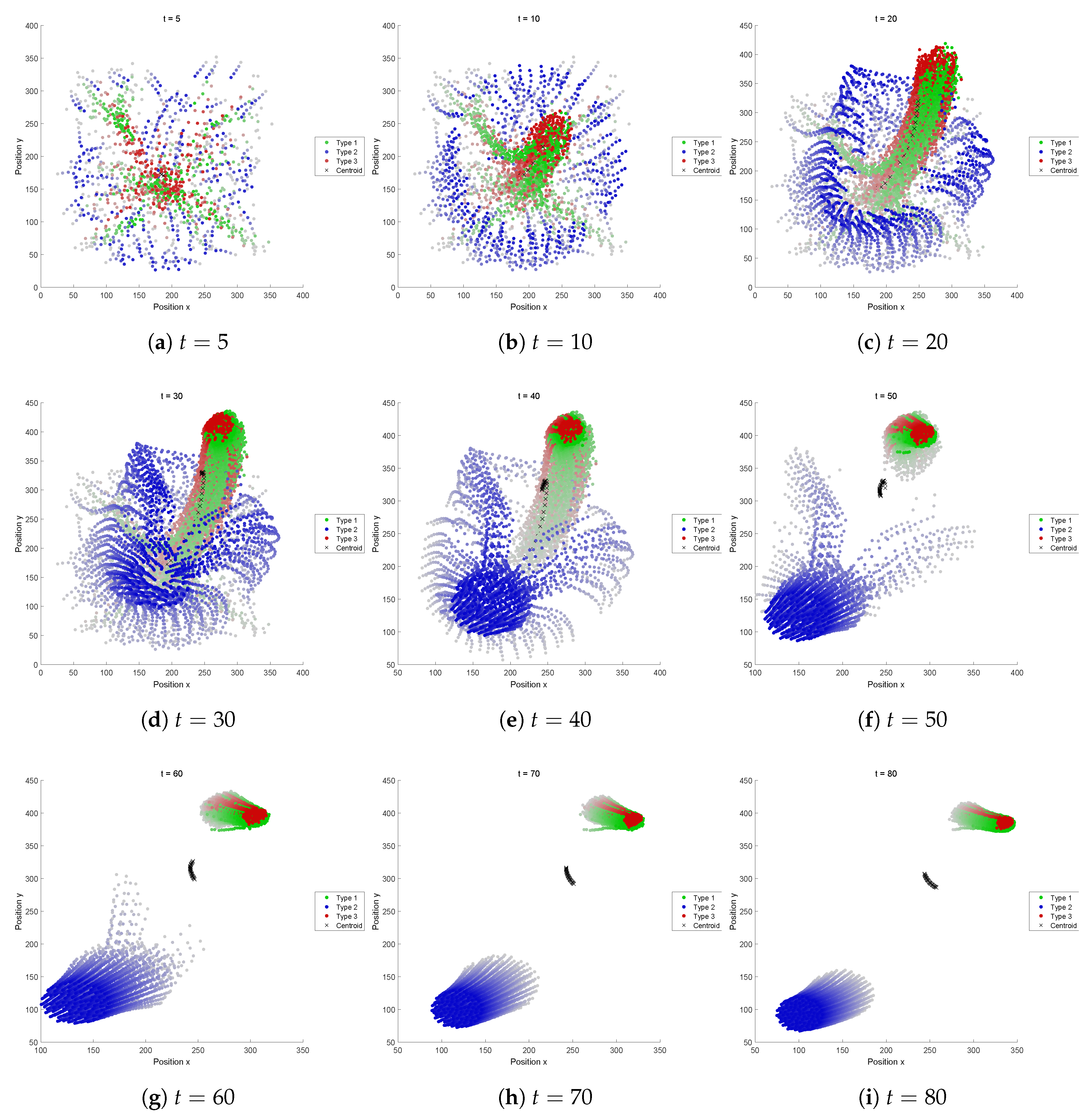
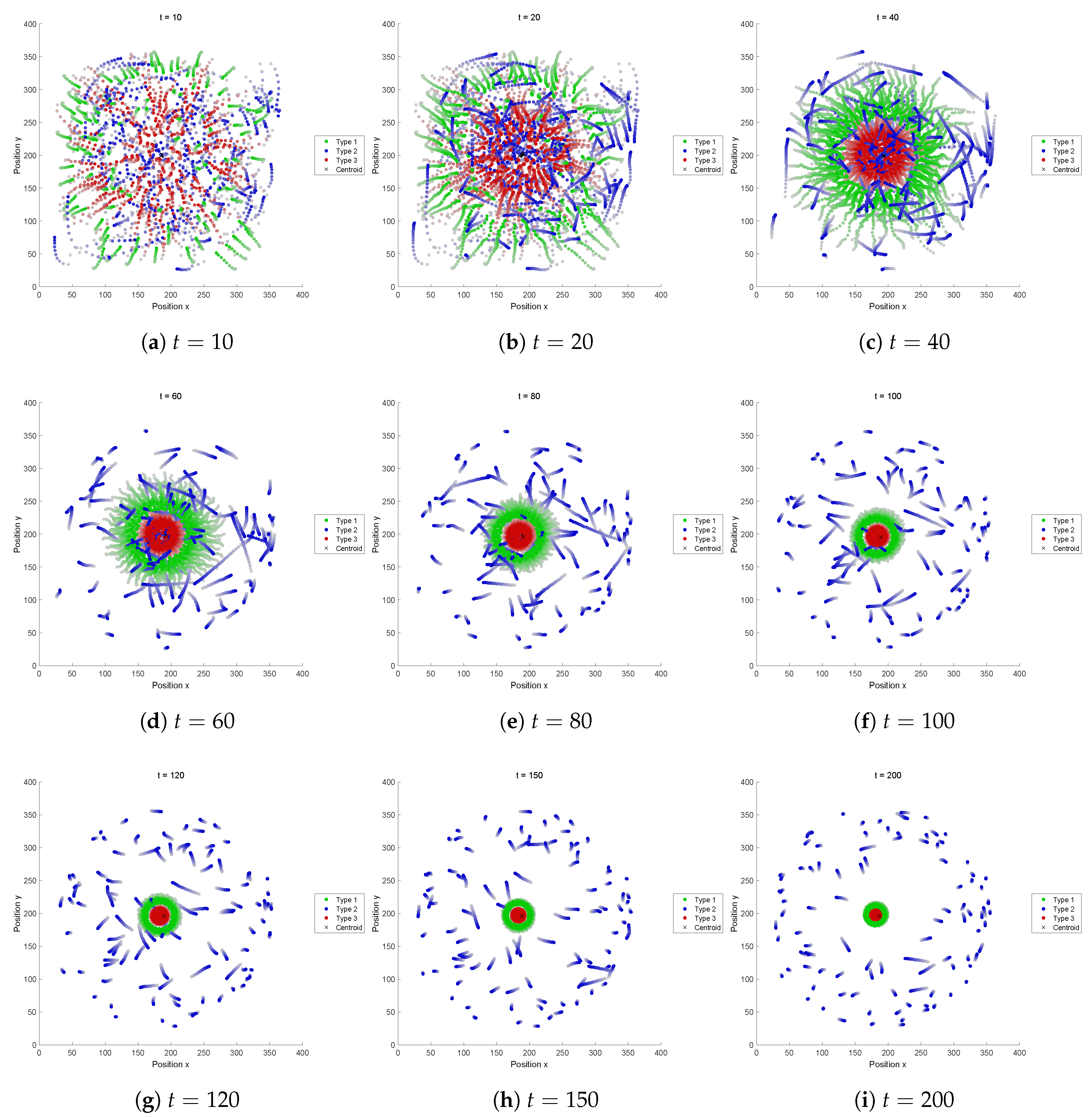
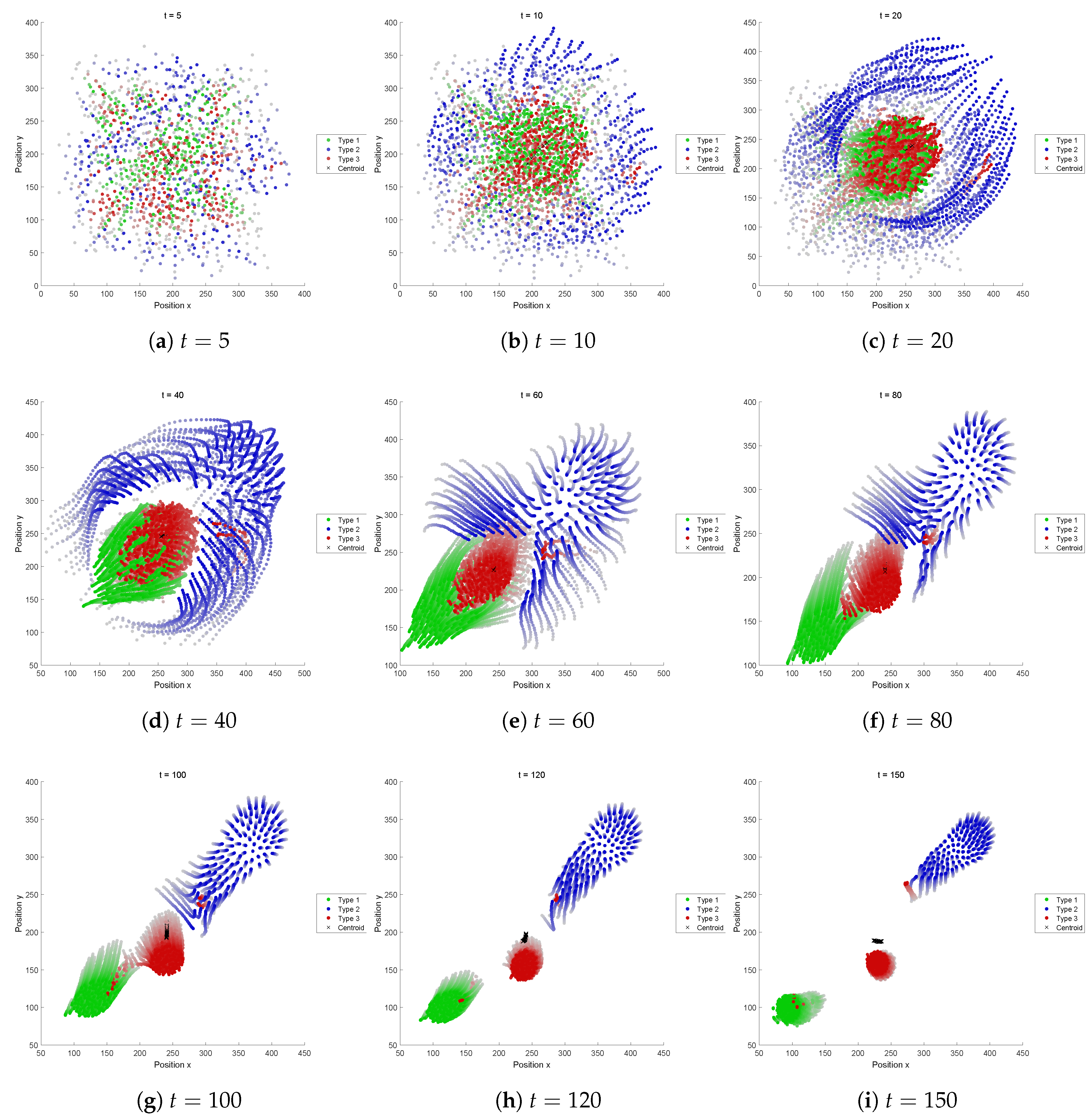
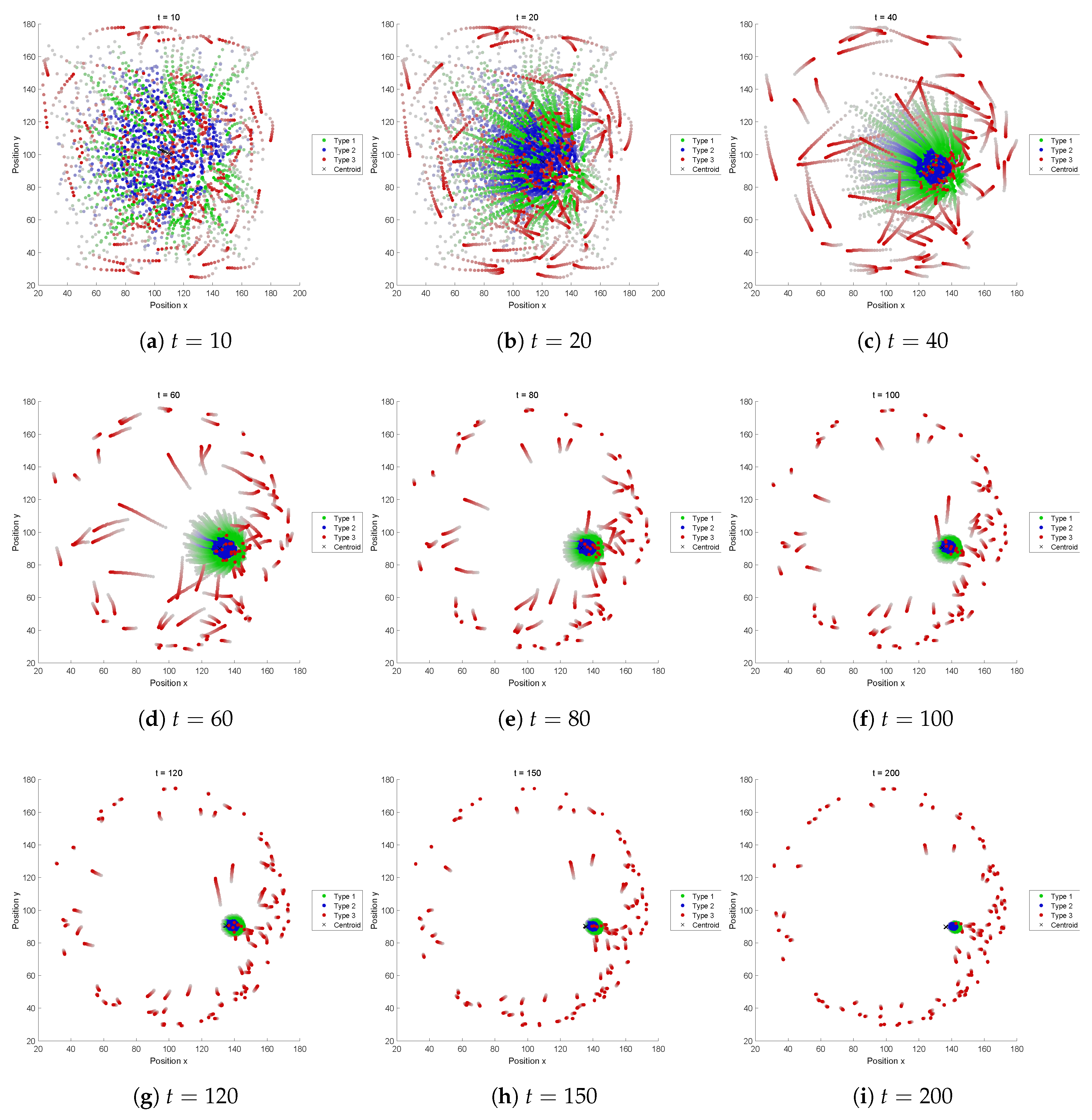
A swarm might exhibit interesting motions or structures when it includes different types of agents. On a swarm model named Swarm Chemistry, some interesting patterns can appear if the parameters are well-tuned. However, there is a hurdle for us to get capable of tuning the parameters by automatic searching methods like a genetic algorithm, particularly because defining interestingness itself is a challenging issue. This paper aims to investigate how interesting patterns can be detected, comparing seven measures from an aspect of system asymmetries. Based on numerical experiments, the effects of changing kinetic parameters are discussed, finding that: (1) segregating patterns, which are frequently observed but uninteresting, tend to appear when the perception range is small and normal (ideal) speed is large or when cohesive force is weak and separating force is strong; (2) asymmetry of information transfer represented by topological connectivity is an effective way to characterize the interestingness; (3) pulsation-like patterns can be captured well by using time-derivative of state variables like network-degrees; (4) it helps capture a gradual structural deformation when fitness function adopts the mean over min-max differences of state variables. The findings will help the efficient search of already-discovered or undiscovered interesting swarm dynamics.
Keywords: swarm behavior; Swarm Chemistry; self-organization; asymmetrical interaction; genetic algorithm swarm behavior; Swarm Chemistry; self-organization; asymmetrical interaction; genetic algorithm
Graphical Abstract