Article

Automatic Taxonomic Classification of Fish Based on Their Acoustic Signals
by
Juan J. Noda
1,*,†,
Carlos M. Travieso
1,2,† and
David Sánchez-Rodríguez
1,3,†
1
Institute for Technological Development and Innovation in Communications, University of Las Palmas de Gran Canaria, Campus Universitario de Tafira, 35017 Las Palmas de Gran Canaria, Spain
2
Signal and Communications Department, University of Las Palmas de Gran Canaria, Campus Universitario de Tafira, 35017 Las Palmas de Gran Canaria, Spain
3
Telematic Engineering Department, University of Las Palmas de Gran Canaria, Campus Universitario de Tafira, 35017 Las Palmas de Gran Canaria, Spain
*
Author to whom correspondence should be addressed.
Current address: Institute for Technological Development and Innovation in Communications, University of Las Palmas de Gran Canaria, Campus Universitario de Tafira, 35017 Las Palmas de Gran Canaria, Spain.
Appl. Sci. 2016, 6(12), 443; https://doi.org/10.3390/app6120443
Submission received: 26 September 2016 / Revised: 25 November 2016 / Accepted: 13 December 2016 / Published: 17 December 2016

Abstract

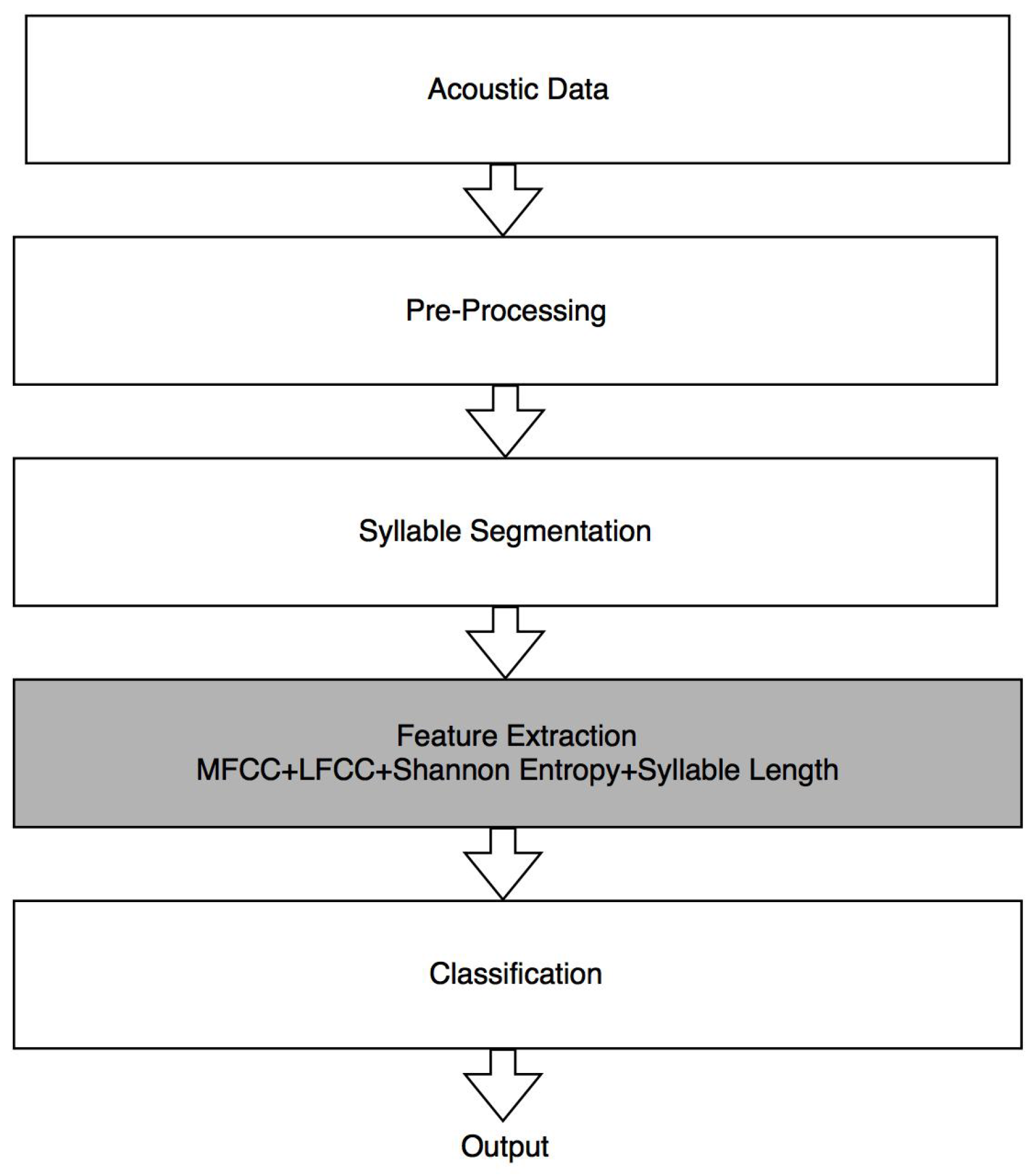
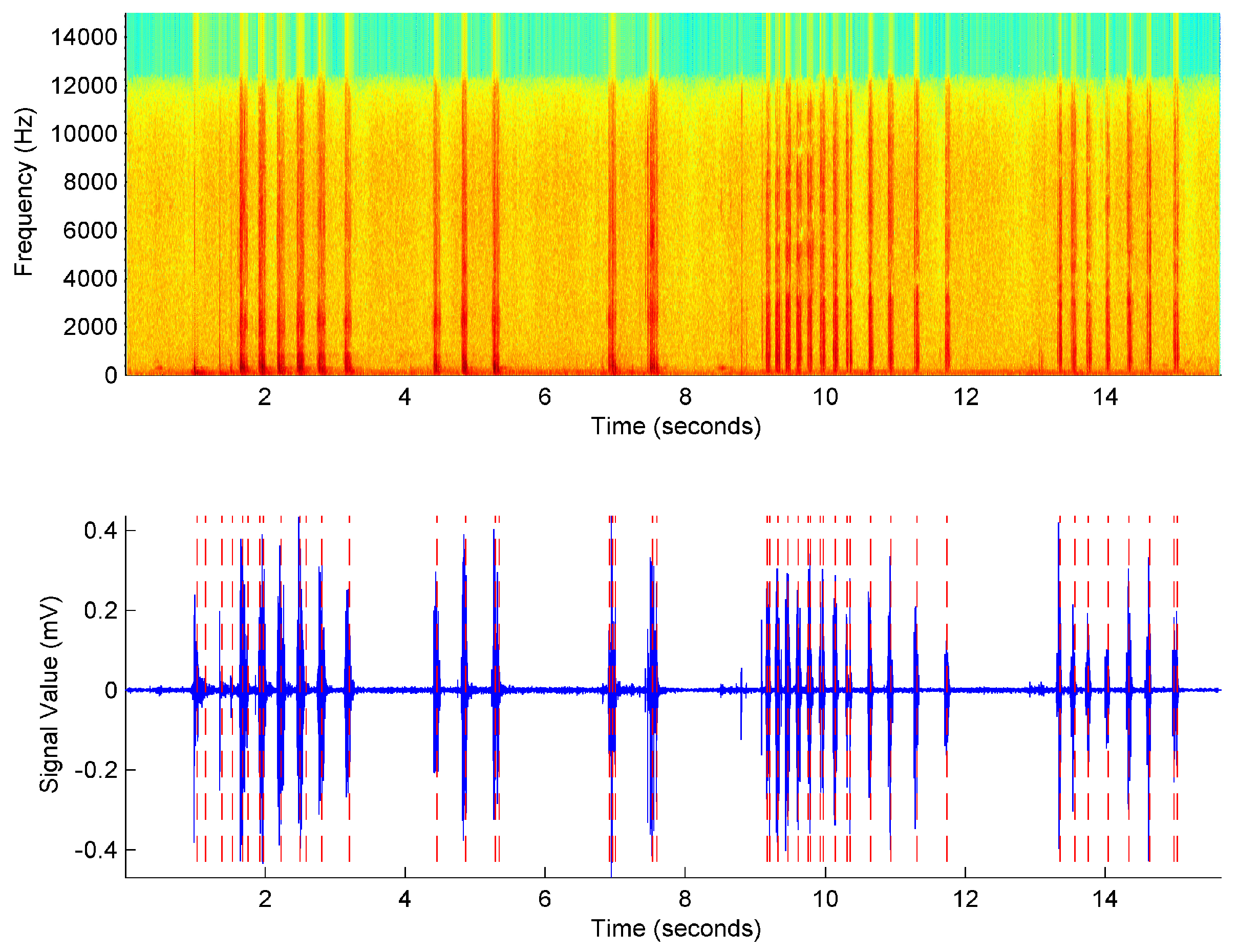
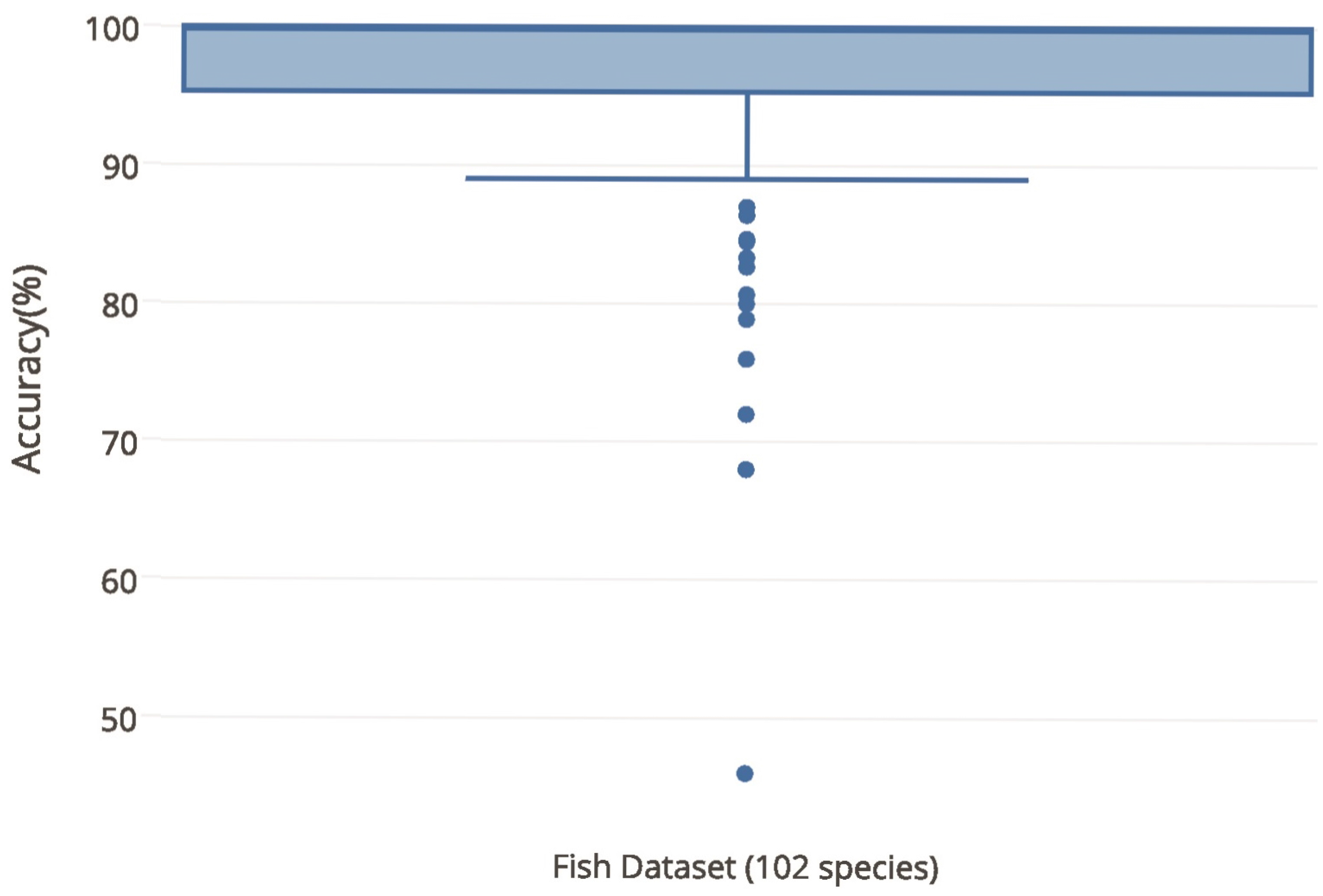
Fish as well as birds, mammals, insects and other animals are capable of emitting sounds for diverse purposes, which can be recorded through microphone sensors. Although fish vocalizations have been known for a long time, they have been poorly studied and applied in their taxonomic classification. This work presents a novel approach for automatic remote acoustic identification of fish through their acoustic signals by applying pattern recognition techniques. The sound signals are preprocessed and automatically segmented to extract each call from the background noise. Then, the calls are parameterized using Linear and Mel Frequency Cepstral Coefficients (LFCC and MFCC), Shannon Entropy (SE) and Syllable Length (SL), yielding useful information for the classification phase. In our experiments, 102 different fish species have been successfully identified with three widely used machine learning algorithms: K-Nearest Neighbors (KNN), Random Forest (RF) and Support Vector Machine (SVM). Experimental results show an average classification accuracy of 95.24%, 93.56% and 95.58%, respectively.
Keywords: biological acoustic analysis; bioacoustic taxonomy identification; fish acoustic signal; hydroacoustic sensors; species mapping biological acoustic analysis; bioacoustic taxonomy identification; fish acoustic signal; hydroacoustic sensors; species mapping