Article

Refined Modeling and Safety Assessment of Tunnel Lining Based on 3D Laser Scanning

1
Highway School, Chang’an University, Xi’an 710054, China
2
Zhaotong Expressway Investment and Development Co., Ltd., Zhaotong 657099, China
3
National Center for Materials Service Safety, University of Science and Technology Beijing, Beijing 100083, China
4
School of Civil Engineering, North China University of Technology, Beijing 100144, China
5
Department of Civil Engineering, Tsinghua University, Beijing 100084, China
6
School of Environmental, Civil, Agricultural and Mechanical Engineering, College of Engineering, University of Georgia, Athens, GA 30602, USA
*
Authors to whom correspondence should be addressed.
Appl. Sci. 2026, 16(9), 4532; https://doi.org/10.3390/app16094532
Submission received: 30 March 2026 / Revised: 22 April 2026 / Accepted: 27 April 2026 / Published: 5 May 2026
(This article belongs to the Special Issue Research on Tunnel Construction and Underground Engineering)

Abstract

Geometric deviations are inevitably generated during tunnel lining construction. These deviations result from construction inaccuracies. They pose potential risks to long-term structural safety and engineering quality. Traditional numerical simulations are based on idealized design cross-sections. This approach is limited in reflecting actual mechanical behavior. In this study, a refined modeling and safety assessment method is developed. Construction-induced geometric deviations are incorporated into the analysis. Optimized geometric fitting and mesh reconstruction algorithms are employed. Large-scale irregular point cloud data are efficiently processed. A full-scale solid finite element model is constructed. Actual construction deviations are represented in this model. The results are systematically compared with those from the conventional design model. It is revealed that construction-induced geometric deviations alter internal force transmission paths. Asymmetric deformation is induced. Localized stress concentrations are observed. The ideal stress state is predicted by the design model. In contrast, stiffness degradation is observed in the as-built model. This degradation is significant in vulnerable regions such as the haunch on the heavily loaded side. A considerable reduction in the local safety factor is also observed. The overestimation of safety redundancy is quantified when geometric variations are neglected. The results indicate that incorporating field-measured point cloud data into structural simulations can improve the geometric realism of tunnel-lining assessment and assist in identifying potential high-risk zones.

1. Introduction

The tunnel lining structure serves as a critical barrier for ensuring the long-term stability of underground engineering, among which the secondary lining plays a dominant role in bearing surrounding rock pressure, controlling structural deformation, and ensuring operational safety. However, due to complex geological conditions, excavation-induced unloading effects, and constraints imposed by construction techniques, geometric deviations such as thickness variation and non-uniform deformation are frequently observed in the lining structure during the construction phase, which may further lead to cracking and water leakage [1,2,3]. If the influence of these early-stage defects on structural bearing capacity is not accurately assessed, potential safety hazards may remain during the operational phase. Therefore, stability analysis of the lining based on its actual state during construction is essential for engineering risk prevention and control. At present, the stability assessment of tunnel linings mainly relies on physical monitoring and numerical simulation. Physical monitoring methods can intuitively reflect the structural state through data such as stress measurements. However, due to the limited arrangement of monitoring points, the comprehensive quantification of internal structural conditions and overall bearing capacity is hindered [4,5,6,7,8,9,10,11,12]. Numerical simulation serves as an effective tool for revealing structural stress mechanisms and states. Nevertheless, most existing analytical models are established based on standard design cross-sections or assumptions of homogeneous material properties [13,14,15,16,17,18,19]. The simulation results derived from such “ideal models” often fail to reflect the geometric distortions caused by overbreak, underbreak, and construction errors. This discrepancy between the model and the actual structure leads to results that cannot accurately represent the real engineering risks.
With the advancement of finite element theory and constitutive models, numerous studies have incorporated factors such as lining construction conditions, surrounding rock interactions, support parameters, groundwater coupling, and time-dependent effects into the analytical framework. Insights have been gained in areas including the identification of stress concentration zones, evolution of plastic zones, and structural response to loading [20,21,22,23]. However, in terms of geometric representation, most models remain within the scope of parametric or idealized configurations. As a result, accurate simulation of non-standard features such as arch shoulder deformation and asymmetric loading for a specific cross-section is difficult to achieve. This limitation leads to discrepancies between simulation results and field measurements. Three-dimensional laser scanning enables millimeter-level acquisition of lining geometry, defects, and convergence deformation. Techniques such as point cloud reconstruction, profile extraction, and multi-temporal registration have significantly advanced the digital representation of tunnel structures. Nevertheless, existing research has primarily focused on deformation monitoring, clearance analysis, configuration recognition, or surface reconstruction. The integration of point cloud data into mechanical modeling remains limited, with its application largely confined to inspection and visualization [24,25,26,27,28,29,30,31,32,33]. Therefore, a numerical simulation method for tunnel linings that uses three-dimensional scanning point cloud data as the geometric and configurational input is necessary. Such an approach would enable mechanical response analysis based on the as-built structural morphology.
In light of this, the present study addresses practical engineering requirements by conducting refined modeling and safety assessment of tunnel linings that incorporate construction-induced geometric deviations. By extracting actual lining profiles and component boundaries from field-measured point cloud data, a numerical model that reflects the true as-built geometric characteristics is constructed. The measured data used in this study are geometric/deviation measurements rather than assumed geometric inputs. Their role is to capture construction-induced thickness deviations, contour irregularities, and local curvature mutations that cannot be faithfully represented by the design cross-section alone. By transforming such field-measured geometric data into finite element input, the actual stress state and safety reserve of the tunnel lining can be evaluated more realistically. This approach overcomes the limitations imposed by idealized assumptions in traditional models and provides a direct engineering basis for structural stability assessment and subsequent reinforcement design.

2. Finite Element Modeling Method of Tunnel Lining Based on Three-Dimensional Point Cloud Data

2.1. Tunnel Lining Point Cloud Data Acquisition and Preprocessing

2.1.1. Laser Scanning Principle

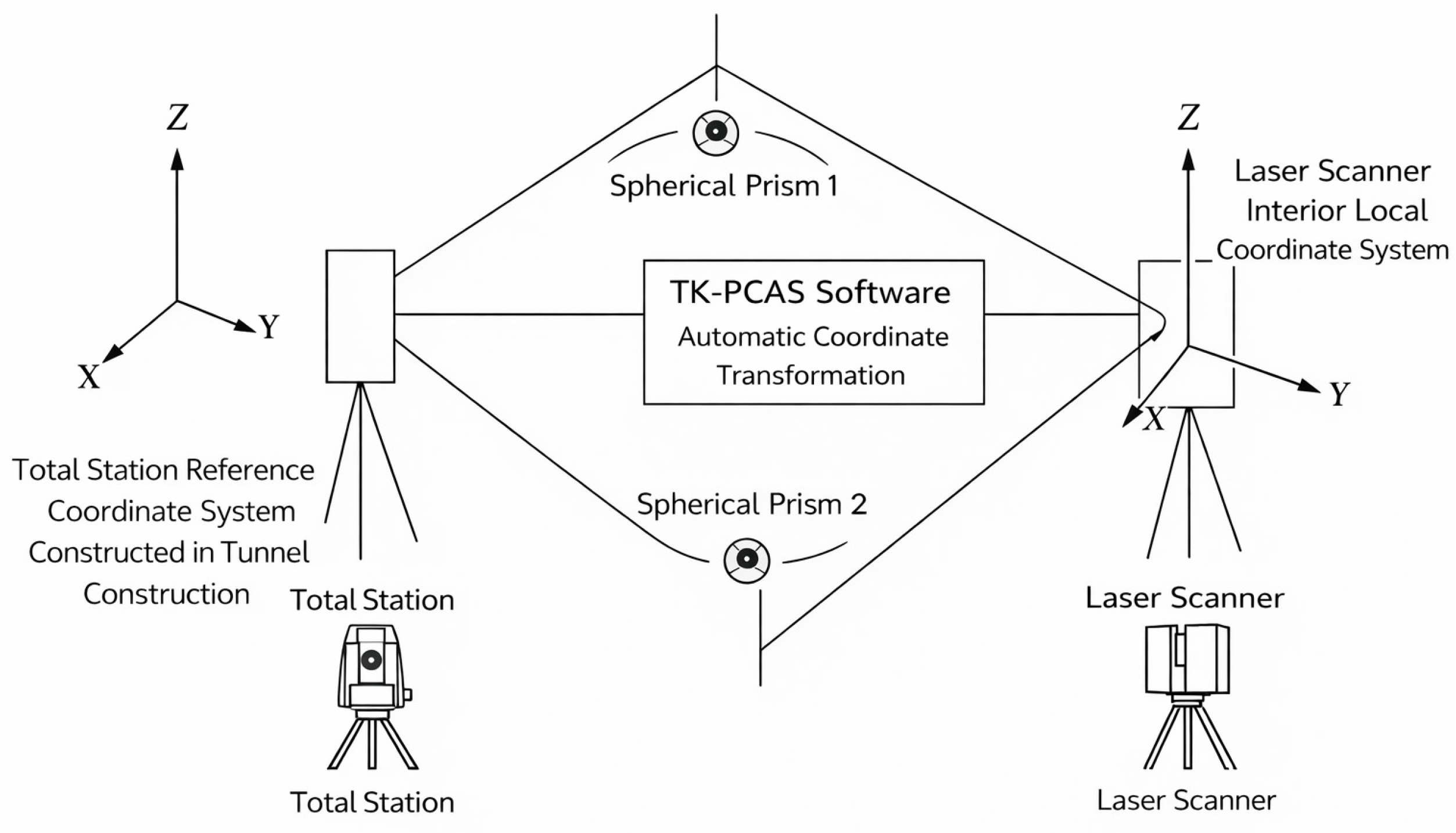
Three-dimensional laser scanning is based on the principle of laser ranging combined with angular encoding. The distance to a target is obtained through time-of-flight or phase difference measurements. This distance is denoted as R . The horizontal and vertical angles are represented as θ and φ , respectively. The three-dimensional coordinates of the target point are calculated in the instrument coordinate system, denoted as P s . These coordinates are then transformed into engineering coordinates P g in the real world using Equation (2). Control targets, such as spherical prisms, are employed for coordinate unification. Their precise positions are measured in the construction coordinate system using a total station. A rigid transformation is performed to unify the local and global coordinate systems. In this manner, a comparable engineering benchmark is established for the point cloud data, as shown in Equations (1) and (2). Measurement accuracy is mainly affected by factors such as ranging noise, angular resolution, incident angle, and surface reflectivity. Point spacing is determined by both the measurement distance and the angular resolution.
R = c t 2
Ρ g = R Ρ s + t
Based on the aforementioned mechanism, the data processing workflow in this study is streamlined to include only the essential steps, as illustrated in Figure 1. (1) Instrument calibration and stability verification are performed, which include the configuration of resolution and field of view. (2) The coordinate reference frame is established, wherein the total station is used to measure control targets, and the exterior orientation elements are solved. (3) Point cloud registration is conducted, which involves coarse registration constrained by target features and fine registration using algorithms such as iterative closest point. (4) Quality assessment is carried out, where the residual errors of control points, the root mean square error of inter-station registration, point density, and occlusion coverage rates are evaluated against predefined thresholds. (5) Data output is generated, consisting of globally consistent point cloud data and associated metadata, thereby providing a reliable data source for subsequent design alignment and deviation analysis.
The resulting dataset therefore represents field-measured as-built geometric data of the tunnel lining, which forms the basis for subsequent deviation quantification and geometry-informed finite element modeling.

2.1.2. Laser Scanning Process of Outer Surface of Tunnel Lining

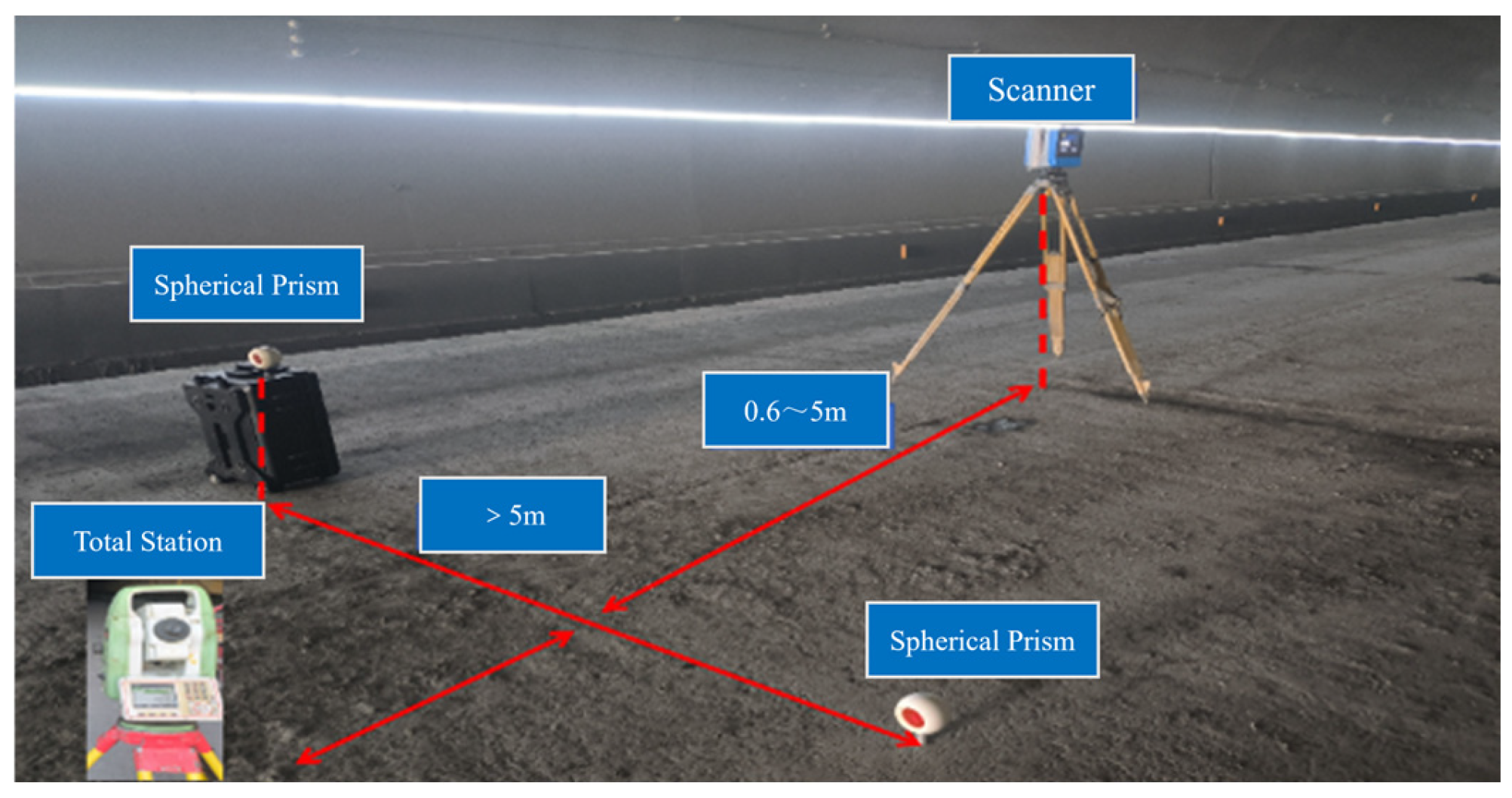
As shown in Figure 2, a typical section located approximately 150 m from the tunnel entrance was selected within the left tube of the experimental tunnel. This section was scanned using a combination of three-dimensional laser scanning and total station surveying. High-precision as-built geometry was obtained through this integrated approach. The coordinates of control targets were used to unify the coordinate systems of multiple scan stations. Stable registration of the point cloud data was achieved accordingly. The processed point cloud was subsequently used for geometric reconstruction and numerical modeling. The detailed procedures are summarized in Table 1.
In addition, automatic conversion from the internal coordinate system of the laser scanner to the tunnel construction coordinate system controlled by the total station is realized using the TK-PCAS companion software. As a result, the acquired three-dimensional point cloud data are assigned global georeferencing attributes, meaning that accurate spatial coordinate information is obtained for any point within the tunnel. During the data acquisition phase, a scanning route following an “outside–in, primary–supplementary” strategy was adopted. Resolution and field of view were appropriately configured to ensure sufficient overlap between adjacent stations and adequate point density at critical locations such as the arch crown, arch foot, and sidewall junctions. Areas affected by occlusion or abnormal echo signals were promptly rescanned. Rolling quality control measures were implemented on site. These included verification of residual errors at control points, spot checks of inter-station registration errors, inspection of holes or blind zones, and supplementary scanning where necessary. Upon completion of the field work, point cloud data from individual stations and corresponding control information were backed up in duplicate. Equipment settings and environmental conditions were also recorded to facilitate traceability.
To ensure the quality of the point cloud data, strict control was exercised over equipment stability, scanning resolution, and ambient light interference during data acquisition. After the field scanning was completed, the raw point cloud data were imported into the professional software platform Cyclone9.1 for preprocessing. Preprocessing operations included noise filtering, point cloud registration, outlier removal, and spatial alignment. These steps established a solid data foundation for subsequent geometric analysis and structural reconstruction.

2.2. Geometric Fitting and Simplification Algorithm of Point Cloud Data

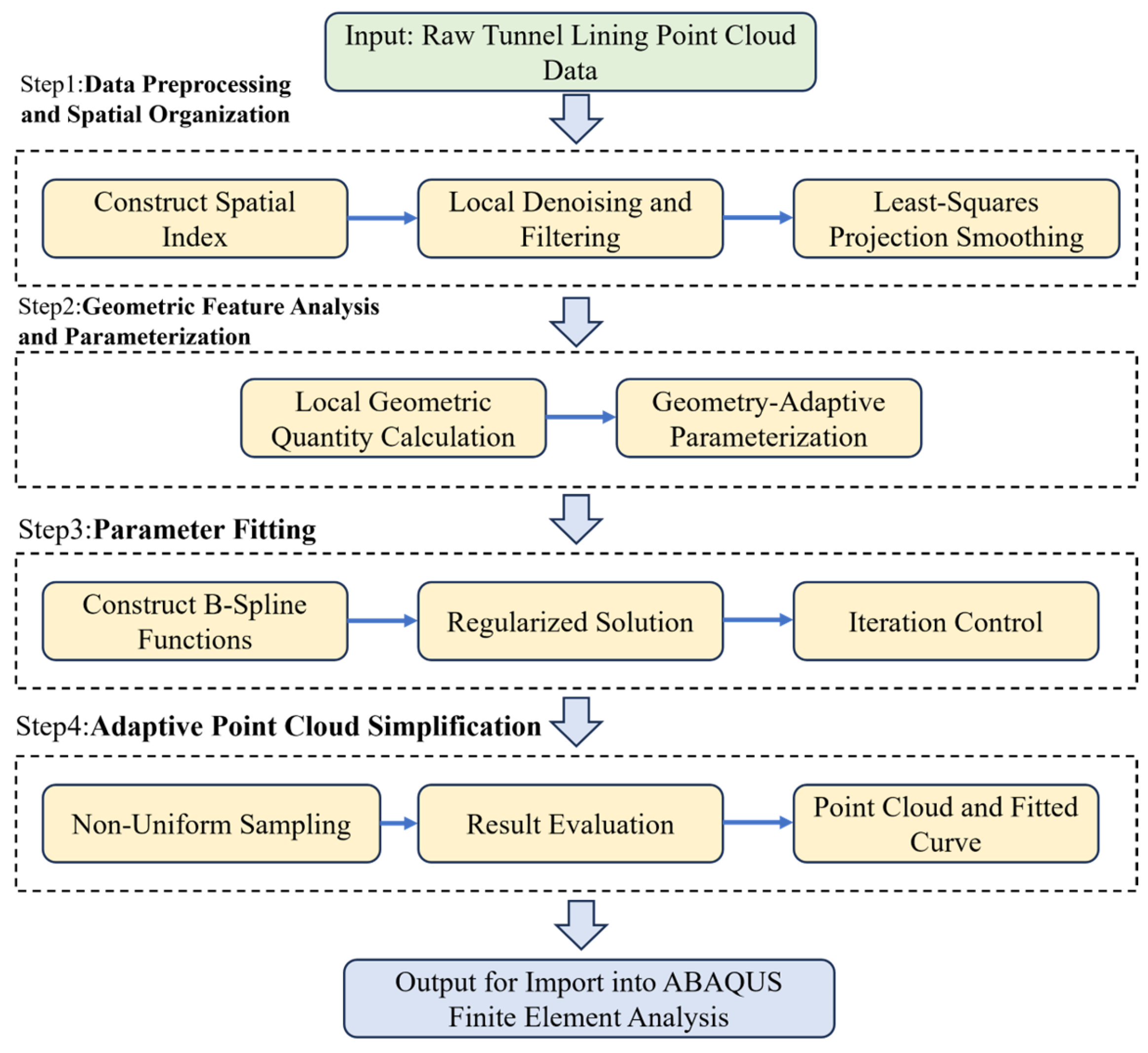
For the three-dimensional scanning point cloud data of large-scale tunnel engineering projects, the core challenges in converting irregular point clouds into geometric curves lie in computational efficiency, feature fidelity, and robustness against noise and non-uniformity. To address these challenges, a multi-scale hierarchical processing framework and a data-adaptive regularized fitting model are designed in this study, taking into account the geometric characteristics of tunnel engineering and the requirements of data processing algorithms. The main algorithmic workflow is divided into four steps, as illustrated in Figure 3.
The workflow shown in Figure 3 was adopted to balance geometric fidelity, feature preservation, and downstream compatibility with finite element analysis. By using field-measured geometry rather than an idealized design section, the method preserves construction-induced deviations that are directly relevant to structural response. In addition, instead of directly meshing raw point clouds, the proposed procedure introduces denoising, parameterization, fitting, and adaptive simplification to reduce the influence of measurement noise, improve mesh robustness, and control computational cost. Meanwhile, it retains local curvature mutations and thickness irregularities that may be smoothed out by overly simplified profile-fitting approaches.

2.2.1. Data Preprocessing and Spatial Organization

For the raw point cloud P = { p i = ( x i , y i , z i ) T R 3 } i = 1 N , which is characterized by a large volume and highly irregular distribution—including non-uniform density, noise, and outliers—the primary task is considered to be the reduction of global computational complexity and the suppression of noise. First, a hierarchical spatial indexing structure is constructed based on a K-dimensional tree. This structure is built by recursively partitioning the three-dimensional space. The point cloud is organized into units with spatial locality. Within each voxel, a point set P voxel P is contained. This divide-and-conquer strategy provides a foundation for subsequent parallel processing and local computations. Subsequently, a moving least squares method is applied within each local unit for smoothing and denoising. This is performed based on K-nearest neighbor search. For a given point p i , a local reference plane or quadratic surface is fitted within its neighborhood N ( p i ) . The point p i is then projected onto this surface. As a result, a denoised point p ~ i is obtained. Through this step, measurement noise is effectively smoothed, while the original geometric features are preserved.

2.2.2. Geometric Feature Analysis and Parameterization

After obtaining the denoised point set P ~ = { p ~ i } , the extraction of its intrinsic geometric structure is required for subsequent curve-based description. The normal vector n i and curvature κ i are estimated for each point using local principal component analysis. For a given point p ~ i , a neighborhood point set N ( p ~ i ) is defined. A covariance matrix is then constructed from the points within this neighborhood, as expressed in Equation (3):
C i = 1 N i q N i ( q q ˉ ) ( q q ˉ ) T , C i v j = λ j v j , λ 0 λ 1 λ 2
The curvature κ i serves as a critical indicator for identifying geometric features such as corners and edges. The subsequent step involves a key parameterization procedure, through which the three-dimensional points are mapped onto a one-dimensional parametric domain t [ 0 , 1 ] .
This mapping provides parametric coordinates for the subsequent curve fitting process. For point clouds that are unordered and may contain branching structures, topological reconstruction and segmentation are first required. It is assumed here that the region being processed corresponds to a single, well-defined point cloud segment. An adaptive parameterization based on chord length is then adopted. This parameterization is defined as shown in Equation (4), where the parameter value at each point is computed according to the cumulative chord length along the point sequence. In this manner, the spatial distribution of the points is properly reflected in the parametric domain:
t 1 = 0 , t i = t i 1 + p ~ i p ~ i 1 j = 2 N p ~ j p ~ j 1 , i = 2 , , N
This method introduces the curvature weight and stretches the parameter interval in the high curvature region to allocate more parameter resources so as to better capture features.

2.2.3. Fitting of Parameter Curve

The denoised point set ( t i , p ~ i ) is fitted into a parametric curve. A non-uniform rational B-spline (NURBS) representation is adopted for this purpose. A k-th degree B-spline curve is defined as shown in Equation (5):
C ( t ) = j = 0 m B j , k ( t ) c j
where B j , k ( t ) denotes the j-th B-spline basis function of degree k , which is defined by the knot vector U = [ u 0 , u 1 , , u m + k + 1 ] . The control points c j R 3 are to be determined. The fitting process is formulated as a minimization of a regularized least squares objective function, as given in Equation (6):
E = i = 1 N w i p ~ i C ( t i ) 2 + λ 1 0 1 C ( t ) 2 d t + λ 2 0 1 C ( t ) 2 d t + γ features C ( t f ) p ~ f 2
The weights w i are assigned according to the importance of each point, such as those located in feature regions. The parameters λ 1 and λ 2 control the first-order (tension) and second-order (bending) smoothness of the curve, respectively. The feature constraint term is used to enforce the curve to pass through manually or automatically detected key feature points p ~ f . The optimization problem is solved using the iteratively reweighted least squares (IRLS) method, from which the control points c j are obtained.

2.2.4. Point Cloud Adaptive Simplification

After the fitted curve C ( t ) is obtained, the original dense point cloud P ~ can be significantly reduced. Only the key points that represent the curve shape and its geometric features are retained. In the reduction process, an importance score S i is computed for each parametric point t i within the parametric domain [ 0 , 1 ] . This score is constructed by integrating both the geometric contribution, measured by the fitting residual p ~ i C ( t i ) at the point, and the geometric feature, represented by the curvature κ i . Sampling is then performed based on the importance score S i . More points are retained in regions of high importance, such as those characterized by high curvature or large fitting residuals, while points are sparsely sampled in flatter regions. This sampling can be realized by setting an adaptive threshold τ ( t ) or by using a variant of the maximum–minimum distance sampling. Care is taken to ensure that the reduced point set still clearly defines the start point, end point, and any sharp corners of the curve. Topological alteration or loss of geometric features due to over-simplification is thus avoided. Ultimately, the reduced point set P reduced and the fitted curve C ( t ) together form a concise and accurate geometric representation of the original massive point cloud.

2.3. Real Section Finite Element Model Generation Technology

The process of importing the geometric curve data obtained from point cloud fitting into ABAQUS.2023 and generating the analysis mesh requires careful handling to ensure geometric fidelity and mesh quality. The core workflow is divided into three stages: data format conversion and import, geometry processing and meshing in ABAQUS/CAE, and mesh optimization and verification.

2.3.1. Data Format Conversion and Import

After the geometric fitting is completed, the B-spline surface model is first converted into a standard CAD format recognizable by ABAQUS.2023, such as STL. In the fitting procedure, parameters including control points, knot vectors, and curve degrees are exported as .step or .xt files through the geometric kernel library. Subsequently, the point cloud is meshed using Meshlab 2023.12, and the resulting mesh is exported as an STL file. This STL file is then imported into SolidWorks 2023 SP5.0, where a solid model is generated. Following this, HyperMesh 2023.1 is used to complete any missing mesh elements. The final mesh is exported as an INP file. Finally, the mesh is imported into ABAQUS.2023 using the “Plug-ins > Tools > STL Import” plugin. Upon import, the model is converted into a part within ABAQUS/CAE. Care is taken to ensure that the unit system used during export is consistent with that of the subsequent analysis model.

2.3.2. Geometric Repair and Mesh Generation

The imported geometry often contains minor features, gaps, or imprecise edges. Therefore, geometry repair and simplification are necessary steps before mesh generation. In the Part module of ABAQUS.2023, the Geometry Diagnostics tool is used to identify such issues. For complex geometries derived from point cloud fitting, the virtual topology function is particularly important. This function simplifies the topological structure by merging insignificant small faces and ignoring short edges, which greatly improves the robustness of meshing and the resulting element quality. Subsequently, global seeds are assigned to define the overall element size. Local seeds are then applied in regions of high curvature or particular interest to achieve finer resolution. For complex shapes, the Free meshing technique with tetrahedral elements is typically selected. If the geometry is regular, the Swept meshing technique is chosen to obtain more efficient hexahedral elements.

2.3.3. Deviation Control and Grid Quality Inspection

Controlling the deviation of the mesh relative to the original geometry is essential for ensuring analysis accuracy. In the mesh control options of ABAQUS.2023, curvature control is activated and a maximum deviation factor is specified. A smaller value of this factor yields a mesh that conforms more closely to the geometry, although it also increases the element count. In regions of high curvature identified during the fitting stage, namely those that exhibited pronounced stretching during the earlier parameterization process, stricter local deviation control was applied. After the mesh is generated, a systematic verification is performed using the Mesh Verify tool in ABAQUS.2023. Attention is focused on element shape metrics, such as element shape factor and aspect ratio, as well as the Jacobian. Severely distorted elements that could lead to non-convergence in the analysis are thus avoided. Through this approach, the fitted geometry is reliably transformed into a high-quality mesh model suitable for finite element analysis.

3. Engineering Application and Model Construction

3.1. Engineering Overview

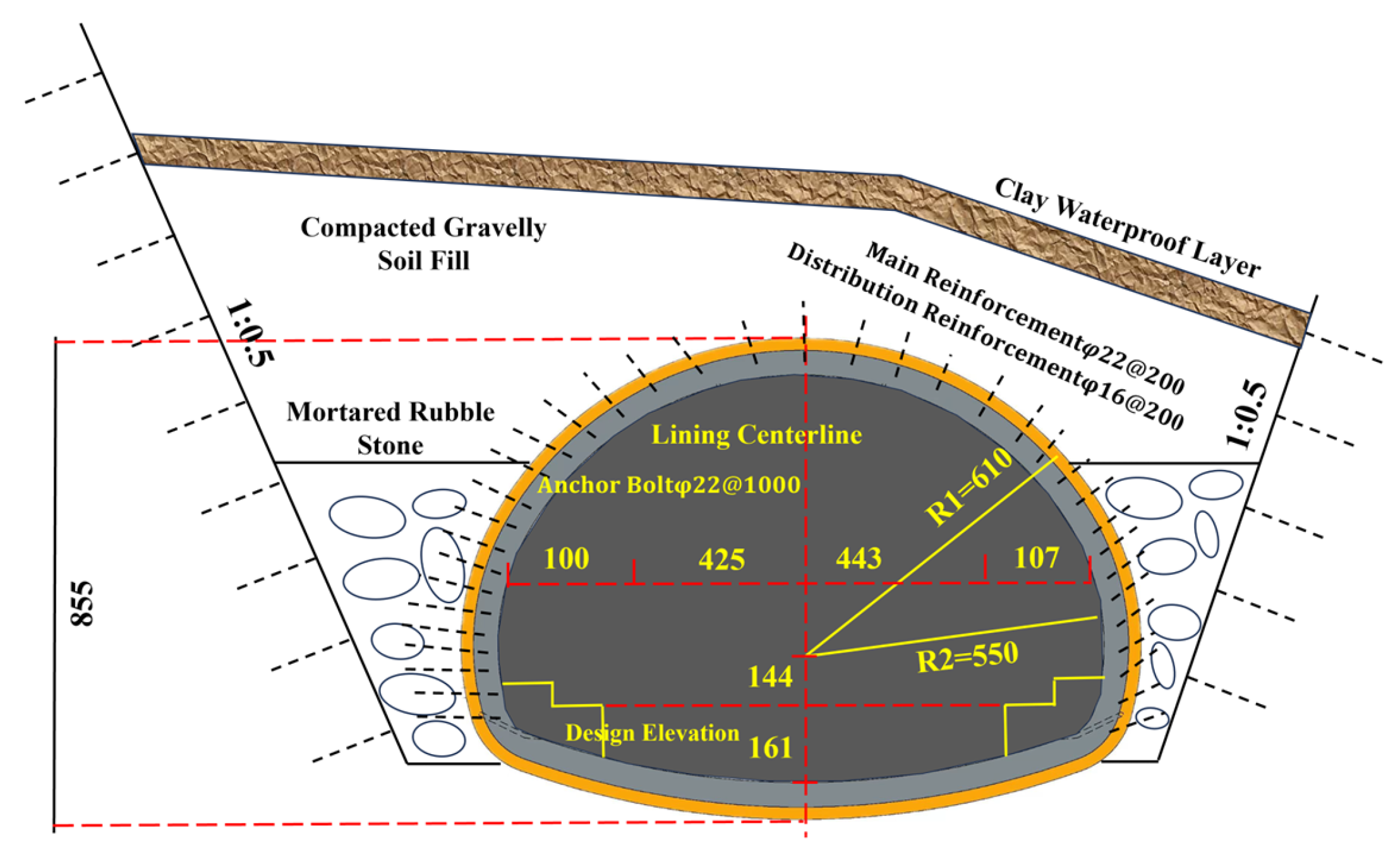
This study is based on a certain section of the “Yongshan Connecting Line Tunnel Project” in Yunnan Province, China, which is a typical mountainous expressway. The tunnel structure in this section is arranged in a curved alignment along the longitudinal direction. The structural design of the left tunnel portal section takes full consideration of the complexity of topography, geology, and excavation conditions. The main physical and geometric configuration is illustrated in Figure 4.
In terms of structural cross-section design, the tunnel has a net width of approximately 10.5 m and a net height of approximately 8.55 m. A composite lining structure is adopted. The primary support consists mainly of Φ22 longitudinal steel bars, C30 concrete, and rock bolts. This support system is designed to control surrounding rock deformation and provide structural stability during construction. In the portal section, Φ22 main steel bars are added to the sidewalls and arch, together with Φ16 stirrups at 200 mm spacing, forming a double-layer bidirectional reinforcement scheme. This configuration further enhances the crack resistance of the lining. The secondary lining is made of C30 reinforced concrete, with a thickness ranging from 40 cm to 50 cm depending on the location.
Due to the significant topographic relief at the portal section, retaining walls and open-cut tunnel structures are arranged on both sides of the portal. Reinforced concrete retaining walls are adopted for slope protection, and a blind drainage system is installed. In some sections, reinforced concrete sidewalls are additionally constructed to ensure the stability of the portal slope and structural safety during construction.

3.2. Boundary Conditions and Material Parameters

In the finite element model established in this study, a typical excavation-backfill simulation logic is adopted for the soil structure. The excavation process is dynamically controlled using the element birth and death technique. In the initial state of the model, the tunnel excavation profile is predefined. The sequential progression of tunnel excavation and support installation is simulated by activating or deactivating the corresponding elements. The tunnel body region is removed from the model in advance. The gradual construction of the support structure and the unloading response of the surrounding soil are subsequently simulated through the application of the birth and death technique.
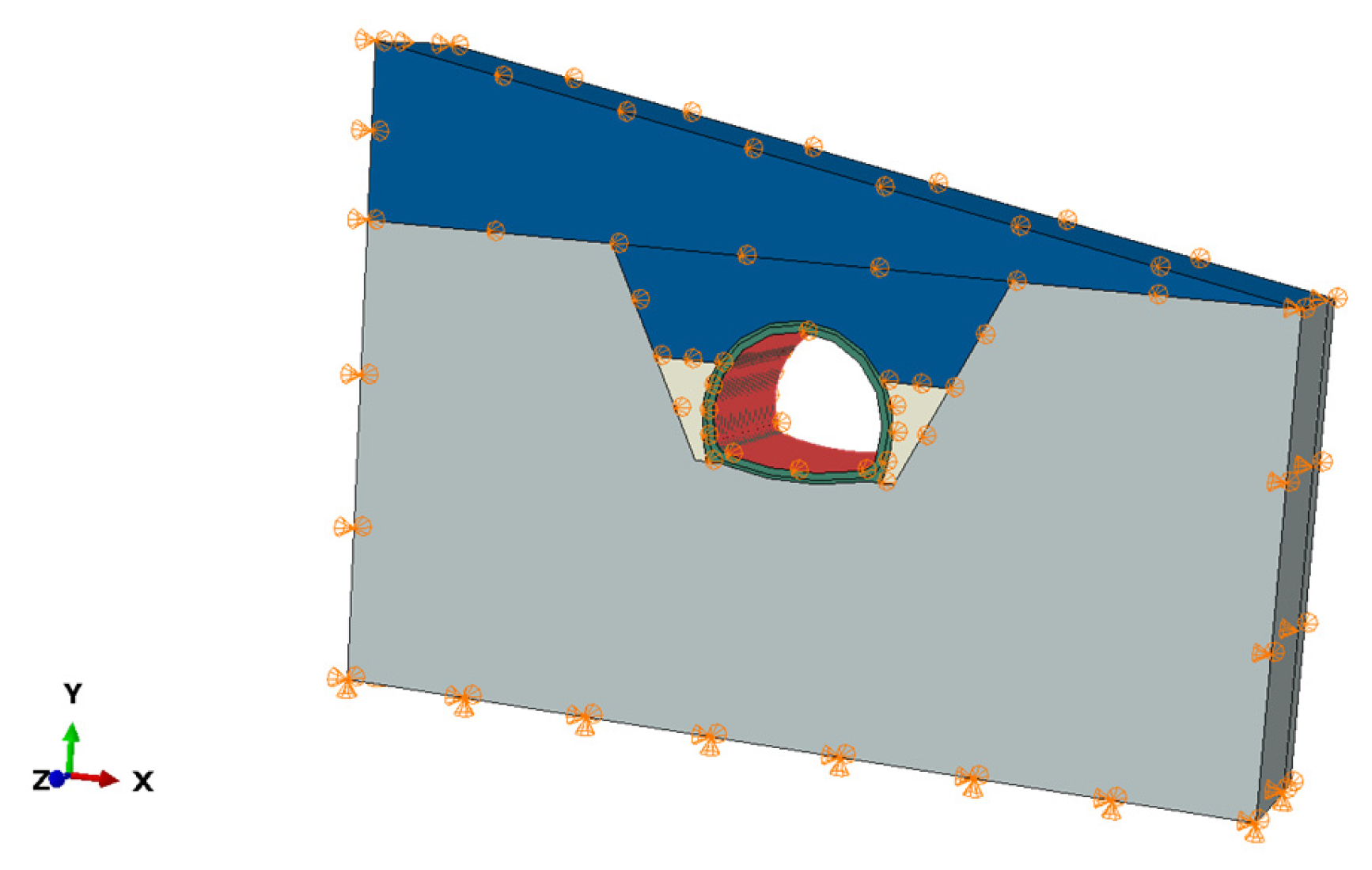
To minimize the influence of boundary effects on the computed results and to accurately reflect the semi-infinite characteristics of underground engineering, the boundary conditions are defined according to the Saint-Venant principle. Normal displacement constraints are applied to the left, right, front, and rear sides of the model. These constraints simulate the lateral support of the surrounding rock at an infinite distance. Full constraints are applied to the bottom surface of the model to represent the embedment effect of the deep bedrock. The top surface is defined as a free surface, without any displacement constraints, allowing free settlement and deformation of the ground surface to reflect actual site conditions, as illustrated in Figure 5.
Considering that geomaterials such as surrounding rock, backfill soil, and rubble masonry exhibit significant pressure dependency and dilatancy, all soil and rock materials are modeled using the Mohr–Coulomb elastic–plastic constitutive model. This model adequately describes the stress–strain behavior of geomaterials during shear failure. The yield function F is defined as:
F = τ σ n t a n φ c
where τ is the shear stress, σ n is the normal stress, ϕ is the internal friction angle of the material, and c is the cohesion. According to this criterion, yielding or failure occurs when the shear stress on any plane within the material reaches the limit value determined by the normal stress and the shear strength parameters of the material.
The tunnel lining structure is primarily responsible for bearing structural loads in the simulation. A high elastic modulus of 30 GPa is assigned to represent the stiffness response of the secondary lining, ensuring the safety of the support system. The rubble masonry material, with density and strength properties intermediate between those of concrete and surrounding rock, is used to simulate the portal section or slope support structures. The backfill material is characterized by a low elastic modulus and a small internal friction angle, representing the loose characteristics of overburden soil or backfill zones. The surrounding rock represents the stiffness and shear strength properties of the natural rock mass and serves as the primary load-bearing component in the model. The detailed physical and mechanical property parameters of the main materials are summarized in Table 2.

3.3. Data Acquisition and Model Establishment

3.3.1. Ideal Model Based on Design Parameters

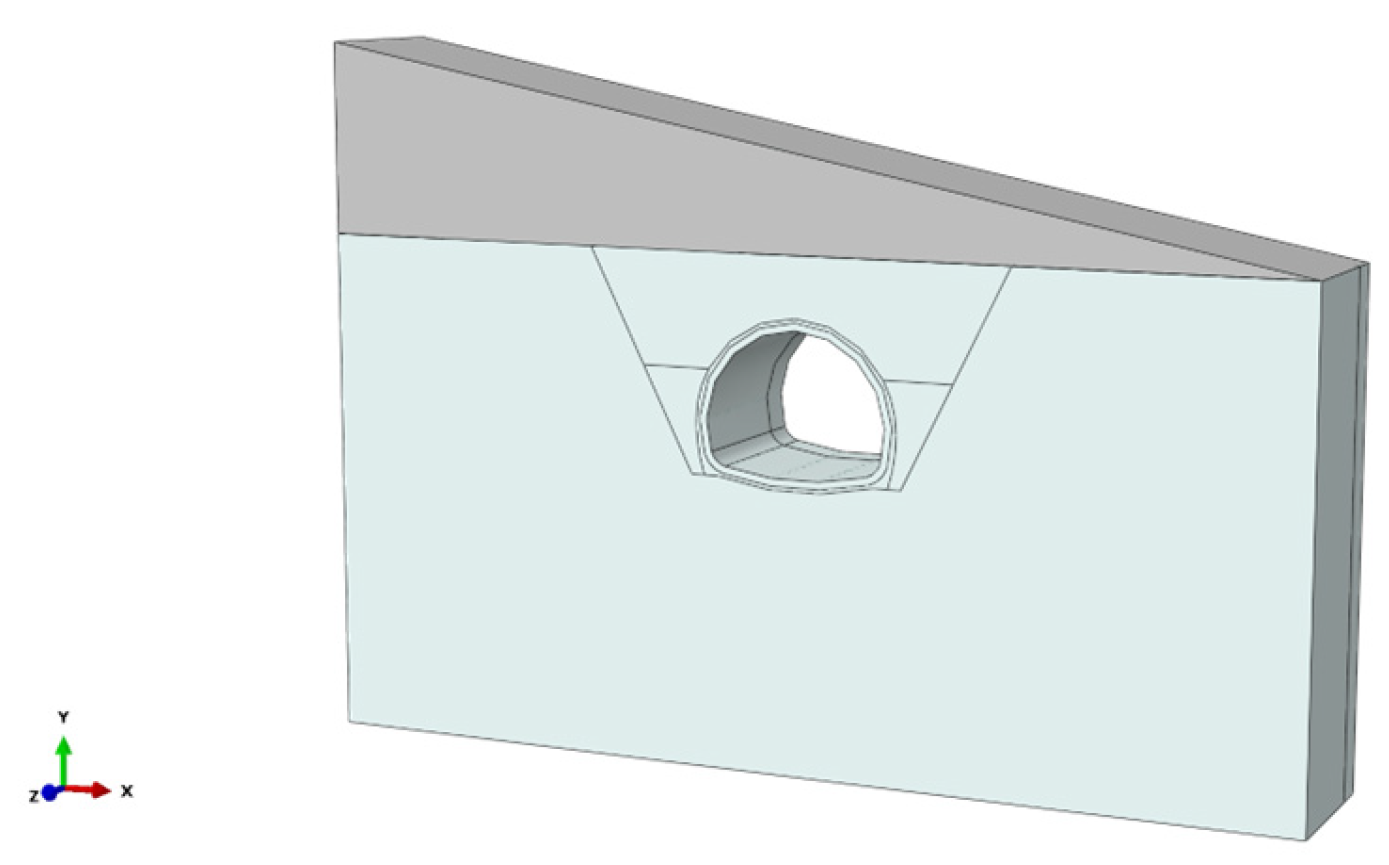
In the three-dimensional finite element model of the overall tunnel lining structure, the primary support and the secondary lining are integrated into a complete lining assembly. This configuration enables the overall morphology of the lining under the surrounding rock conditions to be effectively represented and the mechanical response during excavation to be analyzed. While maintaining the geometric and material properties of the lining, the reinforcement cage and the rock bolt system were incorporated into the model (the structural details are shown in Figure 6). This incorporation enhances the physical realism and engineering applicability of the model in terms of detailed structural response, localized stress analysis, and damage evolution simulation.
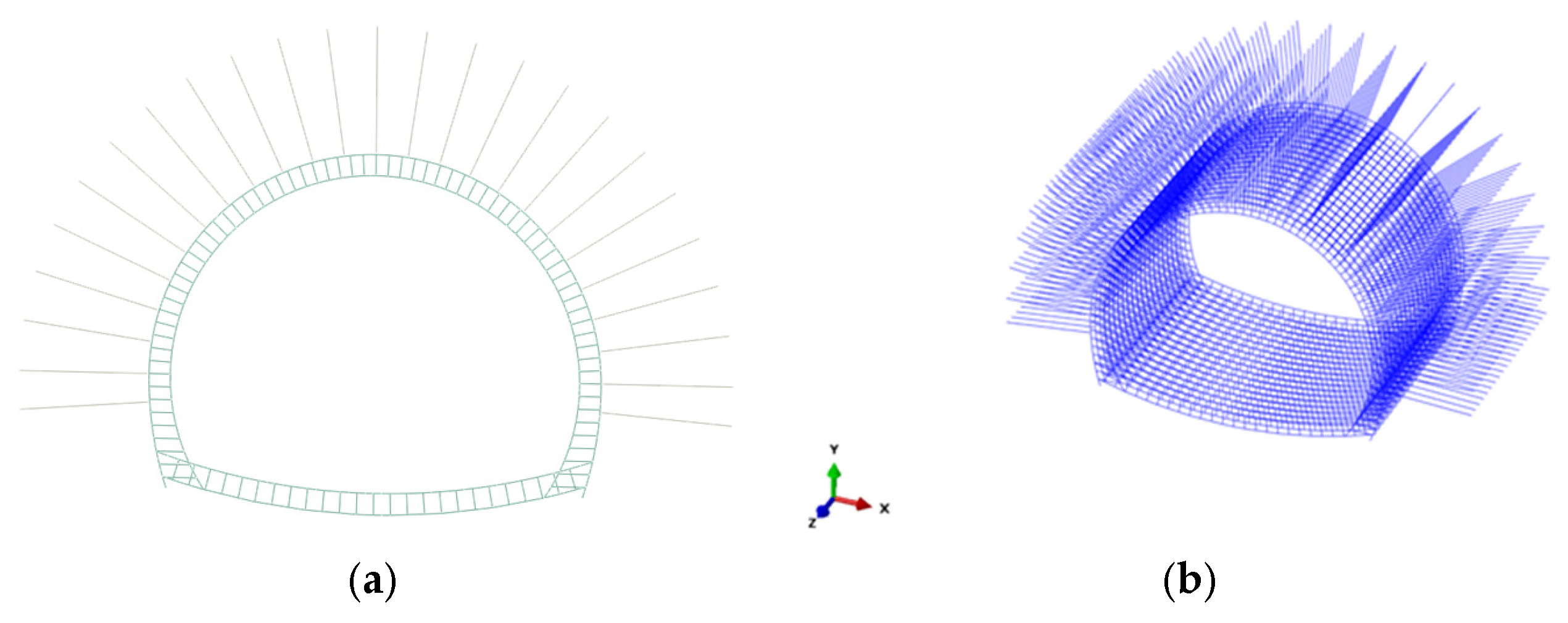
The reinforcement cage is arranged in an array pattern uniformly along the circumferential direction of the lining. An alternating configuration of inner and outer main rebars and stirrups is constructed. A cross-sectional view of this configuration is shown in Figure 7a. The support rock bolts are distributed radially around the outer side of the lining. The arrangement is modeled parametrically with reference to the actual construction drawings. The overall 3D layout is presented in Figure 7b, which reflects the structural interaction among the lining, rock bolts, and surrounding rock system.
In this model, two representative types of reinforcing bars are introduced: D8 and D22, corresponding to the main rebars and stirrups of different diameters. These two types have different cross-sectional areas and are arranged in the inner and outer layers, respectively, of the reinforcement cage to simulate the division of load-bearing roles. The steel material is modeled using an ideal elastic constitutive model. The main material parameters are as follows: density of 7850 kg/m3, elastic modulus of 206 GPa, and Poisson’s ratio of 0.30. The loading conditions and boundary constraints remain consistent with those described above, including the application of gravity loads and displacement constraints at the foundation and boundaries. This ensures that the model is suitable for comparative analysis of structural responses.
In the refined numerical simulation of the tunnel lining structure, accurate representation of the reinforcement cage and rock bolt system is crucial for ensuring analysis accuracy. For the primary support, Φ22 threaded rock bolts (effective length of 2.5 m, spacing of 1000 mm) are arranged according to the design cross-section. These work in conjunction with C30 shotcrete to bear the surrounding rock pressure. The rock bolts are discretized in the model using T3D2 spatial truss elements. Deformation compatibility with the surrounding rock and support system is achieved through shared nodes or embedded constraints.
For the secondary lining, the main structure is made of C30 concrete, with a double-layer bidirectional reinforcement mesh embedded inside. The main rebars and distribution rebars are Φ22 and Φ16 steel bars, respectively, with a spacing of 200 mm in both directions. They are uniformly arranged from the arch crown and haunch to the sidewalls to enhance the overall stiffness and crack control capacity of the lining. In the numerical model, the reinforcement mesh is coupled with the concrete solid elements using the embedded region technique. This enables explicit simulation in critical regions and accurately reflects the role of reinforcement in regulating local stress redistribution. The above refined modeling strategy effectively overcomes the limitations of the equivalent parameter method. It allows the model to capture the detailed structural stress response and stress concentration behavior at segmented sections more realistically, significantly improving the applicability and reliability of the numerical simulation.
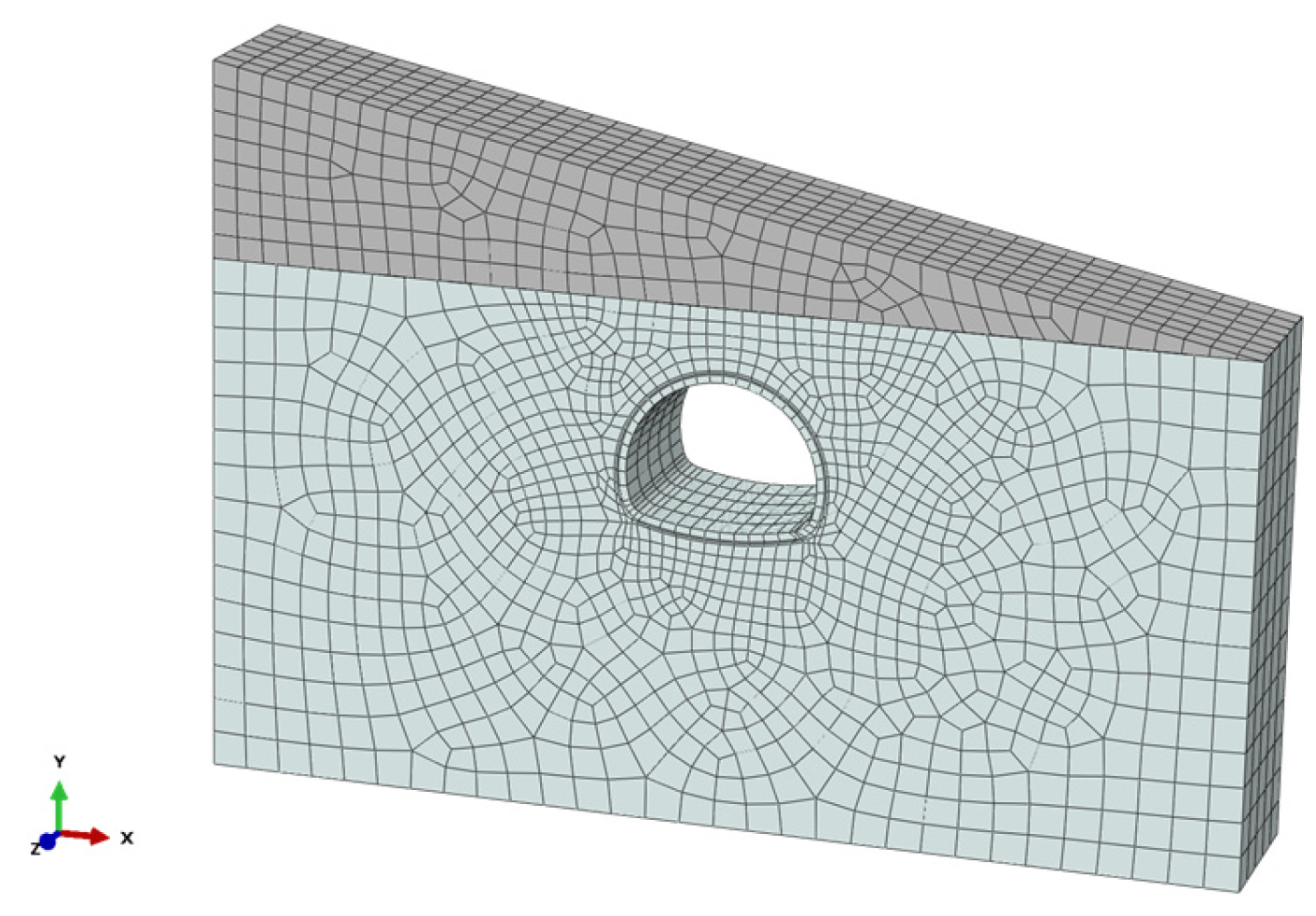
Global mesh refinement is applied in structurally critical regions, such as the tunnel arch crown, excavation boundaries at the portal section, and rock bolt concentration zones, as shown in Figure 8. This refinement is intended to better capture stress concentrations and displacement gradient variations, thereby ensuring the accuracy and reliability of the subsequent numerical results.
To ensure that the model maintains overall computational efficiency while achieving sufficient accuracy in local responses, a rationally partitioned 3D mesh system is adopted in the refined tunnel structural modeling. Appropriate element types are selected for different structural components. A total of 23,525 finite elements are used in the overall model. Among these, 5955 C3D8R linear eight-node hexahedral elements are employed for the continuum regions, including the surrounding rock, lining structure, and backfill soil. This element type is a reduced-integration element with favorable computational stability and convergence characteristics, making it suitable for large-deformation analysis and embedded modeling applications.
For slender structural components such as the reinforcement cage and rock bolts, one-dimensional linear truss elements (T3D2) are used. Mechanical coupling between these elements and the concrete lining structure is achieved through the embedded region method. This modeling approach accurately simulates the load-transfer interaction between the steel reinforcement and the concrete without significantly increasing the number of degrees of freedom. It is particularly suitable for simulating tensile members and anchoring systems.

3.3.2. Geometry-Informed As-Built Model Based on Scan Data

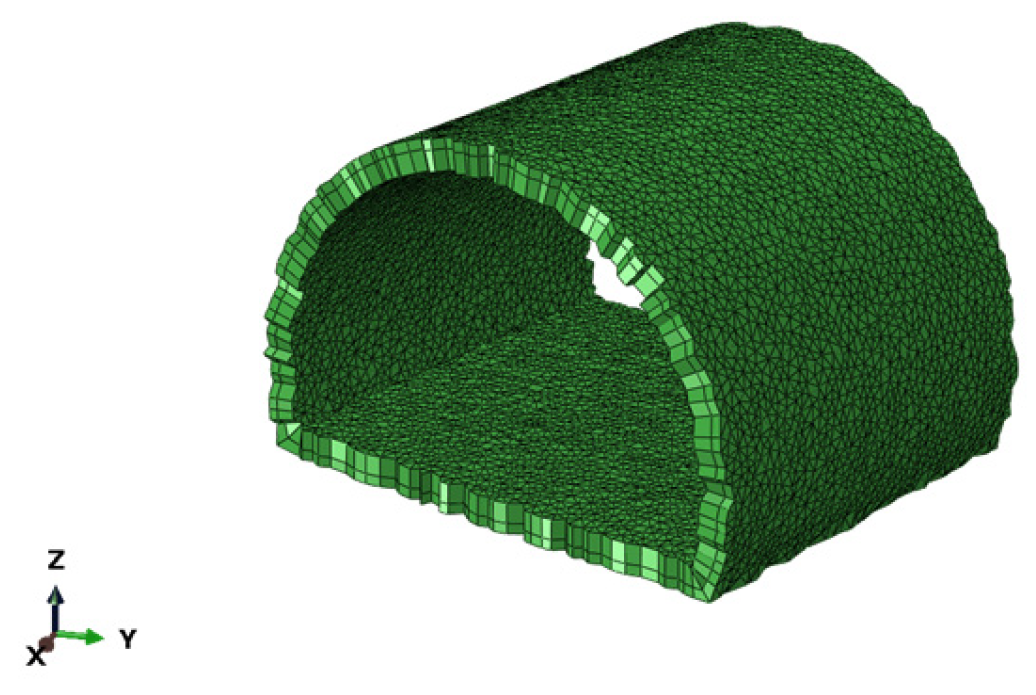
To investigate the influence of construction deviations and the actual geometric configuration on the mechanical behavior of the tunnel, a geometry-informed finite element model based on field-measured geometric data is constructed in this study. Different from the ideal design model, the core of this model lies in the geometric reconstruction of the secondary lining structure. Using point cloud data acquired through 3D laser scanning, a lining mesh model incorporating actual construction thickness deviations and contour characteristics is generated after denoising, registration, and reverse modeling processes, as shown in Figure 9.
This model is then imported into the finite element system to replace the ideal design lining and to achieve coupling. To ensure comparability between the simulation results, the principle of controlled variables is followed. Except for the geometry of the secondary lining, all other environmental and structural parameters are kept strictly consistent with those of the aforementioned model based on the design parameters. Specifically, the simulation logic for the backfilling of the soil surrounding the tunnel, the displacement constraints defining the model boundaries, the material constitutive parameters for each structural layer (as listed in Table 2), and the layout of the reinforcement and rock bolt support systems are all maintained unchanged.
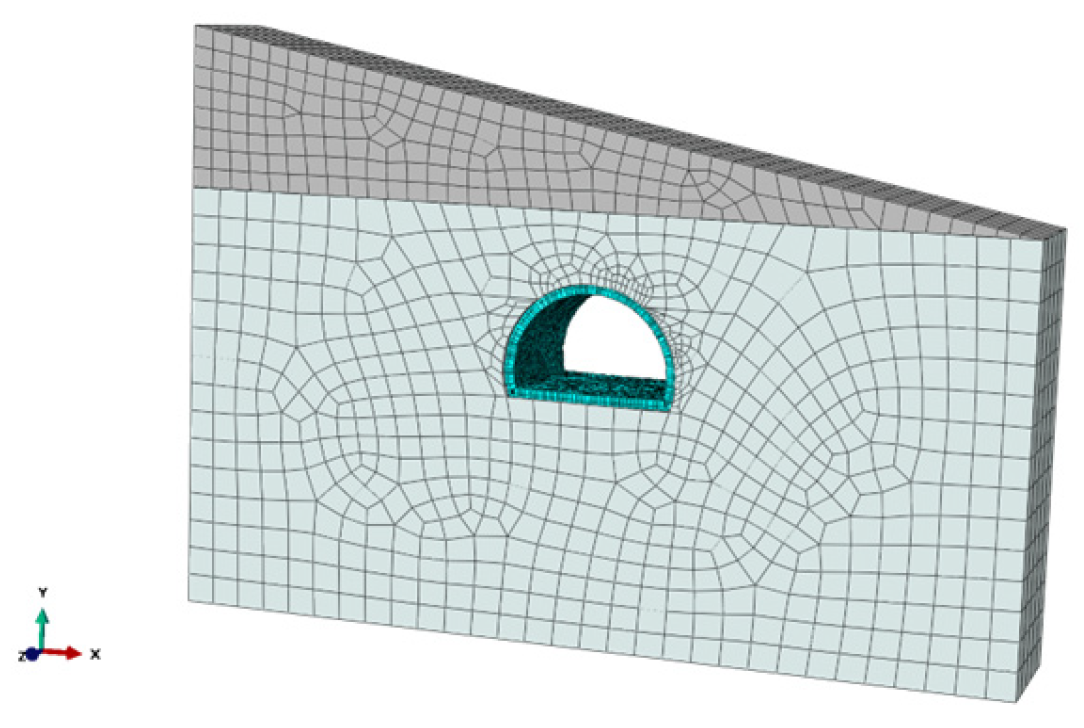
To balance computational accuracy with numerical efficiency, a non-uniform gradient meshing strategy is adopted in the model. Considering that stress concentration and plastic development after tunnel excavation are primarily distributed in the region near the tunnel perimeter, a high-density refined mesh is employed in the vicinity of the tunnel contour to capture accurate mechanical responses. A coarser mesh is gradually transitioned toward the far-field boundaries. For the secondary lining model reconstructed from the measured point cloud, a highly adaptable high-precision meshing scheme is used to preserve its actual geometric non-uniformity. The meshing configuration is shown in Figure 10. To address the mismatch of mesh nodes between the measured lining and the surrounding soil, a tie constraint is applied to rigidly couple the interface between the two media. This approach ensures displacement compatibility and continuous stress transfer across the interface. Meanwhile, the internal reinforcement and rock bolt system are modeled using the embedded region method. Through this configuration, an integrated load-bearing simulation of the surrounding rock, as-built lining, and support structure is achieved.

4. Comparative Stability Analysis of the Lining Structure

4.1. Analysis of Geometric Deviation Characteristics

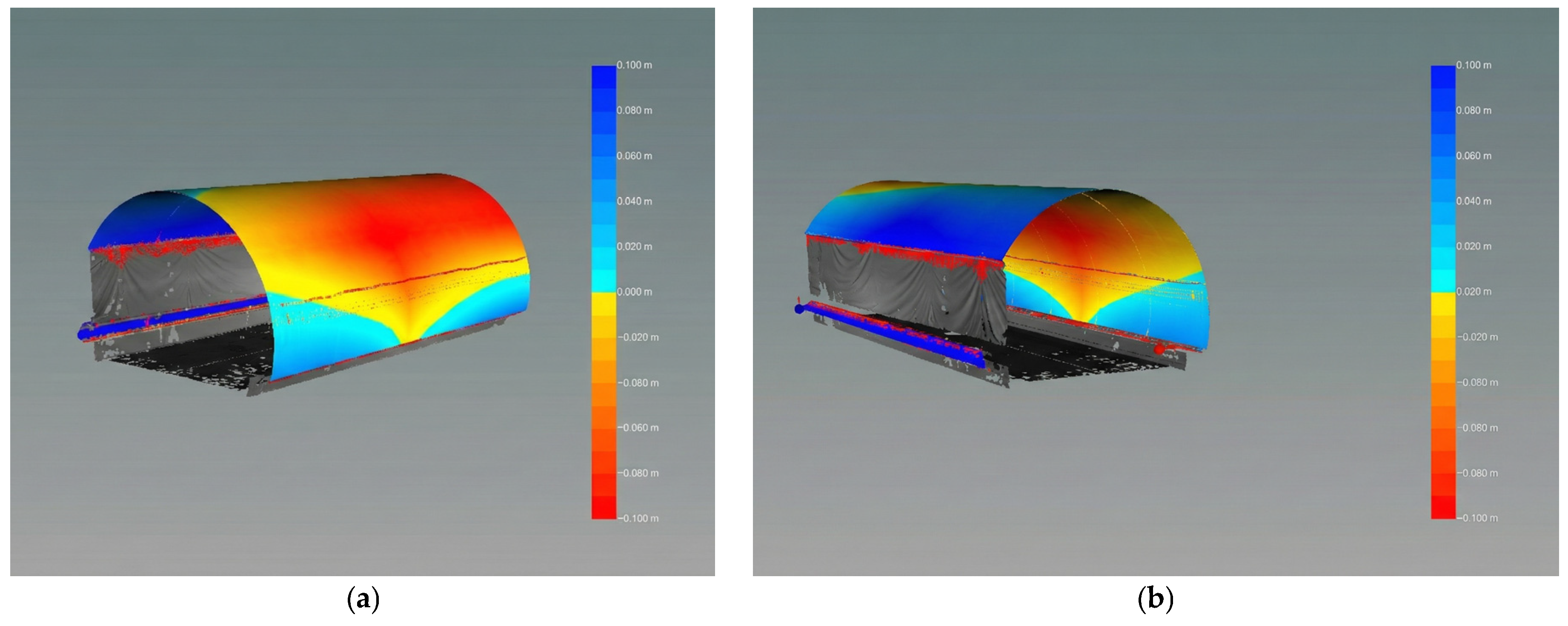
Field-measured point cloud data acquired by three-dimensional laser scanning were used to quantify the as-built geometry of the tunnel lining, with particular emphasis on the spatial distribution of geometric deviations. The raw point cloud was denoised and rigidly registered on the Cyclone platform. Taking the design BIM model as the reference, the geometric deviations were calculated using a point-to-surface algorithm with a threshold of ±0.10 m, and a three-dimensional color deviation map was generated, as shown in Figure 11. In the figure, cool colors (blue) indicate positive deviations, corresponding to excessive thickness or over-elevation, whereas warm colors (red) indicate negative deviations, corresponding to insufficient thickness or under-elevation.
As shown in Figure 11a, a pronounced blue band is observed in the crown region, with a maximum positive deviation of approximately +0.08 m, indicating a generally excessive concrete thickness at the crown. In contrast, the invert-edge region is predominantly red, with a maximum negative deviation of −0.10 m, indicating that the finished surface in this region lies below the design elevation. In Figure 11b, the gray region on the left corresponds to the tunnel ventilation duct. The deviation distribution on the left side of the tunnel is continuous without abrupt mutations, reflecting relatively stable trolley positioning and concreting procedures. Although the overall deviations satisfy the code requirements, the systematic negative deviations at the sidewall and arch foot not only reduce the effective load-bearing section, but may also introduce additional eccentricity.

4.2. Comparative Analysis of Stress Response

4.2.1. Analysis of Equivalent Stress Distribution and Displacement Response

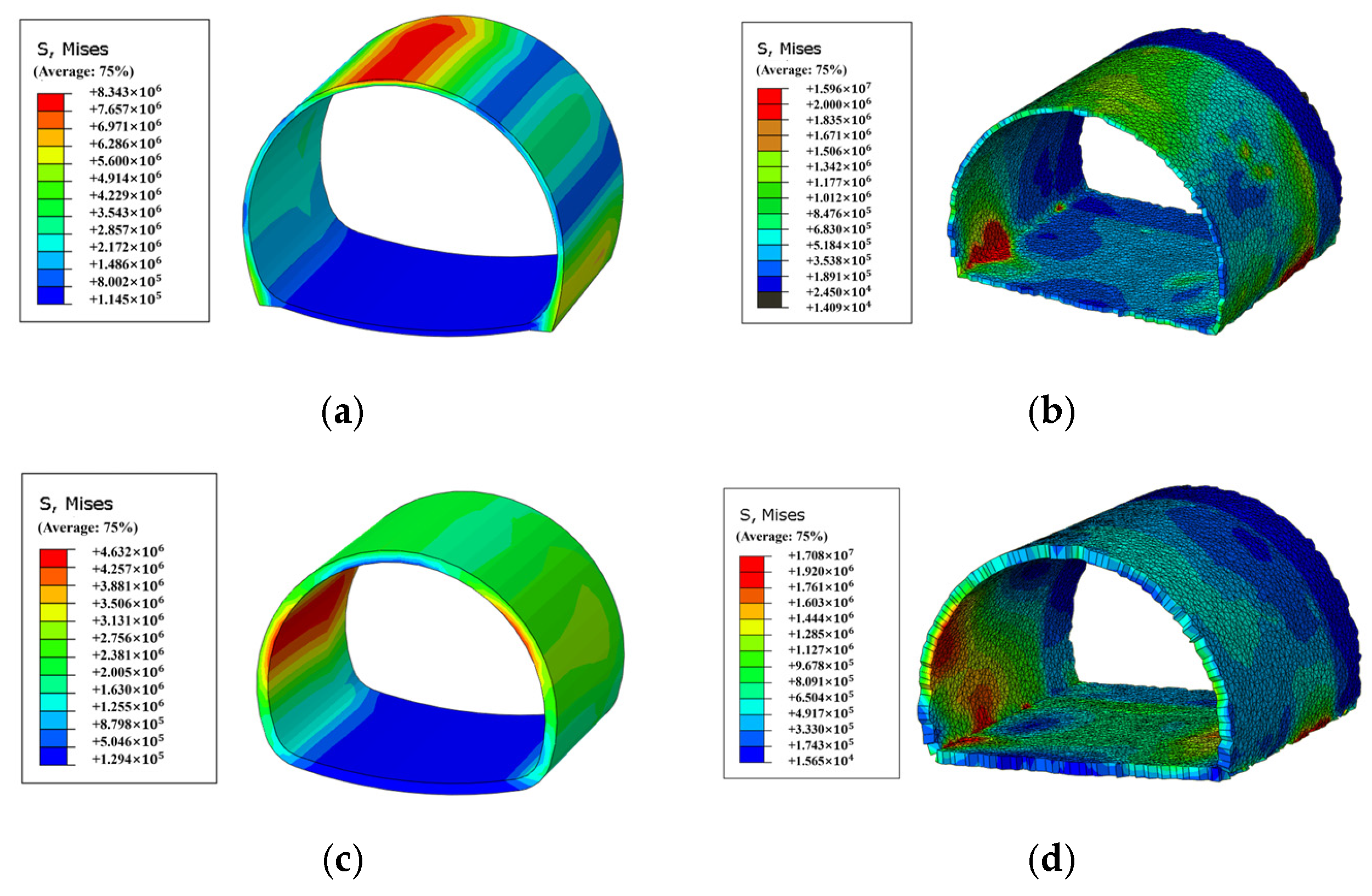
Figure 12 compares the equivalent stress distributions of the lining in the two models and shows that geometric deviations have a pronounced effect on the load-carrying behavior of the support system. During the primary support stage, as shown in Figure 12a,b, the engineering design model exhibits a typical symmetric load-bearing pattern, with the high-stress region concentrated at the crown and gradually decreasing toward both sides. By contrast, the 3D scanned model exhibits significant stress redistribution. Owing to the irregular construction contour and non-uniform contact with the surrounding rock, the high-stress zone shifts asymmetrically from the crown toward the arch foot and the lower sidewall. Moreover, the peak stress in the scanned model (approximately 15.9 MPa) is nearly twice that in the design model (approximately 8.34 MPa), and localized patchy stress concentrations are observed, revealing the complexity of internal force transfer paths under the actual geometric morphology.
During the secondary lining stage, as shown in Figure 12c,d, the differences between the two models become even more pronounced. In the engineering design model, the stress is mainly distributed in the haunch region, with a relatively smooth gradient. In contrast, the 3D scanned model exhibits highly non-uniform stress distribution, with the high-stress region strongly localized near the corner zone adjacent to the arch foot. Notably, the peak stress of the scanned model (approximately 17.1 MPa) is nearly four times that of the design model (approximately 4.63 MPa). This marked stress amplification does not simply result from an increase in load; rather, it is caused by stress concentration induced by geometric irregularities. In regions with insufficient local section thickness or abrupt curvature changes, the reduction in effective load-bearing area and the presence of geometric discontinuities generate stress peaks far beyond the design expectation.
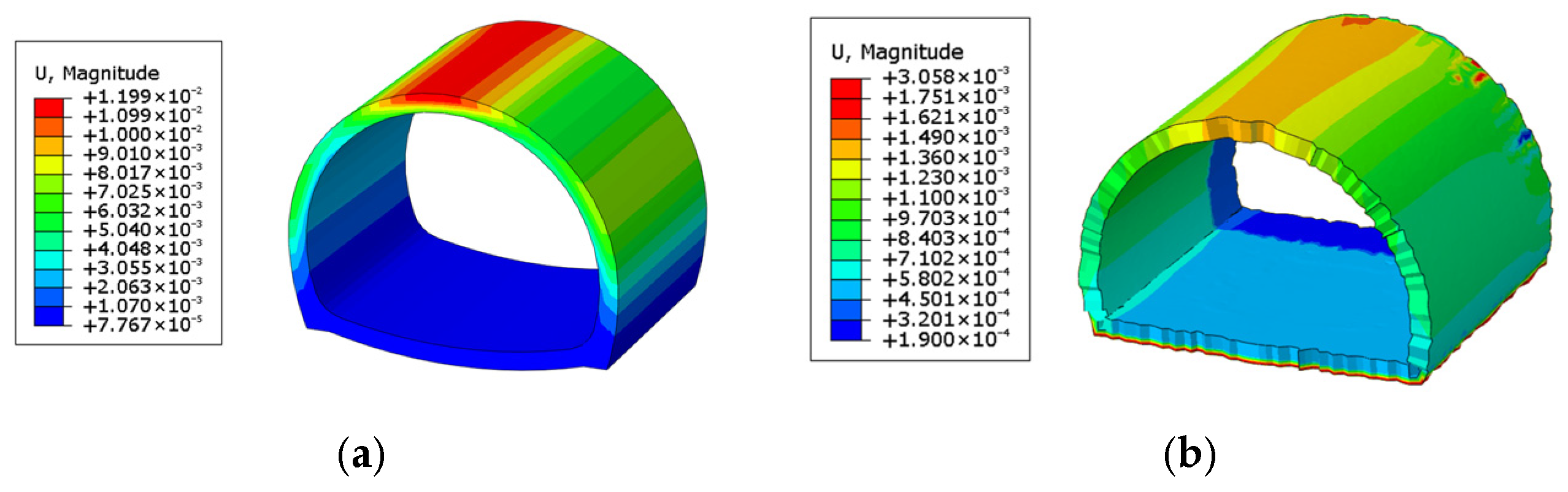
Figure 13 compares the displacement magnitude contours of the lining structures in the two models, intuitively illustrating the deformation differences between the idealized state and the measured state. First, the displacement pattern changes fundamentally. The engineering design model, shown in Figure 13a, exhibits strict geometric symmetry, and the displacement field is layered, with the maximum settlement concentrated along the crown centerline and attenuating uniformly toward both sides. In contrast, the 3D scanned model reconstructed from point cloud data, shown in Figure 13b, departs from this symmetric deformation pattern, and the displacement field exhibits marked discreteness and non-uniformity. The irregular concave–convex features of the measured contour cause drastic local fluctuations in the displacement gradient, reflecting the nonlinear deformation characteristics of the actual lining under complex boundary conditions. Second, both the magnitude and location of the peak displacement shift significantly. In the engineering design model, the peak displacement reaches 12.0 mm, indicating an overall subsidence trend. In the 3D scanned model, however, the peak displacement decreases sharply to 3.1 mm, approximately one quarter of the predicted value. Moreover, the high-displacement region is no longer concentrated at the crown, but becomes scattered in the haunch and local regions. This indicates that local thickness variation and altered contact conditions in the actual structure modify the overall stiffness distribution, such that the deformation is no longer governed primarily by crown settlement.
In summary, the engineering design model tends to reflect a globally ideal equilibrium path, whereas the 3D scanned model accurately captures the irregular deformation induced by geometric distortion. The abnormal fluctuations in the displacement field show a clear spatial correspondence with the stress concentration regions discussed above, indicating that geometric defects caused by construction deviations are an important internal factor driving asymmetric deformation of the structure. This comparison reflects the influence of different geometric representations on the predicted deformation pattern, rather than direct validation against in situ mechanical monitoring data.

4.2.2. Analysis of Stress and Displacement Responses Along Typical Sectional Paths

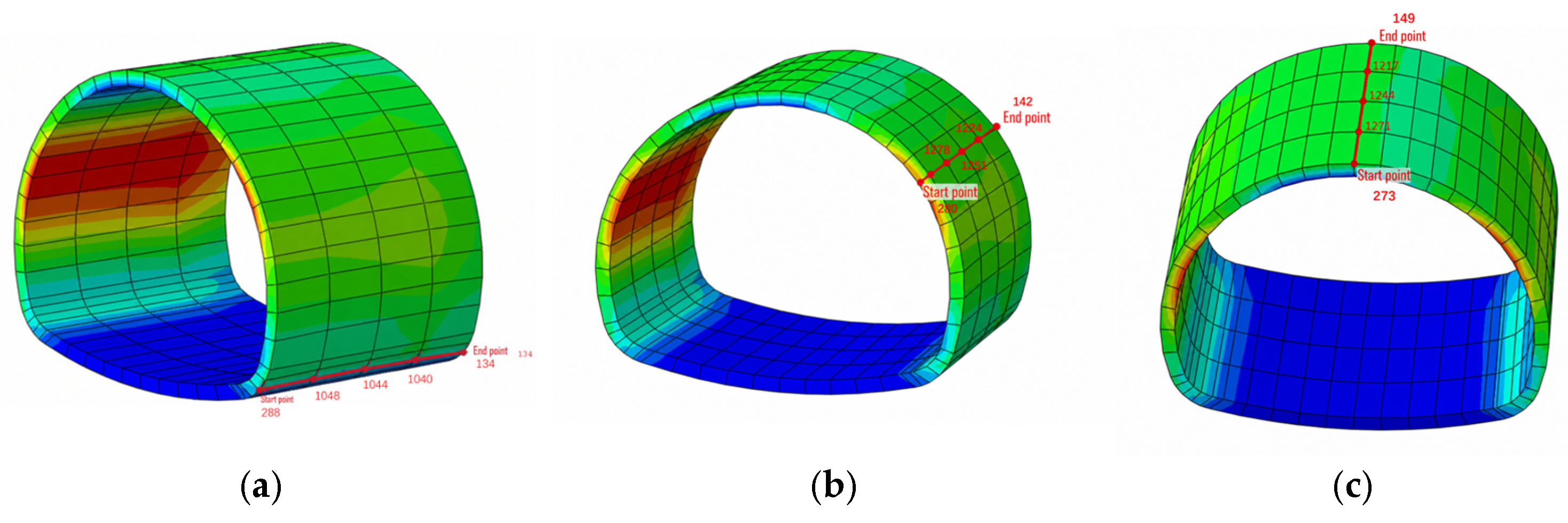
As shown in Figure 14, to investigate the longitudinal mechanical differences in the secondary lining, five typical monitoring paths were established along the tunnel axis at five key characteristic locations: the crown, the left and right haunches, and the left and right arch feet. By extracting and comparing the nodal stress data along these paths in the engineering design model and the 3D scanned model, the influence of construction-induced geometric deviations on the longitudinal mechanical behavior of the structure was quantitatively analyzed.
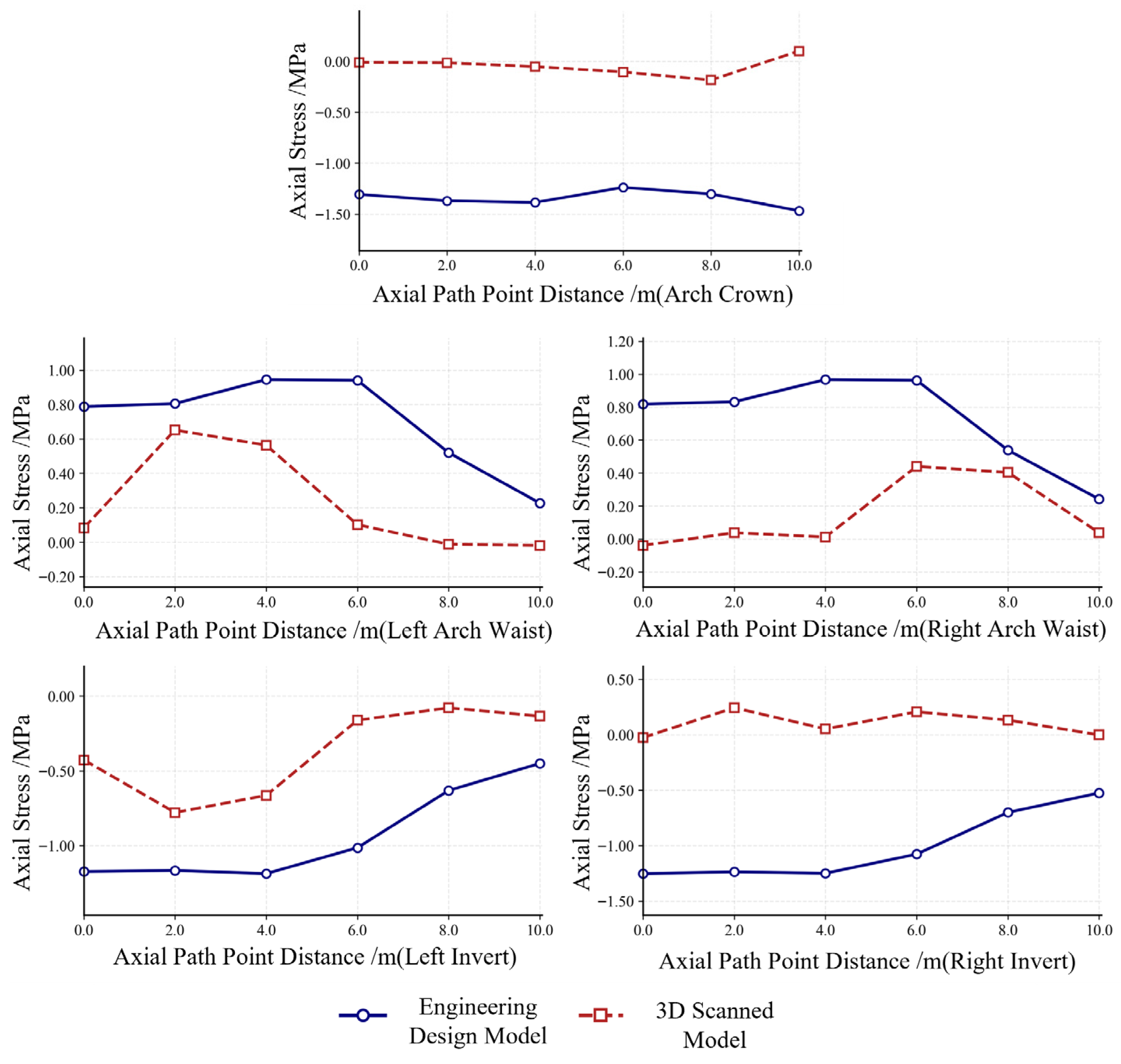
Figure 15 presents the axial stress evolution along the typical paths in the two models. The comparison shows the following. First, the engineering design model exhibits an idealized longitudinal arching effect, and its stress magnitude is significantly higher than that of the measured model. In the design model (blue curve), the crown and arch foot are subjected to pronounced compressive stress, with peak values of approximately −1.4 MPa, whereas the haunch exhibits stable tensile stress. The curves are smooth and highly symmetrical, indicating that under an ideal geometric configuration, the lining can form a continuous and efficient longitudinal load-transfer system. Second, the 3D scanned model exhibits a marked axial stress relaxation effect. In contrast to the sharp increase in Mises equivalent stress caused by geometric defects, as shown previously in Figure 12, the axial stress here shows an opposite attenuation trend. In the scanned model (red curve), the stress magnitude decreases by approximately 50–90% relative to the design model, and the compressive stress at the crown is even reduced to nearly zero. This indicates that although geometric distortion leads to local stress concentration, as reflected by the rise in Mises stress, it simultaneously disrupts the geometric continuity of the lining along the longitudinal direction. This geometric waviness greatly weakens the ability of the structure to transfer internal forces along the tunnel axis, resulting in degradation of longitudinal stiffness and stress release. Therefore, due to construction deviations, the actual lining fails to develop the ideal longitudinal beam-arch effect and instead degenerates into a discrete load-bearing body dominated by local geometric morphology.
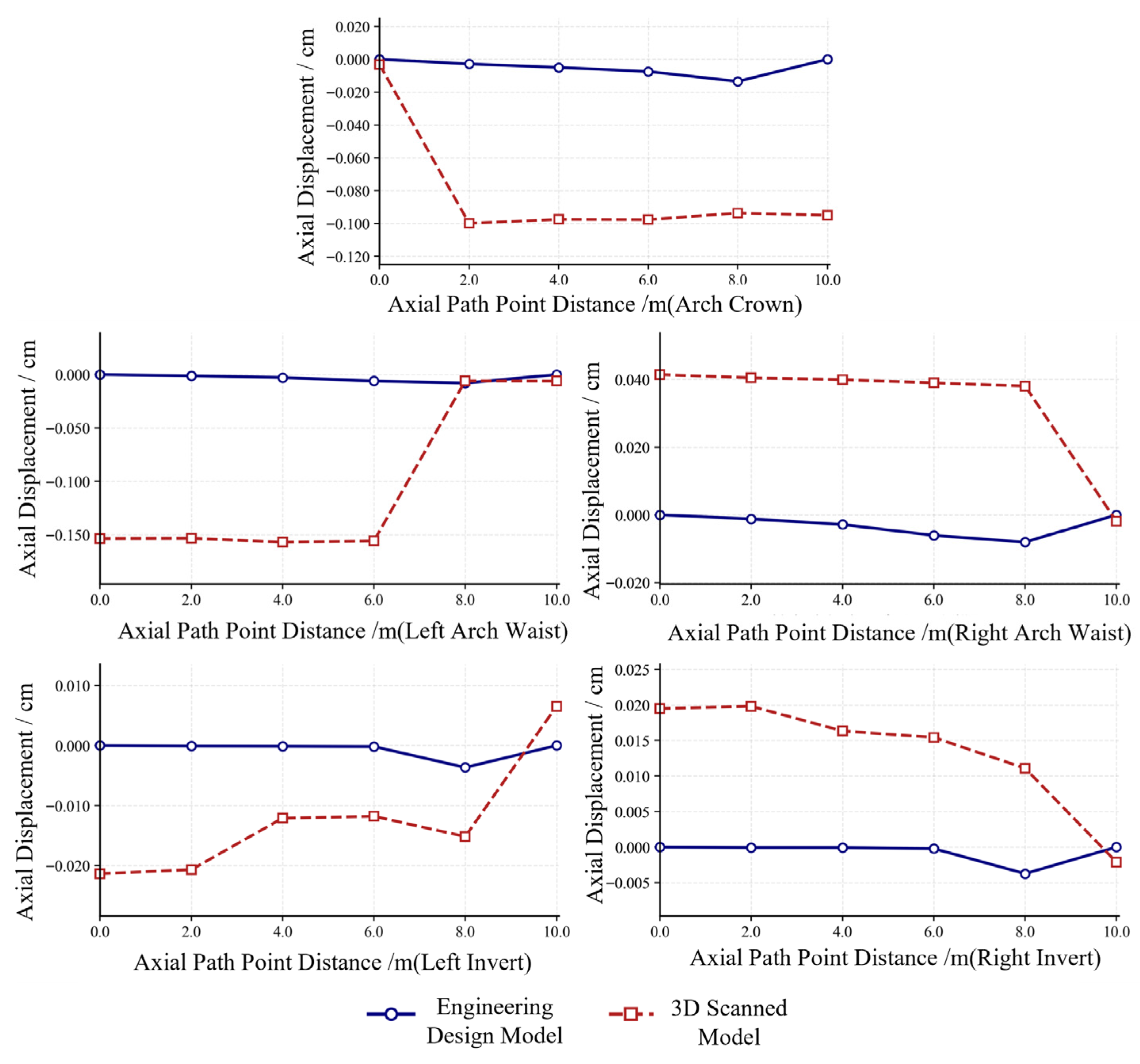
Figure 16 shows the axial displacement responses along the tunnel axis in the two models. The comparison reveals the following. First, the engineering design model exhibits idealized longitudinal stability. Along all five monitoring paths, the axial displacement of the design model (blue curve) remains close to 0 cm, indicating that under ideal geometric constraints, the secondary lining mainly undergoes transverse convergence deformation, while longitudinal extension and misalignment are minimal, reflecting good overall coordination. Second, the 3D scanned model reveals significant longitudinal warping and horizontal shearing behavior. Unlike the nearly flat response of the design model, the scanned model (red dashed curve) shows strong fluctuations and an obvious antisymmetric distribution. On the left side of the tunnel, including the haunch and arch foot, the displacement is mainly negative, with a maximum value of −0.15 cm at the left haunch. On the right side, however, the displacement is positive, with a peak of approximately +0.04 cm at the right haunch. This “negative on the left and positive on the right” pattern indicates that, under the combined action of non-uniform surrounding rock pressure and geometric defects, the actual secondary lining undergoes lateral bending and shear offset. It is noteworthy that the left haunch shows an abrupt displacement rebound within the axial interval of 6–8 m, rising sharply from −0.15 cm to 0 cm. Such nonlinear mutation points often correspond to construction joints or locally severe under-thickness of the concrete, implying the existence of a pronounced longitudinal stiffness discontinuity in this region.
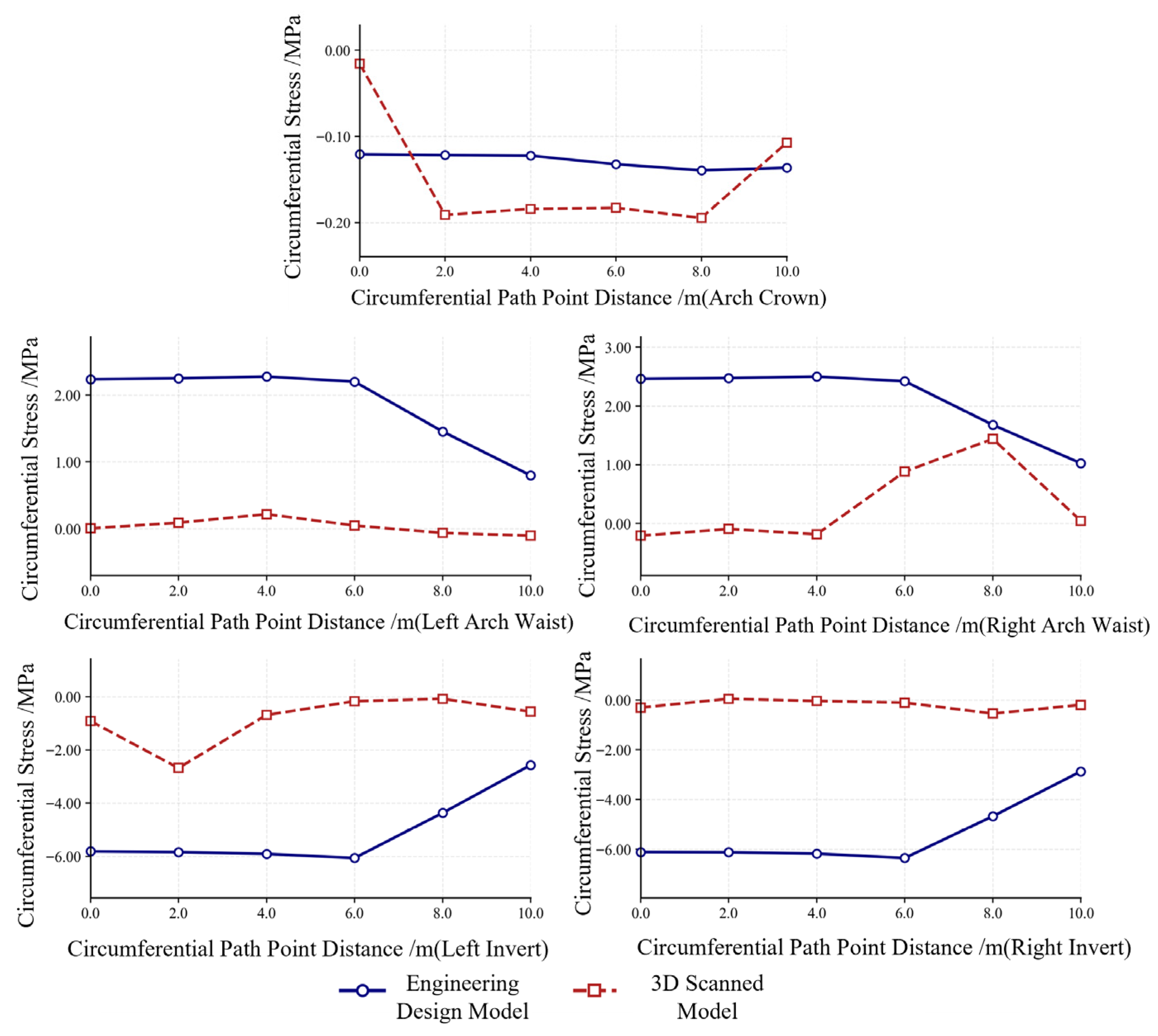
Figure 17 further compares the circumferential stress evolution at typical locations in the two models, revealing pronounced stress release and unsymmetrical loading effects in the actual structure. First, the engineering design model exhibits a high-amplitude ideal arch load-bearing mode. In the design model (blue curve), the arch foot shows strong compressive stress concentration, with peak values of approximately −6.0 MPa, whereas the haunch shows pronounced tensile stress, with peaks of approximately +2.5 MPa. The curves are smooth and highly symmetrical on both sides, indicating that under ideal geometric conditions, the secondary lining can fully mobilize the material strength and form a robust circumferential load-bearing system. However, the 3D scanned model shows an overall reduction in stress magnitude and local asymmetric mutations. The circumferential stress amplitude in the 3D scanned model (red dashed curve) is generally much lower than that in the design model. In particular, in the arch foot region, the peak compressive stress in the scanned model is only about −2.0 MPa, representing a decrease of approximately 60–70% relative to the predicted value. This pronounced stress reduction indicates that due to irregular construction contours and defects such as voids behind the lining, the actual secondary lining cannot form an ideal stiff ring, resulting in reduced efficiency of circumferential force transfer and substantial stress relaxation. Comparison of the left and right haunch paths shows that the circumferential stress on the left side is nearly zero, implying ineffective load bearing, whereas the right haunch exhibits a significant tensile stress peak of approximately +1.5 MPa in the interval of 6–8 m. This strong left–right contrast confirms the existence of severe unsymmetrical loading, namely that owing to geometric distortion, the load is borne primarily by the right-side structure, while the left side fails to share the internal force effectively. Therefore, the redistribution of the circumferential stress field is not a simple numerical fluctuation, but a direct manifestation of the transition of the structural load-bearing mode from an ideal symmetric ring to a distorted shell under unsymmetrical pressure.
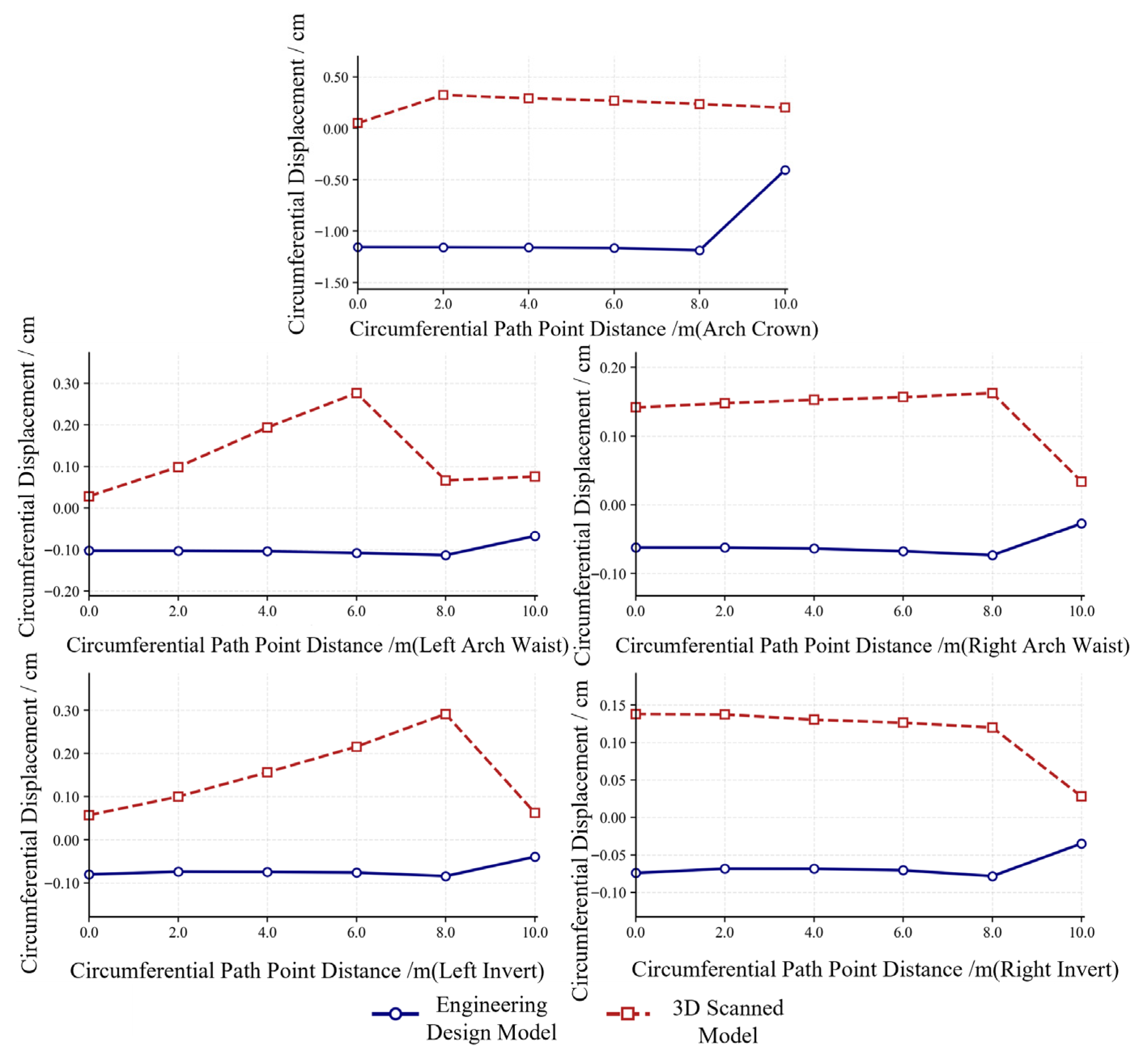
Figure 18 compares the circumferential displacement responses at typical locations in the two models, revealing substantial differences in deformation mode. First, the crown region exhibits a marked reversal in both direction and order of magnitude. In the engineering design model (blue curve), the crown shows a large negative displacement, remaining stable at approximately −1.2 cm, which reflects the uniform contraction or settlement trend under ideal conditions. However, in the 3D scanned model (red dashed curve), the displacement not only decreases sharply to approximately +0.25 cm, only one fifth of the predicted value, but also changes sign to become positive. This suggests that under actual conditions, because of construction deviations or the local restraint provided by the support system, the crown does not undergo the large deformation predicted theoretically, and its deformation energy may instead be redistributed. Second, the haunch and arch foot regions exhibit measured lateral bulging behavior. Unlike the near-zero and smooth curves of the design model at the sidewalls, with displacement magnitudes below 0.1 cm, the scanned model shows pronounced positive displacement peaks at both the left and right haunches and arch feet. In particular, the left haunch and left arch foot reach displacement values of approximately +0.30 cm, far exceeding the predicted values at the same locations. This indicates that the actual deformation mode of the secondary lining is not simple overall contraction, as predicted by the design model, but rather a more complex pattern characterized by relatively strong roof stiffness and asymmetric outward bulging of the sidewalls.
Overall, the substantial differences in mechanical response between the engineering design model and the 3D scanned model highlight the limitations of conventional idealized modeling in dealing with irregular engineering entities. Specifically, the engineering design model, based on ideal geometric assumptions, tends to produce smooth and uniform results, thereby masking the risk of local stress concentration caused by geometric distortion, such as the stress amplification identified above, and making it difficult to detect potential cracking hazards induced by construction deviations. In contrast, the 3D scanned model, by accurately reproducing the actual sectional geometry, effectively corrects the misleading deformation trend predicted by the idealized model. It revises the single theoretical crown settlement mode into a more realistic sidewall outward bulging mode, thereby revealing the true stiffness distribution and weak zones of the structure. This comparison indicates that integrating point-cloud-based geometric measurements into finite element analysis can improve the identification of structurally unfavorable zones associated with construction-induced geometric defects. Such an approach not only enables quantitative evaluation of the reduction in safety factor caused by geometric defects, but also provides a reliable scientific basis for precise risk control during construction and optimization of support schemes.

4.3. Evaluation of Safety Factors

4.3.1. Safety-Factor Evaluation Criteria and Calculation Method

According to the Specifications for Design of Highway Tunnels (JTG 3370.1-2018) [34], the section ultimate strength method considering the coupled action of axial force N and bending moment M was adopted for verification of the reinforced concrete secondary lining. The compressive safety factor K is defined as the ratio of the section ultimate bearing capacity R u to the load effect N , as given in Equation (8). When the eccentricity e 0 ≤ 0.20 h ( e 0 = M N ), the section is calculated as a small-eccentricity compression member using Equations (9) and (10); when the eccentricity e 0 > 0.20 h, the section is calculated as tension-controlled using Equations (11) and (12). The code specifies the threshold value of the compressive safety factor K for the secondary lining as 2.4 [35].
K = R u N
R u = φ α R a b h
K = R u N = φ α R a b h / N
R u = 1.75 R t b h φ / 6 e 0 / h 1
K = R u N = 1.75 R t b h φ / N 6 e 0 / h 1
In these equations, R a denotes the ultimate compressive strength of concrete (MPa), R t denotes the ultimate tensile strength of concrete (MPa), b is the width of the lining section and is taken as 1 m, h is the thickness of the lining section and is taken as 40 cm according to the secondary lining thickness, φ is the longitudinal bending coefficient of the member and is taken as 1 for tunnel linings, and α is the eccentricity influence coefficient of the axial force.
Because the three-dimensional solid finite element model directly outputs the nodal stress field, and to avoid the interference of corner numerical singularities in the overall evaluation, the equivalent section stress was introduced into the calculation, as shown in Equation (13). Specifically, the area-weighted equivalent stress obtained after excluding numerically singular stress peaks along the critical paths, or the representative stress of characteristic sections, was taken as the input for the calculation of the safety factor K .
σ a v g = σ i A i A i

4.3.2. Comparison of Safety-Factor Distributions

Using the design axial compressive strength of C30 concrete f c d = 14.3   M P a , together with the maximum stress peak and equivalent stress peak obtained from the finite element model and substituted into Equation (11), the safety factors were obtained.
Under the design’s unsymmetrical loading condition, the engineering design model shows relatively uniform structural stress distribution. The minimum safety factor calculated from the maximum peak stress of 4.632 MPa is K = 3.087 , while the value calculated from the equivalent stress of 2.093 MPa reaches 6.832. All measuring points are significantly higher than the code threshold of 2.4, verifying the reliability of the design under the ideal geometric state.
According to the equivalent stress contour of the 3D scanned model, as shown in Figure 12d, the structural safety reserve is significantly differentiated under the influence of geometric distortion. The local stress peak at a certain location reaches as high as 17.08 MPa, corresponding to K = 0.63 < 2.4 , indicating that at an extreme geometric defect point, the structure has theoretically entered a state of plastic damage or even failure. After area-weighted correction and removal of numerical singularities, the equivalent stress in representative regions such as the left haunch is 3.552 MPa, corresponding to K = 3.02 . Although the overall structure remains in a stable state ( K > 2.4 ), the local stress concentration induced by geometric imperfection is still significantly higher than the design expectation and should therefore be a focus of subsequent tunnel maintenance and monitoring. A comparison of the safety factors for the two models is presented in Table 3.

4.3.3. Quantification of Stability Reduction Caused by Geometric Deviations

To quantify the weakening effect of geometric deviations on structural stability, the reduction ratio of the safety factor was introduced:
η = K i d e a l K r e a l K i d e a l × 100 %
as shown in Equation (14), where K design is the safety factor of the design model and K scanned is the corresponding safety factor of the 3D scanned model.
The introduction of the safety-factor reduction ratio ( η ) avoids the influence of absolute numerical fluctuations and reveals, in a relative sense, the weakening law of stability caused by construction deviations. The calculated results show that the reduction ratio of safety under the equivalent stress criterion reaches 55.8% (calculated based on K i d e a l = 6.832 , K r e a l = 3.02 ). This value should be interpreted as a case-specific result for the analyzed tunnel section, rather than a statistically representative value applicable to all tunnel linings or all geometric deviation patterns. Nevertheless, it demonstrates that measured contour unevenness can reduce the effective load-bearing thickness of the secondary lining and amplify eccentricity owing to abrupt local curvature changes, thereby shifting the structural load-bearing mode from an ideal small-eccentricity compression state to a more unfavorable coupled compression–bending–shear state. If verification were carried out only on the basis of the design drawings, the structural safety redundancy of this investigated section would be substantially overestimated.

5. Discussion and Implications

(1)
Study Limitations
The complex environment inside the tunnel may lead to scanning blind zones and missing data, and therefore the point cloud data obtained by three-dimensional laser scanning inherently contain limitations. Instrument precision, station registration errors, and the surface properties of concrete, such as moisture and gloss, introduce unavoidable noise. These data-level errors may be propagated and even amplified during subsequent geometric reconstruction and mesh generation, ultimately affecting the geometric fidelity of the finite element model. In addition, information simplification is unavoidable in the conversion from continuous geometry to a discrete analysis model. When the fitted B-spline surface or solid model is imported into ABAQUS and meshed, real defects such as fine cracks and local voids must be idealized or neglected for computational feasibility, and the infinitely complex constitutive behavior of materials must also be simplified, for example, by adopting homogeneous elastic or elastic–plastic models. Such idealization inevitably creates a discrepancy between the numerical model and the actual physical behavior of the structure. In addition, the measured data used in this study were geometric/deviation data derived from 3D laser scanning, rather than in situ mechanical monitoring data. Therefore, the present results should be interpreted as a geometry-based numerical comparison between two modeling strategies, rather than a direct validation against measured stress, strain, or displacement. Moreover, the analysis was conducted on one representative tunnel section only, and the quantitative reduction in safety factor may vary with deviation type, magnitude, and local geometric characteristics.
(2)
Engineering Implications
The numerical simulation method driven by field-measured geometric data based on three-dimensional laser scanning proposed in this study has important practical significance for construction quality control in tunnel engineering. It shifts the traditional passive quality-control framework of “design–construction–post inspection” toward an active predictive framework of “field measurement–modeling analysis–targeted intervention.” By converting the actual scanned data of the secondary lining into a finite element model, construction units can quantitatively evaluate the actual mechanical state of the secondary lining as a whole and spatially identify and warn of potential risks. The analytical results can guide the prioritization of grouting reinforcement areas and the optimization of subsequent excavation and support parameters. In addition, this method lays the foundation for establishing a digital twin of tunnel engineering. Each scan and analysis updates the digital model, and long-term accumulation can form a database reflecting the time-varying behavior of the structure. Such a database not only serves the current construction stage, but also provides an initial benchmark and design model for health monitoring and maintenance decision-making during the operation stage, thereby significantly improving the refined and intelligent whole-life-cycle management level of tunnels.
(3)
Future Work
Based on the findings of this study, future work can proceed in two main directions. First, the capability of multi-source data fusion and automatic model generation should be improved. Future studies may explore the integration of laser point clouds with photogrammetry, infrared thermography, and other data sources to compensate for the limitations of a single data source. Artificial intelligence algorithms, especially deep learning models, may also be employed to realize automatic identification of point cloud defects, intelligent reconstruction of geometric features, and fully automatic generation of high-quality analysis meshes, thereby greatly shortening the model preparation cycle and creating conditions for near-real-time analysis. Second, advanced analytical models considering material time-dependence and realistic interface behavior should be developed. Future ABAQUS-based analyses should move beyond homogeneous material assumptions by incorporating concrete shrinkage and creep and explicitly modeling the contact behavior among the secondary lining, primary support, and surrounding rock.

6. Conclusions

Using measured point cloud data of the lining, this study established a refined finite element model of the tunnel lining structure incorporating reinforcement cages and rock bolts. In comparison with the engineering design model, the stress and deformation behaviors of the secondary lining and key components were systematically analyzed. The main conclusions are as follows.
(1)
A refined solid-model reconstruction method based on three-dimensional laser point cloud data was established. In view of the large volume, high noise level, and irregularity of measured tunnel point cloud data, a geometric reconstruction workflow integrating data preprocessing, feature extraction, and parametric fitting was proposed. This method substantially reduces the data volume while preserving key mechanical features with high fidelity. On this basis, a three-dimensional refined numerical model integrating the primary support, secondary lining, and rock bolt system was constructed.
(2)
The influence of the actual geometric morphology on the stress and deformation modes of the secondary lining was revealed. Comparative analysis showed that, due to construction deviations and irregular contours, the deformation mode shifts from crown-settlement dominance in the design model to asymmetric outward bulging of the sidewall in the measured model. Meanwhile, owing to the enhanced interlocking effect generated by irregular contact surfaces, the surrounding-rock constraint is strengthened. Although the overall displacement magnitude in the measured model is smaller than that in the design model, significant stress concentration occurs at the arch foot and contour mutation zones, confirming that irregular geometry is the key factor leading to local deterioration of the mechanical state.
(3)
The weakening effect of construction-induced geometric deviations on the longitudinal load-bearing performance of the structure was clarified. The analysis showed that the surface waviness and unevenness caused by construction destroy the geometric continuity of the structure along the tunnel axis. Unlike the ideal longitudinal beam-arch effect exhibited by the design model, the axial stress amplitude in the 3D scanned model decreases sharply by approximately 50–90%, and the load-bearing responses on the left and right sides become highly asymmetric. This indicates that construction deviations reduce the longitudinal force-transfer efficiency of the structure, making it difficult to form an integral load-bearing system and thereby rendering the structure more prone to local stress relaxation and shear dislocation.
(4)
The reduction in the safety reserve of the secondary lining caused by construction deviations was quantitatively evaluated. Calculations based on the section ultimate bearing capacity criterion showed that the engineering design model overestimates the safety factor because it neglects construction defects. In the measured model, the unfavorable increase in additional eccentricity caused by insufficient local lining thickness and contour distortion drives the structural stress state from the ideal small-eccentricity compression mode to a more unfavorable coupled compression–bending–shear mode. For the investigated section, the reduction ratio of the representative safety factor reached 55.8% after the as-built geometric deviations were considered. This result indicates that relying solely on the design geometry may substantially overestimate the local safety reserve. However, because this value was obtained from a single scanned section, it should be regarded as a case-specific result rather than a universal value.

Author Contributions

All authors contributed significantly to the work presented in this manuscript. Conceptualization, B.Y. and Z.Y.; methodology, Y.X., W.L. and Z.Y.; software, W.L. and F.Y.; validation, B.Y., Y.X. and Z.Y.; formal analysis, Z.Y., W.L. and F.Y.; resources, Y.W. and L.W.; writing—original draft preparation, Z.Y., F.Y. and W.L.; writing—review and editing, B.Y. and Y.X.; supervision, Y.W. and L.W.; project administration, Z.Y. and Y.X. All authors have read and agreed to the published version of the manuscript.

Funding

The work was supported by the Major Science and Technology Special Plan Project of Yunnan Provincial Department of Science and Technology (Grant No. 202302AD080007) and the Science and Technology Demonstration Project for Intelligent Construction of Tunnels under Complex Geological Conditions along the Jinsha River Expressway.

Institutional Review Board Statement

Not applicable.

Informed Consent Statement

Informed consent was obtained from all subjects involved in the study.

Data Availability Statement

The data presented in this study are available upon request from the corresponding authors.

Conflicts of Interest

Author Yifeng Xia was employed by the company Zhaotong Expressway Investment and Development Co., Ltd. The remaining authors declare that the research was conducted in the absence of any commercial or financial relationships that could be construed as a potential conflict of interest.

References

  1. Lu, X.; Liu, Y.; Chen, C.; Gao, R.; Wang, R.; Wang, Y.; Wang, Z. Study on impact of crack properties on structural mechanics characteristics and safety performance of tunnel lining. J. Archit. Civ. Eng. 2025, 42, 165–179. [Google Scholar]
  2. He, B.-G.; Liu, E.-R.; Zhang, Z.-Q.; Zhang, Y. Failure modes of highway tunnel with voids behind the lining roof. Tunn. Undergr. Space Technol. 2021, 117, 104147. [Google Scholar] [CrossRef]
  3. Liu, X.; Zhuang, Y.; Zhou, X.; Liang, N.; Mao, J.; Chen, H. Study of the damage characteristics and corrosion mechanism of tunnel lining in a sulfate environment. Front. Mater. 2024, 10, 1323274. [Google Scholar] [CrossRef]
  4. Zhou, Z.; Yan, L.B.; Zhang, J.J.; Gong, C. Review and prospect of intelligent identification of apparent diseases in highway tunnels based on deep learning. China Civ. Eng. J. 2022, 55, 38–48. [Google Scholar]
  5. Gao, S.J. Analysis of construction deformation characteristics of a metro tunnel closely undercrossing a large-diameter high-speed railway shield tunnel. Railw. Investig. Surv. 2022, 48, 113. [Google Scholar]
  6. Lin, J.; Zhu, J.L.; Huang, S.L.; Xiao, Q.; Huang, Y.; Lei, S.; Zhou, P. Numerical study on tunnel deformation under local thickness reduction in tunnel linings and destruction prediction. Chin. J. Geotech. Eng. 2024, 46, 177–182. [Google Scholar]
  7. Shao, Z.S.; Xi, H.H.; Qiao, R.J.; Zhou, H.; Guo, Y. Review of the research on lining damage and repair measures for tunnels in operation. Mod. Tunn. Technol. 2022, 59, 29–39. [Google Scholar]
  8. He, F.Y. Identification method of structural stability of shield tunnel. Fly Ash Compr. Util. 2023, 37, 23. [Google Scholar]
  9. Zhao, Y.-M.; Han, Y.; Kou, Y.-Y.; Li, L.; Du, J.-H. Three-dimensional, real-time, and intelligent data acquisition of large deformation in deep tunnels. Adv. Civ. Eng. 2021, 2021, 6671118. [Google Scholar] [CrossRef]
  10. Sun, Y. Analysis of stress characteristics and stability of initial support arch of tunnels with the spatial effect of truss structure taken into consideration. Mod. Tunn. Technol. 2023, 60, 34–43. [Google Scholar]
  11. Huang, F.; Gao, X. Study on the structural stability of mined tunnels with double-layer initial supporting arch cover in soil-rock composite strata. Mod. Tunn. Technol. 2021, 58, 37–45. [Google Scholar]
  12. Zhou, Z.; Zhao, J.; Tan, Z.; Zhou, X. Mechanical responses in the construction process of super-large cross-section tunnel: A case study of Gongbei tunnel. Tunn. Undergr. Space Technol. 2021, 115, 104044. [Google Scholar] [CrossRef]
  13. Feng, K.; He, C.; Fang, Y.; Jiang, Y. Study on the mechanical behavior of lining structure for underwater shield tunnel of high-speed railway. Adv. Struct. Eng. 2013, 16, 1381–1399. [Google Scholar] [CrossRef]
  14. Tan, Y.; Chen, B.; Liu, Z. Study on large deformation characteristics and secondary lining supporting time of tunnels in carbonaceous schist stratum under high geo-stress. Sustainability 2023, 15, 14278. [Google Scholar] [CrossRef]
  15. Wu, W.J.; Wu, W.; Zou, Y.L.; Gu, H.; Zhu, H. Numerical implementation of the elastoplastic constitutive model based on the improved smoothed GZZ criterion into ABAQUS. Chin. J. Rock Mech. Eng. 2025, 44, 1001–1012. [Google Scholar] [CrossRef]
  16. Wang, J.F.; Huang, H.W.; Xie, X.Y.; Bobet, A. Void-induced liner deformation and stress redistribution. Tunn. Undergr. Space Technol. 2014, 40, 263–276. [Google Scholar] [CrossRef]
  17. Ding, W.; Huang, X.; Yu, C.; Zhang, Q.; Wu, T. Calculation method of new assembled corrugated steel initial support structure of highway tunnel. Appl. Sci. 2024, 14, 7242. [Google Scholar] [CrossRef]
  18. Zhang, Q.H.; Zhang, Y.R. Sensitivity and linear correlation analysis of secondary lining structures in highway tunnels. Hans J. Civ. Eng. 2022, 11, 699–711. [Google Scholar] [CrossRef]
  19. Wang, P.; Ma, X.; Yang, L.; Sheng, X.; Wang, X.; Lin, C. Investigation into the time-dependent characteristics of stress and deformation of weak surrounding rock and lining structure in operational tunnels: Model test. Appl. Sci. 2024, 14, 5447. [Google Scholar] [CrossRef]
  20. Cao, Y.; Li, J.; Hao, J.; Yang, X. Application of constitutive model in simulation analysis of tunnel construction. J. Appl. Sci. Eng. 2021, 24, 791–797. [Google Scholar]
  21. Schreter, M.; Neuner, M.; Unteregger, D.; Hofstetter, G. On the importance of advanced constitutive models in finite element simulations of deep tunnel advance. Tunn. Undergr. Space Technol. 2018, 80, 103–113. [Google Scholar] [CrossRef]
  22. Çetindemir, O. Nonlinear constitutive soil models for the soil–structure interaction modeling issues with emphasis on shallow tunnels: A review. Arab. J. Sci. Eng. 2023, 48, 12657–12691. [Google Scholar] [CrossRef]
  23. Zhang, D.; Zhou, Z.; Gao, C.; Bai, S.; Bu, F.; Chen, X.; Chen, J. Stability investigation of tunnel surrounding rock by coupling peridynamics, finite element method, and finite volume method. Phys. Fluids 2025, 37, 013614. [Google Scholar] [CrossRef]
  24. Zhang, J.R.; Yan, B.; Gong, Y.F.; Xu, J.; Liu, D. Research status and prospects of intelligent monitoring technology and information management system for tunnel engineering. Chin. J. Undergr. Space Eng. 2021, 17, 567–579. [Google Scholar]
  25. Dai, J.; Wang, J.J.; Li, D.F.; Wang, Y.; Qiu, W.G.; Ling, P. 3D laser scanning assisted tunnel large deformation control. Railw. Stand. Des. 2024, 68, 146–153. [Google Scholar]
  26. An, Z.L.; Ma, W.B.; Yuan, Z.Y.; Guo, X.X.; Wang, Y. Railway tunnel clearance inspection and analysis based on laser scanning. Chin. J. Undergr. Space Eng. 2022, 18, 874–883. [Google Scholar]
  27. Jiang, Q.; Shi, Y.-E.; Yan, F.; Zheng, H.; Kou, Y.-Y.; He, B.-G. Reconstitution method for tunnel spatiotemporal deformation based on 3D laser scanning technology and corresponding instability warning. Eng. Fail. Anal. 2021, 125, 105391. [Google Scholar] [CrossRef]
  28. Jia, D.; Zhang, W.; Liu, Y. Systematic approach for tunnel deformation monitoring with terrestrial laser scanning. Remote Sens. 2021, 13, 3519. [Google Scholar] [CrossRef]
  29. Hu, D.; Li, Y.; Yang, X.; Liang, X.; Zhang, K.; Liang, X. Experiment and application of NATM tunnel deformation monitoring based on 3D laser scanning. Struct. Control Health Monit. 2023, 2023, 3341788. [Google Scholar] [CrossRef]
  30. Wei, Z.; Wang, Y.; Weng, W.; Zhou, Z.; Li, Z. Research on tunnel construction monitoring method based on 3D laser scanning technology. Symmetry 2022, 14, 2065. [Google Scholar] [CrossRef]
  31. Xiang, L.; Ding, Y.; Wei, Z.; Zhang, H.; Li, Z. Research on the detection method of tunnel surface flatness based on point cloud data. Symmetry 2021, 13, 2239. [Google Scholar] [CrossRef]
  32. Zhao, D.A.; Lei, X.Y.; Swoboda, G. Nonlinear FEM analysis for single and double lining tunnels. China J. Highw. Transp. 2003, 16, 62–67. [Google Scholar]
  33. Hammoud, M.A.; Tuhta, S.; Günday, F. Determination of modal parameters of reinforced concrete tunnel retrofitted with CFRP using finite element method. Int. J. Innov. Eng. Res. Technol. 2022, 9, 8–10. [Google Scholar]
  34. JTG 3370.1-2018; Specifications for Design of Highway Tunnels, Section 1: Civil Engineering. People’s Communications Publishing House Co., Ltd.: Beijing, China, 2018.
  35. Liu, C.; Peng, Z.; Cui, J.; Huang, X.; Li, Y.; Chen, W. Development of crack and damage in shield tunnel lining under seismic loading: Refined 3D finite element modeling and analyses. Thin-Walled Struct. 2023, 185, 110647. [Google Scholar] [CrossRef]
Figure 1. Schematic diagram of tunnel laser scanning.
Applsci 16 04532 g001
Figure 2. Field measurement of tunnel laser scanning.
Applsci 16 04532 g002
Figure 3. Flowchart of the geometric fitting and simplification algorithm for point cloud data.
Applsci 16 04532 g003
Figure 4. Schematic diagram of the physical and geometric structure of the studied tunnel engineering project.
Applsci 16 04532 g004
Figure 5. Model boundary condition settings.
Applsci 16 04532 g005
Figure 6. Refined model with reinforcement and anchor bolt support.
Applsci 16 04532 g006
Figure 7. Three-dimensional model of the reinforcement and anchor bolt support structure. (a) Sectional view; (b) Three-dimensional layout.
Applsci 16 04532 g007
Figure 8. Mesh diagram of the engineering design model.
Applsci 16 04532 g008
Figure 9. Mesh construction based on point cloud data.
Applsci 16 04532 g009
Figure 10. Mesh generation of the 3D scanned model.
Applsci 16 04532 g010
Figure 11. Error contour map between the lining structure point cloud and the design model. (a) Right-side view; (b) Left-side view.
Applsci 16 04532 g011
Figure 12. Comparative analysis of the stress contours of the primary and secondary lining structures in the two types of models. (a) Stress contour of the primary lining in the engineering design model; (b) Stress contour of the primary lining in the 3D scanned model; (c) Stress contour of the secondary lining in the engineering design model; (d) Stress contour of the secondary lining in the 3D scanned model.
Applsci 16 04532 g012
Figure 13. Displacement magnitude contours of the lining structure in the two types of models. (a) Engineering design model; (b) 3D scanned model.
Applsci 16 04532 g013
Figure 14. Schematic diagram of monitoring points at typical locations of the tunnel secondary lining structure. (a) Monitoring point at the right invert; (b) Monitoring point at the right arch waist; (c) Monitoring point at the arch crown.
Applsci 16 04532 g014
Figure 15. Comparison of axial stress ( σ z ) evolution at typical locations in the two models.
Applsci 16 04532 g015
Figure 16. Axial displacement ( U Z ) at typical locations in the two models.
Applsci 16 04532 g016
Figure 17. Comparison of circumferential stress ( σ θ ) evolution at typical locations in the two models.
Applsci 16 04532 g017
Figure 18. Circumferential displacement ( U θ ) responses at typical locations in the two models.
Applsci 16 04532 g018
Table 1. Flow chart of laser point cloud.
Work StepConcrete Content
Step 1: Total Station Control Network EstablishmentTraverse control points are arranged along the tunnel axis. Three-dimensional coordinates are obtained through adjustment calculations. These coordinates are aligned with the project reference coordinate system.
Step 2: Station and Target PlacementThe scanner tripod is leveled and oriented at each station. Multiple stations are arranged along the tunnel axis. Two spherical prisms or reflective spheres are placed approximately 1 m in front of each station. These targets are spaced approximately 5 m apart to form a baseline.
Step 3: Point Cloud AcquisitionScanning is performed according to the defined resolution. Both the targets and the lining or surrounding rock are scanned. Overlap between adjacent stations is maintained at 30–50% of the field of view.
Step 4: Coordinate Transformation and RegistrationCoordinate transformation and coarse registration are performed using the target coordinates derived from the total station. Fine registration is subsequently carried out using the iterative closest point (ICP) algorithm.
Step 5: Quality Control and OutputResidual errors at control points and registration errors between overlapping stations are examined. Noise points and areas with incomplete coverage are removed. A unified point cloud with consistent coordinates and a registration quality report are generated as the final outputs.
Table 2. Physical and mechanical property parameters of the main materials used in tunnel structure construction.
Material TypeDensity (kg/m3)Elastic Modulus
(MPa)
Poisson’s RatioInternal Friction Angle (°)
C30 Concrete2403.8830,0000.2
Mortared Rubble Stone2200.01000.325
Backfill Material2000.0100.315
Surrounding Rock2700.020,0000.330
Table 3. Comparison of Safety Factors for the Two Models.
Model TypeMaximum Stress PeakEquivalent Stress PeakMinimum K Value (Based on Peak Stress)Representative K Value (Based on Equivalent Stress)
Engineering Design Model4.632 MPa2.093 MPa3.0876.832
3D Scanned Model17.08 MPa3.552 MPa0.633.02
Disclaimer/Publisher’s Note: The statements, opinions and data contained in all publications are solely those of the individual author(s) and contributor(s) and not of MDPI and/or the editor(s). MDPI and/or the editor(s) disclaim responsibility for any injury to people or property resulting from any ideas, methods, instructions or products referred to in the content.