Metal-Ion-Coordinated Conductive Hydrogels for Strain Sensing from Coordination Design to Wearable Applications

Abstract
1. Introduction
1.1. Background of Flexible Strain Sensors
1.2. Advantages and Limitations of Conductive Hydrogels
1.3. The Unique Role of Metal-Ion Coordination
1.4. Scope and Organization of This Review
2. Representative Metal-Ion Coordination Systems
2.1. Fe3+-Based Coordination Systems
2.1.1. Single-Network Catalytic Systems
2.1.2. Functional-Separation Strategy: Coordination Bonds and Conductive Fillers in Parallel
2.1.3. Dual-Network Partitioning: Fe3+ in Functionally Distinct Sub-Networks
2.1.4. Summary and Cross-Strategy Comparison
2.2. Ca2+/Zn2+-Based Coordination Systems
2.2.1. Ca2+-Based Coordination Systems
2.2.2. Zn2+-Based Coordination Systems
2.2.3. Summary and Remarks
2.3. Other Multivalent Metal Ion Coordination Systems
3. Key Properties for Strain Sensing
3.1. Conductivity
3.2. Mechanical Robustness and Stretchability
3.3. Self-Healing, Interfacial Adhesion, and Environmental Stability
3.3.1. Self-Healing and Sensing Recovery
3.3.2. Interfacial Adhesion
3.3.3. Freezing Resistance
3.3.4. Resistance to Dehydration
4. Typical Strain-Sensing Applications
4.1. Large-Strain Motion Monitoring
4.2. Subtle Physiological Signal Detection
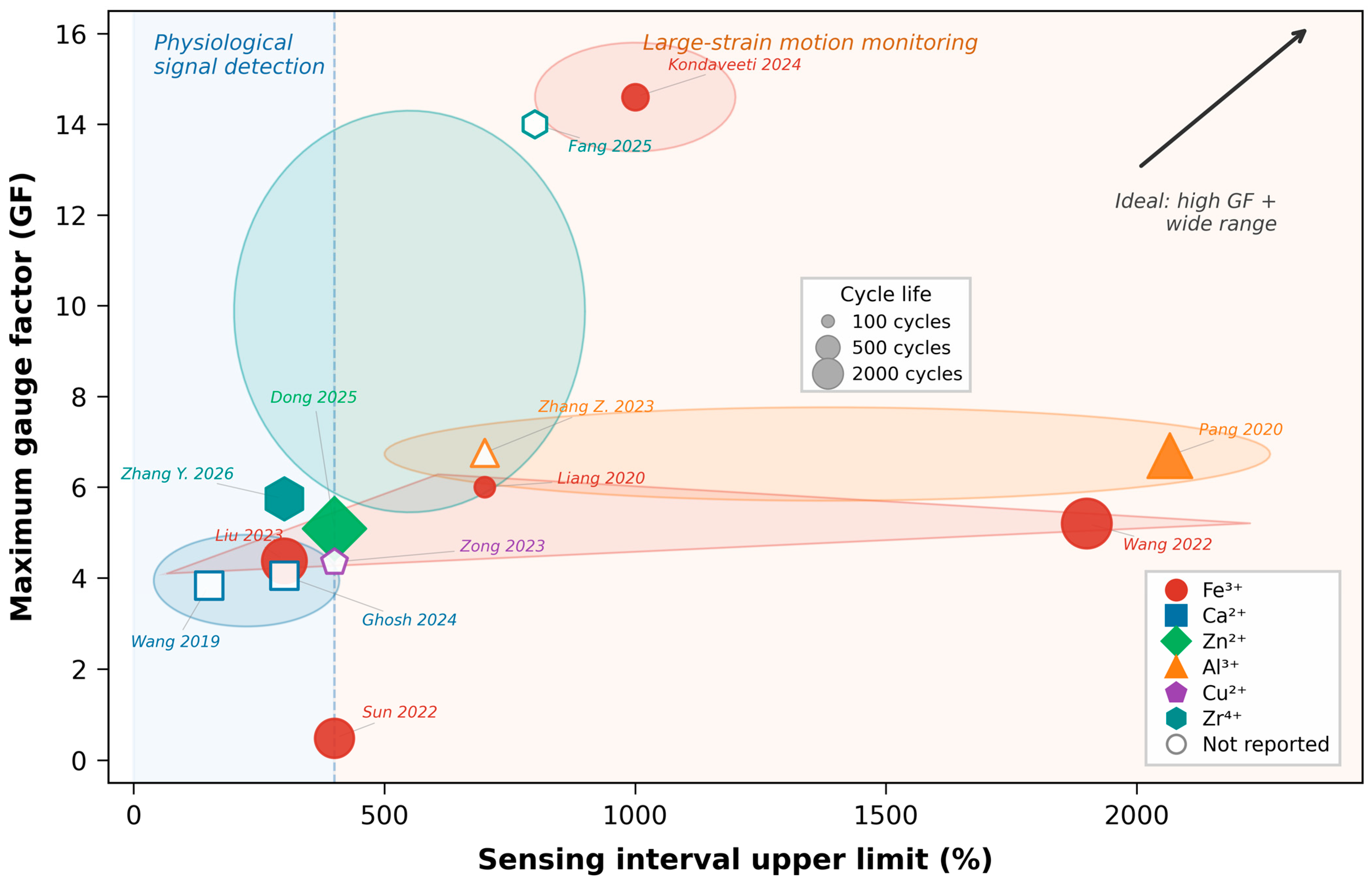
4.3. Comparative Analysis of Sensing Performance
5. Challenges and Current Limitations
5.1. The Conductivity–Mechanics Coupling Bottleneck
5.2. Insufficient Long-Term Operational Stability
5.3. Biosafety and Skin-Contact Compatibility
5.4. Lack of Standardized Evaluation Protocols
5.5. Device Integration and Manufacturing Scalability
6. Conclusions and Outlook
Author Contributions
Funding
Institutional Review Board Statement
Data Availability Statement
Conflicts of Interest
Abbreviations
| Abbreviation | Full Term |
| AL | alkali lignin |
| CMC | carboxymethyl cellulose |
| DA | dopamine |
| DIW | direct ink writing |
| DLP | digital light processing |
| DN | double network |
| DSC | differential scanning calorimetry |
| ECG | electrocardiogram |
| EIS | electrochemical impedance spectroscopy |
| EMG | electromyography |
| GF | gauge factor |
| LS | calcium lignosulfonate |
| Ls | sodium lignosulfonate |
| MXene | Ti3C2Tx MXene |
| PAA | poly(acrylic acid) |
| PAM | polyacrylamide |
| PANI | polyaniline |
| PDA | polydopamine |
| PHEAA | poly(N-hydroxyethyl acrylamide) |
| PVA | poly(vinyl alcohol) |
| RH | relative humidity |
| rGO | reduced graphene oxide |
| SA | sodium alginate |
| SBMA | sulfobetaine methacrylate |
| SMA | stearyl methacrylate |
| SPE | sulfated polysaccharide from Enteromorpha prolifera |
| TA | tannic acid |
References
- Lim, H.R.; Kim, H.S.; Qazi, R.; Kwon, Y.T.; Jeong, J.W.; Yeo, W.H. Advanced Soft Materials, Sensor Integrations, and Applications of Wearable Flexible Hybrid Electronics in Healthcare, Energy, and Environment. Adv. Mater. 2020, 32, 1901924. [Google Scholar] [CrossRef]
- Wang, X.; Liu, Z.; Zhang, T. Flexible Sensing Electronics for Wearable/Attachable Health Monitoring. Small 2017, 13, 1602790. [Google Scholar] [CrossRef]
- Zhu, G.; Javanmardia, N.; Qian, L.; Jin, F.; Li, T.; Zhang, S.; He, Y.; Wang, Y.; Xu, X.; Wang, T.; et al. Advances of Conductive Hydrogel Designed for Flexible Electronics: A Review. Int. J. Biol. Macromol. 2024, 281, 136115. [Google Scholar] [CrossRef]
- Petronienė, J.J.; Dzedzickis, A.; Morkvenaite-Vilkončienė, I.; Bučinskas, V. Flexible Strain Sensors: Recent Progress 2016–2023. Sens. Actuators A Phys. 2024, 366, 114950. [Google Scholar] [CrossRef]
- Amjadi, M.; Kyung, K.U.; Park, I.; Sitti, M. Stretchable, Skin-Mountable, and Wearable Strain Sensors and Their Potential Applications: A Review. Adv. Funct. Mater. 2016, 26, 1678–1698. [Google Scholar] [CrossRef]
- Cao, J.; Wu, B.; Yuan, P.; Liu, Y.; Hu, C. Progress of Research on Conductive Hydrogels in Flexible Wearable Sensors. Gels 2024, 10, 144. [Google Scholar] [CrossRef] [PubMed]
- Zhu, J.; Tao, J.; Yan, W.; Song, W. Pathways toward Wearable and High-Performance Sensors Based on Hydrogels: Toughening Networks and Conductive Networks. Natl. Sci. Rev. 2023, 10, nwad180. [Google Scholar] [CrossRef]
- Chen, J.; Liu, F.; Abdiryim, T.; Liu, X. An Overview of Conductive Composite Hydrogels for Flexible Electronic Devices. Adv. Compos. Hybrid Mater. 2024, 7, 35. [Google Scholar] [CrossRef]
- Sun, J.Y.; Zhao, X.; Illeperuma, W.R.K.; Chaudhuri, O.; Oh, K.H.; Mooney, D.J.; Vlassak, J.J.; Suo, Z. Highly Stretchable and Tough Hydrogels. Nature 2012, 489, 133–136. [Google Scholar] [CrossRef] [PubMed]
- Liu, K.; Wei, S.; Song, L.; Liu, H.; Wang, T. Conductive Hydrogels—A Novel Material: Recent Advances and Future Perspectives. J. Agric. Food Chem. 2020, 68, 7269–7280. [Google Scholar] [CrossRef]
- Dechiraju, H.; Jia, M.; Luo, L.; Rolandi, M. Ion-Conducting Hydrogels and Their Applications in Bioelectronics. Adv. Sustain. Syst. 2022, 6, 2100173. [Google Scholar] [CrossRef]
- Qin, T.; Liao, W.; Yu, L.; Zhu, J.; Wu, M.; Peng, Q.; Han, L.; Zeng, H. Recent Progress in Conductive Self-Healing Hydrogels for Flexible Sensors. J. Polym. Sci. 2022, 60, 2607–2634. [Google Scholar] [CrossRef]
- Wang, Z.; Cong, Y.; Fu, J. Stretchable and Tough Conductive Hydrogels for Flexible Pressure and Strain Sensors. J. Mater. Chem. B 2020, 8, 3437–3459. [Google Scholar] [CrossRef]
- Ding, H.; Liu, J.; Shen, X.; Li, H. Advances in the Preparation of Tough Conductive Hydrogels for Flexible Sensors. Polymers 2023, 15, 4001. [Google Scholar] [CrossRef]
- Li, M.; Pu, J.; Cao, Q.; Zhao, W.; Gao, Y.; Meng, T.; Chen, J.; Guan, C. Recent Advances in Hydrogel-Based Flexible Strain Sensors for Harsh Environment Applications. Chem. Sci. 2024, 15, 17799–17822. [Google Scholar] [CrossRef] [PubMed]
- Holten-Andersen, N.; Harrington, M.J.; Birkedal, H.; Lee, B.P.; Messersmith, P.B.; Lee, K.Y.C.; Waite, J.H. pH-Induced Metal-Ligand Cross-Links Inspired by Mussel Yield Self-Healing Polymer Networks with Near-Covalent Elastic Moduli. Proc. Natl. Acad. Sci. USA 2011, 108, 2651–2655. [Google Scholar] [CrossRef] [PubMed]
- Khare, E.; Holten-Andersen, N.; Buehler, M.J. Transition-Metal Coordinate Bonds for Bioinspired Macromolecules with Tunable Mechanical Properties. Nat. Rev. Mater. 2021, 6, 421–436. [Google Scholar] [CrossRef]
- Grindy, S.C.; Learsch, R.; Mozhdehi, D.; Cheng, J.; Barrett, D.G.; Guan, Z.; Messersmith, P.B.; Holten-Andersen, N. Control of Hierarchical Polymer Mechanics with Bioinspired Metal-Coordination Dynamics. Nat. Mater. 2015, 14, 1210–1216. [Google Scholar] [CrossRef]
- Khare, E.; Cazzell, S.; Song, J.; Holten-Andersen, N.; Buehler, M.J. Molecular Understanding of Ni2+-Nitrogen Family Metal-Coordinated Hydrogel Relaxation Times Using Free Energy Landscapes. Proc. Natl. Acad. Sci. USA 2023, 120, e2213160120. [Google Scholar] [CrossRef]
- Sun, W.; Xue, B.; Fan, Q.; Tao, R.; Wang, C.; Wang, X.; Li, Y.; Qin, M.; Wang, W.; Chen, B.; et al. Molecular Engineering of Metal Coordination Interactions for Strong, Tough, and Fast-Recovery Hydrogels. Sci. Adv. 2020, 6, eaaz9531. [Google Scholar] [CrossRef]
- Ghosh, A.; Kumar, S.; Singh, P.P.; Nandi, S.; Mandal, M.; Pradhan, D.; Khatua, B.B.; Das, R.K. Dynamic Metal-Coordinated Adhesive and Self-Healable Antifreezing Hydrogels for Strain Sensing, Flexible Supercapacitors, and EMI Shielding Applications. ACS Omega 2024, 9, 33204–33223. [Google Scholar] [CrossRef]
- Sanoja, G.E.; Schauser, N.S.; Bartels, J.M.; Evans, C.M.; Helgeson, M.E.; Seshadri, R.; Segalman, R.A. Ion Transport in Dynamic Polymer Networks Based on Metal–Ligand Coordination: Effect of Cross-Linker Concentration. Macromolecules 2018, 51, 2017–2026. [Google Scholar] [CrossRef]
- Schauser, N.S.; Sanoja, G.E.; Bartels, J.M.; Jain, S.K.; Hu, J.G.; Han, S.; Walker, L.M.; Helgeson, M.E.; Seshadri, R.; Segalman, R.A. Decoupling Bulk Mechanics and Mono- and Multivalent Ion Transport in Polymers Based on Metal–Ligand Coordination. Chem. Mater. 2018, 30, 5759–5769. [Google Scholar] [CrossRef]
- Filippidi, E.; Cristiani, T.R.; Eisenbach, C.D.; Waite, J.H.; Israelachvili, J.N.; Ahn, B.K.; Valentine, M.T. Toughening Elastomers Using Mussel-Inspired Iron-Catechol Complexes. Science 2017, 358, 502–505. [Google Scholar] [CrossRef]
- Li, Y.; Wen, J.; Qin, M.; Cao, Y.; Ma, H.; Wang, W. Single-Molecule Mechanics of Catechol-Iron Coordination Bonds. ACS Biomater. Sci. Eng. 2017, 3, 979–989. [Google Scholar] [CrossRef]
- Wu, M.; Han, L.; Yan, B.; Zeng, H. Self-Healing Hydrogels Based on Reversible Noncovalent and Dynamic Covalent Interactions: A Short Review. Supramol. Mater. 2023, 2, 100045. [Google Scholar] [CrossRef]
- Zhang, J.; Wang, Y.; Wei, Q.; Wang, Y.; Lei, M.; Li, M.; Li, D.; Zhang, L.; Wu, Y. Self-Healing Mechanism and Conductivity of the Hydrogel Flexible Sensors: A Review. Gels 2021, 7, 216. [Google Scholar] [CrossRef]
- Tang, L.; Wu, S.; Qu, J.; Gong, L.; Tang, J. A Review of Conductive Hydrogel Used in Flexible Strain Sensor. Materials 2020, 13, 3947. [Google Scholar] [CrossRef]
- Zhang, J.; Zhang, Q.; Liu, X.; Xia, S.; Gao, Y.; Gao, G. Flexible and Wearable Strain Sensors Based on Conductive Hydrogels. J. Polym. Sci. 2022, 60, 2663–2678. [Google Scholar] [CrossRef]
- Jia, Z.; Zeng, Y.; Tang, P.; Gan, D.; Xing, W.; Hou, Y.; Wang, K.; Xie, C.; Lu, X. Conductive, Tough, Transparent, and Self-Healing Hydrogels Based on Catechol-Metal Ion Dual Self-Catalysis. Chem. Mater. 2019, 31, 5625–5632. [Google Scholar] [CrossRef]
- Kondaveeti, S.; Choi, G.; Veerla, S.C.; Kim, S.; Kim, J.; Lee, H.J.; Kuzhiumparambil, U.; Ralph, P.J.; Yeo, J.; Jeong, H.E. Mussel-Inspired Resilient Hydrogels with Strong Skin Adhesion and High-Sensitivity for Wearable Device. Nano Converg. 2024, 11, 12. [Google Scholar] [CrossRef] [PubMed]
- Liu, J.; Wang, F.; Zhao, Q.; Liu, Y. Multifunctional Conductive Hydrogels Based on the Alkali Lignin-Fe3+-Mediated Fenton Reaction for Bioelectronics. Int. J. Biol. Macromol. 2023, 235, 123817. [Google Scholar] [CrossRef]
- Sun, X.; Wang, H.; Ding, Y.; Yao, Y.; Liu, Y.; Tang, J. Fe3+-Coordination Mediated Synergistic Dual-Network Conductive Hydrogel as a Sensitive and Highly Stretchable Strain Sensor with Adjustable Mechanical Properties. J. Mater. Chem. B 2022, 10, 1442–1452. [Google Scholar] [CrossRef]
- Wang, J.; Dai, T.; Wu, H.; Ye, M.; Yuan, G.; Jia, H. Tannic Acid-Fe3+ Activated Rapid Polymerization of Ionic Conductive Hydrogels with High Mechanical Properties, Self-Healing, and Self-Adhesion for Flexible Wearable Sensors. Compos. Sci. Technol. 2022, 221, 109345. [Google Scholar] [CrossRef]
- Sun, H.; Zhou, K.; Yu, Y.; Yue, X.; Dai, K.; Zheng, G.; Liu, C.; Shen, C. Highly Stretchable, Transparent, and Bio-Friendly Strain Sensor Based on Self-Recovery Ionic-Covalent Hydrogels for Human Motion Monitoring. Macromol. Mater. Eng. 2019, 304, 1900227. [Google Scholar] [CrossRef]
- Wang, J.; Liu, Y.; Su, S.; Wei, J.; Rahman, S.E.; Ning, F.; Christopher, G.; Cong, W.; Qiu, J. Ultrasensitive Wearable Strain Sensors of 3D Printing Tough and Conductive Hydrogels. Polymers 2019, 11, 1873. [Google Scholar] [CrossRef]
- Chen, Y.; Huang, Q.; Zhou, M.; Hu, Y.; Zhang, Y.; Jiang, X.; Chen, Z. A Robust, Fatigue-Resistant, Self-Healing, and Recyclable κ-Carrageenan-Based Ionic Conductive Hydrogel with Synergistic K+/Ca2+ Enhancement for Multifunctional Flexible Sensor. Int. J. Biol. Macromol. 2025, 331, 148427. [Google Scholar] [CrossRef] [PubMed]
- Dong, H.; Su, Y.; Liu, C.; Zhang, X.; Zhou, H.; Si, D.; Luo, Y.; Jia, J.; Han, M.; Zeng, W. Gelatin and Zinc Ion-Cooperated Triple Crosslinked Hydrogels with High Mechanical Properties and Ultrasensitivity for Multimodal Sensing and Handwriting Recognition. Int. J. Biol. Macromol. 2025, 304, 140869. [Google Scholar] [CrossRef]
- Wang, R.; Jin, B.; Li, J.; Li, J.; Xie, J.; Zhang, P.; Fu, Z. Bio-Inspired Synthesis of Injectable, Self-Healing PAA-Zn-Silk Fibroin-MXene Hydrogel for Multifunctional Wearable Capacitive Strain Sensor. Gels 2025, 11, 377. [Google Scholar] [CrossRef]
- Tunn, I.; Harrington, M.J.; Blank, K.G. Bioinspired Histidine–Zn2+ Coordination for Tuning the Mechanical Properties of Self-Healing Coiled Coil Cross-Linked Hydrogels. Biomimetics 2019, 4, 25. [Google Scholar] [CrossRef]
- Su, H.; Liu, H.; Su, Z.; Gao, H.; Ma, F.; Lu, Q.; Yan, W.; Liu, L. Rapid Polymerization of Anti-Freezing Hydrogels Using a Lignin Sulfonate–Zn2+ Self-Catalytic System for Strain and Temperature Sensors. ACS Appl. Polym. Mater. 2025, 7, 1026–1036. [Google Scholar] [CrossRef]
- Pang, J.; Wang, L.; Xu, Y.; Wu, M.; Wang, M.; Liu, Y.; Yu, S.; Li, L. Skin-Inspired Cellulose Conductive Hydrogels with Integrated Self-Healing, Strain, and Thermal Sensitive Performance. Carbohydr. Polym. 2020, 240, 116360. [Google Scholar] [CrossRef]
- Zhang, Z.; Cai, X.; Lv, Y.; Tang, X.; Shi, N.; Zhou, J.; Yan, M.; Li, Y. Self-Healing, Ultra-Stretchable, and Highly Sensitive Conductive Hydrogel Reinforced by Sulfate Polysaccharide from Enteromorpha prolifera for Human Motion Sensing. Int. J. Biol. Macromol. 2023, 253, 126847. [Google Scholar] [CrossRef]
- Sun, D.; Li, N.; Rao, J.; Jia, S.; Su, Z.; Hao, X.; Peng, F. Ultrafast Fabrication of Organohydrogels with UV Blocking, Anti-Freezing, Anti-Drying, and Skin Epidermal Sensing Properties Using Lignin–Cu2+ Plant Catechol Chemistry. J. Mater. Chem. A 2021, 9, 14381–14391. [Google Scholar] [CrossRef]
- Zong, S.; Lv, H.; Liu, C.; Zhu, L.; Duan, J.; Jiang, J. Mussel Inspired Cu-Tannic Autocatalytic Strategy for Rapid Self-Polymerization of Conductive and Adhesive Hydrogel Sensors with Extreme Environmental Tolerance. Chem. Eng. J. 2023, 465, 142831. [Google Scholar] [CrossRef]
- Wu, J.; Wang, X.; Liu, B.; Tang, J.; Wan, X.; Weng, G. Stress and Airflow-Sensitive 3D-Printed Hydrogel Sensor Based on Cu2+–Alanine Coordination and Graphene Sheet Networks. J. Mater. Chem. A 2025, 13, 38130–38139. [Google Scholar] [CrossRef]
- Wang, C.; Zhang, J.; Fu, Q.; Niu, C.; Xu, Y.; Chen, Y.; Zhao, Z.; Lu, L. Construction of Strain Responsive Ti-Containing Carboxymethyl Cellulose Hydrogel with Transitional Coordination Precursor. Int. J. Biol. Macromol. 2024, 261, 129865. [Google Scholar] [CrossRef] [PubMed]
- Fang, H.; Dong, T.; Yuan, Z.; Zhang, X.; Shao, W. Zr4+-Reinforced Zwitterionic Hydrogels with Multiple Dynamic Networks for Ultrasensitive Strain Sensing in Next-Generation Wearable Electronics. Chem. Eng. J. 2025, 518, 164546. [Google Scholar] [CrossRef]
- Zhang, Y.; Liang, M.; Yan, Z.; Zhang, S. A Highly Resilient and Large-Strain Wearable Hydrogel Sensor Based on Acrylamide/Gelatin/Zr4+ and Its Application in Human Motion Monitoring and Information Transmission. Polymer 2026, 346, 129635. [Google Scholar] [CrossRef]
- Ren, A.; Jia, L.; Wang, P.; Xiang, T.; Zhou, S. Toughening of Anti-Freezing Ionic Hydrogels with Zr4+-Dicarboxylic Acid Coordination Complex for Low Temperature Sensing Applications. Chem. Eng. J. 2024, 501, 157822. [Google Scholar] [CrossRef]
- Li, M.; Zhang, J.; Chen, G.; Liu, Y.; Xie, D.; Li, M.; Zhang, Y.; Song, J.; Luo, Z. Strong and Tough Adhesive Hydrogel Based on Polyacrylate/Carboxylated Cellulose Nanofibers/Zr4+ for High-Sensitivity Motion Monitoring and Controlled Transdermal Drug Delivery. Int. J. Biol. Macromol. 2025, 303, 140657. [Google Scholar] [CrossRef]
- Chen, C.-K.; Lin, C.-Y.; Chakravarthy, R.D.; Chen, Y.-H.; Chen, C.-Y.; Lin, H.-C.; Yeh, M.-Y. Effect of Metal Ions on the Conductivity, Self-Healing, and Mechanical Properties of Alginate/Polyacrylamide Hydrogels. Materials 2025, 18, 3871. [Google Scholar] [CrossRef] [PubMed]
- Mo, F.; Lin, Y.; Liu, Y.; Zhou, P.; Yang, J.; Ji, Z.; Wang, Y. Advances in Ionic Conductive Hydrogels for Skin Sensor Applications. Mater. Sci. Eng. R 2025, 165, 100989. [Google Scholar] [CrossRef]
- Zhao, Z.; Liu, J.; Zhang, F.; Song, K.; Lu, A.; Nian, X.; Song, J.; Wang, Y. Zinc Chloride Cross-Linked PVA/Gel/Zn2+ Composite Hydrogels and Their Antimicrobial Sensing Properties. Mater. Lett. 2025, 385, 138149. [Google Scholar] [CrossRef]
- Zhang, X.; Geng, H.; Zhang, X.; Liu, Y.; Hao, J.; Cui, J. Modulation of Double-Network Hydrogels via Seeding Calcium Carbonate Microparticles for the Engineering of Ultrasensitive Wearable Sensors. J. Mater. Chem. A 2023, 11, 2996–3007. [Google Scholar] [CrossRef]
- Fu, H.; Wang, B.; Li, J.; Xu, J.; Li, J.; Zeng, J.; Gao, W.; Chen, K. A Self-Healing, Recyclable and Conductive Gelatin/Nanofibrillated Cellulose/Fe3+ Hydrogel Based on Multi-Dynamic Interactions for a Multifunctional Strain Sensor. Mater. Horiz. 2022, 9, 1412–1421. [Google Scholar] [CrossRef] [PubMed]
- Zhang, H.; Guo, Z.; Ma, C.; Xie, W.; Liu, W. Study on meso-macroscopic ionic conductivity of hydrogels and construction of prediction model. Polymer 2024, 302, 127048. [Google Scholar] [CrossRef]
- Sun, G.; He, X.; Chen, H.; Li, J.; Wang, Y. Ca2+/Ethanol Driven In-Situ Integration of Tough, Antifreezing and Conductive Silk Fibroin/Polyacrylamide Hydrogels for Wearable Sensors and Electronic Skin. Chem. Eng. J. 2024, 497, 154745. [Google Scholar] [CrossRef]
- Yang, H.; Han, W.; Shi, C.; Miao, D.; Wang, D.; Shi, Z.; Yang, J.; Shen, J. Tannic-Ca2+ Complex-Induced Rapid Fabrication of Anti-Freezing and Adhesive Hydrogels for High-Performance Strain Sensing. Chem. Eng. J. 2026, 530, 173581. [Google Scholar] [CrossRef]
- Daso, R.E.; Posey, R.; Garza, H.; Perry, A.; Petersen, C.; Fritz, A.C.; Rivnay, J.; Tropp, J. Standardized Electrochemical Characterization of Conductive Hydrogels. Adv. Funct. Mater. 2025, 35, 2508859. [Google Scholar] [CrossRef]
- Zhang, K.; Feng, Q.; Fang, Z.; Gu, L.; Bian, L. Structurally Dynamic Hydrogels for Biomedical Applications. Chem. Rev. 2021, 121, 11149–11193. [Google Scholar] [CrossRef]
- Lin, X.; Wang, X.; Zeng, L.; Wu, Z.L.; Guo, H.; Hourdet, D. Stimuli-Responsive Toughening of Hydrogels. Chem. Mater. 2021, 33, 7633–7656. [Google Scholar] [CrossRef]
- Zhou, L.; Wang, Z.; Wu, C.; Cong, Y.; Zhang, R.; Fu, J. Highly Sensitive Pressure and Strain Sensors Based on Stretchable and Recoverable Ion-Conductive Physically Cross-Linked Double Network Hydrogels. ACS Appl. Mater. Interfaces 2020, 12, 51969–51977. [Google Scholar] [CrossRef] [PubMed]
- Das Mahapatra, R.; Imani, K.B.C.; Yoon, J. Integration of Macro-Cross-Linker and Metal Coordination: A Super Stretchable Hydrogel with High Toughness. ACS Appl. Mater. Interfaces 2020, 12, 40786–40793. [Google Scholar] [CrossRef]
- Li, R.; Ren, J.; Zhang, M.; Li, M.; Li, Y.; Yang, W. Highly Stretchable, Fast Self-Healing, Self-Adhesive, and Strain-Sensitive Wearable Sensor Based on Ionic Conductive Hydrogels. Biomacromolecules 2024, 25, 614–625. [Google Scholar] [CrossRef] [PubMed]
- Liu, Y.; Liu, Y.; Yang, Z.; Chen, X.; Zhao, Y. Preparation of MPASP-PAA/Fe3+ Composite Conductive Hydrogel with Physical and Chemical Double Crosslinking Structure and Its Application in Flexible Strain Sensors. Macromol. Chem. Phys. 2022, 223, 2100467. [Google Scholar] [CrossRef]
- Feng, Q.; Wan, K.; Zhu, T.; Fan, X.; Zhang, C.; Liu, T. Stretchable, Environment-Stable, and Knittable Ionic Conducting Fibers Based on Metallogels for Wearable Wide-Range and Durable Strain Sensors. ACS Appl. Mater. Interfaces 2022, 14, 4542–4551. [Google Scholar] [CrossRef]
- Tong, R.; Ma, Z.; Gu, P.; Yao, R.; Li, T.; Zeng, M.; Guo, F.; Liu, L.; Xu, J. Stretchable and Sensitive Sodium Alginate Ionic Hydrogel Fibers for Flexible Strain Sensors. Int. J. Biol. Macromol. 2023, 246, 125683. [Google Scholar] [CrossRef]
- Song, H.-S.; Rumon, M.M.H.; Rahman Khan, M.M.; Jeong, J.-H. Toward Intelligent Materials with the Promise of Self-Healing Hydrogels in Flexible Devices. Polymers 2025, 17, 542. [Google Scholar] [CrossRef]
- Helm, L.; Merbach, A.E. Water Exchange on Metal Ions: Experiments and Simulations. Coord. Chem. Rev. 1999, 187, 151–181. [Google Scholar] [CrossRef]
- Remsing, R.C.; Klein, M.L. Exponential Scaling of Water Exchange Rates with Ion Interaction Strength from the Perspective of Dynamic Facilitation Theory. J. Phys. Chem. A 2019, 123, 1077–1084. [Google Scholar] [CrossRef] [PubMed]
- Bovone, G.; Dudaryeva, O.Y.; Marco-Dufort, B.; Tibbitt, M.W. Engineering Hydrogel Adhesion for Biomedical Applications via Chemical Design of the Junction. ACS Biomater. Sci. Eng. 2021, 7, 4048–4076. [Google Scholar] [CrossRef]
- Wang, J.; Li, W.; Liu, J.; Li, J.; Wang, F. A Highly Stretchable and Self-Adhesive Cellulose Complex Hydrogels Based on PDA@Fe3+ Mediated Redox Reaction for Strain Sensor. Int. J. Biol. Macromol. 2024, 281, 136307. [Google Scholar] [CrossRef]
- Dong, X.; He, X.; Sun, Z.; Tian, Y.; Li, Q.; Wei, D. Frost-Resistant Ionic Conductive Hydrogels toward Sensor Application. ACS Appl. Polym. Mater. 2025, 7, 3174–3187. [Google Scholar] [CrossRef]
- Chen, D.; Bai, H.; Zhu, H.; Zhang, S.; Wang, W.; Dong, W. Anti-Freezing, Tough, and Stretchable Ionic Conductive Hydrogel with Multi-Crosslinked Double-Network for a Flexible Strain Sensor. Chem. Eng. J. 2024, 480, 148192. [Google Scholar] [CrossRef]
- Sun, X.; Yao, F.; Li, J. Nanocomposite Hydrogel-Based Strain and Pressure Sensors: A Review. J. Mater. Chem. A 2020, 8, 18605–18623. [Google Scholar] [CrossRef]
- Han, Y.; Wu, X.; Zhang, X.; Lu, C. Self-Healing, Highly Sensitive Electronic Sensors Enabled by Metal–Ligand Coordination and Hierarchical Structure Design. ACS Appl. Mater. Interfaces 2017, 9, 20106–20114. [Google Scholar] [CrossRef] [PubMed]
- Kim, T.Y.; Suh, W.; Jeong, U. Approaches to Deformable Physical Sensors: Electronic versus Iontronic. Mater. Sci. Eng. R 2021, 146, 100640. [Google Scholar] [CrossRef]
- Liang, Y.; Ye, L.; Sun, X.; Lv, Q.; Liang, H. Tough and Stretchable Dual Ionically Cross-Linked Hydrogel with High Conductivity and Fast Recovery Property for High-Performance Flexible Sensors. ACS Appl. Mater. Interfaces 2020, 12, 1577–1587. [Google Scholar] [CrossRef]
- Liu, J.; Bao, S.; Ling, Q.; Fan, X.; Gu, H. Ultra-Fast Preparation of Multifunctional Conductive Hydrogels with High Mechanical Strength, Self-Healing and Self-Adhesive Properties Based on Tara Tannin-Fe3+ Dynamic Redox System for Strain Sensors Applications. Polymer 2022, 240, 124513. [Google Scholar] [CrossRef]
- Guan, X.; Zheng, S.; Zhang, B.; Sun, X.; Meng, K.; Elafify, M.S.; Zhu, Y.; El-Gowily, A.H.; An, M.; Li, D.; et al. Masking Strategy Constructed Metal Coordination Hydrogels with Improved Mechanical Properties for Flexible Electronic Sensors. ACS Appl. Mater. Interfaces 2024, 16, 5168–5182. [Google Scholar] [CrossRef] [PubMed]
- Zeng, Q.; Wan, S.; Yang, S.; Zhao, X.; He, F.; Zhang, Y.; Cao, X.; Wen, Q.; Feng, Y.; Yu, G.; et al. Super Stretchability, Strong Adhesion, Flexible Sensor Based on Fe3+ Dynamic Coordination Sodium Alginate/Polyacrylamide Dual-Network Hydrogel. Colloids Surf. A Physicochem. Eng. Asp. 2022, 652, 129733. [Google Scholar] [CrossRef]
- Luo, Y.; Zhang, S.; Yang, X.; Shen, Y.; Liang, M.; Lu, Y. Double-Network Sodium Carboxymethyl Cellulose/Fe3+ Hydrogel with Enhanced Mechanical Properties and Sensing Performance for Human Motion Monitoring and Morse Code Transmission. Int. J. Biol. Macromol. 2026, 338, 149806. [Google Scholar] [CrossRef]
- Zhao, R.; Gao, M.; Zhao, Z.; Song, S. Ultra-Stretchable, High Conductive, Fatigue Resistance, and Self-Healing Strain Sensor Based on Mussel-Inspired Adhesive Hydrogel for Human Motion Monitoring. Eur. Polym. J. 2024, 211, 113024. [Google Scholar] [CrossRef]
- Pang, Q.; Hu, H.; Zhang, H.; Qiao, B.; Ma, L. Temperature-Responsive Ionic Conductive Hydrogel for Strain and Temperature Sensors. ACS Appl. Mater. Interfaces 2022, 14, 26536–26547. [Google Scholar] [CrossRef]
- Wang, J.; Du, P.; Hsu, Y.-I.; Uyama, H. Smart Versatile Hydrogels Tailored by Metal-Phenolic Coordinating Carbon and Polypyrrole for Soft Actuation, Strain Sensing and Writing Recognition. Chem. Eng. J. 2024, 493, 152671. [Google Scholar] [CrossRef]
- Wang, D.; Qin, L.; Yang, W.; He, Y.; Zhang, S.; Yang, Y.; Xu, K.; Gao, P.; Yu, J.; Cai, K. A Conductive Hydrogel Based on GaIn and PVA/PAA/Fe3+ for Strain Sensor and Physiological Signal Detection. ACS Appl. Polym. Mater. 2021, 3, 5268–5276. [Google Scholar] [CrossRef]
- Chen, Q.; Tang, H.; Liu, J.; Wang, R.; Sun, J.; Yao, J.; Shao, Z.; Chen, X. Silk-Based Pressure/Temperature Sensing Bimodal Ionotronic Skin with Stimulus Discriminability and Low-Temperature Workability. Chem. Eng. J. 2021, 422, 130091. [Google Scholar] [CrossRef]
- Fan, Z.; Ji, D.; Kim, J. Recent Progress in Mechanically Robust and Conductive-Hydrogel-Based Sensors. Adv. Intell. Syst. 2023, 5, 2300194. [Google Scholar] [CrossRef]
- Li, Y.; Tan, S.; Zhang, X.; Li, Z.; Cai, J.; Liu, Y. Design Strategies and Emerging Applications of Conductive Hydrogels in Wearable Sensing. Gels 2025, 11, 258. [Google Scholar] [CrossRef] [PubMed]
- Xiao, L.; Jiang, H.; Zhang, D.; Ou, C.; Lai, J.; Wang, M.; Ma, Y.; Huang, Y. Designing Anti-Dehydration and Ion-Conductive Tough Hydrogels as Environment-Adaptable Strain Sensors for E-Skin. Chem. Eng. J. 2023, 474, 145944. [Google Scholar] [CrossRef]
- Li, H.; Li, Y.; Zhao, C.; Cheng, J.; Wu, Y.; Du, Y.; He, J.; Xiao, M.; Liu, X. Anti-Freezing Plants Inspired Zwitterionic Hydrogel Strain Sensor for Human Motion Monitoring. Colloids Surf. A Physicochem. Eng. Asp. 2026, 730, 138993. [Google Scholar] [CrossRef]
- Pradeepa, P.; Brabu, B.; Murugan, S.S.; Sathya, T.N.; Murali, M.R.; Navaneethakrishnan, K.R.; Kumaravel, T.S.; Naveen, S.V. Hydrogel Based Skin Contacting Medical Devices and Cytotoxicity: An Overview of Challenges and Recommendations from a Regulatory Perspective. Indian J. Sci. Technol. 2023, 16, 2350–2357. [Google Scholar] [CrossRef]
- Chen, M.; Liu, H.; Chen, X.; Kang, L.; Yao, X.; Tan, L.; Zhu, W.; Yu, J.; Qin, X.; Wu, D. A Novel Multifunction of Wearable Ionic Conductive Hydrogel Sensor for Promoting Infected Wound Healing. Appl. Mater. Today 2024, 39, 102298. [Google Scholar] [CrossRef]
- Luo, Y.; Abidian, M.R.; Ahn, J.H.; Akinwande, D.; Andrews, A.M.; Antonietti, M.; Bao, Z.; Berggren, M.; Berkey, C.A.; Bettinger, C.J.; et al. Technology Roadmap for Flexible Sensors. ACS Nano 2023, 17, 5211–5295. [Google Scholar] [CrossRef]
- Zheng, X.; Dong, L.; Jiang, H.; Aihemaiti, P.; Aiyiti, W.; Shuai, C. Three-Dimensional Printed Ionic Conductive Hydrogels with Tunable Mechanical Properties for Wearable Strain Sensors. Colloids Surf. B Biointerfaces 2025, 255, 114912. [Google Scholar] [CrossRef]
- Khan, S.A.; Ahmad, H.; Zhu, G.; Pang, H.; Zhang, Y. Three-Dimensional Printing of Hydrogels for Flexible Sensors: A Review. Gels 2024, 10, 187. [Google Scholar] [CrossRef] [PubMed]
- Ren, N.; Zheng, G.; Cui, M.; Zhang, L.; Ai, Y.; Shan, C.; Qi, W.; Huang, R.; Su, R. Integrally Formed Janus Adhesive Conductive Hydrogel with Excellent Interfacial Stability and Fatigue Resistance for Robust Flexible Sensing. Cell Rep. Phys. Sci. 2025, 6, 102916. [Google Scholar] [CrossRef]



| Metal Ion | Polymer Matrix/Key Components | Main Coordinating Ligand Group(s) | Key Feature | Ref. |
|---|---|---|---|---|
| Fe3+ | dopamine (DA); poly(acrylic acid) (PAA) | catechol (DA) | dynamic Fe3+–catechol/carboxyl coordination | [30] |
| Fe3+ | dopamine-functionalized pectin; PAA; polydopamine-coated reduced graphene oxide | carboxyl; catechol | hybrid ionic/electronic network | [31] |
| Fe3+ | poly(acrylamide-co-acrylic acid); polyaniline (PANI) | carboxyl | synergistic dual-network sensor | [33] |
| Ca2+ | polyacrylamide (PAM); sodium alginate/calcium alginate | guluronic acid blocks in alginate | sacrificial egg-box double network | [35] |
| Zn2+ | gelatin; poly(acrylamide-co-acrylic acid) | carboxyl (–COO−); amino/amide groups (gelatin) | triple-crosslinked network | [38] |
| Al3+ | poly(acrylic acid) (PAA); sulfated polysaccharide from Enteromorpha prolifera | carboxyl (–COO−); sulfate (–OSO3−) | multi-coordination stretchable network | [43] |
| Cu2+ | sodium lignosulfonate (Ls); poly(N-hydroxyethyl acrylamide) (PHEAA); glycerol/water | catechol-like phenolic hydroxyl groups in lignin | ultrafast organohydrogel formation | [44] |
| Ti4+ | carboxymethyl cellulose (CMC); dopamine | catechol (dopamine) | tris-catechol coordination network | [47] |
| Zr4+ | sulfobetaine methacrylate (SBMA); stearyl methacrylate (SMA); calcium lignosulfonate (LS); hydrophobic micelles | sulfonate (–SO3−) groups | multiple dynamic networks | [48] |
| Zr4+ | polyacrylamide (PAM); gelatin | carboxyl/amino groups (gelatin); amide groups (PAM) | resilient large-strain sensor network | [49] |
| Metal Ion | Representative System | Reported Sensing Interval (%) | Gauge Factor (GF) | Other Reported Sensor Merits | Representative Application | Ref. |
|---|---|---|---|---|---|---|
| Fe3+ | PPGP hydrogel | 0–1000 | 14.6 (650–1000%) | 169 ms; 150 cycles | Eyebrow/eye blinking, carotid pulse, joint bending | [31] |
| Fe3+ | AL/PAA/Fe3+ hydrogel | 0–300 | 1.68 (0–120%), 2.98 (120–200%), 4.38 (200–300%) | 1000 cycles | Wireless motion monitoring | [32] |
| Fe3+ | PANI-P(AAm-co-AA)@Fe3+ hydrogel | 0–400 | 0.48 | 500 cycles | Finger/wrist bending; pulse detection | [33] |
| Fe3+ | BCW-TA/PAA/Fe3+ hydrogel | 0–1900 | 5.2 (1200–1900%) | 91% self-healing; 2000 cycles | Flexible wearable sensing in harsh environments | [34] |
| Fe3+ | P(AAm-co-AA)-Fe3+/CS- SO42− hydrogel | 0–700 | 6.0 (700%) | Fast recovery; 100 cycles | Knuckle motion; speaking; swallowing | [79] |
| Ca2+ | 3D-printed agar/calcium alginate/PAM hydrogel | 0–150 | 3.83 | Rapid and stable response | Finger bending | [36] |
| Ca2+ | PAAm-co-maleic acid/Ca2+ hydrogel | 0–300 | 1.9 (0–50%), 4.05 (300%) | ~98% conductivity recovery in 1 min; | Finger, elbow, knee, wrist bending; Morse code | [21] |
| Zn2+ | PMAGZ hydrogel | 0–400 | 1.98 (0–100%), 3.12 (100–250%), 5.09 (250–400%) | 195 ms; 1000 cycles | Multimodal sensing; handwriting recognition | [38] |
| Zn2+ | PZS-MXene hydrogel | 0–200 | 1.39 (0–75%), 1.78 (75–150%), 0.52 (150–200%) | Self-healing within 30 s; 0.2 s; 100 cycles | Wearable capacitive strain sensing | [39] |
| Al3+ | PAA-CMC-Al3+ composite hydrogel | 0–2066 | 0.22 (0–200%), 6.7 (1600–2066%) | ~96.3% self-healing within 60 min; 1000 cycles | Joint bending; pulse; phonation | [42] |
| Al3+ | PAA-Al3+/SPE hydrogel | 0–700 | 2.10 (25–100%), 3.23 (100–300%), 6.76 (300–700%) | Rapid self-healing within 60 s | Joint bending, breathing, phonation | [43] |
| Cu2+ | CuTCG conductive hydrogel | 0–400 | 1.77–4.35 (0–400%) | ~120 ms; flexible/adhesive from −20 to 60 °C | Joint bending; swallowing; phonation | [45] |
| Zr4+ | P(SBMA-SMA)/LS/Zr4+ hydrogel | 0–800 | 3.4 (0–200%), 7.6 (200–400%), 14.0 (400–800%) | 100% self-healing within 6 h | Joint bending; pulse; gesture recognition | [48] |
| Zr4+ | PMG2Z2 hydrogel sensor | 0–300 | 1.395 (0–50%), 2.637 (50–150%), 5.744 (150–300%) | 800 cycles; fracture strain 924% | Motion monitoring; phonation; Morse code | [49] |
Disclaimer/Publisher’s Note: The statements, opinions and data contained in all publications are solely those of the individual author(s) and contributor(s) and not of MDPI and/or the editor(s). MDPI and/or the editor(s) disclaim responsibility for any injury to people or property resulting from any ideas, methods, instructions or products referred to in the content. |
© 2026 by the authors. Licensee MDPI, Basel, Switzerland. This article is an open access article distributed under the terms and conditions of the Creative Commons Attribution (CC BY) license.
Share and Cite
Li, M.; Zhang, H. Metal-Ion-Coordinated Conductive Hydrogels for Strain Sensing from Coordination Design to Wearable Applications. Appl. Sci. 2026, 16, 4450. https://doi.org/10.3390/app16094450
Li M, Zhang H. Metal-Ion-Coordinated Conductive Hydrogels for Strain Sensing from Coordination Design to Wearable Applications. Applied Sciences. 2026; 16(9):4450. https://doi.org/10.3390/app16094450
Chicago/Turabian StyleLi, Muze, and Hui Zhang. 2026. "Metal-Ion-Coordinated Conductive Hydrogels for Strain Sensing from Coordination Design to Wearable Applications" Applied Sciences 16, no. 9: 4450. https://doi.org/10.3390/app16094450
APA StyleLi, M., & Zhang, H. (2026). Metal-Ion-Coordinated Conductive Hydrogels for Strain Sensing from Coordination Design to Wearable Applications. Applied Sciences, 16(9), 4450. https://doi.org/10.3390/app16094450