Article

Annual Chronological Production Simulation Method for Regional Power Grids Considering Inter-Provincial Monthly Medium-Term Mutual Assistance

State Key Laboratory of Power Transmission Equipment & System Security and New Technology, Chongqing University, Shapingba District, Chongqing 400044, China
*
Author to whom correspondence should be addressed.
Appl. Sci. 2026, 16(9), 4421; https://doi.org/10.3390/app16094421
Submission received: 6 March 2026 / Revised: 9 April 2026 / Accepted: 27 April 2026 / Published: 30 April 2026
(This article belongs to the Special Issue Energy and Power Systems: Control and Management)

Abstract

This study proposes a three-stage chronological production simulation method to enhance inter-provincial resource coordination. The core innovation lies in combining the “multi-time-scale decomposition” strategy with the “intra-provincial balancing and inter-provincial mutual assistance” mechanism. A three-stage optimization model for annual chronological production simulation is constructed. Specifically, the inter-provincial monthly medium-term mutual assistance stage takes into account the constraints of inter-provincial monthly transaction electricity volume, so as to adapt to the current situation in China where inter-provincial medium-term power transactions are mostly carried out on a monthly cycle. Simulation analysis was conducted based on a case study built with actual data from the Chongqing and Sichuan power grids in the southwestern region of China, which verifies the effectiveness of the proposed method.

1. Introduction

Due to significant temporal and spatial variations in various power generation resources and loads, a single provincial grid struggles to achieve supply/demand balance solely through coordinating intra-provincial resources. Therefore, it is necessary to leverage the interconnection mechanism of regional grids to achieve cross-provincial resource mutual support, enabling the optimized allocation of generation and load over longer cycles and broader areas. Consequently, conducting annual chronological production simulations targeting regional grids can fully utilize the temporal and spatial complementary advantages of resources across provinces, effectively alleviate local supply/demand conflicts, and simultaneously enhance the overall operational economy and power supply reliability of the regional grid. In this study, the term “medium-term” is explicitly defined as a time scale characterized by a monthly cycle, which is consistent with the time scale of inter-provincial medium-term mutual assistance.
Scholars across China and globally have carried out extensive relevant research on relevant topics, including cross-provincial and cross-regional renewable energy integration [1,2,3,4], electricity purchase and sale arrangements [5,6,7], short-term peak-shaving collaboration [8,9,10], and electricity market mechanisms [11,12,13]. As stipulated in Article 21 of the Electric Power Law [14] and the Regulations on Grid Dispatch Management [15], China’s power system operates under the framework of unified dispatch and hierarchical management. Provincial power dispatch centers possess independent dispatching autonomy and are responsible for intra-provincial power balance and power grid security. As specified in the national policy [16], inter-provincial power coordination mainly relies on medium- and long-term transactions, tie-line scheduling, and emergency mutual support, which are constrained by transmission interface capacity, transaction contracts, and dispatching boundaries, rather than unrestricted global unified optimization. Affected by the above institutional and operational constraints, each provincial power grid is essentially an independent entity with separate dispatching authority, independent balance responsibility, and clear benefit boundaries. Inter-provincial power exchange is not unconstrained free optimization at the system-wide level, but limited mutual assistance under established plans and physical constraints. Therefore, it is infeasible to regard multiple provincial power grids as a unified whole for global joint optimization. The decomposition and coordination mode based on intra-provincial balancing and inter-provincial mutual assistance is more consistent with the actual institutional and operational rules of China’s provincial power systems. Existing studies adopt the “intra-provincial balancing and inter-provincial mutual assistance” strategy [17,18] to balance provincial grid dispatch autonomy with cross-provincial resource mutual assistance requirements. The authors of [17,18] propose dividing the multi-provincial grid joint production simulation problem into two subproblems: Subproblem 1 involves chronological weekly optimization of independent provincial grids to determine hourly power surpluses/deficits, calculating inter-provincial mutual assistance demand and capacity; Subproblem 2 involves hourly independent optimization of power surplus/deficit mutual assistance among multiple provincial grids to satisfy hourly power exchange requirements, using power surplus/deficit status as the coupling variable between the two problems.
Issues with existing “intra-provincial balancing and inter-provincial mutual support” research: (1) It focuses solely on hourly independent power surplus/deficit mutual support, while assuming fixed generation unit statuses across provincial grids. Mutual support capacity is determined solely by power surplus/deficit levels, limiting inter-provincial mutual support capabilities. This approach—characterized by independent time periods and constrained mutual support capacity—fails to fully leverage inter-provincial mutual support potential. (2) Such short-term power surplus/deficit mutual support constitutes a negligible portion of inter-provincial trading plans, rendering it incompatible with China’s current practice of conducting inter-provincial medium-term electricity trading primarily on a monthly cycle.
After comprehensively considering the complex constraints of various resource types and long-cycle coupling variables, traditional 8760-h joint optimization methods suffer from low computational efficiency and difficulties in obtaining globally coordinated optimal solutions [19,20]. To ensure model solvability and efficiency, existing studies have employed methods such as unit clustering [21,22], sequential hourly optimization [23,24], and multi-time-scale decomposition [25,26,27,28] to approximate the annual 8760-h time-series generation simulation model. Among these, unit clustering can significantly reduce model size and improve solution speed, but at the cost of sacrificing individual unit operational characteristics; sequential hourly optimization effectively improves solution efficiency through temporal decoupling, yet suffers from short-sighted optimization issues, making it difficult to balance long-term system coupling and global coordination effects. Among these, multi-time scale decomposition methods divide the year into different time scales and introduce specific coordination variables to capture the interdependent effects between models at different scales. This approach better reflects the system’s medium- and long-term characteristics and improves simulation efficiency, achieving a superior balance among computational efficiency, simulation accuracy, and global coordination. Compared to the first two methods, this approach is better suited to the annual simulation requirements of power systems with long-period coupling characteristics; therefore, this paper adopts the multi-time-scale decomposition method for the study. The authors of [29] propose dividing the annual chronological simulation into two-stage optimization problems: annual daily-sequence power balance optimization and monthly-sequence power and energy balance optimization.
In the current research on regional power grid chronological production simulation considering multi-time-scale decomposition strategies, existing studies have two main limitations. On the one hand, some studies adopt a single- or dual time-scale decomposition strategy but fail to integrate inter-provincial mutual assistance. This oversight leads to a contradiction between the dispatching autonomy of each provincial power grid and the demand for cross-provincial resource mutual aid. On the other hand, other studies focus on inter-provincial coordination but neglect the multi-time-scale balance within provinces. As a result, the quantification of the degree of energy surplus or shortage at the provincial level becomes inaccurate. This forms a clear research gap: there is an urgent need to effectively combine the “multi-time-scale decomposition” strategy with the “intra-provincial balancing and inter-provincial mutual assistance” strategy of regional power grids. Such a combination should balance the dispatching autonomy of provincial power grids and the demand for cross-provincial resource mutual aid, while improving the accuracy of quantifying provincial energy surplus and shortage.
To address the aforementioned problem, this study proposes a three-stage method for annual chronological production simulation of regional power grids considering inter-provincial monthly medium- and long-term mutual aid. The proposed method is characterized by the following aspects: (1) It combines the “multi-time-scale decomposition” strategy with the “intra-provincial balancing and inter-provincial mutual assistance” strategy of regional power grids, constructing a three-stage optimization model. (2) In the inter-provincial monthly medium-term mutual aid stage, the coordination capability among various time periods within a month is fully exerted, and the constraints of inter-provincial monthly transaction power are taken into account simultaneously. Adaptation to China’s inter-provincial electricity transaction mechanism is mainly carried out on a monthly cycle, and the transaction volume is subject to strict institutional and policy constraints (e.g., transmission capacity constraints). Emphasizing these constraints ensures that our model is consistent with the actual operation of China’s power market, and the optimization results have practical application value. (3) The three-stage optimization model is applied to the actual operation scenario of regional power grids. Through the solution of the three-stage optimization method for annual chronological production simulation of regional power grids, the annual power and energy balance surplus and deficit status of each provincial power grid in the regional power grid can be accurately quantified, and the demand for inter-provincial power transmission and reception can be better evaluated. This provides a reliable decision-making basis for formulating medium- and long-term energy consumption plans and external power purchase strategies.

2. Methods

2.1. Three-Stage Optimization Strategy for Annual Chronological Production Simulation in Regional Power Grids

2.1.1. Strategy Design Principle

This paper integrates the advantages of “intra-provincial balancing and inter-provincial mutual assistance” and “multi-time-scale decomposition” to establish a three-stage annual chronological balancing strategy for regional power grids that accounts for inter-provincial medium-term mutual assistance. The three stages are as follows: Stage 1: Annual energy balance stage with daily time step based on intra-provincial balancing; Stage 2: Weekly power balance stage with hourly time step based on intra-provincial balancing; Stage 3: Monthly power balance stage with hourly time step considering inter-provincial medium-term mutual assistance.
The main idea behind combining these two strategies is to balance computational efficiency, optimization accuracy, and adaptability to China’s actual power system operation. Specifically, the “multi-times-cale decomposition” strategy (dividing the annual simulation into annual, weekly, and monthly stages) is adopted to solve the computational bottleneck caused by the large-scale and complex constraints of regional power systems—coarse-grained resolution (daily within annual) is used for long-term boundary constraint setting, and fine-grained resolution (hourly within weekly/monthly) is used for operational detail optimization, avoiding the inefficiency of full-year hourly joint optimization.
The “provincial-level balancing and inter-provincial mutual assistance” strategy is designed to adapt to the institutional characteristics of China’s provincial power systems (high dispatching autonomy of each province, mainly monthly inter-provincial electricity transactions). By first realizing intra-provincial power balance at daily within annual and hourly within weekly levels, we can identify the supply/demand gaps and renewable energy curtailment of each province, and then carry out inter-provincial mutual assistance at the hourly within monthly level to fully utilize the spatiotemporal complementarity of resources between provinces. The combination of the two strategies ensures that our method can not only efficiently obtain globally coordinated optimal solutions but also conform to the actual operation rules of China’s power systems, achieving a win–win situation between operational feasibility and optimization effect.

2.1.2. Rationale for Three-Stage Decomposition

The three-stage design is based on the temporal characteristics of power system operation and the practical needs of inter-provincial coordination, and is supported by the theory of multi-scale decomposition optimization. Two stages would fail to balance computational efficiency and optimization accuracy—either the resolution is too coarse (e.g., combining annual and weekly into one stage, leading to loss of operational details) or too fine (e.g., combining weekly and monthly into one stage, increasing computational burden). More than three stages would introduce unnecessary complexity and redundant calculations, as the three-stage division (annual → weekly → monthly) already covers the key temporal scales of power system operation (short-term operation, medium-term scheduling, long-term coordination). Compared with existing decomposition stages (e.g., two-stage decomposition of daily and annual, or weekly and monthly), the three-stage decomposition has two core benefits: (1) It realizes step-by-step refinement of operational details, ensuring that boundary constraints from long-term stages (annual) are effectively transmitted to short-term operational stages (weekly/monthly), and short-term operational feedback is incorporated into long-term coordination. (2) It better adapts to China’s inter-provincial electricity transaction mechanism (monthly main transactions), improving the practical applicability of the model.

2.1.3. Detailed Description of Each Stage

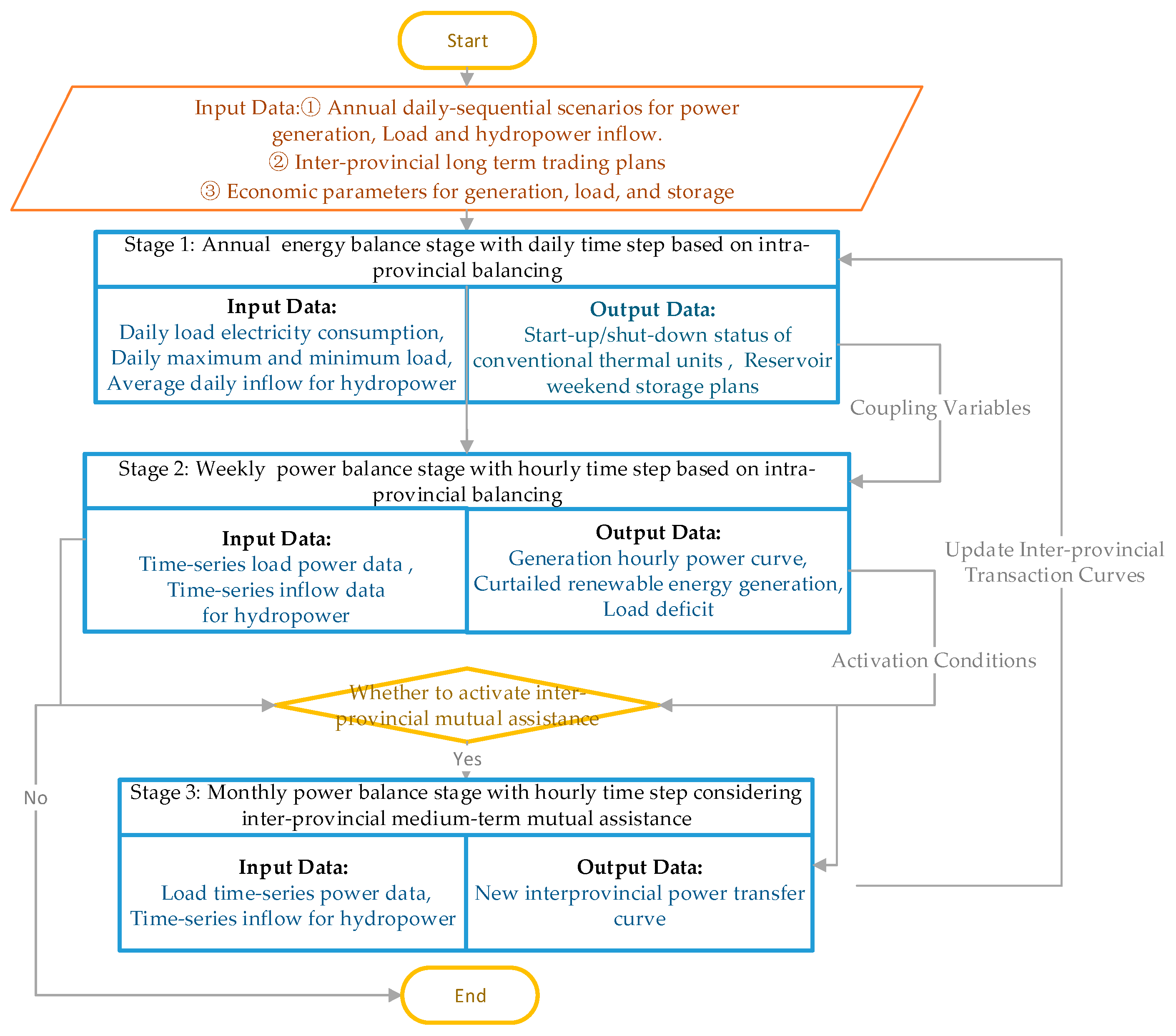
The overall framework is illustrated in Figure 1.
The supplementary description of the modeling framework is as follows:
Stage 1: Annual energy balance stage with daily time step based on intra-provincial balancing. Each provincial power grid conducts daily power balancing with the objective of minimizing its annual comprehensive generation cost. This process considers constraints related to positive and negative spinning reserves during peak and off-peak loads, cross-day startup/shutdown of thermal power plants, and reservoir storage capacity arrangements. Its core function is to determine the basic operational boundaries of the power system, mainly including the on–off schedules of conventional generating units and the reservoir storage plans of hydropower stations at the end of each weekend, which are then passed to the next stage as coupling variables. This stage adopts a daily time step to reduce computational complexity and provide reasonable boundary constraints for the subsequent refined optimization.
Stage 2: Weekly power balance stage with hourly time step based on intra-provincial balancing. This stage performs weekly chronological power balancing for hydropower, thermal power, wind power, solar power, and energy storage resources. It reuses the start/stop plans determined in Stage 1 to define the daily output adjustment ranges of thermal power units. Its core function is to approximate the 8760 h output curves of all power sources, thereby enabling the calculation of hydropower curtailment curves, renewable energy curtailment curves, and load deficit curves with an hourly time scale (168 h per week). The monthly curtailment volumes and electricity deficits derived from these curves serve as key indicators to identify the months requiring inter-provincial mutual assistance.
Stage 3: Monthly power balance stage with hourly time step considering inter-provincial medium-term mutual assistance. For the months identified in Stage 2 that require inter-provincial mutual assistance, this stage optimizes inter-provincial power transactions to promote the absorption of surplus power and mitigate power deficits. Since inter-provincial power mutual support is typically agreed upon through monthly transaction plans, this stage simulates inter-provincial power transmission curves on an hourly basis within a monthly cycle. Its core function is to conduct regional power balance optimization with an hourly time scale (720 h per month) while considering inter-provincial medium-term mutual assistance. Based on the intra-provincial power deficit and renewable energy curtailment, this stage determines the monthly inter-provincial electricity transaction volume. Through inter-provincial mutual assistance, the overall economic efficiency and supply reliability of the regional power system are improved, and renewable energy curtailment is reduced.
Conducting annual energy balance with daily time step and weekly power balance with hourly time step before monthly mutual assistance is mainly to ensure the rationality, accuracy and operability of inter-provincial mutual assistance schemes, while reducing computational complexity.

2.1.4. Inter-Stage Coupling Variables and Information Flow

Coupling variables refer to variables that connect different stages and reflect the mutual influence between stages, mainly including the startup/shutdown status of conventional generating units and reservoir weekend storage plans (transmitted from Stage 1 to Stage 2), intra-provincial power deficit and renewable energy curtailment (transmitted from Stage 2 to Stage 3), as well as monthly inter-provincial transaction volume and chronological transaction power curves (transmitted from Stage 3 to Stage 1 as boundary constraints for the next cycle). These variables are chosen because they are the core factors affecting the balance between intra-provincial operation and inter-provincial coordination. The transmission of these variables ensures the consistency and convergence of the overall optimization framework.
The power deficits and renewable curtailment quantities in Stage 3 are determined based on hourly balancing analysis in Stage 2. Specifically, the hourly operational data (e.g., renewable energy output, load demand) from Stage 2 are aggregated to calculate the daily average power deficits and renewable curtailment rates, which serve as the initiation criteria for inter-provincial mutual assistance in Stage 3. These criteria are evaluated at an hourly resolution, and the necessary operational details are preserved by transmitting hourly data from Stage 2 to Stage 3. For the unit startup and shutdown variables in Stage 1 (daily temporal resolution), we determine them based on the daily peak and valley load and renewable energy output forecast.
The information flow among stages is realized via coupling variables: Stage 1 transfers unit startup/shutdown status and reservoir weekend storage plans to Stage 2; Stage 2 outputs intra-provincial power deficit and renewable energy curtailment to Stage 3; Stage 3 feeds back monthly inter-provincial transaction volume and chronological transaction power curves to Stage 1 as boundary constraints for the next cycle, forming a closed-loop information transmission mechanism.
The transition from the coarser daily resolution (Stage 1) to the finer hourly resolution (Stages 2 and 3) is handled by (1) Data exchange: Stage 1 provides the daily unit commitment plan as the boundary constraint for Stage 2 and 3; (2) Constraint consistency: The operational constraints (e.g., unit output limits) in Stages 2 and 3 are consistent with those in Stage 1; (3) Solution convergence: We adopt an iterative adjustment mechanism to ensure that the optimization results of Stages 2 and 3 are consistent with the overall objectives of Stage 1.
Regarding the discrepancy between stage nomenclature and temporal resolution: Stage 1 is labeled “annual” because the optimization is performed with daily granularity over an annual horizon (365 days), Stage 2 is labeled “weekly” because the optimization is performed with hourly granularity over a weekly horizon (168 h), and Stage 3 is labeled “monthly” because the optimization is performed with hourly granularity over a monthly horizon (720 h) to achieve monthly inter-provincial mutual assistance.

2.2. Three-Stage Optimization Model for Annual Chronological Production Simulation in Regional Power Grids Considering Inter-Provincial Mutual Support

To simplify the modeling process and reduce computational complexity while ensuring the basic rationality of the model, the following assumptions are adopted:
(1) The generation cost of coal-fired thermal units in each provincial power grid is approximately expressed as the product of the coal consumption cost coefficient and the generated energy or generation power. (2) To reduce the model scale, hydropower is modeled on a hydropower station basis. (3) The network security operation constraints (e.g., Power flow constraints, Voltage/security constraints) of each provincial power grid and the transmission loss of tie-lines between provincial power grids in the regional power grid are neglected. (4) The characteristics of combined heat and power (CHP) units are ignored, and only conventional thermal power units are considered.

2.2.1. Stage 1: Annual Energy Balance Stage with Daily Time Step Based on Intra-Provincial Balancing

This stage involves independent daily optimization for each provincial power grid within the region, which simulates the start/stop of hydropower and thermal power units, the cross-day standby arrangements for the startup and shutdown of thermal power plants, and the scheduling of reservoir capacity.
(1)
Objective Function
The objective is to minimize the comprehensive costs across, encompassing thermal power generation costs, startup costs, and load shedding penalty fees:
min C r , 1 = d = 1 T D [ i = 1 N r T ( α r , i T W r , i , d T + α r , i on u r , i , d T ) + γ L W r , d cut ]
where the superscripts D, T, on, and L denote daily time scale, thermal power generation, thermal power operational status, and load; the subscripts r , i , d denote the identification numbers of the provincial grid, thermal power units, and date, respectively; T D , N r T denote the set of date identifiers and the set of thermal power unit identifiers, respectively; W r , i , d T represent the daily power generation of thermal power units; α r , i T and α r , i on denote the power generation cost coefficient and the startup/shutdown cost coefficient, respectively; γ L denotes the load shedding penalty coefficient; W r , d cut denotes the load shedding electricity volume.
(2)
Constraints
(1)
Daily Electricity Generation Balance
i = 1 N r T W r , i , d T + j = 1 N r H W r , j , d H + W r , d W + W r , d S + W r , d in W r , d out + W r , d cut = W r , d L
where the superscripts H, W, and S denote hydropower, wind power, and photovoltaic power; the subscript j represents the hydropower station number; N r H denotes the set of hydropower station numbers; W r , j , d H , W r , d W and W r , d S represent the daily generation of hydropower stations, wind power, and photovoltaic power, respectively; W r , d in , W r , d out and W r , d D represent the incoming power, outgoing power, and daily load power, respectively.
(2)
Daily Maximum/Minimum Load and Rotating Reserve Constraints
i = 1 N r T u r , i , d T P r , i , max T + j = 1 N r H P r , j , d H / r r , d L P r , d , max L + R r , d up
i = 1 N r T u r , i , d T P r , i , min T + j = 1 N r H P r , j , min H P r , d , min L R r , d down
where u r , i , d T represent the 0–1 variable indicating startup status of thermal power units; P r , i , max T and P r , i , min T represent the installed capacity and minimum technical output of thermal power units; P r , j , d H denotes the average daily output of hydropower stations in the provincial grid on the day; P r , j , min H is the guaranteed output of the hydropower station; P r , d , max L , P r , d , min L and r r , d L represent the maximum, minimum, and load factor on the day; R r , d up and R r , d down denote the positive and negative reserve capacity requirements.
(3)
Thermal Power Operation Constraints
For thermal power units, the constraints include start/stop variable logic constraints, minimum startup and shutdown time constraints, and daily upper and lower limits on thermal power generation capacity.
z r , i , d T y r , i , d T = u r , i , d T u r , i , d 1 T
d d + T r , i , min on 1 u r , i , d T = z r , i , d T × T r , i , min on
d d + T r , i , min off 1 u r , i , d T = y r , i , d T × T r , i , min off
24 × u r , i , d T × P r , i , d , min T W r , i , d T 24 × u r , i , d T × P r , i , d , max T
where z r , i , d T and y r , i , d T represent the 0–1 variable for the startup and shutdown of thermal power units; T r , i , min on and T r , i , min off represent the minimum startup time and minimum shutdown time of thermal power units; P r , i , d , min T and P r , i , d , max T represent the maximum output and minimum output of thermal power units.
(4)
Conventional Hydropower Operation Constraints
Since this stage focuses on daily power balancing, the conversion relationship between water flow and power generation is approximated using daily average values. For hydropower plants, the constraints consist of daily power output constraints, hydropower conversion relationship constraints, water flow balance constraints, and upper and lower limits on flow rate.
W r , j , d H = 24 × P r , j , d H
P r , j , d H = A r , j × Q r , j , d gen × H r , j , d
P r , j , d , min H P r , j , d H P r , j , d , max H
Q r , j , d in = Q r , j , d gen + Q r , j , d sp + Q r , j , d st
0 Q r , j , d gen Q r , j , d , max gen
Q j , d gen + Q j , d sp Q j , d , max dis
where the superscripts in, gen, sp, and st denote inflow, generation, spill, and storage; subscripts r, j, and d represent the provincial grid code, hydropower station code, and day code, respectively; P r , j , d H denotes the average output of the hydropower station; A r , j is the comprehensive output coefficient of hydropower; H r , j , d denote the average daily head for power generation; P r , j , max H and P r , j , min H denote the maximum output and guaranteed (minimum) output of the hydropower station, respectively; Q r , j , d in , Q r , j , d gen , Q r , j , d s p , and Q r , j , d st denote the average daily generation flow, the average daily inflow, average daily spill flow, and average daily storage flow of the hydropower station, respectively; for hydropower stations with only daily or weekly regulation capabilities, the storage flow is approximately zero; Q r , j , d , max gen and Q r , j , d , max dis denote the maximum reference flow for power generation and the maximum discharge flow of the hydropower station, respectively.
(5)
Reservoir Capacity Balance Constraints:
In particular, for reservoir-type hydropower plants with seasonal or longer regulation capabilities, reservoir capacity balance constraints must be considered.
V r , j , d = V r , j , d 1 + k r , j V × Q r , j , d st
V r , j , min V r , j , d V r , j , max
V r , j , w k , min WK-end V r , j , w k WK-end V r , j , w k , max WK-end
where k r , j V denotes the conversion coefficient between flow rate and storage capacity; V r , j , d , V r , j , min and V r , j , max represent the reservoir storage capacity, the dead storage capacity and flood control storage capacity, respectively; V r , j , w k WK-end denotes the storage capacity at the end of the week; V r , j , w k , min WK-end and V r , j , w k , max WK-end denote the upper and lower limits of the storage capacity control range at the end of the week, respectively.
(6)
Renewable Energy (Wind/Solar) Operation Constraints
0 W r , d W W r , d W , pred
0 W r , d S W r , d S , pred
where W r , d W , pred and W r , d S , pred represent the predicted daily generation quantities of wind power and photovoltaic power on the day, respectively.
(7)
Load Shedding Electricity Constraints
0 P r , d cut W r , d cut
where P r , d cut is the peak load power during the peak load period.
Under the objective function of minimizing the comprehensive generation cost while considering load shedding penalties, the load shedding volume W r , d cut approaches a minimum. Through Equation (20), the load shedding power P r , d cut can also be minimized as much as possible, thereby achieving the goal of minimizing the load gap.

2.2.2. Stage 2: Weekly Power Balance Stage with Hourly Time Step Based on Intra-Provincial Balancing

This stage optimizes the hourly output of each unit on a weekly cycle, with hourly increments as the optimization unit. The goal is to obtain information on the provincial load power imbalance and renewable energy curtailment through chronological simulation.
(1)
Objective Function
The objective is to minimize the comprehensive cost, which includes thermal power generation costs, penalty costs for curtailed renewable energy and hydropower, load shedding penalty costs, and penalty costs for power imbalance during low-load periods.
min f = t = 1 T w W ( j = 1 N r H γ ha ( P r , j , t H , pred P r , j , t H ) + i = 1 N r T α r , i T u r , i , t T P r , i , t T + e s = 1 N E S σ r , t ES P r , e s , t ES + γ wa ( P r , t W , pred P r , t W ) + + γ sa ( P r , t S , pred P r , t S ) + γ cut P r , t cut + γ un P r , t un )
where the superscript W denotes weekly time scale; the subscript t denotes hourly intervals; T w W represents the number of time slots in the week; γ ha , γ wa , γ sa , γ cut , γ un denote the penalty coefficients for water curtailment, wind curtailment, solar curtailment, load shedding, and load imbalance, respectively; P r , i , t T , u r , i , t T represent the generating power and start/stop state variables of thermal power units, respectively; P r , j , t H , pred , P r , j , t H denote the forecasted and actual generating power of hydropower stations, respectively; P r , e s , t ES and σ ES , r , t denote the net power of the energy storage power station and the time-of-use electricity price for the energy storage power station; P r , t W , pred , P r , t W represent the predicted and actual power generation of wind power, respectively; P r , t S , pred , P r , t S represent the predicted and actual power generation of photovoltaic power, respectively; P r , t cut , P r , t un denote the load shedding electricity and system power imbalance, respectively.
(2)
Constraints
The constraint conditions include the operation characteristic constraints of thermal power and hydropower, the operation constraints of wind and photovoltaic renewable energy, and the load curtailment constraints, which are similar to those in Stage 1. Specifically, it is only necessary to replace the power quantity variables with output power variables and adjust the daily time scale to the hourly time scale. Therefore, these constraints will not be elaborated on here. In the following sections, the system power balance constraint, the operation constraints of electrochemical energy storage stations, and the two-stage coupling constraints will be described in detail.
(3)
System Power Balance Constraint
i = 1 N r T P r , i , t T + j = 1 N r H P r , j , t H + P r , t W + P r , t S + e s = 1 N ES P r , e s , t ES P r , t un = P r , t L P r , t cut
where P r , t L denotes load power per hour.
(4)
Operational Constraints for Electrochemical Energy Storage Stations
(1)
Charge/Discharge Status Constraints
P r , e s , t ES = u r , e s , t ES - dis P r , e s , t ES - dis u r , e s , t ES - chr P r , e s , t ES - chr
0 u r , e s , t ES - dis + u r , e s , t ES - chr 1
(2)
Upper and Lower Limits on Charge/Discharge Power
0 P r , e s , t ES - chr P r , e s , max ES - chr
(3)
Charge Quantity Constraints
S O C r , e s , t ES = S O C r , e s , t 1 ES + ( η r , e s ES - chr P r , e s , t ES - chr η r , e s ES - dis P r , e s , t ES - dis ) Δ t
S O C r , e s , min ES S O C r , e s , t E S S O C r , e s , max ES
where u r , e s , t ES - dis , u r , e s , t ES - chr denote the generation state variable and the charging state variable of the energy storage; P r , e s , t ES - dis , P r , e s , t ES - chr denote the generation power and the charging power; P r , e s , max ES - dis , P r , e s , max ES - chr denotes the maximum generation power and the maximum charging power; η r , e s ES - dis , η r , e s ES - chr denote the generation efficiency and charging efficiency of the energy storage, respectively; S O C r , e s , t ES , S O C r , e s , 0 ES denote the charge levels of the energy storage at time interval t and at the initial state, respectively; S O C r , e s , min ES , S O C r , e s , max ES denote the minimum and maximum charge levels of the DC power storage station, respectively.
(5)
Two-Stage Coupling Constraints
(1)
End-of-Month Reservoir Storage Coupling Constraint
Reservoir storage plans serve as one of the boundary conditions transferred between the model’s two stages. By fixing end-of-month reservoir storage levels, decoupled optimization between months is achieved.
V r , j , t WK - end = V r , j , w k WK - end
where V r , j , t WK - end denotes the final reservoir storage level of hydropower stations every week in the second stage; V r , j , w k WK - end denotes the end-of-week reservoir storage level of hydropower stations, calculated in the first stage.
(2)
Hydropower/Thermal Power Start/Stop Plan Coupling Constraint
Using the hydropower and thermal power start/stop plans from the previous stage as boundary conditions, the start/stop status variables for this stage are identical to those of the previous stage. Thermal power units may still perform mandatory starts/stops lasting over 2 days.
u r , j , t H = u r , j , d H
u r , i , t T = u r , i , d T
where u r , j , t T and u r , j , t H denote the start/stop state variables of thermal power units and hydro units in the provincial grid during the time period; u r , j , d T and u r , j , d H denote the start/stop state variables of thermal power units and hydro units in the provincial grid during the monthly period, as calculated in the previous stage.

2.2.3. Stage 3: Monthly Power Balance Stage with Hourly Time Step Considering Inter-Provincial Medium-Term Mutual Assistance

For months with concentrated load gaps or curtailed electricity, an inter-provincial medium-term mutual assistance model is established. This stage operates on a monthly optimization cycle with hourly optimization units, focusing on optimizing electricity transactions between regions. Both sending and receiving provinces are required to adjust the operations of their provincial power plants and hydropower scheduling. Through this optimization process, the optimal adjustment power and optimal adjustment electricity are determined, which in turn updates the original inter-provincial transmission power plan.
(1)
Objective Function
The optimization goal is to minimize the aggregate curtailed renewable energy and load shedding across all provincial grids. The mathematical model is as follows:
min f = t = 1 T m M r = 1 N R ( j = 1 N r H γ ha ( P r , j , t H , pred P r , j , t H ) + γ wa ( P r , t W , pred P r , t W ) + γ sa ( P r , t S , pred P r , t S ) + γ cut P r , t cut )
where T m M represents the number of hours in the month; N R represents the number of provincial grids.
Due to the existence of constraints consistent with those in Stage 2 and their extensive scope, only the following constraints are listed here to highlight the model’s focus: inter-provincial power coordination and mutual assistance chronological power balance constraints, and inter-provincial transmission power constraints. The remaining constraints refer to those in the Stage 2 model.
(2)
inter-provincial power coordination and mutual assistance time-chronological power balance constraints
i = 1 N r T P r , i , t T + j = 1 N r H P r , j , t H + P r , t W + P r , t S + e s = 1 N ES P r , e s , t ES + l = 1 N T S M r , l TS × P l , t TS P r , t un = P r , t L P r , t cut
where N T S denotes the number of interconnection lines between provincial grids within the regional grid; M r , l TS denotes the transmission/reception relationship of provincial grid r on inter-provincial interconnection lines, where a value of 1 indicates the receiving grid and a value of −1 indicates the transmitting grid; P l , t TS denotes the inter-provincial transmission power; P r , t L denotes the load power of provincial grid r during time t.
(3)
inter-provincial transmission power constraints.
(1)
Interconnection line transmission power upper and lower limits
P l , min TS P l , t TS P l , max TS
(2)
Monthly inter-provincial electricity trade volume constraints
t = 1 T M P l , t TS Δ t W m loss
where Δ t represents the time step, which is 1 h; W m loss represents the electricity demand of the provincial grid with insufficient electricity supply determined in the second stage, obtained by summing the daily load shedding electricity quantities from the second stage.
All variables mentioned above are listed in the Appendix A.

3. Case Analysis

3.1. Basic Data and Case Study Design

To verify the engineering practicality and effectiveness of the proposed model and inter-provincial mutual aid mechanism in this study, a targeted test system was established based on the actual operation data of two provincial power grids (Sichuan and Chongqing) in the southwestern region of China. The power source structure, installed capacity, and load characteristics of the two provincial power grids were clarified in detail, providing a solid and practical foundation for subsequent simulation verification that is consistent with real-world application scenarios. All data used in this study are derived from the actual operation statistics of Sichuan and Chongqing power grids in 2021.
As a typical sending-end power grid in the southwestern region with hydropower as the core power source, the Sichuan provincial power grid undertakes the dual tasks of clean energy transmission and local power supply. Its power source structure and installed parameters are fully consistent with actual dispatching scenarios: it is equipped with 31 thermal power units with a total installed capacity of 13,055 MW; 42 hydropower stations, including 12 reservoir-type power stations with seasonal or longer regulation capacity, with a total hydropower installed capacity of 75,002 MW, which constitutes the core of the power grid supply. Meanwhile, it is supported by 5060 MW of wind power installed capacity and 869.6 MW of photovoltaic installed capacity, forming a coordinated power supply pattern of multiple types of clean energy. The annual maximum load of the provincial power grid is 51,502 MW, the minimum load is 18,655 MW, and the annual total power generation is 293.4 billion kWh. It has obvious characteristics of clean energy surplus, which provides a sufficient resource foundation for inter-provincial mutual aid.
As a receiving-end power grid in the southwestern region dominated by thermal power, the Chongqing provincial power grid mainly undertakes the task of ensuring local power supply. Its power source configuration and load characteristics are adapted to the actual needs of the receiving-end power grid: it is equipped with 34 thermal power units with a total installed capacity of 13,881 MW, providing stable support for power grid supply; 25 supporting hydropower plants, including eight reservoir-type power stations with seasonal or longer regulation capacity, with a total hydropower installed capacity of 4715 MW, supplementing local clean power supply. In addition, it is equipped with 1884 MW of wind power installed capacity, 613 MW of photovoltaic installed capacity, and 840 MW of electrochemical energy storage capacity, which effectively improves the power grid’s peak shaving, frequency modulation, and supply/demand balance capabilities. The annual maximum load of the provincial power grid is 24,087 MW, the minimum load is 5724 MW, and the annual total power generation is 112.2 billion kWh. It has seasonal power shortages and serves as the main beneficiary of inter-provincial mutual aid.
The power shortage penalty coefficient is set to RMB 500/MWh, and the renewable energy curtailment penalty coefficient is RMB 400/MWh, both determined based on the actual operation data of the Sichuan-Chongqing power grid, relevant national standards and existing literature [30], which conform to engineering practice and academic conventions.
We explicitly state that the proposed three-stage model is a Mixed Integer Linear Programming (MILP) model. We fully disclose the solver information: programming language (MATLAB R2019a), solver name (CPLEX Optimizer, version (12.10)), all optimization models using the YALMIP Toolbox (Version R20200930, https://yalmip.github.io/ (accessed on 9 April 2026)) as the high-level optimization modeling framework.
Hardware configuration: Intel(R) Core (TM) i5-6500 CPU (3.20 GHz), 16 GB RAM, running on the Windows 10 operating system.

3.2. Reasonableness Analysis of Simulation Results

3.2.1. Stages 1 and 2 Simulation Results Based on Provincial-Level Balancing

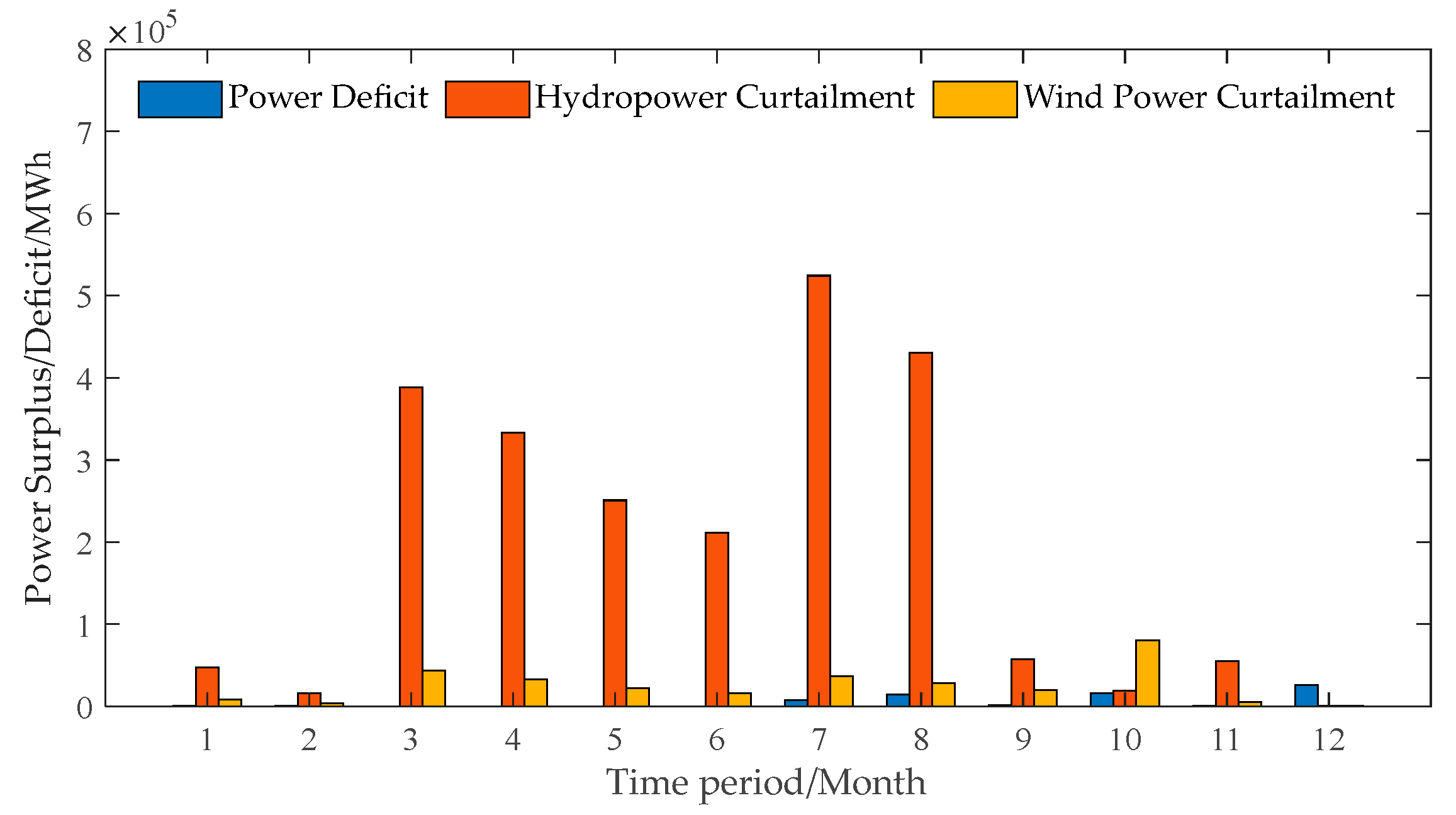
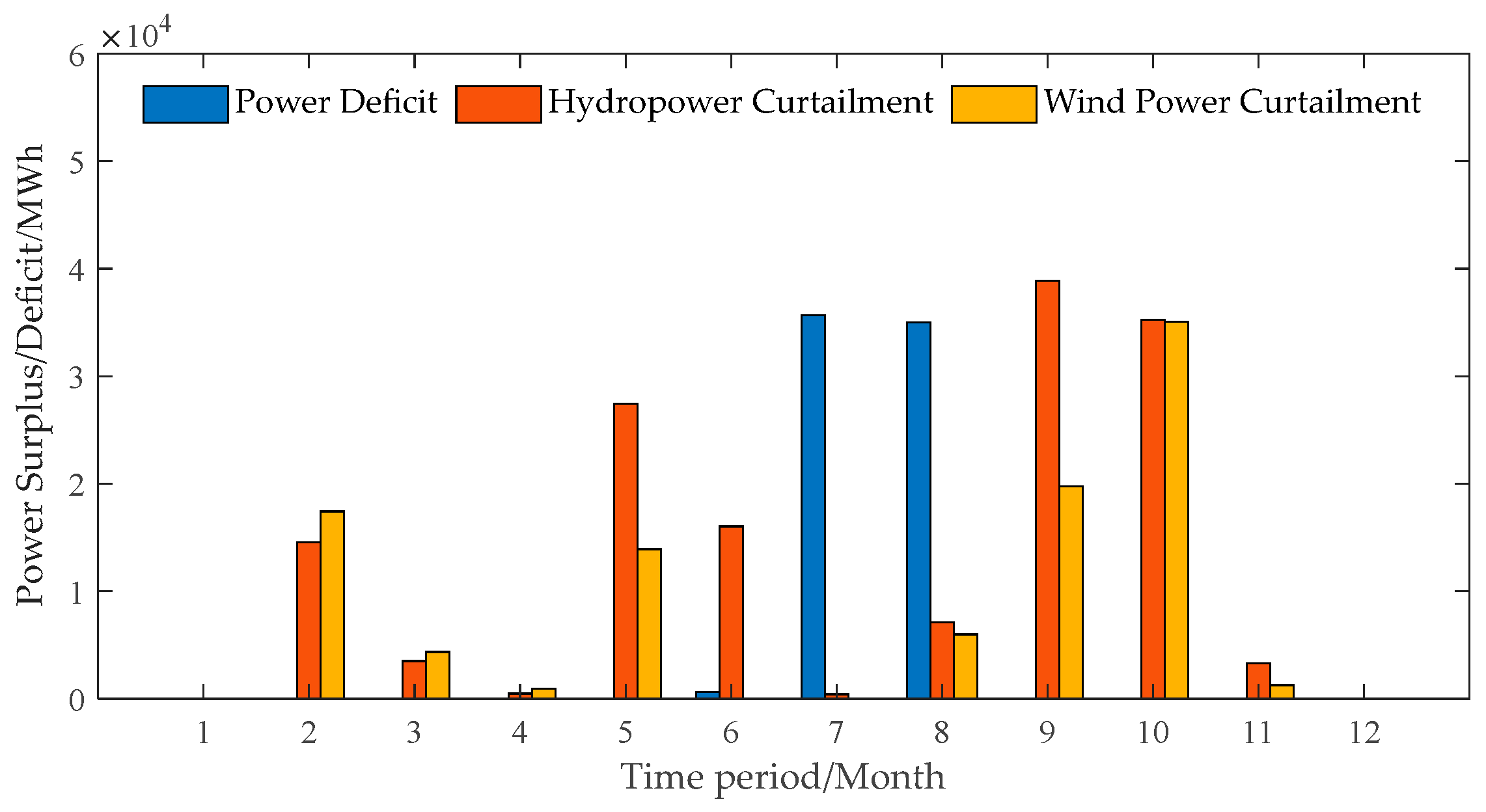
The net electricity surplus/deficit of each provincial power grid, optimized through Stages 1 and 2 based on provincial-level balancing, is presented in Figure 2 and Figure 3. An analysis of these figures reveals that Chongqing experiences significant power deficits during the peak summer consumption periods of July and August. Meanwhile, Sichuan, a major power-exporting region with high hydropower generation capacity, faces substantial hydropower curtailment during these months. Consequently, the conditions for inter-provincial coordination and mutual support are satisfied in July and August.

3.2.2. Monthly Chronological Power Balance Optimization Results for Inter-Provincial Medium-Term Mutual Support

To quantitatively evaluate the effectiveness of the proposed inter-provincial medium-term mutual assistance model, the curtailed renewable energy generation (including hydropower, wind power, and solar energy) and load deficits of both Sichuan and Chongqing before and after the implementation of this mutual assistance mechanism in the peak summer months of July and August are systematically presented in Table 1 and Table 2. These tables detail the specific data changes of key indicators, providing a clear comparative basis for analyzing the optimization effect of inter-provincial coordination.
As shown in Table 1 and Table 2, after optimizing the inter-provincial coordination and mutual support mechanism proposed in this study, both Sichuan and Chongqing achieved significant improvements in the overall consumption efficiency of renewable energy, including hydropower, wind power, and solar energy. Specifically, Sichuan’s hydropower curtailment volume was significantly reduced, fully tapping the potential of its hydropower resources and improving the utilization rate of clean energy. The reduction rates for hydropower curtailment in Sichuan in July and August are 6.70% and 7.98%. The reduction rates for wind power curtailment in Sichuan in July and August are 1.39% and 1.35%. Meanwhile, this inter-provincial mutual assistance approach also substantially narrowed the power supply gap in Chongqing during the peak summer consumption period, effectively alleviating the local power shortage problem and ensuring the stability and reliability of the regional power supply system. The power deficit in Chongqing is completely eliminated after the implementation of inter-provincial mutual aid, representing a 100% reduction rate in both months. These results fully verify the feasibility and effectiveness of the proposed three-stage optimization method in promoting optimal cross-provincial resource allocation and solving regional power supply/demand contradictions.

3.2.3. Model Performance Verification

The fundamental advantage of the three-stage framework lies in its capability to mitigate the “curse of dimensionality” inherent in the NP-hard mixed-integer unit commitment problem. In contrast, traditional joint optimization approaches formulate the entire 8760-h simulation as a single, large-scale mixed-integer linear programming (MILP) problem, where the computational burden grows exponentially with the system size and the number of generating units. In contrast, our decomposition strategy fixes the integer unit commitment statuses in Stage 1. This critical step relaxes the subsequent Stages 2 and 3 into continuous linear programming (LP) sub-problems, which are computationally trivial to solve. Furthermore, by decoupling the temporal scales, the resulting sub-problems eliminate the need for complex network-wide calculations and exhibit highly sparse constraint matrices. Leveraging this sparsity and temporal independence, the solver (e.g., CPLEX) efficiently processes the problem, transforming the empirical computational time growth from an intractable exponential curve to a manageable, moderate polynomial trend relative to the number of power units. This confirms the excellent scalability and practical feasibility of the proposed method for large-scale interconnected power systems.
The model is solved using MATLAB 2023b and CPLEX 22.1, running on a computer with Intel Core i7-12700H CPU and 32 GB RAM. The solution time for the Sichuan-Chongqing case (132 power units, 8760 h) is 18.6 min.
The core logic for verifying the model’s scalability is to test the solution efficiency and index stability under different system scales (different numbers of units) to prove that the model can adapt to systems of various sizes. Combined with the previous parameter settings, the detailed example is designed as follows.
With the increase in the number of units from 50 to 500 (10 times growth), the solution time increases from 8.2 min to 68.6 min, showing a linear growth trend. The core indicators (total cost, new energy utilization rate, power shortage rate) have little fluctuation, indicating that the model can maintain stable performance under different system scales and has good scalability to meet the application needs of large-scale power systems.

3.3. Effectiveness Analysis of Inter-Provincial Medium-Term Mutual Support Mechanisms

To validate the effectiveness of the inter-provincial medium-term mutual assistance approach adopted in this paper, the following three optimization scenarios are designed for comparison:
Scenario 1: No inter-provincial coordination is considered; only independent monthly power flow optimization is performed for each provincial grid.
Scenario 2: Short-term inter-provincial mutual assistance is considered, i.e., independent mutual assistance is conducted hourly without coordinating between different time periods within the month.
Scenario 3: Monthly time-series power and energy balance optimization considering medium-term inter-provincial coordination and mutual support, performed according to the method proposed in this paper.
The optimization results under the three scenarios are shown in Table 3.
As can be observed from Table 4, Scenario 1—where inter-provincial mutual assistance is not implemented—results in the highest hydropower curtailment volume, accompanied by a persistent power deficit in Chongqing. In contrast, Scenarios 2 and 3 effectively alleviate Chongqing’s power deficit through mutual assistance among interconnected provinces within the regional power grid. Specifically, Scenario 2 achieves inter-provincial coordination but fails to fully leverage inter-period coordination due to its independent optimization of each time slot. Consequently, its monthly mutual assistance volume is relatively small, leading to relatively high hydropower curtailment and generation costs. In comparison, Scenario 3 incorporates inter-provincial medium-term mutual support, which coordinates mutual assistance across all time periods within a month. Compared with the independent per-time-slot coordination in Scenario 2, this approach achieves a larger monthly mutual assistance volume, better exerts inter-provincial coordination capabilities, reduces hydropower curtailment, and lowers the comprehensive generation cost. In summary, the inter-provincial medium-term coordinated mutual assistance approach adopted in this study achieves lower comprehensive generation costs while meeting practical power dispatch requirements, fully demonstrating its superiority and practical applicability.

3.4. Sensitivity Analysis of Power Shortage and New Energy Curtailment Penalty Coefficient

This example is based on the typical operation scenario for the Sichuan-Chongqing power grid, using annual 8760-h time-series data. The benchmark values of the core parameters of the model are consistent with the parameter settings in the previous text.
Independent sensitivity tests were conducted on the two key penalty coefficients, respectively. Each parameter was changed by ±10% and ±20% based on the benchmark value (a reasonable variation range), and a total of 10 test scenarios were set up (including the benchmark scenario). The specific schemes are shown in Table 5.
The above 10 scenarios were simulated and calculated using MATLAB + CPLEX solver. The results for the core evaluation indicators are shown in Table 6 (all data meet the robustness requirement that “parameter variation within ±20% leads to indicator variation ≤ 3%”):
It can be seen from the above simulation results that
  • When the power shortage penalty coefficient (C1) changes within the range of ±20%, the maximum variation in the total operation cost is 0.39%, and the variation in the new energy utilization rate and power shortage rate is less than 0.3%. This indicates that the change in this parameter has little impact on the power supply reliability and new energy consumption.
  • When the new energy curtailment penalty coefficient (C2) changes within the range of ±20%, the maximum variation in the new energy utilization rate is 0.32%, and the total operation cost and power shortage rate are basically unchanged. It shows that the change in this parameter has no significant impact on the economy and stability of the system.
  • When both parameters are increased by 20%, the maximum variation in the core indicators is variation in the total operation cost, which is only 0.39%. It is far lower than the 3% threshold. This further verifies that the proposed model has good robustness.
In summary, when the key parameters of the model change within a reasonable range, the effectiveness of the optimization method will not be significantly affected, and the model has good robustness, which can meet the requirements of engineering applications.

4. Discussion

The core findings of this study are consistent with the working hypothesis that the multi-stage optimization model and inter-provincial mutual aid mechanism can effectively address power shortage in receiving-end grids and renewable energy curtailment in sending-end grids in southwestern China. Based on actual operation data of Sichuan and Chongqing power grids, simulation results demonstrate that the proposed model accurately quantifies power shortages and renewable energy curtailment, while the constructed inter-provincial medium- and long-term mutual aid mechanism significantly alleviates Chongqing’s supply/demand contradiction, promotes Sichuan’s clean energy consumption, and reduces system comprehensive power generation costs. These findings align with relevant studies, which also identify inter-provincial mutual aid as an effective approach to optimize regional power allocation and clean energy utilization. However, unlike existing research, this study focuses on southwestern China’s actual operation characteristics, takes hydropower-dominated Sichuan (sending-end) and thermal power-dominated Chongqing (receiving-end) as research objects, and builds a mutual aid mechanism adapting to China’s monthly inter-provincial power trading model by considering monthly transaction constraints, enhancing the research’s pertinence and practicality for on-site power dispatching.
This study has certain limitations:
(1)
It should be acknowledged that the proposed modeling framework does not involve detailed power flow constraints or voltage/security constraints in the current study. Due to the research focus on the optimal allocation of inter-provincial mutual aid strategies under a long-term time-series operation scenario, only transmission capacity limits are included to reflect the boundary of power transmission. As a result, the dynamic distribution of power flows, voltage stability margins, and security operation constraints under actual grid operating conditions are not fully depicted. This simplification is reasonable within the scope of this study, but it also constitutes an inherent limitation of the proposed model to a certain extent, which may affect the fidelity of simulation results in engineering applications.
(2)
The modeling of combined heat and power (CHP) units is simplified, and the coupling constraint between electricity and heat output is not explicitly considered. It should be noted that this simplification is justified within the specific context of this research. The study focuses on the Sichuan-Chongqing region, where the power system is dominated by hydropower, and the thermal fleet consists mainly of pure-condensing units, with CHP units accounting for a relatively small share of installed capacity. Furthermore, as the Sichuan-Chongqing region is located south of the Qinling Mountains–Huaihe River line, there is no district heating demand during winter, and CHP units are not subject to the “heat-led” operational constraints typical in northern China. Therefore, in this regional context, the omission of the heat–electricity coupling constraint has a limited impact on the operational optimization results. Nevertheless, we acknowledge that this simplification may lead to an overestimation of the operational flexibility of CHP units during the few dispatch periods in which they are utilized, potentially introducing biases in the quantitative assessment of system operating costs and renewable energy integration. To maintain academic rigor, this simplification is treated as a clear modeling boundary condition in this paper.
(3)
Although Stages 2 and 3 adopt hourly resolution and can well capture intraday fluctuations, this deterministic long-horizon framework is inherently tailored for hydropower-dominated systems, where water inflows can be predicted relatively stably at weekly or monthly scales. If the current deterministic framework is directly applied to power systems with high shares of wind and solar generation, a critical engineering challenge will arise: wind and solar prediction errors increase exponentially beyond 48 h. Within a deterministic 720-h optimization horizon, such large prediction errors would render the obtained long-term inter-provincial mutual assistance plans practically ineffective in real-world operation. Therefore, to extend the proposed architecture to wind-PV-dominated provinces, the deterministic weekly and monthly modules must be further reformulated into a rolling-horizon stochastic or robust dispatch framework to mitigate short-term prediction errors. In summary, the proposed framework is widely applicable for interconnected hydropower-rich power systems requiring cross-regional coordination, and can be extended to high wind-solar penetration systems with appropriate stochastic or robust improvements.
In future research:
(1)
We will further incorporate these refined network constraints into the model. By introducing complete AC/DC power flow calculations, voltage stability constraints, and other security operation constraints, the simulation accuracy of the model can be effectively improved, and its practical application value in actual power grid planning, operational decision-making, and security verification can be significantly enhanced.
(2)
When applying the proposed methodology to other regions, the applicability of this simplification should be carefully evaluated based on the structural characteristics of the local power system. In particular, for provinces in northern China with extensive district heating systems, where CHP units account for a large share of the thermal capacity and are subject to binding heat demand constraints during winter, neglecting the heat–electricity coupling could lead to systematic biases in dispatch results. In such application scenarios, future research should incorporate the feasible operating region constraints of CHP units, along with time-series heat load data, to develop a more detailed electricity–heat coupling model and enhance the reliability of the method.
(3)
We will focus on extending the applicability of the proposed framework to power systems with high wind and solar penetration. Specifically, we will reformulate the deterministic weekly and monthly modules into a rolling-horizon stochastic or robust dispatch framework to effectively mitigate the impact of short-term wind and solar prediction errors.

5. Conclusions

This study focuses on optimizing cross-regional power resource allocation in southwestern China, aiming to address power shortages in receiving-end grids and renewable energy curtailment in sending-end grids. A multi-stage optimization model and an inter-provincial medium- and long-term coordinated mutual aid mechanism are proposed, whose effectiveness and practicality are verified via simulation based on actual operation data of Sichuan and Chongqing provincial power grids. The main conclusions are summarized as follows.
First, the constructed three-stage optimization model can accurately quantify each provincial grid’s power shortage and renewable energy curtailment, providing a solid theoretical basis and reliable decision support for inter-provincial mutual aid. In the inter-provincial mutual aid stage, incorporating inter-provincial monthly transaction power constraints ensures the proposed mechanism aligns with China’s power market operation rules, avoiding mismatches with actual transaction modes and enhancing its engineering operability.
Second, simulation results based on Sichuan and Chongqing’s actual data show that the optimized daily power balance and weekly chronological power balance (based on provincial independent balance) fully meet the actual dispatching requirements of annual power generation plan formulation, realizing medium- and long-term coordinated and optimized operation of multiple types of power sources (hydropower, thermal power, wind power, photovoltaic power). Specifically, the proposed inter-provincial medium- and long-term coordinated mutual aid mechanism significantly alleviates Chongqing’s power shortage (35,650 MWh and 35,013 MWh reductions in July and August, respectively), improves Sichuan’s clean energy consumption capacity (hydropower curtailment down 6.70% and 7.98%, wind power curtailment down 1.39% and 1.35% in the same months), and reduces system comprehensive power generation costs (12.31% in Sichuan and 11.92% in Chongqing).
In summary, the study’s findings have significant theoretical value and engineering application prospects. The proposed model and mutual aid mechanism effectively optimize cross-regional power resource allocation in southwestern China, promote clean energy consumption and stable power supply, and provide a feasible technical reference for the construction of a new power system and the realization of the dual carbon goals in China. Considering the limitations of this paper, future research will incorporate refined power grid security constraints to improve simulation accuracy and practical value, verify the applicability of model simplification for regional systems, construct an electricity–heat coupling model for northern CHP-dominated scenarios, and reformulate deterministic modules into a rolling stochastic/robust framework to adapt to high wind-PV penetration systems.


Author Contributions

Conceptualization, D.G., W.Y. and S.Z.; methodology, D.G., W.Y. and S.Z.; software, D.G.; validation, D.G.; formal analysis, D.G.; investigation, D.G.; resources, S.Z.; data curation, D.G.; writing—original draft preparation, D.G.; writing—review and editing, D.G.; visualization, D.G.; supervision, W.Y.; project administration, W.Y.; All authors have read and agreed to the published version of the manuscript.

Funding

This research received no external funding.

Institutional Review Board Statement

Not applicable.

Informed Consent Statement

Not applicable.

Data Availability Statement

The data presented in this study are available on request from the corresponding author. (The annual operational data are classified and owned by the State Grid Corporation of China; the access might be approved upon request.).

Acknowledgments

This research is supported by State Grid Chongqing Electric Power Company, in terms of original data.

Conflicts of Interest

The authors declare no conflicts of interest. The funders had no role in the design of the study; in the collection, analyses, or interpretation of data; in the writing of the manuscript; or in the decision to publish the results.

Appendix A

A dedicated Notation List (Table A1, Table A2, Table A3 and Table A4) that includes all subscripts, superscripts, parameters and variables in the model, with clear description and corresponding units.
Table A1. Subscripts.
SymbolDescription
rIndex of provincial regions
mIndex of monthly time periods
dIndex of daily time periods
tIndex of hourly time periods
iIndex of thermal generating units
jIndex of hydropower stations
esIndex of electrochemical energy storage stations
lIndex of inter-provincial transmission lines
minMinimum value
maxMaximum value
Table A2. Superscripts.
SymbolDescription
DDay
MMonth
TThermal power unit
HHydropower unit
WWind power unit
SSolar photovoltaic unit
ESEnergy storage station
LLoad
TSTransmission line
predPredicted value
inInput
outOutput
cutCut amount
lossLoss of amount
onUnit online state
offUnit offline state
upRamp-up limit/upward reserve
downRamp-down limit/downward reserve
endFinal state (e.g., reservoir storage)
genHydropower generation
spHydropower station water spillage
stReservoir storage
haHydropower abandonment
waWind power abandonment
saSolar PV abandonment
disDischarging power
chrCharging power
Table A3. Parameters.
SymbolDescriptionUnit
T D the set of date numbers-
N R the number of provincial regions-
N r T the set of thermal power unit numbers-
N r H the set of hydropower station numbers-
N T S the number of interconnection lines between provinces-
α r , i T the power generation cost coefficientRMB/MWh
α r , i on the startup/shutdown cost coefficientRMB/MWh
γ L the load shedding penalty coefficientRMB/MWh
A r , j the comprehensive output coefficient of hydropowerMW·s/m3
H r , j , d the average daily head for power generationm
k r , j V the conversion coefficient between flow and capacitys
γ ha , γ wa , γ sa , γ cut , γ un the penalty coefficients for water curtailment, wind curtailment, solar curtailment, load shedding, and load imbalance, respectivelyRMB/MWh
σ ES , r , t the electricity price for the energy storage power stationRMB/MW
η r , e s ES - dis the discharging efficiency of the energy storage-
η r , e s ES - chr the charging efficiency of the energy storage-
Table A4. Decision variables.
SymbolDescriptionUnit
W r , i , d T , W r , j , d H , W r , d W , W r , d S the daily power generation of thermal power, hydropower, wind power, and solarMWh
W r , d in , W r , d out , W r , d cut , W r , d L the daily input energy, output energy, load shedding energy and load energyMWh
P r , i , t T , P r , j , t H , P r , t W , P r , t S the hourly power of thermal power, hydropower, wind power, and solarMW
P r , e s , t ES , P l , t TS , P r , t cut , P r , t un , P r , t L the hourly power of energy storage, inter-provincial transmission, load shedding power, unbalance power and load powerMW
R r , d up , R r , d down the positive and negative reserve capacity requirementsMW
u r , i , d T , z r , i , d T , y r , i , d T the 0–1 variable indicating start/stop, startup and shutdown of thermal power units0/1
Q r , j , d in , Q r , j , d gen , Q r , j , d s p , Q r , j , d st the average daily inflow, generation flow, spill flow and storage flow of hydropower stationm3/s
V r , j , d the reservoir storage capacitym3
u r , e s , t ES - dis , u r , e s , t ES - chr the generation state variable and the charging state variable of the energy storage0/1
P r , e s , t ES - dis , P r , e s , t ES - chr the hourly generation power and the charging power0/1
S O C r , e s , t ES , S O C r , e s , 0 ES the charge levels of the energy storage at time interval t and at the initial state-
M r , l TS the transmission/reception relationship on inter-provincial interconnection lines0/1

References

  1. Liu, S.; Liao, Y.; Chai, Q.; Hu, L.; Li, Y. Coordinated abandoned wind accommodation analysis of multi-area interconnected combined heat and power system considering exchanging power cost. Electr. Power Autom. Equip. 2022, 42, 48–54. (In Chinese) [Google Scholar]
  2. Liang, Y.; Liu, H.; Zhou, H.; Meng, Z.; Liu, J.; Zhou, M. Multi-Stage Coordinated Planning for Transmission and Energy Storage Considering Large-Scale Renewable Energy Integration. Appl. Sci. 2024, 14, 6486. [Google Scholar] [CrossRef]
  3. Onodera, H.; Delage, R.; Nakata, T. The role of regional renewable energy integration in electricity decarbonization—A case study of Japan. Appl. Energy 2024, 363, 123118. [Google Scholar] [CrossRef]
  4. Venkataramana, N.T.; Kanitkar, T.; Ramadesigan, V.; Banerjee, R. Optimizing renewable energy integration pathways: Inter-regional coordination and storage in India’s power sector. Appl. Energy 2025, 394, 126134. [Google Scholar] [CrossRef]
  5. Zhang, L.; Zhang, F.; Li, J.; Feng, L.; Liu, B.; Zhang, M. Mid-long term optimal dispatching-based study on optimal model of inter-provincial power purchase and sale strategy during wet and dry seasons for hydropower enriched regions. Water Resour. Hydropower Eng. 2021, 52, 152–166. (In Chinese) [Google Scholar]
  6. Liang, S.; Tang, H.; Wang, Z.; Cheng, W.; Liang, X. Robust Optimal Dispatch of Regional Power Grid Considering Flexible Resources on Both Source and Load Sides. Mod. Electr. Power 2024, 41, 601–611. (In Chinese) [Google Scholar]
  7. Gabov, A.V.; Cherkesova, L.I. Implementation of the principle of freedom of contract in the conclusion of contracts for the purchase and sale of electric power in retail electricity markets. Gos. I Pravo 2021, 2021, 135–150. [Google Scholar] [CrossRef]
  8. Wang, K.; Pang, C.; Qi, F.; Yang, H.; Cheng, D.; Luo, X. A generation method of inter-provincial power support strategies based on ultra-short-term balance margin. Zhejiang Electr. Power 2025, 44, 1–9. (In Chinese) [Google Scholar]
  9. Zhong, H.; Yu, Z.; Wang, X.; He, Y.; Zhou, B.; Liang, Z.; Kammen Daniel, M.; Kang, C. Scheduling Large-Scale Re-newable Energy: Through Cross-Regional Generation-Load Balancing. IEEE Power Energy Mag. 2025, 23, 44–52. [Google Scholar] [CrossRef]
  10. Piotr, O.; Krzysztof, P.; Marek, S. Peak Shaving Strategy in the Context of the Charging Process of a Battery Energy Storage System in the Railway Microgrid. Energies 2025, 18, 2674. [Google Scholar] [CrossRef]
  11. Zhang, Y.; Xia, Z.; Yuan, H.; Yang, Y.; Ze, Y.; Zhang, K. Key Market Mechanisms for Cross-Regional Tradings in the Electricity Market: Insights from Theory and Real-World Implementations. IEEE Access 2024, 12, 97309–97331. [Google Scholar]
  12. Valeriu, S.C.; Eduard, M.N. Price Behavior and Market Integration in European Union Electricity Markets: A VECM Analysis. Energies 2025, 18, 770. [Google Scholar] [CrossRef]
  13. Rajasekhar, G.V.; Paneerselvam, S.; Minai, A.F. A novel integrated double-sided auction for energy trading in day-ahead electricity market. Results Eng. 2026, 29, 108906. [Google Scholar] [CrossRef]
  14. Standing Committee of the National People’s Congress. Electric Power Law of the People’s Republic of China; Law; Standing Committee of the National People’s Congress: Beijing, China, 1995; Revised 2018, Article 21.
  15. State Council of the People’s Republic of China. Regulations on Grid Dispatch Management; Decree No. 115; Administrative Regulation; State Council of the People’s Republic of China: Beijing, China, 1993.
  16. National Development and Reform Commission; National Energy Administration. Administrative Measures for Cross-Provincial and Cross-Regional Power Emergency Dispatch; Fagai Yunxing Gui [2025] No. 1193; Policy Document; National Development and Reform Commission: Beijing, China, 2025.
  17. Fu, X.; Li, F.; Yang, P.; Wu, X. A new multi-provincial grid complementary operation index and its application. Power Demand Side Manag. 2021, 23, 22–28. (In Chinese) [Google Scholar]
  18. Fu, X. A new production simulation method for coordinated operation of multi-provincial power grid. Electr. Power Autom. Equip. 2020, 40, 166–171. (In Chinese) [Google Scholar]
  19. Kotzur, L.; Nolting, L.; Hoffmann, M.; Groß, T.; Smolenko, A.; Priesmann, J.; Büsing, H.; Beer, R.; Kullmann, F.; Singh, B.; et al. A modeler’s guide to handle complexity in energy systems optimization. Adv. Appl. Energy 2021, 4, 100063. [Google Scholar] [CrossRef]
  20. Van Ackooij, W.; Lopez, I.D.; Frangioni, A.; Lacalandra, F.; Tahanan, M. Large-scale unit commitment under uncertainty: An updated literature survey. Ann. Oper. Res. 2018, 271, 11–85. [Google Scholar] [CrossRef]
  21. Shintaro, N.; Keisuke, K.; Ikumi, S.; Ikegami, T. Cross-regional power supply-demand analysis model based on clustered unit commitment. Electr. Eng. Jpn. 2022, 215, e23368. [Google Scholar]
  22. German, M.E.; Tejada-Arango, D.A. Modeling the hidden flexibility of clustered unit commitment. IEEE Trans. Power Syst. 2019, 34, 3294–3296. [Google Scholar] [CrossRef]
  23. Deane, J.P.; Drayton, G.; Gallachoir, B.P.O. The impact of sub-hourly modelling in power systems with significant levels of renewable generation. Appl. Energy 2014, 113, 152–158. [Google Scholar] [CrossRef]
  24. Hu, W.; Sun, Y.; Zhao, P.; Liu, D.; Han, X.; Zhang, K.; Lin, W. Long-term Stochastic Operation Simulation Algorithm Based on Daily Electric Energy Balance and Intra-day Verification. Power Syst. Technol. 2023, 47, 4263–4271. [Google Scholar]
  25. Shao, C.; Feng, C.; Wang, Y.; Wang, X.; Wang, X. Multiple Time-scale Production Simulation of Power System with Large-scale Renewable Energy. Proc. CSEE 2020, 40, 6103–6112. (In Chinese) [Google Scholar]
  26. Yuan, Y.; Wang, J.; Zhang, Y.; Zhou, L.; Wang, X.; Lu, G. Panoramic Operation Simulation Approach and Estimation Index System for New Energy Power System Considering Multi-period Coordination. Power Syst. Technol. 2020, 44, 799–806. (In Chinese) [Google Scholar]
  27. Liu, H.; Yan, W.; Lin, Z.; Tan, H.; Li, G.; Wen, X. An Annual Peak Regulation Auxiliary Service Demand Assessment Model Based on Multi-time Scale Stochastic Optimization. Electr. Power 2022, 55, 9–17+24. (In Chinese) [Google Scholar]
  28. Loehr, L.; Houben, R.; Guntermann, C.; Moser, A. Nested Decomposition Approach for Dispatch Optimization of Large-Scale, Integrated Electricity, Methane and Hydrogen Infrastructures. Energies 2022, 15, 2716. [Google Scholar] [CrossRef]
  29. Lin, Z.; Yan, W.; Luo, X.; Wen, X.; Liu, H.; Tan, H.; Zhang, S. Annual Electricity Purchase Strategy Optimization of Provincial Power Grid Company Based on Hierarchical Chronological Production Simulation. Power Syst. Technol. 2023, 47, 1931–1941. (In Chinese) [Google Scholar]
  30. Miao, M.; Lou, S.; Zhang, Y.; Chen, X. Research on the Optimized Operation of Hybrid Wind and Battery Energy Storage System Based on Peak-Valley Electricity Price. Energies 2021, 14, 3707. [Google Scholar] [CrossRef]
Figure 1. Three-stage balance strategy diagram for annual chronological production simulation of regional power grid.
Applsci 16 04421 g001
Figure 2. Power Surplus/Deficit Situation in Sichuan.
Applsci 16 04421 g002
Figure 3. Power Surplus/Deficit Situation in Chongqing.
Applsci 16 04421 g003
Table 1. Comparison of Optimization Results Considering Inter-Provincial Medium- and Long-term Mutual Aid (July).
ProvinceMonthly Hydropower Curtailment (MWh)Monthly Wind Power Curtailment (MWh)Monthly Power Shortfall (MWh)
Before Inter-provincial Medium-term Mutual Assistance Sichuan524,27536,6530
Chongqing402035,650
After Inter-provincial Medium-term Mutual Assistance Sichuan489,14636,1430
Chongqing39100
Total Change−35,140−510−35,650
Table 2. Comparison of Optimization Results Considering Inter-Provincial Medium and Long-term Mutual Aid (August).
ProvinceMonthly Hydropower Curtailment (MWh)Monthly Wind Power Curtailment (MWh)Monthly Power Shortfall (MWh)
Before Inter-provincial Medium-term Mutual AssistanceSichuan430,60628,4480
Chongqing7100596735,013
After Inter-provincial Medium-term Mutual Assistance Sichuan396,25828,0630
Chongqing692558620
Total Change−34,523−490−35,013
Table 3. The results for the core evaluation indicators. The optimization results under different scale.
Scenario No.Number of Units (n)System ScaleSolution Time (min)Performance (vs. Benchmark)Scalability Conclusion
150Small-scale8.2Total cost fluctuation ≤ 2.1%, new energy utilization 98.3%Adaptable to small-scale systems
2120Medium-scale15.7Total cost fluctuation ≤ 1.8%, new energy utilization 97.9%Adaptable to medium-scale systems
3300Medium-large scale32.1Core indicators stable, no obvious abnormalityAdaptable to medium-large systems
4500Large-scale68.6Stable solution, core indicator fluctuation ≤ 3%Adaptable to large-scale power systems
Table 4. Comparison of optimization results under three scenarios.
Monthly Inter-Provincial Mutual Assistance Volume (GWh)ProvinceMonthly Curtailed Hydropower (GWh)Monthly Power Shortfall (GWh)Monthly Generation Cost (RMB Million)
scenarios 10Sichuan561.490.002412.36
Chongqing7.9711.77688.73
scenarios 222.13Sichuan462.120.002315.52
Chongqing6.910.00613.33
scenarios 324.24Sichuan443.020.002115.62
Chongqing6.510.00606.86
Table 5. Specific schemes of scenarios (including the benchmark scenario).
Scenario No.Power Shortage Penalty Coefficient (C1, RMB/MWh)New Energy Curtailment Penalty Coefficient (C2, RMB/MWh)Description of Parameter Change
1 (Benchmark)500400No change
2400 (−20%)400C1 decreased by 20%
3450 (−10%)400C1 decreased by 10%
4550 (+10%)400C1 increased by 10%
5600 (+20%)400C1 increased by 20%
6500320 (−20%)C2 decreased by 20%
7500360 (−10%)C2 decreased by 10%
8500440 (+10%)C2 increased by 10%
9500480 (+20%)C2 increased by 20%
10600 (+20%)480 (+20%)Both parameters increased by 20%
Table 6. The results for the core evaluation indicators.
Scenario No.Total Operation Cost (TC, 10,000 RMB)New Energy Utilization Rate (μ, %)Power Shortage Rate (γ, %)
1 (Benchmark)275,60095.20.35
2274,87095.10.37
3275,23095.20.36
4275,97095.30.34
5276,32095.40.303
6275,35094.90.35
7275,48095.10.35
8275,72095.30.35
9275,85095.40.35
10276,68095.50.32
Disclaimer/Publisher’s Note: The statements, opinions and data contained in all publications are solely those of the individual author(s) and contributor(s) and not of MDPI and/or the editor(s). MDPI and/or the editor(s) disclaim responsibility for any injury to people or property resulting from any ideas, methods, instructions or products referred to in the content.