Article

Causal Mediation Mechanism of Endogenous Hormones in Seedling Growth Response of Picea abies and Picea crassifolia to Post-Sunset Supplemental Light Durations

1
School of Mathematics and Physics, North China Electric Power University, Beijing 102206, China
2
Beijing Botanical Garden, Beijing Floriculture Engineering Technology Research Centre, Key Laboratory of National Forestry and Grassland Administration on Plant Ex Situ Conservation, Beijing 100093, China
3
State Key Laboratory of Tree Genetics and Breeding, Key Laboratory of Tree Breeding and Cultivation of State Forestry Administration, Research Institute of Forestry, China Academy of Forestry, Beijing 100091, China
4
College of Forestry, Fujian Agriculture and Forestry University, Fuzhou 350002, China
*
Authors to whom correspondence should be addressed.
These authors contributed equally to this work.
Appl. Sci. 2026, 16(9), 4372; https://doi.org/10.3390/app16094372
Submission received: 27 January 2026 / Revised: 12 April 2026 / Accepted: 26 April 2026 / Published: 29 April 2026
(This article belongs to the Section Agricultural Science and Technology)

Abstract

Post-sunset supplemental light promotes Picea seedling stem elongation, but the underlying hormonal regulation mechanisms on interspecific differences in spruce growth response to photoperiod remain unclear. This study aimed to clarify the physiological mechanism underlying the response of two Picea species to different supplemental light durations. Three-year-old seedlings of P. abies and P. crassifolia were subjected to 0 (CK), 4, 8, and 12 h of post-sunset supplemental light treatments for two growing seasons, with growth characteristics and endogenous hormone contents analyzed. The results showed that species and the interaction between species and photoperiod were the principal factors driving phenotypic divergence in spruce growth traits. Supplemental light treatments significantly promoted sustained growth of P. abies, with 4 h treatment being optimal. This treatment also resulted in the highest levels of gibberellins (GAs) and zeatin riboside (ZR), as well as the highest ratios of ZR/GAs. For P. crassifolia, supplemental light treatment promoted dry matter accumulation (8 h treatment being optimal) but had no significant effect on other growth traits, most endogenous hormones (ZR, IAA), and their ratios across treatments. Correlation and causal inference mediation analysis suggest that ZR and the ZR/IAA ratio could be the main factors driving shoot elongation. Thus, the findings provide a valuable insight for optimizing species-specific supplemental light regimes for seedling production in nurseries.

1. Introduction

During the process of plant growth and development, photoperiod influences the entire life cycle of plants, including growth, flowering, apical bud formation, frost resistance, dormancy, and dormancy release [1,2]. The critical photoperiod and the photoperiodic response to growth cessation vary with the latitudinal origin of ecotypes. Compared with southern ecotypes at lower latitudes, northern ecotypes have a longer critical photoperiod and higher photoperiodic sensitivity [3]. For example, the critical photoperiod of Norway spruce (Picea abies (L.) H. Karst.) growing in Norway ( 64   N ) is 21 h, while that in Austria ( 47 ° 04   N ) is 15 h [4]. In addition to latitude, the critical photoperiod also varies with altitude. At the same latitude, high-altitude ecotypes have a longer critical photoperiod than low-altitude ecotypes [5].
In addition, plant endogenous hormones play an important role in the photoperiodic regulation of plant growth and development [6,7,8]. Under short-day conditions, trees form apical buds and stop growing, accompanied by a decrease in auxin and gibberellin [6,9]. In P. abies, the levels of zeatin riboside (ZR), gibberellin acid (GAs), and auxin indole-3-acetic acid (IAA) under extended-light treatment are significantly higher than those in the control treatment. Moreover, the levels of GAs and IAA in seedlings from provenances with better growth performance are significantly higher than those from provenances with poorer growth performance, indicating that IAA and GAs respond to extended-light treatment [10].
Spruce is a high-quality commercial timber, used for construction, bridges, furniture, etc., and also for ornamental purposes. However, the slow growth of spruce during the seedling and young tree stages restricts the progress of its genetic improvement. Supplementary light at night during the growing season can promote the rapid and continuous growth of spruce seedlings, shortening the seedling raising cycle by 3–5 years [10]. Picea crassifolia Kom. is a tree species endemic to China, distributed in provinces and autonomous regions such as Qinghai, Gansu, Ningxia, and Inner Mongolia [11]. Picea abies is naturally distributed throughout Central and Northern Europe and has a cultivation history of over 80 years in China [12,13]. Compared with other native spruce species, this species not only grows rapidly but also has strong adaptability. It flowers and bears fruit normally, is cold-resistant, and resistant to diseases and pests, and its growth rate is faster than that of the native species, such as P. koraiensis and P. crassifolia [13]. Supplementary light treatments significantly promote the growth of Picea [10]. However, it is still unclear whether P. crassifolia has the same light response as P. abies, and the mechanism of the different responses of these two spruce species to supplemental light duration, particularly the role of endogenous hormones, remains unknown.
In this study, three-year-old P. crassifolia and P. abies seedlings were used as materials, with four supplementary light treatments: 12, 8, 4 h of supplementary light after sunset, and no supplementary light (control). To characterize the effects of supplementary light on seedling growth, multiple growth traits were dynamically monitored over two consecutive growing seasons, and four key endogenous phytohormones (GAs, IAA, abscisic acid (ABA), and ZR) were quantified at multiple time points (0, 5, 45, and 75 days after treatment initiation). The overall aim of the study was to examine changes in the growth traits and endogenous hormone contents of spruce seedlings in response to supplementary light regimes. The specific research objectives were as follows: (1) to examine the differential responses of stem elongation of P. crassifolia and P. abies to the duration of supplementary light treatment; (2) to quantify the differential responses of endogenous hormones of P. crassifolia and P. abies to the duration of supplementary light treatment; and (3) to explore the internal relationship among photoperiod, endogenous hormones and stem elongation according to mechanistic analysis of causal mediation effects. The corresponding hypotheses of the study were as follows: (1) the optimal supplemental light duration results in higher stem elongation, which differs between species; (2) the level of endogenous hormones is higher at optimal supplemental light duration, with marked variation between species; and (3) endogenous hormones may play a key role in regulating the growth responses of these spruce species to photoperiod.

2. Materials and Methods

2.1. Experimental Materials and Experimental Design

Three-year-old seedlings of P. abies and P. crassifolia were planted in 15 × 15 cm nutrient pots on a greenhouse seedbed. They received natural light during the day, and the light duration was extended at night using LED lights with a composite light quality (7 red light:1 blue light:1 far-red light) (power: 90 W, with the main wavelength peaks of each light quality at 450 nm, 640 nm, and 700 nm) for 12 h, 8 h, 4 h, and 0 h (CK), resulting in a total of 4 treatments. LED light sources were installed 90 cm above the seedling canopy. Five seedlings were placed directly below each light in a single row with 10 cm spacing between individuals, and three groups of five seedlings constituted one replicate (total 15 seedlings per replicate and treatment); replicated three times, total n = 45 seedlings per treatment and species were used. Light intensity was measured at canopy height using a spectral meter of the National Metrology Society (OL 750, Optronic Labs, Orlando, FL, USA) and maintained at 100 µmol·m−2·s−1. All seedlings were randomly arranged and repositioned weekly on the bench to ensure uniform light and micro-environmental conditions. The supplementary light regimes were applied over two consecutive growing seasons, with light supplementation provided for 90 days each season, and the seedlings were grown under the following growth conditions in the greenhouse: a temperature of 18–24 °C, relative humidity of 50–70%, watered regularly every other day, and fertilized weekly with a balanced nutrient solution to maintain optimal growth. The management of all seedlings under different light treatments was consistent.

2.2. Measurement of Growth Traits

Initial seedling height (cm) and initial ground diameter (mm) were measured prior to the initiation of supplemental light treatments. Growth traits, height (H, cm), root collar diameter (D, mm), current shoot length (CSL, cm), number of lateral branches (NLB), number of lateral bud sprouting (NLBS), lateral bud sprouting rate (LBSR, %), number of terminal buds (NTB), and diameter of terminal buds (DTB, mm) were measured after 90 days of treatment application in the first year while current shoot length (CSL1, cm) was measured at 5-day intervals until day 120. In the second year, after 90 days of supplemental light treatments, the following additional growth traits were measured: taproot length (TL), number of primary lateral roots (NPLR), needle dry weight (NDW), main stem dry weight (MSDW), lateral branch dry weight (LBDW), aboveground dry weight (ADW), and root dry weight (RDW). Dry weights (NDW, MSDW, LBDW, ADW, RDW) were measured after oven-drying at 105 °C for 30 min and then drying to constant weight at 80 °C. A schematic of the measurements is shown in Supplemental Figure S1.

2.3. Endogenous Hormone Content Determination

In the first year, the contents of four endogenous hormones, GAs, IAA, ABA, and ZR, in the new shoots of P. abies and P. crassifolia after 75 d of supplementary light treatments were determined by enzyme-linked immunosorbent assay (ELISA). The ratios of endogenous hormones (GAs/IAA, ZR/GAs, ZR/IAA, GAs/ABA) were then calculated. In addition, the four endogenous hormones and their ratios in the new shoots of P. abies and P. crassifolia were determined at 0 d, 5 d, 45 d, and 75 d of supplementary light treatments for 8 h when both species responded well.

2.4. Statistical Analysis

Taking growth traits and endogenous hormone contents as the response variables, and species and light supplementation duration as the explanatory variables, we conducted a two-way analysis of variance (ANOVA), and one-way ANOVA was performed for each species separately when interaction effects were significant using the following models, respectively.
X i j k = μ + S i + P j + S P i j + e i j k   ,
X j k = μ + P j + e j k   ,
i = 1 , 2 ; j = 1 , 2 , 3 , 4 ;   k = 1 , , 300 . 1 < k 300 ,
where X i j k denotes the growth traits and endogenous hormone contents of the k -th individual plant of the i -th species under the j -th light time. μ is the total mean effect, S i is the mean effect of the i -th species, P j is the mean effect of the j -th light time, and S P i j is their interaction effect. e j k and e i j k are the corresponding residual terms; the residuals are mutually independent and follow a normal distribution with mean zero and equal variance.
The data were subjected to normality and homoscedasticity tests first using the Shapiro–Wilk and Levene’s test, respectively. For normally distributed data with homogeneous variances, ANOVA was performed; for non-normal data, Aligned Rank Transform ANOVA (ART-ANOVA) was used instead. Tukey’s honestly significant difference (HSD) test was conducted for post hoc multiple comparisons at a significance level of p < 0.05.
Correlation analysis was performed to examine the linear relationships between endogenous hormone contents and seedling new shoot length under different supplementary light durations. Prior to correlation analysis, the Shapiro–Wilk test was conducted to assess the normality of all variables (Supplemental Table S1). The results indicated that the original distributions of most phytohormone-associated factors (e.g., IAA, GAs, ZR) and new shoot length traits (CSL1, CSL2) deviated significantly from normality (p < 0.05), as evidenced by the low Shapiro–Wilk W values. To mitigate this violation, a log-transformation was applied to all variables. Post-transformation testing revealed that this approach effectively normalized the data distributions, with all key variables satisfying the assumptions required for subsequent parametric statistical analyses, including Pearson correlation, with a significance level set at p < 0.05.
Mediation analysis was employed to clarify the potential regulatory pathway of supplementary light duration → endogenous hormone → new shoot length. Let Y denote the outcome variable, representing the plant’s growth indicator (new shoot length); M is the endogenous hormone (mediator variable), which exerts a causal effect on Y ; T is the light supplementation duration (treatment variable). The relationships between variables in the mediation analysis can be illustrated using the directed acyclic graph shown in Figure 1.
Three hierarchical linear regression models were established as follows:
Y = μ 1 + c 1 T + e 1 ,
model (3) tested the total effect of T on Y . μ 1 is the intercept term, c 1 is the total effect coefficient, e 1 is the residual error.
M = μ 2 + c 2 T + e 2 ,
which tested the effect of T on the mediator M , where c 2 is the effect coefficient of T on M , e 2 is the residual error.
Y = μ 3 + c 3 T + b M + e 3 .
Model (5) tested the direct effect of T on Y after controlling for M , where c 3 is the direct effect coefficient, b is the indirect effect coefficient of M on Y , e 3 is the residual error. It is easy to see that c 1 = c 3 + b c 2 .
Prior to mediation effect analysis, data were subjected to logarithmic transformation and standardization to ensure that residuals in mediation models (3), (4), and (5) followed or approximately followed a normal distribution. Regression coefficients were then calculated to determine the mediation effect, direct effect, and total effect. Finally, confidence intervals and significance tests were estimated using Bootstrap resampling with 500 iterations. All statistical analyses were performed using Python (version 3.14, PSF, Wilmington, DE, USA) and R (version 4.3.1, R Core Team, Vienna, Austria).

3. Results

3.1. Effects of Supplementary Light Duration on the Growth Traits of P. abies and P. crassifolia

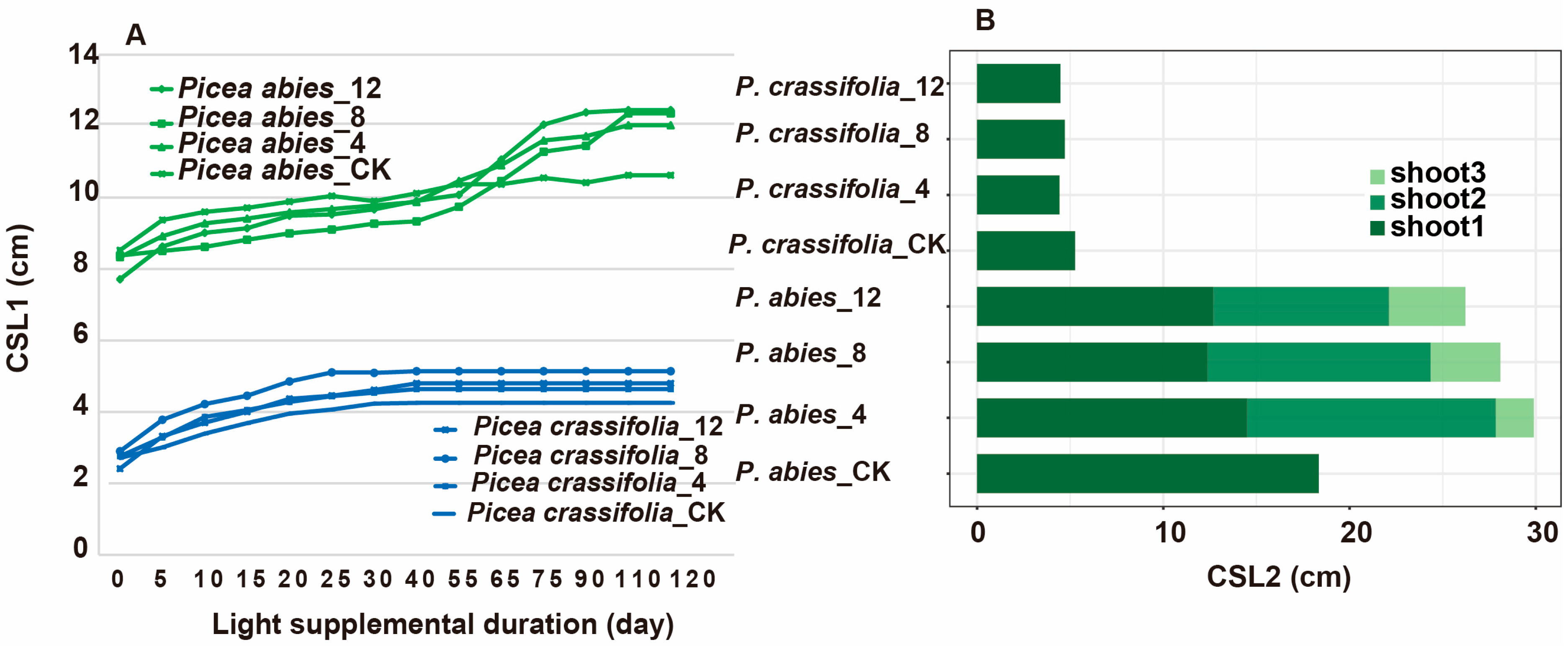
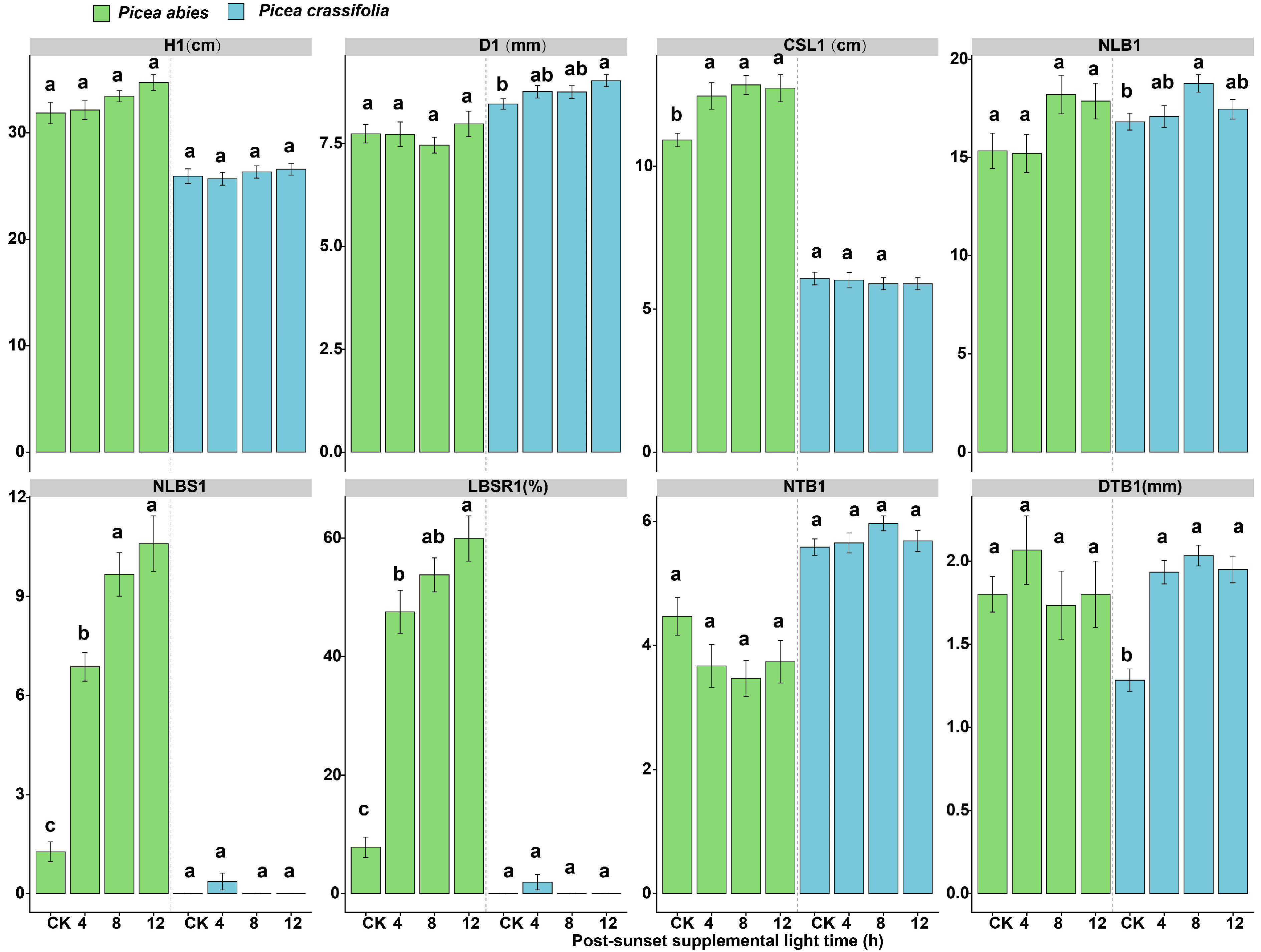
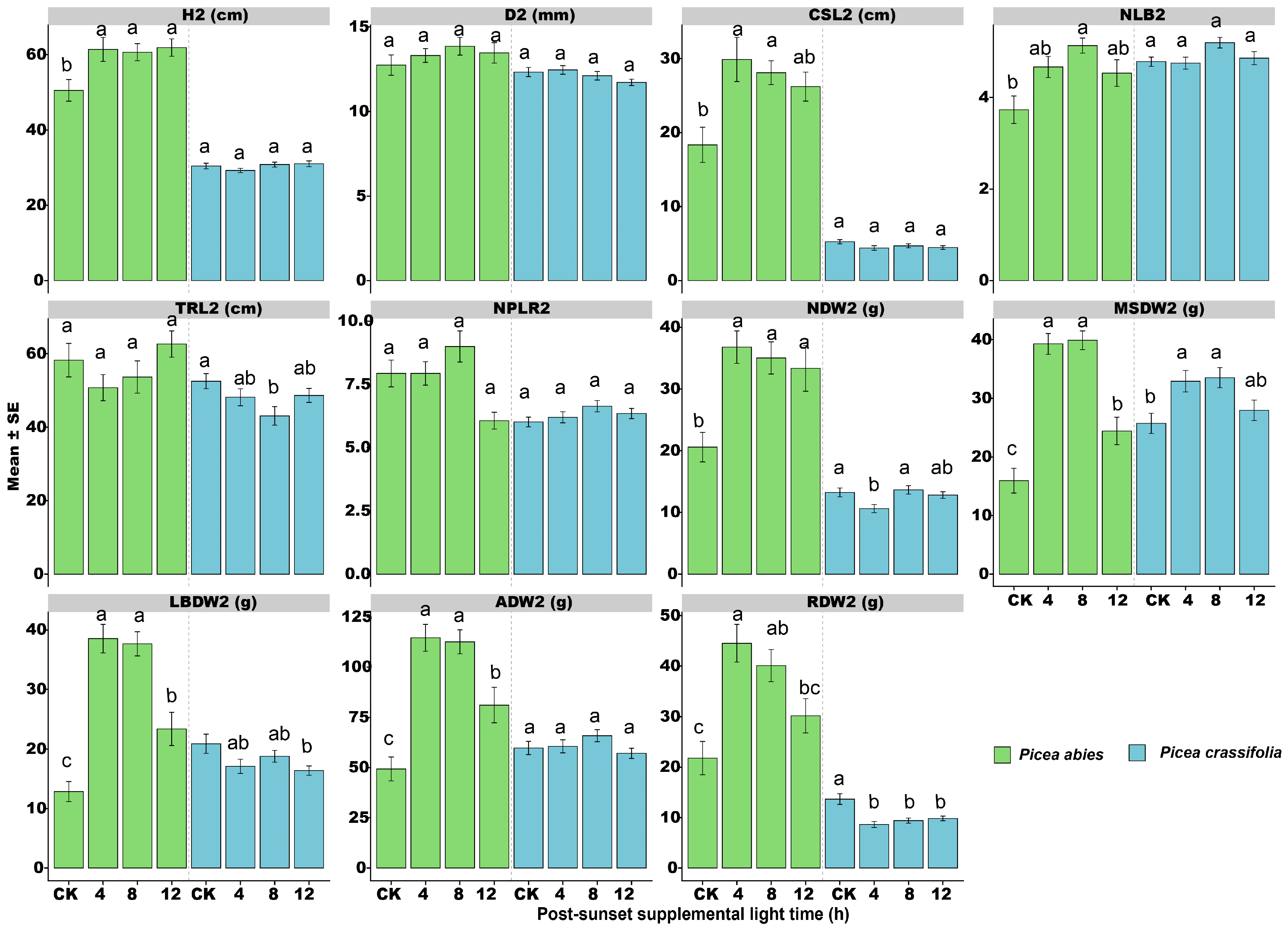
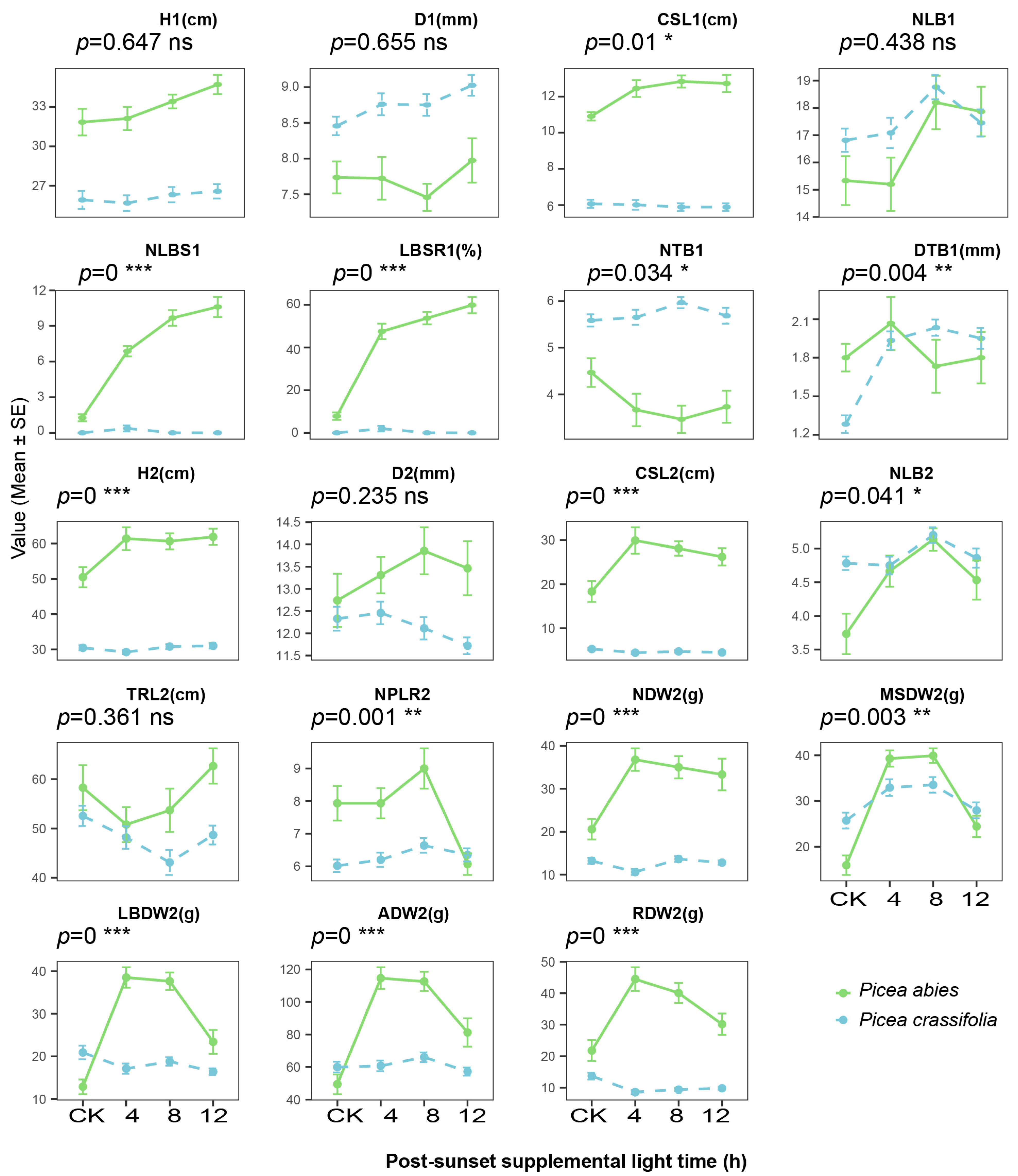
Analysis of the growth rhythm of new shoots in the first year reveals that the shoots of P. crassifolia seedlings ceased growing and became dormant after approximately 40 days, irrespective of the supplemental light treatment durations. In contrast, P. abies seedlings under the control treatment reached dormancy after 55 days, while those under the supplementary light treatments continued to grow, and dormancy was reached only after 110 days (Figure 2A). Species-specific analysis indicated that the duration of supplementary light treatments significantly affected the length of new shoots of P. abies in both the first and second years, but had no significant effect on the length of new shoots of P. crassifolia in both growing seasons (Figure 2B, Figure 3 and Figure 4). The length of new shoots of P. abies seedlings exposed to different supplemental light durations in the second year, with an average length ranging from 24 to 29 cm, was 33–61% higher than the control group with an average length of 18 cm (Figure 4). P. crassifolia seedlings under both supplementary light regimes and control treatments had only one period of shoot elongation growth, unlike P. abies, which showed three growth flushes, with an average new shoot length of 4.4–5.2 cm in the second year (Figure 2B).
The results of the ART-ANOVA analysis (Table 1) revealed that species was the principal factor driving phenotypic divergence in spruce growth traits: the majority of growth traits (e.g., height, diameter, shoot length, number of lateral buds, and biomass across different years) were significantly influenced by species (Figure 3 and Figure 4). Similarly, the interaction between species and photoperiod had a highly significant impact on most key growth traits (Figure 5). Meanwhile, the regulatory effect of photoperiod duration exhibited both temporal and trait specificity. In the first year, branch and bud traits were markedly affected by photoperiod duration, whereas key growth parameters such as height, diameter, and shoot length remained unaffected. In the second year, the influence of photoperiod duration became more pronounced, significantly impacting a wider range of shoot and root, and aboveground biomass, though no significant effect was observed on diameter, number of primary lateral roots, or belowground biomass. As a whole, the optimal duration of supplemental light regimes differed between the two species: P. abies achieved maximum growth under 4 h of additional light treatment, whereas the growth of P. crassifolia seedlings was optimal under 8 h of supplemental light treatment.

3.2. Effects of Supplemental Light Duration on Endogenous Hormones in P. abies and P. crassifolia

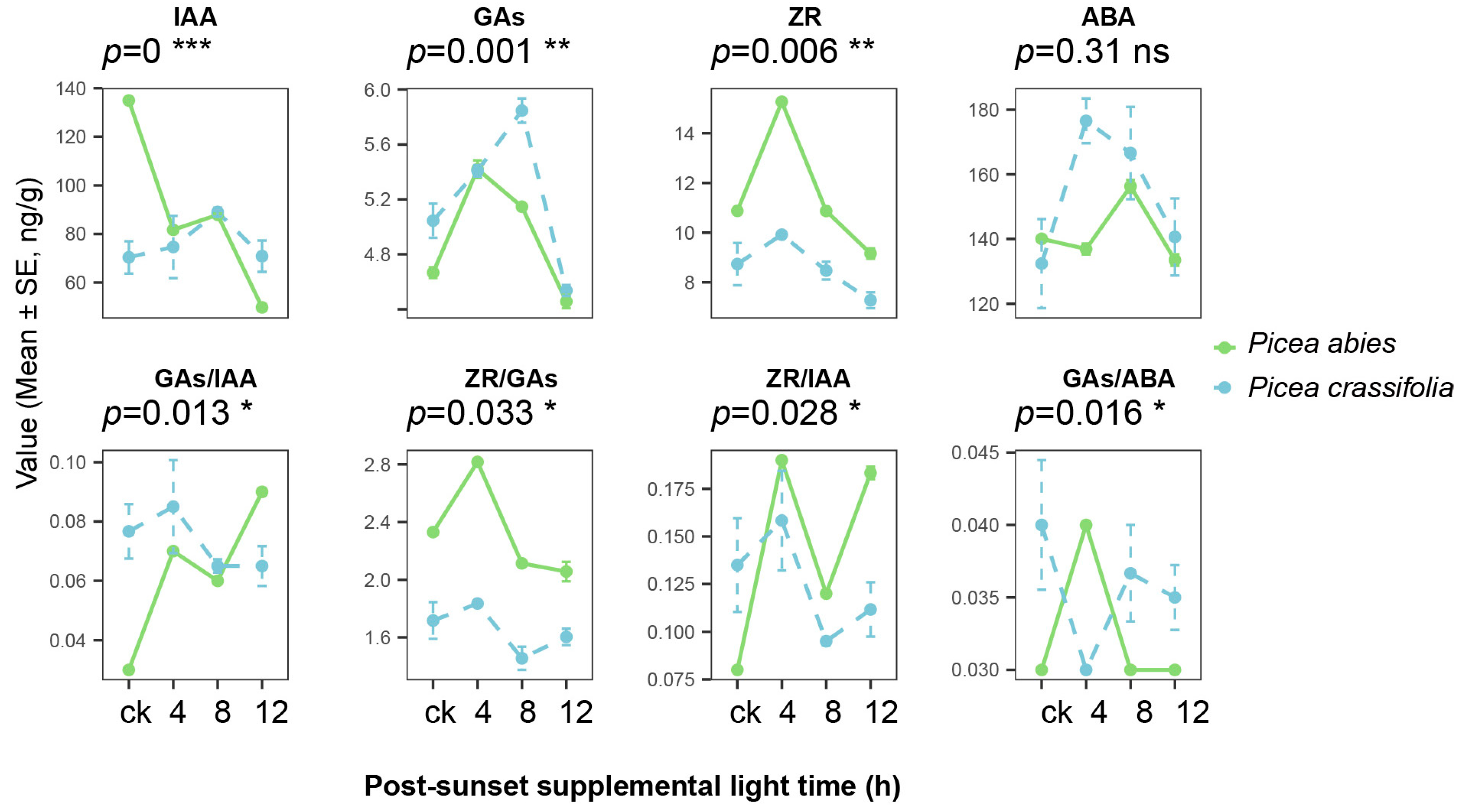
The ART-ANOVA results (Table 2) indicate that species had a significant effect on levels of GAs, ZR, and the ZR/GAs ratio, whereas no significant influence was observed for IAA and ABA. In contrast, photoperiod exerted more extensive effects, significantly modulating the activity of IAA, GAs, ZR, ABA, ZR/GAs, and ZR/IAA.
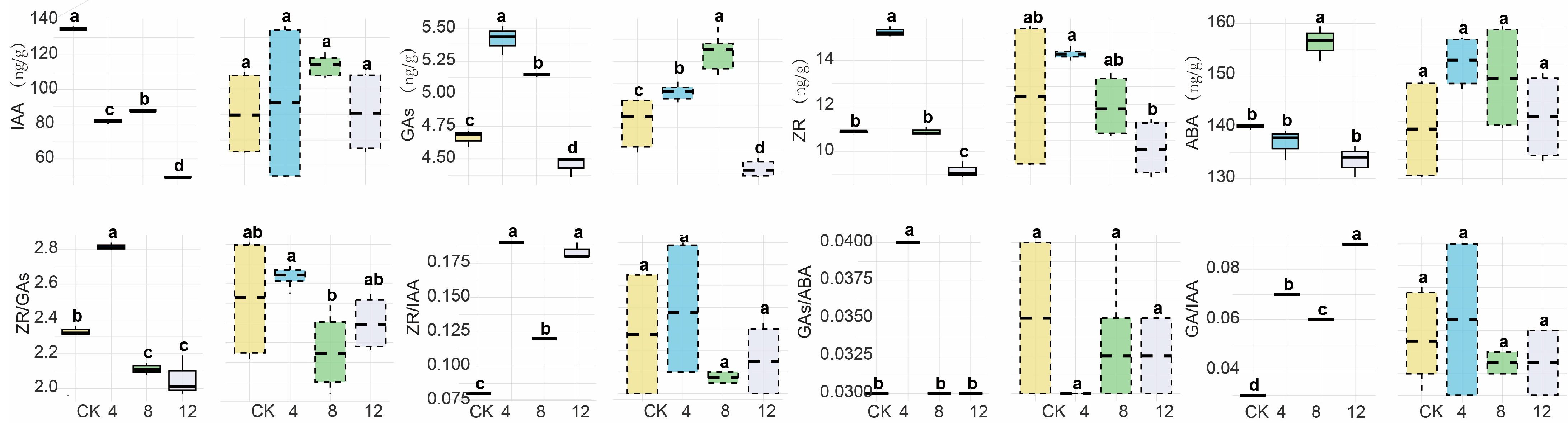
For P. abies, all endogenous hormones and their ratios exhibited statistically significant differences under the four supplemental light durations. The highest values of GAs, ZR, ZR/GAs, ZR/IAA, and GAs/ABA were observed under the 4 h supplemental light treatment. The concentrations of GAs and ZR were 5.42 ng/g and 15.26 ng/g, representing increases of 16% and 40% over the control group, 5% and 40% over the 8 h supplemental light treatment, and 22% and 67% over the 12 h supplemental light treatment, respectively. The ratios of ZR/GAs, ZR/IAA, and GAs/ABA were 2.81, 0.19, and 0.04, which were 21%, 138%, and 33% higher than the control; 37%, 58%, and 33% higher than the 8 h treatment; and 37%, 4%, and 33% higher than the 12 h treatment, respectively. Under the 8 h nighttime supplemental light treatment, GAs and ZR/IAA ranked second highest (Figure 6).
In contrast, for P. crassifolia, most endogenous hormones and their ratios, including ZR, IAA, ABA, GAs/IAA, ZR/GAs, ZR/IAA, and GAs/ABA, showed no significant differences (p > 0.05) across the four supplemental light durations. Only GAs demonstrated a significant difference (p < 0.01), with the highest concentration (5.8 ng/g) observed under the 8 h supplemental light treatment, representing a 7% increase compared to the control. However, under this light duration, ABA content was also relatively high (167 ng/g), resulting in no significant differences in the GAs/ABA ratio (ranging from 0.03 to 0.04) across the four treatments (Figure 6). Except for ABA, all other measured endogenous hormones (IAA, GAs, ZT) and their ratios (GAs/IAA, ZT/GAs, ZT/IAA, GAs/ABA) showed significant species-by-photoperiod interaction effects (Figure 7).

3.3. Temporal Variation in Endogenous Hormone Levels of P. abies and P. crassifolia Exposed to 8 h Night Supplemental Light Treatments

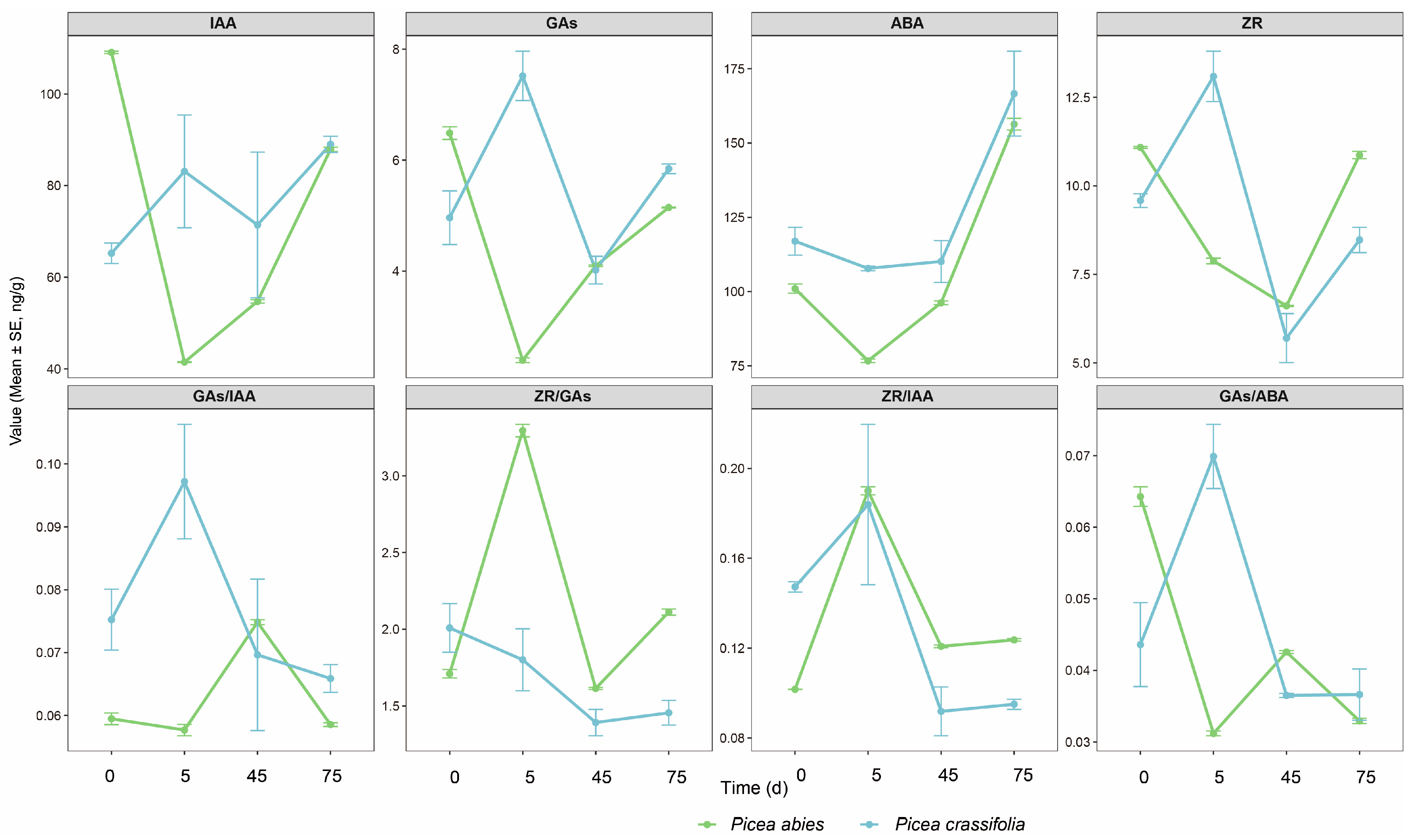
The endogenous hormone levels and ratios of P. abies seedlings exposed to 8 h night supplemental light treatment showed highly significant temporal variation (p < 0.01). The levels of IAA, GAs, and ZR increased after 40 d and 75 d of supplemental light treatments, approaching the levels before light treatment was applied. The ABA content decreased after 5 d of supplemental light treatment and reached the lowest level after 40 d of light treatment (Figure 8).
Similarly, the levels of endogenous hormones in P. crassifolia seedlings exposed to 8 h of night supplemental light treatment showed extremely significant temporal variation (p < 0.001). Five days after light supplementation, the GAs and ZR levels, and GAs/IAA, ZR/IAA, ZR/GAs, and GAs/ABA ratios all rose to their highest values but continued to decline thereafter until 40 d and at 75 d of light supplementation, and basically reached the lowest level at 75 d of light treatment. At 75 d, P. crassifolia seedlings had completely ceased growth and entered dormancy, whereas P. abies seedlings remained actively growing, with the levels of ZR, ZR/GAs, and ZR/IAA still being significantly higher than those in P. crassifolia (Figure 8).

3.4. Correlations of Current Shoot Length in the First and Second Years with Endogenous Hormones

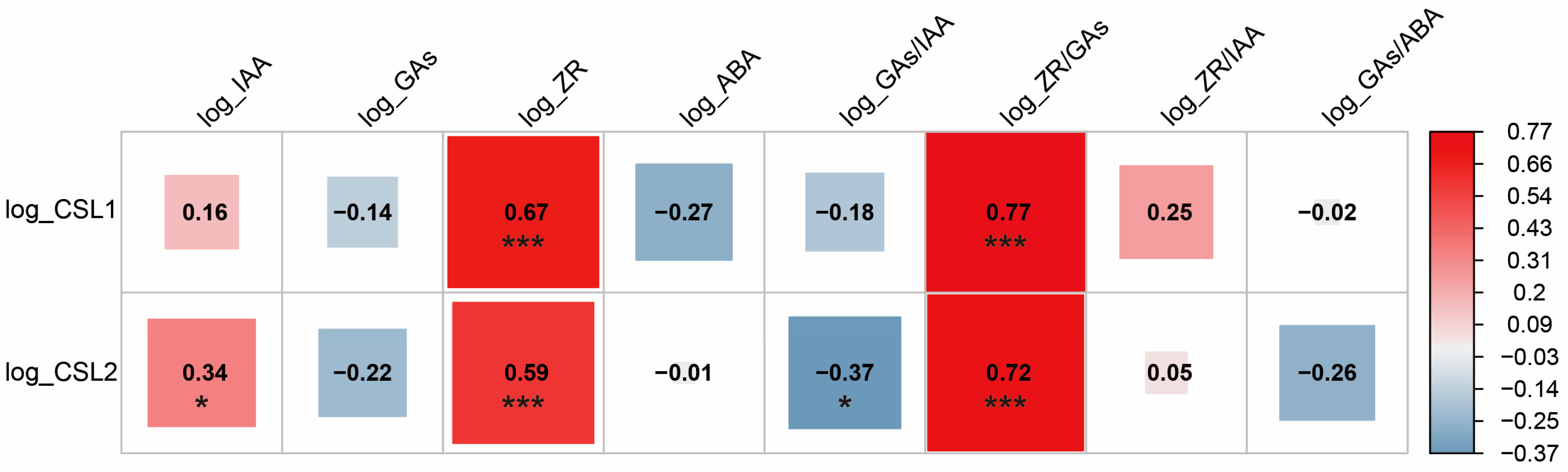
Pearson correlation analysis (Figure 9) demonstrated that ZR and ZR/GAs were the most prominent positive regulators of new shoot elongation. For CSL1, ZR/GAs exhibited the strongest positive correlation (r = 0.77 ***), followed closely by ZR (r = 0.67 ***). A consistent pattern was observed for CSL2, where ZR/GAs again displayed the strongest positive association (r = 0.72 ***), with ZR as the second most significant factor (r = 0.59 ***).

3.5. Causal Inference Mediation Effect Model Analysis of New Shoot Length with Light Duration and Endogenous Hormones

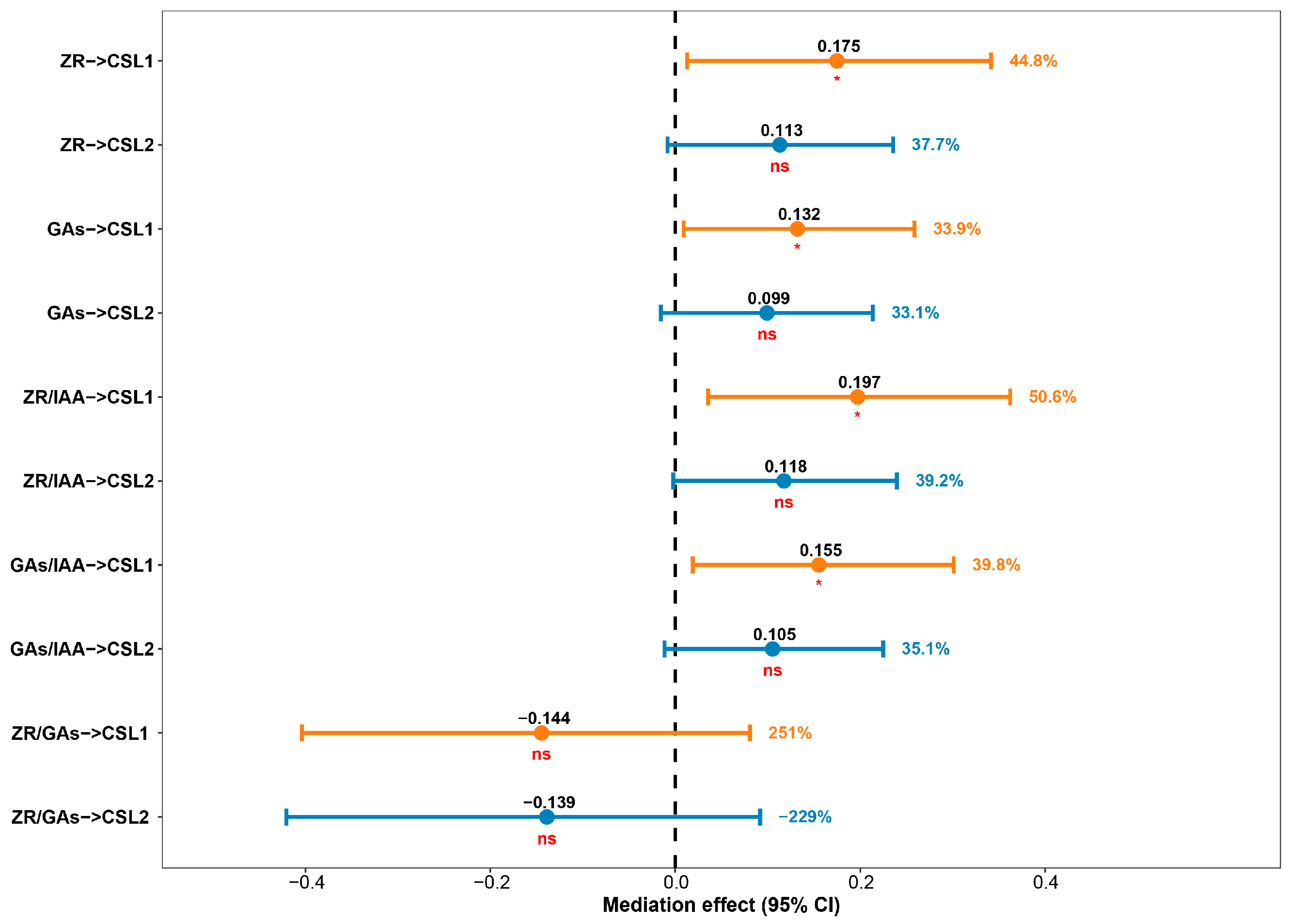
The results of the mediation effect analysis are presented in Table 3 and Figure 10. For CSL1, mediation effect analysis demonstrated that four hormones/hormone ratios (ZR, GAs, ZR/IAA, and GAs/IAA) exhibited significant mediation effects (p < 0.05). Notably, ZR/IAA showed the strongest mediation effect (0.198), contributing 50.6% of the total effect (p = 0.011). ZR displayed the second-largest mediation contribution, with an effect size of 0.175, accounting for 44.8% of the total effect (p = 0.020). For CSL2, no hormonal mediation effects reached the conventional significance threshold of p < 0.05. However, all effects showed a consistent trend toward marginal significance (p = 0.065–0.091). The mediation effect of ZR/GAs on CSL1 was negative (−0.1445), with a 95% confidence interval of [−0.4206, 0.0917] crossing zero, indicating a non-significant mediation effect. The total effect was −0.0576, and the mediation ratio reached 2.51. For CSL2, the mediation ratio was −2.2941, while the mediation effect remained non-significant. These ratios greater than 1 or less than −1 mainly resulted from opposite directions and near-zero values of the direct and total effects.

4. Discussion

Photoperiod exerts a significant influence on the growth and development of coniferous trees. Prolonged photoperiods have been shown to suppress dormancy and enhance height growth in conifers [14]. Supplemental light treatments extend the effective photosynthetic duration, thereby promoting the growth of Picea seedlings, along with an increase in the number of lateral buds, shoot length, and leaf count [10,15]. The substantial expansion of photosynthetic area further enhances photosynthetic activity and assimilation, leading to elevated levels of photosynthetic products in seedlings. Studies indicate that the responsiveness of Picea seedlings to supplemental light treatments varies significantly by species, provenance, and family [16,17].
Distinct species exhibit species-specific responses to photoperiod, a differentiation resulting from long-term evolutionary adaptation to the photoperiodic rhythms of their respective geographical environments [18,19]. In the present study, supplemental light treatment induced three growth flushes in P. abies, but did not promote multiple growth cycles in P. crassifolia. Furthermore, the optimal duration of supplemental light treatment differed between the two species: P. abies achieved maximum growth under 4 h of additional light, whereas P. crassifolia responded optimally to 8 h of supplemental illumination. This discrepancy may be attributed to inherent genetic traits shaped by long-term evolutionary adaptation. Picea abies is native to northern and central Europe, spanning latitudes from 45 °   N to 70 °   N , encompassing the cold temperate and temperate zones of the region. Its growth and development are highly sensitive to environmental factors such as light and temperature [12,18,20].
Picea abies exhibits high sensitivity to photoperiod extension, with significant seasonal variation in day length across its native range. Studies indicate that the critical photoperiod for P. abies grown in Norway ( 64   N ) is 21 h, while for those in Austria ( 47 ° 04   N ) is 15 h [4]. In contrast, P. crassifolia is naturally distributed in regions such as Gansu, Ningxia, eastern Qinghai, and central Inner Mongolia in China, spanning latitudes from approximately 32 °   N to 42 °   N , primarily in montane habitats within the arid and semi-arid zones of northwestern China [11]). Unlike P. abies, P. crassifolia demonstrates a threshold-saturation growth limitation: regardless of extended photoperiods, the average annual shoot-flushing frequency remains consistently at one, with no significant difference in new shoot length compared to control conditions. This pattern may be attributed to the high-altitude distribution of P. crassifolia, where growth is more strongly constrained by temperature than by photoperiod [21]. Photoperiod and temperature interact to regulate the growing season, with temperature thresholds at high altitudes determining growth initiation and cessation. Photoperiod extension fails to prolong the growing season under these conditions. To mitigate risks of frost damage to new shoots or resource depletion, P. crassifolia enhances lignification per flushing event, avoiding reduced stress tolerance due to rapid growth and thereby maintaining adaptation to high-altitude environments.
Plant hormones and light signals work in tandem to regulate plant growth [22]. In this study, the treatment with the best growth performance (4 h of supplementary light after sunset) also had the highest ratios of GAs, ZR, ZR/GAs, ZR/IAA, and GAs/ABA in P. abies. Research indicates that GAs play a core role in promoting stem elongation [9], and the application of gibberellin biosynthesis agents can enable the cells of the apical meristem of Salix pentandra to resume division and elongation after they have stopped [21]. Arabidopsis thaliana mutants lacking endogenous GAs have shorter stems and smaller leaves [23]. The cessation of growth and the formation of terminal buds in European spruce [24] and Salix pentandra [6] under short-day conditions or low night temperatures are accompanied by a decrease in active GAs. Studies have shown that the content of auxin and gibberellin in seedlings under supplementary light treatment is the main physiological factor promoting the growth of P. abies seedlings and the differences among provenances [10].
ABA and GAs exhibit antagonistic effects on plant growth and development; in contrast to GAs, ABA inhibits growth. In the present study, although the highest GAs content in P. crassifolia was observed under an 8 h supplemental light regime, its ABA content was also elevated. This hormonal profile may partly explain the lack of significant differences in growth among the three supplemental light durations compared to the control. Such a hormone balance represents an adaptation to high-altitude stress: elevated ABA enhances leaf water retention and frost resistance, while a low GAs/ABA ratio prevents excessively rapid growth that would compromise stress tolerance. However, further investigation into the physiological state of the seedlings (e.g., water potential and proline content) exposed to different supplemental light durations (photoperiod) is needed to confirm the role of elevated ABA production in stress tolerance.
Cytokinins play a crucial role in modulating plant branch development, primarily by regulating apical meristematic activity [25,26]. Studies in Arabidopsis thaliana have shown a positive correlation between meristem size and cytokinin levels [27]. In conifer species, multiple studies indicate that cytokinins are involved in the regulation of bud differentiation and development [28,29]. Supplemental light treatment enhances cytokinin delivery to leaves, upregulates signaling genes such as ARR7/16, sustains photosynthetic capacity, and delays senescence. In the present study, P. abies exhibited optimal growth under a 4 h supplemental light regime, which coincided with the highest levels of ZR and the ratio of ZR to IAA, indicating that ZR plays a critical role in initiating apical bud burst and sustaining growth in P. abies. This finding is further corroborated by mediation effect analysis, which suggested ZR and the ZR/IAA ratio as key factors promoting shoot growth (Figure 10).
The involvement of zeatin-type cytokinins in shoot apex development of P. abies was examined, and it was found that the levels of these cytokinins were pivotal for the establishment of bud size heterogeneity, which consequently dictates the architectural patterning of the tree crown [28]. Furthermore, the upregulation of ZR levels during the period of active bud development highlights the functional significance of cytokinins in driving this developmental process. Importantly, a positive correlation between ZR levels and bud growth has been documented during the predetermination stage of the subsequent year’s branch growth, suggesting that this cytokinin indirectly regulates the morphological characteristics of individual branches in spruce [29]. Similarly, ZR levels significantly increase during the initiation and active growth phases of P. glauca vegetative buds, promoting bud primordium differentiation and meristem expansion [9]. Cytokinin-related genes (e.g., type-A response regulators) are differentially expressed in synchrony with trans-zeatin riboside (t-ZR) dynamics, with short-day (SD) conditions inducing a more pronounced t-ZR elevation than long-day treatments. This underscores the conserved role of ZR in promoting bud initiation and active growth. Furthermore, in P. crassifolia, floral bud differentiation is facilitated by a rapid increase in ZR/GAs and ZR/IAA ratios, which initiate the flowering process [30]. These findings suggest that cytokinin trans-zeatin plays a critical role in breaking dormancy and initiating the second growth flush in P. abies, although its action is not solitary but results from synergistic interactions among multiple phytohormones.
Mediation analysis for CSL1 demonstrated that ZR/IAA was identified as the primary mediator, with the largest mediation effect ( 0.198 ), contributing 50.6 % of the total effect. This regulatory pattern aligns with the fundamental paradigm in plant biology that hormonal ratios govern growth dynamics. Supplementary light significantly enhanced ZR biosynthesis ( c 2 = 0.413 ) and suppressed IAA oxidase activity, thereby elevating the ZR/IAA ratio. This change stimulated cell division in the apical meristem ( b = 0.478 ) and ultimately promoted shoot elongation. Among individual hormones, ZR represented the second-most impactful mediator ( 44.8 % ,   p = 0.020 ). The a-coefficient ( 0.387 ) confirmed that light exposure directly facilitated ZR accumulation. As a cytokinin, ZR promoted shoot growth by delaying leaf senescence and sustaining meristematic activity ( b = 0.452 ).
For CSL2, mediation effect magnitudes ( 0.099 0.118 ) reached 70 89 % of those observed in CSL1, with mediation-to-total effect proportions ranging from 33.1 % to 39.2 % . All core mediators showed identical directional responses to CSL1, and only marginally crossed zero in their 95% confidence intervals (e.g., ZR/IAA:   0.0018 ,   0.2400 ). This marginal significance is unlikely to reflect random variation, but rather ontogenetic shifts in biennial plants. Current shoot of year 2 plants underwent a transition from predominantly vegetative growth to a mixed strategy of nutrient reserve accumulation and reproductive development, which increased the hormonal sensitivity threshold of the apical meristem. Accordingly, both coefficients c 2 and b were lower than in CSL1 (e.g., ZR: the coefficient c 2 decreased from 0.387 to 0.296 ). Additionally, CSL2 exhibited greater inter-individual variation driven by prior-year growth vigor and winter nutrient reserves, resulting in a markedly higher coefficient of variation ( C V   =   18.2 % vs. C V = 12.5 % in CSL1) and reduced statistical power. Nevertheless, these findings do not invalidate the light hormone current shoot length regulatory pathway.
The non-significant mediation effect of ZR/GAs suggests that this hormonal ratio is not a reliable pathway mediating the effect of light duration on shoot elongation. The extremely high and reversed mediation ratios observed in the two shoot traits were mainly caused by statistical features of near-zero total effects and opposite direct and indirect effects, rather than true biological differences. This indicates that shoot growth is regulated by a complex hormonal network, and ZR/GAs play a weak or unstable role under the current light conditions.

5. Conclusions

This study reveals that post-sunset supplemental light treatment exerts species-specific effects on seedling growth and endogenous hormone homeostasis. The optimal supplemental light duration that resulted in better growth differed between the species: 4 h for P. abies and 8 h for P. crassifolia, confirming our first hypothesis that growth responses to photoperiod are species-specific. The level of endogenous hormones and their ratios were also higher at these optimal durations for growth responses, with significant differences between species. Causal inference-based mediation analysis suggests that ZR, GAs, and ZR/IAA play a key role in driving shoot elongation, confirming that endogenous hormones may play a key role in regulating the growth responses of these spruce species to photoperiod. Collectively, the growth response to supplemental light is species-dependent, with its regulatory effect mediated by ZR, GAs, and ZR/IAA. The findings provide insights into optimizing supplemental light regimes in the nurseries for enhancing the growth of seedlings. As there are many Picea species with different geographic distributions, similar studies involving as many spruce species as possible would be needed to get an understanding of the general patterns of photoperiodic responses and the role of endogenous hormones in regulating photoperiodic responses.

Supplementary Materials

The following supporting information can be downloaded at: https://www.mdpi.com/article/10.3390/app16094372/s1, Figure S1: Schematic Representation of Morphological Trait Measurements in Seedlings; Table S1: Normality Test Results (Shapiro-Wilk Test).

Author Contributions

Conceptualization, J.Z. and J.W.; methodology, J.Z. and F.O.; software, J.Z.; validation, J.Z., M.C., and Y.C.; formal analysis, F.O. and J.Z.; investigation, Z.N. and B.L.; resources, J.W.; data curation, F.O., Y.C., and B.L.; writing—original draft preparation, J.Z. and F.O.; writing—review and editing, Y.C., M.C., Z.N., F.O., and M.T.; visualization, J.Z. and M.C.; supervision, J.W.; project administration, J.W.; funding acquisition, F.O. All authors have read and agreed to the published version of the manuscript.

Funding

This research was partially supported by the National Natural Science Foundation of China (NSFC 31600541), ‘14th Five-year Plan’ under the National Key Research and Development Plan (2024YFD220020203), the Beijing Botanical Garden of Science and Technology Project (BZ202603, BZ2025013), and the ‘13th Five-year Plan’ under the National Key Research and Development Plan (2017YFD0600606-09).

Institutional Review Board Statement

Not applicable.

Informed Consent Statement

Not applicable.

Data Availability Statement

The original contributions presented in this study are included in the article. Further inquiries can be directed to the corresponding authors.

Acknowledgments

The authors thank the Research Institute of Forestry of Xiaolong Mountain for providing the experimental site and for all their assistance.

Conflicts of Interest

The authors declare no conflicts of interest.

Abbreviations

The following abbreviations are used in this manuscript:
IAAIndole-3-acetic acid
GasGibberellins
ZRZeatin riboside
ABAAbscisic acid
H1Height1
D1Diameter1
CSL1Current shoot length1
NLB1Number of lateral branches1
NLBS1Number of lateral bud sprouting1
LBSR1Lateral bud sprouting rate1
NTB1Number of terminal buds1
DTB1Diameter of terminal buds1
H2Height2
D2Diameter2
CSL2Current shoot length2
NLB2Number of lateral branches2
TL2Taproot length2
NPLR2Number of primary lateral roots2
NDW2Needle dry weight2
MSDW2Main stem dry weight2
LBDW2Lateral branch dry weight2
ADW2Aboveground dry weight2
RDW2Root dry weight2

References

  1. Olsen, J. Light and Temperature Sensing and Signaling in Induction of Bud Dormancy in Woody Plants. Plant Mol. Biol. 2010, 73, 37–47. [Google Scholar] [CrossRef] [Scilit]
  2. David, B.; Körner, C. Photoperiod and Temperature Responses of Bud Swelling and Bud Burst in Four Temperate Forest Tree Species. Tree Physiol. 2014, 34, 377–388. [Google Scholar] [CrossRef] [Scilit]
  3. Li, C.; Junttila, O.; Ernstsen, A.; Heino, P.; Palva, E.T. Photoperiodic Control of Growth, Cold Acclimation and Dormancy Development in Silver Birch (Betula pendula) Ecotypes. Physiol. Plant. 2003, 117, 206–212. [Google Scholar] [CrossRef] [Scilit]
  4. Heide, O.M. Growth and Dormancy in Norway Spruce Ecotypes. Physiol. Plant. 1974, 31, 147–154. [Google Scholar] [CrossRef] [Scilit]
  5. Basler, D.; Körner, C. Photoperiod Sensitivity of Bud Burst in 14 Temperate Forest Tree Species. Agric. For. Meteorol. 2012, 165, 73–81. [Google Scholar] [CrossRef] [Scilit]
  6. Olsen, J.; Junttila, O.; Moritz, T. Long Day-Induced Bud Break in Salix pentandra Is Associated with Transiently Elevated Levels of GA and Gradual Increase in IAA. Plant Cell Physiol. 1997, 38, 536–540. [Google Scholar] [CrossRef] [Scilit]
  7. Behringer, F.; Davoes, P. Indole-3-acetic Acid Levels after Phytochrome-Mediated Changes in Stem-Elongation Rate of Dark-and Light-Grown Pisum Seedlings. Planta 1992, 188, 85–92. [Google Scholar] [CrossRef] [Scilit]
  8. Lau, O.S.; Deng, X.W. Plant Hormone Signaling Lightens Up: Integrators of Light and Hormones. Curr. Opin. Plant Biol. 2010, 13, 571–577. [Google Scholar] [CrossRef] [Scilit]
  9. El Kayal, W.; Allen, C.C.; Ju, C.J.; Adams, E.; King-Jones, S.; Zaharia, L.I.; Abrams, S.R.; Cooke, J.E. Molecular Events of Apical Bud Formation in White Spruce, Picea glauca. Plant Cell Environ. 2011, 34, 480–500. [Google Scholar] [CrossRef] [Scilit]
  10. Ouyang, F.Q.; Jiang, M.; Wang, J.H.; Jia, Z.R.; Zhang, S.Z.; Xu, N.; Liu, L.Y.; Li, Y. Effects of Supplemental Lighting on Growth and Physiological Responses of Norway Spruce (Picea abies (L.) H. Karst) from Different Provenances. J. Beijing For. Univ. 2016, 38, 50–58. [Google Scholar]
  11. Farjon, A. A Handbook of the World’s Conifers 2; BRILL: Leiden, The Netherlands; Boston, MA, USA, 2010; pp. 533–1111. [Google Scholar]
  12. Caudullo, G.; Tinner, W.; de Rigo, D. Picea abies in Europe: Distribution, Habitat, Usage and Threats. In European Atlas of Forest Tree Species; Publications Office of the European Union: Luxembourg, 2016. [Google Scholar]
  13. Zhang, L.G.; Zhang, C.L. Studies on Introduction of Picea abies. J. Hebei For. Coll. 1995, 10, 122–126. [Google Scholar]
  14. Steven, K.O.; Kent, L.E. Photoperiod Extension with Two Types of Light Sources: Effects on Growth and Development of Conifer Species. Tree Plant. Notes 1993, 44, 105–112. [Google Scholar]
  15. Zhang, X.W. Plant Hydraulic-Limitation in the Geographical Distribution and Growth Responses to Enhanced Temperature of Picea Taxa in China. Doctoral Dissertation, Lanzhou University, Lanzhou, China, 2015. [Google Scholar]
  16. Ouyang, F.Q.; Zhang, S.G.; Wang, J.H.; Ma, J.H.; Jiang, M.; Wang, M.Q.; Li, Y. Effects of Supplemental Lighting Treatments on Seedling Growth of Varied Provenances in Black Spruce. J. Beijing For. Univ. 2010, 32, 82–87. [Google Scholar]
  17. Ouyang, F.Q.; Wang, J.H.; Jia, Z.R.; Li, Y.; Zhong, Y.F.; Qi, S.X. Effects of Supplemental Light on Biomass and Mineral Element Content of Seedlings from Nine Families in Picea crassifolia. Sci. Silvae Sin. 2014, 50, 188–196. [Google Scholar]
  18. Ekberg, I.; Eriksson, G.; Dormling, I. Photoperiodic Reactions in Conifer Species. Holarct. Ecol. 1979, 2, 255–263. [Google Scholar] [CrossRef] [Scilit]
  19. Mu, W.; Wu, X.; Camarero, J.J.; Fu, Y.H.; Huang, J.; Li, X.; Chen, D. Photoperiod drives cessation of wood formation in northern conifers. Glob. Ecol. Biogeogr. 2023, 32, 603–617. [Google Scholar] [CrossRef] [Scilit]
  20. Jansson, G.; Danusevičius, D.; Grotehusman, H.; Kowalczyk, J.; Krajmerova, D.; Skrøppa, T.; Wolf, H. Norway Spruce (Picea abies (L.) H. Karst.). In Forest Tree Breeding in Europe; Pâques, L., Ed.; Managing Forest Ecosystems; Springer: Dordrecht, The Netherlands, 2013; Volume 25. [Google Scholar] [CrossRef] [Scilit]
  21. Wang, T.; Liang, E.; Zhang, Y. Divergent Seasonal Patterns of Qinghai Spruce Growth with Elevation in Northwestern China. Forests 2022, 13, 365. [Google Scholar] [CrossRef] [Scilit]
  22. Olsen, J.; Jensen, E.; Junttila, O.; Moritz, T. Photoperiodic Control of Endogenous Gibberellins in Seedlings of Salix pentandra. Plant Physiol. 1995, 93, 639–644. [Google Scholar] [CrossRef] [Scilit]
  23. Leonid, V.K.; Linda, J.W.; Allison, H. Interactions between Plant Hormones and Light Quality Signaling in Regulating the Shoot Growth of Arabidopsis thaliana Seedlings. Botany 2012, 90, 237–246. [Google Scholar]
  24. Mølmann, J.; Asante, D.; Jensen, J.; Krane, M.; Junttila, O.; Olsen, J. Low Night Temperature and Inhibition of Gibberellin Biosynthesis Override Phytochrome Action, and Induce Bud Set and Cold Acclimation, but Not Dormancy in Hybrid Aspen. Plant Cell Environ. 2005, 28, 1579–1588. [Google Scholar] [CrossRef] [Scilit]
  25. Su, Y.H.; Liu, Y.B.; Zhang, X.S. Auxin-Cytokinin Interaction Regulates Meristem Development. Mol. Plant 2011, 4, 616–625. [Google Scholar] [CrossRef] [Scilit]
  26. Kyozuka, J. Control of Shoot and Root Meristem Function by Cytokinin. Curr. Opin. Plant Biol. 2007, 10, 442–446. [Google Scholar] [CrossRef] [Scilit]
  27. Werner, T.; Motyka, V.; Laucou, V.; Smets, R.; Van Onckelen, H.; Schmülling, T. Cytokinin-Deficient Transgenic Arabidopsis Plants Show Multiple Developmental Alterations Indicating Opposite Functions of Cytokinins in the Regulation of Shoot and Root Meristem Activity. Plant Cell 2003, 15, 2532–2550. [Google Scholar] [CrossRef] [Scilit]
  28. Bollmark, M.; Chen, H.J.; Moritz, T.; Eliasson, L. Relations between Cytokinin Level, Bud Development and Apical Control in Norway Spruce, Picea abies. Physiol. Plant. 1995, 95, 563–568. [Google Scholar] [CrossRef] [Scilit]
  29. Chen, H.J.; Bollmark, M.; Eliason, L. Evidence that Cytokinin Controls Bud Size and Branch Form in Norway Spruce. Physiol. Plant. 1996, 98, 612–618. [Google Scholar] [CrossRef] [Scilit]
  30. Hu, P.; Wang, C. Content Changes of Endogenous Hormones during Flower Bud Differentiation of Picea crassifolia. Acta Bot. Boreal.-Occident. Sin. 2012, 32, 540–545. [Google Scholar]
Figure 1. Path diagram for mediation effect analysis.
Applsci 16 04372 g001
Figure 2. Growth changes in the first-year new current shoot length (CSL1) of P. abies (green line) and P. crassifolia (blue line) after different times of exposure to four supplementary light treatments (A) and Stacked graph of the second-year current shoot length (CSL2) of P. abies and P crassifolia under different supplementary light duration treatments (B). Shoot1: First shoot growth flush; Shoot2: Second shoot growth flush, and Shoot3: Third shoot growth flush.
Applsci 16 04372 g002
Figure 3. Growth traits of P. abies and P. crassifolia in the first growing season in response to varying supplemental light durations. Bars with different lowercase letters indicate significant differences at p < 0.05 based on Tukey’s honestly significant difference (HSD) test.
Applsci 16 04372 g003
Figure 4. Growth traits of P. abies and P. crassifolia in the second growing season in response to varying supplemental light durations. Bars with different lowercase letters indicate significant differences at p < 0.05 based on Tukey’s honestly significant difference (HSD) test.
Applsci 16 04372 g004
Figure 5. The interaction effects between species and photoperiod on growth traits for the first and second years. Significance levels are denoted as follows: * p < 0.05, ** p < 0.01, *** p < 0.001.
Applsci 16 04372 g005
Figure 6. Comparative analysis of endogenous hormones dynamics and their ratios of P. abies and P. crassifolia under different supplementary light durations. Means followed by lowercase letters are significantly different. The solid line represents P. abies and the dashed line represents P. crassifolia. IAA, indole-3-acetic acid; GAs, gibberellins; ZR, zeatin riboside; ABA, abscisic acid. Boxes with different lowercase letters indicate significant differences at p < 0.05 based on Tukey’s honestly significant difference (HSD) test.
Applsci 16 04372 g006
Figure 7. Interaction effects of photoperiod and species on levels of endogenous hormones and their ratios. IAA, indole-3-acetic acid; GAs, gibberellins; ZR, zeatin riboside; ABA, abscisic acid. Significance levels are denoted as follows: * p < 0.05, ** p < 0.01, *** p < 0.001.
Applsci 16 04372 g007
Figure 8. Temporal variation in endogenous hormone levels in P. abies and P. crassifolia seedlings exposed to 8 h supplementary light treatment. IAA, indole-3-acetic acid; GAs, gibberellins; ZR, zeatin riboside; ABA, abscisic acid.
Applsci 16 04372 g008
Figure 9. Pearson correlation heatmaps of new shoot length (CSL1, CSL2) with endogenous phytohormone-related. Significance levels are denoted as follows: * p < 0.05, *** p < 0.001.
Applsci 16 04372 g009
Figure 10. Mediation effect of supplementary light duration on current shoot length via endogenous hormones, where * and ns respectively represent significant (p < 0.05) and no-significant (p > 0.05) mediation effects of hormone on current shoot growth, the values above the dot represent the mediating effects of various endogenous hormones on new shoot length, which are equal to the product of coefficient c 2 and coefficient b in Table 3. For example, 0.175 = 0.3872 × 0.4516.
Applsci 16 04372 g010
Table 1. p-values from Aligned Rank Transform ANOVA for growth traits in P. abies and P. crassifolia under varied supplemental light durations for two years.
YearGrowth TraitsAbbreviationSpeciesPhotoperiodSpecies × Photoperiod
1Diameter D10.000.170.65
1Current shoot length CSL10.000.800.00
1Number of lateral branches NLB10.250.010.44
1Number of lateral bud sprouting NLBS10.000.000.00
1Lateral bud sprouting rate LBSR10.000.000.00
1Number of terminal budsNTB10.000.070.00
1Diameter of terminal buds DTB10.060.000.00
2Height H200.010
2Diameter D200.540.44
2Current shoot lengthCSL200.080
2Number of lateral branches NLB20.0000.075
2Taproot length TL21 × 10−40.020.43
2Number of primary lateral rootsNPLR200.183 × 10−4
2Needle dry weight NDW200.070
2Main stem dry weight MSDW20.7004 × 10−4
2Lateral branch dry weight LBDW200.020
2Aboveground dry weightADW205 × 10−40
2Root dry weight RDW200.510
Table 2. p-values of Aligned Rank Transform ANOVA analysis of endogenous hormones and their ratios of P. abies and P. crassifolia under different supplementary light durations.
HormonesSpeciesPhotoperiodSpecies × Photoperiod
IAA0.190.011 × 10−4
Gas1 × 10−400.00
ZR000.00
ABA0.710.090.44
GAs/IAA0.250.280.02
ZR/Gas02 × 10−40.05
ZR/IAA0.260.0040.05
GAs/ABA0.250.640.08
Table 3. Mediation effect analysis of endogenous hormones (M) on seedling shoot growth (Y) under different supplemental light durations (T).
Mediator VariableDependent VariableCoefficient (T → M)Coefficient (M → Y)Mediation Effectp-Value for Mediation Effect95% CI for Mediation EffectSignificanceDirect EffectTotal Effect
ZRCSL10.38720.45160.17490.021[0.0128, 0.3415]*0.21560.3905
ZRCSL20.29580.38240.11310.078[−0.0082, 0.2357]ns0.18690.3000
GAsCSL1−0.3215−0.41080.13210.035[0.0092, 0.2587]*0.25840.3905
GAsCSL2−0.2783−0.35620.09920.091[−0.0156, 0.2137]ns0.20080.3000
ZR/IAACSL10.41250.47830.19730.012[0.0356, 0.3621]*0.19320.3905
ZR/IAACSL20.32150.36580.11760.065[−0.0021, 0.2398]ns0.18240.3000
GAs/IAACSL1−0.3587−0.43290.15530.028[0.0189, 0.3012]*0.23520.3905
GAs/IAACSL2−0.3021−0.34870.10530.082[−0.0115, 0.2248]ns0.19470.3000
ZR/GAsCSL1−0.18390.7856−0.14450.216[−0.4036, 0.0808]ns0.0869−0.0576
ZR/GAsCSL2−0.18390.7545−0.13880.240[−0.4206, 0.0917]ns0.19930.0605
Note: Coefficient (T–M) in the table corresponds to coefficient c 2 in Formula (4), and Coefficient (M–Y) refers to coefficient b in Formula (5). The Mediation Effect is the product of these two coefficients. * indicates p < 0.05; ns indicates not significant (p ≥ 0.05).
Disclaimer/Publisher’s Note: The statements, opinions and data contained in all publications are solely those of the individual author(s) and contributor(s) and not of MDPI and/or the editor(s). MDPI and/or the editor(s) disclaim responsibility for any injury to people or property resulting from any ideas, methods, instructions or products referred to in the content.