
Parametric Optimization of Spiked Blunt Bodies in Supersonic Flow Using Surrogate-Assisted Machine Learning and Evolutionary Algorithms
 ,
,
Abstract
1. Introduction
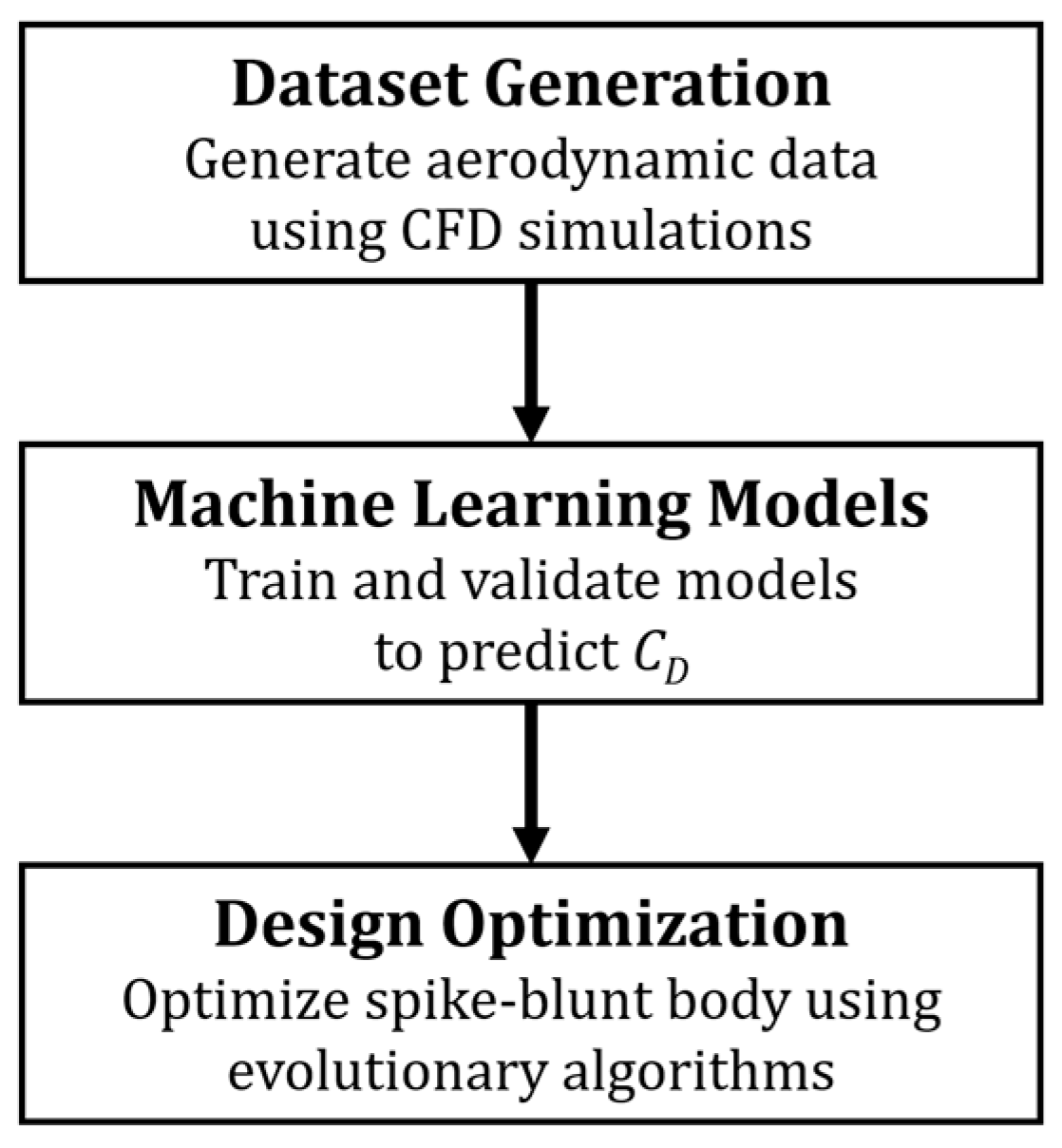
2. Materials and Methods
2.1. Dataset Generation (CFD Process)
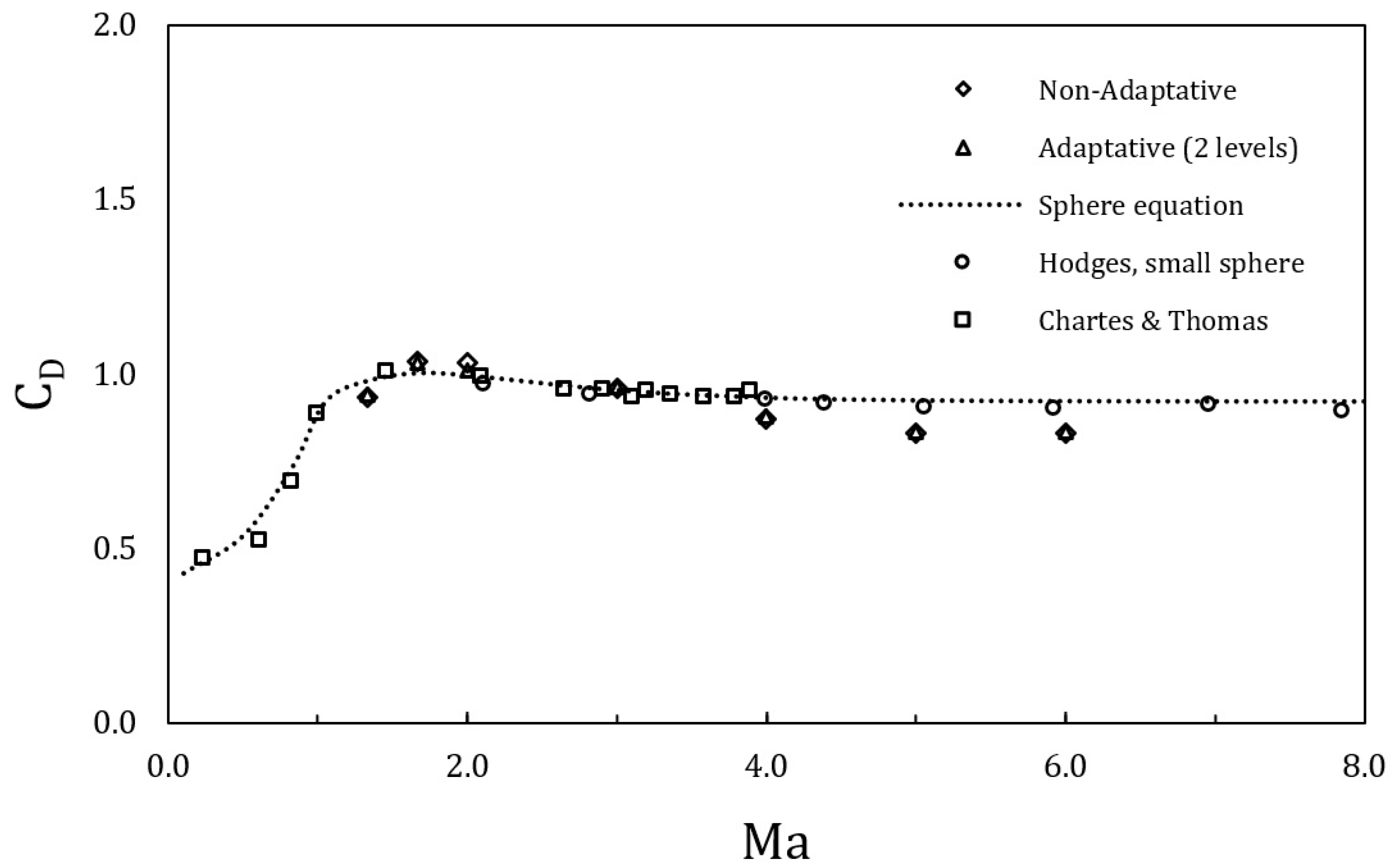
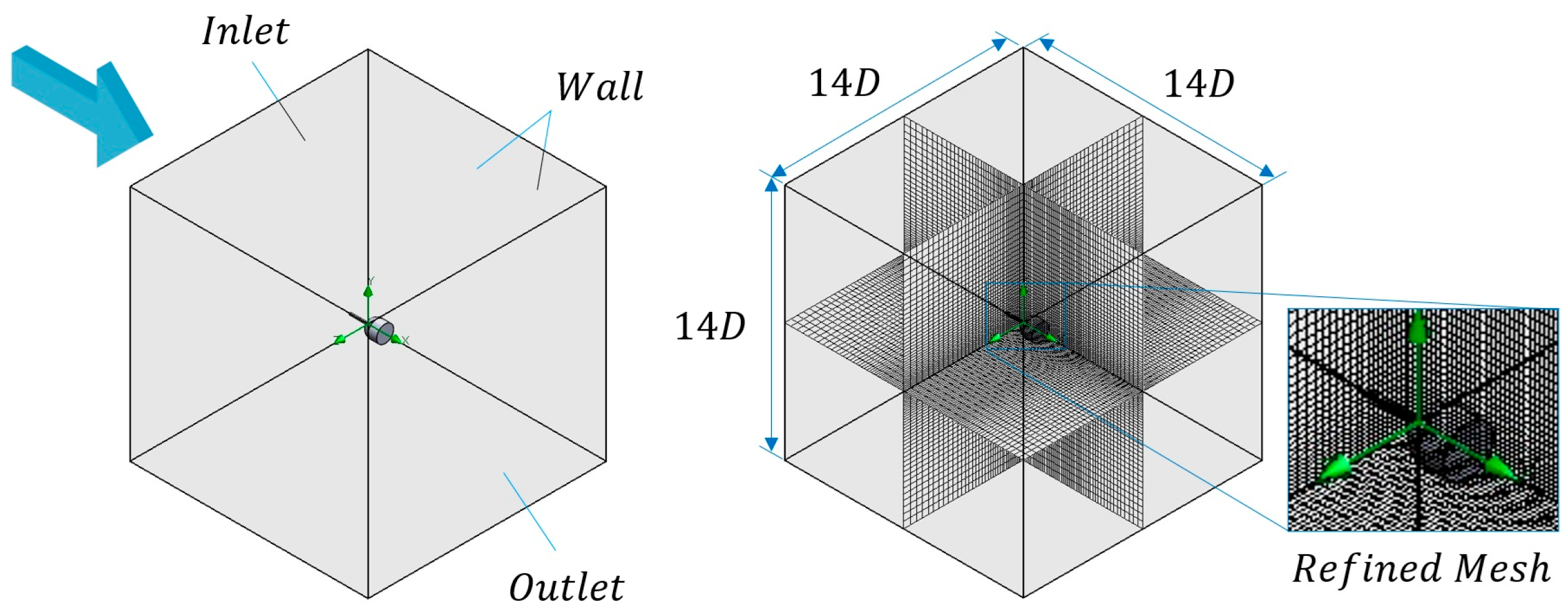
2.1.1. CFD Validation Test
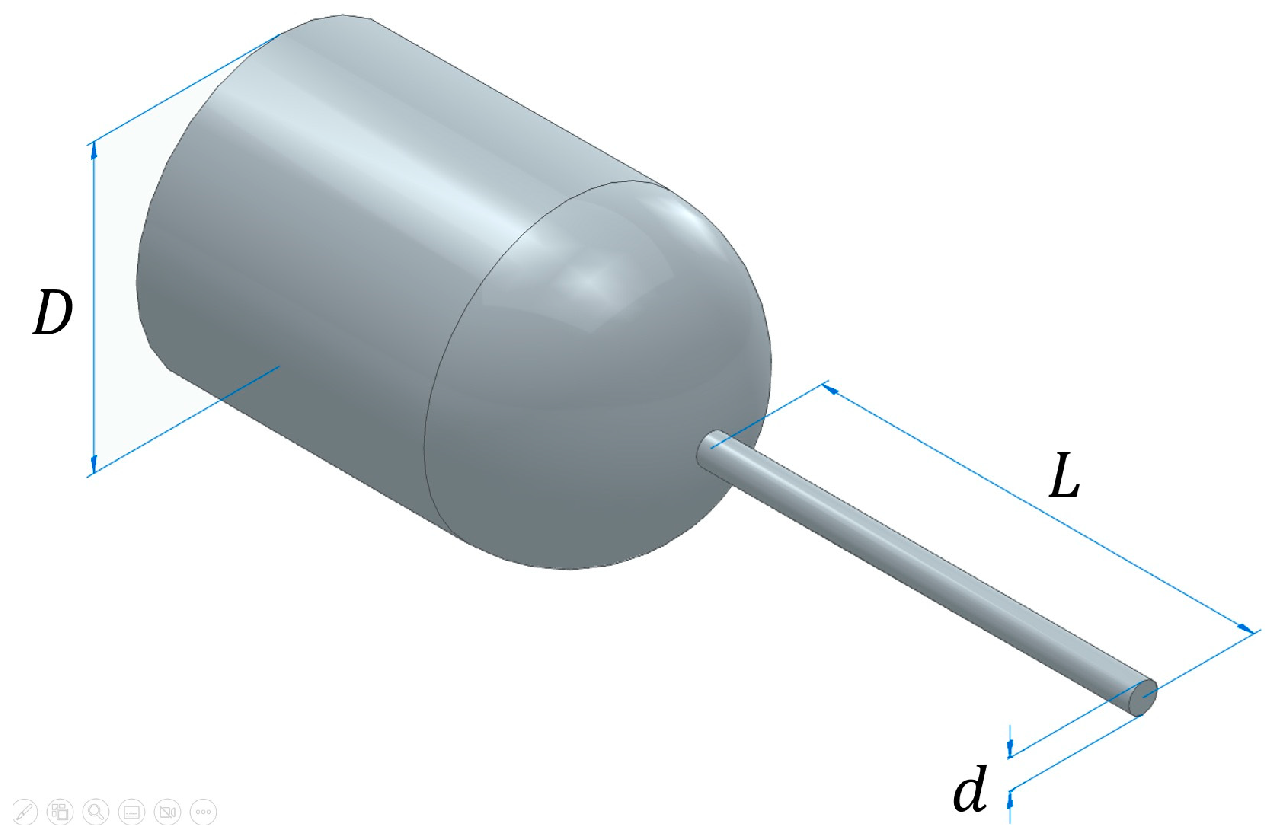
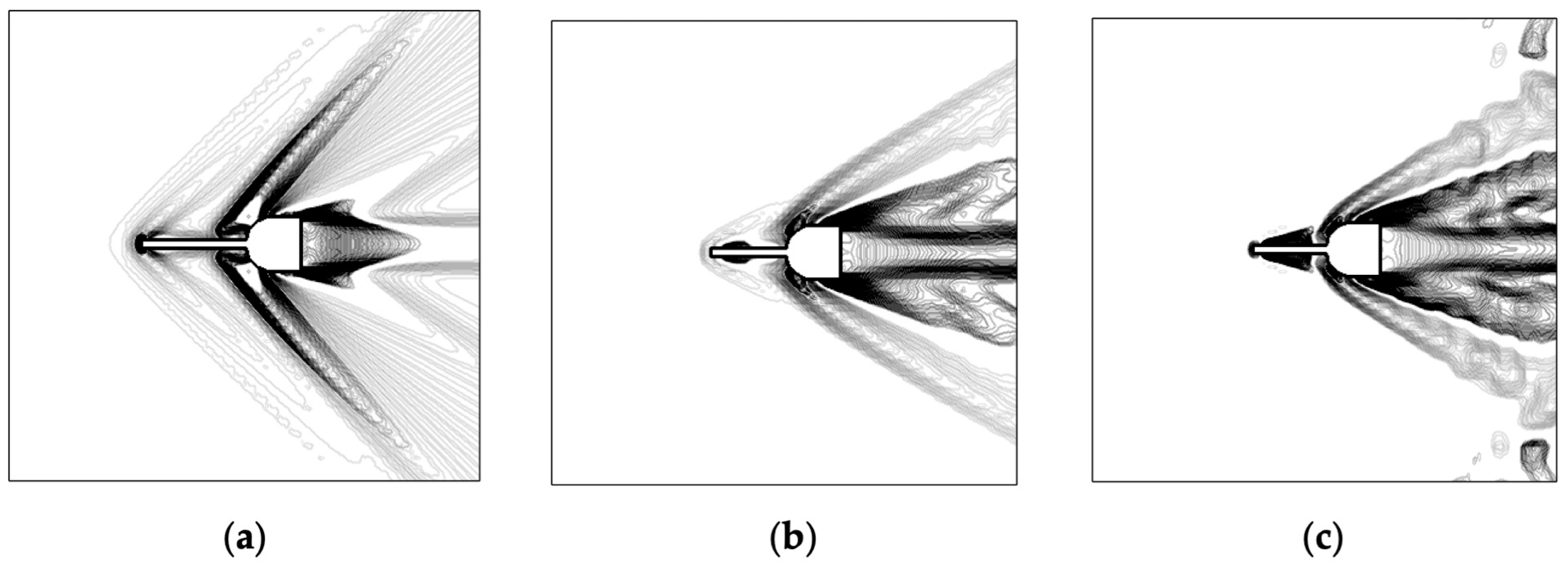
2.1.2. Spike Blunt Configuration
2.2. Machine Learning Models
2.2.1. Training Protocol
2.2.2. Hyperparameter Tuning
2.2.3. Model Evaluation Metrics
2.2.4. Gradient Boosting Regressor (GBR)
2.2.5. Light Gradient Boosting Regressor (LGBR)
2.3. Evolutionary Algorithms
2.3.1. Genetic Algorithms (GA)
- Selection: Individuals with higher fitness are probabilistically favored for reproduction. A common approach is the roulette-wheel selection, where the probability of selecting an individual is proportional to its fitness:
- Crossover (Recombination): Two parent solutions and are combined to produce offspring . A simple arithmetic crossover for continuous variables is:
- Mutation: A small random perturbation is applied to offspring to maintain diversity and explore new regions of the search space:
2.3.2. Differential Evolution (DE)
- are three distinct vectors randomly selected from the current population, different from .
- is scaling factor controlling the amplification of the differential variation.
- is the crossover probability,
- is the randomly chosen index to ensure that at least one component comes from the donor vector.
2.3.3. Covariance Matrix Adaptation Evolution Strategy (CMA-ES)
- InitializationThe algorithm starts by defining an initial distribution:
- ○
- Initial mean:
- ○
- Initial standard deviation: .
- ○
- Initial covariance matrix: .
- ○
- Population size: λ
- Sampling of individuals
- Evaluation and selection
- Update of the mean
- Evolution pathsTwo evolution paths are updated:
- ○
- Step-size control path:
- ○
- Covariance matrix adaptation path:
- Covariance matrix update
- Step size adaptation
3. Results and Discussion
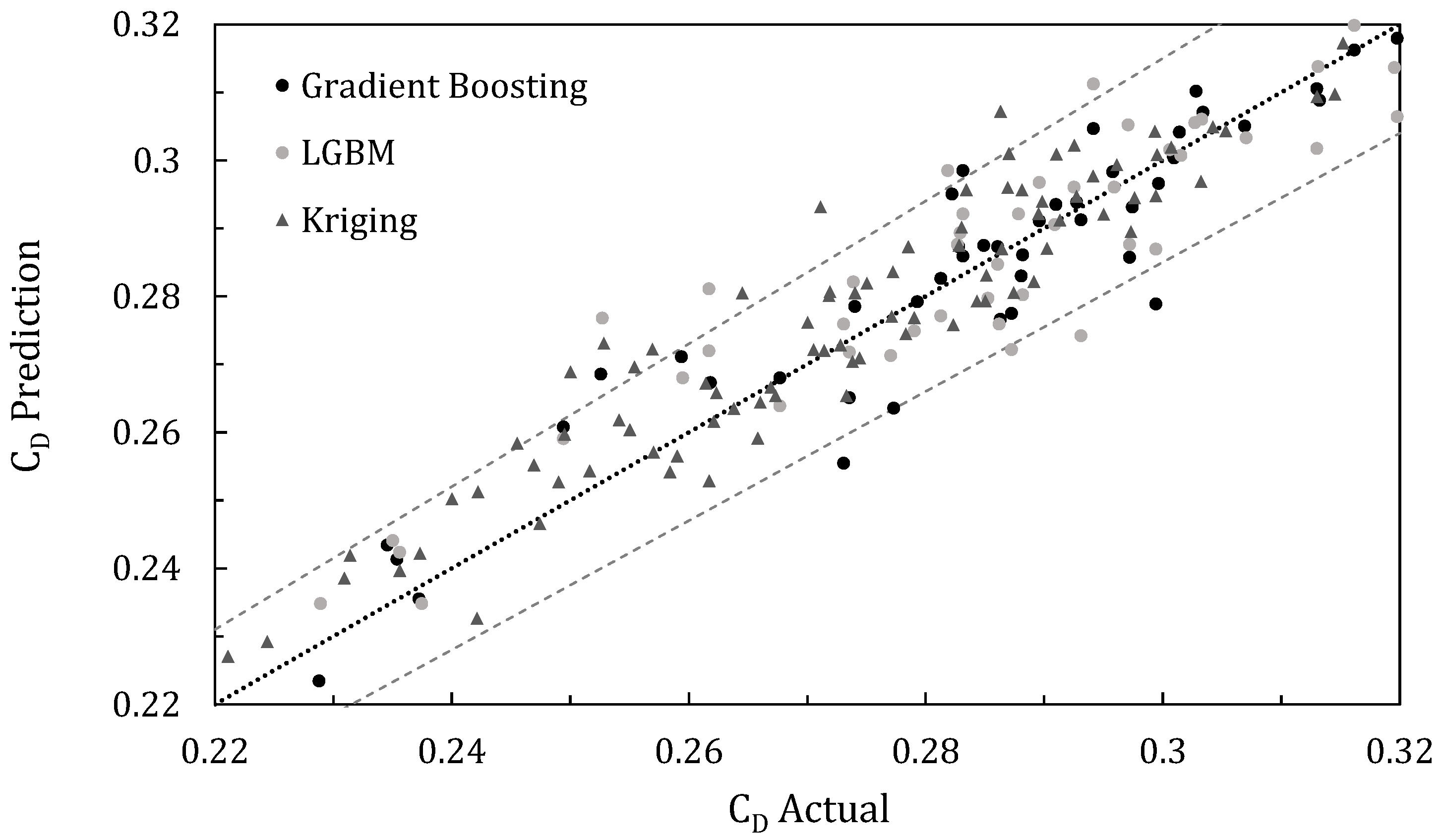
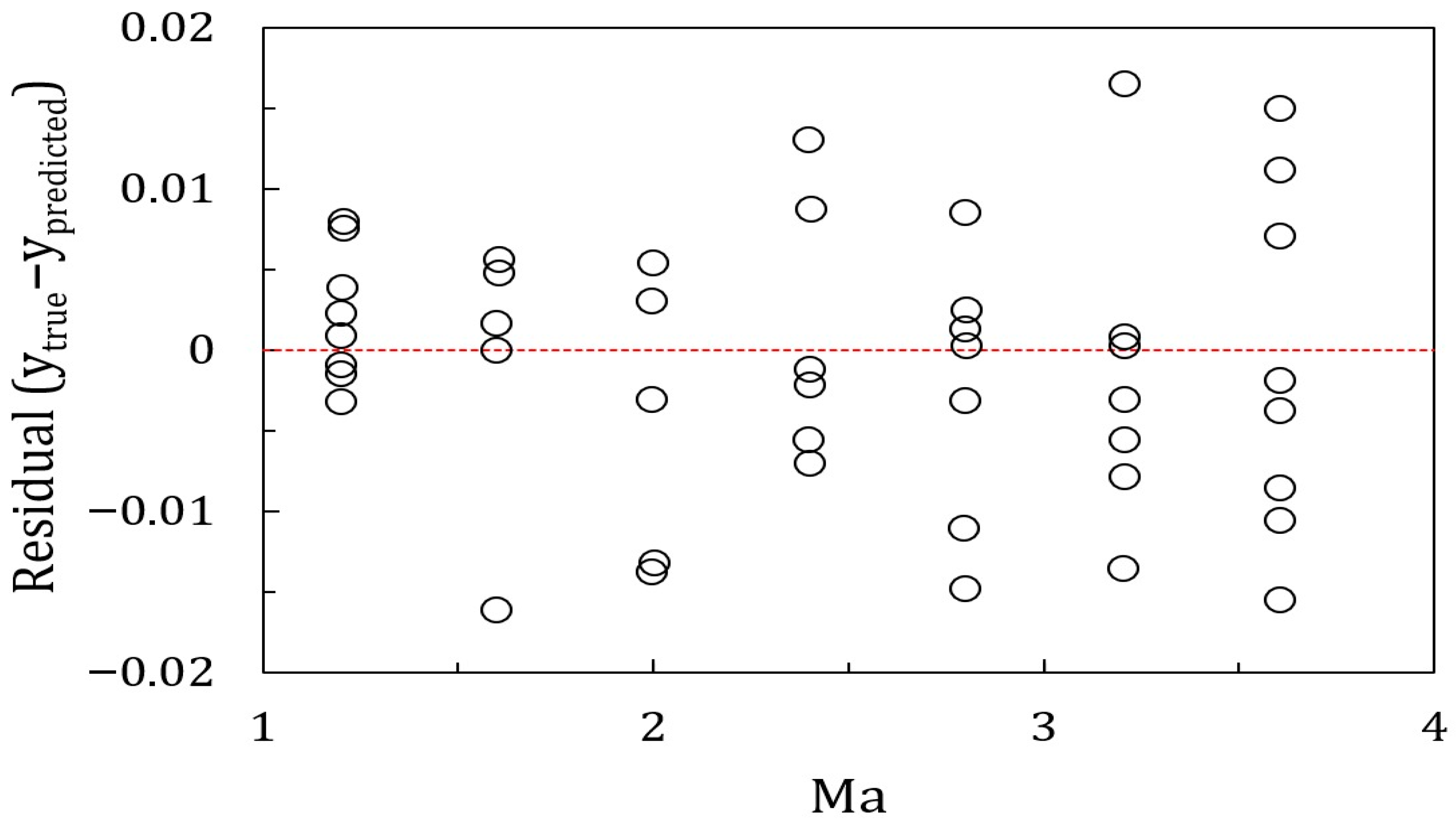
3.1. Machine Learning Lodels Performance
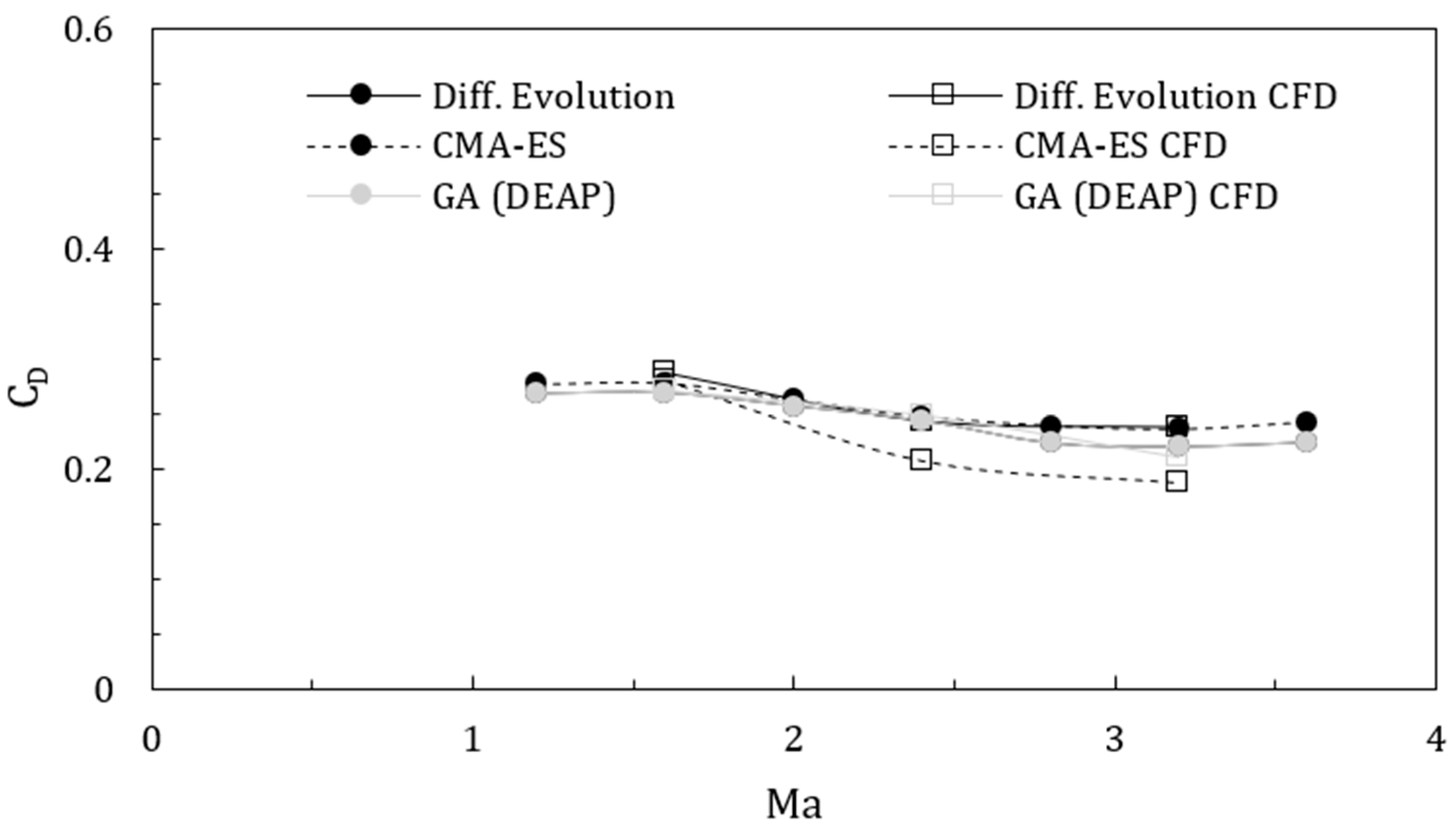
3.2. Optimization Models Performance vs. CFD
4. Conclusions
Author Contributions
Funding
Institutional Review Board Statement
Informed Consent Statement
Data Availability Statement
Acknowledgments
Conflicts of Interest
Appendix A. Dataset Used for Prediction
| d/D | L/D | CD Comp Ma = 1.2 | CD Comp Ma = 1.6 | CD Comp Ma = 2.0 | CD Comp Ma = 2.4 | CD Comp Ma = 2.8 | CD Comp Ma = 3.2 | CD Comp Ma = 3.6 |
| 0.06 | 0.15 | 0.3304 | 0.353 | 0.348 | 0.3312 | 0.3459 | 0.3032 | 0.3229 |
| 0.06 | 0.45 | 0.3268 | 0.3442 | 0.333 | 0.3145 | 0.2887 | 0.2645 | 0.321 |
| 0.06 | 0.75 | 0.3217 | 0.3291 | 0.3088 | 0.2834 | 0.2828 | 0.2738 | 0.322 |
| 0.06 | 1.05 | 0.3165 | 0.3197 | 0.3133 | 0.2891 | 0.2749 | 0.2728 | 0.3027 |
| 0.06 | 1.35 | 0.3117 | 0.3213 | 0.3016 | 0.274 | 0.28 | 0.2719 | 0.3139 |
| 0.06 | 1.65 | 0.3122 | 0.3053 | 0.3028 | 0.2783 | 0.299 | 0.2973 | 0.3084 |
| 0.06 | 1.95 | 0.2971 | 0.2863 | 0.33 | 0.2711 | 0.2861 | 0.2993 | 0.3162 |
| 0.09 | 0.15 | 0.3307 | 0.3533 | 0.3483 | 0.3321 | 0.2992 | 0.2976 | 0.329 |
| 0.09 | 0.45 | 0.3236 | 0.3358 | 0.3213 | 0.313 | 0.3322 | 0.2569 | 0.3198 |
| 0.09 | 0.75 | 0.313 | 0.3152 | 0.2941 | 0.283 | 0.2714 | 0.2621 | 0.3133 |
| 0.09 | 1.05 | 0.3016 | 0.3007 | 0.2827 | 0.2744 | 0.2593 | 0.2658 | 0.2831 |
| 0.09 | 1.35 | 0.298 | 0.2898 | 0.2752 | 0.2554 | 0.267 | 0.2495 | 0.3072 |
| 0.09 | 1.65 | 0.3005 | 0.2913 | 0.2818 | 0.279 | 0.2862 | 0.2638 | 0.2898 |
| 0.09 | 1.95 | 0.2915 | 0.2925 | 0.3229 | 0.2961 | 0.2783 | 0.2772 | 0.3098 |
| 0.12 | 0.15 | 0.3322 | 0.3541 | 0.3479 | 0.331 | 0.297 | 0.295 | 0.3311 |
| 0.12 | 0.45 | 0.3161 | 0.321 | 0.3077 | 0.287 | 0.2791 | 0.25 | 0.3162 |
| 0.12 | 0.75 | 0.307 | 0.3042 | 0.2821 | 0.285 | 0.2632 | 0.2617 | 0.2996 |
| 0.12 | 1.05 | 0.2969 | 0.2895 | 0.2851 | 0.266 | 0.2478 | 0.2469 | 0.2824 |
| 0.12 | 1.35 | 0.2883 | 0.2828 | 0.2683 | 0.2422 | 0.2546 | 0.257 | 0.2367 |
| 0.12 | 1.65 | 0.2861 | 0.2902 | 0.2535 | 0.2455 | 0.2743 | 0.2673 | 0.2617 |
| 0.12 | 1.95 | 0.2821 | 0.2881 | 0.3087 | 0.2874 | 0.2776 | 0.2718 | 0.3012 |
| 0.15 | 0.15 | 0.3337 | 0.3549 | 0.3464 | 0.3294 | 0.2938 | 0.2927 | 0.33 |
| 0.15 | 0.45 | 0.3122 | 0.3166 | 0.3017 | 0.291 | 0.2703 | 0.2614 | 0.3122 |
| 0.15 | 0.75 | 0.3007 | 0.2995 | 0.2896 | 0.2823 | 0.2478 | 0.2474 | 0.2964 |
| 0.15 | 1.05 | 0.2975 | 0.2864 | 0.2785 | 0.2541 | 0.2349 | 0.2309 | 0.2774 |
| 0.15 | 1.35 | 0.2813 | 0.275 | 0.2643 | 0.249 | 0.2406 | 0.2373 | 0.2414 |
| 0.15 | 1.65 | 0.2854 | 0.2843 | 0.2737 | 0.255 | 0.2569 | 0.2584 | 0.2731 |
| 0.15 | 1.95 | 0.2734 | 0.2785 | 0.299 | 0.2771 | 0.2678 | 0.2669 | 0.2746 |
| 0.18 | 0.15 | 0.3393 | 0.3578 | 0.3454 | 0.3306 | 0.2926 | 0.2994 | 0.3227 |
| 0.18 | 0.45 | 0.311 | 0.3139 | 0.3012 | 0.2869 | 0.2671 | 0.2623 | |
| 0.18 | 0.75 | 0.2958 | 0.2941 | 0.2881 | 0.2705 | 0.2392 | 0.2356 | |
| 0.18 | 1.05 | 0.2938 | 0.2851 | 0.2843 | 0.259 | 0.2233 | 0.2211 | |
| 0.18 | 1.35 | 0.2798 | 0.27 | 0.2617 | 0.24 | 0.2289 | 0.2244 | |
| 0.18 | 1.65 | 0.2779 | 0.2733 | 0.2436 | 0.2516 | 0.242 | 0.2421 | |
| 0.18 | 1.95 | 0.2702 | 0.2528 | 0.2931 | 0.2714 | 0.2522 | 0.2314 |
References
- Anderson, J.D. Modern Compressible Flow: With Historical Perspective, 3rd ed.; McGraw-Hill Education: Columbus, OH, USA, 2003. [Google Scholar] [CrossRef]
- Bertin, J.J.; Cummings, R.M. Fifty Yxears of Hypersonics: Where We’ve Been, Where We’re Going. Prog. Aerosp. Sci. 2003, 39, 511–536. [Google Scholar] [CrossRef]
- Bertin, J.J.; Bouslog, S.A.; Wang, K.-C.; Campbell, C.H. Recent Aerothermodynamic Flight Measurements during Shuttle Orbiter Re-Entry. J. Spacecr. Rocket. 1996, 33, 457–462. [Google Scholar] [CrossRef] [PubMed]
- Schneider, S.P. Flight Data for Boundary-Layer Transition at Hypersonic and Supersonic Speeds. J. Spacecr. Rocket. 1999, 36, 8–20. [Google Scholar] [CrossRef]
- Hollis, B.R.; Borrelli, S. Aerothermodynamics of Blunt Body Entry Vehicles. Prog. Aerosp. Sci. 2012, 48–49, 42–56. [Google Scholar] [CrossRef]
- Huang, W.; Chen, Z.; Yan, L.; Yan, B.; Du, Z. Drag and Heat Flux Reduction Mechanism Induced by the Spike and Its Combinations in Supersonic Flows: A Review. Prog. Aerosp. Sci. 2019, 105, 31–39. [Google Scholar] [CrossRef]
- Guenther, R.A.; Reding, J.P. Fluctuating Pressure Environment of a Drag Reduction Spike. J. Spacecr. Rocket. 1977, 14, 705–710. [Google Scholar] [CrossRef]
- Ahmed, M.Y.M.; Qin, N. Recent Advances in the Aerothermodynamics of Spiked Hypersonic Vehicles. Prog. Aerosp. Sci. 2011, 47, 425–449. [Google Scholar] [CrossRef]
- Esfeh, M.K.; Tajalli, S.M.; Liu, P. Evaluation of Aerospike for Drag Reduction on a Blunt Nose Using Experimental and Numerical Modeling. Acta Astronaut. 2019, 160, 656–671. [Google Scholar] [CrossRef]
- Tekure, V.; Pophali, P.S.; Venkatasubbaiah, K. Numerical Investigation of Aerospike Semi-Cone Angle and a Small Bump on the Spike Stem in Reducing the Aerodynamic Drag and Heating of Spiked Blunt-Body: New Correlations for Drag and Surface Temperature. Phys. Fluids 2021, 33, 116108. [Google Scholar] [CrossRef]
- Kalimuthu, R.; Mehta, R.C.; Rathakrishnan, E. Investigation of Aerodynamic Coefficients at Mach 6 over Conical, Hemispherical and Flat-Face Spiked Body. Aeronaut. J. 2017, 121, 1711–1732. [Google Scholar] [CrossRef]
- Li, Z.; Sun, C.; Xia, X.; Li, X. Numerical Simulation of Aerodynamic Heating over Solid Blunt Configuration with Porous Spike. J. Aerosp. Eng. 2018, 31, 04018083. [Google Scholar] [CrossRef]
- Asif, M.; Zahir, S.; Kamran, N.; Khan, M. Computational Investigations Aerodynamic Forces at Supersonic/Hypersonic Flow Past a Blunt Body with Various Forward Facing Spikes. In Proceedings of the 22nd Applied Aerodynamics Conference and Exhibit, Guidance, Navigation, and Control and Co-Located Conferences, AIAA, Providence, RI, USA, 16–19 August 2004. [Google Scholar]
- Crawford, D.H. Investigation of the Flow over a Spiked-Nose Hemisphere-Cylinder at a Mach Number of 6.8; NASA TN D-118; National Aeronautics and Space Administration: Washington, DC, USA, 1961.
- Feszty, D.; Badcock, K.J.; Richards, B.E. Aerodynamic characteristics of spiked blunt bodies. AIAA J. 2004, 42, 879–887. [Google Scholar] [CrossRef]
- Panaras, A.G.; Drikakis, D. High-speed flows around spiked blunt bodies. J. Fluid Mech. 2009, 632, 69–96. [Google Scholar] [CrossRef]
- Deng, F.; Wen, C.Y.; Tang, H.; Liu, J. Spike effects on drag reduction. J. Spacecr. Rocket. 2017, 54, 36–47. [Google Scholar] [CrossRef]
- Xue, Y.; Wang, L.; Fu, S. Drag Reduction and Aerodynamic Shape Optimization for Spike-Tipped Supersonic Blunt Nose. J. Spacecr. Rocket. 2018, 55, 552–560. [Google Scholar] [CrossRef]
- Hamza, M.; Khan, S.B.; Maqsood, A. Geometric Optimization of Blunt Bodies with Aerodisk and Opposing Jet for Wave Drag and Heat Reduction. Aerospace 2022, 9, 800. [Google Scholar] [CrossRef]
- Mukhtar, A.; Yasir, A.S.H.M.; Nasir, M.F.M. A machine learning-based comparative analysis of surrogate models for design optimisation in computational fluid dynamics. Heliyon 2023, 9, e18674. [Google Scholar] [CrossRef] [PubMed]
- Alizadeh, R.; Allen, J.K.; Mistree, F. Managing computational complexity using surrogate models: A critical review. Res. Eng. Des. 2020, 31, 275–298. [Google Scholar] [CrossRef]
- Mao, R.; Lan, Y.; Liang, L.; Yu, T.; Mu, M.; Leng, W.; Long, Z. Rapid CFD prediction based on Machine Learning surrogate model in built Environment: A review. Fluids 2025, 10, 193. [Google Scholar] [CrossRef]
- Kirsch, J.; Rider, W.J.; Fathi, N. Credibility Assessment of Machine Learning-Based Surrogate Model Predictions on NACA 0012 Airfoil Flow. In Proceedings of the ASME 2024 Verification, Validation, and Uncertainty Quantification Symposium, College Station, TX, USA, 15–17 May 2024. [Google Scholar] [CrossRef]
- Zhang, T.; Dey, B.; Veeraraghavan, K.; Kulkarni, H.; Chakraborty, A. Demystifying the Data Need of ML-surrogates for CFD Simulations. arXiv 2022, arXiv.2205.08355. [Google Scholar] [CrossRef]
- Joly, M.M.; Sarkar, S.; Mehta, D. Machine Learning Enabled Adaptive Optimization of a Transonic Compressor Rotor With Pre-Compression. J. Turbomach. 2018, 141, 051011. [Google Scholar] [CrossRef]
- El Zaatari, L.; Leicht, T.; Lang, S.; Bekemeyer, P.; Görtz, S. A Machine Learning based Expert System for Optimizing CFD Solver Parameters. In Proceedings of the ECCOMAS Congress 2022, Oslo, Norway, 5–9 June 2022. [Google Scholar] [CrossRef]
- Owoyele, O.; Pal, P.; Torreira, A.V.; Probst, D.; Shaxted, M.; Wilde, M.; Senecal, P.K. Application of an automated machine learning-genetic algorithm (AutoML-GA) coupled with computational fluid dynamics simulations for rapid engine design optimization. Int. J. Engine Res. 2021, 23, 1586–1601. [Google Scholar] [CrossRef]
- Niu, Y.; Zhao, K.; Yang, Y.; Yao, M.; Wu, Q.; Bai, B.; Ma, L. Integration of deep learning and CFD for aerodynamic force prediction. Phys. Fluids 2024, 36, 103610. [Google Scholar] [CrossRef]
- Hwang, P.; Wu, J.; Chang, Y. Optimization Based on Computational Fluid Dynamics and Machine Learning for the Performance of Diffuser-Augmented Wind Turbines with Inlet Shrouds. Sustainability 2024, 16, 3648. [Google Scholar] [CrossRef]
- Cabrera-Escobar, J.; Vera, D.; Jurado, F.; Córdova-Suárez, M.; Santillán-Valdiviezo, G.; Rodríguez-Orta, A.; Cabrera-Escobar, R. Optimization of olive pomace dehydration process through the integration of computational fluid dynamics and deep learning. Energy Sources Part A 2024, 46, 4756–4776. [Google Scholar] [CrossRef]
- Wang, Y.; Guzik, S.; Zupanski, M.; Gao, X. The maximum likelihood ensemble filter for computational flame and fluid dynamics. IMA J. Appl. Math. 2021, 86, 631–661. [Google Scholar] [CrossRef]
- Stavrakakis, G.; Karadimou, D.; Zervas, P.; Sarimveis, H.; Markatos, N. CFD and neural networks for optimization. Build. Environ. 2010, 46, 298–314. [Google Scholar] [CrossRef]
- Wang, Z.J.; Fidkowski, K.; Abgrall, R.; Bassi, F.; Caraeni, D.; Cary, A.; Deconinck, H.; Hartmann, R.; Hillewaert, K.; Huynh, H.T.; et al. High-order CFD methods: Current status and perspective. Int. J. Numer. Methods Fluids 2013, 72, 811–845. [Google Scholar] [CrossRef]
- Halila, G.L.O.; Ghazlane, I.; Carrier, G.; Trepanier, J.Y. Adjoint-based aerodynamic shape optimization for compressible flows: A review. Aerosp. Sci. Technol. 2020, 106, 106112. [Google Scholar]
- Beigzadeh, R.; Soltanian, S.; Tofangchi, D. Enhancing heat transfer efficiency in heat exchangers: A fusion of computational fluid dynamics and genetic algorithm for circular baffle optimization. Int. J. Heat Fluid Flow 2024, 112, 109726. [Google Scholar] [CrossRef]
- Yu, J.; Tang, M.; Cui, P.; Deng, J.; Mi, H.; Zhang, L.; Chen, L.; Wu, P.; Chao, Y.; Zhu, W.; et al. Computational fluid dynamics and machine learning assisted Al-LDH adsorbent reactor design for lithium recovery from salt lakes. Desalination 2024, 600, 118396. [Google Scholar] [CrossRef]
- Barragan, G.; Atarihuana, S.; Cando, E.; Hidalgo, V. Enhancing hydraulic efficiency of pelton turbines through computational fluid dynamics and metaheuristic optimization. Algorithms 2025, 18, 35. [Google Scholar] [CrossRef]
- Samiani, O.S.; Boroushaki, M. Optimal design of Archimedes Wind Turbine using genetic algorithm. Energy 2024, 314, 134157. [Google Scholar] [CrossRef]
- Ingram, D.M.; Causon, D.M.; Mingham, C.G. Developments in Cartesian Cut Cell Methods. Math. Comput. Simul. 2003, 61, 561–572. [Google Scholar] [CrossRef]
- Sobachkin, A.; Dumnov, G. Numerical basis of CAD-embedded CFD. In NAFEMS World Congress; Scientific Research: Salzburg, Austria, 2013; Volume 2013, pp. 1–20. [Google Scholar]
- Hodges, A.J. The Drag Coefficient of Very High Velocity Spheres. J. Aeronaut. Sci. 1957, 24, 755–758. [Google Scholar] [CrossRef]
- Charters, A.C.; Thomas, R.N. The Aerodynamic Performance of Small Spheres from Subsonic to High Supersonic Velocities. J. Aeronaut. Sci. 1945, 12, 468–476. [Google Scholar] [CrossRef]
- Bentéjac, C.; Csörgő, A.; Martínez-Muñoz, G. Comparative analysis of gradient boosting algorithms. Artif. Intell. Rev. 2020, 54, 1937–1967. [Google Scholar] [CrossRef]
- Cha, G.; Moon, H.; Kim, Y. Comparison of Random Forest and Gradient Boosting Machine Models for Predicting Demolition Waste Based on Small Datasets and Categorical Variables. Int. J. Environ. Res. Public Health 2021, 18, 8530. [Google Scholar] [CrossRef]
- Natekin, A.; Knoll, A. Gradient boosting machines, a tutorial. Front. Neurorobot. 2013, 7, 21. [Google Scholar] [CrossRef]
- GeeksforGeeks. Gradient Boosting in ML; GeeksforGeeks: Noida, India, 2025; Available online: https://www.geeksforgeeks.org/machine-learning/mL-gradient-boosting/ (accessed on 10 January 2026).
- Taha, A.A.; Malebary, S.J. An Intelligent Approach to Credit Card Fraud Detection Using an Optimized Light Gradient Boosting Machine. IEEE Access 2020, 8, 25579–25587. [Google Scholar] [CrossRef]
- GeeksforGeeks. Regression Using LightGBM; GeeksforGeeks: Noida, India, 2025; Available online: https://www.geeksforgeeks.org/machine-learning/regression-using-lightgbm/ (accessed on 10 January 2026).
- Kramer, O. Genetic Algorithms. In Genetic Algorithm Essentials; Studies in Computational Intelligence; Springer: Cham, Switzerland, 2017; Volume 679. [Google Scholar] [CrossRef]
- PyGAD. (s. f.). PyGAD documentation. Read the Docs. Available online: https://pygad.readthedocs.io/en/latest/ (accessed on 10 January 2026).
- Mayer, D.; Kinghorn, B.; Archer, A. Differential evolution—An easy and efficient evolutionary algorithm for model optimisation. Agric. Syst. 2004, 83, 315–328. [Google Scholar] [CrossRef]
- Cristina, S. Differential Evolution from Scratch in Python; Machine Learning Mastery: Victoria, Australia, 2021; Available online: https://machinelearningmastery.com/differential-evolution-from-scratch-in-python/ (accessed on 10 January 2026).
- Nikolaus Hansen, N.; Andreas Ostermeier, A. Completely derandomized self-adaptation in evolution strategies. Evol. Comput. 2001, 9, 159–195. [Google Scholar] [CrossRef]
- cma-es. cma-es (Versión 1.5.0) [Paquete PyPI]. Python Package Index. 2021. Available online: https://pypi.org/project/cma-es/ (accessed on 10 January 2026).
- Ahmad, H.; Hasan, N.; Sanghi, S. On the Influence of Co-Flow on the Shocks and Vortex Rings in the Starting Phases of under-Expanded Jets. Phys. Fluids 2022, 34, 076117. [Google Scholar] [CrossRef]
- Tahani, M.; Karimi, M.S.; Motlagh, A.M.; Mirmahdian, S. Numerical Investigation of Drag and Heat Reduction in Hypersonic Spiked Blunt Bodies. Heat Mass Transf. 2013, 49, 1369–1384. [Google Scholar] [CrossRef]
- Muñoz, J.A.S.; Lagarza-Cortés, C.; Ramírez-Cruz, J. Aerodynamic Drag Coefficient Prediction of a Spike Blunt Body Based on K-Nearest Neighbors. Aerospace 2024, 11, 757. [Google Scholar] [CrossRef]
- Ponce-Bobadilla, A.V.; Schmitt, V.; Maier, C.S.; Mensing, S.; Stodtmann, S. Practical guide to SHAP analysis: Explaining supervised machine learning model predictions in drug development. Clin. Transl. Sci. 2024, 17, e70056. [Google Scholar] [CrossRef] [PubMed]
- Awan, A.A. An Introduction to SHAP Values and Machine Learning Interpretability. DataCamp. 2023. Available online: https://www.datacamp.com/tutorial/introduction-to-shap-values-machine-learning-interpretability (accessed on 10 January 2026).





| Parameters | Description | Range | Size Step |
|---|---|---|---|
| Mach number (Ma) | Free stream Mach number | 1.2–3.6 | 0.2 |
| Reynolds number (Re) | Based on freestream conditions | 4.7 × 10⁵–1.2 × 10⁶ | Dependent on Ma |
| d/D | Spike diameter ratio | 0.06–0.18 | 0.03 |
| L/D | Spike length ratio | 0.15–1.95 | 0.3 |
| Angle | Angle of attack | 0° | - |
| Pressure (P, atm) | Temperature (T, K) | Viscosity (μ, Pa·s) | Density (ρ, kg/m3) | Gas Constant (Rg, kJ/kg·K) | Speed of Sound (c, m/s) |
|---|---|---|---|---|---|
| 1.0 | 290 | 1.8 × 10⁻⁵ | 0.816 | 0.287 | 340 |
| Model | Hyperparameter | Values Explored |
|---|---|---|
| GBR | n_estimators | 50, 100, 200 |
| GBR | learning_rate | 0.01, 0.1, 0.2 |
| GBR | max_depth | 3, 5, 7 |
| LightGBM | n_estimators | 50, 100, 200 |
| LightGBM | num_leaves | 20, 31, 50 |
| LightGBM | learning_rate | 0.01, 0.1, 0.2 |
| LightGBM | max_depth | 3, 5, 7 |
| Model | CV R2 (Mean) | Test R2 | Test RMSE | Optimized Parameters |
|---|---|---|---|---|
| Gradient Boosting | 0.8553 | 0.8909 | 0.00775 | n_estimators = 100 max_depth = 3 learning_rate = 0.2 |
| Light GBM | 0.7252 | 0.8459 | 0.00922 | n_estimators = 100 max_depth = 3 learning_rate = 0.1 num_leaves = 20 |
| Mach | Mean Relative Error (%) | Max Relative Error (%) | RMSE |
|---|---|---|---|
| 1.2 | 1.021 | 2.68 | 0.0040 |
| 1.6 | 2.075 | 6.40 | 0.0079 |
| 2.0 | 2.7091 | 4.70 | 0.0091 |
| 2.4 | 2.1463 | 4.54 | 0.0074 |
| 2.8 | 2.5343 | 5.70 | 0.0078 |
| 3.2 | 3.2370 | 5.53 | 0.0089 |
| 3.6 | 3.23 | 5.47 | 0.0102 |
Disclaimer/Publisher’s Note: The statements, opinions and data contained in all publications are solely those of the individual author(s) and contributor(s) and not of MDPI and/or the editor(s). MDPI and/or the editor(s) disclaim responsibility for any injury to people or property resulting from any ideas, methods, instructions or products referred to in the content. |
© 2026 by the authors. Licensee MDPI, Basel, Switzerland. This article is an open access article distributed under the terms and conditions of the Creative Commons Attribution (CC BY) license.
Share and Cite
Sánchez Muñoz, J.A.; Lagarza-Cortés, C.; Ramírez-Cruz, J.; Silva-Campos, J.M.; Flores-Eraña, G. Parametric Optimization of Spiked Blunt Bodies in Supersonic Flow Using Surrogate-Assisted Machine Learning and Evolutionary Algorithms. Appl. Sci. 2026, 16, 4365. https://doi.org/10.3390/app16094365
Sánchez Muñoz JA, Lagarza-Cortés C, Ramírez-Cruz J, Silva-Campos JM, Flores-Eraña G. Parametric Optimization of Spiked Blunt Bodies in Supersonic Flow Using Surrogate-Assisted Machine Learning and Evolutionary Algorithms. Applied Sciences. 2026; 16(9):4365. https://doi.org/10.3390/app16094365
Chicago/Turabian StyleSánchez Muñoz, Jonathan Arturo, Christian Lagarza-Cortés, Jorge Ramírez-Cruz, Juan Manuel Silva-Campos, and Gustavo Flores-Eraña. 2026. "Parametric Optimization of Spiked Blunt Bodies in Supersonic Flow Using Surrogate-Assisted Machine Learning and Evolutionary Algorithms" Applied Sciences 16, no. 9: 4365. https://doi.org/10.3390/app16094365
APA StyleSánchez Muñoz, J. A., Lagarza-Cortés, C., Ramírez-Cruz, J., Silva-Campos, J. M., & Flores-Eraña, G. (2026). Parametric Optimization of Spiked Blunt Bodies in Supersonic Flow Using Surrogate-Assisted Machine Learning and Evolutionary Algorithms. Applied Sciences, 16(9), 4365. https://doi.org/10.3390/app16094365