Composite Spatiotemporal Traffic Instability Metric for Early Congestion Detection in Underground Expressways



Abstract
1. Introduction
- A mechanism-informed composite variability formulation tailored to confined environments;
- A systematic scenario-based construction framework;
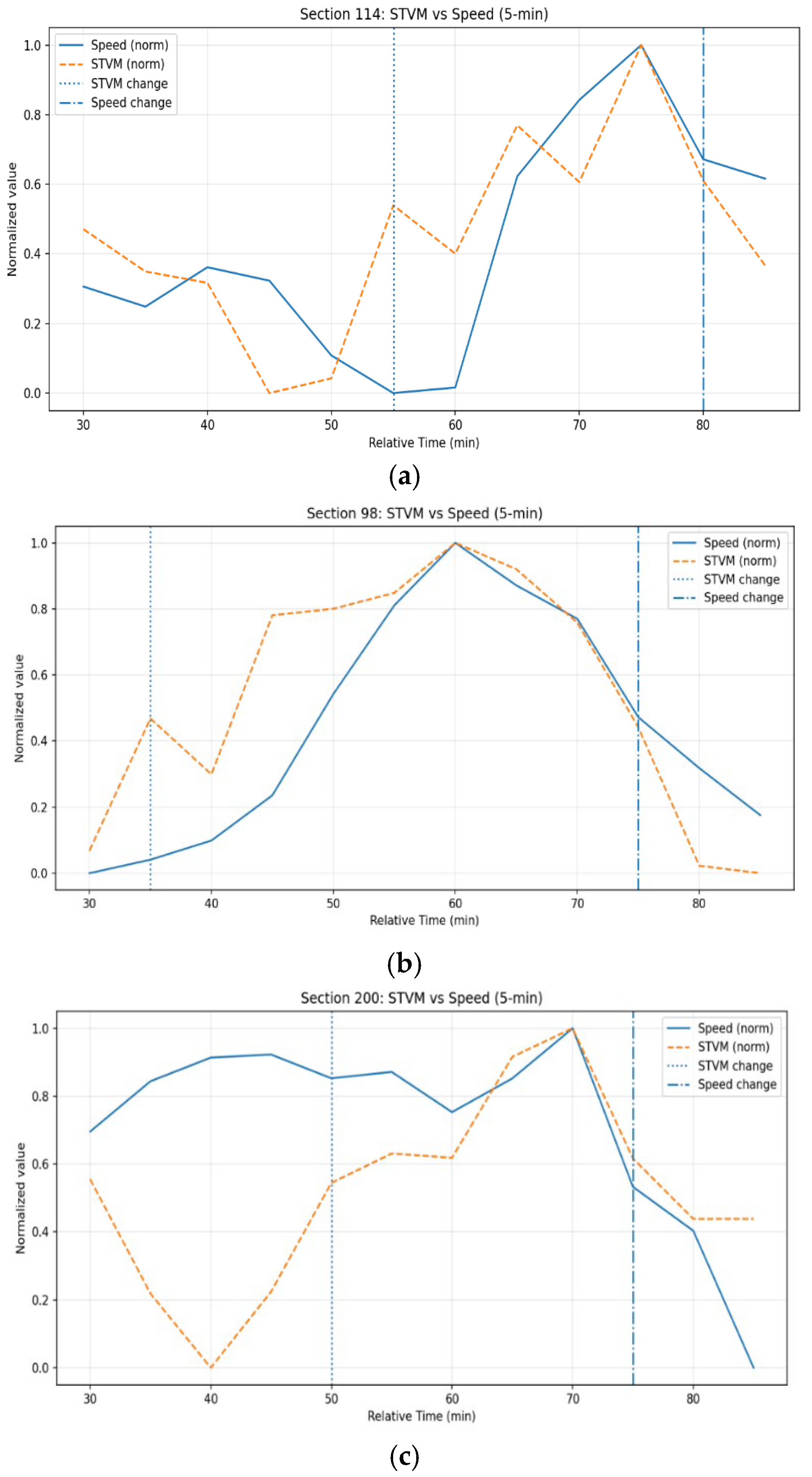
- Quantitative evidence that variability escalation precedes observable speed degradation by 5–20 min, demonstrating early detection capability beyond conventional performance indicators.
2. Related Work
2.1. Traffic Instability in Confined Roadway Environments
2.2. Variability-Oriented Traffic Metrics
2.3. Research Gap
3. Methodology
3.1. Conceptual and Mechanism-Oriented Basis of STVM
3.2. Mathematical Formulation of STVM
- Speed fluctuation ratio
- Density fluctuation ratio
- Heavy-Vehicle mix ratio
- Sectional saturation ratio
- Ramp interference ratio
- Exit discharge efficiency
3.3. Component Quantification
3.3.1. Speed Fluctuation Ratio
3.3.2. Density Fluctuation Ratio
3.3.3. Heavy-Vehicle Mix Ratio
3.3.4. Sectional Saturation Ratio
3.3.5. Ramp Interference Ratio
3.3.6. Exit Discharge Efficiency
3.4. Standardization and Instability Scaling
4. Simulation Framework and Validation
4.1. Dual-Stage Simulation Design
4.2. Early-Response Performance Relative to Speed
- The first sustained STVM instability escalation beyond the statistical baseline, and
- The onset of a speed-based congestion threshold
4.3. Component Interaction Analysis
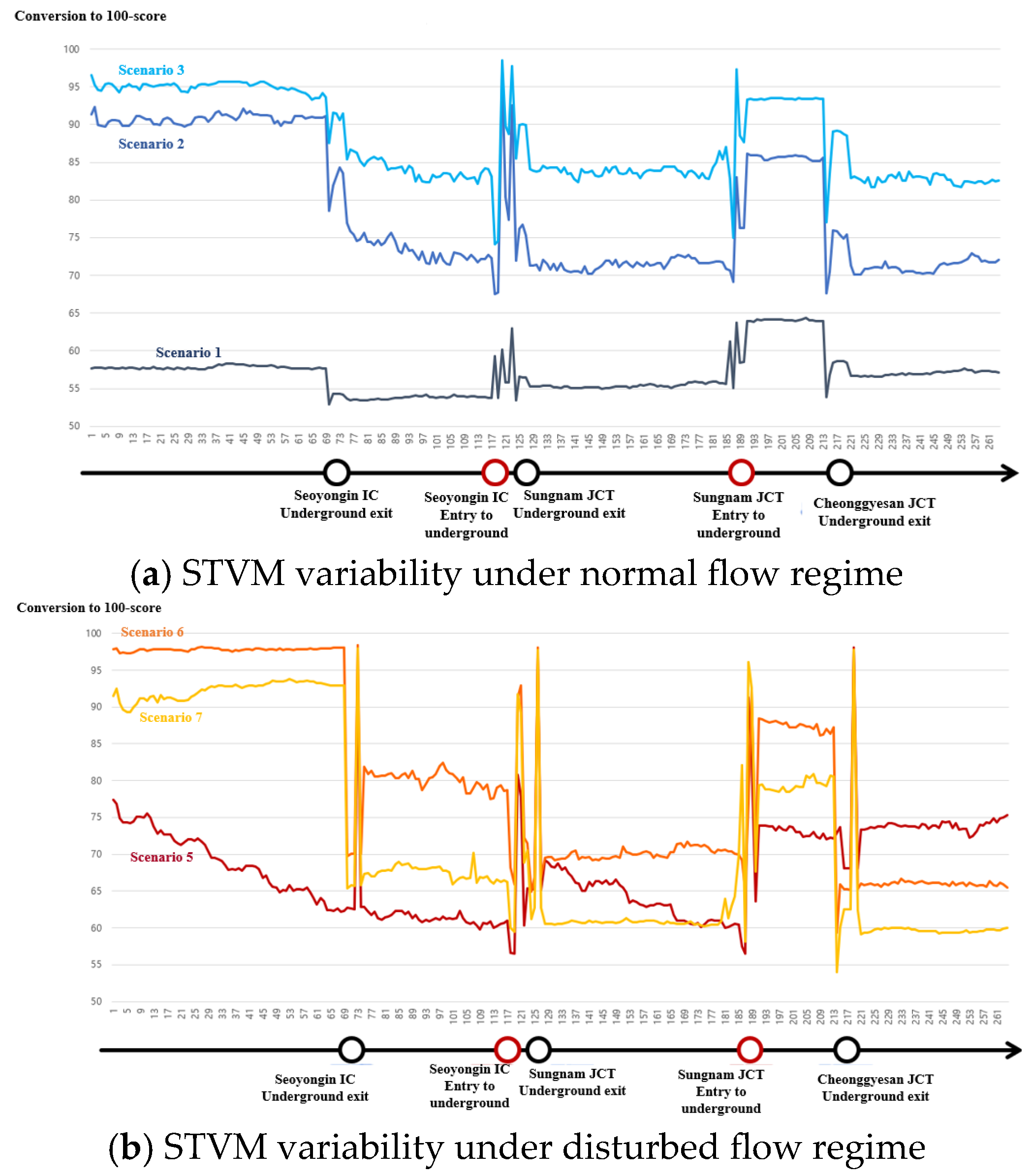
4.4. Regime-Dependent Component Contribution
4.5. Network-Level Instability Patterns
4.6. Limitations
5. Conclusions
Author Contributions
Funding
Institutional Review Board Statement
Informed Consent Statement
Data Availability Statement
Conflicts of Interest
Abbreviations
| STVM | Spatiotemporal Variability Metric |
| ITS | intelligent transportation system |
Appendix A. STVM Computation Procedure
References
- Shang, T.; Lu, J.; Luo, Y.; Wang, S.; He, Z.; Wang, A. Understanding the traffic flow in different types of freeway tunnels based on car-following behaviors analysis. Tunn. Undergr. Space Technol. 2024, 143, 105494. [Google Scholar] [CrossRef]
- Duan, M. Simulation analysis of traffic flow stability for intelligent connected vehicles at mountain tunnel entrances considering nonlinear coupling effects. Sci. Rep. 2025, 15, 37310. [Google Scholar] [CrossRef] [PubMed]
- Shy, B. Overview of traffic safety aspects and design in road tunnels. IATSS Res. 2016, 40, 35–46. [Google Scholar] [CrossRef]
- Edie, L.C.; Foote, R.S. Traffic Flow in Tunnels. Proc. Highw. Res. Board 1958, 37, 334–344. [Google Scholar]
- Kerner, B.S. Microscopic theory of traffic-flow instability governing traffic breakdown at highway bottlenecks: Growing wave of increase in speed in synchronized flow. Phys. Rev. E 2015, 92, 062827. [Google Scholar] [CrossRef] [PubMed]
- Bouadi, M.; Jia, B.; Jiang, R.; Li, X.; Gao, Z.Y. Stochastic factors and string stability of traffic flow: Analytical investigation and numerical study based on car-following models. Transp. Res. Part B Methodol. 2022, 165, 96–122. [Google Scholar] [CrossRef]
- Mazloumian, A.; Geroliminis, N.; Helbing, D. The spatial variability of vehicle densities as determinant of urban network capacity. Philos. Trans. R. Soc. A 2010, 368, 4627–4647. [Google Scholar] [CrossRef] [PubMed]
- Wada, K.; Martínez, I.; Jin, W.L. Continuum car-following model of capacity drop at sag and tunnel bottlenecks. Transp. Res. Procedia 2019, 38, 668–687. [Google Scholar] [CrossRef]
- Seong, H.; Kim, S.; Park, J. Measuring traffic congestion using multi-dimensional metrics in urban networks. ISPRS Int. J. Geo-Inf. 2023, 12, 130. [Google Scholar] [CrossRef]
- Tsekeris, T.; Stathopoulos, A. Measuring variability in urban traffic flow by use of principal component analysis. J. Transp. Stat. 2006, 9, 49–62. [Google Scholar]
- Erdelić, T.; Carić, T.; Erdelić, M.; Tišljarić, L.; Turković, A.; Jelušić, N. Estimating congestion zones and travel time indexes based on the floating car data. Comput. Environ. Urban Syst. 2021, 87, 101604. [Google Scholar] [CrossRef]
- Ministry of Land, Infrastructure and Transport. Korea Highway Capacity Manual; Ministry of Land, Infrastructure and Transport: Sejong, Republic of Korea, 2017.
- Yang, C.; Yoon, C. Traffic simulation-based sensitivity analysis of long underground expressways. Appl. Sci. 2026, 16, 1249. [Google Scholar] [CrossRef]
- Korea Institute of Civil Engineering and Building Technology. Comparative Analysis of Traffic Characteristics Between Surface and Underground Road Conditions: Simulation Results Summary; Technical Report; Korea Institute of Civil Engineering and Building Technology: Goyang, Republic of Korea, 2022. [Google Scholar]
- Bulteau, E.; Leblanc, R.; Blandin, S.; Bayen, A. Traffic flow estimation using higher-order speed statistics. In Proceedings of the Transportation Research Board (TRB) 92nd Annual Meeting, Washington, DC, USA, 13–17 January 2013; Volume 2013, p. 13-3307. [Google Scholar]
- Storani, F.; Di Pace, R.; Bruno, F.; Fiori, C. Analysis and comparison of traffic flow models: A new hybrid traffic flow model vs benchmark models. Eur. Transp. Res. Rev. 2021, 13, 58. [Google Scholar] [CrossRef]
- Yeung, J.S.; Wong, Y.D.; Xu, H. Driver perspectives of open and tunnel expressways. J. Environ. Psychol. 2013, 36, 248–256. [Google Scholar] [CrossRef]
- Scelloto, S.; Fortuna, L.; Frasca, M.; Gómez-Gardenes, J.; Latora, V. Traffic optimization in transport networks based on local routing. Eur. Phys. J. B 2010, 73, 303–308. [Google Scholar] [CrossRef]
- Bawaneh, M.; Simon, V. Novel traffic congestion detection algorithms for smart city applications. Concurr. Comput. Pract. Exp. 2022, 35, e7563. [Google Scholar] [CrossRef]
- Li, Q.; Tan, H.; Jiang, Z.; Wu, Y.; Ye, L. Non-recurrent traffic congestion detection with a coupled scalable Bayesian robust tensor factorization model. arXiv 2020, arXiv:2005.04567. [Google Scholar] [CrossRef]


| Dimension | Conventional Measures | Proposed STVM |
|---|---|---|
| Variable structure | Primarily single-variable | Six mechanism-informed components |
| Temporal sensitivity | Lagging response to congestion | Variability escalation precedes speed degradation by 5–20 min |
| Spatial representation | Limited corridor-level integration | Explicit inter-segment variability integration |
| Operational interpretability | Raw statistical outputs | Standardized 50–100 instability score |
| Domain specificity | Surface road oriented | Tailored to confined underground corridors |
| Mechanism linkage | Implicit or purely statistical | Explicitly grounded in traffic flow theory |
| Scenario | Mainline Inflow (Vehicles/h) | Ramp Inflow (Vehicles/h) | Ramp Outflow Condition | Total Demand (Vehicles/h) | Heavy-vehicle Share (%) | Rationale |
|---|---|---|---|---|---|---|
| Normal Flow | ||||||
| 1 | 2000 | 1200 | Normal | 3200 | 5 | Baseline condition |
| 2 | 5000 | 1200 | Normal | 6200 | 15 | Medium-level demand |
| 3 | 6000 | 1200 | Normal | 7200 | 30 | Effect of increased gradient (downhill) |
| 4 | 4000 | 2000 | Normal | 6000 | 15 | Reflecting concentrated ramp demand |
| Disturbed Flow | ||||||
| 5 | 5000 | 1200 | Ramp outflow restricted | 6200 | 5 | Ramp bottleneck condition |
| 6 | 6000 | 1200 | Downstream congestion | 7200 | 30 | Reflecting surface road congestion |
| 7 | 4000 | 2000 | Normal | 6000 | 15 | Upstream bottleneck at mainline entry |
| Scenario | Flow Regime | Lead Ratio from Cross-Correlation | Lead Ratio of Inflection Points | Median Inflection Point Lead Time |
|---|---|---|---|---|
| 2 | Normal | 31.4% | 50.4% | +5.0 |
| 3 | Normal | 50.0% | 41.7% | +5.0 |
| 4 | Normal | 43.9% | 31.1% | +5.0 |
| 5 | Disturbed | 36.8% | 52.1% | +5.0 |
| 6 | Disturbed | 48.3% | 46.9% | +4.0 |
| 7 | Disturbed | 41.2% | 38.7% | +5.0 |
| Component | Regression Coefficient (Normal) | Relative Importance (Normal) | Regression Coefficient (Disturbed) | Relative Importance (Disturbed) |
|---|---|---|---|---|
| Speed fluctuation | −0.42 | 31% | −0.38 | 26% |
| Density fluctuation | 0.35 | 26% | 0.33 | 21% |
| Heavy-vehicle mix | 0.22 | 16% | 0.24 | 17% |
| Sectional saturation | −0.18 | 13% | −0.28 | 18% |
| Ramp interference | 0.12 | 9% | 0.18 | 11% |
| Exit discharge efficiency | −0.08 | 5% | −0.11 | 7% |
Disclaimer/Publisher’s Note: The statements, opinions and data contained in all publications are solely those of the individual author(s) and contributor(s) and not of MDPI and/or the editor(s). MDPI and/or the editor(s) disclaim responsibility for any injury to people or property resulting from any ideas, methods, instructions or products referred to in the content. |
© 2026 by the authors. Licensee MDPI, Basel, Switzerland. This article is an open access article distributed under the terms and conditions of the Creative Commons Attribution (CC BY) license.
Share and Cite
Yang, C.; Yoon, C. Composite Spatiotemporal Traffic Instability Metric for Early Congestion Detection in Underground Expressways. Appl. Sci. 2026, 16, 4286. https://doi.org/10.3390/app16094286
Yang C, Yoon C. Composite Spatiotemporal Traffic Instability Metric for Early Congestion Detection in Underground Expressways. Applied Sciences. 2026; 16(9):4286. https://doi.org/10.3390/app16094286
Chicago/Turabian StyleYang, Choongheon, and Chunjoo Yoon. 2026. "Composite Spatiotemporal Traffic Instability Metric for Early Congestion Detection in Underground Expressways" Applied Sciences 16, no. 9: 4286. https://doi.org/10.3390/app16094286
APA StyleYang, C., & Yoon, C. (2026). Composite Spatiotemporal Traffic Instability Metric for Early Congestion Detection in Underground Expressways. Applied Sciences, 16(9), 4286. https://doi.org/10.3390/app16094286