1. Introduction
Railway platform canopies are a critical component of the railway system, with their structural safety directly affecting the normal operation of the railway network and passenger safety. Reinforced concrete (RC) railway platform canopies, compared to steel structures, are less prone to vibration and have lower maintenance costs, making them widely used in many small and medium-sized stations. These structures often feature large cantilevered beams and slabs, necessitating simultaneous consideration of horizontal and vertical seismic forces. Under significant seismic loads, they are prone to collapse. As open-air structures, platform canopies are susceptible to corrosion over time, which significantly degrades structural performance. Consequently, investigating the seismic collapse resistance of corroded railway platform canopies holds substantial practical significance.
In recent years, some scholars have investigated the seismic performance of individual reinforced concrete canopy structures through numerical simulations or experiments [
1,
2,
3,
4,
5]. Others have conducted anti-seismic collapse studies on single reinforced concrete canopy structures [
6,
7]. However, these structures used for studies were designed according to seismic codes prior to 2024 and did not analyze their performance when structural corrosion occurs. Furthermore, they focused solely on specific canopy structures and seismic fortification intensities (SFIs), neglecting to evaluate seismic collapse resistance in accordance with current collapse codes. There remains a lack of generalized research addressing different canopy types and varying SFIs. Additionally, their numerical models predominantly employ fiber elements and solid elements, making it challenging to accurately simulate the complex damage states that occur during structural collapse.
Numerical models used in structural collapse research must be capable of simulating conditions under severe damage. The Ibarra-Medina-Krawinkler (IMK) model proposed by Ibarra et al. [
8] effectively captures the degradation of structural strength and stiffness. Compared to fiber elements and solid elements, it more accurately accounts for phenomena such as reinforcement buckling, reinforcement slippage, stirrup failure, and localized concrete crushing. Consequently, it has been widely applied in earthquake collapse studies. Lignos [
9,
10] further refined this model, yielding the modified IMK (ModIMK) model. Early research on the IMK model primarily focused on reinforced concrete square columns [
11,
12]. Recently, Dai [
13] and Liu [
14,
15] extended its application to RC circular columns, enabling the ModIMK model to be used in the collapse analysis of structures incorporating them. Dai [
16] also established a ModIMK model for corroded square columns, while Liu [
17] created a ModIMK model for corroded circular columns. This enables the use of ModIMK models for performance studies of corroded structures.
Accordingly, this paper aims to investigate the seismic collapse fragility of corroded circular column platform canopy structures in China. To achieve this, six typical single-column and six double-column canopies with SFIs ranging from 6 to 9 degrees were designed according to the Building Seismic Design Code (2024 Edition) GB/T 50011-2010 [
18]. Three corrosion scenarios of reinforcing bars—uncorroded, 5% corrosion, and 15% corrosion—were considered. Numerical OpenSees (3.3.0) models based on the ModIMK model were established, and Incremental Dynamic Analysis (IDA) was performed in accordance with the Code for Seismic Collapse-Resistant Design of Building Structures T/CECS 392-2021 [
19]. The seismic collapse fragility curves for the corroded platform canopies were ultimately derived, and the collapse probabilities for each structure were analyzed.
2. Platform Canopy Structural Design
Select typical structural forms and dimensions for single-column and double-column canopies using PKPM software (2025R2.3). Next, through iterative optimization, the designs closely approach code minimum requirements. Key control factors are the column axial compression ratio, elastic inter-story drift angle, and member shear compression ratio. Detailed information is provided in
Table 1. The naming format is PC-Canopy Type-SFI: PC is platform canopy, types 1 and 2 are single- and double-column, respectively. For example, PC-2-7 is a double-column canopy with SFI 7.
2.1. Single-Column Canopies
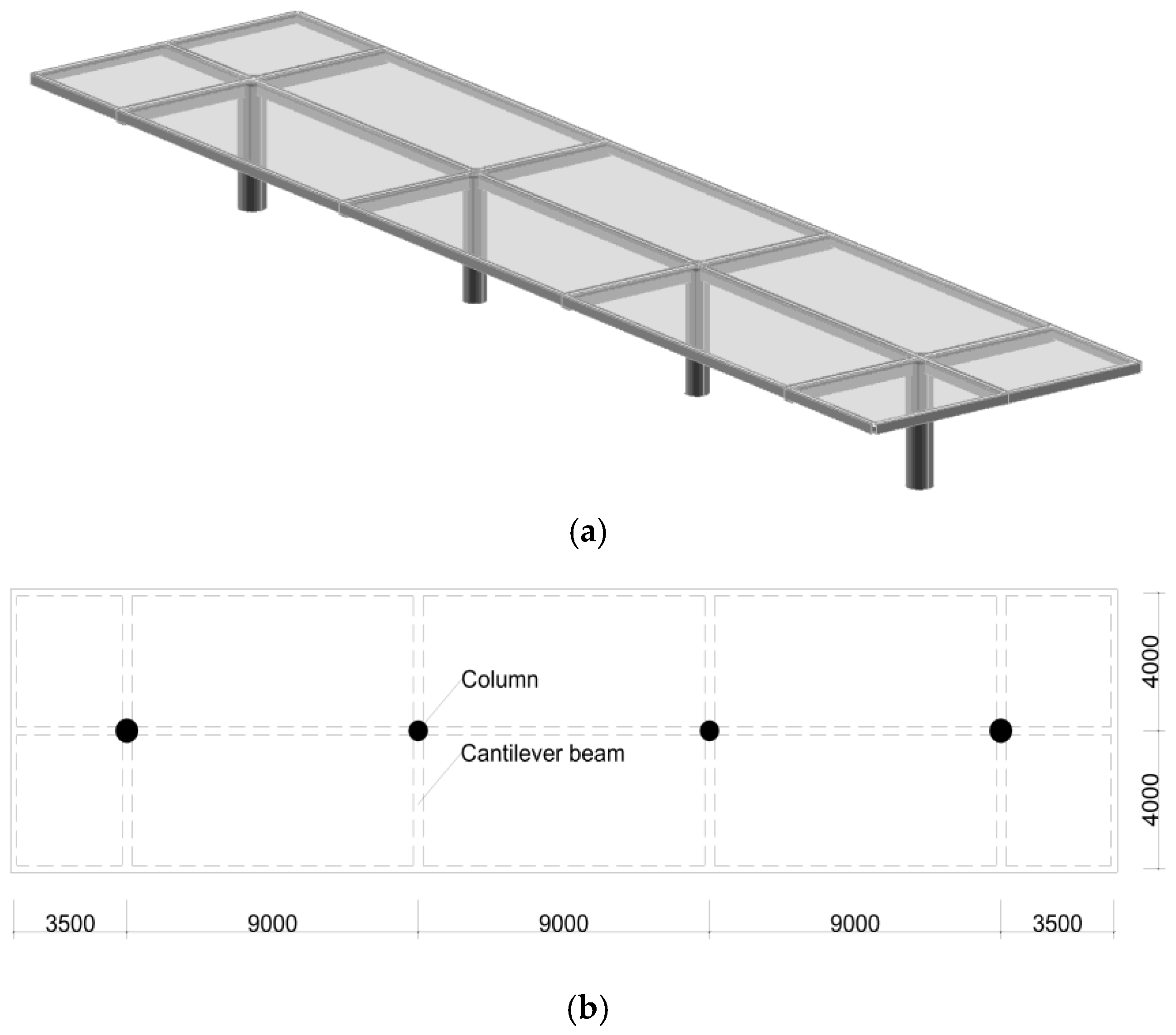
Six single-column canopy designs, based on Weinan West Station on the Ningxi Railway, were developed to investigate seismic collapse fragility. Site classification is Category II, seismic group II, and building category C. SFIs (PGA) include: 6 degrees (0.05 g), 7 degrees (0.10 g), 7.5 degrees (0.15 g), 8 degrees (0.20 g), 8.5 degrees (0.30 g), 9 degrees (0.40 g). Columns are 6 m tall with 4 m cantilevered beams. The canopy slab live load is 0.5 kN/m
2; dead load depends on slab thickness. HRB400 is used as longitudinal reinforcement, and HPB300 as transverse reinforcement.
Figure 1 shows the structure diagram;
Table 1 provides details.
2.2. Double-Column Canopy
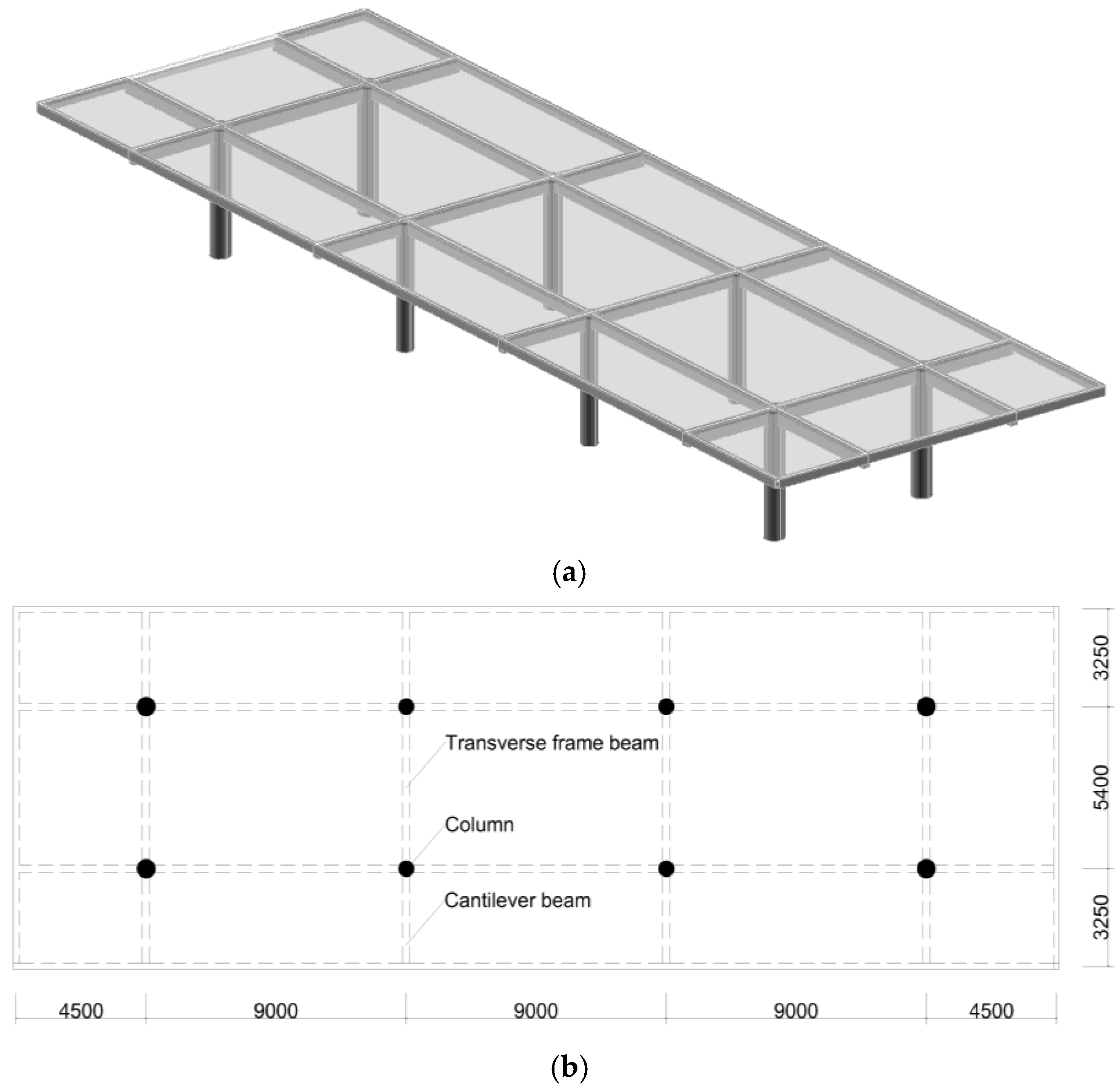
The double-column canopy design references Ankang West Station and also features six structural variants. The site classification is Category II, seismic group II, and building category C. The canopy columns with all SFIs are 6 m tall, with transverse frame beams spanning 5.4 m and cantilever beams projecting 3.25 m. The canopy live load is set at 0.5 kN/m
2, while the dead load is determined based on the canopy slab thickness. HRB400 is used as longitudinal reinforcement, while HPB300 is used as transverse reinforcement. Refer to
Figure 2 for the specific structural layout and
Table 1 for detailed design information.
3. Numerical Model
A central transverse bay of the circular-column frame canopy was selected for analysis. The lower ends of the columns are rigidly connected to the foundation, and the connections between beams and columns are also rigid. The structure is a cast-in-place reinforced concrete structure. OpenSees was used to create separate analysis programs for each of the 12 canopy structures. In the models, zero-length elements were placed at both ends of the columns and frame beams, and cantilever beams had zero-length elements near their column ends. The peak-oriented modified IMK material model was used for these zero-length elements. The middle sections of the columns and frame beams, as well as the cantilevered beam portions, were modeled as elastic beam-column elements.
Based on the actual reinforcement configuration of the beams and columns, model parameters for each plastic hinge were calculated using estimation formulas from references [
13,
14,
15]. Next, following the methods of Ibarra [
20] and Zareian [
21], the rotational stiffness of plastic hinges and the elastic member stiffness were adjusted. Other ModIMK parameters and structural damping were then sequentially adjusted. Finally, due to the “strong column-weak beam” design, beam-column joints have high shear resistance, so their shear deformation is disregarded, and they are assumed rigid.
To consider corrosion’s impact on structural performance, we adjusted ModIMK parameters for the uncorroded structure, as described in [
16,
17].
Given the canopy structure’s large-span cantilever beams and slabs, which are significantly affected by vertical seismic forces, both the PKPM design and the OpenSees numerical model analysis incorporated vertical seismic actions.
4. Structural Seismic Collapse Fragility Analysis Process
Structural collapse fragility analysis involves issues such as selecting seismic records and seismic intensity indicators, defining structural collapse criteria, and establishing the fragility curve method.
4.1. Seismic Records and Seismic Intensity Indicators
This study uses the IDA method to analyze how structures resist seismic collapse as earthquake intensity is gradually increased. Since earthquakes are random, one IDA result may not be reliable. To reduce the risk of calculation errors, many seismic records are required [
22]. This study uses 22 far-field records (epicentral distances > 10 km) recommended by the American ATC-63 program [
23] as seismic inputs. Through in-depth research, Tang [
24] and Yang [
25] found that these records are suitable for analyzing the structural vulnerability of buildings with different seismic fortification intensities in China.
The platform canopy structure features a large cantilever beam; therefore, both horizontal and vertical seismic forces must be considered in the seismic analysis. Since some of the 22 records lacked vertical records, we applied the same seismic records to both the horizontal and vertical directions, using the intensity ratio of 1:0.65 for horizontal and vertical records as specified in Chinese standards.
The selection of seismic intensity indicators significantly impacts IDA results. The most commonly used indicators are PGA and structural first-period spectral acceleration
[
22]. Following ATC-63 recommendations, using
as the intensity indicator instead of PGA can substantially reduce the variability of analysis results. This paper adopts
as the seismic intensity indicator. The calculation of
is based on the response spectrum curves provided by the Chinese seismic code GB/T 50011 and T/CECS 392.
4.2. Canopy Collapse Criteria
Platform canopies often have large-span cantilever beams and slabs, making them susceptible to vertical seismic effects. Therefore, this study considers both horizontal and vertical seismic forces. Collapse criteria are referenced in T/CECS 392 and FEMA 350 [
26]. Collapse occurs if: (1) Structural tangent stiffness from the IDA curve drops to 20% of its initial value; or (2) Column displacement angle reaches 0.045; or (3) Cantilever beam displacement angle reaches 0.045.
4.3. Seismic Collapse Fragility Analysis Process
Structural collapse fragility analysis followed the approach in [
27]. Numerical models of both uncorroded and corroded canopy structures were built in OpenSees. Using IDA, we obtained the collapse probability for structures with different SFIs. Assume that the collapsed probability follows the log-normal distribution, collapse fragility curves were then fitted using the maximum likelihood method for each canopy structure. Finally, we calculated the collapse probability under the maximum considered earthquake (MCE) and the extreme considered earthquake (ECE, an earthquake larger than MCE).
5. Collapse Fragility Analysis Results for Platform Canopies
5.1. Collapse Fragility Curves
The analysis of structural fragility involves numerous uncertainties that influence the results. These factors fall into two primary categories: uncertainties in seismic ground motion and uncertainties in structural modeling [
27].
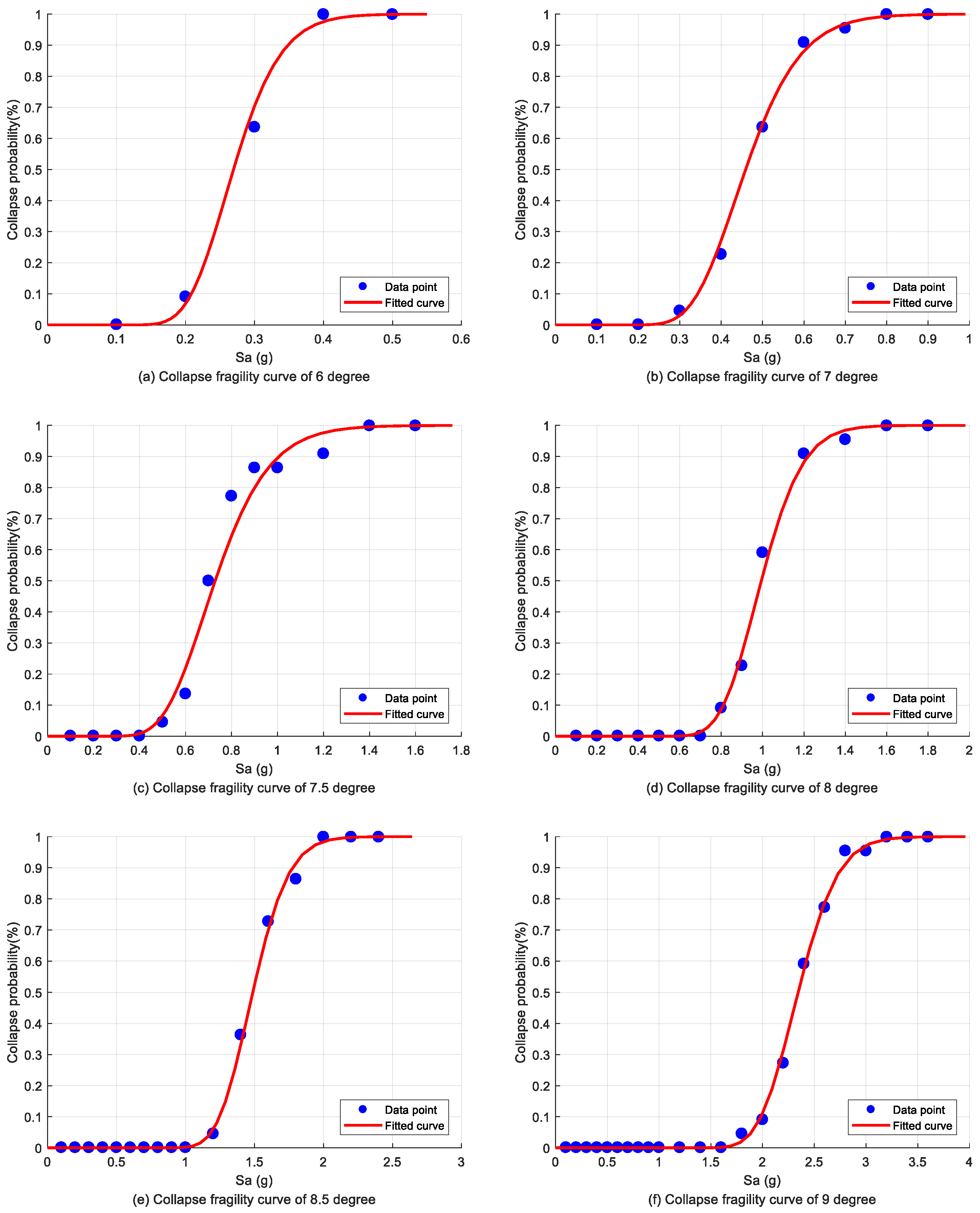
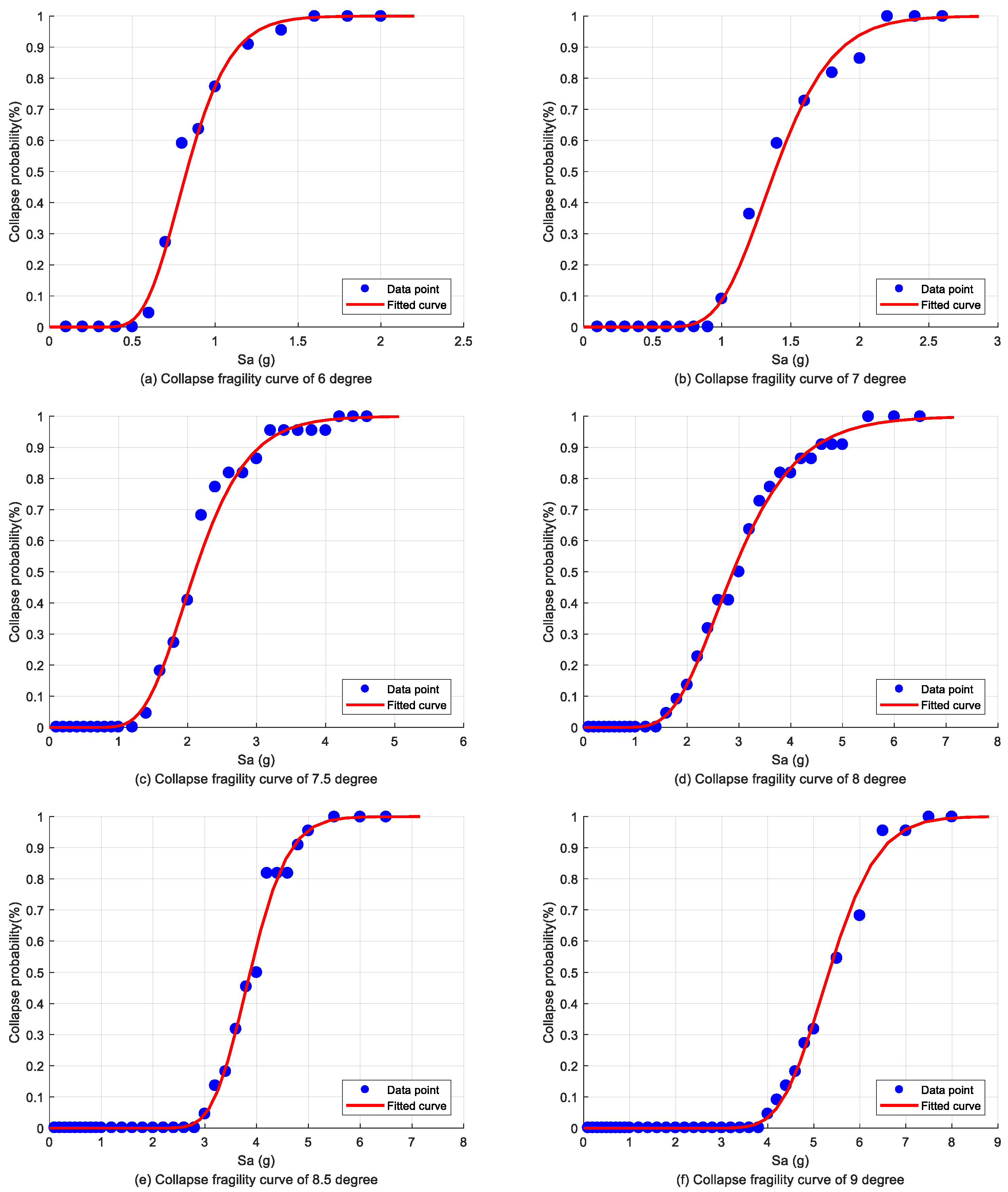
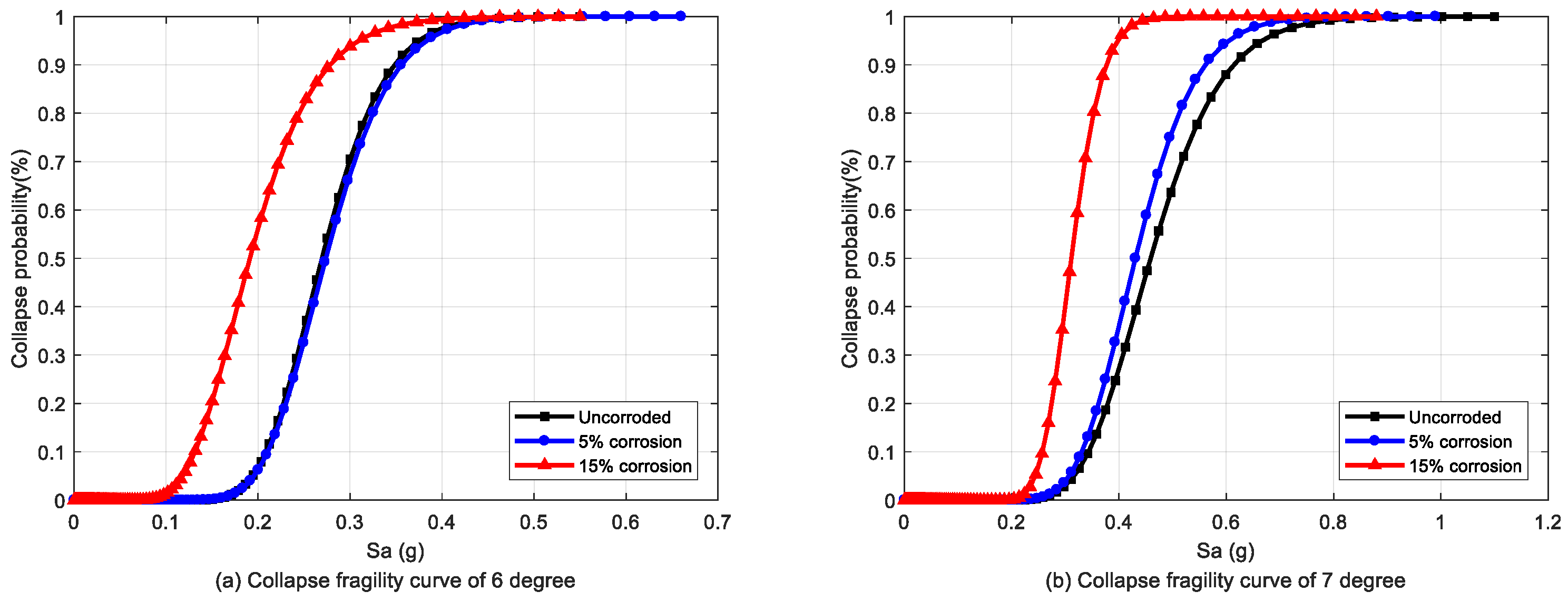
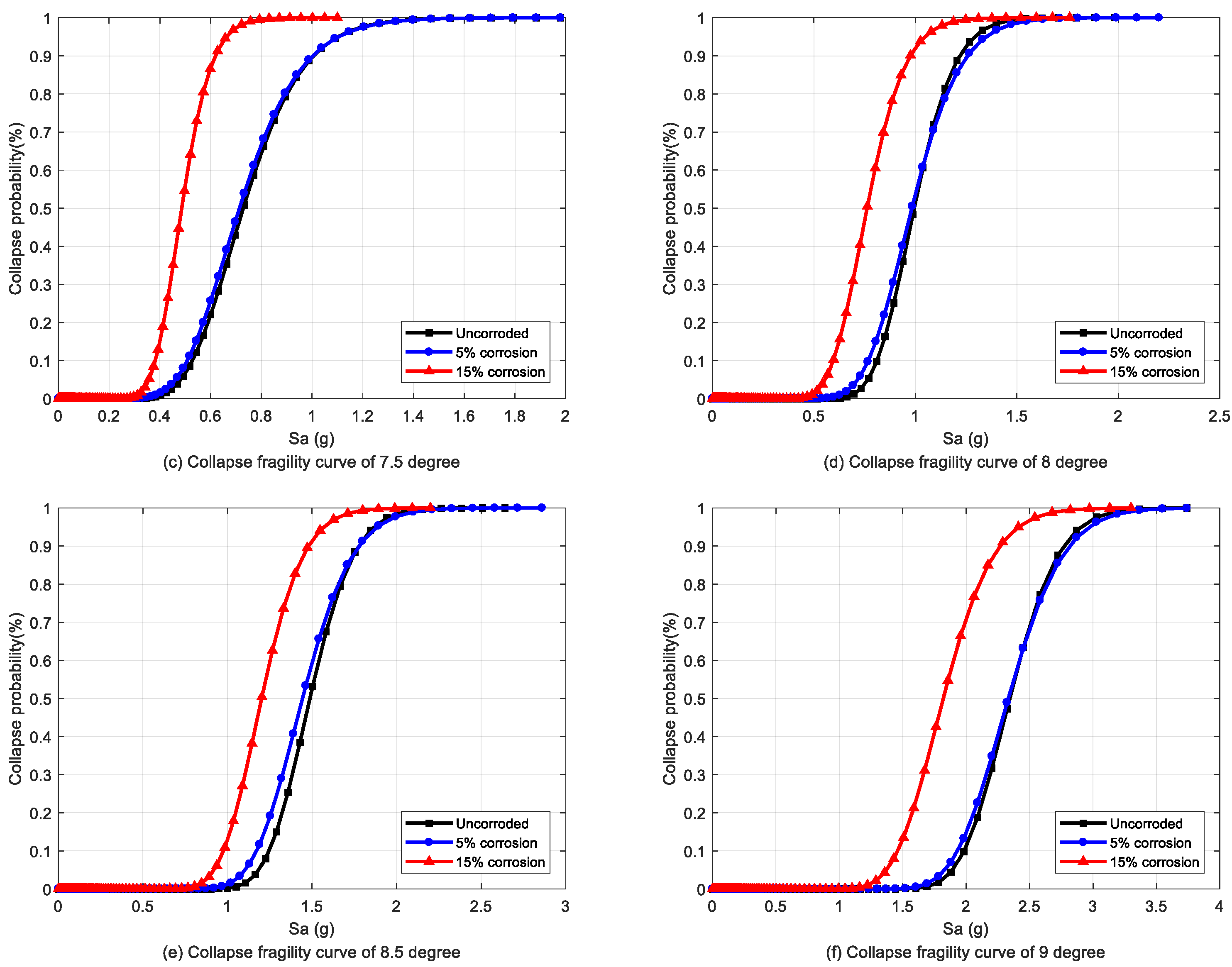
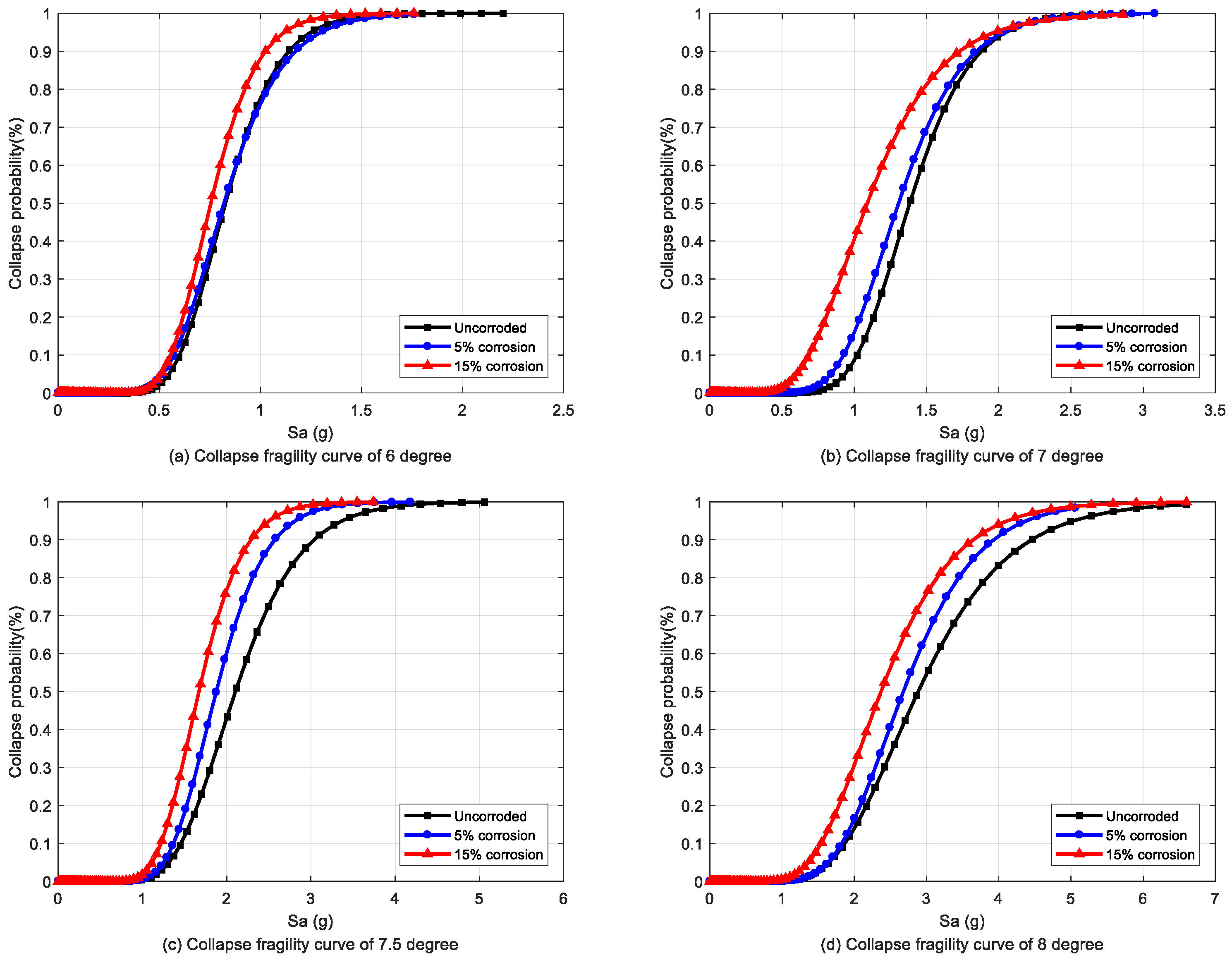
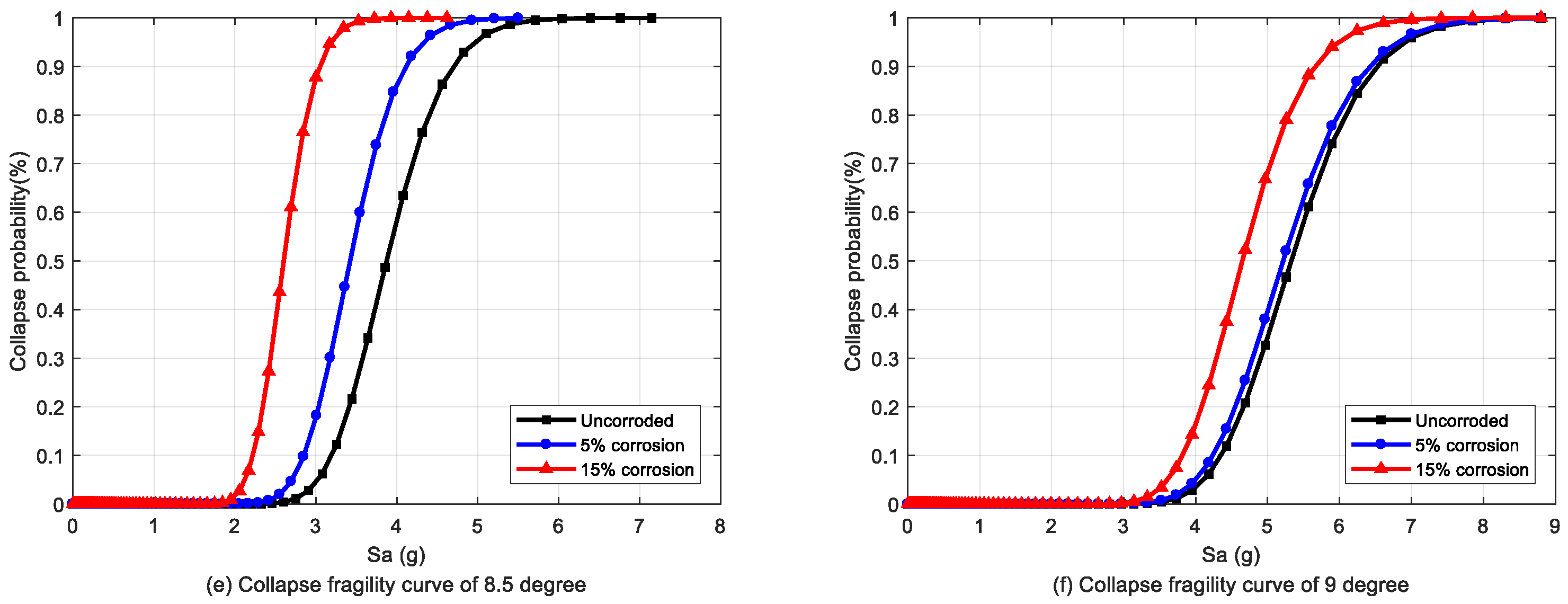
Structural modeling uncertainties are relatively complex; this paper focuses solely on seismic motion uncertainties. The fitted collapse fragility curves for uncorroded single-column and double-column canopies at various SFIs are shown in
Figure 3 and
Figure 4. To analyze the impact of corrosion levels on structural collapse performance, the seismic collapse fragility of structures with varying degrees of corrosion was compared, as shown in
Figure 5 and
Figure 6.
The structural collapse fragility curve is obtained by fitting a log-normal distribution to the collapse points on each IDA curve; the formulation for the fragility curve is as follows:
Here, θ is the median value of Sa(T1) at a 50% probability of structural collapse; βRTR is the logarithmic standard deviation resulting from uncertainties in the seismic record; and c is the cumulative distribution function of the standard normal distribution.
The values of
θ and
βRTR for each fragility curve, obtained through maximum likelihood estimation, are shown in
Table 2.
Table 2 reveals the following: (1) Under identical corrosion conditions, the value of
θ increases as the seismic fortification intensity increases, indicating that canopies designed for higher seismic intensities possess greater resistance to seismic collapse. As the corrosion rate increases, the value of
θ decreases, indicating that structural corrosion reduces the structure’s resistance to seismic collapse. Under identical conditions, the value of
θ for double-column canopies is greater than that for single-column canopies, indicating that double-column canopies possess stronger resistance to seismic collapse than single-column canopies. (2) As seismic design intensity and corrosion levels increase, the value of
βRTR does not exhibit a clear pattern. Under identical conditions, the value of
βRTR for double-column canopies is greater than that for single-column canopies, indicating that the fragility curve of double-column canopies exhibits greater dispersion.
Our analysis shows that for single-column canopies, the primary failure locations are at the base of the column, while for double-column canopies, they are primarily at the base of the cantilever beam.
5.2. Collapse Probability Analysis of Canopy Structures
Due to the complexity of earthquakes, many regions have experienced seismic events exceeding the maximum considered earthquake (MCE) intensity specified in the seismic code GB/T 50011. Therefore, the collapse resistance code T/CECS 392 stipulates seismic intensities greater than MCE, referred to as the extreme considered earthquake (ECE). This code requires verification of the structures’ collapse resistance under both MCE and ECE. Their corresponding PGA values are listed in
Table 3.
5.2.1. Collapse Probability of Uncorroded Canopy Structures
Based on the fitted fragility curve equations, the collapse probabilities for structures at different SFIs under both MCE and ECE were calculated and summarized in
Table 4.
As shown in
Table 4, the double-column platform canopy structures designed according to the Chinese code can meet the requirements of Code T/CECS 392 when subjected to MCE and ECE, without accounting for structural modeling uncertainties. The collapse probability limit for structures under MCE is 5%, and for ECE, it is 10%. This demonstrates that double-column platform canopies designed in accordance with Chinese seismic codes exhibit strong resistance to collapse during earthquakes.
Single-column platform canopies exhibit markedly different behavior. When subjected to MCE, the collapse probability of all structures with different SFIs is 0%, except for structures with the SFI of 7.5, which have a collapse probability of 0.02%—still well below the code’s 5% limit. This confirms that single-column structures designed in accordance with Chinese seismic codes exhibit sufficient seismic collapse resistance under MCE. However, when subjected to ECE, the collapse probabilities for structures with SFIs of 6 to 9 degrees are: 0%, 1.35%, 3.03%, 1.97%, 20.03%, and 11.0%, respectively. Notably, structures with SFI 8.5 and 9 degrees exceed the code’s collapse probability limit. This indicates that single-column canopy structures with SFIs 8.5 and 9 face significant collapse risks under ECE.
Analysis of collapse probabilities reveals that double-column structures designed in accordance with Chinese codes exhibit superior seismic collapse resistance and are suitable for all SFIs regions. In regions with SFIs of 8.5 and 9, single-column platform canopies should be avoided whenever possible. Alternatively, measures such as controlling canopy cantilever length and column height can be implemented to mitigate the risk of collapse.
5.2.2. Collapse Probability of Corroded Canopy Structures
(1) For Single-Column Canopies
Table 4 shows the collapse probability of single-column platform canopy structures with different levels of corrosion. The summary is as follows:
(a) With minor corrosion (5% corrosion rate): Collapse probability remains negligible under MCE, meeting the requirements of T/CECS 392. Under ECE, the collapse probability for single-column canopies with SFI 8.5 reaches 35%, exceeding the code’s 10% limit; structures with SFI 9 show a collapse probability of 17.28%, also exceeding the code’s limit. All other cases meet code requirements.
(b) When the structure is severely corroded (corrosion rate of 15%): When subjected to MCE, the collapse probability is very low, and all structures meet the requirements of T/CECS 392. Under ECE, collapse probabilities exceed the 10% threshold from SFI 7.5 to 9. Particularly at SFIs 8.5 and 9, collapse probabilities reach 55.34% and 49.96%, posing significant collapse risks. Even at an SFI of 7 degrees, the collapse probability reaches 8.5%, indicating a notable collapse risk.
(c) Compared to uncorroded single-column canopy structures: When subjected to MCE, collapse probabilities remain extremely low for both uncorroded intact structures, structures with 5% corrosion, and structures with 15% corrosion. When subjected to ECE, structures with 15% corrosion generally exhibit the highest collapse probability, followed by those with 5% corrosion, while uncorroded structures have the lowest collapse probability.
(2) For double-column canopy structures
As shown in
Table 4, for double-column platform canopy structures with 5% and 15% corrosion, the collapse probability remains low under both MCE and ECE, meeting the requirements of T/CECS 392. This demonstrates that double-column canopies exhibit strong resistance to corrosion-related deterioration.
6. Conclusions
This paper designs 12 railway platform canopies with varying seismic fortification intensities (SFIs) in accordance with the Seismic Design Code for Buildings (2024 Edition). Using the IDA method, we analyze the seismic collapse fragility of structures under three conditions: no corrosion; 5% corrosion mass—loss of reinforcement; and 15% corrosion mass—loss of reinforcement. The main conclusions are as follows:
(1) Uncorroded canopy structures: (a) For double-column canopies, the collapse probability of all structures with different SFIs under MCE and ECE remains significantly below the threshold requirements of the Code for Seismic Collapse-Resistant Design of Building Structures T/CECS 392-2021; (b) for single-column canopies, structures of all SFIs meet code requirements when subjected to MCE. However, collapse probabilities for structures with SFIs of 8.5 and 9 exceed code limits when subjected to ECE, reaching 20.03% and 11%, respectively.
(2) Corroded double-column canopies: Under 5% and 15% corrosion, the collapse probability remains low under both MCE and ECE. This shows strong resistance to corrosion degradation.
(3) Corroded single-column canopy: (a) When subjected to MCE, the collapse probability of structures with 5% and 15% corrosion is very low, far below code-specified limits; (b) When subjected to ECE, the collapse probability of the structure with 5% corrosion exceeds that of uncorroded structures at all SFIs. The collapse probabilities for the structures with SFI 8.5 and SFI 9 fail to meet code requirements; (c) when subjected to ECE, the structure with 15% corrosion exhibits significant performance degradation, with collapse probabilities far exceeding that of the uncorroded structure. Structures with SFIs from 7.5 to 9 all fail to meet the code’s collapse probability limits. For structures designed for SFIs 8.5 and 9, their collapse probabilities reach 55.34% and 49.96%, respectively, indicating substantial collapse risk.
This study provides important reference values for improving the seismic design of platform canopies and for investigating the impact of corrosion on their collapse resistance.
Author Contributions
Conceptualization, J.L. (Junqi Lin) and J.L. (Jinlong Liu); methodology, H.L.; software, H.L.; validation, H.L., J.L. (Junqi Lin) and J.L. (Jinlong Liu); formal analysis, H.L.; investigation, H.L.; resources, J.L. (Junqi Lin); data curation, H.L.; writing—original draft preparation, H.L.; writing—review and editing, H.L.; visualization, H.L.; supervision, J.L. (Junqi Lin); project administration, J.L. (Junqi Lin); funding acquisition, J.L. (Junqi Lin), J.L. (Jinlong Liu). All authors have read and agreed to the published version of the manuscript.
Funding
This research was funded by Scientific Research Fund of Institute of Engineering Mechanics, China Earthquake Administration (2021C06) and Heilongjiang Provincial Natural Science Foundation of China (LH2021E123).
Institutional Review Board Statement
Not applicable.
Informed Consent Statement
Not applicable.
Data Availability Statement
The original contributions presented in the study are included in the article, further inquiries can be directed to the corresponding author.
Conflicts of Interest
The authors declare no conflict of interest.
References
- Yang, C.W. Seismic performance analysis of slab-shell structures platform canopy of railway passenger station. Railw. Stand. Des. 2023, 67, 137–142. (In Chinese) [Google Scholar]
- Chang, Y.Z.; Kuang, J.Y. Seismic performance of prefabricated platform canopy with mortise-tenon connection. J. Railw. Eng. Soc. 2024, 41, 69–74+86. (In Chinese) [Google Scholar]
- Fang, S.B. Study on seismic performance of cast-in-place reinforced concrete single-column canopy structure of railway platform. Earthq. Resist. Eng. Retrofit. 2024, 46, 121–130. (In Chinese) [Google Scholar]
- Chang, Y.; Kuang, J.; Bai, C. Seismic performance of mortise-tenon joint in prefabricated platform canopy. Structures 2024, 69, 107512. [Google Scholar] [CrossRef]
- Chang, Y.; Kuang, J.; Bai, C.; Cai, Y.; Wang, D.; Wang, Y.; Tian, L. Experimental and numerical study on seismic performance of assembled platform canopy with mortise-tenon joints. Soil Dyn. Earthq. Eng. 2024, 183, 108815. [Google Scholar] [CrossRef]
- Yang, Y.F.; Xie, L.T.; Chen, Q. Research on progressive collapse capacity of typical platform with column canopy structures. J. Railw. Eng. Soc. 2020, 37, 78–83. (In Chinese) [Google Scholar]
- Fang, S.B.; Chen, Q.; Yang, Y.F. Progressive collapse capacity analysis of platform canopies with single-column. Earthq. Resist. Eng. Retrofit. 2021, 43, 159–166. (In Chinese) [Google Scholar]
- Ibarra, L.F.; Medina, R.A.; Krawinkler, H. Hysteretic models that incorporate strength and stiffness deterioration. Earthq. Eng. Struct. Dyn. 2005, 34, 1489–1511. [Google Scholar] [CrossRef]
- Lignos, D.G. Sidesway Collapse of Deteriorating Structural Systems Under Seismic Excitations. Ph.D. Thesis, Stanford University, Stanford, CA, USA, 2013. [Google Scholar]
- Lignos, D.G.; Krawinkler, H. Deterioration modeling of steel components in support of collapse prediction of steel moment frames under earthquake loading. J. Struct. Eng. 2011, 137, 1291–1302. [Google Scholar] [CrossRef]
- Haselton, C.B.; Liel, A.B.; Lange, S.T. Beam-Column Element Model Calibrated for Predicting Flexural Response Leading to Global Collapse of RC Frame Buildings; Pacific Earthquake Engineering Research Center: Berkeley, CA, USA, 2008. [Google Scholar]
- Haselton, C.B.; Liel, A.B.; Taylor-Lange, S.C.; Deierlein, G.G. Calibration of model to simulate response of reinforced concrete beam-columns to collapse. ACI Struct. J. 2016, 113, 1141–1152. [Google Scholar] [CrossRef]
- Dai, K.Y.; Yu, X.H.; Wang, S. Identification of the hysteretic model parameters for reinforced concrete circular columns based on the modified ibarra-medina-krawinkler material model. Eng. Mech. 2021, 38, 154–163. (In Chinese) [Google Scholar]
- Liu, H.B.; Lin, J.Q.; Liu, J.L. Development of Phenomenological Model for RC Circular Columns. Appl. Sci. 2025, 15, 4841. [Google Scholar] [CrossRef]
- Liu, H.B.; Lin, J.Q.; Liu, J.L. Research on modified IMK hysteretic model for RC circular columns failing in flexural mode. In Proceedings of the 20th Conference on Seismic Technology for High-Rise Buildings (Volume I), Hangzhou, China, 3 December 2025. [Google Scholar]
- Dai, K.Y.; Yu, X.H.; Lu, D.G. Phenomenological hysteretic model for corroded RC columns. Eng. Struct. 2020, 210, 110315. [Google Scholar] [CrossRef]
- Liu, H.B.; Lin, J.Q.; Liu, J.L. Deterioration Model for Corroded Circular Columns. Appl. Sci. 2024, 14, 7983. [Google Scholar] [CrossRef]
- GB 50011-2010 (2024); Code for Seismic Design of Buildings. China Ministry of Housing and Urban-Rural Development of the People’s Republic of China. Architecture & Building Press: Beijing, China, 2024. (In Chinese)
- T/CECS 392-2021; Standard for Anti-Collapse Design of Building Structures. China Association for Standardization of Engineering Construction. China Planning Press: Beijing, China, 2021. (In Chinese)
- Ibarra, L.F. Global Collapse of Frame Structures Under Seismic Excitations. Doctoral Dissertation, Stanford University, Stanford, CA, USA, 2004. [Google Scholar]
- Zareian, F.; Medina, R.A. A practical method for proper modeling of structural damping in inelastic plane structural systems. Comput. Struct. 2010, 88, 45–53. [Google Scholar] [CrossRef]
- Lu, X.Z.; Tang, D.Y.; Ye, L.P. Study on the seismic collapse resistance of RC frame structures with equal spans in zones with seismic intensity VII. J. Earthq. Eng. Vib. 2011, 31, 13–20. (In Chinese) [Google Scholar]
- ATC-63; Quantification of Building Seismic Performance Factors. Federal Emergency Management Agency: Washington, DC, USA, 2009.
- Tang, B.; Lu, X.; Ye, L.; Shi, W. Evaluation of collapse resistance of RC frame structures for Chinese schools in seismic design categories B and C. Earthq. Eng. Eng. Vib. 2011, 10, 369–377. [Google Scholar] [CrossRef]
- Yang, W. Study on the Seismic Fragility of RC Frame Structures. Master’s Thesis, Xi’an University of Architecture & Technology, Xi’an, China, 2016. (In Chinese) [Google Scholar]
- Venture, S.; Guidelines Development Committee. Recommended Seismic Design Criteria for New Steel Moment-Frame Buildings; Federal Emergency Management Agency: Washington, DC, USA, 2000.
- Luo, K.H.; Bao, H.E.; Zuo, Q. Statistics and analysis on risk of earthquake collapse of RC frame structures with different fortification intensities. J. Build. Struct. 2021, 42, 137–144. (In Chinese) [Google Scholar]
| Disclaimer/Publisher’s Note: The statements, opinions and data contained in all publications are solely those of the individual author(s) and contributor(s) and not of MDPI and/or the editor(s). MDPI and/or the editor(s) disclaim responsibility for any injury to people or property resulting from any ideas, methods, instructions or products referred to in the content. |