Understanding the Role of Physics-Informed Inductive Biases in Brain Tumor Segmentation: A Theoretical and Methodological Perspective


Abstract
1. Introduction
1.1. Motivation and Scope
1.2. The Concept of Inductive Bias
1.3. Objectives of This Study
2. Background and Related Work
2.1. Physics-Informed Neural Networks in Medical Imaging
2.2. Mathematical Models of Brain Tumor Growth
2.3. Inductive Bias in Deep Learning
2.4. Positioning of This Study
3. Theoretical and Formal Framing of Physics-Informed Priors as Inductive Biases
3.1. Nature of Physics-Informed Constraints
3.2. Formalization of Physics-Informed Loss
3.3. Reaction–Diffusion Formulations for Tumor and Edema
3.3.1. Tumor Growth Model
3.3.2. Edema Dynamics Model
3.4. The Alignment Problem: A Formal Framework
- (1)
- Isotropic versus anisotropic diffusion. Simple diffusion models assume isotropic spread, whereas brain tumors frequently exhibit preferential invasion along white matter tracts [31,35]. Diffusion tensor imaging (DTI) studies have shown that glioma cells can exhibit faster and directional spread along white matter fibers compared to fiber-crossing directions [44]. Isotropic formulations may therefore systematically misrepresent the geometry of tumor spread in white matter–rich regions.
- (2)
- Steady-state assumptions. Many physics-informed formulations assume steady-state conditions (∂C/∂t = 0), whereas tumor growth is inherently dynamic. Single-time-point imaging cannot fully resolve temporal dynamics, and the steady-state approximation introduces systematic bias proportional to the growth rate at the time of imaging [30].
- (3)
- Patient heterogeneity. Biological parameters such as diffusion coefficients and proliferation rates vary considerably across patients and tumor types. Swanson et al. [30] documented order-of-magnitude differences in these parameters. Population-level parameter estimates may not accurately reflect individual cases, and this parametric uncertainty affects the physics loss [32,33].
- (4)
- Tumor type mismatch. Reaction–diffusion models are derived from glioma research. Brain metastases exhibit different growth patterns, including displacement rather than infiltration [36]. Applying glioma-derived physics priors to metastasis segmentation introduces a fundamental model mismatch whose severity varies with lesion characteristics.
4. Conditions of Effectiveness: A Theoretical Analysis
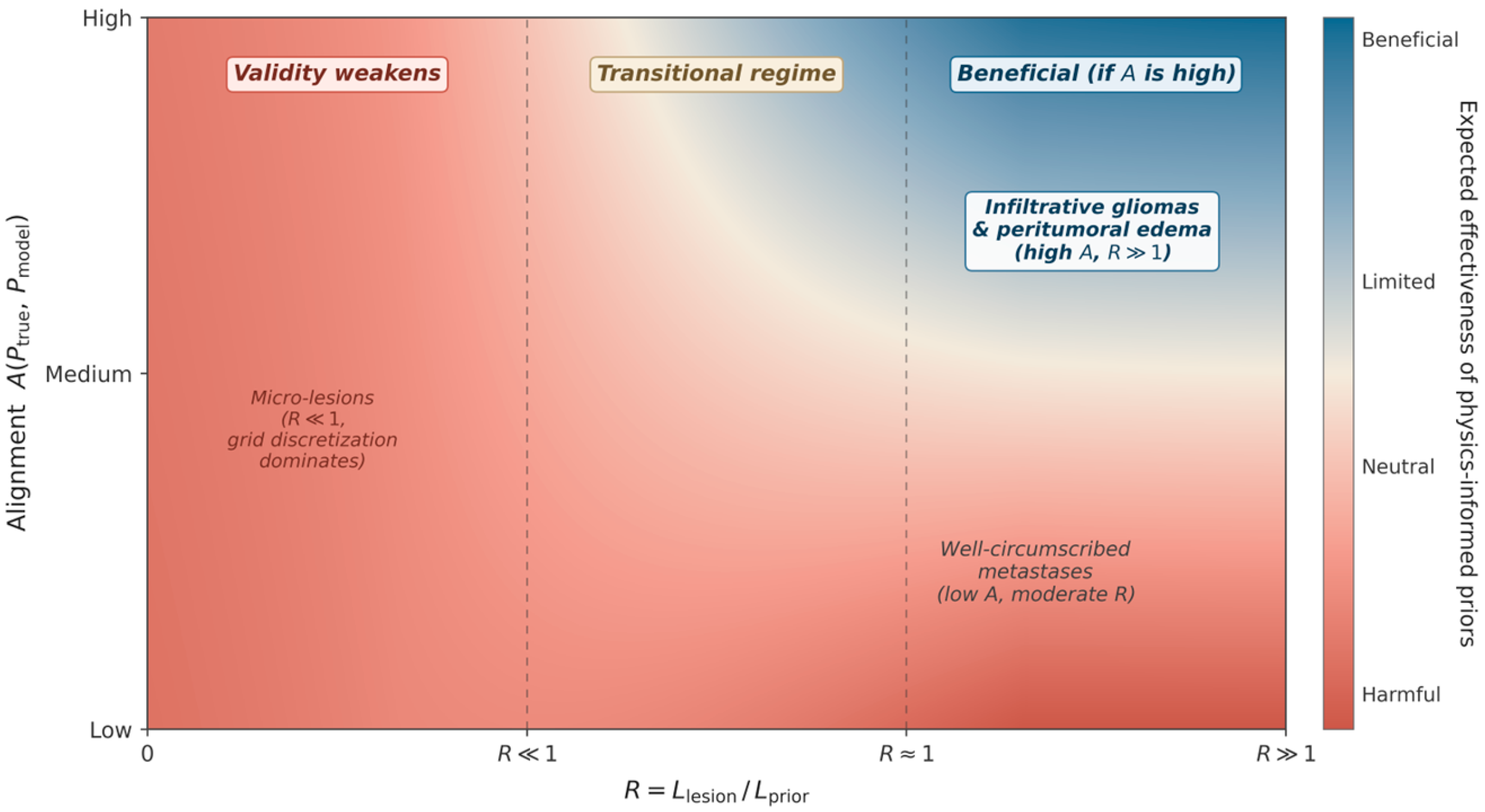
4.1. Scenarios Where Physics-Informed Priors Are Expected to Be Beneficial
4.2. Scenarios Where Physics-Informed Priors Offer Limited Benefit
4.3. The Role of Spatial Scale
4.4. Conditional Validity of Smoothness Constraints
5. Methodological Design and Evaluation Perspective
5.1. Reconsidering Evaluation Metrics
5.2. Reporting Framework for Physics-Informed Studies
- (1)
- Physics specification. Explicit statement of the partial differential equations (PDEs) used, including all terms, parameters, and boundary conditions, along with justification for the suitability of the chosen formulation for the target pathology.
- (2)
- Parameter documentation. Clear indication of whether physics parameters (e.g., D, ρ, kd) are fixed, learned, or derived from the literature. If parameters are fixed, their sources should be provided and sensitivity analysis regarding the choices should be reported.
- (3)
- Integration modality. Explicit description of how physics constraints are embedded in the model (regularization as a loss term, architectural constraint, or post-processing). For loss-based approaches, the regularization coefficient (λ) and any scheduling strategy should be specified.
- (4)
- Alignment assessment. Discussion of the expected alignment between the physics model and the target pathology, in the context of known limitations and potential mismatches.
- (5)
- Ablation design. Comparison with (a) the same architecture without the physics constraint, (b) a general smoothness regularizer of comparable capacity, and (c) at least two different λ values to distinguish physics-specific effects from general regularization.
- (6)
- Stratified results. Reporting of performance separately for at least three lesion size categories and, where applicable, for different tissue types.
5.3. Distinguishing Regularization Effects from Biological Alignment
6. Discussion
6.1. Physics-Informed Learning as Context-Dependent Regularization
6.2. Implications for Future Research
- (1)
- Adaptive regularization strategies. Rather than applying uniform physics constraints to all spatial locations, adaptive approaches that adjust regularization strength based on local image features may be explored. For example, prediction uncertainty could be used as a gating signal; a local coefficient based on softmax entropy could strengthen physics constraints in uncertain regions while relaxing them in well-defined regions where data evidence is sufficient [52,53]. Such a mechanism could enhance the context sensitivity of physics-informed regularization.
- (2)
- Anisotropic diffusion-based priors. Instead of a simple isotropic diffusion coefficient, the use of a spatially varying diffusion tensor derived from diffusion tensor imaging data could model preferential invasion along white matter more realistically [31,44]. Although such models have been investigated in glioma growth simulations [32,35], their systematic integration as inductive biases in segmentation architectures has remained limited.
- (3)
- Systematic ablation protocols. The proposed ablation design could be translated into standardized experimental protocols for disentangling physics-informed regularization from general smoothness penalties. In particular, comparing a physics-informed loss with a Laplacian-type smoothness penalty of comparable capacity could more clearly reveal the existence of biology-specific contributions.
- (4)
- Multi-scale physics priors. The scale dependence findings suggest that different physics formulations may be appropriate in different spatial regimes. A multi-scale approach could apply PDE-based priors only to lesion components exceeding a certain size threshold while giving greater weight to data-driven learning for structures below the threshold. This could reduce the risk of over-smoothing arising from scale mismatch.
6.3. Limitations of This Analysis
- (1)
- Theoretical scope. The presented framework offers a theoretical and methodological analysis. Direct experimental validation of quantitative threshold values—for example, the critical regimes of the dimensionless ratio R—lies outside the scope of this study. Nevertheless, a separate empirical study by the same authors, currently under peer review [54], investigates the empirical behavior of physics-informed approaches; the framework developed here aims at the theoretical reinterpretation and generalization of those findings. Accordingly, the present study offers a principled structure for future experimental designs rather than producing experimental results. This sequencing—first formalizing the conditions under which physics-informed priors are expected to be beneficial, neutral, or harmful, and then subjecting those predictions to controlled empirical tests—reflects a deliberate methodological choice rather than an incidental omission.
- (2)
- Focus on reaction–diffusion models. This analysis focuses primarily on reaction–diffusion formulations. Biomechanical models [31], hemodynamic constraints [27,28], or imaging physics-based approaches [26] may exhibit different structural properties. Although the general principles concerning alignment and context dependence are likely transferable, the specific predictions derived in the preceding sections are formulation-specific.
- (3)
- Brain tumor specificity. The discussion has focused on brain tumor segmentation, particularly emphasizing the biological distinction between gliomas and metastases. These findings may not directly generalize to other anatomical regions or pathologies where different biological processes predominate. Extension to different organ systems would require reformulating alignment analysis with organ-specific physics models. Importantly, the general framework—gradient interaction analysis, the alignment concept, and the scale ratio R—is transferable to any organ system, whereas the specific predictions in Table 1 are brain-tumor-specific by design. Applying the framework to, for example, hepatic or pulmonary tumors would require substituting organ-appropriate physics models (e.g., perfusion-based models for liver, airway-dependent spread models for lung) and re-deriving the corresponding alignment conditions. Such organ-specific reformulations constitute a valuable direction for future research.
7. Conclusions
Author Contributions
Funding
Data Availability Statement
Conflicts of Interest
References
- Litjens, G.; Kooi, T.; Bejnordi, B.E.; Setio, A.A.A.; Ciompi, F.; Ghafoorian, M.; van der Laak, J.A.W.M.; van Ginneken, B.; Sánchez, C.I. A Survey on Deep Learning in Medical Image Analysis. Med. Image Anal. 2017, 42, 60–88. [Google Scholar] [CrossRef] [PubMed]
- Shen, D.; Wu, G.; Suk, H.-I. Deep Learning in Medical Image Analysis. Annu. Rev. Biomed. Eng. 2017, 19, 221–248. [Google Scholar] [CrossRef] [PubMed]
- Esteva, A.; Robicquet, A.; Ramsundar, B.; Kuleshov, V.; DePristo, M.; Chou, K.; Cui, C.; Corrado, G.; Thrun, S.; Dean, J. A Guide to Deep Learning in Healthcare. Nat. Med. 2019, 25, 24–29. [Google Scholar] [CrossRef] [PubMed]
- Ronneberger, O.; Fischer, P.; Brox, T. U-Net: Convolutional Networks for Biomedical Image Segmentation. In Proceedings of the MICCAI 2015; Springer: Cham, Switzerland, 2015; pp. 234–241. [Google Scholar]
- Isensee, F.; Jaeger, P.F.; Kohl, S.A.A.; Petersen, J.; Maier-Hein, K.H. nnU-Net: A Self-Configuring Method for Deep Learning-Based Biomedical Image Segmentation. Nat. Methods 2021, 18, 203–211. [Google Scholar] [CrossRef]
- Myronenko, A. 3D MRI Brain Tumor Segmentation Using Autoencoder Regularization. In Proceedings of the Brainlesion; Springer: Cham, Switzerland, 2019; pp. 311–320. [Google Scholar]
- Hatamizadeh, A.; Nath, V.; Tang, Y.; Yang, D.; Roth, H.R.; Xu, D. Swin UNETR: Swin Transformers for Semantic Segmentation of Brain Tumors in MRI Images. In Proceedings of the Brainlesion; Springer: Cham, Switzerland, 2022; pp. 272–284. [Google Scholar]
- Menze, B.H.; Jakab, A.; Bauer, S.; Kalpathy-Cramer, J.; Farahani, K.; Kirby, J.; Burren, Y.; Porz, N.; Slotboom, J.; Wiest, R.; et al. The Multimodal Brain Tumor Image Segmentation Benchmark (BRATS). IEEE Trans. Med. Imaging 2015, 34, 1993–2024. [Google Scholar] [CrossRef]
- Bakas, S.; Akbari, H.; Sotiras, A.; Bilello, M.; Rozycki, M.; Kirby, J.S.; Freymann, J.B.; Farahani, K.; Davatzikos, C. Advancing The Cancer Genome Atlas Glioma MRI Collections with Expert Segmentation Labels and Radiomic Features. Sci. Data 2017, 4, 170117. [Google Scholar] [CrossRef]
- Moawad, A.W.; Janas, A.; Baid, U.; Ramakrishnan, D.; Jekel, L.; Kofler, F.; LaBella, D.; Aerts, H.J.W.L.; Bousabarah, K.; Chakrabarty, S.; et al. The Brain Tumor Segmentation (BraTS-METS) Challenge 2023. arXiv 2023, arXiv:2306.00838. [Google Scholar]
- Karniadakis, G.E.; Kevrekidis, I.G.; Lu, L.; Perdikaris, P.; Wang, S.; Yang, L. Physics-Informed Machine Learning. Nat. Rev. Phys. 2021, 3, 422–440. [Google Scholar] [CrossRef]
- Raissi, M.; Perdikaris, P.; Karniadakis, G.E. Physics-Informed Neural Networks: A Deep Learning Framework for Solving Forward and Inverse Problems Involving Nonlinear Partial Differential Equations. J. Comput. Phys. 2019, 378, 686–707. [Google Scholar] [CrossRef]
- Cuomo, S.; Di Cola, V.S.; Giampaolo, F.; Rozza, G.; Raissi, M.; Piccialli, F. Scientific Machine Learning Through Physics–Informed Neural Networks: Where We Are and What’s Next. J. Sci. Comput. 2022, 92, 88. [Google Scholar] [CrossRef]
- Krishnapriyan, A.; Gholami, A.; Zhe, S.; Kirby, R.; Mahoney, M.W. Characterizing Possible Failure Modes in Physics-Informed Neural Networks. In Proceedings of the NeurIPS; NeurIPS: La Jolla, CA, USA, 2021; pp. 26548–26560. [Google Scholar]
- Wang, S.; Teng, Y.; Perdikaris, P. Understanding and Mitigating Gradient Flow Pathologies in Physics-Informed Neural Networks. SIAM J. Sci. Comput. 2021, 43, A3055–A3081. [Google Scholar] [CrossRef]
- Banerjee, C.; Nguyen, K.; Salvado, O.; Tran, T.; Fookes, C. PINNs for Medical Image Analysis: A Survey. arXiv 2024, arXiv:2408.01026. [Google Scholar] [CrossRef]
- Ahmadi, M.; Biswas, D.; Lin, M.; Vrionis, F.D.; Hashemi, J.; Tang, Y. Physics-Informed Machine Learning for Advancing Computational Medical Imaging. Artif. Intell. Rev. 2025, 58, 297. [Google Scholar] [CrossRef]
- Dwivedi, V.; Srinivasan, B.; Krishnamurthi, G. Physics Informed Contour Selection for Rapid Image Segmentation. Sci. Rep. 2024, 14, 6996. [Google Scholar] [CrossRef]
- Leontiou, T.; Frixou, A.; Charalambides, M.; Stiliaris, E.; Papanicolas, C.N.; Nikolaidou, S.; Papadakis, A. Three-Dimensional Thermal Tomography with Physics-Informed Neural Networks. Tomography 2024, 10, 1930–1946. [Google Scholar] [CrossRef]
- Mitchell, T.M. Machine Learning; McGraw-Hill: New York, NY, USA, 1997. [Google Scholar]
- Wolpert, D.H. The Lack of A Priori Distinctions Between Learning Algorithms. Neural Comput. 1996, 8, 1341–1390. [Google Scholar] [CrossRef]
- Wolpert, D.H.; Macready, W.G. No Free Lunch Theorems for Optimization. IEEE Trans. Evol. Comput. 1997, 1, 67–82. [Google Scholar] [CrossRef]
- Goldblum, M.; Finzi, M.; Rowan, K.; Wilson, A.G. The No Free Lunch Theorem, Kolmogorov Complexity, and the Role of Inductive Biases in Machine Learning. arXiv 2024, arXiv:2304.05366. [Google Scholar]
- Goodfellow, I.; Bengio, Y.; Courville, A. Deep Learning; MIT Press: Cambridge, MA, USA, 2016. [Google Scholar]
- Shalev-Shwartz, S.; Ben-David, S. Understanding Machine Learning: From Theory to Algorithms; Cambridge University Press: New York, NY, USA, 2014. [Google Scholar]
- Borges, P.; Sudre, C.; Varsavsky, T.; Thomas, D.; Drobnjak, I.; Ourselin, S.; Cardoso, M.J. Physics-Informed Brain MRI Segmentation. In Proceedings of the SASHIMI; Springer: Cham, Switzerland, 2019; pp. 100–109. [Google Scholar]
- Van Herten, R.L.M.; Chiribiri, A.; Breeuwer, M.; Veta, M.; Scannell, C.M. Physics-Informed Neural Networks for Myocardial Perfusion MRI Quantification. Med. Image Anal. 2022, 78, 102399. [Google Scholar] [CrossRef]
- Sarabian, M.; Babaee, H.; Laksari, K. Physics-Informed Neural Networks for Brain Hemodynamic Predictions Using Medical Imaging. IEEE Trans. Med. Imaging 2022, 41, 2285–2303. [Google Scholar] [CrossRef]
- Murray, J.D. Mathematical Biology: I. An Introduction; Springer: New York, NY, USA, 2002. [Google Scholar]
- Swanson, K.R.; Bridge, C.; Murray, J.D.; Alvord, E.C. Virtual and Real Brain Tumors: Using Mathematical Modeling to Quantify Glioma Growth and Invasion. J. Neurol. Sci. 2003, 216, 1–10. [Google Scholar] [CrossRef] [PubMed]
- Clatz, O.; Sermesant, M.; Bondiau, P.-Y.; Delingette, H.; Warfield, S.K.; Malandain, G.; Ayache, N. Realistic Simulation of the 3-D Growth of Brain Tumors in MR Images Coupling Diffusion with Biomechanical Deformation. IEEE Trans. Med. Imaging 2005, 24, 1334–1346. [Google Scholar] [CrossRef] [PubMed]
- Konukoglu, E.; Clatz, O.; Bondiau, P.-Y.; Delingette, H.; Ayache, N. Extrapolating Glioma Invasion Margin in Brain Magnetic Resonance Images: Suggesting New Irradiation Margins. Med. Image Anal. 2010, 14, 111–125. [Google Scholar] [CrossRef] [PubMed]
- Martens, C.; Rovai, A.; Bonatto, D.; Metens, T.; Debeir, O.; Decaestecker, C.; Goldman, S.; Van Simaeys, G. Deep Learning for Reaction-Diffusion Glioma Growth Modeling: Towards a Fully Personalized Model? Cancers 2022, 14, 2530. [Google Scholar] [CrossRef]
- Zhang, R.Z.; Ezhov, I.; Balcerak, M.; Zhu, A.; Wiestler, B.; Menze, B.; Lowengrub, J.S. Personalized Predictions of Glioblastoma Infiltration: Mathematical Models, Physics-Informed Neural Networks and Multimodal Scans. Med. Image Anal. 2025, 101, 103423. [Google Scholar] [CrossRef]
- Painter, K.J.; Hillen, T. Mathematical Modelling of Glioma Growth: The Use of Diffusion Tensor Imaging (DTI) Data to Predict the Anisotropic Pathways of Cancer Invasion. J. Theor. Biol. 2013, 323, 25–39. [Google Scholar] [CrossRef]
- Nayak, L.; Lee, E.Q.; Wen, P.Y. Epidemiology of Brain Metastases. Curr. Oncol. Rep. 2012, 14, 48–54. [Google Scholar] [CrossRef]
- Suh, J.H.; Kotecha, R.; Chao, S.T.; Ahluwalia, M.S.; Sahgal, A.; Chang, E.L. Current Approaches to the Management of Brain Metastases. Nat. Rev. Clin. Oncol. 2020, 17, 279–299. [Google Scholar] [CrossRef]
- Zhang, C.; Bengio, S.; Hardt, M.; Recht, B.; Vinyals, O. Understanding Deep Learning Requires Rethinking Generalization. arXiv 2017, arXiv:1611.03530. [Google Scholar] [CrossRef]
- Battaglia, P.W.; Hamrick, J.B.; Bapst, V.; Sanchez-Gonzalez, A.; Zambaldi, V.; Malinowski, M.; Tacchetti, A.; Raposo, D.; Santoro, A.; Faulkner, R.; et al. Relational Inductive Biases, Deep Learning, and Graph Networks. arXiv 2018, arXiv:1806.01261. [Google Scholar] [CrossRef]
- Goyal, A.; Bengio, Y. Inductive Biases for Deep Learning of Higher-Level Cognition. Proc. R. Soc. A 2022, 478, 20210068. [Google Scholar] [CrossRef]
- Papadopoulos, M.C.; Saadoun, S.; Binder, D.K.; Manley, G.T.; Krishna, S.; Verkman, A.S. Molecular Mechanisms of Brain Tumor Edema. Neuroscience 2004, 129, 1011–1020. [Google Scholar] [CrossRef]
- Stummer, W. Mechanisms of Tumor-Related Brain Edema. Neurosurg. Focus 2007, 22, E8. [Google Scholar] [CrossRef] [PubMed]
- Hawkins-Daarud, A.; Rockne, R.C.; Anderson, A.R.A.; Swanson, K.R. Modeling Tumor-Associated Edema in Gliomas during Anti-Angiogenic Therapy and Its Impact on Imageable Tumor. Front. Oncol. 2013, 3, 66. [Google Scholar] [CrossRef] [PubMed]
- Bondiau, P.-Y.; Clatz, O.; Sermesant, M.; Marcy, P.-Y.; Delingette, H.; Frenay, M.; Ayache, N. Biocomputing: Numerical Simulation of Glioblastoma Growth Using Diffusion Tensor Imaging. Phys. Med. Biol. 2008, 53, 879–893. [Google Scholar] [CrossRef] [PubMed]
- McAllester, D.A. PAC-Bayesian Model Averaging. In Proceedings of the COLT 1999; ACM: New York, NY, USA, 1999; pp. 164–170. [Google Scholar]
- LeVeque, R.J. Finite Difference Methods for Ordinary and Partial Differential Equations: Steady-State and Time-Dependent Problems; SIAM: Philadelphia, PA, USA, 2007. [Google Scholar]
- Reinke, A.; Tizabi, M.D.; Sudre, C.H.; Eisenmann, M.; Rädsch, T.; Baumgartner, M.; Acion, L.; Antonelli, M.; Arbel, T.; Bakas, S.; et al. Common Limitations of Image Processing Metrics: A Picture Story. arXiv 2023, arXiv:2104.05642. [Google Scholar]
- Maier-Hein, L.; Reinke, A.; Godau, P.; Tizabi, M.D.; Buettner, F.; Christodoulou, E.; Glocker, B.; Isensee, F.; Kleesiek, J.; Kozubek, M.; et al. Metrics Reloaded: Recommendations for Image Analysis Validation. Nat. Methods 2024, 21, 195–212. [Google Scholar] [CrossRef]
- De Verdier, M.C.; Saluja, R.; Gagnon, L.; LaBella, D.; Baid, U.; Tahon, N.H.; Foltyn-Dumitru, M.; Pflüger, I.; Piffer, S.; Shinohara, R.T.; et al. The 2024 Brain Tumor Segmentation (BraTS) Challenge: Glioma Segmentation on Post-treatment MRI. arXiv 2024, arXiv:2405.18368. [Google Scholar]
- Rudin, L.I.; Osher, S.; Fatemi, E. Nonlinear Total Variation Based Noise Removal Algorithms. Physica D 1992, 60, 259–268. [Google Scholar] [CrossRef]
- Miyato, T.; Kataoka, T.; Koyama, M.; Yoshida, Y. Spectral Normalization for Generative Adversarial Networks. arXiv 2018, arXiv:1802.05957. [Google Scholar] [CrossRef]
- Kendall, A.; Gal, Y. What Uncertainties Do We Need in Bayesian Deep Learning for Computer Vision? arXiv 2017, arXiv:1703.04977. [Google Scholar] [CrossRef]
- Gal, Y.; Ghahramani, Z. Dropout as a Bayesian Approximation: Representing Model Uncertainty in Deep Learning. In Proceedings of the ICML 2016; JMLR: Brookline, MA, USA, 2016; pp. 1050–1059. [Google Scholar]
- Güzel, M.; Baykan, Ö.K. Physics-Informed DynUNet for Brain Metastasis Segmentation. Comput. Methods Programs Biomed. 2025; under review.


| Scenario | Context Dependence | Theoretical Prediction | Key Determinant | Relevant Tissue |
|---|---|---|---|---|
| Ambiguous boundaries | High | Beneficial | Boundary SNR < prior smoothness | Infiltrative tumors, edema margin |
| Limited training data | Medium–High | Beneficial | Sample size < model complexity | All data-dependent regions |
| Diffuse tissue | High | Beneficial | Biological process is diffusive | Peritumoral edema |
| Sharp boundaries | Low | Neutral/Harmful | Lprior > boundary width | Well-circumscribed metastases |
| High contrast | Variable | Limited contribution | Image SNR sufficient | Contrast-enhancing lesions |
| Micro-lesions (R << 1) | Very Low | Validity weakens | Grid resolution ≈ lesion scale | Sub-voxel metastases |
| Evaluation Objective | Recommended Metrics | Stratification | Practical Rationale |
|---|---|---|---|
| Overall accuracy | Dice, IoU | By lesion size category | Reveals size-dependent performance differences |
| Boundary quality | HD95, ASSD | By tissue type (ET, TC, WT) | Smoothness priors directly affect boundary geometry |
| Small lesion detection | Lesion-wise sensitivity, F1 | By volume threshold | Aggregate Dice can mask small lesion errors |
| Prediction reliability | Coefficient of variation, IQR | Across cross-validation folds | Measures variance-reducing effect of prior |
| Clinical relevance | Scenario-weighted scores | By clinical context | Clinical importance varies by tissue type |
Disclaimer/Publisher’s Note: The statements, opinions and data contained in all publications are solely those of the individual author(s) and contributor(s) and not of MDPI and/or the editor(s). MDPI and/or the editor(s) disclaim responsibility for any injury to people or property resulting from any ideas, methods, instructions or products referred to in the content. |
© 2026 by the authors. Licensee MDPI, Basel, Switzerland. This article is an open access article distributed under the terms and conditions of the Creative Commons Attribution (CC BY) license.
Share and Cite
Güzel, M.; Baykan, Ö.K. Understanding the Role of Physics-Informed Inductive Biases in Brain Tumor Segmentation: A Theoretical and Methodological Perspective. Appl. Sci. 2026, 16, 4164. https://doi.org/10.3390/app16094164
Güzel M, Baykan ÖK. Understanding the Role of Physics-Informed Inductive Biases in Brain Tumor Segmentation: A Theoretical and Methodological Perspective. Applied Sciences. 2026; 16(9):4164. https://doi.org/10.3390/app16094164
Chicago/Turabian StyleGüzel, Murat, and Ömer Kaan Baykan. 2026. "Understanding the Role of Physics-Informed Inductive Biases in Brain Tumor Segmentation: A Theoretical and Methodological Perspective" Applied Sciences 16, no. 9: 4164. https://doi.org/10.3390/app16094164
APA StyleGüzel, M., & Baykan, Ö. K. (2026). Understanding the Role of Physics-Informed Inductive Biases in Brain Tumor Segmentation: A Theoretical and Methodological Perspective. Applied Sciences, 16(9), 4164. https://doi.org/10.3390/app16094164