


Abstract
Physics-informed deep learning models have received increasing attention in medical image segmentation and particularly in brain tumor analysis, owing to their ability to incorporate mechanistic prior knowledge into data-driven architectures. Although numerous studies have presented empirical observations using physics-informed constraints, considerably less attention has been paid to why, when, and under what conditions such prior knowledge meaningfully contributes to segmentation behavior. This study presents a theoretical and methodological analysis of physics-informed segmentation frameworks from an inductive bias perspective. Rather than proposing new models or numerical benchmarks, we examine how reaction–diffusion-based priors influence model behavior across different spatial scales, tumor growth assumptions, and imaging scenarios. We argue that physics-informed constraints function not as universal improvers but as context-dependent regularization mechanisms whose effectiveness depends on the alignment between biological assumptions and imaging characteristics. By reframing physics-informed segmentation as a problem of inductive bias compatibility rather than numerical optimization, this study clarifies the conceptual role of mechanistic priors and provides guidance for their principled use in future segmentation studies. To operationalize this perspective, we introduce two central constructs: a dimensionless scale ratio R that delimits the spatial regime in which reaction–diffusion priors remain valid, and an alignment function A that captures the compatibility between encoded biological assumptions and the underlying data-generating process. We formalize the conditions under which physics-informed regularization is expected to be beneficial, neutral, or potentially harmful, and propose a reporting framework for the transparent evaluation of physics-informed approaches.
1. Introduction
While automated brain tumor diagnosis offers significant advantages to clinicians, most existing methods remain far from understanding the biological principles underlying tumor growth [1,2,3]. Although architectures such as U-Net [4], nnU-Net [5], SegResNet [6], and SwinUNETR [7] have demonstrated strong empirical performance on benchmark datasets, they operate without explicitly addressing the mechanistic principles governing tumor proliferation, invasion, and geometric spread [8,9]. This plateau in performance has motivated the investigation of additional methods that can provide greater inductive bias than data-driven learning alone can offer [10,11].
In response, physics-informed learning has been proposed as a tool for embedding mechanistic assumptions such as reaction–diffusion dynamics into segmentation models [11,12,13]. The underlying premise is that encoding prior knowledge about tumor biology guides models toward more plausible solutions. Despite growing interest in empirical evidence, the conceptual role of such prior knowledge has not been sufficiently understood. It is often unclear whether the observed effects reflect genuine biological coordination or merely additional regularization [14,15]. Recent reviews of physics-informed approaches in medical imaging have documented their applications in reconstruction, synthesis, and segmentation [16,17], yet a systematic theoretical analysis of when and why such priors affect segmentation behavior remains limited.
This study analyzes physics-informed segmentation frameworks at the level of inductive bias and methodological design and provides a theoretical foundation for their principled application in clinical and research settings.
1.1. Motivation and Scope
The motivation for this study arises from a conceptual gap in the literature. Although many studies have incorporated physics-informed terms into segmentation loss functions [13,18,19], the conditions under which such terms are expected to be beneficial, neutral, or potentially harmful have been systematically underexplored. This gap limits the interpretability of empirical findings and hinders the development of fundamental design principles.
The scope of this study is explicitly theoretical and methodological. We do not present new experimental data and do not claim that physics-informed approaches are inherently superior to conventional methods. Instead, we provide a conceptual framework for understanding how mechanistic priors interact with data-driven learning and under what conditions this interaction is productive. In doing so, we aim to move the discourse beyond binary assessments of whether physics-informed approaches work toward a more nuanced theoretical framework of how they work.
1.2. The Concept of Inductive Bias
In machine learning theory, inductive bias refers to the set of assumptions that a learning algorithm uses to generalize from finite training data to unseen examples [20]. The No Free Lunch theorems formalize the impossibility of bias-free learning: without prior assumptions about the target function, no algorithm can systematically outperform random guessing across all possible problems [21,22]. Every learning algorithm necessarily contains some form of inductive bias; without it, generalization is impossible [20,21]. The choice of inductive bias determines which assumptions the algorithm favors and consequently how it behaves on new inputs [20,23].
From this perspective, physics-informed constraints are explicit inductive biases that encode domain-specific assumptions about the structure of the target problem. In brain tumor segmentation, these assumptions typically take the form of partial differential equations (PDEs) describing tumor growth and edema dynamics. Structural decisions regarding convolutional neural networks already encode implicit inductive biases about geometric structures such as spatial translation equivariance and local receptive fields [24]. Physics-informed constraints additionally introduce explicit biases concerning the biological processes that give rise to the observed morphological patterns. Most importantly, the effectiveness of any inductive bias depends on its consistency with the actual data-generating process [21,25]. If the encoded assumptions accurately reflect biological reality, the bias will guide learning toward better solutions. If the assumptions are ill-specified, the bias will be ineffective or even harmful. This consistency criterion provides a guiding principle for structuring our analysis.
1.3. Objectives of This Study
This study pursues three interrelated objectives:
The first is to establish a theoretical framework that positions physics-informed constraints as inductive biases, clarifies their conceptual role within the learning process, and formalizes the conditions under which they influence model behavior.
The second is to analyze the conditions under which such biases are expected to affect segmentation behavior, taking into account factors such as spatial scale, imaging characteristics, biological plausibility, and the distinction between tumor growth and edema dynamics.
The third is to provide methodological guidance for the design, reporting, and interpretation of physics-informed segmentation studies, including a concrete reporting checklist and evaluation recommendations.
Before turning to the background literature, we delimit the scope of the present analysis at three levels: (i) the general framework—gradient interaction analysis, the alignment concept, and the scale ratio R—is applicable to any physics-informed segmentation task regardless of organ or modality; (ii) the specific predictions regarding reaction–diffusion priors apply to brain tumors modeled by Fisher–Kolmogorov-type equations; and (iii) the differential analysis of gliomas versus metastases versus edema represents the most fine-grained application, where brain-specific biological distinctions are determinative.
2. Background and Related Work
2.1. Physics-Informed Neural Networks in Medical Imaging
Physics-informed neural networks (PINNs) were introduced by Raissi et al. [12] as a framework for solving forward and inverse problems involving nonlinear partial differential equations. The core principle enforces network outputs to satisfy physical laws by embedding governing equations directly into the loss function. Karniadakis et al. [11] expanded the scope of this methodology, arguing that integrating mechanistic knowledge with learning algorithms produces complementary gains that neither purely data-driven nor purely model-based methods can achieve alone.
In medical imaging, physics-informed approaches have been applied to various tasks. Borges et al. [26] integrated MRI physics forward models into segmentation networks to enhance robustness against acquisition variability. Van Herten et al. [27] employed tracer kinetic models for cardiac perfusion quantification. Sarabian et al. [28] used Navier–Stokes equations for cerebral hemodynamic estimation. A comprehensive taxonomy by Banerjee et al. [16] categorized over 80 physics-informed medical image analysis studies, revealing that segmentation remains among the least explored applications compared to reconstruction and generation tasks.
Cuomo et al. [13] offered a broader perspective on scientific machine learning through PINNs, while Krishnapriyan et al. [14] characterized failure modes that arise when physics-informed loss terms conflict with gradient-based optimization. These studies collectively demonstrate that physics-informed learning is not a monolithic methodology but rather a family of strategies whose effectiveness is critically dependent on implementation details and domain characteristics.
2.2. Mathematical Models of Brain Tumor Growth
Mathematical models of brain tumor growth have a long history rooted in diffusion theory. Murray [29] laid the foundations of mathematical biology, while Swanson et al. [30] pioneered the use of cell proliferation–invasion models to quantitatively characterize glioma growth patterns and demonstrated that tumor growth rates differ by approximately an order of magnitude between low-grade and high-grade gliomas. Clatz et al. [31] extended this framework to three-dimensional models coupling diffusion to biomechanical deformation of patient-specific MRI data. Konukoglu et al. [32] proposed image-guided personalization of reaction–diffusion models using anisotropic eikonal equations and demonstrated the potential for predicting patient-specific variables. More recently, Martens et al. [33] applied deep learning to predict reaction–diffusion parameters from individual MRI images, and Zhang et al. [34] investigated PINNs for predicting personalized glioblastoma growth using multi-modal scans. These developments illustrate the increasing complexity of combining mathematical tumor models with data-driven approaches.
An important observation from this literature is that reaction–diffusion models were originally developed for gliomas; these tumors exhibit a fundamentally different growth pattern from brain metastases. Gliomas typically infiltrate and spread along white matter tracts [31,35], whereas metastases typically grow as relatively well-circumscribed lesions with surrounding vasogenic edema [36,37]. This distinction carries important implications for the utility of reaction–diffusion in metastasis segmentation.
2.3. Inductive Bias in Deep Learning
The theoretical foundations of inductive bias in machine learning trace back to Mitchell [20], who argued that generalization requires specific assumptions about the target concept. The No Free Lunch theorems of Wolpert [21] and Wolpert and Macready [22] rigorously demonstrated that no algorithm can dominate across all problems, establishing that inductive bias selection is not an optional improvement but a fundamental design decision. Shalev-Shwartz and Ben-David [25] further expanded this perspective within the Probably Approximately Correct (PAC) learning framework, showing that the capacity of a hypothesis class influenced by inductive bias determines sample complexity bounds.
In deep learning, inductive biases are incorporated at various levels: structurally encoded through architectural choices, optimization algorithms, and regularization strategies [24,38]. Battaglia et al. [39] argued that relational inductive biases in graph neural networks enable compositional generalization, while Goyal and Bengio [40] proposed that modular inductive biases supporting independent causal mechanisms enhance out-of-distribution generalization.
A recent study by Goldblum et al. [23] reinterpreted the No Free Lunch theorems within the framework of Kolmogorov complexity, arguing that neural networks exhibit a simplicity bias consistent with the low complexity of real-world data distributions. This perspective suggests that the effectiveness of an inductive bias depends not only on its alignment with the target function but also on its compatibility with the broader complexity structure of the problem domain. We build on this theoretical framework by examining how physics-informed priors interact with the complexity structure of brain tumor segmentation tasks.
2.4. Positioning of This Study
Existing reviews of physics-informed medical imaging [13,16,17] primarily categorize empirical applications without providing theoretical analysis of when and why physics-informed priors affect learning. On the other hand, theoretical examinations of inductive bias [21,23,25] rarely address domain-specific applications in medical imaging. This study bridges these two bodies of literature by presenting a theoretically grounded analysis of physics-informed priors specifically in the context of brain tumor segmentation. Our contribution is not a new model or empirical benchmark, but a conceptual framework that clarifies the conditions under which mechanistic priors are expected to be productive, neutral, or counterproductive.
3. Theoretical and Formal Framing of Physics-Informed Priors as Inductive Biases
This section presents formal constructs at two levels of rigor. Derived results—the gradient decomposition (Equation (4)), the physics loss formulation (Equation (3)), and the scale ratio definition (Equation (8))—follow directly from mathematical definitions. Proposed constructs—the alignment function A (Equation (7)), the regime predictions in Table 1, and the boundary conditions for beneficial versus harmful operation—are formulated as testable hypotheses grounded in the derived results and supported by independent published evidence.
Table 1.
Theoretical predictions of physics-informed prior effectiveness across imaging and biological scenarios.
3.1. Nature of Physics-Informed Constraints
Physics-informed constraints in segmentation models typically take the form of penalty terms added to the training loss function. These terms encode mathematical relationships derived from physical or biological theories, such as reaction–diffusion equations describing tumor growth. When minimized during training, they encourage the model’s outputs to reflect the encoded relationships.
It is of vital importance to recognize that physics-informed models make assumptions about tumor behavior rather than directly capturing it [11,14]. This distinction is subtle but important. The physical equations embedded in these models offer simplified, idealized descriptions of complex biological processes. They represent assumptions about how tumors grow and spread, not precise knowledge of individual patient biology [11,13]. Their value lies in steering the solution space toward configurations aligned with these assumptions.
3.2. Formalization of Physics-Informed Loss
To provide a precise framework for analysis, we define the physics-informed learning objective. Let fθ denote a segmentation network parameterized by θ. The standard training objective aims to minimize a segmentation loss:
where x denotes input images, y ground-truth segmentations, and l a voxel-wise loss function. A physics-informed model augments this with a regularization term:
where λ ≥ 0 controls the relative strength of the physics constraint and Lphysics encodes a PDE residual. For a reaction–diffusion prior based on the Fisher–Kolmogorov equation, the physics loss is expressed as:
where C represents the predicted tumor cell density, D(x) a spatially varying diffusion coefficient, and ρ a proliferation rate parameter. The assumptions encoded in this loss—continuous diffusive spread and logistic proliferation—are consistent with the invasive behavior documented for infiltrative gliomas [30,31] but less so with the typically well-circumscribed growth of brain metastases [36,37]. This asymmetry previews the alignment question formalized in Section 3.4.
This formulation explicitly reveals the effect of physical regularization on learning dynamics. The gradient of the total loss with respect to the network parameters is:
The physics term adds an additional gradient component that steers parameter updates toward regions of the parameter space where the PDE residual is small. When the physics gradient aligns with the segmentation gradient, the physics prior reinforces data-driven learning. When the gradients are misaligned, the physics prior competes with data-driven learning and the outcome depends on the relative magnitudes governed by λ. This gradient interaction provides a mechanistic basis for understanding when physics-informed priors help or hinder segmentation. This gradient interaction is consistent with the findings of Wang et al. [15], who documented gradient flow pathologies in PINNs arising from competing loss components. Two clarifications are warranted. First, Equation (3) defines a pointwise residual penalty rather than a boundary-value problem to be solved; the formulation does not require an explicit tumor-boundary condition and is evaluated at interior sample points. Second, at image-domain edges, finite-difference operators introduce minor numerical artifacts that are conventionally mitigated by zero-flux (Neumann) boundary handling or interior masking, as is standard in the PINN literature [12,15].
3.3. Reaction–Diffusion Formulations for Tumor and Edema
Two distinct biological processes require separate consideration: tumor cell proliferation and peritumoral edema formation.
3.3.1. Tumor Growth Model
Fisher–Kolmogorov-type models [29,30] encode assumptions about tumor cell spread:
This equation encodes two fundamental assumptions: that tumor cells spread spatially through diffusion-like processes and that cell density grows logistically toward a carrying capacity. These assumptions are supported by experimental and clinical evidence for infiltrative gliomas [30,31]. However, they carry a stronger approximative character for metastases, which typically exhibit more circumscribed growth [36,37].
3.3.2. Edema Dynamics Model
Peritumoral edema, an important component of brain tumor segmentation, is grounded in biological and pathophysiological mechanisms distinct from tumor cell proliferation. Vasogenic edema develops as a consequence of blood–brain barrier disruption and subsequent fluid extravasation [41,42]. Following the formulation of Hawkins-Daarud et al. [43], an appropriate model for edema dynamics is expressed as:
where E represents edema fluid density, De the edema diffusion coefficient, S(C) a source term linking edema production to tumor cell density, and kd a drainage/absorption rate. The distinct biophysics of edema, characterized by genuinely diffuse spatial patterns, suggests that reaction–diffusion priors are better aligned with edema dynamics than with the growth patterns of well-circumscribed metastatic lesions. This differential alignment carries important implications for the expected effectiveness of physics-informed priors across different tissue classes.
3.4. The Alignment Problem: A Formal Framework
The effectiveness of physics-informed priors is fundamentally dependent on the alignment between encoded assumptions and biological reality. We formalize this concept as follows. Let Ptrue denote the actual data-generating process and Pmodel the process encoded by the physics prior. Alignment A can be conceptualized over the physics loss surface as:
where f* is the optimal segmentation mapping. When alignment is high, ground-truth segmentations already approximately satisfy the physics constraint, and the prior functions as beneficial regularization reinforcing correct predictions. When alignment is low, the physics constraint penalizes correct segmentations, and a tension between data fidelity and physical consistency emerges.
The sources of potential alignment mismatches between the physical prior and the data-generating process must be systematically examined:
- (1)
- Isotropic versus anisotropic diffusion. Simple diffusion models assume isotropic spread, whereas brain tumors frequently exhibit preferential invasion along white matter tracts [31,35]. Diffusion tensor imaging (DTI) studies have shown that glioma cells can exhibit faster and directional spread along white matter fibers compared to fiber-crossing directions [44]. Isotropic formulations may therefore systematically misrepresent the geometry of tumor spread in white matter–rich regions.
- (2)
- Steady-state assumptions. Many physics-informed formulations assume steady-state conditions (∂C/∂t = 0), whereas tumor growth is inherently dynamic. Single-time-point imaging cannot fully resolve temporal dynamics, and the steady-state approximation introduces systematic bias proportional to the growth rate at the time of imaging [30].
- (3)
- Patient heterogeneity. Biological parameters such as diffusion coefficients and proliferation rates vary considerably across patients and tumor types. Swanson et al. [30] documented order-of-magnitude differences in these parameters. Population-level parameter estimates may not accurately reflect individual cases, and this parametric uncertainty affects the physics loss [32,33].
- (4)
- Tumor type mismatch. Reaction–diffusion models are derived from glioma research. Brain metastases exhibit different growth patterns, including displacement rather than infiltration [36]. Applying glioma-derived physics priors to metastasis segmentation introduces a fundamental model mismatch whose severity varies with lesion characteristics.
These considerations reveal that physics-informed priors should be viewed as approximative regularization mechanisms rather than precise biological models, and that their degree of approximation varies systematically across tissue types, lesion sizes, and patient populations.
4. Conditions of Effectiveness: A Theoretical Analysis
4.1. Scenarios Where Physics-Informed Priors Are Expected to Be Beneficial
From the gradient interaction framework, physics-informed priors are expected to be beneficial in situations where the physics gradient component reinforces the segmentation gradient, effectively amplifying correct learning signals. This arises primarily in scenarios where imaging signals are weak, ambiguous, or fragmentary, and unregularized learning risks overfitting to acquisition artifacts rather than the underlying biological structure.
Ambiguous boundaries: When tumor boundaries are poorly defined due to infiltrative growth or partial volume effects, the framework predicts that physics-informed smoothness constraints regularize predictions by encoding the assumption that tumor density varies continuously [30,32]. The encoded prior effectively interpolates between sparse image evidence, providing a biologically motivated completion of missing boundary information. This prediction is consistent with the findings of Konukoglu et al. [32], who demonstrated that reaction–diffusion personalization is effective for infiltrative gliomas with ambiguous margins.
Limited training data: When training data is limited, physics-informed priors provide data-efficient regularization by constraining the hypothesis space [11,14]. From the PAC-Bayes perspective [25], the physics prior functions as a structured prior distribution over the hypothesis space, reducing effective model complexity and thereby lowering the sample complexity required for a given generalization bound [25,45].
Diffuse tissue types: Tissues such as peritumoral edema that exhibit distinctly diffuse spatial patterns arising from plasma extravasation and interstitial diffusion [41,42] are expected to be well-suited to reaction–diffusion priors. The fact that the biological process generating edema is itself diffusive suggests strong alignment between the mathematical formulation and the underlying physics [43]. In this context, the alignment function A(Ptrue, Pmodel) is expected to reach relatively high values. Zhang et al. [34] demonstrated the practical feasibility of personalized reaction–diffusion predictions from multimodal scans, supporting the premise that such priors can meaningfully guide learning when alignment is high.
4.2. Scenarios Where Physics-Informed Priors Offer Limited Benefit
Conversely, the gradient interaction framework predicts limited benefit or possible harm when the physics gradient opposes the segmentation gradient—that is, when the physics prior penalizes correct segmentation outputs.
Well-circumscribed lesions: Some brain metastases present with sharp, well-defined boundaries that do not conform to diffusion-like spreading assumptions [36,37]. Inappropriately applying smoothness constraints blurs clinically important edges. The distinguishing criterion is the relationship between the characteristic length scale of the imposed prior and the actual boundary transition width. However, we note that metastatic lesions are heterogeneous; while many present sharp boundaries, the peritumoral edema surrounding metastases may exhibit diffuse characteristics where reaction–diffusion priors remain applicable.
High contrast: When contrast-enhanced MRI provides clear lesion delineation, data-driven learning alone suffices [5,6]. The segmentation gradient already points toward the correct solution with high confidence, and additional physics constraints are unnecessary.
Resolution-limited structures: In micro-lesions approaching voxel resolution, continuous field assumptions underlying partial differential equations lose validity. When lesion diameter drops to the scale of a few voxels, the residual term of the physical model computed on a discrete grid may begin to reflect numerical discretization effects rather than biological dynamics [14,46]. In this case, physics-informed regularization risks optimizing resolution limitations rather than meaningful biological signals. This prediction is supported by Krishnapriyan et al. [14], who demonstrated that PINN loss terms can produce failure modes when operating outside their valid regime, and by LeVeque [46], who showed that PDE discretization on coarse grids introduces systematic errors proportional to the grid-to-feature ratio.
4.3. The Role of Spatial Scale
Spatial scale emerges as a fundamental factor determining the utility of physics-informed priors. The continuous field assumptions underlying reaction–diffusion equations require that modeled structures are sufficiently large relative to the discrete computational grid [14,46]. We can formalize this with a dimensionless ratio:
where Llesion is the characteristic lesion diameter and Lprior = √(D/ρ) is the characteristic length scale of the reaction–diffusion prior. When R >> 1 (large lesions), the continuous approximation is valid and the physics-informed prior operates at spatial scales where the encoded assumptions hold. When R ≈ 1, the prior length scale is comparable to the lesion size. When R << 1 (micro-lesions), the prior length scale exceeds the lesion and the validity of the PDE-based formulation weakens.
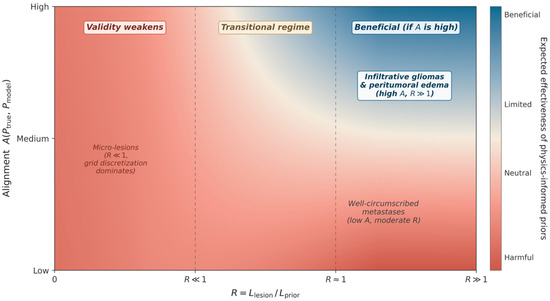
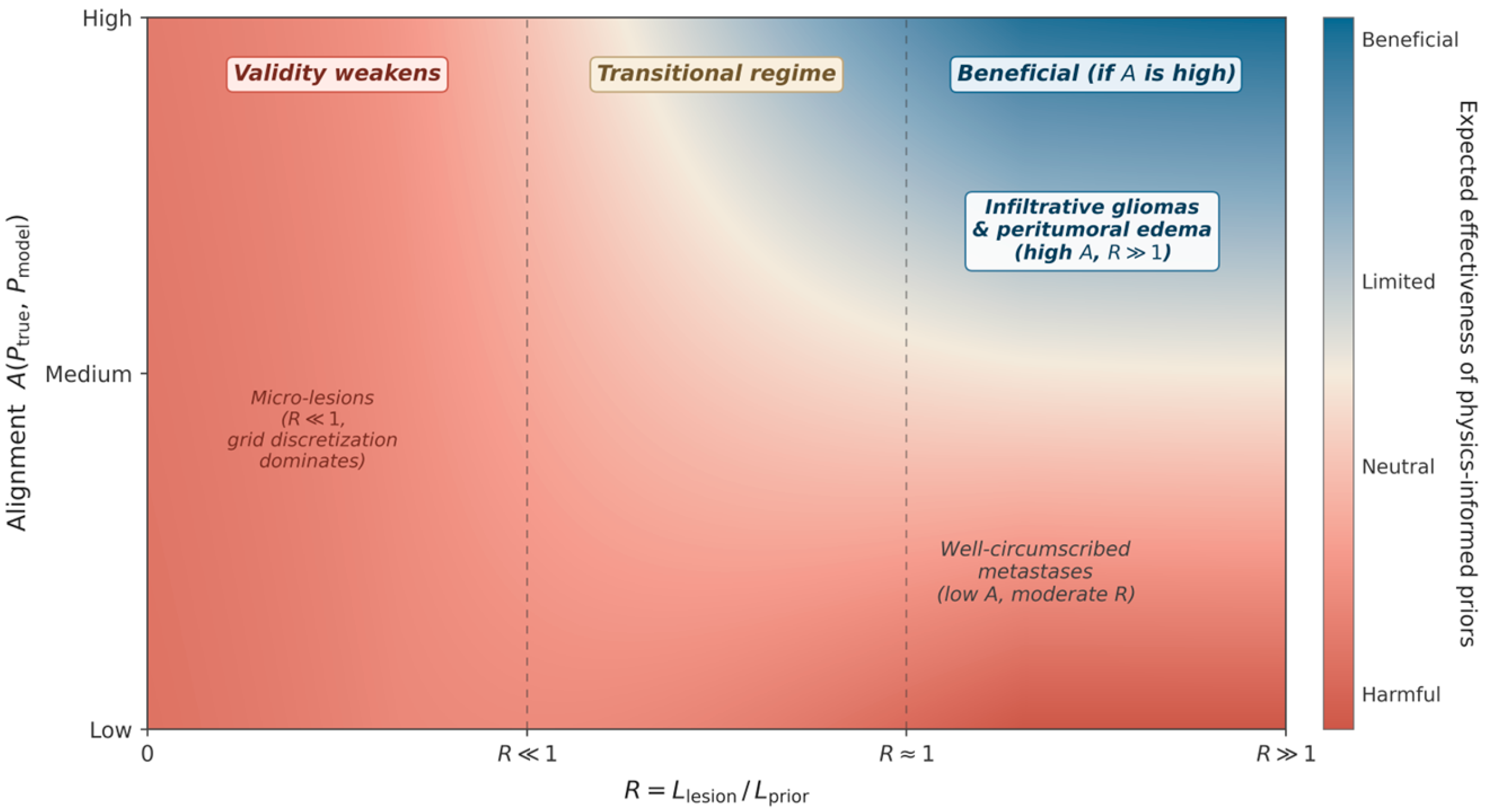
This scale dependence demonstrates that physics-informed priors are not equally effective across all lesion sizes. Their utility is limited to specific size ranges where the assumptions are approximately valid, and the greatest benefit is expected for medium-to-large lesions with diffuse boundaries. Table 1 summarizes these theoretical predictions across different imaging and biological scenarios, and Figure 1 illustrates the joint dependence on the scale ratio R and the alignment function A.
Figure 1.
Schematic illustration of the relationship between the dimensionless scale ratio R, the alignment function A, and the expected effectiveness regime of physics-informed priors. The horizontal axis represents R = Llesion/Lprior, while shading indicates three regimes: harmful/invalid (R ≪ 1), transitional (R ≈ 1), and beneficial (R ≫ 1, contingent on high alignment A).
4.4. Conditional Validity of Smoothness Constraints
At first glance, a paradox appears: physics-informed smoothness constraints seem beneficial for ambiguous boundaries yet harmful for sharp edges. However, this dichotomy resolves once one recognizes that the decisive factor is not the smoothness constraint itself, but the ratio between the spatial frequency of the actual boundary and the characteristic length scale of the imposed prior.
When the prior length scale (Lprior) is smaller than the actual boundary transition width, the smoothness prior effectively suppresses high-frequency noise without distorting boundary morphology. Conversely, when Lprior exceeds the boundary transition width, the prior imposes a continuity assumption that does not exist, leading to over-smoothing. This framework provides a principled and quantitative criterion for predicting prior effectiveness that goes beyond qualitative intuitions.
5. Methodological Design and Evaluation Perspective
5.1. Reconsidering Evaluation Metrics
Conventional voxel-based evaluation metrics implicitly assume that all segmentation errors are equivalent, regardless of lesion size, spatial context, or biological significance [47,48]. Methodologically, this assumption can render the differential effects of physics-informed constraints invisible. The preceding theoretical analysis predicts that physics-informed priors may produce different effects across lesion sizes and tissue types; aggregate metrics reduce these effects to averages, masking both potential benefits and possible harms.
Within this framework, the effect of mechanistic priors should be assessed through stratified analyses that reveal performance patterns emerging under different conditions. Table 2 presents the recommended evaluation strategy for physics-informed segmentation studies.
Table 2.
Recommended evaluation strategy for physics-informed segmentation studies.
5.2. Reporting Framework for Physics-Informed Studies
Transparent reporting is critically important for the reproducibility and interpretability of physics-informed segmentation studies. The following minimum reporting components are recommended for studies employing physics-informed constraints:
- (1)
- Physics specification. Explicit statement of the partial differential equations (PDEs) used, including all terms, parameters, and boundary conditions, along with justification for the suitability of the chosen formulation for the target pathology.
- (2)
- Parameter documentation. Clear indication of whether physics parameters (e.g., D, ρ, kd) are fixed, learned, or derived from the literature. If parameters are fixed, their sources should be provided and sensitivity analysis regarding the choices should be reported.
- (3)
- Integration modality. Explicit description of how physics constraints are embedded in the model (regularization as a loss term, architectural constraint, or post-processing). For loss-based approaches, the regularization coefficient (λ) and any scheduling strategy should be specified.
- (4)
- Alignment assessment. Discussion of the expected alignment between the physics model and the target pathology, in the context of known limitations and potential mismatches.
- (5)
- Ablation design. Comparison with (a) the same architecture without the physics constraint, (b) a general smoothness regularizer of comparable capacity, and (c) at least two different λ values to distinguish physics-specific effects from general regularization.
- (6)
- Stratified results. Reporting of performance separately for at least three lesion size categories and, where applicable, for different tissue types.
As a concrete operational example, a minimum-standard evaluation could adopt nnU-Net [5] or SegResNet [6] as baseline architectures, use BraTS-METS 2023 [10] or BraTS-GLI 2024 [49] as benchmark datasets, and compare three conditions: (a) physics-informed model, (b) same architecture without the physics term, and (c) a Laplacian smoothness regularizer of comparable capacity. Results should be stratified into at least three lesion-size bins (e.g., <1 cm3, 1–10 cm3, >10 cm3) and separated by tissue type (enhancing tumor, tumor core, whole tumor). Statistical significance should be assessed using paired Wilcoxon signed-rank tests or permutation tests across cross-validation folds.
To summarize how the theoretical constructs of Section 3 translate to implementation decisions: the physics loss (Equation (3)) specifies a concrete loss term implementable in any deep learning framework, with D(x) estimable from diffusion tensor imaging and ρ from longitudinal imaging or published parameter ranges [30]; the scale ratio R (Equation (8)) is directly computable for each lesion from ground-truth volumes and published biological parameters, enabling pre-experiment stratification; and the alignment function A (Equation (7)) provides the conceptual criterion for selecting which tissue classes and lesion types warrant physics-informed regularization.
It is worth noting that the physics-informed term contributes only to training-time computation; at inference, the segmentation network performs an identical forward pass regardless of whether physics-informed regularization was used. Real-time clinical deployment is therefore unaffected by this choice, and the ablation protocol above is intended to assess whether the training-time overhead is justified in each specific context.
5.3. Distinguishing Regularization Effects from Biological Alignment
A fundamental methodological challenge in evaluating physics-informed approaches is distinguishing genuine biological alignment from general regularization effects [14,15]. Physics-informed loss terms often function as smoothness penalties defined through differential operators. For example, the reaction–diffusion residual term can be mathematically related to Laplacian-type smoothing; this raises the question of whether observed performance gains are specific to the biological formulation or could also be obtained with simpler regularization techniques [13,14].
This distinction has direct practical implications. If physics-informed constraints function essentially as regularizers, similar benefits may be obtainable through computationally more economical general regularization methods [50,51]. Conversely, if the prior genuinely encodes biological structure, performance gains should be restricted to contexts where that structure is determinative. The proposed ablation design provides a direct tool for testing this distinction: if the physics-informed model systematically outperforms a general smoothness penalty of comparable capacity, the biological formulation transcends the mere smoothing effect. If performance levels are equivalent, the functional contribution of the physics component should be questioned.
An alternative analytical strategy is the examination of tissue-specific effects. If physics-informed priors genuinely encode biological information, performance gains are not expected to distribute homogeneously across tissue types. More pronounced improvements should be observed in tissues consistent with the encoded model, while limited or neutral effects should emerge in structurally different tissues. Conversely, uniform improvement across all tissue types suggests general regularization rather than biological alignment.
More generally, while the alignment function is, by construction, not directly computable—in analogy to Bayes risk in statistical learning theory—the framework provides computable proxies for its operationalization: the scale ratio R (Equation (8)) is directly measurable from lesion geometry and published biological parameters; the gradient norms and can be monitored during training to verify the interaction predicted by Equation (4); and cross-pathology transfer experiments, in which a glioma-trained prior is applied to metastasis data, probe the alignment function empirically. These proxies convert the formal framework into actionable design decisions without requiring access to itself.
6. Discussion
6.1. Physics-Informed Learning as Context-Dependent Regularization
The theoretical framework developed in this study demonstrates that physics-informed constraints in segmentation models function as context-dependent regularization mechanisms. The effectiveness of these constraints depends on the alignment between the encoded biological assumptions and the characteristics of the target imaging task. To state this more explicitly, physics-informed priors are both approximative and context-sensitive; while they reduce complex biological processes, their utility varies with imaging conditions and lesion characteristics. These two properties complement each other: the approximative nature determines the upper bound of potential benefit, while context dependence determines in which regimes that benefit is realized.
This approach departs from frameworks that position physics-informed learning as a universal improvement method. The developed gradient interaction framework and dimensionless scale ratio R enable quantitative prediction of these contexts and move the discussion beyond purely qualitative intuitions.
An important epistemological clarification concerns the distinction between predictive and post hoc explanatory theory. While some predictions of the framework are consistent with previously observed patterns (e.g., size-dependent performance degradation in BraTS challenges [8,10]), others extend beyond existing observations and are directly falsifiable: for instance, the prediction that physics-informed priors should yield greater improvement for edema than for well-circumscribed enhancing tumor in metastasis segmentation, or that a general smoothness regularizer of comparable capacity should produce similar aggregate but different tissue-specific gains. These specific, testable predictions distinguish the present framework from a purely retrospective account.
6.2. Implications for Future Research
This theoretical framework points to several concrete research directions:
- (1)
- Adaptive regularization strategies. Rather than applying uniform physics constraints to all spatial locations, adaptive approaches that adjust regularization strength based on local image features may be explored. For example, prediction uncertainty could be used as a gating signal; a local coefficient based on softmax entropy could strengthen physics constraints in uncertain regions while relaxing them in well-defined regions where data evidence is sufficient [52,53]. Such a mechanism could enhance the context sensitivity of physics-informed regularization.
- (2)
- Anisotropic diffusion-based priors. Instead of a simple isotropic diffusion coefficient, the use of a spatially varying diffusion tensor derived from diffusion tensor imaging data could model preferential invasion along white matter more realistically [31,44]. Although such models have been investigated in glioma growth simulations [32,35], their systematic integration as inductive biases in segmentation architectures has remained limited.
- (3)
- Systematic ablation protocols. The proposed ablation design could be translated into standardized experimental protocols for disentangling physics-informed regularization from general smoothness penalties. In particular, comparing a physics-informed loss with a Laplacian-type smoothness penalty of comparable capacity could more clearly reveal the existence of biology-specific contributions.
- (4)
- Multi-scale physics priors. The scale dependence findings suggest that different physics formulations may be appropriate in different spatial regimes. A multi-scale approach could apply PDE-based priors only to lesion components exceeding a certain size threshold while giving greater weight to data-driven learning for structures below the threshold. This could reduce the risk of over-smoothing arising from scale mismatch.
6.3. Limitations of This Analysis
This study contains several important limitations.
- (1)
- Theoretical scope. The presented framework offers a theoretical and methodological analysis. Direct experimental validation of quantitative threshold values—for example, the critical regimes of the dimensionless ratio R—lies outside the scope of this study. Nevertheless, a separate empirical study by the same authors, currently under peer review [54], investigates the empirical behavior of physics-informed approaches; the framework developed here aims at the theoretical reinterpretation and generalization of those findings. Accordingly, the present study offers a principled structure for future experimental designs rather than producing experimental results. This sequencing—first formalizing the conditions under which physics-informed priors are expected to be beneficial, neutral, or harmful, and then subjecting those predictions to controlled empirical tests—reflects a deliberate methodological choice rather than an incidental omission.
- (2)
- Focus on reaction–diffusion models. This analysis focuses primarily on reaction–diffusion formulations. Biomechanical models [31], hemodynamic constraints [27,28], or imaging physics-based approaches [26] may exhibit different structural properties. Although the general principles concerning alignment and context dependence are likely transferable, the specific predictions derived in the preceding sections are formulation-specific.
- (3)
- Brain tumor specificity. The discussion has focused on brain tumor segmentation, particularly emphasizing the biological distinction between gliomas and metastases. These findings may not directly generalize to other anatomical regions or pathologies where different biological processes predominate. Extension to different organ systems would require reformulating alignment analysis with organ-specific physics models. Importantly, the general framework—gradient interaction analysis, the alignment concept, and the scale ratio R—is transferable to any organ system, whereas the specific predictions in Table 1 are brain-tumor-specific by design. Applying the framework to, for example, hepatic or pulmonary tumors would require substituting organ-appropriate physics models (e.g., perfusion-based models for liver, airway-dependent spread models for lung) and re-deriving the corresponding alignment conditions. Such organ-specific reformulations constitute a valuable direction for future research.
7. Conclusions
In this study, a physics-informed segmentation framework was examined from a theoretical and methodological perspective. It was demonstrated that physics-informed constraints function as inductive biases rather than mechanisms that directly enhance performance. The developed formal analysis defines the conditions under which reaction–diffusion-based priors influence segmentation behavior and shows that their effectiveness depends on the alignment between biological processes and imaging characteristics.
The contributions of this study can be summarized in three key points. First, the gradient interaction framework provides a mechanistic explanation of how physics-informed priors shape learning dynamics and can predict both positive and negative effects depending on gradient alignment. Second, the dimensionless scale ratio R enables quantitative determination of the appropriate spatial regime for physics-informed priors. Third, the distinction between tumor growth and edema dynamics reveals that physics-informed priors can be effective at different levels depending on tissue type and may exhibit stronger alignment with diffuse processes.
This study does not position physics-informed learning as a universal solution; instead, it emphasizes the importance of conceptual clarity in the design and interpretation of such models. The proposed reporting framework and ablation strategy provide concrete tools for the transparent and context-sensitive evaluation of physics-informed approaches. Future work may investigate adaptive regularization strategies that adjust the strength of physics constraints according to local image context, enabling physical guidance to strengthen in uncertain regions while allowing data-driven learning to prevail in well-defined areas.
In conclusion, this perspective provides a conceptual foundation for the more principled, context-sensitive, and measurable application of physics-informed learning in medical imaging.
Author Contributions
Conceptualization, Formal Analysis, Investigation, Writing—Original Draft and Visualization, M.G.; Supervision, Formal Analysis (review), Resources, Writing—Review and Editing and Project Administration, Ö.K.B. All authors have read and agreed to the published version of the manuscript.
Funding
This research received no external funding.
Data Availability Statement
The original contributions presented in this study are included in the article. Further inquiries can be directed to the corresponding author.
Conflicts of Interest
The authors declare no conflicts of interest.
References
- Litjens, G.; Kooi, T.; Bejnordi, B.E.; Setio, A.A.A.; Ciompi, F.; Ghafoorian, M.; van der Laak, J.A.W.M.; van Ginneken, B.; Sánchez, C.I. A Survey on Deep Learning in Medical Image Analysis. Med. Image Anal. 2017, 42, 60–88. [Google Scholar] [CrossRef] [Scilit] [PubMed]
- Shen, D.; Wu, G.; Suk, H.-I. Deep Learning in Medical Image Analysis. Annu. Rev. Biomed. Eng. 2017, 19, 221–248. [Google Scholar] [CrossRef] [Scilit] [PubMed]
- Esteva, A.; Robicquet, A.; Ramsundar, B.; Kuleshov, V.; DePristo, M.; Chou, K.; Cui, C.; Corrado, G.; Thrun, S.; Dean, J. A Guide to Deep Learning in Healthcare. Nat. Med. 2019, 25, 24–29. [Google Scholar] [CrossRef] [Scilit] [PubMed]
- Ronneberger, O.; Fischer, P.; Brox, T. U-Net: Convolutional Networks for Biomedical Image Segmentation. In Proceedings of the MICCAI 2015; Springer: Cham, Switzerland, 2015; pp. 234–241. [Google Scholar]
- Isensee, F.; Jaeger, P.F.; Kohl, S.A.A.; Petersen, J.; Maier-Hein, K.H. nnU-Net: A Self-Configuring Method for Deep Learning-Based Biomedical Image Segmentation. Nat. Methods 2021, 18, 203–211. [Google Scholar] [CrossRef] [Scilit]
- Myronenko, A. 3D MRI Brain Tumor Segmentation Using Autoencoder Regularization. In Proceedings of the Brainlesion; Springer: Cham, Switzerland, 2019; pp. 311–320. [Google Scholar]
- Hatamizadeh, A.; Nath, V.; Tang, Y.; Yang, D.; Roth, H.R.; Xu, D. Swin UNETR: Swin Transformers for Semantic Segmentation of Brain Tumors in MRI Images. In Proceedings of the Brainlesion; Springer: Cham, Switzerland, 2022; pp. 272–284. [Google Scholar]
- Menze, B.H.; Jakab, A.; Bauer, S.; Kalpathy-Cramer, J.; Farahani, K.; Kirby, J.; Burren, Y.; Porz, N.; Slotboom, J.; Wiest, R.; et al. The Multimodal Brain Tumor Image Segmentation Benchmark (BRATS). IEEE Trans. Med. Imaging 2015, 34, 1993–2024. [Google Scholar] [CrossRef] [Scilit]
- Bakas, S.; Akbari, H.; Sotiras, A.; Bilello, M.; Rozycki, M.; Kirby, J.S.; Freymann, J.B.; Farahani, K.; Davatzikos, C. Advancing The Cancer Genome Atlas Glioma MRI Collections with Expert Segmentation Labels and Radiomic Features. Sci. Data 2017, 4, 170117. [Google Scholar] [CrossRef] [Scilit]
- Moawad, A.W.; Janas, A.; Baid, U.; Ramakrishnan, D.; Jekel, L.; Kofler, F.; LaBella, D.; Aerts, H.J.W.L.; Bousabarah, K.; Chakrabarty, S.; et al. The Brain Tumor Segmentation (BraTS-METS) Challenge 2023. arXiv 2023, arXiv:2306.00838. [Google Scholar]
- Karniadakis, G.E.; Kevrekidis, I.G.; Lu, L.; Perdikaris, P.; Wang, S.; Yang, L. Physics-Informed Machine Learning. Nat. Rev. Phys. 2021, 3, 422–440. [Google Scholar] [CrossRef] [Scilit]
- Raissi, M.; Perdikaris, P.; Karniadakis, G.E. Physics-Informed Neural Networks: A Deep Learning Framework for Solving Forward and Inverse Problems Involving Nonlinear Partial Differential Equations. J. Comput. Phys. 2019, 378, 686–707. [Google Scholar] [CrossRef] [Scilit]
- Cuomo, S.; Di Cola, V.S.; Giampaolo, F.; Rozza, G.; Raissi, M.; Piccialli, F. Scientific Machine Learning Through Physics–Informed Neural Networks: Where We Are and What’s Next. J. Sci. Comput. 2022, 92, 88. [Google Scholar] [CrossRef] [Scilit]
- Krishnapriyan, A.; Gholami, A.; Zhe, S.; Kirby, R.; Mahoney, M.W. Characterizing Possible Failure Modes in Physics-Informed Neural Networks. In Proceedings of the NeurIPS; NeurIPS: La Jolla, CA, USA, 2021; pp. 26548–26560. [Google Scholar]
- Wang, S.; Teng, Y.; Perdikaris, P. Understanding and Mitigating Gradient Flow Pathologies in Physics-Informed Neural Networks. SIAM J. Sci. Comput. 2021, 43, A3055–A3081. [Google Scholar] [CrossRef] [Scilit]
- Banerjee, C.; Nguyen, K.; Salvado, O.; Tran, T.; Fookes, C. PINNs for Medical Image Analysis: A Survey. arXiv 2024, arXiv:2408.01026. [Google Scholar] [CrossRef] [Scilit]
- Ahmadi, M.; Biswas, D.; Lin, M.; Vrionis, F.D.; Hashemi, J.; Tang, Y. Physics-Informed Machine Learning for Advancing Computational Medical Imaging. Artif. Intell. Rev. 2025, 58, 297. [Google Scholar] [CrossRef] [Scilit]
- Dwivedi, V.; Srinivasan, B.; Krishnamurthi, G. Physics Informed Contour Selection for Rapid Image Segmentation. Sci. Rep. 2024, 14, 6996. [Google Scholar] [CrossRef] [Scilit]
- Leontiou, T.; Frixou, A.; Charalambides, M.; Stiliaris, E.; Papanicolas, C.N.; Nikolaidou, S.; Papadakis, A. Three-Dimensional Thermal Tomography with Physics-Informed Neural Networks. Tomography 2024, 10, 1930–1946. [Google Scholar] [CrossRef] [Scilit]
- Mitchell, T.M. Machine Learning; McGraw-Hill: New York, NY, USA, 1997. [Google Scholar]
- Wolpert, D.H. The Lack of A Priori Distinctions Between Learning Algorithms. Neural Comput. 1996, 8, 1341–1390. [Google Scholar] [CrossRef] [Scilit]
- Wolpert, D.H.; Macready, W.G. No Free Lunch Theorems for Optimization. IEEE Trans. Evol. Comput. 1997, 1, 67–82. [Google Scholar] [CrossRef] [Scilit]
- Goldblum, M.; Finzi, M.; Rowan, K.; Wilson, A.G. The No Free Lunch Theorem, Kolmogorov Complexity, and the Role of Inductive Biases in Machine Learning. arXiv 2024, arXiv:2304.05366. [Google Scholar]
- Goodfellow, I.; Bengio, Y.; Courville, A. Deep Learning; MIT Press: Cambridge, MA, USA, 2016. [Google Scholar]
- Shalev-Shwartz, S.; Ben-David, S. Understanding Machine Learning: From Theory to Algorithms; Cambridge University Press: New York, NY, USA, 2014. [Google Scholar]
- Borges, P.; Sudre, C.; Varsavsky, T.; Thomas, D.; Drobnjak, I.; Ourselin, S.; Cardoso, M.J. Physics-Informed Brain MRI Segmentation. In Proceedings of the SASHIMI; Springer: Cham, Switzerland, 2019; pp. 100–109. [Google Scholar]
- Van Herten, R.L.M.; Chiribiri, A.; Breeuwer, M.; Veta, M.; Scannell, C.M. Physics-Informed Neural Networks for Myocardial Perfusion MRI Quantification. Med. Image Anal. 2022, 78, 102399. [Google Scholar] [CrossRef] [Scilit]
- Sarabian, M.; Babaee, H.; Laksari, K. Physics-Informed Neural Networks for Brain Hemodynamic Predictions Using Medical Imaging. IEEE Trans. Med. Imaging 2022, 41, 2285–2303. [Google Scholar] [CrossRef] [Scilit]
- Murray, J.D. Mathematical Biology: I. An Introduction; Springer: New York, NY, USA, 2002. [Google Scholar]
- Swanson, K.R.; Bridge, C.; Murray, J.D.; Alvord, E.C. Virtual and Real Brain Tumors: Using Mathematical Modeling to Quantify Glioma Growth and Invasion. J. Neurol. Sci. 2003, 216, 1–10. [Google Scholar] [CrossRef] [Scilit] [PubMed]
- Clatz, O.; Sermesant, M.; Bondiau, P.-Y.; Delingette, H.; Warfield, S.K.; Malandain, G.; Ayache, N. Realistic Simulation of the 3-D Growth of Brain Tumors in MR Images Coupling Diffusion with Biomechanical Deformation. IEEE Trans. Med. Imaging 2005, 24, 1334–1346. [Google Scholar] [CrossRef] [Scilit] [PubMed]
- Konukoglu, E.; Clatz, O.; Bondiau, P.-Y.; Delingette, H.; Ayache, N. Extrapolating Glioma Invasion Margin in Brain Magnetic Resonance Images: Suggesting New Irradiation Margins. Med. Image Anal. 2010, 14, 111–125. [Google Scholar] [CrossRef] [Scilit] [PubMed]
- Martens, C.; Rovai, A.; Bonatto, D.; Metens, T.; Debeir, O.; Decaestecker, C.; Goldman, S.; Van Simaeys, G. Deep Learning for Reaction-Diffusion Glioma Growth Modeling: Towards a Fully Personalized Model? Cancers 2022, 14, 2530. [Google Scholar] [CrossRef] [Scilit]
- Zhang, R.Z.; Ezhov, I.; Balcerak, M.; Zhu, A.; Wiestler, B.; Menze, B.; Lowengrub, J.S. Personalized Predictions of Glioblastoma Infiltration: Mathematical Models, Physics-Informed Neural Networks and Multimodal Scans. Med. Image Anal. 2025, 101, 103423. [Google Scholar] [CrossRef] [Scilit]
- Painter, K.J.; Hillen, T. Mathematical Modelling of Glioma Growth: The Use of Diffusion Tensor Imaging (DTI) Data to Predict the Anisotropic Pathways of Cancer Invasion. J. Theor. Biol. 2013, 323, 25–39. [Google Scholar] [CrossRef] [Scilit]
- Nayak, L.; Lee, E.Q.; Wen, P.Y. Epidemiology of Brain Metastases. Curr. Oncol. Rep. 2012, 14, 48–54. [Google Scholar] [CrossRef] [Scilit]
- Suh, J.H.; Kotecha, R.; Chao, S.T.; Ahluwalia, M.S.; Sahgal, A.; Chang, E.L. Current Approaches to the Management of Brain Metastases. Nat. Rev. Clin. Oncol. 2020, 17, 279–299. [Google Scholar] [CrossRef] [Scilit]
- Zhang, C.; Bengio, S.; Hardt, M.; Recht, B.; Vinyals, O. Understanding Deep Learning Requires Rethinking Generalization. arXiv 2017, arXiv:1611.03530. [Google Scholar] [CrossRef] [Scilit]
- Battaglia, P.W.; Hamrick, J.B.; Bapst, V.; Sanchez-Gonzalez, A.; Zambaldi, V.; Malinowski, M.; Tacchetti, A.; Raposo, D.; Santoro, A.; Faulkner, R.; et al. Relational Inductive Biases, Deep Learning, and Graph Networks. arXiv 2018, arXiv:1806.01261. [Google Scholar] [CrossRef] [Scilit]
- Goyal, A.; Bengio, Y. Inductive Biases for Deep Learning of Higher-Level Cognition. Proc. R. Soc. A 2022, 478, 20210068. [Google Scholar] [CrossRef] [Scilit]
- Papadopoulos, M.C.; Saadoun, S.; Binder, D.K.; Manley, G.T.; Krishna, S.; Verkman, A.S. Molecular Mechanisms of Brain Tumor Edema. Neuroscience 2004, 129, 1011–1020. [Google Scholar] [CrossRef] [Scilit]
- Stummer, W. Mechanisms of Tumor-Related Brain Edema. Neurosurg. Focus 2007, 22, E8. [Google Scholar] [CrossRef] [Scilit] [PubMed]
- Hawkins-Daarud, A.; Rockne, R.C.; Anderson, A.R.A.; Swanson, K.R. Modeling Tumor-Associated Edema in Gliomas during Anti-Angiogenic Therapy and Its Impact on Imageable Tumor. Front. Oncol. 2013, 3, 66. [Google Scholar] [CrossRef] [Scilit] [PubMed]
- Bondiau, P.-Y.; Clatz, O.; Sermesant, M.; Marcy, P.-Y.; Delingette, H.; Frenay, M.; Ayache, N. Biocomputing: Numerical Simulation of Glioblastoma Growth Using Diffusion Tensor Imaging. Phys. Med. Biol. 2008, 53, 879–893. [Google Scholar] [CrossRef] [Scilit] [PubMed]
- McAllester, D.A. PAC-Bayesian Model Averaging. In Proceedings of the COLT 1999; ACM: New York, NY, USA, 1999; pp. 164–170. [Google Scholar]
- LeVeque, R.J. Finite Difference Methods for Ordinary and Partial Differential Equations: Steady-State and Time-Dependent Problems; SIAM: Philadelphia, PA, USA, 2007. [Google Scholar]
- Reinke, A.; Tizabi, M.D.; Sudre, C.H.; Eisenmann, M.; Rädsch, T.; Baumgartner, M.; Acion, L.; Antonelli, M.; Arbel, T.; Bakas, S.; et al. Common Limitations of Image Processing Metrics: A Picture Story. arXiv 2023, arXiv:2104.05642. [Google Scholar]
- Maier-Hein, L.; Reinke, A.; Godau, P.; Tizabi, M.D.; Buettner, F.; Christodoulou, E.; Glocker, B.; Isensee, F.; Kleesiek, J.; Kozubek, M.; et al. Metrics Reloaded: Recommendations for Image Analysis Validation. Nat. Methods 2024, 21, 195–212. [Google Scholar] [CrossRef] [Scilit]
- De Verdier, M.C.; Saluja, R.; Gagnon, L.; LaBella, D.; Baid, U.; Tahon, N.H.; Foltyn-Dumitru, M.; Pflüger, I.; Piffer, S.; Shinohara, R.T.; et al. The 2024 Brain Tumor Segmentation (BraTS) Challenge: Glioma Segmentation on Post-treatment MRI. arXiv 2024, arXiv:2405.18368. [Google Scholar]
- Rudin, L.I.; Osher, S.; Fatemi, E. Nonlinear Total Variation Based Noise Removal Algorithms. Physica D 1992, 60, 259–268. [Google Scholar] [CrossRef] [Scilit]
- Miyato, T.; Kataoka, T.; Koyama, M.; Yoshida, Y. Spectral Normalization for Generative Adversarial Networks. arXiv 2018, arXiv:1802.05957. [Google Scholar] [CrossRef] [Scilit]
- Kendall, A.; Gal, Y. What Uncertainties Do We Need in Bayesian Deep Learning for Computer Vision? arXiv 2017, arXiv:1703.04977. [Google Scholar] [CrossRef] [Scilit]
- Gal, Y.; Ghahramani, Z. Dropout as a Bayesian Approximation: Representing Model Uncertainty in Deep Learning. In Proceedings of the ICML 2016; JMLR: Brookline, MA, USA, 2016; pp. 1050–1059. [Google Scholar]
- Güzel, M.; Baykan, Ö.K. Physics-Informed DynUNet for Brain Metastasis Segmentation. Comput. Methods Programs Biomed. 2025; under review.

Disclaimer/Publisher’s Note: The statements, opinions and data contained in all publications are solely those of the individual author(s) and contributor(s) and not of MDPI and/or the editor(s). MDPI and/or the editor(s) disclaim responsibility for any injury to people or property resulting from any ideas, methods, instructions or products referred to in the content. |
© 2026 by the authors. Licensee MDPI, Basel, Switzerland. This article is an open access article distributed under the terms and conditions of the Creative Commons Attribution (CC BY) license.