1. Introduction
Despite constant technological progress, the modern aviation industry remains a significant source of greenhouse gas emissions. In the context of global initiatives to reduce the carbon footprint and achieve sustainable development goals, the assessment of the environmental impact of flights and the processes associated with the training of aviation personnel becomes relevant. Pilot training includes the use of simulators, flight missions, the operation of aviation equipment, and the consumption of energy and resources, which together form a significant carbon footprint.
To date, there is no unified approach to quantifying the carbon footprint of aviation education and professional training processes. Although aviation-related emissions are widely recognized at the sectoral level, their representation in scientific research remains fragmented when applied to training environments. In practice, emissions arise not only from aircraft operations, but also from training flights, simulator use, energy consumption of educational buildings, supporting transport, and other institutional activities. However, these components are usually investigated separately: some studies focus on greenhouse gas accounting standards, others on regulatory and economic mitigation instruments, and others still on digital monitoring, predictive analytics, or sustainability-oriented optimization. As a result, the carbon footprint of pilot training has not yet been sufficiently integrated into a coherent methodological framework. This gap highlights the need for a hybrid model that combines expert assessment, empirical data analysis, and intelligent technologies to provide accurate, adaptive, and scalable measurement of carbon footprint in the educational environment of pilot training.
This study aims to develop a hybrid model for assessing the carbon footprint of pilot training, considering the degree of implementation of green infrastructure by educational institutions. The proposed model will allow for the quantitative assessment of a student’s individual carbon emissions, considering the primary sources of their formation, and will also formulate recommendations to support strategic decision-making in the field of environmentally sustainable aviation training.
Based on this, the following scientific research questions can be formulated (RQs):
RQ1: Does the proposed hybrid model allow for a practical assessment of a pilot’s carbon footprint during his training?
RQ2: Does the hybrid model provide the ability to automatically determine the level of carbon footprint of an aviation educational institution and generate substantiated recommendations for the strategic management of sustainable development of the educational process?
The remaining sections of this study are organized as follows:
Section 2 presents the previous experience from selected scientific works and studies on the issue.
Section 3 presents the formal formulation of the problem and describes the hybrid model.
Section 4 focuses on testing the proposed model, demonstrating its application using real data.
Section 5 discusses the results, highlights the advantages of the model, and identifies its limitations. Finally,
Section 6 provides new scientific conclusions and suggestions for future research, effectively concluding the study.
2. Overview of Selected Domestic and Foreign Research Studies
In the context of global environmental challenges, the aviation industry, particularly the pilot training system, is a significant source of greenhouse gas emissions. Therefore, the issue of assessing the carbon footprint in aviation education is gaining strategic importance for ensuring sustainable development. Modern research focuses on standardized approaches to measuring CO2 emissions, digital monitoring technologies, and integrating environmental criteria into educational processes. Given the relevance of the problem, this section reviews key scientific approaches and practical tools for assessing the carbon footprint, which is the basis for developing a hybrid model adapted to the specifics of aviation training.
The most common accounting methodologies are the Greenhouse Gas GHG Protocol [
1] and the International Organization for Standardization standard ISO 14064-1 [
2], which classify emissions into three levels: direct (Scope 1), indirect energy (Scope 2), and other indirect emissions (Scope 3). The use of digital technologies, including blockchain, IoT, and Big Data analytics, is actively being explored to improve accounting [
3,
4].
In addition to accounting methods, regulatory policy is also essential. One of the key regulatory instruments is a carbon tax, which creates economic incentives to reduce emissions through changes in production processes and the introduction of clean technologies. The effectiveness of the tax depends on its correct rate, accounting transparency, and the availability of accompanying measures [
5,
6]. It is also worth noting that Zhijie Jia et al. point to the effectiveness of combined approaches, including tax incentives, green certificates, and emissions trading systems [
7]. Attention is paid to small- and medium-sized businesses, for which simplified assessment tools that consider limited resources are essential [
8]. Thus, the combination of standardized assessment methods, digital solutions, and tax incentives forms the basis for sustainable emission management in enterprises.
These studies should be considered as a separate research direction because they mainly address economic and regulatory mechanisms of emission reduction rather than the direct methodological assessment of carbon footprint in educational aviation systems. Their value for the present study lies in showing how environmental targets can be operationalized through external policy instruments, but they do not provide an integrated framework for measuring the training-related carbon footprint itself.
In the context of the educational environment, assessing the carbon footprint of the educational process, particularly in aviation education, is a relevant area of modern research, combining environmental, technical, and academic aspects. Educational institutions significantly affect carbon emissions through energy consumption, transport operations, use of materials, and infrastructure [
9]. Given the specifics of aviation training, not only are direct emissions associated with flight training considered, but also indirect ones—energy consumption of simulators, transport of students and staff, as well as the functioning of the educational infrastructure [
10].
Digital technologies have made a significant contribution to the development of assessment methods. Current research focuses on implementing digital technologies, such as the Internet of Things (IoT), Big Data analytics, and machine learning, to collect, monitor, and analyze data, increasing carbon footprint assessment accuracy in educational institutions. For example, Mylonas et al. propose a methodology for achieving energy savings in schools using IoT infrastructure, which reduces energy consumption by 20% [
11]. Jiuxiang Li and Rufeng Wang consider the role of IoT and machine learning in educational institutions, in the context of reducing carbon footprint through effective energy management [
12]. In turn, Gao Zhenyu and Mavris Dimitri reviewed statistical and machine learning methods for analyzing aviation’s environmental impact, particularly in assessing CO
2 emissions from training flights and simulators [
13]. Thus, the use of these technologies contributes not only to operational monitoring but also to the prediction of the environmental impact of various training scenarios.
In methodological terms, this group of studies represents a distinct digital–analytical direction, because it focuses on data acquisition, monitoring precision, and predictive support. However, these works primarily improve measurement and forecasting capabilities and do not, by themselves, resolve the problem of how to aggregate heterogeneous educational, infrastructural, and operational factors into a single interpretable sustainability indicator.
A separate area of research concerns the implementation of distance learning to reduce carbon emissions from transport operations and energy consumption on campuses [
14,
15]. At the same time, it is essential to consider that digital technologies themselves require resources, which requires finding a balance between efficiency and environmental friendliness.
This line of research should also be treated separately, since it examines organizational transformation of the educational process to reduce emissions, rather than a formal method for integrated carbon-footprint assessment. Therefore, although such studies are important for identifying reduction strategies, they do not provide a unified evaluation model for pilot training under mixed real-flight, simulator, and institutional infrastructure conditions.
Energy-efficient simulators are another area of optimization. Michał Gołębiewski et al. showed in their study that simulators reduce energy consumption by 97% compared to real flights, significantly reducing carbon emissions [
16]. Marta Maciejewska et al. investigated the multi-faceted impact of the educational process—from simulators to educational infrastructure, including the integration of VR, electrification, and renewable energy [
17]. Therefore, to reduce the carbon footprint in aviation education, it is recommended to introduce energy-efficient technologies, use environmentally friendly means of transport, optimize the operation of simulators, and develop educational programs that increase the environmental awareness of students and industry professionals.
Modern approaches to carbon footprint assessment increasingly rely on fuzzy models and methods that provide flexibility, adaptability, and the ability to work with uncertain or incomplete data. Fuzzy logic allows for the effective integration of multiple sustainability criteria while considering the complex relationships between energy consumption, logistics, production processes, and behavioral factors.
In the study of Eleonora Bottani et al. [
18], a tool for assessing corporate sustainability based on fuzzy logic was proposed, which allowed for combining heterogeneous indicators into a single generalized index. A similar approach was adaptively applied to analyzing carbon footprint in industrial and educational environments. Liu integrated multi-criteria decision-making methods with fuzzy logic to assess the environmental performance of enterprises, emphasizing the possibility of more accurate modeling of conditions with uncertainty [
19].
The combinations of fuzzy logic with Data Envelopment Analysis (DEA) methods are particularly effective, as shown in the works of Ignatius et al. and Min-Chun Yu et al. [
20,
21]. Such models allow for the ranking of objects according to carbon efficiency indicators and predict the potential for their improvement under limited resources. Fallahpour et al. developed an integrated model for assessing supplier efficiency in the context of a green supply chain, considering carbon management [
22].
Similar tools are also used in the transport context. Xiao and Zhou [
23] demonstrated the effectiveness of fuzzy integrated assessment in transport systems, particularly for the analysis of the low-carbon performance of road infrastructure. Such approaches can be adapted for the study of learning processes that include a transport component.
At the level of building infrastructure, Abdulaziz Alghamdi et al. [
24] applied fuzzy clustering methods to identify structural and behavioral patterns of energy, water consumption, and carbon emission generation in university buildings. The results allowed for the identification of typical consumption profiles and target areas for energy efficiency interventions.
In summary, the reviewed studies demonstrate that the existing literature addresses several important but largely separate directions: standardized carbon accounting, regulatory and economic emission-control instruments, digital monitoring and prediction technologies, organizational changes in educational delivery, and fuzzy sustainability-oriented decision models [
25,
26]. However, none of these directions, taken separately, provides a unified methodological solution for assessing the carbon footprint of pilot training as a combined educational, infrastructural, and operational process. This unresolved gap defines the research problem of the present study: the need for an integrated model capable of jointly accounting for institution-level resource consumption, practical flight emissions, and the degree of green infrastructure implementation. Based on this, the working hypothesis of the study is that a hybrid fuzzy model can provide a more comprehensive and decision-oriented assessment of pilot-training carbon footprint than approaches that evaluate these components separately.
3. Materials and Methods
The practical basis of the study was a case study conducted at the Faculty of Aeronautics of the Technical University of Košice (Slovakia) within the bachelor-level “PILOT” study program. The methodological verification relied on institutional data collected across the 2022–2025 period and included three main empirical components: (i) annual data on electricity, natural gas, and water-related energy use of the faculty building; (ii) student practical-flight parameters for pilot training; and (iii) expert assessments of the level of green infrastructure implementation. In this way, the methodological framework presented below was directly linked to a real educational environment used for subsequent calculations and verification.
For the institutional case considered in this study, the empirical basis covered one aviation faculty building and three consecutive academic years of pilot training. The student population used for the institutional emission normalization included 34 trainees in 2022/23, 32 in 2023/24, and 31 in 2024/25. The expert component involved 15 specialists with experience in ecology and urban planning, who evaluated green infrastructure criteria using a predefined linguistic scale and confidence coefficients. The practical-flight component was demonstrated using the Viper SD4 as the homogeneous reference aircraft for the main calculation scenario, while acknowledging the presence of other training aircraft types in the program.
3.1. Formal Formulation of the Evaluation Problem
Based on theoretical and systemic generalization, a definition of carbon footprint in the context of the pilot training process is formulated.
Definition 1. The carbon footprint of pilot training is the total amount of greenhouse gas emissions generated by the activities of participants in the educational process, the functioning of the academic institution’s infrastructure, and the operation of aviation equipment during flight training.
All greenhouse gases (water vapor, nitrous oxide, methane, etc.) were converted into a carbon dioxide equivalent (CO2-equivalent) to simplify calculations. This meant determining the amount of CO2 (in tons) that created a greenhouse effect comparable to the impact of a given amount of another greenhouse gas.
Carbon footprint includes direct and indirect emissions.
In our study, direct emissions are defined as the amount of CO2 or other greenhouse gases directly emitted into the atmosphere from the territory of the educational institution. The primary sources of such emissions were the consumption of thermal energy and electricity in educational buildings (in particular, for heating and conducting the educational process), as well as the use of aviation fuel during practical flights by students.
Indirect emissions are defined as the amounts of greenhouse gases that arise during the production, transportation, and use of products and services that are necessary to ensure the educational process (for example, stationery, equipment, household supplies, etc.).
Accurately calculating all greenhouse gas emissions was difficult and, in some cases, impossible. Indirect emissions are usually not recorded in an educational institution. For example, the amount of CO2 produced because of the decomposition of household waste could not be accurately determined or estimated.
Developing Green Infrastructure (GI), which includes ecological facilities and green spaces, is becoming an effective strategy for supporting a sustainable environment. Modern educational institutions are actively implementing these approaches, but a question arises: How can we assess the effectiveness of implementing green infrastructure in academic institutions?
Such an assessment should be carried out by experts or a group of experts who, based on their experience and knowledge of the research object, can conduct an analysis and form well-founded conclusions.
Given this, for assessing the carbon footprint in training pilots, it was advisable to use methods of fuzzy set theory, which allow for modeling and processing probabilistic judgments. The construction of mathematical models in our study was based on objective information about the object and expert assessments, which may have been fuzzy or linguistic. Such assessments reflected the content features of the phenomenon under study and were formulated in natural language.
In addition, to form a final assessment, it was necessary to bring all the initial data to a single measurement scale. The indicator of the number of tons of CO2 by itself did not carry a meaningful load without comparison with reference levels. Comparison with the indicators of leading or weaker educational institutions allowed for management to form conclusions and implement policies to achieve the goal of a zero-carbon footprint in the educational process of pilot training.
A hybrid model was developed that allowed us to estimate the amount of CO
2 emissions during pilot training and the level of carbon footprint, considering the degree of implementation of green infrastructure by the educational institution. Formally, the hybrid fuzzy model can be represented as a set-theoretic system:
where
—a designated aviation educational institution that trains pilots;
—a student studying to be a pilot at the relevant academic institution;
—an expert group consisting of specialists in assessing the implementation of green infrastructure and environmental management;
—a fuzzy method for estimating the amount of CO
2 emitted into the atmosphere by an educational institution using energy carriers;
—a fuzzy method for estimating CO
2 emissions emitted into the atmosphere during practical flight training of pilots (students);
—a formalized hybrid approach for assessing the level of implementation of green infrastructure in an educational institution; and
—a fuzzy method for aggregating knowledge of the carbon footprint in the pilot training process. The initial estimate
, consists of:
—aggregated individual estimate of CO
2 emissions in the pilot training process,
L—carbon footprint level taking into account the degree of implementation of green infrastructure by the educational institution, and
R—recommendations to support strategic decision-making in the field of environmentally sustainable aviation training.
To develop a hybrid model, the following management entities are defined: a system analyst—a specialist responsible for setting up the assessment process by the logic of the hybrid model; and a decision-maker (DM)—a manager or authorized representative of an aviation educational institution responsible for strategic planning, implementing environmental initiatives and ensuring that educational processes meet modern requirements for sustainable development and ecological safety.
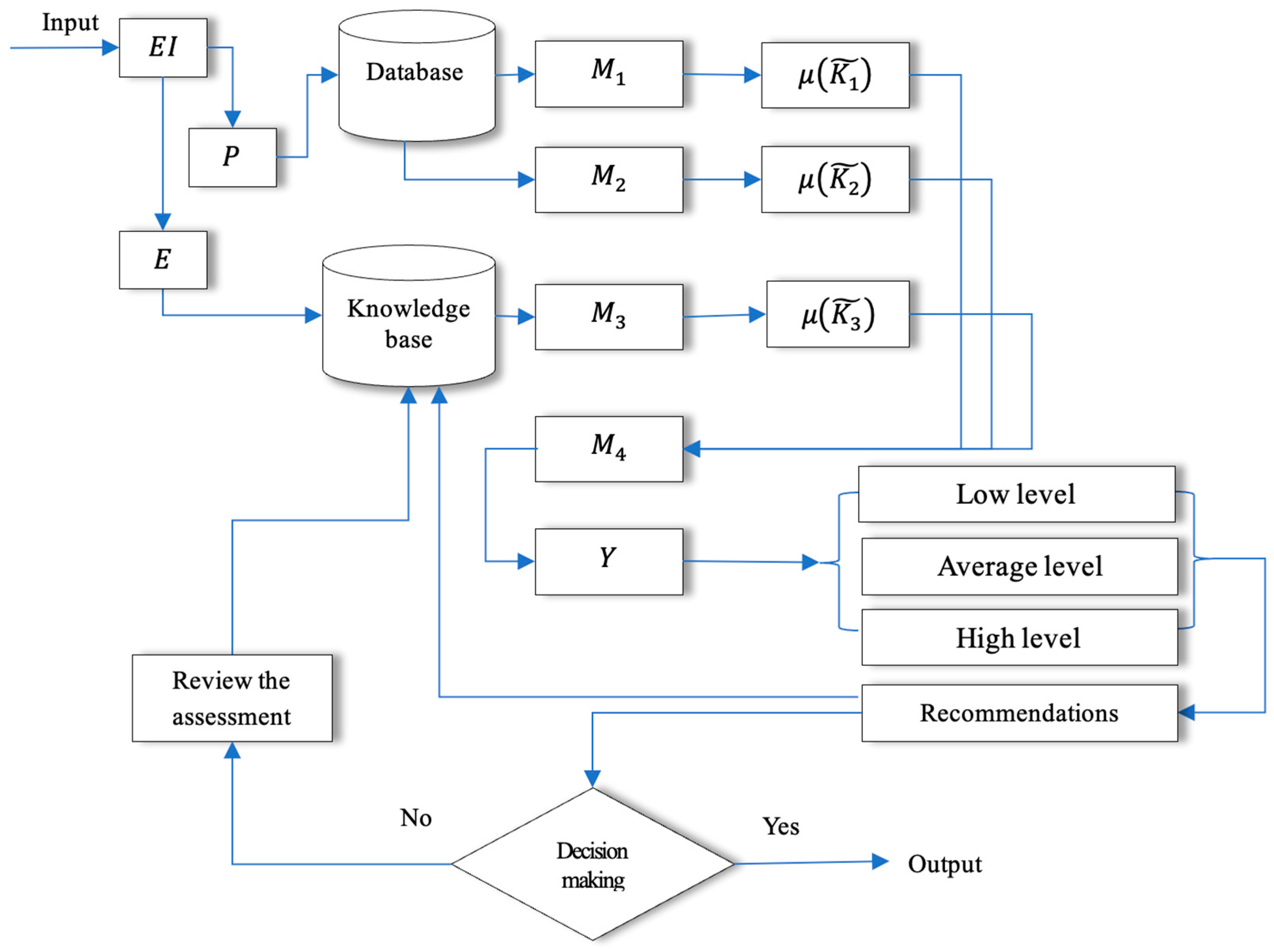
The process of assessing the carbon footprint in the pilot training process is formally presented in
Figure 1.
To begin the process, an aviation educational institution is determined for assessment, which trains pilots . An expert group () is also formed to assess the implementation of green infrastructure and environmental management. The database contains information on the volumes of electricity and natural gas consumed by all buildings of the educational institution during the entire period of the student’s training, the corresponding CO2 emission factors for electricity and gas in each year of pilot training, as well as the total number of students of the educational institution. This information is used to calculate the amount of CO2 emitted into the atmosphere by the academic institution using energy carriers () and to estimate CO2 emissions emitted into the atmosphere during the practical flight training of pilots (). In parallel, the level of implementation of green infrastructure in the educational institution () is assessed based on the knowledge of the expert group (). Next, the obtained knowledge () is fed into the aggregation of knowledge of the carbon footprint in the pilot training process (). As a result, an aggregated individual estimate of CO2 emissions in the pilot training process (Y) and the carbon footprint (L) level are derived. Based on the knowledge obtained, the DM recommendations are formed. The results obtained from the hybrid model form the research knowledge base. The DM analyzes and decides on further actions based on the generated recommendations. In case of dissatisfaction with the results, a re-evaluation is performed by adjusting the relevant parameters in the knowledge base.
To determine the initial estimates, the proposed methods and approaches are considered in detail .
3.2. A Fuzzy Method for Estimating the Amount of CO2 Emitted into the Atmosphere by an Educational Institution Using Energy Sources—
The fuzzy method (
) for estimating the amount of CO
2 emitted into the atmosphere by an educational institution using natural gas and electricity can be formally represented as an operator:
At the operator’s input, —the amount of electricity consumed by all buildings of the educational institution during the entire period of the student’s studies; —the amount of natural gas consumed during the whole period of the student’s studies; and —the amount of water consumption during the entire period of a student’s training. At the output, we obtain: , the number of tons of CO2 emitted into the atmosphere by the educational institution per student, and the normalized level .
To estimate the number of tons of CO
2 emitted into the atmosphere by an educational institution using natural gas and electricity, the following calculation is proposed:
where
i—the year of pilot training;
—the total amount of electricity consumed by all faculty buildings during the
i-th year of pilot training;
—the total amount of natural gas consumed by all faculty buildings during the
i-th year of pilot training;
—total water consumption of the faculty buildings during the
i-th year of pilot training;
—the carbon emission factor of electricity in the
i-th year of pilot training (tCO
2/mWh);
—the carbon emission factor of natural gas in the
i-th year of pilot training (tCO
2/mWh); and
—carbon emission factor of water consumption in the
i-th year of pilot training (tCO
2/mWh).
It is noted that emission factors are regulatory values that determine the amount of CO2 emissions (in tons) per 1 megawatt-hour of consumed electricity, natural gas, or energy spent on water supply, considering the energy source and its production technologies.
Since the goal is to calculate the amount of CO
2 emissions (in tons) per student for the entire period of study:
where
is the number of students in the educational institution in the
i-th year of study. This approach allows us to normalize the total emissions in proportion to the number of students who cause them and thereby ensure a unified presentation of data for further analysis. The calculation of the average value per student facilitates comparison between different educational institutions, contributes to the assessment of the effectiveness of the implemented eco-saving measures, and is convenient for management decisions.
Thus, we obtain a fuzzy value —the total amount of CO2 emitted into the atmosphere by an educational institution due to the consumption of energy resources (natural gas, electricity and water consumption) per student for the entire period of study, which, as a rule, is n = 3 years for obtaining a bachelor’s degree.
As a result, the numerical variable
, although based on quantitative indicators, is still a fuzzy number since it depends on several complex factors to measure or predict accurately. These are fluctuations in energy consumption in different years, seasonal changes in heating, energy efficiency of buildings, other numbers of students in groups, changes in electricity sources, losses during energy transportation, etc. Due to the inability to consider all these factors with complete accuracy, the result has a characteristic of fuzziness, which is advisable to describe using fuzzy set theory. In addition, normalized values are necessary for further data comparison. For this purpose, it is advisable to apply modeling of fuzzy knowledge using the fuzzy set apparatus and membership functions [
27], which increases the objectivity of estimates. To normalize the number of tons of CO
2 emitted by an educational institution, it is proposed to use a membership function of the quadratic Z-spline type:
where the numerical parameters are calculated as follows
. In this case, standardization concerns the minimum and maximum values of electricity and natural gas consumed during the student’s study period. Without reducing the generality, these numerical parameters can be proposed in another way. For example, take the most minor and most significant amount of predicted annual resource consumption after energy-efficient reconstruction of buildings.
A quadratic Z-spline is used because the function best corresponds to the logic of assessing environmental indicators: the smaller the value, the higher the membership. Such a function provides a smooth decrease in the membership value as it approaches the upper emission limit, has a straightforward interpretation of the parameters (minimum and maximum values), and also allows for avoiding sharp changes in the results, which makes it more adequate compared to linear or symmetric functions that do not take into account the one-sided nature of the desirability of the result.
Formula (5) shows the comparable level of CO2 emissions by an educational institution into the atmosphere per student. The resulting value of the estimate characterizes that the smaller the emissions value, the higher the indicator increases and approaches unity.
The presented method allows us to account for annual fluctuations in energy consumption, changes in the structure of the student contingent, and other vaguely defined factors. A quadratic Z-spline membership function was used to normalize the results, which provides an objective interpretation of the level of environmental load. This approach is convenient for comparative analysis and management decision-making in the context of decarbonization of the educational process.
3.3. Fuzzy Method for Estimating CO2 Emissions Released into the Atmosphere During Practical Flight Training of Pilots (Students)—
The purpose of the
model is to provide a fuzzy estimate of the amount of CO
2 emissions to the atmosphere that occur during practical flight training of pilots. This allows for the uncertainty in the duration of flights and the heterogeneity of the aircraft and fuel used to be considered, providing a more flexible and realistic analysis of the environmental impact of the training process. A fuzzy estimate
of the amount of CO
2 emissions that enter the atmosphere during practical flight training of pilots is proposed. The operator gives the formal representation of this model:
where
—the total number of hours provided for in the student flight training curriculum, the output is
—the number of tons of CO
2 emitted into the atmosphere during the pilot’s practical training, and the normalized level of uncertainty
.
As such, the following can be determined:
where
—the total number of hours provided for in the student flight training curriculum, the output is
—the number of tons of CO
2 emitted into the atmosphere during the pilot’s practical training,
j—the number of the year of the pilot’s practical training.
In the case where different types of aircraft operating on various types of fuel are used for pilot training, then, without loss of generality, Formula (7) must be refined by breaking it down into a multiplicative sum that considers the number of hours spent on each type of aircraft.
Thus, we will obtain —the amount of CO2 emitted into the atmosphere during practical training per student.
Similarly to the previous model, fuzzy knowledge modeling is used using a membership function based on a quadratic Z-spline to compare the obtained data:
There are situations when part of the flight training sessions can be replaced by simulators, which will cause the actual number of hours of real flights in a specific academic year to be fewer. At the same time, all classes may take place exclusively in the air on airplanes. Accordingly, the membership function parameters should be selected, considering the specific situation of the practical training of pilots in the relevant educational institution. For example, we propose that . Then, the assessment level is determined by the minimum and maximum number of flight hours.
Formula (9) reflects a fuzzy estimate of the amount of CO2 emissions into the atmosphere during the practical training of one student. At the same time, the smaller the actual value of emissions, the higher the membership function index, approaching unity.
Replacing part of the training flights with classes in flight simulators directly affects the method’s parameters since the actual number of hours of real flight () decreases, and therefore, the amount of CO2 emissions. This, in turn, leads to an increase in the value of the membership function μ . Thus, the use of simulators reduces the environmental load and allows for obtaining a higher fuzzy estimate due to lower emissions into the atmosphere.
3.4. A Formalized Hybrid Approach to Assessing the Level of Green Infrastructure Implementation in an Educational Institution—
Environmental sustainability and green development are becoming a priority in modern educational strategies. One of the key areas of implementing these strategies is the implementation of GI, which reduces the carbon footprint and contributes to harmonizing the interaction of the institution with the environment. At the same time, methods for formalizing the level of integration of GI remain underdeveloped, which complicates the adoption of informed management decisions in sustainable development. The functioning of any modern educational institution involves reducing the carbon footprint through the implementation of green infrastructure. However, the system for assessing GI’s development level to support environmental sustainability remains insufficiently studied. In this regard, a hybrid approach to determining the degree of implementation of GI in an educational institution is proposed, which is formalized using the following operator:
The operator models the procedure for assessing the degree of implementation of GI based on hybrid data–linguistic assessments of experts for each criterion from the set K and the corresponding reliability coefficients . The result of the operator is the normalized value , which characterizes the generalized level of implementation of green infrastructure.
GI in an educational institution is estimated based on the input expert assessments, the proposed set of criteria—. Each criterion is estimated by the expert using the linguistic assessment of the term set of linguistic variables , where L—“low level”; BA—“level below average”; A—“average level”; AA—“level above average”; H—“high level”. Also, to each assessment, the expert puts the “confidence” number of his reasoning in the range from 0 to 1, which reflects the degree of confidence in the provided assessment. This information allows for the consideration of both qualitative and quantitative uncertainty when forming an overall assessment of the level of implementation of green infrastructure in an educational institution.
As a result of theoretical and systemic generalization, a set of criteria for assessing GI in an educational institution was determined, as follows.
—Formation of species biodiversity. The development of green infrastructure should contribute to the maximum increase in species diversity.
—Provision of habitat for species. The development of GI should maximize the functions of creating a favorable environment for the habitat of various species.
—Use of local plants and elements. The development of green infrastructure should provide for the priority use of local flora and natural elements.
—Use of environmentally friendly materials. When designing GI, sustainable materials should be used to the maximum extent, characterized by naturalness, a low degree of processing, energy efficiency, minimal pollution, low toxicity, and ease of natural decomposition.
—Reduction in energy consumption. The development of GI should ensure a significant reduction in the use of non-renewable energy sources by introducing renewable resources, such as solar, wind, hydropower, etc., in the life cycle of objects.
—Increase in energy efficiency and reduction of carbon emissions. The development of green infrastructure should maximize energy savings using low-carbon energy sources and the reduction of harmful emissions.
—Harmonization with the environment. When designing GI, the impact on the environment and the harmonious combination of the landscape with natural conditions should be considered.
—Implementation of environmental engineering. The development of green infrastructure should involve the use of environmental technologies and concepts to minimize damage to the environment.
—Increasing the level of green cover. The design of GI should contribute to the maximum expansion of green areas and cover.
This set of criteria is an open set; a systems analyst can always adjust them, and they also provide a multidimensional assessment of ecological integration, considering both bioecological and engineering, and organizational aspects.
Let the term set of linguistic variables
be given on some numerical interval
, where
r is the number of linguistic terms used for evaluation. For example, for the given linguistic variables, we can propose the following interval,
, where
. We propose to consider the dependence of the level of the green infrastructure implementation criterion T and the “reliability”
of the expert’s reasoning regarding the level assignment using the membership functions of the quadratic S-spline. Since the quantitative values
are known and the intervals of numerical values for
are known, then for each criterion, we express the dependence:
Depending on the expert’s level of confidence in his assessment, the function allows for adaptive changing of the numerical representation of the linguistic variable. This allows for the consideration of the subjectivity of judgments without losing the formalized structure.
It is noted that are the values of the ends of the intervals, which are given depending on the linguistic variable , .
Since the terms are defined on a certain interval of values, the obtained values
are normalized:
The obtained value is interpreted as a function of the disclosure of uncertainty of fuzzy expert reasoning regarding the level of green infrastructure implementation and the amount of “confidence” regarding the level assignment. The larger the value , the higher the level of the criterion K.
Thus, at the initial stage, the input hybrid data, which included both linguistic and quantitative assessments, was fuzzified. As a result of this process, it was possible to reduce heterogeneous data to a unified numerical form, which provides the possibility of further objective analysis and comparison. That is, there was a transition from fuzzy and subjective assessments to a single integrated metric suitable for formal calculation.
Suppose that, for further decisions on the assessment of the process of implementing GI by an educational institution, there is a need to set the weight coefficients
from the interval [1; 10] for each criterion. In the absence of a need for prioritization by experts, the equivalence of all criteria is assumed without loss of generality. Since all calculations are carried out in a unified measurement scale, the normalized weight coefficients are then determined following the given values:
At the next stage, an aggregated (integral) assessment of the level of GI implementation in an educational institution is calculated. For this purpose, it is advisable to use the average convolution method, which allows for combining individual normalized assessments for all criteria into one generalized value. This approach is justified, since it provides a balanced assessment, considering both the quantitative values of each criterion and their importance in the overall structure of GI implementation:
The normalized aggregated score is an integral indicator of the environmental maturity of an educational institution. It allows for comparing different institutions by the level of implementation of GI, as well as identifying strong and weak aspects of the environmental policy of the institution. The higher the score, the greater the environmental sustainability of the educational institution, which is able not only to create a carbon footprint, but also to absorb it.
3.5. A Fuzzy Method for Aggregating Knowledge of the Carbon Footprint in the Pilot Training Process—
At this stage, three key pieces of knowledge are formed for further analysis:
—an estimate of CO
2 emissions into the atmosphere by an educational institution using natural gas and electricity, per student;
—an estimate of CO
2 emissions into the atmosphere during a student’s practical training; and
—a normalized estimate of the implementation of GI by an educational institution. To obtain an integral indicator
Y, which reflects an individual estimate of CO
2 emissions during the pilot training process, it is necessary to aggregate the specified estimates. Given the uncertainty in the initial data, it is advisable to apply a modeling method of the “average value” type in three-dimensional space. For this purpose, it is proposed to use a cone-shaped membership function, which provides soft aggregation and allows for preserving the influence of each factor when forming the final estimate:
where
—distance in three-dimensional space from the current vector value of the estimates to the reference point (1; 1; 1);
—value of the corresponding normalized estimate (
l = 1, 2, 3);
—coordinates of the center of the base of the cone, which corresponds to the ideal state (minimum CO
2 emissions and maximum GI implementation); and
—non-zero numerical scaling parameters along the corresponding coordinates of the vector
, which should be chosen equal to 3 to preserve the symmetry of the space and balance the influence of the estimates. The scaling parameters were set to maintain the isotropic sensitivity of the aggregation space. This ensures that deviations in institutional energy use, flight emissions, and green infrastructure development have equal influence on the resulting sustainability score. This design choice reflects the conceptual assumption that none of the three components dominates the environmental performance of pilot training, which is consistent with integrated sustainability frameworks in higher education.
Thus, the initial aggregated individual estimate of CO2 emissions during pilot training was obtained in the interval [0.423; 1]. The lower limit of this range corresponds to the mathematical interpretation of the used cone-shaped membership function. It is noted that the obtained integral indicator can be used as an indicator of the environmental efficiency of educational programs in the field of aviation, which directly supports the UN Sustainable Development Goals, in particular Goal 13 “Combating Climate Change”.
The choice of membership functions used in this hybrid model was not arbitrary. Quadratic Z-spline functions were selected for modeling CO2-related indicators because they provide a monotonic and asymmetrical response that corresponds to the environmental desirability principle, where lower emissions are always preferable and should receive a higher membership value. S-spline functions were applied to green infrastructure indicators to model the gradual growth of sustainability maturity under increasing expert confidence. The cone-shaped aggregation function was chosen to preserve the geometric balance between energy consumption, flight emissions, and green infrastructure implementation, while ensuring smooth degradation of the environmental performance index when any of these components deviates from its ideal value.
This selection is also consistent with the broader fuzzy-sustainability literature, where monotonic membership functions are commonly used when environmental desirability is directionally ordered, and where sensitivity analysis is recommended to verify the stability of conclusions against parameter perturbations. In this study, the Z-spline functions were retained because they ensure a smooth one-sided penalty for increasing emissions, whereas the S-spline representation was preserved for green infrastructure. After all, it reflects gradual maturity growth rather than abrupt threshold effects. The cone-shaped aggregation was kept as a geometrically balanced compromise that does not overweight any single sustainability component.
Next, the level of carbon footprint is determined, considering the degree of implementation of green infrastructure by the educational institution (L). For this, the obtained aggregated value (according to Formula (15)) is compared with one of the term sets , which reflects the qualitative level of carbon footprint considering the degree of implementation of GI by the educational institution. The following intervals are established for classification:
(0.856; 1]— = “low level of carbon footprint in the pilot training process”. This range reflects the situation when the educational institution implements green infrastructure measures as effectively as possible, actively reduces CO2 emissions using energy-efficient technologies and alternative energy sources, minimizes natural gas consumption, and optimizes practical training. Such institutions demonstrate the highest environmental responsibility in the context of aviation personnel training.
(0.65; 0.856]— = “average level of carbon footprint in the pilot training process”. This level characterizes educational institutions that have partially implemented environmental optimization measures. They have certain elements of green infrastructure, but overall, CO2 emissions remain at a moderate level. This may be due to the limited use of renewable energy or insufficient coverage of environmental initiatives in the educational process.
[0.423; 0.65]— = “high level of carbon footprint in the pilot training process”. This interval indicates the absence or minimal implementation of environmental measures in the educational institution. The main sources of emissions are the intensive use of traditional energy sources, low energy efficiency, and imperfect environmental policy. Such institutions require priority modernization towards sustainable development and reductions in environmental impact.
The interval boundaries defining low, average, and high carbon footprint levels were established through empirical calibration using the TUKE dataset combined with expert judgment, aiming to maximize discrimination between sustainability performance classes. These thresholds do not represent universal regulatory limits but serve as relative benchmarks that can be adjusted for other institutions or regions using larger comparative datasets.
For transfer to another institution, we propose the following recalibration protocol: (i) collect at least three consecutive academic years of local data on building energy use, water consumption, student cohort size, flight hours, aircraft types, fuel types, and locally applicable emission factors; (ii) recalculate the institution-specific emission indicators using Equations (3)–(8); (iii) redefine the lower and upper bounds of the quadratic Z-spline membership functions in Equations (5) and (9) based on local observed ranges or justified target scenarios; (iv) repeat the expert assessment of green infrastructure using the same linguistic scale and confidence coefficients and recompute the GI score using Equations (11)–(14); and (v) reset the final class intervals for the carbon footprint levels according to the empirical distribution of the aggregated indicator Y for the local dataset. If climatic, infrastructural, or regulatory conditions differ substantially, the recalibrated parameters should be reported together with their local justification to preserve transparency and comparability.
This interval delimitation is selected considering the necessary contrast between carbon footprint levels to ensure that the assessment system is sufficiently sensitive to changes in CO2 emissions. The delimitation of intervals requires the involvement of real empirical data obtained by studying educational institutions with different levels of implementation of green infrastructure.
The knowledge gained is then used to provide recommendations to support strategic decision-making in the field of environmentally sustainable aviation education (R).
For a low carbon footprint (), the educational institution already has effective environmental practices, so the following are recommended:
—Maintain existing energy efficiency and environmental responsibility measures.
—Implement small improvements, such as the use of additional renewable energy sources.
—Continue to monitor emissions and regularly update the environmental strategy.
—Share experience and best practices with other educational institutions.
For the medium carbon footprint (), the educational institution has a moderate impact; therefore, the following are recommended:
—Actively implement energy-saving technologies and measures to optimize the use of energy resources.
—Gradually switch to renewable energy sources, for example, install solar panels.
—Optimize practical training, increase the use of simulators and remote technologies.
—Introduce systems for regular monitoring and reporting of CO2 emissions.
—Conduct training programs for staff and students on reducing environmental impact.
For a high carbon footprint (), the educational institution has a significant environmental impact, so the following are necessary:
—Conduct a comprehensive audit of energy consumption and environmental risks.
—Implement large-scale energy-saving and CO2 emission reduction measures.
—Develop and implement a plan for the transition to renewable energy sources.
—Minimize flights during practical training, increasing the use of simulators.
—Establish systems for monitoring and managing environmental indicators with mandatory reporting.
—Organize large-scale educational campaigns to raise environmental awareness among all participants in the process.
—Consider the possibility of certifying environmental activities following international standards.
The recommendations are useful for aviation education leaders and specialists, environmental analysts, curriculum developers, and policymakers in the field of sustainable development. They enable a systematic approach to assessing and reducing carbon footprints and promote the implementation of effective energy conservation and environmental responsibility measures at different stages of the educational process. Thanks to this, educational institutions can more consciously plan their environmental strategies, optimize resources, and maintain high standards of sustainable aviation education that meet modern requirements for environmental safety and social responsibility.
4. Results
This section presents the results of experimental verification of the developed hybrid model. The experiments aim to comprehensively assess the environmental impact of the pilot training process through energy consumption and flight practice. The substantiated methodology is based on a combination of quantitative calculations of CO2 emissions and qualitative expert assessment of the components of the green infrastructure implemented in the educational institution.
The following results, therefore, represent the empirical verification of the methodology described in
Section 3 based on the defined institutional case study.
The validation was carried out based on actual data from the Technical University of Košice (Slovakia), where the “PILOT” training program at the Faculty of Aeronautics provides comprehensive training for students. Practical classes cover both theoretical and real-world flight training, provided on modern training aircraft, including the Viper SD4 and Diamond DA-40 TDI. The verification included the calculation of CO2 emissions caused by the energy consumption of the faculty building, practical flights of students, as well as the level of integration of green infrastructure elements, assessed using expert methodology.
For methodological clarity, the experimental calculation was based on a homogeneous aircraft type (Viper SD4), while acknowledging that other training aircraft, such as the DA-40 TDI, exhibit different fuel and emission profiles. The model is designed to accommodate multiple aircraft types through weighted aggregation, a feature that can be applied in future institutional implementations.
As a result of the experiments, complex values of environmental efficiency parameters were obtained, including quantitative estimates of total and individual CO2 emissions and normalized values of membership functions, which allow for assessing the level of carbon footprint of the educational process. The results obtained are used to formulate recommendations for increasing the environmental sustainability of aviation training, considering modern requirements for the decarbonization of the educational sphere.
The “PILOT” study program within the Faculty of Aeronautics involves the use of one faculty building. Input data for model
regarding energy consumption costs, presented in mWh (natural gas, electricity, and water consumption) [
28], are given in
Table 1.
Data for carbon emission factors for electricity are taken from the official website of Slovak Power Plants [
29]. Data for carbon emission factors for natural gas are taken from official sources, the Slovak gas industry—distribution [
30]. Data for carbon emission factors for water supply are taken from the Slovak Water Management Enterprise [
31]. All these data are presented in
Table 2.
Within the framework of a formalized hybrid approach to assessing the level of green infrastructure implementation in an educational institution, an expert survey was conducted. A total of 15 experts from the Technical University of Košice, with extensive experience in the field of ecology and urban planning and selected for their professional competence, were involved in the assessment. The authors of the article were also members of the expert panel, which, we recognize, may create a potential risk of confirmation bias or perceived conflict of interest in the expert component of the assessment. To reduce this risk, the survey was conducted individually using a questionnaire, while the criteria set, linguistic scale, and evaluation procedure were predefined before aggregation. In addition, all judgments were processed using the same formalized procedure with explicit confidence coefficients. The consistency of expert assessments was verified using Kendall’s concordance coefficient, which reached 0.78, indicating substantial agreement across the panel, although some inter-expert variability remained possible. Therefore, the obtained green infrastructure score should be interpreted as a robust expert-informed institutional estimate suitable for comparative and strategic evaluation, rather than as a fully independent external certification result. The input data obtained from the survey are given in
Table 3 [
28].
The calculation of the estimated number of tons of CO2 emissions during the pilot training process was carried out using the developed hybrid model in terms of the presented methods.
—A fuzzy method for estimating the amount of CO2 emitted into the atmosphere by an educational institution using energy carriers.
First, the number of students of the Faculty of Aviation studying to become pilots, with a bachelor’s educational qualification level, for 3 years from 2022 to 2025, is given, namely:
In the 2022/23 academic year, a total of 34 pilots were in training. Of these, 6 were cadets, and 28 were civilian pilots, including 10 foreign citizens.
In the 2023/24 academic year, the total number of pilots in training was 32. Among them were 5 cadets and 27 civilian pilots, of whom 15 were foreigners.
In the 2024/25 academic year, 31 pilots were in training. Of these, 5 were cadets, and 26 were civilian pilots, including 13 foreign citizens.
Therefore, the following can be determined: 34, 32, 31.
Based on the input data, to calculate
, the multiplication is first calculated according to Formula (3):
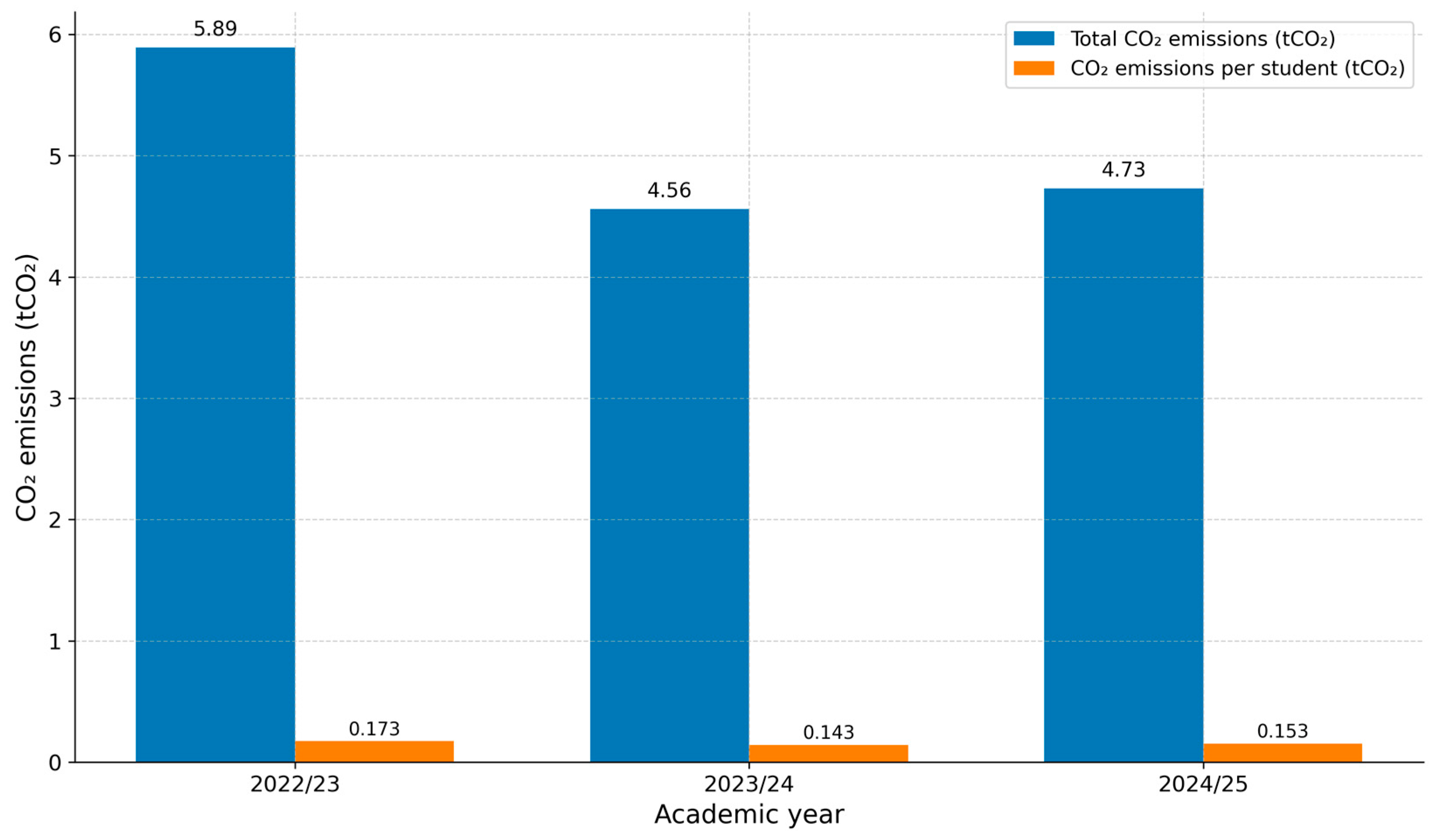
5.895;
4.561;
4.731. The data visualization is shown in
Figure 2.
Thus, the total number of tons of CO2 emitted into the atmosphere by the educational institution over the 3 years from 2022 to 2025 was 15,187 tons of CO2. To calculate the amount of CO2 per student, Formula (4) is used: = 5.895/34 + 4.561/32 + 4.731/31 = 0.469 (tCO2).
Next, to calculate the normalized amount of CO2 emitted into the atmosphere by the educational institution, a quadratic Z-spline is used. At the first stage, the corresponding numerical parameters = 0.428; = 0.52 are determined. Then, according to Formula (5) is calculated = 0.609.
The obtained value = 0.609 indicates an average level of CO2 emissions due to the energy consumption of the educational building, which requires further measures to improve energy efficiency.
—A fuzzy method for estimating CO2 emissions emitted into the atmosphere during practical flight training of pilots (students).
During practical flight training, one of the key environmental aspects is the amount of CO
2 emissions generated by fuel combustion. A ViperSD4 aircraft, equipped with a Rotax 912 ULS piston engine (100 hp), consumes approximately 16.4 L of fuel per hour during cruise flight [
32]. Given that aviation gasoline (100 LL or MOGAS) emits approximately 2.31 kg of CO
2 per liter, the total emissions are approximately 0.038 tons of CO
2 per hour of flight. In contrast, a Diamond DA-40 TDI, equipped with a diesel engine and using aviation kerosene (Jet-A or diesel fuel), consumes approximately 20 L per hour, which corresponds to approximately 0.05 tons of CO
2 per hour of flight [
33].
The fuzzy method was tested for a pilot student (cadet) of the bachelor’s educational program “Pilot” with a total flight time of 150 h on a Viper SD4 aircraft. To simplify the calculations, the model did not consider the use of DA-40 TDI for some students, as well as individual deviations in the number of flight hours. It is assumed that the number of flight hours for a student over 3 years of study is: = 40; = 50; = 60. And the CO2 emission coefficient of the ViperSD4 aircraft is = 0.038 (tCO2/h).
Next, using Formula (7), the values are determined: = 1.52; = 1.9; = 2.28. After that, using Formula (8), the total number of tons of CO2 emitted into the atmosphere during the student’s practical training is determined: = 5.7 (tCO2).
Finally, an estimate of the amount of CO2 emissions into the atmosphere during the practical training of one student pilot is calculated. For this, a membership function in the form of a quadratic Z-spline is used (see Formula (9)).
The parameters of the function are determined based on the flight range: the minimum number of hours in the first year of training is 10 h, and the maximum number of flights during the entire course is 150 h. To calculate the lower and upper boundaries of the fuzzy zone, we use the CO2 emission coefficient of the Viper SD4 aircraft (which corresponds to the width of the transition region of the Z-spline) and a factor of 3 (according to the adopted stretching scale). Then = 1.14; . These values are used to construct a membership function that considers the uncertainty in the assessment of the impact of flight training on the volume of CO2 emissions: = = 0.84.
The value = 0.84 demonstrates a high level of efficiency in the use of aviation equipment in terms of CO2 emissions, but also indicates a significant share of the impact of flights on the overall carbon footprint.
—A formalized hybrid approach for assessing the level of implementation of green infrastructure in an educational institution.
First of all, to distinguish terms, terms are defined on the scale [0; 100], which intuitively carries the meaning of percentages, where —[0; 20], —[20; 40], —[40; 60], —[60; 80], —[80; 100]. Next, for each criterion, values are calculated according to Formula (11): = 55.53; = 93.68; = 95.53; = 53.68; = 55.53; = 72.25; = 93.68; = 53.68; = 93.68. Since the terms are defined on a certain interval of values, the obtained values of are normalized by Formula (12): = 0.56; = 0.94; = 0.96; = 0.54; = 0.56; = 0.72; = 0.94; = 0.54; = 0.94.
The weighting factors for the evaluation criteria are equivalent. Then, the normalized aggregated assessment of the green infrastructure implementation process by the educational institution is determined by Formula (14): = 0.74.
The aggregated value = 0.74 reflects a moderately high level of integration of green infrastructure principles into the educational environment, which demonstrates the existing potential for further greening of the educational process. An additional factor is the spatial separation of the faculty building, which creates favorable conditions for the implementation of environmentally friendly solutions.
—A fuzzy method for aggregating knowledge of the carbon footprint in the pilot training process.
Therefore, the evaluation results in
= 0.609;
= 0.84;
= 0.74. To calculate the aggregated estimate of CO
2 emissions in the process of training pilots Y, a cone-shaped membership function is used, according to Formula (15):
The resulting integral value Y = 0.835 corresponds to the average level of the pilot training carbon footprint, indicating a generally balanced, but not yet optimal, combination of training load and environmental measures.
To verify the robustness of the classification, a local sensitivity check was performed for the main boundary parameters of the membership functions and the final class intervals. Specifically, the lower and upper bounds of the Z-spline transition zones and the class thresholds separating low, average, and high carbon footprint levels were perturbed within a narrow range (±5%). The recalculated integral scores showed only minor variation and did not change the qualitative class assignment for the TUKE case, which indicates that the model is locally stable with respect to moderate parameter deviations. This result supports the use of the proposed parameterization as an institution-specific baseline, while still confirming the need for full recalibration when the model is transferred to substantially different operational contexts.
Recommendations are also offered to support strategic decision-making in the field of environmentally sustainable aviation training. Given that the obtained integral value corresponds to the medium carbon footprint class, the response should not be limited to isolated technical measures but should include a coordinated set of managerial, infrastructural, educational, and monitoring interventions. From the managerial perspective, the institution should introduce a formal carbon footprint reduction plan with measurable targets, implementation stages, and periodic review procedures. From the infrastructural perspective, priority should be given to improving building energy efficiency, reducing dependence on conventional energy sources, and gradually integrating renewable-energy solutions where institutionally feasible.
From the training-process perspective, the results indicate the need to optimize the balance between real-flight practice and simulator-based training, especially in those training modules where learning outcomes can be maintained with lower direct emissions. From the monitoring perspective, the institution should establish a permanent internal system for collecting and updating data on energy consumption, training-flight parameters, and environmental performance indicators, which would allow the model to be used not only as a one-time assessment tool but also as a dynamic decision-support instrument.
In addition, the results justify educational and organizational measures, including targeted environmental-awareness training for students, instructors, and administrative personnel, as well as the integration of sustainability criteria into institutional development planning. Since the obtained assessment reflects a combination of resource consumption, flight-related emissions, and green infrastructure implementation, effective improvement requires coordinated action across all three dimensions rather than single-factor interventions. Therefore, the recommendations generated by the model should be interpreted as a multi-level framework for gradual decarbonization of aviation training rather than as a narrow list of isolated corrective actions.
For practical implementation, these recommendations may be differentiated by time horizon. In the short term, the institution may strengthen environmental monitoring, staff and student awareness measures, and selected simulator substitution practices. In the medium term, the priority should be the modernization of energy use and the systematic inclusion of sustainability indicators in institutional management. In the long term, the strategic objective should be the broader integration of green infrastructure, renewable-energy solutions, and data-supported environmental governance into the pilot-training system.
The experiments confirmed the effectiveness of the developed hybrid model for assessing the level of green infrastructure implementation in an aviation educational institution. According to the data of the Technical University of Košice, it was determined that the average carbon footprint in the pilot training process is 0.835, which corresponds to a low level. The model considers expert assessments of the implementation of GI according to the relevant criteria. The obtained values = 0.609, = 0.84 and = 0.74 indicate an imbalance between the level of resource consumption and environmental measures, which became the basis for the formation of specific recommendations for reducing the impact of the educational process on the environment. These recommendations are systemic in nature and are intended to support staged institutional decision-making at the operational, tactical, and strategic levels.
5. Discussion
A hybrid model for assessing the carbon footprint in the process of pilot training has been developed, which is implemented in the form of four methods, namely: a fuzzy method for assessing the amount of CO2 emitted into the atmosphere by an educational institution using energy carriers; a fuzzy method for assessing CO2 emissions emitted into the atmosphere during practical flight training of pilots (students); a formalized hybrid approach for assessing the level of implementation of green infrastructure in an educational institution; and a fuzzy method for aggregating knowledge of the carbon footprint in the process of pilot training. As a result, the proposed model allows for the quantitative assessment of individual CO2 emissions in the process of pilot training and obtaining collective knowledge of the level of carbon footprint, considering the degree of implementation of green infrastructure by the educational institution. Such knowledge allows for the formulation of recommendations to support strategic decision-making in the field of environmentally sustainable aviation training. The hybrid model was verified and tested on real data of the Technical University of Košice (Slovakia) in the “PILOT” study program at the Faculty of Aeronautics.
The current validation of the model was performed using data from a single aviation education institution, which allowed for the detailed calibration of parameters but limited the direct generalization of numerical thresholds. The proposed framework is therefore primarily intended as a transferable methodological template, while the specific numerical boundaries of membership functions and footprint levels should be recalibrated when applied to other institutions with different climatic, infrastructural, and operational conditions. Accordingly, the model should be interpreted as a generalizable assessment architecture rather than a fixed set of universal thresholds. In practical applications, cross-institutional transfer requires local re-estimation of emission inputs, redefinition of membership-function boundaries, repetition of the expert evaluation of green infrastructure, and empirical resetting of the final decision intervals. This procedure enables adaptation of the model to different regulatory environments, campus infrastructures, and climatic contexts without changing its internal logic.
The research has implemented an approach based on the application of fuzzy set theory in combination with expert assessment methods. The basis of this approach is the use of membership functions and convolutional mechanisms, which allow for the consideration of the subjective assessments of experts, reflecting them in the form of formalized numerical characteristics. The proposed methodology is aimed at the effective processing of data on the state and development of green infrastructure elements in the educational environment, which in turn allows for transforming this data into relevant knowledge and practical recommendations regarding the level of carbon footprint, contributing to making informed decisions regarding the environmental policy of the institution.
The advantage of the study is the integration of quantitative data on CO2 emissions generated by the educational institution with qualitative expert assessments of the level of implementation of green infrastructure elements and the effectiveness of environmental management. This approach provides a comprehensive view of the situation, and processing the collected information using fuzzy set theory tools allows for increased accuracy of assessment and consideration of uncertainty in the subjective judgments of experts. As a result, a system of knowledge is formed regarding the level of CO2 emissions in the process of pilot training, and practical recommendations for their reduction are generated.
The limitation of the study is the difficulty of accurately calculating greenhouse gas emissions, in particular indirect ones, due to the lack of systematic accounting of relevant indicators in educational institutions (for example, emissions from household waste or related production processes). The choice of the type of membership function for processing fuzzy data may cause ambiguity in the results. Another limitation concerns the composition of the expert panel, because some of the article’s authors also participated as experts in the green infrastructure assessment. Although this decision was motivated by domain familiarity with the institutional context, it may introduce a risk of subjective bias. For this reason, the expert-based component should be interpreted cautiously, and future studies should prioritize broader external expert participation or independent replication at other institutions to further reduce potential bias and strengthen the neutrality of the assessment. In addition, for full-fledged testing and calibration of the model, it is necessary to involve several educational institutions, which would allow for comparative analysis and increase the accuracy of adapting the model to different conditions. The listed limitations do not reduce the reliability of the results obtained.
The results obtained are consistent with some previous studies that emphasize the need for a comprehensive approach to assessing the carbon footprint of higher education institutions, especially in the context of aviation training [
13,
14,
16,
17]. Studies of the ISO 14064 series [
34,
35,
36] demonstrate the importance of considering both direct and indirect emissions, which are relevant for the analysis of educational activities, including energy consumption, mobility, and infrastructure. At the same time, unlike many existing methods that are limited to direct CO
2 emissions, the developed hybrid model also considers the degree of implementation of green infrastructure by the educational institution. This corresponds to modern trends in the systemic vision of the environmental impact of educational institutions, which are outlined in [
37,
38], and is also confirmed in national methodological approaches to greenhouse gas inventories [
39].
In addition, the application of fuzzy set theory to process subjective assessments is considered in several works as an effective tool for overcoming the problem of uncertainty in environmental management [
40,
41]. Thus, the proposed approach not only confirms the scientific validity of the proposed mechanisms but also complements existing approaches with a more flexible and adaptive model that can consider the specifics of aviation education.
Recent studies also support the importance of robustness checking when fuzzy approaches are used in sustainability and carbon-related decision models. At the same time, recent green supply-chain optimization studies highlight the importance of empirically grounded parameter settings in multi-level environmental decision problems, although such models are structurally different from the educational carbon-footprint context considered here [
42,
43]. Therefore, the present study positions its methodological choices within the broader family of sustainability-oriented fuzzy models, while acknowledging that future work should extend the robustness analysis using larger cross-institutional samples.
Thus, the developed hybrid model for assessing the level of carbon footprint in the process of pilot training can become an example for EU educational institutions to follow. An adequate distinction between levels will be possible only if there is data from many educational institutions for comparison. It is important to evaluate a sample of leading aviation educational institutions in EU countries, where environmental policy has a high priority, compared to those operating in countries where the issue of reducing CO2 emissions is only beginning to be realized. Determining the numerical parameters of the membership functions and the boundaries between the levels of carbon footprint is a complex experimental task that can become the basis for further research. In the modern world, every organization and activity must manage its carbon footprint, and therefore, the developed hybrid model with customized parameters and levels for the EU, together with the appropriate software, will become an important component of a comprehensive system that is synchronized with the European Green Deal initiative.
The proposed hybrid index is not intended to replace ISO 14064-based greenhouse gas inventories but rather to complement them by providing an operational sustainability indicator tailored to educational and training processes. While ISO 14064 focuses on formal reporting of Scope 1–3 emissions, the developed fuzzy model integrates infrastructural maturity and training dynamics into a decision-support metric for institutional management.
As a result of the conducted research, answers to the formulated scientific questions are obtained:
RQ1: The proposed hybrid model demonstrates high efficiency in assessing the individual carbon footprint of a pilot during the educational process. The model provides accurate analysis and considers key factors influencing the formation of the carbon footprint, which is confirmed by the results of the experimental application. Regarding the scope of the model, it should be noted that indirect emissions are largely excluded from the model due to measurement difficulties.
RQ2: The hybrid model successfully provides automated determination of the level of carbon footprint of an aviation educational institution. It also allows for the formation of substantiated recommendations for strategic management aimed at the sustainable development of the educational process, which is confirmed by the practical results of the study.
Thus, both scientific questions were successfully addressed; the results of the study have important practical significance and can be applied to optimize the assessment of the carbon footprint in aviation education, improve the efficiency of environmental management of educational institutions, and develop sustainable development strategies in the field of pilot training.
6. Conclusions
As part of solving the problem, a technical device was developed, which was registered as a utility model and later received a patent from the Industrial Property Office of the Slovak Republic. The effective date of the patent is 11 June 2025 [
44].
As a result of the research, a hybrid fuzzy model was developed that allows for a comprehensive assessment of the environmental impact of the pilot training process. The model considers not only the amount of CO2 emissions associated with the energy consumption of the educational institution and the practical flight training of students, but also the level of implementation of green infrastructure in the educational environment. At the same time, the present version of the model does not provide a complete representation of all indirect emissions associated with pilot training, since many such indicators are not systematically recorded by educational institutions and are difficult to quantify with sufficient reliability. Consequently, the obtained results should be interpreted as a structured assessment of the major measurable emission components and green-infrastructure-related sustainability factors, rather than as a full accounting of the entire indirect carbon footprint.
The proposed model combines expert assessment, fuzzy methods of measuring emissions, and knowledge aggregation, which allows for a complete picture of the carbon footprint per student for the entire period of study. The use of fuzzy sets and membership functions of the quadratic Z-spline type increases the accuracy and flexibility of the assessment, considering the natural uncertainty of the parameters.
The developed model allows for the formulation of practical recommendations to support strategic decisions in the field of environmentally sustainable development of aviation education. The proposed approach is universal and can be adapted for carbon footprint assessment in other areas of educational activity, contributing to increasing the efficiency of environmental management and implementing a “green” policy in educational institutions.
Prospects for further research lie in the development of full-fledged software for implementing a hybrid model of carbon footprint assessment in the process of pilot training. The future software product will include: modules for collecting, processing, and storing data on the educational process and CO2 emissions; algorithms for automated calculation of the carbon footprint level according to the proposed model, taking into account fuzzy and expert assessments; a user interface for interactive work with the system; a generator of personalized recommendations for reducing the carbon footprint, taking into account the specifics of aviation training; and mechanisms for monitoring changes in the carbon footprint in dynamics.
A priority direction for future research is the gradual extension of the data architecture to include broader categories of indirect emissions, such as upstream supply, waste-related processes, and supporting educational services, provided that sufficiently reliable institutional datasets become available.
In addition, it is planned to involve partner educational institutions for extensive testing and tuning of the model, which will allow it to be adapted to different pilot training conditions and increase the accuracy and practical value of the development.
The implementation of such a software product will allow for the scaling of the research results and the integration of the model into educational institutions and aviation centers, which will ensure effective management of environmental indicators in the process of pilot training and will contribute to the implementation of environmentally sustainable practices in the aviation industry.




 ,
,