Article

The Swell-Shrink Behavior of Nanomaterial-Treated Expansive Soils

School of Mechanics and Engineering Sciences, Shanghai University, Shanghai 200444, China
*
Author to whom correspondence should be addressed.
Appl. Sci. 2026, 16(8), 3995; https://doi.org/10.3390/app16083995
Submission received: 16 March 2026 / Revised: 14 April 2026 / Accepted: 17 April 2026 / Published: 20 April 2026

Abstract

The swell-shrink behavior of expansive soil strongly affects the long-term stability of subgrades and other geotechnical infrastructures. This study investigated the effects of three nanomaterial additives, namely nano-lime, nano-calcined clay, and hydrophobic nano-silica, on expansive soil. A series of laboratory tests was performed to evaluate the swell-shrink behavior of nanomaterial-treated soils under varying initial water contents and curing durations. Additionally, microstructural analyses were conducted to reveal the underlying stabilization mechanisms. The results showed that all three nanomaterials reduced the swell-shrink potential of the expansive soil, but their improvement effects were strongly dependent on the initial water content. Nano-lime exhibited the strongest overall stabilization effect, especially under relatively high initial water contents, and its performance became more pronounced with curing. Nano-calcined clay provided a moderate but relatively stable improvement. In contrast, hydrophobic nano-silica performed better under relatively low initial water contents, indicating a distinct moisture-dependent behavior. Nano-lime and nano-calcined clay were more effective in refining the pore structure and promoting a denser soil fabric, whereas nano-silica mainly modified particle surface conditions and showed limited pore-refinement capacity under wet conditions. These findings highlight the novelty of the present study in terms of the moisture-dependent stabilization performance and comparative mechanisms of three representative nanomaterials under a unified low dosage, and they provide useful guidance for the improvement of expansive soil subgrades in engineering practice.

1. Introduction

Expansive soil is a typical problematic soil characterized by its high liquid limit and high plasticity [1,2,3,4]. Widely distributed globally, these soils exhibit high sensitivity to climate and moisture changes, frequently causing severe damage to municipal infrastructures, hydraulic engineering projects, and building foundations [5,6,7]. The failure mode of expansive soils is typically progressive and persistent, leading them to be classified as “potential hazards” in geotechnical engineering. They not only lead to substantial economic losses but also pose serious risks to public safety [8,9]. Traditional improvement methods, involving inorganic binders such as cement, fly ash, and lime, have effectively enhanced the mechanical properties and durability of these soils. However, the production of these conventional additives is resource-intensive and carbon-heavy. Furthermore, the high alkalinity associated with cement-treated soils can compromise the longevity of underground structures. Consequently, in response to global ecological demands, the development of environmentally friendly soil stabilizers has become a priority.
In recent years, nanomaterials have emerged as a promising alternative to conventional additives for soil improvement. Due to their high specific surface area and reactivity, nanomaterials can induce pronounced improvements in the physicochemical and microstructural properties of soil [10]. Their exceptional dispersibility allows them to penetrate fine-grained soil matrices and establish intimate contact with soil particles [11]. Consequently, even a small dosage of nanomaterial additives can significantly influence the engineering properties of soil [12]. Among various nanomaterials, nano-lime, nano-calcined clay, and superhydrophobic nano-silica have shown notable environmental benefits and durability [13,14]. For instance, Tanzadeh et al. [15] reported that nano-lime significantly enhanced the mechanical strength and plastic limit of clay within a shorter curing period. Similarly, the incorporation of nano-calcined clay has been found to improve mechanical performance, durability, and shrinkage resistance in cement-based materials [16]. Luo et al. [17,18] demonstrated through permeability and compression tests that superhydrophobic nano-silica effectively reduced the swell-shrink potential and enhanced the mechanical properties of expansive soil.
Previous research has been conducted on the hydromechanical properties of untreated expansive soils. Swelling deformation, defined as the volume increase in expansive soil upon water absorption, has been widely modeled. Xu and Shi [19] investigated the relationship between swelling deformation, initial water content, and overburden load, establishing a predictive mathematical model for foundation swelling. Gao et al. [20] further examined these variables, concluding that swelling deformation increased with dry density but decreased with higher initial water content. Hu et al. [21] observed that the swelling rate follows a semi-logarithmic relationship with water absorption and decreases under higher overburden pressures. Parallel research has focused on the shrinkage behavior during drying. Tang et al. [22] found that volumetric shrinkage in remolded samples correlates positively with initial water content but is inhibited by higher dry density. To characterize the hydro-structural behavior of intact soils, Braudeau et al. [23] and Boivin et al. [24] proposed a four-stage shrinkage model, comprising structural shrinkage, normal shrinkage, residual shrinkage, and zero shrinkage phases.
Swelling pressure is defined as the internal stress developed in expansive soil upon water absorption under laterally confined conditions, where volumetric expansion is fully restricted. Ye et al. [25] found that swelling pressure follows a power function decrease with increasing initial water content. Liu et al. [26] demonstrated a linear decreasing trend in vertical swelling pressure with increasing initial water content through triaxial tests. Manca et al. [27] highlighted that swelling pressure in bentonite-sand mixtures is governed by both matric suction and pore water chemistry. Furthermore, Tang et al. [28] indicated that the equilibration time for swelling pressure equilibrium in unsaturated environments depends on the initial suction gradient and vapor migration rate. Liang et al. [29] reported that swelling pressure develops non-monotonically over the suction range, a phenomenon linked to microstructural evolution during wetting.
Despite the extensive literature on untreated soils, research on the swell-shrink characteristics of nanomaterial-treated soils remains at a preliminary stage. Al-Swaidani et al. [30] observed significant inhibition of both free swell ratio and swelling pressure due to the interaction between the nano-natural pozzolan and nano-lime. Kacha et al. [31] reported a 95% reduction in swelling pressure after incorporating fly ash with 1% nano-lime. Al-Swaidani et al. [32] found that both nano-calcined clay and nano-lime effectively reduced swelling indices. Qasaimeh et al. [33] observed a continuous reduction in swelling with increasing nano-clay content. In terms of composite stabilizers, Shahsavani et al. [34] achieved a 77% reduction in swelling potential using an optimal dosage of 0.5% nano-silica and 20% electric arc furnace slag.
Although previous studies have shown that nanomaterials can improve the volume-change behavior of expansive soils, a direct comparison among nano-lime, nano-calcined clay, and hydrophobic nano-silica under the same dosage and water content conditions remains limited. In particular, the moisture-dependent performance of different nanomaterials and the corresponding differences in their stabilization mechanisms have not been sufficiently clarified. Therefore, the novelty of the present study lies in the comparative evaluation of three representative nanomaterials under a unified dosage of 1%, with explicit focus on the effects of initial water content and curing duration on free swelling, swelling pressure, shrinkage, and microstructural evolution. This study further reveals how the different stabilization pathways of nano-lime, nano-calcined clay, and hydrophobic nano-silica are related to water content conditions and clay mineralogy.

2. Materials and Specimen Preparation

2.1. Materials

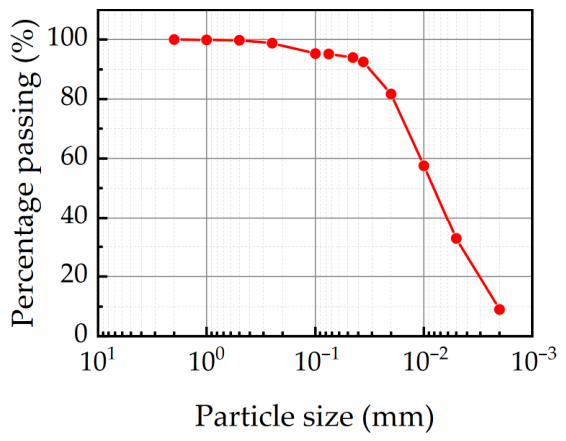
The test soil was obtained from a construction site in Ankang City, Shaanxi Province, at a depth of 2 m. The soil exhibited a light-yellow color. Moreover, it is not ball-milled nanoscale soil. The particle size distribution of the natural soil was determined using a combination of sieve analysis and laser diffraction. For the fine fraction, a BT-9300ST laser particle size analyzer from Liaoning Dandong Baxter Instrument Co. was used. Prior to testing, the soil sample was dried, gently crushed, sieved, and the fine particles were dispersed in deionized water. Ultrasonic dispersion was applied before measurement to improve particle dispersion and reduce agglomeration. The results are shown in Figure 1.
The basic physical properties were measured in accordance with the Standard for geotechnical testing method (GB/T 50123-2019) [35]. According to the Unified Soil Classification System (USCS) [36], the soil is classified as high-plasticity clay, with a liquid limit of 58.4%, a plastic limit of 33.7%, and a plasticity index of 24.7. With a free swell ratio of 77%, the soil is categorized as moderately expansive soil. More detailed basic physical indexes of Ankang expansive soil are shown in Table 1. The mineralogical composition of the soil was determined by X-ray diffraction (XRD) using a D8 ADVANCE diffractometer (Karlsruhe, Germany). Prior to testing, the soil sample was air-dried, ground, and sieved. The XRD analysis was conducted over a 2θ range of 5–60° in step-scan mode with a step size of 0.02°, at an operating voltage of 45 kV and a current of 100 mA. The mineral contents were estimated by semi-quantitative analysis based on the characteristic diffraction peaks, in which the content of montmorillonite was 24%, and the content of illite was 20%, as shown in Table 2.
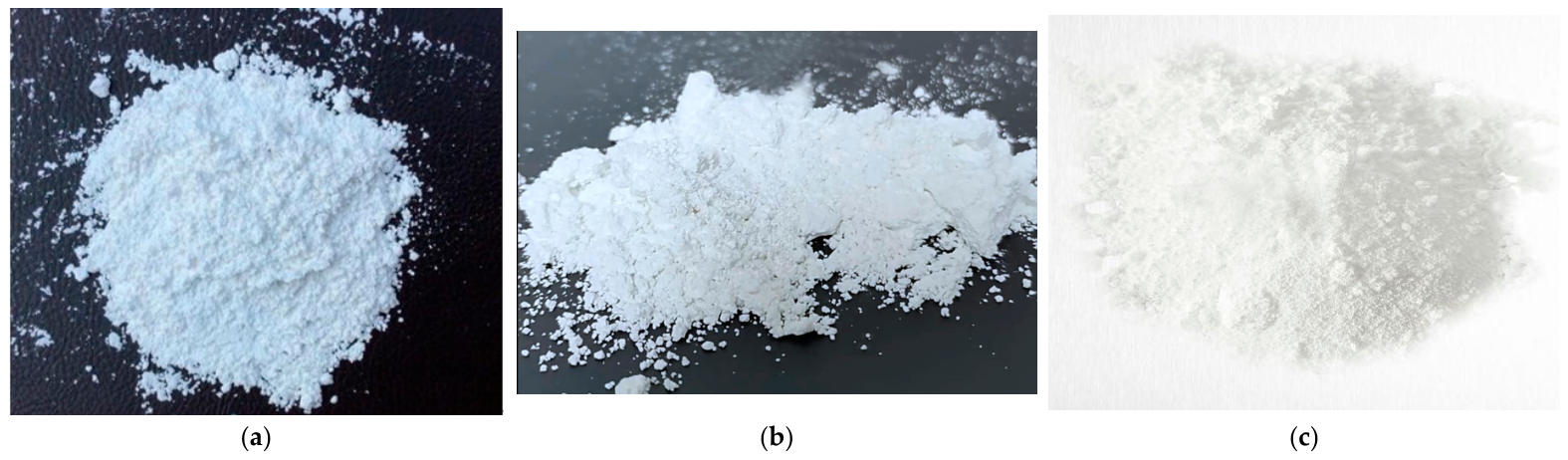
As shown in Figure 2, three nanomaterials were used in the experiments: nano-lime, nano-calcined clay, and nano-silica. Nano-lime mainly consisted of calcium oxide with a purity of up to 99%. Nano-calcined clay was modified calcined kaolin, and its main chemical compositions are listed in Table 3. The hydrophobic nano-silica, with a purity of over 99%, was prepared by surface chemical treatment of hydrophilic nano-silica. Its water contact angle was 151.9°, indicating superhydrophobicity. All three nanomaterials were supplied by chemical manufacturers in Shanghai. They are non-toxic, odorless, and highly inert.

2.2. Specimen Preparation

The natural soil collected from the site was air-dried, pulverized, and passed through a 2 mm sieve to obtain the soil powders. To minimize agglomeration and ensure uniform dispersion, the nanomaterial additives were independently ground and passed through a 0.075 mm sieve. The sieved soil and nanoparticles were thoroughly mixed by mechanical stirring until a visually homogeneous mixture was achieved, confirmed by the absence of visible white agglomerates. Distilled water was then sprayed onto the dry mixture to reach the target water content. The moist soil was sealed in airtight polyethylene bags and equilibrated for 24 h to ensure moisture equilibration.
All specimens were fabricated using static compaction to a target dry density of 1.5 g/cm3. The sample dimensions were tailored to specific testing protocols: (1) Cylindrical specimens with a diameter of 61.8 mm and height of 20 mm for free swell ratio tests; (2) Ø50 mm × 20 mm specimens for both swelling pressure and shrinkage tests; and (3) Ø35 mm × 8 mm specimens for water retention measurements. Following compaction, the specimens were wrapped in plastic film and cured in a constant temperature and humidity chamber (20 ± 1 °C, relative humidity > 95%) for the designated periods.

3. Experimental Methods

The experimental program included free swell ratio tests, swelling pressure tests, shrinkage tests, mercury intrusion porosimetry tests (MIP), and scanning electron microscopy tests (SEM). A uniform dosage of 1% (by dry weight of soil) was applied for all nanomaterial-treated specimens. This low dosage was selected with reference to previous studies showing that measurable improvement can be achieved at approximately 0.5–1% nano-additive content [17,31,34], while also avoiding excessive agglomeration and masking the effect of initial water content targeted in the present study. Considering that the water content of expansive soil subgrades in Ankang generally ranges from 14% to 25%, representative initial water content levels were selected on both the dry and wet sides of the optimum water content in order to systematically investigate the influence of initial water content on the swell-shrink behavior of expansive soil. The specific test scheme is presented in Table 4.
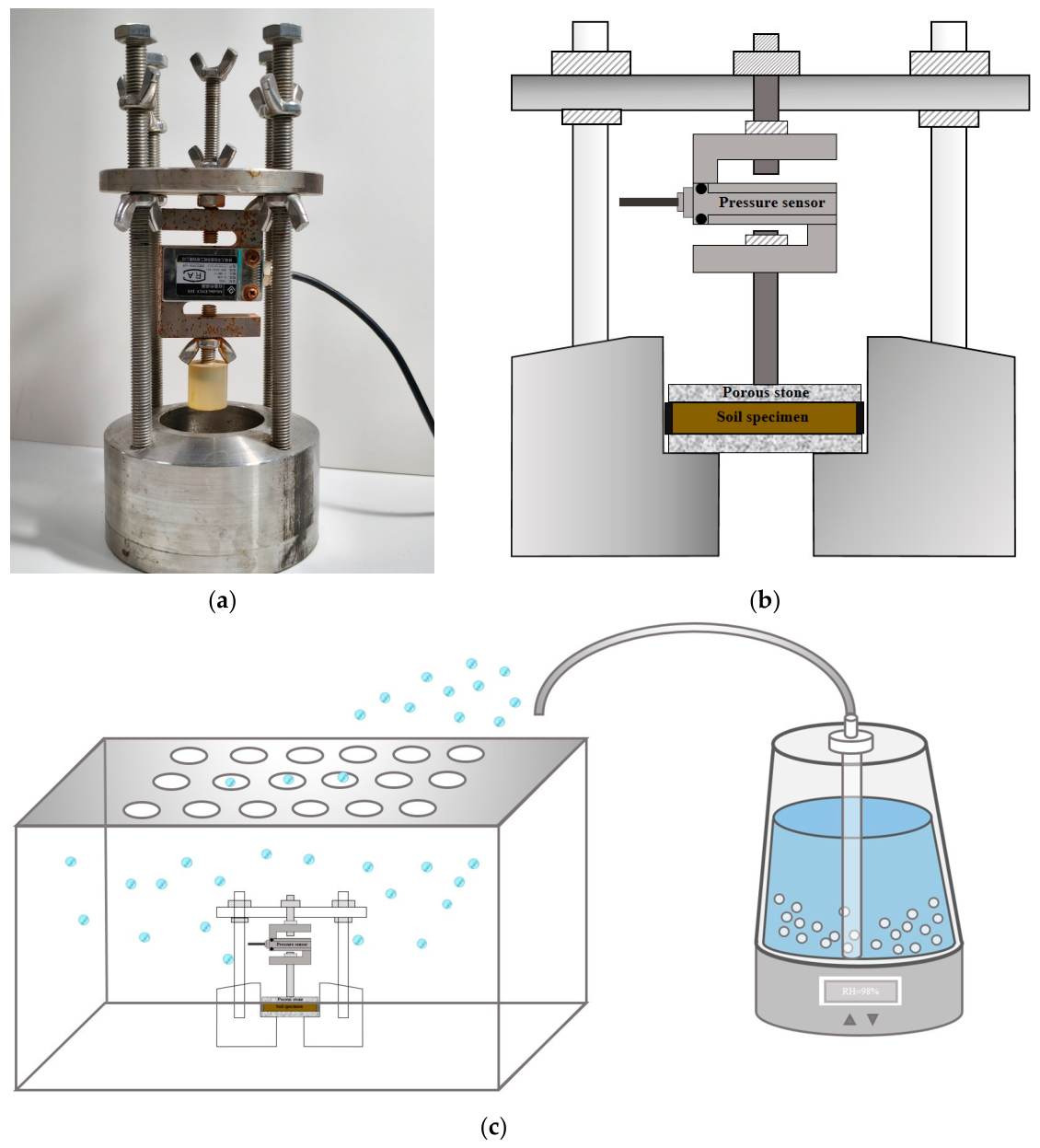
The free swell ratio was measured using a standard consolidometer setup equipped with dial gauges and extension rings. The testing procedure was conducted in strict compliance with the Standard for geotechnical testing method (GB/T 50123-2019) [35]. The swelling pressure was determined using the constant-volume method, as shown in Figure 3. Figure 3a presents a photograph of the swelling pressure measurement apparatus, in which a custom-designed device was used to measure the swelling pressure under saturated conditions. In this device, the laterally confined soil specimen expanded upon water absorption, and the generated swelling force was transmitted to the pressure sensor by compressing the upper and lower porous stones, as illustrated in Figure 3b. Figure 3c shows a schematic diagram of the mist humidification process used to ensure uniform moisture absorption throughout the specimen.
The soil-water retention curve was determined using a dewpoint potentiometer (WP4C), which featured a suction measurement range of 0 to 300 MPa with an accuracy of ±1%. For the shrinkage test, specimens were subjected to air-drying under controlled laboratory conditions. The mass, diameter and height of the specimen were recorded at predetermined intervals until mass equilibrium was reached.
To elucidate the microstructure of the soil specimens, mercury intrusion porosimetry and scanning electron microscopy tests were conducted on specimens cured for 28 days. Prior to testing, the specimens were cut into cubic samples of 1 cm3 and placed in liquid nitrogen under vacuum for 24 h for low-temperature freezing treatment. The pore size distribution was measured using an AutoPore IV 9510 porosimeter supplied by Micromeritics Instrument Corp. (Norcross, GA, USA), with a measurable pore diameter range from 5 nm to 360 μm. The microstructure was observed using a Hitachi S-4800 microscope from Qingdao Jiading Analytical Instrument Corp. (Qingdao, China). Before SEM imaging, the specimen surfaces were gold-coated under vacuum to improve conductivity. Representative micrographs at 2000× magnification were selected for analysis.
For each test condition, three parallel specimens were prepared and tested. The reported values represent the average results of the three measurements.

4. Results

4.1. Free Swell Ratio Test

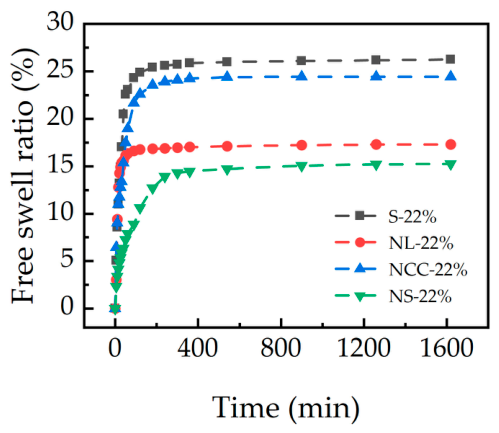
Figure 4 illustrates the relationship between free swell ratio and time for the natural and treated soils after 1 day of curing. As observed, the swelling process of both untreated and treated soils can be divided into three stages: a rapid swelling stage, a decelerating swelling stage, and a slow swelling stage [37,38]. During the initial rapid stage (0–120 min), the expansive soil exhibited a sharp increase in volume because of its relatively low initial water content, high porosity, and strong affinity for water. Most of the swelling deformation occurred during this period. As water infiltration continued, hydration of the clay minerals progressed, and the swelling rate gradually decreased during the second stage (120–360 min). In the final slow swelling stage (after 360 min), the soil approached a near-saturated state, and the remaining swelling potential was gradually exhausted.
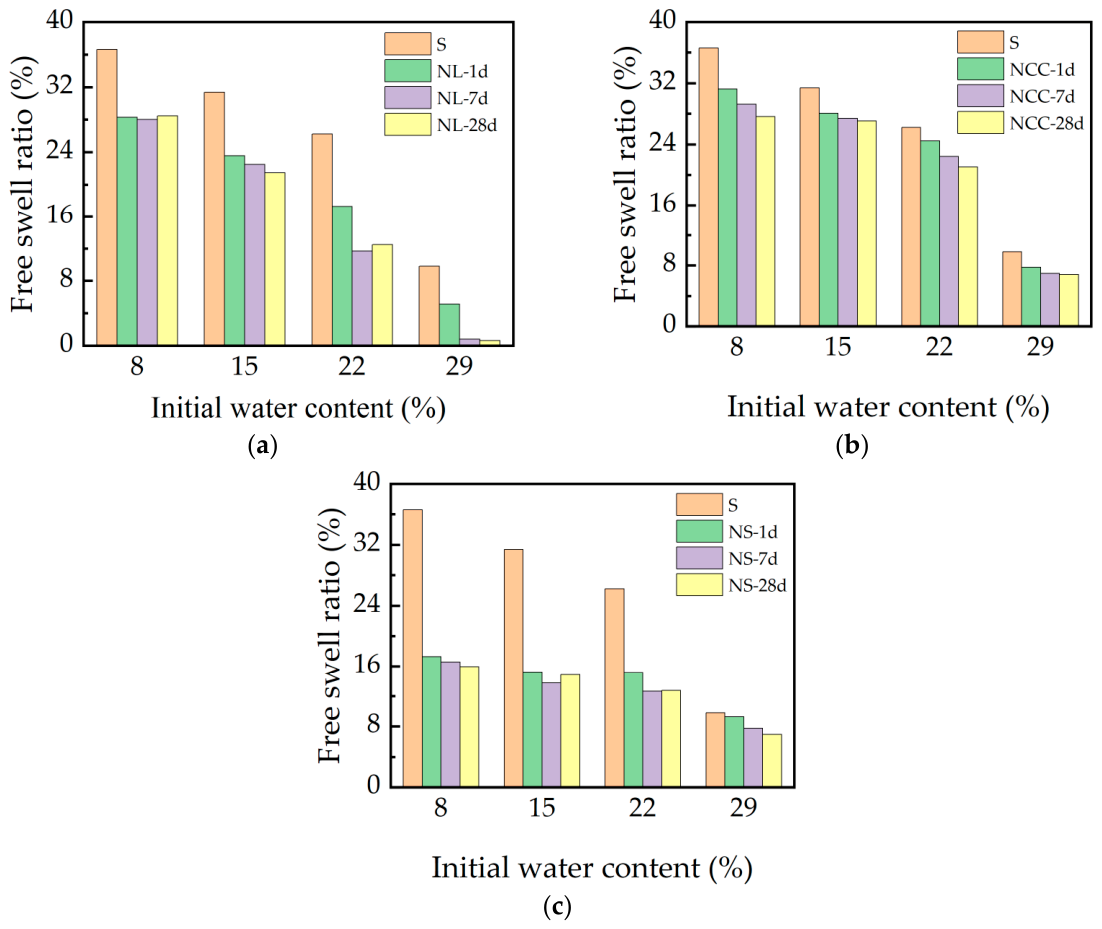
Figure 5 presents the relationship between the free swell ratio and initial water content for soils treated with different nanomaterials. Overall, all three nanomaterials reduced the free swell ratio compared with the natural soil, but their moisture sensitivity was markedly different. Furthermore, the swelling potential of the treated samples exhibited a continuous decline with curing time.
For the nano-lime-treated soil, the free swell ratio was significantly lower than that of the natural soil under all initial water content conditions. As shown in Figure 5a, relative to the 1-day cured samples, the free swell ratio after 7 days of curing decreased by 0.9%, 4.5%, 32.7%, and 84.1% at initial water contents of 8%, 15%, 22%, and 29%, respectively. After 28 days of curing, a further decrease was observed, and the free swell ratio approached a negligible level at 29% initial water content. This trend is in good agreement with Al-Swaidani and Meziab [30], who reported that nano-lime significantly improved the volume-change behavior of expansive soils. Compared with these previous studies, the present results further indicate that the performance of nano-lime is strongly dependent on the initial water content.
Figure 5b shows that the free swell ratio of the nano-calcined clay-treated soil decreased with increasing initial water content at all curing ages, although the improvement was more moderate than that of nano-lime. Taking the 7-day curing period as an example, the reductions relative to the 1-day cured samples were 3.2%, 2.5%, 8.3%, and 11.5% at initial water contents of 8%, 15%, 22%, and 29%, respectively. A pronounced improvement was observed mainly when the initial water content exceeded 22%, indicating that sufficient moisture availability was beneficial to the treatment effect. This observation is consistent with previous findings from Janani and Ravichandran [39], who reported that the free swell index of expansive soil decreased from 210 to 80 when 10% calcined clay was added.
In contrast, the behavior of the nano-silica-treated soil differed markedly from that of the other two additives. As shown in Figure 5c, the reduction in free swell ratio first increased and then decreased with increasing initial water content, and the inhibitory effect was weakest at 29% initial water content. Specifically, after 7 days of curing, the free swell ratio decreased by 52.7%, 51.8%, 45.7%, and 5.2% at initial water contents of 8%, 15%, 22%, and 29%, respectively. This pattern indicates that hydrophobic nano-silica was more effective under relatively dry initial conditions. This aligns with previous studies by Shahsavani et al. [34], who showed that the effectiveness of hydrophobic nano-silica can deteriorate sharply at high initial water contents. This may be because pre-existing pore water hinders the uniform coating of soil aggregates and weakens the water-repellent barrier effect.

4.2. Swelling Pressure Test

4.2.1. Saturated Swelling Pressure Test

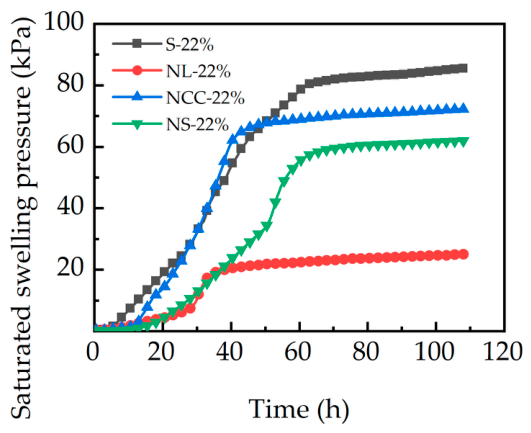
Figure 6 presents the evolution of saturated swelling pressure with time for the natural and treated soils after 28 days of curing at an initial water content of 22%. Once humidification began, all specimens exhibited a progressive increase in swelling pressure. The pressure development curve can be divided into three stages. In the initial stage, the increase in swelling pressure was relatively slow. This lag can be attributed to the water-mist humidification method adopted in this study. Unlike direct immersion, the ultrafine water mist required time to accumulate within the porous stone and filter paper system before effective moisture transfer to the specimen could be established. Once the hydraulic pathway was formed, the process entered an accelerated stage, during which the swelling pressure increased rapidly as the soil matrix continuously absorbed water. In the final stage, the pressure gradually approached an equilibrium value as the specimen neared saturation.
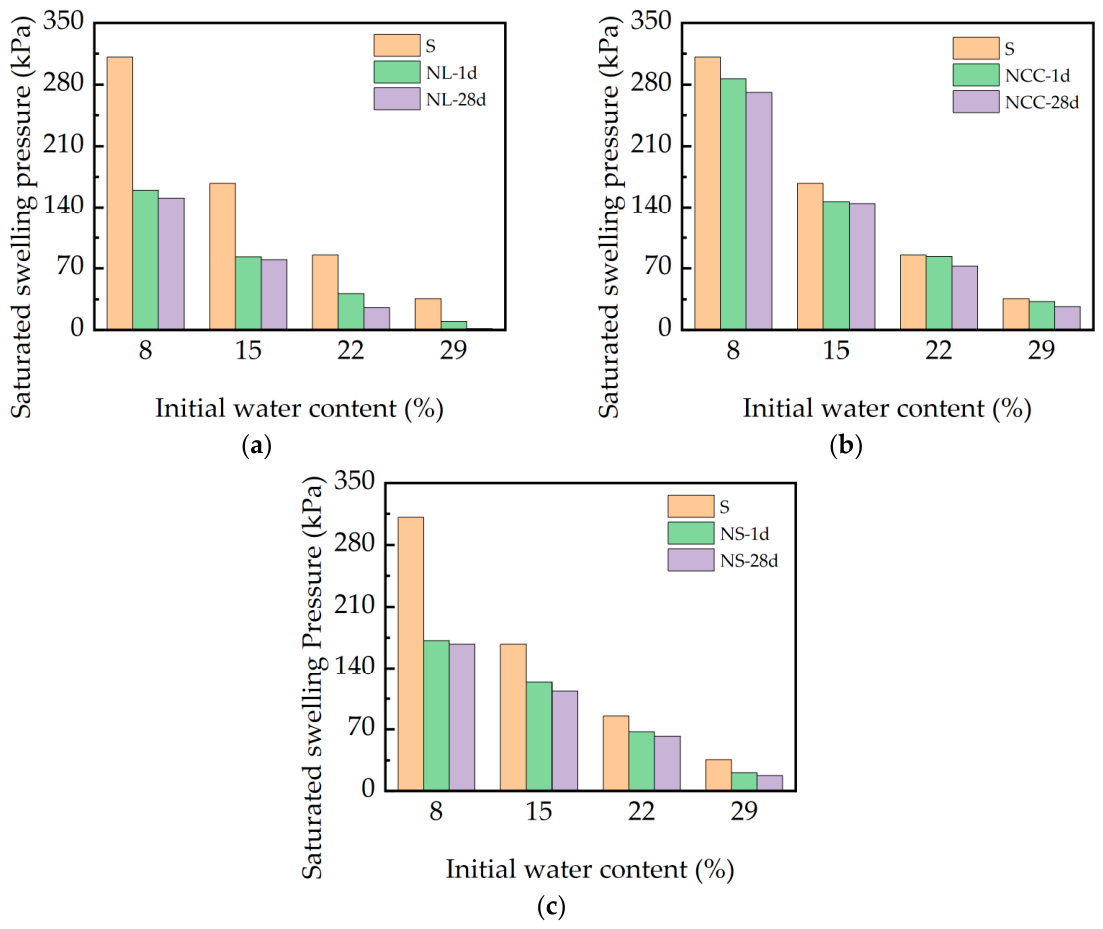
Figure 7 presents the changes in saturated swelling pressure for soils treated with different nanomaterials at various initial water contents. Overall, all three nanomaterials reduced the saturated swelling pressure relative to the natural soil, although their inhibition efficiencies and water-content sensitivities differed considerably.
As shown in Figure 7a, the saturated swelling pressure decreased with increasing initial water content, and the reduction became more pronounced with prolonged curing. Relative to the natural soil, the 1-day-cured specimens exhibited reductions of 48.7%, 50.4%, 45.8%, and 72.7% at initial water contents of 8%, 15%, 22%, and 29%, respectively. After 28 days of curing, the swelling pressure decreased further, with additional reductions of 5.4%, 3.6%, 45.4%, and 82.5% compared with the 1-day results. This trend is consistent with previous studies on lime-based stabilization. Al-Gharbawi et al. [40] showed that lime-rich treatment systems can decrease swelling pressure by about 76% in expansive soils. A higher initial water content likely favors calcium ion migration, cation exchange, and flocculation, while longer curing allows time-dependent physicochemical interaction to further densify the soil structure.
For the nano-calcined clay-treated soil, the magnitude of reduction increased gradually with increasing initial water content. As shown in Figure 7b, the maximum reduction in saturated swelling pressure after curing reached 18.4% under the 29% initial water content condition. Although this improvement was more modest than that of nano-lime, it still demonstrates that nano-calcined clay can mitigate the restrained swelling behavior of expansive soil. This aligns with the findings from Al-Swaidani et al. [32], who reported that calcined clay-based additives improve the swelling behavior of expansive soils through pore filling, structure refinement, and limited physicochemical reactivity.
The nano-silica-treated soil exhibited a different pattern. As shown in Figure 7c, after 1 day of curing, the saturated swelling pressure decreased by 44.8%, 26.3%, 21.3%, and 41.5% at initial water contents of 8%, 15%, 22%, and 29%, respectively, relative to the natural soil. The magnitude of reduction first decreased and then increased with increasing initial water content, indicating a non-monotonic response to moisture. After 28 days of curing, further reductions of 2.3%, 8.1%, 7.4%, and 14.4% were observed compared with the 1-day curing period. This behavior indicates that the performance of nano-silica was influenced by competing effects of moisture accessibility, which is consistent with the findings of Luo et al. [17], who showed superhydrophobic nano-SiO2 could reduce expansion and alter the pore system by attaching to the surface of soil particles and forming a hydrophobic barrier.

4.2.2. Unsaturated Swelling Pressure Test

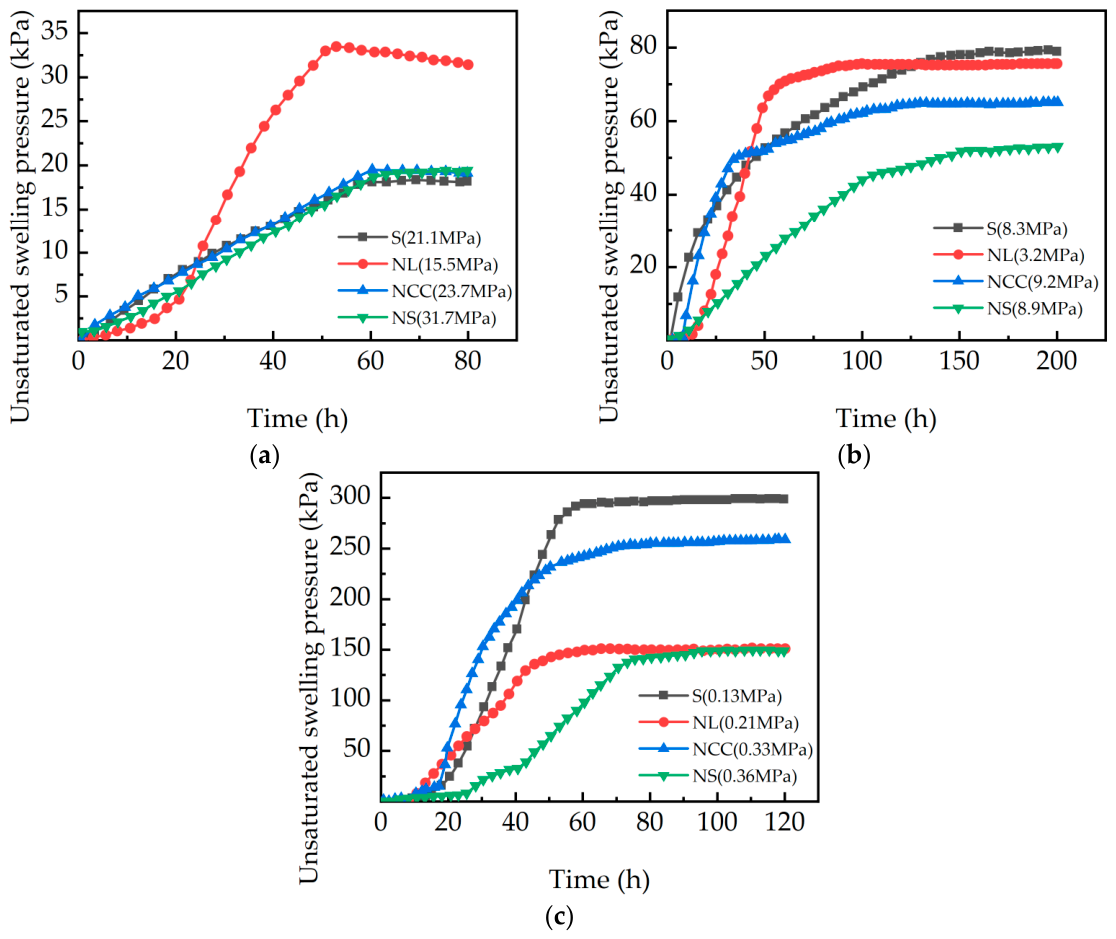
Figure 8 presents the evolution of unsaturated swelling pressure for the natural soil and nanomaterial-treated soils under different suction ranges. As shown in Figure 8a, in the high suction range (10–100 MPa), the swelling pressure increased gradually during the initial stage and then slightly decreased after reaching a peak, which may be attributed to the wetting-induced collapse of the initially unsaturated and partially metastable soil structure. Similar swell-collapse behavior has been reported for unsaturated expansive subgrades subjected to wetting [41]. In the medium suction range (1–10 MPa), the swelling pressure exhibited a prolonged period of slow development, and the pressure increase started only after a clear time lag following humidification. Figure 8c indicates that in the low suction range (0.1–1 MPa), the swelling pressure increased rapidly and reached relatively high values, showing behavior closer to that observed under saturated conditions.
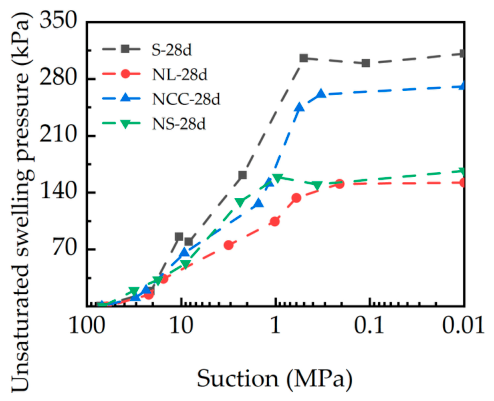
Figure 9 illustrates the relationship between unsaturated swelling pressure and suction for the nanomaterial-treated soils. A clear increase in unsaturated swelling pressure was observed with decreasing suction for all specimens. When suction exceeded 10 MPa, the swelling pressure remained negligible, approaching zero. However, once suction dropped below this threshold, the swelling pressure began to rise sharply, and when suction was lower than 1 MPa, the swelling pressure reached relatively high values. This aligns with the findings from Al-Mahbashi et al. [42], who demonstrated that the axial swelling pressure of unsaturated expansive clay increased as suction decreased, confirming the strong hydromechanical coupling between wetting and restrained expansion.
Compared with the untreated soil, all three nanomaterial treatments significantly reduced the unsaturated swelling pressure across the entire suction range. The untreated expansive soil maintained a high swelling potential throughout the wetting path. Among the three additives, nano-lime consistently yielded the lowest swelling pressure over the full suction range, indicating the strongest suppression capability.
The nano-silica-treated soil also displayed substantial suppression of unsaturated swelling pressure, with an overall performance comparable to that of nano-lime in part of the suction range, although still slightly weaker overall. As previously discussed by El-Samea et al. [43], superhydrophobic nano-SiO2 can reduce soil-water interaction by modifying aggregate surfaces and limiting wetting-induced volume change.
By contrast, the nano-calcined clay-treated soil showed a smaller reduction in unsaturated swelling pressure, indicating a more moderate suppression effect during wetting under controlled suction. This may be because its beneficial action is more related to pore filling and structure refinement than to strong alteration of the clay–water interaction mechanism.

4.3. Shrinkage Test

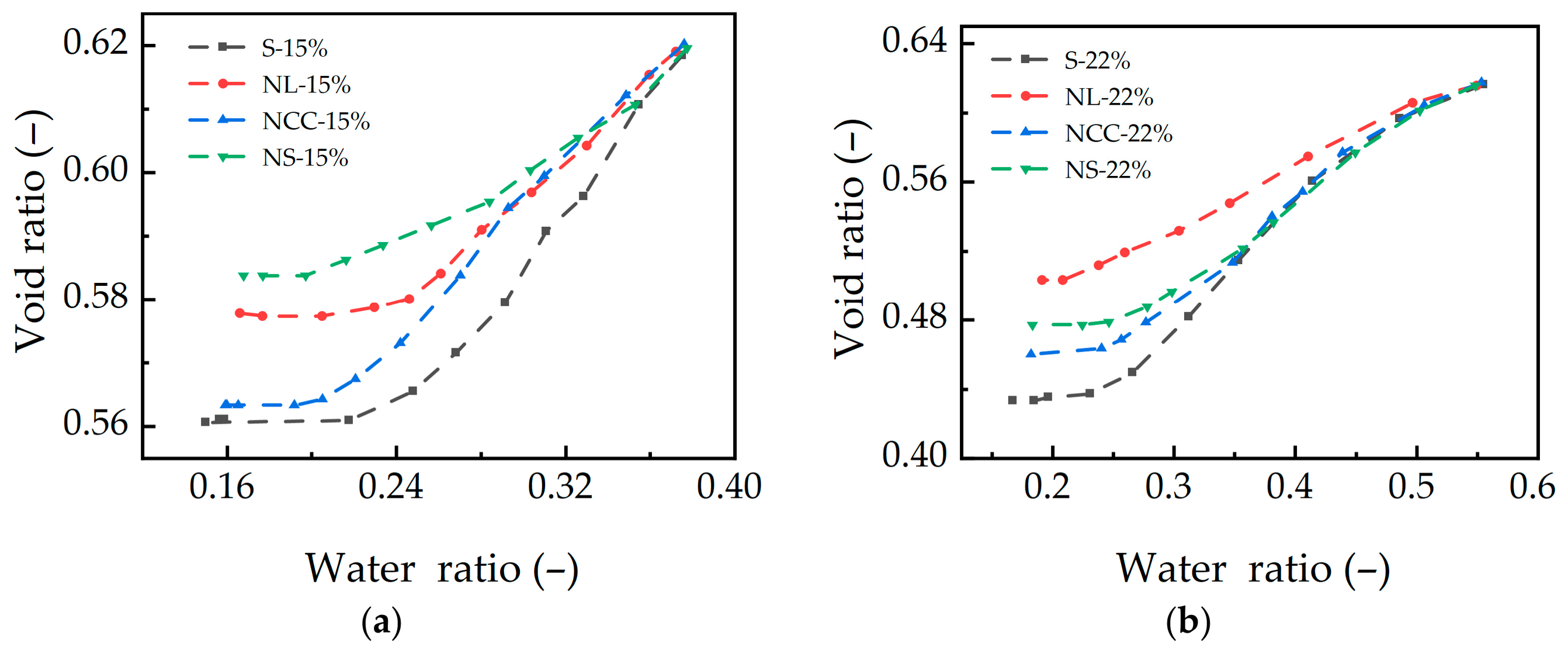
Figure 10 presents the shrinkage curves of the natural soil and nanomaterial-treated soils after 28 days of curing. The shrinkage curves of both untreated and treated soils under different initial water contents can be divided into three characteristic stages, namely normal shrinkage, residual shrinkage, and zero shrinkage. This staged behavior is consistent with previous studies on drying shrinkage of expansive soils, which reported that shrinkage deformation is closely related to moisture loss, suction increase, and the progressive contraction of the diffuse double layer during desaturation [44].
Figure 10a shows the results at an initial water content of 15%. Under these relatively dry conditions, the nano-silica-treated soil exhibited the largest final void ratio, indicating the highest resistance to volumetric shrinkage. A plausible explanation is that the hydrophobic nano-silica altered the surface condition of soil aggregates and hindered the formation of continuous water-evaporation pathways. This interpretation is supported by the work of Yang et al. [44], who reported that increasing the contact angle between soil particles and pore water can effectively suppress the dry-shrinkage cracking of expansive soils. Figure 10b shows that at an initial water content of 22%, the nano-lime-treated soil demonstrated the most significant shrinkage inhibition, with its shrinkage curve remaining noticeably above those of the other specimens. This result indicates that nano-lime was more effective in maintaining the structural integrity of the soil skeleton during drying when a sufficient amount of initial water was available.
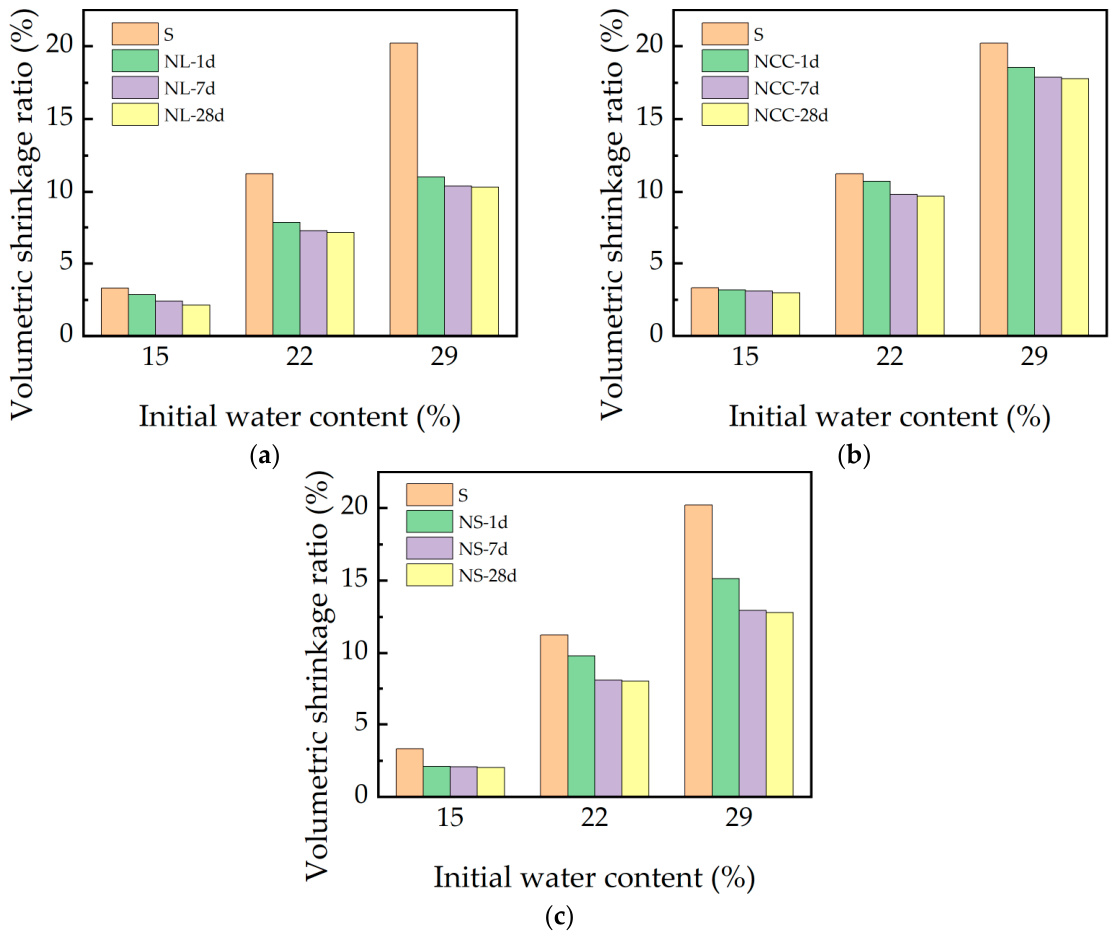
Figure 11 presents the relationship between initial water content and volumetric shrinkage ratio for soils treated with different nanomaterials. Figure 11a shows the volumetric shrinkage behavior of the nano-lime-treated soil. The reduction in volumetric shrinkage became more pronounced as the initial water content increased. Specifically, compared with the natural soil, the volumetric shrinkage ratios of the treated soil at initial water contents of 15%, 22%, and 29% after 1 day of curing decreased by 13.5%, 30.2%, and 45.4%, respectively. After 7 days of curing, the shrinkage behavior was further stabilized. Compared with the 1-day cured samples, the additional reductions after 7 days were 15.5%, 7.3%, and 5.6% at initial water contents of 15%, 22%, and 29%, respectively. These results indicate that under higher initial water contents, nano-lime reacted more effectively and more rapidly, thereby decreasing the shrinkage potential of expansive soil during the early curing stage.
Figure 11b illustrates the volumetric shrinkage behavior of the nano-calcined clay-treated soil. At the low initial water content of 15%, the shrinkage behavior of the treated soil closely resembled that of the natural soil, with a reduction of only 4.5% after 1 day of curing. However, as the initial water content increased, the difference between the treated and natural soils became progressively more pronounced. Consequently, the optimal absolute shrinkage inhibition was observed under the 29% initial water content condition in the short curing term. After 7 days of curing, the magnitude of reduction in the volumetric shrinkage ratio first increased and then decreased as the initial water content increased. At initial water contents of 15%, 22%, and 29%, the volumetric shrinkage ratios decreased by 2.5%, 8.5%, and 5.6%, respectively, compared with those at the 1-day curing period. This indicates that sufficient moisture availability was beneficial to the curing effect of nano-calcined clay.
Figure 11c shows the volumetric shrinkage behavior of the nano-silica-treated soil. Compared with the natural soil, the volumetric shrinkage ratios of the treated soil at initial water contents of 15%, 22%, and 29% after 1 day of curing decreased by 37.2%, 12.8%, and 25.2%, respectively. After 7 days of curing, the volumetric shrinkage ratios at 22% and 29% initial water contents decreased by an additional 16.8% and 14.4%, respectively, compared with the 1-day results. These results indicate that nano-silica was particularly effective in reducing shrinkage under relatively dry initial conditions, whereas under wetter initial conditions, its early-age effect was less pronounced. A plausible explanation is that under high initial water content, moisture migration during drying was relatively rapid, and the nano-silica particles initially formed only unstable connections with soil particles and were more prone to displacement. With prolonged curing, the interaction between nano-silica and the soil skeleton became more stable, thereby enhancing interparticle bonding and improving shrinkage resistance. The results indicate that this beneficial effect is highly dependent on the initial moisture state.

4.4. Microstructure Investigations

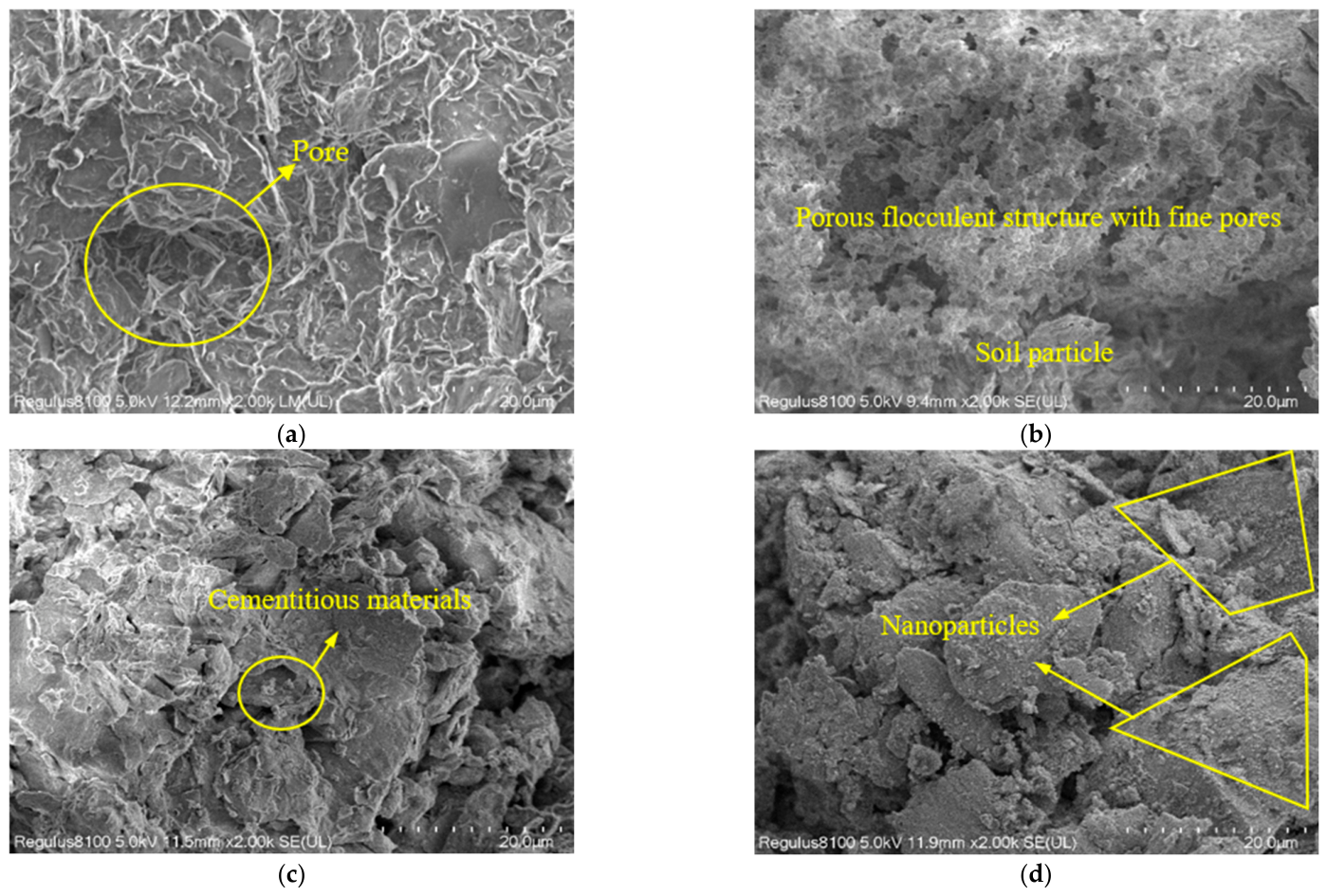
To investigate the effects of different nanomaterial additives on the microstructure of expansive soil, scanning electron microscopy (SEM) and mercury intrusion porosimetry (MIP) tests were conducted on the untreated and treated soil samples. Figure 12 presents the SEM images of the soil samples at 2000× magnification.
As shown in Figure 12a, the natural expansive soil exhibited a typical platy microstructure dominated by face-to-face and edge-to-face particle contacts. The clay particles displayed relatively smooth and flat surfaces, forming a loose framework with visible inter-aggregate pores. Figure 12b shows that the nano-lime-treated soil developed a distinct flocculated structure, characterized by refined pores and a more compact particle arrangement. In addition, bridging features could be observed between adjacent particles, suggesting that the treatment promoted the formation of a denser and more stable soil skeleton. This aligns with the findings from Jha and Sivapullaiah [45], who observed that lime treatment transformed the soil fabric from a dispersed arrangement into a flocculated and aggregated structure. In Figure 12c, the nano-calcined clay-treated soil revealed only a limited amount of bonding material distributed between particles. This observation corresponded to its modest improvement in macroscopic swell-shrink behavior compared with the natural soil. Figure 12d demonstrates that nano-silica particles were distributed across the surfaces of the soil particles, giving the specimen a rougher and more textured appearance. The spherical nano-silica particles adhered to the soil surfaces, and distinct agglomerates were observed that were noticeably larger than those in the other treatment groups. This observation is in good agreement with the findings of Luo et al. [17,18], who reported that superhydrophobic nano-SiO2 can attach to the surface of soil particles and form a hydrophobic membrane, thereby reducing water accessibility and modifying the pore structure.
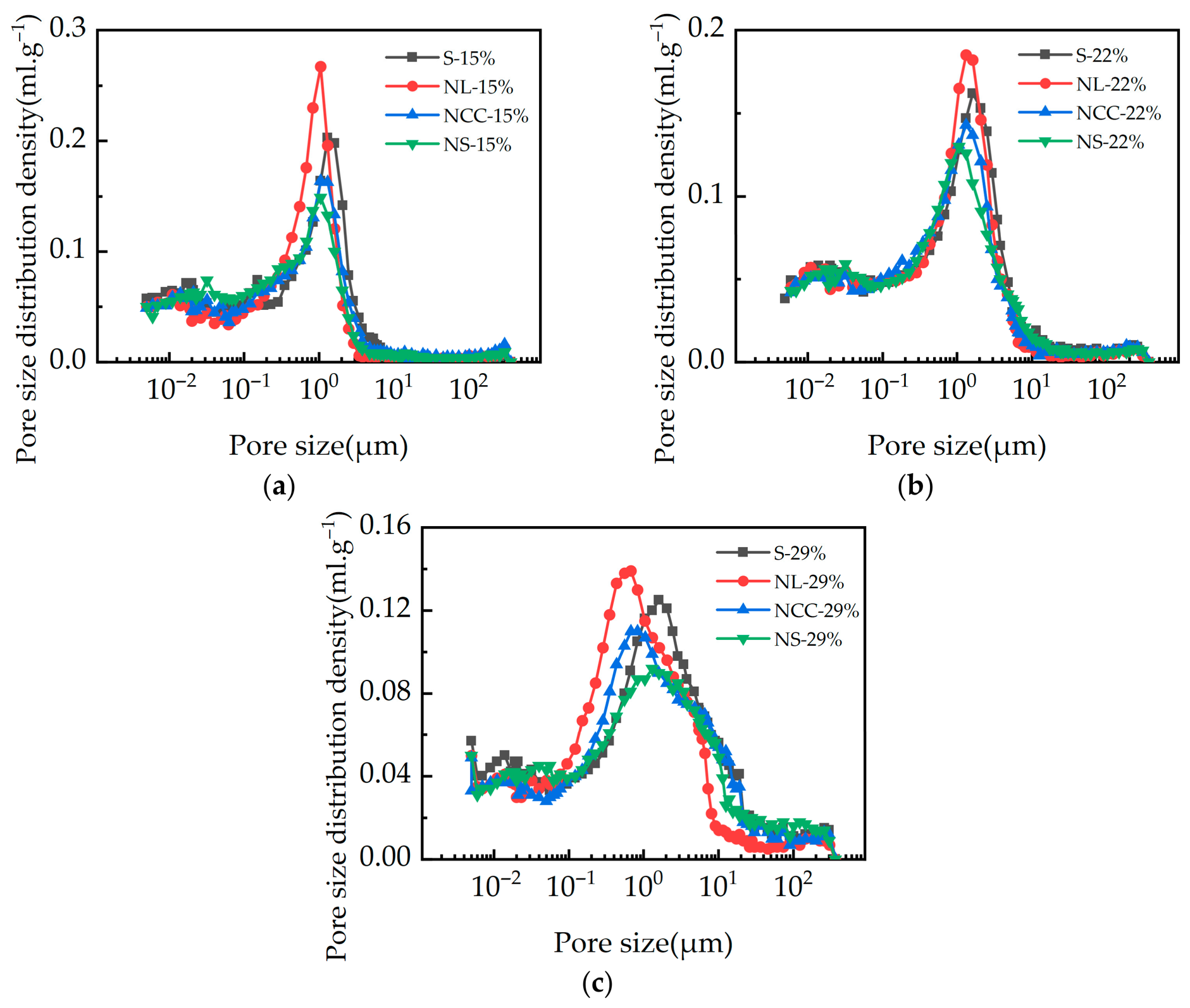
Figure 13 presents the pore size distribution density curves for the natural and treated expansive soils under different initial water contents. Generally, as the initial water content increased, the peak intensity decreased, and the pore concentration broadened toward larger pore sizes. This indicates that higher initial water contents led to a wider pore-size distribution and a more heterogeneous internal structure. At an initial water content of 29%, the peak pore sizes were observed at 1.601 μm for the natural soil, 0.679 μm for the nano-lime-treated soil, 0.831 μm for the nano-calcined clay-treated soil, and 1.508 μm for the nano-silica-treated soil. These results highlight a clear divergence in stabilization efficacy. The peak pore sizes of the nano-lime and nano-calcined clay-treated soils were significantly smaller than those of the natural soil, indicating that these two additives effectively refined the pore system and fragmented large pores into finer ones.
By contrast, the peak pore size of the nano-silica-treated soil remained close to that of the natural soil at high initial water content. This indicates that, although nano-silica improved the surface characteristics of the soil particles, it did not effectively refine the macropore network under wet initial conditions. A plausible explanation is that under high water content, the hydrophobic nano-silica particles tended to agglomerate in order to minimize surface energy in the wet environment. While these agglomerates may be internally dense, their bonding with the surrounding soil matrix is relatively weak, and larger interfacial voids can remain between the agglomerates and the soil skeleton.

5. Discussions

5.1. Mineralogical Interpretation

The swell-shrink behavior of expansive soil is closely related to the physicochemical interaction between clay minerals and water. In particular, the high swelling potential of the tested soil can be mainly attributed to the montmorillonite-rich fraction, because montmorillonite has a layered structure, high specific surface area, and strong interlayer water adsorption capacity. During wetting, the expansion of the diffuse double layer and the hydration of exchangeable cations increase the repulsive force between clay particles, which contributes to the large swelling deformation. In addition, interlayer hydration of active clay minerals further enhances the volume increase in the untreated expansive soil. In contrast, illite also contributes to water sensitivity and plasticity, but its swelling capacity is generally lower than that of montmorillonite. Possible changes in the interlayer spacing of montmorillonite were not directly measured in this study. Therefore, the above interpretation should be regarded as a mineralogical and physicochemical inference based on the observed macroscopic behavior, microstructural test results, and previous studies.

5.2. Comparative Stabilization Behavior of the Three Nanomaterials

The experimental results indicate that the stabilization performances of the three nanomaterials were jointly governed by the initial water content and curing duration. As the initial water content increased, the inhibitory effect of nano-lime on free swelling, swelling pressure, and shrinkage became progressively stronger. This is likely because nano-lime reduced swelling more effectively through calcium-mediated cation exchange and flocculation, which may have compressed the diffuse double layer and decreased interparticle repulsion. Nano-calcined clay provided a more moderate improvement, mainly through pore refinement, filler effects, and limited physicochemical interaction. By contrast, nano-silica mainly modified particle surface characteristics and local contact conditions. Its pore-refinement effect became limited under high initial water content because of particle agglomeration, which explains its reduced effectiveness under wetter conditions. These observations indicate that the stabilization efficiency of nanomaterials in expansive soil is governed not only by additive type, but also by the coupling among clay mineralogy, water content condition, and microstructural evolution.

5.3. Practical Engineering Implications

The present results indicate that the practical selection of nanomaterial stabilizers for expansive soil should depend on the field water content condition. Nano-lime is more suitable for relatively wet conditions, hydrophobic nano-silica performs better under relatively dry conditions, and nano-calcined clay provides a moderate but stable improvement. Therefore, material selection should consider both the additive type and the expected moisture regime.

6. Conclusions

Based on the analysis of the swell-shrink tests and microstructural analyses conducted on expansive soils treated with nano-lime, nano-calcined clay, and nano-silica, the following conclusions can be drawn:
(1)
All three nanomaterial additives improved the swell-shrink behavior of the expansive soil, but their stabilization performances differed significantly with respect to initial water content and curing duration. In general, the treatment effect became more stable after approximately 7 days of curing.
(2)
Nano-lime exhibited the strongest overall improvement effect. Its ability to reduce free swell ratio, swelling pressure, and shrinkage became more pronounced as the initial water content increased, indicating that it is particularly effective under relatively wet conditions.
(3)
Nano-calcined clay also reduced the swell-shrink potential of the expansive soil, but its effect was more moderate than that of nano-lime. Its improvement was relatively stable and became more evident at higher initial water contents.
(4)
Hydrophobic nano-silica showed a distinct moisture-dependent behavior. It performed better under relatively low initial water contents, whereas its effectiveness decreased under wetter conditions.
(5)
The SEM and MIP results suggested that the three additives modified the soil fabric through different pathways. Nano-lime showed the most pronounced pore refinement and structural densification, nano-calcined clay provided moderate microstructural improvement, and nano-silica mainly affected particle surface characteristics and local aggregation.
(6)
These findings provide useful guidance for the selection of nanomaterial stabilizers for expansive soils under different water conditions. Further studies should include direct mineralogical verification, mechanical characterization, and field-scale validation under wetting-drying conditions.

Author Contributions

Writing—original draft preparation, Visualization, Formal analysis, H.C.; writing—review and editing, Y.W.; investigation, H.W. All authors have read and agreed to the published version of the manuscript.

Funding

This research received no external funding.

Institutional Review Board Statement

Not applicable.

Informed Consent Statement

Not applicable.

Data Availability Statement

The data presented in this study are available on request from the corresponding author.

Conflicts of Interest

The authors declare no conflicts of interest.

Abbreviations

The following abbreviations are used in this manuscript:
SNatural soil
NLNano-lime-treated soil
NCCNano-calcined clay-treated soil
NSNano-silica-treated soil
SEMScanning electron microscopy
MIPMercury intrusion porosimetry
USCSUnified Soil Classification System
XRDX-ray diffraction

References

  1. Cheng, Z.L.; Li, Q.Y.; Guo, X.L.; Gong, B.W. Study on the Stability of Expansive Soil Slope. J. Yangtze River Sci. Res. Inst. 2011, 28, 102–111. [Google Scholar]
  2. Wang, Y.F.; Liu, C.X.; Liang, B.; Xu, Y.F.; Sun, D.W. Experimental study on improving expansive soil with soil stabilizer-polypropylene fiber composite. Hydro-Sci. Eng. 2022, 6, 86–94. [Google Scholar] [CrossRef]
  3. Zada, U.; Jamal, A.; Iqbal, M.; Eldin, S.M.; Almoshaogeh, M.; Bekkouche, S.R.; Almuaythir, S. Recent advances in expansive soil stabilization using admixtures: Current challenges and opportunities. Case Stud. Constr. Mater. 2023, 18, e01985. [Google Scholar] [CrossRef]
  4. Liu, Y.L.; Zhao, Y.A.; Vanapalli, S.K.; Mehmood, M. Soil-water characteristic curve of expansive soils considering cumulative damage effects of wetting and drying cycles. Eng. Geol. 2024, 339, 107642. [Google Scholar] [CrossRef]
  5. Zhu, Z.D.; Liu, S.Y. Utilization of a new soil stabilizer for silt subgrade. Eng. Geol. 2008, 97, 192–198. [Google Scholar] [CrossRef]
  6. Jian, X.; Zha, X.D.; Zhan, H.R.; Yang, J.J. Research on the damaging mechanisms of expansive soil in subgrade. Mech. Adv. Mater. Struct. 2024, 31, 2362–2369. [Google Scholar] [CrossRef]
  7. Zhou, A.N.; Du, J.P.; Lin, X.S.; Bu, Y.H.; Kodikara, J. Nanoscale mechanism on lime stabilization of expansive soil. Acta Geotech. 2023, 18, 2681–2701. [Google Scholar] [CrossRef]
  8. Shen, T.Y.; Xing, S.X.; Wang, S.J.; Cheng, M.S.; Huang, W. Complex ameliorants screening for reducing swelling ratio and improving shear strength of strong expansive soil. Trans. Chin. Soc. Agric. Eng. 2017, 33, 109–115. [Google Scholar] [CrossRef]
  9. Zhou, R.; Wang, B.T.; Han, S.Y.; Wang, D.Y.; Zhang, F.H. Mechanisms of crack development and strength deterioration in compacted expansive soils under controlled wetting-drying conditions. Eng. Fail. Anal. 2024, 159, 108133. [Google Scholar] [CrossRef]
  10. Majeed, Z.H.; Taha, M.R. A Review of Stabilization of Soils by using Nanomaterials. Aust. J. Basic Appl. Sci. 2013, 7, 576–581. [Google Scholar]
  11. Krishnan, J.J.; Shukla, S. The behaviour of soil stabilised with nanoparticles: An extensive review of the present status and its applications. Arab. J. Geosci. 2019, 12, 436. [Google Scholar] [CrossRef]
  12. Taha, M.R.; Alsharef, J.M.A.; Khan, T.A.; Aziz, M.; Gaber, M. Compressive and tensile strength enhancement of soft soils using nanocarbons. Geomech. Eng. 2018, 16, 559–567. [Google Scholar] [CrossRef]
  13. Kannan, G.; Sujatha, E.R. A review on the Choice of Nano-Silica as Soil Stabilizer. Silicon 2022, 14, 6477–6492. [Google Scholar] [CrossRef]
  14. Chaudhary, V.; Yadav, J.S.; Dutta, R.K. A critical appraisal on some geotechnical properties of soil stabilised with nano-additives. Environ. Dev. Sustain. 2024, 26, 13831–13894. [Google Scholar] [CrossRef]
  15. Tanzadeh, R.; Vafaeian, M.; Yusefzadeh Fard, M. Effects of micro-nano-lime (CaCO3) particles on the strength and resilience of road clay beds. Constr. Build. Mater. 2019, 217, 193–201. [Google Scholar] [CrossRef]
  16. Hakamy, A.; Shaikh, F.U.A.; Low, I.M. Characteristics of nanoclay and calcined nanoclay-cement nanocomposites. Compos. Part B Eng. 2015, 78, 174–184. [Google Scholar] [CrossRef]
  17. Luo, X.Q.; Kong, L.W.; Bai, W.; Jian, T. Effect of Superhydrophobic Nano-SiO2 on the Geotechnical Characteristics of Expansive Soil. J. Test. Eval. 2022, 50, 2932–2947. [Google Scholar] [CrossRef]
  18. Luo, X.Q.; Kong, L.W.; Bai, W. Effect of Superhydrophobic Nano-SiO2 on the Hydraulic Conductivity of Expansive Soil and Analysis of Its Mechanism. Appl. Sci. 2023, 13, 8198. [Google Scholar] [CrossRef]
  19. Xu, Y.F.; Shi, C.L. Swelling deformation patterns of Ningxia expansive soil. Chin. J. Geotech. Eng. 1997, 19, 98–101. [Google Scholar]
  20. Gao, Y.; Sun, D.A.; Lü, H.B. Deformation characteristics of weakly expansive soil and its prediction. Rock Soil Mech. 2015, 36, 755–761. [Google Scholar] [CrossRef]
  21. Hu, J.; Wang, B.T.; Zhang, W.H.; Guo, S.J.; Zhang, L. Deformation trends of expansive soils under free and loading condition. Chin. J. Geotech. Eng. 2011, 33, 335–338. [Google Scholar]
  22. Tang, C.S.; Cui, Y.J.; Tang, A.M.; Shi, B. Volumetric shrinkage characteristics of soil during drying. Chin. J. Geotech. Eng. 2011, 33, 1271–1279. [Google Scholar]
  23. Braudeau, E.; Costantini, J.M.; Bellier, G.; Colleuille, H. New Device and Method for Soil Shrinkage Curve Measurement and Characterization. Soil Sci. Soc. Am. J. 1999, 63, 525–535. [Google Scholar] [CrossRef]
  24. Boivin, P.; Garnier, P.; Tessier, D. Relationship between Clay Content, Clay Type, and Shrinkage Properties of Soil Samples. Soil Sci. Soc. Am. J. 2004, 68, 1145–1153. [Google Scholar] [CrossRef]
  25. Ye, Y.X.; Zou, W.L.; Han, Z.; Xie, P.; Zhang, J.F.; Xu, Y.F. One-dimensional swelling characteristics of expansive soils considering influence of initial states. Chin. J. Geotech. Eng. 2021, 43, 1518–1525. [Google Scholar] [CrossRef]
  26. Liu, H.F.; Wang, S.J.; Li, X.; Liang, G.C.; Shen, T.Y.; He, B.H. Experimental study on three-dimensional swelling pressure of highly expansive clay in Handan district of China. Chin. J. Geotech. Eng. 2019, 41, 789–796. [Google Scholar] [CrossRef]
  27. Manca, D.; Ferrari, A.; Laloui, L. Fabric evolution and the related swelling behaviour of a sand/bentonite mixture upon hydro-chemo-mechanical loadings. Géotechnique 2016, 66, 41–57. [Google Scholar] [CrossRef]
  28. Tang, C.S.; Tang, A.M.; Cui, Y.J.; Delage, P.; Laure, E.D. A New Apparatus for the Measurement of Swelling Pressure Under Constant Volume Condition. Eng. Geol. Soc. Territ. 2014, 6, 489–492. [Google Scholar] [CrossRef]
  29. Liang, W.Y.; Yan, R.T.; Xu, Y.F.; Zhang, Q.; Tian, H.H.; Wei, C.F. Swelling pressure of compacted expansive soil over a wide suction range. Appl. Clay Sci. 2021, 203, 106018. [Google Scholar] [CrossRef]
  30. Al-Swaidani, A.M.; Meziab, A. Restriction of Volume Change and Improvement of Strength Properties of Problematic Soils Using Nano-natural Additives. Indian Geotech. J. 2021, 51, 992–1010. [Google Scholar] [CrossRef]
  31. Kacha, S.; Shah, S.; Dhruv, D. Investigating characteristics of expansive soil of Rajkot modified with flyash and nanolime. Mater. Today Proc. 2022, 63, 314–319. [Google Scholar] [CrossRef]
  32. al-Swaidani, A.M.; Hammoud, I.; al-Ghuraibi, I.; Mezyab, A. Nanocalcined Clay and Nanolime as Stabilizing Agents for Expansive Clayey Soil: Some Geotechnical Properties. Adv. Civ. Eng. Mater. 2019, 8, 327–345. [Google Scholar] [CrossRef]
  33. Qasaimeh, A.; Sharo, A.A.; Bani-Melhem, K. Clayey SOIL AMENDMENT BY HYDROPHILIC NANO BENTONITE FOR LANDFILL COVER BARRIER: A CASE STUDY. J. Environ. Eng. Landsc. Manag. 2020, 28, 148–156. [Google Scholar] [CrossRef]
  34. Shahsavani, S.; Vakili, A.H.; Mokhberi, M. The effect of wetting and drying cycles on the swelling-shrinkage behavior of the expansive soils improved by nanosilica and industrial waste. Bull. Eng. Geol. Environ. 2020, 79, 4765–4781. [Google Scholar] [CrossRef]
  35. GB/T 50123-2019; Standard for Geotechnical Testing Method. Ministry of Water Resources of the People’s Republic of China & China Planning Press: Beijing, China, 2019.
  36. Howard, A.K. Soil Classification Handbook: Unified Soil Classification System; Geotechnical Branch, Division of Research and Laboratory Services, Engineering and Research Center, Bureau of Reclamation: Denver, CO, USA, 1986.
  37. Zhong, Y.J.; Zhang, L. Experimental study on swell-shrink characteristics of expansive soil. Gonglu Jiaotong Keji 2008, 2, 85–87. [Google Scholar]
  38. Paranthaman, R.; Azam, S. A Physicochemical Framework for Saturated-Unsaturated Behavior of Low Plasticity Compacted Clays. Geotech. Geol. Eng. 2024, 42, 1957–1976. [Google Scholar] [CrossRef]
  39. Janani, V.; Ravichandran, P.T. Effect of calcined clay on the improvement of compaction, swell and microstructural characteristics of expansive soil. Heliyon 2023, 9, e19337. [Google Scholar] [CrossRef]
  40. Al-Gharbawi, A.S.; Najemalden, A.M.; Fattah, M.Y. Expansive Soil Stabilization with Lime, Cement, and Silica Fume. Appl. Sci. 2023, 13, 436. [Google Scholar] [CrossRef]
  41. He, F.C.; Li, Z.K. Experimental study of wetting expansibility and mechanical properties of weak expansive soil in Nanyang section of South-to-North Water Diversion Project. Rock Soil Mech. 2013, 34, 190–194. [Google Scholar] [CrossRef]
  42. Al-Mahbashi, A.M.; Al-Shamrani, M.A.; Abbas, M.F. Hydromechanical behavior of unsaturated expansive clay under repetitive loading. J. Rock Mech. Geotech. Eng. 2021, 13, 1136–1146. [Google Scholar] [CrossRef]
  43. El-Samea, W.H.A.; Mowafy, Y.M.; El-Naiem, M.A.A.; Towfeek, A.R. Effect of Nano and Ordinary Particles of Silica on the Swelling Properties of Expansive Soil. Soil Mech. Found. Eng. 2024, 61, 164–169. [Google Scholar] [CrossRef]
  44. Yang, S.; Wu, J.H.; Huang, J.F. Effects of pore water surface tension and contact angle on dry-shrinkage cracking of expansive soils. Chin. J. Geotech. Eng. 2017, 39, 1645–1652. [Google Scholar] [CrossRef]
  45. Jha, A.K.; Sivapullaiah, P.V. Mechanism of improvement in the strength and volume change behavior of lime stabilized soil. Eng. Geol. 2015, 198, 53–64. [Google Scholar] [CrossRef]
Figure 1. Particle gradation curve of Ankang expansive soil.
Applsci 16 03995 g001
Figure 2. Three nanomaterial additives: (a) nano-lime; (b) nano-calcined clay; (c) nano-silica.
Applsci 16 03995 g002
Figure 3. Swelling pressure measurement apparatus. (a) Photograph of swelling pressure measurement apparatus; (b) Schematic diagram of swelling pressure measurement apparatus; (c) Schematic diagram of water mist humidification.
Applsci 16 03995 g003
Figure 4. Free swell ratio versus time curves of treated soils at an initial water content of 22%.
Applsci 16 03995 g004
Figure 5. Relationship between initial water content and free swell ratio of soils treated with different nanomaterials (a) Nano-lime-treated soil; (b) Nano-calcined clay-treated soil; (c) Nano-silica-treated soil.
Applsci 16 03995 g005
Figure 6. Saturated swelling pressure versus time curves of treated soils at 22% initial water content.
Applsci 16 03995 g006
Figure 7. Changes in the saturated swelling pressure of soils treated with different nanomaterials at various initial water contents (a) Nano-lime-treated soil; (b) Nano-calcined clay-treated soil; (c) Nano-silica-treated soil.
Applsci 16 03995 g007
Figure 8. Unsaturated swelling pressure versus time curves of treated soils in different suction ranges (a) 10–100 MPa suction range; (b) 1–10 MPa suction range; (c) 0.1–1 MPa suction range.
Applsci 16 03995 g008
Figure 9. Relationship between unsaturated swelling pressure and suction for nanomaterial-treated soils.
Applsci 16 03995 g009
Figure 10. Relationship between void ratio and water ratio of the treated soils at different initial water contents (a) at 15% initial water content; (b) at 22% initial water content.
Applsci 16 03995 g010
Figure 11. Relationship between initial water content and volumetric shrinkage ratio of soils treated with different nanomaterials (a) Nano-lime-treated soil; (b) Nano-calcined clay-treated soil; (c) Nano-silica-treated soil.
Applsci 16 03995 g011
Figure 12. SEM images of nanomaterial-treated soil samples (2000×). (a) Natural soil; (b) Nano-lime-treated soil; (c) Nano-calcined clay-treated soil; (d) Nano-silica-treated soil.
Applsci 16 03995 g012
Figure 13. Pore size distribution density curves of expansive soil and treated soils under different initial water contents (a) at 15% initial water content; (b) at 22% initial water content; (c) at 29% initial water content.
Applsci 16 03995 g013
Table 1. Basic physical indexes of Ankang expansive soil.
Liquid Limit (%)Plastic Limit (%)Plasticity Index (−)Maximum Dry Density (g/cm3)Optimal Water Content (%)Free Swelling Ratio (%)
58.433.724.71.572277
Table 2. XRD mineral composition of Ankang expansive soil.
Quartz (%)Montmorillonite (%)Illite (%)Plagioclase (%)Microcline (%)Kaolinite (%)
342420877
Table 3. Main chemical components of nano-calcined clay.
Chemical CompositionSiO2Al2O3Fe2O3Ti2O3CaoMgO
Content (%)52440.40.20.40.15
Table 4. Testing program.
Soil TypeTestInitial Water Content (%)Curing Time (Day)
Natural soil (S)
Nano-lime-treated soil (NL)
Nano-calcined clay-treated soil (NCC)
Nano-silica-treated soil (NS)
Free swell ratio test8, 15, 22, 291, 7, 28
Saturated swelling pressure test8, 15, 22, 291, 28
Unsaturated swelling pressure test828
Shrinkage test15, 22, 291, 7, 28
Mercury intrusion porosimetry test15, 22, 2928
Disclaimer/Publisher’s Note: The statements, opinions and data contained in all publications are solely those of the individual author(s) and contributor(s) and not of MDPI and/or the editor(s). MDPI and/or the editor(s) disclaim responsibility for any injury to people or property resulting from any ideas, methods, instructions or products referred to in the content.