Article

Adaptive Prompting-Driven Degradation-Aware Fusion for Infrared and Visible Images

Qingdao Institute of Software, College of Computer Science and Technology, China University of Petroleum (East China), Qingdao 266580, China
*
Author to whom correspondence should be addressed.
Appl. Sci. 2026, 16(8), 3947; https://doi.org/10.3390/app16083947
Submission received: 25 March 2026 / Revised: 15 April 2026 / Accepted: 17 April 2026 / Published: 18 April 2026

Abstract

Infrared and visible image fusion aims to combine the complementary advantages of thermal radiation information and rich texture details to generate more informative images for downstream perception tasks. However, existing deep learning-based methods usually assume ideal imaging conditions and often suffer from performance degradation in complex environments such as low illumination, rain interference, and strong lighting disturbances. To address this problem, this paper proposes an adaptive prompting-driven degradation-aware fusion framework. Specifically, a degradation-aware prompt generation module is introduced to automatically perceive degradation patterns from the input images and generate structured conditional prompts. These prompts guide the network to adaptively adjust feature representations through learnable affine modulation. Furthermore, a semantic-aligned feature learning strategy is designed to ensure consistent cross-modal representation in the latent space. Extensive experiments demonstrate that the proposed method achieves superior performance compared with several state-of-the-art fusion approaches under both normal and degraded conditions.

1. Introduction

Single-modal images typically capture only partial aspects of a scene, making it difficult to achieve a comprehensive representation of the overall context. Image fusion mitigates this limitation by integrating complementary information across multiple modalities [1,2,3], thereby enhancing scene understanding and improving the performance of downstream tasks such as object detection [4]. Among existing fusion techniques, infrared and visible image fusion (IVIF) has attracted considerable attention, as it effectively combines the rich texture details of visible images with the thermal radiation cues captured by infrared sensing [5,6,7].
Although recent methods have improved fusion performance, their effectiveness remains limited under challenging scenarios such as low illumination, sensor noise, and overexposure. Most existing approaches assume high-quality inputs and perform feature-level integration of modality-specific texture and contrast information [8,9]. However, under real-world imaging conditions, visible images tend to lose fine-grained texture details, while infrared images often suffer from reduced contrast. To alleviate these issues, a common strategy is to preprocess degraded inputs, such as enhancing low-light visible images. Nevertheless, separating restoration from fusion often introduces feature-level inconsistencies, which subsequently impair structural fidelity and suppress contrast in the final results [10]. Existing methods still lack a unified framework that can effectively handle diverse degradation patterns within the fusion process. In most approaches, adverse imaging factors are treated as noise to be suppressed rather than as informative signals that can guide feature integration. Consequently, their intrinsic characteristics remain insufficiently explored, which constrains effective representation within the model.
Recent advances in all-in-one image restoration introduce unified frameworks for handling diverse image corruptions. Instead of developing separate models for each condition, these approaches incorporate multiple restoration tasks into a single model, often leveraging learnable prompts to provide task-specific guidance [11,12,13]. This strategy has demonstrated notable efficacy in blind restoration, highlighting the potential of prompts to guide representation modeling and improve adaptability to heterogeneous imaging variations. However, extending this idea to cross-modal fusion entails additional challenges. Unlike single-modality restoration, fusion requires the integration of multi-source information under adverse conditions, where degradation patterns and modality discrepancies are inherently coupled. In addition, existing prompting mechanisms reveal a key limitation. Although adaptive prompts offer flexibility, they often lack discriminative capability, as different corruption types may exhibit similar low-level characteristics. For example, low-light and low-contrast images both show global luminance reduction, whereas denoising and deraining involve similar local texture patterns. In contrast, explicit prompts are more distinctive but rely on predefined categories and prior knowledge, thereby limiting their applicability in complex and challenging scenarios [14,15]. Consequently, prompting-based methods face a trade-off between discriminability and adaptability, which limits their effectiveness in handling diverse fusion conditions.
To address these challenges, we propose a unified degradation-aware fusion framework that models adverse imaging factors as structured, learnable embeddings to guide the fusion process. To this end, we introduce an Adaptive Degradation-Aware Prompt Module (ADPM). Through a sparsity-aware gating mechanism, ADPM selects representative prompts from a parameterized expert pool to form condition-adaptive prompt distributions, which serve as conditional priors for fusion. To enforce semantic consistency between learned prompts and latent degradation patterns, we propose a Contrastive Semantic Alignment Constraint (CSAC), which leverages contrastive learning over positive and negative prompt–feature pairs to align their representations within a shared embedding space. In parallel, we develop a Spectral Filtering Fusion Module (SF2M) to perform adaptive enhancement and cross-modal integration in the frequency domain, thereby improving structural coherence and detail richness in the fused results. Extensive experiments demonstrate that our method achieves competitive performance across both standard and degraded conditions, thereby supporting downstream high-level vision tasks.
The main contributions of this paper are summarized as follows:
  • We propose a unified degradation-aware image fusion framework that mitigates adverse imaging factors and exploits complementary information from source images.
  • We develop Adaptive Degradation-Aware Prompt Module (ADPM) and Contrastive Semantic Alignment Constraint (CSAC) to learn degradation-discriminative prompts as conditional priors for fusion, enabling the model to effectively handle complex imaging conditions.
  • We design Spectral Filtering Fusion Module (SF2M) that enhances structural information via cross-modal phase integration and suppresses noise through frequency reweighting.
  • Extensive experiments demonstrate that our method outperforms state-of-the-art approaches across multiple benchmarks.
The remainder of this paper is organized as follows. Section 2 reviews related work. Section 3 presents the proposed framework. Section 4 reports the experimental results. Section 5 concludes the paper and discusses future directions.

2. Related Work

2.1. Infrared and Visible Image Fusion

Recent advances in deep learning have significantly improved infrared and visible image fusion. Existing methods can be categorized into four groups based on network architectures and training strategies: autoencoders (AEs), generative adversarial networks (GANs), convolutional neural networks (CNNs), and Transformer-based approaches.
Autoencoder-based approaches for infrared and visible image fusion typically encode source images into latent representations and reconstruct fused outputs through an encoder–decoder architecture. Early work by Li et al. [16] adopted a fixed fusion strategy in the latent space, which limits adaptability due to the absence of learnable feature integration. To address this issue, Li et al. further proposed a residual fusion network (RFN) [17], introducing a learnable fusion module that enables adaptive feature weighting and end-to-end optimization. Subsequent studies focus on improving feature representation and interaction within the latent space. For example, Li et al. [18] incorporated low-rank representation (LRR) to regularize feature distributions, thereby enhancing structural consistency and improving the balance between detail preservation and semantic information. Cheng et al. [19] introduced a memory unit to guide feature aggregation, facilitating the extraction of informative contextual representations. Jian et al. [20] proposed a symmetric encoder–decoder architecture with residual connections and adaptive attention mechanisms to strengthen feature interaction. Zhao et al. [21] developed a correlation-driven feature decomposition strategy to promote the integration of global and local information.
Generative adversarial networks formulate the fusion process as an adversarial optimization between a generator and a discriminator, thereby enhancing perceptual quality and structural consistency in fused images. Ma et al. [22] first introduced a GAN-based fusion framework with a single-discriminator architecture; however, this design tends to induce modality imbalance. To address this limitation, Ma et al. [23] adopted a conditional GAN with dual discriminators to enforce more balanced cross-modal representation and improve structural fidelity. Building on this line of research, Ma et al. [24] further employed a multi-class discriminator to better preserve fine-grained details. Subsequent studies have explored more task-coupled adversarial learning strategies. For instance, Liu et al. [25] proposed a dual-adversarial framework that jointly optimizes image fusion and downstream object detection, thereby enabling task-driven feature learning. In parallel, Li et al. [26] incorporated attention mechanisms into the adversarial framework to facilitate selective integration of complementary information. Tang et al. [27] further enhanced this paradigm by combining dual-attention mechanisms with multi-distribution constraints, leading to improved edge preservation and contrast representation.
Convolutional neural networks facilitate end-to-end image fusion by learning hierarchical representations across multiple feature levels. To enhance detail preservation, Wang et al. [28] introduced gradient residual blocks to explicitly reinforce edge-related information. Tang et al. [29] integrated semantic segmentation into the fusion framework, enabling the incorporation of high-level semantic priors to guide feature aggregation. In addition, Liu et al. [30] further introduced contrastive learning to enforce cross-modal consistency, promoting more discriminative and aligned feature representations. Subsequent research has focused on improving the integration of salient and complementary features through frequency-domain modeling and representation learning. For example, Xiao et al. [31] incorporated wavelet transforms to capture high-frequency components, thereby improving texture preservation. Zheng et al. [32] proposed a frequency-integrated and spatially compensated network to strengthen salient object representation.
Transformers leverage self-attention to capture long-range dependencies, thereby enabling global context modeling for image fusion. Building upon this capability, Fu et al. [33] introduced a Patch Pyramid Transformer to jointly encode multi-scale local details and global contextual information. To further enhance structural consistency and cross-modal complementarity, Tang et al. [34] designed a Y-shaped architecture with dynamic encoders and a dedicated detail enhancement module, facilitating more effective modality interaction. On this basis, channel–spatial dual attention mechanisms were incorporated to achieve modality-adaptive feature weighting, thereby refining cross-modal feature aggregation and reducing redundant responses [35,36]. Despite these advances in representation modeling, feature redundancy and insufficient cross-modal complementarity remain critical challenges. Li et al. [37] employed cross-modal cross-attention to selectively aggregate informative features and suppress redundant responses. Park et al. [38] leveraged global contextual representations to alleviate feature overlap across modalities. Tang et al. [39] proposed a parallel local–global architecture with a cross-correlation constraint to reinforce structural fidelity and contrast preservation. Chang et al. [40] introduced an adaptive feature selection mechanism to dynamically regulate modality contributions, improving representation flexibility and robustness.

2.2. Degradation-Resistant Image Fusion

In image fusion, low illumination, low contrast, and noise can degrade fusion quality. To address these challenges, a series of IVIF methods have been developed to improve fusion performance under challenging imaging conditions. For instance, Tang et al. [10] proposed an illumination-aware progressive fusion network to mitigate detail loss under low-light conditions. Zou and Yang [41] combined multi-scale decomposition with adaptive illumination adjustment to improve structural consistency. He et al. [42] employed a deep unfolding network to explicitly model the corruption process, enhancing robustness to noise and blur. Tian et al. [43] introduced a global information enhancement module to preserve brightness while improving detail representation. Yi et al. [14] incorporated semantic text guidance into the fusion process to improve task adaptiveness. Building on this idea, Wang et al. [15] combined text guidance with region-aware modulation to enhance salient feature representation. In parallel, Wang et al. [44] proposed a corruption-aware network that models implicit degradation distributions to improve detail reconstruction. Despite recent progress, existing IVIF methods can be broadly divided into two categories. The first category comprises optimization-based approaches that are designed for specific corruption factors, but exhibit limited generalization under complex real-world conditions. The second category comprises model-driven methods that rely on predefined priors, which makes them sensitive to prior quality and constrains their effectiveness under diverse imaging conditions. As a result, existing IVIF methods remain limited in generalization, exhibit strong reliance on prior knowledge, and demonstrate inadequate cross-modal integration. Prompt learning enables conditioning of the fusion process on input characteristics by capturing underlying corruption patterns in either explicit or implicit forms, thereby improving adaptability across diverse imaging conditions. Motivated by this, we propose a corruption-aware fusion network that integrates gated adaptive prompting with semantic alignment, enhancing structural consistency and contrast preservation under complex conditions.

2.3. Prompt Learning in Image Restoration

Prompt learning has been widely adopted in language and vision tasks, and has recently been extended to low-level vision problems. In this context, Potlapalli et al. [45] introduced a learnable prompt module to adapt to different corruption types without relying on prior knowledge, enabling unified restoration. Li et al. [46] designed an interaction mechanism between base prompts and corruption-specific prompts to enhance semantic–structural consistency. Qi et al. [47] focused on semantic prompts to emphasize key semantic cues, while Yan et al. [12] extended prompt modalities to natural language to improve interpretability through interactive mechanisms. Cui et al. [13] introduced frequency-aware prompts to learn more discriminative representations of corruption patterns.
Despite these advances, applying prompt learning to complex imaging conditions remains non-trivial. Task instructions may fail to accurately reflect underlying corruption patterns, leading to ambiguous guidance, while overlapping low-level characteristics can induce redundancy in prompt representations and obscure their semantic boundaries. To address these issues, we propose two modules, ADPM and CSAC, to redesign the prompt mechanism from the perspectives of sparsity, discriminability, and adaptability. Our framework improves prompt–task alignment and enables more precise modeling of corruption characteristics for multi-source image fusion.

3. Method

3.1. Overall Framework

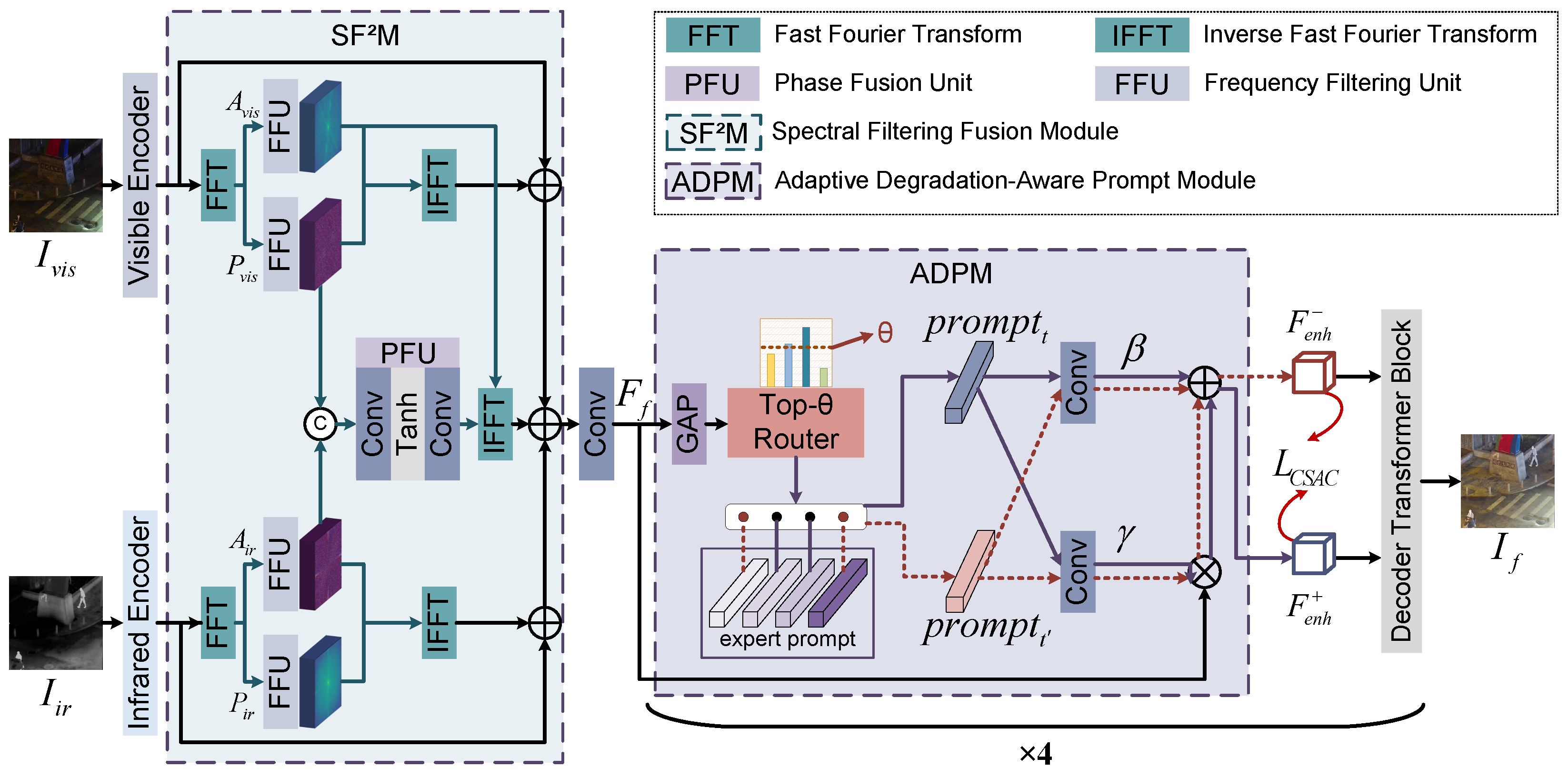
The overall architecture of the proposed framework is illustrated in Figure 1. It consists of five components: a dual-branch encoder, the Spectral Filtering Fusion Module (SF2M), the Adaptive Degradation-Aware Prompt Module (ADPM), the Contrastive Semantic Alignment Constraint ( L CSAC ), and a reconstruction decoder.
Specifically, given a pair of infrared and visible images I i r R H × W × 1 and I v i s R H × W × 3 , two modality-specific Transformer encoders extract multi-level features in four stages. These features are fed into SF2M, where they are mapped into the frequency domain via the Fast Fourier Transform (FFT). Within this space, the Frequency Filtering Unit (FFU) redistributes spectral responses to strengthen informative components while attenuating noise-dominated frequencies, whereas the Phase Fusion Unit (PFU) integrates phase responses across modalities. The fused spectral components are projected back to the spatial domain via the inverse Fast Fourier Transform (IFFT) to obtain the fused feature F f , preserving cross-modal complementarity.
To adapt the fusion process to diverse corruption patterns, F f is further refined by ADPM. Concretely, ADPM introduces a sparsity-aware gating mechanism to select relevant prompt experts and generate a task-specific prompt vector prompt t . This vector is projected through lightweight convolutional layers to produce scale ( γ ) and bias ( β ) parameters, which modulate F f to mitigate image distortions. To align prompts with image condition distributions, CSAC imposes contrastive supervision by constructing positive and negative prompt pairs ( prompt t , prompt t ) and enforcing feature consistency between their corresponding representations F enh + and F enh . This constraint encourages the prompt space to encode condition-specific and separable features.
Finally, ADPM and the decoder operate across four spatial scales to progressively reconstruct the fused image I f . During training, multi-level fusion losses are jointly optimized with L CSAC , facilitating stable feature learning, thereby enabling the generation of structurally coherent and detail-rich fused images.

3.2. Spectral Filtering Fusion Module

3.2.1. Basics of Fast Fourier Transform

Before introducing the proposed framework, we briefly review the Fourier Transform as the basis for frequency-domain fusion. The Fourier Transform maps signals from the spatial domain to the frequency domain, where structural and appearance information are represented by different spectral components. Formally, for a feature map x R H × W , its two-dimensional Fourier Transform is defined as:
F ( x ) ( u , v ) = h = 0 H 1 w = 0 W 1 x ( h , w ) e j 2 π u h H + v w W
where j denotes the imaginary unit, and ( u , v ) represents the frequency coordinates. For multi-channel inputs, the transform is applied to each channel independently to avoid inter-channel interference. The resulting real and imaginary components, R ( x ) ( u , v ) and I ( x ) ( u , v ) , are used to derive the amplitude and phase representations:
A ( x ) ( u , v ) = R ( x ) ( u , v ) 2 + I ( x ) ( u , v ) 2
P ( x ) ( u , v ) = arctan I ( x ) ( u , v ) R ( x ) ( u , v )
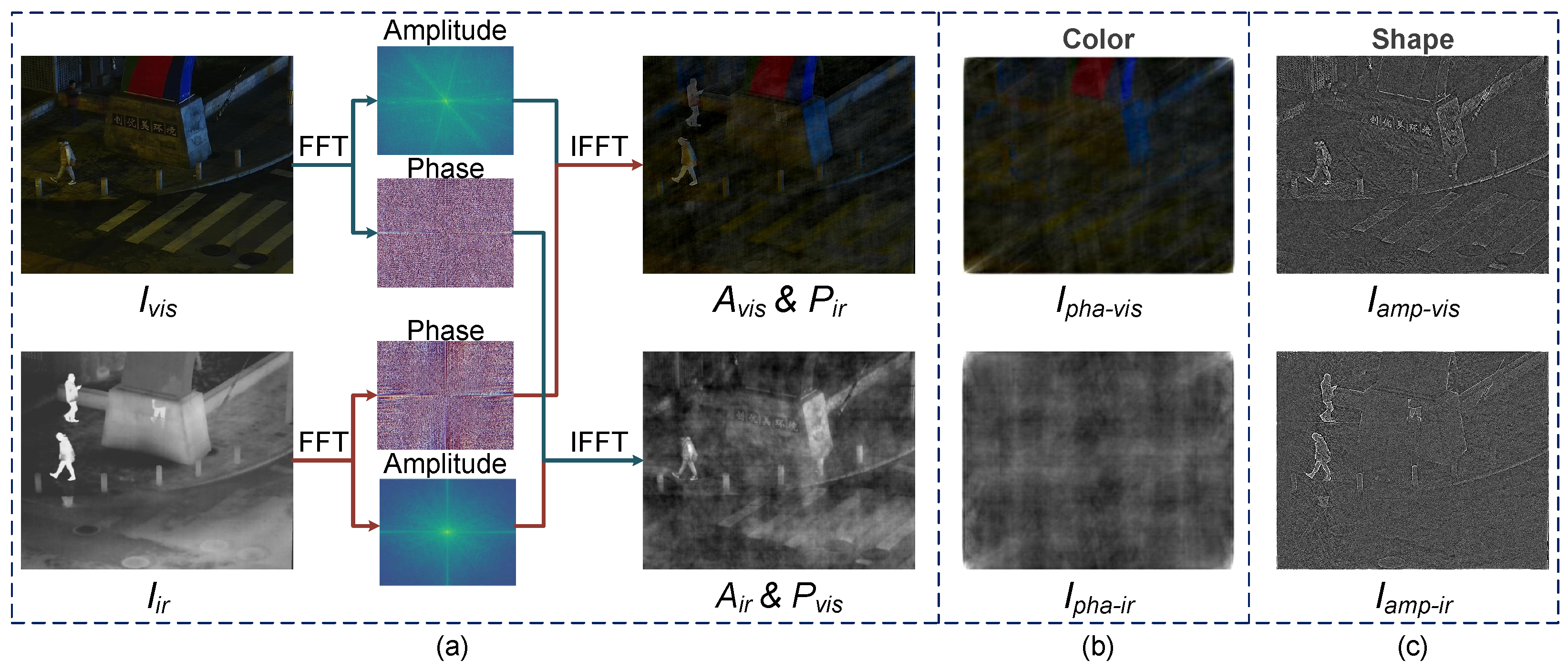
As shown in Figure 2, swapping the phase spectra between infrared and visible images leads to substantial differences in the reconstructed structural content, even under identical amplitude components. This observation confirms that phase is the principal carrier of spatial structure, whereas amplitude mainly encodes luminance and color [48].
Based on this observation, SF2M is designed according to two principles:
(i)
Spectral weighting. Illumination variations are generally reflected in low-frequency components, while noise is predominantly distributed in high-frequency regions [49]. The Frequency Filtering Unit (FFU) applies spectral re-weighting to amplitude and phase to enhance informative frequency components and suppress noise-dominated regions.
(ii)
Cross-modal phase integration. Since phase encodes structural layout, the Phase Fusion Unit (PFU) integrates phase spectra from infrared and visible features to improve structural consistency, while preserving visible amplitude to retain appearance information.

3.2.2. Frequency Filtering Unit

To exploit frequency-domain information for selective feature enhancement, we design a Frequency Filtering Unit (FFU) that applies attention to re-weight spectral components. Specifically, F i r and F v i s are mapped into the frequency domain via FFT:
F i r = FFT ( F i r ) = ( A i r , P i r )
F v i s = FFT ( F v i s ) = ( A v i s , P v i s )
where A i r and A v i s denote the amplitude spectra of infrared and visible features, while P i r and P v i s denote their phase spectra.
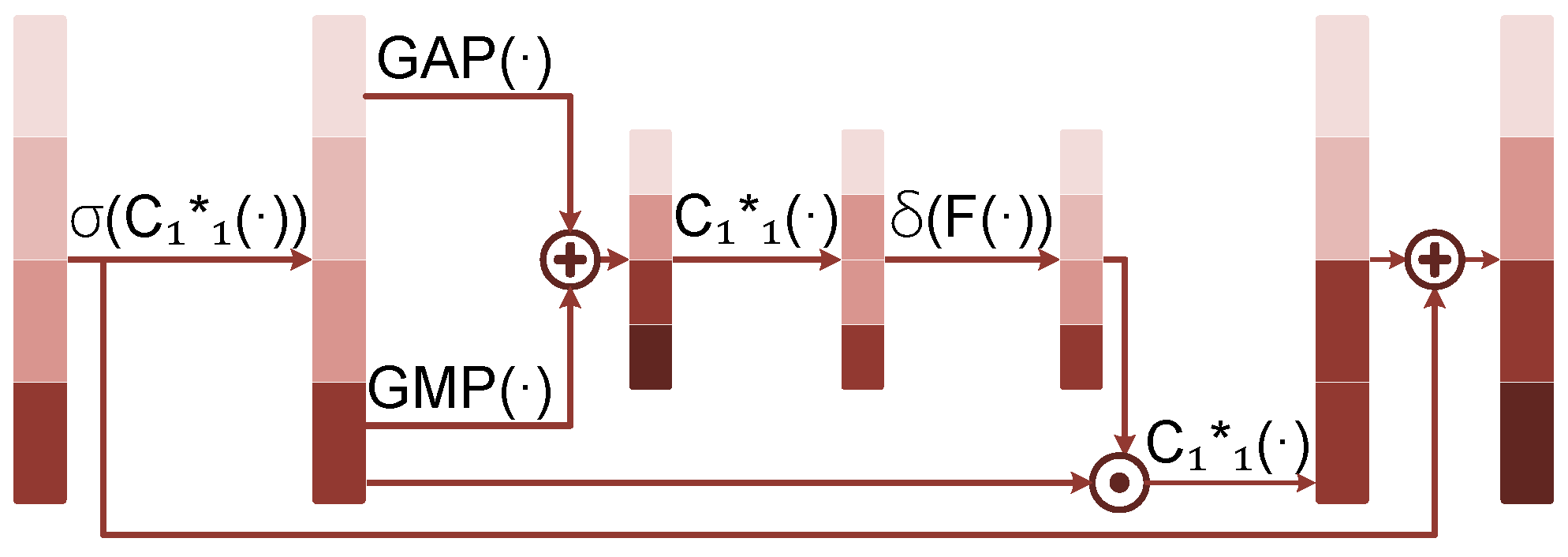
As illustrated in Figure 3, the FFU performs frequency-domain modulation by adaptively reweighting spectral components. Specifically, the phase spectrum P ir is first processed via pointwise convolution and nonlinear activation to capture local spectral dependencies:
P ^ ir = σ Conv ( P ir )
where σ ( · ) represents the ReLU function. To incorporate global spectral dependencies, the feature map is aggregated via global average pooling (GAP) and global max pooling (GMP), and the resulting descriptors are combined and projected to produce channel-wise weights:
Z = GAP ( P ^ ir ) + GMP ( P ^ ir )
W = δ Conv ( Z )
where δ ( · ) denotes the Sigmoid function. The refined phase spectrum is updated by adding the transformed weighted response to the original phase spectrum:
P ˜ ir = P ir + Conv W P ^ ir
where ⊙ is element-wise multiplication.
The FFU re-weights spectral components to enhance relevant frequencies while suppressing noise-dominated responses, with the same operation applied to P vis , A ir and A vis .

3.2.3. Phase Fusion Unit

As illustrated in Figure 2, structural information is predominantly encoded in the phase spectrum, while the amplitude spectrum mainly captures appearance-related variations. Based on this observation, the Phase Fusion Unit (PFU) is designed to leverage phase cues for cross-modal structural integration.
Specifically, the modulated phase spectra P ˜ ir and P ˜ vis are concatenated and subsequently processed by two 1 × 1 convolutional layers with a tanh activation to produce the fused phase representation P f :
P f = tanh Conv Conv Concat P ˜ ir , P ˜ vis
The amplitude spectrum of the visible modality is retained as A ˜ vis , and the fused representation F freq is reconstructed in the spatial domain via the inverse Fourier Transform:
F freq = IFFT A ˜ vis , P f
In parallel, to preserve modality-specific characteristics, infrared and visible features are reconstructed from their modulated spectra via inverse Fourier Transforms and integrated with the corresponding encoder features through residual connections:
F ir = IFFT A ˜ ir , P ˜ ir + F ir
F vis = IFFT A ˜ vis , P ˜ vis + F vis
Finally, the cross-modal frequency feature is integrated with the modality-specific reconstructions, followed by convolutional refinement to produce the fused representation F f :
F f = Conv F freq + F ir + F vis
The PFU leverages phase spectra to guide cross-modal structural integration, while retaining amplitude components from the visible modality to preserve color and photometric fidelity. Furthermore, modality-specific residual pathways are incorporated to preserve fine-grained details, yielding structurally consistent and detail-preserving fusion results.

3.3. Adaptive Degradation-Aware Prompt Module

To address heterogeneous corruption characteristics, we introduce an Adaptive Degradation-Aware Prompt Module (ADPM). ADPM adopts a sparsity-aware gating mechanism to dynamically select and aggregate relevant prompts conditioned on input features, enabling adaptive modulation and refinement of feature representations.
In particular, ADPM comprises two components: (i) a set of N learnable expert prompts, E = { E 1 , , E N } , each prompt implicitly captures distinct corruption-specific characteristics; and (ii) a sparse gating network G that assigns expert weights conditioned on the fused feature F f . The gating network facilitates input-dependent prompt selection through sparse activation of experts based on their gating scores. The aggregated task-specific prompt prompt t is computed as:
prompt t = i = 1 N g i ( F f ) E i ( F f )
where E i ( · ) denotes the output of the i-th expert, and g i ( · ) corresponds to the gating weight from G. To impose sparsity on expert activation, we employ a Top- θ selection mechanism, where the gating weights are computed as:
g ( F f ) = Top- θ softmax W g · GAP ( F f ) + b g , θ
where W g and b g are learnable parameters. The Top- θ ( · ) operator retains the smallest subset of experts whose cumulative weights exceed the threshold θ (set to 0.9), while setting the remaining weights to zero.
The task-specific prompt prompt t is projected into channel-wise affine parameters, γ and β , which are applied to modulate the fused feature F f :
γ = Conv ( prompt t ) β = Conv ( prompt t ) F enh = γ F f + β
where ⊙ denotes channel-wise multiplication.
The expert prompts are not explicitly assigned to predefined categories but are learned in a data-driven manner to capture input-dependent feature characteristics. The sparsity-aware gating mechanism dynamically selects subsets of prompts conditioned on the input, enabling adaptive expert activation. During inference, only the Top- θ prompts are retained for feature modulation. To promote semantic alignment between prompts and latent distortion characteristics, inactive prompts ( prompt t , t t ) are treated as negative samples during training. A contrastive objective is formulated by constructing positive and negative prompt–feature pairs, as detailed in the next section.

3.4. Contrastive Semantic Alignment Constraint

Although ADPM performs sparse expert selection, sparsity alone does not ensure that the selected prompts are well aligned with the input features. Different prompts may exhibit similar responses to low-level patterns (e.g., illumination and contrast), leading to ambiguity in prompt selection. To mitigate this issue, we introduce a Contrastive Semantic Alignment Constraint (CSAC), formulating prompt learning as a contrastive process through the construction of positive and negative prompt–feature pairs.
Let F f denote the fused representation and prompt t denote the selected prompt. The prompt is used to modulate a feature transformation function F ( · ) , producing the enhanced feature for the positive branch:
F enh + = F ( F f , prompt t )
while each inactive prompt prompt t ( t t ) produces the feature for the negative branch:
F enh ( t ) = F ( F f , prompt t )
The anchor feature F gt is constructed from high-quality reference images. Given clean infrared and visible images I ir g and I vis g , we extract reference features by applying the same encoder E ( · ) and the spectral fusion module SF2M as in the main pipeline:
F gt = SF 2 M E ( I ir g ) , E ( I vis g )
A multi-negative InfoNCE loss is employed to pull F enh + toward F gt while pushing negative-branch features away from F gt . Let N t = { t : t t } denote the index set of inactive prompts. The CSAC loss is defined as:
L CSAC = log exp sim ( F enh + , F gt ) / τ exp sim ( F enh + , F gt ) / τ + t N t exp sim ( F enh ( t ) , F gt ) / τ
where sim ( a , b ) = a b a b denotes cosine similarity, and τ > 0 is a temperature parameter that controls the concentration of the similarity distribution.
This encourages prompt-enhanced features to align with their corresponding reference features while remaining separable from mismatched ones, thereby enhancing discriminability. Moreover, CSAC introduces no additional computational overhead during inference, as only the Top- θ selected prompt is used at test time.

3.5. Loss Functions

Beyond leveraging prompts to address diverse adverse conditions, IVIF aims to produce a fused representation that balances salient targets and fine-grained details. The overall training objective is formulated as:
L f = L fusion + λ L CSAC ,
where λ is a weighting factor that balances the contribution of L CSAC . The fusion loss is formulated as a combination of multiple complementary terms, including intensity loss L int , structural similarity loss L SSIM , gradient loss L grad , and color consistency loss L color .
To enhance contrast representation and preserve fine-grained texture details in the fused image, intensity and gradient loss are introduced. The formulations are defined as follows:
L int = 1 H W I f max ( I vis g , I ir g ) 1
L grad = 1 H W I f max ( I vis g , I ir g ) 1
where · 1 denotes the 1 norm and ∇ denotes a spatial gradient operator. H and W represent the height and width of the image, respectively.
To preserve chromatic fidelity with respect to the visible modality, a color consistency constraint is imposed. Specifically, the image is transformed into the YCbCr color space, where the chrominance components (Cb and Cr) are constrained via Euclidean distance minimization. The corresponding loss is formulated as follows:
L color = 1 H W F CbCr ( I f ) F CbCr ( I vis g ) 1
where F CbCr ( · ) denotes the transformation from the RGB space to the YCbCr color space.
The Structural Similarity Index (SSIM) [50] is widely used to assess image similarity in terms of luminance, contrast, and structure. Owing to its effectiveness in preserving structural fidelity, SSIM is incorporated into the fusion objective to enforce structural consistency between the fused image and the source modalities. The formulation is given as follows:
L ssim = 1 2 1 SSIM ( I ir g , I f ) + 1 2 1 SSIM ( I vis g , I f )
The fusion loss is defined as:
L fusion = L int + L ssim + L grad + L color
All loss terms are normalized to the range [ 0 , 1 ] . Specifically, the structural similarity loss is inherently bounded within [ 0 , 1 ] ,while the remaining losses are implemented as pixel-wise averaged 1 losses. Since the input images are normalized to [ 0 , 1 ] , the resulting loss values are also constrained within a comparable range, enabling balanced contributions during joint optimization.

4. Experiments

In this section, we first describe the experimental settings and provide comprehensive details of our training procedure. Subsequently, we systematically evaluate the proposed method’s fusion performance both qualitatively and quantitatively on multiple public datasets and typical degradation scenarios. Finally, we conduct ablation studies to validate the effectiveness of our approach.

4.1. Experimental Setting

4.1.1. Datasets

We evaluated our method on four public infrared–visible fusion datasets: LLVIP [51], RoadScene [52], MSRS [10], and TNO [53]. They contain image variations including low illumination, overexposure, rain interference, low infrared contrast, and sensor noise. We randomly selected 3787 image pairs for training and used 1187 pairs for testing. To provide supervision, we adopted restored reference images from Text-IF [14], which were manually restored following the procedure described in the original work.

4.1.2. Baselines

We compared our method with eleven recent deep learning fusion methods: TarDAL [25], CDDFuse [21], Text-IF [10], LDFusion [54], MUFusion [19], CMTFusion [38], YDTR [34], BDLFusion [55], IGNet [56], DAFusion [44], and LRRNet [18]. We used the official pretrained models provided by the authors. All methods were evaluated under the same experimental settings.

4.1.3. Evaluation Metrics

We used eight quantitative metrics to evaluate our method. Fusion quality was evaluated using entropy (EN) [57], average gradient (AG) [58], spatial frequency (SF) [59], structural correlation difference (SCD) [60], mutual information (MI) [61], and visual information fidelity (VIF) [62]. These metrics measure different properties of the fused image: EN and MI reflect information content, AG and SF capture edge and texture variation, SCD evaluates structural consistency, and VIF measures perceptual similarity. For all these metrics, higher values indicate better fusion performance. We further included two no-reference metrics, Natural Image Quality Evaluator (NIQE) [63] and Perception-based Image Quality Evaluator (PIQE) [64], to assess image quality without reference images. NIQE measures deviation from natural scene statistics, while PIQE evaluates local distortion levels. Lower NIQE and PIQE values indicate better image quality.

4.1.4. Implementation Details

We implemented the proposed model in PyTorch (version 2.0.0) and ran it on an NVIDIA RTX 3090 GPU. The model was trained using the AdamW optimizer with an initial learning rate of 1 × 10 4 and a linear decay schedule. The batch size was set to 8, and the model was trained for 200 epochs. Input image pairs were randomly cropped into 96 × 96 patches during training. All experiments were conducted under the same hardware and software configuration.
The network adopted a symmetric U-Net architecture with four encoder–decoder stages. The encoder extracts multi-scale features, and the decoder restores spatial resolution to reconstruct the fused image. Restorer modules were inserted at each encoding and decoding stage to enhance feature representation. The number of Restorer modules at each stage was set to [2, 2, 4, 4] to match different feature scales. In the Restorer modules, Layer Normalization and GELU activation were employed.

4.2. Fusion Performance Evaluation

This section comprehensively evaluates the fusion performance of our method across multiple test datasets through systematic qualitative and quantitative analyses.
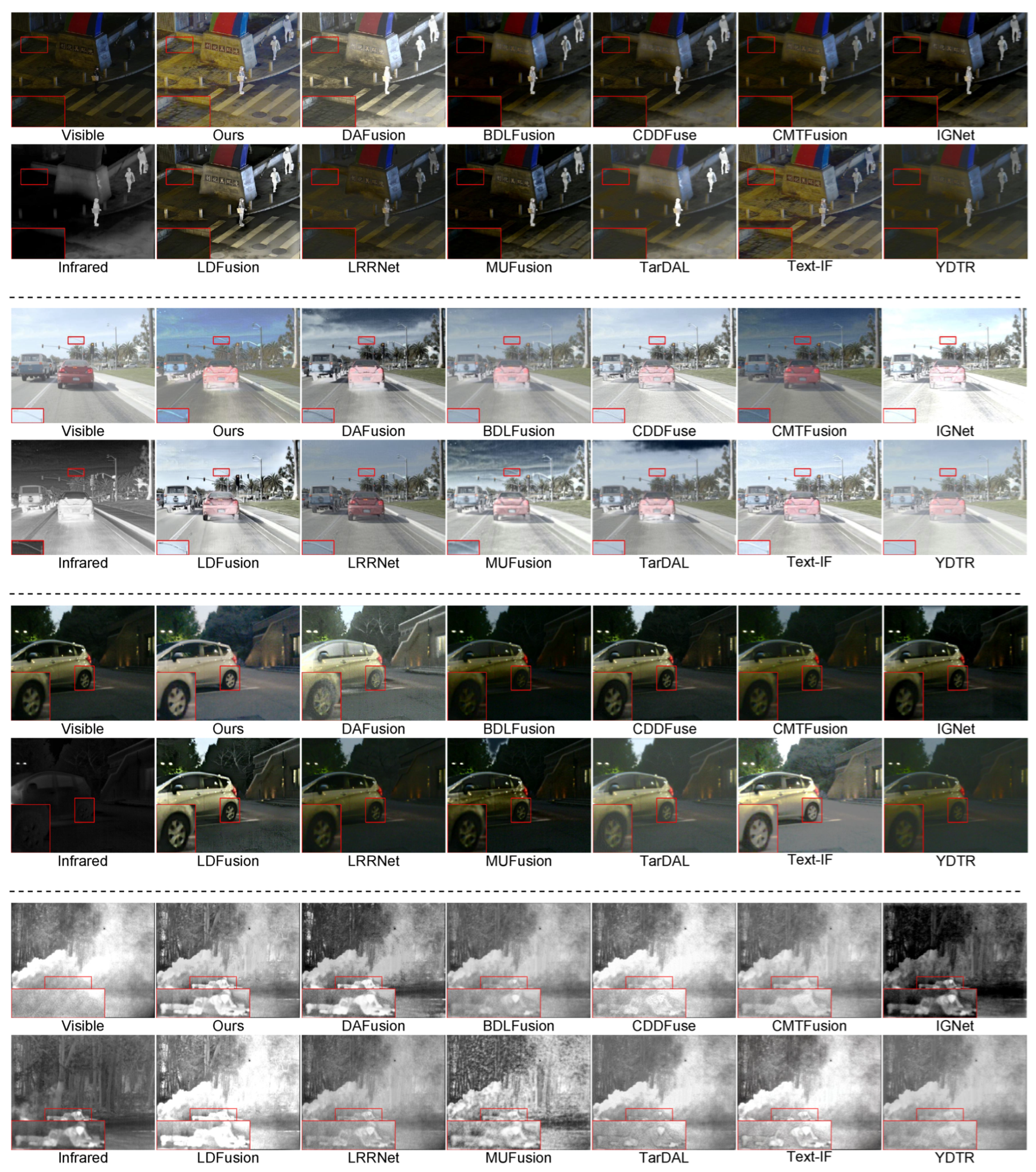
Qualitative Comparisons: Figure 4 shows qualitative comparisons with several state-of-the-art fusion methods on multiple datasets. The red boxes mark representative local regions. In these regions, our method, enabled by prompt-driven condition-aware modeling, exhibits three key advantages. First, it preserves fine-grained details, as shown by the clearer ground textures in the first group. Second, it enhances structural delineation, producing more discernible contours of the fog-obscured person in the fourth group. Third, it improves chromatic fidelity, yielding more natural and coherent color reproduction in the second group. Methods such as CDDFuse, BDLFusion, CMTFusion, and LRRNet exhibit reduced detail preservation in certain regions, resulting in smoother appearances, as evidenced by the highlighted regions. IGNet presents variations in color distribution in some cases, which are distinctly reflected in the sky region of the second group. Although Text-IF and LDFusion incorporate textual guidance, their results still show limited clarity in fine-scale structures, particularly at edges and around small objects. MUFusion shows slight reductions in contrast and structural detail in multiple cases, particularly in the wheel region of the third group, which may reduce its distinguishability. TarDAL and YDTR demonstrate different smoothing characteristics. TarDAL tends to preserve higher intensity responses, as observed in the brighter human regions in the first group. In contrast, YDTR produces smoother results with reduced local structural distinctness. DAFusion enhances brightness in low-light regions; however, slight color deviations are perceptible in the first and third groups, and the wheel boundary in the third group appears less well-defined.
Quantitative Comparisons: Table 1 presents quantitative results on four benchmark datasets. Although the optimal methods vary across individual metrics and datasets, our method achieves the best overall ranking (RoR) on all datasets. In particular, notable advantages are observed in the MI and VIF metrics. The MI metric indicates that SF2M improves the preservation of informative content, while the VIF metric suggests better alignment with human visual perception in structural representation and detail reconstruction. For structural preservation, our method achieves the best SCD metric on the MSRS dataset and near-optimal results on the remaining datasets, reflecting consistent structural integrity under diverse imaging conditions. The highest AG metric is achieved on the LLVIP dataset, indicating that ADPM effectively adapts to low-illumination conditions and enhances edge and detail representation. On the TNO dataset, our method achieves the highest SF metric, suggesting effective recovery of high-frequency details. Although it does not achieve the highest EN metric, our method attains near-leading performance, indicating competitive information richness. In comparison, LDFusion attains high EN and SF metrics with textual guidance, indicating strong high-frequency responses and information representation; however, its performance in the SCD, MI, and VIF metrics suggests a limited capacity to balance structural preservation and noise suppression. DAFusion attains relatively high EN and AG metrics, reflecting effectiveness in content restoration and detail enhancement under certain conditions, but remains inferior in overall performance. Collectively, the consistent first-place RoR ranking across the evaluated datasets suggests the effectiveness of our method, indicating its capability to jointly preserve informative content, structural integrity, and high-frequency details.

4.3. Fusion Performance Under Degraded Conditions

We evaluated our method with several image restoration and fusion methods. To address various image degradations, we applied representative restoration models to preprocess the source images before fusion: NeuralBR [65] for low-light enhancement, DTR [66] for raindrop removal, AirNet [67] for denoising and contrast adjustment, and IAT [68] for exposure correction. All methods were evaluated using publicly available pretrained models.
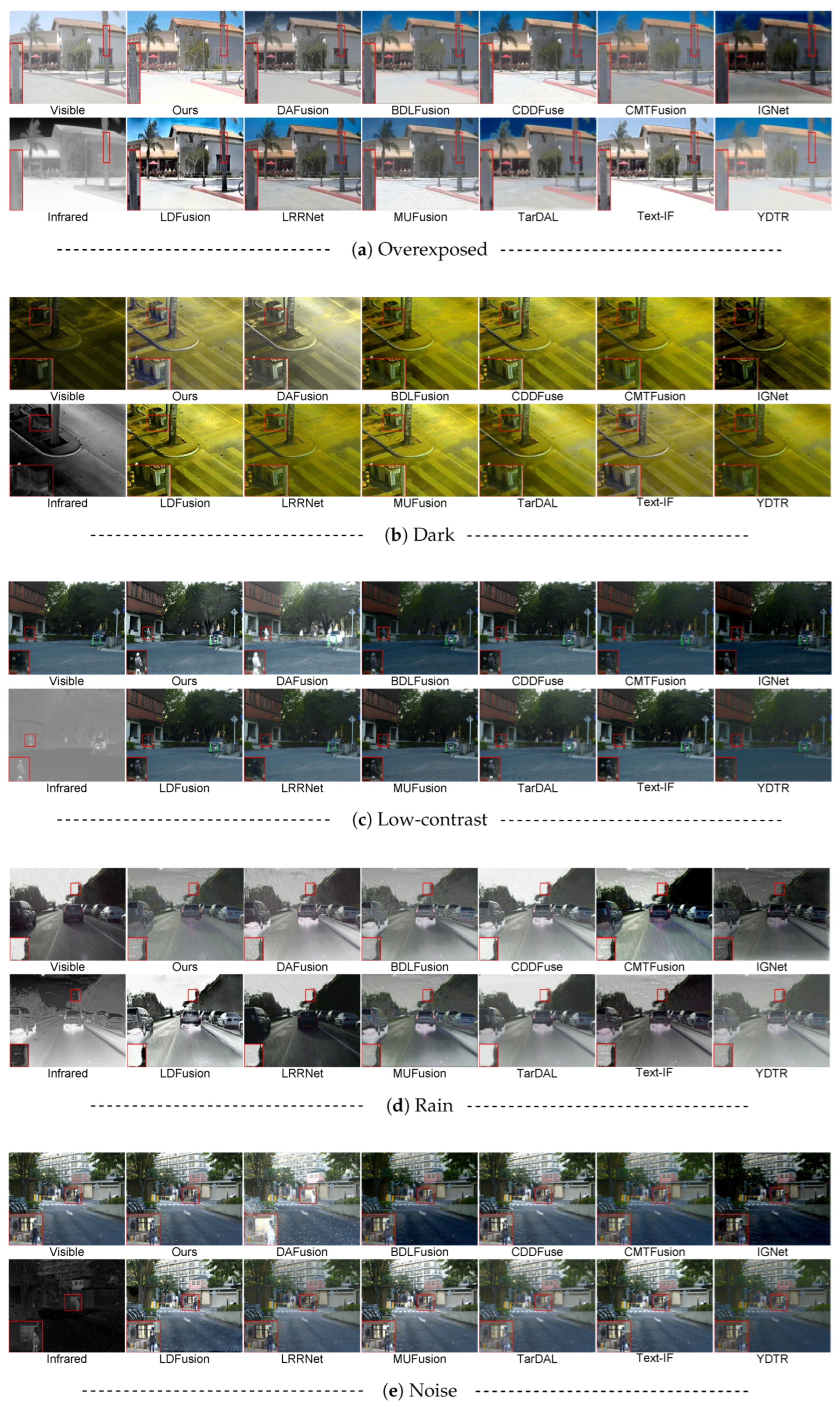
Qualitative Comparisons: Figure 5 presents qualitative comparisons between our method and several image restoration and fusion approaches under different conditions. The red boxes indicate representative local regions for comparison. Within these regions, our method exhibits significant advantages in preserving salient targets and representing fine-grained details. In contrast, DAFusion and Text-IF demonstrate limited structural information retention under challenging scenarios. In particular, under degradations such as rain and noise, fine-scale structural consistency is compromised, as evidenced in the fourth group where the overhead wires exhibit reduced continuity. In addition, residual noise persists in the outputs of DAFusion, as observed in the fifth group, indicating insufficient noise suppression. Meanwhile, under low-contrast infrared conditions, Text-IF shows reduced discriminability between targets and the background in the third group, reflecting inadequate target saliency representation. Other methods (e.g., TarDAL and CDDFuse) rely on restoration-based preprocessing and tend to preserve already visible content in complex scenarios, while their capability to represent structures in low-visibility regions remains limited.
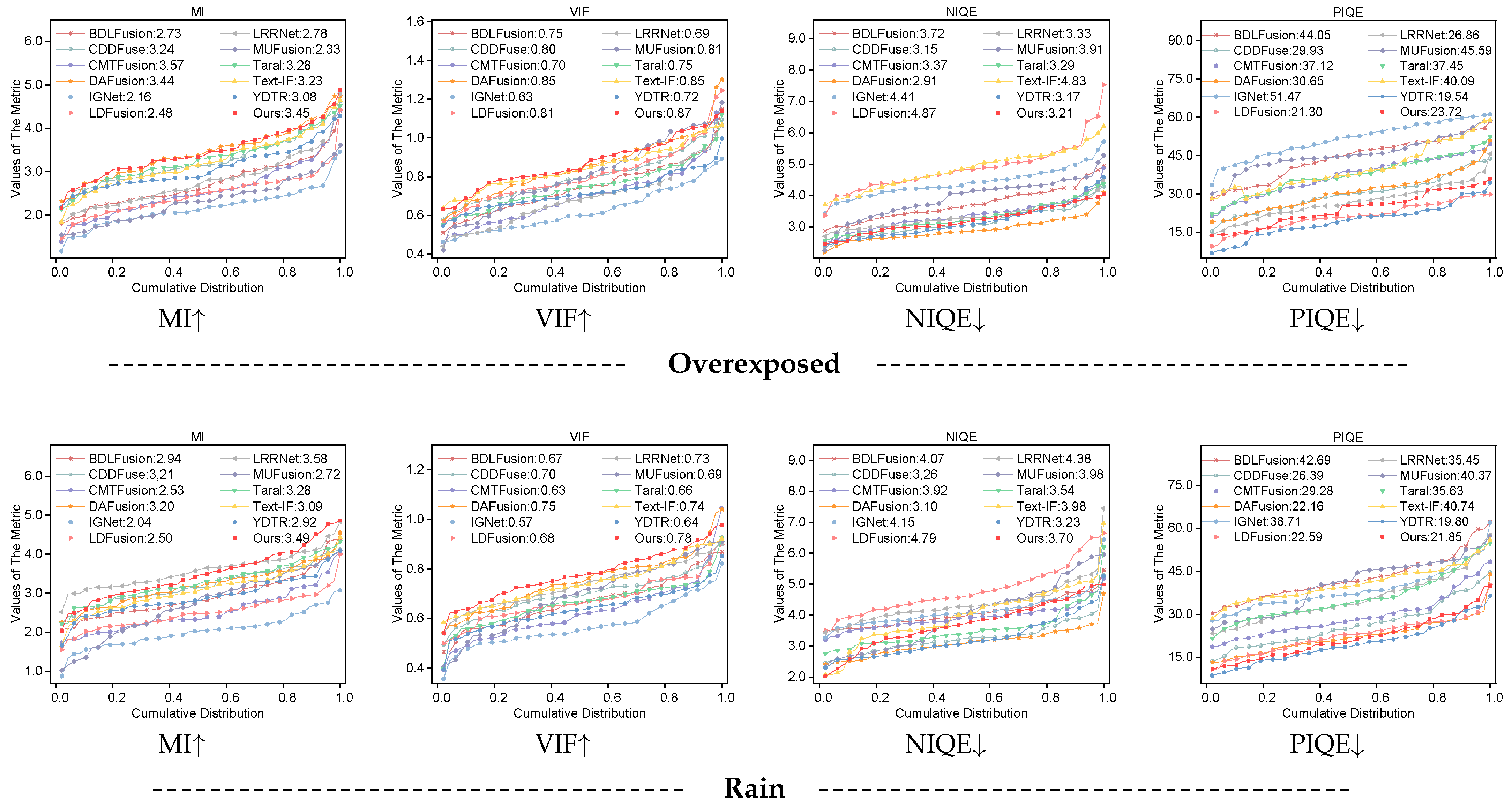
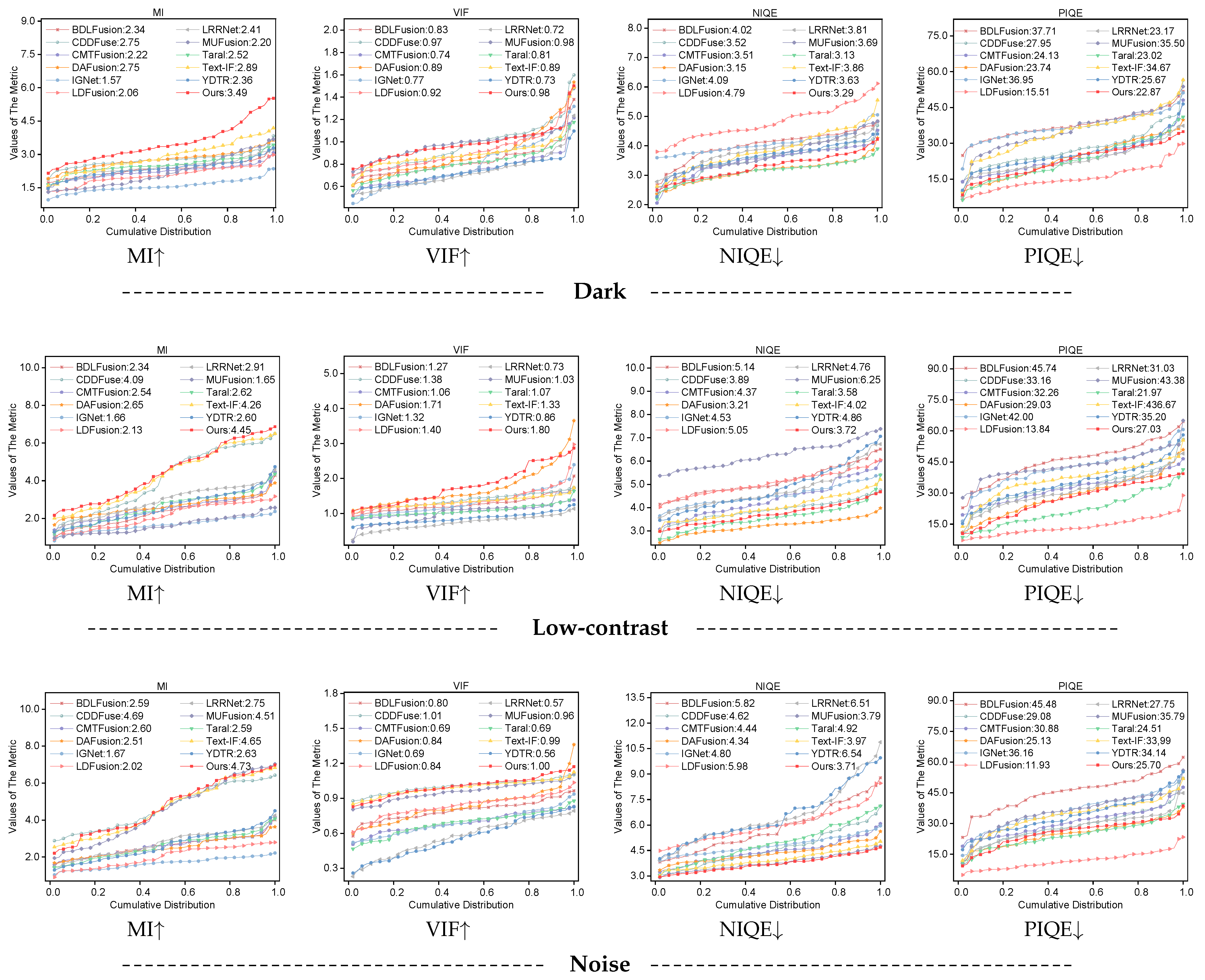
Quantitative Comparisons: Figure 6 presents quantitative comparisons between our method and several image restoration and fusion methods under various conditions. Our method maintains consistently competitive performance across all evaluation metrics. The advantages in the MI and VIF metrics indicate that our method achieves more effective information retention and better alignment with human visual perception, which can be attributed to the prompt-driven condition-aware modeling. Meanwhile, the NIQE and PIQE results remain competitive, demonstrating its capability to generate high-quality fused images. In comparison, although DAFusion and TarDAL achieve competitive NIQE scores in specific scenarios, their relatively weaker performance in other metrics suggests limited overall balance and consistency. Similarly, while LDFusion performs well in PIQE, its inferior MI and VIF indicate a weaker ability to preserve informative and structurally relevant content. Overall, our method achieves leading performance in MI and VIF while maintaining competitive results in NIQE and PIQE, resulting in a more balanced trade-off across different evaluation criteria under diverse imaging conditions.

4.4. Results of Infrared–Visible Object Detection

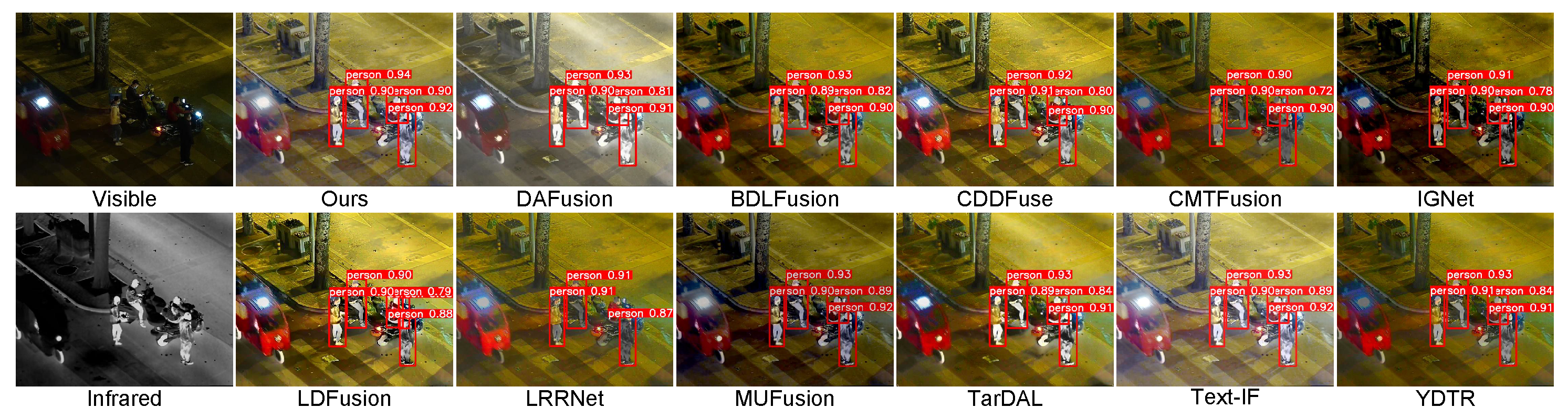
To evaluate infrared and visible image fusion for multimodal object detection, we conducted experiments on the LLVIP dataset, which contains low-light street scenes. The dataset was split into 3000 image pairs for training, 300 for validation, and 163 for testing. Each fusion method was paired with a YOLOv5 detection model, with all models trained under identical settings. We evaluated performance using Precision (P), Recall (R), mAP@0.5, and mAP@0.5:0.95. As shown in Figure 7, our method achieves superior detection accuracy under low-light conditions, demonstrating its effectiveness in challenging visual environments. As reported in Table 2, the quantitative results on the LLVIP dataset further substantiate this observation, with our method achieving the top ranking in both mAP@0.5 and mAP@0.5:0.95, thereby indicating consistently stable detection performance across a range of IoU thresholds. This advantage stems from the frequency-domain fusion strategy, which preserves structural consistency and fine details, enabling more discriminative and reliable features for detection. In terms of the P metric, our method ranks second, indicating accurate localization capability. However, the relatively lower R score suggests reduced target recall, indicating that some targets may be missed in certain scenarios.

4.5. Ablation Study

Importance of each component: To assess the contribution of each component, we perform ablation experiments on the LLVIP dataset, as summarized in Table 3. We begin with a baseline model based on parameter-matched 3 × 3 convolutional fusion, where all evaluation metrics remain at relatively low levels. The performance improves steadily as SF2M, ADPM, and CSAC are progressively incorporated. The inclusion of SF2M yields consistent improvements across multiple metrics, owing to its ability to effectively integrate structural and detail information in the frequency domain. The incorporation of ADPM and CSAC leads to further performance gains, underscoring their efficacy in enriching the representation of degradation-related information. The full model, which integrates all three modules, achieves the best overall performance. These results show that each component contributes positively and that their combination leads to consistent performance gains.
Impact of ADPM and CSAC: To further analyze the roles of ADPM and CSAC, we design additional comparative experiments. In addition to removing each module individually, we replace ADPM with static prompts for comparison, as shown in Table 4 and Table 5. The results indicate that, although static prompts achieve marginal gains on certain metrics compared to ADPM alone, the joint integration of ADPM and CSAC leads to more consistent overall performance across evaluation criteria, highlighting their effectiveness in jointly modeling and mitigating adverse imaging conditions.
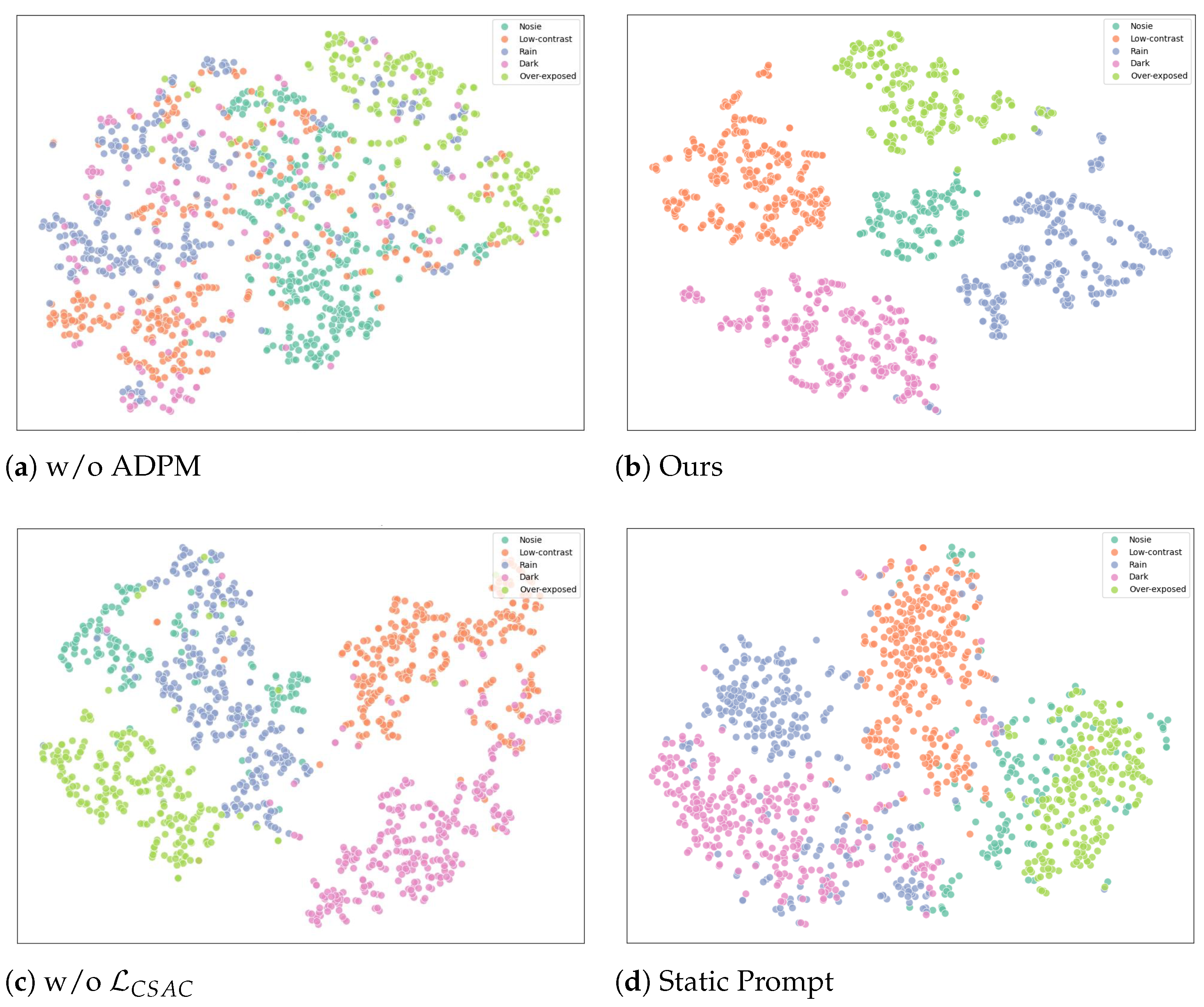
To further assess the degradation discrimination capability of ADPM and CSAC, we employ t-SNE visualization to analyze feature distributions. As illustrated in Figure 8, removing ADPM leads to significant overlap of feature embeddings across different image conditions. When ADPM is replaced with static prompts, the boundaries between different categories remain ambiguous, resulting in limited discriminability of the feature distributions. Furthermore, removing CSAC causes the feature boundaries of degradation types such as Noise and Rain to become more blurred, making them difficult to distinguish effectively. In contrast, the full model produces more compact intra-class distributions while significantly enlarging the inter-class separation under the same conditions. These results substantiate the effectiveness of ADPM and CSAC in jointly capturing adverse imaging variations and enhancing feature discriminability.
Effectiveness of FFU and PFU: To evaluate the effectiveness of the FFU and PFU modules, we conduct ablation experiments on the MSRS dataset, with results summarized in Table 6. In these experiments, PFU is replaced with a parameter-matched 3 × 3 convolution. The results show that removing either FFU or PFU results in performance deterioration across all metrics, with varying degrees of decline. Notably, FFU contributes more substantial gains, highlighting its role in enhancing informative frequency components while suppressing noise-dominated regions. The inclusion of PFU further promotes cross-modal information integration, improving structural consistency in the fused results. Combining both modules yields additional improvements, demonstrating their complementary roles in enhancing overall fusion performance.
Hyperparameter analysis: We conduct an ablation study on the weighting hyperparameter λ in the overall training objective. Specifically, λ is varied from 1.3 to 1.7 with a step size of 0.1. As shown in Table 7, the model performance varies with different λ values. Performance improves as λ increases from 1.3 to 1.5, and then decreases when λ is further increased. The best results are obtained at λ = 1.5 across most evaluation metrics. This setting provides a balanced contribution between the fusion loss and the CSAC loss L CSAC .
We further analyze the impact of the threshold hyperparameter θ on model performance. As shown in Table 8, increasing θ from 0.7 to 0.9 leads to consistent improvements across all metrics, with the optimal overall performance attained at a value of 0.9. When θ is further increased to 1.0, most metrics exhibit noticeable performance deterioration, although VIF shows a marginal gain. These results indicate that a moderate θ facilitates the selection of informative prompts, whereas a larger θ may introduce redundancy or less relevant signals. Accordingly, θ = 0.9 is adopted in all experiments.
Analysis of Fusion Losses: We conduct an ablation study on four fusion loss components, including the intensity loss ( L int ), structural similarity loss ( L ssim ), color consistency loss ( L color ), and gradient loss ( L gra ). These losses constrain the fusion process from different aspects. As shown in Table 9, the removal of any loss term results in varying degrees of performance deterioration. In contrast, integrating all four loss terms yields superior performance across most metrics, indicating that their complementary constraints enhance feature optimization and overall fusion quality.
Evaluation of runtime and computational complexity: To evaluate the computational efficiency of our method, we select a representative text-guided fusion approach, Text-IF, as a baseline for comparison. Table 10 reports the number of learnable parameters, FLOPs, and runtime for different methods across multiple datasets. Our method achieves comparable runtime while maintaining relatively low computational cost, indicating a balanced trade-off between performance and efficiency.


5. Conclusions

In this work, we propose an end-to-end framework for infrared and visible image fusion in complex real-world conditions, integrating degradation modeling with cross-modal feature fusion to enhance robustness while exploiting complementary information. Specifically, the Degradation-Aware Prompt Module (ADPM), together with the Contrastive Semantic Alignment Constraint (CSAC), learns condition-specific features to generate discriminative prompts, which serve as conditional priors to guide the optimization of degradation-related representations in the source features. Meanwhile, the Spectral Filtering Fusion Module (SF2M) operates in the frequency domain to extract complementary information, suppress interference, and facilitate cross-modal feature integration. Experiments on multiple benchmarks and diverse scenarios show that our method achieves competitive performance across multiple evaluation metrics, ranking first overall in RoR, which confirms its effectiveness and robustness. Despite these results, the method still has certain limitations. The modeling of interactions among multiple factors remains relatively implicit, and under coexisting adverse conditions, the discriminative capability still has room for improvement. Future work will focus on more refined condition modeling and decoupling mechanisms to explicitly characterize interactions among different factors, thereby enhancing generalization in complex composite scenarios.

Author Contributions

Conceptualization, Q.Z. and J.Z.; methodology, Q.Z. and J.Z.; validation, Q.Z., J.Z. and H.L.; writing—original draft preparation, J.Z.; writing—review and editing, H.L.; supervision, Q.Z. All authors have read and agreed to the published version of the manuscript.

Funding

This work was supported in part by the Natural Science Foundation of Shandong Province (Grant No. ZR2025MS1064).

Institutional Review Board Statement

Not applicable.

Informed Consent Statement

Not applicable.

Data Availability Statement

The data used in this study are available from the corresponding author upon reasonable request.

Acknowledgments

The authors would like to thank the anonymous reviewers for their valuable comments.

Conflicts of Interest

The authors declare no conflicts of interest.

References

  1. Meher, B.; Agrawal, S.; Panda, R.; Abraham, A. A survey on region based image fusion methods. Inf. Fusion 2019, 48, 119–132. [Google Scholar] [CrossRef] [Scilit]
  2. Zhang, X. Deep learning-based multi-focus image fusion: A survey and a comparative study. IEEE Trans. Pattern Anal. Mach. Intell. 2021, 44, 4819–4838. [Google Scholar] [CrossRef] [Scilit]
  3. Zhou, Y.; Yu, L.; Zhi, C.; Huang, C.; Wang, S.; Zhu, M.; Fu, S. A survey of multi-focus image fusion methods. Appl. Sci. 2022, 12, 6281. [Google Scholar] [CrossRef] [Scilit]
  4. Wang, Y.; Mao, Q.; Zhu, H.; Deng, J.; Zhang, Y.; Ji, J.; Zhang, Y. Multi-modal 3D object detection in autonomous driving: A survey. Int. J. Comput. Vis. 2023, 131, 2122–2152. [Google Scholar] [CrossRef] [Scilit]
  5. Bao, C.; Cao, J.; Hao, Q.; Cheng, Y.; Ning, Y.; Zhao, T. Dual-YOLO architecture from infrared and visible images for object detection. Sensors 2023, 23, 2934. [Google Scholar] [CrossRef] [Scilit]
  6. Karim, S.; Tong, G.; Li, J.; Qadir, A.; Farooq, U.; Yu, Y. Current advances and future perspectives of image fusion: A comprehensive review. Inf. Fusion 2023, 90, 185–217. [Google Scholar] [CrossRef] [Scilit]
  7. Ren, W.; Luo, L.; Ren, J. A two-stage approach for infrared and visible image fusion and segmentation. Appl. Sci. 2025, 15, 10698. [Google Scholar] [CrossRef] [Scilit]
  8. Minahil, S.; Kim, J.H.; Hwang, Y. Patch-wise infrared and visible image fusion using spatial adaptive weights. Appl. Sci. 2021, 11, 9255. [Google Scholar] [CrossRef] [Scilit]
  9. Hu, Y.; Xu, S.; Cheng, X.; Zhou, C.; Xiong, M. AFSFusion: An adjacent feature shuffle combination network for infrared and visible image fusion. Appl. Sci. 2023, 13, 5640. [Google Scholar] [CrossRef] [Scilit]
  10. Tang, L.; Yuan, J.; Zhang, H.; Jiang, X.; Ma, J. PIAFusion: A progressive infrared and visible image fusion network based on illumination awareness. Inf. Fusion 2022, 83, 79–92. [Google Scholar] [CrossRef] [Scilit]
  11. Ma, J.; Cheng, T.; Wang, G.; Zhang, Q.; Wang, X.; Zhang, L. ProRes: Exploring degradation-aware visual prompt for universal image restoration. arXiv 2023, arXiv:2306.13653. [Google Scholar]
  12. Yan, Q.; Jiang, A.; Chen, K.; Peng, L.; Yi, Q.; Zhang, C. Textual prompt guided image restoration. Eng. Appl. Artif. Intell. 2025, 155, 110981. [Google Scholar] [CrossRef] [Scilit]
  13. Cui, Y.; Zamir, S.W.; Khan, S.; Knoll, A.; Shah, M.; Khan, F.S. Adair: Adaptive all-in-one image restoration via frequency mining and modulation. In Proceedings of the International Conference on Learning Representations (ICLR), Singapore, 24–28 April 2025; pp. 57335–57356. [Google Scholar]
  14. Yi, X.; Xu, H.; Zhang, H.; Tang, L.; Ma, J. Text-IF: Leveraging semantic text guidance for degradation-aware and interactive image fusion. In Proceedings of the IEEE/CVF Conference on Computer Vision and Pattern Recognition (CVPR), Seattle, WA, USA, 17–21 June 2024; pp. 27026–27035. [Google Scholar]
  15. Wang, H.; Zhang, H.; Yi, X.; Xiang, X.; Fang, L.; Ma, J. TERF: Text-driven and region-aware flexible visible and infrared image fusion. In Proceedings of the 32nd ACM International Conference on Multimedia (ACM MM), Melbourne, VIC, Australia, 28 October–1 November 2024; pp. 935–944. [Google Scholar]
  16. Li, H.; Wu, X.J. DenseFuse: A fusion approach to infrared and visible images. IEEE Trans. Image Process. 2018, 28, 2614–2623. [Google Scholar] [CrossRef] [Scilit] [PubMed]
  17. Li, H.; Wu, X.J.; Kittler, J. RFN-Nest: An end-to-end residual fusion network for infrared and visible images. Inf. Fusion 2021, 73, 72–86. [Google Scholar] [CrossRef] [Scilit]
  18. Li, H.; Xu, T.; Wu, X.J.; Lu, J.; Kittler, J. LRRNet: A novel representation learning guided fusion network for infrared and visible images. IEEE Trans. Pattern Anal. Mach. Intell. 2023, 45, 11040–11052. [Google Scholar] [CrossRef] [Scilit]
  19. Cheng, C.; Xu, T.; Wu, X.J. MUFusion: A general unsupervised image fusion network based on memory unit. Inf. Fusion 2023, 92, 80–92. [Google Scholar] [CrossRef] [Scilit]
  20. Jian, L.; Yang, X.; Liu, Z.; Jeon, G.; Gao, M.; Chisholm, D. SEDRFuse: A symmetric encoder–decoder with residual block network for infrared and visible image fusion. IEEE Trans. Instrum. Meas. 2020, 70, 1–15. [Google Scholar] [CrossRef] [Scilit]
  21. Zhao, Z.; Bai, H.; Zhang, J.; Zhang, Y.; Xu, S.; Lin, Z.; Van Gool, L. CDDFuse: Correlation-driven dual-branch feature decomposition for multi-modality image fusion. In Proceedings of the IEEE/CVF Conference on Computer Vision and Pattern Recognition (CVPR), Vancouver, BC, Canada, 17–24 June 2023; pp. 5906–5916. [Google Scholar]
  22. Ma, J.; Yu, W.; Liang, P.; Li, C.; Jiang, J. FusionGAN: A generative adversarial network for infrared and visible image fusion. Inf. Fusion 2019, 48, 11–26. [Google Scholar] [CrossRef] [Scilit]
  23. Ma, J.; Xu, H.; Jiang, J.; Mei, X.; Zhang, X.P. DDcGAN: A dual-discriminator conditional generative adversarial network for multi-resolution image fusion. IEEE Trans. Image Process. 2020, 29, 4980–4995. [Google Scholar] [CrossRef] [Scilit] [PubMed]
  24. Ma, J.; Zhang, H.; Shao, Z.; Liang, P.; Xu, H. GANMcC: A generative adversarial network with multiclassification constraints for infrared and visible image fusion. IEEE Trans. Instrum. Meas. 2020, 70, 1–14. [Google Scholar] [CrossRef] [Scilit]
  25. Liu, J.; Fan, X.; Huang, Z.; Wu, G.; Liu, R.; Zhong, W.; Luo, Z. Target-aware dual adversarial learning and a multi-scenario multi-modality benchmark to fuse infrared and visible for object detection. In Proceedings of the IEEE/CVF Conference on Computer Vision and Pattern Recognition (CVPR), New Orleans, LA, USA, 18–24 June 2022; pp. 5802–5811. [Google Scholar]
  26. Li, J.; Huo, H.; Li, C.; Wang, R.; Feng, Q. AttentionFGAN: Infrared and visible image fusion using attention-based generative adversarial networks. IEEE Trans. Multimed. 2020, 23, 1383–1396. [Google Scholar] [CrossRef] [Scilit]
  27. Tang, Z.; Xiao, G.; Guo, J.; Wang, S.; Ma, J. Dual-attention-based feature aggregation network for infrared and visible image fusion. IEEE Trans. Instrum. Meas. 2023, 72, 1–13. [Google Scholar] [CrossRef] [Scilit]
  28. Wang, J.; Xi, X.; Li, D.; Li, F. FusionGRAM: An infrared and visible image fusion framework based on gradient residual and attention mechanism. IEEE Trans. Instrum. Meas. 2023, 72, 1–12. [Google Scholar] [CrossRef] [Scilit]
  29. Tang, L.; Yuan, J.; Ma, J. Image fusion in the loop of high-level vision tasks: A semantic-aware real-time infrared and visible image fusion network. Inf. Fusion 2022, 82, 28–42. [Google Scholar] [CrossRef] [Scilit]
  30. Liu, J.; Lin, R.; Wu, G.; Liu, R.; Luo, Z.; Fan, X. CoCoNet: Coupled contrastive learning network with multi-level feature ensemble for multi-modality image fusion. Int. J. Comput. Vis. 2024, 132, 1748–1775. [Google Scholar] [CrossRef] [Scilit]
  31. Xiao, G.; Tang, Z.; Guo, H.; Yu, J.; Shen, H.T. FAFusion: Learning for infrared and visible image fusion via frequency awareness. IEEE Trans. Instrum. Meas. 2024, 73, 1–11. [Google Scholar] [CrossRef] [Scilit]
  32. Zheng, N.; Zhou, M.; Huang, J.; Zhao, F. Frequency integration and spatial compensation network for infrared and visible image fusion. Inf. Fusion 2024, 109, 102359. [Google Scholar] [CrossRef] [Scilit]
  33. Fu, Y.; Xu, T.; Wu, X.; Kittler, J. PPT fusion: Pyramid patch transformer for a case study in image fusion. arXiv 2021, arXiv:2107.13967. [Google Scholar]
  34. Tang, W.; He, F.; Liu, Y. YDTR: Infrared and visible image fusion via Y-shape dynamic transformer. IEEE Trans. Multimed. 2022, 25, 5413–5428. [Google Scholar] [CrossRef] [Scilit]
  35. Tang, W.; He, F.; Liu, Y. ITFuse: An interactive transformer for infrared and visible image fusion. Pattern Recognit. 2024, 156, 110822. [Google Scholar] [CrossRef] [Scilit]
  36. Tang, W.; He, F.; Liu, Y.; Duan, Y.; Si, T. DATFuse: Infrared and visible image fusion via dual attention transformer. IEEE Trans. Circuits Syst. Video Technol. 2023, 33, 3159–3172. [Google Scholar] [CrossRef] [Scilit]
  37. Li, H.; Wu, X.J. CrossFuse: A novel cross attention mechanism based infrared and visible image fusion approach. Inf. Fusion 2024, 103, 102147. [Google Scholar] [CrossRef] [Scilit]
  38. Park, S.; Vien, A.G.; Lee, C. Cross-modal transformers for infrared and visible image fusion. IEEE Trans. Circuits Syst. Video Technol. 2023, 34, 770–785. [Google Scholar] [CrossRef] [Scilit]
  39. Tang, W.; He, F.; Liu, Y. TCCFusion: An infrared and visible image fusion method based on transformer and cross correlation. Pattern Recognit. 2023, 137, 109295. [Google Scholar] [CrossRef] [Scilit]
  40. Chang, Z.; Feng, Z.; Yang, S.; Gao, Q. AFT: Adaptive fusion transformer for visible and infrared images. IEEE Trans. Image Process. 2023, 32, 2077–2092. [Google Scholar] [CrossRef] [Scilit]
  41. Zou, D.; Yang, B. Infrared and low-light visible image fusion based on hybrid multiscale decomposition and adaptive light adjustment. Opt. Lasers Eng. 2023, 160, 107268. [Google Scholar] [CrossRef] [Scilit]
  42. He, C.; Li, K.; Xu, G.; Zhang, Y.; Hu, R.; Guo, Z.; Li, X. Degradation-resistant unfolding network for heterogeneous image fusion. In Proceedings of the IEEE/CVF International Conference on Computer Vision (ICCV), Paris, France, 1–6 October 2023; pp. 12611–12621. [Google Scholar]
  43. Tian, J.; Sun, D.; Gao, Q.; Lu, Y.; Bao, M.; Zhu, D.; Zhao, D. A novel infrared and visible image fusion algorithm based on global information-enhanced attention network. Image Vis. Comput. 2024, 149, 105161. [Google Scholar] [CrossRef] [Scilit]
  44. Wang, X.; Guan, Z.; Qian, W.; Cao, J.; Ma, R.; Bi, C. A degradation-aware guided fusion network for infrared and visible image. Inf. Fusion 2025, 118, 102931. [Google Scholar] [CrossRef] [Scilit]
  45. Vaishnav, P.; Syed Waqas, Z.; Salman, K.; Fahad Shahbaz, K. PromptIR: Prompting for all-in-one blind image restoration. arXiv 2023, arXiv:2306.13090. [Google Scholar] [CrossRef] [Scilit]
  46. Li, Z.; Lei, Y.; Ma, C.; Zhang, J.; Shan, H. Prompt-in-prompt learning for universal image restoration. SSRN 2023, 6115113. [Google Scholar]
  47. Qi, C.; Tu, Z.; Ye, K.; Delbracio, M.; Milanfar, P.; Chen, Q.; Talebi, H. SPIRE: Semantic prompt-driven image restoration. In Proceedings of the European Conference on Computer Vision (ECCV), Milan, Italy, 29 September–4 October 2024; pp. 446–464. [Google Scholar]
  48. Zhang, Y.; Wang, H.; Lu, Y.; Yan, Y.; Li, X. Frequency domain nuances mining for visible-infrared person re-identification. IEEE Trans. Inf. Forensics Secur. 2025, 20, 5411–5424. [Google Scholar] [CrossRef] [Scilit]
  49. Cong, X.; Gui, J.; Zhang, J.; Hou, J.; Shen, H. A semi-supervised nighttime dehazing baseline with spatial-frequency aware and realistic brightness constraint. In Proceedings of the IEEE/CVF Conference on Computer Vision and Pattern Recognition (CVPR), Seattle, WA, USA, 16–22 June 2024; pp. 2631–2640. [Google Scholar]
  50. Zhao, H.; Gallo, O.; Frosio, I.; Kautz, J. Loss functions for image restoration with neural networks. IEEE Trans. Comput. Imaging 2016, 3, 47–57. [Google Scholar] [CrossRef] [Scilit]
  51. Jia, X.; Zhu, C.; Li, M.; Tang, W.; Zhou, W. LLVIP: A visible-infrared paired dataset for low-light vision. In Proceedings of the IEEE/CVF International Conference on Computer Vision (ICCV), Montreal, QC, Canada, 11–17 October 2021; pp. 3496–3504. [Google Scholar]
  52. Xu, H.; Ma, J.; Jiang, J.; Guo, X.; Ling, H. U2Fusion: A unified unsupervised image fusion network. IEEE Trans. Pattern Anal. Mach. Intell. 2020, 44, 502–518. [Google Scholar] [CrossRef] [Scilit] [PubMed]
  53. Toet, A. The TNO multiband image data collection. Data Brief 2017, 15, 249. [Google Scholar] [CrossRef] [Scilit]
  54. Wang, Y.; Miao, L.; Zhou, Z.; Zhang, L.; Qiao, Y. Infrared and visible image fusion with language-driven loss in CLIP embedding space. arXiv 2024, arXiv:2402.16267. [Google Scholar] [CrossRef] [Scilit]
  55. Liu, Z.; Liu, J.; Wu, G.; Ma, L.; Fan, X.; Liu, R. Bi-level dynamic learning for jointly multi-modality image fusion and beyond. arXiv 2023, arXiv:2305.06720. [Google Scholar]
  56. Li, H.; Sun, Y. IGFNet: Illumination-guided fusion network for semantic scene understanding using RGB-thermal images. In Proceedings of the IEEE International Conference on Robotics and Biomimetics (ROBIO), Koh Samui, Thailand, 4–9 December 2023; pp. 1–6. [Google Scholar]
  57. Wang, Z.; Bovik, A.C.; Sheikh, H.R.; Simoncelli, E.P. Image quality assessment: From error visibility to structural similarity. IEEE Trans. Image Process. 2004, 13, 600–612. [Google Scholar] [CrossRef] [Scilit]
  58. Cui, G.; Feng, H.; Xu, Z.; Li, Q.; Chen, Y. Detail preserved fusion of visible and infrared images using regional saliency extraction and multi-scale image decomposition. Opt. Commun. 2015, 341, 199–209. [Google Scholar] [CrossRef] [Scilit]
  59. Eskicioglu, A.M.; Fisher, P.S. Image quality measures and their performance. IEEE Trans. Commun. 2002, 43, 2959–2965. [Google Scholar] [CrossRef] [Scilit]
  60. Rao, Y.J. In-fibre Bragg grating sensors. Meas. Sci. Technol. 1997, 8, 355–375. [Google Scholar] [CrossRef] [Scilit]
  61. Qu, G.; Zhang, D.; Yan, P. Information measure for performance of image fusion. Electron. Lett. 2002, 38, 313–315. [Google Scholar] [CrossRef] [Scilit]
  62. Sheikh, H.R.; Bovik, A.C. Image information and visual quality. IEEE Trans. Image Process. 2006, 15, 430–444. [Google Scholar] [CrossRef] [Scilit] [PubMed]
  63. Mittal, A.; Soundararajan, R.; Bovik, A.C. Making a “completely blind” image quality analyzer. IEEE Signal Process. Lett. 2012, 20, 209–212. [Google Scholar] [CrossRef] [Scilit]
  64. Venkatanath, N.; Praneeth, D.; Sumohana, S.C.; Swarup, S.M. Blind image quality evaluation using perception based features. In Proceedings of the National Conference on Communications (NCC), Mumbai, India, 27 February–1 March 2015; pp. 1–6. [Google Scholar]
  65. Zhao, Z.; Lin, H.; Shi, D.; Zhou, G. A non-regularization self-supervised Retinex approach to low-light image enhancement with parameterized illumination estimation. Pattern Recognit. 2024, 146, 110025. [Google Scholar] [CrossRef] [Scilit]
  66. Patil, P.W.; Gupta, S.; Rana, S.; Venkatesh, S.; Murala, S. Multi-weather image restoration via domain translation. In Proceedings of the IEEE/CVF International Conference on Computer Vision (ICCV), Paris, France, 1–6 October 2023; pp. 21696–21705. [Google Scholar]
  67. Li, B.; Liu, X.; Hu, P.; Wu, Z.; Lv, J.; Peng, X. All-in-one image restoration for unknown corruption. In Proceedings of the IEEE/CVF Conference on Computer Vision and Pattern Recognition (CVPR), New Orleans, LA, USA, 18–24 June 2022; pp. 17452–17462. [Google Scholar]
  68. Cui, Z.; Li, K.; Gu, L.; Su, S.; Gao, P.; Jiang, Z.; Harada, T. You only need 90k parameters to adapt light: A lightweight transformer for image enhancement and exposure correction. arXiv 2022, arXiv:2205.14871. [Google Scholar]
Figure 1. Overview of the proposed degradation-aware fusion network, which comprises three key components: (1) Spectral Filtering Fusion Module for integrating frequency information; (2) Adaptive Degradation-Aware Prompt Module enabling adaptive prompt selection; and (3) Contrastive Semantic Alignment Constraint ( L C S A C ) to align prompts with restoration tasks.
Applsci 16 03947 g001
Figure 2. Frequency-domain decomposition and reconstruction of visible (vis) and infrared (ir) images. (a) Reconstructed images obtained by swapping the amplitude and phase components between vis and ir images. (b) vis and ir reconstructions using only phase information. (c) vis and ir reconstructions using only amplitude components.
Applsci 16 03947 g002
Figure 3. Illustration of the Frequency Filtering Unit (FFU). Given the amplitude or phase spectrum obtained via the Fourier Transform, FFU enhances structure-relevant frequency components through local spectral convolution and global channel attention.
Applsci 16 03947 g003
Figure 4. The qualitative fusion results of our proposed method and state-of-the-art infrared and visible image fusion methods across different test datasets. The regions highlighted in red boxes are enlarged to illustrate the variations in detail preservation among the compared methods.
Applsci 16 03947 g004
Figure 5. Qualitative fusion results under different degradation scenarios.
Applsci 16 03947 g005
Figure 6. The quantitative comparison of our method under different degradation scenarios.
Applsci 16 03947 g006aApplsci 16 03947 g006b
Figure 7. Visualization results of the object detection task on the LLVIP dataset.
Applsci 16 03947 g007
Figure 8. t-SNE visualization of feature distributions under different settings.
Applsci 16 03947 g008
Table 1. The mean quantitative results of SOTA methods on benchmark datasets. The best values are highlighted in bold.
MethodBenchmark Datasets: LLVIPBenchmark Datasets: MSRS
ENAGSFSCDMIVIFRoRENAGSFSCDMIVIFRoR
TarDAL7.20993.36760.05071.49543.25320.84436.56.49153.48790.04841.41982.77710.71465
CDDFuse7.01393.56680.05131.58604.41090.995755.97572.30760.02811.34732.29040.679311.5
MUFusion6.82743.04330.03511.18562.09540.8096116.29973.16010.03481.37192.41120.66969
CMTFusion7.01082.40150.02911.56702.65020.878296.30692.91220.03311.54262.56320.79906
YDTR6.63712.53800.04021.16003.07490.7154105.64872.22550.02901.13792.75280.556111.5
BDLFusion6.99243.13240.03811.48173.53770.951586.18252.78210.03231.61122.73420.86237
IGNet6.81714.48800.05601.64192.03350.96026.56.09593.31760.03891.56681.83410.75338
LRRNet5.78152.18270.03340.66502.04380.5032126.19422.67210.03310.79312.90810.582810
LDFusion7.45965.69150.08621.53111.78631.007747.16425.13490.06911.51882.15880.87194
Text-IF7.01584.46270.06091.60292.95701.029436.73813.94690.04671.69594.01211.03322
DAFusion7.30734.50170.05731.74223.05321.006027.05825.22080.05481.61592.55150.90433
Ours7.30936.32400.08091.57223.01221.035017.04673.88950.04481.71704.53651.04531
MethodBenchmark Datasets: RoadSceneBenchmark Datasets: TNO
ENAGSFSCDMIVIFRoRENAGSFSCDMIVIFRoR
TarDAL7.05034.20560.04281.41523.44550.725397.12864.23240.04721.66972.69310.85866
CDDFuse7.33657.39910.08261.66773.14890.805937.09004.50850.04551.75852.72820.94124
MUFusion7.42135.85160.05131.59842.42850.725077.15834.71300.03871.55181.55540.77848
CMTFusion6.90074.60660.04621.73282.86420.708086.98323.85720.03771.78902.13130.83207
YDTR6.70313.73200.04031.63152.98800.6779116.41912.74180.02891.57602.49980.723012
BDLFusion6.91513.62200.03401.60243.01890.7278106.94563.39190.03211.69752.47160.825310.5
IGNet7.25634.38780.04051.50322.17700.6269127.07344.19780.03861.57151.65470.82659
LRRNet7.12425.02150.05341.69753.01950.724657.04623.85530.03811.53112.55010.810810.5
LDFusion7.44657.51860.09571.54122.32530.760047.16244.26360.05301.71672.03140.90395
Text-IF7.33214.46270.06091.60292.95700.739367.20895.16640.05181.69213.08510.98553
DAFusion7.47185.03360.06681.72683.42570.850427.39435.54400.05511.71362.75470.97622
Ours7.33955.04520.06731.69794.19650.909517.25824.59640.05581.72333.68210.99291
Table 2. Object detection results of various methods on the LLVIP dataset. The best values are highlighted in bold.
MetricTarDALCDDFuseMUFusionCMTFusionYDTRBDLFusionIGNetLRRNetLDFusionText-IFDAFusionOurs
P 0.9720.9710.9720.9600.9720.9460.9810.9670.9760.9590.9860.981
mAP@0.50.9820.9800.9730.9770.9780.9810.9860.9730.9840.9770.9860.990
mAP@0.5:0.950.6700.6600.6680.6830.6800.6500.6400.6400.6290.6650.6860.731
R 0.9390.9450.9450.9540.9540.9680.9440.9500.9630.9360.9450.957
RoR6.5108.56.538.551141221
Table 3. Ablation of each component on the LLVIP datasets. The best results are highlighted in bold.
ADPMCSACSF2MMetrics
ENAGSFSCDMIVIF
---6.63412.16200.03811.17692.11820.8101
--7.26886.14910.07911.37572.80740.9280
-7.26856.24160.07961.37822.84390.9430
7.30936.32400.08091.57223.01221.0350
“✓” indicates the inclusion of a component in the model.
Table 4. Ablation study of ADPM and CSAC on the LLVIP dataset. Higher values indicate better performance.
MethodENAGSFSCDMIVIF
w/o ADPM7.26886.14910.07911.37572.80740.9280
w/o L CSAC 7.26856.24160.07961.37822.84390.9430
Static Prompt7.28126.26810.08011.39602.89120.9470
Ours7.30936.32400.08091.57223.01221.0350
Table 5. Ablation study of ADPM and CSAC under different degradation scenarios. The best results are highlighted in bold.
MetricOursw/o ADPMw/o L CSAC Static Prompt
DarkMI3.51993.46613.49533.4812
VIF0.93240.91530.92150.9310
PIQE26.411836.048935.331730.1201
NIQE3.56123.66423.56333.4912
Low-contrastMI4.59124.37334.32254.3382
VIF1.40571.38541.40111.3920
PIQE25.936133.414229.937729.9050
NIQE3.67063.76303.70733.7120
NoiseMI4.43294.32624.34034.3312
VIF0.97950.96840.97250.9661
PIQE33.018833.885333.717436.0121
NIQE3.66733.77783.72783.7787
RainMI3.20333.10223.17873.0142
VIF0.77210.71690.74310.6024
PIQE21.030926.981124.349028.0543
NIQE3.25293.97363.22313.9844
Over-exposedMI3.51683.46813.49553.4223
VIF0.86510.82360.84310.8321
PIQE33.592837.654636.524836.9567
NIQE3.08043.78633.40363.6760
Table 6. Ablation study on the proposed FFU and PFU modules, with the best results highlighted in bold.
FFUPFUENAGSFSCDMIVIF
--6.69733.79280.04461.67984.46971.0341
-6.85683.88080.04511.67453.72801.0351
-6.98703.87240.04471.68434.51021.0391
7.04673.88950.04481.71704.53651.0453
“✓” indicates the activation of the corresponding module in the ablation setting.
Table 7. The mean quantitative results of different λ values on the validation dataset. The best results are highlighted in bold.
λ ENAGSFSCDMIVIF
1.37.27426.26680.08031.50122.90900.9543
1.47.28396.29120.08011.48982.94510.9972
1.5 (Ours)7.30936.32400.08091.57223.01221.0350
1.67.29736.19540.07961.53702.97571.0012
1.77.26766.22810.07921.49942.90430.9474
Table 8. The mean quantitative results of different θ values on the validation dataset. The best results are highlighted in bold.
θ ENAGSFSCDMIVIF
0.77.26936.26120.07951.37862.84510.9436
0.87.27886.28220.08031.38842.87250.9524
0.9 (Ours)7.30936.32400.08091.57223.01221.0350
1.07.28666.27150.08041.41342.90221.0692
Table 9. The effect of various constraint loss combinations on model performance. The best values are highlighted in bold.
L int L SSIM L color L grad Metrics
ENAGSFSCDMIVIF
---7.20325.99410.07821.39512.79310.8891
-7.00876.09120.07911.47982.85531.0401
-7.18876.09320.07881.48932.86310.8979
-7.30126.30630.07961.54712.97570.9743
7.30936.32400.08091.57223.01221.0350
“✓” indicates that the corresponding loss term is included in the training objective.
Table 10. The computational complexity, number of learnable parameters, and runtime on benchmark datasets are reported. The best values are highlighted in bold.
Flops (G)Para (M)LLVIP (s)RoadScence (s)MSRS (s)TNO (s)
Text-IF249.70789.0149.5720.3490.5480.593
Ours104.96364.7826.1860.2830.5010.468
Disclaimer/Publisher’s Note: The statements, opinions and data contained in all publications are solely those of the individual author(s) and contributor(s) and not of MDPI and/or the editor(s). MDPI and/or the editor(s) disclaim responsibility for any injury to people or property resulting from any ideas, methods, instructions or products referred to in the content.