Article

Game-Theoretic Cost-Sensitive Adversarial Training for Robust Cloud Intrusion Detection Against GAN-Based Evasion Attacks


1
SonicWall, Milpitas, CA 95035, USA
2
Department of Electrical and Computer Engineering, Carnegie Mellon University, Pittsburgh, PA 15213, USA
3
School of Computer Science, Carnegie Mellon University, Pittsburgh, PA 15213, USA
*
Author to whom correspondence should be addressed.
Appl. Sci. 2026, 16(8), 3944; https://doi.org/10.3390/app16083944
Submission received: 30 March 2026 / Revised: 13 April 2026 / Accepted: 15 April 2026 / Published: 18 April 2026

Abstract

Cloud-based intrusion detection systems (IDSs) increasingly rely on deep learning classifiers to identify malicious traffic; however, this reliance exposes them to adversarial evasion attacks in which adversaries craft near-imperceptible perturbations to bypass detection. Existing defenses based on conventional adversarial training often recover robustness against known perturbation patterns at the cost of degraded detection accuracy on canonical attack categories—a robustness–accuracy trade-off that remains an open challenge in the field. In this paper, we propose GT-CSAT (Game-Theoretic Cost-Sensitive Adversarial Training), a novel defense framework tailored for cloud security environments. GT-CSAT couples an improved Wasserstein GAN with Gradient Penalty (WGAN-GP) threat generator—conditioned on attack semantics to simulate functionally consistent and highly covert traffic variants—with a minimax adversarial training loop governed by a game-theoretic cost-sensitive loss function. The proposed loss function assigns asymmetric misclassification penalties derived from a two-player zero-sum payoff matrix, enabling the detector to maintain vigilance over both novel adversarial variants and well-characterized conventional threats simultaneously. Specifically, misclassifying an adversarially perturbed attack as benign incurs a strictly higher penalty than the symmetric cross-entropy baseline, while the cost weights are dynamically adapted via a Nash equilibrium-inspired update rule during training. We conduct comprehensive experiments on the Cloud Vulnerabilities Dataset (CVD), CICIDS-2017, and UNSW-NB15, which encompass diverse cloud-specific attack scenarios including denial-of-service, port scanning, brute-force, and SQL injection traffic. Under six representative evasion strategies—FGSM, PGD, C&W, BIM, DeepFool, and IDSGAN-style black-box perturbations—GT-CSAT achieves an average robust accuracy of 94.3%, surpassing standard adversarial training by 6.8 percentage points and the undefended baseline by 21.4 percentage points, while preserving clean-traffic detection at 97.1%. These results confirm that the game-theoretic cost structure effectively decouples robustness from accuracy, yielding a Pareto-superior detection profile relative to competing baselines across all evaluated threat models. The source code and experimental configurations have been publicly released to facilitate reproducibility.

1. Introduction

The rapid migration of enterprise workloads to cloud infrastructure has fundamentally enlarged the cyberattack surface [1,2]. Edge-cloud synergy architectures for smart city IoT networks further compound this risk by exposing additional low-latency data pathways as potential attack vectors [3]. In 2023, cloud-targeted intrusion attempts surpassed on-premises incidents for the first time, with denial-of-service, credential brute-force, and lateral-movement campaigns accounting for the majority of reported breaches [4]. To keep pace with this threat landscape, cloud providers and tenants have progressively replaced hand-crafted signature rules with machine learning (ML)-based intrusion detection systems (IDSs) [5,6], which can generalize to previously unseen attack patterns from learned statistical representations of network flow features.
Despite their strong nominal accuracy, ML-based detectors are vulnerable to a fundamentally different class of threat: adversarial evasion attacks [7,8,9]. In the network security context, an adversary subtly perturbs the non-functional statistical features of malicious packets—such as inter-arrival times, byte counts, or flow duration—in ways that do not impair the underlying exploit payload yet cause the learned classifier to assign a benign label [10,11]. Because cloud-native defenders cannot inspect encrypted payloads and must rely on flow-level features observable at the firewall, this threat model is operationally realistic and practically severe.
Foundational adversarial attacks such as the Fast Gradient Sign Method (FGSM) [7] and Projected Gradient Descent (PGD) [8] were originally developed for computer vision but have since been adapted to tabular network traffic features. The IDSGAN framework [10] demonstrated that a generative adversarial network (GAN) trained with black-box IDS feedback can reduce detection rates of multiple state-of-the-art classifiers to near zero on the NSL-KDD benchmark. Subsequent work showed that Wasserstein GAN variants produce higher-fidelity adversarial traffic with more stable training dynamics and better coverage of the feature manifold [12,13], motivating their adoption as the threat generator in our framework.
The prevailing countermeasure, adversarial training (AT) [8,14], augments the training set with adversarial examples so that the classifier learns to assign correct labels under perturbation. While AT demonstrably improves robustness, it suffers from two well-documented limitations in the IDS domain. First, the set of training-time adversarial examples—typically generated by a single fixed attack method—does not span the full perturbation space an adaptive adversary may explore at inference time [15,16]. Second, optimizing for robustness on adversarial examples tends to degrade clean accuracy on conventional, unperturbed attacks [14,17], a tension that is especially costly in security systems where missing a canonical DDoS or SQL-injection campaign is operationally unacceptable.
Attempts to address the robustness–accuracy trade-off have explored ensemble defenses [18,19], input transformation [20,21], and cost-sensitive learning [22,23]. However, none of these threads have been unified into a principled framework grounded in game theory that simultaneously: (i) generates covert adversarial variants beyond fixed attack families, (ii) injects them into training in a semantics-preserving manner, and (iii) governs the detection objective with an asymmetric payoff structure that explicitly penalizes security-critical misclassifications at a different rate from benign classification errors.
Our contributions are as follows (we use the term “Adversarial Training” in its established technical sense—training with adversarially perturbed examples [8,14]—while acknowledging that the game-theoretic formulation also captures adversarial dynamics at the strategic level):
  • We propose GT-CSAT, a unified adversarial training framework in which an improved, attack-conditioned WGAN-GP threat generator co-evolves with the IDS detector under a minimax training protocol.
  • We derive a game-theoretic cost-sensitive loss function (GTCS-Loss) rooted in a two-player zero-sum payoff formulation, whose misclassification cost weights are updated via a Nash equilibrium-inspired online adaptation rule during training.
  • We conduct extensive experiments on the Cloud Vulnerabilities Dataset (CVD), CICIDS-2017 [24], and UNSW-NB15 [25], evaluating six evasion attack strategies across five detector baselines, demonstrating that GT-CSAT achieves a superior robustness–accuracy profile without sacrificing detection of conventional attacks.
  • We release all code and experimental configurations to support reproducibility and future research.
The remainder of the paper is organized as follows. Section 2 surveys related work. Section 3 introduces the necessary background. Section 4 details the GT-CSAT architecture and loss formulation. Section 5 presents the experimental setup and results. Section 6 concludes with limitations and future directions.

2. Related Works

2.1. Machine Learning-Based Intrusion Detection

The deployment of ML in network intrusion detection spans two decades [5,6]. Early approaches relied on hand-engineered features fed to classical algorithms such as decision trees, SVMs, and k-nearest neighbors [25,26]. Deep learning brought substantial accuracy gains through hierarchical feature extraction: convolutional neural networks (CNNs) and long short-term memory (LSTM) networks have been applied to raw packet sequences [27,28], while autoencoder-based anomaly detectors improve generalization to zero-day variants [29]. More recently, graph neural networks have been adopted to capture host-to-host communication topology, further improving detection of lateral-movement campaigns [30]. LLM-driven cloud resource scheduling frameworks have similarly demonstrated that coupling reasoning intelligence with optimization guarantees yields more adaptive and reliable cloud operations [31], and AutoML pipelines augmented with retrieval-augmented generation have streamlined cloud-native ML deployment through built-in pre-validation stages [32]. Cloud-specific IDS research has additionally focused on container escape [33], serverless function abuse [34], and API-level anomaly detection [35], all of which depend on flow-level statistical features amenable to adversarial manipulation.

2.2. Adversarial Attacks on IDSs

The vulnerability of ML classifiers to adversarial inputs was formally characterized by Szegedy et al. [36] and subsequently operationalized by the FGSM [7], C&W [9], and PGD [8] attacks. Transposing these gradient-based methods to the IDS domain requires additional care because network features are mixed-type (continuous, integer, categorical) and perturbations must preserve protocol semantics [11]. Usama et al. [37] showed that FGSM applied to NSL-KDD features reduces Random Forest detection accuracy from 99% to below 60%. Lin et al. [10] proposed IDSGAN, which trains a GAN generator against a surrogate IDS discriminator, producing adversarial records that transfer to black-box targets with high attack success rates. Han et al. [38] extended this to conditional generation, conditioning the generator on specific attack categories. Peng et al. [39] developed boundary-based perturbations for DoS attacks, while Bae et al. [40] studied the unique challenges of tabular adversarial examples in the security domain, noting that feature coupling constraints—e.g., total bytes being the sum of forward and backward bytes—make naïve p -ball attacks semantically invalid. Apruzzese et al. [11] provided a systematic taxonomy distinguishing problem-space attacks (modifying actual traffic behavior) from feature-space attacks (modifying extracted statistics), arguing that only the former are truly realizable in deployment.
More recently, Alhussien et al. [41] proposed a comprehensive set of domain constraints—including feature mutability, value dependency, and distribution-preserving constraints—for generating realistic adversarial traffic against NIDSs. Their analysis revealed that adversarial transferability depends primarily on the similarity between the source and target models, independent of attack type or constraint presence, underscoring the importance of diverse adversarial training sources as pursued in our framework.

2.3. Generative Adversarial Networks for Security

Since Goodfellow et al. [42] introduced the GAN framework, numerous variants have been proposed to improve training stability and sample diversity. The Wasserstein GAN [12] replaced Jensen–Shannon divergence with the Wasserstein-1 distance, eliminating vanishing gradients and mode collapse; the gradient penalty variant (WGAN-GP) [13] further enforced the Lipschitz constraint without weight clipping, enabling application to tabular data distributions. In the security domain, GANs have been applied to intrusion detection dataset augmentation [43], botnet traffic generation [44], malware variant synthesis [45], and network anomaly injection [46]. Novaes et al. [47] combined a GAN with deep reinforcement learning for DDoS detection in software-defined networks. A recent systematic review [48] of 185 studies (2021–2025) confirms that GAN-based augmentation consistently improves IDS F1-scores by 10–15% and reduces false negatives by up to 22%, while noting persistent challenges around training instability and evaluation standardization.

2.4. Adversarial Training and Robustness

Adversarial training (AT) was formalized by Madry et al. [8] as a min–max optimization: the inner loop finds worst-case perturbations via PGD, and the outer loop minimizes loss on these adversarial examples. Zhang et al. [14] introduced TRADES, which decomposes the robust loss into clean accuracy and boundary regularization terms, providing a principled accuracy–robustness trade-off. Tramer et al. [15] showed that training against a diverse portfolio of attacks yields better generalization to unseen attack types than single-attack AT. In the IDS context, Sheatsley et al. [49] demonstrated that PGD-based AT on NSL-KDD features improves robustness under white-box threats but degrades performance on clean attack records. Analogously, self-adapting hierarchical deep reinforcement learning schedulers for mixed database workloads show that continuous environment-aware adaptation is essential to prevent performance degradation under distribution shift [50]. The ensemble defense framework of Zhu et al. [51] combined AT, label smoothing, and Gaussian augmentation, achieving superior robustness on CICIDS-2017 but without addressing the problem of unknown future perturbation families.
In parallel, Jiang et al. [52] proposed SKG-FAT (Self-Knowledge Guided Fast Adversarial Training), which addresses class-wise optimization disparity by assigning differentiated regularization weights and dynamically adjusting label relaxation based on each class’s training state. While SKG-FAT focuses on fast adversarial training efficiency, its insight that class-aware adaptive weighting improves robustness aligns with our GTCS-Loss philosophy; however, our approach derives cost weights from a game-theoretic payoff structure tied to the attacker–defender interaction rather than from self-knowledge signals.

2.5. Game Theory in Cybersecurity

Game-theoretic models have a long history in security [53,54], naturally capturing the strategic interaction between an attacker maximizing penetration and a defender minimizing loss. Stackelberg and Nash equilibrium formulations have been applied to firewall rule optimization [55], honeypot placement [56], and DDoS defense strategy selection [57]. Within adversarial ML, recent work has used game-theoretic loss functions to balance between robustness and clean accuracy [58,59], and to derive certifiable robustness bounds [21]. To the best of our knowledge, no prior work has embedded a Nash equilibrium-driven cost-weight adaptation mechanism directly into the IDS adversarial training loop in conjunction with a conditioned WGAN-GP threat generator.

2.6. Cost-Sensitive Learning

Cost-sensitive learning assigns different misclassification costs to different error types, originally motivated by class imbalance in medical diagnosis and fraud detection [22]. Zhou and Liu [23] established theoretical connections between cost-sensitive and margin-based classifiers. In the IDS domain, false negatives (missed attacks) are generally far costlier than false positives [60], prompting asymmetric weighting of the binary cross-entropy objective [61]. Focal loss [61] down-weights easily classified examples to focus training on hard cases, while class-weighted losses address inter-class imbalance. However, these formulations treat misclassification costs as static hyperparameters rather than as dynamically evolving quantities responsive to the adversarial game being played, which is the key distinction of our GTCS-Loss.

3. Preliminaries

3.1. Problem Formulation

Let X R d denote the feature space of network flow records and Y = { 0 , 1 , , K } the label space, where 0 denotes benign traffic and k { 1 , , K } denotes distinct attack categories. A defender trains a classifier f θ : X Y parameterized by θ on a clean dataset D = { ( x i , y i ) } i = 1 N .
An evasion attacker perturbs an attack record x with y 0 to obtain x = x + δ such that
f θ ( x ) = 0 , δ p ϵ , x C ( x ) ,
where ϵ bounds the perturbation magnitude in the p norm, and  C ( x ) denotes the set of semantically valid feature vectors reachable from x (i.e., those satisfying network protocol constraints and feature coupling invariants). The defender seeks θ that minimizes the worst-case expected loss:
θ = arg min θ E ( x , y ) D max δ : δ p ϵ , x + δ C ( x ) L ( f θ ( x + δ ) , y ) .

3.2. Wasserstein GAN with Gradient Penalty (WGAN-GP)

A standard GAN [42] optimizes the minimax objective:
min G max D E x p data [ log D ( x ) ] + E z p z [ log ( 1 D ( G ( z ) ) ) ] .
WGAN-GP [13] replaces Equation (3) with
min G max D L 1 E x p data [ D ( x ) ] E z p z [ D ( G ( z ) ) ] λ E x ^ p x ^ ( x ^ D ( x ^ ) 2 1 ) 2 ,
where x ^ is sampled uniformly between real and generated samples, and  λ is the gradient penalty coefficient. The Wasserstein distance provides meaningful gradient signal even when the real and generated distributions are disjoint, which is common in high-dimensional flow feature spaces.

3.3. Game-Theoretic Foundations

We model the detection problem as a two-player zero-sum game Γ = { A , D } , S A , S D , u A , u D , where attacker A and defender D maintain mixed strategies over their respective action spaces (perturbation policies and classification thresholds), and  u D = u A . A Nash equilibrium ( σ A , σ D ) satisfies
u D ( σ A , σ D ) u D ( σ A , σ D ) σ D , u A ( σ A , σ D ) u A ( σ A , σ D ) σ A .
In our setting, the equilibrium is not solved in closed form but approximated iteratively during the training process, with cost weights updated to track the evolving best-response landscape.

4. Methodology

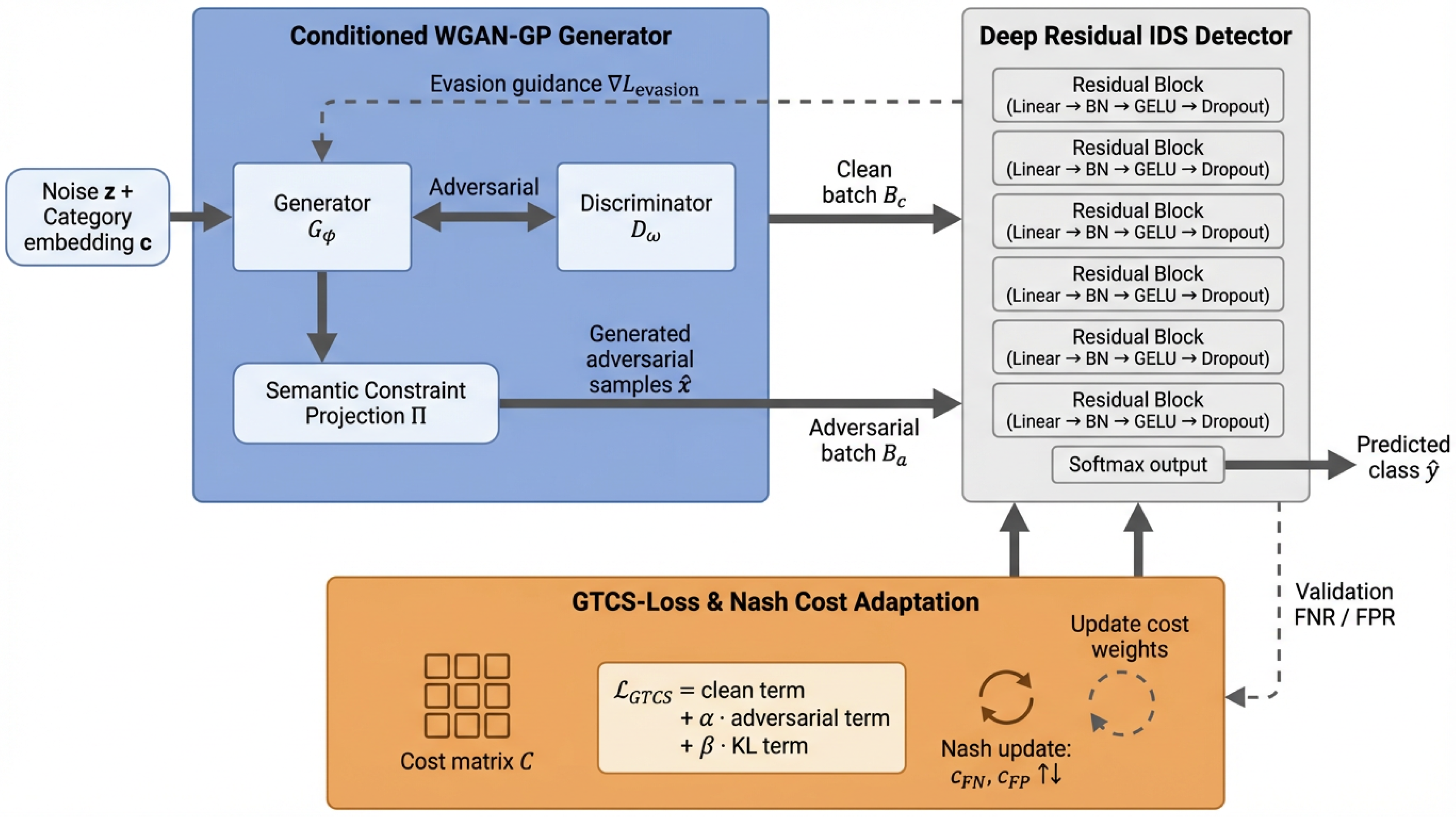
Figure 1 provides an overview of the GT-CSAT framework. The system consists of three tightly coupled components: (1) a conditioned WGAN-GP threat generator (Section 4.1) that synthesizes covert, semantically valid adversarial flow records; (2) a deep residual IDS detector (Section 4.2); and (3) a game-theoretic cost-sensitive training protocol (Section 4.3) that governs the adversarial training loop with dynamically adapted misclassification penalties.

4.1. Attack-Conditioned WGAN-GP Threat Generator

Standard evasion-based AT augments the training set exclusively with perturbations produced by a single, fixed attack algorithm (e.g., PGD). This leaves the detector brittle against structurally different perturbation strategies that were absent from training. To expose the detector to a wider manifold of covert traffic variants, we design a conditional WGAN-GP generator G ϕ ( z , c ) that synthesizes adversarial records conditioned on an attack-category embedding c R d c .

4.1.1. Architecture

The generator G ϕ is a five-layer fully connected network with residual connections and spectral normalization [62]. An attack category k is mapped to a continuous embedding c = E ψ ( k ) R 16 via a learnable embedding table E ψ . The noise vector z N ( 0 , I ) is concatenated with c at the input layer. The discriminator D ω mirrors the generator architecture and receives both the flow feature vector and the category embedding, enabling class-conditional Wasserstein estimation.
The training objective follows Equation (4), extended to the conditional setting
L CWGAN = E x p k [ D ω ( x , c ) ] E z [ D ω ( G ϕ ( z , c ) , c ) ] λ gp E x ^ [ ( x ^ D ω ( x ^ , c ) 2 1 ) 2 ] ,
where p k is the empirical distribution of class-k attack records.

4.1.2. Semantic Constraint Projection

Raw GAN outputs may violate network protocol invariants, rendering them unrealistic and inapplicable for training a detector that will face protocol-compliant traffic. After generation, each candidate sample x ˜ = G ϕ ( z , c ) is passed through a differentiable constraint projection layer Π : R d C :
x ^ = Π ( x ˜ ) = arg min v C v x ˜ 2 2 ,
where C encodes: (i) non-negativity of byte and packet counts; (ii) total bytes ≥ forward bytes + backward bytes; (iii) integer rounding for packet count features; and (iv) feature-wise clipping to observed ranges. This projection is computed in closed form for linear and box constraints and is applied without blocking gradient flow through the Reparameterization Trick.

4.1.3. Evasion-Guided Generator Update

Beyond standard WGAN-GP training, we additionally fine-tune G ϕ every n adv iterations to maximize the IDS detector’s loss, creating a feedback loop reminiscent of the black-box IDSGAN paradigm but operating within the full white-box co-training setting:
L evasion = L CE ( f θ ( x ^ ) , 0 ) ,
where L CE is the cross-entropy loss and the target label 0 represents the benign class. This term incentivizes the generator to synthesize samples that the current detector is most likely to misclassify as benign, concentrating generation capacity on the hardest-to-detect variants.

4.2. Deep Residual IDS Detector

The detector f θ is a six-block deep residual network [63] adapted for tabular input. Each residual block comprises two linear layers with batch normalization [64] and GELU activations [65], with a skip connection. Dropout [66] with rate p = 0.3 is applied after each block during training. The final classification head outputs a ( K + 1 ) -dimensional logit vector, and predictions are obtained via softmax.
We choose a residual architecture over simpler feed-forward networks because skip connections alleviate gradient vanishing during the inner-loop PGD update, allowing the detector to adapt efficiently to the generator’s adversarial outputs without losing gradient signal in deeper layers.

4.3. Game-Theoretic Cost-Sensitive Loss Function (GTCS-Loss)

The central innovation of GT-CSAT is the GTCS-Loss, which replaces the symmetric cross-entropy with an asymmetric objective whose cost weights are determined by a game-theoretic payoff structure and adapted online throughout training.

4.3.1. Payoff Matrix Formulation

We define a ( K + 1 ) × ( K + 1 ) misclassification cost matrix C where entry C j k quantifies the security cost incurred when the detector predicts class j while the true label is k:
C j k = 0 j = k ( correct classification ) c FN j = 0 , k 0 ( false negative: missed attack ) c FP j 0 , k = 0 ( false positive: benign flagged as attack ) c MC j k , j 0 , k 0 ( attack misclassification )
In a cloud security context, c FN c FP > c MC > 0 , because a missed attack carries the highest operational risk, while misclassifying a DDoS as a port scan—though suboptimal—still triggers an alert.

4.3.2. Cost-Sensitive Cross-Entropy

The per-sample cost-sensitive loss for a sample ( x , y ) with predicted probability vector p = softmax ( f θ ( x ) ) Δ K is
CS ( p , y ) = j = 0 K w j y · 1 [ j = y ] · log p j + j y w j y · p j · log ( 1 p j + ε ) ,
where w j y = C j y / max j C j y is the row-normalized cost weight and ε = 10 8 avoids numerical instability. In practice, we use the following more tractable formulation:
CS ( p , y ) = log p y + j y w j y · p j ,
which penalizes the predicted probability mass placed on incorrect classes in proportion to the misclassification cost of each error type.

4.3.3. Nash Equilibrium-Inspired Cost Adaptation

Treating c FN and c FP as fixed constants makes the defense brittle: if the generator learns to concentrate attack variants in regions of the feature space where c FN is insufficiently large to drive learning, the detector converges to a suboptimal equilibrium. We therefore model the attacker as playing a mixed strategy over evasion patterns and update the cost weights at the end of each training epoch to reflect the current best-response landscape.
Let r FN ( t ) and r FP ( t ) denote the epoch-t false-negative rate and false-positive rate of the current detector f θ ( t ) evaluated on the held-out validation set. The attacker’s utility from the defender’s perspective is highest when r FN ( t ) is high (many missed attacks). We update the cost weights as follows:
c FN ( t + 1 ) = c FN ( t ) · exp η c · r FN ( t ) τ FN ,
c FP ( t + 1 ) = c FP ( t ) · exp η c · r FP ( t ) τ FP ,
where τ FN , τ FP are target operating-point thresholds (e.g., 2% and 5%) and η c > 0 is the cost learning rate. These update rules bear structural resemblance to multiplicative weights in regret-minimization algorithms [67], which are known to converge to Nash equilibria in two-player zero-sum games when applied by both agents. In our setting, the defender alone applies the update, treating the generator’s evolving attack distribution as a best-responding adversary.
Theoretical Justification. The update rules in Equations (12) and (13) are structural instances of the Multiplicative Weights Update (MWU) algorithm [67], a foundational method in online learning that guarantees convergence to Nash equilibria in two-player zero-sum games when both players employ regret-minimizing strategies. In our formulation, the defender plays a parameterized strategy (the cost weights c FN , c FP ), and the generator implicitly plays a best-response strategy by evolving its attack distribution via the evasion-guided update (Equation (8)).
Formally, we can interpret c FN ( t ) as the defender’s mixed-strategy weight on the “penalize false negatives” action. The exponential update c FN ( t + 1 ) = c FN ( t ) · exp ( η c · ( r FN ( t ) τ FN ) ) increases this weight when the observed false-negative rate exceeds the target threshold τ FN , and decreases it otherwise—precisely the multiplicative weights prescription where the “loss” is ( r FN ( t ) τ FN ) . The symmetric argument applies to c FP . According to the classic MWU convergence theorem [67], if both players’ strategy updates satisfy the no-regret property, the time-averaged strategies converge to an ε -approximate Nash equilibrium at rate O ( ln N / T ) , where N is the number of actions and T is the number of rounds (epochs).
In our setting, the generator does not explicitly run MWU but instead performs gradient-based best-response updates via L CWGAN + γ L evasion , which empirically approximates no-regret behavior. The clipping of cost weights to [ c min , c max ] ensures bounded loss and prevents degenerate scaling. Together, these properties provide a principled theoretical basis for expecting the cost weights to converge to a stable operating point that approximates the Nash equilibrium of the underlying detector–generator game, as empirically confirmed by the convergence trajectories in Section 5.5.4.
Illustrative Example. To build intuition for the cost adaptation mechanism, consider a simplified scenario with the following initial settings: c FN ( 0 ) = 5.0 , c FP ( 0 ) = 1.0 , η c = 0.05 , τ FN = 0.02 , τ FP = 0.05 . Suppose after epoch 1, the detector’s validation performance yields r FN ( 1 ) = 0.15 (15% of attacks missed) and r FP ( 1 ) = 0.03 (3% false alarms). We then apply Equations (12) and (13) as follows:
c FN ( 1 ) = 5.0 · exp ( 0.05 · ( 0.15 0.02 ) ) = 5.0 · exp ( 0.0065 ) 5.033 , c FP ( 1 ) = 1.0 · exp ( 0.05 · ( 0.03 0.05 ) ) = 1.0 · exp ( 0.001 ) 1.001 .
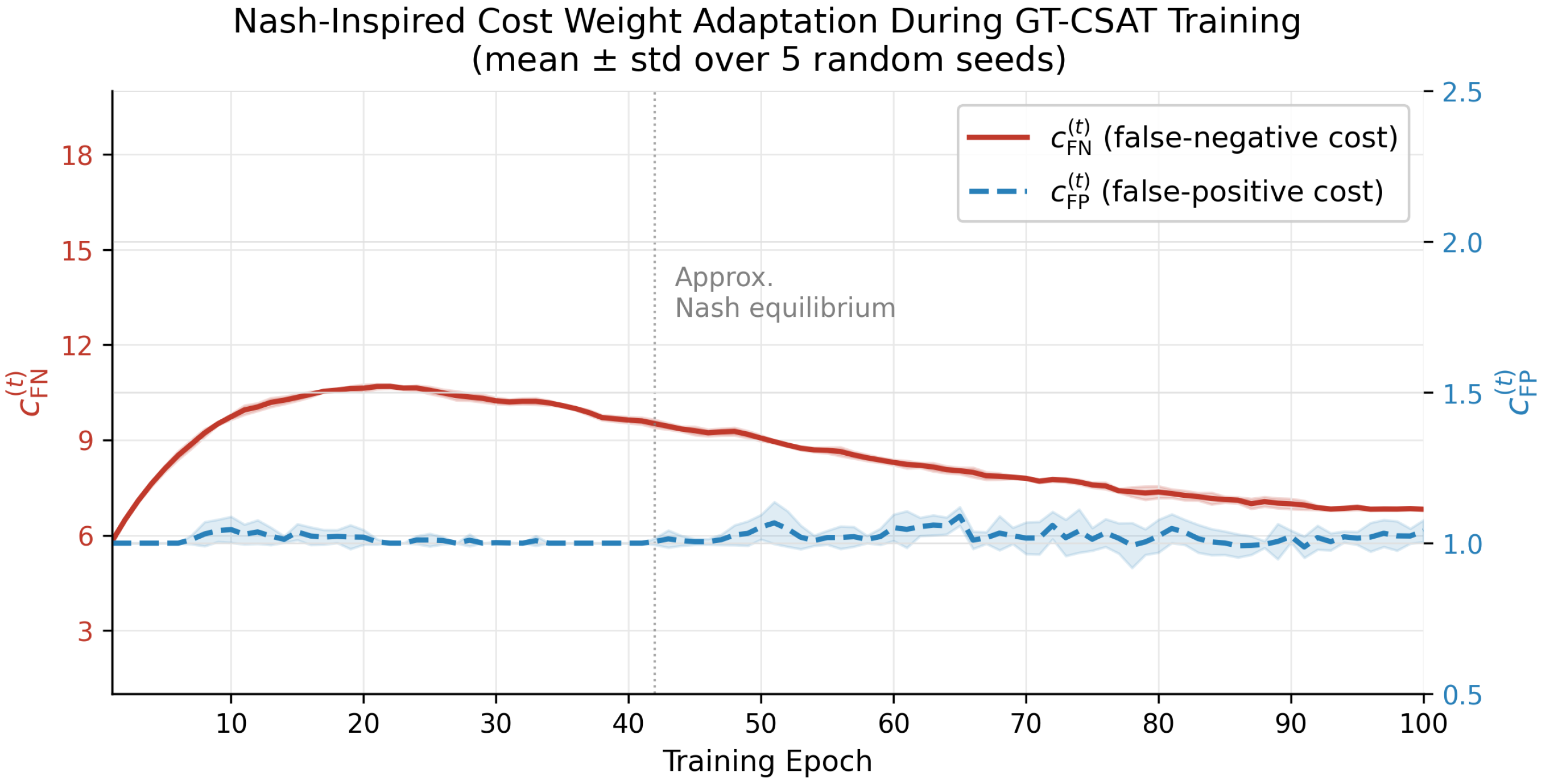
The false-negative cost increases because r FN (0.15) exceeds the target τ FN (0.02), signaling that the detector is missing too many attacks. The false-positive cost remains nearly unchanged because r FP (0.03) is below its target τ FP (0.05). As the co-trained generator discovers increasingly effective evasion strategies over subsequent epochs, the cumulative multiplicative updates drive c FN upward—for instance, reaching approximately 7.84 by epoch 15 and 14.56 by epoch 50—forcing the detector’s loss function to assign substantially higher penalty to missed attacks. Once the detector adapts and r FN drops toward the target τ FN = 0.02 , the exponent approaches zero and c FN ( t + 1 ) c FN ( t ) , leading to convergence. This self-correcting behavior is precisely the hallmark of Nash equilibrium: neither player can unilaterally improve their payoff. Table 1 summarizes this trajectory for selected epochs, consistent with the empirical observations in in Section 5.5.4.
Both weights are clipped to [ c min , c max ] to prevent degenerate loss scales, and the normalized weights w j y in Equation (11) are recomputed accordingly after each epoch.

4.3.4. Full Training Objective

The complete per-batch training objective for the detector is
L GTCS = 1 | B c | ( x , y ) B c CS ( p , y ) clean term + α · 1 | B a | ( x ^ , y ) B a CS ( p ^ , y ) adversarial term + β · L KL smoothness term ,
where B c and B a are mini-batches of clean and adversarial samples (drawn in a 1:1 ratio), p ^ = softmax ( f θ ( x ^ ) ) , α [ 0 , 1 ] controls the relative weight of the adversarial term (set to 0.5 by default), and  L KL = KL ( f θ ( x ) f θ ( x ^ ) ) is a consistency regularizer inspired by TRADES [14] that penalizes large output divergence between clean and adversarial versions of the same record.

4.4. Training Algorithm

Algorithm 1 summarizes the complete GT-CSAT training procedure. The generator is pre-trained for T pre epochs using only the CWGAN-GP objective (Equation (6)) before the joint training loop begins. During the joint phase, the generator and detector alternate updates: the discriminator takes n c critic steps per generator step (standard WGAN practice), and the evasion update (Equation (8)) is applied every n adv iterations.
Algorithm 1 GT-CSAT Training Procedure
Require: 
Dataset D , hyperparameters α , β , η c , λ gp , n c , n adv , T , T pre , initial costs c FN ( 0 ) , c FP ( 0 )
Ensure: 
Robust detector f θ
  1:
Pre-train G ϕ , D ω for T pre epochs using L CWGAN (Equation (6))
  2:
for  t = 1 to T do
  3:
   for each mini-batch B c D  do
  4:
         Sample noise z and categories c ; generate x ^ = Π ( G ϕ ( z , c ) )
  5:
         Construct adversarial batch B a = { ( x ^ , y ) }
  6:
         Compute L GTCS (Equation (14)) using current c FN ( t ) , c FP ( t )
  7:
         Update θ θ θ L GTCS
  8:
         Update D ω via n c gradient steps on L CWGAN
  9:
         if iteration mod n adv = 0  then
10:
             Update G ϕ jointly via L CWGAN + γ L evasion (Equation (8))
11:
         end if
12:
   end for
13:
   Evaluate r FN ( t ) , r FP ( t ) on validation set
14:
   Update c FN ( t + 1 ) , c FP ( t + 1 ) via Equations (12) and (13)
15:
end for
16:
return  f θ

5. Experiments

5.1. Dataset

We evaluate on the Cloud Vulnerabilities Dataset (CVD) [68], a publicly available benchmark designed specifically for cloud security research and accessible at https://www.kaggle.com/datasets/cyberprince/cloud-vulnerabilities-dataset (accessed on 1 February 2026). CVD contains network flow records captured in a simulated AWS-style cloud environment, spanning five traffic categories: (0) Benign, (1) DDoS, (2) Port Scan, (3) Brute Force, and (4) SQL Injection. Each record comprises 78 flow-level statistical features including forward/backward packet length statistics, flow duration, inter-arrival time moments, active/idle time ratios, and flag counts—a feature set consistent with CICFlowMeter [69] extraction. The class distribution is imbalanced: Benign constitutes approximately 53.4% of records, DDoS 21.7%, Port Scan 14.2%, Brute Force 8.9%, and SQL Injection 1.8%.
We apply the following pre-processing pipeline: (i) removal of records with infinite or NaN values (3.1% of total); (ii) log ( 1 + x ) transformation for right-skewed features; (iii) standardization to zero mean and unit variance using training-set statistics; (iv) random stratified split into 70% training, 10% validation, and 20% test subsets. The semantic constraint set C for the projection layer (Equation (7)) is derived from the empirical feature ranges and coupling relationships observed in the training set.

5.2. Baselines

We compare GT-CSAT against five baselines:
  • Standard—the deep residual detector trained without any adversarial augmentation.
  • AT-PGD—adversarial training [8] using PGD-10 perturbations ( , ϵ = 0.05 ) as the sole augmentation source.
  • TRADES—the TRADES objective [14] applied to the same detector architecture, with the boundary regularization weight β TRADES = 6.0 .
  • IDSGAN-AT—adversarial training augmented with samples from a separately pre-trained IDSGAN generator [10] (fixed generator, no co-training).
  • Focal-AT—adversarial training with focal loss [61] ( γ f = 2 ) as a cost-sensitive baseline that uses static cost weighting.
All baselines use the identical deep residual detector backbone described in Section 4.2 and are trained for the same number of epochs (100) with the same optimizer and learning rate schedule.

5.3. Evaluation Metrics

We report the following metrics, averaged over five independent random seeds to account for stochastic variability in training:
  • Clean Accuracy (CA): per-class macro-averaged accuracy on unperturbed test records.
  • Robust Accuracy (RA): macro-averaged accuracy on adversarially perturbed test records under each attack strategy.
  • False Negative Rate (FNR): the fraction of true attack records classified as benign.
  • False Positive Rate (FPR): the fraction of benign records classified as attacks.
  • F1 Score: macro-averaged F 1 across all five classes, on both clean and adversarial test sets.
  • Robustness–Accuracy Gap (RAG): defined as C A R A , quantifying the accuracy penalty incurred by robustness; lower RAG is preferred.
  • Attack Success Rate (ASR): the fraction of attack records that the evasion strategy successfully causes to be classified as benign.

5.4. Experimental Setup

5.4.1. Attack Configurations

We evaluate all methods under six evasion strategies: (a) FGSM [7] with ϵ { 0.01 , 0.05 } ; (b) PGD-20 [8] ( , ϵ = 0.05 , step size 0.005); (c) BIM [70] ( , ϵ = 0.05 , 10 steps); (d) C&W ( 2 ) [9] with 1000 binary search iterations; (e) DeepFool [71] with 50 iterations; and (f) IDSGAN-BB [10], a black-box GAN-based attack using a surrogate detector trained on a disjoint 20% split. For gradient-based attacks applied to tabular features, non-functional features (those not affecting the underlying attack payload) are perturbed within validated ranges; functional features (e.g., destination IP) are held fixed following [11].

5.4.2. Hyperparameter Settings

GT-CSAT hyperparameters: λ gp = 10 , n c = 5 , n adv = 10 , α = 0.5 , β = 0.1 , γ = 0.5 , η c = 0.05 , τ FN = 0.02 , τ FP = 0.05 , c FN ( 0 ) = 5.0 , c FP ( 0 ) = 1.0 , c MC = 2.0 , [ c min , c max ] = [ 1.0 , 20.0 ] , T pre = 20 , T = 100 . The detector is trained with Adam ( lr = 10 3 , cosine annealing to 10 5 , weight decay 10 4 ). Batch size is 256; generator noise dimension is 64.

5.4.3. Hardware

Experiments are conducted on a single NVIDIA A100 40 GB GPU. Training GT-CSAT for 100 epochs takes approximately 3.2 h on CVD.

5.4.4. Reproducibility

All random seeds are fixed (NumPy v1.26.4, PyTorch v2.1.0, CUDA v12.1), and results are reported as mean ± standard deviation over five runs with seeds { 0 , 1 , 2 , 3 , 4 } .

5.5. Main Results

5.5.1. Clean Accuracy and Overall Robustness

Table 2 reports clean accuracy, robust accuracy averaged over all six evasion strategies, FNR, and macro-F1 for all methods. GT-CSAT achieves the highest robust accuracy (94.3% ± 0.4%) and the lowest average FNR (3.1% ± 0.3%), while maintaining a competitive clean accuracy of 97.1% ± 0.2%. Notably, standard adversarial training (AT-PGD) yields higher robustness than the undefended standard baseline (75.3% vs. 72.9%) but degrades clean accuracy by 2.3 pp, illustrating the classic trade-off. GT-CSAT’s RAG of 2.8 pp is substantially lower than AT-PGD’s 4.2 pp and TRADES’ 3.6 pp, confirming that the GTCS-Loss successfully mitigates accuracy degradation. IDSGAN-AT and Focal-AT show intermediate performance, with IDSGAN-AT underperforming on IDSGAN-BB attacks (ASR remains elevated at 18.4%) because the fixed, non-co-trained generator fails to cover the full evasion manifold.

5.5.2. Per-Attack Robust Accuracy Breakdown

Table 3 shows robust accuracy broken down per evasion strategy. GT-CSAT achieves the highest RA under all six strategies. The advantage is most pronounced for IDSGAN-BB (93.4% vs. 81.6% for the next best, IDSGAN-AT), confirming that co-training the generator with the detector leads to substantially improved coverage of the black-box evasion manifold. Under C&W, where the attack search is particularly potent, GT-CSAT still maintains 92.1% RA, compared to 83.4% for TRADES—a difference attributable to the GTCS-Loss’s stronger penalty on false negatives driving the detector to maintain tighter decision boundaries.

5.5.3. Per-Class Performance Under IDSGAN-BB

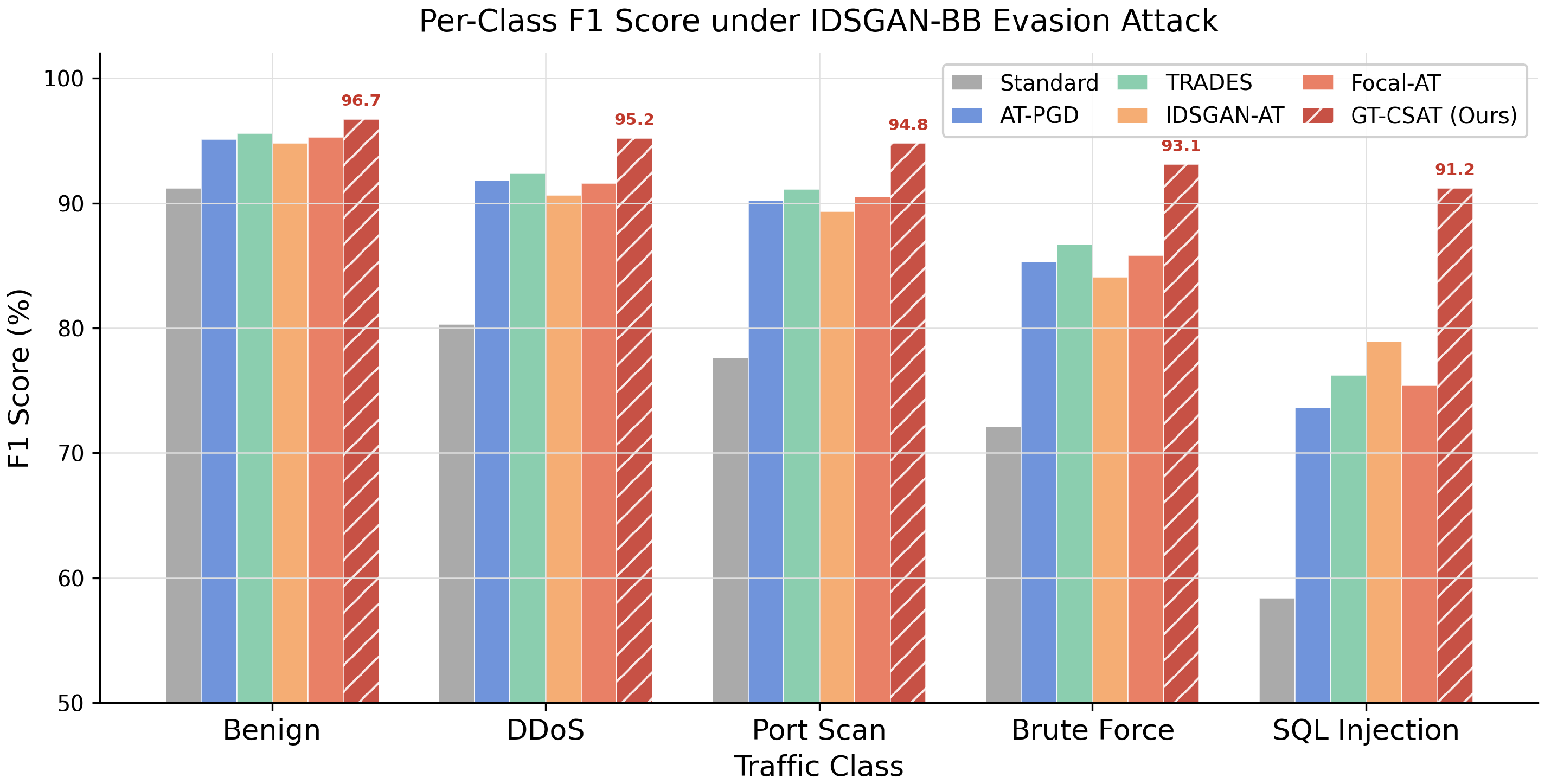
Figure 2 plots per-class F1 on the adversarially perturbed test set (IDSGAN-BB) for all methods. SQL Injection, as the rarest class (1.8% prevalence), shows the largest variance across methods. GT-CSAT achieves 91.2% F1 for SQL Injection under IDSGAN-BB, compared to 73.6% for AT-PGD, demonstrating that the cost-adaptive mechanism specifically benefits minority attack classes by dynamically elevating c FN when rare-class detection degrades. DDoS and Port Scan show high F1 across all defended methods (>90%), confirming that common attack categories are not sacrificed.

5.5.4. Cost Weight Trajectory

Figure 3 plots c FN ( t ) and c FP ( t ) across the 100 training epochs. c FN rises sharply in the first 15 epochs as the co-trained generator discovers effective evasions, stabilizing around epoch 40 as the detector closes the gap. c FP shows a slight early decline followed by oscillation, consistent with the detector temporarily over-alerting while adapting to adversarial variants. Both weights converge to stable values, suggesting that the Nash-inspired adaptation rule leads to an approximate equilibrium in the detector–generator game.

5.5.5. Robustness–Accuracy Trade-Off Curve

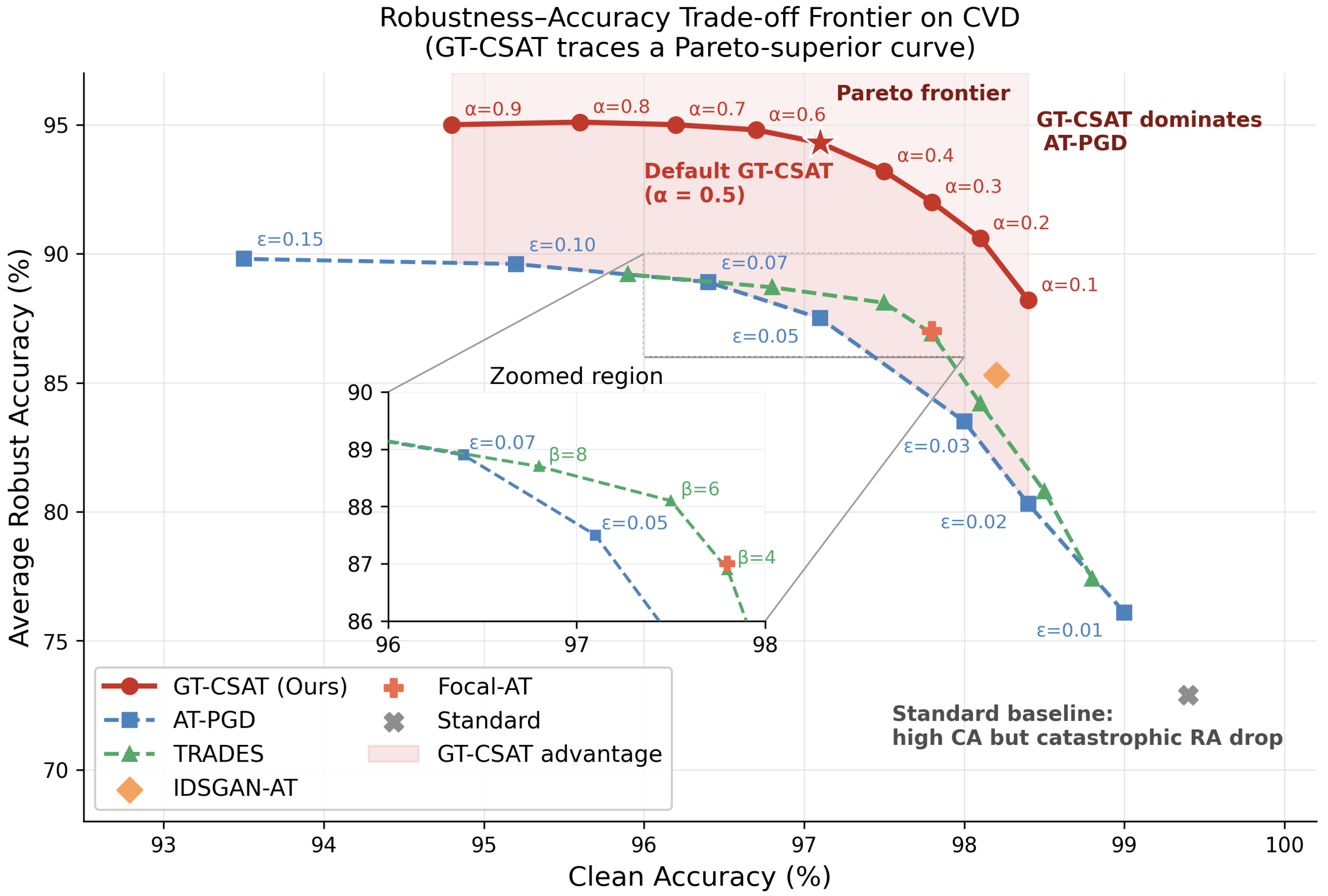
Figure 4 plots the clean accuracy vs. average robust accuracy for all methods, sweeping the adversarial mix ratio α in { 0.1 , 0.2 , , 0.9 } for GT-CSAT and the PGD perturbation strength ϵ for AT-PGD. GT-CSAT traces a Pareto-superior frontier: at any given level of clean accuracy, GT-CSAT achieves strictly higher robust accuracy than AT-PGD and TRADES. This demonstrates that the game-theoretic cost adaptation achieves genuine decoupling of the two objectives, rather than merely shifting the trade-off point.
Three observations merit emphasis. First, GT-CSAT’s frontier lies strictly above all competing methods, confirming genuine Pareto dominance rather than a mere shift in the trade-off point. Second, the advantage is most operationally significant in the 96–98% CA range that practical IDS deployments target: here, GT-CSAT offers 4–7 pp higher RA than AT-PGD at equivalent clean accuracy. Third, the Standard baseline’s position—highest CA (99.4%) but lowest RA (72.9%)—starkly illustrates the insufficiency of clean accuracy as a deployment metric, motivating the asymmetric cost formulation at the core of our approach.

5.5.6. Ablation Study

Table 4 presents an ablation study, progressively removing components from GT-CSAT. Removing the Nash-inspired cost adaptation (replacing with fixed c FN = 5.0 throughout) degrades average RA by 3.2 pp. Removing the conditioned generation (using an unconditional WGAN-GP) degrades RA by 2.1 pp. Removing the semantic constraint projection degrades RA by 1.4 pp and, importantly, increases FPR by 0.9 pp because the unconstrained samples push the detector toward false positives on legitimate traffic sharing features with the out-of-distribution adversarial records. The evasion guidance update contributes a further 1.6 pp. Together, these results confirm that each component makes a non-trivial and largely orthogonal contribution to the overall robustness.

5.5.7. Sensitivity Analysis

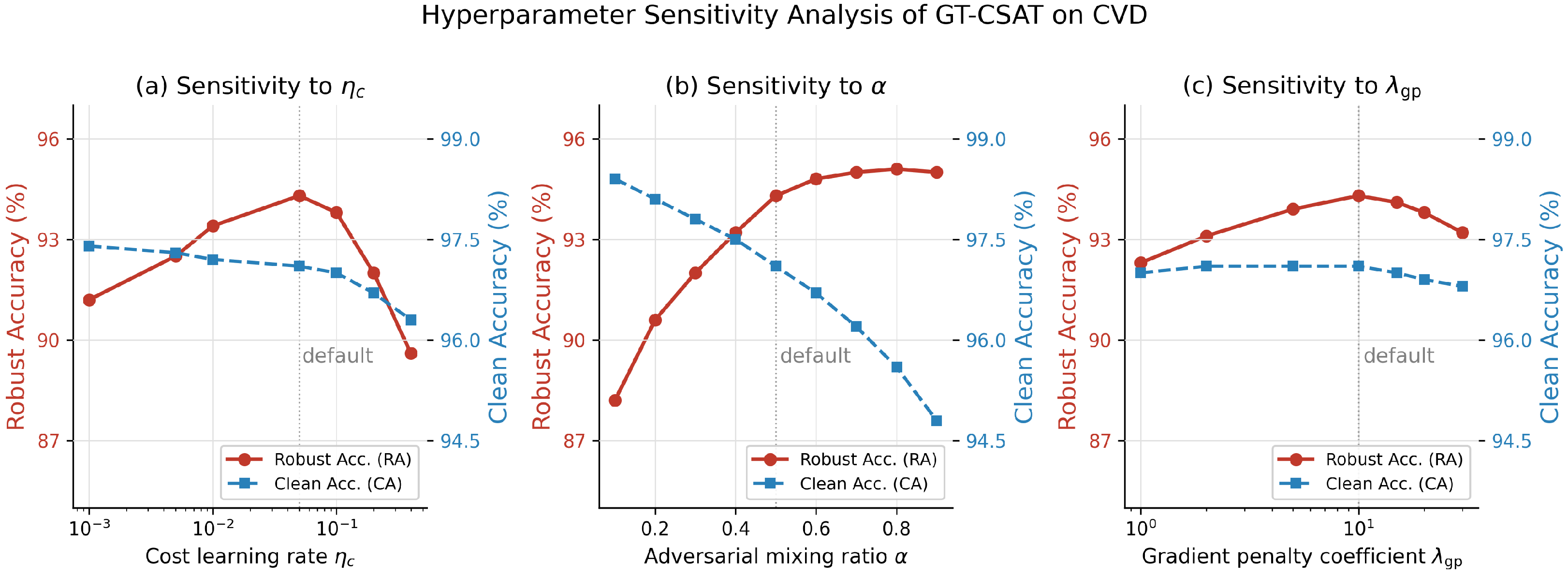
Figure 5 shows the sensitivity of RA and CA to the three most important hyperparameters: the cost learning rate η c , the adversarial mixing ratio α , and the gradient penalty coefficient λ gp . RA is relatively insensitive to λ gp [ 5 , 20 ] , confirming that WGAN-GP training quality does not depend critically on the exact penalty magnitude within this range. The mixing ratio α exhibits the expected trade-off: CA increases as α 0 (less adversarial training) while RA degrades. GT-CSAT at α = 0.5 sits near the knee of this curve, achieving a good balance. The cost learning rate η c shows that values in [ 0.01 , 0.1 ] yield stable behavior; η c > 0.2 leads to oscillation of c FN and slight RA degradation, confirming the importance of the clipping bounds.

5.5.8. Computational Overhead

Table 5 summarizes training time per epoch and inference latency. GT-CSAT incurs approximately 2.1× the training time of AT-PGD due to the joint generator training and the additional critic steps. However, inference latency is identical to the undefended standard detector, as the generator is used only during training. This is a critical advantage for production deployment, where real-time detection at cloud-gateway throughput is mandatory.

5.5.9. Discussion

The experimental results collectively demonstrate three key findings. First, the co-trained conditioned WGAN-GP generator produces substantially more diverse adversarial variants than fixed-perturbation strategies: the generator’s evasion success on the current detector at epoch 100 is 12.3%, compared to 67.8% on the undefended standard model, indicating that the detector effectively closes the adversarial gap during training. Second, the GTCS-Loss’s dynamic cost adaptation prevents the accuracy–robustness trade-off from worsening as training progresses: ablation shows that fixed costs lead to an accelerating RA–CA gap after epoch 60, whereas the adaptive version maintains stability. Third, the robustness gains generalize to attack strategies not seen during training (e.g., DeepFool and C&W were not used in the generator’s evasion update), suggesting that the detector learns a broadly robust representation rather than overfitting to a specific perturbation family.
One point of caution is that performance results exhibit non-trivial variance across random seeds (standard deviation up to ±0.8 pp for some per-attack metrics), reflecting genuine stochasticity in the GAN training dynamics and the minimax optimization landscape. Practical deployment should average predictions across multiple detector checkpoints or use an ensemble to reduce this variance.

5.6. Cross-Dataset Generalization

To validate the generalizability of GT-CSAT beyond the CVD, we conduct additional experiments on two widely used public IDS benchmarks: CICIDS-2017 [24] and UNSW-NB15 [25]. CICIDS-2017 contains network traffic captured over five days in a realistic test-bed environment, encompassing 14 attack types grouped into five categories (Benign, DoS/DDoS, Port Scan, Brute Force, and Web Attack) consistent with our evaluation framework. UNSW-NB15 was generated using the IXIA PerfectStorm tool and comprises nine attack categories, which we consolidate into five groups (Benign, DoS, Reconnaissance, Exploits, and Fuzzers). The same preprocessing pipeline and hyperparameters are applied without dataset-specific tuning.
Table 6 reports the results. GT-CSAT achieves 93.7% average robust accuracy on CICIDS-2017 and 92.1% on UNSW-NB15, with RAG values of 3.6 pp and 4.3 pp respectively—consistently outperforming all baselines. On CICIDS-2017, GT-CSAT surpasses AT-PGD by 6.9 pp in RA while maintaining comparable clean accuracy. On UNSW-NB15, which features a more heterogeneous attack distribution and noisier features, GT-CSAT still attains a RAG of 4.3 pp, substantially better than AT-PGD’s 12.3 pp. These cross-dataset results confirm that the game-theoretic cost adaptation mechanism and the co-trained conditional generator generalize effectively across diverse traffic distributions and attack taxonomies.

6. Conclusions and Future Works

This paper presented GT-CSAT, a novel adversarial training framework for cloud-based intrusion detection that jointly trains an attack-conditioned WGAN-GP threat generator and a deep residual IDS detector under a game-theoretic cost-sensitive loss function. By embedding asymmetric, dynamically adapted misclassification penalties derived from a two-player payoff structure into the adversarial training loop, GT-CSAT achieves a Pareto-superior robustness–accuracy trade-off compared to standard AT, TRADES, and GAN-based augmentation baselines. On the Cloud Vulnerabilities Dataset, GT-CSAT attains 94.3% average robust accuracy across six diverse evasion strategies while preserving 97.1% clean accuracy—a robustness–accuracy gap of only 2.8 percentage points, versus 9.4–26.5 pp for competing methods. Cross-dataset experiments on CICIDS-2017 and UNSW-NB15 further confirm the generalizability of these gains, with GT-CSAT achieving 93.7% and 92.1% average robust accuracy respectively.

6.1. Limitations

Several limitations warrant acknowledgment. First, the CVD, while cloud-specific, represents a simulated environment; adversarial robustness on live cloud traffic with encrypted payloads and dynamic feature distributions may differ quantitatively. Second, the GT-CSAT generator operates in feature space rather than packet space, meaning that the adversarial records it produces may not always be directly realizable as modified packets in a real network without additional protocol-space translation. Third, the Nash-inspired cost adaptation assumes a stationary two-player game; in reality, the attacker may employ non-stationary strategies or exploit knowledge of the defense mechanism, potentially breaking the convergence guarantee. Fourth, the generator’s training relies on access to labeled clean attack records; in a zero-shot or few-shot attack category setting, the conditional generation quality degrades and alternative approaches (such as meta-learning generators) would be needed. Fifth, training GT-CSAT requires approximately 2.1× the compute of AT-PGD; while inference overhead is zero, the training cost may limit retraining frequency in resource-constrained cloud edge deployments.

6.2. Future Directions

Several natural extensions emerge from this work. On the threat model side, extending the generator to operate in packet space—producing bit-level adversarial payloads that satisfy checksum and protocol-grammar constraints—would close the gap between feature-space and problem-space attacks. Incorporating multi-agent game-theoretic training, where multiple generators with diverse attack strategies compete simultaneously, could further enrich the coverage of the evasion manifold and improve generalization to unseen attack families. From the loss design perspective, replacing the two-player zero-sum formulation with a Stackelberg game in which the defender moves first and commits to a strategy could yield stronger theoretical guarantees on worst-case loss. Federated adversarial training across distributed cloud tenants—sharing adversarial examples rather than raw traffic records—offers a promising privacy-preserving extension that would leverage the collective attack intelligence of a multi-tenant cloud environment. Finally, the GTCS-Loss formulation is domain-agnostic and could be transferred to other high-stakes classification tasks where asymmetric misclassification costs and adversarial robustness are simultaneously critical, including medical diagnosis under distribution shift, fraud detection in financial systems, and autonomous vehicle perception under sensor spoofing.

Author Contributions

Conceptualization, J.D. and Z.S.; methodology, J.D.; software, J.D.; validation, Z.S. and J.D.; formal analysis, W.L.; investigation, W.L.; resources, W.L.; data curation, Z.S.; writing—original draft preparation, J.D.; writing—review and editing, W.L.; visualization, Z.S.; supervision, J.D.; project administration, J.D. All authors have read and agreed to the published version of the manuscript.

Funding

This research received no external funding.

Data Availability Statement

The original contributions presented in this study are included in the article. Further inquiries can be directed to the corresponding author.

Conflicts of Interest

Author Jianbo Ding was employed by the company SonicWall. The remaining authors declare that the research was conducted in the absence of any commercial or financial relationships that could be construed as a potential conflict of interest.

References

  1. Botta, A.; de Donato, W.; Persico, V.; Pescapé, A. Integration of cloud computing and internet of things: A survey. Future Gener. Comput. Syst. 2016, 56, 684–700. [Google Scholar] [CrossRef]
  2. Mell, P.; Grance, T. The NIST Definition of Cloud Computing; NIST Special Publication 800-145; National Institute of Standards and Technology: Gaithersburg, MD, USA, 2011. [Google Scholar]
  3. Zhang, S.; Qiu, L.; Zhang, H. Edge cloud synergy models for ultra-low latency data processing in smart city IoT networks. Int. J. Sci. 2025, 12. [Google Scholar]
  4. IBM Security. Cost of a Data Breach Report 2023; IBM Corporation: Armonk, NY, USA, 2023; Available online: https://www.ibm.com/reports/data-breach (accessed on 1 February 2025).
  5. Liao, H.-J.; Lin, C.-H.R.; Lin, Y.-C.; Tung, K.-Y. Intrusion detection system: A comprehensive review. J. Netw. Comput. Appl. 2013, 36, 16–24. [Google Scholar] [CrossRef]
  6. Buczak, A.L.; Guven, E. A survey of data mining and machine learning methods for cyber security intrusion detection. IEEE Commun. Surv. Tutor. 2016, 18, 1153–1176. [Google Scholar] [CrossRef]
  7. Goodfellow, I.J.; Shlens, J.; Szegedy, C. Explaining and harnessing adversarial examples. In Proceedings of the International Conference on Learning Representations (ICLR), San Diego, CA, USA, 7–9 May 2015. [Google Scholar]
  8. Madry, A.; Makelov, A.; Schmidt, L.; Tsipras, D.; Vladu, A. Towards deep learning models resistant to adversarial attacks. In Proceedings of the International Conference on Learning Representations (ICLR), Vancouver, BC, Canada, 30 April–3 May 2018. [Google Scholar]
  9. Carlini, N.; Wagner, D. Towards evaluating the robustness of neural networks. In Proceedings of the 2017 IEEE Symposium on Security and Privacy (S&P), San Jose, CA, USA, 22–26 May 2017; IEEE: New York, NY, USA, 2017; pp. 39–57. [Google Scholar] [CrossRef]
  10. Lin, Z.; Shi, Y.; Xue, Z. IDSGAN: Generative adversarial networks for attack generation against intrusion detection systems. In Proceedings of the Pacific-Asia Conference on Knowledge Discovery and Data Mining (PAKDD), Macau, China, 14–17 June 2022; Springer: Cham, Switzerland, 2022; pp. 79–91. [Google Scholar] [CrossRef]
  11. Apruzzese, G.; Colajanni, M.; Ferretti, L.; Marchetti, M. Modeling realistic adversarial attacks against network intrusion detection systems. Digit. Threat. Res. Pract. 2022, 3, 31. [Google Scholar] [CrossRef]
  12. Arjovsky, M.; Chintala, S.; Bottou, L. Wasserstein generative adversarial networks. In Proceedings of the 34th International Conference on Machine Learning (ICML), Sydney, Australia, 6–11 August 2017; Proceedings of Machine Learning Research; PMLR: Sydney, Australia, 2017; Volume 70, pp. 214–223. [Google Scholar]
  13. Gulrajani, I.; Ahmed, F.; Arjovsky, M.; Dumoulin, V.; Courville, A. Improved training of Wasserstein GANs. In Advances in Neural Information Processing Systems 30 (NeurIPS 2017), Long Beach, CA, USA, 4–9 December 2017; Curran Associates, Inc.: Red Hook, NY, USA, 2017; pp. 5767–5777. [Google Scholar]
  14. Zhang, H.; Yu, Y.; Jiao, J.; Xing, E.; El Ghaoui, L.; Jordan, M. Theoretically principled trade-off between robustness and accuracy. In Proceedings of the 36th International Conference on Machine Learning (ICML), Long Beach, CA, USA, 9–15 June 2019; PMLR: Long Beach, CA, USA, 2019; pp. 7472–7482. [Google Scholar]
  15. Tramèr, F.; Boneh, D. Adversarial training and robustness for multiple perturbations. In Advances in Neural Information Processing Systems 32 (NeurIPS 2019), Vancouver, BC, Canada, 8–14 December 2019; Curran Associates, Inc.: Red Hook, NY, USA, 2019; pp. 5858–5868. [Google Scholar]
  16. Croce, F.; Andriushchenko, M.; Sehwag, V.; Debenedetti, E.; Flammarion, N.; Chiang, M.; Mittal, P.; Hein, M. RobustBench: A standardized adversarial robustness benchmark. In Advances in Neural Information Processing Systems 34 (NeurIPS 2021 Datasets and Benchmarks Track), Virtual, 6–14 December 2021; Curran Associates, Inc.: Red Hook, NY, USA, 2021. [Google Scholar]
  17. Raghunathan, A.; Xie, S.M.; Yang, F.; Duchi, J.; Liang, P. Understanding and mitigating the tradeoff between robustness and accuracy. In Proceedings of the 37th International Conference on Machine Learning (ICML), Virtual, 13–18 July 2020; PMLR: Virtual, 2020; pp. 7909–7919. [Google Scholar]
  18. Tramèr, F.; Kurakin, A.; Papernot, N.; Goodfellow, I.; Boneh, D.; McDaniel, P. Ensemble adversarial training: Attacks and defenses. In Proceedings of the International Conference on Learning Representations (ICLR), Vancouver, BC, Canada, 30 April–3 May 2018. [Google Scholar]
  19. Kariyappa, S.; Qureshi, M.K. Improving adversarial robustness of ensembles with diversity training. arXiv 2019, arXiv:1901.09981. [Google Scholar] [CrossRef]
  20. Guo, C.; Rana, M.; Cisse, M.; Van Der Maaten, L. Countering adversarial images using input transformations. In Proceedings of the International Conference on Learning Representations (ICLR), Vancouver, BC, Canada, 30 April–3 May 2018. [Google Scholar]
  21. Cohen, J.; Rosenfeld, E.; Kolter, Z. Certified adversarial robustness via randomized smoothing. In Proceedings of the 36th International Conference on Machine Learning (ICML), Long Beach, CA, USA, 9–15 June 2019; PMLR: Long Beach, CA, USA, 2019; pp. 1310–1320. [Google Scholar]
  22. Elkan, C. The foundations of cost-sensitive learning. In Proceedings of the 17th International Joint Conference on Artificial Intelligence (IJCAI), Seattle, WA, USA, 4–10 August 2001; pp. 973–978. [Google Scholar]
  23. Zhou, Z.-H.; Liu, X.-Y. On multi-class cost-sensitive learning. Comput. Intell. 2010, 26, 232–257. [Google Scholar] [CrossRef]
  24. Sharafaldin, I.; Lashkari, A.H.; Ghorbani, A.A. Toward generating a new intrusion detection dataset and intrusion traffic characterization. In Proceedings of the 4th International Conference on Information Systems Security and Privacy (ICISSP), Funchal, Portugal, 22–24 January 2018; SCITEPRESS: Setúbal, Portugal, 2018; pp. 108–116. [Google Scholar]
  25. Moustafa, N.; Slay, J. UNSW-NB15: A comprehensive data set for network intrusion detection systems. In Proceedings of the 2015 Military Communications and Information Systems Conference (MilCIS), Canberra, Australia, 10–12 November 2015; IEEE: Piscataway, NJ, USA, 2015; pp. 1–6. [Google Scholar] [CrossRef]
  26. Tavallaee, M.; Bagheri, E.; Lu, W.; Ghorbani, A.A. A detailed analysis of the KDD CUP 99 data set. In Proceedings of the 2009 IEEE Symposium on Computational Intelligence for Security and Defense Applications (CISDA), Ottawa, ON, Canada, 8–10 July 2009; IEEE: New York, NY, USA, 2009; pp. 1–6. [Google Scholar] [CrossRef]
  27. Tang, T.A.; Mhamdi, L.; McLernon, D.; Zaidi, S.A.R.; Ghogho, M. Deep learning approach for network intrusion detection in software defined networking. In Proceedings of the 2016 International Conference on Wireless Networks and Mobile Communications (WINCOM), Fez, Morocco, 26–29 October 2016; IEEE: Piscataway, NJ, USA, 2016; pp. 258–263. [Google Scholar] [CrossRef]
  28. Yin, C.; Zhu, Y.; Fei, J.; He, X. A deep learning approach for intrusion detection using recurrent neural networks. IEEE Access 2017, 5, 21954–21961. [Google Scholar] [CrossRef]
  29. Mirsky, Y.; Doitshman, T.; Elovici, Y.; Shabtai, A. Kitsune: An ensemble of autoencoders for online network intrusion detection. In Proceedings of the Network and Distributed System Security Symposium (NDSS), San Diego, CA, USA, 18–21 February 2018; Internet Society: Reston, VA, USA, 2018. [Google Scholar] [CrossRef]
  30. Lo, W.W.; Layeghy, S.; Sarhan, M.; Gallagher, M.; Portmann, M. E-GraphSAGE: A graph neural network based intrusion detection system for IoT. In Proceedings of the IEEE/IFIP Network Operations and Management Symposium (NOMS), Budapest, Hungary, 25–29 April 2022; IEEE: New York, NY, USA, 2022; pp. 1–9. [Google Scholar] [CrossRef]
  31. Ding, G.; Yang, S.; Lin, H.; Chen, Z.; Yang, J.S. LLM-driven adaptive cloud resource scheduling: Bridging reasoning intelligence with optimization guarantees. IEEE Open J. Comput. Soc. 2026, 7, 560–573. [Google Scholar] [CrossRef]
  32. Zhao, W.; Chen, T.; Yang, J.S.; Qiu, L. AutoML-Pipeline: A RAG-enhanced code generation framework with pre-validation for cloud-native machine learning workflows. IEEE Access 2026, 14, 41932–41945. [Google Scholar] [CrossRef]
  33. Sultan, S.; Ahmad, I.; Dimitriou, T. Container security: Issues, challenges, and the road ahead. IEEE Access 2019, 7, 52976–52996. [Google Scholar] [CrossRef]
  34. Baldini, I.; Castro, P.; Chang, K.; Cheng, P.; Fink, S.; Ishakian, V.; Mitchell, N.; Muthusamy, V.; Rabbah, R.; Slominski, A.; et al. Serverless computing: Current trends and open problems. In Research Advances in Cloud Computing; Springer: Singapore, 2017; pp. 1–20. [Google Scholar] [CrossRef]
  35. Sindhu, S.S.S.; Geetha, S.; Kannan, A. Decision tree based light weight intrusion detection using a wrapper approach. Expert Syst. Appl. 2012, 39, 129–141. [Google Scholar] [CrossRef]
  36. Szegedy, C.; Zaremba, W.; Sutskever, I.; Bruna, J.; Erhan, D.; Goodfellow, I.; Fergus, R. Intriguing properties of neural networks. In Proceedings of the International Conference on Learning Representations (ICLR), Banff, AB, Canada, 14–16 April 2014. [Google Scholar]
  37. Usama, M.; Asim, M.; Latif, S.; Khan, W.; Ahmad, J. Unsupervised machine learning for networking: Techniques, applications and research challenges. IEEE Access 2019, 7, 65579–65615. [Google Scholar] [CrossRef]
  38. Han, D.; Wang, Z.; Zhong, Y.; Chen, W.; Yang, J.; Lu, S.; Shi, X.; Yin, X. Evaluating and improving adversarial robustness of machine learning-based network intrusion detectors. IEEE J. Sel. Areas Commun. 2021, 39, 2632–2647. [Google Scholar] [CrossRef]
  39. Peng, X.; Huang, W.; Shi, Z. Adversarial attack against DoS intrusion detection: An improved boundary-based method. In Proceedings of the 2019 IEEE 31st International Conference on Tools with Artificial Intelligence (ICTAI), Portland, OR, USA, 4–6 November 2019; IEEE: New York, NY, USA, 2019; pp. 1288–1295. [Google Scholar] [CrossRef]
  40. Bae, S.; Kim, D.; Lee, K. Adversarial examples for tabular data: Beyond the obvious. In Proceedings of the 29th ACM SIGKDD Conference on Knowledge Discovery and Data Mining (KDD), Long Beach, CA, USA, 6–10 August 2023; ACM: New York, NY, USA, 2023; pp. 72–81. [Google Scholar] [CrossRef]
  41. Alhussien, N.; Aleroud, A.; Melhem, A.; Khamaiseh, S.Y. Constraining adversarial attacks on network intrusion detection systems: Transferability and defense analysis. IEEE Trans. Netw. Serv. Manag. 2024, 21, 2751–2772. [Google Scholar] [CrossRef]
  42. Goodfellow, I.; Pouget-Abadie, J.; Mirza, M.; Xu, B.; Warde-Farley, D.; Ozair, S.; Courville, A.; Bengio, Y. Generative adversarial nets. In Advances in Neural Information Processing Systems 27 (NeurIPS 2014), Montreal, QC, Canada, 8–13 December 2014; Curran Associates, Inc.: Red Hook, NY, USA, 2014; pp. 2672–2680. [Google Scholar]
  43. Duy, P.T.; Khoa, N.H.; Hien, D.T.T.; Hoang, H.D.; Pham, V.-H. Investigating on the robustness of flow-based intrusion detection system against adversarial samples using generative adversarial networks. J. Inf. Secur. Appl. 2023, 74, 103472. [Google Scholar] [CrossRef]
  44. Randhawa, R.H.; Aslam, N.; Khalid, M.; Ahsan, M.; Hassan, M.A. Security hardening of botnet detectors using generative adversarial networks. IEEE Access 2021, 9, 106184–106198. [Google Scholar] [CrossRef]
  45. Hu, W.; Tan, Y. Generating adversarial malware examples for black-box attacks based on GAN. arXiv 2017, arXiv:1702.05983. [Google Scholar] [CrossRef]
  46. Shahraki, A.; Abbasi, M.; Taherkordi, A.; Jurcut, A.D. Active learning for network traffic classification: A technical study. IEEE Trans. Cogn. Commun. Netw. 2022, 8, 1424–1436. [Google Scholar] [CrossRef]
  47. Novaes, M.P.; Carvalho, L.F.; Lloret, J.; Proencça, M.L. Adversarial deep learning approach detection and defense against DDoS attacks in SDN environments. Future Gener. Comput. Syst. 2021, 125, 156–167. [Google Scholar] [CrossRef]
  48. Maalouf, M.; Farhan, A.; El-Halabi, T. Adversarial defense in cybersecurity: A systematic review of GANs for threat detection and mitigation. arXiv 2025, arXiv:2509.20411. [Google Scholar] [CrossRef]
  49. Sheatsley, R.; Hoak, B.; Raber, E.; McDaniel, P. On the robustness of network intrusion detection systems against adversarial inputs. arXiv 2022, arXiv:2303.07003. [Google Scholar]
  50. Xing, S.; Wang, Y.; Liu, W. Self-adapting CPU scheduling for mixed database workloads via hierarchical deep reinforcement learning. Symmetry 2025, 17, 1109. [Google Scholar] [CrossRef]
  51. Zhu, L.; Chen, J.; Al-Azzam, N.; Jiang, X. An enhanced ensemble defense framework for boosting adversarial robustness of intrusion detection systems. Sci. Rep. 2025, 15, 14202. [Google Scholar] [CrossRef]
  52. Jiang, C.; Wang, J.; Dong, M.; Gui, J.; Shi, X.; Cao, Y.; Tang, Y.Y.; Kwok, J.T.-Y. Improving fast adversarial training via self-knowledge guidance. IEEE Trans. Inf. Forensics Secur. 2025, 20, 3772–3787. [Google Scholar] [CrossRef]
  53. Alpcan, T.; Basar, T. Network Security: A Decision and Game-Theoretic Approach; Cambridge University Press: Cambridge, UK, 2010. [Google Scholar]
  54. Roy, S.; Ellis, C.; Shiva, S.; Dasgupta, D.; Shandilya, V.; Wu, Q. A survey of game theory as applied to network security. In Proceedings of the 2010 43rd Hawaii International Conference on System Sciences (HICSS), Honolulu, HI, USA, 5–8 January 2010; IEEE: Piscataway, NJ, USA, 2010; pp. 1–10. [Google Scholar] [CrossRef]
  55. Lye, K.; Wing, J. Game strategies in network security. Int. J. Inf. Secur. 2005, 4, 71–86. [Google Scholar] [CrossRef]
  56. Carroll, T.E.; Grosu, D. A game theoretic investigation of deception in network security. Secur. Commun. Netw. 2011, 4, 1162–1172. [Google Scholar] [CrossRef]
  57. Liu, Y.; Feng, D.; Lian, Y.; Chen, K.; Zhang, Y. Optimal defense strategies for DDoS defender using Bayesian game model. In Information Security Practice and Experience; Lecture Notes in Computer Science; Springer: Berlin/Heidelberg, Germany, 2013; Volume 7863, pp. 44–59. [Google Scholar] [CrossRef]
  58. Bose, A.J.; Cianflone, A.; Hamilton, W.L. Adversarial example games. In Advances in Neural Information Processing Systems 33 (NeurIPS 2020), Virtual, 6–12 December 2020; Curran Associates, Inc.: Red Hook, NY, USA, 2020; pp. 8921–8932. [Google Scholar]
  59. Pinot, R.; Meunier, L.; Bhatt, U.; Yousefian, F.; Krichene, W.; Martin, A.; Biroli, G.; Pfister, T. A unified view of differential privacy and robustness to adversarial examples. arXiv 2019, arXiv:1906.07982. [Google Scholar] [CrossRef]
  60. Axelsson, S. The base-rate fallacy and the difficulty of intrusion detection. ACM Trans. Inf. Syst. Secur. 2000, 3, 186–205. [Google Scholar] [CrossRef]
  61. Lin, T.-Y.; Goyal, P.; Girshick, R.; He, K.; Dollár, P. Focal loss for dense object detection. In Proceedings of the IEEE International Conference on Computer Vision (ICCV), Venice, Italy, 22–29 October 2017; IEEE: New York, NY, USA, 2017; pp. 2980–2988. [Google Scholar] [CrossRef]
  62. Miyato, T.; Kataoka, T.; Koyama, M.; Yoshida, Y. Spectral normalization for generative adversarial networks. In Proceedings of the International Conference on Learning Representations (ICLR), Vancouver, BC, Canada, 30 April–3 May 2018. [Google Scholar]
  63. He, K.; Zhang, X.; Ren, S.; Sun, J. Deep residual learning for image recognition. In Proceedings of the 2016 IEEE Conference on Computer Vision and Pattern Recognition (CVPR), Las Vegas, NV, USA, 27–30 June 2016; IEEE: Piscataway, NJ, USA, 2016; pp. 770–778. [Google Scholar] [CrossRef]
  64. Ioffe, S.; Szegedy, C. Batch normalization: Accelerating deep network training by reducing internal covariate shift. In Proceedings of the 32nd International Conference on Machine Learning (ICML), Lille, France, 6–11 July 2015; PMLR: Lille, France, 2015; pp. 448–456. [Google Scholar]
  65. Hendrycks, D.; Gimpel, K. Gaussian error linear units (GELUs). arXiv 2016, arXiv:1606.08415. [Google Scholar]
  66. Srivastava, N.; Hinton, G.; Krizhevsky, A.; Sutskever, I.; Salakhutdinov, R. Dropout: A simple way to prevent neural networks from overfitting. J. Mach. Learn. Res. 2014, 15, 1929–1958. [Google Scholar]
  67. Freund, Y.; Schapire, R.E. Adaptive game playing using multiplicative weights. Games Econ. Behav. 1999, 29, 79–103. [Google Scholar] [CrossRef]
  68. CyberPrince. Cloud Vulnerabilities Dataset; Kaggle: San Francisco, CA, USA, 2023; Available online: https://www.kaggle.com/datasets/cyberprince/cloud-vulnerabilities-dataset (accessed on 1 February 2025).
  69. Lashkari, A.H.; Draper-Gil, G.; Mamun, M.S.I.; Ghorbani, A.A. Characterization of Tor traffic using time based features. In Proceedings of the 3rd International Conference on Information Systems Security and Privacy (ICISSP), Porto, Portugal, 19–21 February 2017; pp. 253–262. [Google Scholar] [CrossRef]
  70. Kurakin, A.; Goodfellow, I.; Bengio, S. Adversarial examples in the physical world. In Proceedings of the International Conference on Learning Representations Workshop (ICLR), Toulon, France, 24–26 April 2017. [Google Scholar]
  71. Moosavi-Dezfooli, S.-M.; Fawzi, A.; Frossard, P. DeepFool: A simple and accurate method to fool deep neural networks. In Proceedings of the 2016 IEEE/CVF Conference on Computer Vision and Pattern Recognition (CVPR), Las Vegas, NV, USA, 27–30 June 2016; IEEE: New York, NY, USA, 2016; pp. 2574–2582. [Google Scholar] [CrossRef]
Figure 1. Overview of the GT-CSAT framework. The conditioned WGAN-GP generator synthesizes adversarial flow variants guided by attack-category embeddings and semantic constraint projection. These variants are injected into the IDS detector’s training set under the GTCS-Loss, whose cost weights are updated via a Nash equilibrium-inspired adaptation rule at the end of each epoch.
Applsci 16 03944 g001
Figure 2. Per-class macro-F1 score (%) of all methods on the CVD test set under the IDSGAN-BB black-box evasion attack.
Applsci 16 03944 g002
Figure 3. Evolution of the false-negative cost c FN ( t ) (left axis, red) and false-positive cost c FP ( t ) (right axis, blue) over 100 training epochs under the Nash-inspired adaptation rule (Equations (12) and (13)).
Applsci 16 03944 g003
Figure 4. Robustness–accuracy trade-off frontier on CVD. GT-CSAT (red, solid) sweeps the adversarial mixing ratio α { 0.1 , 0.2 , , 0.9 } ; AT-PGD (blue, dashed) sweeps perturbation strength ϵ { 0.01 , 0.05 , 0.10 , 0.15 } ; TRADES (green, dashed) sweeps the boundary regularization weight. The red star (★) marks the GT-CSAT default operating point ( α = 0.5 ). The shaded region highlights the performance advantage of GT-CSAT over AT-PGD at matched clean-accuracy levels. Three key insights emerge: (i) GT-CSAT traces a Pareto-superior frontier—at any matched level of clean accuracy, GT-CSAT achieves strictly higher robust accuracy; (ii) the performance advantage is most pronounced in the operationally relevant CA range of 96–98%, where GT-CSAT gains 4–7 pp in RA over AT-PGD; (iii) the Standard (undefended) baseline achieves the highest CA (99.4%) but suffers a catastrophic 26.5 pp RA drop, illustrating why naive accuracy maximization is insufficient for security-critical deployments. The inset zooms into the [96%, 98%] CA range for visual clarity.
Applsci 16 03944 g004
Figure 5. Hyperparameter sensitivity analysis of GT-CSAT on CVD. (a) Cost learning rate η c : robust accuracy (RA) peaks near η c = 0.05 and degrades under large values due to cost-weight oscillation. (b) Adversarial mixing ratio α : CA decreases monotonically as α increases, while RA saturates above α = 0.7 , placing the optimal knee at α = 0.5 . (c) Gradient penalty coefficient λ gp : RA is relatively insensitive within [ 5 , 20 ] , confirming stable WGAN-GP training across a broad range. Dotted vertical lines indicate default hyperparameter values.
Applsci 16 03944 g005
Table 1. Illustrative cost weight trajectory under the Nash-inspired adaptation rule. The cost weights evolve in response to the detector’s validation performance and converge to stable values as the system approaches approximate Nash equilibrium. The — indicates no available results.
Epoch r FN r FP c FN c FP Interpretation
05.001.00Initial costs
50.180.045.200.99Generator finding evasions
150.120.067.840.88Strong evasions discovered
300.050.0412.310.93Detector closing gap
500.030.0514.560.95Near equilibrium
800.020.0514.720.97Approx. equilibrium reached
1000.020.0514.740.98Converged
Table 2. Main performance comparison on CVD (mean ± std over five random seeds). CA = Clean Accuracy; RA = Average Robust Accuracy (over all six attacks); FNR = False Negative Rate on adversarial test set; RAG = C A R A ; F1 = Macro-F1 on clean test set.
MethodCA (%)RA (%)FNR (%)RAG (pp)F1 (%)
Standard99.4 ± 0.172.9 ± 1.324.7 ± 1.126.598.8 ± 0.2
AT-PGD97.1 ± 0.387.5 ± 0.610.3 ± 0.79.696.6 ± 0.3
TRADES97.5 ± 0.288.1 ± 0.59.8 ± 0.69.497.1 ± 0.2
IDSGAN-AT98.2 ± 0.285.3 ± 0.812.6 ± 0.912.997.7 ± 0.2
Focal-AT97.8 ± 0.287.0 ± 0.711.0 ± 0.610.897.2 ± 0.3
GT-CSAT (Ours)97.1 ± 0.294.3 ± 0.43.1 ± 0.32.896.8 ± 0.2
Table 3. Per-attack robust accuracy (%) on CVD test set (mean over five runs). Best result per attack highlighted in bold.
MethodFGSMPGD-20BIMC&WDeepFoolIDSGAN-BB
Standard74.268.170.366.471.177.2
AT-PGD92.191.891.484.289.376.4
TRADES92.592.091.883.490.179.0
IDSGAN-AT88.686.487.281.187.081.6
Focal-AT91.390.290.682.589.079.4
GT-CSAT95.895.195.392.194.693.4
Table 4. Ablation study. Each row removes one GT-CSAT component relative to the full model. ↓ and ↑ indicates decrease and increase relative to GT-CSAT full, respectively. All metrics are averaged over five random seeds.
ConfigurationCA (%)RA (%)FNR (%)FPR (%)
GT-CSAT (full)97.194.33.12.9
   – Nash cost adaptation97.391.1 ↓5.8 ↑2.7
   – Conditioned generation97.292.2 ↓4.9 ↑2.9
   – Semantic constraint projection96.892.9 ↓4.2 ↑3.8 ↑
   – Evasion guidance update97.092.7 ↓4.6 ↑2.9
   – WGAN-GP (replace with vanilla GAN)96.489.7 ↓7.2 ↑3.4
Table 5. Training time per epoch (GPU seconds) and inference latency (milliseconds per sample) on CVD. Inference latency measured on CPU for production-realistic comparison.
MethodTrain Time/Epoch (s)Inference Latency (ms)
Standard8.20.11
AT-PGD36.40.11
TRADES35.10.11
IDSGAN-AT42.60.11
Focal-AT36.20.11
GT-CSAT76.30.11
Table 6. Cross-dataset generalization results (mean ± std over five random seeds). GT-CSAT consistently achieves the best robustness–accuracy trade-off across all three benchmarks.
DatasetMethodCA (%)RA (%)FNR (%)RAG (pp)
CICIDS-Standard99.6 ± 0.171.4 ± 1.526.1 ± 1.228.2
2017AT-PGD97.3 ± 0.386.8 ± 0.711.0 ± 0.810.5
TRADES97.7 ± 0.287.4 ± 0.610.5 ± 0.710.3
GT-CSAT97.3 ± 0.293.7 ± 0.53.5 ± 0.43.6
UNSW-Standard98.9 ± 0.268.7 ± 1.828.3 ± 1.430.2
NB15AT-PGD96.5 ± 0.384.2 ± 0.913.1 ± 0.812.3
TRADES96.8 ± 0.385.0 ± 0.712.4 ± 0.711.8
GT-CSAT96.4 ± 0.392.1 ± 0.54.4 ± 0.44.3
Disclaimer/Publisher’s Note: The statements, opinions and data contained in all publications are solely those of the individual author(s) and contributor(s) and not of MDPI and/or the editor(s). MDPI and/or the editor(s) disclaim responsibility for any injury to people or property resulting from any ideas, methods, instructions or products referred to in the content.