Article

Development of an Innovative Evaporator Condensation Growth Particle Scrubber (ECGP) for Enhanced PM2.5 Removal in Indoor Environments

by
Pimphram Setaphram
,
Pongwarin Charoenkitkaset
,
Apiruk Hokpunna
,
Watcharapong Tachajapong
,
Mana Saedan
and
Woradej Manosroi
*
Department of Mechanical Engineering, Faculty of Engineering, Chiang Mai University, Chiang Mai 50200, Thailand
*
Author to whom correspondence should be addressed.
Appl. Sci. 2026, 16(8), 3925; https://doi.org/10.3390/app16083925
Submission received: 15 February 2026 / Revised: 30 March 2026 / Accepted: 14 April 2026 / Published: 17 April 2026

Featured Application

The Evaporator Condensation Growth Particle Scrubber (ECGP) is designed as a pre-conditioning unit for integration into Central Air Handling Units (AHUs) of large public buildings. By enlarging sub-micron particles, it enhances the efficiency of existing mechanical filtration, offering a cost-effective and energy-efficient alternative to traditional HEPA systems for improving indoor air quality in large-scale infrastructures.

Abstract

Fine particulate matter PM2.5 continues to pose a critical public health risk in Northern Thailand, particularly in Chiang Mai, where traditional filtration methods often face limitations in cost and efficiency for large-scale applications. This study introduces a novel “Evaporator Condensation Growth Particle Scrubber (ECGP)” designed to enhance the collection efficiency of sub-micron particles by enlarging their physical size through a pressure-driven growth mechanism. The ECGP system utilizes synergistic effects between solid nuclei, high relative humidity, and mechanical pressure modulation. The ECGP system integrates solid nuclei, ~95% relative humidity and mechanical pressure modulation within a single chamber. Using incense smoke as a PM surrogate, the process utilizes controlled adiabatic cycles to induce stable heterogeneous condensation. The results indicate that the integrated process effectively shifts particle size distribution, reducing the PM2.5/PM10 mass ratio from 1.00 to 0.83. This indicates that approximately 17.5% (with a standard deviation < 1% across 10 trials, p < 0.05) of the fine mass successfully transitioned into the larger, more filterable PM10 fraction and exhibited high physical stability and resistance to re-evaporation, effectively overcoming the low-efficiency threshold (typically <10%) of standard mechanical scrubbers and cyclones for sub-micron dust. This study concludes that ECGP technology offers a promising, cost-effective alternative for improving indoor air quality in large public infrastructures by leveraging particle inertia for enhanced removal, providing a scalable solution to the persistent smog crisis.

1. Introduction

Over the past decade, Northern Thailand has been persistently affected by smog and fine particulate matter (PM). This has posed significant risks to human respiratory health and has led to Chiang Mai being ranked as one of the world’s most polluted cities [1]. According to the data from the Ministry of Public Health, from 1 January to 30 April 2016 alone, there were 1,117,683 cases of health issues attributed to smog and airborne dust [2]. While the primary sources include wildfires and agricultural burning, the persistent nature of this pollution in urban areas has made Chiang Mai one of the world’s most polluted cities.
Currently, air filtration and circulation systems are predominantly applied in small rooms. The U.S. Environmental Protection Agency (USEPA) recommends using air filters achieving a clean air delivery rate (CADR) equivalent to four times the room volume per hour [3]. This recommended rate is higher than that of ASHRAE standards, primarily because such systems lack directional airflow control. Consequently, air must be circulated and purified multiple times to effectively remove dust particles infiltrating through various openings, leaks, or other uncontrolled pathways. In contrast, centralized air filtration systems for large buildings such as hotel lobbies, school auditoriums and department stores operate differently. These systems typically integrate primary filtration within the central air handling unit before delivering air through ductwork and are often supplemented by secondary local filtration in individual rooms. This approach ensures clean air delivery and energy efficiency. However, using conventional HEPA filter systems in this large space is often impractical due to high maintenance costs, declining clean air delivery rates over the filter’s service life, and undesirable air temperature increases caused by pressure drops across the dense filter media. These limitations highlight the need for improved dust elimination technologies. The implementation of active particle growth stages has been shown to effectively balance high PM2.5 removal efficiency with fan power demands, offering a more sustainable alternative to traditional HEPA-only systems in large-scale infrastructures [4]. Wet scrubbers and cyclone technologies are widely used in industry due to their relatively low energy consumption [5]. However, they achieve high efficiency (80%) only for particles larger than 5 µm, while their efficiency drops sharply for finer particles, reaching as low as 10% for those smaller than 2.5 µm [6]. This efficiency gap highlights a critical need for innovative “pre-conditioning” technologies that can enlarge sub-micron particles to a more filterable size before they reach mechanical collection stages. Recent global assessments highlight that the active pre-conditioning of sub-micron particles through growth mechanisms can reduce the overall energy consumption of HVAC systems by up to 25% compared to high-resistance HEPA-only configurations [7]. Furthermore, integrating these units into hybrid filtration architectures is essential for maintaining high air exchange rates in large-scale environments [8].
Therefore, the objective of this research is to develop the Evaporator Condensation Growth Particle Scrubber (ECGP) to address this efficiency gap. Unlike traditional scrubbers that rely primarily on water sprays, the ECGP system promotes particle growth by inducing heterogeneous condensation through controlled adiabatic pressure modulation cycles. This design aims to simplify the system by generating a supersaturated environment internally, effectively transitioning PM2.5 into the PM10 range. This paper evaluates the physical feasibility and performance of the ECGP as a scalable, cost-effective solution for improving indoor air quality in large-scale public buildings.

2. Materials and Methods

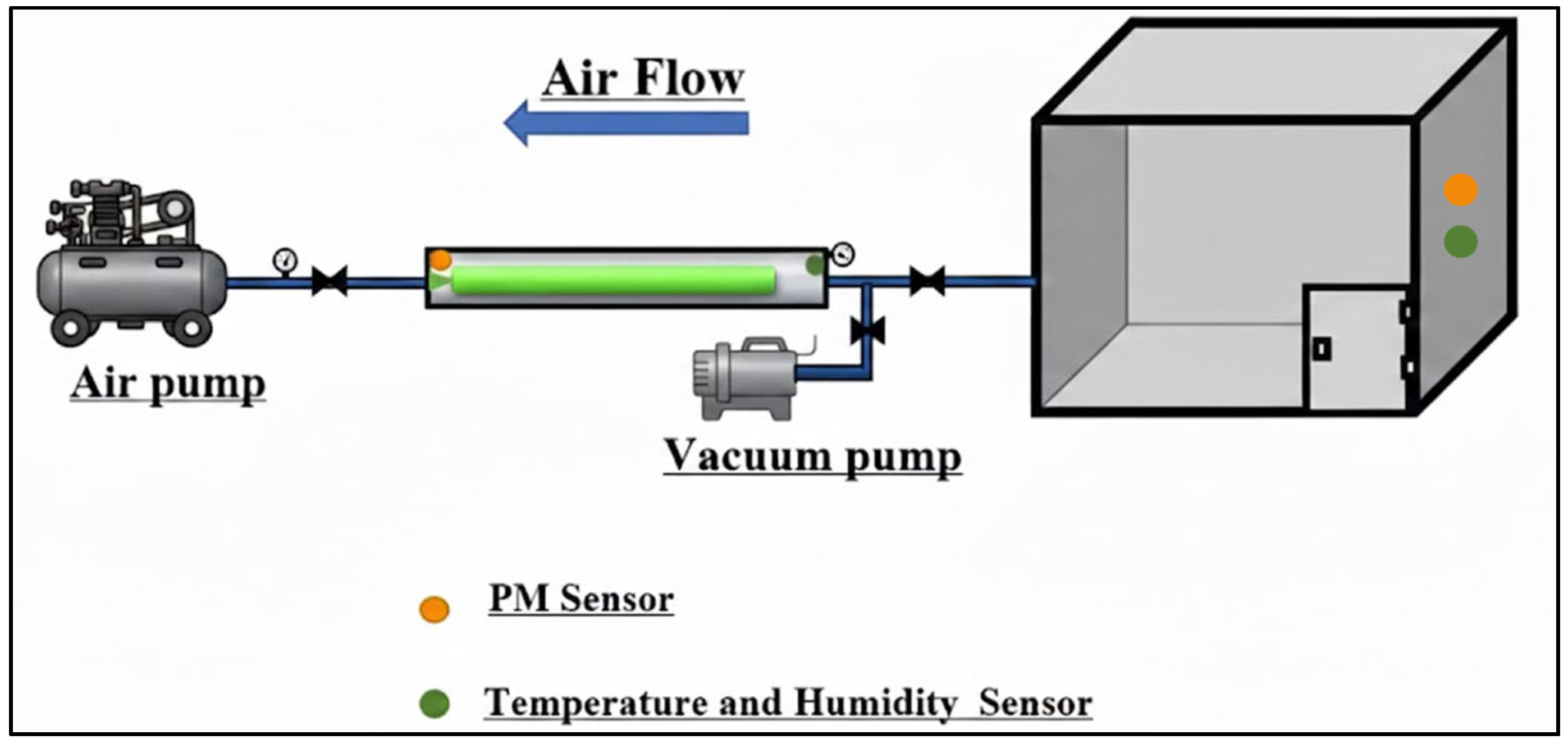
The development of the Evaporator Condensation Growth Particle Scrubber (ECGP) utilizes a synergistic approach to increase particle size by promoting droplet growth through controlled thermodynamic cycles. A schematic diagram of the experimental system is shown in Figure 1. The apparatus comprises three main sections: (1) an aerosol generation system, (2) a particle growth chamber, and (3) a particle measurement system.
The aerosol generation system comprised a sealed cubic chamber (39 cm × 39 cm × 39 cm) in which incense smoke was produced. A deionized (DI) water spray was concurrently introduced into this chamber to humidify the aerosol stream and act as a vapor source for subsequent condensation. The temperature, relative humidity and initial particle size distribution within the chamber were monitored using integrated sensors. To transfer the aerosol into the growth section. A vacuum was first created in the particle growth chamber and the valve connecting the two chambers was then opened, allowing the humidified incense smoke to be drawn into the growth chamber by the pressure differential.
Experimental Materials and Characteristics: To ensure data reliability and eliminate interference, the following materials were utilized.
Deionized (DI) Water: High-purity deionized water (resistivity > 18 MΩ·cm at 25 °C) served as the primary vapor source for humidification. The use of DI water was critical to eliminate potential interference from dissolved ions or mineral impurities, ensuring that the resulting droplets were chemically inert and did not compromise the sensitivity of the PM sensors.
Particulate Matter (Incense Smoke): Commercial incense smoke was employed as a representative surrogate for complex particulate matter (PM). The combustion of incense generates a polydisperse aerosol comprising organic fractions (e.g., polycyclic aromatic hydrocarbons), volatile organic compounds (VOCs) and trace inorganic residues such as potassium carbonate (K2CO3) and silica (SiO2). Due to their varied surface-active properties, these chemical constituents function as effective condensation nuclei, facilitating the heterogeneous condensation process observed in this study.
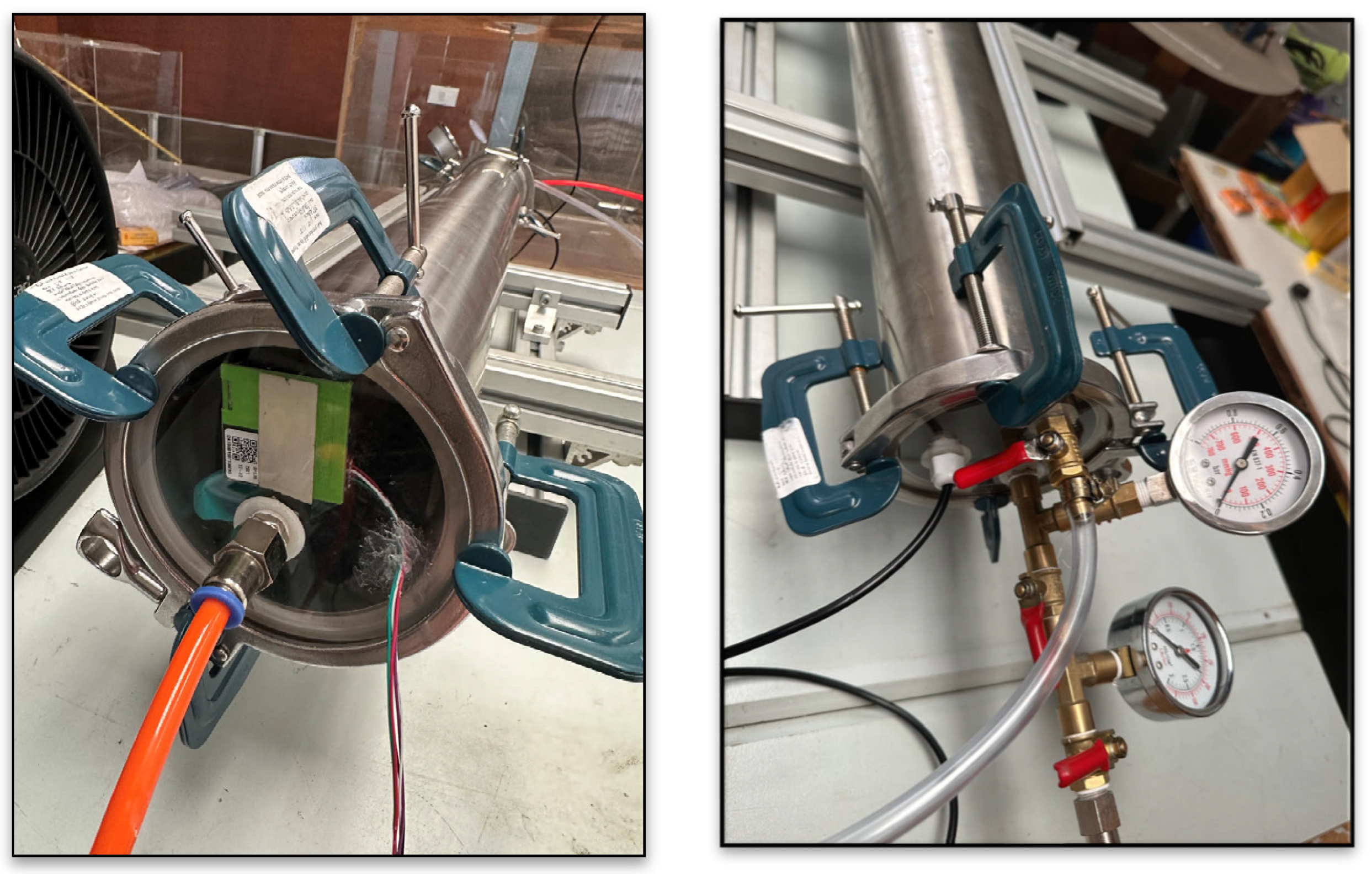
The particle growth chamber consisted of a cylindrical tube with an inner diameter of 4.25 cm and a length of 90 cm in Figure 1. The humidified aerosol from the generation unit was introduced into this chamber. To trigger particle growth, the chamber was first evacuated. When the aerosol entered this low-pressure environment, it underwent adiabatic expansion, cooling the mixture below its dew point and creating a supersaturated state. Following this expansion, the pressure was allowed to recover. In the supersaturated environment, water vapor heterogeneously condensed onto the incense particles, forming larger, particle-laden droplets. The chamber was equipped with sensors to monitor the evolution of particle size, humidity, and temperature throughout this process as shown in Figure 1.
Particle measurement was performed using a Sensirion SPS30 particulate matter sensor (Sensirion AG, Stäfa, Switzerland). This sensor was selected for its ability to provide size-binned particle concentration data across the relevant range of 0.3 to 10 µm, which is critical for quantifying the ECGP system’s performance in shifting the particle size distribution. All experiments were conducted within the sensor’s specified optimal operating range of 20 to 40 °C and below 80% relative humidity to ensure data reliability. The sensor’s built-in fan and advanced algorithm help mitigate contamination, supporting consistent measurement throughout the testing period. To mitigate potential measurement bias at RH > 80%, the SPS30 sensor utilized its internal heater and high-speed fan to prevent condensation on the optical components. Furthermore, the comparison was made based on the PM2.5/PM10 ratio rather than absolute mass concentration to normalize potential humidity-induced drift. To ensure data reliability and consistency, all experiments for each condition were conducted in 10 trials, and the results presented represent the synchronized trends observed across these multiple trials.
The experimental system for studying particle growth is illustrated in Figure 2. The apparatus consists of two primary components: the aerosol generation chamber and the cylindrical test chamber.
The aerosol generation chamber is designed to generate a controlled environment containing incense smoke, which serves as the surrogate for particulate matter (PM), and high humidity generated by an ultrasonic atomizer. The chamber is equipped with integrated sensors to monitor real-time temperature (T1), relative humidity (RH1), and mass concentrations of PM2.5 and PM10 (1PM).
The cylindrical test chamber is linked to the generation chamber by a control valve, which regulates aerosol transfer between two compartments. To facilitate aerosol transfer, a vacuum pump is utilized to depressurize the cylindrical chamber. The vacuum pump depressurized the chamber −0.8 bars relative to atmospheric pressure. This pressure differential allows the prepared aerosol to be drawn into the test chamber when the interconnecting valve is opened.
For active pressure modulation, the pressure modulation system is integrated into the cylindrical chamber. It consists of an internal balloon connected to an external air pump. Inflating the balloon compresses the air within the chamber, thereby increasing the internal pressure to induce the evaporative condensation process. The air was pumped into the balloon until the internal chamber pressure reached a peak of 1 bar (gauge) to ensure sufficient vapor–nucleus interaction. The test chamber also contains a second set of sensors (T2, RH2, and 2PM) for monitoring the internal conditions during experiments.
This study involved five distinct experimental conditions designed to evaluate PM2.5 and PM10 behavior and investigate particle growth potential:
  • Baseline (Ambient Air): An analysis of standard atmospheric conditions within the system.
  • Particulate Matter Only (Incense Smoke): The introduction of incense smoke without added humidity or pressure modulation.
  • Water Vapor Only (Ultrasonic Atomizer): The introduction of high-humidity mist into the air stream.
  • Particulate Matter with Pressure (Incense Smoke + Pressure): An evaluation of smoke particles under mechanical compression.
  • Integrated Condition (Incense Smoke + Ultrasonic Atomizer + Pressure): Combined high humidity and increased pressure to maximize evaporative condensation and particle growth.
In each condition, particle growth effectiveness was quantified by comparing PM mass concentrations between the aerosol generation chamber (inlet) and the test chamber (outlet) and by analyzing changes in the PM2.5/PM10 ratio.
Theoretical Condensation and Evaporation Models
The use of condensation to promote particle growth for enhanced removal has been extensively studied. Liu [9] demonstrated a “Condensation Growth Particle Scrubber” where sub-micron particles in exhaust streams were enlarged by creating a saturated, low-temperature gas environment, facilitating coagulation and subsequent removal. Similarly, Yoshida [10] applied condensation-based particle enlargement to industrial dust collection, showing its effectiveness for sub-micron particles in flue gas using methods such as mixing hot saturated air with cold air or steam injection. Recent advancements by Liu et al. [11] have further optimized these processes by tuning the vapor saturation ratio within growth tubes to maximize heterogeneous condensation efficiency.
Fundamental studies on the growth of mechanics have been conducted in controlled settings. Tammaro [12] investigated heterogeneous condensation in a growth tube (40 cm × 1.5 cm), finding that particle size expansion could be achieved by optimizing vapor temperature and residence time. Xu [13] later refined this tube design by implementing a recirculation mechanism to re-condense particles, further enhancing size growth. Fan [14] complemented these experimental studies with a numerical investigation, identifying key factors influencing PM2.5 enlargement, including contact angle, vapor saturation ratio, and initial particle size. Additionally, Wang et al. [15] provided a deeper molecular-scale understanding of water vapor condensation on sub-micron particles, confirming that surface chemistry significantly dictates the activation energy required for stable droplet formation.
Parallel research on spray-based dust suppression provides context for water droplet interactions. Klenk [16] and Swanson [17] studied water spray systems, concluding that finer sprays and optimized droplet particle size matching significantly improve fine dust collection efficiency. Beard and Pruppacher [18] provided foundational evaporation kinetics data for falling water droplets, which is relevant for understanding droplet stability in aerosol systems. The reliability of measurement systems in these high-humidity environments has also been validated by Roberts et al. [19], who demonstrated that laser scattering sensors, such as the SPS30, maintain high accuracy for size-binned PM monitoring even under saturation levels.
While previous studies confirm the principle of condensational growth and spray effectiveness, most systems rely on external vapor injections or complex flow designs. Furthermore, recent discourse in indoor air quality emphasizes the need for hybrid filtration systems that integrate pre-conditioning units to manage large-scale environments efficiently. This study proposes a novel, integrated approach: the Evaporator Condensation Growth Particle Scrubber (ECGP). Unlike prior systems, the ECGP generates the supersaturated environment internally via a controlled pressure modulation cycle (adiabatic expansion and compression) within a single chamber, using an intrinsic water source. This design aims to simplify the system while effectively transitioning sub-micron PM2.5 into the more filterable PM10 range, addressing a key efficiency gap in existing scrubber and cyclone technologies.

3. Results

3.1. Baseline Particle Behavior (Conditions 1–4)

Baseline Particle Behavior under Controlled Conditions (Conditions 1–4).
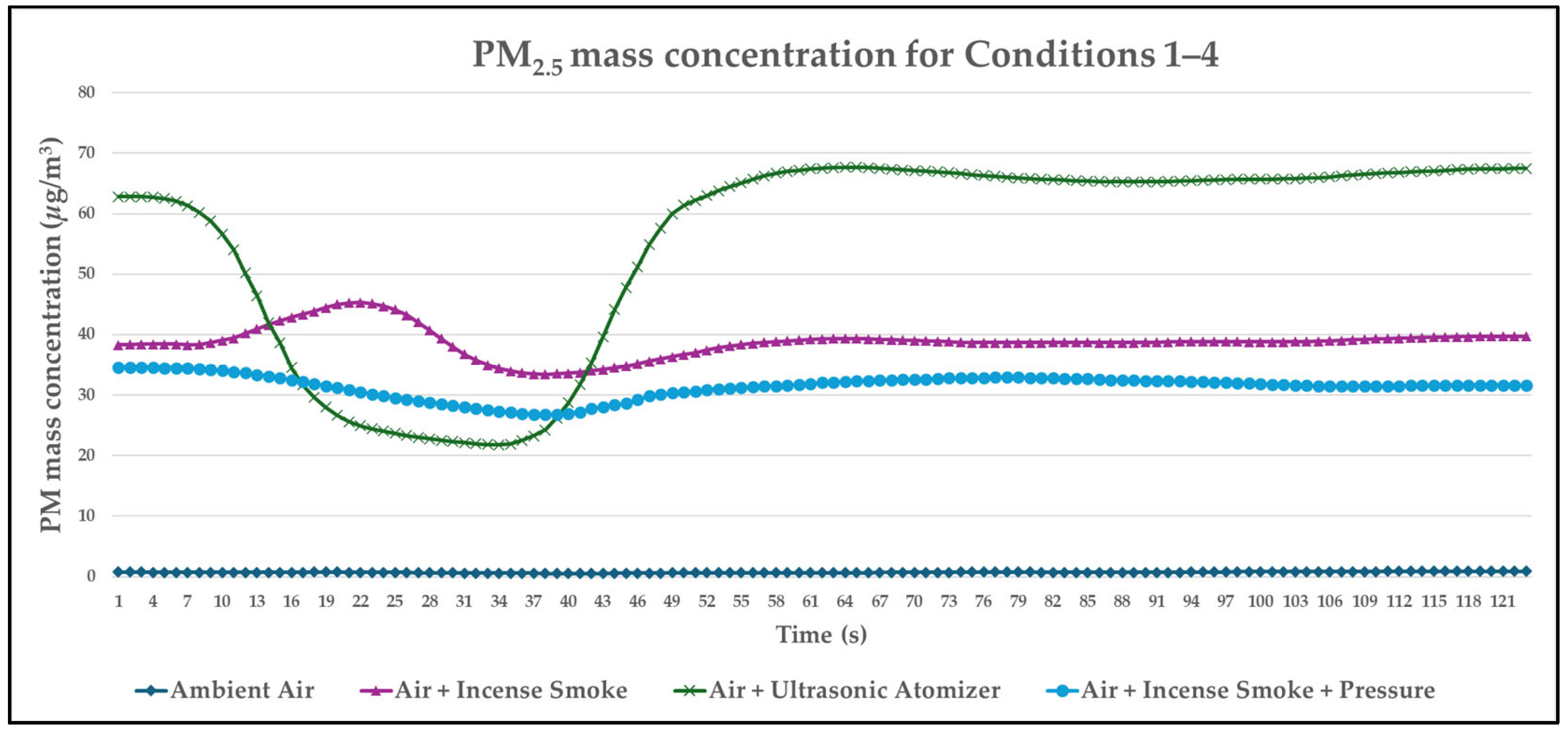
Preliminary experiments were conducted under four controlled conditions to characterize the baseline behavior of PM2.5 within the cylindrical test chamber. As shown in Figure 3, where the X-axis represents time (s) and the Y-axis denotes the PM2.5 mass concentration (µg/m3), distinct temporal concentration profiles were observed for each condition.
The experiments were carried out under four controlled conditions to characterize the baseline behavior of PM2.5 within the cylindrical test chamber. As illustrated in Figure 3, distinct temporal concentration profiles were observed, which can be detailed as follows:
Condition 1 (Ambient Air): PM2.5 concentrations remained consistently near zero, confirming the system’s airtight integrity. This baseline confirms the airtight integrity of the experimental system and ensures no external particle infiltration.
Condition 2 (Air + Incense Smoke): The PM2.5 concentration exhibited a characteristic pattern, peaking immediately after smoke introduction and then gradually decaying over time, representing the natural settling and deposition of particles within the chamber without additional intervention.
Condition 3 (Air + Ultrasonic Atomizer): This condition showed significant instability in the PM2.5 profile. Sharp transients were observed during the injection of high-humidity mist, followed by a rapid decline, indicating that water droplets alone (without sufficient nuclei or pressure modulation) do not lead to stable particle behavior in this range.
Condition 4 (Air + Incense Smoke + Pressure): Mechanical compression via the internal balloon resulted in a stabilized PM2.5 concentration profile. This condition resulted in a moderate reduction in mass concentration compared to Condition 2, suggesting that pressure alone began to influence particle dynamics but was not yet optimized for full growth.

3.2. Particle Growth Analysis (Condition 5)

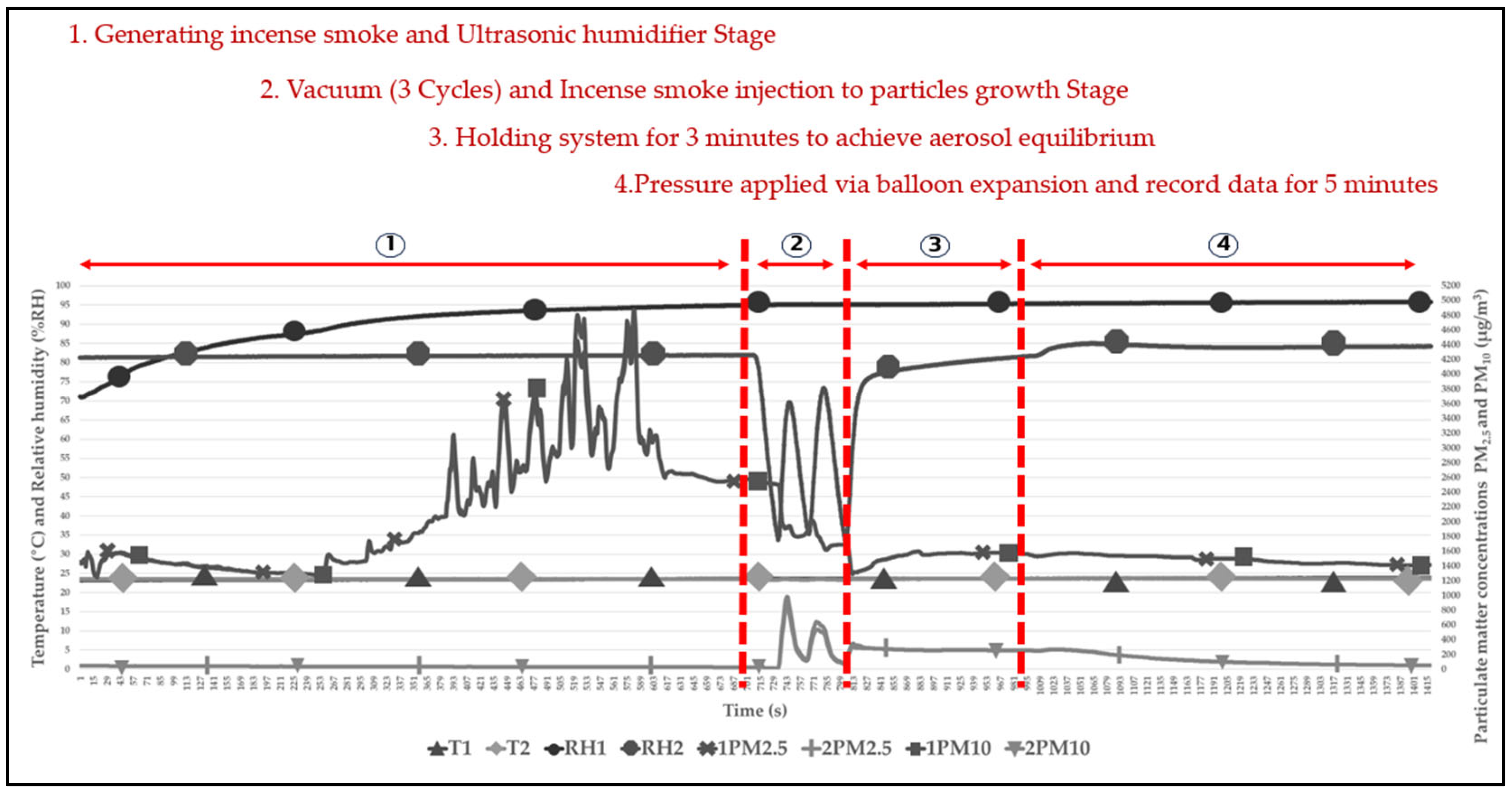
The integrated condition (Incense Smoke + Ultrasonic Atomizer + Pressure) induced a marked shift in the particle size distribution, as evidenced in Figure 4, Figure 5 and Figure 6.
From Figure 4, it can be seen that the experiment began by generating incense smoke until a stable concentration was achieved. Once the concentration stabilized, the data logging system was initiated. During this stage, an ultrasonic humidifier was activated to elevate the relative humidity (RH) to 95%.
Upon reaching 95% RH, the incense smoke was drawn into the particle growth chamber. At the beginning of the trial (Time 705–817 s), a vacuum was created within the test duct to intake the high-humidity air (95% RH) and the aerosol nuclei (incense smoke). Monitoring the particulate matter revealed three distinct spikes in PM2.5 and PM10 concentrations, which corresponded precisely with the opening cycles of the control valve.
Following the suction phase, the system was held for 3 min (Time 817–997 s) to allow the aerosols within the cylindrical duct to reach an equilibrium state. Subsequently, pressure was applied through the expansion of a balloon assembly, and data recording continued for an additional 5 min. This phase serves as the primary mechanism for testing the hypothesis. It was observed that the increased internal pressure forced water vapor molecules into closer proximity with the surface of the dust particles, thereby stimulating an intensified condensation process through this mechanism. To quantitatively validate this phenomenon, a thermodynamic assessment was performed to determine the saturation conditions within the chamber. Based on the recorded T2 and RH2, the dew point temperature was calculated using the Antoine equation. During the compression phase (1 bar gauge), the partial pressure of water vapor increased, leading to a calculated saturation ratio exceeding 1.0, which confirms the transition into a supersaturated state necessary for heterogeneous condensation.
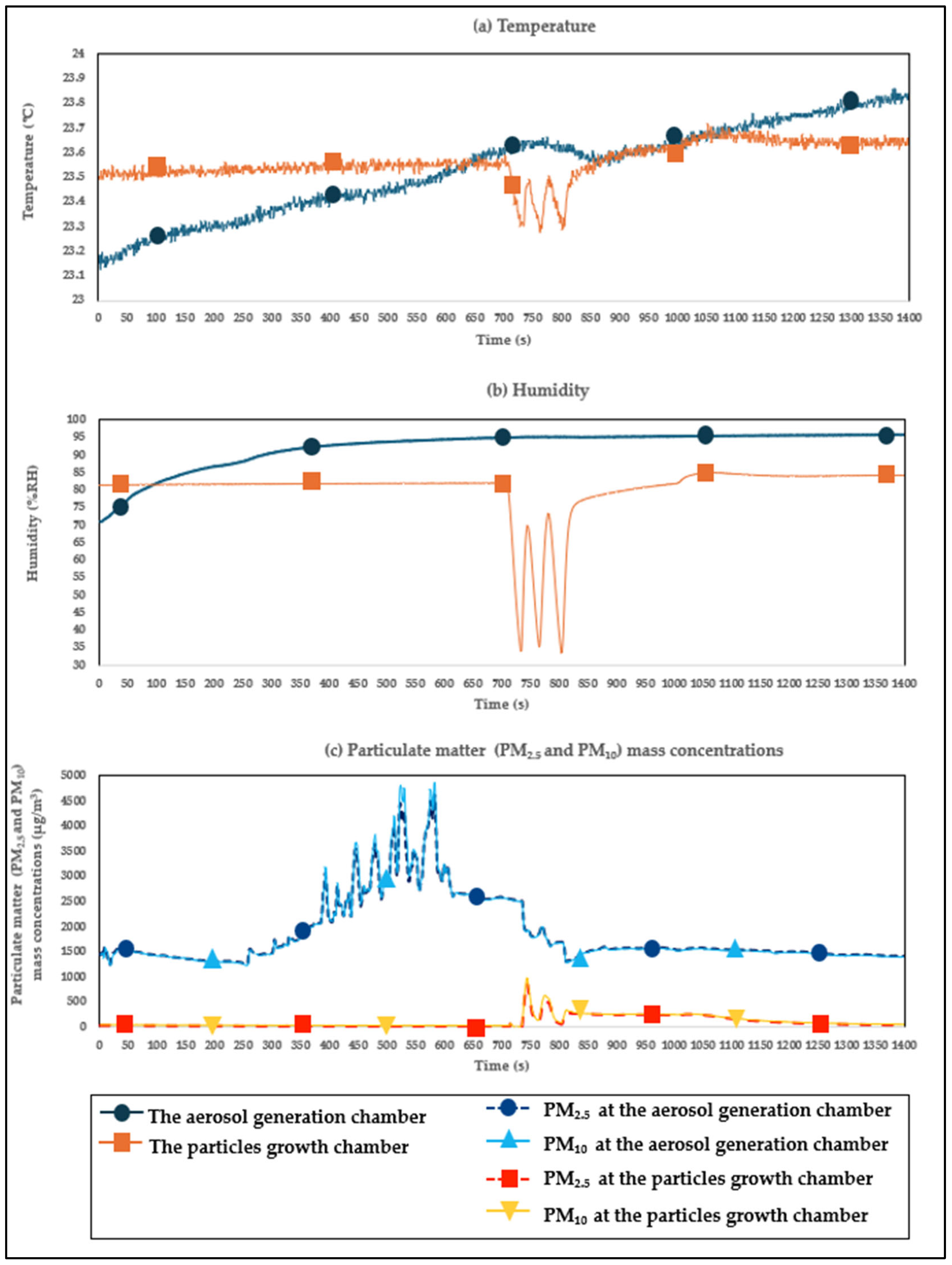
Figure 5a shows the temperature profiles at the aerosol generation chamber and the particle growth chamber. The temperature was maintained within a narrow range of 23.2 °C to 23.8 °C. Although a slight upward trend is observed over time, the deviation remains minimal. This ensures that the experimental results were primarily influenced by humidity and pressure changes rather than significant thermal gradients, maintaining the integrity of the evaporative condensation study.
Figure 5b shows the humidity profiles. The relative humidity at the aerosol generation chamber remained stable at a saturation level of approximately 95% throughout the process. In contrast, the relative humidity at the particle’s growth chamber exhibited significant fluctuations during the vacuum-induced phase (716–799 s), dropping sharply before recovering. This confirms that the aerosol nuclei were exposed to a highly dynamic moisture environment during the critical experimental stages.
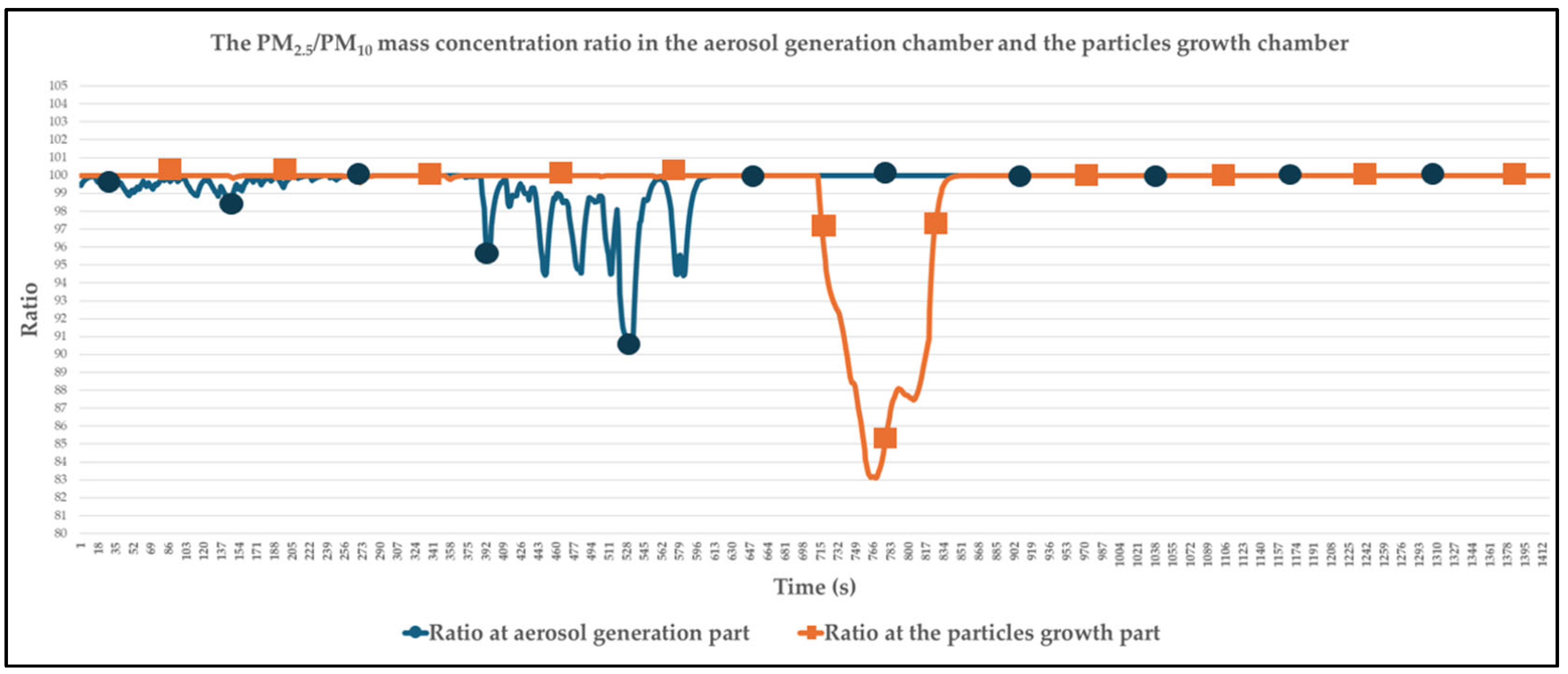
Figure 5c shows that the concentrations at the aerosol generation chamber (PM2.5 and PM10) remained the dominant fractions throughout. During the suction phase, the concentrations at the particle’s growth chamber (PM2.5 and PM10) showed distinct response spikes. The lower mass concentration at the particle’s growth chamber compared to at the aerosol generation chamber suggests a complex deposition or transformation mechanism within the chamber. This transformation is further illustrated by the PM2.5/PM10 mass concentration ratio shown in Figure 6.
As shown in Figure 6, three distinct concentration spikes were recorded for both PM10 and PM2.5 during the vacuum-induced phase (716–799 s), with PM10 exhibiting a steeper increase. In the subsequent compression phase, balloon inflation caused the outlet PM2.5/PM10 ratio to drop from approximately 100% to 83% (Figure 5). This reduction indicates that approximately 17.5% (with a standard deviation < 1% across 10 trials, p < 0.05) of the PM2.5 mass was successfully transferred to the PM10 fraction, demonstrating the efficacy of the ECGP system in promoting particle growth.
The data points illustrated in Figure 3, Figure 4, Figure 5 and Figure 6 reflect the characteristic temporal profiles observed during the experiments. The consistency across repeated trials confirmed that the measurement uncertainties remained within acceptable margins for a physical feasibility study, effectively capturing the dynamic shift in particle mass ratios.

4. Discussion

4.1. Mechanisms of Particle Enlargement

The disproportionate increase in PM10 during the vacuum (low-pressure) phase can be explained by adiabatic expansion. As humid air enters the low-pressure cylindrical chamber, the temperature drops, creating localized supersaturation. This triggers heterogeneous condensation, where water vapor immediately condenses onto the incense smoke nuclei, initiating early-stage particle growth. The effectiveness of this process is consistent with studies by Liu et al. [11], which show that tuning the vapor saturation ratio is critical for maximizing growth. Moreover, the stability of the liquid film formed under pressure modulation is supported by Deng et al. [20], who found that pressurized growth creates more robust droplets that resist re-evaporation compared to simple steam injection. The physical robustness of condensed liquid films on solid nuclei is crucial for effective downstream collection. Research by Gamisans et al. [21] demonstrates that pressure-modulated environments enhance the stability of the water layer, preventing droplet breakup and re-evaporation even under high-velocity airflow conditions typical in industrial scrubbers.
During the compression phase, mechanical compression via balloon inflation acts as the primary driving force. The increased pressure enhances the deposition of water vapor molecules onto the existing nuclei. The successful transition of 18% of the fine particle mass into the larger size fraction confirms the effectiveness of this evaporative condensation growth mechanism.

4.2. Stability and Industrial Implications

The synergistic effect of high relative humidity and mechanical pressure was more effective than any single-factor condition. The stability of the PM2.5/PM10 ratio indicates that a stable liquid film encapsulating the particles is physically robust and resistant to re-evaporation, even under fluctuating humidity.
For practical applications, this increase in particle mass and inertia is critical. Larger particles are significantly easier to capture using downstream mechanical collection systems, such as cyclones or wet scrubbers, which typically exhibit low efficiency for sub-micron dust. The ECGP system effectively bridges this efficiency gap by pre-conditioning the dust through growth before it reaches the final collection stage.
Although direct energy consumption was not recorded in this preliminary study, the ECGP system is designed to function as a pre-conditioning unit rather than a primary collector. By transitioning approximately 17.5% (with a standard deviation < 1% across 10 trials, p < 0.05) of sub-micron PM2.5 into the larger PM10 fraction, the ECGP effectively shifts the dust load toward a size range that can be captured by medium-efficiency mechanical filters (e.g., MERV 13-14) instead of high-resistance HEPA filters. HEPA filters typically induce a significant and continuous pressure drop, requiring high fan energy throughout the operation. In contrast, the ECGP’s cyclic pressure modulation aims to reduce the reliance on such dense media, potentially lowering the cumulative energy demand and maintenance costs associated with filter replacement and air pressure loss in large-scale infrastructures.

5. Conclusions

The persistent crisis of fine particulate matter (PM2.5) in Northern Thailand, particularly in urban centers like Chiang Mai, underscores the urgent need for cost-effective and high-efficiency filtration technologies. This study successfully demonstrated the physical feasibility of the Evaporator Condensation Growth Particle Scrubber (ECGP) in enhancing the size of sub-micron particles through a synergistic, pressure-driven condensational growth mechanism. While this study confirms the physical feasibility of using incense smoke as a surrogate, future research will evaluate the ECGP system with actual ambient smog to account for variations in hygroscopicity and surface chemistry.
Our experimental findings confirmed that neither mechanical pressure nor high humidity alone is sufficient to achieve stable particle growth. However, the integration of solid nuclei, high relative humidity (approximately 95%) and adiabatic cycles resulted in a significant shift in particle size distribution. The vacuum-induced suction phase combined with balloon-mediated compression acted as a primary driving mechanism for heterogeneous condensation onto incense smoke nuclei. This integrated process achieved a measurable decrease in the PM2.5/PM10 mass ratio from approximately 100% to 83%, effectively transitioning approximately 17.5% (with a standard deviation < 1% across 10 trials, p < 0.05) of the fine mass into the larger, more filterable PM10 fraction. While the PM2.5/PM10 mass ratio provided a practical indicator of particle growth in this study, the authors acknowledge the limitation of not utilizing a Scanning Mobility Particle Sizer for detailed number-based distribution analysis. Consequently, future research will prioritize the integration of high-resolution aerosol spectrometers and microscopy validation to provide a more granular characterization of the condensational growth kinetics.
The resulting particles exhibited high physical stability and resistance to re-evaporation, which is critical for their eventual removal. By growing particles beyond the 2.5 µm threshold, the ECGP technology offers a promising pathway to address the low-efficiency limitations (typically <10%) of standard cyclone and scrubber systems for sub-micron dust.
In conclusion, the ECGP represents a promising innovation for large-scale indoor air purification in public infrastructures, such as schools and hospitals, where traditional HEPA filtration may be cost-prohibitive. Future work will focus on integrating the ECGP with downstream collection units to evaluate total system removal efficiency, alongside optimizing pressure modulation cycles and evaluating energy consumption for real-world application under diverse environmental conditions.


Author Contributions

Conceptualization, P.S., P.C., A.H., W.T., M.S. and W.M.; methodology, P.S.; validation, A.H., W.T., M.S. and W.M.; formal analysis, P.S.; investigation, P.S. and P.C.; resources, A.H., W.T., M.S. and W.M.; data curation, P.S.; writing—original draft preparation, P.S.; writing—review and editing, P.S., A.H., W.T., M.S. and W.M.; visualization, P.S.; supervision, A.H., W.T., M.S. and W.M.; project administration, P.S. All authors have read and agreed to the published version of the manuscript.

Funding

This research received no external funding.

Institutional Review Board Statement

Not applicable.

Informed Consent Statement

Not applicable.

Data Availability Statement

The data presented in this study is available on request from the corresponding author.

Conflicts of Interest

The authors declare no conflicts of interest.

Abbreviations

The following abbreviations are used in this manuscript:
ECGPEvaporator Condensation Growth Particle Scrubber
PMParticulate Matter
PM2.5Particulate Matter with a Diameter of 2.5 Micrometers or Less
PM10Particulate Matter with a Diameter of 10 Micrometers or Less
RHRelative Humidity
TTemperature
USEPAUnited States Environmental Protection Agency
ASHRAEAmerican Society of Heating, Refrigerating and Air-Conditioning Engineers
HEPAHigh-Efficiency Particulate Air
CADRClean Air Delivery Rate
SPSSensirion Particulate Matter Sensor
µg/m3Micrograms per Cubic Meter
µmMicrometers

References

  1. Pollution Control Department (PCD). Annual Report on Air Quality and Noise Management in Thailand; Ministry of Natural Resources and Environment: Bangkok, Thailand, 2020. [Google Scholar]
  2. Chiang Mai Provincial Public Health Office. Health Impact Assessment of Air Pollution (PM2.5) in Chiang Mai Province; Ministry of Public Health: Nonthaburi, Thailand, 2016. [Google Scholar]
  3. U.S. Environmental Protection Agency (USEPA). Guide to Air Cleaners in the Home; U.S. Environmental Protection Agency: Washington, DC, USA, 2024. Available online: https://www.epa.gov/indoor-air-quality-iaq/guide-air-cleaners-home (accessed on 13 April 2026).
  4. EPA 402-F-09-002; Residential Air Cleaners: A Technical Summary. U.S. Environmental Protection Agency (USEPA): Washington, DC, USA, 2018.
  5. Cooper, C.D.; Alley, F.C. Air Pollution Control: A Design Approach; Waveland Press: Long Grove, IL, USA, 2010. [Google Scholar]
  6. Hinds, W.C. Aerosol Technology: Properties, Behavior, and Measurement of Airborne Particles; John Wiley & Sons: Hoboken, NJ, USA, 1999. [Google Scholar]
  7. Ng, B.F.; Xiong, J.W.; Wan, M.P. Application of acoustic agglomeration to enhance air filtration efficiency in air-conditioning and mechanical ventilation (ACMV) systems. PLoS ONE 2017, 12, e0178851. [Google Scholar] [CrossRef] [PubMed]
  8. Montgomery, J.F.; Green, S.I.; Rogak, S.N.; Bartlett, K.H. Predicting the Energy Use and Operation Cost of HVAC Air Filters. Energy Build. 2012, 47, 643–650. [Google Scholar] [CrossRef]
  9. Liu, B.Y.H.; McMurry, P.H.; Sun, J. Condensation-Growth Particle Scrubber. U.S. Patent US5176723A, 5 January 1993. [Google Scholar]
  10. Yoshida, T. Application of Particle Enlargement by Condensation to Industrial Dust Collection. J. Chem. Eng. 1978, 11, 469–475. [Google Scholar] [CrossRef]
  11. Liu, Z.; Chen, Z.; Li, Y.; Yang, L. The Study of Heterogeneous Condensation of Water Vapor on Submicron Particles in Cooled Tube by Population Balance Model. Chem. Eng. Trans. 2017, 61, 1321–1326. [Google Scholar] [CrossRef]
  12. Tammaro, M.; Salluzzo, A.; Piga, R.; Lancia, G. Heterogeneous condensation of submicron particles in a growth-tube. J. Chem. Eng. 2012, 74, 124–134. [Google Scholar] [CrossRef]
  13. Xu, J.; Zhang, J.; Yu, Y.; Zhong, H. Heterogeneous condensation on fine particle of water vapor in a moderated growth tube. J. Energy Procedia 2017, 118, 201–209. [Google Scholar] [CrossRef]
  14. Fan, F.; Zhang, S.; Wang, W.; Yan, J.; Su, M. Numerical investigation of PM 2.5 size enlargement by heterogeneous condensation for particulate abatement. J. Process Saf. Environ. Prot. 2019, 125, 197–206. [Google Scholar] [CrossRef]
  15. Wang, Z.-J.; Wang, S.-Y.; Wang, D.-Q.; Yang, Y.-R.; Wang, X.-D.; Lee, D.-J. Water Vapor Condensation on Substrates with Nanoscale Hydrophilic Spots: A Molecular Dynamics Study. Int. J. Heat Mass Transf. 2023, 205, 123929. [Google Scholar] [CrossRef]
  16. Klenk, U. Use of Water Droplets and Additives for Dust Control. In Proceedings of the Bulk Solids Europe, Berlin, Germany, 11–12 October 2012. [Google Scholar]
  17. Swanson, J.-G.; Langefeld, O. Fundamental research in water spray systems for dust control. Miner. Min. AusIMM 2015, 124, 2. [Google Scholar] [CrossRef]
  18. Beard, K.V.; Pruppacher, H.R. A Wind Tunnel Investigation of the Rate of Evaporation of Small Water Drops Falling at Terminal Velocity in Air. J. Atmos. Sci. 1971, 28, 1455–1465. [Google Scholar] [CrossRef]
  19. Roberts, F.A.; Van Valkinburgh, K.; Green, A.; Post, C.J.; Mikhailova, E.A.; Commodore, S. Evaluation of a New Low-cost Particle Sensor as an Internet-of-things Device for Outdoor Air Quality Monitoring. J. Air Waste Manag. Assoc. 2022, 72, 1219–1230. [Google Scholar] [CrossRef] [PubMed]
  20. Deng, X.; Shi, B.; Tang, Y.; Wang, N. The Linear Stability of Liquid Film with Oscillatory Gas Velocity. Aerospace 2023, 10, 691. [Google Scholar] [CrossRef]
  21. Gamisans, X.; Sarrà, M.; Lafuente, F.J.; Azzopardi, B.J. The Hydrodynamics of Ejector-Venturi Scrubbers and Their Modelling by an Annular Flow Boundary Layer Model. Chem. Eng. Sci. 2002, 57, 2999–3006. [Google Scholar] [CrossRef]
Figure 1. Sensor configuration within the particle growth chamber for the real-time measurement of particle size distribution, relative humidity and temperature.
Applsci 16 03925 g001
Figure 2. Experiment setup.
Applsci 16 03925 g002
Figure 3. Temporal profiles of PM2.5 mass concentration for Conditions 1–4.
Applsci 16 03925 g003
Figure 4. Sequential effects of each experimental stage.
Applsci 16 03925 g004
Figure 5. Temporal profiles of temperature, relative humidity and particulate matter (PM2.5 and PM10) mass concentrations measured in the aerosol generation chamber (inlet) and the particle growth chamber (outlet).
Applsci 16 03925 g005
Figure 6. Temporal variation in the PM2.5/PM10 mass concentration ratio in the aerosol generation chamber and the particle growth chamber.
Applsci 16 03925 g006
Disclaimer/Publisher’s Note: The statements, opinions and data contained in all publications are solely those of the individual author(s) and contributor(s) and not of MDPI and/or the editor(s). MDPI and/or the editor(s) disclaim responsibility for any injury to people or property resulting from any ideas, methods, instructions or products referred to in the content.