Article

Model-Correction-Based Feedforward Anti-Sway Control for Bridge Cranes with Rigid Vertical Slender Payloads


Naval University of Engineering, Wuhan 430030, China
*
Authors to whom correspondence should be addressed.
Appl. Sci. 2026, 16(8), 3888; https://doi.org/10.3390/app16083888
Submission received: 3 March 2026 / Revised: 14 April 2026 / Accepted: 15 April 2026 / Published: 16 April 2026
(This article belongs to the Section Marine Science and Engineering)

Abstract

The overall swing dynamics of rigid slender payloads lifted in a vertical orientation deviate significantly from the ideal point-mass pendulum model, leading to severe performance degradation of feedforward control strategies designed based on this simplified model. This paper focuses on the bridge crane system and establishes a double-pendulum dynamic model that accounts for the payload’s mass distribution effect. To compensate for the theoretical error of the linearized model, a data-driven payload swing frequency correction strategy is proposed. Based on this corrected model, a dual-mode Zero Vibration Derivative (Corrected-Dual-ZVD) input shaping feedforward controller is designed. Simulations under eight typical operating conditions were conducted using the Matlab/Simulink control system simulation software. The results show that compared to the controller designed based on the traditional single-pendulum model, the proposed Corrected-Dual-ZVD controller, based on the corrected double-pendulum model, can significantly reduce the maximum residual swing angle of the payload. The average swing angle suppression rate reaches 68.9% across seven valid operating conditions, and it can reach 98.9% under the extreme condition of high speed and short rope length. When model parameters are subjected to ±10% disturbances, the proposed method demonstrates good robustness.

1. Introduction

In marine engineering operations such as shipbuilding and dock loading, rigid slender payloads (e.g., ship rudder stocks, missile vertical launching system modules) require high-precision hoisting and positioning in a vertical orientation. Although such payloads are made of rigid materials like steel and are lifted by inextensible ropes, their mass is continuously distributed along the axis. This results in a moment of inertia during swinging that is far greater than that of an equivalent point mass. This distributed-mass effect causes the system’s actual swing period to deviate significantly from the value predicted by the classical simple pendulum theory ( T = 2 π l / g , T is the theoretical swing period, l is the effective pendulum length, and g is the acceleration due to gravity), exhibiting more complex double-pendulum dynamic characteristics. Taking the bridge crane as an example, if the control system still employs a feedforward strategy designed based on the ideal simple pendulum model, it will fail to effectively cancel residual vibrations due to the mismatch between the system’s natural frequencies. This not only prolongs the operation waiting time but may also cause collisions between the payload and the ship hull or other structures, leading to safety incidents.
The anti-sway control technology for cranes has evolved over decades, leading to the development of various methods including feedback control, feedforward control, and intelligent control [1,2,3,4,5,6]. Among these, input shaping, as an open-loop feedforward technique, has been widely adopted in industrial applications due to its simple structure, no requirement for additional sensors, ease of integration into existing controllers, and its property of not altering the closed-loop system stability [7,8,9,10]. The Zero Vibration (ZV) input shaper, as its fundamental form, has a suppression effect that is highly dependent on the accuracy of the system model, particularly the natural frequency and damping ratio [11]. To enhance robustness, the Zero Vibration Derivative (ZVD) shaper achieves insensitivity to parameter perturbations by introducing additional derivative constraints based on the system’s inherent dynamic characteristics [12]. At the modeling level, the point-mass pendulum model is commonly used in industrial practice for controller design. This model is well-suited for scenarios where the payload dimensions are much smaller than the rope length or where the mass is highly concentrated [13]. However, for vertically lifted slender components with continuously distributed mass (e.g., wind turbine monopiles, ship rudder stocks, missile vertical launch modules), the model’s neglect of the mass distribution effect leads to significant deviations in frequency prediction, severely compromising the effectiveness of feedforward control [14]. Some studies have attempted to address this by introducing equivalent pendulum lengths or online compensation strategies based on measured data [15]. However, these efforts primarily focus on scenarios involving laterally hoisted or transferred beam structures, flexible cable-suspended payloads or multibody payloads [16,17,18,19]. There is a lack of systematic research on model correction strategies specifically for the “rigid vertical lifting” condition—a specific yet common operational scenario. Particularly, comprehensive comparisons and evaluations of different correction structures regarding accuracy, robustness, computational complexity, and engineering feasibility are scarce. In practical industrial applications, manual or remote-controlled crane operation remains common in non-repetitive tasks such as construction and custom handling, where operator experience is still essential despite advances in automation [20,21]. When positioning accuracy is unsatisfactory, operators often need to repeatedly start and stop the crane to adjust its position. This positioning method is not only inefficient but also highly prone to inducing large-amplitude payload swings, leading to safety incidents. Therefore, developing corresponding automatic control systems is of significant engineering value [22].
This paper takes the bridge crane as the research object to address the aforementioned issues. Firstly, the double-pendulum dynamic model for vertically lifted slender payloads is derived. Secondly, to address the deviation between the swing frequencies predicted by the theoretical model and those from the high-fidelity simulation system, a data-driven model correction method is proposed. Finally, a feedforward controller is designed using input shaping control theory. A damping ratio of 0.2 is introduced to more realistically reflect the system’s dissipative characteristics. The effectiveness of the proposed method is comprehensively validated through simulations under multiple operating conditions and robustness analysis.

2. Payload Dynamic Modeling

2.1. Ideal Single-Pendulum Model

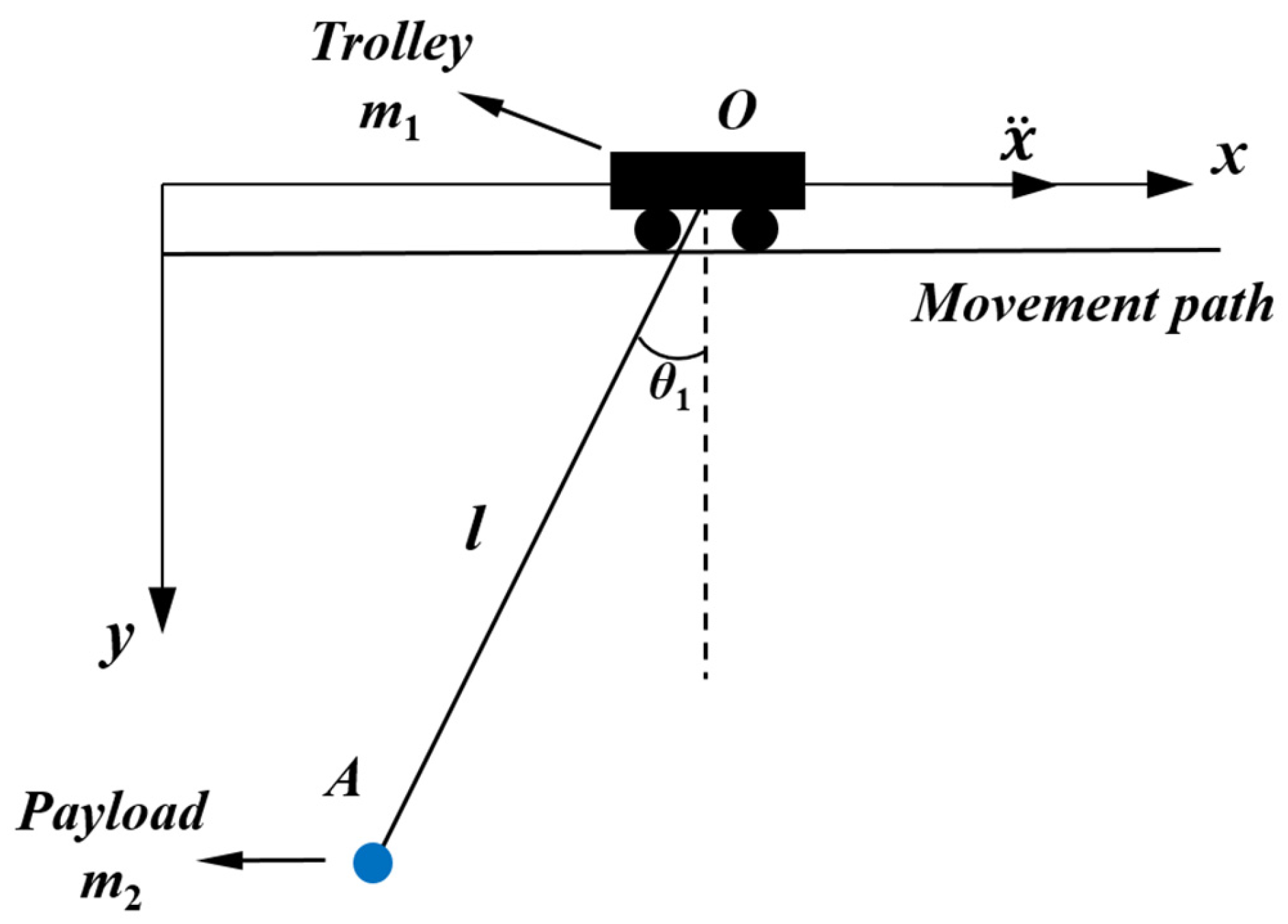
In a bridge crane, as the sway patterns of the payload are identical in the travel directions of both the trolley and the gantry, the dynamic analysis of the payload during trolley acceleration is presented as follows to illustrate the general sway pattern. Consider the bridge crane system shown in Figure 1, where the payload is suspended from a moving trolley by a rigid hoisting rope in a vertical orientation. Here, m1 is the trolley mass, m2 is the point-mass payload, l is the hoisting rope length, and θ1 is the payload sway angle.
The system is modeled under two key assumptions: (1) damping ratio is negligible (ζ ≈ 0), as it has little effect on natural frequencies and mode shapes; and (2) the hoisting rope is rigid and massless [23]. In the inertial coordinate system, the trolley coordinate is O(x, 0), and the point payload coordinate is A(x − −lsin θ1, −lcos θ1). According to Lagrange’s equation, the nonlinear dynamic equation of the trolley-point mass payload pendulum system can be obtained as:
l θ ¨ 1 x ¨ cos θ 1 + g sin θ 1 = 0
The equation describes the fully coupled dynamics of the trolley–payload system. In practical applications of bridge cranes, the trolley acceleration typically satisfies the relationship x ¨ g to ensure smooth and safe transportation [24]. Under this condition, the payload swing angle is usually within a small range, often satisfying θ1 ≤ 10°. This allows the approximations cos θ1 ≈ 1 and sin θ1θ1. Substituting these into Equation (1) yields the linearized dynamic equation for the trolley-point mass payload pendulum system:
l θ ¨ 1 x ¨ + g θ 1 = 0
To determine the system’s natural frequency, the external input x ¨ is removed to consider free vibration. Setting the trolley acceleration to zero ( x ¨ = 0 ), the equation becomes:
θ ¨ 1 + g l θ 1 = 0
Solving yields ω = g / l . Then, when the trolley acceleration is a unit impulse x ¨ t = δ t , the response of the point-mass payload sway angle θ1(t) is:
θ 1 t = 1 g l sin g l t
The fundamental assumption of this model lies in equating the entire inertial effect of the distributed mass to a point mass located at the suspension point, completely neglecting the payload’s moment of inertia about its own center of mass. This assumption introduces non-negligible errors because the moment of inertia significantly increases the system’s equivalent inertia, thereby reducing its swing frequency.

2.2. Double-Pendulum Model Considering Mass Distribution

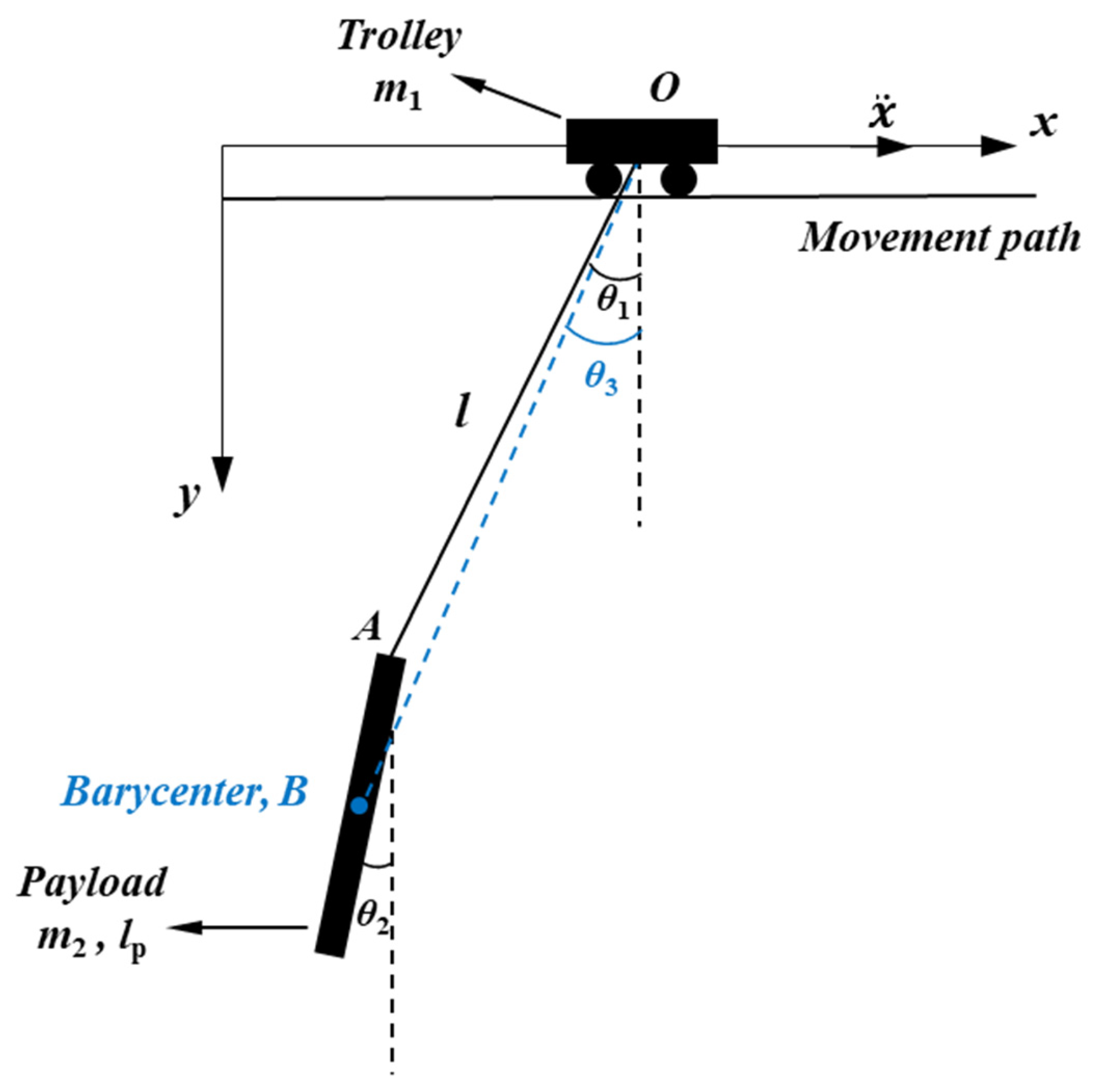
To accurately describe the dynamic characteristics of rigid vertical slender payloads, a double-pendulum model is established as shown in Figure 2. Here, m1 is the trolley mass, m2 is the payload mass, l is the hoisting rope length, lp is the payload length, θ1 is the swing angle of the hoisting rope, θ2 is the swing angle of the vertically suspended slender payload, and θ3 is the angle by which the center of mass (point B) of the vertically suspended slender payload deviates from the vertical direction.
Assume that the system’s damping ratio is approximately zero, and the hoisting rope is rigid with negligible mass. In the inertial coordinate system, the trolley coordinate is O(x, 0), the suspension point coordinate is A(x − −lsin θ1, −lcos θ1), and the coordinate of the center of mass B of the vertically suspended slender payload is (x − −lsin θ1 − 0.5lpsin θ2, −lcos θ1 − 0.5lpcos θ2). According to Lagrange’s equation, the nonlinear dynamic equations for the trolley-rigid vertical slender payload double-pendulum system can be obtained as:
l θ ¨ 1 + l p 2 θ ¨ 2 cos θ 1 θ 2 l p 2 θ ˙ 2 θ ˙ 1 θ ˙ 2 sin θ 1 θ 2 x ¨ cos θ 1 + x ˙ θ ˙ 1 sin θ 1 + g sin θ 1 = 0 l p θ ¨ 2 + 3 l 2 θ ¨ 1 cos θ 1 θ 2 3 l 2 θ ˙ 1 θ ˙ 1 θ ˙ 2 sin θ 1 θ 2 3 2 x ¨ cos θ 2 + 3 2 x ˙ θ ˙ 2 sin θ 2 + 3 g 2 sin θ 2 = 0
The trolley mass m1 does not appear in the equations because x(t) is prescribed as an input. The slender payload mass m2, though present in the derivation, cancels out upon substituting the moment of inertia of a uniform slender payload about its center of mass. Consequently, the linearized dynamics depend only on the geometric parameters l and lp. These equations describe the fully coupled dynamics of the trolley–payload system. Similarly, based on the small-angle trigonometric approximations and neglecting higher-order terms, the linearized dynamic equations for the trolley-rigid vertical slender payload double-pendulum system are simplified as:
l θ ¨ 1 + l p 2 θ ¨ 2 x ¨ + g θ 1 = 0 l p θ ¨ 2 + 3 l 2 θ ¨ 1 3 2 x ¨ + 3 g 2 θ 2 = 0
Further analysis yields the linear differential equations for the trolley-rigid vertical slender payload double-pendulum system as:
θ ¨ 1 = 1 l x ¨ 4 g l θ 1 + 3 g l θ 2 θ ¨ 2 = 6 g l p θ 1 6 g l p θ 2
Similarly, to determine the system’s natural frequencies (i.e., the frequencies during free vibration), the external input is removed to consider free vibration. Setting the trolley acceleration to zero ( x ¨ = 0 ), the equations become:
θ ¨ 1 = 4 g l θ 1 + 3 g l θ 2 θ ¨ 2 = 6 g l p θ 1 6 g l p θ 2
Solving yields:
ω 1 = g 2 4 l + 6 l p + 4 l 2 + 24 l l p + 6 l p 2 ω 2 = g 2 4 l + 6 l p 4 l 2 + 24 l l p + 6 l p 2
Then, when the trolley acceleration is a unit impulse x ¨ t = δ t , the responses of the sway angles θ1(t) and θ2(t) are:
θ 1 t = 1 l ω 2 2 ω 1 2 6 g l p ω 1 2 ω 1 sin ω 1 t + ω 2 2 6 g l p ω 2 sin ω 2 t θ 2 t = 1 3 g l ω 2 2 ω 1 2 6 g l p ω 1 2 4 g l ω 1 2 ω 1 sin ω 1 t + ω 2 2 6 g l p 4 g l ω 2 2 ω 2 sin ω 2 t
Based on the geometric relationships in Figure 2, the swing angle of the payload’s center of mass is:
θ 3 = arctan l sin θ 1 + l p 2 sin θ 2 l cos θ 1 + l p 2 cos θ 2

2.3. Applicability Boundary Analysis of the Small-Angle Linearized Model

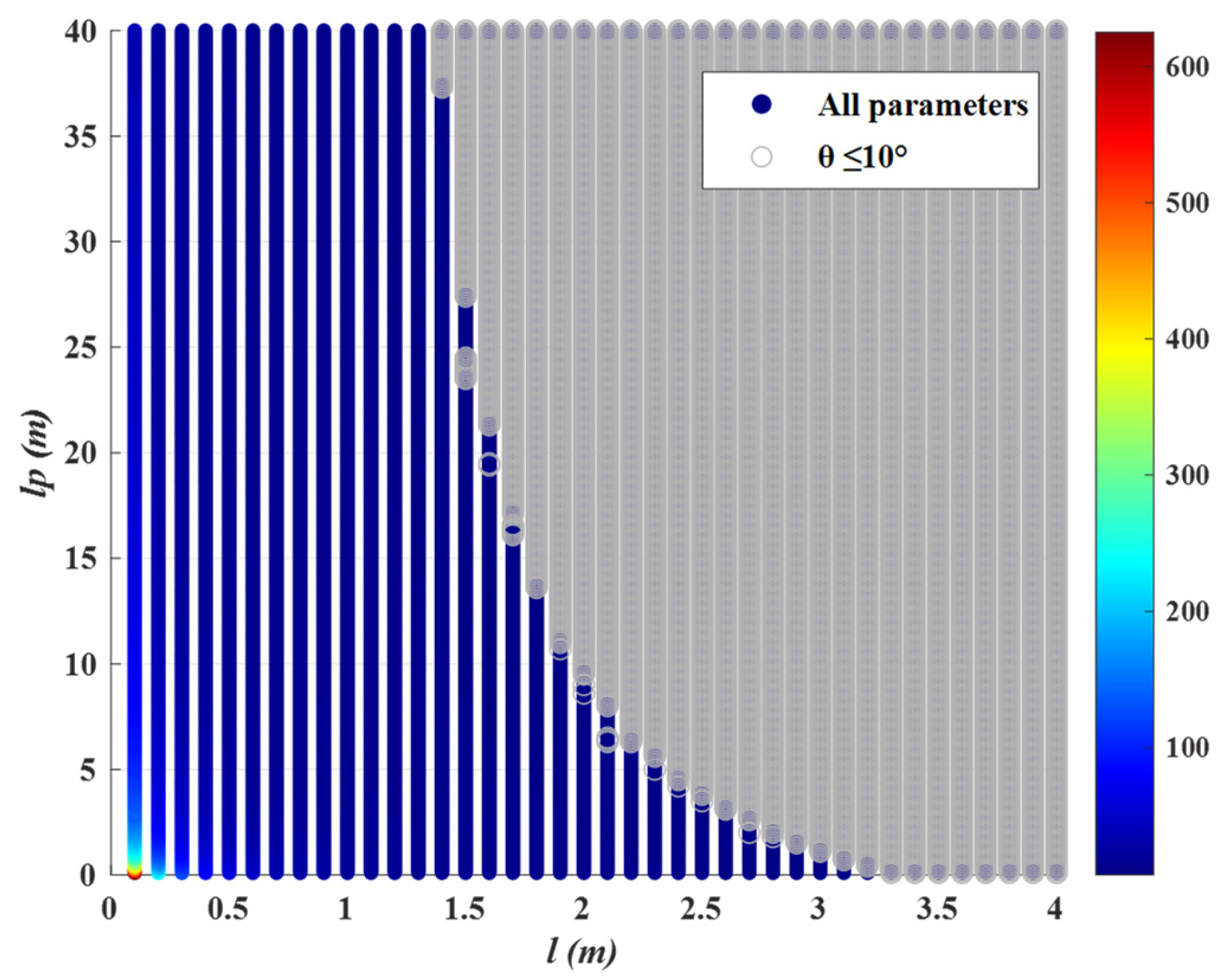
The aforementioned linearized model is valid under the premise of the small-angle assumption (θ1, θ2, and θ3 ≤ 10°). To determine the applicability boundary of the small-angle linearized model, a traversal calculation was performed over the values of l and lp. The objective was to identify the combinations of l and lp for which θ1, θ2, and θ3 ≤ 10°, and to determine the fitted function for the applicability boundary.
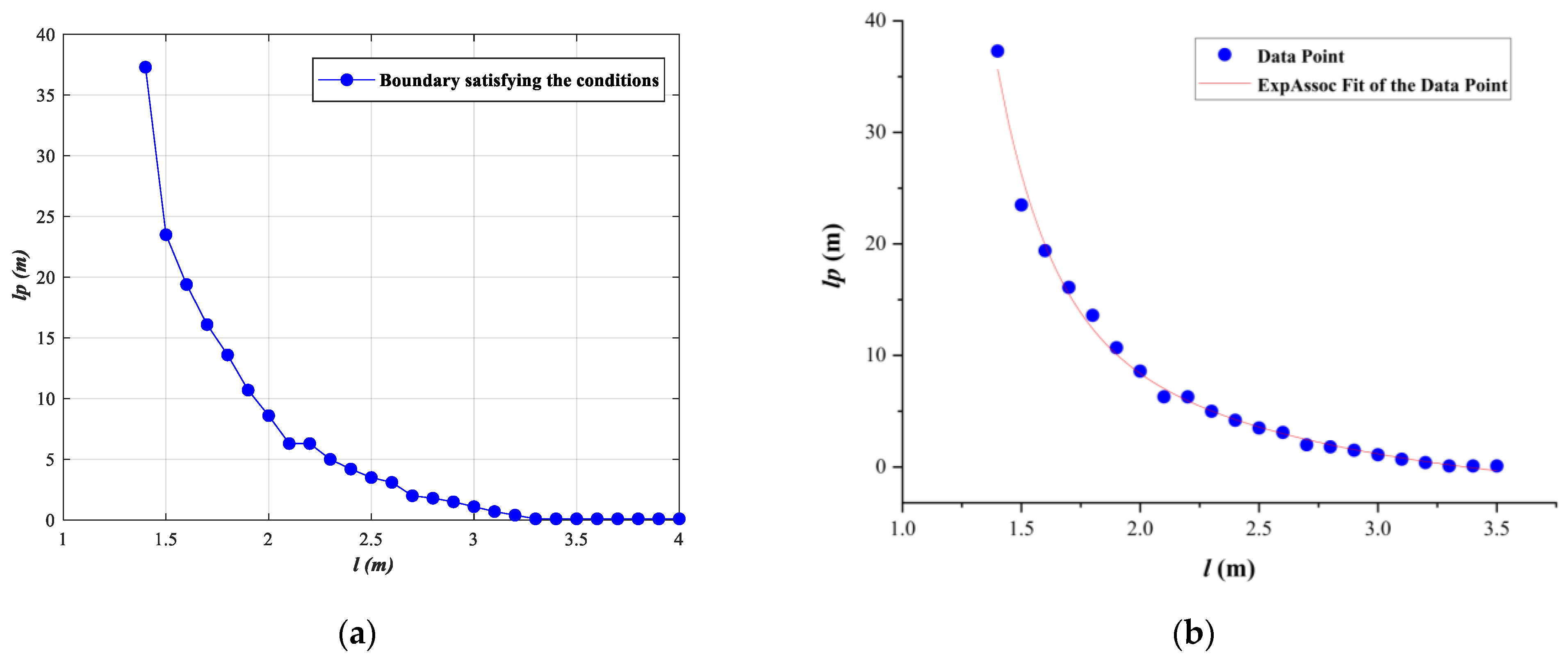
The results are shown in Figure 3, where the gray points represent the parameters that satisfy the condition. The boundary condition obtained by fitting (Figure 4) is:
l p > 6620.9 6598.1 × 1 e l 0.25223 33.5 × 1 e l 2.8609
When l and lp satisfy this condition, the aforementioned small-angle simplified model is applicable. The subsequent calculations of l and lp values all meet this condition. All simulation conditions presented later in this paper satisfy this condition to ensure the validity of the linearized model.
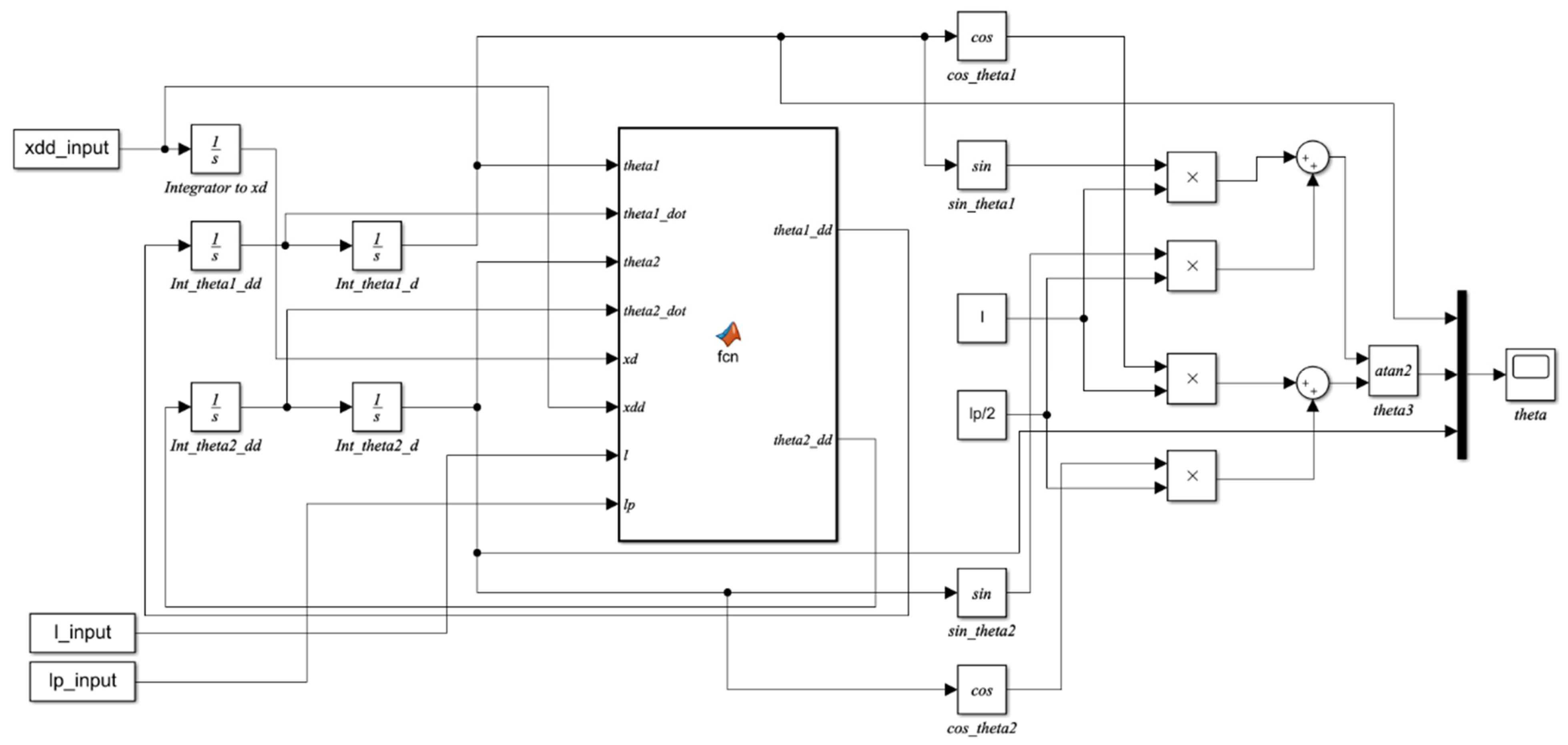
Figure 5 shows the R2019b-MATLAB/Simulink realization of the second-order pendulum dynamics together with the feedforward controller (FCN), forming the open-loop plant-plus-control-law model used for simulation. The model comprises trolley acceleration, rope length, and payload length input blocks, state computation modules, and swing angle output modules. The model is built under the assumptions of rigid inextensible ropes, negligible rope mass, and small-angle approximation, with all parameters consistent with the theoretical dynamic model for reliable validation.

3. Design and Evaluation of Data-Driven Model Correction Strategy

Although the theoretical double-pendulum model is more accurate than the single-pendulum model, the payload sway angle (denoted as θ3raw(t)) derived based on the small-angle assumption and modal superposition method deviates from the simulation results of the Simulink model (denoted as θ3sim(t)) due to the influences of nonlinear effects, neglected higher-order modes, and parameter simplification [9]. Moreover, unavoidable imperfections exist in practical engineering systems, which further cause discrepancies between ideal theoretical models and real dynamic behaviors [25,26]. This is manifested as an offset between the two theoretical natural frequencies, ω1 and ω2, and the actual swing frequencies exhibited by the system. To improve the accuracy of the theoretical model in engineering prediction, this paper designs a data-driven joint linear correction method. Taking the Simulink model simulation output as the benchmark and using the instantaneous composite sway angle θ3(t) as the correction target, this method corrects the two dominant swing frequencies. The goal is to minimize the Root Mean Square Error (RMSE) of the instantaneous phase between the corrected output θ3corr(t) and the Simulink output.
This method compensates for the idealized assumptions of the linearized model regarding natural frequencies and initial conditions by introducing frequency scaling factors a1, a2 and phase shifts φ1, φ2 to the two dominant sway components, θ1(t) and θ2(t), making it better align with the actual dynamic response. Simultaneously, a linear transformation is applied to the original theoretical output θ3raw(t), which is synthesized from the corrected modal signals θ1corr(t) and θ2corr(t): θ3corr(t) = b0 + b1θ3raw(t) + b2t, where b0 is a constant bias, b1 is an amplitude scaling coefficient, and b2 is a time drift term used to compensate for potential phase drift.
θ 1 c o r r t = 1 l ω 2 2 ω 1 2 6 g l p ω 1 2 ω 1 sin α 1 ω 1 t + φ 1 + ω 2 2 6 g l p ω 2 sin α 2 ω 2 t + φ 2 θ 2 c o r r t = 1 3 g l ω 2 2 ω 1 2 6 g l p ω 1 2 4 g l ω 1 2 ω 1 sin α 1 ω 1 t + φ 1 + ω 2 2 6 g l p 4 g l ω 2 2 ω 2 sin α 2 ω 2 t + φ 2
θ 3 c o r r = b 0 + b 1 arctan l sin θ 1 c o r r + l p 2 sin θ 2 c o r r l cos θ 1 c o r r + l p 2 cos θ 2 c o r r + b 2 t
Considering the practical ranges of hoisting rope lengths l and payload lengths lp in engineering applications (both in meters), the optimization process involved traversing 2657 sets of geometric configurations (that fall within the applicable range) within the parameter space (l, lp)∈[1, 35] × [0.5, 20]. The objective was to identify the optimal correction parameters by minimizing the Root Mean Square Error (RMSE). For each geometric configuration, the optimal correction parameters were identified by solving a constrained nonlinear optimization problem using MATLAB’s fmincon solver to minimize the RMSE, which is defined as:
R M S E = 1 N k = 1 N θ 3 c o r r t θ 3 s i m t 2
where N is the number of sampling points, set to 3000 (0~30 s, step size 0.01).
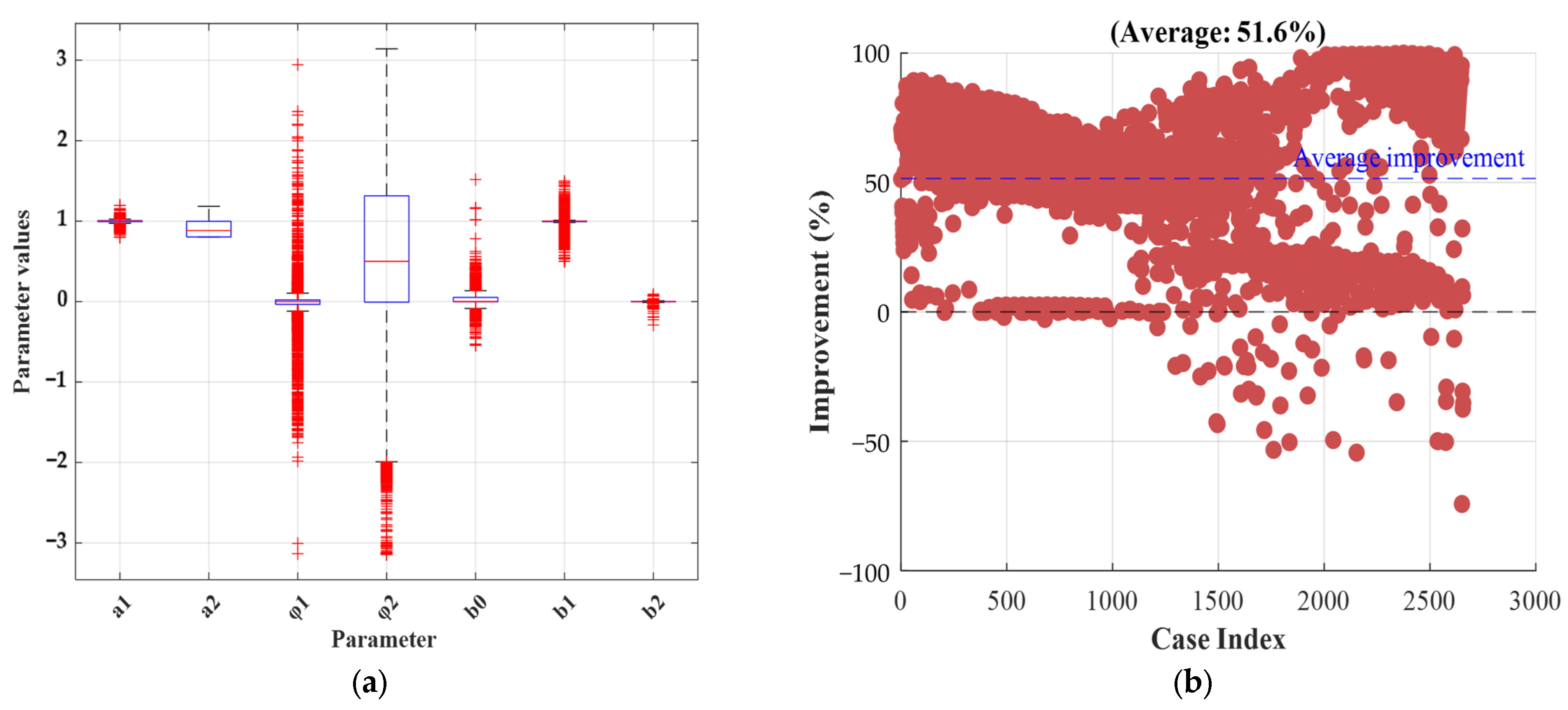
Figure 6a shows the parameter correction results, and Figure 6b shows the RMSE optimization results after parameter correction. A few configurations in Figure 6b show negative RMSE improvement (down to ≈−75%), corresponding to cases with negligible payload swing where the baseline model’s linearization error is already minimal, and parameter correction introduces slight overfitting. Nevertheless, the proposed method achieves an average RMSE improvement of 51.6%, with substantial gains in most practical scenarios. The mean values of the corrected parameters are a1 = 1.1309, a2 = 0.9581, φ1 = 2.0036, φ2 = 1.2691, b0 = 0, b1 = 0.5081, and b2 = 0. Due to the good consistency of the parameters, the global average correction coefficients a1 and a2 can be directly adopted in engineering applications, avoiding the complex online identification process.
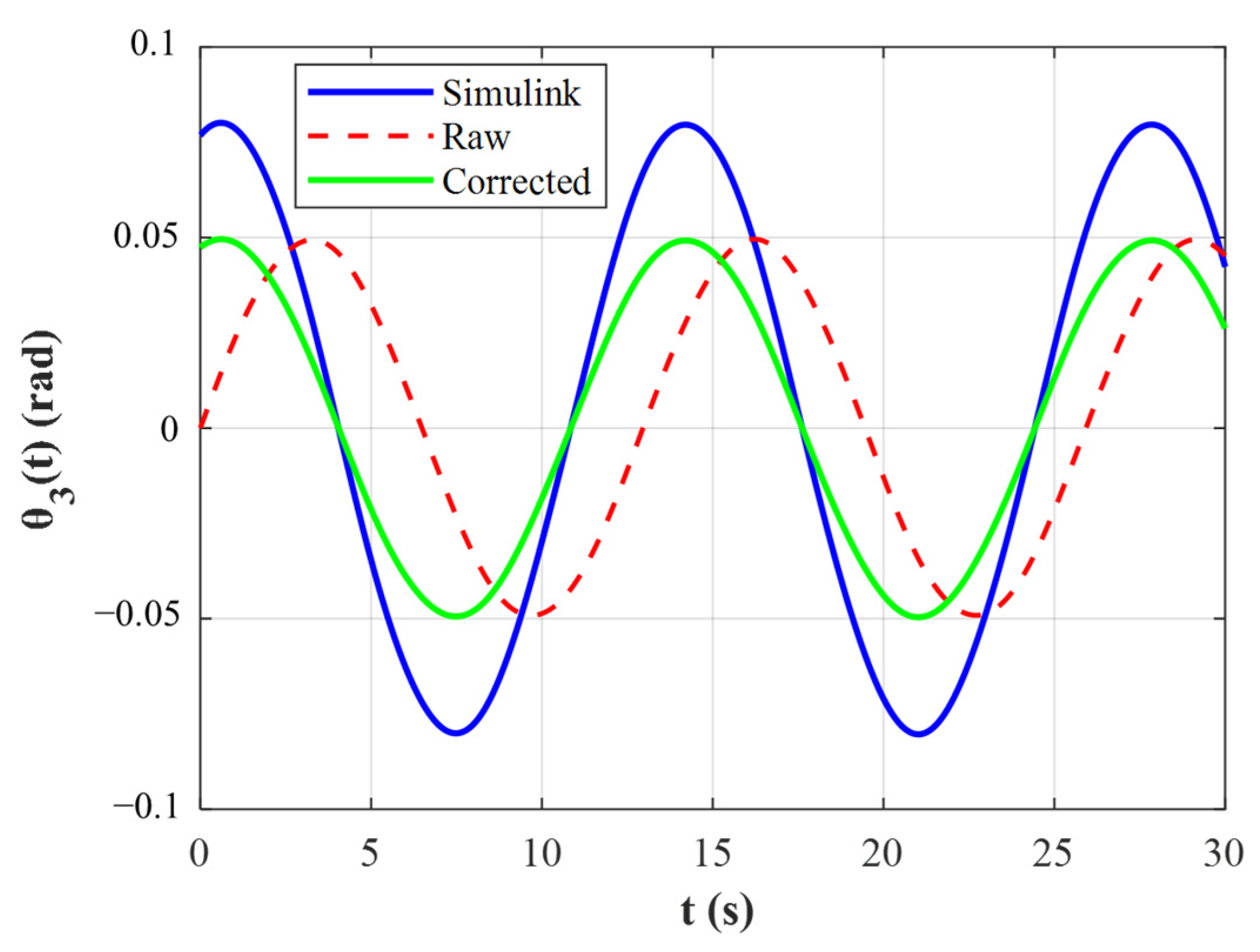
Taking l = 31.5 m, lp = 19 m as an example, Figure 7 compares the time-domain responses of θ3(t) before and after correction. A clear phase difference exists between the red dashed line (theoretical model) and the blue solid line (Simulink simulation), while the green solid line (corrected model) exhibits phase agreement with the blue solid line. This visually demonstrates the effectiveness of the proposed correction strategy.

4. Simulation Verification

4.1. Control Models and Methods

To systematically evaluate the effectiveness of the method proposed in this paper, four types of methods are compared: the uncontrolled benchmark (Original), the ZVD method based on the single-pendulum model, the Dual-ZVD method based on the theoretical double-pendulum model, and the proposed Corrected-Dual-ZVD method based on model correction. The configurations are shown in Table 1. The design of all controllers considers a system damping ratio of ζ = 0.2, which is a typical value for bridge cranes to reflect real energy dissipation and improve control robustness.
For a single-mode system, the Zero Vibration Derivative (ZVD) input shaper consists of three impulses. Their amplitudes and application times satisfy the condition that simultaneously makes both the residual vibration at the specified frequency and its first derivative with respect to frequency equal to zero. Assuming the dynamics of an ideal single-pendulum system can be described by a single natural frequency ω = g / l , the corresponding ZVD shaper for this frequency ω can be expressed as:
I S t = K δ t + 2 1 K δ t π ω + K δ t 2 π ω
Among them, the coefficient K is determined by the robustness condition. Considering a system damping ratio of ζ = 0.2, its value is:
K = 1 1 + 2 cos π 2 2 0.25
To validate the effectiveness of the double-pendulum model and simultaneously suppress the two inherent modes of the double-pendulum system while enhancing robustness against model parameter uncertainties, this paper introduces the theoretical dual-frequency Zero Vibration Derivative (Dual-ZVD) method. A dual-mode controller is constructed by convolving two single-mode Zero Vibration Derivative (ZVD) shapers. Assuming the two theoretical natural frequencies of the double-pendulum system are ω1 and ω2, two single-mode ZVD sequences are designed for them and convolved to obtain the final dual-frequency robust input shaper:
I S D u a l Z V D t = I S 1 t I S 2 t
Subsequently, impulses with excessively small amplitudes (less than 10−3) are removed, and the amplitudes of the remaining impulses are normalized to ensure conservation of total momentum.
The Corrected-Dual-ZVD method proposed in this paper corrects the aforementioned theoretical frequencies by introducing empirical correction coefficients a1 and a2. This aims to compensate for the frequency offset caused by the system’s nonlinear coupling, thereby making the controller design more aligned with the actual dynamic characteristics. The goal is to enhance the effectiveness of the control performance without increasing the algorithmic complexity.

4.2. Typical Operating Condition Settings and Simulation

To verify the effectiveness of the method proposed in this paper and in conjunction with engineering practice, the simulation is set up with two travel distances of 2 m and 9 m and two travel times of 3 s and 6 s. The payload length lp is set to 3 m, and the hoisting rope length l is set to 3 m and 10 m. Combining these parameters results in a total of eight typical operating conditions, as shown in Table 2. The corresponding trolley velocities for these combinations are 0.33 m/s, 0.67 m/s, 1.50 m/s, and 3.00 m/s, covering the operational speed range of actual bridge cranes in settings such as shipyards and ports. The simulation experiments were conducted on the MATLAB/Simulink R2019b platform.
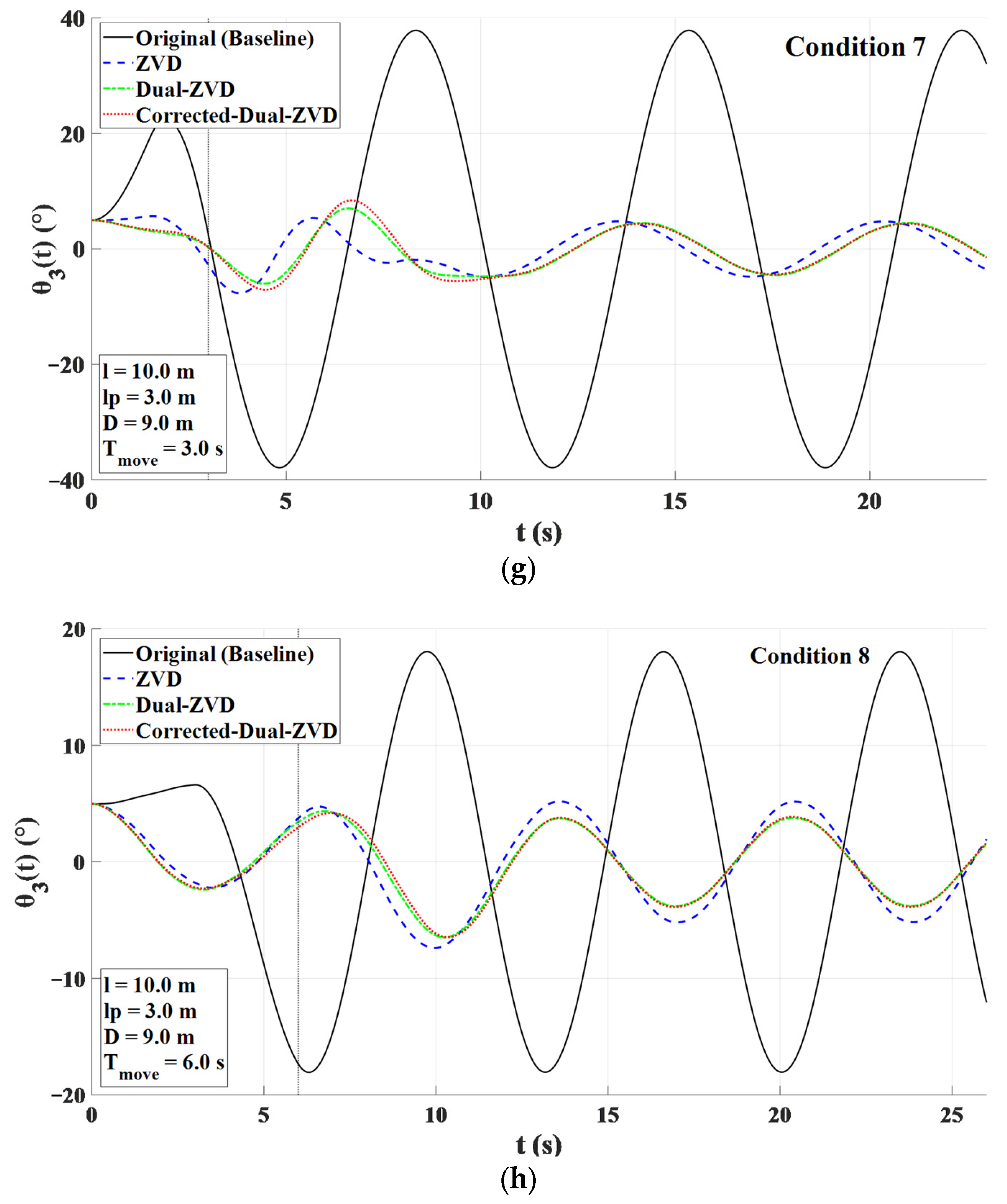
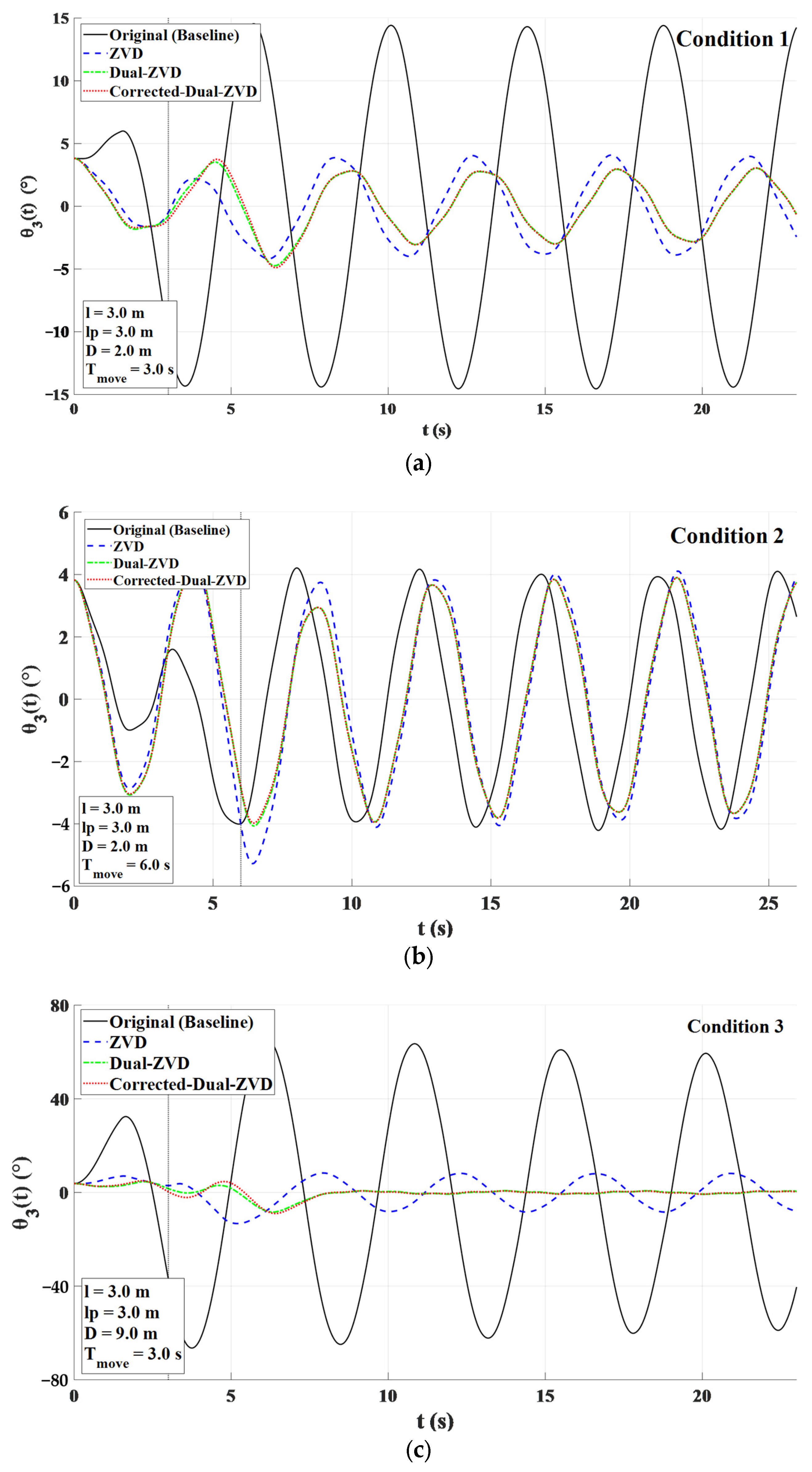
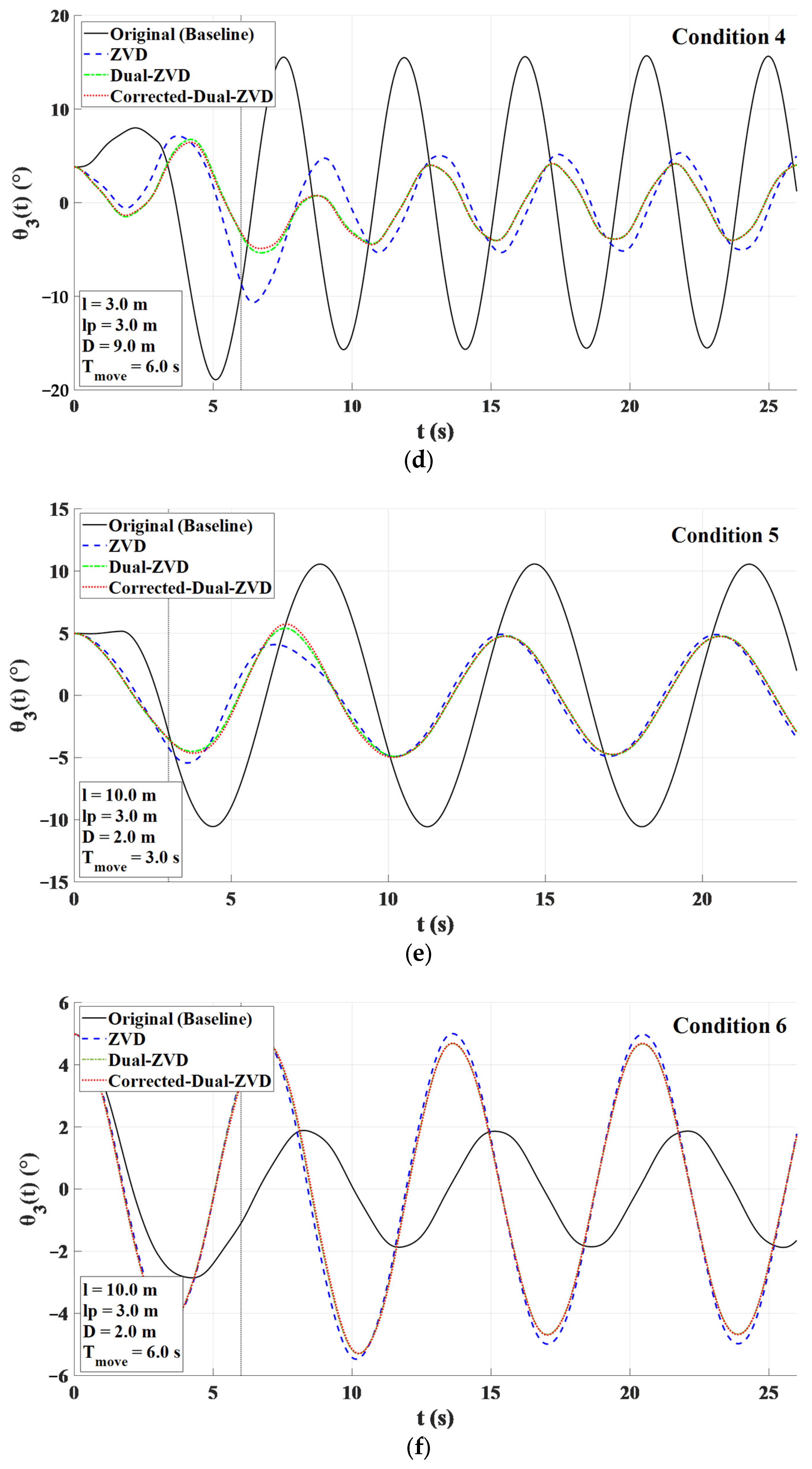
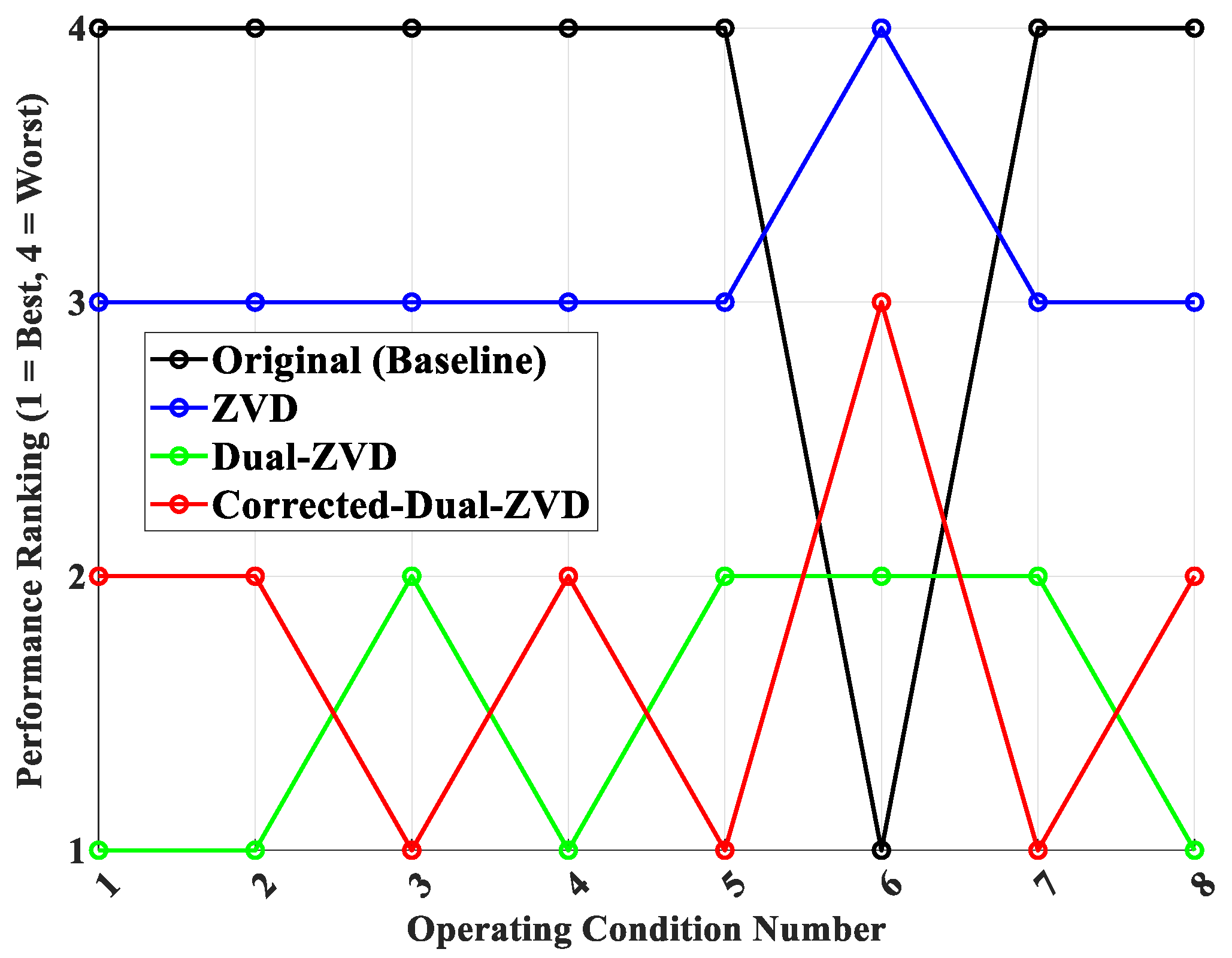
Figure 8 shows the time-domain plots of the payload swing angle θ3(t) simulation results for different control methods under each operating condition, and Figure 9 shows the performance ranking of different control methods across conditions. Table 3 presents the corresponding maximum residual swing angles θ3max.
Condition 6 is not considered in the aggregated performance evaluation because its combination of very low trolley speed and long rope length results in negligible payload swing, a regime where input shaping provides little benefit or may even degrade performance. Across the remaining seven valid operating conditions, the Corrected-Dual-ZVD method achieves an average swing angle suppression rate of 68.9%, as demonstrated in the simulation results. This represents an improvement of 6.2% compared to the 62.7% suppression rate of the traditional ZVD method. The Dual-ZVD method achieved an average suppression rate of 68.6%, which is close to that of Corrected-Dual-ZVD. This fully demonstrates the core advantage of the double-pendulum model over the single-pendulum model. Under Condition 3, characterized by high speed and short rope, the Corrected-Dual-ZVD method achieved a suppression rate as high as 98.9%. In most other conditions, the ZVD controller based on the single-pendulum model, due to frequency prediction errors, resulted in residual swing amplitudes that were larger than those of the controllers based on the double-pendulum model.

4.3. Robustness Analysis

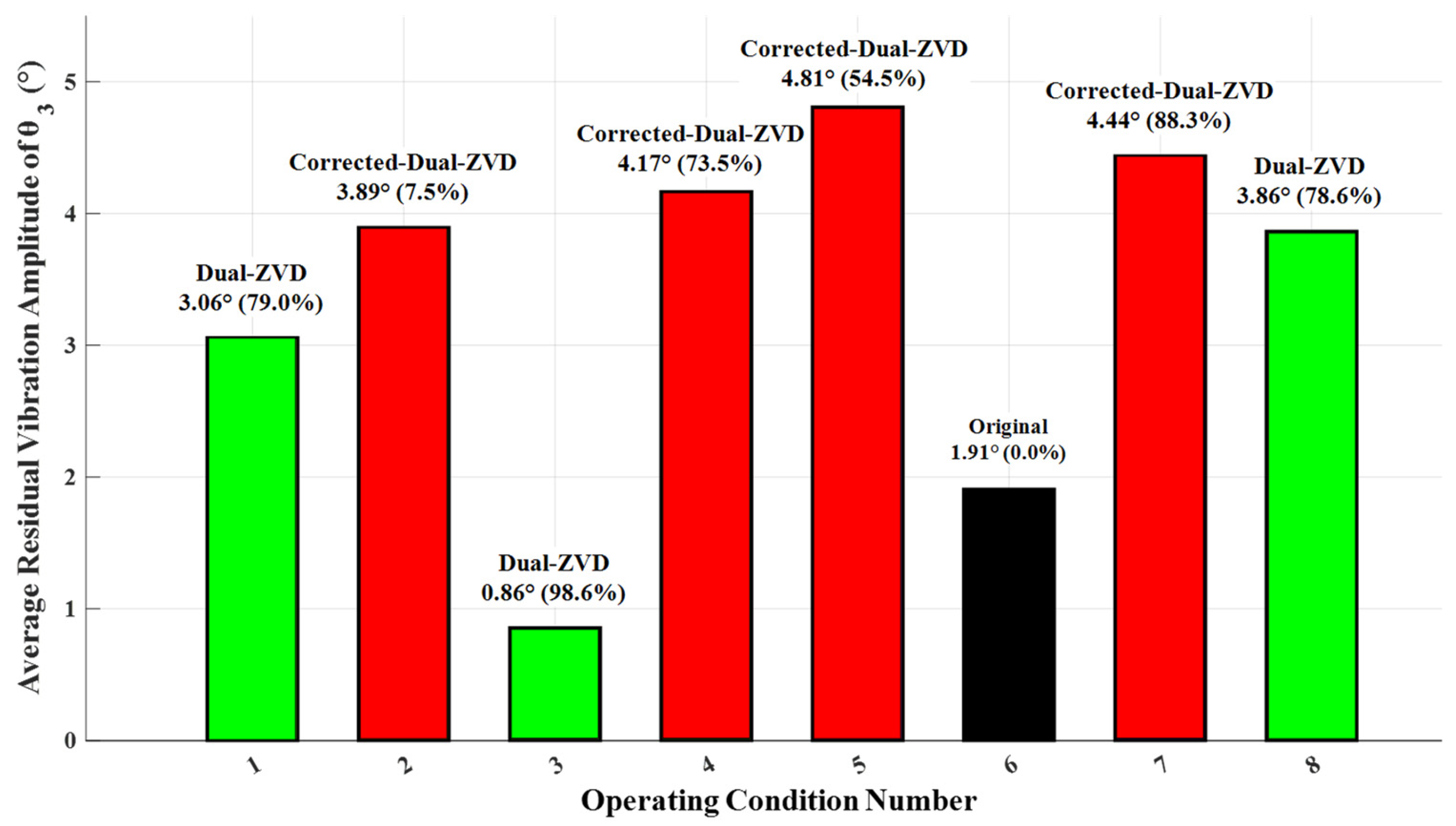
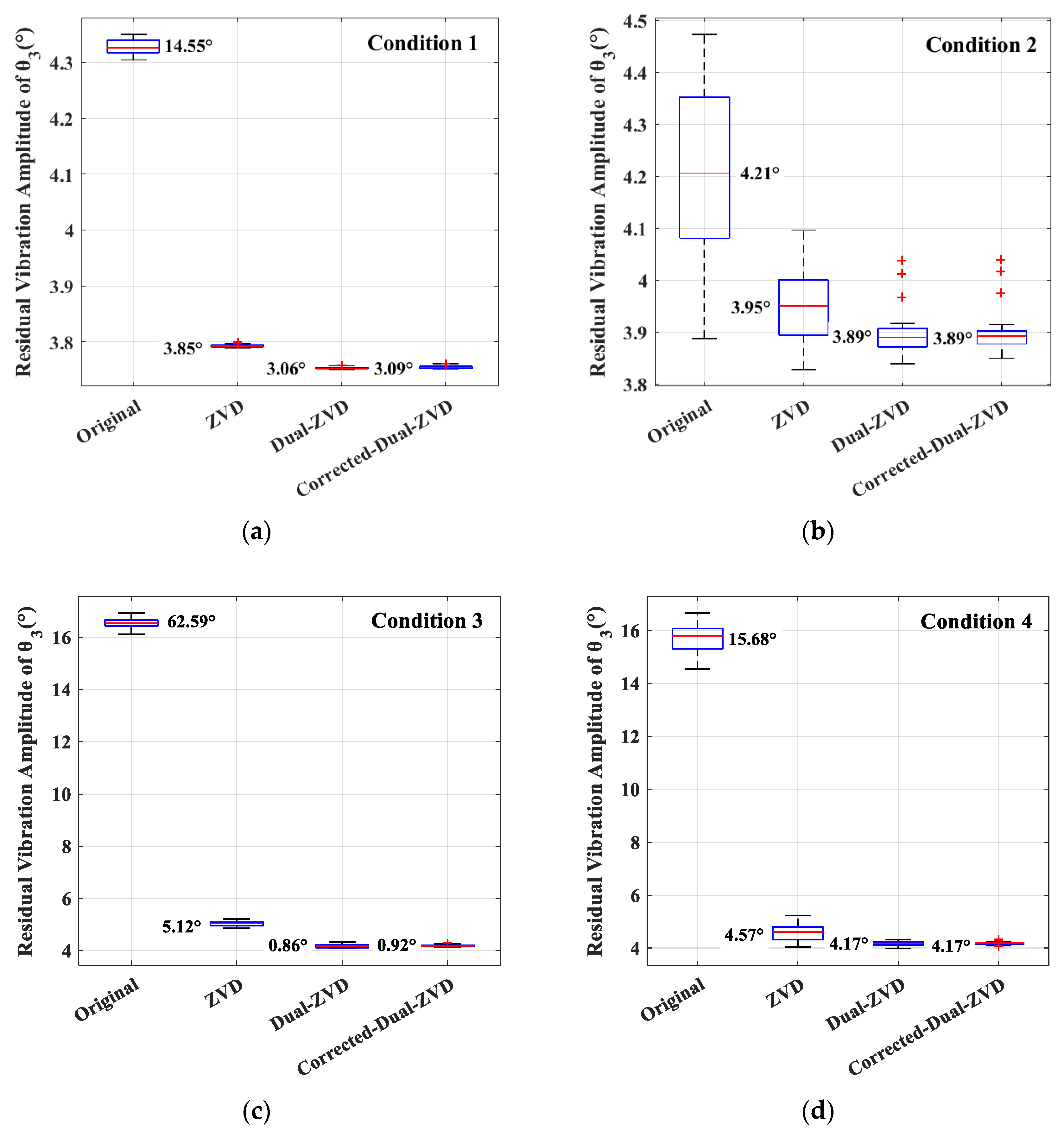
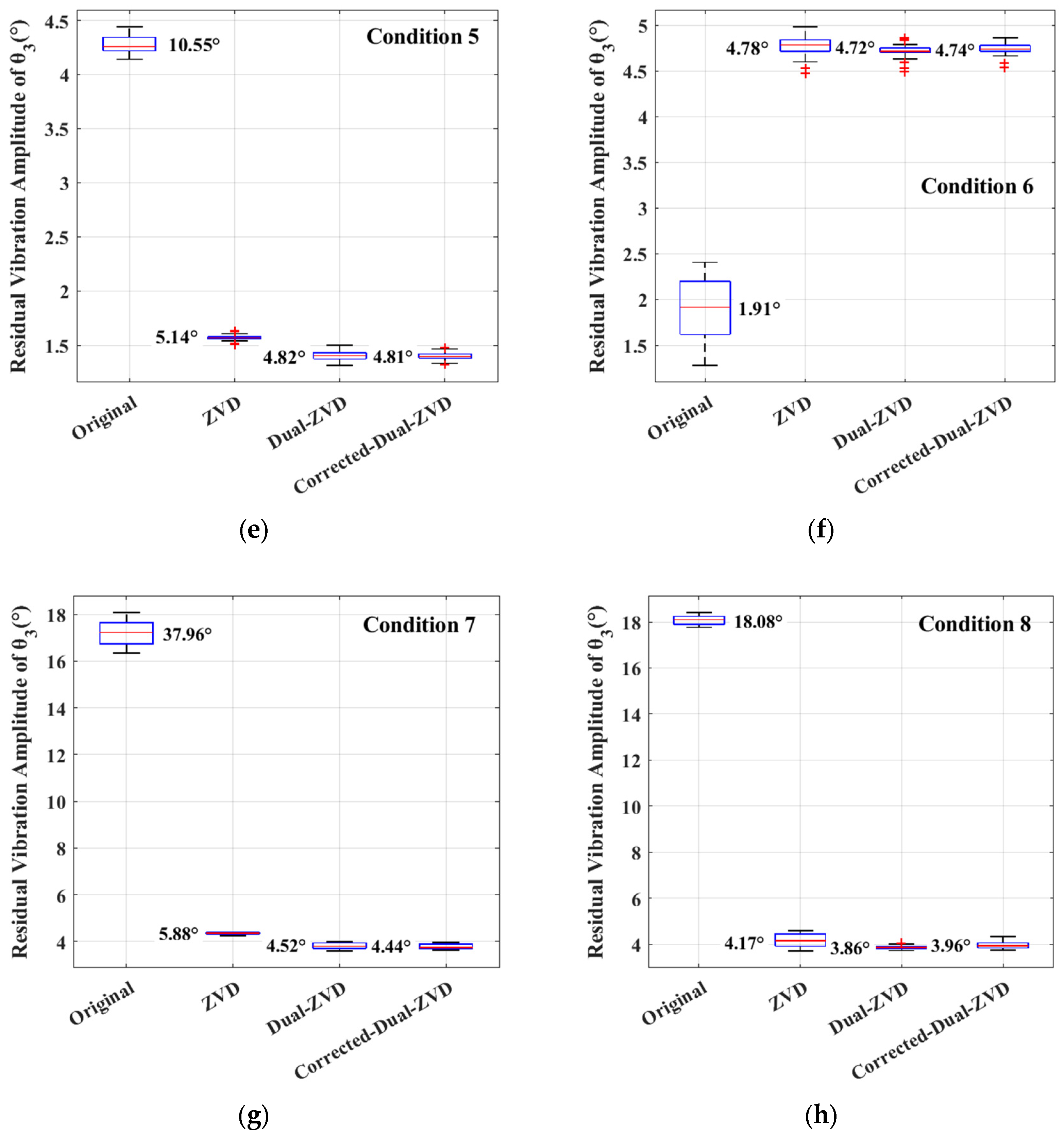
Considering that measurement errors or inaccuracies in estimation may exist for the hoisting rope length l and the payload length lp in practical engineering, this paper further tests the robustness of each controller in the presence of perturbations in the model parameters. In the simulation for each operating condition, independent random deviations of ±10% were applied to l and lp, respectively. Fifty Monte Carlo simulation runs were repeated for each case to statistically analyze the distribution of the maximum residual swing angle (θ3max). Figure 10 displays the average residual swing angle for the best control method under each operating condition, and Figure 11 presents the box plots of the θ3max distribution for different control methods across all conditions.
The box plot results indicate that, except for Condition 6, the Corrected-Dual-ZVD controller exhibits a more concentrated distribution of θ3max across all operating conditions, with a relatively lowest mean value (as can be seen in conjunction with Figure 10) and fewer outliers, demonstrating insensitivity to parameter perturbations. The distribution of the Dual-ZVD controller based on the theoretical double-pendulum model is superior to that of the ZVD controller based on the single-pendulum model. In contrast, the distribution of θ3max under the uncontrolled state is the most dispersed and has the highest mean value, indicating extreme sensitivity to parameter perturbations. Overall, the Corrected-Dual-ZVD method achieves the best balance between control accuracy and robustness, providing an effective solution for the anti-sway control problem of vertically suspended slender payloads.

5. Conclusions

This paper conducts a systematic study addressing the model mismatch problem in the hoisting of rigid vertical slender payloads. A two-degree-of-freedom pendulum dynamic model for vertically suspended loads, considering the mass distribution effect, is established. A data-driven model correction strategy is proposed, and a dual-frequency Zero Vibration Derivative input shaping feedforward controller is designed based on the corrected frequencies. Simulations under eight typical operating conditions and with parameter deviations show that the Corrected-Dual-ZVD method achieves an average swing angle suppression rate of 68.9% across seven valid conditions, representing a 6.2-percentage-point improvement over the traditional single-pendulum ZVD method. Under the extreme condition of high speed and short rope, the suppression rate can reach 98.9%. Although the nominal performance difference between Dual-ZVD and Corrected-Dual-ZVD is small, the latter demonstrates markedly improved robustness under ±10% parameter perturbations, exhibiting a tighter performance distribution and fewer outliers, thereby offering more reliable anti-sway control in the presence of real-world modeling uncertainties. However, the proposed model correction strategy is based on a high-fidelity Simulink model, which mainly compensates for the linearization error of the theoretical dynamic model rather than the actual discrepancy between the model and the physical system. The current method is only targeted at uniformly distributed mass payloads. Additionally, the performance evaluation is based on a limited set of representative operating conditions and has not been systematically validated across the entire calibrated parameter space. Future work will extend it to more operating conditions and more complex scenarios, such as non-uniformly distributed masses (e.g., tapered wind turbine monopiles) and external wind disturbances, and will proceed to physical experimentation to further address the gap between simulation and real-world conditions.

Author Contributions

Conceptualization and methodology, H.C.; software and validation, H.F.; investigation and resources, C.C.; formal analysis and data curation, X.L.; formal analysis and data curation, L.Y.; writing—original draft preparation, H.C.; writing—review and editing, X.P.; supervision H.F.; project administration and funding acquisition W.G. All authors have read and agreed to the published version of the manuscript.

Funding

This research and the APC were funded by the military scientific research project (330X2EXACCX00V).

Institutional Review Board Statement

Not applicable.

Informed Consent Statement

Not applicable.

Data Availability Statement

The original contributions presented in this study are included in the article. Further inquiries can be directed to the corresponding authors.

Acknowledgments

We acknowledge the support provided to this study by the Naval University of Engineering in the form of time and facilities.

Conflicts of Interest

The authors declare no conflicts of interest.

References

  1. Ovalle, L.; Ríos, H.; Llama, M. Continuous sliding-mode output-feedback control for stabilization of a class of underactuated systems. IEEE Trans. Autom. Control 2022, 67, 986–992. [Google Scholar] [CrossRef]
  2. Wu, X.Q.; Xu, K.X.; He, X.X. Disturbance-observer-based nonlinear control for overhead cranes subject to uncertain disturbances. Mech. Syst. Signal Process 2020, 139, 106631. [Google Scholar] [CrossRef]
  3. Shi, H.T.; Huang, J.Q.; Wang, Y.C. Anti-swing control of double pendulum tower crane based on strong energy coupling. Control Eng. China 2022, 29, 1395–1403. (In Chinese) [Google Scholar]
  4. Shi, H.; Li, G.; Ma, X.; Sun, J. Research on Nonlinear Coupling Anti-Swing Control Method of Double Pendulum Gantry Crane Based on Improved Energy. Symmetry 2019, 11, 1511. [Google Scholar] [CrossRef]
  5. Jin, B.; Zeng, J.; Gao, P.; Zhang, H.; Ge, S. Dynamic Modeling and Validation of Dual-Cable Double-Pendulum Systems for Gantry Cranes. Machines 2025, 13, 676. [Google Scholar] [CrossRef]
  6. Muddassir, M.; Zayed, T.; Ali, A.H.; Elrifaee, M.; Abdulai, S.F.; Yang, T.; Eldemiry, A. Automation in tower cranes over the past two decades (2003–2024). Autom. Constr. 2025, 170, 105889. [Google Scholar] [CrossRef]
  7. Wu, Q.X.; Wang, X.K.; Wang, X.W. Feedforward anti-swing control algorithm for cranes: Simulation and experimental study. J. Wuhan Univ. Technol. 2016, 38, 115–122. (In Chinese) [Google Scholar]
  8. Singhose, W.; Kim, D.; Kenison, M. Input Shaping Control of Double-Pendulum Bridge Crane Oscillations. J. Dyn. Syst. Meas. Control 2008, 130, 424. [Google Scholar] [CrossRef]
  9. Masoud, Z. Frequency-modulation input-shaping strategy for double-pendulum overhead cranes undergoing simultaneous hoist and travel maneuvers. IEEE Access 2022, 10, 44954–44963. [Google Scholar] [CrossRef]
  10. Jaafar, H.I.; Mohamed, Z.; Ahmad, M.A.; Wahab, N.A.; Ramli, L.; Shaheed, M.H. Control of an underactuated double-pendulum overhead crane using improved model reference command shaping: Design, simulation and experiment. Mech. Syst. Signal Process 2020, 151, 107358. [Google Scholar] [CrossRef]
  11. Singhose, W. Command shaping for flexible systems: A review of the first 50 years. Int. J. Precis. Eng. Manuf. 2009, 10, 153–168. [Google Scholar] [CrossRef]
  12. Smoczek, J.; Szpytko, J. Comparision of model predictive, input shaping and feedback control for a lab-scaled overhead crane. In Proceedings of the 2016 21st International Conference on Methods and Models in Automation and Robotics (MMAR), Międzyzdroje, Poland, 29 August–1 September 2016. [Google Scholar] [CrossRef]
  13. Yang, T.; Sun, N.; Chen, H. Neural Network-Based Adaptive Antiswing Control of an Underactuated Ship-Mounted Crane with Roll Motions and Input Dead Zones. IEEE Trans. Neural Netw. Learn. Syst. 2020, 31, 901–914. [Google Scholar] [CrossRef]
  14. Wang, S.H.; Ferri, A.; Singhose, W. Slipping dynamics of slender-beam payloads during lay-down operations. J. Dyn. Syst. Meas. Control 2018, 140, 081001. [Google Scholar] [CrossRef]
  15. Kim, G.H.; Yoon, M.; Jeon, J.Y.; Hong, K.S. Data-driven Modeling and Adaptive Predictive Anti-swing Control of Overhead Cranes. Int. J. Control Autom. Syst. 2022, 20, 2712–2723. [Google Scholar] [CrossRef]
  16. Wu, Q.X.; Wang, X.K.; Hua, L.; Xia, M.H. Dynamic analysis and time optimal anti-swing control of double pendulum bridge crane with distributed mass beams. Mech. Syst. Signal Process 2020, 144, 106968. [Google Scholar] [CrossRef]
  17. Fatehi, M.H.; Eghtesad, M.; Necsulescu, D.S.; Fatehi, A.A. Tracking control design for a multi-degree underactuated flexible-cable overhead crane system with large swing angle based on singular perturbation method and an energy-shaping technique. J. Vib. Control 2019, 25, 1752–1767. [Google Scholar] [CrossRef]
  18. Peláez, G.; Vaugan, J.; Izquierdo, P.; Rubio, H.; García-Prada, J.C. Dynamics and Embedded Internet of Things Input Shaping Control for Overhead Cranes Transporting Multibody Payloads. Sensors 2018, 18, 1817. [Google Scholar] [CrossRef]
  19. Bello, M.M.; Mohamed, Z.; Efe, M.Ö.; Ishak, H. Modelling and dynamic characterisation of a double-pendulum overhead crane carrying a distributed-mass payload. Simul. Model. Pract. Theory 2024, 134, 102953. [Google Scholar] [CrossRef]
  20. Ramli, L.; Mohamed, Z.; Abdullahi, A.M. Control strategies for crane systems: A comprehensive review. Mech. Syst. Signal Process 2017, 95, 1–23. [Google Scholar] [CrossRef]
  21. Maghsoudi, M.J.; Mohamed, Z.; Sudin, S.; Buyamin, S.; Jaafar, H.I.; Ahmad, S.M. An improved input shaping design for an efficient sway control of a nonlinear 3D overhead crane with friction. Mech. Syst. Signal Process 2017, 92, 364–378. [Google Scholar] [CrossRef]
  22. Liu, S.Q.; Xu, W.M. Model-free robust adaptive control of overhead cranes with finite-time convergence based on time-delay control. Trans. Inst. Meas. Control 2023, 45, 1037–1051. [Google Scholar] [CrossRef]
  23. Huang, J.; Liang, Z.; Zang, Q. Dynamics and swing control of double-pendulum bridge cranes with distributed-mass beams. Mech. Syst. Signal Process 2015, 54–55, 357–366. [Google Scholar] [CrossRef]
  24. Sun, N.; Fang, Y. An efficient online trajectory generating method for underactuated crane systems. Int. J. Robust Nonlinear Control 2014, 24, 1653–1663. [Google Scholar] [CrossRef]
  25. Bucolo, M.; Buscarino, A.; Famoso, C.; Fortuna, L.; Frasca, M. Control of imperfect dynamical systems. Nonlinear Dyn. 2019, 98, 2989–2999. [Google Scholar] [CrossRef]
  26. Bucolo, M.; Buscarino, A.; Famoso, C.; Fortuna, L.; Gagliano, S. Imperfections in Integrated Devices Allow the Emergence of Unexpected Strange Attractors in Electronic Circuits. IEEE Access 2021, 9, 29573–29583. [Google Scholar] [CrossRef]
Figure 1. Two-dimensional bridge crane single-pendulum dynamic model.
Applsci 16 03888 g001
Figure 2. Two-dimensional bridge crane double-pendulum dynamic model.
Applsci 16 03888 g002
Figure 3. Iterating through parameter combinations to calculate results. (Note: The colormap shows the maximum of the peak absolute values of the three pendulum angles (θ1, θ2, and θ3); extremely large values arise when ω1 ≈ ω2 in the analytical solution (Equations (10) and (11)).
Applsci 16 03888 g003
Figure 4. Fitting Process Diagram: (a) Boundary value points; (b) Fitting curve.
Applsci 16 03888 g004
Figure 5. Dynamic model of the second-order pendulum payload with FCN.
Applsci 16 03888 g005
Figure 6. Model calibration: (a) Parameter calibration result distribution; (b) Percentage improvement of RMSE.
Applsci 16 03888 g006
Figure 7. Comparison of the time-domain response of θ3(t) (l = 31.5 m, lp = 19 m).
Applsci 16 03888 g007
Figure 8. Time-domain response diagrams of θ3(t) under different control methods for 8 operating conditions: (a) Condition 1: l = 3.0 m, lp = 3.0 m, D = 2.0 m, Tmove = 3.0 s; (b) Condition 2: l = 3.0 m, lp = 3.0 m, D = 2.0 m, Tmove = 6.0 s; (c) Condition 3: l = 3.0 m, lp = 3.0 m, D = 9.0 m, Tmove = 3.0 s; (d) Condition 4: l = 3.0 m, lp = 3.0 m, D = 9.0 m, Tmove = 6.0 s; (e) Condition 5: l = 10.0 m, lp = 3.0 m, D = 2.0 m, Tmove = 3.0 s; (f) Condition 6: l = 10.0 m, lp = 3.0 m, D = 2.0 m, Tmove = 6.0 s; (g) Condition 7: l = 10.0 m, lp = 3.0 m, D = 9.0 m, Tmove = 3.0 s; (h) Condition 8: l = 10.0 m, lp = 3.0 m, D = 9.0 m, Tmove = 6.0 s.
Applsci 16 03888 g008aApplsci 16 03888 g008bApplsci 16 03888 g008c
Figure 9. Performance ranking of control methods under 8 operating conditions.
Applsci 16 03888 g009
Figure 10. Optimal control methods and performance for 8 operating conditions (based on average of 50 groups).
Applsci 16 03888 g010
Figure 11. Maximum residual swing angle θ3max distribution box plot: (a) Condition 1: l = 3.0 m, lp = 3.0 m, D = 2.0 m, Tmove = 3.0 s; (b) Condition 2: l = 3.0 m, lp = 3.0 m, D = 2.0 m, Tmove = 6.0 s; (c) Condition 3: l = 3.0 m, lp = 3.0 m, D = 9.0 m, Tmove = 3.0 s; (d) Condition 4: l = 3.0 m, lp = 3.0 m, D = 9.0 m, Tmove = 6.0 s; (e) Condition 5: l = 10.0 m, lp = 3.0 m, D = 2.0 m, Tmove = 3.0 s; (f) Condition 6: l = 10.0 m, lp = 3.0 m, D = 2.0 m, Tmove = 6.0 s; (g) Condition 7: l = 10.0 m, lp = 3.0 m, D = 9.0 m, Tmove = 3.0 s; (h) Condition 8: l = 10.0 m, lp = 3.0 m, D = 9.0 m, Tmove = 6.0 s.
Applsci 16 03888 g011aApplsci 16 03888 g011b
Table 1. Control Models and Method Settings.
Method NameModel TypeFrequencyControl Method
Original--Uncontrolled, trapezoidal velocity planning
ZVDIdeal single-pendulum model ω = g / l ZVD control strategy
Dual-ZVDDouble-pendulum model considering mass distribution ω 1 = g 2 4 l + 6 l p + 4 l 2 + 24 l l p + 6 l p 2 ω 2 = g 2 4 l + 6 l p 4 l 2 + 24 l l p + 6 l p 2 Dual-ZVD control strategy
Corrected-Dual-ZVDDouble-pendulum model considering mass distribution ω 1 = a 1 g 2 4 l + 6 l p + 4 l 2 + 24 l l p + 6 l p 2 ω 2 = a 2 g 2 4 l + 6 l p 4 l 2 + 24 l l p + 6 l p 2 Dual-ZVD control strategy with frequency correction
Table 2. Typical operating condition parameter settings.
Operating Condition Numberl (m)lp (m)D (m)
Travel Distance of the Trolley
Tmove (s)v (m/s)
Travel Speed of the Trolley
13.03.02.03.00.67
23.03.02.06.00.33
33.03.09.03.03.00
43.03.09.06.01.50
510.03.02.03.00.67
610.03.02.06.00.33
710.03.09.03.03.00
810.03.09.06.01.50
Table 3. Maximum residual swing angle θ3max and suppression rate of each control method under 8 operating conditions.
Operating Condition NumberControl MethodMaximum Residual Swing Angle θ3max (°)Inhibition Rate (%)
1Original14.5438N/A (Baseline)
ZVD4.089971.9
Dual-ZVD3.036079.1
Corrected-Dual-ZVD3.062778.9
2Original4.2097N/A (Baseline)
ZVD4.10742.4
Dual-ZVD3.89647.4
Corrected-Dual-ZVD3.89997.4
3Original62.1822N/A (Baseline)
ZVD8.339686.6
Dual-ZVD0.754698.8
Corrected-Dual-ZVD0.699598.9
4Original15.6962N/A (Baseline)
ZVD5.322066.1
Dual-ZVD4.165873.5
Corrected-Dual-ZVD4.178373.4
5Original10.5644N/A (Baseline)
ZVD4.911253.5
Dual-ZVD4.770254.8
Corrected-Dual-ZVD4.752955.0
6Original1.8775N/A (Baseline)
ZVD4.9865−165.6
Dual-ZVD4.6744−149.0
Corrected-Dual-ZVD4.6951−150.1
7Original37.8749N/A (Baseline)
ZVD4.807987.3
Dual-ZVD4.544488.0
Corrected-Dual-ZVD4.414588.3
8Original18.0424N/A (Baseline)
ZVD5.183271.3
Dual-ZVD3.782779.0
Corrected-Dual-ZVD3.878678.5
Disclaimer/Publisher’s Note: The statements, opinions and data contained in all publications are solely those of the individual author(s) and contributor(s) and not of MDPI and/or the editor(s). MDPI and/or the editor(s) disclaim responsibility for any injury to people or property resulting from any ideas, methods, instructions or products referred to in the content.