Risk Prediction of Water Inrush in Diversion Tunnel Crossing Water-Rich Fault Based on NRBO-XGBoost Algorithm


Abstract
1. Introduction
2. NRBO-XGBoost Algorithm
2.1. Basic Principles of XGBoost Algorithm
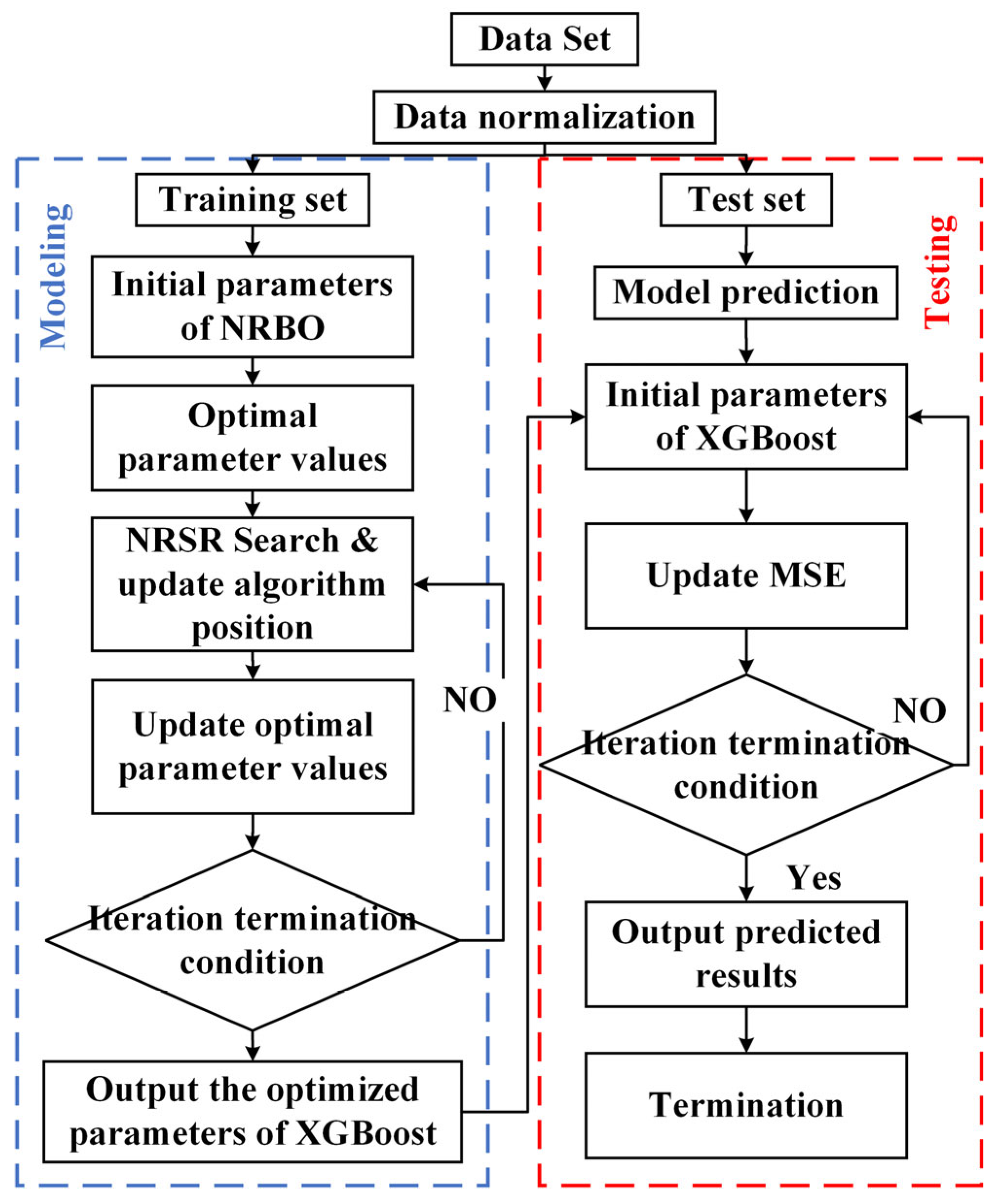
2.2. NRBO Optimizes the XGBoost Algorithm
3. Prediction Model of Water Inrush Risk
3.1. Levels of Water Inrush Risk
3.2. Prediction Indicators of Water Inrush Risk
4. Engineering Application
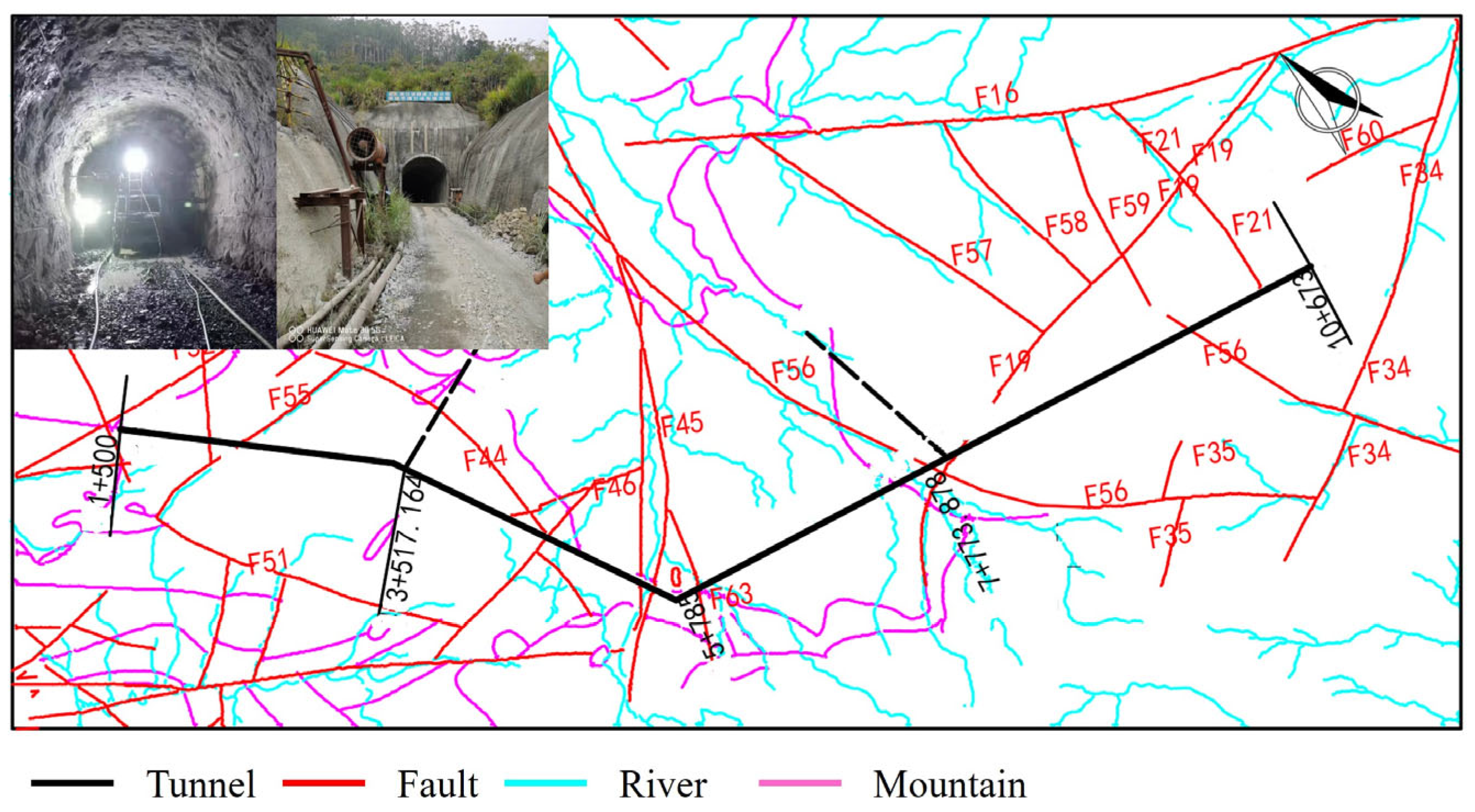
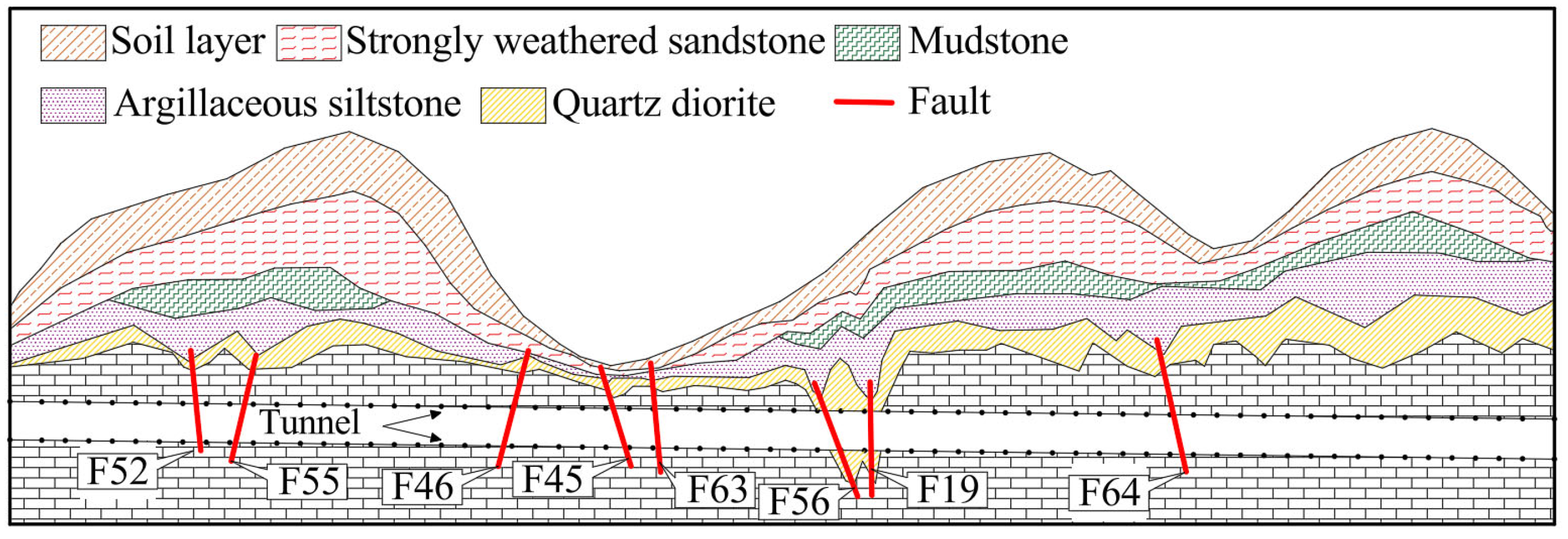
4.1. Project Overview
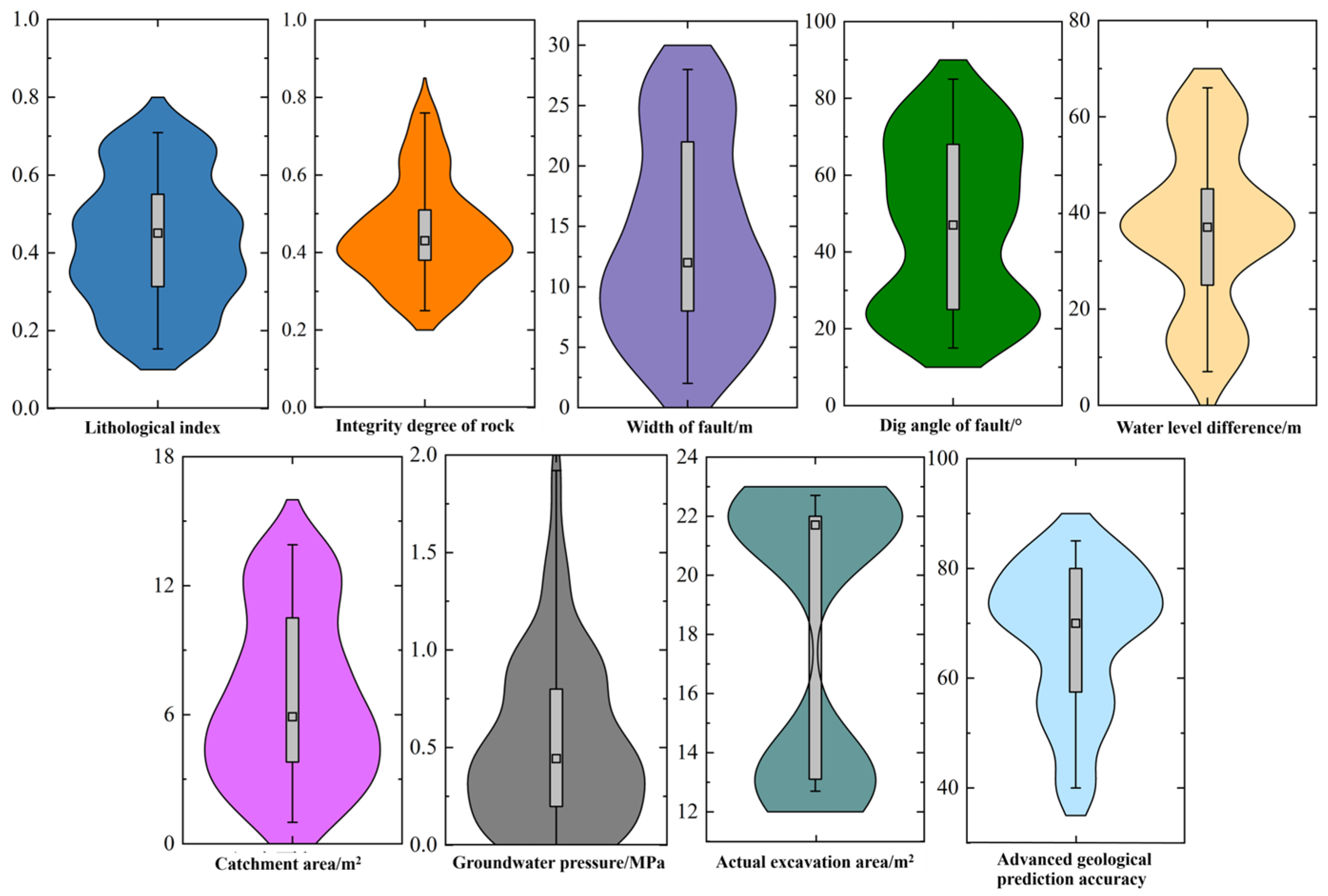
4.2. Dataset for Water Inrush Risk
4.3. Model Training and Prediction
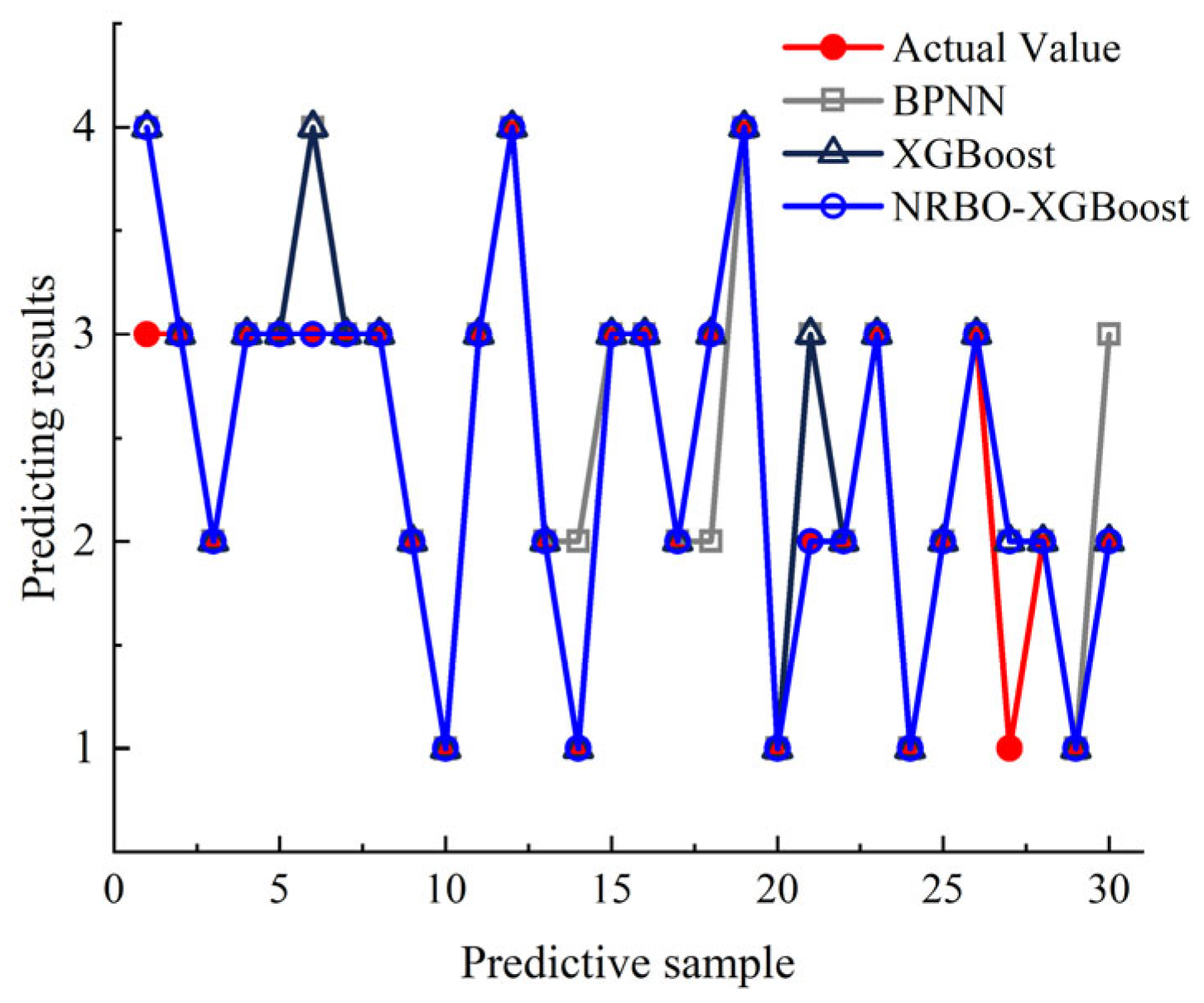
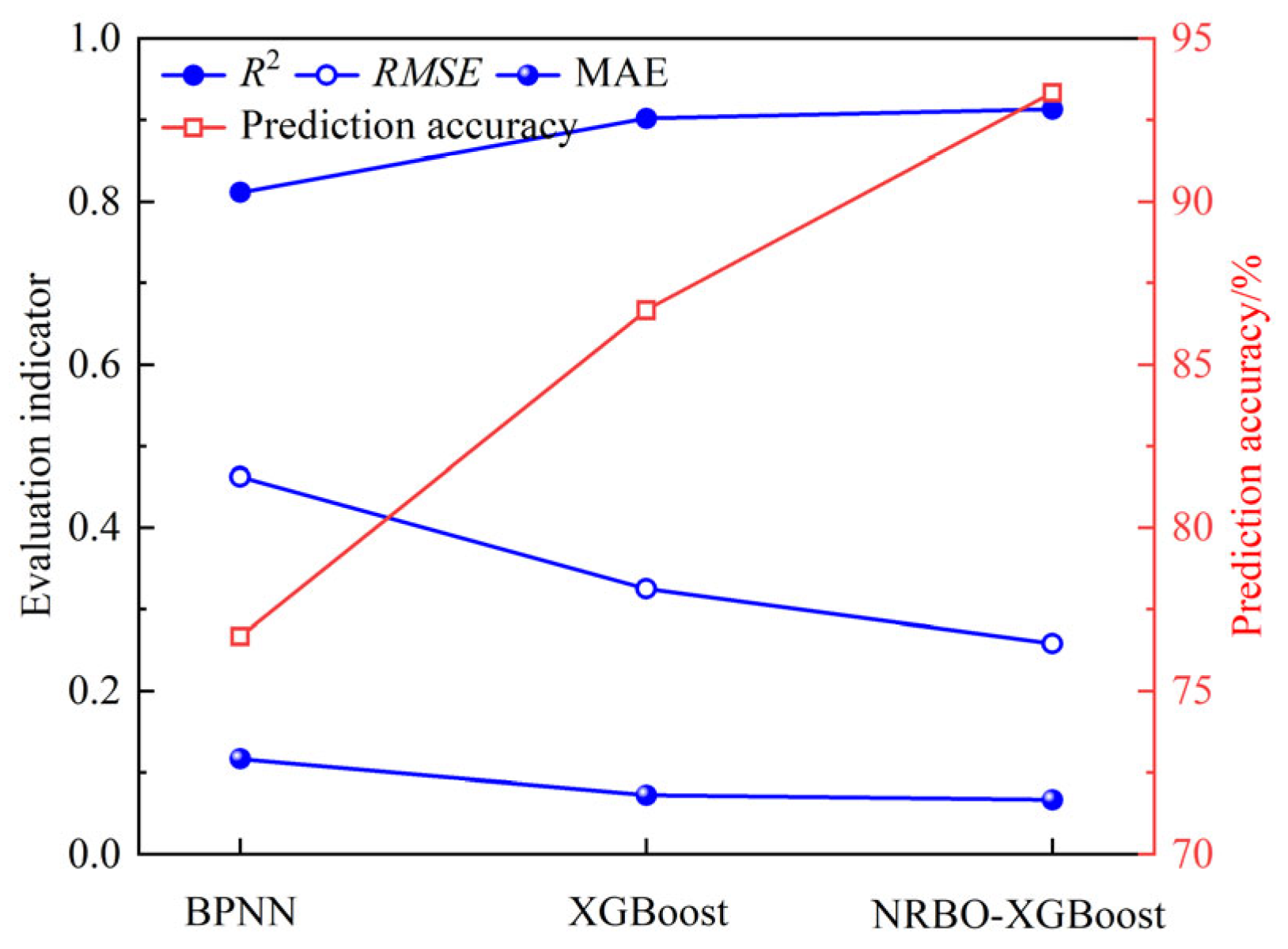
4.4. Effectiveness Comparison of Model
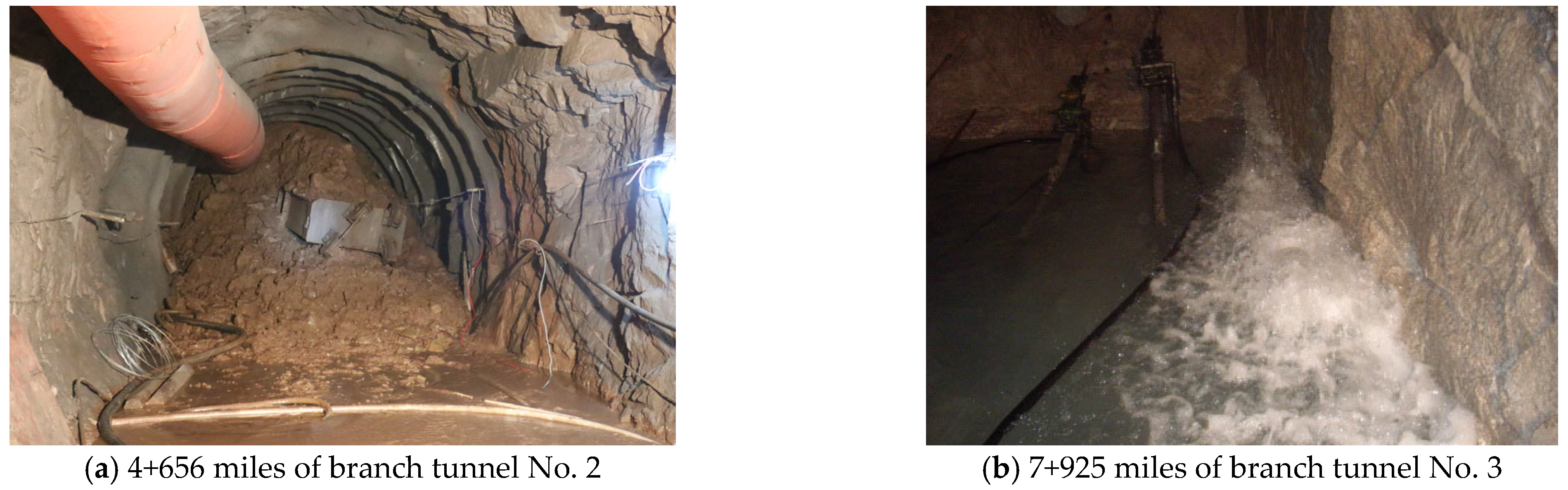
5. On-Site Verification
6. Conclusions
Author Contributions
Funding
Institutional Review Board Statement
Informed Consent Statement
Data Availability Statement
Conflicts of Interest
Abbreviations
| yi | True values of the i-th data |
| Estimated values of the i-th data | |
| fk | Function of the k-th decision tree |
| n | Total number of data samples |
| F | Set of regression trees |
| K | Total number of decision trees |
| Ω(fk) | Complexity of Function |
| J | Total number of leaves |
| w2j | Square of the leaf weight |
| γ, λ | Penalty coefficients. |
| C | Constant |
| gi | First derivatives of the loss function |
| hi | Second derivatives of the loss function |
| xn+1 | Next position |
| Xb | Better location in the vicinity of the xn neighborhood |
| Xw | Worse location in the vicinity of the xn neighborhood |
| randn | Random number from the standard normal distribution |
| Δx | Disturbance quantity |
| θ1, θ2 | Random numbers |
| Mean() | Mean function |
| δ | Adaptive parameter |
| μ1, μ2 | Random numbers used to control diversity |
| Normalized data value | |
| yi | True data value |
| ymax | Maximum values of the data |
| ymin | Minimum values of the data |
References
- Liu, G.J.; Peng, Y.X.; Wu, L.; Cheng, Y.; Dong, D.J.; Jia, L.; Zhu, S. Stability prediction of surrounding rock in tunnel crossing fault zone based on cusp catastrophe theory. KSCE J. Civ. Eng. 2024, 28, 4146–4157. [Google Scholar] [CrossRef]
- Pan, Y.; Qi, J.R.; Zhang, J.F.; Peng, Y.X.; Chen, C.; Ma, H.N.; Ye, C. Analytical solution for water inflow into deeply buried symmetrical subsea tunnels with excavation damage zones. Water 2023, 15, 3556. [Google Scholar] [CrossRef]
- Li, X.W.; Li, S.C.; Wang, B.; Qu, J.X.; Zhao, J.L.; Zhao, S.S. Water inrush risk assessment during karst tunnel construction based on knowledge decision and data-driven methods. Tunn. Undergr. Space Technol. 2026, 168, 107120. [Google Scholar] [CrossRef]
- Kong, H.Q.; Zhang, N. Risk assessment of water inrush accident during tunnel construction based on FAHP-I-TOPSIS. J. Clean. Prod. 2024, 449, 141744. [Google Scholar] [CrossRef]
- Xu, K.; Li, S.; Lu, C.; Liu, J. Risk assessment of coal mine gas explosion based on cloud integrated similarity and fuzzy DEMATEL. Process. Saf. Environ. 2023, 177, 1211–1224. [Google Scholar] [CrossRef]
- Sun, X.L.; Teng, G.; Guo, X.L.; Li, X.Z. Risk assessment of water inrush in karst tunnels based on fuzzy comprehensive evaluation considering misjudgment losses: A case study. Arab. J. Geosci. 2022, 15, 421. [Google Scholar] [CrossRef]
- Zhu, J.Q.; Li, T.Z. Catastrophe theory-based risk evaluation model for water and mud inrush and its application in karst tunnels. J. Cent. South Univ. 2020, 27, 1587–1598. [Google Scholar] [CrossRef]
- Cheng, W.J.; Yin, H.Y.; Xie, D.L.; Dong, F.Y.; Li, Y.J.; Zhu, T.; Wang, J. Prediction of dominant roof water inrush windows and analysis of control target area based on set pair variable weight-Forward correlation cloud model. J. Clean. Prod. 2024, 483, 144253. [Google Scholar] [CrossRef]
- Peng, Y.X.; Wu, L.; Zuo, Q.J.; Chen, C.H.; Hao, Y. Risk assessment of water inrush in tunnel through water-rich fault based on AHP-Cloud model. Geomat. Nat. Hazards Risk 2020, 11, 301–317. [Google Scholar] [CrossRef]
- Wang, Y.C.; Chen, F.; Yin, X.; Geng, F. Study on the risk assessment of water inrush in karst tunnels based on intuitionistic fuzzy theory. Geomat. Nat. Hazards Risk 2019, 10, 1070–1083. [Google Scholar] [CrossRef]
- Luo, M.M.; Chen, J.; Hamza, J.; Li, N.; Guo, X.L.; Zhou, H. Identifying and predicting karst water inrush in a deep tunnel, South China. Eng. Geol. 2022, 305, 106716. [Google Scholar] [CrossRef]
- Li, S.C.; Bu, L.; Shi, S.S.; Li, L.P.; Zhou, Z.Q. Prediction for water inrush disaster source and CFD-based design of evacuation routes in karst tunnel. Int. J. Geomech. 2022, 22, 05022001. [Google Scholar] [CrossRef]
- Chen, J.Y.; Zhou, M.L.; Zhang, D.M.; Huang, H.W.; Zhang, F.S. Quantification of water inflow in rock tunnel faces via convolutional neural network approach. Autom. Constr. 2021, 123, 103526. [Google Scholar] [CrossRef]
- Li, Z.Y.; Wang, Y.C.; Olgun, C.G.; Yang, S.Q.; Jiao, Q.L.; Wang, M. Risk assessment of water inrush caused by karst cave in tunnels based on reliability and GA-BP neural network. Geomat. Nat. Hazards Risk 2020, 11, 1212–1232. [Google Scholar] [CrossRef]
- Song, W.H.; Cheng, S.; Zi, J.Q.; Jin, H.; Jiang, X.B.; Wang, J.H. Intelligent detection method for tunnel water inrush disasters based on deep learning. Tunn. Undergr. Space Technol. 2026, 172, 107549. [Google Scholar] [CrossRef]
- Li, D.D.; Xu, H.W.; Jiang, T.; Ding, H.; Xiang, Y. Tunnel water burst disaster management engineering based on artificial intelligence technology-taking Yonglian Tunnel in Jiangxi Province as the object in China. Water Suppl. 2023, 23, 3377–3391. [Google Scholar] [CrossRef]
- Li, S.C.; Liu, C.; Zhou, Z.Q.; Li, L.P.; Shi, S.S.; Yuan, Y.C. Multi-sources information fusion analysis of water inrush disaster in tunnels based on improved theory of evidence. Tunn. Undergr. Space Technol. 2021, 113, 103948. [Google Scholar] [CrossRef]
- Arsalan, M.; Mokhtar, M.; Krikar, M.; Mohammad, K.; Hawkar, H.I.; Hunar, F.; Sazan, N.A. Presenting the best prediction model of water inflow into drill and blast tunnels among several machine learning techniques. Autom. Constr. 2021, 127, 103719. [Google Scholar] [CrossRef]
- Zhang, N.; Niu, M.M.; Wan, F.; Lu, J.L.; Wang, Y.Y.; Yan, X.H.; Zhou, C.F. Hazard prediction of water inrush in water-rich tunnels based on random forest algorithm. Appl. Sci. 2024, 14, 867. [Google Scholar] [CrossRef]
- Xu, Z.G.; Kong, F.H.; Cao, C.; Zhan, Z.Y. Prediction and analysis of tunnel water inrush disasters in Chinese Karst area based on Variable weight-weighted Bayesian network model. Carbonates Evaporites 2025, 40, 2. [Google Scholar] [CrossRef]
- Wu, L.J.; Li, X.; Yuan, J.D.; Wang, S.J. Real-time prediction of tunnel face conditions using XGBoost Random Forest algorithm. Front. Struct. Civ. Eng. 2023, 17, 1777–1795. [Google Scholar] [CrossRef]
- Nguyen, V.Q.; Tran, V.L.; Nguyen, D.D.; Sadiq, S.; Park, D. Novel hybrid MFO-XGBoost model for predicting the racking ratio of the rectangular tunnels subjected to seismic loading. Transp. Geotech. 2022, 37, 100878. [Google Scholar] [CrossRef]
- Shen, Y.; Chen, Y.Z.; Wang, Y.M.; Ma, L.Y.; Zhang, X.L. Research on a prediction model based on a Newton-Raphson-Optimization-XGBoost Algorithm predicting environmental electromagnetic effects for an airborne synthetic aperture radar. Electronics 2025, 14, 2202. [Google Scholar] [CrossRef]
- Yang, H.J.; Zhang, J.M.; Pang, Z.Q. Early Indoor Fire Warning Algorithm Based on INRBO-XGBoost and Fuzzy Inference. In Proceedings of the 2024 China Automation Congress (CAC), Qingdao, China, 1–3 November 2024; pp. 911–916. [Google Scholar]
- Chen, T.Q.; Guestrin, C. XGBoost: A scalable tree boosting system. In Proceedings of the 22nd ACM SIGKDD International Conference on Knowledge Discovery and Data Mining (KDD), San Francisco, CA, USA, 13–17 August 2016; pp. 785–794. [Google Scholar]
- Vaneeta, R.S. IDPS_WOA-XGBoost: A novel intrusion detection and prevention system based on whale optimization and XGBoost algorithm. Int. J. Inf. Technol. 2026, 18, 345–353. [Google Scholar] [CrossRef]
- Zhou, K.; Jia, A.; Yang, C.; Li, Y.Y.; Wei, J. Short-term rockburst prediction model based on the WOA-XGBoost algorithm. Acta Geophys. 2026, 74, 103. [Google Scholar] [CrossRef]
- Ravichandran, S.; Manoharan, P.; Pradeep, J. Newton-Ralphson-based optimizer: A new population-based metaheuristic algorithm for continuous optimization problems. Eng. Appl. Artif. Intell. 2024, 128, 107532. [Google Scholar] [CrossRef]
- Peng, Y.X.; Wu, L.; Su, Y.; Zhou, R.F. Risk prediction of tunnel water or mud inrush based on disaster forewarning grading. Geotech. Geol. Eng. 2016, 34, 1923–1932. [Google Scholar] [CrossRef]
- Ma, S.W.; Mei, Z.R.; Zhang, J.W. Geologic structural quantitative evaluation of abrupt geologic hazards for long and large tunnels. Mod. Tunn. Technol. 2009, 46, 99–104. [Google Scholar] [CrossRef]
- Wang, J.; Li, S.C.; Li, L.P.; Lin, P.; Xu, Z.H.; Gao, C. Attribute recognition model for risk assessment of water inrush. Bull. Eng. Geol. Environ. 2019, 78, 1057–1071. [Google Scholar] [CrossRef]



| Type of Indicators | Prediction Indicators | Characterization Parameter | Water Inrush Risk Levels | |||
|---|---|---|---|---|---|---|
| I | II | III | IV | |||
| Engineering geology | Lithology of the strata on both sides of the fault (I1) | Lithological index | 0~0.2 | 0.2~0.4 | 0.4~0.6 | 0.6~1 |
| Degree of rock mass fragmentation (I2) | Integrity degree of rock | 1~0.75 | 0.75~0.55 | 0.55~0.35 | 0.35~0 | |
| Scale of the fault (I3) | Width of fault/m | 0~2 | 2~5 | 5~10 | >10 | |
| Characteristics of the fault (I4) | Dig angle of fault/° | 30~50 | 50~70 | 0~30 | 70~90 | |
| Hydrogeology | Groundwater level (I5) | Water level difference/m | 0~10 | 10~30 | 30~60 | >60 |
| Water collection capacity (I6) | Catchment area/m2 | <5 | 5~7.5 | 7.5~10 | >10 | |
| Groundwater recharge (I7) | Groundwater pressure /MPa | 0~0.2 | 0.2~0.5 | 0.5~1.0 | >1.0 | |
| Tunnel construction conditions | Geometric parameters of tunnel (I8) | Actual excavation area/m2 | 0~10 | 10~50 | 50~100 | >100 |
| Advanced geological prediction (I9) | Prediction accuracy/% | 90~100 | 70~90 | 50~70 | 0~50 | |
| Type of Data | Prediction Indicator | Characterization Parameter | Maximum | Minimum | Average | Standard Deviation |
|---|---|---|---|---|---|---|
| Input data | Lithology of the strata on both sides of the fault (I1) | Lithological index | 0.709 | 0.183 | 0.447 | 0.153 |
| Degree of rock mass fragmentation (I2) | Integrity degree of rock | 0.76 | 0.25 | 0.461 | 0.127 | |
| Scale of the fault (I3) | Width of fault/m | 28 | 2 | 13.459 | 8.240 | |
| Characteristics of the fault (I4) | Dig angle of fault/° | 85 | 15 | 49.036 | 21.105 | |
| Groundwater level (I5) | Water level difference/m | 66 | 7 | 37.856 | 33.586 | |
| Water collection capacity (I6) | Catchment area/m2 | 13.9 | 1.2 | 6.74 | 3.904 | |
| Groundwater recharge (I7) | Groundwater pressure/MPa | 1.92 | 0 | 0.482 | 0.408 | |
| Geometric parameters of tunnel (I8) | Actual excavation area/m2 | 22.7 | 12.7 | 18.068 | 4.473 | |
| Advanced geological prediction (I9) | Prediction accuracy/% | 85 | 40 | 67.477 | 13.600 | |
| Output data | Water inrush risk level (I~IV) | 1~4 | 4 | 1 | 2.243 | 0.876 |
| Parameters for XGBoost Model | Evaluation Indicator | ||||
|---|---|---|---|---|---|
| num_trees | max_depth | eta | R2 | RMSE | MAE |
| 320 | 20 | 0.09 | 0.9129 | 0.2582 | 0.0667 |
| Model | BPNN | XGBoost | NRBO-XGBoost | |
|---|---|---|---|---|
| Accuracy/% | 76.67 | 86.67 | 93.33 | |
| Evaluation indicator | R2 | 0.8114 | 0.9015 | 0.9129 |
| RMSE | 0.4624 | 0.3251 | 0.2582 | |
| MAE | 0.1163 | 0.0725 | 0.0667 | |
| Tunnel | Mileage | Fault No. | Occurrence | Risk Level | Face Condition | Engineering Record | Construction Measurement |
|---|---|---|---|---|---|---|---|
| Main tunnel | 1+566 | F48 | NW295° SW∠75° | II | Seepage | Rocks within the fault zone are relatively fragmented, and there is a small amount of seepage at the face | Normal construction and focuses on the water seepage situation of the tunnel surrounding rock. |
| 2+179 | F52 | NE35° SE∠78° | I | Dry | Rocks in the fault zone are relatively fragmented and the face is dry | Normal construction in accordance with the tunnel design and plan | |
| Branch tunnel No. 2 | 4+656 | F46 | NE80° NW∠80° | IV | Water inrush | Rocks within the fault zone are extremely fragmented, filled with residual granite soil. Water gushes suddenly at the tunnel face and it collapses | Stopping construction, grouting and real-time monitoring measurement |
| 5+519 | F45 | NE30° SE∠60° | II | Dripping | Rocks within the fault zone are relatively fragmented, and the joints and fissures at the facet face produce dripping water | Normal construction and focuses on the water seepage situation of the tunnel surrounding rock. | |
| Branch tunnel No. 3 | 7+925 | F19 | NE70° NW∠55° | IV | Water inrush | Rocks within the fault zone are extremely fragmented, filled with fractured rocks. After excavation, a large water inrush occurs, with the water inflow reaching 438.54 m3/h | Stopping construction, grouting and real-time monitoring measurement |
Disclaimer/Publisher’s Note: The statements, opinions and data contained in all publications are solely those of the individual author(s) and contributor(s) and not of MDPI and/or the editor(s). MDPI and/or the editor(s) disclaim responsibility for any injury to people or property resulting from any ideas, methods, instructions or products referred to in the content. |
© 2026 by the authors. Licensee MDPI, Basel, Switzerland. This article is an open access article distributed under the terms and conditions of the Creative Commons Attribution (CC BY) license.
Share and Cite
Peng, Y.; Zhang, S.; Su, L.; Yao, Z. Risk Prediction of Water Inrush in Diversion Tunnel Crossing Water-Rich Fault Based on NRBO-XGBoost Algorithm. Appl. Sci. 2026, 16, 3831. https://doi.org/10.3390/app16083831
Peng Y, Zhang S, Su L, Yao Z. Risk Prediction of Water Inrush in Diversion Tunnel Crossing Water-Rich Fault Based on NRBO-XGBoost Algorithm. Applied Sciences. 2026; 16(8):3831. https://doi.org/10.3390/app16083831
Chicago/Turabian StylePeng, Yaxiong, Shizhong Zhang, Lei Su, and Zhen Yao. 2026. "Risk Prediction of Water Inrush in Diversion Tunnel Crossing Water-Rich Fault Based on NRBO-XGBoost Algorithm" Applied Sciences 16, no. 8: 3831. https://doi.org/10.3390/app16083831
APA StylePeng, Y., Zhang, S., Su, L., & Yao, Z. (2026). Risk Prediction of Water Inrush in Diversion Tunnel Crossing Water-Rich Fault Based on NRBO-XGBoost Algorithm. Applied Sciences, 16(8), 3831. https://doi.org/10.3390/app16083831