Article

Mechanical Performance of Reinforcement Measures for Corrugated Steel Pipe Arch Bridges Under Differential Settlement

1
Tai’an Highway Development Center, Tai’an 271000, China
2
School of Highway, Chang’an University, Xi’an 710064, China
3
Shandong Taishan Transportation Planning and Design Consulting Co., Ltd., Tai’an 271000, China
*
Author to whom correspondence should be addressed.
Appl. Sci. 2026, 16(8), 3830; https://doi.org/10.3390/app16083830
Submission received: 15 March 2026 / Revised: 10 April 2026 / Accepted: 13 April 2026 / Published: 14 April 2026
(This article belongs to the Section Civil Engineering)

Abstract

This study evaluates the effectiveness of reinforcement measures for a corrugated steel pipe arch bridge subjected to differential settlement induced by underground mining. Using a ten-span continuous corrugated steel pipe arch bridge in Shandong Province as the engineering background, a refined finite element model was developed based on 12 months of in situ settlement monitoring data. The mechanical performance of three reinforcement schemes–inner lining concrete, inner lining concrete with nested steel pipes, and laterally welded steel plates–was systematically compared. The results indicate that under differential settlement, the maximum stress of the unreinforced structure reaches 75.74 MPa, primarily concentrated at the arch foot. Reinforcement with an inner concrete lining significantly improves structural performance; in particular, the 200 mm-thick lining reduces the maximum steel pipe stress by 61.8%, achieves a maximum reduction of 22.1% in crown displacement and approximately 11.2% in sidewall displacement, and limits the circumferential displacement amplitude to 12–17 mm, representing a reduction of 11.7–15%. The nested steel pipe scheme delivers reinforcement effects comparable to the pure inner lining concrete scheme, with a maximum crown displacement reduction of approximately 17.3%, though its overall additional advantages remain limited. In contrast, the laterally welded steel plate scheme reduces the maximum structural stress by 28.3%. While it exhibits favorable control over local displacements, its overall reinforcement effectiveness is inferior to that of the inner lining concrete scheme. These findings provide a useful reference for the reinforcement design and engineering application of corrugated steel pipe arch bridges in mining-induced subsidence areas.

1. Introduction

Corrugated steel pipe (CSP) arch bridges, as a typical soil–steel composite structural system, derive their mechanical performance primarily from the interaction between corrugated steel plates and the surrounding backfill soil. Owing to their advantages of low self-weight, rapid construction, and strong adaptability to complex foundation conditions, such bridges have been increasingly applied in highway engineering, municipal infrastructure, and transportation systems in special areas such as mining goafs and soft ground regions [1,2]. Compared with conventional rigid bridges, CSP arch structures exhibit relatively low flexural stiffness and high deformability, making their mechanical response more sensitive to changes in the surrounding soil environment. In particular, differential settlement induced by mining activities or nonuniform foundation conditions can alter the soil–structure interaction mechanism, resulting in stress redistribution, deformation amplification, and stress concentration at critical locations such as arch feet and connection joints. In extreme cases, this may even trigger local buckling of corrugated steel plates or joint damage, thereby posing a serious threat to structural safety and serviceability [3,4]. Therefore, a systematic investigation into the mechanical behavior and strengthening performance of CSP arch bridges under differential settlement is of significant engineering importance and theoretical value.
Extensive studies have been conducted worldwide on the mechanical behavior, deformation characteristics, and strengthening methods of CSP structures and soil–steel composite systems, yielding substantial findings. Existing research indicates that, during the construction stage, construction sequence, backfill height, and compaction quality are key factors governing structural deformation and stress redistribution, while the crown and haunch regions are particularly sensitive to construction disturbances, highlighting the importance of construction control in determining the initial stress state of the structure [5,6,7]. In terms of long-term service performance, differential settlement along the longitudinal axis of the bridge can lead to pronounced stress concentration and deformation incompatibility, demonstrating the critical role of longitudinal soil–structure interaction in mining-affected areas [8]. Further studies have shown that span arrangement, structural geometric parameters, and disturbances from adjacent underground engineering activities can significantly influence the sensitivity of CSP arch structures to soil loads and foundation deformation [9,10,11]. In the field of numerical simulation and parameter sensitivity, equivalent stiffness representation, corrugation geometry, and plate thickness are identified as dominant factors controlling overall structural performance, while differences in parameter selection and modeling assumptions can directly affect the reliability of simulation results [12,13]. Regarding local stability and buckling behavior, soil confinement and composite action can delay the development of local buckling to a certain extent; however, material stratification, interface bonding conditions, and geometric parameters still play a crucial role in determining buckling modes and critical stresses [14,15]. In addition, studies on strengthening strategies and seismic performance indicate that various boundary conditions, reinforcement configurations, and composite strengthening systems can improve structural performance; nevertheless, existing research has mainly focused on performance enhancement under conventional conditions, with limited attention to the underlying mechanisms of strengthening measures and their influence on soil–structure interaction [16,17,18,19,20,21,22]. Overall, although previous studies have provided a solid foundation for construction control, service performance evaluation, numerical analysis, and strengthening design of CSP structures, they have primarily focused on culverts or small-to-medium-span structures. Systematic investigations on large-span, multi-span continuous CSP arch bridges subjected to mining-induced differential settlement remain scarce, particularly those integrating long-term field monitoring, refined numerical simulation, and targeted strengthening strategies. Moreover, quantitative comparisons among different strengthening schemes and their secondary effects on soil–structure interaction mechanisms have not yet been clearly established. Therefore, further research combining field monitoring and numerical analysis is required to comprehensively reveal the mechanical response and strengthening mechanisms of CSP arch bridges under differential settlement.
To address the aforementioned research gaps, this study considers a ten-span continuous CSP arch bridge located in a mining-affected area in China as the research object. Based on 12 months of field settlement monitoring data, the mechanical response and strengthening performance of the bridge under differential settlement are investigated. Specifically, this study aims to: (1) quantify the spatiotemporal distribution characteristics of mining-induced differential settlement and clarify the relationships among maximum settlement, settlement rate, settlement difference, and key structural sections; (2) develop a refined finite element model incorporating soil–structure interaction and validate its reliability using field monitoring data to ensure the accuracy of displacement and stress predictions; (3) systematically compare three typical strengthening schemes—concrete lining, concrete lining combined with nested steel tubes, and laterally welded steel plates—and evaluate their effectiveness in improving stress redistribution and displacement response; and (4) establish a comprehensive evaluation framework for strengthening schemes from the perspectives of mechanical performance, constructability, and economic efficiency, thereby identifying their applicable scenarios and providing quantitative references for strengthening design and risk assessment of large-span CSP arch bridges in mining goaf areas.

2. Engineering Overview

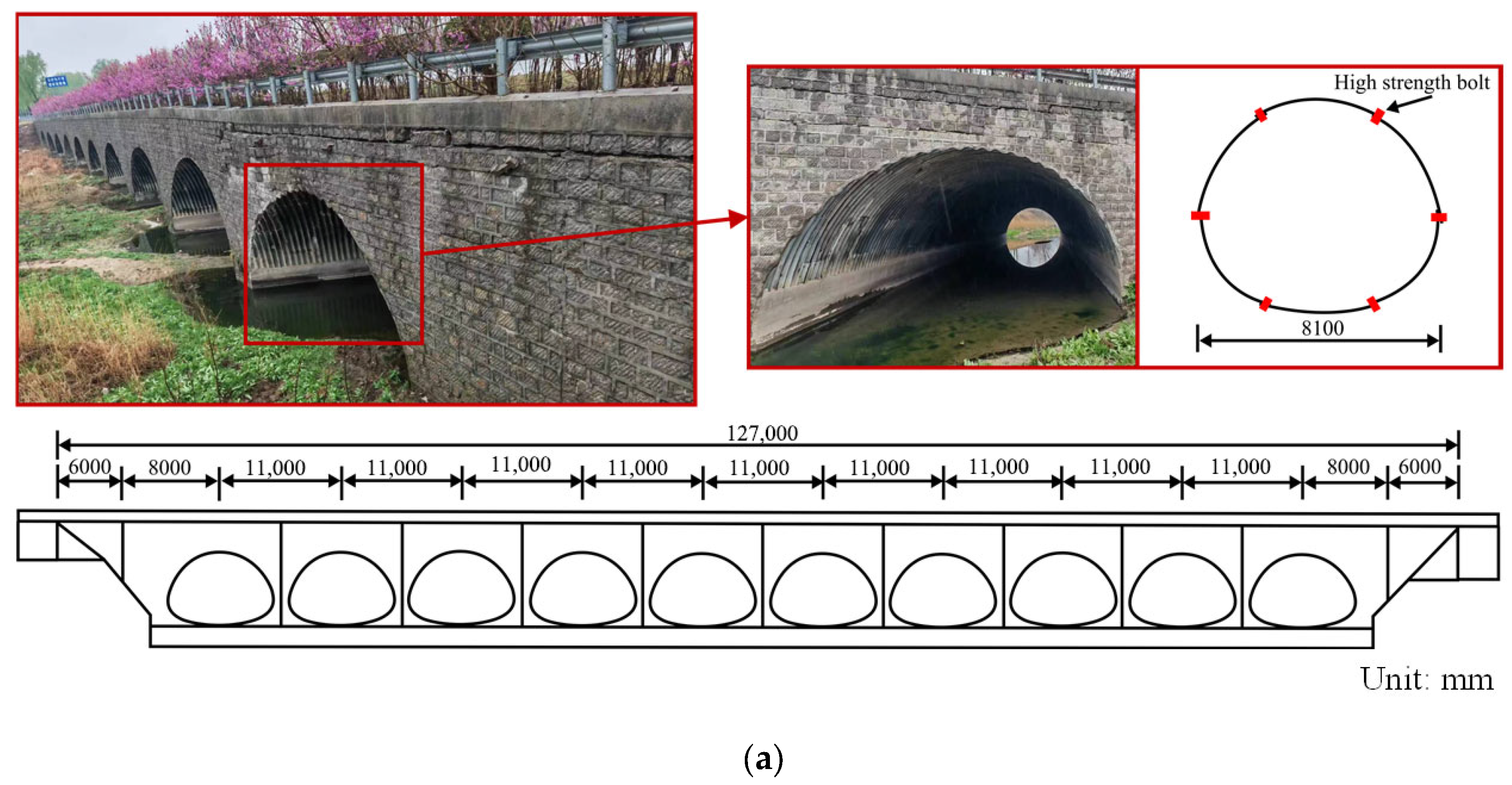
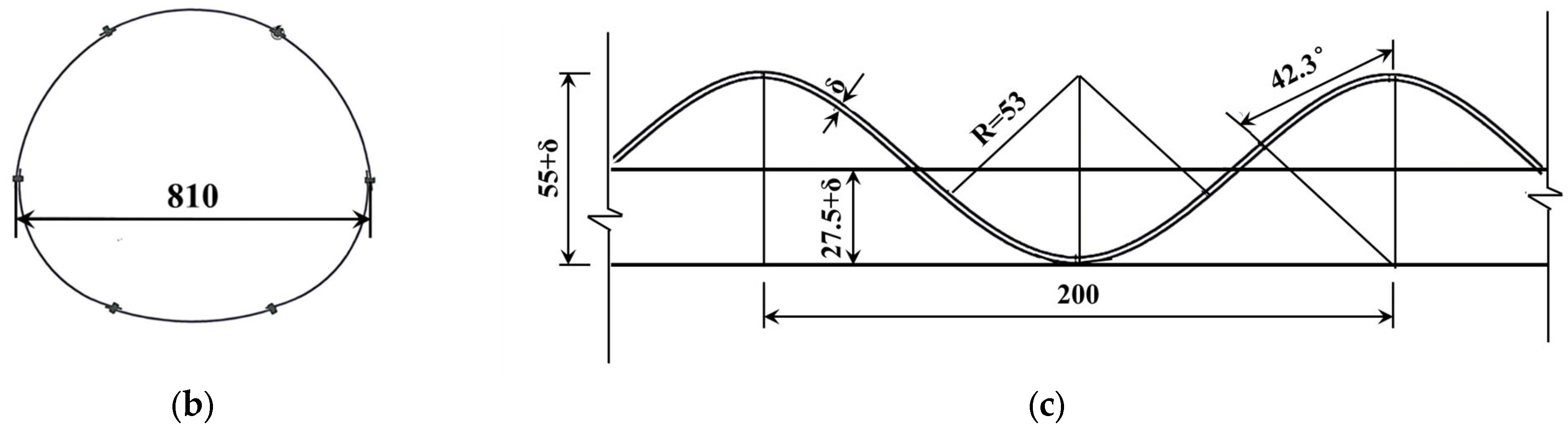
This study is based on a damaged ten-span continuous CSP arch bridge located in Shandong Province, China, as shown in Figure 1, which serves as the engineering background and research object. The selected bridge is considered representative of large-span CSP arch bridges in mining-affected regions due to its typical structural configuration, material properties, and geological conditions. The bridge adopts a multi-span continuous arrangement, which is commonly used in practical engineering to accommodate wide crossings and improve structural adaptability. In addition, the use of Q345 corrugated steel plates with standard corrugation geometry (200 mm × 55 mm × 6 mm) reflects widely adopted design practices in CSP structures. The relatively shallow soil cover and the reliance on soil–structure interaction for load transfer further correspond to typical design conditions of soil–steel composite bridges.
A mined-out void formed by historical coal extraction exists approximately 120 m below the bridge site. Within the fractured overburden zone, joints and fissures are highly developed, and the degree of rock mass fragmentation reaches 35%, reflecting highly complex geological conditions. Site investigation results show that the Quaternary overburden layer exhibits an asymmetric distribution between the southern and northern sides of the bridge: the southern side comprises 8.2 m of silty clay interbedded with sand-gravel layers, whereas the northern side comprises 9.4 m of clay interbedded with gravel. The significant contrast in foundation bearing capacity between the two sides poses a substantial risk of differential settlement. Such asymmetric geological conditions and mining-induced subsidence are commonly observed in mining goaf areas, making the bridge a suitable and representative case for investigating differential settlement effects on CSP arch structures.
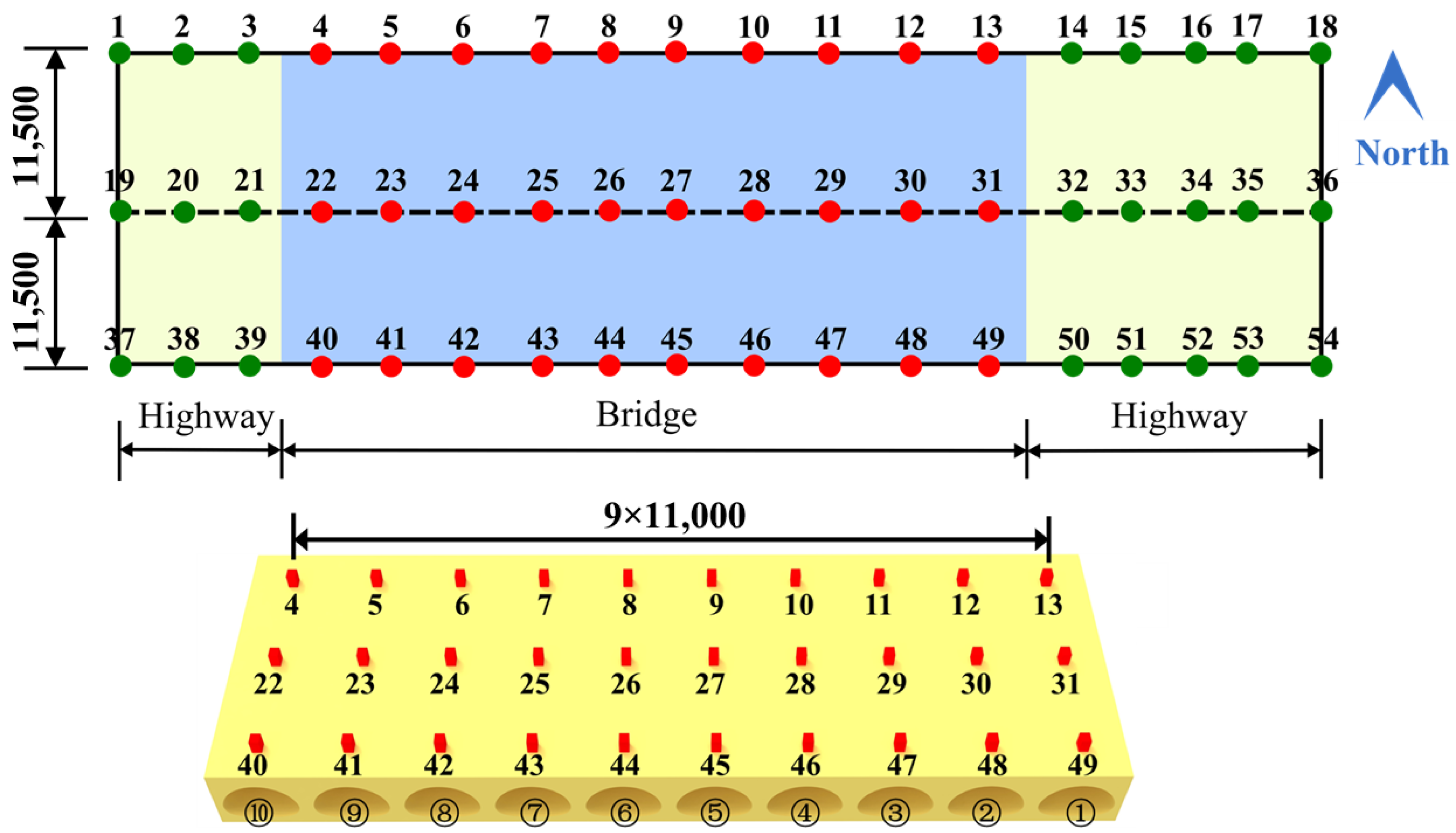
Due to the subsidence of overlying strata induced by the underlying mined-out area, the soil-covered CSP arch bridge has experienced pronounced differential settlement. The system includes a total of 54 monitoring points, which are arranged evenly in three rows on the bridge deck. Rows 1 and 3 are located on both sides of the bridge, and Row 2 is at the center line of the bridge deck, with the monitoring points in each row spaced at 11 m intervals along the bridge longitudinal direction. All monitoring points on the bridge are situated at the crown position of each span. The settlement variation in each span can be analyzed based on the monitoring data of points along the bridge transverse direction, and the mutual influence of the settlement of multiple spans can be investigated from the data of points along the bridge longitudinal direction. In addition, to monitor the settlement variation in the approach roads at both ends of the bridge, some monitoring points are also arranged at the two ends of the bridge. The numbers and layout of the monitoring points are shown in Figure 2.
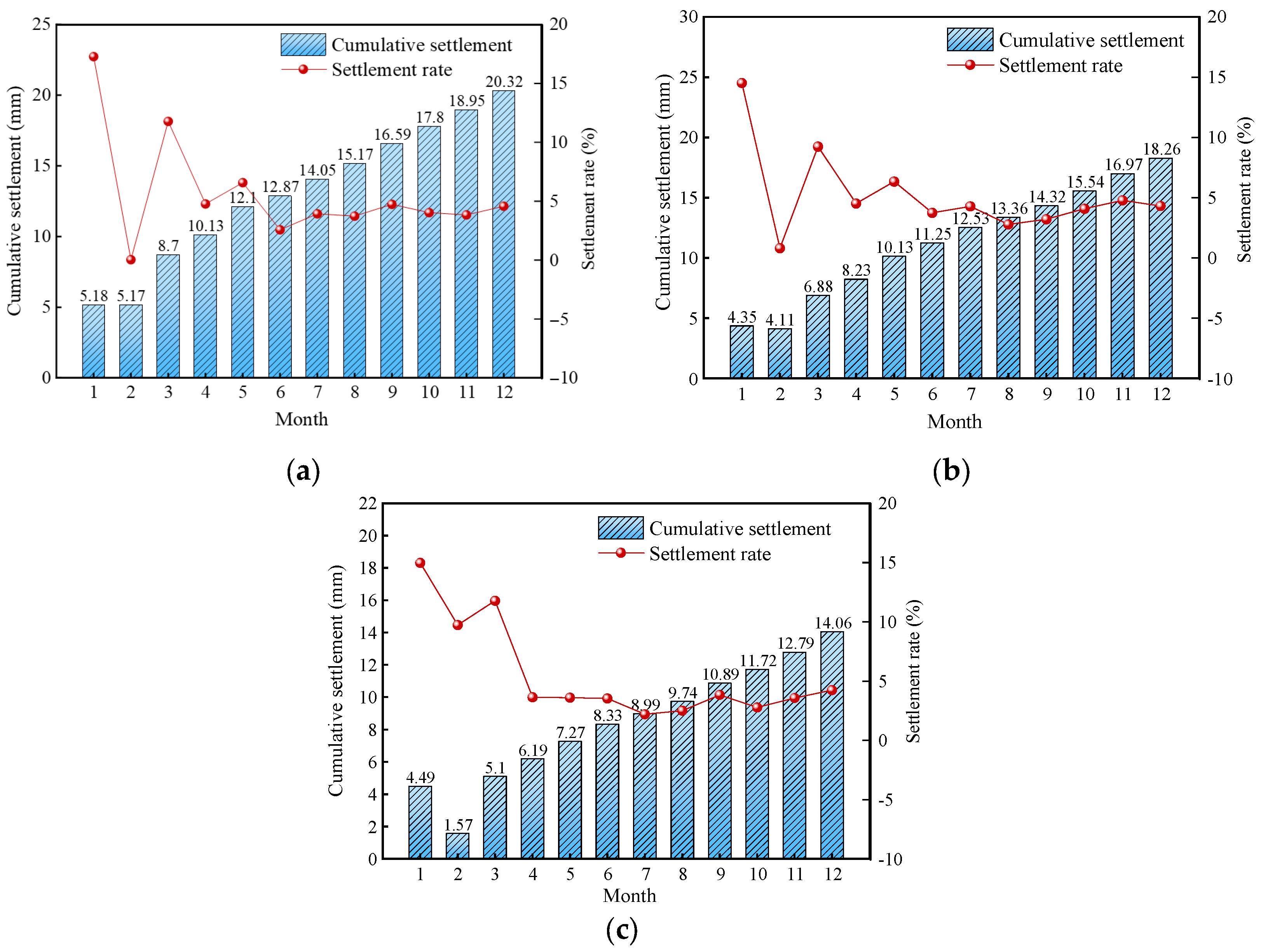
According to the field monitoring results of all spans of the actual bridge, Span 3 exhibits the most significant cumulative settlement among all mid-spans, and thus is selected as the representative span for detailed analysis. The monitoring results of this span are shown in Figure 3. The cumulative settlement at Monitoring Points 11, 29, and 47 exhibited a continuous increasing trend over time. By the 12th month, the cumulative settlements reached 20.32 mm, 18.26 mm, and 14.06 mm, respectively. In terms of settlement rate, all monitoring points initially exhibited noticeable fluctuations and then gradually stabilized at later stages. Meanwhile, the settlement-rate and cumulative-settlement development patterns differed significantly among the measurement points, directly indicating pronounced differential settlement in this embedded corrugated steel pipe arch bridge under the influence of ground subsidence in the goaf area.
To further verify the reliability of the settlement monitoring results for Span 3, a statistical analysis was conducted on the monthly settlement increments of Monitoring Points 11, 29, and 47 during the stable period (months 4–12). The results show that the mean monthly increments of Monitoring Points 11, 29, and 47 were 4.30 mm, 4.22 mm, and 3.32 mm, respectively, with corresponding standard deviations of 1.08 mm, 1.02 mm, and 0.67 mm, and coefficients of variation of 25.2%, 24.1%, and 20.2%. The coefficients of variation for all three points were below 26%, indicating limited data dispersion, controlled fluctuations, and minimal influence from incidental disturbances and measurement errors. Furthermore, linear regression analysis of the cumulative settlement–time relationship yielded coefficients of determination (R2) of 0.982, 0.986, and 0.943 for Monitoring Points 11, 29, and 47, respectively, indicating a significant linear growth trend in cumulative settlement and a clear time-dependent evolution. Based on the sample mean, the 95% confidence intervals were calculated as 3.47–5.14 mm, 3.44–5.00 mm, and 2.80–3.83 mm, respectively, which further confirms the statistical stability and reliability of the monitoring data. Therefore, this set of settlement monitoring data can be used as the load input basis for subsequent numerical simulations.
The observed evolution pattern of differential settlement provides essential quantitative evidence for evaluating the in-service structural performance and for formulating targeted maintenance and reinforcement strategies. Although the present study is based on a specific engineering case, the observed deformation characteristics, stress redistribution patterns, and the relative effectiveness of different strengthening schemes reflect general mechanical behaviors of CSP arch bridges under differential settlement. Therefore, the findings of this study can provide useful references for similar structures in mining subsidence areas, particularly for large-span and multi-span configurations.

3. Finite Element Model Development

3.1. Finite Element Model of the Unreinforced Corrugated Steel Pipe Arch Bridge

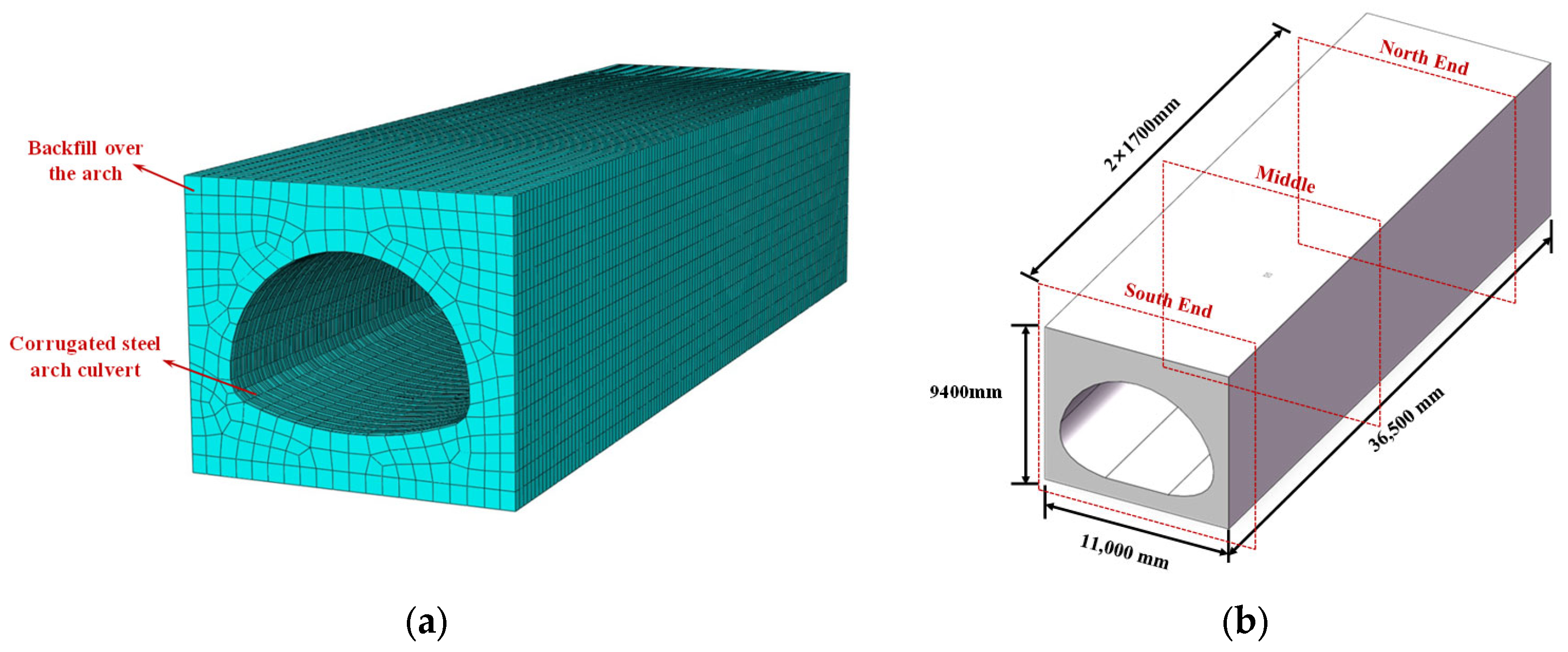
According to the field monitoring data of the actual bridge, Span No. 3 has the largest cumulative settlement and the most significant differential settlement, representing the most unfavorable loading condition of the structure. Therefore, this span is selected as the research object, and a finite element model with a total length of 36.5 m, width of 11 m, and height of 9.4 m is established. The measured settlements are applied as displacement loads at the corresponding monitoring points in the model, as shown in Figure 4. In the present study, a linear elastic material model is adopted to focus on the comparative evaluation of different strengthening schemes under differential settlement. The primary objective is to investigate the relative effectiveness of the strengthening measures in terms of stress redistribution and deformation control, rather than to predict long-term performance under cyclic loading. Therefore, the linear elastic assumption is considered appropriate for capturing the overall structural response and ensuring consistency in the comparison. It should be noted that time-dependent effects and material nonlinearity under long-term operation may influence the structural behavior, which can be further investigated in future studies. The material properties adopted in the model are consistent with those of the actual bridge. The corrugated steel pipe utilizes Q345 steel with an elastic modulus of 2.06 × 10⁵ MPa, a Poisson’s ratio of 0.3, and a unit weight of 78.0 kN/m3. The surrounding soil is simplified as an idealized elastic material with an elastic modulus of 100 MPa, Poisson’s ratio of 0.25, and a unit weight of 19 kN/m3. This assumption is adopted to ensure consistency among the compared reinforcement schemes and to focus on their relative mechanical performance. However, real backfill soil may exhibit stress-dependent stiffness degradation, plastic yielding, and nonlinear strain redistribution, which can influence the development of soil arching and the distribution of contact pressure. Therefore, the present assumption should be regarded as a modeling simplification, and its influence on absolute response values is acknowledged. Field inspection and numerical analysis confirmed that the stress level of the bridge was far below the yield strength of Q345 steel, and the structure was still in the elastic stage without obvious plastic development.
The geometric parameters of the corrugated steel plates are expressed as wavelength × wave height × thickness = 200 mm × 55 mm × 6 mm. The thickness-to-wave-height ratio (1:9.2) satisfies the simplified assumption of thin-shell theory (thickness-to-radius < 1:10), and therefore S4R shell elements were used for modeling [14]. The backfill soil and the inner lining concrete used in the reinforcement schemes were modeled using C3D8R solid elements [16,23]. For the inner lining concrete, the following modeling assumptions were adopted: (1) A perfect bond constraint was applied between the concrete lining and the corrugated steel pipe to simulate composite action, with no relative slip considered. (2) The concrete was not assumed to undergo cracking or plastic deformation within the analyzed load range, as the structure remained in the elastic stage. To balance computational accuracy and efficiency, a uniform mesh size of 600 mm was assigned to the lining concrete and backfill, while the corrugated steel pipe region was refined using a 200 mm mesh to better capture local stress and deformation behavior.
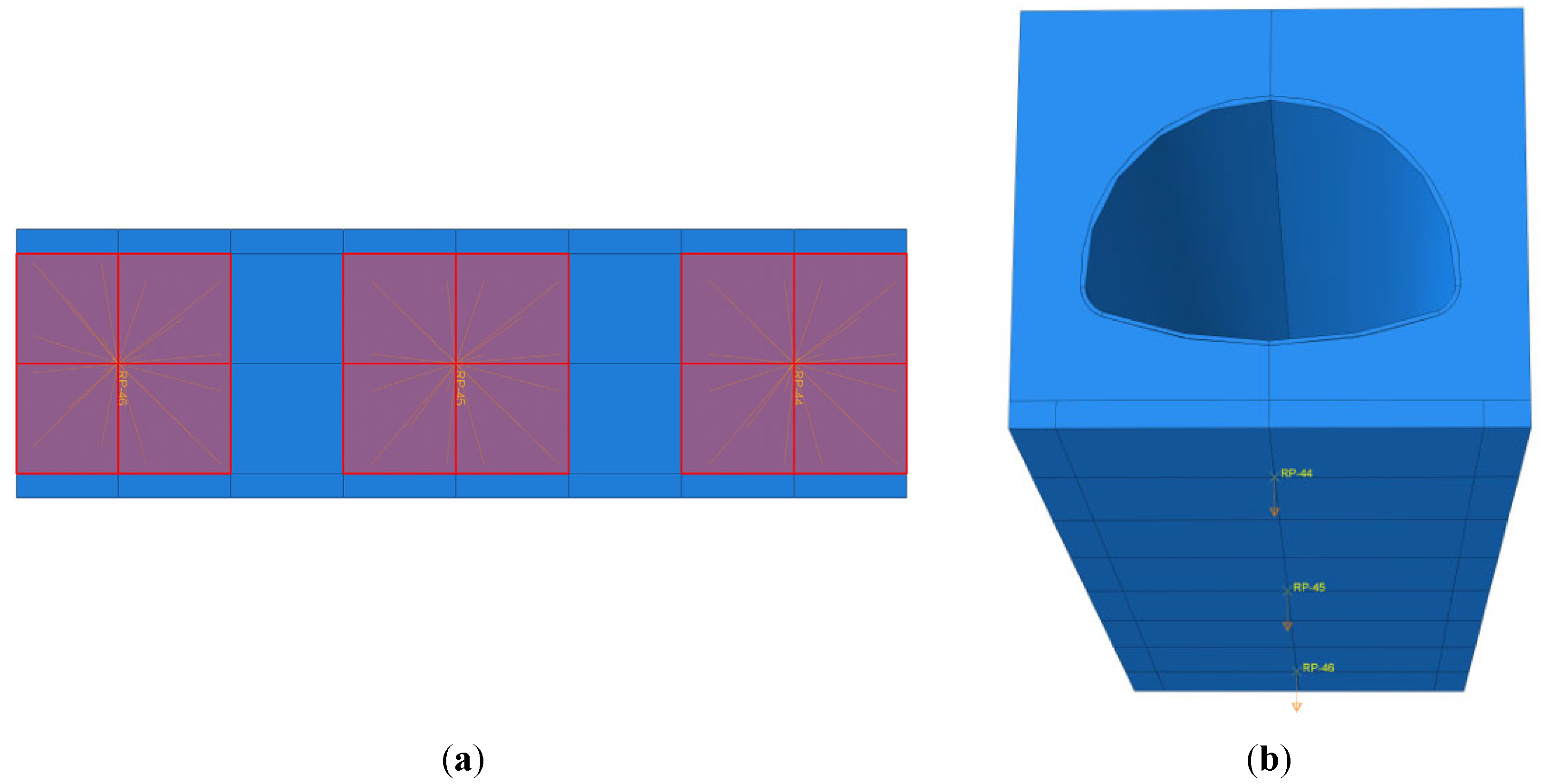
A Coulomb-type contact formulation was adopted to represent the interaction between the backfill soil and the corrugated steel shell. The adopted interface parameters were an equivalent friction angle of 39°, dilation angle of 5°, cohesion of 3 kPa, and interface rigidity (normal stiffness) of 100,000 kN/m3. These parameters were adopted from validated soil–steel bridge interface settings reported in the literature and are used here to characterize the contact behavior between the backfill and the steel shell. An equivalent rectangular simplified model of the representative span was adopted in this study. Symmetry boundary conditions were applied to the two lateral symmetry planes of the simplified model to reduce boundary influence and to facilitate comparison among strengthening schemes. The skew-induced local effects at the obtuse/acute corners were not explicitly considered, which is discussed as a limitation of the present study. Only vertical displacement is released at the bottom surface, and coupled constraints are imposed on the bottom surface at the actual monitoring point locations. Displacements corresponding to the measured settlement values are applied at the positions corresponding to the actual monitoring points. Regarding the contact interface between the corrugated steel pipe and the internal concrete lining, a perfect bonding condition was assumed, considering the mechanical interlock provided by the welded shear connectors. This assumption represents the intended composite action of the strengthened system and is adopted to ensure consistency in the comparative evaluation of the reinforcement schemes. In practical engineering, the connector arrangement would be designed to maximize composite action between the steel shell and the concrete lining. Although partial slip or local debonding may occur under some conditions, such interface effects are not the main focus of this study. Therefore, the present assumption should be interpreted as an idealized modeling condition used for scheme comparison. A static implicit solver was employed for the numerical analysis, and geometric nonlinearity (NLGEOM) was not considered because the deformation of the structure is small relative to its span and the system is assumed to remain within the small-deformation regime. Under the present loading condition, the maximum displacement is 23.16 mm over a span of 36.5 m, which indicates that second-order geometric effects are limited. However, it should be noted that neglecting geometric nonlinearity may slightly underestimate local stress and displacement concentrations, particularly near the arch foot and other regions with higher curvature. Therefore, this assumption should be regarded as a modeling simplification adopted for comparative analysis under service-level conditions. Meanwhile, gravity load is applied to the whole model, with the gravitational acceleration set to 9800 mm/s2. Detailed information on the loads and interactions is shown in Figure 5.

3.2. Structural Response Under Differential Settlement

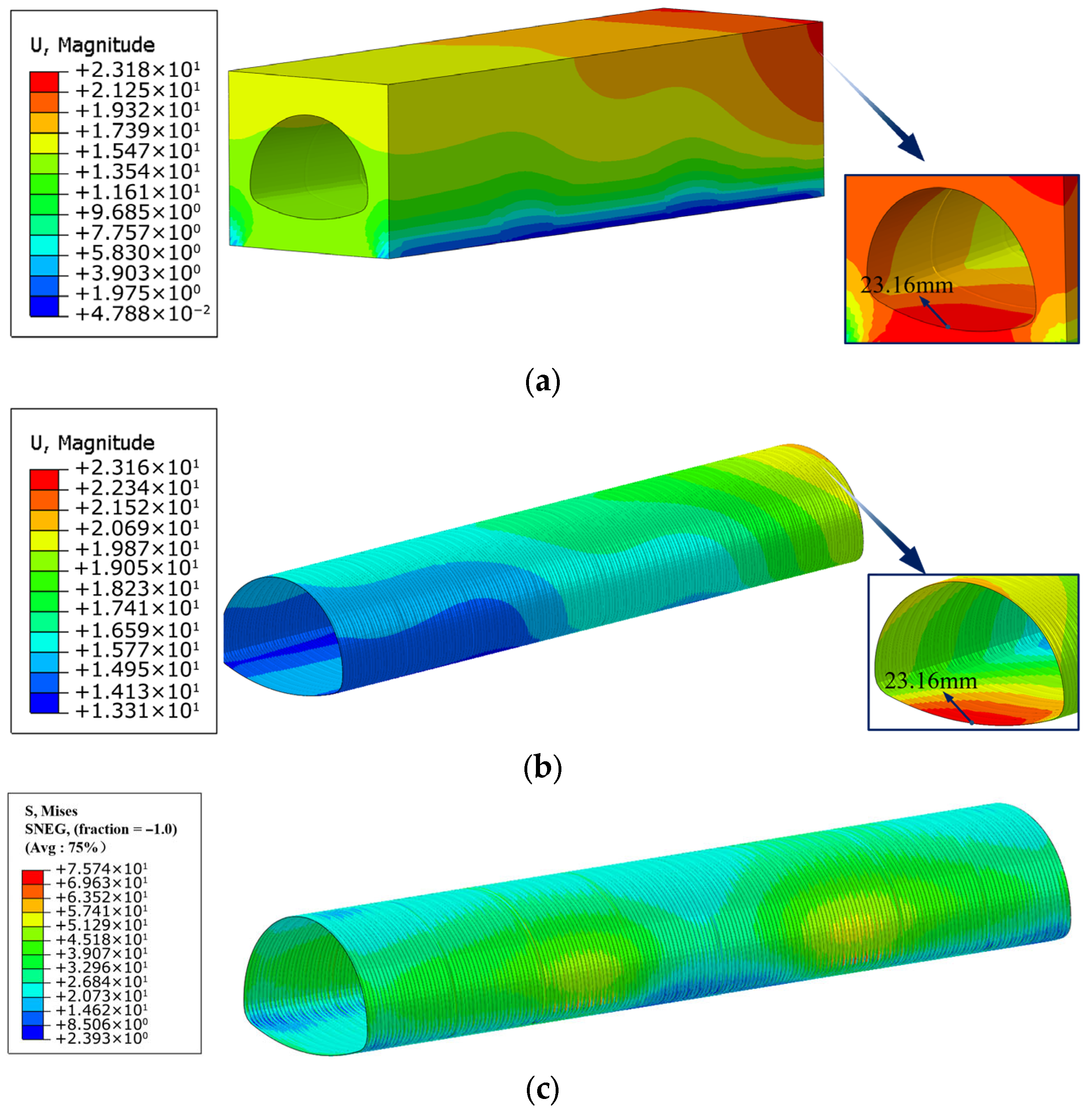
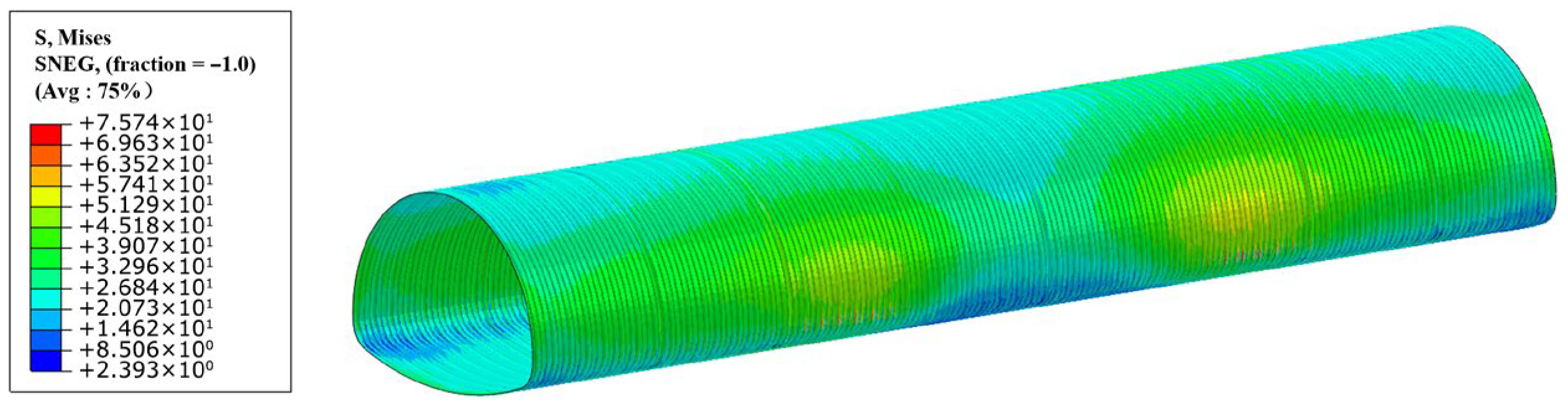
The finite element simulation results shown in Figure 6 provide a preliminary assessment of the structural response under self-weight and differential settlement. The results indicate that the corrugated steel pipe and the surrounding soil exhibit coordinated deformation, accompanied by a pronounced stress response in the pipe. The maximum displacement values of the soil and the structure are nearly identical (both 23.16 mm), indicating good composite action during the settlement process without obvious separation. However, the displacement within the corrugated steel pipe shows a clear gradient, decreasing from 23.16 mm to 13.31 mm, which reflects the regulating effect of structural stiffness under differential settlement.
In terms of stress, the maximum stress in the corrugated steel pipe reaches 75.74 MPa, indicating a noticeable local stress concentration, while the stress in most regions remains relatively uniform, ranging from 32.96 MPa to 45.18 MPa. This stress concentration mainly occurs at the arch foot and can be attributed to the combined effects of section bending induced by differential settlement, internal force redistribution within the corrugated shell geometry, and non-uniform constraints at the soil–structure interface. Although the maximum stress is well below the yield strength of the steel (e.g., 345 MPa for Q345 steel), such localized stress concentration may still adversely affect the long-term structural performance. In particular, the arch foot region may act as a critical location for fatigue crack initiation under repeated traffic loading, and the combined action of axial force and bending may also increase the risk of localized buckling in the thin-walled corrugated steel plates. These effects may lead to progressive damage accumulation and degradation of structural safety over time. Therefore, this critical region is identified as a key focus for subsequent analysis, and targeted strengthening schemes are further investigated to mitigate potential adverse effects.

4. Finite Element Modeling of Different Reinforcement Schemes

4.1. Model Grouping and Parameters

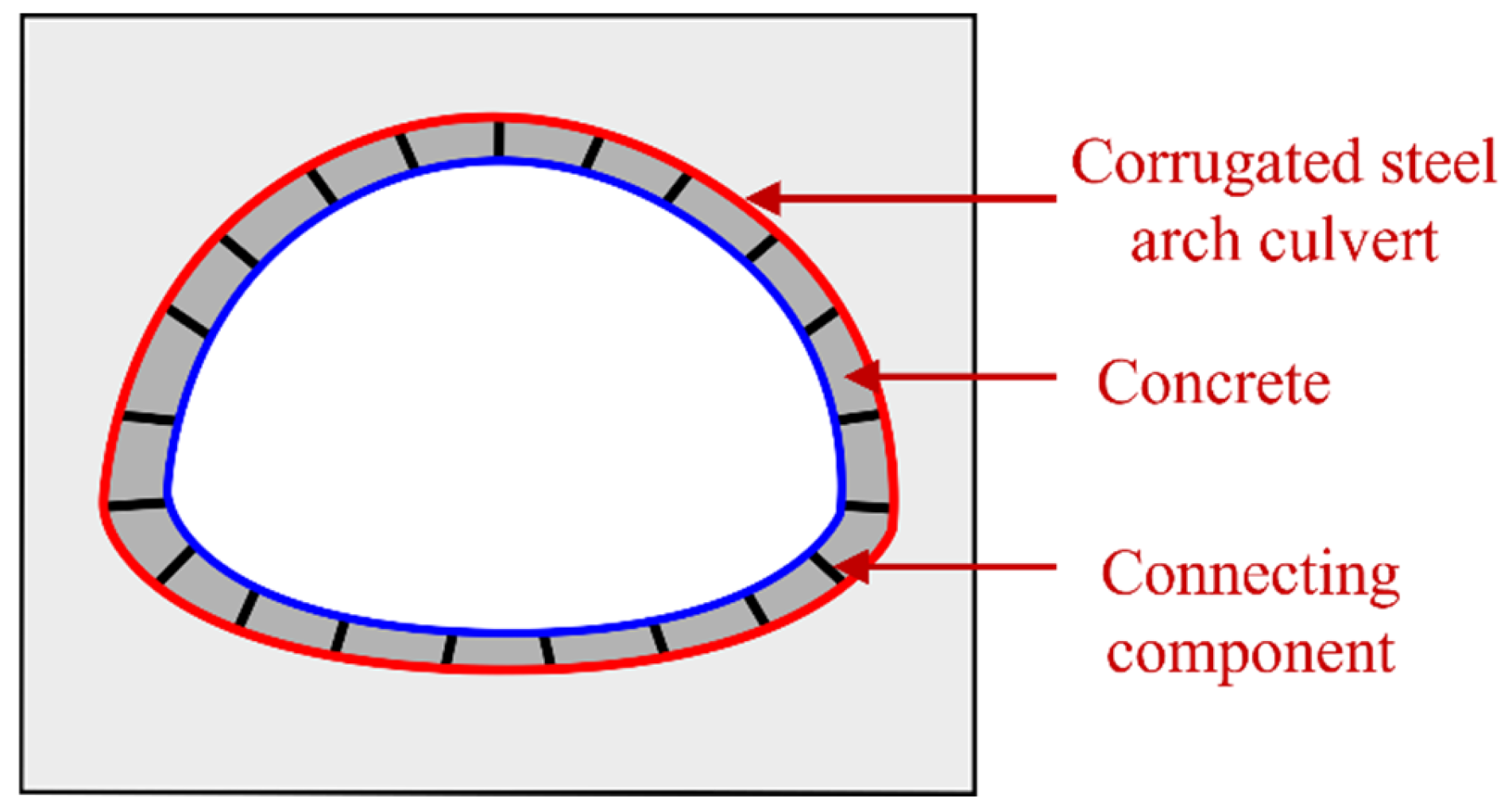
Based on the technical research and engineering application experience of corrugated steel pipe structure reinforcement at home and abroad, and on the basis of existing research results, this paper systematically proposes three differentiated and innovative composite reinforcement schemes [19,20,21,22]. Different from the single reinforcement measure commonly adopted in existing studies, the proposed schemes in this paper include inner lining concrete reinforcement, steel–concrete–steel composite structural system reinforcement, and steel plate strengthening, which can improve the mechanical performance of the structure more comprehensively. The configurations of these reinforcement schemes are shown in Figure 7. In this type of strengthening scheme, connecting components are first welded inside the existing corrugated steel pipe according to the design drawings, so as to ensure the composite performance between the later cast concrete layer and the corrugated steel pipe; their function is similar to that of PBL shear connectors in bridge structures. Then, concrete casting formworks are erected and fixed based on the designed thickness of the strengthening layer, followed by concrete casting and proper curing. After the concrete reaches its design strength, a waterproof coating is applied on the concrete surface to form the strengthened structural system. Scheme I uses internal concrete lining to enhance stiffness and load distribution; Scheme II introduces a steel–concrete–steel composite system to improve composite action and deformation resilience; Scheme III employs lateral steel plates to mitigate local stress concentration and enhance lateral restraint. These schemes together cover the main strengthening mechanisms of stiffness enhancement, composite action, and local confinement. Other common reinforcement methods were not considered because they are less suitable for the embedded bridge configuration, require more extensive construction disruption, or primarily target foundation treatment rather than directly improving the superstructure’s mechanical response.
To systematically evaluate the mechanical enhancement produced by each reinforcement scheme, six finite element models (S1–S6) were developed, as shown in Table 1. Model S1 serves as the baseline unreinforced configuration using Q345 corrugated steel plates. Models S2–S4 represent Scheme I, incorporating concrete linings with thicknesses of 100 mm, 150 mm, and 200 mm, respectively, to assess the influence of lining thickness on stiffness and stress response. Model S5 represents Scheme II, in which an additional corrugated steel pipe is embedded within a 100 mm concrete lining to investigate composite action. Model S6 corresponds to Scheme III, using a 150 mm lining combined with laterally welded side steel plates—adopting the same material and thickness as the corrugated steel pipe of the actual bridge, with a welded connection to the pipe for reliable integration—to evaluate improvements in lateral restraint and stress distribution.
In the composite steel–concrete arch system, the key interaction interfaces include: (1) the interface between the backfill soil and the steel pipe; (2) the interface between the inner concrete lining and the steel pipe; (3) the interface between the welded side plates and the surrounding soil. The contact between concrete and corrugated steel was simulated using a frictional surface-to-surface contact formulation. Normal behavior was defined as “hard contact”, while tangential behavior was modeled using the Coulomb friction model with a friction coefficient of 0.2. Tensile separation was allowed, meaning that the interface could not transmit tension once separation occurred.
For the “steel–concrete–steel composite sandwich” system, both inner and outer concrete surfaces were defined with corresponding steel plate interfaces, using identical contact properties to accurately simulate the layered load transfer mechanism. In the “steel plate enhancement” scheme, surface contact was defined between the steel pipe and the backfill, while the welded plates were modeled as embedded in the soil to reflect their composite behavior.

4.2. Comparison of Steel Pipe Stress States

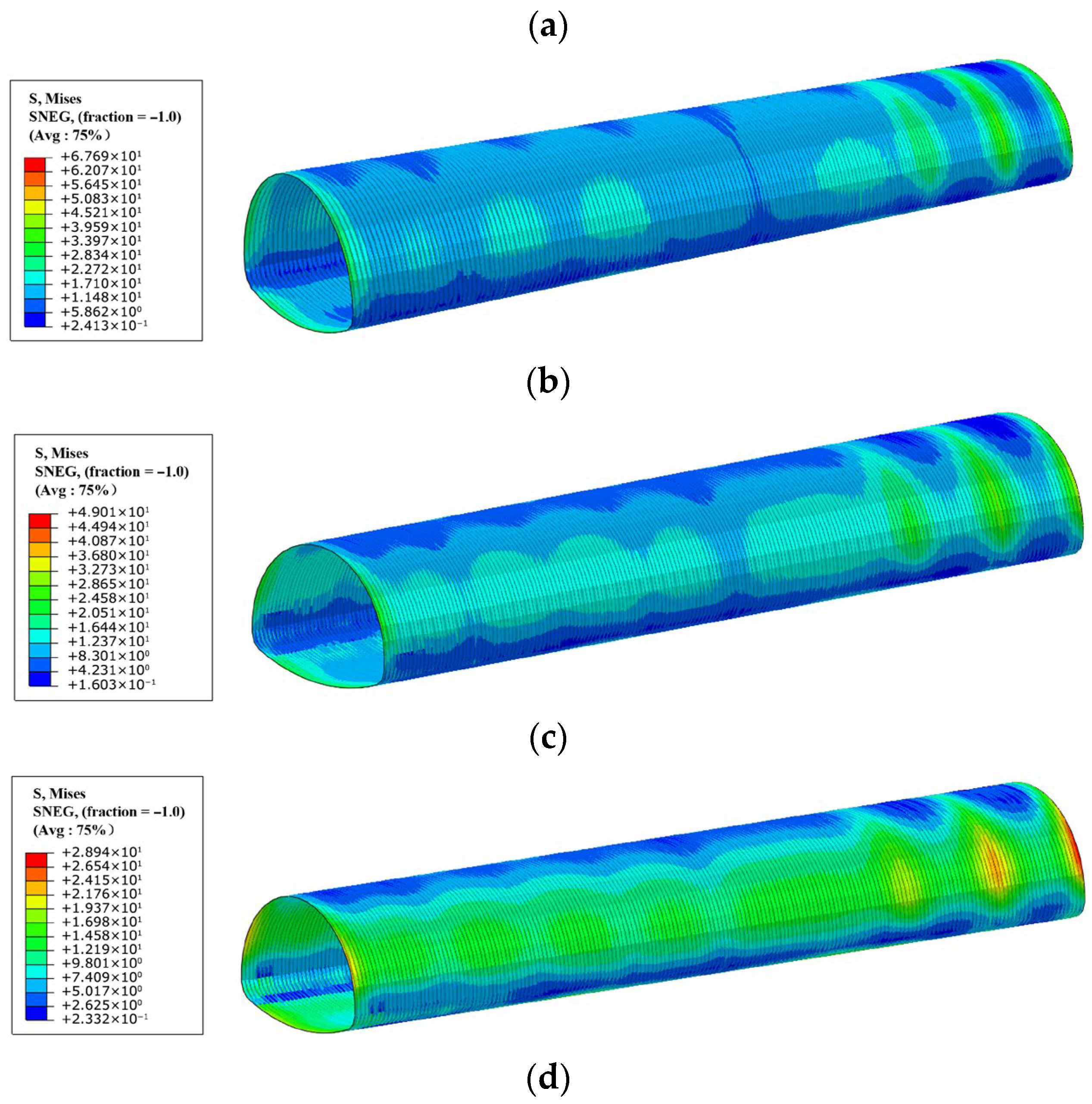
Finite element stress contours indicate that the addition of a concrete lining significantly reduces the stress level in the corrugated steel pipe under external loads, with the stress mitigation effect clearly dependent on lining thickness. For the unreinforced structure (Figure 8a), the maximum stress reaches 75.74 MPa, accompanied by pronounced local stress concentration at the arch foot, posing a critical risk to long-term structural performance. With a 100 mm concrete lining (Figure 8b), the maximum stress decreases to 67.69 MPa, a 10.6% reduction, and local stress concentrations are substantially alleviated, demonstrating effective composite action between the steel pipe and concrete lining. Increasing the lining thickness to 150 mm (Figure 8c) further reduces the maximum stress to 49.01 MPa, achieving a 35.2% reduction relative to the unreinforced structure. For a 200 mm lining (Figure 8d), the maximum stress decreases to 28.94 MPa, representing a total reduction of 61.8% compared to the unreinforced case and an additional 40.9% relative to the 150 mm scheme.

4.3. Stress Comparison Among Different Reinforcement Schemes

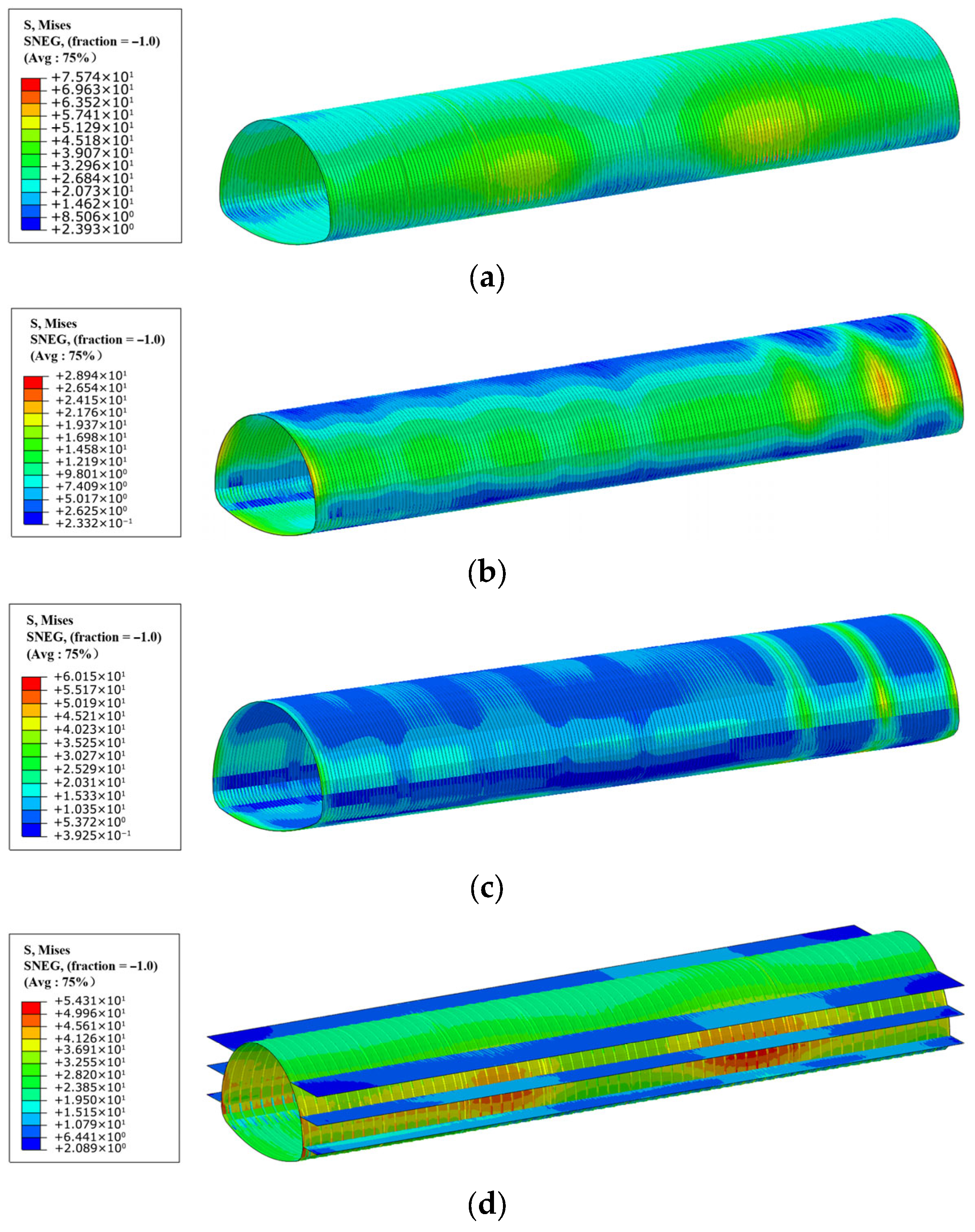
The stress contour plots in Figure 9 illustrate the effect of different reinforcement measures on the stress response of the corrugated steel pipe. For the unreinforced baseline model (Figure 9a), the maximum equivalent Mises stress reaches 75.74 MPa, with pronounced high-stress regions distributed along the pipe, particularly at the arch foot. For Scheme I, employing a 200 mm concrete lining (Figure 9b), the maximum stress decreases to 28.94 MPa, representing a 61.8% reduction compared to the unreinforced case, and the extent of high-stress regions is significantly reduced, demonstrating that the concrete lining effectively enhances overall structural stiffness and promotes stress redistribution, yielding excellent global stress-mitigation performance. Under Scheme II, combining the concrete lining with an embedded steel pipe (Figure 9c), the maximum stress is reduced to 60.15 MPa, a 20.6% reduction from the baseline, representing the smallest stress reduction among the three schemes. This indicates that, compared to the concrete lining alone, the additional embedded steel pipe provides only limited stress-relief benefits, as the primary contribution to stiffness enhancement and stress diffusion still comes from the concrete layer, while the embedded steel pipe is constrained by the surrounding concrete and contributes minimally. Scheme III, involving lateral welded steel plate reinforcement (Figure 9d), reduces the maximum stress to 54.31 MPa, corresponding to a 28.3% decrease from the unreinforced structure. Due to its local reinforcement nature, the overall structural stiffness is only modestly improved, so the global stress reduction remains inferior to that achieved by the concrete lining in Scheme I.

5. Evaluation of Structural Strengthening Schemes

5.1. Extraction Paths for Stress and Displacement

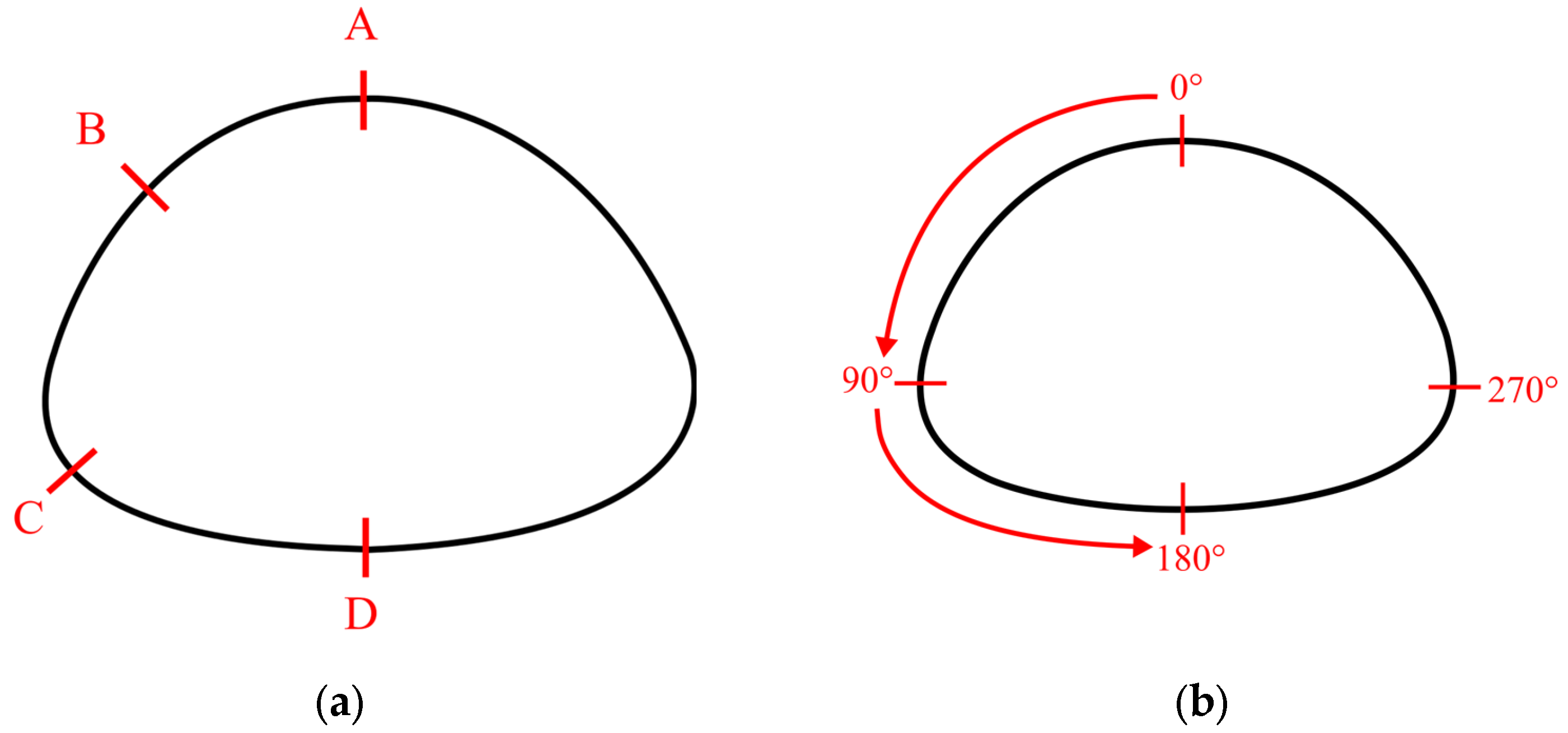
To compare the deformation characteristics of corrugated steel pipes under different strengthening schemes, four representative locations were selected as shown in Figure 10a: the pipe crown (A), the sidewall (B), the arch foot (C), and the invert (D). Radial displacement data at these locations were extracted to systematically evaluate deformation evolution at the key positions of the pipe structure. In addition, circumferential paths were defined as shown in Figure 10b, along which the deformation of both the mid-span and the quarter-span sections was obtained. By quantitatively analyzing the displacement distribution patterns along these circumferential paths, the improvement in pipe deformation under each strengthening scheme could be evaluated, providing essential quantitative data support for determining the optimal scheme.

5.2. Comparison of Strengthening Effects

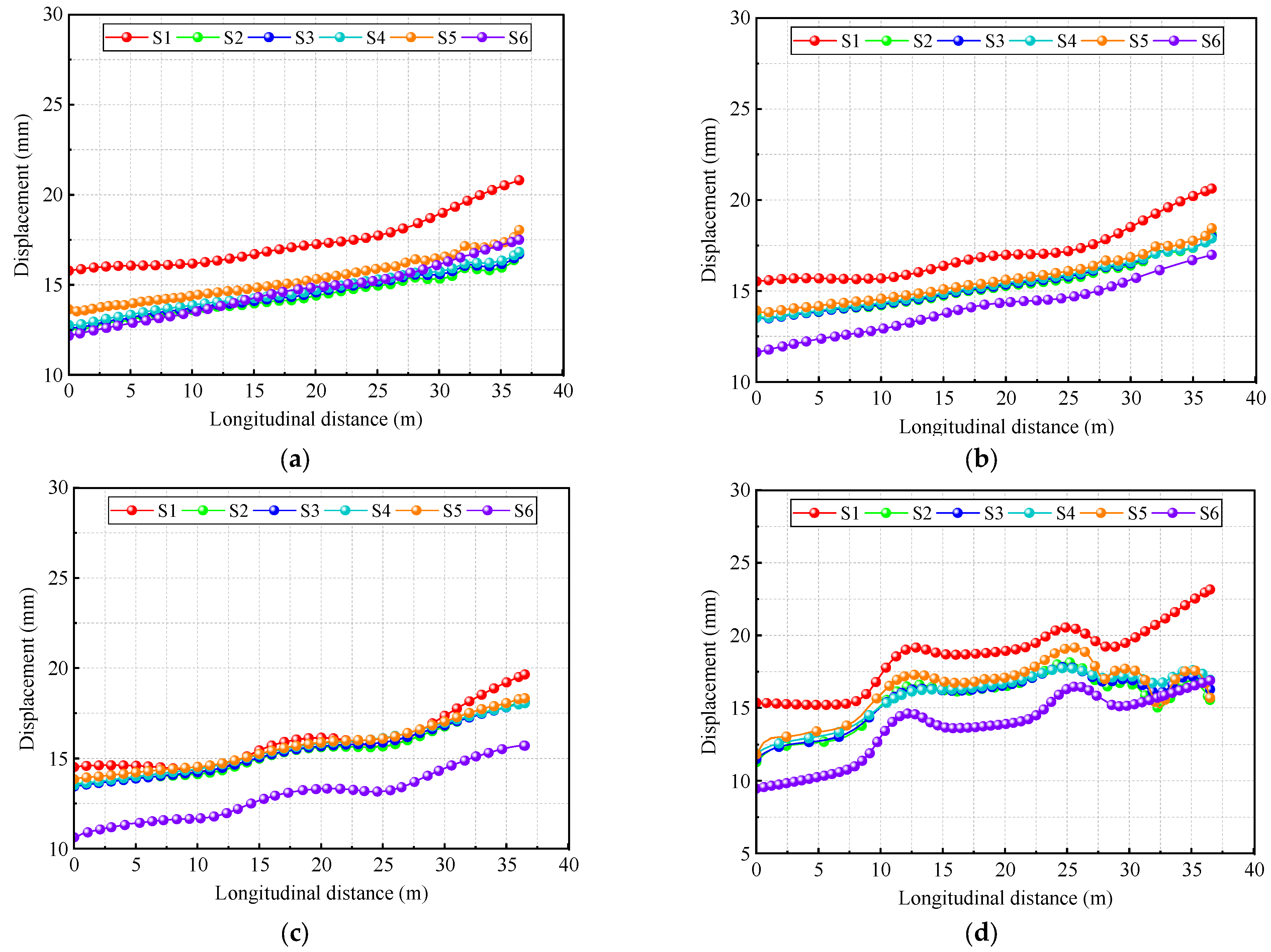
Based on the displacement comparison analysis corresponding to the four extraction paths, the following conclusions can be drawn: At the top of the corrugated steel pipe (Figure 11a), the unreinforced baseline condition (S1) exhibits a maximum displacement of approximately 20.8 mm. The “concrete lining” reinforcement schemes (S2–S4) can effectively improve the displacement of the corrugated steel pipe by significantly enhancing the overall structural stiffness and promoting stress redistribution, reducing the maximum displacement to 16.2 mm with a notable reduction rate of 22.1%. Within the thickness range of 100–200 mm, the stiffness improvement tends to saturate, resulting in similar performance across these schemes. The “concrete lining with nested steel pipe” reinforcement scheme (S5) achieves a comparable displacement improvement effect at the top of the corrugated steel pipe to the single concrete lining scheme, with a maximum displacement reduction rate of approximately 17.3%. The concrete lining plays a dominant role in displacement optimization by bearing the main load through its own stiffness, while the nested steel pipe is constrained by the surrounding concrete, making it difficult to exert additional stiffness gain effects and thus providing negligible supplementary benefits. The “laterally welded steel plates” (S6) represent a local reinforcement method that can only enhance the transverse constraint of specific parts and cannot improve the global stress state of the top of the corrugated steel pipe. Therefore, their inhibition on the displacement at this position is relatively limited, and the displacement curve is basically consistent with that of the unreinforced scheme.
As shown in Figure 11b (structural displacement at the sidewall of the corrugated steel pipe), the unreinforced condition has a maximum displacement of approximately 20.5 mm. The “laterally welded steel plate” reinforcement scheme (S6) achieves a more significant optimization effect on the sidewall displacement by directly enhancing the local transverse constraint capacity of the sidewall, reducing the maximum displacement to 17.0 mm with a reduction rate of 17.1%. In contrast, the “concrete lining” and “concrete lining with nested steel pipe” reinforcement schemes (S2–S5) mainly regulate displacement by improving the overall structural stiffness, and their targeted improvement on the sidewall (a locally stressed part) is limited, with a maximum displacement reduction rate of only about 11.2%.
As shown in Figure 11c (structural displacement at the arch foot), the unreinforced condition has a maximum displacement of approximately 19.8 mm, and this part is a region of local stress concentration. There are significant differences in the displacement reduction effects of various reinforcement schemes at this position: the “laterally welded steel plates” (S6) can accurately enhance the local constraint of the arch foot, effectively limiting the local deformation of this part with a reduction rate of 20.2%. In contrast, the “concrete lining”-based schemes (S2–S5) focus on global stiffness improvement, and their effect on alleviating local stress concentration at the arch foot is weak, with a maximum displacement reduction rate of only 8.1%, further verifying the prominent constraint advantage of steel plates for locally stressed parts.
As shown in Figure 11d (structural displacement at the bottom (invert) of the corrugated steel pipe), the unreinforced condition exhibits the largest displacement with obvious fluctuations due to uneven foundation settlement, with a maximum displacement of approximately 23.5 mm. The “laterally welded steel plates” reinforcement scheme (S6) not only achieves a displacement reduction rate of 29.8% by enhancing the transverse constraint of the invert but also results in a more uniform displacement distribution, effectively inhibiting local deformation concentration. The “concrete lining”-based schemes (S2–S5) reduce the absolute displacement amplitude of the invert by improving the overall structural stiffness, with a reduction rate of about 21.3%, and also alleviate the displacement concentration phenomenon. However, due to the lack of targeted constraint on the local invert, the overall optimization effect is slightly inferior to that of the laterally welded steel plate scheme.
In summary, at the key section positions, the displacement inhibition effects of different reinforcement schemes show obvious position dependence: the “concrete lining” reinforcement scheme can effectively inhibit the global displacement deformation of the corrugated steel pipe by improving the overall structural stiffness and promoting stress redistribution, and performs optimally at globally stressed parts such as the top of the corrugated steel pipe. Among them, when the thickness of the concrete lining is 150 mm, the stiffness improvement has the highest matching degree with the structural stress requirements, achieving the optimal reinforcement effect. Compared with the unreinforced prototype structure, the maximum displacement amplitude at the top of the corrugated steel pipe is reduced most significantly. The “concrete lining with nested steel pipe” reinforcement scheme has a similar displacement regulation effect to the single concrete lining scheme, and its core optimization effect still relies on the concrete lining, while the nested steel pipe is difficult to exert additional gain due to constraints. In contrast, the “laterally welded steel plate” reinforcement scheme, relying on its local constraint advantage, achieves more prominent displacement inhibition effects at locally stressed parts such as the sidewall, arch foot, and invert, but its improvement on globally stressed parts such as the top of the corrugated steel pipe is limited, resulting in a relatively single overall optimization effect.
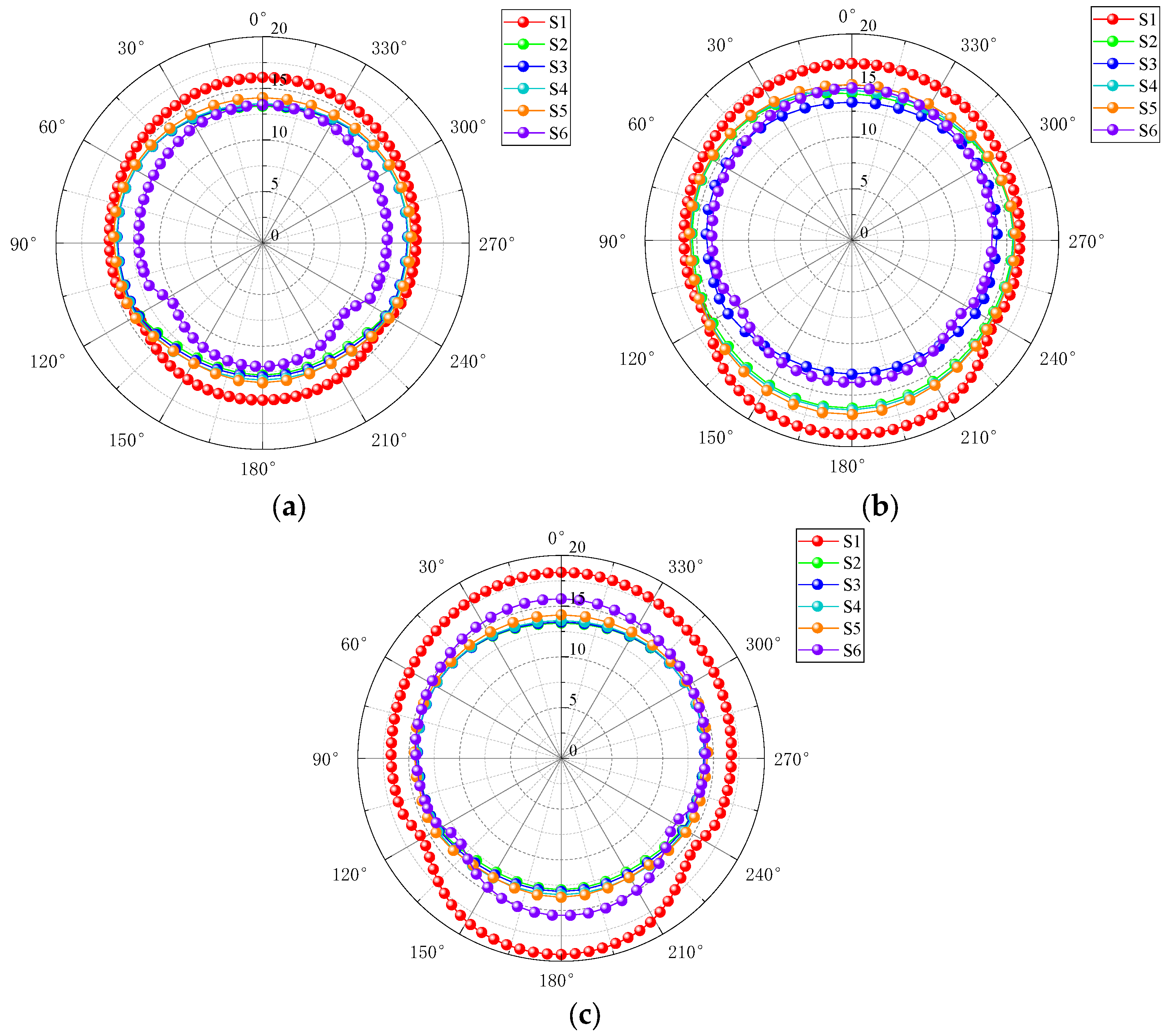
Based on the circumferential deformation patterns shown in Figure 12, the following conclusions can be drawn: At the anterior quarter-span (Figure 12a), different reinforcement schemes exhibit distinct circumferential displacement responses, with the unreinforced baseline condition (S1) having a maximum circumferential displacement of approximately 20 mm. The laterally welded steel plate scheme (S6) achieves the optimal reinforcement effect, effectively controlling the circumferential displacement within the range of 10–12 mm with a maximum reduction rate of 40% compared with the unreinforced condition; the concrete-based reinforcement schemes (S2–S5) also demonstrate a good control effect, restricting the circumferential displacement to 12–14 mm with a reduction rate of about 30%. The circumferential displacement at the two arch feet of this position is smaller than that at other circumferential positions, forming a characteristic concave-shaped displacement curve. At the mid-span (Figure 12b), the amplitude and distribution law of circumferential displacement are similar to those at the anterior quarter-span, with the unreinforced condition (S1) having a maximum circumferential displacement of approximately 20 mm. The concrete-based reinforcement schemes (S2–S5) show a better control effect, limiting the displacement amplitude to 12–15 mm with a maximum reduction rate of 35%; the laterally welded steel plate scheme (S6) can still significantly inhibit circumferential deformation, with the displacement amplitude controlled at 13–16 mm and a reduction rate of about 25%, which is far superior to the unreinforced condition. At the posterior quarter-span (Figure 12c), affected by the adverse effect of uneven foundation settlement, the circumferential displacement of the unreinforced condition (S1) further increases with a maximum displacement of approximately 22 mm. The concrete-based reinforcement schemes (S2–S5) still maintain the optimal control effect, effectively confining it within the range of 14–17 mm with a maximum reduction rate of 32%; although the reinforcement effect of the laterally welded steel plate scheme (S6) is slightly weakened by settlement, it is still significantly better than the unreinforced condition, controlling the displacement amplitude at 15–18 mm with a reduction rate of about 18% compared with the unreinforced condition, which effectively restrains the local deformation concentration at this position. Overall, the laterally welded steel plate scheme (S6) exhibits the optimal circumferential deformation control capability at the anterior quarter-span, while the concrete-based reinforcement schemes (S2–S5) show a more prominent control effect at the mid-span and posterior quarter-span; both types of reinforcement schemes have achieved a significant reduction in circumferential displacement compared with the unreinforced condition. Due to the different reinforcement mechanisms, the local constraint-type steel plate reinforcement and the global stiffness-enhancing concrete lining reinforcement present different adaptive advantages in the circumferential deformation control at different longitudinal positions of the bridge.
A comparative analysis of circumferential displacement at the three critical sections indicates the following: (1) A spatial gradient exists in the circumferential deformation of the pipe structure, with the last quarter-span exhibiting larger displacements than the first and mid-span regions, which is closely related to the non-uniform foundation settlement. (2) The concrete lining and concrete lining with nested steel pipe schemes present favorable performance in circumferential deformation control, effectively reducing displacement amplitude and enhancing the overall structural stiffness. The laterally welded steel-plate strengthening scheme also achieves obvious improvement in circumferential deformation control, especially showing the optimal control effect at the first quarter-span, while its effect is slightly inferior to that of concrete-based schemes at the mid-span and last quarter-span. Owing to different reinforcement mechanisms, the two types of schemes demonstrate distinct adaptive advantages in controlling circumferential deformation at different longitudinal positions of the bridge.
From the perspective of the core regulatory mechanism of soil-structure interaction (SSI), all three reinforcement measures reconstruct the load transfer and deformation coordination relationships of the soil-structure system by altering the global or local stiffness of the structure, which is the essential reason for the improvement of structural mechanical performance by reinforcement measures. Key SSI settings including Coulomb friction contact between soil and steel, perfect bonding at the steel–concrete interface, and embedment of welded steel plates in soil have been considered in the finite element model of this study. The simulation results show that: Scheme I realizes the global optimization of SSI by virtue of the global stiffness improvement of the concrete lining, which can simultaneously reduce structural stress and realize uniform soil stress distribution; Scheme II fails to exert additional stiffness gain due to the confinement of the embedded steel pipe by concrete, and thus cannot form an additional improvement on SSI; and Scheme III is the local optimization of SSI, which can targetedly improve the interface force transfer characteristics of key stress-bearing parts despite its limited global effect. The regulatory effect of each scheme on SSI is highly consistent with the optimization trend of structural stress and displacement, which verifies the action law of SSI as the dominant factor of soil-steel composite structures.

6. Conclusions

This study investigates a ten-span continuous corrugated steel pipe arch bridge subjected to uneven settlement in a mining subsidence area. To address the associated structural safety risks, comprehensive field monitoring and numerical simulations were conducted. A year-long settlement monitoring program revealed the temporal and spatial evolution of deformation; a full-scale finite element model was established to elucidate stress and deformation characteristics; and the strengthening effects of concrete lining, concrete lining with a nested steel pipe, and side-welded steel plate schemes were comparatively evaluated. The key findings are as follows:
  • Field monitoring indicates pronounced spatiotemporal heterogeneity in settlement. Span No. 3 experiences the most unfavorable settlement, with the maximum cumulative settlement at Monitoring Point 11 reaching 20.32 mm over 12 months. Settlement rates at different points exhibit initial fluctuations followed by gradual stabilization, reflecting the influence of mining-induced uneven foundation settlement on the superstructure.
  • Finite element results show that the corrugated steel pipe and surrounding soil deform cooperatively under uneven settlement, while significant stress concentrations develop. The maximum stress in the unstrengthened structure reaches 75.74 MPa, primarily at the arch foot. These stress concentrations are closely related to cross-sectional bending effects, internal force redistribution in the thin-walled corrugated geometry, and non-uniform soil restraint.
  • Among the strengthening schemes, the concrete lining provides the most significant improvement. With a lining thickness of 200 mm, the maximum pipe stress is reduced to 28.94 MPa, representing a 61.8% decrease. Crown and sidewall displacements are reduced by 8% and 10%, respectively, and displacement uniformity is markedly improved. The concrete-lining-with-nested-steel-pipe scheme yields a comparable strengthening effect to the pure concrete lining scheme, whereas the side-welded steel plate scheme demonstrates a superior performance in improving structural displacement.
  • Circumferential deformation analysis shows a spatial gradient in displacements, with the posterior quarter-span exhibiting larger amplitudes than the anterior and mid-span sections. Concrete-based schemes effectively control circumferential displacement within 12–17 mm, achieving reductions of 11.7–15% and significantly improving overall deformation stiffness.
Despite these findings, several limitations remain. The numerical model adopts ideal elastic material assumptions, neglecting material nonlinearity and long-term creep effects. In addition, strengthening effects were evaluated only for the most unfavorable span (Span No. 3), without broader parametric validation across different span configurations or geotechnical conditions.

Author Contributions

Conceptualization, T.L., K.S., K.L., L.J. and Y.S.; methodology, L.C., K.L. and Y.S.; software, Y.S. and L.C.; validation, T.L., K.S., K.L., and X.W.; formal analysis, L.J., K.L., and Y.W.; investigation, Y.W.; resources, K.S., T.L.; data curation, T.L., K.S.; writing—original draft preparation, L.C., Y.S.; writing—review and editing, L.J.; visualization, X.W.; supervision, X.W.; project administration, T.L.; funding acquisition, T.L. All authors have read and agreed to the published version of the manuscript.

Funding

This research was funded by the Science and Technology Program of the Shandong Provincial Department of Transportation (2024B38–02).

Institutional Review Board Statement

Not applicable.

Informed Consent Statement

Not applicable.

Data Availability Statement

The original contributions presented in the study are included in the article, further inquiries can be directed to the corresponding author.

Conflicts of Interest

Author Tao Li was employed by the company Tai’an Highway Development Center. Authors Kaixuan Sun, Ke Li, Xiao Wang were employed by the company Shandong Taishan Transportation Planning and Design Consulting Co., Ltd. The remaining authors declare that the research was conducted in the absence of any commercial or financial relationships that could be construed as a potential conflict of interest.

References

  1. Ezzeldin, I.; El Naggar, I. Three-dimensional finite element modeling of corrugated metal pipes. Transp. Geotech. 2021, 27, 100467. [Google Scholar] [CrossRef]
  2. Vilca, N.S.; Gómez-Amador, A.M.; Jiménez de Cisneros Fonfría, J.J. Soil-structure interaction analysis using the finite element method in thin-walled steel pipes buried under Haul Roads. Appl. Sci. 2024, 14, 167. [Google Scholar] [CrossRef]
  3. Zhang, Y.; Liu, B.; Meng, L. Structural behavior and soil arching state of underground corrugated steel utility tunnel. J. Constr. Steel Res. 2023, 203, 107798. [Google Scholar] [CrossRef]
  4. Liu, B.; Wang, Z.; Xu, W.; Sun, H.; Wang, X. Comparative experimental study and FE analysis of corrugated steel pipe culverts with different stiffness. Open Civ. Eng. J. 2016, 10, 549–563. [Google Scholar] [CrossRef]
  5. Bao, X.; Wu, X.; Shen, J.; Wu, S.; Chen, X.; Cui, H. Performance analysis of multiple steel corrugated pipe arch culvert under construction and periodic vehicle load. Appl. Sci. 2023, 13, 9441. [Google Scholar] [CrossRef]
  6. Kunecki, B. Empirical investigation of the structural response of super-span soil-steel arches during backfilling. Materials 2025, 18, 3650. [Google Scholar] [CrossRef]
  7. Miśkiewicz, M.; Sobczyk, B.; Tysiac, P. Non-destructive testing of the longest span soil-steel bridge in Europe—Field measurements and FEM calculations. Materials 2020, 13, 3652. [Google Scholar] [CrossRef]
  8. Zhang, Y.; Liu, B.; Sun, W.; Meng, L. Experimental and numerical study on longitudinal structural performance of soil-steel composite bridges. Case Stud. Constr. Mater. 2025, 22, e04148. [Google Scholar] [CrossRef]
  9. Embaby, K.; El Naggar, M.H.; EI Sharnouby, M. Performance of large-span arched soil-steel structures under soil loading. Thin-Walled Struct. 2022, 172, 108884. [Google Scholar] [CrossRef]
  10. Bao, X.; Bao, Z.; Shen, J.; Wu, S.; Yang, S.; Chen, X. Study on the performance of twin shield tunnel excavation below existing multi-arch culvert bridge in close vicinity. Appl. Sci. 2023, 13, 12285. [Google Scholar] [CrossRef]
  11. Wu, F.; Liu, B.; Sun, W.; Sun, H.; Zhang, S. Full-scale model tests of two box-type soil-steel structures with different crown and haunch radii. Materials 2024, 17, 1710. [Google Scholar] [CrossRef]
  12. Duan, M.; Wang, F.; Wu, Y.; Tao, H.; Zhang, D. Sensitivity analysis of structural parameters of unequal-span continuous rigid frame bridge with corrugated steel webs. Appl. Sci. 2023, 13, 10024. [Google Scholar] [CrossRef]
  13. Ding, W.; Huang, X.; Yu, C.; Zhang, Q.; Wu, T. Calculation method of new assembled corrugated steel initial support structure of highway tunnel. Appl. Sci. 2024, 14, 7242. [Google Scholar] [CrossRef]
  14. Che, C.; Hu, P.; Shi, F.; Xu, P.; Liu, J.; Li, K. Local stability analysis of a composite corrugated steel plate pipe-arch in soil. Buildings 2024, 14, 3290. [Google Scholar] [CrossRef]
  15. Che, C.; Sun, Z.; Xu, P.; Shi, F.; Liu, J.; Li, K. Elastic local buckling analysis of a sandwich corrugated steel plate pipe-arch in underground space. Buildings 2024, 14, 2696. [Google Scholar] [CrossRef]
  16. Maleska, T.; Nowacka, J.; Beben, D. Application of EPS geofoam to a soil-steel bridge to reduce seismic excitations. Geosciences 2019, 9, 448. [Google Scholar] [CrossRef]
  17. Maleska, T.; Beben, D. Behaviour of soil-steel composite bridges under strong seismic excitation with various boundary conditions. Materials 2023, 16, 650. [Google Scholar] [CrossRef]
  18. Haghani, R.; Yang, J.; Gutierrez, M.; Eamon, C.D.; Volz, J. Fiber reinforced polymer culvert bridges—A feasibility study from structural and LCC points of view. Infrastructures 2021, 6, 128. [Google Scholar] [CrossRef]
  19. Li, P.; Wang, S.; Zhang, M.; Huang, Z. Supporting structure of steel corrugated plate-mold bag concrete and its application in a circular shaft. Appl. Sci. 2023, 13, 12937. [Google Scholar] [CrossRef]
  20. Chen, Z.; Liu, X. Experimental study on seismic performance of transversely ribbed corrugated steel plate-steel pipe concrete shear wall. Buildings 2024, 14, 2708. [Google Scholar] [CrossRef]
  21. Liu, F.; Qian, H.; Zhang, Z.; Zhang, H. Experimental study on the mechanical properties of vertical corrugated pipe grout anchor connection joints. Appl. Sci. 2023, 13, 11889. [Google Scholar] [CrossRef]
  22. Yang, F.; Liu, J.; Liu, Y.; Hou, Q. Theoretical and experimental research on deflection of hollow slabs set by thin-walled corrugated tubes on simply supported and fixed constraints in opposite sides. Buildings 2024, 14, 1591. [Google Scholar] [CrossRef]
  23. Sun, K.; Jiang, L.; Shi, Y.; Ning, Z.; Wang, M.; Li, T.; Cui, L.; Hu, C. Deformation Response of Corrugated Steel Pipe Arch Bridges Under Differential Foundation Settlement. Symmetry 2026, 18, 267. [Google Scholar] [CrossRef]
Figure 1. Dimensions of the ten-span continuous corrugated steel pipe arch bridge (unit: mm): (a). Elevation layout. (b). Schematic of a horseshoe-shaped joint section. (c). Detail of the corrugated steel plate.
Applsci 16 03830 g001aApplsci 16 03830 g001b
Figure 2. Layout of monitoring points (unit: mm).
Applsci 16 03830 g002
Figure 3. Cumulative settlement at Span No. 3: (a) Monitoring Point 11; (b) Monitoring Point 29; (c) Monitoring Point 47.
Applsci 16 03830 g003
Figure 4. Schematic diagram of finite element model and geometric dimensions for the corrugated steel pipe arch culvert: (a). Finite element model. (b). Detailed model dimensions.
Applsci 16 03830 g004
Figure 5. Simulation of differential settlement of corrugated steel pipe arch culvert (a). Coupled constraint at loading points. (b). Displacement load application.
Applsci 16 03830 g005
Figure 6. Structural response under differential settlement: (a) Soil displacement. (b) Corrugated steel pipe displacement. (c) Corrugated steel pipe stress.
Applsci 16 03830 g006
Figure 7. The strengthened structural configuration.
Applsci 16 03830 g007
Figure 8. Stress contours of corrugated steel pipes strengthened with concrete lining: (a) Unstrengthened corrugated steel pipe. (b) Corrugated steel pipe with 100 mm concrete lining. (c) Corrugated steel pipe with 150 mm concrete lining. (d) Corrugated steel pipe with 200 mm concrete lining.
Applsci 16 03830 g008aApplsci 16 03830 g008b
Figure 9. Stress contours of corrugated steel pipes under different strengthening schemes: (a) Unstrengthened corrugated steel pipe. (b) Corrugated steel pipe with 200 mm concrete lining. (c) Corrugated steel pipe strengthened with concrete lining and embedded steel pipe. (d) Corrugated steel pipe strengthened with steel plates.
Applsci 16 03830 g009
Figure 10. Deformation analysis paths: (a) Axial extraction path. (b) Circumferential extraction path.
Applsci 16 03830 g010
Figure 11. Displacement results along each extraction path: (a) Structural displacement at the top of the corrugated steel pipe. (b) Structural displacement at the sidewall of the corrugated steel pipe. (c) Structural displacement at the arch foot. (d) Structural displacement at the bottom (invert) of the corrugated steel pipe.
Applsci 16 03830 g011
Figure 12. Circumferential deformation of the structure: (a) Circumferential displacement at the anterior quarter-span of the corrugated steel pipe. (b) Circumferential displacement at mid-span. (c) Circumferential displacement at the posterior quarter-span of the corrugated steel pipe.
Applsci 16 03830 g012
Table 1. Parameter values for analysis.
No.Lining Concrete Thickness (mm)Lining Concrete MarkCorrugated Steel StrengthStrengthening Scheme
S1//Q345/
S2100C30Q345Scheme I
S3150C30Q345Scheme I
S4200C30Q345Scheme I
S5100C30Q345Scheme II
S6150/Q345Scheme III
Disclaimer/Publisher’s Note: The statements, opinions and data contained in all publications are solely those of the individual author(s) and contributor(s) and not of MDPI and/or the editor(s). MDPI and/or the editor(s) disclaim responsibility for any injury to people or property resulting from any ideas, methods, instructions or products referred to in the content.