1. Introduction
In contemporary software development environments characterized by rapid technological change, increasing system complexity, and evolving customer expectations, the limitations of traditional plan-driven methodologies have become increasingly evident. The Waterfall model, which dominated software development practices throughout the early 1990s, is based on a sequential and deterministic process that assumes stable and well-defined requirements from the outset. While this model offers predictability and control, its rigidity makes it poorly suited for software projects, where uncertainty, frequent requirement changes, and fast feedback cycles are intrinsic [
1,
2].
Agile methodologies emerged as a response to these challenges, introducing iterative development, continuous feedback, and adaptive planning as core principles. Rather than fixing scope early and adjusting time and cost accordingly, agile approaches rely on fixed timeboxes, most commonly referred to as sprints, within which scope is continuously refined based on stakeholder feedback and evolving priorities [
3,
4]. In agile software engineering team projects, strong collaboration and effective communication among team members are critical for fostering agility and supporting lean software development [
5]. As a result, the development cycle duration has become a fundamental design parameter in agile project management, directly influencing planning accuracy, feedback frequency, team productivity, and overall project adaptability. There is increasing recognition that agility, defined as the ability to respond rapidly to changing and challenging environments, is a critical factor for international business [
6]. Another study demonstrates that both the efficiency and effectiveness of software products have a significant and positive impact on the success of agile software development projects [
7].
Among agile frameworks, Scrum formalizes this concept through short, time-boxed sprints that typically range from one to four weeks [
8,
9]. The selection of sprint duration is not merely a procedural decision but a strategic one. Shorter sprints enable faster feedback and earlier detection of misalignment with user needs, but they may also increase coordination overhead, reduce development depth, and amplify planning costs. Conversely, longer sprints allow for more comprehensive implementation and reduced meeting overhead but risk delayed feedback, increased rework, and reduced responsiveness to change. Despite its central role, sprint duration is often treated as a fixed or arbitrary parameter in practice, rather than as a variable that should be adapted to project dynamics and organizational context [
10].
The impact of sprint duration becomes even more pronounced when agile methodologies are implemented across organizations of different scales. Startups, operating under severe time-to-market pressure and constrained resources, frequently adopt very short development cycles or informal sprint structures to accelerate delivery. In such cases, activities such as test planning, documentation, and architectural refinement are often reduced or deferred in order to minimize short-term cost and effort [
8,
9]. While this approach can support rapid experimentation and early market validation, it may also lead to quality degradation, accumulation of technical debt, and instability in later stages of product evolution [
11,
12].
In contrast, large-scale organizations tend to adopt longer or more structured sprint cycles, supported by formal planning processes, automated testing, and scaled agile frameworks such as SAFe or LeSS [
13,
14]. These organizations aim to balance flexibility with predictability by stabilizing sprint duration and embedding governance mechanisms into the agile process. However, this disciplined approach may reduce responsiveness and slow down innovation if sprint cycles become overly rigid or disconnected from actual project needs.
Although the existing literature extensively discusses agile principles and framework-level comparisons, empirical studies that focus specifically on sprint duration as a determinant of project effectiveness remain limited. In particular, there is a lack of comparative analyses that examine how variations in sprint length influence project outcomes when agile practices are selectively adapted, modernized, or partially omitted. Addressing this gap, the present study investigates the strategic effectiveness of different agile implementations with a specific focus on development cycle duration. By combining industry experience with laboratory-based experiments conducted on four software projects, the study evaluates how sprint length affects feedback efficiency, planning quality, and overall project performance. The findings aim to provide actionable guidance on how agile methodologies can be tailored to project dynamics while preserving their core principles.
In light of the identified research gap, the primary aim of this study is to systematically investigate the strategic effectiveness of agile approaches by treating sprint duration as a key design variable rather than a fixed procedural element. Specifically, the study seeks to examine how different planning frequencies (daily, weekly, and bi-weekly) influence critical project performance dimensions, including workflow continuity, team productivity, and resource utilization.
To achieve this aim, the study is guided by the following research objectives:
- (i)
Compare the effects of varying sprint durations under controlled project conditions with identical scope and team structure;
- (ii)
Analyze the trade-offs between short and long planning cycles in terms of adaptability, coordination overhead, and development stability;
- (iii)
Identify an optimal or balanced sprint duration that maximizes both responsiveness and operational efficiency in agile environments.
Accordingly, the study addresses the following research question: How does sprint duration, as a strategic parameter, affect the effectiveness and sustainability of agile software development processes under comparable project conditions?
2. Background of the Study
The project management literature offers a broad spectrum of methodologies, theoretical foundations, and practical frameworks that shape modern software development practices. Within this literature, agile methodologies occupy a central position due to their emphasis on adaptability, iterative delivery, and continuous feedback. This section establishes the theoretical background of the agile approach and examines two of the most widely used agile methodologies, Scrum and Kanban, by focusing on their structural characteristics, particularly their treatment of time, workflow, and feedback mechanisms. This comparison provides the conceptual foundation for analyzing the strategic role of development cycle (sprint) duration in agile project effectiveness [
15].
2.1. Agile Approach
The agile approach represents both a philosophy and a collection of methods designed to cope with uncertainty, evolving requirements, and rapid change in software development projects [
16,
17]. Rooted in the Agile Manifesto published in 2001, the agile approach emphasizes individuals and interactions over processes and tools, working software over comprehensive documentation, customer collaboration over contract negotiation, and responding to change over following a fixed plan [
16]. These principles collectively aim to shorten feedback loops and maximize delivered value within limited timeframes. The findings reveal a significant increase in research on agile project management, particularly after 2015, with major discussions and contributions published across a wide range of academic journals spanning multiple disciplines [
18].
A defining characteristic of agile methods is iterative and incremental development, where each iteration delivers a potentially usable software increment that can be evaluated by stakeholders [
17]. This iterative structure is closely aligned with Lean principles, which focus on eliminating waste, optimizing flow, and increasing efficiency across the development lifecycle [
19]. While agile is often discussed as a unified concept, it encompasses a variety of methodologies including Scrum, Kanban, Extreme Programming (XP), and hybrid approaches, each of which operationalizes agile principles through different mechanisms, particularly in terms of time management and workflow control.
Agile is a time-boxed approach in which projects are divided into smaller units, often in the form of user stories, that are iteratively developed and continuously refined through frequent feedback. When its core values and principles are applied appropriately, agile methodology enables organizations operating in dynamic environments to effectively manage cross-functional teams and support faster, more informed decision-making. A key strength of the agile approach is its emphasis on flexibility, which allows organizations to adapt to rapidly changing market conditions. Moreover, the improvements in timeliness and cost efficiency associated with agile practices provide organizations with a significant competitive advantage [
20]. An agile mindset motivates organizations to explore and adopt new managerial approaches by fostering a culture in which members remain attentive to novel and innovative ways of working [
6]. Empirical findings indicate that organizations that are adaptive and embrace change through agility are better positioned to succeed in environments marked by uncertainty and rapid transformation [
21].
2.2. Scrum Framework
Scrum is the most widely adopted and structurally defined framework within the agile methodology. Developed by Ken Schwaber and Jeff Sutherland, Scrum is explicitly designed for managing complex and adaptive problems in environments where requirements cannot be fully specified upfront [
10,
22]. Its core organizational unit is the sprint: a fixed-length, time-boxed development cycle that typically lasts between two and four weeks [
10,
19]. Each sprint is expected to result in a potentially shippable product increment aligned with a clearly defined sprint goal.
Unlike traditional project management approaches, Scrum replaces the conventional project manager role with a role-based structure consisting of the product owner, Scrum Master, and development team. This structure distributes responsibility across strategic prioritization, process facilitation, and technical execution. The fixed duration of sprints introduces a predictable rhythm of planning, development, review, and retrospective activities, enabling regular inspection and adaptation [
23,
24].
From a strategic perspective, sprint duration plays a critical role in determining Scrum’s effectiveness. Shorter sprints increase feedback frequency and enhance responsiveness but may introduce significant planning and coordination overhead. Longer sprints reduce meeting frequency and allow deeper implementation but increase the risk of delayed feedback, misaligned development, and accumulated reworking. While Scrum promotes fixed sprint lengths to maintain consistency, selecting an inappropriate duration can undermine the intended benefits of the framework. Additionally, once a sprint begins, scope changes are discouraged, which may limit flexibility in environments with rapidly shifting priorities. Poorly managed Scrum ceremonies may further reduce productive development time, and in long-running projects, continuous sprint cycles may contribute to perceptions of scope creep or an endlessly ongoing process.
2.3. Kanban Method
Kanban is an agile methodology derived from Toyota’s production system, emphasizing visualization, flow optimization, and continuous improvement [
25]. Adapted to software development by David J. Anderson, Kanban is characterized as an evolutionary change method, seeking to improve existing processes rather than replacing them with a predefined framework. Unlike Scrum, Kanban does not rely on fixed iterations or time-boxed development cycles.
The central artifact of Kanban is the visual workflow board, which represents work states (e.g., “To Do”, “In Progress”, “Done”) and makes process bottlenecks visible. A key principle of Kanban is the use of Work In Progress (WIP) limits, which constrain the number of tasks that can be handled simultaneously, thereby improving focus and flow efficiency [
25]. As a pull-based system, Kanban allows team members to start new work only when capacity becomes available.
Kanban offers high flexibility, as priorities can be adjusted at any time without waiting for iteration boundaries. It also reduces procedural overhead by eliminating mandatory roles and ceremonies, and it supports continuous delivery by allowing completed items to be released immediately. However, the absence of fixed timeboxes introduces challenges related to predictability, long-term planning, and performance measurement. Without structured iterations, forecasting delivery timelines relies heavily on historical flow metrics, which may be unavailable or unreliable in immature teams. For organizations lacking process discipline, the lack of a formal structure may lead to ambiguity and instability [
22].
2.4. Sprint Duration as a Strategic Variable
Although Scrum and Kanban differ significantly in their treatment of time, sprint duration remains a central parameter in agile practice, particularly in Scrum-based and hybrid implementations. Despite considerable advances in understanding how agile practices influence key developer outcomes, there remains limited insight into whether the way teams implement these practices (e.g., daily stand-ups or pair programming) consistently aligns with developers’ actual needs [
26]. For instance, a team operating within a Scrum framework may realize during sprint planning that excessive time is being spent on detailing tasks beyond what is necessary. In such cases, a team member with a strong ability to discern relevant distinctions may recommend a more high-level planning approach, focusing on clearly defined sprint goals while allowing the team to self-organize in achieving them, rather than over-specifying individual tasks. This shift can enhance the flexibility and efficiency of the sprint planning process, thereby supporting greater agility and responsiveness throughout the sprint cycle [
27]. Effectively managing the technical practices of agile software development such as sprints, pair programming, test-driven development, refactoring, and timeboxing acts as a key enabler of successful implementation [
28]. At the micro level, agile is primarily understood as a project management approach characterized by sprint cycles and iterative development, designed to ensure continuous delivery of outputs in large-scale software development and project-based environments [
29].
Table 1 presents commonly observed sprint durations in industry practice along with their associated implications.
Academic and practical analyses consistently suggest that a two-week sprint duration represents a “golden mean” in agile development (
Table 1) [
16,
20]. Accordingly, Scrum was reported as the most commonly adopted agile methodology (59.7%), while a majority of respondents (73.5%) indicated a preference for two-week sprint cycles [
30]. One-week sprints maximize adaptability but often impose excessive planning, review, and retrospective overhead, leading to cognitive overload and reduced development depth. In contrast, four-week or longer sprints delay feedback and increase the risk of progressing in an incorrect direction, effectively reintroducing characteristics of plan-driven models. From a psychological perspective, a two-week cycle creates sufficient urgency to maintain focus while allowing adequate time to deliver a meaningful and testable product increment. Studies have shown that psychological safety has both a direct impact and indirect effects mediated by team capability and customer involvement on the success of agile software development projects [
31]. Furthermore, quality assurance activities including defect identification, resolution, and regression testing can be effectively managed within a two-week timeframe, supporting both speed and reliability [
17,
24,
32].
3. Case Study
To empirically examine the theoretical arguments discussed in the previous sections, this study adopts a comparative case study design, which is widely recognized as an appropriate method for analyzing complex phenomena within real-life contexts [
33,
34]. The study focuses on sprint duration and planning frequency as primary explanatory variables.
In alignment with the agile frameworks discussed in the Background of the Study, four software development projects with identical functional requirements and comparable scope were selected. This design enables a controlled comparison across projects, allowing the isolation of the effects of sprint duration. Key factors such as team size, roles, estimation techniques, and technological context were kept constant to ensure that observed differences in project performance, workflow stability, and productivity can be attributed primarily to variations in planning frequency.
To enhance internal validity, the controlled setup minimizes confounding variables and strengthens the reliability of cross-project comparisons. A potential limitation of the study is the relatively small number of projects and the startup-based context, which may affect generalizability. However, this limitation was partially mitigated by increasing the number of projects and extending the observation period.
3.1. Case Design and Common Characteristics
All four projects were conducted within the same organizational environment and developed comparable software features under similar constraints. Each project team consisted of five members: one Team Lead, one Backend Developer, one to two Frontend Developers and one to two Mobile Developers. Task estimation and sizing were performed using the Fibonacci-based story point technique (1, 3, 5, 8), ensuring consistency in workload assessment across cases. The key differentiating factor among the projects was the length of the planning cycle and, correspondingly, the frequency of work handover and feedback.
Table 2 presents a structured comparison of the examined projects in terms of planning type, sprint duration, team composition, and key performance indicators, including delivery delay, total bugs, and dependency risk. This table provides a consolidated view of the contextual and outcome-related variables across the case studies, enabling a more transparent evaluation of the relationship between planning frequency and project performance. In addition to process-related metrics, the number of reported bugs is included as a proxy indicator of short-term software quality within the scope of this study. By presenting these attributes in a unified format, the table facilitates cross-project comparison and supports the interpretation of the observed differences in workflow continuity, resource utilization, and operational stability.
Project X adopted a daily planning model, representing an extreme form of short development cycles.
Project Y followed a weekly planning approach, positioned between daily and sprint-based planning.
Project Z implemented a two-week sprint structure aligned with standard Scrum practices.
Project W extended the analysis by introducing a mobile development context with a different team composition.
This design enables a structured comparison of how increasing planning horizons affect resilience, utilization of working time, and dependency on key roles.
3.2. Project X: Daily Planning and Ultra-Short Feedback Cycles
In Project X, work planning was conducted on a daily basis. Each workday began with a short handover meeting (10–20 min), during which the Team Lead assigned tasks to the developers. At the end of the day, a brief evaluation meeting (approximately 15 min) was held to review progress and deliver completed work. This approach maximized feedback frequency and allowed immediate course correction, closely resembling an ultra-short sprint model.
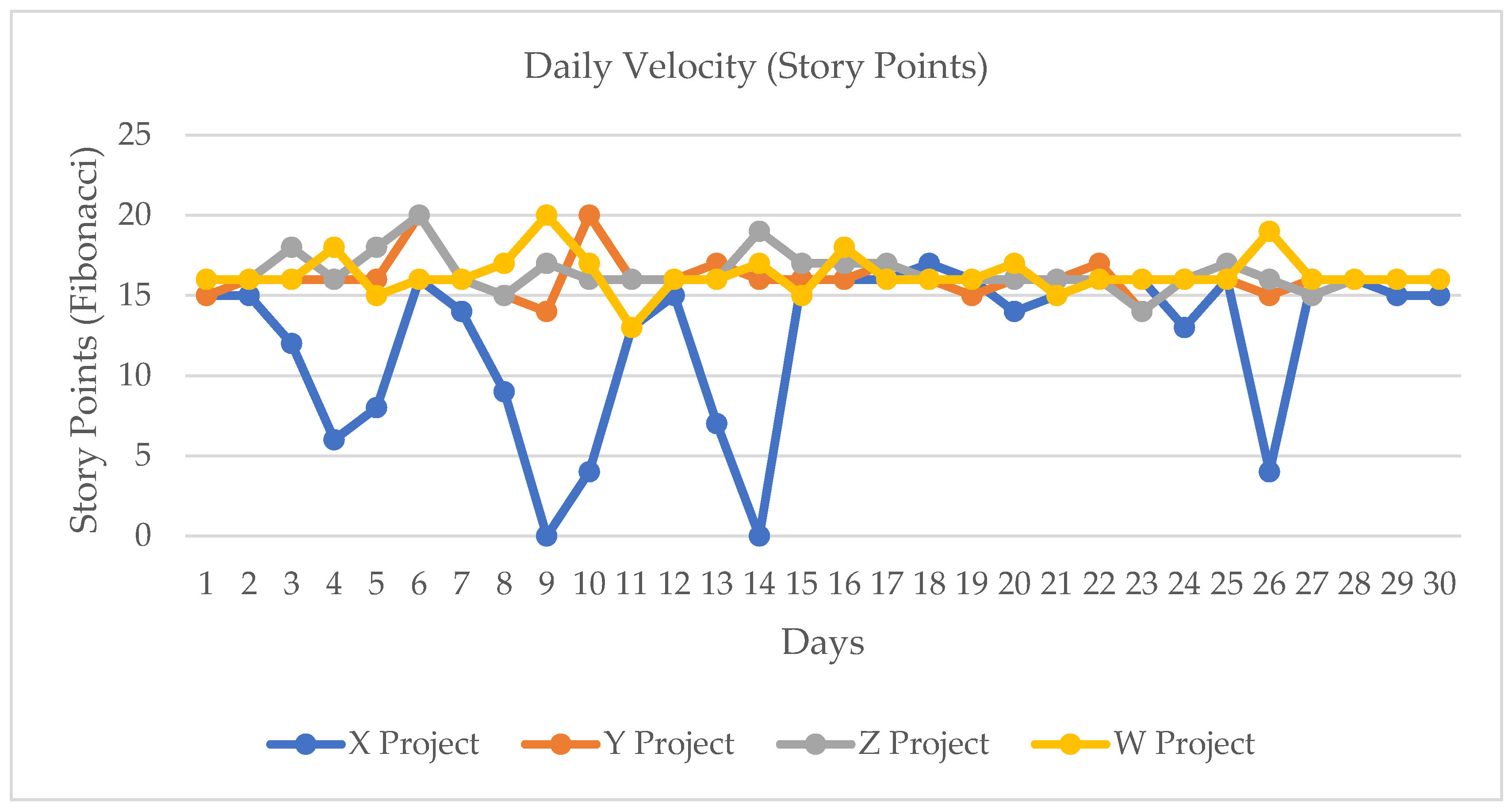
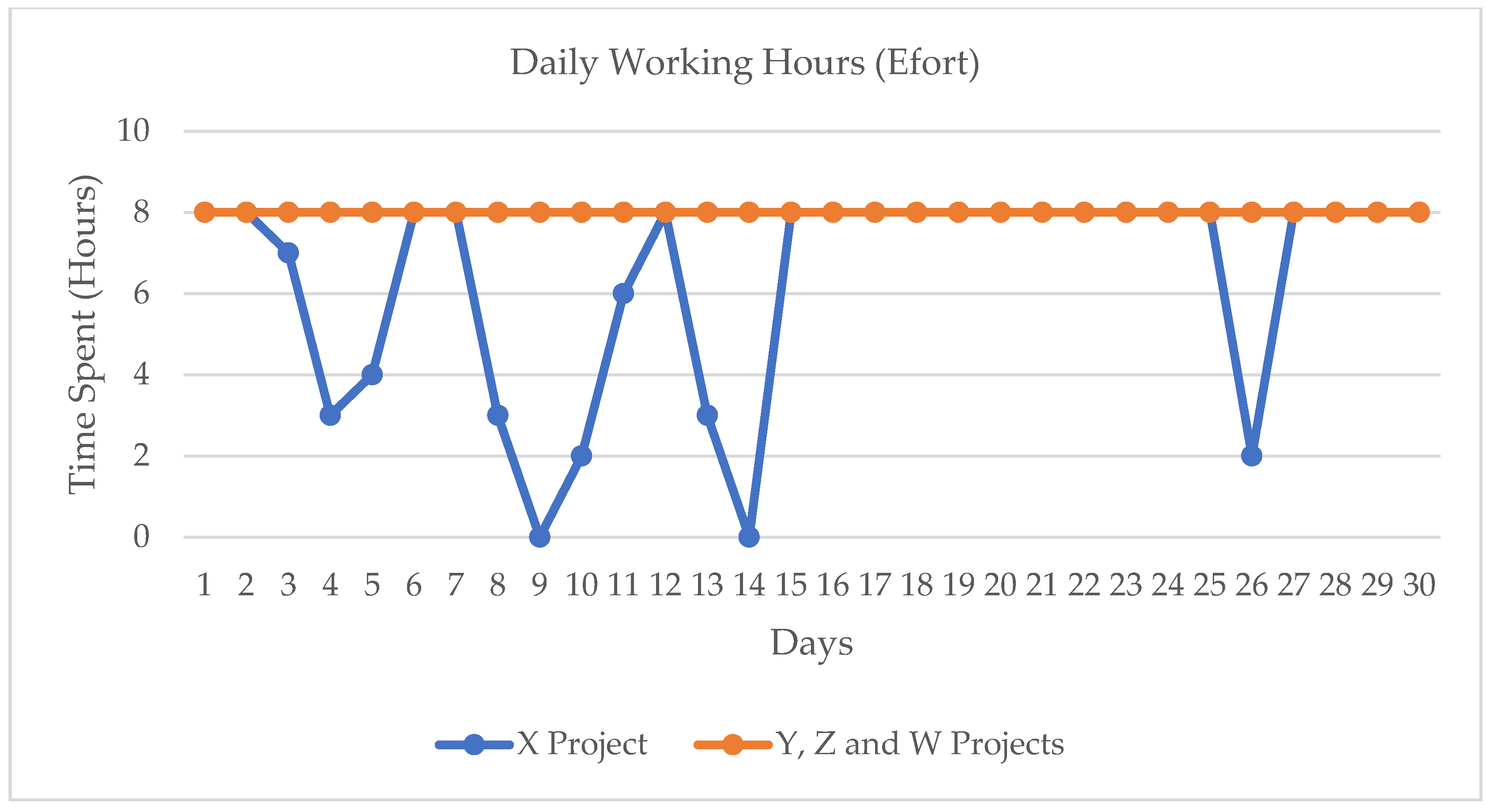
While daily planning provided high adaptability, it also introduced structural fragility into the project workflow. Planning responsibility was highly centralized, and the continuity of development was directly dependent on the Team Lead’s daily availability. During the observation period, several disruptions occurred due to unforeseen infrastructure issues and the temporary absence of the Team Lead. When daily planning could not be performed, team members were forced to rely solely on previously stocked tasks. As the available backlog was insufficient, significant portions of planned working time remained unused, leading to reduced productivity and idle capacity.
Figure 1 and
Figure 2 illustrate these effects by correlating daily completed work units with actual working hours. Notably, productivity dropped sharply on days when planning was delayed or omitted, despite team members being available. These findings indicate that although daily planning maximizes agility, it creates a single-point-of-failure risk and amplifies the negative impact of short-term disruptions. Over time, this planning model proved unsustainable, particularly in scenarios involving parallel responsibilities, operational interruptions, or team leader unavailability.
3.3. Project Y: Weekly Planning and Moderate Feedback Cycles
Project Y adopted a weekly planning cycle, balancing adaptability and stability. At the beginning of each week, a planning and handover meeting (not exceeding 20 min) was conducted to assign tasks. Short daily stand-up meetings (maximum 15 min) were used to monitor progress and identify blockers. Compared to Project X, this structure significantly reduced planning overhead and provided developers with a more predictable workflow.
The weekly planning horizon mitigated the dependency on the daily availability of the Team Lead. Even when short-term interruptions occurred, the team was able to continue working on pre-planned tasks without significant idle time. However, the reduced planning frequency limited responsiveness to requirement changes arising mid-week. Adjustments often had to be deferred until the next planning session, introducing a moderate delay in course correction. Despite this limitation, Project Y demonstrated a more stable productivity pattern than Project X, as reflected in the working hour utilization and work unit completion trends.
3.4. Project Z: Two-Week Sprints and Structured Adaptability
Project Z implemented a two-week sprint-based planning model consistent with Scrum practices discussed in
Section 2.2. Sprint planning meetings at the start of each cycle were limited to 30 min, during which sprint goals and task scope were clearly defined. Daily stand-up meetings were maintained to support transparency and continuous feedback throughout the sprint.
The two-week planning horizon enabled the inclusion of more comprehensive tasks within a single cycle while maintaining sufficient feedback frequency to detect misalignment early. Importantly, the pre-defined sprint backlog reduced reliance on the continuous presence of the Team Lead. Even when unexpected absences or parallel responsibilities arose, the team maintained a steady workflow by progressing through the planned sprint tasks.
Analysis of
Figure 1 and
Figure 2 shows that Project Z achieved the most consistent utilization of working hours and the least variance in daily completed work units. Furthermore, when the sprint workload fell below expectations, team members were able to pull additional tasks from previous sprints, improving both motivation and overall efficiency. Although feedback cycles were longer than in Project X, the stability gained outweighed the loss in immediacy.
3.5. Project W: Mobile Development with Two-Week Sprints
Project W adopted the same sprint-based development approach as Project Z, operating with two-week sprint cycles. Sprint planning meetings were conducted at the beginning of each cycle, and progress was continuously monitored through daily stand-up meetings.
This structure enabled the effective management of requirements specific to mobile application development, particularly those related to UI/UX coordination and cross-platform compatibility. At the same time, the stability and continuity provided by the structured sprint-based approach were preserved.
3.6. Comparative Findings and Link to Theoretical Framework
The comparative analysis confirms the theoretical arguments presented in the Background of the Study. Daily planning, while offering maximum agility, introduces significant operational risk and planning overhead, particularly when responsibility is concentrated in a single role. Weekly planning provides improved stability but may limit rapid responsiveness. Two-week sprint planning offers a balanced structure that combines predictable workflow, manageable planning overhead, and effective feedback cycles.
These findings empirically support the notion of sprint duration as a strategic variable rather than a procedural detail. Consistent with the “golden mean” discussed in
Section 2.4, the two-week sprint model demonstrated the highest resilience and sustainability across the observed projects. This suggests that sprint duration should be deliberately tailored to project dynamics, team structure, and organizational context, rather than adopted as a fixed convention.
It should be noted that the projects examined in this study were conducted within a small-scale startup environment. In larger organizations, roles such as Scrum Master and Team Lead are typically distributed across multiple individuals, allowing critical responsibilities to be shared and reducing dependency on any single role.
In contrast, startup or small-scale organizations often operate with limited human resources and more centralized decision-making structures, making such role redundancy difficult to achieve. This limitation increases the risk of role dependency and amplifies the impact of temporary unavailability of key individuals.
These observations indicate that the operational fragility observed particularly in the daily planning model is not solely a function of sprint duration, but is also strongly influenced by organizational structure. In particular, the centralized decision-making structure observed in the examined projects appears to amplify the risks associated with frequent planning cycles. In more mature and self-organizing teams, where decision-making authority is distributed and less dependent on a single individual, these negative effects may be significantly reduced. Therefore, the impact of planning frequency should be evaluated in conjunction with contextual factors such as team composition, role distribution, and organizational maturity rather than being considered inherently disadvantageous.
4. Discussion
According to the literature, customer-related, team-related, agile-process, and project-related factors are significant predictors of agile project success, particularly in terms of process efficiency, sustainable software product quality, and stakeholder satisfaction [
35]. Among these, agile-process factors such as sprint duration emerged as the strongest predictor of sustainable software product quality, outperforming team, customer, organizational, technical, and project-related factors [
35].
This study investigated the impact of work planning frequency and sprint duration on project performance by analyzing four software development projects with identical requirements and comparable scope. To the best of our knowledge, this study is among the first to empirically analyze sprint duration as a controlled design variable in startup-like environments. The findings demonstrate that daily, weekly, and bi-weekly planning approaches produce markedly different outcomes in terms of team efficiency, workflow continuity, and effective utilization of resources. Contrary to the common assumption that shorter planning cycles inherently increase agility and performance, the results indicate that excessive reduction of planning horizons may introduce structural fragility and operational risk rather than improving project flow.
The case of Project X illustrates the limitations of ultra-short planning cycles. Although daily planning maximized feedback frequency and allowed rapid reaction to short-term changes, it also created a strong dependency on a single planning authority. When the Team Lead was temporarily unavailable due to infrastructure issues, a health-related absence, or competing responsibilities, the entire planning mechanism was disrupted. As reflected in the work unit and working-hour distributions, these disruptions resulted in idle time, underutilized capacity, and inconsistent productivity. While the presence of pre-prepared or “stocked” tasks partially mitigated these effects in the short term, it proved insufficient to ensure sustainable workflow continuity. This finding supports the argument that daily planning, particularly in small teams with centralized decision-making, represents an operational anti-pattern rather than an advanced form of agility.
In contrast, Projects Y, Z and W, which employed weekly and bi-weekly planning structures, exhibited significantly higher stability and resilience. Extending the planning horizon reduced the sensitivity of the development process to short-term disruptions and enabled the team to maintain productivity even in the temporary absence of the Team Lead. These results align with the theoretical advantages of time-boxed iterations discussed in the agile and Scrum literature, where fixed planning intervals are used to balance adaptability with predictability. Moreover, the ability to pull additional tasks from previous planning cycles when anticipated workload was completed early contributed positively to team motivation and optimized the use of available working time.
A particularly noteworthy finding is that the two-week sprint structure implemented in Projects Z and W achieved the most consistent balance between flexibility and control. While the feedback cycle was longer than in daily or weekly planning, it remained sufficiently short to detect deviations and quality issues before they accumulated into significant rework. At the same time, the reduced frequency of planning and handover meetings minimized coordination overhead and cognitive load in the team. These observations empirically support the concept of a “golden mean” sprint duration proposed in prior studies, which suggests that two-week cycles offer an optimal compromise between rapid feedback and sustainable development capacity.
From a broader perspective, the findings highlight that sprint duration should be treated as a strategic design parameter rather than a procedural detail. The effectiveness of agile practices is not determined solely by adherence to framework prescriptions but by how well core elements such as planning frequency, role distribution, and feedback mechanisms are aligned with project context and organizational constraints. Over-optimization for agility, particularly through excessively short planning cycles, may undermine the very objectives agile methodologies aim to achieve.
The findings of this study should be interpreted within the context of small-scale, startup-like environments, where team structures are typically more centralized and role redundancy is limited. In larger and more mature organizations, responsibilities such as Scrum Master and Team Lead are often distributed across multiple individuals, which may reduce dependency on a single role and mitigate some of the observed risks. Therefore, the applicability of the results to large-scale or highly decentralized teams may be limited, and caution should be exercised when generalizing these findings beyond similar project settings.
Overall, the discussion reinforces the central argument of this study: agile effectiveness emerges not from maximizing the frequency of planning or feedback in isolation, but from achieving a balanced interaction between adaptability, stability, and resource utilization. Weekly and bi-weekly planning approaches, especially when combined with clear task ownership and backlog management, provide a more robust foundation for sustainable agile project execution. While the two-week sprint is often cited as an industry convention, this study provides empirical and comparative evidence supporting its effectiveness under controlled and context-specific conditions. These insights contribute to both academic understanding and practical guidance by demonstrating how deliberate adaptation of sprint duration can enhance strategic effectiveness in agile software development.
5. Conclusions
This study investigated the strategic impact of planning frequency and sprint duration on agile project effectiveness by analyzing four software development projects with identical requirements and comparable scope. The findings demonstrate that agility cannot be achieved simply by shortening planning cycles or increasing the frequency of coordination activities. While frequent planning is often associated with enhanced flexibility, the results of this study show that excessively short planning intervals may introduce operational fragility, disrupt workflow continuity, and reduce the effective utilization of team capacity.
The empirical evidence from Project X illustrates that daily planning approaches are highly sensitive to role dependency and short-term disruptions. In small teams with centralized planning responsibilities, the unavailability of a single key role can significantly impair productivity, leading to idle time and unstable project flow. These observations indicate that daily planning, despite its theoretical appeal in terms of rapid feedback, is difficult to sustain in practice and may increase operational risk rather than improve agile performance.
In contrast, the weekly and bi-weekly planning approaches examined in Projects Y, Z and W provided a more balanced and resilient structure. Extending the planning horizon reduced the project’s sensitivity to unexpected events, supported more consistent utilization of working time, and enabled teams to maintain productivity even in the temporary absence of planning authority. In particular, the two-week sprint model demonstrated the most effective balance between adaptability and stability, aligning with the concept of a “golden mean” sprint duration frequently discussed in the agile literature.
The comparative results provide clear quantitative evidence supporting the proposed recommendations. For example, projects using daily planning exhibited significantly higher delivery delays (23 days) and defect counts (57 bugs) compared to weekly planning (8 days delay, 32 bugs) and two-week sprint planning (1–2 days delay, 17–23 bugs). This corresponds to a reduction of over 65% in delivery delays and approximately 50–70% in defect-related indicators when transitioning from daily to longer planning horizons under comparable conditions.
These findings indicate that excessively short planning intervals may introduce measurable inefficiencies, while two-week sprint structures provide a more balanced and stable configuration in terms of both delivery performance and short-term software quality.
From a broader perspective, the study reinforces the argument that sprint duration should be treated as a strategic design parameter rather than a procedural convention. Agile effectiveness emerges from aligning planning frequency, role distribution, and feedback mechanisms with project dynamics and organizational constraints. Over-optimization for agility through excessively short cycles may undermine the fundamental goals of agile methodologies, including sustainable development and predictable delivery.
Based on the findings of this study, several practical recommendations can be derived for project managers and development teams when adapting agile approaches to specific project contexts. First, excessively short planning intervals, such as daily planning, should be applied with caution, as they may introduce operational fragility and increased coordination overhead, particularly in environments where critical responsibilities are concentrated in a limited number of roles. Second, longer planning horizons, such as weekly planning, may improve workflow stability but can reduce responsiveness to rapid changes. Third, the results indicate that a two-week sprint structure provides a balanced configuration, offering predictable workflow, manageable planning overhead, and effective feedback cycles, making it a robust choice across similar project settings.
Furthermore, sprint duration should be treated not as a fixed procedural parameter but as a strategic design variable that must be aligned with project characteristics. In particular, factors such as team structure, role distribution, and organizational context play a critical role in determining the effectiveness of planning frequency. In small-scale or startup environments, where role redundancy is limited, the risks associated with very short planning cycles may be amplified. Therefore, agile practices should be adapted holistically, considering both process design and organizational constraints to achieve sustainable and resilient project outcomes.
In conclusion, this study contributes to both academic research and practical application by providing empirical evidence that weekly and bi-weekly sprint structures offer more sustainable and effective planning horizons than daily planning in most software development contexts. These findings offer actionable guidance for practitioners seeking to modernize agile practices without compromising stability and highlight the importance of deliberate sprint duration selection as a key factor in strategic agile project management.
6. Limitations and Future Research
Despite the valuable insights provided by this study, several limitations should be acknowledged. First, the empirical analysis is based on a limited number of case projects conducted within a single organizational environment. Although the projects were designed with identical requirements and comparable scope to isolate the effects of planning frequency and sprint duration, the findings may not be directly generalizable to all software development contexts. Variations in organizational culture, domain complexity, team maturity, and tooling may influence how sprint duration impacts project outcomes.
Second, the case study involved relatively small teams with clearly defined and centralized roles. While this structure enabled controlled observation of planning dependencies, it may not fully represent large-scale or distributed agile teams, where decision-making authority, coordination mechanisms, and communication patterns differ significantly. Consequently, the observed effects of daily, weekly, and bi-weekly planning may vary in environments with higher team autonomy or decentralized planning structures.
Third, the evaluation of project performance focused primarily on workflow continuity, utilization of working time, and qualitative productivity indicators derived from work unit and working-hour analyses. Although these metrics provide meaningful insights into operational efficiency, the study did not incorporate additional quantitative measures such as defect density, customer satisfaction, delivery lead time, or long-term technical debt. The absence of these dimensions limits the ability to assess the broader impact of sprint duration on software quality and business outcomes.
Another limitation of this study is the relatively short observation period, which focuses on short- to medium-term process dynamics. Long-term effects, such as the accumulation of technical debt, maintainability issues, or evolving product quality, were not directly measured within the scope of this research. Future studies may benefit from longitudinal designs that examine how different sprint durations influence long-term software quality and sustainability over extended development cycles.
These findings suggest that sprint duration should not be evaluated as an isolated parameter, but rather as part of a broader system involving team structure, organizational context, and project dynamics. This reinforces the importance of context-aware adaptation of agile practices rather than relying on universally fixed configurations.
Future research can address these limitations in several ways. Expanding the number of case studies across multiple organizations and industry domains would enhance the external validity of the findings and enable cross-contextual comparison. Further studies could also investigate sprint duration effects in large-scale or distributed agile environments, particularly in conjunction with scaled agile frameworks such as SAFe or LeSS.
Additionally, future research may integrate quantitative quality metrics and longitudinal data to examine how different sprint durations influence technical debt accumulation, maintainability, and customer-perceived value over extended project lifecycles. Experimental or simulation-based studies could also be employed to systematically test hybrid planning models, including adaptive or dynamic sprint durations that evolve in response to project maturity, team experience, or system complexity.
Overall, these directions offer promising opportunities to deepen understanding of sprint duration as a strategic variable in agile project management and to refine guidance for tailoring agile practices to diverse organizational and project contexts.