1. Introduction
Physical literacy (PL) has emerged in the last two decades as a core construct in physical education, sport, and public health. Based on Whitehead’s philosophical framework, PL is commonly defined as the motivation, confidence, physical competence, knowledge, and understanding that enable individuals to value and take responsibility for lifelong engagement in physical activity [
1,
2]. PL has several domains, such as physical, cognitive, affective and social dimensions, and involves a holistic journey throughout the life course with special relevance in education and health [
3]. In line with this conceptualization, national and international frameworks such as WHO Global Action Plan on Physical Activity 2018–2030, UNESCO’s Guidelines on Quality PE, and the current Spanish education law (LOMLOE) have positioned PL as a central educational aim for promoting lifelong active and healthy lifestyles [
4,
5,
6].
Adolescence is a critical developmental period for PL. More than 80% of adolescents aged 11–17 years do not meet physical activity recommendations. This phenomenon has been relatively stable in the last decade [
7] and is especially worrying in the case of female adolescents, with more than 84% not meeting the recommendations [
8]. Higher levels of PL have been associated with enhanced cardiorespiratory fitness and higher physical activity levels [
9,
10]. This suggests that improving PL may enhance physical activity and physical well-being in children and adolescents. In line with this hypothesis, a recent meta-synthesis study explored the effects of PL interventions on several crucial variables related to engagement in lifelong physical activity [
11]. Specifically, the authors observed improvements in affective and psychological capabilities, including enhanced enjoyment, self-awareness, confidence, motivation, resilience, and self-worth; social capabilities, with evidence of increased engagement, collaboration, leadership, improved behavior, strengthened peer relationships, and greater social interaction; physical/motor capabilities, involving fundamental movement skills, coordination, object manipulation, and sport-related competence; and cognitive outcomes such as increased knowledge and awareness of physical activity, enhanced problem-solving, strategy and planning skills, improved focus and tactical reasoning, and greater body awareness.
PL is extremely important in childhood and adolescence because sedentary behaviors often increase during the transition to young adulthood [
12], which may be a major public health challenge. PL might be a potential determinant of health across the life span, since it represents a multidimensional, reciprocal engagement cycle integrating motor competence, motivation, positive affect, social processes, and knowledge [
13]. Thus, PL may promote sustained participation in physical activity, which in turn induces physiological, psychological and social adaptations that are associated with reduced risk of chronic disease and enhanced wellbeing. From this framework, higher PL in childhood and adolescence may contribute to more active habits and healthier profiles in adulthood.
As a multidimensional variable, PL may be divided into several domains or components. In the review and meta-analysis by Jiang et al. [
10], four domains were identified based on the scientific articles included: (a) physical competence, (b) daily behavior, (c) knowledge and understanding, and (d) motivation and confidence [
10]. However, other domains such as affective/psychological capabilities, social capabilities, physical/motor capabilities, and cognitive capabilities [
11] have been suggested. This conceptual multidimensionality, together with the context-dependent nature of PL, makes valid assessment methodologically challenging. A recent systematic review identified a range of PL assessment tools and concluded that most available instruments focus narrowly on either fundamental movement skills or physical fitness, while only a minority of tools assess affective, cognitive and physical components in an integrated way [
14].
Among the developed tools to evaluate PL, the Perceived Physical Literacy Instrument (PPLI) is one of the most widely used self-report scales. Sum et al. [
15] originally created an 18-item instrument for physical education teachers, derived from an extensive literature review, focus groups with experienced teachers, and expert panel review [
15]. Exploratory and confirmatory factor analysis in a sample of Hong Kong physical education teachers yielded a three-factor structure that included (a) sense of self and self-confidence, (b) self-expression and communication with others, and (c) knowledge and understanding. The final version comprised 9 items with satisfactory reliability and model fit. Subsequently, the same 9-item tool was validated with a large sample of Hong Kong adolescents aged 11–19 years, showing good factorial validity, convergent and discriminant validity, and measurement invariance across gender [
16]. In this study, the authors emphasized that the item wording was “generic” and not tied to a specific profession, which facilitated use of the teacher-based items with a sample comprising adolescents without further qualitative redevelopment.
The 9-item PPLI has been translated and validated in several countries and across different age groups. In Spain, Mendoza-Muñoz et al. [
17] validated a Spanish version for adults derived from the original 18-item version of the PPLI. The authors conducted both an exploratory factor analysis (EFA) and a confirmatory factor analysis (CFA) and reported a valid tool version with good internal consistency, involving 9 items grouped into three dimensions: (1) physical competence, (2) motivation and confidence, and (3) knowledge and understanding. Similarly, López-Gil et al. [
18], performed a cross-cultural adaptation and psychometric validation of the 9-item version (S-PPLI) in a sample of 360 Spanish adolescents aged 12–17 years. In this case, the authors used the reduced 9-item version validated in Hong Kong adolescents and conducted only a CFA with the Spanish sample. Their results supported the three-factor structure, with acceptable internal consistency, moderate–good test–retest reliability, and adequate convergent and discriminant validity. However, from both theoretical and measurement perspectives, this validated version has several relevant limitations. First, the item reduction from 18 to 9 items was conducted exclusively with a sample of physical education teachers, using their responses to decide which items to retain or discard [
15]. It is therefore unclear whether the items that best discriminated among experienced adult professionals are also optimal for adolescents’ perceptions, given their different life contexts, responsibilities, and needs. Moreover, the 9 retained items represent only part of the original content domain. For instance, items concerning establishing friendships through sport or turning sport into an ongoing life habit were removed during the teacher-based psychometric trimming. Thus, based on the perspective of Whitehead’s framework [
2,
19] and recent pedagogical models of PL in physical education, these omitted elements may be highly relevant to assess a holistic construct such as PL. In addition, reviews of PL assessment have warned that many instruments, including frequently used questionnaires, risk oversimplifying the construct, over-emphasizing selected components (often physical competence), and under-representing its dispositional and lifelong character [
14].
Given these considerations, the present study aimed to evaluate the validity and test–retest reliability of a Spanish adaptation of the original 18-item PPLI in adolescents aged 11–18 years. By retaining all original items, we aimed to (1) consider the full holistic scope of the PL construct as originally conceptualized through extensive literature review, focus groups, and expert panel review [
15]; (2) analyze which items best capture perceived PL in the Spanish adolescent context, potentially different from the teacher-based item selection; (3) generate new Spanish items and psychometric data that reflect adolescent perspectives and realities; and (4) create a more comprehensive measurement tool, as well as to explore the possibility of developing a short form for some context where the number of items and the response time are decisive.
4. Discussion
In the present study, we aimed to examine the factorial validity, reliability, and longitudinal stability of a Spanish adaptation of the original 18-item Perceived Physical Literacy Instrument (PPLI) in adolescents aged 11–18 years. By retaining the full original item pool, we re-evaluated the dimensional structure of the instrument within a different cultural and developmental context and determined whether the multidimensional structure originally identified in physical education teachers [
15] was adequate in a Spanish adolescent sample. Although exploratory analyses initially supported a three-factor solution broadly consistent with the conceptual domains of Whitehead’s physical literacy (PL), some limitations were identified. Subsequent confirmatory analyses consistently indicated that a strong general factor accounted for the majority of shared variance among items, which may indicate a one-dimensional structure. Based on this finding, we developed a short 5-item version with acceptable validity and reliability for potential use in Spanish adolescents. However, due to the complexity of the PL concept, brief questionnaires might fail to measure the full philosophical breadth of the construct. Thus, the 5-item version must be understood as a brief screening-oriented measure of perceived PL, capturing a core general dimension but not the totality of the construct.
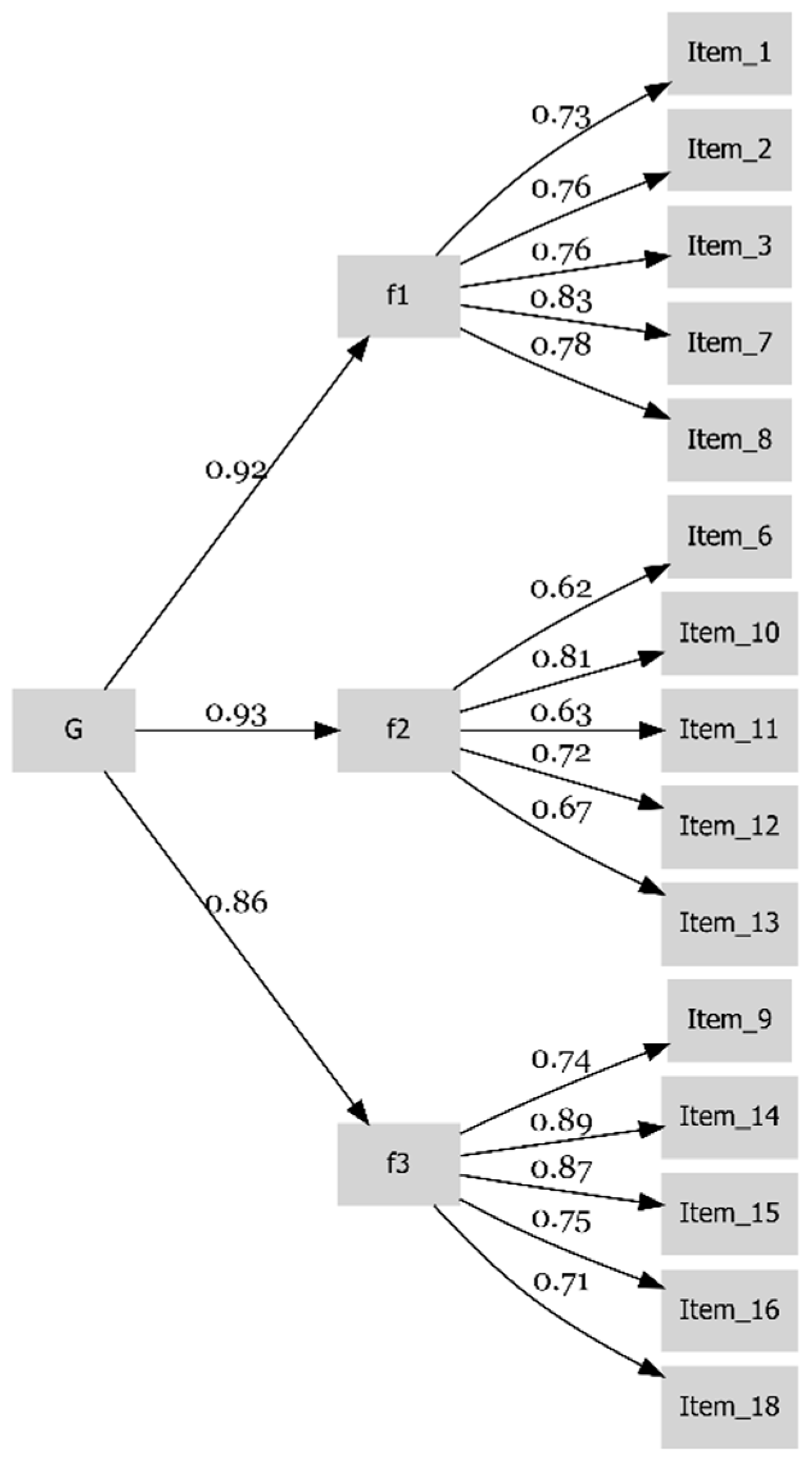
With respect to the three-dimensional structure, the Exploratory Factor Analysis (EFA) showed that 15 items provided the best fit in this sample of Spanish adolescents. This stands in contrast to the 9-item structure found by Sum et al. [
15,
16]. These differences may reflect contextual and educational factors rather than simple psychometric weakness. PL should be defined within specific social and pedagogical environments, and the meanings attached to movement, sport, health, autonomy, and social interaction may differ across countries and cultures. Similar to the findings of previous validation studies [
15,
16,
17], our EFA results indicated three first-order factors. The first factor, which may be labelled Perceived Physical Competence and Self-Regulation, including items 1, 2, 3, 7, and 8, primarily assesses adolescents’ perceptions of motor competence, physical fitness, and self-regulation of physical activity behavior. Conceptually, this domain overlaps substantially with the sense of self and self-confidence dimension described by Sum et al. [
15,
16], particularly with respect to confidence in movement and perceived competence. The second dimension may be labelled Adaptive and Social Competence, including items 6, 10, 11, 12, and 13. It integrates social and communication competence, environmental adaptability, and the functional application of knowledge. It closely resembles the self-expression and communication with others domain identified by Sum et al. [
15,
16], but extends it by incorporating elements of adaptability and long-term knowledge application that were previously associated with the knowledge and understanding dimension in Sum et al.’s [
15,
16] version. The third dimension, which may be termed Motivation for Lifelong Engagement in Sport, consisted of items 9,14, 15, 16, and 18. This domain reflects intrinsic orientation toward healthy, long-term commitment to physical activity. While motivational aspects were embedded across the original three domains proposed by Sum et al. [
15,
16], this cluster represents a more explicit and cohesive motivational–behavioral orientation toward sustained participation.
Although these three domains partially overlap with the three-factor structure originally proposed by Sum et al. [
15,
16] (sense of self and self-confidence, self-expression and communication with others, and knowledge and understanding), the present findings suggest a more integrated configuration. In particular, the knowledge component appeared embedded in the competence and adaptive domains, instead of isolated as a proper domain. This pattern is consistent with Whitehead’s conceptualization of physical literacy as a holistic and integrated concept [
2]. However, factorial structures may vary depending on educational contexts and language adaptation processes, suggesting potential cultural influences of the Spanish culture and physical education context. In this regard, the current Spanish education law, which positions physical literacy as a core aim for promoting active and healthy lifestyles [
4,
5,
6], may have influenced the present results. Future research in Spanish adolescent populations should further explore this hypothesis.
To compare the proposed 15-item version and Sum et al.’s [
15,
16] 9-item version, we analyzed their model fit with the present dataset. Overall, the 9-item model also exhibited adequate fit, which supports the notion that the same item may be interchangeably allocated into different dimensions and, consequently, that the multidimensionality of the scale may be controversial. This also supports the re-examination of the full content domain within the target population rather than assuming cross-contextual invariance of item functioning. In this regard, Spanish adolescents may differ substantially from physical education professionals from Hong Kong. Therefore, the psychometric reduction conducted in teachers may not fully generalize to youth populations. By retaining and re-evaluating all 18 items, this study provides new evidence that some previously discarded indicators may contribute meaningfully to the general construct when examined in adolescents. This reinforces the importance of population-specific validation rather than direct transplantation of shortened versions.
Although this three-factor structure showed acceptable fit, aligning with previous validations of the PPLI in both adult teachers and adolescents, subsequent confirmatory analyses consistently revealed some limitations that should be considered when using this structure. Specifically, very high loadings and high correlations between items and factors are commonly interpreted as evidence of essential unidimensionality rather than meaningful multidimensionality [
47,
50]. Furthermore, the internal consistency observed for the 15-item version (ω = 0.919) is relatively high. Although this indicates excellent reliability, it may also reflect some degree of item redundancy or content overlap, which should be considered in future applications. Therefore, while the three factor versions are valid, a unidimensional version of the PPLI may be adequate based on this study’s data. However, due to the complexity and multidimensional nature of PL, psychometric essential unidimensionality at the instrument level should not be interpreted as theoretical reductionism at the construct level.
Given such dominance of the general factor at the measurement level and with the aim of providing a reduced instrument suitable for specific settings, a 5-item unidimensional short form was developed and cross-validated. The short form demonstrated high factor loadings (λ = 0.70–0.79), adequate convergent validity (AVE = 0.558), high composite reliability (ω = 0.821), a similar test–retest reliability to the other tested models (ICC = 0.69), and full longitudinal configural, metric, and scalar invariance. Importantly, the five-item version achieved temporal stability comparable to the 9- and 15-item versions, despite containing substantially fewer items. This indicates that the short form preserves essential psychometric properties while substantially reducing respondent burden, which may be useful for large-scale epidemiological studies, school-based screening, or intervention monitoring where assessment time is constrained.
The content of this 5-item version mainly focuses on the domains of perceived physical competence, self-regulation, and motivation for lifelong physical activity. In contrast, items representing social and adaptive competence in physical activity contexts were not retained in the short form. In addition, compared with the three domains originally proposed by Sum et al. [
15,
16], the short form strongly reflects sense of self and self-confidence, as well as knowledge and understanding. However, again, it does not reflect self-expression and communication with others. This pattern suggests that the short form is assessing the core components of perceived physical literacy, with emphasis on perceived physical competence, self-regulatory capacity, and motivational orientation toward lifelong engagement in physical activity, but excluding the social and communicative skill assessment.
According to our findings, the 9- and 15-item versions may be valid and reliable, so researchers and educators may select the instrument version according to their objectives. The 15-item three-factor model may be useful when interest lies in exploring domain-specific patterns, while the five-item unidimensional short form may be recommended when there is time restriction and the goal is to rapidly assess the global construct. The 9-item version can also be used to compare with other international studies that have used that structure. Another main difference among the three versions is the inclusion of the social component, which has been highlighted by previous studies as part of a broader, holistic view of the concept of PL [
53,
54]. However, empirical assessment tools often prioritize physical competence and motivation/confidence, with the social component appearing less consistently as an independent latent domain [
14]. Therefore, when the aim is the assessment of PL with special emphasis on the social and communicative components, the 15-item version would be preferable because it includes three related items (Items 10, 11, and 16), whereas the 9-item version includes only one (Item 11) and the 5-item version includes none.
From a practical perspective, the promotion of PL in children and adolescents is a promising strategy for promoting lifelong engagement in physical activity and improving health outcomes. A wide range of movement experiences, including dance, fitness activities, games, gymnastics, individual sports, and outdoor activities, may contribute to the development of PL and, consequently, enhance physical activity participation and health-related outcomes [
55]. In addition, interventions that extend beyond the school setting, incorporating family or home-based components, may provide further benefits [
56]. Although the integration of PL into school curricula is encouraging, the effectiveness of these initiatives requires further empirical evaluation [
55]. In this context, the PPLI may serve as a brief and efficient screening tool to assess PL before and after an intervention. The 5-item version, due to its short administration time, can be easily implemented at the beginning and end of a teaching unit to monitor changes in students’ perceived physical literacy, particularly in terms of motivation, perceived competence, and engagement in physical activity. When a more comprehensive assessment is required, the 15-item version may be used to capture a broader range of domains.
Several limitations should be considered. First, item selection was guided by both statistical and theoretical considerations, so replication in independent samples may be recommended. Second, although the short form is valid and reliable, some PL domains are not assessed using this version, such as the social and communicative one. Furthermore, it does not permit the assessment of any possible subscale-specific variance, so respective interpretations are limited. Third, although the sample size was adequate and involved public and private institutions from urban and rural areas of the western, northern, eastern and southern regions of Spain, representativeness may not be ensured. Despite these limitations, the current study provides an in-depth analysis of the PPLI structure, which is one of the PL assessment tools with the highest level of validity [
14], based on the 18 initial items developed by Sum et al. [
15] and comparing between three different options.




 ,
,