1. Introduction
Urban traffic signal control systems play a critical role in regulating dynamic traffic conditions and maintaining overall network efficiency. Because traffic demand fluctuates significantly throughout the day due to commuting patterns, commercial activities, and land-use characteristics, signal timing strategies should adapt to temporal variations in traffic flow. Among various operational strategies, time-of-day (TOD) control is one of the most widely implemented approaches in urban signal systems.
TOD operation divides a day into multiple predefined periods, each associated with a specific signal timing plan. Ideally, these operational periods should correspond to meaningful changes in traffic conditions at the network level. However, in many practical applications, TOD boundaries are determined using fixed clock-based intervals, historical conventions, or engineering judgment. Such approaches often rely on simplified assumptions about traffic patterns and may not adequately capture actual transitions between traffic states. As a result, signal performance at the network level may not fully reflect evolving traffic conditions, leading to increased variability within operational periods and reduced overall efficiency.
Recent advances in traffic detection technologies have enabled the continuous collection of large-scale traffic data from urban road networks. Vehicle detection systems (VDSs) provide high-frequency traffic volume observations that allow detailed characterization of temporal traffic patterns. Despite the availability of such data, systematic methodologies for deriving TOD boundaries directly from observed network-level traffic patterns remain limited. Furthermore, many existing studies focus on corridor-level optimization or do not explicitly incorporate operational constraints required for real-world signal implementation.
These limitations highlight the need for a data-driven framework that integrates large-scale detector data analysis with network-level signal operation principles. Accordingly, this study proposes a clustering-based approach for determining optimal TOD boundaries for urban signal control using traffic detector data. One-year traffic volume data recorded at 15-min intervals are analyzed to construct representative daily traffic patterns at the network scale. Homogeneous temporal traffic states are identified through clustering analysis, and TOD boundary points are determined based on transitions between distinct traffic states. To enhance practical applicability, a minimum segment length constraint is incorporated to ensure operational feasibility.
The main contributions of this study are summarized as follows:
Development of a network-level, data-driven framework for TOD boundary optimization in urban signal control using large-scale traffic detector data.
Integration of operational feasibility constraints through a minimum segment length condition to ensure implementability in real-world signal systems.
Quantitative validation demonstrates improved temporal homogeneity compared with conventional fixed TOD configurations.
This study bridges the gap between data-driven traffic pattern analysis and practical network-level signal control implementation.
2. Related Work
2.1. Conventional Time-of-Day Segmentation in Signal Control
Time-of-day (TOD) signal operation has long been adopted to accommodate temporal variations in traffic demand within urban signal control systems. Conventional TOD segmentation is typically determined based on historical traffic observations, engineering judgment, and predefined peak-hour intervals [
1,
2]. While such approaches are practical and widely implemented in signal practice, they often rely on fixed clock-based boundaries that may not adequately reflect dynamic traffic state transitions at the network level.
In Korea, several studies have investigated TOD breakpoint optimization and field-based evaluations at arterial intersections [
2]. Although these studies enhanced breakpoint selection through empirical analysis and optimization techniques, most applications were limited to specific corridors or individual intersections. Moreover, they generally assumed relatively stable traffic patterns and did not explicitly address network-wide traffic variability.
As urban traffic systems become increasingly complex and interconnected, signal operations require segmentation strategies that reflect dynamic, network-level traffic conditions rather than relying on static or heuristic boundary definitions. However, these studies do not explicitly address network-level signal coordination or the derivation of TOD boundaries from aggregated urban traffic demand patterns. In addition, previous research has explored time-of-day-based routing and scheduling strategies to account for temporal variations in traffic conditions, further highlighting the importance of accurate temporal segmentation in transportation systems [
3].
2.2. Clustering-Based Traffic State Identification
Clustering techniques have been widely applied in traffic analysis to identify homogeneous traffic states and representative temporal patterns. K-means clustering and other unsupervised learning methods have been used to classify traffic conditions, detect congestion patterns, and segment temporal variations in traffic flow [
4,
5,
6,
7]. In particular, the performance of K-means clustering can be influenced by the selection of initial centroids, which has been extensively studied in the literature [
8]. These approaches enable data-driven classification of traffic states without predefined thresholds.
The quality of clustering results is commonly evaluated using validation metrics such as the silhouette score [
9,
10], which assesses the cohesion and separation of clusters.
In the Korean context, clustering-based approaches have also been applied to traffic volume analysis and signal-related studies. Mixed clustering techniques have been used to estimate peak-hour factors [
11], and dynamic time warping-based clustering has been employed to optimize TOD segmentation [
12]. Additionally, traffic pattern learning methods have been explored for multi-intersection signal control [
13].
Despite these advancements, most clustering-based applications have focused on localized analyses or specific performance indicators rather than systematic TOD boundary determination for network-level signal control. While clustering methods have demonstrated effectiveness in traffic state classification, their integration into network-level TOD boundary determination for signal control remains limited.
2.3. Data-Driven Traffic Management at the Urban Scale
With the increasing availability of traffic detector data, data-driven methodologies have gained prominence in traffic management research. These approaches build upon fundamental traffic flow theories, such as the kinematic wave model [
14], which describe the macroscopic behavior of traffic dynamics.
Large-scale datasets have been widely used for traffic state recognition, prediction, and pattern extraction [
4,
5,
15,
16]. In addition, urban-scale traffic behavior and aggregated traffic dynamics have been analyzed to better understand macroscopic characteristics and network-wide performance [
17].
Despite these advances, the application of clustering-based approaches for deriving operational time-of-day (TOD) boundaries at the network level remains limited. In practice, many urban signal systems still rely on predefined and fixed segmentation structures rather than systematically derived boundaries that reflect actual traffic state transitions.
Recent studies have further explored advanced data-driven approaches, particularly deep learning frameworks that jointly capture spatial and temporal dependencies in traffic systems [
18]. Graph-based neural networks and related models have also demonstrated strong performance in traffic prediction and state representation [
19,
20].
However, most of these studies focus primarily on predictive accuracy or data representation, rather than the derivation of interpretable and operationally applicable traffic segmentation structures.
Therefore, there remains a need for a comprehensive framework that integrates clustering-based traffic state identification with operational feasibility constraints to determine practical and implementable TOD boundaries using real-world traffic detector data. In this context, the present study focuses on identifying interpretable temporal traffic states and deriving practical TOD boundaries that can be directly applied to urban signal control operations.
3. Materials and Methods
3.1. Network-Level Traffic Data for Signal Operation
This study utilizes traffic volume data collected from vehicle detection systems (VDSs) installed on major urban roads in Daejeon Metropolitan City, Republic of Korea. Since urban signal control operates at the network level, traffic data from multiple corridors were aggregated to represent overall network demand conditions.
The detectors measure directional traffic volumes at 15-min intervals, enabling continuous observation of temporal demand variations relevant to signal timing decisions. Traffic volume data were collected over a one-year period from January to December 2021. The 15-min recording interval resulted in 96 time intervals per day, providing sufficient temporal resolution for time-of-day boundary analysis.
To derive network-level TOD boundaries applicable to signal operation, traffic volumes from all available VDS locations were aggregated by time interval to generate a representative citywide traffic profile. Days with incomplete observations were excluded to maintain temporal consistency. Only daily records containing all 96 time intervals were retained for analysis.
For each 15-min time index (), average traffic volumes were calculated across all valid days. The resulting 96 average values represent the representative network-level daily demand pattern used for TOD boundary optimization.
3.2. Methodology
To determine operationally meaningful TOD boundaries for urban signal control, clustering analysis was applied to the representative network-level traffic pattern.
The average traffic volume at time index
, denoted as
, was calculated as:
where
denotes the traffic volume on day
at time index
, and
is the number of valid days.
The sequence represents the network-level daily demand profile.
K-means clustering was employed to group time intervals exhibiting similar demand characteristics. Since signal timing decisions are primarily driven by traffic demand levels, traffic volume was selected as the primary indicator for TOD boundary determination. K-means was chosen due to its interpretability and computational efficiency, making it suitable for practical implementation in signal operation analysis.
The objective of K-means is to minimize the within-cluster sum of squared errors (SSE):
The optimal number of clusters was determined using the silhouette score:
After clustering, consecutive time intervals assigned to the same cluster were grouped into continuous segments. These segments represent traffic states with homogeneous demand characteristics at the network level.
TOD boundaries were defined at transition points where cluster labels changed. To ensure stability and practical applicability in signal timing plans, a minimum segment length constraint was applied. Segments shorter than the predefined minimum duration were merged with adjacent segments. In this study, the minimum segment length was set to 120 min (eight consecutive 15-min intervals), reflecting common operational practice in network-level signal control and ensuring compatibility with real-world timing plan implementation.
Although various traffic indicators such as occupancy, speed, density, and queue length can influence signal control performance, traffic volume is one of the most fundamental measures of traffic demand and is widely used in signal timing design and TOD planning. At the network scale considered in this study, the primary objective is to identify major temporal transitions in aggregate traffic demand rather than detailed operational states at individual intersections. Therefore, traffic volume was selected as the primary variable due to its widespread availability and direct relevance to signal timing design.
4. Results
4.1. Determination of the Number of Clusters
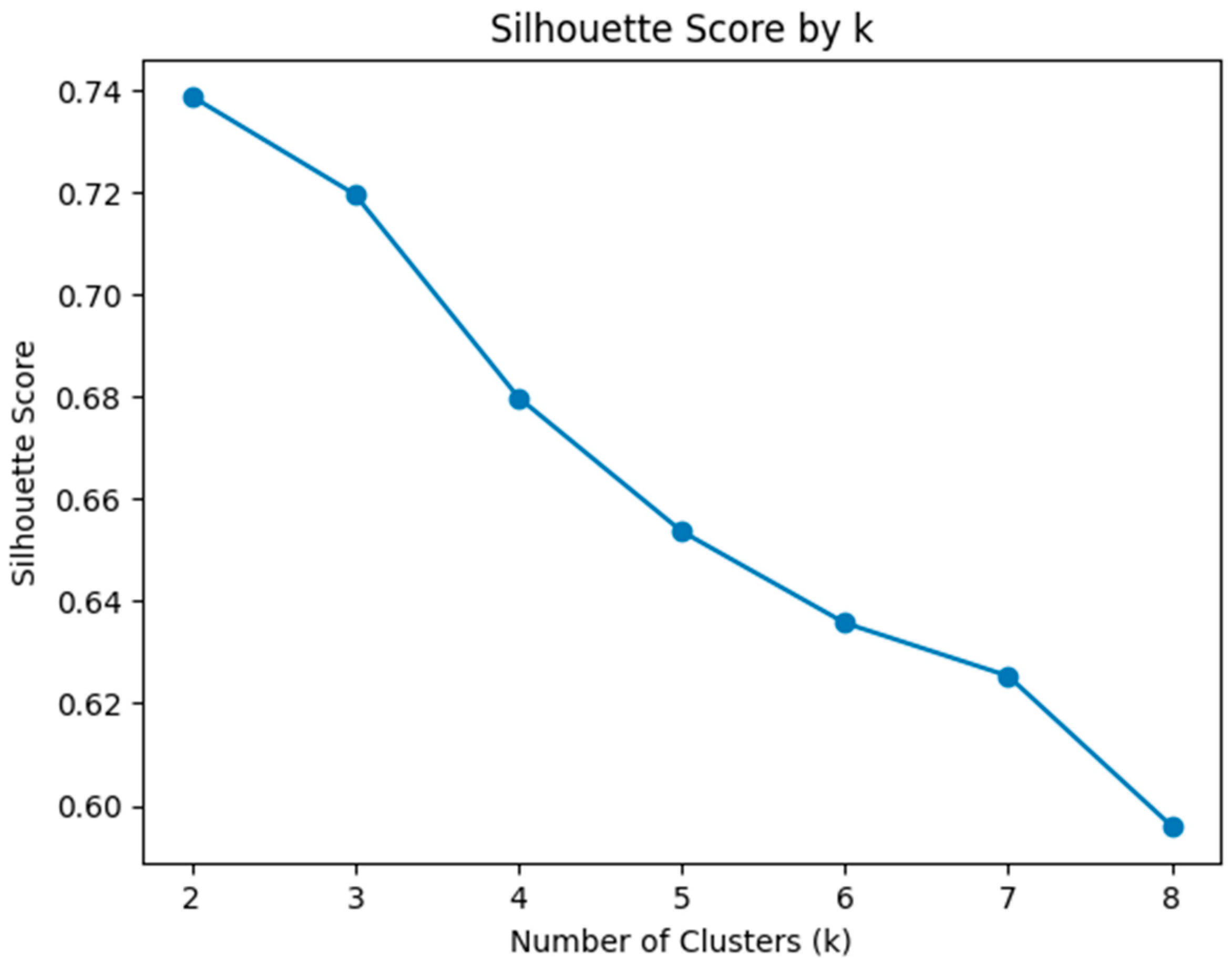
To determine an appropriate number of clusters, K-means clustering was performed for K values ranging from 2 to 8, and the average silhouette score was calculated for each case (
Figure 1).
The results indicate that = 2 and = 3 yield the highest silhouette scores (approximately 0.73 and 0.72, respectively), indicating strong clustering quality.
To explore more detailed traffic patterns, a higher number of clusters ( = 5) was additionally examined. The = 5 configuration reveals more granular traffic state transitions throughout the day, allowing identification of intermediate transition periods that are not visible in coarser segmentations.
Therefore, in this study, clustering is used not only to determine the final number of TOD periods, but also to identify underlying temporal traffic structures.
4.2. Representative Daily Traffic Pattern and Seasonal Stability
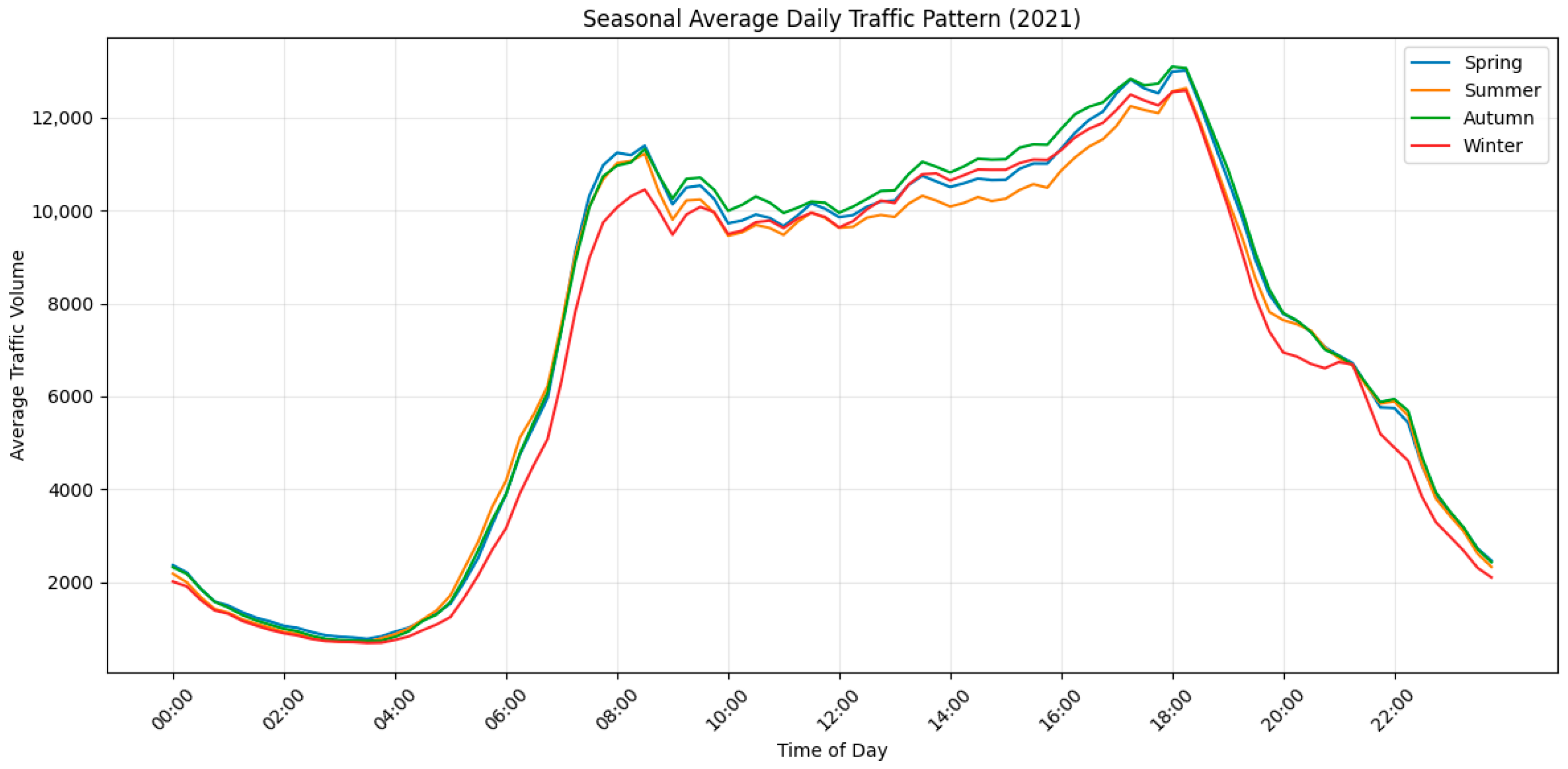
To examine the representativeness of the aggregated traffic pattern, seasonal analyses were conducted by constructing representative daily profiles for spring, summer, autumn, and winter (
Figure 2).
The results indicate that although traffic volume magnitudes vary across seasons, the overall temporal structure remains consistent. In particular, morning increases, daytime plateaus, evening peaks, and nighttime declines are observed across all seasons.
These findings confirm that the identified temporal traffic structure is stable and not an artifact of over-averaging, supporting the use of an annual representative profile for clustering analysis (
Figure 2).
4.3. Identification of Fine-Grained Traffic States
Using
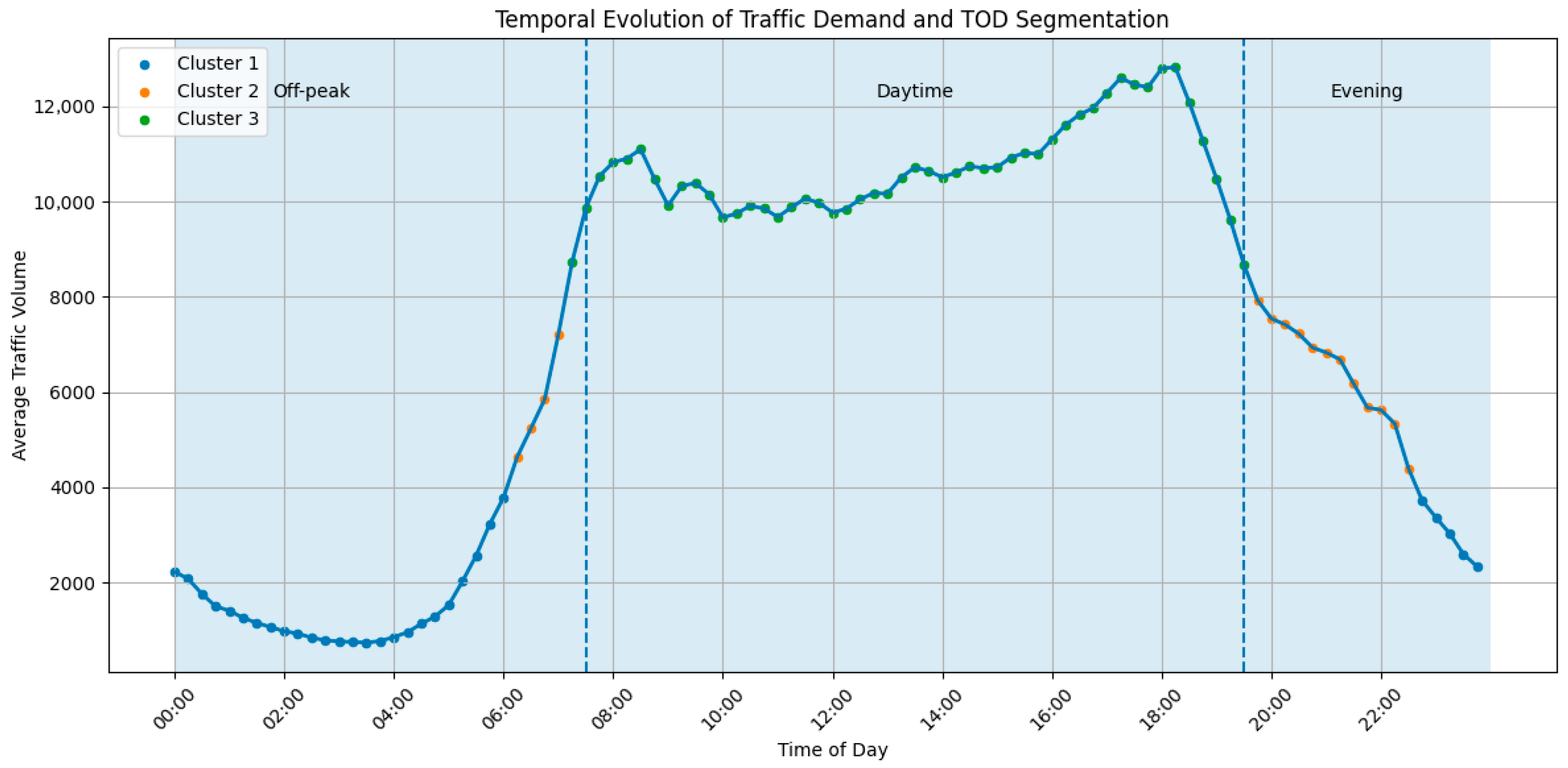
= 5, the clustering results identify multiple distinct traffic states throughout the day (
Figure 3). This configuration reveals several transition points corresponding to changes in traffic demand levels.
However, the resulting segmentation includes short-duration periods that may not be suitable for practical signal operation. While = 5 effectively captures detailed temporal variations, it may lead to overly fragmented TOD structures when directly applied.
This result highlights the need to incorporate operational constraints in the TOD segmentation process.
4.4. TOD Boundary Derivation with Operational Constraints
To derive practically applicable TOD boundaries, consecutive time intervals assigned to the same cluster were grouped, and transition points were identified.
A minimum segment length constraint was then applied to ensure operational feasibility. Segments shorter than the predefined threshold were merged with adjacent segments.
Sensitivity analysis was conducted using minimum segment lengths of 60, 90, and 120 min. The results show that shorter durations (e.g., 60 min) produce fragmented TOD structures with multiple short segments, while longer durations (90 and 120 min) result in more stable and consistent segmentation.
Under the 120-min constraint, the segmentation converges to three operational periods:
00:00–07:30;
07:30–19:30;
19:30–24:00.
This two-stage process—first identifying fine-grained traffic states and then applying operational constraints—ensures that both data-driven insights and practical signal operation requirements are incorporated.
4.5. Quantitative Performance Comparison
The baseline configuration represents a conventional three-period TOD schedule (00:00–07:00, 07:00–19:00, and 19:00–24:00), while the proposed segmentation consists of three periods (00:00–07:30, 07:30–19:30, and 19:30–24:00). Although both configurations adopt the same number of operational periods, they differ in the placement of boundary times. For both configurations, traffic variability within each TOD segment was evaluated using the sum of squared errors (SSE) and root mean squared error (RMSE) (
Table 1).
The results show that the total SSE under the baseline configuration is 169,483,909, whereas the proposed segmentation reduces the SSE to 110,391,812, corresponding to a 34.87% reduction in intra-segment variability. Similarly, RMSE decreases from 69.549 under the baseline configuration to 56.130 under the proposed segmentation.
These findings demonstrate that adjusting TOD boundary locations based on observed traffic patterns can significantly improve the homogeneity of traffic conditions within each period, even when the number of segments remains unchanged (
Table 1).
4.6. Weekday and Weekend Analysis
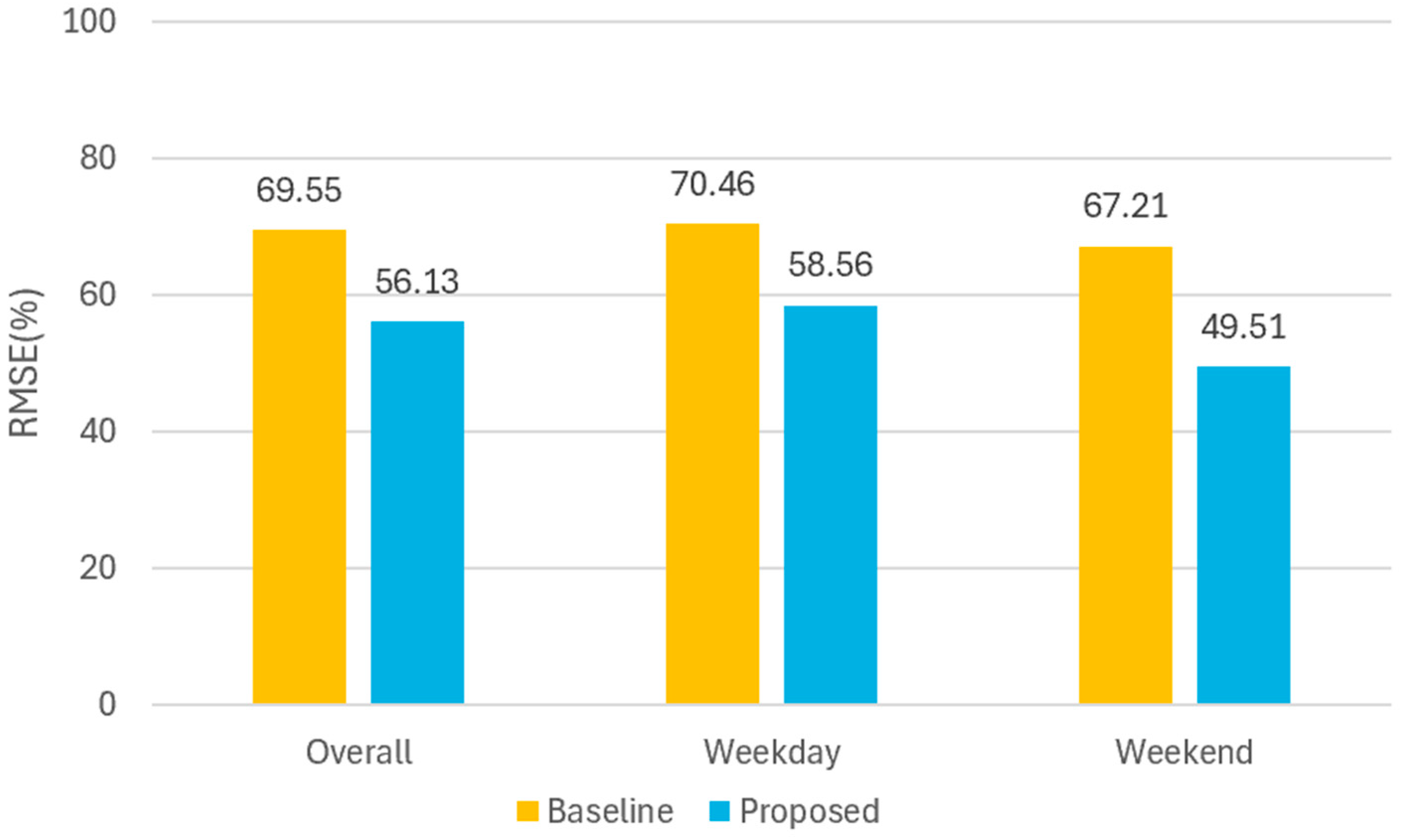
To further validate the robustness of the proposed method, separate analyses were conducted for weekday and weekend traffic conditions. The results indicate consistent improvements in both cases, with particularly larger improvements observed during weekends, where traffic patterns tend to be more variable (
Figure 4).
This suggests that the proposed data-driven approach is especially effective under dynamic and less predictable traffic conditions.
4.7. Robustness and Stability Analysis
To evaluate the robustness of the clustering results, the K-means algorithm was executed 50 times with different random initializations.
The results show identical silhouette scores across all runs (mean = 0.7196, standard deviation = 0.0), and consistent identification of transition points.
These findings confirm that the clustering results are stable and not sensitive to initialization, demonstrating the reliability of the proposed framework.
5. Discussion
The results of this study demonstrate that the proposed clustering-based TOD segmentation significantly improves intra-segment homogeneity compared with conventional fixed TOD configurations. The reduction in both SSE and RMSE indicates that traffic conditions within each operational period become more consistent.
From an operational perspective, homogeneous traffic conditions within each TOD segment are essential for effective signal timing. Conventional TOD settings are typically determined based on engineering judgment and fixed time intervals, which may not accurately reflect actual traffic demand transitions. As a result, a single timing plan may be applied to heterogeneous traffic conditions, potentially reducing operational efficiency.
In contrast, the proposed framework determines TOD boundaries based on observed traffic patterns, allowing signal timing plans to better align with actual demand conditions. This improved alignment can enhance the consistency and robustness of signal timing implementation, even though direct performance measures such as delay or travel time were not explicitly evaluated in this study.
It is important to note that the improvement achieved in this study does not result from increasing the number of TOD periods, but from more accurately identifying boundary locations. Both the baseline and proposed configurations consist of three operational periods; however, the proposed method shifts the boundary times to better reflect actual traffic transitions. This highlights the importance of boundary placement in TOD segmentation.
The results also demonstrate that the proposed framework is robust across different traffic conditions. The seasonal analysis shows that the temporal structure of traffic demand remains consistent throughout the year, while the weekday and weekend analyses confirm that the method performs well under both regular and more variable traffic patterns. In addition, the clustering stability analysis indicates that the results are not sensitive to initialization, further supporting the reliability of the approach.
The minimum segment length constraint plays a key role in bridging the gap between data-driven analysis and practical implementation. While clustering with a larger number of segments (e.g., K = 5) captures fine-grained traffic variations, directly applying such segmentation may lead to operational complexity. By introducing a minimum duration constraint, the proposed method simplifies the segmentation while preserving the essential structure of traffic demand. The selected value of 120 min should be interpreted as a policy-sensitive parameter that can be adjusted depending on local traffic conditions, agency practices, and control strategies.
Despite these strengths, several limitations should be noted. First, the analysis relies on traffic volume as the primary indicator, which may not fully capture all aspects of traffic conditions such as speed or density. Second, the evaluation focuses on traffic homogeneity rather than direct signal performance metrics. Future research should integrate multi-dimensional traffic data and evaluate the proposed segmentation through simulation or field implementation.
Overall, the proposed framework provides a practical and scalable approach for TOD boundary determination that integrates data-driven analysis with real-world signal operation requirements.
6. Conclusions
This study proposed a network-level, clustering-based framework for optimizing time-of-day (TOD) boundaries for urban signal control using large-scale traffic detector data. By constructing a representative daily demand pattern from one-year citywide VDS observations and applying K-means clustering, homogeneous traffic regimes were identified, and operationally meaningful TOD boundaries were systematically derived.
The proposed data-driven segmentation achieved a 34.87% reduction in intra-segment variability in terms of SSE and significantly improved RMSE compared with conventional fixed TOD configurations. Sensitivity analysis confirmed the structural stability of the derived three-period configuration under varying minimum segment length constraints, while weekday and weekend validation demonstrated consistent performance improvements across different temporal traffic conditions.
Unlike traditional engineering-based TOD practices that rely on predefined clock-based boundaries, the proposed framework determines segmentation directly from observed network-level demand transitions. By reducing intra-period variability without increasing operational complexity, the method enhances the reliability and practical applicability of signal timing plans.
Overall, this study demonstrates that clustering-based TOD boundary optimization can serve as an effective decision-support tool for network-level urban signal control. The framework provides a scalable and transferable approach that can be implemented in cities equipped with traffic detector systems.
Future research may extend this methodology toward adaptive or semi-dynamic TOD strategies and explore integration with real-time traffic monitoring and advanced signal control platforms.
The findings highlight the importance of integrating data-driven analytics into conventional signal control frameworks for improved urban traffic management.