Article

Sensorless Admittance Control for Cable-Driven Synchronous Continuum Robot

1
School of Mechanical Convergence Engineering, Hanyang University, Seoul 04763, Republic of Korea
2
Korea Institute of Industrial Technology (KITECH), Ansan 15588, Republic of Korea
*
Author to whom correspondence should be addressed.
Appl. Sci. 2026, 16(8), 3637; https://doi.org/10.3390/app16083637
Submission received: 24 February 2026 / Revised: 28 March 2026 / Accepted: 30 March 2026 / Published: 8 April 2026
(This article belongs to the Section Robotics and Automation)

Abstract

The synchronous continuum robot (SCR) was developed to emulate biological structures, such as animal tails and elephant trunks, based on continuum robot principles. By synchronizing disk motions, the SCR generates biologically inspired continuous movements while maintaining precise trajectory control. However, its synchronization-based architecture limits adaptability during physical interaction due to rigid trajectory-following characteristics. To address this limitation, this paper proposes a sensorless variable admittance control (VAC)-based compliant motion generation framework for the SCR. A dynamic model-based sensorless disturbance observer is designed to estimate external torques without additional force sensors. To compensate for uncertainties inherent in the cable-driven transmission mechanism, an adaptive term is incorporated into the parameter identification process, improving disturbance estimation accuracy. Based on the estimated external torques, admittance parameters are adaptively modulated according to joint angles, angular velocities, and robot posture, enabling interaction-aware motion speed regulation. Furthermore, the proposed method simultaneously enforces constraints on both joint angles and angular velocities through the adaptive regulation of target positions and velocities, ensuring safe and physically feasible motion. Experimental results under various interaction scenarios demonstrate reliable contact-independent force estimation and effective compliant motion generation. The proposed framework provides an integrated solution for robust force estimation, adaptive compliance control, and simultaneous constraint enforcement in mechanically synchronized continuum robots.

1. Introduction

A continuum robot is a flexible robotic system inspired by natural structures such as snakes, elephant trunks, and plant vines. Owing to its deformable body, it can navigate complex and constrained environments more effectively than traditional rigid-link robots composed of discrete joints. This structural characteristic enhances dexterity and adaptability [1], and extensive research has explored its applications in various domains [2,3,4,5,6].
In the field of social robotics, physical appearance and motion characteristics significantly influence human acceptance. Social robots designed for emotional interaction benefit from movements that are familiar, continuous, and biologically inspired [7,8]. Moreover, physical human–robot interaction (pHRI), including contact-based interaction, plays a crucial role in improving communication and engagement [9,10]. These requirements make continuum robots particularly suitable for social and companion robots, as their compliant and continuous structures resemble biological forms. However, due to their passive stiffness characteristics, conventional continuum robots generally exhibit low passive stiffness and limited load-carrying capacity [11], which restricts their ability to generate stable and controlled interaction forces.
To enhance stiffness and achieve stable active motions, one approach is to mechanically couple adjacent joints using cables or linkages to enable synchronous rotation [12,13,14]. The synchronous continuum robot (SCR) considered in this study adopts such a mechanically synchronized structure, allowing it to generate coordinated and precise motions while increasing passive stiffness. However, this mechanical synchronization constrains individual joint motions and reduces passive compliance, making it difficult to achieve safe and natural behavior during physical interaction with humans and uncertain environments [15]. Therefore, a control strategy that enables active compliant yet stable interaction for mechanically synchronized continuum robots remains an open challenge.
To generate active compliant motion, impedance- and admittance-based control approaches have been widely investigated. Impedance control achieves stable dynamic interaction with stiff environments but may suffer from reduced free-space motion accuracy due to friction and unmodeled dynamics [16]. In contrast, admittance control, which can be interpreted as a position-based realization of impedance control, is generally more robust to modeling uncertainties than impedance control [17], particularly in position-controlled robotic systems, although its performance can still be affected by inaccuracies in dynamic parameters such as inertia. Consequently, admittance control has been commonly adopted to realize active compliant motion in continuum robots [18].
For diverse interaction scenarios, it is necessary to adapt active compliance characteristics according to task requirements and external conditions. Variable admittance control (VAC), which adjusts admittance parameters in response to interaction states, has been proposed for this purpose. Model-based VAC approaches modify parameters using estimated models of the environment or user motion [19,20,21,22], but their performance is sensitive to modeling uncertainties, such as inaccuracies in representing interaction conditions as well as unmodeled nonlinearities in the system dynamics [23]. Learning-based VAC methods improve adaptability under uncertain environments [24,25,26,27,28]; however, they typically require large amounts of training data and extensive tuning, which can be costly and impractical for diverse physical interaction behaviors [29]. Hence, achieving adaptive and robust compliant motion without relying on precise environmental models or large training datasets remains a significant challenge.
Another practical issue arises from the measurement of external interaction forces. Conventional admittance-control-based methods require additional force or torque sensors. However, integrating such sensors increases mechanical complexity, joint design constraints, and system cost and may degrade structural robustness [30]. In particular, the SCR consists of multiple closely spaced disks interconnected through a cable-driven synchronization mechanism, making it difficult to install force/torque sensors at each link or at arbitrary locations along the structure. This limitation arises from the complex cable routing, which would be further complicated by additional sensor wiring, and the short link structure undergoing continuous bending, potentially causing physical interference between sensors or increasing the risk of sensor damage during operation. Therefore, estimating interaction forces without dedicated sensors is essential for implementing compliant control in the SCR.
To address the aforementioned challenges, this paper proposes a sensorless variable admittance control (VAC) framework tailored for the synchronous continuum robot (SCR). First, a generalized momentum (GM)-based sensorless disturbance observer is designed to estimate external torques acting on the joints without requiring additional force/torque sensors. To improve estimation accuracy in the presence of cable-driven transmission uncertainties, an adaptive term is incorporated into the parameter identification process. This adaptive modeling compensates for unmodeled cable tension variations and transmission nonlinearities inherent to the SCR, thereby enhancing external torque estimation performance. Second, an adaptive VAC scheme is introduced in which the admittance parameters associated with joint angles and angular velocities are modulated according to the estimated external torques and the robot posture. This interaction-aware adaptation enables motion speed regulation based on user intention while preserving stable task-oriented active motion. Furthermore, a constraint-aware motion regulation method is incorporated to simultaneously enforce joint angle and angular velocity limits. By adjusting both the target position and target velocity according to the interaction torque and proximity to joint boundaries, the proposed framework ensures safe, bounded, and context-dependent interaction behavior. Through these integrated strategies, the proposed method achieves compliant, stable, and biologically inspired motion in a mechanically synchronized continuum robot. The main contributions of this paper are summarized as follows:
1.
A sensorless disturbance observer based on a GM dynamic model is implemented to estimate external torques, enabling compliant control of the SCR without additional force/torque sensors.
2.
A VAC-based motion generation framework is proposed to realize compliant behavior while explicitly incorporating diverse environmental interaction conditions and joint-level constraints.
3.
The effectiveness of the proposed framework is experimentally validated through various scenarios.
The remainder of this paper is organized as follows: Section 2 introduces the structure and modeling of the synchronous continuum robot (SCR). Section 3 presents the GM-based sensorless disturbance observer. Section 4 describes the proposed adaptive VAC framework and reference-point adaptation method. Section 5 provides experimental validation and performance evaluation. Finally, Section 6 concludes the paper.

2. Structural Configuration of the Cable-Driven Synchronous Continuum Robot

The synchronous continuum robot (SCR) developed in this study is designed to emulate the continuous bending behavior observed in biological appendages while enhancing passive stiffness through mechanical synchronization. Unlike conventional continuum robots that primarily rely on flexible backbones or elastic materials to achieve passive compliance, the SCR adopts a cable-synchronized overconstrained architecture to generate coordinated and repeatable bending motions.
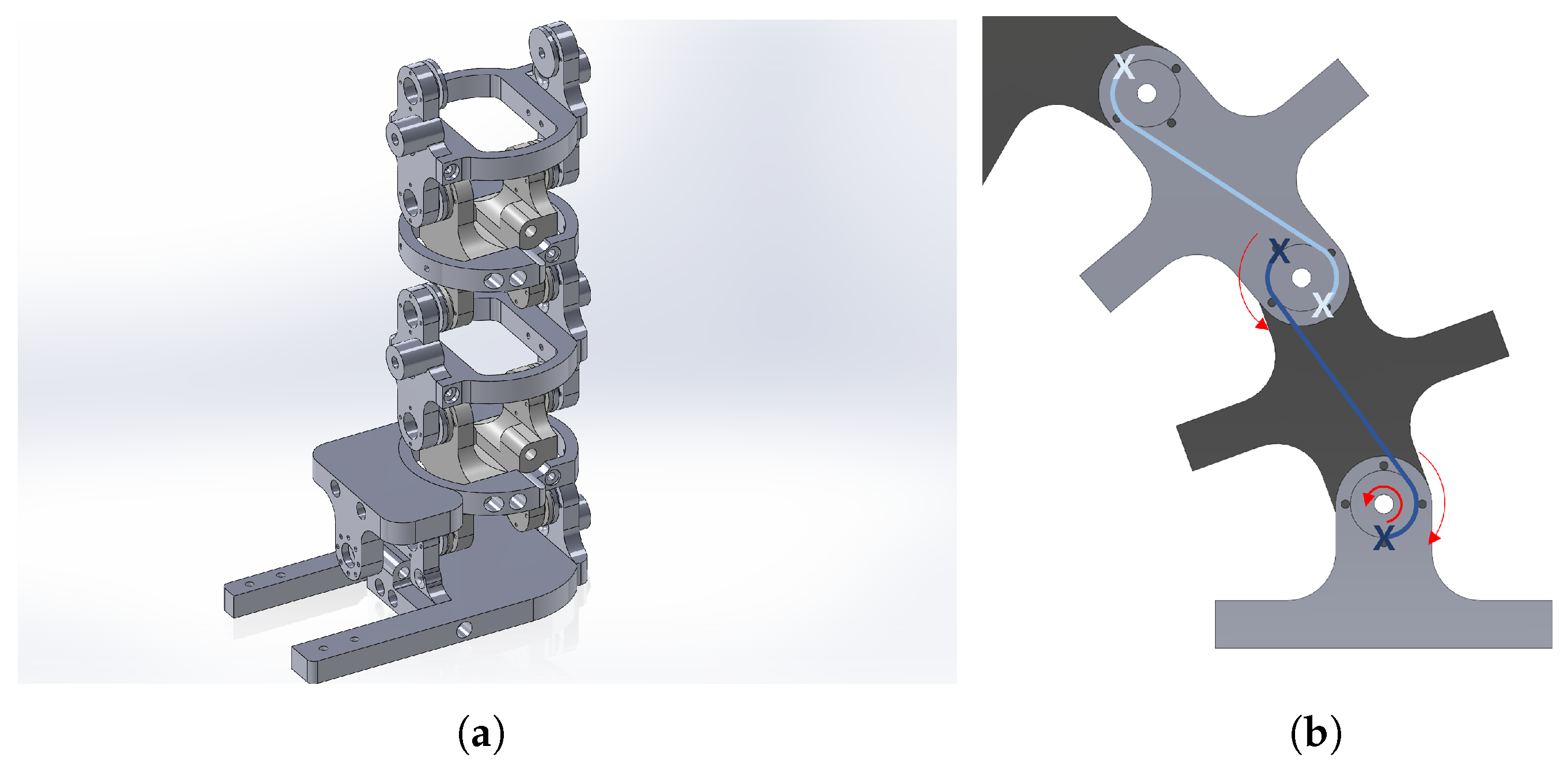
As illustrated in Figure 1, the SCR is composed of multiple disks interconnected by revolute joints. Within each section, all joints are mechanically coupled through a cable network and constrained to rotate with identical angular displacements. This synchronization approximately satisfies the constant-curvature assumption commonly adopted in continuum modeling, thereby simplifying modeling and control. By distributing external forces across the entire section rather than concentrating them at a single joint, the structure provides enhanced stiffness compared to conventional compliant continuum mechanisms while preserving global continuum-like deformation characteristics.
To further clarify the synchronization behavior and its relation to the constant-curvature assumption, the kinematic relationship among the joints within a segment is described as follows: Let a segment consist of n serially connected joints, and let θ i denote the rotation angle of the i-th joint. Due to the cable-driven pulley mechanism, the joint motions are kinematically constrained by a common actuator input, which can be expressed as
θ i = α i θ , i = 1 , 2 , , n
where θ represents the actuator input angle and α i denotes the transmission ratio determined by the pulley configuration. In the proposed design, identical pulley radii are employed, resulting in
α i = 1 θ 1 = θ 2 = · · · = θ n = θ
This relationship indicates that all joints within a segment undergo identical angular displacements, thereby enabling synchronized motion. Based on this synchronized behavior, the total bending angle of a segment can be expressed as
θ total = i = 1 n θ i = n θ
which supports the use of the constant-curvature assumption for modeling the segment.
In practical implementations, however, perfect synchronization may be affected by factors such as cable elasticity, pulley backlash, and friction. These effects can introduce small deviations in the joint angles, which can be represented as
θ i = θ + δ i
where δ i denotes a small synchronization error at the i-th joint. In the proposed system, such effects are mitigated by the use of high-stiffness steel cables and the relatively slow and smooth motion profiles typical of social robot applications. As a result, the magnitude of δ i is expected to be small, and the deviation from the ideal constant-curvature assumption is considered negligible under the operating conditions of this study.
Based on the synchronized joint behavior described above, each section effectively possesses one degree of freedom (1-DOF), despite consisting of multiple physical joints. This mechanism enforces coordinated sectional bending rather than independent joint motion, which simplifies control while maintaining structural rigidity.
The joints are positioned along the outer circumference of the structure, leaving the central region hollow. This hollow architecture enables electrical wiring and additional actuation cables to pass through the center toward upper sections. Owing to this modular design, actuators can be mounted on the terminal disk of each section to serially connect subsequent sections, enabling scalable expansion of the robot’s overall degrees of freedom. The mass of these actuators is incorporated into the overall dynamic parameters of the system through the parameter identification process, and its influence is implicitly reflected in the system dynamics. Furthermore, the bending range of each section can be tuned by adjusting the number of disks: increasing the number of disks results in a larger cumulative orientation change at the terminal disk, allowing the bending characteristics to be determined at the design stage.
Although the overconstrained synchronization mechanism improves passive stiffness, motion repeatability, and precision, it reduces local passive compliance typically achieved through elastic deformation. Because joint motions are mechanically synchronized, external forces applied at a specific location are transmitted and distributed throughout the entire section rather than being absorbed locally. As passive stiffness increases, safe and adaptive physical interaction cannot rely solely on mechanical flexibility. Therefore, active compliant behavior must be realized through an active control strategy.
To address this limitation, this study proposes a sensorless variable admittance control framework for the SCR. In multi-joint serially bending structures such as the SCR, installing individual force/torque sensors at each joint is structurally impractical and would significantly increase mechanical complexity, size, and cost. Moreover, interaction forces may occur at arbitrary locations along the body, making localized sensing insufficient. Accordingly, a sensorless disturbance observer based on motor current measurements and a dynamic model expressed in generalized momentum (GM) form is employed to estimate external torques without additional sensors. The estimated torques are then utilized in a variable admittance controller to generate compliant motion while preserving the inherent stiffness and precision of the mechanically synchronized structure. The following section presents the parameter identification process required for external torque estimation.

3. Sensorless Disturbance Observer Based on Generalized Momentum

3.1. Parameter Identification of SCR

In this paper, a sensorless disturbance observer (SDO) is developed to estimate external torques generated by physical interaction with the environment without the use of additional force/torque sensors. The proposed SDO is formulated based on the robot’s dynamic model. Accurate knowledge of the robot’s dynamic parameters, such as including link masses, link lengths, and center-of-mass locations, is required for observer implementation. In this study, these parameters are obtained through dynamic parameter identification based on analytical modeling and experimental data.
The joint-space dynamics of the robot can be expressed as
τ = M ( q ) q ¨ + C ( q , q ˙ ) q ˙ + G ( q ) + τ u + τ f + τ e x t ,
where q R n denotes the joint angle vector and M ( q ) R n × n is the inertia matrix. The term C ( q , q ˙ ) q ˙ R n represents the Coriolis and centrifugal torques, and G ( q ) R n denotes the gravitational torque. The term τ u R n represents the torque generated by uncertainties such as cable tension and friction effects due to the mechanically synchronized actuation mechanism. The external interaction torque applied to the robot is denoted by τ e x t R n . The friction torque τ f R n is modeled as a combination of viscous and Coulomb friction components:
τ f = μ v q ˙ + μ c sign ( q ˙ ) ,
where μ v and μ c denote the viscous and Coulomb friction coefficients, respectively. This friction model is adopted to facilitate dynamic parameter identification and disturbance estimation, as commonly employed in sensorless force estimation frameworks [31,32].
To identify the dynamic parameters, the robot dynamics are reformulated into a linear observation model [32,33,34]. Specifically, the nonlinear robot dynamics can be expressed in a linear-in-parameters regression form as follows:
τ = Y ( q , q ˙ , q ¨ ) ϕ s + τ u ( x ) ,
where Y ( q , q ˙ , q ¨ ) R n × p is the regressor matrix constructed from joint angles, velocities, and accelerations, and ϕ s R p denotes the vector of inertial parameters of the dynamic model. The term τ u ( x ) represents a modeling uncertainty term that accounts for unmodeled dynamics, such as cable tension variations and other nonlinear effects inherent to the cable-driven structure. To compensate for these uncertainties, the term τ u ( x ) is modeled as a linear function:
τ u ( x ) = ω x + b ,
where ω and b denote constant coefficients to be identified, and x represents the selected basis input vector associated with the uncertainty dynamics. The parameter identification process is conducted in two steps. First, the nominal inertial parameters ϕ ^ s are estimated by assuming τ u ( x ) = 0 , resulting in a standard linear regression problem. Subsequently, to account for the residual modeling error, the uncertainty coefficients ω and b are identified using the remaining torque discrepancy.
To obtain ϕ ^ s , the data on τ , q, and q ˙ are measured at multiple points along an excitation trajectory. Once a sufficient amount of data is collected over the time interval t = k T ( k = 1 , 2 , , N ) , the dimensional regression equation is constructed from Equation (7) as follows:
τ ^ = Y ^ ( q , q ˙ , q ¨ ) ϕ s ,
where
τ ^ = [ τ ( T ) , τ ( 2 T ) , · · · , τ ( N T ) ] T , Y ^ ( q , q ˙ , q ¨ ) = [ Y ( T ) , Y ( 2 T ) , · · · , Y ( N T ) ] T ,
T denotes the step-time interval. The motor torque, i.e., τ , is calculated by measuring the current feedback from the motor driver and applying the motor’s torque coefficient:
τ = K m I m ,
where N m , I m , and K m represent the gear ratio, feedback current, and motor torque constant, respectively. The torque constant Km is determined by the motor specifications provided in the manufacturer’s datasheet and defines the proportional relationship between the motor current and the generated torque. Based on the measured data, the parameter identification problem is formulated. In this paper, the identification problem is designed as a quadratic programming problem with constraints [34].
min ϕ ^ s | | τ ^ Y ^ ( q , q ˙ , q ¨ ) ϕ ^ s | | 2 ,
subject to
ϕ ̲ s < ϕ ^ s < ϕ ¯ s ,
where ϕ ^ s denotes estimated parameter; ϕ ̲ s and ϕ ¯ s denote the lower and upper boundaries of the dynamic parameters, respectively. These constraints are designed to ensure the parameters remain physically feasible, calculated based on CAD data and the measured mass of each robot link. Using this method, ϕ ^ s is obtained and applied to determine the adaptive term.
By substituting the obtained ϕ ^ s into Equation (7), the model in the time interval for obtaining the adaptive term can be expressed as
τ ^ u ( x ) = τ ^ Y ^ ( q , q ˙ , q ¨ ) ϕ ^ s = X Ω ,
where
X = x ( T ) · · ·   x ( N T ) 1 · · ·   1 T , Ω = ω b T .
In this paper, the angle, angular velocity, and torque of each joint are used as the input values for the adaptive term, i.e., x. The optimization problem for determining ω and b to express the adaptive term for the motion is formulated as follows:
min Ω | | τ ^ u ( x ) X Ω | | 2 ,
Based on this optimization problem, ω and b for the robot’s adaptive term are determined and applied to compensate for the uncertainty in the dynamic model according to the robot’s motion.
To accurately estimate the robot’s dynamic parameters, the excitation trajectories are designed as finite sums of harmonic sine and cosine functions [32]:
q i ( t ) = l = 1 n a l ω f l sin ( ω f l t ) b l ω f l cos ( ω f l t ) + q i 0 ,
q ˙ i ( t ) = l = 1 n a l cos ( ω f l t ) + b l sin ( ω f l t ) ,
q ¨ i ( t ) = l = 1 n ω f l ( b l cos ( ω f l t ) a l sin ( ω f l t ) ) ,
where q i , q ˙ i , and q ¨ i denote the angle, angular velocity, and angular acceleration of the ith joint of the robot, respectively. ω f and q i 0 denote the fundamental frequency and the offset angle of the ith joint, respectively. The amplitudes of the cosine and sine functions are adjusted by the parameters a l and b l , which are determined based on the actuation range of the ith joint. The excitation trajectory is with taking into account the robot’s workspace and the angular velocities of the joint. The motion range of the robot is π / 6 π / 6 rad; the driving range is 4.08 rad/s; the initial angle and driving range of the joint are 0 rad and 2 π / 3 rad, respectively. The parameters for the excitation trajectories are summarized in Table 1.
Based on the excitation trajectories, data for identification is collected under the assumption that there are no external torques, i.e., τ e x t = 0 . Subsequently, parameter identification is performed using the collected data.
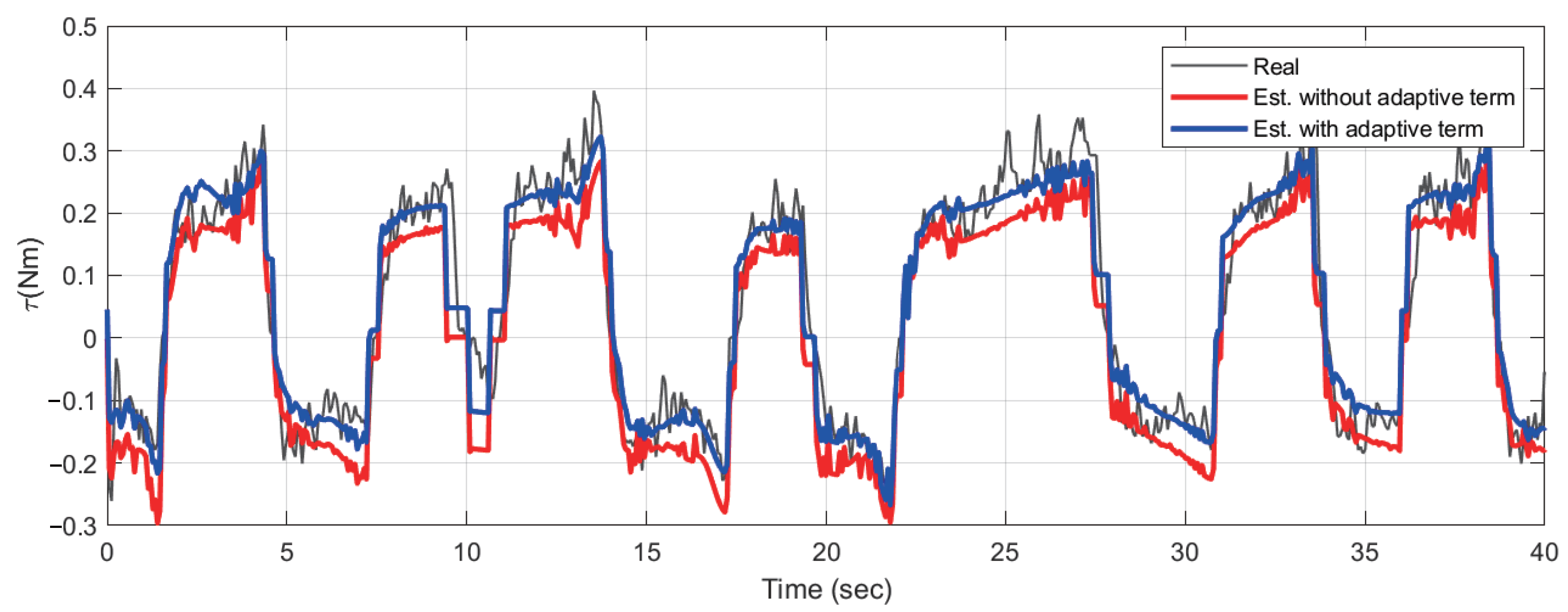
Figure 2 presents a comparison between the motor torques computed from the measured motor current data and the torques reconstructed using the identified dynamic parameters. The black line represents the reference torque calculated from the motor current, i.e., I m . The red and blue lines denote the reconstructed torques obtained from the identified parameters. Specifically, the red line corresponds to the torque estimated using only the nominal dynamic parameters without the adaptive term, whereas the blue line represents the torque reconstructed using the parameters identified with the inclusion of the adaptive term.
As shown in Figure 2, both the blue and red curves follow trends similar to the measured motor torque. However, when the adaptive term is not included (red curve), uncertainties inherent in the SCR’s cable-driven transmission—such as cable stiffness variation and friction effects—lead to discrepancies between the reconstructed torque and the measured torque, resulting in a total root mean square (RMS) error of 0.0709 Nm. In contrast, when the adaptive term is incorporated (blue curve), these model uncertainties are effectively compensated for through the adaptive parameter update mechanism. Consequently, the RMS error decreases to 0.0546 Nm, demonstrating improved torque reconstruction accuracy. These results indicate that the dynamic parameters were successfully identified and that the inclusion of the adaptive term enhances estimation performance by mitigating cable-related modeling uncertainties. The identified dynamic parameters are subsequently utilized in the implementation of the sensorless disturbance observer.

3.2. Disturbance Observer Based on Generalized Momentum

In this paper, a sensorless disturbance observer (SDO) is implemented based on the identified dynamic parameters to estimate external torques without employing additional force/torque sensors. The robot dynamics are formulated as shown in Equation (5). In conventional model-based approaches, the external torque, τ e x t , can be directly computed from the dynamic model using estimated parameters and measured joint states. However, this formulation requires the joint angular acceleration, q ¨ , which is typically obtained through numerical differentiation of the measured joint velocity, q ˙ . Since numerical differentiation amplifies high-frequency measurement noise, the resulting acceleration signal can severely degrade estimation accuracy and compromise observer stability.
To address this issue, a generalized momentum (GM)-based disturbance observer is adopted, enabling external torque estimation without explicitly computing joint accelerations. The GM-based disturbance observer is a well-established alternative to conventional model-based estimation methods, as it avoids both explicit acceleration computation and inertia matrix inversion, thereby improving numerical robustness and noise immunity [35,36,37]. The generalized momentum of the robot is defined as follows:
p = M ( q ) q ˙ R n ,
and thus
p ˙ = M ( q ) q ¨ + M ˙ ( q ) q ˙ .
By substituting (17) into (5), the equation can be expressed as
p ˙ = M ˙ ( q ) q ˙ C ( q , q ˙ ) q ˙ G ( q ) τ f τ u + τ τ e x t .
With skew-symmetry property of M ( q ) , i.e., M ˙ ( q ) = C ( q , q ˙ ) + C T ( q , q ˙ ) , the equation can be expressed as follows [35]:
p ˙ = τ ¯ τ e x t ,
where
τ ¯ = C T ( q , q ˙ ) q ˙ G ( q ) τ f τ u + τ .
It should be noted that the skew-symmetry property is applied to the nominal model, while non-conservative effects from the cable-driven mechanism are compensated by the adaptive term. From Equation (19), the dynamic model can be expressed without joint acceleration and inversion of the inertia matrix, and this model is applied to design the observer. The observer based on the GM is defined as follows:
p ^ ˙ = τ ¯ + r ,
where
r = L p ˜ ,
r and L R n × n denote the residual vector of the observer and the positive gain of the observer, respectively. The observer gain L is selected as a constant value and is experimentally tuned by considering the trade-off between noise sensitivity and response speed. A higher gain improves estimation responsiveness but increases sensitivity to measurement noise, whereas a lower gain enhances noise robustness at the expense of slower response. p ˜ denote the difference between the actual and estimated GM, i.e., p ˜ = p p ^ , respectively. p can be calculated based on Equation (16) with the estimated dynamic parameters and measured q and q ˙ , and estimated GM, p ^ is obtained based on Equation (20). Based on the estimated GM, the estimated external torque is calculated as follows:
τ ^ e x t = L p ˜ .
To clarify the relationship between τ e x t and τ ^ e x t , Equations (19) and (20) are transformed into the Laplace domain. The resulting expression is given by
s p ˜ = ( τ e x t + L p ˜ ) ,
From Equations (21) and (22), the relationship between τ e x t and τ ^ e x t can be derived as
τ ^ e x t = L s + L τ e x t .
This result indicates that the estimated torque, τ ^ e x t , corresponds to a first-order low-pass-filtered version of the actual external torque, with L determining the cutoff frequency of the filter. Therefore, high-frequency noise components are attenuated while preserving the dominant interaction dynamics. Based on this property, the external torque applied to the robot can be estimated without additional sensors, and the estimated torque is subsequently used to generate compliant motion of the SCR.

4. VAC-Based Motion Generation Strategies for SCR

The SCR is designed to realize biologically continuous structures with synchronized bending behavior. For SCR-based robots to interact effectively in diverse environments, they must generate task-oriented active motions while simultaneously exhibiting compliant behavior during physical interactions. Furthermore, when excessive external forces are applied, the robot should produce protective responses to prevent mechanical damage and ensure operational safety. To maintain stable and safe behavior, the range of compliant motion must be appropriately bounded within physically and functionally feasible limits.
To satisfy these requirements, this paper proposes a variable admittance control (VAC)-based motion generation framework for the SCR. Admittance control enables compliant motion by modulating the robot’s dynamic response to external forces, where the interaction behavior is governed by virtual mass, damping, and stiffness parameters. In the proposed framework, motion constraints are defined within the robot’s admissible workspace to regulate both active and compliant motions, thereby preventing excessive deformation and ensuring structural safety. In addition, an adaptive parameter adjustment scheme is introduced to modulate the admittance parameters in response to external torque and posture-dependent conditions. This adaptive mechanism allows the robot to regulate its motion speed and compliance level under varying interaction scenarios while maintaining stability and bounded behavior.
Typically, when admittance control is applied at the joint level, the VAC model is formulated in joint space as
M θ ˜ ¨ + B v θ ˜ ˙ + K v θ ˜ = τ ˜ e x t ,
where
θ ˜ = θ d θ m , τ ˜ e x t = τ d τ e x t .
θ d and θ m denote reference and modified trajectories, respectively; M, B v , and K v denote admittance parameters, i.e., mass, damper, and stiffness, respectively; τ e x t denotes the estimated external torque applied to the joint; and τ d represents the desired interaction torque (which is typically set to zero for passive compliance). In this study, variable damping and stiffness parameters, B v and K v , are applied to adapt the robot’s compliant behavior according to task requirements and interaction conditions. From Equation (24), the modified joint acceleration in response to external torque is obtained as
θ ¨ m = θ ¨ d + M 1 K v θ ˜ + B v θ ˜ ˙ τ ˜ e x t .
The modified trajectory θ m is then generated by numerically integrating the modified acceleration θ ¨ m . Through this process, the reference motion is adaptively adjusted according to the external interaction torque.

4.1. Variable Parameter for Compliance Motion

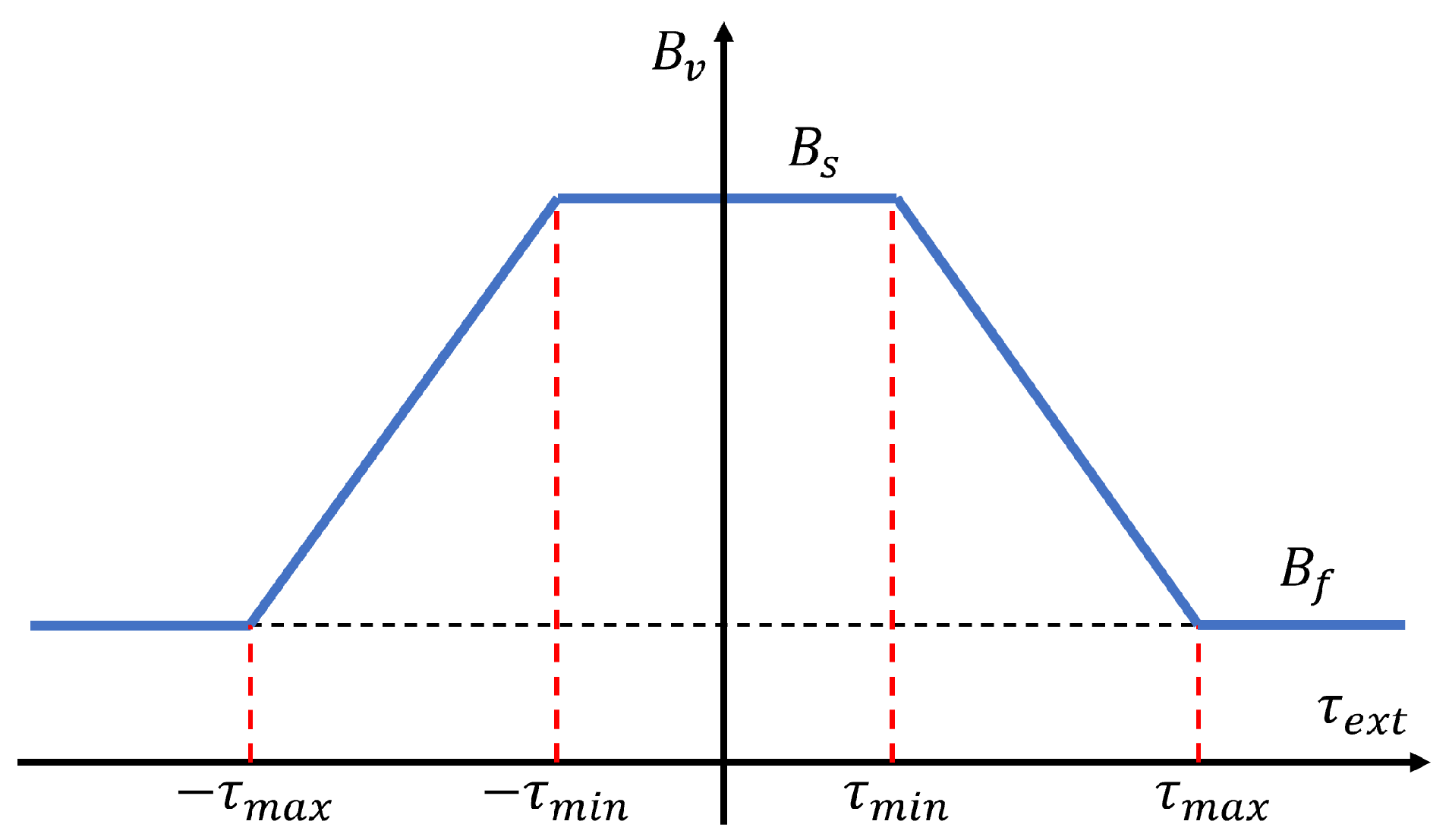
Effective interaction in diverse environments, including human–robot interaction, requires motion generation that adapts to varying interaction conditions. In this study, the damping coefficient of the admittance controller is adjusted based on the estimated external torque, as shown in Figure 3.
When the external torque is small, the interaction force between the robot and the environment is limited, which may indicate either light contact or the operator’s intention to perform precise and fine movements. In this case, the damping parameter is set to a relatively high value. A higher damping coefficient reduces motion speed and enhances motion stability, allowing accurate and controlled behavior. Moreover, in situations where contact with the environment is suddenly released, the higher damping prevents abrupt acceleration and enables the robot to smoothly converge to the nominal reference velocity.
Conversely, when a relatively large external torque is detected—such as when the operator intends to accelerate the motion or change the direction of the robot—the damping coefficient is reduced. Lower damping allows faster dynamic response, thereby increasing motion speed and improving responsiveness to user-applied forces. To prevent undesired switching between trajectory tracking and compliant behavior due to sensor noise, particularly in near-stationary conditions, a dead-band is introduced in the force estimation logic. Specifically, estimated external torque values within ±0.1 Nm are treated as zero, which suppresses noise-induced fluctuations and avoids chattering during control mode transitions. The variation in the damping coefficient as a function of the external torque is formulated as follows:
B v = α B B s , if | τ ^ e x t |   < τ m i n α B ( B s Δ B ) , if τ m i n | τ ^ e x t | τ m a x α B B f , if | τ ^ e x t |   > τ m a x
where
Δ B = B s B f | τ m a x τ m i n | ( | τ ^ e x t |   τ m i n ) ,
B s and B f represent the damping values for slow and fast velocity responses, respectively, based on the external torque applied; α B denotes the switching coefficient used to reflect the motion range of the robot; and τ m a x and τ m i n denote the upper and lower boundaries of the external torque.
In addition to variable damping, this study introduces a variable stiffness strategy to improve responsiveness during contact while preventing excessive internal force generation caused by the virtual stiffness of the admittance controller. The variable stiffness parameter, K v , is defined as
K v = K c , if | τ ^ e x t |   > τ m i n c K a , otherwise
where K c and K a denote the stiffness values for compliant motion and active motion, respectively, and τ m i n c represents the lower threshold of the external torque used to detect contact. When no significant external torque is detected (i.e., | τ ^ e x t |   τ m i n c ), the robot operates in the active motion mode. In this case, the higher stiffness value K a is applied to ensure accurate tracking of the reference trajectory generated by the user or predefined task planner. Conversely, when the estimated external torque exceeds the predefined threshold ( | τ ^ e x t |   > τ m i n c ), the robot interprets this condition as physical contact with the environment. The controller then switches to the compliant mode by applying a lower stiffness value K c , allowing the robot to yield to external forces and generate compliant interaction behavior. By combining the variable damping parameter B v and the variable stiffness parameter K v , the proposed framework enables adaptive compliance under diverse interaction scenarios. The torque thresholds are established based on the technical specifications of the disturbance observer and the motor. Initially, thresholds are set considering the dead-band torque and the motor’s maximum rated torque. Subsequently, these values are finalized through experimental fine-tuning to achieve an optimal trade-off between operational stability (preventing false triggers from noise) and interaction responsiveness. Since the SCR is designed for interaction with humans and environments, it must not only generate compliant motion in response to external forces but also satisfy structural and workspace constraints to ensure safety and stability. The following section describes the proposed method for incorporating motion constraints while generating compliant behavior.

4.2. Constraint-Aware Variable Reference and Admittance Parameters

For stable human–robot interaction within a shared workspace, it is essential not only to generate compliant motion in response to external forces but also to enforce joint-level motion constraints, including limits on joint angles and angular velocities. Conventional variable admittance control (VAC) primarily regulates interaction behavior through force-dependent parameter adaptation; however, it does not explicitly incorporate joint boundary constraints. Consequently, when large external torques are applied or when the reference trajectory is improperly defined, the robot may approach or even exceed its allowable joint limits.
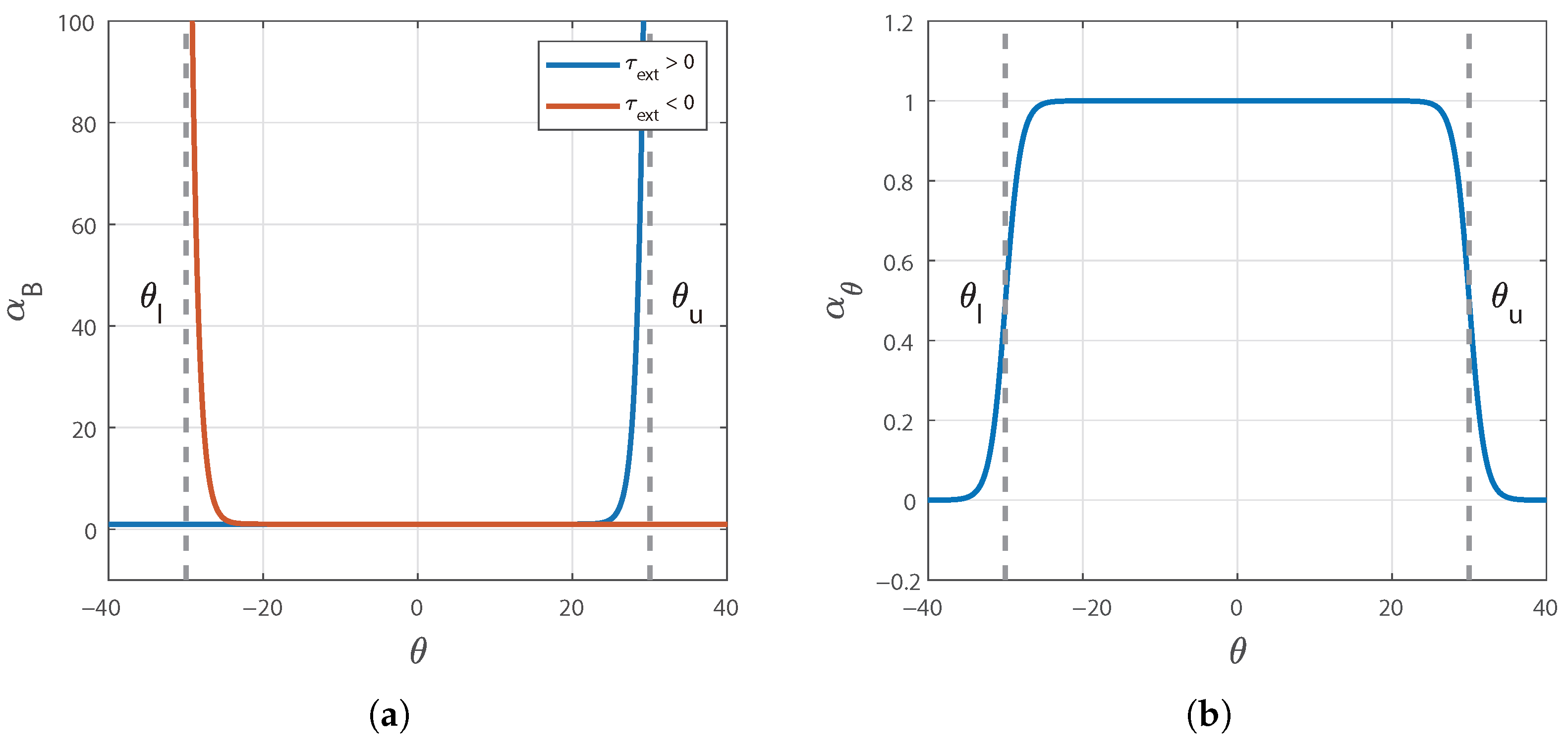
To overcome this limitation, this paper proposes a constraint-aware VAC framework that integrates boundary handling directly into the motion generation process. The proposed framework simultaneously modifies (i) the admittance parameters and (ii) the reference trajectory near joint limits. This is achieved through a dual-layer constraint strategy employing two adaptive coefficients, α B and α θ , which operate at different control layers to ensure safe and bounded motion:
  • Reference-level suppression ( α θ ) prevents commanded motion beyond joint limits.
  • Parameter-level damping amplification ( α B ) attenuates externally induced motion near boundaries.
First, the modified angular velocity generated by the VAC scheme, θ ˙ m , is restricted within predefined bounds. The reference angular velocity is adjusted as
θ ˙ d = α θ θ ˙ m a x , if θ ˙ m > θ ˙ m a x α θ θ ˙ d , if θ ˙ m i n θ ˙ m θ m a x α θ θ ˙ m i n , if θ ˙ m < θ ˙ m i n
where θ ˙ m a x and θ ˙ m i n denote the allowable angular velocity limits. The coefficient α θ is introduced to smoothly suppress the reference velocity as the joint approaches its positional boundary. To achieve smooth transition without discontinuity, α θ is defined using a sigmoid-based function:
α θ = σ ( k ( θ m θ u ) ) σ ( k ( θ m θ l ) ) .
where
σ ( x ) = 1 1 + e x
k determines the transition steepness, and θ u , θ l denote upper and lower joint angle boundaries, respectively. Within the allowable motion range ( θ l θ m θ u ), α θ approaches unity, allowing the user-defined reference velocity to be applied directly. As the joint approaches its boundary, α θ smoothly decreases toward zero, effectively suppressing the reference velocity and preventing further motion toward the limit.
In addition to modifying the reference velocity, the damping parameter of the admittance controller is adjusted near joint limits to attenuate externally induced motion. The damping scaling coefficient α B is defined as
α B = 1 + β γ s i g n ( τ ^ e x t ) ( θ θ ¯ ) ,
where
θ ¯ = θ u , if τ ^ e x t > 0 θ l , if τ ^ e x t < 0
β > 1 and γ govern the growth rate of α B . The term sign ( τ ^ e x t ) ( θ θ ¯ ) captures both the direction of the external torque and the proximity to the joint limit. When the joint operates within the safe region and the external torque drives the motion away from the boundary, α B remains close to 1, thereby preserving the nominal damping. However, when the joint approaches its limit and the external torque pushes the motion further toward the boundary, α B increases rapidly. Consequently, the effective damping is amplified, reducing the influence of the external torque and preventing excessive motion. This approach ensures that the damping increases progressively as the joint approaches its constraint boundary.
By combining α θ and α B , the proposed dual-layer constraint strategy enables compliant interaction motion within the admissible workspace while ensuring safe and bounded behavior. Unlike conventional VAC schemes that rely solely on force-based adaptation, the proposed method explicitly incorporates joint constraint awareness into both trajectory generation and admittance parameter regulation. Figure 4 illustrates the variation in α B and α θ with respect to the joint angle:
  • Reference-level suppression ( α θ ) prevents commanded motion beyond joint limits.
  • Parameter-level damping amplification ( α B ) attenuates externally induced motion near boundaries.
This dual strategy enables compliant interaction within the admissible workspace while ensuring safe and bounded behavior. Unlike conventional VAC schemes that rely solely on force-based adaptation, the proposed method explicitly incorporates joint constraint awareness into both trajectory generation and admittance parameter regulation. Figure 4 illustrates the variations in α B and α θ with respect to joint angle.
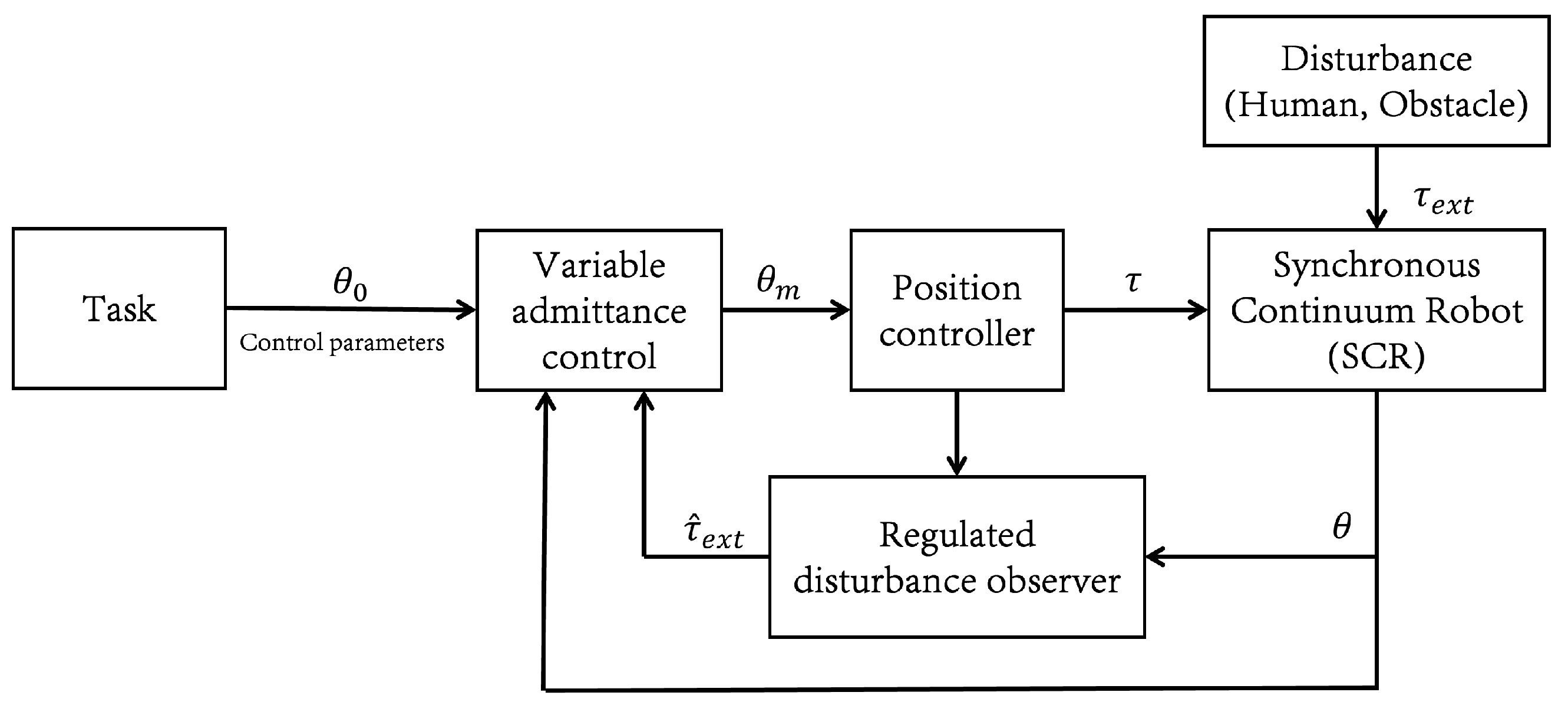
Figure 5 illustrates the overall block diagram of the proposed method. The control parameters and the reference joint angles, denoted as θ 0 , are determined and applied to the proposed VAC-based schemes to generate compliant motion. During operation, if contact occurs between the environment and the robot, the external torques, denoted as τ ^ e x t , are estimated using a sensorless disturbance observer based on the motor torque and the actual joint angles. The estimated torques are then used to modify the trajectories according to the proposed schemes. Finally, the robot executes the generated motion through a position controller.

5. Performance Validation

5.1. Experimental Environment

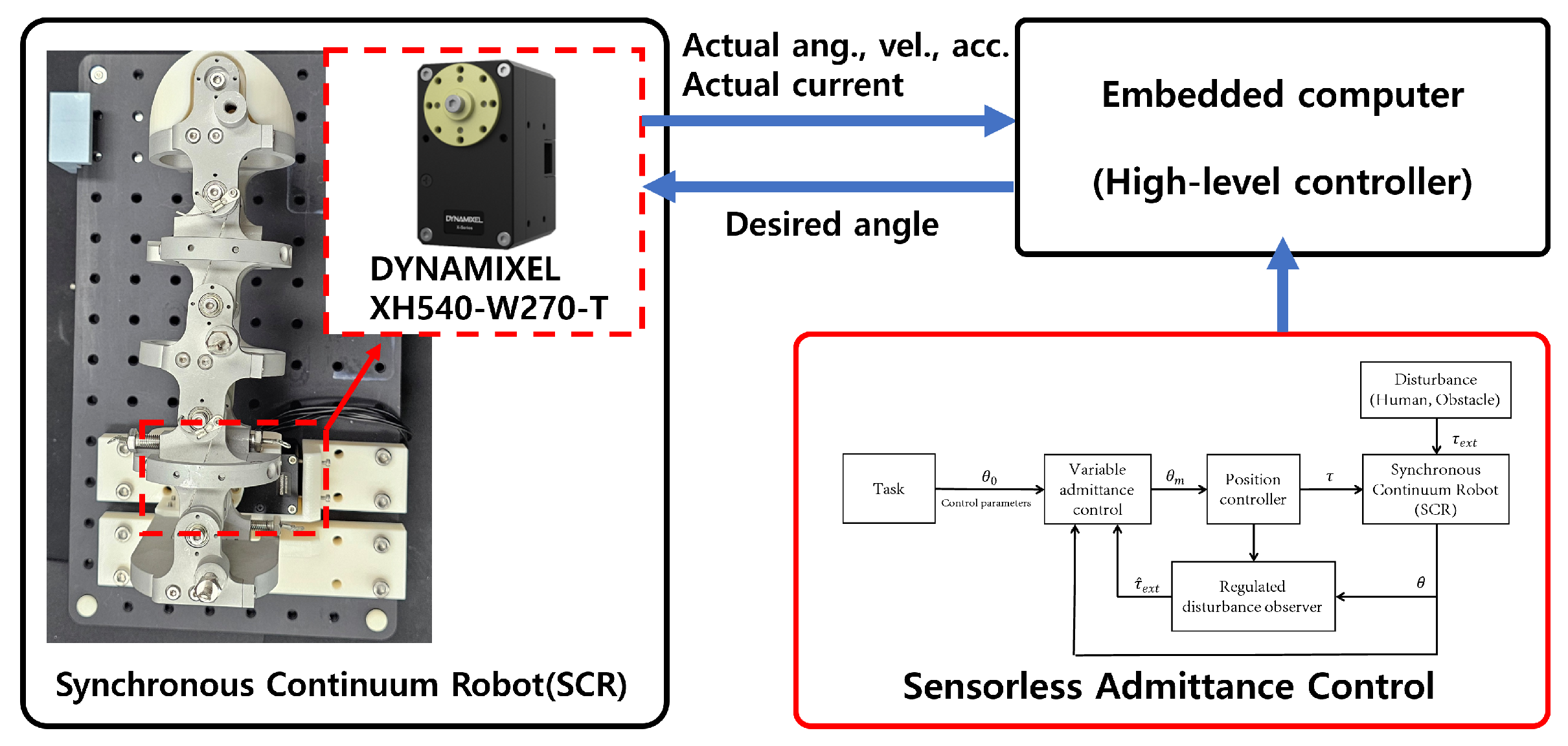
To validate the effectiveness and performance of the proposed control framework, experiments were conducted using a SCR platform. The overall system configuration of the robot is illustrated in Figure 6.
The actuator is located at the base of the mechanism and directly controls the orientation of the lower disk. A Dynamixel HX540-W270 (ROBOTIS, Seoul, Republic of Korea) actuator is employed as the driving motor, and its key specifications are summarized in Table 2. The internal current sensing of the actuator provides a resolution of approximately 2.69 mA, corresponding to a torque resolution of about 0.005 Nm. This resolution is sufficient for disturbance estimation in the proposed framework, although small torque variations may be affected by friction and measurement noise. The motor delivers torque directly to the lower disk rather than regulating cable length. The generated torque is transmitted through a synchronized cable network, which distributes the actuation force to all joints within the section. As a result, all joints rotate with an identical angular displacement, preserving the structural continuity of the SCR.
All structural components were fabricated from aluminum to ensure sufficient stiffness and stable operation under high cable tension. High-strength steel cables were employed to withstand the transmitted loads and to maintain reliable torque delivery throughout the mechanism.
The parameters of the admittance controller were determined based on the dynamic response characteristics of a second-order system. For parameter design, the admittance coefficients were assumed to be constant within predefined external torque regions, i.e., | τ ^ e x t |   < τ m i n (low-interaction region) and | τ ^ e x t |   > τ m a x (high-interaction region), in order to facilitate intuitive parameter selection. In the actual implementation, however, the coefficients are smoothly varied as continuous functions of the estimated external torque to ensure gradual transitions between regions and to avoid discontinuities in the control input. Within each region, fixed admittance parameters were assigned to ensure predictable dynamic behavior. The admittance model of each joint in Equation (24) can be represented in the Laplace domain as [17]
Θ ( s ) T ( s ) = m s 2 + b v m s + k v m b 0 s 2 + 2 ζ ω n s + ω n 2 ,
where m, b v , and k v denote the virtual inertia, damping, and stiffness coefficients of the admittance model, respectively. ω n and ζ represent the natural frequency and damping ratio of the equivalent second-order system. To prevent overshoot and ensure stable interaction, each joint was designed as a critically damped or overdamped system (i.e., ζ 1 ), which guarantees a non-oscillatory and stable response of the equivalent second-order system. Accordingly, the damping ratio condition was defined as
ζ = b v 2 m k v 1 .
Considering the mechanical characteristics of the SCR and the motor torque limits, the damping coefficients ( B f and B s ) were selected based on the relationship between achievable joint velocities and the predefined torque thresholds, τ m i n and τ m a x . The virtual inertia parameter m was chosen to achieve a settling time shorter than 0.5 s, ensuring responsive yet stable physical interaction. For compliant motion, the stiffness coefficient K c was set to zero to allow free motion generation driven purely by external torque. In contrast, the stiffness for active motion, K a , was determined according to the overdamping condition in Equation (32) to guarantee stable convergence toward the reference trajectory. Finally, all control parameters were experimentally fine-tuned to account for unmodeled dynamics and cable transmission characteristics. The final parameter values used in the performance validation experiments are summarized in Table 3.

5.2. Experiment for Constrained Motion

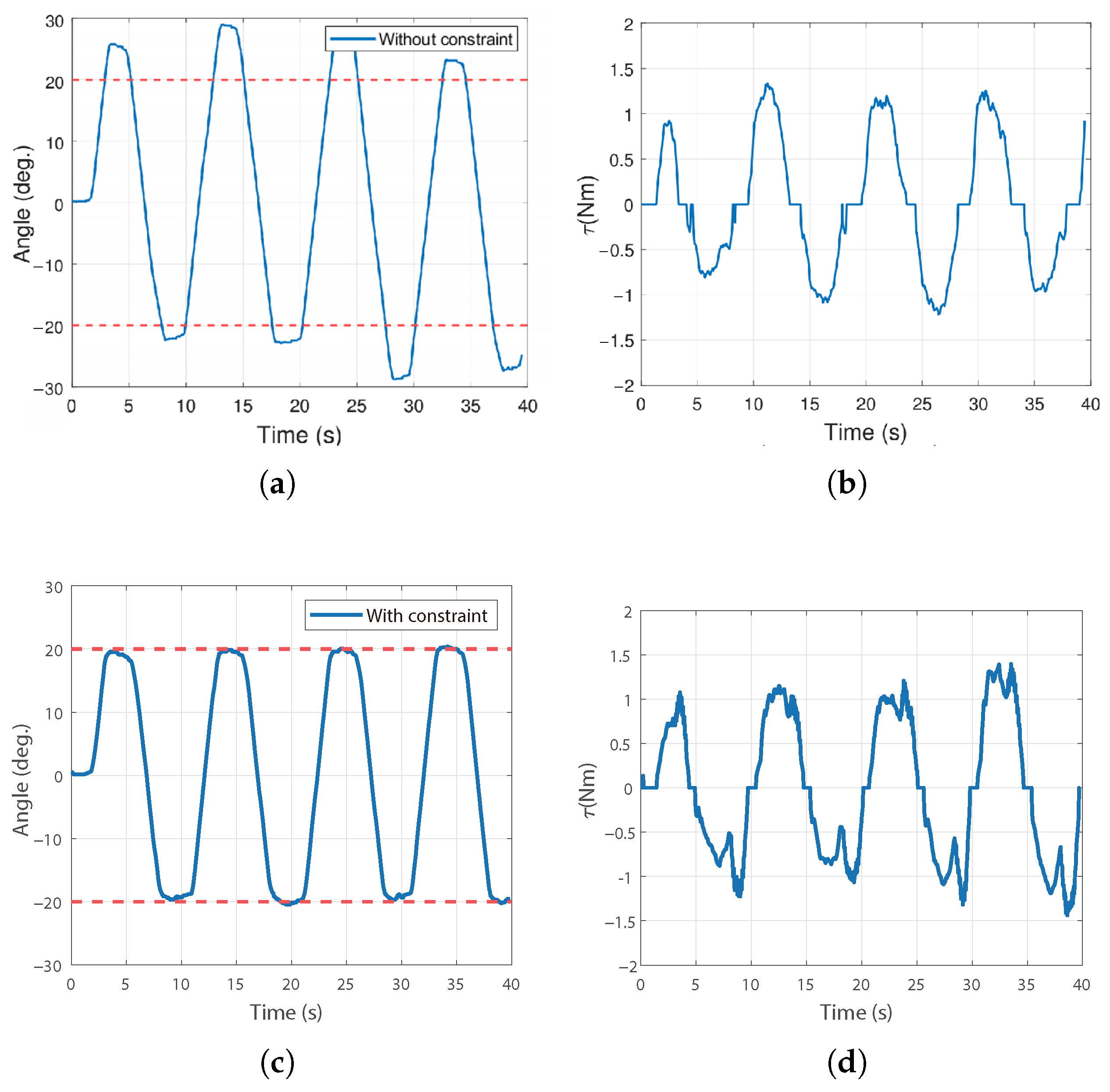
As an initial validation of the proposed method, experiments were conducted to investigate the effect of joint constraints on the robot’s achievable workspace. Specifically, the constraints on the joint motion range and angular velocity were defined as follows: the angle was limited to between 20 and 20 degrees, and the angular velocity was restricted to between −0.3 and 0.3 rad/s.
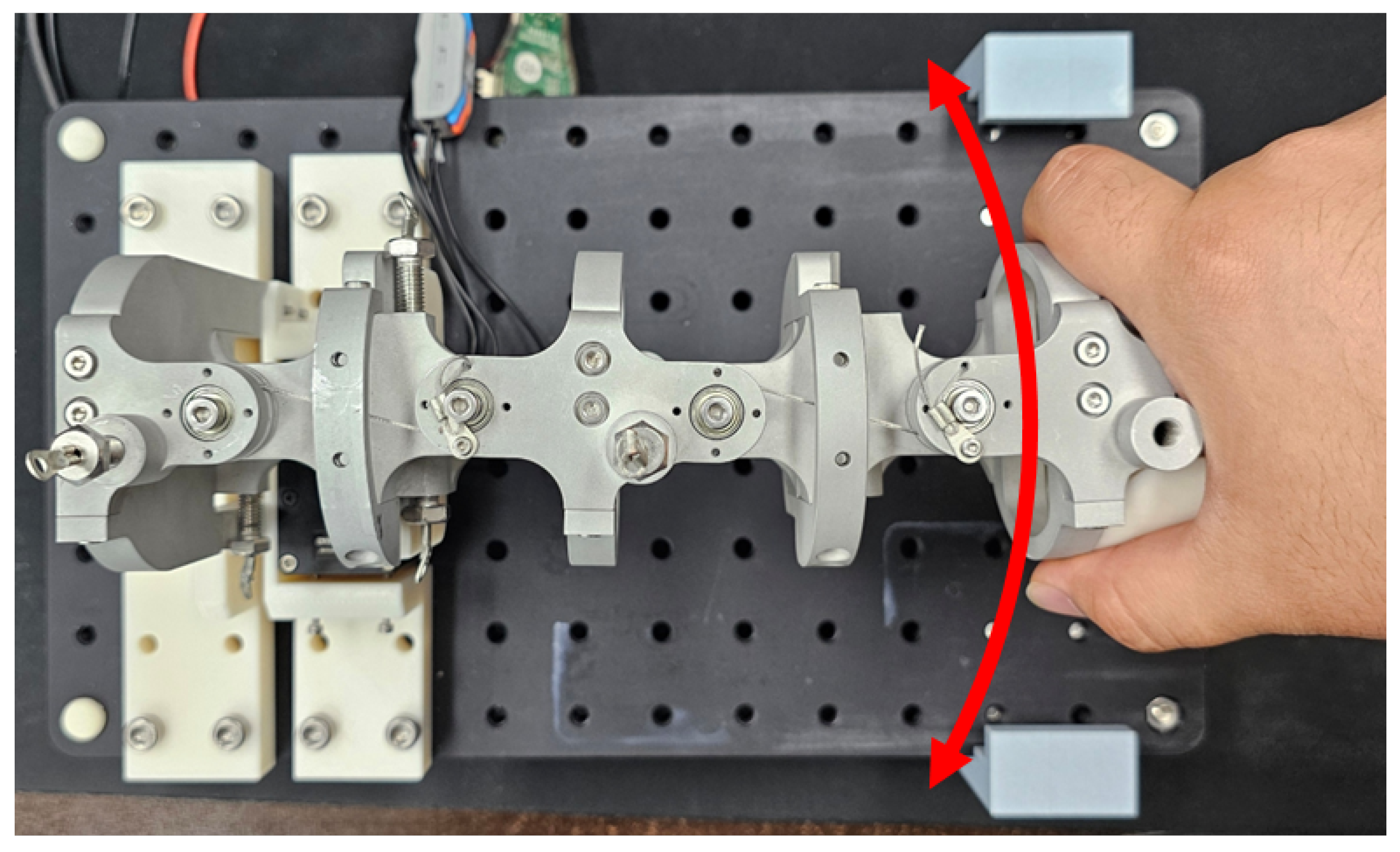
To evaluate the effect of joint constraints, an operator manually grasped and manipulated the robot, as illustrated in Figure 7. The external torque applied by the operator was estimated, and the corresponding robot motion was generated based on the proposed method. The experiment was performed under two conditions: with and without joint constraints.
Figure 8 illustrates the effect of joint angle constraints on robot motion generation. The red dashed lines in the figure indicate the predefined joint angle limits. When the constraints were not applied, motion continued to be generated in response to external torques even as the joint approached its upper and lower limits, as shown in Figure 8a. In contrast, when the proposed constraints were activated, motion generation was effectively suppressed near the joint boundaries despite the presence of external torque, as depicted in Figure 8c. These results demonstrate that the proposed method explicitly incorporates joint angle constraints into the motion generation process, enabling safe and constraint-consistent trajectory generation.
Furthermore, the proposed framework explicitly integrates angular velocity constraints by adaptively regulating the target velocity in addition to the target position. By concurrently enforcing both joint angle and angular velocity limits, the method ensures physically feasible motion while preserving compliant interaction behavior.
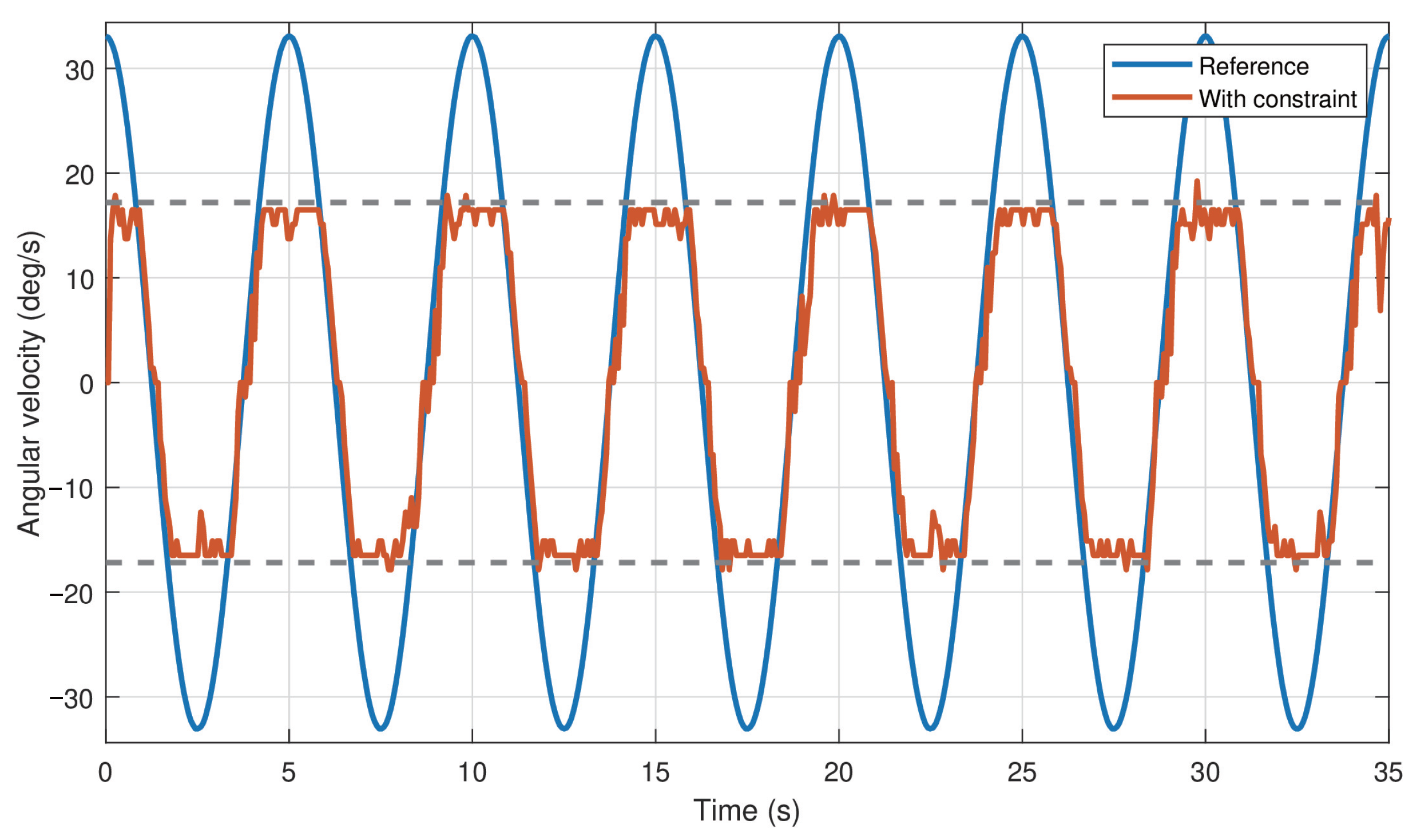
To further validate the effectiveness of the angular velocity constraint, an additional experiment was conducted. The robot was commanded to track a sinusoidal trajectory with a maximum angular velocity of 0.3 rad/s in the absence of external torques, allowing the isolated effect of the velocity constraint to be evaluated. Figure 9 presents the experimental results, clearly demonstrating the influence of the angular velocity constraint on motion generation. The gray dashed line indicates the predefined angular velocity limit. Although the commanded reference velocity exceeds the predefined angular velocity limit, the proposed method successfully regulates the robot motion to remain within the allowable speed range. These results confirm that the proposed framework effectively enforces angular velocity constraints while maintaining stable motion behavior. Furthermore, together with the joint angle regulation method, the framework enables the simultaneous incorporation of both joint angle and angular velocity constraints within a unified motion generation strategy.

5.3. Experiment for Compliance Motion

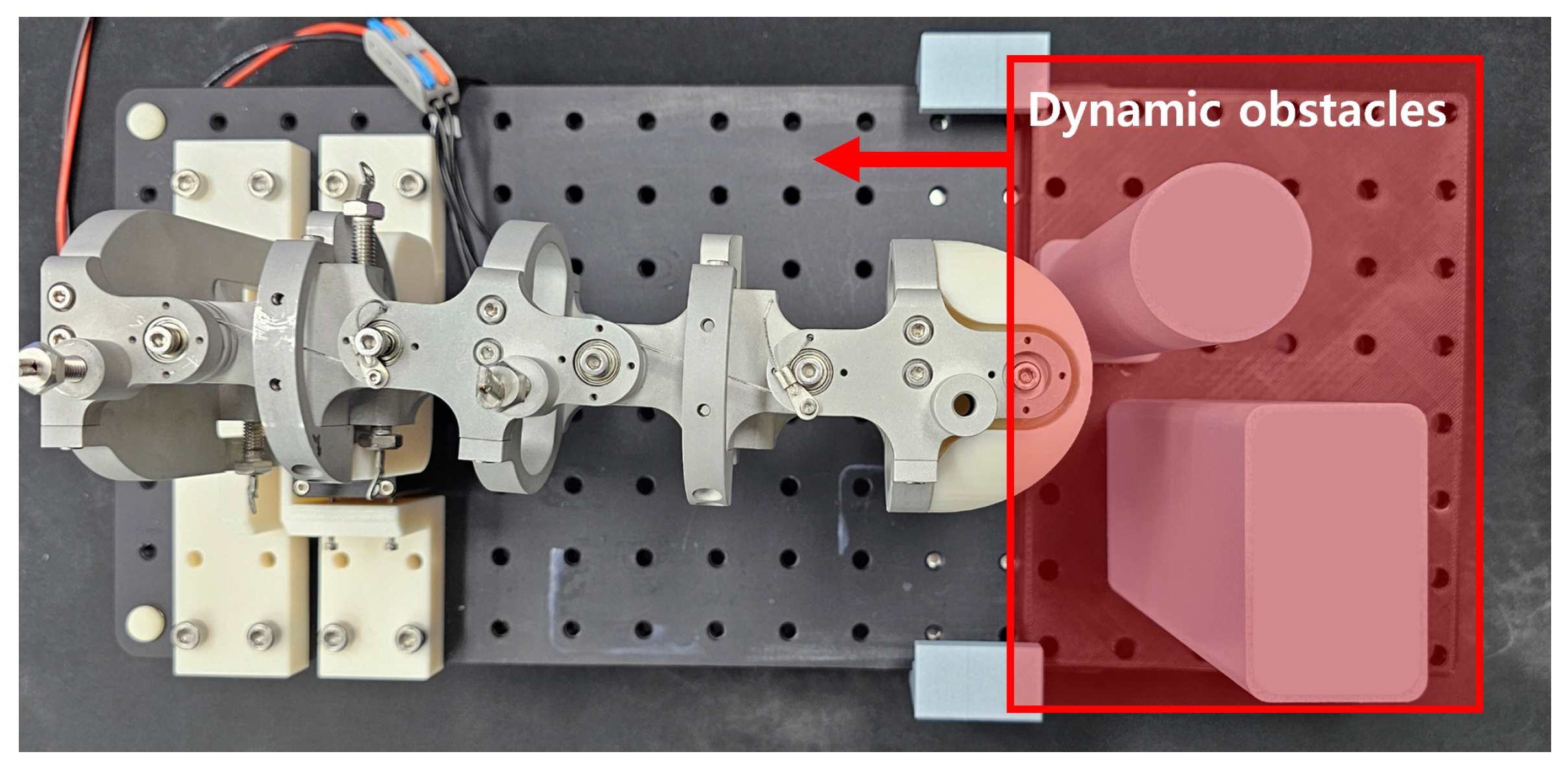
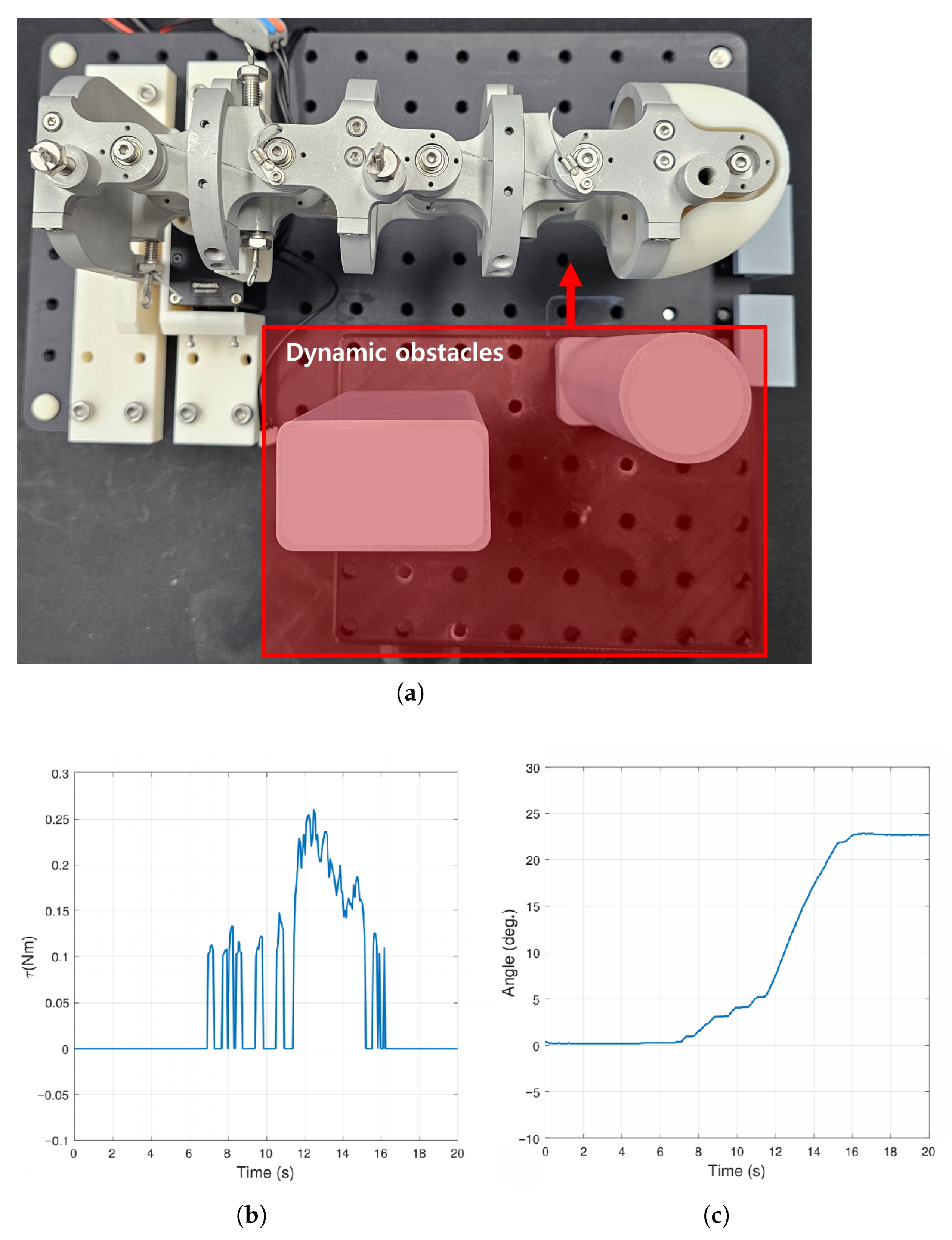
To validate the effectiveness of the proposed method in generating compliant motion under external disturbances, experiments were conducted under two scenarios. In the first scenario, the system’s ability to produce compliant motion at different contact points was evaluated. The robot was commanded to maintain a constant reference angle, while a moving obstacle interacted with the robot structure, as illustrated in Figure 10.
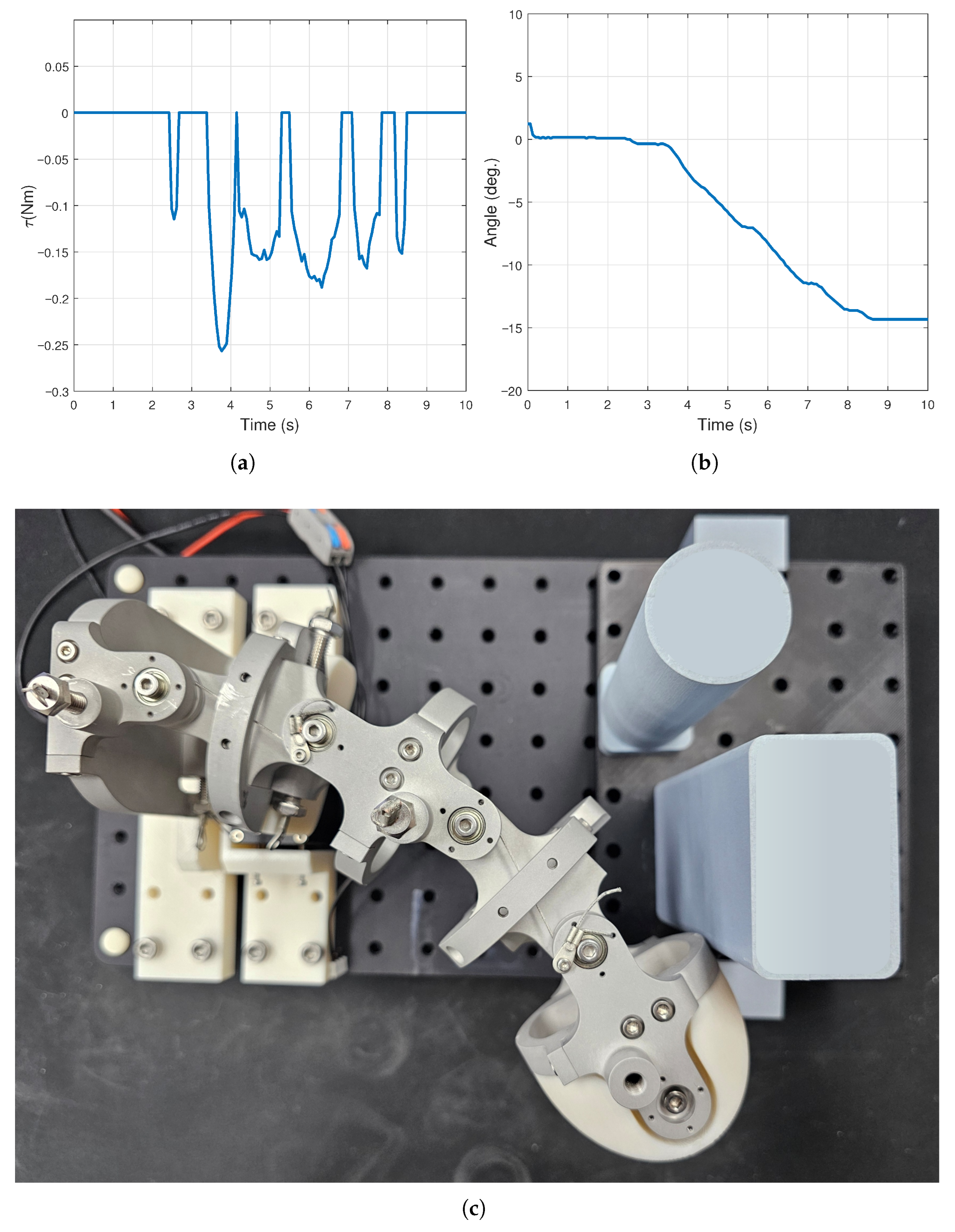
Figure 11 presents the experimental results. Contact between the obstacle and the robot generates external forces, which are estimated using the SDO, as shown in Figure 11a. The estimated torque is incorporated into the proposed control framework, thereby modifying the robot’s trajectory, as illustrated in Figure 11b. As the robot’s posture changes, the contact point shifts accordingly. Despite this variation, the external force is consistently estimated, and the robot adaptively adjusts its posture in response, as shown in Figure 11c.
To further validate the generation of compliant motion at various contact positions, an additional experiment was conducted by changing the direction of the obstacle’s motion, as shown in Figure 12a. In contrast to the previous case, the obstacle contacted the lateral side of the robot. Nevertheless, the external force was successfully estimated by the applied SDO, as shown in Figure 12b. As a result, the robot’s posture was modified based on the proposed method. Figure 12c presents the joint angles adjusted according to the estimated external force. These results demonstrate that, regardless of the contact point between the robot and the obstacle, the external force can be reliably estimated, and compliant motion can be generated based on the estimated force using the proposed method.
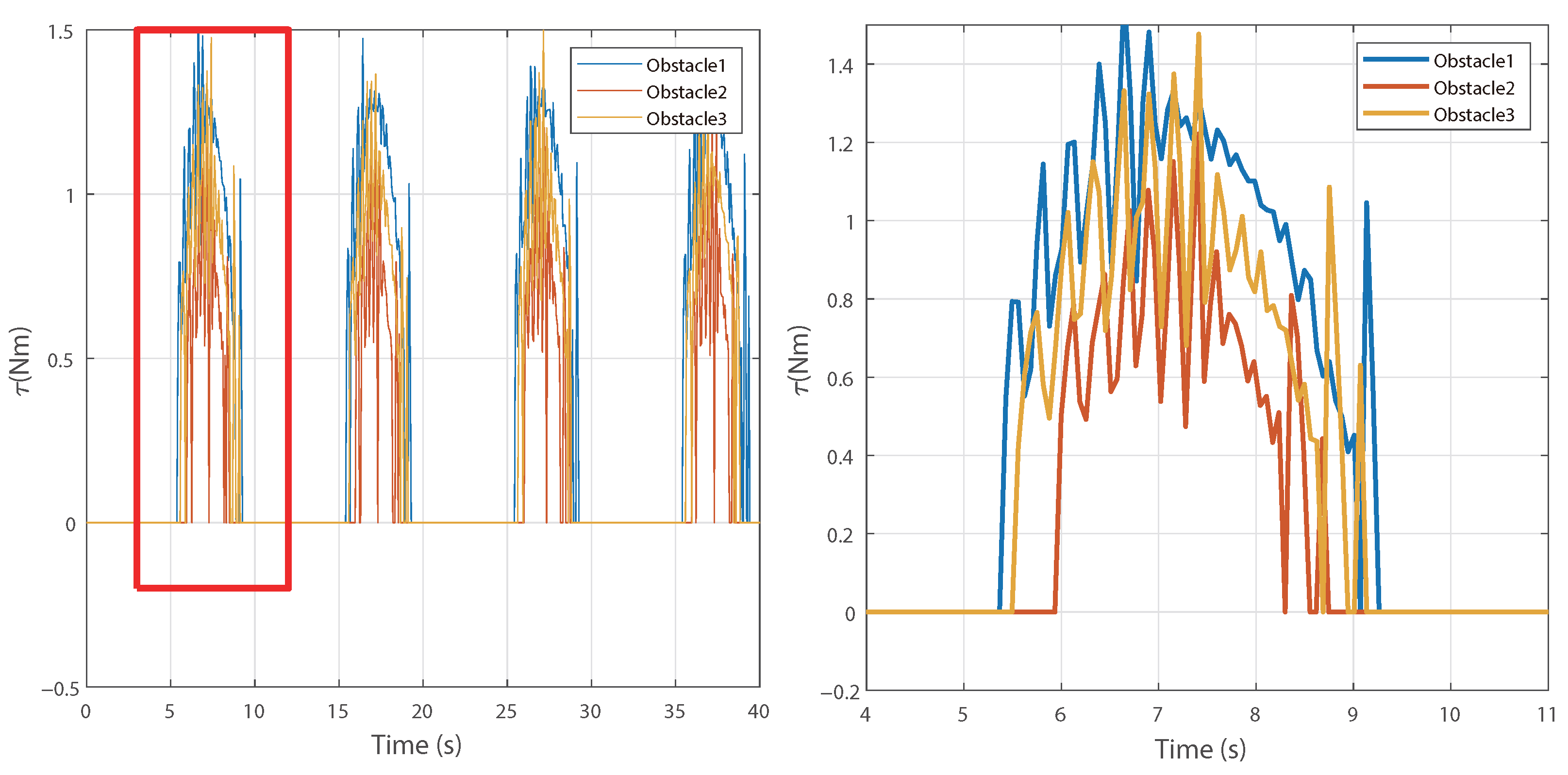
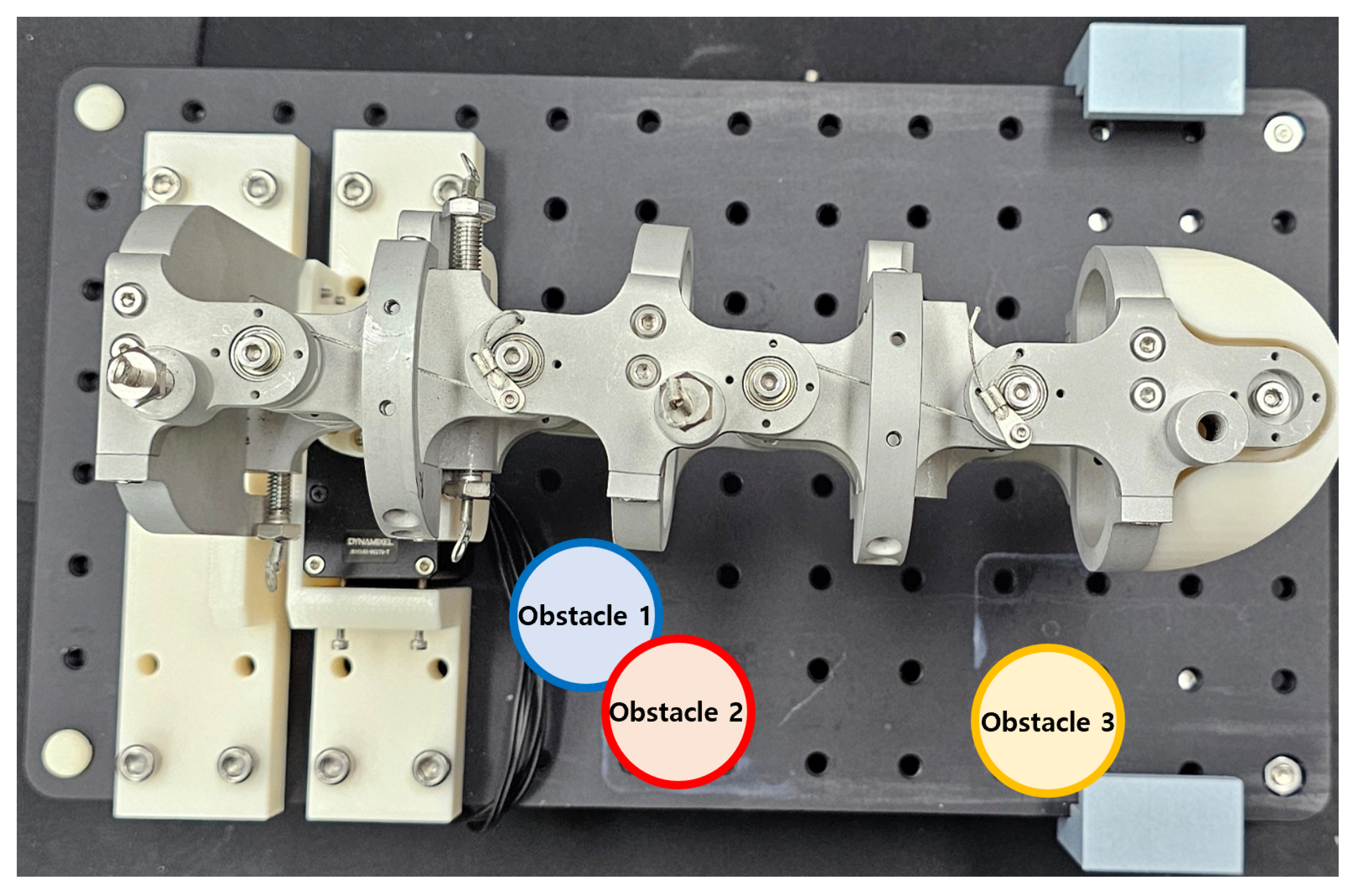
The experimental setup is shown in Figure 13. The robot follows predefined trajectories, and an obstacle is placed along its motion path. During motion, contact occurs between the robot and the obstacle, and the resulting contact force is estimated using a sensorless disturbance observer. Based on the estimated torque, compliant motion is generated. To evaluate robustness across different contact conditions, the position of the obstacle is varied so that different disks of the robot come into contact with it. The experiment is repeated for each configuration.
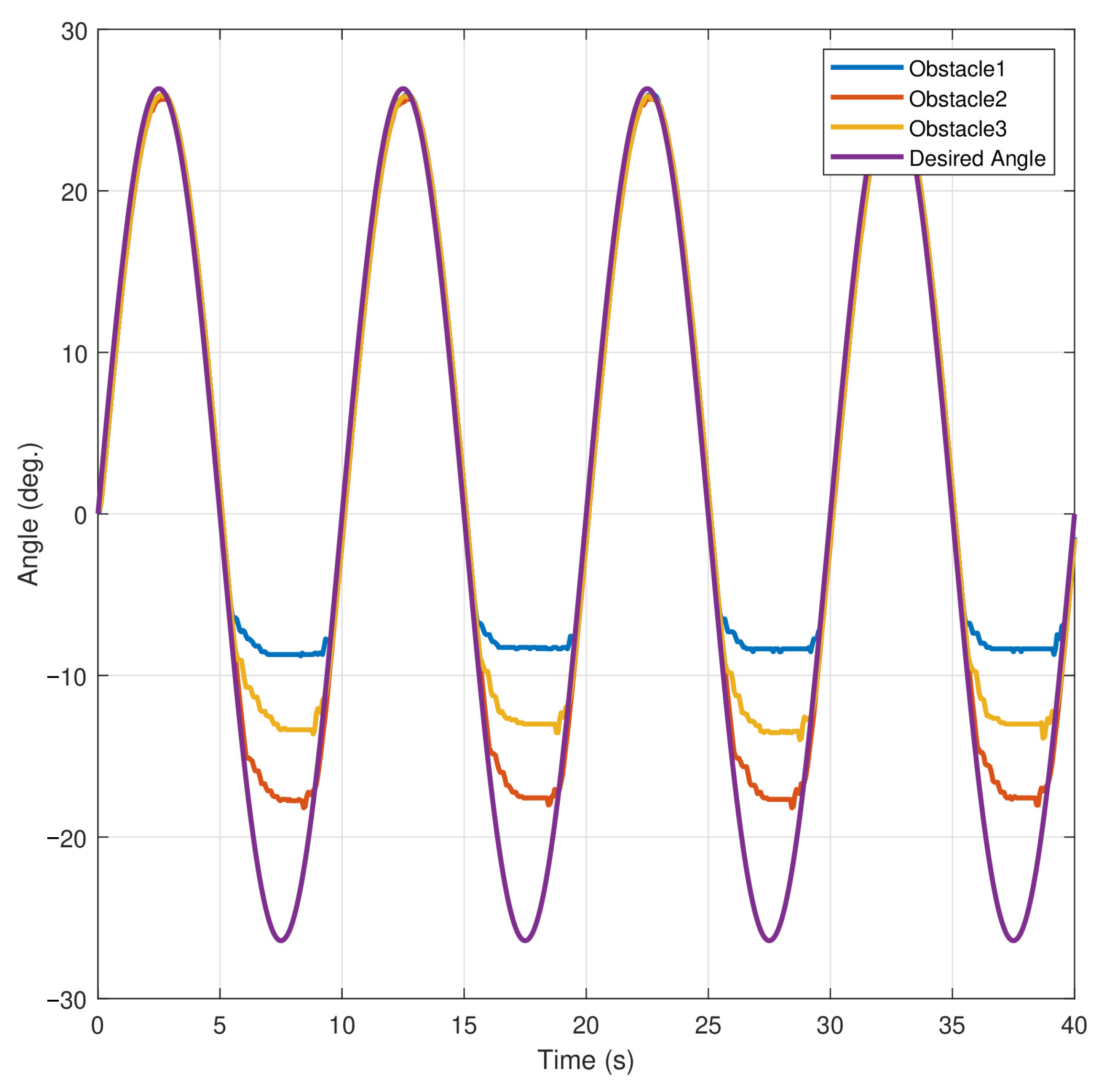
Figure 14 presents the experimental results. In Figure 14, the timing of the estimated torque varies depending on the obstacle position, since contact occurs at different locations along the robot structure. This demonstrates that the proposed sensorless disturbance observer (SDO) can estimate external forces regardless of the specific contact location. Based on the estimated torque, the predefined trajectory is modified using the proposed method. As shown in Figure 15, when contact occurs, the robot no longer strictly follows the predefined trajectory but instead generates compliant motion that reflects the interaction force. In contrast, once contact with the obstacle is released, the robot resumes tracking the predefined trajectory. These results verify that the proposed method enables not only compliant motion generation during contact but also accurate trajectory tracking in the absence of external interaction. Furthermore, even when the contact condition changes, the transition between trajectory tracking and compliant behavior is achieved smoothly and stably.
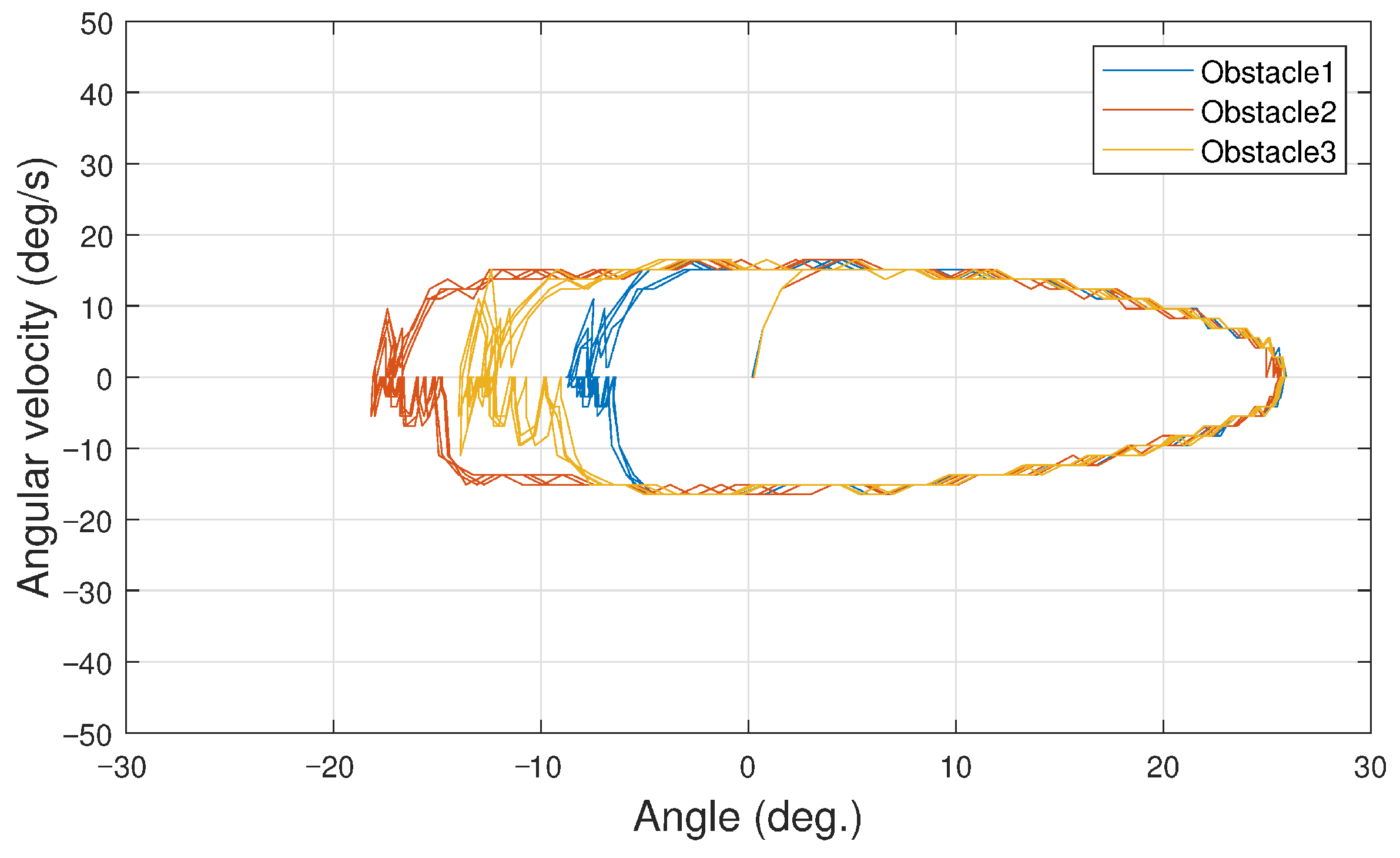
To further verify the stability of the proposed control framework, a phase plot of the joint motion under varying reference inputs was analyzed, as shown in Figure 16. The phase trajectories exhibit smooth convergence toward the equilibrium point without noticeable oscillations, indicating a stable and well-damped dynamic response of the system.

5.4. Discussion

Experiments were conducted in various interaction scenarios using the synchronous continuum robot (SCR) to evaluate the effectiveness of the proposed framework. External torques generated by contact were successfully estimated using the proposed sensorless disturbance observer (SDO) without the need for additional sensors. Moreover, the experimental results confirmed that the external forces could be reliably estimated regardless of the contact location between the robot and the obstacle, demonstrating the robustness of the proposed SDO under varying interaction conditions. In particular, the incorporation of the adaptive term in the parameter identification process contributed significantly to improving estimation accuracy despite the cable-driven transmission characteristics of the SCR. Since cable mechanisms inherently include uncertainties such as tension variation, friction, and transmission nonlinearities, accurate disturbance estimation can be challenging. The proposed adaptive compensation mechanism effectively mitigated these uncertainties, enabling stable and reliable external torque tracking even in the presence of cable-related dynamics.
Based on the estimated torques, compliant motions were generated under various reference angles and target positions using the proposed VAC-based control method. The results demonstrate that the controller enables adaptive compliance in response to external interactions while maintaining stable and consistent motion behavior. Furthermore, the proposed algorithm simultaneously enforces constraints on both joint angles and angular velocities through adaptive regulation of target positions and target speeds. This dual-layer constraint integration allows the robot to maintain safe, physically feasible motion within admissible boundaries while preserving interaction responsiveness. The ability to concurrently reflect both positional and velocity-level constraints highlights the effectiveness of the proposed unified motion regulation strategy. Overall, these findings confirm that the proposed framework effectively integrates contact-independent force estimation, adaptive compliant motion generation, and simultaneous constraint enforcement within a unified control architecture.
Additionally, the modular nature of the SCR suggests that the future integration of multiple SCR units arranged in different orientations could enable the generation of more diverse spatial motion patterns. By combining SCR modules in various directional configurations, richer trajectory generation capabilities and enhanced interaction versatility are expected, further extending the applicability of the proposed control framework. However, several challenges remain for future investigation. While the proposed constraint-aware strategy demonstrated stable behavior under the considered operating conditions, its performance under sudden, high-magnitude external torques—particularly near joint limits—has not been extensively investigated. In such cases, rapid transitions of the constraint-related coefficients may introduce chattering or instability, which requires further analysis. In addition, when multiple SCR segments are connected in series, dynamic coupling between segments may affect the accuracy of the disturbance observer, which is based on independent joint assumptions. Such coupling can influence torque propagation across segments and may impact control performance. Furthermore, long-term operation may introduce mechanical wear and friction variations, leading to time-varying uncertainties that can affect both disturbance estimation and control accuracy [38]. Addressing these challenges will be an important direction for future work.

6. Conclusions

In this paper, a sensorless variable admittance control (VAC)-based compliant motion generation method was proposed for the Synchronous Continuum Robot (SCR). The SCR was designed with a mechanically synchronized architecture to generate precise continuous motion, and this study presented a control framework that enables active compliant motion for safe interaction with diverse environments. To estimate external torques without additional force sensors, a dynamic model-based sensorless disturbance observer (SDO) was implemented. Based on the estimated external torques, variable admittance parameters related to joint angles and angular velocities were designed. This adaptive strategy allows the robot to modulate its dynamic response according to different interaction conditions.
To validate the effectiveness of the proposed method, a series of experiments were conducted under various environmental interaction scenarios. Experiments were performed not only under fixed reference posture conditions with external contact but also during dynamic motion involving contact with obstacles at different locations along the robot body. The results demonstrated that external torques were stably estimated even when contact occurred at different points, and appropriate compliant motions were successfully generated based on the estimated forces. In addition, experiments incorporating the proposed constraint-aware trajectory generation scheme were carried out to enhance operational safety. In particular, the proposed framework enables the simultaneous consideration of joint angle and angular velocity constraints by adaptively regulating both target positions and target velocities according to interaction torques and proximity to joint limits. This dual-layer motion regulation mechanism allows the SCR to generate safe, bounded, and stable motions within the admissible workspace while preserving compliant interaction behavior. These experimental validations demonstrate that the proposed control framework operates effectively across diverse contact locations and interaction environments, while ensuring constraint-consistent and interaction-aware motion generation. From a broader perspective, the proposed framework can also be interpreted as a form of control-level biomimicry. Inspired by biological manipulators such as an elephant trunk, which exhibit adaptive force perception, compliant interaction, and self-protective behavior during environmental contact, the integration of sensorless disturbance estimation, variable admittance control, and constraint-aware strategies enables the SCR to realize similar interaction characteristics through control design. This perspective extends the concept of biomimicry beyond mechanical structure toward control principles, providing additional insight for the development of safe and intuitive human–robot interaction systems.
In future work, the SCR structure will be further extended to incorporate more biologically inspired characteristics, with the goal of developing social robots capable of natural and intuitive interaction with humans. Furthermore, future research will investigate the integration of multiple SCR units arranged in different orientations and configurations to enable the generation of more diverse and complex spatial trajectories. By combining SCR modules in various directional arrangements, it is expected that richer path-generation capabilities and enhanced task adaptability can be achieved, expanding the applicability of the proposed control framework to more sophisticated interaction and manipulation scenarios. As the number of links and structural complexity increase, it becomes important to evaluate the resulting mechanical stresses and potential self-induced torques. In this regard, simulation-based analysis is considered a feasible and effective approach for assessing the structural and dynamic responses of the system, and it will be investigated to support design optimization and decision-making.

Author Contributions

Conceptualization, M.-O.K.; Methodology, M.-O.K. and J.C.; Software, M.-O.K.; Validation, M.-O.K., J.C. and D.C.; Investigation, M.-O.K.; Data curation, M.-O.K. and J.C.; Writing—original draft, M.-O.K.; Writing—review & editing, J.C., T.S. and D.-W.L.; Supervision, D.C., T.S. and D.-W.L.; Project administration, T.S. and D.-W.L. All authors have read and agreed to the published version of the manuscript.

Funding

This work was supported by the Industrial Fundamental Technology Development Program (No. 20023495, Development of behavior-oriented HRI AI technology for long-term interaction between service robots and users) funded by the Ministry of Trade, Industry and Energy (MOTIE, Republic of Korea).

Institutional Review Board Statement

Not applicable.

Informed Consent Statement

Not applicable.

Data Availability Statement

The raw data supporting the conclusions of this article will be made available by the authors on request.

Conflicts of Interest

The authors declare no conflicts of interest.

References

  1. Burgner-Kahrs, J.; Rucker, D.C.; Choset, H. Continuum Robots for Medical Applications: A survey. IEEE Trans. Robot. 2010, 31, 1261–1280. [Google Scholar] [CrossRef]
  2. Webster, R.J., III; Jones, B.A. Design and Kinematic Modeling of Constant Curvature Continuum Robots: A Review. Int. J. Robot. Res. 2010, 29, 1661–1683. [Google Scholar] [CrossRef]
  3. Chikhaoui, M.T.; Lilge, S.; Kleinschmidt, S.; Burgner-Kahrs, J. Comparison of modeling approaches for a tendon actuated continuum robot with three extensible segments. IEEE Robot. Autom. Lett. 2019, 4, 989–996. [Google Scholar] [CrossRef]
  4. Buckingham, R.; Graham, A. Nuclear snake-arm robots. Ind. Robot 2012, 39, 6–11. [Google Scholar] [CrossRef]
  5. Nahar, D.; Yanik, P.M.; Walker, I.D. Robot tendrils: Long, thin continuum robots for inspection in space operations. In Proceedings of the IEEE Aerospace Conference, Big Sky, MT, USA, 8 June 2017. [Google Scholar]
  6. Anscombe, R.; Bryant, A.; Buckingham, R.; Green, B. Snake-arm robots: A new approach to aircraft assembly. In Aerospace Technology Conference and Exposition; SAE Technical Paper; SAE International: Warrendale, PA, USA, 2006. [Google Scholar]
  7. Siciliano, B.; Khatib, O. Springer Handbook of Robotics; Springer: Berlin/Heidelberg, Germany, 2016; pp. 1349–1360. [Google Scholar]
  8. Wang, Z.; Peer, A.; Buss, M. An HMM approach to realistic haptic human-robot interaction. In Proceedings of the Third Joint EuroHaptics conference and Symposium on Haptic Interfaces for Virtual Environment and Teleoperator Systems, Salt Lake City, UT, USA, 18–20 March 2009. [Google Scholar]
  9. Pinto-Bernal, M.J.; Cespedes, N.; Castro, P.; Munera, M.; Cifuentes, C.A. Physical Human-Robot Interaction Influence in ASD Therapy Through an Affordable Soft Social Robot. J. Intell. Robot. Syst. 2022, 105, 67. [Google Scholar] [CrossRef]
  10. Prasad, V.; Stock-Homburg, R.; Peters, J. Human-Robot Handshaking: A Review. Int. J. Soc. Robot. 2022, 14, 277–293. [Google Scholar] [CrossRef]
  11. Yang, C.; Geng, S.; Walker, I.; Branson, D.T.; Liu, J.; Dai1, J.S.; Kang, R. Geometric constraint based modeling and analysis of a novel continuum robot with SMA initiated variable stiffness. Int. J. Robot. Res. 2020, 39, 1–15. [Google Scholar] [CrossRef]
  12. Liu, T.; Mu, Z.; Xu, W.; Yang, T.; You, K.; Fu, H. A Improved Mechanical Design and Simplified Motion Planning of Hybrid Active and Passive Cable-Driven Segmented Manipulator with Coupled Motion. In Proceedings of the IEEE/RSJ International Conference on Intelligent Robots and Systems, Macau, China, 3–8 November 2019. [Google Scholar]
  13. Ma, S.; Liang, B.; Wang, T. Dynamic analysis of a hyper-redundant space manipulator with a complex rope network. Aerosp. Sci. Technol. 2020, 100, 105768. [Google Scholar] [CrossRef]
  14. Zheng, X.; Yang, T.; Zhu, X.; Chen, Z.; Wang, X.; Liang, B. Dynamic modeling and experimental verification of a cable-driven continuum manipulator with cable-constrained synchronous rotating mechanisms. Nonlinear Dyn. 2022, 107, 153–172. [Google Scholar] [CrossRef]
  15. Mira, M.A.; Mousa, O.A.; Fahmy, A.H.; Shehata, O.M.; Morgan, E.I. Investigating Various Force Control Techniques Effect on a Flexible Continuum Robot. Int. J. Mech. Eng. Robot. Res. 2021, 10, 255–260. [Google Scholar] [CrossRef]
  16. Ott, C.; Mukherjee, R.; Nakamura, Y. Unified Impedance and Admittance Control. In Proceedings of the IEEE International Conference on Robotics and Automation, Anchorage, AK, USA, 3–7 May 2010. [Google Scholar]
  17. Kang, S.H.; Jin, M.; Chang, P.H. A Solution to the Accuracy/Robustness Dilemma in Impedance Control. IEEE/ASME Trans. Mechatronics 2009, 14, 282–294. [Google Scholar] [CrossRef]
  18. Cho, J.; Choi, D.; Park, J.H. Sensorless Variable Admittance Control for Human–Robot Interaction of a Dual-Arm Social Robot. IEEE Access 2023, 11, 69366–69377. [Google Scholar] [CrossRef]
  19. Li, Y.; Ge, S.S. Human-robot collaboration based on motion intention estimation. IEEE/ASME Trans. Mechatronics 2014, 19, 1007–1014. [Google Scholar] [CrossRef]
  20. Duchaine, V.; Gosselin, C. Investigation of human-robot interaction stability using Lyapunov theory. In Proceedings of the IEEE International Conference on Robotics and Automation, Pasadena, CA, USA, 19–23 May 2008. [Google Scholar]
  21. Sun, T.; Wang, Z.; He, C.; Yang, L. Adaptive Robust Admittance Control of Robots Using Duality Principle-Based Impedance Selection. Appl. Sci. 2022, 12, 12222. [Google Scholar] [CrossRef]
  22. Liu, C.; Li, Z. Force tracking smooth adaptive admittance control in unknown environment. Robotica 2023, 41, 1991–2011. [Google Scholar] [CrossRef]
  23. Kang, G.; Oh, H.S.; Seo, J.K.; Kim, U.; Choi, H.R. Variable admittance control of robot manipulators based on human intention. IEEE/ASME Trans. Mechatronics 2019, 24, 1023–1032. [Google Scholar] [CrossRef]
  24. Kronander, K.; Billard, A. A online learning of varying stiffness through physical human–robot interaction. In Proceedings of the IEEE/RSJ International Conference on Intelligent Robots and Systems, Saint Paul, MN, USA, 14–18 May 2012. [Google Scholar]
  25. Kormushev, P.; Calinon, S.; Caldwell, D.G. Robot motor skill coordination with EM-based Reinforcement Learning. In Proceedings of the IEEE/RSJ International Conference on Intelligent Robots and Systems, Taipei, Taiwan, 18–22 October 2010. [Google Scholar]
  26. He, W.; Xue, C.; Yu, X.; Li, Z.; Yang, C. Admittance-Based Controller Design for Physical Human–Robot Interaction in the Constrained Task Space. IEEE Trans. Autom. Sci. Eng. 2020, 17, 1937–1949. [Google Scholar] [CrossRef]
  27. Zhan, H.; Huang, D.; Yang, C. Adaptive dynamic programming enhanced admittance control for robots with environment interaction and actuator saturation. Int. J. Intell. Robot. Appl. 2021, 5, 89–100. [Google Scholar] [CrossRef]
  28. Rahman, M.; Ikeura, R.; Mizutani, K. Investigating the impedance characteristic of human arm for development of robots to co-operate with human operators. In Proceedings of the IEEE International Conference on Systems, Man, and Cybernetics, Tokyo, Japan, 12–15 October 1999. [Google Scholar]
  29. Duan, J.; Gan, Y.; Chen, M.; Dai, X. Adaptive variable impedance control for dynamic contact force tracking in uncertain environment. Robot. Auton. Syst. 2018, 102, 54–65. [Google Scholar] [CrossRef]
  30. Zhang, X.; Zhao, J.; Zhang, M.; Liu, X. Disturbance Recognition and Collision Detection of Manipulator Based on Momentum Observer. Sensors 2020, 20, 4187. [Google Scholar] [CrossRef]
  31. Swevers, J.; Verdonck, W.; De Schutter, J. Dynamic Model Identification for Industrial Robots. IEEE Control Syst. Mag. 2007, 27, 58–71. [Google Scholar]
  32. Jin, J.; Gans, N. Parameter identification for industrial robots with a fast and robust trajectory design approach. Robot. Comput.-Integr. Manuf. 2015, 31, 21–29. [Google Scholar] [CrossRef]
  33. Lee, T.; Lee, B.D.; Park, F.C. Optimal excitation trajectories for mechanical systems identification. Automatica 2021, 131, 109773. [Google Scholar] [CrossRef]
  34. Jung, D.; Do, H.; Choi, T.; Park, J.; Cheong, J. Robust Parameter Estimation of Robot Manipulators Using Torque Separation Technique. IEEE Access 2021, 9, 150443–150458. [Google Scholar] [CrossRef]
  35. Yang, C.; Peng, G.; Cheng, L.; Na, J.; Li, Z. Force Sensorless Admittance Control for Teleoperation of Uncertain Robot Manipulator Using Neural Networks. IEEE Trans. Syst. Man Cybern. Syst. 2021, 51, 3282–3292. [Google Scholar] [CrossRef]
  36. Wahrburg, A.; Morara, E.; Cesari, G.; Matthias, B.; Ding, H. Cartesian contact force estimation for robotic manipulators using Kalman filters and the generalized momentum. In Proceedings of the IEEE International Conference on Automation Science and Engineering, Gothenburg, Sweden, 24–28 August 2015. [Google Scholar]
  37. Liu, S.; Wang, L.; Wang, X.V. Sensorless force estimation for industrial robots using disturbance observer and neural learning of friction approximation. Robot. Comput.-Integr. Manuf. 2021, 71, 102168. [Google Scholar] [CrossRef]
  38. Su, J.; Ouyang, Y.; Yin, L.; Shi, Z.; Zhou, C.; Wang, H.; Hu, B. Advancing wind turbine gearbox durability with eco-friendly GO nanolubricants: CFD simulation–experiment synergy for understanding flow dynamics, wear suppression and surface restoration mechanisms. Tribol. Int. 2026, 213, 111034. [Google Scholar] [CrossRef]
Figure 1. Design and actuation mechanism of the cable-driven synchronous continuum robot (SCR). (a) Overall structure of the cable-driven SCR. (b) Cable–pulley synchronous rotation unit.
Applsci 16 03637 g001
Figure 2. Comparison between measured and estimated torque of joints.
Applsci 16 03637 g002
Figure 3. Variable weight for velocity according to an external torque.
Applsci 16 03637 g003
Figure 4. Variable weight for angle according to motion. (a) Variable weight of α B . (b) Variable weight of α θ .
Applsci 16 03637 g004
Figure 5. A block diagram for the proposed control loop.
Applsci 16 03637 g005
Figure 6. System configuration of the SCR platform.
Applsci 16 03637 g006
Figure 7. Experiment environment designed to show the effect of the constrarints for angle.
Applsci 16 03637 g007
Figure 8. Result of the experiments for constraints on the angle. (a) Actual joint angle without constraints. (b) External torque without constraints. (c) Actual joint angle with constraints. (d) External torque with constraints.
Applsci 16 03637 g008
Figure 9. Results of the experiments for constraints on angular velocity.
Applsci 16 03637 g009
Figure 10. The experimental setup for compliant motion validation under external disturbance.
Applsci 16 03637 g010
Figure 11. Dynamic response of the SCR under external disturbance: (a) Actuation torque profile; (b) Joint angle response; (c) Top view of the SCR during contact under external disturbance.
Applsci 16 03637 g011
Figure 12. Dynamic response of the SCR under external disturbance applied from the lateral direction. (a) Experimental setup for compliant motion validation under external disturbance applied from the lateral direction. (b) Actuation torque profile. (c) Joint angle response.
Applsci 16 03637 g012
Figure 13. The experimental setup for compliant motion validation with time-varying reference trajectories.
Applsci 16 03637 g013
Figure 14. Measured actuation torque of the SCR under time-varying reference trajectories with a magnified view of the contact interval.
Applsci 16 03637 g014
Figure 15. Reference and actual joint angles under time-varying reference trajectories.
Applsci 16 03637 g015
Figure 16. Phase plot of joint motion under varying reference inputs.
Applsci 16 03637 g016
Table 1. The parameters for the excitation trajectories (n = 8).
l12345678
a l 10401020406080110
b l −100100−10010070−7030−30
Table 2. Motor specifications of the SCR actuator.
ResolutionStall TorqueRPMGear Ratio
4096 PPR9.9 Nm39.0272.5:1
Table 3. Control parameters of VAC.
DescriptionValue
Coefficent for mass (M)0.3
Coefficent for slow response ( B s )5.0
Coefficent for fast response ( B f )4.0
Coefficent for active motion ( K a )0.2
Coefficent for compliance motion ( K c )0.0
Disclaimer/Publisher’s Note: The statements, opinions and data contained in all publications are solely those of the individual author(s) and contributor(s) and not of MDPI and/or the editor(s). MDPI and/or the editor(s) disclaim responsibility for any injury to people or property resulting from any ideas, methods, instructions or products referred to in the content.