3.2. Research Hypotheses
Based on the original interview data presented in
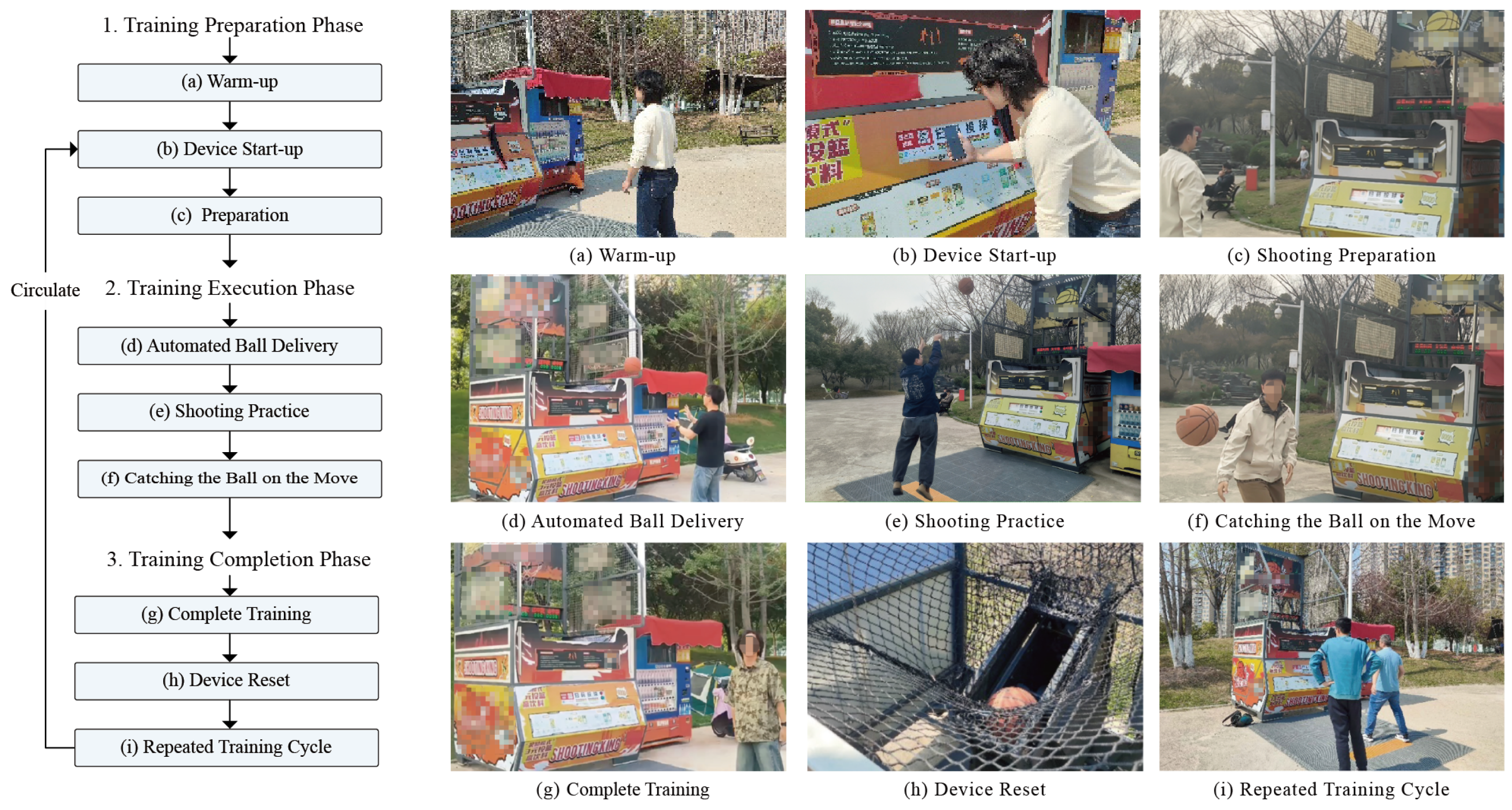
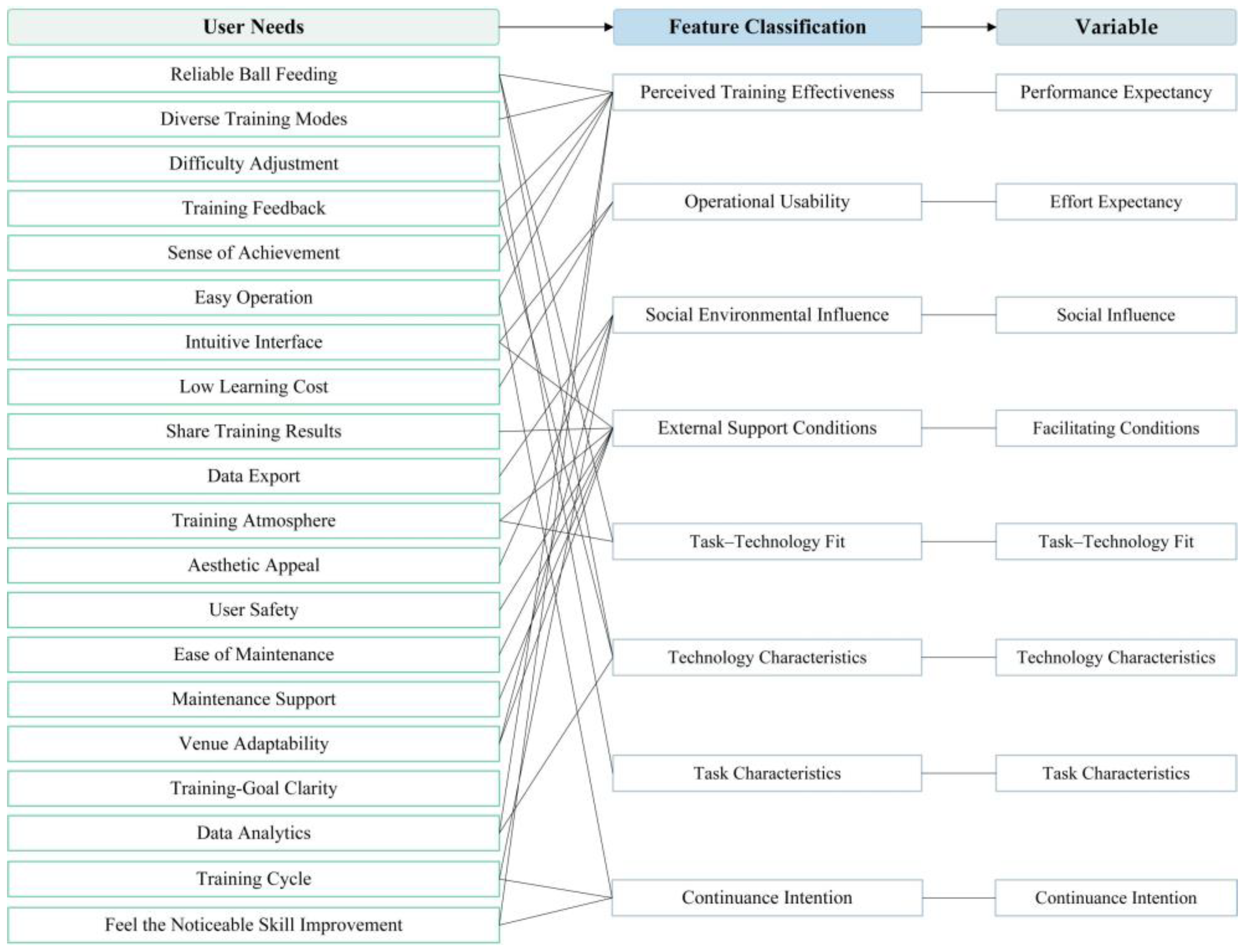
Table 1, the research team identified and categorized user needs related to training effectiveness, operational convenience, and functional–technical fit. These needs were then linked to the constructs in the integrated UTAUT–TTF framework. The qualitative study helped identify context-specific user needs, provided a basis for hypothesis development and questionnaire design, and improved the alignment between the proposed hypotheses and real usage scenarios [
28], as shown in
Figure 6.
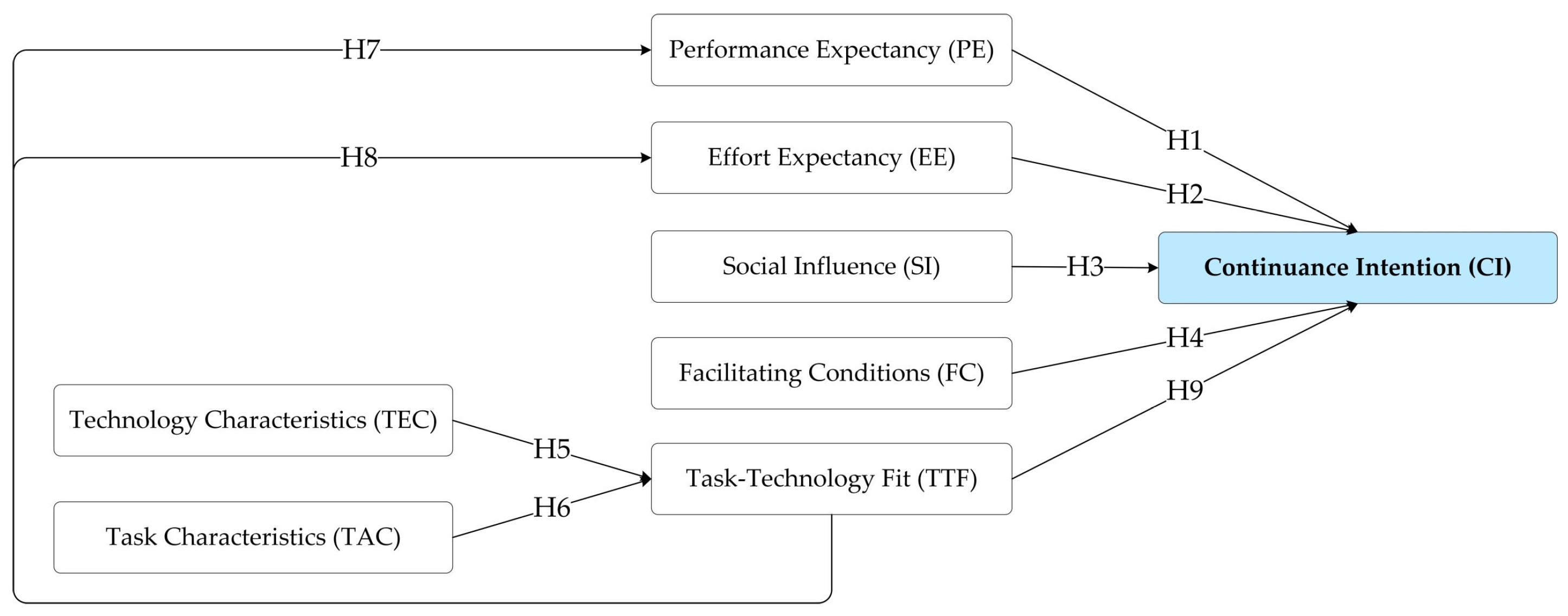
To explore the relationships among the factors influencing users’ continuance intention toward the basketball shooting training machine, the research team reviewed the relevant literature and developed the following hypotheses.
Performance expectancy refers to the degree to which users believe that the basketball shooting training machine can improve their training outcomes and basketball skills. For this type of device, its core value lies in enhancing training efficiency through automated ball delivery and data feedback [
28]. When users perceive that the device can significantly improve training outcomes, they are more likely to recognize its practical value and develop stronger continuance intention. Accordingly, we propose Hypothesis (H):
H1: Performance Expectancy positively influences users’ continuance intention to use the basketball shooting training machine.
Effort expectancy refers to the degree to which users perceive the basketball shooting training machine as easy to learn and easy to operate. For basketball enthusiasts without a professional background, the usability of the human–machine interface is particularly important. When the device is easy to operate and provides a user-friendly interface, it can reduce barriers to use and lower the effort required for learning and operation. This, in turn, increases users’ willingness to use the device for basketball training tasks [
29]. Based on this reasoning, the following hypothesis is proposed:
H2: Effort Expectancy positively influences users’ continuance intention to use the basketball shooting training machine.
Social influence refers to the extent to which other people’s opinions and recommendations affect an individual’s decision to use the basketball shooting training machine. Li et al. examined social influence from three dimensions—subjective norms, social image, and social identity—and found that these social factors significantly affect continuance intention through mechanisms such as perceived usefulness [
30]. In sports contexts, users are usually embedded in social networks, where recommendations from peers and public evaluations can significantly shape their judgments of value. In the present study, social influence specifically refers to the effects of surrounding people’s evaluations, recommendations, and supportive attitudes toward the shooting training machine on users’ continuance intention. Based on this reasoning, the following hypothesis is proposed:
H3: Social Influence positively influences users’ continuance intention to use the basketball shooting training machine.
Facilitating conditions refer to the degree of external support available to users when using the device, encompassing maintenance services, technical guidance, and facility provisions. When users can obtain sufficient external support, barriers encountered during use are mitigated, thereby enhancing continuance intention, hence the following hypothesis:
H4: Facilitating Conditions positively influence users’ continuance intention to use the basketball shooting training machine.
Technology characteristics denote the functional attributes and service quality of the technological tool. In basketball training, relevant characteristics of a shooting training machine include adjustable feeding frequency, controllable landing points, and real-time performance feedback. When technical capabilities more precisely cover training requirements, task–technology fit is expected to improve. Accordingly:
H5: Technology Characteristics positively influence Task–Technology Fit.
Task characteristics refer to the specific requirements and degree of complexity that users encounter while performing a task. When these characteristics align closely with users’ needs, they can markedly strengthen users’ sense of control and autonomy. In other words, clearly defined task characteristics tend to increase users’ reliance on technological products and, in turn, reinforce user stickiness (i.e., sustained engagement and continued use). For basketball enthusiasts, training tasks typically encompass multiple goals, such as improving shooting accuracy, correcting shooting mechanics, and enhancing physical conditioning. As training objectives become more explicit—and as task difficulty and intensity increase—users become more sensitive to the extent to which an automated training device can match their functional requirements. Under such conditions, they are also more likely to perceive a high level of fit during practice. Accordingly:
H6: Task Characteristics positively influence Task–Technology Fit.
Within TTF theory, task–technology fit reflects the extent to which the training task aligns with the device’s technical capabilities. Technology characteristics and task characteristics are two critical antecedents of fit. When the machine’s technological attributes are highly congruent with users’ task requirements, users are more likely to obtain superior training experiences [
20], which in turn strengthens continuance intention. Therefore:
H7: Task–Technology Fit positively influences users’ continuance intention to use the basketball shooting training machine.
TTF theory posits that users’ perceptions of technology use and their continuance intention are fundamentally contingent upon the degree of alignment between technological features and task demands. In the context of basketball shooting training, when the device’s functionalities closely match users’ needs for skill enhancement, users are more likely to clearly perceive improvements in their shooting accuracy and postural standardization, thereby substantially bolstering their performance expectancy toward the equipment. Within integrated UTAUT–TTF research frameworks, numerous studies have shown that task–technology fit is a key antecedent of performance expectancy, which depends heavily on the alignment between technology and users’ task requirements [
31]. Furthermore, when the device’s functional design and operational logic align seamlessly with users’ training tasks, it significantly alleviates perceived operational burdens, thereby elevating effort expectancy. Accordingly, this study proposes the following hypotheses:
H8: Task–Technology Fit positively influences users’ Performance Expectancy toward the basketball shooting training machine.
H9: Task–Technology Fit positively influences users’ Effort Expectancy toward the basketball shooting training machine.
3.3. Questionnaire Design
The questionnaire consisted of two parts. The first part collected demographic information, including gender, age, education level, and basketball experience. The second part measured the constructs in the UTAUT and TTF frameworks, including performance expectancy, effort expectancy, social influence, facilitating conditions, task characteristics, technology characteristics, task–technology fit, and continuance intention. All items were designed to capture respondents’ actual perceptions. An example item is: “I believe the basketball shooting training machine can improve my shooting accuracy within a short period of time.”
Most items were adapted from established scales and revised according to findings from the prototype-based user study to ensure their suitability for the basketball shooting training context. All items were measured on a five-point Likert scale, ranging from 1 (“strongly disagree”) to 5 (“strongly agree”). Each latent construct was measured with two to three items, resulting in a total of 22 items.
Before the formal survey, a pilot test was conducted with 35 respondents who had basketball participation experience. All participants watched a short introduction to the basketball shooting training machine before completing the questionnaire. Based on the pilot feedback, several items were revised to improve clarity.
3.6. Confirmatory Factor Analysis (CFA) and Model Fit
To assess the reliability and validity of the questionnaire data, internal consistency reliability was first examined for each latent construct using SPSS 27.0. The results showed that all Cronbach’s alpha values were above 0.70, indicating good internal consistency of the measurement scales, as shown in
Table 4.
To examine sampling adequacy, the Kaiser–Meyer–Olkin (KMO) value and Bartlett’s test of sphericity were calculated. The KMO value was 0.898, and Bartlett’s test was significant (p < 0.001), indicating that the data were suitable for factor analysis. Exploratory factor analysis further confirmed the preliminary structure of the scale. The cumulative variance explained reached 73.792%, suggesting that the scale had a sound structural basis.
Based on the exploratory factor analysis, this study established a factor model of the determinants of users’ continuance intention toward the basketball shooting training machine. Confirmatory factor analysis was then conducted using AMOS 31.0 to test the structural validity of the model. The model fit indices met commonly accepted criteria, indicating an overall acceptable model fit. The detailed results are presented in
Table 5.
Convergent validity was further examined. The results showed that the standardized factor loadings of all measurement items were greater than 0.50 and statistically significant [
27]. In addition, the composite reliability (CR) values of all latent constructs exceeded 0.70, and the average variance extracted (AVE) values were all above 0.50. These results indicate good convergent validity of the measurement scale. The detailed results are shown in
Table 6.
3.7. Path Analysis and Hypothesis Testing
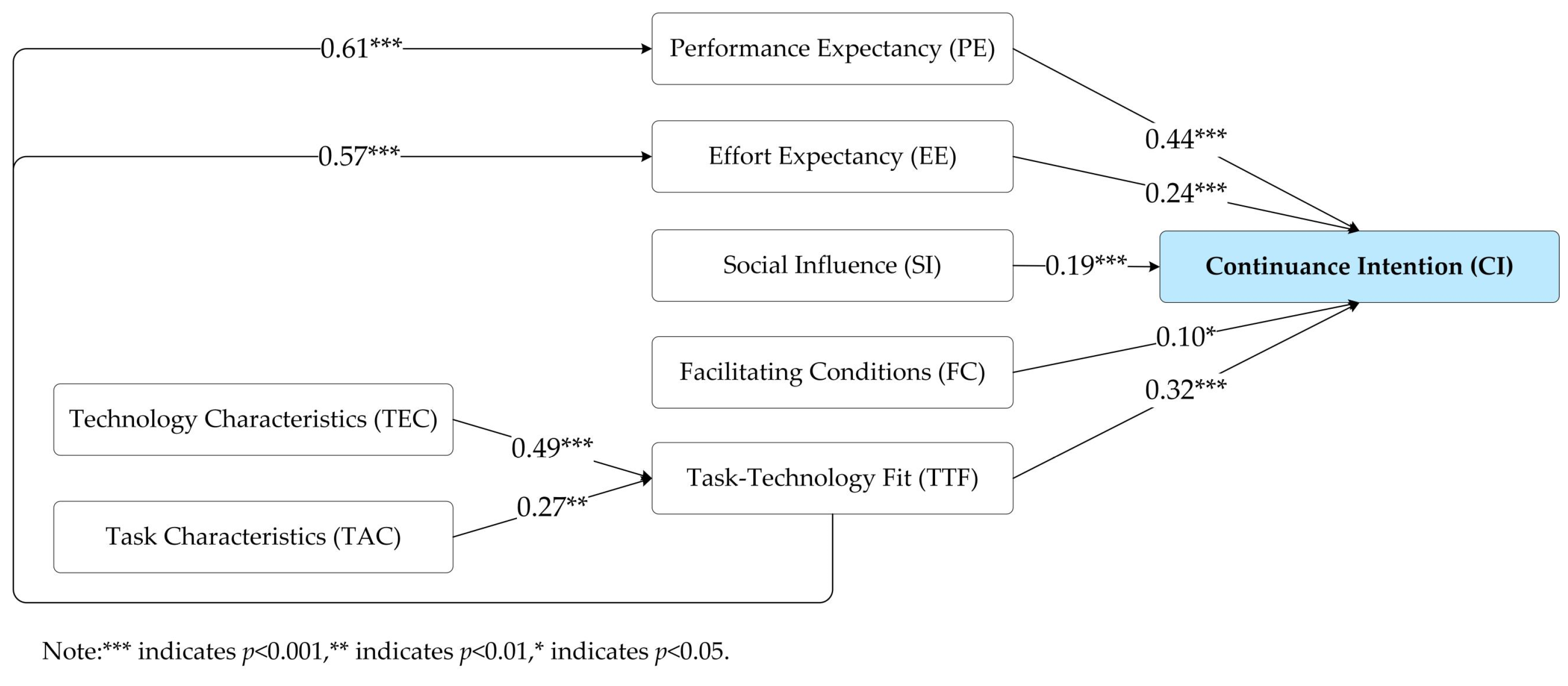
This study applied an integrated UTAUT–TTF framework to investigate the factors influencing users’ continuance intention. The exogenous variables included Task–Technology Fit, Performance Expectancy, Effort Expectancy, Facilitating Conditions, and Social Influence. The path analysis results are shown in
Figure 7. Performance Expectancy significantly increased continuance intention (
β = 0.44,
p < 0.001), supporting H1. Effort Expectancy also showed a significant positive effect (
β = 0.24,
p < 0.001), supporting H2. Social Influence (
β = 0.19,
p < 0.001) and Facilitating Conditions (
β = 0.10,
p < 0.05) were likewise significant, supporting H3 and H4. Technology Characteristics (
β = 0.49,
p < 0.001) and Task Characteristics (
β = 0.27,
p < 0.01) both significantly improved Task–Technology Fit, supporting H5 and H6. Task–Technology Fit further exerted a significant positive effect on continuance intention (
β = 0.32,
p < 0.001), supporting H7. In addition, Task–Technology Fit significantly enhanced Performance Expectancy (
β = 0.61,
p < 0.001) and Effort Expectancy (
β = 0.57,
p < 0.001), supporting H8 and H9. Overall, all nine hypotheses were supported, indicating that the integrated UTAUT–TTF model effectively explains users’ continuance intention toward the basketball shooting training machine. The hypothesis testing results are reported in
Table 7.