Article

Study on the Evolution Law of Fracture Seepage Behavior of Granite Under High Temperature and High Pressure

1
College of Mining Engineering, Taiyuan University of Technology, Taiyuan 030024, China
2
Key Laboratory of In-Situ Property Improving Mining of Ministry of Education, Taiyuan University of Technology, Taiyuan 030024, China
*
Author to whom correspondence should be addressed.
Appl. Sci. 2026, 16(7), 3606; https://doi.org/10.3390/app16073606
Submission received: 14 March 2026 / Revised: 2 April 2026 / Accepted: 7 April 2026 / Published: 7 April 2026
(This article belongs to the Section Earth Sciences)

Abstract

With the continuous development of drilling and reservoir stimulation technologies, the drilling depth of enhanced geothermal system projects is getting deeper and deeper, and the surrounding rock stress of dry hot rock reservoirs is also increasing. Therefore, it has become an inevitable demand for geothermal exploitation to study the evolution law of fracture seepage characteristics of granite under high temperature and ultra-high pressure. To reveal the evolutionary patterns of seepage characteristics in deep-seated hot dry rock fractures, an independently developed ultra-high pressure rock triaxial mechanical testing system was employed to investigate the seepage characteristics of fractured granite under varying temperatures (25–150 °C) and triaxial stresses (50–100 MPa). The study explores the influence of temperature on the seepage characteristics of granite fractures under ultra-high triaxial stress conditions. The results indicate that: (1) In the temperature range of 25–125 °C, as the rock temperature increases, the permeability of the Specimens showed a continuously decreasing trend due to the effect of thermal expansion. (2) In the temperature range of 125–150 °C, as the rock temperature increases, the permeability continues to decrease under low triaxial stress (50 MPa). However, under high triaxial stress (75 MPa) and extremely high triaxial stress (100 MPa), the permeability shows a slight increase instead. This phenomenon is attributed to free surface dissolution. (3) Quantitative analysis of the mesoscopic morphological data of the rock fracture surfaces after testing, combined with SEM images from scanning electron microscopy, confirms that within the high-temperature range of 125–150 °C, the differing levels of triaxial stress determine the variation in the dominant mechanism governing the evolution of the Specimen fracture surfaces, which in turn leads to the divergence in the trend of their permeability changes.

1. Introduction

In recent years, with the rapid progress and development of human civilization, the traditional energy structure, primarily reliant on non-renewable fossil energy, has become increasingly outdated due to environmental pollution issues [1]. Seeking to develop green and renewable energy to improve the energy structure has become a global issue of utmost urgency. Geothermal energy, as the heat stored within the Earth, possesses outstanding advantages such as huge reserves, wide distribution, clean and environmentally friendly nature, as well as stability and reliability, making it an excellent renewable energy source. The development and utilization of geothermal energy are of great significance for improving the energy structure [2,3].
Hot dry rock (HDR) is the primary rock mass storing geothermal energy, generally buried at depths of 3 to 10 km underground [3]. The essence of extracting geothermal energy using an Enhanced Geothermal System (EGS) lies in the process of low-temperature fluid seeping and exchanging heat within the high-temperature, fractured hot dry rock mass in deep strata [4]. In this process, the underground hot dry rock is consistently subjected to high-temperature environments and high formation pressure. Therefore, studying the seepage characteristics of fractured rock masses under high-temperature and ultra-high pressure conditions is crucial for the efficient development of geothermal energy.
The study of seepage in fractured rock masses under high temperature and high pressure is a classic problem in rock engineering. Through decades of in-depth research by scholars worldwide, a substantial body of research findings has been accumulated. Shu et al. [5] investigated the effects of different confining pressures (4–20 MPa) on the hydraulic properties of granite within the temperature range of 25–200 °C, confirming that confining pressure is the main factor controlling the hydraulic properties of granite. Carbillet, L. et al. [6] conducted an experimental study on Lanhélin granite subjected to a temperature gradient ranging from 100 °C to 700 °C and compared the results with the original untreated samples. Their findings demonstrate that microcracks began to form in Lanhélin granite at approximately 100 °C, leading to a progressive increase in porosity and permeability of the rock samples, although the extent of this thermally induced microcracking remained relatively limited below 700 °C. Mokhtari M. et al. [7] investigated the influence of fracture roughness on fluid flow characteristics through numerical simulation. The results indicated that the aperture of fractures formed by hydraulic fracturing was smaller than that produced by mechanical fracturing, and the permeability of the fractured samples exhibited significant anisotropy. Zhang et al. [8] conducted long-term permeability tests and employed a coupled model to describe the distribution of fracture damage, thereby revealing the influence mechanism of thermal stress on the evolution of fracture permeability. Yang et al. [9] conducted water–rock interaction experiments under high temperature and pressure to systematically investigate the permeability evolution behavior of thermally treated granite. Luo et al. [10] found in their study of single-fracture granite that within the confining pressure range of 4–24 MPa and temperature range of 25–100 °C, an increase in rock temperature leads to a decrease in the hydraulic aperture of the fracture. Brush et al. [11] revealed that during the soaking process, chemical reactions such as dissolution or precipitation on the fracture surface directly cause changes in the seepage channels. Arash Kamali-Asl et al. [12,13,14,15] utilized multiple approaches including experiments and simulations to investigate the impacts of various factors on EGS development, including pore pressure and temperature variations, volume effects induced by fluid injection and production, as well as chemical alteration of fracture surfaces. Hu et al. [16] developed a novel fully coupled fluid-flow and geomechanical model, TOUGH2-EGS, and subsequently applied it to analyze pressure and temperature changes as well as deformation at The Geysers geothermal field. Caulk R. A. et al. [17] conducted long-term granite seepage tests under conditions of 120 °C and an effective stress of 25–35 MPa, indicating that the decrease in permeability of fractured granite is due to the combined effect of dissolution of fracture asperities and mechanical creep.
The aforementioned experiments have conducted studies on the patterns and mechanisms of various factors affecting rock mechanical properties and seepage characteristics, yielding a wealth of findings that provide an important reference for the writing of this paper.
However, in most current studies, the experimental conditions involving applied triaxial stress are generally limited to 40 MPa and below. With the development and refinement of drilling and reservoir stimulation technologies, the drilling depths of existing EGS projects are becoming increasingly deeper in order to obtain suitable reservoir temperatures [18]. As of 2022, the Otaniemi project in Finland [19], which has the deepest drilling depth, has reached an injection well depth of 6100 m, corresponding to a formation pressure of 150 MPa. At the same time, in 2022, Taiyuan University of Technology in China carried out the “Scientific Drilling Project for Geothermal Development in a 4000 m Deep Fractured Reservoir,” where the formation stress also reaches as high as 100 MPa. Therefore, studies under 40 MPa and below can no longer meet the practical needs of today. The process of low-temperature fluid seeping through high-temperature fractured rock masses under the high-temperature and ultra-high pressure conditions of deep rock masses has not been sufficiently studied. Therefore, to thoroughly investigate the current patterns and mechanisms of hot dry rock geothermal energy extraction, it is necessary to study the seepage characteristics of fractured rock under the aforementioned high-temperature and ultra-high pressure conditions.
Based on this, this experiment takes the development of a deep geothermal extraction system as its background. Using varying triaxial stresses and temperatures as variables, it conducts seepage characteristic tests on single-fractured granite under ultra-high triaxial stress (50–100 MPa) to simulate the seepage process in hot dry rock within deep strata. The aim is to investigate the mechanical and seepage characteristics of fractured granite under high temperature and ultra-high pressure. The experimental results are intended to provide key theoretical support for Taiyuan University of Technology’s “4000 m Scientific Drilling” project in China and to lay a theoretical foundation for the subsequent effective development of deep hot dry rock geothermal resources and the optimization design of EGS engineering.

2. Experimental System and Procedures

2.1. Specimen Preparation and Experimental System

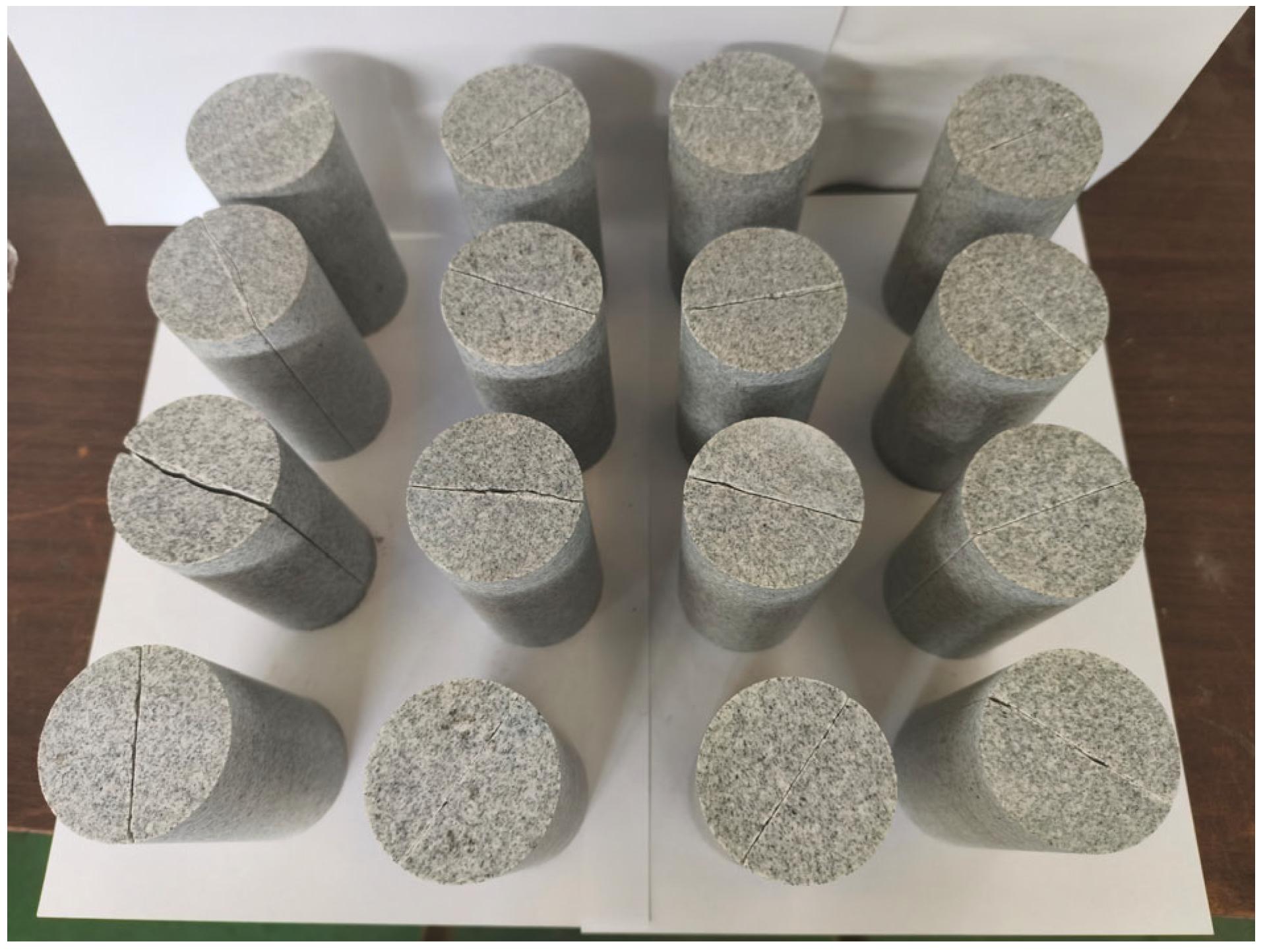
The research subject of this experiment is the “Lu Gray granite” sourced from Jining, Shandong Province, China. This rock has a fine-grained texture. Following the relevant standards of the International Society for Rock Mechanics, the rock was processed into standard cylindrical specimens of φ50 mm × 100 mm through coring, cutting, and grinding. A single fracture was created along the radial direction of the specimens using the Brazilian splitting method, resulting in fracture surfaces with good matching. Some standard specimens are shown in Figure 1 [20]. To ensure as much consistency as possible in the mineral composition of the rock Specimens and to eliminate potential interference from inherent primary defects on the experimental results, all specimens were taken from the same batch of large-sized rock blocks. To prevent the moisture generated during the processing from affecting the experiment, the specimens were pretreated by drying in an oven at 85 °C for 24 h. Subsequently, the mass, volume, and fracture length of each specimen were measured and assigned a number.
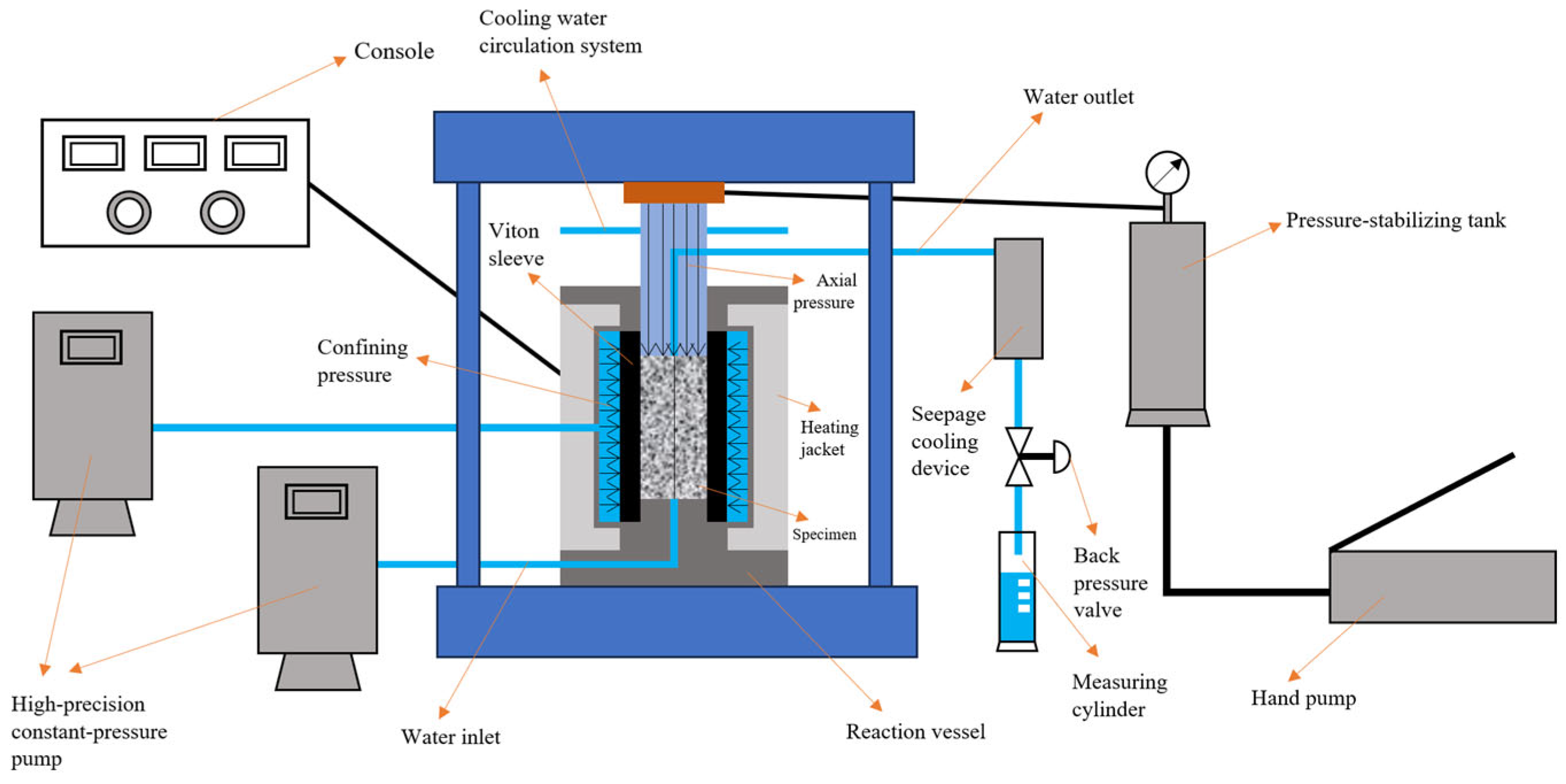
This experiment was conducted using the high-temperature and ultra-high pressure rock triaxial testing apparatus independently developed by Taiyuan University of Technology (the testing system is shown in Figure 2). This apparatus is suitable for standard specimens of φ50 mm × 100 mm. Its design single limits are a temperature of 200 °C, a confining pressure of 200 MPa, and an axial pressure of 500 MPa. Its coupled limit for experiments is a temperature of 150 °C and a confining pressure of 100 MPa, enabling seepage and mechanical tests under high temperature and ultra-high pressure conditions. The core of the system is the high-temperature triaxial stress chamber, which integrates control systems for axial pressure, confining pressure, temperature increase, and water cooling. The stress chamber is sealed using a fluororubber sleeve. Once confining pressure is applied, the sleeve fits tightly against the specimen, achieving effective sealing.

2.2. Experimental Procedures

Currently, numerous single-fracture seepage tests under high temperature and triaxial stress have been conducted both domestically and internationally, which have largely covered the various patterns and studies under triaxial stress below 40 MPa. Therefore, considering that this experiment is motivated by the increasing depth of hot dry rock reservoirs in current Enhanced Geothermal Systems (EGS), and that existing studies cannot accurately characterize the seepage evolution patterns in deep hot dry rock reservoirs, further investigation of the current established patterns is necessary.
Therefore, three sets of tests (Tests 1, 2, and 3) were designed for Specimen 1, with triaxial stresses of 50 MPa, 75 MPa, and 100 MPa, corresponding to burial depths of 2000 m, 3000 m, and 4000 m, respectively. This step-by-step investigation aims to explore the influence of triaxial stress and temperature on the seepage in deep hot dry rock reservoirs, building upon the established patterns observed under 40 MPa.
To eliminate the influence of fracture surface morphology on the seepage characteristics of fractured granite and to avoid the contingency of a single test, Specimen 2, whose fracture surface morphology differs the most from that of Specimen 1, was selected to conduct three sets of tests under the same conditions (Tests 4, 5, and 6) for comparison and control. The experimental conditions of this study are detailed in Table 1.
The specific experimental procedures are as follows:
(1) A Beijing Tianyuan OKIO–H–200 3D topography scanner (Beijing Tianyuan 3D Technology Co., Ltd., Beijing, China) and a JEOL Ltd. JSM-IT800 scanning electron microscope (SEM) (JEOL Ltd., Tokyo, Japan) were used to perform mesoscopic and microscopic scans, respectively, of the fracture surface morphology of the prepared specimens.
(2) The scanned single-fracture granite specimen was placed into the high-temperature triaxial pressure chamber. Axial pressure and confining pressure were applied alternately through the axial pressure control loading system and the confining pressure control loading system, respectively, until reaching the experimental requirements corresponding to Table 1 (50 MPa, 75 MPa, 100 MPa).
(3) The specimen was heated at a rate of 20 °C/h to the target temperatures (25, 50, 75, …, 150 °C) and then maintained at a constant for 2 h to ensure uniformity of its internal temperature field.
(4) In order to prevent the fluid from boiling or vaporizing under high temperature and high pressure, and to ensure that the flow within the single fracture remains laminar throughout, a back pressure valve was used in this experiment to precisely control the pressure and flow rate of the fluid. Due to equipment limitations, the back pressure valve was set to maintain a constant back pressure of 30 MPa. To achieve uniform conversion of measurement data with standard conditions, an extended pipeline and a cooling system were installed at the fluid outlet of the experimental setup to ensure that the measured water volume corresponds to standard conditions. Using a constant pressure pump, purified water was injected into the specimen through the water inlet at the minimum injection pressure corresponding to the experiments in Table 1, until liquid flowed out from the back pressure valve at the outlet.
(5) The permeability of the specimen under different injection pressures was measured using the steady-state flow method. To minimize measurement errors, three sets of permeability data were measured, and the average value was taken. After completing the measurement of the specimen’s permeability under the injection pressure conditions outlined in the experimental plan in Table 1, the constant pressure pump was stopped, the pressure was released from the back pressure valve, and the fluid was drained from the equipment. This procedure was followed to ensure that each test involved the seepage of low-temperature fluid in the high-temperature fractured rock mass.
(6) Repeat steps (3), (4), and (5) above until the permeability measurement is completed at the final temperature of 150 °C.
(7) The single-fracture granite specimen was removed, and a 3D topography scanner and a scanning electron microscope were used to perform mesoscopic and microscopic scans of the fracture surface morphology again, in order to obtain the changes in the fracture surface morphology of the specimen before and after the test.
(8) Repeat the above steps until all the tests in Table 1 are completed.

3. Experimental Results and Discussion

3.1. Experimental Results Calculation

The specimens tested in this study are single-fracture granite. The permeability of the granite matrix is on the order of 10−19 m3 [21], which is several orders of magnitude lower than the fracture permeability. Therefore, it can be neglected.
The permeability of the granite fracture in this experiment was calculated using the cubic law [22], and the calculation formula is as follows:
e h = 12 μ L Q D Δ P 3
k = e h 2 12
In the formula: Q represents the seepage discharge, mL·s−1; eh represents the hydraulic aperture of the fracture, m; μ represents the dynamic viscosity of the fluid, Pa·s; ΔP represents the osmotic pressure difference, MPa; D represents the width of the specimen fracture, m; L represents the length of the specimen, m; and k represents the permeability of the fracture, m2.
The dynamic viscosity coefficient of water is a function related to temperature and pressure. It is significantly influenced by temperature, while the effect of injection pressure is relatively small. After consulting relevant literature, the formula by McDermott et al. [23] was selected to calculate the dynamic viscosity coefficient of water. The calculation formula is as follows:
μ w = 243.18 × 10 7 × 10 247.8 / T 140 × 1 + p p s a t × 1.0467 × 10 6 × T 305
p s a t = 22088 e x p 374.136 T T i = 1 8 A i 0.65 0.01 T i 1
In the formula: µw is the dynamic viscosity coefficient of water, Pa·s; T′ is the thermodynamic temperature of water, K; p′ is the injection pressure, bar; psat is the saturation pressure, bar; T″ is the Celsius temperature of water, °C. Ai in the formula are fixed coefficients, and the values of these coefficients are shown in Table 2.
It should be noted that Formulas (3) and (4) have a clear scope of application. They can only be used to calculate the dynamic viscosity coefficient when the fluid within the fracture is in a liquid state. Since the boiling point of water increases with water pressure, the back pressure in the experiment described in this paper is 30 MPa. According to the IAPWS (International Association for the Properties of Water and Steam) standards, the saturation temperature of water under this pressure is 234.8 °C, which is significantly higher than the maximum temperature of 150 °C in this experiment. Therefore, the seepage fluid in the fracture channels during this experiment is liquid water, and its dynamic viscosity coefficient can be calculated using Formulas (3) and (4).
In summary, the permeability for the experiment in this paper is obtained through comprehensive calculation.

3.2. The Effect of Temperature and Triaxial Stress on the Permeability of Granite Fractures

The essence of extracting geothermal energy using EGS is the process of seepage and heat exchange of low-temperature fluids within high-temperature fractured rock masses in deep strata [4]. The temperature of the rock mass in this process inevitably affects the efficiency of geothermal energy extraction. Therefore, it is necessary to analyze the effect of temperature and triaxial stress on the permeability of granite fractures.
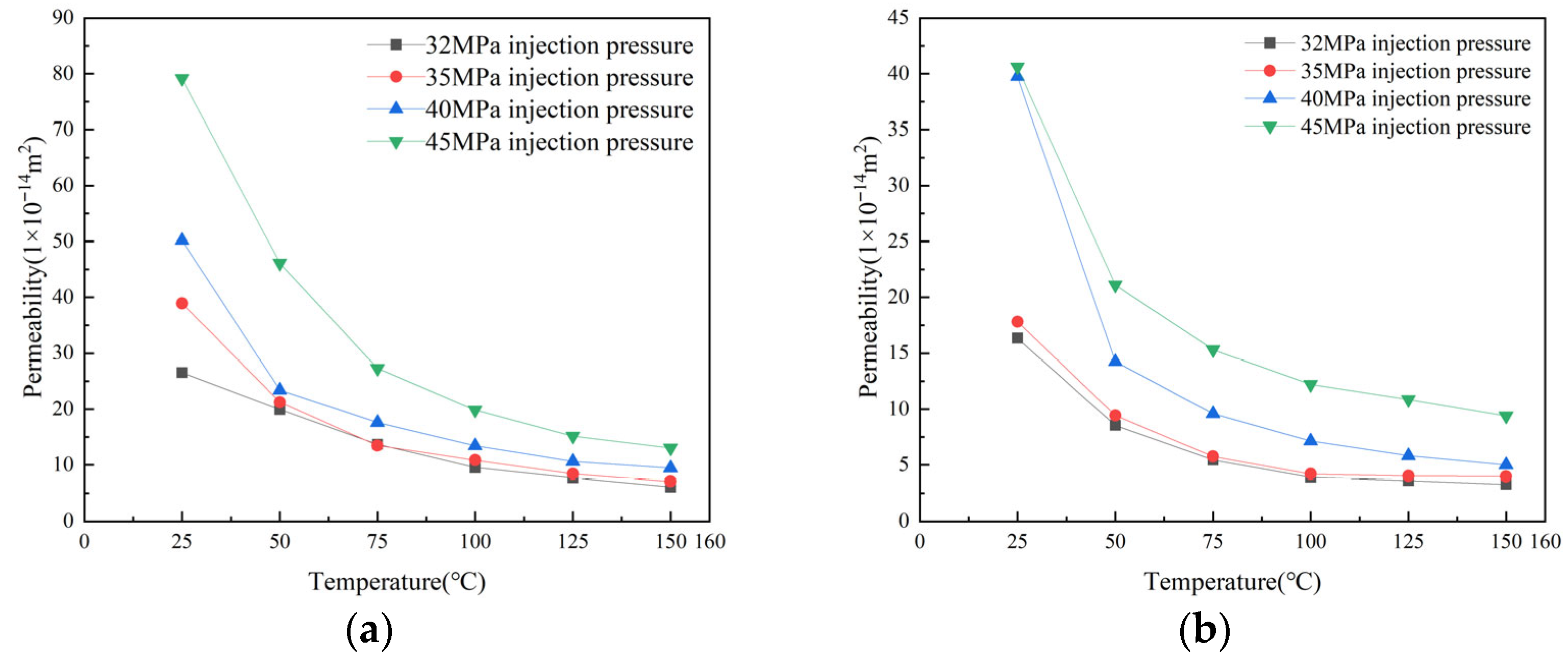
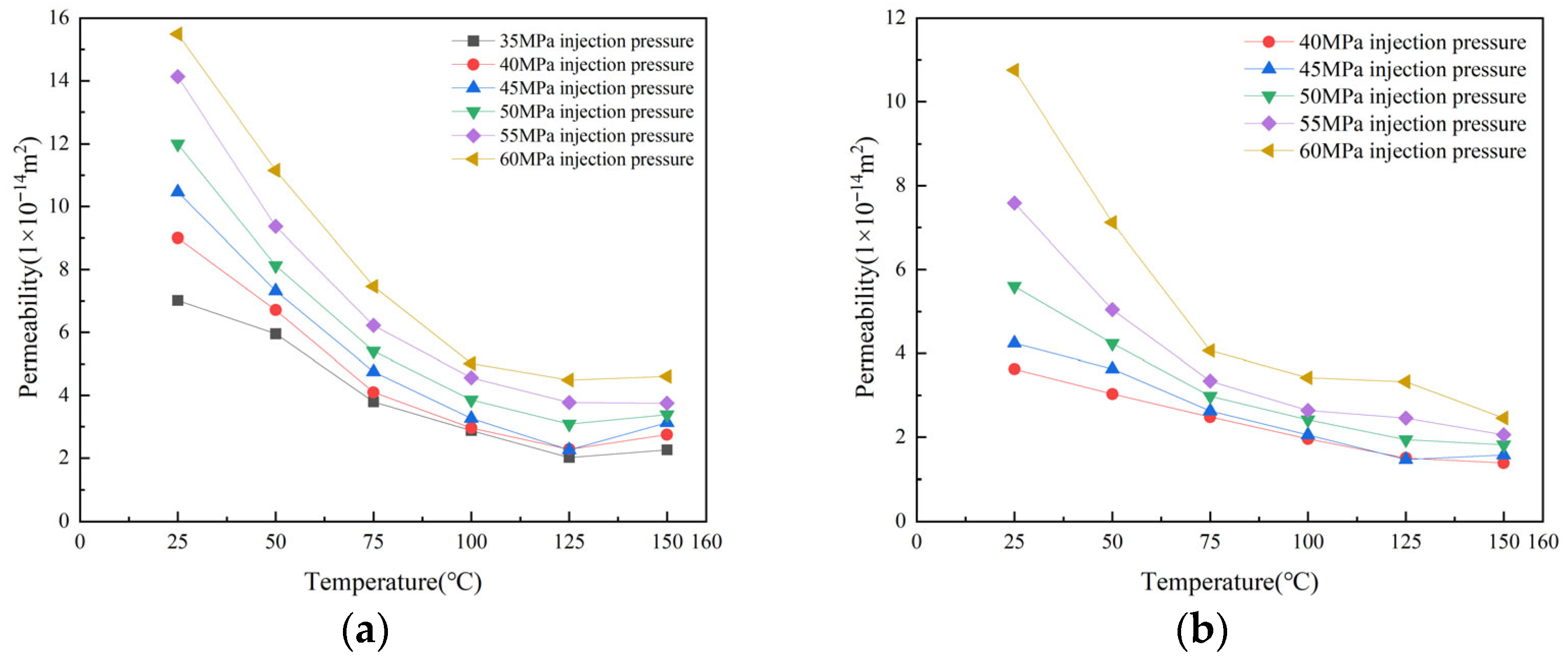
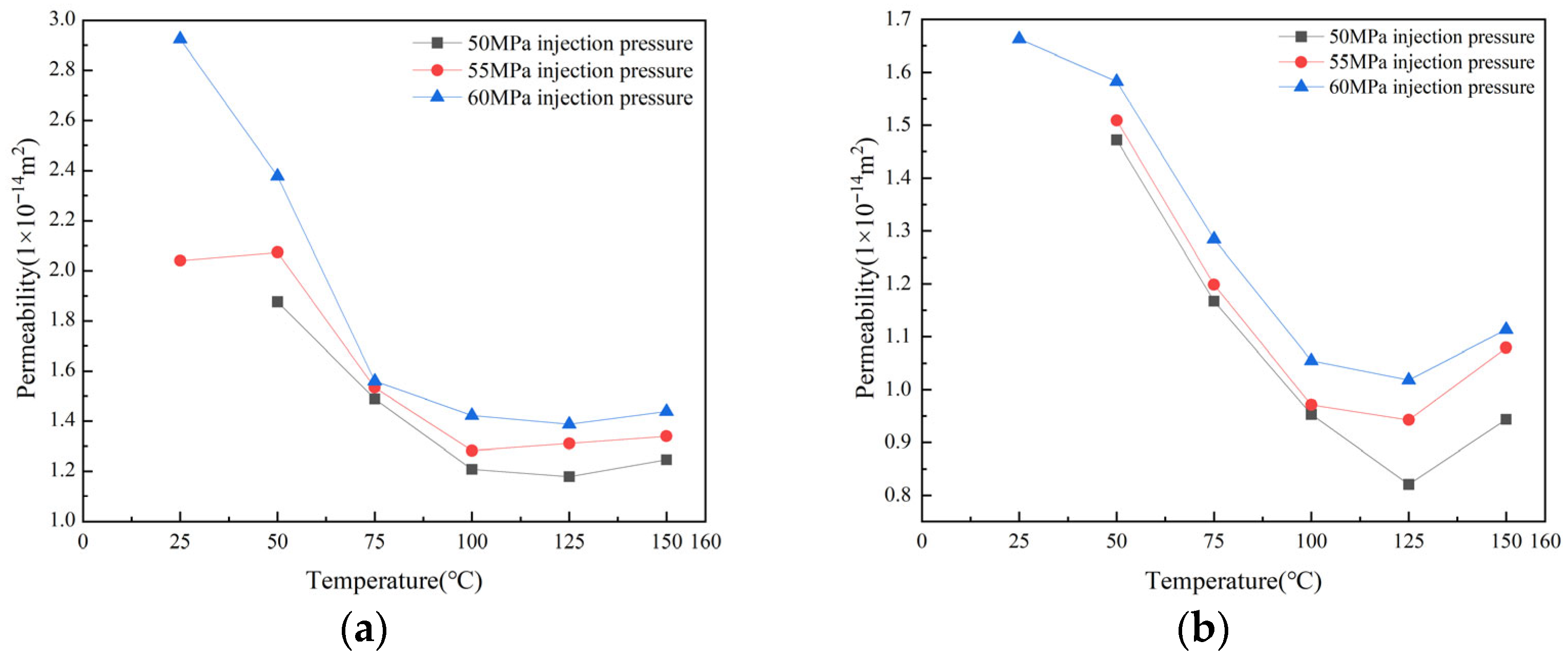
Based on the data calculated in Section 2.1, plot the curves of the specimen fracture permeability versus temperature under 50 MPa (Figure 3), 75 MPa (Figure 4), and 100 MPa (Figure 5).
Preliminary analysis of the above experimental results indicates that the permeability of a single-fracture granite can be divided into two stages as temperature changes, depending on the magnitude of the applied triaxial stress:
(1) Stage I (25–125 °C): As the temperature increases, the permeability of the granite fracture surface under triaxial stresses of 50 MPa, 75 MPa, and 100 MPa exhibits a continuous decreasing trend. This trend is essentially consistent with the variation patterns reported by Shu et al. [5] under 20 MPa triaxial stress and Luo et al. [10] under 24 MPa triaxial stress.
The mechanism behind this pattern can be attributed to two coupling thermodynamic effects [10]. First, the increase in temperature causes significant thermal expansion strain in the granite. Its radial component directly compresses the effective aperture of the fracture, leading to the closure of seepage channels and reducing the seepage area, which directly affects the permeability. Second, the elastic modulus of granite decreases with increasing temperature. This weakens the fracture surface’s ability to resist deformation, further exacerbating its closure under the same triaxial stress and causing the existing closed fracture surfaces to bond more tightly. The combined effect of these two factors leads to a further reduction in the seepage area of the fracture surface, significantly decreasing the fracture permeability.
Considering that to ensure a uniform internal temperature of the specimen, each test underwent a 2 h insulation treatment, which extended the total duration of the experiment, the influence of the water–rock reaction must be taken into account in the analysis.
Under triaxial stress loading, the water–rock reaction primarily induces pressure solution (also known as dissolution creep; in this paper, it refers to the phenomenon in which rock undergoes dissolution at regions of high stress and precipitation at regions of low stress under external triaxial stress) and free-face dissolution on the fracture surface. In the temperature range of 25–125 °C, the pores on the fracture surface are relatively developed, and the actual contact area of the asperities is relatively small. As the temperature increases, granite undergoes thermal expansion deformation. Under triaxial stress loading, this leads to stress concentration, causing the asperities on the fracture surface to break, exhibiting a morphological evolution characteristic of “grinding the peaks to fill the valleys.” At this stage, pressure solution in the water–rock reaction plays a dominant role, with its influence significantly exceeding that of free-face dissolution. The pressure solution process further exacerbates the reduction in the undulation of the fracture surface and the closure of seepage channels, thereby leading to a decrease in the permeability of the fracture surface.
In summary, the comprehensive effects of thermal expansion deformation of granite, reduction in elastic modulus, and water–rock reaction at high temperatures lead to a decrease in the permeability of the granite fracture surface with increasing temperature in the range of 25–125 °C.
(2) Stage II (125–150 °C): Depending on the magnitude of the applied triaxial stress, the permeability of the single-fracture granite exhibits different trends with increasing temperature.
Under lower triaxial stress (50 MPa), as the temperature increases, the permeability of the granite fracture surface still exhibits a decreasing trend. This is because, under lower triaxial stress, there remains a considerable amount of fracture aperture at 125 °C, and the seepage channels within the fracture surface are far from reaching their closure limit, leaving room for further closure. Consequently, the fracture closure effect, driven jointly by the thermal expansion deformation of granite, the reduction in elastic modulus, and pressure solution, remains significant. The resulting reduction in seepage channel area far exceeds the area increase contributed by the minor micropores generated by free-face dissolution. Therefore, the seepage area of the fracture surface continues to decrease, and the permeability maintains its declining trend.
Under relatively higher triaxial stress (75 MPa, 100 MPa), as the temperature increases, the permeability of the granite fracture surface generally shows a slight increasing trend. Shu et al. [5] and Liu et al. [24] have observed that under extremely low triaxial stress (Shu et al. [5] under 5 MPa, Liu et al. [24] under 3.5 MPa), the permeability of fractured rock masses increases with temperature in the range of 125–150 °C. This phenomenon occurs because the triaxial stress is too low for the stress concentration induced by thermal expansion of the specimen to effectively crush the asperities on the fracture surface. The change in the area of internal fracture channels within the rock mass primarily originates from the persistent free-face dissolution [24,25], leading to an increase in the area of these internal fracture channels, and consequently, a rise in permeability.
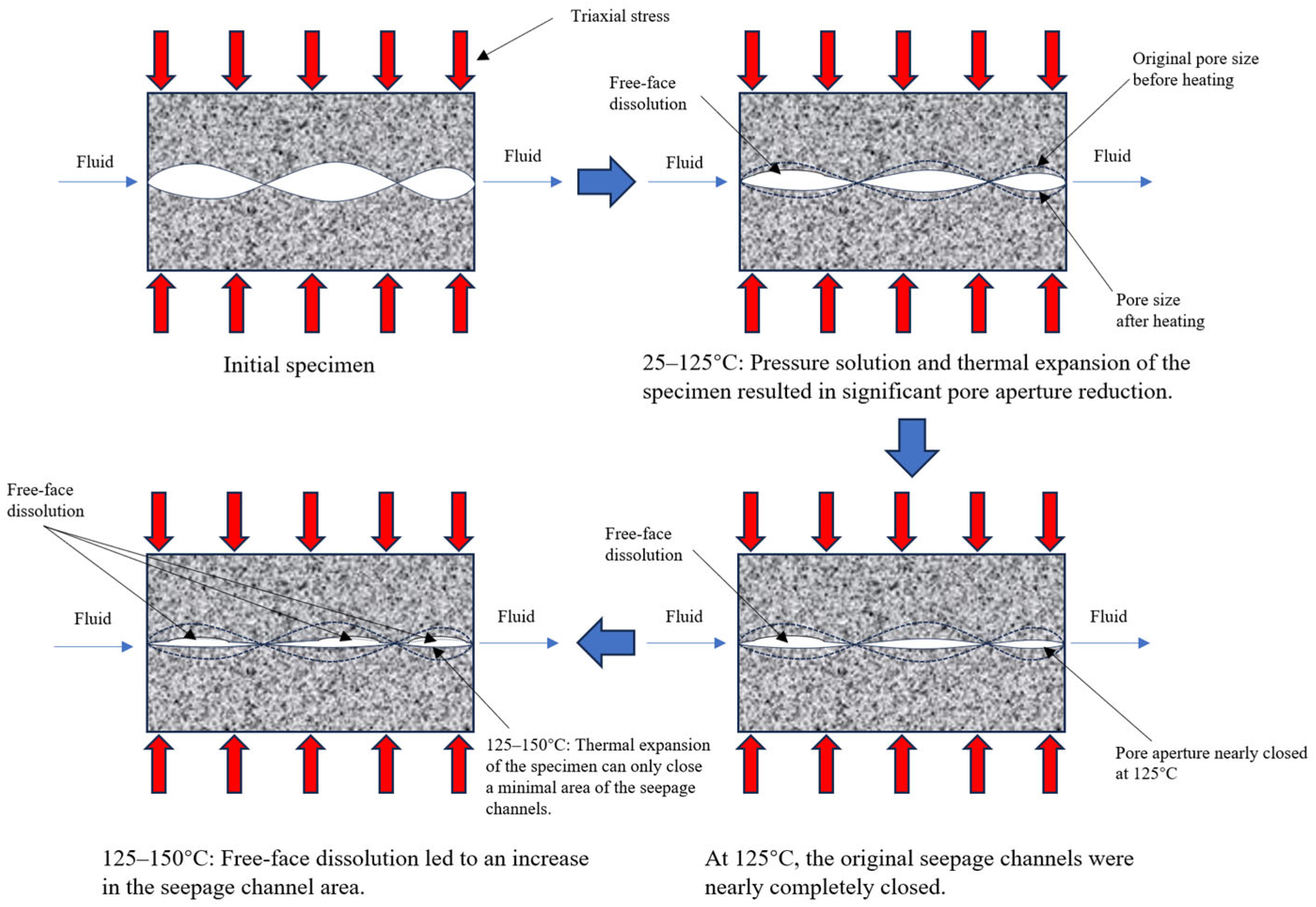
The variation pattern observed in this experiment under relatively high triaxial stress is similar to that reported by Shu et al. [5] and Liu et al. [24] under extremely low triaxial stress. The reason for this pattern is that, under the influence of relatively high triaxial stress, the contact areas of the asperities on the specimen’s fracture surface, being the sites of stress concentration, experience significant local contact stress. Without prior softening by water–rock reactions, they undergo plastic failure directly under stress. This results in an increase in the contact area of the asperities and a more uniform stress distribution compared to that under 50 MPa. The stress generated by the thermal expansion of the specimen becomes more dispersed, making it difficult to continue crushing a large number of asperities on the fracture surface simultaneously. Consequently, the degree of pore closure between the rock fracture surfaces is greater than that under 50 MPa. At 125 °C, the pores between the rock fracture surfaces are nearly completely closed. When the temperature rises from 125 °C to 150 °C, the closure efficiency decreases due to the thermal expansion deformation of the granite and the reduction in its elastic modulus. The change in the area of internal fracture channels within the rock mass becomes essentially unrelated to the thermal expansion deformation of the granite. The effect of free-face dissolution in increasing the seepage channel area on the fracture surface emerges, causing the seepage channel area to enlarge and ultimately leading to an increase in permeability.
To visually represent the changes occurring on the fracture surface, a schematic diagram of the seepage channel area changes during the heating process under ultra-high triaxial stresses of 75–100 MPa is drawn, as shown in Figure 6.
In summary, under relatively high triaxial stress conditions (75 MPa, 100 MPa), during the temperature increase from 125 °C to 150 °C, the seepage channels between the original rock fracture surfaces have nearly completely closed due to the high stress. The closure effect from the thermal expansion deformation of granite, induced by the rising temperature, tends to saturate. At this point, the change in the area of internal fracture channels within the rock mass is primarily caused by free-face dissolution. This dissolution generates new pores, increasing the overall seepage channel area, which further leads to an upward trend in the permeability of the granite fracture surface.

3.3. Morphological Changes of the Specimen Fracture Surface Before and After the Experiment and Discussion

3.3.1. Calculation of Fracture Surface Morphological Characterization

To characterize the roughness characteristics of the fracture surface, this paper adopts the Joint Roughness Coefficient (JRC) to represent the undulation degree of the structural surface. This coefficient was proposed by Barton [26,27].
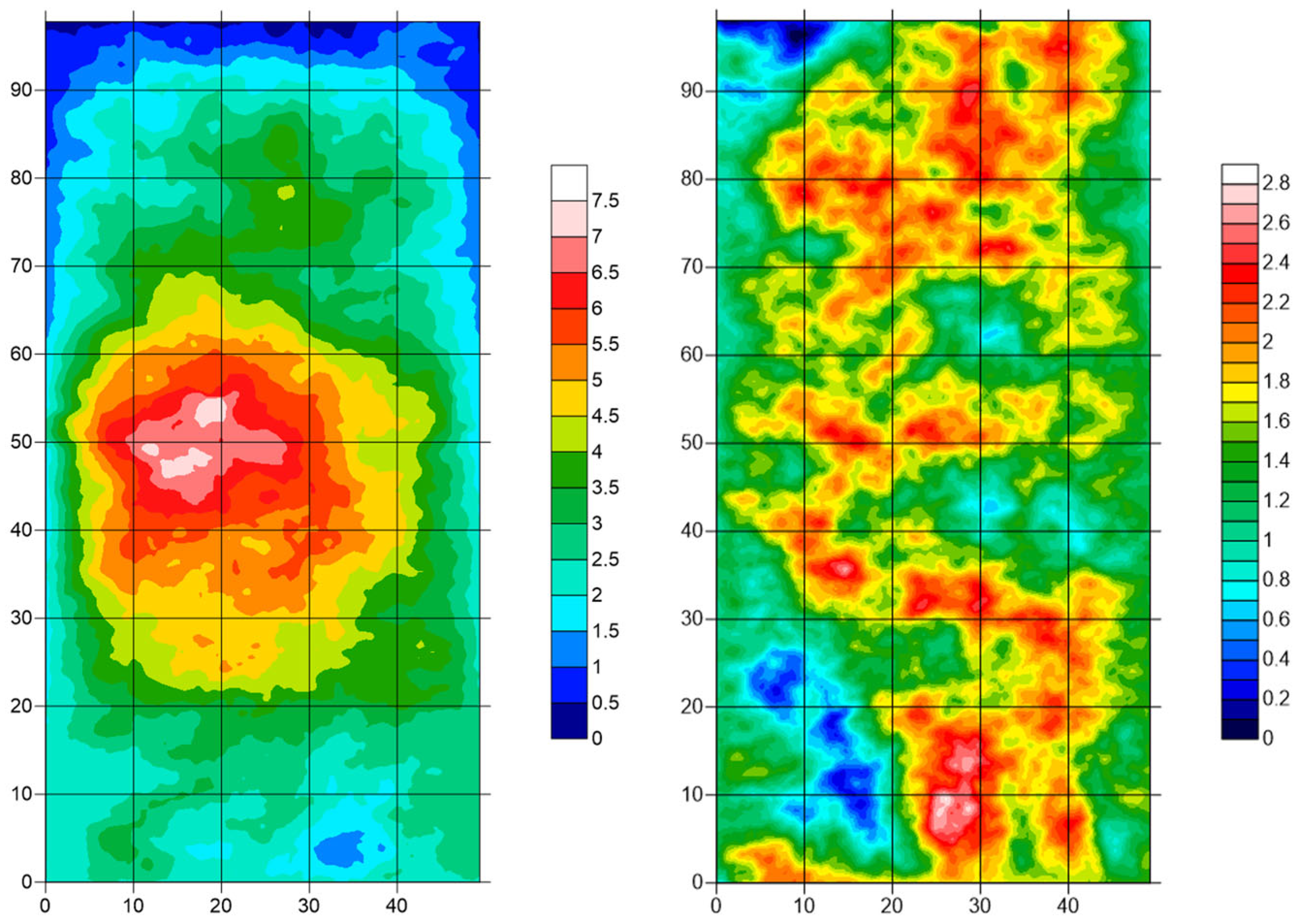
The scanned point cloud data is imported into the Surfer11 software (Surfer Version 11.0.642) and divided into a high-precision grid using the Kriging interpolation method. The calculation is performed using the mathematical statistical method for joint morphology. The specific steps are as follows: Profile lines are systematically Specimend on the fracture surface at 10 mm intervals along the X and Y coordinate directions, respectively (as shown in Figure 7). A total of 13 profile lines are obtained for each fracture surface, and the arithmetic mean of their JRC values is calculated to represent the roughness characteristics of the entire fracture surface [28].
The calculation formula is as follows:
Z 2 = 1 L Z i = 1 n 1 Z i + 1 Z i 2 X i + 1 X i 1 2
J R C = 32.2 + 32.47 lg Z 2
In the formula: Z2 represents the first derivative of the root mean square of the fracture surface profile height; LZ represents the projected length of the fracture profile line; Xi represents the coordinate along the length direction of the fracture profile line; Zi represents the asperity height corresponding to the coordinate along the length direction; n represents the number of Specimens.
The morphological changes of the fracture surface for Specimen 1 and Specimen 2 before and after the experiment are calculated using Formulas (5) and (6).

3.3.2. Discussion of Meso-Scale Morphological Changes on the Fracture Surface

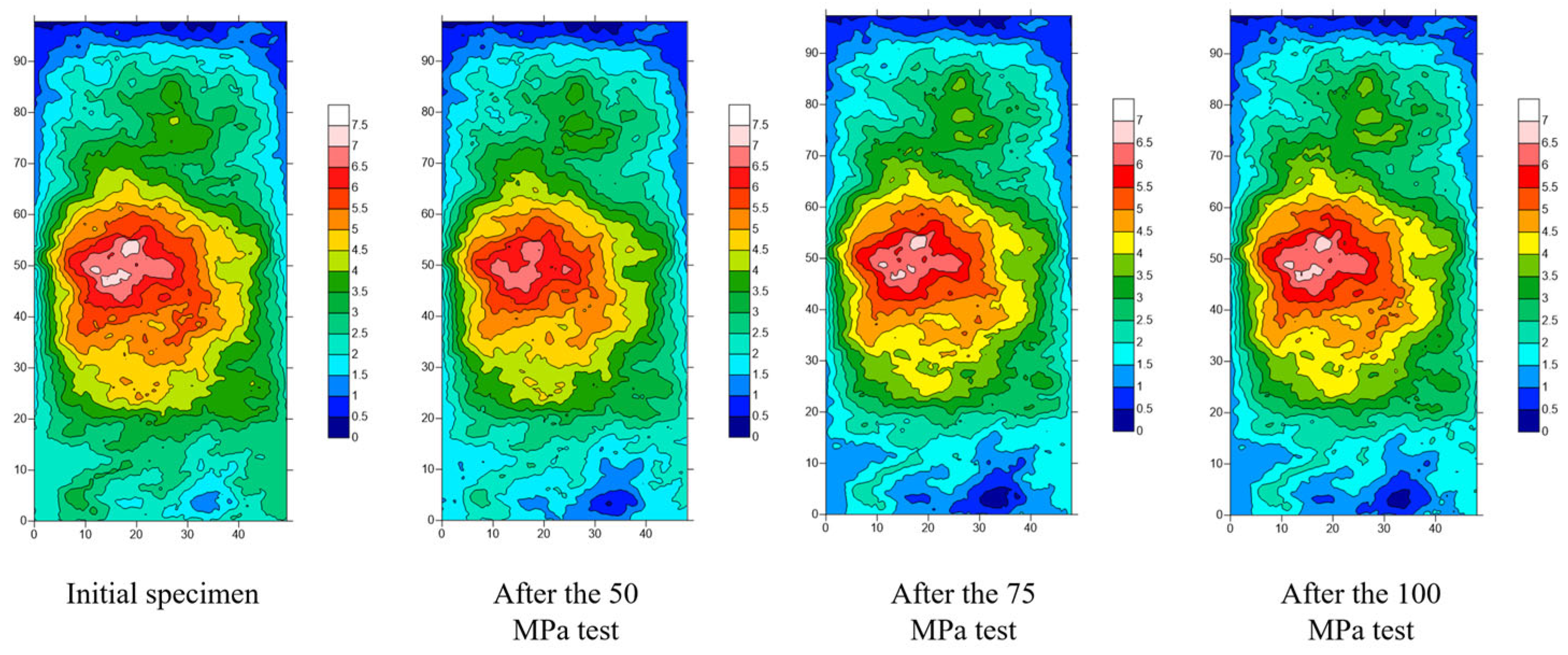
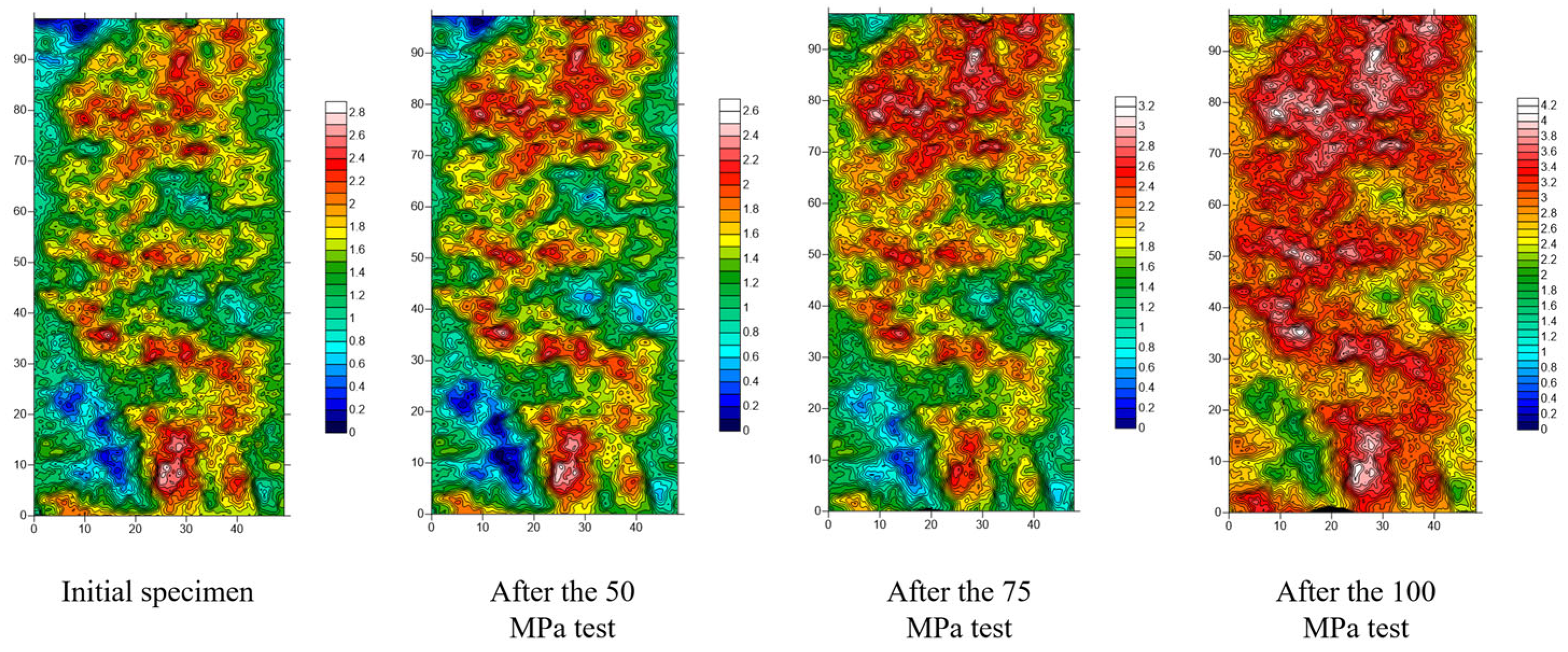
The point cloud data obtained from scanning before and after the experiment are imported into Surfer11 software and divided into a high-precision grid using the Kriging interpolation method, resulting in the contour maps of the specimen fracture surface morphology before and after the experiment in this paper, as shown in Figure 8 and Figure 9.
Based on the data calculated in Section 2.1, compile Table 3 and Table 4. The data in the tables include the Joint Roughness Coefficient (JRC) of the fracture surface, the maximum height difference ζ of the fracture surface profile, the root mean square deviation Rrms of the fracture surface profile, and the arithmetic mean deviation Rn of the fracture surface profile.
Quantitative analysis of the above results yields the following conclusions:
After the 50 MPa test, the JRC, ζ, Rrms, and Rn of both Specimen 1 and Specimen 2 decreased, indicating a reduction in the local undulation of the fracture surface and a decreased average deviation of the morphological surface height from the reference plane. After the 50 MPa test, the JRC, ζ, Rrms, and Rn of both Specimen 1 and Specimen 2 decreased, indicating a reduction in the local undulation of the fracture surface and a decreased average deviation of the morphological surface height from the reference plane. This phenomenon suggests that the asperities on the fracture surface decreased during the experiment, confirming the occurrence of water–rock reactions during the test. Under lower triaxial stress, the water–rock reaction primarily manifested as pressure solution. The contact areas of the asperities on the fracture surface, being regions of stress concentration, underwent plastic failure due to pressure solution, resulting in a decrease in the maximum height difference ζ of the fracture surface. Simultaneously, this process formed the morphological evolution characteristic of “grinding the peaks to fill the valleys,” making the fracture surface smoother overall. This, in turn, led to further closure of the seepage channels on the fracture surface, reducing the seepage area and consequently causing a decrease in permeability.
After the 75 MPa test, the JRC of both Specimen 1 and Specimen 2 increased, while Rrms and Rn decreased. The ζ of Specimen 1 decreased, whereas the ζ of Specimen 2 showed an abnormal increase due to edge damage. The decrease in ζ indicates that under 75 MPa triaxial stress, the asperities on the fracture surface continued to be destroyed by pressure solution. The increase in JRC of the fracture surface indicates a rise in local undulation. The decreases in Rrms and Rn indicate a reduction in the average deviation of the morphological surface height from the reference plane. The combined changes in JRC, Rrms, and Rn collectively reflect a structural reconstruction of the seepage channels on the specimen fracture surface. The original larger and deeper pores gradually close under the effects of thermal expansion deformation and pressure solution, while free-face dissolution continuously generates a large number of smaller, shallower micropores. The combination of these two factors jointly causes changes in the area of the fracture channels, thereby affecting the permeability of the granite fracture surface. When the temperature reaches 125 °C, under the influence of relatively high triaxial stress, the pores between the rock fracture surfaces are nearly completely closed. At this point, the thermal expansion deformation of the granite and pressure solution tend to saturate, and their effect on the change in seepage channel area diminishes significantly. Overall, the process begins to be dominated by free-face dissolution. The net increasing effect of newly generated micropores exceeds the residual closure effect, leading to a net increase in the seepage channel area, which in turn causes the permeability of the granite fracture surface to generally show an upward trend.
After the 100 MPa test, the JRC, Rrms, and Rn of both Specimen 1 and Specimen 2 increased. The ζ of Specimen 1 continued to decrease, while the ζ of Specimen 2 sharply increased due to aggravated edge damage. The continued decrease in ζ indicates that, even under extremely high stress conditions, the thermal expansion deformation of granite and pressure solution still exert a morphological modification effect of “grinding the peaks to fill the valleys” to a certain extent. This effect still has a certain closure effect on the seepage channel area of the fracture surface. However, the increase in JRC, Rrms, and Rn of the fracture surface indicates that the local undulation of the fracture surface and the average deviation of the morphological surface height from the reference plane have increased. This confirms that the free-face dissolution on the fracture surface is more significant, and the newly generated fracture pores are further enlarged. At 125 °C, under the influence of extremely high triaxial stress, the pores between the rock fracture surfaces are more tightly closed than under 75 MPa. The effects of thermal expansion deformation of granite and pressure solution are further weakened, while the opposing phenomenon of free-face dissolution becomes more prominent, becoming the main factor affecting the seepage channel area on the specimen fracture surface. At this point, the change in the area of internal fracture channels within the rock mass is primarily generated by free-face dissolution. This process produces a large number of micropores and expands the existing micropores, significantly increasing the seepage channel area, and ultimately leading to an upward trend in the permeability of the granite fracture surface.
In summary, the morphological changes of the specimen fracture surface before and after the experiment confirm the reasons for the varying patterns of seepage in the specimen fracture surface with temperature under different triaxial stress levels, as discussed in Section 2.2. Specifically, under different triaxial stresses, the degree of closure at 125 °C caused by thermal expansion of the specimen varies. During the subsequent temperature increase (125–150 °C), the extent to which the seepage channel area on the fracture surface is reduced by the thermal expansion deformation of granite and pressure solution differs. This reduction interacts with the increase in seepage channel area resulting from free-face dissolution on the fracture surface. The combined effect of these factors influences the fracture channel area, ultimately leading to the different observed variation patterns in the permeability of the specimen fracture surface.

3.3.3. Observation and Discussion of Micro-Morphological Changes on the Fracture Surface

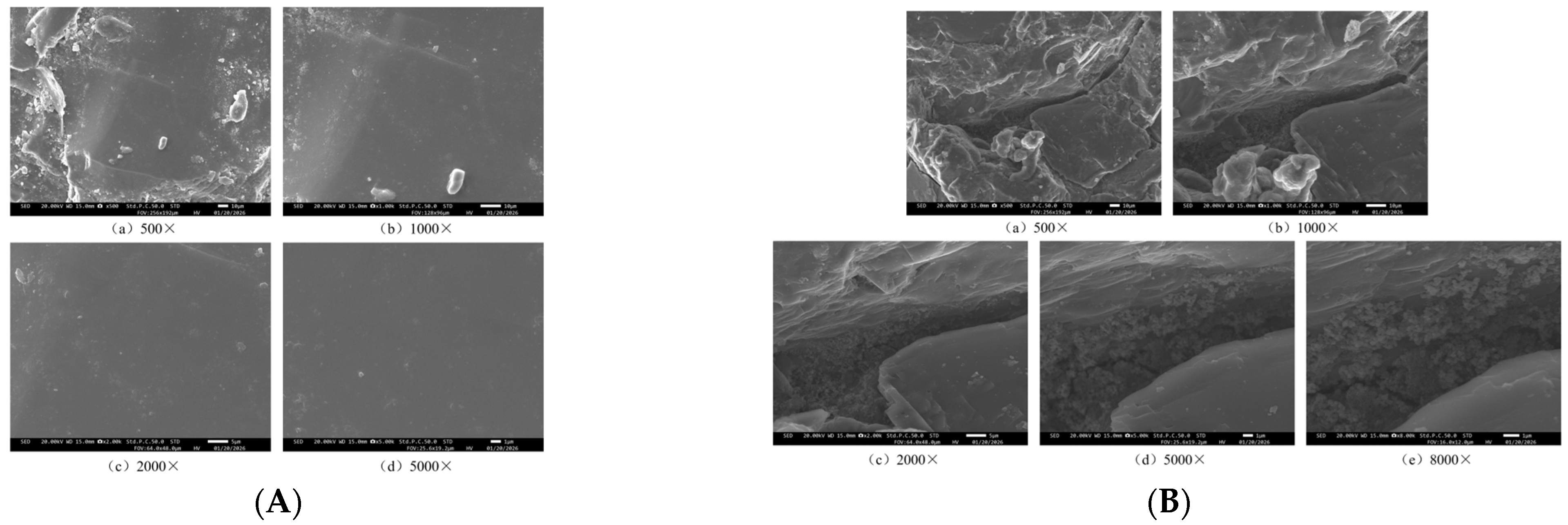
The JSM-IT800 model Scanning Electron Microscope from JEOL Ltd. (Japan Electron Optics Laboratory) (JEOL Ltd., Tokyo, Japan) was used for SEM examination to observe the micro-morphological changes on the fracture surface of the specimens before and after the test. The obtained results are shown in Figure 10:
The SEM images reveal that before the test, the specimen surface was smooth and structurally intact, essentially free of pores or fractures (Figure 10A). After the test, the microstructure of the fracture surface underwent significant changes, exhibiting completely different morphological characteristics compared to its pre-test state (Figure 10B).
At a low magnification of 500–1000×, the main structure of the fracture surface is observed to consist of relatively smooth, large-scale blocky matrices intersected by fractures.
When magnified to 2000 times, it can be clearly observed that the originally smooth matrix surface is actually densely developed with a large number of micropores, far exceeding the number of primary pores in the specimen before the test. Meanwhile, submicron fillings are widely distributed within the fractures and pores, essentially blocking the larger-scale fractures and pores. This indicates that significant dissolution–precipitation occurred during the coupled test process. The above phenomena verify the existence of the “grinding the peaks to fill the valleys” micro-morphological modification effect and also demonstrate that the reduction in permeability of the specimen fracture is not only related to the physical closure mechanism but is also significantly influenced by the pore filling effect.
When further magnified to 5000 times, it can be observed that the structure of the fillings is not completely dense, and fine gaps develop internally. This indicates that during the 125–150 °C heating stage, the increase in permeability is not only due to pore generation and expansion caused by free-face dissolution but also related to the enlargement of the seepage area resulting from secondary dissolution of precipitated particles and the reopening of original seepage channels, thereby contributing to the rise in fracture permeability.
In summary, the SEM images confirm the relevant mechanisms of the aforementioned experiments, indicating that the change in specimen fracture permeability is the result of the combined action of physical mechanics (closure effect) and hydrochemical effects (the “grinding the peaks to fill the valleys” effect and free-face dissolution).


4. Conclusions

This paper investigates the seepage characteristics of fractured granite under different temperatures (25–150 °C) and triaxial stresses (50–100 MPa), exploring the effects of temperature and varying triaxial stresses on the seepage characteristics of granite fractures. By integrating quantitative characterization of the fracture surface morphology, the study analyzes the evolution laws of seepage characteristics in granite fractures under high temperature and ultra-high pressure. The following conclusions can be drawn:
(1) In the temperature range of 25–125 °C, the evolution of granite fracture permeability is mainly controlled by the reduction in seepage channel area under thermal–mechanical–chemical coupling effects. The negative effect of fracture closure and filling, jointly constituted by thermal expansion deformation, reduction in elastic modulus, and pressure solution, on the fracture channel area is significantly stronger than the positive effect brought by free-face dissolution. The former plays an absolutely dominant role in controlling the change in fracture channel area, resulting in a continuous decreasing trend in granite fracture permeability with increasing temperature. This decreasing trend is characterized by an initial rapid decline followed by a slower decrease, exhibiting a distinct nonlinear relationship.
(2) In the high-temperature range of 125–150 °C, the evolution pattern of granite fracture permeability exhibits stress dependence, with the magnitude of triaxial stress becoming the key factor controlling the direction of its evolution. When the triaxial stress is relatively low (50 MPa), the effects of thermal expansion deformation, reduction in elastic modulus, and pressure solution are still significant. The fracture closure effect induced by these factors is stronger than free-face dissolution, so the permeability continues to decrease. However, under relatively high (75 MPa) and extremely high (100 MPa) stress conditions, the fractures are nearly completely closed at 125 °C. The thermally induced closure effect tends to saturate, and its efficiency is greatly reduced. At this point, free-face dissolution becomes the dominant mechanism, continuously dissolving the fracture surface and generating new micropores. The change in the area of internal fracture channels within the rock mass is primarily produced by this effect. The newly added cross-sectional area of the pores exceeds the residual closure effect, resulting in a net increase in the seepage channel area, and the permeability thus turns to an upward trend.
(3) Through quantitative analysis of the meso-morphological parameters of the rock fracture surface after the experiment, the intrinsic mechanism of the effect of temperature on the permeability of granite fractures under different stress conditions is confirmed, as follows:
① Under low triaxial stress (50 MPa), thermal expansion and pressure solution caused a reduction in asperities and undulation on the fracture surface, leading to a decrease in permeability.
② Under relatively high triaxial stress (75 MPa), free-face dissolution became dominant after 125 °C, generating numerous micropores and resulting in an increase in permeability.
③ Under high triaxial stress (100 MPa), free-face dissolution was more significant, enhancing fracture surface undulation and continuously developing micropores, further increasing permeability.

Author Contributions

Conceptualization, Z.F., Z.Z. and G.X.; validation, Z.Z.; formal analysis, Z.Z.; Writing—original draft, Z.Z.; Writing—review & editing, P.J. and W.Y.; Supervision, P.J.; Project administration, Z.F.; funding acquisition, Z.F. All authors have read and agreed to the published version of the manuscript.

Funding

This research was funded by the Shanxi Provincial Science and Technology Major Project (No. 202101060301024).

Institutional Review Board Statement

Not applicable.

Informed Consent Statement

Not applicable.

Data Availability Statement

The data presented in this study are available from the first author upon request. Contact address: zhzm219@126.com.

Acknowledgments

This study was strongly supported by Shanxi Province, to whom the authors would like to express their sincere gratitude. Shanxi Province provided funding and technical support for this research.

Conflicts of Interest

The authors declare no conflicts of interest.

References

  1. Anderson, A.; Rezaie, B. Geothermal technology: Trends and potential role in a sustainable future. Appl. Energy 2019, 248, 18–34. [Google Scholar] [CrossRef]
  2. Zhu, J.; Hu, K.; Lu, X.; Huang, X.; Liu, K.; Wu, X. A review of geothermal energy resources, development, and applications in China: Current status and prospects. Energy 2015, 93, 466–483. [Google Scholar] [CrossRef]
  3. Qiao, M.; Jing, Z.; Feng, C.; Li, M.; Chen, C.; Zou, X.; Zhou, Y. Review on heat extraction systems of hot dry rock: Classifications, benefits, limitations, research status and future prospects. Renew. Sustain. Energy Rev. 2024, 196, 114364. [Google Scholar] [CrossRef]
  4. Olasolo, P.; Juárez, M.C.; Morales, M.P.; Liarte, I.A. Enhanced geothermal systems (EGS): A review. Renew. Sustain. Energy Rev. 2016, 56, 133–144. [Google Scholar] [CrossRef]
  5. Shu, B.; Zhu, R.; Tan, J.; Zhang, S.; Liang, M. Evolution of permeability in a single granite fracture at high temperature. Fuel 2019, 242, 12–22. [Google Scholar] [CrossRef]
  6. Carbillet, L.; Griffiths, L.; Heap, M.J.; Duwiquet, H.; Baud, P.; Violay, M.E.S.; Reuschlé, T.; Guillou-Frottier, L. The influence of micro-and macrocracks on the permeability of granite. Rock Mech. Rock Eng. 2025, 58, 1361–1378. [Google Scholar] [CrossRef]
  7. Mokhtari, M.; Tutuncu, A.N.; Boitnott, G.N. Intrinsic anisotropy in fracture permeability. Interpretation 2015, 3, ST43–ST53. [Google Scholar] [CrossRef]
  8. Zhang, W.; Wang, D.; Wang, Z.; Guo, T.; Wang, C.; He, J.; Zhang, L.; Zheng, P.; Qu, Z. Study on permeability evolution and damage mechanism along the EGS fracture in heat mining stage under thermal stress/cracking. Geotherm. Energy 2023, 11, 31. [Google Scholar] [CrossRef]
  9. Yang, F.; Wang, G.; Hu, D.; Zhou, H.; Tan, X. Influence of water-rock interaction on permeability and heat conductivity of granite under high temperature and pressure conditions. Geothermics 2022, 100, 102347. [Google Scholar] [CrossRef]
  10. Luo, J.; Zhu, Y.; Guo, Q.; Tan, L.; Zhuang, Y.; Liu, M.; Zhang, C.; Xiang, W.; Rohn, J. Experimental investigation of the hydraulic and heat-transfer properties of artificially fractured granite. Sci. Rep. 2017, 7, 39882. [Google Scholar] [CrossRef]
  11. Brush, D.J. Three-Dimensional Fluid Flow and Solute Transport in Rough-Walled Fractures. Doctoral Dissertation, University of Waterloo, Waterloo, ON, Canada, 2001. [Google Scholar]
  12. Kamali-Asl, A.; Ghazanfari, E.; Perdrial, N.; Bredice, N. Experimental study of fracture response in granite specimens subjected to hydrothermal conditions relevant for enhanced geothermal systems. Geothermics 2018, 72, 205–224. [Google Scholar] [CrossRef]
  13. Majer, E.L.; Baria, R.; Stark, M.; Oates, S.; Bommer, J.; Smith, B.; Asanuma, H. Induced seismicity associated with enhanced geothermal systems. Geothermics 2007, 36, 185–222. [Google Scholar] [CrossRef]
  14. Ghassemi, A. A review of some rock mechanics issues in geothermal reservoir development. Geotech. Geol. Eng. 2012, 30, 647–664. [Google Scholar] [CrossRef]
  15. McClure, M.W.; Horne, R.N. An investigation of stimulation mechanisms in Enhanced Geothermal Systems. Int. J. Rock Mech. Min. Sci. 2014, 72, 242–260. [Google Scholar] [CrossRef]
  16. Hu, L.; Winterfeld, P.H.; Fakcharoenphol, P.; Wu, Y.S. A novel fully-coupled flow and geomechanics model in enhanced geothermal reservoirs. J. Pet. Sci. Eng. 2013, 107, 1–11. [Google Scholar] [CrossRef]
  17. Caulk, R.A.; Ghazanfari, E.; Perdrial, J.N.; Perdrial, N. Experimental investigation of fracture aperture and permeability change within Enhanced Geothermal Systems. Geothermics 2016, 62, 12–21. [Google Scholar] [CrossRef]
  18. Lu, S.M. A global review of enhanced geothermal system (EGS). Renew. Sustain. Energy Rev. 2018, 81, 2902–2921. [Google Scholar] [CrossRef]
  19. Avouac, J.P.; Vrain, M.; Kim, T.; Smith, J.; Ader, T.; Ross, Z.; Saarno, T. A Convolution Model for Earthquake Forecasting Derived from Seismicity Recorded During the ST1 Geothermal Project on Otaniemi Campus, Finland. In Proceedings of the World Geothermal Congress 2020, Reykjavik, Iceland, 24–27 October 2021; p. 1. [Google Scholar]
  20. Yin, W.; Feng, Z.; Zhao, Y. Effect of grain size on the mechanical behaviour of granite under high temperature and triaxial stresses. Rock Mech. Rock Eng. 2021, 54, 745–758. [Google Scholar] [CrossRef]
  21. Selvadurai, A.P.S.; Boulon, M.J.; Nguyen, T.S. The permeability of an intact granite. Pure Appl. Geophys. 2005, 162, 373–407. [Google Scholar] [CrossRef]
  22. Ranjith, P.G.; Darlington, W. Nonlinear single-phase flow in real rock joints. Water Resour. Res. 2007, 43. [Google Scholar] [CrossRef]
  23. McDermott, C.I.; Randriamanjatosoa, A.R.; Tenzer, H.; Kolditz, O. Simulation of heat extraction from crystalline rocks: The influence of coupled processes on differential reservoir cooling. Geothermics 2006, 35, 321–344. [Google Scholar] [CrossRef]
  24. Liu, J.; Sheng, J.; Polak, A.; Elsworth, D.; Yasuhara, H.; Grader, A. A fully-coupled hydrological–mechanical–chemical model for fracture sealing and preferential opening. Int. J. Rock Mech. Min. Sci. 2006, 43, 23–36. [Google Scholar] [CrossRef]
  25. Polak, A.; Elsworth, D.; Liu, J.; Grader, A.S. Spontaneous switching of permeability changes in a limestone fracture with net dissolution. Water Resour. Res. 2004, 40. [Google Scholar] [CrossRef]
  26. Barton, N.; Choubey, V. The shear strength of rock joints in theory and practice. Rock Mech. 1977, 10, 1–54. [Google Scholar] [CrossRef]
  27. Barton, N.; Bandis, S.; Bakhtar, K. Strength, deformation and conductivity coupling of rock joints. Int. J. Rock Mech. Min. Sci. Geomech. Abstr. 1985, 22, 121–140. [Google Scholar] [CrossRef]
  28. Chen, Y.; Lian, H.; Liang, W.; Yang, J.; Nguyen, V.P.; Bordas, S.P. The influence of fracture geometry variation on non-Darcy flow in fractures under confining stresses. Int. J. Rock Mech. Min. Sci. 2019, 113, 59–71. [Google Scholar] [CrossRef]
Figure 1. Granite Specimens.
Applsci 16 03606 g001
Figure 2. Schematic diagram of test system.
Applsci 16 03606 g002
Figure 3. Fracture permeability as a function of temperature at 50 MPa: (a) Specimen 1; (b) Specimen 2.
Applsci 16 03606 g003
Figure 4. Fracture permeability as a function of temperature at 75 MPa: (a) Specimen 1; (b) Specimen 2.
Applsci 16 03606 g004
Figure 5. Fracture permeability as a function of temperature at 100 MPa: (a) Specimen 1; (b) Specimen 2.
Applsci 16 03606 g005
Figure 6. Schematic diagram of the change of seepage channel area during the heating process under the ultra-high triaxial stress of 75–100 MPa.
Applsci 16 03606 g006
Figure 7. Schematic of the sampling strategy for fracture profiles.
Applsci 16 03606 g007
Figure 8. Evolution of the fracture surface morphology in Specimen 1 during testing.
Applsci 16 03606 g008
Figure 9. Evolution of the fracture surface morphology in Specimen 2 during testing.
Applsci 16 03606 g009
Figure 10. Microscopic morphology of the surface of the fracture surface: (A) Before the test; (B) After the test.
Applsci 16 03606 g010
Table 1. Design of experimental conditions.
Test No.Specimen No.Axial Pressure (MPa)Confining Pressure (MPa)Injection Pressure (MPa)Back Pressure (MPa)Max. Heating Temp. (°C)
11#50503230150
50503530150
50504030150
50504530150
21#75753530150
75754030150
75754530150
75755030150
75755530150
75756030150
31#1001005030150
1001005530150
1001006030150
42#50503230150
50503530150
50504030150
50504530150
52#75753530150
75754030150
75754530150
75755030150
75755530150
75756030150
62#1001005030150
1001005530150
1001006030150
Table 2. Fitted coefficients Ai [23].
CoefficientValue
A1−7.419242
A20.29721
A3−0.1155286
A4−0.008685635
A50.001094098
A60.00439993
A70.002520658
A80.000521868
Table 3. Statistical parameters of fracture surface morphology before and after experiment of the Specimen 1.
JRCζRrmsRn
Initial specimen6.3337.3550.9440.783
After the 50 MPa test5.7306.7150.9010.746
After the 75 MPa test5.7886.4790.8870.735
After the 100 MPa test6.1496.4440.9020.748
Table 4. Statistical parameters of fracture surface morphology before and after experiment of the Specimen 2.
JRCζRrmsRn
Initial specimen3.5232.7820.3630.298
After the 50 MPa test2.8092.3500.3500.288
After the 75 MPa test3.3482.9650.3470.286
After the 100 MPa test4.0134.0810.3560.288
Disclaimer/Publisher’s Note: The statements, opinions and data contained in all publications are solely those of the individual author(s) and contributor(s) and not of MDPI and/or the editor(s). MDPI and/or the editor(s) disclaim responsibility for any injury to people or property resulting from any ideas, methods, instructions or products referred to in the content.