Article

Catalytic Upgrading of Vacuum Residue over Metal-Loaded Iraqi Kaolin Using a Fixed-Bed Reactor

by
Osamah Basil Al-Ameri
1,2,
Abdelhakim Elmouwahidi
1,
Mohammed Alzuhairi
2,*,
Esther Bailón-García
1,
Juan Amaro-Gahete
1,3,* and
Francisco Carrasco-Marín
1
1
Materiales Polifuncionales Basados en Carbono (UGR-Carbon), Departamento de Química Inorgánica, Unidad de Excelencia Química Aplicada a Biomedicina y Medioambiente, Universidad de Granada (UEQ-UGR), ES18071 Granada, Spain
2
Department of Materials Engineering, University of Technology, Baghdad 10069, Iraq
3
Departamento de Química Inorgánica y Química Técnica, Facultad de Ciencias, Universidad Nacional de Educación a Distancia (UNED), Avenida De Esparta s/n, Las Rozas de Madrid, ES28232 Madrid, Spain
*
Authors to whom correspondence should be addressed.
Appl. Sci. 2026, 16(7), 3597; https://doi.org/10.3390/app16073597
Submission received: 4 March 2026 / Revised: 13 March 2026 / Accepted: 27 March 2026 / Published: 7 April 2026
(This article belongs to the Section Green Sustainable Science and Technology)

Abstract

The catalytic upgrading of vacuum residue (VR) is constrained by the high cost, diffusional limitations, and rapid deactivation of conventional zeolite-based catalysts due to severe coking. Addressing this, we developed novel, low-cost, and coke-resistant catalysts utilizing naturally abundant Iraqi kaolin. A composite support comprising 80 wt.% Iraqi red kaolin and 20 wt.% white kaolin was synthesized via thermal activation at 800 °C and acid leaching. This support was subsequently impregnated with transition and rare-earth metals (Ni, Co, Ce) at 3–40 wt.% loadings, and comprehensively characterized using XRD, BET, SEM-EDX, and XPS. Catalytic performance was evaluated during VR upgrading in a fixed-bed batch reactor at 450 °C. Among the formulations, the 20 wt.% Ce-loaded catalyst (MKRW-800A@Ce20%) exhibited superior efficiency, achieving 80.15% VR conversion, 61.04% liquid yield, and minimal coke formation (3.81 g) compared to Ni and Co counterparts. This enhanced activity is attributed to synergistic effects of improved surface acidity, textural accessibility, and the Ce3+/Ce4+ redox couple, which promotes selective cracking while suppressing coke precursors. These findings provide new insights into the rational design of natural clay-based catalysts, establishing Ce-modified metakaolin as a viable, sustainable alternative to zeolites for industrial heavy-oil processing.

1. Introduction

Vacuum residue (VR) represents the heaviest fraction of crude oil and contains high concentrations of asphaltenes, resins, and metals such as nickel and vanadium. These complex, polyaromatic molecules are highly condensed, polar, and thermally resistant, making VR one of the most challenging feedstocks to upgrade [1,2]. Asphaltenes, in particular, are prone to aggregation and polymerization under thermal stress, leading to coke and tar formation, catalyst fouling, and a sharp decline in liquid yield. Therefore, the catalytic conversion of VR into lighter, more valuable products such as gasoline and diesel remains a critical but difficult task in modern refining [3].
Catalytic cracking enables the selective cleavage of C-C bonds and hydrogen transfer reactions that transform high-molecular-weight hydrocarbons into lighter fractions. The reaction pathway typically involves β-scission of large paraffins (CnH2n+2 → CxH2x+2 + CγH), followed by secondary hydrogen transfer, cyclization, and isomerization reactions that stabilize olefinic intermediates and suppress aromatic condensation [4]. However, the success of these transformations depends heavily on the acidity of the catalyst, pore architecture, and resistance to deactivation by coke and metal deposition [5].
Zeolite-based materials, especially Y-type zeolites, have traditionally been used as the active component in fluid catalytic cracking (FCC) catalysts due to their strong Brønsted acidity and shape-selective microporous framework. While effective for lighter feeds, zeolites exhibit several drawbacks when applied to heavy residues. The micropore network restricts diffusion of bulky asphaltene molecules, leading to incomplete cracking and localized coke deposition inside the pores [6,7]. In addition, the high cost and limited thermal stability of zeolites under severe operating conditions make them less attractive for residue upgrading. Consequently, the industry has sought alternative catalyst supports that combine sufficient acidity, high thermal stability, and improved textural properties suitable for large hydrocarbon molecules [8].
Among these alternatives, acid-treated clays have received growing attention as low-cost, environmentally benign supports. Kaolin-derived metakaolinite (MKRW-800A) is particularly promising because of its tunable acidity, mesoporous texture, and structural stability at high temperatures [5,9,10]. Upon calcination at 700–900 °C and subsequent acid leaching, kaolin transforms into amorphous MKRW-800A with enhanced surface area and accessible acid sites, while retaining adequate mechanical integrity. These properties allow efficient processing of heavy feed molecules that cannot penetrate zeolitic micropores [11].
In this context, Iraqi kaolin represents a valuable yet underexplored raw material for catalyst production. Iraq possesses abundant deposits of both red and white kaolin, rich in aluminosilicate minerals and well suited for modification. When thermally activated at 800 °C and acid-leached with hydrochloric acid (HCl), Iraqi kaolin forms an amorphous, acid-active metakaolinite (MKRW-800A) characterized by strong acidity, high surface area, and a stable mesoporous framework [5,6]. These features make it a viable, low-cost substitute for conventional zeolites in heavy oil upgrading, especially for feeds rich in asphaltenes [6,9].
The efficiency of VR cracking depends on balancing acidity and porosity. Excess acidity can promote over-cracking and coke formation, while insufficient acidity or narrow pores limit accessibility and conversion [6]. Stratiev et al. [7] demonstrated that optimal catalytic performance arises from a synergy between moderate acidity and mesoporosity, which enhances the diffusion of heavy molecules and removal of coke precursors. For instance, La2O3-doped acid-treated clays with moderate acidity achieved higher residue conversion (~74%) than more acidic Cr2O3-doped catalysts (~66%), primarily due to their larger pore volume and better reactant accessibility. This highlights that mesoporosity can offset moderate acidity, resulting in superior cracking efficiency for asphaltenic feeds.
Beyond textural and acidic optimization, metal incorporation introduces hydrogenation-dehydrogenation functionality that significantly influences coke behavior and product selectivity. Transition metals such as cerium (Ce), nickel (Ni), and cobalt (Co) have been widely used as promoters for heavy oil cracking catalysts [8,9]. Cerium oxide (CeO2) acts as a redox mediator through the reversible Ce3+/Ce4+ cycle, providing lattice oxygen to oxidize carbonaceous precursors and thus mitigating coke accumulation [10]. Nickel and cobalt, on the other hand, facilitate hydrogen transfer and olefin saturation, reducing polymerization pathways that lead to aromatic and coke formation [11]. Nevertheless, excessive metal loading may cause sintering, pore blockage, or even catalytic dehydrogenation that accelerates gas and coke formation [2,12].
Interestingly, bimetallic formulations often exhibit synergistic effects. Istadi et al. [11] reported that a Ni-Co/HZSM-5 catalyst exhibited higher conversion and lower coke yield compared with monometallic Ni catalysts, owing to enhanced acidity and improved hydrogenation activity. Similarly, multimetallic Zr-Fe-Ni and Zr-Co-Ni catalysts have achieved 71–76% VR conversion, nearly double that of thermal cracking (~40%), demonstrating the benefits of combining acid and metal functionalities [7,8]. However, even advanced mesoporous zeolites still suffer from coke buildup during resid processing, emphasizing the need for alternative supports with better diffusion and redox properties [13,14]. In this context, metal-loaded metakaolin composites emerge as a highly promising alternative. Unlike conventional zeolitic systems that often suffer from diffusional constraints due to their predominant microporosity, the hierarchical mesoporous structure of acid-leached metakaolin allows bulky vacuum residue molecules (such as asphaltenes) to easily access the active metallic sites. This enhanced accessibility not only improves cracking efficiency but also mitigates rapid deactivation by preventing pore blockage.
To fully appreciate the benefits of these directed catalytic pathways, it is important to consider that thermal cracking of VR, by contrast, proceeds through non-selective free-radical mechanisms. These uncatalyzed reactions yield broad product distributions and substantial coke formation due to the uncontrolled polymerization of asphaltenes [15,16]. Without acid or hydrogenation sites, thermal cracking strongly favors the formation of polyaromatic coke and heavy residues. Conversely, catalytic systems based on metal-loaded, acid-treated clays provide a more selective pathway. By combining controlled bond scission and mild hydrogenation, they lead to higher yields of gasoline (C5-C10) and kerosene (C10-C16) fractions and lower coke production [17]. For example, Ni/Co-promoted metakaolinite catalysts have achieved total liquid yields exceeding 80% from VR feeds, with significantly reduced coke compared to non-catalytic processes [18].
Despite these encouraging results, systematic studies on Ce-, Ni-, and Co-loaded catalysts derived from naturally abundant Iraqi kaolin are still lacking. The specific roles of each metal in promoting VR conversion, hydrogen transfer, and coke suppression remain poorly understood. Moreover, the synergistic behavior between acidity, redox activity, and mesoporosity in kaolin-based systems has yet to be fully elucidated for asphaltene-rich residues.
Therefore, the primary aim of this work is to evaluate the catalytic upgrading of vacuum residue using novel metal-loaded (Ce, Ni, and Co) metakaolin catalysts derived from natural Iraqi kaolin. By assessing their performance in a continuous fixed-bed reactor, this study seeks to elucidate the specific roles of these metals in maximizing VR conversion, optimizing the distribution of light liquid products, and fundamentally suppressing coke formation. Ultimately, this research aims to provide new insights into the design of affordable, sustainable, and highly accessible catalysts as viable alternatives to conventional zeolite-based systems for heavy oil upgrading.

2. Materials and Methods

2.1. Raw Materials Collection and Preparation

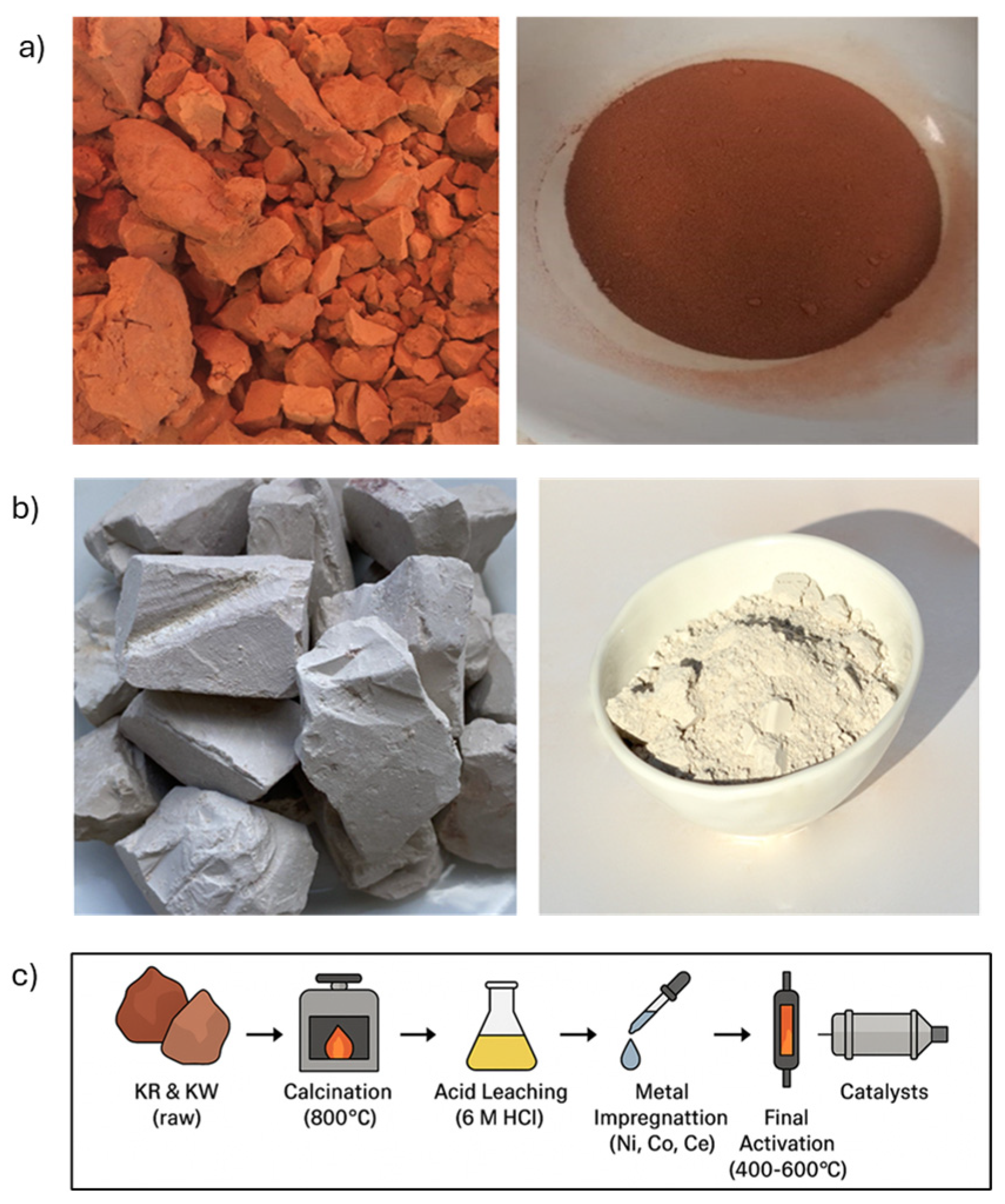
Two types of kaolin, red (KR) and white (KW), were collected as natural rock samples from different locations in the western desert of Al-Anbar, Iraq, in collaboration with the Iraqi Geological Survey, Ministry of Industry and Minerals. The raw kaolin rocks were crushed, ground, and sieved to obtain powders with a particle size around 100 µm, ensuring homogeneity and facilitating subsequent calcination and chemical treatment, as reported in previous studies on clay activation [19,20,21]. Figure 1a,b illustrate the visual appearance of both raw and treated kaolin samples.

2.2. Thermal Activation and Acid Treatment of Kaolin

The textural and acidic properties of kaolin were enhanced by sequential calcination and acid leaching. The powdered kaolin samples (KR and KW; Figure 1 and Figure 2, left side) were calcined at 800 °C for 4 h in air to obtain metakaolin (MKR800 and MKW800; Figure 1 and Figure 2, right side), which exhibits higher reactivity toward acid treatment. The calcined samples were subsequently leached with 6 M hydrochloric acid (HCl, 37%, Sigma Aldrich) at 80 °C under continuous stirring for 5 h using a solid-to-liquid ratio of 1:20, which was employed to ensure sufficient acid penetration and effective extraction of exchangeable cations, iron species, and partially coordinated aluminum [22,23,24]. After leaching, the suspensions were filtered, thoroughly washed with deionized water until neutral pH and chloride-free filtrate were obtained, and finally dried at 120 °C for 24 h. The resulting materials are referred to as acid-treated metakaolin (MKRW-800A).

2.3. Preparation of the Catalysts

Nickel (Ni), cobalt (Co), and cerium (Ce) were selected as active metals for impregnation onto the acid-treated metakaolinite supports. The corresponding precursors—nickel(II) nitrate hexahydrate [Ni(NO3)2·6H2O, 99%], cobalt(II) nitrate hexahydrate [Co(NO3)2·6H2O, 98%], and cerium(III) nitrate hexahydrate [Ce(NO3)3·6H2O, 98.5%]—were used as received from Sigma-Aldrich. Single-metal catalysts were prepared by the incipient wetness impregnation method at metal loadings of 3–8 wt.% for Ni and Co [25,26,27], to evaluate the effect of metal concentration on catalytic performance while minimizing the risk of sintering and pore blockage, and 10–40 wt.% for Ce, due to the structural and redox nature of cerium oxide and its ability to act as both a promoter and structural modifier [19,23]. This selection of distinct loading ranges was strategically based on established catalytic principles for heavy oil upgrading. Transition metals such as Ni and Co possess exceptionally high hydrogenation/dehydrogenation activity; thus, limiting their loading prevents severe metal agglomeration, excessive light gas production, and accelerated coke formation via carbon filament growth. Conversely, to form a robust CeO2 phase capable of providing sufficient oxygen storage capacity (Ce3+/Ce4+) and mitigating rapid deactivation by bulky asphaltenes, significantly higher Ce loadings are fundamentally required.
The mass of each metal precursor to achieve the target metal loading was calculated using the following mathematical formula:
m p r e c u r s o r = ( x · m s u p p o r t 100 x ) · ( M W p r e c u r s o r M W m e t a l )
where x is the target metal loading (wt.%), msupport is the mass of the MKRW-800A support, MWprecursor is the molecular weight of the nitrate salt, and MWmetal is the atomic weight of the respective metal (Ni, Co, or Ce). The calculated amount of the precursor was dissolved in the minimum volume required of deionized water. This solution was then added drop by drop evenly over the entire support. The resulting mixture was continuously stirred at room temperature until a homogeneous slurry was obtained, to ensure a complete and uniform distribution of the metallic species within the matrix. The impregnated samples were aged at room temperature for 24 h, dried at 110 °C for another 24 h, and stored in a desiccator. Subsequent thermal activation was carried out in an inert atmosphere. Ni- and Co-loaded catalysts were heated at 400 °C, while Ce-loaded samples required 600 °C to ensure complete decomposition of nitrate precursors and formation of active oxide phases. The complete synthesis process is illustrated in Figure 1c. The resulting catalysts are denoted as MKRW-800A@Ni3%, MKRW-800A@Ni5%, MKRW-800A@Ni8%, MKRW-800A@Co3%, MKRW-800A@Co5%, MKRW-800A@Co8%, MKRW-800A@Ce10%, MKRW-800A@Ce20% and MKRW-800A@Ce40%. For clarity, the catalyst nomenclature follows a specific structure: for example, the code MKRW-800A@Ce20% denotes a mixed MetaKaolin support (Red and White), thermally activated at 800 °C, Acid-leached, and impregnated with 20 wt.% of Cerium.

2.4. Feedstock Description

The vacuum residue (VR) used as the feedstock was obtained from the Al-Durra Refinery in Baghdad, Iraq. The main physicochemical properties of the VR are summarized in Table 1. This heavy residue was employed for catalytic cracking tests to evaluate catalyst activity, selectivity toward lighter distillates, and coke formation

2.5. Reactor Setup and Catalytic Cracking Procedure

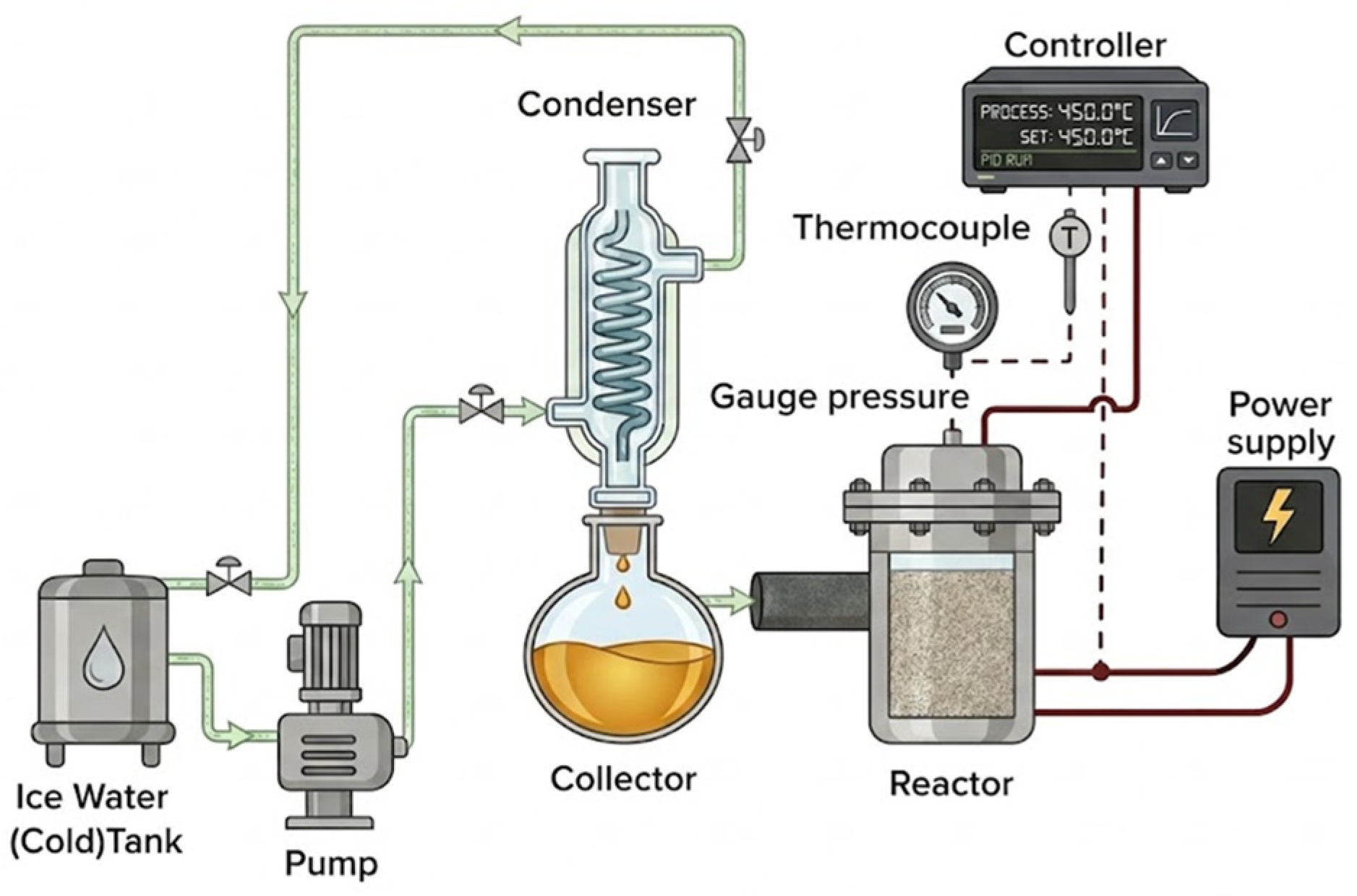
Catalytic cracking experiments were performed in a fixed-bed batch reactor equipped with temperature and pressure control systems (Figure 2). Prior to each run, the reactor was purged with nitrogen gas to eliminate residual oxygen and prevent unwanted oxidation reactions. Each experiment was carried out under atmospheric pressure, with the temperature gradually increasing to 450 °C using an electric heating system. The reaction was maintained for 1 h under constant stirring to ensure uniform heating and contact between the VR and catalyst. After each run, the reactor was cooled to room temperature under nitrogen flow, and the gaseous, liquid, and solid (coke) products were separated and quantified.

2.6. Characterization Techniques

The synthesized catalysts were extensively characterized to determine their physicochemical properties and establish structure–performance relationships. Crystalline phases were identified by X-ray diffraction (XRD) using a Bruker D8 diffractometer (Berlin, Germany) equipped with Cu Kα radiation (λ = 1.541 Å). Textural properties were evaluated from nitrogen adsorption–desorption isotherms measured at 77 K using a Micromeritics TRISTAR II PLUS 3030 analyzer (Norcross, GA, USA). The specific surface area (SBET), micropore volume (W0), and micropore width (L0) of the samples were determined using the Brunauer–Emmett–Teller (BET) method and the Dubinin–Radushkevich (DR) equation, while the mesopore volume was calculated as the difference between the amount of N2 adsorbed at a relative pressure of 0.95 (V0.95) and the micropore volume according to the Gurvich rule. Surface morphology and particle dispersion were examined by scanning electron microscopy (SEM) using a Carl Zeiss GEMINI 1430-VP microscope (Oberkochen, Germany) (maximum magnification 500,000×), and the elemental composition was analyzed by coupled energy-dispersive X-ray spectroscopy (EDX). The surface chemical states and metal–support interactions were investigated by X-ray photoelectron spectroscopy (XPS) with a Kratos Axis Ultra-DLD spectrometer (Manchester, United Kingdom) equipped with heating (up to 600 °C) and cooling (down to −150 °C) capabilities, enabling detailed analysis of oxidation states and surface bonding environments. Finally, the composition of the liquid products from catalytic cracking was analyzed by gas chromatography-mass spectrometry (GC-MS) using a Shimadzu GC-2010 system (Kyoto, Japan) operated with helium as the carrier gas (100 kPa), injector temperature 280 °C, oven temperature 60 °C, and a total flow rate of 12.7 mL min−1.

3. Results and Discussion

3.1. Chemical Composition of Iraqi Kaolin

Table 2 presents the chemical composition of the red (KR) and white (KW) kaolins as determined by X-ray fluorescence (XRF). Red kaolin (KR) contains higher amounts of Fe2O3 (14.74%) and SiO2 (50.22%), reflecting the presence of iron and silica phases typical of less refined clays. The presence of iron oxides can influence thermal behavior during calcination and may contribute to intrinsic redox activity; however, excessive iron can also affect acidity and structural stability during acid treatment [28,29,30].
In contrast, white kaolin (KW) shows higher Al2O3 content (34.69%). This composition indicates a higher kaolinite purity and fewer iron impurities, which is consistent with the high crystallinity observed in its XRD pattern (Section 3.3). This is desirable for generating uniform acid sites after calcination and leaching. The higher loss on ignition (LOI ≈ 12.3 wt.%) observed for KW is consistent with a higher hydroxyl content, confirming a more ordered kaolinite structure prior to thermal activation [31,32]. Both clays contain minor amounts of TiO2 and alkali metals, with very low transition metal content; these compositional differences will influence the behavior during calcination, dealumination and, ultimately, the catalytic potential and thermal stability of the derived metakaolinite materials.

3.2. Catalytic Performance: GC-MS Analysis

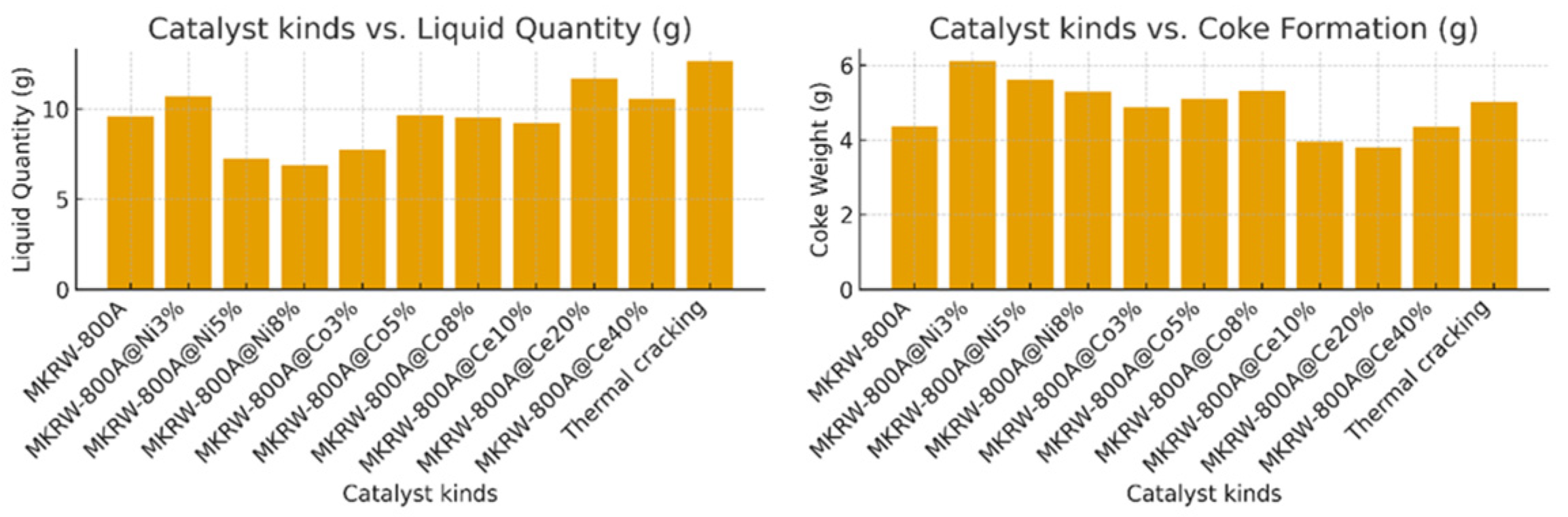
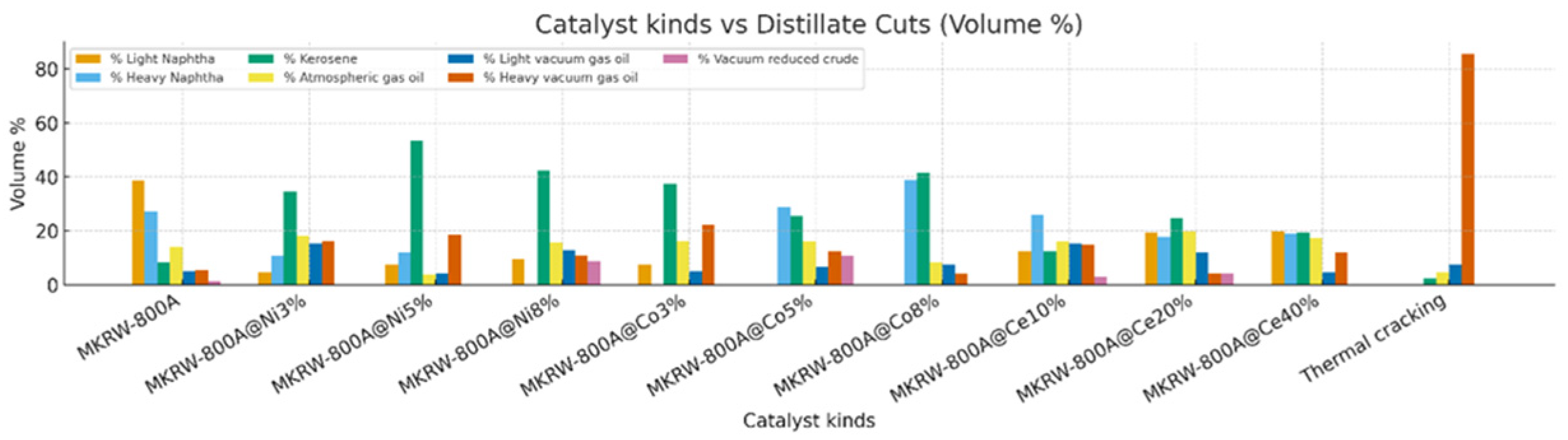
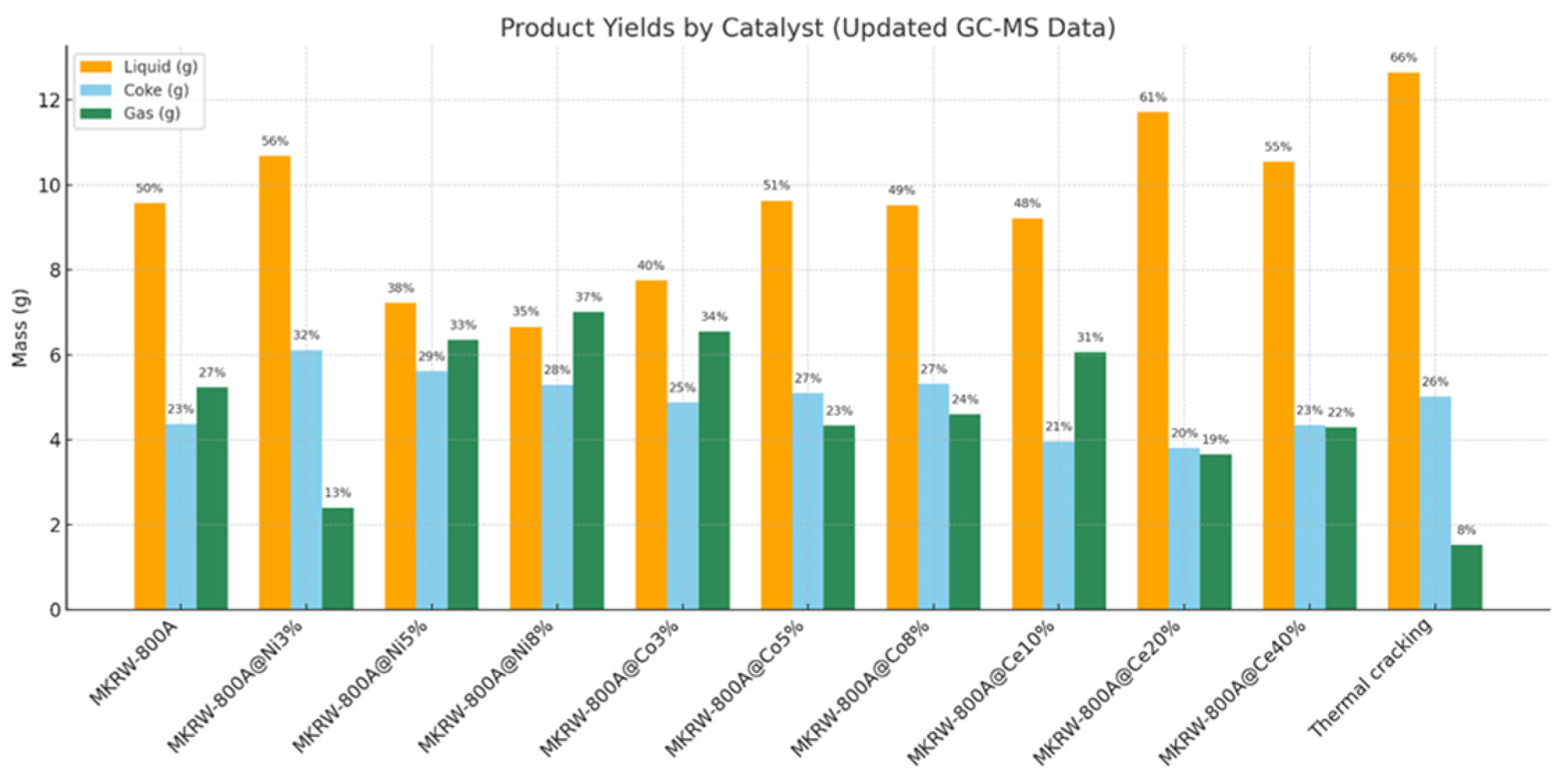
The catalytic activity of the MKRW-800 A-based materials was evaluated for vacuum residue (VR) cracking in a fixed-bed reactor. Table 3 and Figure 3, Figure 4 and Figure 5 summarize the yields of liquid, gas, and coke, as well as the distribution of liquid fractions into light naphtha, heavy naphtha, and kerosene.
Regarding the best performing catalyst, MKRW-800A@Ce20% exhibited the highest catalytic efficiency, producing 11.72 g of liquid (≈61% of total product) and the lowest coke formation (3.81 g, ≈20%) [2,7,8]. This superiority is fundamentally driven by a bifunctional synergistic mechanism between the acidic support and the redox-active ceria. Specifically, the cerium oxide does not primarily participate in the direct C-C bond cleavage; the direct cracking of bulky VR molecules into lighter fractions is executed by the Brønsted and Lewis acid sites of the metakaolinite via carbocation intermediates. However, these acid-catalyzed reactions inherently generate polyaromatic radicals that quickly polymerize into coke, deactivating the sites. At this critical stage, the Ce3+/Ce4+ redox couple acts as a protective mediator. By providing high oxygen mobility (lattice oxygen), ceria continuously oxidizes these carbonaceous precursors before they can condense into hard coke, effectively keeping the adjacent acid sites clean and accessible. Additionally, this redox cycle facilitates mild hydrogen transfer, which stabilizes the cracked olefinic intermediates and prevents their recombination into heavier tars [8,10,33,34,35]. This direct synergy, where the support cracks the molecules and the metal preserves the active sites, explains the sustained liquid yield and minimal coke formation. Moreover, MKRW-800A@Ce20% also enhanced selectivity toward light fractions, yielding 19.76% light naphtha, 18.97% heavy naphtha, and 24.72% kerosene, demonstrating effective secondary cracking and hydrogenation [7,13,14,34].
Ni-doped samples (especially 5–8 wt.% Ni) produced lower liquid yields (6.86–7.22 g) and higher coke (6.35–7.03 g), suggesting that at these loadings nickel promotes excessive cracking/dehydrogenation and polymerization under these conditions, increasing carbonaceous deposit formation. This behavior aligns with the known sensitivity of residue cracking to the balance between hydrogen transfer and coke-forming condensation, particularly when metal sites become overly dominant or poorly dispersed [3,7,8,35].
Co-modified samples presented intermediate behavior (liquid yields 7.75–9.63 g; coke 4.3–5.3 g), indicating moderate activity and selectivity; cobalt provides some hydrogen-transfer/redox functions but did not outperform the Ce-promoted system under the tested conditions. Thermal runs produced 12.648 g liquid but of very poor quality (0% naphtha fractions, only 2.36% kerosene) and left ≈ 85.5% of the feed as unconverted VR, highlighting the importance of catalytic assistance for upgrading VR [35,36,37].
The global product distribution (Figure 3) further confirms that MKRW-800A@Ce20% offered the best overall balance, with 61% liquid, 19% gas, and 20% coke. Lower Ce loadings (10%) and higher ones (40%) both showed inferior results. The macroscopic drop in performance at 40 wt.% Ce strongly suggests that such excessive loading leads to severe metal agglomeration and pore blockage, restricting the diffusion of bulky VR molecules to the active sites. This demonstrates the critical importance of optimizing metal concentration to achieve high dispersion and stable redox behavior [17]. The combined GC–MS and product distribution data clearly establish MKRW-800A@Ce20% as the optimal composition, offering high liquid yield, enhanced light-fraction selectivity, and superior coke resistance [2,8,38].
Although multi-cycle reusability tests fall outside the scope of this initial proof-of-concept study, the remarkably low coke deposition observed for the optimal MKRW-800A@Ce20% catalyst strongly suggests a high resistance to deactivation. This indicates excellent potential for long-term stability and reusability, which will be the primary focus of our forthcoming investigations.

3.3. X-Ray Diffraction (XRD)

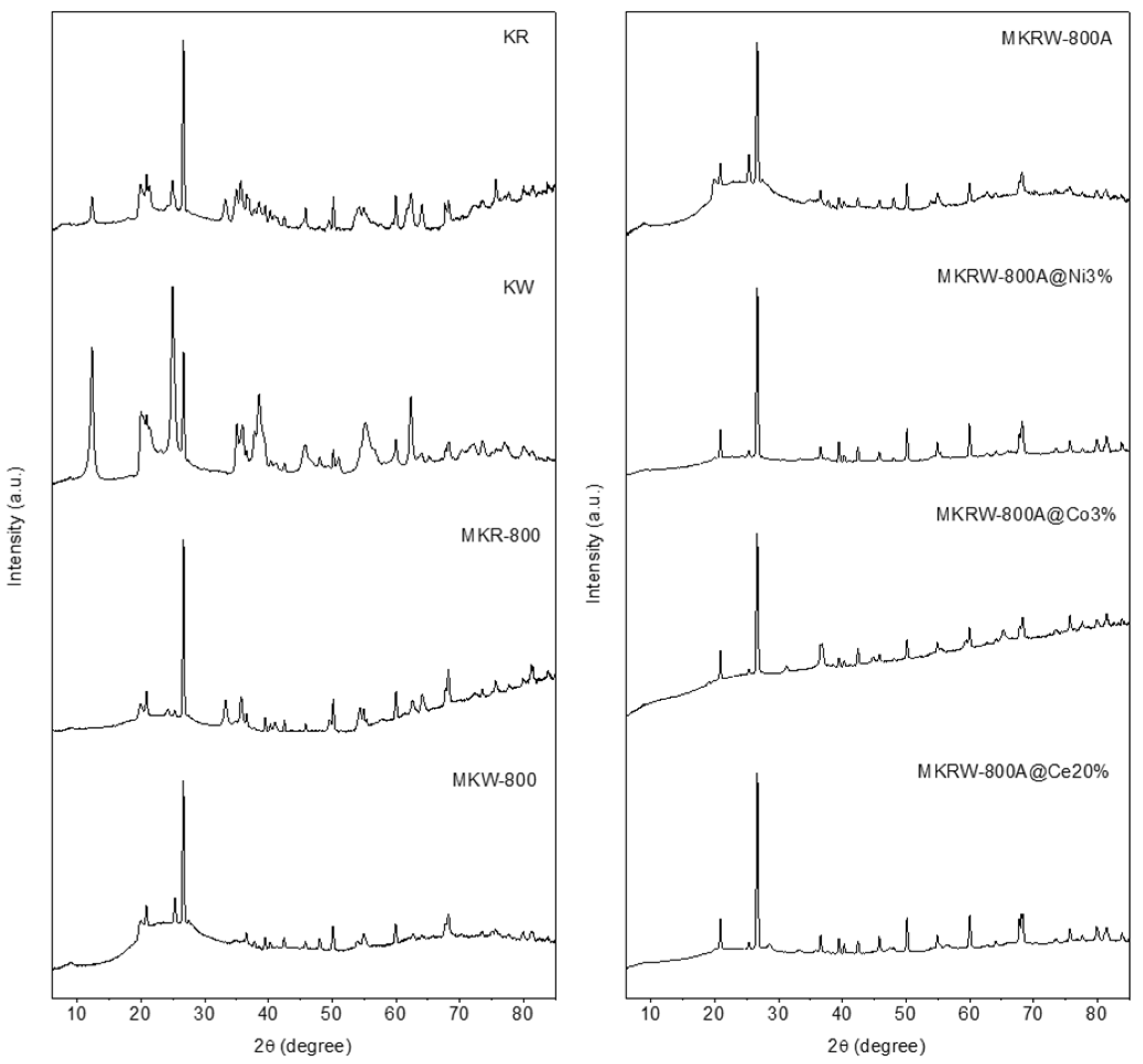
The XRD patterns (Figure 6) reveal the structural transformation of the kaolin-based materials. The raw samples (KR and KW) exhibit the characteristic reflections of crystalline kaolinite at 2θ = 12.3° and 24.8°. Notably, the KW sample displays sharper and more intense kaolinite reflections compared to KR, which perfectly corroborates its higher structural purity and superior Al2O3 content previously determined by XRF. After calcination at 800 °C, these specific kaolinite peaks disappear, confirming the dehydroxylation into metakaolinite. Such calcination-driven structural collapse and loss of long-range order are consistent with thermal transformation behavior reported for kaolinite-rich clays. However, a prominent sharp reflection remains at 2θ = 26.6° across all samples, indexed to quartz (SIO2) present as a persistent crystalline impurity in the precursor clay. Regarding the metal-modified samples (Ni 3% and Co 3%), no significant diffraction peaks corresponding to NiO or Co3O4 phases were detected [39,40]. This absence suggests that these metals are either present as clusters below the detection limit of the instrument or are highly dispersed within the amorphous metakaolinite matrix, a feature often beneficial for catalytic performance.
Even at a higher loading of Ce (20%), the characteristic fluorite-type CeO2 reflections [41,42] are remarkably weak or absent. Given that 20 wt.% is a substantially high loading, this lack of distinct peaks is a strong indicator of excellent metal dispersion. It indicates that the cerium species are either highly amorphous or present as extremely small nanoclusters (<3–4 nm) falling below the XRD detection limit, being successfully incorporated into the porous structure of the acid-leached support (MKRW-800A) without forming long-range crystalline domains [43,44,45,46].

3.4. Surface and Pore Structure

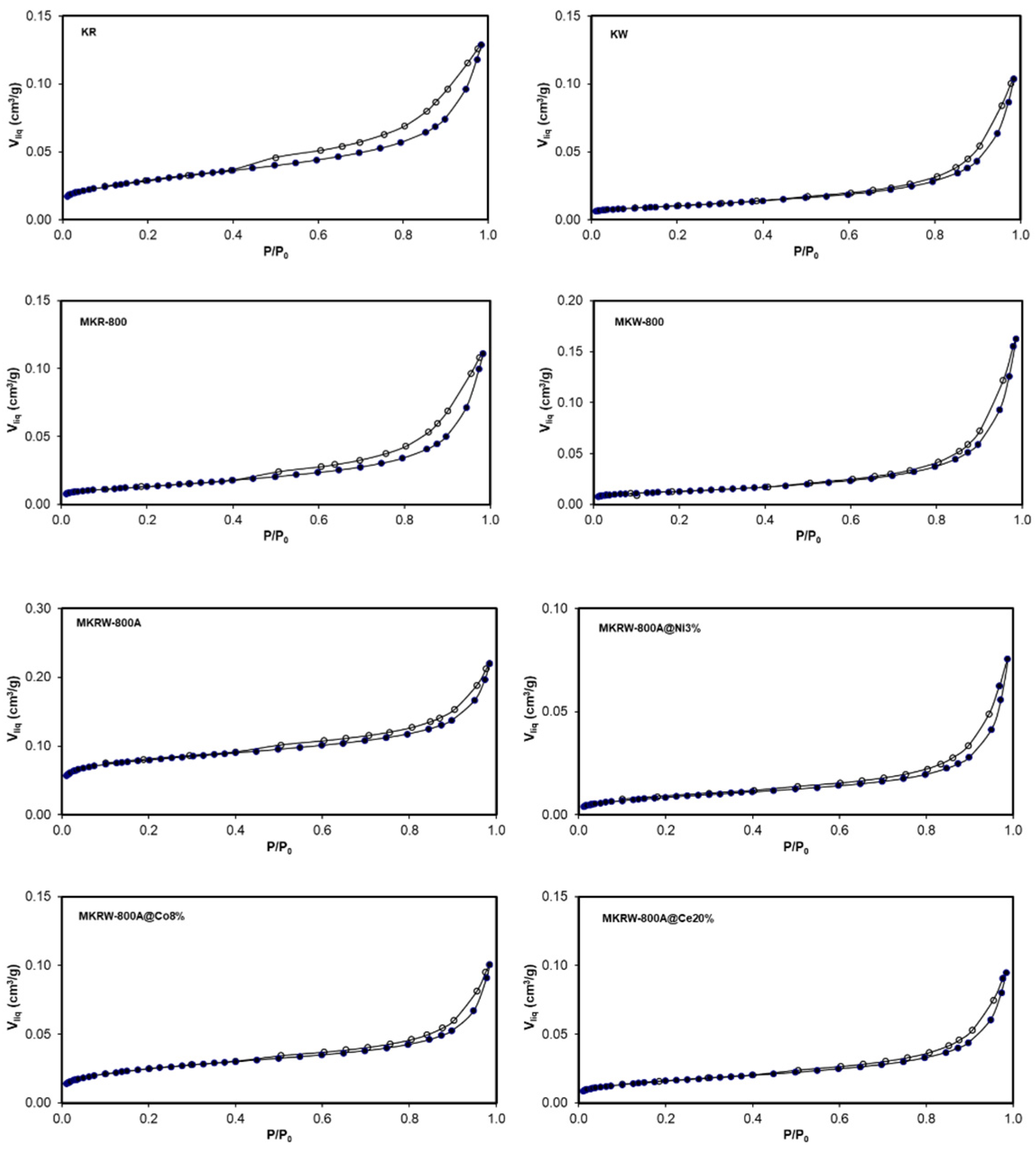
Surface area and porosity data (Table 4) demonstrate that both structural and chemical treatments significantly influence the textural characteristics of kaolin. Acid activation of metakaolinite (MKRW-800A) markedly increased its surface area to 190 m2/g and pore volume to 0.166 cm3/g, primarily due to dealumination and iron removal, which open the matrix and enhance accessibility to reactants [24,40]. However, subsequent metal loading reduced surface area as metal oxides partially blocked pores and covered active sites, yielding 19, 56, and 36 m2/g for the optimal Ni-, Co-, and Ce-loaded samples (MKRW-800A@Ni3%, MKRW-800A@Co8%, and MKRW-800A@Ce20%), respectively [47]. Despite this reduction, the micropore width (L0) remained between 1.49 and 2.10 nm. More importantly, the catalysts successfully preserved an adequate mesoporous volume (Vmeso = 0.033–0.087 cm3/g), which provides the essential wider channels (>2 nm) that facilitate diffusion and suppresses coke formation [47,48,49]. It is well established that pores between 2 and 10 nm are optimal for upgrading heavy oils [50]. In summary, the combination of moderate surface area, stable mesoporosity, and dispersed redox-active species such as Ce4+/Ce3+ and Co3O4 enhances acidity, oxygen mobility, and long-term catalytic stability [51,52].
The N2 adsorption–desorption isotherms (Figure 7) for both the raw and modified materials are characteristic of Type IV isotherms according to the IUPAC classification, which is typical of mesoporous structures. At low relative pressures (P/P0 < 0.1), the curves show a slight initial uptake related to monolayer adsorption in micropores, particularly evident in the acid-activated sample (MKRW-800A), which aligns with its significantly higher SBET. All samples exhibit a distinct H3-type hysteresis loop in the P/P0 range of 0.4–1.0. This specific hysteresis type is associated with non-rigid aggregates of plate-like particles, such as those found in clay minerals, forming slit-shaped pores. Notably, the acid treatment (MKRW-800A) enhances the adsorption capacity across the entire pressure range, reflecting the development of a more open porous network. Conversely, after metal loading (Ni, Co, and Ce), the isotherms maintain their Type IV shape and H3 hysteresis but show a marked decrease in the total volume of adsorbed N2. This reduction is mainly associated with partial pore filling and surface coverage by metal oxide species, a phenomenon widely reported for impregnated clay and oxide supports [53,54]. Despite this decrease, the catalysts retain a significant mesoporous volume (Vmeso = 0.033 − 0.046 cm3 g−1), which remains within the optimal range for heavy oil upgrading [55]. Therefore, whilst the fundamental mesoporous architecture of the metakaolinite-quartz matrix is preserved, the impregnated metal species partially occupy or block the pore channels, consistent with the reduction in pore volume (V0.95) and surface area observed in Table 4.

3.5. Scanning Electron Microscopy (SEM)

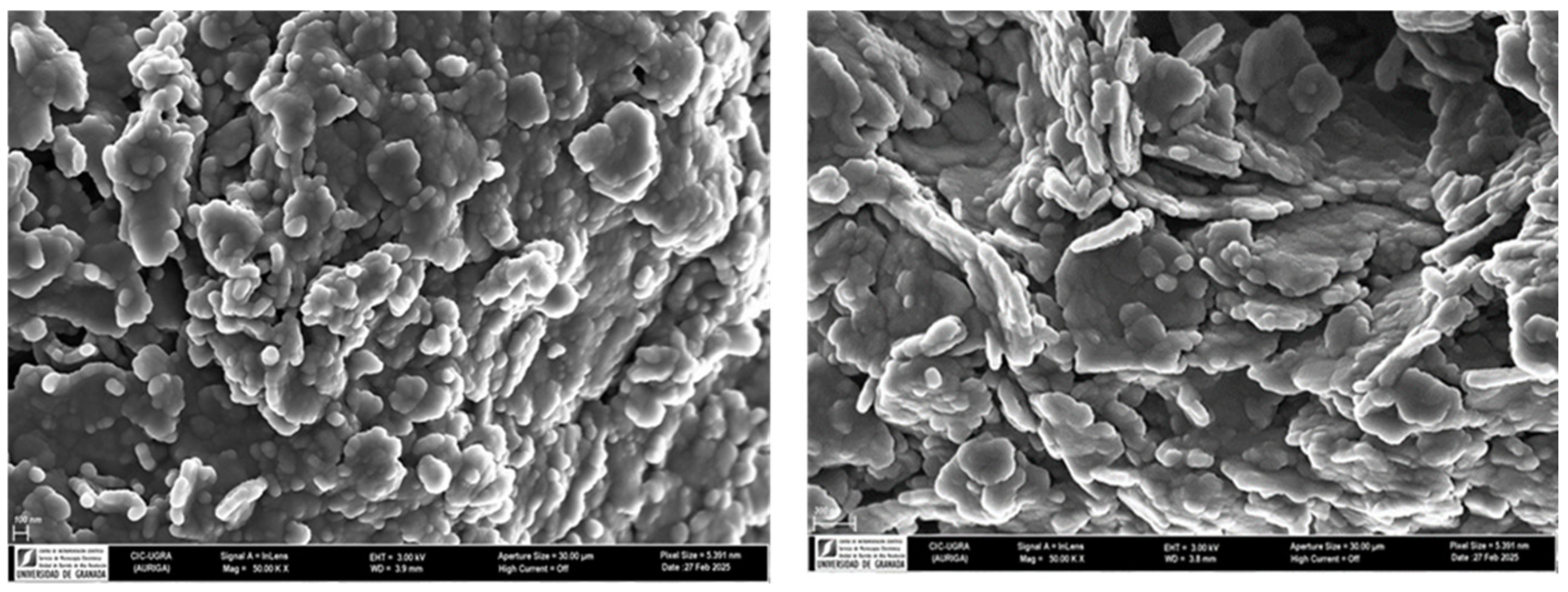
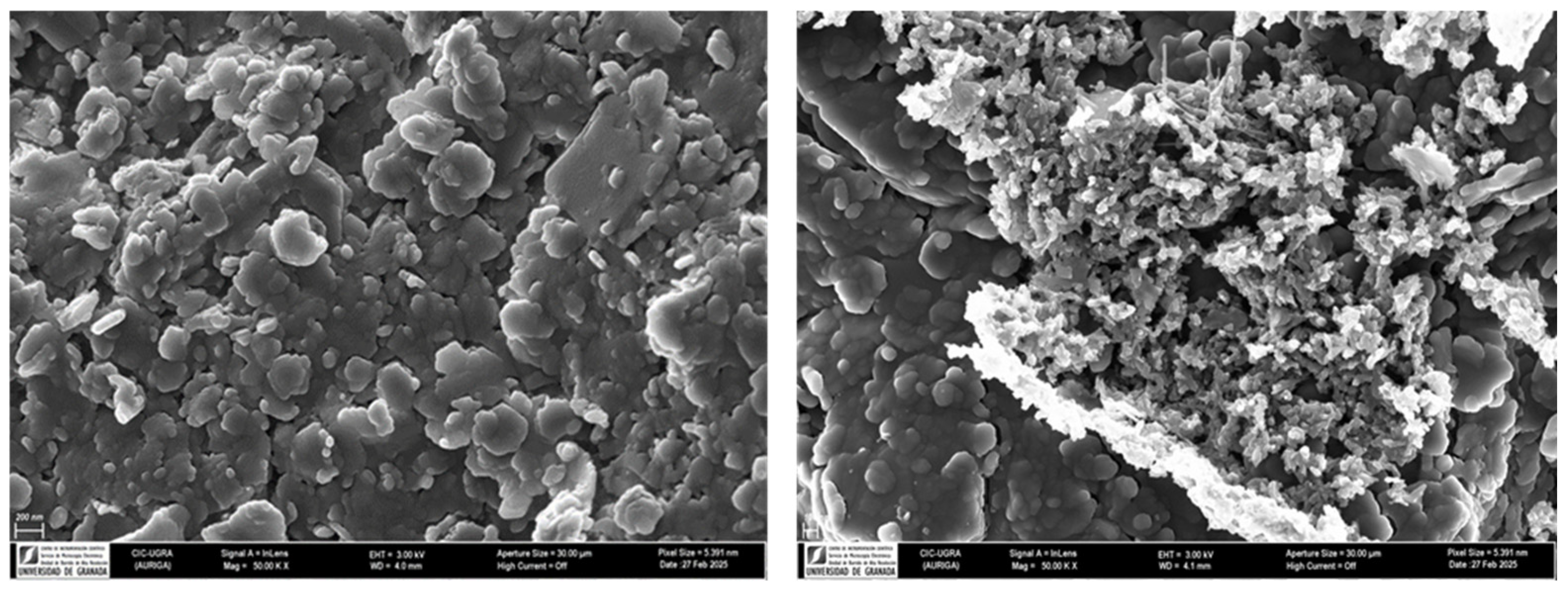
SEM micrographs reveal a direct relationship between morphological evolution and catalytic performance. The raw kaolins KR and KW (Figure 8) exhibit smooth, compact lamellar surfaces with limited porosity, restricting diffusion and catalytic accessibility [56].
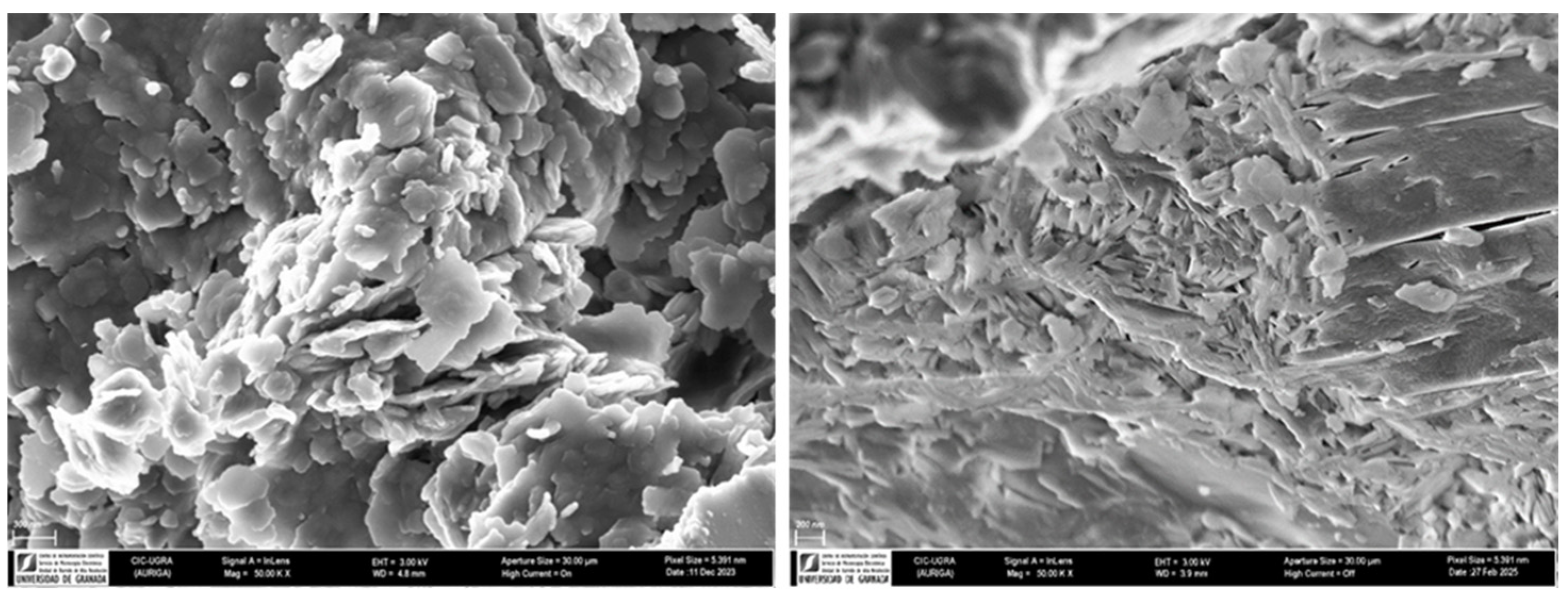
After calcination to 800 °C, metakaolinite (MKR800, MKW800) shows partial amorphization and dehydroxylation, increasing reactivity slightly but still limiting diffusion (Figure 9) [57,58]. Acid treatment (MKRW-800A) drastically alters the morphology, producing a fractured, porous texture (Figure 9, left). This transformation, driven by dealumination and iron extraction, enhances surface area, introduces Brønsted acidity, and creates open diffusion channels essential for VR cracking [18,59].
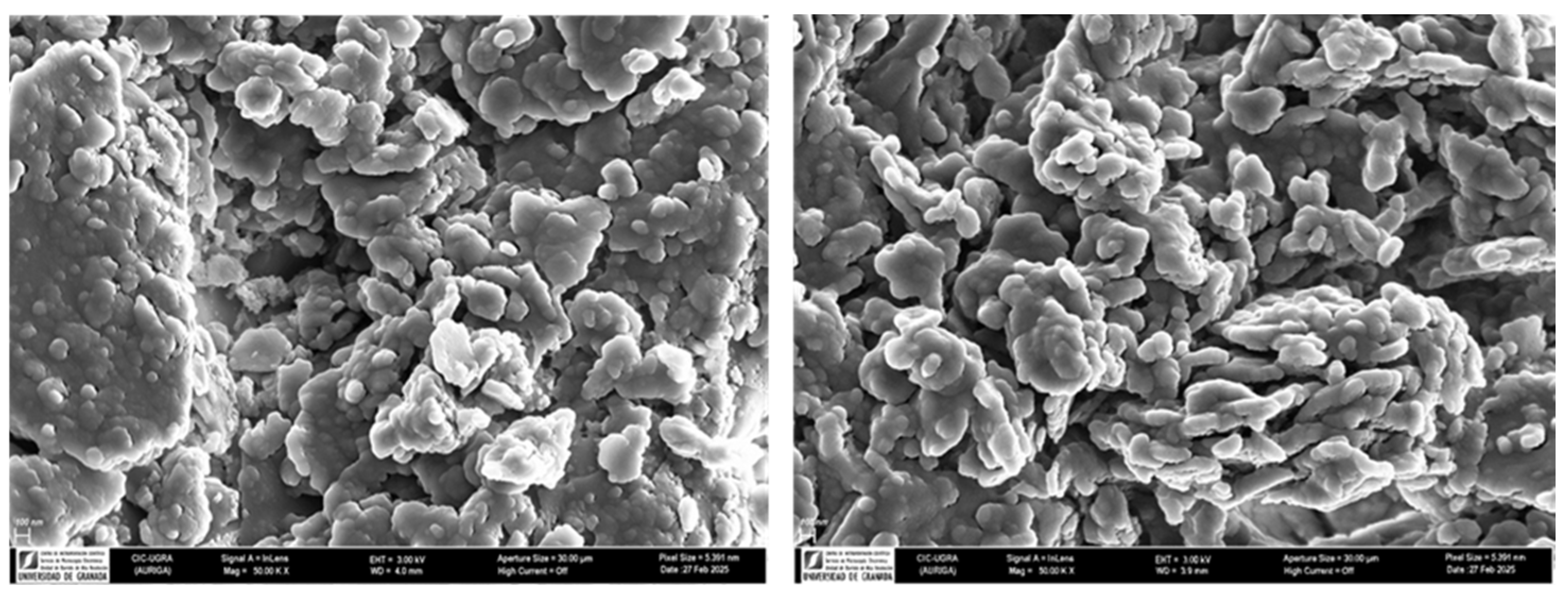
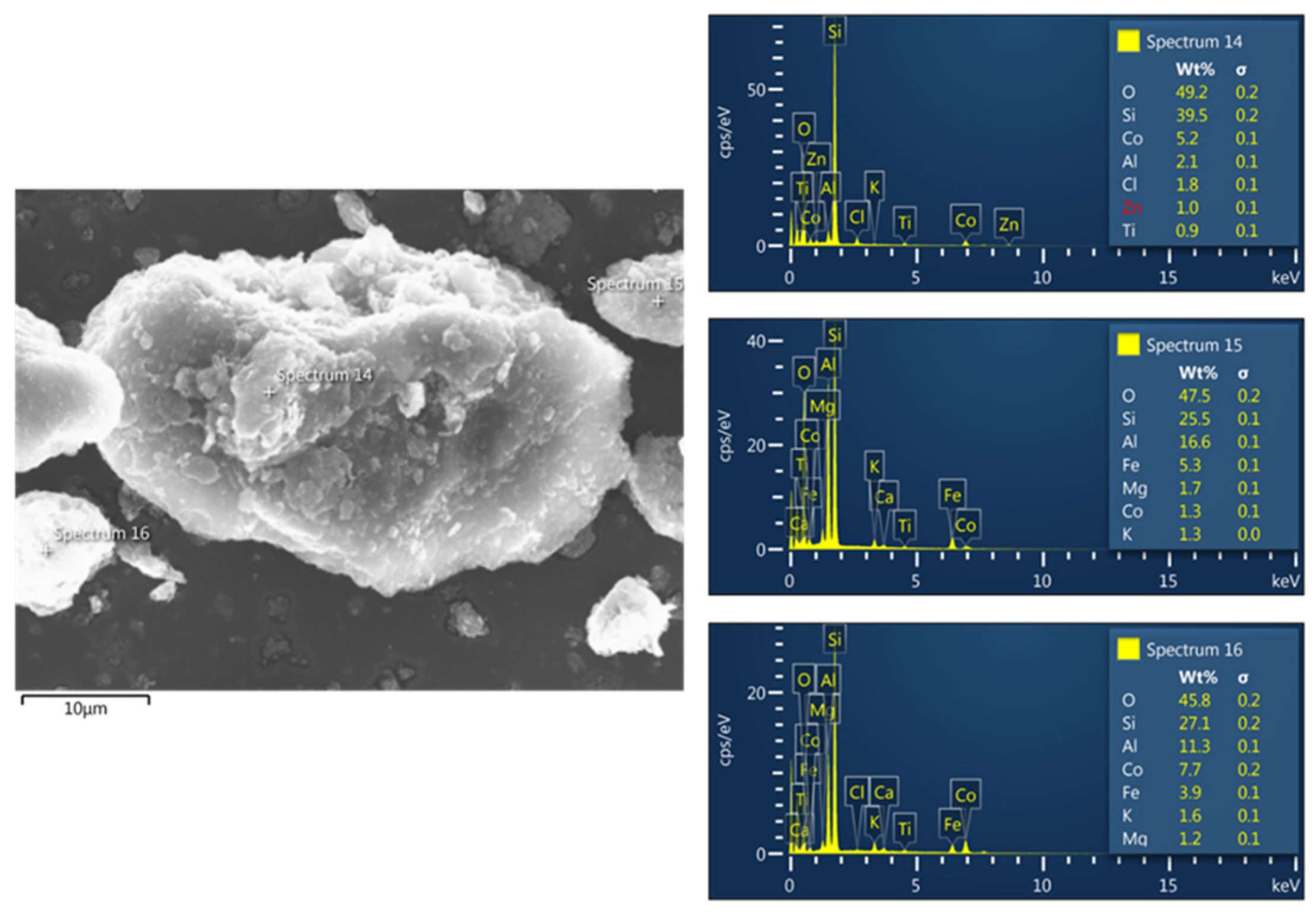
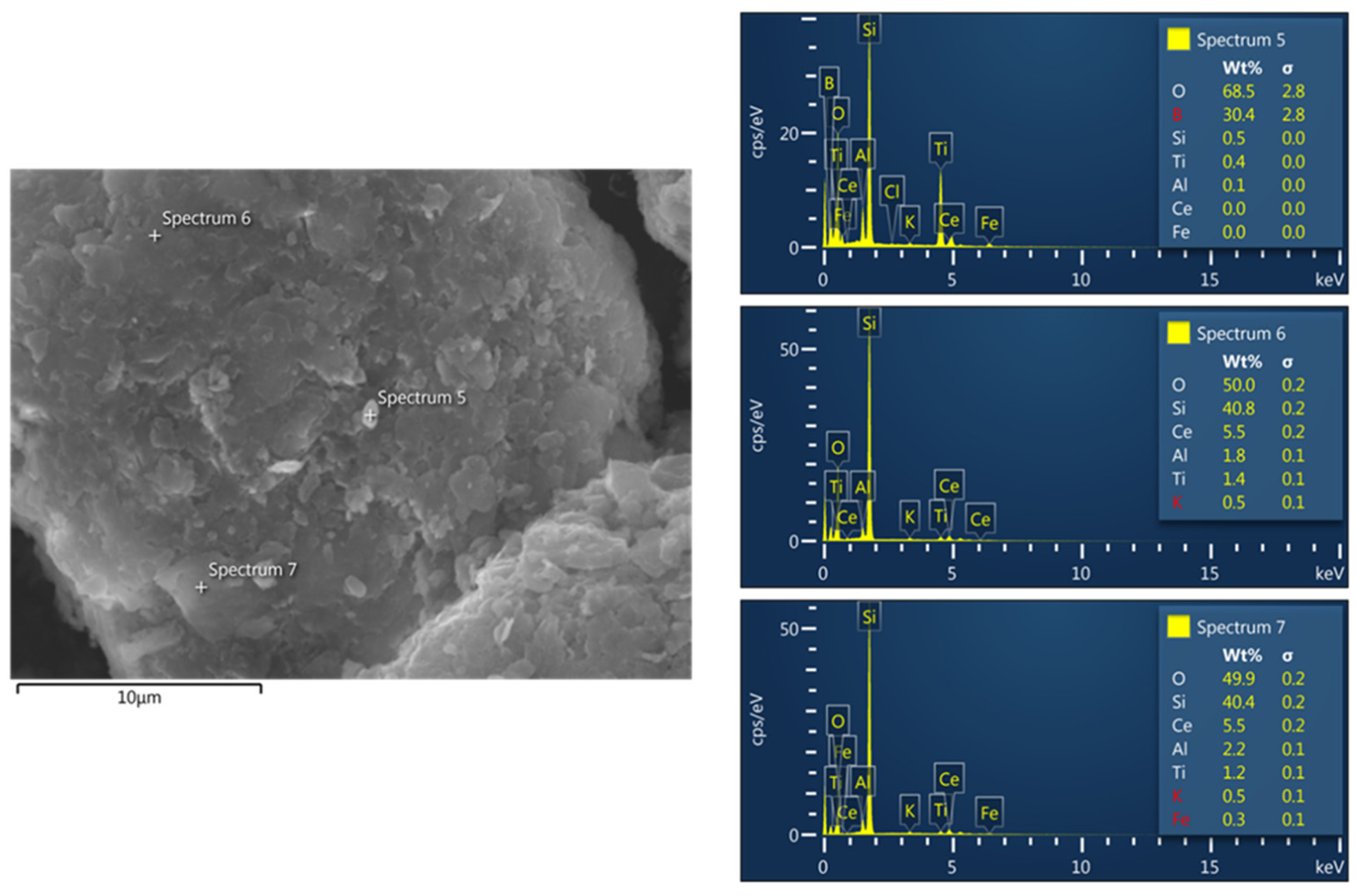
Figure 10 and Figure 11 show SEM images of the acid-leached metakaolinite (MKRW-800A) before and after being loaded with metals like Ni, Co, and Ce. Overall, the typical layered or plate-like structure of the metakaolin is still visible in all the samples. There are no drastic changes in the surface shape or noticeable collapse of the structure after metal loading. Although we cannot directly see or identify the metal oxide particles (like NiO, Co3O4, or CeO2) from these SEM images alone, we can assume that the metals are present based on how the catalysts behave during cracking. For a clearer picture of where the metals are and how well they are spread, we refer to the EDX results [60,61,62].

3.6. SEM–EDX Analysis

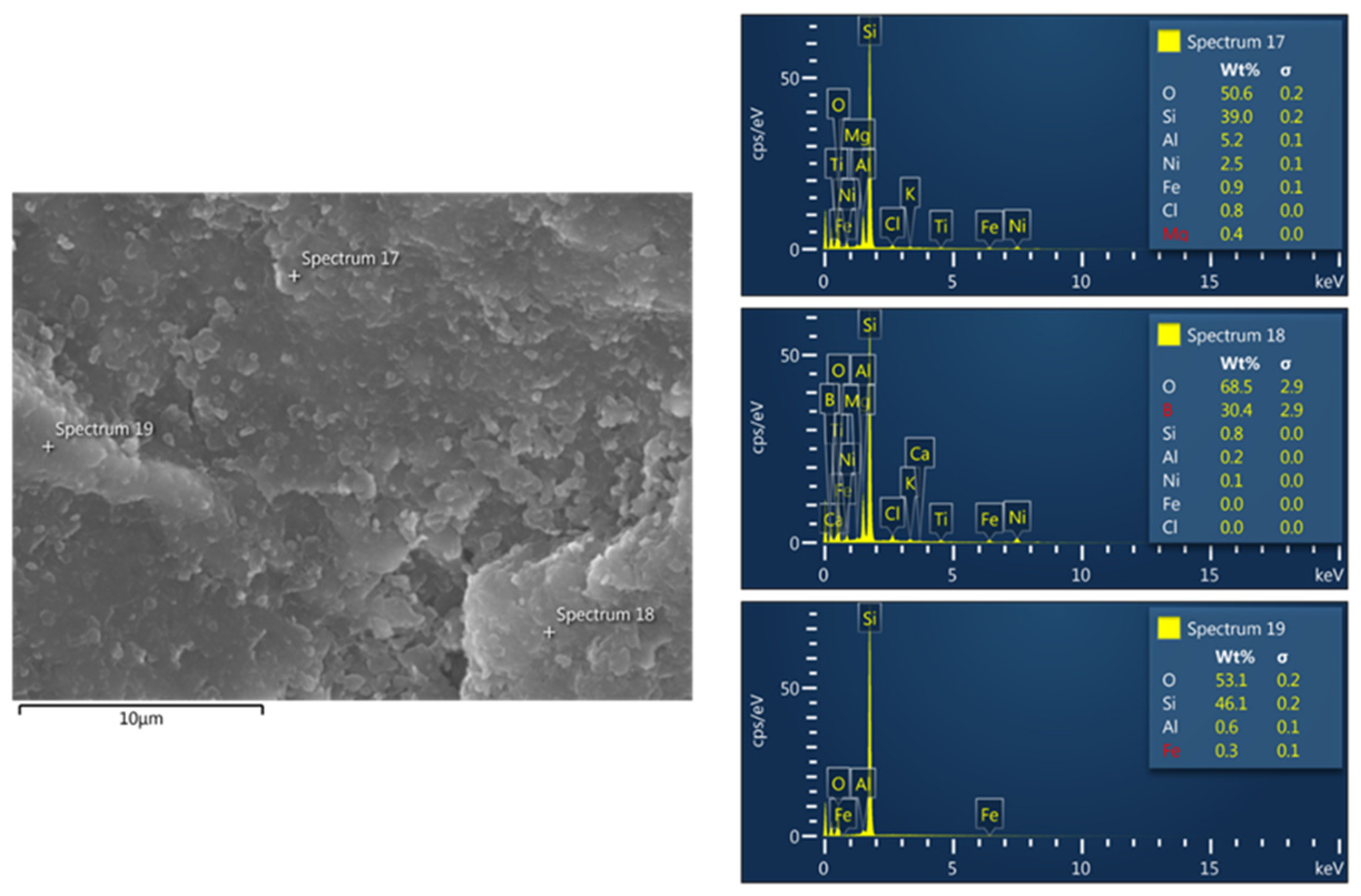
SEM–EDX characterization of MKRW-800A@Ni3%, MKRW-800A@Co8%, and MKRW-800A@Ce20% catalysts confirms the elemental composition and metal dispersion patterns. The acid-leached support (MKRW-800A) provides a porous, high-area scaffold suitable for anchoring metal oxides. In MKRW-800A@Ni3% (Figure 12), NiO nanoparticles are evenly distributed across the porous surface, and EDX spectra confirm the presence of Ni, Si, Al, and O, indicating good dispersion and minimal sintering, features consistent with Ni/kaolin systems in steam reforming [63,64,65]. MKRW-800A@Co8% (Figure 13) shows Co clusters and rough morphology, while EDX verifies Co incorporation into the aluminosilicate matrix, forming redox-active Co3O4 domains [66]. In both Ni- and Co-loaded metakaolinite materials, the atomic percentage of Ni and Co fits fairly well with that theoretically incorporated in certain regions of the sample. The MKRW-800A@Ce20% catalyst (Figure 14) exhibits partial agglomeration of CeO2 with slightly reduced porosity; however, its strong Ce4+/Ce3+ redox cycle and oxygen storage capacity impart excellent coke resistance, aligning with previous findings for CeO2-supported Ni systems [67]. The detected cerium percentage being slightly below the nominal 20 wt.% is attributable to the inherent semi-quantitative and highly localized nature of the EDX analysis. Because the EDX interaction volume samples a specific, micron-scale region, slight deviations from the overall nominal loading are typically a reflection of microscopic heterogeneity in the metal distribution across the individual metakaolinite particles.

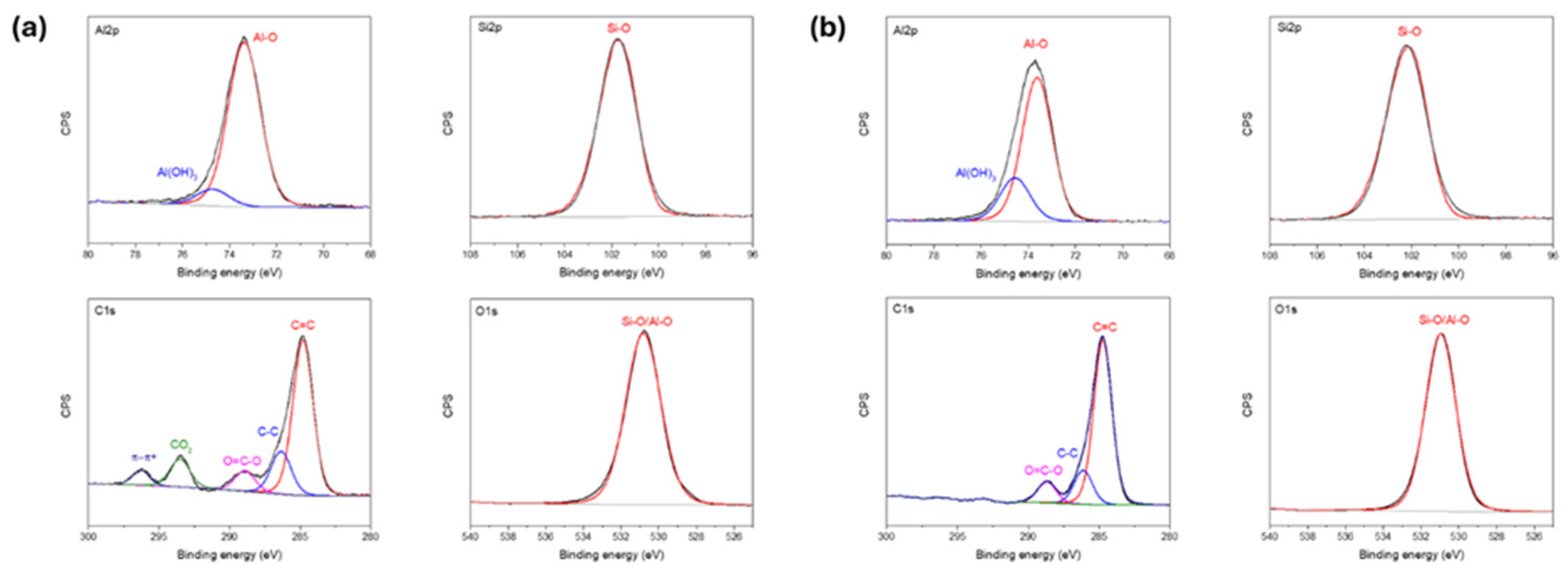
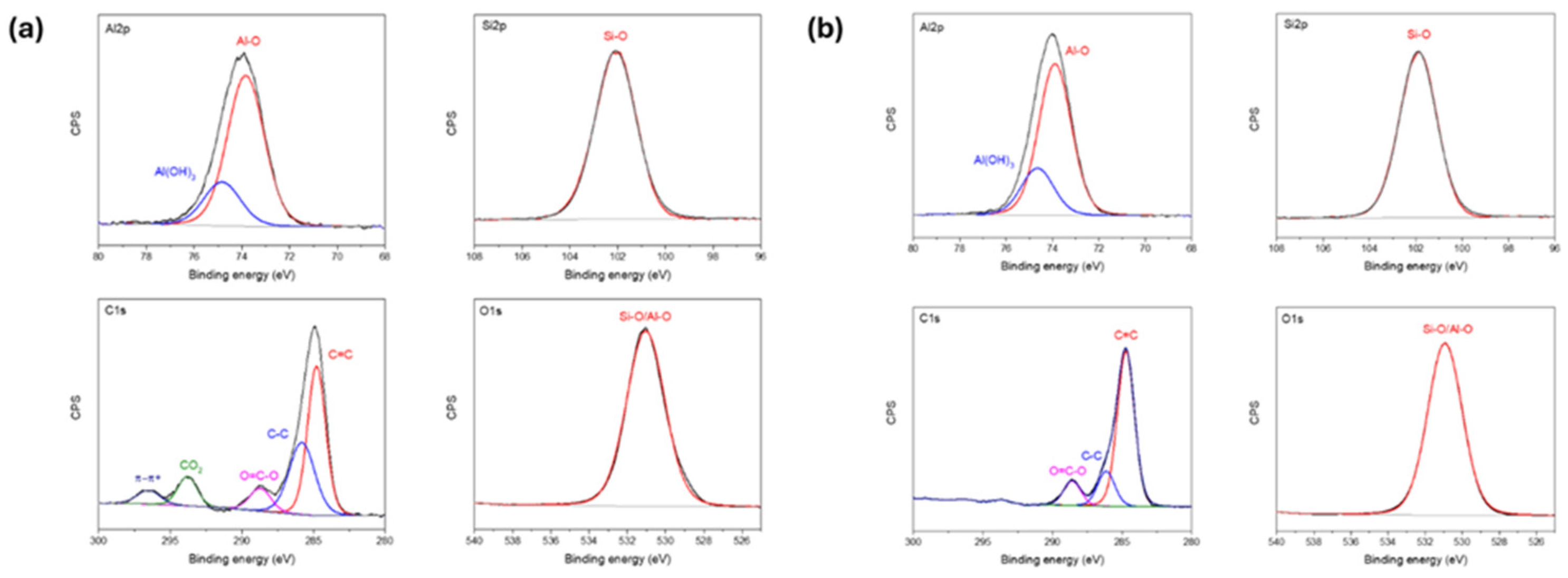
3.7. XPS Analysis

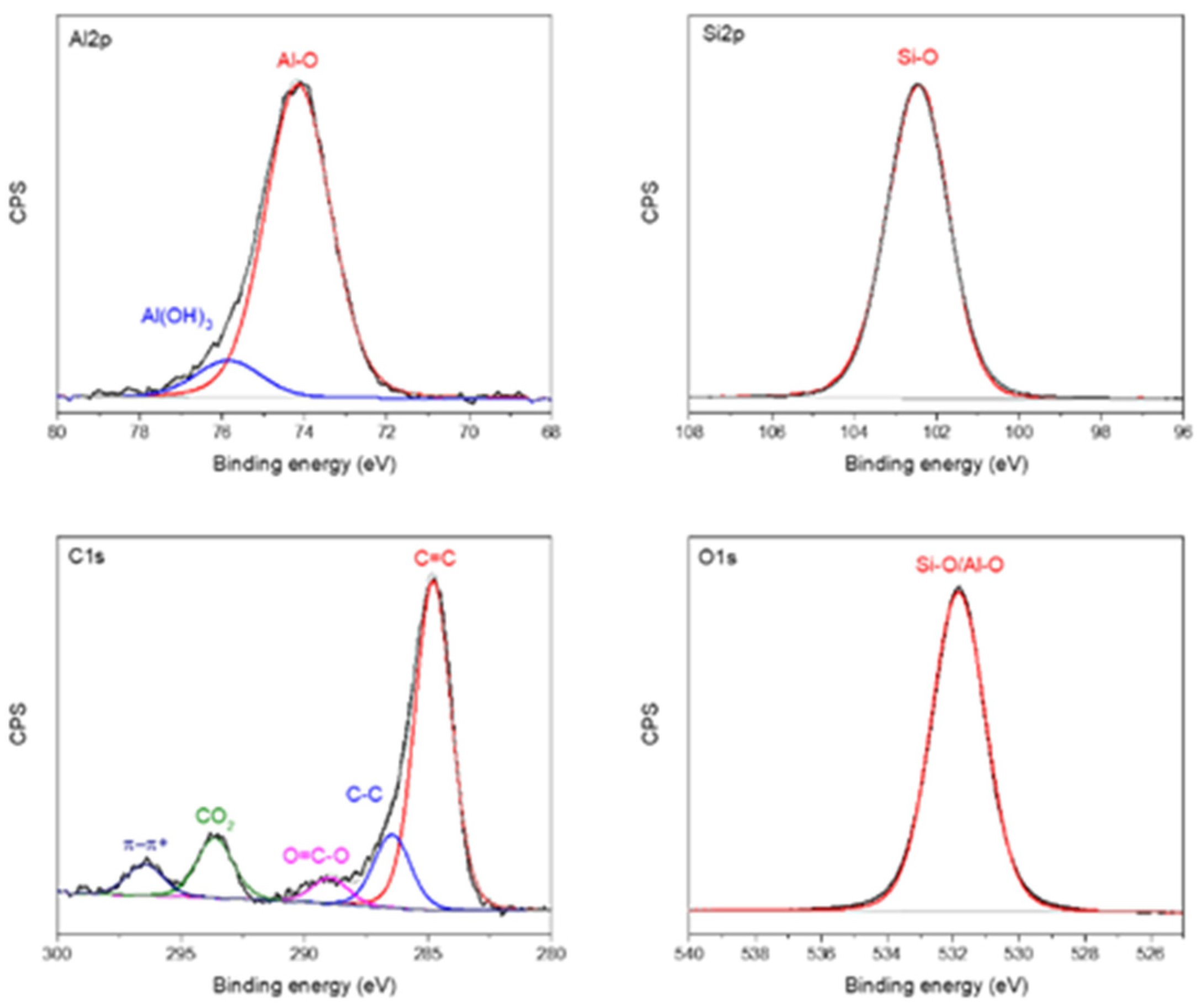
XPS spectra (Figure 15, Figure 16, Figure 17, Figure 18, Figure 19 and Figure 20) and elemental compositions (Table 5) confirm significant chemical and electronic transformations throughout the catalyst synthesis process. The high-resolution spectra of the raw kaolin samples display the typical core-level emissions corresponding to the aluminosilicate framework. The Al 2p spectrum (Figure 15) shows a main peak at 73.6 eV attributed to Al–O bonds in octahedral Al3+ sites within the kaolinite lattice, accompanied by a secondary component at 74.5 eV assigned to Al(OH)3, indicating the presence of surface hydroxylated aluminum species. The Si 2p peak is centered at 102.8 eV, corresponding to Si–O–Si and Si–O–Al linkages, typical of layered kaolinite structures. The O 1s region exhibits two distinct contributions: a dominant peak at 532.8 eV due to lattice oxygen (Si–O–Al/Si–O–Si) and a weaker one at 531.2 eV attributed to hydroxyl oxygen or adsorbed species. The C 1s spectrum is deconvoluted into four components: C–C/C=C (284.6 eV), C–O (286.3 eV), C=O (287.6 eV), and CO2 or carbonate species (288.6 eV), reflecting minor surface contamination and atmospheric adsorption [68]. These deconvoluted features establish a reference for the subsequent modifications induced by calcination, acid leaching, and metal impregnation.
Upon thermal activation at 800 °C (Figure 16), the kaolinite structure transforms into amorphous metakaolinite (MKRW800). The Al 2p peak slightly shifts to ~74.2 eV and broadens, consistent with dehydroxylation and the collapse of the ordered layers, generating unsaturated Al3+ centers that serve as Lewis acid sites. The Si 2p peak remains at ~103.0 eV but narrows, reflecting the predominance of Si–O–Si linkages after partial removal of structural hydroxyls. The O 1s band also becomes broader, dominated by lattice oxygen (531.4 eV), indicative of the increased defect density and amorphous character of MKRW800. These spectral changes confirm the destruction of long-range kaolinite order and the formation of a reactive, defect-rich aluminosilicate surface suitable for catalytic modification [69].
After acid leaching (MKRW-800A, Figure 17), strong dealumination occurs, as evidenced by the marked reduction in Al 2p intensity (from 11.3 to 4.34 wt.%) and an enhancement of the Si 2p signal (up to 30.3 wt.%). The O 1s peak sharpens and shifts slightly toward higher binding energy, dominated by Si–O–Si and Si–O–Al contributions, confirming the formation of a silica-enriched surface. This modification increases both Lewis acidity (due to exposed Al3+ in distorted tetrahedral coordination) and Brønsted acidity (from residual surface hydroxyls), which are key to catalytic cracking activity [62,70]. The persistence of the C 1s components (C–C, C=O, CO2) indicates minor carbonaceous residues or re-adsorbed CO2 but does not affect the surface chemistry significantly.
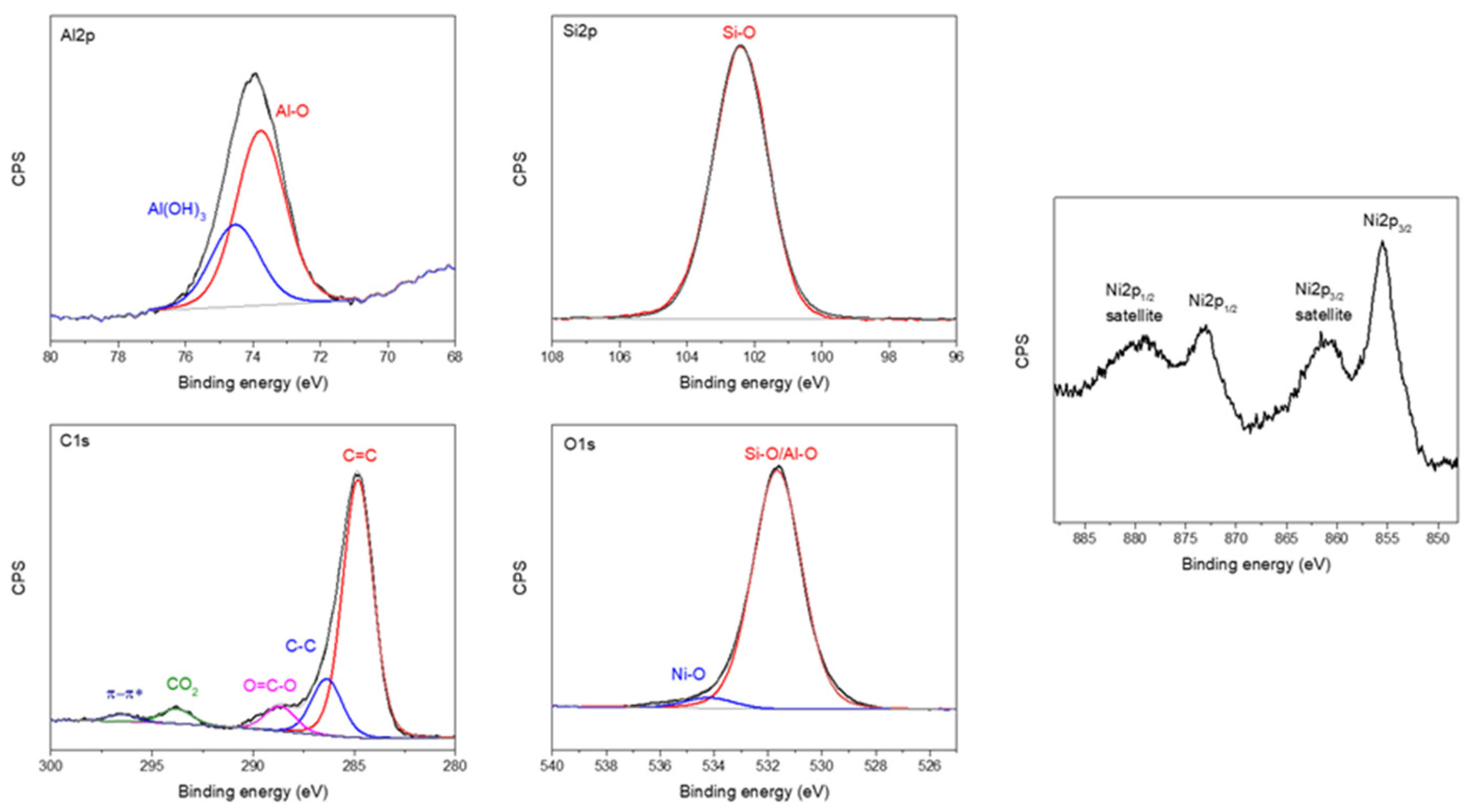
Upon metal impregnation, the general structure of the aluminosilicate matrix remains intact, with new electronic states appearing from the incorporated metals. In Ni-modified samples (Figure 18), the Ni 2p3/2 signal appears at 855.0 eV, with a satellite peak near 861 eV, confirming the presence of Ni2+ in NiO, while a faint shoulder at 852.8 eV may indicate traces of metallic Ni0 formed during calcination. The coexistence of Ni2+/Ni0 enhances hydrogen transfer and dehydrogenation–hydrogenation balance during vacuum residue (VR) cracking, though it may promote coke at higher loadings [71].
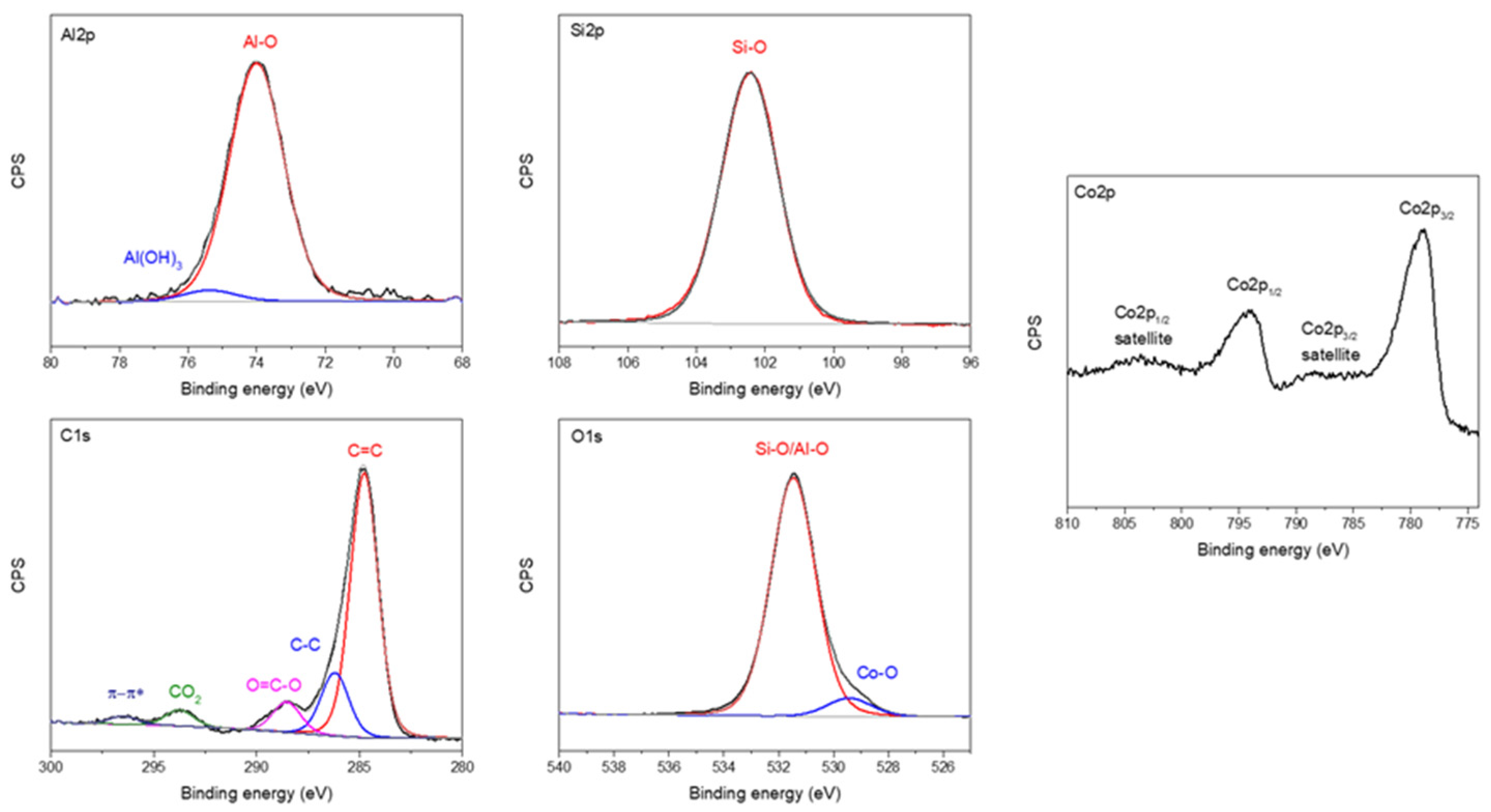
For Co-doped catalysts (Figure 19), the Co 2p3/2 peak at 778.5 eV, together with a satellite near 787 eV, is characteristic of Co3O4, containing both Co2+ and Co3+ oxidation states [72]. This redox duality facilitates oxygen transfer reactions that assist in partial oxidation of coke precursors, although the strong interaction between Co3+ and the aluminosilicate matrix can induce local aggregation, consistent with SEM–EDX data [66].
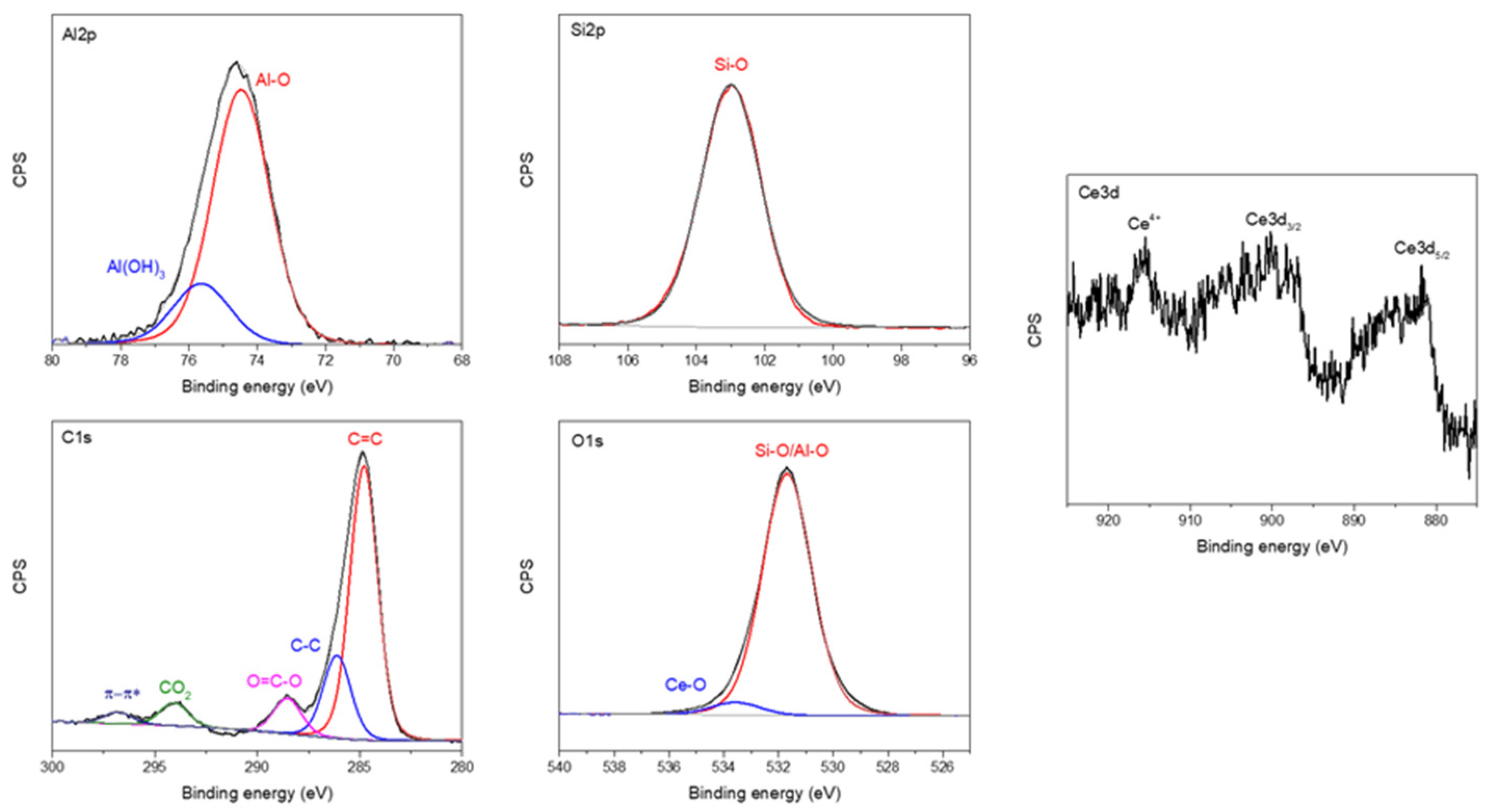
In the Ce-modified catalyst (MKRW-800A@Ce20%, Figure 20), the Al 2p and Si 2p peaks remain largely unchanged, confirming the structural stability of the kaolinite-derived framework after metal incorporation. The O 1s spectrum shows a main component at 532.6 eV (Si–O–Al/Si–O–Si) and a new shoulder at 530.4 eV assigned to Ce–O bonds, evidencing intimate metal–support interaction. The Ce 3d spectrum exhibits a multiplet pattern typical of CeO2, with intense peaks at 882.3, 888.6, 898.0, 900.8, and 914.0 eV corresponding to Ce4+, and weaker features at 885.1 and 903.3 eV attributed to Ce3+ [72,73]. The strong Ce4+ signal around 914 eV indicates that Ce predominantly exists as CeO2, while the presence of Ce3+ species confirms oxygen vacancies and reversible redox cycling (Ce4+ ⇌ Ce3+). This redox flexibility enhances oxygen mobility, promoting the oxidation of carbonaceous intermediates and reducing coke formation during VR cracking. The coexistence of acidic (Si–O–Al) and redox-active (Ce4+/Ce3+) sites generates a synergistic acid–redox environment, responsible for the improved catalytic activity and stability of Ce-loaded MKRW-800A [74,75].
This transformation pathway agrees well with previous reports. The incorporation of redox-active metals, particularly cerium, aligns with studies describing the strong redox flexibility and oxygen-storage capacity of CeO2 [76,77]. The shift from crystalline kaolinite to amorphous metakaolinite, followed by dealumination and silica enrichment after acid leaching, is also consistent with findings on thermochemically treated clay materials [78]. Together, these studies explain why the Ce-modified catalyst exhibits more balanced surface chemistry and, consequently, higher VR conversion with lower coke formation.

3.8. Comparative Performance with Literature

The catalytic cracking of vacuum residue (VR) aims to convert heavy hydrocarbons into valuable light fractions such as gasoline, kerosene, and diesel. While zeolite-based catalysts are widely used, acidified metakaolinite (MKRW-800A) represents a low-cost and effective alternative. Comparative data (Table 6) demonstrate that MKRW-800A@Ce20% achieves superior conversion (≈80.15%) and high liquid yield (≈61%), with minimal coke formation (≈3.81 g). This performance surpasses several benchmark catalysts reported in recent studies, including metal-modified zeolites and mixed oxides [33,79]. The improved behavior is mainly due to the redox functionality of cerium, which enhances hydrogen transfer, oxygen mobility, and coke oxidation. Ni and Co loadings at lower levels also promote activity but tend to deactivate faster at higher concentrations due to sintering or excessive polymerization. Therefore, the synergy between acidified metakaolinite and an optimal Ce loading offers a promising balance between cost, efficiency, and stability [80].

3.9. Environmental Implications

From an environmental perspective, metal-loaded MKRW-800A catalysts, particularly those containing Ce, offer cleaner and more sustainable routes for VR upgrading. Reduced coke generation minimizes reactor regeneration frequency and energy consumption [89]. Moreover, the use of natural kaolin as a precursor aligns with green chemistry principles, providing a non-toxic, abundant, and recyclable support material [34,90]. The redox properties of Ce accelerate coke oxidation, extend catalyst life, and reduce waste, while improved selectivity for light fractions diminishes dependence on hydrotreatment and lowers CO2 emissions [76]. Upgrading heavy residues to light fuels supports decarbonization goals by improving resource efficiency and decreasing sulfur emissions [73]. Additionally, these findings may extend to related processes, including plastic and PET waste upcycling, offering both economic and environmental benefits [91,92,93,94].

4. Conclusions

Natural kaolin-derived materials represent a sustainable and low-cost alternative to conventional zeolitic catalysts for heavy oil upgrading. Their abundance, structural stability, and tunable acidity make them excellent supports for developing active, thermally robust catalysts. Through controlled thermal activation and acid leaching, kaolinite transforms into highly porous, silica-enriched metakaolinite (MKRW-800A), which provides accessible active sites and a suitable framework for metal dispersion. This approach enables the design of efficient catalytic systems using locally available minerals, reducing dependence on synthetic zeolites and promoting cleaner refining technologies. This study evaluated acid-treated metakaolinite (MKRW-800A) catalysts loaded with Ni, Co, and Ce for vacuum residue (VR) cracking in a fixed-bed batch reactor. Among all catalysts, the Ce-loaded MKRW-800A@Ce20% exhibited the highest performance, achieving 80.15% VR conversion, 61.04% liquid yield, and only 3.81 g coke. Such improvement stems from the Ce4+/Ce3+ redox couple, which provides oxygen storage capacity and promotes oxidative removal of coke precursors while maintaining strong surface acidity for effective cracking reactions. Ni- and Co-modified catalysts displayed moderate activity at low loadings (3–5 wt.%), but their performance deteriorated at higher concentrations due to agglomeration, pore blockage, and increased coke formation arising from metallic sintering. These findings confirm that catalytic efficiency is not governed solely by surface area or crystallinity, as indicated by XRD and BET, but rather by the balance between acidity, redox behavior, and metal dispersion. In particular, Ce-modified samples, despite showing only moderate BET surface area, delivered superior selectivity and coke resistance due to their dynamic redox cycling and enhanced oxygen mobility. Complementary surface analyses further elucidated this behavior. EDX revealed partial heterogeneity in the distribution of Ce at the micrometer scale, while XPS, being more surface-sensitive, confirmed a dominant presence of Ce4+/Ce3+ species. This complementarity indicates that catalytic performance is governed primarily by surface-active cerium species rather than bulk uniformity, consistent with the improved stability and lower coke yield of Ce-loaded MKRW-800A. Overall, all metal-loaded catalysts outperformed thermal cracking in conversion, product selectivity, and coke suppression. The combination of acid activation and metal incorporation into the kaolinite matrix yields a thermally stable, low-cost, and environmentally benign catalyst. Among them, Ce-modified MKRW-800A exhibits the most balanced interplay between surface acidity, redox capacity, and mesoporosity, key attributes for industrial-scale VR upgrading, cleaner fuel production, and sustainable refinery operations.

Author Contributions

Conceptualization, M.A., E.B.-G., J.A.-G., and F.C.-M.; methodology, A.E., M.A., E.B.-G., J.A.-G., and F.C.-M.; investigation, O.B.A.-A., A.E., M.A. and J.A.-G.; writing—original draft preparation, O.B.A.-A., A.E., and J.A.-G.; writing—review and editing, O.B.A.-A., A.E., E.B.-G. and J.A.-G.; supervision, M.A. and F.C.-M.; project administration, M.A., E.B.-G., J.A.-G., and F.C.-M.; funding acquisition, M.A., J.A.-G. and E.B.-G. All authors have read and agreed to the published version of the manuscript.

Funding

This research was funded by the Consejería de Universidad, Investigación e Innovación and the ERDF Andalusia Program 2021–2027 under projects C-EXP-247-UGR23 and PLSQ_2023_00183, as well as by MICIU/AEI/10.13039/501100011033, the “European Union NextGenerationEU/PRTR” program, and “ERDF A way of making Europe” under Projects PID2021-127803OB-I00 and CNS2023-144680.

Data Availability Statement

Data are contained within the article.

Acknowledgments

J.A.-G. offers thanks for the funding from MCIN/AEI/10.13039/501100011033 and the European Union “NextGenerationEU/PRTR” for the Juan de la Cierva contract (JDC2022-048903-I). E.B.-G. acknowledges MICINN for her postdoctoral fellowship (RYC2020-029301-I). O.B.A.-A. and M.A. would like to thank the University of Technology-Iraq for all the service and support provided.

Conflicts of Interest

The authors declare no conflicts of interest.

References

  1. Primerano, K.; Mirwald, J.; Hofko, B. Asphaltenes and maltenes in crude oil and bitumen: A comprehensive review of properties, separation methods, and insights into structure, reactivity and aging. Fuel 2024, 368, 131616. [Google Scholar] [CrossRef]
  2. Urazov, K.K.; Sviridenko, N.N.; Sviridenko, Y.A.; Utyaganova, V.R. Influence of a Precursor Catalyst on the Composition of Products in Catalytic Cracking of Heavy Oil. Energies 2024, 17, 2016. [Google Scholar] [CrossRef]
  3. Balpanova, N.; Baikenov, M. Thermal Degradation Kinetics of Vacuum Residues in the Presence of Chrysotile Supported Ni-Ti Catalyst. Catalysts 2023, 13, 1361. [Google Scholar] [CrossRef]
  4. Al-Yassir, N.; Al-Mashhadani, M. Cerium promoted and silica-alumina supported molybdenum oxide in the zeolite-containing hybrid catalyst for the selective deep catalytic cracking of petroleum naphthas. Catal. Lett. 2005, 101, 1–6. [Google Scholar] [CrossRef]
  5. Ulfiati, R.; Dhaneswara, D.; Harjanto, S.; Fatimah, J. Synthesis and Characterization ZSM-5 Based on Kaolin as a Catalyst for Catalytic Cracking of Heavy Distillate. Int. J. Technol. 2022, 13, 860–869. [Google Scholar] [CrossRef]
  6. Jabar, T.A.; Alzuhairi, M.A.; Abed, M.S. Utilizing Kaolin-Based Geopolymer Catalysts for Improved Doura Vacuum Residue Cracking. Iraqi J. Oil Gas Res. 2024, 4, 39–64. [Google Scholar] [CrossRef]
  7. Stratiev, D.; Shishkova, I.; Argirov, G.; Dinkov, R.; Ivanov, M. Roles of Catalysts and Feedstock in Optimizing the Performance of Heavy Fraction Conversion Processes: Fluid Catalytic Cracking and Ebullated Bed Vacuum Residue Hydrocracking. Catalysts 2024, 14, 616. [Google Scholar] [CrossRef]
  8. Adanenche, D.E.; Aliyu, A.; Atta, A.Y.; El-Yakubu, B.J. Residue fluid catalytic cracking: A review on the mitigation strategies of metal poisoning of RFCC catalyst using metal passivators/traps. Fuel 2023, 343, 127894. [Google Scholar] [CrossRef]
  9. Jabar, T.A.; Alzuhairi, M.A.; Abed, M.S. Acidic Influence on Geopolymerization: A Thorough Study Using HCl and Iraqi Kaolin. Russ. J. Appl. Chem. 2024, 97, 104–113. [Google Scholar] [CrossRef]
  10. Dejhosseini, M.; Aida, T.; Watanabe, M.; Takami, S.; Hojo, D.; Aoki, N.; Arita, T.; Kishita, A.; Adschiri, T. Catalytic cracking reaction of heavy oil in the presence of cerium oxide nanoparticles in supercritical water. Energy Fuels 2013, 27, 4624–4631. [Google Scholar] [CrossRef]
  11. Istadi, I.; Riyanto, T.; Anggoro, D.D.; Pramana, C.S.; Ramadhani, A.R. High acidity and low carbon-coke formation affinity of Co-Ni/ZSM-5 catalyst for renewable liquid fuels production through simultaneous cracking-deoxygenation of palm oil. Bull. Chem. React. Eng. Catal. 2023, 18, 222–237. [Google Scholar] [CrossRef]
  12. Kuhaudomlap, S.; Srifa, A.; Koo-Amornpattana, W.; Fukuhara, C.; Ratchahat, S. Insight and comprehensive study of Ni-based catalysts supported on various metal oxides for CO2 methanation. Sci. Rep. 2024, 14, 23149. [Google Scholar] [CrossRef]
  13. Al-Karim, A.A.; Shakor, Z.M.; Al-Sheikh, F. Experimental and kinetic study of vacuum residue cracking over zirconium based catalysts. React. Kinet. Mech. Catal. 2022, 135, 847–865. [Google Scholar] [CrossRef]
  14. Smal, E.; Bespalko, Y.; Arapova, M.; Fedorova, V.; Valeev, K.; Eremeev, N.; Sadovskaya, E.; Krieger, T.; Glazneva, T.; Sadykov, V.; et al. Dry Reforming of Methane over 5%Ni/Ce1-xTixO2 Catalysts Obtained via Synthesis in Supercritical Isopropanol. Int. J. Mol. Sci. 2023, 24, 9680. [Google Scholar] [CrossRef]
  15. Hou, Y.; Bai, Z.; Lu, H.; Feng, Z.; Zhang, T.; Jia, Y.; Guo, Z.; Kong, L.; Li, W. In-situ catalytic upgrading of Hami coal pyrolysis volatiles over acid-modified kaolin. Fuel 2023, 331, 125660. [Google Scholar] [CrossRef]
  16. Olaremu, A.G.; Adedoyin, W.R.; Ore, O.T.; Adeola, A.O. Sustainable development and enhancement of cracking processes using metallic composites. Appl. Petrochem. Res. 2021, 11, 1–18. [Google Scholar] [CrossRef]
  17. Abdoulaye Dan Makaou, O.; Gueu, S.; Gourouza, M.; Yao, K.B. Development of semi-synthetic catalyst based on clay and their use in catalytic cracking of petroleum residue. Appl. Petrochem. Res. 2021, 11, 147–154. [Google Scholar] [CrossRef]
  18. Abbasi, A.; Darian, J.T.; Pourmand, M.; Yazd, M.S. Mechanistic insights into coke suppression and enhanced olefin selectivity in mixed metal oxide-modified SAPO-34 for high-performance methanol-to-olefins catalysis. Chem. Eng. J. Adv. 2025, 22, 100745. [Google Scholar] [CrossRef]
  19. Cui, B.; Li, Y.; Li, S.; Xia, Y.; Zheng, Z.; Liu, Y.Q. Bi-Doped Ceria as a Highly Efficient Catalyst for Soot Combustion: Improved Mobility of Lattice Oxygen in CexBi1–xOy Catalysts. Energy Fuels 2020, 34, 9932–9939. [Google Scholar] [CrossRef]
  20. Christophliemk, M.P.; Heponiemi, A.; Hu, T.; Lassi, U. Preparation of Porous and Durable Metakaolin-Based Alkali-Activated Materials with Active Metal as Composites for Catalytic Wet Air Oxidation. Top. Catal. 2023, 66, 1427–1439. [Google Scholar] [CrossRef]
  21. Kaskel, S.; Schlichte, K.; Kratzke, T. Catalytic properties of high surface area titanium nitride materials. J. Mol. Catal. A Chem. 2004, 208, 291–298. [Google Scholar] [CrossRef]
  22. Aydın, M.T.A. A spectroscopic study on the effect of acid concentration on the physicochemical properties of calcined halloysite nanotubes. J. Aust. Ceram. Soc. 2024, 60, 629–642. [Google Scholar] [CrossRef]
  23. Dehghani, F.; Ayatollahi, S.; Bahadorikhalili, S.; Esmaeilpour, M. Synthesis and Characterization of Mixed–Metal Oxide Nanoparticles (CeNiO3, CeZrO4, CeCaO3) and Application in Adsorption and Catalytic Oxidation–Decomposition of Asphaltenes with Different Chemical Structures. Pet. Chem. 2020, 60, 731–743. [Google Scholar] [CrossRef]
  24. Lenarda, M.; Storaro, L.; Talon, A.; Moretti, E.; Riello, P. Solid acid catalysts from clays: Preparation of mesoporous catalysts by chemical activation of metakaolin under acid conditions. J. Colloid Interface Sci. 2007, 311, 537–543. [Google Scholar] [CrossRef]
  25. Gamal, A.; Jilani, A.; Ozoemena, K.I.; Eid, K. A promising CO2 methanation catalyst system based on modified halloysites as supports. Emergent Mater. 2025, 8, 2737–2747. [Google Scholar] [CrossRef]
  26. Dumlu, D.; Kanatlı, T.K.; Karadeniz, S.; Ceylan, E.; Bayrakdar, M.; Ayas, N. Kaolin-supported Ni and Co catalysts for hydrogen production from acetic acid by catalytic steam reforming. Chem. Eng. Commun. 2025, 212, 1577–1597. [Google Scholar] [CrossRef]
  27. Gao, Z.; Zhang, Z.; Tian, H.; Hu, X. Ordinary clay as a support of nickel catalyst for steam reforming of acetic acid: Impacts of pretreatments of clay on catalytic behaviors. Int. J. Energy Res. 2020, 44, 10378–10393. [Google Scholar] [CrossRef]
  28. Yoon, S.; Kim, J.; An, K. Strategies for oxygen vacancy formation in CeO2-based materials for thermal catalysis. Chem Catal. 2025, 5, 101423. [Google Scholar] [CrossRef]
  29. Courtalón, N.L.; Milt, V.G.; Dieuzeide, M.L.; Miró, E.E.; Banús, E.D.; Bortolozzi, J.P. Co-Ce Clay-Based Materials: Their Feasibility as Catalysts for Soot and CO Oxidation Reactions. Catalysts 2024, 14, 882. [Google Scholar] [CrossRef]
  30. Huang, X.; Zhang, K.; Peng, B.; Wang, G.; Muhler, M.; Wang, F. Ceria-based materials for thermocatalytic and photocatalytic organic synthesis. ACS Catal. 2021, 11, 9618–9678. [Google Scholar] [CrossRef]
  31. Eduardo, S.d.S.; Mendonça, J.P.; Romano, P.N.; de Almeida, J.M.A.R.; Machado, G.; Garcia, M.A.S. Tailoring Ceria-Based Nanocatalysts for Enhanced Performance in Steam Reforming Processes: Exploring Fundamentals and Morphological Modulations. Hydrogen 2023, 4, 493–522. [Google Scholar] [CrossRef]
  32. Othman, A.; Gowda, A.; Andreescu, D.; Hassan, M.H.; Babu, S.V.; Seo, J.-G.; Andreescu, S. Two decades of ceria nanoparticle research: Structure, properties and emerging applications. Mater. Horiz. 2024, 11, 3213–3266. [Google Scholar] [CrossRef]
  33. Al-Ameri, O.B.; Alzuhairi, M.; Shakor, Z.; Bailón-García, E.; Carrasco-Marín, F.; Amaro-Gahete, J. Kinetic and Thermodynamic Study of Vacuum Residue Cracking over Cerium-Modified Metakaolinite Catalyst. Processes 2025, 13, 3126. [Google Scholar] [CrossRef]
  34. Stratiev, D.; Toteva, V.; Shishkova, I.; Nenov, S.; Pilev, D.; Atanassov, K.; Bureva, V.; Vasilev, S.; Stratiev, D.D. Industrial Investigation of the Combined Action of Vacuum Residue Hydrocracking and Vacuum Gas Oil Catalytic Cracking While Processing Different Feeds and Operating under Distinct Conditions. Processes 2023, 11, 3174. [Google Scholar] [CrossRef]
  35. Pham, P.T.H.; Pham, C.Q.; Dam, T.T.; Nguyen, Q.A.; Nguyen, M.T. A comprehensive review of catalyst deactivation and regeneration in heavy oil hydroprocessing. Fuel Process. Technol. 2025, 267, 108170. [Google Scholar] [CrossRef]
  36. Keivanimehr, F.; Kabiri, R.; Habibzadeh, S. Dual rare earth-doped Pt–Sn/Al2O3 catalysts with synergistic Ce and Sm effects on high-efficiency aromatization and coke suppression in naphtha reforming. Sci. Rep. 2025, 15, 4371. [Google Scholar] [CrossRef]
  37. Ibrasheva, R.K.; Yemelyanova, V.S.; Sassykova, L.R.; Dzhatkambayeva, U.N.; Shakiyeva, T.V.; Dossumova, B.T.; Zhakirova, N.K.; Sendilvelan, S.; Seilkhanov, T.M. Catalytic cracking of vacuum distillates on composite catalysts. Rasayan J. Chem. 2020, 13, 2370–2375. [Google Scholar] [CrossRef]
  38. Kohli, K.; Prajapati, R.; Maity, S.K.; Sharma, B.K. Effect of Silica, Activated Carbon, and Alumina Supports on NiMo Catalysts for Residue Upgrading. Energies 2020, 13, 4967. [Google Scholar] [CrossRef]
  39. Alaba, P.A.; Sani, Y.M.; Daud, W.M.A.W. Kaolinite properties and advances for solid acid and basic catalyst synthesis. RSC Adv. 2015, 5, 101127–101147. [Google Scholar] [CrossRef]
  40. Briggs, D.; Grant, J.T. Surface Analysis by Auger and X-Ray Photoelectron Spectroscopy; IM Publications: Chichester, UK, 2003. [Google Scholar]
  41. Garbarino, G.; Loricera, C.R.V.; Finocchio, E.; Cortés Corberán, V.; Busca, G. On the detectability limits of nickel species on NiO/γ-Al2O3 catalytic materials. Appl. Catal. A Gen. 2016, 525, 180–189. [Google Scholar] [CrossRef]
  42. Sietsma, J.R.A.; Friedrich, H.; Broersma, A.; Versluijs-Helder, M.; van Dillen, A.J.; de Jongh, P.E.; de Jong, K.P. The preparation of supported NiO and Co3O4 nanoparticles by the nitric oxide controlled thermal decomposition of nitrates. Angew. Chem. Int. Ed. 2007, 46, 4547–4549. [Google Scholar] [CrossRef] [PubMed]
  43. Purón, H.; Pinilla, J.L.; Montoya de la Fuente, J.A.; Millán, M. Effect of metal loading in NiMo/Al2O3 catalysts on Maya vacuum residue hydrocracking. Energy Fuels 2017, 31, 4843–4850. [Google Scholar] [CrossRef]
  44. Al-Ameri, O.B.; Alzuhairi, M.; Bailón-García, E.; Carrasco-Marín, F.; Amaro-Gahete, J. Transforming Petrochemical Processes: Cutting-Edge Advances in Kaolin Catalyst Fabrication. Appl. Sci. 2024, 14, 9080. [Google Scholar] [CrossRef]
  45. Liu, S.; Liao, X. Crystal-plane and shape influences of nanoscale CeO2 on the activity of Ni/CeO2 catalysts for maleic anhydride hydrogenation. Nanomaterials 2022, 12, 762. [Google Scholar] [CrossRef]
  46. Marinho, A.L.A.; Toniolo, F.S.; Noronha, F.B.; Epron, F.; Duprez, D.; Bion, N. Highly active and stable Ni dispersed on mesoporous CeO2-Al2O3 catalysts for production of syngas by dry reforming of methane. Appl. Catal. B Environ. 2021, 281, 119459. [Google Scholar] [CrossRef]
  47. Thommes, M.; Kaneko, K.; Neimark, A.V.; Olivier, J.P.; Rodriguez-Reinoso, F.; Rouquerol, J.; Sing, K.S.W. Physisorption of gases, with special reference to the evaluation of surface area and pore size distribution (IUPAC Technical Report). Pure Appl. Chem. 2015, 87, 1051–1069. [Google Scholar] [CrossRef]
  48. Strejcová, K.; Tišler, Z.; Svobodová, E.; Velvarská, R. Characterization of modified natural minerals and rocks for possible adsorption and catalytic use. Molecules 2020, 25, 4989. [Google Scholar] [CrossRef]
  49. Yeletsky, P.M.; Zaikina, O.O.; Sosnin, G.A.; Kukushkin, R.G.; Yakovlev, V.A. Heavy oil cracking in the presence of steam and nanodispersed catalysts based on different metals. Fuel Process. Technol. 2020, 199, 106239. [Google Scholar] [CrossRef]
  50. Wu, C.; Dong, L.; Onwudili, J.A.; Williams, P.T.; Huang, J. Effect of Ni particle location within the mesoporous MCM-41 support for hydrogen production from the catalytic gasification of biomass. ACS Sustain. Chem. Eng. 2013, 1, 1083–1091. [Google Scholar] [CrossRef]
  51. Hu, C.; Liu, Z.; Meng, J.; Hu, X.; Chen, L.; Wu, X.; Ran, R.; Weng, D. Property and Reactivity Relationships of Co3O4 with Diverse Nanostructures for Soot Oxidation. ACS Omega 2022, 7, 44116–44123. [Google Scholar] [CrossRef] [PubMed]
  52. Montini, T.; Melchionna, M.; Monai, M.; Fornasiero, P. Fundamentals and catalytic applications of CeO2-based materials. Chem. Rev. 2016, 116, 5987–6041. [Google Scholar] [CrossRef] [PubMed]
  53. Furimsky, E. Selection of catalysts and reactors for hydroprocessing. Appl. Catal. A Gen. 1998, 171, 177–206. [Google Scholar] [CrossRef]
  54. Trovarelli, A. Catalytic properties of ceria and CeO2-containing materials. Catal. Rev. 1996, 38, 439–520. [Google Scholar] [CrossRef]
  55. Trovarelli, A.; Fornasiero, P. (Eds.) Catalysis by Ceria and Related Materials; Imperial College Press: London, UK, 2002; Volume 2. [Google Scholar] [CrossRef]
  56. Asmare, Z.G.; Aragaw, B.A.; Atlabachew, M. Facile Synthesis of Natural Kaolin-Based CuO Catalyst: An Efficient Heterogeneous Catalyst for the Catalytic Reduction of 4-Nitrophenol. ACS Omega 2024, 9, 48014–48031. [Google Scholar] [CrossRef]
  57. Dong, Y.; Tong, D.; Ren, L.; Zhang, H.; Yu, W.; Zhou, C. Enhanced hydrolysis of cellulose to reducing sugars on kaolinte clay activated by mineral acid. Catal. Lett. 2021, 151, 2797–2806. [Google Scholar] [CrossRef]
  58. Hayatullah; Shathi, A.S.; Mostafa, M.G.; Rahman, M.A.; Biswas, P.K.; Alam, M.S.; Rana, M.S.; Uddin, M.R.; Nuruzzaman, M.; Shahriar, M.S. Iron removal from red clay using oxalic acid leaching for enhanced ceramic industry applications. Heliyon 2024, 10, e38863. [Google Scholar] [CrossRef] [PubMed]
  59. Aimdate, K.; Srifa, A.; Koo-Amornpattana, W.; Klysubun, W.; Kiatphuengporn, S.; Assabumrungrat, S.; Wongsakulphasatch, S.; Kaveevivitchai, W.; Sudoh, M.; Watanabe, R.; et al. Natural kaolin-based Ni catalysts for CO2 methanation: On the effect of ce enhancement and microwave-assisted hydrothermal synthesis. ACS Omega 2021, 6, 13779–13794. [Google Scholar] [CrossRef]
  60. Hsu, C.-Y.; Chung, W.-T.; Lin, T.-M.; Yang, R.-X.; Chen, S.S.; Wu, K.C.-W. Coking-resistant NiO@CeO2 catalysts derived from Ce-MOF for enhanced hydrogen production from plastics. Int. J. Hydrogen Energy 2024, 49, 873–883. [Google Scholar] [CrossRef]
  61. Gopal, J.; Elumalai, G.; Tajuddin, A.A.H.; Ito, Y.; Vajiravelu, S.; Ravikumar, D. Recyclable clay-supported heteropolyacid catalysts for complete glycolysis and aminolysis of post-consumer PET beverage bottles. J. Polym. Environ. 2022, 30, 2614–2630. [Google Scholar] [CrossRef]
  62. Mohammed, K.S.; Atlabachew, M.; Aragaw, B.A.; Asmare, Z.G. Synthesis of kaolin-supported nickel oxide composites for the catalytic oxidative degradation of methylene blue dye. ACS Omega 2024, 9, 4287–4299. [Google Scholar] [CrossRef] [PubMed]
  63. Sholeha, N.A.; Mohamad, S.; Bahruji, H.; Prasetyoko, D.; Widiastuti, N.; Fatah, N.A.A.; Jalil, A.A.; Taufiq-Yap, Y.H. Enhanced CO2 methanation at mild temperature on Ni/zeolite from kaolin: Effect of metal–support interface. RSC Adv. 2021, 11, 16376–16387. [Google Scholar] [CrossRef] [PubMed]
  64. Xue, H.; Dong, X.; Fan, Y.; Ma, X.; Yao, S. Study of structural transformation and chemical reactivity of kaolinite-based high ash slime during calcination. Minerals 2023, 13, 466. [Google Scholar] [CrossRef]
  65. Newbury, D.E.; Ritchie, N.W.M. Performing elemental microanalysis with high accuracy and high precision by scanning electron microscopy/silicon drift detector energy-dispersive X-ray spectrometry (SEM/SDD-EDS). J. Mater. Sci. 2015, 50, 493–518. [Google Scholar] [CrossRef]
  66. Petitto, S.C.; Langell, M.A. Surface composition and structure of Co3O4 (110) and the effect of impurity segregation. J. Vac. Sci. Technol. A 2004, 22, 1690–1696. [Google Scholar] [CrossRef]
  67. Dokuchaev, I.S.; Zurnina, A.A.; Sklyuev, P.V.; Maximov, N.M.; Tyshchenko, V.A. Investigation of Vacuum Residue Transformation in the Presence of Dispersed and Oil-Soluble Suspended Catalysts. Russ. J. Gen. Chem. 2024, 94, 1487–1493. [Google Scholar] [CrossRef]
  68. Biswas, B.; Islam, M.R.; Deb, A.K.; Greenaway, A.; Warr, L.N.; Naidu, R. Understanding iron impurities in Australian kaolin and their effect on acid and heat activation processes of clay. ACS Omega 2023, 8, 5533–5544. [Google Scholar] [CrossRef] [PubMed]
  69. Wang, Y.; Ye, Q.; Xu, X.; Dhmees, A.S.; Cui, X. Effect of Yttrium on Ce/Ni-Metakaolin Catalysts for CO2 Methanation. Molecules 2023, 28, 7079. [Google Scholar] [CrossRef]
  70. Anekwe, I.M.S.; Oboirien, B.; Isa, Y.M. Effects of transition metal doping on the properties and catalytic performance of ZSM-5 zeolite catalyst on ethanol-to-hydrocarbons conversion. Fuel Commun. 2024, 18, 10010. [Google Scholar] [CrossRef]
  71. Liu, H.; Zhong, Z.; Li, K.; Zhang, B.; Wu, J.; Chen, H.; Shi, X. Effect of activation conditions and iron loading content on the catalytic cracking of toluene by biochar. Energy 2022, 247, 123409. [Google Scholar] [CrossRef]
  72. Bêche, E.; Charvin, P.; Perarnau, D.; Abanades, S.; Flamant, G. Ce 3d XPS investigation of cerium oxides and mixed cerium oxide (CexTiyOz). Surf. Interface Anal. 2008, 40, 264–267. [Google Scholar] [CrossRef]
  73. Paparazzo, E. Corrigendum: Use and mis-use of x-ray photoemission spectroscopy Ce3d spectra of Ce2O3 and CeO2. J. Phys. Condens. Matter 2018, 30, 343003. [Google Scholar] [CrossRef] [PubMed]
  74. Dogan, M.Y.; Arbağ, H.; Taşdemir, H.M.; Yaşyerli, N.; Yaşyerli, S. Effect of ceria content in Ni–Ce–Al catalyst on catalytic performance and carbon/coke formation in dry reforming of CH4. Int. J. Hydrogen Energy 2023, 48, 23013–23030. [Google Scholar] [CrossRef]
  75. Trovarelli, A.; Llorca, J. Ceria catalysts at nanoscale: How do crystal shapes shape catalysis? ACS Catal. 2017, 7, 4716–4735. [Google Scholar] [CrossRef]
  76. Ahn, S.-Y.; Jang, W.J.; Shim, J.-O.; Jeon, B.-H.; Roh, H.-S. CeO2-based oxygen storage capacity materials in environmental and energy catalysis for carbon neutrality: Extended application and key catalytic properties. Catal. Rev. 2024, 66, 1316–1399. [Google Scholar] [CrossRef]
  77. Isaacs, M.A.; Parlett, C.M.A.; Wilson, K.; Lee, A.F. XPS surface analysis of ceria-based materials: Experimental methods and considerations. Appl. Surf. Sci. Adv. 2023, 18, 100469. [Google Scholar] [CrossRef]
  78. Drweesh, E.A.; Elzahany, E.A.M.; Tawfik, A.; Akarish, A.I.M.; Abou-El-Sherbini, K.S. Optimizing direct acid leaching of Egyptian kaolin for aluminum extraction and value-added adsorbent production for water treatment applications. Appl. Water Sci. 2025, 15, 279. [Google Scholar] [CrossRef]
  79. Almeida Streitwieser, D.; Arteaga, A.; Gallo-Cordova, A.; Hidrobo, A.; Ponce, S. Chemical recycling of used motor oil by catalytic cracking with metal-doped aluminum silicate catalysts. Sustainability 2023, 15, 10522. [Google Scholar] [CrossRef]
  80. Anekwe, I.M.S.; Isa, Y.M. Unlocking catalytic longevity: A critical review of catalyst deactivation pathways and regeneration technologies. Energy Adv. 2025, 4, 1075–1113. [Google Scholar] [CrossRef]
  81. Ahmad, A.; Ahmed, S.; Siddiqui, M.A.B.; Al-Shammari, A.A. The Investigation of Zeolite to Matrix Ratio Effect on the Performance of FCC Catalysts during Catalytic Cracking of Hydrotreated VGO. Catalysts 2023, 13, 1255. [Google Scholar] [CrossRef]
  82. Naranov, E.R.; Dement’ev, K.I.; Gerzeliev, I.M.; Kolesnichenko, N.V.; Roldugina, E.A.; Maksimov, A.L. The role of zeolite catalysis in modern petroleum refining: Contribution from domestic technologies. Pet. Chem. 2019, 59, 247–261. [Google Scholar] [CrossRef]
  83. Kumar, R.; Sadhukhan, A.K.; Gupta, P.; Singh, R.K.; Ruj, B. Investigations on the effect of kaolin catalyst on the yield of various products obtained from pyrolysis of low-density polyethylene (LDPE) wastes and reaction kinetics. Environ. Sci. Pollut. Res. 2024, 31, 24206–24215. [Google Scholar] [CrossRef] [PubMed]
  84. Al-Attas, T.A.; Ali, S.A.; Zahir, M.H.; Xiong, Q.; Al-Bogami, S.A.; Malaibari, Z.O.; Razzak, S.A.; Hossain, M.M. Recent advances in heavy oil upgrading using dispersed catalysts. Energy Fuels 2019, 33, 7917–7949. [Google Scholar] [CrossRef]
  85. Jermy, B.R.; Tanimu, A.; Siddiqui, M.A.; Qureshi, Z.S.; Aitani, A.; Akah, A.; Xu, Q.; AlHerz, M. Crude oil conversion to chemicals over green synthesized ZSM-5 zeolite. Fuel Process. Technol. 2023, 241, 107610. [Google Scholar] [CrossRef]
  86. Liu, Y.; Yan, L.; Bai, Y.; Li, F. Catalytic upgrading of volatile from coal pyrolysis over faujasite zeolites. J. Anal. Appl. Pyrolysis 2018, 132, 184–189. [Google Scholar] [CrossRef]
  87. Hartati; Trisunaryanti, W.; Mukti, R.R.; Kartika, I.A.; Firda, P.B.D.; Sumbogo, S.D.; Prasetyoko, D.; Bahruji, H. Highly selective hierarchical ZSM-5 from kaolin for catalytic cracking of Calophyllum inophyllum oil to biofuel. J. Energy Inst. 2020, 93, 2238–2246. [Google Scholar] [CrossRef]
  88. Attique, S.; Batool, M.; Yaqub, M.; Goerke, O.; Gregory, D.H.; Shah, A.T. Highly efficient catalytic pyrolysis of polyethylene waste to derive fuel products by novel polyoxometalate/kaolin composites. Waste Manag. Res. 2020, 38, 689–695. [Google Scholar] [CrossRef]
  89. Osman, A.I.; Nasr, M.; Mohamed, A.R.; Abdelhaleem, A.; Ayati, A.; Farghali, M.; Al-Muhtaseb, A.H.; Al-Fatesh, A.S.; Rooney, D.W. Life cycle assessment of hydrogen production, storage, and utilization toward sustainability. Wiley Interdiscip. Rev. Energy Environ. 2024, 13, e526. [Google Scholar] [CrossRef]
  90. Guo, Y.; Zhang, H.; Zhang, B.; Wang, G.; Yu, Y. Co/kaolin-pectin/Co catalyst for activating peroxymonosulfate to degrade atrazine in water. J. Environ. Chem. Eng. 2025, 13, 117515. [Google Scholar] [CrossRef]
  91. Kareem, I.; Alzuhairi, M.; Hashim, F.A.; Al-Ghaban, A.H. Recycled plastics in building materials: Enhancing sustainability and economic efficiency. Int. J. Des. Nat. Ecodyn. 2025, 20, 893–904. [Google Scholar] [CrossRef]
  92. Jawad, D.S.; Nassir, N.A.; Alzuhairi, M. Synthesis of polymethylmethacrylate/depolymerized polyethylene terephthalate blend reinforced by titanium dioxide nanoparticles for dental fillings applications. J. Thermoplast. Compos. Mater. 2024, 37, 2944–2962. [Google Scholar] [CrossRef]
  93. Alzuhairi, M. Bubble column and CFD simulation for chemical recycling of polyethylene terephthalate. AIP Conf. Proc. 2018, 1968, 020001. [Google Scholar] [CrossRef]
  94. Alzuhairi, M.; Al-Kaisy, H.; Khdheer, M. Depolymerization of waste plastic using bubble column for nano alumina blended coating. Fluids 2022, 7, 127. [Google Scholar] [CrossRef]
Figure 1. (a) Red kaolin (KR) (left), Red Metakaolinite (MKR800) (right), (b) White kaolin (KW) (left), White Metakaolinite (MKW800) (right), and (c) Schematic representation of the whole catalyst synthesis process.
Applsci 16 03597 g001
Figure 2. Schematic of a fixed-bed reactor device and its accessories.
Applsci 16 03597 g002
Figure 3. GC-MS spectroscopy results and the relation between catalyst types with respect to the liquid quantity (mL) (left) and coke formation (g) (right).
Applsci 16 03597 g003
Figure 4. Type of catalysts vs. liquid volume % of different cuts.
Applsci 16 03597 g004
Figure 5. VR cracking product distribution (solid, liquid, gas) of the catalysts.
Applsci 16 03597 g005
Figure 6. XRD patterns for the studied materials: raw kaolins (KR, KW), metakaolinites (MKR800, MKW800), and metal-loaded MKRW-800A catalysts (Ni, Co, Ce).
Applsci 16 03597 g006
Figure 7. N2 adsorption–desorption isotherms: raw kaolins (KR, KW), metakaolinites (MKR800, MKW800), and metal-loaded MKRW-800A catalysts (Ni, Co, Ce).
Applsci 16 03597 g007
Figure 8. SEM images for raw kaolin KR (left) and KW (right).
Applsci 16 03597 g008
Figure 9. SEM images for MKR800 (left) and MKW800 (right).
Applsci 16 03597 g009
Figure 10. SEM images for acidified metakaolinite (MKRW-800A) (left), loaded with Ni3% (MKRW-800A@Ni3%) (right).
Applsci 16 03597 g010
Figure 11. SEM images for MKRW-800A loaded with Co8% (MKRW-800A@Co8%) (left) and loaded with Ce20% (MKRW-800A@Ce20%) (right).
Applsci 16 03597 g011
Figure 12. SEM-EDX spectra for MKRW-800A@Ni3%.
Applsci 16 03597 g012
Figure 13. SEM-EDX spectra for MKRW-800A@Co8%.
Applsci 16 03597 g013
Figure 14. SEM-EDX spectra for MKRW-800A@Ce20%.
Applsci 16 03597 g014
Figure 15. XPS spectra for red kaolin (KR) (a), white kaolin (KW) (b).
Applsci 16 03597 g015
Figure 16. XPS spectra for red metakaolinite (MKR800) (a) (left), white metakaolinite (MKW800) (b) (right).
Applsci 16 03597 g016
Figure 17. XPS spectra for acidified metakaolinite (MKRW-800A).
Applsci 16 03597 g017
Figure 18. XPS spectra for MKRW-800A@Ni3%.
Applsci 16 03597 g018
Figure 19. XPS spectra for MKRW-800A@Co8%.
Applsci 16 03597 g019
Figure 20. XPS spectra for MKRW-800A@Ce20%.
Applsci 16 03597 g020
Table 1. Properties of VR used for catalytic cracking.
PropertyValue
Viscosity @100 °C (cSt)782
Pour Point (°C)+39
Sulfur (wt.%)6.55
Density @15 °C (g/cm3)1.019
Flash Point (COC, °C)314
Table 2. Chemical composition of Iraqi Kaolin (Red KR, White KW).
SampleSiO2 (%)Al2O3 (%)Fe2O3 (%)MgO (%)CaO (%)Na2O (%)K2O (%)TiO2 (%)P2O5 (%)LOI (%) (Loss on Ignition)
KR50.2221.5114.741.550.430.091.471.620.068.30
KW48.5134.691.620.330.130.290.431.630.0312.34
Table 3. Gas chromatography-mass spectroscopy results.
Catalyst KindsLiquid (g)Coke (g)Gas
(g)
% L.N 1% H.N 2% Kerosene%
A G.O 3
%
L.V.G.O 4
% H.V.G.O 5% V.R.C 6
MKRW-800A9.584.375.2338.627.148.2214.155.51.4
MKRW-800A@Ni3%10.686.112.44.6710.8434.6618.0715.4916.270
MKRW-800A@Ni5%7.225.616.357.6511.9853.423.974.4118.570
MKRW-800A@Ni8%6.865.37.029.630.119842.1515.5112.8810.968.87
MKRW-800A@Co3%7.754.886.557.4037.3916.32522.140
MKRW-800A@Co5%9.6365.14.34028.7525.3916.036.5412.410.89
MKRW-800A@Co8%9.525.314.6038.8241.358.337.44.10
MKRW-800A@Ce10%9.22083.966.0612.525.9712.3715.9315.414.872.95
MKRW-800A@Ce20%11.7153.813.6619.517.924.7219.8212.14.124.12
MKRW-800A@Ce40%10.5484.354.2919.718.9719.317.464.6512.080
Thermal cracking12.6485.021.52002.364.697.4385.520
1 L.N = light Naphtha, 2 H.N = heavy Naphtha, 3 A.G.O = atmospheric Gas Oil, 4 L.V.G.O = Light Vacuum Gas Oil, 5 H.V.G.O = Heavy Vacuum Gas Oil, 6 V.R.C = Vacuum Reduced Crude.
Table 4. Surface area and pore structure of the material.
SampleSBET (m2/g)W0 (N2) (cm3/g)L0 (N2) (nm)V0.95 (cm3/g)Vmeso (cm3/g)
KR630.0261.590.0970.071
KW230.0091.560.0630.059
MKR-800290.0121.730.0720.060
MKW-800290.0131.810.0930.080
MKRW-800A1900.0791.490.1660.087
MKRW-800A@Ni3%190.0082.100.0410.033
MKRW-800A@Co8%560.0241.820.0670.043
MKRW-800A@Ce20%360.0151.860.0610.046
SBET: BET surface area, W0: micropore volume, L0: micropore width, V0.95: adsorbed volume at a relative pressure of 0.95, Vmeso: mesoporous volume.
Table 5. Atomic percentage by XPS survey analysis.
SampleC (wt.%)O (wt.%)Al (wt.%)Si (wt.%)Fe (wt.%)N (wt.%)Na (wt.%)Cl (wt.%)F (wt.%)Ni (wt.%)Co (wt.%)Ce (wt.%)
KR13.756.410.617.70.740.560.10-----
KW22.850.211.315.0--0.48-----
MKR-80013.755.411.318.80.65-------
MKW-80019.149.913.716.9--0.13-----
MKRW-800A3.4861.84.3430.3--------
MKRW-800A@Ni3%13.851.97.3025.3---1.15-0.46--
MKRW-800A@Co8%11.756.04.1827.2------0.78-
MKRW-800A@Ce20%12.951.74.3926.3---1.22---3.34
Table 6. Summary of the previous work concerning VR cracking.
ReferenceCatalyst and FeedstockConditionsKey Findings
Ulfiati et al., 2022 [5]ZSM-5 vs. Ni–Mo350 °C, 1 MPa
  • Increases C3–C5 production
  • Outperformed non-catalytic runs
Al-Karim et al., 2022 [13].ZnFeNi and ZnCoNi on VR400–450 °C, 2–3 h
  • Maximum activity with ZnCoNi
  • 76.3% VR conversion
Kohli et al., 2020 [38].NiMo/SBA-15, NiMo/AC, NiMo/Al2O3 on VR410 °C, high-pressure H2
  • Best VR upgrading with NiMo/Al2O3
  • Highest removal of impurities
Dokoutchaiev et al., 2024 [67].Spent Al–Co–Mo on VR440–460 °C
  • 39.8% light fraction at 460 °C
Almeida et al., 2023 [79].Mg, Cu, Ni on used motor oil380–390 °C
  • 85% conversion
  • Low coke formation
Ahmad et al., 2023 [81].USY zeolite + kaolin + VGO550 °C
  • High yield
  • Low coke formation vs. pure zeolite
Naranov, E. R. et al., 2019 [82]H-ZSM-5 + chlorinated oil450–550 °C
  • 47.3 wt.% gasoline yield
  • 20.7 wt.% olefins yield
Kumar et al., 2024 [83].Kaolin + LDPE (10–20%)550–850 °C
  • Maximum 24.8% VR conversion,
  • 10% coke formation at low temp.
Al-Attas et al., 2019 [84]Dispersed Ni, Mo, Fe, Co catalysts on heavy oil/VR400–500 °C, high pressure (batch & slurry reactors)
  • Higher VR conversion and liquid yield
  • Lower coke formation than conventional fixed-bed catalysts
Jermy, B. Rabindran, et al. 2023 [85]ZSM-5 + alumina, SiO2 + pyrolysis oil675 °C
  • 47% liquid yield
  • 14.7% aromatics yield
Liu et al., 2018 [86]
Four zeolites + VR700 °C
  • BTEX yield: 3.63 wt.% (NaY) and 5.31 wt.% (HY)
Trisunaryanti, Wega et al. 2020 [87].ZSM-5 + hexadecane475 °C, 1.2 h−1
  • 93% conversion
  • highC7–C9 selectivity
Attique et al., 2020 [88]Alumina-substituted Keggin tungstoborate/Kaolin, LDPE500 °C
  • Low coke formation
  • High hydrocarbon selectivity
This WorkMKRW-800A@Ce20% on VR450 °C, 0.5 h−1
  • Highest liquid yield (61.04%)
  • 80.15% VR conversion
  • Minimal coke formation (3.81 g)
  • Synergistic acid-redox mechanism
Disclaimer/Publisher’s Note: The statements, opinions and data contained in all publications are solely those of the individual author(s) and contributor(s) and not of MDPI and/or the editor(s). MDPI and/or the editor(s) disclaim responsibility for any injury to people or property resulting from any ideas, methods, instructions or products referred to in the content.