1. Introduction
Artificial Intelligence (AI) refers to computational methods that enable systems to learn patterns from data and support automated decision-making without explicit rule-based programming. Within the context of strength training (ST) and performance monitoring (PM), AI primarily encompasses machine learning (ML) and deep learning (DL) approaches applied to high-dimensional, time-dependent data generated by wearable technologies, such as inertial, physiological, and pressure-based signals. ML models identify statistical relationships between input features (e.g., acceleration, physiological signals, or force data) and target outcomes through training on labeled datasets, while DL approaches, such as convolutional neural networks (CNNs) and long short-term memory networks (LSTMs), automatically extract hierarchical features from raw sensor data, making them particularly suitable for complex temporal and multivariate signals [
1,
2]. A key distinction lies in the trade-off between interpretability and predictive performance: classical ML models (e.g., support vector machines, random forests) are often more transparent and suitable for smaller datasets, whereas DL models can capture non-linear and temporal dependencies more effectively but are typically less interpretable (“black-box” systems) [
3,
4].
The integration of AI and wearable technology (WT) is transforming sports science and exercise physiology by redefining how ST is assessed, optimized, and monitored [
5,
6,
7]. These innovations bridge the gap between laboratory-based assessments and real-world training, offering scalable opportunities for personalized performance development and injury prevention [
8,
9]. By enabling continuous tracking of physiological and biomechanical parameters, AI-driven wearable systems can provide deeper insights into training adaptations, support real-time performance analysis and deliver individualized feedback. This can help reshape traditional training practices towards a more data-driven approach to performance and long-term health management. Recent advancements in multimodal wearable systems demonstrate that AI-driven load monitoring and performance profiling can greatly contribute in high-performance settings [
10,
11].
To date, ST and performance monitoring (PM) rely on sophisticated laboratory systems such as force plates, motion capture and biomechanical analysis tools [
5,
12]. These systems are accurate but also expensive, requiring controlled environments that are often inaccessible outside elite sport settings [
13,
14]. Countermovement jump (CMJ) performance is a widely used indicator of lower-limb neuromuscular performance and training adaptation, which, although heavily dependent on laboratory-grade equipment, can now be assessed through portable force platforms and wearable sensors, which enables field-based monitoring and immediate feedback [
15,
16].
Advances in WT, including inertial measurement units (IMUs), pressure-sensing insoles, accelerometers, and smartwatches combined with computer vision, allow continuous monitoring of biomechanical and physiological indicators in natural training environments [
6,
8,
9,
12]. Advancements in AI techniques such as ML and DL facilitate automated exercise recognition, real-time feedback, injury-risk prediction, and individualized load prescription [
5,
7,
17,
18]. Approaches such as CNNs, pose estimation models, and multi-sensor fusion have significantly improved accuracy, with hybrid models achieving >96% movement classification accuracy [
6,
19,
20] and physics-informed ML reducing biomechanical force estimation error to 2.6% [
21]. This interdisciplinary field integrating sports science, computer science, and biomedical engineering has accelerated rapidly [
8,
12,
22], and commercial systems increasingly deliver insights previously restricted to laboratory settings [
14,
23].
Recent research has explored hybrid CV–IMU architectures allowing a robust assessment of lifting biomechanics and neuromuscular control in realistic training environments, such as during squats, deadlifts, and Olympic-style lifts [
24]. This underscores the rapid expansion of AI–wearable applications in sport [
25,
26,
27,
28,
29,
30,
31,
32]. Kumar et al. reported marked growth in DL-based motion classification, physiological prediction, and performance profiling, yet noted inconsistent validation frameworks and limited ecological testing [
28]. Further, De Beukelaar and Mantini and Softić et al. highlighted a shift from isolated single-sensor monitoring to multimodal network systems enabling real-time analysis in resistance and field-based training [
12,
22]. Furthermore, Alzahrani and Ullah and Wang et al. demonstrated the feasibility of AI-enhanced cardiovascular and metabolic biosensing. Methodological innovations, such as explainable AI (XAI), edge computing, and privacy-preserving machine learning, can improve interpretability, reduce latency, and enhance data security [
28,
33]. However, advanced neural architectures and self-powered strain sensors [
23,
34] support more autonomous and context-aware analytics. Collectively, these developments signal a shift from descriptive monitoring toward predictive and prescriptive performance analysis. Additionally, emerging applications can detect fatigue using wearable EMG and ML algorithms, which offer new pathways for individualized workload regulation [
35]. Despite these advancements, the literature remains fragmented across isolated applications, including jump performance, fatigue detection, and injury risk prediction [
36,
37,
38,
39].
Technological innovation has progressed faster than systematic evaluation, and only a small number of studies incorporate real-world validation. Kumar et al. observed that fewer than one-quarter of AI–wearable studies included ecological testing [
40], while de Beukelaar and Mantini identified inconsistencies in sensor configurations [
12], limited integration of physiological and biomechanical data, and a lack of standardized validation protocols [
12,
40]. These challenges show the need for unified athlete-centered validation frameworks (i.e., standardized AI-wearables), with broader population representation to be examined in real-world studies to support practical implementation [
41,
42]. Beyond descriptive summaries of individual applications, there is a growing need for critical evaluation of how methodological choices, data characteristics, and validation strategies shape the reliability and practical utility of AI-WT in strength training environments. Despite rapid methodological advancements, the effectiveness of AI models is strongly dependent on data characteristics, including dataset size, sensor configuration, signal quality, and label validity. Many current applications rely on small, homogeneous datasets and proxy outcome measures (e.g., inferred fatigue or estimated load), which may limit generalizability and introduce uncertainty in model predictions. Furthermore, the lack of standardized validation protocols and external testing remains a significant barrier to real-world implementation.
The present scoping review aims to combine current AI applications and WT in ST and PM via wearable sensor configurations, outcome measures, and study populations. Importantly, an evaluation of methodological trade-offs between classical and DL approaches, the influence of dataset size and composition on reported performance, the role of explainability in actionable decision-making, and the translational readiness of existing systems will be conducted. Identifying structural limitations, knowledge gaps, and practical barriers to implementation will inform future research priorities with evidence-based integration of AI-enhanced wearables in applied strength training and performance settings.
The remainder of this review is structured as follows.
Section 2 outlines the methodological approach.
Section 3 presents the results, organized into key thematic domains.
Section 4 discusses the findings in relation to current literature and practical implications. Finally,
Section 5 highlights limitations and future research directions.
3. Results
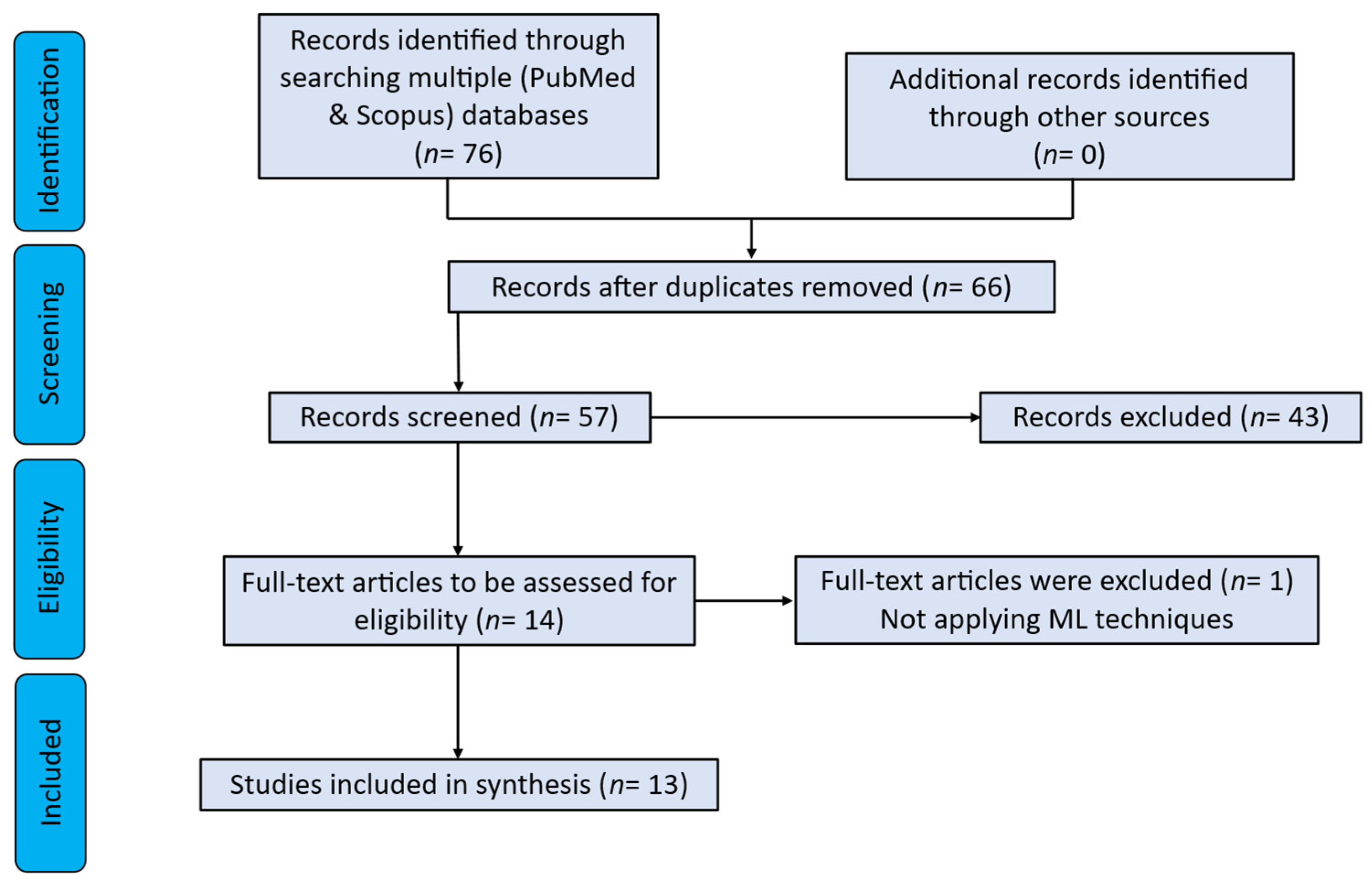
The database search initially yielded 76 records. After duplicates were removed and titles, abstracts, and full texts were screened, 13 studies met the inclusion criteria and were included in the qualitative synthesis. The selection process followed the PRISMA-ScR guidelines and is illustrated in
Figure 1 [
45].
All included studies examined the integration of artificial intelligence AI and WT for assessing, monitoring or optimizing sports performance. Studies were excluded if they did not involve AI algorithms, lacked wearable components or were unrelated to biomechanical or performance-oriented applications. The included literature was organized into three thematic domains: (i) Biomechanical and Strength Performance Assessment, (ii) Physiological Monitoring and Health Optimization and (iii) AI-Driven Sport-Specific and Predictive Analytics.
3.1. Biomechanical and Strength Performance Assessment
The present study found that recent advances in wearable sensing and artificial intelligence have enabled increasingly detailed assessment of biomechanical loading, movement quality, and strength-related performance outside of laboratory environments. The five studies reviewed in this section demonstrate how AI-based analytical methods transform high-dimensional wearable sensor data into interpretable biomechanical indicators, addressing long-standing challenges related to movement variability, internal load estimation, and real-world applicability (
Table 1). Across studies, these AI models are typically trained using supervised learning on labeled time-series data, where sensor inputs (e.g., acceleration or pressure signals) are mapped to predefined movement patterns or biomechanical outcomes.
A common focus was identified on movement pattern classification and technique assessment, where AI enables objective identification of biomechanical deviations during exercise. Hu et al. [
6] introduced a gated long short-term memory with transformer network (GLTN) to classify bodyweight squat movements using data from four IMUs placed on the trunk and lower limb segments. By distinguishing one acceptable squat pattern from eight aberrant movement variants, the study highlights how deep sequential models can capture subtle temporal dependencies in multi-segment motion. Compared with conventional DL architectures, the proposed model achieved superior classification accuracy (over 96%), demonstrating the suitability of hybrid temporal-attention frameworks for movement quality assessment. This type of architecture combines recurrent layers (LSTM), which model temporal dependencies, with attention mechanisms that prioritize relevant features within the movement sequence, enabling more precise pattern recognition. Importantly, despite their high accuracy, such models should not be treated as universal solutions, emphasizing the need for individual-specific interpretation in strength and conditioning contexts. A key limitation of this study is the relatively small and homogeneous sample, which may restrict generalizability across different populations, movement strategies, and sensor placements.
Beyond classification, other studies extend AI applications toward estimating internal biomechanical loads, which are traditionally inaccessible outside laboratory-based motion capture and force plate systems. Matijevich et al. [
21] addressed this limitation by combining wearable inertial sensors, pressure-sensing insoles, musculoskeletal modeling, and machine learning to estimate tibial bone forces during running. The study compared physics-based and machine learning approaches against commonly used surrogate metrics such as vertical average loading rate (VALR). While VALR-based estimates showed limited accuracy and large errors in predicted bone damage, the machine learning model substantially reduced force estimation error and, critically, minimized downstream errors in bone damage calculations. This work underscores a key analytical insight: even modest improvements in force estimation accuracy can lead to disproportionately large gains in injury risk assessment, highlighting the added value of AI-driven biomechanical modeling over simplified impact metrics. Despite these advances, the model relies on indirect estimations and laboratory-calibrated inputs, highlighting the need for external validation under real-world conditions and across diverse running patterns.
Complementary research explores novel wearable sensor modalities and their integration with AI to overcome limitations of traditional sensing technologies. Bellisle et al. [
46] developed a garment-integrated knot-based strain sensor embedded in a full-body suit, combined with supervised ML to classify human movements. Despite being positioned locally on the lower leg, the system successfully classified non-local joint movements across the ankle, knee, hip, and torso, illustrating how AI can compensate for sparse or indirect sensing through learned relationships. Although the study adopted an exploratory design and reported moderate recall levels, it provides important evidence that garment-integrated sensing combined with machine learning can support scalable biomechanical monitoring in constrained environments, with relevance for both spaceflight and sports performance applications. However, the exploratory nature of the study and limited sample size suggest that further validation is required to assess robustness across different movement types and real-world training conditions.
Pressure-based biomechanical assessment is further advanced in the work by Zhang et al. [
47], who developed highly sensitive piezoresistive textile pressure sensors integrated into a multi-channel insole system. With the assistance of DL, the system accurately estimated vertical ground reaction forces (vGRFs) across different gait speeds and terrains, achieving accuracy exceeding 98%. This approach addresses a major limitation of inertial-only systems, which often struggle to infer external forces reliably. By enabling continuous outdoor monitoring of vGRF, the study demonstrates how AI-enhanced pressure sensing can bridge the gap between laboratory-grade force measurements and real-world biomechanical assessment. Nevertheless, the system’s performance may be influenced by factors such as footwear variability, sensor calibration, and environmental conditions, which should be considered in future implementations.
Finally, AI-based movement classification can be applied to complex, continuous training scenarios, as demonstrated by Preatoni et al. [
48]. Using multiple IMUs and supervised learning algorithms, the study achieved high classification accuracy for functional fitness exercises performed within unstructured workout sessions. The analysis explored sensor placement, windowing strategies, and validation schemes, revealing that accurate classification can be achieved even with reduced sensor configurations. Notably, misclassifications occurred primarily during transitions between repetitions, highlighting the inherent challenge of segmenting continuous movement streams. This work illustrates how supervised machine learning can support automated biomechanical monitoring in realistic training environments, where exercise boundaries are not explicitly defined. This limitation reflects a broader methodological challenge across studies, where models trained on segmented datasets may struggle when applied to continuous, real-world data streams.
Collectively, these studies demonstrate that AI-driven biomechanical assessment extends well beyond activity recognition. By integrating wearable sensing with advanced machine learning models, researchers are increasingly able to estimate internal loads, assess movement quality, and quantify strength-related performance metrics in ecologically valid settings. However, across studies, common constraints include small sample sizes, limited external validation, and dependence on controlled experimental conditions.
At the same time, the findings emphasize that model accuracy, sensor design, and biomechanical interpretability must be carefully balanced to ensure that AI-based assessments translate into meaningful insights for performance optimization and injury risk management. Future research should focus on larger and more diverse datasets, standardized validation protocols, and the integration of explainable AI techniques to enhance both model transparency and practical applicability.
3.2. Physiological Monitoring and Health Optimization
AI-enhanced wearable systems have an integral role in the transformation of physiological monitoring from isolated measurements into continuous, predictive, and individualized health optimization frameworks for athletes. The five studies reviewed in this section demonstrate how machine learning and deep learning models utilize multimodal physiological signals, encompassing cardiovascular and metabolic responses, as well as biochemical markers, to support data-driven training adaptation, recovery management, and injury prevention (
Table 1). In most cases, these models are trained on time-series physiological data, where input features such as heart rate, motion signals, or biochemical markers are mapped to outcomes including energy expenditure, fatigue, or health status.
Several studies focus on cardiovascular, neuromuscular, and biomechanical indicators as core components of physiological health monitoring. Alzahrani and Ullah [
5] employed a multi-sensor wearable platform incorporating inertial measurement units, electromyography, pressure sensors, and haptic feedback to capture real-world biomechanical and physiological data during sports physiotherapy. By integrating machine-learning-based analytics, the system allows the quantification of key performance metrics such as heart rate, joint kinematics, muscle activation, and stress–strain features, revealing substantial inter-individual variability.
Therefore, AI-driven adaptive interventions allow real-time adjustment of rehabilitation and training strategies, highlighting the shift from population-based norms toward precision health monitoring tailored to individual physiological responses. However, the study relies on relatively small and heterogeneous samples and lacks standardized validation procedures, which may limit reproducibility and generalizability across different athletic populations.
Metabolic assessment represents another critical domain where AI-driven wearable analytics address long-standing accessibility limitations. Moon et al. [
8] developed machine learning models to estimate exercise-induced energy expenditure while explicitly accounting for excess post-exercise oxygen consumption (EPOC), using wearable heart-rate data, physical characteristics, and exercise intensity. The high correlation between estimated and ground-truth energy expenditure demonstrates that AI-based regression models can approximate laboratory-grade metabolic assessments without reliance on calorimetry systems. By capturing both in-exercise and post-exercise metabolic costs, this approach provides a more physiologically comprehensive representation of training load, with direct relevance for recovery planning and long-term workload management. Nevertheless, the model is based on indirect physiological indicators and controlled experimental settings, which may reduce accuracy when applied in free-living or highly variable training conditions.
Beyond traditional physiological metrics, recent work has expanded AI-driven monitoring into biochemical domains. Wang et al. [
9] introduced a dielectric-response-based microfluidic sweat sensor capable of continuous, noninvasive multi-analyte monitoring. By combining simultaneous electrical measurements with machine learning classification, the system achieved high specificity in identifying sweat biomarkers across a broad concentration range. On-body testing revealed strong correlations between sweat composition and exercise intensity, underscoring the potential of AI-assisted biochemical sensing to complement cardiovascular and biomechanical data. This work illustrates how advanced sensor engineering coupled with AI, enables real-time insight into internal physiological states that were previously difficult to monitor during training. However, validation was conducted on a limited number of participants, and factors such as sweat rate variability, environmental conditions, and sensor stability may influence performance in real-world applications.
At the system level, DL architectures have been increasingly applied to holistic health state inference. Wang et al. [
49] proposed a wearable-based sports health monitoring framework integrating CNNs, LSTMs, and self-attention mechanisms to model complex temporal dependencies in physiological signals. Trained on large-scale wearable datasets, the model demonstrated robust performance in predicting overall athlete health status, enabling automated feedback via cloud-based platforms. Similarly, Zhao et al. [
50] developed an IoT-enabled health monitoring framework using big data analytics and CNN-based predictive models to assess injury risk and performance outcomes in college athletes. Beyond predictive accuracy, this study explicitly addressed ethical considerations such as data privacy, fairness, and interpretability, highlighting critical implementation challenges associated with large-scale AI-driven health monitoring. Despite these advances, both systems rely on proxy outcome variables and internally validated datasets, raising concerns regarding external validity and real-world deployment.
Collectively, these studies demonstrate that AI-driven physiological monitoring extends beyond isolated signal analysis toward integrated health optimization ecosystems. Machine learning enables accurate estimation of metabolic load, while DL architectures capture complex temporal and cross-modal relationships underlying athlete health states. The inclusion of biochemical sensing and ethical considerations further reflects the maturation of this research domain. Across studies, common methodological constraints include small sample sizes, reliance on indirect outcome measures, and limited external validation. Together, these advances support continuous, individualized, and proactive approaches to athlete well-being, positioning AI-enhanced wearables as central tools for long-term performance sustainability and injury risk mitigation. Future research should focus on improving data quality, incorporating clinically or biomechanically validated ground truth measures, and integrating explainable AI approaches to enhance transparency and trust in physiological predictions.
3.3. AI-Driven Sport-Specific and Predictive Analytics
Recent advances in sports analytics demonstrate a clear movement toward AI-driven, sport-specific predictive models that leverage wearable sensor data and machine learning to move beyond descriptive monitoring toward actionable performance insights. The studies reviewed in this section illustrate how AI methodologies are tailored to the biomechanical, physiological, and tactical demands of distinct sporting contexts, including combat sports, team sports, and endurance-based training (
Table 1). These models are typically trained on sport-specific datasets, where wearable-derived features are used to predict performance outcomes, classify actions, or estimate physiological states.
In combat sports, a study on boxing action recognition employed Deep Convolutional Neural Networks (DCNNs) to classify movement patterns captured by wearable IMUs [
51]. By focusing on pad work training, the authors demonstrated that DCNNs can accurately recognize complex boxing actions, achieving high recall (99%) and accuracy (91%). Compared with traditional video-based performance analysis, this IMU-based approach offers a cost-effective, portable, and scalable alternative that enables continuous monitoring within regular training routines. Importantly, the study highlights the potential for automated performance assessment and real-time scoring systems, marking a shift toward engineering-driven solutions that reduce reliance on subjective evaluation and expensive infrastructure in combat sports. DCNNs operate by automatically extracting spatial features from raw sensor signals, allowing the model to learn movement-specific patterns without manual feature engineering. However, the model was trained on a limited and sport-specific dataset, which may constrain generalizability across different athletes, skill levels, or training conditions.
In elite volleyball, de Leeuw et al. [
13] applied ensemble learning techniques—specifically XGBoost, random forest regression, and subgroup discovery—to examine the relationships between training load, perceived wellness, and match performance. Using a combination of wearable sensor data, manually logged training activities, wellness questionnaires, and video-based match annotations, the study identified non-linear and conditional associations between training characteristics and specific performance outcomes. Attack performance was positively associated with heavier lower-body strength training loads in the four weeks preceding competition, while excessive upper-body loading, large load variability, low jump heights, and limited variation in high jumps were linked to poorer outcomes. In contrast, passing performance was sensitive to short-term jump load patterns, particularly excessive or insufficient variation in high jumps during the one- to two-week pre-competition period. These findings demonstrate how AI can uncover position- and skill-specific performance determinants, supporting evidence-based adjustments to training schedules rather than one-size-fits-all load prescriptions. Ensemble models such as RFs and XGBoost combine multiple decision trees to capture complex, non-linear relationships between training variables and performance outcomes. Nevertheless, the reliance on data from a single team and specific competition context limits external validity and transferability to other populations or sports.
From a physiological perspective, Biró et al. [
7] focused on the prediction of fatigue and stamina using multivariate IMU-generated time series data collected from repeated training sessions. The study compared Random Forest, Gradient Boosting Machines, and LSTM, demonstrating high predictive accuracy for fatigue and strong correlations between predicted fatigue levels and observed performance decline. A key contribution of this work lies in its real-time feedback loop, which continuously adjusted model predictions based on error and bias estimation. This adaptive mechanism enabled early detection of fatigue before overt physical symptoms emerged, allowing timely interventions to reduce overtraining risk. Moreover, stamina predictions facilitated individualized training adjustments aligned with athletes’ physiological thresholds, emphasizing the role of AI in personalized load management and training periodization. LSTM models are particularly suited for this task due to their ability to capture temporal dependencies in sequential physiological data. However, fatigue was inferred using proxy indicators rather than direct physiological measurements, which may introduce uncertainty in model validity.
Collectively, these studies illustrate the growing role of AI in sport-specific predictive analytics, where models are explicitly designed around the data structures, performance indicators, and decision-making needs of each discipline. Rather than merely automating data collection or classification, AI is increasingly used to identify non-linear relationships, forecast performance-relevant states, and support individualized coaching strategies. Across studies, common constraints include small sample sizes, sport-specific datasets, and limited external validation, increasing the risk of overfitting and reducing generalizability. At the same time, the findings underline the importance of high-quality sensor data, careful feature selection, and sport-contextual interpretation to ensure that predictive models translate into meaningful performance improvements in both training and competition settings. Future research should focus on cross-sport validation, larger datasets, and the integration of explainable AI methods to improve model transparency and practical usability.
3.4. Summary of Included Studies by Application Domain
The included studies were categorized into three application domains based on their primary objectives and outcome measures, as reported in
Table 1. This classification highlights current research priorities and methodological trends in the integration of AI and WT for strength training and performance monitoring.
Five studies out of the 13 in total focused on Biomechanical and Strength Performance Assessment, reflecting a strong research emphasis on quantifying movement quality, load distribution, symmetry, and exercise execution. Studies within this domain commonly employed IMUs, textile-based strain and pressure sensors, and, in some cases, camera-based computer vision systems. These sensing modalities were combined with AI techniques such as convolutional neural networks, recurrent neural networks, and supervised machine learning classifiers to enhance biomechanical profiling and deliver objective feedback during strength exercises and functional movements.
The other five studies out of the 13 studies were classified under Physiological Monitoring and Health Optimization, emphasizing the interpretation of cardiovascular, metabolic, and recovery-related signals obtained from wearable devices. Research in this domain leveraged AI models to estimate energy expenditure, monitor fatigue, assess health status, and support continuous training-load and recovery monitoring. This body of work represents an emerging frontier in sports technology, where physiological sensing and predictive analytics converge to enable individualized readiness assessment and data-informed recovery strategies.
The remaining three studies out of the 13 studies addressed AI-Driven Sport-Specific and Predictive Analytics, applying advanced machine learning frameworks to sport-tailored datasets for performance classification, match-related analysis, and fatigue or stamina prediction. These investigations demonstrate how wearable-derived data can be translated into actionable insights for individualized training prescription, tactical optimization, and injury risk management within specific sporting disciplines.
4. Discussion
The present scoping review critically assessed 13 studies (2015 to 2025) that integrated AI and WT within ST and PM contexts. The relatively small number of studies assessed reflects the emerging nature of this research area, as all the strict inclusion criteria were applied.
Rather than cataloging applications, this review examines how methodological choices, data characteristics, and validation strategies can influence the interpretability, generalizability, and practical usability of AI-enhanced WT. It was found that there are technologically automated advancements in biomechanical assessment, physiological monitoring and performance feedback, although most applications remain at an experimental or prototype stage. A high model performance frequently reflects controlled laboratory conditions and small and homogeneous samples. The reliance on internal validation collectively constrains ecological validity and translational confidence. Consequently, the practical application of AI-driven WT in strength training depends on the alignment between AI methods, data quality, explainability, and the real-world decision-making contexts in which these systems are intended to operate rather than nominal accuracy metrics [
6,
8,
21,
48,
52].
4.1. AI Techniques and Application Domains
Across the three application domains identified in this review: (i) biomechanical and strength performance assessment, (ii) physiological monitoring and health optimization, and (iii) AI-driven sport-specific predictive analytics, distinct methodological patterns and trade-offs were observed. With respect to (i) above, studies primarily employed DL and supervised ML models to classify movement patterns and estimate mechanical loading using inertial, pressure, and textile-based sensors. In (ii) above, regression-based and temporal DL models were more frequently used to model metabolic cost, fatigue, and health-related states from cardiovascular and biochemical signals. In contrast, (iii) above relied on tailored ensemble and deep learning approaches to capture discipline-dependent relationships between training load and performance outcomes. These findings indicate that model selection is closely linked to the structure of the sensor data, which can affect the level of interpretability and the nature of the target outcome required for practical decision-making. Consequently, the integration of AI with WT is not supported by a single optimal methodological solution, as these can vary depending on the specific strength training context, type of exercise (e.g., resistance training vs. sport-specific drills), the performance goal or health outcome, and the environment in which data is collected (e.g., laboratory vs. field-based).
With respect to biomechanical and strength performance assessment (i), studies used (
Table 1) deep architectures, including CNN-, LSTM-, transformer-based, and hybrid models, which consistently achieved high accuracy in movement classification and technique assessment tasks, particularly when modeling complex temporal dependencies and multi-segment coordination patterns. Such gains are typically observed in small, homogeneous samples under controlled conditions, with validation most often limited to internal cross-validation. As a result, performance metrics may overestimate generalizability, especially when models are deployed across different athletes, sensor placements, or training environments. The use of simpler supervised models (e.g., SVMs, RFs) can lower nominal accuracy with reduced computational demands, which improves the interpretability in applied strength training settings where data availability and transparency are constrained [
2,
9,
17,
39,
41].
To achieve physiological and health-related monitoring and optimization, the use of different methodological designs can be affected by signal type and temporal structure. Regression-based ML approaches were commonly applied to metabolic estimation tasks, such as energy expenditure and EPOC prediction, where continuous physiological relationships could be modeled effectively using limited WT [
8]. However, the use of DL architectures incorporating recurrent layers and attention mechanisms was favored for holistic health state inference and fatigue monitoring. These learning architectures have enabled integration of multi-modal physiological streams to capture long-range temporal dependencies [
49,
50]. Nevertheless, fatigue, readiness, and injury risk were inferred using proxy labels rather than direct clinical or biomechanical ground truth, introducing uncertainty into model validity despite high reported accuracy [
5,
9]. This reliance on indirect outcomes reinforces the need to align model complexity with label reliability to interpret predictive performance cautiously.
Sport-specific AI-driven predictive analytics represented the most context-dependent application domain. Deep neural models and ensemble learning techniques are tailored to the biomechanical, physiological, and tactical demands of individual sports, yielding valuable insights into discipline- and position-specific performance determinants. However, such models are inherently narrow in scope, often trained on single teams, sports, or training tasks, and are therefore potentially vulnerable to overfitting and dataset shift. These approaches demonstrate that AI may uncover non-linear and conditional performance relationships, although their transferability remains largely untested [
7,
21,
47,
51].
Across all domains, a central methodological tension emerges between predictive performance and interpretability. Data-driven DL approaches (e.g., convolutional, recurrent, and transformer-based networks) frequently outperformed classical machine learning models in classification and pattern recognition tasks. However, their black-box nature can limit the practitioner’s trust due to complex translation into actionable coaching or clinical decisions, particularly in injury risk assessment and load prescription [
35]. In contrast, simpler and more transparent approaches, such as linear models, decision trees, and RF classifiers, offered greater interpretability and traceability of input–output relationships but typically at the cost of reduced predictive accuracy. Explainable artificial intelligence (XAI) techniques, including feature attribution, attention visualization, and surrogate modeling, remain underutilized in the reviewed literature. XAI techniques can possibly bridge this gap by linking model outputs to biomechanically and physiologically meaningful variables; therefore, future research is required [
33].
Overall, the comparative synthesis of AI techniques across application domains indicates that methodological suitability in ST is dependent on model accuracy, but also on dataset size and quality, validation rigor, interpretability, and intended decision-making use. Rather than favoring increasingly complex models by default, future research and applied implementation should prioritize alignment between AI methodology, data reality, and practical constraints to ensure that AI-enhanced WT delivers reliable, trustworthy, and context-appropriate insights.
4.2. Temporal Evolution and Research Trends
The selected studies in the present scoping review show a clear shift in the methodological approaches and technological integration considering the persistent structural constraints that limit translational impact. Recent investigations (2020–2022) primarily focused on single-sensor configurations, foundational exercise classification, and laboratory-oriented biomechanical assessment [
13,
21,
48]. These studies established proof-of-concept feasibility for applying machine learning to wearable-derived motion data but were largely confined to controlled environments, narrow movement repertoires, and small samples. It was observed that biomechanical inference relied heavily on proxy metrics, such as acceleration profiles, repetition counts, or symmetry indices, rather than direct estimation of joint kinematics or kinetics. Overall, this early phase of research established methodological feasibility, revealing critical limitations in biomechanical specificity and ecological validity that later studies have sought to address.
In practice, joint-level biomechanics, load distribution, and injury mechanisms are of great importance in strength training, although there are limited studies exploring joint angles, moments, or intersegmental coordination. This may be due to technical challenges associated with WT in biomechanics, including sensor placement variability, soft tissue artifacts, signal drift, and the scarcity of synchronized motion-capture ground truth for model training and validation. As a result, joint kinematic estimation remains unresolved; therefore, future research is required to explore how multimodal sensor fusion and biomechanics-informed or physics-embedded AI models can affect joint kinematic estimation in strength training environments.
More recently, studies since 2023 expanded beyond movement classification toward modeling physiological states and training responses, including fatigue, metabolic cost, and cardiovascular dynamics, often using hybrid deep learning architectures [
5,
7,
8,
50]. These approaches increasingly incorporate temporal modeling, multimodal inputs, and adaptive feedback mechanisms, which target individualized monitoring rather than population-level descriptors. A greater reliance on indirect or proxy outcome labels, such as perceived fatigue or inferred readiness can make the interpretation of predictive accuracy more complex, which requires a careful alignment between model complexity and label validity.
The most recent studies (2024–2025) signal a technological maturation phase, characterized by the introduction of smart textiles, graphene-based and dielectric-response sensors, self-powered wearable systems, and edge-AI architectures capable of on-device inference [
5,
39,
40]. Edge computing, in particular, reduces latency and data transmission requirements, enhancing feasibility for real-time biomechanical and physiological monitoring in training environments [
52]. At the same time, emerging emphasis on explainable AI, privacy-preserving analytics, and low-latency feedback loops reflects growing awareness that technical performance alone is insufficient for adoption in applied sport settings.
Overall, temporal trends have transitioned from feasibility-driven experimentation into integrated and context-aware AI–wearable systems. Nevertheless, advances in sensor technology and model complexity have outpaced the progress in standardized validation, external testing, and interpretability. Addressing this imbalance is vital to ensure future innovations translate into robust, trustworthy, and practically usable tools for ST and PM.
4.3. Explainability and Actionability in Strength Training
Explainability is a critical, yet insufficiently addressed, requirement for the practical adoption of AI-enhanced wearable systems in ST and PM. The present review found high predictive accuracy, although relatively few provided transparent insight into how model outputs were derived or how predictions should be interpreted by practitioners. This is one of the limitations in strength training contexts, where AI outputs are intended to inform decisions related to technique modification, load prescription, fatigue management, or injury risk mitigation. Therefore, AI outputs should provide decisions that carry direct performance and health implications.
Across the reviewed literature, DL architectures (e.g., hybrid CNN–LSTM and LSTM–transformer models) applied to movement classification and health state inference tasks are commonly used to capture complex temporal and multivariate relationships in wearable-derived data. However, these models typically functioned as black-box systems, offering limited visibility into the biomechanical or physiological factors driving predictions. In applications such as exercise classification, this opacity may be acceptable when the primary goal is automated recognition or repetition counting. In contrast, for higher-stakes applications, including fatigue detection, readiness assessment, and injury risk prediction, the absence of explainability substantially constrains trust, accountability, and clinical or coaching usability.
The lack of explainability complicates model validation and error analysis. Without insight into feature relevance or decision logic, it may be difficult to determine whether a model is responding to meaningful biomechanical patterns or exploiting spurious correlations linked to sensor placement, movement speed, or dataset-specific artifacts. This issue is exacerbated by the widespread reliance on small, homogeneous datasets and internal validation procedures, increasing the risk that high reported performance reflects overfitting rather than robust learning [
28]. Consequently, explainability should be viewed not only as a usability feature but also as a methodological safeguard against misleading performance claims to enhance trust and accountability.
Overall, the findings of this review indicate that explainability remains a key obstacle with limited to no translation capabilities of AI-enhanced wearables from experimental tools to trusted decision-support systems. Future research should integrate explainability considerations at the model design stage, rather than treating them as post hoc additions, and should evaluate not only predictive accuracy but also the clarity, consistency, and actionability of model outputs. The advancement of explainable AI within strength training contexts is crucial in bridging the gap between technological capability and meaningful real-world impact.
4.4. Geographic Distribution and Research Landscape
The present review used a diverse geographical research landscape, with distinct regional emphases that shape both technological innovation and methodological practice in AI-enhanced wearable systems for ST. The wide geographic distribution and research landscape complement the research priorities that influence sensor development, analytical depth, and translational focus.
Research groups based in Asia (e.g., China, South Korea, and Kazakhstan) have led advances in wearable sensor innovation, flexible and smart materials, biochemical sensing, and the integration of deep learning architectures with novel hardware platforms [
5,
8,
9,
40]. These studies prioritize sensor sensitivity, miniaturization, and real-time data acquisition, enabling high-resolution monitoring of biomechanical and physiological signals. However, this hardware-driven innovation is frequently evaluated under controlled conditions with limited sample diversity and short-term validation, constraining conclusions regarding robustness and long-term deployment in applied training environments.
However, European research contributions predominantly focus on applied biomechanics, fatigue modeling, and performance analytics within structured sport settings [
7,
13,
48]. These studies typically demonstrate stronger alignment with sport science theory, emphasize contextual interpretation of wearable-derived data, and more explicitly address training load, readiness, and performance outcomes relevant to coaching practice. Nevertheless, European investigations often rely on modest sample sizes and sport-specific cohorts, which limit scalability and cross-context generalizability despite methodological rigor.
North America research has contributed primarily to textile-based wearable systems, user-centered design, and sensor interpretability, emphasizing wearability, comfort, and real-world usability [
39]. This translational orientation reflects a stronger focus on deployment constraints, including user compliance, sensor integration into garments, and system durability. While these studies advance practical feasibility, they are often exploratory in nature and may lack extensive longitudinal validation or comparative benchmarking against alternative sensing approaches.
Collectively, the regional progress in AI–wearable integration for strength training is distributed across complementary research ecosystems rather than concentrated within a single paradigm. Technological innovation, methodological rigor, and translational readiness are advancing in parallel but often in isolation. Greater cross-regional collaboration combining advanced sensor engineering, rigorous biomechanical validation, explainable AI methodologies, and real-world testing is essential to accelerate the development of robust, generalizable, and practically deployable AI-enhanced wearable systems for strength training and performance monitoring.
4.5. Wearable Sensor Technologies: Capabilities, Limitations, and Trends
The reviewed studies employed a diverse range of wearable sensor technologies, each offering distinct capabilities and imposing specific constraints on AI-driven analysis and real-world deployment. Inertial measurement units (IMUs) were the most widely used sensors, owing to their portability, low cost, and high temporal resolution. These characteristics make IMUs well-suited for movement classification, repetition detection, and velocity-based monitoring in strength training contexts. However, IMU-based systems remain sensitive to sensor drift, placement variability, and soft tissue artifacts, which can substantially degrade model performance when deployed outside controlled conditions [
28].
Pressure and force-sensing technologies, including instrumented insoles and textile-based piezoresistive sensors, provided more direct information on external loading and ground reaction forces, addressing key limitations of inertial-only approaches. These systems are typically constrained to specific contact points and may lack robustness across footwear types, surfaces, or exercise modalities. Smart textiles represent an emerging alternative, enabling distributed sensing and improved user comfort, yet challenges related to durability, calibration stability, and signal consistency currently limit their widespread adoption in strength training environments [
28,
46].
Physiological sensors (heart rate, electromyography, and biochemical sensing platforms) offer critical insight into internal load, fatigue, and recovery states. While these sensors expand the scope of AI-enhanced monitoring beyond biomechanics alone, they are particularly susceptible to motion artifacts, inter-individual variability, and contextual confounders, complicating both model training and interpretation. As a result, physiological sensing often benefits most from multimodal integration with biomechanical data rather than standalone analysis [
5,
8,
49].
Across sensor modalities, a clear trend toward multimodal sensor fusion, edge-based processing, and user-centered design is evident. Edge AI architectures reduce latency and reliance on cloud connectivity, enhancing feasibility for real-time feedback during training sessions. Importantly, sensor choice and system design directly influence not only model accuracy but also explainability, robustness, and user compliance—factors that ultimately determine whether AI–wearable systems can transition from experimental tools to practical decision-support systems in strength training [
33,
35,
52].
4.6. Limitations of Primary Studies
Several recurring methodological limitations were identified across the reviewed studies. Sample sizes were generally small and homogeneous, most often involving young, healthy adults or trained athletes, which restricts generalizability to broader populations. Many investigations were short-term and conducted under controlled laboratory conditions, limiting ecological validity and real-world transferability. Validation procedures were frequently confined to internal cross-validation, with relatively few studies incorporating external test sets, multi-site evaluation, or longitudinal field-based validation [
28,
36,
37].
Another limitation is that the present studies used male-dominant samples with inconsistent outcome definitions, incomplete reporting of sensor accuracy, and substantial variability in data preprocessing and labeling procedures. From a technical perspective, challenges such as sensor drift, algorithmic latency, and dependence on cloud-based computation further restrict a more practical deployment. Therefore, standardized validation pipelines, transparent reporting practices, and reproducible AI–wearable workflows are required to be implemented in future research, which is consistent with previous research [
42].
Another limitation is an increased reliance on data-driven AI paradigms. Wearable-derived datasets are often limited in size, diversity, and label quality, with key outcomes—such as fatigue, injury risk, or metabolic state—frequently inferred using indirect or proxy indicators rather than biomechanically or clinically validated ground truth. Consequently, model generalizability and interpretability may be compromised, particularly when applied outside the populations or contexts used for training. Emerging knowledge-embedded and physics-informed AI approaches offer a promising pathway to mitigate these challenges by integrating biomechanical principles, physiological constraints, or expert-defined rules into learning architectures. Such hybrid models may reduce dependence on large labeled datasets, enhance robustness across contexts, and improve interpretability, supporting more reliable translation into applied strength training environments [
28,
40].
4.7. Limitations of the Current Review
At the review level, the synthesis was limited to peer-reviewed, English-language publications, potentially excluding relevant gray literature, industry-led developments, and rapidly evolving commercial systems. In particular, the restriction to PubMed and Scopus databases may have limited the inclusion of studies published in engineering- and computer-science-focused venues (e.g., IEEE Xplore or ACM Digital Library), where a substantial portion of AI-driven wearable research is often reported. Substantial heterogeneity in AI methodologies, sensor modalities, outcome definitions, and validation strategies precluded quantitative meta-analysis and necessitated a qualitative synthesis approach. Additionally, the relatively small number of included studies (n = 13) reflects both the emerging nature of this interdisciplinary field and the strict inclusion criteria applied, particularly regarding the integration of AI with wearable technologies in strength training contexts. Given the rapid pace of innovation in AI and wearable technologies, some recently published studies may not have been captured at the time of data extraction. These factors may have contributed to an underrepresentation of certain methodological approaches and emerging technologies and should be considered when interpreting the breadth and generalizability of the findings. Nevertheless, this review provides a comprehensive and timely critical synthesis of methodological trends, limitations, and translational challenges in AI-enabled wearable applications for strength training and performance monitoring.
4.8. Future Research Directions and Practical Implications
Future research should prioritize large-scale, multi-center validation across diverse populations and real-world training environments to improve generalizability and translational confidence. In particular, expanding literature coverage to include engineering-focused databases and interdisciplinary repositories will be essential for capturing the full scope of AI-driven wearable research. Establishing standardized datasets, transparent benchmarks, and open-access repositories will be essential to support reproducibility and meaningful comparison across studies. Such standardization would also address current limitations related to small sample sizes, heterogeneous methodologies, and lack of cross-study comparability identified in the present review. Methodological advances in explainable AI, edge computing, and federated learning should be leveraged to enhance interpretability, reduce latency, and ensure data security. These approaches may help mitigate challenges associated with black-box models, limited interpretability, and reliance on proxy outcome measures. Expanding participant diversity to include female athletes, youth, older adults, and rehabilitation populations will further improve the equity and applicability of AI–wearable systems [
12,
33,
38,
40].
From a practical integration perspective, the reviewed evidence supports a staged adoption model for AI-enhanced wearables in strength and conditioning. This staged perspective reflects the current methodological maturity of the field, where high-performing models are often constrained by limited external validation and ecological testing. Near-term applications with the strongest readiness include automated exercise classification, repetition counting, and velocity-based load monitoring, particularly when systems are validated under field conditions. Mid-term applications, such as fatigue detection and individualized workload monitoring, show promise but require improved validation, explainability, and longitudinal testing. In contrast, autonomous injury risk prediction and prescriptive load adjustment without human oversight remain insufficiently validated and should currently be treated as decision-support tools rather than decision-makers [
35,
36,
37].
Effective implementation, therefore, depends on aligning analytical complexity with practitioner needs and risk tolerance. AI-driven wearables should augment, rather than replace, expert judgment by providing objective, individualized, and real-time insights that complement existing coaching and clinical workflows. Emphasis on explainability, user-centered interface design, and transparent validation will be essential for building trust and enabling responsible adoption within the strength training community [
33,
35]. Addressing these challenges will require not only technological advancement but also methodological standardization and closer alignment between AI development and applied strength training practice.
5. Conclusions
This scoping review critically synthesized evidence from 13 studies published between 2015 and 2025 examining the integration of AI and WT in ST and PM. The current findings show an evolving methodological and technological progress, particularly in the application of ML, DL, and multimodal sensor fusion to enhance the acquisition and interpretation of biomechanical and physiological data. AI-enhanced wearables now enable capabilities such as automated movement classification, real-time feedback, fatigue monitoring, and individualized performance insights, supporting a shift toward more continuous and personalized training assessment.
Despite these advances, translation into routine practice remains limited. The current evidence base is characterized by small and homogeneous samples, methodological heterogeneity, reliance on proxy outcome measures, and predominantly internal validation, which collectively restrict generalizability and ecological validity. Bridging this gap will require standardized datasets, rigorous external and field-based validation, and user-centered system design, alongside greater emphasis on explainable and transparent AI to support trustworthy decision-making in applied settings.
Beyond technical considerations, this review underscores that the impact of AI-enhanced wearables in strength training will depend on responsible integration rather than technological capability alone. When aligned with practitioner needs, validated under real-world conditions, and implemented as decision-support tools rather than autonomous decision-makers, AI-driven wearables have the potential to meaningfully advance evidence-based practice in training, rehabilitation, and long-term athlete development. As such, these technologies represent a promising, but still evolving, pathway toward more adaptive, precise, and accountable approaches to human performance optimization.





 ,
,