Article

Experimental Study on Spanwise Aerodynamic Control Measures for Vortex-Induced Vibrations of a Narrow Π-Shaped Girder of a Large Span Railway Cable-Stayed Bridge

1
State Key Laboratory of Bridge Safety and Resilience, Hunan University, Changsha 410082, China
2
Key Laboratory for Wind & Bridge Engineering of Hunan Province, Hunan University, Changsha 410082, China
3
College of Civil Engineering, Hunan University, Changsha 410082, China
4
China Railway Siyuan Survey and Design Group Co., Ltd., Wuhan 430063, China
*
Author to whom correspondence should be addressed.
Appl. Sci. 2026, 16(7), 3422; https://doi.org/10.3390/app16073422
Submission received: 7 March 2026 / Revised: 26 March 2026 / Accepted: 31 March 2026 / Published: 1 April 2026
(This article belongs to the Special Issue Structural Wind Engineering: Latest Advances and Applications)

Abstract

Large-span bridges with bluff body girders are susceptible to vortex-induced vibration (VIV) due to their low frequency, light mass, and relatively low damping ratio, affecting fatigue life and serviceability. While research progress has been made on VIV mechanisms and control measures, systematic investigations on the application of vortex generators (VGs) to narrow Π-shaped railway girders remain scarce, and the potential synergistic effect of combining VGs with conventional aerodynamic measures has not been explored. To address this gap, wind tunnel tests were conducted on a 1:50 scale sectional model of a narrow Π-shaped steel girder for a railway cable-stayed bridge. The experimental program systematically investigated the VIV response of the original girder and evaluated the suppression effectiveness of conventional aerodynamic measures (vertical stabilizers, deflectors, modified fairings) and spanwise control using VGs. Parametric optimization of VG height (0.1 H–0.2 H, where H is the girder height), spacing (2/3 L0 and L0, where L0 = 12.5 m is the standard segment length), and installation position (upper fairing, lower fairing, girder bottom) was performed. Results show that under wind angles of attack from −5° to +5° and a damping ratio of 0.36%, the original girder exhibits pronounced vertical VIV with a maximum RMS amplitude of 0.025 m, approximately 3.15 times the code limit. Conventional measures alone fail to adequately suppress VIV. However, the optimal combination of VGs (height 0.2 H, spacing L0, installed on the lower fairing) with a 0.5 m wide, 15° inclined deflector effectively suppresses VIV under wind AOAs of 0°, ±3°, and –5°, achieving suppression below the measurable threshold. This study contributes the first comprehensive parametric investigation of VGs for narrow Π-shaped railway girders, reveals a synergistic effect when combining VGs with deflectors, and incorporates practical engineering constraints (such as aesthetic requirements) into the optimization process.

1. Introduction

The Π-shaped girder section, a common bridge deck cross-section, is widely used in large-span bridges due to its excellent load-bearing capacity and cost-effectiveness [1]. However, as a typical bluff body, the Π-shaped girder exhibits inferior aerodynamic performance compared with the streamlined box girders [1,2]. In practice, several bridges with Π-shaped girders have experienced pronounced vortex-induced vibration (VIV), such as the YingWuZhou Yangtze River Bridge in Wuhan, Hubei Province, China [3], and the Yangpu Bridge in Danzhou, Hainan Province, China [4].
Numerous scholars have investigated the control measures and mechanisms of VIV in bridge girders. Larsen et al. [5] studied the influence of bridge deck plates on the VIV of box girders and designed bridge deck plates that were almost free of vibration. Fujino [6] described various vibration patterns that occur in numerous ultra-long bridges, and reviewed the vibration mechanisms and corresponding control measures of large-span bridges subjected to wind forces. Ge et al. [7] provided a comprehensive review of the four commonly employed research methods for VIV in large-span bridge girders—field measurements, wind tunnel tests, computational fluid dynamics (CFD), and theoretical analysis—along with their respective application scopes. Furthermore, Ge reviewed the state of the art in VIV research, focusing on the vibration mechanisms of girder cross-sections, key influencing factors, and VIV mitigation strategies. Hwang et al. [8] conducted wind tunnel tests on a suspension bridge that experienced excessive vibration under a wind speed of 6–7 m/s. They revealed that the main cause of the vortex-induced vibration was the temporary protective net installed on the guardrail due to the pavement replacement. This protective net did play a certain role in providing shade. Through wind tunnel tests and numerical simulations, Song et al. [9] revealed that the VIV of a wide Π-shaped girder is primarily caused by the shear layer formed as airflow separates at the leading edge of the deck, which subsequently rolls into large-scale vortices on the scale of the girder depth. Bernardo et al. [10] conducted wind tunnel tests on a non-streamlined box girder sectional model with two types of non-structural attachments (traffic protection barriers), and found that there were significant differences in the amplitudes and the locking intervals of vortex-induced vibrations between the two types.
Liu et al. [11] conducted numerical simulations on a steel-concrete composite Π-shaped girder with a width-to-height ratio of 5, and found that the underlying mechanism involves shear layer separation vortices generated on the windward side that extend to the leeward side, resulting in periodic vortex shedding. Zhou et al. [12] employed Dynamic Mode Decomposition (DMD) in conjunction with CFD simulations to investigate the VIV mechanism of a Π-shaped girder section. The results indicated that unsteady vortices within the cavity on the lower surface of the girder were a key factor contributing to VIV. Liu et al. [13] studied the influence of the width-to-height ratio, the gap width between the side boxes, and the slope of the side boxes on the VIV characteristics of a twin-box girder section. By analyzing the distributed aerodynamic forces and flow field characteristics during VIV, they found that the VIV responses can be effectively suppressed by modifying the aerodynamic profile of the structure to reduce the periodic forces exerted on the girder.
To address the issue of VIV in Π-shaped girders, numerous scholars have proposed various aerodynamic control measures. Gao et al. [14] systematically reviewed the progress in VIV mechanisms and aerodynamic control technologies for large-span bridges, with a particular focus on flow field control methods that mitigate girder vibration by modulating the flow around the main girder. Larsen et al. [15] observed the vertical VIV on the Great Belt Bridge, based on structural and wind speed monitoring, selected the installation of guide vanes beneath the girder to suppress the vertical vibrations. Bai et al. [16,17] demonstrated that regularly arranged closed traffic barriers along the bridge deck could effectively mitigate VIV, and further investigated the effects of four different aerodynamic mitigation measures—fairings, central stabilizers, inverted L-shaped edge plates, and lower horizontal edge plates—on the VIV of a Π-shaped girder. Li et al. [18] explored the mitigation mechanisms for two distinct “lock-in” regions of vertical VIV in a Π-shaped girder, and found that among the measures considered, the inverted L-shaped edge plates provided optimal suppression of both vertical and torsional vibrations. Huang et al. [19] conducted wind tunnel tests on aerodynamic control measures for the VIV of a steel–concrete composite Π-shaped girder. They first tested single measures such as baffles, skirts, vertical stabilizers, wind barriers, and fairings, and subsequently investigated combined measures involving fairings and vertical stabilizers. Wang [20] introduced a high-strength soft emergency aerodynamic measure for VIV control in typical bluff bridge sections. By varying the weight, using discontinuous arrangements, and adopting staggered configurations, the soft mitigation device exhibited more intense and irregular oscillation under wind loading, thereby reducing VIV amplitudes. Li et al. [21] modified the longitudinal configuration of composite Π-shaped girders—including the height of the longitudinal beams, the width of the bottom plate, and the inclination angle of the vertical bottom plate—and conducted synchronous pressure and vibration measurement tests. The results showed that certain geometric modifications could suppress vortex development at the girder leading edge, thereby mitigating VIV. Zeng et al. [22] investigated VIV control for composite Π-shaped girders under high wind angles of attack (AOA) in mountainous gorges. The combined aerodynamic measure of modified fairings and vertical stabilizers reduced the VIV response by more than 95%. Álvarez et al. [23] used three-dimensional LES to simulate and analyze the aerodynamic forces of a twin-box main girder’s vortex-induced vibration, facilitating the design of aerodynamic countermeasures from the perspective of aerodynamics. Xiao et al. [24] proposed an actively controlled movable spoiler to suppress VIV of a narrow Π-shaped girders. Using CFD simulations, they examined the effects of spoiler width, rotation frequency, and angle on VIV mitigation, and validated the feasibility of this approach through wind tunnel tests. Liu et al. [13] reported that aerodynamic measures such as vertical stabilizers and horizontal plates exhibited limited effectiveness in suppressing VIV for narrow Π-shaped girders with a width-to-height ratio of 5.
Conventional aerodynamic control measures are conventionally arranged continuously along the bridge axis, primarily suppressing VIV responses by modifying the flow field characteristics around the girder section. In recent years, drawing inspiration from flow control techniques in aeronautics, several scholars have introduced vortex generators (VGs) at appropriate locations on the girder cross-section to generate spanwise vortices along the bridge axis, thereby controlling VIV responses [25,26,27]. The application and investigation of VGs in the field of bridge wind engineering remain relatively limited and nascent, with research primarily focusing on the installation position, dimensions, and spacing of VGs on bridges. Xin et al. [28] investigated the effects of VG size, installation location, and spanwise spacing on VIV mitigation in bridges. Their findings indicate that VGs with a height of 0.1–0.25 times the girder depth and a spanwise spacing of 1–3 times the girder depth can effectively suppress the VIV. Furthermore, VGs installed at the bottom edge of a box girder were found to be more effective in suppressing vibrations than those installed at the center of the bottom surface. Tao et al. [29] conducted wind tunnel tests on a circular cylinder equipped with triangular VGs and observed that the VGs shortened the lock-in region of VIV, reduced vibration amplitudes, and delayed boundary layer separation on the cylinder surface. Regarding the three-dimensional characteristics of the flow field, the VGs were shown to reduce the spanwise correlation of wind pressure on the cylinder surface. Zhang et al. [30] implemented spanwise aerodynamic control on a bridge by installing VGs at its bottom side. The results demonstrated that the VGs generated spanwise vortices and significantly perturbed the two-dimensional vortex shedding process, introducing spanwise imbalance during shedding and substantially reducing wake vortex intensity, thereby effectively suppressing girder VIV. To address the VIV issues observed in the Π-shaped girder of the Hainan Yangpu Bridge, Wang et al. [4] proposed an aerodynamic solution involving the installation of VGs at the lower edge of the fairings. The control effectiveness and underlying mechanism were investigated through wind tunnel tests and numerical simulations. The VG-based scheme was subsequently implemented on the actual bridge and achieved satisfactory control performance.
The aforementioned spanwise aerodynamic control measures have primarily been applied to highway bridges with relatively wide girder sections. In contrast, narrow Π-shaped girders for railway bridges exhibit distinct aerodynamic characteristics due to their smaller width-to-height ratio and the presence of railway tracks and ancillary components, which can significantly influence the flow field and VIV. Moreover, railway bridges impose stricter limits on vibration amplitudes to ensure running safety and ride comfort, making effective VIV suppression even more critical. However, systematic investigations on the application of VGs to narrow Π-shaped railway girders are still scarce in the literature.
This study focuses on a railway bridge with a narrow twin-box Π-shaped girder, specifically a railway cable-stayed bridge with a main span of 340 m to be constructed in Guangxi, China. The aerodynamic control of VIV observed during wind tunnel tests on this bridge is investigated. The main contributions of this study are: (1) a comprehensive parametric study of VG configurations (height, spacing, installation position) specifically for narrow Π-shaped railway girders; (2) the discovery of a synergistic effect when combining VGs with deflectors, achieving VIV suppression below the measurable threshold; and (3) the consideration of practical engineering constraints (such as: aesthetic requirements) in the optimization process, which is rarely addressed in previous studies.
The paper is organized as follows: First, wind tunnel tests on a sectional model of the main girder are conducted. Then, conventional aerodynamic control measures are employed to mitigate VIV of the girder. Finally, spanwise aerodynamic control using VGs is implemented, and the key parameters of the VGs are optimized. The objectives of this study are to: (1) experimentally investigate the VIV characteristics of a narrow Π-shaped railway girder; (2) evaluate the effectiveness of conventional aerodynamic control measures; and (3) optimize VG configurations for complete VIV suppression while considering practical engineering constraints.

2. Engineering Background

2.1. Feilong Yujiang Railway Bridge

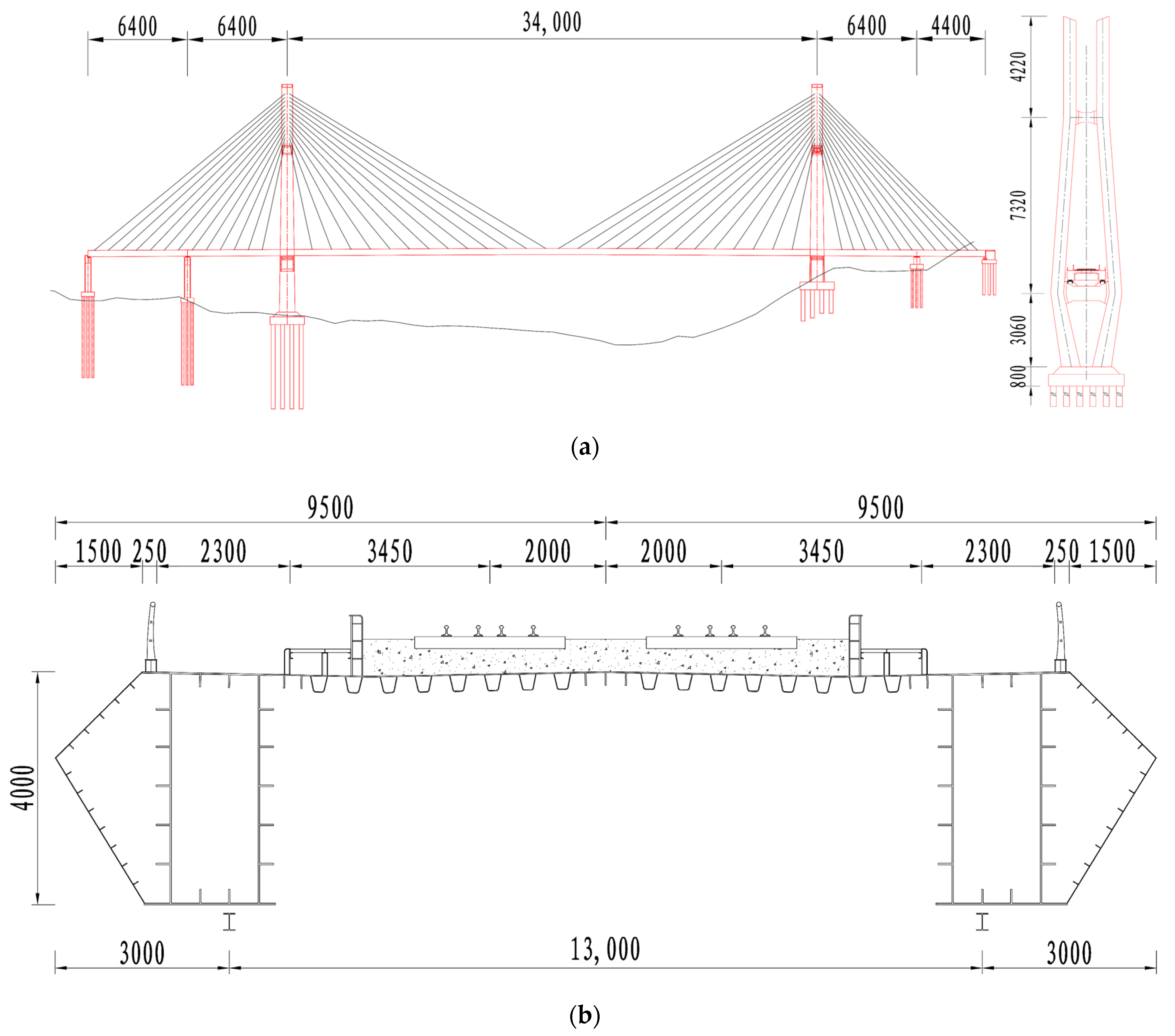
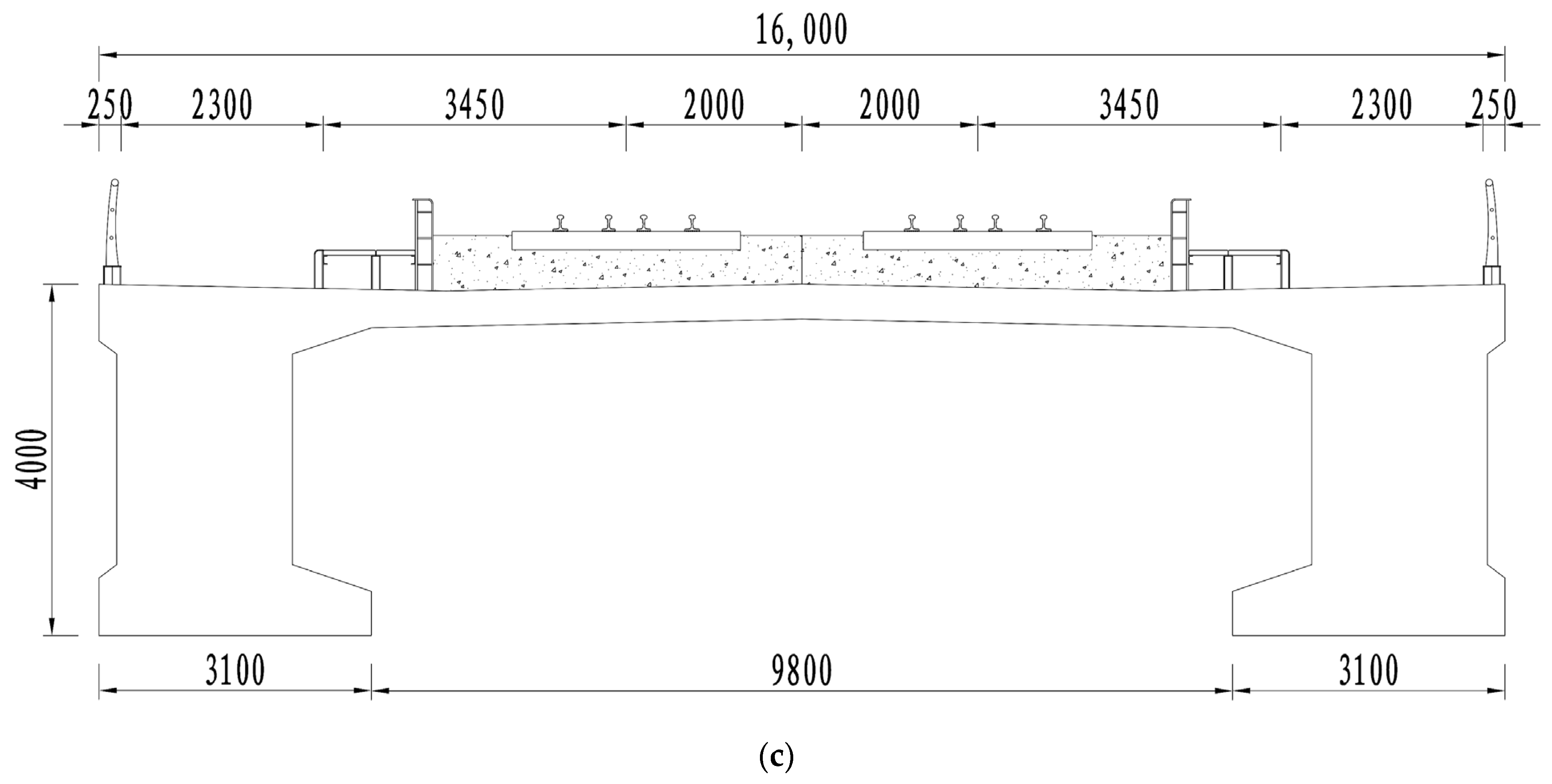
The Feilong Yujiang Railway Bridge (FLYJB), located in Nanning, Guangxi, China, is a twin-tower hybrid girder cable-stayed bridge with a main span of 340 m. The span arrangement is (64 + 64 + 340 + 64 + 44) m, totaling 576 m. The main span adopts a composite Π-shaped steel girder consisting of twin boxes with external fairings and an orthotropic steel deck, while the side spans employ Π-shaped concrete girders. The Π-shaped steel girder of the FLYJB has a width of 19.0 m including the 1.5 m wide fairings at two sides of the girder, with a depth of 4.0 m, resulting in a width-to-depth ratio (including fairings) of 4.75. The heights of the two concrete bridge towers are 146.0 m and 126.7 m, respectively. The stay cables are fabricated from φ7 mm zinc–aluminum alloy-coated parallel steel wires protected by polyethylene sheathing, arranged in a double-plane fan configuration. 104 cables (52 pairs) are installed across the entire bridge. The cable spacing on the main span is 12.0 m, while on the side spans it varies from 6.0 to 9.0 m. Figure 1 presents the elevation layout of the bridge, along with the typical cross-sections of the main span steel girder and the side span concrete girder. According to Code for Wind-resistant Design of Railway Bridges (Q/CR 9162-2023) [31], sectional model wind tunnel tests are recommended for vortex-induced vibration assessment when the main span of a railway cable-stayed bridge does not exceed 400 m. The present bridge has a main span of 340 m, thus meeting this criterion. Moreover, narrow Π-shaped girders are known from engineering experience to be susceptible to VIV due to their bluff-body characteristics. Therefore, it is necessary to conduct sectional model wind tunnel tests for this bridge. The basic wind speed at the bridge site (10 m height, 100-year return period, 10 min mean annual maximum wind speed) is 28.5 m/s. According to the terrain conditions surrounding the bridge site, the ground roughness category is determined as Class B, with a corresponding conversion factor of 1.0. Therefore, the design basic wind speed for the bridge is 28.5 m/s, and the design reference wind speed for the girder is 35.3 m/s.

2.2. Dynamic Characteristics of the FLYJB

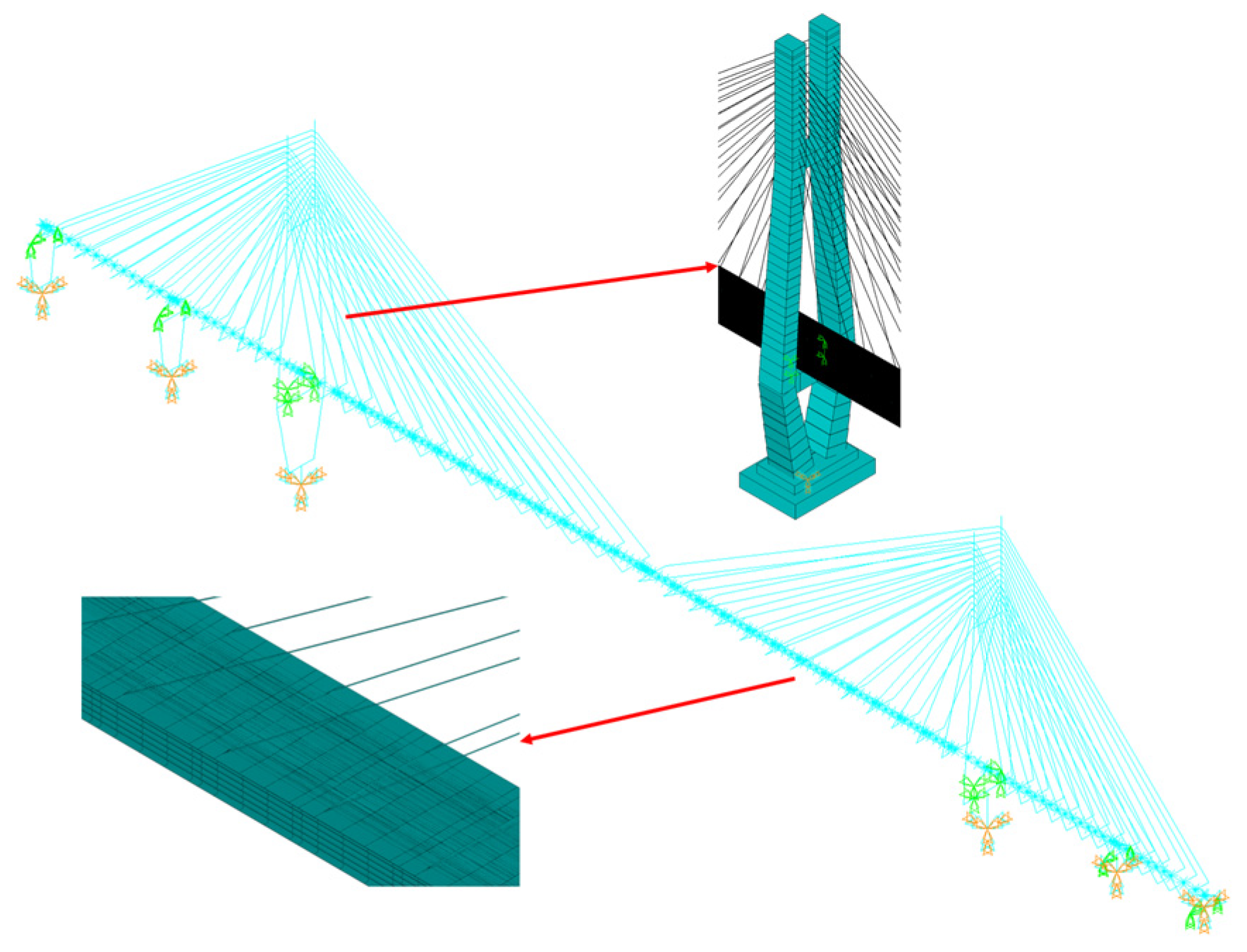
A three-dimensional finite element model of the FLYJB was established using the commercial software ANSYS (version 18.0) to analyze its dynamic characteristics in service state. The main girder was simulated using BEAM188 elements to consider its warping torsional stiffness, the towers and piers were modeled using BEAM4 elements, and the stay cables were modeled using LINK10 spatial truss element. The secondary dead loads, including railings, deck pavement, tracks, and diaphragms, were modeled using MASS21 mass element. The boundary conditions were set as follows: the bases of the towers and piers were fixed, two vertical supports were set at the connections between the main girder and the towers/piers, one transverse support was arranged at the pier top for the main girder, the transverse wind-resistant supports were installed at the tower–girder connections, and longitudinal restraint was applied to the main girder at the tower locations. The coupling between structural components was implemented as follows. The connections between the main girder and the towers/piers were modeled using coupled degrees of freedom (CP command in ANSYS). Specifically, the vertical displacements at the two support locations were coupled to simulate the vertical supports, the transverse displacements at the pier tops were coupled to simulate the transverse supports, and the longitudinal displacement at the tower-girder connections was coupled to simulate the longitudinal restraint. For the transverse wind-resistant supports at the tower-girder connections, the transverse displacements were coupled accordingly. The stay cables were connected to the main girder and towers through rigid links to account for the eccentricity between the cable anchor points and the neutral axis of the girder and towers. These rigid links were simulated using beam elements with artificially high elastic modulus (e.g., E = 2.10 × 10¹¹ Pa), ensuring negligible deformation under load and effectively acting as rigid connections. This approach ensures that forces from the cables are correctly transferred to the structural components while maintaining the geometric configuration of the actual bridge. The initial stress and sag effect of the stay cables were considered in the dynamic characteristic analysis. The three-dimensional finite element model of the FLYJB is shown in Figure 2. The finite element model of the main girder was established according to the construction segments, resulting in a total of 668 nodes and 970 elements. The material properties used in the finite element model are summarized in Table 1. These material parameters were determined based on the Code for Design on Railway Bridge and Culvert (TB 10002-2017) [32].
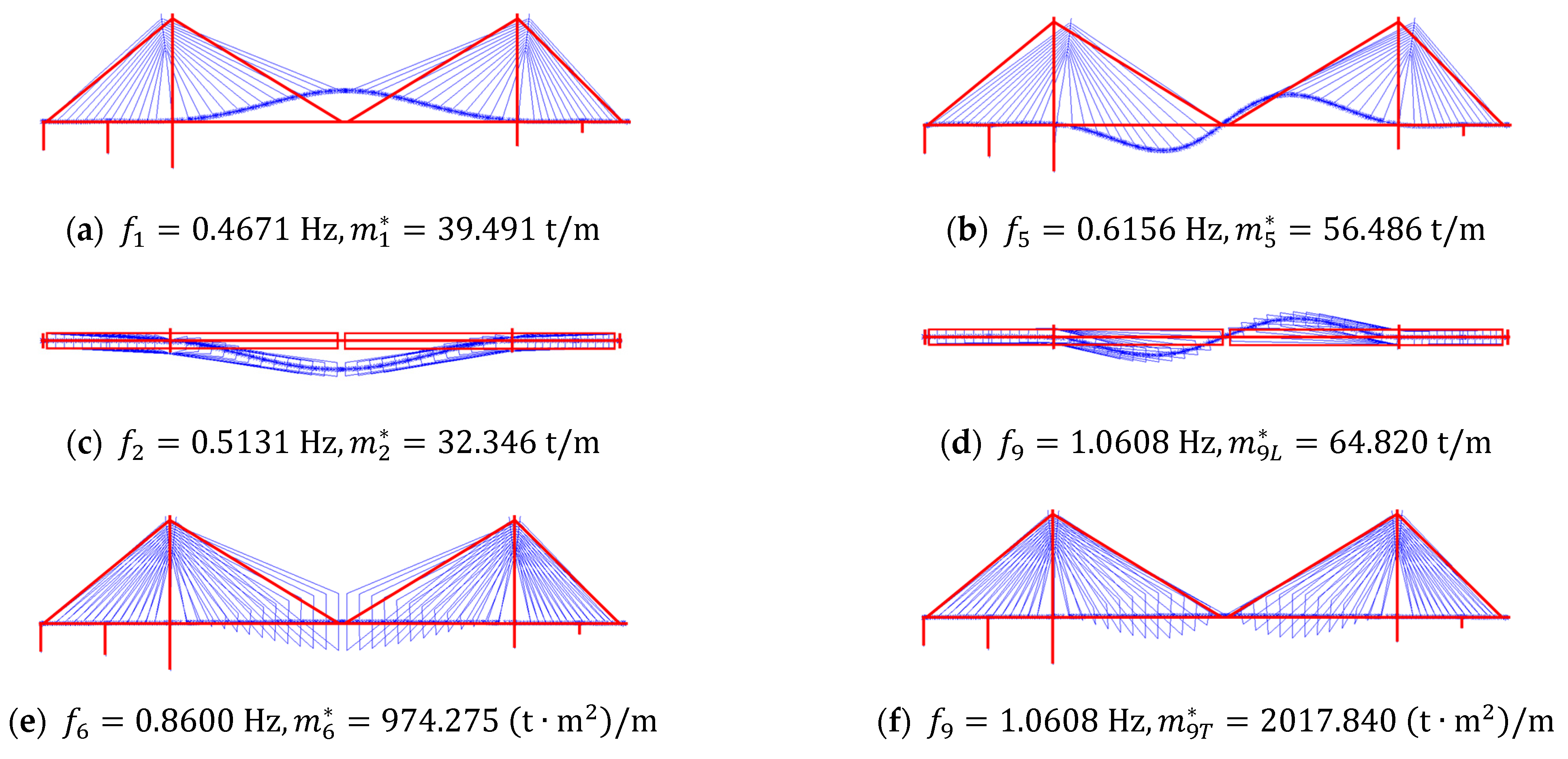
Figure 3 illustrates the mode shapes of the first symmetric and first antisymmetric vertical bending, lateral bending, and torsional modes of the main girder for the FLYJB in service stage, respectively. The frequencies of the first symmetric vertical bending, lateral bending, and torsional modes of the main girder are 0.4671 Hz, 0.5131 Hz, and 0.8600 Hz, respectively. The numerical model was validated by comparing the computed natural frequencies with those estimated using empirical formulas from the Code for Wind-resistant Design of Railway Bridges [31], as well as with engineering experience from similar railway cable-stayed bridges. The frequencies obtained from the finite element analysis were found to be in general agreement with these reference values, confirming that the model adequately captures the dynamic characteristics of the prototype bridge. The equivalent mass per unit length for each vibration mode of the bridge structure is presented in Equation (1).
m i = B m s ϕ i 2 s d s g ϕ i 2 s d s
where m i is the equivalent mass per unit length of the i-th mode; B denotes integration over the entire bridge structure, including pylons, stay cables, and piers; g denotes integration over the main deck; m s is the mass per unit length of the complete bridge structure, including main deck, pylons, stay cables, and piers; and ϕ i s is the i-th mode shape function of the bridge structure.
Based on Equation (1), the equivalent masses per unit length for the first symmetric vertical bending, lateral bending, and torsional modes of the main girder are 39.491 t/m, 32.346 t/m, and 974.275 t·m2/m, respectively.

3. Experimental Setup and Test Cases

3.1. Experimental Setup

The sectional model for wind tunnel tests was designed based on the dynamic characteristics obtained from the finite element analysis described in Section 2.2. Based on the geometric scale ratio, wind velocity ratio, and the similarity laws, the frequency ratio was derived. The target natural frequencies of the sectional model, including the first symmetric vertical bending frequency and the first symmetric torsional frequency, were then obtained by scaling down the corresponding frequencies of the prototype bridge calculated from the finite element model. The equivalent mass per unit length from the finite element analysis was used, together with the geometric scale ratio, to determine the required mass of the sectional model according to the similarity laws. The spring stiffness of the spring-supported system was calculated based on the target frequencies and the model mass, ensuring that the reduced velocity range in the wind tunnel covered the lock-in region of interest. Prior to the formal experiments, the spring-supported system was calibrated through static stretching tests to verify that the actual stiffness met the design requirements.
The wind tunnel tests on the sectional model of the main girder were conducted in the Section I of the HD-2 wind tunnel at Hunan University. This test section measures 17.0 m in length, 3.0 m in width, and 2.5 m in height. The maximum wind speed in the empty tunnel is 58.0 m/s, and the turbulence intensity of the incoming flow is less than 0.5% for wind speeds exceeding 2.0 m/s.
Considering factors such as Reynolds number effects, geometric details of the sectional model, and model blockage ratio, the geometric scale ratio of the main girder sectional model was determined to be λL = 1:50. The model length was L = 1725 mm, the width (including fairings) was B = 380 mm, and the height was H = 80 mm. To ensure similarity in overall stiffness and geometric configuration, the model was constructed with stainless steel supporting framework and covered with high-quality acrylonitrile–butadiene–styrene copolymer (ABS) plates. Railings were fabricated using ABS plates and steel wire strips, with careful simulation of their shape and porosity. The inspection rail was carved from ABS plates. Additionally, to maintain two-dimensional flow characteristics around the main girder model section, 3 mm thick elliptical wooden end plates were installed at both ends of the model, with 700 mm in length and 320 mm in height. Turntables and connecting rods were also arranged at both ends of the model for adjustment of the wind AOA during testing. Moreover, the connecting rods connected the model to the wind tunnel walls via eight springs, forming a two-degree-of-freedom spring-supported system. Considering that the actual bridge features a steel main girder in the mid-span and concrete main girders in the side spans, the vertical and torsional damping ratios of the sectional model were taken as ξv = 0.36% and ξt = 0.39%, respectively. These values were determined based on the following considerations. According to the Code for Wind-resistant Design of Railway Bridges (Q/CR 9162-2023) [31], the recommended damping ratio for composite girders of railway cable-stayed bridges is 0.7%. However, field measurements on existing bridges, including the similar in-service cable-stayed bridge reported in Wang et al. [4], indicate that actual damping ratios are often lower than code-specified values and may decrease further over time due to long-term service conditions, wear of structural connections, and the presence of non-structural components. Such reductions can significantly affect the VIV response, making a design based solely on code values potentially non-conservative for bridges in operation. To account for these realistic conditions and to ensure a robust safety margin, relatively lower damping ratios (approximately half of the code value) were adopted in the experiments. These values not only reflect the lower end of damping that may occur during the bridge’s service life but also provide a conservative assessment of VIV susceptibility and control effectiveness—even under extreme or unfavorable scenarios. This conservative approach guarantees that if the proposed aerodynamic measures successfully suppress VIV under such low-damping conditions, they will be at least as effective, if not more so, under the higher damping typically present in actual bridge structures, thereby offering a reliable safety margin for the prototype bridge.
The sectional model tests were designed and interpreted according to established similarity laws to ensure applicability to the full-scale bridge. The primary similarity parameters—geometry, mass ratio, damping ratio, and reduced velocity—were satisfied as follows: geometric similarity was achieved with a scale ratio of λL = 1:50; mass similarity was satisfied by adjusting the model mass based on the equivalent mass from the finite element analysis; damping ratios were set to representative values for steel-concrete composite bridges (ξv = 0.36%, ξt = 0.39%); and reduced velocity similarity was achieved by scaling the model frequency according to fmodel/fprototype = λV/λL, where λV is the wind velocity scale. Regarding Reynolds number effects, it is well recognized that complete Reynolds number similarity cannot be achieved at a geometric scale of 1:50. However, for the Π-shaped girder in this study, the influence is expected to be minimal due to its sharp-edged geometry, which fixes the flow separation points and makes the aerodynamic behavior less sensitive to Reynolds number variations within the range of interest. This is supported by Wang et al. [4], who conducted comparative wind tunnel tests on a wide Π-shaped girder using both 1:25 and 1:50 scale sectional models. Their results showed that while a minor difference (an additional lock-in region at −3° attack angle) was observed between the two scales, the overall VIV characteristics and the main conclusions regarding control effectiveness remained consistent, demonstrating that a 1:50 scale model is adequate for evaluating VIV suppression measures on Π-shaped girders.
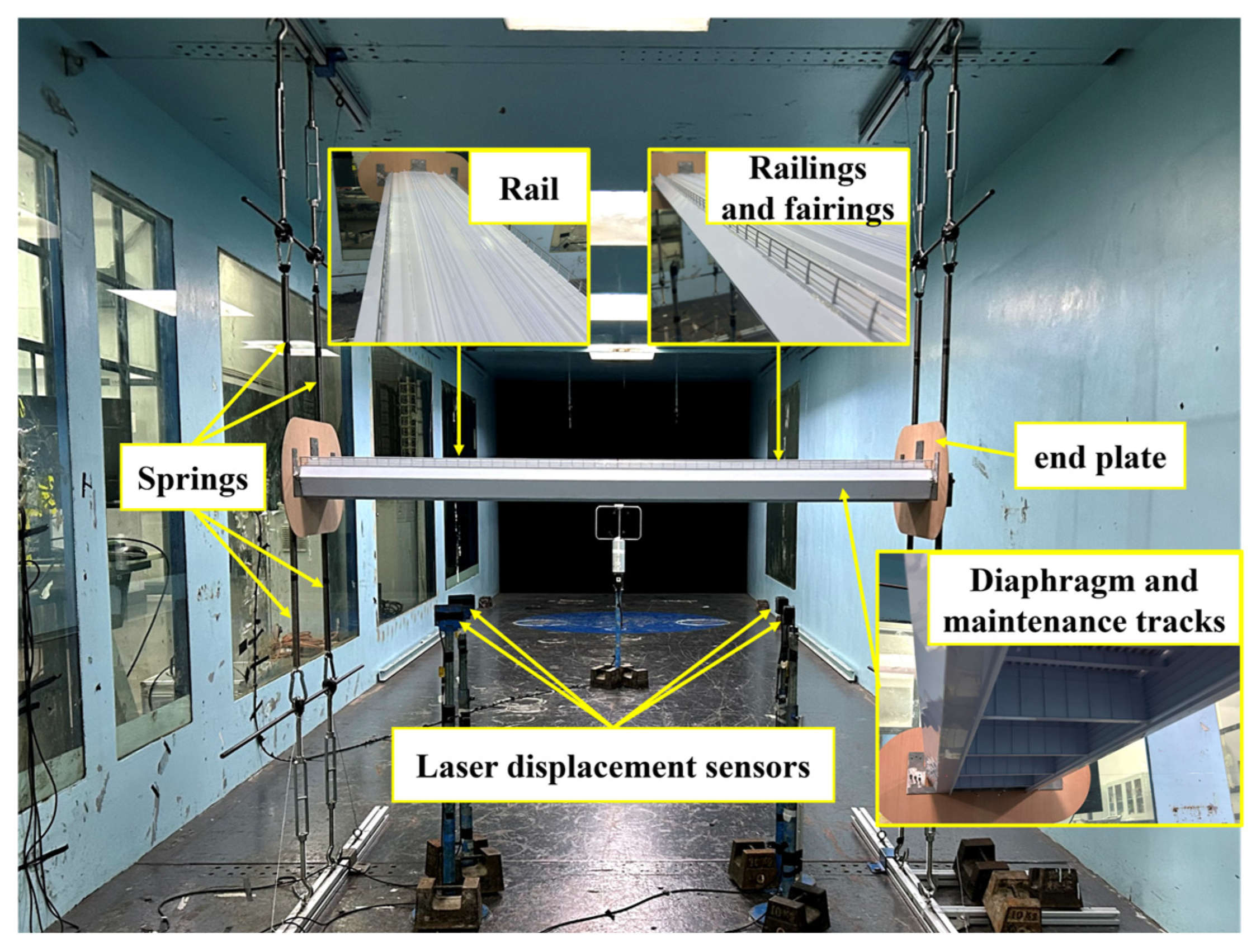
The displacement of the main girder sectional model was measured using IL-300 laser displacement sensors manufactured by KEYENCE Corporation. The full-scale (F.S.) of the laser displacement sensor IL-300 is ±140 mm, and the linear error of IL-300 is 0.25%, F.S. = ±0.05 mm. Four laser displacement transducers were symmetrically arranged at both ends of the model, on the upstream and downstream sides. The transverse spacing between displacement transducers was 280 mm, and the longitudinal spacing was 1000 mm. Data acquisition was performed using a DH5920 multi-channel dynamic data acquisition system manufactured by Donghua Testing Technology Co., Ltd., Taizhou, Jiangsu, China, with a sampling frequency of 1000 Hz, and the sampling time was set to 60 s. All tests were conducted in uniform flow condition. A schematic diagram of the installed main girder sectional model in the wind tunnel is shown in Figure 4, and the relevant test parameters of the sectional model are summarized in Table 2.

3.2. Test Cases

3.2.1. Original Girder Section and Conventional Aerodynamic Control Measures

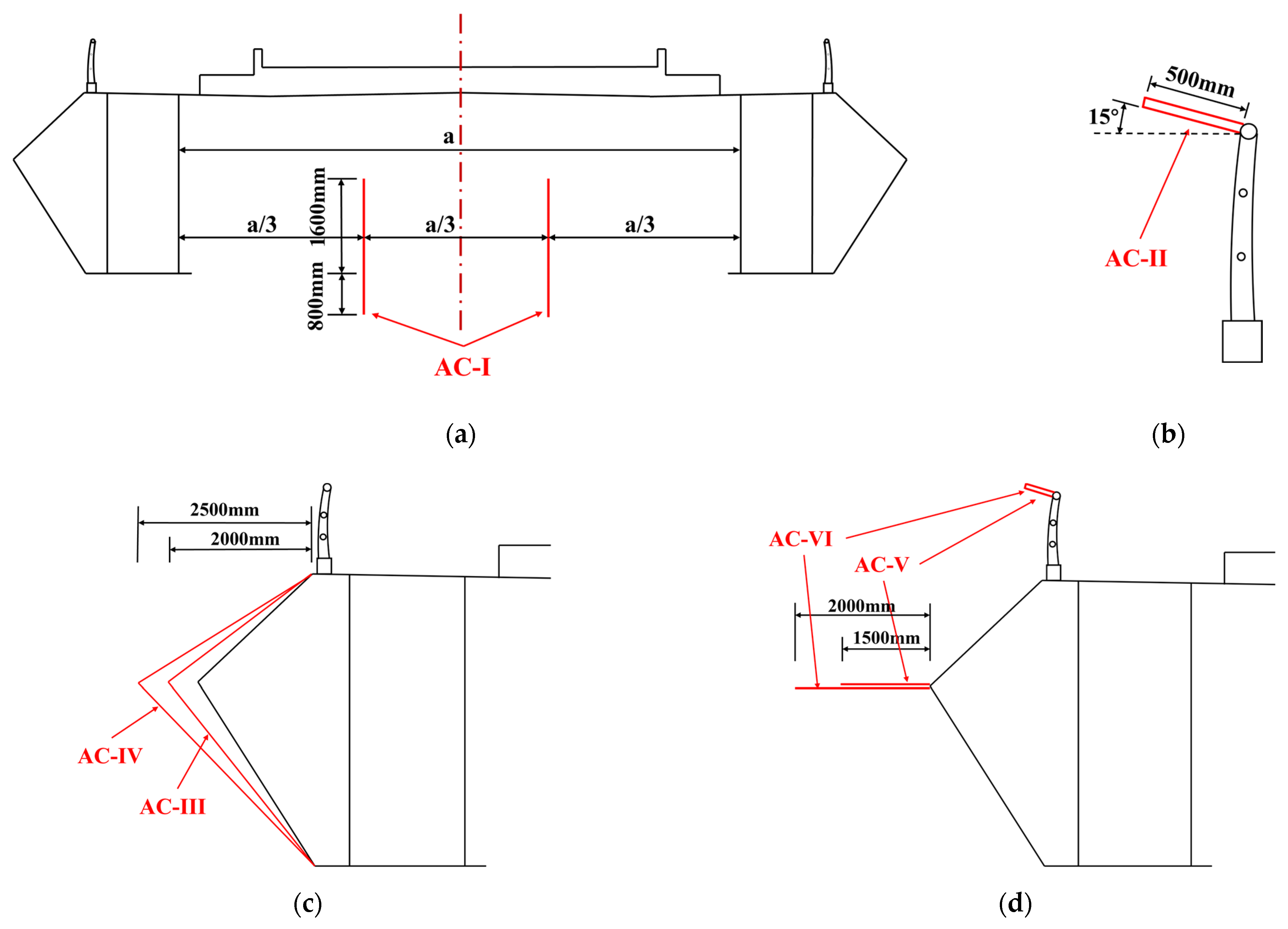
Vibration measurement tests were conducted on the original girder section design under five wind AOAs. Subsequently, experimental investigations on conventional aerodynamic control measures for mitigating VIV responses of the main girder were carried out at a wind AOA of +3°. The test cases for the baseline section and conventional aerodynamic control measures are summarized in Table 3, and schematic diagrams of the relevant measures are shown in Figure 5.

3.2.2. Aerodynamic Control Measures Using VGs

Based on the relevant dimensional parameters of VGs reported in the literature, rectangular VGs extending from the tip of the fairing to its bottom were selected. To further assess the feasibility of practical engineering applications, optimization was pursued based on the following two approaches. First, while maintaining the target height, the length of the VG was reduced so that it does not start from the tip of the fairing but extends from an intermediate position to the girder bottom, thereby avoiding interference with the inspection gantry. Second, while retaining the layout extending from the fairing tip to the girder bottom, the original rectangular cross-section was modified to a trapezoidal shape, gradually tapering from the fairing tip until the structural profile no longer interferes with the passage of the inspection vehicle. Three heights were designed for both the rectangular and trapezoidal VGs: 0.1 H, 0.15 H, and 0.2 H (H is the height of the girder).
Regarding the spacing between VG pairs, two initial spacing schemes were proposed, namely 2 H (8.0 m) and 3 H (12.0 m). Considering that the standard segment length L0 of the steel main girder of the FLYJB is 12.5 m, to facilitate standardized production of steel girders with VGs in the fabrication yard, the spacing S between VG pairs was determined as 2/3 L0 (8.3 m) and L0 (12.5 m).
In addition, the potential installation positions of the VGs (on the upper part of the fairing, on the lower part of the fairing, or at the bottom of the section) and combined aerodynamic control measures (combination of deflectors with VGs or combination of two VGs) were also considered.
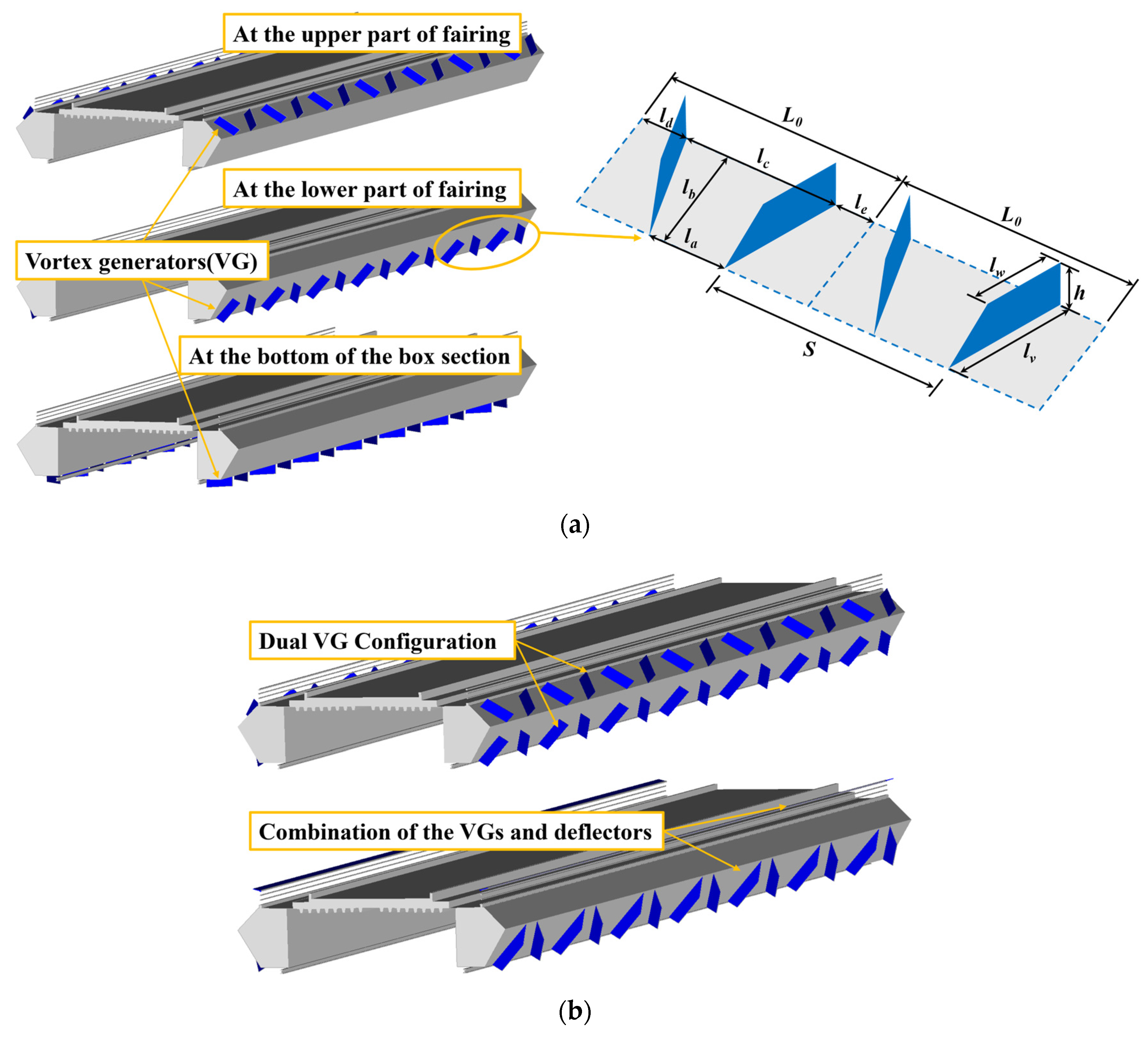
Table 4 summarizes the test cases for aerodynamic control using VGs, the detailed dimensions of individual VGs are presented in Table 5, and schematic diagrams of the VGs are shown in Figure 6. The detailed experimental procedure and the logic behind parameter selection are described in Section 4.4 and illustrated in the flowchart there.

4. Results and Discussion

4.1. Allowable Amplitude of Main Girder VIV

According to Article 8.1.9 of the Code for Wind-resistant Design of Railway Bridges (Q/CR 9162-2023) [31], the allowable amplitudes for vertical VIV and torsional VIV of the main girder are given as follows:
h v = 0.01 f v 2 + γ n v L 2 = 0.01 0.4671 2 + 0.5 × 33.33 340 2 = 0.0448   m
θ t = 1.14 f t 2 + γ n v L 2 · 1 B r = 0.01 0.8600 2 + 0.5 × 33.33 340 2 × 1 5.5 = 0.2784 °
The corresponding allowable root mean square (RMS) values for vertical and torsional VIV are:
σ v a = 0.0488 / 2 = 0.0317   m
σ t a = 0.2784 / 2 = 0.1969 °
The corresponding dimensionless allowable RMS value for vertical VIV is:
σ v a = σ v a / H = 0.0317 / 4 = 0.0079
where h v and θ t are the allowable amplitude values for vertical and torsional VIV of the main girder, respectively; σ v a and σ t a are the allowable RMS values for vertical and torsional VIV of the main girder, respectively; σ v a is the dimensionless allowable RMS value for vertical VIV of the main girder; f v and f t are the vertical and torsional frequencies of the main girder (Hz), respectively; B r is the distance between the outermost tracks on the bridge deck (m); L is the main span length of the bridge (m); here v is the train operating speed (m/s); and γ n is the mode shape coefficient for VIV, taken as 0.5 for the first symmetric mode.

4.2. Experimental Results of the Original Main Girder Section

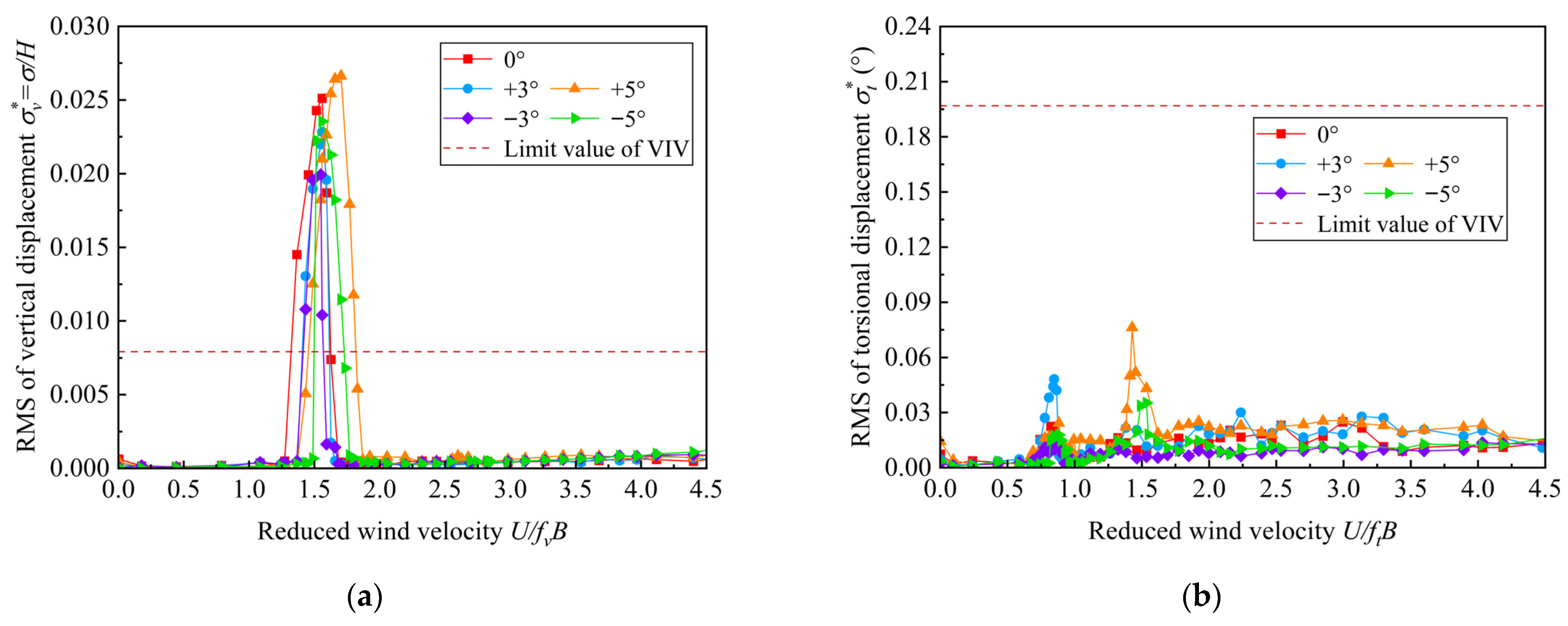
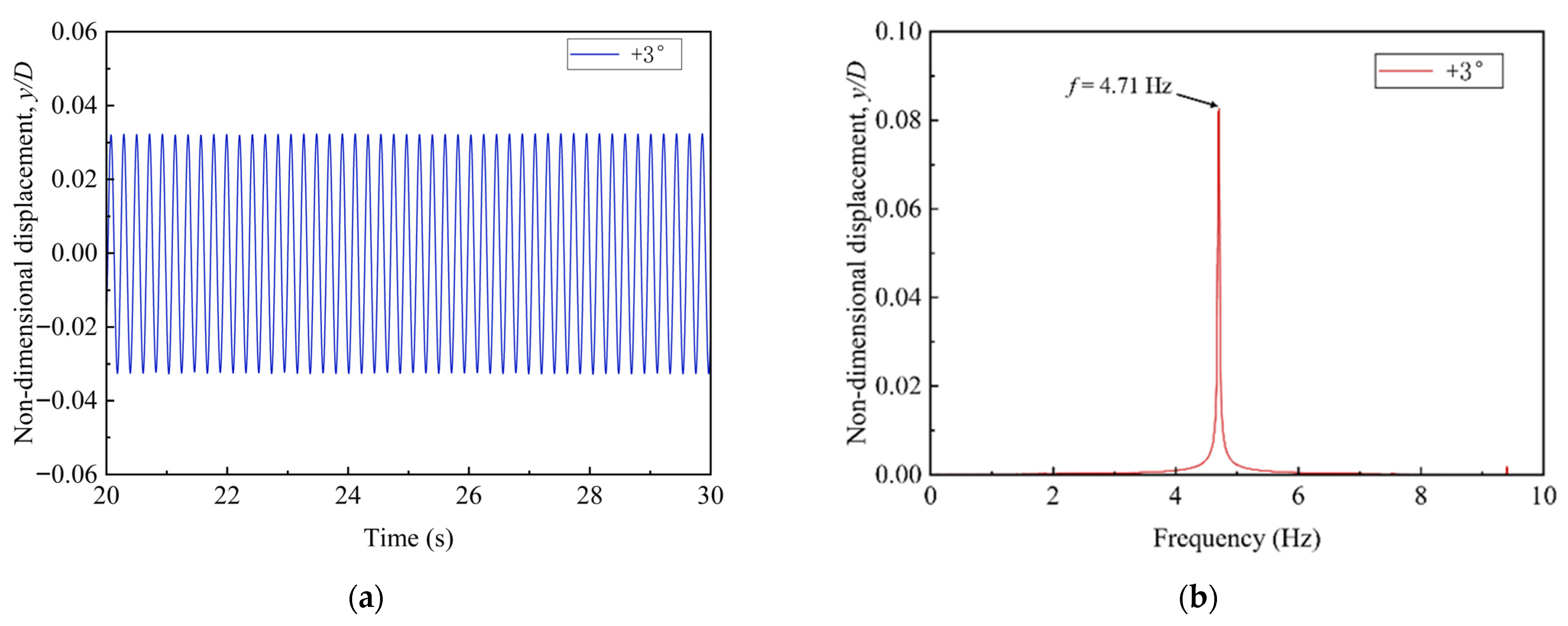
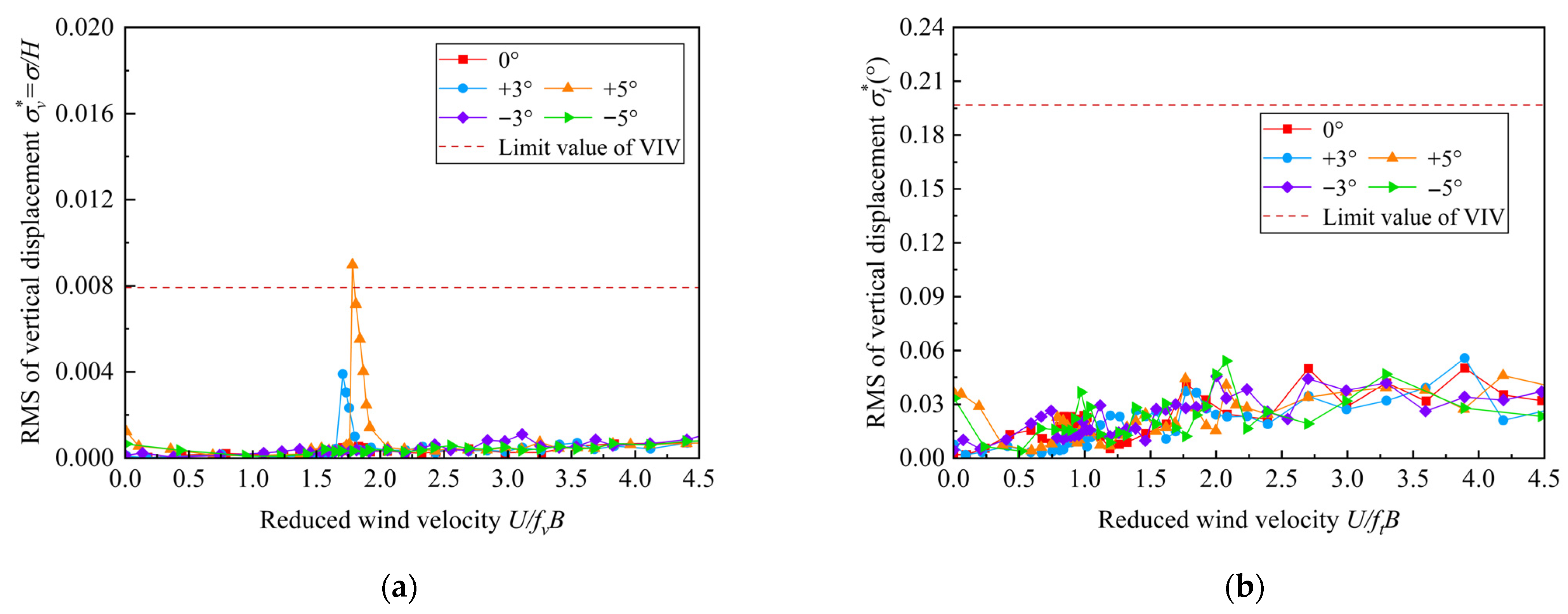
Figure 7 presents the RMS responses of vertical and torsional wind-induced vibrations of the original main girder section as functions of the reduced wind velocity normalized by the girder height. The abscissa represents the reduced wind velocity U / f B , where U is the wind speed, f is the natural frequency of the bridge (taking the first symmetric vertical frequency f v for vertical vibration and the first symmetric torsional frequency f t for torsional vibration), and B is the bridge width. The ordinate represents the RMS vertical displacement σ v = σ / D or RMS torsional displacement σ t of the actual bridge after conversion. Figure 8a shows the time–history curves of the girder section vibration responses corresponding to the maximum amplitudes under a wind AOA of +3°, where the abscissa is time and the ordinate is the dimensionless amplitude y/D. Figure 8b presents the amplitude spectrum corresponding to the maximum vertical VIV amplitude under a wind AOA of +3°.
As shown in Figure 7a,b, vertical VIV was observed in the original girder section under all five wind AOAs, with vertical VIV amplitudes approximately three times the allowable limits specified in the code. Under wind AOAs of +3°, +5°, and −5°, the original girder section exhibited noticeable vertical VIV accompanied by slight torsional VIV; however, the torsional VIV amplitudes remained below the code limits. At a 0° wind AOA, the lock-in region for vertical VIV was 1.27–1.68 (corresponding to full-scale wind speeds of 11.29–14.95 m/s), with a maximum RMS vertical response of σ v = 0.025 m. At a +3° wind AOA, the lock-in region for vertical VIV was 1.37–1.66 (corresponding to full-scale wind speeds of 12.71–14.71 m/s), with a maximum RMS vertical response of σ v = 0.023 m; the lock-in region for torsional VIV was 0.74–0.88 (corresponding to full-scale wind speeds of 12.16–14.43 m/s), with a maximum RMS torsional response of σ t = 0.0482 . At a +5° wind AOA, the lock-in region for vertical VIV was 1.37–1.87 (corresponding to full-scale wind speeds of 12.16–16.59 m/s), with a maximum RMS vertical response of σ v = 0.027 m. From Figure 7a,b, it can be observed that the largest vertical VIV amplitude occurred at a +5° wind AOA. Because the original design of the girder section exhibited pronounced VIV that exceeded the code limits, it was necessary to investigate aerodynamic control measures. Accordingly, experimental studies on conventional aerodynamic control measures and spanwise aerodynamic control using VGs were carried out for the most unfavorable wind AOA among the typical angles, i.e., +3°.

4.3. Conventional Aerodynamic Control Measures

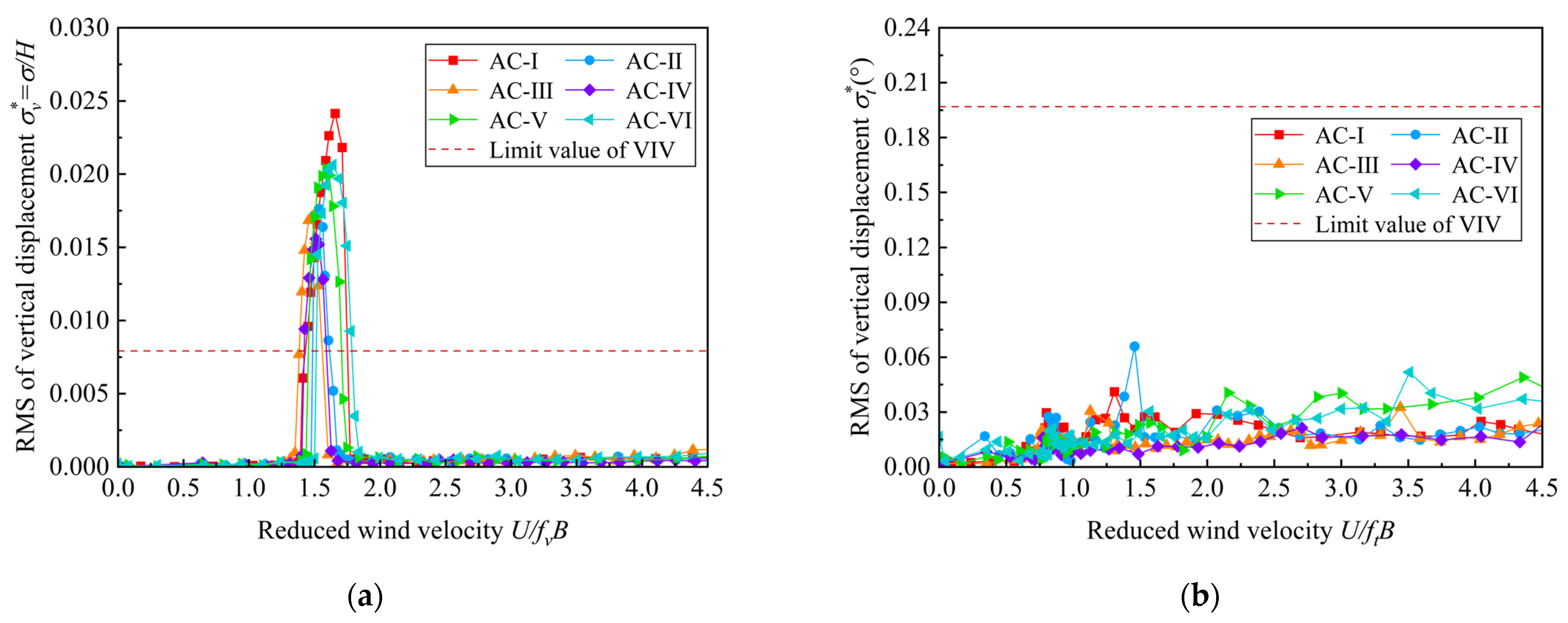
To effectively mitigate the VIV response of the narrow Π-shaped girder section, experimental investigations were first conducted on the original girder section with various conventional aerodynamic control measures. These included the installation of two vertical stabilizers, a deflector with a 15° inclination angle and a width of 0.5 m, modifications to the aerodynamic profile of the fairings, a combination of a deflector and a horizontal splitter plate, and relocation of the inspection rail. Figure 9 presents the RMS responses of vertical and torsional vibrations vs. the reduced wind velocity for conventional aerodynamic control measures AC-I through AC-VI. As shown in Figure 9, the addition of two vertical stabilizers at the girder bottom (AC-I) not only failed to effectively suppress VIV but exacerbated the vertical VIV amplitude of the girder section. The installation of a deflector with a 15° inclination angle and a width of 0.5 m on the railings (AC-II), as well as modifications to the aerodynamic profile of the fairings (AC-III, AC-IV), reduced the vertical VIV response to some extent. The corresponding maximum RMS dimensionless vertical displacements were 0.772, 0.751, and 0.683 times that of the original girder section, respectively. However, none of these measures satisfied the code requirements. The combined control measure comprising a deflector and a horizontal splitter plate (AC-V, AC-VI) exhibited limited effectiveness in suppressing VIV responses.
From the aforementioned results of conventional aerodynamic control measures, it can be observed that VIV responses of the narrow Π-shaped bluff body girder section are difficult to suppress to meet code requirements using conventional aerodynamic control measures alone. However, it is noted that the deflector and fairing modifications exhibited relatively better control effectiveness. This suggests that the underlying cause of VIV may be associated with the railings and the fairings of the girder. Therefore, subsequent efforts will focus on deflector-based measures and novel aerodynamic control strategies targeting the railings and fairings.

4.4. Aerodynamic Control Using VGs

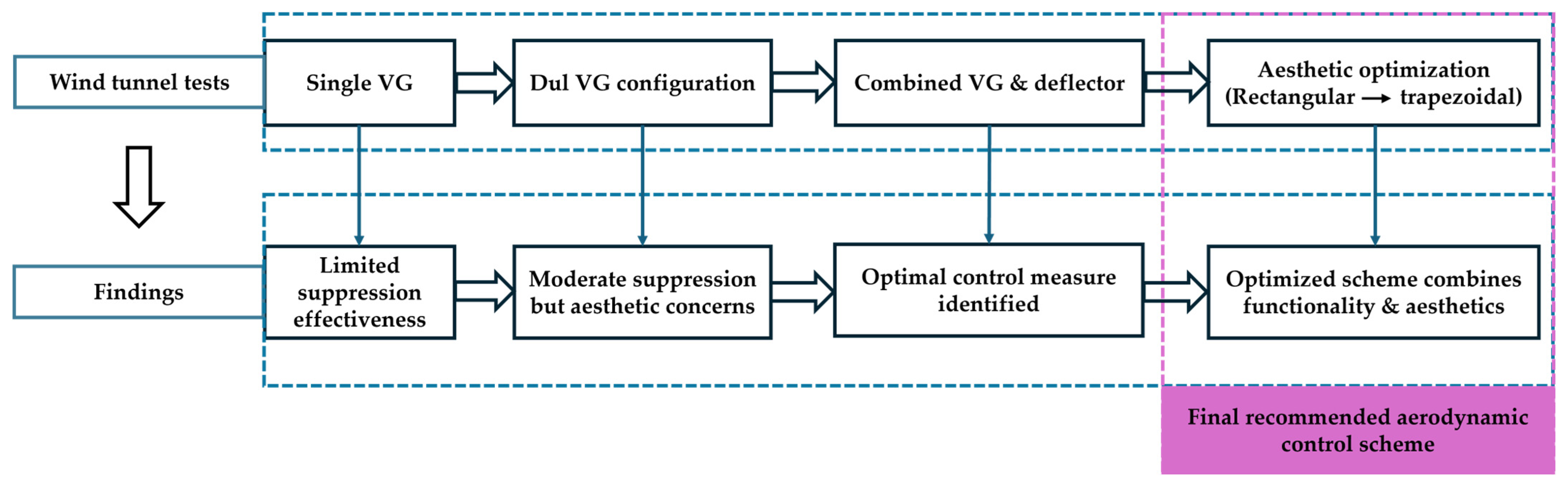
With the objective of completely suppressing VIV or ensuring that any remaining vibration amplitudes comply with code limits, wind tunnel tests were first conducted on the Π-shaped girder section equipped with single VG. The effects of different installation positions and spacings of single VG on VIV suppression of the main girder were discussed, and it was found that single VG exhibited limited suppression effectiveness. Therefore, to further enhance the spanwise flow of the incoming airflow, wind tunnel tests were then performed with VGs installed simultaneously on both the upper and lower parts of the fairings (i.e., dual VG configuration). The suppression effectiveness of dual VG with different heights was examined, and it was observed that while dual VG achieved a certain level of VIV suppression, it did not conform to the aesthetic design principles of the bridge, necessitating further adjustment and optimization. Consequently, combined aerodynamic control measures comprising VGs and deflectors were considered. The influences of three key parameters—VG spacing, installation position, and height—on the VIV of the main girder were systematically investigated, and the aerodynamic control measure exhibiting the optimal suppression effectiveness was identified. Finally, aesthetic optimization was performed on the optimal aerodynamic measure identified above, wherein the rectangular VGs were modified to a trapezoidal shape. The recommended aerodynamic control scheme was ultimately proposed. A flowchart of the experimental procedure is shown in Figure 10.

4.4.1. Single VG

First, the suppression effectiveness of single VG on VIV of the main girder section was investigated under a wind AOA of +3°, considering different installation positions (upper part and lower part of the fairing) and different spacings (2/3 L0 and L0).
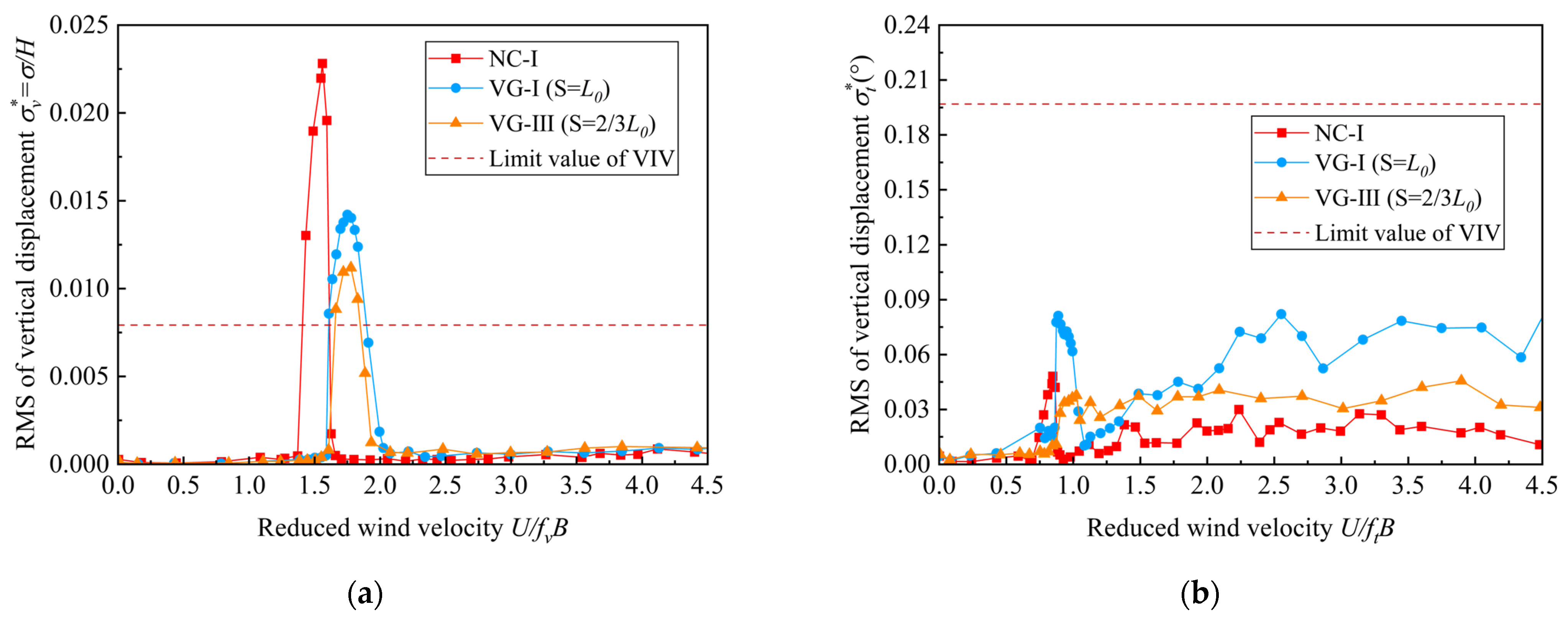
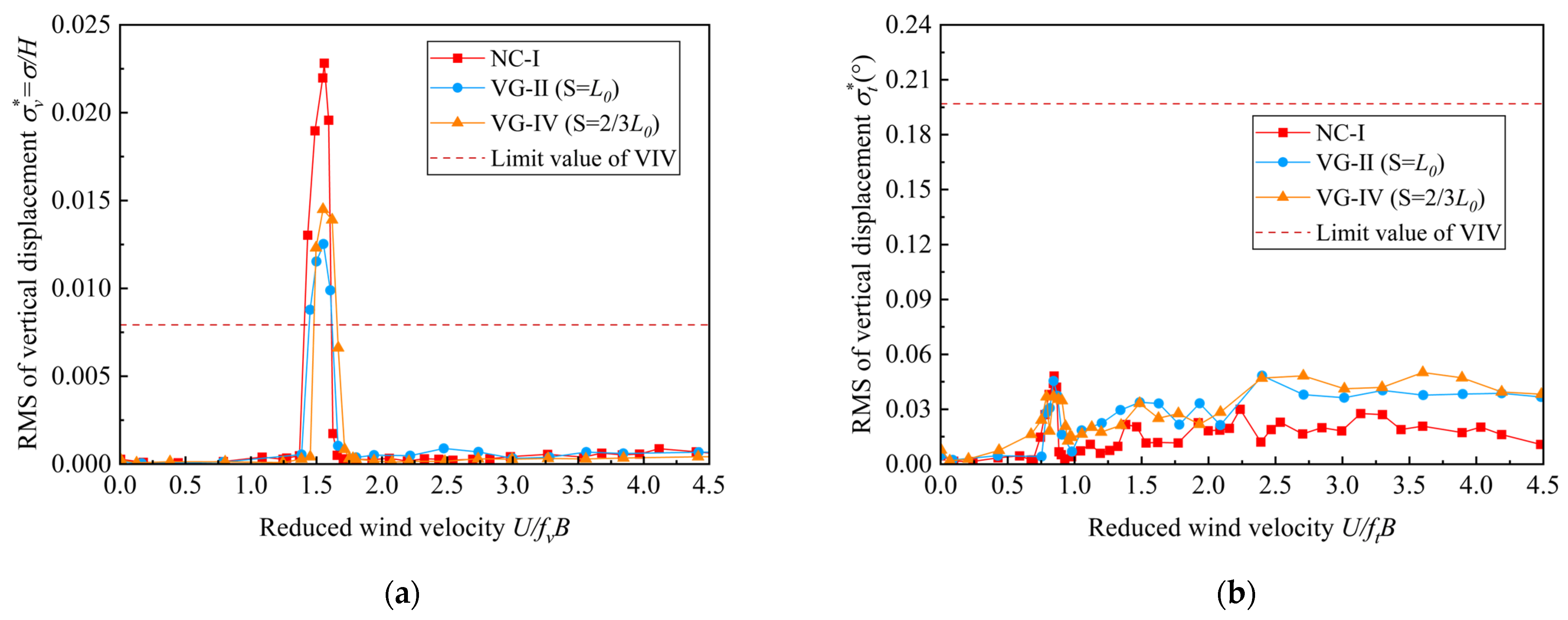
Figure 11 presents the RMS dimensionless displacement response of the main girder vs. the reduced wind velocity after installing single VG with different spacings on the lower part of the fairing. As shown in Figure 11 that when the single VG was installed on the lower part of the fairing, the VG with a spacing of 2/3 L0 exhibited better suppression effectiveness than that with a spacing of L0. The maximum RMS vertical response of the former was approximately 0.79 times that of the latter, and the maximum RMS vertical responses of the two configurations were 0.622 and 0.490 times that of the original girder section, respectively.
Figure 12 shows the variation curves of the VIV response RMS of the main girder after installing single VG with different spacings on the upper part of the fairing. It can be seen from the figure that when the single VG was installed on the upper part of the fairing, the VG with a spacing of L0 exhibited better suppression effectiveness than that with a spacing of 2/3 L0. The maximum RMS vertical response of the former was approximately 0.86 times that of the latter, and the maximum RMS vertical responses of the two configurations were 0.444 and 0.515 times that of the original no control girder section, respectively.
From the above, it can be observed that single VG achieved better suppression effectiveness than any of the conventional measures tested. Furthermore, the suppression effectiveness of the same VG spacing varied with different installation positions of the single VG. However, neither changing the installation position nor the spacing of the single VG enabled the vibration responses to meet the code requirements. In addition, a smaller VG spacing increases the number of VGs within a given length, potentially adding weight to the girder and thus affecting the bridge design to some extent. Conversely, a larger VG spacing may fail to generate sufficiently strong spanwise vortices to effectively suppress the VIV of the main girder.

4.4.2. Dual VG Configuration

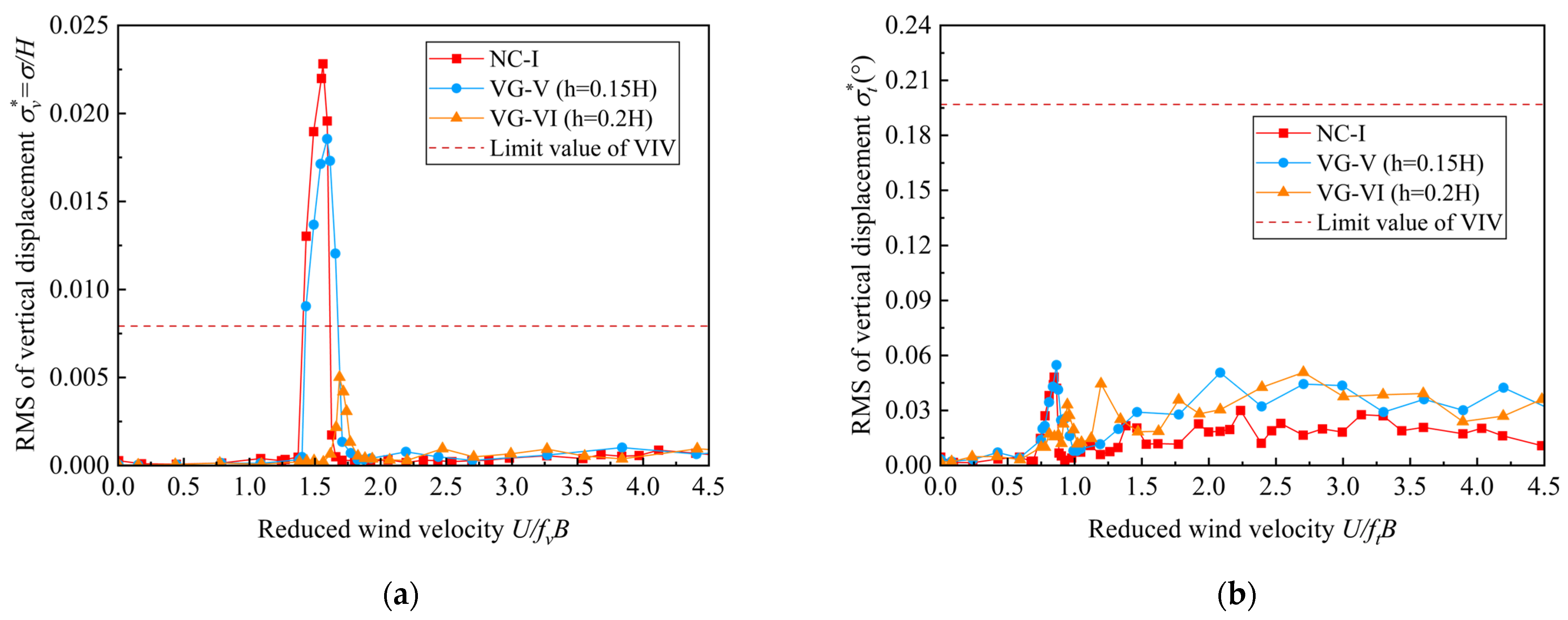
Building upon the single VG investigations, a control scheme employing dual VG was considered, i.e., installing VGs simultaneously on both the upper and lower parts of the fairings. Figure 13 presents RMS of vertical and torsional responses vs. the reduced wind velocity of the main girder after installing dual VGs with two different heights on both the upper and lower parts of the fairings. As shown in Figure 13, with a VG height of 0.2 H, the maximum RMS vertical response of the main girder after adopting the dual VG aerodynamic measure was 0.005 m, which fell below the allowable code limit of 0.0079 m. This indicates that the dual VG configuration can further enhance the spanwise flow of the airflow, thereby achieving effective suppression of main girder VIV. When the height of the dual VG was reduced from 0.2 H to 0.15 H, the maximum RMS vertical response of the main girder increased to 0.0186 m, and the reduced wind velocity corresponding to the VIV lock-in region shifted forward from 1.56–1.76 to 1.40–1.71. This demonstrates that the height of the dual VG significantly influences the spanwise flow effect of the incoming airflow. Within a certain range, a greater VG height yields better spanwise control effectiveness, and changes in VG height alter the lock-in region of VIV.
From an aesthetic perspective, for practical bridge engineering, installing VGs simultaneously on both the upper and lower parts of the fairings, as illustrated in Figure 6b, would compromise the bridge aesthetics. Therefore, the aerodynamic shape optimization of the VGs should be further conducted.

4.4.3. Combination of VGs and Deflectors

The combination of VGs and deflectors, which exhibited relatively better suppression effectiveness among the conventional aerodynamic control measures, was further investigated. Wind tunnel tests were conducted on various combination cases involving deflectors and VGs with different heights, spacings, and installation positions.
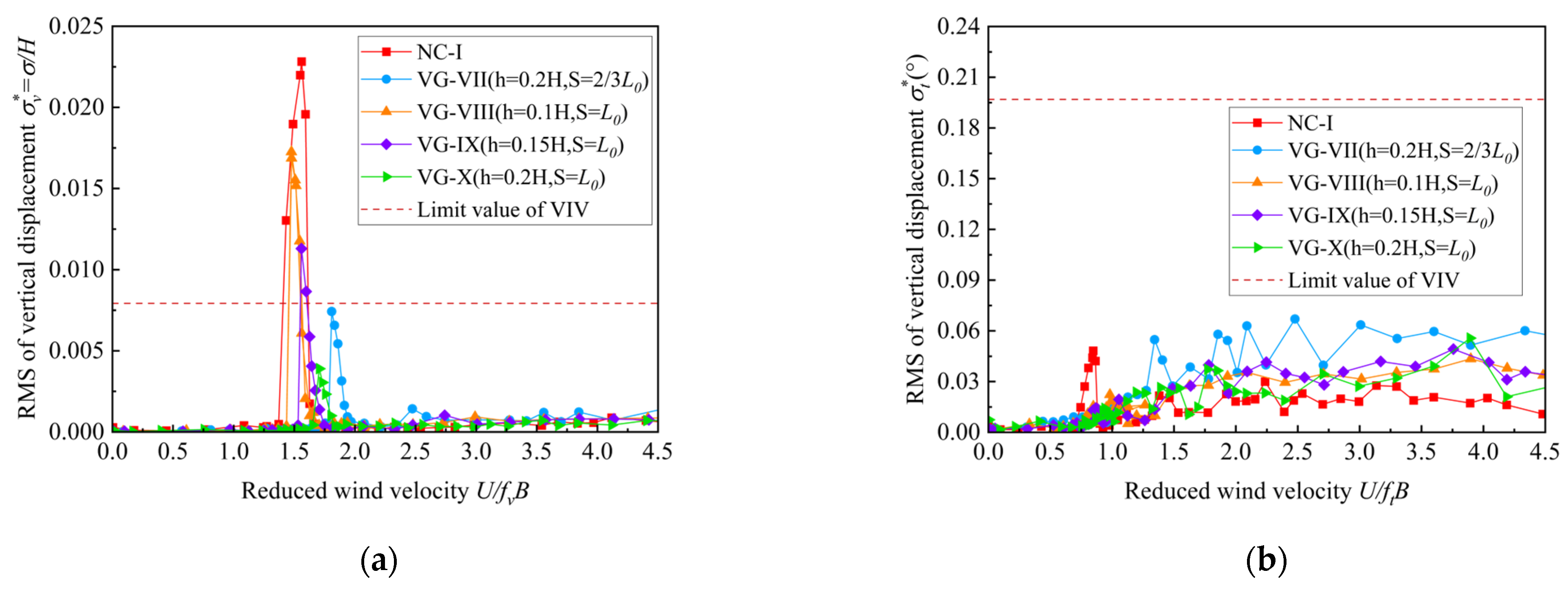
Figure 14 presents the RMS of the vertical and torsional responses vs. the reduced wind velocity of the main girder after installing VGs with different heights and spacings on the lower part of the fairing. It can be observed from Figure 14 that, for the combination cases of deflectors and VGs with three different heights installed on the lower part of the fairing, the maximum RMS vertical response of the main girder with VGs of height 0.2 H was 0.23 times that with VGs of height 0.1 H, and 0.35 times that with VGs of height 0.15 H. This is consistent with the finding from the dual VG configuration that the VG height significantly influences the VIV of the main girder. Therefore, for the combined control measure comprising VGs and deflectors, a VG height of 0.2 H was adopted.
It can also be seen from Figure 14 that VGs with a spacing of L0 exhibited better suppression effectiveness than those with a spacing of 2/3 L0. Therefore, adopting VGs with a spacing of L0 in combination with deflectors offers two advantages: reduced weight and improved suppression effectiveness. Accordingly, for the combined control measure comprising VGs and deflectors, a VG spacing of L0 was adopted.
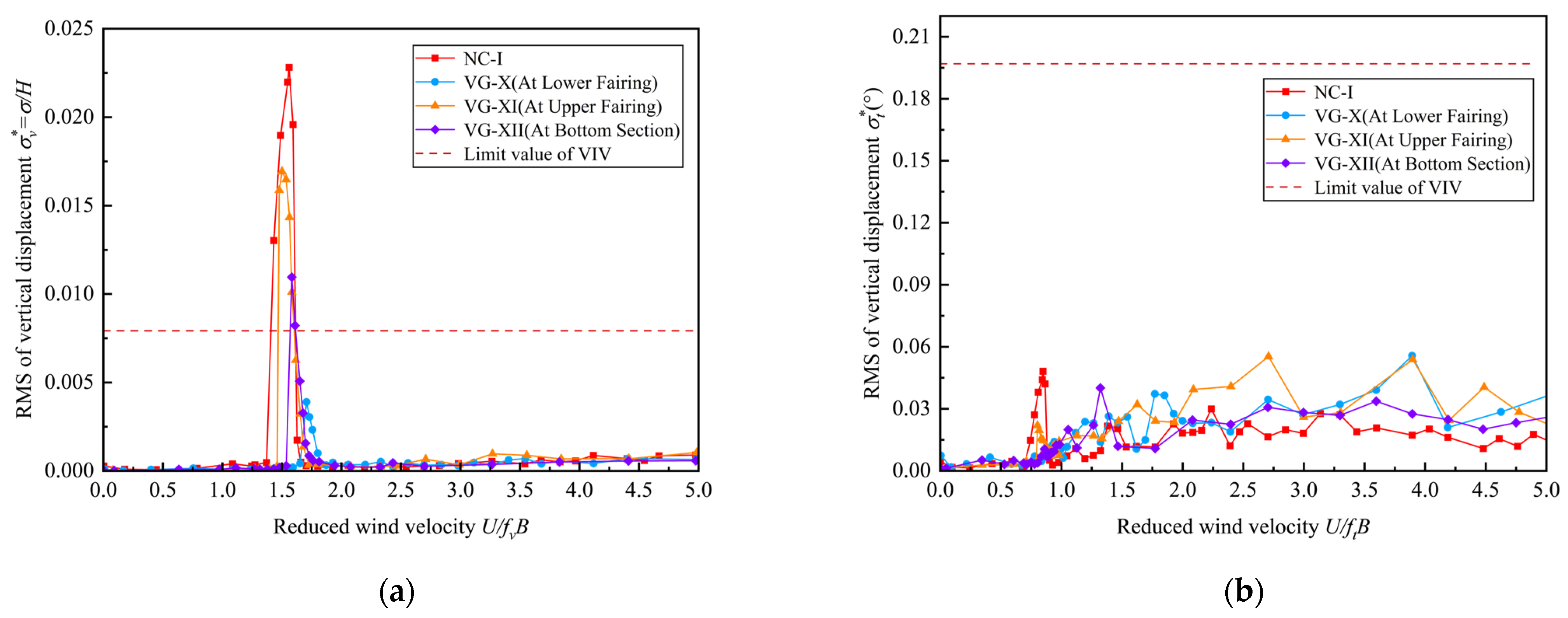
Figure 15 shows the RMS of the vertical and torsional responses vs. the reduced wind velocity of the main girder after combining deflectors with VGs at different installation positions, with a fixed VG spacing of L0 and height of 0.2 H. As shown in Figure 15, the best suppression effectiveness was achieved when the VGs were installed on the lower part of the fairing, with a maximum RMS vertical response σ v of 0.0039. The effectiveness was moderate when the VGs were installed at the bottom of the box chamber, with σ v = 0.0110 , and the poorest effectiveness occurred when the VGs were installed on the upper part of the fairing, with σ v = 0.0169 . Therefore, for the combination of deflectors and VGs, installing the VGs on the lower part of the fairing yields the optimal suppression effectiveness.
Figure 16 presents the RMS of the vertical and torsional responses vs. the reduced wind velocity of the main girder for Case VG-X, i.e., the combination of deflectors with VGs installed on the lower part of the fairing, with a spacing of L0 and a height of 0.2 H. It can be observed from the figure that VIV of the main girder exhibited no observable VIV under wind AOAs of 0°, −3°, and −5°. Only under a wind AOA of +5° did the vertical VIV fail to satisfy the code requirements, with a maximum RMS vertical response σ v of 0.009. Therefore, this aerodynamic scheme can be considered as a preliminary recommended configuration.

4.4.4. Optimization of VGs

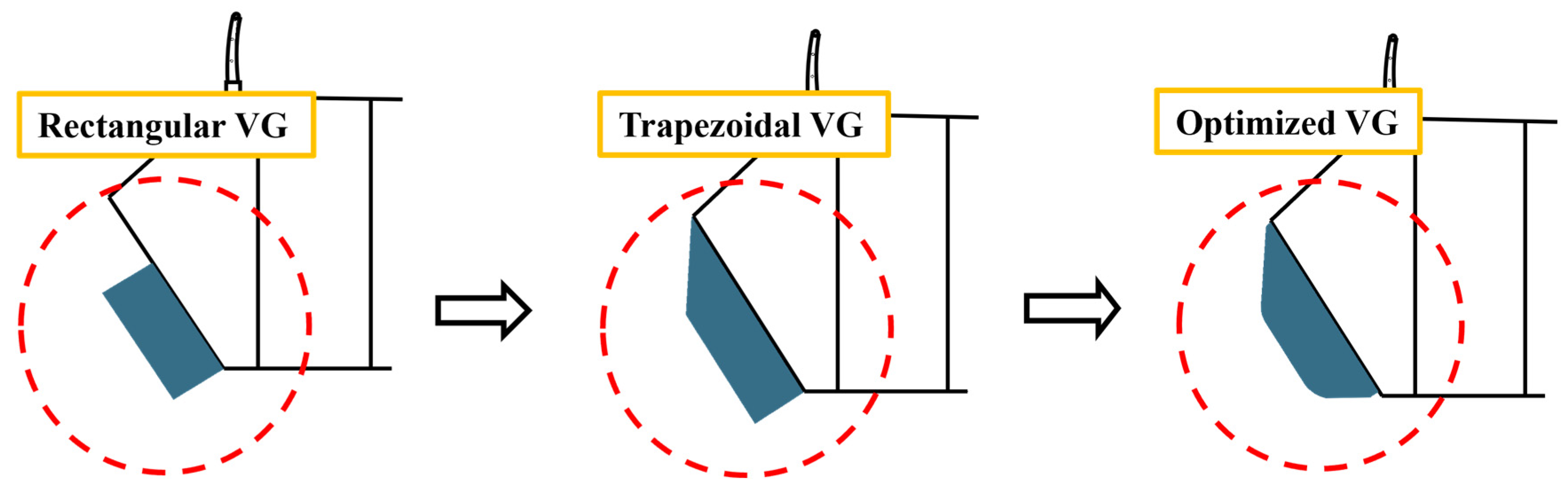
Considering aesthetic factors, the rectangular VGs were further modified to a trapezoidal shape, which enhances the visual harmony between the fairings and the VGs to some extent. In addition, further refinements were attempted based on the trapezoidal VG geometry: the sharp corners of the trapezoidal VGs were rounded, and the bottom of the VGs was flattened to maintain parallelism with the girder bottom, resulting in a smoother and more coordinated appearance, as illustrated in Figure 17.
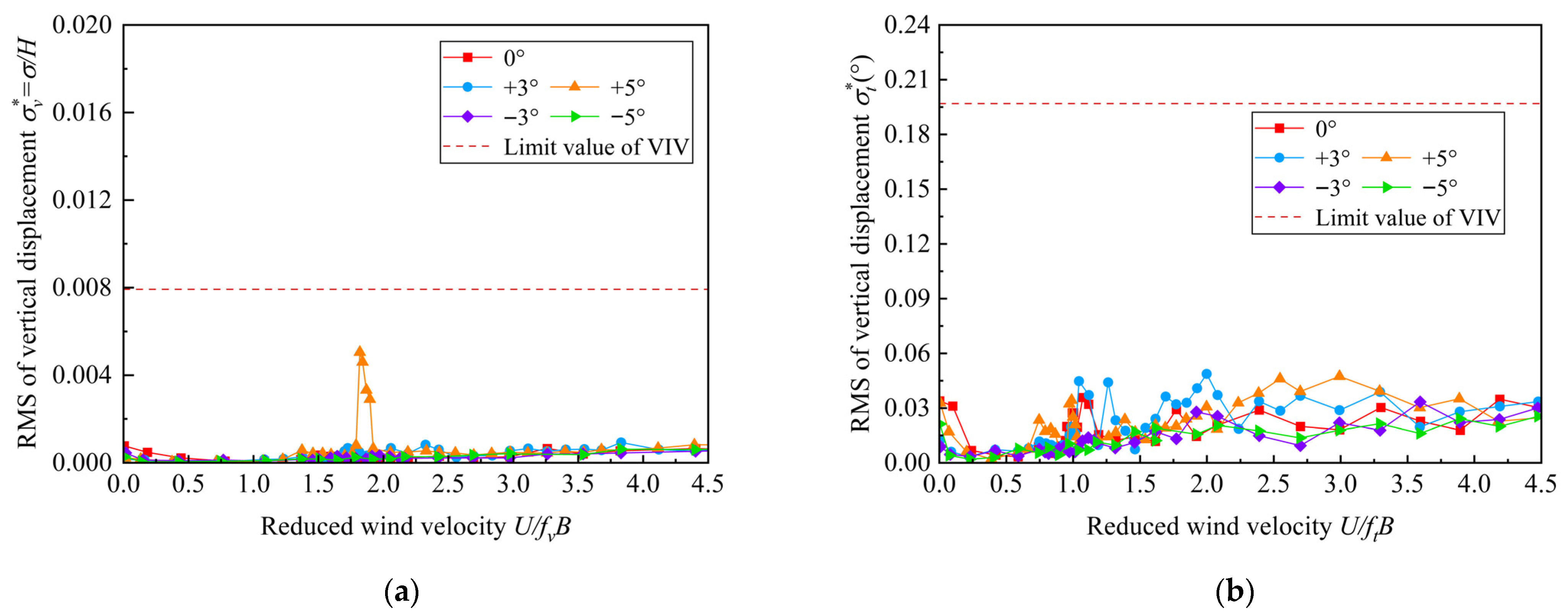
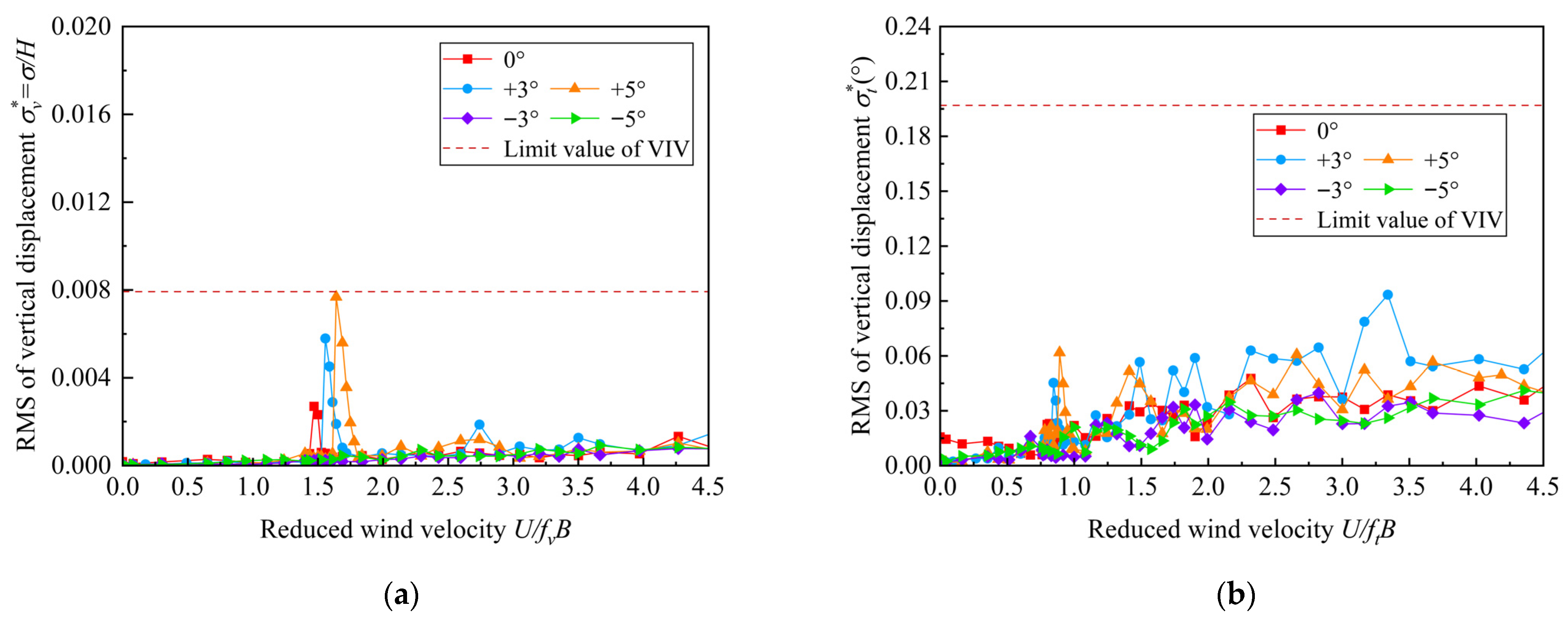
Figure 18 presents the RMS of the vertical and torsional responses vs. the reduced wind velocity of the main girder for Case VG-XIII under wind AOAs of 0°, ±3°, and ±5°, respectively. It can be observed from the figure that VIV of the main girder was effectively suppressed, with no observable vibration, under wind AOA of 0°, ±3°, and −5°. Vertical VIV occurred only under a wind AOA of +5°, with a maximum RMS vertical response σ v of 0.005, which satisfies the code requirements. Figure 19 shows the RMS of the vertical and torsional responses vs. the reduced wind velocity of the main girder for the combined measure comprising the optimized VGs (with rounded corners and flattened bottom) and deflectors. It can be seen from the figure that noticeable vertical VIV occurred under wind AOAs of 0°, +3°, and +5°, with maximum RMS vertical responses σ v of 0.0027, 0.0058, and 0.0077, respectively. Although all these values remain within the allowable code limits, the suppression effectiveness is inferior to that of the unmodified trapezoidal VGs. This indicates that the trailing edge of the VGs exerts a critical influence on spanwise control. The in-depth investigations on VG shape optimization are warranted for future studies. In summary, the combined aerodynamic control scheme comprising deflectors and trapezoidal VGs (with a spacing of L0 and a height of 0.2 H) installed on the lower part of the fairing offers both practical and aesthetic advantages. This configuration is therefore recommended as the final aerodynamic control scheme for mitigating VIV responses of the FLYJB.

4.5. Discussion

4.5.1. Comparative Analysis of Different VIV Suppression Measures

To systematically evaluate the effectiveness of different aerodynamic control measures, a comparative analysis of representative configurations is presented here. The comparison is conducted at a wind attack angle of +3°, as the range of −3° to +3° is required by bridge wind-resistant design codes, and +3° represents the most unfavorable attack angle within this conventional range.
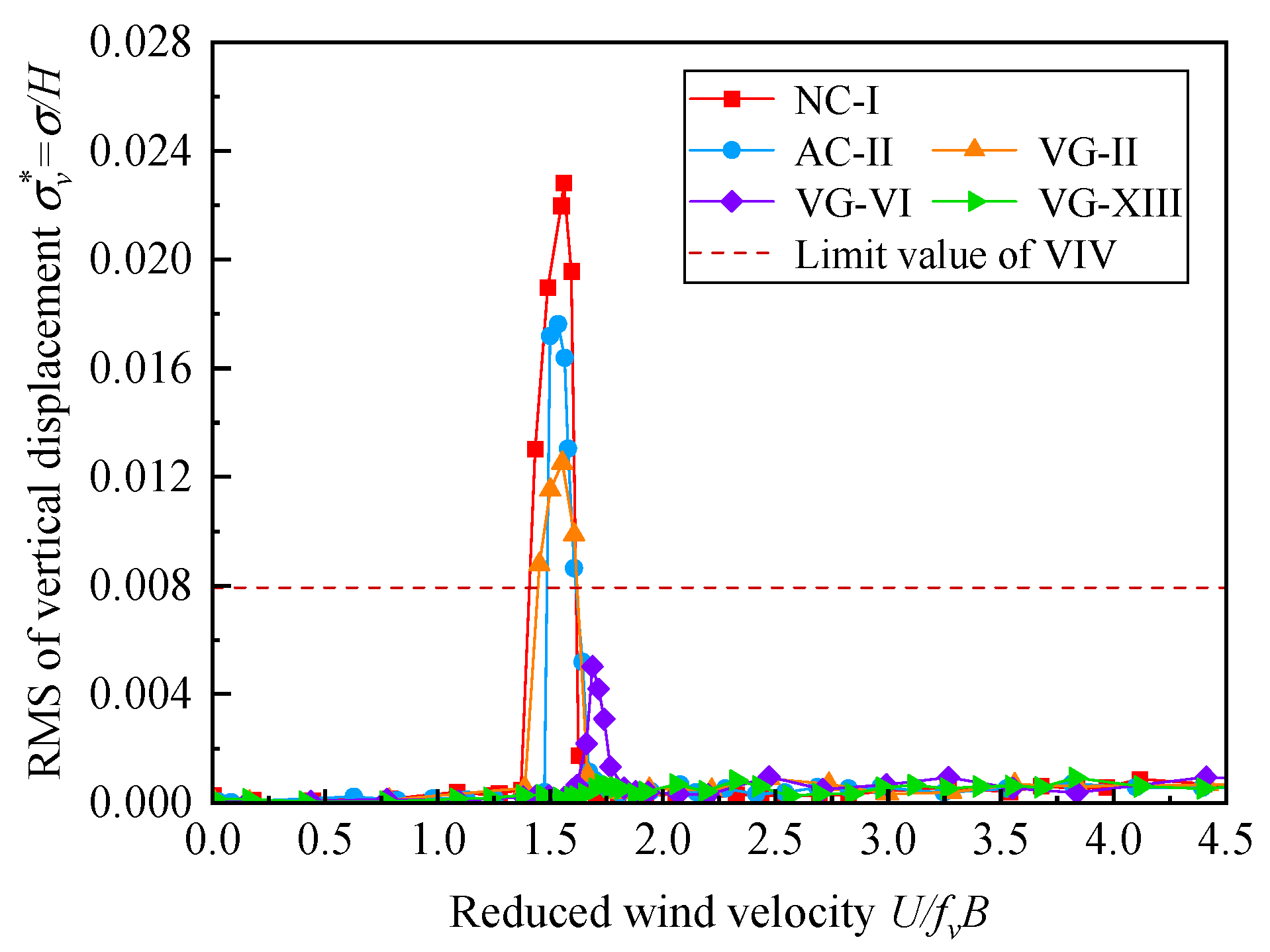
Figure 20 presents the RMS of vertical VIV responses versus wind velocity curves for five representative configurations: the original girder section (NC-I), the inclined deflectors (AC-II), the single VG (VG-II), the dual VG (VG-VI), and the combination of VGs and deflectors (VG-XIII). The code limit of 0.0079 is also indicated for reference. Table 6 summarizes the key quantitative metrics for these configurations.
As shown in Figure 20 and Table 6, a progressive improvement in suppression effectiveness is observed. The original section (NC-I) exhibits significant VIV with a maximum RMS amplitude of 0.0228, substantially exceeding the code limit. The inclined deflectors (AC-II) reduce the amplitude by 22.7% to 0.0176, while the single VG (VG-II) achieves a 45.1% reduction to 0.0125; however, both remain above the code limit. The dual VG (VG-VI) achieve a 78.0% reduction to 0.0050, which falls below the code limit. Most importantly, the combination of VGs and deflectors (VG-XIII) suppresses VIV, with no observable vibration within the tested wind velocity range.
Although the dual VG meets the code requirement, it was deemed less desirable due to aesthetic considerations. Therefore, the combination of VGs and deflectors is recommended as the optimal solution, satisfying both performance requirements and practical constraints.

4.5.2. Comparison with Previous Studies

To further demonstrate the effectiveness of the proposed aerodynamic control measures and to place the present work in the context of existing research, the results obtained in this study are compared with those reported in the literature for similar applications of VGs on bridge girders.
Wang et al. [4] investigated the use of VGs to mitigate unexpected wind-induced vibration of an in-service cable-stayed bridge with a wide Π-shaped girder. In their study, VGs were installed on the lower part of the fairings, and a parametric study was conducted with VG heights ranging from 0.13 H to 0.3 H and spanwise spacings of 2 H and 2.67 H. They reported that VGs with a height of 0.17 H and a spacing of 2 H effectively eliminated the VIV of the bridge, and this aerodynamic measure was subsequently implemented on the actual bridge structure. The optimal VG parameters identified in their study (height approximately 0.17 H, spacing 2 H) are in close agreement with the findings of the present work, where VG heights of 0.15 H–0.2 H and spacings of approximately 2/3 L0 (8.3 m, equivalent to about 2.1 H considering H = 4.0 m) and L0 (12.5 m, equivalent to about 3.1 H) were found to be effective. This consistency validates the reliability of the experimental results and confirms that VGs are an effective aerodynamic measure for suppressing VIV on Π-shaped girders.
Xin et al. [28] conducted an experimental study on mitigating VIV of a bridge with a box girder section using passive VGs. The VGs were installed at the bottom of the box girder, with heights ranging from 0.1 H to 0.25 H and spanwise spacings from 1 H to 3 H. Their results showed that VGs could effectively suppress VIV of the box girder. However, it should be noted that the present study focuses on a narrow Π-shaped girder, which has distinct aerodynamic characteristics compared to box girders. The different cross-sectional geometry leads to different flow patterns around the girder, and consequently, the optimal VG configuration and installation position may differ. While Xin et al. [28] demonstrated the effectiveness of VGs on box girders, the present study extends this knowledge to narrow Π-shaped girders, which have received less attention in the literature.
Compared with these previous studies, the present work makes several contributions. First, while Wang et al. [4] focused on wide Π-shaped girders, this study addresses narrow Π-shaped girders, demonstrating that VGs are equally effective for this cross-sectional type. Second, in addition to single and dual VG configurations, this study systematically investigated the combination of VGs and deflectors, revealing a synergistic effect that achieves effective VIV suppression below code limits. This combined approach has not been previously reported for Π-shaped girders. Third, unlike most previous studies that focused solely on aerodynamic performance, the optimization process in this study also considered practical engineering constraints such as aesthetic requirements. The final recommended configuration—trapezoidal VGs combined with deflectors—not only achieves superior VIV suppression but also satisfies these real-world considerations, demonstrating the functionality and applicability of the proposed solution.
The comparison with previous studies confirms that the optimal VG parameters identified in this work are consistent with the literature, while the novel combination of VGs with deflectors offers an innovative and effective solution for VIV mitigation on narrow Π-shaped girders.

4.5.3. CFD Analysis and Reynolds Number Considerations

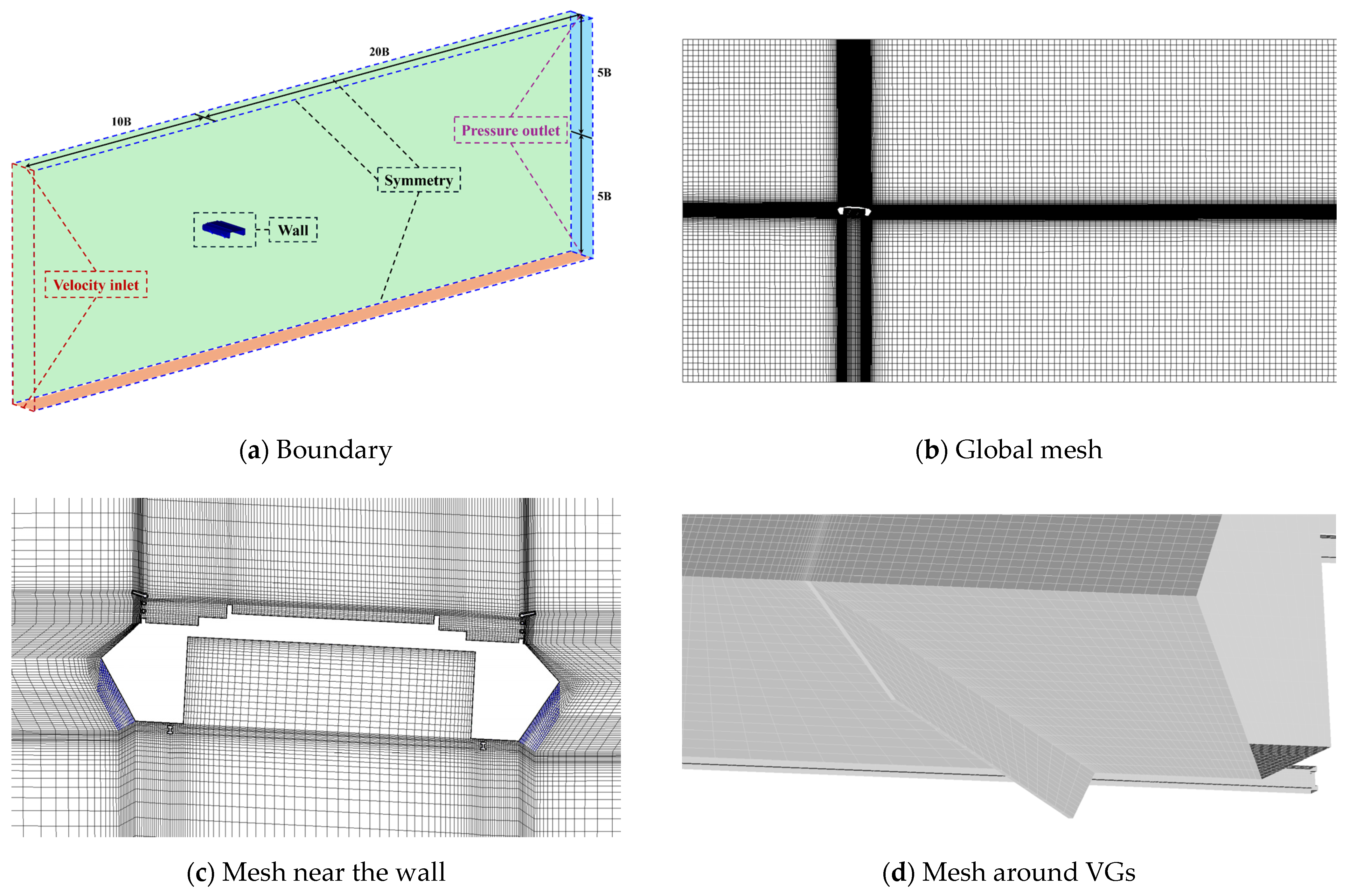
To explore the mechanism by which VGs suppress VIV of the main girder, a simplified CFD simulation was performed for the original section and the recommended aerodynamic measure under a wind attack angle of +3°. Fine boundary layer meshes were constructed near the wall to ensure convergence, using hexahedral elements. For the original section, the height of the first layer of mesh was set between 0.05 and 0.06 mm depending on the structural component, with 15 boundary layers and a growth rate of 1.05. In the spanwise direction, a total of 210 cells were used. The mesh count for the original section was 7.6 million. For the section equipped with VGs, the same mesh strategy—including the first layer height, boundary layer settings, and spanwise resolution—was applied to discretize the VG geometry, resulting in a total mesh count of 12.4 million. In this study, the large eddy simulation (LES) model was adopted, with a velocity inlet at the upstream boundary and a pressure outlet at the downstream boundary. To maintain consistency with the wind tunnel tests, the incoming flow was set to uniform with a velocity of 13.12 m/s and a turbulence intensity of 0.5%. The SIMPLEC second-order implicit algorithm was used for the spatial discretization of pressure and momentum, respectively, and the convergence residual was set to 10−6. The time step was set to 0.001 s. The computational domain and mesh configuration for the CFD simulations are shown in Figure 21.
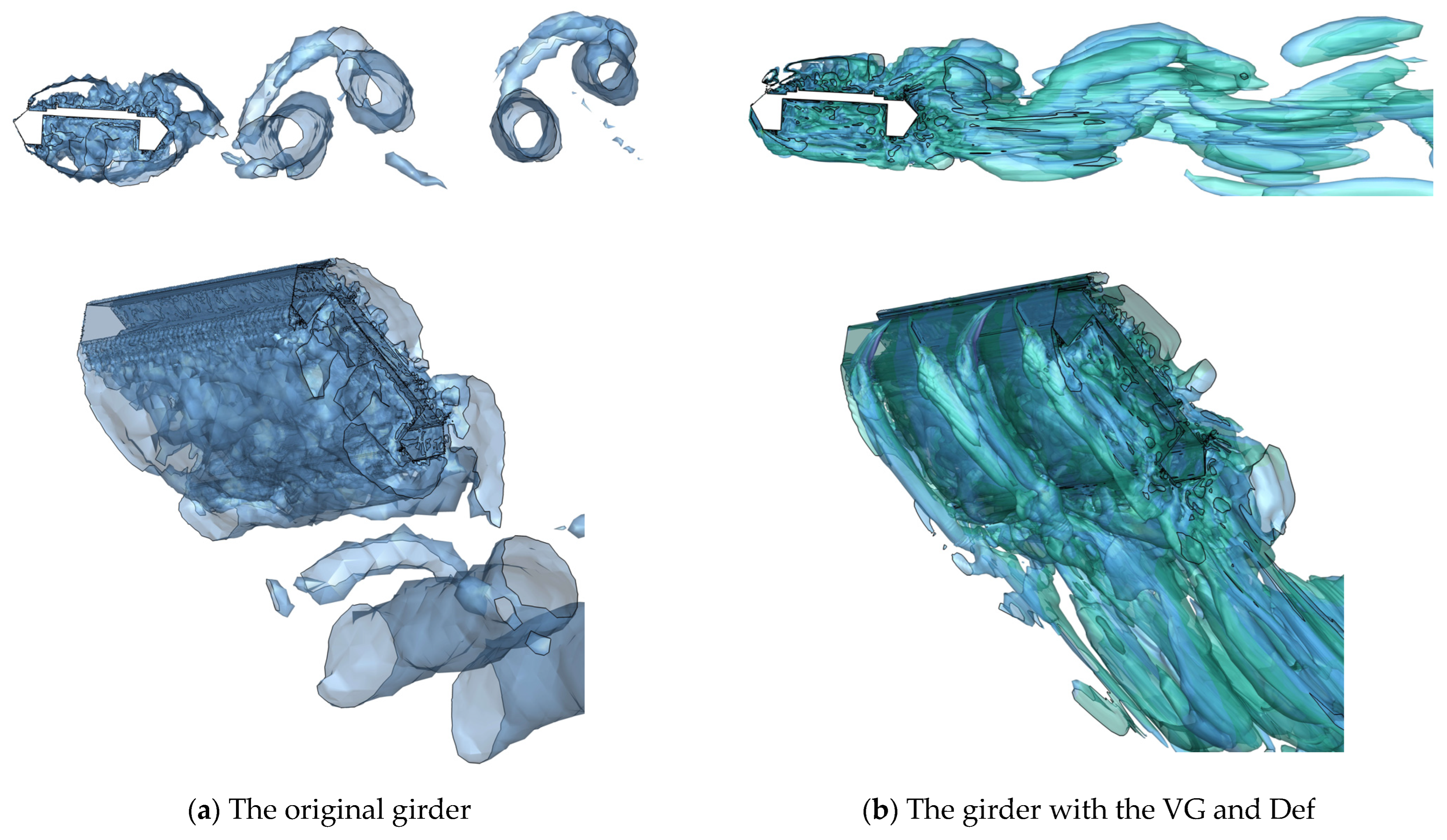
In this study, the Q-criterion was used to identify the vortex structures. Q is defined as Q = 1 2 Ω 2 S 2 , where S and Ω are the strain rate and vorticity tensors, respectively. Positive Q values indicate regions where rotation dominates deformation, corresponding to coherent vortices. As shown in Figure 22, large-scale vortex structures were observed around both the original girder and the girder with the recommended VG configuration, particularly above, below, and in the wake of the girder. However, a distinct difference is that for the original section, the wake exhibits significant alternating vortex shedding, which is synchronized and orderly along the spanwise direction. This spanwise coherence leads to periodic unsteady forces that excite VIV, explaining the occurrence of pronounced VIV at a wind attack angle of +3°. In contrast, for the recommended configuration with VGs, the wake vortices are disrupted by the VGs, showing pronounced spanwise incoherence. This disruption arises because VGs generate streamwise vortices that introduce three-dimensional perturbations into the flow, effectively breaking the spanwise correlation of vortex shedding. As a result, the integrated unsteady forces acting on the girder are significantly reduced, thereby enhancing the three-dimensional instability of the wake and effectively suppressing VIV.
It is well recognized that complete Reynolds number similarity cannot be achieved in scale model tests. However, as discussed in Section 3.1, the Π-shaped girder features sharp-edged geometry that fixes the flow separation points, making the aerodynamic behavior relatively insensitive to Reynolds number variations within the subcritical to supercritical range. The consistency of the present CFD results with the wind tunnel observations further supports that the influence of Reynolds number on the main aerodynamic phenomena is limited. Therefore, the suppression mechanisms identified from the 1:50 scale model are considered representative of the full-scale bridge behavior.
The CFD results further strengthen the interpretation of the experimental observations. The spanwise incoherence revealed by the Q-criterion directly explains the substantial reduction in vibration amplitudes and the narrowing of the lock-in region observed in the wind tunnel tests. This consistency confirms that the disruption of spanwise vortex coherence is the dominant mechanism by which vortex generators suppress VIV on narrow Π-shaped girders.

5. Conclusions

The VIV responses characteristics, aerodynamic control measures, namely conventional aerodynamic control measures and spanwise aerodynamic control measures, of the narrow Π-shaped girder section of FLYJB were investigated by wind tunnel tests. The main conclusions are as follows:
(1) VIV susceptibility of narrow Π-shaped girders. The original Π-shaped girder section exhibited poor VIV performance, with VIV observed under wind AOAs of 0°, ±3°, and ±5°. The maximum RMS vertical displacement at 0° wind AOA was 0.025 m, approximately 3.15 times the code limit value. This confirms that narrow Π-shaped girders, due to their bluff-body characteristics, are inherently susceptible to VIV and require effective aerodynamic countermeasures.
(2) Limitations of conventional aerodynamic measures. Conventional aerodynamic control measures—including vertical stabilizers, a deflector with a 15° inclination angle and width of 0.5 m, modifications to the fairing profile, combination of deflector with horizontal splitter plate, and relocation of the inspection rail—showed limited effectiveness in suppressing VIV. Among these, the deflector measure and the replacement with 2.5 m fairings were relatively effective, reducing the maximum RMS vertical displacement to 0.772 and 0.683 times that of the original section, respectively. These results indicate that single conventional measures are insufficient for complete VIV suppression on narrow Π-shaped girders, motivating the need for more advanced control strategies.
(3) Synergistic effect of VGs combined with deflectors. The combined aerodynamic control scheme comprising deflectors and trapezoidal VGs (with spacing of L0 and height of 0.2 H) installed on the lower part of the fairing was identified as the optimal configuration. With this measure, VIV of the main girder was effectively suppressed, with no observable vibration under wind AOAs of 0°, ±3°, and −5°. Vertical VIV occurred only under wind AOA of +5°, with a maximum RMS vertical response of 0.005, which satisfies the code requirements. This finding demonstrates that the combination of VGs and deflectors produces a synergistic effect that achieves VIV suppression below code limits, which cannot be attained by either measure alone.
(4) Scientific contributions and design implications. The main contributions of this study are: (a) a comprehensive parametric investigation of VG configurations (height, spacing, installation position) specifically for narrow Π-shaped railway girders, which have received limited attention in the literature; (b) the discovery of a synergistic effect when combining VGs with deflectors, achieving VIV suppression below the measurable threshold; and (c) the incorporation of practical engineering constraints (aesthetic requirements, inspection vehicle clearance) into the optimization process. The optimal parameters identified (VG height 0.15 H–0.2 H, spacing ~2 H–3 H, installation on fairings) provide general design guidance for similar bridge projects.
(5) Recommendations for future research. Based on the findings and limitations of this study, the following directions are recommended for future research: (a) flow field measurements (e.g., PIV) or CFD simulations to directly visualize the flow modifications induced by VGs and validate the inferred mechanisms; (b) investigation of VG performance under turbulent flow conditions to assess robustness in real-world wind environments; (c) exploration of the combination of VGs and deflectors on other bridge girder types; and (d) systematic uncertainty and repeatability analysis—including quantification of measurement variability (e.g., coefficient of variation), error propagation from instrument calibration and data acquisition, and assessment of test-to-test repeatability—to further validate the robustness and reliability of the experimental findings.
(6) Applicability and limitations. The findings of this study are directly applicable to narrow Π-shaped railway girders with similar geometric characteristics (width-to-height ratio approximately 4.75, sharp-edged fairings, and railway-specific ancillary components). For other girder types—such as box girders, wide Π-shaped sections, or highway bridges—the optimal VG parameters and suppression effectiveness should be validated through dedicated wind tunnel tests or numerical simulations, as the aerodynamic characteristics may differ significantly.

Author Contributions

Conceptualization, Z.L.; methodology, J.L.; software, J.L.; validation, Z.L., J.L. and M.L.; formal analysis, J.L.; investigation, J.L. and M.L.; resources, Z.X., B.L. and Z.L.; data curation, J.L.; writing—original draft preparation, J.L., B.L. and M.L.; writing—review and editing, Z.X. and Z.L.; visualization, J.L. and Z.X.; supervision, Z.X. and Z.L.; project administration, Z.X., B.L. and Z.L.; funding acquisition, B.L., M.L. and Z.L. All authors have read and agreed to the published version of the manuscript.

Funding

National Natural Science Foundation of China, No. 52178475.

Data Availability Statement

All data analyzed in this study have been included in this paper.

Conflicts of Interest

Authors Zhengchun Xia, Bing Li, and Ming Liu were employed by the company China Railway Siyuan Survey and Design Group Co., Ltd., Wuhan, Hubei, China. The remaining authors declare that the research was conducted in the absence of any commercial or financial relationships that could be construed as a potential conflict of interest.

References

  1. Zhang, Y. Study on the Model of Vortex Force on Π—Shaped Section Based on the Characteristics of Vortex Force. Master’s Thesis, Chang’an University, Xi’an, China, 2020. (In Chinese) [Google Scholar] [CrossRef]
  2. Zasso, A.; Argentini, T.; Omarini, S.; Rocchi, D.; Øiseth, O. Peculiar aerodynamic advantages and problems of twin-box girder decks for long span crossings. Bridge Struct. Assess. Des. Constr. 2019, 15, 111–120. [Google Scholar] [CrossRef]
  3. Chen, C.; Zhai, H.-N.; Liu, H.-S.; Sun, P.-J.; Wang, B.-Q. Analysis of vortex-induced vibration and wind characteristics of Wuhan Yingwuzhou Yantze River Bridge on 26 April 2020. J. Cent. China Norm. Univ. 2025, 59, 947–954. (In Chinese) [Google Scholar] [CrossRef]
  4. Wang, C.; Xu, H.; Huang, Z.; Feng, Z.; Li, Q.; Hua, X.; Chen, Z. Control of unexpected wind-induced vibration of an in-service cable-stayed bridge using vortex generators. J. Wind. Eng. Ind. Aerodyn. 2025, 261, 106079. [Google Scholar] [CrossRef]
  5. Larsen, A.; Wall, A. Shaping of bridge box girders to avoid vortex shedding response. J. Wind. Eng. Ind. Aerodyn. 2012, 104, 159–165. [Google Scholar] [CrossRef]
  6. Fujino, Y. Vibration Mechanisms and Controls of Long-Span Bridges: A Review. Struct. Eng. Int. 2013, 23, 248–268. [Google Scholar] [CrossRef]
  7. Ge, Y.-J.; Zhao, L.; Xu, K. Review and reflection on vortex-induced vibration of main girders of long-span bridges. China J. Highw. Transp. 2019, 32, 1–18. (In Chinese) [Google Scholar] [CrossRef]
  8. Hwang, Y.C.; Kim, S.; Kim, H.-K. Cause investigation of high-mode vortex-induced vibration in a long-span suspension bridge. Struct. Infrastruct. Eng. Maint. Manag. Life-Cycle Des. Perform. 2020, 16, 84–93. [Google Scholar] [CrossRef]
  9. Song, Y.-B.; Ti, Z.-L.; Li, Y.-L. Mechanism and aerodynamic optimization of vortex-induced vibration for a wide Π-shaped bridge deck. J. Vib. Shock. 2023, 42, 121–127. (In Chinese) [Google Scholar] [CrossRef]
  10. Nicese, B.; Marra, A.M.; Bartoli, G.; Mannini, C. VIV mechanisms of a non-streamlined bridge deck equipped with traffic barriers. J. Fluids Struct. 2025, 132, 104195. [Google Scholar] [CrossRef]
  11. Liu, Z.; He, F.; Yan, A.; Liu, Z.; Yin, T.; Chen, Z. Mechanism and Aerodynamic Countermeasures of Vortex-Induced Vibration of a Cable-Stayed Bridge with Narrow Π-Shaped Girder Sections. J. Bridge Eng. 2023, 28, 04023090. [Google Scholar] [CrossRef]
  12. Zhou, Z.-Y.; Fu, K.; Zhang, K.; Jiang, B.-S.; Wan, Y.-Y. Analysis of vortex-induced vibration flow field evolution characteristics for Π-shaped beam based on dynamic mode decomposition. J. Southeast Univ. 2024, 54, 827–835. (In Chinese) [Google Scholar] [CrossRef]
  13. Liu, Q.; Wang, Q.; Sun, Y.; Liu, R.; Gu, H.; Liu, Y.; Ma, J. Investigation on distributed aerodynamic forces of two-box edge girders with various aerodynamic configurations during vortex-induced vibration. Structures 2026, 84, 111105. [Google Scholar] [CrossRef]
  14. Gao, D.; Deng, Z.; Yang, W.; Chen, W. Review of the excitation mechanism and aerodynamic flow control of vortex-induced vibration of the main girder for long-span bridges: A vortex-dynamics approach. J. Fluids Struct. 2021, 105, 103348. [Google Scholar] [CrossRef]
  15. Larsen, A.; Esdahl, S.; Andersen, J.E.; Vejrum, T. Storebaelt suspension bridge-vortex shedding excitation and mitigation by guide vanes. J. Wind. Eng. Ind. Aerodyn. 2000, 88, 283–296. [Google Scholar] [CrossRef]
  16. Bai, H.; Ji, N.; Xu, G.; Li, J. An alternative aerodynamic mitigation measure for improving bridge flutter and vortex induced vibration (VIV) stability: Sealed traffic barrier. J. Wind. Eng. Ind. Aerodyn. 2020, 206, 104302. [Google Scholar] [CrossRef]
  17. Bai, H.; Li, R.; Xu, G.; Kareem, A. Aerodynamic performance of Π-shaped composite deck cable-stayed bridges including VIV mitigation measures. J. Wind. Eng. Ind. Aerodyn. 2021, 208, 04451. [Google Scholar] [CrossRef]
  18. Li, J.; Wu, P.; Hao, J.; Pan, H. Experimental and numerical studies on the two “lock-in” regions characteristic of vertical vortex-induced vibration of Π-shaped composite bridge deck. J. Wind. Eng. Ind. Aerodyn. 2022, 228, 105122. [Google Scholar] [CrossRef]
  19. Huang, L.; Dong, J.-H.; Chen, C.; Wang, Q.; Liao, H.-L. Influence of the fairing combination measure shape on the vortex-induced vibration performance of a cable -stayed bridge with Π-shaped composite girder. China J. Highw. Transp. 2023, 36, 124–134. (In Chinese) [Google Scholar] [CrossRef]
  20. Wang, B. Investigation of the Vortex-Induced Vibration and Vibration Suppression of the Bridge with Typical Bluff Body Configuration. Ph.D. Thesis, Dalian University of Technology, Dalian, China, 2024. (In Chinese) [Google Scholar] [CrossRef]
  21. Li, K.; Sun, Y.; Liu, Q.; Wang, Y.; Wang, Q.; Wang, B. Effects and mechanisms of the main longitudinal beam shape on vortex-induced vibrations of Π-shaped composite girders. Structures 2025, 78, 109345. [Google Scholar] [CrossRef]
  22. Zeng, M.; Liu, H.; Mao, N.; Chen, B.; Han, Y.; Li, C. Study on aerodynamic optimization of Π-shaped cable-stayed bridge with vortex-induced vibration in mountainous areas. J. China Foreign Highw. 2025, 45, 130–136. (In Chinese) [Google Scholar] [CrossRef]
  23. Álvarez, A.-J.; Nieto, F. Vortex induced vibration analysis of a twin-box bridge deck by means of 3D LES simulations. J. Wind. Eng. Ind. Aerodyn. 2025, 258, 106015. [Google Scholar] [CrossRef]
  24. Xiao, H.; Liu, Z.; Chen, Z.; Li, F.; Unglaub, J.; Thiele, K.; He, F.; Xin, Y. Numerical and experimental study on active aerodynamic deflectors for vortex-induced vibration suppression of a narrow Π-shaped girder section. Eng. Struct. 2025, 341, 120843. [Google Scholar] [CrossRef]
  25. Tao, S. Wind-Induced Vibration Control of Long-Span Bridges Based on Vortex Generators. Ph.D. Thesis, Harbin Institute of Technology, Harbin, China, 2017. (In Chinese) [Google Scholar] [CrossRef]
  26. Wu, Y.; Zhao, C.; Zhang, L.; Zhu, Y. Application of vortex generator to wind turbine blade. Tianjin Sci. Technol. 2018, 45, 80–83. (In Chinese) [Google Scholar] [CrossRef]
  27. Zao, J. Research on the Optimization Effect of Vortex Generators on Wind Turbine Airfoils Considering Wind Field Conditions. Master’s Thesis, Shijiazhuang Tiedao University, Shijiazhuang, China, 2025. (In Chinese) [Google Scholar] [CrossRef]
  28. Xin, D.; Zhang, H.; Ou, J. Experimental study on mitigating vortex-induced vibration of a bridge by using passive vortex generators. J. Wind. Eng. Ind. Aerodyn. 2018, 175, 100–110. [Google Scholar] [CrossRef]
  29. Tao, S.; Liu, D.; Tang, A. Experimental research on properties of vortex-induced vibration for cylinders with vortex generators. J. Huazhong Univ. Sci. Technol. 2019, 47, 14–18. (In Chinese) [Google Scholar] [CrossRef]
  30. Zhang, H.; Xin, D.; Ou, J. Wake control using spanwise-varying vortex generators on bridge decks: A computational study. J. Wind. Eng. Ind. Aerodyn. 2019, 184, 185–197. [Google Scholar] [CrossRef]
  31. Q/CR 9162-2023; Code for Wind-Resistant Design of Railway Bridges. China State Railway Group Co., Ltd.: Beijing, China, 2023.
  32. TB 10002-2017; Code for Design on Railway Bridge and Culvert. China Railway Design Corporation: Tianjin, China, 2017.
Figure 1. Elevation layout of FYLJB and typical cross-sections of the main girder: (a) Elevation layout of FYLJB; (b) Typical cross-section of the main span steel girder; (c) Typical cross-section of the side span concrete girder. (Unit: mm).
Applsci 16 03422 g001aApplsci 16 03422 g001b
Figure 2. FEM model of the FLYJB.
Applsci 16 03422 g002
Figure 3. Mode shapes of the main deck for the FLYJB in service stage: (a) 1-S-V of the main deck; (b) 1-A-V of the main deck; (c) 1-S-L of the main deck; (d) 1-A-L of the main deck; (e) 1-S-T of the main deck; (f) 1-A-V of the main deck. A—antisymmetry, S—symmetry, V—vertical mode, L—lateral mode, T—torsional mode, respectively.
Applsci 16 03422 g003
Figure 4. Photograph of the spring-supported sectional model in the wind tunnel.
Applsci 16 03422 g004
Figure 5. Schematic diagram of conventional aerodynamic control measures: (a) vertical stabilizers (AC-I); (b) inclined deflectors (AC-II); (c) modified fairings (AN-III and AC-IV); (d) inclined deflectors and horizontal diversion plates (AC-V and AC-VI).
Applsci 16 03422 g005
Figure 6. Schematic diagram of aerodynamic control using VGs: (a) schematic diagram of VG installation positions and dimensions; (b) schematic diagrams of dual VG configuration and combined installation of VGs with deflectors.
Applsci 16 03422 g006
Figure 7. RMS of VIV responses of the original girder section: (a) vertical VIV response; (b) torsional VIV response.
Applsci 16 03422 g007
Figure 8. Experimental results of the original girder section under wind AOA of +3°: (a) time–history curve of VIV at maximum amplitude; (b) amplitude spectrum of the vertical displacement of the original section.
Applsci 16 03422 g008
Figure 9. RMS of VIV responses of the section with AC-I to AC-VI under +3° wind AOA: (a) vertical VIV response; (b) torsional VIV response.
Applsci 16 03422 g009
Figure 10. Flowchart of wind tunnel tests for aerodynamic control using VGs.
Applsci 16 03422 g010
Figure 11. RMS of VIV responses of the section with NC-I, VG-I and VG-III under wind AOA of +3°: (a) vertical VIV response; (b) torsional VIV response.
Applsci 16 03422 g011
Figure 12. RMS of VIV responses of the section with NC-I, VG-II and VG-IV under wind AOA of +3°: (a) vertical VIV response; (b) torsional VIV response.
Applsci 16 03422 g012
Figure 13. RMS of VIV responses of the section with NC-I, VG-V and VG-VI under wind AOA of +3°: (a) vertical VIV response; (b) torsional VIV response.
Applsci 16 03422 g013
Figure 14. RMS of VIV responses of the section with NC-I, VG-VII To VG-X under wind AOA of +3°: (a) vertical VIV response; (b) torsional VIV response.
Applsci 16 03422 g014
Figure 15. RMS of VIV responses of the section with NC-I, VG-VX To VG-XII under wind AOA of +3°: (a) vertical VIV response; (b) torsional VIV response.
Applsci 16 03422 g015
Figure 16. RMS of VIV responses of the section with VG-X: (a) vertical VIV response; (b) torsional VIV response.
Applsci 16 03422 g016
Figure 17. Design Optimization of VGs.
Applsci 16 03422 g017
Figure 18. RMS of VIV responses of the section with VG-XIII: (a) vertical VIV response; (b) torsional VIV response.
Applsci 16 03422 g018
Figure 19. RMS of VIV responses of the section with VG-XIV: (a) vertical VIV response; (b) torsional VIV response.
Applsci 16 03422 g019
Figure 20. RMS of vertical VIV responses of different aerodynamic control measures under wind AOA of +3°.
Applsci 16 03422 g020
Figure 21. Computational domain and mesh configuration for CFD simulations.
Applsci 16 03422 g021
Figure 22. Instantaneous vortex structures visualized by the Q-criterion.
Applsci 16 03422 g022
Table 1. Material properties used in the finite element model.
ComponentMaterialGradeDensity (kN/m3)Elastic Modulus (MPa)Poisson’s Ratio
Steel girder (mid-span)SteelQ37077.02.06 × 1050.3
Concrete girder (side spans)ConcreteC6026.03.65 × 1040.2
TowersConcreteC5026.43.55 × 1040.2
PiersConcreteC4025.73.40 × 1040.2
Table 2. Parameters for the main girder sectional model tests.
ParameterUnitPrototype ValuesScale RatioSectional Model Values
Designed ValuesMeasured ValuesRelatively Error (%)
Length, Lm86.251:501.7251.7250.0
Width, Bm19.001:500.380.380.0
Height, Hm4.001:500.080.080.0
Mass per unit length, Mkg/m39,4911:50215.79615.7820.09
Mass moment of inertia per unit length, Imkg·m2/m974,2751:5040.15590.15700.71
Vertical frequency, fvHz0.467110:14.6714.7100.83
Torsional frequency, ftHz0.860010:18.6008.4232.06
Vertical damping ratio, ξv%0.381:10.380.36284.5
Torsional damping ratio, ξt%0.381:10.380.39343.5
Table 3. Test cases for conventional aerodynamic control measures of VIV of the main girder.
No.CasesDescription of Aerodynamic Control MeasuresWind AOA (Deg)
1NC-INo control0, ±3, ±5
2AC-ITwo vertical stabilizers+3
3AC-IIInclined deflectors+3
4AC-III2.0 m width fairings+3
5AC-IV2.5 m width fairings+3
6AC-VInclined deflectors and 1.5 m width horizontal diversion plates+3
7AC-VIInclined deflectors and 2.0 m width horizontal diversion plates+3
Table 4. Test cases for VIV control of main girder using VGs.
No.CasesDescriptionParameters of VGsWind AOA (Deg)
Spacing (S)Height (h)PositionShape
1VG-ISingle VGL00.2 HLowerREC+3
2VG-IISingle VGL00.2 HUpperREC+3
3VG-IIISingle VG2/3 L00.2 HLowerREC+3
4VG-IVSingle VG2/3 L00.2 HUpperREC+3
5VG-VDual VG2/3 L00.15 HLower and UpperREC+3
6VG-VIDual VG2/3 L00.2 HLower and UpperREC+3
7VG-VIIVG and Def2/3 L00.2 HLowerREC+3
8VG-VIIIVG and DefL00.1 HLowerREC+3
9VG-IXVG and DefL00.15 HLowerREC+3
10VG-XVG and DefL00.2 HLowerREC0, ±3, ±5
11VG-XIVG and DefL00.2 HUpperREC+3
12VG-XIIVG and DefL00.2 HBottomREC+3
13VG-XIIIVG and DefL00.2 HLowerTRA0, ±3, ±5
14VG-XIVVG and DefL00.2 HLowerOPT0, ±3, ±5
Note: VG denotes vortex generator; Def denotes deflector. L0 is the standard segment length of the steel girder; H is the height of the main girder; Upper refers to installation on the upper part of the fairing; Lower refers to installation on the lower part of the fairing; Bottom refers to installation at the bottom of the section. REC is rectangle; TRA is trapezoid; OPT is optimized.
Table 5. Detailed dimensions of VGs.
Spacing (S)ShapeDetailed Dimensions
lalblcldlelvlwh
L0REC44501800805022252225254625460.1 H, 0.15 H and 0.2 H
TRA2250290080502225222541022546
2/3 L0REC2366180059661183118325462546
Note: REC is rectangle; TRA is trapezoid.
Table 6. Quantitative comparison of VIV suppression effectiveness under wind AOA of +3°.
ConfigurationDescriptionMAX RMS AmplitudeWind Velocity Range (m/s)Reduced Velocity RangeSuppression EfficiencyMeets Code?
NC-IOriginal section0.022812.71–14.711.37–1.66-No
AC-IIInclined deflectors0.017613.31–14.261.50–1.6122.7%No
VG-IISingle VG0.012512.88–14.261.45–1.6145.1%No
VG-VIDual VG0.005014.35–15.691.62–1.7778.0%Yes
VG-XIIIVG and DefNo VIV--100%Yes
Code limit-0.0079----
Disclaimer/Publisher’s Note: The statements, opinions and data contained in all publications are solely those of the individual author(s) and contributor(s) and not of MDPI and/or the editor(s). MDPI and/or the editor(s) disclaim responsibility for any injury to people or property resulting from any ideas, methods, instructions or products referred to in the content.