Analyzing Bias in LLM-Augmented Knowledge Graph Systems: Taxonomy, Interaction Mechanisms, and Evaluation


Abstract
1. Introduction
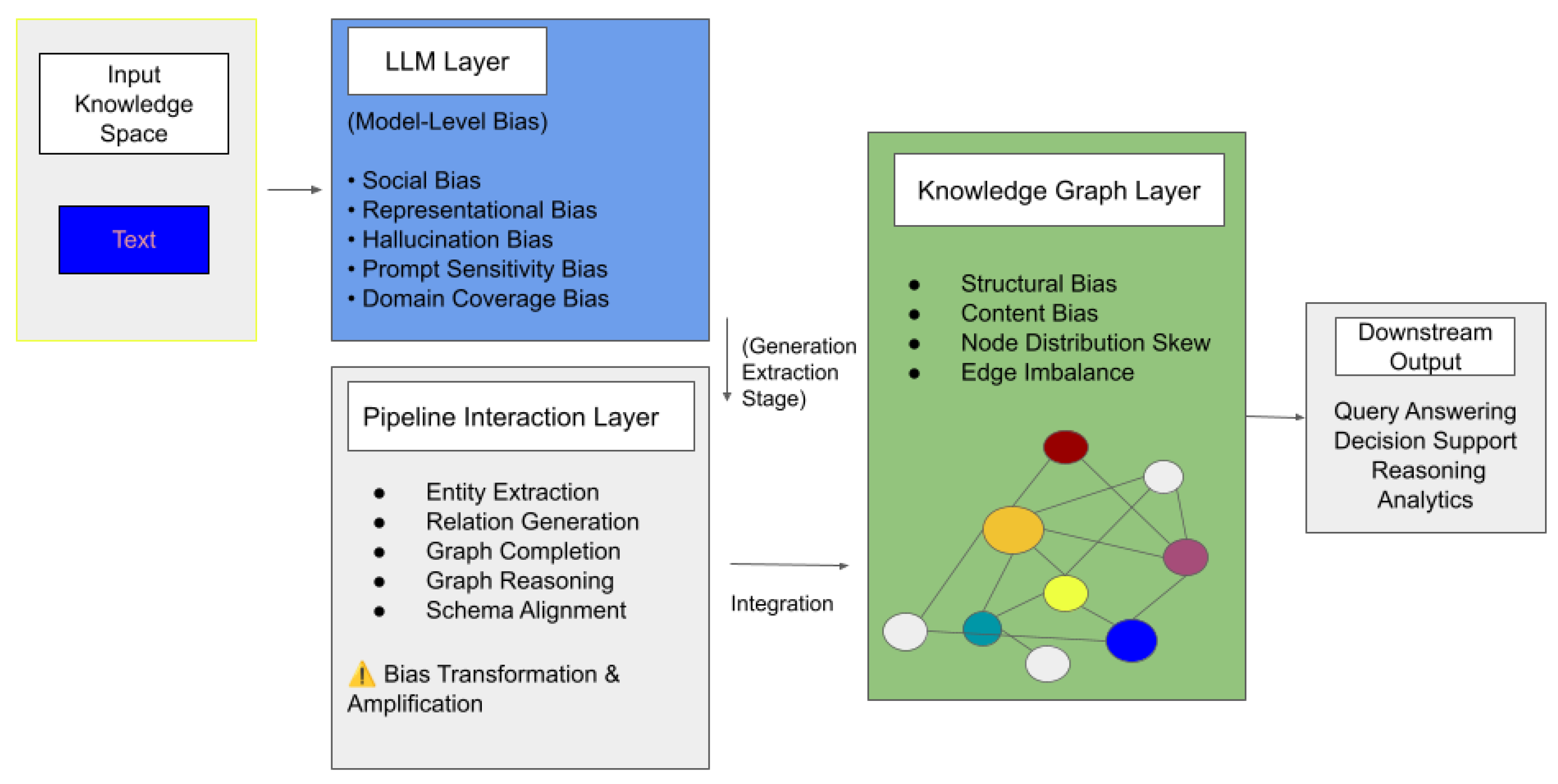
- We introduce a structured taxonomy of bias in LLM-augmented knowledge graph pipelines, distinguishing between model-level phenomena (i.e., social, representational, hallucination, prompt-sensitivity, and domain coverage bias) and graph-level distortions such as (structural and content bias).
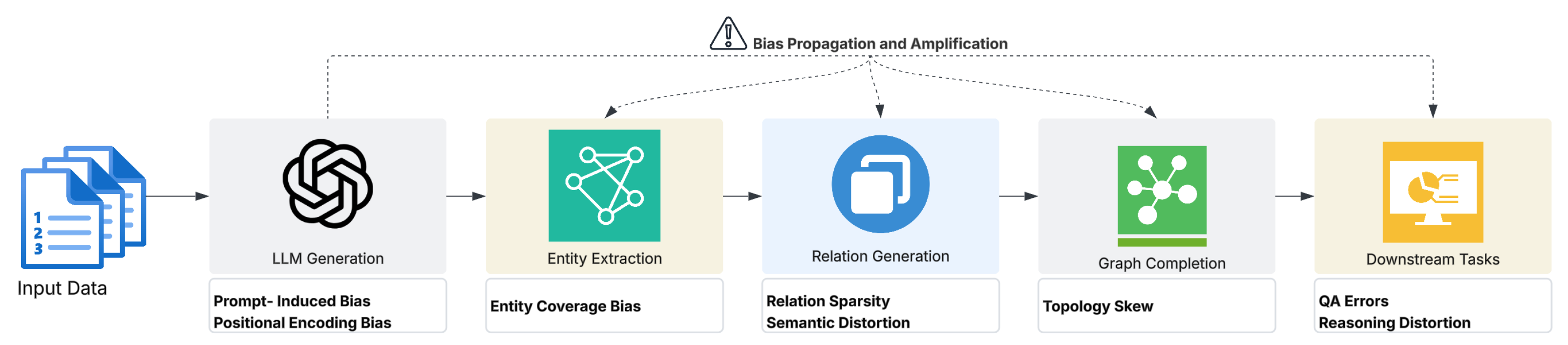
- We provide a unified conceptual framework that links biases across three layers: (i) Large Language Models, (ii) standalone Knowledge Graphs, and (iii) their interaction within LLM-augmented pipelines, clarifying how these biases differ in origin, manifestation, and impact on entity extraction, relation generation, graph completion, and reasoning.
- We conduct a comprehensive comparative analysis of bias types and their implications for knowledge graph construction.
- We consolidate and categorize existing datasets and benchmarks for bias evaluation in LLMs, KGs, and hybrid LLM-KG systems, organizing them across textual, structural, multimodal, and algorithmic settings and highlighting their evaluation focus and suitability for studying different bias dimensions.
2. Background: Bias in Large Language Models and Knowledge Graphs
2.1. Bias in Large Language Models
2.1.1. Social and Representational Bias
2.1.2. Hallucination and Factual Bias in LLMs
2.1.3. Prompt-Sensitivity Bias
2.1.4. Domain Coverage Bias
2.2. Bias in Knowledge Graphs
Structural and Content Bias
2.3. From Standalone Biases to LLM-Augmented Knowledge Graphs
3. Bias in LLM-Knowledge Graph Integration
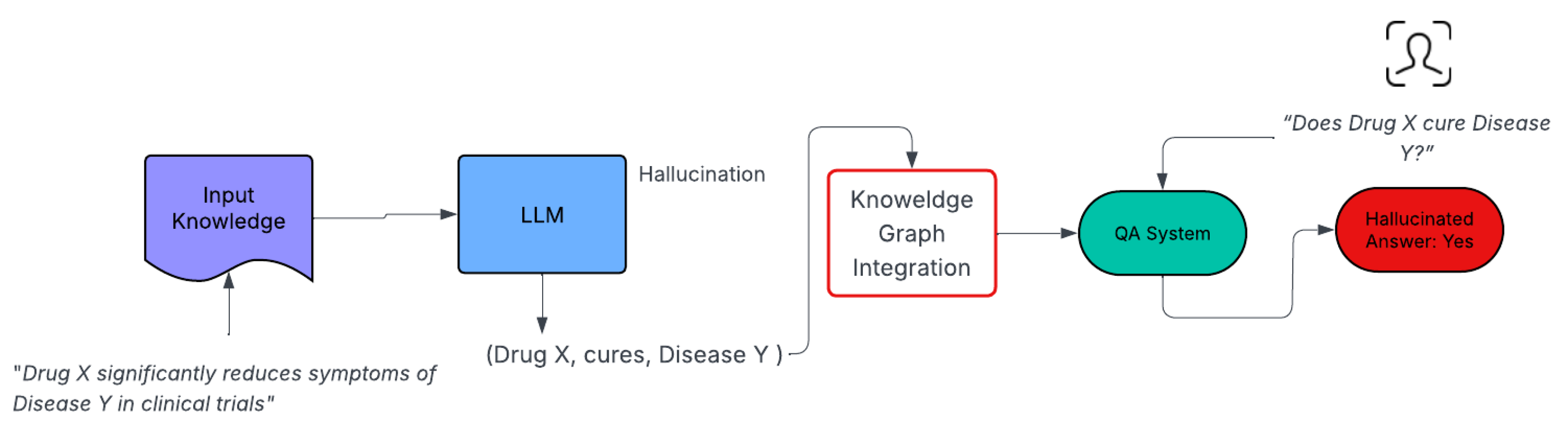
- Unsupported Triple Ratio (UTR): Fraction of generated triples that cannot be verified against source evidence or external knowledge bases.
- Edge Imbalance Ratio (EIR): Measures disproportionate growth of specific relations in the graph caused by hallucinated outputs.where denotes the number of edges of relation r, and denotes the total number of edges in the graph. The superscripts generated and baseline refer to the generated graph and the reference graph, respectively.Interpretation: indicates overrepresentation of relation r (potential hallucination), indicates balanced distribution, and indicates underrepresentation.
3.1. Hallucination and Factual Bias
3.2. Positional Bias
- (Aspirin–treats–inflammation)
- (Naproxen–reduces–inflammation)
3.3. Prompt Variation Bias
Measuring Prompt Variation Bias
- Entity Coverage Variance: Measures the variability in which entities or triples are extracted across different prompts. High variance suggests inconsistent KG representation and potential underrepresentation of critical concepts [32].
- Alignment Stability Score (ASS): Provides a single measure of output stability across prompt variants:Here, is the output set from the i-th prompt variant, is a reference output set, N is the number of prompt variants, and denotes the symmetric difference between sets. Higher ASS values indicate more stable outputs, reflecting reduced prompt variation bias [32]. Example in KG construction: Take two semantically equivalent prompts:
- −
- Prompt A output: {(Aspirin–treats–inflammation), (Ibuprofen–reduces–pain)}
- −
- Prompt B output: {(Aspirin–treats–inflammation), (Naproxen–reduces–inflammation)}
The low overlap results in a lower ASS, indicating that KG extraction is sensitive to prompt formulation. Strategies such as prompt ensembling or multi-prompt aggregation can mitigate this instability.
3.4. Domain Knowledge Bias
3.5. Social Bias
3.6. Practical Guidance for Bias Mitigation in LLM-Augmented KG Pipelines
3.7. Comparative Analysis of Bias Types
4. Literature Review
5. Evaluation Metrics
5.1. Semantic-Level Alignment: G-BERTScore (G-BS)
5.2. Flexible Lexical Matching: G-BLEU and G-ROUGE
5.3. Additional Evaluation Considerations for LLM-Augmented Knowledge Graphs
6. Datasets for Bias Analysis in LLMs and Knowledge Graphs
6.1. Benchmarks for LLM Social Bias
- CrowS-Pairs [54]: This dataset is widely used to measure how much models favor stereotypical over anti-stereotypical statements across nine categories, including race, gender, and religion.
- StereoSet [55]: Similar to CrowS-Pairs, this benchmark uses crowd-sourced sentence pairs to evaluate both intra-sentence and inter-sentence biases.
- BOLD (Bias in Open-Ended Language Generation) [56]: This dataset focuses on measuring fairness when models generate text about different professions, religions, and political ideologies.
- BBQ (Bias Benchmark for QA) [57]: This benchmark targets social biases in question answering tasks. It is particularly useful for measuring how LLMs rely on stereotypes when the provided context is ambiguous, covering eleven social categories such as age, disability status, and sexual orientation.
6.2. Benchmarks for Structural Bias in Knowledge Graphs
- FB15k-237 [58]: Originally a subset of Freebase, this is a standard benchmark used to evaluate how well models can predict missing links without relying on simple patterns like inverse relations.
- YAGO [60]: As a large-scale multilingual knowledge base derived from Wikipedia and WordNet, YAGO is often used to study taxonomic bias and the uneven distribution of attributes across different cultural or geographical entities.
- DBpedia [61]: This dataset serves as a major hub for the Linked Open Data cloud. Researchers use it to analyze coverage bias, specifically focusing on how the structured representation of information can be skewed by the crowdsourced nature of its underlying wiki sources.
6.3. Benchmarks for Bias Analysis in LLM-KG Systems
- HaluEval [62]: This is a large-scale collection that includes both generated and human-annotated samples. It is designed to test whether an LLM can recognize its own hallucinations, which is vital when using these models to augment a knowledge graph with new facts.
- MultiHal [63]: This benchmark uses specific knowledge graph paths from Wikidata to verify the factuality of model responses. It is particularly useful for checking if the integration maintains consistency across different languages.
6.4. Benchmarks for Multimodal and Algorithmic Bias
- CelebA [66]: Although it is primarily a facial attributes dataset, CelebA is frequently used in multimodal research to see how models associate physical traits with social or professional labels. For an LLM tasked with generating KG entities from visual data, this benchmark helps identify representational skews that could lead to biased node attributes in the resulting graph.
- COMPAS [67]: This dataset is a foundational benchmark for studying algorithmic fairness and historical data imbalance. While it originated in risk assessment, it is used here to represent the challenges of processing tabular data. It highlights how underlying skews in training data can lead to disparate treatment of different racial or demographic groups, a critical concern when KGs are used for automated decision-making or case retrieval in engineering.
7. Research Gaps and Motivation
8. Discussion and Conclusions
Funding
Institutional Review Board Statement
Informed Consent Statement
Data Availability Statement
Acknowledgments
Conflicts of Interest
References
- Liang, X.; Wang, Z.; Li, M.; Yan, Z. A survey of LLM-augmented knowledge graph construction and application in complex product design. Procedia CIRP 2024, 128, 870–875. [Google Scholar] [CrossRef]
- Ibrahim, N.; Aboulela, S.; Ibrahim, A.; Kashef, R. A survey on augmenting knowledge graphs (KGs) with large language models (LLMs): Models, evaluation metrics, benchmarks, and challenges. Discov. Artif. Intell. 2024, 4, 76. [Google Scholar] [CrossRef]
- Yang, J. Integrated application of llm model and knowledge graph in medical text mining and knowledge extraction. Soc. Med. Health Manag. 2024, 5, 56–62. [Google Scholar]
- Xu, J.; Zhang, H.; Zhang, H.; Lu, J.; Xiao, G. ChatTf: A knowledge graph-enhanced intelligent Q&A system for mitigating factuality hallucinations in traditional folklore. IEEE Access 2024, 12, 162638–162650. [Google Scholar]
- Song, Y.; Sun, P.; Liu, H.; Li, Z.; Song, W.; Xiao, Y.; Zhou, X. Scene-driven multimodal knowledge graph construction for embodied AI. IEEE Trans. Knowl. Data Eng. 2024, 36, 6962–6976. [Google Scholar] [CrossRef]
- Dehal, R.S.; Sharma, M.; Rajabi, E. Knowledge Graphs and Their Reciprocal Relationship with Large Language Models. Mach. Learn. Knowl. Extr. 2025, 7, 38. [Google Scholar] [CrossRef]
- Gallegos, I.O.; Rossi, R.A.; Barrow, J.; Tanjim, M.M.; Kim, S.; Dernoncourt, F.; Yu, T.; Zhang, R.; Ahmed, N.K. Bias and fairness in large language models: A survey. Comput. Linguist. 2024, 50, 1097–1179. [Google Scholar] [CrossRef]
- Sardina, J.; Kelleher, J.D.; O’Sullivan, D. A Survey on Knowledge Graph Structure and Knowledge Graph Embeddings. arXiv 2024, arXiv:2412.10092. [Google Scholar] [CrossRef]
- Qi, W.; Lyu, H.; Luo, J. Representation Bias in Political Sample Simulations with LargeLanguage Models. In Companion Proceedings of the ACM on Web Conference 2025; Association for Computing Machinery: New York, NY, USA, 2025; pp. 1264–1267. [Google Scholar] [CrossRef]
- Lee, M.; Montgomery, J.; Lai, C. The Effect of Group Status on the Variability of Group Representations in LLM-generated Text. SoLaR Poster. 2023. Available online: https://neurips.cc/virtual/2023/78919 (accessed on 10 February 2026).
- Chen, Y.; Raghuram, V.C.; Mattern, J.; Mihalcea, R.; Jin, Z. Causally Testing Gender Bias in LLMs: A Case Study on Occupational Bias. In Proceedings of the Findings of the Association for Computational Linguistics: NAACL 2025, Albuquerque, NM, USA, 29 April–4 May 2025; pp. 4984–5004. [Google Scholar] [CrossRef]
- Huang, L.; Yu, W.; Ma, W.; Zhong, W.; Feng, Z.; Wang, H.; Chen, Q.; Peng, W.; Feng, X.; Qin, B.; et al. A Survey on Hallucination in Large Language Models: Principles, Taxonomy, Challenges, and Open Questions. ACM Trans. Inf. Syst. 2025, 43, 1–55. [Google Scholar] [CrossRef]
- Sahoo, N.R.; Saxena, A.; Maharaj, K.; Ahmad, A.A.; Mishra, A.; Bhattacharyya, P. Addressing Bias and Hallucination in Large Language Models. In Proceedings of the 2024 Joint International Conference on Computational Linguistics, Language Resources and Evaluation (LREC-COLING 2024): Tutorial Summaries, Torino, Italy, 20–25 May 2024; pp. 73–79. [Google Scholar]
- Perez, E.; Kiela, D.; Cho, K. True Few-Shot Learning with Language Models. In Proceedings of the Advances in Neural Information Processing Systems; Curran Associates, Inc.: Red Hook, NY, USA, 2021; Volume 34. [Google Scholar]
- Sclar, M.; Choi, Y.; Tsvetkov, Y.; Suhr, A. Quantifying Language Models’ Sensitivity to Spurious Features in Prompt Design or: How I learned to start worrying about prompt formatting. arXiv 2023, arXiv:2310.11324. [Google Scholar] [CrossRef]
- Raju, R.S.; Jain, S.; Li, B.; Li, J.L.; Thakker, U. Constructing Domain-Specific Evaluation Sets for LLM-as-a-Judge. In Proceedings of the 1st Workshop on Customizable NLP: Progress and Challenges in Customizing NLP for a Domain, Application, Group, or Individual, Miami, FL, USA, 16 November 2024; pp. 167–181. [Google Scholar] [CrossRef]
- Guo, J.; Mohanty, V.; Hao, H.; Gou, L.; Ren, L. Can LLMs Infer Domain Knowledge from Code Exemplars? A Preliminary Study. In Proceedings of the Companion Proceedings of the 29th International Conference on Intelligent User Interfaces; Association for Computing Machinery: New York, NY, USA, 2024; pp. 95–100. [Google Scholar] [CrossRef]
- Bourli, S.; Pitoura, E. Bias in Knowledge Graph Embeddings. In Proceedings of the 2020 IEEE/ACM International Conference on Advances in Social Networks Analysis and Mining (ASONAM), The Hague, The Netherlands, 7–10 December 2020. [Google Scholar] [CrossRef]
- Rossi, A.; Barbosa, D.; Firmani, D.; Matinata, A.; Merialdo, P. Knowledge Graph Embedding for Link Prediction: A Comparative Analysis. ACM Trans. Knowl. Discov. Data 2021, 15, 1–49. [Google Scholar] [CrossRef]
- Gerritse, E.J.; Hasibi, F.; de Vries, A.P. Bias in Conversational Search: The Double-Edged Sword of the Personalized Knowledge Graph. In Proceedings of the 2020 ACM SIGIR International Conference on the Theory of Information Retrieval; Association for Computing Machinery: New York, NY, USA, 2020; pp. 133–136. [Google Scholar] [CrossRef]
- Yu, L.; Tian, F.; Kuang, P.; Zhou, F. Amplifying Commonsense Knowledge via Bi-Directional Relation Integrated Graph-Based Contrastive Pre-Training from Large Language Models. Inf. Process. Manag. 2025, 62, 104068. [Google Scholar] [CrossRef]
- Lin, L.; Wang, L.; Guo, J.; Wong, K.F. Investigating Bias in LLM-Based Bias Detection: Disparities between LLMs and Human Perception. In Proceedings of the 31st International Conference on Computational Linguistics; Rambow, O., Wanner, L., Apidianaki, M., Al-Khalifa, H., Di Eugenio, B., Schockaert, S., Eds.; Association for Computational Linguistics: Abu Dhabi, United Arab Emirates, 2025; pp. 10634–10649. [Google Scholar]
- Jenny, D.F.; Billeter, Y.; Schölkopf, B.; Jin, Z. Exploring the Jungle of Bias: Political Bias Attribution in Language Models via Dependency Analysis. In Proceedings of the Third Workshop on NLP for Positive Impact, Miami, FL, USA, 15 November 2024. [Google Scholar]
- Taubenfeld, A.; Dover, Y.; Reichart, R.; Goldstein, A. Systematic Biases in LLM Simulations of Debates. In Proceedings of the 2024 Conference on Empirical Methods in Natural Language Processing; Association for Computational Linguistics: Stroudsburg, PA, USA, 2024. [Google Scholar] [CrossRef]
- Huang, G.L.; Zaslavsky, A. Contextual Knowledge Graph Approach to Bias-Reduced Decision Support Systems. J. Decis. Syst. 2024, 33, 29–46. [Google Scholar] [CrossRef]
- Fanourakis, N.; Efthymiou, V.; Kotzinos, D.; Christophides, V. Knowledge Graph Embedding Methods for Entity Alignment: Experimental Review. Data Min. Knowl. Discov. 2023, 37, 2070–2137. [Google Scholar] [CrossRef]
- Liu, N.F.; Lin, K.; Hewitt, J.; Paranjape, A.; Bevilacqua, M.; Petroni, F.; Liang, P. Lost in the middle: How language models use long contexts. arXiv 2023, arXiv:2307.03172. [Google Scholar] [CrossRef]
- Brown, T.; Mann, B.; Ryder, N.; Subbiah, M.; Kaplan, J.D.; Dhariwal, P.; Neelakantan, A.; Shyam, P.; Sastry, G.; Askell, A.; et al. Language models are few-shot learners. Adv. Neural Inf. Process. Syst. 2020, 33, 1877–1901. [Google Scholar]
- Zhang, Z.; Yang, F.; Jiang, Z.; Chen, Z.; Zhao, Z.; Ma, C.; Zhao, L.; Liu, Y. Position-aware parameter efficient fine-tuning approach for reducing positional bias in llms. arXiv 2024, arXiv:2404.01430. [Google Scholar]
- Hsieh, C.Y.; Chuang, Y.S.; Li, C.L.; Wang, Z.; Le, L.; Kumar, A.; Glass, J.; Ratner, A.; Lee, C.Y.; Krishna, R.; et al. Found in the middle: Calibrating positional attention bias improves long context utilization. In Proceedings of the Findings of the Association for Computational Linguistics: ACL 2024, Bangkok, Thailand, 11–16 August 2024. [Google Scholar]
- Wu, X.; Wang, Y.; Jegelka, S.; Jadbabaie, A. On the emergence of position bias in transformers. arXiv 2025, arXiv:2502.01951. [Google Scholar] [CrossRef]
- Xu, Z.; Peng, K.; Ding, L.; Tao, D.; Lu, X. Take care of your prompt bias! investigating and mitigating prompt bias in factual knowledge extraction. arXiv 2024, arXiv:2403.09963. [Google Scholar] [CrossRef]
- Zhu, K.; Wang, J.; Zhou, J.; Wang, Z.; Chen, H.; Wang, Y.; Yang, L.; Ye, W.; Zhang, Y.; Gong, N.; et al. Promptrobust: Towards evaluating the robustness of large language models on adversarial prompts. In Proceedings of the 1st ACM workshop on Large AI Systems and Models with Privacy and Safety Analysis, Salt Lake City, UT, USA, 14–18 October 2024; pp. 57–68. [Google Scholar]
- Li, Z.; Peng, B.; He, P.; Yan, X. Evaluating the instruction-following robustness of large language models to prompt injection. In Proceedings of the 2024 Conference on Empirical Methods in Natural Language Processing, Miami, FL, USA, 12–16 November 2024; pp. 557–568. [Google Scholar]
- Birzoim, A. Cross-Domain Applications of LLM-Based Retrieval and Dialogue Systems: A Review of Current Practice. Authorea Prepr. 2025. [Google Scholar] [CrossRef]
- Li, M.; Zhao, Y.; Zhang, W.; Li, S.; Xie, W.; Ng, S.K.; Chua, T.S.; Deng, Y. Knowledge boundary of large language models: A survey. In Proceedings of the 63rd Annual Meeting of the Association for Computational Linguistics (Volume 1: Long Papers); Association for Computational Linguistics: Stroudsburg, PA, USA, 2025; pp. 5131–5157. [Google Scholar]
- Zhang, Y.; Chen, L.; Li, S.; Cao, N.; Shi, Y.; Ding, J.; Qu, Z.; Zhou, P.; Bai, Y. Way to specialist: Closing loop between specialized llm and evolving domain knowledge graph. In Proceedings of the 31st ACM SIGKDD Conference on Knowledge Discovery and Data Mining V. 1; Association for Computing Machinery: New York, NY, USA, 2025; pp. 1996–2007. [Google Scholar]
- Bolukbasi, T.; Chang, K.W.; Zou, J.Y.; Saligrama, V.; Kalai, A.T. Man is to computer programmer as woman is to homemaker? Debiasing word embeddings. Adv. Neural Inf. Process. Syst. 2016, 29, 4349–4357. [Google Scholar]
- Caliskan, A.; Bryson, J.J.; Narayanan, A. Semantics derived automatically from language corpora contain human-like biases. Science 2017, 356, 183–186. [Google Scholar] [CrossRef] [PubMed]
- Weidinger, L.; Mellor, J.; Rauh, M.; Griffin, C.; Uesato, J.; Huang, P.; Cheng, M.; Glaese, M.; Balle, B.; Kasirzadeh, A.; et al. Ethical and social risks of harm from language models. arXiv 2021, arXiv:2112.04359. [Google Scholar] [CrossRef]
- Nie, J.; Hou, X.; Song, W.; Wang, X.; Zhang, X.; Jin, X.; Zhang, S.; Shi, J. Knowledge graph efficient construction: Embedding chain-of-thought into LLMs. In Proceedings of the VLDB 2024 Workshop on Large Language Models and Knowledge Graphs (LLM+KG), Guangzhou, China, 26–30 August 2024; Available online: https://www.vldb.org/workshops/2024/proceedings/LLM+KG/LLM+KG-4.pdf (accessed on 10 February 2026).
- Xu, M.; Liang, G.; Chen, K.; Wang, W.; Zhou, X.; Yang, M.; Zhao, T.; Zhang, M. Memory-augmented query reconstruction for llm-based knowledge graph reasoning. arXiv 2025, arXiv:2503.05193. [Google Scholar]
- Marchesin, S.; Silvello, G.; Alonso, O. Large Language Models and Data Quality for Knowledge Graphs. Inf. Process. Manag. 2025, 62, 104281. [Google Scholar] [CrossRef]
- Zhou, T.; Chen, Y.; Liu, K.; Zhao, J. Cogmg: Collaborative augmentation between large language model and knowledge graph. arXiv 2024, arXiv:2406.17231. [Google Scholar] [CrossRef]
- Chen, X.; Lu, T.; Wang, Z. LLM-Align: Utilizing Large Language Models for Entity Alignment in Knowledge Graphs. arXiv 2024, arXiv:2412.04690. [Google Scholar] [CrossRef]
- Guan, X.; Liu, Y.; Lin, H.; Lu, Y.; He, B.; Han, X.; Sun, L. Mitigating Large Language Model Hallucinations via Autonomous Knowledge Graph-Based Retrofitting. In Proceedings of the AAAI Conference on Artificial Intelligence; AAAI Press: Washington, DC, USA, 2024. [Google Scholar]
- Huang, H.; Chen, C.; Sheng, Z.; Li, Y.; Zhang, W. Can LLMs be Good Graph Judge for Knowledge Graph Construction? arXiv 2024, arXiv:2411.17388. [Google Scholar]
- Zhang, T.; Kishore, V.; Wu, F.; Weinberger, K.Q.; Artzi, Y. BERTScore: Evaluating Text Generation with BERT. arXiv 2019, arXiv:1904.09675. [Google Scholar] [CrossRef]
- Ma, Z.; Nguyen, S.M.; Xu, P. Can LLMs Translate Human Instructions into a Reinforcement Learning Agent’s Internal Emergent Symbolic Representation? arXiv 2025, arXiv:2510.24259. [Google Scholar] [CrossRef]
- Lavrinovics, E.; Biswas, R.; Bjerva, J.; Hose, K. Knowledge Graphs, Large Language Models, and Hallucinations: An NLP Perspective. J. Web Semant. 2025, 85, 100844. [Google Scholar] [CrossRef]
- Pal, A.; Umapathi, L.K.; Sankarasubbu, M. Med-HALT: Medical Domain Hallucination Test for Large Language Models. arXiv 2023, arXiv:2307.15343. [Google Scholar] [CrossRef]
- Mohamed, A.; Parambath, S.; Kaoudi, Z.; Aboulnaga, A. Popularity Agnostic Evaluation of Knowledge Graph Embeddings. Proc. Mach. Learn. Res. 2020, 124, 1059–1068. [Google Scholar]
- Blodgett, S.L.; Barocas, S.; Daumé, H., III; Wallach, H. Language (Technology) is Power: A Critical Survey of “Bias” in NLP. arXiv 2020, arXiv:2005.14050. [Google Scholar] [CrossRef]
- Nangia, N.; Vania, C.; Bhalerao, R.; Bowman, S.R. CrowS-Pairs: A Challenge Dataset for Measuring Social Biases in Masked Language Models. In Proceedings of the 2020 Conference on Empirical Methods in Natural Language Processing, Online, 16–20 November 2020; pp. 1953–1967. [Google Scholar]
- Nadeem, M.; Bethke, A.; Reddy, S. StereoSet: Measuring Stereotypical Bias in Pretrained Language Models. In Proceedings of the 59th Annual Meeting of the Association for Computational Linguistics and the 11th International Joint Conference on Natural Language Processing (Volume 1: Long Papers), Online, 1–6 August 2021; pp. 5356–5371. [Google Scholar] [CrossRef]
- Dhamala, J.; Sun, T.; Kumar, V.; Krishna, S.; Pruksachatkun, Y.; Chang, K.W.; Gupta, R. BOLD: Dataset and Metrics for Measuring Biases in Open-Ended Language Generation. In Proceedings of the 2021 ACM Conference on Fairness, Accountability, and Transparency; Association for Computing Machinery: New York, NY, USA, 2021; pp. 862–872. [Google Scholar] [CrossRef]
- Parrish, A.; Chen, A.; Nangia, N.; Padmakumar, V.; Phang, J.; Thompson, J.; Htut, P.M.; Bowman, S. BBQ: A Hand-Built Bias Benchmark for Question Answering. In Proceedings of the Findings of the Association for Computational Linguistics: ACL 2022, Dublin, Ireland, 22–27 May 2022; pp. 2086–2105. [Google Scholar]
- Keidar, D.; Zhong, M.; Zhang, C.; Shrestha, Y.R.; Paudel, B. Towards Automatic Bias Detection in Knowledge Graphs. arXiv 2021, arXiv:2109.10697. [Google Scholar] [CrossRef]
- Russo, M.; Sawischa, S.F.; Vidal, M.E. Tracing the Impact of Bias in Link Prediction. In Proceedings of the 39th ACM/SIGAPP Symposium on Applied Computing; Association for Computing Machinery: New York, NY, USA, 2024; pp. 1626–1633. [Google Scholar] [CrossRef]
- Suchanek, F.M.; Alam, M.; Bonald, T.; Chen, L.; Paris, P.H.; Soria, J. YAGO 4.5: A Large and Clean Knowledge Base with a Rich Taxonomy. In Proceedings of the 47th International ACM SIGIR Conference on Research and Development in Information Retrieval; Association for Computing Machinery: New York, NY, USA, 2024; pp. 131–140. [Google Scholar] [CrossRef]
- Lehmann, J.; Isele, R.; Jakob, M.; Jentzsch, A.; Kontokostas, D.; Mendes, P.N.; Hellmann, S.; Morsey, M.; van Kleef, P.; Auer, S.; et al. DBpedia – A Large-Scale, Multilingual Knowledge Base Extracted from Wikipedia. Semant. Web 2015, 6, 167–195. [Google Scholar] [CrossRef]
- Li, J.; Cheng, X.; Zhao, W.X.; Nie, J.Y.; Wen, J.R. HaluEval: A Large-Scale Hallucination Evaluation Benchmark for Large Language Models. In Proceedings of the 2023 Conference on Empirical Methods in Natural Language Processing; Association for Computational Linguistics: Stroudsburg, PA, USA, 2023. [Google Scholar] [CrossRef]
- Lavrinovics, E.; Biswas, R.; Hose, K.; Bjerva, J. MultiHal: Multilingual Dataset for Knowledge-Graph Grounded Evaluation of LLM Hallucinations. arXiv 2025, arXiv:2505.14101. [Google Scholar] [CrossRef]
- Chandak, P.; Huang, K.; Zitnik, M. Building a Knowledge Graph to Enable Precision Medicine. Sci. Data 2023, 10, 67. [Google Scholar] [CrossRef]
- Canese, K.; Weis, S. PubMed: The Bibliographic Database. The NCBI Handbook. 2013. Available online: https://www.ehu.eus/biofisica/juanma/mbb/pdf/pubmed_intro.pdf (accessed on 10 February 2026).
- Liu, Z.; Luo, P.; Wang, X.; Tang, X. Deep Learning Face Attributes in the Wild. In Proceedings of the IEEE International Conference on Computer Vision (ICCV), Santiago, Chile, 7–13 December 2015; pp. 3730–3738. [Google Scholar]
- Fabris, A.; Messina, S.; Silvello, G.; Susto, G.A. Algorithmic Fairness Datasets: The Story So Far. Data Min. Knowl. Discov. 2022, 36, 2074–2152. [Google Scholar] [CrossRef]
- Fisher, J.; Mittal, A.; Palfrey, D.; Christodoulopoulos, C. Debiasing Knowledge Graph Embeddings. In Proceedings of the 2020 Conference on Empirical Methods in Natural Language Processing, Online, 16–20 November 2020; pp. 7332–7345. [Google Scholar]
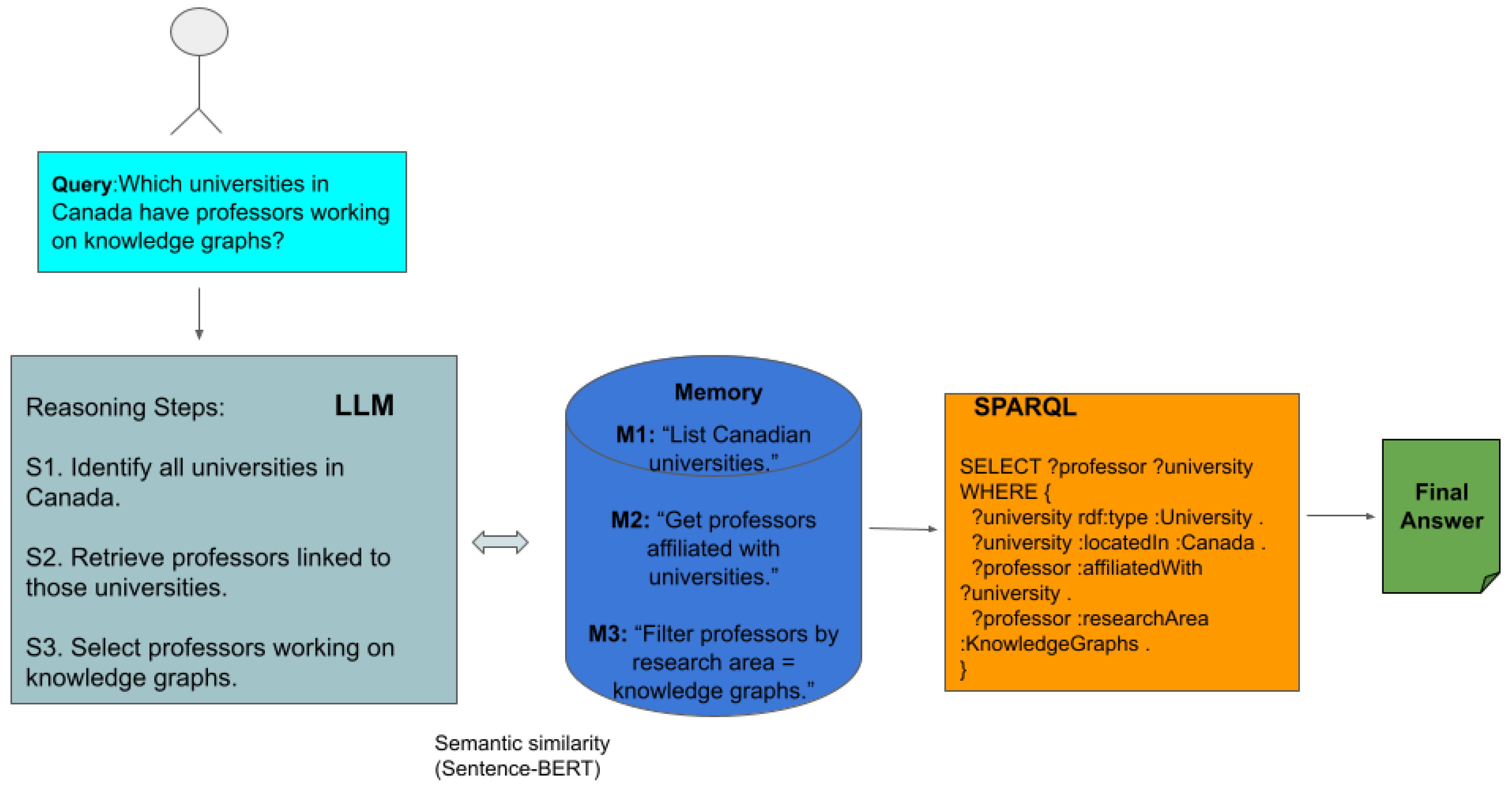

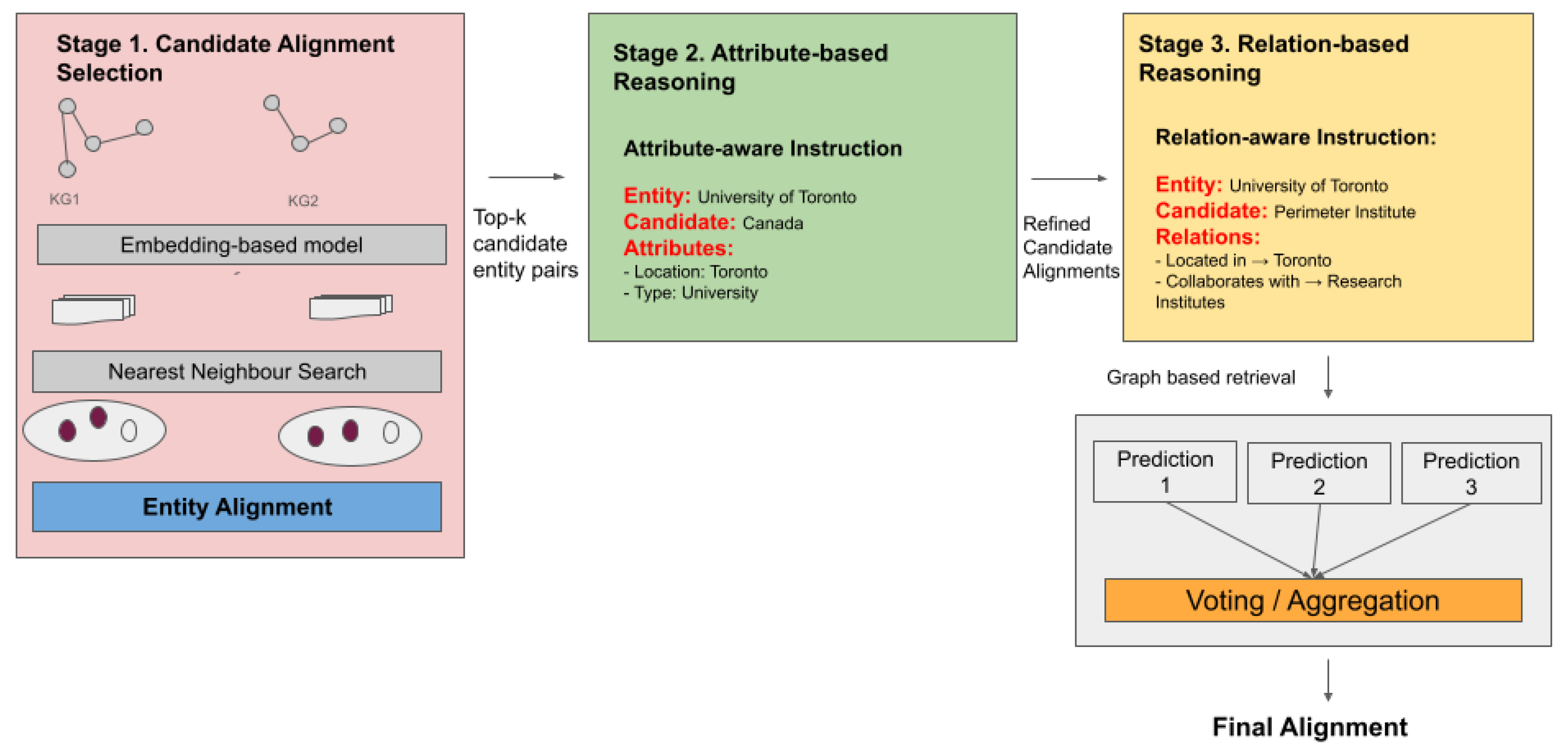

| Survey | Primary Focus | LLM | KG | Pipeline | Evaluation Perspective |
|---|---|---|---|---|---|
| [7] | Fairness and bias in Large Language Models | ✔ | — | — | Focus on linguistic bias detection and mitigation within LLM outputs |
| [8] | Knowledge Graph structure and embedding behaviour | — | ✔ | — | Focus on structural bias in KG topology and link prediction models |
| [2] | LLM–KG integration frameworks and benchmarks | Partial | Partial | Limited | Evaluation of KG construction and augmentation tasks |
| Our Work | Pipeline-level bias propagation in LLM-augmented KG systems | ✔ | ✔ | ✔ | Unified taxonomy and evaluation synthesis addressing linguistic and structural bias interactions |
| Abbreviation | Definition |
|---|---|
| LLM | Large Language Model |
| KG | Knowledge Graph |
| RAG | Retrieval-Augmented Generation |
| CoT | Chain-of-Thought |
| KGQA | Knowledge Graph Question Answering |
| CQ | Competency Question |
| EA | Entity Alignment |
| GAL-KARS | Graph Augmentation with LLMs for Knowledge-Aware Recommender Systems |
| DCR | Domain Coverage Ratio |
| UTR | Unsupported Triple Ratio |
| EIR | Edge Imbalance Ratio |
| ASS | Alignment Stability Score |
| PBS | Position Bias Score |
| PopBS | Popularity Bias Score |
| G-BS | G-BERTScore |
| G-BL | G-BLEU |
| G-RO | G-ROUGE |
| RD | Representation Disparity |
| Bias Type | System | Primary Source | Manifestation | Implications for LLM-KG Pipelines | Observable Signal/Mitigation |
|---|---|---|---|---|---|
| Biases in Large Language Models | |||||
| Social and Representational | LLM | Imbalanced training data and annotation practices | Stereotypical associations, ideological skew, and unequal performance across demographic groups [9,10,11] | Biased entity descriptions, skewed relation generation, and distorted population-level simulations | Demographic performance disparity in generated entities; mitigation via dataset balancing or bias-aware prompting |
| Hallucination and Factual | LLM | Domain gaps, weak grounding, and confidence miscalibration | Fluent but factually incorrect or unverifiable content [12,13] | Injection of false entities or relations that corrupt graph structure and reasoning | Unsupported or unverifiable triples in generated graphs; mitigation via retrieval grounding or fact verification |
| Prompt-sensitivity | LLM | Prompt formulation, formatting, and example ordering | Output instability under semantically equivalent prompts [14,15] | Inconsistent entity extraction, relation phrasing variation, and reduced reproducibility | High output variance across prompt paraphrases; mitigation via prompt standardization or ensemble prompting |
| Domain Coverage | LLM | Uneven representation of domains or languages in training corpora | Asymmetric accuracy across high- and low-resource domains [16,17] | Sparse or unreliable graph augmentation in specialized or technical domains | Domain-specific recall imbalance in extracted entities; mitigation via domain-adaptive fine-tuning or expert validation |
| Biases in Knowledge Graphs | |||||
| Structural | KG | Graph construction, sampling strategies, and data availability | Degree imbalance, popularity bias, and long-tail underrepresentation [18,19] | Completion and retrieval biased toward dense or well-connected subgraphs | Skewed node degree distribution or popularity bias; mitigation via debiased sampling or re-weighted training |
| Content | KG | Source-dependent documentation and ontology design | Coverage gaps and culturally contingent representations [20] | Systematic omission or under-specification of minority entities and attributes | Missing entities or attribute imbalance across groups; mitigation via ontology refinement or curated knowledge sources |
| Biases Emerging in LLM-Augmented Knowledge Graphs | |||||
| Pipeline-level Interaction | LLM-KG | Cross-component bias amplification | Reinforcement of linguistic and structural biases across extraction and completion stages [21] | Persistent, compounded bias that is difficult to detect using standalone evaluation | Bias amplification across pipeline stages; mitigation via cross-stage validation and pipeline auditing |
| Bias Type | Mitigation Strategies | Feasibility/Considerations |
|---|---|---|
| Positional Bias | Prompt ensembling, multi-order input sequences, attention calibration | Low-cost to moderate; requires multiple LLM calls and careful prompt design |
| Prompt Variation Bias | Multi-prompt aggregation, alignment stability monitoring, post-generation validation | Moderate; increases computational cost; may require manual selection of reference outputs |
| Social/Representational Bias | Demographic-aware prompts, human-in-the-loop auditing, diversity-aware KG curation | High cost and data sensitivity; feasible for high-stakes domains (healthcare, policy) |
| Hallucination/Factual Bias | Retrieval-Augmented Generation (RAG), external KG grounding, fact-checking pipelines, human verification | Requires integration with external knowledge sources; higher latency and resource requirements |
| Domain Coverage Bias | Domain-specific fine-tuning, KG grounding, inclusion of specialized corpora | Dependent on availability of high-quality domain data; may require significant preprocessing |
| Structural/Content Bias | Schema constraints, graph validation rules, post-processing for node/edge balance | Generally feasible; can be automated, but may require domain expertise for rule design |
| Bias Type | Pipeline Layer | Metric |
|---|---|---|
| Positional Bias | LLM Layer | Position Bias Score (PBS), selection frequency by input position |
| Prompt Variation Bias | Pipeline Interaction Layer | Alignment Stability Score (ASS), BLEU, ROUGE |
| Social Bias | LLM Layer | Representation Disparity metrics |
| Hallucination/Factual Bias | LLM Layer | Unsupported Triple Ratio (UTR) |
| Domain Coverage Bias | LLM Layer | Domain Coverage Ratio (DCR) |
| Structural Bias | Knowledge Graph Layer | Edge Imbalance Ratio (EIR), Node Distribution Skew (NDS) |
| Content Bias | Knowledge Graph Layer | Semantic similarity deviation, triple uniqueness |
| Dataset | System Type | Primary Bias Type | Evaluation Signal | Domain |
|---|---|---|---|---|
| LLM Bias Benchmarks | ||||
| CrowS-Pairs [54] | LLM | Social/Stereotypical | Stereotype preference score | General |
| StereoSet [55] | LLM | Representational | Bias score (intra-/inter-sentence) | General |
| BOLD [56] | LLM | Demographic/Ideological | Bias in generated text | General |
| BBQ [57] | LLM | Social/Contextual | QA answer distribution bias | General |
| Knowledge Graph Bias Benchmarks and Sources | ||||
| FB15k-237 [58] | KG | Structural/Popularity | Link prediction disparity | General |
| WN18RR [59] | KG | Relational/Hierarchical | Relational consistency | Lexical |
| YAGO [60] | KG | Taxonomic/Coverage | Ontology coverage imbalance | Multilingual |
| DBpedia [61] | KG | Coverage/Representational | Entity frequency imbalance | Multilingual |
| LLM–KG Integrated Benchmarks | ||||
| HaluEval [62] | LLM–KG | Hallucination/Factuality | Response-level factual verification | General |
| MultiHal [63] | LLM–KG | Hallucination/Grounding | KG grounding consistency | Multilingual |
| PrimeKG [64] | LLM–KG | Domain coverage | Biomedical KG completion | Biomedical |
| PubMed corpus [65] | LLM–KG | Domain-specific | Scientific entity and relation extraction | Biomedical |
| Multimodal and Algorithmic Bias Benchmarks | ||||
| CelebA [66] | Multimodal | Representational | Attribute bias across facial features | Vision |
| COMPAS [67] | Tabular | Historical/Demographic | Fairness disparity across groups | Criminal justice |
Disclaimer/Publisher’s Note: The statements, opinions and data contained in all publications are solely those of the individual author(s) and contributor(s) and not of MDPI and/or the editor(s). MDPI and/or the editor(s) disclaim responsibility for any injury to people or property resulting from any ideas, methods, instructions or products referred to in the content. |
© 2026 by the authors. Licensee MDPI, Basel, Switzerland. This article is an open access article distributed under the terms and conditions of the Creative Commons Attribution (CC BY) license.
Share and Cite
Zabihi, P.; Nawara, D.; Ibrahim, A.; Kashef, R. Analyzing Bias in LLM-Augmented Knowledge Graph Systems: Taxonomy, Interaction Mechanisms, and Evaluation. Appl. Sci. 2026, 16, 3410. https://doi.org/10.3390/app16073410
Zabihi P, Nawara D, Ibrahim A, Kashef R. Analyzing Bias in LLM-Augmented Knowledge Graph Systems: Taxonomy, Interaction Mechanisms, and Evaluation. Applied Sciences. 2026; 16(7):3410. https://doi.org/10.3390/app16073410
Chicago/Turabian StyleZabihi, Paria, Dina Nawara, Ahmed Ibrahim, and Rasha Kashef. 2026. "Analyzing Bias in LLM-Augmented Knowledge Graph Systems: Taxonomy, Interaction Mechanisms, and Evaluation" Applied Sciences 16, no. 7: 3410. https://doi.org/10.3390/app16073410
APA StyleZabihi, P., Nawara, D., Ibrahim, A., & Kashef, R. (2026). Analyzing Bias in LLM-Augmented Knowledge Graph Systems: Taxonomy, Interaction Mechanisms, and Evaluation. Applied Sciences, 16(7), 3410. https://doi.org/10.3390/app16073410