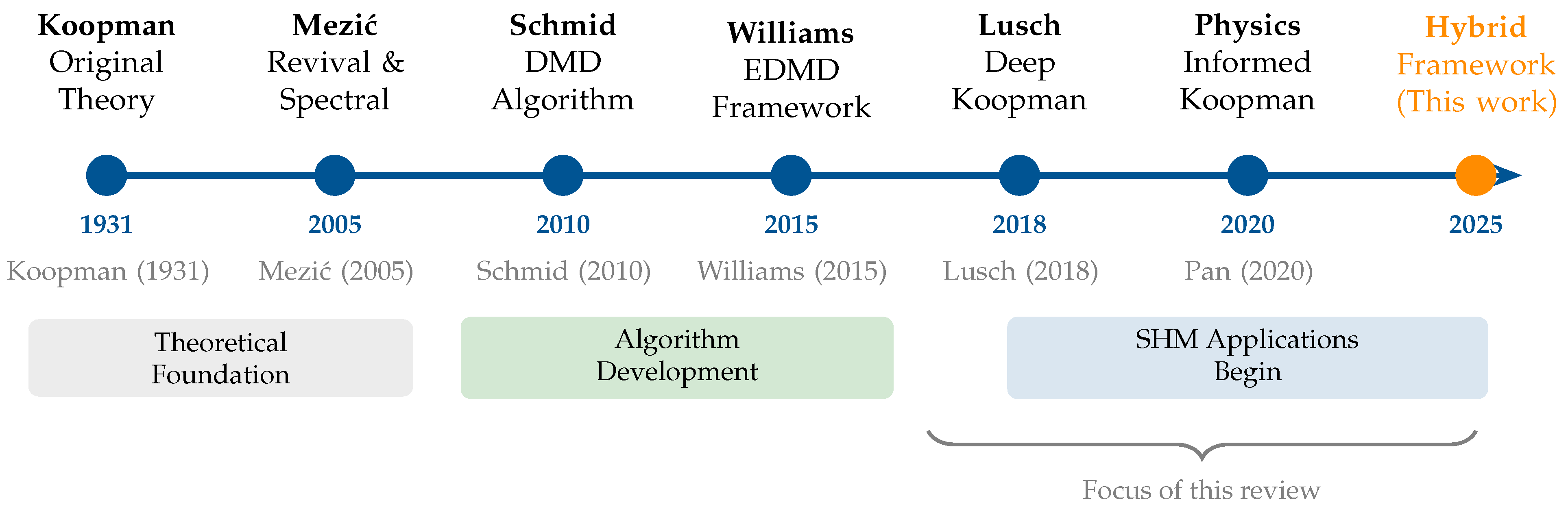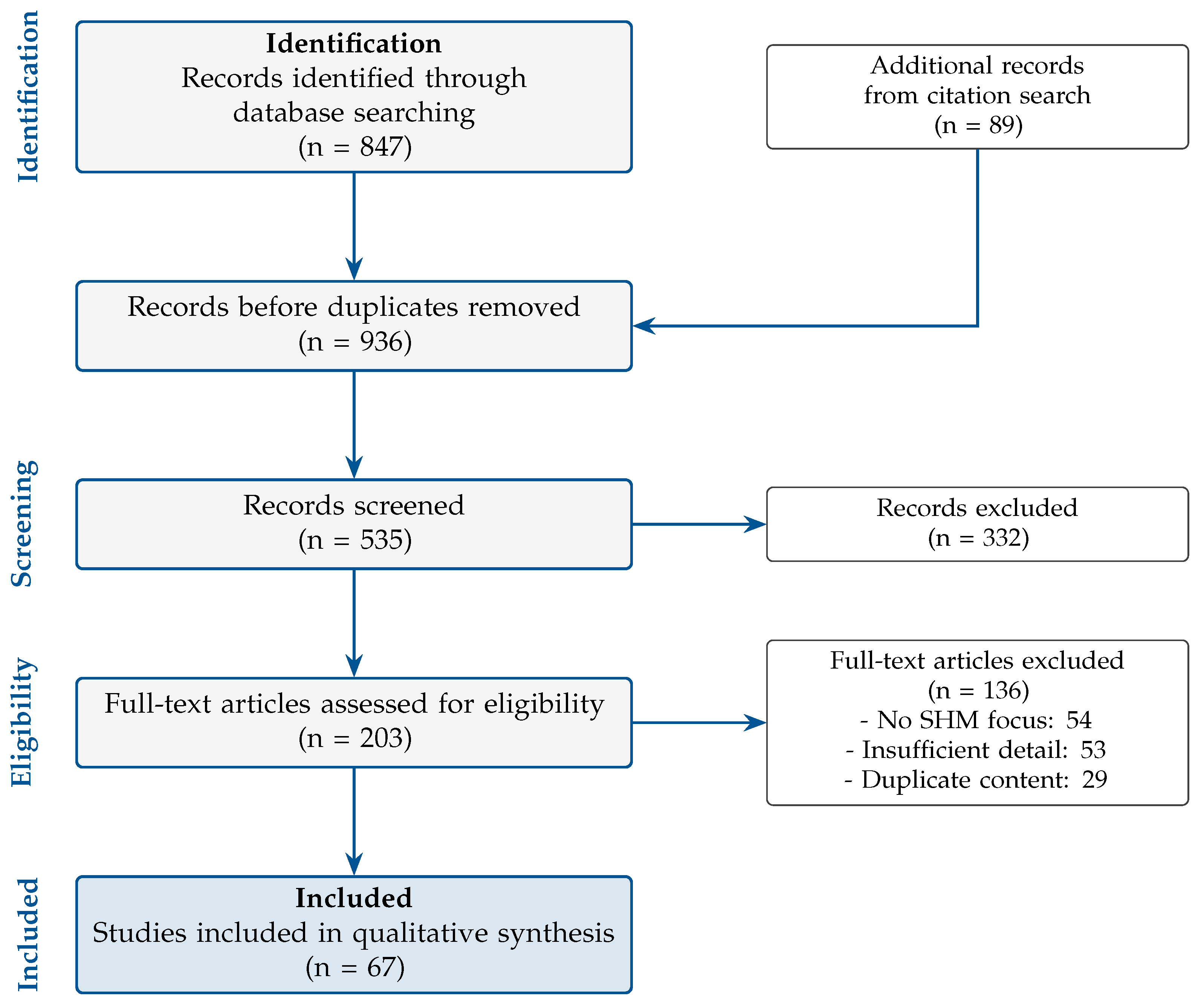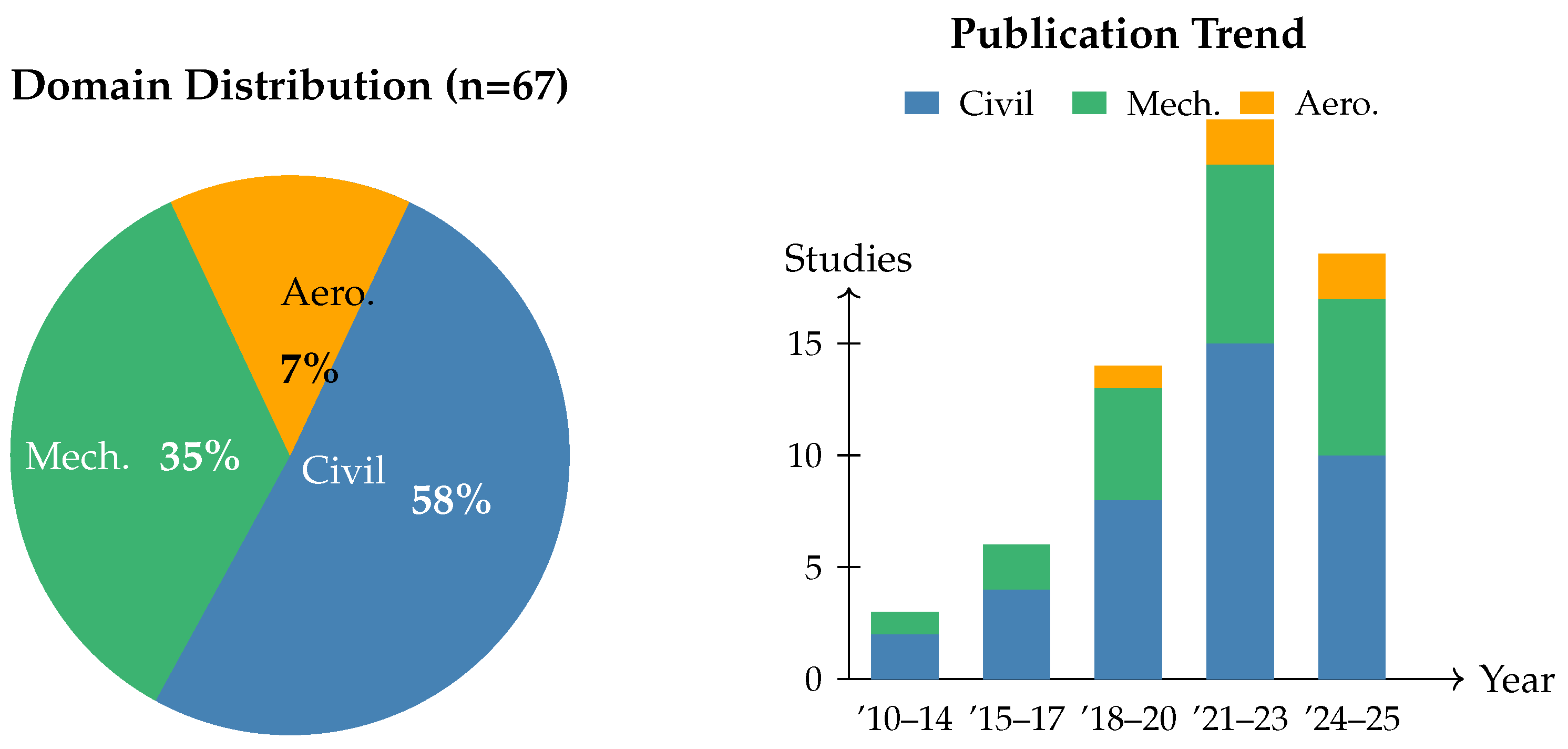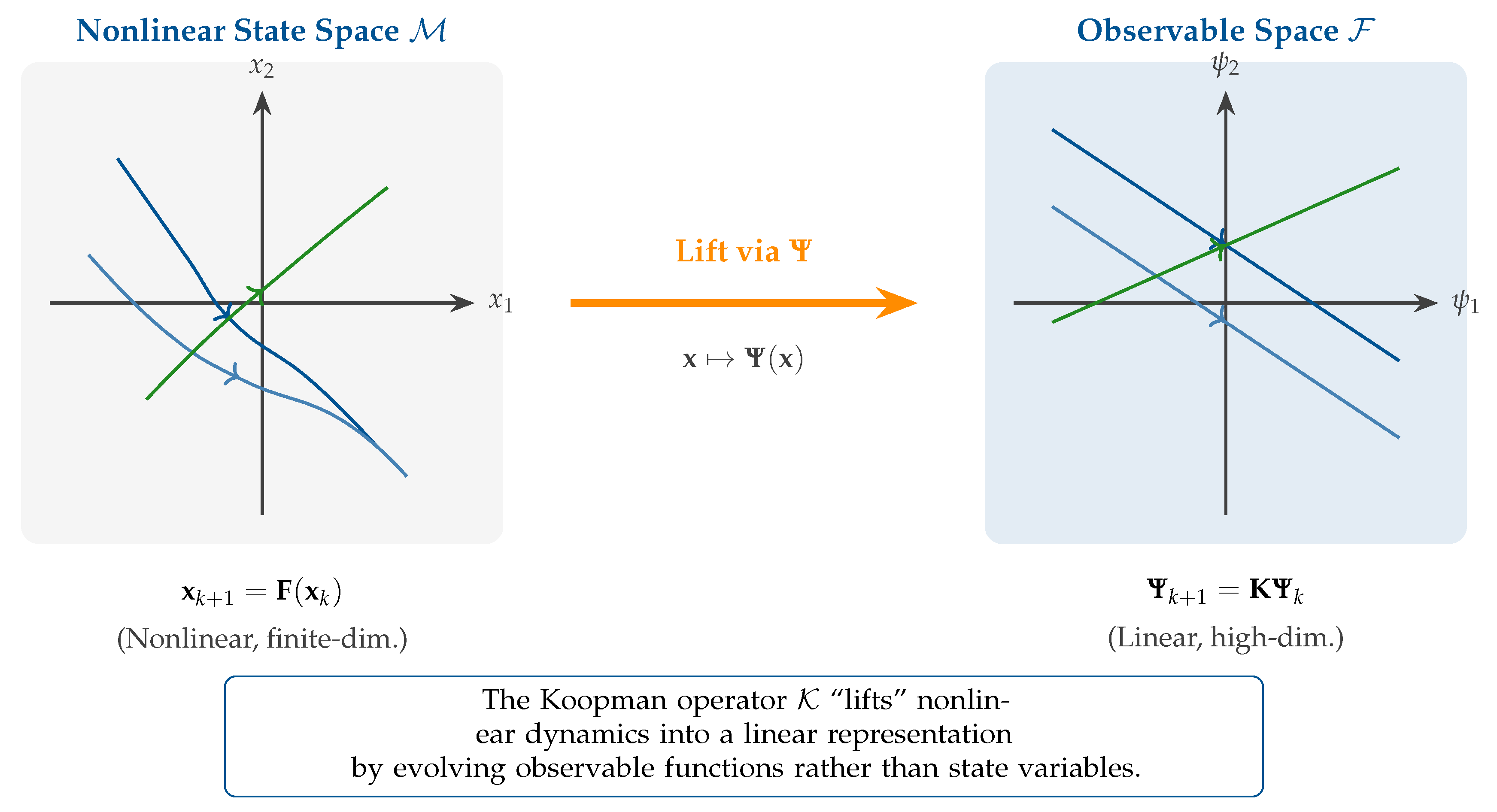
Koopman Operator Methods in Structural Health Monitoring: A Systematic Review Towards Hybrid Physics–Data Frameworks



Abstract
1. Introduction
2. Review Methodology
2.1. Study Selection and Data Extraction
2.2. Thematic Organization
- Foundational Methods: Processes that have established DMD/EDMD algorithms and theoretical properties.
- Civil Infrastructure Applications: Bridges, buildings, towers, and other infrastructure structures on large scale.
- Mechanical Systems: Rotating machinery, gearboxes, bearings, industrial equipment.
- Aerospace Structures: Aircraft parts, space vehicles and aerospace structures.
- Hybrid Approaches: Physics-informed learning, constrained optimization, multi-fidelity approaches.
- Deep Learning Integration: Neural network-based Koopman embeddings and auto-encode neural network architectures.
3. Theoretical Background
3.1. Traditional Structural Health Monitoring: Methods and Limitations
3.1.1. The SHM Hierarchy
- Level 1—Detection: Estimation of existence of damages in the structure.
- Level 2—Localization: Possible location(s) of the damage identified.
- Level 3—Quantification: Determination of extent or severity of damage.
- Level 4—Prognosis: Prediction of the remaining useful life.
3.1.2. Model-Based Methods
- Model uncertainty: In practice, real structures are inevitably different from the idealized representations that are used in finite element simulations because of construction tolerances, material variabilities, approximations of boundary conditions, and the omission of one or more components [53]. The propagation of such parameter uncertainties through coupled multi-field models has been shown to produce considerable scatter in both forward predictions and inverse identification results [54,55].
- Computational cost: High-fidelity FEM updating for large civil structures might be computationally too expensive, especially for real-time monitoring applications [56]. Even moderately complex coupled thermo-hydro-mechanical simulations require parallel computation strategies and optimized sparse storage schemes to remain tractable [57], and the repeated model evaluations needed for probabilistic sensitivity analyses further compound this burden [58].
- Nonlinearity handling: Standard FEM updating is based on the assumption that the structure behaves linearly, which restricts its application to structures showing notable nonlinear response [59]. Extending model-based identification to coupled nonlinear settings, such as thermo-hydro-mechanical problems in masonry dams, demands substantially more sophisticated formulations and solver strategies [57], while the reconstruction of nonlinear deformations in thin shell structures introduces additional geometric complexities into the inverse analysis [60].
- Ill-posedness: The inverse problem of inferring distributed damage from limited modal measurements of an object can often be ill-posed, with multiple damage configurations potentially yielding similar modal changes [61]. This difficulty persists in multi-field inverse problems such as crack identification in hydro-mechanically coupled systems, where regularizing iterative methods must be applied to obtain stable reconstructions [62]. Optimal experimental design strategies have been proposed to mitigate this ill-posedness by maximizing the information content of the available measurements [63].
3.1.3. Data-Driven Methods
3.1.4. The Need for Hybrid Approaches
3.1.5. Koopman Operator
3.1.6. Spectral Properties
3.1.7. Relevance to Structural Dynamics
3.2. Data-Driven Approximations: DMD and EDMD
3.2.1. Dynamic Mode Decomposition (DMD)
3.2.2. Extended Dynamic Mode Decomposition (EDMD)
3.2.3. Deep Learning Extensions
4. Applications of Koopman Methods in Structural Health Monitoring
4.1. Civil Infrastructure: Bridges, Buildings, and Large-Scale Structures
4.1.1. Phase-Space Embedding and Stochastic Koopman Operators
4.1.2. Cable Force Estimation in Bridge Networks
4.1.3. Vision-Based DMD for Modal Identification
4.2. Mechanical Systems: Rotating Machinery and Gearboxes
4.2.1. Multi-Resolution DMD for Gearbox Monitoring
4.2.2. Bearing Fault Diagnosis
4.3. Aerospace Structures and Control-Oriented Applications
4.3.1. Prospective Opportunities and Aerospace-Specific Challenges
4.3.2. Koopman-Based Control and Prediction
4.4. Cross-Domain Comparison
5. Hybrid Koopman Approaches: Integrating Physics with Data-Driven Learning
5.1. Physics-Informed Koopman Learning
5.1.1. Stability-Guaranteed Learning
5.1.2. Constrained Optimization Formulations
Reciprocity (Maxwell–Betti Symmetry)
Passivity and Dissipation
Modal Orthogonality
Boundary Conditions
Stiffness Matrix Structure
Symmetry
5.2. Fusion of First-Principles Models with Koopman Learning
5.2.1. Regularized Koopman Optimization
5.2.2. Hybrid Observable Dictionaries
5.3. Deep Learning with Physical Constraints
- Physics-informed loss terms: Adding penalty terms for energy non-conservation, constraint violation, or deviation from known equilibria guides the network toward physically consistent solutions [71].
- Equivariant architectures: Neural network architectures that uphold identified symmetries (e.g., rotation equivariance in rotationally symmetric architectures) reduce the hypothesis space and enhance generalization, which is why they are called equivariant architectures [95].
- Residual learning: Residual learning trains networks to recall the difference between a physics baseline and observations instead of the whole dynamic to exploit prior knowledge while allowing modeling of random effects that do not change the model. This residual philosophy has been realized concretely by Chen et al. [93], who trained a Koopman autoencoder to model only the unknown residual component of a partially known equation of motion, preserving the known physics exactly while learning the complement from data.
5.4. Insights from Hybrid Models in Structural Mechanics
5.4.1. Inverse Analysis and Uncertainty Quantification
5.4.2. Frequency-Based Damage Identification Under Uncertainty
5.4.3. Sensor Integration and Deployment Challenges
5.4.4. Explainability and Trust in Data-Driven SHM
6. Research Gaps and Future Directions
6.1. Gap 1: Observable Dictionary Design for Damage Sensitivity
- Hybrid dictionaries using strain energy, modal coordinates, and learning nonlinear features;
- Sensitivity analysis between composition of dictionary and damage detectability;
- Adaptive dictionary learning with a focus on damage-relevant dynamics.
6.1.1. Strategies for Physics-Informed Observable Design
Mode Shape-Based Observables
Strain Energy-Based Observables
Nonlinear Feature Observables
- Products of modal coordinates: (capturing mode coupling);
- Higher harmonics: (capturing harmonic generation);
- Time-frequency features: wavelet coefficients at damage-sensitive frequency bands.
Sensitivity Optimization
6.2. Gap 2: Integration of Structural Mechanics Constraints
- Stability-constrained EDMD for structural systems;
- Incorporation of mass/stiffness matrix structure into learned operators;
- Energy-preserving Koopman formulations for conservative systems.
6.3. Gap 3: Quantitative Spectral-to-Physical Damage Mapping
- Perturbation analysis to obtain Eigen sensitivity to localized changes in stiffness;
- Bayesian inference frameworks of damage parameters from spectral observations;
- Physics-regularized regression learning spectral-damage mappings from simulation data.
6.4. Gap 4: Benchmarking and Comparative Validation
- Comparison on benchmarks for SHM (Z24 bridge, IASC-ASCE buildings);
- Evaluation at different noise levels, levels of damage, and environmental conditions;
- Computational cost and real-time feasibility assessment.
6.4.1. Established SHM Benchmark Datasets
Z24 Bridge (Switzerland)
- Nearly one year of continuous ambient vibration monitoring;
- Seventeen progressive damage scenarios applied before demolition;
- Documented environmental effects (temperature-frequency relationships);
- Publicly available through KU Leuven.
IASC-ASCE Benchmark Structure
- Simulated and experimental data;
- Multiple damage scenarios (brace removal, connection loosening);
- Standardized evaluation metrics.
Los Alamos National Laboratory Datasets
Rotating Machinery Datasets
- CWRU Bearing Dataset: Case Western Reserve University bearing fault data with multiple fault types, locations, and severities.
- IMS/NASA Bearing Dataset: Run-to-failure data enabling prognostic algorithm development.
- Paderborn University Bearing Dataset: Multiple operating conditions and damage types.
Quantitative Performance Summary
- Frequency estimation: Studies reporting frequency recovery accuracy typically achieve errors below 2% for dominant modes [92].
- Damage localization: Cable force estimation studies demonstrate correlation coefficients exceeding 0.99 between predicted and measured values [39].
- Detection sensitivity: Most studies demonstrate damage detection capability for damage severities exceeding 5–10% stiffness reduction, though systematic sensitivity characterization is rare.
6.5. Gap 5: Real-Time Implementation and Scalability
- Recursive/streaming EDMD algorithms for online Koopman updating;
- Anomaly detection frameworks that trigger detailed analysis on change detection;
- Scalability tests on large sensor networks and extended time periods of monitoring.
6.6. Noise Sensitivity and Robustness Considerations
6.6.1. Sources of Noise in SHM Data
- Sensor noise: Accelerometers, strain gauges, and other transducers introduce measurement uncertainties, typically modeled as additive white Gaussian noise.
- Environmental variability: Temperature, humidity, and boundary condition changes induce response variations that may mask or mimic damage effects [12].
- Operational variability: Varying loads, traffic patterns, and excitation sources create non-stationary conditions.
6.6.2. Impact on Standard DMD
6.6.3. Noise-Robust DMD Variants
- Forward-Backward DMD: This method reduces bias by averaging the results of DMD applied in both forward and time-reversed directions [100].
- Total Least-Squares DMD (TLS-DMD): Addresses noise in both the input and output snapshot matrices. This approach avoids the bias that is often present in standard least-squares methods [42].
- Optimized DMD: Distributes reconstruction error across all snapshots, rather than concentrating it in the last snapshot. This improves the method’s robustness, as shown in [101].
- Robust DMD (RDMD): This method uses robust statistical frameworks, specifically Huber estimators, to lessen the impact of outliers [102].
6.6.4. Implications for SHM Applications
- Characterize the noise floor of their measurement systems;
- Use TLS-DMD or similar noise-resistant methods when the situation calls for it;
- Report sensitivity analyses quantifying detection capability versus noise level;
- Consider environmental compensation techniques to separate damage effects from benign variability.

| Gap | Current Limitation | Proposed Direction |
|---|---|---|
| Dictionary Design | Generic observables not optimized for damage | Hybrid physics–data dictionaries with sensitivity optimization |
| Physics Constraints | Learned models may violate mechanics principles | Stability, symmetry, and energy constraints in optimization |
| Damage Quantification | Spectral shifts not mapped to physical damage | Perturbation analysis and inverse mapping frameworks |
| Benchmarking | Lack of systematic comparisons | Standardized datasets and evaluation protocols |
| Real-Time Operation | Batch processing unsuitable for continuous monitoring | Online/streaming algorithms with adaptive updating |
6.7. Limitations of This Review
7. Conclusions
Author Contributions
Funding
Data Availability Statement
Conflicts of Interest
References
- Farrar, C.R.; Worden, K. An Introduction to Structural Health Monitoring. Philos. Trans. R. Soc. Math. Phys. Eng. Sci. 2007, 365, 303–315. [Google Scholar] [CrossRef] [Scilit]
- Worden, K.; Dulieu-Barton, J.M. An Overview of Intelligent Fault Detection in Systems and Structures. Struct. Health Monit. 2004, 3, 85–98. [Google Scholar] [CrossRef] [Scilit]
- American Society of Civil Engineers. 2021 Infrastructure Report Card; American Society of Civil Engineers: Reston, VA, USA, March 2021; Available online: https://2021.infrastructurereportcard.org/ (accessed on 5 March 2026).
- Cawley, P.; Adams, R.D. The Location of Defects in Structures from Measurements of Natural Frequencies. J. Strain Anal. Eng. Des. 1979, 14, 49–57. [Google Scholar] [CrossRef] [Scilit]
- Doebling, S.W.; Farrar, C.R.; Prime, M.B.; Shevitz, D.W. Damage Identification and Health Monitoring of Structural and Mechanical Systems from Changes in Their Vibration Characteristics: A Literature Review; Technical Report LA-13070-MS; Los Alamos National Laboratory: Los Alamos, NM, USA, 1996. [Google Scholar] [CrossRef] [Scilit]
- Carden, E.P.; Fanning, P. Vibration Based Condition Monitoring: A Review. Struct. Health Monit. 2004, 3, 355–377. [Google Scholar] [CrossRef] [Scilit]
- Pandey, A.K.; Biswas, M.; Samman, M.M. Damage Detection from Changes in Curvature Mode Shapes. J. Sound Vib. 1991, 145, 321–332. [Google Scholar] [CrossRef] [Scilit]
- Stubbs, N.; Kim, J.T.; Topole, K. An Efficient and Robust Algorithm for Damage Localization in Offshore Platforms. In Proceedings of the ASCE 10th Structures Congress, San Antonio, TX, USA, 13–15 April 1992; pp. 543–546. [Google Scholar]
- Pandey, A.K.; Biswas, M. Damage Detection in Structures Using Changes in Flexibility. J. Sound Vib. 1994, 169, 3–17. [Google Scholar] [CrossRef] [Scilit]
- Worden, K.; Tomlinson, G.R. Nonlinearity in Structural Dynamics: Detection, Identification and Modelling; CRC Press: Boca Raton, FL, USA, 2001. [Google Scholar]
- Andreaus, U.; Casini, P.; Vestroni, F. Non-Linear Dynamics of a Cracked Cantilever Beam under Harmonic Excitation. Int. J. Non-Linear Mech. 2007, 42, 566–575. [Google Scholar] [CrossRef] [Scilit]
- Sohn, H. Effects of Environmental and Operational Variability on Structural Health Monitoring. Philos. Trans. R. Soc. Math. Phys. Eng. Sci. 2007, 365, 539–560. [Google Scholar] [CrossRef] [Scilit] [PubMed]
- Cross, E.J.; Worden, K.; Chen, Q. Cointegration: A Novel Approach for the Removal of Environmental Trends in Structural Health Monitoring Data. Proc. R. Soc. Math. Phys. Eng. Sci. 2011, 467, 2712–2732. [Google Scholar] [CrossRef] [Scilit]
- Peeters, B.; De Roeck, G. One-Year Monitoring of the Z24 Bridge: Environmental Effects versus Damage Events. Earthq. Eng. Struct. Dyn. 2001, 30, 149–171. [Google Scholar] [CrossRef] [Scilit]
- Cornwell, P.; Farrar, C.R.; Doebling, S.W.; Sohn, H. Environmental Variability of Modal Properties. Exp. Tech. 1999, 23, 45–48. [Google Scholar] [CrossRef] [Scilit]
- Bao, Y.; Chen, Z.; Wei, S.; Xu, Y.Y.; Tang, Z.Z.; Li, H. The State of the Art of Data Science and Engineering in Structural Health Monitoring. Engineering 2019, 5, 234–242. [Google Scholar] [CrossRef] [Scilit]
- Sun, L.; Shang, Z.; Xia, Y.; Bhowmick, S.L.; Nagarajaiah, S. Review of Bridge Structural Health Monitoring Aided by Big Data and Artificial Intelligence: From Condition Assessment to Damage Detection. J. Struct. Eng. 2020, 146, 04020073. [Google Scholar] [CrossRef] [Scilit]
- Alkam, F.; Lahmer, T. Eigenfrequency-Based Bayesian Approach for Damage Identification in Catenary Poles. Infrastructures 2021, 6, 57. [Google Scholar] [CrossRef] [Scilit]
- Alkam, F.; Lahmer, T. A Robust Method of the Status Monitoring of Catenary Poles Installed along High-Speed Electrified Train Tracks. Results Eng. 2021, 12, 100289. [Google Scholar] [CrossRef] [Scilit]
- Azimi, M.; Eslamlou, A.D.; Pekcan, G. Data-Driven Structural Health Monitoring and Damage Detection through Deep Learning: State-of-the-Art Review. Sensors 2020, 20, 2778. [Google Scholar] [CrossRef] [Scilit]
- Flah, M.; Nunez, I.; Ben Chaabene, W.; Nehdi, M.L. Machine Learning Algorithms in Civil Structural Health Monitoring: A Systematic Review. Arch. Comput. Methods Eng. 2021, 28, 2621–2643. [Google Scholar] [CrossRef] [Scilit]
- Abdeljaber, O.; Avci, O.; Kiranyaz, S.; Gabbouj, M.; Inman, D.J. Real-Time Vibration-Based Structural Damage Detection Using One-Dimensional Convolutional Neural Networks. J. Sound Vib. 2017, 388, 154–170. [Google Scholar] [CrossRef] [Scilit]
- Li, X.; Bolandi, H.; Masmoudi, M.; Salem, T.; Jha, A.; Lajnef, N.; Boddeti, V.N. Mechanics-Informed Autoencoder Enables Automated Detection and Localization of Unforeseen Structural Damage. Nat. Commun. 2024, 15, 9229. [Google Scholar] [CrossRef] [Scilit]
- Walther, C.; Alkam, F.; Nguyen-Tuan, L.; Lieboldt, M.; Lahmer, T. Challenges for Embedding RFID Sensors in Reinforced Concrete for Low-Effort Structural Health Monitoring. ce/papers 2023, 6, 1460–1469. [Google Scholar] [CrossRef] [Scilit]
- Karniadakis, G.E.; Kevrekidis, I.G.; Lu, L.; Perdikaris, P.; Wang, S.; Yang, L. Physics-Informed Machine Learning. Nat. Rev. Phys. 2021, 3, 422–440. [Google Scholar] [CrossRef] [Scilit]
- Luckey, D.; Fritz, H.; Legatiuk, D.; Abadía, J.J.P.; Walther, C.; Smarsly, K. Explainable Artificial Intelligence to Advance Structural Health Monitoring. In Structural Health Monitoring Based on Data Science Techniques; Springer: Cham, Switzerland, 2022; Volume 21, pp. 331–346. [Google Scholar] [CrossRef] [Scilit]
- Brunton, S.L.; Budišić, M.; Kaiser, E.; Kutz, J.N. Modern Koopman Theory for Dynamical Systems. SIAM Rev. 2022, 64, 229–340. [Google Scholar] [CrossRef] [Scilit]
- Koopman, B.O. Hamiltonian Systems and Transformation in Hilbert Space. Proc. Natl. Acad. Sci. USA 1931, 17, 315–318. [Google Scholar] [CrossRef] [Scilit] [PubMed]
- Schmid, P.J. Dynamic Mode Decomposition of Numerical and Experimental Data. J. Fluid Mech. 2010, 656, 5–28. [Google Scholar] [CrossRef] [Scilit]
- Williams, M.O.; Kevrekidis, I.G.; Rowley, C.W. A Data-Driven Approximation of the Koopman Operator: Extending Dynamic Mode Decomposition. J. Nonlinear Sci. 2015, 25, 1307–1346. [Google Scholar] [CrossRef] [Scilit]
- Mezić, I. Spectral Properties of Dynamical Systems, Model Reduction and Decompositions. Nonlinear Dyn. 2005, 41, 309–325. [Google Scholar] [CrossRef] [Scilit]
- Budišić, M.; Mohr, R.; Mezić, I. Applied Koopmanism. Chaos Interdiscip. J. Nonlinear Sci. 2012, 22, 047510. [Google Scholar] [CrossRef] [Scilit] [PubMed]
- Lusch, B.; Kutz, J.N.; Brunton, S.L. Deep Learning for Universal Linear Embeddings of Nonlinear Dynamics. Nat. Commun. 2018, 9, 4950. [Google Scholar] [CrossRef] [Scilit]
- Li, Q.; Dietrich, F.; Bollt, E.M.; Kevrekidis, I.G. Extended Dynamic Mode Decomposition with Dictionary Learning: A Data-Driven Adaptive Spectral Decomposition of the Koopman Operator. Chaos Interdiscip. J. Nonlinear Sci. 2017, 27, 103111. [Google Scholar] [CrossRef] [Scilit]
- Pan, S.; Duraisamy, K. Physics-Informed Probabilistic Learning of Linear Embeddings of Nonlinear Dynamics with Guaranteed Stability. SIAM J. Appl. Dyn. Syst. 2020, 19, 480–509. [Google Scholar] [CrossRef] [Scilit]
- Peng, Z.; Li, J.; Hao, H. Data Driven Structural Damage Assessment Using Phase Space Embedding and Koopman Operator under Stochastic Excitations. Eng. Struct. 2022, 255, 113906. [Google Scholar] [CrossRef] [Scilit]
- Baddoo, P.J.; Herrmann, B.; McKeon, B.J.; Kutz, J.N.; Brunton, S.L. Physics-Informed Dynamic Mode Decomposition. Proc. R. Soc. Math. Phys. Eng. Sci. 2023, 479, 20220576. [Google Scholar] [CrossRef] [Scilit]
- Rytter, A. Vibration Based Inspection of Civil Engineering Structures. Ph.D. Thesis, Aalborg University, Aalborg, Denmark, 1993. [Google Scholar]
- Deng, C.; Ren, Y.; Xu, X.; Fan, Z.; Huang, Q. Novel Cable Force Estimation Based on Koopman Operator Leveraging Spatiotemporal Correlation in Cable Networks. J. Civ. Struct. Health Monit. 2025, 15, 3607–3624. [Google Scholar] [CrossRef] [Scilit]
- Maeck, J.; De Roeck, G. Description of Z24 Benchmark. Mech. Syst. Signal Process. 2003, 17, 127–131. [Google Scholar] [CrossRef] [Scilit]
- Johnson, E.A.; Lam, H.F.; Katafygiotis, L.S.; Beck, J.L. Phase I IASC-ASCE Structural Health Monitoring Benchmark Problem Using Simulated Data. J. Eng. Mech. 2004, 130, 3–15. [Google Scholar] [CrossRef] [Scilit]
- Hemati, M.S.; Rowley, C.W.; Deem, E.A.; Cattafesta, L.N. De-Biasing the Dynamic Mode Decomposition for Applied Koopman Spectral Analysis of Noisy Datasets. Theor. Comput. Fluid Dyn. 2017, 31, 349–368. [Google Scholar] [CrossRef] [Scilit]
- Cheng, C.; Ding, J.; Zhang, Y. A Koopman Operator Approach for Machinery Health Monitoring and Prediction with Noisy and Low-Dimensional Industrial Time Series. Neurocomputing 2020, 406, 204–214. [Google Scholar] [CrossRef] [Scilit]
- Moher, D.; Liberati, A.; Tetzlaff, J.; Altman, D.G.; PRISMA Group. Preferred Reporting Items for Systematic Reviews and Meta-Analyses: The PRISMA Statement. PLoS Med. 2009, 6, e1000097. [Google Scholar] [CrossRef] [Scilit]
- Colombo, F.T.; da Silva, S.; Garrido, H.; Domizio, M. Damage Identification in Structures Using Dynamic Mode Decomposition for Vibration Analysis of Low-Resolution Videos. Struct. Health Monit. 2025; Early Access. [CrossRef] [Scilit]
- Climaco, P.; Garcke, J.; Iza-Teran, R. Multi-Resolution Dynamic Mode Decomposition for Damage Detection in Wind Turbine Gearboxes. Data-Centric Eng. 2023, 4, e1. [Google Scholar] [CrossRef] [Scilit]
- Ma, P.; Zhang, H.; Wang, C. Adaptive Dynamic Mode Decomposition and its Application in Rolling Bearing Compound Fault Diagnosis. Struct. Health Monit. 2023, 22, 398–416. [Google Scholar] [CrossRef] [Scilit]
- Dang, Z.; Lv, Y.; Li, Y.; Wei, G. Improved Dynamic Mode Decomposition and Its Application to Fault Diagnosis of Rolling Bearing. Sensors 2018, 18, 1972. [Google Scholar] [CrossRef] [Scilit]
- Bruder, D.; Fu, X.; Gillespie, R.B.; Remy, C.D.; Vasudevan, R. Data-Driven Control of Soft Robots Using Koopman Operator Theory. IEEE Trans. Robot. 2021, 37, 948–961. [Google Scholar] [CrossRef] [Scilit]
- Friswell, M.I.; Mottershead, J.E. Finite Element Model Updating in Structural Dynamics, 1st ed.; Solid Mechanics and Its Applications; Springer: Dordrecht, The Netherlands, 1995; pp. 98–292. [Google Scholar] [CrossRef] [Scilit]
- Teughels, A.; Maeck, J.; De Roeck, G. Damage Assessment by FE Model Updating Using Damage Functions. Comput. Struct. 2002, 80, 1869–1879. [Google Scholar] [CrossRef] [Scilit]
- Jaishi, B.; Ren, W.X. Structural Finite Element Model Updating Using Ambient Vibration Test Results. J. Struct. Eng. 2005, 131, 617–628. [Google Scholar] [CrossRef] [Scilit]
- Beck, J.L.; Katafygiotis, L.S. Updating Models and Their Uncertainties. I: Bayesian Statistical Framework. J. Eng. Mech. 1998, 124, 455–461. [Google Scholar] [CrossRef] [Scilit]
- Nguyen-Tuan, L.; Lahmer, T.; Datcheva, M.; Schanz, T. Global and Local Sensitivity Analyses for Coupled Thermo–Hydro–Mechanical Problems. Int. J. Numer. Anal. Methods Geomech. 2017, 41, 707–720. [Google Scholar] [CrossRef] [Scilit]
- Nguyen-Tuan, L.; Könke, C.; Bettzieche, V.; Lahmer, T. Uncertainty Assessment in the Results of Inverse Problems: Applied to Damage Detection in Masonry Dams. Int. J. Reliab. Saf. 2018, 12, 2–23. [Google Scholar] [CrossRef] [Scilit]
- Simoen, E.; De Roeck, G.; Lombaert, G. Dealing with Uncertainty in Model Updating for Damage Assessment: A Review. Mech. Syst. Signal Process. 2015, 56–57, 123–149. [Google Scholar] [CrossRef] [Scilit]
- Nguyen-Tuan, L.; Könke, C.; Bettzieche, V.; Lahmer, T. Numerical Modeling and Validation for 3D Coupled-Nonlinear Thermo-Hydro-Mechanical Problems in Masonry Dams. Comput. Struct. 2017, 178, 143–154. [Google Scholar] [CrossRef] [Scilit]
- Vu-Bac, N.; Lahmer, T.; Zhuang, X.; Nguyen-Thoi, T.; Rabczuk, T. A Software Framework for Probabilistic Sensitivity Analysis for Computationally Expensive Models. Adv. Eng. Softw. 2016, 100, 19–31. [Google Scholar] [CrossRef] [Scilit]
- Kerschen, G.; Worden, K.; Vakakis, A.F.; Golinval, J.C. Past, Present and Future of Nonlinear System Identification in Structural Dynamics. Mech. Syst. Signal Process. 2006, 20, 505–592. [Google Scholar] [CrossRef] [Scilit]
- Vu-Bac, N.; Duong, T.X.; Lahmer, T.; Zhuang, X.; Sauer, R.A.; Park, H.S.; Rabczuk, T. A NURBS-Based Inverse Analysis for Reconstruction of Nonlinear Deformations of Thin Shell Structures. Comput. Methods Appl. Mech. Eng. 2018, 331, 427–455. [Google Scholar] [CrossRef] [Scilit]
- Titurus, B.; Friswell, M.I. Regularization in Model Updating. Int. J. Numer. Methods Eng. 2008, 75, 440–478. [Google Scholar] [CrossRef] [Scilit]
- Lahmer, T. Crack Identification in Hydro-Mechanical Systems with Applications to Gravity Water Dams. Inverse Probl. Sci. Eng. 2010, 18, 1083–1101. [Google Scholar] [CrossRef] [Scilit]
- Lahmer, T. Optimal Experimental Design for Nonlinear Ill-Posed Problems Applied to Gravity Dams. Inverse Probl. 2011, 27, 125005. [Google Scholar] [CrossRef] [Scilit]
- Figueiredo, E.; Park, G.; Farrar, C.R.; Worden, K.; Figueiras, J. Machine Learning Algorithms for Damage Detection under Operational and Environmental Variability. Struct. Health Monit. 2011, 10, 559–572. [Google Scholar] [CrossRef] [Scilit]
- Santos, A.; Figueiredo, E.; Silva, M.; Santos, R.; Sales, C.; Costa, J.C. Genetic-Based EM Algorithm to Improve the Robustness of GMMs for Damage Detection in Bridges. Struct. Control Health Monit. 2016, 24, e1886. [Google Scholar] [CrossRef] [Scilit]
- Avci, O.; Abdeljaber, O.; Kiranyaz, S.; Hussein, M.; Gabbouj, M.; Inman, D.J. A Review of Vibration-Based Damage Detection in Civil Structures: From Traditional Methods to Machine Learning and Deep Learning Applications. Mech. Syst. Signal Process. 2021, 147, 107077. [Google Scholar] [CrossRef] [Scilit]
- Rudin, C. Stop Explaining Black Box Machine Learning Models for High Stakes Decisions and Use Interpretable Models Instead. Nat. Mach. Intell. 2019, 1, 206–215. [Google Scholar] [CrossRef] [Scilit]
- Gardner, P.; Liu, X.; Worden, K. On the Application of Domain Adaptation in Structural Health Monitoring. Mech. Syst. Signal Process. 2020, 138, 106550. [Google Scholar] [CrossRef] [Scilit]
- Alemu, Y.L.; Lahmer, T.; Walther, C. Damage Detection with Data-Driven Machine Learning Models on an Experimental Structure. Eng 2024, 5, 629–656. [Google Scholar] [CrossRef] [Scilit]
- Bull, L.A.; Gardner, P.; Gosliga, J.; Rogers, T.J.; Dervilis, N.; Cross, E.J.; Papatheou, E.; Maguire, A.E.; Campos, C.; Worden, K. Foundations of Population-Based SHM, Part I: Homogeneous Populations and Forms. Mech. Syst. Signal Process. 2021, 148, 107141. [Google Scholar] [CrossRef] [Scilit]
- Raissi, M.; Perdikaris, P.; Karniadakis, G.E. Physics-Informed Neural Networks: A Deep Learning Framework for Solving Forward and Inverse Problems Involving Nonlinear Partial Differential Equations. J. Comput. Phys. 2019, 378, 686–707. [Google Scholar] [CrossRef] [Scilit]
- Samaniego, E.; Anitescu, C.; Goswami, S.; Nguyen-Thanh, V.M.; Guo, H.; Hamdia, K.M.; Zhuang, X.; Rabczuk, T. An Energy Approach to the Solution of Partial Differential Equations in Computational Mechanics via Machine Learning: Concepts, Implementation and Applications. Comput. Methods Appl. Mech. Eng. 2020, 362, 112790. [Google Scholar] [CrossRef] [Scilit]
- Goswami, S.; Anitescu, C.; Chakraborty, S.; Rabczuk, T. Transfer Learning Enhanced Physics Informed Neural Network for Phase-Field Modeling of Fracture. Theor. Appl. Fract. Mech. 2020, 106, 102447. [Google Scholar] [CrossRef] [Scilit]
- Mezić, I. Analysis of Fluid Flows via Spectral Properties of the Koopman Operator. Annu. Rev. Fluid Mech. 2013, 45, 357–378. [Google Scholar] [CrossRef] [Scilit]
- Kutz, J.N.; Brunton, S.L.; Brunton, B.W.; Proctor, J.L. Dynamic Mode Decomposition: Data-Driven Modeling of Complex Systems; SIAM: Philadelphia, PA, USA, 2016. [Google Scholar]
- Askham, T.; Kutz, J.N. Variable Projection Methods for an Optimized Dynamic Mode Decomposition. SIAM J. Appl. Dyn. Syst. 2018, 17, 380–416. [Google Scholar] [CrossRef] [Scilit]
- Brunton, S.L.; Brunton, B.W.; Proctor, J.L.; Kaiser, E.; Kutz, J.N. Chaos as an Intermittently Forced Linear System. Nat. Commun. 2017, 8, 19. [Google Scholar] [CrossRef] [Scilit]
- Takeishi, N.; Kawahara, Y.; Yairi, T. Learning Koopman Invariant Subspaces for Dynamic Mode Decomposition. In Proceedings of the Advances in Neural Information Processing Systems, Long Beach, CA, USA, 4–9 December 2017; Volume 30, pp. 1130–1140. [Google Scholar]
- Otto, S.E.; Rowley, C.W. Linearly Recurrent Autoencoder Networks for Learning Dynamics. SIAM J. Appl. Dyn. Syst. 2019, 18, 558–593. [Google Scholar] [CrossRef] [Scilit]
- Azencot, O.; Erichson, N.B.; Lin, V.; Mahoney, M. Forecasting Sequential Data Using Consistent Koopman Autoencoders. In Proceedings of the International Conference on Machine Learning (ICML), Virtual, 12–18 July 2020; Volume 119, pp. 475–485. [Google Scholar]
- Chen, J.G.; Davis, A.; Wadhwa, N.; Durand, F.; Freeman, W.T.; Büyüköztürk, O. Video Camera-Based Vibration Measurement for Civil Infrastructure Applications. J. Infrastruct. Syst. 2017, 23, B4016013. [Google Scholar] [CrossRef] [Scilit]
- Sarrafi, A.; Mao, Z.; Niezrecki, C.; Poozesh, P. Vibration-Based Damage Detection in Wind Turbine Blades Using Phase-Based Motion Estimation and Motion Magnification. J. Sound Vib. 2018, 421, 300–318. [Google Scholar] [CrossRef] [Scilit]
- Cai, Z.; Dang, Z.; Lü, Y.; Yuan, R.; An, B. Adaptive Dynamic Mode Decomposition and GA-SVM with Application to Fault Classification of Planetary Bearing. Chin. J. Eng. 2023, 45, 1559–1568. [Google Scholar] [CrossRef]
- Sause, M.G.R.; Jasiuniene, E. Structural Health Monitoring Damage Detection Systems for Aerospace; Springer Aerospace Technology; Springer: Berlin/Heidelberg, Germany, 2021. [Google Scholar] [CrossRef] [Scilit]
- Ogunleye, R.; Rusnáková, S.; Javořík, J.; Žaludek, M.; Kotlánová, B. Advanced Sensors and Sensing Systems for Structural Health Monitoring in Aerospace Composites. Adv. Eng. Mater. 2024, 26, 2401745. [Google Scholar] [CrossRef] [Scilit]
- Korda, M.; Mezić, I. Linear Predictors for Nonlinear Dynamical Systems: Koopman Operator Meets Model Predictive Control. Automatica 2018, 93, 149–160. [Google Scholar] [CrossRef] [Scilit]
- Bakhtiaridoust, M.; Yadegar, M.; Meskin, N. Data-Driven Fault Detection and Isolation of Nonlinear Systems using Deep Learning for Koopman Operator. ISA Trans. 2023, 134, 200–211. [Google Scholar] [CrossRef] [Scilit]
- SAE International. ARP6461A: Guidelines for Implementation of Structural Health Monitoring on Fixed Wing Aircraft; (24 August, 2021) Technical Report; SAE International: Warrendale, PA, USA, 2021. [Google Scholar]
- Memmolo, V.; Boffa, N.D.; Maio, L.; Monaco, E.; Ricci, F. Damage Localization in Composite Structures Using a Guided Waves Based Multi-Parameter Approach. Aerospace 2018, 5, 111. [Google Scholar] [CrossRef] [Scilit]
- Glaessgen, E.; Stargel, D. The Digital Twin Paradigm for Future NASA and U.S. Air Force Vehicles. In Proceedings of the 53rd AIAA/ASME/ASCE/AHS/ASC Structures, Structural Dynamics and Materials Conference, Honolulu, HI, USA, 23–26 April 2012; pp. 1–14. [Google Scholar] [CrossRef] [Scilit]
- Lee, J.D.; Im, S.; Kim, L.; Ahn, H.; Bang, H. Data-Driven Fault Detection and Isolation for Multirotor System Using Koopman Operator. J. Intell. Robot. Syst. 2024, 110, 128. [Google Scholar] [CrossRef] [Scilit]
- Yang, Y.; Dorn, C.; Mancini, T.; Talken, Z.; Kenyon, G.; Farrar, C.; Mascareñas, D. Blind Identification of Full-Field Vibration Modes from Video Measurements with Phase-Based Video Motion Magnification. Mech. Syst. Signal Process. 2017, 85, 567–590. [Google Scholar] [CrossRef] [Scilit]
- Chen, Z.; Sun, H.; Xiong, W. Forecasting Dynamics by an Incomplete Equation of Motion and an Auto-Encoder Koopman Operator. Mech. Syst. Signal Process. 2024, 220, 111599. [Google Scholar] [CrossRef] [Scilit]
- Kaiser, E.; Kutz, J.N.; Brunton, S.L. Data-Driven Discovery of Koopman Eigenfunctions for Control. Mach. Learn. Sci. Technol. 2021, 2, 035023. [Google Scholar] [CrossRef] [Scilit]
- Wang, R.; Walters, R.; Yu, R. Incorporating Symmetry into Deep Dynamics Models for Improved Generalization. In Proceedings of the International Conference on Learning Representations, Virtual, 3–7 May 2021; pp. 1–20. [Google Scholar]
- Rucevskis, S.; Janeliukstis, R.; Akishin, P.; Chate, A. Mode Shape-Based Damage Detection in Plate Structure without Baseline Data. Struct. Control Health Monit. 2016, 23, 1180–1193. [Google Scholar] [CrossRef] [Scilit]
- Garmaev, S.; Fink, O. Deep Koopman Operator-Based Degradation Modelling. Reliab. Eng. Syst. Saf. 2024, 251, 110351. [Google Scholar] [CrossRef] [Scilit]
- Reynders, E.; De Roeck, G. Vibration-Based Damage Identification: The Z24 Bridge Benchmark. In Encyclopedia of Earthquake Engineering; Springer: Berlin/Heidelberg, Germany, 2014; pp. 3871–3879. [Google Scholar] [CrossRef] [Scilit]
- Chen, B.; Wang, Y. Online Physics-Informed Dynamic Mode Decomposition: Theory and Applications. Proc. R. Soc. Math. Phys. Eng. Sci. 2025, 481, 20240437. [Google Scholar] [CrossRef] [Scilit]
- Dawson, S.T.M.; Hemati, M.S.; Williams, M.O.; Rowley, C.W. Characterizing and Correcting for the Effect of Sensor Noise in the Dynamic Mode Decomposition. Exp. Fluids 2016, 57, 42. [Google Scholar] [CrossRef] [Scilit]
- Chen, K.K.; Tu, J.H.; Rowley, C.W. Variants of Dynamic Mode Decomposition: Boundary Condition, Koopman, and Fourier Analyses. J. Nonlinear Sci. 2012, 22, 887–915. [Google Scholar] [CrossRef] [Scilit]
- Abolmasoumi, A.H.; Netto, M.; Mili, L. Robust Dynamic Mode Decomposition. IEEE Access 2022, 10, 65473–65484. [Google Scholar] [CrossRef] [Scilit]


| Component | Search Terms |
|---|---|
| Group A (Koopman/DMD) | “Koopman operator” OR “Dynamic Mode Decomposition” OR “DMD” OR “Extended DMD” OR “EDMD” OR “Koopman eigenfunction” OR “Koopman mode” |
| Group B (SHM) | “structural health monitoring” OR “damage detection” OR “damage identification” OR “condition monitoring” OR “fault diagnosis” OR “vibration-based” OR “modal analysis” |
| Group C (Domain) | “civil structure” OR “bridge” OR “building” OR “mechanical system” OR “aerospace” OR “infrastructure” OR “nonlinear dynamics” |
| Combined query: (Group A) AND (Group B OR Group C). Databases searched: Scopus, Web of Science, IEEE Xplore, Google Scholar. Supplemented by forward and backward citation searching of seminal papers. | |
| Inclusion Criteria | |
|---|---|
| IC1 | Published in peer-reviewed journals, conferences, or doctoral dissertations between 2010 and 2025 |
| IC2 | Written in English |
| IC3 | Applied Koopman operator theory, DMD, or closely related spectral methods to structural or mechanical system analysis |
| IC4 | Addressed damage detection, health monitoring, condition assessment, or prognostic objectives |
| IC5 | Provided sufficient methodological detail for critical evaluation |
| Exclusion Criteria | |
| EC1 | Fluid dynamics applications without structural relevance |
| EC2 | Purely theoretical developments not applied to physical systems |
| EC3 | Duplicate publications or extended abstracts of already included full papers |
| EC4 | Non-peer-reviewed material (e.g., preprints without subsequent publication) |
| Authors | Year | Domain | Method | Structure | Validation | Main Findings |
|---|---|---|---|---|---|---|
| Peng et al. [36] | 2022 | Civil | EDMD | Frame building | Numerical | Eigenvalue shift (2–5%) detects breathing cracks under stochastic excitation |
| Deng et al. [39] | 2025 | Civil | Koopman | Cable-stayed bridge | Field data | Correlation > 0.99 for cable force estimation; 20% faster than competing methods |
| Colombo et al. [45] | 2025 | Civil | DMD | Beam | Laboratory | Low-resolution video DMD identifies localized mode shape changes at damage sites |
| Climaco et al. [46] | 2023 | Mech. | mrDMD | Wind turbine gearbox | Numerical | Hierarchical decomposition isolates tooth mesh fault signatures under turbulence |
| Ma et al. [47] | 2023 | Mech. | ADMD | Rolling bearing | Benchmark | Adaptive DMD decouples compound faults; validated on CWRU data |
| Dang et al. [48] | 2018 | Mech. | Improved DMD | Rolling bearing | Benchmark | Optimal rank truncation extracts fault features from noisy signals |
| Bruder et al. [49] | 2021 | Robotics | Deep Koopman | Soft robot | Laboratory | Linear Koopman model enables real-time MPC for geometrically nonlinear structures |
| Performance Metric | Domain | Reported Range | Key References |
|---|---|---|---|
| Frequency estimation error | Civil/Mech. | <2% for dominant modes | [45,92] |
| Fault classification accuracy | Mechanical | 90–97% | [47,48,83] |
| Cable force correlation | Civil | >0.99 | [39] |
| Damage detection threshold | Civil | 5–10% stiffness reduction | [36] |
| Computation time reduction | Civil | ∼20% vs. competing methods | [39] |
| Dataset | Domain | Structure Type | Key Features | Koopman Studies |
|---|---|---|---|---|
| Z24 Bridge | Civil | Highway bridge | Environmental effects, progressive damage | Limited |
| IASC-ASCE | Civil | Steel frame | Multiple damage scenarios | None identified |
| LANL 8-DOF | Civil | Shear building | Controlled damage levels | None identified |
| CWRU Bearing | Mechanical | Rolling bearing | Multiple fault types | Yes [47,48] |
| IMS/NASA | Mechanical | Rolling bearing | Run-to-failure | Limited |
Disclaimer/Publisher’s Note: The statements, opinions and data contained in all publications are solely those of the individual author(s) and contributor(s) and not of MDPI and/or the editor(s). MDPI and/or the editor(s) disclaim responsibility for any injury to people or property resulting from any ideas, methods, instructions or products referred to in the content. |
© 2026 by the authors. Licensee MDPI, Basel, Switzerland. This article is an open access article distributed under the terms and conditions of the Creative Commons Attribution (CC BY) license.
Share and Cite
Alagbada, A.V.; Lahmer, T. Koopman Operator Methods in Structural Health Monitoring: A Systematic Review Towards Hybrid Physics–Data Frameworks. Appl. Sci. 2026, 16, 3392. https://doi.org/10.3390/app16073392
Alagbada AV, Lahmer T. Koopman Operator Methods in Structural Health Monitoring: A Systematic Review Towards Hybrid Physics–Data Frameworks. Applied Sciences. 2026; 16(7):3392. https://doi.org/10.3390/app16073392
Chicago/Turabian StyleAlagbada, Abiodun Victor, and Tom Lahmer. 2026. "Koopman Operator Methods in Structural Health Monitoring: A Systematic Review Towards Hybrid Physics–Data Frameworks" Applied Sciences 16, no. 7: 3392. https://doi.org/10.3390/app16073392
APA StyleAlagbada, A. V., & Lahmer, T. (2026). Koopman Operator Methods in Structural Health Monitoring: A Systematic Review Towards Hybrid Physics–Data Frameworks. Applied Sciences, 16(7), 3392. https://doi.org/10.3390/app16073392