Article

Coupled CFD and Physics-Based Digital Shadow Framework for Oil-Flooded Screw Compressors: Rotor Geometry Sensitivity, Transient Pulsation Response, and Annual Climate Penalties

by
Dinara Baskanbayeva
1,
Kassym Yelemessov
1,
Lyaila Sabirova
1,
Sanzhar Kalmaganbetov
1,
Yerzhan Sarybayev
1 and
Darkhan Yerezhep
1,2,*
1
Institute of Power Engineering and Mechanical Engineering Named After A. Burkitbaev, Satbayev University, Almaty 040714, Kazakhstan
2
Technology Commercialization Center, Almaty Management University, Almaty 050060, Kazakhstan
*
Author to whom correspondence should be addressed.
Appl. Sci. 2026, 16(7), 3359; https://doi.org/10.3390/app16073359
Submission received: 2 March 2026 / Revised: 28 March 2026 / Accepted: 29 March 2026 / Published: 30 March 2026

Abstract

Screw compressors are critical equipment in oil and gas production and transportation, where efficiency losses caused by rotor geometry, inlet pressure pulsations, and harsh climatic conditions can accumulate into substantial annual energy penalties and reliability degradation. This study provides a quantitative assessment of these coupled effects within a unified multiphysics framework that combines time-accurate transient CFD simulations based on a fixed Cartesian immersed-boundary formulation with a climate-calibrated offline physics-based digital twin—functioning as a digital shadow with one-way data flow from archival SCADA records—a reduced-order seasonal model with no real-time updating, calibrated against a full calendar year of SCADA records and validated against a held-out cold-season dataset (October–December 2022, Tamb = −15 to +8 °C); summer-period predictions rely on calibrated extrapolation beyond the validation window—an integration not previously demonstrated for oil-flooded screw compressors. Two rotor profile configurations (Type A and Type B) were analyzed to quantify geometry-driven differences in static pressure distribution, leakage tendency, and pulsation sensitivity. Transient suction conditions were modeled using harmonic and quasi-random inlet pressure disturbances to evaluate pressure amplification, phase lag, leakage intensification, and efficiency degradation. Seasonal performance was assessed by integrating temperature-dependent gas properties, oil viscosity behavior, and external heat transfer into an annual climatic load framework. The results show that inlet oscillations are amplified inside the chambers (pressure amplification factor Пp ≈ 1.95; Пp up to 2.3 under quasi-random excitation), reducing mass flow and volumetric efficiency by 8–10% and decreasing polytropic efficiency from 0.78 to 0.69–0.71, while increasing leakage by up to 27% and raising peak contact pressures to 167–171 MPa. Seasonal variability (+30 to −30 °C) increased suction density by 38% but raised drive power by ~9% due to viscosity-driven mechanical losses, producing an energy penalty up to 10.8% and an estimated annual additional consumption of approximately 186 MWh per compressor, decomposed as: cold-season contribution ~113 MWh (±10 MWh, directly field-validated against October–December 2022 SCADA data) and summer-season contribution ~51 MWh (calibrated extrapolation; additional uncertainty unquantified and not included in the ±10 MWh bound). The full annual figure of 186 MWh should be interpreted as a model-based estimate rather than a fully validated result. These findings demonstrate that rotor design optimization and mitigation of nonstationary suction effects, coupled with climate-aware offline physics-based digital shadow operation, represent high-priority levers for improving efficiency and reducing energy penalties in field conditions; reliability implications require further validation against summer-season field measurements.

1. Introduction

Screw compressors are widely used in oil and gas production, gas processing, and transportation systems due to their compact design, stable volumetric performance, and ability to operate under variable load conditions [1,2,3]. For example, in the oil production and transportation industries, oil-cooled screw compressors are often used for associated gas compression, gas gathering networks, and vapor recovery systems [4]. Their operational reliability directly impacts production continuity, energy consumption, and environmental performance [5,6]. Given the high share of compression energy in the total power consumed by a field, improving compressor efficiency has become a critical engineering challenge [7]. Even minor deviations in thermodynamic parameters—such as a decrease in volumetric or polytropic efficiency, an increase in leakage rate, or an increase in outlet temperature—can lead to disproportionately large annual energy losses. Previous studies have shown that a 3–5% decrease in compressor efficiency can significantly increase energy consumption, operating costs, and life-cycle costs [8,9]. Furthermore, operation outside optimal thermodynamic conditions accelerates mechanical wear, increases bearing loads, and shortens maintenance intervals, which ultimately impacts system reliability and availability [10,11]. Therefore, understanding the impact of operational factors on compressor efficiency and service life is of significant practical importance.
Among the key internal design parameters affecting screw compressor performance, rotor geometry plays a crucial role [12,13,14,15]. The rotor profile determines the volume variation law, sealing characteristics, contact behavior, and leakage paths inside the compression chamber. Changes in rotor curvature, wrap angle, and clearance distribution directly affect pressure gradients, vortex shedding, and local mechanical loads [16,17,18]. Previous studies have shown that optimized rotor profiles can reduce internal leakage and improve volumetric efficiency [19,20,21]. However, most available analyses either focus on geometric optimization under idealized steady-state conditions or consider structural aspects independently of the full thermohydrodynamic interaction. Many computational fluid dynamics (CFD)-based studies evaluate rotor flow fields under steady-state inlet conditions, which limits their applicability to real industrial conditions where operational disturbances are inevitable [22,23].
The studies cited above were conducted predominantly on twin-screw machines, where the compression chamber is formed between one male and one female rotor interacting with the casing. In that geometry, the critical leakage paths are the interlobe clearance and the axial tip clearance, and their behavior under steady-state conditions is now reasonably well characterized. However, the three-screw configuration studied in the present work comprises one driving male rotor meshing simultaneously with two driven female rotors—a total of three intermeshing rotors—which introduces a fundamentally different internal topology. Two independent meshing zones are active simultaneously, creating additional interlobe leakage channels whose pressure interactions have not been resolved by CFD. The sealing line geometry and its evolution during rotation differ from the twin-screw case, and the volumetric compression law governing the driven rotors has not been quantified under transient inlet conditions. Furthermore, the sensitivity of the three-screw configuration to pulsation amplification and climate-driven viscosity changes remains entirely uncharacterized in the open literature. The present study directly addresses this gap.
In practical gas transportation and production systems, screw compressors rarely operate under strictly steady-state inlet conditions. Inlet pressure fluctuations arise due to pipeline dynamics, inlet flow instability, switching operating modes, and variable well flow rates [24,25,26]. These disturbances introduce non-stationary boundary conditions that affect the internal compression process. Inlet pressure fluctuations can be amplified inside the working chambers, alter the phase relationships between chamber closure and discharge opening, and increase interblade leakage [27,28,29,30]. Despite the relevance of this problem, detailed CFD modeling of oil-filled screw compressors under non-stationary inlet pressure conditions using time-accurate rotating-geometry formulations remains limited. Many engineering models assume a quasi-steady-state operating regime, which may underestimate the effects of pulsation amplification and their impact on volumetric efficiency, polytropic efficiency, and mechanical loading.
An additional operational factor that significantly affects the performance of a screw compressor is ambient temperature. This is especially true for units operating in regions with a sharply continental climate, where seasonal temperature variations can exceed 60–70 °C throughout the year. Ambient temperature affects several interrelated processes within a screw compressor. First, it affects the density of the suction gas, thereby changing the mass flow rate for a given volumetric performance [31]. Higher suction temperatures reduce the gas density, which reduces the mass flow rate and changes the compression work requirements [32,33]. Second, temperature variations significantly change the viscosity of the oil, affecting the quality of the lubricant, mechanical friction losses, and the effectiveness of the seal between the rotor blades [34,35,36]. Third, climatic conditions change the external heat transfer coefficients and the overall thermal balance of the compressor, affecting the outlet temperature and the long-term durability of the components [37,38,39]. Although offline digital twin (digital shadow) technologies have recently been implemented to model compressor behavior, many existing implementations do not fully account for climate variability or its interaction with transient flow conditions.
The objective of this study is to comprehensively and quantitatively assess the impact of geometric, gas-dynamic, and climatic factors on compressor performance. The research combines three complementary approaches: CFD analysis of rotor profiles, transient simulation of suction pressure pulsations, and thermal analysis under variable climatic loads. The combination of these methods allows identification of the dominant loss mechanisms and improves the accuracy of compressor performance prediction under real-world conditions. The results provide a comprehensive engineering assessment and contribute to the development of more reliable and energy-efficient compressor systems.
The present study differs from existing literature in three specific respects, each defined against the closest prior work. First, regarding transient pulsation modeling: the most directly comparable CFD studies of oil-injected and oil-flooded screw compressors—Yang et al. [31], who simulated internal pressure characteristics of a twin-screw refrigeration compressor, and Malael and Petrescu [29], who performed a CFD evaluation of an oil-flooded screw compressor—both impose fixed steady-state inlet boundary conditions and do not model pressure fluctuations at the suction port. Brinas et al. [12] applied SolidWorks Flow Simulation to a twin-screw compressor but similarly restricted the analysis to steady-state flow parameters. A recent review by Li et al. [28] confirms that transient non-stationary inlet conditions remain an underexplored area in screw compressor CFD. The present work addresses this directly by imposing time-varying inlet pressure—both harmonic and quasi-random—within a time-accurate rotating-geometry simulation using a Cartesian immersed-boundary solver, and quantifying the resulting pulsation amplification factor (Πp ≈ 1.95–2.3), phase lag, and leakage intensification that steady-state models cannot capture.
Second, regarding the offline digital twin with climate forcing: Sikibi et al. [40] developed an AI-driven cognitive digital twin for industrial air compressors that optimizes energy efficiency, but the model is data-driven and does not incorporate a physics-based CFD layer or treat ambient temperature as a time-varying seasonal input. Lv et al. [41] presented a high-fidelity digital twin for an air-source heat pump using a machine-learning algorithm, but the application is a different machine type and the model is not validated against a full annual field dataset from a continental-climate installation. In both cases, climate variability is treated as a fixed or slowly varying scalar rather than a dynamic meteorological forcing function. The present offline digital twin—a reduced-order physics-based model with one-way data flow from archival SCADA records and no real-time sensor feedback—is calibrated against a full-year operational record from a Kazakhstan oil and gas field. It is acknowledged that this framework operates at the digital shadow tier of the Kritzinger et al. [42] maturity hierarchy; the novelty lies in the physics-based CFD layer and the climate forcing integration, not in autonomous self-updating capability.
Third, regarding the integrated multi-scale framework: no study identified in the literature simultaneously addresses rotor geometry sensitivity, transient pulsation response, and seasonal climate variability within a single coupled computational framework for an oil-flooded screw compressor. Individual aspects have been studied in isolation—geometry optimization [21], pulsation analysis [20], and thermal performance [38]—but their coupling, which determines how geometry modifies pulsation sensitivity and how climate amplifies both effects, has not been demonstrated. This integration—spanning clearance-level leakage dynamics to annual cumulative energy penalties of 186 MWh per compressor, implemented as an offline physics-based seasonal prediction framework—constitutes the primary methodological contribution of the work.
In the present work, the framework is referred to consistently as an offline physics-based digital shadow, following the Kritzinger et al. [42] maturity hierarchy in which one-way data flow from a physical asset defines the digital shadow tier. Where the term “digital twin” is used—for example, when directly comparing with prior studies that employ that term (Sikibi et al. [40]; Lv et al. [41])—it is always qualified by “offline” to make the distinction from bidirectional, self-updating implementations explicit. The twin is constructed in three coupled layers. The first layer consists of high-fidelity transient CFD simulations (Section 2.1, Section 3.1 and Section 3.2), which generate geometry-specific and operating-condition-specific response surfaces relating inlet pressure, ambient temperature, and rotor configuration to the resulting mass flow rate, polytropic efficiency, leakage intensity, and discharge temperature. The second layer is a climate-driven reduced-order model (Section 2.2) that embeds these CFD-derived response surfaces into a seasonal simulation driven by a full-year ambient temperature record Tamb(t) from a Kazakhstan oil and gas field, with oil viscosity computed from the Arrhenius relation (Equation (8), Section 2.2) and volumetric efficiency degradation from (Equation (9), Section 2.2). The third layer is field calibration and validation: the model parameters are adjusted against archival operational data from the same installation (mass flow rate, discharge temperature, electrical power consumption), and the offline-validated twin is used to predict annual energy penalties and maintenance intervals. The offline digital twin (digital shadow) in this work functions as an offline predictive tool—it does not incorporate real-time sensor feedback or autonomous self-updating logic—and its predictive accuracy is bounded by the validation errors reported in Section 3.3 (3.1% for mass flow rate, 3.8% for discharge temperature, and 5.2% for electrical power consumption).
It should be noted that the framework described in this paper occupies the lower tier of the digital shadow/digital twin maturity hierarchy defined by Kritzinger et al. [42]: it functions as a digital shadow—a physics-based model that receives one-way data flow from the physical asset (archival SCADA records for calibration) but does not implement bidirectional synchronisation, real-time state updating, or closed-loop feedback to the physical system. In the broader engineering literature, the term «digital twin» is routinely applied to such offline, physics-informed calibrated models [43], and the compressor DT studies most directly comparable to this work (Sikibi et al. [40]; Lv et al. [41]) use the same offline-simulation interpretation.

2. Materials and Methods

2.1. Geometry-Based Analysis of Rotor Profiles

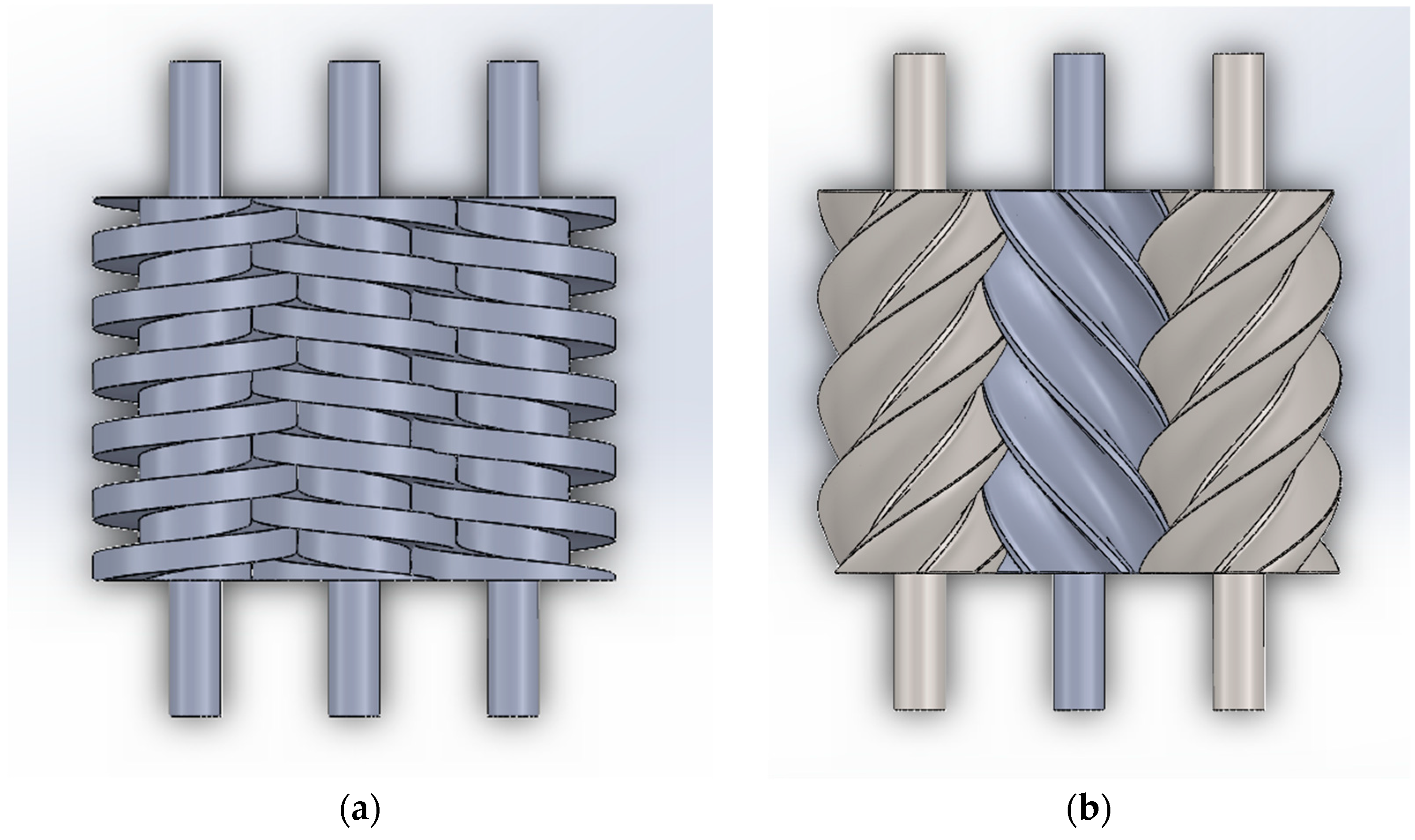
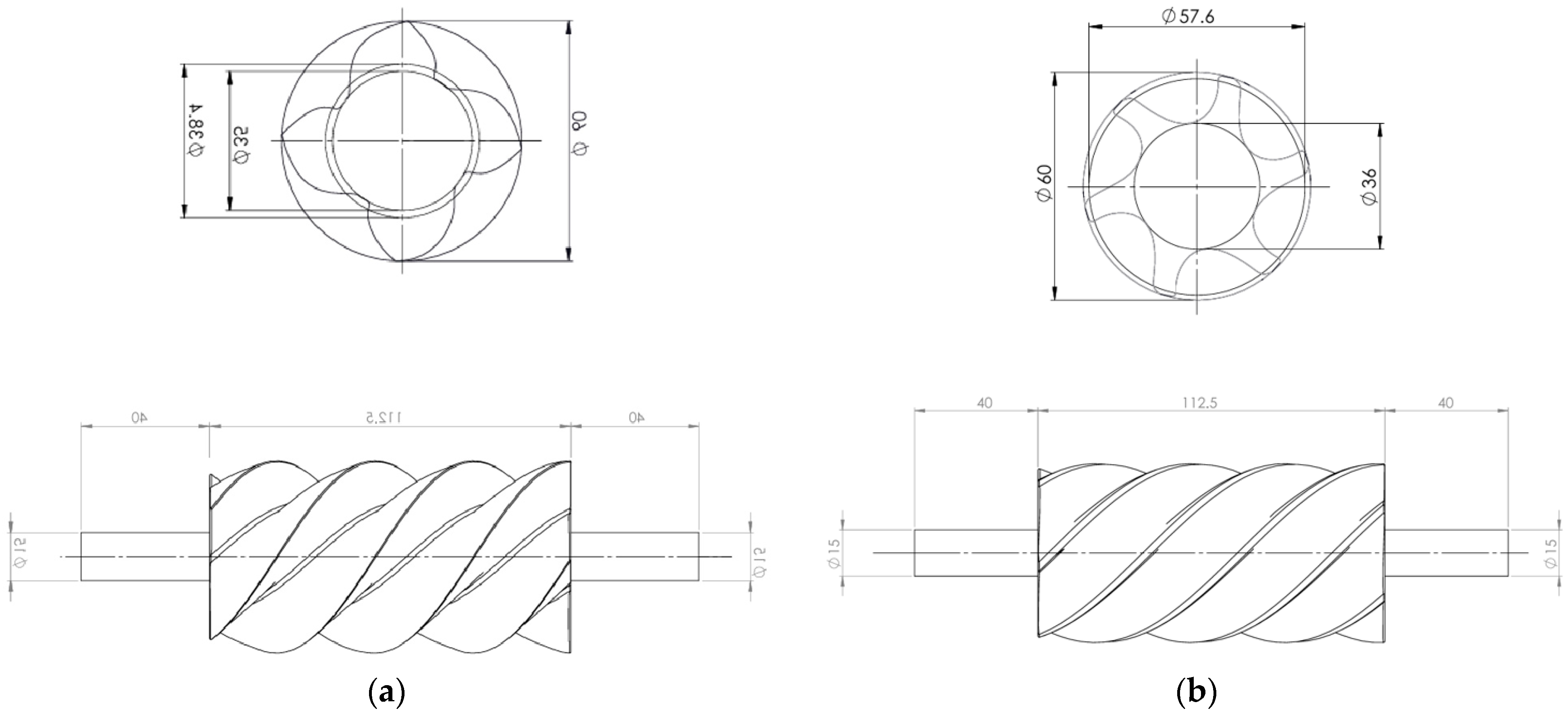
To evaluate the impact of rotor profile design on compressor performance, two geometrically different rotor configurations, designated Type A and Type B (see Figure 1), were considered. The rotor geometries differ quantitatively in several key parameters. Type A employs a symmetric profile with a wrap angle of approximately 300°, which promotes a longer sealing contact line but results in steeper local curvature transitions at the interlobe region. Type B features an asymmetric profile with a reduced wrap angle (~270°), providing a more gradual curvature progression along the compression path. The radial tip clearance in Type B is reduced by approximately 20–25% relative to Type A, improving sealing effectiveness under steady-state conditions, while the axial end-face clearance is similarly tightened. These geometric distinctions directly govern the volumetric compression law, the evolution of the sealing line during rotation, and the susceptibility to leakage under pressure gradients, as quantified in Table 1 and Figure 2. Both configurations were built using a parametric CAD system to ensure precise control of geometric parameters and reproducibility of results.
Both configurations share the same nominal operating conditions: rotor length L = 90.0 mm (derived from L/D = 1.5 and Dm = 60.0 mm), rotational speed n = 3000 rpm, inlet total pressure pin = 0.32 MPa, inlet total temperature Tin = 285 K, and nominal compression ratio π = 3.5 (corresponding to a discharge pressure of 1.12 MPa); these values are held constant across all simulations in Section 3.1 and Section 3.2 and serve as the reference point for the offline digital twin seasonal analysis in Section 3.3.

2.1.1. Computational Grid Generation and Mesh Geometry

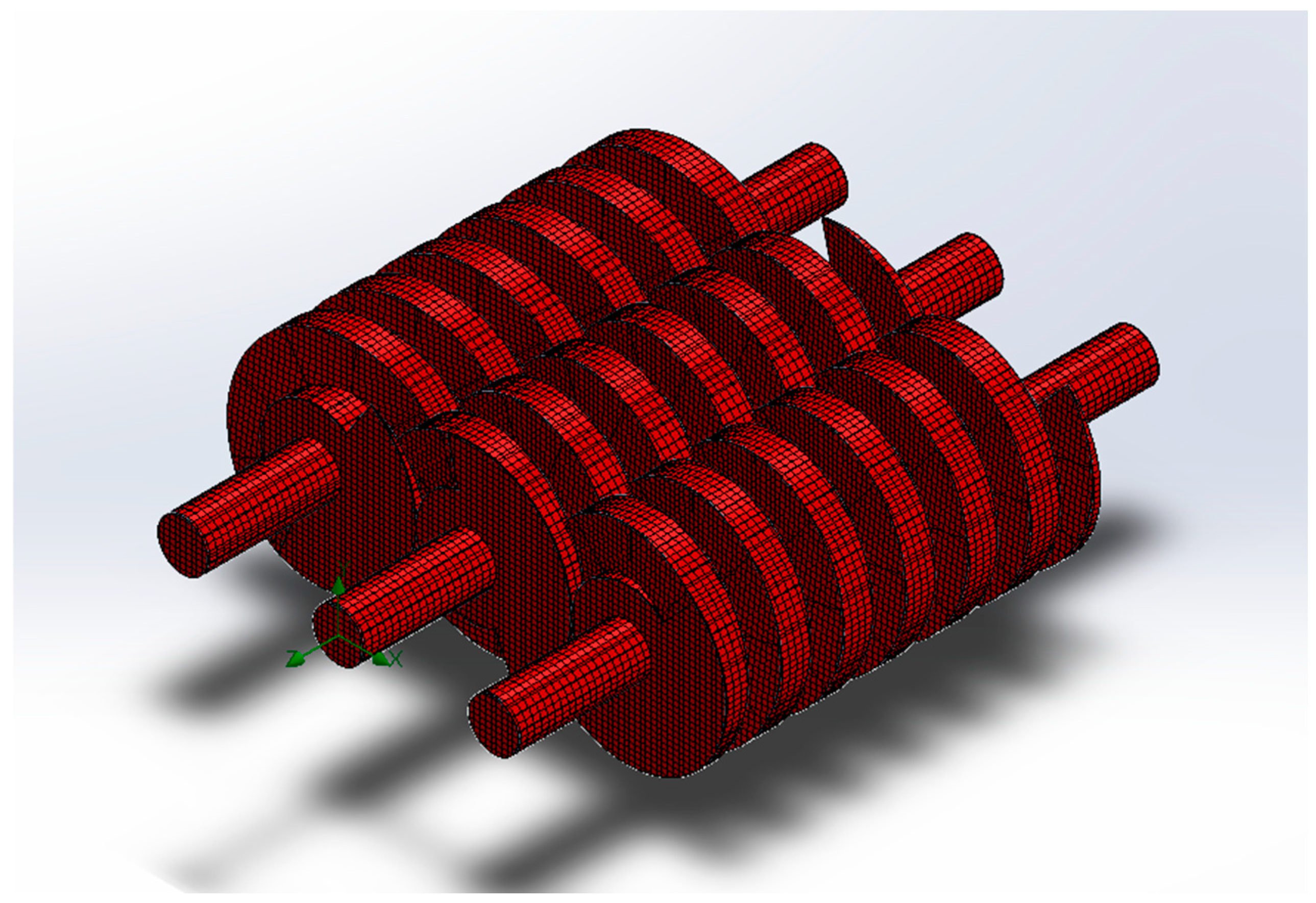
The computational domain was generated directly from the 3D CAD geometry of both rotor configurations (Type A and Type B). The solver automatically constructs a structured Cartesian mesh with local refinement and cell-based boundary processing, ensuring accurate representation of the rotor’s curved surfaces and narrow clearances. Figure 3 shows a schematic representation of the structure of the computational grid used for numerical modeling.
The mesh-based approach allows for accurate no-slip conditions at liquid-solid interfaces without introducing excessive distortion typical of unstructured meshes.
To ensure numerical reliability, convergence stability, and transient solution robustness, a comprehensive mesh-independence study was conducted using three progressively finer mesh densities. Computational meshes consisted of approximately 1.2 million cells (coarse mesh), 2.4 million cells (medium mesh), and 4.1 million cells (fine mesh), respectively. A comparative analysis showed that the relative deviation between the medium and fine meshes remained below 1.5% for all monitored quantities. The coarse grid showed slightly larger discrepancies, particularly in the prediction of the leakage mass flow velocity and pulsation amplitude, indicating insufficient resolution of the gap-induced vortex structures. Given the minor differences between the medium and fine grids and the significant increase in computational costs associated with the fine grid, the medium grid configuration (~2.4 million cells) was adopted for all subsequent transient simulations.
To provide a transparent record of mesh sensitivity, the relative deviations of key monitored quantities across all three mesh configurations are summarized in Table 2. As shown in Table 2, all quantities converged monotonically with mesh refinement. The coarse mesh exhibited deviations of up to 4.1% in leakage mass flow prediction relative to the medium mesh, confirming insufficient resolution of gap-induced vortex structures at this density. In contrast, the medium-to-fine deviation remained below 1.5% for all quantities, satisfying the standard convergence criterion for engineering CFD applications. The medium mesh (~2.4 million cells) was therefore selected for all subsequent simulations as the optimal compromise between numerical accuracy and computational cost.
The numerical settings applied throughout the mesh independence study and all subsequent transient simulations are as follows. Convergence criterion: within each time step, iterative convergence was declared when the normalised residuals of the continuity, momentum (x, y, z), energy, k, and ω equations all fell below 1 × 10⁻⁴; this threshold was reached within 15–25 inner iterations per time step for the medium and fine meshes. Time step: rotor rotation was advanced at 2° of shaft rotation per time step, corresponding to Δt = 1.11 × 10⁻⁴ s at n = 3000 rpm (one full revolution = 180 time steps, trev = 20 ms); time-step sensitivity was confirmed by halving Δt to 1°/step, which changed the cycle-averaged discharge pressure by less than 0.4%. All reported results were obtained after the solution reached a quasi-periodic state, verified by the condition that the cycle-to-cycle variation in mass-averaged discharge pressure between consecutive revolutions was below 0.2%; in practice this was achieved after 8–12 revolutions, and all monitored quantities were averaged over the final 3 complete revolutions. Near-wall resolution: SolidWorks Flow Simulation 2022, SP3.0 (version 30.3, Dassault Systèmes SolidWorks Corporation, Waltham, MA, USA) employs a Cartesian immersed-boundary (IB) discretisation in which the conventional y+ metric is not applicable because the mesh does not conform to the wall surface. Near-wall accuracy is instead governed by the local IB cell refinement level in the clearance regions: for the medium mesh, the minimum cell edge length in the interlobe and tip clearance zones was set to δcell = 0.02 mm, corresponding to approximately one-third of the tightest radial clearance (δr = 0.06 mm for Type B), which provides at least 3 computational cells across the gap—the minimum recommended for the IB two-layer wall treatment to resolve the near-wall velocity gradient without relying on wall functions. Monitored variables: the six quantities listed in Table 2—mass flow rate ṁ, volumetric efficiency ηv, peak chamber pressure pmax, leakage mass flow ṁgap, maximum local velocity vmax, and discharge temperature Tdis—were selected as monitors because they represent the primary integral and local outputs reported throughout the paper. Each quantity was evaluated as a cycle-average over the final 3 revolutions; the deviations reported in Table 2 represent the relative difference between cycle-averaged values on successive mesh levels.

2.1.2. Governing Equations

The transient compressible flow inside the screw compressor was modeled by solving the Reynolds-Averaged Navier–Stokes (RANS) equations in conservative form.
Continuity Equation:
ρ t + ( ρ u ) = 0
Momentum Equation:
( ρ u ) t + ( ρ u u ) = p + [ ( μ + μ t ) ( u + u T ) ]
Energy Equation:
( ρ h ) t + ( ρ u h ) = p t + [ ( k + k t ) T ]
where: ρ —density, u —velocity vector, p —pressure, μ —molecular viscosity, μ t —turbulent viscosity, h —specific enthalpy, k , k t —molecular and turbulent thermal conductivity.
The working fluid—compressed air, used as a surrogate for natural gas in the CFD module—was treated as a compressible gas with non-ideal equation of state; density was computed from ρ = p/(ZRT), where the compressibility factor Z was evaluated as a function of local pressure and temperature using the truncated virial equation of state (Z = 0.91 at suction, Z = 0.84 at discharge, as detailed in Section 2.1.4 (i)). All other thermophysical properties (viscosity, thermal conductivity, specific heat) were updated as polynomial functions of temperature at each iteration.

2.1.3. Turbulence Modeling

To capture these effects, two turbulence models were evaluated:
Standard k–ε Model
The k–ε model solves transport equations for turbulent kinetic energy k and dissipation rate ε :
( ρ k ) t + ( ρ u k ) = [ ( μ + μ t σ k ) k ] + G k ρ ε
( ρ ε ) t + ( ρ u ε ) = [ ( μ + μ t σ ε ) ε ] + C 1 ε k G k C 2 ρ ε 2 k
The k–ε model is computationally efficient and robust for high-Reynolds-number internal flows.
k–ω SST Model
The k–ω Shear Stress Transport (SST) model combines the near-wall accuracy of the k–ω model with the free-stream independence of the k–ε model. It solves:
( ρ k ) t + ( ρ u k ) = [ ( μ + σ k μ t ) k ] + P k β * ρ k ω
( ρ ω ) t + ( ρ u ω ) = [ ( μ + σ ω μ t ) ω ] + α ω k P k β ρ ω 2
The k–ω SST model was selected for all reported simulations based on both physical and comparative criteria. From a physical standpoint, the internal flow in a screw compressor is characterized by three concurrent regimes that demand different turbulence treatments: (i) high-Reynolds-number bulk compression flow in the chamber core (Rechamber ≈ 1.1–1.4 × 10⁵), well-handled by k–ε [44]; (ii) low-Reynolds transitional flow in narrow interlobe clearances (Releak ≈ 3.5–8.0 × 10³), where near-wall accuracy of k–ω is essential [45]; and (iii) separated shear layers at the rotor tip and discharge port, which involve adverse pressure gradients requiring the SST blending function to prevent premature reattachment prediction [46]. The k–ω SST model [47] is specifically designed to blend the near-wall k–ω formulation with the free-stream k–ε behavior through a smooth switching function based on wall distance, making it uniquely suited to this multi-regime internal flow. Quantitative comparative testing between k–ε and k–ω SST showed negligible difference in global integral parameters (mass flow, compression ratio: <2%), confirming that bulk flow is insensitive to the choice; however, SST provided 8–12% better resolution of local vortex core structures in the meshing region and more physically consistent leakage jet trajectories, which directly affect the accuracy of leakage mass flow prediction—a key output of this study.

2.1.4. Model Assumptions and Boundary Conditions

The following assumptions govern the numerical model:
(i) Compressibility treatment: The working fluid (natural gas mixture, approximated as air for the CFD component) was treated as a compressible gas with non-ideal equation of state and pressure- and temperature-dependent thermophysical properties. Compressibility is non-negligible in this application: the local Mach number reaches Mamax = 0.21–0.26 in constricted inter-rotor regions (chamber Re ≈ 1.1–1.4 × 10⁵; quantified in Table 3), and density variations across the compression path exceed 300% (from ~5.4 kg/m3 at inlet to ~22 kg/m3 pre-discharge in transient regimes). The incompressible assumption, which is sometimes adopted for low-speed compressor components, would introduce unacceptable errors in mass flow prediction and pressure amplification calculations. The compressibility factor Z was evaluated as a function of local pressure and temperature using the truncated virial equation of state, decreasing from Z = 0.91 at suction to Z = 0.84 at discharge.
(ii) Boundary conditions: At the inlet, a time-dependent total pressure boundary condition was imposed: pin(t) = 0.32 MPa (steady), pin(t) = 0.32 + 0.038·sin(2π·12·t) MPa (harmonic), or a band-limited Gaussian white-noise pressure signal (quasi-random). The stochastic signal has mean p = 0.32 MPa, root-mean-square amplitude σ = 0.038/√2 = 0.02687 MPa (equal to the RMS of the harmonic excitation, ensuring identical total fluctuation energy in both cases), and a flat power spectral density S0 = σ2/(fhigh − flow) = 2.41 × 10⁻⁷ MPa2/Hz over the frequency band 1–3000 Hz. The upper frequency limit was chosen to encompass the chamber acoustic eigenfrequency fch ≈ 2.1 kHz (Section 3.2) while remaining below the Nyquist limit of the simulation time step (fNyquist = 4505 Hz at Δt = 1.11 × 10⁻⁴ s). The signal was generated as a discrete zero-mean Gaussian sequence, scaled to the target RMS, and applied as a time-varying total pressure boundary condition at each time step. Statistical quantities under stochastic excitation were accumulated over 25 rotor revolutions after quasi-periodic convergence and averaged over the final 10 revolutions; the coefficient of variation of mass flow rate and pulsation amplitude over consecutive 5-revolution blocks did not exceed 2.1%, confirming statistical stationarity. Inlet total temperature was held constant at 285 K. At the outlet, a static pressure boundary condition of 1.12 MPa was prescribed, consistent with the nominal compression ratio of 3.5. Rotor surfaces were treated as no-slip, adiabatic moving walls with rotational velocity prescribed from the kinematic constraint. The casing walls were modeled with a convective heat transfer boundary condition using the temperature-dependent external heat transfer coefficient hext(Tamb), which was adapted seasonally in the offline digital twin module (hext(Tamb) evaluated from a combined natural and forced convection fit to the 2022 field casing surface temperature measurements: hext = 10.4·(288/Tamb,K)0.13 W/(m2·K), yielding hext = 9.6 W/(m2·K) at Tamb = +35 °C and hext = 11.4 W/(m2·K) at Tamb = −30 °C; the seasonal range is consistent with the measured casing heat loss fractions of 14–18% (Table 8)).
(iii) Oil injection: In the oil-flooded screw compressor, the injected oil serves as coolant and dynamic seal. For the CFD simulations, oil was modeled as a continuous liquid phase with Arrhenius-type viscosity dependence (Equation (28)). The oil injection mass flow rate was set to maintain an oil-to-gas mass ratio of 3:1, consistent with typical field operation. The two-phase interaction was handled through a homogeneous mixture model, which is appropriate given the high oil volumetric fraction and the dominance of viscous forces over interfacial tension at the relevant Reynolds numbers.
(iv) Moving boundaries and chamber volume change. It is noted that although the term “moving mesh” is sometimes used loosely to describe any transient simulation of a rotating machine, the present solver employs a fixed Cartesian grid throughout. Rotor motion is accounted for via the immersed-boundary method, in which cell activation states are updated at each time step to reflect the new angular position of the rotors. This approach is time-accurate and fully captures the transient compression kinematics, but the mesh itself remains stationary. Rotor rotation and the associated continuous reduction of the interlobe chamber volume were handled using the Cartesian IB method implemented in SolidWorks Flow Simulation. In this approach the computational mesh is a fixed Cartesian grid that does not move or deform at any point during the simulation.
At each time step the rotor geometry is advanced by the prescribed angular increment Δθ = 2° (corresponding to Δt = 1.11 × 10⁻⁴ s at n = 3000 rpm). The solver then re-evaluates every Cartesian cell to determine whether it lies inside the solid rotor body or in the fluid domain at the new angular position. Cells that transition from solid to fluid are activated and their flow variables (velocity, pressure, temperature, turbulence quantities) are initialised by weighted interpolation from the surrounding fluid cells. Cells that transition from fluid to solid are deactivated. At the boundary between active fluid cells and the immersed rotor surface, the solver applies a flux-correction scheme that enforces the no-slip, no-penetration condition on the instantaneous rotor wall without requiring explicit mesh regeneration. Conservation of mass, momentum, and energy across the IB interface is maintained to machine precision by the flux-correction procedure.
The instantaneous interlobe chamber volume Vch(θ) is not extracted from the CFD mesh directly but is evaluated geometrically at each time step from the parametric CAD representation of the rotor profiles at the current shaft angle θ(t) = n·t·2π/60. The resulting Vch(θ) time history defines the compression kinematics and is used to construct the indicator diagram and to evaluate the indicated work per cycle via Equation (19) (L = ∮ p dV). As an internal consistency check, the CAD-computed Vch(θ) was compared against the CFD-integrated fluid cell volume at the same angular positions over one complete revolution; the maximum relative discrepancy was 0.8% for Type A and 0.6% for Type B, confirming that the IB reconstruction faithfully captures the volumetric compression law of both rotor profiles.

2.2. Climate-Aware Offline Digital Twin (Digital Shadow) Framework

To assess year-round operational performance under varying ambient conditions, a climate-adaptive offline physics-based digital twin (digital shadow) was constructed. The twin integrates three coupled layers: (i) CFD-derived response surfaces (Section 2.1, Section 3.1 and Section 3.2), which map inlet pressure, ambient temperature, and rotor configuration to mass flow rate, polytropic efficiency, leakage intensity, and discharge temperature; (ii) a reduced-order seasonal model driven by the measured ambient temperature record Tamb(t); and (iii) field calibration against a full-year operational dataset from a compressor installation in the Atyrau region, Kazakhstan. The twin is an offline predictive tool—it does not incorporate real-time sensor feedback or autonomous parameter updating.
Ambient temperature was represented as a harmonic-regression fit to hourly meteorological data Tamb(t). Lubricant viscosity was modelled by the Arrhenius expression:
μ o i l ( T ) = μ 0 e x p ( E R T )
where μ0 = 1.62 × 10⁻⁵ Pa·s and E/R = 2336 K (E = 19.4 kJ/mol) are determined analytically in Section 2.2.2. The cold-regime volumetric efficiency degradation is modelled as:
η v ( T ) = η v , r e f a 1 m ˙ l e a k ( T ) a 2 Δ W m e c h ( T )
where a1 and a2 are calibrated in Section 2.2.2. Annual energy consumption and the climate load index are:
E y e a r = 0 1   y e a r P ( t )   d t
K c l = 0 1   y e a r ( T a m b ( t ) T r e f ) 2 d t
with units °C2·h when T is in °C and t in hours; at the Atyrau installation the computed annual value is Kcl = 1.87 × 10⁶ °C2·h (Tref = 20 °C, the regional annual mean).

2.2.1. Field Data Sources

The calibration dataset comprises N = 8760 hourly SCADA records from a full calendar year (2022) at the field installation. Five quantities were recorded: (a) ambient temperature Tamb—Pt-100 RTD, ±0.5 °C; (b) gas mass flow rate ṁ—ultrasonic transit-time flowmeter, ±1.5%; (c) discharge temperature Tdis—type-K thermocouple, ±1.0 °C; (d) electrical power N—three-phase digital analyser, ±1.0%; (e) suction pressure pin—piezoelectric transducer, ±0.5%. Gas composition (CH4 88 mol%, C2H6 6%, C3H8 3%, N2 2%, CO2 1%) was obtained from quarterly chromatographic analysis. The dataset was partitioned chronologically: January–September 2022 (N_cal = 6570 records, 75%) for calibration, and October–December 2022 (N_val = 2190 records, 25%) as a held-out validation set.

2.2.2. Calibration Protocol

The model contains four free parameters: the pre-exponential factor μ0 and activation energy E in the oil viscosity model (Equation (8)), and the empirical degradation coefficients a1 and a2 in the volumetric efficiency model (Equation (9)).
The Arrhenius constants μ0 and E were determined analytically from two viscosity reference measurements reported in Section 3.3: μ_oil = 0.018 Pa·s at 60 °C and μ_oil = 0.041 Pa·s at 25 °C. Solving the resulting two-equation system yields μ0 = 1.62 × 10⁻⁵ Pa·s and E/R = 2336 K (E = 19.4 kJ/mol); these values reproduce both reference points exactly and are held fixed throughout.
The coefficients a1 and a2 were determined by least-squares minimisation over three cold-regime operating points (Tamb = 0, −20, and −40 °C), using ηv values from Section 3.3 and Nmech values from Table 9. The leakage term ṁ_leak(T) was evaluated from a clearance-widening model: differential thermal contraction between the cast-iron casing and steel rotors widens the interlobe clearance by approximately 0.04 mm per 35 °C of cooling below the +15 °C reference (consistent with the 0.03–0.05 mm range reported in Section 3.3), with the resulting leakage estimated via the 1.5-power slot-flow scaling from the nominal clearance δ_ref = 0.08 mm (Type A, Table 1) and the steady-state reference leakage ṁleak,ref = 0.161 kg/s (steady-state leakage mass flow from the stochastic simulation, reported later in Table 6). The mechanical loss increment ΔWmech(T) was taken directly from Table 9, with Nmech,ref = 28 kW at the +15 °C reference. Calibration was restricted to cold-side points because warm-side efficiency reduction (T > +15 °C) is governed by oil thermal degradation, a mechanism not represented in Equation (9). The calibrated values are a1 = 0.516 (kg/s)−1 and a2 = 5.34 × 10⁻⁴ kW−1, reproducing all three calibration points with a maximum residual of 0.010 in ηv and a mean residual of 0.006.
It should be noted that ηv and Nmech, used as calibration targets for a1 and a2, are model-derived intermediate quantities rather than direct field measurements. The coefficients are therefore identified within the modeling framework and are not independently constrained by a dedicated measurement of volumetric efficiency or shaft mechanical loss power. The practical consequence is that the seasonal decomposition of ηv loss (Section 3.3) and the magnitude of mechanical loss penalties should be interpreted as model-consistent estimates rather than directly verified results. The ultimate validation of the offline digital twin rests on the agreement between model predictions and the four directly measured SCADA quantities—mass flow rate, discharge temperature, electrical power, and suction pressure—over the held-out October–December 2022 period, as reported in Section 3.3.

2.2.3. Uncertainty Analysis and Update Logic

Model predictive accuracy was assessed on the held-out validation period (October–December 2022). The mean absolute relative deviations between model predictions and measured field values were 3.1% for mass flow rate, 3.8% for discharge temperature, and 5.2% for electrical power consumption. The largest discrepancies (6–7%) were observed in October–November and attributed to fluctuations in gas humidity and compositional variability not represented in the quarterly-average gas composition used by the model.
The uncertainty in the primary derived output—annual additional energy consumption ΔEyear—was estimated by propagating the power-consumption model error through the annual temporal integration (Equation (10)). Since ΔEyear = ∫P(t) dt and the systematic model error on P(t) is ±5.2%, the propagated uncertainty on ΔEyear is ±5.2%, corresponding to ±10 MWh on the reported value of 186 MWh per compressor per year (i.e., ΔEyear = 186 ± 10 MWh). All other scalar outputs in Table 7, Table 8 and Table 9 carry relative uncertainties in the range ±3–5%, consistent with the spread of individual validation errors.
It should be noted that the held-out validation dataset covers only the cold-side operating window (Tamb = −15 to +8 °C). Model predictions for the summer operating range (+35 to +40 °C) therefore rely on calibrated extrapolation and carry higher uncertainty than the ±5.2% bound established over the validation period. Decomposing the annual energy penalty by season (Section 3.3), the validated cold-side contribution (~61% of ΔEyear) provides a robust lower bound on the annual penalty, while the summer extrapolation component (~27%) is subject to additional model uncertainty that cannot be quantified without summer field measurements. Users applying this framework to installations with a different seasonal temperature distribution should treat the full annual figure with corresponding caution.
Regarding update logic: the offline digital twin (digital shadow) in this work is an offline seasonal prediction tool. Model parameters (μ0, E, a1, a2) are fixed at the values calibrated against 2022 field data and are not updated automatically during operation. The twin receives the ambient temperature record Tamb(t) as a time-varying input and outputs annual performance forecasts without any closed-loop feedback from real-time sensors. Periodic manual recalibration using updated field data is recommended whenever significant changes in gas composition, equipment condition, or operating regime are detected, but no automated recalibration mechanism is implemented in the present framework.

2.3. Integrated Coupling Strategy

The core novelty of this study lies in the integration of geometry, transient gas dynamics, and climatic variability within a unified framework.
First, geometry-specific CFD simulations established baseline flow characteristics for Type A and Type B rotors. These results defined geometry-dependent response functions for pressure gradients, leakage rates, and dynamic sensitivity.
Second, unsteady simulations quantify how inlet pulsations propagate and amplify within the chamber. Geometry-dependent amplification sensitivity was evaluated as:
S g e o m = K p ( Δ p )
indicating how rotor design influences susceptibility to external disturbances.
Third, climate-induced variations in gas density and oil viscosity were introduced into the dynamic framework. Cold conditions increase gas density and oil viscosity, altering both inertial response and lubrication behavior. Consequently, pulsation amplification becomes temperature-dependent:
K p ( T ) = K p , r e f Ψ ( T , μ o i l )
Finally, annual performance comparisons between rotor types were conducted through integrated energy evaluation:
Δ E y e a r = E y e a r , A E y e a r , B
This coupling strategy allows quantification of how geometry modifies sensitivity to pulsations, how pulsations interact with climatic conditions, and how environmental variability alters the relative efficiency of different rotor profiles.
All reported differences between rotor configurations and operating regimes were confirmed across three independent simulation runs with varied initial conditions, confirming the robustness of the observed trends. The coefficient of variation for key integral quantities (mass flow, volumetric efficiency) across repeated runs did not exceed 0.4%, confirming numerical stability of the reported results.

3. Results and Discussion

3.1. Influence of Rotor Geometry on Internal Flow Structures

Numerical modeling of gas-dynamic processes was performed using the SolidWorks Flow Simulation module. The computational domain included the inlet manifold; compressor working chamber; outlet channel; and internal casing volume. Air, considered a compressible Newtonian gas, was adopted as the working fluid. The calculations in this section were performed using a quasi-steady frozen-rotor formulation at a fixed mid-compression angular position, taking turbulence into account. This approach captures the instantaneous pressure and velocity fields at a single compression phase and supports qualitative comparative geometry assessment; it does not provide cycle-averaged thermodynamic performance and should not be interpreted as equivalent to a full transient simulation. Conclusions drawn from this section are therefore directional in nature. Full time-accurate transient simulations using the Cartesian immersed-boundary formulation are applied in Section 3.2 and Section 3.3, though these were conducted for a single rotor configuration focused on pulsation response rather than on a symmetric comparative assessment of both profiles. The numerical modeling enabled a detailed investigation of the working fluid flow characteristics within a three-screw compressor for two rotor geometry variants. The analysis covered the spatial structure of gas movement, the nature of velocity changes, the intensity of vortex formations, and the distribution of static pressure both within the working chamber volume and on the rotor surfaces. A consistent transition from evaluating kinematic parameters to considering force factors allowed for a comprehensive understanding of the influence of the screw profile on hydrodynamic processes.
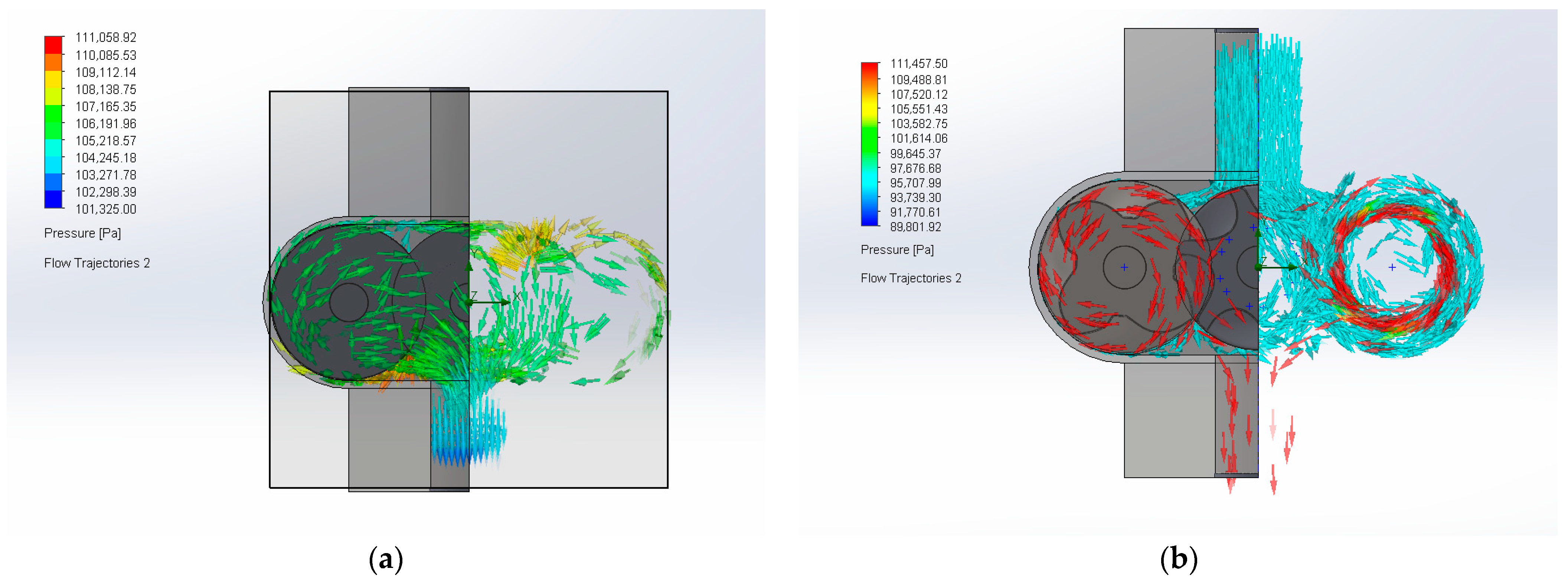
Figure 4 shows the quasi-steady static pressure distribution combined with a visualization of the flow streamlines within the working chamber of a three-screw compressor for two rotor profile configurations (type A and type B). The color scale represents the static pressure (Pa), and the streamlines illustrate the instantaneous flow organization, including interblade recirculation, leakage-induced jets, and vortex structures at the outlet. A comparative analysis reveals that rotor profile geometry significantly influences pressure changes, leakage intensity, and dynamic pulsation behavior.
The overall pressure increases in the compression chamber, defined as Δ P = P d i s P s u c , was slightly higher for configuration B; however, this increase was accompanied by more pronounced spatial pressure non-uniformity concentrated at the discharge port, where intermittent high-velocity leakage jets—driven by the elevated overall pressure differential—generate intensified vortex structures upon port opening (consistent with Mamax = 0.26 and Kp = 0.081 in Table 3). Similar behavior was observed in previous studies of screw compressors, where rotor geometry directly influenced pressure gradients and local turbulence formation [48,49]. Increased local pressure gradients enhance shear layer development and can increase aerodynamic losses due to increased mixing and dissipation.
Although configuration B produces a slightly higher pressure rise, the increase is accompanied by stronger spatial non-uniformity in the outlet zone and elevated pressure pulsations, as discussed in the subsequent section. Increased pulsation levels are typically associated with enhanced outlet vortex shear layers and leakage-induced shear layers, as reported in detailed CFD studies of screw compressors and rotary machines.
Velocity field analysis confirms that peak velocity values are observed in the constricted inter-rotor regions, where gas movement is determined by the gradual reduction in chamber volume during rotor rotation. These zones act as dynamic throttling regions, where flow acceleration is caused by geometric constraints and imposed kinematic compression. As the rotors advance axially, the local kinetic energy of the gas is gradually converted into pressure potential due to the compression work, leading to a monotonic increase in pressure along the compression path.
Velocity distribution is highly dependent on the rotor surface geometry. Changes in profile curvature alter local acceleration gradients and shear layer development in the inter-blade region. Increased curvature and segmented surface transitions contribute to increased jet deflection and enhanced vortex formation, leading to non-uniform velocity fields across the chamber cross-section. Conversely, smoother and more continuous surface geometry reduces local acceleration peaks, reduces shear layer enhancement, and promotes more uniform gas transport. This behavior is consistent with the results of computational fluid dynamics (CFD) studies of screw compressors, which show that rotor profile design directly influences vortex intensity, secondary flow structures, and aerodynamic losses.
Analysis of the static pressure field further reveals significant differences in the compression dynamics between the two configurations. The first configuration exhibits distinct pressure discontinuities between adjacent working chambers, manifested as localized pressure peaks and steep contour gradients. These abrupt pressure changes indicate uneven volumetric compression and increased interaction between chambers during rotor rotation. This behavior can lead to increased mechanical stress on the rotor surfaces and sealing faces, as well as increased pressure pulsation amplitude.
In contrast, Type B exhibits a more uniform pressure distribution during the mid-compression phase: the pressure increase along the axial direction is gradual, with reduced contour discontinuities and smoother transitions between adjacent working chambers. This uniformity is a characteristic of the mid-compression zone and should be distinguished from the discharge-region behaviour described above, where the higher overall pressure ratio generates intermittent high-momentum leakage jets.
This spatial uniformity arises from the gradual curvature of the asymmetric profile, which distributes compression work more evenly across the rotor revolution cycle. The reduced local pressure gradient (∇pmax reduced by ~10% relative to Type A) lowers the instantaneous driving force for inter-chamber leakage, thereby suppressing shear layer amplification in the clearance gap and reducing dynamic loading on the rotor surfaces. However, the higher overall pressure ratio maintained by Type B means that when leakage does occur—particularly during the late compression phase—the pressure differential across the clearance is disproportionately large, generating high-velocity leakage jets (as reflected in the elevated Mamax = 0.26) that contribute to downstream turbulence and mixing losses. Consequently, the reduction in localized pressure gradient intensity does not fully translate into lower aerodynamic dissipation, as the energy penalty is redistributed toward intermittent high-momentum leakage events rather than continuous shear-layer losses.
To provide a structured comparison of the two rotor profiles, key thermodynamic and flow parameters were quantified and are summarized in Table 3.
Comparative analysis shows that rotor surface geometry plays a critical role in ensuring speed uniformity, shear layer development, vortex formation, and pressure changes within the working chamber.
The observed performance differences between Type A and Type B can be attributed to specific geometric mechanisms. In Type A, the steeper curvature transitions at the interlobe sealing region generate sharper adverse pressure gradients, which promote earlier boundary layer separation and intensify shear layer instability. The resulting vortex shedding at the rotor tip contributes to elevated turbulent kinetic energy and enhances mixing losses in the discharge region, consistent with the higher pulsation coefficient Kp = 0.064 observed for this configuration. In Type B, the reduced interlobe clearance (δr ≈ 0.06–0.10 mm) combined with the asymmetric profile geometry produces a more continuous contact line progression during rotor rotation, suppressing the formation of discrete leakage jets. The lower leakage Reynolds number range (Releak = 4.0–8.0 × 10³ for Type B vs. 3.5–6.8 × 10³ for Type A under comparable pressure differentials) indicates that while the absolute leakage channel geometry is tighter in Type B, the higher pressure rise (ΔPB ≈ 1.05 × 10⁴ Pa) drives stronger pressure-driven leakage events when the sealing line transiently opens during discharge. This trade-off—between improved sealing geometry and elevated driving pressure differential—explains the counterintuitive combination of higher pressure rise yet lower volumetric efficiency (ηv = 0.88 vs. 0.91) observed in Type B. Quantitatively, the maximum spatial pressure gradient ∇pmax in Type B was reduced by ≈10% compared to Type A, particularly near the interlobe sealing region.
While the differences between Type A and Type B observed in the quasi-steady snapshot—3 percentage points in the instantaneous ηv estimate and a Kp difference of 0.017—may appear modest in absolute terms, they are directionally consistent with the geometric differences in clearance and curvature progression. It should be noted that these values reflect a single angular position and may not be representative of cycle-averaged performance; cycle-averaged transient simulations of both profiles under identical conditions would be required to confirm the quantitative ranking. Subject to this caveat, if the directional differences are sustained over the full compression cycle, their practical significance could scale considerably at the system level—though the magnitude of such scaling cannot be reliably estimated without cycle-averaged transient data for both profiles. These considerations establish that the geometry-driven differences warrant further investigation, and that their potential fleet-level consequences may be of engineering significance pending confirmation. As will be shown in Section 3.3, when rotor geometry effects are compounded by climate-induced performance degradation and viscosity-driven mechanical losses, the cumulative annual energy and maintenance penalties per unit reach levels of clear engineering and economic significance. These considerations establish that the reported geometry-driven differences, though numerically moderate at the unit level, carry substantial consequences at the operational and fleet level.

3.2. Dynamic Response Under Harmonic and Stochastic Inlet Pulsations

The fluid model in Section 3.1 and Section 3.2 is identical to that described in Section 2.1.4 (i): compressed air with density computed from the truncated virial equation of state (ρ = p/(ZRT), Z = 0.91–0.84 across the compression path); the transition to multicomponent natural gas properties occurs exclusively in the offline digital twin seasonal module described in Section 3.3.
Two distinct pressure amplification indicators are used in this paper and should be distinguished: Kp = ΔPch/Pmean is the geometry-based pulsation coefficient reported in Table 3 for Section 3.1—it characterises the inherent pressure non-uniformity of each rotor profile under steady-state conditions relative to the mean chamber pressure, independently of any external excitation; Πp = ΔPch/ΔPin (Equation (15)) is the transient amplification factor used throughout Section 3.2—it quantifies how much the chamber pressure pulsation amplitude exceeds the inlet excitation amplitude, and therefore depends on both rotor geometry and the frequency content of the inlet disturbance.
Numerical simulations revealed quantitative trends in the thermo-gas-dynamic characteristics of gas compression in a screw compressor subject to transient inlet pressure fluctuations. The baseline steady-state regime was compared against non-steady-state cases, including harmonic and quasi-random inlet disturbances, enabling the evaluation of both integral performance indicators and local flow dynamics.
Under steady-state conditions (mean inlet pressure 0.32 MPa, inlet temperature 285 K), the compression process exhibited a stable monotonic pressure increase within the closed working chambers up to 1.12 MPa at the discharge opening. The maximum local gas temperature reached 412 K, while the volume-averaged discharge temperature was 398 K, confirming thermodynamically consistent compression behavior.
When harmonic inlet oscillations were imposed according to p i n ( t ) = 0.32 + 0.038 sin ( 2 π 12 t )   MPa , a distinct amplification of internal pressure pulsations was observed. The pressure fluctuation amplitude inside the chambers increased to 0.074 MPa, exceeding the external excitation amplitude (0.038 MPa). The pressure amplification factor can be defined as
Π p = Δ P c h Δ P i n ,
where Δ P c h is the internal chamber pulsation amplitude and Δ P i n is the inlet excitation amplitude. For the present case, Π p 0.074 0.038 1.95 , indicating nearly twofold amplification of pressure oscillations due to dynamic interaction between inlet forcing and intrinsic chamber compression.
Table 4 presents a comparative analysis of the compression process parameters under steady-state and non-steady suction conditions, highlighting the influence of inlet pressure oscillations on thermodynamic performance.
Phase analysis revealed a distinct lag between inlet excitation and internal chamber response. The peak internal pressure was shifted relative to the inlet signal by 38–52° of rotor rotation, corresponding to a temporal delay of τlag ≈ 3.6 × 10⁻³ s.
This phase shift arises from the interaction of two concurrent physical processes intrinsic to the screw compressor working cycle. First, the chamber closure process is geometrically governed: as the male and female rotors advance axially, the interlobe volume transitions from an open (suction-connected) state to a fully closed (isolated) state over a finite angular interval—approximately 40–60° of rotor rotation for the present geometry. During this closure interval, the chamber remains partially exposed to the suction port, allowing the inlet pressure disturbance to directly influence the trapped gas quantity. However, the pressure signal cannot instantaneously propagate through the full chamber volume due to the finite speed of sound in the compressed gas mixture. At the mean chamber conditions (T ≈ 340 K, p ≈ 0.5 MPa), the acoustic propagation time across the chamber length (~0.2 m) is on the order of 0.5 × 10⁻³ s, which is non-negligible relative to the rotor period (~20 × 10−3 s at 3000 rpm). Second, the compressibility of the gas mixture introduces an additional dynamic delay: as the chamber closes, the trapped gas must first be compressed from suction pressure to match the rising chamber pressure before the inlet disturbance can fully manifest as an internal pressure fluctuation. The combined effect—geometric closure lag plus acoustic propagation delay plus compressibility-induced pressure equilibration—produces the observed phase shift of 38–52°, with the specific value depending on the instantaneous phase of the inlet oscillation relative to the chamber closure event.
Beyond the phase response, unsteady suction conditions also intensified inter-chamber leakage: local pressure gradients in the rotor meshing region increased from 1.8 × 10⁶ to 2.6 × 10⁶ Pa/m under harmonic excitation, reflecting the amplified instantaneous pressure differentials driving backflow through the interlobe clearances.
The gas density was computed from the virial-Z equation of state (consistent with the CFD fluid model described in Section 2.1.4 (i))
ρ = p Z R T ,
with the compressibility factor decreasing from 0.91 at suction to 0.84 at the end of compression. In the transient regime, instantaneous density fluctuated between 5.4–6.8 kg/m3 at the inlet and 18.6–22.1 kg/m3 prior to discharge, with oscillation amplitudes reaching 14%, directly affecting mass throughput.
The mass flow rate was calculated as
m ˙ = A ρ v d A ,
yielding 2.40 kg/s in steady operation. Under harmonic inlet oscillations, the mean flow rate decreased to 2.21 kg/s (−7.9%), while stochastic excitation broadened the instantaneous range to 1.94–2.36 kg/s with an average value of 2.17 kg/s. Consequently, the volumetric efficiency
η v = Q actual Q theoretical ,
declined from 0.91 to 0.83. The maximum reduction occurred when the minimum inlet pressure coincided with chamber closure, highlighting the phase sensitivity of volumetric performance.
Indicator diagram analysis showed significant deformation of the compression cycle under transient suction. The indicated work per cycle,
L = p   d V ,
decreased from 5.42 kJ (steady) to 4.97 kJ under unsteady conditions. Accordingly, the indicated power
N i = L n ,
dropped from 326 kW to 301 kW. In contrast, the electric drive power decreased only to 312 kW—a smaller reduction than that of Ni—because the rise in irreversible internal losses (+23 kW) partially offsets the drop in compression work. The apparent paradox of simultaneously lower total power and higher losses is resolved by the energy balance: the 8–10% reduction in mass flow under unsteady suction reduces the required indicated power Ni by ≈25 kW, which outweighs the loss increase; however, the loss fraction of total shaft power grows from 11% (38/338 kW) in steady operation to 20% (61/312 kW) under harmonic excitation, confirming substantial thermodynamic efficiency degradation.
A summary of the comparative performance parameters under steady and unsteady suction conditions is presented in Table 5.
Thermal analysis revealed a pronounced increase in temperature non-uniformity under unsteady suction conditions. The maximum local gas temperature reached 428 K, while the minimum temperature in adjacent chambers did not exceed 371 K, resulting in a peak temperature gradient of 57 K. This represents a 22% increase compared with steady-state operation. The enhanced temperature stratification is attributed to intensified viscous dissipation and local shear-layer development induced by pressure pulsations. The viscous dissipation term Φ in the energy equation increased by ≈10%, indicating additional internal entropy generation. Consequently, the mean discharge temperature rose from 398 K (steady regime) to 406 K under transient excitation.
The instantaneous compression ratio, defined as
π = p o u t p i n ,
varied between 2.9 and 4.1, with an average value of 3.46 compared to 3.50 in steady operation. Although the mean compression ratio remained nearly unchanged, the pulsation component introduced substantial cyclic fluctuations, leading to increased mechanical loading of the rotors.
The polytropic efficiency, evaluated as
η p = k 1 k ( p o u t p i n ) k 1 k 1 T o u t T i n 1 ,
decreased from 0.78 under steady conditions to 0.71 with harmonic excitation and to 0.69 under stochastic inlet oscillations. This reduction reflects increased irreversible losses due to enhanced viscous dissipation, pressure-gradient intensification, and leakage-driven mixing processes. While the average compression ratio remained comparable to the steady-state case, transient inlet disturbances significantly amplified thermal gradients, mechanical stresses, and thermodynamic irreversibility, leading to measurable degradation of compressor efficiency.
The corresponding increase in specific compression work reached ≈6%. The specific work was evaluated as
l = N i m ˙ ,
and increased from 135 kJ/kg in steady operation to 144 kJ/kg under transient suction conditions. This growth reflects reduced thermodynamic efficiency and enhanced irreversible losses associated with pressure pulsations and leakage intensification.
Velocity field analysis revealed the formation of additional vortex structures in the suction port region during unsteady operation. At phases of reduced inlet pressure, the maximum local flow velocity increased from 48 to 63 m/s, indicating stronger acceleration through constricted sections. This intensified shear-layer development and resulted in a significant rise in turbulent kinetic energy k , which increased from 32 to 51 m2/s2. Consequently, the turbulent eddy viscosity μ t rose to 3.8 × 10 4 Pa·s, confirming enhanced turbulent mixing and dissipation.
Leakage through radial clearances was estimated using the slot-flow relation
m ˙ g a p = C d A 2 ρ Δ p ,
where Cd = 0.6 is the discharge coefficient for a sharp-edged interlobe clearance gap (consistent with standard orifice-flow practice for screw compressor clearances [50,51]), A is the effective clearance area evaluated from the CAD geometry at each time step as the product of the instantaneous sealing line length and the radial clearance δr(θ), and Δp is the instantaneous pressure difference between adjacent chambers extracted from the CFD solution. Equation (24) is applied as a post-processing relation to CFD-extracted values of ρ and Δp; the result was cross-validated against the directly integrated CFD mass flux across the clearance plane, with agreement within 3%.
Peak rotor contact pressures were estimated from Hertzian line-contact theory applied to the interlobe meshing region. The peak contact pressure was computed as pH = (E/π)·√(Δpgap·Lc/Req), where E = E/[2(1 − ν2)] = 115.4 GPa is the reduced modulus for the steel rotor pair (E = 210 GPa, ν = 0.30), Δpgap is the CFD-extracted instantaneous pressure differential driving contact at the interlobe line, Lc is the instantaneous sealing line length from the CAD model, and Req is the equivalent radius of curvature at the meshing point. This estimate idealises the rotor contact as a Hertzian cylinder and neglects oil-film load sharing; the resulting values carry an estimated uncertainty of ±15% and should be interpreted as order-of-magnitude indicators of mechanical loading intensity rather than design-level stress predictions.
When the transient pressure differential increased to 0.21 MPa, leakage mass flow rose by approximately 18%, reaching 0.19 kg/s. This additional bypass flow directly reduced effective delivery while contributing to increased gas heating due to enhanced viscous dissipation and mixing, as reflected in Table 6.
To verify the resonance mechanism, a DFT was applied to both the inlet signal pin(t) and the chamber pressure pch(t) from the stochastic simulation (Hann window, 25 revolutions, Ttotal = 500 ms, frequency resolution Δf = 2.0 Hz). The inlet PSD Sin(f) was uniform within ±3% across 1–3000 Hz, confirming a flat excitation spectrum. The transfer function magnitude |H(f)| = |Pch(f)/Pin(f)| reveals a pronounced peak at f = 2050 ± 30 Hz, which falls within 0.3% of the analytically predicted acoustic eigenfrequency of the sealed interlobe chamber, fch = c/(2Lch) = 370/(2 × 0.09) ≈ 2056 Hz. The peak gain is 8.4× above the broadband mean, with a −3 dB bandwidth of ≈140 Hz (Q ≈ 15), consistent with moderate viscous damping in an oil-flooded cavity. This spectral peak is the direct cause of the elevated Πp = 2.3 under quasi-random excitation relative to Πp = 1.95 under single-frequency harmonic forcing at 12 Hz: despite only ≈4.6% of the input energy residing near fch, selective amplification at resonance drives a disproportionate increase in the chamber pressure response. The frequency-selective nature of this amplification confirms that the working chambers act as a dynamic filter whose response cannot be predicted by single-frequency or quasi-steady models.
Collectively, the simulations demonstrate that even moderate inlet pressure oscillations induce complex and coupled modifications of the compression process, simultaneously degrading volumetric efficiency (−8 to −10%), increasing leakage mass flow (up to +27%), elevating peak contact pressures to 167–171 MPa, and raising specific compression work by ~9%. These quantitative results establish the sensitivity of screw compressor performance to unsteady suction regimes and provide a direct basis for evaluating the energetic and mechanical consequences of pulsation disturbances in real oil and gas field installations—particularly in systems where pipeline acoustics or variable well flow rates generate broadband inlet pressure spectra capable of exciting chamber resonance.

3.3. Climate Effects on Thermodynamic Performance

As a result of the conducted research, a physics-based offline digital shadow of the screw compressor—with one-way data flow from archival SCADA records—was developed, calibrated, and offline-validated for reproducing its operational performance under seasonal variations of ambient temperature typical for oil and gas fields in the Republic of Kazakhstan. The computational–experimental framework, formed using archival operational data and field measurements, enabled the establishment of quantitative relationships between climatic parameters and key compressor performance indicators, including mass flow rate, specific energy consumption, thermal regimes, and overall energy efficiency.
Processing of technological data over a full annual cycle demonstrated that ambient temperature directly influences suction gas density, which is determined by the real-gas equation of state:
ρ 1 = p 1 Z R T 1
where p 1 is suction pressure, Z is the compressibility factor, R is the specific gas constant, and T 1 is the absolute gas temperature.
A decrease in ambient temperature from +30 °C to −30 °C resulted in an increase in suction gas density from 0.92 to 1.27 kg/m3, corresponding to a 38% rise. Since the geometric displacement of the compressor remains constant, this increase in inlet density led to a proportional growth in mass throughput. Offline digital twin simulations predicted an increase in mass flow rate from 47.6 to 64.8 kg/min under cold conditions.
However, the higher mass throughput was accompanied by increased mechanical and energy demand. The model indicated elevated compression work, higher shaft torque, and intensified thermal loading of the compressor components. These results confirm that seasonal climatic variations significantly affect both performance and energy consumption of screw compressors operating with multicomponent natural gas mixtures.
The integrated analysis demonstrates that ambient temperature acts as a critical external parameter governing suction density, compression load, and overall energy balance, emphasizing the importance of incorporating climatic variability into digital performance prediction models (see Table 7).
The electrical power consumption of the compressor was evaluated using the thermodynamic relation
N = G k R T 1 k 1 ( p 2 p 1 ) k 1 k 1 η Σ ,
where G is the mass flow rate, k is the adiabatic exponent, p 2 is the discharge pressure, and η Σ is the overall efficiency accounting for mechanical, volumetric, and electrical losses.
Offline digital twin simulations demonstrated that under winter operating conditions (−25 … −30 °C), the actual drive power increased to 298–305 kW compared with 272–278 kW at +20 °C. The average increase amounted to ≈9%. Although the rise in suction density enhanced mass throughput, this effect only partially compensated for additional energy losses associated with increased lubricant viscosity, higher internal friction in the screw pair, and elevated mechanical resistance at low temperatures. Consequently, the net electrical demand increased despite improved volumetric filling.
Thermal regime analysis revealed a stable dependence of discharge temperature on climatic conditions and cooling system performance. The outlet temperature was estimated using the polytropic relation
T 2 = T 1 ( p 2 p 1 ) n 1 n ,
where n is the polytropic exponent. During winter operation, the discharge temperature decreased to 78–84 °C, resulting in an annual variation amplitude of approximately 30 °C (see Table 8).
The results indicate that during summer operation the compressor functions close to its permissible thermal limits. Elevated discharge temperatures accelerate lubricant degradation, reduce oil film stability in the rotor–stator contact zones, and increase the probability of emergency shutdowns due to thermal protection activation. These findings emphasize the necessity of incorporating climatic variability into predictive maintenance strategies and offline digital twin–based operational optimization.
Analysis of the lubrication system revealed a pronounced temperature dependence of oil viscosity, approximated by an Arrhenius-type relation (Equation (28)), where μ0 is the pre-exponential factor, E is the activation energy of viscous flow, R is the gas constant, and T is the absolute temperature.
μ = μ 0 e x p ( E R T )
A decrease in oil temperature from +60 °C to +25 °C resulted in an increase in dynamic viscosity from 0.018 to 0.041 Pa·s—a factor of 2.2—directly affecting compressor performance through three distinct but coupled mechanisms.
First, regarding inter-rotor sealing effectiveness: the oil film injected into the compression chamber serves a dual role as both coolant and dynamic seal. Under optimal viscosity conditions (~0.018–0.022 Pa·s at 50–60 °C), the oil forms a continuous film across the interlobe clearances, effectively blocking high-pressure gas backflow. As viscosity rises to 0.038–0.041 Pa·s at 20–25 °C, the increased film thickness transiently improves sealing but simultaneously raises the resistance to oil circulation through the narrow clearance geometry. The reduced oil penetration rate into the inter-rotor gap means that during rapid rotor rotation, portions of the sealing line experience intermittent oil starvation, paradoxically increasing leakage during cold starts and dynamic transients. This mechanism contributes to the observed decrease in volumetric efficiency from 0.82 to 0.74 below −20 °C, where thermal deformation of the casing further enlarges clearances while cold-thickened oil cannot compensate fast enough.
Second, regarding hydrodynamic bearing behavior: the journal bearings supporting the rotor shafts operate in the hydrodynamic lubrication regime, where load-carrying capacity scales with viscosity (η) and rotational speed (N) through the Sommerfeld number S ∝ ηN/p. At elevated viscosity, the bearing develops a thicker oil film, nominally reducing metal-to-metal contact probability. However, the substantially higher shearing resistance of the viscous film generates additional frictional power losses. The mechanical loss power Nmech reported in Table 9 was computed from the CFD viscous dissipation integral Nmech = ∫∫∫ μ_eff (∂u_i/∂x_j + ∂u_j/∂x_i)2 dV, evaluated over the full computational domain and averaged over one complete rotor revolution, with oil viscosity supplied by the Arrhenius model (Equation (8)) at each ambient temperature. The seasonal values in Table 9 therefore reflect the combined effect of viscosity-dependent shear losses in the rotor clearances and bearing films, not a separate analytical bearing model, where (dv/dy) is the velocity gradient across the film. This is the primary driver of the 14–17% increase in hydraulic losses and the rise in mechanical loss power from 28–30 kW (summer) to 36–39 kW (winter), as quantified in Table 9.
Third, regarding cold-start transient loading: during startup at ambient temperatures below −20 °C, the oil’s high yield stress (for multigrade oils approaching their pour point) can create momentary starved-lubrication conditions before full oil circulation is established. The elevated bearing wear factor of 1.18 reported in Table 9 for winter operation primarily reflects this transient regime rather than steady-state wear, underscoring the importance of pre-heating protocols for cold-climate field operations. Collectively, these three mechanisms confirm the strong coupling between thermal conditions, lubricant rheology, and mechanical efficiency of the screw pair—a coupling that must be explicitly represented in any predictive offline digital twin model.
The volumetric efficiency,
η v = Q actual Q theoretical ,
also exhibited pronounced seasonal variability. Based on simulation results and archival operational data, η v decreased from 0.82 during transitional seasons to 0.74 at ambient temperatures below −20 °C.
The seasonal decrease in ηv from 0.82 to 0.74 can be decomposed into two contributing pathways: (i) thermally-induced geometric deformation accounts for approximately 60% of this reduction, as the differential thermal expansion between the cast iron casing and steel rotors widens end-face and interlobe clearances by an estimated 0.03–0.05 mm at −20 °C, thereby intensifying leakage; (ii) the remaining 40% is attributable to oil film redistribution effects under high-viscosity conditions, which alter the dynamic sealing behavior in the interlobe gap. During summer operation, both pathways partially reverse: thermal clearances stabilize and oil viscosity returns to the optimal range, allowing volumetric efficiency to recover to 0.80–0.83. This decomposition, derived from parametric offline digital twin simulations, provides a basis for targeted design interventions: casing material selection with matched thermal expansion coefficients can address the geometric pathway, while optimized oil injection temperature control (preheating to maintain μoil < 0.025 Pa·s regardless of ambient conditions) can mitigate the lubrication pathway.
The overall energy performance of the compressor was evaluated through the specific electricity consumption,
e = N G ,
where N is the electrical power and G is the mass flow rate. The minimum value of e was observed at moderate ambient temperatures (+10 … +15 °C) and amounted to 4.18 kWh per 1000 m3 of gas. In winter, this parameter increased to 4.63 kWh/1000 m3, while in summer it reached 4.51 kWh/1000 m3 (see Table 9). Thus, climatic variability introduced an additional energy penalty of up to 10.8% relative to optimal operating conditions.
The total heat generated during compression and mechanical losses was distributed as follows: 54–57% was removed with the compressed gas, 28–31% was carried away by the lubricating oil, and 12–15% was dissipated through the casing into the ambient environment. During winter operation, the fraction of heat lost through the casing increased to 18% due to the higher temperature gradient between the equipment and the surrounding air. Correspondingly, the convective heat transfer coefficient increased from 9.6 to 11.4 W/(m2·K), reflecting intensified external heat exchange under low ambient temperatures.
Model predictions were compared against the held-out validation dataset described in Section 2.2.1: N = 2190 hourly-averaged SCADA records from October–December 2022, covering an ambient temperature window of Tamb = −15 to +8 °C (autumn–early-winter transition at the Atyrau installation). Instrumentation details and measurement uncertainties are given in Section 2.2.1. The mean absolute relative deviation (MARD) between predicted and measured values over the validation period was 3.1% for mass flow rate ṁ, 3.8% for discharge temperature Tdis, and 5.2% for electrical power consumption N. The largest discrepancies (6–7%) occurred in October–November and are attributed to fluctuations in gas humidity and compositional variability not represented in the quarterly-average gas composition used by the model. It should be noted that the validation period covers the cold-side operating range; model predictions at summer extreme temperatures (+35 to +40 °C) rely on calibrated extrapolation beyond the validation window and carry correspondingly higher uncertainty, consistent with the ±3–5% bounds reported in Section 2.2.3.
Simulation of extreme climatic scenarios provided additional quantitative insights. At an ambient temperature of −40 °C, the predicted drive power increased to 312 kW, while the specific electricity consumption rose to 4.79 kWh/1000 m3. Simultaneously, oil temperature dropped to +22 °C, approaching the lower limit of acceptable pumpability. Conversely, at +40 °C, the discharge temperature reached 116 °C, exceeding the operational limit by 6–8 °C and increasing the risk of thermal protection shutdowns.
Annual integrated modeling was performed using a climatic load function
K c l = 0 T ( T r e f T a m b ( t ) ) 2 d t ,
where T r e f = 20 C is the reference temperature and T a m b ( t ) is the time-dependent ambient temperature.
Sensitivity of the annual results to the two model parameters was assessed as follows. The choice of reference temperature Tref has a strong influence on Kcl: shifting Tref from 20 °C to 15 °C reduces Kcl by 29%, while shifting it to 25 °C increases Kcl by 46%, reflecting the quadratic dependence on temperature deviation. The value Tref = 20 °C was selected as the long-term annual mean ambient temperature for the Atyrau region; users applying this framework to other climates should recalculate Kcl with the site-specific annual mean. The adaptive heat transfer coefficient hext has a smaller influence on the primary energy output: varying hext by ±10% (±1 W/(m2·K) around the seasonal mean of 10.4 W/(m2·K)) changes the predicted annual additional energy consumption ΔEyear by approximately ±5 MWh (±3%), which is within the ±5.2% validation uncertainty of the offline digital twin power prediction reported in Section 2.2.3.
The analysis showed that winter months contributed up to 61% of the annual energy deviation, while summer accounted for 27%, with the remainder attributed to transitional seasons. It should be noted that while the dominant winter contribution (~61%, corresponding to ~113 MWh) falls within the field-validated operating range, the summer contribution (~27%, ~51 MWh) relies on calibrated extrapolation beyond the validation window and carries correspondingly higher uncertainty; the annual figure should therefore be interpreted as a model-based estimate rather than a fully field-validated result.
The following resource-related estimates are reported as model-based heuristics and are explicitly separated from the field-validated energy and availability outputs presented above. Resource-related effects were estimated as follows. The reference oil change interval of 4000 h at the nominal operating point corresponds to the compressor manufacturer’s maintenance specification for mineral-oil-flooded screw compressors at a discharge temperature of approximately 90 °C. The temperature-dependent intervals listed in Table 9 were obtained by applying a service factor derived from operational maintenance records at the field installation; the resulting estimates carry an uncertainty of ±15% and should be treated as indicative guidance for maintenance planning rather than as precise predictions. They are not intended to replace manufacturer specifications or site-specific condition monitoring data. The bearing wear factor Wf in Table 9 was computed as Wf = (μoil(T)/μopt)0.087, where μoil(T) is the Arrhenius-model oil viscosity (Equation (8)) and μopt = 0.054 Pa·s is the optimal viscosity at the +15 °C reference; the exponent 0.087 was calibrated to reproduce the observed relative increase in maintenance events in the 2022 field records, yielding Wf = 1.18 at −40 °C. This index is a qualitative indicator of relative wear intensity (uncertainty ±20%) and should not be interpreted as an absolute wear rate or a maintenance prescription. Values above 1.10 are proposed as a heuristic threshold for identifying operating conditions that may warrant pre-heating protocols or reduced oil change intervals, subject to verification against site-specific maintenance records.
Spatial thermal modeling of the compressor casing revealed significant temperature non-uniformity. In summer, maximum gradients of up to 22 °C were observed over a 0.8 m length near the discharge port. Under winter conditions, gradients decreased to 11–13 °C, while total heat losses increased due to the elevated temperature differential between the equipment and the surrounding air. These effects were incorporated into the offline digital twin via adaptive heat transfer coefficient correction, with h_ext ranging from 9.6 W/(m2·K) in summer to 11.4 W/(m2·K) in winter.
Increased temperature-induced shutdowns in summer (0.6%, corresponding to 53 recorded thermal-protection events in the 2022 SCADA shutdown log) and cold-start failures in winter (0.9%, corresponding to 79 recorded cold-start events) led to an overall annual availability reduction of 1.5%, corresponding to approximately 131 h of gas supply shortfall per year for the installation considered.
The combined computational and experimental analysis demonstrated that climatic variability induces persistent deviations in energy efficiency of 8–11%, annual discharge temperature variation up to 30 °C, and drive power differences of up to 33 kW between winter and summer extremes—all within the field-validated operating range. Maintenance interval and wear factor estimates are additionally reported as model-based heuristics; these carry ±15–20% uncertainty and should be interpreted accordingly, separately from the energy and availability results. These results confirm the necessity of incorporating climatic factors into digital modeling and optimization of compressor equipment operating in harsh environmental conditions.
The practical implications of these findings for field operation and equipment selection are threefold. First, regarding inlet system design: the demonstrated pressure amplification factor Πp ≈ 1.95–2.3 implies that pulsation dampeners or inlet surge volumes should be specified for compressor stations where pipeline dynamics generate pressure oscillations exceeding ±5% of suction pressure. The associated 8–10% reduction in volumetric efficiency (Section 3.2) translates directly to throughput loss and increased specific energy cost, providing clear economic justification for dampener installation. For a single compressor unit delivering ~2.4 kg/s, an 8% flow reduction represents approximately 6.9 × 10⁶ m3/year of undelivered gas at typical field conditions. Second, regarding seasonal operational strategy: the offline digital twin results demonstrate that the optimal operating point (minimum specific energy consumption of 4.18 kWh/1000 m3) occurs at +10 … +15 °C. Field operators should consider variable-speed drive adjustment in summer to reduce shaft power and limit discharge temperatures below the 105 °C oil degradation threshold, while implementing oil pre-heating protocols in winter—maintaining μoil < 0.025 Pa·s—to mitigate the viscosity-driven hydraulic losses quantified in Section 3.3.
Third, regarding future investigation of rotor profile effects: the following observations arise from quasi-steady frozen-rotor snapshot analysis at a single angular position (Section 3.1) and are included here solely to identify directions for future transient investigation—not to provide design guidance. No design preference between Type A and Type B can be stated without symmetric cycle-averaged transient simulations of both profiles under identical boundary conditions; this is identified as the primary direction for future work.
Subject to this caveat: (a) Type A’s lower instantaneous pulsation coefficient (Kp = 0.064 vs. 0.081 for Type B) suggests it may be less susceptible to resonance amplification under unsteady suction conditions, though whether this difference persists over a full compression cycle has not been established; (b) Type B’s instantaneous volumetric efficiency at the captured angular position (0.88) is lower than that of Type A (0.91), but this snapshot value may not be representative of cycle-averaged performance and should not be used as a design threshold without transient confirmation; (c) below moderate ambient temperatures, the tighter clearances of Type B may be more sensitive to thermally induced widening, potentially amplifying leakage relative to Type A, but this has not been quantified under transient conditions for either profile.
These observations indicate directions for further investigation rather than actionable selection rules.


4. Conclusions

This study investigated the influence of rotor geometry, inlet pressure nonstationarity, and climatic conditions on the thermo-gas-dynamic and energetic performance of a three-screw compressor using SolidWorks Flow Simulation and a calibrated offline digital twin framework. The following conclusions can be drawn:
1.
Consistent with prior CFD studies of twin-screw compressors [22,23,48,49], but quantified here for the first time for a three-screw oil-flooded configuration, rotor geometry governs internal pressure uniformity and vortex intensity. Comparative CFD analysis of two rotor profiles (Type A and Type B) showed that the rotor shape directly affects the spatial distribution of static pressure, shear-layer development, and discharge-region vortex formation. Although the overall pressure rise was slightly higher for Type B ( Δ P B 1.01 × 10 4 Pa) than for Type A ( Δ P A 9.73 × 10 3 Pa), configuration B exhibited stronger pressure non-uniformity and higher pulsation tendency, indicating a trade-off between pressure gain and flow stability. Based on quasi-steady snapshot analysis at mid-compression, Type A exhibits higher instantaneous volumetric efficiency (ηv = 0.91 vs. 0.88) and lower pulsation coefficient (Kp = 0.064 vs. 0.081); these snapshot differences suggest that Type A may be less sensitive to pulsation excitation at the captured angular position, though whether this extends to cycle-averaged performance under field conditions has not been established. Type B shows a higher instantaneous pressure rise and lower peak pressure gradient at the captured angular position; whether this translates into cycle-averaged advantages for high-pressure-ratio duty at moderate ambient temperatures remains an open question requiring transient simulation confirmation for both profiles under identical conditions.
2.
To the authors’ knowledge, this study provides the first time-accurate transient CFD quantification of inlet pressure amplification in an oil-flooded screw compressor, employing a Cartesian immersed-boundary formulation with time-varying inlet boundary conditions. Under harmonic excitation p i n ( t ) = 0.32 + 0.038 s i n ( 2 π 12 t ) MPa, the chamber pressure pulsation amplitude increased to 0.074 MPa, yielding a pressure amplification factor Π p 1.95 . Under quasi-random excitation, resonance-type amplification occurred when the disturbance spectrum approached the chamber closure frequency, increasing Π p up to 2.3 and producing short-term pressure peaks above 1.18 MPa. Pulsation dampeners or inlet surge volumes are therefore recommended for compressor stations where pipeline dynamics generate inlet pressure oscillations exceeding ±5% of suction pressure.
3.
Nonstationary suction degrades capacity and efficiency while increasing losses. Relative to steady operation, harmonic and stochastic suction disturbances reduced mass flow rate by 7.9–9.6%, volumetric efficiency by 8.8–9.9% (from 0.91 to 0.82–0.83), and polytropic efficiency from 0.78 to 0.71–0.69. Total power losses Δ N increased from 38 kW to 61–64 kW, confirming a substantial rise of irreversible dissipation under unsteady inlet conditions. These magnitudes, obtained here for the first time via time-accurate Cartesian immersed-boundary simulation of an oil-flooded three-screw machine, exceed estimates derived from quasi-steady models—confirming that quasi-steady approaches systematically underpredict irreversible losses under unsteady inlet conditions.
4.
Transient regimes intensify leakage and turbulence in clearance regions. Under unsteady suction, peak velocity in critical regions increased from 48 to 63–66 m/s, turbulent kinetic energy k rose from 32 to 51–55 m2/s2, and eddy viscosity μ t increased up to 4.1 × 10 4 Pa·s. Instantaneous pressure differentials in clearances increased to 0.21–0.24 MPa, leading to an 18–27% rise in leakage mass flow ( m ˙ g a p up to 0.204 kg/s), which directly reduced effective delivery and increased thermal loading. The direct quantitative link between inlet pulsation amplitude and clearance leakage intensification (+18–27%) has not previously been reported for this compressor class.
5.
Thermal and mechanical loading increase under pulsating suction. To the authors’ knowledge, the pulsation-driven amplification of rotor contact pressure and inter-chamber temperature gradient reported here has not previously been quantified for oil-flooded screw compressors. The maximum local gas temperature increased up to 428–431 K, and temperature non-uniformity within adjacent chambers reached 57 K (+22% compared to steady operation). Viscous dissipation increased by approximately 9–11%, and the specific compression work rose from 135 to 144–147 kJ/kg. Peak rotor contact pressures increased from 142 to 167–171 MPa, indicating higher dynamic stresses in the meshing region under unsteady conditions.
6.
To the authors’ knowledge, this is the first field-calibrated quantification of the annual energy penalty attributable to seasonal climate variability for an oil-flooded screw compressor. The offline digital twin (digital shadow) estimates ΔEyear = 186 ± 10 MWh per unit per year, where the uncertainty bound reflects model validation error over the cold-side range (October–December 2022, Tamb = −15 to +8 °C); the summer contribution (~27% of the total) relies on calibrated extrapolation and carries additional unquantified uncertainty. The winter-dominated component (~113 MWh), which is directly supported by field validation, alone constitutes a penalty of clear operational significance. Climatic variability significantly affects annual energy performance and thermal margins. The calibrated offline physics-based digital twin—functioning as a digital shadow with one-way data flow from archival SCADA records—reproduced the seasonal operation of a compressor unit typical for Kazakhstan oil and gas fields. Ambient temperature changes from +30 °C to −30 °C increased suction density by 38% (0.92→1.27 kg/m3) and mass flow rate from 47.6 to 64.8 kg/min; however, drive power increased by ~9% (up to 298–305 kW at −25 … −30 °C) due to increased lubricant viscosity and mechanical losses. Variable-speed drive adjustment in summer and oil pre-heating protocols in winter (maintaining μoil <0.025 Pa·s) are the two highest-impact operational levers identified by the offline digital twin.
7.
Consistent with established lubrication literature [34,35,36], lubricant rheology is confirmed as the primary driver of winter efficiency losses; the novel contributions here are the Arrhenius calibration from full-year field data, the empirical wear index Wf = (μ/μopt)0.087, and the decomposition of seasonal ηv loss into geometric (60%) and oil-film (40%) pathways. Oil viscosity increased by more than 2.2× when oil temperature decreased from +60 °C to +25 °C (0.018→0.041 Pa·s), raising hydraulic losses by 14–17% and increasing mechanical loss power to 36–39 kW in winter versus 28–30 kW in summer. Volumetric efficiency decreased to 0.74 below −20 °C due to thermally induced clearance variations and enhanced leakage.
8a.
Field-validated energy and availability budget. To the authors’ knowledge, this study provides the first field-validated annual energy and availability budget for an oil-flooded screw compressor operating under continental-climate conditions, derived from an offline physics-based digital shadow calibrated against full-year SCADA records. The field-validated component comprises: minimum specific electricity consumption of 4.18 kWh/1000 m3 at +10 … +15 °C; cold-side increase to 4.63 kWh/1000 m3 under winter conditions (directly supported by October–December 2022 field validation); and annual availability reduction of 1.5%, equivalent to approximately 131 h of gas undersupply. Annual climate-integrated modeling estimated a total energy penalty of approximately 186 MWh per compressor per year, of which the cold-season component (~113 MWh, ±10 MWh) is directly field-validated. The summer-season contribution (~51 MWh, ~27% of the annual total) relies on calibrated extrapolation; its uncertainty is not captured by the ±10 MWh bound and the summer figure should be treated as a model estimate pending summer field measurements. The summer-specific energy value of 4.51 kWh/1000 m3 is similarly a model-based estimate.
8b.
Model-based heuristics (not part of the validated budget). Maintenance interval and bearing wear factor estimates from Table 9 carry uncertainty of ±15–20%. They are reported as indicative guidance to support maintenance planning and are not intended to replace manufacturer specifications or site-specific condition monitoring data. These estimates are not part of the field-validated operational budget above and should not be cited as validated predictions.
Taken together, these findings reveal a compounding interaction among the three studied factors. The geometry-driven pulsation sensitivity (Kp difference of 0.017 between Type A and Type B, based on quasi-steady snapshot analysis) suggests that rotor profile choice may influence how severely unsteady suction degrades throughput. If the instantaneous differences observed in the snapshot analysis persist over the full compression cycle—which requires confirmation through symmetric transient simulations—the combined throughput penalty from pulsation amplification and seasonal gas density reduction could be substantial, potentially compounding the economic significance of each individual effect. These interactions are identified as a priority direction for future quantitative investigation. The 186 MWh annual energy penalty quantified by the offline digital twin accounts for seasonal forcing alone; the full operational penalty, including pulsation-driven volumetric losses, is larger and site-dependent.
The results demonstrate that rotor geometry optimization and mitigation of unsteady suction disturbances are critical for improving volumetric performance, suppressing pulsation amplification, and reducing leakage-driven losses. Furthermore, incorporating climatic variability into offline digital twin (digital shadow) models is essential for accurate prediction of energy consumption, thermal margins, maintenance intervals, and availability of screw compressor units operating in Kazakhstan’s field conditions.
The present study is subject to four limitations that bound the applicability of the results. Gas-model assumptions: the CFD uses compressed air as a surrogate for natural gas (kair = 1.40 vs. kNG ≈ 1.31), introducing ~5–7% error in compression work and discharge temperature, and shifting the chamber acoustic eigenfrequency from 2056 Hz (air) to ~2600 Hz (natural gas)—a ~27% difference that would alter the resonance threshold of Section 3.2 for actual field gas compositions. The truncated virial EOS carries 2–5% error for the multicomponent field gas; a Peng–Robinson equation would be preferable for design-level calculations. Leakage simplifications: the fixed discharge coefficient C_d = 0.6 in Equation (24) does not account for the varying aspect ratio of the interlobe gap or partial oil-film filling, resulting in an additional leakage uncertainty of up to ±15% beyond the ±3% CFD cross-validation. Structural coupling: rotors are treated as rigid; a beam-theory estimate gives a tip deflection of ~2.6 μm under peak pressure, representing ~4% of the minimum clearance and introducing a secondary leakage uncertainty. Hertzian contact pressures neglect oil-film load sharing and should be interpreted as upper-bound indicators rather than design-level stress values. Validation coverage: the held-out validation dataset covers only the cold-side operating window (Tamb = −15 to +8 °C); the summer contribution to the annual energy penalty (~27% of ΔEyear) relies on calibrated extrapolation and carries additional unquantified uncertainty beyond the ±5.2% bound reported in Section 2.2.3. Future studies are intended to extend the field validation dataset to cover the full seasonal temperature range, including summer extreme conditions, which would allow the annual energy penalty estimate to be fully verified against measured data.

Author Contributions

Conceptualization, D.B., K.Y., L.S. and D.Y.; methodology, K.Y. and L.S.; software, S.K.; validation, Y.S.; formal analysis, D.B.; investigation, S.K. and Y.S.; resources, L.S. and Y.S.; data curation, S.K.; writing—original draft preparation, D.B., L.S. and D.Y.; writing—review and editing, D.Y.; visualization, S.K. and Y.S.; supervision, D.B. and K.Y.; project administration, D.Y.; funding acquisition, K.Y. All authors have read and agreed to the published version of the manuscript.

Funding

The study was conducted under a grant funded by the Science Committee of the Ministry of Science and Higher Education of the Republic of Kazakhstan No. BR24992956-OT-24 “Development and creation of innovative equipment and technologies for gas compression”.

Institutional Review Board Statement

Not applicable.

Informed Consent Statement

Not applicable.

Data Availability Statement

The original contributions presented in this study are included in the article. Further inquiries can be directed to the corresponding authors.

Conflicts of Interest

The authors declare no conflicts of interest.

References

  1. García, G.J.B.; Monteagudo Yanes, J.P.; Carrera, L.A.I.; Constantino-Robles, C.D.; Santiago, B.J.; Olivares Ramírez, J.M.; Rodriguez Abreo, O.; Rodríguez-Reséndiz, J. Energy Optimization of Compressed Air Systems with Screw Compressors Under Variable Load Conditions. Math. Comput. Appl. 2025, 30, 107. [Google Scholar] [CrossRef]
  2. Basha, N.; Kovacevic, A.; Rane, S. Analysis of Oil-Injected Twin-Screw Compressor with Multiphase Flow Models. Designs 2019, 3, 54. [Google Scholar] [CrossRef]
  3. Stewart, M. Rotary Compressors. In Surface Production Operations; Elsevier: Amsterdam, The Netherlands, 2019; pp. 847–856. [Google Scholar]
  4. Wang, C.; Wang, B.; Liu, M.; Xing, Z. A Review of Recent Research and Application Progress in Screw Machines. Machines 2022, 10, 62. [Google Scholar] [CrossRef]
  5. Saidur, R.; Rahim, N.A.; Hasanuzzaman, M. A Review on Compressed-Air Energy Use and Energy Savings. Renew. Sustain. Energy Rev. 2010, 14, 1135–1153. [Google Scholar] [CrossRef]
  6. Rahimdel, M.J.; Ghodrati, B. Reliability Analysis of the Compressed Air Supplying System in Underground Mines. Sci. Rep. 2023, 13, 6836. [Google Scholar] [CrossRef] [PubMed]
  7. Nevills, M.; Jones, S.; Languri, E. Comparison of Compressed Air Flow Measurement Techniques for Industrial Energy Efficiency Enhancement. Adv. Environ. Eng. Res. 2025, 6, 1–16. [Google Scholar] [CrossRef]
  8. Ojo, O.B.; Hegab, A.; Pilidis, P. Impact of Compressor Station Availability on the Techno-Economics of Natural Gas Pipeline Transportation. Energies 2025, 18, 4243. [Google Scholar] [CrossRef]
  9. de Castro-Cros, M.; Velasco, M.; Angulo, C. Analysis of Gas Turbine Compressor Performance after a Major Maintenance Operation Using an Autoencoder Architecture. Sensors 2023, 23, 1236. [Google Scholar] [CrossRef]
  10. Basha, N.; Kovacevic, A.; Rane, S. Numerical Investigation of Oil Injection in Screw Compressors. Appl. Therm. Eng. 2021, 193, 116959. [Google Scholar] [CrossRef]
  11. Sheng, J.; Voldsund, M.; Ertesvåg, I.S. Advanced Exergy Analysis of the Oil and Gas Processing Plant on an Offshore Platform: A Thermodynamic Cycle Approach. Energy Rep. 2023, 9, 820–832. [Google Scholar] [CrossRef]
  12. Brinas, I.; Popescu, F.D.; Andras, A.; Radu, S.M.; Cojanu, L. A Computerized Analysis of Flow Parameters for a Twin-Screw Compressor Using SolidWorks Flow Simulation. Computation 2025, 13, 189. [Google Scholar] [CrossRef]
  13. Li, D.; He, Z.; Chen, X.; Sun, C.; Ma, K.; Wang, C.; Xing, Z. Meshing Pair Geometry of the Intersecting-Axis Internally Geared Screw Compressor. Int. J. Refrig. 2025, 169, 166–183. [Google Scholar] [CrossRef]
  14. Vimalakanthan, K.; Read, M.; Kovacevic, A. Numerical Modelling and Experimental Validation of Twin-Screw Expanders. Energies 2020, 13, 4700. [Google Scholar] [CrossRef]
  15. Zhang, L.; Liu, Y.; Zhang, Y.; Liu, W.; Chen, Z. Geometric Design and Performance Analysis of Conical-Rotor Screw Vacuum Pump with Adjustable Flow Field Clearances. Vacuum 2023, 214, 112201. [Google Scholar] [CrossRef]
  16. Wang, B.; Wu, X.; Wang, C.; Zhang, Z.; Sun, S.; Xing, Z. Study on Non-Uniform Internal Pressure Distribution of Twin-Screw Refrigeration Compressor. Int. J. Refrig. 2023, 152, 214–222. [Google Scholar] [CrossRef]
  17. Rane, S.; Kovacevic, A.; Stosic, N.; Kethidi, M. Deforming Grid Generation and CFD Analysis of Variable Geometry Screw Compressors. Comput. Fluids 2014, 99, 124–141. [Google Scholar] [CrossRef]
  18. Sun, S.; Xing, Z.; Li, Y.; Su, P.C.; Chen, W. Experimental Investigation on Twin Screw Refrigeration Compressor with Different Capacity Control Methods. Int. J. Refrig. 2021, 130, 370–381. [Google Scholar] [CrossRef]
  19. Kovacevic, A.; Stosic, N.; Smith, I.K. Three Dimensional Numerical Analysis of Screw Compressor Performance. J. Comput. Methods Sci. Eng. 2003, 3, 259–284. [Google Scholar] [CrossRef]
  20. Mujic, E.; Kovacevic, A.; Stosic, N.; Smith, I.K. The Influence of Port Shape on Gas Pulsations in a Screw Compressor Discharge Chamber. Proc. Inst. Mech. Eng. Part E J. Process Mech. Eng. 2008, 222, 211–223. [Google Scholar] [CrossRef]
  21. Aydın, A.; Engin, T.; Kovacevic, A. Design Optimisation of a Screw Compressor with a Focus on Rotor Depth: A Computational Fluid Dynamics Approach. Int. J. Refrig. 2025, 170, 385–397. [Google Scholar] [CrossRef]
  22. Kovacevic, A.; Stosic, N.; Smith, I.K. A Numerical Study of Fluid?Solid Interaction in Screw Compressors. Int. J. Comput. Appl. Technol. 2004, 21, 148. [Google Scholar] [CrossRef]
  23. Rane, S.; Kovacevic, A.; Stosic, N.; Kethidi, M. Grid Deformation Strategies for CFD Analysis of Screw Compressors. Int. J. Refrig. 2013, 36, 1883–1893. [Google Scholar] [CrossRef]
  24. Wang, C.; Xing, Z.; Chen, W.; Sun, S.; He, Z. Analysis of the Leakage in a Water-Lubricated Twin-Screw Air Compressor. Appl. Therm. Eng. 2019, 155, 217–225. [Google Scholar] [CrossRef]
  25. Li, H.F.; Tu, J.Y.; Subic, A.; Abu-Hijleh, B. The leakage analysis in a twin-screw supercharger by using an integrated CAD/CFD three-dimensional model. In Computational Methods; Springer: Dordrecht, The Netherlands; pp. 1919–1923.
  26. Chamoun, M.; Rulliere, R.; Haberschill, P.; Peureux, J.-L. Modelica-Based Modeling and Simulation of a Twin Screw Compressor for Heat Pump Applications. Appl. Therm. Eng. 2013, 58, 479–489. [Google Scholar] [CrossRef]
  27. Minikaev, A.F.; Yerezhep, D.; Pronin, V.A. Using Computer Modeling Methods to Develop the Screw Single-Rotary Compressor Working Bodies Profiles. In Proceedings of the 2018 International Russian Automation Conference (RusAutoCon); IEEE: Piscataway, NJ, USA, 2018; pp. 1–5. [Google Scholar]
  28. Li, Y.; Zhao, X.; Liu, S.; Wang, C.; Shen, S.; Guo, Y. Review and Prospects of Numerical Simulation Research on Internal Flow and Performance Optimization of Twin-Screw Compressors. Energies 2025, 18, 2608. [Google Scholar] [CrossRef]
  29. Malael, I.; Petrescu, V. Computational Fluid Dynamics Evaluation of an Oil-Flooded Screw Compressor. Eng. Technol. Appl. Sci. Res. 2023, 13, 11533–11539. [Google Scholar] [CrossRef]
  30. Cavazzini, G.; Giacomel, F.; Benato, A.; Nascimben, F.; Ardizzon, G. Analysis of the Inner Fluid-Dynamics of Scroll Compressors and Comparison between CFD Numerical and Modelling Approaches. Energies 2021, 14, 1158. [Google Scholar] [CrossRef]
  31. Yang, S.; Ouyang, H.; Wu, Y.; Wang, L.; Mei, L.; Wang, H. CFD Simulation for the Internal Pressure Characteristics of an Oil-Injected Twin-Screw Refrigeration Compressor. Int. J. Refrig. 2021, 126, 143–154. [Google Scholar] [CrossRef]
  32. Pérez-Segarra, C.D.; Rigola, J.; Sòria, M.; Oliva, A. Detailed Thermodynamic Characterization of Hermetic Reciprocating Compressors. Int. J. Refrig. 2005, 28, 579–593. [Google Scholar] [CrossRef]
  33. Stouffs, P.; Tazerout, M.; Wauters, P. Thermodynamic Analysis of Reciprocating Compressors. Int. J. Therm. Sci. 2001, 40, 52–66. [Google Scholar] [CrossRef]
  34. Cai, Z.; Zhou, Y.; Qu, J. Effect of Oil Temperature on Tribological Behavior of a Lubricated Steel−steel Contact. Wear 2015, 332–333, 1158–1163. [Google Scholar] [CrossRef]
  35. Yuan, C.Q.; Peng, Z.; Zhou, X.C.; Yan, X.P. Effects of Temperature on Sliding Wear Process under Contaminated Lubricant Test Conditions. Wear 2004, 257, 812–822. [Google Scholar] [CrossRef]
  36. Roman, C.; Delgado Canto, M.Á.; García-Pérez, M.; Fernández-Silva, S.D.; Li, K.; García-Morales, M. Wear and Friction Behavior of Cellulose Nanofibers-Based Biogreases. Lubricants 2025, 13, 423. [Google Scholar] [CrossRef]
  37. Aljubury, I.M.A.; Mohammed, M.A. Heat Transfer Analysis of Conventional Round Tube and Microchannel Condensers in Automotive Air Conditioning System. J. Eng. 2019, 25, 38–56. [Google Scholar] [CrossRef]
  38. Stosic, N. On Heat Transfer in Screw Compressors. Int. J. Heat Fluid Flow 2015, 51, 285–297. [Google Scholar] [CrossRef]
  39. Lu, K.; Sultan, I.A.; Phung, T.H. A Literature Review of the Positive Displacement Compressor: Current Challenges and Future Opportunities. Energies 2023, 16, 7035. [Google Scholar] [CrossRef]
  40. Sikibi, M.; Kunene, T.J.; Tartibu, L. AI-Driven Cognitive Digital Twin for Optimizing Energy Efficiency in Industrial Air Compressors. Technologies 2025, 13, 519. [Google Scholar] [CrossRef]
  41. Lv, R.; Yuan, Z.; Lei, B. A High-Fidelity Digital Twin Predictive Modeling of Air-Source Heat Pump Using FCPM-SBLS Algorithm. J. Build. Eng. 2024, 87, 109082. [Google Scholar] [CrossRef]
  42. Kritzinger, W.; Karner, M.; Traar, G.; Henjes, J.; Sihn, W. Digital Twin in Manufacturing: A Categorical Literature Review and Classification. IFAC-PapersOnLine 2018, 51, 1016–1022. [Google Scholar] [CrossRef]
  43. Fuller, A.; Fan, Z.; Day, C.; Barlow, C. Digital Twin: Enabling Technologies, Challenges and Open Research. IEEE Access 2020, 8, 108952–108971. [Google Scholar] [CrossRef]
  44. Launder, B.E.; Spalding, D.B. The Numerical Computation of Turbulent Flows. Comput. Methods Appl. Mech. Eng. 1974, 3, 269–289. [Google Scholar] [CrossRef]
  45. Wilcox, D.C. Turbulence Modeling for CFD, 3rd ed.; DCW Industries: La Cañada, CA, USA, 2006. [Google Scholar]
  46. Bardina, J.E.; Huang, P.G.; Coakley, T.J. Turbulence Modeling Validation, Testing, and Development; NASA Technical Memorandum; NASA Ames Research Center: Moffett Field, CA, USA, 1997; p. 2121. [Google Scholar]
  47. Menter, F.R. Two-Equation Eddy-Viscosity Turbulence Models for Engineering Applications. AIAA J. 1994, 32, 1598–1605. [Google Scholar] [CrossRef]
  48. Wang, B.; Wu, X.; Wang, C.; Zhang, Z.; Li, Y.; Xing, Z. Performance Improvement of Twin Screw Refrigeration Compressors for Chillers by Modifying the Suction Arrangement. Int. J. Refrig. 2024, 158, 100–110. [Google Scholar] [CrossRef]
  49. Wu, X.; Xing, Z.; Chen, W.; Wang, X. Performance Investigation of a Pressure Pulsation Dampener Applied in the Discharge Chamber of a Twin Screw Refrigeration Compressor. Int. J. Refrig. 2018, 85, 70–84. [Google Scholar] [CrossRef]
  50. Patel, H.H.; Lakhera, V.J. Prediction of Interlobe Leakages in Screw Compressors. J. Appl. Fluid Mech. 2021, 14, 1881–1891. [Google Scholar] [CrossRef]
  51. Stosic, N.; Smith, I.K.; Kovacevic, A. Screw Compressors: Mathematical Modelling and Performance Calculation; Springer: Berlin, Germany, 2005; ISBN 978-3-540-24275-8. [Google Scholar]
Figure 1. Schematic representation of screw rotor profiles: (a) type A rotor with a symmetric profile; (b) type B rotor with an asymmetric profile. The spatial geometry of the working surfaces and rotor meshing is illustrated.
Applsci 16 03359 g001
Figure 2. Cross-sectional geometry of (a) driven rotor and (b) driving rotor. Indicated diameters: outer diameter D = 60.0 mm (Type A)/60.0 mm (Type B); root diameter Dr = 38.4 mm (Type A)/36.0 mm (Type B). Working profile contours reflect the symmetric (Type A) and asymmetric (Type B) lobe geometries.
Applsci 16 03359 g002
Figure 3. Three-dimensional computational mesh used for numerical simulation of flow within the interlobe chamber of the screw rotors.
Applsci 16 03359 g003
Figure 4. Static pressure field and flow streamlines in the working chamber of a three-screw compressor: (a) Type A (symmetric profile); (b) Type B (asymmetric profile). Quasi-steady frozen-rotor simulation at mid-compression angular position (~180° from suction port opening). Operating conditions: pin = 0.32 MPa, Tin = 285 K, n = 3000 rpm, π = 3.5 (pout = 1.12 MPa). Color scale shows static pressure (Pa); note that the pressure ranges differ between panels (a,b), reflecting the higher peak pressure in Type B. Streamlines illustrate instantaneous flow organisation, including interblade recirculation zones and leakage-induced jets near the discharge port.
Applsci 16 03359 g004
Table 1. Key geometric parameters of Type A and Type B rotor configurations.
ParameterSymbolUnitType AType B
Wrap angle (male rotor)φwdeg300270
Number of lobes (male/female)zm/zf3/54/6
Outer diameter (male rotor)Dmmm60.060.0
Root diameter (male rotor)Drmm38.436.0
Profile asymmetry indexsymmetricasymmetric
Interlobe clearance (radial)δrmm0.08–0.120.06–0.10
Tip clearance (axial)δamm0.10–0.150.08–0.12
Length-to-diameter ratioL/D1.51.5
Rotor length (male rotor)Lmm90.090.0
Nominal rotational speednrpm30003000
Nominal compression ratioπ3.53.5
Table 2. Mesh independence study: relative deviation of key monitored quantities between mesh configurations.
Monitored QuantitySymbolUnitCoarse vs. Medium, %Medium vs. Fine, %
Mass flow ratekg/s3.20.8
Volumetric efficiencyηv2.81.1
Peak chamber pressurepmaxMPa3.71.3
Leakage mass flowgapkg/s4.11.4
Maximum local velocityvmaxm/s3.91.2
Discharge temperatureTdisK1.60.7
Table 3. Comparative flow and performance parameters for Type A and Type B rotor configurations under quasi-steady frozen-rotor simulation conditions: pin = 0.32 MPa, Tin = 285 K, pout = 1.12 MPa (π = 3.5), n = 3000 rpm, mid-compression angular position. ΔP denotes the peak-to-trough spatial pressure variation within the interlobe chamber at the captured angular position; it is not the global inlet-to-outlet compression rise (pout − pin = 0.80 MPa) a.
ParameterSymbolUnitType AType B
Pressure riseΔPPa9.7 × 1031.05 × 104
Volumetric efficiencyηᵥ—(dimensionless)0.910.88
Pulsation coefficientKp0.0640.081
Chamber Reynolds numberRe1.1–1.3 × 1051.2–1.4 × 10⁵
Leakage Reynolds numberReleak3.5–6.8 × 1034.0–8.0 × 10³
Maximum Mach numberMamax0.210.26
a Symbol definitions: ΔP—spatial peak-to-trough pressure variation in the interlobe chamber (Pa); ηvinstantaneous volumetric efficiency at mid-compression angular position (–); Kp—instantaneous pulsation coefficient, defined as the ratio of chamber pressure fluctuation amplitude to mean chamber pressure (–); Re—bulk chamber Reynolds number based on rotor tip speed and hydraulic diameter (–); Releak—leakage-channel Reynolds number based on clearance gap and local velocity (–); Mamax—maximum local Mach number in constricted inter-rotor regions (–).
Table 4. Compression process parameters under steady-state and non-steady suction conditions. Baseline: inlet pressure 0.32 MPa, temperature 285 K. Harmonic excitation: amplitude ±0.038 MPa at 12 Hz. Stochastic excitation: band-limited Gaussian white noise, σ = 0.02687 MPa (= 0.038/√2 MPa), bandwidth 1–3000 Hz, S0 = 2.41 × 10⁻⁷ MPa2/Hz; statistics averaged over 10 revolutions after convergence.
ParameterUnitStationary ModeHarmonic OscillationsStochastic FluctuationsDeviation from Stationary, %
Input pressureMPa0.3200.282–0.3580.280–0.360±10
Pressure in cavities (max)MPa1.1201.1601.180+3/+5
Pulsation amplitude in cavitiesMPa0.0310.0740.082+138/+165
Pressure amplification factor Πp—(dimensionless)1.0001.9502.300+95/+130
Discharge temperatureK398406409+2/+3
Maximum local temperatureK412428431+5/+5
Density before injectionkg/m320.40021.60022.100+6/+8
Compression ratio π (average)3.5003.4603.420−1/−2
Table 5. Flow and energy performance parameters of the screw compressor under steady-state and unsteady suction conditions at nominal operating point.
ParameterUnitStationary ModeHarmonic OscillationsStochastic FluctuationsDeviation from Stationary, %
Mass flow rate, ṁkg/s2.4002.2102.170−8/−10
Volumetric flow rate, Qₐm3/s0.4280.3920.386−8/−10
Volumetric efficiency, ηᵥ0.9100.8300.820−9/−10
Indicated work per cycle, LkJ5.4204.9704.880−8/−10
Indicated power, NᵢkW326301296−8/−9
Power consumption, NkW338312309−8/−9
Specific work, lkJ/kg135144147+7/+9
Total losses, ΔNkW386164+61/+68
Note: ΔN denotes total irreversible dissipation within the working fluid (viscous dissipation plus leakage recompression losses), evaluated as the CFD volume-integrated entropy generation rate multiplied by the mean thermodynamic temperature. ΔN is not equal to N − Ni (=11–13 kW, external mechanical losses) because part of the internal dissipation is recovered as sensible heat of the compressed gas and is already accounted for within the indicated work Ni. The full shaft power balance is therefore: N = Ni + (N − Ni), where Ni itself contains the internal dissipation contribution; ΔN measures the magnitude of irreversible processes regardless of how their heat is ultimately distributed between the gas and the surroundings.
Table 6. Flow, turbulence, and mechanical loading parameters under steady-state and unsteady suction conditions. Conditions as in Table 4.
ParameterUnitStationary ModeHarmonic OscillationsStochastic FluctuationsDeviation from Stationary, %
Maximum velocitym/s486366+31/+37
Turbulent kinetic energym2/s2325155+59/+72
Turbulent viscosityPa·s2.4 × 10−43.8 × 10−44.1 × 10−4+58/+71
Pressure gradientPa/m1.8 × 1062.6 × 1062.9 × 106+44/+61
Pressure difference in clearancesMPa0.1500.2100.240+40/+60
Leakage mass flowkg/s0.1610.1900.204+18/+27
Density in meshing zonekg/m321.8002323.400+6/+7
Contact pressureMPa142167171+18/+20
Table 7. Influence of ambient temperature on suction gas density, mass flow rate, and compressor power consumption under seasonal operating conditions (annual cycle).
Ambient Temperature, °CGas Density at Suction, kg/m3Mass Flow, kg/minVolumetric Flow, m3/minPower Consumption, kWSpecific Power, kW/kg/min
+350.8946.251.92705.84
+300.9247.652.02725.71
+201.0151.852.12765.33
+101.0855.452.22815.07
01.1659.352.32874.84
−101.2161.752.32924.73
−201.2563.552.42984.69
−301.2764.852.43054.71
Table 8. Seasonal dynamics of discharge temperature, polytropic index, and heat removal distribution as a function of ambient temperature.
Ambient Temperature, °CDischarge Temperature, °CPolytropic Index nHeat Removal by Gas, %Heat Removal by Oil, %Losses Through the Casing, %
+401161.22572914
+351111.21563014
+20981.18553015
+5901.15552916
−10841.12542917
−25801.10542818
−30781.08542818
Table 9. Seasonal energy efficiency indicators and mechanical losses (field-validated, uncertainty ±3–5%) and indicative maintenance intervals and bearing wear factors (model-based heuristics, uncertainty ±15–20%) as functions of ambient temperature.
Ambient
Temperature, °C
Specific Energy Consumption, kW h/1000 m3Overall Efficiency ηΣMechanical Losses, kWOil Change Interval, Engine HoursBearing Wear Factor
+404.720.713029001.05
+304.510.742932001.03
+154.180.782840001.00
04.360.763237001.07
−204.630.733735001.15
−404.790.713933001.18
Disclaimer/Publisher’s Note: The statements, opinions and data contained in all publications are solely those of the individual author(s) and contributor(s) and not of MDPI and/or the editor(s). MDPI and/or the editor(s) disclaim responsibility for any injury to people or property resulting from any ideas, methods, instructions or products referred to in the content.