Position Identification for UAV Wireless Charging Coupler Using Neural Network and Voltage Fingerprint


Abstract
1. Introduction
- (1)
- Structural/topological optimization to enhance misalignment tolerance. By optimizing the geometry of magnetic coupling mechanisms, increasing coupling margins, or employing compensation network designs, relevant studies maintain near-constant current/voltage output within specified misalignment ranges, thus mitigating the impact of offset on system efficiency and stability [12,13,14]. Such methods typically enhance system robustness without introducing additional sensing links, but generally require balancing among coupler size, efficiency, manufacturability, and cost. As the further widening of landing error margins, the synergistic use of alignment or correction strategies may still be required to achieve more stable engineering performance [14,16].
- (2)
- Alignment mechanisms incorporating external positioning/guidance information. Some studies provide landing guidance or alignment assistance via bidirectional communication, visual navigation, UWB, or RFID, thus enhancing UAV landing consistency and docking success rates [17,18,19,20]. This route has potential for improving positioning accuracy and scalability, although further optimizations are needed in stability in complex environments, deployment costs, and system integration complexity.
- (3)
- Self-perception positioning based on near-field physical characteristics. By utilizing the physical principle that the magnetic field distribution or magnetic coupling quantity varies with displacement, relative coil positions can be estimated without additional external infrastructure, thereby achieving favorable engineering adaptability [21]. Traditional “fingerprint + nearest neighbor matching” methods (e.g., k-nearest neighbors (KNN) and weighted KNN (WKNN)) offer simple implementation and high interpretability, but their positioning accuracy is typically dependent on fingerprint sampling density and operating consistency. Meanwhile, since distance computation and retrieval overhead during online processing increase with the fingerprint scale, low-latency deployment on resource-constrained platforms becomes challenging [22,23].
2. Materials and Methods
2.1. System Structure and Operating Principle
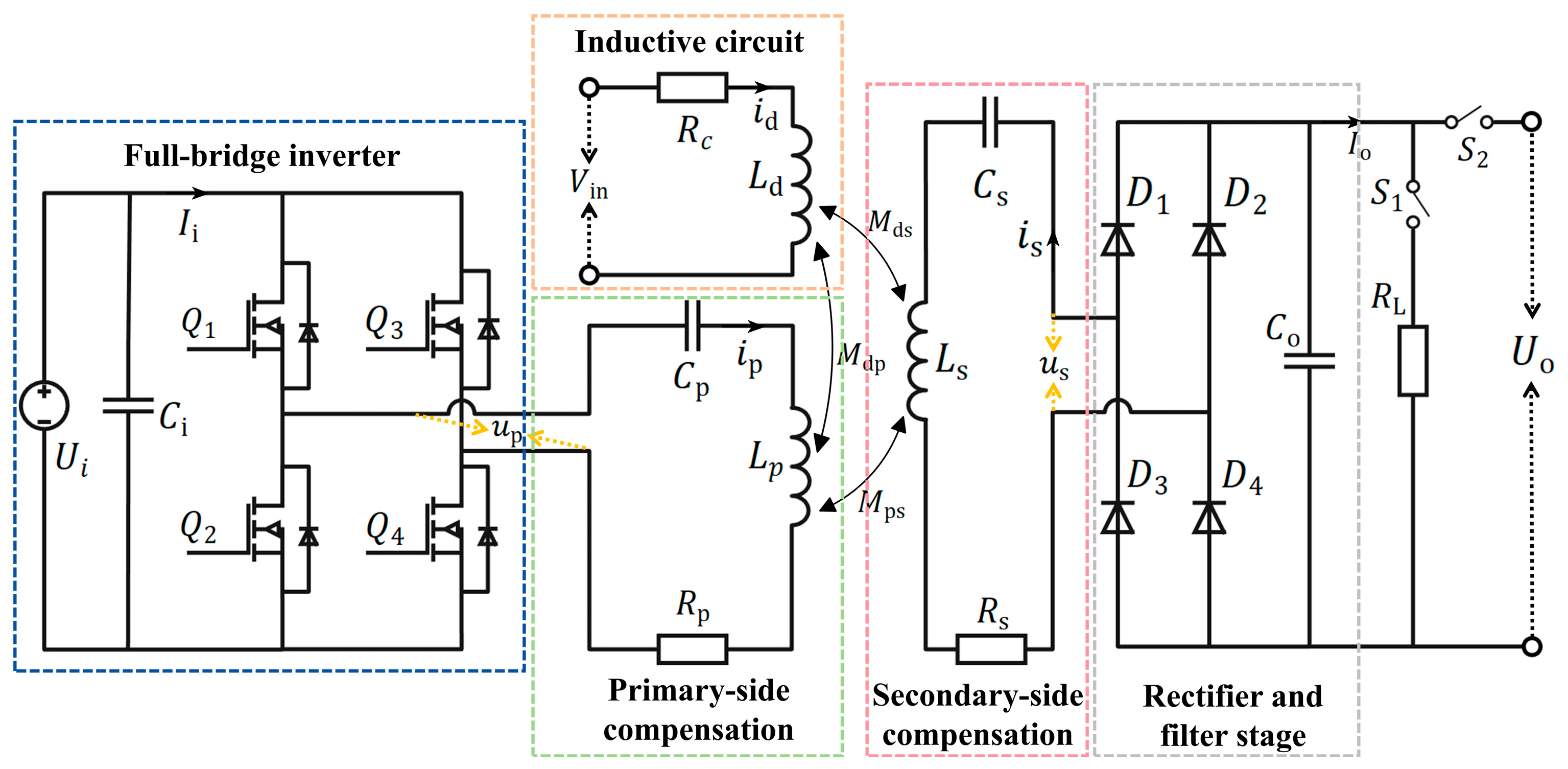
2.1.1. System Circuit Configuration
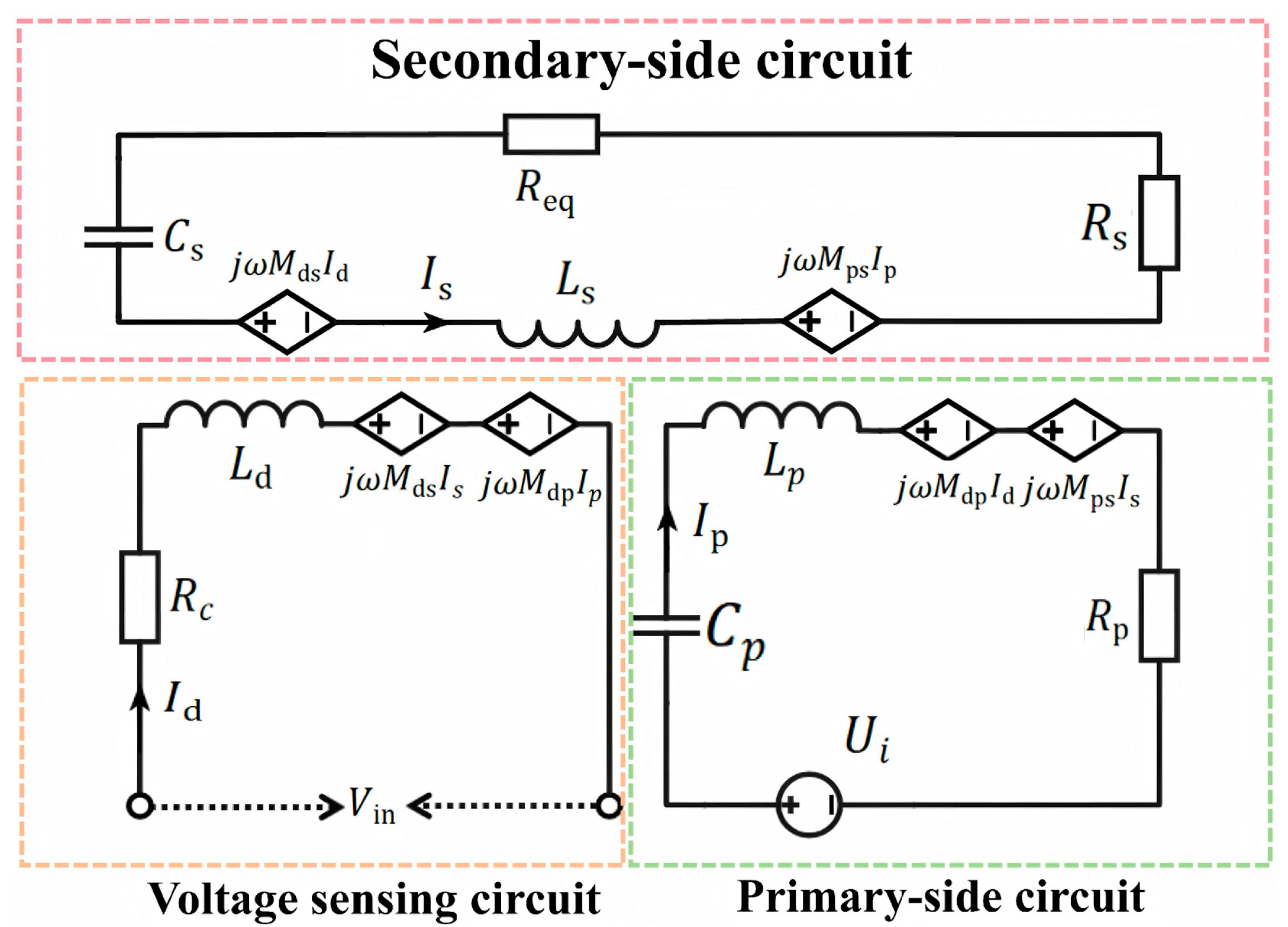
2.1.2. Theoretical Analysis
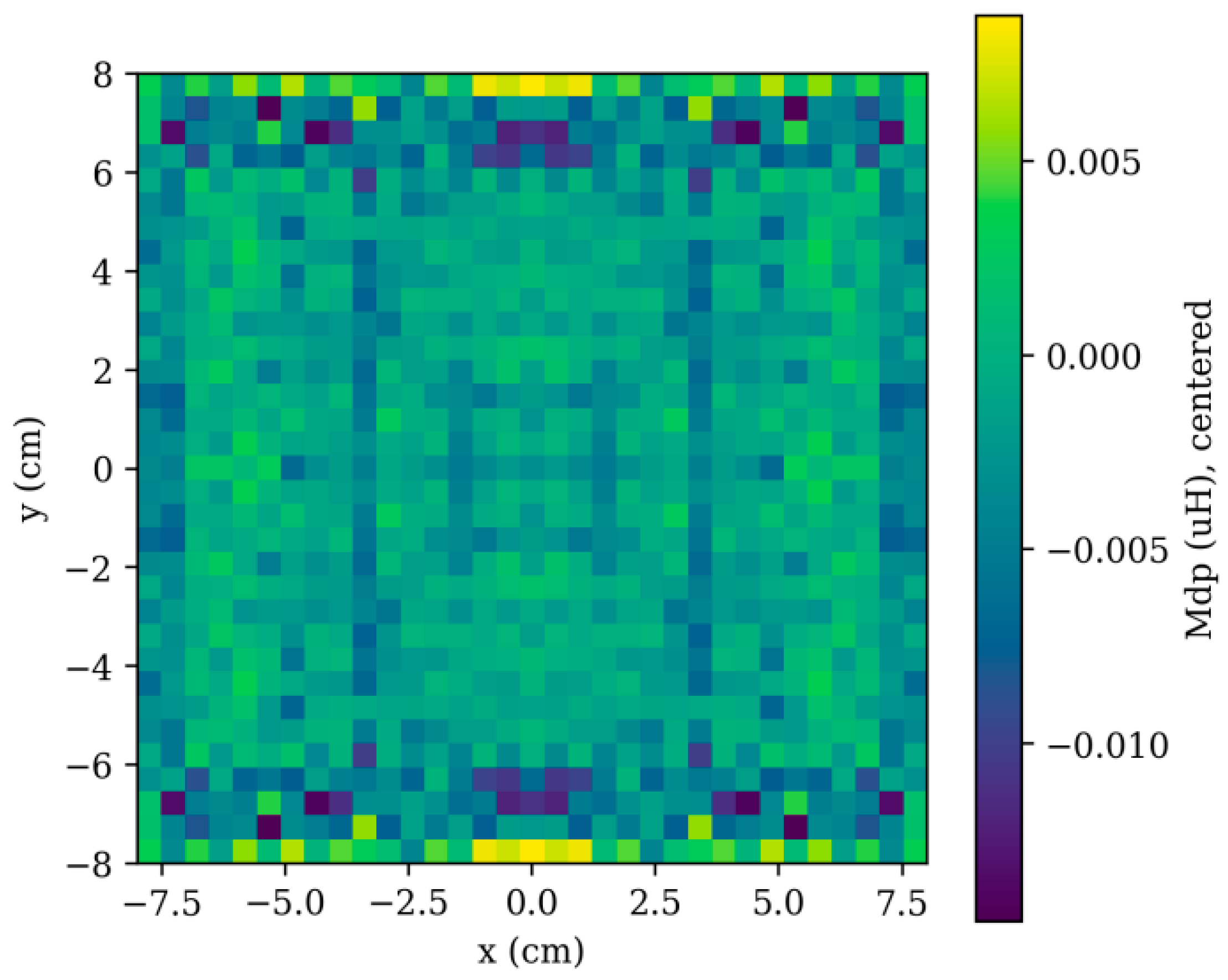
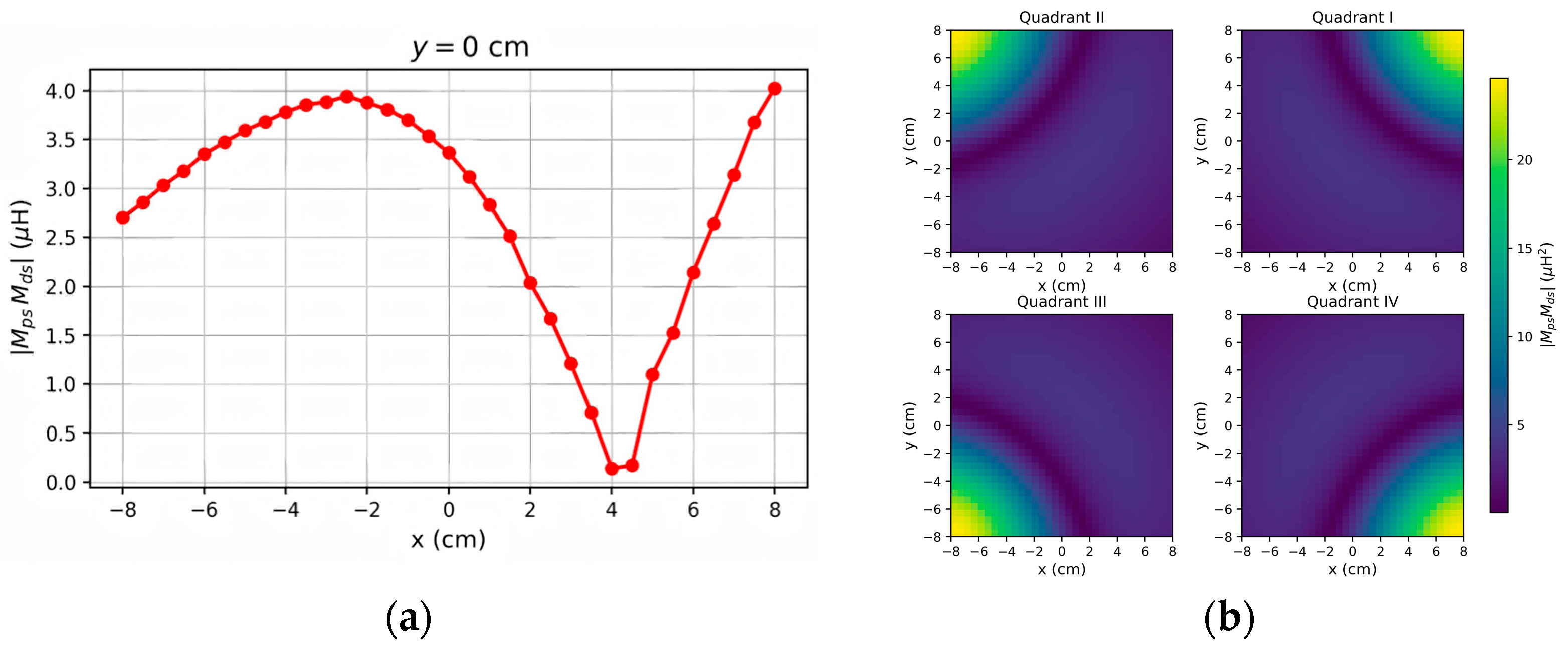
2.1.3. Simulation Verification of Mutual Induction Product and Position Relationship & Decoupling Effect Analysis
2.2. A Multi-Prototype MLP-RBF-Based Method for Coupling Mechanism Alignment
2.2.1. Collection and Construction of Fingerprint Database
2.2.2. MLP–RBP Fingerprint Matching Network Architecture
2.2.3. Embedded Positioning Application Process
2.3. Experiments
2.3.1. Experimental Prototype
2.3.2. Experimental Procedure
3. Results and Discussion
4. Conclusions
Author Contributions
Funding
Institutional Review Board Statement
Informed Consent Statement
Data Availability Statement
Conflicts of Interest
Abbreviations
| UAVs | Unmanned aerial vehicles |
| BP | Bipolar |
| MLP-RBF | Multi-layer perceptron–radial basis function |
| WPT | Wireless power transfer |
| KNN | K-nearest neighbors |
| WKNN | Weighted k-nearest neighbors |
| S–S | Series–series |
| CC | Constant current |
| CV | Constant voltage |
References
- Liang, Z.; Wang, J.; Gong, Y.; Gu, Y. Multiple-Channel Coupling Effect Observation for In-Flight Wireless Charging of Drones. IEEE Trans. Ind. Electron. 2026, 73, 2024–2034. [Google Scholar] [CrossRef]
- Liu, X.; Fan, Y.; Hao, M. Dubins-CPSO: A Hybrid Static–Dynamic Method for Coordinated Trajectory Planning of Multiple UAVs. Appl. Sci. 2026, 16, 1880. [Google Scholar] [CrossRef]
- Pahlavan, S.; Jafarabadi-Ashtiani, S.; Mirbozorgi, S.A. Maze-Based Scalable Wireless Power Transmission Experimental Arena for Freely Moving Small Animals Applications. IEEE Trans. Biomed. Circuits Syst. 2025, 19, 120–129. [Google Scholar] [CrossRef] [PubMed]
- Pahlavan, S.; Shooshtari, M.; Jafarabadi Ashtiani, S. Star-Shaped Coils in the Transmitter Array for Receiver Rotation Tolerance in Free-Moving Wireless Power Transfer Applications. Energies 2022, 15, 8643. [Google Scholar] [CrossRef]
- Grlj, C.G.; Krznar, N.; Pranjić, M. A Decade of UAV Docking Stations: A Brief Overview of Mobile and Fixed Landing Platforms. Drones 2022, 6, 17. [Google Scholar] [CrossRef]
- Li, Y.; Liu, M.; Jiang, D. Application of Unmanned Aerial Vehicles in Logistics: A Literature Review. Sustainability 2022, 14, 14473. [Google Scholar] [CrossRef]
- Siddaiah, A.; Kasar, A.K.; Khosla, V.; Menezes, P.L. In-Situ Fretting Wear Analysis of Electrical Connectors for Real System Applications. J. Manuf. Mater. Process. 2019, 3, 47. [Google Scholar] [CrossRef]
- Niu, S.; Jia, Q.; Hu, Y.; Yang, C.; Jian, L. Safety Management Technologies for Wireless Electric Vehicle Charging Systems: A Review. Electronics 2025, 14, 2380. [Google Scholar] [CrossRef]
- Xu, H.; Wang, C.; Xia, D.; Liu, Y. Design of Magnetic Coupler for Wireless Power Transfer. Energies 2019, 12, 3000. [Google Scholar] [CrossRef]
- Song, K.; Lan, Y.; Wei, R.; Yang, G.; Yang, F.; Li, W.; Jiang, J.; Zhu, C.; Li, Y. A Control Strategy for Wireless EV Charging System to Improve Weak Coupling Output Based on Variable Inductor and Capacitor. IEEE Trans. Power Electron. 2022, 37, 12853–12864. [Google Scholar] [CrossRef]
- Sanchez, J.; Arteaga, J.; Zesiger, C.; Mitcheson, P.; Young, D.; Roundy, S. Inductive Power Transfer Coil Misalignment Perception and Correction for Wirelessly Recharging Underground Sensors. Sensors 2025, 25, 309. [Google Scholar] [CrossRef] [PubMed]
- Cortes, I.; Kim, W.-J. Lateral Position Error Reduction Using Misalignment-Sensing Coils in Inductive Power Transfer Systems. IEEE/ASME Trans. Mechatron. 2018, 23, 875–882. [Google Scholar] [CrossRef]
- Rong, C.; Chang, J.; Lu, Q.; Liu, W.; Zhao, Y.; Liu, Y.; Chen, M.; Wang, H.; Liu, Y. Coupling Mechanism Optimization to Improve Misalignment Tolerance in UAV Wireless Charging Systems. J. Power Electron. 2024, 24, 1490–1504. [Google Scholar] [CrossRef]
- Chen, M.; Li, Z.; Yuan, D.; Ban, M. UAV Wireless Charging System with High Anti-Misalignment Capability and Constant Current/Voltage Outputs. J. Power Electron. 2025, 25, 1166–1174. [Google Scholar] [CrossRef]
- Ma, Q.; Wu, Y.; Shoukat, M.U.; Yan, Y.; Wang, J.; Yang, L.; Yan, F.; Yan, L. Deep Reinforcement Learning-Based Wind Disturbance Rejection Control Strategy for UAV. Drones 2024, 8, 632. [Google Scholar] [CrossRef]
- Kim, S.-W.; Cho, I.-K.; Hong, S.-Y. Design of Transmitting Coil for Wireless Charging System to Expand Charging Area for Drone Applications. Microw. Opt. Technol. Lett. 2018, 60, 1179–1183. [Google Scholar] [CrossRef]
- Chittoor, P.K.; Bharatiraja, C. Wireless-Sensor Communication Based Wireless-Charging Coil Positioning System for UAVs with Maximum Power Point Tracking. IEEE Sensors J. 2022, 22, 8175–8182. [Google Scholar] [CrossRef]
- Huang, L.; Wang, Z.; Xiong, Q.; Qu, R.; Yao, C.; Li, C. Mamba-VNPS: A Visual Navigation and Positioning System with State-Selection Space. Drones 2024, 8, 663. [Google Scholar] [CrossRef]
- Ochoa-de-Eribe-Landaberea, A.; Zamora-Cadenas, L.; Peñagaricano-Muñoa, O.; Velez, I. UWB and IMU-Based UAV’s Assistance System for Autonomous Landing on a Platform. Sensors 2022, 22, 2347. [Google Scholar] [CrossRef]
- Zhang, J.; Wang, X.; Yu, Z.; Lyu, Y.; Mao, S.; Periaswamy, S.C.; Patton, J.; Wang, X. Robust RFID Based 6-DoF Localization for Unmanned Aerial Vehicles. IEEE Access 2019, 7, 77348–77361. [Google Scholar] [CrossRef]
- Liang, C.; Zhang, Y.; Li, Z.; Yuan, F.; Yang, G.; Song, K. Coil Positioning for Wireless Power Transfer System of Automatic Guided Vehicle Based on Magnetic Sensing. Sensors 2020, 20, 5304. [Google Scholar] [CrossRef]
- Chen, B.; Ma, J.; Zhang, L.; Xiong, Z.; Fan, J.; Lan, H. An Improved Weighted KNN Fingerprint Positioning Algorithm. Wirel. Netw. 2024, 30, 6011–6022. [Google Scholar] [CrossRef]
- Hoang, M.T.; Zhu, Y.; Yuen, B.; Reese, T.; Dong, X.; Lu, T.; Westendorp, R.; Xie, M. A Soft Range Limited K-Nearest Neighbors Algorithm for Indoor Localization Enhancement. IEEE Sensors J. 2018, 18, 10208–10216. [Google Scholar] [CrossRef]
- Wen, F.; Zhang, X.; Li, Q.; Zhang, D.; Li, G.; Wu, S.; Yao, Z.; Yu, K. Research on Coil Positioning Method and Magnetic Field Orientation Strategy of Wireless Power Transfer System. Energy Rep. 2023, 9, 353–361. [Google Scholar] [CrossRef]
- Bucolo, M.; Buscarino, A.; Famoso, C.; Fortuna, L.; Gagliano, S. Imperfections in Integrated Devices Allow the Emergence of Unexpected Strange Attractors in Electronic Circuits. IEEE Access 2021, 9, 29573–29583. [Google Scholar] [CrossRef]





| Parameter | Value | Parameter | Value |
|---|---|---|---|
| Controller | STM32F405RGT6 | Self-inductance of detection coil 3 | 16.78 μH |
| External Flash | 1 MB | Self-inductance of detection coil 4 | 17.06 μH |
| Self-inductance of transmitter coil | 63.56 μH | Primary-side resonant capacitor | 55.1 nF |
| Self-inductance of receiver coil | 62.43 μH | Secondary-side resonant capacitor | 57.8 nF |
| Internal resistance of the transmitter coil | 286.7 mΩ | Resonant frequency | 85 kHz |
| Internal resistance of the receiver coil | 134.3 mΩ | Load resistance | 6.67 Ω |
| Self-inductance of detection coil 1 | 17.84 μH | Vertical air gap | 4.8 cm |
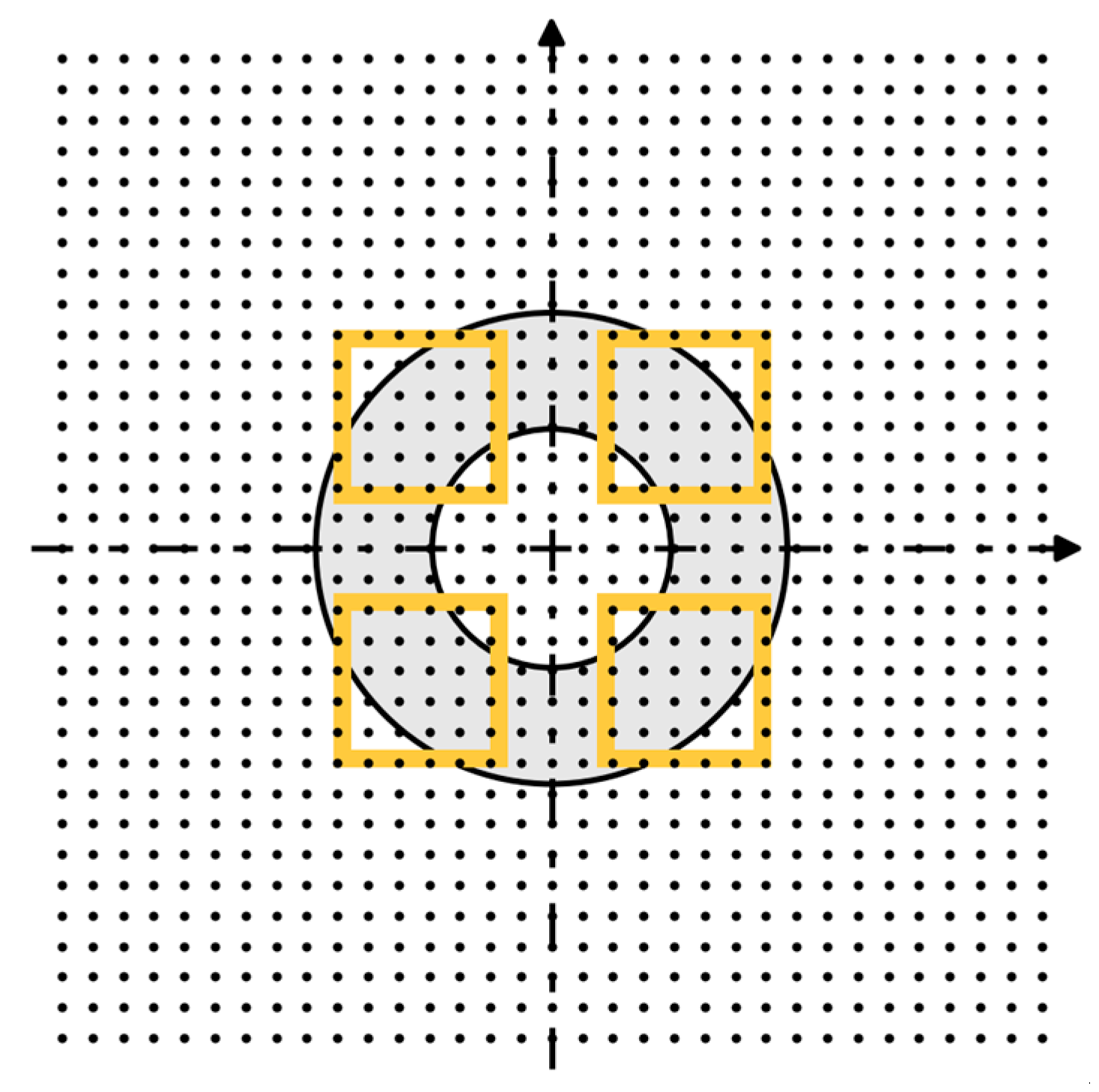
| Self-inductance of detection coil 2 | 17.45 μH | Number of sampling points | 1089 |
| Square detection coil dimensions | 10.7 cm | DC bus voltage | 6 V |
| Coordinates | x (cm) | y (cm) | Induced Voltage | v1 (V) | v2 (V) | v3 (V) | v4 (V) |
|---|---|---|---|---|---|---|---|
| Loc(x y): | −8 | −8 | V: | 1.836 | 0.542 | 2.121 | 1.513 |
| Loc(x y): | −8 | 8 | V: | 1.345 | 1.754 | 0.903 | 1.011 |
| Loc(x y): | 8 | 8 | V: | 1.716 | 1.413 | 1.165 | 1.592 |
| Loc(x y): | 8 | −8 | V: | 1.658 | 0.688 | 1.449 | 1.849 |
| Loc(x y): | 0 | 0 | V: | 1.933 | 1.807 | 1.931 | 1.927 |
| References | Perception Solution | Algorithm | Positioning Accuracy | Remarks |
|---|---|---|---|---|
| [11] | Magnetic coupling-based pose/misalignment detection for closed-loop correction and alignment | Error perception + particle filtering/Sequential Monte Carlo (SMC) chain positioning and correction | Alignment accuracy within 1 cm in best cases | Misalignment correction completed without relying on complex coil structures or additional telemetry. |
| [21] | Hall array measurement of magnetic field feature for coil relative position estimation | Magnetic field feature modelling + position solution | Maximum error < 4 cm; 90.4% of samples with error ≤ 3 cm | Belonging to the typical “magnetic fingerprint” route, a magnetic sensor array is needed. |
| [23] | WiFi RSSI fingerprinting combined with user’s previous positioning data | SRL-KNN; RSSI histogram fusion in distance computation | 0.66 m average error of indoor WiFi fingerprint positioning; 80% error < 0.89 m | Computational load increases with fingerprint database scale; SRL-KNN achieves approximately 45% higher accuracy than traditional KNN. |
| [24] | Current stage shift control achieves power directional positioning within zones, utilizing an optimized partition modeling methodology. | BP neural network regression + collaborative control of magnetic field direction/stage strategies within positioning zones | Average positioning error within 32.9 cm × 32.9 cm < 1 cm | Strong coupling between positioning and power transmission control, suitable for “positioning zone + guidance” application scenarios. |
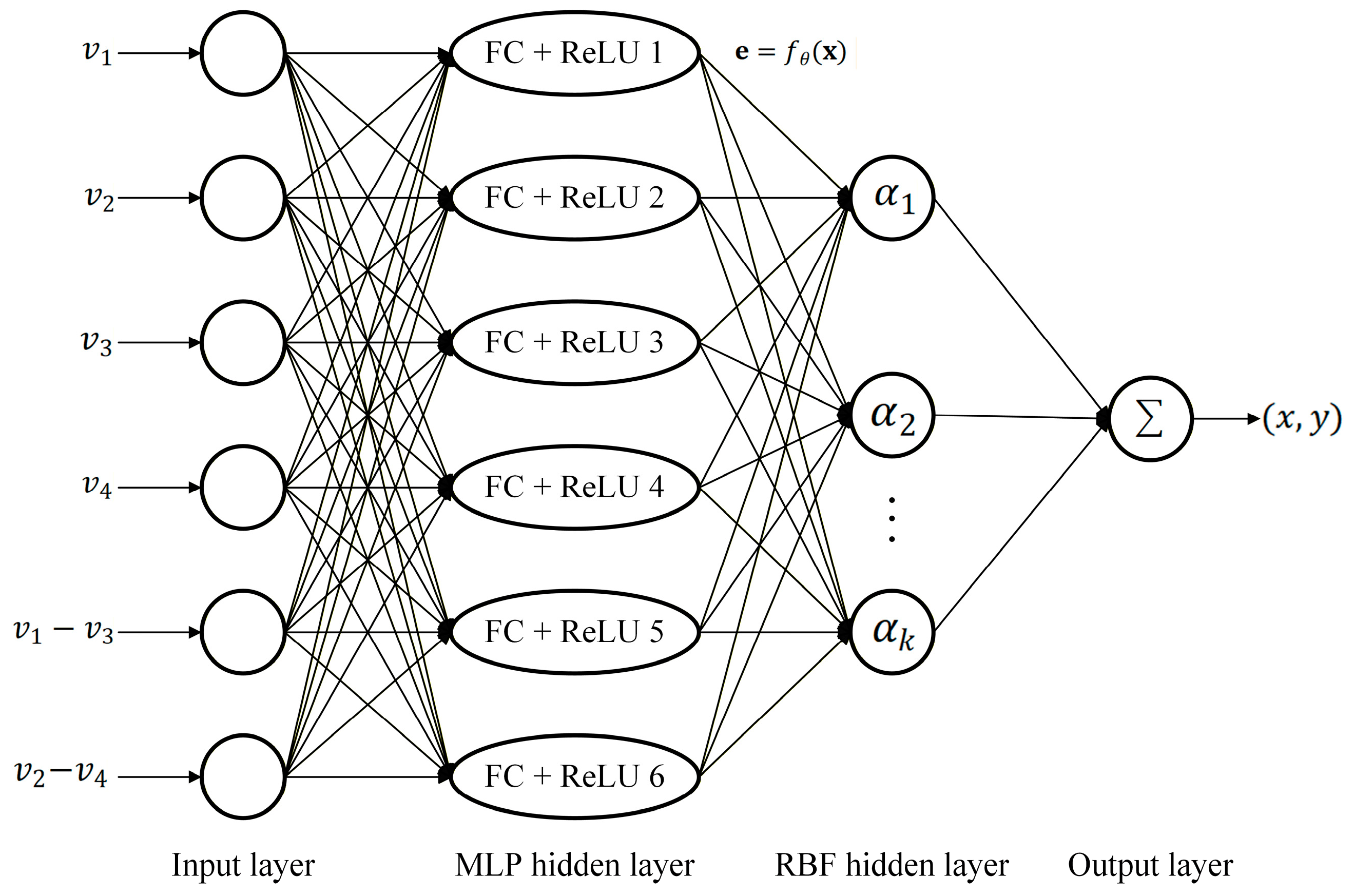
| This work | Four-detection-coil sensing voltage + multiple sampling to construct a fingerprint database | Six-layer MLP + RBF + learnable metric | Average error ≈ 1.2 cm; maximum error < 1.8 cm | Balance between embedded inference and online closed-loop alignment. |
Disclaimer/Publisher’s Note: The statements, opinions and data contained in all publications are solely those of the individual author(s) and contributor(s) and not of MDPI and/or the editor(s). MDPI and/or the editor(s) disclaim responsibility for any injury to people or property resulting from any ideas, methods, instructions or products referred to in the content. |
© 2026 by the authors. Licensee MDPI, Basel, Switzerland. This article is an open access article distributed under the terms and conditions of the Creative Commons Attribution (CC BY) license.
Share and Cite
Yuan, D.; Li, L.; Han, Z.; Liu, J.; Zhao, C. Position Identification for UAV Wireless Charging Coupler Using Neural Network and Voltage Fingerprint. Appl. Sci. 2026, 16, 3318. https://doi.org/10.3390/app16073318
Yuan D, Li L, Han Z, Liu J, Zhao C. Position Identification for UAV Wireless Charging Coupler Using Neural Network and Voltage Fingerprint. Applied Sciences. 2026; 16(7):3318. https://doi.org/10.3390/app16073318
Chicago/Turabian StyleYuan, Dechun, Linxuan Li, Zhihao Han, Jiali Liu, and Chaoyue Zhao. 2026. "Position Identification for UAV Wireless Charging Coupler Using Neural Network and Voltage Fingerprint" Applied Sciences 16, no. 7: 3318. https://doi.org/10.3390/app16073318
APA StyleYuan, D., Li, L., Han, Z., Liu, J., & Zhao, C. (2026). Position Identification for UAV Wireless Charging Coupler Using Neural Network and Voltage Fingerprint. Applied Sciences, 16(7), 3318. https://doi.org/10.3390/app16073318