Article

Meter-Scale Discharge Capillaries for Plasma-Based Accelerators

INFN—Laboratori Nazionali di Frascati, 00044 Frascati, Italy
*
Authors to whom correspondence should be addressed.
Appl. Sci. 2026, 16(7), 3291; https://doi.org/10.3390/app16073291
Submission received: 21 November 2025 / Revised: 12 March 2026 / Accepted: 20 March 2026 / Published: 28 March 2026
(This article belongs to the Special Issue New Challenges in Plasma Accelerators)

Abstract

Gas-filled discharge capillaries are widely used in the field of plasma-based particle accelerators, due to their compactness, cost-effectiveness and versatility for different applications. Technological improvement of such plasma sources is necessary to enable high energy gain acceleration at the meter scale, as required for next-generation particle colliders and light sources. Beam quality preservation within such an acceleration length involves accurate tuning of the plasma properties. In particular, precise tailoring of the plasma density distribution is required to control the emittance growth of particle bunches during the acceleration process. In this context, this paper presents a scalable and versatile approach for the design of meter-scale discharge capillaries, aimed at achieving fine tuning of the plasma density distribution, with the possibility of locally controlling the density profile by acting on the source geometry. Forty-centimeter-long capillaries are designed using numerical fluid dynamics simulations and tested in a dedicated plasma module. Different arrangements of the gas inlets are tested, with their number and diameter varied, to assess the effect of the capillary geometry on the plasma properties. Plasma density measurements show that a higher number of inlets with variable diameter along the plasma formation channel provides an enhancement in the homogeneity of the electron plasma density distribution. Longitudinal density plateaus are observed along most of the plasma channel length, with a center-to-end density uniformity of up to 80%. The experimental results highlight the proposed approach’s capability to modulate the longitudinal plasma density distribution by acting on the capillary geometry, thus providing uniform density profiles over the meter scale, as required for plasma-based acceleration experiments.

1. Introduction

Plasma-based particle accelerators are generating interest within the scientific community thanks to the intense GV/m-range accelerating fields produced in plasma acceleration mechanisms [1,2,3], which allow to dramatically reduce the cost and footprint of accelerating facilities. In recent years, pioneering experiments have proven the possibility of producing GeV-range electron beams within few-centimeter-long plasma channels [4,5,6]. Furthermore, improvements in the quality of plasma-accelerated beams have demonstrated the suitability of this technology for user-oriented applications, such as free-electron lasers [7,8,9,10]. Scaling plasma-based accelerators for future light sources and beam collider facilities requires the development of meter-scale plasma accelerating stages, able to boost the beam energy while preserving the beam quality [11,12]. Among the variety of plasma sources used for plasma acceleration experiments, gas-filled plasma discharge capillaries represent one of the most compact and cost-effective devices for plasma creation and confinement, achieved using high-voltage pulses [13,14,15,16]. Such devices can be made of different materials, from 3D-printed plastic [17] and glass to sapphire [18] and high-melting-temperature ceramics, such as macor and shapal [19]. Capillaries provide fine control of the plasma density by tuning the injected gas pressure or the applied voltage. The shaping of the capillary channels provides high-density uniformity and modularity [20], while the shot-to-shot stability of the plasma discharges can be enhanced by triggering gas ionization using an external laser pulse [21]. Apart from the acceleration of particle beams in particle-driven Plasma Wakefield Acceleration (PWFA) experiments, plasma discharge capillaries are also used for guiding high-intensity laser pulses in Laser Wakefield Acceleration (LWFA) schemes [6] and for focusing charged particle beams in the so-called Active Plasma Lenses (APL), alternatively to conventional quadrupoles, exploiting the kT/m azimuthal focusing fields produced by the current discharges [22]. Moreover, microwave-based discharge capillaries are used for UV light confinement, photolithography, biomedical tools and environmental research [23,24,25].
The realization of discharge capillaries for meter-scale plasma accelerating stages requires dedicated designs, able to control the plasma density distribution according to the beam properties. Beam quality preservation requires a uniform density profile within the plasma source, in order to freeze the shape of the accelerating ion cavities, produced in the wake of the driver beam, and keep the witness beam on the peak of the longitudinal accelerating wakefield [3]. In addition, the presence of smooth density ramps can contribute to preserving the beam emittance towards the injection and extraction of the beams from the plasma accelerating stage [26]. The design of capillary sources usually relies on computational fluid dynamics (CFD) codes, adopted to simulate the neutral gas filling the capillary structures [20,27]. Moreover, new simulation codes for plasma modeling, including the electrical discharge process as well as plasma heating and expansion dynamics, are currently under development, with recent results showing promising agreement with experimental observations [27,28,29,30,31].
Within this context, we present the prototype of 40 cm long gas-filled discharge capillaries, designed using CFD simulations and experimentally characterized through spectroscopic analysis for the measurement of plasma density distribution. The CFD software (Version 5) OpenFOAM is used to simulate the dynamics of the neutral gas filling the capillary structure, thus providing information on the molecular density distribution along the plasma source. Relying on simulative results, the capillary geometry is optimized in order to improve the density uniformity along the capillary channel. Designed capillaries are realized by tool machining and then tested in a dedicated plasma module, using the Stark broadening method to perform complete characterization of the plasma density distribution. The approach to the design and realization of the capillaries, comprising the production and assembly of multiple blocks and the modulation of the plasma distribution using dedicated gas injection networks, proves to be a valid strategy in the realization of meter-scale capillary plasma sources. Experimental and theoretical activities are carried out at the Plasma_lab facility (INFN), within the SPARC_LAB collaboration [32], the EuPRAXIA framework [11] and the EuPRAXIA@SPARC_LAB project [33].

2. Materials and Methods

2.1. CFD Simulations

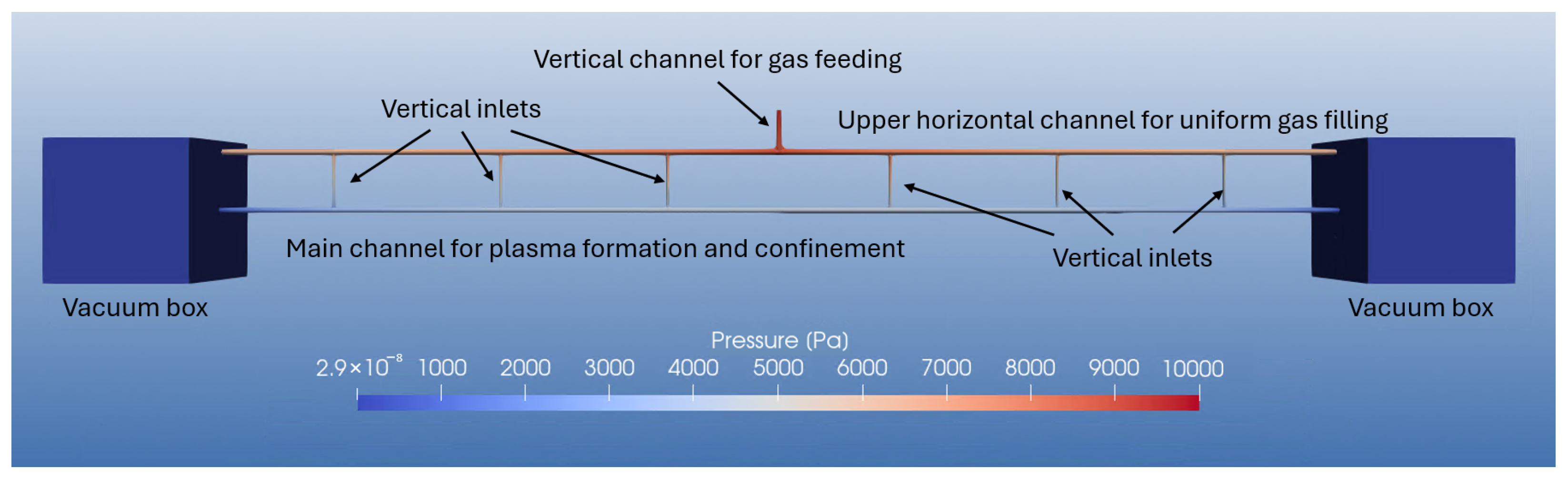
Plasma discharge capillaries are first designed using the CFD code OpenFOAM [34], adopted to simulate the dynamics of neutral hydrogen gas filling the injection channels of the capillary structure. Three-dimensional numerical simulations are performed with the solver SonicFoam to simulate the gas in a turbulent transient regime [20]. Figure 1 shows the geometry of a 40 cm long capillary, designed for CFD simulations. The capillary length is chosen within the framework of the EuPRAXIA@SPARC_LAB project, which involves the use of a meter-scale plasma accelerating stage to guide an FEL user facility [33]. Indeed, a 40 cm long capillary, operating at a plasma density of around 10 16 cm 3 , can provide an accelerating gradient of up to 1.5 GV/m, corresponding to a total energy gain of around 600 MeV.
The capillary structure constitutes an upper vertical channel with a 1.5 mm diameter, connecting the gas injection pipe to the capillary; two horizontal channels with a 2 mm diameter; and 6 vertical inlets with a 1 mm diameter. The lower horizontal channel, i.e., the main channel for the plasma formation and confinement, is fed by the upper one through the vertical inlets, which are horizontally spaced to properly tailor the neutral gas density distribution along the main channel. An inlet pressure of few hundreds mbars is set at the entrance of the upper vertical channel to simulate the gas injection, which is usually performed in a pulsed regime using an electro-mechanical valve, with typical opening times of a few ms. The simulation domain also includes two side boxes connected to the capillary ends, simulating the gas expansion inside the vacuum chamber, in which the capillary is installed. The mesh grid is composed of hexahedral cells with sides measuring 1 mm with a refinement level of 3, corresponding to a mesh size of 125 μ m, at a distance of 1 mm from the capillary walls, in order to achieve a better spatial resolution towards the boundary regions. Starting from the described geometry, different versions are tested to analyze how the neutral gas density profile behaves when varying the inlet arrangement. In order to optimize the density uniformity along the capillary channel, the geometrical configuration is modified with a higher number of inlets and by increasing the inlet diameter towards the capillary ends. OpenFOAM is limited to describing only neutral gas dynamics; hence, the electrical discharge formation and the plasma dynamics are not included in the simulations. Although the plasma channel properties are generally affected by the ionization mechanism, i.e., dissociation of neutral molecules, electric discharge ignition and plasma column heating and expansion, the gas dynamics prior to plasma formation provides useful information on the plasma channel for the design of the capillary geometry. Indeed, gas dynamics simulations can be exploited to predict features of the plasma channel profiles in given capillary structures, such as the creation of density ramps and flat-tops due to the effect of specific inlet arrangements and channel shapes [20]. Hence, even if CFD simulations cannot provide the exact plasma density distribution, they can be used to design a first capillary structure, which can be experimentally validated and eventually optimized to produce the desired plasma density profile.

2.2. Realization, Testing and Characterization

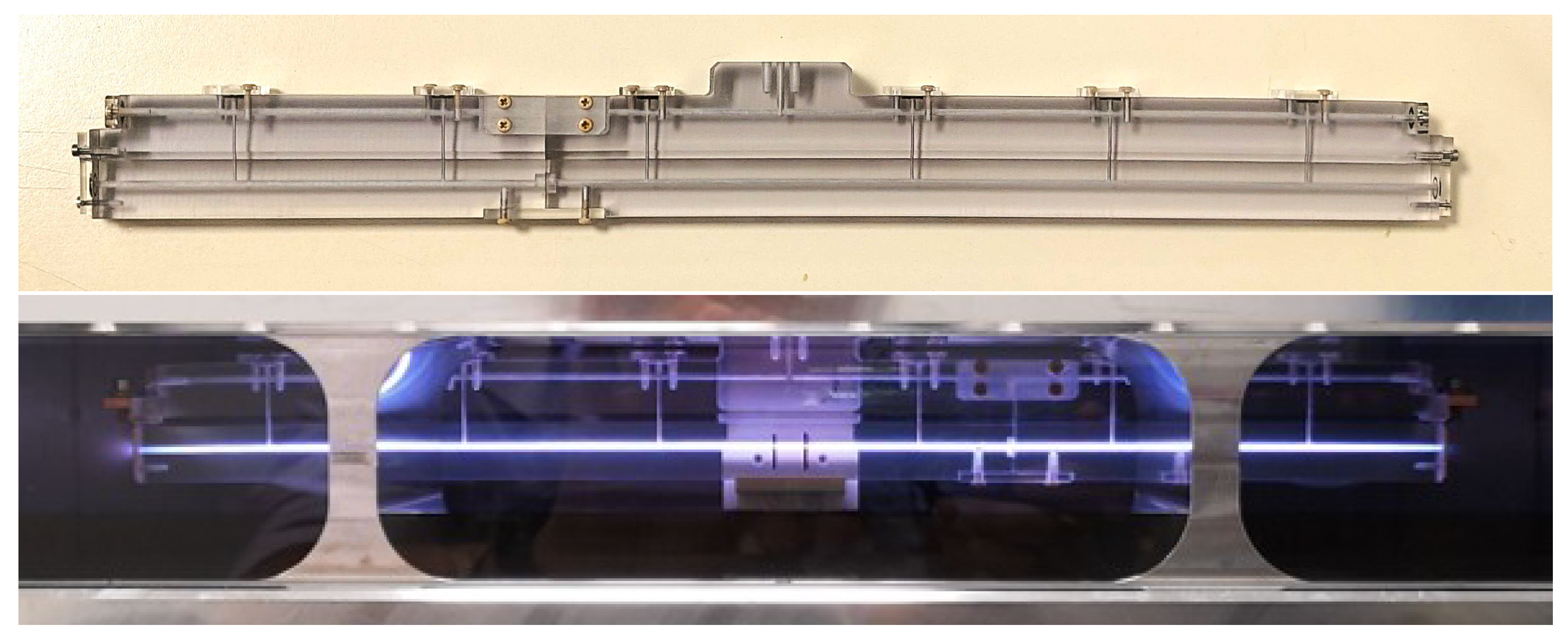
Discharge capillaries, designed through CFD simulations, are realized by tool machining of plastic blocks made of Lexan. In order to produce the 40 cm long horizontal channels with sub-millimeter precision, capillary devices are realized by stacking and joining two asymmetric blocks, which are independently machined. Figure 2 shows a picture of a 40 cm long capillary composed of two blocks and realized with the inner structure shown in Figure 1, with two horizontal channels and six vertical inlets.
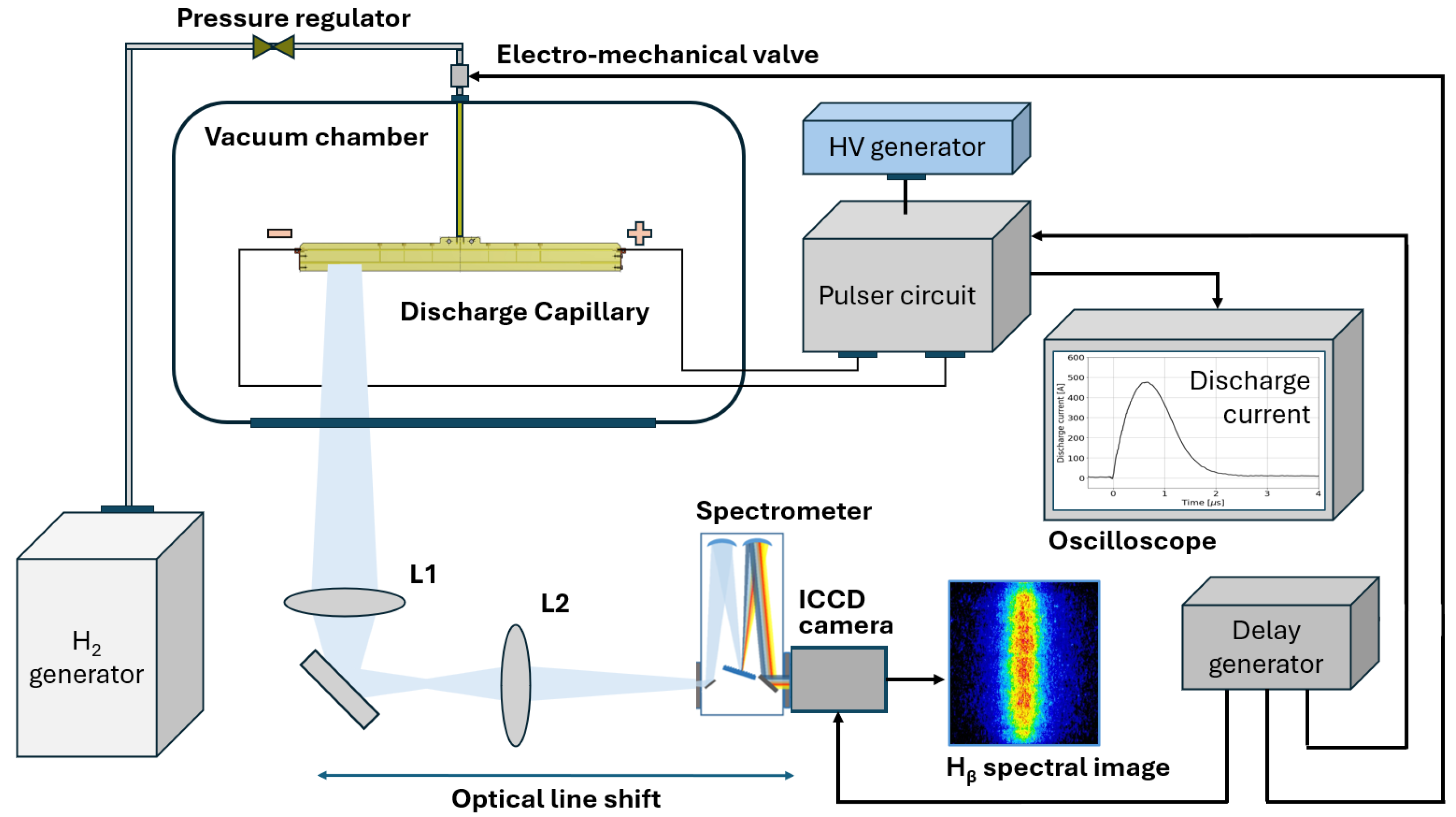
Experimental testing and characterization of discharge capillaries are performed with a dedicated plasma module at the Plasma_lab facility. The experimental plasma module, set up for plasma discharge tests with 40 cm long capillaries, constitutes three different systems for gas injection, plasma formation and characterization, as shown in Figure 3.
Tested capillaries are installed inside a vacuum chamber and filled with pure hydrogen gas, produced through water electrolysis by a hydrogen generator and injected in a pulsed regime using an electro-mechanical valve. A mechanical regulator sets the injection pressure in a range of few hundred mbar to 1 bar. Two primary scroll pumps and one turbo-molecular pump keep a vacuum level of 10 4   ÷   10 2 mbar inside the vacuum chamber, suitable to produce and confine the plasma discharges. A high-voltage (HV) generator feeds an electrical pulser circuit, which delivers kV-range μ s pulses to a pair of copper electrodes attached to the capillary ends. In this way, HV pulses ionize the hydrogen gas column inside the capillary channel and produce the plasma discharge [35]. A delay generator (Stanford Research DG535) sets the operating repetition rate of 1 Hz and synchronizes the voltage pulses with the e-valve activation time, so as to trigger the plasma discharge once the capillary channel is filled with hydrogen gas. The discharge current is measured using a Pearson 110 probe, which converts the current pulse into a voltage signal with a transfer impedance of 0.1 V/A. The voltage signal is then acquired by a 300 MHz WaveAce 2032 oscilloscope, allowing us to retrieve the waveform of the discharge current pulse, as shown in Figure 3.
Characterization of the plasma discharge is performed via spectroscopic analysis of the plasma-emitted light, based on the Stark broadening method [36]. A telescopic optical line, constituting 3 mirrors and lenses, guides the plasma-emitted light from the plasma channel to an imaging spectrometer equipped with an intensified CCD camera. Hydrogen emission lines of the Balmer series, specifically H α (656.3 nm) and H β (486.1 nm), are selected by a spectrometer diffraction grating with 1200 grooves/mm and an instrumental broadening of 3.6 Å. Images of the selected Balmer lines are then acquired by an ICCD camera with a calibration of 0.27 Å/pixel. For each acquired spectral image, the broadening of the hydrogen spectral line is measured to retrieve the electron plasma density, exploiting the direct proportionality between the hydrogen spectral linewidth Δ λ 1 / 2 (FWHM) and the electron plasma density N e , according to the Stark effect:
N e = 8.02 × 10 12 Δ λ 1 / 2 [ Å ] α 1 / 2 [ Å ] 3 / 2 [ cm 3 ]
in which the fractional width α 1 / 2 [37] depends on the plasma density, assumed to be around 10 16 ÷ 10 18 cm 3 , and the plasma temperature, which in turn is estimated using the quasi-static model of the plasma discharge developed by Bobrova [38]:
T e = 5.7 I [ kA ] r 0 [ mm ] 2 / 5 [ eV ]
where I is the discharge current measured by the oscilloscope and r 0 the radius of the capillary channel. By measuring the hydrogen linewidth along the vertical axis of the spectral image, it is possible to reconstruct the longitudinal profile of the plasma density distribution, as shown in Figure 3. Since the optical line constitutes 3 mirrors and lenses, only a 5 cm long portion of the plasma channel is collected into the imaging spectrometer. Therefore, the whole 40 cm long longitudinal plasma density distribution is retrieved by shifting the diagnostic line along the capillary and stacking the spectral images acquired from different positions of the plasma channel. Markers are applied on the capillary surface as a reference to properly stitch the spectral images. Furthermore, by gating the camera acquisition time to the discharge circuit, it is possible to observe the temporal evolution of the plasma channel density distribution, during both the plasma formation and recombination into neutral hydrogen gas. Hence, this diagnostic tool provides complete longitudinal and temporal characterization of the plasma density distribution for the tested discharge capillaries.

3. Results and Discussion

3.1. Simulation Results

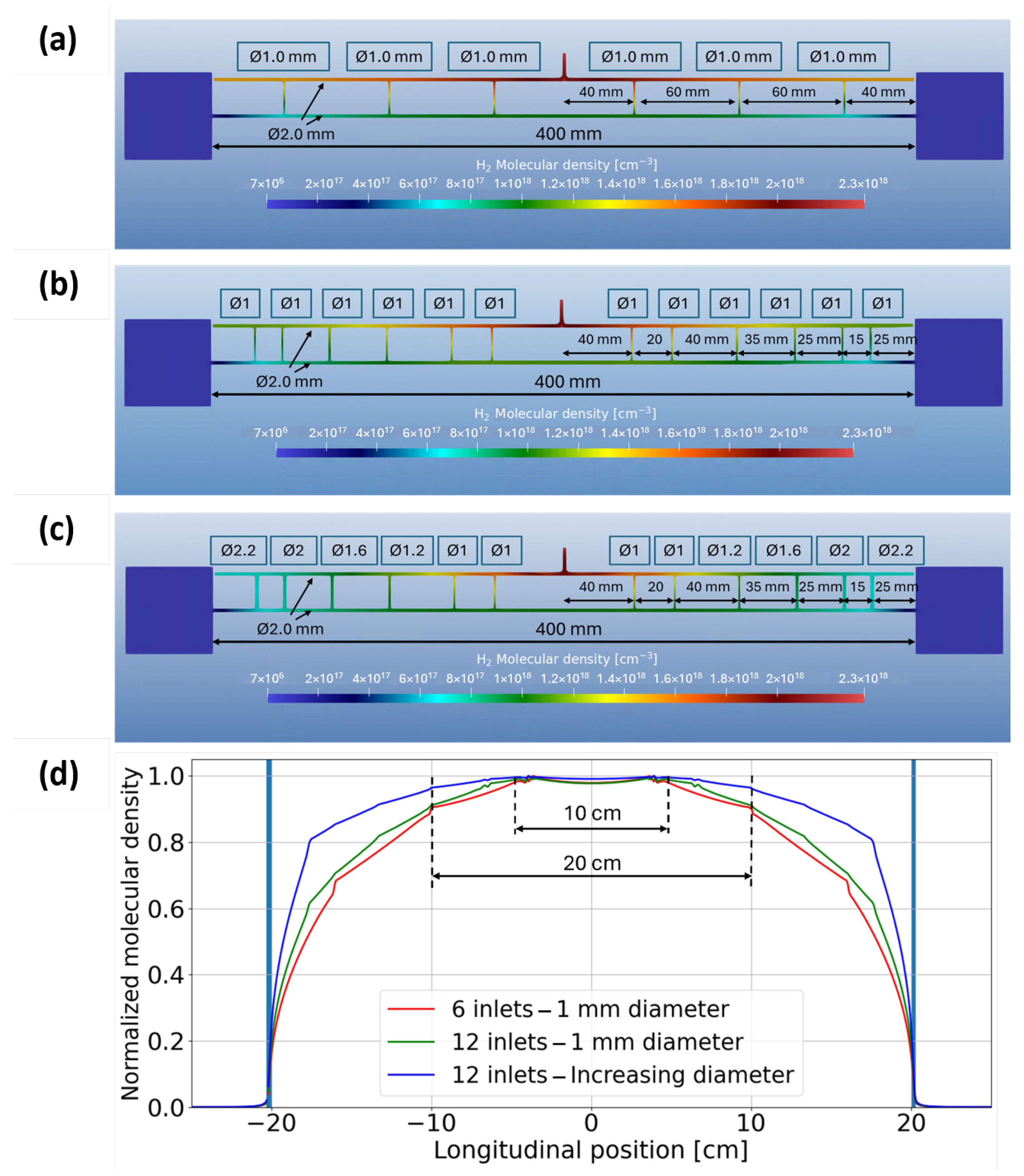
Figure 4 shows the H 2 molecular density distribution simulated with different capillary geometries. These results are obtained in the hydrodynamic steady state, reached around 3 ms after the e-valve opening with an injection pressure of 100 mbar. Figure 4a–c show section views of the 2D density distribution in steady state for three different capillary geometries that, respectively, have 6 inlets with a 1 mm diameter, 12 inlets with a 1 mm diameter, and 12 inlets with an increasing diameter towards the capillary ends, ranging from 1 mm to 2.2 mm. A detailed list of key geometrical parameters of the three capillaries is reported in Table 1.
As shown in the three plots, a molecular density of up to 1 × 10 18 cm 3 , corresponding to around 50 mbar H 2 , is reached in the lower horizontal channel for each of the three geometries. Figure 4d shows a comparison of the normalized H 2 molecular density profiles along the plasma formation channel, obtained with the three different configurations. As shown in the figure, the first configuration with 6 inlets (red curve) is characterized by a 10 cm long plateau, localized at the capillary center, and smooth density ramps covering most of the capillary channel. Such non-uniformity in the longitudinal density profile, from the center to the capillary ends, is due to the gas flowing from the capillary channel to the outer vacuum chamber, because of the pressure difference between the capillary (tens of mbar) and the vacuum chamber ( 10 2 mbar). It is possible to counteract the gas outflow by increasing the number of inlets (green curve) and also their diameter towards the capillary extremities (blue curve). In the latter case, a high uniformity is achieved for the longitudinal density distribution, with a 20 cm long plateau having less than 5% density variation, and an overall density uniformity of 80% from the center to the outermost inlets, located 2.5 cm from the capillary extremities.
Hence, according to the simulation results, proper arrangement of the inlets, with increasing diameter towards the capillary ends, allows to control the neutral gas outflow and improve the uniformity of the density distribution along the plasma formation channel.

3.2. Experimental Characterization

The discharge capillaries with inner structures shown in Figure 4 are experimentally tested with pure hydrogen gas, injected in a pulsed regime with a 5 ms e-valve aperture time. An injection pressure of 700 mbar is set by the mechanical regulator, located outside the vacuum chamber, corresponding to around 100 mbar at the capillary entrance. The pressure is measured downstream of the regulator by a pressure gauge. 10 kV voltage pulses are subsequently delivered to the electrodes attached to the capillary ends, resulting in hydrogen ionization and the onset of discharge pulses with a 500 A peak current.
As described in Section 2.2, the light emitted by the plasma discharge is collected by the diagnostic line and analyzed through the Stark broadening method, allowing us to reconstruct the plasma density distribution along the plasma channel. Given the capillary radius of 1 mm and a discharge current of up to 500 A, the plasma temperature estimated through Equation (2) ranges from 1 to 4 eV during the plasma evolution. On the other hand, an average plasma density in the range of 10 17 cm 3 is assumed, as already observed with discharge capillaries tested in similar experimental conditions [20]. Hence, the fractional width α 1 / 2 varies in the range of 0.085 ÷ 0.095 Å during the plasma discharge. By inserting α 1 / 2 into Equation (1) and measuring the spectral linewidth of the hydrogen H β line, the plasma density distribution is retrieved both longitudinally and temporally.
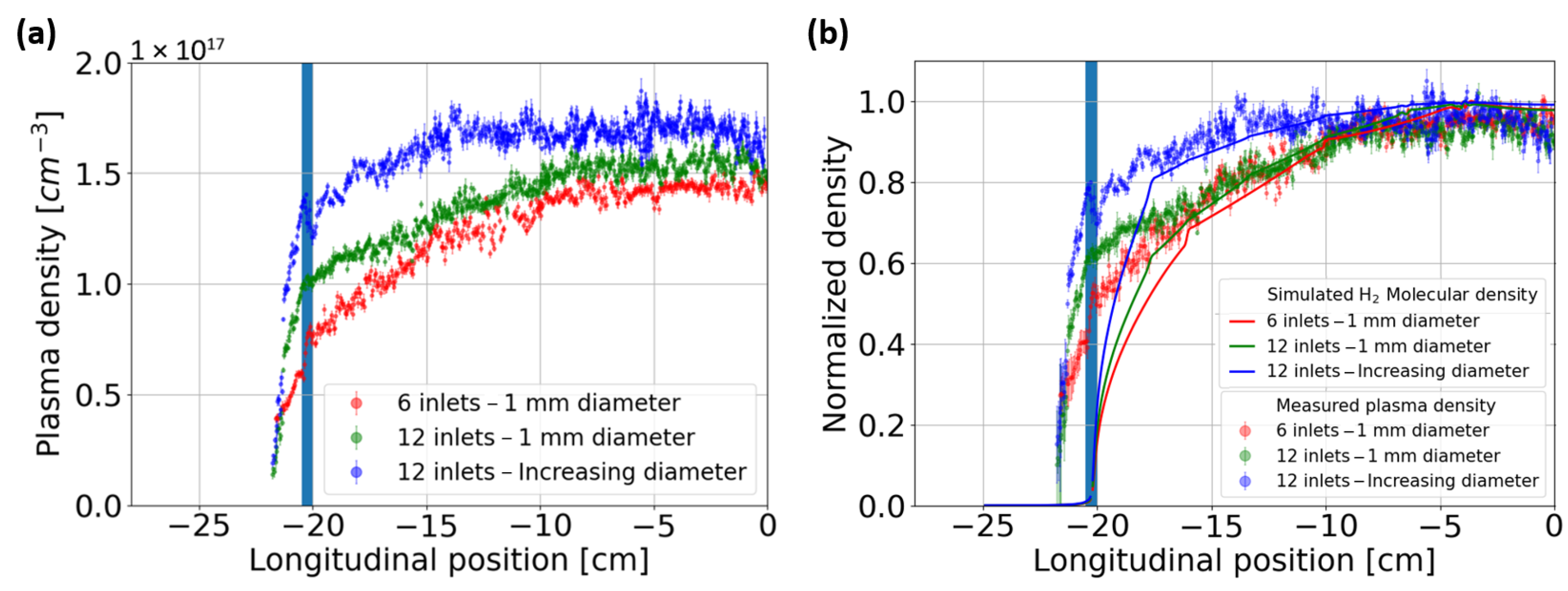
Figure 5a shows the longitudinal plasma density profiles measured for the three capillaries at the same time delay (300 ns) with respect to the discharge trigger. Given the symmetry of the device, the longitudinal profiles are acquired over half of the capillary structures. The measured error bars represent the density standard deviation calculated over 50 spectral images, acquired for each longitudinal position along the capillary. The six-inlet configuration (red dots) is characterized by a 20 cm long central plateau (from −10 to 10 cm) at 1.45 × 10 17 cm 3 , and 10 cm long density ramps towards the channel ends, with a center-to-end halving of the plasma density. On the other hand, the configurations with 12 inlets that have a 1 mm diameter (green dots) and a variable diameter in the range of 1 ÷ 2.2 mm (blue dots) show higher homogeneity in the whole channel, with a slightly higher density plateau of 1.5 × 10 17 cm 3 and 1.6 × 10 17 cm 3 , and a center-to-end density uniformity of 70% and 80% respectively.
Figure 5b shows a comparison between the measured plasma density profiles and the simulated molecular density profiles, each normalized to the corresponding peak. The simulated molecular density profiles accurately predict the plasma density distribution inside the plasma formation channel, especially in the region between the inlets (i.e., from −16 cm to 0). On the other hand, a mismatch is observed in the outer parts of the channel, i.e., from the external inlets at −16 cm (geometry 1) and −17.5 cm (geometries 2 and 3) to the capillary ends at −20 cm. In this region the molecular density drops rapidly, while the plasma density decreases smoothly. Such a discrepancy may be due to the different propagation velocities of neutral gas and plasma. Indeed, while the simulated gas propagates at velocities of ∼ 10 3 m/s, the thermal velocity of plasma electrons is in the order of 10 5 ÷ 10 6 m/s. In addition, the density ramps in the plasma plumes have similar shapes compared to the neutral density ramps towards the capillary exits. As a result, except for the outer 2–3 cm of the capillary channel, gas dynamics simulations demonstrate a useful capability to predict specific features of the plasma density profiles.
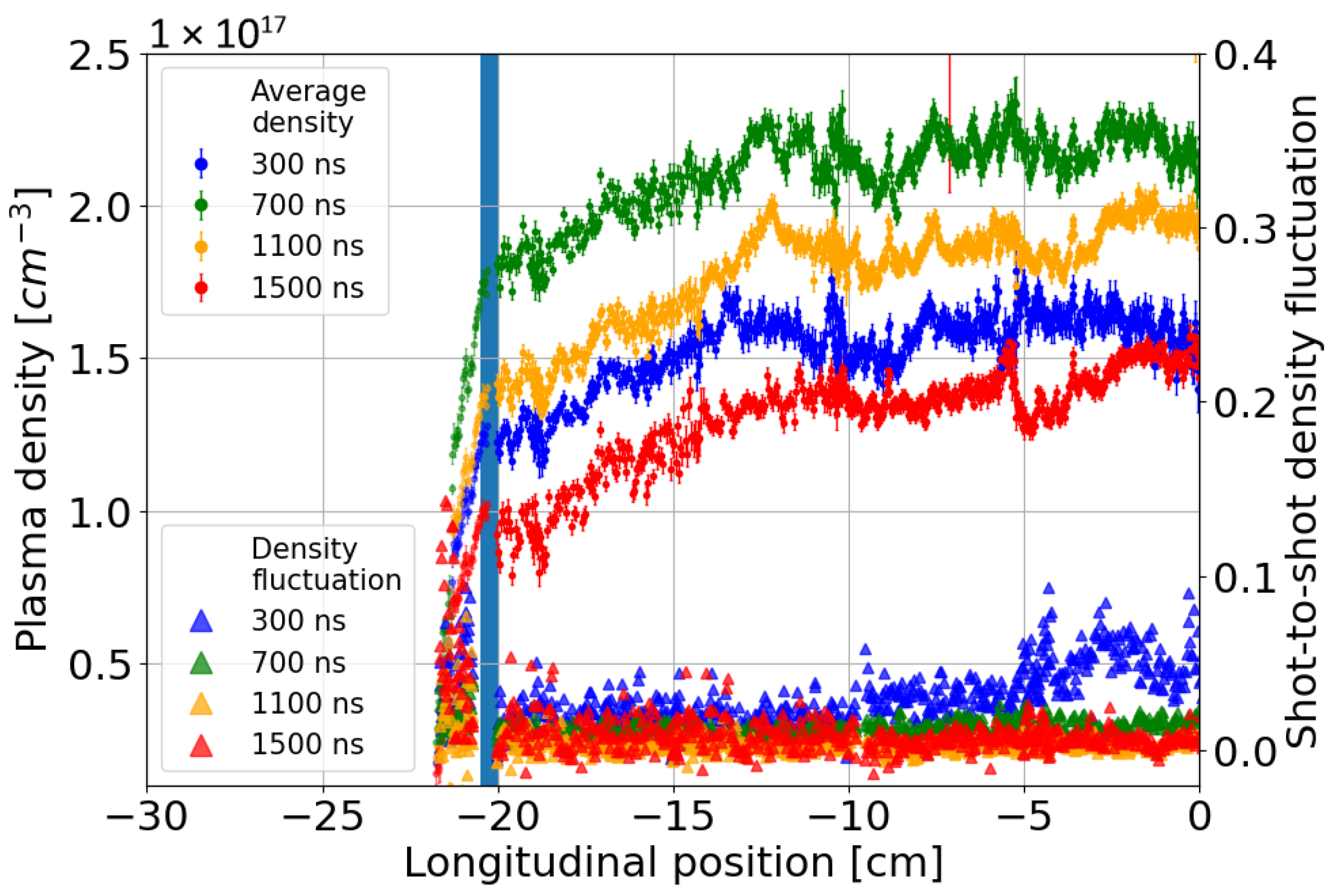
Longitudinal plasma density profiles are measured at different time delays with respect to the discharge onset, in order to assess the temporal evolution of the density distribution during the plasma formation and recombination into neutral hydrogen gas. Figure 6 shows the longitudinal density profiles measured with the latest capillary geometry (12 inlets with a variable diameter), with the acquisition time delay varied from 300 to 1500 ns. As shown in the figure, the length of the central plateau remains constant (around 30 cm), while the average density increases during the plasma formation up to ∼2.2 × 10 17 cm 3 at 700 ns, and decreases in the recombination phase to ∼1.4 × 10 17 cm 3 at 1500 ns. Moreover, the shape of the outer ramps also remains constant during the observed time interval. Together with longitudinal density profiles, Figure 6 shows the corresponding shot-to-shot fluctuations, computed as the density variation between two consecutive shots averaged over 50 acquired images at each delay. The shot-to-shot variation ranges from a minimum of 0.6% to a maximum of 3.8%, observed at 1100 ns and 300 ns respectively. This low percentage of density fluctuation can be further reduced using discharge stabilization techniques, such as the use of low-intensity laser pulses to trigger the electric discharge [21].
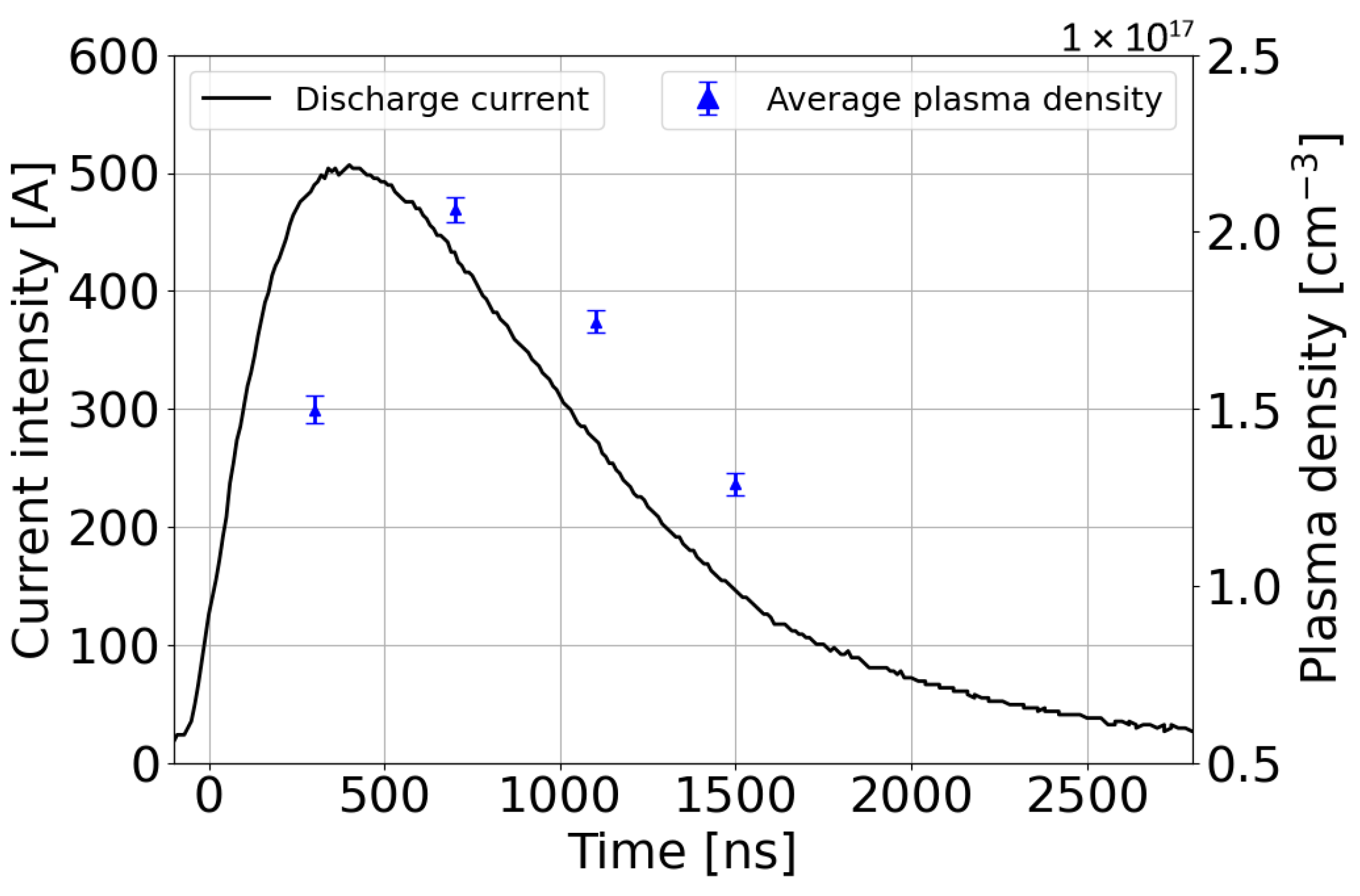
In addition, Figure 7 reports the temporal evolution of the plasma density averaged over the longitudinal profile, overlapped with the discharge current waveform measured by the oscilloscope. The average density increases during the plasma formation up to a density peak of ∼2.2 × 10 17 cm 3 , measured at 700 ns. Then, in the recombination phase, the density decreases to ∼1.2 × 10 17 cm 3 at 1500 ns. The simulated molecular density of 1 × 10 18 cm 3 and measured plasma density of 1 ÷ 2 × 10 17 cm 3 result in a plasma ionization degree of 10–20%. The observed partial ionization is due to the relatively low applied voltage of 10 kV, which is close to the ionization threshold for a 40 cm long hydrogen gas column.
The measured plasma profiles confirm the density trend observed in neutral gas simulations, with a longitudinal uniformity that is optimized by the inlet arrangement and is stable during the entire plasma evolution. Therefore, the numerical and experimental results prove the capability of the capillary geometric design to modulate the plasma density distribution over the 40 cm long plasma channel and, specifically, to improve the density uniformity for the optimization of the plasma acceleration mechanism. The presented approach can be applied to meter-scale capillaries, relying on CFD simulations for the design of long gas injection structures to ensure high density uniformity and modularity. In addition, the realization of such sources can be achieved through tool machining and assembly of modular blocks, which may optimize the production costs and geometric tolerances [33]. One of the possible issues related to meter-scale capillaries is the increase in the breakdown voltage, which scales with the gas column length. To keep the required voltage around 10–20 kV, achievable with compact and cost-effective HV systems, a suitable strategy is to divide the capillary into many segments, which are independently fed by parallel HV circuits. The increased capillary length also leads to a higher heat flux produced by the discharge and deposited onto the capillary walls. In this sense, high-melting-temperature materials, such as sapphire and shapal, can be adopted for long-term operation [18,19].

4. Conclusions

In this work we have presented the design and characterization of 40 cm long gas-filled discharge capillaries, aimed at demonstrating the possibility of modulating the plasma density distribution of meter-scale plasma channels by acting on the capillary geometry. Three different geometrical configurations, with various numbers of gas inlets of varying diameters, have been designed with CFD simulations and characterized using the Stark broadening technique for the measurement of plasma density distribution. Simulative and experimental results have shown that proper arrangement of the gas inlets allows to tailor both the neutral gas and plasma density profiles along the capillary channel. In particular, long density plateaus and an overall center-to-end uniformity of up to 80% in the longitudinal plasma density distribution can be achieved with a high number of gas inlets that have a variable diameter along the plasma formation channel. Furthermore, as highlighted by the temporal analysis of the plasma channels, such density uniformity is preserved during the entire discharge lifetime, from the plasma formation to its recombination into neutral gas. This allows to tune the average plasma density, and thus the accelerating gradient, without affecting the plasma density distribution. In conclusion, the obtained results demonstrate the effectiveness of the presented approach, which can be used for the design and realization of 40 cm long capillaries and is extendable to the meter-scale.

Author Contributions

A.B., L.C. and R.D. proposed the experiment. A.B., L.C. and V.L. designed the capillary structures. L.C. performed numerical CFD simulations to optimize the plasma source geometry. D.P. developed the high-voltage pulser circuit. A.B., L.C. and R.D. carried out the experimental characterization of the plasma discharge capillaries. M.F. provided funding for the experiment. L.C. wrote the paper draft. All authors have read and agreed to the published version of the manuscript.

Funding

This work received funding from the European Union’s Horizon Europe research and innovation program, under Grant Agreement No. 101079773 (EuPRAXIA Preparatory Phase), No. 101188004 (PACRI—Plasma Accelerator systems for Compact Research Infrastructures) and No. 101073480 (EuPRAXIA Doctoral Network), and from the UKRI guarantee funds.

Data Availability Statement

The data that support the findings of this study are available from the corresponding author on reasonable request.

Acknowledgments

We thank T. De Nardis and G. Grilli for the realization of the electrical pulser circuits and L. Ioannucci and G. Luminati for the installation of the cooling system for the vacuum pumps.

Conflicts of Interest

The authors declare no conflicts of interest.

References

  1. Tajima, T.; Dawson, J.M. Laser Electron Accelerator. Phys. Rev. Lett. 1979, 43, 267–270. [Google Scholar] [CrossRef]
  2. Chen, P.; Dawson, J.M.; Huff, R.W.; Katsouleas, T. Acceleration of Electrons by the Interaction of a Bunched Electron Beam with a Plasma. Phys. Rev. Lett. 1985, 54, 693–696. [Google Scholar] [CrossRef]
  3. Pukhov, A.; Meyer-ter Vehn, J. Laser wake field acceleration: The highly non-linear broken-wave regime. Appl. Phys. B 2002, 74, 355–361. [Google Scholar] [CrossRef]
  4. Mangles, S.; Murphy, C.; Najmudin, Z.; Thomas, A.G.; Collier, J.L.; Dangor, A.E.; Divall, E.J.; Foster, P.S.; Gallacher, J.G.; Hooker, C.J.; et al. Monoenergetic beams of relativistic electrons from intense laser–plasma interactions. Nature 2004, 431, 535–538. [Google Scholar] [CrossRef]
  5. Blumenfeld, I.; Clayton, C.; Decker, F.; Hogan, M.J.; Huang, C.; Ischebeck, R.; Iverson, R.; Joshi, C.; Katsouleas, T.; Kirby, N.; et al. Energy doubling of 42 GeV electrons in a metre-scale plasma wakefield accelerator. Nature 2007, 445, 741–744. [Google Scholar] [CrossRef]
  6. Gonsalves, A.J.; Nakamura, K.; Daniels, J.; Benedetti, C.; Pieronek, C.; de Raadt, T.C.H.; Steinke, S.; Bin, J.H.; Bulanov, S.S.; van Tilborg, J.; et al. Petawatt Laser Guiding and Electron Beam Acceleration to 8 GeV in a Laser-Heated Capillary Discharge Waveguide. Phys. Rev. Lett. 2019, 122, 084801. [Google Scholar] [CrossRef]
  7. Pompili, R.; Alesini, D.; Anania, M.P.; Arjm, S.; Behtouei, M.; Bellaveglia, M.; Biagioni, A.; Buonomo, B.; Cardelli, F.; Carpanese, M.; et al. Free-electron lasing with compact beam-driven plasma wakefield accelerator. Nature 2022, 605, 659–662. [Google Scholar] [CrossRef]
  8. Wang, W.; Feng, K.; Ke, L.; Yu, C.; Xu, Y.; Qi, R.; Chen, Y.; Qin, Z.; Zhang, Z.; Fang, M.; et al. Free-electron lasing at 27 nanometres based on a laser wakefield accelerator. Nature 2021, 595, 516–520. [Google Scholar] [CrossRef]
  9. Galletti, M.; Alesini, D.; Anania, M.P.; Arjmand, S.; Behtouei, M.; Bellaveglia, M.; Biagioni, A.; Buonomo, B.; Cardelli, F.; Carpanese, M.; et al. Stable Operation of a Free-Electron Laser Driven by a Plasma Accelerator. Phys. Rev. Lett. 2022, 129, 234801. [Google Scholar] [CrossRef]
  10. Labat, M.; Cabadağ, J.C.; Ghaith, A.; Irman, A.; Berlioux, A.; Berteaud, P.; Blache, F.; Bock, S.; Bouvet, F.; Briquez, F.; et al. Seeded free-electron laser driven by a compact laser plasma accelerator. Nat. Photon. 2023, 17, 150–156. [Google Scholar] [CrossRef]
  11. Assmann, R.W.; Weikum, M.K.; Akhter, T.; Alesini, D.; Alexandrova, A.S.; Anania, M.P.; Andreev, N.E.; Andriyash, I.; Artioli, M.; Aschikhin, A.; et al. EuPRAXIA Conceptual Design Report. Eur. Phys. J. Spec. Top. 2020, 229, 3675–4284. [Google Scholar] [CrossRef]
  12. Adli, E.; Appleby, J.; Barklow, T.L.; Biagini, M.; Svensson, J.B.; Berggren, M.; Bettoni, S.; Boogert, S.; Burrows, P.; Caldwell, A.; et al. HALHF: A hybrid, asymmetric, linear Higgs factory using plasma- and RF-based acceleration. arXiv 2025, arXiv:2503.19880. [Google Scholar] [CrossRef] [PubMed]
  13. Spence, D.J.; Hooker, S.M. Investigation of a hydrogen plasma waveguide. Phys. Rev. E 2000, 63, 015401. [Google Scholar] [CrossRef]
  14. Zigler, A.; Ehrlich, Y.; Cohen, C.; Krall, J.; Sprangle, P. Optical guiding of high-intensity laser pulses in a long plasma channel formed by a slow capillary discharge. J. Opt. Soc. Am. B 1996, 13, 68–71. [Google Scholar] [CrossRef]
  15. Butler, A.; Spence, D.J.; Hooker, S.M. Guiding of High-Intensity Laser Pulses with a Hydrogen-Filled Capillary Discharge Waveguide. Phys. Rev. Lett. 2002, 89, 185003. [Google Scholar] [CrossRef] [PubMed]
  16. Spence, D.J.; Butler, A.; Hooker, S.M. Gas-filled capillary discharge waveguides. J. Opt. Soc. Am. B 2003, 20, 138–151. [Google Scholar] [CrossRef]
  17. Filippi, F.; Anania, M.P.; Biagioni, A.; Chiadroni, E.; Cianchi, A.; Ferber, Y.; Ferrario, M.; Zigler, A. 3D-printed capillary for hydrogen filled discharge for plasma based experiments in RF-based electron linac accelerator. Rev. Sci. Instrum. 2018, 89, 083502. [Google Scholar] [CrossRef]
  18. Gonsalves, A.J.; Liu, F.; Bobrova, N.A.; Sasorov, P.V.; Pieronek, C.; Daniels, J.; Antipov, S.; Butler, J.E.; Bulanov, S.S.; Waldron, W.L.; et al. Demonstration of a high repetition rate capillary discharge waveguide. J. Appl. Phys. 2016, 119, 033302. [Google Scholar] [CrossRef]
  19. Crincoli, L.; Demitra, R.; Lollo, V.; Pellegrini, D.; Pitti, M.; Pronti, L.; Romani, M.; Ferrario, M.; Biagioni, A. Advanced ceramic plasma discharge capillaries for high repetition rate operation. Sci. Rep. 2025, 15, 12456. [Google Scholar] [CrossRef]
  20. Crincoli, L.; Anania, M.P.; Biagioni, A.; Carillo, M.; Costa, G.; Giorno, M.D.; Galletti, M.; Iovine, P.; Lollo, V.; Mariani, C.; et al. Characterization of plasma-discharge Capillaries for Plasma-based Particle Acceleration. J. Phys. Conf. Ser. 2024, 2687, 042006. [Google Scholar] [CrossRef]
  21. Biagioni, A.; Anania, M.P.; Arjm, S.; Behar, E.; Costa, G.; Del Dotto, A.; Ferrario, M.; Galletti, M.; Lollo, V.; Pellegrini, D.; et al. Gas-filled capillary-discharge stabilization for plasma-based accelerators by means of a laser pulse. Plasma Phys. Control. Fusion 2021, 63, 115013. [Google Scholar] [CrossRef]
  22. Pompili, R.; Anania, M.P.; Bellaveglia, M.; Biagioni, A.; Bini, S.; Bisesto, F.; Brentegani, E.; Cardelli, F.; Castorina, G.; Chiadroni, E.; et al. Focusing of High-Brightness Electron Beams with Active-Plasma Lenses. Phys. Rev. Lett. 2018, 121, 174801. [Google Scholar] [CrossRef] [PubMed]
  23. Dap, S.; Leroy, O.; Andrieu, J.; Boisse-Laporte, C.; Leprince, P.; Stancu, G.D.; Minea, T. Hydrodynamic and thermal effects of continuous microwave-sustained plasma in capillary tubes. Plasma Sources Sci. Technol. 2015, 24, 065007. [Google Scholar] [CrossRef]
  24. Sterie, V.A.; Zhao, Y.; Stancu, G.D. Nitric oxide generation by microwave capillary discharges under thermal control at atmospheric pressure. Front. Phys. 2023, 11, 1188549. [Google Scholar] [CrossRef]
  25. Sadeghi, H.; Kiai, S.; Adlparvar, S.; Fazelpour, S. Innovative microwave discharge plasma technology for high-intensity extreme ultraviolet (EUV) radiation generation. Opt. Quant. Electron. 2025, 57, 397. [Google Scholar] [CrossRef]
  26. Romeo, S.; Biagioni, A.; Crincoli, L.; Del Dotto, A.; Ferrario, M.; Giribono, A.; Parise, G.; Rossi, A.; Silvi, G.; Vaccarezza, C. Evaluation of the transfer matrix of a plasma ramp with squared cosine shape via an approximate solution of Mathieu differential equation. Plasma Phys. Control. Fusion 2023, 65, 115005. [Google Scholar] [CrossRef]
  27. Bagdasarov, G.A.; Kruchinin, K.O.; Molodozhentsev, A.Y.; Sasorov, P.V.; Bulanov, S.V.; Gasilov, V.A. Discharge plasma formation in square capillary with gas supply channels. Phys. Rev. Res. 2022, 4, 013063. [Google Scholar] [CrossRef]
  28. Mewes, S.M.; Boyle, G.J.; D’Arcy, R.; Garland, J.M.; Huck, M.; Jones, H.; Loisch, G.; Maier, A.R.; Osterhoff, J.; Parikh, T.; et al. Characterization of discharge capillaries via benchmarked hydrodynamic plasma simulations. arXiv 2025, arXiv:2506.16192. [Google Scholar] [CrossRef]
  29. Sasorov, P.; Bagdasarov, G.; Bobrova, N.; Grittani, G.; Molodozhentsev, A.; Bulanov, S.V. Capillary discharge in the high repetition rate regime. Phys. Rev. Res. 2024, 6, 013290. [Google Scholar] [CrossRef]
  30. Saifutdinov, A.I.; Sysoev, S.S. Numerical simulation and experimental diagnostics of fast electron kinetics and plasma parameters in a microhollow cathode discharges in helium. Plasma Sources Sci. Technol. 2023, 32, 114001. [Google Scholar] [CrossRef]
  31. Nikic, D.; Fierro, A.; Moore, C.; Lehr, J. Numerical-heating effects in atmospheric pressure streamer discharges simulated with a PIC code. Plasma Sources Sci. Technol. 2026, 35, 025017. [Google Scholar] [CrossRef]
  32. Ferrario, M.; Alesini, D.; Anania, M.; Bacci, A.; Bellaveglia, M.; Bogdanov, O.; Boni, R.; Castellano, M.; Chiadroni, E.; Cianchi, A.; et al. SPARC_LAB present and future. Nucl. Instrum. Methods Phys. Res. Sect. B Beam Interact. Mater. Atoms 2013, 309, 183–188. [Google Scholar] [CrossRef]
  33. Alesini, D.; Anania, M.P.; Anelli, F.; Angeletti, P.; Angelucci, M.; Armenti, G.; Arpaia, M.; Assmann, R.; Avaldi, L.; Bacci, A.L.; et al. EuPRAXIA@SPARC_LAB Technical Design Report; INFN Open Access Repository. 2026. Available online: https://www.openaccessrepository.it/records/k57qz-5qk09 (accessed on 19 March 2026).
  34. Weller, H.G.; Tabor, G.; Jasak, H.; Fureby, C. A tensorial approach to computational continuum mechanics using object-oriented techniques. Comput. Phys. 1998, 12, 620–631. [Google Scholar] [CrossRef]
  35. Biagioni, A. Technical Report SPARC-PL-19/001; National Institute of Nuclear Physics—Frascati National Laboratories: Frascati, Italy, 2019. [Google Scholar]
  36. Griem, H.R. Principles of Plasma Spectroscopy; Cambridge University Press: Cambridge, UK, 1997. [Google Scholar]
  37. Griem, H.R. Spectral Line Broadening by Plasmas; Academic Press: College Park, ML, USA, 1974. [Google Scholar]
  38. Bobrova, N.; Esaulov, A.; Sakai, J.; Sasorov, P.; Spence, D.; Butler, A.; Hooker, S.; Bulanov, S. Simulations of a hydrogen-filled capillary discharge waveguide. Phys. Rev. E Stat. Nonlinear Soft Matter Phys. 2002, 65, 016407. [Google Scholar] [CrossRef] [PubMed]
Figure 1. CFD simulation domain, including the neutral gas injection network, realized inside the capillary device by tool machining, and two side boxes connected to the capillary ends to simulate the gas expansion in the vacuum chamber.
Applsci 16 03291 g001
Figure 2. (Top) Picture of a 40 cm long capillary, composed of two plastic blocks stacked and joined together. (Bottom) Picture of the 40 cm long capillary during plasma formation inside the vacuum chamber of the experimental plasma module.
Applsci 16 03291 g002
Figure 3. Schematic representation of the experimental plasma module.
Applsci 16 03291 g003
Figure 4. Two-dimensional steady-state hydrogen density distribution in the capillary structure with (a) 6 inlets with a 1 mm diameter, (b) 12 inlets with a 1 mm diameter and (c) 12 inlets with a variable diameter. (d) Normalized H 2 molecular density profiles along the plasma formation channel, obtained with the three configurations. Vertical blue bars located at ±20 cm represent the electrodes at the capillary ends.
Applsci 16 03291 g004
Figure 5. (a) Longitudinal plasma density profiles, measured along half of the plasma channel in the three geometrical configurations, i.e., 6 inlets with a 1 mm diameter (red dots), 12 inlets with a 1 mm diameter (green dots) and 12 inlets with a variable diameter (blue dots). Density profiles are acquired at a delay of 300 ns from the discharge trigger. (b) Measured plasma density profiles (dots) and simulated molecular density profiles (solid lines) normalized to the corresponding peaks for each capillary geometry. The vertical blue bar located at −20 cm represents the electrode at the capillary end.
Applsci 16 03291 g005
Figure 6. Longitudinal plasma density profiles (dots) and related shot-to-shot fluctuations (triangles), measured at different time delays with respect to the discharge trigger, for the capillary geometry with 12 inlets with a variable diameter. The density fluctuation of each profile is computed as the shot-to-shot variation over 50 consecutive discharges. The vertical blue bar located at −20 cm represents the electrode at the capillary end.
Applsci 16 03291 g006
Figure 7. Temporal evolution of the plasma density distribution, averaged over the longitudinal profiles shown in Figure 6. The solid black line represents the discharge current waveform, acquired by the oscilloscope, with a 500 Amp current peak.
Applsci 16 03291 g007
Table 1. Geometrical parameters of the three 40 cm long capillaries.
Capillary123
Horizontal channel diameters [mm]222
Number of inlets61212
Inlet positions [mm]
(from the center to the ends)
±40,
±100,
±160
±40, ±60,
±100, ±135,
±160, ±175
±40, ±60,
±100, ±135,
±160, ±175
Inlet diameters [mm]
(from the center to the ends)
111, 1, 1.2,
1.6, 2, 2.2
Disclaimer/Publisher’s Note: The statements, opinions and data contained in all publications are solely those of the individual author(s) and contributor(s) and not of MDPI and/or the editor(s). MDPI and/or the editor(s) disclaim responsibility for any injury to people or property resulting from any ideas, methods, instructions or products referred to in the content.