


Abstract
Human respiratory syncytial virus (RSV) is the predominant etiological agent responsible for lower respiratory tract infections in young children. Recurrent infections throughout an individual’s lifespan can lead to significant morbidity, particularly in the elderly and in adults, influencing the trends of hospitalization rates. Consequently, it is imperative to develop technologies that can sanitize environments from this pathogen while being compatible with human presence. Structure Resonant Energy Transfer (SRET) is the scientific principle underlying a sanitization technology that has demonstrated efficacy against several enveloped viruses, including SARS-CoV-2 and Influenza A viruses. SRET employs specific frequencies of electromagnetic waves to effectively disrupt the structural integrity of viral envelopes through dipole coupling. This disruption leads to the inactivation of the virus, rendering it non-infectious. The objective of this study is to analyse the effect of a specific SRET sanitization method on RSV. The sanitization test was conducted in aerosol form within a BSL-3 laboratory, exploring the frequency band from 8 to 16 GHz. An optimal sub-band was identified, giving an inactivation efficiency up to 99.5%. In conclusion, it has been demonstrated that the microwave non-thermal sanitization method is effective against RSV. These results confirm its potential as a viable approach for environmental decontamination.
1. Introduction
Respiratory syncytial virus (RSV), classified within the Paramyxoviridae family [1], represents a principal etiological agent of acute lower respiratory tract infections (LRTIs) in the pediatric population globally and constitutes a significant contributor to childhood morbidity and mortality [2,3,4]. Globally, RSV is estimated to account for approximately 33 million episodes of lower respiratory tract infection each year, leading to around 3.6 million hospital admissions and nearly 100,000 fatalities among children under five years of age, with the highest burden observed in low- and middle-income countries (LMICs) [2,4,5]. In infants, RSV infection typically commences with several days of nonspecific upper respiratory tract symptoms, such as fever, rhinorrhea, and nasal congestion [6]. Signs of lower respiratory tract involvement typically manifest abruptly and may include tachypnea with increased respiratory effort, thoracic hyperinflation, inspiratory chest wall retractions, and auscultatory findings such as fine crackles and/or coarse wheezing [7]. Although most RSV infections are relatively mild and can be managed with supportive care alone, certain subsets of infants are at heightened risk for severe disease, which may necessitate hospitalization, intensive care admission, or mechanical ventilation, or can even result in mortality [6,8,9]. Approximately 18% of children under five years of age presenting with acute respiratory infections are found to have RSV. This elevated prevalence represents a significant pediatric public health concern, as it contributes to a considerable disease burden irrespective of underlying comorbidities [3,10,11]. It is also important to emphasize that RSV infection is prevalent among adults, where it imposes a significant clinical and economic burden, primarily associated with lower respiratory tract complications and increased mortality [10]. These considerations underscore the necessity of implementing effective infection control measures aimed at prevention and minimizing the risk of exposure to RSV. In this context, the application of electromagnetic wave-based air treatment technologies may constitute a preventive strategy to mitigate viral exposure risk. Microwave electromagnetic radiation, within the frequency range of 300 MHz to 300 GHz, is classified as non-ionizing because its energy is insufficient to remove electrons from atomic structures. However, it possesses adequate energy to induce molecular vibrations in matter [12,13]. One notable application of this vibrational excitation is the phenomenon of resonant energy transfer (SRET), whereby microwave radiation couples to specific acoustic vibrational modes of viral particles, offering a promising non-chemical approach to decontamination [14,15,16,17,18,19,20]. This method represents a promising strategy for mitigating the transmission of airborne viruses, while simultaneously enabling real-time air decontamination [21]. The mechanism leverages the confined acoustic dipolar resonance mode within viral particles. When aerosolized virions are subjected to microwave radiation at specific frequencies, energy is coupled into these intrinsic vibrational modes, inducing resonance that results in structural destabilization and subsequent viral inactivation [22,23]. Recent investigations have confirmed the efficacy of this approach against multiple SARS-CoV-2 variants, including Wuhan, Delta, and Omicron strains [16,17,19]. Controlled bioaerosol experiments demonstrated that microwave exposure achieved an average viral titer reduction of 91.31% across these variants [19]. Comparable inactivation levels were observed for influenza viruses, with H1N1 showing a 90% reduction computed through viral titer [19], and A(H5N1) reaching approximately 94% [20]. To achieve the reported inactivation results, optimal parameters were identified, including the electromagnetic radiation frequency, to maximize the SRET phenomenon. SARS-CoV-2 exhibited sensitivity to frequencies up to 12 GHz [19], whereas the H1N1 influenza virus showed susceptibility at higher frequencies, reaching up to 16 GHz [19]. Similarly, A(H5N1) demonstrated greater sensitivity within the 8–12 GHz range [20]. Based on these promising findings, we applied the same methodology to investigate aerosolized RSV inactivation. To the best of our knowledge, no studies in literature have addressed RSV aerosol inactivation through electromagnetic treatment. Therefore, the aim of this study is to assess the virucidal effect of electromagnetic exposure on aerosolized RSV by exploring multiple frequency bands between 8 and 16 GHz, with the objective of identifying the sub-band in which RSV is most susceptible to SRET.
2. Materials and Methods
2.1. Analytical Considerations
Viruses can be regarded as nanoscale condensed matter systems exhibiting core–shell charge separation [17,23]. Specifically, RSV is an enveloped, negative-sense RNA virus. It displays pleomorphic morphology, emerging from infected cells as both spherical and filamentous particles. The spherical forms generally measure 150–300 nm in diameter [24], which allows us to approximate RSV as a roughly spherical virus for most purposes. Regarding the RSV virion envelope, it possesses a lipid nature as it originates from the host cell plasma membrane during the budding process, which is enriched in phospholipids and cholesterol [24].
When spherical virions are modeled as free, homogeneous nanoparticles, their magnetic resonance frequencies align closely with the dipolar modes predicted by elastic continuum theory. These findings indicate a potential approach for configuring microwave apparatus for virus treatment.
According to Lamb’s theory [25], the frequency of the dipolar spheroidal mode (SPH, ) for any spherical particle can be determined using the following eigenvalue equation:
where , and Jl(η) represents the spherical Bessel function of the first kind with order . Here, denotes the particle’s radius, while and correspond to the longitudinal and transverse sound velocities, respectively. If the virus is modelled as a homogeneous, isotropic elastic continuum, its mechanical properties can be described in terms of Poisson’s ratio, Young’s modulus, and density. Poisson’s ratio is typically assumed to be 1/3, which corresponds to an approximate ratio of 1/2 between the transverse and longitudinal sound velocities within the viral structure [26]. Moreover, in this case, the lipid nature of the virion envelope allows us, with appropriate approximations, to assume that the longitudinal sound velocity corresponds to that of lipids, which is approximately 1500 m/s [27]. The eigenvalue equation was solved numerically as reported in [17]. Specifically, Bessel functions corresponding to dipolar, quadrupolar, and octupolar modes were computed for the first harmonic as a function of the particle radius.
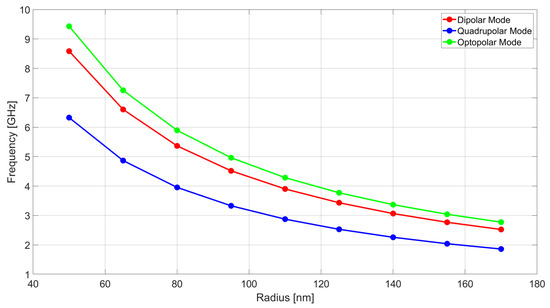
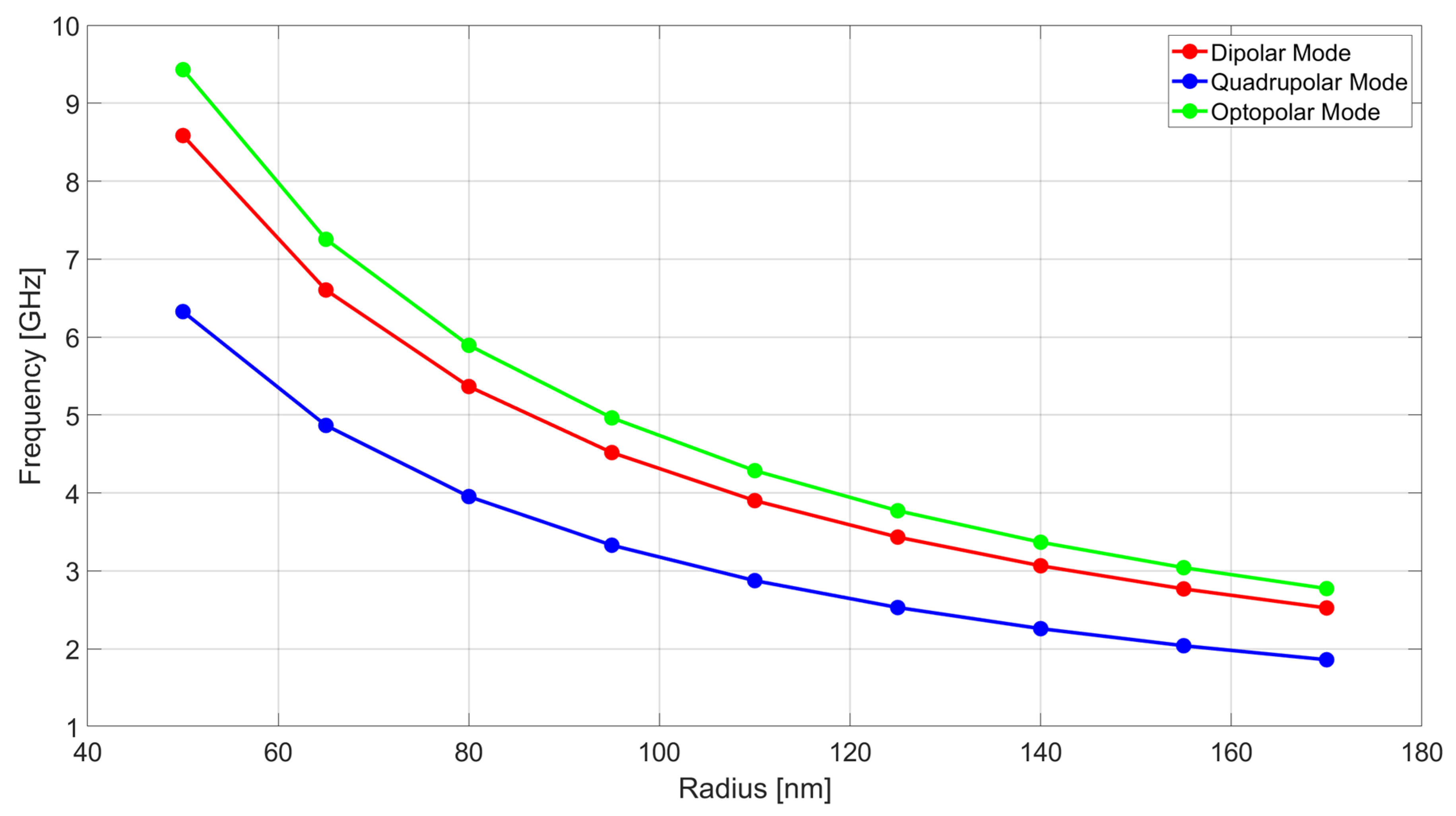
Figure 1 shows the variation in resonance frequencies as a function of the radius for the dipolar, quadrupolar, and octupolar modes. From these trends, it can be observed that the resonance frequency for all modes decreases as the virion radius increases.
Figure 1.
Resonance frequencies at first harmonic as a function of the radius for the dipolar, quadrupolar, and octupolar modes.
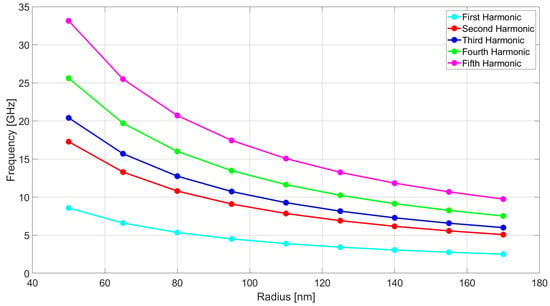
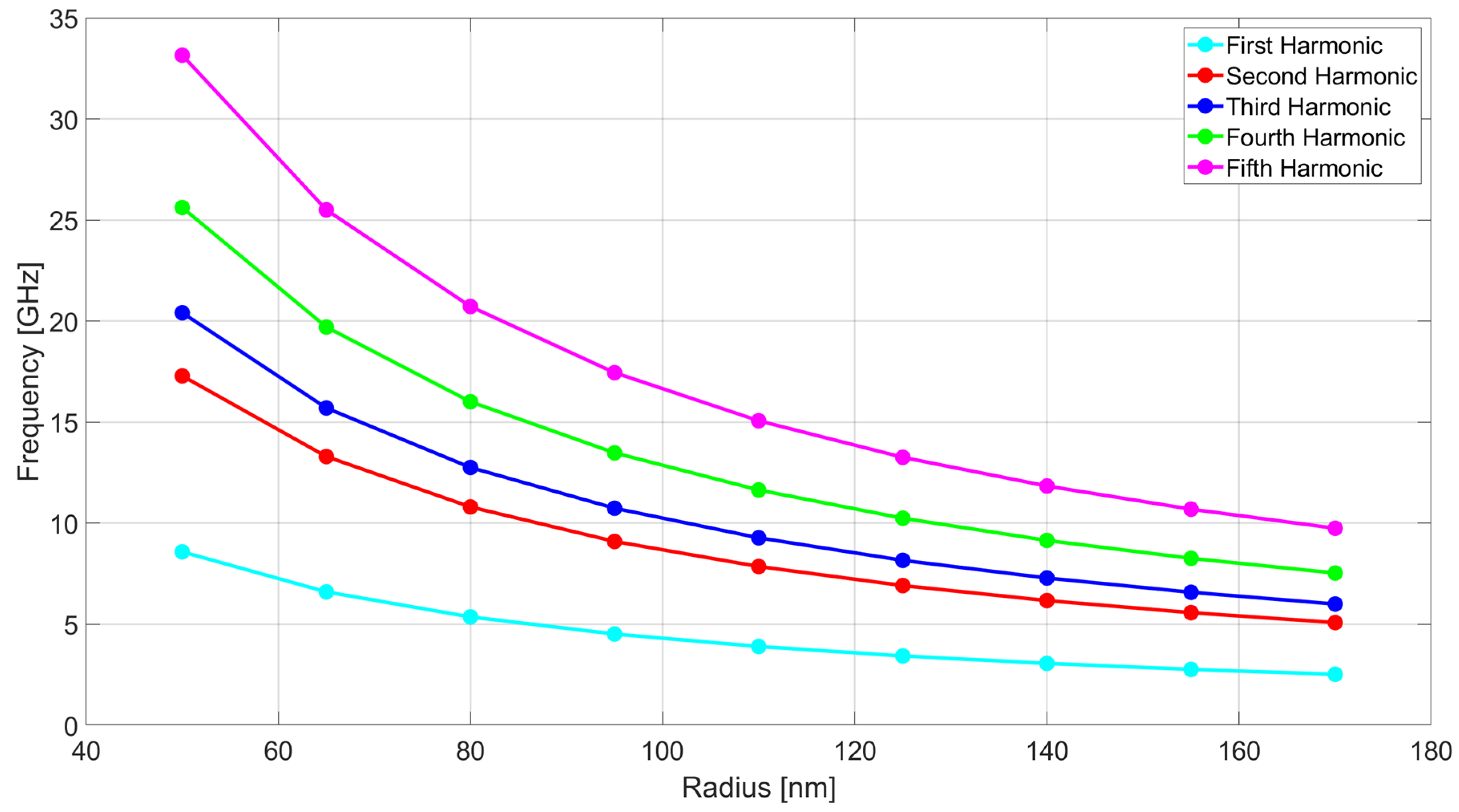
Furthermore, since energy exchange is more efficient in the dipolar mode compared to the other modes [16,23], the Bessel function for the dipolar mode was calculated as a function of the radius up to the first fifth harmonic. Coinciding with the natural resonance frequency of the virus’s dipolar vibrational mode, efficient absorption of microwave energy occurs. This energy transfer can induce mechanical stress within the viral structure, potentially resulting in structural disruption and subsequent viral inactivation [16,23].
Figure 2 presents the resonance frequency trends for the dipolar mode, calculated from the first to the fifth harmonic.
Figure 2.
Resonance frequencies for dipolar mode up to the fifth harmonic.
As shown in Figure 2, within the 8–16 GHz frequency band, it is possible to simultaneously target the resonance frequencies associated with the second and third harmonics, thereby improving the effectiveness of the inactivation process. For this reason, this frequency band was selected for experimental investigation.
2.2. Experimental Setup
All experimental procedures were performed in strict compliance with the standardized protocols governing exposure configurations in biological research [28]. The experimental protocol designed to investigate the effects of microwave radiation on aerosolized RSV comprised four main stages. Initially, RSV was propagated in human epithelial cells (HEp2) to obtain a high-titer viral suspension suitable for aerosolization, ensuring sufficient viral load and consistency across experimental replicates. Following this preparatory phase, the viral suspension was aerosolized under controlled conditions to produce a fine mist of airborne particles, thereby simulating natural transmission dynamics and providing an appropriate model for evaluating the impact of microwave radiation on suspended viral particles. The aerosolized virus was then exposed to microwave irradiation under rigorously controlled environmental parameters, and a systematic assessment of multiple frequency bands was conducted to identify the optimal conditions for viral inactivation. This approach enabled the determination of specific frequency ranges exhibiting maximal virucidal efficacy. Finally, viral infectivity was quantified using Vero E6 cells (African green monkey kidney) maintained at optimal density in accordance with ATCC guidelines [29], and the presence or absence of infection in each well was determined by monitoring cytopathic effects through digital microscopy imaging. In the following sections, each experimental step will be examined in greater detail.
2.3. Propagation of RSV
Propagation of the RSV was carried out under Biosafety Level 3 (BSL-3) containment conditions at ViroStatics Srl (Sassari, Italy), within the Scientific and Technological Park Porto Conte Ricerche Srl (Alghero, Italy). For each test, a 2 mL viral suspension of RSV with a titer of 3.16 × 10⁴ TCID50/mL was used. The virus was produced in epithelial carcinoma cells (HEP-2). For RSV propagation in cell culture, the strain RSV A_VR36_ATCC was employed, and HEp2 cells were utilized. The cell culture medium consisted of DMEM supplemented with 10% fetal bovine serum (FBS); during viral infection, the serum concentration was reduced to 2%. Cells were seeded at a density of 2 × 10⁵ cells/mL in T-25 flasks containing DMEM with 10% FBS and incubated until reaching approximately 60% confluence. The virus stock was diluted to achieve a multiplicity of infection (MOI) of 0.1 in DMEM containing 2% FBS and inoculated onto the cell monolayer for 1 h at 37 °C in a 5% CO2 atmosphere, with gentle agitation every 15 min. Following incubation, 5 mL of DMEM supplemented with 2% FBS was added, and the cells were further incubated at 37 °C with 5% CO2 for three days, until a cytopathic effect (CPE) of at least 70% was observed. The infected culture was then subjected to a freeze–thaw cycle to obtain a cell lysate, which was centrifuged at 3000 rpm for 15 min at 4 °C. The supernatant was collected, aliquoted, and stored at −80 °C. The resulting viral titer was determined using the same procedure applied to aerosol-generated samples, as described in Section 2.5 Microwave Treatment. Finally, all reagents used for cell culture are listed in Table 1.
Table 1.
Table of reagents used for cell culture.
2.4. Aerosolization of the RSV Viral Suspension
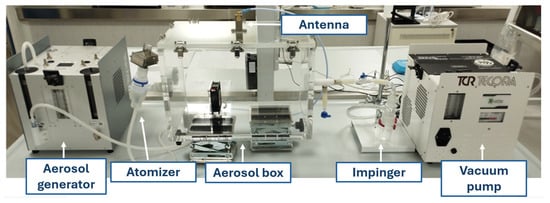
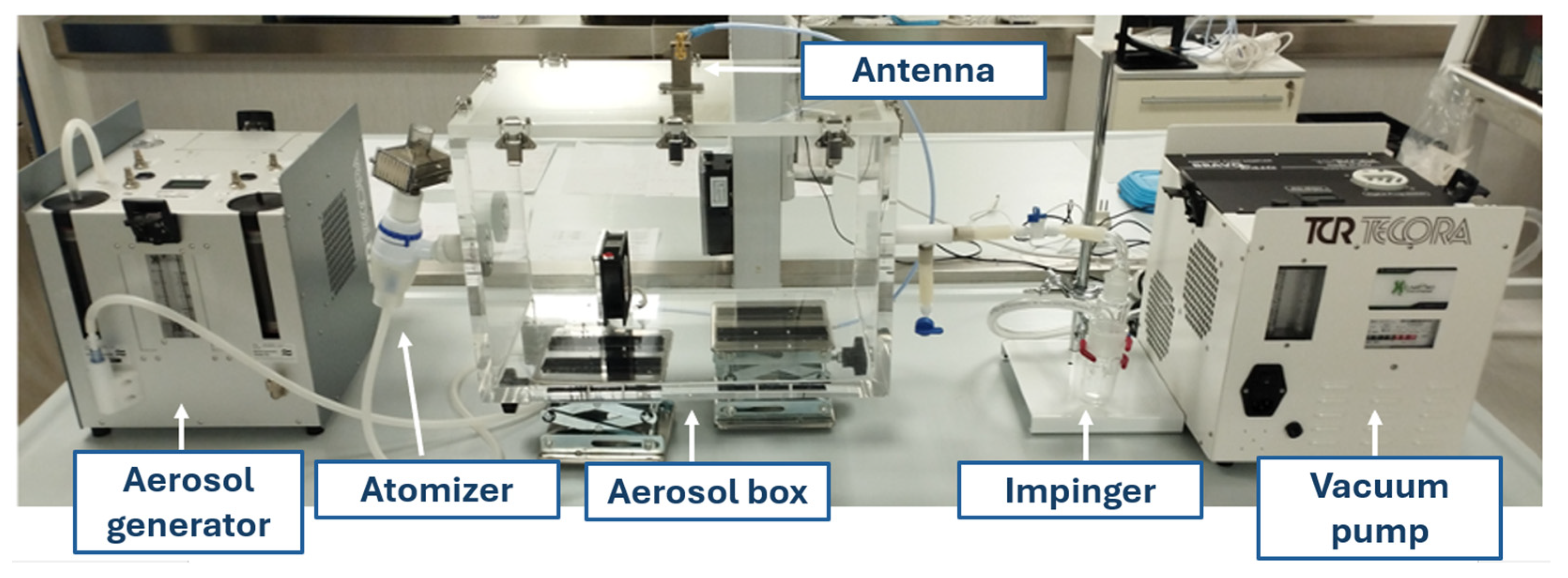
All experimental procedures were conducted under controlled environmental settings at 21 °C. Additionally, the BSL-3 laboratory operator was blinded to the specifics of the virus inactivation protocol, ensuring that all assays were performed under blind conditions. Aerosol inactivation experiments were performed using the aerosolization apparatus previously described in detail [17,18,19] and are illustrated in Figure 1. The viral suspension was aerosolized using a DDS aerosol generator (Model AERO) (TCR TECORA, Cogliate, Italy), equipped with an atomizer designed for nebulizing liquids such as aqueous solutions, suspensions, and oils. The system incorporates two integrated pumps enabling independent flow control, with adjustable pressure and flow rates, producing aerosolized particles with a mean aerodynamic diameter of approximately 1 μm. Aerosols were introduced into a controlled chamber with a total volume of 32 L. The aerosolization protocol was designed to replicate natural airborne transmission pathways of the virus, emulating droplet and aerosol formation typically generated during respiratory activities such as coughing, sneezing, or speaking [30]. The use of a hermetically sealed chamber ensured full containment of the aerosolized viral particles, enabling controlled exposure to subsequent microwave treatment (MW). Aerosolization was maintained until the viral suspension occupied the entire chamber volume, achieving a homogeneous spatial distribution of particles. Following MW exposure, aerosol particles were collected using a Bravo BASIC M impinger connected to a vacuum pump (Xrv-Biosamp, XEarPro) (TCR TECORA, Cogliate, Italy) operating at a constant flow rate of 12 L·min−1. The aerosol-based testing setup is illustrated in Figure 3.
Figure 3.
Aerosol-based inactivation testing setup.
2.5. Microwave Treatment
The aerosolized RSV was exposed to microwave irradiation produced by a radiofrequency (RF) generator, utilizing a custom-built apparatus previously described in detail [17,19,31]. The RF system was purpose-built to enable precise delivery of microwave radiation for viral inactivation studies. The architecture included: an ultra-wideband, frequency-agile synthesizer spanning the C to Ku bands for broad-spectrum testing; medium- and high-power microwave amplifiers for signal enhancement; a digital variable attenuator for output power modulation; and an embedded control framework implemented in C++ on an ESP32 platform via Visual Studio Code (Version 1.86), governing all RF component configurations. The terminal amplification stage employed advanced 0.15 μm GaN-on-SiC high-electron-mobility transistor (HEMT) technology, providing up to 10 W across an ultra-wideband range. RF output from the transmitter was coupled to a horn antenna through a dedicated RF cable. Given that the primary objective was to evaluate pathogen inactivation capability of SRET technology, during the test campaign the RF source was configured to operate at its maximum available power output and overlapping sub-bands of two GHz in the X-band and Ku-band (8–10 GHz, 9–11 GHz, 10–12 GHz, 11–13 GHz, 12–14, 13–15 GHz, 14–16 GHz) with a 10 MHz step between frequencies were analyzed, exposing the aerosol to microwave treatment for 10 min. Each frequency sub-band was tested in three independent replicates. The reference condition for evaluating the inactivation percentage consisted of control samples exposed to the same aerosol setup but without microwave irradiation; throughout the 10 min treatment, the RF device remained turned off.
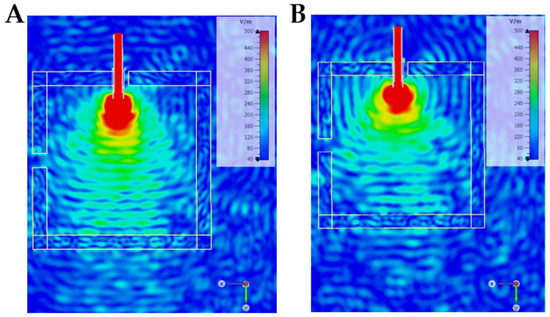
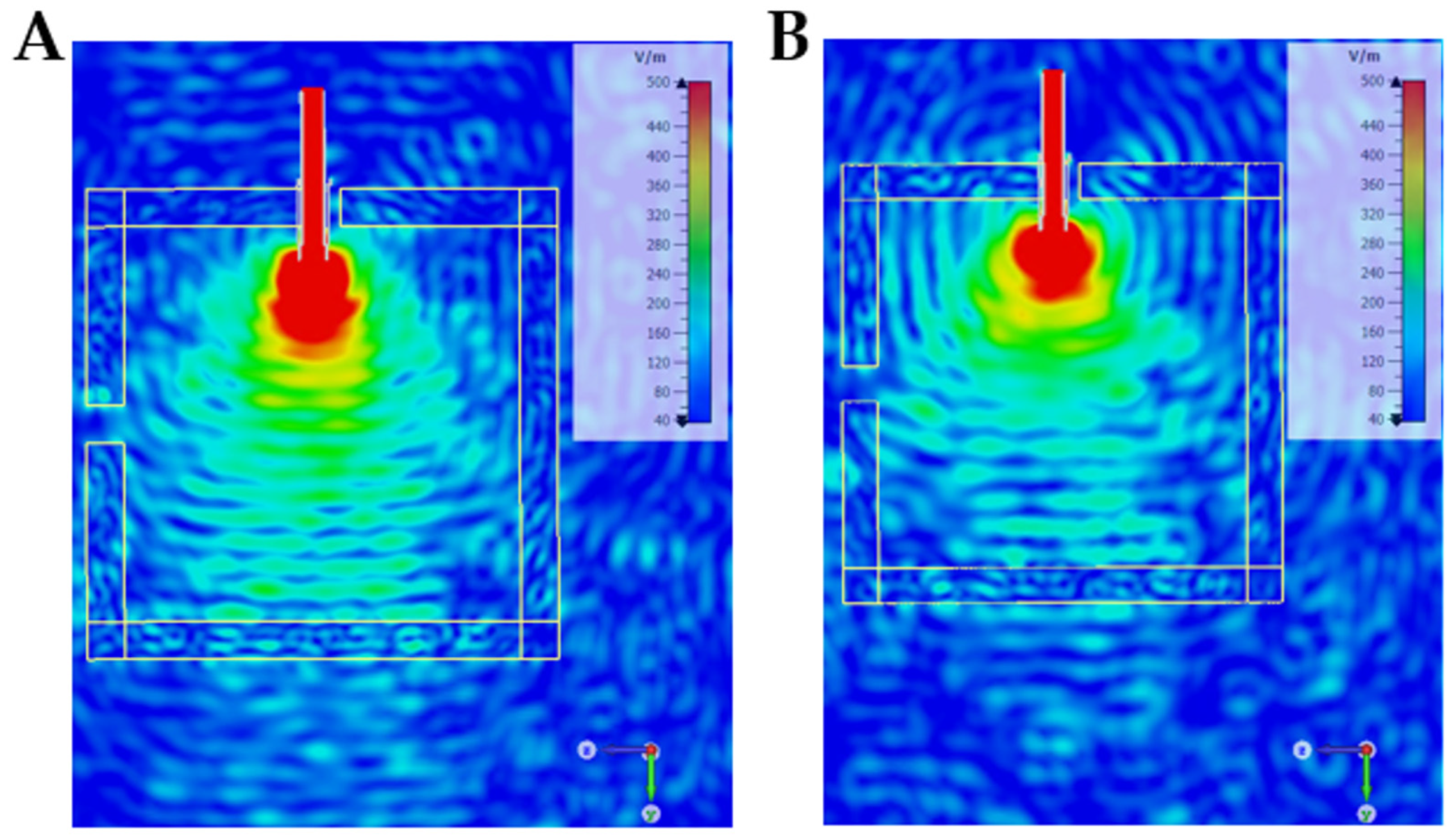
Prior to performing the experimental measurements, a simulation was conducted to verify the electric field amplitudes and its spatial distribution inside the aerosol box. The simulation was carried out using CST Studio Suite (Dassault Systèmes, Seattle, WA, USA). As shown in Figure 4A,B, the simulation indicated electromagnetic field amplitudes of approximately 400 V/m beneath the antenna and about 80 V/m along the corner of the box. Specifically, Figure 4A,B illustrate the field distribution respectively at a frequency of 12 GHz and 10 GHz.
Figure 4.
Electromagnetic field intensity distribution for an antenna operating at 12 GHz for (A) and 10 GHz for (B). The color scale depicts the electric field magnitude in volts per meter (V/m), where red corresponds to higher field strength and blue indicates lower values. The arrows indicate that the field varies slightly with respect to the limits of the colorbar. To approximate to integer values, we decided to restrict the colorbar to 500 V/m and 40 V/m.
Subsequently, the experimental measurements were carried out: the root mean square (RMS) amplitude of the electromagnetic field was quantified under real-world conditions using a NARDA Fieldman field probe. Measurements were performed in Continuous Wave (CW) mode at fixed frequencies across selected points within the X-band and Ku-band ranges. Field amplitude values recorded inside the enclosure during the first campaign varied according to spatial location, with approximately 400 V/m directly beneath the antenna and about 80 V/m at the enclosure corners. These measurements were in good agreement with the results of the electromagnetic simulation. Regarding the dosimetry, using the measured electric field values, we estimated the power density distribution inside the chamber by applying the Poynting vector equation under free-space conditions (with a characteristic impedance ). The resulting power density values ranged from at the chamber corners to directly below the antenna. Importantly, the whole-body exposure limit for uncontrolled airborne exposure is set at di 10 W/m2, averaged over 30 min, in accordance with IEEE standards [32]. Considering the measured average electric field of at the chamber corners, the corresponding power density was computed as follows:
The calculated power density corresponds to 56.2% of the allowable exposure limit when averaged over a 30 min period. Regarding the field strengths, although the SAR values comply with the limits, the field amplitudes nevertheless remain above the thresholds established by ICNIRP [32].
2.6. Temperature Measurement
To quantify potential temperature increases resulting from the RF treatment, the temperature variation before and after RF exposure was measured. The testing campaign is solely intended to assess whether the RF treatment induces any significant increase in the ambient temperature within the test environment.
Specifically, ten control temperature-variation measurements were performed, following the same exposure procedure but with the RF turned off, and ten temperature-variation measurements were performed with the RF source activated. Temperature measurements were obtained using a Hoyiours HP01 digital hygrometer–thermometer (Shenzhen Haoyi Network Technology Co., Ltd., Shenzhen, China). In Table 2, the temperature measures are reported with respective deltas.
Table 2.
Table of temperature measurements.
As shown in Table 2, the temperature variation between the control and the treated samples is, in both cases, on the order of one-tenth of a degree. Consequently, the inactivation observed in the RF tests cannot be attributed to thermal variations within the test chamber.
2.7. Viral Titer Determination
For the determination of the RSV titer, an appropriate cell system was employed. Vero E6 cells were maintained in culture at their optimal density according to ATCC guidelines [29]. On day 1 of the experiment, cells were seeded into 96-well plates at a density of 10,000 cells per well. On day 2, the cells were infected using serial dilutions of the collected viral suspension. The initial suspension was considered a 10−2 dilution, and further dilutions of 10−3, 10−4, and 10−5 were prepared in medium supplemented with 2% fetal bovine serum. Each viral dilution was tested in eight replicates. On day 9 post-seeding, infection status in each well was assessed by detecting cytopathic effects using a microscope equipped with a digital camera. The data obtained was used to calculate the viral titers of the collected suspensions according to the method described by Reed and Muench [31].
2.8. Uncertainty Quantification
To ensure a robust and accurate representation of viral inactivation, an uncertainty propagation approach was employed. This method systematically accounts for the variability inherent in both control and experimental measurements, thereby providing a confidence interval for the estimated inactivation values. The limits of this interval, in percentage terms, were computed using the following equations:
where denotes the mean value of the control measurement and represents the corresponding absolute error. Similarly, refers to the mean value of the test measurements and indicates the absolute error associated with the test measurements.
3. Results
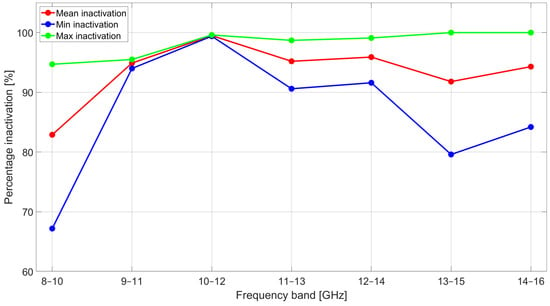
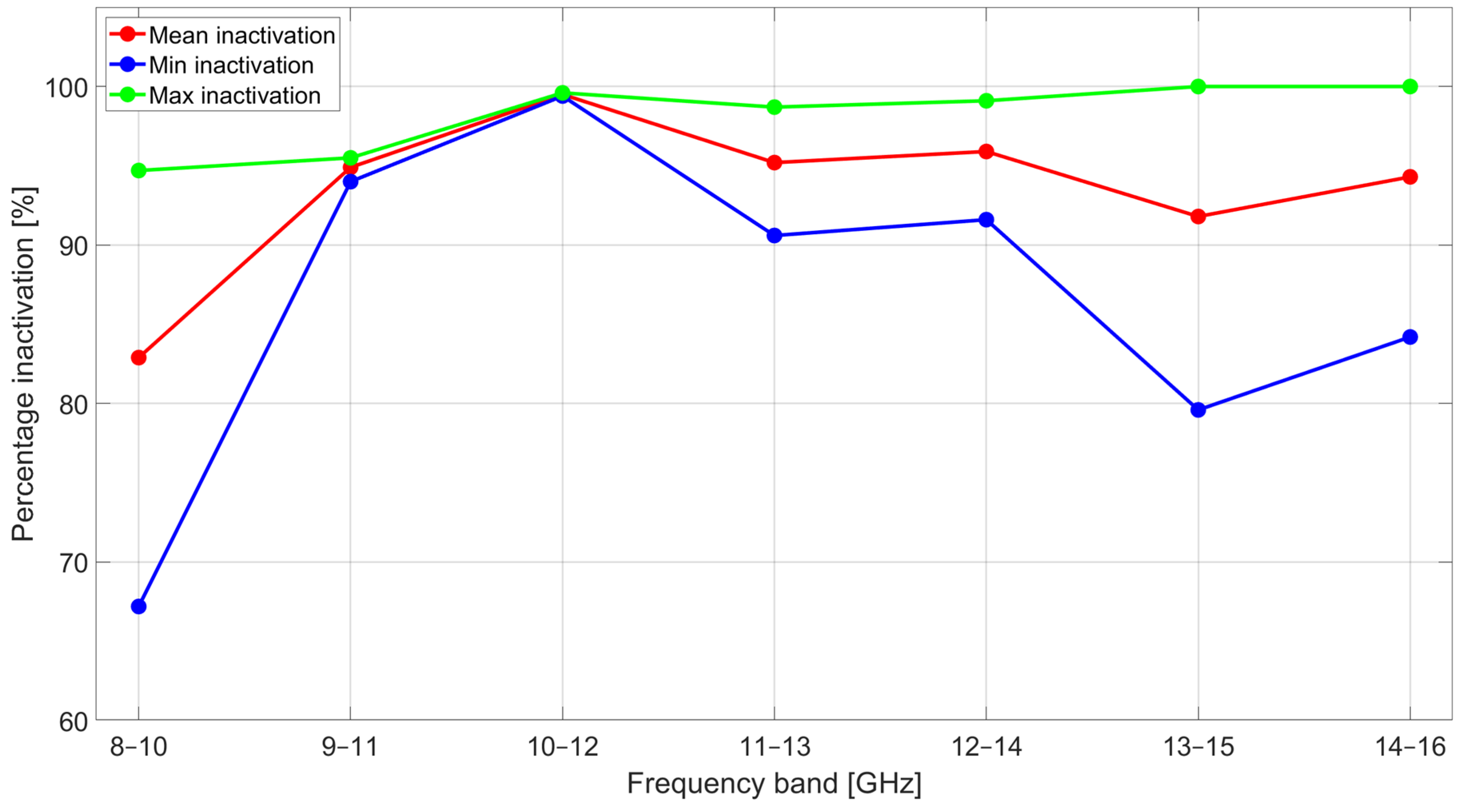
Table 3 summarizes the microwave-induced inactivation of aerosolized RSV as a function of frequency band. A non-linear, frequency-dependent response was evident, characterized by distinct efficacy profiles across the tested bands as represented in Figure 5. The highest level of inactivation occurred within the 10–12 GHz range, yielding a mean reduction of 99.5% in viral titer (range: 99.4–99.6%). The 12–14 GHz frequency band exhibited the second-highest inactivation efficiency, with a mean reduction of 95.9% (range: 91.6–99.1%). Similarly, the 11–13 GHz band demonstrated pronounced virucidal activity, achieving a mean reduction of 92.5% (range: 90.6–98.7%). In comparison, the 8–10 GHz band showed a lower, yet still considerable, inactivation effect, with a mean reduction of 82.9% (range: 67.2–94.7%).
Table 3.
Impact of microwave frequency bands on RSV titer reduction. Percentage reduction was determined relative to the non-irradiated control and is presented as mean values along with the minimum and maximum observed across replicates. Abbreviation: TCID50, 50% tissue culture infectious dose.
Figure 5.
Percentage inactivation in RSV viral titer across different frequency bands.
The results indicate the presence of an optimal frequency band centered around 12 GHz. Deviations from this optimal frequency, either toward higher values (14–16 GHz) or lower values down to 8 GHz, are associated with a progressive reduction in the inactivation efficacy of the electromagnetic treatment.
Subsequently, Table 4 reports the mean values and standard deviations for the control and for the performed triplicates.
Table 4.
Mean and standard deviation for control and treatment.
To better highlight the trends, the percentage inactivation values were plotted as a function of the analyzed frequency bands. As shown in Figure 5, a peak is observed in correspondence with the 10–12 GHz band; meanwhile, lower percentage inactivation values are observed as the frequency deviates from the optimal band.
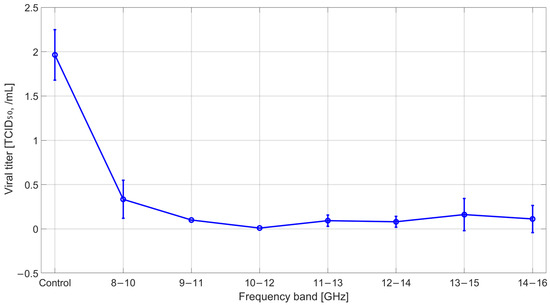
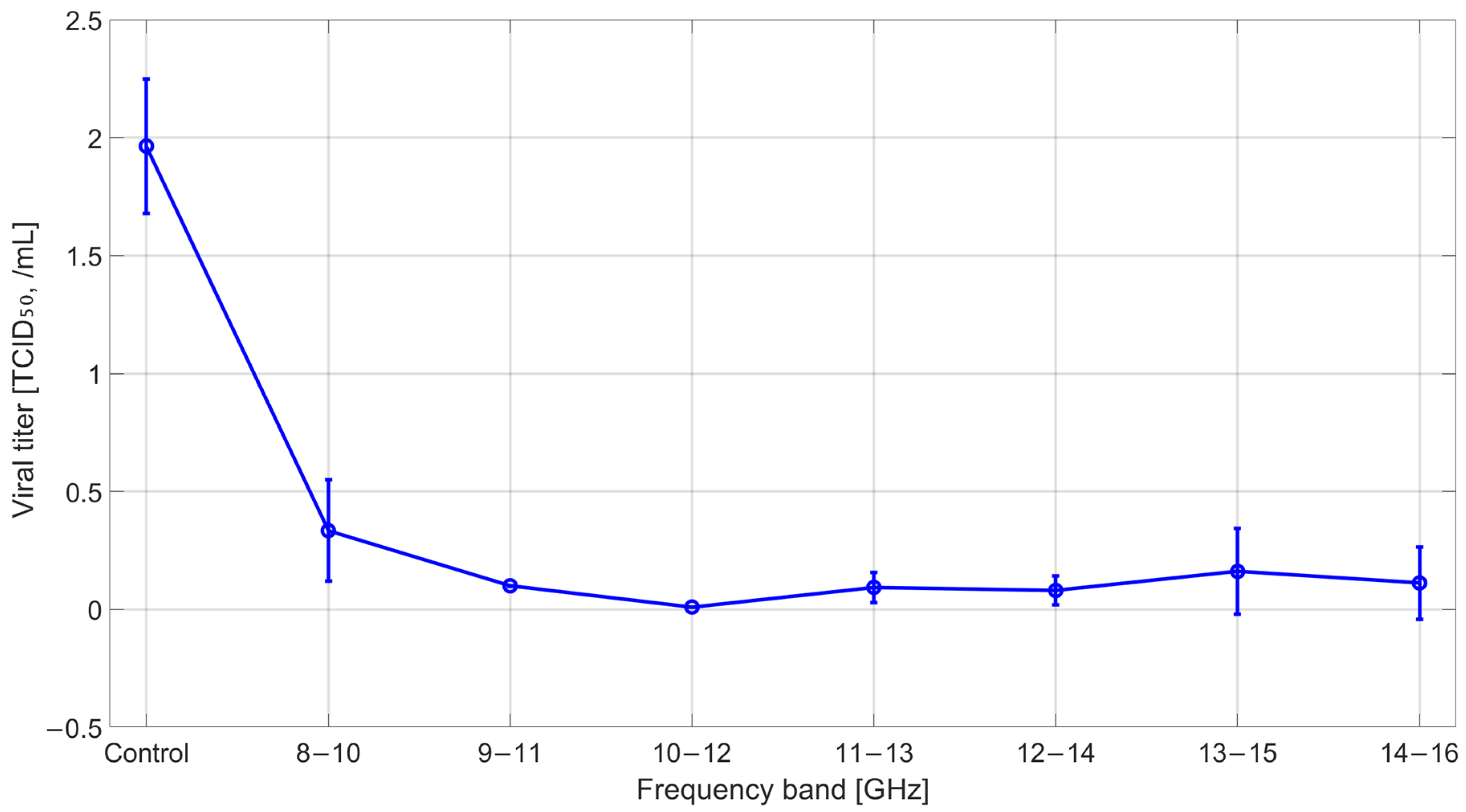
Finally, Figure 6 reports the mean viral titer values across the different frequency bands investigated, along with their respective error bars. The error bars were calculated using the standard deviation of the corresponding triplicates.
Figure 6.
Mean viral titer across different frequency bands.
4. Discussion
RSV is a major etiological agent of acute lower respiratory tract infections in the pediatric population [2,3,4], and its high prevalence in both children and adults imposes a substantial burden on public health systems [3,10,11]. In this context, electromagnetic wave-based treatment emerges as a promising preventive strategy to reduce population-level exposure risk. To the best of our knowledge, this study is the first to evaluate the inactivation efficiency of electromagnetic treatment on aerosolized RSV. Our approach aimed to maximize the virucidal effect through SRET mechanism by identifying the optimal frequency sub-band. A modelling approach was employed to determine the optimal resonance frequencies of the RSV virion. The dipolar, quadrupolar, and octupolar modes were modelled, and resonance frequencies up to the fifth harmonic were calculated for the dipolar mode. The model indicated that targeting the 8–16 GHz frequency band allows simultaneous excitation of the resonance frequencies associated with the second and third harmonics, thereby enhancing the effectiveness of the inactivation process. Based on these simulation results, seven sub-bands within the 8–16 GHz range were selected for experimental investigation (8–10 GHz, 9–11 GHz, 10–12 GHz, 11–13 GHz, 12–14 GHz, 13–15 GHz, and 14–16 GHz). The virucidal effect was quantified via viral titration and compared to negative control. Each experiment was performed in triplicate with an exposure duration of 10 min. Results revealed the highest inactivation rate of approximately 99.5% within the 10–12 GHz sub-band, followed by 95.9% in the 12–14 GHz band and 92.5% in the 11–13 GHz band. The lowest inactivation was observed in the 8–10 GHz sub-band, with a reduction of 82.9%. Temperature measurements were also performed by comparing the pre- and post-RF irradiation temperature variations in both control and treated samples without observing any differences. These findings suggest that the 10–12 GHz frequency range is optimal for RSV inactivation via the SRET mechanism induced by the second and third harmonics and that virion inactivation cannot be attributed to thermal effects alone. Finally, based on the dosimetry considerations, we calculated a power density value corresponding to 56.2% of the allowable exposure limit when averaged over a 30 min period, remaining well below the established thresholds associated with thermal discomfort in humans.
Although our experimental setup was intentionally designed to closely mimic real-world conditions, we acknowledge that factors such as humidity, temperature changes, and the presence of organic material can significantly affect the effectiveness of viral inactivation. To maximize ecological relevance, we chose an experimental design that more accurately reflects realistic environments, even though this introduced challenges due to variations in electric field intensity over time, space, and frequency.
Our findings confirm that aerosolized viruses can be successfully inactivated; however, additional research is needed to determine whether this approach is equally effective for viruses found on surfaces. We also recognize that our experimental system has limitations, particularly in measuring variability during intermediate stages of the process. The complexity of the setup, combined with the absence of direct measurements during aerosol generation and collection, prevented us from conducting a quantitative analysis of potential fluctuations at those points. Consequently, our analysis was limited to assessing viral titers at the final collection stage. Furthermore, uneven distribution of the electromagnetic field within the test chamber and uncertainties in dosimetry introduced additional technical challenges that should be addressed in future studies to improve precision and reproducibility.
Given the ongoing difficulties associated with the spread of RSV [2,3,4,5,6,7,8,9,10], investigating non-thermal microwave applications in real-world settings is an essential next step. For example, implementing microwave emitters optimized for RSV could offer continuous air disinfection in high-risk environments such as hospitals, schools, or other crowded public spaces. This strategy has the potential to significantly reduce the risk of airborne transmission in these settings.
5. Future Work
We recognize that the exposure durations and electric field amplitudes utilized in this study do not reflect conditions feasible for real-world implementation. Nonetheless, the promising outcomes obtained provide a compelling basis for continued research. Future investigations will aim to optimize these parameters by exploring substantially shorter exposure times (<10 min) and lower field intensity, in alignment with ICNIRP safety guidelines [33]. These adjustments are critical to ensure both efficacy and compliance with regulatory standards, thereby facilitating the potential translation of this approach into practical applications. Furthermore, to support progress in the development and validation of non-thermal microwave technologies for viral inactivation, future work should systematically address methodological limitations described in the Discussion section.
Author Contributions
Conceptualization, A.M. and P.B.; methodology, A.M. and P.B.; software, A.F.; validation, A.M., formal analysis, A.F. and M.L.; investigation, A.F. and M.L.; resources, A.M.; data curation, A.F. and M.L., writing—original draft preparation, A.F. and M.L.; writing—review and editing, P.B.; visualization, A.F. and M.L.; supervision, P.B.; project administration, A.M.; funding acquisition, A.M. All authors have read and agreed to the published version of the manuscript.
Funding
This research was funded by Elettronica S.p.A.
Institutional Review Board Statement
Not applicable.
Informed Consent Statement
Not applicable.
Data Availability Statement
The original contributions presented in this study are included in the article. Further inquiries can be directed to the corresponding author.
Conflicts of Interest
The authors declare no conflicts of interest. P. Bia, A. Filisetti, M. Losardo and A. Manna are employees of Elettronica S.p.A., sponsoring the study.
References
- Meng, J.; Stobart, C.C.; Hotard, A.L.; Moore, M.L. An overview of respiratory syncytial virus. PLoS Pathog. 2014, 10, e1004016. [Google Scholar] [CrossRef] [Scilit]
- Asseri, A.A. Respiratory Syncytial Virus: A Narrative Review of Updates and Recent Advances in Epidemiology, Pathogenesis, Diagnosis, Management and Prevention. J. Clin. Med. 2025, 14, 3880. [Google Scholar] [CrossRef] [Scilit] [PubMed]
- Hall, C.B.; Weinberg, G.A.; Iwane, M.K.; Blumkin, A.K.; Edwards, K.M.; Staat, M.A.; Auinger, P.; Griffin, M.R.; Poehling, K.A.; Erdman, D.; et al. The burden of respiratory syncytial virus infection in young children. N. Engl. J. Med. 2009, 360, 588–598. [Google Scholar] [CrossRef] [Scilit] [PubMed]
- Li, Y.; Wang, X.; Blau, D.M.; Caballero, M.T.; Feikin, D.R.; Gill, C.J.; A Madhi, S.; Omer, S.B.; Simões, E.A.F.; Campbell, H.; et al. Global, regional, and national disease burden estimates of acute lower respiratory infections due to respiratory syncytial virus in children younger than 5 years in 2019: A systematic analysis. Lancet 2022, 399, 2047–2064. [Google Scholar] [CrossRef] [Scilit] [PubMed]
- Azzari, C.; Baraldi, E.; Bonanni, P.; Bozzola, E.; Coscia, A.; Lanari, M.; Manzoni, P.; Mazzone, T.; Sandri, F.; Lisi, G.C.; et al. Epidemiology and prevention of respiratory syncytial virus infections in children in Italy. Ital. J. Pediatr. 2021, 47, 198. [Google Scholar] [CrossRef] [Scilit]
- Welliver, R.C. Review of epidemiology and clinical risk factors for severe respiratory syncytial virus (RSV) infection. J. Pediatr. 2003, 143, 112–117. [Google Scholar] [CrossRef] [Scilit]
- Wohl, M.E.B.; Chernick, V. State of the art: Bronchiolitis. Am. Rev. Respir. Dis. 1978, 118, 759–781. [Google Scholar] [CrossRef] [Scilit]
- Wang, E.E.; Law, B.J.; Boucher, F.D.; Stephens, D.; Robinson, J.L.; Dobson, S.; Langley, J.M.; McDonald, J.; MacDonald, N.E.; Mitchell, I. Pediatric Investigators Collaborative Network on Infections in Canada (PICNIC) study of admission and management variation in patients hospitalized with respiratory syncytial viral lower respiratory tract infection. J. Pediatr. 1996, 129, 390–395. [Google Scholar] [CrossRef] [Scilit]
- Fishaut, M.; Tubergen, D.; McIntosh, K. Cellular response to respiratory viruses with particular reference to children with disorders of cell-mediated immunity. J. Pediatr. 1980, 96, 179–186. [Google Scholar] [CrossRef] [Scilit]
- Yoon, J.G.; Noh, J.Y.; Choi, W.S.; Park, J.J.; Suh, Y.B.; Song, J.Y.; Cheong, H.J.; Kim, W.J. Clinical characteristics and disease burden of respiratory syncytial virus infection among hospitalized adults. Sci. Rep. 2020, 10, 12106. [Google Scholar] [CrossRef] [Scilit]
- Heikkinen, T.; Ojala, E.; Waris, M. Clinical and socioeconomic burden of respiratory syncytial virus infection in children. J. Infect. Dis. 2016, 215, 17–23. [Google Scholar] [CrossRef] [Scilit]
- Xiao, Y.; Zhao, L.; Peng, R. Effects of electromagnetic waves on pathogenic viruses and relevant mechanisms: A review. Virol. J. 2022, 19, 161. [Google Scholar] [CrossRef] [Scilit]
- Hoff, B.W.; Cohick, Z.W.; Tilley, B.S.; Luginsland, J.W.; Revelli, D.; Cox, J.; Irshad, H.; Snider, A.; Arndt, A.; Ibey, B.L.; et al. Observed reductions in the infectivity of bioaerosols containing bovine coronavirus under repetitively pulsed RF exposure. IEEE Trans. Biomed. Eng. 2022, 70, 640–649. [Google Scholar] [CrossRef] [Scilit] [PubMed]
- Wu, Y.; Yao, M. In situ airborne virus inactivation by microwave irradiation. Chin. Sci. Bull. 2014, 59, 1438–1445. [Google Scholar] [CrossRef] [Scilit] [PubMed]
- Wang, C.; Hu, X.; Zhang, Z. Airborne disinfection using microwave-based technology: Energy efficient and distinct inactivation mechanism compared with waterborne disinfection. J. Aerosol Sci. 2019, 137, 105437. [Google Scholar] [CrossRef] [Scilit]
- Wang, P.-J.; Pang, Y.-H.; Huang, S.-Y.; Fang, J.-T.; Chang, S.-Y.; Shih, S.-R.; Huang, T.-W.; Chen, Y.-J.; Sun, C.-K. Microwave resonant absorption of SARS-CoV-2 viruses. Sci. Rep. 2022, 12, 12596. [Google Scholar] [CrossRef] [Scilit]
- Manna, A.; De Forni, D.; Bartocci, M.; Pasculli, N.; Poddesu, B.; Lista, F.; De Santis, R.; Amatore, D.; Grilli, G.; Molinari, F.; et al. SARS-CoV-2 inactivation in aerosol by means of radiated microwaves. Viruses 2023, 15, 1443. [Google Scholar] [CrossRef] [Scilit] [PubMed]
- Bartocci, M.; Bia, P.; Manna, A.; Pasculli, N. SARS-CoV-2 and H1N1 Inactivation in Aerosol by Means of Radiated Microwaves with Novel Setup. In 2024 IEEE International Symposium on Antennas and Propagation and INC/USNC-URSI Radio Science Meeting (AP-S/INC-USNC-URSI); IEEE: New York, NY, USA, 2024; pp. 2393–2394. [Google Scholar]
- Manna, A.; De Forni, D.; Bartocci, M.; Pasculli, N.; Poddesu, B.; Vincentelli, A.S.; Lori, F. Endemic respiratory viruses inactivation in aerosol by means of radiated microwaves. Med. Res. Arch. 2023, 11. [Google Scholar] [CrossRef] [Scilit]
- Bia, P.; Losardo, M.; Manna, A.; Brusaferro, S.; Privitera, G.P.; Vincentelli, A.S. Selected microwave irradiation effectively inactivates airborne avian influenza A(H5N1) virus. Sci. Rep. 2025, 15, 2021. [Google Scholar] [CrossRef] [Scilit]
- Losardo, M.; Simonetti, M.; Bia, P.; Manna, A.; Verratti, M.; Rasam, H. Evaluating the Efficacy of Microwave Sanitization in Reducing SARS-CoV-2 Airborne Contagion Risk in Office Environments. Appl. Sci. 2025, 15, 6940. [Google Scholar] [CrossRef] [Scilit]
- Sadraeian, M.; Kabakova, I.; Zhou, J.; Jin, D. Virus inactivation by matching the vibrational resonance. Appl. Phys. Rev. 2024, 11, 021324. [Google Scholar] [CrossRef] [Scilit]
- Yang, S.-C.; Lin, H.-C.; Liu, T.-M.; Lu, J.-T.; Hung, W.-T.; Huang, Y.-R.; Tsai, Y.-C.; Kao, C.-L.; Chen, S.-Y.; Sun, C.-K. Efficient structure resonance energy transfer from microwaves to confined acoustic vibrations in viruses. Sci. Rep. 2015, 5, 18030. [Google Scholar] [CrossRef] [Scilit]
- Pastey, M.K.; McCurdy, L.H., III; Graham, B. Decoding respiratory syncytial virus morphology: Distinct structural and molecular signatures of spherical and filamentous particles. Front. Cell. Infect. Microbiol. 2025, 15, 1597279. [Google Scholar] [CrossRef] [Scilit] [PubMed]
- Lamb, H. On the vibrations of an elastic sphere. Proc. Lond. Math. Soc. 1881, 1, 189–212. [Google Scholar] [CrossRef] [Scilit]
- Sadd, M.H. Elasticity: Theory, Applications, and Numerics; Academic Press: San Diego, CA, USA, 2009. [Google Scholar]
- Saijo, Y.; Hozumi, N.; Lee, C.; Nagao, M.; Kobayashi, K.; Oakada, N.; Tanaka, N.; Filho, E.d.S.; Sasaki, H.; Tanaka, M.; et al. Ultrasonic speed microscopy for imaging of coronary artery. Ultrasonics 2006, 44, e51–e55. [Google Scholar] [CrossRef] [Scilit] [PubMed]
- Kuster, N.; Schönborn, F. Recommended minimal requirements and development guidelines for exposure setups of bio-experiments addressing the health risk concern of wireless communications. Bioelectromagnetics 2000, 21, 508–514. [Google Scholar] [CrossRef] [Scilit] [PubMed]
- DeliveReD, G. Atcc® Animal Cell Culture Guide; American Type Culture Collection: Manassas, VA, USA, 2012. [Google Scholar]
- Drossinos, Y.; Weber, T.P.; Stilianakis, N.I. Droplets and aerosols: An artificial dichotomy in respiratory virus transmission. Health Sci. Rep. 2021, 4, e275. [Google Scholar] [CrossRef] [Scilit]
- Reed, L.J.; Muench, H. A simple method of estimating fifty per cent endpoints. Am. J. Epidemiol. 1938, 27, 493–497. [Google Scholar] [CrossRef] [Scilit]
- Bailey, W.H.; Harrington, T.; Hirata, A.; Kavet, R.R.; Keshvari, J.; Klauenberg, B.J.; Legros, A.; Maxson, D.P.; Osepchuk, J.M.; Reilly, J.P.; et al. Synopsis of IEEE Std C95. 1™-2019 “IEEE standard for safety levels with respect to human exposure to electric, magnetic, and electromagnetic fields, 0 Hz to 300 GHz”. IEEE Access 2019, 7, 171346–171356. [Google Scholar] [CrossRef] [Scilit]
- FIELDS, Electromagnetic. Icnirp Guidelines. Health 2020, 17.9078/20: 0. Available online: https://www.icnirp.org/cms/upload/publications/ICNIRPrfgdl2020.pdf (accessed on 24 March 2026).

Disclaimer/Publisher’s Note: The statements, opinions and data contained in all publications are solely those of the individual author(s) and contributor(s) and not of MDPI and/or the editor(s). MDPI and/or the editor(s) disclaim responsibility for any injury to people or property resulting from any ideas, methods, instructions or products referred to in the content. |
© 2026 by the authors. Licensee MDPI, Basel, Switzerland. This article is an open access article distributed under the terms and conditions of the Creative Commons Attribution (CC BY) license.