Article

Multi-Radar Distributed Fusion Algorithm Aided by Multi-Feature Information

1
School of Electrical and Information Engineering, Changzhou Institute of Technology, Changzhou 213032, China
2
Laboratory of Array and Information Processing, Hohai University, Nanjing 210098, China
3
School of Information Science and Engineering, Hohai University, Nanjing 210098, China
4
School of Electrical and Power Engineering, Hohai University, Nanjing 210098, China
*
Author to whom correspondence should be addressed.
Appl. Sci. 2026, 16(7), 3159; https://doi.org/10.3390/app16073159 (registering DOI)
Submission received: 4 February 2026 / Revised: 19 March 2026 / Accepted: 23 March 2026 / Published: 25 March 2026
(This article belongs to the Section Electrical, Electronics and Communications Engineering)

Abstract

Compared with single-radar systems, multi-radar systems generally achieve superior detection performance due to their spatial and frequency diversity. To further enhance multi-target tracking, this paper proposes a multi-radar distributed fusion algorithm aided by multi-feature information. Each radar computes its measurement-updated Labeled Multi-Bernoulli (LMB) posterior, and track association is performed using multi-feature information extracted from radar echoes, including Doppler frequency and signal-to-noise ratio (SNR), improving robustness in complex scenarios. Distributed fusion is then carried out via the Generalized Covariance Intersection (GCI) algorithm. Simulation results show that, compared with other fusion methods, the proposed approach achieves superior multi-target tracking accuracy while maintaining lower computational cost.

1. Introduction

Multi-sensor information fusion aims to jointly process data collected from multiple sensors to improve target tracking performance [1,2,3]. Among various sensing modalities, radar plays a crucial role in surveillance and tracking applications due to its ability to operate reliably under adverse weather and illumination conditions. By exploiting multi-channel observations acquired from multiple radars, multi-radar information fusion can provide more complete and accurate target trajectories [4]. Compared with single-sensor systems, multi-radar fusion significantly improves tracking accuracy, enhances robustness against clutter and interference, and provides more reliable situational awareness in complex environments. Consequently, multi-sensor fusion has become a key technology in modern radar surveillance and defense systems.
Existing multi-sensor information fusion methods can generally be regarded as extensions of classical single-sensor multi-target tracking approaches, such as the Joint Probabilistic Data Association (JPDA) method [5], Multiple Hypothesis Tracking (MHT) method [6], and Random Finite Set (RFS)-based methods [7]. In particular, RFS-based approaches have attracted significant attention in recent years due to their rigorous Bayesian formulation and their capability to jointly estimate both the number of targets and their states without requiring explicit data association.
With the rapid development of military technology and the increasing complexity of battlefield environments, the performance requirements imposed on single-radar systems have become increasingly stringent. In many practical scenarios, such as dense target environments or strong clutter conditions, a single radar often cannot provide sufficiently reliable tracking performance. As a result, radar systems are evolving toward networking and cooperative operation, which has become a key enabling technology in modern radar systems. Radar data fusion has therefore attracted extensive attention from researchers worldwide, as it enables the integration of complementary information from multiple radars to achieve more accurate tracking results and improved situational awareness.
From a system architecture perspective, From a system architecture perspective, radar data fusion methods can generally be classified into centralized fusion and distributed fusion frameworks [8]. In centralized fusion, measurements from multiple radars are transmitted directly to a fusion center for joint processing, including parallel filtering [9,10], sequential filtering [9], and data compression filtering [10]. Although centralized fusion can achieve high estimation accuracy, it typically requires large communication bandwidth and substantial computational resources at the fusion center. In contrast, distributed fusion transmits local tracks generated by individual radars to the fusion center for further fusion, such as hierarchical fusion algorithms [11] and weighted average fusion algorithms [12]. Compared with centralized fusion, distributed fusion significantly reduces communication burden and improves system reliability, since the failure of a single radar does not severely degrade the overall system performance. Therefore, distributed fusion has become an attractive solution for large-scale radar networks.
In general, an optimal Bayesian distributed fusion framework should account for correlations in target state estimation errors and eliminate duplicated mutual information. However, accurately computing mutual information is generally intractable in practical implementations. To address this issue, several suboptimal distributed fusion methods have been proposed, including the Generalized Covariance Intersection (GCI) method [13] and the Arithmetic Average (AA) method [14]. These methods are derived based on the Kullback–Leibler divergence (KLD) approximation, thereby avoiding the explicit calculation of mutual information. In addition, various RFS-based distributed fusion algorithms have been developed. For example, the Sequential Monte Carlo (SMC) implementation of the multi-sensor Probability Hypothesis Density (PHD) filter was proposed in [15], while Gaussian mixture (GM) implementations of the multi-sensor PHD and cardinalized PHD (CPHD) filters were presented in [16]. Furthermore, implementation methods for the multi-sensor Multi-Bernoulli (MB) filter and the multi-sensor Generalized Multi-Bernoulli (GMB) filter were investigated in [17,18,19]. These approaches provide effective tools for multi-target tracking in multi-sensor systems.
Despite these advances, several challenges remain in practical multi-radar fusion systems. First, many existing multi-sensor fusion algorithms assume that different sensors assign identical labels to the same target. Under this assumption, multi-sensor fusion methods for labeled RFS densities were derived in [20,21,22]. However, in practical applications, different sensors may independently initialize and maintain tracks, which often leads to inconsistent labeling of the same target across sensors. This label-mismatch problem can significantly degrade the performance of distributed fusion algorithms and may result in incorrect target association.
Several studies have attempted to address this issue. For example, ref. [23] proposed a fusion approach that combines a label-free strategy with the AA fusion rule. Although this method can alleviate the label mismatch problem to some extent, it suffers from relatively high computational complexity. In ref. [24], multi-sensor fusion was achieved by approximating the measurement update of the Labeled Multi-Bernoulli (LMB) filter using a loopy belief propagation algorithm. However, the cardinality estimation performance of this method is relatively poor in challenging scenarios. Moreover, most existing methods primarily rely on kinematic information for track association, while additional discriminative features contained in radar echoes, such as Doppler frequency and signal-to-noise ratio (SNR), are often not fully exploited. Ignoring these useful features may reduce the robustness of track association, particularly in dense target environments.
Motivated by the above observations, this paper proposes a multi-radar distributed fusion algorithm aided by multi-feature information. First, the LMB distribution is employed to approximate the measurement update distribution of each radar, yielding the corresponding LMB posterior distribution. Subsequently, track association is enhanced using multi-feature information extracted from radar echoes. Finally, distributed fusion is performed using the GCI algorithm.
The main contributions of this paper are summarized as follows:
  • A multi-radar distributed fusion framework aided by multi-feature information is proposed. In this framework, the LMB distribution is used to approximate the measurement update distribution of each radar, enabling efficient distributed fusion in radar networks while preserving the labeled RFS representation.
  • A multi-feature-assisted track association strategy is developed to address the label mismatch problem in distributed fusion. By jointly exploiting the Mahalanobis distance, Doppler frequency, and SNR, a track association factor is constructed to obtain the optimal association matrix, ensuring consistent labeling of the same target across different radars.
  • An enhanced distributed fusion scheme with improved robustness in dense environments is achieved. By incorporating discriminative multi-feature information from radar echoes into the track association process, the proposed method effectively suppresses clutter interference and improves the discrimination capability among closely spaced targets.
The remainder of this paper is organized as follows. Section 2 presents the LMB filter and distributed fusion methods. Section 3 introduces the proposed fusion framework and details the specific steps of the algorithm. Section 4 provides simulation results and performance analysis. Finally, conclusions are drawn in Section 5.

2. Related Works

2.1. The LMB Filter

The Labeled Multi-Bernoulli filter is a labeled random finite set filter in which the multi-target state is modeled as an Labeled Multi-Bernoulli Random Finite Set (LMB RFS), with labels attached to target states to distinguish individual target identities [25].
In the LMB filter, a single-target state is denoted by x = ( x , l ) , with x X and associated label l L . Here, X represents the target state space, and L is the target label space. Each target is assigned a unique label l , which forms an ordered and distinct sequence. A label can be represented as l = ( k , i ) , where k denotes the time of target birth, and i distinguishes multiple targets born at the same time.
The labeled multi-target state is denoted by X = { x 1 , x i , x n } , where each x i = ( x , l ) represents a single-target state. By introducing the target label space L , the parameter form of the LMB RFS can be expressed as:
π = { ( r l , p l ) } l L
The LMB RFS follows the LMB distribution, and its Probability Density Function (PDF) is:
π ( X ) = Δ ( X ) w ( L ) p X
where p l represents the PDF of the target labeled l , r l represents the corresponding existence probability, and the weight of LMB RFS can be expressed as:
w ( L ) = ( l L ( 1 r l ) ) l L 1 L ( l ) r l 1 r l

2.2. Distributed Fusion Methods

In Bayesian optimal distributed fusion, the calculation of mutual information is required. However, computing mutual information involves complex probability operations, which generally cannot be solved analytically and incur high computational cost [26]. Therefore, in practical applications, suboptimal distributed fusion methods are often employed to reduce computational complexity and improve fusion efficiency. Representative examples include GCI fusion [26,27,28] and AA fusion [29,30,31].
These methods construct a Kullback–Leibler divergence (KLD) function using the posterior probability density functions (PDFs) of individual sensors and the fused PDF of multiple sensors [32,33,34,35], and then obtain the fused PDF through an optimization process. In the context of multi-target tracking using random finite sets, a PDF describes the likelihood of a finite set of target states taking particular values. In multi-sensor target tracking, the posterior PDF π i of sensor i represents the updated belief of the target state given the measurements of that sensor, while the fused PDF π represents the consensus estimate obtained by combining information from all sensors.
The KLD between a single sensor’s posterior PDF and the fused PDF is defined as:
D K L ( π ; π i ) = π ( x ) log π ( x ) π i ( x ) d x
For the GCI fusion method, the core idea is to construct an optimization function based on the KLD such that the weighted sum of the KLDs between the fused PDF and all posterior PDFs is minimized. In other words, the fusion process aims to minimize the weighted information gain as much as possible. The specific mathematical formulation is given as follows [26]:
π ¯ arg min π i N w i D K L ( π ; π i )
where N is the number of sensors, w i is the normalized non-negative weight of the i -th sensor, and i N w i = 1 ; π i is the posterior PDF of the i -th sensor, and π is the fused PDF. By finding the optimal approximation, π ¯ can be obtained as:
π ¯ = i N [ π i ( X ) ] w i i N [ π i ( X ) ] w i δ X
Equation (6) is the GCI fusion formula. In the GCI fusion process of LMB distributions, if it is assumed that different sensors assign the same label to the same target, then according to Equation (6), the fused GCI probability density function can be derived to still follow an LMB distribution, with the specific form given as [28]:
π ¯ = { ( r ¯ l , p ¯ l ) } l L
p ¯ ( x , l ) = i N [ p i ( x , l ) ] w i i N [ p i ( x , l ) ] w i d x
r ¯ l = i N [ r i l p i ( x , l ) ] w i d x i N ( 1 r i l ) w i + i N [ r i l p i ( x , l ) ] w i d x
The GCI fusion method possesses formal simplicity and is capable of preserving the independence among individual tracks.
For AA fusion, a KLD-based optimization function is constructed to minimize the weighted sum of the Kullback–Leibler divergences between all posterior probability density functions and the fused probability density function, which corresponds to minimizing the weighted information loss. The specific mathematical formulation is given as follows [30]:
π ^ arg min π i N w i D K L ( π i ; π )
By solving the above optimization problem, the optimal approximation of π ^ can be obtained as follows:
π ^ = i N w i π i ( X )
Equation (11) represents the AA fusion formula. In the AA fusion of the LMB distribution, it is assumed that different sensors maintain consistent labels for the same target. Based on Equation (11), it can be shown that the fused probability density function still follows an LMB distribution. The corresponding expression is given as follows [30]:
π ^ = { ( r ^ l , p ^ l ) } l L
p ^ ( x , l ) = 1 j N w j r j l i N w i r i l p i ( x , l )
r ^ l = i w i r i l
GCI fusion is more conservative and robust, suitable when sensor correlations are unknown or uncertain. AA fusion is simpler and information-preserving, but may overestimate certainty if sensor measurements are not independent.
For both fusion methods applied to LMB distributions, it is commonly assumed that different sensors assign consistent labels to the same target. Under this assumption, the fused density after either GCI or AA fusion still follows an LMB distribution. However, this assumption is often unrealistic in practice, since factors such as false alarms, missed detections, and measurement errors may cause the same target to be assigned different labels across sensors. Therefore, accurate track association across sensors is required prior to fusion to ensure that the labels of the same target are correctly matched, thereby improving the accuracy and consistency of the fusion results.

3. The Proposed Algorithm

3.1. Fusion Scheme

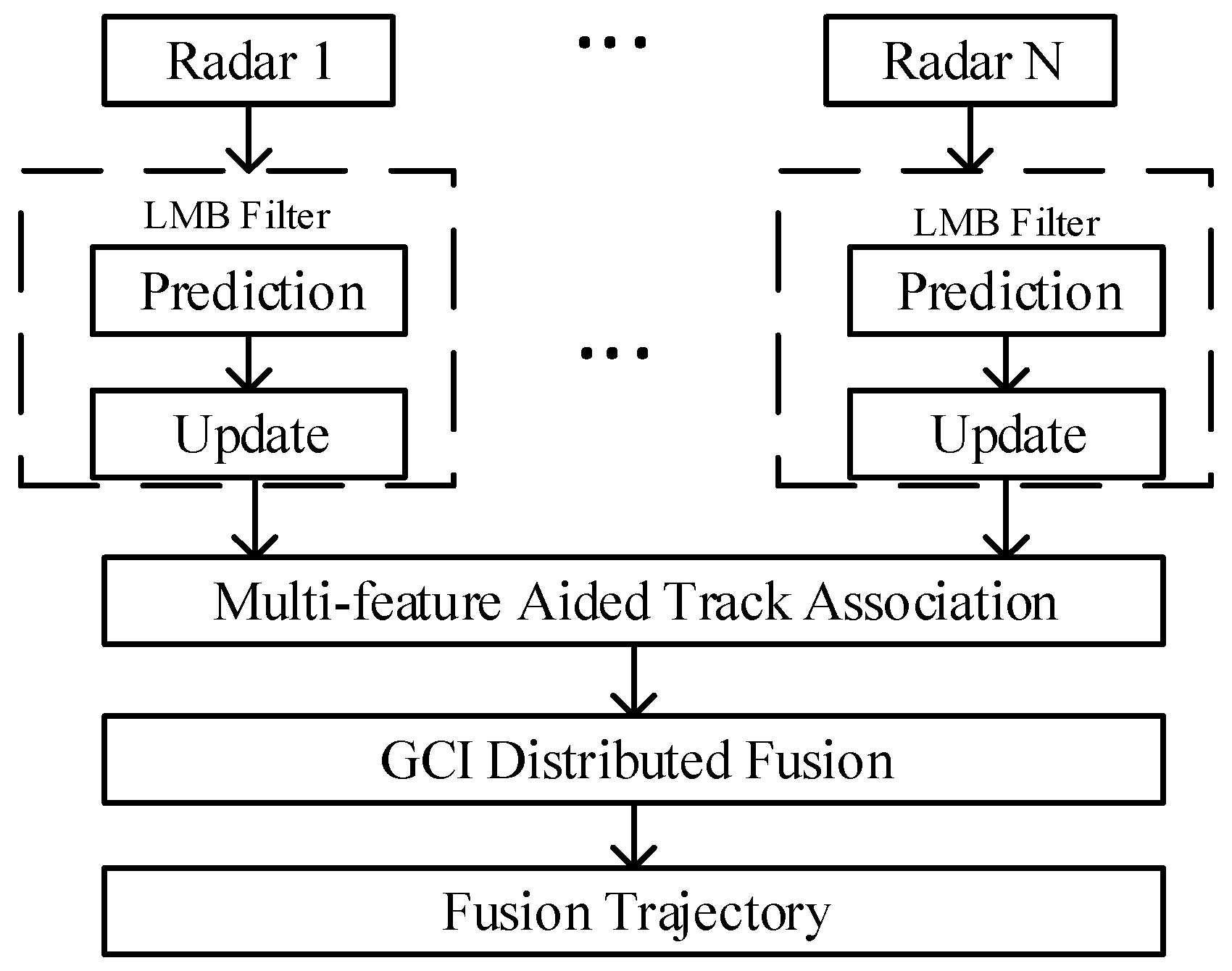
The proposed fusion algorithm is illustrated in Figure 1. First, each radar performs LMB filtering to obtain its multi-target tracks. Next, multi-feature information is used to assist track association. Finally, distributed fusion is performed using the GCI algorithm to produce the fused trajectories.

3.2. Prediction

Assuming the multi-target posterior PDF at time t is π t | t = { ( r t | t l , p t | t l ) } l L , the Gaussian Mixture of the density function p t | t ( x , l ) of the trajectory l is expressed as:
p t | t ( x , l ) j = 1 J t | t ( l ) w t | t j ( l ) N ( x ; m t | t j ( l ) , p t | t j ( l ) )
where J t | t ( l ) denotes the number of Gaussian components of the target labeled l at time t ; w t | t j ( l ) denotes the weight of the j -th Gaussian component at time t ; N ( x ; m t | t j ( l ) , p t | t j ( l ) ) denotes a Gaussian probability density function with mean m t | t j ( l ) and covariance matrix p t | t j ( l ) , where m t | t j ( l ) and p t | t j ( l ) denote the mean and covariance matrix of the target labeled l at time t , respectively.
Assume that the PDF of the newly appearing target is π B , t + 1 = { ( r B , t + 1 l , p B , t + 1 l ) } l B . The PDF of the predicted multi-target at time t + 1 can be calculated as:
π t + 1 | t = { ( r + , t + 1 | t l , p + , t + 1 | t l ) } l L { ( r B , t + 1 l , p B , t + 1 l ) } l B = { ( r t + 1 | t l , p t + 1 | t l ) } l L +
where L + = L B ,
r + , t + 1 | t l = p S r t | t l
p t + 1 | t ( x + , l ) = 1 L ( l ) j = 1 J t | t ( l ) w + , t + 1 | t j , l N ( x + ; m + , t + 1 | t j , l , P + , t + 1 | t j , l ) + 1 B ( l ) p B , t + 1 ( x + , l )
where w + , t + 1 | t j , l denotes the predicted weight of the j -th Gaussian component at time t + 1 ; m + , t + 1 | t j , l represents the predicted mean of the target labeled l at time t + 1 ; P + , t + 1 | t j , l denotes the predicted covariance matrix of the target labeled l at time t + 1 ; and p S represents the target’s survival probability. Here, m + , t + 1 | t j ( l ) = F t m + , t | t j ( l ) , P + , t + 1 | t j ( l ) = Q t + F t P t | t j ( l ) F t T , F t denotes the state transition matrix, and Q t denotes the process noise matrix.

3.3. Update

The multi-target posterior PDF at time t + 1 is π t + 1 | t + 1 = { ( r t + 1 | t + 1 l , p t + 1 | t + 1 l ) } l L + , where
r t + 1 | t + 1 l = ( I + , θ ) F ( L + ) × Θ I + w t + 1 | t + 1 ( I + , θ ) ( Z ) 1 I + ( l )
p t + 1 t + 1 ( x , l ) = 1 r t + 1 t + 1 l ( I + , θ ) F ( L + ) × Θ I + w t + 1 t + 1 ( I + , θ ) ( Z ) 1 I + ( l ) j = 1 J k + 1 k ( l ) w t + 1 t + 1 θ , j ( l ) N ( x ; m t + 1 t + 1 θ , j ( l ) , P t + 1 t + 1 θ , j ( l ) ) = 1 r t + 1 t + 1 l ( I + , θ ) F ( L + ) × Θ I + j = 1 J k + 1 k ( l ) w t + 1 t + 1 ( I + , θ ) ( Z ) 1 I + ( l ) w t + 1 t + 1 θ , j ( l ) N ( x ; m t + 1 t + 1 θ , j ( l ) , P t + 1 t + 1 θ , j ) = j = 1 J k + 1 k + 1 ( l ) w t + 1 t + 1 j ( l ) N ( x ; m t + 1 t + 1 j ( l ) , P t + 1 t + 1 j ( l ) )
w t + 1 | t + 1 j ( l ) = w t + 1 | t + 1 ( I + , θ ) ( Z ) 1 I + ( l ) w t + 1 | t + 1 θ , j ( l ) r t + 1 | t + 1 l
where I + = { l 1 , l | I + | } represents a hypothesis and Θ I + represents the set of mappings θ : I + { 0 , 1 , | Z | } ; w t + 1 | t + 1 ( I + , θ ) denotes the weight associated with the hypothesis ( I + , θ ) ; w t + 1 | t + 1 θ , j ( l ) denotes the weight of the j -th Gaussian component with the hypothesis ( I + , θ ) at time t + 1 ; m t + 1 | t + 1 θ , j ( l ) and P t + 1 | t + 1 θ , j ( l ) denote the mean and covariance matrix of the j -th Gaussian component with the hypothesis ( I + , θ ) at time t + 1 ; J k + 1 | k + 1 ( l ) denotes the number of Gaussian components of the target labeled l at time t + 1 ; w t + 1 | t + 1 j ( l ) denotes the weight of the j -th Gaussian component of the target labeled l at time t + 1 ; m t + 1 | t + 1 j ( l ) and P t + 1 | t + 1 j ( l ) denote the mean and covariance matrix of the j -th Gaussian component of the target labeled l at time t + 1 .

3.4. Multi-Feature Aided Track Association

The optimal association matrix is obtained through pairwise optimal association between radars. Consider the track association between Radar i and Radar v , where i , v N . The Mahalanobis distance between two radar trajectories, l and l , is defined as:
d l , l = ( m ¯ i ( l ) m ¯ v ( l ) T P ¯ i , v ( l , l ) ) ( m ¯ i ( l ) m ¯ v ( l ) )
where m ¯ i ( l ) and P ¯ i ( l ) denote the mean and covariance of the posterior PDF for the target with a given label l in Radar i , m ¯ v ( l ) and P ¯ v ( l ) denote the mean and covariance of the PDF for the target with a given label l in Radar v . Let P ¯ i , v ( l , l ) = P ¯ i ( l ) + P ¯ v ( l ) 2 , with l L , and l L . L and L represent the label spaces of the posterior PDFs of Radar i and Radar v , respectively.
To enhance association reliability, additional confidence weights are introduced. The Doppler-based confidence weight between two radar trajectories, l and l , is defined as f l , l = f i ( l ) f v ( l ) , where f i ( l ) and f v ( l ) correspond to the Doppler frequency values of the target with label l in Radar i and the target with label l in Radar v , respectively.
Similarly, the signal-to-noise-ratio (SNR)-based confidence weight is defined as s l , l = s i ( l ) s v ( l ) , with s i ( l ) and s v ( l ) denoting the SNR values of the corresponding targets.
The track association factor is defined as follows:
φ l , l = α 1 d l , l σ + α 2 f l , l σ f + α 3 s l , l σ s
where σ , σ f , and σ s are the standard deviations of d l , l , f l , l , and s l , l , respectively. α 1 , α 2 , and α 3 are tunable weights. In this paper, we set α 1 = 0.3 and α 2 = α 3 = 0.3 .
The optimal track association can be obtained as follows:
ϕ ¯ i , v = arg min ϕ i , v T ( L ,   L ) l L φ l , ϕ i , v ( l )
Here, the mapping ϕ i , v : L L represents a one-to-one association from the label set L to L , and it is unidirectional; that is, for every l L , there exists a corresponding ϕ i , v ( l ) L . The set of all possible mappings ϕ i , v is denoted by T ( L ,   L ) . The optimal mapping ϕ ¯ i , v consists of a sequence of labels in L , which corresponds sequentially to the label sequence in L .
The solution of Equation (24) can be formulated as an optimal assignment problem, which is a classical problem in combinatorial optimization. The assignment problem was introduced by Kuhn [36], who proposed the Hungarian algorithm for solving it in polynomial time. Later, Munkres showed that the assignment problem is strongly polynomial-time solvable [37]. The ranked assignment problem extends the standard assignment problem by enumerating the T least cost assignments. This problem was first addressed by Murty [38]. Murty’s algorithm relies on an efficient bipartite assignment solver, such as the algorithm proposed by James Munkres [37] or the algorithm developed by Jonker-Volgenant [39].
In the context of multi-target tracking, a ranked assignment algorithm with a computational complexity of O ( T Z 4 ) was proposed in [40]. Subsequently, an efficient algorithm with a complexity of O ( T Z 3 ) was developed in [41], demonstrating improved performance when handling larger measurement sets Z . In this paper, we adopt the reoptimization-based ranking algorithm for assignment problems proposed in [41].
The optimal association matrix Φ can be constructed by computing the optimal pairwise associations ϕ ¯ i , v between radars. Taking Radar 1 as the reference, the optimal association matrix is given by Φ 1 = [ ϕ 1 , 1 , ϕ 1 , 2 , , ϕ 1 , N ] , where ϕ 1 , 1 denotes the self-association of Radar 1 and is directly stored in L . If no trajectory corresponding to a given label l L exists, ϕ 1 , v ( l ) = 0 is assigned. Each row of the optimal association matrix Φ represents the optimal association between a trajectory in Radar 1 and its corresponding trajectories in all other radars. In other words, the matrix Φ characterizes the trajectory correspondence of the same target across different radars. Through this track association process, consistent labels can be assigned to the same target observed by multiple radars.
In this paper, Radar 1 is selected as the reference sensor for pairwise association with other radars. This approach simplifies implementation and reduces computational complexity, while providing effective association performance when inter-sensor registration errors are small.
It should be noted that false alarm tracks can affect optimal track association. By setting an existence probability threshold r g a t e = 0.85 , only tracks above this value are considered valid for association, while others are retained in the filter without association. Minimizing total error does not guarantee correct individual track matching; in practice, a track ϕ i , v ( l ) ( ϕ i , v ( l ) L ) associated with l ( l L ) may not correspond to an actual track, and the optimal association simply assigns it to the nearest available match. To address this, a distance threshold R g a t e = 10 3 is applied, and only associations below this threshold are treated as valid.
By integrating the Mahalanobis distance with Doppler- and SNR-based confidence weights, the proposed association factor provides a discriminative metric for reliable label matching across heterogeneous radars. The global association matrix, constructed from optimal pairwise associations, explicitly captures cross-radar trajectory correspondences and enables the assignment of consistent and unified labels to the same target observed by multiple sensors. This framework establishes a principled and scalable basis for multi-radar track-level fusion under uncertainty.

3.5. GCI Fusion

For the sake of notational clarity and formula legibility, the fusion of two radars, i and v , is considered. Suppose that the target with label l detected by Radar i is associated with the target with label l detected by Radar v , and that their corresponding fusion weights are w i and w v , respectively. According to Equation (20), the following expression can be obtained:
p i ( x , l ) = j = 1 J i α j N ( x ; m j i , P j i )
p v ( x , l ) = j = 1 J v α j N ( x ; m j v , P j v )
where α j and α j denote the weights of the Gaussian components associated with the target labeled l from Radar i and Radar v , respectively. m j i and P j i represent the mean and covariance of the Gaussian component corresponding to label l from Radar i , while m j v and P j v denote those from Radar v .
Accordingly, based on Equation (8), the fused probability density p ¯ l ( x , l ) is computed as follows:
p ¯ l ( x , l ) = [ p i ( x , l ) ] w i [ p v ( x , l ) ] w v [ p i ( x , l ) ] w i [ p v ( x , l ) ] w v d x j = 1 J i j = 1 J v α j , j i , v N ( x ; m j , j i , v , P j , j i , v ) j = 1 J i j = 1 J v α j , j i , v
where
m j , j i , v = P j , j i , v ( w i ( P j i ) 1 m j i + w v ( P j v ) 1 m j v )
P j , j i , v = [ w i ( P j i ) 1 + w v ( P j v ) 1 ] 1
α j , j i , v = ( α j i ) w i ( α j v ) w v κ ( w v , P j v ) N ( m j i m j v ; 0 , P j i w i + P j v w v )
κ ( w v , P j v ) [ det ( 2 π P j v / w v ) ] 1 2 [ det ( 2 π P j v ) ] w v 2
Here, α j , j i , v denotes the fused weight of the Gaussian component associated with label l ; m j , j i , v and P j , j i , v represent the fused mean and covariance, respectively. w i and w v denote the fusion weights of Radar i and Radar v , respectively.
To reduce the number of Gaussian components, components with relatively small weights are pruned by computing the Mahalanobis distance of the Gaussian weights in Equation (30).
Finally, the fused existence probability r ¯ l can be obtained from Equations (27) and (9) as follows:
r ¯ l = [ r i l p i ( x , l ) ] w i [ r v l p v ( x , l ) ] w v d x ( 1 r i l ) w i ( 1 r v l ) w v + [ r i l p i ( x , l ) ] w i [ r v l p v ( x , l ) ] w v d x
It should be emphasized that, when employing a pairwise fusion strategy, the weights w i and w v must be normalized to ensure that w i + w v = 1 . When more than two radars are involved, fusion can be carried out iteratively. For global fusion of all associated tracks, effective association verification should be performed first, followed by weight normalization for the associated tracks, and then the fusion operation. After fusion, Gaussian components with relatively small weights are pruned, and similar components are merged. Finally, the multi-target states are extracted from the fused distribution, yielding a consistent and compact representation suitable for further analysis or tracking. In this paper, all radars are assigned equal fusion weights. In future work, we plan to develop an adaptive weighting scheme that adjusts each sensor’s contribution based on detection probability and tracking accuracy, aiming to improve fusion performance in complex scenarios with varying target characteristics or clutter levels. In addition, a sensitivity analysis will be performed to assess how key parameters affect the performance of the proposed method, providing guidance for parameter selection and further optimization.
The proposed algorithm first performs filtering on each radar to obtain its local multi-target tracks. Subsequently, radar-specific feature information is utilized to assist in track association, and finally, distributed fusion is conducted using the GCI algorithm to generate the fused multi-target tracks. By integrating data from multiple radars, this multi-radar track fusion approach achieves improved tracking performance and produces more complete and accurate target trajectories, making it well-suited for multi-radar networked applications.

4. Simulation Experiments and Result Analysis

To verify the effectiveness of the proposed multi-feature-aided Labeled Multi-Bernoulli Generalized Covariance Intersection (LMB-GCI) fusion algorithm, simulation experiments were conducted in this section. The results were compared with those of the Probability Hypothesis Density Arithmetic Average (PHD-AA) algorithm [23] and the Geometric Average Labeled Multi-Bernoulli (GA-LMB) algorithm [24]. These algorithms were selected because they represent high-performance, state-of-the-art multi-sensor fusion methods and are widely cited in the literature. This comparison allows us to evaluate the performance of the proposed method relative to existing approaches and highlight its advantages in terms of tracking accuracy and computational efficiency.

4.1. Simulation Setup

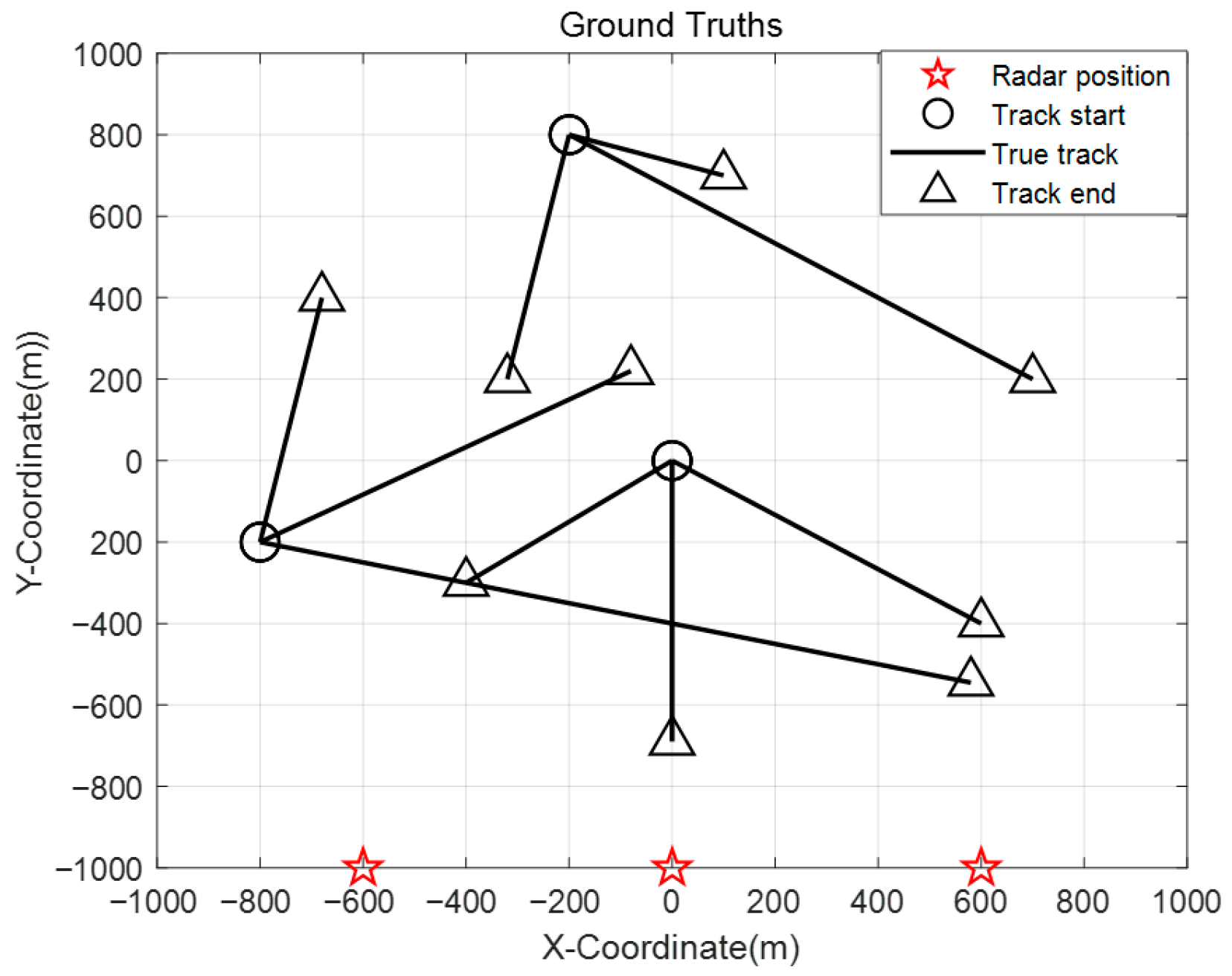
In this paper, all filters are implemented using their Gaussian mixture forms. Three radars are deployed in the simulation experiments, and the observation area is [−1000, 1000] m × [−1000, 1000] m. The simulation scenario involves nine targets, including target birth, trajectory crossover, and target death. The radar positions and target trajectories are illustrated in Figure 2.
At time t , a target with label l is represented as X t = ( x t , l ) , where x t = [ p x , t , p y , t , v x , t , v y , t ] T denotes the target’s state vector comprising its two-dimensional position and velocity components. The target state transition density is denoted by f t + 1 | t ( x t + 1 | x t , l ) = N ( x t + 1 ; F t x t , Q t ) , and the state transition matrix F t and the process noise covariance matrix Q t are denoted by, respectively:
F t = I 2 T I 2 0 2     I 2 , Q t = σ v 2 T 3 / 3 I 2 T 2 / 2 I 2 T 2 / 2 I 2       T I 2
where the sampling interval is T = 1 s; I 2 and 0 2 denote the 2 × 2 identity matrix and zero matrix, respectively; the standard deviation of process noise is σ v = 5   m / s 2 .
The survival probability is p S = 0.95 . The single-target likelihood function is given by g t ( z | x t , l ) = N ( z ; H t x t , R t ) , where H t = [ I 2 0 2 ] , R t = σ 2 I 2 , and the standard deviation of measurement noise is σ = 30   m .
The probability density function of newborn targets is given by π B , t = { ( r B , t l , p B , t l ) } l B , where B = { l 1 , l 2 , l 3 } , r B , t l i = 0.03 , and p B , t l i N ( ; m B , t l i , P B ) . The mean of trajectory l 1 is m B , t l 1 = [ 0 , 0 , 0 , 0 ] T , that of l 2 is m B , t l 2 = [ 200 , 800 , 0 , 0 ] T , and that of l 3 is m B , t l 3 = [ 800 , 200 , 0 , 0 ] T . The covariance matrix for all trajectories is P B = diag ( [ 10 , 10 , 10 , 10 ] T ) 2 .
The number of clutter points follows a Poisson distribution with a mean λ . The clutter is uniformly distributed over the observation area and is independent of the measurements generated by the targets.
The simulation experiments were conducted on a computer equipped with an Intel(R) Core(TM) i9-10900 CPU and 8 GB of RAM, running a 64-bit Windows 10 operating system, with implementation carried out in MATLAB R2021a. All simulations were performed in MATLAB, and all algorithms were executed under identical conditions to ensure a fair comparison.
Using the same target trajectories, 100 Monte Carlo (MC) runs were conducted to evaluate the average performance, with measurements in each run being mutually independent. Performance metrics, including the optimal sub-pattern assignment (OSPA) distance [42] and computational time, were computed for each run and subsequently averaged, providing a robust basis for comparison among the evaluated methods.
Simulation Experiment 1: The three radars are configured with different parameters. Radar 1 has a detection probability of P D , 1 ( x , l ) = 0.9 and a clutter rate of λ 1 = 20 ; Radar 2 has a detection probability of P D , 2 ( x , l ) = 0.85 and a clutter rate of λ 2 = 20 ; Radar 3 has a detection probability of P D , 3 ( x , l ) = 0.9 and a clutter rate of λ 3 = 40 .
Simulation Experiment 2: The three radars are configured with identical parameters. The detection probability of each radar is set to P D , 1 ( x , l ) = P D , 2 ( x , l ) = P D , 3 ( x , l ) = 0.85 , and the clutter rate is set to λ 1 = λ 2 = λ 3 = 40 .

4.2. Feature Measurement Modeling

To support the proposed multi-feature-aided track association, a physically consistent feature measurement model is introduced in this section. In addition to kinematic measurements, Doppler frequency and SNR are incorporated as discriminative features to improve target–clutter separation and inter-sensor association reliability.

4.2.1. Doppler Measurement Model

The Doppler frequency is related to the radial velocity of the target and is modeled as:
f d = 2 v r f c c + w f
where f d denotes the measured Doppler frequency, v r is the radial velocity of the target relative to the radar, f c = 10   GHz is the carrier frequency, c = 3 × 10 8   m / s is the speed of light, w f N ( 0 , σ f 2 ) ( σ f = 5   Hz ) represents Gaussian measurement noise. This model reflects the physical relationship between Doppler frequency and target motion, enabling velocity-based discrimination between targets and clutter.

4.2.2. SNR Measurement Model

Based on the radar equation, the received SNR is inversely proportional to the fourth power of the range. The SNR in logarithmic (dB) form is modeled as:
S N R = S N R 0 40 log ( d ) + w s
where S N R is the measured SNR, d is the distance between the radar and the target, S N R 0 = 50   dB is a constant determined by radar system parameters (e.g., transmit power, antenna gain, wavelength, and target RCS), w s N ( 0 , σ s 2 ) ( σ s = 2   dB ) denotes SNR measurement noise. This formulation ensures that the simulated SNR follows realistic radar signal propagation characteristics.

4.2.3. Clutter Feature Modeling

To enable effective discrimination between targets and clutter, feature statistics of clutter are modeled separately:
Doppler of clutter:
f d ( c ) N ( 0 , σ f , c 2 )
where f d ( c ) denotes the measured Doppler frequency of clutter, with a mean of zero to reflect that most clutter is stationary or exhibits zero-mean random motion. The variance σ f , c 2 ( σ f , c = 10   Hz ) represents the uncertainty and fluctuation of the clutter radial velocity. The Doppler of clutter is thus modeled as a zero-mean Gaussian distribution, which helps to discriminate clutter from moving targets.
SNR of clutter:
S N R c l u t t e r N ( u c , σ c 2 )
where S N R c l u t t e r denotes the measured SNR of clutter, u c = 15   dB is the mean SNR of clutter, typically lower than that of targets to reflect weaker signal strength, and σ c 2 ( σ c = 5   dB ) represents the variance of clutter SNR, representing the uncertainty or fluctuation of the clutter signal. The SNR of clutter is modeled as a Gaussian distribution with a lower mean to facilitate discrimination from targets.
We assume that Doppler frequency and SNR are conditionally independent given the target state. This assumption is widely adopted in multi-feature tracking. It is reasonable because Doppler primarily depends on the target’s radial velocity, whereas SNR is mainly determined by the target range and reflectivity. Since these features are governed by different physical mechanisms, their statistical dependence is typically weak in practice. This assumption simplifies the likelihood formulation and reduces computational complexity, while still enabling effective multi-feature discrimination.

4.3. Simulation Results and Analysis

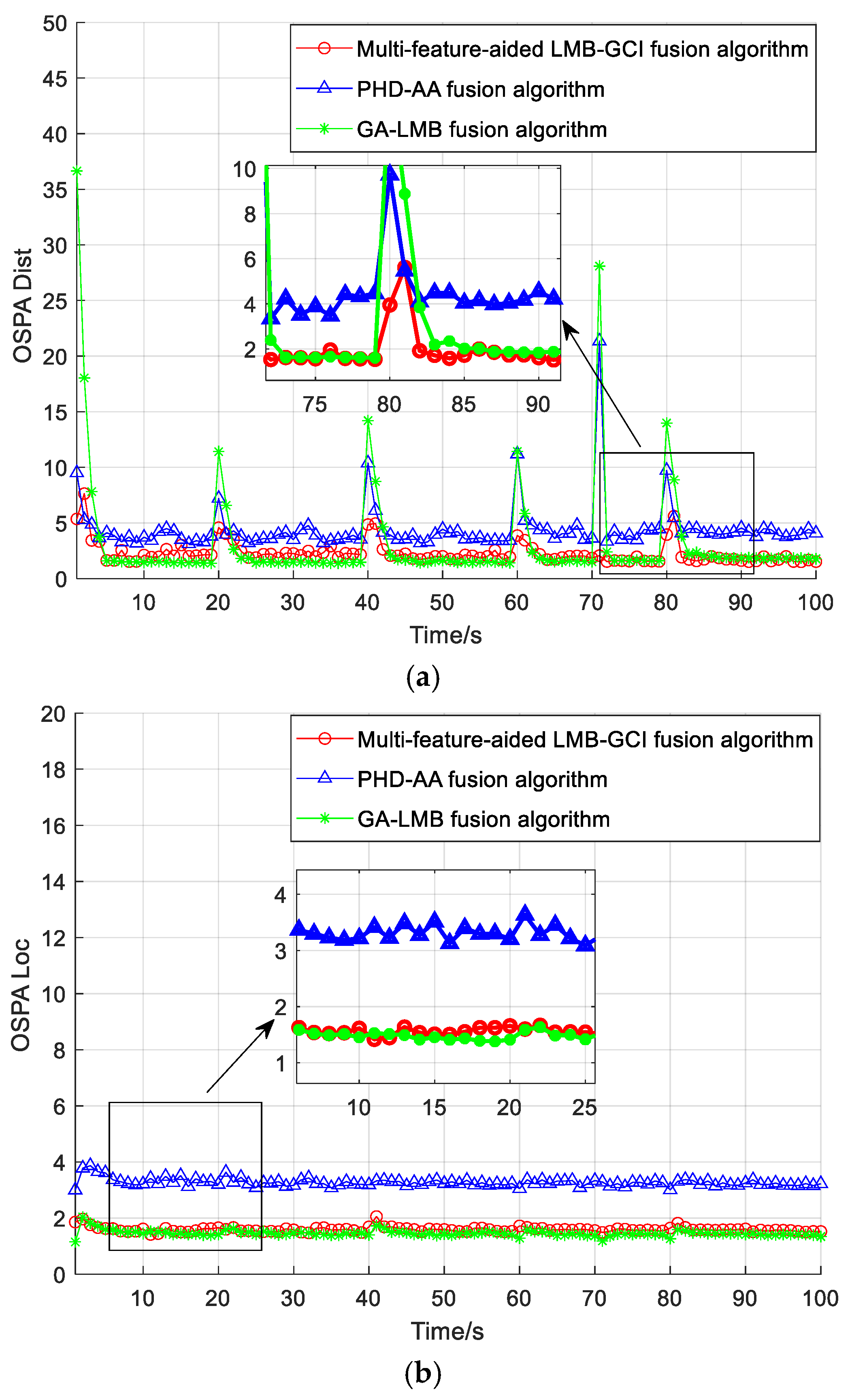
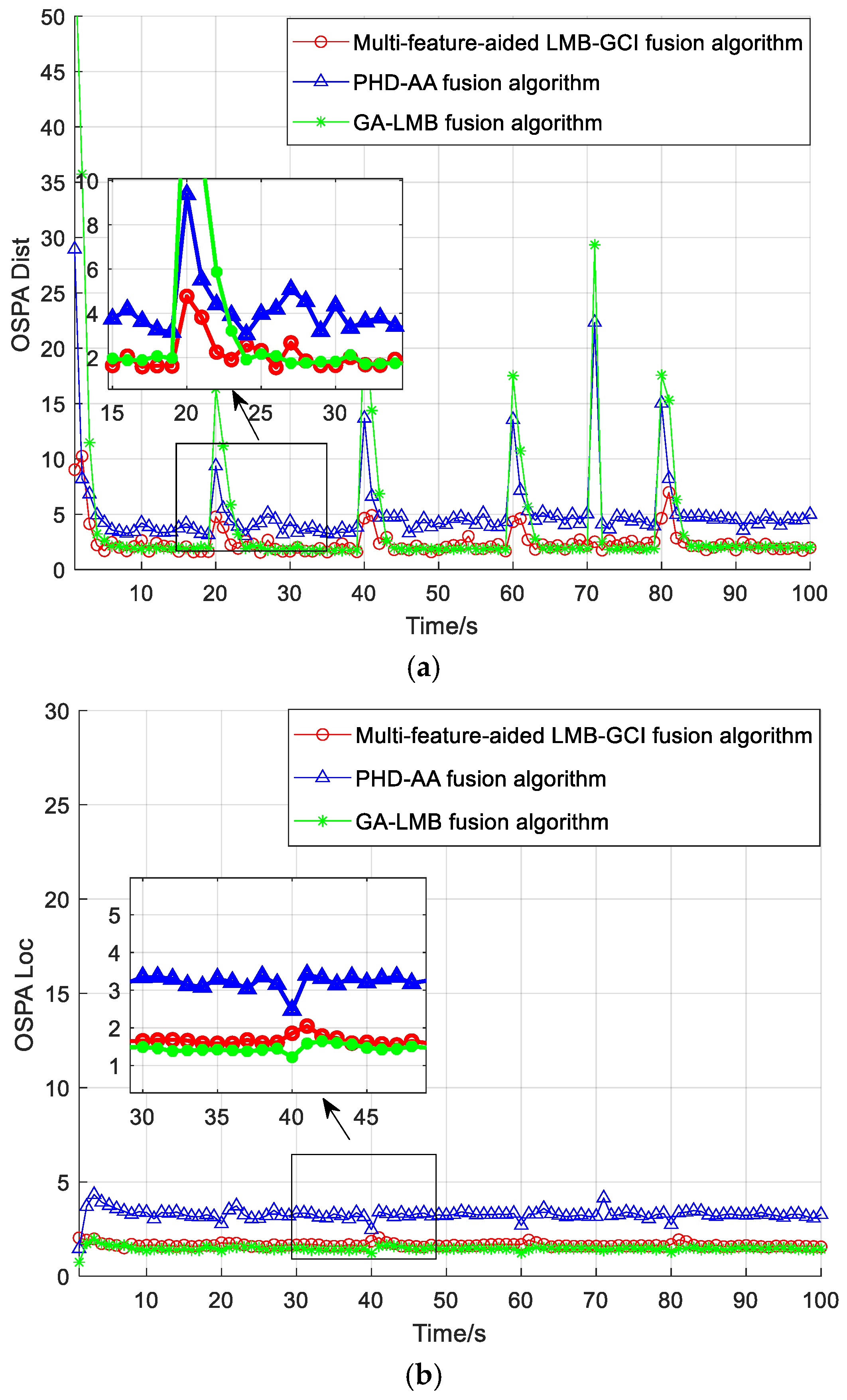
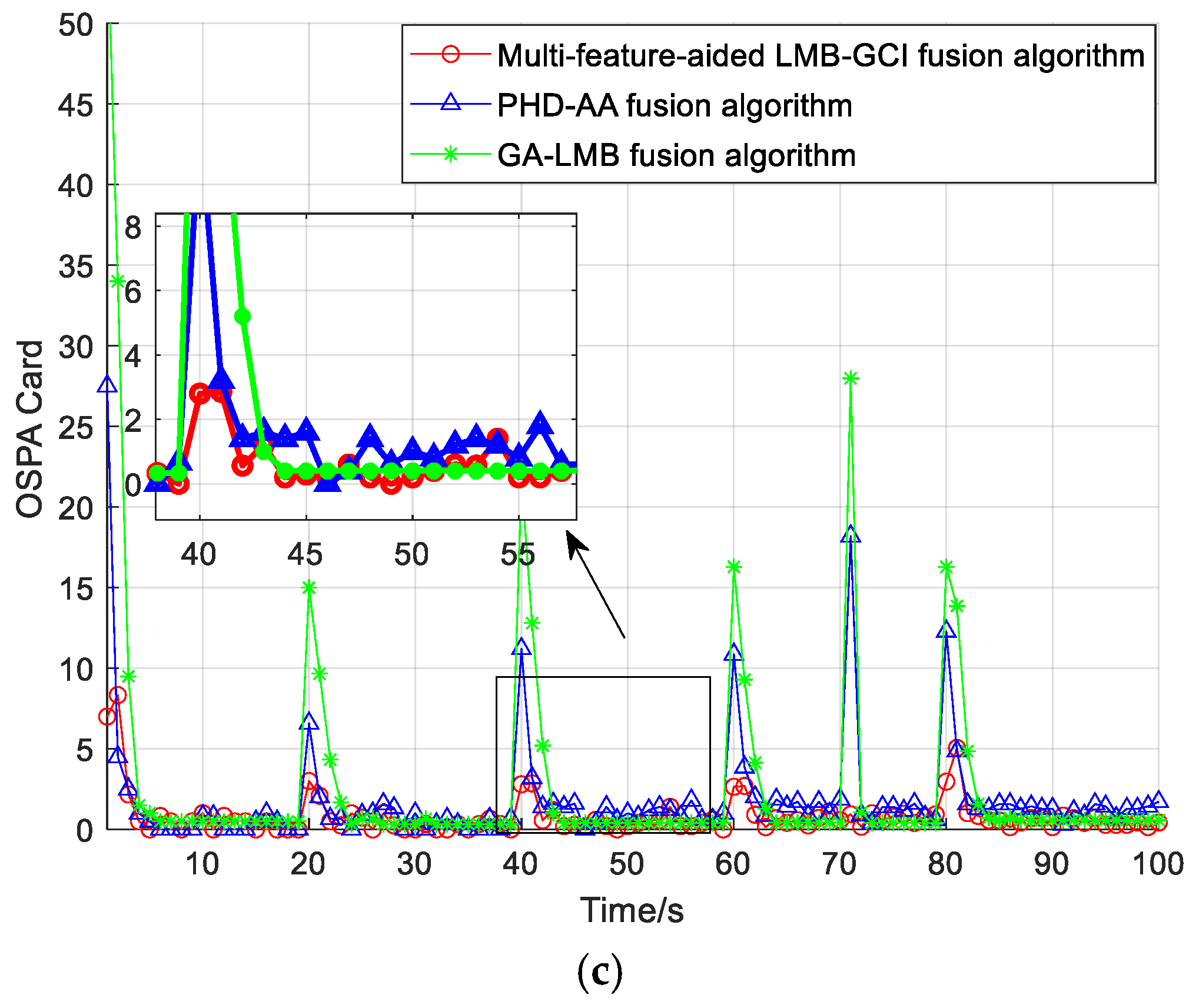
Figure 3 compares the tracking performance of different fusion algorithms for radar networks with varying parameter settings. The proposed multi-feature-aided LMB-GCI fusion algorithm achieves lower OSPA total error and OSPA cardinality error than the other two fusion algorithms, particularly at target appearance times t = 1   s , t = 20   s , t = 40   s , t = 60   s , t = 80   s , and at the target disappearance time t = 70   s . Overall, it outperforms the PHD-AA algorithm in [23] and the GA-LMB algorithm in [24] in terms of tracking performance.
Table 1 presents a comparison of the tracking performance and real-time performance of different fusion algorithms under radar networks with different parameter settings (the best performance is highlighted in bold, and the second-best performance is underlined). As shown in Table 1, the proposed multi-feature-aided LMB-GCI fusion algorithm achieves lower total OSPA error and cardinality estimation error than the PHD-AA algorithm and the GA-LMB algorithm.
Compared with the PHD-AA fusion algorithm and the GA-LMB fusion algorithm, the proposed multi-feature-aided LMB-GCI fusion algorithm reduces the total OSPA error by 54.04% and 37.31%, respectively, corresponding to improvements in tracking performance of 54.04% and 37.31%. Therefore, in terms of tracking performance, the proposed multi-feature-aided LMB-GCI fusion algorithm demonstrates clear advantages and is suitable for application scenarios with high requirements on tracking accuracy.
Compared with the PHD-AA fusion algorithm and the GA-LMB fusion algorithm, the proposed multi-feature-aided LMB-GCI fusion algorithm reduces the computational time cost by 83.13% and 11.96%, respectively, corresponding to improvements in real-time performance of 83.13% and 11.96%. Therefore, in terms of real-time performance, the proposed multi-feature-aided LMB-GCI fusion algorithm also shows advantages and is suitable for application scenarios with stringent real-time requirements.
This is because the proposed multi-feature-aided LMB-GCI fusion algorithm exploits multiple features contained in radar echoes, enabling effective clutter suppression and discrimination among different targets, thereby improving both real-time performance and tracking accuracy.
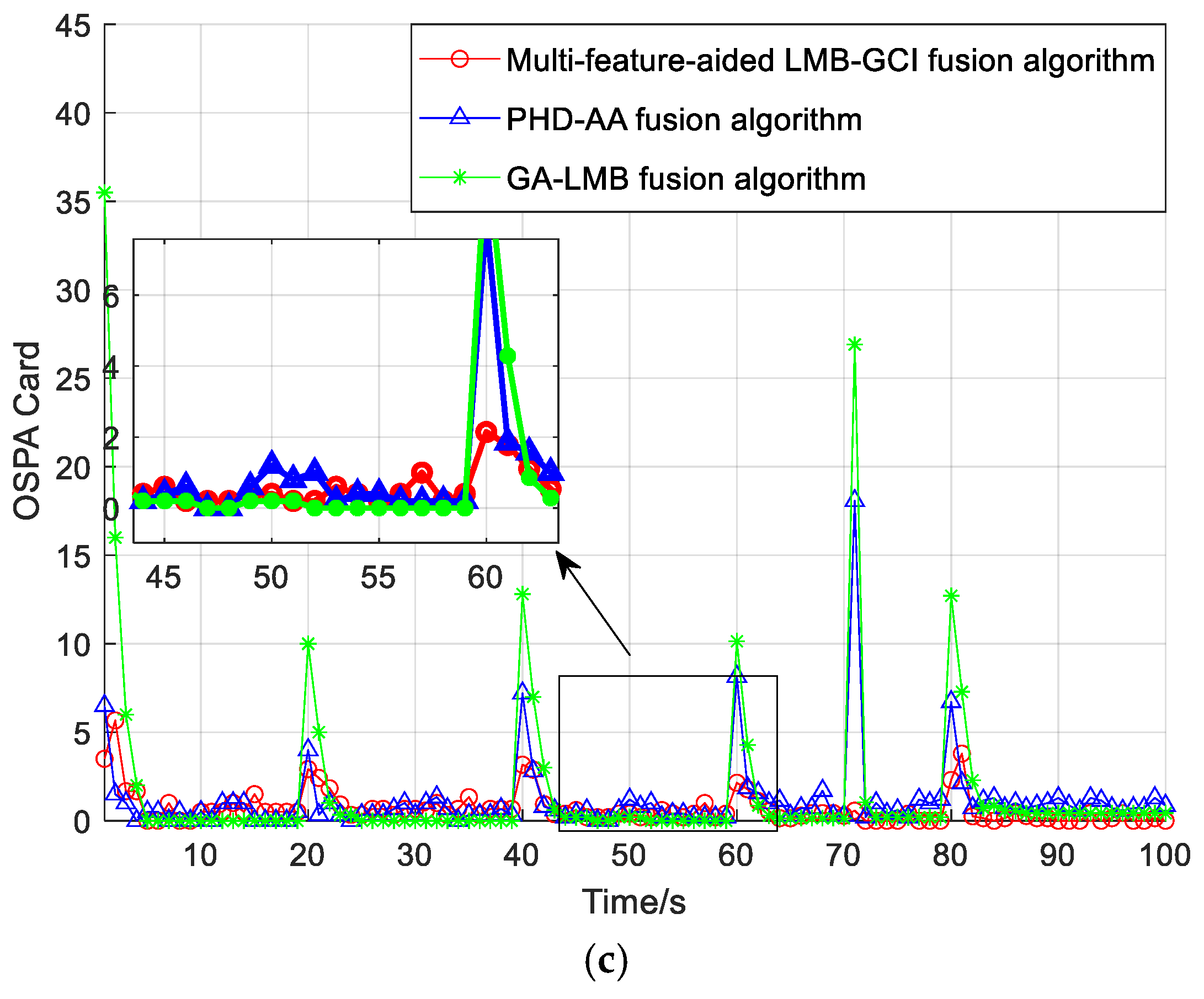
Figure 4 presents a comparison of the tracking performance of different fusion algorithms under a radar network with identical parameter settings. As can be observed from Figure 4, the proposed multi-feature-aided LMB-GCI fusion algorithm achieves lower total OSPA error and OSPA cardinality error than the other three fusion algorithms, especially at target appearance times t = 1   s , t = 20   s , t = 40   s , t = 60   s , t = 80   s , and at the target disappearance time t = 70   s . Therefore, in terms of tracking performance, the proposed multi-feature-aided LMB-GCI fusion algorithm outperforms the PHD-AA algorithm and the GA-LMB algorithm.
Table 2 presents a comparison of the tracking performance and real-time performance of different fusion algorithms under a radar network with identical parameter settings (the best performance is highlighted in bold, and the second-best performance is underlined).
As can be seen from Table 2, the proposed multi-feature-aided LMB-GCI fusion algorithm achieves lower total OSPA error and OSPA cardinality error than the PHD-AA algorithm and the GA-LMB algorithm. Compared with the PHD-AA fusion algorithm and the GA-LMB fusion algorithm, the proposed multi-feature-aided LMB-GCI fusion algorithm reduces the total OSPA error by 51.93% and 45.36%, respectively, corresponding to improvements in tracking performance of 51.93% and 45.36%. Therefore, in terms of tracking performance, the proposed multi-feature-aided LMB-GCI fusion algorithm demonstrates clear advantages.
Among the three fusion algorithms, the proposed multi-feature-aided LMB-GCI fusion algorithm exhibits the shortest execution time. Compared with the PHD-AA fusion algorithm and the GA-LMB fusion algorithm, the proposed multi-feature-aided LMB-GCI fusion algorithm reduces the computational time cost by 85.36% and 9.52%, respectively, corresponding to improvements in real-time performance of 85.36% and 9.52%. Therefore, in terms of real-time performance, the proposed multi-feature-aided LMB-GCI fusion algorithm also shows advantages. This is because the proposed fusion algorithm exploits multiple features contained in radar echoes, enabling effective clutter suppression and discrimination among different targets, thereby enhancing both real-time performance and tracking accuracy.
Results from different simulation experiments demonstrate that the proposed multi-feature-aided LMB-GCI fusion algorithm outperforms the PHD-AA algorithm and the GA-LMB algorithm in terms of tracking performance, particularly at target birth and target death instants. The proposed multi-feature-aided LMB-GCI fusion algorithm also exhibits superior real-time performance compared with the PHD-AA algorithm and the GA-LMB algorithm. Therefore, the proposed multi-feature-aided LMB-GCI fusion algorithm is well-suited for multi-radar networked application scenarios with high requirements on both tracking accuracy and real-time performance.

4.4. Discussion

The proposed multi-feature-aided LMB-GCI fusion algorithm exhibits excellent tracking performance, which can be attributed to its multi-feature-assisted track association. By leveraging Doppler and SNR features in addition to kinematic measurements, the algorithm can more reliably distinguish closely spaced targets from clutter, reducing both localization and cardinality errors. This advantage is particularly pronounced during target birth and disappearance, where conventional kinematics-only methods, such as PHD-AA [23] and GA-LMB [24], are prone to false or missed tracks due to increased association ambiguity. Moreover, the employed distributed framework combined with multi-feature-assisted track association allows faster runtime while maintaining tracking accuracy.
The robustness of the proposed method is demonstrated under varying radar network parameters. Even when spatial measurements are noisy or affected by clutter, Doppler and SNR features provide additional association cues, maintaining stable performance in dense target environments or during temporary target occlusions.
Despite these advantages, several limitations remain. The effectiveness of multi-feature association depends on the availability and quality of radar echo features; severe degradation of Doppler or SNR measurements can reduce its benefits. Current evaluation relies on simulations, and further validation with real radar datasets is necessary. In addition, the present implementation uses fixed association parameters and fusion weights. Future work may explore adaptive feature weighting or learning-based association mechanisms to further improve robustness and adaptability in complex operational scenarios.

5. Conclusions

This paper presents a multi-radar distributed fusion algorithm aided by multi-feature information. In the proposed method, each radar computes its measurement-updated LMB posterior, and track association leverages multi-feature information extracted from radar echoes, enhancing association accuracy and robustness in challenging scenarios. The resulting tracks from multiple radars are then fused using the GCI algorithm. Simulation results demonstrate that, compared with other fusion methods, the proposed algorithm achieves higher multi-target tracking accuracy and lower computational cost, confirming its effectiveness and practical applicability. Despite these improvements, challenges remain in highly dynamic or noisy environments. Future work will focus on validating the method with real radar data and exploring adaptive feature weighting and learning-based association strategies to further enhance performance.

Author Contributions

J.T. (Jin Tao): Conceptualization; formal analysis; investigation; methodology; writing—original draft. X.L.: formal analysis and methodology. J.T. (Junyan Tan) and Y.L.: methodology and writing—review and editing. Y.G. and D.J.: project administration; funding acquisition; writing—review and editing. All authors have read and agreed to the published version of the manuscript.

Funding

This work is supported by the National Natural Science Foundation of China (grant no. 61971179) and the Open Sharing Fund for the Large-scale Instruments of Hohai University (grant no. GX202402A).

Institutional Review Board Statement

Not applicable.

Informed Consent Statement

Not applicable.

Data Availability Statement

The original contributions presented in the study are included in the article, further inquiries can be directed to the corresponding author.

Conflicts of Interest

The authors declare no conflicts of interest.

References

  1. Zhu, C.; Cong, X.; Han, Y.; Sheng, W. Online spatial alignment and fusion for networked radars on moving platforms only using target position information. Digit. Signal Process. 2025, 166, 105375. [Google Scholar] [CrossRef]
  2. Mahler, R.P. Statistical Multisource-Multitarget Information Fusion; Artech: Norwood, MA, USA, 2007; ISBN 9781596930926. [Google Scholar]
  3. Zhang, W.; Meyer, F. Multisensor Multiobject Tracking with Improved Sampling Efficiency. IEEE Trans. Signal Process. 2024, 72, 2036–2053. [Google Scholar] [CrossRef]
  4. Wen, H.; Li, Y.; Duan, C.; Zhang, J.; Li, N.; Wu, T. Multi-radar data fusion for maritime moving target detection based on three-dimensional sliding window. Int. J. Remote Sens. 2023, 44, 646–665. [Google Scholar] [CrossRef]
  5. Meyer, F.; Braca, P.; Willett, P.; Hlawatsch, F. A Scalable Algorithm for Tracking an Unknown Number of Targets Using Multiple Sensors. IEEE Trans. Signal Process. 2017, 65, 3478–3493. [Google Scholar] [CrossRef]
  6. Coraluppi, S.; Carthel, C.; Coon, A. An MHT Approach to Multi-Sensor Passive Sonar Tracking. In Proceedings of the 21st International Conference on Information Fusion, Cambridge, UK, 10–13 July 2018; pp. 480–487. [Google Scholar] [CrossRef]
  7. Ueney, M.; Clark, D.E.; Julier, S.J. Distributed Fusion of PHD Filters via Exponential Mixture Densities. IEEE J. Sel. Top. Signal Process. 2013, 7, 521–531. [Google Scholar] [CrossRef]
  8. Hao, G.; Sun, S. Distributed fusion cubature Kalman filters for nonlinear systems. Int. J. Robust Nonlinear Control 2019, 29, 5979–5991. [Google Scholar] [CrossRef]
  9. Krieg, M.L.; Gray, D.A. Radar and optical track fusion using real data. In Proceedings of the 1st Australian Data Fusion Symposium, Adelaide, SA, Australia, 21–22 November 1996; pp. 25–30. [Google Scholar] [CrossRef]
  10. Gan, Q.; Harris, C.J. Comparison of two measurement fusion methods for Kalman-filter-based multisensor data fusion. IEEE Trans. Aerosp. Electron. Syst. 2001, 37, 273–280. [Google Scholar] [CrossRef]
  11. Zhu, Y.; You, Z.; Zhao, J.; Zhang, K.; Li, X. The optimality for the distributed Kalman filtering fusion with feedback. Automatica 2001, 37, 1489–1493. [Google Scholar] [CrossRef]
  12. Wang, K.; Zhang, Q.; Hu, X. Multisensor Multitarget Tracking Arithmetic Average Fusion Method Based on Probabilistic Time Window. IEEE Sens. J. 2024, 24, 3583–3593. [Google Scholar] [CrossRef]
  13. Jin, Y.; Li, J. Time-space domain assignment for generalized covariance intersection fusion with labeled multitarget densities. Digit. Signal Process. 2022, 132, 103786. [Google Scholar] [CrossRef]
  14. Li, T.; Wang, X.; Liang, Y.; Pan, Q. On Arithmetic Average Fusion and Its Application for Distributed Multi-Bernoulli Multitarget Tracking. IEEE Trans. Signal Process. 2020, 68, 2883–2896. [Google Scholar] [CrossRef]
  15. Li, T.; Hlawatsch, F. A distributed particle-PHD filter using arithmetic-average fusion of Gaussian mixture parameters. Inf. Fusion 2021, 73, 111–124. [Google Scholar] [CrossRef]
  16. Battistelli, G.; Chisci, L.; Fantacci, C.; Farina, A.; Graziano, A. Consensus CPHD Filter for Distributed Multitarget Tracking. IEEE J. Sel. Top. Signal Process. 2013, 7, 508–520. [Google Scholar] [CrossRef]
  17. Wang, B.; Yi, W.; Hoseinnezhad, R.; Li, S.; Kong, L.; Yang, X. Distributed Fusion with Multi-Bernoulli Filter Based on Generalized Covariance Intersection. IEEE Trans. Signal Process. 2017, 65, 242–255. [Google Scholar] [CrossRef]
  18. Yi, W.; Jiang, M.; Hoseinnezhad, R.; Wang, B. Distributed Multi-Sensor Fusion Using Generalised Multi-Bernoulli Densities. IET Radar Sonar Navig. 2017, 11, 434–443. [Google Scholar] [CrossRef]
  19. Jiang, M.; Yi, W.; Hoseinnezhad, R.; Kong, L. Distributed Multi-Sensor Fusion Using Generalized Multi-Bernoulli Densities. In Proceedings of the 19th International Conference on Information Fusion (FUSION), Heidelberg, Germany, 5–8 July 2016; pp. 1332–1339. [Google Scholar]
  20. Shen, H.; Lin, D.; Yang, X.; He, S. Vision-Based Multiobject Tracking Through UAV Swarm. IEEE Geosci. Remote Sens. Lett. 2023, 20, 6008905. [Google Scholar] [CrossRef]
  21. Li, S.; Yi, W.; Hoseinnezhad, R.; Battistelli, G.; Wang, B.; Kong, L. Robust Distributed Fusion with Labeled Random Finite Sets. IEEE Trans. Signal Process. 2018, 66, 278–293. [Google Scholar] [CrossRef]
  22. Li, S.; Battistelli, G.; Chisci, L.; Yi, W.; Wang, B.; Kong, L.-J. Computationally Efficient Multi-Agent Multi-Object Tracking with Labeled Random Finite Sets. IEEE Trans. Signal Process. 2019, 67, 260–275. [Google Scholar] [CrossRef]
  23. Wei, J.; Luo, F.; Qi, J.; Luo, X. Distributed Fusion of Labeled Multi-Bernoulli Filters Based on Arithmetic Average. IEEE Signal Process. Lett. 2024, 31, 656–660. [Google Scholar] [CrossRef]
  24. Robertson, S.C.J.; Van Daalen, C.E.; Du Preez, J.A. Efficient approximations of the multi-sensor labelled multi-Bernoulli filter. Signal Process. 2022, 199, 108633. [Google Scholar] [CrossRef]
  25. Li, G.; Li, G.; He, Y. Distributed Multiple Resolvable Group Targets Tracking Based on Hypergraph Matching. IEEE Sens. J. 2023, 23, 9669–9676. [Google Scholar] [CrossRef]
  26. García-fernández, Á.F.; Battistelli, G. Distributed Poisson Multi-Bernoulli Filtering via Generalized Covariance Intersection. IEEE Trans. Signal Process. 2026, 74, 246–257. [Google Scholar] [CrossRef]
  27. Li, X.; Guo, Y.; Wu, X.; Zhang, H.; Chen, Y. Multi-Source Decision Fusion for Multi-View Extended Target Tracking with Self-Occlusion. IEEE Sens. J. 2025, 25, 31208–31218. [Google Scholar] [CrossRef]
  28. Shi, L.; Battistelli, G.; Chisci, L.; Yang, F.; Zheng, L. Distributed Adaptive Bernoulli Filtering for Multi-Sensor Target Tracking under Uncertainty. IEEE Trans. Signal Process. 2024, 72, 3242–3257. [Google Scholar] [CrossRef]
  29. Li, T. Arithmetic Average Density Fusion—Part II: Unified Derivation for Unlabeled and Labeled RFS Fusion. IEEE Trans. Aerosp. Electron. Syst. 2024, 60, 3255–3268. [Google Scholar] [CrossRef]
  30. Yu, X.; Feng, X. An Optimal Hierarchical Arithmetic Average Fusion of GM-PHD Filters. IEEE Signal Process. Lett. 2025, 32, 1605–1609. [Google Scholar] [CrossRef]
  31. Xue, Y.; Feng, X.A. A Pseudo Measurement-Level Arithmetic Average Fusion in Asynchronous Networks. Digit. Signal Process. 2025, 161, 105089. [Google Scholar] [CrossRef]
  32. Gao, L.; Battistelli, G.; Chisci, L. Fusion of Labeled RFS Densities with Minimum Information Loss. IEEE Trans. Signal Process. 2020, 68, 5855–5868. [Google Scholar] [CrossRef]
  33. Li, G.; Battistelli, G.; Yi, W.; Kong, L. Distributed multi-sensor multi-view fusion based on generalized covariance intersection. Signal Process. 2020, 166, 107246. [Google Scholar] [CrossRef]
  34. Gao, L.; Battistelli, G.; Chisci, L.; Wei, P. Distributed Joint Sensor Registration and Multitarget Tracking via Sensor Network. IEEE Trans. Aerosp. Electron. Syst. 2020, 56, 1301–1317. [Google Scholar] [CrossRef]
  35. Wang, B.; Li, S.; Battistelli, G.; Chisci, L.; Yi, W. Multi-Agent Fusion With Different Limited Fields-of-View. IEEE Trans. Signal Process. 2022, 70, 1560–1575. [Google Scholar] [CrossRef]
  36. Kuhn, H. The Hungarian method for the assignment problem. Nav. Res. Logist. Q. 1955, 2, 83–97. [Google Scholar] [CrossRef]
  37. Munkres, J. Algorithms for assignment and transportation problems. J. Soc. Ind. Appl. Math. 1957, 5, 32–38. [Google Scholar] [CrossRef]
  38. Murty, K.G. An algorithm for ranking all the assignments in order of increasing cost. Oper. Res. 1968, 16, 682–687. [Google Scholar] [CrossRef]
  39. Jonker, R.; Volgenant, A. A shortest augmenting path algorithm for dense and sparse linear assignment problems. Computing 1987, 38, 325–340. [Google Scholar] [CrossRef]
  40. Cox, I.; Hingorani, S. An efficient implementation of Reid’s multiple hypothesis tracking algorithm and its evaluation for the purpose of visual tracking. IEEE Trans. Pattern Anal. Mach. Intell. 1996, 18, 138–150. [Google Scholar] [CrossRef]
  41. Pedersen, C.; Nielsen, L.; Andersen, K. An algorithm for ranking assignments using reoptimization. Comput. Oper. Res. 2008, 35, 3714–3726. [Google Scholar] [CrossRef]
  42. Schuhmacher, D.; Vo, B.T.; Vo, B.N. A Consistent Metric for Performance Evaluation of Multi-Object Filters. IEEE Trans. Signal Process. 2008, 70, 3447–3457. [Google Scholar] [CrossRef]
Figure 1. Flow diagram of the proposed fusion algorithm (the dashed box indicates the LMB filtering process for a single radar).
Applsci 16 03159 g001
Figure 2. Radar positions and target trajectories.
Applsci 16 03159 g002
Figure 3. The tracking performance of different fusion algorithms for radar networks with varying parameter settings. (a) Optimal sub-pattern assignment (OSPA) total error. (b) Location components of OSPA. (c) Cardinality components of OSPA.
Applsci 16 03159 g003aApplsci 16 03159 g003b
Figure 4. The tracking performance of different fusion algorithms for radar networks with identical parameter settings. (a) OSPA total error. (b) Location components of OSPA. (c) Cardinality components of OSPA.
Applsci 16 03159 g004aApplsci 16 03159 g004b
Table 1. The tracking performance and real-time performance of different fusion algorithms under radar networks with different parameter settings.
Fusion AlgorithmsOSPA Total Error (m)Location Components of OSPA (m)Cardinality Components of OSPA (m)Computational Time (s)
Multi-feature-aided LMB-GCI2.02801.60420.42380.0081
PHD-AA4.41223.27201.14020.0480
GA-LMB3.23491.45811.77680.0092
Table 2. The tracking performance and real-time performance of different fusion algorithms under a radar network with identical parameter settings.
Fusion AlgorithmsOSPA Total Error (m)Location Components of OSPA (m)Cardinality Components of OSPA (m)Computational Time (s)
Multi-feature-aided LMB-GCI2.47051.64900.82150.0095
PHD-AA5.13923.26771.87150.0649
GA-LMB4.52171.47333.04840.0105
Disclaimer/Publisher’s Note: The statements, opinions and data contained in all publications are solely those of the individual author(s) and contributor(s) and not of MDPI and/or the editor(s). MDPI and/or the editor(s) disclaim responsibility for any injury to people or property resulting from any ideas, methods, instructions or products referred to in the content.