Article

Valorization of Kinmen Peanut Skin, an Agro-Industrial By-Product: A Polyphenol- and Phytosterol-Rich Extract with Antioxidant and Hypolipidemic Effects in Hamsters

1
Department of Nutrition and Health Sciences, Chang Gung University of Science and Technology, Taoyuan 33303, Taiwan
2
Graduate Institute of Health Industry Technology, Chang Gung University of Science and Technology, Taoyuan 33303, Taiwan
3
Research Center for Food and Cosmetic Safety, Chang Gung University of Science and Technology, Taoyuan 33303, Taiwan
4
Central Region Campus, Industrial Technology Research Institute, Hsinchu 31057, Taiwan
5
Department of Food Science, National Quemoy University, Kinmen 89250, Taiwan
6
Center for Drug Research and Development, Chang Gung University of Science and Technology, Taoyuan 33303, Taiwan
*
Author to whom correspondence should be addressed.
These authors contributed equally to this work.
Appl. Sci. 2026, 16(7), 3116; https://doi.org/10.3390/app16073116
Submission received: 3 March 2026 / Revised: 19 March 2026 / Accepted: 20 March 2026 / Published: 24 March 2026

Abstract

Kinmen peanut (Arachis hypogaea L. cultivar Kinmen No. 1) is a unique crop used to produce local specialty “peanut candy”; however, the peanut skins (PSs) are treated as waste owing to the bitter taste. To support the valorization of this agro-industrial by-product, peanut skin ethanolic extract (PSE) was prepared and evaluated for its hypolipidemic potential in a cholesterol/fat-fed hamster model, together with its antioxidant capacity and chemical composition. Hamsters were fed a cholesterol/fat-enriched diet supplemented with PSE at 0.1%, 0.2%, or 0.4% (w/w) for 8 weeks. Serum lipid profiles were determined, and derived atherogenic indices were calculated. In parallel, antioxidant activity was assessed using 1,1-diphenyl-2-picrylhydrazyl (DPPH), 2,2′-azino-bis-(3-ethylbenzothiazoline-6-sulfonic acid) (ABTS), and reducing power assays, while chemical characterization included total phenolics, crude phytosterols, and HPLC profiling of representative phenolic compounds. PSE significantly reduced serum total cholesterol (TC) and low-density lipoprotein cholesterol (LDL-C) compared with the cholesterol/fat-enriched control, whereas triglycerides were not significantly altered. The LDL-C/HDL-C ratio was also reduced in PSE-treated groups, with the greatest reduction observed in the 0.1% PSE group (0.33 ± 0.04 vs. 0.56 ± 0.12 in the negative control). In addition, PSE exhibited marked antioxidant activity, with IC50 values of 141.3 and 76.2 μg/mL in the DPPH and ABTS assays, respectively. Chemical analyses showed that PS contained 1098 ± 189 µg β-sitosterol equivalents/g PS and 199.3 ± 4.6 mg gallic acid equivalent (GAE)/g PS, and HPLC identified p-coumaric acid, ferulic acid, gallic acid, chlorogenic acid, daidzein, catechin, and resveratrol as representative phenolic constituents. Collectively, these findings support Kinmen peanut skin as a promising value-added source of bioactives for functional ingredient development targeting cholesterol dysregulation and oxidative processes.

1. Introduction

Peanut (Arachis hypogaea L.) is an important food and oilseed crop widely cultivated throughout tropical and subtropical regions. In Kinmen, Taiwan, cultivar (cv.) Kinmen No. 1 is well adapted to mildly acidic soils and is a key raw material for the local specialty “peanut candy”, which is renowned for its flavor and fragrance. During processing, the reddish seed coat (peanut skin; PS) is removed because of its astringent/bitter taste, leading to an estimated ~500 metric tons of PS by-products each year in Kinmen that are currently treated mainly as waste or low-value feed additives. In parallel with the increasing emphasis on sustainable food systems and circular-economy approaches, upcycling agro-industrial by-products into value-added functional ingredients has become an active research and industrial priority [1,2].
Peanut is not only an important economic crop but is also rich in proteins, unsaturated fatty acids, and health-promoting micronutrients and phytochemicals. Peanut skins, in particular, are recognized as a concentrated source of phenolic constituents and have been reported to be suitable for extraction and food-related applications, with no evidence of intrinsic toxicity to animals in the available literature [3,4]. Recent international reviews have further shown that peanut skin research has evolved beyond simple compositional characterization to include green extraction technologies, encapsulation strategies, stability enhancement, and food applications, with particular attention to proanthocyanidins/procyanidins as major bioactive constituents [3,5]. Three major classes of phenolic compounds—phenolic acids, flavonoids, and stilbenes—have been identified in PS extracts [6]. Abundant phenolic compounds, such as catechin, coumaric acid, ferulic acid, gallic acid, chlorogenic acid, daidzein, resveratrol, and genistein, have been found in peanut and PS extracts [6,7,8], contributing to free-radical scavenging activity [8] and potential hypolipidemic effects. Furthermore, recent studies continue to optimize the extraction and stability of proanthocyanidin-rich peanut skin fractions, reinforcing the feasibility of converting PS into higher-value antioxidant ingredients [6]. Beyond antioxidant potential, in vivo evidence has also emerged: peanut skin extract has been reported to ameliorate diet-induced atherosclerosis in ApoE−/− mice through effects on lipid metabolism, inflammation, and gut microbiota [9]. In addition to polyphenols, phytosterols (e.g., β-sitosterol, campesterol, stigmasterol) are widely recognized cholesterol-lowering bioactives that competitively reduce intestinal cholesterol absorption [10], implying that PS-derived extracts enriched in both polyphenols and phytosterols may exert complementary effects on lipid homeostasis.
Hyperlipidemia, characterized by elevated serum total cholesterol (TC), triglycerides (TGs), and an unfavorable lipoprotein profile, is a key risk factor for cardiovascular disease. Low-density lipoprotein cholesterol (LDL-C) delivers cholesterol to peripheral tissues, whereas high-density lipoprotein cholesterol (HDL-C) promotes reverse cholesterol transport to the liver for excretion. Increasing evidence indicates that oxidative stress and oxidative modification of lipoproteins are closely linked to the development of atherogenic dyslipidemia and atherosclerosis, thereby providing a mechanistic rationale for investigating antioxidant-rich food-derived extracts in lipid disorders [11]. Consistent with earlier findings, high-cholesterol diets have been reported to increase free-radical production and induce hypercholesterolemia and oxidative stress [12]. Phenolic compounds can mitigate oxidative stress via multiple mechanisms, including scavenging superoxide anions [13]. For translational evaluation of functional ingredients targeting cholesterol metabolism, Syrian golden hamsters are widely used because they are highly responsive to dietary cholesterol and display lipoprotein handling patterns that are considered more relevant to human cholesterol metabolism than those of several other rodent models [14].
Although peanut skin has been increasingly studied as a source of antioxidant phenolics and as a candidate for by-product valorization, most previous studies have focused on extraction optimization, compositional profiling, or antioxidant assays, and in vivo hypolipidemic evidence has been more limited and has mainly relied on rat- or mouse-based models [11,12]. Moreover, information remains limited for cultivar-specific peanut skin materials linked to local agro-industrial chains, particularly when chemical characterization, antioxidant activity, and hypolipidemic evaluation are integrated within the same study design. In the present study, PS from A. hypogaea L. cv. Kinmen No. 1 were valorized by preparing a polyphenol- and phytosterol-rich extract. We systematically characterized its chemical composition and antioxidant capacity and then evaluated its hypolipidemic and antioxidant effects in cholesterol-fed hamsters. The present study aimed to provide scientific evidence supporting the conversion of a local agro-industrial by-product into a value-added functional ingredient.

2. Materials and Methods

2.1. Materials and Reagents

Unless otherwise stated, all chemicals, enzymes, and analytical standards were purchased from Sigma–Aldrich (St. Louis, MO, USA). Ethanol (95%, analytical grade) was used for extraction. Methanol and acetone used for spectrophotometric and HPLC analyses were of HPLC grade. The following reagents were of analytical or reagent grade: diethyl ether, 1,1-diphenyl-2-picrylhydrazyl (DPPH), 2,2′-azino-bis-(3-ethylbenzothiazoline-6-sulfonic acid) (ABTS), potassium persulfate, vitamin C, Trolox, potassium ferricyanide, trichloroacetic acid (TCA), ferric chloride (FeCl3), sodium carbonate (Na2CO3), Folin–Ciocalteu phenol reagent, glacial acetic acid, acetic anhydride, thiourea, sulfuric acid (H2SO4), cholesterol, and β-sitosterol. Phosphate salts used to prepare 0.2 M phosphate buffer (pH 6.6) were of analytical grade. Gallic acid and the authentic standards catechin, genistein, daidzein, ferulic acid, p-coumaric acid, chlorogenic acid, and resveratrol were used as analytical reference standards. Heat-stable α-amylase, protease, and amyloglucosidase used in the dietary fiber assay were obtained from the same supplier. Ultrapure water was used throughout the study.

2.2. Preparation of Peanut Skins (PSs) and Ethanolic Extract (PSE)

Seeds of Arachis hypogaea L. cv. Kinmen No. 1 were de-shelled to obtain kernels with seed coats. The seed coats (peanut skins; PSs) were manually separated from the kernels, ground using a laboratory grinder (RT-02A, Rong Tsong Precision Technology Co., Taichung, Taiwan), and passed through a 60-mesh stainless-steel sieve. For extraction, 200 g of PS powder was mixed with 1 L of 95% ethanol and subjected to ultrasound-assisted extraction in an ultrasonic bath (KQ-500DE, Kunshan Ultrasonic Instruments Co., Kunshan, China; frequency 40 kHz, power 500 W) for 3 days. The extract was filtered to collect the supernatant. The residue was re-extracted twice under the same conditions (total of three extraction cycles). This solvent-based extraction scheme with repeated extraction cycles is consistent with previously reported extraction approaches for peanut skins, and ultrasound-assisted extraction is a recognized strategy for improving the recovery of plant bioactives. The combined filtrates were concentrated under reduced pressure using a rotary evaporator (N-1300, Eyela Co., Tokyo, Japan). The dried crude extract (PSE) yield was 35.1 g (17.5%, w/w based on dry PS) and was stored at −20 °C until use [15,16].

2.3. Hyperlipidemic Hamster Model and Experimental Design

All animal procedures were approved by the Laboratory Animal Care Committee of Chang Gung University Laboratory Animal Center (IACUC Approval No.: CGU10-031). Animal experiments are reported in accordance with ARRIVE 2.0 guidelines [17].
Forty-eight male Syrian golden hamsters (Mesocricetus auratus), 4 weeks of age, with supplier-reported Syrian golden hamster strain designation and specific pathogen-free (SPF) health status, were obtained from the National Laboratory Animal Center and housed in plastic cages under controlled conditions (20–25 °C, 60–80% relative humidity) with a 12 h light/dark cycle (lights on 06:00–18:00). Feed and water were provided ad libitum. Animals were not genetically modified and had not undergone any previous experimental procedures prior to the present study. At the start of the dietary intervention (12 weeks of age), baseline body weight was recorded for each animal. Hamsters were housed in groups of 8 per cage throughout the dietary intervention; therefore, feed intake during the experimental period was measured at the cage level by weighing feed offered and feed remaining in each cage each week. The in vivo experiment was conducted at the Chang Gung University Laboratory Animal Center. Animals were acclimatized on commercial chow (Rodent Laboratory Chow 5001; Purina, St. Louis, MO, USA) for 8 weeks, and the dietary intervention started at 12 weeks of age.
Experimental diets were formulated based on AIN-93M (Table 1) [18]. The cholesterol/fat-enriched diet (negative control; NC) was prepared by increasing dietary fat (5% soybean oil + 5% lard) and adding 0.2% cholesterol (w/w) at the expense of corn starch. To evaluate the hypolipidemic activity of PSE, PSE was incorporated into the cholesterol/fat-enriched diet at 0.1%, 0.2%, and 0.4% (w/w) by replacing equal amounts of corn starch, designated as low-, medium-, and high-dose groups, respectively. A positive control (PC) diet was prepared by adding 4% β-sitosterol (Sigma, St. Louis, MO, USA) to the cholesterol/fat-enriched diet, replacing 4% corn starch. At 12 weeks of age, hamsters were randomly allocated into six groups (n = 8 animals per group; total n = 48) stratified by baseline body weight using a computer-generated random number list (Microsoft Excel RAND function): Normal, NC, PC, PSE-0.1%, PSE-0.2%, and PSE-0.4%.
The sample size (n = 8 animals per group) was determined a priori in accordance with the Taiwan Food and Drug Administration (TFDA) [19]. Method for Evaluating the Blood Lipid Regulation Function of Health Foods, which recommends the use of hamsters for biochemical lipid-endpoint studies and specifies a minimum of 8 animals per group for animal experiments. The same guidance also recommends 2–3 dose groups and an experimental duration of 4–8 weeks; accordingly, the present study used hamsters, three PSE dose levels, and an 8-week intervention. No formal a priori sample size calculation was performed. However, a post hoc power analysis based on the observed primary outcomes indicated that the present design was adequately powered, with achieved power >0.99 for both TC and LDL-C at α = 0.05.
Hamsters were housed in groups of 8 per cage. Accordingly, feed intake was treated as a cage-level variable, whereas body weight, organ weights, and serum lipid outcomes were analyzed at the individual-animal level. No a priori inclusion/exclusion criteria were set for animals or data points. All randomized animals were included in all analyses, and no animals or data points were excluded. Unless otherwise stated, n refers to the number of animals per group (n = 8). No blinding was performed. Investigators were aware of group allocation during allocation, conduct of the experiment (diet administration and monitoring), outcome assessment (sample collection and laboratory measurements), and data analysis.

2.4. Sample Collection and Serum Lipid Analysis

At the end of the feeding period, animals were fasted for 12 h prior to sampling. Hamsters were anesthetized with diethyl ether, and blood was collected from the abdominal large veins into tubes without anticoagulant. Following blood collection under deep anesthesia, animals were euthanized by exsanguination, and tissues were collected immediately. Liver, epididymal fat pads, and perirenal fat pads were excised and weighed after gently removing surface blood. Blood samples were allowed to clot (37 °C for 30 min, followed by 4 °C for 90 min) and centrifuged at 3000 rpm (approximately 1100× g; Centrifuge 5810R, Eppendorf AG, Hamburg, Germany) for 15 min to separate serum. Serum was stored at 4 °C until analysis. Serum triglycerides (TGs), total cholesterol (TC), HDL-Cholesterol (HDL-C), and LDL-Cholesterol (LDL-C) were measured using an Abaxis Piccolo Express chemistry analyzer (Abaxis, Union City, CA, USA). The analytical performance of the Piccolo Xpress platform and its lipid panel for serum/plasma testing has been reported previously [20].

Derived Lipid Risk Indices and Descriptive Improvement Metrics

For each animal, Atherogenic Index of Plasma (AIP), Castelli risk index (CRI), and the LDL-C/HDL-C ratio were calculated using the following equations:
A t h e r o g e n i c   I n d e x   o f   P l a s m a   ( A I P ) = log 10 T G H D L - C
C a s t e l l i   r i s k   i n d e x   ( C R I ) = T C H D L - C
L D L - C / H D L - C   r a t i o = L D L - C H D L - C
For AIP, TG and HDL-C were expressed in molar concentrations. All derived indices were calculated at the individual-animal level and are presented as mean ± standard deviation (SD) for each group. Higher AIP, CRI-I, and CRI-II values were interpreted as reflecting a more atherogenic lipid profile [21,22,23].
To facilitate interpretation of the extent to which each treatment normalized the lipid risk indices toward the normal control (NC), a descriptive percent improvement was additionally calculated using group means as follows:
I m p r o v e m e n t   ( % ) = h y p e r l i p i d e m i c   c o n t r o l M e a n G r o u p M e a n h y p e r l i p i d e m i c   c o n t r o l M e a n N C M e a n × 100
This percentage was used only as a descriptive indicator to aid interpretation.

2.5. In Vitro Antioxidant Capacity Assays

Antioxidant capacity of PSE was evaluated using DPPH radical scavenging, ABTS radical cation scavenging, and reducing power assays. Unless otherwise stated, absorbance was measured using a microplate reader (PowerWave XS2, BioTek Instruments, Winooski, VT, USA). All assays were performed in triplicate and repeated in at least three independent runs.

2.5.1. DPPH Radical Scavenging Assay

DPPH radical scavenging activity was determined using 1,1-diphenyl-2-picrylhydrazyl (DPPH; Sigma–Aldrich, St. Louis, MO, USA) [24]. Vitamin C was used as the standard (105.6, 70.4, 35.2, 17.6, 13.2, 8.8, and 4.4 μg/mL). PSE was prepared at 50, 75, 100, 150, 200, and 250 μg/mL. Briefly, 50 μL of sample was mixed with 150 μL of 400 μM DPPH in methanol, incubated in the dark for 90 min, and absorbance was measured at 517 nm.

2.5.2. ABTS Radical Cation Scavenging Assay

ABTS radical cation (ABTS•+) was generated by reacting 7 mM ABTS with 2.45 mM potassium persulfate and incubating the mixture in the dark at room temperature for 12–16 h [25]. The ABTS•+ solution was diluted with ethanol to an appropriate absorbance before use. Trolox (Sigma–Aldrich, St. Louis, MO, USA) and PSE were tested at 25, 50, 75, and 100 μg/mL. After adding 1.0 mL of diluted ABTS•+ solution to the sample solution, absorbance at 734 nm was recorded at 1 min after mixing and monitored up to 6 min [25].

2.5.3. Reducing Power Assay

Reducing power was measured according to a commonly used ferricyanide reduction protocol [26]. PSE (25–800 μg/mL) and vitamin C were prepared at indicated concentrations. Briefly, 1 mL of sample was mixed with 1 mL of 0.2 M phosphate buffer (pH 6.6) and 1 mL of 1% (w/v) potassium ferricyanide, incubated at 50 °C for 20 min, and then mixed with 1 mL of 10% trichloroacetic acid (TCA). After centrifugation at 3000 rpm (approximately 1100× g; Centrifuge 5810R, Eppendorf AG, Hamburg, Germany) for 10 min, 100 μL of supernatant was mixed with 20 μL of 0.1% FeCl3 and 100 μL of distilled water. Absorbance was measured at 700 nm.

2.6. Proximate Composition, Total Phenolics, HPLC Phenolic Profiling, and Phytosterols

2.6.1. Proximate Analysis

Proximate analyses of PS were conducted according to AOAC-based methods, including moisture (method 945.15), ash (method 920.153), crude fat (method 945.16), and crude protein (method 945.18) [27]. Total dietary fiber (TDF), insoluble dietary fiber (IDF), and soluble dietary fiber (SDF) were determined using the AOAC enzymatic–gravimetric method 991.43. Briefly, samples were sequentially digested with heat-stable α-amylase, protease, and amyloglucosidase to remove starch and protein, followed by filtration to obtain IDF. The filtrate was precipitated with ethanol to recover SDF. Fiber residues were corrected for protein and ash contents, and a reagent blank was included for correction.

2.6.2. Total Polyphenol Content (Folin–Ciocalteu)

Total polyphenols of PSE were determined using the Folin–Ciocalteu method [28] with gallic acid as the standard. Gallic acid standards were prepared at 100, 200, 400, and 800 μg/mL. PSE solutions were prepared at 100–1000 μg/mL. Briefly, 40 μL of PSE was mixed with 520 μL distilled water and 40 μL Folin–Ciocalteu reagent for 6 min, followed by addition of 7% Na2CO3. After 90 min at room temperature, absorbance was measured at 700 nm. Total phenolics were expressed as the gallic acid equivalent (GAE) based on the standard curve [28].

2.6.3. HPLC Analysis of Selected Phenolic Compounds

For HPLC analysis, PSE was dissolved in acetone/water/acetic acid (70/29.5/0.5, v/v/v) and filtered through 0.45 μm PVDF syringe filter (Millex-HV, Merck Millipore, Burlington, MA, USA) before injection. Phenolic compounds were analyzed using an HPLC system with a UV/Vis detector (UltiMate 3000, Dionex, Sunnyvale, CA, USA) on an Inertsil ODS-3V column (5 μm, 250 × 4.6 mm; GL Sciences, Torrance, CA, USA). The same acetone/water/acetic acid mixture was used as the mobile phase, and chromatograms were monitored at 254 nm. The flow rate was set at 1.0 mL/min, the column temperature was maintained at 30 °C, and the injection volume was 10 μL. Quantification was performed using external calibration curves of authentic standards (catechin, genistein, daidzein, ferulic acid, p-coumaric acid, gallic acid, chlorogenic acid, and resveratrol).

2.6.4. Crude Phytosterol Content

Crude phytosterols were determined using an acetic anhydride colorimetric method with β-sitosterol as the standard. Calibration standards were prepared at 0.5, 2, and 4 mg/mL β-sitosterol. The color reagent was prepared by mixing thiourea (0.5 g), glacial acetic acid (350 mL), and acetic anhydride (650 mL), followed by addition of concentrated sulfuric acid (10 mL). Then, 100 μL of PSE solution (100 mg/mL) was mixed with 4 mL of color reagent and incubated at 37 °C for 10 min. Absorbance was measured at 620 nm, and results were expressed as β-sitosterol equivalents based on the calibration curve.

2.7. Statistical Analysis

Data are presented as mean ± standard deviation (SD). For animal study outcomes involving more than two groups, differences among groups were analyzed by one-way analysis of variance (ANOVA). When significant, Duncan’s new multiple range test was used for post hoc comparisons. For the ABTS radical-scavenging assay, differences between PSE and Trolox at the same concentration were analyzed using Student’s t-test. A p-value < 0.05 was considered statistically significant. For the primary outcomes (TC and LDL-C), effect sizes were reported as mean differences between each intervention group and the NC group with 95% confidence intervals.

3. Results and Discussion

3.1. Hypolipidemic Effect of PSE in Hamsters Fed a Cholesterol/Fat-Enriched Diet

3.1.1. Growth Performance and Organ Indices

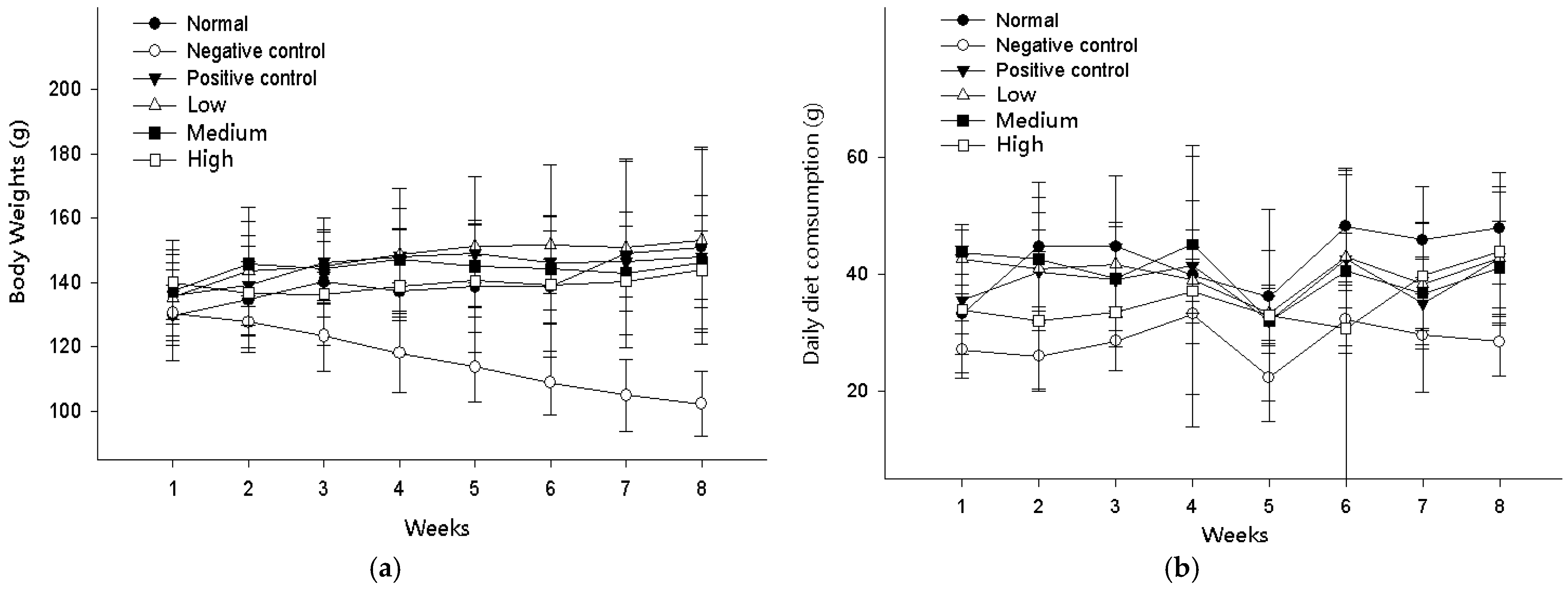
Body weight and daily diet consumption were monitored throughout the feeding period (Figure 1). As shown in Figure 1a, the NC group exhibited a progressive decline in body weight over time, whereas the PC- and PSE-treated groups maintained body weight trajectories that were generally comparable to the Normal group. No clear dose-dependent suppression of body weight was observed among the Low-, Medium-, and High-PSE groups. Figure 1b further shows that although daily diet consumption fluctuated from week to week, the PC and PSE groups remained within a similar range and did not display a consistent dose-dependent reduction in feed intake. Accordingly, the lipid-lowering effects observed in the PSE groups are unlikely to be explained solely by reduced diet consumption. This interpretation is consistent with previous studies in hamsters showing that phytosterol- or plant extract-supplemented cholesterol-rich diets can improve lipid outcomes without significantly altering body weight gain or food intake [29,30,31]. In addition, the vertical bars in Figure 1 represent the dispersion of individual values around the group mean at each time point (mean ± SD, n = 8), and the relatively wider bars in panel (b) indicate greater inter-animal variability in diet intake than in body weight; therefore, week-specific fluctuations in feed intake should be interpreted cautiously. At the end of the feeding period, the NC group showed the lowest final body weight (Table 2). Because dietary cholesterol itself may adversely affect growth performance even in the absence of marked changes in total food consumption, interpretation of lipid outcomes primarily emphasized comparisons among the cholesterol/fat-fed groups receiving the same basal diet [14].
Liver weight, epididymal fat pad weight, and perirenal fat pad weight did not differ significantly among groups (Table 2). Together with the absence of a clear dose-dependent reduction in body weight or feed intake, these organ index data do not suggest overt growth suppression or marked organ enlargement/atrophy attributable to PSE at the tested inclusion levels. Similar findings have been reported in other hamster studies, in which phytosterol- or plant extract supplementation modified lipid metabolism without materially changing body weight or relative adipose/organ weights [31,32].

3.1.2. Diet-Induced Dyslipidemia and Lipid-Lowering Response to PSE

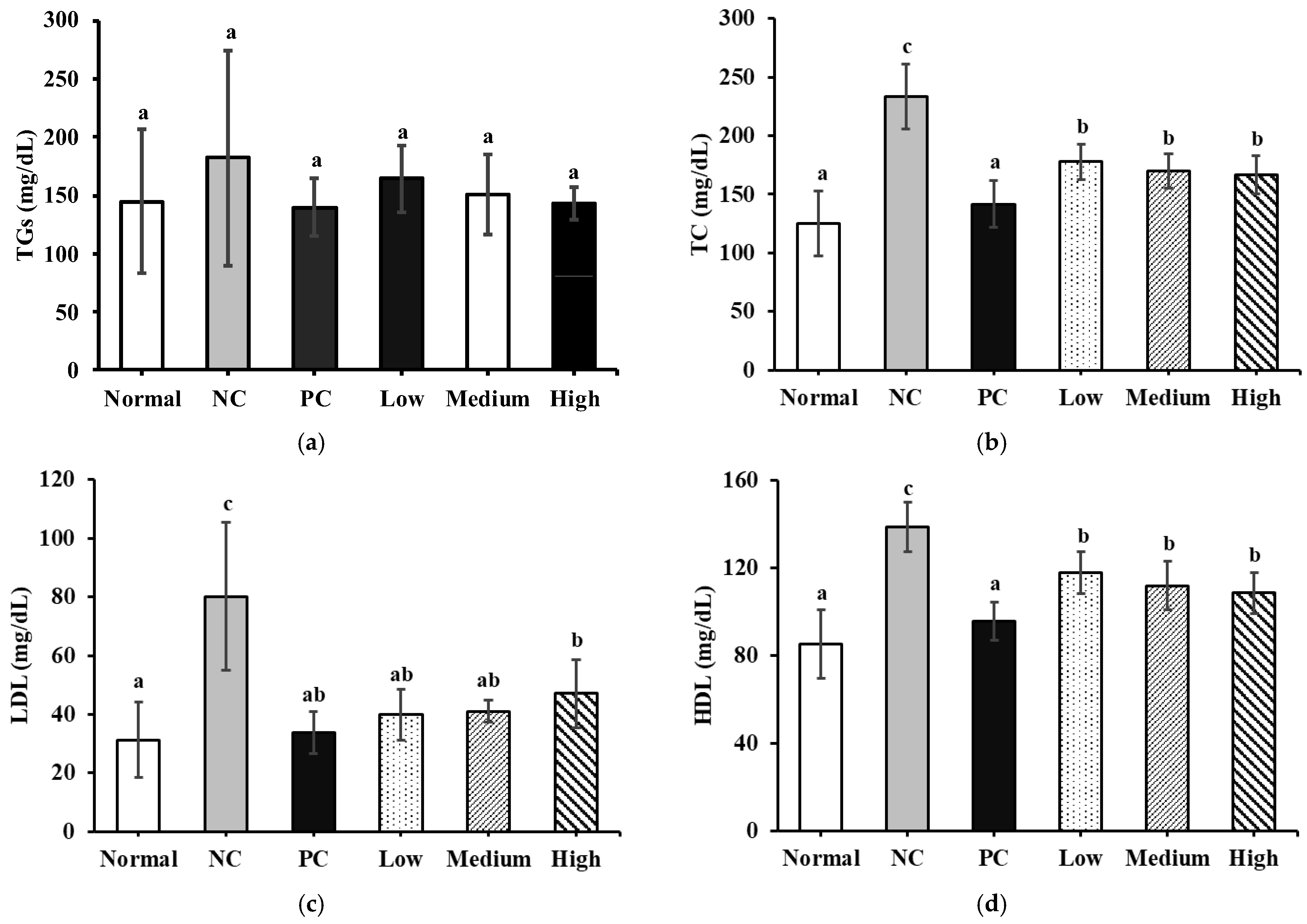
The cholesterol/fat-enriched diet successfully induced a hyperlipidemic phenotype. Compared with the Normal group, the NC group exhibited a significant increase in serum total cholesterol (TC), accompanied by elevated LDL-C and HDL-C (Figure 2). In contrast, serum triglycerides (TGs) did not differ significantly among groups (Figure 2a). An increase in HDL-C in cholesterol-fed hamsters is not unusual, because dietary cholesterol can alter cholesterol distribution across multiple lipoprotein fractions, and the magnitude of the HDL-C response may vary with dietary cholesterol level, dietary fat composition, and feeding duration [14]. Importantly, the higher circulating HDL-C concentration observed in the NC group should not be interpreted as unequivocally protective because diet-induced dyslipidemia in hamsters can coexist with impaired reverse cholesterol transport despite elevated HDL concentrations. Accordingly, TC, LDL-C, non-HDL-C, and LDL-C/HDL-C were emphasized when evaluating the net atherogenic response in the present study [14,33,34].
Supplementation with 4% β-sitosterol (PC) significantly decreased serum TC and LDL-C relative to NC (Figure 2), consistent with the established cholesterol-lowering effect of phytosterols. Mechanistically, phytosterols lower LDL-C primarily by displacing cholesterol from mixed micelles in the small intestine and thereby reducing intestinal cholesterol absorption [10].
Notably, PSE supplementation (0.1–0.4%) significantly reduced serum TC and LDL-C compared with NC (Figure 2b,c), whereas TG remained unchanged (Figure 2a). HDL-C in PSE groups was intermediate—higher than Normal/PC but lower than NC (Figure 2d). These results indicate that PSE primarily improved the cholesterol-related lipoprotein profile (TC and LDL-C) under cholesterol/fat challenge, without a measurable TG-lowering effect under the present conditions. Thus, under the present dietary conditions, the principal lipid response to PSE appeared to be attenuation of cholesterol accumulation rather than correction of hypertriglyceridemia.
To further contextualize atherogenic risk, lipid-ratio indices were calculated from individual-animal lipid profiles, including the Atherogenic Index of Plasma (AIP), Castelli risk index (CRI), and the LDL-C/HDL-C ratio (Table 3). Lipid-ratio indices integrate atherogenic and atheroprotective lipoprotein components and have been widely used as practical indicators in cardiovascular risk assessment frameworks [35].
In Table 3, AIP and CRI showed numerical reductions in the PC and PSE groups relative to NC; however, these differences did not reach statistical significance, potentially reflecting the concurrent elevation of HDL-C in the NC group and the relatively large inter-individual variability of ratio-based indices in this model. In contrast, the LDL-C/HDL-C ratio was significantly higher in NC (0.56 ± 0.12) and was reduced in the PC and all PSE groups (Table 3). This lack of a monotonic dose–response should be interpreted cautiously. First, the absolute LDL-C and HDL-C values among the three PSE doses were relatively close, and ratio-based endpoints can magnify modest concurrent changes in both the numerator and denominator. In the present dataset, the 0.4% group showed slightly higher LDL-C together with slightly lower HDL-C than the 0.1% group, which mathematically increased the LDL-C/HDL-C ratio. Second, PSE is a complex phytochemical mixture, and phytochemicals/polyphenols do not necessarily exhibit linear dose–response relationships; biphasic or hormetic responses and dose-dependent differences in bioavailability have been reported. Therefore, the present data support a lipid-improving effect of PSE, but they do not establish that increasing the dose from 0.1% to 0.4% yields proportionally greater benefit under the present experimental conditions [36,37,38].
Percent improvement values are provided for descriptive comparison only and were not subjected to inferential statistical testing (Table 3).
Phenolic compounds have been reported to counteract hyperlipidemia partly through mitigation of oxidative stress and downstream lipid peroxidation processes [12,13]. In vivo, hypolipidemic effects of peanut skin-derived materials have been described primarily in rat models, including water-soluble extracts/fractions [39] and polyphenol-enriched preparations [40,41], with an overarching summary provided by Bansode et al. (2015) [42]. More recently, peanut skin ethanolic extract was reported to ameliorate high-fat diet-induced atherosclerosis via modulation of lipid metabolism and inflammatory responses in ApoE−/− mice [9].
The present work extends this evidence base to a hamster model, which is considered informative for dietary cholesterol responsiveness and lipoprotein handling because hamsters exhibit cholesterol metabolism and bile acid handling that are closer to humans than those of rats [43]. Moreover, because the intervention employed an ethanolic extract rather than the whole skin matrix, the lipid-lowering effects observed here are more plausibly attributed to ethanol-soluble constituents, such as polyphenols and other lipophilic phytochemicals, than to the insoluble dietary fiber fraction that predominates in intact peanut skins (Table 4).
Oxidative stress and atherogenic dyslipidemia may interact bidirectionally, whereby increased reactive oxygen species promote oxidative modification of lipoproteins and vascular inflammation, while dyslipidemia increases susceptibility to lipoprotein oxidation. In this context, a polyphenol-rich extract that demonstrates strong radical-scavenging and reducing activity in chemical assays (Section 3.2) is biologically consistent with the cholesterol-lowering phenotype observed here. Nevertheless, the present study does not resolve the mechanism underlying the hypolipidemic effect of PSE. We did not directly measure intestinal cholesterol absorption, hepatic cholesterol synthesis, LDL receptor-mediated clearance, bile acid metabolism, or fecal sterol excretion. In addition, key molecular regulators related to these pathways, such as NPC1L1, ABCG5/8, HMG-CoA reductase, LDLR, and CYP7A1, were not evaluated. Therefore, the current findings should be interpreted as demonstrating a phenotypic lipid-lowering effect rather than establishing a specific mechanism. Based on previous studies of peanut skin extract and the broader polyphenol literature, plausible mechanisms include reduced intestinal cholesterol uptake, modulation of hepatic cholesterol metabolism, enhanced bile acid turnover/excretion, and gut microbiota-associated effects; however, these possibilities require targeted verification in future studies [9,44,45].

3.2. Antioxidant Capacity of PSE

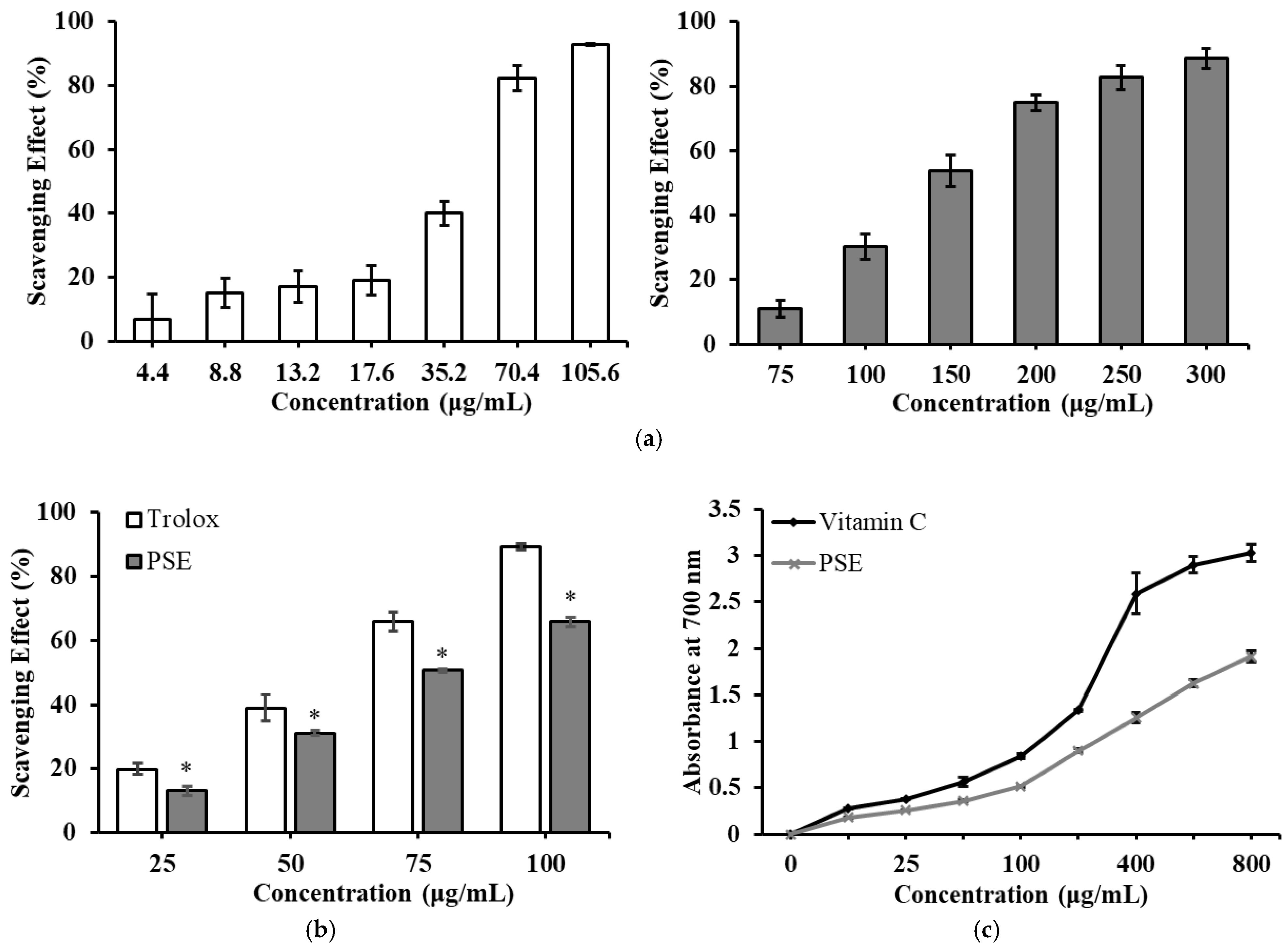
The antioxidant capacity of PSE was assessed using DPPH and ABTS radical-scavenging assays and a reducing power assay (Figure 3). PSE scavenged DPPH radicals in a concentration-dependent manner (Figure 3a), reaching high scavenging efficiency at the upper tested concentrations; the calculated IC50 for DPPH scavenging was 141.3 ± 8.9 μg/mL. Similarly, PSE scavenged ABTS•+ radicals dose-dependently (Figure 3b), with an IC50 of 76.2 ± 3.7 μg/mL. In the reducing power assay, PSE exhibited increasing reducing activity with increasing concentration (Figure 3c), indicating the presence of electron-donating constituents capable of reducing oxidized intermediates.
These findings are consistent with prior observations that peanut-skin-derived preparations can suppress oxidative processes in model systems, such as modulation of TBARS in a gamma-irradiated fish model [46]. In comparison to older reports on peanut hull extracts requiring higher concentrations to achieve similar DPPH scavenging [47], the present PSE appears comparatively potent, which is compatible with its high phenolic content (Table 4). The strength of reducing power has been reported to correlate with antioxidant capacity [48], supporting the interpretation that PSE contains compounds with strong redox activity.
Recent work continues to highlight peanut skins as a rich source of proanthocyanidins and other phenolics with measurable antioxidant activity and also addresses stability considerations of such extracts—an important point for downstream food applications [6]. Moreover, incorporation of peanut skin extract into real food matrices (e.g., mayonnaise) has been shown to improve oxidative stability during storage, indicating practical relevance beyond in-tube assays [49].
While DPPH/ABTS/reducing power are chemical assays and do not directly replicate in vivo redox biology, they provide a standardized estimate of the extract’s radical-quenching and electron-donating potential, which is directionally consistent with hypotheses linking oxidative stress to dyslipidemia progression [11].

3.3. Chemical Composition of PS and PSE (Proximate Composition, Phenolics, Phytosterols, and HPLC Profiling)

3.3.1. Proximate Composition of Peanut Skin (PS)

Based on AOAC proximate analyses, PS contained 6.81 ± 0.13% moisture, 4.14 ± 0.02% ash, 17.94 ± 0.32% crude protein, and 11.01 ± 0.85% crude fat (Table 4). Total dietary fiber was 52.15 ± 0.30%, with the insoluble fraction substantially exceeding the soluble fraction (Table 4). Nitrogen-free extract (NFE) was calculated as 7.95% by difference.

3.3.2. Total Phenolics and Phytosterols

PSE exhibited a high total phenolic content of 199.3 ± 4.6 mg GAE/g (Table 4). This value appears higher than some earlier reports using alternative extraction strategies [50,51,52] and may reflect differences in cultivar, extraction conditions, and expression basis. Phenolic compounds are widely recognized as major contributors to the antioxidant potential of peanut skins [3,48]. A recent comprehensive review summarized how extraction technology, cultivar/genotype, and processing factors drive large variability in peanut skin phenolic profiles and reported bioactivities, as well as compiled updated food-application evidence [53].
In addition, recent primary research continues to report high phenolic loads in peanut skin extracts and documents their stability/processing behavior [6], which helps contextualize the relatively high phenolic content reported here. Crude phytosterol content was 1098 ± 189 μg β-sitosterol equivalent/g PS (Table 4), indicating that peanut skins can contribute phytosterols in addition to polyphenols. β-sitosterol has been associated with protection against oxidized LDL [54]. More broadly, phytosterols are established functional ingredients for lowering intestinal cholesterol absorption and supporting cholesterol management, and recent reviews discuss both efficacy and safety considerations [10].

3.3.3. HPLC Profiling and Linkage to Bioactivity

Several phenolic acids and flavonoids were quantified by HPLC, including p-coumaric acid, ferulic acid, gallic acid, chlorogenic acid, daidzein, catechin, genistein, and resveratrol. In PSE, genistein was not detected, whereas p-coumaric acid and chlorogenic acid were comparatively abundant among the targeted analytes (Table 4).
Rather than attributing bioactivity to a single compound, these data support a multi-component basis for the observed antioxidant and hypolipidemic phenotypes, where phenolic acids/flavonoids/stilbenes contribute redox activity and may influence lipid metabolism pathways [41,46,55]. Reported physiological roles of individual compounds (e.g., catechin, p-coumaric acid, ferulic acid, chlorogenic acid, and resveratrol) remain consistent with antioxidant/cardiometabolic relevance [56,57,58,59,60], and recent review work synthesizes these compound-class relationships specifically for peanut phenolics and their food/health contexts [53].
Taken together, the lipid-profile improvements in cholesterol/fat-fed hamsters (Section 3.1) and the strong antioxidant capacity (Section 3.2), alongside a phenolic- and phytosterol-rich chemical profile (Section 3.3), support the valorization of Kinmen peanut skin as a source of high-value functional ingredients. This positioning aligns with the broader move toward upcycling nut by-products into nutraceutical/functional food applications within circular economy frameworks [61].

4. Conclusions

In this study, peanut skin ethanolic extract (PSE) significantly improved the serum cholesterol profile in hamsters fed a cholesterol/fat-enriched diet, as indicated by reduced total cholesterol (TC) and LDL-Cholesterol (LDL-C). Consistently, the derived LDL-C/HDL-C ratio was reduced in PSE-supplemented groups compared with the negative control, supporting an overall improvement in atherogenic lipoprotein balance. Among the tested doses, 0.1% PSE showed the greatest reduction in the LDL-C/HDL-C ratio, indicating the most favorable improvement in lipoprotein balance under the present experimental conditions. PSE also exhibited marked in vitro antioxidant capacity, as demonstrated by dose-dependent DPPH and ABTS radical-scavenging activities and reducing power. Chemical characterization revealed that Kinmen peanut skin and its extract contain phytosterols and diverse polyphenols, including p-coumaric acid, ferulic acid, gallic acid, chlorogenic acid, catechin, daidzein, and resveratrol. Overall, these findings support the valorization of Kinmen peanut skin (cv. Kinmen No. 1) as a value-added source of bioactives with potential for functional ingredient development. Future work should focus on extract standardization, stability evaluation in food matrices, safety assessment, and formulation into suitable functional food or nutraceutical products.

Author Contributions

Conceptualization, C.-P.C. and S.-H.T.; methodology, C.-P.C., S.-H.T. and M.-Y.L.; software, C.-P.C. and S.-H.T.; validation, C.-P.C., S.-H.T. and M.-Y.L.; formal analysis, C.-P.C., S.-H.T. and M.-Y.L.; investigation, C.-P.C., S.-H.T. and C.-H.C.; resources, Y.-J.L., C.-Y.H. and M.-Y.L.; data curation, C.-P.C.; writing—original draft preparation, S.-H.T., C.-P.C., C.-H.C. and M.-Y.L.; writing—review and editing, M.-Y.L., Y.-J.L. and C.-Y.H.; visualization, C.-H.C. and B.-H.S.; supervision, Y.-J.L., C.-Y.H. and M.-Y.L.; project administration, Y.-J.L., C.-Y.H. and M.-Y.L.; funding acquisition, M.-Y.L. All authors have read and agreed to the published version of the manuscript.

Funding

This research received no external funding.

Institutional Review Board Statement

The animal study protocol was approved by the Laboratory Animal Care Committee of Chang Gung University Laboratory Animal Center (IACUC Approval No.: CGU10-031, 17 June 2010).

Informed Consent Statement

Not applicable.

Data Availability Statement

The raw data supporting the conclusions of this article will be made available by the authors on request.

Conflicts of Interest

The authors declare no conflicts of interest.

Abbreviations

The following abbreviations are used in this manuscript:
PSPeanut Skin
PSEPeanut Skin ethanolic Extract
NCNegative Control
PCPositive Control
AIPAtherogenic Index of Plasma
CRICastelli risk index
TCTotal Cholesterol
LDL-CLow-Density Lipoprotein Cholesterol
HDL-CHigh-Density Lipoprotein Cholesterol

References

  1. Rosales, T.K.O.; Fabi, J.P. Valorization of polyphenolic compounds from food industry by-products for application in polysaccharide-based nanoparticles. Front. Nutr. 2023, 10, 1144677. [Google Scholar] [CrossRef] [PubMed]
  2. Bekavac, N.; Krog, K.; Stanić, A.; Šamec, D.; Šalić, A.; Benković, M.; Jurina, T.; Gajdoš Kljusurić, J.; Valinger, D.; Jurinjak Tušek, A. Valorization of Food Waste: Extracting Bioactive Compounds for Sustainable Health and Environmental Solutions. Antioxidants 2025, 14, 714. [Google Scholar] [CrossRef] [PubMed]
  3. Putra, N.R.; Rizkiyah, D.N.; Yunus, M.A.C.; Abdul Aziz, A.H.; Md Yasir, A.S.H.; Irianto, I.; Jumakir, J.; Waluyo, W.; Suparwoto, S.; Qomariyah, L. Valorization of peanut skin as agricultural waste using various extraction methods: A review. Molecules 2023, 28, 4325. [Google Scholar] [CrossRef] [PubMed]
  4. Sobolev, V.C.; Cole, R.J. Note on utilisation of peanut seed testa. J. Sci. Food Agric. 2004, 84, 105–111. [Google Scholar] [CrossRef]
  5. Sorita, G.D.; Leimann, F.V.; Ferreira, S.R.S. Phenolic Fraction from Peanut (Arachis hypogaea L.) By-product: Innovative Extraction Techniques and New Encapsulation Trends for Its Valorization. Food Bioprocess Technol. 2023, 16, 726–748. [Google Scholar] [CrossRef]
  6. Yu, L.; Feng, S.; Song, Y.; Bi, J.; Gao, Y.; Wang, L.; Jiang, C.; Wang, M. Exploring the extraction, antioxidant activities and its stabilities of peanut skins crude proanthocyanidins extract. Sci. Rep. 2025, 15, 26274. [Google Scholar] [CrossRef]
  7. Chukwumah, Y.C.; Walker, L.T.; Verghese, M.; Bokanga, M.; Ogutu, S.; Alphonse, K. Comparison of extraction methods for the quantification of selected phytochemicals in peanuts (Arachis hypogaea). J. Agric. Food Chem. 2007, 55, 285–290. [Google Scholar] [CrossRef]
  8. Wang, J.; Yuan, X.; Jin, Z.; Tian, Y.; Song, H. Free radical and reactive oxygen species scavenging activities of peanut skins extract. Food Chem. 2007, 104, 242–250. [Google Scholar] [CrossRef]
  9. Xu, M.; Lv, C.; Wang, H.; Lu, Q.; Ye, M.; Zhu, X.; Liu, R. Peanut skin extract ameliorates high-fat diet-induced atherosclerosis by regulating lipid metabolism, inflammation reaction and gut microbiota in ApoE−/− mice. Food Res. Int. 2022, 154, 111014. [Google Scholar] [CrossRef]
  10. Miszczuk, E.; Bajguz, A.; Kiraga, Ł.; Crowley, K.; Chłopecka, M. Phytosterols and the Digestive System: A Review Study from Insights into Their Potential Health Benefits and Safety. Pharmaceuticals 2024, 17, 557. [Google Scholar] [CrossRef]
  11. Vekic, J.; Stromsnes, K.; Mazzalai, S.; Zeljkovic, A.; Rizzo, M.; Gambini, J. Oxidative Stress, Atherogenic Dyslipidemia, and Cardiovascular Risk. Biomedicines 2023, 11, 2897. [Google Scholar] [CrossRef] [PubMed]
  12. Ohara, Y.; Peterson, T.E.; Harrison, D.G. Hypercholesterolemia increases endothelial superoxide anion production. Clin. Res. J. 1993, 91, 2546–2551. [Google Scholar] [CrossRef] [PubMed]
  13. Robak, J.; Gryglewski, R.J. Flavonoids are scavengers of superoxide anions. Biochem. Pharmacol. 1988, 37, 837–841. [Google Scholar] [CrossRef] [PubMed]
  14. Huang, C.H.; Hsu, H.S.; Chiang, M.T. Influence of varied dietary cholesterol levels on lipid metabolism in hamsters. Nutrients 2024, 16, 2472. [Google Scholar] [CrossRef]
  15. Nepote, V.; Grosso, N.R.; Guzmán, C.A. Optimization of extraction of phenolic antioxidants from peanut skins. J. Sci. Food Agric. 2005, 85, 33–38. [Google Scholar] [CrossRef]
  16. Chemat, F.; Rombaut, N.; Sicaire, A.G.; Meullemiestre, A.; Fabiano-Tixier, A.S.; Abert-Vian, M. Ultrasound assisted extraction of food and natural products. Mechanisms, techniques, combinations, protocols and applications. A review. Ultrason. Sonochem. 2017, 34, 540–560. [Google Scholar] [CrossRef]
  17. Percie du Sert, N.; Hurst, V.; Ahluwalia, A.; Alam, S.; Avey, M.T.; Baker, M.; Browne, W.J.; Clark, A.; Cuthill, I.C.; Dirnagl, U.; et al. The ARRIVE guidelines 2.0: Updated guidelines for reporting animal research. PLoS Biol. 2020, 18, e3000410. [Google Scholar] [CrossRef]
  18. Reeves, P.G.; Nielsen, F.H.; Fahey, G.C., Jr. AIN-93 purified diets for laboratory rodents: Final report of the American Institute of Nutrition ad hoc writing committee on the reformulation of the AIN-76A rodent diet. J. Nutr. 1993, 123, 1939–1951. [Google Scholar] [CrossRef]
  19. Taiwan Food and Drug Administration. Health Food Evaluation Method for Blood Lipid Regulation; Announcement No. 0960403114; Ministry of Health and Welfare: Taiwan, China, 2022. Available online: https://www.fda.gov.tw/tc/includes/GetFile.ashx?id=f638055937628026543&type=1 (accessed on 12 January 2025).
  20. Taylor, J.R.; Lopez, L.M. Cholesterol: Point-of-care testing. Ann. Pharmacother. 2004, 38, 1252–1257. [Google Scholar] [CrossRef]
  21. Dobiásová, M. Atherogenic index of plasma [log(triglycerides/HDL-cholesterol)]: Theoretical and practical implications. Clin. Chem. 2004, 50, 1113–1115. [Google Scholar] [CrossRef]
  22. Dobiásová, M.; Frohlich, J.; Sedová, M.; Cheung, M.C.; Brown, B.G. Cholesterol esterification and atherogenic index of plasma correlate with lipoprotein size and findings on coronary angiography. J. Lipid Res. 2011, 52, 566–571. [Google Scholar] [CrossRef]
  23. Gaggini, M.; Gorini, F.; Vassalle, C. Lipids in Atherosclerosis: Pathophysiology and the Role of Calculated Lipid Indices in Assessing Cardiovascular Risk in Patients with Hyperlipidemia. Int. J. Mol. Sci. 2022, 24, 75. [Google Scholar] [CrossRef] [PubMed]
  24. Brand-Williams, W.; Cuvelier, M.E.; Berset, C. Use of a free radical method to evaluate antioxidant activity. LWT-Food Sci. Technol. 1995, 28, 25–30. [Google Scholar] [CrossRef]
  25. Re, R.; Pellegrini, N.; Proteggente, A.; Pannala, A.; Yang, M.; Rice-Evans, C. Antioxidant activity applying an improved ABTS radical cation decolorization assay. Free Radic. Biol. Med. 1999, 26, 1231–1237. [Google Scholar] [PubMed]
  26. Oyaizu, M. Studies on Products of Browning Reactions: Antioxidative Activities of Product of Browning Reaction Prepared from Glucosamine. Jpn. J. Nutr. 1986, 44, 307–315. [Google Scholar] [CrossRef]
  27. Valenzuela, C.; Abugoch, L.; Tapia, C.; Gamboa, A. Effect of alkaline extraction on the structure of the protein of quinoa (Chenopodium quinoa Willd.) and its influence on film formation. Int. J. Food Sci. Technol. 2013, 48, 843–849. [Google Scholar] [CrossRef]
  28. Singleton, V.L.; Rossi, J.A. Calorimetry of total phenolics with phosphotungstic acid reagents. Am. J. Enol. Vitic. 1965, 16, 144–158. [Google Scholar]
  29. Carden, T.J.; Hang, J.; Dussault, P.H.; Carr, T.P. Dietary Plant Sterol Esters Must Be Hydrolyzed to Reduce Intestinal Cholesterol Absorption in Hamsters. J. Nutr. 2015, 145, 1402–1407. [Google Scholar] [CrossRef]
  30. Deng, Q.; Yu, X.; Xu, J.; Kou, X.; Zheng, M.; Huang, F.; Huang, Q.; Wang, L. Single frequency intake of α-linolenic acid rich phytosterol esters attenuates atherosclerosis risk factors in hamsters fed a high fat diet. Lipids Health Dis. 2016, 15, 23. [Google Scholar] [CrossRef]
  31. Lin, Y.; He, C.; Liu, J.; Chung, H.Y.; Chen, Z.Y.; Wong, W.T. Houttuynia cordata Thunb. Extracts Alleviate Atherosclerosis and Modulate Gut Microbiota in Male Hypercholesterolemic Hamsters. Nutrients 2024, 16, 3290. [Google Scholar] [CrossRef]
  32. Berger, A.; Rein, D.; Kratky, E.; Monnard, I.; Hajjaj, H.; Meirim, I.; Piguet-Welsch, C.; Hauser, J.; Mace, K.; Niederberger, P. Cholesterol-lowering properties of Ganoderma lucidum in vitro, ex vivo, and in hamsters and minipigs. Lipids Health Dis. 2004, 3, 2. [Google Scholar] [CrossRef][Green Version]
  33. Weingand, K.W.; Daggy, B.P. Effects of dietary cholesterol and fasting on hamster plasma lipoprotein lipids. Eur. J. Clin. Chem. Clin. Biochem. J. Forum Eur. Clin. Chem. Soc. 1991, 29, 425–428. [Google Scholar] [CrossRef][Green Version]
  34. Oliveira, T.V.; Maniero, F.; Santos, M.H.; Bydlowski, S.P.; Maranhão, R.C. Impact of high cholesterol intake on tissue cholesterol content and lipid transfers to high-density lipoprotein. Nutrition 2011, 27, 713–718. [Google Scholar] [CrossRef]
  35. Okan, T.; Doruk, M.; Ozturk, A.; Topaloglu, C.; Dogdus, M.; Yilmaz, M.B. Evaluation of Plasma Atherogenic Index, Triglyceride-Glucose Index and Other Lipid Ratios as Predictive Biomarkers of Coronary Artery Disease in Different Age Groups. Diagnostics 2024, 14, 1495. [Google Scholar] [CrossRef]
  36. Scholz, S.; Williamson, G. Interactions affecting the bioavailability of dietary polyphenols in vivo. Int. J. Vitam. Nutr. Res. Int. Z. Vitam. Ernahrungsforschung J. Int. Vitaminol. Nutr. 2007, 77, 224–235. [Google Scholar] [CrossRef] [PubMed]
  37. Jodynis-Liebert, J.; Kujawska, M. Biphasic Dose-Response Induced by Phytochemicals: Experimental Evidence. J. Clin. Med. 2020, 9, 718. [Google Scholar] [CrossRef] [PubMed]
  38. Hu, S.; Fan, H.; Zhang, S.; Chen, C.; You, Y.; Wang, C.; Li, J.; Luo, L.; Cheng, Y.; Zhou, M.; et al. Association of LDL-C/HDL-C ratio with coronary heart disease: A meta-analysis. Indian Heart J. 2024, 76, 79–85. [Google Scholar] [CrossRef] [PubMed]
  39. Shimizu-Ibuka, A.; Udagawa, H.; Kobayashi-Hattori, K.; Mura, K.; Tokue, C.; Takita, T.; Arai, S. Hypocholesterolemic effect of peanut skin and its fractions: A case record of rats fed on a high-cholesterol diet. Biosci. Biotechnol. Biochem. 2009, 73, 205–208. [Google Scholar] [CrossRef]
  40. Bansode, R.R.; Randolph, P.; Hurley, S.; Ahmedna, M. Evaluation of hypolipidemic effects of peanut skin-derived polyphenols in rats on Western-diet. Food Chem. 2012, 135, 1659–1666. [Google Scholar] [CrossRef]
  41. Tamura, T.; Inoue, N.; Shimizu-Ibuka, A.; Tadaishi, M.; Takita, T.; Arai, S.; Mura, K. Serum cholesterol reduction by feeding a high-cholesterol diet containing a lower-molecular-weight polyphenol fraction from peanut skin. Biosci. Biotechnol. Biochem. 2012, 76, 834–837. [Google Scholar] [CrossRef]
  42. Bansode, R.R.; Randolph, P.; Ahmedna, M.; Williams, L.L.; Yu, J. Bioavailability and hypolipidemic effects of peanut skin polyphenols. J. Med. Food 2015, 18, 265–272. [Google Scholar] [CrossRef]
  43. Lin, X.; Ma, P.; Yang, C.; Wang, J.; He, K.; Chen, G.; Huang, W.; Fan, J.; Xian, X.; Wang, Y.; et al. Dietary-Induced Elevations of Triglyceride-Rich Lipoproteins Promote Atherosclerosis in the Low-Density Lipoprotein Receptor Knockout Syrian Golden Hamster. Front. Cardiovasc. Med. 2021, 8, 738060. [Google Scholar] [CrossRef]
  44. Chambers, K.F.; Day, P.E.; Aboufarrag, H.T.; Kroon, P.A. Polyphenol Effects on Cholesterol Metabolism via Bile Acid Biosynthesis, CYP7A1: A Review. Nutrients 2019, 11, 2588. [Google Scholar] [CrossRef] [PubMed]
  45. Sun, P.; Zhao, L.; Zhang, N.; Zhou, J.; Zhang, L.; Wu, W.; Ji, B.; Zhou, F. Bioactivity of Dietary Polyphenols: The Role in LDL-C Lowering. Foods 2021, 10, 2666. [Google Scholar] [CrossRef]
  46. de Camargo, A.C.; Regitano-d’Arce, M.A.B.; Rasera, G.B.; Canniatti-Brazaca, S.G.; do Prado-Silva, L.; Alvarenga, V.O.; Sant’Ana, A.S.; Shahidi, F. Phenolic acids and flavonoids of peanut by-products: Antioxidant capacity and antimicrobial effects. Food Chem. 2017, 237, 538–544. [Google Scholar] [CrossRef] [PubMed]
  47. Yen, G.; Duh, P. Scavenging effect of methanolic extracts of peanut hulls on free-radical and active-oxygen species. J. Agric. Food Chem. 1994, 42, 629–632. [Google Scholar]
  48. Chang, L.W.; Yen, W.J.; Huang, S.C.; Duh, P.D. Antioxidant activity of sesame coat. Food Chem. 2002, 78, 347–354. [Google Scholar] [CrossRef]
  49. Bodoira, R.M.; Rodríguez Ruiz, A.C.; Martínez, M.L.; Velez, A.R.; Ribotta, P.D.; Maestri, D.M. From by-product to natural antioxidant: Incorporation of peanut skin extract in mayonnaise and its effect on physico-chemical and sensory properties. Food Biosci. 2024, 61, 104680. [Google Scholar] [CrossRef]
  50. Ballard, T.S.; Mallikarjunan, P.; Zhou, K.; O’Keefe, S.F. Optimizing the extraction of phenolic antioxidants from peanut skins using response surface methodology. J. Agric. Food Chem. 2009, 57, 3064–3072. [Google Scholar] [CrossRef]
  51. Ballard, T.S.; Mallikarjunan, P.; Zhou, K.; O’Keefe, S. Microwave-assisted extraction of phenolic antioxidant compounds from peanut skins. Food Chem. 2010, 120, 1185–1192. [Google Scholar] [CrossRef]
  52. Wu, J.G.; Chen, K.; Zhang, X.Y. Extraction of peanut skin total polyphenols by microwave combined-assisted ethanol method. China Food Addit. 2010, 5, 103–106. [Google Scholar]
  53. Bodoira, R.; Cecilia Cittadini, M.; Velez, A.; Rossi, Y.; Montenegro, M.; Martínez, M.; Maestri, D. An overview on extraction, composition, bioactivity and food applications of peanut phenolics. Food Chem. 2022, 381, 132250. [Google Scholar] [CrossRef]
  54. Jiang, Y.H.; Li, X.; Niu, W.; Wang, D.L.; Wu, B.; Yang, C.H. β-sitosterol regulated microRNAs in endothelial cells against an oxidized low-density lipoprotein. Food Funct. 2020, 11, 1881–1890. [Google Scholar] [PubMed]
  55. Putra, N.R.; Yunus, M.A.C.; Ruslan, M.S.H.; Idham, Z.; Idrus, F.N. Comparison extraction of peanut skin between CO2 supercritical fluid extraction and soxhlet extraction in term of oil yield and catechin. Pertanika J. Sci. Technol. 2018, 26, 799–810. [Google Scholar]
  56. Chacko, S.M.; Thambi, P.T.; Kuttan, R.; Nishigaki, I. Beneficial effects of green tea: A literature review. Chin. Med. 2010, 5, 13. [Google Scholar] [CrossRef] [PubMed]
  57. Luceri, C.; Giannini, L.; Lodovici, M.; Antonucci, E.; Abbate, R.; Masini, E.; Dolara, P. p-Coumaric acid, a common dietary phenol, inhibits platelet activity in vitro and in vivo. Br. J. Nutr. 2007, 97, 458–463. [Google Scholar] [CrossRef]
  58. Srinivasan, M.; Sudheer, A.R.; Menon, V.P. Ferulic acid: Therapeutic potential through its antioxidant property. J. Clin. Biochem. Nutr. 2007, 4, 92–100. [Google Scholar] [CrossRef]
  59. Martinez, M.d.C.; Afonso, S.G.; Buzaleh, A.M.; Batlle, A. Protective action of antioxidants on hepatic damage induced by griseofulvin. Sci. World J. 2014, 2014, 982358. [Google Scholar] [CrossRef]
  60. Kyei, S.K.; Eke, W.I.; Abdul-Karim, H.; Darko, G.; Akaranta, O. Phytochemicals from peanut (Arachis hypogaea L.) skin extract with potential for pharmacological activity. Curr. Bioact. Compd. 2021, 17, 38–56. [Google Scholar] [CrossRef]
  61. Alasalvar, C.; Huang, G.; Bolling, B.W.; Jantip, P.A.; Pegg, R.B.; Wong, X.K.; Chang, S.K.; Pelvan, E.; de Camargo, A.C.; Mandalari, G.; et al. Upcycling commercial nut byproducts for food, nutraceutical, and pharmaceutical applications: A comprehensive review. Food Chem. 2025, 467, 142222. [Google Scholar] [CrossRef]
Figure 1. Effect of peanut skin ethanolic extract (PSE) on (a) body weight and (b) daily diet consumption over period. Hamsters were fed a general AIN-93M diet (Normal), a cholesterol/fat-enriched diet (negative control, NC the 8-week feeding ), a cholesterol/fat-enriched diet supplemented with 4% β-sitosterol (positive control, PC), or the same cholesterol/fat-enriched diet supplemented with 0.1% (Low), 0.2% (Medium), or 0.4% (High) PSE. Symbols represent group means, and the vertical bars represent ±1 standard deviation (SD) at each weekly time point (n = 8 animals per group). The bars indicate within-group variability and do not denote between-group statistical significance.
Applsci 16 03116 g001
Figure 2. Effect of peanut skins on serum (a) triglycerides (TGs), (b) total cholesterol (TC), (c) low-density lipoprotein cholesterol (LDL-C), and (d) high- density lipoprotein cholesterol (HDL-C) after 8 weeks of feeding. Hamsters were fed with general AIN-93M diet (Normal), cholesterol/fat-enriched diet (negative control, NC), cholesterol/fat-enriched diet with 4% β-sitosterol (positive control, PC), cholesterol/fat-enriched diet added with 0.1% (Low), 0.2% (Medium) and 0.4% (High) of peanut skin ethanolic extract (PSE), respectively. Values represent the mean ± standard deviations (SD) (n = 8). Significant differences (p < 0.05) between values were determined by Duncan’s new multiple range test and labels as different letters.
Applsci 16 03116 g002
Figure 3. Antioxidant activities of peanut skin ethanolic extract (PSE): (a) DPPH radical-scavenging activity of vitamin C (left) and PSE (right); (b) ABTS radical-scavenging activity of Trolox and PSE; and (c) reducing power of vitamin C and PSE. Values are presented as mean ± SD of three independent experiments, and the vertical bars represent standard deviations. In (b), asterisks indicate significant differences between PSE and Trolox at the same concentration (p < 0.05, Student’s t-test).
Applsci 16 03116 g003
Table 1. Composition of experimental diet in animal model.
ConstituentsPercentage (%)
NormalNegative Control (NC)Positive Control (PC)Low DosageMedium DosageHigh Dosage
Corn starch46.56940.36936.36940.26940.16939.969
Casein14.00014.00014.00014.00014.00014.000
Dextrinized corn starch15.50015.50015.50015.50015.50015.500
Sucrose10.00010.00010.00010.00010.00010.000
Soybean oil4.0005.0005.0005.0005.0005.000
Lard-5.0005.0005.0005.0005.000
Alphacel, non-nutritive bulk5.0005.0005.0005.0005.0005.000
AIN-93M-mineral mix3.5003.5003.5003.5003.5003.500
L-cystine0.1800.1800.1800.1800.1800.180
AIN-93M-vitamin mix1.0001.0001.0001.0001.0001.000
Choline bitartrate0.2500.2500.2500.2500.2500.250
Tert-butylhydroquinone0.0010.0010.0010.0010.0010.001
Cholesterol-0.2000.2000.2000.2000.200
β-sitosterol--4.000---
Peanut skin extract (PSE)---0.1000.2000.400
Total100.000100.000100.000100.000100.000100.000
Male golden hamsters were fed freely with commercial chow and domesticated for 8 weeks, and successively administered experimental diets. Experimental diets were based on AIN-93M formula from week 9 to week 16 (8 weeks).
Table 2. Changes on body weights, liver weights, epididymal and perirenal fat pads weights of hamsters fed with different diets after 8 weeks of experimental period.
NormalNCPCLow DosageMedium DosageHigh Dosage
Body weight (g)151.0 ± 30.3 a102.3 ± 10.2 b147.9 ± 13.0 a153.3 ± 28.8 a146.3 ± 20.8 a144.0 ± 11.3 a
Liver weight (g)5.09 ± 1.92 a4.99 ± 1.21 a5.53 ± 0.99 a6.13 ± 1.21 a5.84 ± 1.05 a5.53 ± 0.98 a
Epididymal fat pad (g)2.59 ± 1.44 a1.25 ± 0.34 a2.28 ± 0.36 a2.70 ± 0.61 a2.36 ± 0.57 a2.21 ± 0.24 a
Perirenal fat pad (g)1.68 ± 0.87 a0.78 ± 0.20 a1.39 ± 0.21 a2.16 ± 0.55 a1.85 ± 0.57 a1.59 ± 0.35 a
Hamsters were fed with general AIN-93M diet (Normal), cholesterol/fat-enriched diet (negative control, NC), cholesterol/fat-enriched diet with 4% β-sitosterol (positive control, PC), cholesterol/fat-enriched diet added with 0.1% (Low), 0.2% (Medium) and 0.4% of peanut skin ethanolic extract (PSE) (High), respectively. Values represent the mean ± standard deviations (SD) (n = 8). Within a row, values with different superscript letters differ significantly (p < 0.05) as determined by one-way ANOVA followed by Duncan’s new multiple range test.
Table 3. Derived atherogenic risk indices calculated from serum lipid profiles of hamsters after 8 weeks of dietary intervention.
NormalNCPCLowMediumHigh
AIP0.46 ± 0.26 a0.68 ± 0.18 a0.50 ± 0.14 a0.50 ± 0.11 a0.51 ± 0.13 a0.53 ± 0.12 a
CRI1.46 ± 0.26 a1.68 ± 0.18 a1.50 ± 0.14 a1.50 ± 0.11 a1.51 ± 0.13 a1.53 ± 0.12 a
LDL-C/HDL-C0.36 ± 0.09 ab0.56 ± 0.12 c0.35 ± 0.05 ab0.33 ± 0.04 a0.36 ± 0.03 ab0.42 ± 0.07 b
AIP improvement vs. NC (%)--26.3726.2724.5022.34
CRI improvement vs. NC (%)--10.6510.619.909.03
LDL-C/HDL-C improvement vs. NC (%)--37.6841.7336.2524.92
AIP, Atherogenic Index of Plasma; CRI, Castelli risk index. Hamsters were fed with general AIN-93M diet (Normal), cholesterol/fat-enriched diet (negative control, NC), cholesterol/fat-enriched diet with 4% β-sitosterol (positive control, PC), cholesterol/fat-enriched diet added with 0.1% (Low), 0.2% (Medium) and 0.4% (High) of peanut skin ethanolic extract (PSE), respectively. Values represent the mean ± standard deviations (SD) (n = 8). Within a row, values with different superscript letters differ significantly (p < 0.05) as determined by one-way ANOVA followed by Duncan’s new multiple range test. Percent improvement versus NC was calculated from group means and is provided for descriptive comparison only (not subjected to inferential statistical testing).
Table 4. Proximate analysis and chemical composition of Kinmen peanut skin.
Proximate Analysis (%)
Fresh peanut skin (PS)Water contentAshCrude proteinCrude fatDietary fiber contents
Water insolubleWater solubleTotal
6.81 ± 0.134.14 ± 0.0217.94 ± 0.3211.01 ± 0.8548.58 ± 0.083.57 ± 0.3652.15 ± 0.30
PS ethanolic extract (PSE)phenolic components contents (µg/g PS)
p-coumaric acidFerulic acidGallic acidChlorogenic acidDaidzeinCatechinGenisteinResveratrol
48.29 ± 0.911.63 ± 0.066.18 ± 0.0734.23 ± 0.760.29 ± 0.010.91 ± 0.01Not-detected19.36 ± 0.52
Crude phytosterol (µg β-sitosterol equivalent/g PS)Total polyphenol contents (mg gallic acid equivalent/g PS)
1098 ± 189199.3 ± 4.6
Values expressed per g dry PS were converted using extraction yield (17.5%). Values were expressed as the mean ± standard deviations (SD) of three independent replicates. Nitrogen free extract (NFE) was calculated as 7.95% with 100 reduced total contents of water, ash, crude protein, crude fat and dietary fiber.
Disclaimer/Publisher’s Note: The statements, opinions and data contained in all publications are solely those of the individual author(s) and contributor(s) and not of MDPI and/or the editor(s). MDPI and/or the editor(s) disclaim responsibility for any injury to people or property resulting from any ideas, methods, instructions or products referred to in the content.