Article

Quantitative Assessment of Aerosol Leakage in Protective Clothing During Nursing Tasks: The Impact of Body Morphology and Pumping Effects

1
Department of Safety, Health and Environmental Engineering, Hungkuang University, 34 Chungchie Rd., Shalu, Taichung 43302, Taiwan
2
Environmental Sustainability Lab, Natural Science, Center for General Education, CTBC Business School, No. 600, Section 3, Taijiang Boulevard, Annan District, Tainan City 709, Taiwan
*
Author to whom correspondence should be addressed.
Appl. Sci. 2026, 16(6), 3104; https://doi.org/10.3390/app16063104
Submission received: 2 February 2026 / Revised: 18 March 2026 / Accepted: 20 March 2026 / Published: 23 March 2026

Featured Application

This study provides a validated quantitative imaging methodology for assessing the real-time integrity of personal protective equipment (PPE). The findings offer a scientific basis for developing anthropometrically optimized protective clothing designs and precision fit-testing protocols, particularly for healthcare workers in high-consequence infectious disease (HCID) environments.

Abstract

Personal protective equipment (PPE) is critical for defending against airborne biological hazards; however, current standard testing protocols often rely on “black-box” aggregate metrics or qualitative visual inspections that fail to pinpoint localized vulnerabilities. This study proposes a novel, spatially resolved quantitative methodology combining a whole-body fluorescent aerosol exposure chamber with an entropy-based image processing algorithm. By establishing a robust linear calibration mode, we accurately mapped and quantified localized aerosol ingress through protective clothing interfaces. Dynamic human-in-simulant tests were conducted using three suit models on two subjects with distinct body morphologies over 2- and 5-min exposure durations. Quantitative results revealed two distinct morphological failure mechanisms. A well-fitted suit resulted in steady “ Steady Accumulation,” where the total body leakage mass increased consistently (e.g., from 3.29 to 4.19 μg/cm2) while maintaining stable standard deviation, indicating preserved structural integrity. Conversely, an oversized fit induced “Structural Instability” and an erratic “Bellows Effect.” This mismatch was characterized by a dramatic inflation in aerosol leakage standard deviation during extended dynamic movements, rather than a simple increase in the mean leakage. Ultimately, this study empirically proves that protective clothing efficacy is highly morphology-dependent. The proposed quantitative methodology provides a rigorous scientific tool for diagnosing localized interface failures, thereby facilitating targeted improvements in PPE design and occupational safety.

1. Introduction

Personal protective equipment (PPE), particularly high-performance protective clothing, serves as the last line of defense for workers operating in high-containment biological environments, ranging from Biosafety Level 3 and 4 (BSL-3/4) laboratories to frontline healthcare facilities managing high-consequence infectious diseases (HCID) [1,2]. The global outbreaks of Ebola virus disease in 2014 and the recent COVID-19 pandemic have critically underscored the necessity of reliable PPE against biological hazards [3,4]. In these high-risk settings, healthcare workers and emergency responders are frequently exposed to aerosol-generating procedures (AGPs) where infectious pathogens are suspended in the air for extended periods [5,6]. Unlike liquid splashes, these fine bio-aerosols possess unique aerodynamic properties that allow them to penetrate through interface gaps—such as zippers, seams, and glove-sleeve junctions—driven by air currents and pressure differentials [7]. Consequently, the protective efficacy of an ensemble is determined not merely by the barrier performance of the textile material but, more importantly, by the integrity of the entire clothing system under dynamic working conditions [8].

1.1. Literature Review

Currently, the international standard for evaluating the resistance of protective clothing to solid particulates is ISO 13982-2 [9]. This method typically employs sodium chloride (NaCl) aerosol combined with optical particle counters to measure the total inward leakage (TIL) of the suit while the wearer performs a sequence of defined movements [9]. Similar methodologies are adopted in ASTM F2588 for man-in-simulant testing (MIST) [10]. While these standard protocols provide a real-time aggregate metric of leakage useful for certification, they inherently function as “black box” assessments [11]. The use of a single or a limited number of sampling probes fails to provide spatial resolution regarding the entry points of contaminants [12]. When a suit fails a TIL test, researchers often cannot distinguish whether the leakage originated from a structural defect in the zipper, a poor seal at the neck, or material penetration, thereby limiting the ability to implement targeted design improvements.
Following the COVID-19 pandemic, PPE research has increasingly utilized fluorescent tracers to visualize contamination patterns [13]. A substantial body of recent literature employs fluorescent lotions or powders to evaluate doffing protocols, typically relying on qualitative visual inspection under ultraviolet (UV) light to identify protocol errors [14,15]. While effective for training, these methods focus primarily on contact transfer and inherently lack the quantitative precision required to assess aerosol penetration mechanisms. Although our research team previously established a whole-body aerosol exposure method using fluorescent tracers [16], that preliminary work relied on basic image processing to simply identify leakage areas without quantifying the exact concentration of the deposited aerosol.

1.2. Problem Formulation and Study Objectives

Based on the aforementioned literature analysis, the core problem addressed in this article is the critical absence of a spatially resolved, mathematically quantitative methodology to evaluate dynamic aerosol ingress through PPE interfaces. Current methods either quantify leakage without showing where it happens (ISO/ASTM standard TIL tests) or show where contamination occurs without quantifying how much mass has penetrated (qualitative fluorescent visual inspections).
To solve this problem, this study presents an enhanced methodology that integrates a whole-body aerosol exposure chamber with a novel quantitative imaging system. Inspired by the particulate blocking tests for structural firefighting ensembles [17,18], our approach subjects the wearer to fluorescein aerosol under dynamic conditions. Following the exposure and a standardized doffing procedure, leakage points are identified using UV photography. Crucially, this research employs advanced entropy-based image processing algorithms to extract the fluorescent intensity of the leakage spots. By establishing a robust linear calibration model relating fluorescence intensity to deposited mass, this approach accurately visualizes the high-resolution leakage distribution map and quantifies the aerosol penetration caused by the “pumping effect”. Ultimately, this study aims to provide a rigorous scientific tool for diagnosing interface failures and validating morphology-dependent PPE performance against airborne hazards.
This interdisciplinary research represents a collaborative effort combining expertise in occupational safety and environmental engineering. The conceptualization and formal analysis were primarily driven by S.Y. and H.-C.H., while the software development for the imaging system and the execution of the exposure methodology were collaboratively conducted by C.-H.L. and S.Y. (A detailed itemization of individual contributions is provided in the Author Contributions section at the end of this article.)

2. Materials and Methods

2.1. Test Chamber and Fluorescent Aerosol Generation

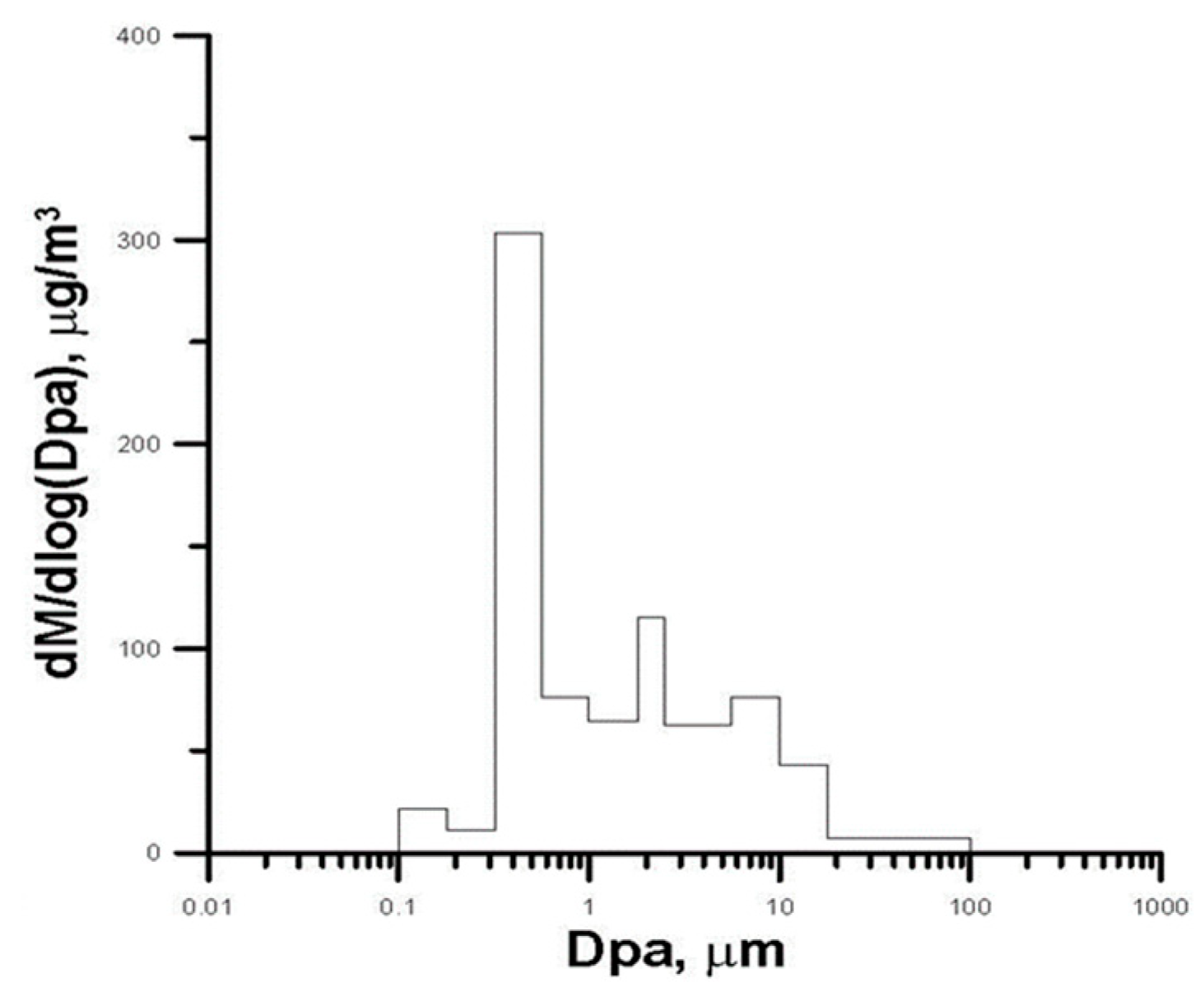
The experimental setup was adapted from the methodology described by Luo et al. [16]. As illustrated in Figure 1, a closed chamber (194 cm L × 200 cm W × 218 cm H) was utilized to simulate an indoor environment with a controlled wind velocity of 1.3 m/s. Environmental conditions were maintained at a temperature of 21 ± 3 °C and a relative humidity of 50 ± 3%. The test aerosol was generated using a mixture of SiO2 powder, a 20% (v/v) ethanol solution, and Hoechst 33258 fluorescent dye (Aldrich Inc. (Sigma-Aldrich, St. Louis, MO, USA)). A nebulizer dispersed the mixture to produce aerosols with a count median diameter (CMD) of 0.15 μm (Figure 2). Particle concentrations, monitored via a portable aerosol spectrometer (Model 1.109, Grimm Aerosol Technik (Model 1.109, Grimm Aerosol Technik, Ainring, Germany)), ranged from 105 to 106 particles/cm3. A minimum stabilization period of 4 h was observed prior to each exposure-and-leakage test to ensure steady temperature and humidity levels.

2.2. Test Subjects and Nursing-Specific Protocol

In contrast to previous studies that predominantly featured standard male subjects, this study specifically recruited two female volunteers to evaluate the impact of body morphology on the interface airtightness of protective clothing. To control for confounding variables, both subjects had an identical height of 160 cm but differed in body composition, specifically regarding chest circumference.
Subject A (48 kg) represented a fuller figure with a chest circumference of 34 inches, whereas Subject B (46 kg) presented a slenderer frame with a chest circumference of 32 inches. This specific anthropometric distinction was selected to investigate how variations in body shape—particularly at the chest area—influence the “pumping effect” and the integrity of critical interfaces, such as the zipper closure and neckline, during dynamic nursing movements.
All subjects donned ISO-compliant Tyvek one-piece coveralls over a standard black cotton base layer, which served as the deposition substrate for the fluorescent tracer. To accurately simulate occupational exposure risks in clinical settings, a Nursing-Specific Action Sequence was developed, deviating from standard ISO movement protocols. Subjects performed a defined series of eleven tasks within the aerosol-filled chamber to induce the pumping effect:
  • Patient Transporting: Bending forward at 45° with hands pulling upward and moving back and forth.
  • Cardiopulmonary Resuscitation (CPR): Bending at 45° and applying a vertical downward force to simulate chest compressions.
  • Oxygen Administration: Maintaining an upright torso while moving hands laterally.
  • Changing IV Drips: Extending both arms vertically upward.
  • Medication Administration: Raising hands to eye level.
  • Suctioning: Bending at 45° and reaching hands forward.
  • Drainage Cleaning: Squatting fully and simulating a dumping motion.
  • Bed Crank Operation: Bending at 90° and simulating a rotational cranking motion.
  • Turning Patient: Bending at 45° and applying lateral force to the left and right.
  • Percussion: Bending at 45°, using one hand for support while the other performs a patting motion.
  • Assisted Ambulation: Bending at 45°, simulating patient support while walking.
To comprehensively address anthropometric variations, detailed body composition measurements were recorded for the two female volunteers, Subject A and B (Table 1). Although their absolute body weights were similar (48 kg and 46 kg), their body profiles exhibited significant differences, particularly in the abdominal and waist regions. Furthermore, to analyze the interaction between body morphology and clothing fit, the sizing specifications of the three tested protective clothing brands (Brand K, M, and T) were documented (Table 2). This specific anthropometric distinction was selected to investigate how variations in body shape influence the localized “bellows effect” and the integrity of critical interfaces, such as the zipper closure and neckline, during dynamic nursing movements.
To ensure statistical reliability and capture the dynamic variability of the pumping effect, a rigorous repeated-measures design was implemented. For each experimental condition—defined by a specific protective clothing brand (Brand K, M, and T) and a targeted exposure duration (2 min or 5 min)—each subject independently performed the aforementioned 11-step nursing protocol for five replicate trials (N = 5). Following each independent trial, aerosol leakage mass concentrations were extracted from five distinct anatomical regions (neck, chest, abdomen, back, and hands), yielding 25 discrete data points per subject per condition. These independent observations served as the foundation for all subsequent standard deviation calculations and parametric statistical analyses.

2.3. Image Acquisition System

Upon completion of the exposure protocol, subjects underwent a controlled doffing procedure and proceeded immediately to a darkroom for whole-body imaging. High-resolution fluorescence photography was conducted using a digital single-lens reflex (DSLR) camera (Nikon D3000, Nikon Corporation, Tokyo, Japan) paired with a 50 mm prime lens (AF NIKKOR F1.8D, Nikon Corporation). Illumination was provided by four 365 nm ultraviolet (UV) light sources positioned to minimize shadowing. Camera parameters were standardized at an aperture of f/2.0, an ISO sensitivity of 800, and a shutter speed of 1/60 s to maintain consistent exposure levels. Crucially, to establish a reliable quantitative relationship between fluorescence intensity and aerosol mass, a standard color calibration chart (Gretag Macbeth ColorChecker) was imaged prior to each session. This step allowed for the normalization of white balance and color response across all datasets, eliminating potential artifacts arising from sensor variations or ambient light fluctuations.

2.4. Quantification of Fluorescent Aerosol via Entropy-Based Image Analysis

The quantification of fluorescent aerosol leakage is fundamentally established on the photometric principle that the total mass of the deposited fluorophore is proportional to its Integrated Optical Density (IOD) within the digital imagery. As described by Waters (2009), the accuracy of such quantitative fluorescence microscopy relies critically on the precise segmentation of the signal from the background [19]. Conventional fixed-threshold methods are often insufficient due to uneven illumination and sensor noise, leading to significant errors in estimating the effective leakage area (A) and intensity (I). To address this uncertainty and ensure statistical objectivity, this study employed the maximum entropy thresholding algorithm proposed by Kapur, Sahoo, and Wong (1985) [20]. This method treats the image histogram as a probability distribution and selects an optimal threshold (sopt) that maximizes the information content retained in both the foreground and background classes [20].
Let the acquired fluorescence image contain N pixels with gray levels ranging from 0 to L − 1. The probability distribution of a specific gray level is normalized as pi = h(i)/N, where h(i) denotes the number of pixels having the gray level i (i.e., the histogram frequency).
For a candidate threshold, the cumulative probabilities for the object class ( ω 0 ) and the background class ( ω 1 ) are defined as:
ω 0 ( s ) = i = 0 s p i , ω 1 ( s ) = i = s + 1 L 1 p i
Based on the additivity of Shannon (1948)’s entropy concept [21], Kapur et al. (1985) derived the total entropy ϕ(s) as the summation of the individual class entropies [20]. To facilitate computational stability and theoretical rigor, the entropy functions are expressed in their expanded logarithmic forms:
H 0 ( s ) = i = 0 s p i ω 0 ln p i ω 0 = ln ( ω 0 ( s ) ) 1 ω 0 ( s ) i = 0 s p i ln p i
H 1 ( s ) = i = s + 1 L 1 p i ω 1 ln p i ω 1 = ln ( ω 1 ( s ) ) 1 ω 1 ( s ) i = s + 1 L 1 p i ln p i
The optimal threshold sopt is uniquely determined as the gray level that maximizes the total entropy, thereby achieving the optimal separation of information between the fluorescent aerosol spots and the substrate background:
s o p t = arg max 0 s < L 1 [ H 0 ( s ) + H 1 ( s ) ]
Upon determining sopt, a binary mask is generated to extract the morphological and photometric features. The calibrated leakage area (Acal) is calculated as the pixel count of the segmented region Ω, while the total fluorescence intensity (Itotal) is the summation of pixel intensities within Ω. Finally, to translate these image features into physical quantities, a regression model is established to correlate the entropy-optimized features with the ground-truth aerosol concentration (C):
C = f ( A c a l , I t o t a l ) α ( A c a l ) β ( I t o t a l ) γ
where α represents the empirical scaling coefficient, while β and γ are specific geometric and intensity parameters. Based on the strict linear calibration validated in Section 3.1, the admissible intervals for this specific experimental setup are constrained as follows: the intensity parameter γ = 1, and the geometric parameter β = 0 (since Itotal inherently accounts for the signal area). Therefore, the equation simplifies to a linear relationship (C = α × Itotal), where α is strictly a positive real number (α > 0) determined by the slope of the calibration curve. This approach ensures that the estimation of leakage concentration is robust against subjective bias and preserves the intrinsic information of the aerosol distribution.
Practically, the optimal threshold Sopt is applied to all raw UV photographs to segment the fluorescent spots from the dark cotton base layer. Subsequently, the functional relationship defined by C forms the theoretical basis for establishing the empirical linear calibration curve, which is detailed in Section 3.1. The complete computational procedure for this entropy-based image processing and leakage quantification is systematically summarized in Algorithm 1.
Algorithm 1: Entropy-Based Fluorescent Aerosol Quantification
Input: Acquired UV fluorescence image I
Output: Calibrated aerosol leakage concentration C
1:  Convert image I to grayscale with L intensity levels (0 to L − 1)
2:  Calculate total number of pixels N
3:  Compute image histogram h(i) for all i ∈ [0, L − 1]
4:  Compute probability distribution p[i] = h(i)/N
5:  Initialize max_entropy = −∞, s_opt = 0
6:  
7: //Step 1: Find optimal threshold s_opt maximizing total entropy
8:    FOR s = 0 to L−2 DO
9:       ω_0 = SUM(p[0] to p[s])
10:     ω_1 = SUM(p[s + 1] to p[L − 1])
11:     
12:     IF ω_0 == 0 OR ω_1 == 0 THEN CONTINUE//Avoid division by zero
13:     
14:     H_0 = ln(ω_0) − (1/ω_0) × SUM(p[i] × ln(p[i])) for i = 0 to s
15:     H_1 = ln(ω_1) − (1/ω_1) × SUM(p[i] × ln(p[i])) for i = s + 1 to L − 1
16:     total_entropy = H_0 + H_1
17:     
18:     IF total_entropy > max_entropy THEN
19:         max_entropy = total_entropy
20:         s_opt = s
21:     END IF
22: END FOR
23: 
24: //Step 2: Extract features and compute concentration
25: Initialize A_cal = 0, I_total = 0
26: FOR each pixel (x, y) in image I DO
27:      IF pixel_value(x, y) >= s_opt THEN
28:          A_cal = A_cal + 1
29:          I_total = I_total + pixel_value(x, y)
30:     END IF
31: END FOR
32: 
33: //Compute final mass concentration using empirical calibration coefficients
34: C = α × (A_cal)^β × (I_total)^γ
35: 
36: RETURN C

2.5. Leakage Calculation and Statistical Analysis

To account for anthropometric variations between subjects, the leakage mass was normalized by the individual’s Body Surface Area (BSA). The BSA (m2) was calculated using the Mosteller formula [22]:
B S A = H × W 3600
where H represents body height (cm) and W represents body weight (kg). Unlike the dimensionless leakage ratio (Lr)based solely on area in previous studies, this study defines the Leakage Mass Concentration (Mleak) to quantify the actual mass of aerosol penetration per unit area. The total leakage mass (mtotal, μg) within a specific anatomical region (e.g., neck, chest) is derived by integrating the calibrated fluorescence intensity values. The final leakage concentration is expressed as:
M l e a k = m t o t a l A r e g i o n
where Aregion is the surface area of the specific body part derived from the anthropometric data. This normalized metric, Mleak, serves as the primary quantitative indicator for evaluating barrier performance. It is the core value reported in the Results section (Section 3.2, Section 3.3 and Section 3.4) and utilized for all subsequent statistical comparisons and graphical representations.
Comparative analyses were performed to evaluate the differences in leakage concentrations among three distinct protective clothing models (Brands K, M, and T) and between exposure durations (2 min vs. 5 min). Given the proof-of-concept nature of this study, data analysis was conducted using a purely descriptive statistical framework. For each specific test condition, the 5 independent trials served as technical replicates. These replicates were essential to rigorously quantify intra-individual measurement error and capture the dynamic physical variability of the protective clothing during the simulated tasks. The quantitative aerosol leakage mass concentrations (C) extracted from the image processing algorithm were compiled and analyzed using Microsoft Excel. Results are expressed as descriptive statistics, specifically the Mean Standard Deviation, focusing on observable trends in mean accumulation and critical fluctuations in standard deviation to evaluate failure mechanisms.

3. Results

3.1. Calibration and Validation of the Quantification Model

To establish a robust quantitative relationship between the fluorescence intensity captured by the imaging system and the actual mass of the aerosol deposited, a calibration experiment was conducted prior to the leakage trials. In contrast to previous studies that utilized human skin as the reference substrate, which may introduce variability due to differences in skin tone, texture, and background fluorescence, this study employed a standardized artificial skin surrogate (synthetic skin) to minimize background noise and ensure optical consistency.
Fluorescent solutions of Hoechst 33258 were prepared at five distinct known mass concentration levels (ranging from 0.1 to 10.0 μg/cm2). Fixed volumes of these solutions were uniformly applied to defined areas (1 cm2) on the artificial skin surface. After the samples were completely dried, they were imaged using the exact same acquisition parameters (ISO 800, aperture f/2.0, shutter speed 1/60 s) and lighting conditions (365 nm UV) as the actual exposure tests.
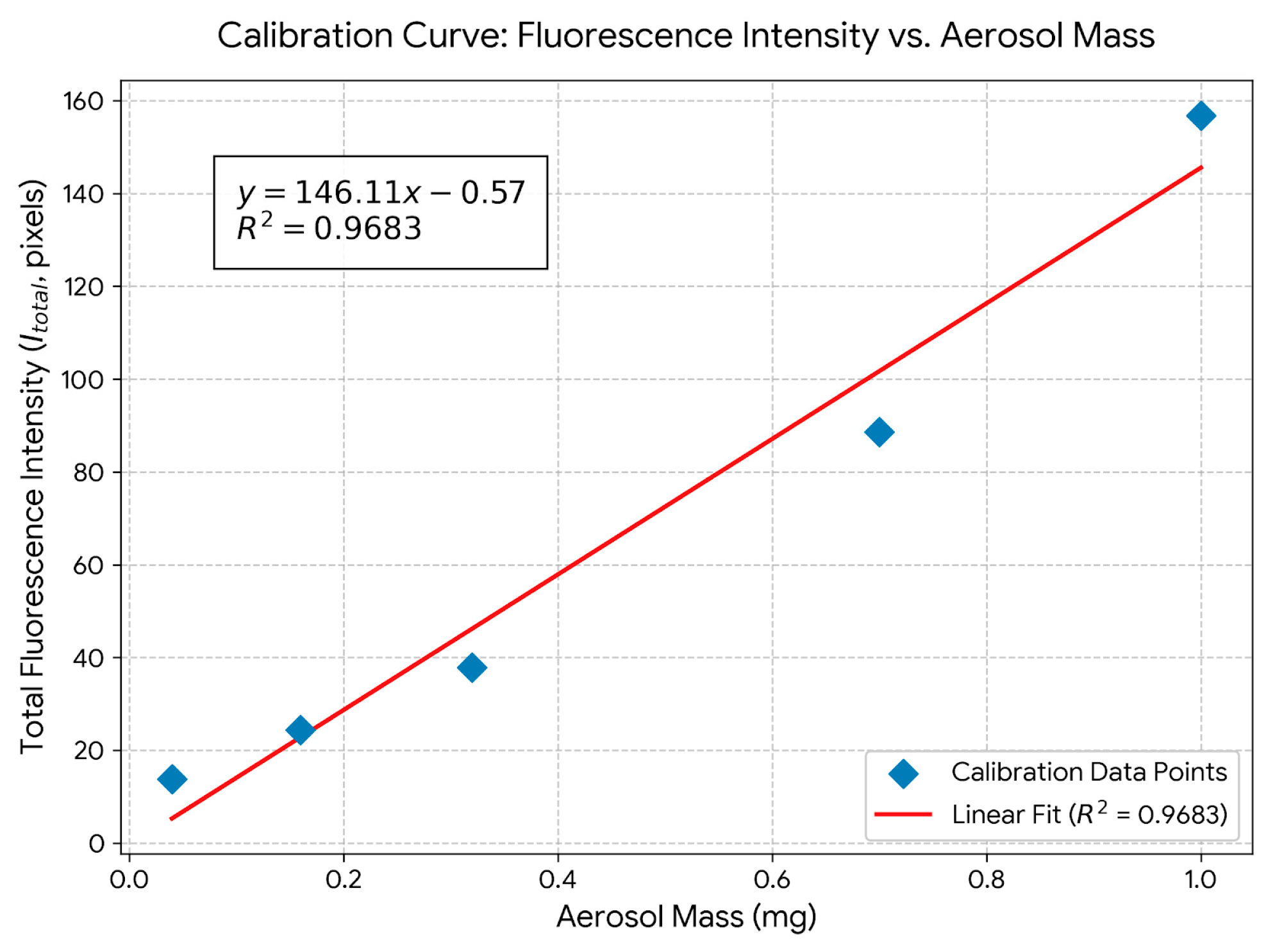
The captured images were processed using the entropy-based thresholding algorithm to extract the total integrated fluorescence intensity (Itotal). A linear regression analysis was performed to correlate the integrated intensity with the known deposited mass (M), as depicted in Figure 3. The analysis revealed a highly significant linear relationship between the fluorescence signal and the aerosol mass, yielding a coefficient of determination (R2) of 0.9683 (p < 0.001). This high linearity confirms that the proposed image analysis method can accurately convert the optical signals observed on the protective clothing interfaces into physical mass concentrations (μg/cm2), providing a validated basis for the subsequent leakage assessments.

3.2. Spatial Distribution of Aerosol Leakage

To provide a comprehensive overview of the foundational data utilized for the subsequent statistical analyses, the detailed descriptive statistics—including the mean leakage mass concentrations and standard deviations across all tested body regions, protective clothing models, and exposure durations—are systematically summarized in Table 3.
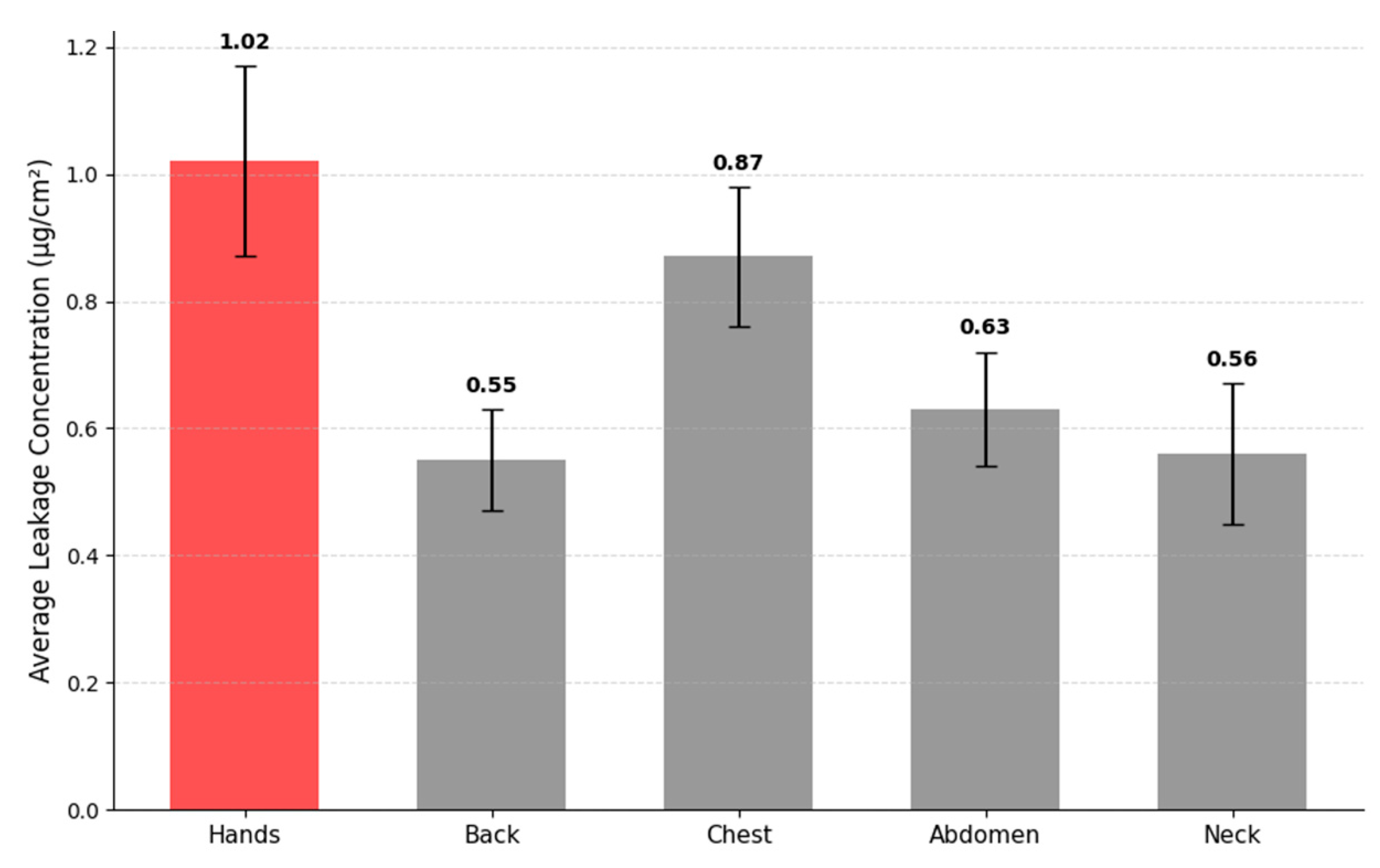
The spatial distribution of fluorescent aerosol leakage was systematically analyzed to identify critical zones of vulnerability across the protective clothing ensemble. Figure 4 illustrates the average leakage mass concentration for each anatomical region, aggregated across all brands, exposure durations, and test subjects.
Descriptive analysis demonstrated a substantial variation in barrier performance across different body parts. A direct comparison of the descriptive statistics further revealed that the hands (wrists) exhibited the highest susceptibility to aerosol penetration, with an average leakage concentration of 1.02 ± 0.15 μg/cm2. This value was substantially higher than that of the back (0.55 ± 0.08 μg/cm2) and neck (0.56 ± 0.11 μg/cm2). This finding quantitatively underscores the critical vulnerability of the sleeve–glove interface, which is frequently compromised by the repetitive upper-extremity movements inherent in nursing tasks, leading to interface separation.
Following the hands, the chest (0.87 ± 0.11 μg/cm2) and abdomen (0.63 ± 0.09 μg/cm2) regions showed moderate leakage levels. This accumulation likely results from the “bellows effect” acting on the zipper closures and front seams during bending and patient-handling maneuvers, which creates transient negative pressure that draws aerosols inward. Conversely, the back and neck regions demonstrated the lowest overall leakage concentrations in the aggregated data, suggesting that, on average, the posterior and superior interfaces maintain a relatively more stable seal compared to the extremities and frontal closures.

3.3. Impact of Exposure Duration on Pumping Effect

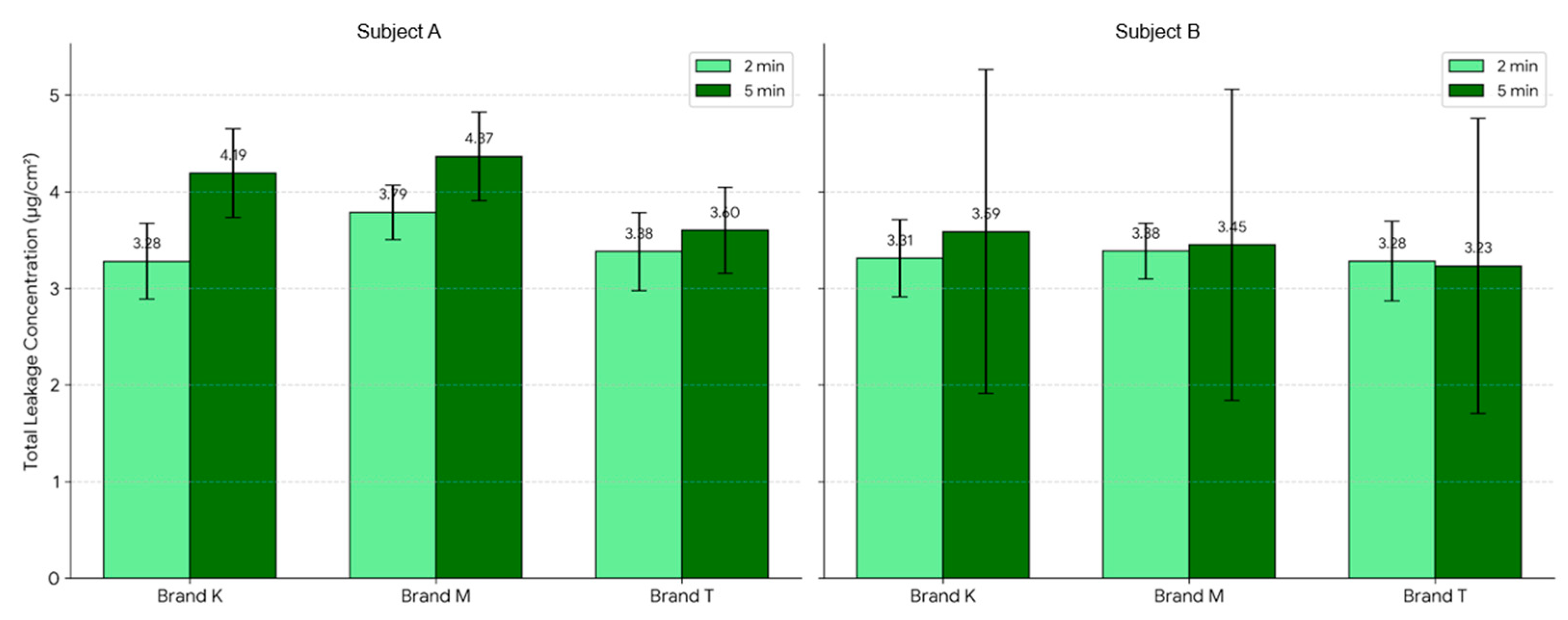
To evaluate the cumulative nature of the pumping effect, the total leakage concentrations were analyzed separately for each subject across 2 min and 5 min exposure trials. The results, as detailed in Figure 5, reveal distinct temporal patterns driven by body morphology.
Overall, descriptive analysis confirmed a notable main effect of time, validating that aerosol ingress is a time-dependent process. However, the manifestation of this effect varied by subject.
Subject A (Fuller Figure) exhibited a classic cumulative pumping effect. The total leakage mass increased consistently across all protective clothing models as exposure extended from 2 to 5 min. Specifically, Brand K showed a marked increase from 3.29 ± 0.39 μg/cm2 to 4.19 ± 0.46 μg/cm2, and Brand M from 3.79 ± 0.28 μg/cm2 to 4.37 ± 0.46 μg/cm2. This steady accumulation suggests that for fuller body types, the pumping mechanism operates continuously, progressively drawing aerosols into the microenvironment.
In contrast, Subject B (Slender Figure) demonstrated a different failure mode characterized by instability rather than steady accumulation. While the mean leakage values for Subject B did not increase as drastically as Subject A (e.g., Brand T remained relatively constant around 3.2–3.3 μg/cm2, the variability of the leakage surged significantly during the 5 min trials. For instance, the standard deviation for Brand K escalated from 0.40 (2 min) to 1.68 (5 min), and similarly for Brand M (from 0.29 to 1.61). This dramatic increase in standard deviation indicates that for slender individuals, extended physical activity causes the looser-fitting protective suit to become structurally unstable, leading to unpredictable fluctuations in barrier performance—likely oscillating between effective sealing and significant gaping events.

3.4. Interaction Between Body Morphology and Clothing Design

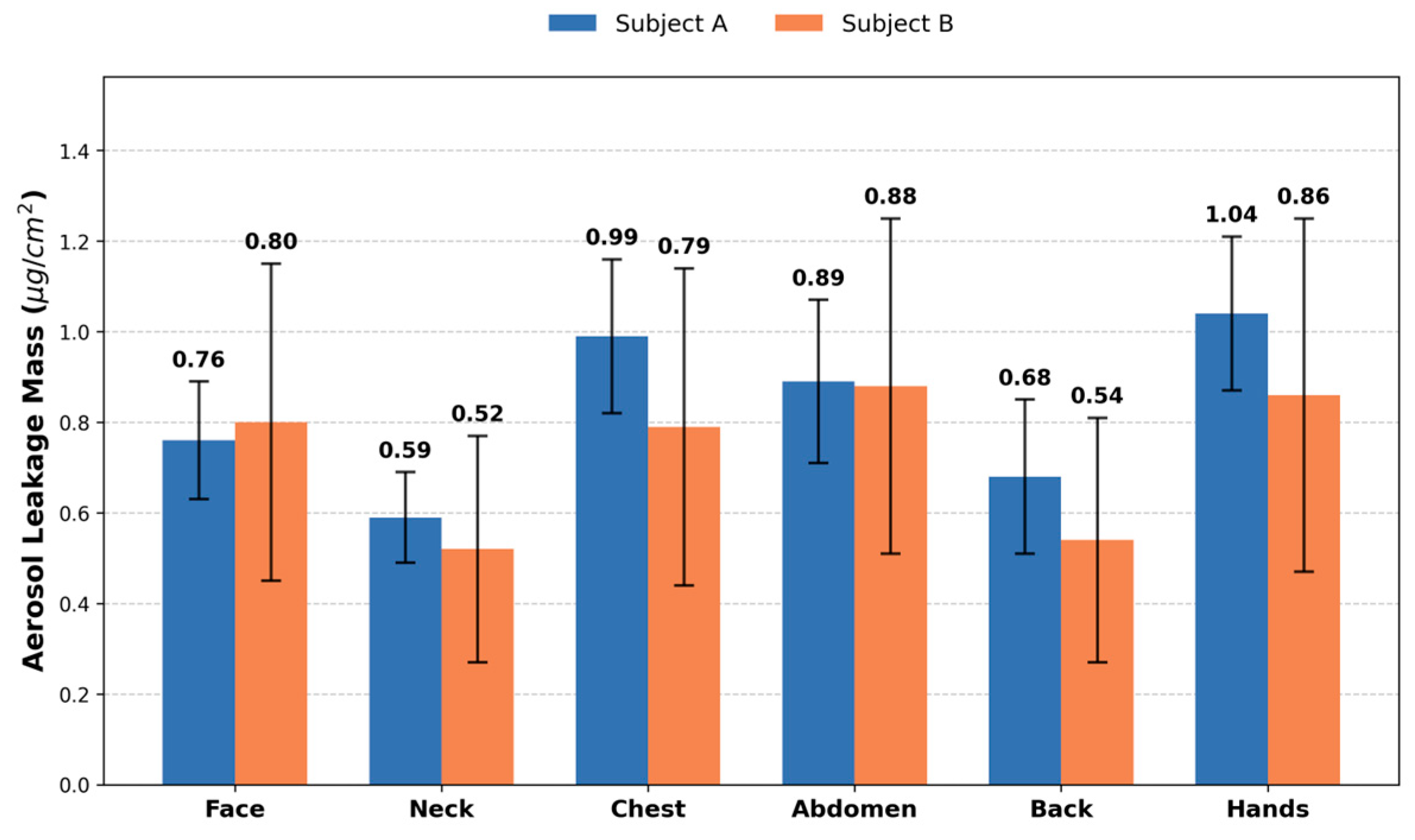
To evaluate the temporal dynamics of aerosol ingress, the leakage mass was compared between the 2 min and 5 min dynamic exposure intervals. As anticipated, extending the exposure duration generally resulted in an increased total leakage mass across most tested conditions. However, a detailed examination of the descriptive statistics (Table 3) and the visual representation in Figure 6 reveals distinctly different failure mechanisms between the two subjects over time. It should be noted that the total leakage mass discussed herein is calculated as the sum of all body regions, excluding the face, to accurately reflect the barrier performance of the protective suit ensemble itself.
For Subject A, the temporal failure mode was characterized by consistent “Steady Accumulation.” As exposure time increased from 2 to 5 min, Subject A exhibited a steady rise in the total mean leakage mass across all protective clothing models. For instance, the total leakage for Brand K increased from 3.29 to 4.19 μg/cm2, and for Brand M, it increased from 3.79 to 4.37 μg/cm2. Crucially, as evidenced in Table 3, the standard deviations for Subject A remained relatively stable and constrained across all body parts despite the longer exposure. This statistical behavior indicates that the protective seal remained structurally intact and consistent, allowing aerosol to permeate at a steady, cumulative rate without sudden catastrophic failures.
Conversely, Subject B exhibited a distinct phenomenon characterized by “Structural Instability” and an erratic “Bellows Effect” over the extended exposure period. While Subject B’s increase in the total mean leakage mass from 2 to 5 min was less pronounced than Subject A’s (e.g., Brand K increasing from 3.31 to 3.59 μg/cm2), the standard deviation within the replicates surged dramatically. As detailed in Table 3 and highlighted by the extensive error bars in Figure 6, Subject B experienced a drastic inflation in standard deviation after 5 min, particularly in the looser-fitting suits. For example, when Subject B wore Brand K, the standard deviation at the abdomen surged from 0.11 at 2 min to 0.37 at 5 min, and the hands showed a similar standard deviation increase (standard deviation from 0.17 to 0.39). This drastic inflation in standard deviation strongly suggests that the looser-fitting suit did not merely leak steadily; rather, the excess fabric shifted erratically during extended dynamic movements, creating an inconsistent and unstable internal pumping mechanism that resulted in highly variable aerosol ingress.

4. Discussion

4.1. Vulnerability of the Sleeve–Glove Interface

The results of this study unequivocally identified the hands (wrists) as the most critical zone of failure, exhibiting leakage concentrations markedly higher than the trunk or neck regions. This finding is consistent with the biomechanical demands of nursing tasks, but the magnitude of the leakage observed here suggests that standard protective protocols may be insufficient for high-mobility scenarios.
The high leakage at the wrists (>1.0 μg/cm2) can be attributed to the “piston effect” generated during upper-extremity movements. Unlike the torso, which remains relatively static, the wrists are subject to continuous flexion, extension, and rotation during patient handling. These complex kinematic motions create varying tension at the sleeve–glove interface, causing micro-gaps to form even when adhesive tape is applied. The statistical dominance of hand leakage in our data underscores that the current interface design fails to accommodate the dynamic range of motion required in healthcare settings, creating a primary pathway for pathogen ingress.

4.2. Temporal Dynamics and Morphology-Dependent Failure Modes

This study provides quantitative evidence for the time-dependent nature of the pumping effect, but crucially, it reveals that the mechanism of failure is dictated by body morphology and its interaction with clothing sizing. While the overall leakage increased with time, the underlying dynamics differed fundamentally between the subjects.
For Subject A, the failure mode was characterized by “Steady Accumulation”, as evidenced by the temporal increase shown in the descriptive data. The steady increase in leakage mass across all brands (e.g., Brand K rising from 3.28 to 4.19 μg/cm2) indicates that the protective seal remained structurally intact but permeable. As the subject moved, the pumping mechanism operated continuously and rhythmically, progressively drawing aerosols into the microenvironment in a predictable manner.
In sharp contrast, Subject B exhibited a failure mode of “Structural Instability.” The dramatic surge in standard deviation after 5 min—for example, Subject B’s standard deviation at the abdomen increasing from 0.11 to 0.37 and at the hands from 0.17 to 0.39 when wearing Brand K (Table 3)—suggests that the looser-fitting suit did not just leak; it became structurally unstable. As detailed in Table 2, Brand K is designed for a chest circumference of 96–104 cm, which vastly exceeds Subject B’s chest circumference of 81.8 cm. This significant sizing mismatch created excessive internal void space. Extended physical activity likely caused the excess fabric to shift erratically, leading to unpredictable fluctuations in barrier performance—oscillating between effective sealing and severe gaping events.

4.3. Anthropometric Incompatibility and Location-Specific Failure

The Subject × Location interaction observed in this study challenges the efficacy of “one-size-fits-all” PPE designs. Our data revealed two distinct location-specific failure pathways driven by anthropometric incompatibility:
  • The “Chimney Effect” in Subject B: Subject B experienced significantly higher leakage at the neck (0.66 μg/cm2). As indicated by the anthropometric data (Table 1), Subject B has a smaller neck circumference (28.4 cm), creating a looser seal around the standard collar. During movement, warm air rising from the body escapes through this collar gap, creating a negative pressure differential that actively draws external aerosols in—a phenomenon exacerbated by the lack of adjustable closures.
  • Enhanced “Localized Bellows Effect” in Subject A: Conversely, Subject A exhibited elevated leakage at the abdomen. Based on the detailed anthropometric data (Table 1), Subject A has a significantly larger abdominal circumference compared to Subject B (77.2 cm vs. 66.3 cm). During torso flexion tasks (e.g., CPR, bending to turn a patient), the prominent abdominal profile causes more pronounced fabric squeezing and deep folding. Rather than mechanical tension pulling the zipper open, this repeated folding creates a strong localized “bellows effect.” The dynamic compression and expansion of the internal volume aggressively pump external aerosols inward through the inherent micro-gaps of the zipper structure, leading to higher aerosol accumulation in the abdominal region.
These findings argue strongly for the implementation of anthropometrically adaptable designs or multi-sized procurement strategies to ensure uniform protection across a diverse workforce.

4.4. Methodological Validity and Limitations

The successful calibration of the quantification system (R2 = 0.9683) using an artificial skin surrogate validates the proposed methodology as a robust alternative to human-subject testing. By eliminating the confounding variables of skin autofluorescence and texture, this method allows for the detection of trace-level leakage that might otherwise be obscured by background noise.
However, this study has limitations. First, the sample size was limited to two subjects; while sufficient to demonstrate biomechanical mechanisms, larger cohorts are needed to generalize the anthropometric findings. Second, the use of fluorescent tracers, while precise, represents a worst-case scenario (aerosol) and may not perfectly mimic liquid splash behavior. Future research should focus on developing dynamic fit-testing protocols that incorporate real-time monitoring to detect the exact moment of barrier breach. Third, regarding the calibration methodology, while the 5-point standard curve effectively established a robust linear relationship (R2 = 0.9683) suitable for this proof-of-concept, the relatively small number of calibration points may introduce minor interpolation standard deviation. Future developments of this quantitative method should incorporate a higher density of concentration gradients to further refine the optical resolution and maximize precision.

5. Conclusions

The primary contribution of this study is the validation of a robust quantitative methodology for mapping aerosol ingress pathways in protective clothing. By employing a standardized artificial skin surrogate, this research successfully established a precise and reproducible protocol that overcomes the limitations of traditional qualitative visual inspections, enabling the detection of trace-level leakage dynamics.
Applying this methodology revealed three critical insights into barrier performance. First, the study identified the hands (wrists) as the most vulnerable interface across all protective ensembles. The leakage in this region was consistently driven by the “piston effect” during dynamic upper-extremity movements, highlighting a fundamental design deficiency in current sleeve–glove interfaces. Second, the “pumping effect” was confirmed to be cumulative; as exposure duration extends, the protective seal progressively degrades, drawing aerosols into the microenvironment.
Third, and perhaps most significantly, the study uncovered that failure modes are dictated by body morphology. Fuller figures tend to experience a steady accumulation of leakage due to mechanical tension on zippers and seams, whereas slender figures face structural instability. This instability manifests as unpredictable surges in leakage variability, particularly at the neck region, driven by the “chimney effect” where loose-fitting allows active aerosol intake.
These findings suggest a necessary paradigm shift in occupational safety standards, moving from binary “pass/fail” testing to quantitative, mass-based assessments. The results argue strongly against “one-size-fits-all” procurement strategies. To ensure uniform protection, future PPE protocols should prioritize anthropometric-based selection—specifically providing adjustable collar closures for slender workers and reinforced interfaces for fuller body types. Furthermore, manufacturers must urgently address the universal vulnerability of the wrist interface. Future research should leverage this quantitative logic to develop real-time sensing technologies, enabling the dynamic monitoring of barrier integrity in clinical settings.

Author Contributions

Conceptualization, S.Y.; methodology, C.-H.L. and S.Y.; software, C.-H.L.; validation, S.Y. and H.-C.H.; formal analysis, S.Y.; investigation, C.-H.L. and S.Y.; resources, C.-H.L. and S.Y.; data curation, C.-H.L. and S.Y.; writing—original draft preparation, S.Y.; writing—review and editing, S.Y.; visualization, S.Y. All authors have read and agreed to the published version of the manuscript.

Funding

This research was funded by the National Science and Technology Council (NSTC), Taiwan, under Grant No. 110-2221-E-432-002 -.

Institutional Review Board Statement

Ethical review and approval were waived for this study because it involved non-invasive performance testing of personal protective equipment (PPE) using standard occupational movements. The study employed non-toxic fluorescent tracers in a controlled environment and did not involve medical interventions, collection of sensitive personal data, or any risks beyond those encountered in daily professional nursing activities.

Informed Consent Statement

Informed consent was obtained from all subjects involved in the study. Written informed consent has been obtained from the subjects to publish this paper.

Data Availability Statement

The data presented in this study are available on request from the corresponding author. The data are not publicly available due to privacy and ethical restrictions related to the imagery of human subjects.

Conflicts of Interest

The authors declare no conflicts of interest.

References

  1. Casanova, L.; Alfano-Sobsey, E.; Rutala, W.A.; Weber, D.J.; Sobsey, M.D. Virus transfer from personal protective equipment to healthcare employees’ skin and clothing. Emerg. Infect. Dis. 2008, 14, 1291–1293. [Google Scholar] [CrossRef] [PubMed]
  2. Fischer, R.; Judson, S.; Miazgowicz, K.; Bushmaker, T.; Prescott, J.; Munster, V.J. Ebola virus stability on surfaces and in fluids in simulated Outbreak Environments. Emerg. Infect. Dis. 2015, 21, 1243–1246. [Google Scholar] [CrossRef] [PubMed]
  3. Verbeek, J.H.; Rajamaki, B.; Ijaz, S.; Sauni, R.; Toomey, E.; Blackwood, B.; Tikka, C.; Ruotsalainen, J.H.; Kilinc Balci, F.S. Personal protective equipment for preventing highly infectious diseases due to exposure to contaminated body fluids in healthcare staff. Cochrane Database Syst. Rev. 2020, 4, CD011621. [Google Scholar] [CrossRef] [PubMed]
  4. Cook, T.M. Personal protective equipment during the coronavirus disease (COVID) 2019 pandemic. Anaesthesia 2020, 75, 159–164. [Google Scholar] [CrossRef] [PubMed]
  5. Petsonk, E.L.; Harber, P. Respiratory protection for health care workers: A 2020 COVID-19 perspective. Am. J. Ind. Med. 2020, 63, 655–658. [Google Scholar] [CrossRef] [PubMed]
  6. MacIntyre, C.R.; Chughtai, A.A. A rapid systematic review of the efficacy of face masks and respirators against coronaviruses and other respiratory transmissible viruses for the community, healthcare workers and sick patients. Int. J. Nurs. Stud. 2020, 108, 103629. [Google Scholar] [CrossRef] [PubMed]
  7. Yu, S.J.; Kim, G.; Jung, H.; Jung, H.; Jung, J.; Kim, D. Dynamic swatch testing of liquid aerosols in a laboratory-sized recirculating wind tunnel. Sci. Rep. 2024, 14, 16539. [Google Scholar] [CrossRef] [PubMed]
  8. Ben Salah, M.; Hallé, S.; Tuduri, L. Efficiency of five chemical protective clothing materials against nano and submicron aerosols when submitted to mechanical deformations. J. Occup. Environ. Hyg. 2016, 13, 425–433. [Google Scholar] [CrossRef] [PubMed]
  9. ISO 13982-2:2004; Protective Clothing for Use against Solid Particulates—Part 2: Test Method of Determination of Inward Leakage of Aerosols into Suits. International Organization for Standardization (ISO): Geneva, Switzerland, 2004. Available online: https://www.iso.org/standard/35958.html (accessed on 19 March 2026).
  10. ASTM F2588-12; Standard Test Method for Man-In-Simulant Test (MIST) for Protective Ensembles. ASTM International: West Conshohocken, PA, USA, 2020. Available online: https://store.astm.org/f2588-12.html (accessed on 19 March 2026).
  11. Rengasamy, S.; Eimer, B.C.; Szalajda, J.V. A quantitative assessment of the total inward leakage of NaCl aerosol representing submicron-size bioaerosol through N95 filtering facepiece respirators and surgical masks. J. Occup. Environ. Hyg. 2014, 11, 388–396. [Google Scholar] [CrossRef] [PubMed]
  12. Espanhol-Soares, M.; Soares, A.R.; Machado-Neto, J.G. Procedures to evaluate the efficiency of protective clothing worn by operators applying pesticide. Ann. Occup. Hyg. 2013, 57, 1041–1051. [Google Scholar] [CrossRef] [PubMed]
  13. Ko, S.; Sung, K.; Oh, M.J.; Kim, Y.; Kim, M.J.; Lee, J.W.; Park, Y.S.; Kim, Y.H.; Hong, J.Y.; Lee, J.S. Enhanced Aerosol Containment Performance of a Negative Pressure Hood with an Aerodynamic Cap Design: Multi-Method Validation Using CFD, PAO Particles, and Microbial Testing. Bioengineering 2025, 12, 624. [Google Scholar] [CrossRef] [PubMed]
  14. Frankfort, M.G.H.; Lauwers, I.; Pruijn, E.M.C.; Dijkstra, S.F.; Boormans, L.H.G.; Schouten, N.A.; van Donkelaar, C.C.; Janssens, H.M. Minimizing Aerosol Leakage from Facemasks in the COVID-19 Pandemic. J. Aerosol Med. Pulm. Drug Deliv. 2023, 36, 101–111. [Google Scholar] [CrossRef] [PubMed]
  15. Guo, Y.P.; Li, Y.; Wong, P.L.H. Environment and body contamination: A comparison of two different removal methods in three types of personal protective clothing. Am. J. Infect. Control 2014, 42, e39–e45. [Google Scholar] [CrossRef] [PubMed]
  16. Luo, C.H.; Yang, S.; Wen, C.Y.; Syu, M.Y.; Lin, K.H.; Chiu, S.H.; Chang, C.P. Fluorescent aerosol leakage quantification for protective clothing with an entropy-based image processor for industrial and medical workers. J. Aerosol Sci. 2011, 42, 491–496. [Google Scholar] [CrossRef]
  17. NFPA 1971; Standard on Protective Ensembles for Structural Fire Fighting and Proximity Fire Fighting. National Fire Protection Association (NFPA): Quincy, MA, USA, 2018.
  18. Stull, J.O.; White, D.F. A review of overall integrity and material performance tests for the selection of chemical protective clothing. Am. Ind. Hyg. Assoc. J. 1992, 53, 455–462. [Google Scholar] [CrossRef]
  19. Waters, J.C. Accura and precision in quantitative fluorescence microscopy. J. Cell Biol. 2009, 185, 1135–1148. [Google Scholar] [CrossRef] [PubMed]
  20. Kapur, J.N.; Sahoo, P.K.; Wong, A.K.C. A new method for gray-level picture thresholding using the entropy of the histogram. Comput. Vision Graph. Image Process. 1985, 29, 273–285. [Google Scholar] [CrossRef]
  21. Shannon, C.E. A mathematical theory of communication. Bell Syst. Tech. J. 1948, 27, 379–423. [Google Scholar] [CrossRef]
  22. Mosteller, R.D. Simplified calculation of body-surface area. N. Engl. J. Med. 1987, 317, 1098. [Google Scholar] [CrossRef] [PubMed]
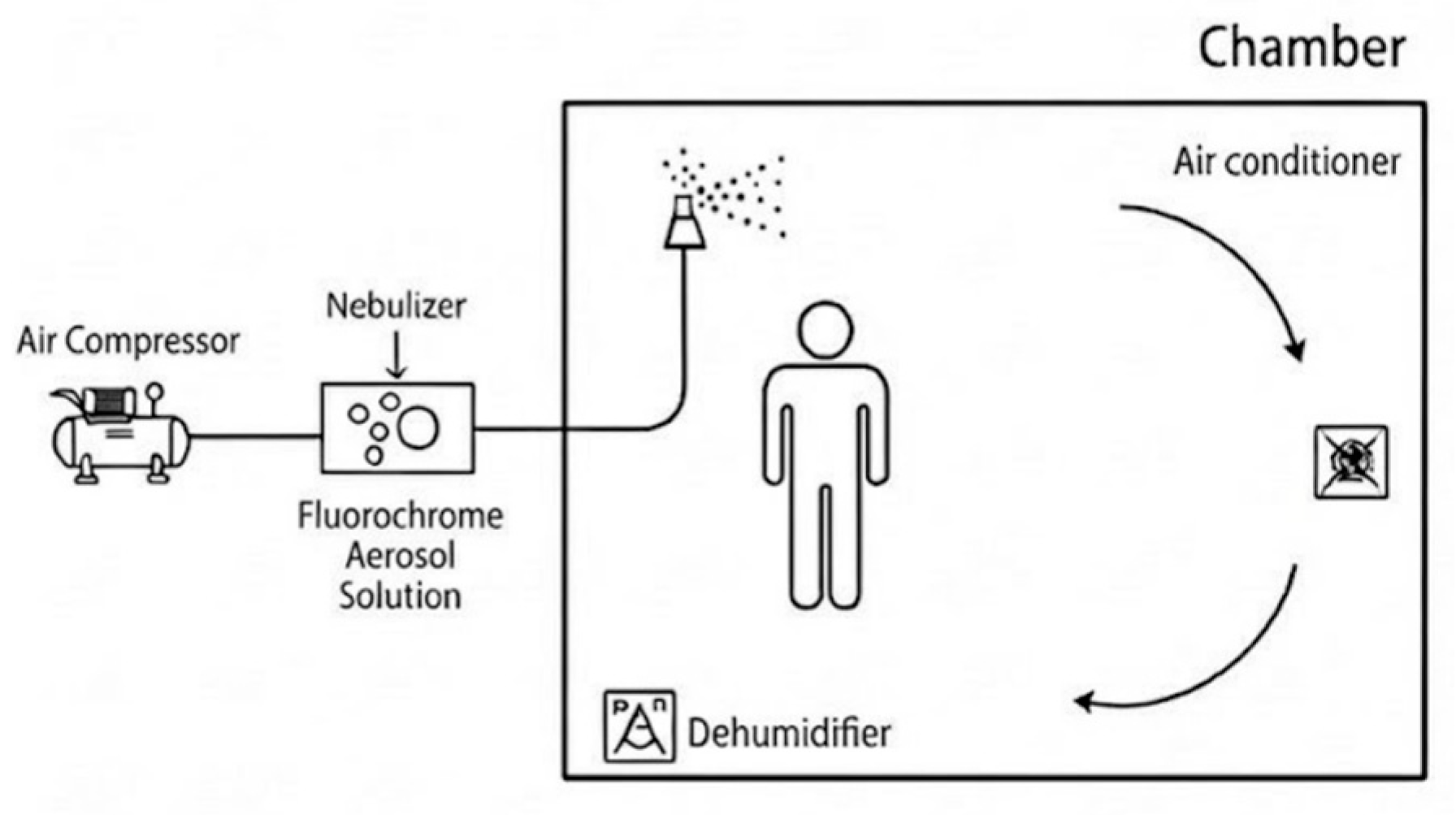
Figure 1. Exposure-and-leakage test setups.
Applsci 16 03104 g001
Figure 2. Fluorescence test aerosol size distribution.
Applsci 16 03104 g002
Figure 3. Calibration curve showing the linear relationship between fluorescence intensity and aerosol mass.
Applsci 16 03104 g003
Figure 4. Average leakage concentration by body part (Overall). The red bar highlights the anatomical region with the maximum leakage mass concentration.
Applsci 16 03104 g004
Figure 5. Total aerosol leakage by brand and exposure time (Per Subject).
Applsci 16 03104 g005
Figure 6. Interaction of body morphology and leakage location.
Applsci 16 03104 g006
Table 1. Anthropometric characteristics of the test subjects.
ParameterSubject ASubject B
Height (cm)162164
Weight (kg)4846
Body Surface Area (m2) 1.471.45
Chest Circumference (cm)86.681.8
Waist Circumference (cm)71.663.8
Abdominal Circumference (cm)77.266.3
Hip Circumference (cm)86.682
Neck Circumference (cm)30.728.4
Shoulder Width (cm)39.437.3
Wrist Circumference (cm)13.513
Table 2. Sizing specifications of the tested protective clothing.
BrandFit Height (cm)Fit Chest Circumference (cm)
Brand K164–17096–104
Brand M164–17084–92
Brand T162–17084–92
Table 3. Summary of experimental aerosol leakage mass concentrations (Mean ± standard deviation, μg/cm2) across all tested conditions (N = 5 replicates per condition).
BrandBody PartSubject ASubject B
2 Min (Mean ± Standard Deviation)5 Min (Mean ± Standard Deviation)2 Min (Mean ± Standard Deviation)5 Min (Mean ± Standard Deviation)
Brand KFace0.71 ± 0.110.76 ± 0.130.72 ± 0.110.80 ± 0.35
Neck0.38 ± 0.060.59 ± 0.100.66 ± 0.130.52 ± 0.25
Chest0.64 ± 0.110.99 ± 0.170.67 ± 0.110.79 ± 0.35
Abdomen0.69 ± 0.160.89 ± 0.180.58 ± 0.110.88 ± 0.37
Back0.56 ± 0.130.68 ± 0.170.56 ± 0.100.54 ± 0.27
Hands1.02 ± 0.201.04 ± 0.170.84 ± 0.170.86 ± 0.39
Brand MFace0.62 ± 0.100.72 ± 0.160.72 ± 0.150.70 ± 0.31
Neck0.58 ± 0.100.62 ± 0.100.81 ± 0.170.56 ± 0.20
Chest0.95 ± 0.231.00 ± 0.170.67 ± 0.120.72 ± 0.30
Abdomen0.65 ± 0.151.10 ± 0.190.61 ± 0.120.67 ± 0.28
Back0.58 ± 0.140.56 ± 0.130.40 ± 0.070.55 ± 0.20
Hands1.03 ± 0.221.09 ± 0.200.89 ± 0.180.95 ± 0.43
Brand TFace0.85 ± 0.160.80 ± 0.180.71 ± 0.180.71 ± 0.17
Neck0.25 ± 0.050.47 ± 0.120.74 ± 0.120.77 ± 0.16
Chest0.93 ± 0.230.97 ± 0.230.75 ± 0.130.77 ± 0.16
Abdomen0.53 ± 0.090.63 ± 0.100.46 ± 0.100.57 ± 0.14
Back0.60 ± 0.150.55 ± 0.140.48 ± 0.100.34 ± 0.05
Hands1.08 ± 0.250.98 ± 0.230.86 ± 0.140.78 ± 0.19
Disclaimer/Publisher’s Note: The statements, opinions and data contained in all publications are solely those of the individual author(s) and contributor(s) and not of MDPI and/or the editor(s). MDPI and/or the editor(s) disclaim responsibility for any injury to people or property resulting from any ideas, methods, instructions or products referred to in the content.