4.1. Experiment Configuration
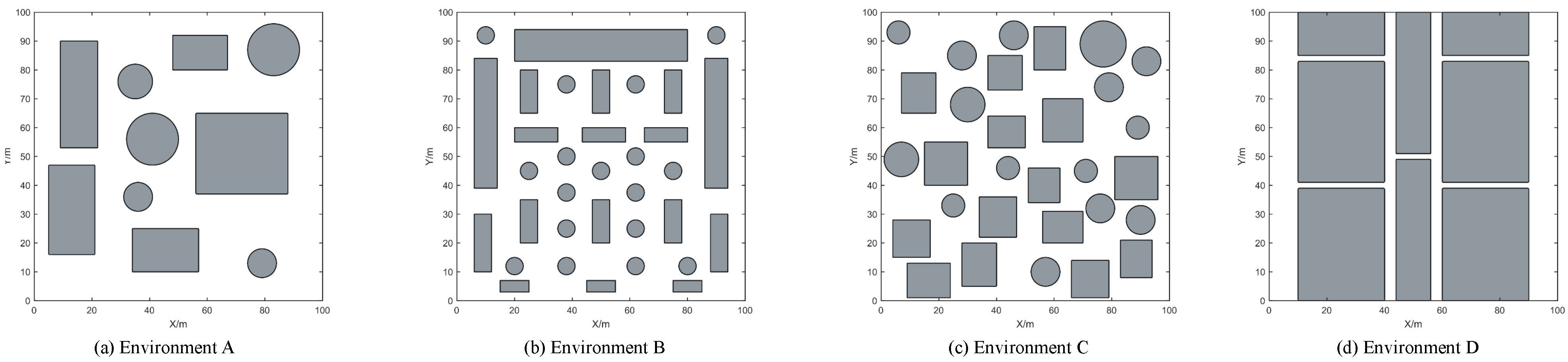
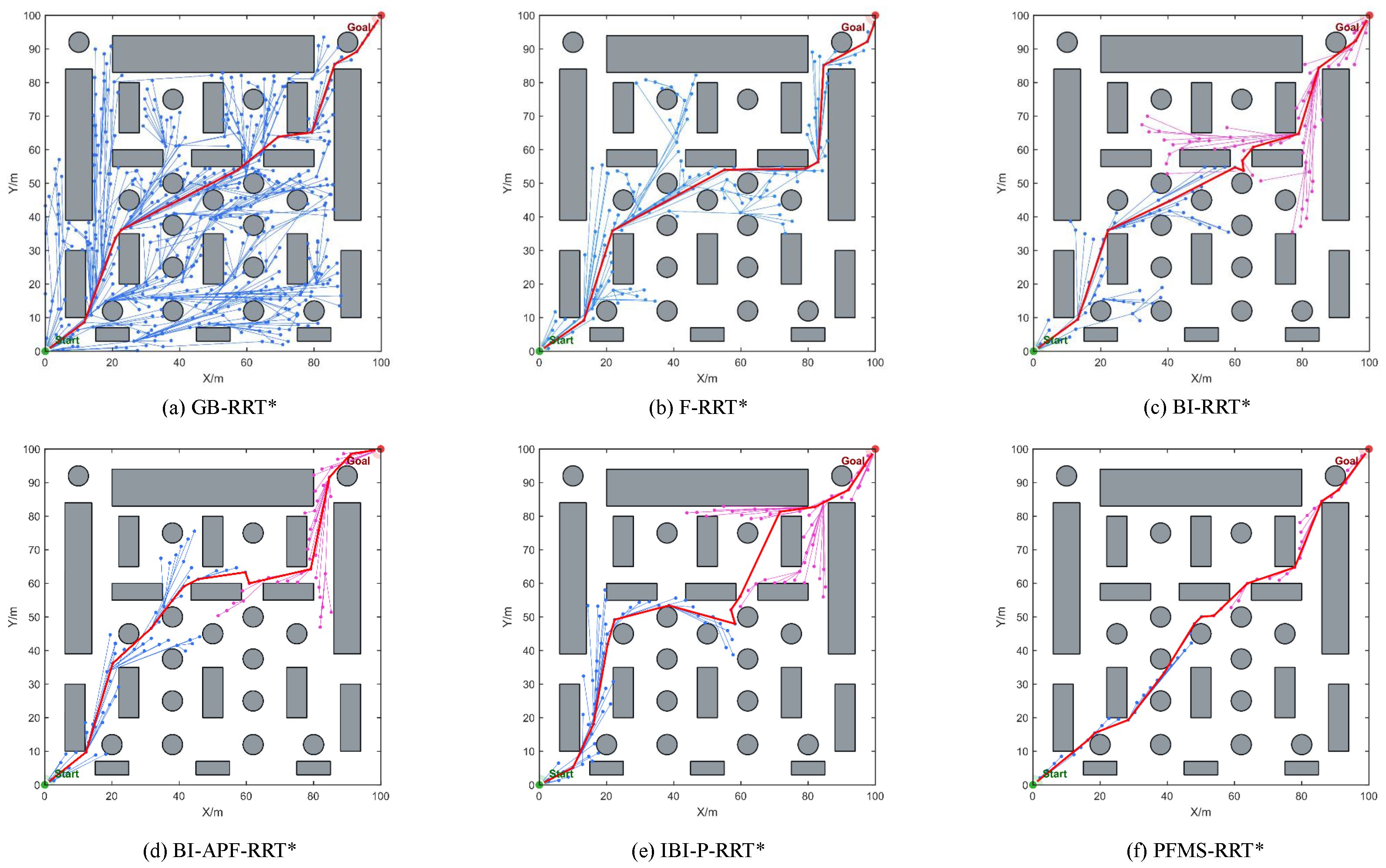
Four representative 2D obstacle environments are used in the experiments, as shown in
Figure 7a–d (Environment A–D).
Environment A (sparse mixed-obstacle scenario): the number of obstacles is relatively small, with rectangles and ellipses mixed in the workspace. The free space is largely open with a few local occlusions, and this scenario is mainly used to evaluate convergence speed and path quality under general obstacle distributions.
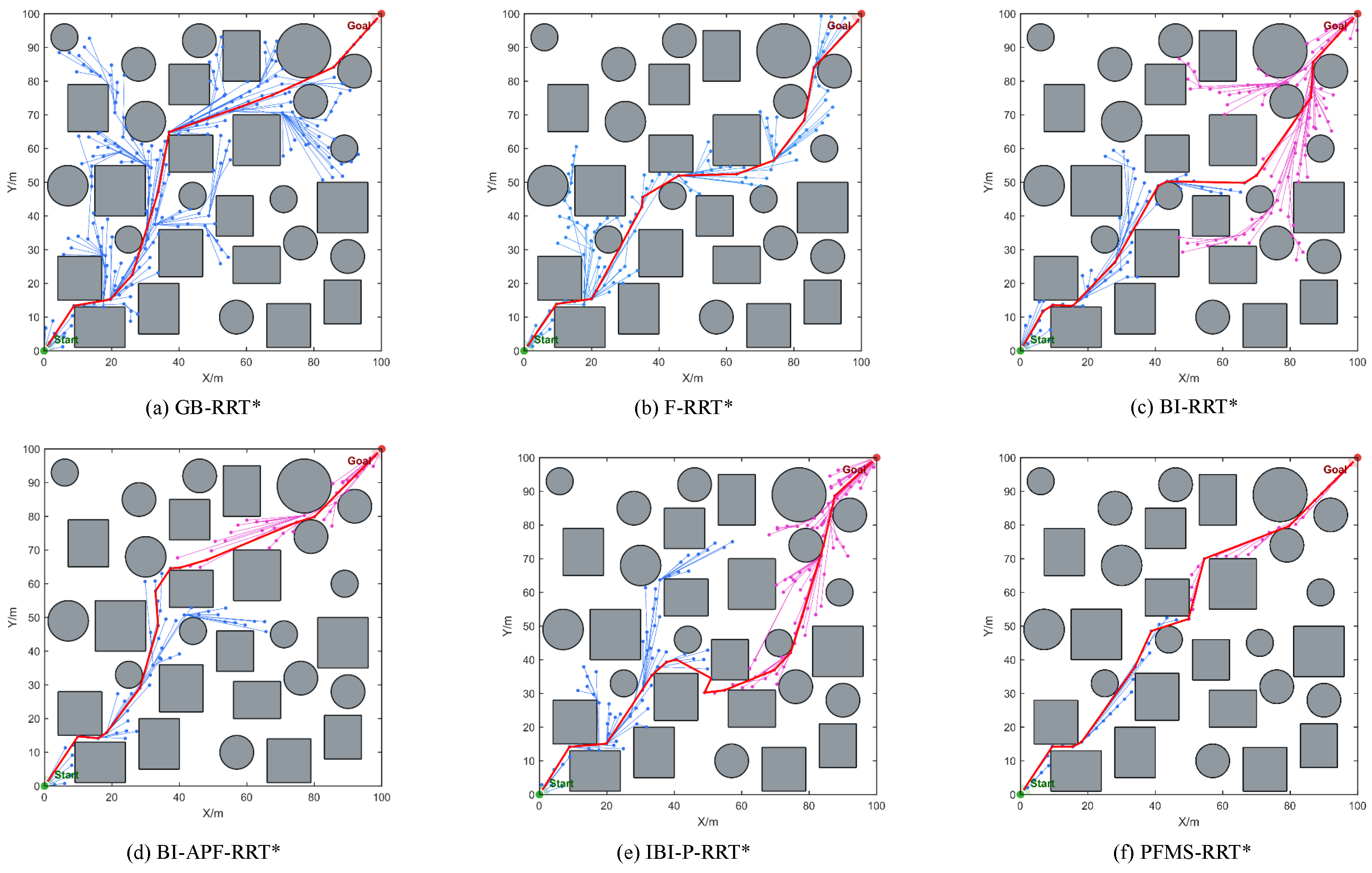
Environment B (structured corridor with dense small obstacles): The layout is highly structured, where long rectangular obstacles form boundary and corridor constraints along the top/bottom and sides, while many small elliptical obstacles are placed inside. This setting reflects dense obstacle interference and frequent collision checking, and is used to assess extension success rate and stability in cluttered environments.
Environment C (random dense mixed-obstacle scenario): Obstacles are more numerous and distributed more randomly, with rectangles and ellipses interleaved. The connectivity of the free space becomes more complex, often requiring detours through locally constrained regions, and this scenario is used to evaluate exploration capability and robust obstacle avoidance in unstructured complex environments.
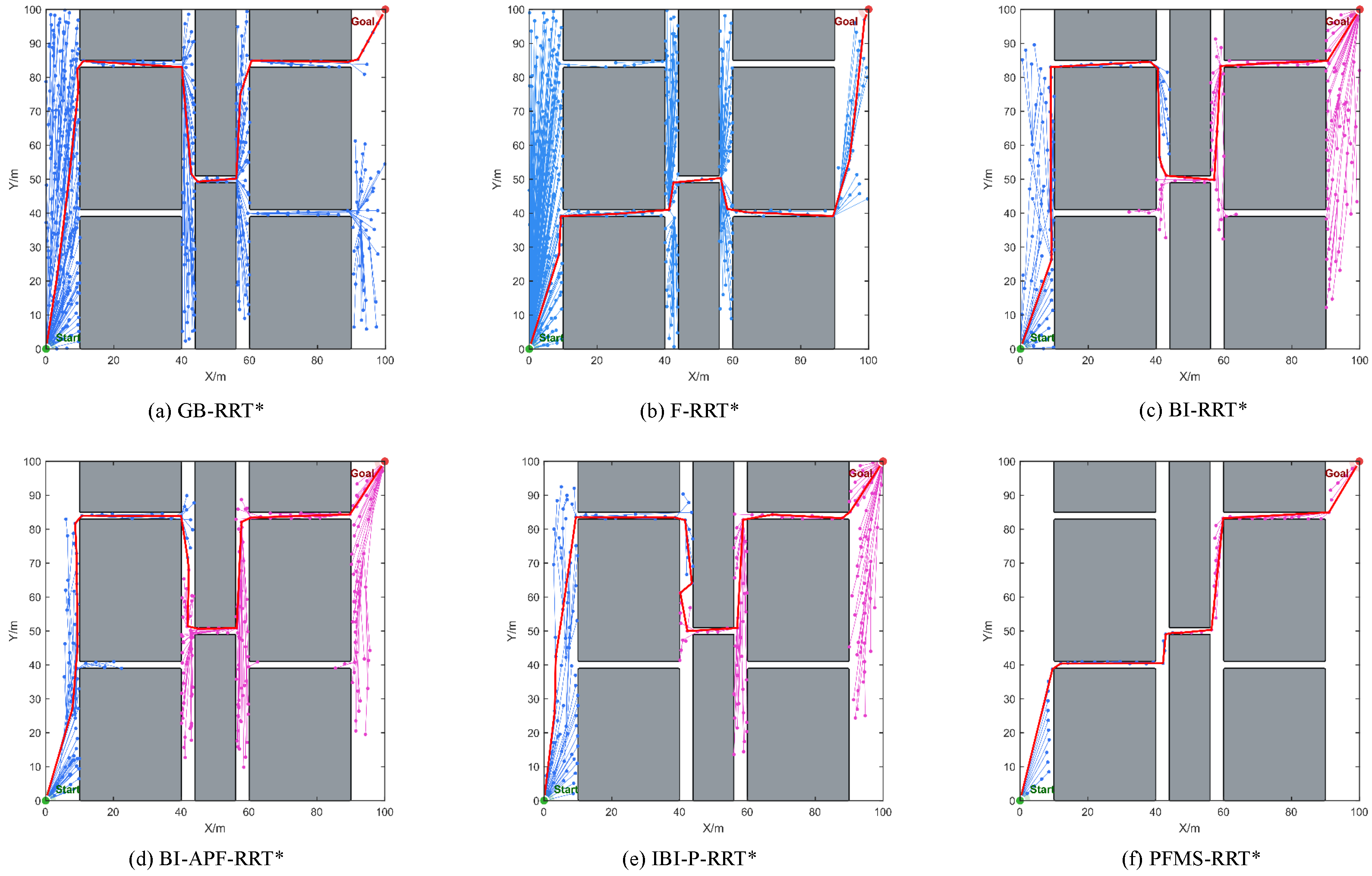
Environment D (narrow-passage scenario): Multiple large rectangular obstacles form a typical narrow-passage structure, leaving only a slender traversable corridor with local bottlenecks. This is a classic challenging scenario for testing whether the sampling and extension strategies can pass through narrow passages and avoid stagnation.
To ensure a fair comparison, all environments share the same map scale and coordinate setting: the planar workspace is a square with . Obstacles are represented by gray occupied regions, and the remaining area is free space for feasible sampling and tree expansion. The start and goal configurations are fixed for all environments as . The initial step size is set to 3. All algorithms were executed independently for 30 runs per environment, with a maximum iteration limit of 3000 for each algorithm.
4.2. Parameter Settings
As summarized in
Table 1, the key parameters of PFMS-RRT* were fixed across all experiments to ensure reproducibility and fair comparison. The step size
was set to balance exploration efficiency and local collision avoidance, while the stagnation threshold
and the amplification upper bound
were used to detect persistent lack of progress and to enlarge the elliptical sampling corridor in a controlled manner. The global-sampling increment
regulates how quickly the planner increases global exploration when stagnation occurs, preventing premature over-exploration while still enabling escape from difficult regions. The ellipse bounds
constrain the locally guided sampling region to avoid over-concentration or excessive expansion, thus maintaining both efficiency and robustness. For the weights for progress reward, look-ahead feasibility reward, lateral-shift penalty
,
, and
were set to fixed values (
,
,
), and then kept unchanged in all reported experiments. These values were chosen based on term scaling and intended behavior: the forward progress term
is typically on the order of the step size
, and the look-ahead feasibility reward is bounded by one step through
with
; therefore, setting
assigns comparable importance to promoting progress and preferring candidates that admit a feasible one-step continuation, while the distance-to-goal term
still provides global guidance. In contrast, a smaller lateral-shift penalty
discourages unnecessary detours without suppressing lateral motion, which is essential for escaping local dead-ends when direct steering is blocked. For the failure-driven switching mechanism, the decay rate
controls the sensitivity of the switching probability to consecutive failures, enabling an adaptive balance between goal-guided extension and APF-based extension. In the APF module, the gains
and influence radius
were chosen to provide stable obstacle avoidance and smooth boundary-following behavior without introducing excessive detours.
As summarized in
Table 2, for the compared baseline planners, we followed the parameter settings reported in their original papers to maintain consistency with prior work. In addition, common experimental settings such as the workspace bounds, termination conditions, and collision-checking procedures were kept the same for all methods, so that performance differences primarily reflect the algorithmic designs rather than parameter discrepancies.
4.4. Algorithm Performance Analysis
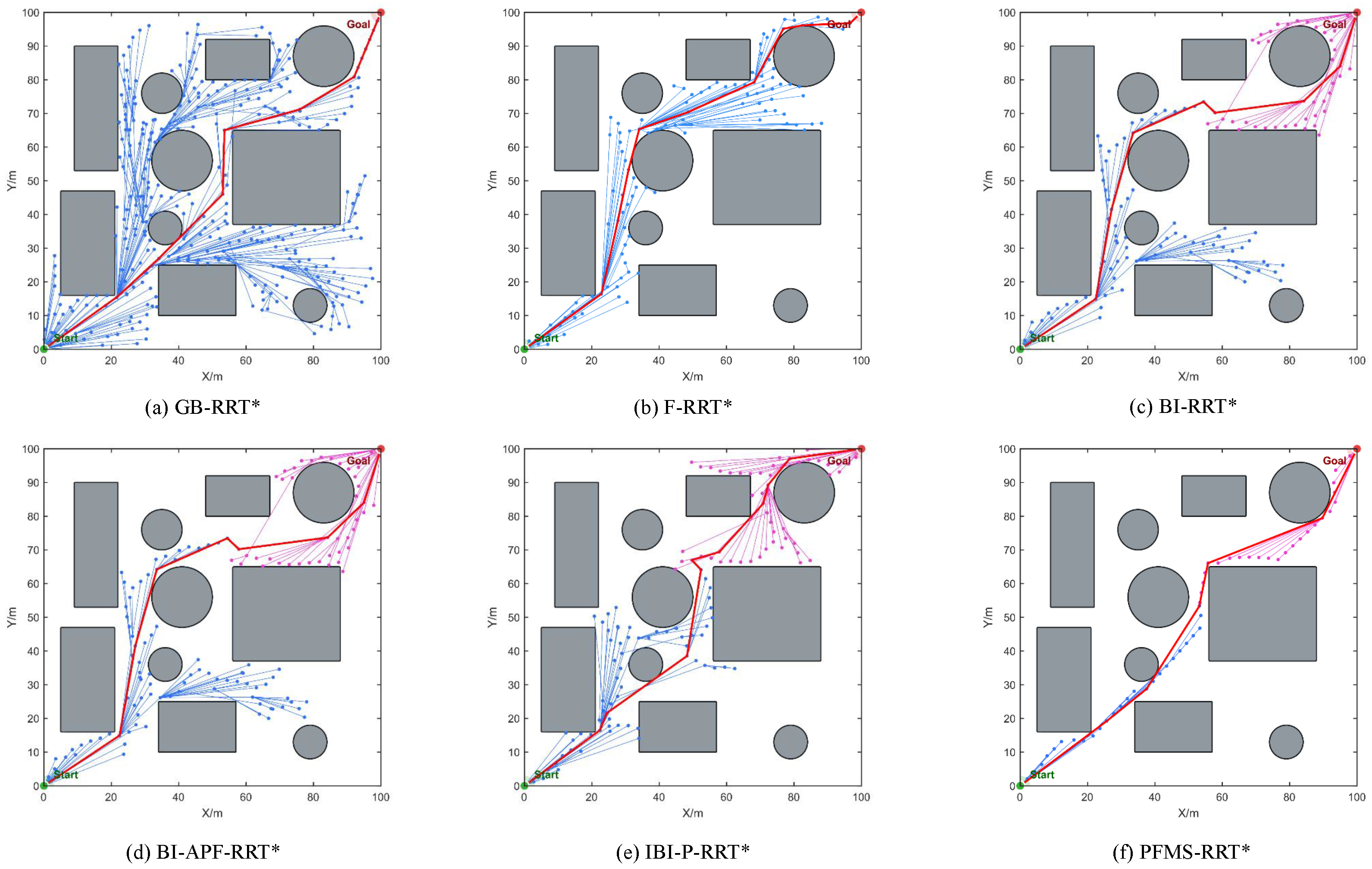
As shown in
Figure 8, in Environment A, all six path-planning algorithms are able to successfully find a collision-free feasible path from the start to the goal. The red curve denotes the final planned path, while the blue and pink curves indicate the bidirectional search trees expanded from the start and the goal, respectively. However, the differences mainly lie in sampling efficiency and path quality. For GB-RRT* and F-RRT*, the search trees are more dispersed and exhibit more ineffective expansions in the vicinity of obstacles, manifested by repeated growth of the blue and pink branches near obstacles with insufficient utilization of the truly traversable regions. This behavior leads to unnecessary detours and polyline-like corrections in the resulting path. In contrast, PFMS-RRT* concentrates its tree expansion in effective feasible regions, producing more coherent obstacle-avoidance expansions with fewer rollbacks, and thus generating a more compact and smoother path. This phenomenon is directly related to the proposed progress-aware fusion sampling strategy. As a result, ineffective sampling around obstacle neighborhoods and redundant nodes are significantly reduced, improving both convergence efficiency and path quality.
The quantitative results in
Table 3 further support the above observations. In Environment A, PFMS-RRT* achieves an average path length of
, an average runtime of
, an average node count of
, and an average minimum distance from path points to obstacles of
. Compared with BI-APF-RRT*, BI-RRT*, and IBI-P-RRT*, PFMS-RRT* reduces the path length by
,
, and
, respectively; compared with F-RRT* and GB-RRT*, the path length is reduced by
and
, respectively. In terms of efficiency, PFMS-RRT* decreases runtime by
,
,
,
, and
relative to BI-APF-RRT*, BI-RRT*, F-RRT*, GB-RRT*, and IBI-P-RRT*, respectively; meanwhile, the average node count is reduced by
,
,
,
, and
, respectively. Regarding safety, PFMS-RRT* improves the average minimum obstacle clearance by
,
,
,
, and
over BI-APF-RRT*, BI-RRT*, F-RRT*, GB-RRT*, and IBI-P-RRT*, respectively. Overall, progress-aware fusion sampling significantly reduces runtime and tree size by eliminating ineffective samples and redundant expansions, while the more focused exploration also contributes to shorter, smoother paths with stronger clearance performance.
As shown in
Figure 9, Environment B contains multiple narrow passages and corner-like structures, imposing higher requirements on reachability and extension stability. In this scenario, the baseline planners are more likely to exhibit path jitter at passage entrances and corners, which is reflected by frequent changes in expansion direction and unstable node distributions inside the corridor. As a consequence, the resulting paths often include additional polyline turns and detours before and after entering the narrow passages. In contrast, PFMS-RRT* can enter and traverse the narrow passages more stably, showing better convergence during search and significantly improved path continuity compared with the baselines.
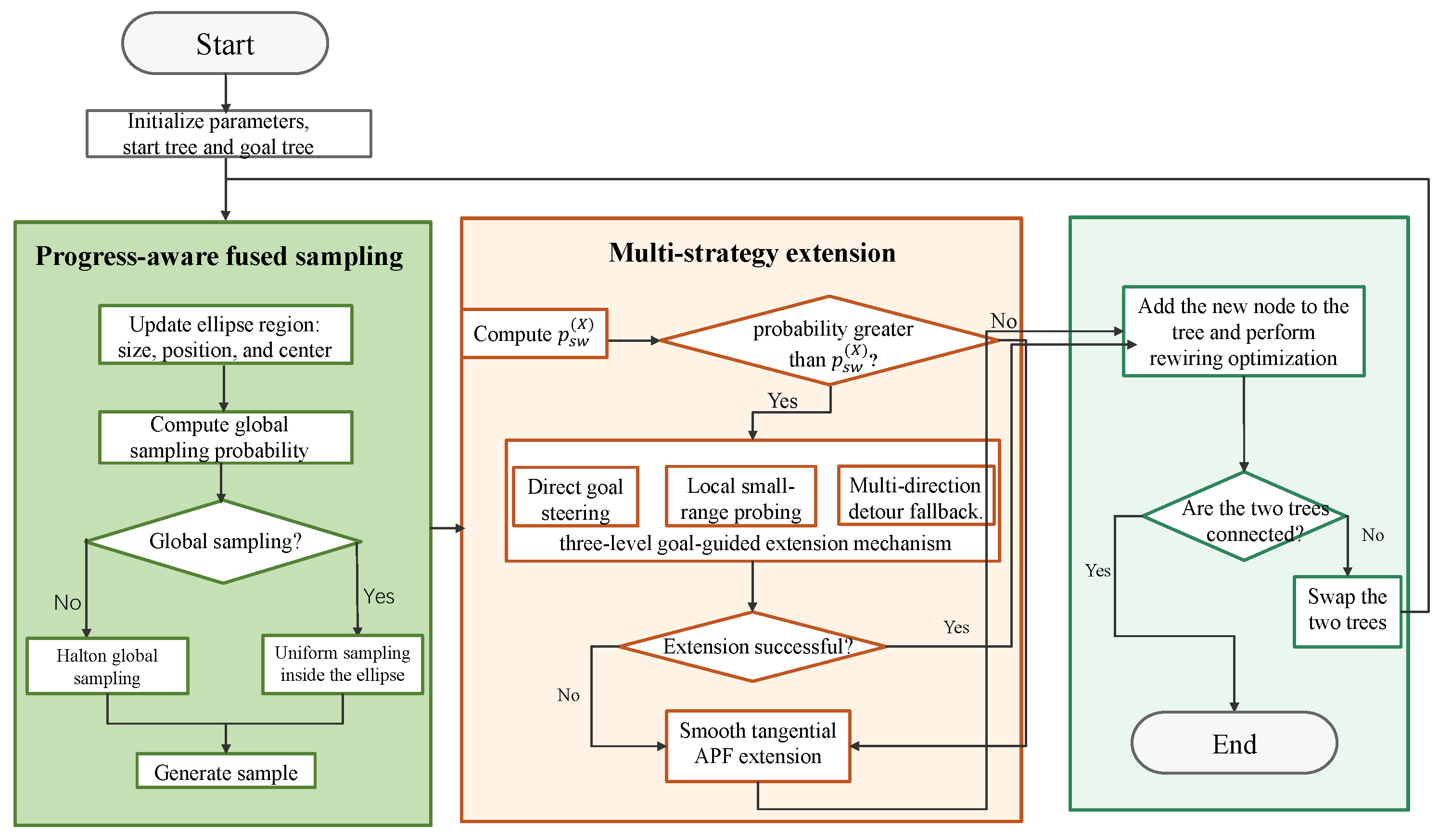
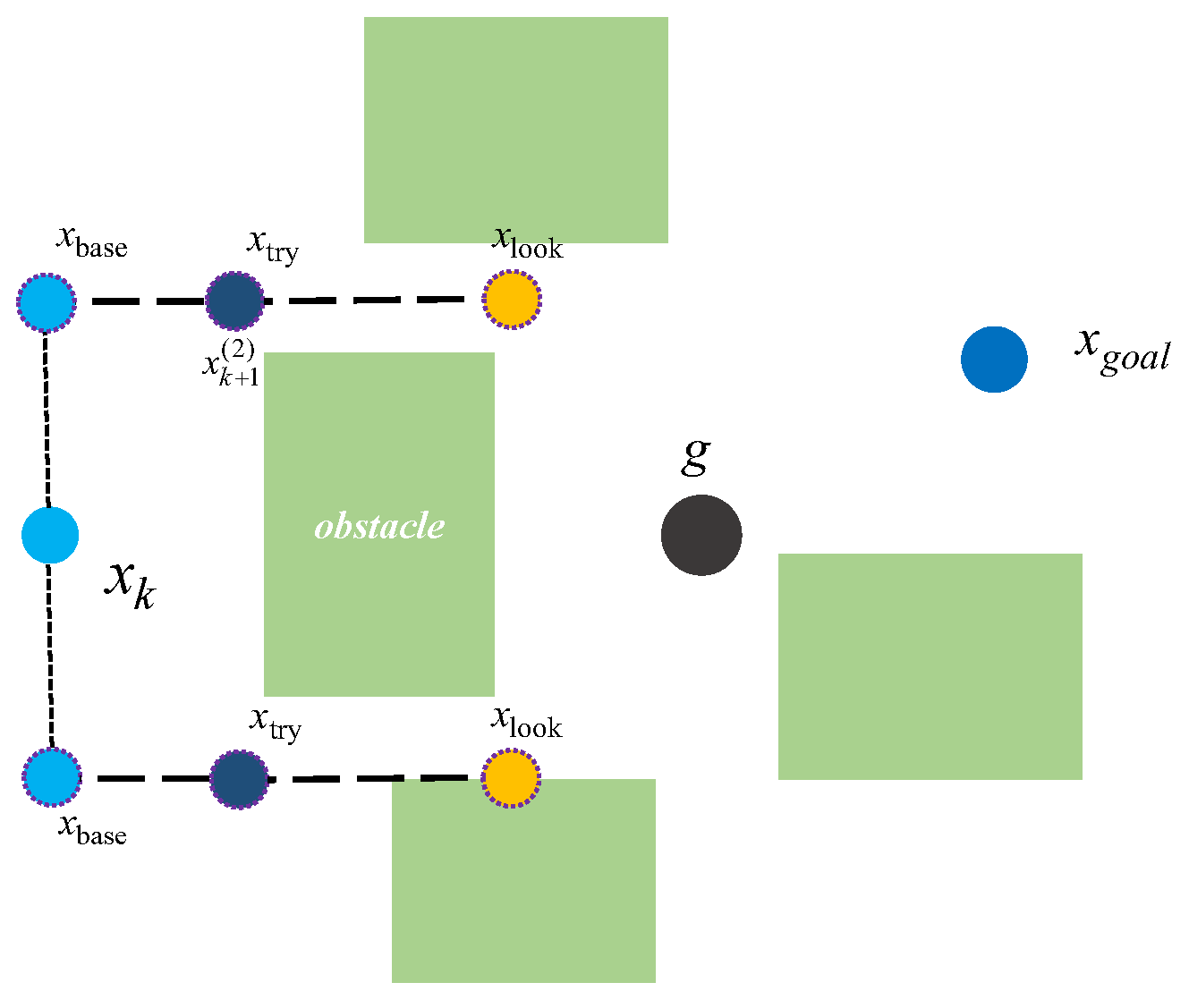
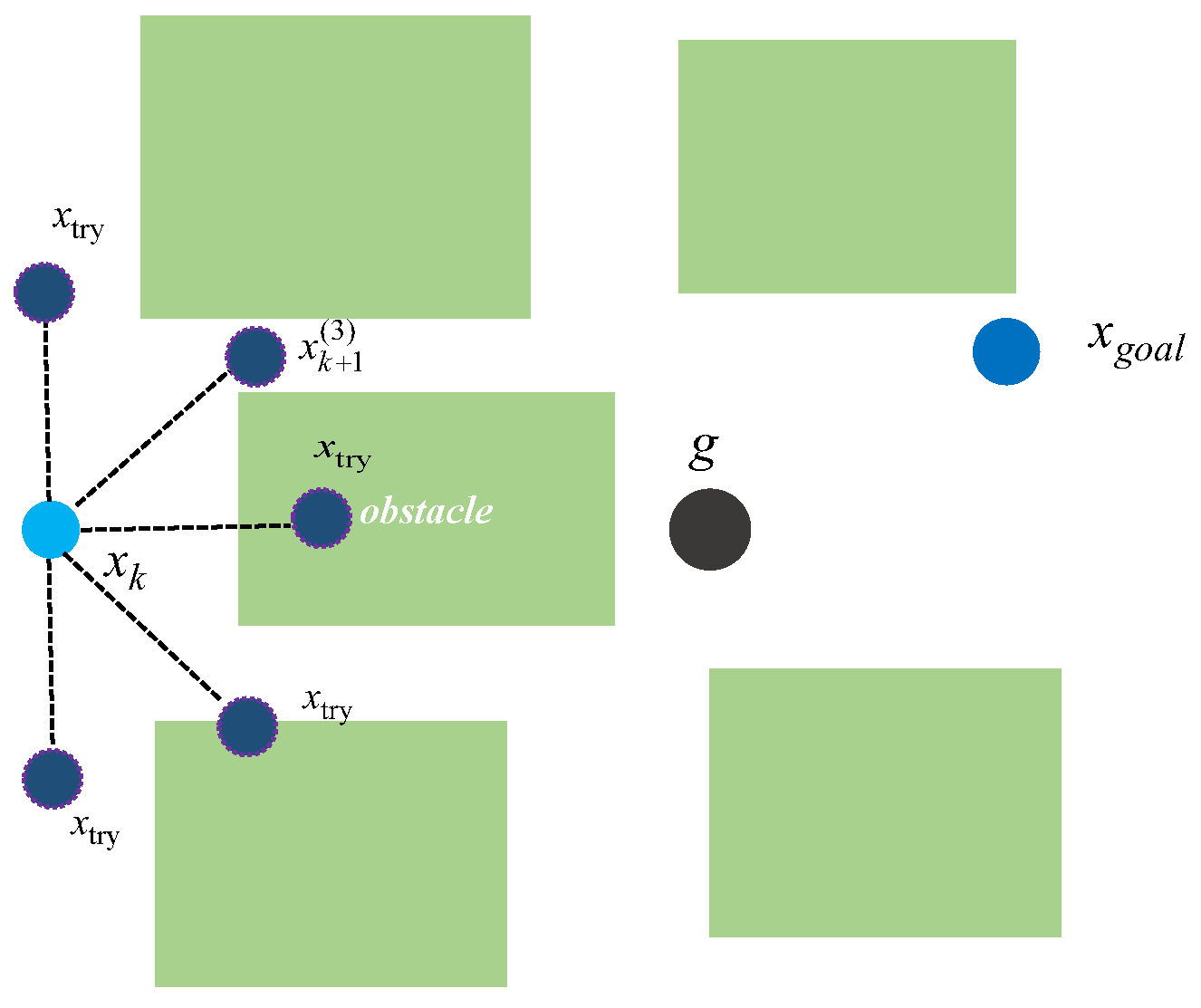
These improvements are directly attributed to the proposed extension strategy. During expansion, PFMS-RRT* employs a three-level fallback goal-guided mechanism: when the standard goal-directed extension is blocked, the planner can still maintain forward progress via progressively strengthened detour behaviors, thereby reducing the probability of local failures and mitigating stagnation around corridor entrances. Moreover, when goal-guided probing becomes ineffective (or when the switching condition is triggered), the planner switches to the smooth tangential APF extension, which encourages boundary-following growth and smoother steering near obstacle boundaries. This makes the node expansion better aligned with corridor boundaries and yields more stable turning behaviors, ultimately improving passage-traversal stability and safety margin in Environment B.
The quantitative results in
Table 4 further validate the above observations. PFMS-RRT* achieves an average path length of
, an average runtime of
, an average node count of
, and an average minimum obstacle clearance (Avgdistance) of
. Compared with BI-APF-RRT*, BI-RRT*, and IBI-P-RRT*, PFMS-RRT* reduces the path length by
,
, and
, respectively; compared with F-RRT* and GB-RRT*, the path length is reduced by
and
, respectively. In terms of efficiency, PFMS-RRT* decreases runtime by 81.48%, 56.52%, 41.18%, 75.00%, and 76.74% relative to BI-APF-RRT*, BI-RRT*, F-RRT*, GB-RRT*, and IBI-P-RRT*, respectively; meanwhile, the average node count is reduced by 67.26%, 52.85%, 42.25%, 75.32%, and 67.17%, respectively. Regarding safety, PFMS-RRT* improves Avgdistance by 3.03%, 13.33%, 52.24%, 45.71%, and 18.60% over the corresponding baselines. Overall, the strong reductions in runtime and node count indicate that progress-aware fused sampling effectively suppresses redundant exploration in dense obstacle fields, while the improved clearance reflects more stable obstacle-neighborhood expansions.
As shown in
Figure 10, Environment C features highly fragmented free space, which can easily induce redundant sampling and detour-prone paths. The baseline planners generally suffer from increased ineffective exploration in this scenario. In particular, IBI-P-RRT* exhibits rollback behaviors, indicating that it is more prone to repeated probing in regions with poor local connectivity, which leads to less natural path shapes and degraded search efficiency. In contrast, PFMS-RRT* concentrates its sampling distribution more clearly on effective regions and produces more natural obstacle-avoidance trajectories, resulting in improvements in both overall search efficiency and path quality.
These results highlight the synergy between fused sampling and multi-level strategy extension. On the one hand, the progress-aware elliptical sampling suppresses repeated sampling in low-value regions by progressively focusing on informative areas. On the other hand, the three-level extension together with the smooth tangential APF provides more stable local guidance in fragmented spaces, thereby reducing the likelihood of rollbacks and unnecessary detours.
As reported in
Table 5, PFMS-RRT* attains an average path length of
, an average runtime of
, an average node count of
, and an Avgdistance of
. Compared with BI-APF-RRT*, BI-RRT*, and IBI-P-RRT*, PFMS-RRT* reduces the path length by 7.94%, 7.96%, and 6.75%, respectively; compared with F-RRT* and GB-RRT*, the path length is reduced by 1.99% and 2.81%, respectively. For efficiency, PFMS-RRT* decreases runtime by 68.75%, 58.33%, 47.37%, 87.80%, and 62.96% relative to BI-APF-RRT*, BI-RRT*, F-RRT*, GB-RRT*, and IBI-P-RRT*, respectively; the average node count is reduced by 63.60%, 56.74%, 52.75%, 86.86%, and 57.78%, respectively. In terms of safety, PFMS-RRT* improves Avgdistance by 2.86%, 9.09%, 17.07%, 18.03%, and 5.88% over the corresponding baselines. These gains indicate that the proposed sampling improvement drives substantial reductions in tree size and runtime in fragmented clutter, while the robust extension behaviors help maintain strong clearance and avoid inefficient stagnation.
As shown in
Figure 11, Environment D is a typical strongly constrained narrow-passage scenario, where the feasible corridor is extremely limited. In this setting, most baseline planners exhibit unstable extensions or noticeable path oscillations inside the passage. Their search trees repeatedly grow within the narrow region but often fail to form a continuous and effective through-corridor connection, so the resulting paths tend to include multiple corrections or boundary-hugging segments. In contrast, PFMS-RRT* can expand stably along the passage and generates a smoother path that better conforms to the corridor structure, demonstrating stronger robustness and adaptability to constrained environments.
This advantage is closely related to the introduction of the smooth tangential APF extension. Under tight boundary constraints, the tangential potential field is more effective at guiding the expansion to follow obstacle boundaries smoothly, thereby reducing collision-prone probing and abrupt direction changes within the passage. Consequently, PFMS-RRT* improves both reachability and safety in Environment D.
As summarized in
Table 6, PFMS-RRT* achieves an average path length of
, an average runtime of
, an average node count of
, and an Avgdistance of
. Compared with BI-APF-RRT*, BI-RRT*, and IBI-P-RRT*, PFMS-RRT* reduces the path length by 14.82%, 10.60%, and 9.43%, respectively; compared with F-RRT* and GB-RRT*, the path length is reduced by 12.39% and 9.31%, respectively. In terms of efficiency, PFMS-RRT* decreases runtime by 92.95%, 90.35%, 75.00%, 80.36%, and 88.78% relative to BI-APF-RRT*, BI-RRT*, F-RRT*, GB-RRT*, and IBI-P-RRT*, respectively; the average node count is reduced by 72.09%, 66.07%, 71.75%, 78.17%, and 65.72%, respectively. Regarding safety, PFMS-RRT* improves Avgdistance by 3.61%, 6.17%, 13.16%, 17.81%, and 4.88% over BI-APF-RRT*, BI-RRT*, F-RRT*, GB-RRT*, and IBI-P-RRT*, respectively. Overall, the pronounced reductions in runtime and node count strongly suggest that the proposed sampling and multi-strategy extension effectively mitigate stagnation in narrow passages, while the tangential APF fallback helps maintain stable boundary-following behavior and competitive clearance under severe local constraints.
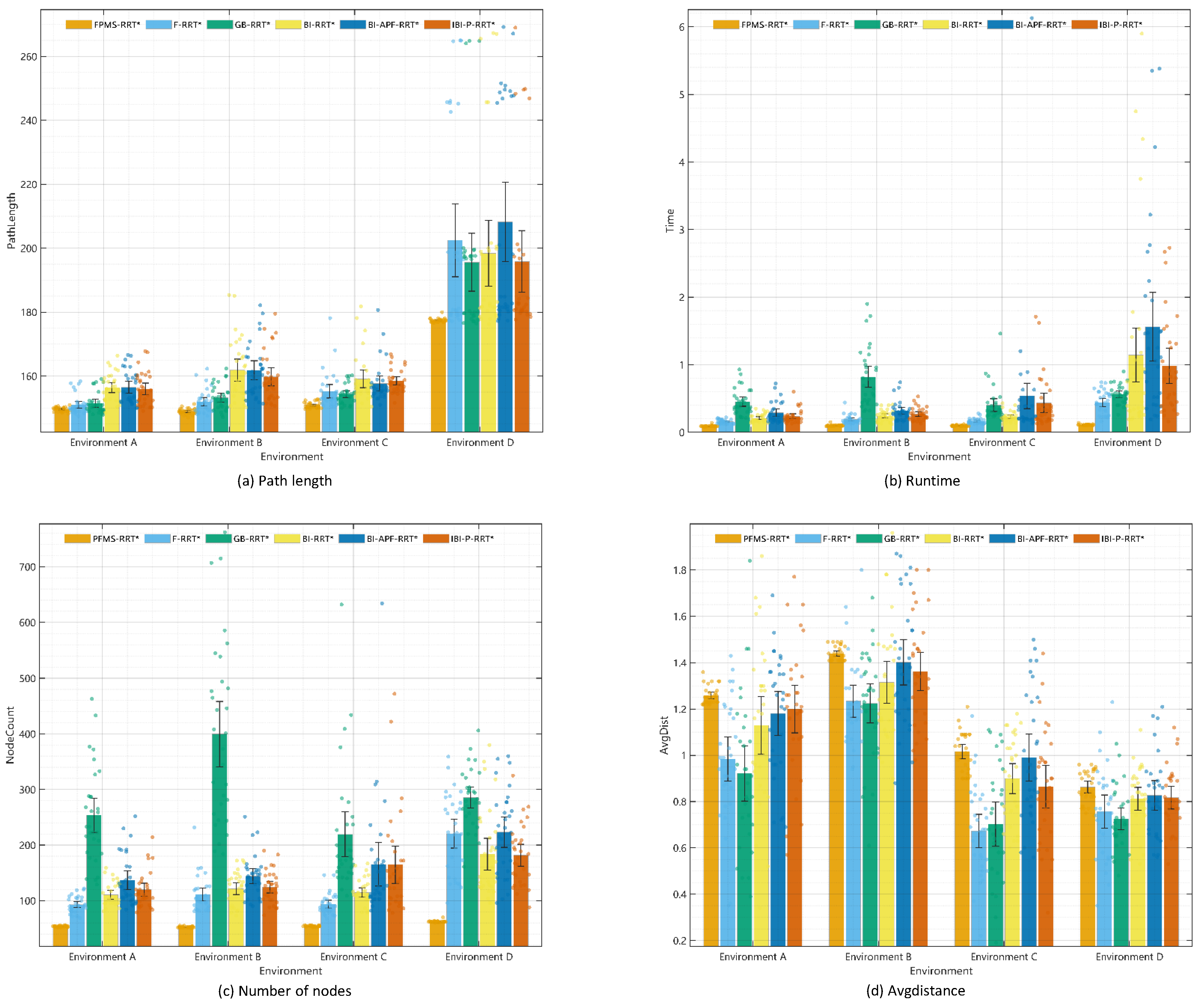
Figure 12 compares the core performance metrics of six RRT* variant algorithms across the four environments using bar charts with overlaid scatter points and 95% confidence-interval error bars. PFMS-RRT* achieves significantly shorter path lengths in all scenarios, with a particularly pronounced advantage in the challenging Environment D. F-RRT exhibits the largest variation in path length, and its mean value in Environment D is much higher than that of the other algorithms. PFMS-RRT* maintains relatively low runtime in most scenarios, with only a slight increase in Environment D. In contrast, GB-RRT* shows notably higher runtime in Environment B, and its scatter points are highly concentrated, indicating unstable efficiency in that scenario. GB-RRT* also produces consistently larger node counts across all environments, suggesting substantial redundancy in its sampling and exploration. By comparison, PFMS-RRT* maintains a low node count throughout, reflecting a more efficient sampling strategy. Moreover, the average distance between nodes and obstacles for PFMS-RRT* varies little across environments, indicating stronger planning stability, whereas F-RRT shows the most dispersed scatter distribution and the largest performance fluctuation. Overall, PFMS-RRT* delivers the best comprehensive performance over the four environments, producing shorter paths with fewer nodes, lower and more stable runtime, and improved robustness. GB-RRT* suffers from high exploration redundancy, and F-RRT exhibits large performance variability. The bidirectional variants perform between PFMS-RRT* and the single-tree methods, achieving a relatively good balance between efficiency and stability.
4.6. Sensitivity Experiment
To evaluate the influence of the weight parameters in Equation (
10), a sensitivity experiment was conducted for
,
, and
. These three parameters respectively control the reward of forward progress, the reward of one-step look-ahead feasibility, and the penalty on lateral offset during the secondary local probing stage. Their values jointly determine the balance among target-oriented expansion, local feasibility maintenance, and obstacle-avoidance flexibility.
The sensitivity results of
are reported in
Table 9. It can be observed that when
varies from 0.4 to 0.8, the overall performance remains highly stable. The path length is maintained around 149.29–149.61 m, the runtime remains approximately 0.09 s, the number of nodes is almost unchanged at 53.60, and the average obstacle distance stays near 1.26–1.27 m. This indicates that within a moderate range, adjusting the forward-progress reward does not significantly alter the global planning behavior, suggesting that the proposed evaluation mechanism is relatively robust to small perturbations of
.
However, when further increases to 1.0, 1.2, and 1.4, the path length gradually rises from 150.06 m to 153.21 m and finally 155.05 m, while the average distance to obstacles decreases from 1.24 m to 1.18 m and then 1.13 m. This trend indicates that an excessively large causes the local probing strategy to overemphasize direct forward movement, thereby weakening its ability to maintain a proper balance between aggressive advancement and safe detouring. In other words, an overly large forward-progress reward makes the candidate selection more radical, which may reduce local adaptability and eventually deteriorate path quality.
Overall, the results suggest that has a relatively wide stable interval, and values in the range of 0.4–0.8 can provide both short paths and stable safety margins. The setting achieves a good compromise between planning efficiency and local adaptability.
The results for
are listed in
Table 10. Compared with
, the influence of
shows a more distinct threshold behavior. When
is set to 0.4 or 0.6, the path length remains relatively large at 153.20 m, and the average obstacle distance reaches 1.47 m, which is noticeably larger than that obtained with higher
values. This suggests that when the look-ahead feasibility reward is insufficient, the probing process tends to generate more conservative local expansions, resulting in longer paths and larger clearance from obstacles.
Once increases to 0.8, the path length drops sharply to 149.61 m, while the average obstacle distance decreases to about 1.26 m. Further increasing to 1.0, 1.2, and 1.4 produces almost identical results, with the path length stabilized around 149.60 m and the node number unchanged. This implies that after the one-step look-ahead feasibility term reaches a sufficient weight, it can reliably guide the local probing toward candidates with better continuation potential, thereby significantly improving path compactness. At the same time, the absence of noticeable performance degradation at larger values indicates that the proposed strategy is not overly sensitive to this parameter once it exceeds a certain effective threshold.
Therefore, the experimental results demonstrate that mainly acts as an enabling factor for local feasibility awareness. A value that is too small weakens the look-ahead guidance effect, whereas values from 0.8 upward yield stable and favorable performance. Considering both effectiveness and consistency, is a reasonable and economical choice.
The sensitivity analysis of
is summarized in
Table 11. Unlike
and
, the role of
is to penalize lateral deviation during candidate evaluation. The results show that the influence of
is comparatively mild within a small range. Specifically, when
increases from 0.01 to 0.05, the path length only changes slightly from 149.59 m to 149.61 m, and the average obstacle distance remains nearly constant at 1.29 m. This indicates that small variations of the lateral-offset penalty do not substantially affect the local decision process.
When is further increased to 0.10 and 0.15, the path length rises to 149.98 m, and the average distance to obstacles drops to 1.26 m. At , the path length further increases to 151.04 m, while the average obstacle distance decreases to 1.21 m. These results suggest that an excessively large lateral penalty suppresses necessary sideways adjustment during local obstacle avoidance, making the probing process less flexible and slightly reducing path quality and safety margin.
In general, behaves as a weak regularization term rather than a dominant decision factor. The algorithm is relatively insensitive to small perturbations of this parameter, but too large a value may gradually limit local detouring capability. Therefore, a small-value interval such as 0.01–0.05 is sufficient, and provides a suitable balance between suppressing redundant lateral oscillations and preserving necessary obstacle-avoidance flexibility.
Combining the above observations, the three parameters exhibit different sensitivity patterns. The parameter mainly affects the aggressiveness of forward expansion, and overly large values may lead to longer paths and reduced safety margins. The parameter plays a more decisive role in enabling one-step feasibility awareness, and its performance improves significantly once it reaches a sufficient level. In contrast, acts as a mild regularizer, and its influence is relatively limited unless it becomes too large.
More importantly, the results in
Table 9,
Table 10 and
Table 11 show that the proposed method maintains stable runtime and node number under different parameter settings, indicating that the overall framework is robust and does not rely on delicate parameter tuning. Based on the sensitivity experiment, the final parameter configuration is set to
which achieves a favorable trade-off among path quality, runtime, node scale, and obstacle clearance.