1. Introduction
Assisted mobility technologies have emerged as an effective engineering solution to improve autonomy, safety, and quality of life for individuals and animals affected by neuromuscular, orthopedic, or degenerative conditions. While early assistive devices focused primarily on mechanical support, recent research increasingly emphasizes the integration of sensing, monitoring, and intelligent supervision to ensure safe operation, detect abnormal conditions, and improve long-term usability [
1,
2,
3]. In the context of animal-assisted mobility, these challenges are further amplified by the absence of verbal feedback, variability in physical conditions, and the need for unobtrusive, lightweight, and comfortable system designs [
4,
5].
The rapid development of the Internet of Things (IoT) has enabled a new generation of assistive systems capable of continuous data acquisition, wireless communication, and remote supervision. IoT-based architectures facilitate the integration of heterogeneous sensors, embedded processing, and cloud or edge analytics, allowing objective assessment of device usage under real-world conditions [
6,
7,
8]. In this context, low-power embedded platforms such as the ESP32 offer a favorable trade-off between computational capability, connectivity, and energy efficiency, making them particularly suitable for mobile and autonomous monitoring applications [
9,
10].
Energy autonomy represents a critical design constraint in mobile assistive systems, where continuous sensing and data transmission must coexist with limited onboard energy resources. This constraint is especially relevant for daily-use devices operating in domestic or outdoor environments. As a result, portable and off-grid power solutions, including compact solar-assisted power banks, have gained attention as practical approaches to extend operational autonomy while preserving system simplicity and user convenience [
11,
12].
Temperature monitoring is a particularly relevant variable in assisted mobility applications, as abnormal thermal patterns at contact interfaces may indicate excessive friction, poor ventilation, prolonged mechanical stress, or early signs of discomfort. Conventional temperature sensors, however, may present limitations related to mechanical rigidity, integration on curved or deformable surfaces, and long-term comfort. Consequently, advances in flexible and wearable electronics have driven the exploration of alternative sensing materials capable of conformal integration and stable operation under dynamic conditions [
13,
14,
15].
Among these materials, laser-induced graphene (LIG) has emerged as a promising platform for flexible and low-cost sensing due to its direct fabrication from commercial polymers, high electrical conductivity, mechanical robustness, and compatibility with rapid laser patterning techniques [
16,
17]. LIG-based sensors have demonstrated reliable performance in a wide range of wearable and embedded applications, including thermal, mechanical, and physiological monitoring, enabling seamless integration of sensing functionality within compact and lightweight systems [
18,
19,
20,
21].
It is important to note that the temperature sensing element employed in this study is based on a laser-induced graphene sensor previously designed, fabricated, and experimentally validated by the authors. In that prior work, the LIG sensor exhibited high sensitivity, fast response time, low power consumption, and stable operation within the temperature range relevant to assisted mobility applications [
22]. Building upon this validated sensing platform, the present study focuses on its integration at the system level, rather than revisiting sensor fabrication or material characterization aspects.
While sensing and IoT connectivity provide the foundation for continuous monitoring, extracting meaningful information from multisensor data streams requires appropriate data analysis strategies. In practical deployments, explicit fault labels are rarely available, and operating conditions may vary significantly across individuals and environments. Under such constraints, unsupervised anomaly detection techniques based on lightweight machine learning models have proven effective for identifying deviations from nominal behavior without requiring extensive labeled datasets [
23,
24,
25,
26]. These approaches are particularly well suited for embedded and IoT-based systems, where computational efficiency and robustness are essential.
Motivated by these considerations, this paper presents an AI-enhanced IoT mechatronic platform for assisted mobility in small disabled dogs. The proposed system integrates a passive assisted-mobility structure, a previously validated LIG temperature sensor embedded at the harness–body interface, wireless data acquisition based on an ESP32 microcontroller, and an unsupervised machine-learning-based anomaly detection framework within a low-cost and autonomous architecture. The results demonstrate that combining flexible sensing materials, prioritized IoT communication, and lightweight analytics enables reliable monitoring and early identification of potentially unsafe operating conditions during daily use.
The main contributions of this work can be summarized as follows:
System-level integration of a laser-induced graphene contact temperature sensor into a passive assisted mobility platform for small animals.
Design and implementation of a prioritized IoT architecture that enables reliable near-real-time monitoring under constrained energy and bandwidth conditions.
Application of an unsupervised anomaly detection strategy leveraging differential temperature features () to identify abnormal operating conditions without labeled data.
2. System Design and Architecture
2.1. Assisted Mobility Platform
The assisted mobility platform was designed as a lightweight and fully passive mechanical system intended to support the hind limbs of small dogs with reduced mobility. In contrast to powered or motorized mobility aids, the proposed platform does not incorporate any active traction, propulsion, or motor-driven components. Locomotion is entirely generated by the animal using its forelimbs, while the platform provides mechanical support, balance, and load redistribution for the posterior region. This passive design reduces system complexity, eliminates energy consumption for actuation, and aligns with commonly adopted principles in veterinary rehabilitation and small-animal mobility assistance [
27,
28].
The geometric configuration of the platform was defined based on functional, ergonomic, and stability-oriented criteria rather than on optimization-driven mechanical design. The overall chassis geometry was selected to ensure a low center of gravity, adequate lateral stability during assisted walking, and alignment with the natural posture of small-breed dogs [
29]. The longitudinal arrangement and wheelbase were chosen to support the hind limbs without introducing active propulsion, while maintaining sufficient ground clearance and maneuverability under typical indoor and outdoor conditions. These design choices follow general static-stability principles commonly applied in ground-supported mobility aids, where wheelbase dimensions and center-of-gravity placement are key determinants of tipping resistance and user safety [
30]. The upper structure geometry was designed to interface with an adjustable harness, enabling consistent load distribution and sensor placement without restricting natural forelimb movement.
The mechanical structure consists of a modular chassis manufactured from lightweight aluminum profiles and polymer components, selected to provide sufficient mechanical strength while minimizing overall mass [
31]. The platform incorporates two rear free-rolling polyurethane wheels. The selection of both wheel size and material was guided by application-oriented considerations, including minimization of rolling resistance, reduction of vibration transmission, and smooth displacement on flat and moderately uneven surfaces typically encountered during assisted mobility. Previous studies on small mobility devices and wheel–surface interaction indicate that wheel diameter, tread material, and compliance strongly influence rolling resistance, vibration behavior, and maneuverability [
32].
Polyurethane was chosen due to its favorable balance between durability, compliance, and noise reduction, making it suitable for prolonged indoor and rehabilitation use [
33]. The wheel size was selected to ensure sufficient ground clearance and stability while remaining compatible with low-speed, animal-driven locomotion and the body scale of small dog breeds [
34]. This configuration avoids excessive contact forces and contributes to stable passive support without altering the animal’s natural gait, in agreement with established guidelines for small-scale mobility aids.
A padded and adjustable support harness is mounted on the upper structure of the platform to support the pelvic region and hind limbs of the animal. This harness represents the primary physical interface between the dog and the device, making it a critical element for comfort, safety, and load distribution. Similar harness-based load redistribution strategies have been widely adopted in veterinary-assisted mobility systems to minimize localized pressure and discomfort [
35]. The device is fully ground-supported, while the harness transfers only a limited fraction of the load, prioritizing stability and low rolling resistance.
To enable continuous monitoring of potential discomfort or abnormal operating conditions during use, a laser-induced graphene (LIG) temperature sensor is incorporated into the system for contact-temperature sensing. The integration of this sensor allows localized thermal phenomena associated with friction, pressure accumulation, or prolonged use to be monitored without restricting the animal’s natural gait or freedom of movement. In addition to contact temperature, contextual variables related to motion and environment are monitored by auxiliary sensors integrated into the platform, as detailed in the following sections.
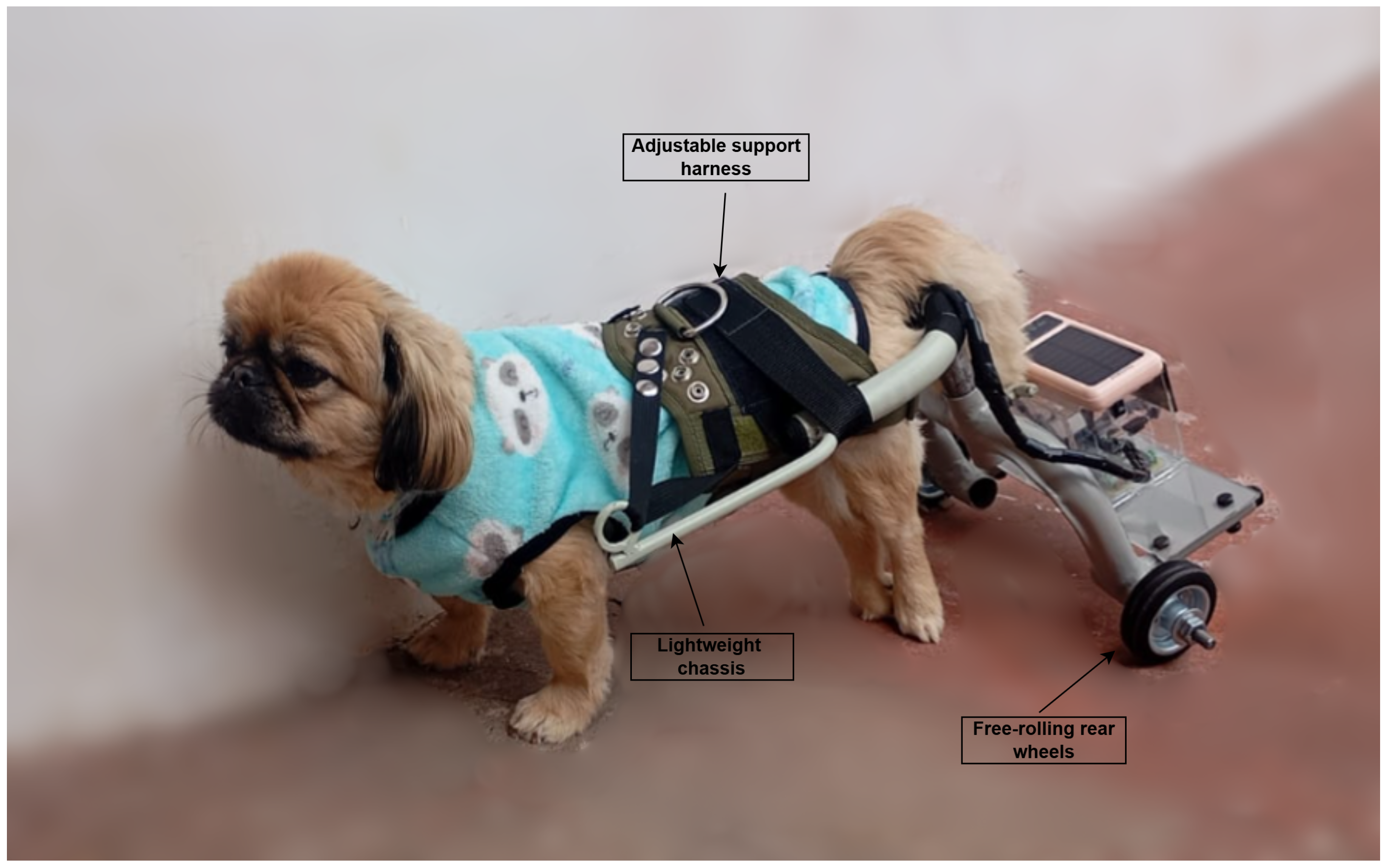
Figure 1 presents an overview of the assisted mobility platform, illustrating the general configuration of the lightweight chassis, the passive wheel arrangement, and the adjustable harness used to assist the hind limbs. This figure emphasizes the absence of active propulsion elements and highlights the passive nature of the mechanical design.
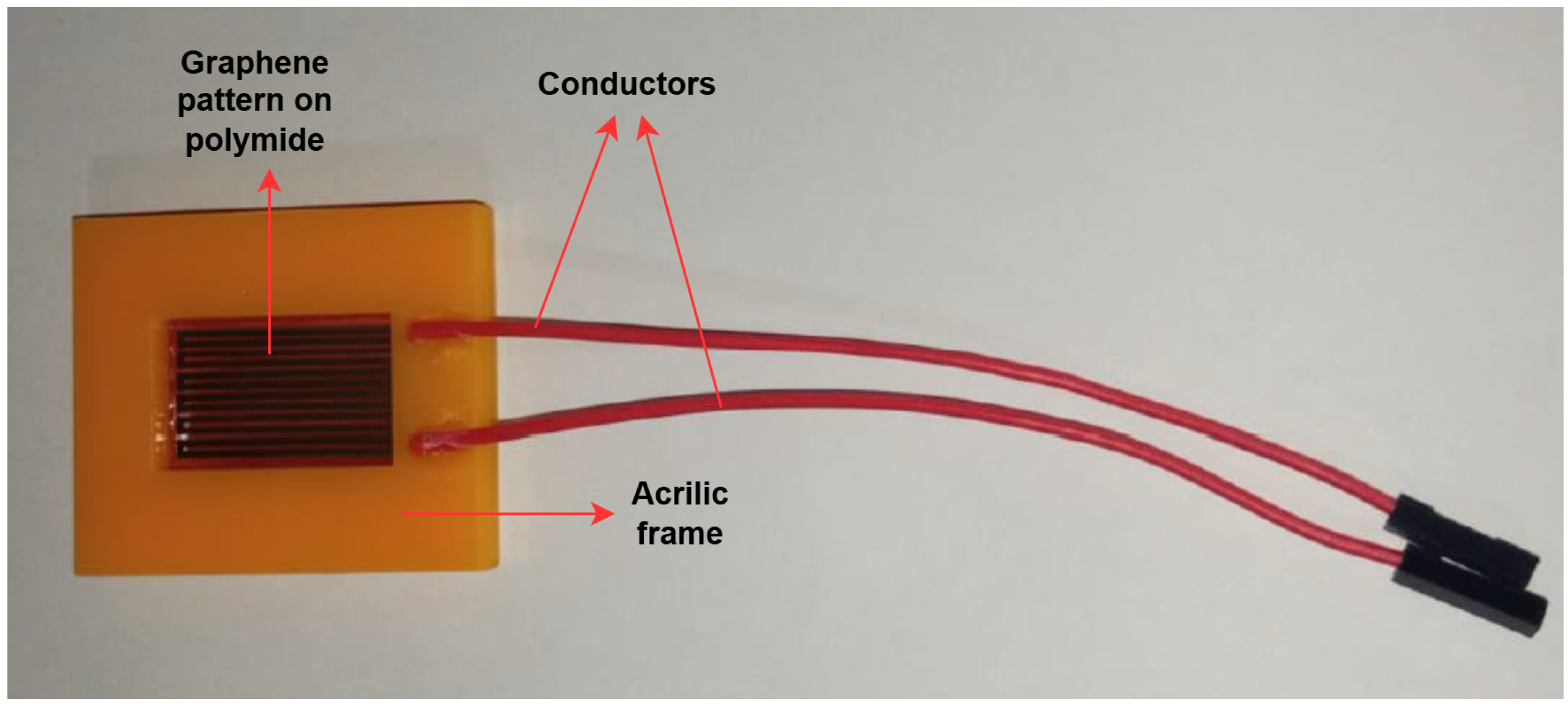
Figure 2 illustrates the laser-induced graphene (LIG) temperature sensor employed in this work. The figure highlights the physical structure of the sensor fabricated on a polyimide substrate, including the graphene sensing pattern and electrical connections, which enable flexible and unobtrusive contact-temperature measurement suitable for wearable and assistive applications.
The main mechanical and functional characteristics of the assisted mobility platform are summarized in
Table 1. As indicated in the table, the platform is designed for small dog breeds with body masses of up to 4 kg, prioritizing low total weight, ergonomic support, and suitability for prolonged daily use. The absence of active actuation simplifies maintenance requirements and facilitates seamless integration with the IoT-based monitoring and data acquisition subsystem described in the following sections.
2.2. Embedded Hardware and Sensor Integration
The embedded hardware architecture was designed to enable reliable data acquisition, wireless communication, and low-power operation within the passive assisted mobility platform. The system is centered on an ESP32 microcontroller (Espressif Systems, Shanghai, China), selected for its integrated Wi-Fi and Bluetooth connectivity, adequate computational resources for edge-level processing, and low energy consumption, which are essential characteristics for mobile IoT-based monitoring systems. The ESP32 acts as the main acquisition, processing, and communication unit, coordinating sensor sampling, local buffering, and data transmission.
The primary sensing element integrated into the platform is a laser-induced graphene (LIG) temperature sensor, fabricated in-house at Escuela Politécnica Nacional, Quito, Ecuador, previously designed and experimentally validated by the authors. In the present system, the LIG sensor is interfaced with the ESP32 through an analog signal conditioning stage that ensures stable voltage levels and noise reduction. The sensor is positioned at the harness–body contact interface, as described in
Section 2.1, enabling continuous measurement of contact temperature associated with friction, pressure accumulation, or prolonged use during assisted mobility sessions.
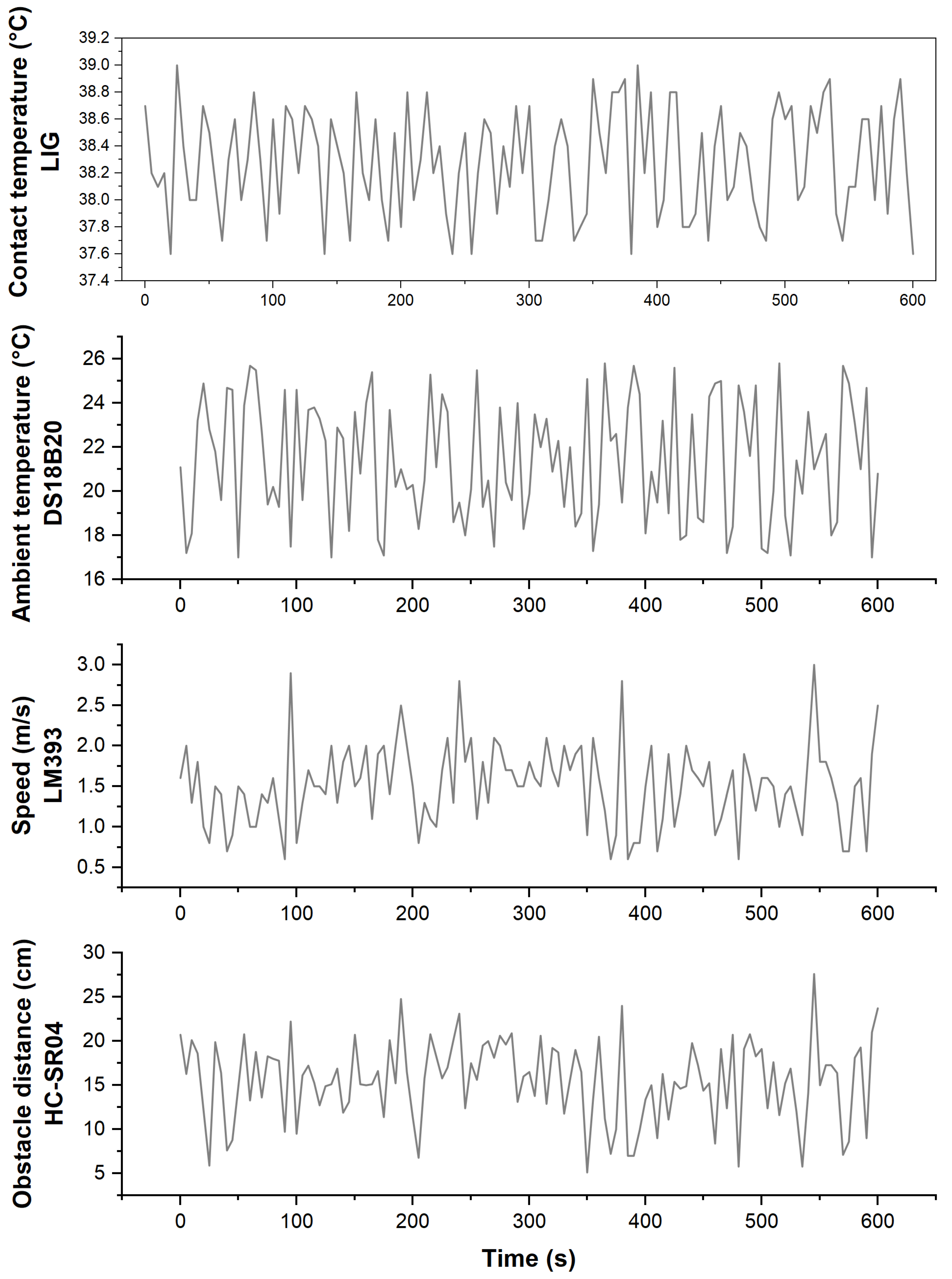
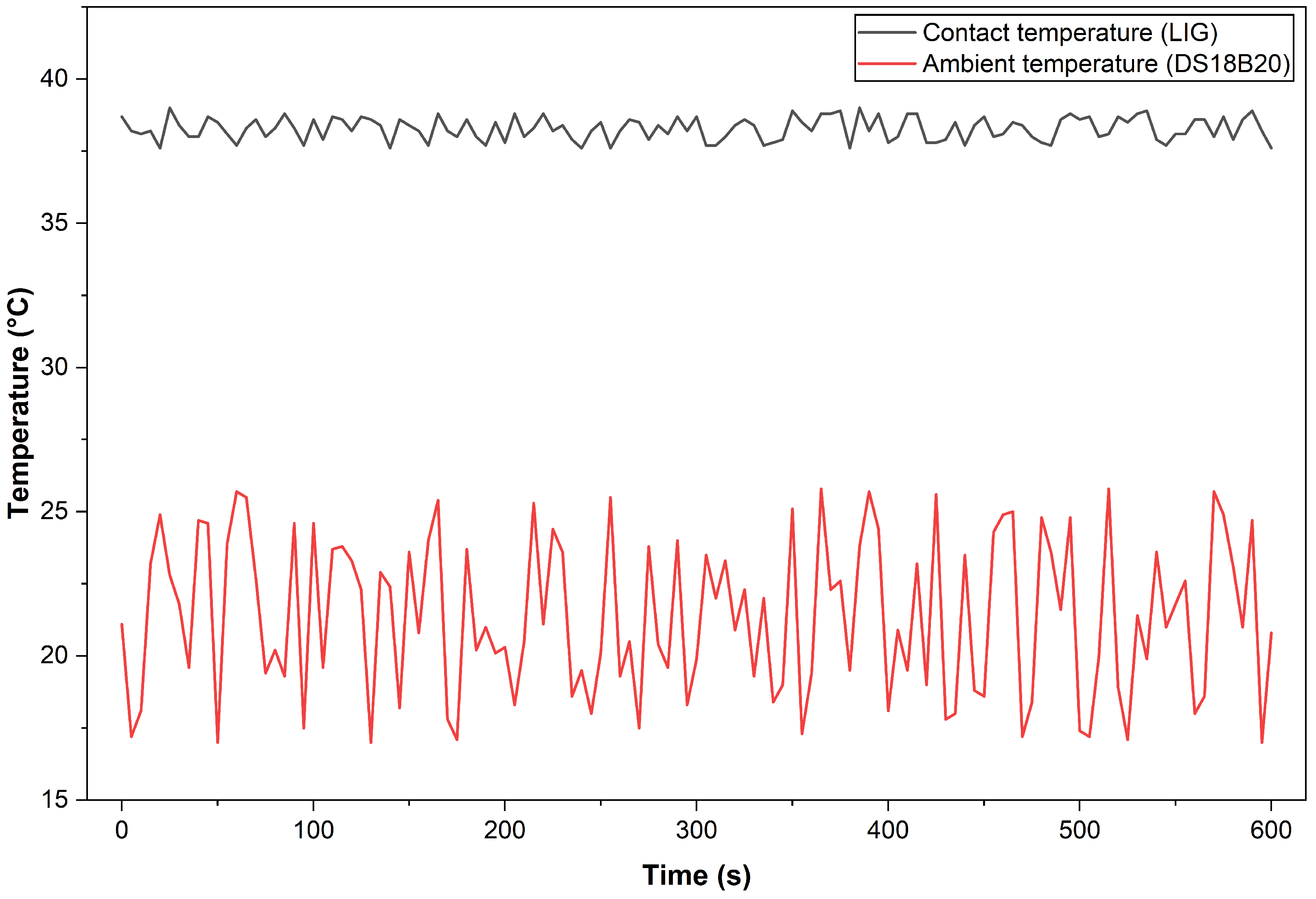
To provide environmental context for the contact-temperature measurements, ambient temperature is monitored using a digital temperature sensor (DS18B20, Maxim Integrated, San Jose, CA, USA). This sensor offers adequate accuracy and robustness for both outdoor and indoor environments and enables discrimination between temperature variations caused by ambient conditions and those originating from contact-related thermal effects. Ambient temperature data are sampled synchronously with the LIG sensor to support comparative thermal analysis and anomaly detection in subsequent sections.
For basic environmental awareness, an ultrasonic distance sensor (HC-SR04, ElecFreaks, Shenzhen, China) is integrated to estimate the distance to nearby obstacles in front of the platform. This information provides contextual insight into usage conditions, such as restricted movement near obstacles or prolonged stationary states, which may correlate with changes in contact temperature and displacement speed during operation.
In addition, the system incorporates a pulse-based speed sensing module built around an LM393 comparator (Texas Instruments, Dallas, TX, USA) circuit to estimate the platform’s linear displacement speed. The LM393 module generates digital pulses associated with the platform’s translational motion, which are captured by the ESP32 using interrupt-based acquisition. The resulting pulse frequency is processed to estimate linear speed, enabling identification of active versus stationary periods, characterization of assisted mobility sessions, and correlation between motion intensity and thermal behavior, without explicitly modeling wheel rotation or angular kinematics.
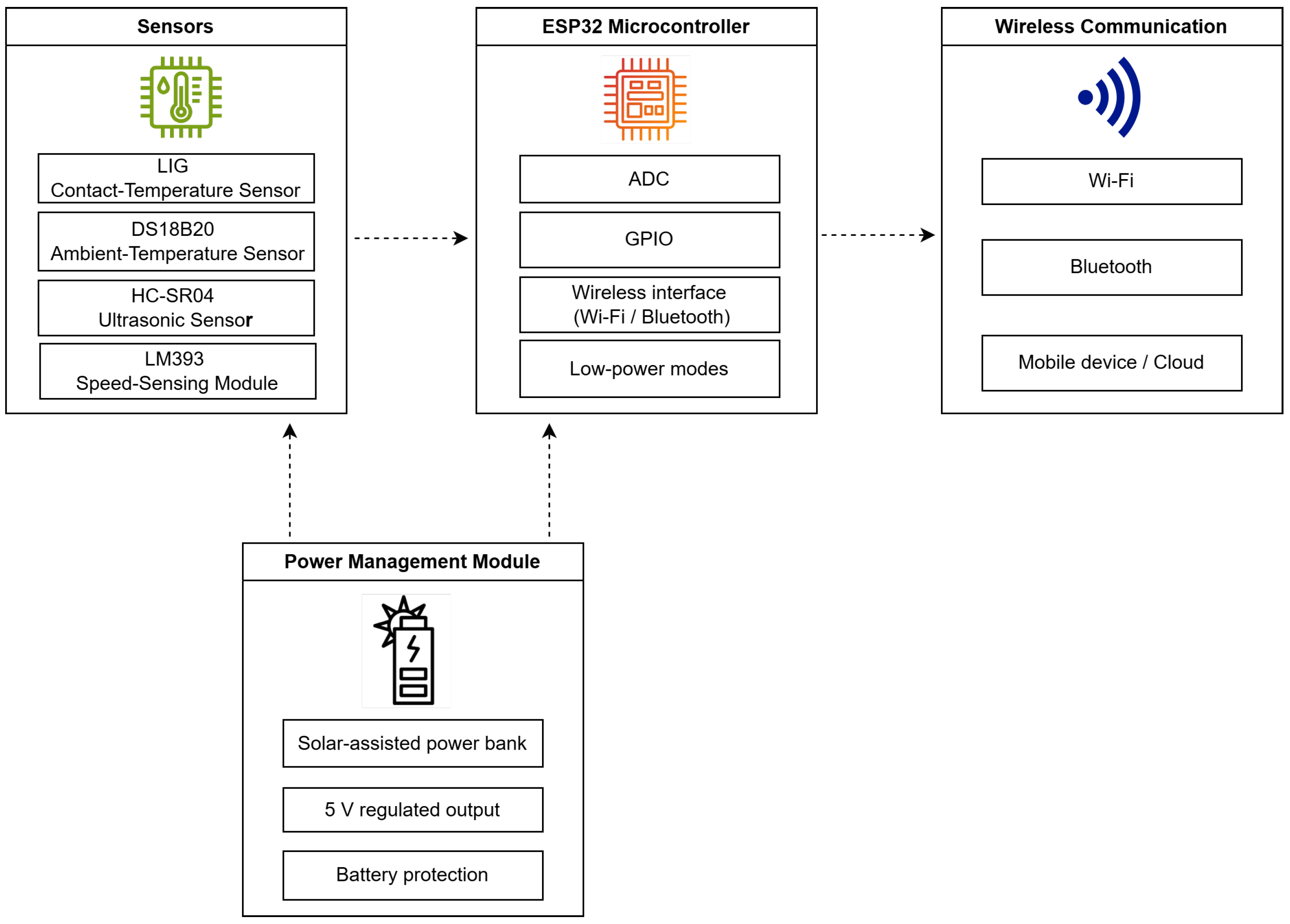
Figure 3 illustrates the overall organization of the embedded hardware architecture adopted in this work. The diagram highlights the modular separation between the sensing layer, the processing unit, the power management subsystem, and the wireless communication interface. This structured organization clarifies how sensing, local processing, energy supply, and data transmission are integrated within the passive assisted mobility platform, while preserving modularity and scalability.
Power is supplied by a compact solar-assisted power bank that delivers a regulated voltage to the ESP32 microcontroller and all connected sensing modules. This power solution enables autonomous operation in outdoor and mobile scenarios by reducing dependence on frequent manual recharging and supporting extended monitoring sessions during daily use.
Figure 4 presents a schematic representation of the power supply architecture, illustrating the energy sources, voltage regulation stage, and power distribution to the embedded electronics.
The main embedded hardware components and their functional roles are summarized in
Table 2. As indicated, the selected components prioritize low power consumption, compact size, and ease of integration, supporting reliable IoT connectivity and continuous sensing while preserving the simplicity required for assisted animal mobility applications.
2.3. IoT Architecture and Mobile Application
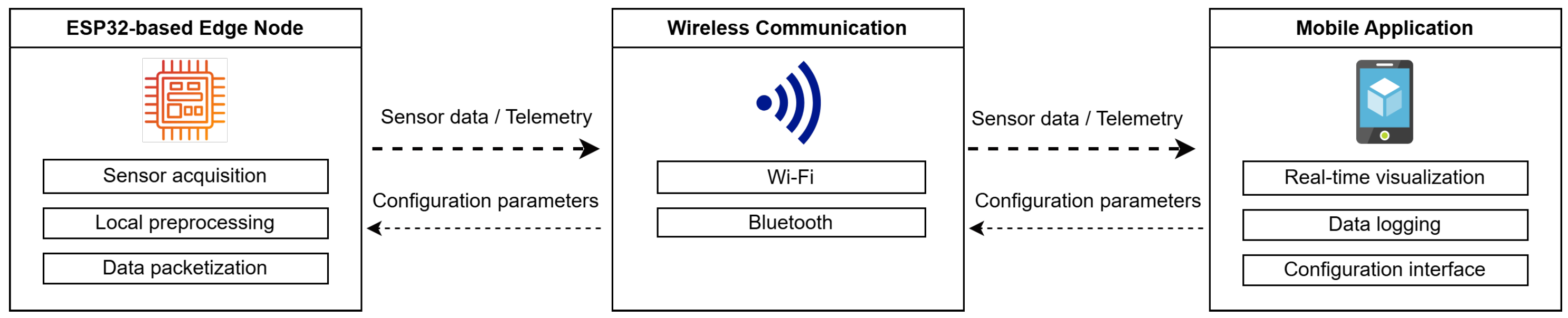
The IoT subsystem was designed to enable continuous monitoring, remote access, and systematic data logging during assisted mobility sessions. The architecture follows a layered approach comprising an embedded edge layer, a wireless communication layer, and an application layer. This structure supports low-cost deployment, modular scalability, and reproducible integration in passive assistive mobility platforms.
At the edge layer, the ESP32 microcontroller acquires synchronized data from the sensors integrated into the platform, including contact temperature, ambient temperature, obstacle distance, and linear speed measurements. Sensor data are time-stamped and locally preprocessed to improve robustness prior to transmission. Preprocessing tasks include basic filtering of the LIG contact-temperature signal to attenuate high-frequency noise, conversion of pulse-based speed measurements into linear velocity estimates, and plausibility checks on distance measurements to reject spurious ultrasonic readings.
The overall organization of the IoT architecture and the data flow between the edge device and the application layer are illustrated in
Figure 5. The figure shows the ESP32-based edge node installed on the assistive mobility platform, the wireless communication link, and the mobile application layer used for visualization, configuration, and data logging. Bidirectional communication is supported, enabling both telemetry transmission and the reception of configuration parameters such as sampling intervals, alert thresholds, and session control commands.
The wireless communication layer primarily relies on the Wi-Fi capabilities of the ESP32, enabling operation either in client mode (connection to an existing wireless network) or access-point mode for direct smartphone connectivity in field conditions. During all experimental sessions reported in this work, the ESP32 operated in Wi-Fi client (station) mode, connecting to an existing local wireless network for telemetry transmission and session-based data logging. Wi-Fi was selected as the main communication channel due to its higher throughput and suitability for continuous telemetry transmission.
In addition to Wi-Fi, the ESP32 Bluetooth interface was implemented and evaluated as an alternative communication channel during experimental trials. Bluetooth connectivity was not intended as the primary operational mode, but rather as a complementary option to assess communication robustness under degraded network conditions or short-range operation scenarios. This dual-interface design enables comparative evaluation of latency, signal strength, and packet delivery behavior across wireless technologies, as quantitatively reported in
Section 4.
To balance monitoring fidelity, communication latency, and energy consumption, the IoT subsystem adopts a prioritized event-driven transmission strategy. Safety-critical events are transmitted immediately upon detection, whereas routine monitoring variables follow predefined periodic schedules. This quality-of-service (QoS) mechanism allows near-real-time reporting of relevant events while limiting bandwidth usage and preserving system autonomy.
Table 3 summarizes the event types managed by the IoT subsystem together with their assigned priorities and timestamping frequencies. Obstacle detection events are triggered using a conservative distance threshold (<50 cm) to flag potential proximity risks; however, the actual obstacle distances observed during typical operation may be considerably lower, depending on the environment and movement dynamics. This threshold-based strategy is used to generate discrete events rather than to characterize precise spatial relationships.
The contact temperature threshold of 39.5 °C used for high-priority event generation was defined as a conservative alert level rather than a diagnostic criterion. This threshold was selected to indicate potentially unfavorable thermal conditions at the animal–device interface while remaining below values associated with clinical hyperthermia. The proposed IoT architecture allows this threshold to be adjusted by the user or adapted to environmental conditions and individual animal characteristics.
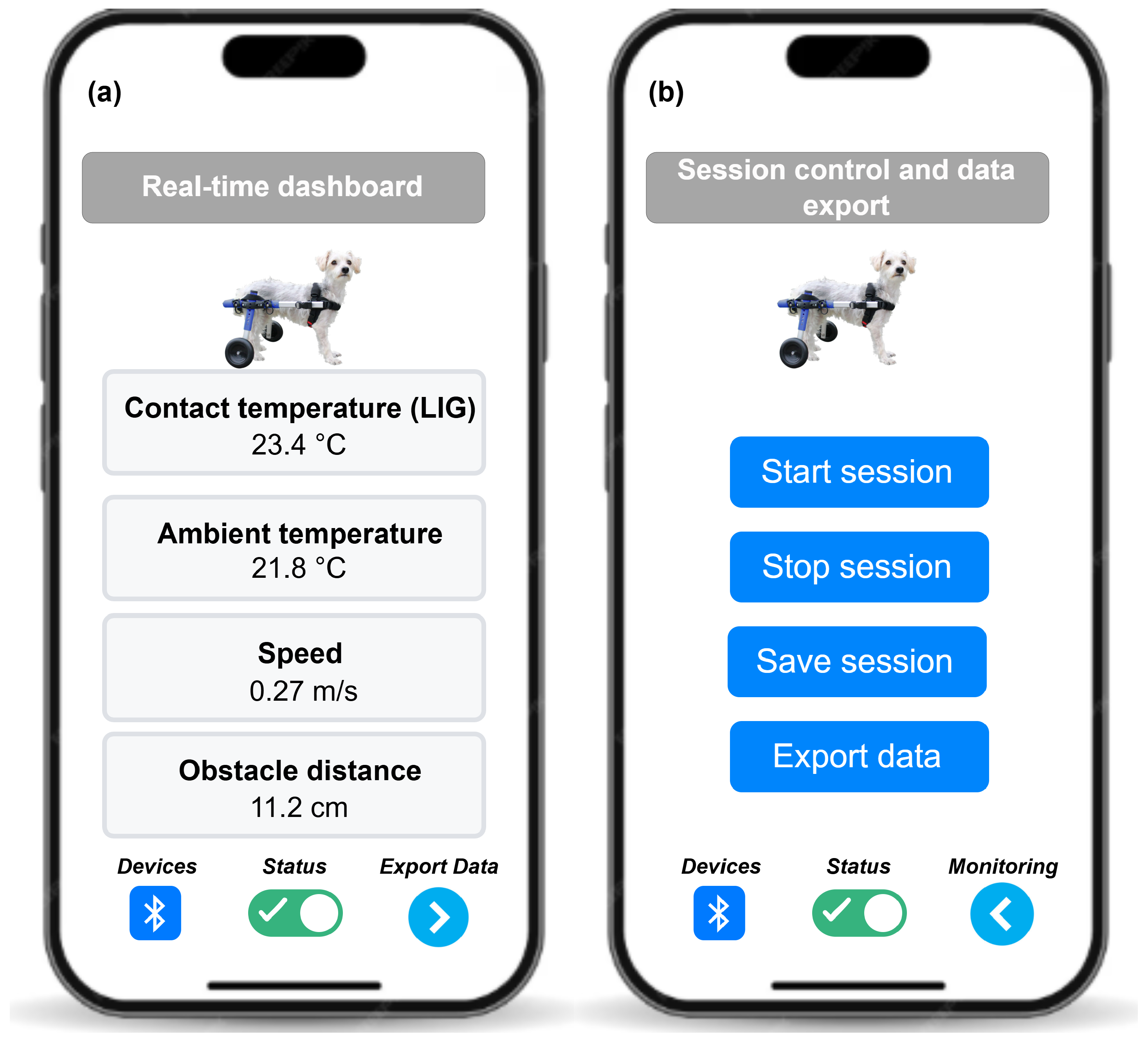
The application layer consists of a mobile application developed to visualize real-time sensor data and manage assisted mobility monitoring sessions. As illustrated in
Figure 6a, the real-time dashboard provides direct access to key variables, including contact temperature, ambient temperature, estimated speed, and obstacle distance.
Figure 6b presents the session control and data export interface, which allows users to start and stop recording sessions and export the collected data for offline analysis.
To ensure traceability and consistency across experiments, recorded data are organized using a structured session-based format aligned with the application interface shown in
Figure 6. Each session includes synchronized sensor measurements, configuration parameters, and contextual metadata. The complete data structure exported by the application is summarized in
Table 4, which details the fields stored for each assisted mobility session and their corresponding units. This structured dataset supports subsequent statistical analysis and machine-learning-based anomaly detection described in later sections.
2.4. Power Supply and Autonomous Operation
The monitoring platform was conceived to operate autonomously in outdoor and mobile scenarios, prioritizing portability, robustness, and low-power consumption. To achieve this, a modular power supply architecture based on a commercial solar-assisted power bank was adopted, allowing operation without dependence on fixed electrical infrastructure.
Figure 4 illustrates the overall power distribution scheme of the system. The energy subsystem is centered on a lithium-based power bank with integrated charge-management electronics, rechargeable either via a standard USB interface or through an auxiliary photovoltaic (PV) panel. A regulated 5 V DC output is provided to directly supply the ESP32 microcontroller and all peripheral sensors through a common power rail.
This direct-supply approach eliminates the need for additional external DC–DC conversion stages, thereby reducing conversion losses, electromagnetic interference, and overall system complexity. The proposed architecture supports low-power operation through idle-state transitions and duty-cycled sensing strategies, which are essential for autonomous monitoring in energy-constrained environments.
During normal operation, the system performs periodic sensing and wireless data transmission at configurable sampling intervals, typically ranging from 1 to 5 s. It should be noted that this 1–5 s interval refers to the internal data acquisition rate and to high-priority sensing channels, particularly thermal measurements during active monitoring. In contrast, telemetry transmission to the application layer follows an event- and priority-driven strategy, as summarized in
Table 3, where different update rates are assigned to each data channel according to its relevance, ranging from immediate event-based logging to periodic updates between 5 s and 5 min. This approach balances responsiveness, bandwidth utilization, and energy efficiency.
Between successive acquisition cycles, the ESP32 can transition into low-power idle states, significantly reducing average current consumption while maintaining system responsiveness. Although deep-sleep modes were not enforced during all experimental trials in order to preserve continuous monitoring, the proposed architecture fully supports duty-cycled operation for future long-term deployments.
From an energy-demand perspective, the ESP32 represents the dominant power consumer, particularly during wireless communication events. The remaining sensors—including the laser-induced graphene (LIG) contact temperature sensor, the ambient temperature sensor, the ultrasonic distance sensor, and the encoder-based speed sensor—exhibit comparatively low power requirements.
Table 5 summarizes the typical power consumption of the main subsystems during active operation.
The auxiliary photovoltaic panel integrated with the power bank is intended to extend operational autonomy rather than to guarantee full energy self-sufficiency. Under favorable irradiance conditions, solar charging partially compensates the energy consumed during system operation, effectively slowing battery depletion. This conservative design choice avoids overestimating renewable generation capabilities while ensuring reliable performance across diverse environmental conditions.
Overall, the proposed power supply strategy provides a pragmatic balance between autonomy, simplicity, and scalability. By combining a solar-assisted energy source with low-power embedded electronics, the system supports extended mobile monitoring sessions relevant to assistive veterinary applications. Furthermore, the architecture remains adaptable to future enhancements, such as adaptive sampling strategies or energy-aware sensing policies, without requiring substantial hardware modifications.
Based on the measured current consumption during active operation and the nominal capacity of the 20,000 mAh power bank, the system supports extended monitoring sessions on the order of several hours of continuous operation. It should be noted that the effective autonomy depends on the usable battery capacity, the average current draw, the sensing and communication duty cycle, and the quality of the wireless link. Partial solar recharging further extends effective autonomy during outdoor use by reducing the net discharge rate.
3. Materials and Methods
3.1. Laser-Induced Graphene Temperature Sensor
Laser-induced graphene (LIG) is an emerging class of porous, graphene-like conductive material produced by direct laser irradiation of carbon-rich precursors, most commonly polyimide substrates. This direct-write process enables simultaneous material conversion and patterning in a single fabrication step, without the need for chemical processing or cleanroom facilities. Owing to its intrinsic electrical conductivity, mechanical flexibility, and compatibility with soft substrates, LIG has been widely investigated in recent years for flexible electronics, electronic skins, and wearable sensing applications. High-impact studies have demonstrated the suitability of LIG for conformable temperature and strain sensing, as well as its integration into multifunctional sensing platforms operating under real-world mechanical deformation and contact conditions [
36,
37]. In parallel, advances in material processing and defect engineering have further improved the electrical stability and sensing performance of LIG, reinforcing its potential as a practical sensing technology beyond laboratory-scale demonstrations [
38,
39]. These characteristics make LIG particularly attractive for assistive and veterinary mobility applications, where sensing elements must remain lightweight, flexible, and robust under prolonged contact and motion, while supporting system-level monitoring and low-power operation.
Contact temperature at the animal–device interface was monitored using a laser-induced graphene (LIG)-based resistive temperature sensor previously developed and experimentally validated by the authors. The fabrication process, material characterization, and fundamental sensing performance of this sensor have been reported in detail in earlier work, where LIG demonstrated high sensitivity, fast response, mechanical flexibility, and low power consumption for temperature and pressure sensing applications [
22]. In the present study, this established sensor is reused and integrated at the system level for contact-temperature monitoring in an assisted mobility application.
In brief, the LIG sensing element is fabricated by direct laser scribing of a polyimide substrate, producing a porous graphene-like conductive network through a single-step photothermal process. This fabrication approach is solvent-free, cost-effective, and compatible with flexible substrates, enabling conformal integration in wearable and assistive systems. The sensing principle relies on the intrinsic temperature dependence of the LIG electrical resistance, which exhibits a repeatable and monotonic response within the operational range relevant to contact temperature monitoring.
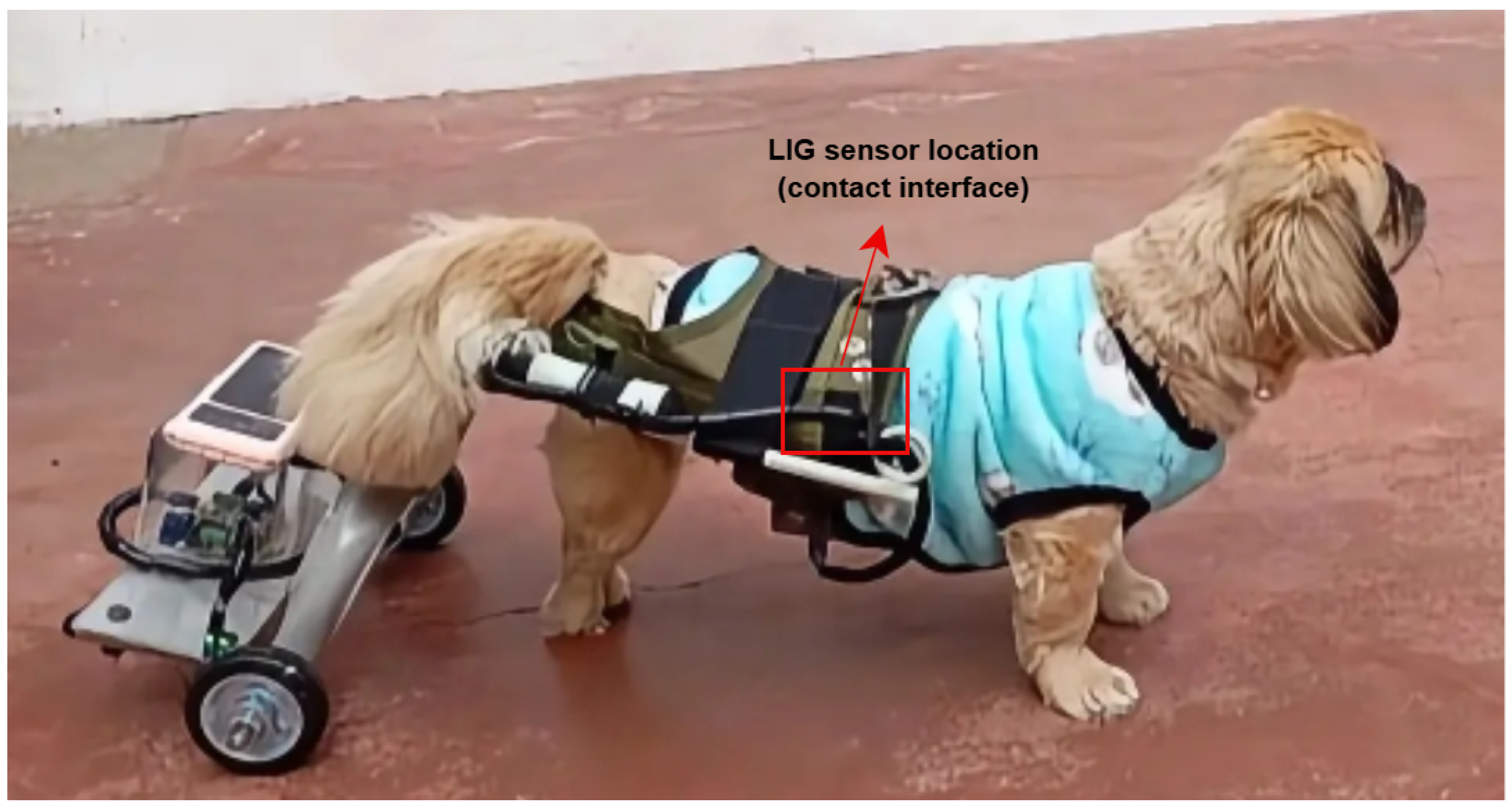
Figure 7 illustrates the physical integration of the LIG temperature sensor within the proposed monitoring platform under real operating conditions. In the present application, the sensor is positioned at the interface between the support harness and the animal’s body, allowing direct measurement of contact temperature during assisted mobility. This placement enables the capture of localized thermal phenomena associated with friction, pressure accumulation, or prolonged use, which are not adequately reflected by ambient temperature measurements alone.
To ensure stable mechanical coupling and reliable thermal transfer, the LIG sensor was mounted on a flexible backing layer and embedded within the harness structure in direct contact with the monitored surface. Electrical insulation and protective encapsulation were applied to minimize the influence of moisture, mechanical abrasion, and environmental contamination, while preserving adequate thermal responsiveness and user comfort.
For electrical readout, the LIG sensor was interfaced using a simple voltage-divider configuration powered at 5 V. The resulting analog voltage was sampled by the analog-to-digital converter (ADC) of the ESP32 microcontroller. Given the relatively slow temporal dynamics of contact temperature variations in veterinary assistive applications, this readout scheme provides sufficient resolution without requiring complex excitation or amplification circuitry. Digital filtering and preprocessing were subsequently applied at the software level to improve signal stability, as detailed in
Section 3.2.
A pragmatic calibration procedure was employed to map ADC readings to temperature values within the expected operational range. A linear approximation was adopted, leveraging the previously demonstrated quasi-linear behavior of the LIG sensor. This approach was found to be adequate for contact-temperature monitoring and anomaly detection purposes, while avoiding unnecessary computational complexity in the embedded implementation.
Detailed material-level characterization (e.g., morphology, electrode geometry, and IDE optimization) is beyond the scope of this work, as the LIG sensor design and experimental characterization were reported in our prior study [
22]. The present contribution focuses on system-level integration and application-oriented performance within an assistive IoT monitoring platform. The main operational characteristics of the integrated LIG temperature sensor are summarized in
Table 6.
By complementing ambient temperature measurements with direct contact temperature sensing, the LIG sensor enhances the system’s ability to detect localized thermal anomalies that may indicate excessive friction, abnormal posture, or prolonged static conditions. The use of a previously validated LIG sensor ensures measurement reliability while allowing the present work to focus on system integration, data acquisition, and anomaly detection rather than on material-level characterization.
3.2. Data Acquisition and Preprocessing
The data acquisition subsystem was designed to ensure reliable, synchronized, and low-noise measurement of all sensing variables while maintaining low power consumption suitable for autonomous operation. All sensor signals were acquired and processed using the ESP32 microcontroller, which integrates a multi-channel analog-to-digital converter (ADC) and sufficient computational resources for real-time preprocessing.
The laser-induced graphene (LIG) temperature sensor, described in
Section 3.1, was interfaced using a simple voltage-divider configuration, complemented by basic analog conditioning and software-level digital filtering to ensure signal stability prior to ADC sampling. The resulting analog voltage was sampled by the ESP32 ADC at a fixed sampling interval selected according to the expected temporal dynamics of contact temperature variations. Since thermal changes at the animal–device interface evolve on the order of seconds rather than milliseconds, sampling periods in the range of 1–5 s were adopted, providing an appropriate trade-off between temporal resolution, energy efficiency, and data volume.
Auxiliary sensors were sampled within the same acquisition cycle to preserve temporal alignment across all channels. Ambient temperature measurements were obtained using a digital temperature sensor, while distance information was acquired from an ultrasonic ranging module. Locomotion-related information was derived from a pulse-based speed sensing module, which generates digital pulses associated with the platform’s linear displacement. These pulses were accumulated over fixed time windows and mapped to linear speed expressed in m/s using a fixed proportional relationship determined by the mechanical configuration of the platform. This approach ensures consistent physical units across all recorded variables while avoiding the need for explicit modeling of rotational kinematics. All sensor readings were time-stamped at the point of acquisition to maintain synchronization across data streams.
To balance monitoring fidelity and energy efficiency, different sampling intervals were assigned according to channel relevance and operational context, following the event-driven and priority-based strategy described in
Section 2.3 and summarized in
Table 3. In practice, higher temporal resolution was applied to contact temperature measurements during active monitoring phases, while lower-priority contextual variables were sampled at reduced rates to limit energy consumption and communication overhead.
Raw sensor signals are inherently affected by electrical noise, quantization effects, and transient disturbances caused by motion or environmental factors. To mitigate these effects, lightweight preprocessing routines were implemented directly on the ESP32. For the LIG contact temperature signal, a moving-average filter with a window length of 5 samples was applied to suppress high-frequency fluctuations while preserving the underlying thermal trends. Given the adopted sampling interval of 1–5 s, this window corresponds to a temporal smoothing horizon of approximately 5–25 s and was empirically selected as a compromise between effective noise attenuation and responsiveness.
Ambient temperature data required minimal filtering due to its intrinsic stability, whereas ultrasonic distance measurements were subjected to plausibility checks and outlier rejection to discard spurious echoes. Pulse-based speed measurements were further smoothed through accumulation and normalization steps to obtain stable linear velocity estimates in physical units. This strategy provides robust motion characterization suitable for contextual analysis while avoiding the computational overhead associated with more complex kinematic models. All preprocessed signals were scaled to physical units using calibration parameters determined prior to experimental deployment.
Following preprocessing, the acquired data streams were organized into structured records suitable for wireless transmission and subsequent analysis. Each record contained synchronized measurements of contact temperature, ambient temperature, obstacle distance, linear speed, and a time index. This unified data structure facilitates downstream processing, including anomaly detection and trend analysis, while minimizing transmission overhead.
Overall, the preprocessing strategy prioritizes simplicity, robustness, and computational efficiency, ensuring that real-time operation is maintained under continuous monitoring conditions. By performing essential filtering, scaling, and synchronization at the edge device, the system reduces communication bandwidth requirements and provides well-conditioned input data for the machine-learning-based anomaly detection framework described in the following section.
3.3. AI-Based Anomaly Detection Method
The objective of the data analysis stage is to identify abnormal operating conditions that may compromise the comfort or safety of the animal during use of the assistive monitoring platform. Given the exploratory nature of the application and the absence of labeled pathological events, an unsupervised anomaly detection strategy was adopted. This choice avoids the need for extensive annotated datasets and is well suited to real-world deployment scenarios, where abnormal events are rare, heterogeneous, and difficult to predefine.
In this work, anomalies are defined as deviations from the expected thermal and kinematic behavior observed during nominal assisted mobility operation. Of particular interest are sustained increases in contact temperature relative to ambient conditions, prolonged stationary states accompanied by abnormal thermal accumulation, and inconsistent relationships between motion, distance, and temperature signals. These patterns may indicate excessive friction, unfavorable contact conditions, or suboptimal harness–body interaction, even in the absence of immediate mechanical failure or clinically observable symptoms.
Figure 8 summarizes the conceptual workflow adopted for AI-based anomaly detection. Multisensor data acquired at the edge layer are first subjected to preprocessing and normalization, as described in
Section 3.2. Subsequently, relevant features are constructed by combining thermal and kinematic information, and the resulting feature vectors are evaluated using an unsupervised anomaly detection model trained exclusively on data corresponding to nominal operating conditions. Samples that deviate significantly from the learned baseline behavior are ultimately flagged as anomalous based on both score magnitude and temporal persistence.
The input feature vector used for anomaly detection was constructed from synchronized and preprocessed sensor signals, reflecting both thermal and motion-related aspects of the animal–device interaction. All features were normalized to zero mean and unit variance (z-score normalization) to prevent scale dominance and to improve numerical stability during model training and inference.
Table 7 lists the input variables employed in the anomaly detection process along with their physical interpretation. In addition to absolute temperature measurements, derived quantities such as the temperature difference between contact and ambient conditions (
) were included. The use of
provides a quantitative means to decouple localized thermal effects from global environmental temperature variations and reduces sensitivity to transient contact-pressure changes or purely mechanical artifacts.
Anomaly detection was implemented using an Isolation Forest algorithm, an unsupervised learning method specifically designed to identify anomalous samples by isolating observations in a multidimensional feature space through random partitioning. Its low computational complexity, robustness to noise, and suitability for multivariate data make it particularly appropriate for embedded and IoT-based monitoring applications.
The Isolation Forest model was configured with trees and a maximum sample size of 256 observations per tree, while maintaining shallow tree depth to limit model complexity and reduce the risk of overfitting. The contamination parameter was set to auto to avoid imposing a fixed anomaly rate given the exploratory nature of the dataset and the absence of prior knowledge regarding the expected frequency of abnormal events. This lightweight configuration is consistent with edge-computing constraints, where memory usage, inference latency, and energy consumption must be minimized without sacrificing reliable anomaly discrimination.
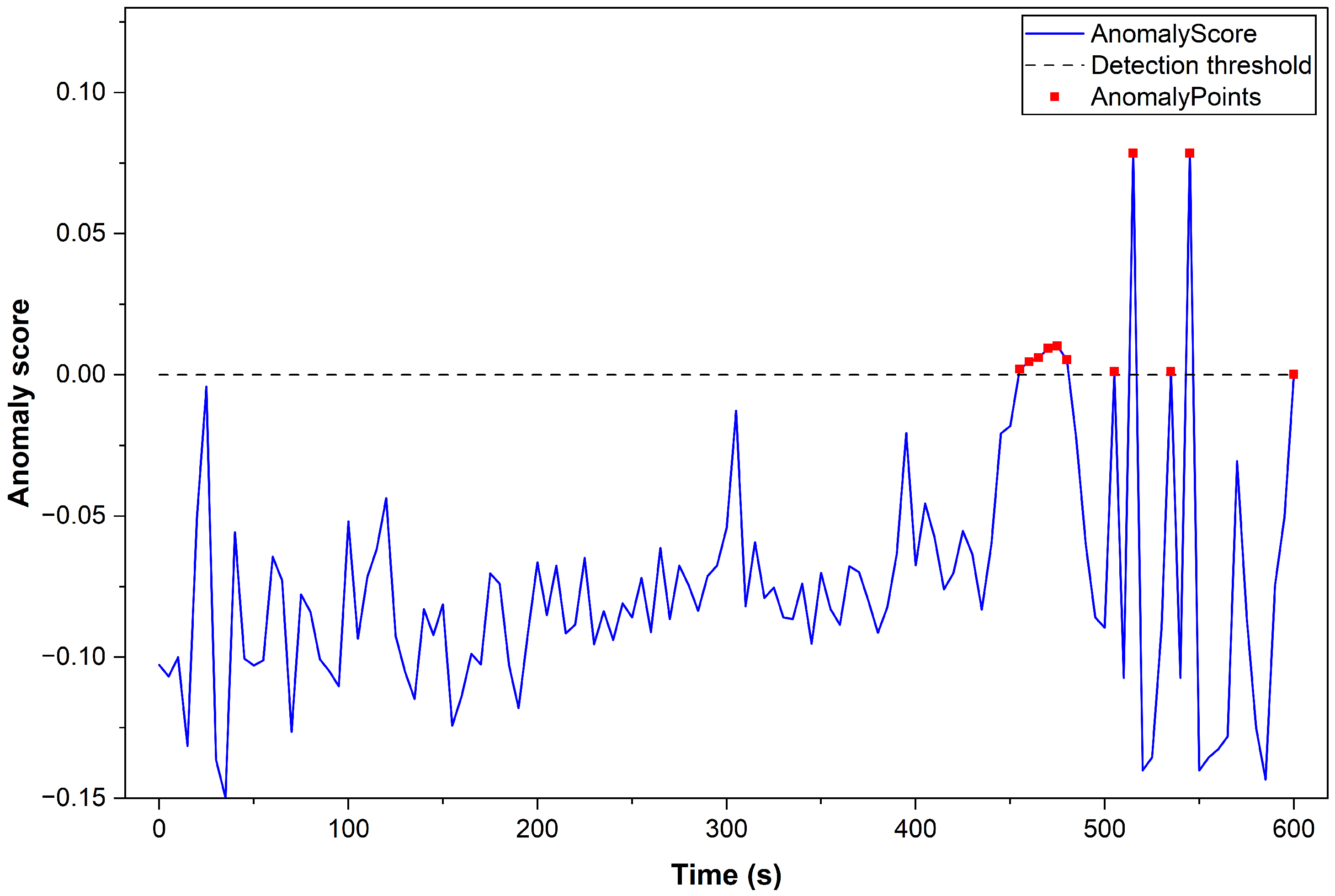
The model was trained exclusively on data collected under nominal operating conditions, enabling it to learn a baseline representation of expected system behavior. During inference, each incoming data sample was assigned an anomaly score that quantifies its deviation from this baseline. To improve robustness and to reduce sensitivity to transient fluctuations or short-lived contact disturbances, anomaly scores were aggregated over short temporal windows prior to decision making. Anomalous events were identified when the aggregated score exceeded a predefined threshold, defined as the 97.5th percentile of anomaly scores observed during nominal operation.
Importantly, anomalous detections were required to exhibit temporal persistence and physical coherence with the system state, such as consistency with motion or stationary phases, rather than appearing as isolated spikes. This criterion further mitigates the influence of momentary contact-mechanics artifacts and supports the interpretation of detected events as genuine thermal anomalies.
In the present implementation, anomaly detection was performed during offline analysis to allow detailed inspection and validation of detected events. Nevertheless, the simplicity and low computational burden of the proposed method enable straightforward migration to on-device execution on the ESP32 in future iterations. Overall, the proposed AI-based anomaly detection framework transforms raw multisensor data into physically interpretable indicators of abnormal operating behavior, complementing the sensing layer without imposing excessive computational or energy overhead.
3.4. Experimental Protocol
The experimental protocol evaluated the proposed monitoring platform under controlled operating conditions, with a focus on contact temperature behavior, multisensor consistency, and anomaly detection performance. Experiments were conducted using the fully integrated system described in
Section 2 and
Section 3, including the LIG contact temperature sensor, auxiliary sensors, and the ESP32-based data acquisition unit.
All experiments were performed under controlled indoor conditions to ensure repeatability and to minimize the influence of uncontrolled environmental factors. The system was mounted on the assistive mobility device using a standardized harness configuration, and data acquisition was initiated only after stable sensor contact at the animal–device interface had been verified. All sensors were sampled synchronously following the acquisition and preprocessing strategy described in
Section 3.2.
The same adjustable assistive harness was used throughout all experimental sessions. Prior to each trial, the harness was individually fitted to the animal following a standardized adjustment procedure to ensure stable mechanical contact while avoiding movement restriction or discomfort. The LIG-based contact temperature sensor was embedded within the harness and positioned at a fixed anatomical location at the animal–device interface. Sensor placement was referenced to the same structural mounting point on the harness, ensuring identical positioning across all experimental sessions. The harness fitting and sensor positioning procedure was repeated and visually verified at the beginning of each session to minimize inter-session variability due to posture changes or harness displacement.
No controlled or externally applied pressure was introduced during the experiments, as the platform is intended for non-invasive assistive use under realistic operating conditions. The padded harness design distributes load and minimizes localized pressure at the contact interface, consistent with veterinary rehabilitation practices. Accordingly, thermal analysis relies on differential temperature trends and temporal persistence rather than on pressure-controlled measurements.
Each experimental session consisted of alternating phases of motion and stationary operation. Motion phases involved normal assisted locomotion at moderate speeds, while stationary phases corresponded to periods during which the device remained static for extended durations. This protocol was intentionally selected to induce variations in contact temperature associated with movement, friction, and heat accumulation, while maintaining safe, non-invasive, and repeatable operating conditions.
Ambient temperature was recorded continuously throughout each session to provide an environmental reference. No artificial heating or external thermal stimulation was applied to the system. All observed temperature variations therefore arose from the natural interaction between the device, the animal, and the surrounding indoor environment. Distance measurements were monitored to identify proximity to obstacles and to support contextual interpretation of motion and stationary states.
Each trial lasted between 20 and 40 min, depending on the specific operating conditions. A total of six independent experimental sessions () were conducted to assess repeatability and to ensure that observed patterns were not isolated events. All experimental sessions were conducted with the same small-breed dog, allowing evaluation of intra-subject repeatability under controlled conditions. Between successive trials, the system was powered down and allowed to return to thermal equilibrium in order to minimize thermal carryover effects.
Table 8 summarizes the main parameters of the experimental protocol, including session duration, operating conditions, and monitored variables. This structured approach ensures reproducibility and provides a transparent basis for interpreting the results presented in
Section 4.
All experiments complied with basic ethical principles for observational animal studies, employing exclusively non-invasive sensors and imposing no additional load, stress, actuation, or feedback beyond normal device operation. The protocol required no invasive procedures or clinical intervention, and all experimental sessions were conducted under supervision to ensure animal comfort and safety. The resulting datasets were used for offline signal analysis and validation of the anomaly detection framework described in
Section 3.3, providing a consistent and reproducible basis for the results presented.
5. Discussion
The results presented in this work demonstrate that the integration of advanced sensing materials, low-power IoT architectures, and lightweight artificial intelligence can substantially enhance safety-oriented monitoring in assisted mobility systems for animals. Unlike conventional passive assistive devices, which primarily focus on mechanical support, the proposed platform introduces an additional layer of situational awareness by continuously monitoring localized thermal and kinematic conditions during operation. Similar system-level monitoring approaches have been increasingly adopted in recent veterinary and wearable rehabilitation technologies to complement mechanical assistance with physiological and contextual awareness [
27]. This approach enables early identification of potentially unfavorable operating states without requiring invasive sensing, clinical diagnosis, or active actuation [
28].
From a practical standpoint, the detection of anomalous thermal or kinematic patterns provides actionable information for caregivers or operators during daily use. Previous studies in animal rehabilitation and human assistive systems have emphasized the importance of early intervention strategies based on continuous monitoring to prevent secondary injuries and discomfort [
27,
35]. When an anomaly is detected, appropriate responses may include temporarily pausing the assisted mobility session, adjusting the harness fit or load distribution, inspecting areas of potential friction, or allowing the animal to rest until thermal conditions return to nominal levels. In this way, the proposed system supports preventive intervention rather than reactive correction, enhancing both animal comfort and user confidence.
A key advantage of the proposed system lies in the integration of a laser-induced graphene (LIG) sensor for direct contact temperature measurement at the harness–body interface. High sensitivity and fast thermal response of graphene-based temperature sensors have been widely demonstrated in wearable applications [
19]. Mechanical compliance and stable operation under repeated deformation have been further reported in flexible graphene sensing platforms [
40]. In addition, the low thermal inertia of LIG structures has been shown to be particularly suitable for continuous contact-temperature monitoring in real-world conditions [
41]. In the present study, the temperature difference between contact and ambient conditions (
) emerged as a particularly informative metric, consistently highlighting localized heating phenomena that were not reflected in ambient measurements alone. This observation is consistent with previous findings in human wearable systems, where differential temperature indicators have been shown to outperform absolute temperature values for comfort and safety assessment [
42]. Similar conclusions were reported in studies focusing on long-term skin–device thermal interaction [
43].
An important aspect related to the sensing performance of flexible graphene-based sensors is the potential influence of mechanical flexion during operation. In practical assisted mobility scenarios, the harness and embedded sensing elements are subject to moderate bending and conformal deformation induced by animal movement and posture changes. Prior studies have shown that flexural deformation in graphene-based and laser-induced graphene devices can influence electrical response through strain-dependent effects, particularly in multifunctional flexible sensing and heating platforms [
44]. In the proposed system, several design choices mitigate this influence. First, the LIG sensor is embedded within a padded, flexible harness that distributes mechanical loads and limits sharp bending radii. Second, anomaly detection relies on sustained temporal trends and multisensor coherence rather than instantaneous absolute values, ensuring that detected anomalies correspond to persistent deviations consistent with thermal accumulation rather than transient mechanically induced perturbations. Explicit decoupling of thermal and flexural contributions through multimodal sensing or strain-aware models therefore remains a relevant direction for future work rather than a requirement for the present application-oriented study.
From a system architecture perspective, the proposed IoT framework demonstrates that near-real-time monitoring can be achieved using commodity embedded hardware while maintaining energy efficiency. Similar architectures based on low-power microcontrollers and wireless communication have been widely adopted in wearable and rehabilitation-oriented monitoring platforms, and comparable performance in terms of packet delivery ratio and latency has been reported in recent ESP32-based and mobile IoT monitoring systems [
45,
46]. The measured packet delivery ratio of approximately 95% and end-to-end latencies predominantly below 500 ms under Wi-Fi connectivity indicate that the system is capable of timely data delivery for monitoring and alerting purposes. The lightweight nature of the data acquisition and transmission pipeline further supports scalability and long-term deployment without imposing excessive computational or energy overhead.
The evaluation of Bluetooth as an alternative communication channel further highlights both advantages and trade-offs inherent to the proposed design. Reduced latency variability under short-range point-to-point communication has been extensively documented for Bluetooth-based systems [
47]. However, limitations in throughput and coverage constrain its applicability in data-intensive or spatially distributed scenarios [
48]. Conversely, Wi-Fi communication offers greater flexibility and extended coverage but exhibits increased sensitivity to network congestion and environmental interference, as discussed in recent studies on hybrid IoT communication strategies [
49]. The ability of the proposed platform to support both communication modes therefore represents a practical advantage, enabling adaptation to diverse operating contexts.
The adoption of an unsupervised Isolation Forest algorithm for anomaly detection represents another important advantage of the proposed platform. Unsupervised learning approaches are particularly suitable for assistive and wearable systems, where labeled abnormal events are inherently scarce [
25]. Isolation Forest-based methods have been shown to provide robust performance with low computational complexity in edge and IoT monitoring applications [
50]. Additional studies have demonstrated their adaptability to non-stationary operating conditions and heterogeneous sensor inputs [
51]. The incorporation of temporal aggregation further enhances robustness by reducing sensitivity to transient noise and measurement artifacts, a strategy also recommended in recent reliability-oriented monitoring frameworks [
52]. Similar aggregation-based approaches have been shown to improve interpretability and operational reliability in structural and wearable sensing systems [
53]. Related findings were also reported for anomaly-aware monitoring in safety-critical applications [
54].
Energy autonomy and operational simplicity constitute additional strengths of the proposed system. Low-duty-cycle operation and event-driven communication have been identified as key enablers for long-term IoT deployments in energy-constrained environments [
55]. The use of a solar-assisted power bank aligns with pragmatic design strategies reported in outdoor monitoring systems [
56]. Comparable hybrid energy approaches have also been shown to effectively slow battery depletion in mobile sensing platforms [
57]. Moreover, the fully passive nature of the assistive platform enhances safety and compatibility by decoupling sensing and monitoring from propulsion or control, allowing the system to be integrated into a wide range of existing assistive devices without structural modification.
At the same time, several limitations of the present study should be acknowledged. The experimental evaluation was conducted over a limited number of sessions () and focused on intra-subject repeatability under controlled indoor conditions. While sufficient to demonstrate feasibility, internal consistency, and proof of concept, this scope limits direct generalization to diverse breeds, body sizes, harness configurations, and outdoor environments. In addition, the monitoring strategy prioritizes application-oriented robustness over detailed biomechanical or pressure-resolved analysis; consequently, the system does not provide direct quantification of contact pressure or discomfort regions. Accordingly, localized thermal deviations detected by the proposed system should be interpreted as early-warning indicators of unfavorable interface conditions—potentially arising from friction, sustained contact, or load redistribution—rather than as isolated or fully decoupled physical quantities. Furthermore, temperature measurements are analyzed as time-resolved signals rather than isolated scalar values; therefore, measurement variability and uncertainty are addressed through signal filtering, temporal aggregation, and anomaly score thresholding rather than through conventional point-wise error bars. In addition, the intrinsic accuracy, resolution, and repeatability of the LIG temperature sensor were previously established during calibration and validation experiments reported in our prior work; consequently, residual measurement variability in the present study is primarily managed at the system level through digital filtering, temporal aggregation, and consistency-based anomaly scoring rather than through classical statistical error-bar representation. Finally, anomaly detection was performed offline in the current implementation, and future work will focus on migrating inference to the embedded device to further reduce latency, improve autonomy, and support adaptive thresholds or personalized baseline models.
From a modeling perspective, future extensions of this work may benefit from the incorporation of fractional-order thermal models to describe heat transfer phenomena in nanoscale carbon-based materials such as laser-induced graphene. Fractional formulations have been shown to capture memory effects, anomalous diffusion, and non-local thermal behavior that cannot be fully represented using classical integer-order models, particularly in porous and defect-rich carbon structures. While the present study adopts a system-level, data-driven monitoring approach rather than physics-based thermal modeling, the integration of fractional-order descriptions represents a promising research direction to deepen physical understanding of LIG thermal dynamics and to enhance predictive capabilities in advanced implementations.
Despite these limitations, the proposed platform illustrates a generalizable paradigm for safety-oriented monitoring in assistive mobility and wearable systems. By combining advanced materials, low-power IoT architectures, and explainable artificial intelligence, it is possible to augment passive devices with intelligent awareness while preserving simplicity, affordability, and user trust. Beyond veterinary applications, the concepts demonstrated in this work may inform the design of smart assistive technologies for broader human- and animal-centered contexts.
6. Conclusions
This paper presented an AI-enhanced IoT monitoring platform designed to improve safety awareness in assisted mobility systems for small dogs through non-invasive sensing and intelligent data analysis. By integrating a laser-induced graphene (LIG) contact temperature sensor, a low-power ESP32-based IoT architecture, and an unsupervised anomaly detection framework, the proposed system extends conventional passive assistive devices with real-time monitoring and early-warning capabilities.
Experimental results demonstrated stable system operation across multiple assisted mobility sessions, with reliable multisensor data acquisition, a packet delivery ratio of approximately 95%, and end-to-end communication latencies predominantly below 500 ms under nominal Wi-Fi connectivity. Direct contact temperature monitoring proved effective in capturing localized thermal phenomena at the harness–body interface, while the temperature difference between contact and ambient conditions emerged as a particularly informative indicator of localized heating. The Isolation Forest-based anomaly detection method consistently identified sustained deviations from normal thermal and kinematic behavior, while remaining robust to transient fluctuations and measurement noise.
Importantly, the proposed framework is explicitly non-diagnostic and safety-oriented, functioning as a preventive monitoring tool rather than a clinical assessment system. The use of conservative, configurable alert thresholds and explainable anomaly detection supports user trust and practical deployment without imposing invasive sensing or complex calibration requirements. The passive nature of the assistive platform further enhances safety and compatibility, enabling integration with existing mobility devices without structural modification.
While the present study focused on a limited number of experimental sessions, the results validate the feasibility and internal consistency of the proposed approach. Future work will address larger-scale evaluations involving multiple animals and environmental conditions, on-device implementation of anomaly detection to further reduce latency and energy consumption, and adaptive personalization strategies to account for inter-animal variability. Collaboration with veterinary professionals may also support complementary validation studies, while maintaining the non-diagnostic scope of the system.
Overall, this work demonstrates that combining advanced sensing materials, IoT architectures, and lightweight artificial intelligence can meaningfully enhance monitoring and safety in assistive mobility applications. The proposed platform offers a low-cost, scalable, and adaptable solution that may inform the development of next-generation smart assistive technologies for both animal and human-centered use cases.