1. Introduction
In modern geared transmissions, long-wavelength flank geometry plays a central role in load distribution, time-varying mesh stiffness (TVMS), and transmission error (TE), which are among the main excitation sources of gear vibration and tonal noise. TE is widely recognized as a dominant source of gear whine and dynamic excitation, and its magnitude is strongly influenced by manufacturing errors, misalignment, and flank deviations [
1,
2]. While micro-scale roughness mainly affects frictional behavior, lubrication, and tribological noise contributions [
3], longer-wavelength deviations across the face width can substantially modify contact patterns, load sharing, and mesh stiffness modulation [
4]. Analytical and numerical studies have further shown that tooth surface modifications and geometric deviations can alter TVMS and load transmission error (LTE), thereby affecting dynamic tooth loads and vibration behavior [
5,
6,
7].
These findings are especially relevant in the context of production metrology. In industrial gear inspection, flank geometry is typically evaluated using tooth-level descriptors such as profile deviations, lead deviations, slope-related parameters, and curve-based deviation measures. These quantities are often interpreted within tooth contact analysis (TCA) and TE-oriented evaluation frameworks, which remain largely focused on the local geometry of individual teeth and their direct meshing implications [
8]. At the same time, recent research has continued to confirm that profile errors, pitch variations, and flank modifications can significantly influence TVMS, TE, and the resulting dynamic response of geared systems [
9,
10,
11,
12,
13,
14].
Despite this progress, most existing evaluation approaches still emphasize either single-tooth descriptions or averaged geometric characteristics of the gear surface. Circumferential tooth-to-tooth variability within the same component is much less frequently quantified explicitly, even though manufacturing-related effects such as process instability, tool wear, local machining deviations, or grinding-related pattern formation may introduce such inhomogeneity across the population of teeth [
15,
16]. From a practical standpoint, this creates a gap between standard metrology outputs and the need to identify components whose individual tooth measurements may appear acceptable, yet still exhibit elevated circumferential variability that could become relevant for downstream meshing behavior.
This gap is particularly important because long-wavelength geometric inconsistency is more closely connected to contact redistribution and excitation behavior than fine-scale surface texture alone [
15]. A population-scale, geometry-based indicator that captures tooth-to-tooth waviness variability directly from standard coordinate measuring machine (CMM) outputs could therefore provide additional insight into manufacturing consistency without requiring dedicated NVH test benches or supplementary measurement hardware.
To address this need, the present study introduces a tooth-to-tooth long-wavelength waviness inhomogeneity indicator, denoted as ΔW1. First, each measured flank curve is detrended using a second-order polynomial in order to remove global form components while preserving the residual waviness content relevant to long-wavelength modulation analysis. The first harmonic amplitude, W1, is then extracted from the residual signal by projection onto sine and cosine basis functions along the normalized face-width coordinate. For each gear component, ΔW1 is defined as the difference between the maximum and minimum W1 values across the measured teeth on the same flank side. In this way, ΔW1 represents the circumferential spread of long-wavelength waviness within a single part. To reduce the influence of edge-related measurement artifacts, an additional mid-section evaluation over the central 10–90% of the face width is also considered.
In line with established metrology and gear-dynamics studies, conventional evaluation procedures remain primarily centered on individual tooth measurements, whereas circumferential tooth-to-tooth variability within the same component is rarely quantified explicitly, despite its possible manufacturing origin [
12,
13,
14,
15,
16]. The main contributions of this work are, therefore, threefold: first, the study introduces a tooth-to-tooth long-wavelength waviness variability indicator derived directly from standard CMM measurements; second, it demonstrates the statistical behavior of this indicator on a large industrial dataset; and third, it shows that circumferential geometric inhomogeneity can be screened using existing inspection data without additional dedicated hardware.
Long-Wavelength Flank Waviness and Harmonic Representation
In gear metrology, tooth flank deviations are commonly interpreted across multiple spatial scales. High-frequency surface roughness is mainly associated with tribological phenomena such as lubrication behavior, frictional interactions, and surface finishing effects, whereas lower-frequency geometric deviations have a stronger influence on contact conditions, load distribution, and meshing kinematics [
17]. Within this broader framework, long-wavelength flank waviness refers to slowly varying geometric modulation along the tooth flank that extends over a substantial portion of the face width.
Such waviness may arise from several manufacturing-related mechanisms, including tool deflection, structural vibration of the machine system, grinding process instability, thermal deformation of machine components, or systematic tool wear. In measured flank curves, these effects usually appear as smooth, undulating patterns rather than fine-scale texture. Previous studies on gear manufacturing errors have shown that machining- and grinding-induced deviation patterns can alter tooth surface geometry in ways that later affect contact behavior and gear performance [
18,
19].
The practical relevance of long-wavelength waviness lies in its influence on contact development during operation. Numerical and experimental investigations have shown that deviations in tooth surface shape can modify the contact pattern and the effective load distribution along the flank [
20,
21]. As a result, slowly varying surface modulation may alter meshing conditions and indirectly affect the dynamic response of the gear system.
From a dynamic perspective, this is important because periodic surface deviations can influence both TE and TVMS during gear engagement. As the contact zone moves along a modulated flank, the instantaneous contact geometry changes continuously, which may introduce additional excitation components into the meshing process [
22,
23]. For this reason, long-wavelength waviness is not merely a geometric description issue; it is also relevant from the standpoint of excitation generation and vibration behavior.
To describe these modulation patterns quantitatively, harmonic representations of flank geometry are often used. In such approaches, the residual deviation signal obtained from measured flank data is decomposed into sinusoidal components defined along the face-width coordinate. Harmonic or Fourier-based descriptions provide a compact way to characterize spatial modulation patterns and to compare the spectral content of measured surface deviations across different teeth or components [
24].
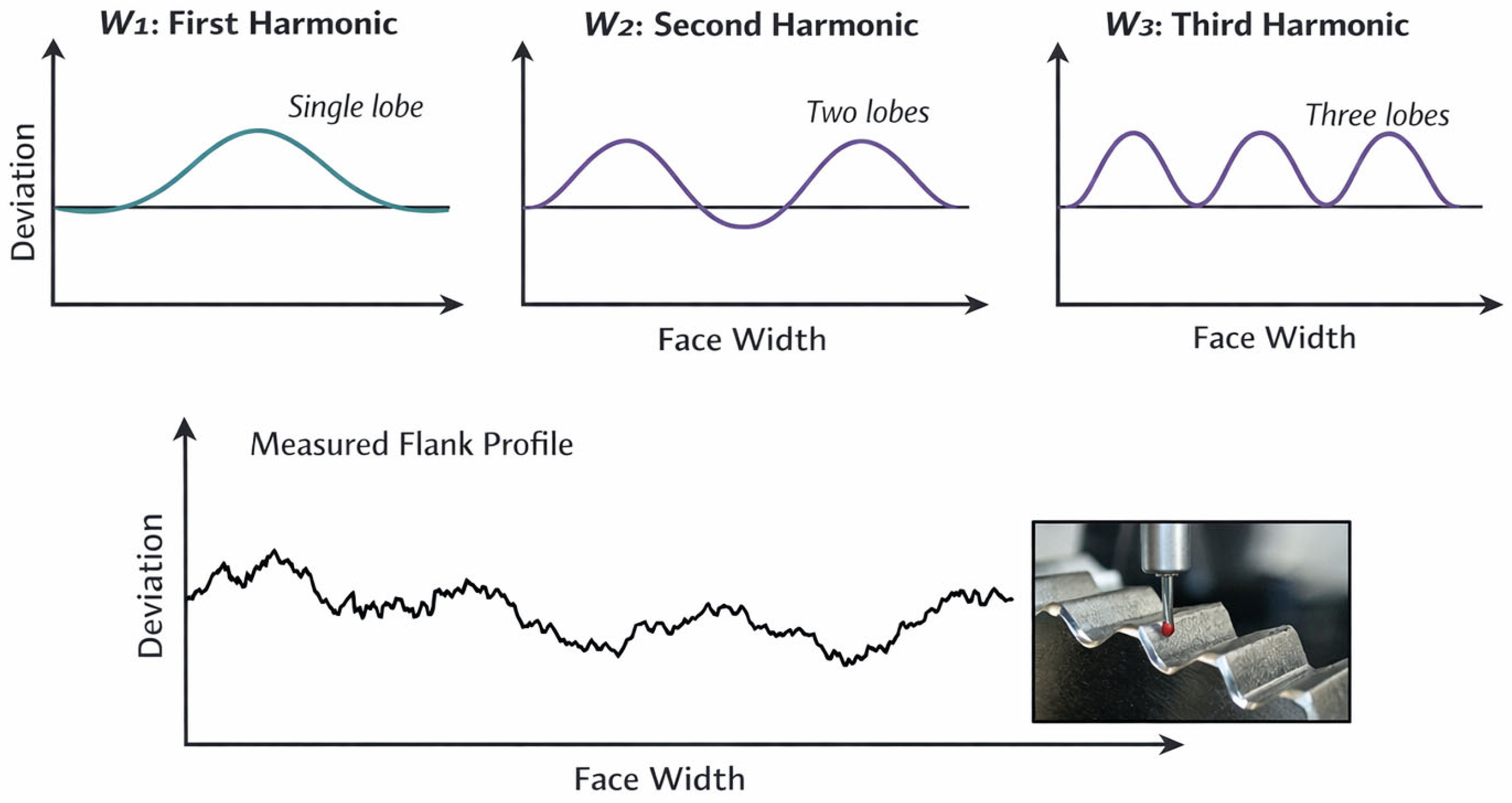
In this framework, the first harmonic component, denoted as W1, corresponds to a single long-wavelength modulation across the face width and typically captures the dominant low-frequency geometric variation in the flank surface, as illustrated in
Figure 1. Higher-order components such as W2 and W3 represent progressively more complex spatial patterns with two and three lobes across the face width, respectively. Together, these descriptors provide a compact basis for representing flank waviness and for comparing modulation patterns between teeth.
Although harmonic flank representations are widely used for individual tooth evaluation, they are typically interpreted on a tooth-by-tooth basis. In the present work, these harmonic descriptors serve as the basis for defining a circumferential variability indicator that quantifies the spread of long-wavelength waviness amplitudes between teeth within the same gear component.
2. Materials and Methods
This section describes the methodological workflow used to quantify circumferential long-wavelength flank waviness variability from standard CMM measurements. First, the measurement dataset and file structure are introduced. Next, the preprocessing, harmonic feature extraction, and definition of the proposed ΔW1 indicator are presented. Finally, the population-level analysis and clustering procedure used to identify geometrically atypical components are summarized.
2.1. Measurement Data and File Structure
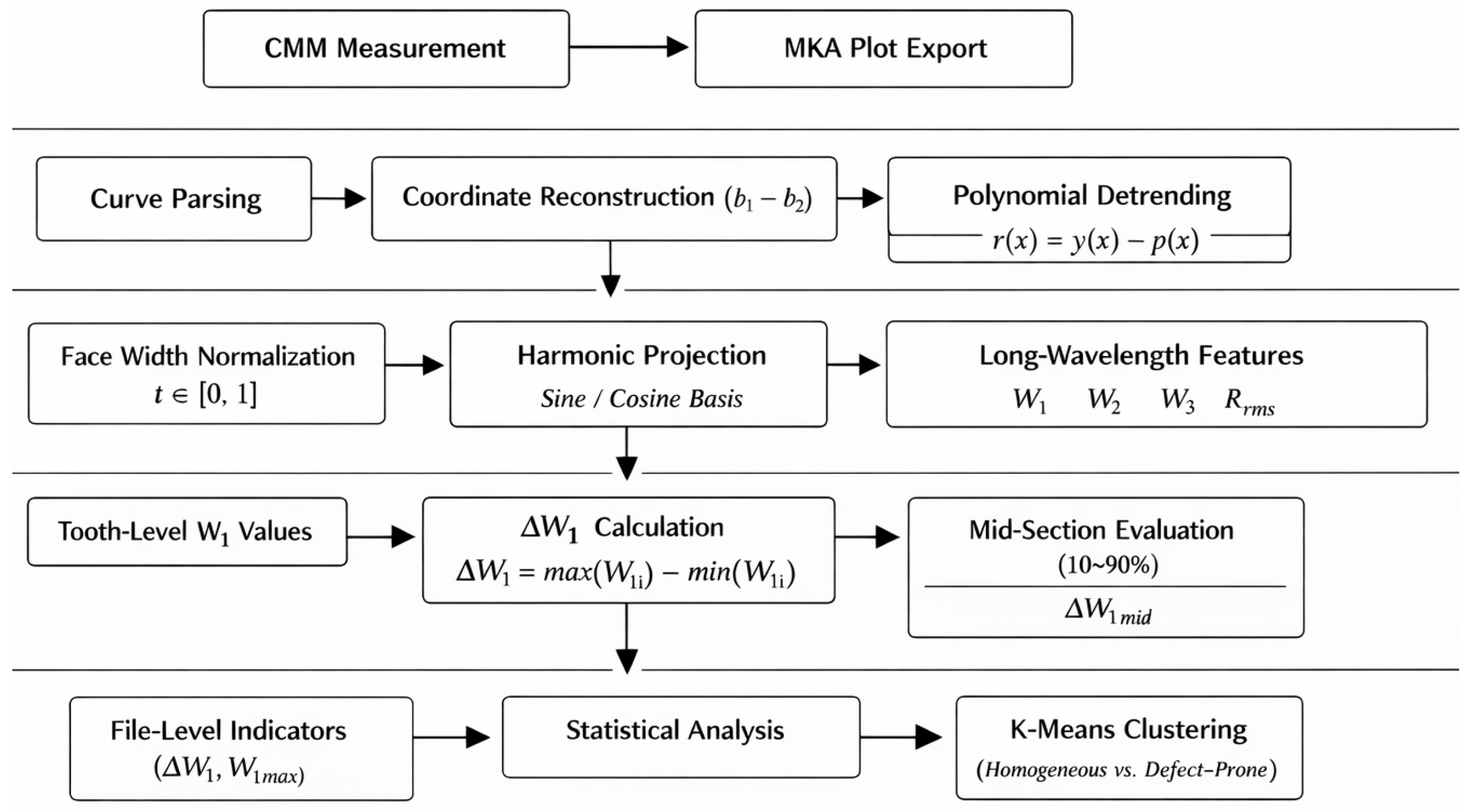
The overall processing workflow for long-wavelength flank waviness inhomogeneity assessment is summarized in
Figure 2.
All components share the same macrogeometry. The investigated gears contain 23 teeth. Flank measurements were available on multiple teeth per component and at least one flank side, enabling tooth-to-tooth comparison within each part. The dataset represents serial production parts from multiple batches measured under a consistent CMM inspection routine.
The dataset consists of 3375 gear components measured using a coordinate measuring machine (CMM), with results exported in Klingelnberg-style MKA plot format (KLINGELNBERG GmbH, Peterstr. 45, 42499 Hückeswagen, Germany). Each file contains flank and profile measurement blocks, including tooth identification, flank side (left/right), number of sampling points, and evaluation range parameters. Only flank measurements were considered for the present long-wavelength waviness analysis.
Each flank curve is represented by a sequence of sampled deviation values along the face width. The evaluation start and end positions are defined in the file header (b1, b2), enabling reconstruction of the physical coordinate axis. Undefined placeholder values are excluded prior to further processing.
The flank curves were obtained using a scanning CMM measurement strategy along the face-width direction. Each flank profile consisted of several hundred sampled points distributed along the evaluation range. The spacing between consecutive measurement points was approximately uniform along the face width, enabling reliable reconstruction of the deviation signal for harmonic analysis. This sampling density is sufficient to capture long-wavelength modulation patterns while avoiding aliasing of the harmonic components considered in the present study.
The main geometric parameters of the investigated gear type are summarized in
Table 1, based on the CMM inspection documentation.
2.2. Curve Detrending and Residual Signal Definition
To isolate waviness components from global form deviations, each flank curve was detrended using a second-order polynomial fit. A second-order polynomial was selected because it effectively captures the dominant global form components typically present in flank measurements, including overall slope and curvature along the face width. Higher-order polynomial fits were intentionally avoided because they may partially absorb long-wavelength modulation components that are relevant for the waviness analysis. The quadratic detrending therefore removes global geometric trends while preserving the physically meaningful long-wavelength deviations that form the basis of the harmonic analysis. Let y(x) denote the measured deviation along the face width coordinate x. A quadratic polynomial p(x) was fitted using least squares, and the residual signal was defined as:
The residual was subsequently mean-centered to remove constant offsets. This procedure suppresses global slope and curvature effects while preserving long-wavelength modulation patterns relevant to excitation behavior.
2.3. Long-Wavelength Lobe Feature Extraction (W1–W3)
Harmonic projection onto sine and cosine basis functions corresponds to the order-based spectral decomposition widely applied in TE and gear excitation analysis [
25].
Long-wavelength waviness components were quantified using harmonic projection along the normalized face width. Because the CMM measurements provide discrete sampling points along the flank curve, the harmonic decomposition was implemented using discrete numerical projections rather than continuous integrals. The projections were computed using the normalized face-width coordinate t ∈ [0, 1] sampled at the CMM measurement points. This formulation ensures that the harmonic amplitudes are computed consistently with the discrete nature of the measured data. The coordinate was normalized to the unit interval:
For each residual signal
r(
t), harmonic amplitudes were computed via projection onto sine and cosine basis functions:
The
k-th lobe amplitude was then defined as:
where
and
denote the cosine and sine projection coefficients obtained from Equations (3) and (4), respectively. The resulting amplitude
, therefore, represents the magnitude of the
-th harmonic waviness component.
In practice, the harmonic projections were evaluated using discrete numerical summation over the sampled CMM measurement points along the flank curve. Let denote the residual deviation at the sampling position along the normalized face-width coordinate. The inner products in Equations (3) and (4) were therefore computed as finite sums over the available measurement points, ensuring consistency with the discrete nature of the CMM data.
In this study, the first three lobe components (W1–W3) were extracted. The first-order component (W1) represents the dominant long-wavelength modulation along the face width and forms the basis of the circumferential inhomogeneity indicator introduced below.
2.4. Definition of the Tooth-to-Tooth Inhomogeneity Indicator (ΔW1)
For each gear component and flank side, the tooth-to-tooth waviness inhomogeneity was quantified as:
where
denotes the first-order lobe amplitude of the i-th measured tooth on the same flank side.
This definition captures the circumferential spread of long-wavelength waviness within a single part. File-level aggregation was performed by taking the maximum ΔW1 value across measured sides. To mitigate potential edge-related measurement artifacts, an additional mid-section evaluation was conducted by restricting the analysis to the central 10–90% of the physical face-width coordinate range (based on reconstructed b1–b2 limits from the MKA header). The exclusion of the outer 10% regions near both edges of the face width was introduced to reduce the influence of probe entry and exit artifacts that may occur during CMM scanning measurements. These edge regions can contain locally increased measurement noise or incomplete sampling due to the probe approach and withdrawal phases. Restricting the analysis to the central 10–90% region, therefore, provides a more robust representation of intrinsic flank waviness while maintaining the majority of the measured data. The harmonic projection was fully recomputed on the truncated coordinate interval without interpolation or post-scaling, and ΔW1_mid was derived analogously from the recalculated W1 values.
2.5. Population-Level Analysis and Clustering
To explore structural grouping within the dataset, unsupervised K-means clustering was performed using two file-level features: ΔW1_max_side and the maximum tooth-level amplitude W1_max. Prior to clustering, both features were standardized to zero mean and unit variance to prevent scale dominance effects.
K-means clustering was applied following Lloyd’s algorithm [
25] with k-means++ initialization to improve convergence robustness [
26]. The number of clusters was selected using the elbow criterion [
27]. Multiple random initializations were used to reduce sensitivity to local minima and improve solution robustness.
This configuration enabled separation between a dominant low-variability cluster, an intermediate group, and a smaller high-variability subset characterized by elevated ΔW1 and W1_max values [
27,
28].
3. Results
This section presents the main results obtained using the proposed ΔW1-based evaluation framework. First, the population-level distributions of W1 and ΔW1 are reported. Next, the effect of the mid-section evaluation is examined for the most critical components. Finally, the clustering results are presented to demonstrate how the proposed indicators support the identification of geometrically atypical or high-variability parts within the investigated production dataset.
3.1. Population-Level Distribution of W1 and ΔW1
The long-wavelength lobe amplitudes were evaluated across the complete measurement population. After excluding 13 files with incomplete flank measurement blocks, valid flank-based indicators were obtained for 3362 gear components, comprising 10,216 individual tooth-side curves. At tooth level, the first lobe amplitude W1 showed a median of 2.24 µm and a mean of 2.16 µm (95th percentile: 3.04 µm; 99th percentile: 3.41 µm). This indicates geometrically homogeneous long-wavelength flank modulation for most components in the investigated production batches.
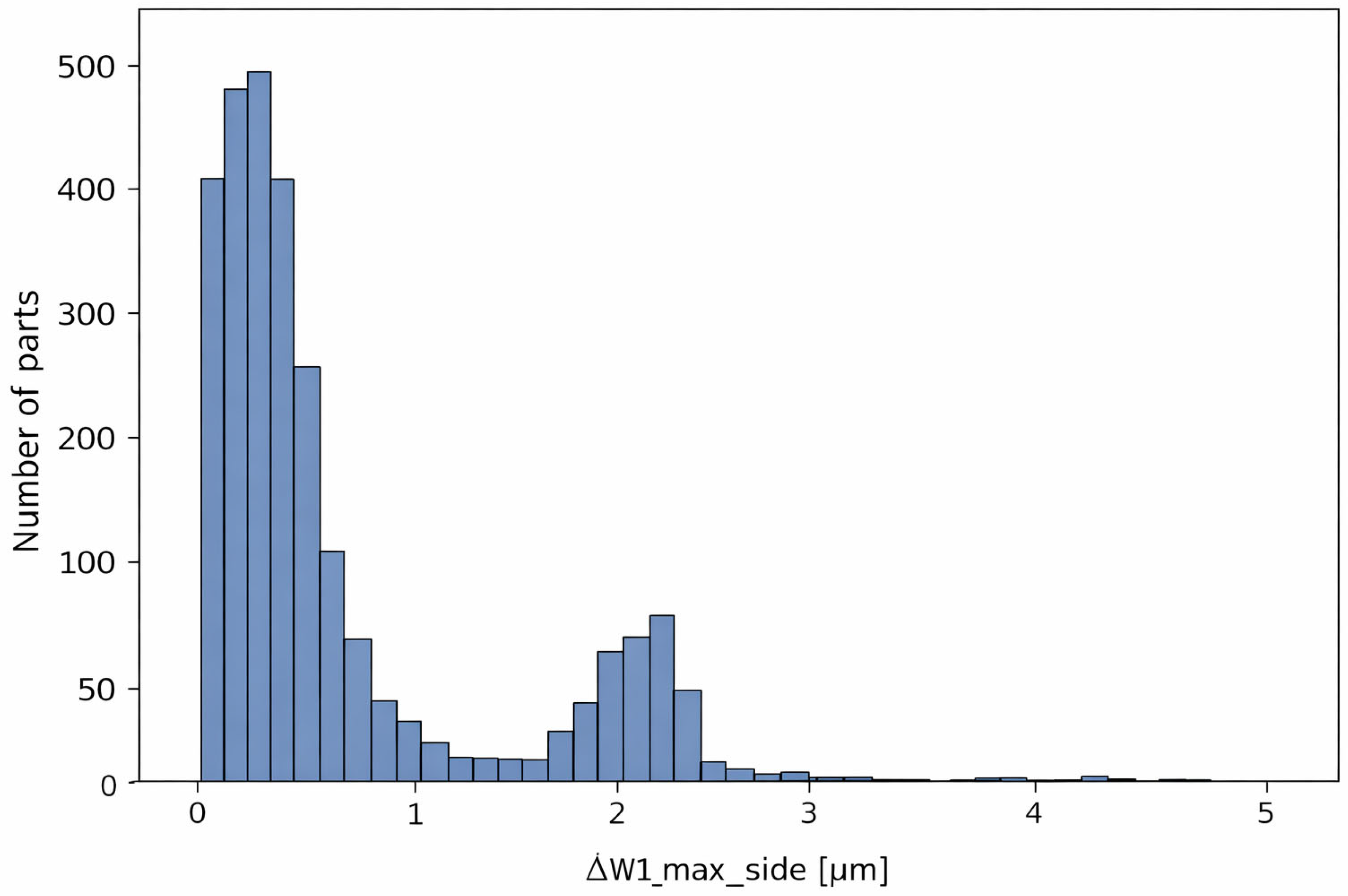
Circumferential inhomogeneity was quantified using the proposed ΔW1 indicator, defined as the within-part tooth-to-tooth spread of W1. The file-level metric ΔW1_max_side exhibited a median of 0.41 µm and a mean of 0.72 µm, with the upper tail characterized by a 95th percentile of 2.37 µm and a maximum of 5.05 µm. The distribution, therefore, contains a distinct subset of parts with markedly higher tooth-to-tooth variability compared to the main population.
The statistical distribution of the extracted indicators is summarized in
Table 2. While the majority of components exhibit low circumferential variability, the upper tail of the ΔW1 distribution indicates a limited subset of geometrically inconsistent parts.
The population-level distribution of ΔW1_max_side is illustrated in
Figure 3. The histogram reveals a strongly right-skewed distribution, with the majority of parts concentrated below 1 µm and a progressively thinning upper tail extending beyond 4 µm. This tail region corresponds to geometrically atypical components characterized by elevated circumferential waviness variability.
3.2. Effect of Mid-Section Evaluation (10–90% Face Width)
To assess robustness against boundary-related effects, an additional mid-section evaluation (10–90% of the face width) was applied. This filtering step increases sensitivity to intrinsic long-wavelength modulation by reducing edge-dominated deviations observed near the evaluation limits. While the full-population mid-section recomputation is not reported for all parts in the present manuscript due to space constraints, the recalculation procedure was applied consistently to all five critical components using the identical harmonic extraction workflow.
For the five most critical parts, mid-section recomputation yielded ΔW1_mid values in the range of approximately 7–9 µm, exceeding the corresponding full-length ΔW1 values. These values exceed the 99th percentile of the full-population ΔW1_max_side distribution by a factor of approximately two, indicating that the identified components represent statistical outliers within the dataset.
This confirms that the observed circumferential variability is not solely attributable to boundary artifacts and remains present within the central face-width region. These values refer exclusively to the five most critical components and do not represent the overall population distribution.
A direct comparison between full-length and mid-section recalculated values for the five most critical components is provided in
Table 3. The systematic increase in ΔW1 after edge filtering confirms that circumferential inhomogeneity persists within the central face-width region. All mid-section values reported in
Table 3 were independently recalculated using the truncated dataset and verified against the original full-length processing pipeline to exclude indexing or implementation inconsistencies.
3.3. Identification of Defect-Prone Components
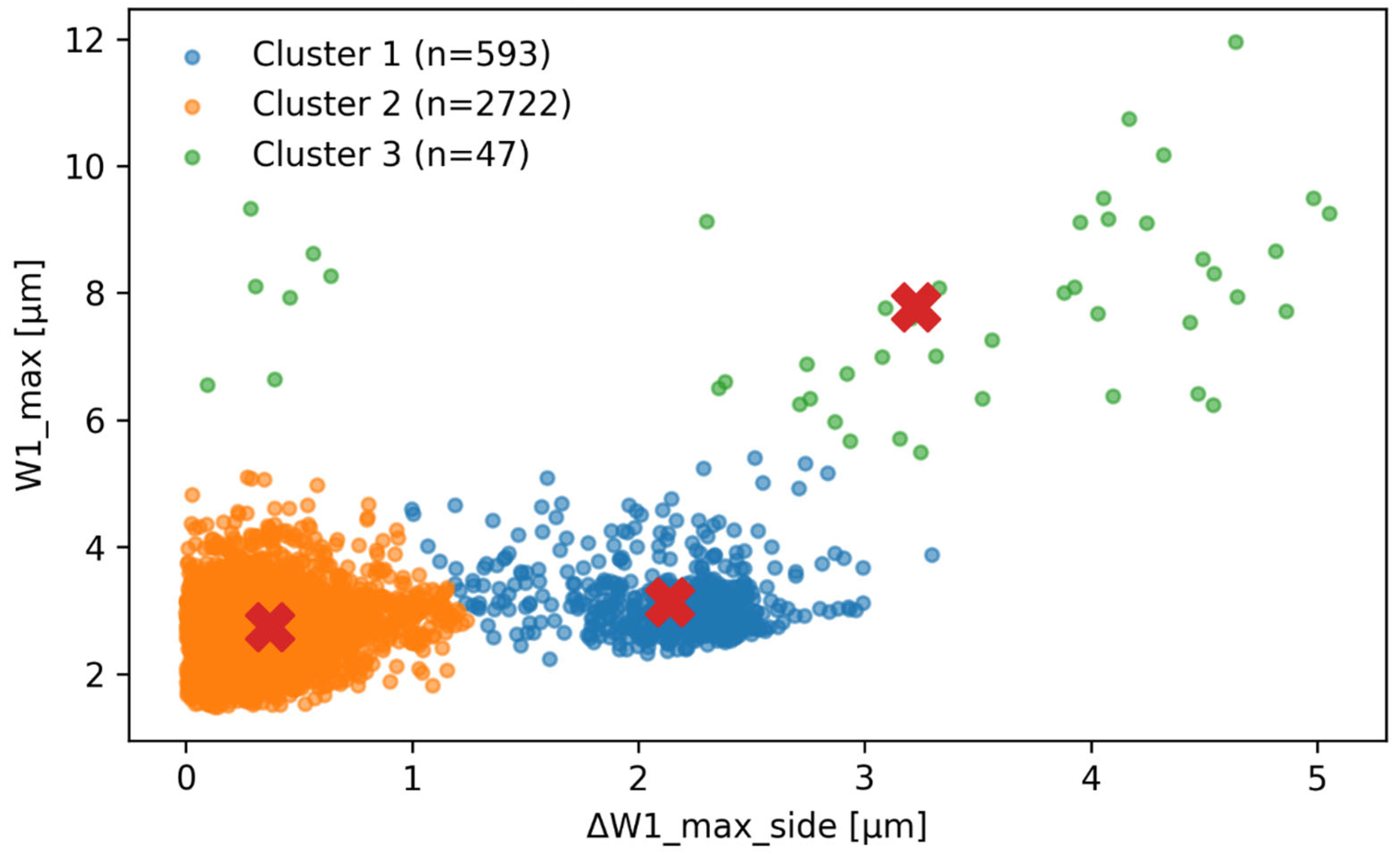
To explore structural grouping, K-means clustering was applied using two file-level features: ΔW1_max_side and the maximum tooth-level amplitude W1_max. With k = 3, the analysis separated a dominant low-variability cluster from intermediate and high-variability subsets. The smallest cluster contained 47 parts and exhibited simultaneously elevated ΔW1 and W1_max, with cluster-center values of approximately ΔW1 ≈ 3.68 µm and W1_max ≈ 5.70 µm.
These results indicate that ΔW1, particularly when combined with W1_max, provides a practical geometry-based screening approach capable of isolating a high-variability subset within large production batches.
A direct comparison between full-length and mid-section recalculated ΔW1 values for the five most critical components is presented in
Figure 4. All points lie above the diagonal reference, indicating systematically increased inhomogeneity after boundary filtering. This behavior confirms that the identified variability is not dominated by edge artifacts but reflects intrinsic long-wavelength modulation differences.
4. Discussion
The present study introduces ΔW1 as a geometry-based indicator for quantifying circumferential long-wavelength flank waviness variability within a single gear component. The main result is that this formulation captures information that is not visible from tooth-by-tooth W1 values alone. While W1 describes the long-wavelength modulation of an individual measured flank curve, ΔW1 quantifies how strongly that modulation varies from tooth to tooth within the same part. In this sense, the proposed metric extends conventional tooth-level evaluation toward a component-level view of circumferential geometric consistency.
The population-level results show that most components exhibit relatively low ΔW1 values, which points to stable manufacturing behavior in the majority of cases. At the same time, the distribution contains a distinct upper tail, indicating that a limited subset of parts deviates clearly from the main population. This is consistent with the interpretation that ΔW1 can serve as a practical manufacturing consistency indicator. Although the present study does not identify the underlying process cause directly, such elevated circumferential variability may plausibly be associated with tool wear progression, localized machining instability, clamping effects, or thermal drift during production. The statistical separation observed in the dataset supports the usefulness of ΔW1 for screening geometrically atypical components in large production batches.
The mid-section evaluation further strengthens this interpretation. After restricting the analysis to the central 10–90% of the face width, the five most critical components still exhibited clearly elevated ΔW1 values, in the approximate range of 7–9 µm. These values are substantially higher than the corresponding full-length values and exceed the 99th percentile of the full-population ΔW1 distribution by roughly a factor of two. This indicates that the identified components are not merely boundary-driven artifacts, but true outliers with pronounced intrinsic circumferential waviness inhomogeneity. The fact that all highlighted parts remain critical after boundary filtering suggests that the proposed indicator is robust against local edge effects and still captures the dominant internal modulation pattern of the flank.
Measurement uncertainty must also be considered when interpreting the magnitude of ΔW1. Modern CMM systems typically operate in the sub-micrometer repeatability and uncertainty range under controlled inspection conditions. In contrast, the largest tooth-to-tooth waviness spreads observed here reach several micrometers. The detected variability, therefore, cannot reasonably be attributed to measurement noise alone. Because ΔW1 is defined within the same component as the difference between the maximum and minimum W1 values, systematic geometric differences between teeth are expected to dominate the metric, whereas random measurement noise contributes only marginally to the observed spread.
At the same time, the scope of the proposed indicator should be stated clearly. ΔW1 is not a direct predictor of vibration or noise. Dynamic excitation in geared systems arises during meshing and depends on the interaction of both gears, the contact state, and the operating conditions. The present work intentionally focuses on single-gear geometry and, therefore, should be interpreted as a geometry-based risk assessment rather than a validated NVH model. Nevertheless, this does not reduce its practical value. Tooth-to-tooth differences in long-wavelength flank geometry may alter local contact conditions and can reasonably be expected to influence mesh stiffness variation or transmission error once the gear operates with a mating partner. Direct quantitative correlation with roll testing, transmission error measurements, or End-of-Line acoustic data remains outside the scope of the current study and should be addressed in future work.
The clustering results highlight the practical usefulness of the method from a production perspective. When ΔW1 is combined with the maximum tooth-level W1 amplitude, the resulting feature space enables automatic separation of low-, intermediate-, and high-variability groups. In the present dataset, the smallest cluster contained only 47 parts and was characterized by simultaneously elevated ΔW1 and W1_max values. This confirms that the proposed indicator is not only descriptive but also suitable for computationally lightweight screening of large industrial datasets. Since the workflow operates directly on standard CMM exports, it can be integrated into existing quality-control practice without additional measurement hardware or dedicated dynamic test procedures.
Overall, the results support the use of ΔW1 as a practical geometry-based screening metric for identifying circumferentially inconsistent gears within large production populations. Its main strength lies in transforming standard flank metrology data into a part-level indicator of tooth-to-tooth inhomogeneity. This provides a useful bridge between conventional inspection outputs and higher-level manufacturing consistency assessment. Future work should focus on linking ΔW1 to meshing simulations, transmission error measurements, and NVH responses from gear-pair experiments to establish its quantitative dynamic relevance.
5. Conclusions
This study introduced ΔW1, a tooth-to-tooth indicator derived from standard CMM flank measurements for quantifying circumferential long-wavelength waviness variability within a single gear component. By evaluating the spread of the first harmonic amplitude between measured teeth, the proposed metric extends conventional tooth-level flank assessment toward a part-level description of circumferential geometric consistency.
The population-level analysis performed on more than 3300 industrial gear components showed that most parts exhibit relatively low circumferential variability, which indicates stable manufacturing behavior in the majority of cases. At the same time, ΔW1 successfully identified a smaller subset of geometrically atypical components with clearly elevated tooth-to-tooth waviness differences. The additional mid-section evaluation confirmed that the most critical cases remain prominent even after boundary filtering, supporting the interpretation that the detected variability reflects intrinsic geometric inhomogeneity rather than edge-related measurement effects alone.
From a methodological perspective, the results demonstrate that circumferential flank waviness variability can be quantified directly from standard CMM inspection outputs without additional measurement equipment or dedicated dynamic testing. In this sense, ΔW1 provides a practical and computationally lightweight screening metric for large-scale production datasets and may support manufacturing consistency monitoring in gear production environments.
At the same time, ΔW1 should be interpreted as a geometry-based variability or risk indicator rather than a direct predictor of NVH performance. Since the present study is intentionally limited to single-gear geometry, establishing a quantitative relationship between circumferential waviness variability and meshing-related dynamic excitation requires dedicated transmission error measurements, gear-pair experiments, or simulation-based validation. These directions will form the basis of future work.