An Investigation of Atmospheric Icing Effects on Wind Turbine Blade Aerodynamics and Power Output: A Case Study of the NREL 5 MW Turbine


Abstract
1. Introduction
2. Numerical Methodology
2.1. Wind Turbine Blade Sections
2.2. Aerodynamic and Power Calculations
2.3. Numerical Framework for Icing Simulations
2.4. Boundary Conditions
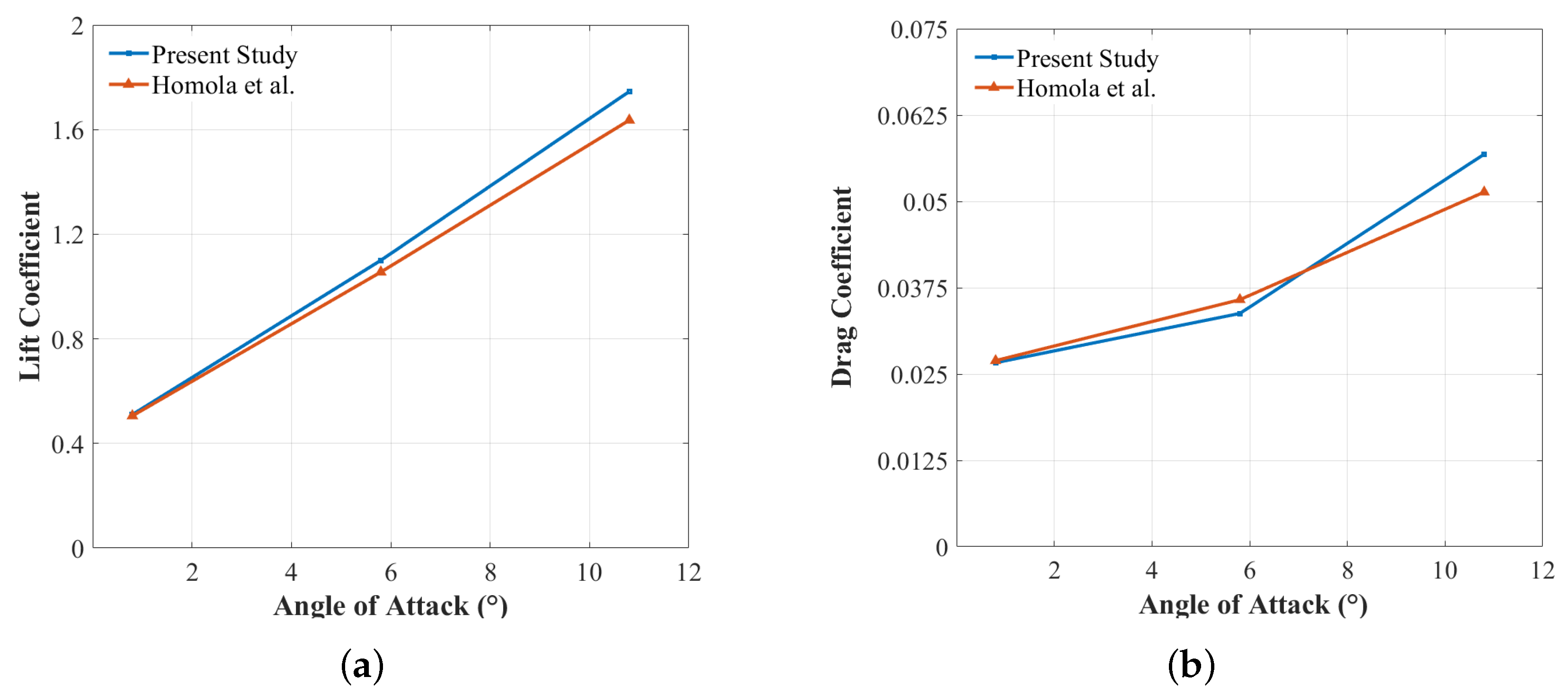
2.5. Validation Study
3. Results
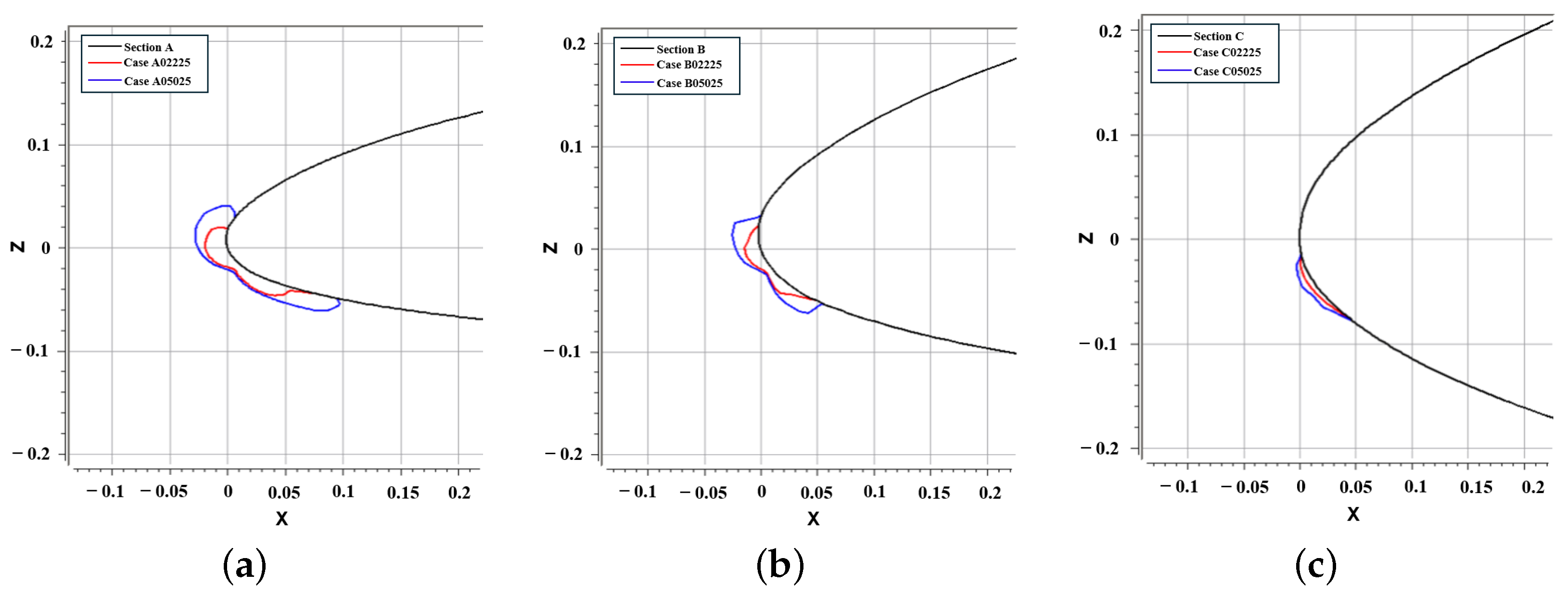
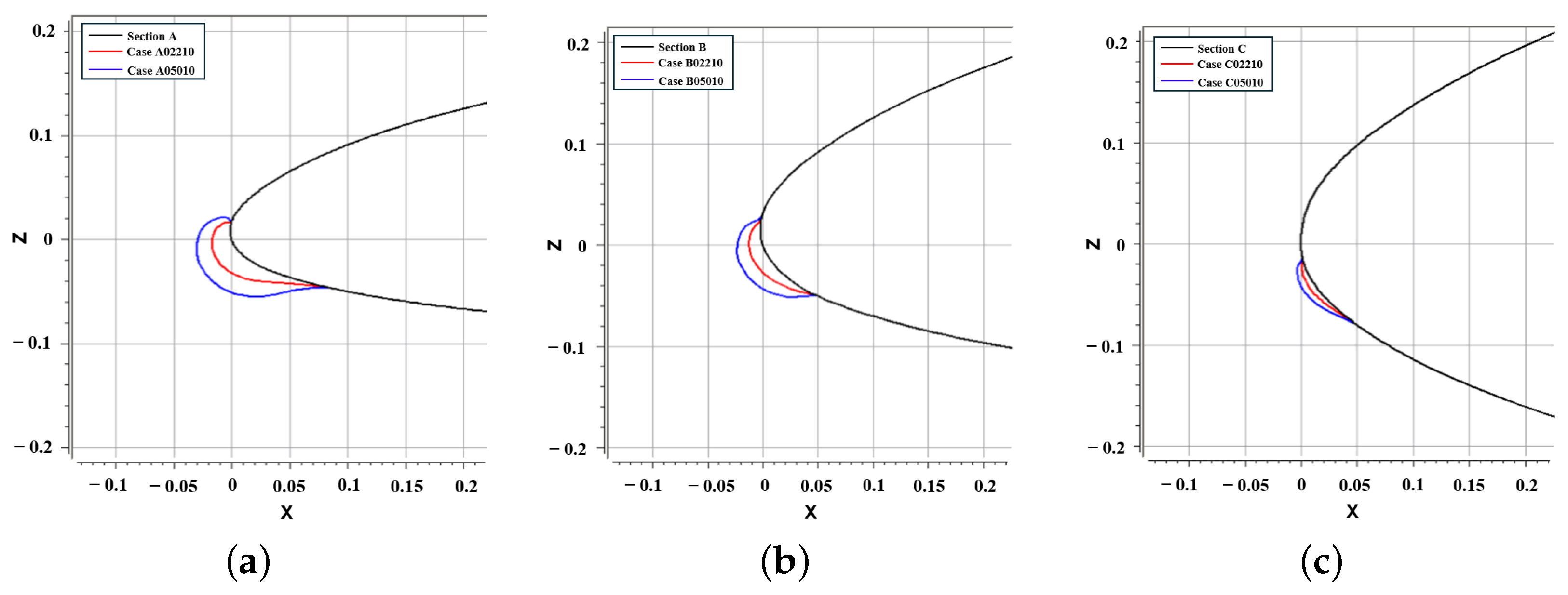
3.1. Ice Accretion Characteristics
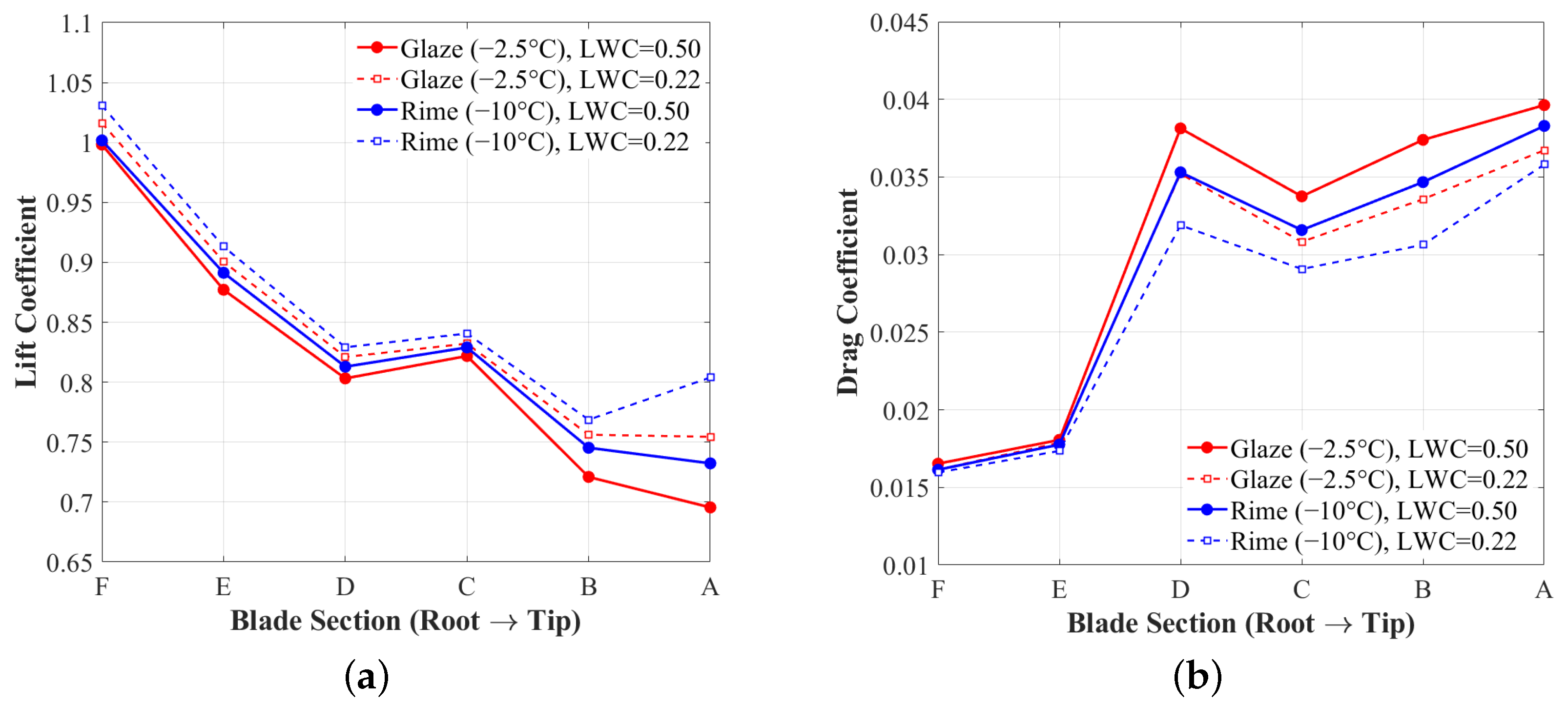
3.2. Aerodynamic Performance Degradation
3.3. Power Loss Analysis
3.4. Economic Analysis
4. Conclusions
- The formation of glaze ice horns induced severe flow separation, leading to a drastic reduction in lift and a substantial increase in drag. Rime ice, despite its considerable thickness, resulted in comparatively lower aerodynamic penalties due to its smoother profile. The degradation was most critical at the blade tip (Section A), which is the primary contributor to torque generation.
- Turbine power output was significantly impacted by icing. The study revealed that glaze icing conditions are more detrimental than rime icing. The total power loss ranged from 31.28% for moderate rime ice to a maximum of 40.76% for severe glaze ice (LWC = 0.50 g/m3). These results highlight that LWC acts as an amplifier of performance degradation, while temperature determines the accretion mechanism.
- The estimated annual energy production losses for a single turbine operating in a cold climate region (e.g., Northern Finland) ranged between 789 MWh and 920 MWh, corresponding to financial losses of approximately €32,000 to €42,000 per year.
Author Contributions
Funding
Institutional Review Board Statement
Informed Consent Statement
Data Availability Statement
Conflicts of Interest
References
- Graham, E.; Fulghum, N. Global Electricity Review 2025; Technical Report; EMBER: London, UK, 2025. [Google Scholar]
- IRENA. Renewable Capacity Statistics 2025; Technical Report; International Renewable Energy Agency: Abu Dhabi, United Arab Emirates, 2025. [Google Scholar]
- Czernkovich, N. Understanding in-flight icing. In Proceedings of the Transport Canada Aviation Safety Seminar, Ottawa, ON, Canada, 17 November 2004; Flight Operations Research: Underhill, VT, USA, 2004; Volune 55, pp. 1–21. [Google Scholar]
- Anderson, D.N. Rime-, Mixed- and Glaze-Ice Evaluations of Three Scaling Laws; Technical Report NASA TM-106461; NASA Lewis Research Center: Cleveland, OH, USA, 1994.
- Li, S.; Paoli, R. Aircraft Icing Severity Evaluation. Encyclopedia 2022, 2, 56–69. [Google Scholar] [CrossRef]
- AGARD. Ice Accretion Simulation; Advisory Report AGARD-AR-344; Advisory Group for Aerospace Research and Development (AGARD): Neuilly-sur-Seine, France, 1997. [Google Scholar]
- Gent, R.W.; Dart, N.P.; Cansdale, J.T. Aircraft icing. Philos. Trans. R. Soc. Lond. Ser. A Math. Phys. Eng. Sci. 2000, 358, 2873–2911. [Google Scholar] [CrossRef]
- Cao, Y.; Tan, W.; Wu, Z. Aircraft icing: An ongoing threat to aviation safety. Aerosp. Sci. Technol. 2018, 75, 353–385. [Google Scholar] [CrossRef]
- Lamraoui, F.; Fortin, G.; Benoit, R.; Perron, J.; Masson, C. Atmospheric icing impact on wind turbine production. Cold Reg. Sci. Technol. 2014, 100, 36–49. [Google Scholar] [CrossRef]
- Dierer, S.; Oechslin, R.; Cattin, R. Wind turbines in icing conditions: Performance and prediction. Adv. Sci. Res. 2011, 6, 245–250. [Google Scholar] [CrossRef]
- Martini, F.; Ibrahim, H.; Contreras Montoya, L.T.; Rizk, P.; Ilinca, A. Turbulence Modeling of Iced Wind Turbine Airfoils. Energies 2022, 15, 8325. [Google Scholar] [CrossRef]
- Hu, L.; Zhu, X.; Chen, J.; Shen, X.; Du, Z. Numerical simulation of rime ice on NREL Phase VI blade. J. Wind. Eng. Ind. Aerodyn. 2018, 178, 57–68. [Google Scholar] [CrossRef]
- Virk, M.S.; Homola, M.C.; Nicklasson, P.J. Atmospheric icing on large wind turbine blades. Int. J. Energy Environ. 2012, 3, 1–8. [Google Scholar]
- Homola, M.C.; Virk, M.S.; Nicklasson, P.J.; Sundsbø, P.A. Performance losses due to ice accretion for a 5 MW wind turbine. Wind Energy 2012, 15, 379–389. [Google Scholar] [CrossRef]
- Shu, L.; Li, H.; Hu, Q.; Jiang, X.; Qiu, G.; McClure, G.; Yang, H. Study of ice accretion feature and power characteristics of wind turbines at natural icing environment. Cold Reg. Sci. Technol. 2018, 147, 45–54. [Google Scholar] [CrossRef]
- Blasco, P.; Palacios, J.; Schmitz, S. Effect of icing roughness on wind turbine power production. Wind Energy 2017, 20, 601–617. [Google Scholar] [CrossRef]
- Etemaddar, M.; Hansen, M.O.L.; Moan, T. Wind turbine aerodynamic response under atmospheric icing conditions. Wind Energy 2014, 17, 241–265. [Google Scholar] [CrossRef]
- Hochart, C.; Fortin, G.; Perron, J.; Ilinca, A. Wind turbine performance under icing conditions. Wind Energy 2008, 11, 319–333. [Google Scholar] [CrossRef]
- Kangash, A.; Virk, M.S.; Maryandyshev, P. Numerical study of icing impact on the performance of pitch-regulated large wind turbine. Wind Eng. 2023, 47, 334–346. [Google Scholar] [CrossRef]
- Jonkman, J.; Butterfield, S.; Musial, W.; Scott, G. Definition of a 5-MW Reference Wind Turbine for Offshore System Development; Technical Report NREL/TP-500-38060; National Renewable Energy Laboratory (NREL): Golden, CO, USA, 2009.
- Lanzafame, R.; Messina, M. Fluid dynamics wind turbine design: Critical analysis, optimization and application of BEM theory. Renew. Energy 2007, 32, 2291–2305. [Google Scholar] [CrossRef]
- Hansen, M.O.L. Aerodynamics of Wind Turbines, 2nd ed.; Earthscan: London, UK, 2008. [Google Scholar]
- Lanzafame, R.; Mauro, S.; Messina, M. Wind turbine CFD modeling using a correlation-based transitional model. Renew. Energy 2014, 68, 31–39. [Google Scholar] [CrossRef]
- Hansen, M.O.L.; Sørensen, N.N.; Voutsinas, S.; Sørensen, J.N.; Madsen, H.A. State of the art in wind turbine aerodynamics and aeroelasticity. Prog. Aerosp. Sci. 2006, 42, 285–330. [Google Scholar] [CrossRef]
- Johansen, J.; Sørensen, N.N. Aerofoil characteristics of wind turbine blades based on two-dimensional aerodynamic testing and 3D CFD. Wind Energy 2004, 7, 283–297. [Google Scholar] [CrossRef]
- Moshfeghi, M.; Song, Y.J.; Xie, Y.H. Effects of near-wall grid spacing on SST-k-ω model using NREL Phase VI wind turbine. Energy 2012, 45, 962–970. [Google Scholar] [CrossRef]
- Catalano, P.; Amato, M. An evaluation of RANS turbulence modelling for aerodynamic applications. Aerosp. Sci. Technol. 2003, 7, 493–509. [Google Scholar] [CrossRef]
- IEA Wind TCP. Available Technologies for Wind Energy in Cold Climates; Report; IEA Wind TCP: Copenhagen, Denmark, 2018. [Google Scholar]
- Finnish Energy. Electricity Year 2024: Inflation-Adjusted Wholesale Electricity Prices; Technical Report; Nord Pool & Statistics Finland Data: Helsinki, Finland, 2025. [Google Scholar]
- Karlsson, T.; Helistö, N.; Atlaskin, E. IEA Wind TCP Annual Report 2024: Finland; Technical Report; VTT Technical Research Centre of Finland: Espoo, Finland; Finnish Meteorological Institute: Helsinki, Finland, 2024. [Google Scholar]





| Parameter | Value |
|---|---|
| Rated power | 5 MW |
| Rotor radius | 63 m |
| Hub radius | 1.5 m |
| Blade length | 61.5 m |
| Cut-In, Rated, Cut-Out Wind Speed | 3 m/s, 11.4 m/s, 25 m/s |
| Cut-In, Rated Rotor Speed | 6.9 rpm, 12.1 rpm |
| Airfoil | Node Radius R (m) | Twist Angle (°) | Chord Length (m) | Section |
|---|---|---|---|---|
| Cylinder1 | 2.8667 | 13.308 | 3.542 | – |
| Cylinder1 | 5.60 | 13.308 | 3.854 | – |
| Cylinder2 | 8.3333 | 13.308 | 4.167 | – |
| DU40 | 11.75 | 13.308 | 4.557 | – |
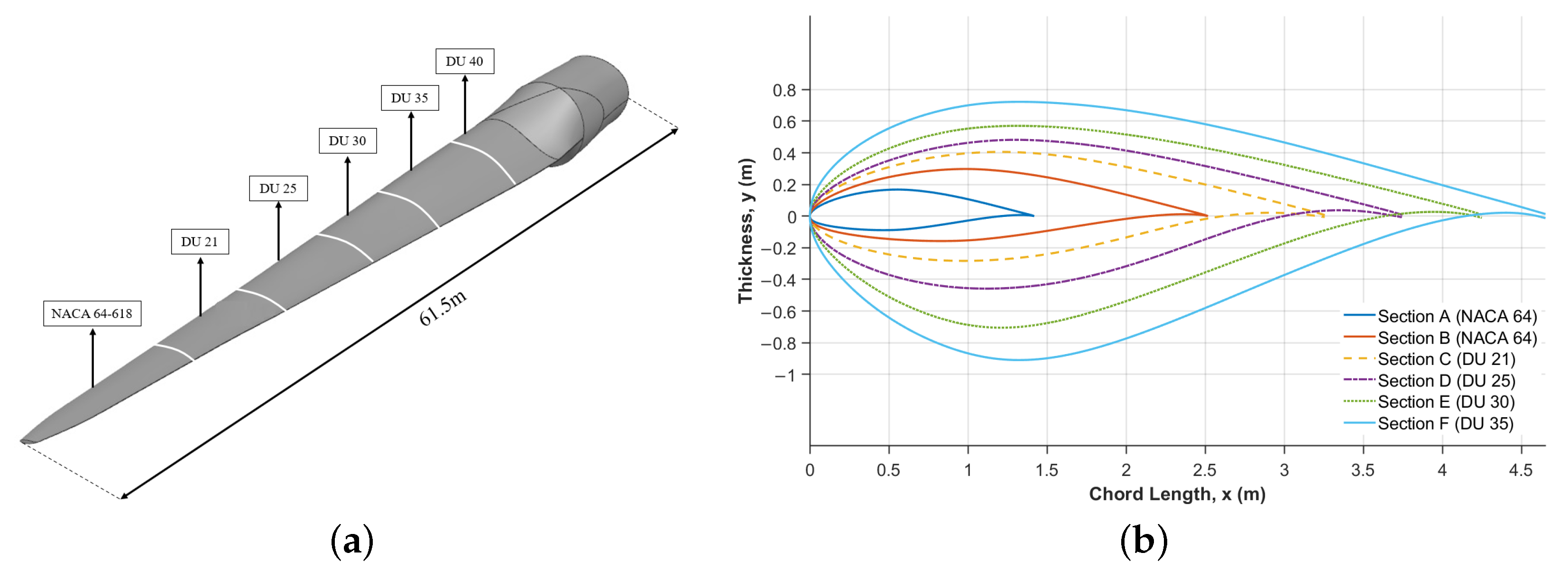
| DU35 | 15.85 | 11.480 | 4.652 | Section F |
| DU35 | 19.95 | 9.690 | 4.458 | – |
| DU30 | 24.05 | 9.011 | 4.249 | Section E |
| DU25 | 28.15 | 7.795 | 4.048 | – |
| DU25 | 32.25 | 6.544 | 3.748 | Section D |
| DU21 | 36.35 | 5.361 | 3.502 | – |
| DU21 | 40.45 | 4.188 | 3.256 | Section C |
| NACA64 | 44.55 | 3.125 | 3.010 | – |
| NACA64 | 48.65 | 2.319 | 2.764 | – |
| NACA64 | 52.75 | 1.526 | 2.518 | Section B |
| NACA64 | 56.1667 | 0.863 | 2.313 | – |
| NACA64 | 58.90 | 0.370 | 2.086 | – |
| NACA64 | 61.6333 | 0.106 | 1.419 | Section A |
| Airfoil Profile | Radial Position, r (m) | Relative Velocity (m/s) | Angle of Attack (°) |
|---|---|---|---|
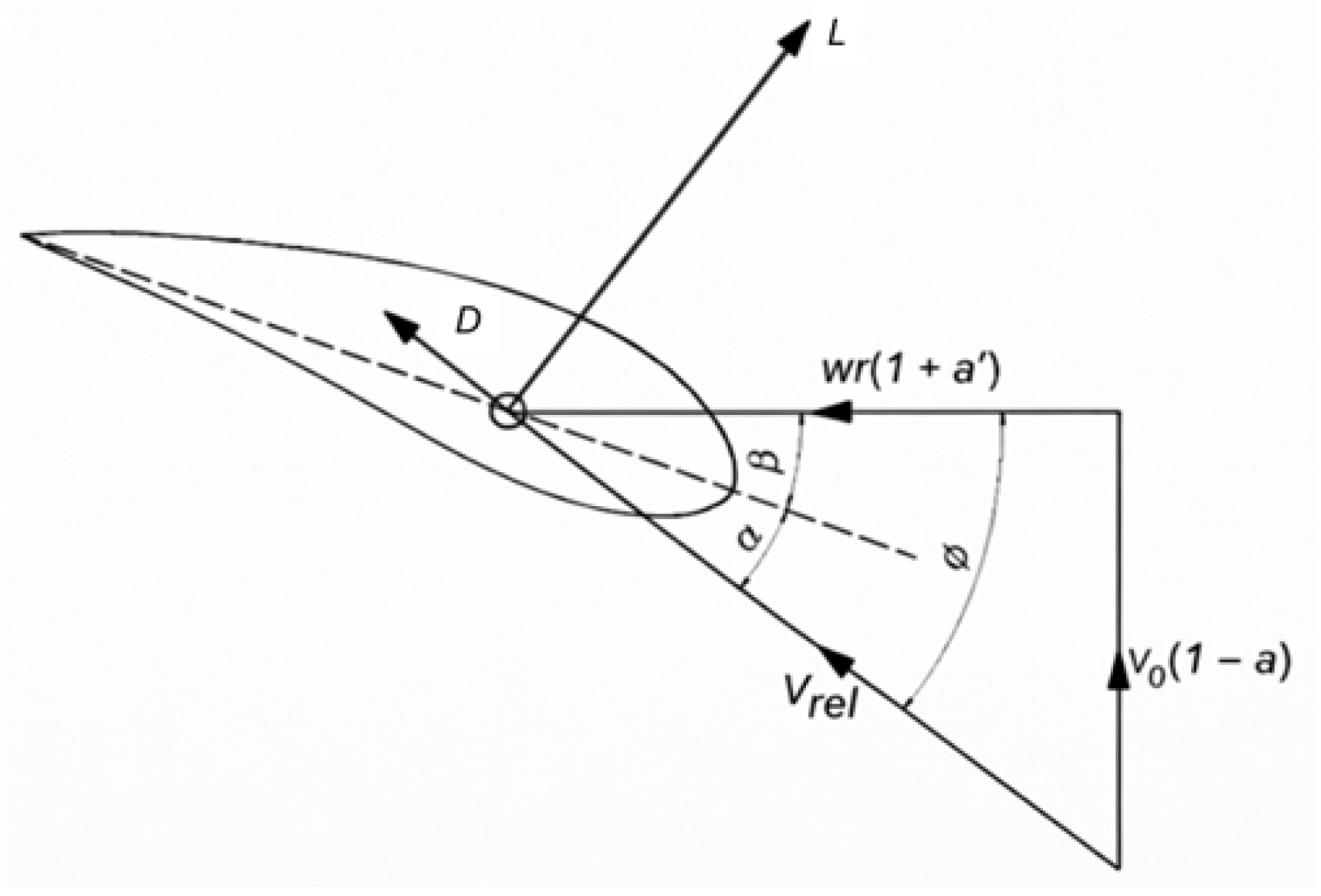
| DU35 | 19.95 | 26.30 | 6.40 |
| DU30 | 24.05 | 31.00 | 5.00 |
| DU25 | 32.25 | 40.70 | 3.60 |
| DU21 | 40.45 | 50.50 | 3.30 |
| NACA64-618 | 52.75 | 65.38 | 4.25 |
| NACA64-618 | 61.63 | 76.23 | 5.76 |
| Section Labels | LWC [g/m3] | Temperature [°C] | Ice Type | Case ID Format |
|---|---|---|---|---|
| A, B, C, D, E, F | 0.22 | −2.5 | Glaze | [Section]02225 |
| A, B, C, D, E, F | 0.22 | −10 | Rime | [Section]02210 |
| A, B, C, D, E, F | 0.50 | −2.5 | Glaze | [Section]05025 |
| A, B, C, D, E, F | 0.50 | −10 | Rime | [Section]05010 |
| Case (0.22 g/m3 LWC) | Thickness (m) | Case (0.50 g/m3 LWC) | Thickness (m) |
|---|---|---|---|
| A02225 | 0.01948 | A05025 | 0.03291 |
| B02225 | 0.01519 | B05025 | 0.03113 |
| C02225 | 0.00695 | C05025 | 0.01303 |
| D02225 | 0.00101 | D05025 | 0.00232 |
| E02225 | 0.000090 | E05025 | 0.000207 |
| F02225 | 0.000031 | F05025 | 0.000069 |
| Icing Case (LWC = 0.22 g/m3) | Power Loss (%) | Icing Case (LWC = 0.50 g/m3) | Power Loss (%) |
|---|---|---|---|
| T = −2.5 °C (Glaze) | 34.96 | T = −2.5 °C (Glaze) | 40.76 |
| T = −10 °C (Rime) | 31.28 | T = −10 °C (Rime) | 36.87 |
| Radial Position, r (m) | Contribution to Total Power Loss (%) |
|---|---|
| 11.75 | 0.00 |
| 19.95 | 1.19 |
| 24.05 | 2.08 |
| 32.25 | 10.89 |
| 40.45 | 19.47 |
| 52.75 | 44.11 |
| 61.63 | 22.27 |
| Total | ≈100.0 |
| Temp. (°C) | LWC (g/m3) | Power Loss (η) | ΔAEP (MWh/Year) | Economic Loss (€/Year) |
|---|---|---|---|---|
| −2.5 | 0.22 | 0.3496 | 789.25 | 36,305 |
| −2.5 | 0.50 | 0.4076 | 920.15 | 42,327 |
| −10.0 | 0.22 | 0.3128 | 706.14 | 32,482 |
| −10.0 | 0.50 | 0.3687 | 832.34 | 38,287 |
Disclaimer/Publisher’s Note: The statements, opinions and data contained in all publications are solely those of the individual author(s) and contributor(s) and not of MDPI and/or the editor(s). MDPI and/or the editor(s) disclaim responsibility for any injury to people or property resulting from any ideas, methods, instructions or products referred to in the content. |
© 2026 by the authors. Licensee MDPI, Basel, Switzerland. This article is an open access article distributed under the terms and conditions of the Creative Commons Attribution (CC BY) license.
Share and Cite
Öztürk, B.; Koçak, E. An Investigation of Atmospheric Icing Effects on Wind Turbine Blade Aerodynamics and Power Output: A Case Study of the NREL 5 MW Turbine. Appl. Sci. 2026, 16, 2991. https://doi.org/10.3390/app16062991
Öztürk B, Koçak E. An Investigation of Atmospheric Icing Effects on Wind Turbine Blade Aerodynamics and Power Output: A Case Study of the NREL 5 MW Turbine. Applied Sciences. 2026; 16(6):2991. https://doi.org/10.3390/app16062991
Chicago/Turabian StyleÖztürk, Berkay, and Eyup Koçak. 2026. "An Investigation of Atmospheric Icing Effects on Wind Turbine Blade Aerodynamics and Power Output: A Case Study of the NREL 5 MW Turbine" Applied Sciences 16, no. 6: 2991. https://doi.org/10.3390/app16062991
APA StyleÖztürk, B., & Koçak, E. (2026). An Investigation of Atmospheric Icing Effects on Wind Turbine Blade Aerodynamics and Power Output: A Case Study of the NREL 5 MW Turbine. Applied Sciences, 16(6), 2991. https://doi.org/10.3390/app16062991