Communication

Antioxidant Capacity of Hemp (Cannabis sativa L.) Leaves and Inflorescences

1
Department of Monogastric Animal Sciences, Division of Animal Nutrition and Food, West Pomeranian University of Technology in Szczecin, 29 Klemensa Janickiego Street, 71-270 Szczecin, Poland
2
Department of Agroecology and Crop Production, Faculty of Agriculture and Economics, University of Agriculture in Krakow, 21 Mickiewicza Street, 31-120 Krakow, Poland
3
Department of Human Nutrition and Dietetics, Faculty of Food Technology, University of Agriculture in Krakow, 122 Balicka Street, 30-149 Krakow, Poland
*
Authors to whom correspondence should be addressed.
Appl. Sci. 2026, 16(6), 2957; https://doi.org/10.3390/app16062957
Submission received: 21 February 2026 / Revised: 12 March 2026 / Accepted: 17 March 2026 / Published: 19 March 2026

Abstract

Plant-derived materials previously regarded as low-value by-products are increasingly investigated as sources of bioactive compounds, yet hemp (Cannabis sativa L.) leaves remain underutilized despite their rich phytochemical profile. This study aimed to evaluate and compare the in vitro antioxidant capacity and total phenolic content of methanolic extracts obtained from the leaves and inflorescences of four hemp cultivars (Finola, Futura 75, Dioica, and Kompolti). Antioxidant capacity (AC) was assessed using ABTS, DPPH, and FRAP assays, while total phenolic content was determined spectrophotometrically. Inflorescences exhibited significantly higher total phenolic content than leaves, with the highest values observed in the Finola cultivar. In contrast, leaf extracts showed greater radical-scavenging capacity in the ABTS and DPPH assays, whereas inflorescences demonstrated higher ferric ion–reducing power in the FRAP assay. Both cultivar and plant part had a significant effect on all evaluated parameters. Overall, hemp leaves and inflorescences displayed distinct and complementary antioxidant profiles in vitro, with Kompolti and Finola leaves characterized by strong radical-scavenging activity and Finola inflorescences showing the highest reducing capacity. These findings provide a comparative characterization of hemp morphological parts with respect to phenolic content and antioxidant behavior, highlighting the potential value of leaves as a source of bioactive compounds.

1. Introduction

In light of the growing burden of diet-related chronic diseases and the increasing demand for sustainable food systems, there is rising interest in plant-derived raw materials that combine a high density of bioactive compounds and low environmental impact [1]. Underutilized fractions of plant biomass are increasingly recognized as promising sources of food-grade bioactive compounds, despite their limited current application in human and animal nutrition. Their utilization aligns not only with the principles of sustainable agriculture but also with the concept of a circular economy by reducing losses and improving resource efficiency [2,3]. Hemp (Cannabis sativa L.) fits well into this framework [4]. This versatile crop is used across multiple industries, ranging from textiles and construction materials to biocomposites, as well as the food and feed sectors [5,6]. In the European Union, the cultivation of hemp and its use in the food industry are not regulated under a fully harmonized legal framework, as detailed requirements are defined at the national level and may limit the placing of hemp-derived products on the market as foods or food ingredients [7]. Therefore, compliance must be verified with the relevant national authorities. Within the EU, only certified industrial hemp varieties with a tetrahydrocannabinol (THC) content not exceeding 0.3% on a dry matter basis are permitted for cultivation, and only seeds originating from such varieties are allowed for food use.
Within this context, increasing attention is being directed toward the valorization of underutilized hemp plant parts, particularly leaves, which remain insufficiently explored as sources of bioactive compounds for human consumption [8,9]. Although numerous plant-derived by-products are already used as functional ingredients in food and nutraceutical formulations [10,11,12,13], hemp leaves and inflorescences are not individually recognized in regulatory frameworks such as the Catalogue of Feed Materials (Commission Regulation (EU) 2022/1104) [14] despite constituting a substantial fraction of hemp biomass and representing a potentially valuable source of food-relevant bioactive compounds. Although certain hemp-derived materials have already been classified and utilized within animal feed systems, the potential of hemp leaves and inflorescences as food-relevant sources of bioactive compounds remains insufficiently explored. In contrast, hemp leaves and inflorescences are not individually listed, despite constituting a substantial fraction of hemp biomass and representing a potentially valuable source of bioactive compounds.
With the gradual easing of legal restrictions on hemp cultivation, the availability of hemp-derived food-relevant biomass has increased considerably. Research indicates a growing interest in hemp-derived resources for both food and animal feed production [11,15,16]. As a result, the cultivation area in the EU expanded from 20,540 ha in 2015 to 33,020 ha in 2022 (an increase of 60%), while production of biomass rose from 97,130 tons to 179,020 tons, reflecting an 84.3% increase [17]. France is the leading producer in Europe, accounting for more than 70% of EU production—approximately 122,000 tons of biomass—followed by Germany (17%) and the Netherlands (5%) [17,18]. Furthermore, hemp cultivation is supported under the Common Agricultural Policy and aligns with the objectives of the European Green Deal and the circular economy [18], which further stimulates interest in its production. Hemp efficiently sequesters carbon due to its rapid growth and high biomass yield, making it a valuable component of climate change mitigation strategies [19,20].
Hemp leaves are a rich source of flavonoids, terpenes, phenolic acids, and many other compounds that may positively affect health [13,21,22]. Proper development of the organism requires controlling stress factors that lead to increased free radical activity—a phenomenon resulting from an imbalance between the formation of reactive oxygen species (ROS) and the body’s ability to neutralize them. Therefore, the chemical composition of hemp-derived raw materials—particularly hemp inflorescences, which represent the most commonly utilized hemp-derived plant material, as well as leaves—is of great importance when assessing their potential use as food ingredients. Studies conducted in biological models indicate that compounds derived from hemp inflorescences and leaves exhibit antioxidant-related bioactivity, supporting their relevance as food-relevant bioactive constituents [23,24]. Moreover, these extracts were shown to reduce biofilm formation by Staphylococcus aureus. Similarly, Khoury et al. [25] reported that hemp flower extracts strongly inhibited aflatoxin B1 production by Aspergillus spp., even at low concentrations. This effect was not directly related to antioxidant capacity but was likely due to the presence of specific phenolic compounds characteristic of hemp. Considering the growing interest in plant-derived bioactive compounds, there is a need to characterize natural raw materials in terms of their antioxidant capacity. Within this framework, the aim of the present study was to evaluate the in vitro antioxidant capacity and phenolic content in leaves and inflorescences from four hemp cultivars (Cannabis sativa L.). The results presented here represent a preliminary yet significant part of a broader research project focused on the comprehensive characterization of hemp-derived bioactive compounds.

2. Materials and Methods

2.1. Plant Material

The research material consisted of hemp (Cannabis sativa L.) cultivars (cvs.) Finola, Futura 75, Dioica and Kompolti (Figure 1), harvested in August 2024. The plants were sourced from a certified organic farm located in Wiekowice, Poland (54°17′59″ N, 16°21′39″ E). The harvested material was air-dried under ambient conditions in a well-ventilated indoor facility, protected from direct sunlight, to minimize photo- and thermal degradation of bioactive compounds. After drying, the plant material was ground to a fine powder and stored in airtight containers with double screw caps in the dark at room temperature until further analysis.

2.2. Dry Matter Determination

All results were expressed on a dry matter (DM) basis. The dry matter content was determined by drying the samples at 105 °C until a constant weight was reached, following method 945.15.

2.3. Extracts Preparation

Methanolic extracts were prepared from dried, ground plant material of four hemp cvs. (inflorescences and leaves). Approximately 1 g of ground sample (±0.0001 g) was weighed and extracted with 70% (v/v) aqueous methanol for 2 h using an orbital shaker–incubator (ES-20/60, SIA BIOSAN, Riga, Latvia) at 25 °C and 110 rpm. This solvent system is commonly used for the extraction of phenolic and antioxidant compounds from plant matrices due to its effectiveness in recovering both polar and moderately polar constituents [26,27,28]. The solutions were filtered through cellulose filter papers (Munktell, Eskilstuna, Sweden, qualitative grade, medium filtration speed, Ø 125 mm, 3 m/N), and the resulting extracts were transferred into Falcon tubes and stored at –20 °C until analysis.

2.4. Determination of Total Phenolic Content

Total phenolic content (TPC) was determined by UV–VIS spectrophotometry (SPECORD® PLUS, Analytik Jena, Jena, Germany) using the Folin–Ciocalteu reagent [29]. Chlorogenic acid and gallic acid were used as reference standards. The use of two different phenolic standards was intended to reflect the heterogeneous nature of the phenolic fraction in the analyzed plant materials, as the composition and relative proportions of phenolic compound classes differ between hemp leaves and inflorescences. The results were expressed as milligrams of gallic acid equivalents per gram of dry matter (mg GAE g−1 DM) and as milligrams of chlorogenic acid equivalents per gram of dry matter (mg CAE g−1 DM). Dilutions were prepared from the previously obtained extracts by transferring 5 mL of each extract into a volumetric flask and diluting to 99 mL with distilled water. Then, 5 mL of the diluted solution was transferred into a test tube, followed by the addition of 0.5 mL of Folin–Ciocalteu reagent (previously diluted 1:1, v/v, with distilled water) and 0.25 mL of 25% (w/v) sodium carbonate solution. The reaction mixtures were incubated for 20 min at room temperature and subsequently shaken for 1 min. Absorbance was measured at 760 nm against a blank containing the solvent used for extract preparation. A chlorogenic acid standard solution (1 mg/mL) was prepared by dissolving 1 mg of the compound in 1 mL of the solvent used for extract preparation. Next, 1 mL of the standard solution was transferred into a volumetric flask and diluted to 99 mL with distilled water. Then, 5 mL of the obtained solution was subjected to the same analytical procedure as the tested samples. The total phenolic content was calculated according to Equation (1):
TPC = [(Ap/Aw) × a × b × 400]/c
where
TPC—total phenolic content,
Ap—absorbance of the sample measured at 760 nm,
Aw—absorbance of the standard measured at 760 nm,
a—mass of the standard used for polyphenol determination (mg),
b—volume of the extract (mL),
c—mass of the sample used for extract preparation (g).

2.5. Determination of Antioxidant Capacity (AC)

2.5.1. ABTS Assay

The ABTS assay (2,2′-azino-bis(3-ethylbenzothiazoline-6-sulfonic acid)) was performed according to the spectrophotometric method described by Re et al. [30] following standardized recommendations for antioxidant capacity determination by Prior et al. [26] with minor modifications. The ABTS•+ radical cation was generated by reacting ABTS with potassium persulfate and allowing the mixture to stand in the dark at room temperature prior to analysis. Before measurement, the ABTS•+ solution was diluted with the solvent used for extract preparation to obtain an absorbance of approximately 0.74–0.75 at 734 nm. Appropriate volumes of the extracts were mixed with the ABTS•+ solution and incubated at 30 °C for 6 min, after which the absorbance was measured at 734 nm using a UV–VIS spectrophotometer (SPECORD® PLUS, Analytik Jena, Jena, Germany). Antioxidant capacity was expressed as Trolox equivalent antioxidant capacity (TEAC) and reported as mg Trolox equivalents per gram of dry matter (mg TRX g−1 DM). The calibration curve was described by the equation y = −0.0079x + 0.4847 (R2 = 0.9986). The corresponding calibration plot is provided in Figure S1 in the Supplementary Material.
The percentage radical scavenging activity (RSA%) against ABTS•+ was calculated using the following Equation (2):
RSA% = [(A0 − A1)/A0] × 100
where:
RSA—radical scavenging activity index,
A0—absorbance of the control sample at the beginning of the reaction,
A1—absorbance of the sample after 6 min of incubation.

2.5.2. DPPH Assay

The DPPH assay (1,1-diphenyl-2-picrylhydrazyl) was performed according to the method described by Brand-Williams et al. [31] as applied in studies on plant extracts such as those reported by Miliauskas et al. [27]. The DPPH solution was prepared in methanol and adjusted to an initial absorbance of 0.900–1.000 at 515 nm. Aliquots of the extracts were mixed with the DPPH solution and incubated for 10 min at room temperature in the dark. The decrease in absorbance associated with the reduction of the DPPH radical was monitored at 515 nm using a UV–VIS spectrophotometer (SPECORD® PLUS, Analytik Jena, Jena, Germany). The results were expressed as Trolox equivalent antioxidant capacity (TEAC) and reported as mg TRX g−1 DM. The calibration curve was described by the equation y = −0.0095x + 0.6713 (R2 = 0.9996). The corresponding calibration plot is provided in Figure S2 in the Supplementary Material.
The percentage radical scavenging activity (RSA%) against DPPH was calculated according to Equation (2). The same calculation formula was applied for both assays. In this assay, A1 represents the absorbance measured after 10 min of incubation.

2.5.3. Ferric Reducing Antioxidant Power (FRAP) Assay

The FRAP assay was performed according to the method of Benzie and Strain [32], with minor modifications. The method is based on the reduction of Fe3+ to Fe2+ in the presence of the TPTZ ligand, resulting in the formation of a blue Fe2+–TPTZ complex. The FRAP reagent consisted of acetate buffer (pH 3.6), TPTZ solution, and FeCl3 solution mixed in a ratio of 10:1:1 (v/v/v). Extracts were mixed with the FRAP reagent and incubated for 10 min at 37 °C. Absorbance was measured at 593 nm using a UV–VIS spectrophotometer (SPECORD® PLUS, Analytik Jena, Jena, Germany) against a methanol blank. The results were expressed as Trolox equivalent antioxidant capacity (TEAC) and reported as mg TRX g−1 DM. The calibration curve was described by the equation y = 0.0098x + 0.0265 (R2 = 0.999). The corresponding calibration plot is provided in Figure S3 in the Supplementary Material.
All determinations (total phenolic content, ABTS, DPPH, and FRAP) were performed in triplicate.

2.6. Statistical Analyses

Two-factorial analysis of variance (ANOVA) and principal component analysis (PCA) were carried out using the STATISTICA v13.30 software (TIBCO Software Inc., Palo Alto, CA, USA). Tukey’s Honestly Significant Difference (HSD) at p = 0.05 was used to find the differences between means. The means denoted by different letters differed statistically.

3. Results

3.1. Total Phenolic Compounds Content

Polyphenols are among the most important groups of secondary plant metabolites, exhibiting strong antioxidant properties. Their presence reflects both the protective potential against oxidative stress and the biological value of the raw material. The content of these compounds in plant material may vary considerably depending on the plant part (e.g., leaves, inflorescences), cultivar (cv.), developmental stage, cultivation practices, and environmental conditions [33,34]. Table 1 presents the total phenolic content (TPC), expressed as chlorogenic acid equivalents (CAE) and gallic acid equivalents (GAE) per gram of dry matter (DM), in inflorescences (IF) and leaves (L). Significantly higher TPC values were observed in inflorescences (105.34 mg CAE/1 g DM and 52.36 mg GAE/1 g DM) compared with leaves (74.59 mg CAE/1 g DM and 37.08 mg GAE/1 g DM). A statistically significant variation in TPC was also observed among the leaves of the studied hemp cvs. The highest total phenolic content was recorded in the Finola cv. (100.15 mg CAE/1 g DM; 49.78 mg GAE/1 g DM), while significantly lower levels were found in Dioica (88.24 mg CAE/1 g DM; 43.86 mg GAE/1 g DM), Kompolti (85.85 mg CAE/1 g DM; 42.67 mg GAE/1 g DM), and Futura 75 (85.62 mg CAE/1 g DM; 42.56 mg GAE/1 g DM) cvs. The raw material obtained from Futura 75, Dioica, and Kompolti cv. did not differ statistically in terms of phenolic content (p < 0.000), as the determined values formed a homogeneous group.
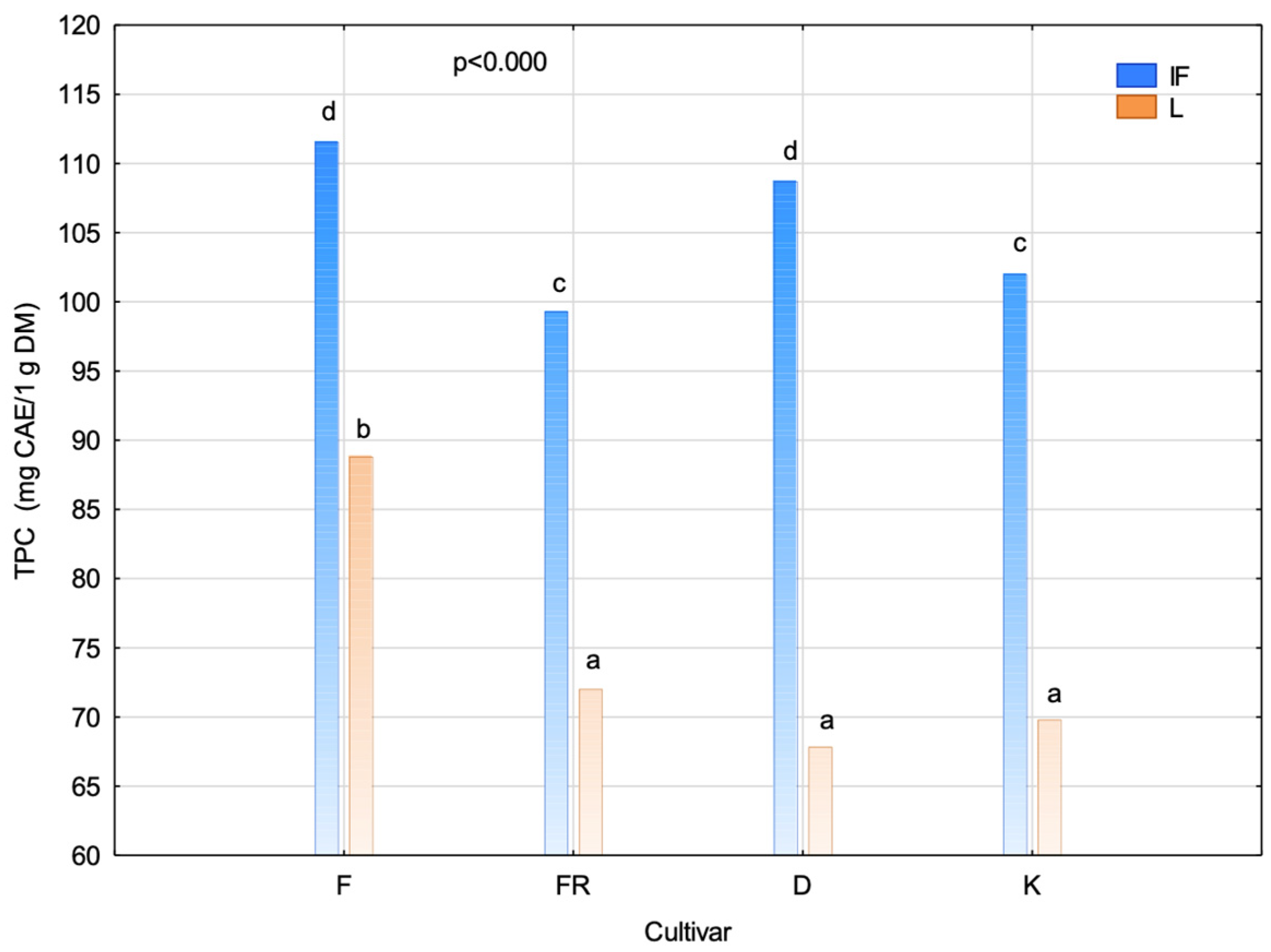
The analysis of total phenolic content in the raw materials (inflorescences and leaves) obtained from four hemp cvs. indicates certain varietal differences (Figure 2). The cultivar with the smallest difference in total phenolic content between inflorescences and leaves was Finola, with a difference of only 22.6 mg CAE/1 g DM. In contrast, the Dioica cv. showed a greater difference between the analyzed plant parts, amounting to 40.9 mg CAE/1 g DM. The ratio of these values was 1:62 for Dioica cv., whereas for Finola cv. it was 1:80.

3.2. Antioxidant Capacity (ABTS, DPPH, FRAP)

A comparison of the morphological components of the plants (Table 2) revealed significant disparities in antioxidant capacity (AC) (p < 0.000) among the examined raw materials (i.e., leaves and inflorescences). The antioxidant capacity was determined using the ABTS (2,2′-azino-bis(3-ethylbenzothiazoline-6-sulfonic acid)) and DPPH (2,2-diphenyl-1-picrylhydrazyl) assays and expressed as Trolox equivalents (TRX) per gram of DM. Leaves exhibited significantly higher AC (ABTS: 246.6 mg TRX/1 g DM; DPPH: 20.73 mg TRX/1 g DM) than inflorescences (ABTS: 216.4 mg TRX/1 g DM; DPPH: 19.91 mg TRX/1 g DM). However, inflorescences exhibited considerably greater iron-reducing capacity (FRAP assay: 15.52 mg TRX/1 g DM) than leaves (8.67 mg TRX/1 g DM). Significant differences in AC (p < 0.000) were also found among the studied hemp cultivars. Significant differences in AC (p < 0.000) were also found among the studied hemp cvs. The radical scavenging activity against ABTS•+ (RSAABTS) determined for inflorescences (83.91%) was significantly higher than that for leaves (46.15%). Conversely, the RSADPPH value determined for leaves (72.73%) was significantly higher compared to inflorescences (70.56%). The highest AC measured by the ABTS assay was observed for the Finola cv. (306.7 mg TRX/1 g DM), while the lowest was found for Dioica cv. (170.7 mg TRX/1 g DM). In the DPPH assay, the Kompolti cv. exhibited the highest AC (22.65 mg TRX/1 g DM), whereas Finola showed the lowest (18.57 mg TRX/1 g DM). The highest recorded RSAABTS value was observed in Finola cv., which reached 68.96%, while Dioica cv. exhibited a significantly lower value of 66.30%. Conversely, the RSADPPH value was the highest in Kompolti cv. The highest percentage was recorded in the 76.21% category, while the lowest was recorded in the Finola cv. category, with a percentage of 68.66%. With regard to ferric ion-reducing capacity (TEAC FRAP), the Finola cv. exhibited the most effective results (22.42 mg TRX/1 g DM), while the Futura 75 cv. demonstrated the least effective results (7.28 mg TRX/1 g DM).
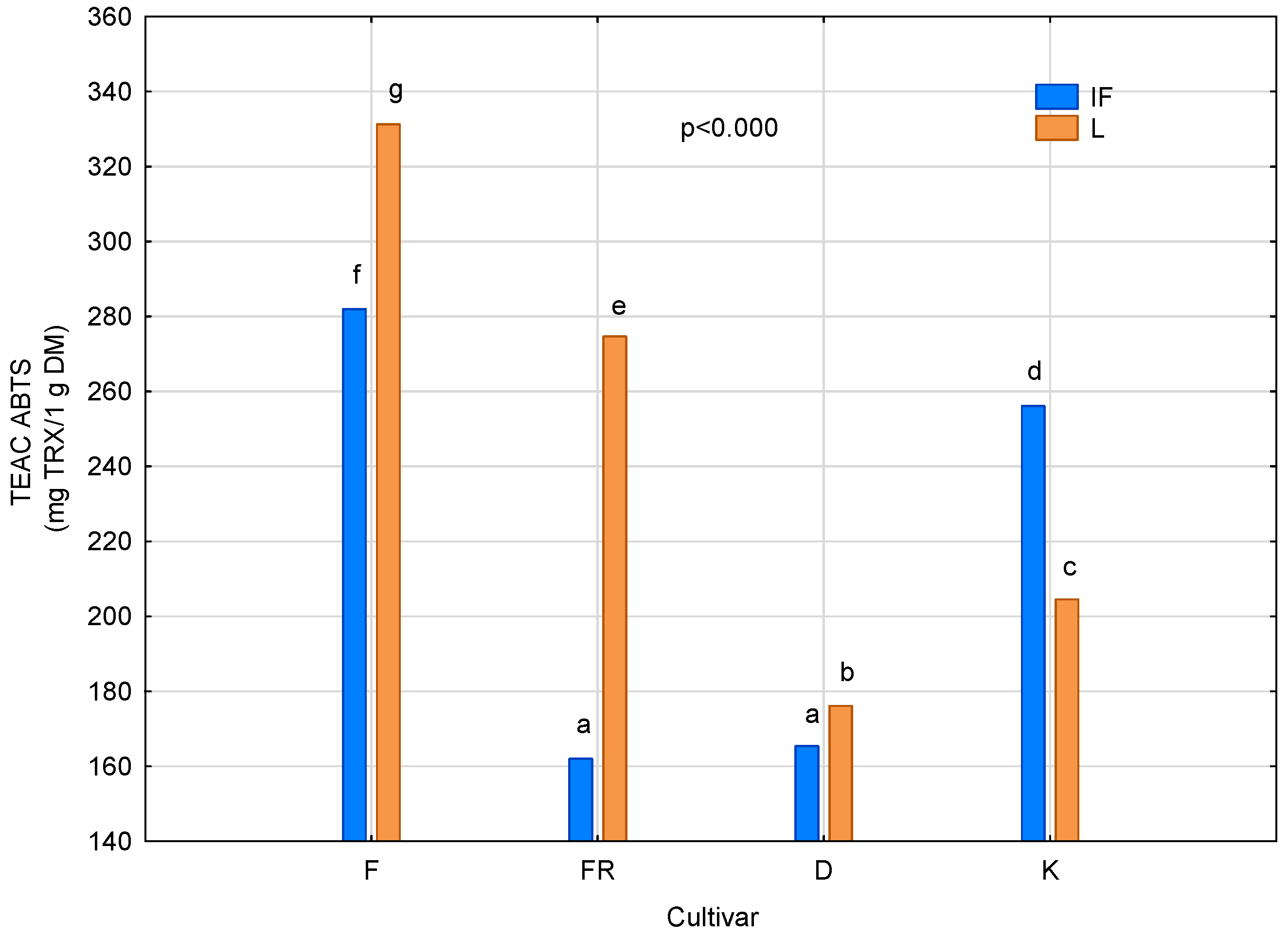
A statistically significant difference in antioxidant capacity was identified between the tested raw materials (p < 0.000) (Figure 3). The highest AC was observed in the leaves of the Finola cv., as the AC value determined for its leaves exceeded 330 mg TRX/1 g DM. The interaction (cultivar × plant part) was analyzed, indicating qualitative differences in the raw materials of two cvs. (Dioica and Kompolti). It is noteworthy that the AC values determined for leaves and inflorescences of Dioica cv. were very similar (176.1 and 165.4 mg TRX/1 g DM, respectively). The above-described variation in AC among raw materials from the four hemp varieties was not reflected in their radical scavenging capacity (Figure S4 in Supplementary Material). Regardless of the variety, significantly higher RSAABTS values were recorded for inflorescences. It should be noted that the lowest IF/L ratio of this parameter (RSAABTS) was found in the Finola cv., whereas the highest was observed in Dioica.
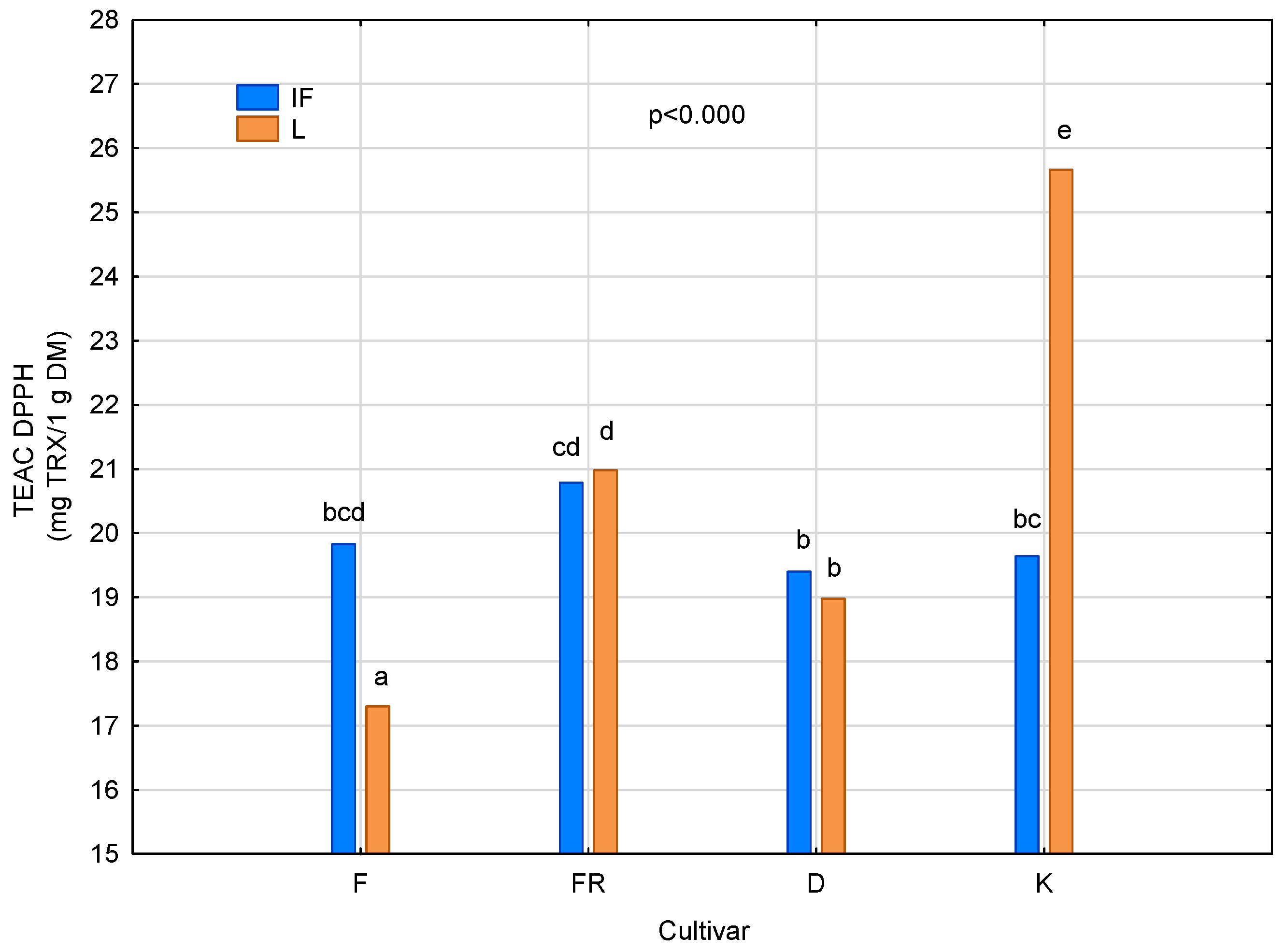
Due to the high specificity of AC assays, particularly the differences arising from the chemical nature of the radicals used (e.g., between ABTS and DPPH assays), the use of different assays resulted in different antioxidant capacity values, despite all results being expressed in the same units. As a result, the relative antioxidant performance of the analyzed raw materials may differ depending on the assay used, as demonstrated by the AC determined using the DPPH radical (Figure 4). This assay indicated the homogeneity of raw materials (leaves and inflorescences) in terms of this trait for two cvs., namely Futura 75 and Dioica. In the case of Finola cv., significantly higher AC values were observed in inflorescences, whereas in Kompolti cv. the leaves exhibited distinctly superior antioxidant properties. A similar pattern was observed for the interaction cv. × plant part when RSADPPH was analyzed (Figure S5 in Supplementary Material). In this case, the leaves of Kompolti cv. showed the highest value (82.3%), while the lowest value was recorded for the leaves of Finola cv. (66.7%).
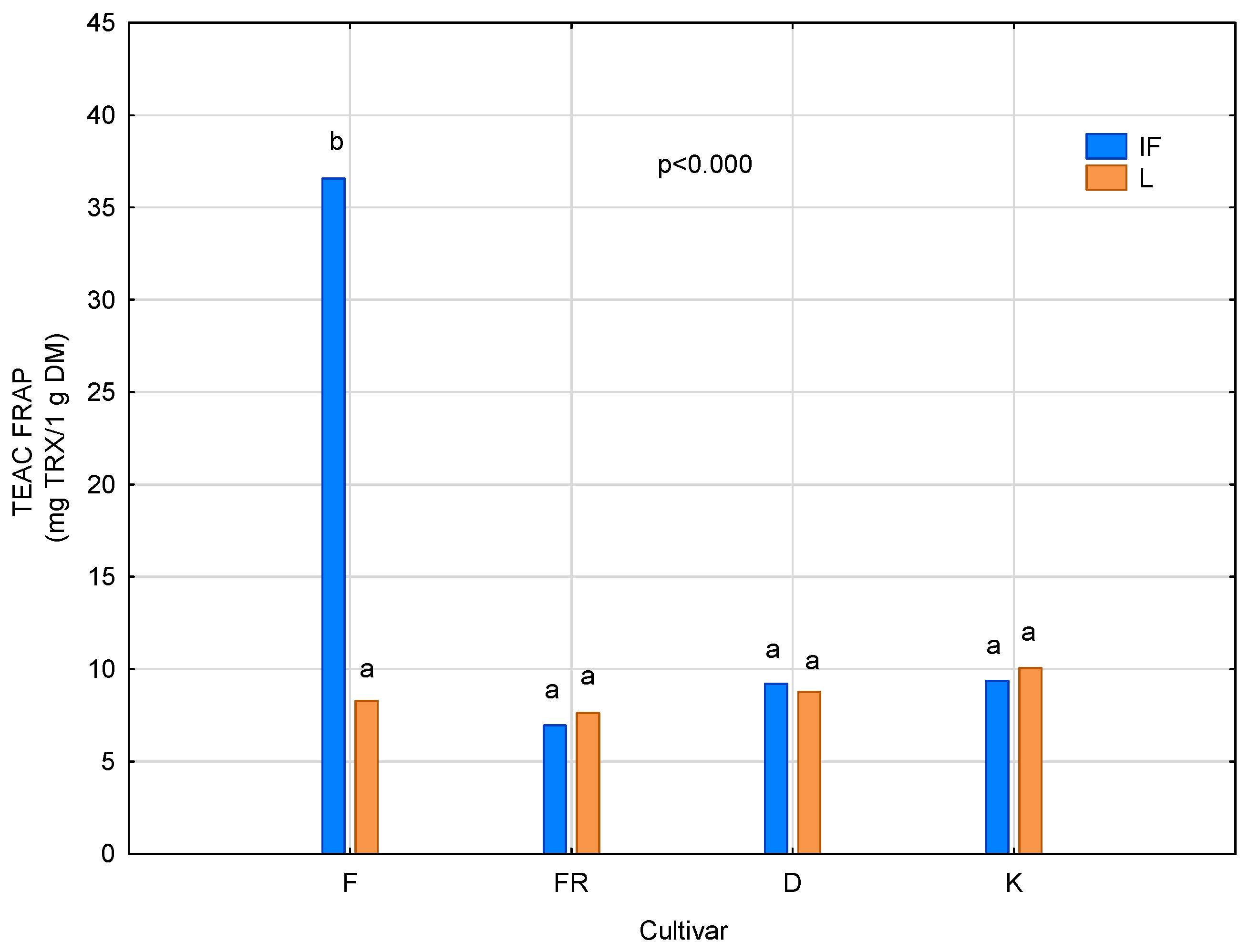
A different picture of the AC of the tested raw materials emerges from the analysis based on ferric ion reduction (FRAP). The interaction of cv. × plant part essentially confirmed a distinctly higher AC only for the inflorescences of the Finola variety (36.6 mg TRX/1 g DM) (Figure 5). The AC of raw materials obtained from the remaining cvs. (both leaves and inflorescences) remained at a comparable level, approximately three times lower.

3.3. Comparative Analysis

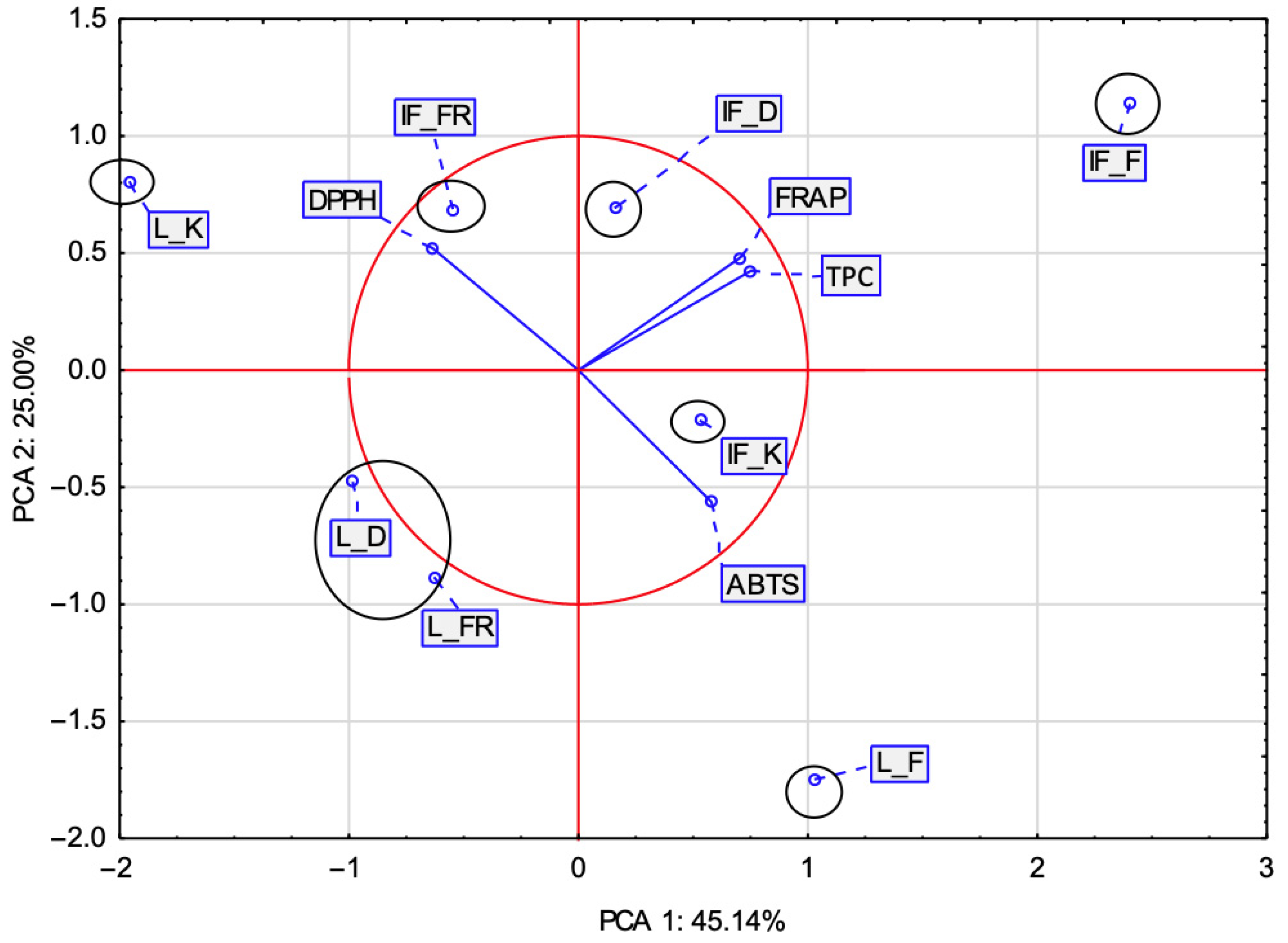
The variability in AC assessed by the three methods in hemp-derived raw materials prompted a deeper analysis using principal component analysis (PCA) (Figure 6). The first two components explained 70% of the total variance of the original data. An important observation confirming the distinct mechanisms of these assays is the negative correlation between the results obtained with the ABTS and DPPH assays. This outcome is clearly related to the fundamentally different chemical nature of the radicals used. Moreover, the AC values obtained with these two assays showed no correlation with AC determined by the FRAP assay. In contrast, AC measured with FRAP displayed a complete correlation with the polyphenol content of the tested raw materials. The ABTS assay appeared to confirm a significant presence of hydrophilic antioxidants in the leaves of the Finola cv. and the inflorescences of the Kompolti cv. In turn, the leaves of Kompolti cv. and the inflorescences of Futura 75 cv. indicated the presence of hydrophobic antioxidants. These findings demonstrate substantial qualitative variation in the antioxidant pools present in raw materials obtained from hemp.

4. Discussion

The total phenolic content (TPC) values obtained in this study indicate that both hemp leaves (37.08 mg GAE/1 g DM) and inflorescences (52.36 mg GAE/1 g DM) were characterized by high levels of these compounds compared to results reported by other authors. Previous studies have shown that TPC in hemp materials is highly variable and depends both on the plant part and the extraction method. Izzo et al. [35] reported TPC in inflorescences ranging from 10.50 to 52.58 mg GAE/1 g DM. Higher values (40.38–72.18 mg GAE/1 g DM) were reported for aqueous hydrolysates (residues after essential oil extraction) in the study by Mazzara [36]. The TPC in ethanolic extracts of the aerial parts of hemp reported by Drinić et al. [37] ranged from 6.43 to 17.05 mg GAE/1 g DM in young plants, whereas extracts prepared from mature plants showed TPC between 5.85 and 9.25 mg GAE/1 g DM. The TPC values obtained in this study fall within the upper range reported for hemp materials, indicating that both leaves and inflorescences may represent relatively rich sources of phenolic compounds. In commonly used plants known for their high antioxidant capacity in animal nutrition, reported values were as follows: nettle (2.75 –19.54 mg GAE/1 g DM) [38], wild rose (73–102 mg GAE/1 g DM) [39,40], and sea buckthorn leaves (186.64–330.16 mg GAE/1 g DM) [28]. Compared with highly phenolic-rich plants such as sea buckthorn leaves, hemp materials contain moderate levels of phenolic compounds, although these values remain comparable to or higher than those reported for several botanical additives used in animal nutrition. In our study, TPC was additionally expressed as chlorogenic acid equivalents (CAE), providing an alternative reference point. Although this standard is rarely applied in analyses of hemp materials, it may be useful in future comparative studies with raw materials in which chlorogenic acid is the main phenolic compound, e.g., green coffee, artichoke, or dandelion leaves. Significantly higher total phenolic content, expressed both as GAE and CAE, was recorded in inflorescences compared with leaves (p < 0.000). Among the analyzed cvs., the highest TPC was observed in Finola (49.78 mg GAE/1 g DM), while the lowest values were noted for Futura 75 and Kompolti cvs., which, together with Dioica cv., formed a statistically homogeneous group. The higher TPC observed in inflorescences compared with leaves indicates that this plant part may represent a more concentrated source of phenolic compounds, while the differences between cultivars highlight the role of genetic variability in shaping the antioxidant profile of hemp materials. These differences may be relevant for the chemical characterization and comparative evaluation of hemp materials. The antioxidant content of hemp-derived plant materials can vary significantly depending on multiple factors, including the plant part analyzed. The differences in AC observed in this study between leaves and inflorescences (p < 0.000) confirm the influence of the plant part. It is noteworthy that the interaction of cultivar × plant part demonstrated that the least significant discrepancy between inflorescences and leaves was observed in Finola cv. (22.6 mg CAE/1 g DM), indicating cultivar-dependent disparities in antioxidant capacity. Conversely, the most substantial discrepancy (40.9 mg CAE/1 g DM) was detected in Dioica cv. These results suggest that both plant morphology and cultivar-related factors contribute to the variability of antioxidant properties in hemp. Woźniczka et al. [12] reported values ranging from 56.99 to 192.82 mg TRX/1 g DM in extracts of a mixture of inflorescences and leaves intended for herbal teas, obtained using methanol, water, and ultrasound-assisted extraction. When water alone was used as the solvent, the values were lower (15.50–49.04 mg TRX/1 g DM). In another study [41] where hemp leaf extracts were analyzed by the ABTS assay with methanol and ethanol (50:50, v/v) as the solvent, the maximum value obtained was 8.48 mg TRX/1 g DM. Since the reaction is carried out in organic solvents (e.g., methanol, acetone), its applicability to hydrophilic compounds is limited. These differences are most likely related to extraction conditions, particularly the solvent used. The deactivation mechanism is based primarily on hydrogen atom transfer (HAT), making it particularly suitable for the analysis of compounds with high reactivity [42]. Consequently, in certain instances, such as leaf extracts comprising readily available and rapidly reacting antioxidants, this method may produce higher values. The results of this study demonstrate that the DPPH values range from 18.57 to 22.65 mg TRX/1 g DM, depending on the cv., thus falling within the range of antioxidant capacity reported for different hemp materials. However, it is evident that there is variation depending on the plant part, variety, and extraction conditions. In terms of radical scavenging capacity (RSA), RSAABTS values were significantly higher in inflorescences (83.91%) than in leaves (46.15%), while the opposite trend was observed for RSADPPH, with leaves showing higher values (72.73%) compared to inflorescences (70.56%). Particularly favorable in this respect were the leaves of the Kompolti cv. (RSADPPH: 82.3%). These differences highlight the necessity of evaluating antioxidant capacity using multiple methods, as each discriminates plant material differently depending on the nature of the active compounds. The values reported here are higher than those obtained for methanolic leaf extracts of the Białobrzeskie, Henola, and Tygra cvs. extracted with ultrasound-assisted methods [41], where antioxidant capacity ranged from 3.0 to 10.5 mg TRX/1 g DM. Significantly higher values were obtained only for aqueous hydrolates, which are residues after essential oil extraction from hemp inflorescences, where DPPH activity reached 90.33–143.00 mg TRX/1 g DM [36]. In turn, the values for inflorescences reported by Izzo et al. [35] ranged from 6.88 to 19.43 mg TRX/1 g DM, placing part of the results of the present study above or within the upper range of that interval. With respect to plant material intended for teas and water–methanol extracts of hemp flowers, for which antioxidant capacity was reported at 2.54–7.85 mg TRX/1 g DM [12], the values obtained in our study were also higher. For comparison, the DPPH activity of extracts from inflorescences and leaves of plants from the Asteraceae family—such as dandelion, tansy, and goldenrod—was 51.81 mg TRX/1 g DM [43], which still exceeds the values determined for hemp in this study. Stasiłowicz-Krzemień et al. [41] reported a DPPH activity of 7.56 mg TRX/1 g DM for hemp leaf extract.
It is important to note that the ABTS•+ radical is significantly more stable than the radicals naturally present in plant material. This raises concerns about the reliability of the assay in reflecting real interactions with free radicals. In contrast, a limitation of the DPPH assay is that DPPH dissolves only in organic solvents, preventing the determination of hydrophilic antioxidants [44]. Antioxidant properties may be influenced by many factors beyond the plant species itself, including the freshness of the plant material [33,34,41,45,46]. Oxidative properties of raw materials may also change depending on the method and duration of storage [47]. Alabri et al. [47] hypothesized that the volatilization or decomposition of certain compounds may occur during the storage of botanical materials. The antioxidant efficacy of a given sample is contingent on numerous factors, including the type of raw material and the method of sample processing.
The results of the FRAP assay demonstrated a highly significant correlation with the total phenolic content (both GAE and CAE), a finding that was further validated through PCA. This finding suggests that the method may serve as a reliable tool for evaluating the overall antioxidant potential of plant materials, particularly with respect to phenolic compound content. The FRAP assay is predicated on the reduction of ferric ions, thus providing information regarding the reducing capacity of the material under investigation, as opposed to providing a direct measurement of radical scavenging activity. Due to these different measurement mechanisms, the results of antioxidant assays are not directly comparable in numerical terms. The literature emphasizes the need to apply at least two complementary methods when assessing the antioxidant capacity of plant materials, particularly in the case of complex matrices containing diverse classes of secondary metabolites.
In the analyzed hemp extracts, ferric ion-reducing capacity varied depending on both the plant part and the cv., with higher activity observed in inflorescences compared with leaves. These values exceeded those reported for hemp leaf extracts in the literature, both for methanolic extracts obtained using ultrasound-assisted extraction (3.0–11.06 mg TRX/1 g DM) [41], and for extracts obtained without ultrasound assistance (0.5–1.84 mg TRX/1 g DM) [48]. Moreover, they surpassed the values determined for selected Lamiaceae herbs, such as sage (Salvia officinalis L.), for which FRAP activity was reported at 1.10 mg TRX/1 g DM [49]. This confirms the high reducing potential of the studied hemp materials. Interestingly, in the cv. × plant part interaction, only the inflorescences of the Finola cv. exhibited significantly higher FRAP values (36.6 mg TRX/1 g DM), while the remaining samples, regardless of cv. or plant part, remained at lower and comparable levels. This may indicate distinct FRAP responses among cultivars.
Overall, the results demonstrate clear differences in antioxidant properties between hemp leaves and inflorescences as well as between cultivars, suggesting that different fractions of hemp biomass may represent distinct sources of antioxidant compounds.

5. Conclusions

The findings of the present study demonstrate that both the selection of cv. and the plant part utilized (leaves vs. inflorescences) are pivotal in determining the chemical antioxidant characteristics of hemp raw materials. The Finola cv. was identified as the most promising source of polyphenols and compounds with high reducing activity (FRAP), particularly in the case of inflorescences. In contrast, the leaves of the Kompolti cv. exhibited the highest scavenging efficiency for DPPH radicals, a finding that may be of particular relevance when comparing antioxidant behavior in different chemical assays targeted at specific antioxidant mechanisms (e.g., HAT vs. SET). The use of multivariate analysis (PCA) provided insight into the qualitative differences in antioxidant pools contained in the tested raw materials, representing an important tool in the selection of cvs. for comparative screening of hemp cultivars.
Attention should be given to the leaves, which are often regarded as a by-product. The utilization of this plant part aligns with the principles of sustainable development and may contribute to more efficient management of plant biomass. Future research should focus on the identification of active compounds, as well as the assessment of their bioavailability, technological stability, and effects on animal organisms. A comparison of the chemical composition of raw materials is only possible if a number of factors are taken into consideration. These include cvs., cultivation systems, and environmental and technological factors. The results demonstrate that both the hemp cultivar and the morphological part exert a significant influence on the total phenolic content and the in vitro antioxidant profile of the raw material. In particular, inflorescences—particularly of the Finola cv.—exhibit the highest polyphenol levels, while leaves provide a complementary antioxidant profile.

Supplementary Materials

The following supporting information can be downloaded at: https://www.mdpi.com/article/10.3390/app16062957/s1, Figure S1. The calibration curve for the determination of antioxidant capacity using the ABTS•+ radical cation; Figure S2. The calibration curve for the determination of antioxidant capacity using the DPPH radical cation; Figure S3. The calibration curve for the determination of antioxidant capacity using the FRAP assay; Figure S4. Radical scavenging activity of hemp inflorescences and leaves based on ABTS assay results (ABTS—2,2′-azino-bis(3-ethylbenzothiazoline-6-sulfonic acid; L—leaves; IF—inflorescences; F—cv. Finola; FR—cv. Futura 75; D—cv. Dioica; K—cv. Kompolti). Different letters (a–h) indicate significant differences between means at p = 0.05; Figure S5. Radical scavenging activity of hemp inflorescences and leaves based on DPPH assay results (DPPH—1,1-diphenyl-2-picrylhydrazyl; L—leaves; IF—inflorescences; F—cv. Finola; FR—cv. Futura 75; D—cv. Dioica; K—cv. Kompolti). Different letters (a–e) indicate significant differences between means at p = 0.05.

Author Contributions

Conceptualization: W.J. and W.B.; methodology: W.J., W.B., R.W. and E.P.; software: R.W.; validation: W.J., W.B., E.P. and R.W.; formal analysis: W.J., R.W. and E.P.; investigation: W.J., W.B. and E.P.; resources: W.J., W.B., R.W. and E.P.; data curation: W.J. and E.P.; writing—original draft preparation, W.J., W.B., R.W. and E.P.; writing—review and editing, W.J., W.B., R.W. and E.P.; visualization, W.J. and R.W.; supervision, W.J., W.B., R.W. and E.P.; project administration, W.J. and W.B.; funding acquisition, W.B. and E.P. All authors have read and agreed to the published version of the manuscript.

Funding

This work was supported by Rector of the West Pomeranian University of Technology in Szczecin for PhD students of the Doctoral School, grant number: 856-414000-00425.

Institutional Review Board Statement

Not applicable.

Informed Consent Statement

Not applicable.

Data Availability Statement

All data generated or analyzed during this study are available from the corresponding author upon reasonable request.

Acknowledgments

Our sincere thanks go to Hempfarm Sp. z o.o., Darłowo (Poland) for supplying the plant material required for this investigation. Their collaboration and willingness to support academic research made a significant contribution to the completion of this work.

Conflicts of Interest

The authors declare no conflicts of interest.

Abbreviations

The following abbreviations are used in this manuscript:
ACAntioxidant capacity
ABTS2,2′-azino-bis(3-ethylbenzothiazoline-6-sulfonic acid)
DPPH1,1-diphenyl-2-picrylhydrazyl
FRAPFerric Reducing Antioxidant Power
THCTetrahydrocannabinol
ROSReactive oxygen species
RSARadical scavenging activity
TRXTrolox
CVCultivar
TPCTotal phenolic content
CAEChlorogenic acid equivalents
GAEGallic acid equivalents
DMDry matter
IFInflorescences
LLeaves
TEACTrolox equivalent antioxidant capacity
TPTZ2,4,6-tripyridyl-s-triazine
PCAPrincipal component analysis
HSDHonestly Significant Difference
Fcv. Finola
FRcv. Futura 75
Dcv. Dioica
Kcv. Kompolti
HATHydrogen atom transfer
SETSingle electron transfer

References

  1. Kussmann, M.; Abe Cunha, D.H.; Berciano, S. Bioactive compounds for human and planetary health. Front. Nutr. 2023, 10, 1193848. [Google Scholar] [CrossRef]
  2. Velenturf, A.P.M.; Purnell, P. Principles for a sustainable circular economy. Sustain. Prod. Consum. 2021, 27, 1437–1457. [Google Scholar] [CrossRef]
  3. de Oliveira, C.T.; Oliveira, G.G.A. What circular economy indicators really measure? An overview of circular economy principles and sustainable development goals. Resour. Conserv. Recycl. 2023, 190, 106850. [Google Scholar]
  4. Lawson, L.; Degenstein, L.M.; Bates, B.; Chute, W.; King, D.; Dolez, P.I. Cellulose textiles from hemp biomass: Opportunities and challenges. Sustainability 2022, 14, 15337. [Google Scholar] [CrossRef]
  5. Crini, G.; Lichtfouse, E.; Chanet, G.; Morin-Crini, N. Applications of hemp in textiles, paper industry, insulation and building materials, horticulture, animal nutrition, food and beverages, nutraceuticals, cosmetics and hygiene, medicine, agrochemistry, energy production and environment: A review. Environ. Chem. Lett. 2020, 18, 1451–1476. [Google Scholar] [CrossRef]
  6. Visković, J.; Zheljazkov, V.D.; Sikora, V.; Noller, J.; Latković, D.; Ocamb, C.M.; Koren, A. Industrial hemp (Cannabis sativa L.) agronomy and utilization: A review. Agronomy 2023, 13, 931. [Google Scholar] [CrossRef]
  7. Bartončíková, M.; Lapčíková, B.; Lapčík, L.; Valenta, T. Hemp-derived CBD used in food and food supplements. Molecules 2023, 28, 8047. [Google Scholar] [CrossRef]
  8. Ceyhan, V.; Türkten, H.; Yıldırım, Ç.; Canan, S. Economic viability of industrial hemp production in Turkey. Ind. Crops Prod. 2022, 176, 114354. [Google Scholar]
  9. Buxoo, S.; Jeetah, P. Feasibility of producing biodegradable disposable paper cup from pineapple peels, orange peels and Mauritian hemp leaves with beeswax coating. SN Appl. Sci. 2020, 2, 3164. [Google Scholar] [CrossRef]
  10. Aloo, S.O.; Mwiti, G.; Ngugi, L.W.; Oh, D.H. Uncovering the secrets of industrial hemp in food and nutrition: The trends, challenges, and new-age perspectives. Crit. Rev. Food Sci. Nutr. 2024, 64, 5093–5112. [Google Scholar]
  11. Tănase Apetroaei, V.; Pricop, E.M.; Istrati, D.I.; Vizireanu, C. Hemp seeds (Cannabis sativa L.) as a valuable source of natural ingredients for functional foods—A review. Molecules 2024, 29, 2097. [Google Scholar] [CrossRef] [PubMed]
  12. Wozniczka, K.; Viapiana, A.; Roszkowska, A.; Plenis, A.; Baczek, T.; Konieczynski, P. Evaluation of commercially available products of Cannabis sativa L. inflorescences to identify their contents of elemental and phenolic compounds. Foods 2025, 14, 1208. [Google Scholar] [CrossRef] [PubMed]
  13. Trono, D. Hemp (Cannabis sativa L.) phytochemicals and their potential in agrochemical, cosmetic, and food industries: A review. Int. J. Mol. Sci. 2026, 27, 1146. [Google Scholar] [CrossRef]
  14. European Union. Commission Regulation (EU) 2022/1104 of 1 July 2022 amending Regulation (EU) No 68/2013 on the Catalogue of Feed Materials. Off. J. Eur. Union 2022, L173, 115–226. [Google Scholar]
  15. Hassan, F.-u.; Liu, C.; Mehboob, M.; Bilal, R.M.; Arain, M.A.; Siddique, F.; Chen, F.; Li, Y.; Zhang, J.; Shi, P.; et al. Potential of dietary hemp and cannabinoids to modulate immune response to enhance health and performance in animals: Opportunities and challenges. Front. Immunol. 2023, 14, 1285052. [Google Scholar] [CrossRef]
  16. Rizzo, G.; Storz, M.A.; Calapai, G. The role of hemp (Cannabis sativa L.) as a functional food in vegetarian nutrition. Foods 2023, 12, 3505. [Google Scholar] [CrossRef]
  17. European Commission. Hemp Production in the EU. European Commission Official Website. 2025. Available online: https://agriculture.ec.europa.eu/farming/crop-productions-and-plant-based-products/hemp_en (accessed on 30 September 2025).
  18. Cortés, J.G.; Ryu, B.R.; Pauli, C.; Barroso, L.R.; Park, S.H. Industrial applications of hemp fiber in Europe and evolving regulatory landscape. J. Nat. Fibers 2024, 21, 2435047. [Google Scholar] [CrossRef]
  19. Kaur, G.; Kander, R. The sustainability of industrial hemp: A literature review of its economic, environmental, and social sustainability. Sustainability 2023, 15, 86457. [Google Scholar] [CrossRef]
  20. Adesina, I.; Bhowmik, A.; Sharma, H.; Shahbazi, A. A review on the current state of knowledge of growing conditions, agronomic soil health practices and utilities of hemp in the United States. Agriculture 2020, 10, 129. [Google Scholar] [CrossRef]
  21. Grigoryev, S.V.; Illarionova, K.V.; Shelenga, T.V.; Vavilov, N.I. Hempseeds (Cannabis spp.) as a source of functional food ingredients, prebiotics and phytosterols. Agric. Food Sci. 2020, 29, 460–470. [Google Scholar] [CrossRef]
  22. Goldberg, E.M.; Gakhar, N.; Ryland, D.; Aliani, M.; Gibson, R.A.; House, J.D. Fatty acid profile and sensory characteristics of table eggs from laying hens fed hempseed and hempseed oil. J. Food Sci. 2012, 77, S153–S160. [Google Scholar] [CrossRef]
  23. Zicarelli, F.; Lotito, D.; Iommelli, P.; Amato, R.; Mahayri, T.M.; Musco, N.; Pacifico, E.; Infascelli, F.; Tudisco, R.; Moniello, G.; et al. Hemp hay (Cannabis sativa L.) in grazing goats’ diet: Effects on oxidative and inflammatory status. Animals 2025, 15, 30364. [Google Scholar] [CrossRef]
  24. Vodolazska, D.; Lauridsen, C. Effects of dietary hemp seed oil to sows on fatty acid profiles, nutritional and immune status of piglets. J. Anim. Sci. Biotechnol. 2020, 11, 50. [Google Scholar]
  25. Al Khoury, A.; Sleiman, R.; Atoui, A.; Hindieh, P.; Maroun, R.G.; Bailly, J.-D.; El Khoury, A. Antifungal and anti-aflatoxigenic properties of organs of Cannabis sativa L.: Relation to phenolic content and antioxidant capacities. Arch. Microbiol. 2021, 203, 4485–4492. [Google Scholar] [CrossRef]
  26. Prior, R.L.; Wu, X.; Schaich, K. Standardized methods for the determination of antioxidant capacity and phenolics in foods and dietary supplements. J. Agric. Food Chem. 2005, 53, 4290–4302. [Google Scholar] [CrossRef]
  27. Miliauskas, G.; Venskutonis, P.R.; Van Beek, T.A. Screening of radical scavenging activity of some medicinal and aromatic plant extracts. Food Chem. 2004, 85, 231–237. [Google Scholar] [CrossRef]
  28. Bośko, P.; Biel, W.; Smetanska, I.; Witkowicz, R.; Piątkowska, E. Sea buckthorn leaves as a potential source of antioxidant substances. Appl. Sci. 2024, 14, 5038. [Google Scholar] [CrossRef]
  29. Ainsworth, E.A.; Gillespie, K.M. Estimation of total phenolic content and other oxidation substrates in plant tissues using Folin–Ciocalteu reagent. Nat. Protoc. 2007, 2, 875–877. [Google Scholar] [CrossRef]
  30. Re, R.; Pellegrini, N.; Proteggente, A.; Pannala, A.; Yang, M.; Rice-Evans, C. Antioxidant activity applying an improved ABTS radical cation decolorization assay. Free Radic. Biol. Med. 1999, 26, 1231–1237. [Google Scholar] [CrossRef] [PubMed]
  31. Brand-Williams, W.; Cuvelier, M.E.; Berset, C. Use of a free radical method to evaluate antioxidant activity. LWT Food Sci. Technol. 1995, 28, 25–30. [Google Scholar] [CrossRef]
  32. Benzie, I.F.F.; Strain, J.J. The ferric reducing ability of plasma (FRAP) as a measure of antioxidant power: The FRAP assay. Anal. Biochem. 1996, 239, 70–76. [Google Scholar] [CrossRef]
  33. Feduraev, P.; Chupakhina, G.; Maslennikov, P.; Tacenko, N.; Skrypnik, L. Variation in phenolic compounds content and antioxidant activity of different plant organs from Rumex crispus L. and Rumex obtusifolius L. at different growth stages. Antioxidants 2019, 8, 237. [Google Scholar] [CrossRef]
  34. Jeelani, S.M.; Farooq, U.; Gupta, A.P.; Lattoo, S.K. Phytochemical evaluation of major bioactive compounds in different cytotypes of five species of Rumex L. Ind. Crops Prod. 2017, 109, 897–904. [Google Scholar]
  35. Izzo, L.; Castaldo, L.; Narváez, A.; Graziani, G.; Gaspari, A.; Rodríguez-Carrasco, Y.; Ritieni, A. Analysis of phenolic compounds in commercial Cannabis sativa L. inflorescences using UHPLC-Q-Orbitrap HRMS. Molecules 2020, 25, 631. [Google Scholar]
  36. Mazzara, E.; Torresi, J.; Fico, G.; Papini, A.; Kulbaka, N.; Dall’Acqua, S.; Sut, S.; Garzoli, S.; Mustafa, A.M.; Cappellacci, L.; et al. A comprehensive phytochemical analysis of terpenes, polyphenols and cannabinoids, and micromorphological characterization of 9 commercial varieties of Cannabis sativa L. Plants 2022, 11, 891. [Google Scholar] [CrossRef] [PubMed]
  37. Drinić, Z.; Vidović, S.; Vladić, J.; Koren, A.; Kiprovski, B.; Sikora, V. Effect of extraction solvent on total polyphenol content and antioxidant activity of Cannabis sativa L. Lek. Sirovine 2018, 38, 17–21. [Google Scholar]
  38. Tarasevičienė, Ž.; Vitkauskaitė, M.; Paulauskienė, A.; Černiauskienė, J. Wild stinging nettle (Urtica dioica L.) leaves and roots chemical composition and phenols extraction. Plants 2023, 12, 309. [Google Scholar] [CrossRef]
  39. Yilmaz, S.O.; Ercisli, S. Antibacterial and antioxidant activity of fruits of some rose species from Turkey. Biotechnol. Biotechnol. Equip. 2011, 25, 16–22. [Google Scholar]
  40. Ercisli, S. Chemical composition of fruits in some rose (Rosa spp.) species. Food Chem. 2007, 104, 1379–1384. [Google Scholar] [CrossRef]
  41. Stasiłowicz-Krzemień, A.; Sip, S.; Szulc, P.; Cielecka-Piontek, J. Determining antioxidant activity of Cannabis leaves extracts from different varieties—Unveiling nature’s treasure trove. Antioxidants 2023, 12, 1390. [Google Scholar] [CrossRef]
  42. Wołosiak, R.; Drużyńska, B.; Derewiaka, D.; Piecyk, M.; Majewska, E.; Ciecierska, M.; Worobiej, E.; Pakosz, P. Verification of the conditions for determination of antioxidant activity by ABTS and DPPH assays—A practical approach. Molecules 2021, 27, 50. [Google Scholar] [CrossRef]
  43. Piątkowska, E.; Biel, W.; Witkowicz, R.; Kępińska-Pacelik, J. Chemical composition and antioxidant activity of Asteraceae family plants. Appl. Sci. 2022, 12, 12293. [Google Scholar] [CrossRef]
  44. Arnao, M.B. Some methodological problems in the determination of antioxidant activity using chromogen radicals: A practical case. Trends Food Sci. Technol. 2000, 11, 419–421. [Google Scholar] [CrossRef]
  45. Mastellone, G.; Marengo, A.; Sgorbini, B.; Scaglia, F.; Capetti, F.; Gai, F.; Peiretti, P.G.; Rubiolo, P.; Cagliero, C. Characterization and biological activity of fiber-type Cannabis sativa L. aerial parts at different growth stages. Plants 2022, 11, 419. [Google Scholar] [CrossRef]
  46. Beleggia, R.; Giovanniello, V.; Menga, V.; Suriano, S.; Trono, D. Exogenous application of methyl jasmonate affects the phytochemical accumulation and the antioxidant activity in hemp (Cannabis sativa L.) inflorescences. Agronomy 2026, 16, 157. [Google Scholar] [CrossRef]
  47. Alabri, T.H.A.; Al Musalami, A.H.S.; Hossain, M.A.; Weli, A.M.; Al-Riyami, Q. Comparative study of phytochemical screening, antioxidant and antimicrobial capacities of fresh and dry leaves crude plant extracts of Datura metel L. J. King Saud Univ. Sci. 2014, 26, 237–243. [Google Scholar]
  48. Stasiłowicz-Krzemień, A.; Sip, S.; Szulc, P.; Walkowiak, J.; Cielecka-Piontek, J. The antioxidant and neuroprotective potential of leaves and inflorescences extracts of selected hemp varieties obtained with scCO2. Antioxidants 2023, 12, 1827. [Google Scholar] [CrossRef]
  49. Wojdyło, A.; Oszmiański, J.; Czemerys, R. Antioxidant activity and phenolic compounds in 32 selected herbs. Food Chem. 2007, 105, 940–949. [Google Scholar] [CrossRef]
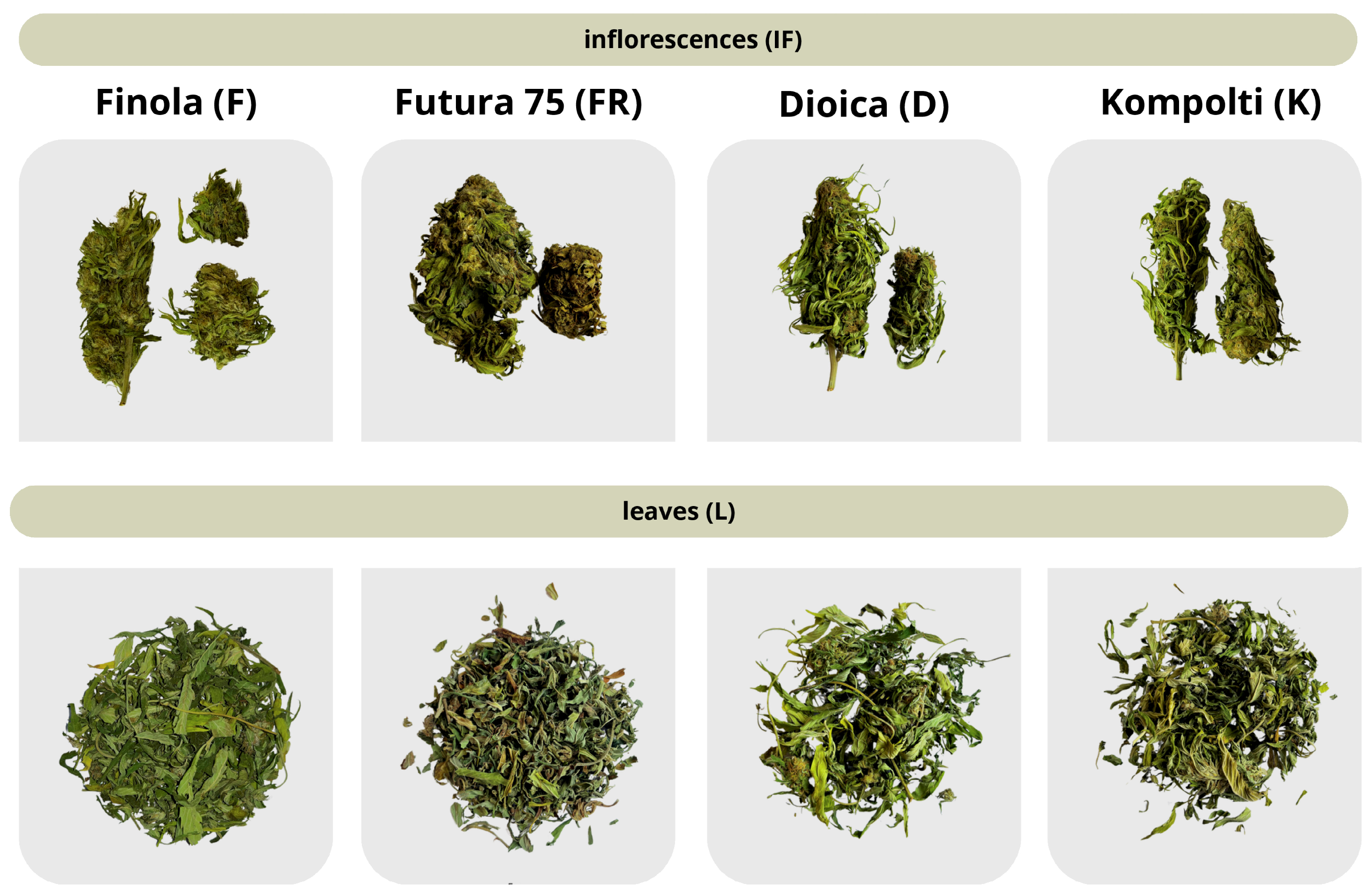
Figure 1. Plant material evaluated—inflorescences and leaves of four hemp (Cannabis sativa L.) cvs.: Finola, Futura 75, Dioica, and Kompolti.
Applsci 16 02957 g001
Figure 2. Total phenolic content in raw materials obtained from four hemp (Cannabis sativa L.) cvs. (TPC—total phenolic content; CAE—chlorogenic acid equivalents; DM—dry matter; F—cv. Finola; FR—cv. Futura 75; D—cv. Dioica; K—cv. Kompolti). Different letters (a–d) indicate significant differences between means at p = 0.05.
Applsci 16 02957 g002
Figure 3. Antioxidant capacity of hemp inflorescences and leaves evaluated using the ABTS assay (TEAC—Trolox equivalent antioxidant capacity; ABTS—2,2′-azino-bis(3-ethylbenzothiazoline-6-sulfonic acid; DM—dry matter; L—leaves; IF—inflorescences; F—cv. Finola; FR—cv. Futura 75; D—cv. Dioica; K—cv. Kompolti). Different letters (a–g) indicate significant differences between means at p ≤ 0.05.
Applsci 16 02957 g003
Figure 4. Antioxidant capacity of hemp inflorescences and leaves evaluated using the DPPH assay (TEAC—Trolox equivalent antioxidant capacity; DPPH—1,1-diphenyl-2-picrylhydrazyl; DM—dry matter; L—leaves; IF—inflorescences; F—cv. Finola; FR—cv. Futura 75; D—cv. Dioica; K—cv. Kompolti). Different letters (a–e) indicate significant differences between means at p = 0.05.
Applsci 16 02957 g004
Figure 5. Ferric reducing antioxidant power of hemp inflorescences and leaves (TEAC—Trolox equivalent antioxidant capacity; FRAP—ferric ion reducing antioxidant parameter; DM—dry matter; L—leaves; IF—inflorescences; F—cv. Finola; FR—cv. Futura 75; D—cv. Dioica; K—cv. Kompolti). Different letters (a, b) indicate significant differences between means at p = 0.05.
Applsci 16 02957 g005
Figure 6. Biplot based on the first two principal component axes for the antioxidant capacity of raw material (leaves and inflorescences) from four cultivars of hemp; DPPH—1,1-diphenyl-2-picrylhydrazyl; FRAP—ferric ion reducing antioxidant parameter; ABTS—2,2′-azino-bis(3-ethylbenzothiazoline-6-sulfonic acid; TPC—total phenolic content; L—leaves; IF—inflorescences; F—cv. Finola; FR—cv. Futura 75; D—cv. Dioica; K—cv. Kompolti).
Applsci 16 02957 g006
Table 1. Total phenolic content in leaves and inflorescences of hemp materials.
FactorTotal Phenolic Content (mg CAE 1/1 g DM 3)Total Phenolic Content
(mg GAE 2/1 g DM)
Part of plant
p 4<0.000<0.000
L 574.59 a 737.08 a
IF105.34 b52.36 b
Cultivar
p<0.000<0.000
F 6100.15 b49.78 b
FR85.62 a42.56 a
D88.24 a43.86 a
K85.85 a42.67 a
1 CAE—chlorogenic acid equivalents; 2 GAE—gallic acid equivalents; 3 DM—dry matter; 4 p—probability of null hypothesis rejection (H0; m1 = m2 …= mn); 5 L—leaves, IF—inflorescences; 6 F—cv. Finola, FR—cv. Futura 75, D—cv. Dioica, K—cv. Kompolti; 7 means with at least one same letter (a, b) not differ statistically at p = 0.05 (for all columns separately).
Table 2. Trolox equivalent antioxidant capacity (TEAC) in ABTS, DPPH and FRAP assays and calculated radical scavenging activity (RSA) of hemp materials.
FactorTEAC ABTS
(mg TRX 1/1 g DM 2)
RSA 3ABTS
(%)
TEAC DPPH
(mg TRX/1 g DM)
RSADPPH
(%)
TEAC FRAP
(mg TRX/1 g DM)
Part of plant
p 4<0.000<0.000<0.000<0.000<0.000
L 5246.6 b 746.15 a20.73 b72.73 b8.67 a
IF216.4 a83.91 b19.91 a70.56 a15.52 b
Cultivar
p<0.000<0.000<0.000<0.000<0.000
F 6306.7 d68.96 d18.57 a68.66 a22.42 b
FR218.3 b66.30 c20.88 b72.45 b7.28 a
D170.7 a65.28 b19.19 a69.26 a8.98 a
K230.3 c59.61 a22.65 c76.21 c9.71 a
1 TRX—trolox; 2 DM—dry matter; 3 RSA—radical scavenging activity; 4 p—probability of null hypothesis rejection (H0; m1 = m2 …= mn); 5 L—leaves, IF—inflorescences; 6 F—cv. Finola, FR—cv. Futura 75, D—cv. Dioica, K—cv. Kompolti; 7 means with at least one same letter (a, b, c, d) not differ statistically at p = 0.05 (for all columns separately).
Disclaimer/Publisher’s Note: The statements, opinions and data contained in all publications are solely those of the individual author(s) and contributor(s) and not of MDPI and/or the editor(s). MDPI and/or the editor(s) disclaim responsibility for any injury to people or property resulting from any ideas, methods, instructions or products referred to in the content.