Article

Robust Multivariate Simultaneous Control Chart Based on Minimum Regularized Covariance Determinant (MRCD)


1
Department of Statistics, Institut Teknologi Sepuluh Nopember, Surabaya 60111, Indonesia
2
Department of Mathematical Sciences, Universiti Teknologi Malaysia, Johor Bahru 81310, Malaysia
*
Author to whom correspondence should be addressed.
Appl. Sci. 2026, 16(6), 2924; https://doi.org/10.3390/app16062924
Submission received: 11 February 2026 / Revised: 13 March 2026 / Accepted: 16 March 2026 / Published: 18 March 2026

Abstract

Control charts are widely used in the industrial world to monitor the average and variability of production processes. Max-Half-Mchart is a multivariate control chart that is not particularly effective in handling many outliers. This research aims to develop a control chart that is more resistant to outliers by using Minimum Regularized Covariance Determinant (MRCD). MRCD is a development of the MCD method, which is better at dealing with ‘fat data,” namely, situations in which the number of variables is greater than the number of observations. The performance of a robust Max-Half-Mchart control chart based on MRCD was evaluated using the average run length (ARL) against shifts in the process mean, process variance, and simultaneous shifts. A comparison was also made of the outlier detection accuracy between the robust Max-Half-Mchart based on MRCD and the standard Max-Half-Mchart. Simulation results demonstrated that the MRCD-based robust chart is most sensitive to simultaneous shifts in the mean and variance, significantly outperforming the conventional method in “de-masking” process deviations. The robust framework maintains higher accuracy and AUC levels even at extreme contamination stages of 30% to 40% outliers, where traditional charts typically fail. A practical application to cement quality data further substantiated these findings, as the robust chart successfully identified 14 out-of-control signals (comprising the mean, variability, and simultaneous shifts), whereas the conventional chart detected none. These results indicate that the MRCD-based Max-Half-Mchart offers a more reliable and responsive quality monitoring system for complex industrial datasets.

1. Introduction

Product quality control is the action to ensure that products meet predetermined standards. Statistical Process Control (SPC) is a critical approach to quality management in the modern industrial world [1]. One of the essential tools in Statistical Process Control (SPC) used to graphically depict the quality characteristics of a product or process is the control chart [2]. The control chart was first conceived by Walter A. Shewhart in 1924, and it is also known as the Shewhart control chart [3]. These control charts are used to monitor process quality characteristics to identify specific causes of variability in univariate data [4]. The Shewhart control chart had shortcomings in dealing with small shifts, so control charts were developed; these were Exponentially Weighted Moving Average (EWMA) [5] and Cumulative Sum (CUSUM) [6], which are good for detecting small shifts in process parameters.
In various subsequent studies, control charts were developed into several types according to the type of data used. Multivariate control charts are a type of control chart that is capable of monitoring data with several characteristics [7]. The first research on multivariate control charts involved T 2 Hotteling, a control chart used to detect the average vector of a process [3]. Control charts have also been developed to observe the covariance matrix of a process, such as generalized variance control charts [8] and successive difference charts [9].
Along with the development of industrial needs in maintaining product quality, control charts are needed that are able to handle multivariate data simultaneously for both subgroup and individual observations [7,10]. There are three types of simultaneous control charts that have been successfully developed, namely Exponentially Weighted Moving Average (EWMA)-type charts [11], Cumulative Sum (CUSUM) charts [12,13] and Shewhart charts [14,15]. The Maximum Multivariate Exponentially Weighted Moving Average (Max-MEWMA) chart is a robust simultaneous control chart for a multivariate normal distribution, but can only be used to monitor subgroup observations [16]. The use of Max-MEWMA statistics on subgroups can be considered as a calculation that reflects the maximum value calculated from a combination of historical data and future observations [17]. The Maximum Multivariate Cumulative Sum (Max-MCUSUM) chart is a simultaneous control chart that can be used to monitor individual and subgroup observations; however, the observation data must meet the assumption of a multivariate normal distribution since this control chart is sensitive to small process shifts [12]. Khusna [18] developed Max-MCUSUM for data containing autocorrelation. The Maximum Multivariate Control Chart (Max-Mchart) chart is a Shewhart-type multivariate control chart that combines T 2 Hotelling statistics and generalized variance statistics to be able to simultaneously monitor process variability and averages for large shifts [15]. Sabahno [19] developed a novel scheme to simultaneously monitor the mean and variability of multivariate normal processes. However, the distribution used for process variability in cases with more than two dimensions follows a gamma distribution, which, when the number of dimensions exceeds two, is unknown but can be approximately modeled with specific parameters [20].
The development of the Max-Mchart chart uses a half-normal distribution approach known as the Maximum Half-Normal Multivariate Control Chart (Max-Half-Mchart) control chart [21]. This modification was made because, in certain cases, the probability value of the Chi-square distribution is close to zero; thus, the quantile value of the standard normal distribution has a large negative absolute value and will be detected as an out-of-control signal on the Max-Mchart chart. A half-normal distribution approach that has original values from 0 to ∞ avoids negative values in calculating quantile values so that it is able to overcome this problem. The successive difference statistic was chosen to replace the generalized variance statistic so that the Max-Half-Mchart can be applied to individual data. Based on the simulation results, it was found that the Max-Half-Mchart control chart was able to detect small or large shifts in the average and covariance matrix. The Max-Half-Mchart statistic is also consistent with T 2 Hotelling statistics and successive difference statistics [21].
In Max-Half-Mchart, a high percentage of outliers can reduce the effectiveness of the control chart in identifying and detecting data outside the control limits. This can be overcome by improving the estimation of the mean vector and covariance matrix so that the control chart can work well. Maleki [22] showed that control charts with robust mean vector estimators and covariance matrices have much better performance than classical estimators when there are outliers. Minimum Covariance Determinant (MCD) is a well-known robust estimator method [23]. MCD has better accuracy than other robust estimator methods [24,25]. MCD works by estimating the location and distribution matrix using a subset of a certain size (h) with the lowest sample covariance determinant. Although MCD was introduced in 1984, this method is rarely used because it has several shortcomings; therefore, several developments have been made to the MCD method to overcome these problems. The reweighted minimum covariance determinant (RMCD) [12] is an extension of the minimum covariance determinant (MCD) that incorporates generalizations by applying weights based on the ranking of Mahalanobis distances, thereby effectively handling intermediate outliers. Fast Minimum Covariance Determinant (Fast-MCD) [26] uses a new algorithm that is able to obtain robust estimators more quickly than the MCD method. Deterministic Minimum Covariance Determinant (Det-MCD) [27] uses the same iteration steps as Fast-MCD but does not draw random subsets and uses a deterministic algorithm to estimate the location and distribution matrix which is usually faster than Fast-MCD.
To get a good estimator accuracy value using the MCD method, it is recommended to use a number of observations ( n ) five times greater than the number of variables ( p ) [27]. This creates limitations on existing estimators in dealing with “fat data”, namely data with a small number of observations ( n ) compared to the number of variables ( p ). Minimum Regularized Covariance Determinant (MRCD) is the result of the development of the MCD method which is able to overcome this problem [28]. MRCD replaces subset-based covariance with estimates of covariance on regularized data [29]. The MRCD estimator is able to provide good results even when the numbers p > n [30].
Based on several ideas explained previously, this research aims to develop a Max-Half-Mchart control chart based on a robust Minimum Regularized Covariance Determinant (MRCD) estimator. This is expected to increase the robustness of the control chart in dealing with outliers in the data and handle cases with a small number of observations compared with a large number of observations. The performance of the proposed MRCD-based Max-Half-Mchart robust control chart is compared with the performance of the Max-Half-Mchart control chart in applications using simulated data and cement quality characteristic data at PT Semen Tonasa.

2. Material and Methods

2.1. Maximum Half-Normal Multivariate Control Chart (Max-Half-Mchart)

The Max-Half-Mchart is developed by combining the statistics of the Hotelling’s T 2 control chart and generalized variance with the half-normal distribution approach. The Chi-square distribution is only relevant for positive values. When the probability is very low, the quantiles generated from the standard normal distribution tend to become large negative numbers [21]. The approach using the half-normal distribution is employed to shift the domain to positive values, thus addressing this issue. The control chart developed from Max-Mchart using the half-normal distribution is called the Maximum Half-Normal Multivariate Control Chart (Max-Half-Mchart). The statistics for process mean and variability for individual observations as follows:
Z i I H = Q 1 H p x i μ 0 S 0 1 x i μ 0
and
V i I H = Q 1 H p 1 2 x i x i 1 S 0 1 x i x i 1
where Q is the cumulative distribution function of the standard half-normal random variable. H ( ) is the cumulative distribution function of the chi-square random variable with p degrees of freedom.
Thus, the statistics for the Max-Half-Mchart for individual observations are obtained, which represent the maximum value of the mean and variability statistics, as follows:
M i I H = m a x Z i I H , V i I H ,   i = 2 , 3 , n .

2.2. Minimum Regularized Covariance Determinant (MRCD)

Minimum Regularized Covariance Determinant (MRCD) is a robust estimator method resulting from the development of the MCD method introduced by Boudt [30]. The MRCD estimator was created to overcome the problem of the inability of the MCD estimator to deal with “fat data.” The MRCD works by replacing the subset-based covariance of the MCD with a subset-based regularized covariance estimator h , which makes all determinants as small as possible
The first stage in obtaining an MRCD estimator is to standardize the observation data X becomes U , which is a collection of u i , as in the following equation:
Q n = σ x i x y ; i < y k
where σ a constant factor and k = h 2 n 2 4 , where h = n 2 + 1 which is close to the value of half the number of observations; that is, the k -th value is taken from the ordered statistics of n 2 distance between points with σ = 2.2219 . When the standardized data U has been obtained, it is continued by searching for a subset of observations h . The next step is to define the covariance matrix K ( H ) with size h × p subsample H from data U as in the following equation:
K H = φ T + 1 φ c ψ S u H i = 1 n X i 2 .
H M R C D is obtained by finding the smallest determinant of the covariance matrix K H in each H H h in the following equation
H M R C D = argmin H H h det φ I + 1 φ C ψ S W H 1 / p .
In this way, the average vector and covariance matrix of the MRCD estimator for the observation data X are obtained as follows:
μ M R C D = V x + D X μ u H M R C D
S M R C D = D x Q Λ 1 / 2 φ I + 1 φ C ψ S W H M R C D Λ 1 / 2 Q D X   .

2.3. Average Run Length (ARL)

The performance of a control graph can be measured by how quickly the control graph can detect signals that indicate a process shift that is out of control [31]. The ability to detect shifts quickly indicates the level of sensitivity of the control chart to changes in the process. To measure this performance, a method called average run length (ARL) is used [4].
Run length, in this context, is a random variable that refers to the number of sample data points that need to be plotted on a control chart before the first signal indicating an out-of-control condition is detected. ARL is the average value of this run length. In situations where the process is in control, we want a high ARL value, which indicates that the control graph produces few false alarms. However, when the process is considered to be out of control, and changes in average characteristics or variability occur that do not match targets, relatively low ARL values are desired. ARL itself can be divided into two types, ARL0 (ARL when the process is in control) and ARL1 (ARL when the process is out of control). ARL0 is an in-control ARL obtained by a simulation process from 1000 normally distributed data samples N 1000 μ 0 = 0 , σ 0 = 1 [21].
A R L 0 = 1 θ .
The previous equation refers to the Type I error, which is the probability of detecting an out-of-control signal on the control graph; however, the process is still in control. The θ value is very important in quality control because it measures the level of risk of receiving a false alarm that can cause unnecessary action on a process that is actually still running well. In many applications, a commonly used value of θ when three-sigma 3 σ control limits are used is θ = 0.0027. Meanwhile, ARL1 is obtained by adding a shift of a to the mean μ s h i f t = μ 0 + a and b to the variance σ s h i f t = σ 0 + b . ARL1 measures how many observations are expected before a signal out of control limits is received. Good performance in quality control will result in lower ARL1 values, indicating faster detection of changes in the production process that could threaten product quality. For performance evaluation, the simulation utilizes a benchmark of 1000 normally distributed data samples to generate the required run length statistics.

2.4. Outlier Detection

An important component of a control chart is the provision of control limits, which determine the limits for acceptable variation in a process. When outliers are correctly identified in a control chart, it indicates that the monitoring system is functioning properly and can provide relevant information. The accuracy level or error level is used to measure the accuracy of a classification method. Precision can be divided into two types: First, True Positives (TP), when the control chart detects an outlier and it is true that there is an outlier. Second, True Negatives (TN), a condition when the control chart detects no outliers and it is true that there are no outliers [32].
The errors that may occur can be divided into two types: false positives (FP) and errors in conditions where the control chart detects an outlier that actually does not exist. Second, False Negatives (FN) are errors in conditions where the control chart fails to detect outliers that actually exist.
The levels of precision used are accuracy, FP rate, FN rate, and AUC, which indicate the quality of the classification results. First, accuracy is the most common calculation in classification modeling. Accuracy is the percentage of numbers predicted correctly out of all data. The mathematical equation can be written in Equation (10) [5].
A c c u r a c y = T P + T N T P + T N + F P + F N
F P r a t e = F P T N + F P
F N r a t e = F N T P + F N
Third, area under the curve (AUC) is a method for calculating the value of the area under the receiver operating characteristic (ROC) curve. A higher AUC value indicates better classification. The AUC equation is expressed as follows:
A U C = 1 2 T P T P + F N + T N T N + F P

2.5. MRCD-Based Max-Half-Mchart

This study modifies the classic estimators of mean vectors x ¯ and covariance matrix S from Equations (1) and (2) by replacing them with estimated values derived from robust estimators of the mean vector and covariance matrix. The statistics for process mean and variability based on MRCD for individual observations are defined as follows:
Z M R C D i I H = Q 1 H p x i μ M R C D S M R C D 1 x i μ M R C D
and
V M R C D i I H = Q 1 H p 1 2 x i x i 1 S M R C D 1 x i x i 1 .
Thus, the statistics for the Max-Half-Mchart based on the MRCD for individual observations are obtained as follows:
M M R C D i I H = m a x Z M R C D i I H , V M R C D i I H ,   i = 2 , 3 , n .
Since M i > 0 , the Max-Mchart only has an Upper Control Limit (UCL). The UCL for the Max-Half-Mchart is determined using a bootstrap approach. The steps to obtain the statistics and control limits for the robust Max-Half-Mchart are calculated using Algorithm 1.
Algorithm 1 Bootstrap Control Limit
Step 1. Calculating the estimator value of the mean vector μ M R C D and the covariance matrix S M R C D using Equations (7) and (8).
Step 2. Calculate the Z M R C D i I H and V M R C D i I H values using Equations (14) and (15).
Step 3. Find the statistical value M M R C D i I H of Equation (16) using Z M R C D i I H and V M R C D i I H which were obtained in step 2.
Step 4. Carry out sampling by returning l bootstrap samples from the M M R C D ; i I H statistic on n observations, l = 1, 2, …, 1000.
Step 5. Calculates the percentile 100(1 − α ) for each statistic M M R C D i I H .
Step 6. Calculating bootstrap-based UCL using equation U C L = 1 1000 i = 1 1000 M M R C D 100 1 α , i I H which produces A R L 0 370.
The evaluation of the Robust MRCD-based Max-Half-Mchart against process shift was conducted using the average run length (ARL) criterion. The steps are divided into two main categories, as follows (Algorithm 2):
Algorithm 2 Performance Evaluation A R L
Step 1. Generate data X c l e a n ~ N μ 0 , Σ o u t and labeled 0, with μ 0 = 0 0 which is a vector of size p × 1 where p = 5; 10, and 0 = 1 ρ ρ ρ 1 ρ ρ ρ 1 where ρ = 0.3 ; 0.5 ; 0.7 .
Step 2. Calculate μ M R C D and S M R C D in the MRCD estimator using Equations (3) and (4).
Step 3. Calculate the values of Z M R C D i I H and M M R C D i I H values using Equations (14) and (15).
Step 4. Find the statistical value M M R C D i I H of Equation (16) using Z M R C D i I H and M M R C D i I H that have been obtained previously.
Step 5. Set the UCL as calculated by Algorithm 1.
Step 6. Record the run length, which is the number of observations until the first out-of-control signal occurs, using the UCL value from step 5.
Step 7. Repeat steps 1–6 1000 times.
Step 10. Calculate A R L = 1 1000 i = 1 1000 R L i
The steps for evaluating the performance of the MRCD-based Max-Half-Mchart robust control charts against outliers are calculated using Algorithm 3.
Algorithm 3 Performance Evaluation against Outliers
Step 1. Generate data X c l e a n ~ N μ 0 , Σ o u t and labeled 0, with μ 0 = 0 0 which is a vector of size p × 1 where p = 5; 10, and 0 = 1 ρ ρ ρ 1 ρ ρ ρ 1 where ρ = 0.3 ; 0.5 ; 0.7 .
Step 2. Generate data X o u t l i e r ~ N μ o u t , Σ o u t with p = 5; 10 and set according to the desired scenario. X o u t l i e r are 5%, 10%, 20%, and 40% of the total data.
Step 3. From X 0 = X C l e a n , X O u t l i e r , X 0 is the combination of X C l e a n and X O u t l i e r .
Step 4. Forming X O u t l i e r is data X 0 data that has been randomized.
Step 5. Performs steps 1–6 in Algorithm 2.
Step 9. Label 1 as outlier for stochastic M i I H M R C D > U C L and label 0 for non-outliers.
Step 10. Comparing the category results based on robust Max-Half-Mchart with the initial category, then forming a confusion matrix and calculating accuracy, FP rate, FN rate, and AUC.
Step 11. Perform the loop 1000 times.

3. Results

3.1. Performance of Robust MRCD-Based Max-Half-Mchart in Process Shift

The performance of the proposed MRCD-Based Max-Half-Mchart robust control chart is evaluated using the average run length (ARL) criterion. A smaller ARL value indicates that the control chart is responsive and can signal as quickly as possible after a deviation occurs. In this study, the ARL calculation involves three types of shifts: shifts in the process mean, process variance, and shifts in both. The ARL calculation for the robust Max-Half-Mchart control chart is performed following the steps outlined in Algorithm 2. Table 1, Table 2 and Table 3 show the evaluation results of the proposed control chart’s ARL with variations in the number of variables ( p = 5   &   10 ) and correlation levels between variables ( ρ = 0.3 ,   0.5 ,   0.7 ).
Table 1, Table 2 and Table 3 present the ARL values for 12 shifts occurring in the process mean, variance, and both (mean and variance). The smallest ARL value is shown in Table 3, which involves simultaneous shifts in both the mean and variance of the process. The ARL value for the variance shift in Table 2 is higher than that in Table 3 (mean and variance shifts), although the difference is not significant. The MRCD-based Max-Half-Mchart robust control chart shows high sensitivity to shifts in both variance and the combined mean and variance, as evidenced by the large differences in Table 2 and Table 3 for shifts 0 and 1. Table 1, which highlights shifts in the process mean, shows the highest ARL value among the three tables. Therefore, the MRCD-based Max-Half-Mchart robust control chart has the highest sensitivity when shifts occur simultaneously in both the variance and the mean of the process. The sensitivity to shifts in the variance is almost the same as that for simultaneous shifts in both the variance and the mean. The chart proposed in this study is more sensitive to changes occurring in the process variance than in the process mean.
The quality characteristics also affect the performance of the chart. In this study, two variations of p = 5 and p = 10 were used, with correlation levels between variables adjusted to ρ = 0.3 , ρ = 0.5 , and ρ = 0.7 . Based on Table 1, the ARL values indicate that the proposed robust Max-Half-Mchart control chart with p = 5 consistently detects process mean shifts faster than with p = 10 . The difference in ARL between p = 5 and p = 10 is not significant when the shifts reach a = [ 2.25 , , 2.25 ] T to a = [ 3.00 , , 3.00 ] T . Subsequently, Table 2 shows the comparison of ARL between p = 5 and p = 10 when a shift occurs in the process variance. The proposed control chart with p = 10 detects the shifts faster compared to p = 5 . However, the ARL results show similarities when b = 1.75 to b = 4 . Based on these results, it can be concluded that the number of characteristic variables used in the Robust Max-Half-Mchart has an impact on the speed of detecting process shifts.
Moreover, Table 1, Table 2 and Table 3 show that the correlation level affects the ARL values of process shifts for p = 5 and p = 10 . The ARL evaluation results consistently indicate that ρ = 0.3 always yields the lowest value, while ρ = 0.7 always gives the highest value among the three. These results suggest that the correlation level between variables influences the sensitivity of the robust Max-Half-Mchart in detecting shifts in the process mean. The lower the ρ value, the faster the detection of process mean shifts. In contrast, for process variance shifts, when b = 1.25 , the ARL value for ρ = 0.7 is the lowest, while ρ = 0.3 yields the highest ARL. However, once the process variance shift reaches b = 1.75 , the ARL values obtained for each ρ tend to converge. Therefore, the higher the ρ value, the faster the detection of process variance shifts.

3.2. Performance of Robust MRCD-Based Max-Half-Mchart Against Outlier

The robust Max-Half-Mchart chart of individual observations in this study is a modification of the Max-Half-Mchart chart with modifications to the mean and covariance estimators used. The modification using the MRCD estimator is able to increase the robustness of the control chart to the presence of outliers with a large percentage.
Outliers are identified when the observation values exceed the specified control limits. A significant number of outliers can be an indicator of a serious problem in the production process. In this study, a comparison of the performance of outlier detection tests on the MRCD-based robust Max-Half-Mchart chart with Max-Half-Mchart chart was conducted. Observations were made by giving several variations, namely the number of characteristic variables ( p ) and the level of correlation between variables ( ρ ).
The detailed results of the comparison of outlier detection on both charts are shown in Table 4 and Table 5. Table 4 shows the results of outlier detection using the MRCD-based Robust Max-Half-Mchart Outlier method with data dimension p = 5 . The effect of varying the proportion of outliers (%out) and the value of correlation parameter ρ = 0.3 , 0.5 and 0.7 on four evaluation metrics, namely accuracy, false positive rate (FP Rate), false negative rate (FN rate), and area under curve (AUC) is shown. In general, the higher the percentage of outliers, the accuracy and AUC tend to decrease, while the FN rate increases, indicating a decrease in detection performance. Higher values of ρ also appear to affect model performance, especially in extreme outlier conditions (e.g., %out ≥ 3).
Table 5 shows the results of outlier detection with the MRCD-based Robust Max-Half-Mchart Outlier method for p = 10 dimensional data. The evaluation was conducted at three levels of correlation between variables ( ρ = 0.3 ,   0.50 , and 0.70 ) and five levels of outlier proportion levels ranging from 5% to 40%. The metrics used include accuracy, false positive rate (FP Rate), false negative rate (FN rate), and area under curve (AUC). In general, an increase in the proportion of outliers leads to a decrease in accuracy and AUC and an increase in FN rate. Meanwhile, at higher ρ , the performance of the method also tends to decrease, indicating that the correlation between variables and the level of data contamination have a significant effect on the effectiveness of outlier detection. The highest AUC value was found in the condition of ρ = 0.3 and low %out, indicating the best performance of the model in the condition of less contaminated data and moderate correlation.

3.2.1. Comparison of Outlier Detection Performance Accuracy Levels

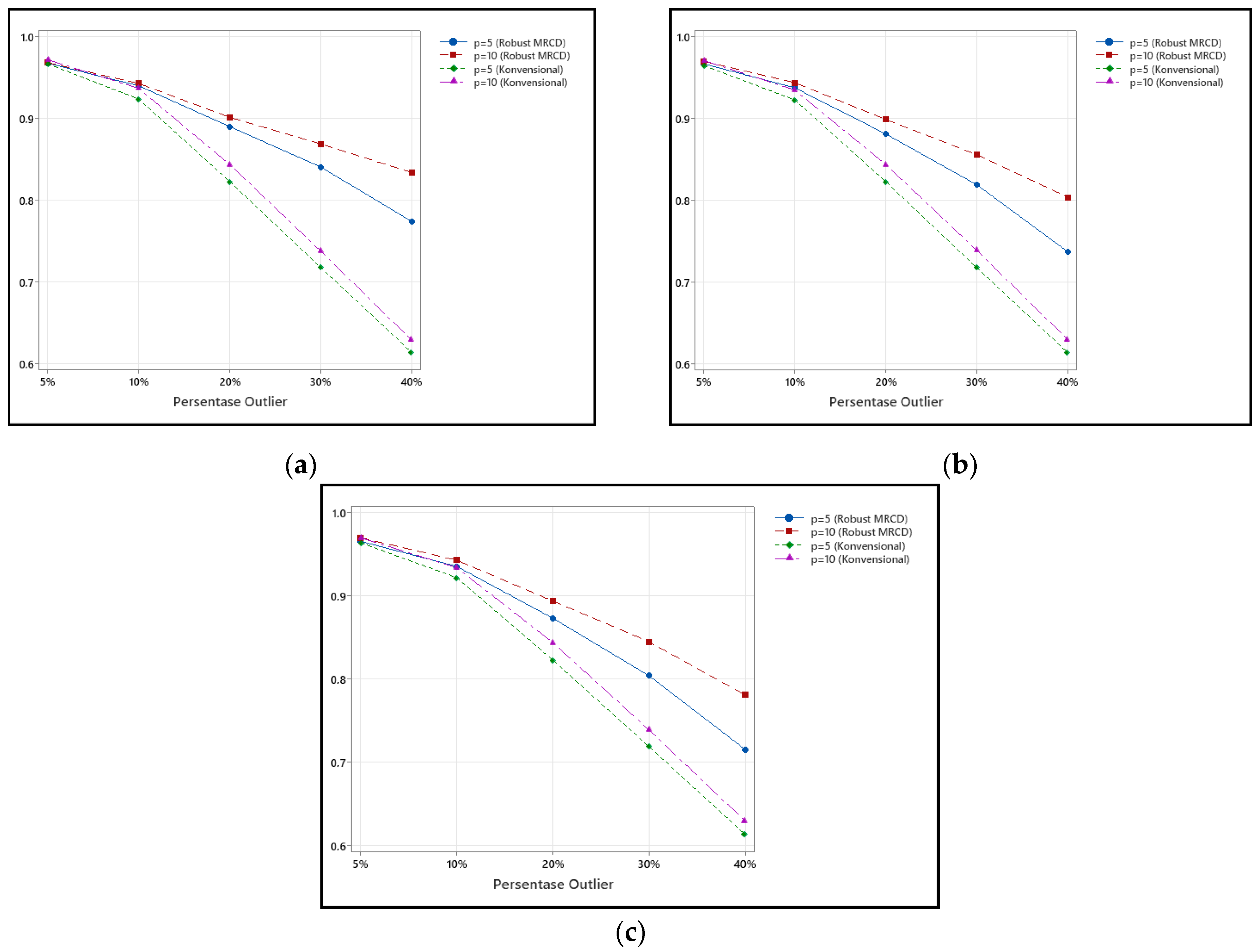
The accuracy level of the control chart indicates its ability to detect changes or deviations in the process. The higher accuracy rate means the better performance of the control chart in detecting outliers. In this section, a comparison of the outlier detection accuracy of MRCD-based Max-Half-Mchart robust charts with Max-Half-Mchart is carried out. Visualization is done based on the correlation levels ( ρ ) used, which are 0.3, 0.5, and 0.7. The results of the outlier detection performance comparison based on the accuracy level are shown in Figure 1.
When the percentage of outliers is between 5% and 10%, the accuracy of the three charts shows similar results. However, when the percentage of outliers is above 10%, the MRCD-based Max-Half-Mchart robust chart consistently shows a higher accuracy rate than the Max-Half-Mchart chart for each number of characteristic variables ( p ). This shows that MRCD-based Max-Half-Mchart robust charts have better accuracy than Max-Half-Mchart charts when the percentage of outliers is large. The accuracy results of Max-Half-Mchart robust charts ( p = 5 and 10 ) at 5–10% outlier percentage are not much different. The difference in accuracy starts to become apparent when the percentage of outliers is 20–40%, where p = 10 consistently shows higher accuracy than p = 5 . These results show that MRCD-based Max-Half-Mchart robust charts have better accuracy with a large number of characteristic variables.
The variation in correlation level ( ρ ) does not seem to affect the accuracy of the Max-Half-Mchart chart. The difference in accuracy results at each correlation level is shown by the MRCD-based Max-Half-Mchart robust chart with a large percentage of outliers. The MRCD robust chart of ρ = 0.7 shows the lowest accuracy, while ρ = 0.3 shows the highest accuracy.

3.2.2. Comparison of Outlier Detection Performance Based on False Positive Rate

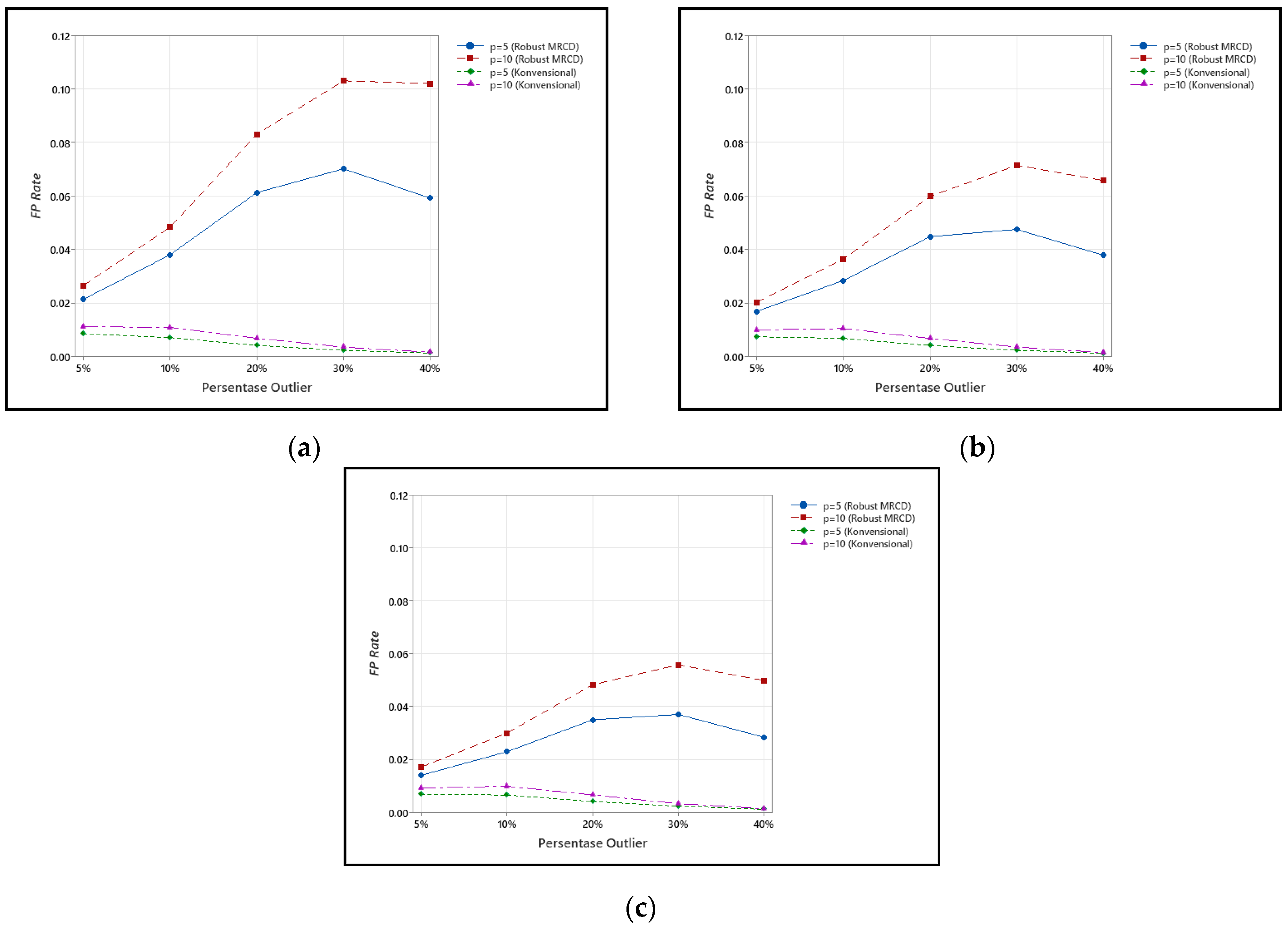
False positive rate (FP rate) on a control chart indicates the error rate in providing warning signals or corrective actions when there is no actual change or deviation in the process. In other words, the system does not give false alarms or unnecessary actions. By having a low false positive value, the control chart becomes more reliable and efficient as it only provides signals when needed. In this subsection, a visualization of the false positive rate (FP rate) comparison of outlier detection between MRCD-based Max-Half-Mchart robust charts and Max-Half-Mchart is conducted. Visualization is done based on the correlation levels ( ρ ) used, which are 0.3, 0.5, and 0.7. The results of the outlier detection FP rate comparison on both charts are shown in Figure 2.
At outlier percentages of 5–10%, the three charts exhibit comparable FP rates. When the percentage of outliers exceeds 10%, the MRCD-based Max-Half-Mchart robust chart produces higher FP rates than the Max-Half-Mchart for both values of the characteristic variables p . This indicates that the MRCD-based Max-Half-Mchart robust chart is more sensitive to the presence of outliers, while the Max-Half-Mchart remains relatively stable. For the MRCD-based Max-Half-Mchart robust chart, the FP rates for p = 5 and p = 10 are similar at low outlier levels (5–10%). The difference in FP rate starts to become apparent when the percentage of outliers is 20–40%, where p = 10 consistently results in a higher FP rate. This suggests that increasing the number of characteristic variables leads to a higher FP rate in the MRCD-based Max-Half-Mchart robust chart.
The variation in the correlation level ρ does not seem to affect the FP rate of the Max-Half-Mchart chart. However, for the MRCD-based robust chart, differences across correlation levels become evident at higher outlier percentages, with ρ = 0.7 yielding the lowest FP rate and ρ = 0.3 the highest.

3.2.3. Comparison of Outlier Detection Performance Based on False Negative Rate

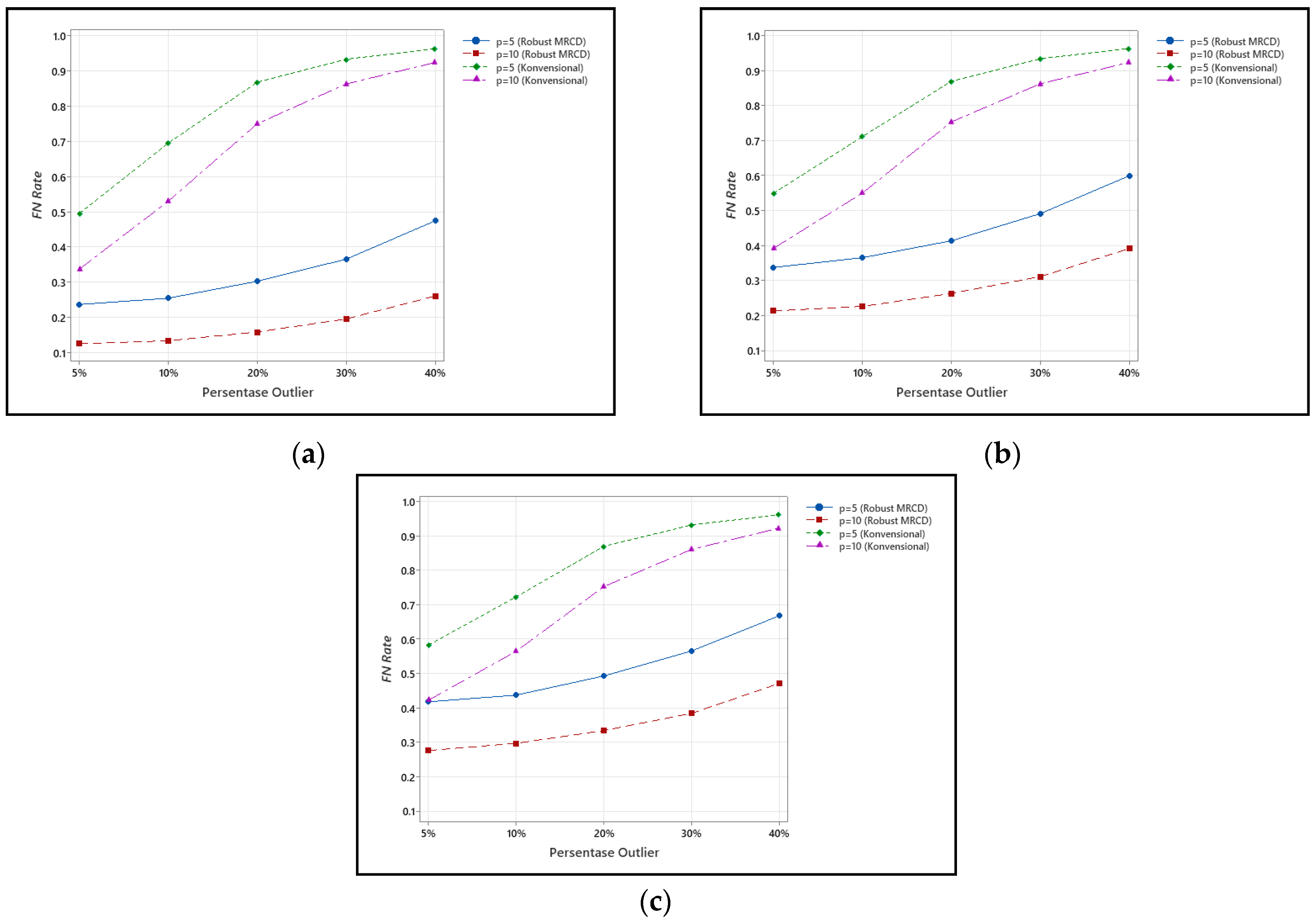
False negative rate (FN rate) on a control chart occurs when there is a change or deviation in the process but the control system does not provide a warning signal. A high FN rate indicates that the system is increasingly unresponsive to actual changes in the process. A good control chart has a low FN rate. In this section, a visualization of the comparison of the FN rate of outlier detection between MRCD-based Max-Half-Mchart and Max-Half-Mchart robust charts is conducted. Visualization is done based on the correlation levels ( ρ ) used, which are 0.3, 0.5, and 0.7. The results of outlier detection performance comparison based on FN rate are shown in Figure 3.
Figure 3 shows that the FN rate of the MRCD-based robust Max-Half-Mchart chart is always smaller than the FN rate of the Max-Half-Mchart chart for the same number of characteristic variables ( p ). The FN rate on the chart shows a high increase in value as the percentage of outliers increases. While the robust MRCD chart shows a difference that is not too far at each increase in the percentage of outliers given. In the three visualizations above, it is found that p = 10 consistently gives a lower FN rate than p = 5 in both types of charts. MRCD-based Max-Half-Mchart robust charts show differences in FN rate at each correlation level. The results of the variation in the level of correlation between the characteristic variables above show that the more ρ increases, the higher the FN rate.

3.2.4. Comparison of Outlier Detection Performance Based on Area Under Curve Value

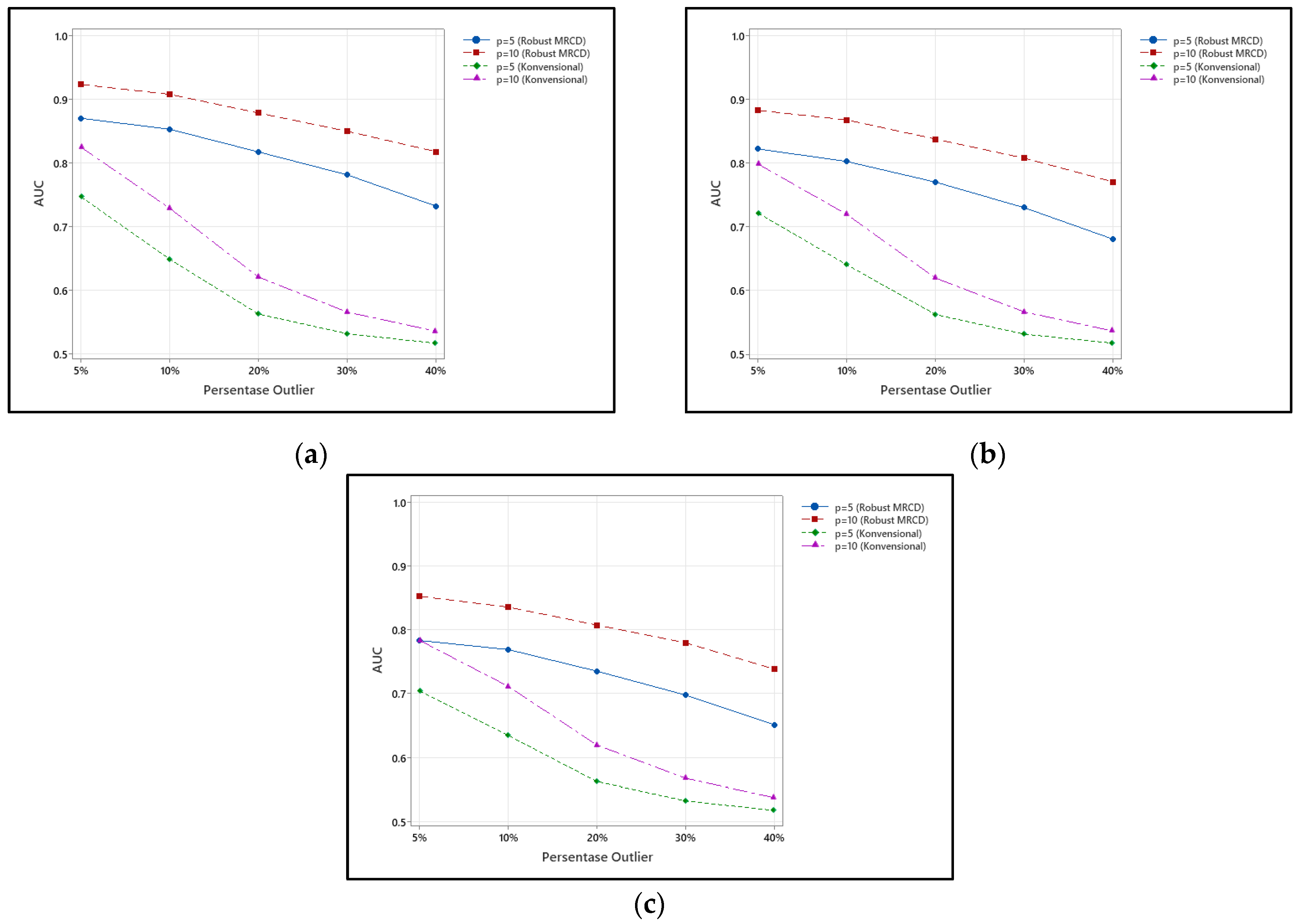
Area under curve (AUC) is used to measure the extent to which the system can distinguish between normal and abnormal situations in a process. The greater the AUC value, the better the system performance in distinguishing between normal and abnormal conditions. In this section, we visualize the comparison of the AUC value of outlier’s detection of MRCD-based Max-Half-Mchart and Max-Half-Mchart robust charts. Visualization is done based on the level of correlation ( ρ ) used, namely 0.3, 0.5, and 0.7. The results of the outlier detection performance comparison based on the AUC value are shown in Figure 4.
Figure 4 indicates that the AUC level of the MRCD-based robust Max-Half-Mchart chart is consistently higher than that of the Max-Half-Mchart chart for the same number of characteristic variables p . The AUC level in the chart shows a clear increase as the percentage of outliers increases. Meanwhile, the MRCD-based robust chart shows relatively stable differences at each increase in the percentage of outliers.
From the three visualizations, it is observed that p = 10 consistently results in a higher AUC level than p = 5 in both the MRCD-based robust Max-Half-Mchart chart and the Max-Half-Mchart chart. The MRCD-based robust Max-Half-Mchart charts also exhibit differences in AUC level at each correlation level. The variation in the correlation level between the characteristic variables shows that as ρ increases, the AUC level also increases.

3.3. Simulation Summary

To facilitate a clearer understanding of the results in Section 3.1, the findings demonstrate that the MRCD-based robust Max-Half-Mchart is most sensitive when shifts occur simultaneously in both process mean and variance, consistently yielding the lowest average run length (ARL) values. The chart is notably more responsive to changes in process variance than to shifts in the process mean alone. Regarding dimensionality, the use of more characteristic variables improves the detection speed for variance shifts but results in slower detection for mean shifts compared to lower dimensions. Furthermore, the correlation levels between variables significantly influence sensitivity; a lower correlation facilitates faster detection of mean shifts, whereas a higher correlation initially aids in detecting variance shifts before the ARL values converge at larger shift magnitudes.
The performance evaluation in Section 3.2 demonstrates that the MRCD-based robust Max-Half-Mchart consistently achieves higher accuracy and Area Under Curve (AUC) levels compared to the conventional Max-Half-Mchart, particularly as data contamination increases beyond 10%. The robust framework is highly effective at “de-masking” process shifts, maintaining a significantly lower False Negative (FN) rate across all tested dimensions and correlation levels. While the conventional chart maintains a lower False Positive (FP) rate, its inability to detect actual outliers in contaminated datasets renders it less effective for high-stakes industrial monitoring. Furthermore, the results indicate that increasing the number of characteristic variables generally improves detection accuracy and AUC, though it may lead to a slightly higher FP rate compared to lower-dimensional data.

3.4. Application of Max-Half-Mchart Robust Control Charts Based on MRCD for Cement Quality Characteristics Data

The application of control charts was carried out using multivariate data in a cement manufacturing company. The data measurements made include 47 observations ( n   = 47) with 10 quality characteristics ( p   = 10). The quality characteristics monitored in this study are presented in Table 6.
Before plotting the control charts, it is important to ensure that the variables used in the multivariate analysis are not significantly interdependent. A dependency test was performed to identify the relationship or dependency between the variables. The results of the dependency test are shown in Table 7.
The chi-square value with α=5% and 45 free degrees is 64.279. When compared to X2 count as in Table 5 of 183.937, H 0 can be rejected because the X2count > X2table value is 183.937 > 64.279. So, it is concluded that there is a relationship between quality characteristics.
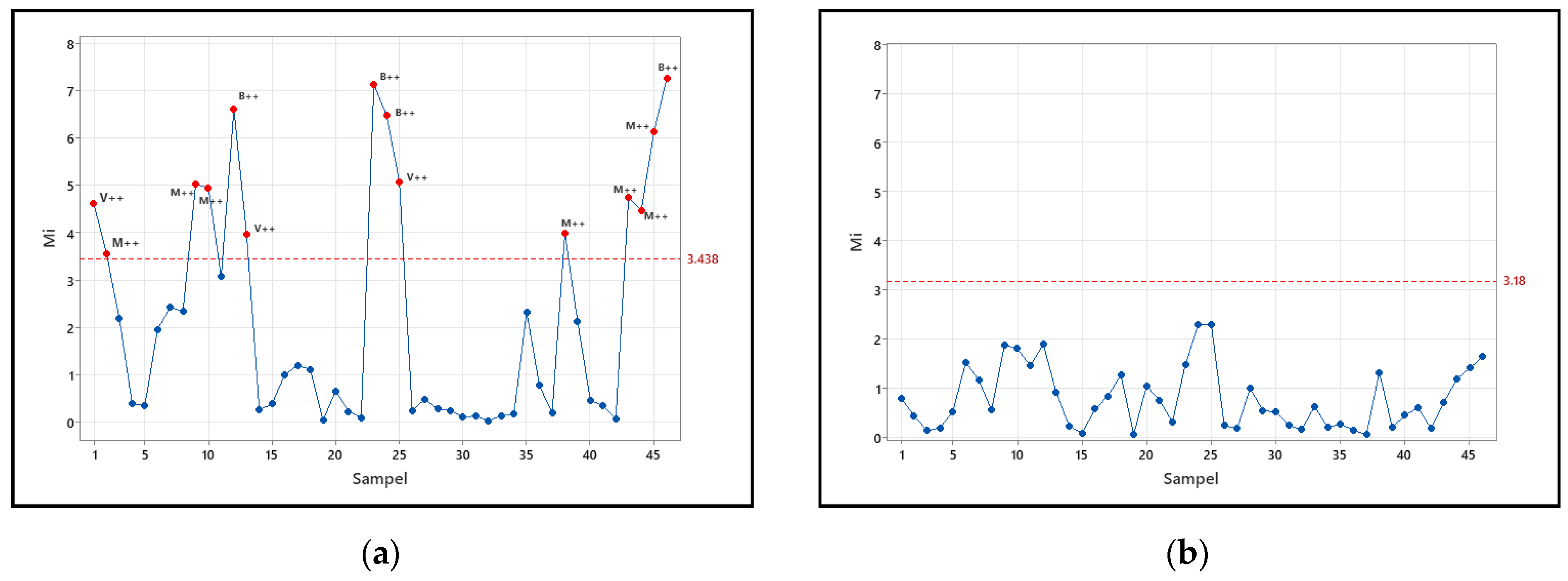
A comparison of the data plot obtained using MRCD-based robust Max-Half-Mchart with that obtained using Max-Half-Mchart is shown in Figure 5.
Figure 5 shows the robust Max-Half-Mchart chart detecting 14 out-of-control signals. Eight of these out-of-control signals were identified as B++ because a shift in the process mean was detected. Three out-of-control signals were identified as V++ because a shift in process variability was detected, while the other three signals were identified as M++ because a shift in both the process mean and process variability occurred simultaneously. The Max-Half-Mchart charts did not detect any out-of-control signals, as shown in Figure 5. The results of the output comparison of the two control charts are presented in Table 8.
As shown in Table 8, the MRCD-based robust Max-Half-Mchart control chart has a better ability to detect out-of-control points than the standard Max-Half-Mchart. The MRCD method detected 14 out-of-control points, whereas the Max-Half-Mchart method detected none. Three points are caused by mean shifts, three by variability shifts, and eight by a combination of both. In addition, the upper control limit (UCL) value of the MRCD method is higher (3.438) than that of the standard method (3.18), which indicates that the MRCD method is more robust to outliers and is able to detect changes in the process more sensitively, whether in terms of average, variability, or a combination of both.

4. Conclusions

The comparative evaluation of outlier detection performance of MRCD-based Max-Half-Mchart robust charts with Max-Half-Mchart is as follows. First, higher accuracy is obtained by MRCD-based Max-Half-Mchart robust charts, especially when the percentage of outliers is large. The larger the number of characteristic variables ( p ), the better the accuracy. Second, the lower FP rate is obtained by the Max-Half-Mchart chart. However, the MRCD-based Max-Half-Mchart robust chart still maintains a relatively low FP rate at a large percentage of outliers. The larger the number of characteristic variables ( p ), the higher the FP rate. The third, smaller FN rate is obtained by the MRCD-based Max-Half-Mchart robust chart. The greater the number of characteristic variables ( p ), the lower the FN obtained, and the better AUC obtained by the MRCD-based Max-Half-Mchart robust chart. The greater the number of characteristic variables ( p ), the better the AUC obtained. In the application to cement quality data, the MRCD-based Max-Half-Mchart robust chart is more sensitive for detecting 14 outlier data while Max-Half-Mchart is unable to detect outliers at all. Therefore, PT Semen Tonasa is advised to adopt robust methods such as MRCD in the quality monitoring system in order to support a more effective quality control process and be responsive to potential production problems.
Although the proposed method demonstrates significant advancements, the conclusion acknowledges specific limitations that provide a balanced view of its current scope. Currently, the method is optimized for individual observation data, and its performance on subgroup data has not been fully explored. Additionally, while the chart is highly sensitive to variance and simultaneous shifts, it shows relatively higher ARL values for shifts occurring solely in the process mean. Future research is recommended to address these limitations by modifying the approach for subgroup data, testing more diverse variations in characteristic variables, and integrating machine learning techniques to further enhance detection consistency across various industrial contexts.
For future research, it is recommended to include expert validation and external labeling to further substantiate the practical significance of these detected points across different industrial contexts. Also, it is recommended to make more diverse variations to the number of characteristic variables, vary the level of correlation between variables in phase two, compare the performance of MRCD-based Max-Half-Mchart robust control charts with other robust methods [33,34], modify the approach to handle subgroup observation data, and apply this method to other data cases to test its consistency and reliability in various contexts. Also, in future studies, the proposed chart can be used in combination with machine learning [35,36,37].

Author Contributions

Conceptualization, M.A. and F.F.; methodology, M.A. and M.M.; software, F.F. and R.N.A.; validation, D.A.S., M.H.L. and M.A.; formal analysis, M.M. and D.A.S.; investigation, M.A. and M.M.; resources, F.F.; data curation, D.A.S.; writing—original draft preparation, M.A.; writing—review and editing, D.A.S.; visualization, F.F.; supervision, M.A. and M.H.L. All authors have read and agreed to the published version of the manuscript.

Funding

This research was funded by the Ministry of Higher Education, Science, and Technology through Grant Number 038/E5/PG.02.00.PL/2024 and local Grant Number 1766/PKS/ITS/2024.

Institutional Review Board Statement

Not applicable.

Informed Consent Statement

Not applicable.

Data Availability Statement

The data presented in this study is available on request from the corresponding author. The data is not publicly available due to privacy reasons.

Acknowledgments

The authors gratefully acknowledge financial support from the Ministry of Higher Education, Science, and Technology for this work under grant number 038/E5/PG.02.00.PL/2024.

Conflicts of Interest

The authors declare no conflicts of interest.

References

  1. Alım, M.; Kesen, S.E. Statistical process control (SPC) and quality management. In Smart and Sustainable Operations and Supply Chain Management in Industry 4.0; CRC Press: Boca Raton, FL, USA, 2023; pp. 117–136. [Google Scholar]
  2. Oakland, J.; Oakland, J.S. Statistical Process Control; Routledge: Oxfordshire, UK, 2007. [Google Scholar]
  3. Hotelling, H. Economic Control of Quality of Manufactured Product. J. Am. Stat. Assoc. 1932, 27, 215–236. [Google Scholar] [CrossRef][Green Version]
  4. Montgomery, D.C. Introduction to Statistical Quality Control, 8th ed.; John Wiley & Sons: New York, NY, USA, 2020. [Google Scholar]
  5. Roberts, S.W. Control Chart Tests Based on Geometric Moving Averages. Technometrics 1959, 1, 239–250. [Google Scholar] [CrossRef]
  6. Page, E.S. Cumulative Sum Schemes Using Gauging Cumulative. Technometrics 1962, 4, 97–109. [Google Scholar] [CrossRef]
  7. Bersimis, S.; Psarakis, S.; Panaretos, J. Multivariate statistical process control charts: An overview. Qual. Reliab. Eng. Int. 2007, 23, 517–543. [Google Scholar]
  8. Anderson, T.; Mentz-Stanford, R.P. The Generalized Variance of a Stationary Autoregressive Process. J. Multivar. Anal. 1977, 7, 584–588. [Google Scholar] [CrossRef]
  9. Khoo, M.B.C.; Quah, S.H. Multivariate control chart for process dispersion based on individual observations. Qual. Eng. 2003, 15, 639–642. [Google Scholar] [CrossRef]
  10. Sanusi, R.A.; Teh, S.Y.; Khoo, M.B.C. Simultaneous monitoring of magnitude and time-between-events data with a Max-EWMA control chart. Comput. Ind. Eng. 2020, 142, 106378. [Google Scholar] [CrossRef]
  11. Pirhooshyaran, M.; Niaki, S.T.A. A double-max MEWMA scheme for simultaneous monitoring and fault isolation of multivariate multistage auto-correlated processes based on novel reduced-dimension statistics. J. Process Control 2015, 29, 11–22. [Google Scholar] [CrossRef]
  12. Cheng, S.W.; Thaga, K. Multivariate max-CUSUM chart. Qual. Technol. Quant. Manag. 2005, 2, 221–235. [Google Scholar] [CrossRef]
  13. Cheng, S.W.; Thaga, K. The max-cusum chart. In Frontiers in Statistical Quality Control 9; Springer: Berlin/Heidelberg, Germany, 2010; pp. 85–98. [Google Scholar]
  14. Antzoulakos, D.L.; Fountoukidis, K.G.; Rakitzis, A.C. The variable sample size and sampling interval run sum Max chart. Qual. Technol. Quant. Manag. 2025, 22, 321–344. [Google Scholar] [CrossRef]
  15. Thaga, K.; Gabaitiri, L. Multivariate Max-Chart. Stoch. Qual. Control 2006, 21, 113–125. [Google Scholar] [CrossRef]
  16. Lowry, C.A.; Woodall, W.H.; Champ, C.W.; Rigdon, S.E. A Multivariate Exponentially Weighted Moving Average Control Chart. Technometrics 1992, 34, 46–53. [Google Scholar]
  17. Zhou, C.; Zou, C.; Zhang, Y.; Wang, Z. Nonparametric control chart based on change-point model. Stat. Pap. 2009, 50, 13–28. [Google Scholar] [CrossRef]
  18. Khusna, H.; Mashuri, M.; Suhartono; Prastyo, D.D.; Lee, M.H.; Ahsan, M. Residual-based maximum MCUSUM control chart for joint monitoring the mean and variability of multivariate autocorrelated processes. Prod. Manuf. Res. 2019, 7, 364–394. [Google Scholar] [CrossRef]
  19. Sabahno, H.; Amiri, A.; Castagliola, P. A new adaptive control chart for the simultaneous monitoring of the mean and variability of multivariate normal processes. Comput. Ind. Eng. 2021, 151, 106524. [Google Scholar] [CrossRef]
  20. McCracken, A.K.; Chakraborti, S. Control charts for joint monitoring of mean and variance: An overview. Qual. Technol. Quant. Manag. 2013, 10, 17–36. [Google Scholar] [CrossRef]
  21. Kruba, R.; Mashuri, M.; Prastyo, D.D. The effectiveness of Max-half-Mchart over Max-Mchart in simultaneously monitoring process mean and variability of individual observations. Qual. Reliab. Eng. Int. 2021, 37, 2334–2347. [Google Scholar] [CrossRef]
  22. Maleki, F.; Mehri, S.; Aghaie, A.; Shahriari, H. Robust T2 control chart using median-based estimators. Qual. Reliab. Eng. Int. 2020, 36, 2187–2201. [Google Scholar] [CrossRef]
  23. Rousseeuw, P.J. Least Median of Squares Regression. J. Am. Stat. Assoc. 1984, 79, 871–880. [Google Scholar] [CrossRef]
  24. Hubert, M.; Van Driessen, K. Fast and Robust Discriminant Analysis. 2004. Available online: www.elsevier.com/locate/csda (accessed on 2 February 2025).
  25. Rousseeuw, P.J.; Van Driessen, K. A fast algorithm for the minimum covariance determinant estimator. Technometrics 1999, 41, 212–223. [Google Scholar] [CrossRef]
  26. Willems, G.; Pison, G.; Rousseeuw, P.J.; Van Aelst, S. A robust Hotelling test. Metrika 2002, 55, 125–138. [Google Scholar] [CrossRef]
  27. Hubert, M.; Rousseeuw, P.J.; Verdonck, T. A deterministic algorithm for robust location and scatter. J. Comput. Graph. Stat. 2012, 21, 618–637. [Google Scholar] [CrossRef]
  28. Zahariah, S.; Midi, H. Minimum regularized covariance determinant and principal component analysis-based method for the identification of high leverage points in high dimensional sparse data. J. Appl. Stat. 2023, 50, 2817–2835. [Google Scholar] [CrossRef]
  29. Oguamalam, J.; Radojičić, U.; Filzmoser, P. Minimum regularized covariance trace estimator and outlier detection for functional data. Technometrics 2024, 66, 588–599. [Google Scholar] [CrossRef]
  30. Boudt, K.; Rousseeuw, P.J.; Vanduffel, S.; Verdonck, T. The minimum regularized covariance determinant estimator. Stat. Comput. 2020, 30, 113–128. [Google Scholar] [CrossRef]
  31. Hoopes, B.J.; Triantis, K.P. Efficiency performance, control charts, and process improvement: Complementary measurement and evaluation. IEEE Trans. Eng. Manag. 2001, 48, 239–253. [Google Scholar] [CrossRef]
  32. Prasetya, I.K.; Ahsan, M.; Mashuri, M.; Lee, M.H. Bootstrap and MRCD Estimators in Hotelling’s T 2 Control Charts for Precise Intrusion Detection. Appl. Sci. 2024, 14, 7948. [Google Scholar] [CrossRef]
  33. Babu, P.; Stoica, P. CellMCD+: An improved outlier-resistant cellwise minimum covariance determinant method. Stat. Probab. Lett. 2025, 220, 110366. [Google Scholar] [CrossRef]
  34. Raymaekers, J.; Rousseeuw, P.J. The cellwise minimum covariance determinant estimator. J. Am. Stat. Assoc. 2024, 119, 2610–2621. [Google Scholar] [CrossRef]
  35. Khusna, H.; Mashuri, M.; Suhartono, S.; Prastyo, D.D.; Ahsan, M. Multioutput least square SVR-based multivariate EWMA control chart: The performance evaluation and application. Cogent Eng. 2018, 5, 1531456. [Google Scholar] [CrossRef]
  36. Ahsan, M.; Khusna, H.; Wibawati; Lee, M.H. Support vector data description with kernel density estimation (SVDD-KDE) control chart for network intrusion monitoring. Sci. Rep. 2023, 13, 19149. [Google Scholar] [CrossRef] [PubMed]
  37. Wibawati; Mashuri, M.; Purhadi; Irhamah; Ahsan, M. Perfomance fuzzy multinomial control chart. J. Phys. Conf. Ser. 2018, 1028, 012120. [Google Scholar] [CrossRef]
Figure 1. Accuracy level of outlier detection: (a) ρ = 0.3 , (b) ρ   =   0.5 , and (c) ρ   =   0.7 .
Applsci 16 02924 g001
Figure 2. False positive rate of outlier detection on (a) ρ = 0.3 , (b) ρ = 0.5 , and (c) ρ = 0.7 .
Applsci 16 02924 g002
Figure 3. False negative rate of outlier detection. (a) ρ   =   0.3 , (b) ρ   =   0.5 , and (c) ρ   =   0.7 .
Applsci 16 02924 g003
Figure 4. AUC levels of outlier detection at (a) ρ   =   0.3 , (b) ρ   =   0.5 , and (c) ρ   =   0.7 .
Applsci 16 02924 g004
Figure 5. Application of (a) MRCD-based and (b) MRCD-free Max-Half-Mchart Robust charts to cement quality characteristic data.
Applsci 16 02924 g005
Table 1. ARL for process mean shift in MRCD-based Max-Half-Mchart.
Shift a p = 5 p = 10
ρ = 0.3 ρ = 0.5 ρ = 0.7 ρ = 0.3 ρ = 0.5 ρ = 0.7
00.00372.107371.220373.210370.850371.490369.100
10.25337.586336.078352.175334.159342.853358.868
20.50248.847278.168295.012268.410289.185313.113
30.75149.062193.544220.350178.344223.345263.629
41.0082.654118.276137.21098.850146.140192.350
51.2540.46063.69688.27751.56797.586128.581
61.5021.52737.89654.38125.41753.87884.594
71.7511.64920.49732.56813.62129.95452.609
82.006.31412.30518.4897.53717.96031.852
92.253.9037.48412.2434.60110.68119.191
102.502.6214.8587.7772.9966.75512.792
112.752.0213.5115.0612.0784.5408.285
120.00372.107371.220373.210370.850371.490369.100
Table 2. ARL for process variability shift in MRCD-based Max-Half-Mchart.
Shift b p = 5 p = 10
ρ = 0.3 ρ = 0.5 ρ = 0.7 ρ = 0.3 ρ = 0.5 ρ = 0.7
01.00372.107371.220373.210370.850371.490369.100
11.2565.70042.16920.76740.05422.7548.826
21.5023.84013.0905.44011.3986.0132.507
31.7511.9706.6743.1085.3103.0411.586
42.007.1894.2752.1913.2182.0201.224
52.254.8193.0251.7492.2941.5581.116
62.503.5712.5081.5321.8131.3301.071
72.752.9982.0841.4061.5321.2121.027
83.002.5511.8151.2951.3631.1311.015
93.252.1651.6171.2061.2471.0771.012
103.501.9431.4691.1541.1791.4691.004
113.751.7881.3991.1241.1271.3991.006
124.001.5991.3211.0971.0911.0271.003
Table 3. ARL for process mean and variability shift in MRCD-based Max-Half-Mchart.
Shift a b p = 5 p = 10
ρ = 0.3 ρ = 0.5 ρ = 0.7 ρ = 0.3 ρ = 0.5 ρ = 0.7
000.001.00372.107371.221373.210370.850371.490
110.251.2563.58840.21419.56338.45421.625
220.501.5020.12112.1535.57010.3255.685
330.751.758.4536.0522.8334.4932.775
441.002.005.0453.6542.0582.5991.857
551.252.253.2772.4241.7101.8221.412
661.502.502.2302.0201.3791.4431.218
771.752.751.8861.6931.2531.2551.119
882.003.001.5491.4081.1681.1431.073
992.253.251.3431.2621.1081.0761.038
10102.503.501.1831.1731.0671.0351.023
11112.753.751.1401.1271.0551.0131.011
12123.004.001.0991.0661.0381.0111.008
Table 4. MRCD-based robust Max-Half-Mchart outlier detection result with p = 5 .
ρ %OutAccuracyFP RateFN RateAUC
0.350.9680.0210.2380.870
100.9400.0380.2560.853
200.8900.0610.3040.817
300.8410.0700.3670.782
400.7740.0590.4760.733
0.550.9670.0170.3380.823
100.9380.0290.3660.803
200.8810.0450.4140.771
300.8190.0480.4920.730
400.7370.0380.6000.681
0.750.9660.0140.4180.784
100.9360.0230.4380.770
200.8730.0350.4940.736
300.8040.0370.5660.698
400.7160.0280.6680.652
Table 5. MRCD-based robust Max-Half-Mchart outlier detection result with p = 10 .
ρ %OutAccuracyFP RateFN RateAUC
0.350.9680.0270.1260.923
100.9430.0480.1350.908
200.9020.0830.1600.879
300.8690.1030.1970.850
400.8340.1020.2620.818
0.550.9700.0200.2140.883
100.9440.0360.2270.868
200.8990.0590.2640.838
300.8560.0710.3120.808
400.8040.0650.3920.771
0.750.9700.0170.2770.853
100.9430.0300.2980.836
200.8940.0480.3350.808
300.8450.0550.3850.780
400.7810.0490.4720.739
Table 6. Quality characteristics in cement data.
VariableDescription
x1LOI (%)
x2SO3 (%)
x3BTL (%)
x4Free Lime (%)
x5Residual 0.045 mm
x6Blaine (cm2)
x7Start (minute)
x8Finish (minute)
x9Third Day Compressive Strength
x10Seventh Day Compressive Strength
Table 7. Dependence test.
Chi-Squaredfp-Value
183.937451.031735 × 10−18
Table 8. Comparison of out-of-control on both charts.
Control ChartUCLTotal Out-Of-ControlMean ShiftVariability ShiftThe Shift in Both
MRCD-Based Robust Max-Half-Mchart3.43814338
Max-Half-Mchart3.180---
Disclaimer/Publisher’s Note: The statements, opinions and data contained in all publications are solely those of the individual author(s) and contributor(s) and not of MDPI and/or the editor(s). MDPI and/or the editor(s) disclaim responsibility for any injury to people or property resulting from any ideas, methods, instructions or products referred to in the content.