Sensor-Based Structural Health Monitoring of Composite Laminates Under Low-Velocity Impact

Abstract
1. Introduction
- Development of a dedicated impact test platform for composite panels equipped with high-precision strain-gauge instrumentation [16].
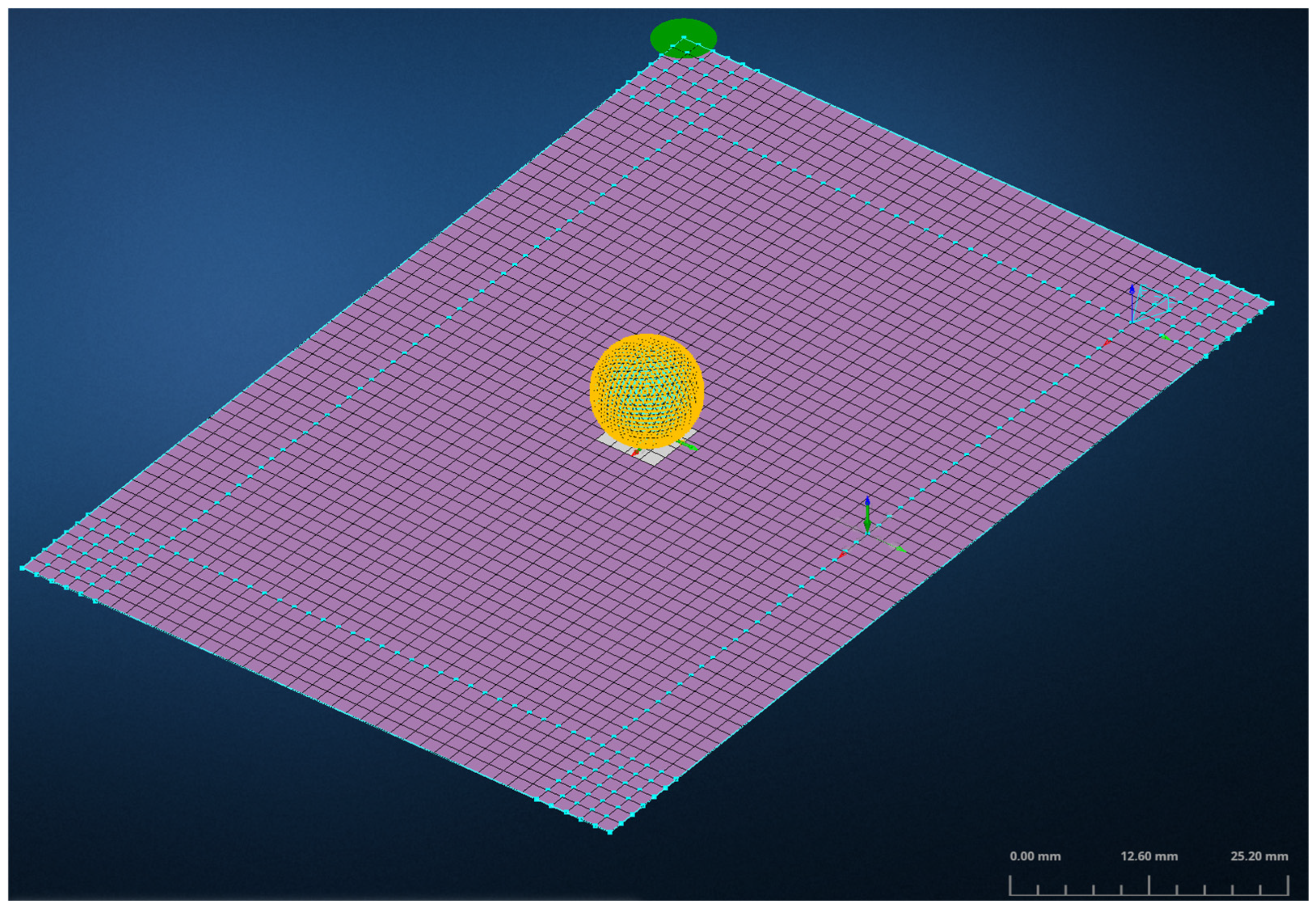
- Development and validation of detailed 2D and 3D finite element models for low-velocity impact.
- Quantitative comparison between measured and simulated strain responses across multiple impact energy levels.
- Assessment of strain trends, including spatial relationships relative to the impact point.
- Discussion of feasibility considerations for implementing strain-based SHM in operational aerospace structures.
- A strain-gauge-based SHM workflow for rapid post-impact assessment of CFRP panels, focused on maintenance-relevant low-velocity impacts.
- A validated experimental–numerical “digital-twin” pipeline (drop-weight tests + MSC Apex 2024.1/Nastran 2024.2 Implicit elastic models) to interpret strain signatures and relate them to damage regime transitions.
- An energy-normalized indicator for identifying departures from elastic scaling at higher impact energies (e.g., the 400 mm case), consistent with damage-dominated dissipation.
2. Background and Literature Review
2.1. Composite Classifications and Properties
- Polymer matrix composites (PMCs): Typically use thermoset resins such as epoxy and polyester.
- Metal matrix composites (MMCs): Incorporate metals such as aluminum or titanium.
- Ceramic matrix composites (CMCs): Employ ceramics such as silicon carbide for high-temperature applications [20].
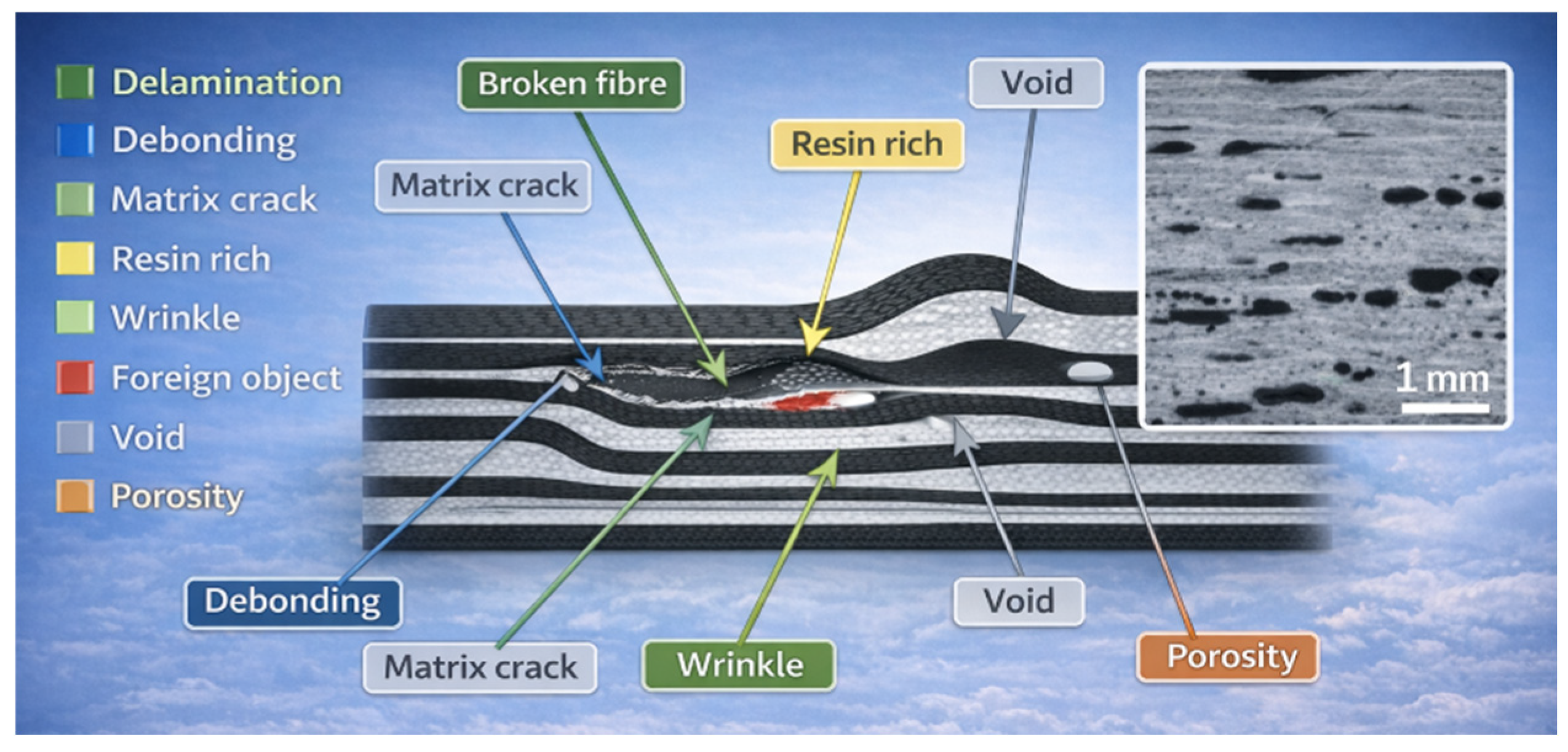
- PMCs: In laminated CFRP/GFRP, the polymer matrix and ply interfaces govern many failure processes. Under service loading, PMCs commonly exhibit matrix cracking, fiber/matrix debonding, and interlaminar delamination; these modes can interact and lead to rapid stiffness degradation and residual strength loss [8].
- MMCs: MMCs tend to show more ductile deformation features (in-dentation/plasticity in the matrix) together with reinforcement-related damage such as particle cracking/fracture and particle–matrix inter-facial debonding; the relative contribution depends on matrix alloy, reinforcement type/volume fraction, and impact severity [26].
- CMCs: CMCs are generally more brittle at the matrix scale, so damage may initiate as matrix/cone cracking and evolve with fiber/matrix debonding, yarn or fiber breakage, and delamination in laminated architectures. Even when surface indications are small, internal cracking and delamination can significantly affect residual properties [27].
2.2. Advanced Maintenance Methodologies and Monitoring Techniques for Mitigating Composites Impact Damage
3. Materials and Methods
3.1. Materials
3.2. Surface Preparation
3.3. Strain Gauge Installation and Equipment
3.4. Impact Test Setup
3.5. Finite Element Model
4. Results
4.1. Results and Discussion Summary
4.2. Analysis of Strain and Energy Levels
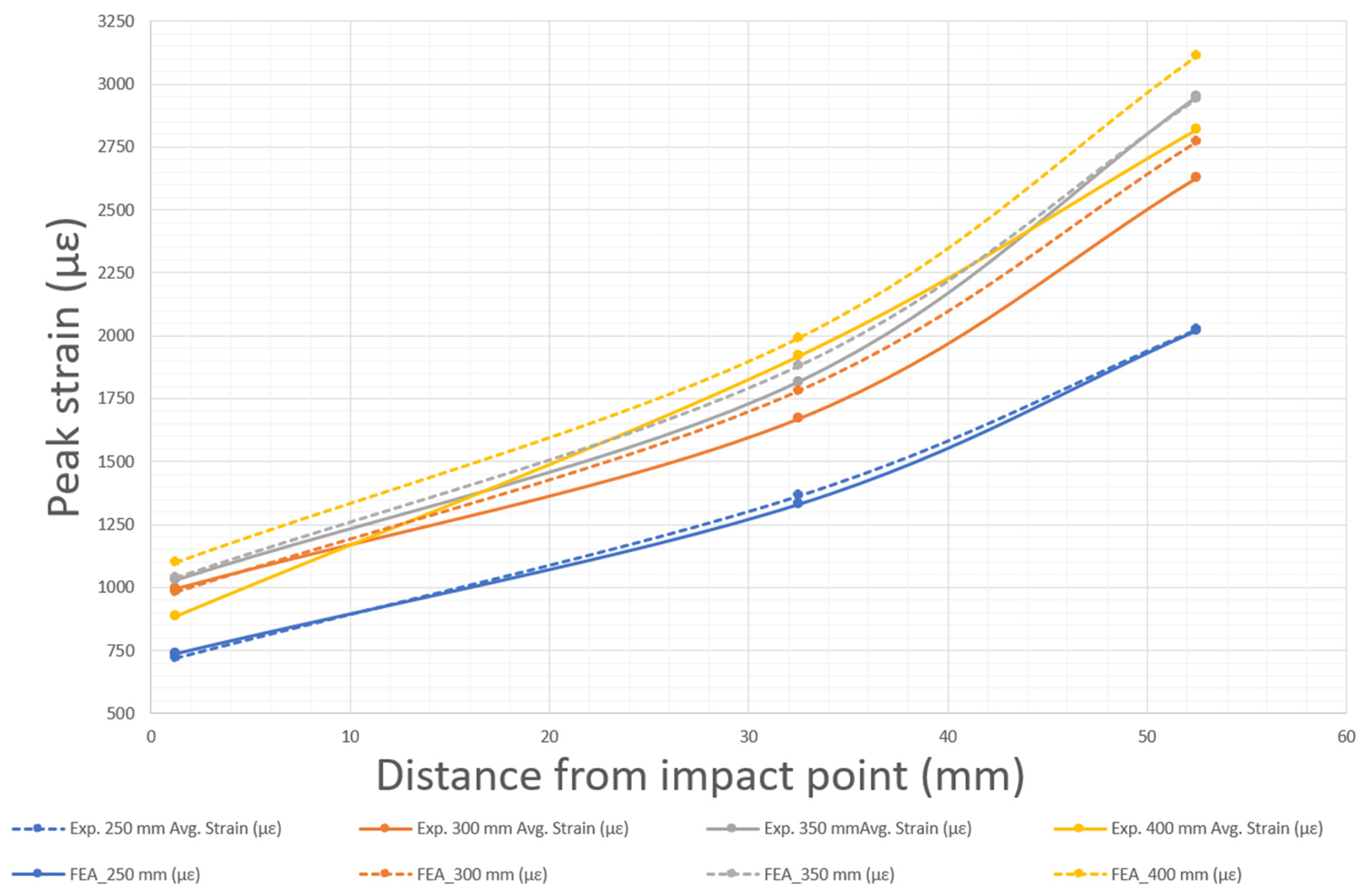
- 250 mm: average strains from primary gauges ranged approximately from 720 µε to 2026 µε.
- 300 mm: strains reached up to 2628 µε.
- 350 mm: strains reached up to 2949 µε.
- 400 mm: maximum strains exceeded 2800 µε (Table 3).
4.3. FEA Validation and Quantitative Comparison
4.4. Damage Assessment and SHM Feasibility
5. Discussion
5.1. Interpretation and Implications for SHM
5.2. Agreement Between Experiment and Simulation
5.3. Limitations and Recommendations
6. Conclusions
6.1. Conclusion and Future Work
6.2. Key Findings and Insights
- Model validation for SHM interpretation: The validated FEA captures the measured strain levels at three-gauge distances (Table 3), indicating that the adopted mesh resolution, laminate definition, and ASTM D7136-consistent boundary conditions provide an adequate representation of the test configuration.
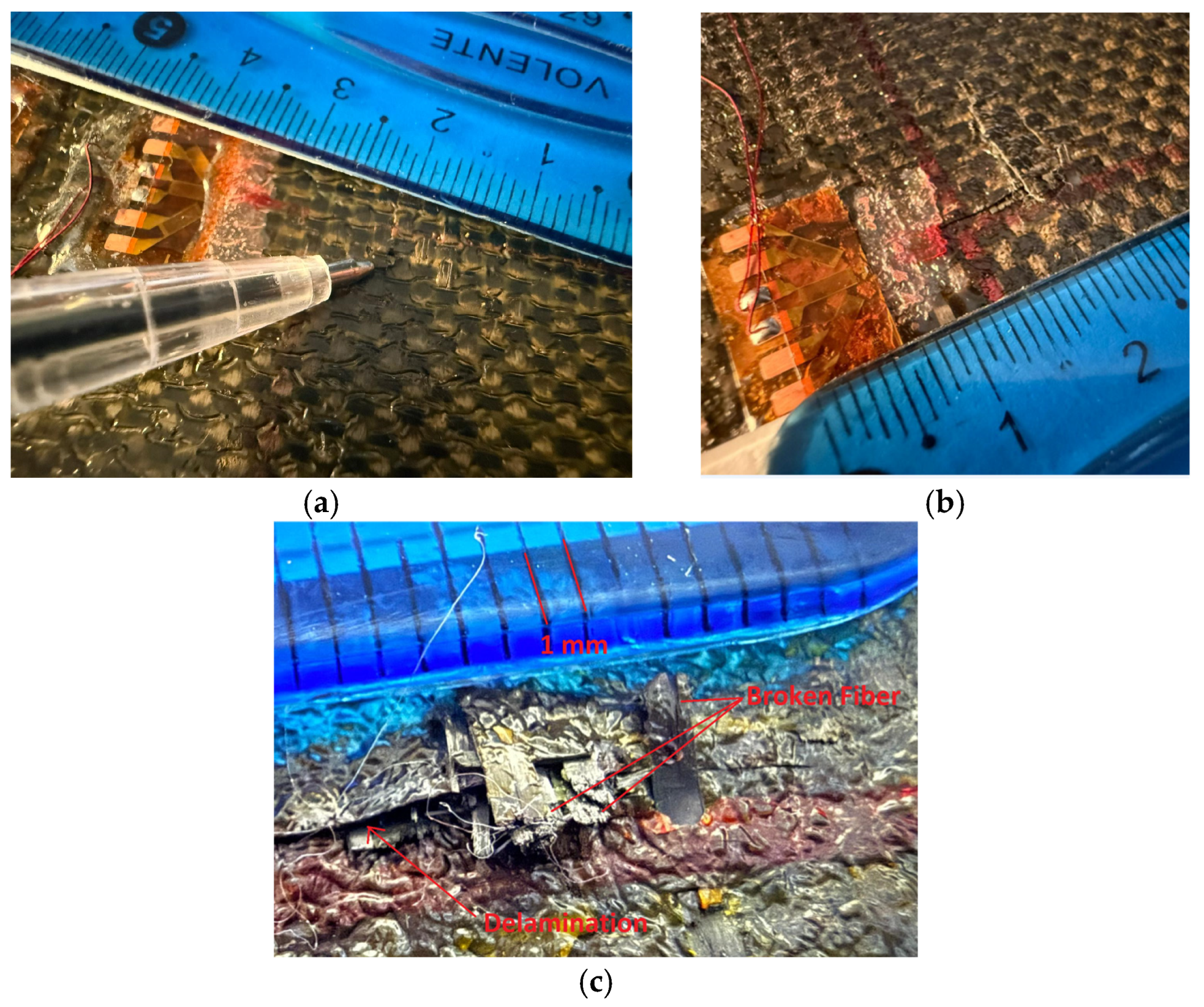
- Damage-regime transition at 400 mm: At 400 mm, the strain field becomes non-monotonic across gauge locations and deviates from an elastic energy-scaling baseline (Table 2). This behavior is consistent with a transition to a damage-dominated response in which part of the input energy is dissipated irreversibly through matrix cracking, delamination growth, and local fiber failure, which redistributes the load paths and alters strain signatures.
- Practical SHM implication: The combined use of (i) multipoint strain measurements, (ii) energy normalization based on drop height and impactor mass, and (iii) a validated numerical model provides a pathway to assess both the presence and severity of maintenance-relevant impacts (e.g., tool drops) in composite aircraft structures.
6.3. Limitations and Future Research
- Damage quantification and uncertainty: The current study correlates strain signatures with impact severity and visible damage features; future work should quantify internal damage using complementary NDT (e.g., ultrasonic C-scan) and report uncertainty bounds for strain-based diagnostics.
- Expanded sensor layouts: Only three primary gauge distances were used; denser layouts and multiple radial directions would improve impact localization and reduce sensitivity to unknown impact location.
- Enhanced damage modeling: Incorporating cohesive-zone or continuum damage mechanics models would allow for delamination initiation/growth and stiffness degradation to be predicted more directly and compared with post-impact inspections.
- In-service realism: Future experiments should include realistic boundary conditions, environmental effects, and repeated impacts to assess long-term sensor reliability and the robustness of the proposed energy-normalized interpretation.
Author Contributions
Funding
Institutional Review Board Statement
Informed Consent Statement
Data Availability Statement
Conflicts of Interest
References
- Gay, D.; Hoa, S.V.; Tsai, S.W. Composite Materials: Design and Applications; CRC Press: Boca Raton, FL, USA, 2003. [Google Scholar]
- Soutis, C. Carbon fiber reinforced plastics in aircraft construction. Mater. Sci. Eng. A 2005, 412, 171–176. [Google Scholar] [CrossRef]
- Boller, C. Ways and options for aircraft structural health management. Smart Mater. Struct. 2001, 10, 432–440. [Google Scholar] [CrossRef]
- Giurgiutiu, V. Structural Health Monitoring with Piezoelectric Wafer Active Sensors, 2nd ed.; Academic Press: Cambridge, MA, USA, 2014. [Google Scholar]
- Farrar, C.R.; Worden, K. An introduction to structural health monitoring. Philos. Trans. R. Soc. A 2007, 365, 303–315. [Google Scholar] [CrossRef] [PubMed]
- Abrate, S. Impact on Composite Structures; Cambridge University Press: Cambridge, UK, 1998. [Google Scholar] [CrossRef]
- Richardson, M.O.W.; Wisheart, M.J. Review of low-velocity impact properties of composite materials. Compos. Part A 1996, 27, 1123–1131. [Google Scholar] [CrossRef]
- Cantwell, W.J.; Morton, J. The impact resistance of composite materials—A review. Composites 1991, 22, 347–362. [Google Scholar] [CrossRef]
- Kessler, S.S.; Spearing, S.M.; Soutis, C. Damage detection in composite materials using Lamb wave methods. Smart Mater. Struct. 2002, 11, 269–278. [Google Scholar] [CrossRef]
- Gopalakrishnan, S.; Ruzzene, M.; Hanagud, S. Computational Techniques for Structural Health Monitoring; Springer: Berlin/Heidelberg, Germany, 2011. [Google Scholar] [CrossRef]
- Su, Z.; Ye, L. Identification of Damage Using Lamb Waves: From Fundamentals to Applications; Springer: Berlin/Heidelberg, Germany, 2009. [Google Scholar] [CrossRef]
- Staszewski, W.J.; Boller, C.; Tomlinson, G.R. Health Monitoring of Aerospace Structures; John Wiley & Sons: Hoboken, NJ, USA, 2004. [Google Scholar] [CrossRef]
- Worden, K.; Dulieu-Barton, J.M. An overview of intelligent fault detection in systems and structures. Struct. Health Monit. 2004, 3, 85–98. [Google Scholar] [CrossRef]
- Zhang, Y.; Zhu, P.; Lai, X. Finite element analysis of low-velocity impact damage in composite laminated plates. Mater. Des. 2006, 27, 513–519. [Google Scholar] [CrossRef]
- Fakhreddini-Najafabadi, S.; Torabi, M.; Taheri-Behrooz, F. An experimental investigation on the low-velocity impact performance of the CFRP filled with nanoclay. Aerosp. Sci. Technol. 2021, 116, 106858. [Google Scholar] [CrossRef]
- ASTM D7136/D7136M-20; Standard Test Method for Measuring the Damage Resistance of a Fiber-Reinforced Polymer Matrix Composite to a Drop-Weight Impact Event 2020. ASTM: West Conshohocken, PA, USA, 2020.
- Anderson, J.D. The Airplane: A History of Its Technology; AIAA: Reston, VA, USA, 2002. [Google Scholar]
- Megson, T.H.G. Aircraft Structures for Engineering Students, 6th ed.; Elsevier: Amsterdam, The Netherlands, 2016. [Google Scholar]
- Campbell, F.C. Manufacturing Technology for Aerospace Structural Materials; Elsevier: Amsterdam, The Netherlands, 2006. [Google Scholar]
- Callister, W.D.; Rethwisch, D.G. Materials Science and Engineering: An Introduction; Wiley: Hoboken, NJ, USA, 2013. [Google Scholar]
- Mallick, P.K. Fiber-Reinforced Composites: Materials, Manufacturing, and Design; CRC Press: Boca Raton, FL, USA, 2007. [Google Scholar]
- Hull, D.; Clyne, T.W. An Introduction to Composite Materials; Cambridge University Press: Cambridge, UK, 1996. [Google Scholar]
- Gutowski, T.G. Advanced Composites Manufacturing; Wiley: Hoboken, NJ, USA, 1997. [Google Scholar]
- Talreja, R.; Singh, C.V. Damage and Failure of Composite Materials; Cambridge University Press: Cambridge, UK, 2012. [Google Scholar] [CrossRef]
- Dutton, S.; Kelly, D.; Baker, A. Composite Materials for Aircraft Structures, 2nd ed.; AIAA: Reston, VA, USA, 2004. [Google Scholar]
- Şentürk, A.; Uzun, M.; Baydogan, M. Repeated low-velocity impact responses of SiC particle reinforced Al metal-matrix composites. Ceram. Int. 2022, 48, 5338–5351. [Google Scholar] [CrossRef]
- Wu, J.; Xu, P.; Jing, R.; Zhang, D.; Fei, Q. Experimental study on low-velocity impact and residual strength of SiC/SiC composite laminates. J. Inorg. Mater. 2024, 39, 51–60. [Google Scholar] [CrossRef]
- Srinivasan, K.; Jackson, W.C.; Hinkley, J.A. Response of Composite Materials to Low Velocity Impact; NASA Langley Research Center: Hampton, VA, USA, 1991.
- Han, L.; Qi, H.; Yang, J.; Chu, F.; Lin, C.; Liu, P.; Zhang, Q. Study on the low-velocity impact response and damage mechanisms of thermoplastic composites. Polymers 2024, 16, 791. [Google Scholar] [CrossRef]
- Liu, L.; Zhang, B.M.; Wang, D.F.; Wu, Z.J. Effects of cure cycles on void content and mechanical properties of composite laminates. Compos. Struct. 2006, 73, 303–309. [Google Scholar] [CrossRef]
- Wisnom, M.R. The role of delamination in failure of fibre-reinforced composites. Philos. Trans. R. Soc. A 2012, 370, 1850–1870. [Google Scholar] [CrossRef] [PubMed]
- Transport Canada. Advisory Circular (AC) No. 500-009 Issue 1: Composite Aircraft Structure; Government of Canada: Ottawa, ON, Canada, 2004.
- Eriksson, M.L. Assessment of damage tolerance approaches for composite aircraft with focus on barely visible impact damage. Compos. Struct. 2019, 230, 111459. [Google Scholar] [CrossRef]
- EASA. Study on Visual Inspection of Composite Structures; EASA: Cologne, Germany, 2009.
- Verhagen, W.J.C.; Santos, B.F.; Freeman, F.; van Kessel, P.; Zarouchas, D.; Loutas, T.; Yeun, R.C.K.; Heiets, I. Condition-based maintenance in aviation: Challenges and opportunities. Aerospace 2023, 10, 762. [Google Scholar] [CrossRef]
- Scott, M.J.; Verhagen, W.J.C.; Bieber, M.T.; Marzocca, P. A systematic literature review of predictive maintenance for defence fixed-wing aircraft sustainment and operations. Sensors 2022, 22, 7070. [Google Scholar] [CrossRef]
- Adhikari, P.P.; Buderath, M. A framework for aircraft maintenance strategy including CBM. PHM Soc. Eur. Conf. 2016, 3. [Google Scholar] [CrossRef]
- Zhang, Y.; Wu, X.; Guo, Q.; Zhang, D.; Li, C.; Li, D.; Liu, Y.; Zhang, J.; Zhang, P.; Yan, Y.; et al. Advances in sensors technologies for composites structural health monitoring. Compos. Struct. 2025, 370, 119448. [Google Scholar] [CrossRef]
- Aznaw, G.M. Advances in composite structures: A systematic review of design, performance, and sustainability trends. Compos. Mater. 2025, 9, 1–17. [Google Scholar] [CrossRef]
- Rocha, H.; Semprimoschnig, C.; Nunes, J.P. Sensors for process and structural health monitoring of aerospace composites: A review. Eng. Struct. 2021, 237, 112231. [Google Scholar] [CrossRef]
- Dziendzikowski, M.; Dragan, K.; Kurnyta, A.; Kornas, Ł.; Latoszek, A.; Zabłocka, M.; Kłysz, S.; Leski, A.; Chalimoniuk, M.; Giewoń, J. An approach to structural health monitoring of composite structures based on embedded PZT transducers. Fatigue Aircr. Struct. 2014, 2014, 113–118. [Google Scholar] [CrossRef]
- Cui, R.; de Souza, C.W.; Katko, B.J.; di Scalea, F.L.; Kim, H. Non-destructive damage localization in built-up composite aerospace structures by ultrasonic guided-wave multiple-output scanning. Compos. Struct. 2022, 292, 115670. [Google Scholar] [CrossRef]
- Bosia, S.; Botsis, M.; Limberger, A.M. Structural health monitoring in composite structures by fiber-optic sensors. Sensors 2018, 18, 1094. [Google Scholar] [CrossRef] [PubMed]
- Manes, A.; Giglio, M.; Villa, M. Strain based method for monitoring the health state of composite structures. Compos. B Eng. 2019, 176, 107253. [Google Scholar] [CrossRef]
- Feng, J.; Dong, H.; Cao, K.; Zhang, Y. An impact strain monitoring and simulating method for large-size composite skin panel with optical fiber sensors. Aerospace 2025, 12, 1070. [Google Scholar] [CrossRef]
- Shchegolkov, A.V.; Shchegolkov, A.V.; Kaminskii, V.V.; Chumak, M.A. Polymer composites with nanomaterials for strain gauging: A review. J. Compos. Sci. 2025, 9, 8. [Google Scholar] [CrossRef]
- Giurgiutiu, V. Structural health monitoring (SHM) of aerospace composites. In Polymer Composites in the Aerospace Industry; Woodhead Publishing: Cambridge, UK, 2015; pp. 449–507. [Google Scholar] [CrossRef]
- Müzel, S.D.; Bonhin, E.P.; Guimarães, N.M.; Guidi, E.S. Application of the finite element method in the analysis of composite materials: A review. Polymers 2020, 12, 818. [Google Scholar] [CrossRef]
- Zhou, J.; Liu, B.; Wang, S. Finite element analysis on impact response and damage mechanism of composite laminates under single and repeated low-velocity impact. Aerosp. Sci. Technol. 2022, 129, 107810. [Google Scholar] [CrossRef]
- Teng, X.; Wierzbicki, T.; Huang, M. Experimental and numerical investigation of aramid fibre reinforced laminates subjected to low velocity impact. Int. J. Impact Eng. 2013, 57, 30–44. [Google Scholar] [CrossRef]
- Menon, M.K.; Shivakumar, S.; Mathew, V.P. Low-velocity impact and compression after impact modeling of composites using modified mesoscale model. Compos. Struct. 2023, 311, 116821. [Google Scholar] [CrossRef]
- Mahdi, N.; Lachaud, J.; Hossain, M.S.S. Low velocity impact and compression after impact simulation of thin ply laminates. Compos. Part A 2018, 109, 413–427. [Google Scholar] [CrossRef]



| Drop Height (mm) | Velocity (m/s) | Energy (J) |
|---|---|---|
| 250 | 2.215 | 2.453 |
| 300 | 2.426 | 2.943 |
| 350 | 2.621 | 3.434 |
| 400 | 2.801 | 3.924 |
| 1.25 mm | 32.5 mm | 52.5 mm | |
|---|---|---|---|
| Expected at 400 mm (µε) | 1223.4 | 2069.1 | 3456.6 |
| Measured at 400 mm (µε) | 887.0 | 1918.7 | 2819.3 |
| Difference (%) | −27.5 | −7.3 | −18.4 |
| Height (mm) | Metric | 12.5 mm | 32.5 mm | 52.5 mm |
|---|---|---|---|---|
| 250 | Avg. Strain (µε) | 720.00 | 1363.67 | 2026.33 |
| FEA (µε) | 738.00 | 1330.00 | 2020.00 | |
| Difference (%) | 2.44 | −2.53 | −0.31 | |
| 300 | Avg. Strain (µε) | 994.33 | 1669.67 | 2628.00 |
| FEA (µε) | 981.00 | 1780.00 | 2770.00 | |
| Difference (%) | −1.36 | 6.20 | 5.13 | |
| 350 | Avg. Strain (µε) | 1029.00 | 1816.00 | 2949.00 |
| FEA (µε) | 1040.00 | 1880.00 | 2940.00 | |
| Difference (%) | 1.03 | 3.42 | −0.30 | |
| 400 | Avg. Strain (µε) | 887.00 | 1918.67 | 2819.33 |
| FEA (µε) | 1100.00 | 1990.00 | 3110.00 | |
| Difference (%) | 19.36 | 3.58 | 9.35 |
Disclaimer/Publisher’s Note: The statements, opinions and data contained in all publications are solely those of the individual author(s) and contributor(s) and not of MDPI and/or the editor(s). MDPI and/or the editor(s) disclaim responsibility for any injury to people or property resulting from any ideas, methods, instructions or products referred to in the content. |
© 2026 by the authors. Licensee MDPI, Basel, Switzerland. This article is an open access article distributed under the terms and conditions of the Creative Commons Attribution (CC BY) license.
Share and Cite
Eroğlu, E.; Diltemiz, S.F. Sensor-Based Structural Health Monitoring of Composite Laminates Under Low-Velocity Impact. Appl. Sci. 2026, 16, 2914. https://doi.org/10.3390/app16062914
Eroğlu E, Diltemiz SF. Sensor-Based Structural Health Monitoring of Composite Laminates Under Low-Velocity Impact. Applied Sciences. 2026; 16(6):2914. https://doi.org/10.3390/app16062914
Chicago/Turabian StyleEroğlu, Ersin, and Seyid Fehmi Diltemiz. 2026. "Sensor-Based Structural Health Monitoring of Composite Laminates Under Low-Velocity Impact" Applied Sciences 16, no. 6: 2914. https://doi.org/10.3390/app16062914
APA StyleEroğlu, E., & Diltemiz, S. F. (2026). Sensor-Based Structural Health Monitoring of Composite Laminates Under Low-Velocity Impact. Applied Sciences, 16(6), 2914. https://doi.org/10.3390/app16062914