Article

Effects of Initial Damage on Water-Weakening and Acoustic Emission Characteristics of Bedded Shale


1
State Key Laboratory of Intelligent Construction and Healthy Operation and Maintenance of Deep Underground Engineering, College of Water Resource and Hydropower, Sichuan University, Chengdu 610065, China
2
Guizhou Coal Mine Design Research Institute Co., Ltd., Guiyang 550025, China
*
Author to whom correspondence should be addressed.
Appl. Sci. 2026, 16(6), 2901; https://doi.org/10.3390/app16062901
Submission received: 2 February 2026 / Revised: 11 March 2026 / Accepted: 12 March 2026 / Published: 18 March 2026

Featured Application

The experimental findings provide insight into how excavation-induced damage redistributes preferential weakening and fracture pathways during subsequent water infiltration and reloading in bedded shale. This understanding can inform the coordination of excavation support, drainage, and waterproofing strategies in deep shale engineering, particularly for managing seepage localization and fracture-dominated damage zones.

Abstract

Initial excavation-induced damage may alter water-driven weakening and failure in bedded shale, yet direct experimental evidence from comparable loading–hydration routes remains limited. In this study, uniaxial compression tests with acoustic emission (AE) monitoring were conducted on bedded shale from the Longmaxi Formation in the Sichuan Basin, China, under two routes, i.e., direct saturation (DS) and pre-damage followed by saturation (PDRS), across seven bedding orientations from 0° to 90°. Pre-damage was introduced by loading–unloading to 0.6 of the orientation-dependent peak strength, producing measurable defects and reducing P-wave velocity by an average of 1.23% while preserving the overall anisotropic pattern of wave propagation. Compared with DS, PDRS caused clear mechanical deterioration, with mean reductions of 37.63% in peak strength and 31.14% in elastic modulus. Both routes retained pronounced bedding-angle dependence, although the locations of minimum strength and stiffness differed between them. AE activity in the PDRS group generally initiated earlier and accumulated more persistently before peak stress. RA–AF analysis showed that tensile-like cracking dominated across all bedding orientations in PDRS, whereas the DS group exhibited stronger orientation-dependent variation in cracking mode. The b-value range was also narrower in PDRS than in DS, indicating reduced dispersion of event-size statistics among orientations. Macroscopically, failure evolved from more distributed multi-crack and mixed-mode patterns in DS to more localized dominant-fracture failure with reduced branching in PDRS. Overall, the results suggest that pre-damage before saturation changes the subsequent weakening and fracture development of bedded shale during reloading.

1. Introduction

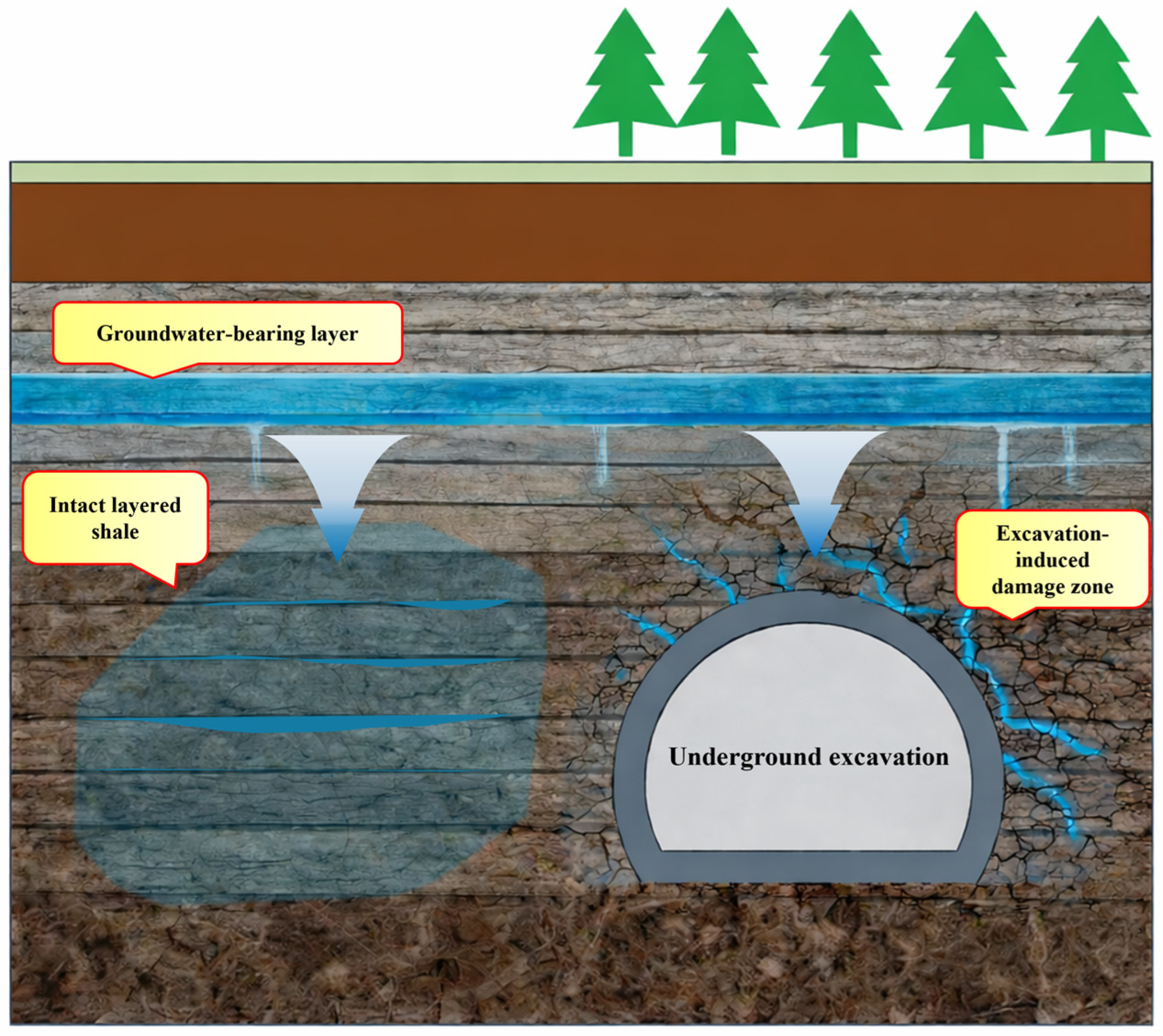
Deep tunnels and mine roadways commonly expose bedded shale as a dominant surrounding rock [1]. Its long-term stability is frequently governed by the coupled effects of excavation-induced stress redistribution and groundwater, often resulting in progressive deterioration [2]. Bedding imparts pronounced structural anisotropy: bedding planes constitute inherent mechanical weak surfaces and may also act as preferential seepage pathways [3]. Excavation typically produces an excavation damaged zone (EDZ), where microcracks initiate and coalesce, leading to a marked permeability increase (see Figure 1). Consequently, groundwater can infiltrate more readily along the EDZ and bedding-related discontinuities, accelerating strength loss, amplifying deformation, and altering failure modes. Within this excavation disturbance–initial damage–water weakening–reloading instability chain, it remains crucial to clarify how initial damage reshapes the water-weakening pathway and the ensuing fracture mechanisms, which is directly relevant to support optimization and drainage/waterproofing design.
A substantial body of work has established the strong mechanical anisotropy of bedded shale [4]. Variations in bedding orientation can systematically change elastic parameters, peak strength, and the deformation–failure process, often producing a characteristic weak-angle zone at intermediate inclinations [5]. Microstructural observations by Cho et al. [6] suggested that microfabric differences underpin this anisotropy, whereas Chen et al. [7] emphasized the role of bedding-parallel pre-existing microcrack populations whose progressive softening redirects preferred paths for crack initiation and propagation under uniaxial loading. These studies collectively indicate that shale failure is an evolutionary process in which microcracks nucleate, grow, interact, and eventually localize into instability. To quantify elastic response and damage thresholds more reliably, He et al. [8] proposed an iterative scheme to approximate crack initiation/damage thresholds, showing that the identifiable elastic regime varies markedly with bedding orientation and that crack damage stress can be inferred from the volumetric strain reversal point. Their energy analyses further revealed a rapid rise in dissipation near the damage threshold while the pre-failure accumulated dissipation remains limited, consistent with brittle instability. Complementarily, in situ micro-CT observations by Li Xiao et al. [9] visualized a progressive sequence from local defects to extensive post-peak cracking, providing direct structural evidence for bedding-controlled crack trajectories.
Water–rock interactions are also well known to weaken shale and clay-rich rocks. Water-induced degradation is commonly attributed to coupled mechanisms, including softening of grain–cement interfaces, hydration-driven reorganization of pores and microcracks, and water-facilitated subcritical crack growth [10]. These effects often intensify under temperature–pressure conditions closer to deep environments. For Longmaxi shale, Du et al. [11] reported significant mechanical reductions after hydrothermal treatment and linked the degradation to carbonate dissolution, clay swelling, and pyrite oxidation. Under multi-fluid conditions involving CO2–brine systems, Zhang et al. [12] likewise observed decreases in uniaxial strength and elastic modulus after saturation and highlighted sensitivities to fluid composition and phase state. Importantly, water weakening is typically heterogeneous rather than spatially uniform: preferential weakening loci and concentrated damage zones are controlled by bedding orientation and fracture structure. Wang et al. [13] reported that tests incorporating both bedding orientation and water content showed monotonic decreases in tensile strength/modulus and brittleness with increasing water content, with minima occurring near specific bedding angles, implying that weak-angle behavior may be intensified or shifted under saturated conditions. These observations further suggest that once initial damage exists, infiltration pathways and the competitive crack-growth landscape may be reorganized, thereby modifying damage onset and instability trajectories during subsequent loading.
At the engineering scale, excavation almost inevitably generates an EDZ. Long-term investigations at the Underground Research Laboratory (URL) showed that excavation method and stress redistribution jointly control damage development and are accompanied by measurable changes in wave velocity and hydraulic transmissivity [14]. In situ measurements at the Korea Underground Research Tunnel (KURT) further indicated that EDZ permeability can be substantially higher than that of intact host rock and generally decays with distance from the excavation boundary [15]. In water-bearing strata, the EDZ therefore tends to evolve into a preferential pathway for subsequent seepage and degradation, continuously amplifying hydro-mechanical coupling and threatening long-term stability.
Acoustic emission (AE), due to its high sensitivity to microcrack initiation, propagation, and coalescence, has been widely used for real-time monitoring of rock fracture processes [16]. By capturing the temporal organization of cracking activity through parameters such as counts and energy, AE provides process-level information beyond conventional stress–strain characterization [7]. For shale, Huang et al. [17] conducted uniaxial compression tests on Lushan shale across bedding angles, identified representative failure modes (trans-bedding failure, bedding-slip failure, and tensile splitting), and related AE fractal metrics to fragment distributions, suggesting that microfracture evolution can map onto macroscopic failure patterns. Wang et al. [18] combined real-time AE monitoring with post-test X-ray CT and reported a U-shaped dependence of AE counts/cumulative energy on bedding inclination, with AE indicators consistent with CT-revealed crack patterns. These advances support the use of AE as a key tool to link cracking processes with bedding-controlled failure morphology [19].
Despite progress on bedding anisotropy, water weakening, EDZ-related seepage pathways, and AE-based monitoring, most shale studies still focus on intact specimens under dry/saturated conditions subjected to a single loading path [20]. In contrast, field conditions more commonly involve excavation-induced initial damage, subsequent seepage exposure, and reloading toward instability. Initial damage may redirect preferential infiltration, relocate weakening concentrations, and reshape crack competition, thereby modulating pre-peak damage activation, AE evolution, and macroscopic failure modes in a bedding-dependent manner [21]. Systematic experimental evidence enabling direct comparisons within the same lithologic system—while integrating mechanics, AE, and fracture morphology—remains limited for this engineering-relevant “damage–water–reloading” sequence.
Accordingly, this study designs two comparable loading–hydration routes—direct saturation (DS) and pre-damage followed by saturation (PDRS)—and conducts uniaxial compression tests with AE monitoring across seven bedding orientations. P-wave velocity measurements and post-failure macroscopic crack documentation are further employed to establish a consistent linkage among structural anisotropy, damage evolution, water weakening, and fracture mechanisms. Particular emphasis is placed on whether initial damage shifts preferential weakening locations and crack competition, and how this shift translates into systematic differences in mechanical degradation, AE process signatures, and macroscopic failure patterns. The results aim to provide experimental evidence and an interpretive framework for stability assessment and hazard mitigation of bedded shale surrounding rocks under coupled excavation–seepage conditions in deep underground engineering.

2. Materials and Methods

2.1. Materials and Specimen Preparation

Shale specimens were collected from the Longmaxi Formation in the Baima Block of the Fuling shale gas field, Sichuan Basin, China. The shale has an average porosity of 4.8% and a dry density of 2.64 g/cm3. X-ray diffraction analysis indicated that the mineral assemblage is dominated by quartz, clay minerals, and carbonates. The relatively high quartz content is consistent with the brittle nature of the material, whereas the appreciable clay-mineral content provides the basis for hydration-related weakening under water-bearing conditions.
To investigate the coupled effects of bedding structure and initial damage, standard cylindrical specimens with a diameter of 50 mm and a length of 100 mm were cored from the same large parent block along different directions. The bedding angle, θ, was defined as the angle between the specimen axis and the normal to the bedding plane. When θ = 0°, the loading direction is parallel to the bedding-plane normal; when θ = 90°, the loading direction is perpendicular to the bedding-plane normal. Seven bedding orientations were considered: θ = 0°, 15°, 30°, 45°, 60°, 75°, and 90°.
Specimen end-face flatness and parallelism were controlled within ≤0.02 mm and ≤0.05 mm, respectively, satisfying the ISRM-suggested tolerances. Prior to group assignment, P-wave velocity was measured for all specimens to evaluate initial integrity and to select specimens with comparable quality. P-wave velocity was measured using a rock parameter testing instrument (I-RPT-90185, Beijing Dongfang Yuantong Technology Development Co., Ltd., Beijing, China). A coupling agent was applied to the probe surfaces, and the two probes were placed in contact with the two ends of the specimen for ultrasonic transmission measurement. The emission voltage was set to 500 V, the measuring distance was set to 100 mm, and the sampling interval was 0.4 μs. After the waveform became stable, the longitudinal wave velocity was recorded. The P-wave velocity was calculated as V p = L / t , where L is the propagation path length and ∆t is the first-arrival travel time.
A total of 14 specimens were finally selected, corresponding to two specimens for each bedding orientation. These specimens were assigned to two groups: a direct-saturation group (DS) and a pre-damage-followed-by-saturation group (PDRS), with one specimen from each bedding orientation in each group.

2.2. Testing Procedure for the Direct-Saturation Group (DS)

For the DS group, specimens were first vacuum-saturated. Vacuuming and water injection were maintained for 4 h until no bubbles were observed, followed by storage in the saturation vessel for an additional 4 h to ensure sufficient saturation. After saturation, the specimens were mounted in an MTS Model 815 rock mechanics test system (MTS Systems Corporation, Eden Prairie, MN, USA) for uniaxial compression.
Displacement-controlled loading was applied at a rate of 0.08 mm/min until global instability and failure occurred. Stress–strain responses were recorded continuously throughout loading, and the macroscopic failure process was visually documented.
AE monitoring was carried out using a PAC 8-channel acoustic emission system (Physical Acoustics Corporation, Princeton Junction, NJ, USA). The sensors were arranged in two circumferential layers (upper and lower), with four sensors in each layer and an angular spacing of 90°. Coupling gel was applied to ensure reliable signal transmission. The sampling rate was set to 1 MHz, and the trigger threshold was 28 dB. During loading, AE parameters including hits, amplitude, duration, and energy were recorded in real time to characterize crack initiation, propagation, and coalescence. After failure, the fracture surfaces and crack patterns of the specimens were documented to identify the macroscopic failure characteristics.

2.3. Testing Procedure for the Pre-Damage–Saturation Group (PDRS)

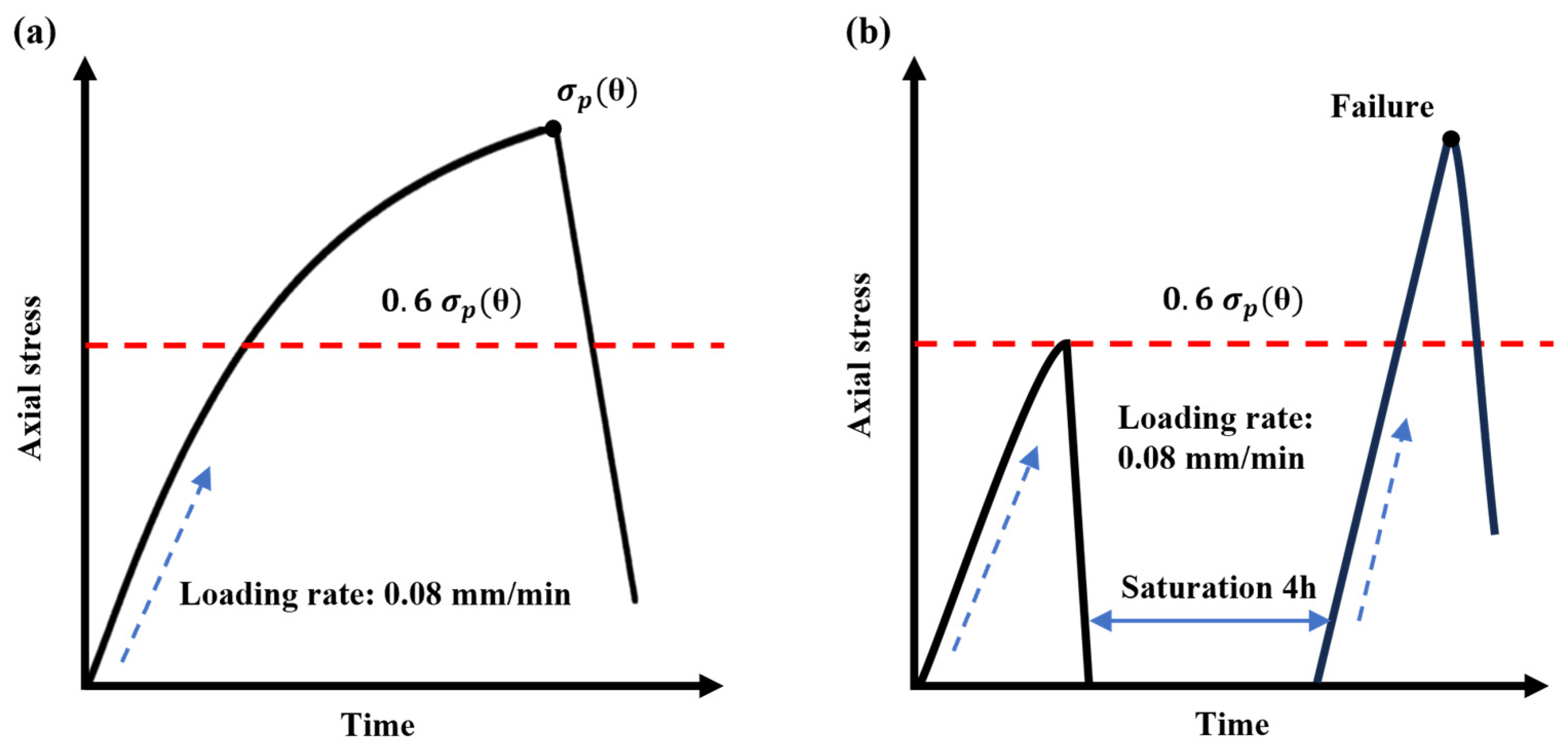
For the PDRS group, a controlled initial damage level was introduced prior to saturation to simulate microcrack development caused by excavation disturbance and/or loading history in deep engineering, and to evaluate its influence on subsequent water weakening and reloading-induced failure. For each bedding angle, the peak strength determined from the stress–strain curves of the corresponding DS specimens was denoted as σ p ( θ ) . Considering that noticeable microcrack initiation and stable growth commonly occur when the uniaxial stress reaches approximately 0.6–0.7 of the peak strength [22], the pre-damage stress level was defined as: σ d ( θ ) = 0.6   σ p ( θ ) .
In the pre-damage stage, specimens were loaded at 0.08 mm/min to σ d ( θ ) , immediately unloaded, and then removed from the machine. P-wave velocity was re-measured after unloading to quantify integrity degradation induced by pre-damage.
Specimens were subsequently vacuum-saturated following the same procedure as the DS group to ensure water penetration into microcrack tips and bedding-related weak planes, thereby enhancing hydration softening. After saturation, specimens were reinstalled in the MTS 815 system and loaded to failure under the same displacement-controlled rate (0.08 mm/min), with AE acquisition using identical sensor layout and acquisition settings as in the DS group. After failure, surface topography scanning was again conducted to document macroscopic crack distributions and bedding-controlled failure characteristics for comparison with the DS results.
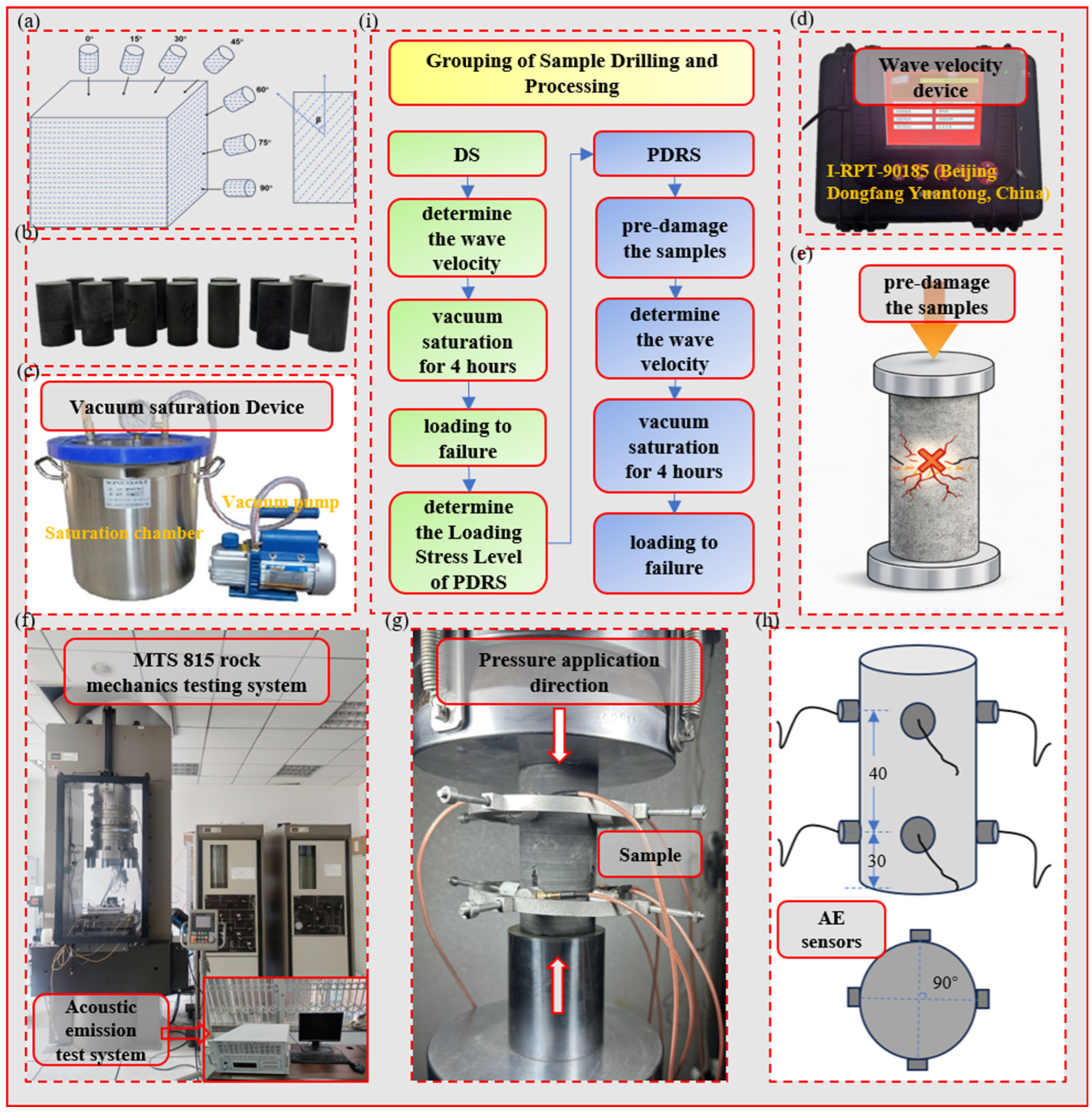
The specimen grouping, experimental workflow, AE system layout, and loading schemes are summarized in Figure 2 and Figure 3.

3. Results and Analysis

3.1. Mechanical Results and Analysis

3.1.1. Quantification of Pre-Damage Degree and P-Wave Velocity Anisotropy

A controllable initial-damage state was achieved by applying a unified relative pre-damage level for specimens with different bedding orientations. After unloading, P-wave velocity was re-measured to quantify the damage introduced by the loading–unloading process. The P-wave velocity reduction ratio was defined as:
Δ V p ( θ ) = V p 0 ( θ ) V p d ( θ ) V p 0 ( θ ) × 100 %
where V p 0 ( θ ) and V p d ( θ ) are the P-wave velocities measured before and after pre-damage at bedding angle θ, respectively. The comparisons for different orientations are summarized in Table 1.
Before pre-damage, the measured P-wave velocity generally increased with increasing bedding angle θ, reflecting the directional dependence of wave propagation in bedded shale [23]. When θ = 0 , the propagation direction crosses more bedding interfaces, where reflection, scattering, and energy dissipation are more likely to occur, leading to a relatively low apparent velocity. As θ increases, the propagation path becomes more aligned with the bedding structure, the number of crossed interfaces decreases, and the interface effect is correspondingly weakened. Under these conditions, the wave tends to travel through a more continuous medium, resulting in a higher measured P-wave velocity.
After pre-damage, the P-wave velocity decreased for all bedding orientations, indicating that the loading–unloading treatment at σ d ( θ ) caused measurable integrity degradation. The magnitude of velocity reduction was orientation-dependent. The largest reduction was observed at θ = 60 , where the velocity decreased from 5001 m/s to 4808 m/s, corresponding to a reduction of 3.86%. Relatively pronounced reductions were also observed at θ = 60 and 15 , with reduction ratios of 1.84% and 1.73%, respectively. By contrast, the reductions at θ = 0 and 30 were limited, at 0.09% and 0.11%, respectively. Across all orientations, the mean reduction ratio was 1.23%, suggesting that the selected pre-damage level introduced detectable internal damage without causing macroscopic failure.
In terms of anisotropy, the velocity range changed from 4386 to 5238 m/s before pre-damage to 4310–5202 m/s after pre-damage, while the monotonic increase with θ remained essentially unchanged. Using the anisotropy index A V p = V p , m a x / V p , m i n , the index changed from 1.195 before pre-damage to 1.20 after pre-damage, indicating only a slight increase. This suggests that pre-damage primarily caused an overall velocity reduction rather than altering the angular distribution of V p . The relatively larger attenuation observed at θ = 45 60 may indicate that specimens within this orientation range were more sensitive to loading–unloading-induced internal damage under the present test conditions, thereby providing a potentially weaker integrity basis for the subsequent saturation and reloading stages.

3.1.2. Stress–Strain Characteristics

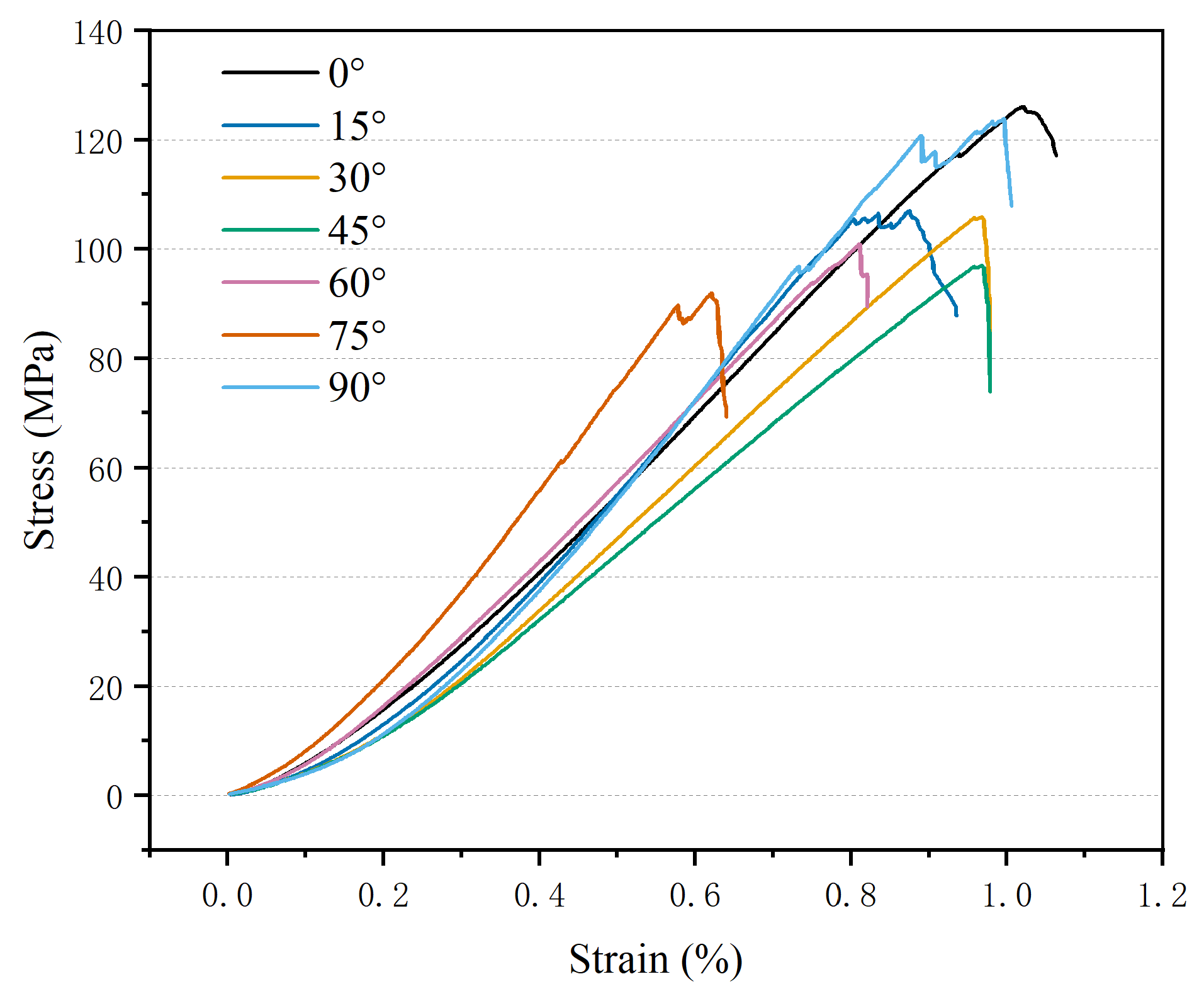
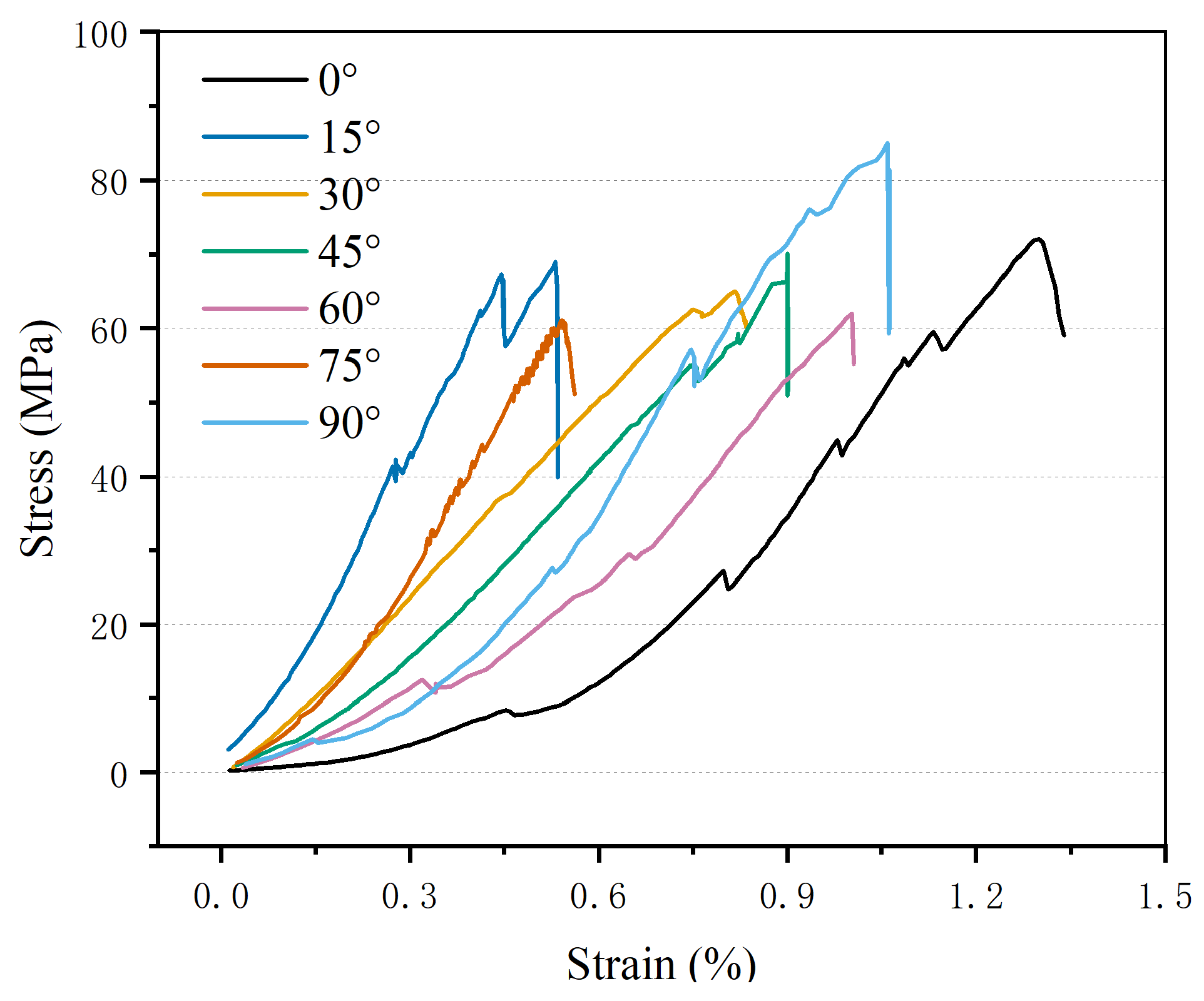
Figure 4 and Figure 5 illustrate the uniaxial stress–strain curves of the DS and PDRS groups under different bedding orientations. In both groups, the curves can generally be divided into four distinct stages: an initial compaction stage, a quasi-linear elastic stage, a pre-peak nonlinear hardening stage, and a post-peak softening stage. Compared with the DS group, the PDRS group exhibited significant differences in curve nonlinearity, stress fluctuation characteristics, and post-peak attenuation behavior.
For the DS group, specimens at all bedding angles generally displayed a short compaction stage at low strain, followed by a relatively stable quasi-linear ascending branch. As strain increased, pre-peak nonlinearity gradually became more prominent, and post-peak softening occurred immediately after the peak stress. For certain bedding orientations, the post-peak branch showed a rapid stress drop right after the peak, followed by a short residual-bearing segment, which is characteristic of relatively brittle failure. The peak stress level and the magnitude of the post-peak stress drop varied with the bedding angle, reflecting the influence of bedding orientation on the load-bearing capacity and failure response of the specimens.
For the PDRS group, the stress–strain curves were generally located below those of the DS group, with more pronounced nonlinearity and stress fluctuations. The transition from the compaction stage to the quasi-linear stage tended to be extended, and the slope of the quasi-linear segment decreased, indicating a reduction in apparent stiffness. In the pre-peak stage, the PDRS curves frequently exhibited serrated fluctuations and local stress drops, which were manifested as intermittent stress increases interspersed with small unloading events. These features suggest a more discontinuous deformation process prior to the peak stress. Post-peak softening in the PDRS group also appeared more segmented. At some orientations, a sustained post-peak bearing stage or secondary peaks could be observed, reflecting a more progressive post-peak response rather than a single abrupt stress drop.
From the perspective of bedding-angle effects, both groups showed clear directional dependence in curve morphology. In the DS group, this angle dependence was mainly reflected in the differences in peak stress and post-peak stress-drop amplitude. In the PDRS group, in addition to the differences in peak stress, variations in pre-peak serration intensity and segmented post-peak softening were also more obvious. Under the present test conditions, these observations indicate that the PDRS curves exhibited more pronounced orientation-dependent differences in both pre-peak and post-peak responses.

3.1.3. Peak Strength and Elastic Modulus

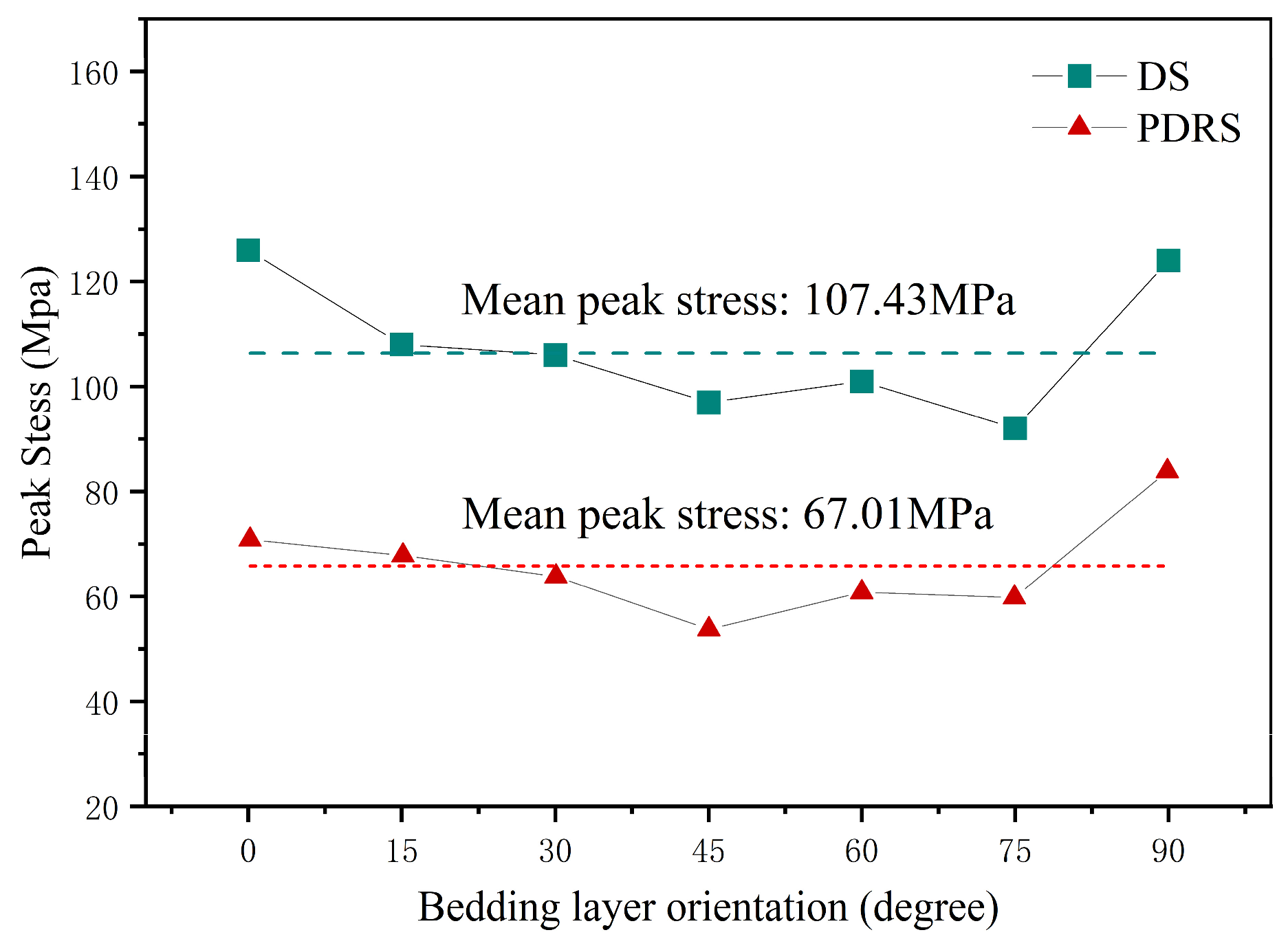
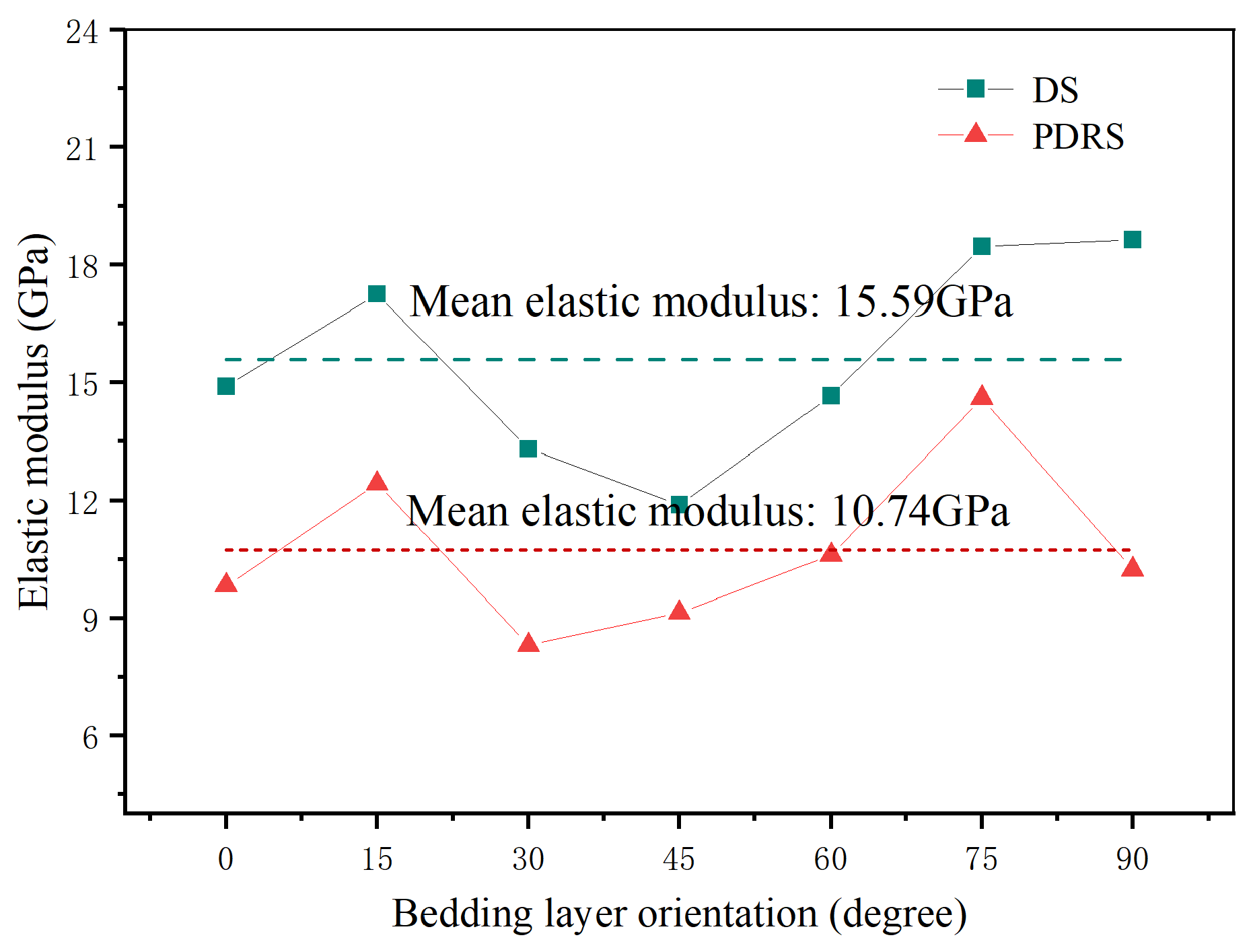
Figure 6 and Figure 7 summarize the orientation dependence of peak strength, denoted by σ p , and elastic modulus, denoted by E , for the DS and PDRS groups. For all bedding orientations, the PDRS dataset is systematically lower than the DS dataset, indicating that the pre-damage–saturation route further deteriorates both the ultimate load-bearing capacity and the apparent stiffness under identical saturation conditions. At the same time, both σ p and E retain clear angle dependence, confirming that bedding remains the dominant control on mechanical anisotropy.
In terms of peak strength, the DS group exhibited σ p values between 92 and 126 MPa, with a mean of 107.43 MPa. The PDRS group showed a lower range of 55–85 MPa, with a mean of 67.01 MPa, corresponding to a reduction of 37.63% relative to the DS group. Orientation-wise, the DS group exhibited relatively high strengths at θ = 0 and 90 , reaching 126 MPa and 124 MPa, respectively, whereas lower values were observed at intermediate orientations, with the minimum occurring at θ = 75 at 92 MPa. In the PDRS group, relatively high strengths were also observed at θ = 0 and 90 , at 72 MPa and 85 MPa, respectively, whereas the minimum occurred at θ = 45 at 55 MPa. Across all orientations, the strength reduction from DS to PDRS ranged from 23.86% to 43.30%, with the largest reduction occurring at θ = 45 , where the peak strength decreased from 97 MPa to 55 MPa, and the smallest reduction occurring at θ = 15 , where it decreased from 108 MPa to 69 MPa. The strength anisotropy index A σ = σ m a x / σ m i n was 1.37 for DS and 1.55 for PDRS, indicating that the overall strength level decreased markedly after pre-damage and saturation, while the strength anisotropy remained evident.
In terms of elastic modulus, the DS group yields E values between 11.89 and 18.64 GPa, with a mean of 15.59 GPa. The PDRS group ranges from 8.32 to 14.61 GPa, with a mean of 10.74 GPa, representing a 31.14% reduction relative to DS and indicating pronounced stiffness deterioration. The DS group exhibits a “U-shaped” orientation dependence, with the minimum modulus at θ = 45 at 11.89 GPa and the maximum at θ = 90 at 18.64 GPa. By comparison, the PDRS group shows a different weak orientation, with the minimum shifting to θ = 30 at 8.32 GPa and the maximum occurring at θ = 75 at 14.61 GPa. The modulus reduction from DS to PDRS varies between 20.90% and 45.12 across orientations; the largest reduction occurs at θ = 90 , where E decreases from 18.64 to 10.23 GPa, whereas the smallest reduction occurs at θ = 75 , where E decreases from 18.47 to 14.61 GPa. The modulus anisotropy index A E = E m a x / E m i n increases from 1.57 in DS to 1.76 in PDRS, suggesting that pre-damage amplifies the orientation-dependent disparity in stiffness more strongly than it does for peak strength.
Overall, under the present dataset, the PDRS route was associated with lower strength and stiffness than the DS route across all tested bedding orientations. Differences in the locations of the minimum σ p and E values were observed between the two groups, particularly for elastic modulus. However, given that one specimen was tested for each bedding orientation in each group, these orientation-specific differences should be interpreted as observations under the current experimental dataset rather than as statistically established migration of a weak-orientation interval.

3.2. AE Results and Analysis

3.2.1. Temporal Evolution of AE Counts and Cumulative AE Counts

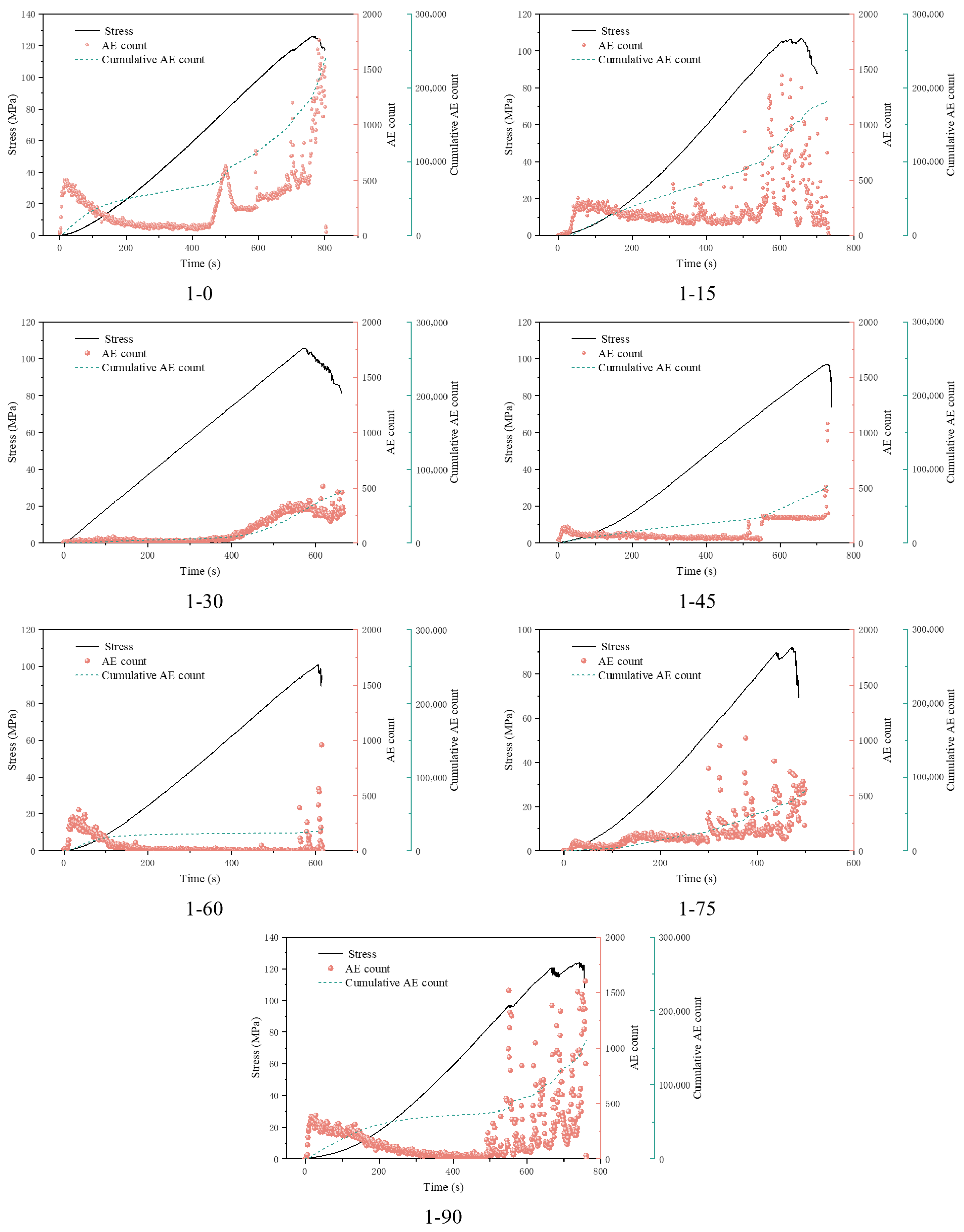
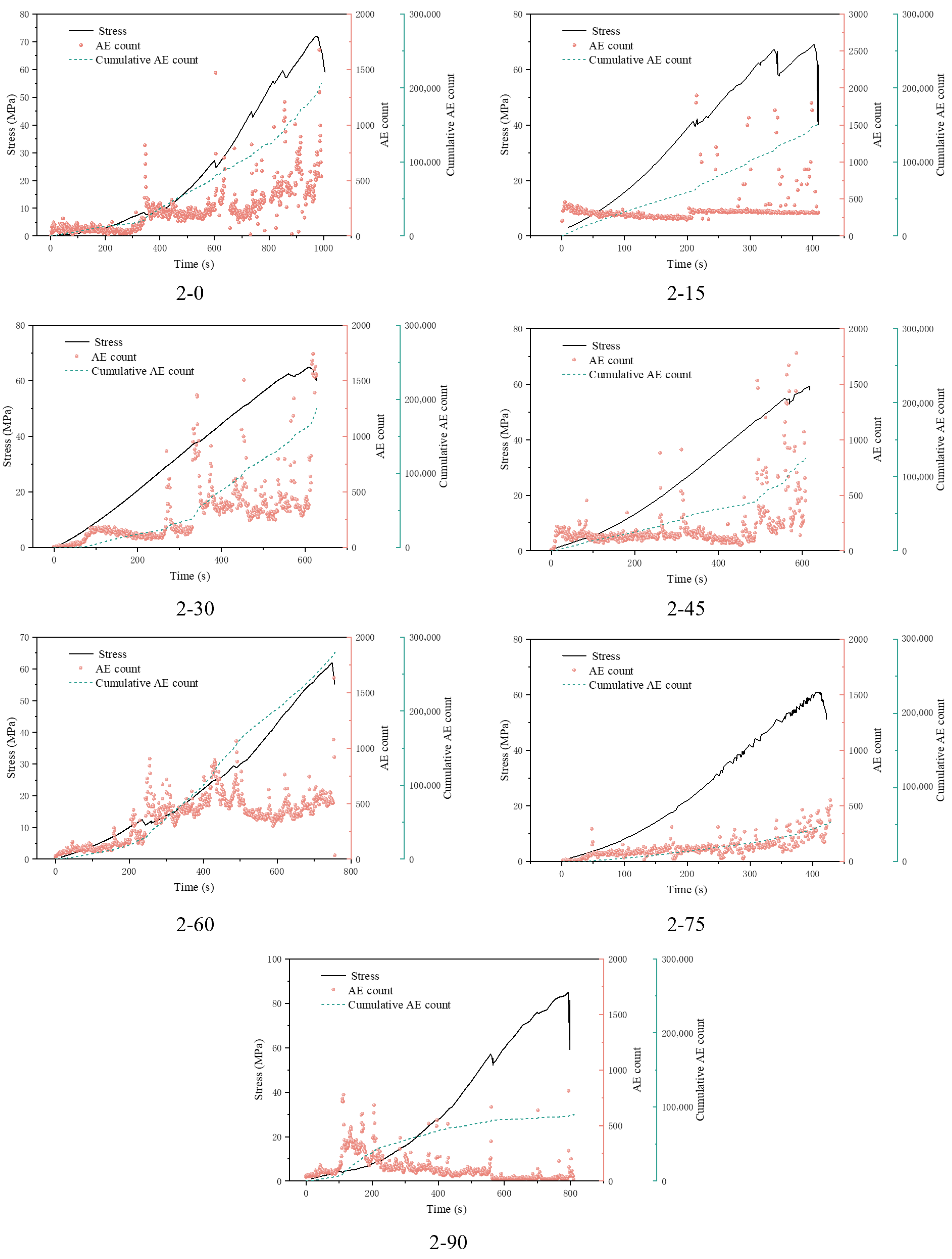
Figure 8 and Figure 9 illustrate the stress-time evolution of acoustic emission (AE) counts and cumulative AE counts for the DS and PDRS groups under different bedding orientations. In both groups, cumulative AE counts generally increased with the progress of loading, while the onset timing, accumulation rate, and peak-neighborhood clustering of AE activity exhibited clear bedding-angle dependence. Compared with the DS group, the PDRS group generally displayed a more staged evolution pattern and a stronger tendency toward pre-peak accumulation.
For the DS group, specimens at 30°, 45°, and 60° maintained relatively low AE activity over an extended loading period, and cumulative AE counts increased slowly before accelerating markedly as peak stress was approached. The response at 45° is the most concentrated, characterized by an abrupt surge in AE counts in the peak-neighborhood stage and a rapid late-stage increase in cumulative AE counts. By contrast, specimens at 75° and 90° show a more gradual evolution, with sustained AE activity developing during the pre-peak stage and cumulative AE counts increasing steadily over a longer duration before further acceleration near peak stress. A clear multi-stage accumulation trend is particularly evident at 90°. At 0°, AE activity remains limited in the early and middle stages, intensifies progressively toward the end of loading, and shows an additional enhancement after peak stress, forming a distinct post-peak cluster. The response at 15° lies between these behaviors, showing a more gradual strengthening from pre-peak to post-peak with a moderate overall activity level.
For the PDRS group, orientation-dependent differences become more pronounced. At 0°, 30°, and 60°, AE counts occur continuously from the early loading stage, and cumulative AE counts increase steadily and persistently, indicating progressive damage accumulation throughout loading. The response at 60° is especially active, with frequent AE counts sustained into the middle and late stages and an overall upward shift in cumulative AE counts. In contrast, 75° exhibits the weakest AE activity, with sparse AE counts and only limited growth in cumulative AE counts until the peak-neighborhood stage. Specimens at 15° and 45° typically show low activity at the beginning followed by sustained intensification, although the degree of pre-peak enhancement is weaker than that at 30° and 60°. At 90°, noticeable AE counts appear at an early stage, followed by a relatively slow accumulation and a secondary intensification toward the end of loading, producing a distinct multi-stage cumulative curve.
Overall, the DS route is characterized by concentrated AE intensification near peak stress, suggesting that microcracking remains relatively subdued for much of the loading history and then localizes and accelerates in the peak-neighborhood stage. In contrast, the PDRS route more often exhibits earlier activation and sustained pre-peak accumulation, indicating that pre-damage promotes earlier engagement of microcrack activity and a more progressive damage-growth process. Bedding orientation exerts a persistent control on the temporal organization of AE activity, as reflected in systematic differences in onset stage, accumulation rate, and the magnitude of peak-neighborhood intensification across orientations.

3.2.2. Tensile–Shear Mechanism Discrimination by RA–AF

To characterize the source-mechanism differences reflected by AE signals during fracture evolution, an RA–AF approach was adopted to classify AE events [24]. The parameter RA is defined as the ratio of rise time to amplitude, and AF is defined as the ratio of counts to duration:
R A = RiseTime Amplitude , A F = Counts Duration
Here, RiseTime is the time interval from trigger to the waveform peak, Amplitude is the peak amplitude, Counts denotes AE counts, and Duration is the signal duration. In general, tensile-dominated cracking tends to exhibit lower RA and higher AF, whereas shear-dominated cracking is associated with higher RA and lower AF [25].
Because the raw RA and AF values showed strong dispersion and considerable magnitude differences among specimens, a global percentile-based normalization procedure was adopted before inter-orientation comparison [26]. Specifically, all valid AE events from all specimens were merged, and the 5th and 95th percentiles were used as lower and upper bounds for each parameter. Values below the 5th percentile were clipped to the lower bound, and values above the 95th percentile were clipped to the upper bound [27]. The clipped values were then linearly scaled to the interval [0, 1]:
R A n = clip ( R A , p 5 , R A , p 95 , R A ) p 5 , R A p 95 , R A p 5 , R A , A F n = clip ( A F , p 5 , A F , p 95 , A F ) p 5 , A F p 95 , A F p 5 , A F
where p 5 , R A and p 95 , R A are the global 5th and 95th percentiles of RA, respectively, and p 5 , A F and p 95 , A F are the corresponding percentiles of AF. This treatment reduces the influence of extreme values while preserving the relative distribution of the majority of AE events.
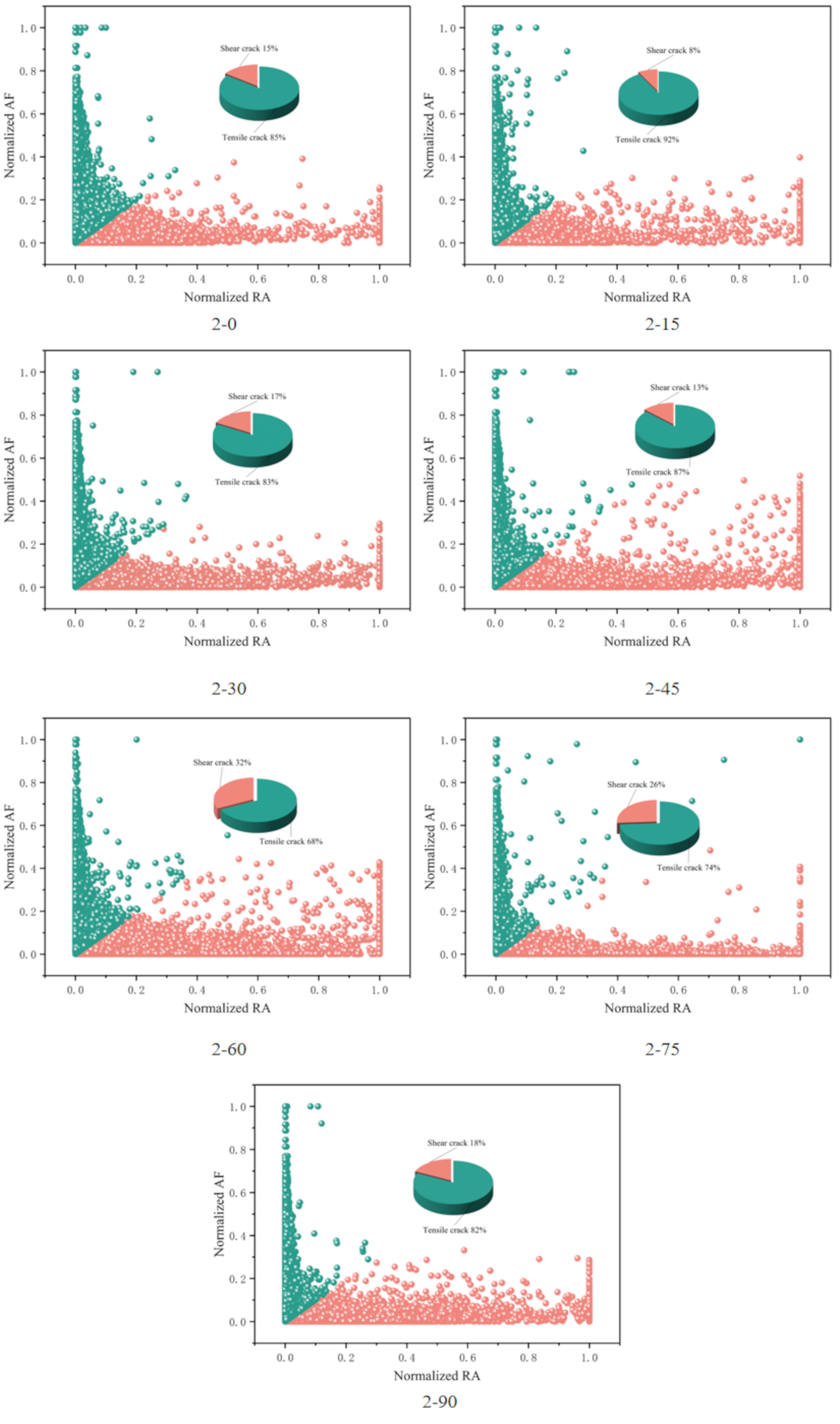
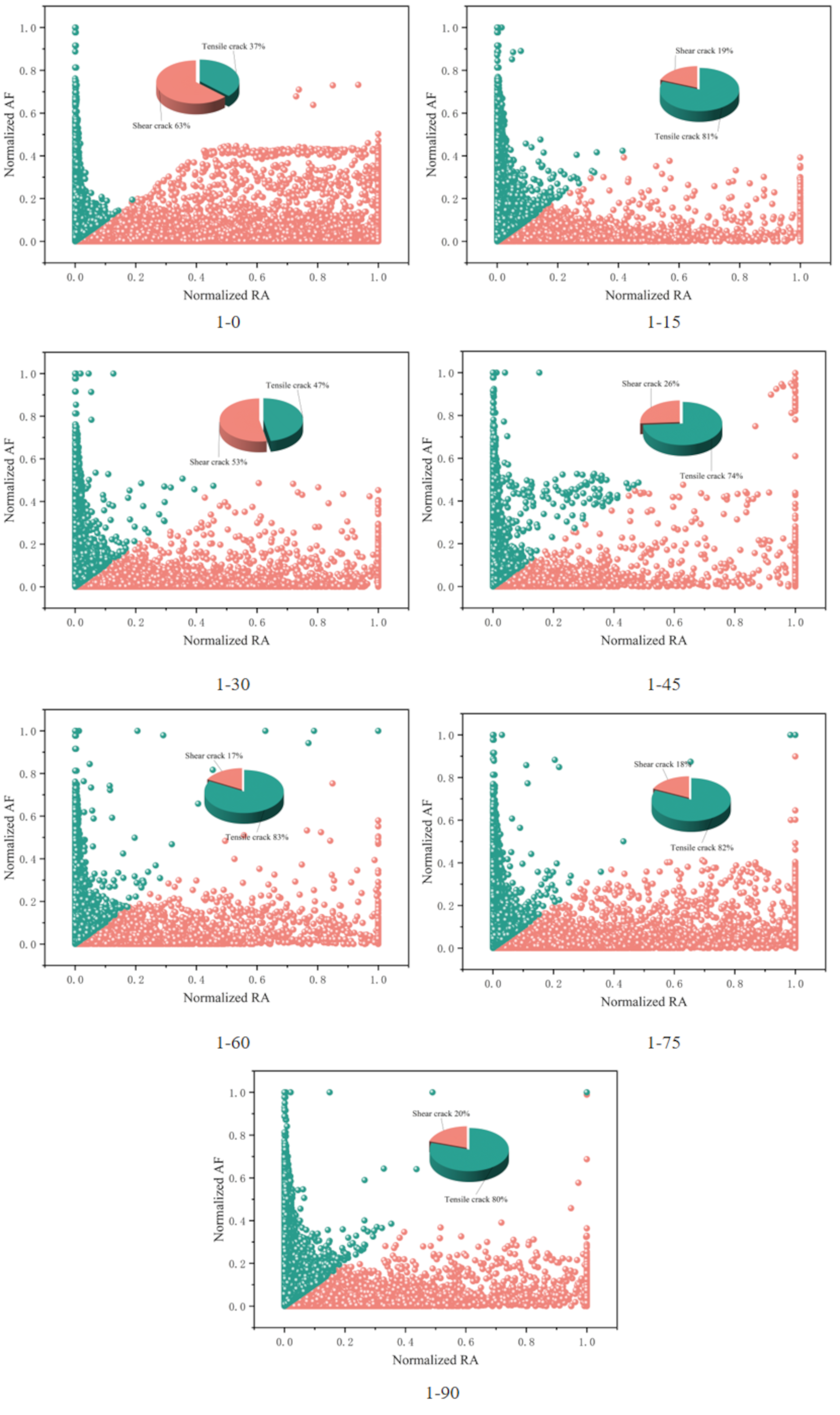
After normalization, AE events were classified in the normalized RA–AF space using the adopted reference boundary, and the proportions of tensile-like and shear-like events were calculated for each specimen [28]. Figure 10 and Figure 11 show the normalized RA–AF distributions and the corresponding event proportions for different bedding orientations.
Based on the RA–AF results, the DS group exhibited pronounced orientation-dependent differences in cracking mode. The tensile-like event proportion ranged from 37.12% to 82.63%, while the shear-like proportion ranged from 17.37% to 62.88%. In the DS group, the specimens at 0° and 30° were shear-dominant, with tensile-like proportions of 37.12% and 46.63%, respectively. By contrast, the specimens at 15°, 45°, 60°, 75°, and 90° were tensile-dominant, with tensile-like proportions of 80.72%, 74.04%, 82.63%, 81.68%, and 79.84%, respectively. These results indicate that the cracking mode in the DS group remained strongly dependent on bedding orientation.
Compared with the DS group, the PDRS group showed a markedly stronger tensile-like tendency across all tested bedding orientations. The tensile-like event proportion ranged from 68.08% to 91.98%, whereas the shear-like proportion ranged from 8.11% to 31.92%. All PDRS specimens were tensile-dominant, with tensile-like proportions of 85.06%, 91.98%, 82.54%, 86.72%, 68.08%, 73.90%, and 81.94% at 0°, 15°, 45°, 60°, 75°, and 90°, respectively. Among them, the highest tensile-like proportion occurred at 15°, whereas the lowest occurred at 60°.
Overall, under the present analysis framework, the PDRS route was associated with a clear increase in the proportion of tensile-like AE events and a corresponding decrease in the proportion of shear-like events relative to the DS route. This result suggests that pre-damage followed by saturation changed the relative distribution of cracking modes during subsequent loading. At the same time, bedding orientation still influenced the tensile-shear partitioning, although the orientation-dependent contrast became weaker in the PDRS group than in the DS group.

3.2.3. Event-Size Statistics Characterized by the b-Value

To quantify the statistical characteristics of AE event-size distributions and their evolution with loading, the b-value was used to characterize fracture processes under different bedding orientations and loading–hydration routes. The b-value is defined by the Gutenberg–Richter relation [29]:
log 10 N ( M ) = a b M
where N   ( M ) is the cumulative number of events with magnitude not smaller than M , and a and b are fitting parameters. In general, higher b-values indicate that small-magnitude events dominate the AE population, whereas lower b-values indicate a greater contribution from large-magnitude events and a stronger tendency toward localized energy release [30].
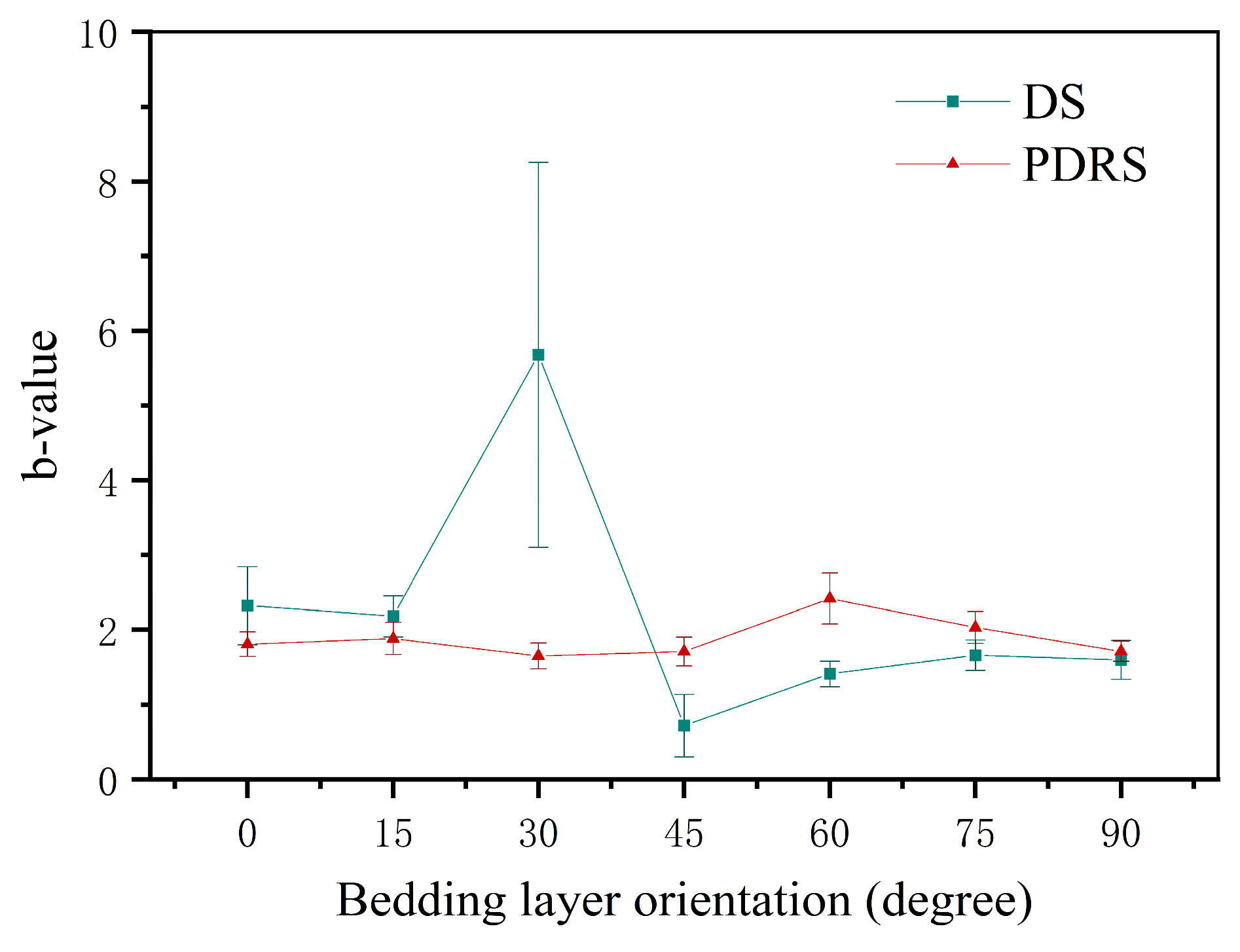
Figure 12 shows that the DS group exhibited a relatively wide range of b-values, from 0.5136 to 5.6815, indicating strong orientation-dependent differences in event-size statistics. The highest value appeared at θ = 30 , whereas the lowest occurred at θ = 45 . The unusually high b-value at θ = 30 indicates a strongly small-event–dominated AE population. Moreover, the large interquartile range in Figure 12 suggests substantial temporal fluctuation of the time-dependent b-value series b(t), and therefore this point is interpreted cautiously. For this reason, the median b-value of the DS group (1.4996) is considered more representative of the overall level than the mean value alone.
By comparison, the PDRS group showed a much narrower b-value range, from 1.5417 to 2.2820, with a mean of 1.7974 and a median of 1.7532. This narrower spread indicates that the event-size statistics were less dispersed among bedding orientations after pre-damage followed by saturation [31]. The contrast between the two groups is also reflected in their coefficients of variation. The DS group showed a value of 0.83, whereas the PDRS group showed a much smaller value of 0.13. A similar pattern is seen in the max-to-min ratio, which was about 14.8 for DS but only about 1.48 for PDRS.
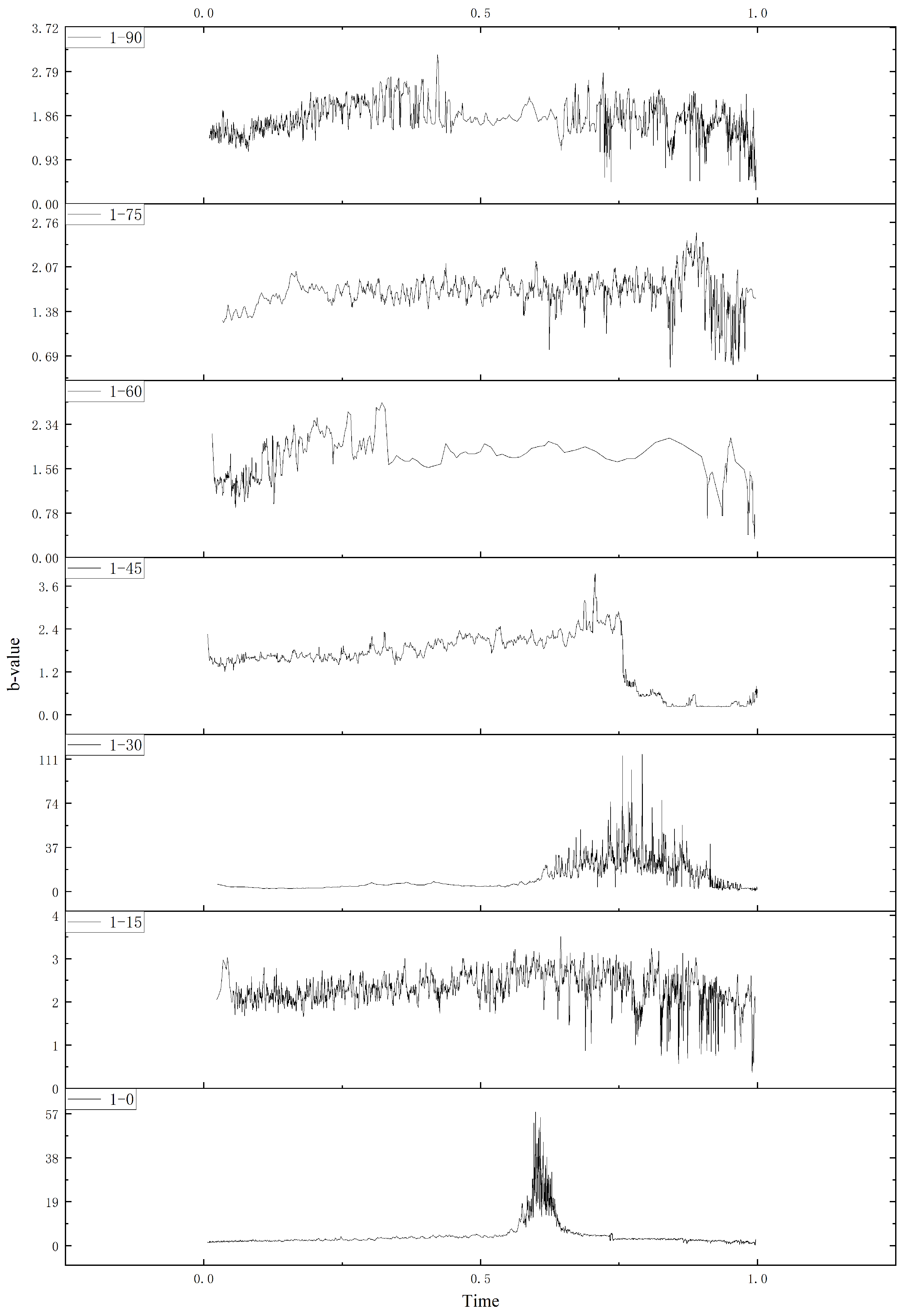
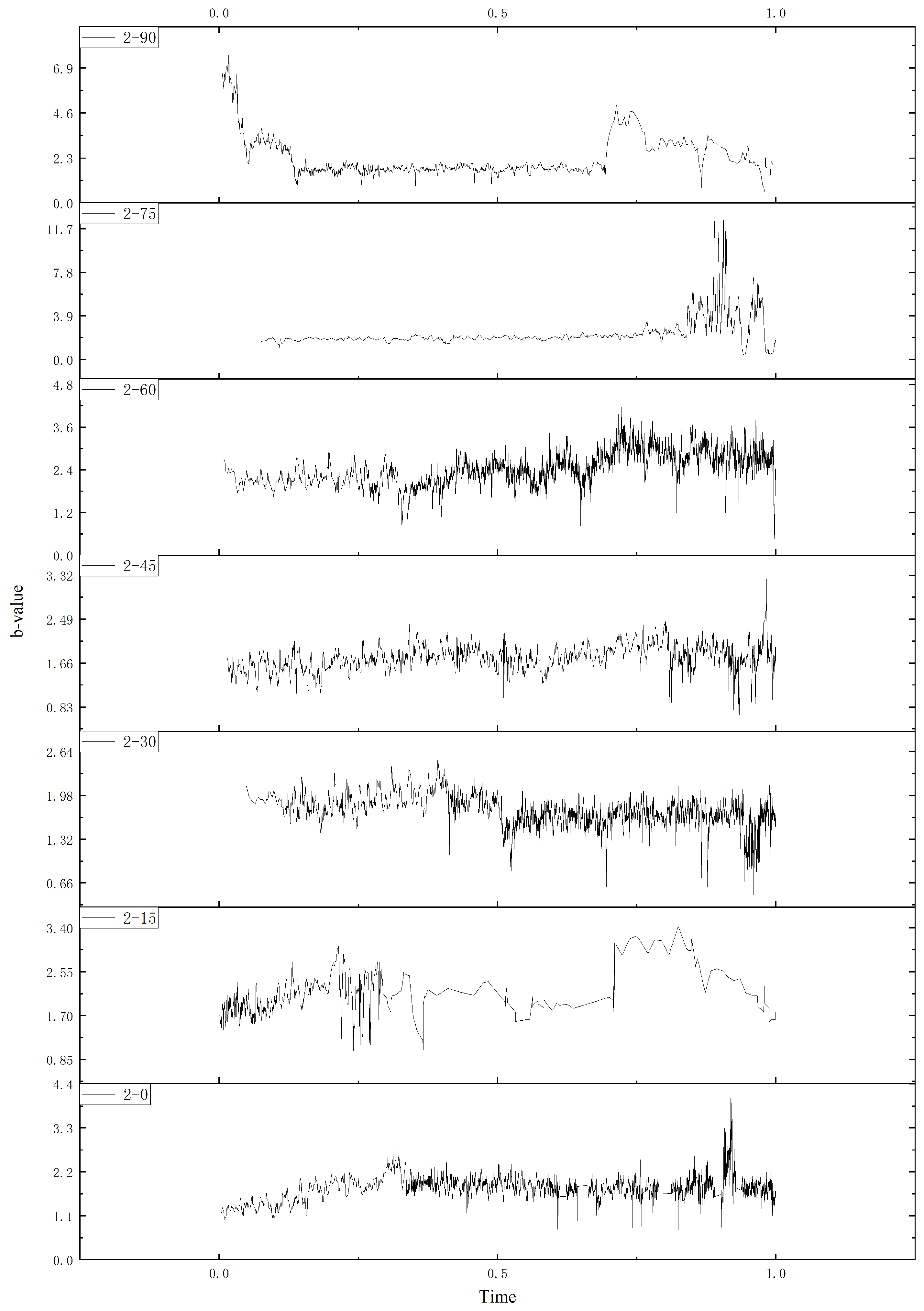
The time evolution of the b-value is shown in Appendix A. The DS specimens generally exhibited stronger temporal fluctuations, and some orientations showed abrupt excursions near the peak-neighborhood stage. In contrast, the PDRS specimens displayed comparatively more stable b-value evolution over a longer portion of the loading process. These temporal results are consistent with the group-level comparison in Figure 12, namely that the DS route showed stronger orientation-related variability, whereas the PDRS route showed more convergent event-size statistics under the present dataset.
Overall, the b-value results suggest that the two loading–hydration routes were associated with different event-size distribution patterns. Combined with the AE accumulation characteristics and the revised RA-AF results, the PDRS route was more often associated with earlier AE activation and a higher proportion of tensile-like events, while the corresponding b-values were less dispersed among orientations.

3.3. Macroscopic Failure Characteristics

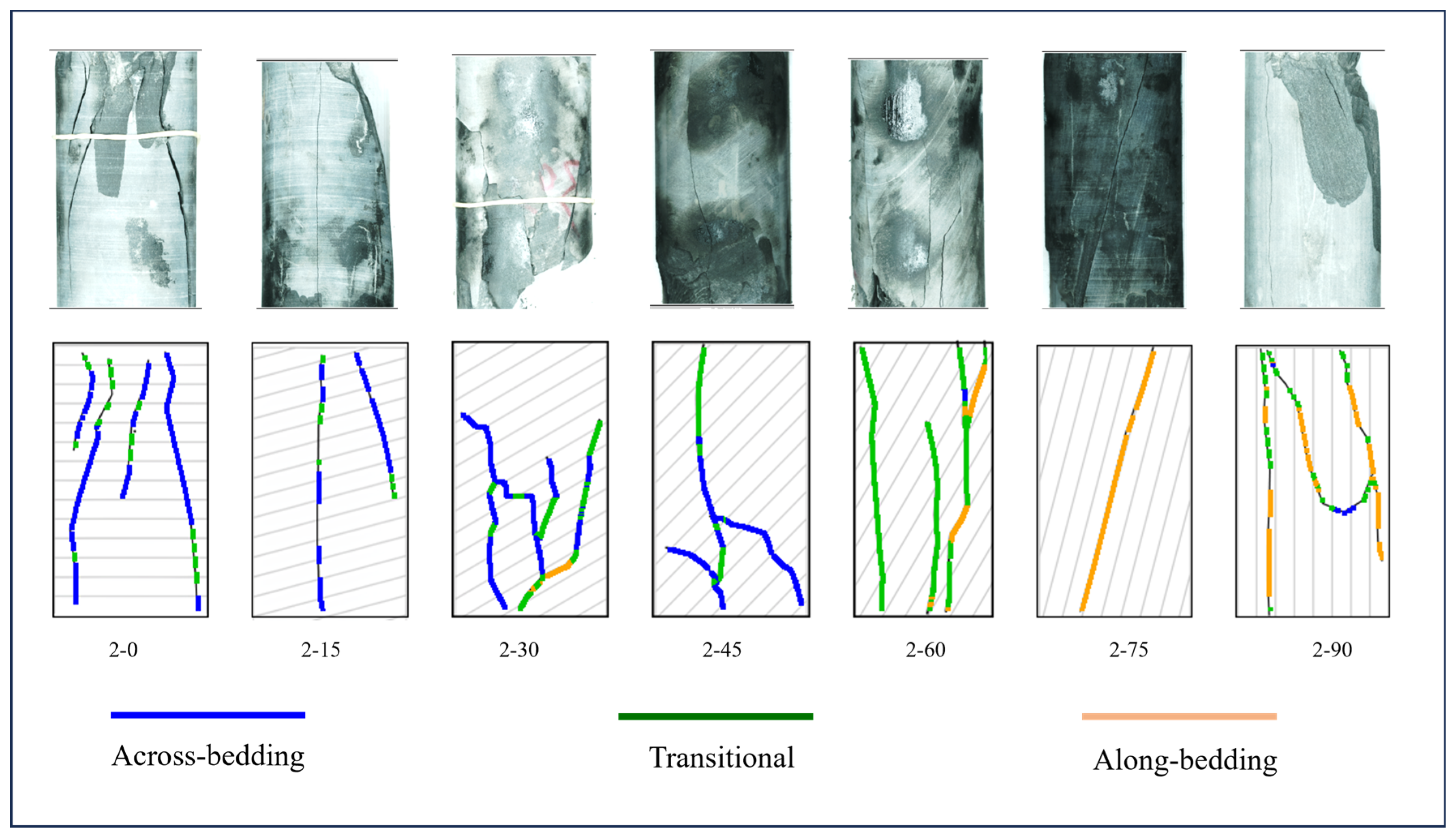
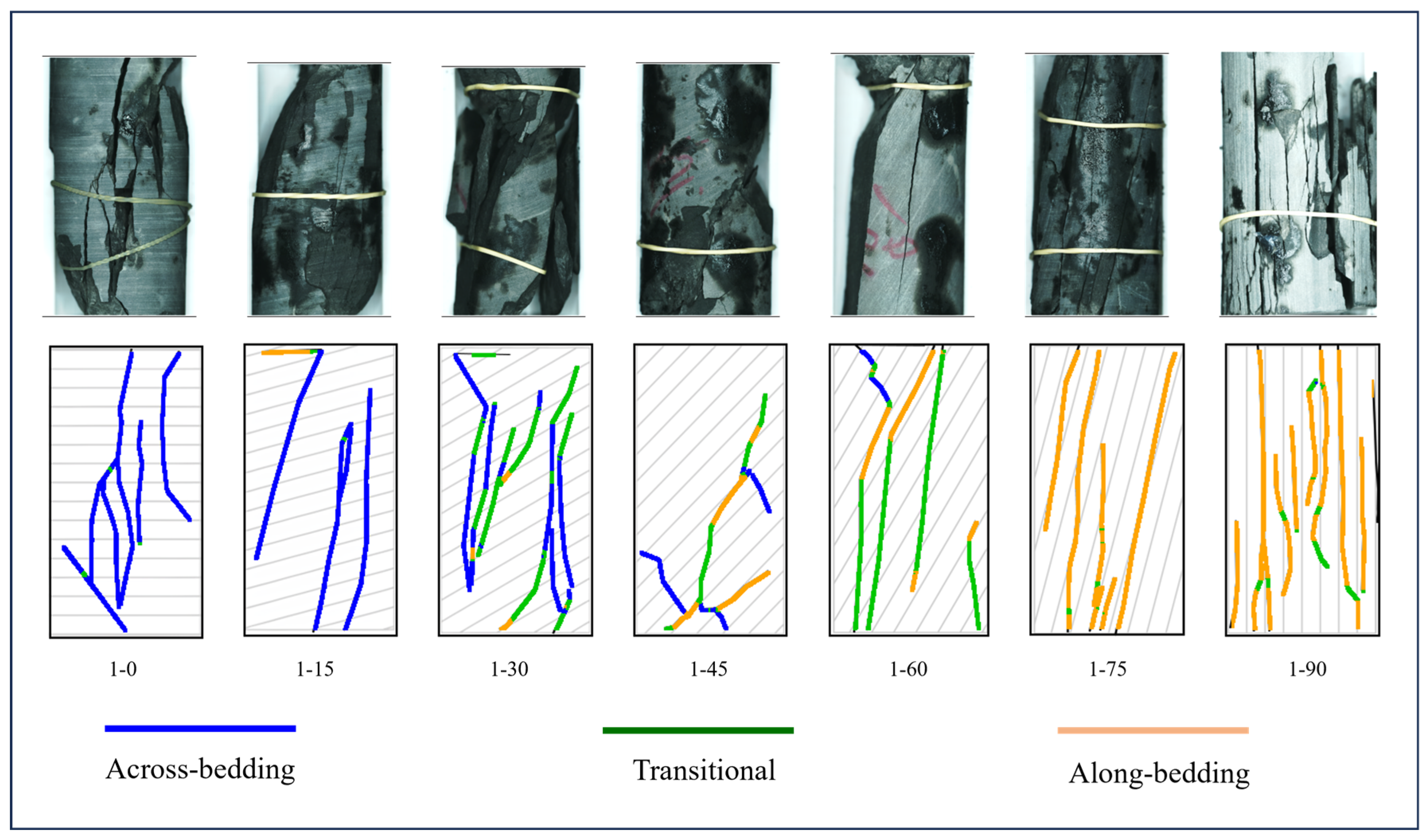
Macroscopic fracture patterns were characterized based on post-failure observations and surface-trace maps (Figure 13 for the DS group and Figure 14 for the PDRS group). Particular attention was paid to the dominant fracture path, crack-system geometry, and their dependence on bedding orientation. Here, the bedding angle θ denotes the angle between the loading direction and the bedding-plane normal. Thus, θ = 0° corresponds to loading perpendicular to bedding, whereas θ = 90° corresponds to loading parallel to bedding.
Overall, DS specimens more frequently developed multi-crack systems with higher geometric complexity, including distributed branching and locally interconnected crack networks. In contrast, PDRS specimens more often failed through a limited number of major fractures, showing a more localized and channelized failure morphology. These macroscopic differences broadly correspond to the variations observed in AE temporal accumulation (Section 3.2.1), event-size statistics (Section 3.2.3), and the tensile–shear partitioning inferred from the revised RA–AF analysis (Section 3.2.2).
To facilitate cross-orientation comparison, representative fracture patterns were compared alongside AE statistics (Table 2). In the DS group, some orientations exhibited pronounced crack branching and segmentation, forming a more distributed fracture network. Other orientations were dominated by one or two principal fractures with limited branching, displaying a more localized fracture path. This contrast in macroscopic morphology is accompanied by differences in AE characteristics, including the degree of peak-neighborhood intensification and the dispersion of event-size statistics, suggesting that the fracture process may transition from more distributed crack competition to more localized coalescence depending on bedding orientation.
In the PDRS group, macroscopic failure was typically dominated by a principal fracture that governed final breakdown, with reduced branching complexity compared with the DS group. Across all orientations, the PDRS route tended to promote earlier crack localization and the rapid formation of a dominant failure path after saturation and reloading. For certain orientations, the dominant fracture surface was strongly influenced by bedding, exhibiting relatively straight, bedding-guided crack paths; for other orientations, mixed-mode fracture propagation and crack deflection were observed. These macroscopic observations are generally consistent with the AE results, where the PDRS route more often exhibited earlier AE activation and a higher proportion of tensile-like events, while the event-size statistics showed reduced inter-orientation dispersion under the present dataset.
In summary, the macroscopic fracture patterns indicate systematic differences between the two loading–hydration routes. Under direct saturation, fracture evolution more frequently involved distributed cracking and network development at some orientations. Under pre-damage followed by saturation, failure morphology more often evolved toward localized channelization and dominant-fracture breakthrough. Together with the AE indicators, these observations suggest that initial damage can modify the cracking-path development and the subsequent failure morphology of bedded shale under saturated reloading, although further replicate testing is required to confirm the orientation-specific tendencies.

4. Discussion

4.1. Mechanisms by Which Initial Damage Modifies Water-Induced Weakening in Bedded Shale

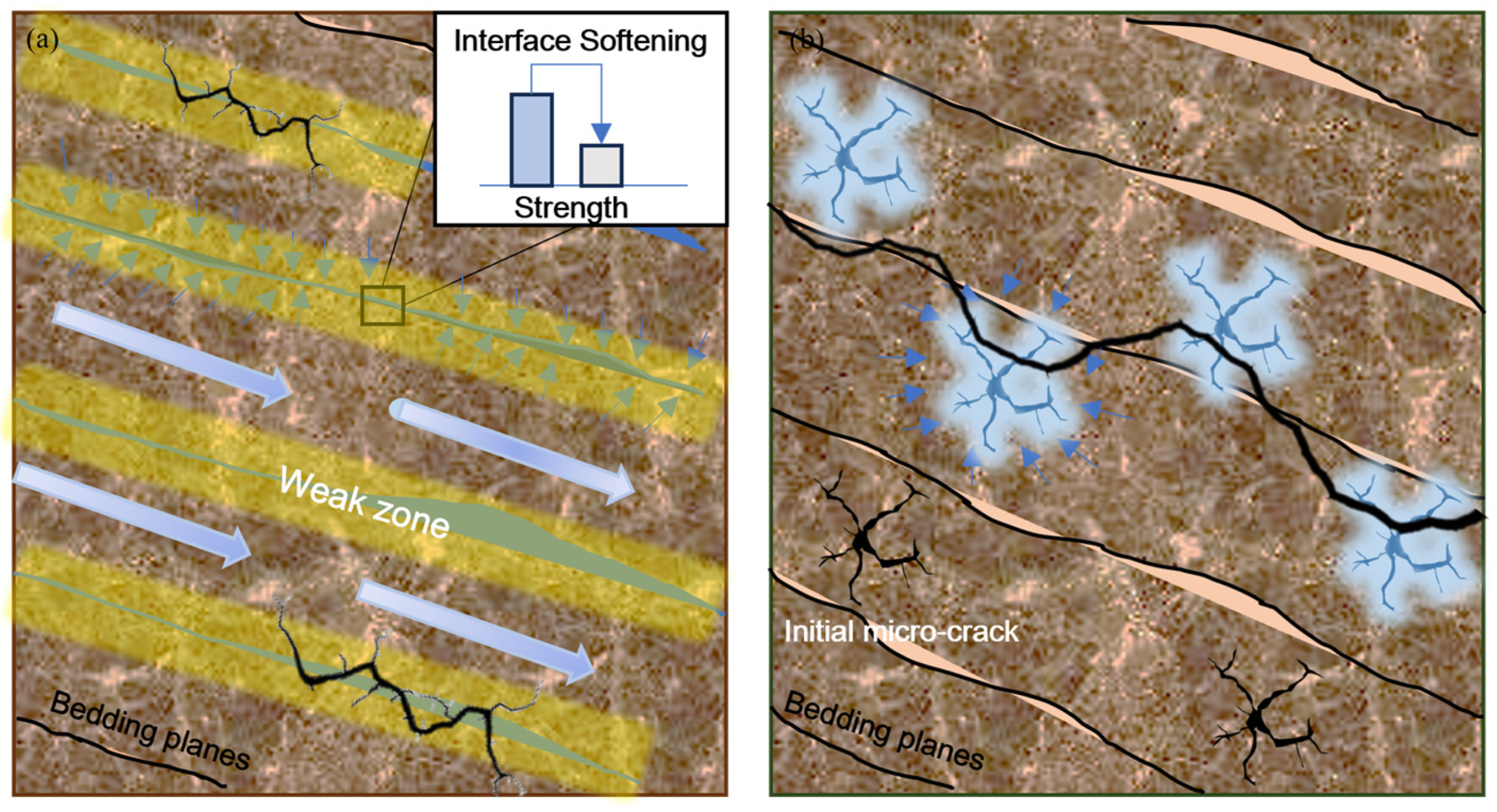
A representative route-dependent phenomenon emerges under identical saturation conditions. The DS route typically produces coexisting multiple cracks, mixed tensile–shear failure, and a relatively high degree of fragmentation. In contrast, the PDRS route more readily evolves toward through-going failure governed by a dominant crack during the second loading stage, with a more regular fracture trace and fewer branches. Notably, despite pronounced reductions in strength and stiffness under PDRS, macroscopic fragmentation does not intensify accordingly; failure becomes weaker in capacity yet more localized in space. This apparent paradox indicates that the key issue is not whether water weakens shale, but how initial damage relocates the dominant weakening zone and redirects crack competition and propagation. The conceptual contrast between the two routes is summarized in Figure 15: DS is associated with distributed interface weakening along bedding-related domains, whereas PDRS concentrates degradation around pre-existing defects and their tips.
Water-induced weakening in shale is inherently heterogeneous and preferentially targets mechanically weak structural domains. Mechanical degradation after hydration is widely attributed to clay mineral hydration and swelling, softening of cementation and intergranular contacts, and reductions in frictional and cohesive resistance along bedding planes and natural microdiscontinuities [32,33,34]. Under the DS route, specimens remain relatively intact prior to saturation; moisture therefore tends to diffuse and act along bedding-related weak interfaces, clay-enriched laminae, and pre-existing discontinuities. During subsequent uniaxial loading, bedding-related slip and shear participation become more pronounced, promoting concurrent crack initiation, branching, and interaction. This interpretation is consistent with the higher proportion of shear-like events observed at selected orientations in the DS group and with complex macroscopic morphologies such as network-like cracking or conjugate shear-through patterns.
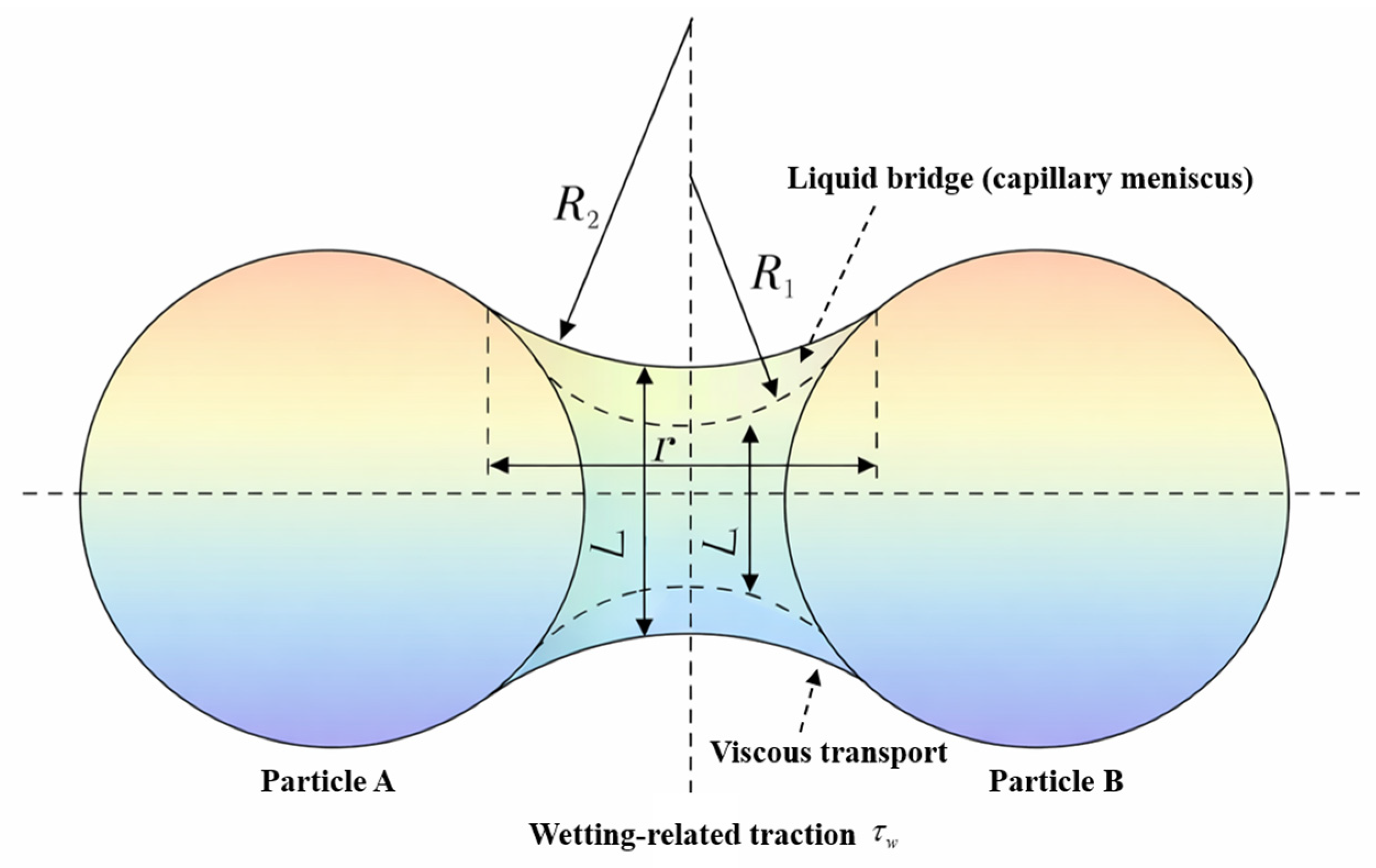
The essential change introduced by PDRS is that controlled pre-damage establishes a highly connected, low-threshold transport–weakening backbone. Loading–unloading at a unified relative level equal to 0.6 of the orientation-dependent peak stress activates recoverable microcracks and degrades bridging zones. During the subsequent saturation stage, water preferentially infiltrates this defect network and concentrates around crack tips, bridges, and the local fracture process zone, shifting weakening from distributed interface softening to localized tip-dominated degradation. At the microscale, partially saturated defects may retain water at narrow constrictions through liquid-bridge formation, providing a plausible mechanism for moisture residence and local hydraulic concentration near tips and bridges, as schematized in Figure 16.
For a representative liquid bridge [35], the wetting-related traction can be expressed as:
τ w = Y R
where Y denotes the wetting potential and R is the curvature radius of the meniscus. This relation highlights that tighter curvature in narrow constrictions corresponds to larger τw, thereby enhancing local traction and favoring water retention at crack tips and bridging throats. The viscosity-controlled transport term associated with the capillary throat can be written as:
Π v = η π r 4 8 L
where η is the liquid viscosity, r is the characteristic bridge radius, and L is the effective capillary length. The strong r4 dependence indicates a pronounced scale effect, such that small geometric variations in constrictions can markedly alter local transport and residence behavior. The resulting liquid-bridge force is given by
F l b = 2 π r τ w + π r Π v
which combines the surface-traction and viscous-transport contributions. Within the PDRS route, pre-damage increases the connectivity of microcracks and bridging zones, making moisture residence and hydration-assisted degradation more likely near crack tips and the local fracture process zone. This promotes tip-focused weakening during reloading, leading to earlier AE activation and a more sustained pre-peak accumulation. Accordingly, macroscopic failure tends to be governed by preferential growth of a dominant crack with suppressed branching, and the predominance of tensile-like events across orientations supports tensile opening as the primary propagation mode.
Overall, initial damage does not simply intensify weakening. Instead, it relocates the dominant weakening zone from bedding-related interfaces to crack-tip and bridging regions, reshapes crack competition from multi-source nucleation toward preferential-channel growth, and reorganizes fracture evolution toward a more localized, more regular, and less fragmented macroscopic failure.

4.2. Coupled Effects of Bedding Anisotropy, Water State, and Loading History on Shale Performance

Shale is a layered anisotropic rock in which degradation and failure are rarely controlled by a single factor. Instead, nonlinear coupling among structure (bedding orientation), state (water condition), and history (initial damage and loading route) governs both the magnitude of degradation and the resulting fracture mode [10]. Bedding defines the geometric baseline and potential weak-plane set, water condition governs where degradation is activated, and loading history reshapes the transport topology and stress concentration sites.
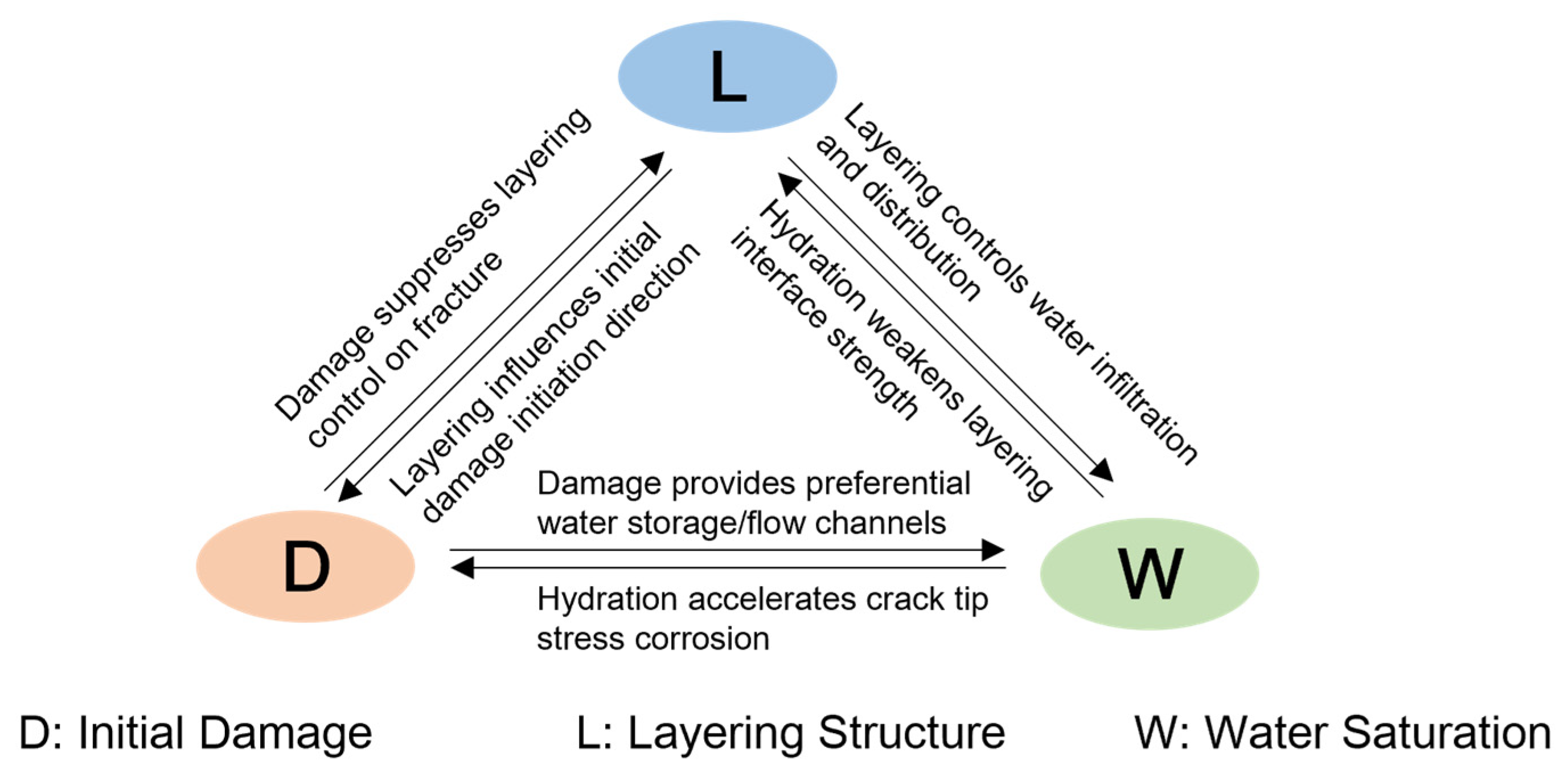
The observations can be organized using a sequential Loading–Damage–Water framework, as illustrated in Figure 17. DS follows saturation then loading to failure. PDRS follows loading to a controlled pre-damage level, unloading, saturation, and reloading to failure. This difference in sequence governs the preferential pathways for water, the dominant sites of stress concentration during reloading, and the pre-peak competition among cracks. Once a connected damage backbone is present before saturation, water–stress coupling becomes increasingly governed by crack-tip/process-zone conditions rather than spatially uniform matrix weakening, which explains why the route effect becomes pronounced after pre-damage is introduced.
Bedding provides a common anisotropic baseline for both routes. The layered structure controls stress decomposition and the geometry of potential weak planes, thereby setting the stage for orientation-dependent strength, stiffness, and fracture-mode responses. Water state interacts with this baseline by selectively degrading directionally weak structural components and by reducing interface resistance along bedding-related domains, which can amplify anisotropy in both deformation and fracture propensity. Loading history then modifies this structure–state interaction by changing the connectivity and threshold of available transport channels. Pre-damage establishes a defect network that redirects water infiltration and relocates the dominant weakening locus, thereby reorganizing where stress concentrates and which pathways dominate during reloading.
Accordingly, DS corresponds to saturation acting on a relatively intact specimen, for which weakening is activated more broadly along bedding-related domains and crack competition is controlled primarily by the structural baseline. In contrast, PDRS introduces a connected defect backbone prior to saturation, so hydration effects become concentrated around defects and their process zones and crack competition during reloading becomes more strongly governed by the pre-established topology. Across bedding angles, the route dependence therefore reflects a shift in the dominant weakening locus and in the relative roles of structure, state, and history, rather than a simple additive effect.

5. Conclusions

Uniaxial compression tests with acoustic emission monitoring were performed on bedded shale from the Longmaxi Formation under two loading–hydration routes: direct saturation (DS) and pre-damage followed by saturation (PDRS). Seven bedding orientations from 0° to 90° were examined. P-wave velocity, stress–strain response, AE temporal evolution, revised mechanism classification, b-value statistics, and macroscopic fracture observations were used to compare route-dependent weakening and failure characteristics. The main conclusions are as follows:
  • Pre-damage produced measurable reductions in P-wave velocity without causing macroscopic failure. Across all orientations, P-wave velocity decreased after pre-damage, with a mean reduction of 1.23%. The anisotropy index changed only slightly, from 1.195 to 1.207, suggesting that pre-damage mainly reduced the absolute wave velocity while the overall anisotropic pattern remained similar.
  • Compared with DS, the PDRS route showed lower peak strength and elastic modulus at all tested bedding orientations. The mean peak strength decreased from 107.43 MPa in DS to 67.00 MPa in PDRS, and the mean elastic modulus decreased from 15.59 GPa to 10.74 GPa. Both strength and stiffness remained clearly dependent on bedding orientation.
  • The temporal organization of AE activity differed between the two routes. In the DS group, AE activity was more concentrated near the peak-neighborhood stage for several orientations. In contrast, the PDRS group more often exhibited earlier activation and more sustained pre-peak accumulation, indicating a more staged development of cracking activity before failure.
  • Based on the RA-AF results, the cracking-mode partitioning differed clearly between DS and PDRS. In the DS group, tensile-like and shear-like event proportions varied strongly with bedding orientation. In the PDRS group, tensile-like events dominated across all orientations, with tensile-like proportions ranging from 68.08% to 91.98%.
  • Event-size statistics and macroscopic failure patterns also differed between the two routes. The DS group showed a wide b-value range of 0.5136–5.6815 with pronounced orientation dependence, whereas the PDRS group showed a narrower range of 1.5417–2.2820. In macroscopic observations, DS more often developed distributed multi-crack networks, whereas PDRS more often failed through a limited number of dominant fractures with reduced branching complexity. Together, these results suggest that introducing pre-damage before saturation alters the subsequent weakening and failure development of bedded shale during reloading.
For deep tunnels and mine roadways, these results highlight the importance of considering excavation-induced damage prior to seepage exposure. Under the present conditions, pre-damage followed by saturation tended to promote earlier AE activity and more localized dominant-fracture failure patterns during reloading, which may inform stability assessment and drainage/waterproofing design in bedded shale formations.

Author Contributions

Conceptualization, H.L., Y.X. and J.L.; Methodology, H.L.; Software, H.L.; Formal analysis, H.L.; Resources, J.L.; Writing—original draft, H.L.; Writing—review & editing, H.L., Y.X. and J.L.; Visualization, Y.X.; Supervision, Y.X. and J.L.; Project administration, Y.X.; Funding acquisition, Y.X. All authors have read and agreed to the published version of the manuscript.

Funding

This research was supported by National Key Research and Development Program of China (No. 2023YFF0615401), the National Natural Science Foundation of China (No. 42477191, U24A2087), Sichuan Science and Technology Program (2026NSFSCZY0092, 2025ZYD0183), and Scientific Research Innovation Capability Support Project for Young Faculty.

Institutional Review Board Statement

Not applicable.

Informed Consent Statement

Not applicable.

Data Availability Statement

The data that support the findings of this study are available from the corresponding author upon reasonable request.

Acknowledgments

The authors would like to thank Yang Liu and Zhaopeng Zhang from the Key Laboratory of Deep Earth Science and Engineering (Ministry of Education) at Sichuan University for their useful discussions and experiment assistance in this work.

Conflicts of Interest

Author Jianxing Liao was employed by the company Guizhou Coal Mine Design Research Institute Co., Ltd. The remaining authors declare that the research was conducted in the absence of any commercial or financial relationships that could be construed as a potential conflict of interest.

Appendix A. Time Dependence of b-Value

The b-value was calculated using a moving-window approach based on the AE amplitude data. The time-dependent curves are provided here to supplement the discussion of early fracture development after preloading and to illustrate the temporal fluctuation underlying the angular dependence shown in Figure 12.
Figure A1. Time-dependent b-value curves for the DS group at different bedding orientations.
Applsci 16 02901 g0a1
Figure A2. Time-dependent b-value curves for the PDRS group at different bedding orientations.
Applsci 16 02901 g0a2

References

  1. Amadei, B. Importance of Anisotropy When Estimating and Measuring in Situ Stresses in Rock. Int. J. Rock Mech. Min. Sci. Geomech. Abstr. 1996, 33, 293–325. [Google Scholar] [CrossRef]
  2. Li, C.; Chen, H.; Ye, C.; Feng, Z.; Ran, Q. Acoustic Emission Spatiotemporal Evolution and Multifractal Spectrum of Sandstone under the Coupled Effects of Wet–Dry Cycles and Cyclic Loading. Phys. Fluids 2025, 37, 087107. [Google Scholar] [CrossRef]
  3. Ding, S.; Tang, S. Mechanical Behavior Evolution and Failure Characteristics of Saturated and Dry Rocks under Different Water Pressure Environments. Int. J. Rock Mech. Min. Sci. 2024, 178, 105777. [Google Scholar] [CrossRef]
  4. Xie, Y.; Hou, M.Z.; Liu, H.; Li, C. Anisotropic Time-Dependent Behaviors of Shale under Direct Shearing and Associated Empirical Creep Models. J. Rock Mech. Geotech. Eng. 2024, 16, 1262–1279. [Google Scholar] [CrossRef]
  5. Jia, Y.; Tang, J.; Lu, Y.; Lu, Z. Laboratory Geomechanical and Petrophysical Characterization of Longmaxi Shale Properties in Lower Silurian Formation, China. Mar. Pet. Geol. 2021, 124, 104800. [Google Scholar] [CrossRef]
  6. Cho, J.-W.; Kim, H.; Jeon, S.; Min, K.-B. Deformation and Strength Anisotropy of Asan Gneiss, Boryeong Shale, and Yeoncheon Schist. Int. J. Rock Mech. Min. Sci. 2012, 50, 158–169. [Google Scholar] [CrossRef]
  7. Chen, H.; Di, Q.; Zhang, W.; Li, Y.; Niu, J. Effects of Bedding Orientation on the Failure Pattern and Acoustic Emission Activity of Shale under Uniaxial Compression. Geomech. Geophys. Geo-Energy Geo-Resour. 2021, 7, 20. [Google Scholar] [CrossRef]
  8. He, R.; Ren, L.; Zhang, R.; Zhu, Z.; Sun, X. Anisotropy Characterization of the Elasticity and Energy Flow of Longmaxi Shale under Uniaxial Compression. Energy Rep. 2022, 8, 1410–1424. [Google Scholar] [CrossRef]
  9. Li, X.; Duan, Y.; Li, S.; Zhou, R. Study on the Progressive Failure Characteristics of Longmaxi Shale under Uniaxial Compression Conditions by X-Ray Micro-Computed Tomography. Energies 2017, 10, 303. [Google Scholar] [CrossRef]
  10. Hong, W.-X.; Yang, S.-Q.; Sun, B.-W.; Tian, W.-L.; Yin, P.-F. Experiment and Numerical Simulation Study of Mechanical Behavior and Failure Mechanism of a Low-Clay Siliceous Shale After Water Saturation. Rock Mech. Rock Eng. 2025, 58, 3925–3954. [Google Scholar] [CrossRef]
  11. Du, J.; Whittle, A.J.; Hu, L.; Divoux, T.; Meegoda, J.N. Mechanical Degradation of Longmaxi Shale Exposed to Water-Based Fluids and Supercritical Carbon Dioxide. J. Rock Mech. Geotech. Eng. 2025, 17, 3378–3394. [Google Scholar] [CrossRef]
  12. Zhang, S.; Xian, X.; Zhou, J.; Zhang, L. Mechanical Behaviour of Longmaxi Black Shale Saturated with Different Fluids: An Experimental Study. RSC Adv. 2017, 7, 42946–42955. [Google Scholar] [CrossRef]
  13. Wang, C.; Li, S.; Zhang, D.; Yu, B.; Wang, X. Study on the Effects of Water Content and Layer Orientation on Mechanical Properties and Failure Mechanism of Shale. Energy 2023, 271, 127050. [Google Scholar] [CrossRef]
  14. Hale, S.; Ries, X.; Jaeggi, D.; Blum, P. Mechanical and Hydraulic Properties of the Excavation Damaged Zone (EDZ) in the Opalinus Clay of the Mont Terri Rock Laboratory, Switzerland. Solid Earth 2021, 12, 1581–1600. [Google Scholar] [CrossRef]
  15. Cho, W.-J.; Kim, J.-S.; Kim, G.Y. Effects of Excavation Damaged Zone on Thermal Analysis of Multi-layer Geological Repository. J. Nucl. Fuel Cycle Waste Technol. 2019, 17, 75–94. [Google Scholar] [CrossRef]
  16. Zhao, K.; Ma, H.; Yang, C.; Daemen, J.J.K. The Role of Prior Creep Duration on the Acoustic Emission Characteristics of Rock Salt under Cyclic Loading. Int. J. Rock Mech. Min. Sci. 2022, 157, 105166. [Google Scholar] [CrossRef]
  17. Huang, H.; Zhou, Y.; Zhang, Y.; Wang, C.; Bi, J. Anisotropic Crack Evolution and Fractal Failure Mechanism of Lushan Shale under Compression: Insights from Acoustic Emission. Sci. Rep. 2025, 15, 14396. [Google Scholar] [CrossRef]
  18. Wang, Y.; Li, C.H.; Hu, Y.Z. Experimental Investigation on the Fracture Behaviour of Black Shale by Acoustic Emission Monitoring and CT Image Analysis during Uniaxial Compression. Geophys. J. Int. 2018, 213, 660–675. [Google Scholar] [CrossRef]
  19. Wang, H.; Bi, J.; Zhao, Y.; Wang, C.; Yang, Z.; Tang, W. Acousto-Optic Characteristics of Dry and Wet Damaged Rock under Cyclic Impact Loads. J. Rock Mech. Geotech. Eng. 2026, 18, 472–493. [Google Scholar] [CrossRef]
  20. Shen, Z.; Zhang, L.; Lin, D.; Zhou, L.; Li, Q.; Chen, J. Study on Anisotropic Mechanics and Acoustic Emission Response Characteristics of Layered Shale under Uniaxial Compression. Sci. Rep. 2025, 15, 11317. [Google Scholar] [CrossRef]
  21. Yang, Y.; Ma, Z.; Zhang, W.; Liu, G.; Zhang, P. Study on Crack Propagation in Layered Rock under the Three-Point Bending Conditions. Front. Earth Sci. 2023, 10, 1084272. [Google Scholar] [CrossRef]
  22. Li, C.; Xie, H.; Wang, J. Anisotropic Characteristics of Crack Initiation and Crack Damage Thresholds for Shale. Int. J. Rock Mech. Min. Sci. 2020, 126, 104178. [Google Scholar] [CrossRef]
  23. Bonnelye, A.; David, C.; Wassermann, J.; Schubnel, A.; Henry, P.; Guglielmi, Y.; Gout, C.; Dick, P. Physical Properties Variations in a Shaly Formation across a Fault Core. Geophys. J. Int. 2024, 237, 1526–1535. [Google Scholar] [CrossRef]
  24. Ohno, K.; Ohtsu, M. Crack Classification in Concrete Based on Acoustic Emission. Constr. Build. Mater. 2010, 24, 2339–2346. [Google Scholar] [CrossRef]
  25. Aggelis, D.G. Classification of Cracking Mode in Concrete by Acoustic Emission Parameters. Mech. Res. Commun. 2011, 38, 153–157. [Google Scholar] [CrossRef]
  26. Yang, K.; Yan, Q.; Zhang, C.; Wu, W.; Wan, F. Study on Mechanical Properties and Damage Evolution of Carbonaceous Shale under Triaxial Compression with Acoustic Emission. Int. J. Damage Mech. 2021, 30, 899–922. [Google Scholar] [CrossRef]
  27. Liu, X.; Liu, Z.; Li, X.; Gong, F.; Du, K. Experimental Study on the Effect of Strain Rate on Rock Acoustic Emission Characteristics. Int. J. Rock Mech. Min. Sci. 2020, 133, 104420. [Google Scholar] [CrossRef]
  28. Ikotun, A.M.; Ezugwu, A.E.; Abualigah, L.; Abuhaija, B.; Heming, J. K-Means Clustering Algorithms: A Comprehensive Review, Variants Analysis, and Advances in the Era of Big Data. Inf. Sci. 2023, 622, 178–210. [Google Scholar] [CrossRef]
  29. Sagar, R.V.; Rao, M.V.M.S. An Experimental Study on Loading Rate Effect on Acoustic Emission Based B-Values Related to Reinforced Concrete Fracture. Constr. Build. Mater. 2014, 70, 460–472. [Google Scholar] [CrossRef]
  30. Yang, J.; Mu, Z.-L.; Yang, S.-Q. Experimental Study of Acoustic Emission Multi-Parameter Information Characterizing Rock Crack Development. Eng. Fract. Mech. 2020, 232, 107045. [Google Scholar] [CrossRef]
  31. Douma, L.A.N.R.; Dautriat, J.; Sarout, J.; Dewhurst, D.N.; Barnhoorn, A. Impact of Water Saturation on the Elastic Anisotropy of the Whitby Mudstone, United Kingdom. Geophysics 2019, 85, MR57–MR72. [Google Scholar] [CrossRef]
  32. Makhanov, K.; Habibi, A.; Dehghanpour, H.; Kuru, E. Liquid Uptake of Gas Shales: A Workflow to Estimate Water Loss during Shut-in Periods after Fracturing Operations. J. Unconv. Oil Gas Resour. 2014, 7, 22–32. [Google Scholar] [CrossRef]
  33. Keller, L.M.; Schwiedrzik, J.J.; Gasser, P.; Michler, J. Understanding Anisotropic Mechanical Properties of Shales at Different Length Scales: In Situ Micropillar Compression Combined with Finite Element Calculations. J. Geophys. Res. Solid Earth 2017, 122, 5945–5955. [Google Scholar] [CrossRef]
  34. Chen, X.; Eichhubl, P.; Olson, J.E.; Dewers, T.A. Effect of Water on Fracture Mechanical Properties of Shales. J. Geophys. Res. Solid Earth 2019, 124, 2428–2444. [Google Scholar] [CrossRef]
  35. Lai, B.; Li, H.; Zhang, J.; Jacobi, D.; Georgi, D. Water-Content Effects on Dynamic Elastic Properties of Organic-Rich Shale. SPE J. 2016, 21, 635–647. [Google Scholar] [CrossRef]
Figure 1. Groundwater interaction with bedded shale in deep excavations: (i) seepage through relatively intact layered rock, mainly guided by bedding-controlled anisotropy; and (ii) seepage through an excavation-damaged zone (EDZ), where excavation-induced cracking increases permeability and provides preferential flow paths near the opening.
Applsci 16 02901 g001
Figure 2. Schematic of specimen preparation, grouping, experimental workflow, and test-system layout. (a) Schematic illustration of sample drilling and the bedding orientation of the specimens; (b) Photograph of the prepared cylindrical red sandstone specimens; (c) Vacuum saturation device used for specimen saturation; (d) Wave velocity measurement device used for ultrasonic testing; (e) Schematic illustration of the pre-damaged specimen; (f) Overall experimental system, including the MTS 815 rock mechanics testing system and the acoustic emission monitoring system; (g) Close-up view of the specimen loading configuration during the uniaxial compression test; (h) Schematic arrangement of the AE sensors around the specimen; (i) Flowchart of sample grouping and processing for the DS and PDRS groups.
Applsci 16 02901 g002
Figure 3. Schematic diagram of the stress path. (a) Loading path of the DS group under uniaxial compression; (b) Loading path of the PDRS group including pre-damage, resaturation, and reloading.
Applsci 16 02901 g003
Figure 4. Uniaxial stress–strain responses of shale in the DS group at seven bedding orientations.
Applsci 16 02901 g004
Figure 5. Uniaxial stress–strain responses of shale in the PDRS group at seven bedding orientations.
Applsci 16 02901 g005
Figure 6. Bedding-orientation dependence of peak stress in the DS and PDRS groups.
Applsci 16 02901 g006
Figure 7. Bedding-orientation dependence of elastic modulus in the DS and PDRS groups.
Applsci 16 02901 g007
Figure 8. Time–stress evolution of AE counts and cumulative AE counts for the DS group at different bedding orientations.
Applsci 16 02901 g008
Figure 9. Time–stress evolution of AE counts and cumulative AE counts for the PDRS group at different bedding orientations.
Applsci 16 02901 g009
Figure 10. Tensile and shear event classification for the DS group based on the RA–AF criterion.
Applsci 16 02901 g010
Figure 11. Tensile and shear event classification for the PDRS group based on the RA–AF criterion.
Applsci 16 02901 g011
Figure 12. Variation in b-value with bedding orientation (median b(t) with interquartile range error bars) for the DS and PDRS groups.
Applsci 16 02901 g012
Figure 13. Macroscopic fracture patterns of the DS group.
Applsci 16 02901 g013
Figure 14. Macroscopic fracture patterns of the PDRS group.
Applsci 16 02901 g014
Figure 15. (a,b) Conceptual illustration of route-dependent weakening under DS and PDRS (DS promotes distributed weakening along bedding-related interfaces and multi-crack competition, whereas PDRS concentrates hydration-assisted degradation around pre-existing microcracks and their tips, favoring dominant-crack breakthrough with reduced branching).
Applsci 16 02901 g015
Figure 16. Schematic of a capillary liquid bridge formed at a narrow constriction between two particles. R1 and R2 denote the principal radii of curvature of the meniscus, r is the characteristic throat radius, and L is the effective throat length. The wetting-related traction ( τ w ) and viscous transport resistance jointly govern liquid retention and localized moisture concentration at constrictions.
Applsci 16 02901 g016
Figure 17. LDW sequential coupling framework.
Applsci 16 02901 g017
Table 1. Comparison of P-wave velocities of shale specimens at different bedding orientations before and after pre-damage.
Bedding Degree
(°)
V P 0 (θ)
(m/s)
V P d (θ)
(m/s)
Δ V P (θ)
(%)
446444600.09%
15°438643101.73%
30°454545400.11%
45°471746301.84%
60°500148083.86%
75°490248870.31%
90°523852020.69%
Table 2. Summary of macroscopic fracture labels and AE parameters.
θ (°)Fracture Mode
(DS)
Fracture Mode
(PDRS)
T/S (%)
(DS)
T/S (%)
(PDRS)
b-Value
(DS)
b-Value
(PDRS)
0Across-bedding splitting–spallingAcross-bedding localized main crack37.12/
62.88
85.06/
14.94
1.76151.7532
15Across-bedding axial splittingAcross-bedding single splitting80.72/
19.28
91.98/
8.11
1.96781.8028
30Branched network, mixed-modeTransitional-dominant composite splitting46.63/
53.37
82.54/
17.46
5.68151.5417
45Conjugate shear, through-goingTransitional-dominant main surface74.04/
25.96
86.72/
13.28
0.51631.6168
60Directional mixed-mode crackingMulti-crack cooperative cracking82.63/
17.37
68.08/
31.92
1.38892.2820
75Along-bedding inclined main crackAlong-bedding main shear plane81.68/
18.32
73.90/
26.10
1.49961.8774
90Along-bedding banded splittingAlong-bedding splitting–delamination79.84/
20.16
81.94/
18.06
1.32701.7082
Disclaimer/Publisher’s Note: The statements, opinions and data contained in all publications are solely those of the individual author(s) and contributor(s) and not of MDPI and/or the editor(s). MDPI and/or the editor(s) disclaim responsibility for any injury to people or property resulting from any ideas, methods, instructions or products referred to in the content.