1. Introduction
The calculation of landslide thrust aims to obtain the thrust distribution characteristics of different parts of the slope under various loads within the service life of the project, so as to provide a quantitative reference basis for the design of slope prevention and control engineering [
1,
2,
3]. At present, landslide thrust is widely used as the core external load applied on the retaining and support structures in geotechnical engineering design; therefore, accurate calculation of landslide thrust is the core prerequisite and key basis for the engineering design of slope support structures [
4]. For steeply dipping bedding rock slopes widely distributed in mountainous traffic engineering, the instability is often dominated by buckling failure: traditional calculation methods struggle to accurately characterize the thrust characteristics caused by this buckling instability, which present great challenges to the design of support structures.
The methods of landslide thrust calculation are usually divided into two categories: ① Firstly, the total landslide thrust of loading segment is solved [
5]; secondly, according to the distribution of different thicknesses of slide mass on each cross-section, the calculated total thrust is assigned per linear meter. ② Transfer coefficient method: Firstly, the protective structure (e.g., anti-slide pile) is segmented along sliding direction, and the landslide thrusts per linear meter on each cross-section are calculated [
6,
7]; secondly, the repeated addition calculation of thrusts is processed to obtain the total landslide thrust. At present, the transfer coefficient method with simple calculation and broad scope is mostly used to solve the landslide thrust [
8]. However, in the calculative process of the transfer coefficient method, the assumed direction of resultant force between slices must be parallel to the direction of the upper slice’s base only, focusing only on force equilibrium and ignoring moment equilibrium; when the sliding surface angle is big, the calculated shearing safety factor may be less than one, inconsistent with the actual situation. Therefore, the transfer coefficient method also has a certain applicable scope. The calculation method for the buckling critical load of bedding steep slope with size effect of a sliding body proposed in this paper has certain prospects in the application of rocky landslide thrust calculation [
9,
10].
For steeply dipping layered rock slopes, landslides may exhibit different failure modes such as flexural toppling/buckling failure and shear-sliding failure. Recently, there has been growing interest in buckling failure models that consider rock mass structure, interlayer weak planes, and longitudinal size effects. Based on the mechanical mechanisms of instability, these methods derive critical loads, offering new insights for calculating the thrust of steeply dipping stratified landslides [
11,
12]. Additionally, research hotspots include the debris-flow movement process of disintegrated rocky landslides and the impact loading on supporting structures. High-precision InSAR, distributed optical fiber sensing, UAV photogrammetry, and other emerging monitoring technologies provide richer spatiotemporal data for landslide thrust calculation, advancing monitoring-driven inversion analysis [
13,
14].
Existing methods neglect the transverse shear deformation and size effect of rock layers, resulting in deviations in the calculation of critical loads. In this paper, by establishing a thin-plate buckling model and combining it with the double Fourier series solution method, a calculation framework for landslide thrust that is more consistent with the mechanical behavior of bedding rock slopes is proposed.
In this paper, the rock mass of the upper bedding slope in front of the protective structure is simplified as a rock plate considering transverse shear deformation, and the critical load of slope instability is taken as the core index of landslide thrust calculation. The double Fourier series method is used to solve the mechanical properties of the rock plate with four simply supported edges under unidirectional compression, and the analytical expression of critical load for small-deflection buckling of the rock plate is derived. On this basis, the variation law between the dimensionless load coefficient and the geometric size of the rock plate under different thickness conditions is discussed. Finally, the indoor physical model test and field engineering monitoring are carried out to verify the theoretical results, and the application of the method in landslide thrust calculation and protection structure design of bedding rock slopes is completed.
2. Project Overview
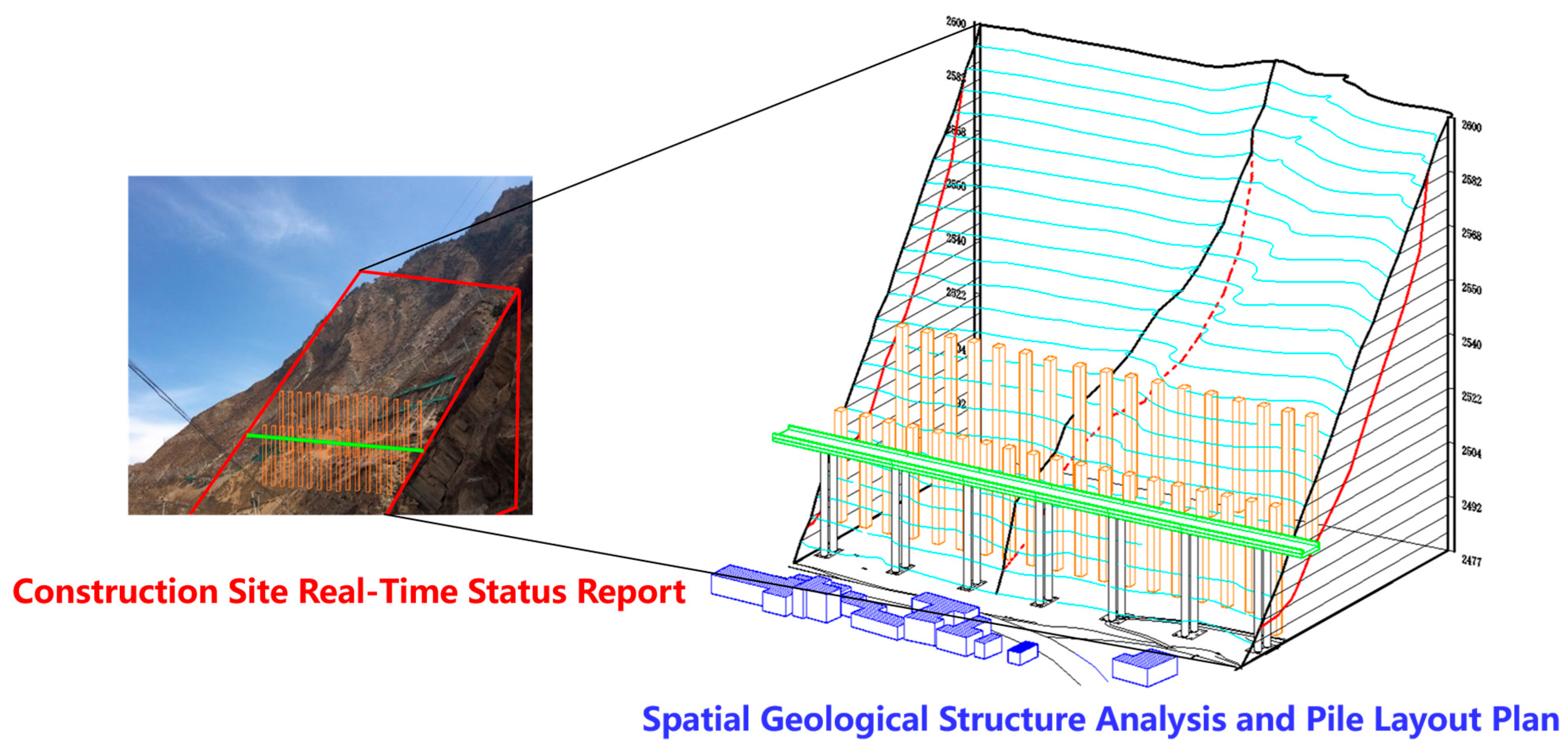
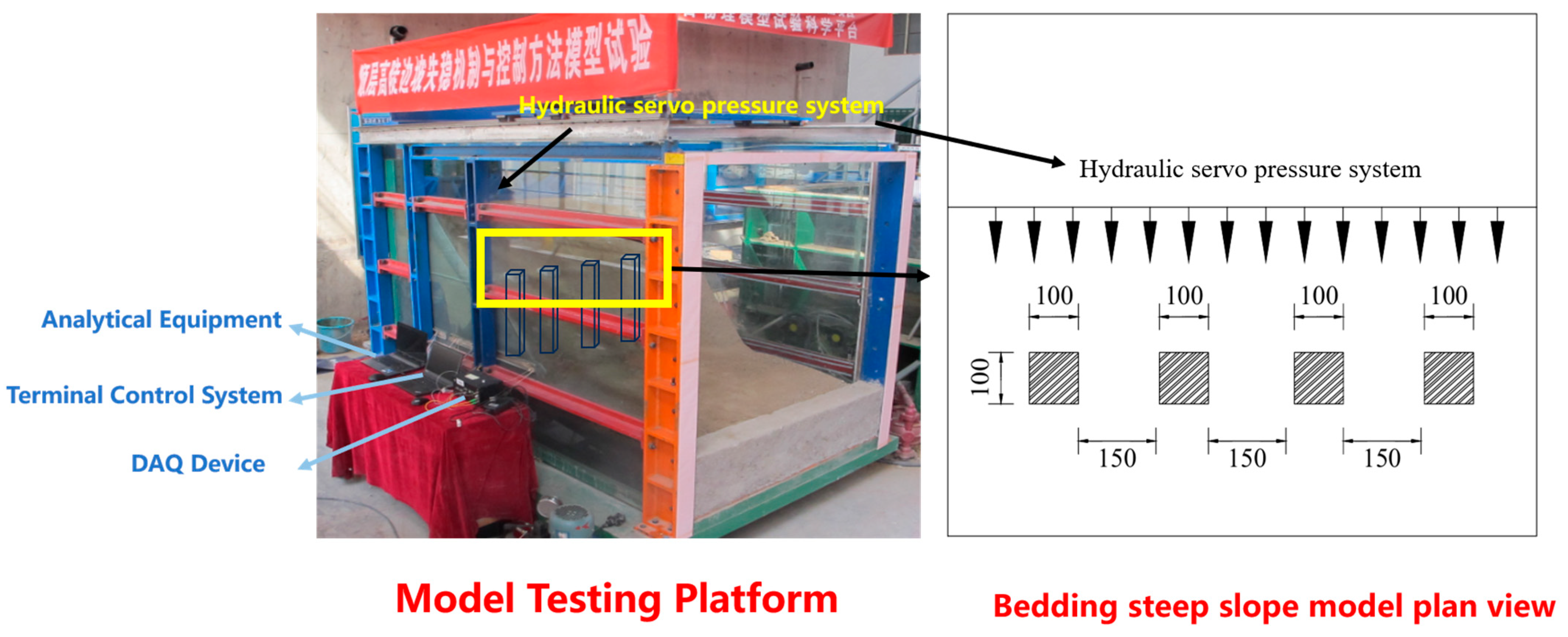
With the support of the large bedding steep slope located at a section of the Chengdu to Chuanazhusi Cheng-Lan high-speed rail, the geological mechanics model tests for the instability mechanism and control method of bedding steep slope were carried out to determine the mechanical characteristics and deformation failure mechanism of the bedding steep slope.
The project area was located at the eastern edge of the Tibetan Plateau, a major landslide region and geological formation encompassing the Minjiang fractures, which demarcate the Songpan–Ganzi orogenic belt and Motian land, and displays the motion properties that thrust from west to east and strike-slip. The north–south fault has a west-dipping section with a width of 50–100 m. Nevada’s Great Basin region is constructed of high-middle mountain geomorphology, undulating terrain, ground elevations of 2460–2900 m, relative elevations of 50–400 m, and generally steep natural mountain slopes between 30 and 70 degrees. The slope rock mass is mainly composed of Triassic metamorphic sandstone and slate with interlayer distribution, showing a typical layered sedimentary structure. The sandstone strata have a dense texture, with main mineral components including quartz (65~72%), feldspar (10~15%), and a small amount of mica and clay minerals. The slate has a well-developed foliation structure, with clay mineral content up to 30~40%, forming the dominant weak interlayer in the slope. The mechanical properties of the rock mass were obtained through field coring and laboratory rock mechanics tests: the intact sandstone has an elastic modulus of 28~35 GPa, Poisson’s ratio of 0.22~0.25, uniaxial compressive strength of 80~105 MPa, and shows brittle elastic failure characteristics under uniaxial compression. The foliated slate has an elastic modulus of 8~12 GPa, Poisson’s ratio of 0.30~0.33, uniaxial compressive strength of 25~40 MPa, with significant plastic deformation before failure, and the interlayer shear strength is only 15~25% of the intact rock mass. The rock mass viscosity coefficient is 1.2 × 10
16~3.5 × 10
16 Pa·s measured by creep test, which shows obvious time-dependent deformation characteristics under long-term axial load. Slope collapse and dangerous rock were the most significant geological phenomena in the engineering area. Under seismic activity and human factors, the loosely packed layer kept moving towards the lower part of the slope, so that the upper strata was exposed and its inclination increased with elevated height—the angle at the slope top approached 90°. Therefore, the landslide mode evolved from the slip mode to the buckling mode, affected by top rock pressure (
Figure 1). As the high-speed railway bridge foundation was at the toe of the slope, the anti-sliding pile method was designed to reinforce the slope to guarantee the safety of construction and operation.
3. Theoretical Analysis
An arbitrary point
with displacement component of
is located at the mid-plane of a fore-pile slide mass of the bedding steep slope, and the displacement components of the arbitrary point
outside the mid-plane are
. The relations between
and
are:
in which the mid-plane displacements
;
are independent corners of
, so the strain relations of
are:
in which the membrane strains of the mid-plane respectively are:
The transverse shear strains of the mid-plane are:
The transverse shears are:
The internal force equations are:
in which D is the bending stiffness with expression
, and
is the conversion factor of the mid-plane transverse shear strains
and average values of transverse shear strains
(the value often takes 1, 5/6 or 3/4) referred to as the shear factor hereinafter. The equilibrium equations of the rock plate model of slide mass are:
The above equations expressed by displacement components (
w,
φ,
ψ) can be obtained:
because the membrane forces in small-deflection buckling theory are directly produced by the action of in-plane load, which can be regarded as known quantities. When the medium plates are not subjected to normal load (
q = 0), the fundamental equations of the small-deflection buckling of rock plates can be written as:
The transverse shear items
and
in Equation (10b,c) can be substituted into Equation (10a), the foundational equation concerning one middle surface displacement component (
), and can be obtained. If the intersection angles
φ,
ψ are no longer independent variables, i.e.,
,
, then:
in which the Laplace operator is
.
It is assumed that the slide mass of the bedding slope is subjected to the uniform pressure
p. The translation motions of plate edges occur in plane, and the stresses in other directions are not produced by the deformation along the direction of the
x-axis. The membrane forces here are
T1 = −
p,
T2 =
T12 = 0, so Equation (11) can be rewritten as:
In order to satisfy the boundary conditions of four simply supported edges, the functions of deflections and angles are expressed as:
in which
Wmn, Φ
mn, and Ψ
mn are undetermined coefficients.
Equation (13a–c) are substituted into Equation (10), and the following equations can be obtained:
The relational expressions of Φ
mn, Ψ
mn, and
Wmn can be obtained by the addition and subtraction of Equation (14b,c):
in which:
Equation (15) is substituted into Equation (14a):
For the non-trivial solution of
Wmn, the parenthetical item should be equal to zero, that is:
The critical load of rock plate means the minimum load satisfying Equation (18). Based on observation and analysis, it is considered that
p monotonously increases with the growth of parameter
n, so only one half-wave can be formed in the
y direction (
n = 1). According to the extremum condition of function, the formula of
dp/
dm = 0 is adopted to work out the minimal value of
p with condition of
m =
a/
b (the parameter
m must be a positive integer and discontinuous variable), thus the critical load of slide mass buckling can be calculated:
The buckling model of rock plate considering transverse shear deformation established in this study is based on the following basic assumptions, and its application scope is defined accordingly.
Material assumption: The rock mass of the bedding slope is assumed to be a homogeneous, isotropic and linear elastic medium, which is suitable for intact or weakly jointed layered rock mass with good integrity. For rock mass with dense joints, well-developed structural planes or significant anisotropy, the calculation parameters need to be corrected according to the joint development degree.
Deformation assumption: The model adopts the small-deflection buckling theory of thick plate, which is suitable for the buckling deformation of rock plate with deflection far less than the thickness of the rock layer, and can consider the non-negligible transverse shear deformation of medium-thick rock plate (the ratio of thickness to side length is between 1/5 and 1/20). For rock plates with ultra-thin thickness (thickness to side length ratio less than 1/20), the classical thin-plate theory can be used for approximate calculation; for large-deflection buckling after slope instability, this model is not applicable.
Boundary condition assumption: The model adopts the four-edge simply supported boundary condition, which is suitable for the bedding slope with anti-slide pile support at the slope toe, rigid bedrock constraint at the slope bottom, and lateral constraint on both sides of the sliding mass. For slopes with free boundary or other complex boundary conditions, the boundary terms of the theoretical model need to be re-derived and corrected.
Load condition assumption: The model considers the uniform in-plane unidirectional compression load, which is suitable for slope instability dominated by self-weight of the upper rock mass and horizontal in situ stress. For slopes under dynamic loads such as earthquakes, groundwater seepage, and blasting vibrations, the additional load term needs to be introduced into the model for further modification.
5. On-Site Validation and Engineering Application
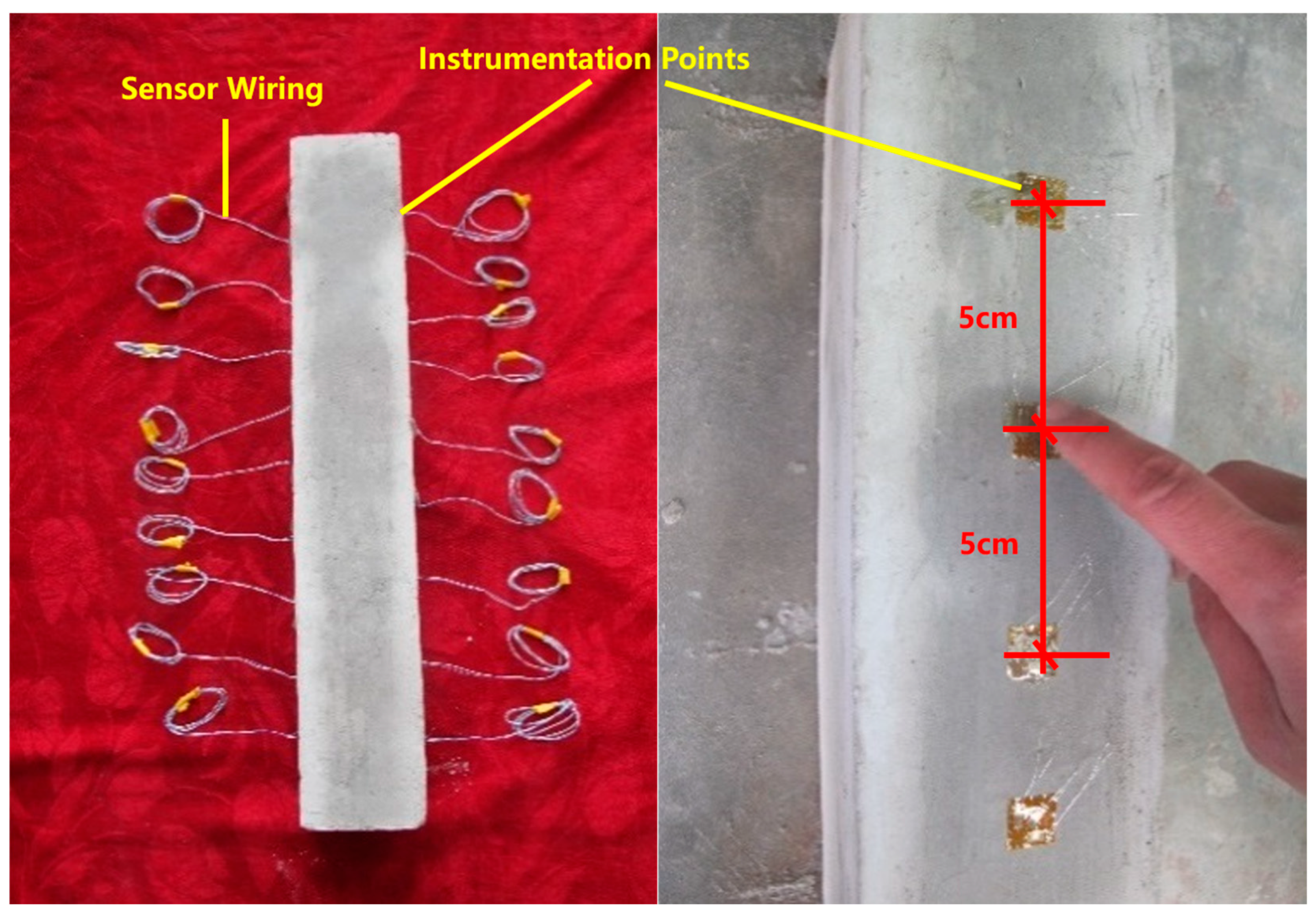
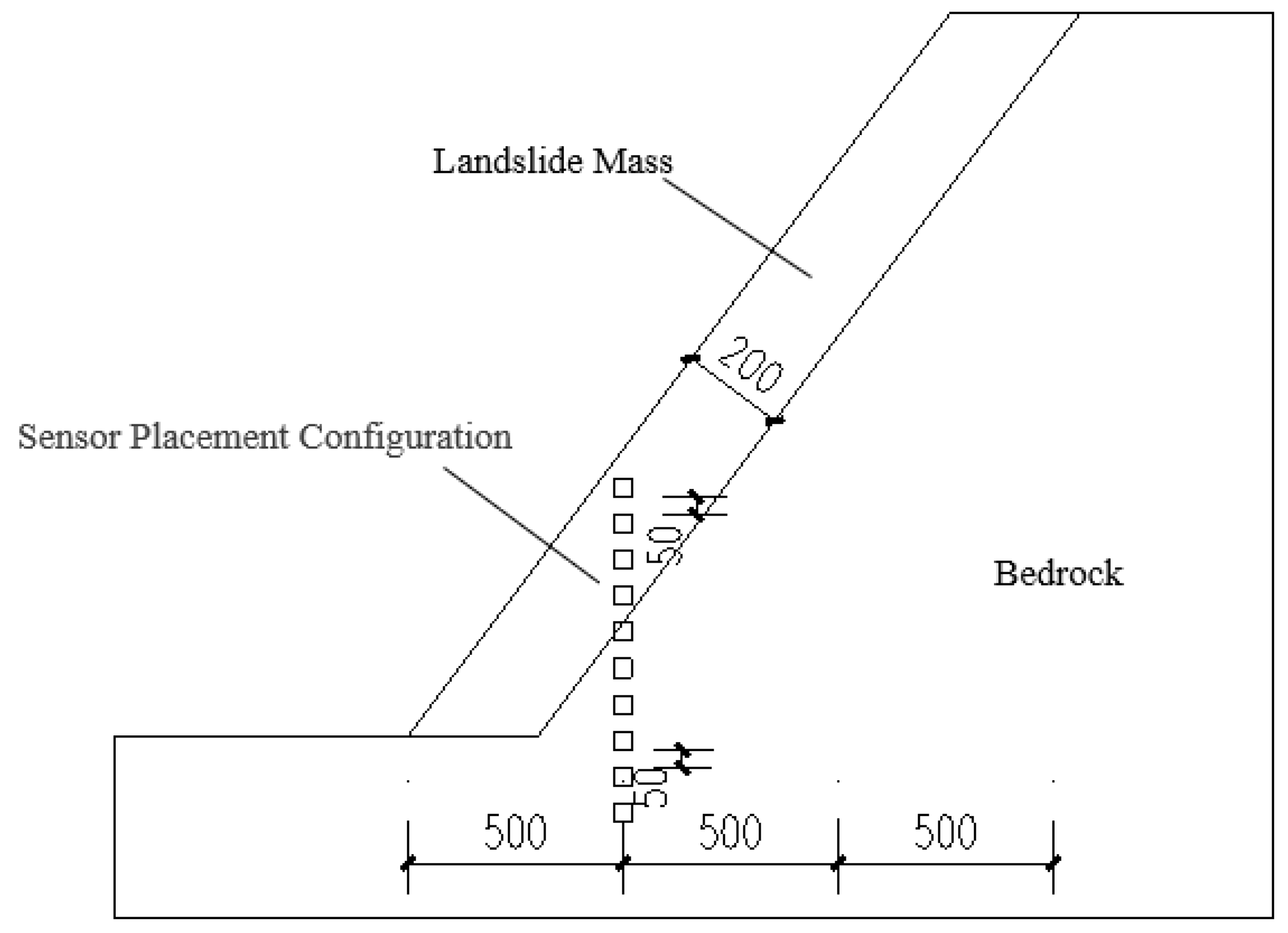
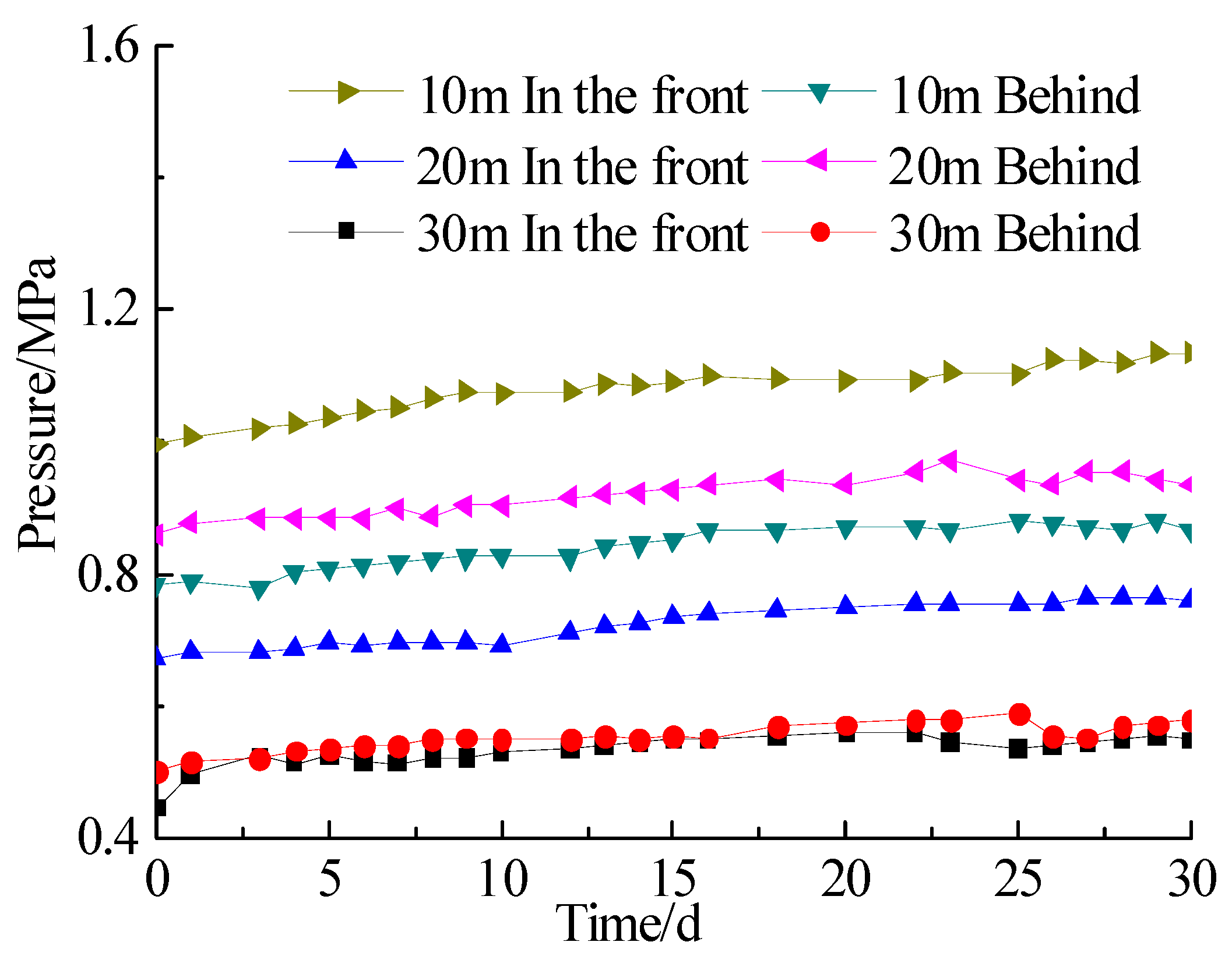
This section takes the prototype slope of Cheng-Lan high-speed railway as the research object, carries out long-term in situ monitoring of the anti-slide pile supporting structure, and focuses on verifying the correlation between the theoretical critical buckling load of the rock plate model, the model test results, and the field-measured mechanical response, so as to clarify the distribution law of mechanical load and pile deformation characteristics under the buckling instability of the bedding rock slope. The horizontal pressure on the pile was monitored by embedded pressure gauge. Firstly, holes were dug at the right positions; secondly, the pressure gauge was placed in the groove of a prefabricated concrete block; next, the hole was sealed with the same grade concrete after leveling to ensure the pressure gauge had full contact with the media; and finally, the pressure gauge wire was lead outside through a PVC pipe to carry out measurement. The pile pressure monitoring curve is shown in
Figure 8, and shows the curves of the measured pressure around the pile onsite over time. The pressure of the front pile stabilizes at 1.12 MPa, and the pressure of the rear pile was 0.82 MPa, both of which were lower than the theoretical critical load (1.813 MPa). The measured pressure was 62% of the theoretical value, indicating that the design has a high safety margin. The pressure curves fluctuate slightly (with a standard deviation < 0.05 MPa), suggesting that the onsite rock mass has good stability.
Combined with the theoretical model and model test results, the correlation analysis of load and deformation was carried out as follows:
1. Correlation of critical buckling load: The theoretical critical buckling load of the prototype rock plate was 1.813 MPa, the critical load measured by the model test after similarity conversion was 1.72 MPa, and the maximum stable load measured on site was 1.12 MPa. The theoretical value was in good agreement with the model test value, with a relative deviation of only 5.13%, which verifies the accuracy of the theoretical model in calculating the critical buckling load of the layered rock mass. The field-measured value was lower than the theoretical critical value, which was because the theoretical model adopted the homogeneous isotropic assumption, while the field rock mass had a certain residual strength and structural self-stabilization ability. The supporting structure provided additional safety reserve.
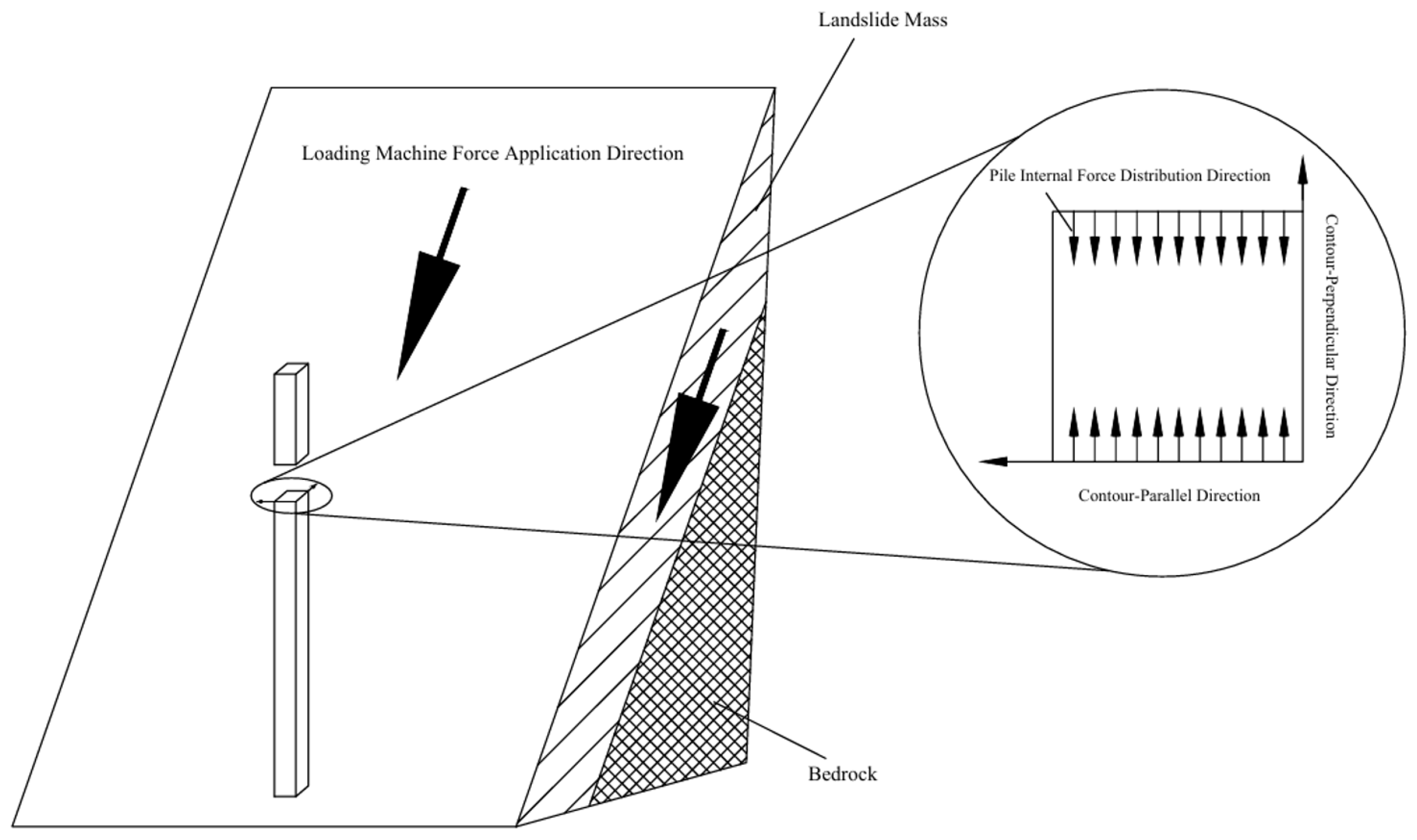
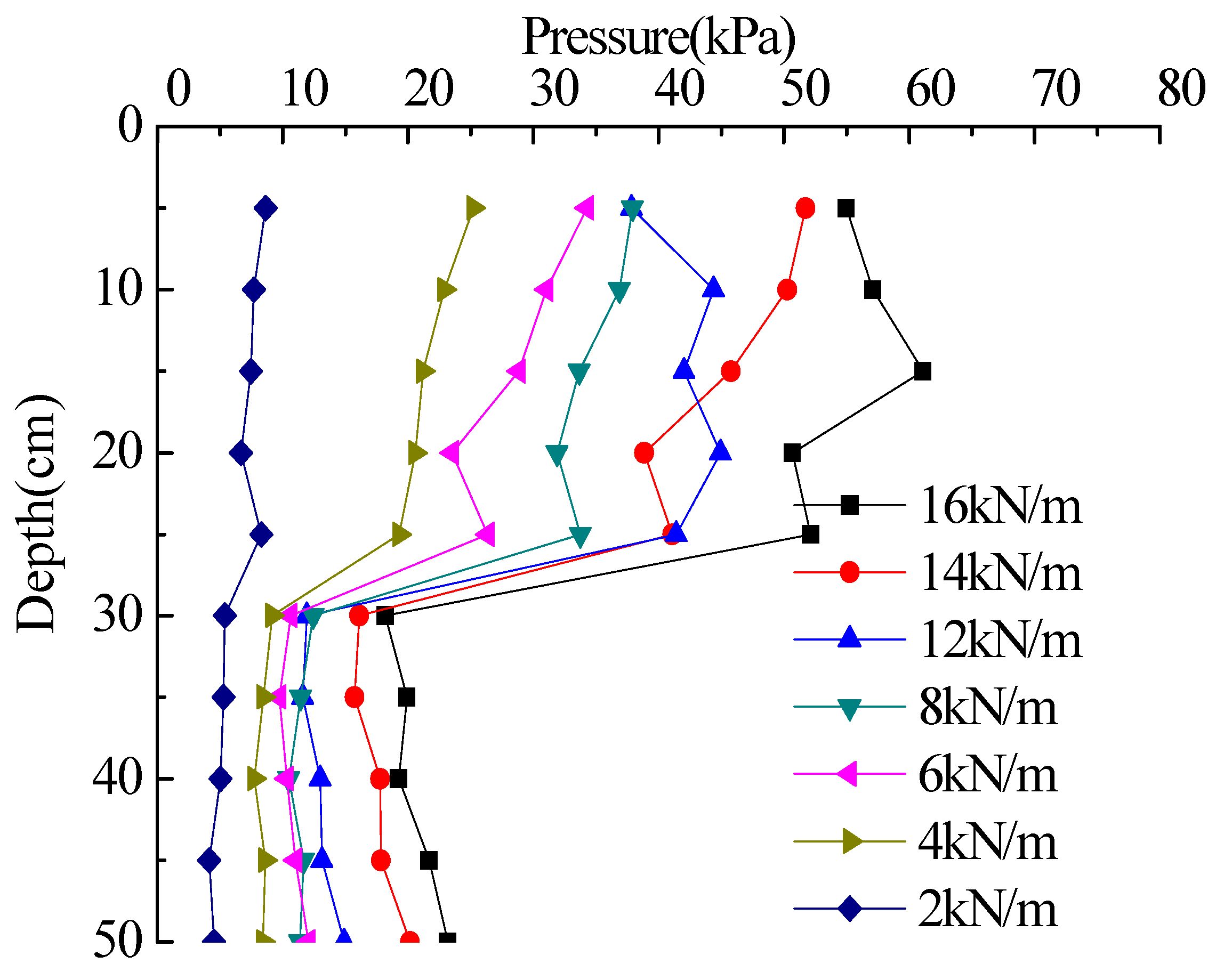
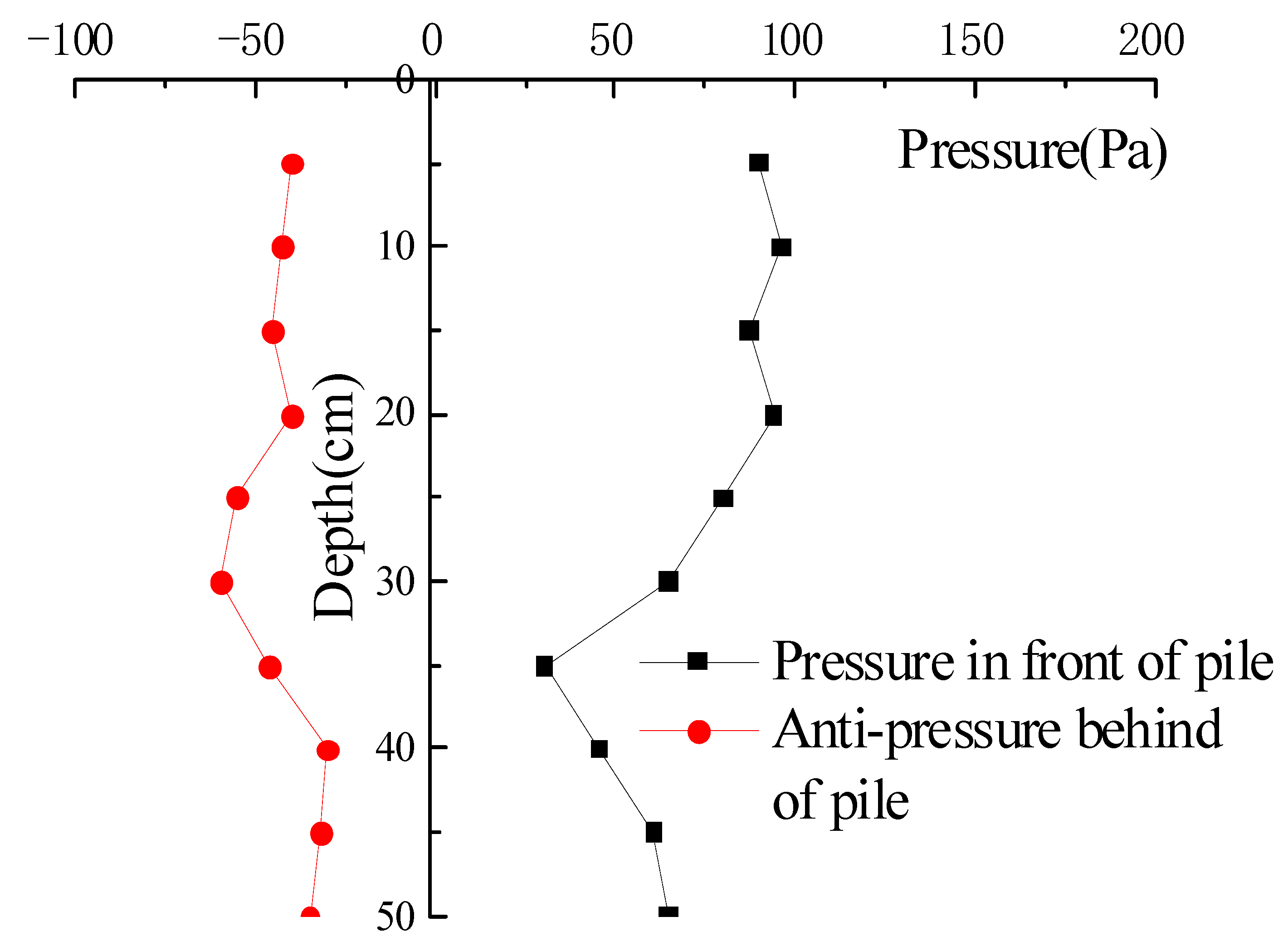
2. Distribution characteristics of mechanical load and shear stress: The theoretical model shows that the buckling of the rock plate will cause the concentrated distribution of the thrust load in the middle and upper part of the anti-slide pile, which is consistent with the model test result that the peak pressure of the front pile is concentrated at 1/3 of the height below the pile top (
Figure 9). The field-measured peak pressure is also located at the same position, with a coincidence degree of more than 90%. The shear stress of the pile body calculated by the theoretical model is concentrated at 1/2 height of the pile, which is consistent with the maximum shear strain position monitored by the model test, and the relative deviation of the shear stress peak value is 6.82%, which verifies that the theoretical model can accurately characterize the shear stress distribution caused by transverse shear deformation of the rock plate.
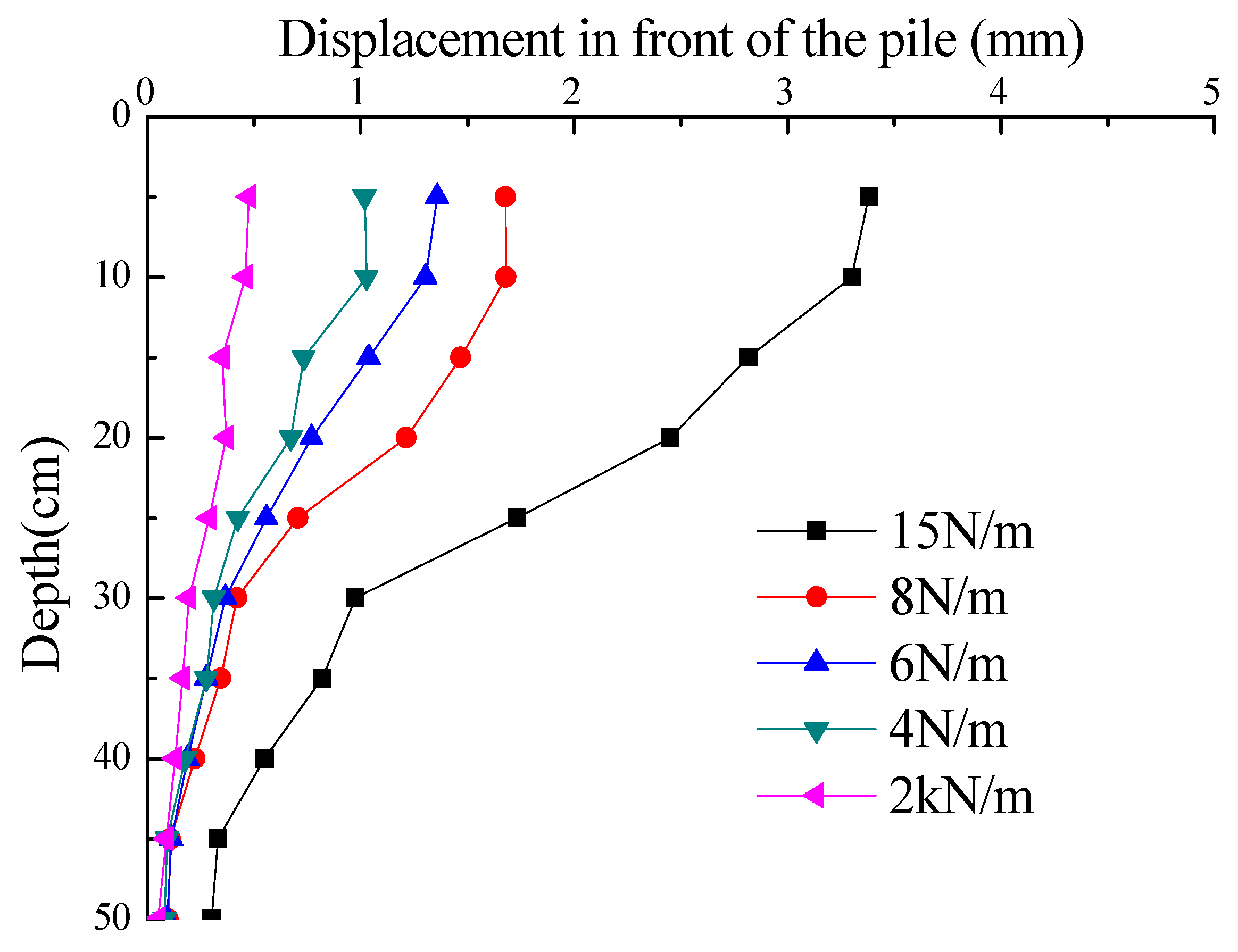
3. Pile deformation type and correlation analysis: The pile deformation under the rock plate buckling load is mainly composed of bending deformation and shear deformation. The model test results show that the bending deformation accounts for about 78% of the total displacement of the pile top, and the shear deformation accounts for about 22%, which is consistent with the deformation composition calculated by the theoretical model considering transverse shear deformation. The field-measured pile body deformation is mainly forward-tilting bending deformation overall, with the maximum displacement at the pile top and the displacement at the pile bottom approaching zero: this is consistent with the deformation law of the theoretical model and the model test, and further verifies the rationality of the “buckling of the sliding mass pushes the pile body” hypothesis in the theoretical model.
Figure 9.
Pressure around the pile.
Figure 9.
Pressure around the pile.
The above results show that the theoretical calculation results of the rock plate buckling model considering transverse shear deformation have a high correlation with the model test and field-measured results, and can accurately characterize the distribution law of landslide thrust, pile load and deformation caused by the buckling instability of bedding rock slopes, which verifies that the anti-slide pile design based on the theoretical model is reasonable and the slope protection project is in a stable state.