Article

Hydrodynamic Response of a Short Magnetorheological Squeeze Film Damper Based on the Mason Number


by
Juan P. Escandón
1,*,
Juan R. Gómez
1,*,
René O. Vargas
1,
Edson M. Jimenez
1,
Rubén Mil-Martínez
2 and
Alejandro Zacarías
1
1
Departamento de Termofluidos, SEPI-ESIME Unidad Azcapotzalco, Instituto Politécnico Nacional, Av. de las Granjas No. 682, Col. Santa Catarina, Alcaldía Azcapotzalco, Ciudad de México 02250, Mexico
2
Escuela Militar de Ingeniería, Universidad del Ejército y la Fuerza Aérea, Av. Industria Militar No.261, Col. Lomas de San Isidro, Naucalpan de Juárez, Ciudad de México 53960, Mexico
*
Authors to whom correspondence should be addressed.
Appl. Sci. 2026, 16(6), 2791; https://doi.org/10.3390/app16062791
Submission received: 13 February 2026 / Revised: 11 March 2026 / Accepted: 12 March 2026 / Published: 13 March 2026
(This article belongs to the Special Issue Advances in Fluid Mechanics Analysis)

Abstract

This study analyzes the hydrodynamic characteristics of a short magnetorheological squeeze film damper, with emphasis on the fluid microstructure responsible for generating damping forces. The magnetorheological fluid contains non-Brownian spherical particles suspended in a non-magnetic Newtonian fluid. When exposed to a magnetic field, these particles form chain-like structures that restrict fluid motion. In this context, the Mason number characterizes the fluid microstructure and establishes the ratio of viscous to magnetic forces. The mathematical model for solving the flow field, which depends on the continuity and momentum laws, the Bingham rheological model, and boundary conditions at the interfaces, is solved analytically. The Reynolds equation determines the fluid pressure distribution and follows the Sommerfeld boundary condition. Mass imbalance induces chaotic rotor motion, resulting in lateral vibrations. As the journal squeezes the fluid, positive pressure develops, generating damping forces that dissipate vibration energy. The results in this research show that the Mason number significantly affects fluid pressure, which increases as magnetostatic forces exceed viscous forces. This increase in pressure produces damping forces that reduce rotor displacement. Additionally, both radial and tangential forces increase with particle volume fraction, in contrast to classical Newtonian behavior. These findings are relevant to the handling of magnetorheological fluids in vibration control mechanisms.

1. Introduction

Magnetorheological (MR) fluids are smart materials that can modify their rheological properties in response to an applied magnetic field [1]. These fluids contain ferromagnetic particles typically pure iron, carbonyl iron, or cobalt powder, with sizes between 0.003 and 10 μ m, suspended in a non-magnetic carrier fluid [2,3]. Without a magnetic field, the particles randomly disperse in the carrier fluid, thereby increasing the MR fluid viscosity [4]. However, when subjected to a magnetic field, dipole-dipole interactions between particles form chain-like structures that restrict fluid motion [5,6]. This is a fundamental characteristic of MR fluids that describes the transition from a liquid to a semi-solid state [7]. The MR fluid then acts as a rigid body whose yield stress depends on the magnetic field intensity and particle volume fraction [8]. Once the particles are fully magnetized, the yield stress becomes field-independent [9].
In MR fluids, the Mason number measures the ratio of hydrodynamic to magnetostatic forces, which is relevant to the formation or collapse of particle chain-like structures [10,11]. Magnetostatic forces refer to magnetic attraction forces between particles induced by a magnetic field [10,12]. Meanwhile, hydrodynamic or viscous forces are the drag forces that the carrier fluid exerts on particles when a shear stress is applied [13]. The deformation of chain-like structures under shear stress depends on the operating mode [14]. In valve mode, an MR fluid deforms in response to a pressure difference between the inlet and outlet of a channel [15]. This principle is used for vibration control in devices such as shock absorbers for vehicle suspension systems, seat dampers, recoil dampers, landing gear, and large stroke dampers for bridges and buildings [2,7]. In shear mode, the relative motion of an actuating interface regarding a stationary surface deforms the fluid; this mode is used in applications such as shock absorbers, brakes, and clutches [2,16]. Finally, in squeeze mode, an MR fluid is confined between two surfaces and subjected to a normal force as one surface moves toward the other; this mode is suitable for vibration-isolation systems for small-magnitude excitations [16,17].
In squeeze mode, squeeze film dampers are commonly used in rotating machinery to mitigate vibrations and enhance system stability; vibrations generally arise from mass imbalance or from operating close to a critical speed [18]. These dampers utilize the hydrodynamic response of the working fluid to generate damping forces as the rotor squeezes the lubricant into the clearance of the oil film [19]. Considering the lubricant as a Newtonian fluid, Kang et al. [20] investigated the effect of clearance on rotor behavior and reported that damping increases with decreasing clearance. Zhou et al. [21] considered the effect of air ingestion on the vibration-damping properties of squeeze film dampers and found that the oil film pressure decreases with increasing fractional volume of air ingestion. Fan and Behdinan [22] studied the effects of a circumferential central groove in a squeeze film damper and found that the axial pressure peak is flat when the groove depth is not constant. Chen et al. [23] analyzed the dynamic behavior of a flexible rotor system supported by a squeeze film damper and found that inertial effects influence the flow field only at high Reynolds numbers. Furthermore, they determined that fluid viscosity affects damping coefficients, i.e., a reduction in viscosity results in lower damping.
Meanwhile, considering the lubricant as an MR fluid, Van der Meer et al. [24] found that an MR fluid under a magnetic field has higher viscosity than a traditional oil. Singh et al. [25] reported that MR dampers provide controllable damping forces via a magnetic field. Wang et al. [26] investigated the behavior of MR dampers coupled to a flexible rotor and concluded that the vibration amplitude decreases with increasing yield stress of the MR fluid. Ma et al. [27] examined the relationship between magnetic induction and yield stress and concluded that the magnetization of the MR fluid is nonlinear. Their results show that yield stress increases linearly at first and then stabilizes as the MR fluid approaches magnetic saturation. Meng et al. [28] studied the squeeze-strengthen effect in a magnetorheological squeeze film damper and observed that magnetization causes MR fluid particles to form chain-like structures, thereby significantly increasing the yield stress. Furthermore, they reported that these particle chains become stronger as the fluid is squeezed. Zapoměl et al. [29,30,31] modeled the behavior of an MR fluid using Bingham and bilinear models, highlighting the generation of a core when the yield stress exceeds the shear stress, thereby generating damping forces. Their results show that a bilinear material exhibits a continuous flow curve, unlike a Bingham fluid. Furthermore, for pressure distribution, Irannejad and Ohadi [32] studied the journal-bearing aspect ratio to generate damping forces and established that a short bearing approximation, where the shaft length is less than the journal bearing diameter, more accurately simulates the real behavior of most journal bearings.
Overall, the macroscopic properties of MR fluids are determined by their chain-like microstructures. However, existing research on MR squeeze film dampers typically neglects fluid microstructure in the analysis of damping force generation. Although several studies have examined MR squeeze film dampers using the Bingham model, none have demonstrated the influence of magnetic particles on the carrier fluid. This is because the Bingham model is a continuum approach that estimates MR fluid behavior from macroscopic properties but does not consider the formation of chain-like structures [11,33]. The current literature does not provide a comprehensive analysis of the flow characteristics or the formation of chain-like structures arising from hydrodynamic and magnetostatic interactions [34]. Therefore, this study analyzes the hydrodynamic response of a magnetorheological squeeze film damper, with emphasis on the microscopic characteristics of the fluid film responsible for damping. This MR fluid microstructure-based approach improves the accuracy of hydrodynamic analysis for determining damping forces. The MR fluid microstructure is determined by the Mason number and particle volume fraction, assuming non-Brownian motion of hard spherical particles in an incompressible Newtonian fluid [35]. Furthermore, the Mason number exhibits an inverse relationship with the Bingham number, since the characteristic shear rate remains the same across both microscopic and macroscopic scales [13]. This work also assumes nonlinear magnetization of the MR fluid, making the yield stress dependent on magnetic field strength, particle volume fraction, and particle saturation magnetization. The method proposed in this work provides better insight into managing MR fluids to generate damping forces via hydrodynamic and magnetostatic interactions, thereby enhancing the understanding of semi-active damping techniques.

2. Problem Formulation

2.1. Physical Model

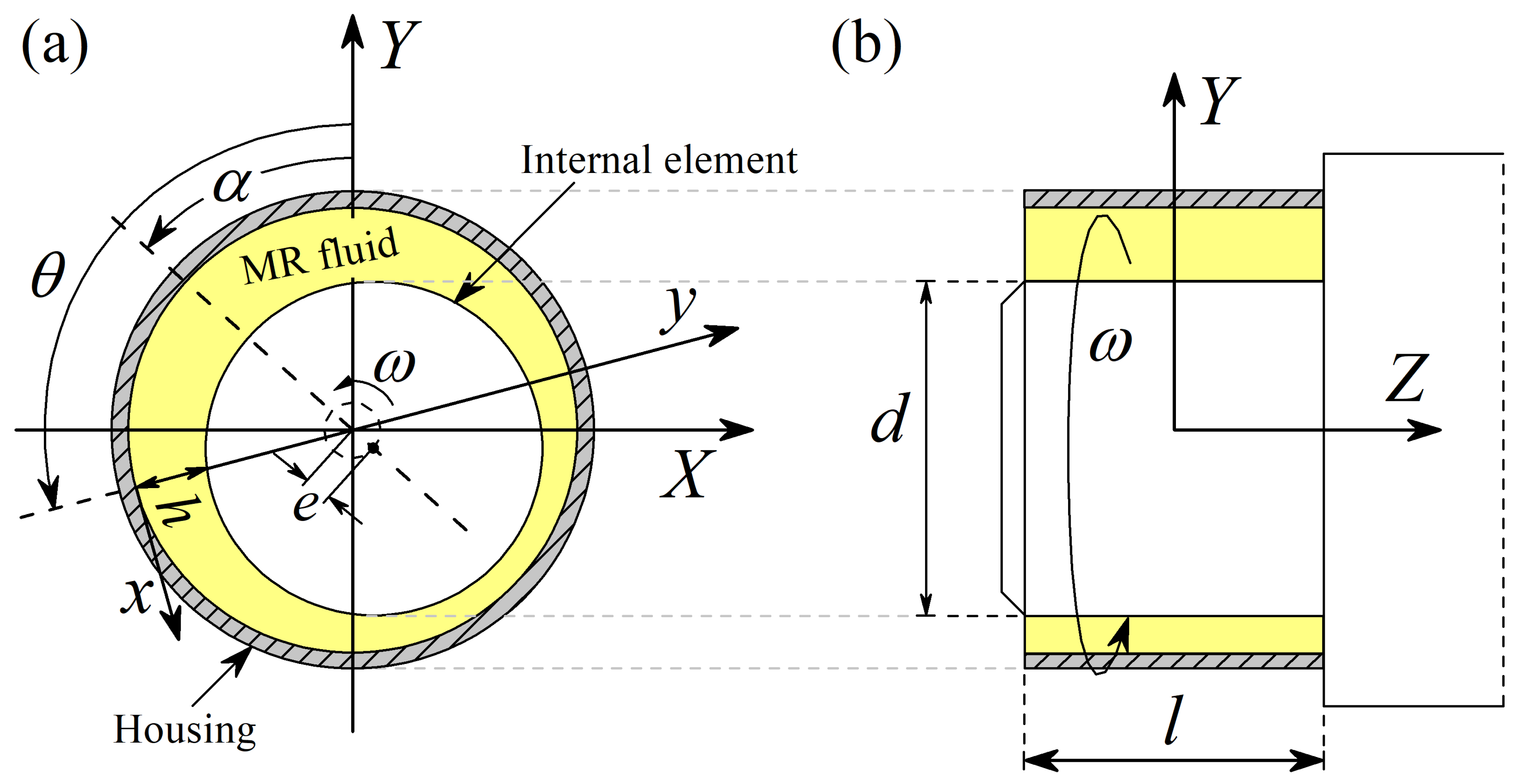
This work analyzes the hydrodynamic behavior of a magnetorheological squeeze film damper. Figure 1a illustrates the cross-sectional view of the device, constructed as follows [26,27]. The inner race of a ball bearing supports the shaft and transfers the whirl motion to the rolling elements. Then, an elastic squirrel cage, fixed to the rotating machine, holds the outer race of the bearing, preventing its rotation but experiencing translational motions due to lateral vibrations generated by rotor imbalance. Based on this structure, the outer face of the internal element refers to the outer surface of the squirrel cage. Furthermore, the internal element motion with angular velocity ω simulates centered circular orbits of the shaft with static eccentricity e [19]. In this figure, a thin MR fluid film (yellow region), between the damper housing and the internal element, acts as a damping element to control rotor loading. Due to the system imbalance, the fluid thickness, which depends on the circumferential coordinate θ , is defined as h = c + e cos ( θ α ) , where c is the clearance and α is the angle position of the line of centers. On the other hand, Figure 1b shows the side view of the MR damper, where d is the internal element diameter and l is the damper width. In general, ( X , Y , Z ) represents the local coordinate system at the center of the MR damper, and ( x , y , z ) denotes the coordinate system used to study the oil film behavior, where the z coordinate is perpendicular to the x y plane. Regarding damping capacity using an MR fluid, the semi-active damping control system uses magnetic fields to adjust the fluid resistance. Therefore, the damper housing is equipped with electromagnetic coils that regulate the magnetic field intensity passing through the MR fluid, thereby generating controllable damping forces.

2.2. Governing and Constitutive Equations

The motion of an incompressible fluid is modeled by the continuity and momentum equations, as follows:
· V = 0
and
ρ D V D t = p + · τ + F ,
where V is the velocity vector, ρ is the fluid density, t is the time, p is the pressure, τ is the stress tensor, and F is the body force. Additionally, this work utilizes the Bingham model to describe the non-Newtonian characteristics of the fluid film [14,36]:
τ = ± τ 0 + η p γ ˙ ,
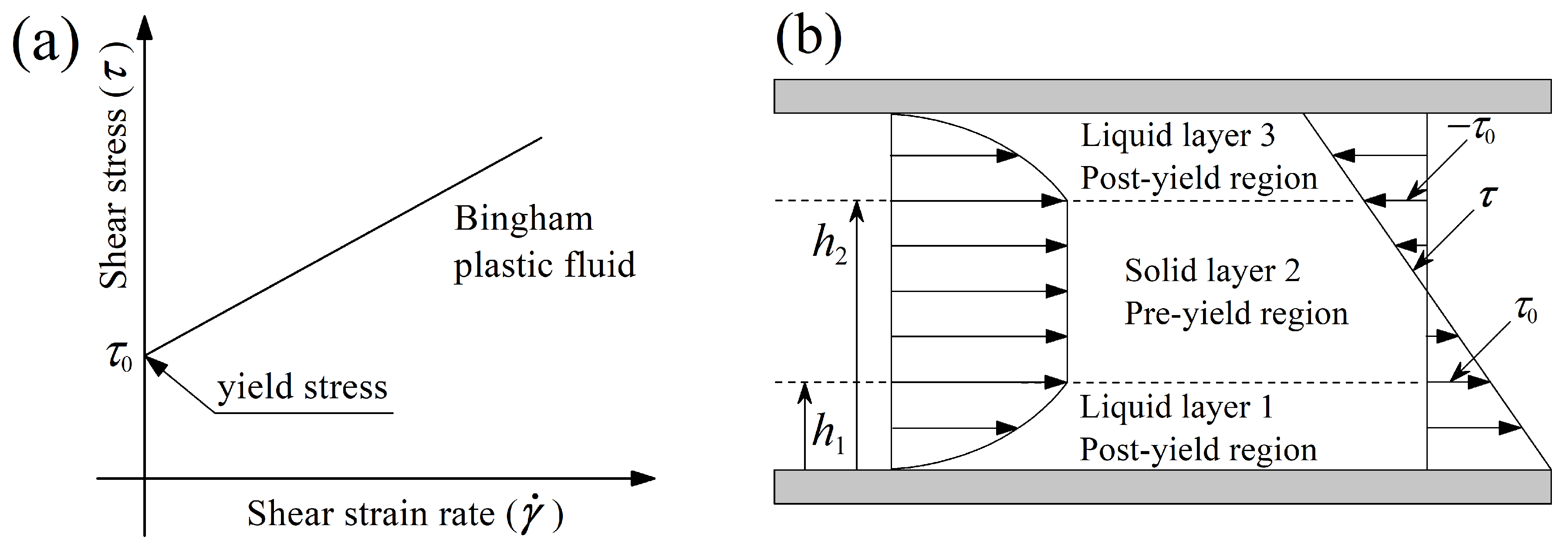
where τ 0 is the yield stress, η p is the plastic viscosity, γ ˙ = ( V ) + ( V ) T is the shear strain rate, and ( V ) T is the transpose of the tensor ( V ) . Figure 2a illustrates the Bingham model [14], where a fluid deforms when the shear stress exceeds its yield stress. In MR fluids, increasing the magnetic field strength raises the yield stress and enhances mechanical resistance. On the other hand, Figure 2b presents the velocity profile and stress distribution for an MR fluid [14]. In a flat plate channel, shear stress is zero at the center and reaches its maximum at the walls. The symmetrical stress distribution, combined with the yield stress of the MR fluid, determines the velocity profile. According to Equation (3) and Figure 2a, the MR fluid deforms and acquires a liquid-like behavior when shear stress exceeds its yield stress, as observed in the post-yield regions in Figure 2b. Meanwhile, when shear stress is equal to or less than the yield stress, the MR fluid does not deform and acquires a solid-like behavior, as observed in the pre-yield region in Figure 2b. Compared to the parabolic velocity profile of a Newtonian fluid, an MR fluid based on the Bingham model exhibits a velocity profile with plug flow at the center. This plug flow represents the chain-like structures that inhibit fluid motion [14]. In Figure 2b, the interface positions h 1 and h 2 indicate the phase change from liquid to solid. Also, the shear stresses at h 1 and h 2 are τ = τ 0 and τ = τ 0 , respectively.
In MR fluids, the magnetic field intensity affects the rate of yield stress growth, which is influenced by nonlinear magnetization. Furthermore, once magnetic particles deposited in the carrier fluid are fully magnetized (saturated), any further increases in magnetic field will not raise the yield stress. In this regard, at low magnetic fields, the magnetization of an MR fluid is proportional to the magnetic field; hence, the yield stress is [5]:
τ 0 = ϕ μ 0 B 2 ,
where ϕ is the particle volume fraction, μ 0 = 4 π × 10 7 TmA−1 is the vacuum permeability, and B is the magnetic field. While for magnetic fields that exceed the linear regime but remain below the magnetic saturation of particles, the yield stress is [5,7]:
τ 0 = 6 ϕ μ 0 M s 1 / 2 B 3 / 2
and once a strong magnetic field fully magnetizes the particles in the carrier fluid, the yield stress becomes dependent on the magnetic saturation of particles rather than the applied magnetic field. Thus, the yield stress is expressed as [5,7,11]:
τ 0 = 0.086 ϕ μ 0 M s 2 ,
where M s is the saturation magnetization of the particles.
When a magnetic field is applied to an MR fluid, the particles suspended in the carrier fluid form chain-like structures that inhibit fluid motion. As a result, the MR fluid behaves like a rigid body whose resistance is characterized by magnetic attraction force between particles (also known as magnetostatic forces) [12,13]:
F 0 = π 48 μ 0 σ 2 M p 2 ,
where σ is the diameter of spherical particles and M p is the magnetization of particles defined as:
M p = M ϕ .
For estimating the magnetization of particles, this work assumes the magnetization of the MR fluid as [37]:
M = B ( μ e f f 1 ) ϕ ,
where μ e f f is the effective permeability of the MR fluid defined as:
μ e f f = μ c r [ 1 3 ϕ m log ( 1 ϕ / ϕ m ) ] ,
where μ c r is the relative permeability of the carrier fluid and ϕ m is the maximum packing fraction. Meanwhile, lateral vibrations in the fluid film deform the particle chain-like structures. In this case, the magnetic particles experience drag forces due to fluid motion, known as hydrodynamic or viscous forces [13].
F H = 3 π η c σ 2 γ ˙ c ,
where η c is the carrier fluid viscosity, γ ˙ c ( u c / c ) is the characteristic shear rate of the system, and u c is the characteristic velocity. Finally, the ratio of hydrodynamic to magnetostatic forces determines the formation of particle chain-like structures, which is key to generate damping forces in the system. At the microscopic scale, the dimensionless Mason number establishes this relationship of forces as [13]:
M n = F H F 0 = 3 π η c γ ˙ c τ ,
where τ is the magnetic stress defined as:
τ = F 0 σ 2 .

2.3. Simplified Mathematical Model

In order to simplify the governing and constitutive equations, this work considers the following assumptions based on the damper geometry and the flow conditions reported in the literature:
  • The fluid thickness is very thin compared to both the damper width and the internal element diameter, i.e., h l and h d [38].
  • The influence of film curvature in the system can be neglected because h d [39].
  • The flow is laminar with a small reduced Reynolds number ( R e m < 1 ) , indicating that viscous forces exceed inertial forces [40]. When evaluating the physical variables in this analysis, the reduced Reynolds number is R e m = R e ( c / l ) , where R e = ρ u c c / η p is the Reynolds number and is O ( 1 ) , as well as ( c / l ) , which is the ratio of clearance to damper width and is O ( 10 2 ) .
  • The fluid viscosity is constant and does not consider the effect of temperature [41].
  • The flow field neglects gravitational body forces because the fluid film has a small body weight relative to the magnitude of viscous and pressure forces [40,42].
Considering the above, Equations (1) and (2) can be simplified in Cartesian coordinates as:
0 = u x + v y + w z ,
p x = τ x y y ,
p y = 0
and
p z = τ z y y ,
where u, v, and w are the velocity components in the coordinates ( x , y , z ) , as well as p / x , p / y , and p / z are the pressure gradients in the coordinates ( x , y , z ) . Meanwhile, the shear stresses based on the Bingham model in Equation (3) result as follows. The shear stress τ x y in Equation (15), considering the post-yield and pre-yield regions in Figure 2b, takes the following values:
for   the   liquid   layer   u 1 u 1 y > 0 ; τ x y = τ 0 + η p u 1 y , for   the   solid   layer   u 2 u 2 y = 0 ; τ x y = τ 0 , for   the   liquid   layer   u 3 u 3 y < 0 ; τ x y = τ 0 + η p u 3 y .
Likewise, the shear stress τ z y in Equation (17), considering the post-yield and pre-yield regions in Figure 2b, results in:
for   the   liquid   layer   w 1 w 1 y > 0 ; τ z y = τ 0 + η p w 1 y , for   the   solid   layer   w 2 w 2 y = 0 ; τ z y = τ 0 , for   the   liquid   layer   w 3 w 3 y < 0 ; τ z y = τ 0 + η p w 3 y .

2.4. Boundary Conditions

This work assumes that the fluid film adheres to the stationary walls of the channel (the damper housing and the squirrel cage) and acquires zero velocity at these surfaces, thereby satisfying the no-slip boundary condition. Furthermore, the velocity and shear stress at the interfaces where the liquid and solid layers converge are equivalent, satisfying the boundary conditions of velocity continuity and stress balance. In this context, the boundary conditions for solving the flow field along the x axis are as follows. The no-slip boundary conditions at the walls are:
u 1 = 0 at y = 0
and
u 3 = 0 at y = h .
While at the interface positions h 1 , x and h 2 , x , the velocity continuity boundary conditions are:
u 1 = u 2 at y = h 1 , x
and
u 3 = u 2 at y = h 2 , x ,
as well as the stress balance boundary conditions are:
τ 0 + η p u 1 y y = h 1 , x = τ 0 + η p u 2 y y = h 1 , x
and
τ 0 + η p u 3 y y = h 2 , x = τ 0 + η p u 2 y y = h 2 , x .
Additionally, the plug flow condition in the pre-yield region, which implies that d u 2 / d y = 0 at h 1 , x y h 2 , x , simplifies Equations (24) and (25) to:
u 1 y y = h 1 , x = 0
and
u 3 y y = h 2 , x = 0 .
Similarly, the boundary conditions for solving the flow field along the z axis are as follows. The no-slip boundary conditions at the walls are:
w 1 = 0 at y = 0
and
w 3 = 0 at y = h .
While at the interface positions h 1 , z and h 2 , z , the velocity continuity boundary conditions are:
w 1 = w 2 at y = h 1 , z
and
w 3 = w 2 at y = h 2 , z ,
as well as the stress balance boundary conditions are:
τ 0 + η p w 1 y y = h 1 , z = τ 0 + η p w 2 y y = h 1 , z
and
τ 0 + η p w 3 y y = h 2 , z = τ 0 + η p w 2 y y = h 2 , z .
Additionally, the plug flow condition in the pre-yield region, which implies that d w 2 / d y = 0 at h 1 , z y h 2 , z , simplifies Equations (32) and (33) to:
w 1 y y = h 1 , z = 0
and
w 3 y y = h 2 , z = 0 .

3. Dimensionless Mathematical Model

This section introduces the following dimensionless variables to normalize the previous simplified mathematical model and express the phenomenon under study in terms of dimensionless parameters that govern fluid behavior:
x ¯ = x d , y ¯ = y c , z ¯ = z l , u ¯ = u u c , v ¯ = l c v u c , w ¯ = w u c , τ ¯ = τ τ c , p ¯ = p p c ,
where d, c, and l are the characteristic lengths of a squeeze film damper [43], u c = ω d / 2 is the linear characteristic velocity related to the internal element motion under circular orbits [43], τ c = η p γ ˙ c is the characteristic stress for a Bingham plastic fluid [13], and p c l η p u c / c 2 is the characteristic pressure obtained from an analysis of orders of magnitude in Equation (17). Therefore, substituting Equation (36) into (14), (15), and (17)–(19) gives:
0 = ε u ¯ x ¯ + v ¯ y ¯ + w ¯ z ¯ ,
ε Γ x = τ ¯ x y y ¯
and
Γ z = τ ¯ z y y ¯ ,
where ε is the dimensionless geometric parameter defined as:
ε = l d ,
which relates the damper width with the internal element diameter in Figure 1. Furthermore, ( u ¯ , v ¯ , w ¯ ) are the dimensionless velocity components in the dimensionless coordinates ( x ¯ , y ¯ , z ¯ ) , and Γ x = p ¯ / x ¯ and Γ z = p ¯ / z ¯ are the dimensionless pressure gradients in the dimensionless coordinates ( x ¯ , z ¯ ) . In Equation (38), the dimensionless shear stress τ ¯ x y is determined by combining Equations (18) and (36) as follows:
for   the   liquid   layer   u ¯ 1 u ¯ 1 y ¯ > 0 ; τ ¯ x y = B i + u ¯ 1 y ¯ , for   the   solid   layer   u ¯ 2 u ¯ 2 y ¯ = 0 ; τ ¯ x y = B i , for   the   liquid   layer   u ¯ 3 u ¯ 3 y ¯ < 0 ; τ ¯ x y = B i + u ¯ 3 y ¯ ,
while in Equation (39), the dimensionless shear stress τ ¯ z y similarly results from combining Equations (19) and (36) in:
for   the   liquid   layer   w ¯ 1 w ¯ 1 y ¯ > 0 ; τ ¯ z y = B i + w ¯ 1 y ¯ , for   the   solid   layer   w ¯ 2 w ¯ 2 y ¯ = 0 ; τ ¯ z y = B i , for   the   liquid   layer   w ¯ 3 w ¯ 3 y ¯ < 0 ; τ ¯ z y = B i + w ¯ 3 y ¯ ,
where B i is the Bingham number defined as:
B i = τ 0 η p γ ˙ c ,
which represents the ratio of magnetic stress to viscous stress at the macroscopic scale. However, considering the same characteristic shear rate γ ˙ c for both B i and M n [13], by combining Equations (12) and (43), the Bingham number becomes:
B i = 3 π τ ¯ 0 M n 1 η ¯ ,
where τ ¯ 0 is the dimensionless yield stress, which represents how effective the magnetic attraction between particles manifests as a yield stress [13]. This parameter is defined as:
τ ¯ 0 = τ 0 τ = τ 0 F 0 / σ 2 .
Moreover, η ¯ in Equation (44) represents the viscosity ratio between the MR fluid and the carrier fluid and reflects the influence of adding hard spherical particles to the Newtonian carrier fluid [37,44]:
η ¯ = η p η c = 1 ϕ ϕ m 2.5 ϕ m ,
where η ¯ > 1 indicates that the MR fluid viscosity depends on the particle volume fraction. While η ¯ = 1 (without magnetic particles) recovers the initial viscosity of the Newtonian carrier fluid.
Regarding the dimensionless boundary conditions for the flow along the x axis, these are obtained by combining Equations (20)–(23), (26), (27) and (36), resulting in the no-slip boundary conditions at the walls:
u ¯ 1 ( y ¯ = 0 ) = u ¯ 3 ( y ¯ = h ¯ ) = 0
and the boundary conditions of velocity continuity and shear stress balance at the interfaces h ¯ 1 , x and h ¯ 2 , x :
u ¯ 1 = u ¯ 2 , u ¯ 1 y ¯ = 0 at y ¯ = h ¯ 1 , x ,
u ¯ 2 = u ¯ 3 , u ¯ 3 y ¯ = 0 at y ¯ = h ¯ 2 , x ,
where in Equations (47)–(49), h ¯ is the dimensionless fluid thickness, as well as h ¯ 1 , x and h ¯ 2 , x are the dimensionless interface positions, which are defined as:
h ¯ = h c = c + e cos ( θ α ) c = 1 + k cos ( θ α ) ,
h ¯ 1 , x = h 1 , x c
and
h ¯ 2 , x = h 2 , x c ,
where k is the normalized eccentricity defined as:
k = e c .
Meanwhile, the dimensionless boundary conditions for the flow along the z axis are obtained by combining Equations (28)–(31) and (34)–(36), resulting in the no-slip boundary conditions at the walls:
w ¯ 1 ( y ¯ = 0 ) = w ¯ 3 ( y ¯ = h ¯ ) = 0
and the boundary conditions of velocity continuity and shear stress balance at the interfaces h ¯ 1 , z and h ¯ 2 , z :
w ¯ 1 = w ¯ 2 , w ¯ 1 y ¯ = 0 at y ¯ = h ¯ 1 , z ,
w ¯ 2 = w ¯ 3 , w ¯ 3 y ¯ = 0 at y ¯ = h ¯ 2 , z ,
where h ¯ 1 , z and h ¯ 2 , z are the dimensionless interface positions defined as:
h ¯ 1 , z = h 1 , z c
and
h ¯ 2 , z = h 2 , z c .

4. Solution Methodology

4.1. Post-Yield Regions

The following procedure describes the solution for the velocity profiles of the liquid layers along the x axis. First, with the help of the shear stress for the fluid layer u ¯ 1 given in Equation (41), Equation (38) is integrated twice with respect to the transverse coordinate y ¯ , and by applying the boundary conditions of Equation (48) gives:
u ¯ 1 = ε Γ x 2 ( h ¯ 1 , x y ¯ ) 2 + u ¯ 2 .
And second, with the help of the shear stress for the fluid layer u ¯ 3 given in Equation (41), Equation (38) is integrated twice with respect to the transverse coordinate y ¯ , and by applying the boundary conditions of Equation (49) results in:
u ¯ 3 = ε Γ x 2 ( y ¯ h ¯ 2 , x ) 2 + u ¯ 2 .
Similarly, the velocity profiles for liquid layers in the flow field on the z axis are obtained by solving the momentum and constitutive Equations (39) and (42) together with their boundary conditions, Equations (55) and (56). Therefore, with the help of the shear stress for the fluid layer w ¯ 1 given in Equation (42), Equation (39) is integrated twice with respect to the transverse coordinate y ¯ , and by applying the boundary conditions of Equation (55) gives:
w ¯ 1 = Γ z 2 ( h ¯ 1 , z y ¯ ) 2 + w ¯ 2 .
While with the help of the shear stress for the fluid layer w ¯ 3 given in Equation (42), Equation (39) is integrated twice with respect to the transverse coordinate y ¯ , and by applying the boundary conditions of Equation (56) results in:
w ¯ 3 = Γ z 2 ( y ¯ h ¯ 2 , z ) 2 + w ¯ 2 .
Without a magnetic field strength, the MR fluid behaves as a completely liquid layer, i.e., h ¯ 1 , x = h ¯ 2 , x = h ¯ 1 , z = h ¯ 2 , z = 0.5 . Conversely, a pre-yield region (solid layer) develops from the center of the channel when the magnetic field increases; in this case, the interfaces h ¯ 1 , x , h ¯ 2 , x , h ¯ 1 , z , and h ¯ 2 , z will have different positions.

4.2. Pre-Yield Regions

The MR fluid reacts to the magnetic field, forming particle chain-like structures that inhibit fluid motion. Thus, the pre-yield region is considered as a rigid body whose movement depends on the velocity of neighboring liquid layers. In this context, the velocity u ¯ 2 , which represents the maximum velocity of the MR fluid on the x axis, is determined by applying the boundary conditions of Equation (47) with the help of Equations (59) and (60):
u ¯ 2 = ε Γ x 2 h ¯ 1 , x 2
and
u ¯ 2 = ε Γ x 2 ( h ¯ h ¯ 2 , x ) 2 ,
where by equating Equations (63) and (64) gives:
h ¯ 1 , x = h ¯ h ¯ 2 , x .
Here, the pre-yield thickness for u ¯ 2 results from integrating Equation (38) in the range of h ¯ 1 , x y ¯ h ¯ 2 , x , considering the stress distribution in Figure 2b, as follows [31,45]:
τ ¯ x y τ ¯ x y τ ¯ x y = ε Γ x h ¯ 1 , x h ¯ 2 , x y ¯ ,
then, solving Equation (66) by a standard method, assuming that τ ¯ x y = B i in the pre-yield region:
δ ¯ x = h ¯ 2 , x h ¯ 1 , x = 2 B i ε Γ x = 6 π τ ¯ 0 M n 1 ε Γ x 1 ϕ ϕ m 2.5 ϕ m ,
where δ ¯ x is the dimensionless pre-yield thickness for u ¯ 2 .
Similarly, applying the boundary conditions of Equation (54) with the help of Equations (61) and (62) results in the plug flow velocity w ¯ 2 :
w ¯ 2 = Γ z 2 h ¯ 1 , z 2 ,
w ¯ 2 = Γ z 2 ( h ¯ h ¯ 2 , z ) 2
and equating Equations (68) and (69) gives:
h ¯ 1 , z = h ¯ h ¯ 2 , z .
Finally, the pre-yield thickness for w ¯ 2 results from integrating Equation (39) in the range of h ¯ 1 , z y ¯ h ¯ 2 , z , considering the stress distribution in Figure 2b, as follows [31,45]:
τ ¯ z y τ ¯ z y τ ¯ z y = Γ z h ¯ 1 , z h ¯ 2 , z y ¯ ,
then, solving Equation (71) by a standard method, assuming that τ ¯ z y = B i in the pre-yield region:
δ ¯ z = h ¯ 2 , z h ¯ 1 , z = 2 B i Γ z = 6 π τ ¯ 0 M n 1 Γ z 1 ϕ ϕ m 2.5 ϕ m ,
where δ ¯ z is the dimensionless pre-yield thickness for w ¯ 2 .

4.3. Pressure Distribution

The Reynolds equation, obtained by integrating the continuity equation given by Equation (37) with respect to the channel cross-section, determines the pressure distribution in the fluid film [38,39,40]:
0 h ¯ v ¯ = ε x ¯ 0 h ¯ u ¯ y ¯ z ¯ 0 h ¯ w ¯ y ¯
and by considering the velocity profiles on the x axis and the z axis, Equation (73) becomes:
0 h ¯ v ¯ = ε x ¯ 0 h ¯ 1 , x u ¯ 1 d y ¯ + h ¯ 1 , x h ¯ 2 , x u ¯ 2 d y ¯ + h ¯ 2 , x h ¯ u ¯ 3 d y ¯ z ¯ 0 h ¯ 1 , z w ¯ 1 d y ¯ + h ¯ 1 , z h ¯ 2 , z w ¯ 2 d y ¯ + h ¯ 2 , z h ¯ w ¯ 3 d y ¯ .
Therefore, by solving the definite integrals inside the parentheses in Equation (74) with the help of Equations (59)–(63) and (68), the Reynolds equation results in:
0 h ¯ v ¯ = ε x ¯ ε Γ x 6 h ¯ 1 , x 3 + ε Γ x 6 ( h ¯ h ¯ 2 , x ) 3 ε Γ x 2 h ¯ 1 , x 2 z ¯ Γ z 6 h ¯ 1 , z 3 + Γ z 6 ( h ¯ h ¯ 2 , z ) 3 Γ z 2 h ¯ 1 , z 2 ,
additionally, considering the short bearing approximation, which establishes that the pressure variation in the z direction is extensively larger than that in the x direction ( ε p ¯ / x ¯ p ¯ / z ¯ , where ε 0.25 ) [19,39], Equation (75) reduces to:
0 h ¯ v ¯ = h ¯ = z ¯ Γ z 6 h ¯ 1 , z 3 + Γ z 6 ( h ¯ h ¯ 2 , z ) 3 Γ z 2 h ¯ 1 , z 2 ,
where h ¯ represents the first derivative of the fluid thickness with respect to time. Finally, assuming that h ¯ 1 , z = h ¯ h ¯ 2 , z from Equation (70), δ ¯ z = h ¯ 2 , z h ¯ 1 , z = 6 π τ ¯ 0 M n 1 / [ 1 ( ϕ / ϕ m ) ] 2.5 ϕ m Γ z from Equation (72), and that the dimensionless fluid thickness is h ¯ = h / c = 1 + k cos ( θ α ) from Equation (50), Equation (76) becomes:
k sin ( θ α ) = z ¯ 1 12 Γ z 2 [ 1 + k cos ( θ α ) ] 3 Γ z 3 + 9 π τ ¯ 0 M n 1 1 ϕ ϕ m 2.5 ϕ m × [ 1 + k cos ( θ α ) ] 2 Γ z 2 4 3 π τ ¯ 0 M n 1 1 ϕ ϕ m 2.5 ϕ m 3 ,
To obtain the pressure distribution in the fluid film, Equation (77) requires two boundary conditions:
Γ z = Γ m a x at z ¯ = 0
and
p ¯ = 0 at z ¯ = ± 1 2 ,
where Γ m a x is the maximum pressure gradient that the MR fluid can withstand before deforming defined as:
Γ m a x = 6 π τ ¯ 0 M n 1 [ 1 ( ϕ / ϕ m ) ] 2.5 ϕ m [ 1 + k cos ( θ α ) ] ,
which is determined from Equation (72) by considering the absence of flow ( h ¯ 1 , z = 0 ) [29]. Meanwhile, Equation (79) indicates that the fluid film pressure at the lateral ends of the MR damper is equal to the atmospheric pressure [39,40]. Therefore, integrating once the Equation (77) with respect to the coordinate z ¯ and applying the boundary condition of Equation (78) gives:
0 = [ 1 + k cos ( θ α ) ] 3 Γ z 3 + 3 3 π τ ¯ 0 M n 1 1 ϕ ϕ m 2.5 ϕ m [ 1 + k cos ( θ α ) ] 2 4 k sin ( θ α ) z ¯ Γ z 2 4 3 π τ ¯ 0 M n 1 1 ϕ ϕ m 2.5 ϕ m 3 .
The pressure gradient Γ z in the above Equation (81) is calculated with the Cardan-Tartaglia method, as shown below:
Γ z = b 1 2 + b 1 2 4 + b 2 3 27 3 + b 1 2 b 1 2 4 + b 2 3 27 3 a 1 3 ,
where
b 1 = a 2 + 2 a 1 3 27 , b 2 = a 1 2 3 , a 1 = X 2 X 1 , a 2 = X 3 X 1 , X 1 = [ 1 + k cos ( θ α ) ] 3 , X 2 = 3 3 π τ ¯ 0 M n 1 1 ϕ ϕ m 2.5 ϕ m [ 1 + k cos ( θ α ) ] 2 4 k sin ( θ α ) z ¯ , X 3 = 4 3 π τ ¯ 0 M n 1 1 ϕ ϕ m 2.5 ϕ m 3 .
Finally, the fluid film pressure in the axial direction can be obtained as [27,31]:
p ¯ = Γ z d z ¯ ,
where Γ z = p ¯ / z ¯ is the numerical value of the pressure gradient from Equation (82). The fluid pressure is then determined by numerically integrating Equation (84) with the trapezoidal rule, considering the boundary condition of Equation (79).

4.4. Damping Forces

Damping forces that attenuate vibrations in the rotating system are produced by squeezing the thin fluid film. The fluid generates radial and tangential forces in response to the radial and lateral displacement of the rotor. These forces are calculated by integrating the fluid pressure distribution across the damper width (from z ¯ = 1 / 2 to 1 / 2 ) and along the circumferential coordinate (in the positive pressure region from α = 0 to π ) [23,43]:
F ¯ r = F r F c = 1 / 2 1 / 2 0 π p ¯ ( α , z ¯ ) cos ( θ α ) d α d z ¯
and
F ¯ t = F t F c = 1 / 2 1 / 2 0 π p ¯ ( α , z ¯ ) sin ( θ α ) d α d z ¯ ,
where F ¯ r and F ¯ t are the dimensionless radial and tangential forces, F r and F t are the radial and tangential forces, F c = P c A c is the characteristic force, and A c = d l / 2 is the characteristic area based on the damper width and the circumferential length. Once the fluid pressure is obtained from Equation (84), Equations (85) and (86) are solved numerically using the trapezoidal rule.

5. Results and Discussion

This work uses the following values to determine the magnitude of dimensionless parameters. Regarding the MR fluid properties, 0.2 ϕ 0.3 for typical MR damper applications [37], ϕ m = π / 6 for spherical particles aligned in single chains (perfect three-dimensional cubic lattice) [44], 0.1 η p 10 Pa s for the MR fluid viscosity [5], 0.02 η c 0.5 Pa s for a silicone oil carrier fluid [33], 3540 ρ 3740 kg m−3 for the MR fluid density [28], μ 0 = 4 π × 10 7 TmA−1 for the vacuum permeability [11], μ c r = 1 for a non-magnetic carrier fluid [12], and M s = 1600 kA m−1 for commercial solid iron particles [46]. While the characteristics of the squeeze film damper are, 0.091 d 0.118 m for the internal element diameter [26,32], 0.016 l 0.05 m for the damper width [29,32], c = 0.001 m for the clearance [26], 0.1 k 0.5 for the normalized eccentricity [43], and 100 ω 500 rad s 1 for the angular velocity [27,29].

5.1. Validation

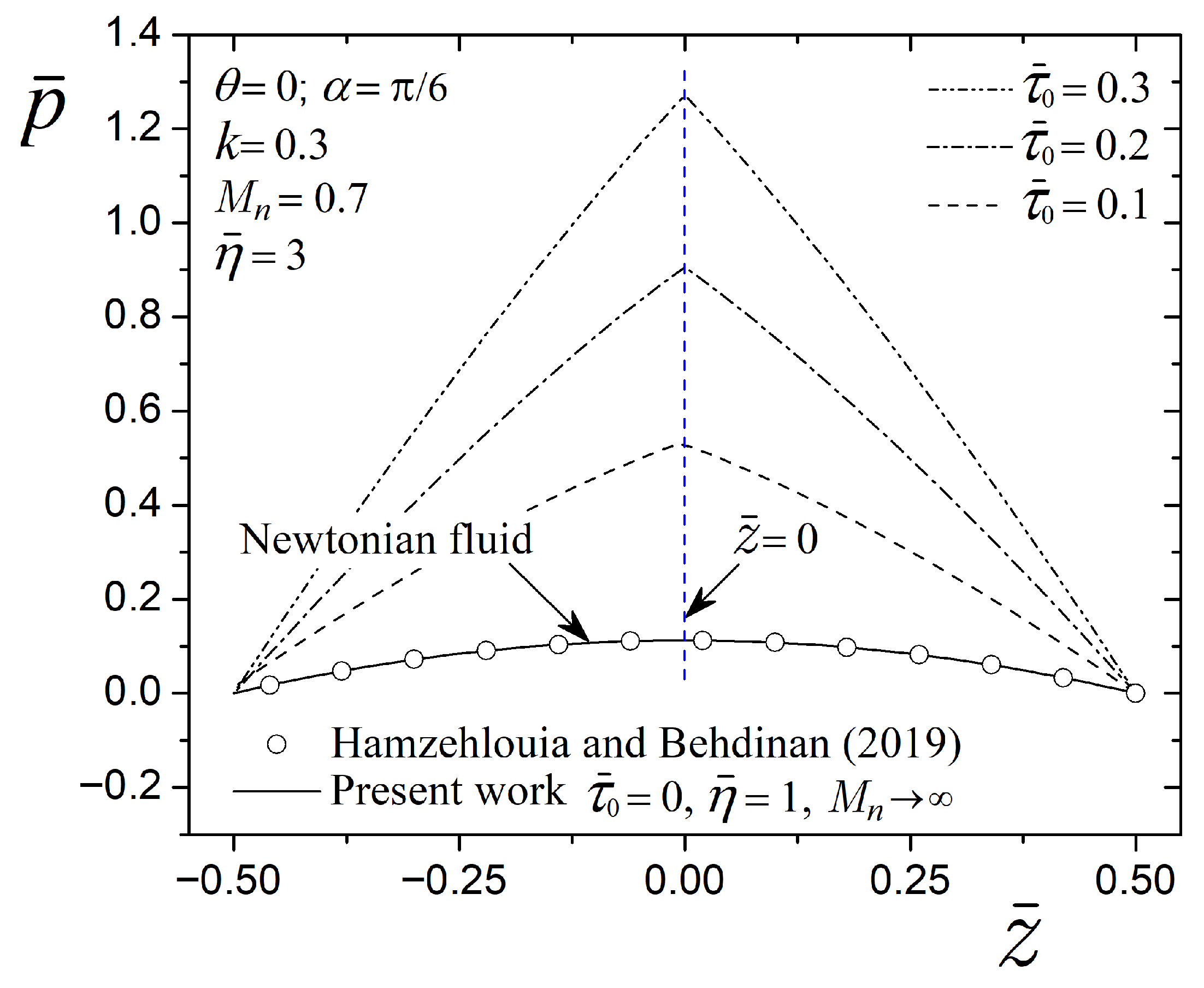
To validate the solution methodology, Figure 3 and Figure 4 compare the pressure distribution from Equation (84) with results reported by Hamzehlouia and Behdinan [43] for a Newtonian fluid. This analysis assumes small Reynolds numbers, R e 1 , thus neglecting the influence of inertial terms on the flow field. Figure 3 illustrates the pressure distribution across the damper width for different yield stress values τ ¯ 0 . The results correspond to θ = 0 in Figure 1a, with a line of centers at α = π / 6 and an eccentricity of k = 0.3 to represent rotor imbalance. The other parameters taken into account for τ ¯ 0 > 0 are M n = 0.7 and η ¯ = 3 . The pressure profiles, based on boundary conditions (78) and (79), exhibit maximum pressure at z ¯ = 0 and zero pressure at z ¯ = ± 1 / 2 . The pressure peak at z ¯ = 0 results from the fluid response to the magnetic field, which depends on the maximum pressure gradient Γ m a x that the MR fluid can withstand before deforming. Meanwhile, the fluid film pressure equals atmospheric pressure at the lateral ends of the damper width. Regarding the influence of the dimensionless yield stress τ ¯ 0 (see Equation (45)) on the flow, it represents the ratio of the yield stress of the MR fluid to the magnetic attraction force between particles. Thus, the macroscopic resistance of the MR fluid, from Equations (4)–(6), is compared to a reference magnetic stress τ (see Equation (13)), which is based on the resistance of particle chain-like structures. Small values of τ ¯ 0 suggest that the magnetic field significantly influences the morphology of the MR fluid; therefore, understanding microscopic behavior is essential for accurately predicting macroscopic hydrodynamic performance. An increase in the magnetic field raises the parameter τ ¯ 0 and enhances the resistance of the MR fluid. Consequently, the fluid film pressure increases with yield stress τ ¯ 0 , resulting in the highest pressure distribution at τ ¯ 0 = 0.3 . In the absence of a magnetic field, the MR fluid behaves like a Newtonian liquid with zero maximum pressure gradient. This case is presented by the pressure profile with a solid line, by assuming η ¯ = 1 , τ ¯ 0 = 0 , and M n in Equation (84), which aligns with the result of Hamzehlouia and Behdinan for a Newtonian fluid [43]. This excellent overlap confirms the validity of the solution methodology used in this study to represent fluid behavior. The blue dashed line at z ¯ = 0 indicates the position for the pressure distribution in Figure 4.
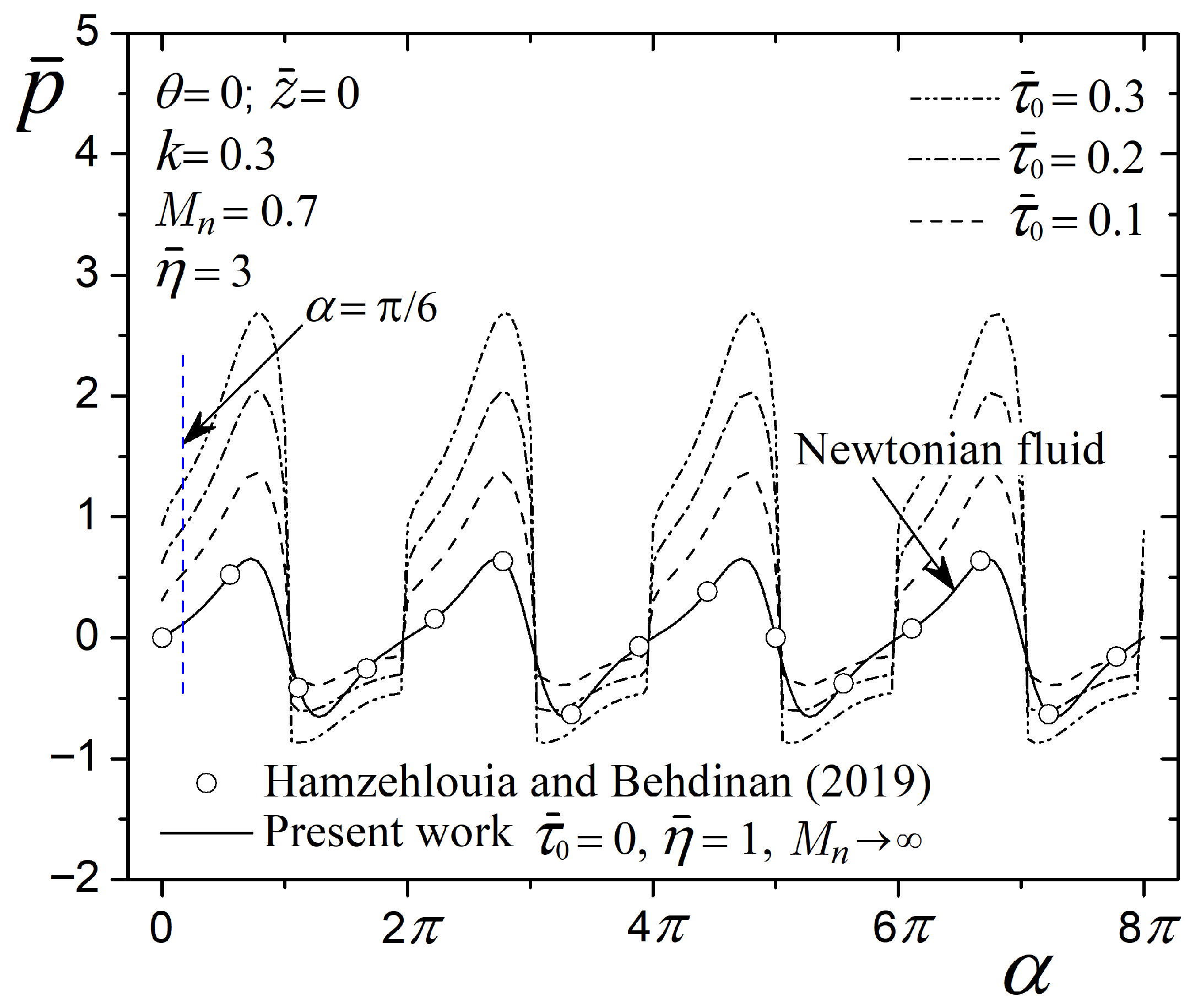
On the other hand, Figure 4 extends the analysis in Figure 3 by showing the pressure distribution along the circumferential coordinate at the center of the damper width ( z ¯ = 0 ). The solid line represents the Newtonian fluid solution in the absence of a magnetic field ( τ ¯ 0 = 0 ). This result matches the solution reported by Hamzehlouia and Behdinan [43] for a Newtonian fluid, demonstrating good convergence between the two studies and validating the solution methodology of this research. The pressure distribution follows the Sommerfeld boundary condition, which assumes a continuous fluid film around the circumference without cavitation effects [40]. The fluid pressure curve increases from α = 0 to a maximum in the compression region (from α = 0 to π ), then drops sharply to a negative value before rising again. Positive pressure (from α = 0 to π ) occurs when the journal squeezes the MR fluid in the oil film clearance, producing damping forces that dissipate vibration energy. Meanwhile, negative pressure (from α = π to 2 π ) develops in response to the sudden increase in fluid thickness. When the damper operates with a magnetic field, the fluid film pressure increases, enhancing system stability. The pressure gradient required for initial flow is greater when a magnetic field is applied, as indicated by Γ m a x > 0 (with magnetic field) and Γ m a x = 0 (without magnetic field) in Equation (80); thus, the pressure at α = 0 is higher for τ ¯ 0 > 0 than for τ ¯ 0 = 0 (Newtonian case). Additionally, when an MR fluid is exposed to a magnetic field, positive pressure predominates, indicating improved mechanical strength to withstand loads. The blue dashed line at α = π / 6 indicates the position for the pressure distribution in Figure 3.

5.2. Pressure Distribution and Velocity Profiles

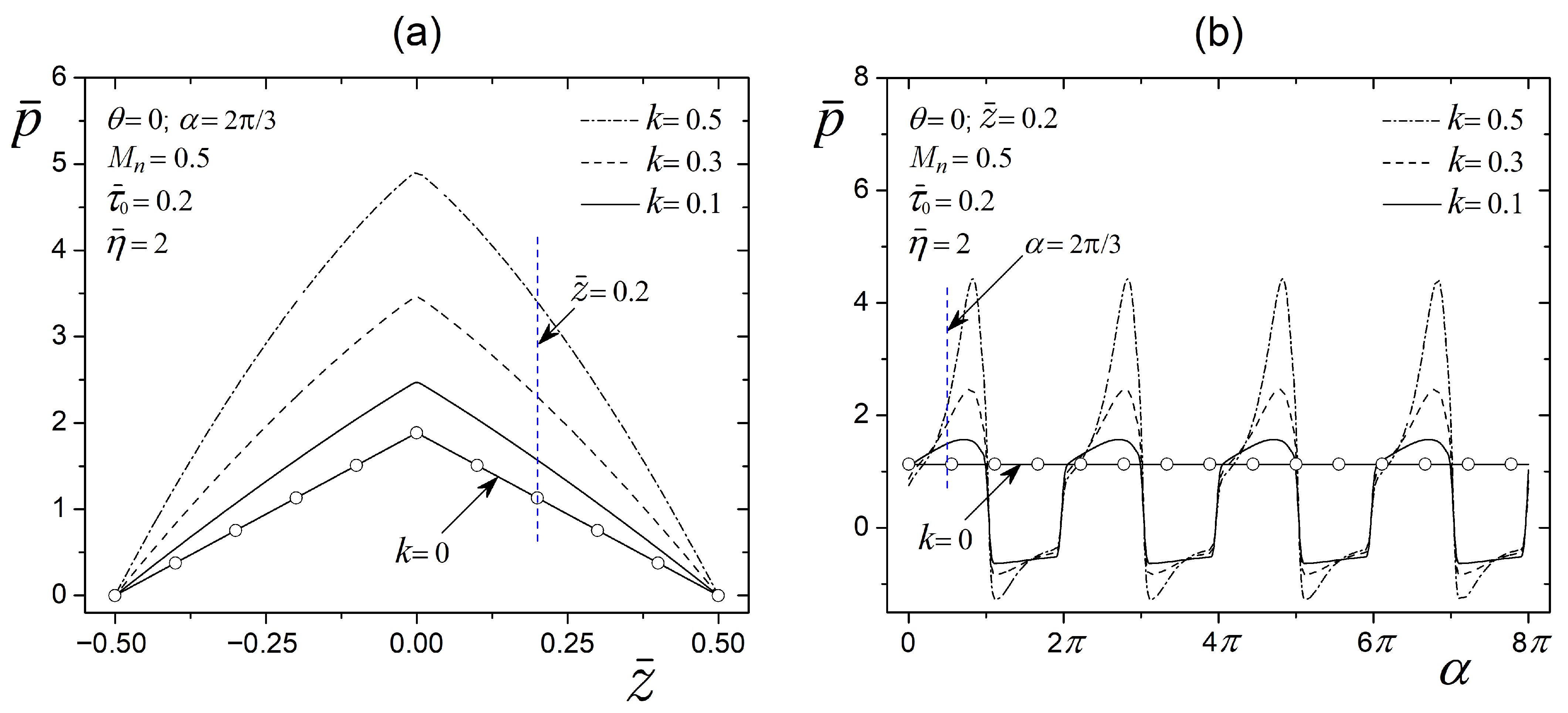
Figure 5 presents the pressure distribution as a function of the eccentricity k for an MR fluid with M n = 0.5 , τ ¯ 0 = 0.2 , and η ¯ = 2 . Figure 5a illustrates fluid pressure across the damper width at θ = 0 and α = 2 π / 3 . Mass imbalance causes system vibrations, which the fluid film absorbs. As eccentricity increases from k = 0 to 0.5 , fluid thickness in Equation (50) decreases from h ¯ = 1 to 0.75 , and pressure rises. This phenomenon, also known as the squeeze-strengthen effect, results in the formation of stronger chain-like structures [28]. Thus, the increased pressure, due to the strengthening of the MR fluid microstructure, enhances damping capacity. The peak pressure increases from 1.88 (when k = 0 ) to 4.92 (when k = 0.5 ), and then drops to zero at z ¯ = ± 0.5 to satisfy the boundary condition of Equation (79). In the absence of eccentricity ( k = 0 ), the journal does not squeeze the fluid, and the pressure does not increase; here, the pressure peak at z ¯ = 0 results from the applied magnetic field, which increases fluid resistance. The pressure drop from z ¯ = 0 to z ¯ = ± 0.5 is linear when there is no eccentricity, as the MR fluid is not affected by external forces. The blue dashed line at z ¯ = 0.2 indicates the position for the pressure distribution in Figure 5b. In this sense, Figure 5b expands on the description in Figure 5a by showing the pressure distribution along the circumferential coordinate at z ¯ = 0.2 . When k = 0 , pressure remains constant because the journal does not squeeze the fluid; the pressure value in this case is determined by the maximum pressure gradient Γ m a x the MR fluid can withstand before deforming. Regarding the pressure profiles with k > 0 , pressure increases in response to the compressive forces exerted by the journal on the MR fluid. In particular, k = 0.5 shows a more significant exponential growth than k = 0.3 and 0.1 , indicating the fluid pressure responds to system instability. Increases in fluid pressure generate damping forces that mitigate lateral vibrations caused by rotor imbalance. The blue dashed line at α = 2 π / 3 indicates the position for the pressure distribution in Figure 5a.
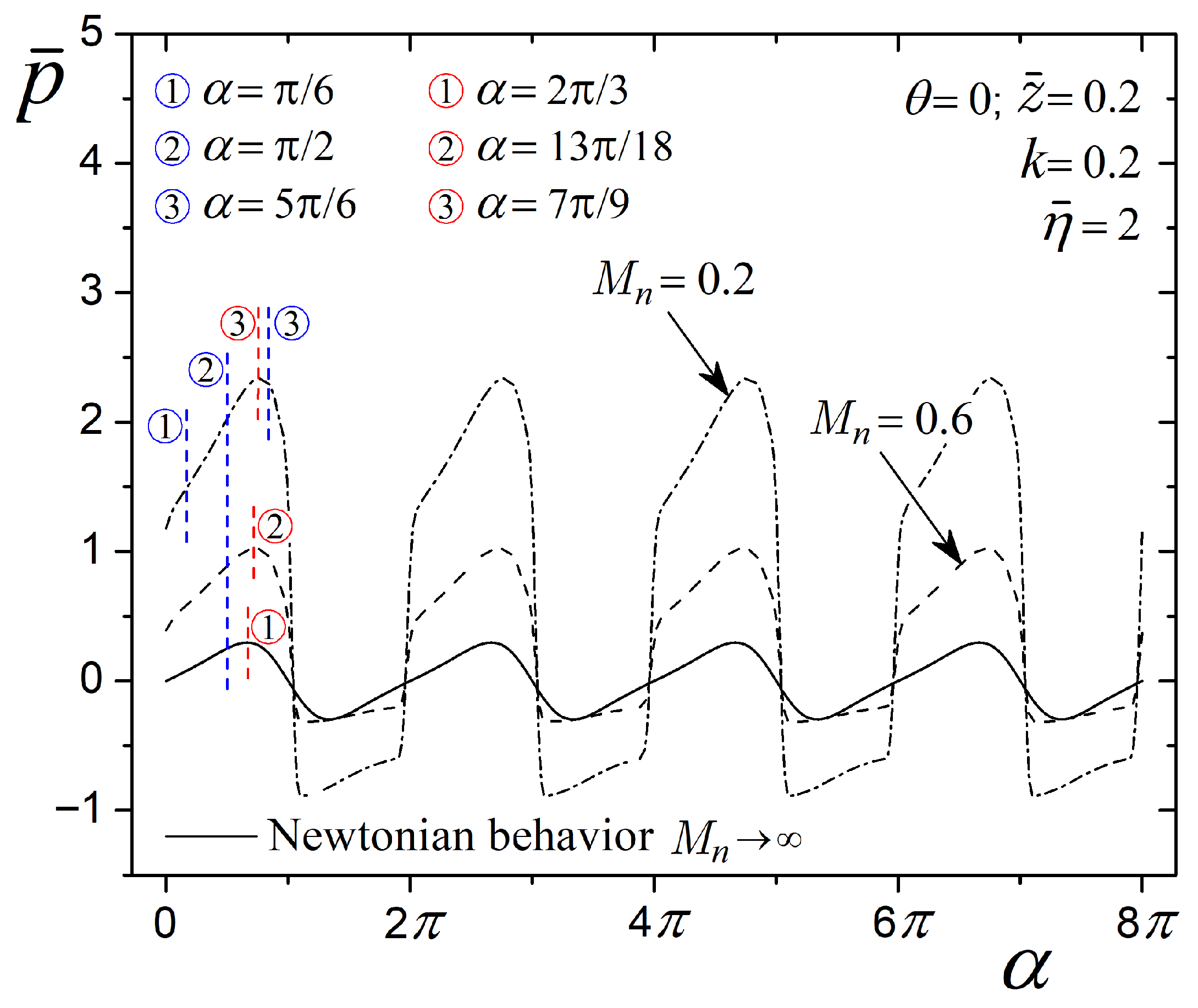
Figure 6 presents the pressure distribution along the circumferential coordinate for different Mason numbers. The results are evaluated at θ = 0 , z ¯ = 0.2 , and system eccentricity k = 0.2 . The solid line represents an MR fluid with a viscosity ratio η ¯ = 2 in the absence of a magnetic field, exhibiting Newtonian behavior ( τ ¯ 0 = 0 and M n ). In this case, the fluid film acts as a liquid whose pressure increases from zero at α = 0 to a maximum at α = 2 π / 3 , as observed by the red dashed line 1. Conversely, the dashed lines show the pressure distribution of the same MR fluid under a magnetic field, with τ ¯ 0 = 0.1 and M n = 0.2 and 0.6 . Here, yield stress depends on the magnetic field strength and particle volume fraction, while the Mason number is a ratio of hydrodynamic to magnetic forces. As the system maintains a constant magnetic field, the Mason number varies from the characteristic shear rate. Lower Mason numbers mean magnetic forces dominate, forming stronger chain-like structures. Meanwhile, higher Mason numbers indicate hydrodynamic forces are more significant, leading to deformation of these structures. As a result, the pressure gradient required to initiate flow at α = 0 is highest for M n = 0.2 ( Γ m a x = 3.99 ), followed by M n = 0.6 ( Γ m a x = 1.3 ), and lowest for the Newtonian case ( Γ m a x = 0 ). Therefore, the fluid film pressure increases as the Mason number decreases, with peak pressures at α = 13 π / 18 for M n = 0.6 and α = 7 π / 9 for M n = 0.2 , as observed by the red dashed lines 2 and 3. These results reveal that the microstructure of the MR fluid under a magnetic field significantly affects the fluid pressure to generate damping forces. The blue dashed lines 1, 2, and 3, at α = π / 6 , π / 2 , and 5 π / 6 indicate the positions for the velocity profiles in Figure 7.
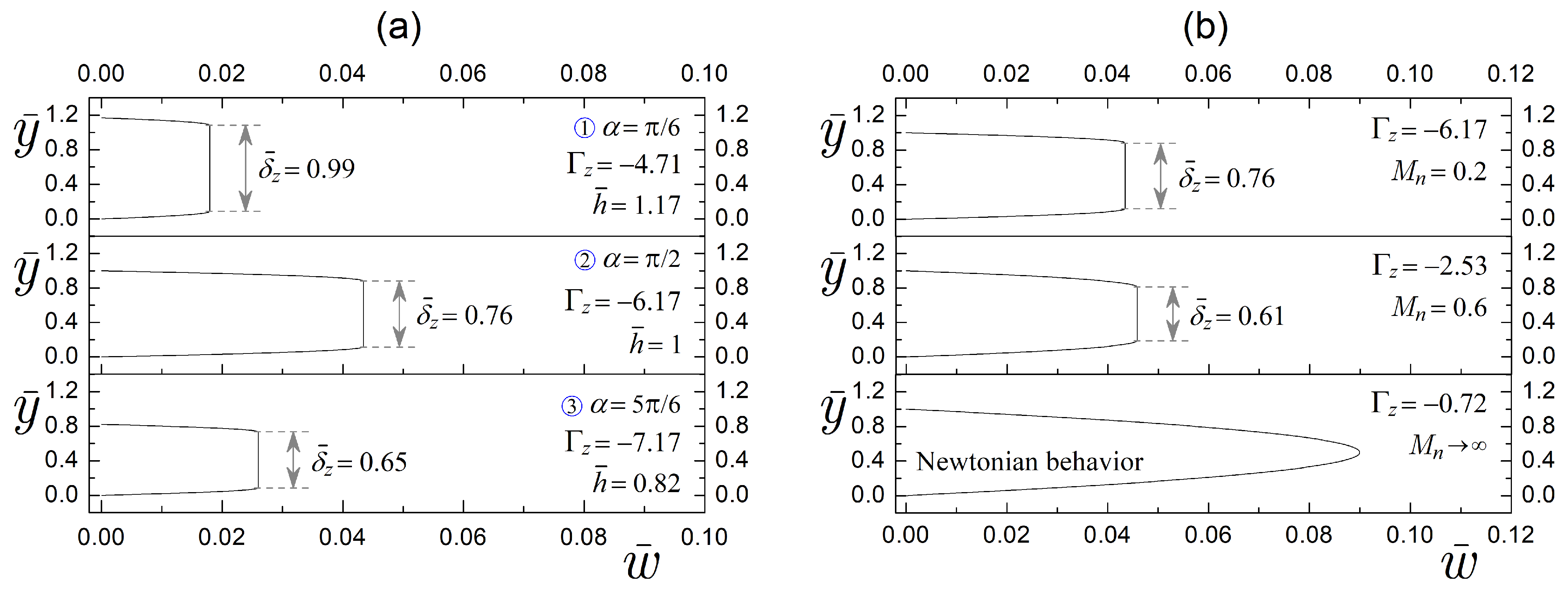
Figure 7 builds on Figure 6 by presenting velocity profiles as a function of the angle position of the line of centers α and the Mason number M n . Figure 7a shows the flow field for the pressure curve with M n = 0.2 at α = π / 6 , π / 2 , and 5 π / 6 in Figure 6. At α = 0 , there is no flow because the journal does not squeeze the fluid in this position. The fluid film begins to flow when the pressure gradient Γ z exceeds the maximum pressure gradient Γ m a x that the MR fluid can withstand before deforming, which occurs in the compression zone ( 0 < α < π ). Increasing α from 0 with Γ m a x = 3.92 to π / 6 with Γ z = 4.71 reduces fluid thickness from h ¯ = 1.2 to 1.17 , deforming the chain-like structures since Γ z > Γ m a x and generating liquid regions. At α = π / 6 , the liquid region is equivalent to 15.39 % assuming that the fluid thickness and pre-yield thickness are h ¯ = 1.17 and δ ¯ z = 0.99 , respectively. Meanwhile, increasing α from π / 6 to π / 2 reduces fluid thickness from h ¯ = 1.17 to 1, decreases pre-yield thickness from δ ¯ z = 0.99 to 0.76 , raises liquid region percentage from 15.39 % to 24%, and increases maximum velocity from w ¯ 2 = 0.0179 to 0.0434 . These results show how lateral vibrations, given by the journal motion in centered circular orbits, deform the chain-like structures (pre-yield thickness), thus generating liquid regions. Finally, increasing α from π / 2 to 5 π / 6 reduces fluid thickness from h ¯ = 1 to 0.82 . However, the liquid region in this case decreases from 24% to 20.74 %, reflecting improved fluid resistance. This change results from the nonlinear squeeze-strengthen effect, in which the MR fluid becomes more resistant to deformation as its thickness decreases.
On the other hand, Figure 7b shows the velocity profiles corresponding to the pressure curves at α = π / 2 in Figure 6. When exposed to a magnetic field, an MR fluid forms chain-like structures (pre-yield thickness) that restrict movement and enhance resistance, thereby increasing the maximum pressure gradient Γ m a x in Equation (80). To initiate flow, the journal must apply a compressive force Γ z greater than Γ m a x , which is 3.92 for M n = 0.2 , 1.3 for M n = 0.6 , and 0 for the Newtonian case. As α increases from 0 to π / 2 , the journal squeezes the fluid from h ¯ = 1.2 to 1, forming liquid regions (post-yield thicknesses) in the flow field. At M n = 0.2 , the applied pressure gradient is Γ z = 6.17 , the pre-yield thickness is δ ¯ z = 0.76 , and the liquid region is equivalent to 24%. At M n = 0.6 , Γ z = 2.53 and δ ¯ z = 0.61 , with increased liquid regions to 39%. These results indicate that M n = 0.2 provides better damping capacity, as both Γ z and δ ¯ z are higher compared to M n = 0.6 . Therefore, an MR fluid can better withstand lateral vibrations as the Mason number decreases. Without a magnetic field, the MR fluid behaves as a Newtonian fluid ( M n ), flowing freely through the channel and reaching a maximum velocity of w ¯ 2 = 0.0899 at y ¯ = 0.5 . As the fluid remains entirely in the liquid state, the applied pressure gradient is Γ z = 0.72 , which is substantially lower than the values observed for M n = 0.2 and 0.6 . This result indicates reduced damping capacity compared to MR fluid under a magnetic field.
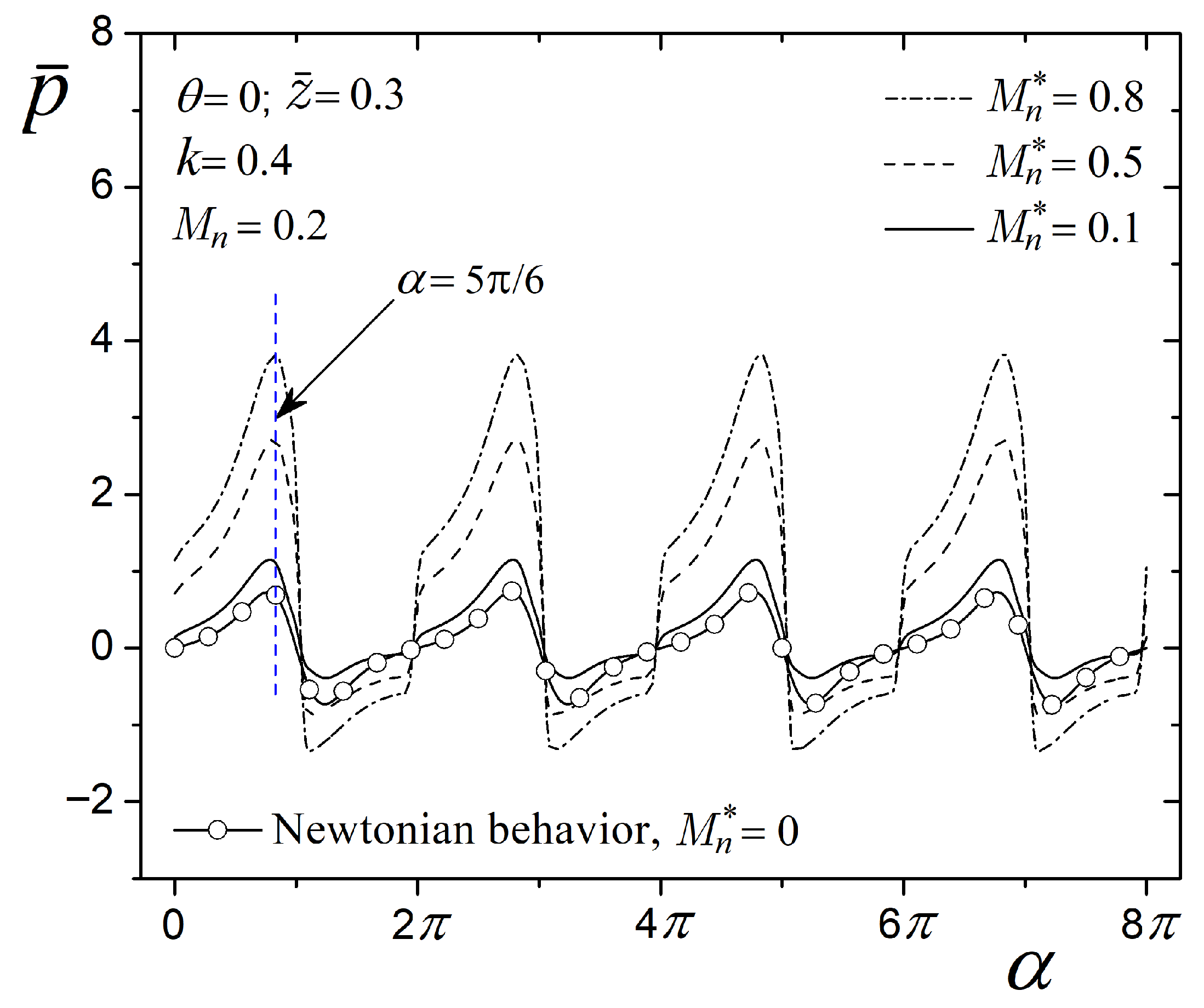
Figure 8 presents the pressure distribution along the circumferential coordinate for different critical Mason numbers M n . This parameter is defined as:
M n = B i · M n = 3 π τ ¯ 0 η ¯
and captures the influence of magnetic particles on the carrier fluid, relating the yield stress τ ¯ 0 to the viscosity ratio η ¯ . The critical Mason number is based on the relationship between the Bingham number and the Mason number in Equation (44), considering that hydrodynamic and magnetic forces scale linearly from the microscopic to the macroscopic scale [13]. Small values ( M n 0 ) lead to the Newtonian flow regime [35], which occurs with a weak magnetic field or low particle concentration. When M n > 1 , viscous drag forces are large enough to prevent the formation of chain-like structures [37]. In this context, the critical Mason number characterizes the microstructural transition of MR fluids from liquid-like (post-yield) to semi-solid (pre-yield) behavior. As the critical Mason number increases, fluid pressure also increases, reaching the highest pressure distribution at M n = 0.8 . When M n = 0.1 , the pressure curve resembles Newtonian behavior (without magnetic particles M n = 0 ). At α = 5 π / 6 , the pressure values for M n = 0 , 0.1 , 0.5 , and 0.8 are p ¯ = 0.68 , 1.13 , 2.74 , and 3.86 , respectively. Compared to Newtonian behavior, fluid pressure increases by 66%, 302%, and 467% when M n = 0.1 , 0.5 , and 0.8 . Therefore, these results demonstrate that magnetic particles significantly affect the performance of MR fluids.
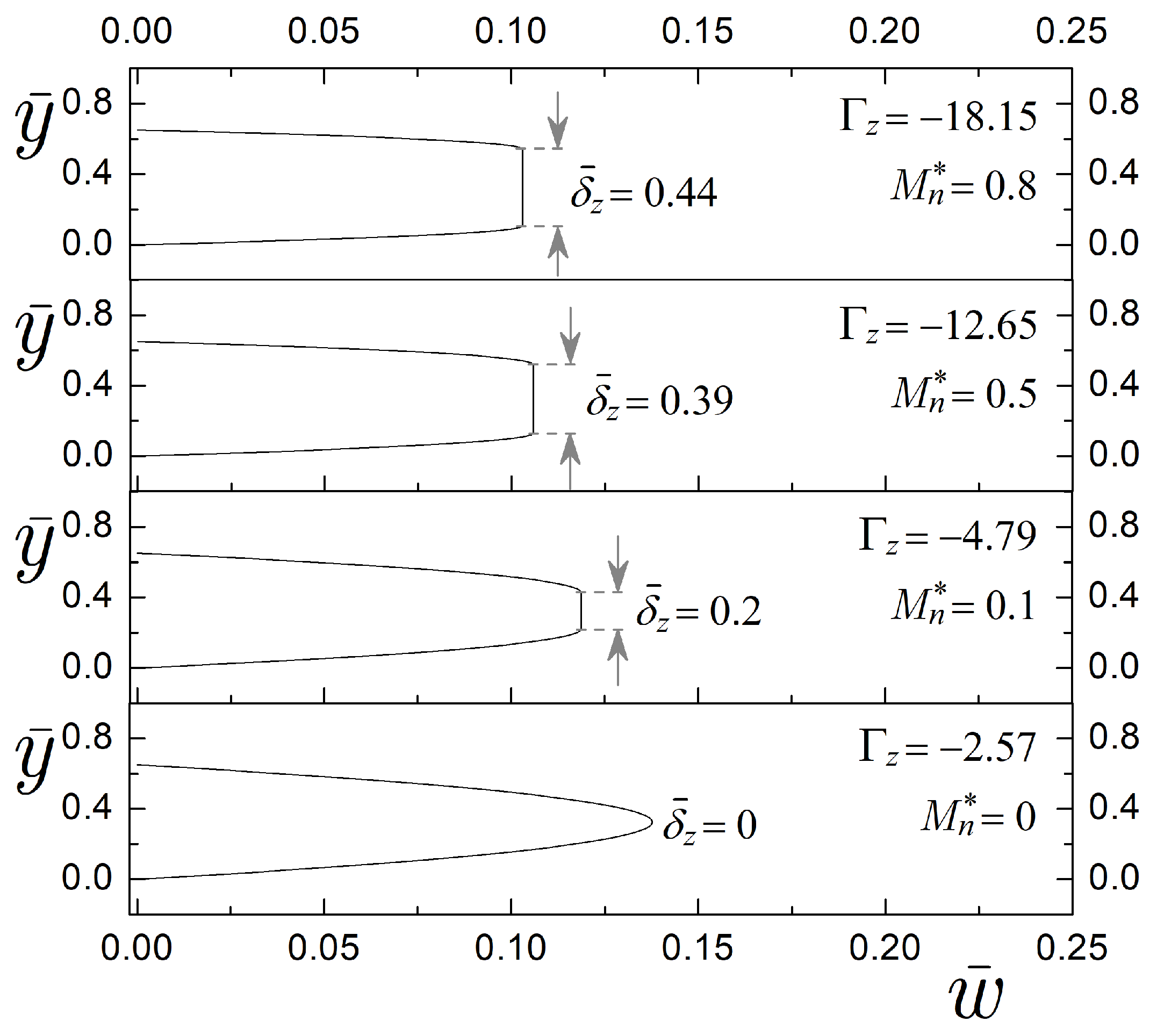
Figure 9 presents the velocity profiles of the pressure curves at α = 5 π / 6 in Figure 8. When magnetic particles are absent ( M n = 0 ), the fluid film behaves as a Newtonian fluid and does not form a pre-yield thickness ( δ ¯ z = 0 ). Thus, the Newtonian case achieves the highest velocity due to its low resistance to deformation. For M n > 0 , increasing α from 0 to 5 π / 6 reduces fluid thickness from h ¯ = 1.4 to 0.65 and pre-yield thickness from δ ¯ z = 1.4 to 0.2 , 0.39 , and 0.44 for M n = 0.1 , 0.5 , and 0.8 , respectively. This indicates that the journal squeezes the fluid, deforming 69.2 %, 40%, and 32.3 % of the chain-like structures that inhibit fluid motion at M n = 0.1 , 0.5 , and 0.8 . These percentages represent the liquid regions in the flow field. Overall, fluid deformation decreases as the critical Mason number increases. The ratio between the critical Mason number from Equation (87) and the Mason number from Equation (12) determines the dominant force regime. When M n / M n is less than 1, hydrodynamic forces predominate in the flow, as observed at M n = 0.1 with 69.2 % liquid region and 30.8 % solid region. As M n / M n approaches 1, the flow field assumes that hydrodynamic and magnetic forces are in balance. Conversely, when M n / M n is greater than 1, magnetic forces predominate over hydrodynamic forces, resulting in larger solid regions than liquid regions, as observed at M n = 0.5 with 40% liquid region and 60% solid region and M n = 0.8 with 32.3 % liquid region and 67.7 % solid region.

5.3. Damping Forces

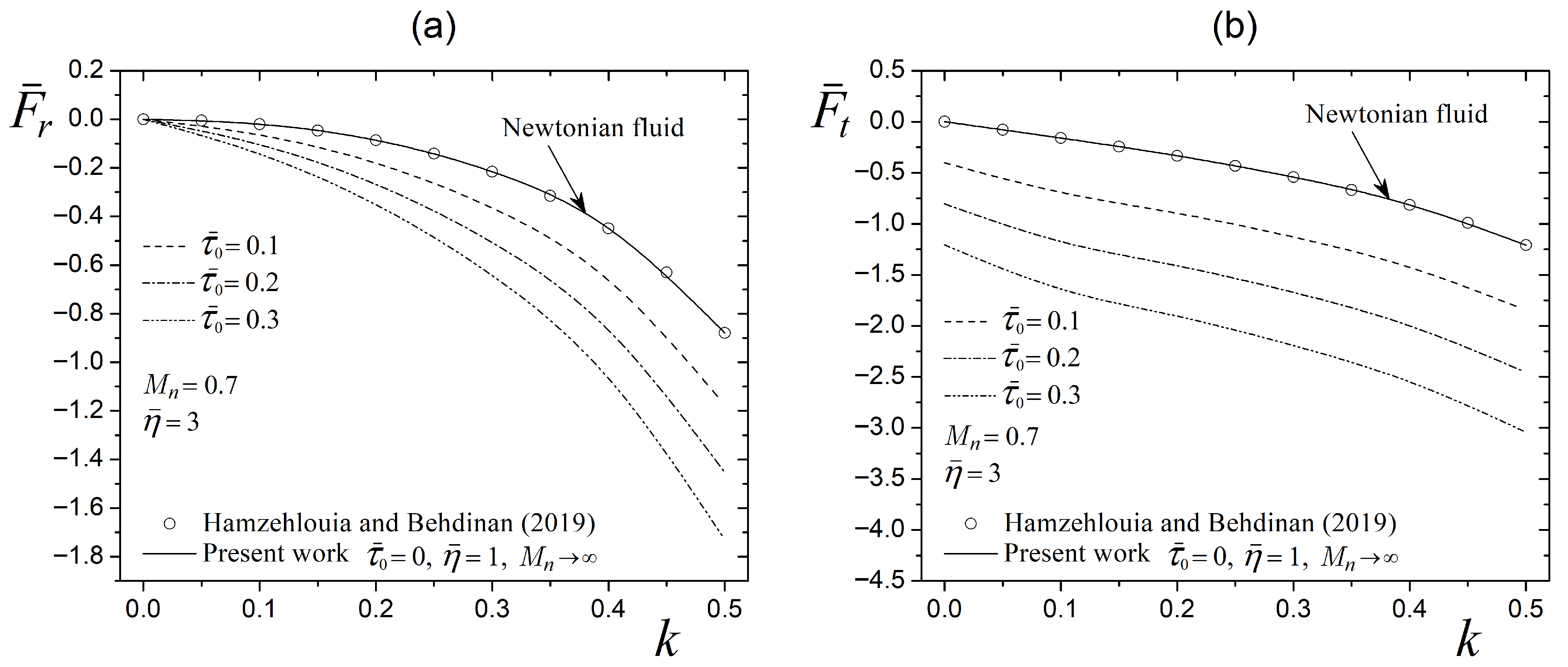
The fluid film responds to system mass imbalance, generating damping forces that control rotor loads and dissipate mechanical vibrations. These forces result from increased fluid pressure during compression (from α = 0 to π ). Therefore, Figure 10, Figure 11 and Figure 12 are constructed for the positive pressure region. Figure 10 presents the dimensionless radial and tangential forces as functions of yield stress τ ¯ 0 and eccentricity k. In Figure 10a, radial forces act in the direction of the rotor displacement and counteract compression, demonstrating the fluid stiffness. Radial forces are zero when eccentricity is absent ( k = 0 ), indicating system stability. However, these forces increase with eccentricity ( k > 0 ), reflecting the resistance to deformation. The solid line in this figure represents Newtonian behavior, when there is no magnetic field ( τ ¯ 0 = 0 and M n ) or particles present ( η ¯ = 1 ), and aligns with the solution reported by Hamzehlouia and Behdinan [43] for a Newtonian fluid. This case shows the lowest force curve because the fluid acts like a liquid with low resistance to deformation. Compared to the Newtonian case, MR fluids with M n = 0.7 , η ¯ = 3 , and τ ¯ 0 > 0 generate higher radial forces due to the formation of chain-like structures. Their semi-solid behavior provides greater resistance to deformation than that of a Newtonian fluid. Thus, the highest radial force is observed with τ ¯ 0 = 0.3 at k = 0.5 . On the other hand, Figure 10b illustrates the tangential forces that counteract the lateral displacements of the rotor. These forces dissipate vibration energy by reducing journal motion through viscous effects. The tangential force for the Newtonian fluid increases from zero at k = 0 to a maximum at k = 0.5 , indicating no resistance to lateral flow at k = 0 and increasing viscous damping as eccentricity increases. Conversely, the tangential force of the MR fluid is higher than that of the Newtonian fluid at k = 0 , indicating that MR fluids impose greater friction on the journal surface. Consequently, the journal must overcome this force to initiate flow. The tangential force increases further with yield stress τ ¯ 0 , indicating that the magnetic field enhances damping. The MR fluid force with τ ¯ 0 = 0.3 at k = 0.5 is approximately 2.5 times the Newtonian fluid force. Therefore, understanding the formation of chain-like structures is essential for accurately predicting MR fluid performance.
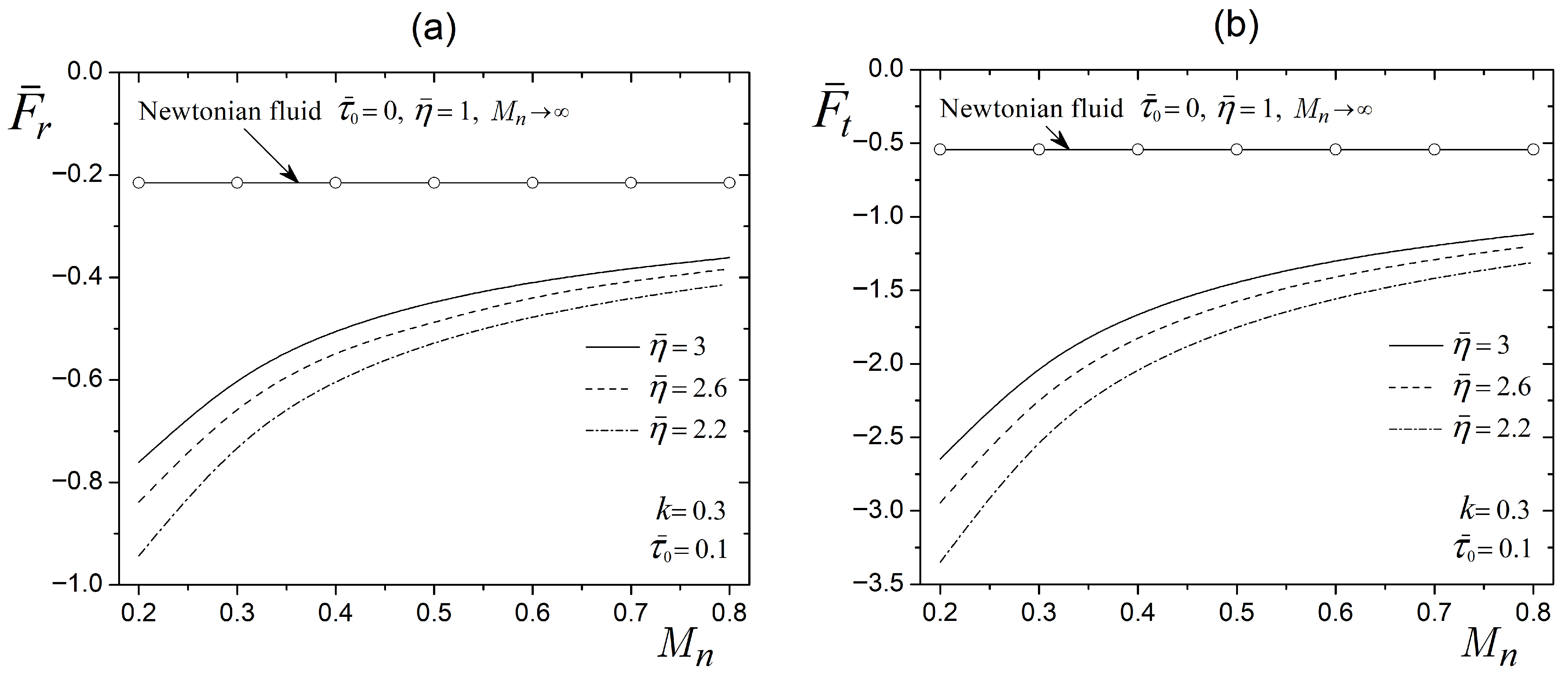
Figure 11 illustrates the relationship between damping forces F ¯ r and F ¯ t , viscosity ratio η ¯ , and Mason number M n . In Figure 11a, radial forces are evaluated with η ¯ = 2.2 , 2.6 , and 3 for different Mason numbers ranging from M n = 0.2 to 0.8 . The solid line with symbols represents the behavior of a Newtonian fluid, characterized by the absence of particles ( η ¯ = 1 ) and magnetic field ( τ ¯ 0 = 0 and M n ). In this case, the radial force is F ¯ r = 0.21 for an eccentricity of k = 0.3 . The lines without symbols depict the behavior of an MR fluid with a yield stress of τ ¯ 0 = 0.1 , an eccentricity of k = 0.3 , and different viscosity ratios. For the MR fluid, the radial force increases as the Mason number decreases, indicating that magnetic attraction forces between particles exceed viscous forces. At low Mason numbers (as M n 0 ), the MR fluid exhibits semi-solid behavior due to the formation of particle chain-like structures. Conversely, higher Mason numbers (as M n 1 ) correspond to liquid-like behavior, reducing both the stiffness and radial force of the MR fluid. For a constant yield stress τ ¯ 0 = 0.1 , increasing the viscosity ratio from η ¯ = 2.2 to 3 decreases the radial force from F ¯ r = 0.94 to 0.76 at M n = 0.2 , and from F ¯ r = 0.41 to 0.36 at M n = 0.8 . This trend occurs because damping forces result from the balance between viscous and magnetostatic forces. An increase in viscosity reduces both the magnetostatic effect and the associated damping forces.
On the other hand, Figure 11b shows the tangential forces that oppose the lateral displacement of the rotor. Compared to Newtonian behavior with F ¯ t = 0.54 , the MR fluid at M n = 0.8 exhibits increases in tangential force of 144%, 120%, and 105% for η ¯ = 2.2 , 2.6 , and 3, respectively. Furthermore, decreasing the ratio of viscous to magnetic forces from M n = 0.8 to M n = 0.2 leads to increases in tangential force by 520%, 444%, and 388% for η ¯ = 2.2 , 2.6 , and 3, respectively, compared to the Newtonian fluid. These findings indicate that damping forces are initially enhanced by increasing viscosity (comparing F ¯ t with η ¯ = 1 and η ¯ > 1 ), followed by a further enhancement as magnetostatic forces increase relative to viscous forces (comparing F ¯ t with M n = 0.8 and M n = 0.2 ). In this figure, for a constant yield stress, an increase in viscosity represents a penalty paid for by the increase in magnetic particles [13], thereby reducing MR fluid performance by causing viscous forces to exceed magnetostatic forces. Therefore, achieving an optimal balance between viscosity and yield stress is essential for maximizing the hydrodynamic response of MR fluids.
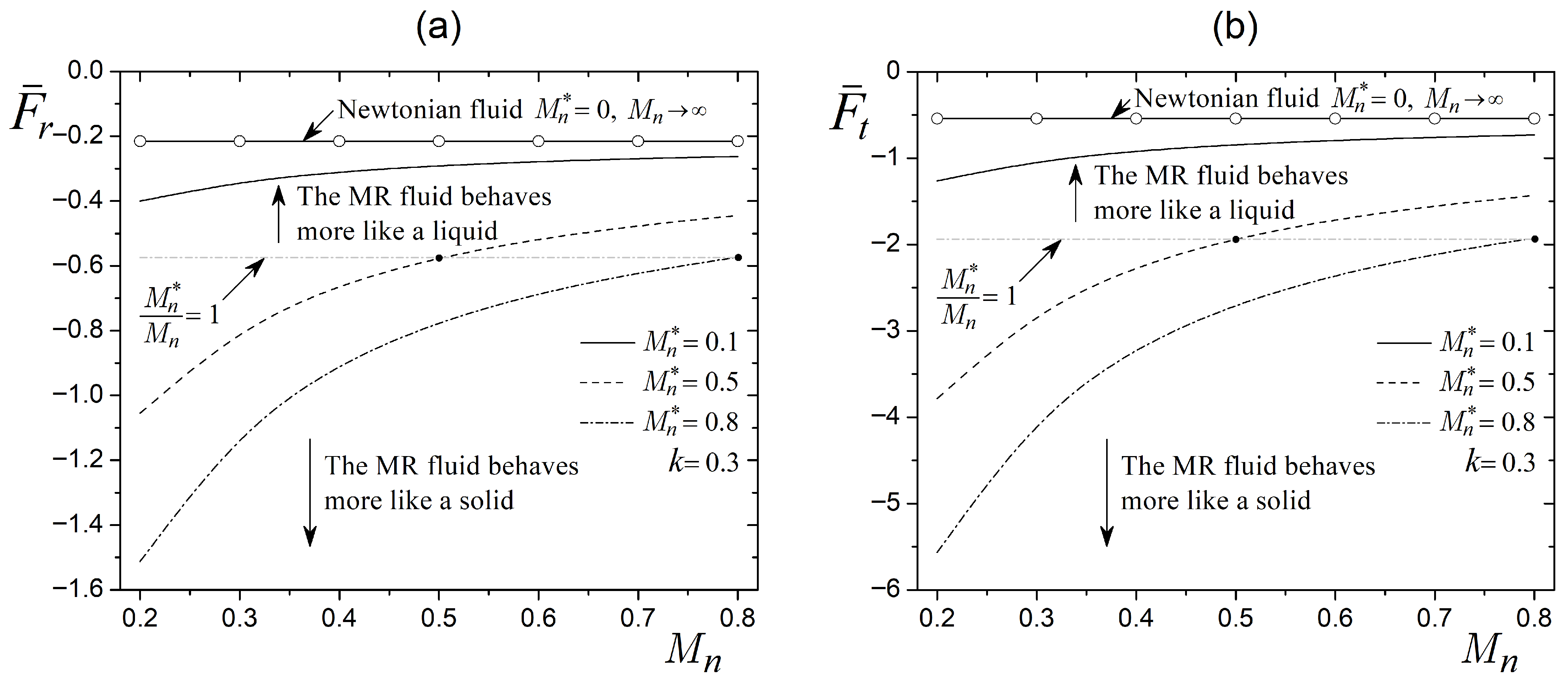
Figure 12 presents damping forces as functions of the critical Mason number M n and the Mason number M n . The critical Mason number reflects the influence of magnetic particles on the carrier fluid, while the Mason number is the ratio of viscous to magnetic forces. M n = 0 exhibits Newtonian behavior, and M n > 0 results in non-Newtonian behavior of the MR fluid under a magnetic field. In Figure 12a, for a Newtonian fluid at eccentricity k = 0.3 , the radial force is F ¯ r = 0.21 ; meanwhile, the MR fluid shows a minimum radial force at M n = 0.8 and a maximum at M n = 0.2 . On the other hand, increasing the particle volume fraction (via M n from 0.1 to 0.8 ) enhances both stiffness and radial force of the MR fluid. At M n = 0.8 , the radial force of M n = 0.1 is significantly lower than that of M n = 0.8 , resembling the Newtonian radial force. At M n = 0.2 , the radial forces for M n = 0.1 and 0.8 are F ¯ r = 0.4 and 1.51 , which are 190% and 719% of the Newtonian radial force, respectively. The ratio of the critical Mason number to the Mason number manifests the transition from liquid-like to semi-solid behavior in MR fluids. When M n / M n < 1 , the MR fluid behaves more like a liquid. When M n / M n > 1 , the MR fluid behaves more like a solid. While at M n / M n = 1 , the viscous and magnetostatic forces are balanced. In Figure 12b, the lowest tangential force corresponds to the Newtonian fluid ( F ¯ t = 0.54 ), followed by the MR fluid with M n = 0.1 ( F ¯ t = 1.26 at M n = 0.2 and 0.73 at M n = 0.8 ). In this case, the MR fluid resistance remains low because hydrodynamic forces dominate its behavior. At M n / M n = 1 , the tangential force increases to F ¯ t = 1.92 , representing 355% of the Newtonian value. The highest tangential forces result from magnetic attraction forces between particles, reaching F ¯ t = 3.78 and 5.56 at M n = 0.2 for M n = 0.5 and 0.8 , respectively. These results demonstrate that chain-like structures in MR fluids play a critical role in generating damping forces. Furthermore, the tangential forces in Figure 12b exceed the radial forces in Figure 12a, indicating that lateral flow resistance is the dominant damping mechanism in the fluid film.

6. Conclusions

This work analyzes the hydrodynamic response of a magnetorheological squeeze film damper, focusing on how the fluid microstructure generates damping forces. The fluid film absorbs mechanical vibrations due to system mass imbalance. As the journal squeezes the fluid, pressure increases, generating damping forces that counteract rotor displacement. The formation of chain-like structures under a magnetic field significantly affects fluid pressure. Compared to a Newtonian fluid, MR fluids can achieve higher pressure peaks by increasing the particle volume fraction. The Mason number characterizes the ratio of viscous to magnetic forces acting on fluid particles. At low Mason numbers, magnetic attraction between particles exceeds viscous forces, resulting in greater damping. This research extends the understanding of semi-active damping mechanisms using MR fluids in engineering applications involving small vibration amplitudes, such as high-force small-stroke linear dampers. The proposed method considers the microscopic characteristics of MR fluids in the formation of chain-like structures that generate damping forces, a phenomenon not previously studied. The results in this work demonstrate that the semi-solid behavior of MR fluids, resulting from dipole-dipole interactions between particles, dissipates vibrational energy.

Author Contributions

Conceptualization, J.P.E. and J.R.G.; methodology, J.P.E., J.R.G. and R.O.V.; software, J.R.G. and E.M.J.; validation, J.R.G. and E.M.J.; formal analysis, J.R.G., R.O.V. and R.M.-M.; investigation, J.R.G., R.M.-M. and A.Z.; resources, J.P.E., J.R.G. and E.M.J.; data curation, J.R.G.; writing—original draft preparation, J.P.E., J.R.G., E.M.J. and R.M.-M.; writing—review and editing, J.P.E., J.R.G., R.O.V. and A.Z.; visualization, J.R.G., R.M.-M. and A.Z.; supervision, J.P.E. and J.R.G.; project administration, J.P.E. and J.R.G.; funding acquisition, J.P.E. and R.O.V. All authors have read and agreed to the published version of the manuscript.

Funding

This research was funded by the Instituto Politécnico Nacional in Mexico, grant numbers SIP-20253830 and SIP-20260567 to J.P.E. and SIP-20260568 to R.O.V.

Institutional Review Board Statement

Not applicable.

Informed Consent Statement

Not applicable.

Data Availability Statement

The original contributions presented in this study are included in the article. Further inquiries can be directed to the corresponding authors.

Acknowledgments

Juan P. Escandón thanks the sabbatical research program sponsored by the Instituto Politécnico Nacional of Mexico. Edson M. Jimenez thanks the postdoctoral fellowship sponsored by the Secretaría de Ciencia, Humanidades, Tecnología e Innovación (SECIHTI) to conduct a research stay at the ESIME Unidad Azcapotzalco (IPN) in Mexico (2025–2028).

Conflicts of Interest

The authors declare no conflicts of interest.

Nomenclature

A c Characteristic aream2
BMagnetic fieldA m−1
B i Bingham number
cClearancem
dInternal element diameterm
eEccentricitym
F Body forceN m−3
F c Characteristic forceN
F H Hydrodynamic forceN
F 0 Magnetic attraction force between particlesN
F r Radial forceN
F t Tangential forceN
F ¯ r Dimensionless radial force
F ¯ t Dimensionless tangential force
hFluid thicknessm
h ¯ Dimensionless fluid thickness
h ¯ First derivative of the fluid thickness
h 1 , h 2 Interface positionsm
h ¯ 1 , h ¯ 2 Dimensionless interface positions
kNormalized eccentricity
lDamper widthm
MMagnetization of the MR fluidA m−1
M p Magnetization of the particlesA m−1
M s Saturation magnetization of the particlesA m−1
M n Mason number
M n Critical Mason number
pPressureN m−2
p ¯ Dimensionless pressure-
p c Characteristic PressureN m−2
R e Reynolds number
R e m Reduced Reynolds number
tTimes
u , v , w Velocity componentsm s−1
u ¯ , v ¯ , w ¯ Dimensionless velocity components
u c Characteristic fluid velocitym s−1
V Velocity vectorm s−1
( X , Y , Z ) Local coordinate systemm
( x , y , z ) Cartesian coordinatesm
( x ¯ , y ¯ , z ¯ ) Dimensionless Cartesian coordinates
Greek symbols
Γ Dimensionless pressure gradient
α Angle position of the line of centers rad
γ ˙ Shear strain rates−1
γ ˙ c Characteristic Shear rates−1
δ ¯ Dimensionless pre-yield thickness
ε Dimensionless geometric parameter
η c Carrier fluid viscosityPa s
η p Plastic viscosityPa s
η ¯ Viscosity ratio
θ Circumferential coordinate rad
μ 0 Vacuum magnetic permeabilityTmA−1
μ c r Relative permeability of the carrier fluid
μ e f f Effective permeability
ρ Fluid densitykg m−3
σ Diameter of the spherical particlesm
τ Stress tensorN m−2
τ 0 Yield stressN m−2
τ ¯ 0 Dimensionless yield stress
τ c Characteristic shear stressN m−2
τ x y Shear stressN m−2
τ z y Shear stressN m−2
τ ¯ x y Dimensionless shear stress
τ ¯ z y Dimensionless shear stress
τ Magnetic stressN m−2
ϕ Particle volume fraction
ϕ m Maximum packing fraction
ω Angular velocityrad s−1

References

  1. Bahl, S.; Nagar, H.; Singh, I.; Sehgal, S. Smart materials types, properties and applications: A review. Mater. Today Proc. 2020, 28, 1302–1306. [Google Scholar] [CrossRef]
  2. Choi, S.-B.; Han, Y.-M. Magnetorheological Fluid Technology: Applications in Vehicle Systems, 1st ed.; CRC Press: Boca Raton, FL, USA, 2013; pp. 1–16. [Google Scholar]
  3. Esmaeilnezhad, E.; Hajiabadi, S.H.; Choi, H.J. Effect of medium viscosity on rheological characteristics of magnetite-based magnetorheological fluids. J. Ind. Eng. Chem. 2019, 80, 197–204. [Google Scholar] [CrossRef]
  4. Kumar, S.; Sehgal, R.; Wani, M.F.; Sharma, M.D. Stabilization and tribological properties of magnetorheological (MR) fluids: A review. J. Magn. Magn. Mater. 2021, 538, 168295. [Google Scholar] [CrossRef]
  5. Bica, I.; Liu, Y.D.; Choi, H.J. Physical characteristics of magnetorheological suspensions and their applications. J. Ind. Eng. Chem. 2013, 19, 394–406. [Google Scholar] [CrossRef]
  6. Wang, N.; Liu, X.; Sun, S.; Królczyk, G.; Li, Z.; Li, W. Microscopic characteristics of magnetorheological fluids subjected to magnetic fields. J. Magn. Magn. Mater. 2020, 501, 166443. [Google Scholar] [CrossRef]
  7. Gołdasz, J.; Sapiński, B. Insight into Magnetorheological Shock Absorbers, 1st ed.; Springer: Cham, Switzerland, 2015; pp. 1–23. [Google Scholar]
  8. Zhang, Y.; Li, D.; Cui, H.; Yang, J. A new modified model for the rheological properties of magnetorheological fluids based on different magnetic field. J. Magn. Magn. Mater. 2020, 500, 166377. [Google Scholar] [CrossRef]
  9. Khajehsaeid, H.; Alaghehband, N.; Bavil, P.K. On the yield stress of magnetorheological fluids. Chem. Eng. Sci. 2022, 256, 117699. [Google Scholar] [CrossRef]
  10. Xu, Z.; Wu, H.; Wang, Q.; Jiang, S.; Yi, L.; Wang, J. Study on movement mechanism of magnetic particles in silicone rubber-based magnetorheological elastomers with viscosity change. J. Magn. Magn. Mater. 2020, 494, 165793. [Google Scholar] [CrossRef]
  11. De Vicente, J.; Klingenberg, D.J.; Hidalgo-Alvarez, R. Magnetorheological fluids: A review. Soft Matter 2011, 7, 3701–3710. [Google Scholar] [CrossRef]
  12. Klingenberg, D.J.; Ulicny, J.C.; Golden, M.A. Mason numbers for magnetorheology. J. Rheol. 2007, 51, 883–893. [Google Scholar] [CrossRef]
  13. Sherman, S.G.; Becnel, A.C.; Wereley, N.M. Relating Mason number to Bingham number in magnetorheological fluids. J. Magn. Magn. Mater. 2015, 380, 98–104. [Google Scholar] [CrossRef]
  14. Salloom, M.Y. Modeling Behavior of Magnetorheological Fluids. In Encyclopedia of Smart Materials; Olabi, A.-G., Ed.; Elsevier: Oxford, UK, 2022; pp. 224–236. [Google Scholar]
  15. Gołdasz, J.; Sapiński, B.; Kubík, M.; Macháček, O.; Bańkosz, W.; Sattel, T.; Tan, A.S. Review: A survey on configurations and performance of flow-mode MR valves. Appl. Sci. 2022, 12, 6260. [Google Scholar] [CrossRef]
  16. Dassisti, M.; Brunetti, G. Introduction to Magnetorheological Fluids. In Encyclopedia of Smart Materials; Olabi, A.-G., Ed.; Elsevier: Oxford, UK, 2022; pp. 187–202. [Google Scholar]
  17. Eshgarf, H.; Nadooshan, A.A.; Raisi, A. An overview on properties and applications of magnetorheological fluids: Dampers, batteries, valves and brakes. J. Energy Storage 2022, 50, 104648. [Google Scholar] [CrossRef]
  18. Sadaat, F.; Nutakor, C.; Sopanen, J. Different modeling methodologies for rotor-system on ball bearing cartridge with squeeze film damper. J. Sound Vib. 2026, 625, 119606. [Google Scholar] [CrossRef]
  19. Gheller, E.; Chatterton, S.; Vania, A.; Pennacchi, P. Squeeze film damper modeling: A comprehensive approach. Machines 2022, 10, 781. [Google Scholar] [CrossRef]
  20. Kang, X.; Palazzolo, A.; Zhong, W. Auxiliary bearing squeeze film dampers for magnetic bearing supported rotors. Tribol. Int. 2020, 146, 106181. [Google Scholar] [CrossRef]
  21. Zhou, H.-L.; Chen, X.; Zhan, Y.-Q.; Ai, Y.-T.; Sun, D. An analysis on the influence of air ingestion on vibration damping properties of squeeze film dampers. Tribol. Int. 2020, 145, 106168. [Google Scholar] [CrossRef]
  22. Fan, T.; Behdinan, K. An analytical model for open-ended squeeze film damper with a circumferential central groove. Proc. Inst. Mech. Eng. J J. Eng. Tribol. 2021, 235, 2110–2121. [Google Scholar] [CrossRef]
  23. Chen, X.; Ren, G.; Gan, X. Dynamic behavior of a flexible rotor system with squeeze film damper considering oil-film inertia under base motions. Nonlinear Dyn. 2021, 106, 3117–3145. [Google Scholar] [CrossRef]
  24. Van der Meer, G.H.G.; Quinci, F.; Litwin, W.; Wodtke, M.; van Ostayen, R.A.J. Experimental comparison of the transition speed of a hydrodynamic journal bearing lubricated with oil and magnetorheological fluid. Tribol. Int. 2023, 189, 108967. [Google Scholar] [CrossRef]
  25. Singh, R.K.; Tiwari, M.; Saksena, A.A.; Srivastava, A. Analysis of a compact squeeze film damper with magneto-rheological fluid. Def. Sci. J. 2020, 70, 122–130. [Google Scholar] [CrossRef]
  26. Wang, J.; Liu, Y.; Qin, Z.; Ma, L.; Chu, F. Nonlinear characteristic investigation of magnetorheological damper-rotor system with local nonlinearity. Chin. J. Aeronaut. 2023, 36, 111–126. [Google Scholar] [CrossRef]
  27. Ma, L.; Wang, J.; Li, C. Vibration suppression of a rotor system with a nonlinear MR damper. Arch. Appl. Mech. 2021, 91, 4053–4068. [Google Scholar] [CrossRef]
  28. Meng, F.; Zhou, J.; Jin, C.; Ji, W. Modeling and experimental verification of a squeeze mode magnetorheological damper using a novel hysteresis model. Proc. Inst. Mech. Eng. Part C J. Mech. Eng. Sci. 2019, 233, 5253–5263. [Google Scholar] [CrossRef]
  29. Zapoměl, J.; Ferfecki, P.; Molčan, M. Optimization of control parameters of magnetorheological squeeze film dampers to minimize the vibration amplitude of rotors passing the critical speed. Appl. Sci. 2023, 13, 6905. [Google Scholar] [CrossRef]
  30. Zapoměl, J.; Ferfecki, P.; Kozánek, J. Modelling of magnetorheological squeeze film dampers for vibration suppression of rigid rotors. Int. J. Mech. Sci. 2017, 127, 191–197. [Google Scholar] [CrossRef]
  31. Zapoměl, J.; Ferfecki, P.; Forte, P. A computational investigation of the transient response of an unbalanced rigid rotor flexibly supported and damped by short magnetorheological squeeze film dampers. Smart Mater. Struct. 2012, 21, 105011. [Google Scholar] [CrossRef]
  32. Irannejad, M.; Ohadi, A. Vibration analysis of a rotor supported on magnetorheological squeeze film damper with short bearing approximation: A contrast between short and long bearing approximations. J. Vib. Control 2015, 23, 1792–1808. [Google Scholar] [CrossRef]
  33. Ghaffari, A.; Hashemabadi, S.H.; Ashtiani, M. A review on the simulation and modeling of magnetorheological fluids. J. Intell. Mater. Syst. Struct. 2014, 26, 881–904. [Google Scholar] [CrossRef]
  34. Fernandes, C.; Faroughi, S.A. Particle-level simulation of magnetorheological fluids: A fully-resolved solver. Int. J. Multiph. Flow 2023, 169, 104604. [Google Scholar] [CrossRef]
  35. Vågberg, D.; Tighe, B.P. On the apparent yield stress in non-Brownian magnetorheological fluids. Soft Matter 2017, 13, 7207–7221. [Google Scholar] [CrossRef] [PubMed]
  36. Chopra, I.; Sirohi, J. Smart Structures Theory, 1st ed.; Cambridge University Press: New York, NY, USA, 2013; pp. 685–738. [Google Scholar]
  37. Bigué, J.-P.L.; Landry-Blais, A.; Pin, A.; Pilon, R.; Plante, J.-S.; Chen, X.; Andrews, M. On the relation between the Mason number and the durability of MR fluids. Smart Mater. Struct. 2019, 28, 094003. [Google Scholar] [CrossRef]
  38. Childs, P.R.N. Rotating Flow, 1st ed.; Butterworth-Heinemann: Oxford, UK, 2011; pp. 177–248. [Google Scholar]
  39. Ishida, Y.; Yamamoto, T. Linear and Nonlinear Rotordynamics: A Modern Treatment with Applications, 2nd ed.; Wiley-VCH: Weinheim, Germany, 2012; pp. 235–262. [Google Scholar]
  40. Szeri, A.Z. Fluid Film Lubrication, 2nd ed.; Cambridge University Press: New York, NY, USA, 2011; pp. 54–87. [Google Scholar]
  41. Wang, H.; Zhao, Y.; Yang, T.; Luo, Z.; Han, Q. Navigating the dynamics of squeeze film dampers: Unraveling stiffness and damping using a dual lens of Reynolds equation and neural network models for sensitivity analysis and predictive insights. Mathematics 2024, 12, 771. [Google Scholar] [CrossRef]
  42. Shizhu, W.; Ping, H. Principles of Tribology, 1st ed.; John Wiley & Sons (Asia) Pte Ltd.: Singapore, 2012; pp. 23–42. [Google Scholar]
  43. Hamzehlouia, S.; Behdinan, K. Squeeze film dampers supporting high-speed rotors: Fluid inertia effects. Proc. Inst. Mech. Eng. J J. Eng. Tribol. 2019, 234, 18–32. [Google Scholar] [CrossRef]
  44. Mewis, J.; Wagner, N.J. Colloidal Suspension Rheology, 1st ed.; Cambridge University Press: New York, NY, USA, 2012; pp. 36–79. [Google Scholar]
  45. Manjeet, K.; Sujatha, C. Magnetorheological valves based on Herschel–Bulkley fluid model: Modelling, magnetostatic analysis and geometric optimization. Smart Mater. Struct. 2019, 28, 115008. [Google Scholar] [CrossRef]
  46. Vereda, F.; de Vicente, J.; Segovia-Gutíerrez, J.P.; Hidalgo-Alvarez, R. Average particle magnetization as an experimental scaling parameter for the yield stress of dilute magnetorheological fluids. J. Phys. D Appl. Phys. 2011, 44, 425002. [Google Scholar] [CrossRef]
Figure 1. (a) Cross–sectional and (b) side view of a magnetorheological squeeze film damper.
Applsci 16 02791 g001
Figure 2. (a) Bingham model, (b) velocity profile, and stress distribution for an MR fluid.
Applsci 16 02791 g002
Figure 3. Dimensionless pressure distribution across the damper width for different yield stress values τ ¯ 0 from the present work and the research reported by Hamzehlouia and Behdinan [43] for a Newtonian fluid.
Applsci 16 02791 g003
Figure 4. Dimensionless pressure distribution along the circumferential coordinate for different yield stress values τ ¯ 0 from the present work and the research reported by Hamzehlouia and Behdinan [43] for a Newtonian fluid.
Applsci 16 02791 g004
Figure 5. Dimensionless pressure distribution (a) across the damper width and (b) along the circumferential coordinate for different eccentricity values k.
Applsci 16 02791 g005
Figure 6. Dimensionless pressure distribution along the circumferential coordinate for different Mason numbers M n .
Applsci 16 02791 g006
Figure 7. Dimensionless velocity profiles for different (a) angle positions of the line of centers α and (b) Mason numbers M n .
Applsci 16 02791 g007
Figure 8. Dimensionless pressure distribution along the circumferential coordinate for different critical Mason numbers M n .
Applsci 16 02791 g008
Figure 9. Dimensionless velocity profiles for different critical Mason numbers M n .
Applsci 16 02791 g009
Figure 10. Dimensionless (a) radial and (b) tangential forces for different values of yield stress τ ¯ 0 and eccentricity k from the present work and the research reported by Hamzehlouia and Behdinan [43] for a Newtonian fluid.
Applsci 16 02791 g010
Figure 11. Dimensionless (a) radial and (b) tangential forces for different viscosity ratios η ¯ and Mason numbers M n .
Applsci 16 02791 g011
Figure 12. Dimensionless (a) radial and (b) tangential forces for different critical Mason numbers M n and Mason numbers M n .
Applsci 16 02791 g012
Disclaimer/Publisher’s Note: The statements, opinions and data contained in all publications are solely those of the individual author(s) and contributor(s) and not of MDPI and/or the editor(s). MDPI and/or the editor(s) disclaim responsibility for any injury to people or property resulting from any ideas, methods, instructions or products referred to in the content.