Development of an NB-IoT-Based Measurement and Control System for Frequency Division Multiplexing Electrical Resistivity Tomography (FDM-ERT) Instruments

 , ,
, ,
Abstract
1. Introduction
2. Materials and Methods: Measurement Principle and Working Configuration
3. System Design and Implementation
3.1. Overall System Architecture
3.2. Embedded Software and Firmware Design
- System Initialization Task: This task serves as the primary stage of system startup, responsible for establishing both software and hardware environments. Specific operations include loading drivers, mounting the file system, registering the NB-IoT network, and configuring Bluetooth/Wi-Fi communication modes (Slave/Access Point modes). These actions ensure that the system transitions into a ready state.
- Command Parsing and Control Task: This task is responsible for managing multi-source heterogeneous instructions. It receives and parses control commands from Bluetooth or NB-IoT interfaces, subsequently transmitting the parsed binary commands to the hardware acquisition system through the SPI bus. To meet the requirement for 24-channel synchronous acquisition, the task automatically controls the relay array by interpreting grouping protocols, thereby facilitating automated channel switching and data acquisition.
- Data Storage and Backup Task: This task, based on the FatFs file system, implements local data persistence. The acquired raw full-waveform data are written to the SD card in real-time. Simultaneously, current data are preserved not only at the Current Station but also synchronously stored at the Acquisition Station to ensure data security.
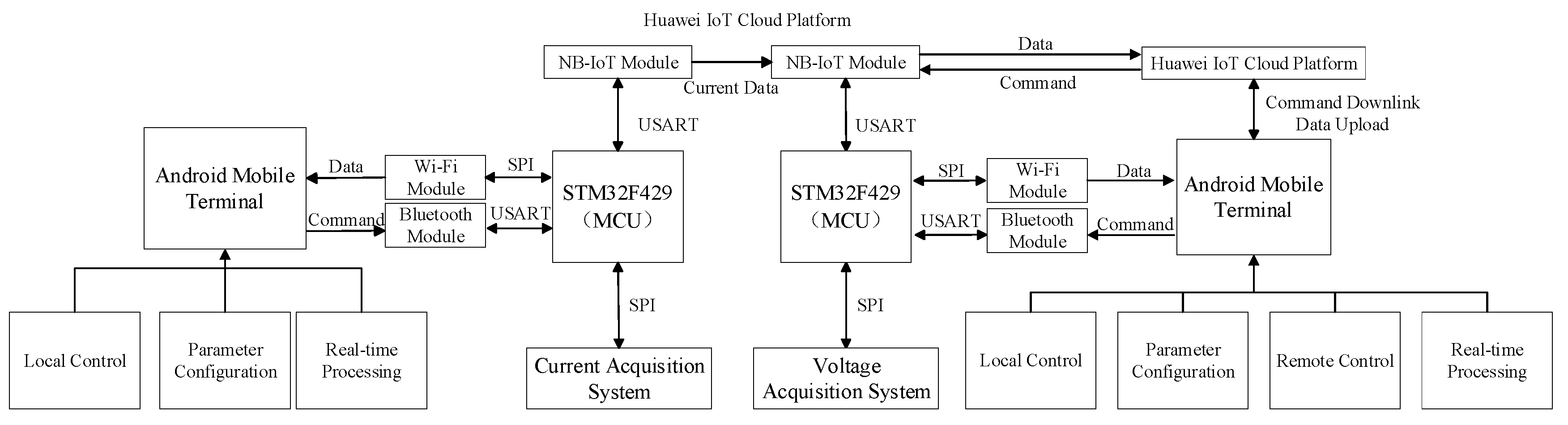
- Communication and Concurrency Task: This task enables the transmission of raw data via Wi-Fi and employs NB-IoT to transfer processed current data between the Current Station and the Acquisition Station, as well as to upload the acquisition results to the cloud platform. Furthermore, a Mutex (Mutual Exclusion) mechanism is implemented to effectively address resource contention for the file system and communication interfaces within the multi-tasking environment, thereby ensuring the stability of data transmission.
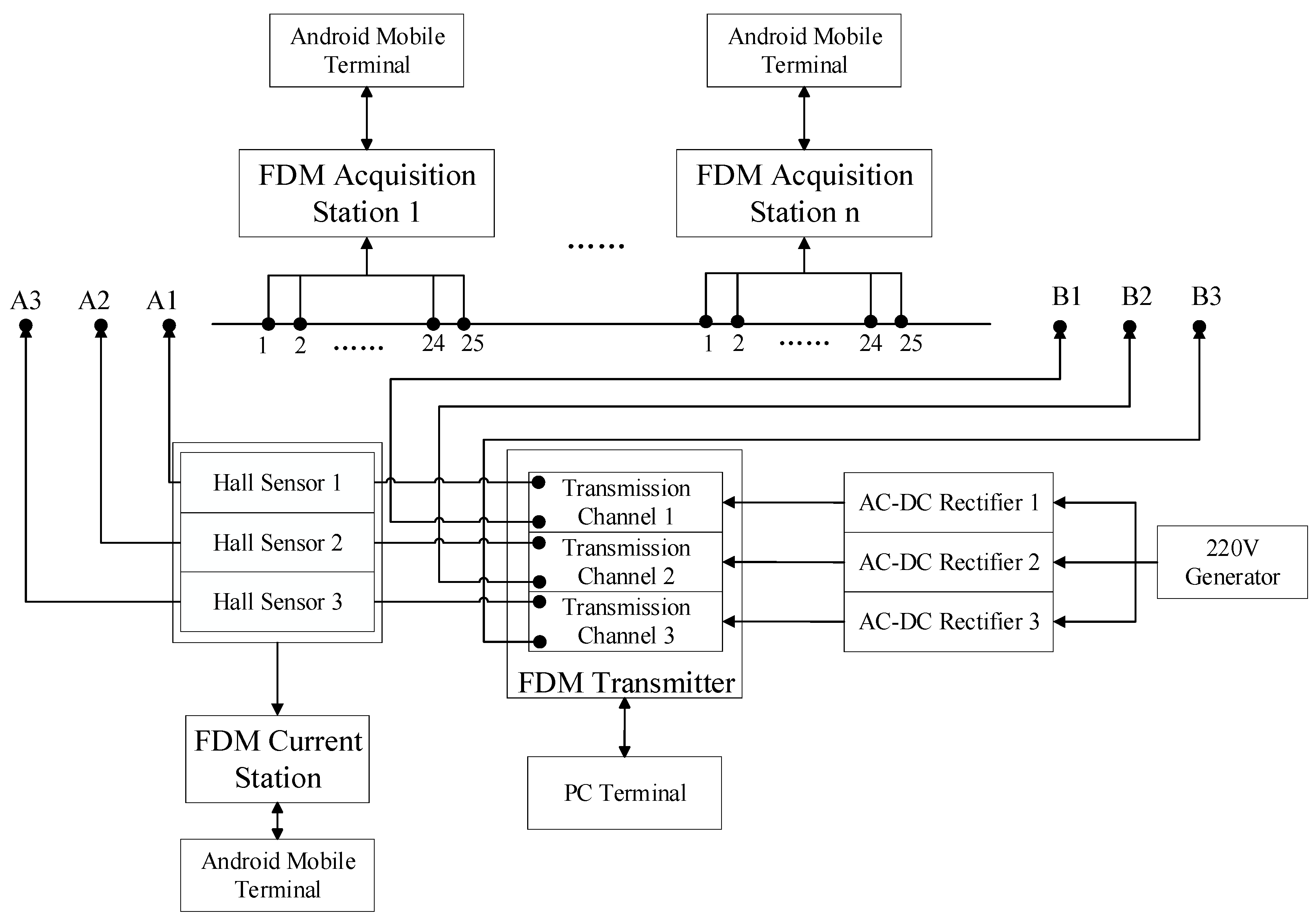
- Edge Computing and Data Processing Task: To address the bandwidth constraints of NB-IoT, the system adopts an edge computing strategy to perform data processing locally on the embedded device. By leveraging the CMSIS-DSP library, the system executes Fast Fourier Transform (FFT) transformation, filtering, and normalization locally to directly extract the potential amplitude at specific frequency points. For the calculation of apparent resistivity, current data from the Current Station is transmitted via the cloud platform to the Acquisition Station. In local communication, the mobile application conducts real-time calculations and imaging based on user configurations. In remote communication, geometric factors are downloaded from the cloud, after which the embedded system performs calculations locally and uploads the results back to the cloud.
3.3. Cloud Platform and IoT Data Synchronization
3.3.1. Heterogeneous Protocol Adaptation and Product Modeling
3.3.2. Rule-Engine-Based Data Routing
3.4. Mobile Application and Control Terminal Design
3.4.1. Software Architecture and Collaborative Logic
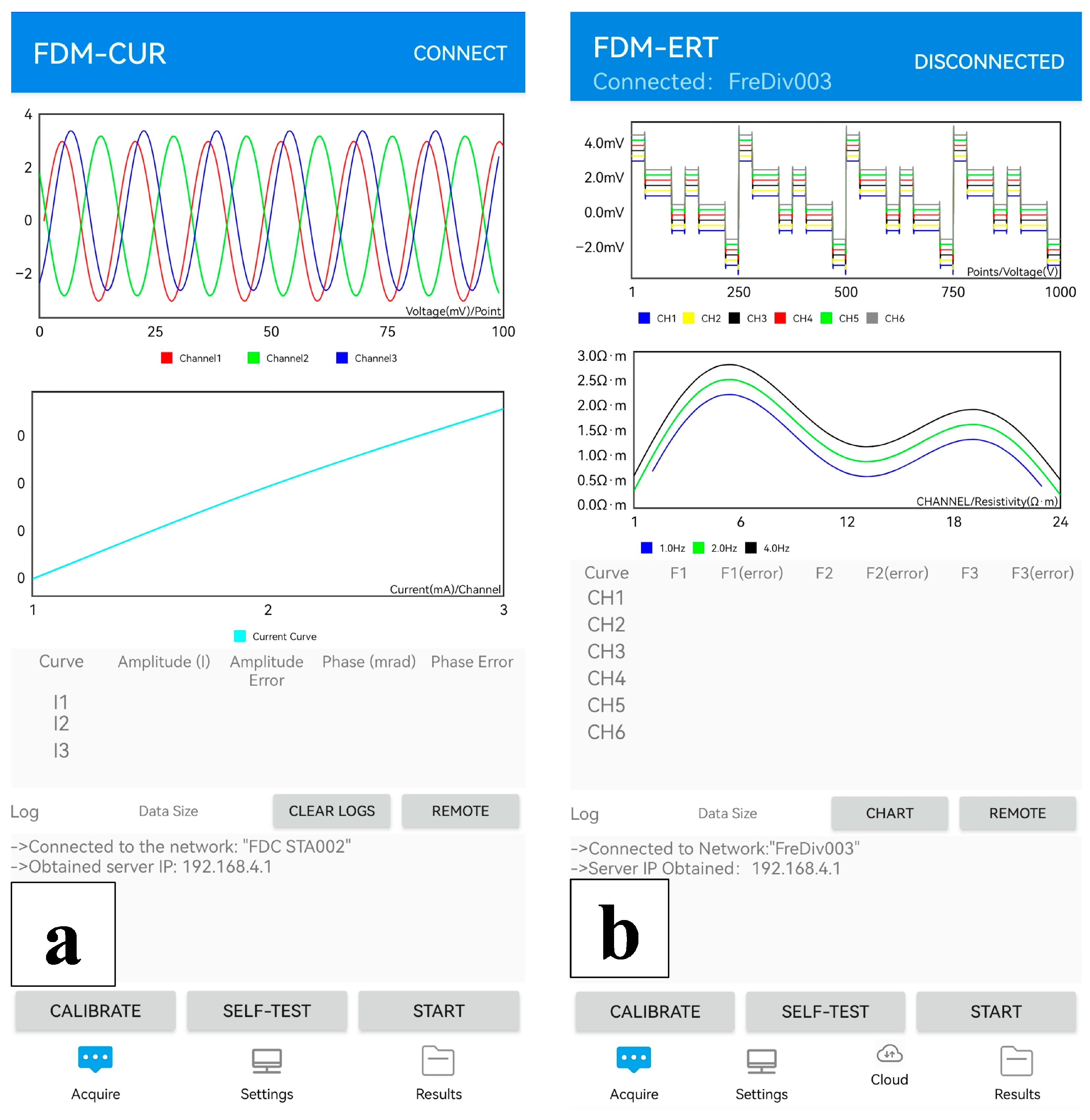
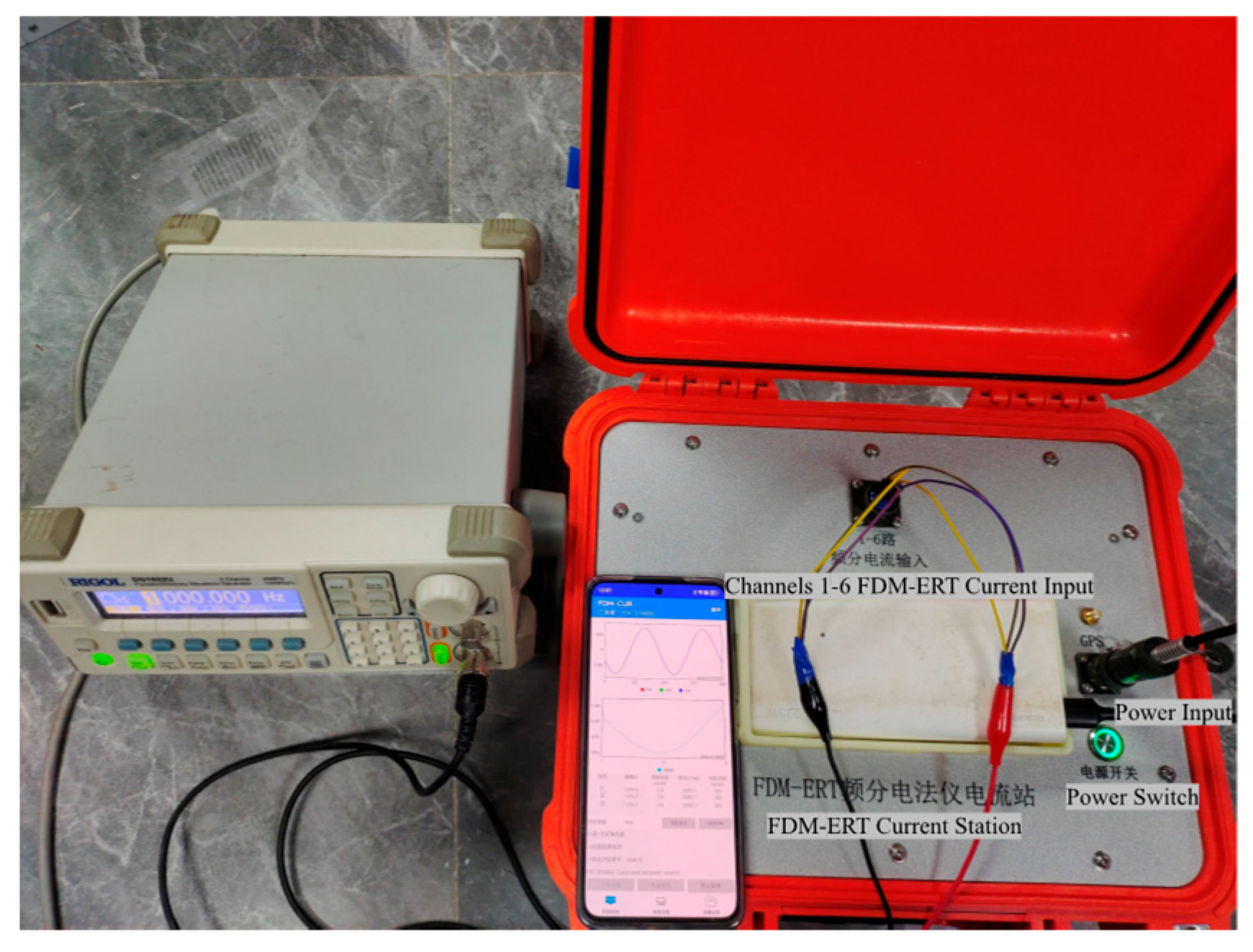
- Software of Current Station: This module is dedicated to the high-precision monitoring of the transmission source current. It parses current data uploaded by Hall sensors in real-time. By analyzing the spectrum of the transmission waveform through FFT transformation, the software ensures the stability of the transmission source during concurrent multi-frequency operations.
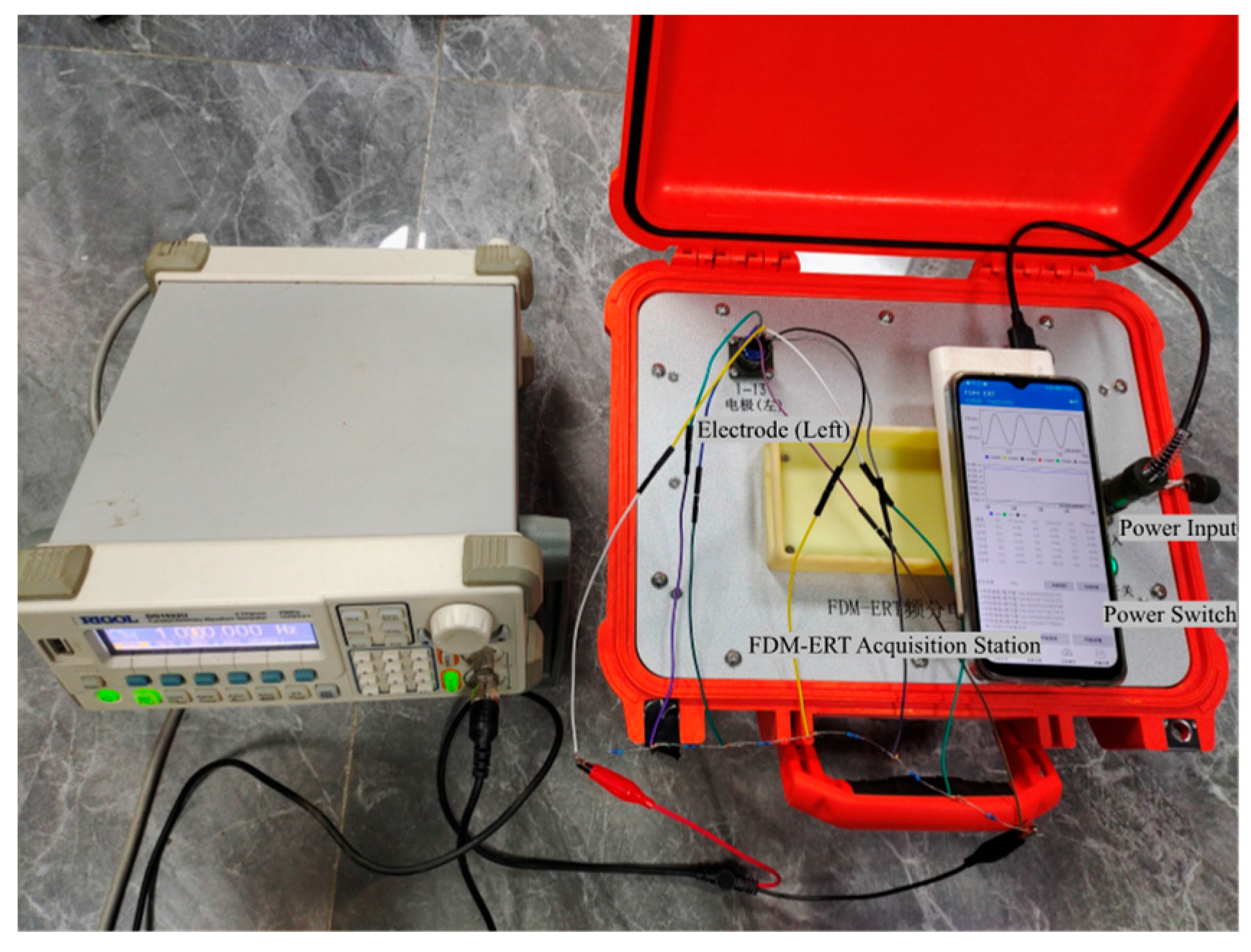
- Software of Acquisition Station: The Software of Acquisition Station functions as the intelligent control hub of the system, facilitating seamless transitions between local and remote operational modes. Designed specifically for a six-channel distributed acquisition architecture, this software employs a multi-channel grouping scan algorithm that automatically coordinates time-division acquisition and stitching of data from 24 channels. Moreover, by integrating local potential difference data with current data synchronized from the cloud, along with electrode geometric factors, it enables real-time calculation and imaging of apparent resistivity directly on the mobile terminal.
3.4.2. Dual-Mode Heterogeneous Communication Architecture
3.4.3. Signal Processing and Visual Interaction
4. Performance Evaluation and Field Experiments
4.1. Laboratory Testing and Functional Verification
4.1.1. Current Station Signal Monitoring
4.1.2. Multi-Channel Acquisition Accuracy
4.1.3. Cloud Collaboration and Data Flow Verification
4.2. Field Experiments and Validation
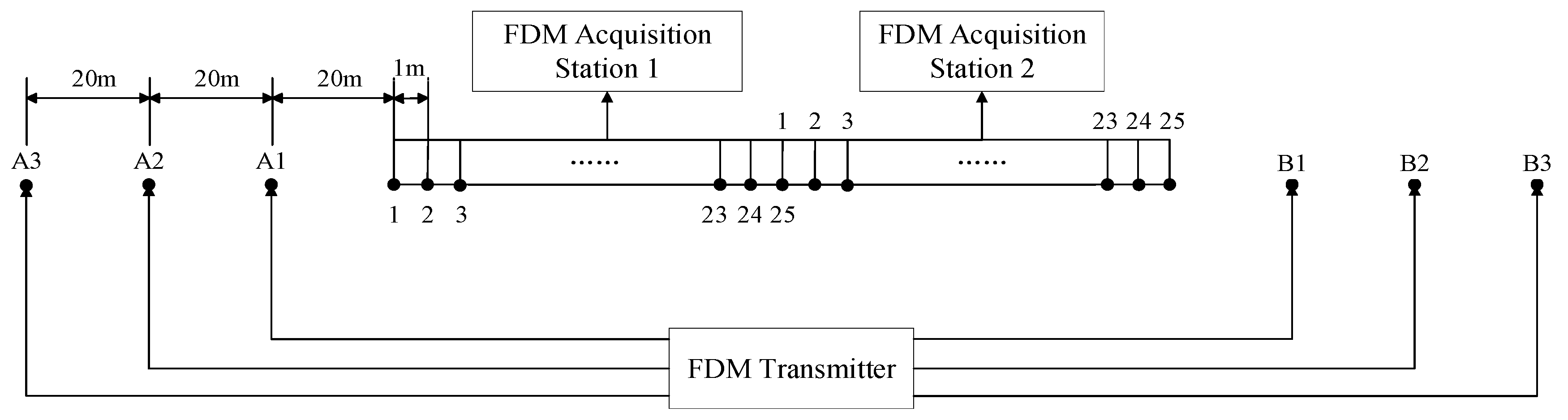
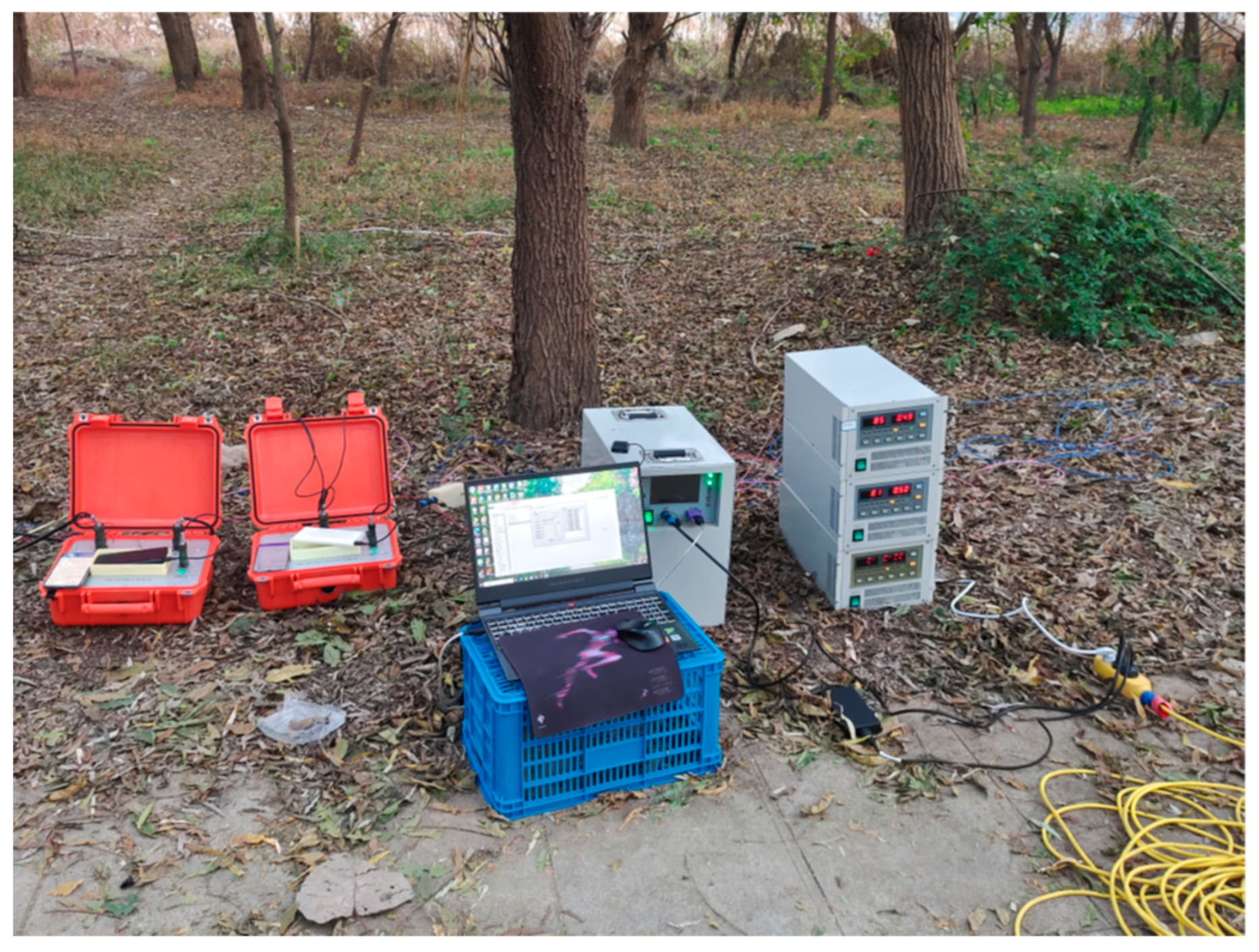
4.2.1. Experimental Setup and Device Deployment
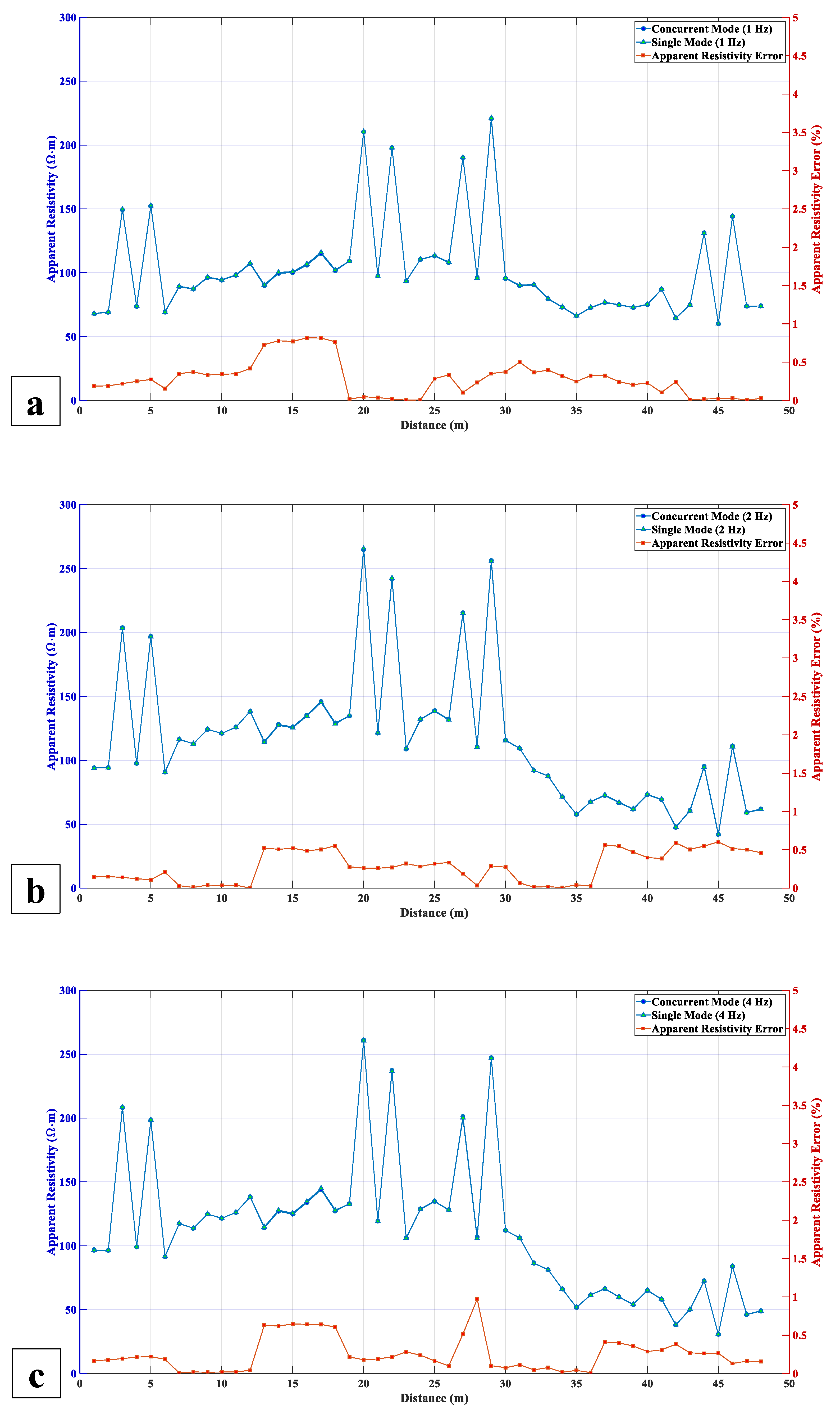
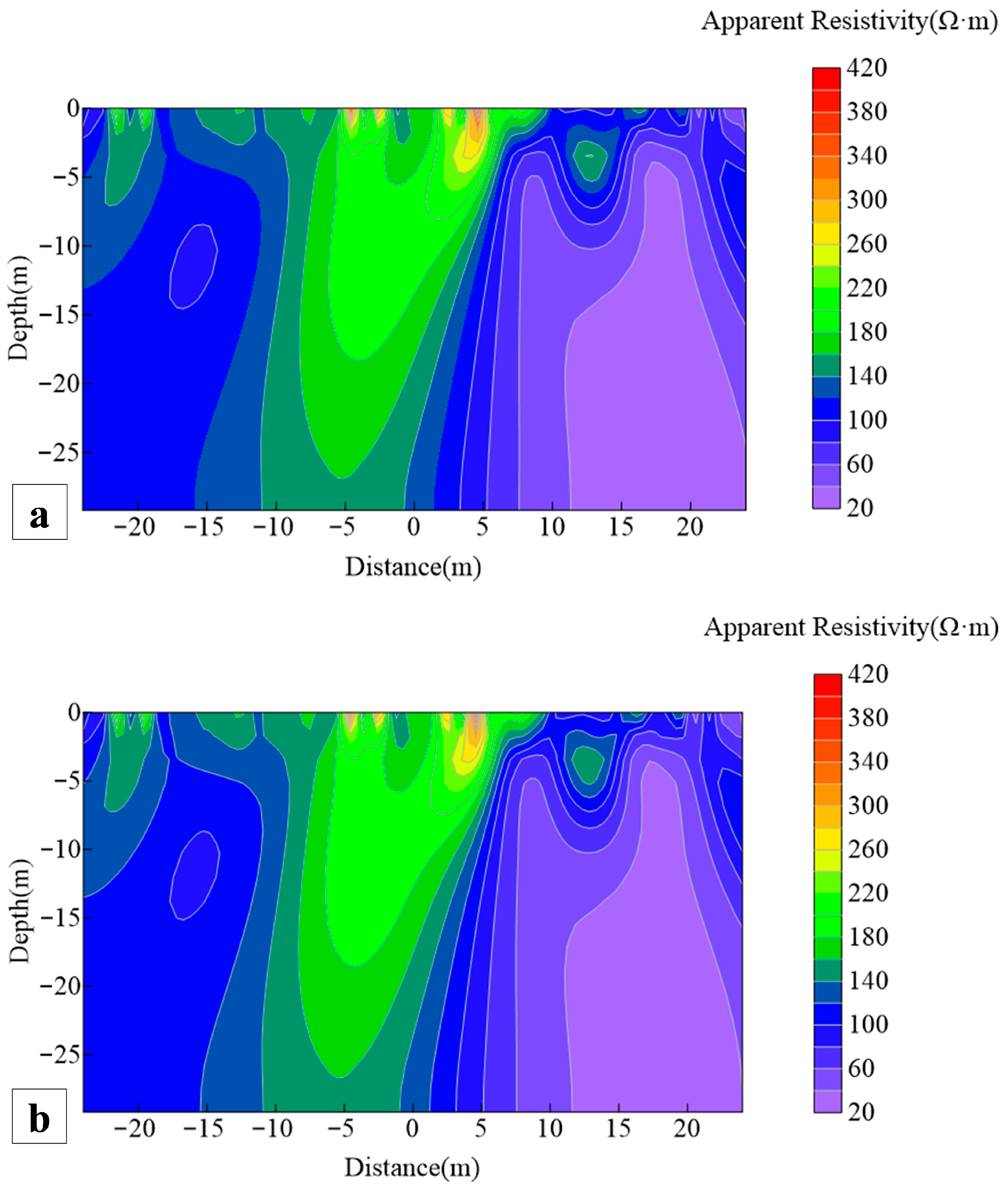
4.2.2. Multi-Mode Comparison and Data Consistency Analysis
4.2.3. Experimental Conclusions
5. Conclusions
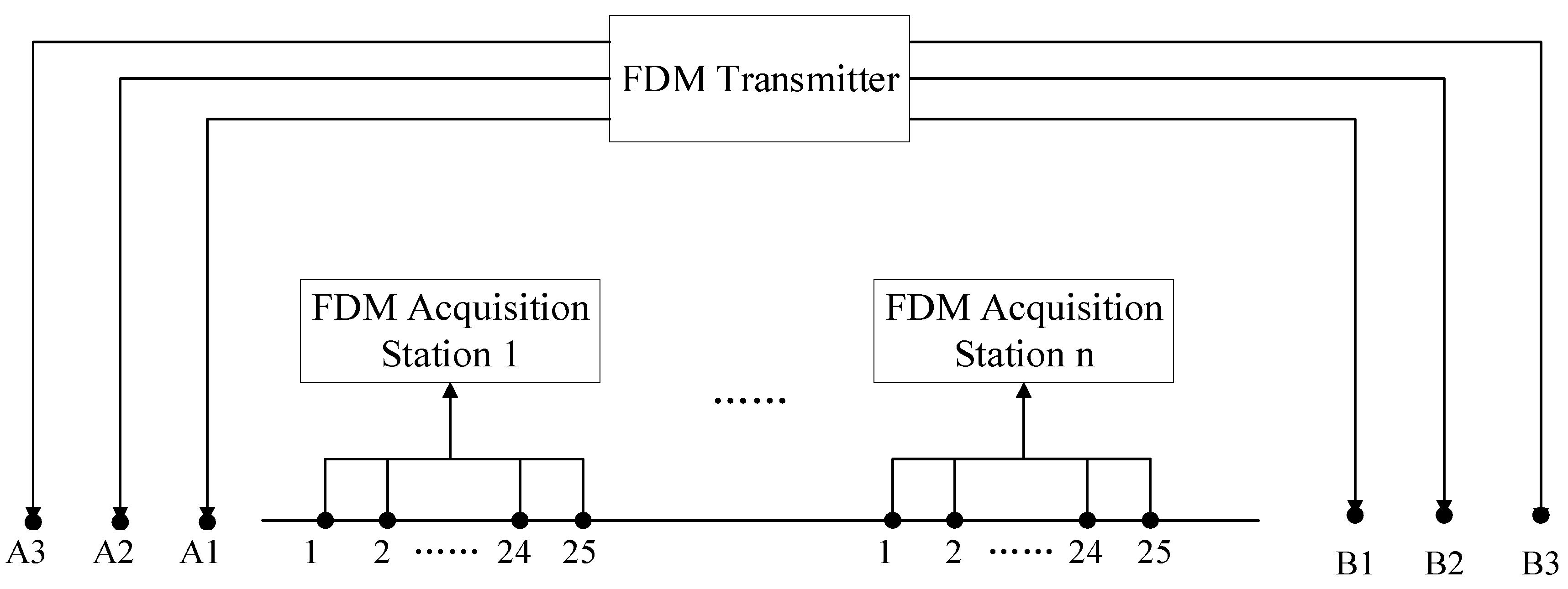
- We developed a collaborative distributed architecture termed ‘Device-Edge-Cloud’. The innovative integration of NB-IoT technology establishes a wide-area data link between current stations and acquisition stations, facilitating cross-device transmission and fusion of emission current data. This approach effectively addresses critical limitations of traditional distributed instruments, specifically cumbersome wiring, synchronization challenges, and inaccuracies in current calculations, thereby significantly enhancing the system’s deployment flexibility and operational coverage.
- We implemented an efficient strategy for FDM-ERT acquisition and real-time imaging. By leveraging STM32-based control logic and Android-based FFT signal processing algorithms, we successfully achieved the concurrent acquisition and demodulation of multi-channel orthogonal frequency signals. The system is characterized by its ‘single layout, multi-depth detection’ capability, which significantly enhances the efficiency of field data acquisition.
- The reliability and field applicability of the system have been thoroughly verified. Laboratory tests and field experiments confirmed the system’s stability under both Bluetooth/Wi-Fi near-field control and cloud-based modes. A comparative analysis revealed that the apparent resistivity measurement results obtained from the multi-frequency concurrent mode were highly consistent with those from the single-frequency time-division mode, with relative errors meticulously controlled within 5%. Furthermore, the inversion process achieved a high fitting precision (RMS = 1.3%), resulting in clear and reliable apparent resistivity imaging. By significantly enhancing acquisition efficiency while maintaining necessary precision, this portable system provides a practical and intelligent foundation for future urban shallow geophysical exploration.
Author Contributions
Funding
Institutional Review Board Statement
Informed Consent Statement
Data Availability Statement
Acknowledgments
Conflicts of Interest
References
- Li, J. Geoelectric Field and Electrical Exploration; Geological Publishing House: Beijing, China, 2005. (In Chinese) [Google Scholar]
- Doetsch, J.; Linde, N.; Vogt, T.; Binley, A.; Green, A.G. Imaging and quantifying salt-tracer transport in a riparian groundwater system by means of 3D ERT monitoring. Geophysics 2012, 77, B207–B218. [Google Scholar] [CrossRef] [Scilit]
- Jiang, L. Electrode Arbitrary Distributed Electrical Resistivity Tomography Survey Design, Optimization and Preliminary Application. Ph.D. Thesis, Zhejiang University, Hangzhou, China, 2021. (In Chinese) [Google Scholar]
- Lü, Q.; Zhang, X.; Tang, J.; Jin, S.; Liang, L.; Niu, J.; Wang, X.; Lin, P.; Yao, C.; Gao, W.; et al. Review on Advancement in Technology and Equipment of Geophysical Exploration for Metallic Deposits in China. Chin. J. Geophys. 2019, 62, 3629–3664. (In Chinese) [Google Scholar] [CrossRef]
- Imani, P.; Tian, G.; Hadiloo, S.; Abd El-Raouf, A. Application of Combined Electrical Resistivity Tomography (ERT) and Seismic Refraction Tomography (SRT) Methods to Investigate Xiaoshan District Landslide Site: Hangzhou, China. J. Appl. Geophys. 2021, 184, 104236. [Google Scholar] [CrossRef] [Scilit]
- Lapenna, V.; Perrone, A. Time-Lapse Electrical Resistivity Tomography (TL-ERT) for Landslide Monitoring: Recent Advances and Future Directions. Appl. Sci. 2022, 12, 1425. [Google Scholar] [CrossRef] [Scilit]
- Hung, Y.C.; Chou, H.S.; Lin, C.P. Appraisal of the Spatial Resolution of 2D Electrical Resistivity Tomography for Geotechnical Investigation. Appl. Sci. 2020, 10, 4394. [Google Scholar] [CrossRef] [Scilit]
- Tsokas, G.N.; Tsourlos, P.I.; Vargemezis, G.; Novack, M. Non-Destructive Electrical Resistivity Tomography for Indoor Investigation: The Case of Kapnikarea Church in Athens. Archaeol. Prospect. 2008, 15, 47–61. [Google Scholar] [CrossRef] [Scilit]
- Shi, Z.; Yu, T.; Shi, M. Investigate the Layout and Age of a Large-Scale Mausoleum in Hangzhou, China Using Combined Geophysical Technologies and Archaeological Documents. Archaeol. Prospect. 2020, 27, 301–313. [Google Scholar] [CrossRef] [Scilit]
- Capozzoli, L.; Giampaolo, V.; De Martino, G.; Perciante, F.; Lapenna, V.; Rizzo, E. ERT and GPR Prospecting Applied to Unsaturated and Subwater Analogue Archaeological Site in a Full Scale Laboratory. Appl. Sci. 2022, 12, 1126. [Google Scholar] [CrossRef] [Scilit]
- Abudeif, A.M.; Abdel Aal, G.Z.; Masoud, A.M.; Mohammed, M.A. Detection of Groundwater Pathways to Monitor Their Level Rise in Osirion at Abydos Archaeological Site for Reducing Deterioration Hazards, Sohag, Egypt Using Electrical Resistivity Tomography Technique. Appl. Sci. 2022, 12, 10417. [Google Scholar] [CrossRef] [Scilit]
- Greggio, N.; Giambastiani, B.M.S.; Balugani, E.; Amaini, C.; Antonellini, M. High-Resolution Electrical Resistivity Tomography (ERT) to Characterize the Spatial Extension of Freshwater Lenses in a Salinized Coastal Aquifer. Water 2018, 10, 1067. [Google Scholar] [CrossRef] [Scilit]
- Zhang, Y.; Fu, J.; Jia, S.; Meng, J. Application of Electrical Resistivity Tomography Method Combined with Cross-Well Seismic Computed Tomography Method in Karst Detection in Complex Urban Environment. Appl. Sci. 2025, 15, 5756. [Google Scholar] [CrossRef] [Scilit]
- Kukemilks, K.; Wagner, J.-F. Detection of Preferential Water Flow by Electrical Resistivity Tomography and Self-Potential Method. Appl. Sci. 2021, 11, 4224. [Google Scholar] [CrossRef] [Scilit]
- Servos, M.; Power, C. Improved ERT Imaging with 3-D Surface-to-Horizontal Borehole Configurations: Relevance to Dense Non-Aqueous Phase Liquids. Geophys. J. Int. 2024, 237, 389–401. [Google Scholar] [CrossRef] [Scilit]
- Trujillo-Romero, O.E.; Restrepo, G.M.; Corrales-Celedon, J.E. Multiscale Geophysical Characterization of Leachate and Gas Plumes in a Tropical Landfill Using Electrical Resistivity Tomography for Environmental Analysis and Diagnosis. Environments 2025, 12, 337. [Google Scholar] [CrossRef] [Scilit]
- Zhang, H.Q.; Cao, Z.B.; Li, W. Application of High Density Electrical Method in Karst Area. In Proceedings of the 6th International Conference on Civil Engineering, ICOCE 2022, Singapore; Lecture Notes in Civil Engineering; Strauss, E., Ed.; Springer: Singapore, 2023; Volume 276, pp. 229–233. [Google Scholar] [CrossRef] [Scilit]
- Xia, T.; Ma, M.; Huisman, J.A.; Zheng, C.; Gao, C.; Mao, D. Monitoring of In-Situ Chemical Oxidation for Remediation of Diesel-Contaminated Soil with Electrical Resistivity Tomography. J. Contam. Hydrol. 2023, 256, 104170. [Google Scholar] [CrossRef] [Scilit]
- Martorana, R.; Capizzi, P.; Pirrera, C. Unconventional Arrays for 3D Electrical Resistivity and Induced Polarization Tomography to Detect Leachate Concentration in a Waste Landfill. Appl. Sci. 2023, 13, 7203. [Google Scholar] [CrossRef] [Scilit]
- Isobe, Y.; Ishimori, H. Continuous Electrical Resistivity Tomography Monitoring in Waste Landfill Sites with Different Properties and Visualization of Water Channels. Appl. Sci. 2025, 15, 6920. [Google Scholar] [CrossRef] [Scilit]
- Johansen, H.K. A Man/Computer Interpretation System for Resistivity Soundings over a Horizontally Stratified Earth. Geophys. Prospect. 1977, 25, 667–691. [Google Scholar] [CrossRef] [Scilit]
- Daily, W.; Ramirez, A.; Binley, A.; LaBrecque, D. Electrical Resistance Tomography—Theory and Practice. In Near-Surface Geophysics; Butler, D.K., Ed.; Society of Exploration Geophysicists: Tulsa, OK, USA, 2005; Volume 13, pp. 525–550. [Google Scholar] [CrossRef] [Scilit]
- Loke, M.H.; Rucker, D.F.; Chambers, J.E.; Wilkinson, P.B.; Kuras, O. Electrical Resistivity Surveys and Data Interpretation. In Encyclopedia of Solid Earth Geophysics; Gupta, H.K., Ed.; Springer: Cham, Switzerland, 2021; pp. 344–350. [Google Scholar] [CrossRef] [Scilit]
- Shima, H.; Sakayama, T. Resistivity Tomography: An Approach to 2-D Resistivity Inverse Problems. In SEG Technical Program Expanded Abstracts 1987; Society of Exploration Geophysicists: Tulsa, OK, USA, 1987; pp. 59–61. [Google Scholar] [CrossRef] [Scilit]
- Olsson, P.-I.; Dahlin, T.; Fiandaca, G.; Auken, E. Measuring Time-Domain Spectral Induced Polarization in the On-Time: Decreasing Acquisition Time and Increasing Signal-to-Noise Ratio. J. Appl. Geophys. 2015, 123, 316–321. [Google Scholar] [CrossRef] [Scilit]
- Ali, N.; Chappuies, J.; Sloan, G.; Rouland, G.; Rai, A.; Dong, Y. A Global Perspective on Electrical Resistivity Tomography, Electromagnetic and Ground Penetration Radar Methods for Estimating Groundwater Recharge Zones. Front. Water 2025, 7, 1636613. [Google Scholar] [CrossRef] [Scilit]
- Ducut, J.D.; Alipio, M.; Go, P.J.; Concepcion, R.; Vicerra, R.R.; Bandala, A.; Dadios, E. A Review of Electrical Resistivity Tomography Applications in Underground Imaging and Object Detection. Displays 2022, 73, 102208. [Google Scholar] [CrossRef] [Scilit]
- Che, H.; Huisman, J.A.; Zimmermann, E. Broad-Band Spectral Electrical Impedance Tomography (sEIT) Measurements with a Centralized Multiplexer and Coaxial Cables. Geophys. J. Int. 2025, 243, ggaf315. [Google Scholar] [CrossRef] [Scilit]
- DMT Group. High-Resolution DC Resistivity Meter System: RESECS. Available online: https://www.dmt-group.com/fileadmin/redaktion/documents/Rebranding-2022/InE/RESECS_EN.pdf (accessed on 6 January 2026).
- Advanced Geosciences, Inc. SuperSting™ Wi-Fi. Available online: https://www.agiusa.com/supersting-wifi (accessed on 6 January 2026).
- OYO Corporation. McOHM Profiler-8i. Available online: https://www.oyo.co.jp/english/services/products-list/mcohm-profiler-8i/ (accessed on 6 January 2026).
- Guideline Geo. ABEM Terrameter LS 2. Available online: https://www.guidelinegeo.com/product/abem-terrameter-ls-2/ (accessed on 6 January 2026).
- Martin, T.; Flores Orozco, A.; Günther, T.; Dahlin, T. Comparison of TDIP and SIP Measurements in the Field Scale. In Proceedings of the 5th International Workshop on Induced Polarization, Newark, NJ, USA, 3–5 October 2018; Available online: https://lup.lub.lu.se/record/809b3f47-838e-4160-89e3-d198fda0b4ab (accessed on 6 January 2026).
- Chongqing Geological Instrument Co., Ltd. DUK-3/4 Series Electrical Resistivity Tomography Measurement System. Available online: https://www.cgif.com.cn/displayproduct-139-9.html (accessed on 6 January 2026).
- Xia, X.; Pan, Y.-Y.; Liu, X.-L.; Jia, Y.-G. Hierarchical Electrode Switching Device Design for Distributed Single-Channel Electrical Resistivity Tomography System. Appl. Sci. 2021, 11, 5746. [Google Scholar] [CrossRef] [Scilit]
- Geopen Technology. GeoPen E60DN3D. Available online: http://www.geopen.net/product/13.html (accessed on 6 January 2026).
- Wu, Z. Research and Development of a Novel 4-Dimensional Multi-Electrode Electrical Prospecting Instrument. Ph.D. Thesis, China University of Geosciences (Beijing), Beijing, China, 2023. (In Chinese) [Google Scholar]
- Liu, D. Development and Application of Electrical Resistivity Tomography Instrument. Master’s Thesis, Lanzhou University, Lanzhou, China, 2022. (In Chinese) [Google Scholar]
- Chen, R.; Tang, D.; Liu, C. Development of Frequency Division Multiplexing 3D Electrical Resistivity Tomography Instrument. In Proceedings of the 2020 Annual Meeting of Chinese Geoscience Union, Chongqing, China, 18–21 October 2020; pp. 109–111. (In Chinese) [Google Scholar]
- Liu, Z. Development of Frequency Division Electrical Measurement and Control System Based on Internet of Things. Master’s Thesis, Central South University, Changsha, China, 2022. (In Chinese) [Google Scholar]
- Balderas-Díaz, S.; Guerrero-Contreras, G. Data Management in Dynamic AAL Environments. In Proceedings of the Tenth Spanish-German Symposium on Applied Computer Science (SGSOACS 2024), Cadiz, Spain, 12–14 June 2024. [Google Scholar]
- Loke, M.H. Tutorial: 2-D and 3-D Electrical Imaging Surveys; University of Birmingham: Birmingham, UK, 2004. [Google Scholar]
- Oyeyemi, K.D.; Aizebeokhai, A.P.; Metwaly, M.; Omobulejo, O.; Sanuade, O.A.; Okon, E.E. Assessing the Suitable Electrical Resistivity Arrays for Characterization of Basement Aquifers Using Numerical Modeling. Heliyon 2022, 8, e09427. [Google Scholar] [CrossRef] [Scilit]
- Loke, M.H.; Chambers, J.E.; Rucker, D.F.; Kuras, O.; Wilkinson, P.B. Recent Developments in the Direct-Current Geoelectrical Imaging Method. J. Appl. Geophys. 2013, 95, 135–156. [Google Scholar] [CrossRef] [Scilit]
- Loke, M.H.; Wilkinson, P.B.; Chambers, J.E.; Uhlemann, S.S.; Sorensen, J.P.R. Optimized Arrays for 2-D Resistivity Survey Lines with a Large Number of Electrodes. J. Appl. Geophys. 2015, 112, 136–146. [Google Scholar] [CrossRef] [Scilit]
- Liu, C.; Tang, D.; Lin, R.; Zhao, Y.; Liu, X.; Cheng, Y. A Multi-Frequency Resistivity Exploration Method. China Patent CN107748395B, 2 July 2019. [Google Scholar]
- Chen, R.; Liu, R.; Liu, C.; Wang, G.; Cao, C. A Harmonic Correction Method for Frequency Division Electrical Method. China Patent CN111624668B, 28 May 2021. [Google Scholar]
- Cao, C.; Liu, C.; Kang, F.; He, Y.; Peng, J. A Frequency Division Multiplexing Electrical Exploration Method. China Patent CN115576015A, 6 January 2023. [Google Scholar]
- Martorana, R.; Capizzi, P.; D’Alessandro, A.; Luzio, D. Comparison of Different Sets of Array Configurations for Multichannel 2D ERT Acquisition. J. Appl. Geophys. 2017, 137, 34–48. [Google Scholar] [CrossRef] [Scilit]
- Dahlin, T.; Leroux, V. Improvement in Time-Domain Induced Polarization Data Quality with Multi-Electrode Systems by Separating Current and Potential Cables. Near Surf. Geophys. 2012, 10, 545–565. [Google Scholar] [CrossRef] [Scilit]
- Dahlin, T.; Zhou, B. Multiple-Gradient Array Measurements for Multichannel 2D Resistivity Imaging. Near Surf. Geophys. 2006, 4, 113–123. [Google Scholar] [CrossRef] [Scilit]
- Wang, S.; Gu, G.; Wu, Y.; Niu, X.; Pan, B.; Wang, X.; Xu, Z.; He, H.; Wang, Y.; Lin, X.; et al. Application of a Multiple Transmitter Spacing Gradient Array TDIP Survey in the Huaniushan Mining Area, Gansu Province, China. Sci. Rep. 2025, 15, 29793. [Google Scholar] [CrossRef] [Scilit] [PubMed]
- Peng, X.; Chun, S.; Su, B.; Chen, R.; Hou, S.; Xu, C.; Zhang, H. Design of Three-Dimensional Electrical Impedance Tomography System for Rock Samples. Appl. Sci. 2024, 14, 1671. [Google Scholar] [CrossRef] [Scilit]
- Hou, S.; Chen, R.; Wang, Z.; Liu, J.; Shen, Y. Development of the NB-IoT-Based Measurement and Control Software for Broadband SIP Response Testers for Rock and Ore Specimens. Geophys. Geochem. Explor. 2022, 46, 1463–1469. (In Chinese) [Google Scholar] [CrossRef]
- IRIS Instruments. Syscal Pro: All-in-One Resistivity and IP System. Available online: https://www.iris-instruments.com/syscal-pro.html (accessed on 3 March 2026).
- Bizhani, H.; Kamkar-Rouhani, A.; Arab-Amiri, A.R.; Parnow, S. Inversion of Geophysical Data of Hafthar Pb-Zn Deposit. In Proceedings of the 19th Iranian Geophysical Conference, Tehran, Iran, 4–6 November 2020; pp. 1–4. [Google Scholar]
- ZOND. ZondRes2d. Available online: http://zond-geo.com/english/zond-software/ert-and-ves/zondres2d/ (accessed on 12 December 2025).



| Service Type | Name | Description | Data Type | Example Value |
|---|---|---|---|---|
| Property | Electricity | Current Data | String | {“Electricity”: 0.85} |
| Property | Resistivity | Apparent Resistivity | String | {“Resistivity”: 256.78} |
| Property | NumID | Group ID | String | {“NumID”: 1} |
| Command | FDM-ERT-Start | Start Acquisition | String | {“FDM-ERT-Start”: “START”} |
| Command | FDM-ERT-Stop | Stop Acquisition | String | {“FDM-ERT-Stop”: “STOP”} |
| Command | FDM-ERT-State | Status | String | {“FDM-ERT-State”: “NORMAL”} |
| Command | FDM-ERT-Config | Send Configuration | String | {“FDM-ERT-Config”: {“sampling_rate”: [250]}} |
| Feature | FDM-ERT | ABEM Terrameter LS | IRIS Syscal Pro |
|---|---|---|---|
| Concurrent Frequencies | Up to 3 | Single-frequency | Single-frequency |
| Data Communication | Wi-Fi, NB-IoT | Wi-Fi, Ethernet, USB | USB, Wi-Fi |
| Control Platform | Mobile App via Wireless Connection (Wi-Fi/Bluetooth) | Embedded Industrial PC (Touchscreen) | On-board Microprocessor Console |
| Parameter | FDM-ERT | ABEM Terrameter LS | IRIS Syscal Pro |
|---|---|---|---|
| Injected Current Magnitude Range (A) | 0.001–5 | Up to 2.5 | 0–2.5 |
| Voltage Compliance/Withstand (V) | 2500 VAC@50 Hz &1 min | Up to ± 600 | 800 V (switch mode)/1000 V (manual mode); |
| Receiver Noise Floor (equivalent input-referred RMS) | Average 0.563 μV | 3 nV (theoretical @ 1 s) | Not explicitly stated; resolution 1 μV, accuracy 0.2% |
| Dynamic Range (dB) | Average 129.4 | Not explicitly specified (24-bit ADC) | Not explicitly specified (24-bit ADC) |
| Figure No. | Measured Value (mV) | Theoretical Value (mV) | Error (%) |
|---|---|---|---|
| a | 1494.09 | 1500 | 0.39 |
| 1493.03 | 1500 | 0.46 | |
| 1494.56 | 1500 | 0.36 | |
| b | 995.46 | 1000 | 0.46 |
| 994.74 | 1000 | 0.53 | |
| 995.36 | 1000 | 0.46 | |
| c | 499.93 | 500 | 0.014 |
| 499.57 | 500 | 0.086 | |
| 500.08 | 500 | 0.016 |
| Frequency (Hz) | Level (Vpp) | Interference Type | Level (Vpp) | SNR_Before (dB) | SNR_After (dB) | ΔSNR (dB) | Error (%) |
|---|---|---|---|---|---|---|---|
| 1 | 2 | 50 Hz | 0.5 | 12.08 ± 0.00 | 42.77 ± 2.08 | 30.69 ± 0.78 | 0.27 ± 0.01 |
| 1.0 | 5.94 ± 0.00 | 35.82 ± 1.98 | 29.88 ± 1.98 | 0.65 ± 0.01 | |||
| 1.5 | 2.46 ± 0.00 | 31.36 ± 1.89 | 28.90 ± 1.89 | 0.64 ± 0.01 | |||
| 2 | 2 | 50 Hz | 0.5 | 12.07 ± 0.00 | 38.50 ± 0.30 | 26.43 ± 0.30 | 1.77 ± 0.01 |
| 1.0 | 5.94 ± 0.00 | 34.78 ± 1.52 | 28.84 ± 1.52 | 2.18 ± 0.00 | |||
| 1.5 | 2.46 ± 0.00 | 31.26 ± 1.66 | 28.80 ± 1.66 | 2.20 ± 0.00 | |||
| 4 | 2 | 50 Hz | 0.5 | 12.07 ± 0.00 | 39.96 ± 1.27 | 27.89 ± 1.27 | 1.86 ± 0.00 |
| 1.0 | 5.94 ± 0.00 | 35.30 ± 1.85 | 29.36 ± 1.85 | 2.25 ± 0.00 | |||
| 1.5 | 2.45 ± 0.00 | 33.20 ± 1.95 | 30.75 ± 1.95 | 2.16 ± 0.01 | |||
| 1 | 2 | Noise | 0.5 | 43.71 ± 0.03 | 43.73 ± 0.04 | 0.02 ± 0.01 | 0.27 ± 0.01 |
| 1.0 | 39.89 ± 0.03 | 39.92 ± 0.03 | 0.03 ± 0.04 | 0.65 ± 0.00 | |||
| 1.5 | 38.52 ± 0.06 | 38.58 ± 0.06 | 0.06 ± 0.00 | 0.65 ± 0.01 | |||
| 2 | 2 | Noise | 0.5 | 46.47 ± 0.04 | 46.45 ± 0.05 | −0.02 ± 0.07 | 0.28 ± 0.00 |
| 1.0 | 40.09 ± 0.04 | 40.12 ± 0.04 | 0.03 ± 0.00 | 0.66 ± 0.00 | |||
| 1.5 | 39.71 ± 0.05 | 39.78 ± 0.05 | 0.07 ± 0.00 | 0.66 ± 0.01 | |||
| 4 | 2 | Noise | 0.5 | 47.91 ± 0.04 | 47.58 ± 0.12 | −0.32 ± 0.08 | 0.30 ± 0.00 |
| 1.0 | 41.38 ± 0.05 | 41.34 ± 0.06 | −0.04 ± 0.01 | 0.63 ± 0.00 | |||
| 1.5 | 41.28 ± 0.06 | 41.31 ± 0.05 | 0.03 ± 0.00 | 0.65 ± 0.00 |
| Parameter | Before Filtering (Mean ± 95% CI) | After Filtering (Mean ± 95% CI) |
|---|---|---|
| Amplitude at principal frequency (4 Hz, V) | 0.9784 ± 0.0001 | 0.9784 ± 0.0001 |
| Leakage ratio at 1 Hz (dB) | −84.49 ± 1.32 | −84.53 ± 1.39 |
| Leakage ratio at 2 Hz (dB) | −77.28 ± 0.36 | −77.28 ± 0.40 |
| Leakage ratio at 50 Hz (dB) | −2.45 ± 0.00 | −74.76 ± 0.01 |
| Leakage ratio at 100 Hz (dB) | −79.05 ± 0.12 | −148.70 ± 5.83 |
| Average leakage (non-principal bins, dB) | −44.11 ± 0.00 | −78.15 ± 0.06 |
| Figure No. | Measured Voltage (mV) | Theoretical Voltage (mV) | Error (%) | Measured Apparent Resistivity (Ω·m) | Theoretical Apparent Resistivity (Ω·m) | Error (%) |
|---|---|---|---|---|---|---|
| a | 166.22 | 166.67 | 0.27 | 524,069.4 | 527,787.6 | 0.70 |
| 164.80 | 166.67 | 1.12 | 501,320.6 | 509,268.7 | 1.56 | |
| 165.23 | 166.67 | 0.86 | 467,767.7 | 473,931.7 | 1.30 | |
| 165.38 | 166.67 | 0.77 | 419,721.3 | 424,896.1 | 1.21 | |
| 165.33 | 166.67 | 0.80 | 361,638.1 | 366,219.9 | 1.25 | |
| 165.96 | 166.67 | 0.42 | 299,704.7 | 302,350.7 | 0.88 | |
| b | 330.43 | 333.33 | 0.87 | 236,596.5 | 237,629.5 | 0.43 |
| 327.58 | 333.33 | 1.73 | 173,653.2 | 175,929.2 | 1.29 | |
| 328.46 | 333.33 | 1.46 | 119,206.1 | 120,449.4 | 1.03 | |
| 328.73 | 333.33 | 1.38 | 72,952.2 | 73,651.5 | 0.95 | |
| 328.62 | 333.33 | 1.41 | 36,927.1 | 37,293.7 | 0.98 | |
| 329.87 | 333.33 | 1.04 | 12,448.6 | 12,524.6 | 0.61 | |
| c | 410.29 | 416.67 | 1.53 | 523,100.2 | 527,787.6 | 0.89 |
| 406.75 | 416.67 | 2.38 | 500,394.4 | 509,268.7 | 1.74 | |
| 407.83 | 416.67 | 2.12 | 466,905.4 | 473,931.7 | 1.48 | |
| 408.18 | 416.67 | 2.03 | 418,947.3 | 424,896.1 | 1.40 | |
| 408.04 | 416.67 | 2.07 | 360,964.5 | 366,219.9 | 1.43 | |
| 409.60 | 416.67 | 1.70 | 299,152.8 | 302,350.7 | 1.06 | |
| d | 490.94 | 500 | 1.81 | 235,335.5 | 237,629.5 | 0.96 |
| 486.71 | 500 | 2.66 | 172,727.0 | 175,929.2 | 1.82 | |
| 488.01 | 500 | 2.40 | 118,570.2 | 120,449.4 | 1.56 | |
| 488.41 | 500 | 2.32 | 72,563.2 | 73,651.5 | 1.47 | |
| 488.25 | 500 | 2.35 | 36,729.2 | 37,293.7 | 1.51 | |
| 490.14 | 500 | 1.97 | 12,382.5 | 12,524.6 | 1.13 |
| Frequency (Hz) | Level (Vpp) | Interference Type | Level (Vpp) | SNR_Before (dB) | SNR_After (dB) | ΔSNR (dB) | Error (%) |
|---|---|---|---|---|---|---|---|
| 1 | 2 | 50 Hz | 0.5 | 12.54 ± 0.00 | 46.56 ± 0.95 | 34.02 ± 0.95 | 0.32 ± 0.04 |
| 1.0 | 5.04 ± 0.00 | 37.16 ± 0.69 | 32.12 ± 0.69 | 0.82 ± 0.08 | |||
| 1.5 | 1.56 ± 0.00 | 35.77 ± 1.00 | 34.21 ± 1.00 | 0.82 ± 0.08 | |||
| 2 | 2 | 50 Hz | 0.5 | 12.53 ± 0.00 | 46.42 ± 1.01 | 33.89 ± 1.01 | 1.59 ± 0.08 |
| 1.0 | 5.04 ± 0.00 | 38.60 ± 0.78 | 33.56 ± 0.78 | 1.77 ± 0.08 | |||
| 1.5 | 1.56 ± 0.00 | 34.56 ± 0.95 | 33.00 ± 0.25 | 1.77 ± 0.08 | |||
| 4 | 2 | 50 Hz | 0.5 | 12.53 ± 0.00 | 45.65 ± 1.04 | 33.11 ± 1.04 | 2.08 ± 0.08 |
| 1.0 | 5.04 ± 0.00 | 38.95 ± 0.58 | 33.92 ± 0.58 | 2.26 ± 0.08 | |||
| 1.5 | 1.55 ± 0.00 | 35.65 ± 0.92 | 34.10 ± 0.92 | 2.26 ± 0.08 | |||
| 1 | 2 | Noise | 0.5 | 60.84 ± 0.27 | 61.92 ± 0.33 | 1.08 ± 0.07 | 0.32 ± 0.04 |
| 1.0 | 42.73 ± 0.04 | 42.82 ± 0.04 | 0.09 ± 0.00 | 0.41 ± 0.06 | |||
| 1.5 | 43.46 ± 0.05 | 43.70 ± 0.05 | 0.23 ± 0.00 | 0.41 ± 0.06 | |||
| 2 | 2 | Noise | 0.5 | 51.13 ± 0.50 | 51.19 ± 0.50 | 0.06 ± 0.02 | 0.29 ± 0.04 |
| 1.0 | 41.82 ± 0.04 | 41.88 ± 0.04 | 0.06 ± 0.01 | 0.39 ± 0.06 | |||
| 1.5 | 42.95 ± 0.05 | 43.16 ± 0.05 | 0.20 ± 0.01 | 0.41 ± 0.06 | |||
| 4 | 2 | Noise | 0.5 | 33.78 ± 0.08 | 33.76 ± 0.08 | −0.01 ± 0.01 | 0.33 ± 0.05 |
| 1.0 | 42.59 ± 0.04 | 42.61 ± 0.04 | 0.02 ± 0.01 | 0.42 ± 0.06 | |||
| 1.5 | 43.35 ± 0.04 | 43.48 ± 0.05 | 0.13 ± 0.01 | 0.43 ± 0.06 |
| Parameter | Before Filtering (Mean ± 95% CI) | After Filtering (Mean ± 95% CI) |
|---|---|---|
| Amplitude at principal frequency (4 Hz, V) | 0.1660 ± 0.0005 | 0.1660 ± 0.0005 |
| Leakage ratio at 1 Hz (dB) | −104.5 ± 2.0 | −104.5 ± 2.0 |
| Leakage ratio at 2 Hz (dB) | −96.0 ± 1.5 | −96.0 ± 1.5 |
| Leakage ratio at 50 Hz (dB) | −1.55 ± 0.01 | −73.84 ± 0.01 |
| Leakage ratio at 100 Hz (dB) | −83.0 ± 0.5 | −170.0 ± 10.0 |
| Average leakage (non-principal bins, dB) | −49.37 ± 0.01 | −89.80 ± 0.30 |
| Acquisition Modes | Work Frequency (Hz) | Number of Emissions (Times) | Number of Electrode Reconfigurations (Times) | Average Working Time (min) | Notes |
|---|---|---|---|---|---|
| single-frequency time-division | 1, 2, 4 | 3 | 3 | 15–18 | Based on 10 independent runs; actual per-frequency ≈ 5–6 min, total range ≈ 15–18 min |
| multi-frequency concurrent | 1, 2, 4 | 1 | 1 | 5–6 | Based on 10 independent runs; actual range 5–6 min |
| Parameter | Before Filtering (Mean ± 95% CI) | After Filtering (Mean ± 95% CI) |
|---|---|---|
| Amplitude at principal frequency (4 Hz, V) | 0.0045 ± 0.0016 | 0.0045 ± 0.0016 |
| Leakage ratio at 50 Hz (dB) | −43.93 ± 4.66 | −115.87 ± 5.71 |
| Leakage ratio at 100 Hz (dB) | −50.14 ± 3.45 | −144.58 ± 2.49 |
| Average leakage (non-principal bins, dB) | −35.09 ± 1.48 | −39.89 ± 2.06 |
| Parameter | Before Filtering (Mean ± 95% CI) | After Filtering (Mean ± 95% CI) |
|---|---|---|
| Amplitude at principal frequency (4 Hz, V) | 0.0042 ± 0.0004 | 0.0042 ± 0.0004 |
| Leakage ratio at 50 Hz (dB) | −29.22 ± 3.92 | −101.46 ± 3.91 |
| Leakage ratio at 100 Hz (dB) | −37.29 ± 2.44 | −165.39 ± 2.77 |
| Average leakage (non-principal bins, dB) | −38.39 ± 1.15 | −42.07 ± 1.53 |
Disclaimer/Publisher’s Note: The statements, opinions and data contained in all publications are solely those of the individual author(s) and contributor(s) and not of MDPI and/or the editor(s). MDPI and/or the editor(s) disclaim responsibility for any injury to people or property resulting from any ideas, methods, instructions or products referred to in the content. |
© 2026 by the authors. Licensee MDPI, Basel, Switzerland. This article is an open access article distributed under the terms and conditions of the Creative Commons Attribution (CC BY) license.
Share and Cite
Yu, K.; Chen, R.; Liu, C.; Chun, S.; Yu, D.; Liu, Z. Development of an NB-IoT-Based Measurement and Control System for Frequency Division Multiplexing Electrical Resistivity Tomography (FDM-ERT) Instruments. Appl. Sci. 2026, 16, 2774. https://doi.org/10.3390/app16062774
Yu K, Chen R, Liu C, Chun S, Yu D, Liu Z. Development of an NB-IoT-Based Measurement and Control System for Frequency Division Multiplexing Electrical Resistivity Tomography (FDM-ERT) Instruments. Applied Sciences. 2026; 16(6):2774. https://doi.org/10.3390/app16062774
Chicago/Turabian StyleYu, Kai, Rujun Chen, Chunming Liu, Shaoheng Chun, Donghai Yu, and Zhitong Liu. 2026. "Development of an NB-IoT-Based Measurement and Control System for Frequency Division Multiplexing Electrical Resistivity Tomography (FDM-ERT) Instruments" Applied Sciences 16, no. 6: 2774. https://doi.org/10.3390/app16062774
APA StyleYu, K., Chen, R., Liu, C., Chun, S., Yu, D., & Liu, Z. (2026). Development of an NB-IoT-Based Measurement and Control System for Frequency Division Multiplexing Electrical Resistivity Tomography (FDM-ERT) Instruments. Applied Sciences, 16(6), 2774. https://doi.org/10.3390/app16062774