Article

Design of the Post-Dispersion System for Coherent-Dispersion Spectrometer

1
Electronic Information School, Wuhan University, Wuhan 430072, China
2
Engineering Technology Research Center of Spectral and Imaging Instruments, Wuhan 430072, China
3
Wuhan Institute of Quantum Technology, Wuhan 430206, China
4
Xi’an Institute of Optics and Precision Mechanics of Chinese Academy of Sciences, Xi’an 710119, China
5
Electronic and Electrical Engineering School, Wuhan Textile University, Wuhan 430073, China
*
Author to whom correspondence should be addressed.
Appl. Sci. 2026, 16(6), 2658; https://doi.org/10.3390/app16062658
Submission received: 9 February 2026 / Revised: 5 March 2026 / Accepted: 9 March 2026 / Published: 11 March 2026
(This article belongs to the Section Applied Physics General)

Abstract

Coherent-dispersion spectroscopy enables high-precision Doppler measurements of stellar spectral lines, which serves as a vital technique for the indirect detection of exoplanets. In this study, the post-dispersion system of a coherent-dispersion spectrometer (CODES) was designed and optimized using Zemax, with the detection spectral range of 656 nm–716 nm and a spectral resolution of 0.06 nm. The relay optical path adopted a combination of a cylindrical lens group and an image slicer, which reshaped the circular spot with a diameter of 630 μm into a linear spot of 27 μm × 2038.8 μm, effectively matching the slit size and improving the light throughput. A flat-field design was employed for the dispersion module, which adopted two structures: the Czerny–Turner spectrometer and the Dyson spectrometer. Both spectrometer structures were designed and optimized, and their aberrations and structural characteristics were comparatively analyzed. The on-axis Modulation Transfer Function (MTF) values at the central wavelength of the two spectrometers were 0.4@37 lp/mm and 0.8@37 lp/mm, respectively, and both the spectral resolution and imaging resolution could meet the design requirements. This work provides a feasible design idea for high-precision CODES for exoplanet detection as well as general medium-to-high resolution spectrometers.

1. Introduction

The search for exoplanets, especially terrestrial planets, has long been a field of intense interest to humanity. The radial velocity (RV) method is currently one of the primary techniques for ground-based exoplanet detection [1,2,3]. It infers the presence of exoplanets by measuring the Doppler shift of stellar spectral lines induced by the gravitational pull of the orbiting planets on their host stars. Two main technical approaches are employed to achieve high-precision RV measurements: the echelle grating technique [4,5,6] and the coherent-dispersion technique [7,8]. The echelle grating technique directly detects the spectral shift of the target star caused by gravitational effects, utilizing a combination of echelle gratings and cross-dispersion to obtain high-resolution spectral images [9,10]. In contrast, the coherent-dispersion technique combines an interferometer with a low-to-moderate resolution dispersive element, measuring the spectral shift of stellar light by detecting the phase shift of interference fringes [11,12]. A coherent-dispersion instrument can use a first-order grating with moderate resolution and high efficiency. Classic coherent-dispersion instruments include the Exoplanet Tracker (ET) [13], the TripleSpec Exoplanet Discovery Instrument (TEDI) [14,15], and the Extremely Precision Extrasolar Planet Tracker (EXPERT) [16], all of which adopt a Michelson interferometer configuration. Wei et al. [17,18] designed an asymmetric common-path CODES and verified the feasibility of the design through both experiments and observations.
The spectral resolution of a coherent-dispersion instrument is jointly determined by the interferometer and the post-dispersion module. The CODES employs an asymmetric common-path interferometer. Compared with the traditional Michelson interferometer, the common-path design offers higher stability, while the asymmetric configuration enables the full utilization of the interference light. For the post-dispersion module, the TEDI and EXPERT adopt a cross-dispersed echelle spectrometer. In the TEDI, the interference light is first preliminarily dispersed by two 22° ZnSe prisms and one 50° Infrasil prism, and then dispersed along the wavelength direction by a plane reflection grating [19]. In contrast, the EXPERT used a 45° wedge PBM2Y prism and adopt a dual-channel mode to achieve cross dispersion [20]. The cross-dispersed echelle spectrometer can achieve a broad wavelength coverage and high spectral resolution, making it the dominant dispersive configuration for coherent-dispersion spectrometers.
Traditional coherent-dispersion instruments require a broad detection band to simultaneously analyze multiple spectral lines within the band, thereby improving detection accuracy. Although cross-dispersed spectrometers can achieve broad-band detection, they suffer from issues such as complex optical design and spectral line curvature. In recent research, Fan [21] proposed an RV inversion algorithm based on a single 656 nm spectral line, whose reliability was verified via Monte Carlo simulations and Doppler shift experiments. This algorithm provides a new perspective for the design of CODES, allowing the instrument to target a narrow spectral band around a specific wavelength. Consequently, the design requirements and complexity of the instrument system are significantly simplified.
The Czerny–Turner spectrometer and the Dyson spectrometer are two classical spectroscopic configurations widely employed in various engineering fields such as remote sensing and astronomy. The Czerny–Turner configuration offers significant advantages in high-resolution spectral detection due to its simple and compact structure, as well as its flexibility in adapting to different spectral bands and resolution requirements [22,23]. However, the presence of off-axis spherical mirrors in this configuration introduces substantial aberrations, which adversely affect imaging quality [24]. The Dyson configuration, owing to its concentric design, achieves excellent imaging performance and high optical throughput [25,26]. Nevertheless, it imposes stricter requirements on the fabrication of optical components (e.g., concave gratings) and presents greater challenges in instrument alignment [27].
In this paper, we focus on the design of a CODES operating in the narrow spectral band of 656–716 nm, which covers the commonly used Hα spectral line of stars. The relay optical path employs a combination of cylindrical lenses and an image slicer to reshape the light spot, matching the slit width and improving light throughput. For the post-dispersion module, both the Czerny–Turner and Dyson spectrometer configurations are investigated to achieve a high spectral resolution of 0.06 nm. A comparative analysis of the aberrations and structural characteristics of the two spectrometer designs is presented. A comparison of partial indicators between the post-dispersion system design of CODES and other coherent dispersion instruments is shown in Table 1. It should be noted that the transmittance of CODES listed herein is a theoretically estimated value.

2. System Architecture of the CODES

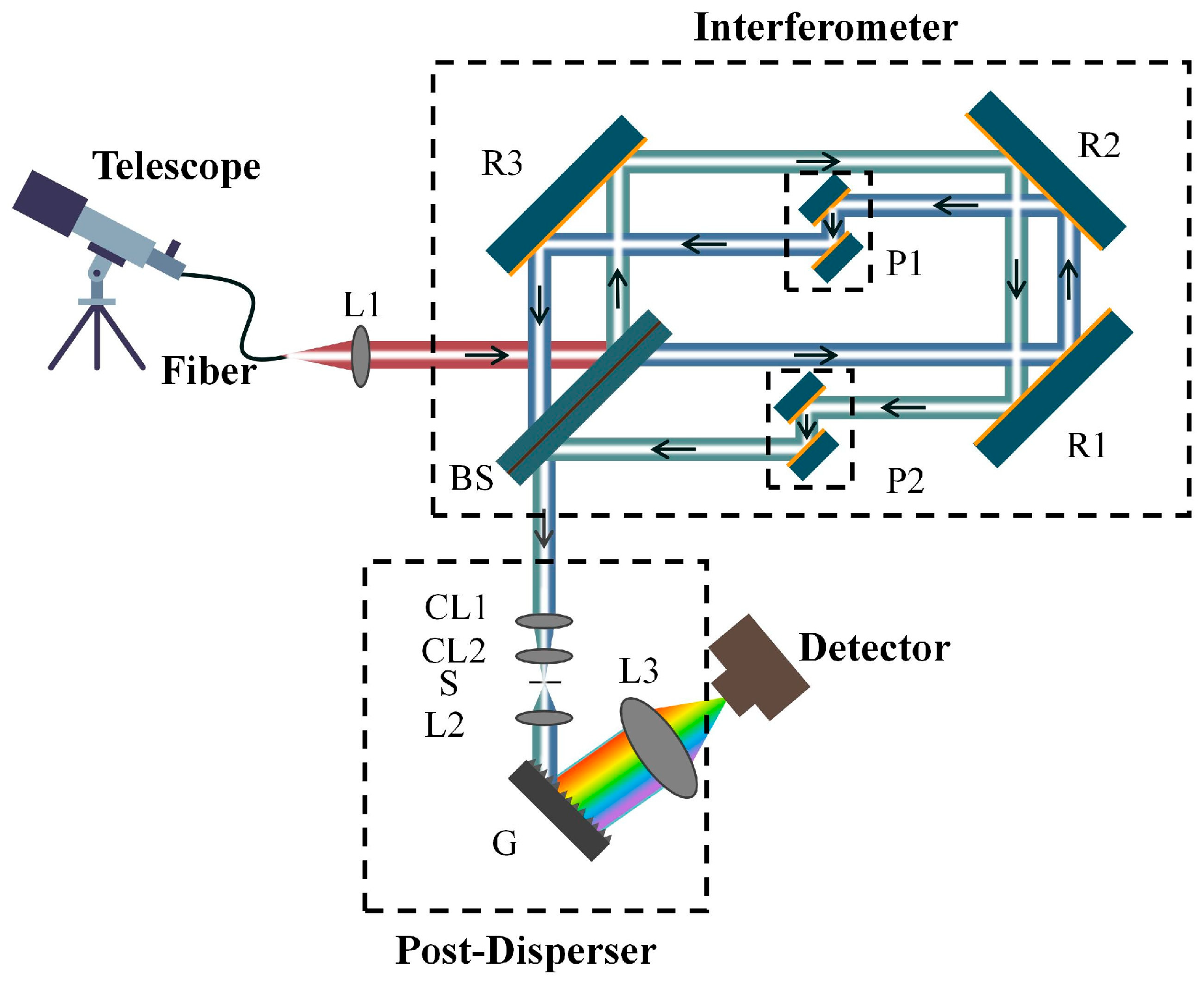
The overall configuration of the CODES is illustrated in Figure 1. Stellar light is collected by a telescope and coupled into the system via an optical fiber. After being collimated by the collimating lens L1, the light enters the asymmetric common-path interferometer as a parallel beam, where BS denotes the beam splitter, R1, R2, and R3 are large reflectors, and P1 and P2 represent two pairs of parallel mirrors. In each pair of parallel mirrors, the light beam exits at the same angle after two reflections, which displaces the beam spatially without altering its propagation direction. By ensuring that the longitudinal displacements induced by P1 and P2 are identical, the two beams from the interferometer recombine at the beam splitter, generating equal-thickness interference fringes. The output beam from the interferometer passes through two cylindrical lenses (CL1 and CL2) with mutually perpendicular powers. The spot is reshaped and compressed before entering the slit S, and then collimated by lens L2 to illuminate the reflective grating G collinearly. The cylindrical lenses transform the circular spot into a narrow linear profile, allowing more light to pass through the slit and thus improving the light utilization efficiency of CODES. Ultimately, the interference fringes corresponding to different wavelengths are dispersed perpendicular to the slit direction, focused by lens L3, and imaged onto the detector focal plane. A two-dimensional interference spectrum is obtained on the detector, where one dimension corresponds to the slit direction and the other to the dispersion direction.
CODES retrieves RV variations by measuring the phase changes of interference fringes. According to the Doppler effect, the relationship between the phase shift of the interference fringes ( Δ φ ) and the magnitude of the RV variation ( Δ v ) can be expressed as:
Δ φ = 2 π τ λ Δ v c
where τ is the fixed optical path difference (OPD) in the interferometer, c is the speed of light, and λ is the wavelength. The fixed OPD amplifies the phase shift induced by the Doppler effect. From the measured RV variations, the mass, orbital period, and other orbital parameters of exoplanets orbiting the host star can be deduced [28]. In a common-path interferometer, the OPD is expressed as:
τ = 2 h 1 sin ω 1 h 2 sin ω 2
where h 1 , h 2 are the mirror spacings of P1 and P2, respectively, and ω 1 , ω 2 are the mirror angles of P1 and P2, respectively. The corresponding OPD can be obtained by adjusting the spacing and angle of the parallel mirrors. For the two arms of the interferometer to produce interference, the longitudinal displacements imparted to the light beam by P1 and P2 must be equal, which requires that:
h 1 cos ω 1 = h 2 cos ω 2
The phase shift of interference fringes is wavelength-dependent. When the spectral range passing through the interferometer is excessively broad, the contrast of the interference fringes degrades sharply, making it difficult to detect the phase shift. The post-dispersion system disperses the interference fringes along the wavelength direction, thereby enabling the detection of fringe variations for each spectral line and improving the detection resolution. This paper focuses on the design and optimization of the post-dispersion system, with simulations performed using the Zemax software(version: Ansys Zemax OpticStudio 2023 R1.00).

3. Design of the Imaging and Relay Optical Paths

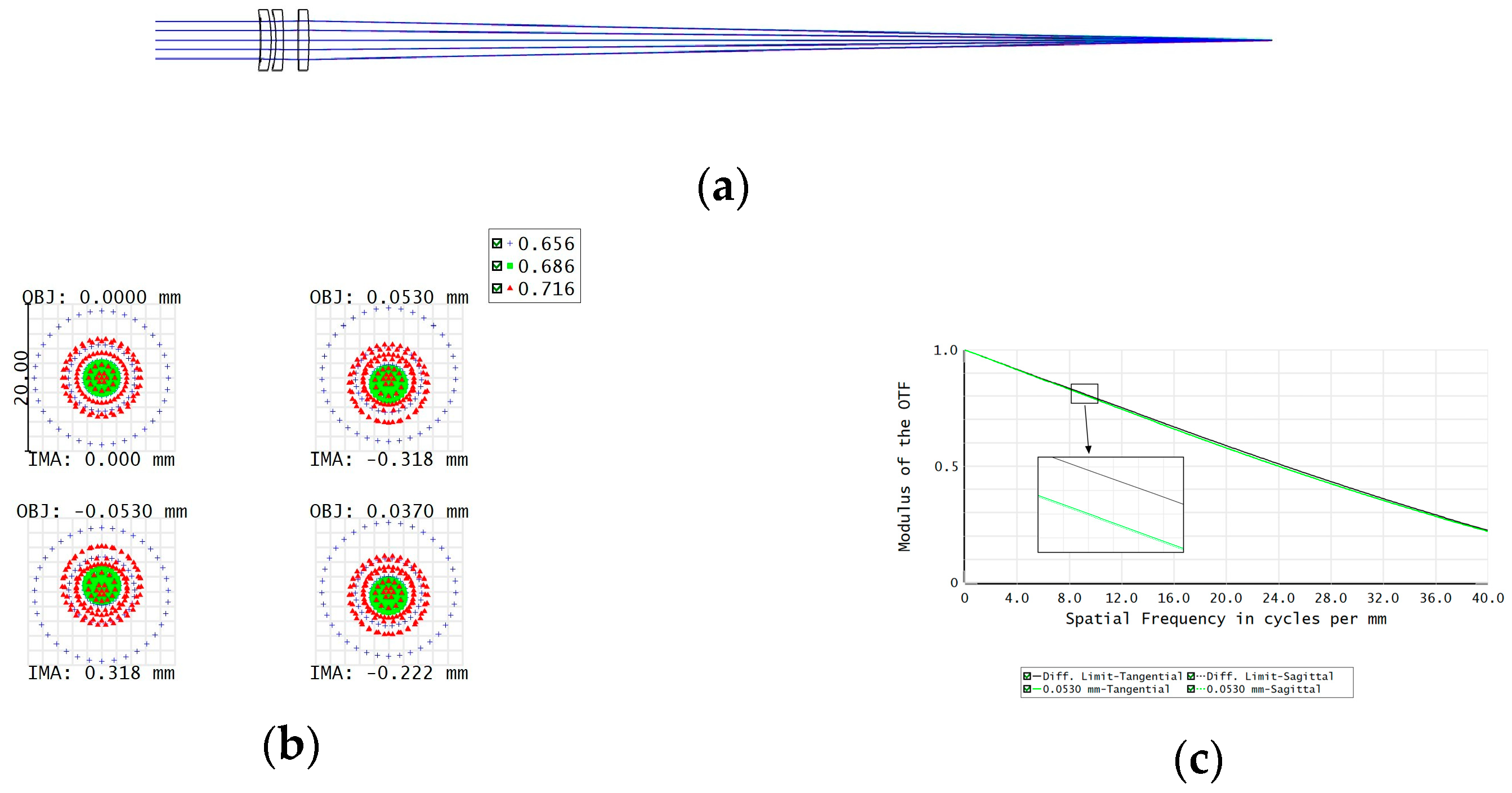
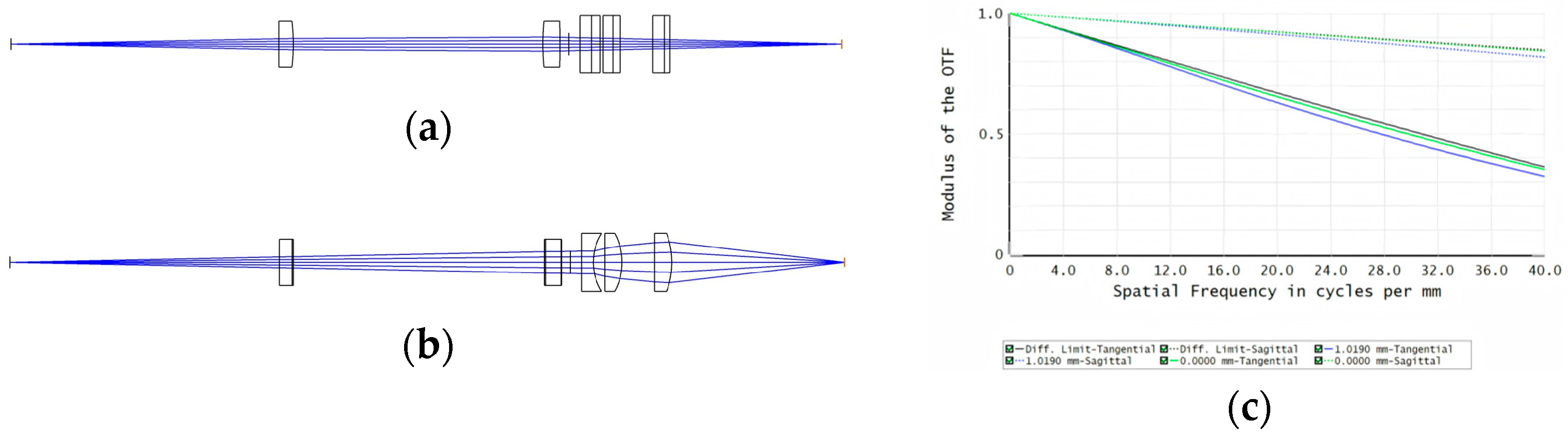
In the CODES, the signal light is collected by a long-focus telescope, coupled into an optical fiber, and collimated into a parallel beam by a collimating lens assembly. The fiber used in this design has a numerical aperture (NA) of 0.12 and a core diameter of 105 μm, resulting in a beam non-parallelism of less than 4″ after collimation. The collimating lens assembly has an f-number (F/#) of 4.17 and an effective focal length (EFL) of 102.16 mm, producing a collimated beam diameter of 24.5 mm. After passing through the interferometer and forming interference fringes, the collimated light is focused by an imaging lens assembly. This assembly has an EFL of 613 mm, a focused spot diameter of 630 μm, and an image-space numerical aperture (NA′) of 0.02. A telecentric optical path design is adopted for the imaging lens assembly, with the exit pupil located at infinity. Its configuration is illustrated in Figure 2a, and the focused spot profile is shown in Figure 2b. The spot size is smaller than the Airy disk radius, indicating diffraction-limited imaging performance. The MTF curve is presented in Figure 2c, with an MTF value of 0.3@30 lp/mm, which is close to the diffraction limit.
Given the extremely weak target signals in deep-space detection, a high-performance CCD detector with high resolution and high sensitivity is required. The iKon-L 936 (ANDOR, Belfast, UK)ultra-low-noise CCD detector was selected for this system, featuring an effective pixel array of 2048 × 2048 and a pixel size of 13.5 μm × 13.5 μm. The slit was set to cover two pixels on the detector, resulting in an optimal slit width of 27 μm. Since the focused spot size is much larger than the slit width, a combination of an image slicer and cylindrical lenses was employed to reshape the beam. This configuration maximizes the energy utilization efficiency by coupling more light energy through the slit.
An image slicer splits an incident light spot into several sliced images of equal width arranged in an orderly manner, enabling better matching to the slit size and reducing energy loss. In this study, a simplified Bowen–Walraven image slicer was adopted, which mainly consists of a knife-edge mirror and a plane mirror. These two mirrors are parallel to each other, forming an optical reflection cavity. When the incident beam strikes the knife-edge region of the knife-edge mirror, distinct reflection and transmission separation occurs: a portion of the beam is reflected off the surface of the knife-edge mirror, while the other portion is transmitted through the knife-edge gap. The circular spot is sliced through multiple reflections and transmissions.
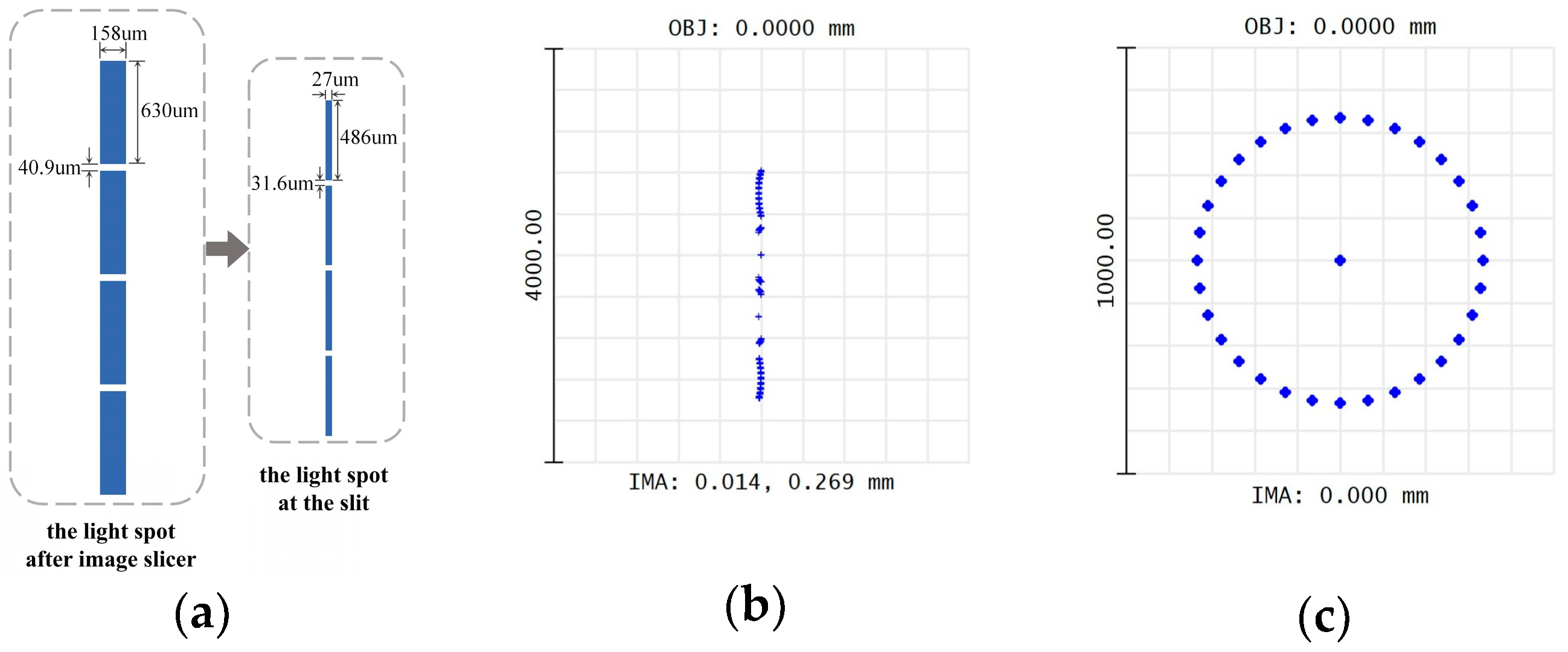
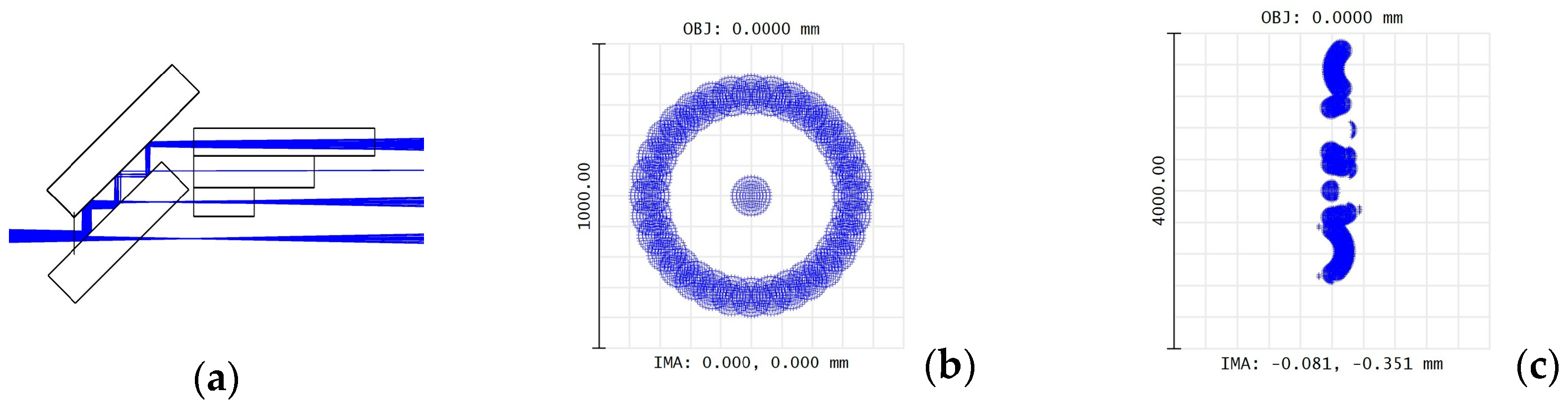
The configuration of the image slicer is illustrated in Figure 3a, where the light incidence angle is 45° and the thickness of the reflection cavity is 0.45 mm. Figure 3b shows the light spot incident on the image slicer, and Figure 3c shows the sliced spot. After passing through the image slicer, the circular spot with a diameter of 630 μm is divided into four linearly arranged sub-spots, each measuring 158 × 630 μm, forming an overall spot size of 158 × 2642.7 μm. A cylindrical lens assembly is thus required to further compress the spot size.
The sub-image width is 158 μm, significantly larger than the operating wavelength. The diffraction divergence angle is very small, approximately 0.26°, and the energy loss due to diffraction is negligible. The transmission efficiency after multiple reflections within the cavity is:
T = 100 k k i = 1 P 2 ( i 1 )
where T that transmittance of the reflect surface, k is the number of splits, and P is the reflectivity of the mirror of the plane mirror. When coated with a high-reflectivity dielectric film, the surface reflectivity can reach 0.99, resulting in a total transmission rate of 97.05%. Additionally, image spot diffusion causes energy loss. The diameter of the dispersion spot of the first and fourth sub-images is 98.47 μm, and the energy loss accounts for about 7.77%. The diameter of the dispersion spot in the second and third sub-images is 29.60 μm, and the energy loss caused by the dispersion spot is 2.85%. Therefore, the total energy loss due to image spot dispersion is approximately 5.31%. Thus, disregarding tolerance effects, the energy transmission rate of the image splitter is 97.05% × 94.69% = 91.8%.
In actual alignment, the image slicer is highly sensitive to the angles and spacings of its mirrors, which directly affects the quality of the sliced image spots. Furthermore, the alignment errors of the entire image slicer assembly impact its coupling with the cylindrical lens group, thereby influencing the imaging resolution. We conducted a preliminary tolerance analysis to observe the effects of element decenters and tilts within the image slicer on the spectral resolution. The internal slicing mirror was assigned tolerances of ±0.02 mm for decenter in X and Y, and ±0.2° for tilt in X and Y. Concurrently, the entire image slicer assembly was assigned tolerances of ±0.02 mm for decenter in X and Y, and ±0.2° for tilt in X and Y.
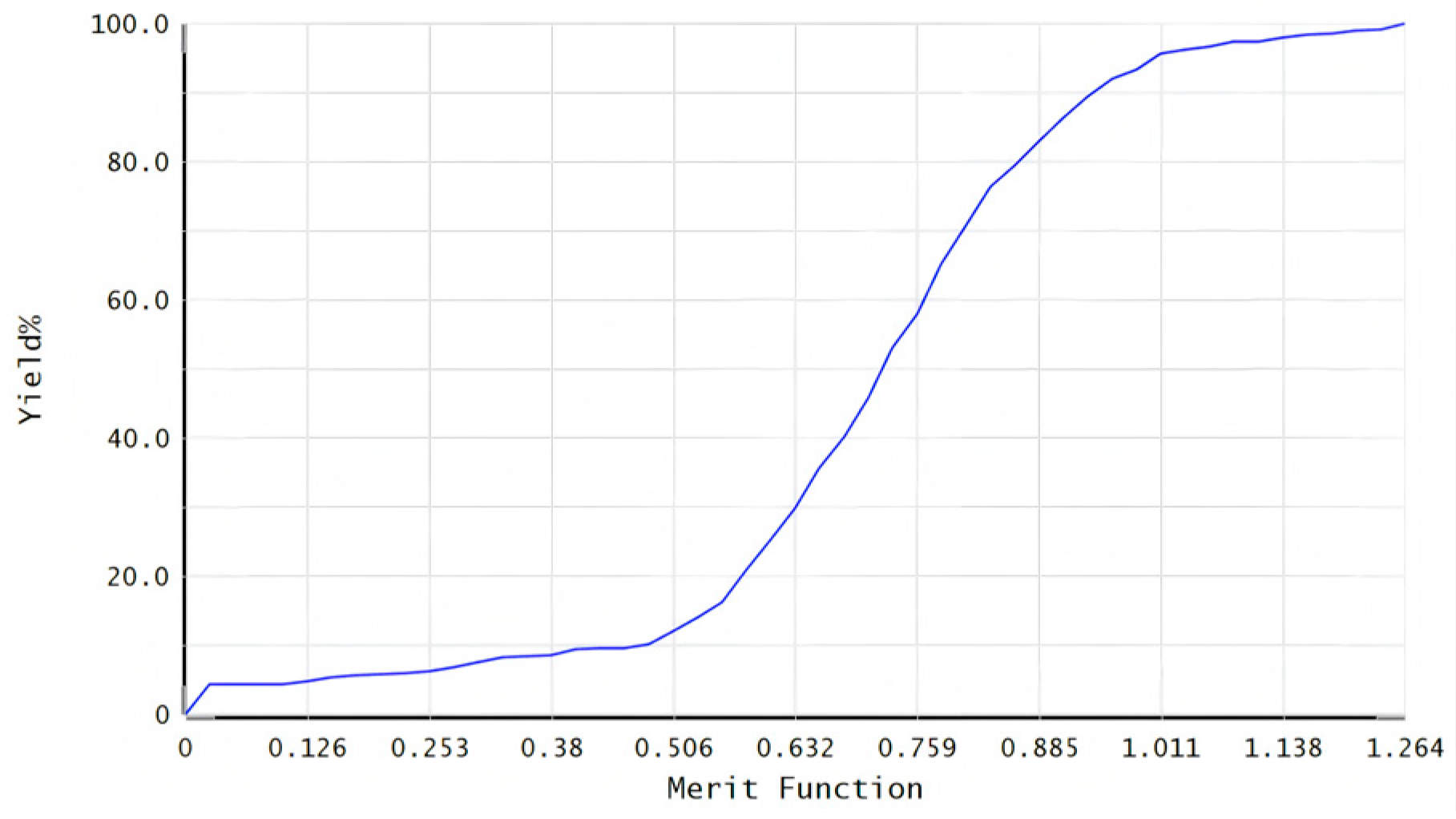
A Monte Carlo tolerance analysis was performed with OD compensation. The resulting yield curve is shown in Figure 4. The horizontal axis represents the ratio of the RMS diameter to the centroid distance of the imaging spots at the edge field for wavelengths of 690 nm and 690.06 nm. This ratio is used as a preliminary estimate for the resolvability of the spots. A ratio of 1 is considered the threshold for two spots to be just resolvable. A smaller ratio indicates better resolution, implying that the spots are either more separated or more tightly converged. Conversely, a ratio greater than 1 suggests that the spots overlap excessively, making them difficult to resolve. The nominal design yields a ratio of 0.75, and the vast majority of Monte Carlo samples cluster near this value.
For samples falling in the leftmost region of the horizontal axis (ratios between 0 and 0.5), the apparent reduction in the RMS diameter is attributed to the mechanical slit vignetting the input beam, effectively cropping the sliced spots. While the calculated ratio for these samples is low, this results from energy loss due to mechanical vignetting rather than an improvement in optical performance. Overall, approximately 80% of the samples meet the resolution requirement.
In the width direction, to match the slit width, the spot width is compressed to 27 μm by the cylindrical lens assembly. In the length direction, to ensure sampling accuracy and facilitate subsequent data processing, the interference fringe period is set to 3 cycles, with each cycle corresponding to 12 detector pixels, requiring a compressed length of 486 μm for a single sub-spot. The spot compression effect of the cylindrical lens assembly is illustrated in Figure 5a. The spot needs to be compressed from 158 μm × 2642.7 μm to 27 μm × 2038.8 μm, with different magnifications in the two directions: the magnification in the meridional direction is 0.1708, and the magnification in the sagittal direction is 0.77. Therefore, cylindrical lenses with mutually perpendicular powers and different focal lengths are required. The final spot after compression by the cylindrical lens assembly is shown in Figure 5b. Compared with the initial spot without shaping (Figure 5c), the spot width is significantly compressed, which can effectively reduce the light loss at the slit. After relaying, the NA in the meridional and sagittal directions are 0.117 and 0.026, respectively.
The configuration of the cylindrical lens assembly is illustrated in Figure 6a,b, and its MTF curves are shown in Figure 6c.
Due to the different numerical apertures and focal lengths in the meridional and sagittal directions, the diffraction limits also differ between the two orientations. The imaging performance is close to the diffraction limit in both directions, with an MTF of 0.36 @ 40 lp/mm in the meridional direction and 0.84 @ 40 lp/mm in the sagittal direction.

4. Design and Optimization of the Post-Dispersion System

The post-dispersion system disperses interference fringes along the wavelength direction, thereby improving the contrast of interference fringes on a single spectral line, and is essentially a high-resolution spectrometer. In this paper, two configurations, namely the Czerny–Turner spectrometer and the Dyson spectrometer, are investigated, with their aberrations and structural characteristics compared. The CODES designed in this study is targeted for detection in the narrow spectral range of 656–716 nm, with a target spectral resolution of 0.06 nm and an incident slit width of 27 μm.

4.1. Design and Optimization of the Czerny–Turner Spectrometer Configuration

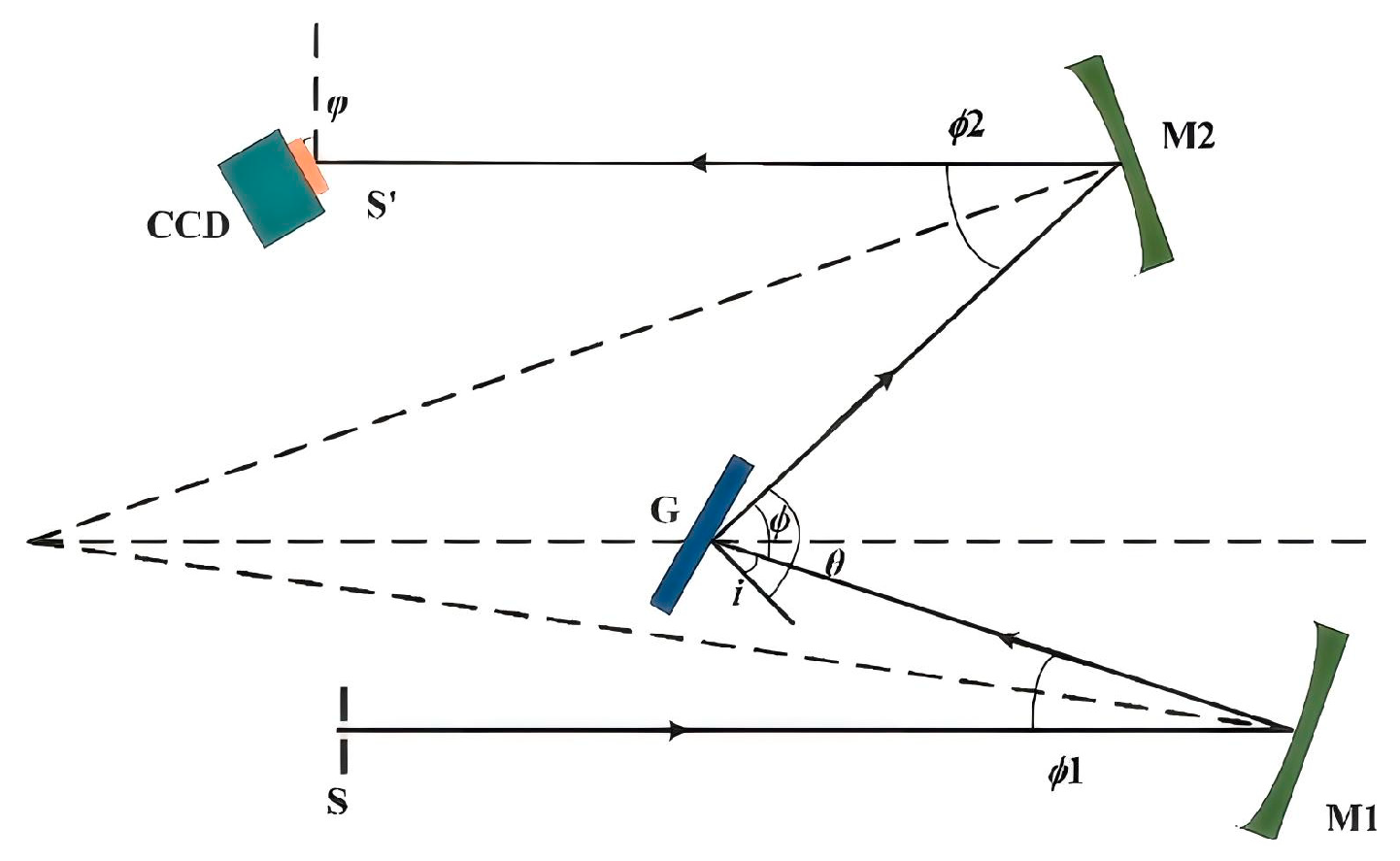
The Czerny–Turner spectrometer features two configurations: the crossed type and the M type. Although the crossed configuration is more compact, it suffers from poor resolution stability and severe coma aberration within the operating spectral range. Thus, the M type is adopted in this study for facilitated aberration optimization and avoidance of secondary and multiple diffraction. Its optical path is illustrated in Figure 7, where M1 is the collimator and M2 is the focusing mirror, both of which are spherical mirrors.
In the Czerny–Turner spectrometer, all optical components are reflective, resulting in only monochromatic aberrations in the system, among which spherical aberration, coma aberration, and astigmatism are the primary factors affecting the system resolution [29]. In the spectrometer, both the collimator and focusing mirror are spherical mirrors, which introduce a certain degree of spherical aberration. This aberration causes the expansion of the imaging spot and blurring of the spectral line edges. To avoid degrading the spectral resolution of the system, the wave aberration induced by spherical aberration should be less than λ / 4 [30], and thus the spot diameter W s ( max ) must satisfy:
W s ( max ) = ( d / 2 ) 4 8 R 3 λ 4
where d is the diameter of the spherical mirror, R is the radius of curvature of the spherical mirror, and f = R / 2 is the focal length of the spherical mirror. Equation (4) can be expressed as:
f 256 λ ( F / # ) 4
In addition to spherical aberration, both the collimator and the focusing mirror operate in an off-axis configuration, which introduces coma aberration. This aberration causes unilateral smearing of spectral lines and results in asymmetric imaging. Shafer [31] pointed out that when the structural parameters of the M-type spectrometer satisfy Equation (6), the wave aberrations induced by the collimator and the focusing mirror cancel each other out, enabling coma aberration correction.
sin ( ϕ 1 ) sin ( ϕ 2 ) = R 1 R 2 2 cos θ cos i 3 cos ( ϕ 1 / 2 ) cos ( ϕ 2 / 2 )
where R 1 and R 2 are the radii of curvature of the collimator and the focusing mirror, ϕ 1 / 2 and ϕ 2 / 2 are the off-axis angles of the collimator and the focusing mirror, θ and i are the incident angle and diffraction angle of the light on the grating. Generally, the off-axis angles are relatively small, so the last term of the equation can be neglected. The structural parameters of the M-type spectrometer satisfy the following geometric relationships:
i + ϕ = θ ϕ 1 + ϕ 2 = ϕ S M 1 = M 1 G = f 1 / cos ϕ 1 / 2 S M 2 = M 2 G = f 2 / cos ϕ 2 / 2
For a grating spectrometer, to achieve a high spectral resolution, the grating—the core component—must have a sufficiently high number of rulings. Taking the grating diffraction order m = 1 , the number of grating rulings must satisfy:
m N = λ Δ λ = 11433
The total number of rulings of the grating in the spectrometer must be greater than 11,433 lines to meet the resolution requirement. If the aperture of the grating is 60 mm, the ruling density must be greater than 190 lines/mm. In practical design, a grating with a higher ruling density is adopted to ensure that the grating performance meets the resolution requirement. The Czerny–Turner spectrometer uses a plane reflection grating, and the number of grating rulings is not limited by the structure. A high-resolution grating with a ruling density of 1500 lines/mm is selected in this design. In the initial configuration, the off-axis angle ϕ 1 / 2 = 7°, and the included angle between the incident and diffracted light ϕ = 30°. According to the grating equation, i = 17.4° and θ = 47.4°. For the focusing mirror, its focal length f 2 must satisfy:
f 2 = l cos θ cos α σ ( λ 2 λ 1 )
where l is the effective detection length of the CCD, which is calculated as l = 27.6 mm based on the detector parameters; α is the image plane tilt; and λ 1 , λ 2 are the two end wavelengths of the detection band. When the image plane is not tilted, f 2 = 208.0 mm and R 2 = 416.0 mm. According to the coma aberration correction condition in Equation (7), f 1 = 324.6 mm and R 1 = 649.2 mm is calculated, from which the initial structural parameters of the spectrometer are further derived.
For the M-type spectrometer, the optical path is folded in space to achieve a compact configuration. However, the grating and spherical mirrors have certain physical dimensions, so the off-axis angles need to be optimized to avoid optical path obstruction. Meanwhile, a high-ruling-density grating is adopted in this system, which results in large angular dispersion and severe astigmatism. In this design, an aspherical compensation lens is added after the slit and designed with a deflection angle to correct astigmatism. The specific parameters of the aspherical compensation lens are shown in Table 2, and the initial and optimized structural parameters of the M-type spectrometer are presented in Table 3.
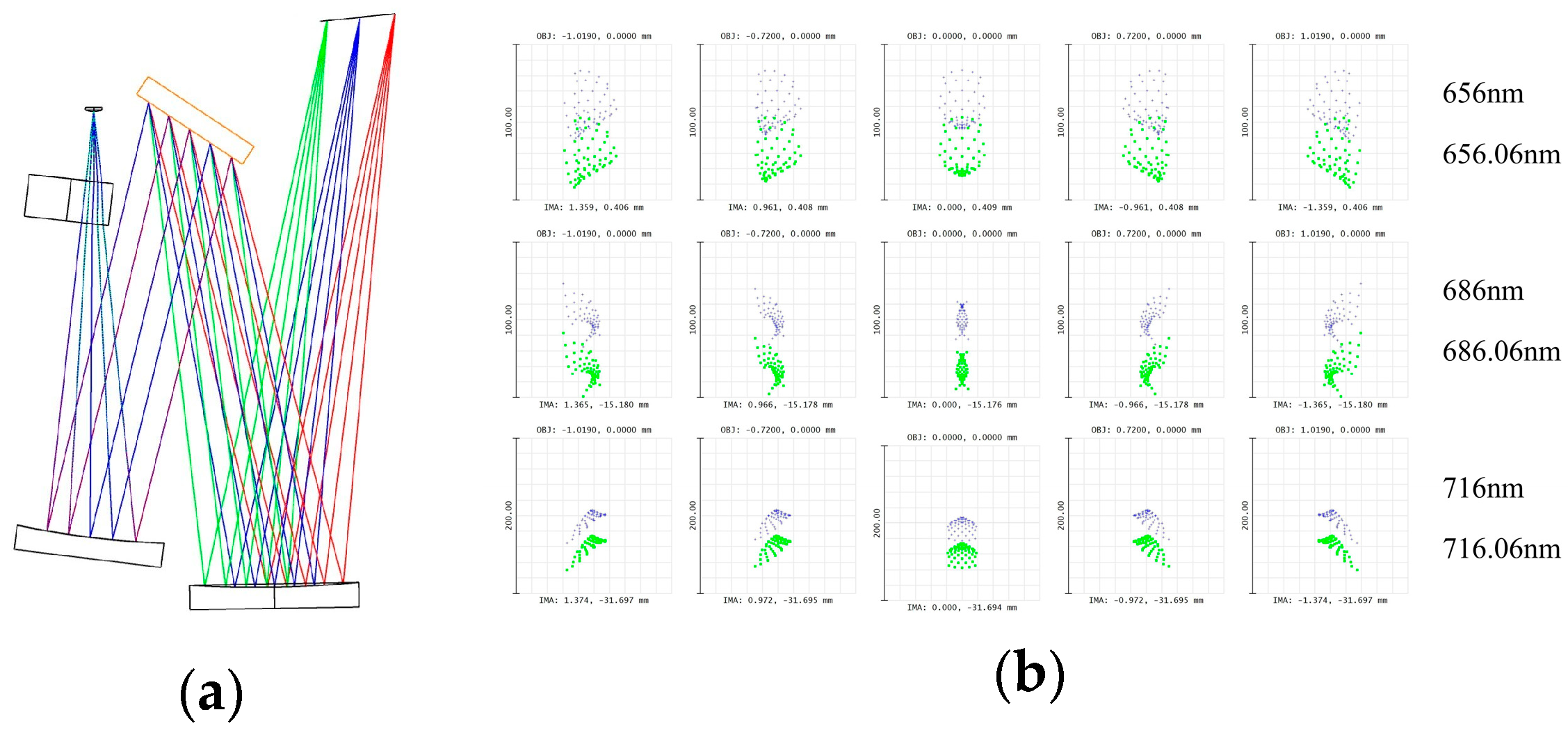
The final optimized configuration is illustrated in Figure 8a, and the imaging spots of the spectrometer at the central field of view, 0.707 field of view and edge field of view are shown in Figure 8b. A spectral resolution of 0.06 nm is achieved at 656 nm, 686 nm and 716 nm.
In addition to the spectral resolution along the dispersion direction, the imaging resolution along the interference direction must also be considered. The MTF is a crucial metric for evaluating the imaging performance of optical systems. It represents the magnitude of the Fourier transform of the Point Spread Function (PSF) and reflects the optical system’s ability to transmit contrast at different spatial frequencies. The diffraction-limited MTF constitutes the theoretical upper limit for an ideal, aberration-free optical system, whose performance is constrained solely by the Fraunhofer diffraction effect. Its numerical definition is:
MTF d i f f r υ = 2 π arccos υ υ c υ υ c 1 υ υ c 2
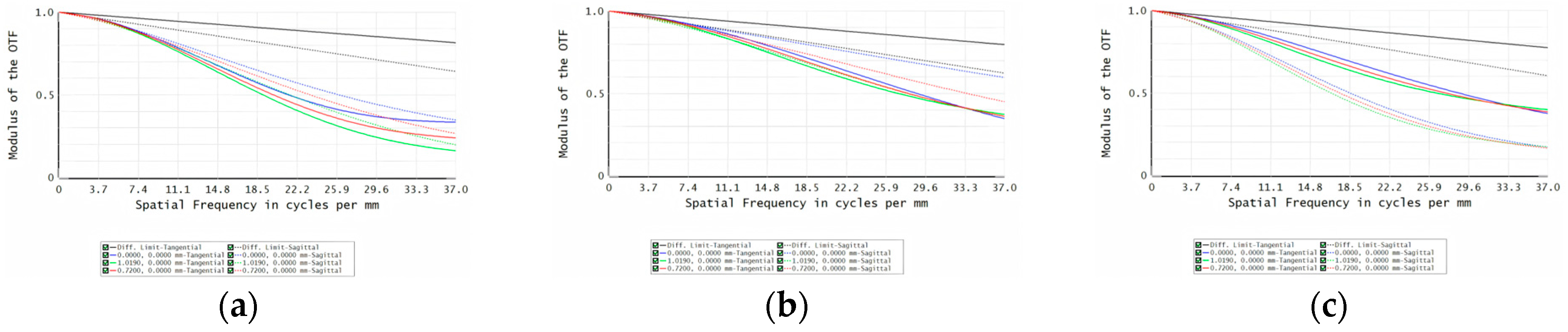
where υ represents the spatial frequency and υ c denotes the cutoff frequency. In practical optical systems, the MTF is influenced by factors such as system aberrations. The MTF curves of the edge and central wavelengths within the detection band are presented in Figure 9, where the solid lines correspond to the dispersion direction and the dashed lines to the fringe period direction. At the Nyquist frequency of the CCD detector (37 lp/mm), the MTF values of the on-axis points and 0.707 field of view for all wavelengths reach 0.2, and up to 0.4 at 686 nm, which matches the CCD resolution and meets the imaging resolution requirements. Due to the inherent limitations of M-type grating spectrometers, the imaging quality between the edge spectrum and the central spectrum will experience a certain degree of degradation. Both the spectral and imaging resolutions of the spectrometer satisfy the design specifications.
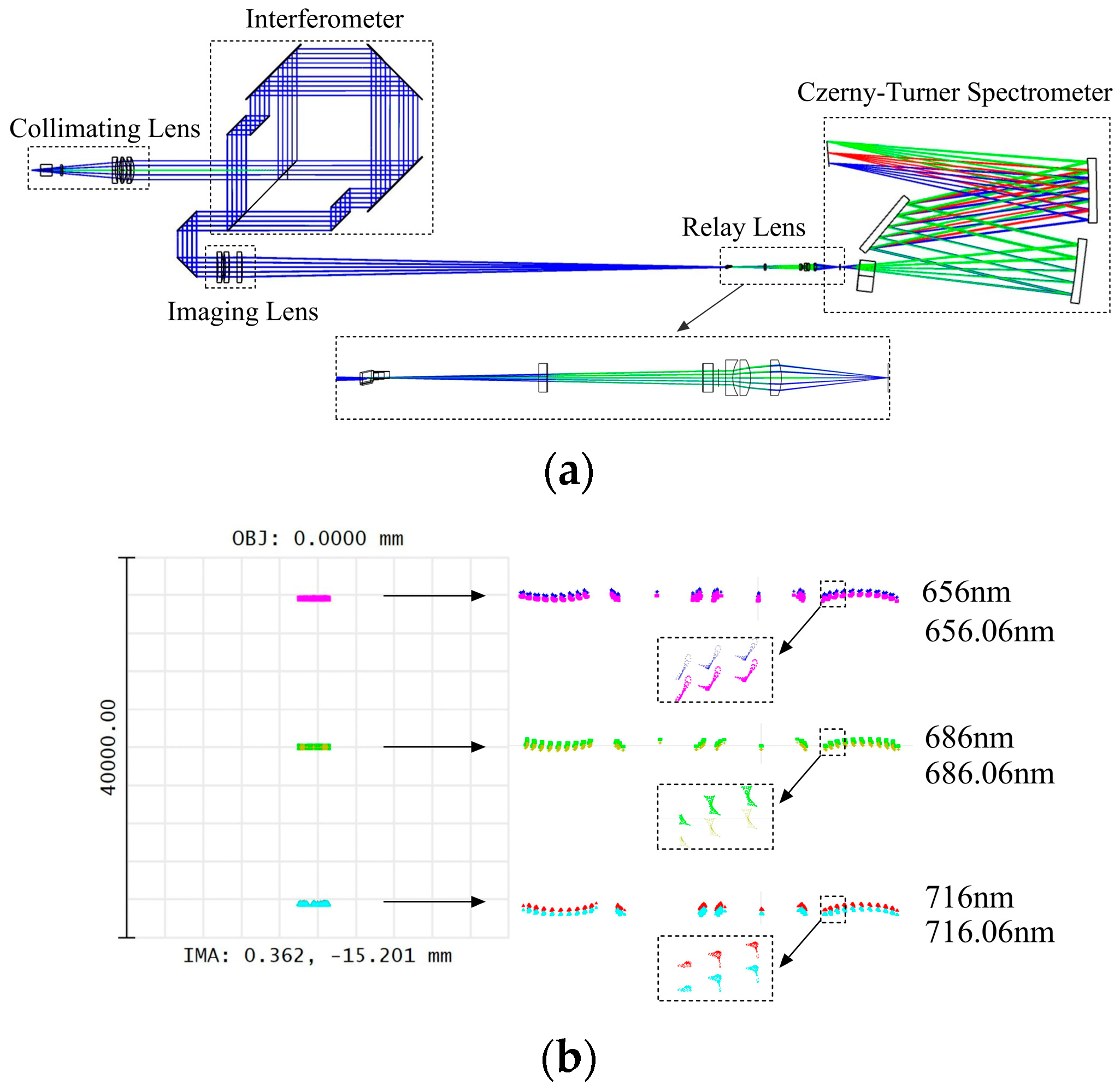
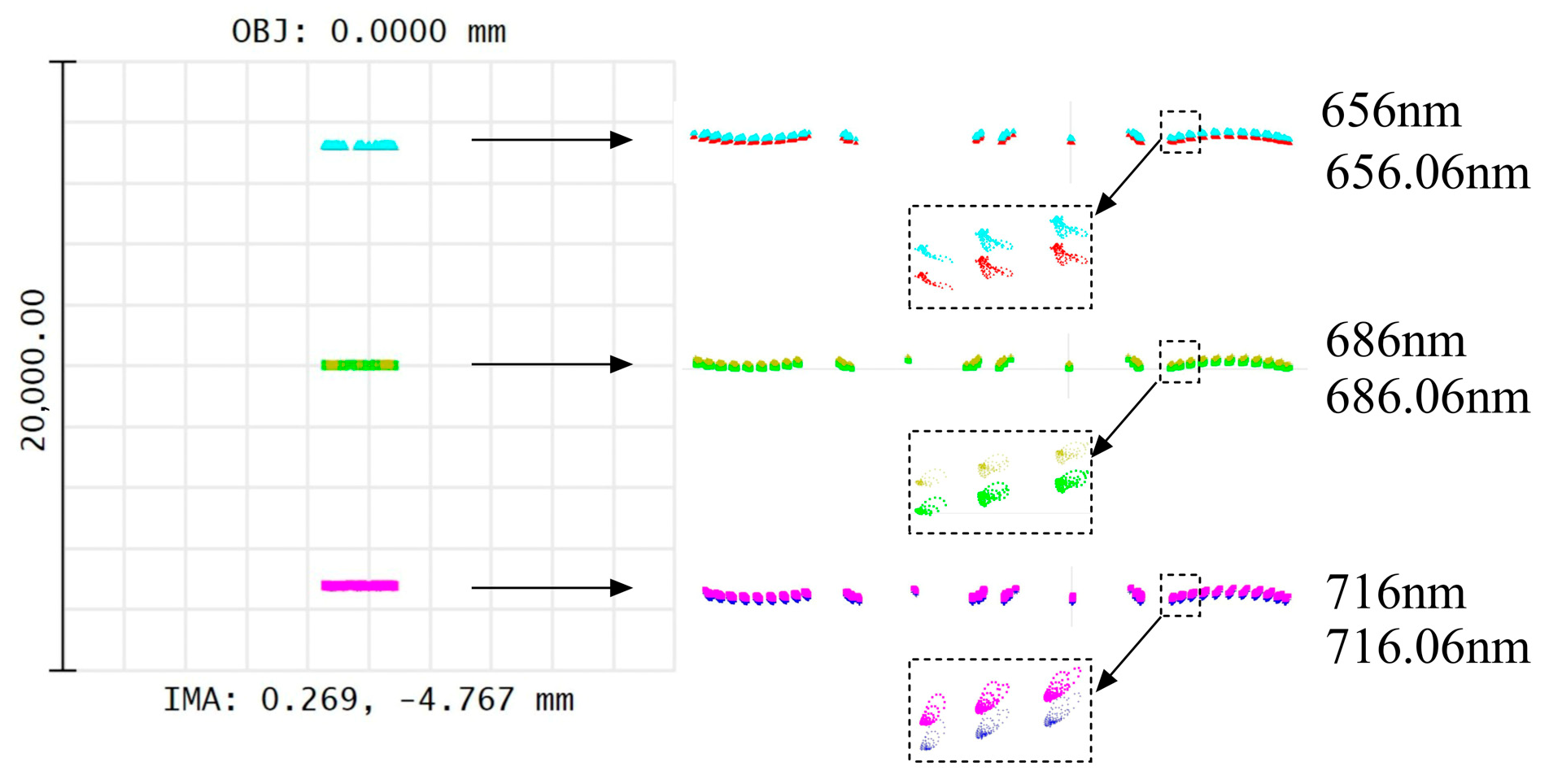
The overall configuration of the final coherent dispersion spectrometer is shown in Figure 10a, and the acquired spectral lines are presented in Figure 10b. The system achieves a spectral resolution of 0.06 nm across the detection band.

4.2. Design and Optimization of the Dyson Spectrometer Configuration

The Dyson configuration [32] consists of a plano-convex lens and a concave mirror with radii of curvature r 1 and r 2 , respectively, and they share a common center of curvature. The focal length of the system is f d , the concave mirror is located at the focal plane of the plano-convex lens and serves as the aperture stop of the system. If the refractive index of the plano-convex lens is n , then the following relationship holds:
r 2 = n n 1 r 1 f d = r 1 n 1 = r 2 n
For the concentric Dyson configuration, when the object point is located at the common center, the light rays pass through the center of curvature without deflection, resulting in zero spherical aberration of the system. When the object point is not at the center, the sine condition is satisfied and the coma aberration is zero; additionally, the system distortion is zero due to the symmetry of the incident and emergent light rays. Under paraxial conditions, the Petzval sum S I V is given by:
S I V = j = 1 k r j 1 n j 1 n j 1 = j = 1 k n j f j 1 = 1 r 1 1 n 1 1 r 2 1 1 + 1 r 1 1 1 n
Substituting Equation (10) into the above, we obtain:
S I V = 0
The Petzval field curvature of the Dyson configuration is zero, and all object points are imaged on the straight lines passing through the object points and the common center; thus, both the sagittal and tangential field curvatures of the system are zero. Under non-paraxial conditions, the system exhibits certain high-order aberrations, mainly tangential field curvature.
Based on the Dyson configuration, the Dyson spectrometer replaces the mirror with a concave reflection grating. Lobb [33] proved using the wave aberration theory that a concave reflection grating with a constant ruling density introduces no additional wave aberrations, and the aberration characteristics of the Dyson spectrometer are consistent with those of the Dyson configuration. Furthermore, in the Dyson spectrometer, the concave grating conforms to the Rowland circle characteristic, and a grating with equidistant rulings enables flat focal plane imaging. Under the flat field condition, the Dyson configuration forms a double telecentric optical path for both the object and image sides, and the spectral line curvature and chromatic distortion of the system are negligible. However, due to the properties of the grating, light of different wavelengths is imaged at different positions after diffraction, causing the system’s optical path to lose symmetry along the diffraction direction while remaining symmetric along the direction perpendicular to dispersion. Consequently, significant astigmatism is induced, which requires optimization.
To correct the astigmatism of the Dyson spectrometer, Montero-Orille C [34] et al. proposed a design method for astigmatism elimination under dual-wavelength conditions. However, the grating ruling density σ calculated based on the parameters of this instrument is 0.09 lines/mm, which is far lower than the resolution requirement. Therefore, it is considered to calculate the initial configuration according to the spectral resolution, and then optimize the aberrations by adjusting parameters such as the radii of the plano-convex lens and the grating, and the distance between the lens and the grating. For the concave grating, its grating equation and linear dispersion equation are given by:
d ( sin i ± sin θ ) = m λ
d l d λ = f d m d cos θ
where d is the grating constant and d = 1 / σ . Once the grating constant is determined, the system focal length can be derived from the above equation, and the initial configuration is determined according to Equation (12). To meet the resolution requirement, a sufficiently high ruling density should be selected as far as possible. However, an excessively high ruling density will result in an overly large diffraction angle, which prevents the light rays from re-entering the lens. Through multiple simulation comparisons, a ruling density of 350 lines/mm is finally selected, and the initial structural parameters are calculated accordingly. The initial configuration fails to meet the resolution requirement and suffers from severe astigmatism; thus, the structural optimization is mainly performed for the RMS radius and astigmatism. The initial and preliminarily optimized structural parameters are presented in Table 4, where l d denotes the distance between the lens and the grating and t is the thickness of the plano-convex lens.
In this configuration, the slit, plano-convex lens and image plane are positioned in close proximity. However, in the actual assembly and alignment process, each component requires a corresponding opto-mechanical structure, and the CCD detector itself has a certain physical volume. This causes positional offsets of both the slit and the image plane, making it difficult to achieve the ideal imaging performance. Therefore, further optimization of this configuration is required to reserve sufficient spacing between the slit and the lens, and between the lens and the image plane, so as to facilitate practical assembly and meet the imaging requirements. In this paper, the aspherical correction lens [29] is adopted for optimization. The introduction of an aspherical lens into the optical path enables a relatively large separation distance and can reduce the thickness of the plano-convex lens. Nevertheless, the chromatic aberration of the system will become severe, with the focal positions of different wavelengths exhibiting deviations. Thus, a deflection design of the image plane is necessary. The final specific structural parameters are presented in Table 5, where l 1 and l 2 denote the distance between the slit and the lens, and the distance between the image plane and the lens, respectively. The parameters of the aspherical lens are shown in Table 6.
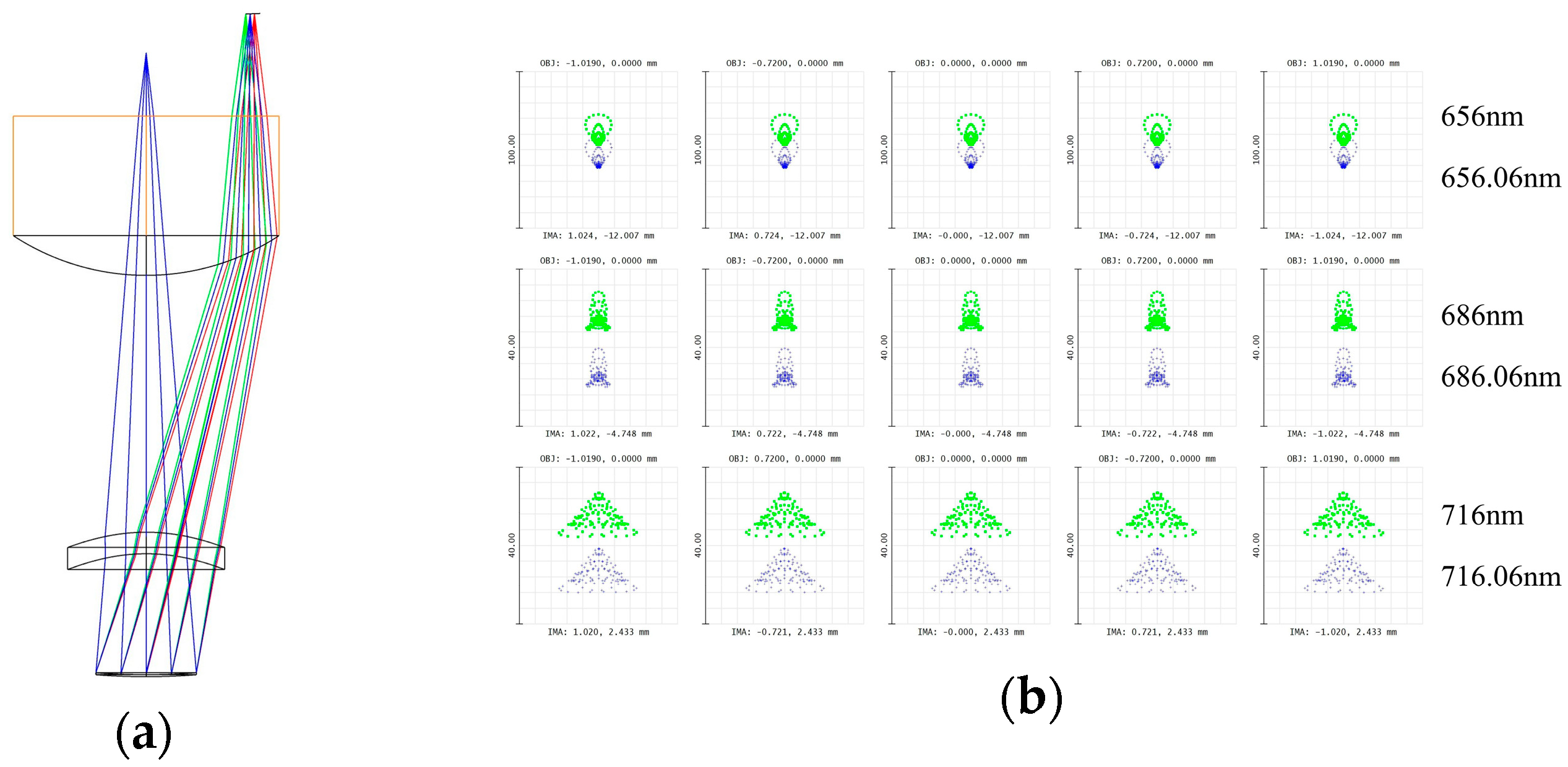
The final configuration is illustrated in Figure 11a. After optimization, the spatial positions between the slit, lens and image plane are more sufficient, and the slit and image plane are spatially staggered, reserving ample space for practical assembly. In addition, the size of the plano-convex lens is significantly reduced, with a decrease of 140 mm compared with the preliminary optimization. The optimized imaging spots are shown in Figure 11b, and a spectral resolution of 0.06 nm is achieved at all wavelengths.
The partial aberration magnitudes of the optimized Czerny–Turner spectrometer and Dyson spectrometer are shown in Table 7. Due to structural constraints, the Czerny–Turner spectrometer exhibits significant spherical aberration and coma. The physical meanings and expressions of each aberration are presented in Appendix A.
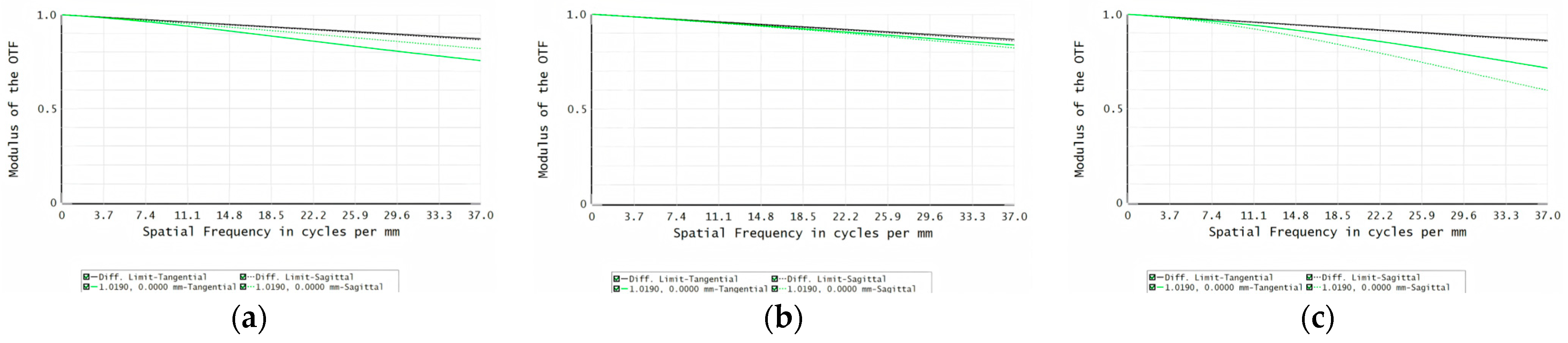
The MTF curves at each wavelength are presented in Figure 12, demonstrating good imaging quality with the imaging resolution meeting the requirements. At the central wavelength of 686 nm, the MTF value reaches 0.8@37 lp/mm, demonstrating excellent imaging resolution.
The configuration of the CODES with the Dyson spectrometer as the post-dispersion module is similar to that shown in Figure 10a, and the finally obtained imaging spots are presented in Figure 13. A spectral resolution of 0.06 nm is achieved at all wavelengths.

5. Conclusions

A coherent dispersion spectrometer for the detection band of 656 nm–716 nm is designed in this paper, with the design and analysis of the post-dispersion system as the core work. A combination of a cylindrical lens group and an image slicer is adopted in the relay optical path, which shapes and compresses the 630 μm circular light spot into a strip light spot of 27 μm × 2038.8 μm. This design effectively matches the slit size and reduces energy loss. Two configurations, namely the Czerny–Turner spectrometer and the Dyson spectrometer, are employed for the post-dispersion system, with separate design and optimization performed for each. Both spectrometers achieve a spectral resolution of 0.06 nm and exhibit distinct characteristics in terms of aberration and structural design.
In terms of aberrations, the off-axis configuration and spherical mirrors of the Czerny–Turner spectrometer necessitate the simultaneous correction of spherical aberration, coma aberration and astigmatism, making aberration correction challenging and the relative aperture limited. The MTF value of the central field of view at 686 nm reaches 0.4@37 lp/mm, which meets the imaging resolution requirements. In contrast, the Dyson spectrometer features a symmetric concentric configuration with small aberrations and a large relative aperture, where only the influence of astigmatism is the primary consideration in optimization. Excellent imaging resolution is achieved after optimization with an aspherical correction mirror, with the MTF value of the central field of view at 686 nm reaching 0.8@37 lp/mm. In terms of structure, the Czerny–Turner configuration is more complex than the Dyson configuration: attention must be paid to the off-axis angles of the grating and spherical mirrors during actual assembly and alignment, yet it features a more compact spatial structure with an overall size of approximately 290 mm in length and 200 mm in width. While the Dyson configuration is structurally simple, it has a larger overall size of about 1000 mm in length and 320 mm in width—nearly five times that of the Czerny–Turner configuration—and a large plano-convex lens, whose thickness remains 264.4 mm even after optimization. In practical applications, environmental conditions such as temperature must be strictly controlled to avoid lens deformation that would degrade the resolution performance. Additionally, the Dyson configuration restricts the use of gratings with a high line density, which is unfavorable for the design of higher-resolution systems. The Czerny–Turner configuration is free from this limitation, and its folded optical path structure prevents excessive increase in the overall size while improving the resolution.
To achieve high-precision RV measurements, CODES will be equipped with precise temperature control devices (e.g., 0.001 K), vacuum chambers, marble vibration isolation tables, etc., to reduce spectral shifts caused by thermal expansion of the optomechanical structure and mechanical vibrations due to environmental variations. Overall, both spectrometers designed in this paper meet the specified requirements for spectral and imaging resolution. However, considering practical factors such as instrument size, the Czerny–Turner spectrometer demonstrates greater potential for the development of high-resolution coherent dispersion spectrometers.

Author Contributions

Conceptualization, X.Z., R.W. and Z.X.; methodology, X.Z. and Z.X.; software, X.Z., Z.X. and R.Y.; validation, X.Z. and R.Y.; formal analysis, X.Z.; investigation, X.Z., R.W. and Z.X.; resources, R.W.; data curation, X.Z.; writing—original draft preparation, X.Z.; writing—review and editing, X.Z., R.W. and X.L.; visualization, X.Z. and R.Y.; supervision, R.W., X.L. and C.L.; project administration, R.W. and X.L.; funding acquisition, R.W. All authors have read and agreed to the published version of the manuscript.

Funding

This research was funded by the National Natural Science Foundation of China, grant number “11727806, 42171464, 41827801”, and the Key Research and Development Project of Hubei Province, grant number “2021BCA216, 2022BCA057”.

Institutional Review Board Statement

Not applicable.

Informed Consent Statement

Not applicable.

Data Availability Statement

The original contributions presented in this study are included in the article. Further inquiries can be directed to the corresponding author.

Acknowledgments

We sincerely thank the editors and anonymous reviewers for their contributions to this paper.

Conflicts of Interest

The authors declare no conflicts of interest.

Appendix A

Appendix A.1. Seidel Aberrations

The primary wave aberrations (Seidel aberrations) of the optical system can be expressed in normalized polar coordinates as:
W ρ , θ ; h = W i j k h i ρ j cos k θ
where h is normalized object height, ρ is normalized pupil coordinate, θ is pupil azimuthal angle, Wijk is wave aberration coefficient (unit: wavelength λ ). The magnitude of the aberration is determined by the wave aberration coefficient.

Appendix A.2. Physical Meaning and Expressions of Aberrations

  • Spherical Aberration
    The paraxial rays and marginal rays emitted from the same object point do not converge at the same point after passing through the spherical lens. The wave aberration coefficient is W 040 . Primary spherical aberration δ L can be expressed as
δ L = 1 2 n k u k 2 1 k S I
S I = l u n i ( i i ) ( i u )
where S I is the primary spherical aberration coefficient, n is the refractive index, u is the image-side aperture angle, u is the object-side aperture angle, l is the object distance, i is the incident angle, and i is the refraction angle.
  • Coma
    Rays emitted from an off-axis point, after passing through different annular zones of the lens, are imaged at different heights and with different sizes, forming a comet-shaped tail. The wave aberration coefficient is W 131 . Primary sagittal coma K s can be expressed as
K s = 1 2 n k u k 1 k S II
S II = l u n i z ( i i ) ( i u )
where S II is primary coma coefficient coma and i z is the angle between the incident ray and the entrance pupil.
  • Field Curvature
    After passing through a lens, the image of a planar object is not a flat plane but a curved surface. The wave aberration coefficient is W 220 . The distributions of primary meridional field curvature x t and sagittal field curvature x s are respectively:
x t = 1 2 n k u k 2 1 k ( 3 S III + S IV )
x s = 1 2 n k u k 2 1 k ( S III + S IV )
S III = l u n i ( i i ) ( i u ) ( i z / i ) 2
S IV = J 2 ( n n ) / n n r
where S III is primary astigmatism coefficient, S IV is primary field curvature coefficient, J is the Lagrange invariant, and r is the radius of curvature.
  • Astigmatism
    The meridional and sagittal rays from an off-axis point focus at two different positions, forming two mutually perpendicular focal lines. The wave aberration coefficient is W 222 . Astigmatism x t s can be expressed as
x t s = x t x s

References

  1. Fulton, B.J.; Rosenthal, L.J.; Hirsch, L.A.; Isaacson, H.; Howard, A.W.; Dedrick, C.M.; Sherstyuk, I.A.; Blunt, S.C.; Petigura, E.A.; Knutson, H.A.; et al. California Legacy Survey. II. Occurrence of Giant Planets beyond the Ice Line. Astrophys. J. Suppl. Ser. 2021, 255, 14. [Google Scholar] [CrossRef]
  2. Hara, N.C.; Ford, E.B. Statistical Methods for Exoplanet Detection with Radial Velocities. Annu. Rev. Stat. Appl. 2023, 10, 623–649. [Google Scholar] [CrossRef]
  3. Hao, Q.-Y.; Zhou, S.-W.; Liu, H.-G. The Potential of Detecting Nearby Terrestrial Planets in the HZ with Different Methods. Publ. Astron. Soc. Pac. 2023, 135, 094401. [Google Scholar] [CrossRef]
  4. Nagarajan, P.; El-Badry, K.; Triaud, A.H.M.J.; Baycroft, T.A.; Latham, D.; Bieryla, A.; Buchhave, L.A.; Rix, H.-W.; Quataert, E.; Howard, A.; et al. ESPRESSO Observations of Gaia BH1: High-Precision Orbital Constraints and No Evidence for an Inner Binary. Publ. Astron. Soc. Pac. 2024, 136, 014202. [Google Scholar] [CrossRef]
  5. Lillo-Box, J.; Faria, J.P.; Suárez Mascareño, A.; Figueira, P.; Sousa, S.G.; Tabernero, H.; Lovis, C.; Silva, A.M.; Demangeon, O.D.S.; Benatti, S.; et al. HD 22496 b: The First ESPRESSO Stand-Alone Planet Discovery. Astron. Astrophys. 2021, 654, A60. [Google Scholar] [CrossRef]
  6. Mignon, L.; Delfosse, X.; Bonfils, X.; Meunier, N.; Astudillo-Defru, N.; Gaisne, G.; Forveille, T.; Bouchy, F.; Curto, G.L.; Udry, S.; et al. Radial Velocity Homogeneous Analysis of M Dwarfs Observed with HARPS: I. Exoplanet Detection and Candidates. Astron. Astrophys. 2024, 689, A32. [Google Scholar] [CrossRef]
  7. Erskine, D.J.; Edelstein, J.; Sirk, M.; Wishnow, E.; Ishikawa, Y.; McDonald, E.; Shourt, W.V. High Resolution Broad-Band Spectroscopy in the NIR Using the Triplespec Externally Dispersed Interferometer at the Hale Telescope. In Proceedings of the SPIE Proceedings; Ramsay, S.K., McLean, I.S., Takami, H., Eds.; SPIE: Montréal, QC, Canada, 2014; Volume 9147, p. 914717. [Google Scholar]
  8. Van Eyken, J.C.; Ge, J.; Mahadevan, S. Theory of Dispersed Fixed-Delay Interferometry for Radial Velocity Exoplanet Searches. Astrophys. J. Suppl. Ser. 2010, 189, 156–180. [Google Scholar] [CrossRef]
  9. Mégevand, D.; Zerbi, F.M.; Di Marcantonio, P.; Cabral, A.; Riva, M.; Abreu, M.; Pepe, F.; Cristiani, S.; Rebolo Lopez, R.; Santos, N.C.; et al. ESPRESSO: The Radial Velocity Machine for the VLT. In Proceedings of the SPIE; Ramsay, S.K., McLean, I.S., Takami, H., Eds.; SPIE: Montréal, QC, Canada, 2014; Volume 9147, p. 91471H. [Google Scholar]
  10. Wang, X.-L.; Chang, L.; Wang, L.; Ji, H.-X.; Xian, H.; Tang, Z.; Xin, Y.-X.; Wang, C.-J.; He, S.-S.; Zhang, J.-J.; et al. The Coude Echelle Spectrograph for the Lijiang 1.8m Telescope. Res. Astron. Astrophys. 2020, 20, 032. [Google Scholar] [CrossRef]
  11. Wang, J.; Ge, J.; Jiang, P.; Zhao, B. Fundamental Performance of a Dispersed Fixed Delay Interferometer in Searching for Planets Around M Dwarfs. Astrophys. J. 2011, 738, 132. [Google Scholar] [CrossRef]
  12. Erskine, D.J. Method for Boosting Dispersive Spectrograph Stability 1000× Using Interferometry with Crossfaded Pairs of Delays. J. Astron. Telesc. Instrum. Syst. 2021, 7, 025006. [Google Scholar] [CrossRef]
  13. Ge, J.; Van Eyken, J.; Mahadevan, S.; DeWitt, C.; Kane, S.R.; Cohen, R.; Vanden Heuvel, A.; Fleming, S.W.; Guo, P.; Henry, G.W.; et al. The First Extrasolar Planet Discovered with a New-Generation High-Throughput Doppler Instrument. Astrophys. J. 2006, 648, 683–695. [Google Scholar] [CrossRef][Green Version]
  14. Edelstein, J.; Muirhead, P.; Wright, J.; Covey, K.; Erskine, D.; Muterspaugh, M.; Lloyd, J.; Halverson, S.; Marckwordt, M.; Mondo, D. Infrared Radial Velocimetry with TEDI: Performance Development. In Proceedings of the SPIE; McLean, I.S., Ramsay, S.K., Takami, H., Eds.; SPIE: San Diego, CA, USA, 2010; Volume 7735, p. 773583. [Google Scholar]
  15. Edelstein, J.; Erskine, D.J.; Lloyd, J.; Herter, T.; Marckwordt, M.; Feuerstein, M. The TEDI Instrument for Near-IR Radial Velocity Surveys. In Proceedings of the SPIE; McLean, I.S., Iye, M., Eds.; SPIE: Orlando, FL, USA, 2006; Volume 6269, p. 62691E. [Google Scholar]
  16. Ge, J.; Zhao, B.; Powell, S.; Wang, J.; Fletcher, A.; Chang, L.; Groot, J.; Wan, X.; Jakeman, H.; Myers, D.; et al. Design and Performance of a New Generation, Compact, Low Cost, Very High Doppler Precision and Resolution Optical Spectrograph. In Ground-Based and Airborne Instrumentation for Astronomy IV; McLean, I.S., Ramsay, S.K., Takami, H., Eds.; SPIE: Amsterdam, The Netherlands, 2012; p. 84468R. [Google Scholar]
  17. Wei, R.; Chen, S.; Hu, B.; Yan, Q.; Wu, Y.; Wang, P. Design and Experimental Test of a Common-Path Coherent-Dispersion Spectrometer for Exoplanet Searches. Publ. Astron. Soc. Pac. 2020, 132, 015003. [Google Scholar] [CrossRef]
  18. Wu, Y.; Chen, S.; Wang, P.; Zhou, S.; Feng, Y.; Zhang, W.; Wei, R. Simulation and Analysis of the Coherent-Dispersion Spectrometer for Exoplanet Detection. Mon. Not. R. Astron. Soc. 2021, 503, 3032–3043. [Google Scholar] [CrossRef]
  19. Wilson, J.C.; Henderson, C.P.; Herter, T.L.; Matthews, K.; Skrutskie, M.F.; Adams, J.D.; Moon, D.-S.; Smith, R.; Gautier, N.; Ressler, M.; et al. Mass Producing an Efficient NIR Spectrograph. In Proceedings of the SPIE Astronomical Telescopes + Instrumentation, Glasgow, UK, 21–25 June 2004; p. 1295. [Google Scholar]
  20. Ge, J.; Zhao, B.; Groot, J.; Chang, L.; Varosi, F.; Wan, X.; Powell, S.; Jiang, P.; Hanna, K.; Wang, J.; et al. Design, Performance, and Early Results from Extremely High Doppler Precision Instruments in a Global Network. In Proceedings of the SPIE; McLean, I.S., Ramsay, S.K., Takami, H., Eds.; SPIE: San Diego, CA, USA, 2010; Volume 7735, p. 77350H. [Google Scholar]
  21. Fan, X.; Wei, R.; Yu, C. Research on High-Precision Radial Velocity Retrieval Method Using an Individual Narrow Spectral Line Based on CODES. Publ. Astron. Soc. Pac. 2025, 137, 104505. [Google Scholar] [CrossRef]
  22. Wang, X.; Qiu, L.; Zhao, W.; Cui, H. Design and Calibration of an Aberration–Corrected Crossed Czerny–Turner Spectrometer System. Opt. Commun. 2025, 592, 132280. [Google Scholar] [CrossRef]
  23. Zhou, Q.; Zou, Z. Astigmatism-Free Czerny–Turner Spectrometer with a Low f-Number by a Bicylinder Lens. Appl. Opt. 2022, 61, 7985–7990. [Google Scholar] [CrossRef]
  24. Li, S.; Zhao, W.; Xu, H.; Qiu, L.; Wang, Y. Optical System Design of Aberration-Corrected Czerny–Turner Imaging Spectrometer with High Resolution. Opt. Commun. 2020, 459, 125015. [Google Scholar] [CrossRef]
  25. Wu, S.; Huang, C.; Yu, L.; Xue, H.; Lin, J. Optical Design and Evaluation of an Advanced Scanning Dyson Imaging Spectrometer for Ocean Color. Opt. Express 2021, 29, 36616–36633. [Google Scholar] [CrossRef] [PubMed]
  26. Jia, X.; Li, S.; He, X.; Zhang, Z.; Hou, P.; Jiang, X.; Liu, J. Design and Series Product Development of a Space-Based Dyson Spectrometer for Ocean Applications. Photonics 2025, 12, 918. [Google Scholar] [CrossRef]
  27. Yu, L.; Xue, H.; Chen, J. Stigmatic Broadband Imaging Spectrometer with a High Numerical Aperture. Appl. Opt. 2018, 57, 2414. [Google Scholar] [CrossRef] [PubMed]
  28. Guan, S.; Liu, B.; Chen, S.; Wu, Y.; Wang, F.; Wang, S.; Liu, X.; Wei, R. Analysis and Simulation of the Effect of Large Optical Range Difference of Common Path Coherent-Dispersion Spectrometer on the Detection of Exoplanet Radial Velocities. Opt. Commun. 2024, 561, 130443. [Google Scholar] [CrossRef]
  29. Wang, Y.; Qu, Y.; Zhao, H.; Fan, X. Optical Design for Aberration Correction of Ultra-Wide Spectral Range Echelle Spectrometer. Photonics 2022, 9, 841. [Google Scholar] [CrossRef]
  30. Xue, Q.; Wang, S.; Lu, F. Aberration-Corrected Czerny-Turner Imaging Spectrometer with a Wide Spectral Region. Appl. Opt. 2009, 48, 11–16. [Google Scholar] [CrossRef]
  31. Shafer, A.B.; Megill, L.R.; Droppleman, L. Optimization of the Czerny–Turner Spectrometer. J. Opt. Soc. Am. 1964, 54, 879–887. [Google Scholar] [CrossRef]
  32. Lobb, D.R. Theory of Concentric Designs for Grating Spectrometers. Appl. Opt. 1994, 33, 2648–2658. [Google Scholar] [CrossRef] [PubMed]
  33. Montero-Orille, C.; Prieto-Blanco, X.; González-Núñez, H.; De La Fuente, R. Design of Dyson Imaging Spectrometers Based on the Rowland Circle Concept. Appl. Opt. 2011, 50, 6487. [Google Scholar] [CrossRef] [PubMed]
  34. Warren, D.W.; Boucher, R.H.; Gutierrez, D.J.; Keim, E.R.; Sivjee, M.G. MAKO: A High-Performance, Airborne Imaging Spectrometer for the Long-Wave Infrared. In Imaging Spectrometry XV; Shen, S.S., Lewis, P.E., Eds.; SPIE: San Diego, CA, USA, 2010; p. 78120N. [Google Scholar]
Figure 1. Schematic diagram of the CODES.
Applsci 16 02658 g001
Figure 2. Schematic of the imaging lens assembly: (a) Optical configuration, (b) Spot diagram of the focused beam, (c) MTF curves, the MTF values in the meridional and sagittal directions for the edge field and the diffraction limit almost overlap.
Applsci 16 02658 g002
Figure 3. Schematic of the image slicer and spot slicing: (a) Optical configuration, (b) Incident spot, (c) Sliced spot.
Applsci 16 02658 g003
Figure 4. Monte Carlo tolerance analysis yield curve.
Applsci 16 02658 g004
Figure 5. Schematic of spot compression by the cylindrical lens assembly: (a) Schematic of spot compression, (b) Spot after compression, (c) Initial focused spot.
Applsci 16 02658 g005
Figure 6. Schematic of the cylindrical lens assembly: (a) Meridional optical configuration, (b) Sagittal optical configuration, (c) MTF curves.
Applsci 16 02658 g006
Figure 7. Configuration of the Czerny–Turner spectrometer.
Applsci 16 02658 g007
Figure 8. Optimized configuration of the Czerny–Turner spectrometer: (a) Spectrometer configuration, the red, green, and blue rays correspond to the wavelengths of 656 nm, 686 nm, and 716 nm, respectively. (b) Imaging spots at various fields of view.
Applsci 16 02658 g008
Figure 9. MTF Curves of the Czerny–Turner spectrometer at different wavelengths: (a) MTF curves at 656 nm, (b) MTF curves at 686 nm, (c) MTF curves at 716 nm.
Applsci 16 02658 g009
Figure 10. Overall simulation of the CODES with C-T Configuration as the post-dispersion module: (a) Overall configuration of the CODES, the red, green, and blue rays correspond to the wavelengths of 656 nm, 686 nm, and 716 nm, respectively. (b) Imaging spots at different wavelengths of the CODES.
Applsci 16 02658 g010
Figure 11. Optimized configuration and imaging spots of the Dyson spectrometer: (a) Optimized configuration of the Dyson spectrometer, the red, green, and blue rays correspond to the wavelengths of 656 nm, 686 nm, and 716 nm, respectively.; (b) Imaging spots of the optimized Dyson spectrometer.
Applsci 16 02658 g011
Figure 12. MTF curves of the Dyson spectrometer at different wavelengths: (a) MTF curves at 656 nm, (b) MTF curves at 686 nm, (c) MTF curves at 716 nm.
Applsci 16 02658 g012
Figure 13. Imaging spots at different wavelengths of the CODES with Dyson configuration as the post-dispersion module.
Applsci 16 02658 g013
Table 1. Comparison of indicators between CODES and other coherent dispersion instruments.
Spectral Band (nm)Spectral Resolution (R)Dispersion ModeOptical Throughput (%)
ET500–5645100VPH grating17.5
TEDI900–24002700cross-dispersion 19
EXPERT390–69418,000cross-dispersion30.2
CODES656–71611,500Czerny–Turner40
Table 2. Parameters of the aspherical compensation lens in Czerny–Turner spectrometer.
Rotation AngleY-Axis OffsetDistance from SlitThicknessFourth-OrderSixth-OrderEighth-Order
6.5°10.64 mm31.8 mm20 mm5.432 × 10−6−1.877 × 10−81.591 × 10−11
Table 3. Parameters of Czerny–Turner spectrometer.
ParametersInitial ValueOptimized Value
R 1 (mm)649.2419.7
R 2 (mm)415.9497.7
ϕ 1 (°)1414
ϕ 2 (°)1615.9
SM1 (mm)327.0199.3
M1G (mm)327.0197.3
GM2 (mm)210.0222.4
S’M2 (mm)210.0267.6
Table 4. Parameters of Dyson spectrometer.
ParametersInitial ValueOptimized Value
r 1 (mm)568.6402.4
r 2 (mm)1816.91082.0
t (mm)568.6404.3
l d (mm)1248.3679.0
Table 5. Final Optimized structural parameters of the Dyson spectrometer.
r 1 (mm) r 2 (mm) l 1 (mm) l 2 (mm) t (mm)
400.51082.1104.9169.6264.4
Table 6. Parameters of the aspherical lens in the Dyson spectrometer.
Second-OrderFourth-OrderSixth-Order
Surface11.575 × 10−3−4.234 × 10⁻⁹−2.475 × 10⁻¹⁴
Surface21.6351 × 10−3−4.454 × 10⁻⁹−2.728 × 10⁻¹⁴
Table 7. Wave aberration coefficients of the Czerny–Turner spectrometer and Dyson spectrometer.
Spherical Aberration
(W040)
Coma
(W131)
Astigmatism
(W222)
Field Curve
(W220P)
Czerny–Turner2.344−0.7810.1830.166
Dyson−0.3250.006−0.000008−0.00004
Disclaimer/Publisher’s Note: The statements, opinions and data contained in all publications are solely those of the individual author(s) and contributor(s) and not of MDPI and/or the editor(s). MDPI and/or the editor(s) disclaim responsibility for any injury to people or property resulting from any ideas, methods, instructions or products referred to in the content.