Article

Multi-Strategy Enhanced NSGA-III Algorithm and Its Application in the Variable-Thickness Design of Morphing Leading Edges


National Key Laboratory of Aerospace Mechanism, Harbin Institute of Technology, Harbin 150001, China
*
Authors to whom correspondence should be addressed.
Appl. Sci. 2026, 16(5), 2598; https://doi.org/10.3390/app16052598
Submission received: 3 February 2026 / Revised: 28 February 2026 / Accepted: 5 March 2026 / Published: 9 March 2026
(This article belongs to the Section Mechanical Engineering)

Abstract

To address the strongly coupled and highly nonlinear optimization problems arising from the increasing system complexity, optimization objectives, and variable dimensions in practical engineering applications, this paper proposes a multi-strategy enhanced NSGA-III algorithm (MSNSGA-III) by introducing K-means clustering, an adaptive hybrid operator, and an assistant evolutionary population strategy on the basis of the NSGA-III algorithm. This algorithm overcomes the performance limitations of the original algorithm in large-scale search with multiple variables. By employing the DTLZ test functions with different variable dimensions and conducting comparisons with six other representative algorithms, the proposed algorithm is proven to have strong competitiveness in terms of diversity and convergence speed. To reflect the superiority of the algorithm in practical applications, this paper establishes a variable-thickness optimization model for the morphing leading edge. By adopting the spline curve-based optimization variable control strategy and the MSNSGA-III algorithm, the optimal thickness distribution of the leading edge skin is obtained. The results show that, compared with the leading edge with a fixed skin thickness of 1.5 mm, the optimized variable thickness skin leading edge achieves 43.6% improvement in shape maintaining accuracy, 40.9% improvement in deformation accuracy, and 17.5% reduction in driving force.

1. Introduction

A variety of state-of-the-art optimization algorithms have been applied to solve practical optimization problems. However, with the increase in variable dimensions and nonlinear constraints, existing optimization algorithms struggle to obtain the global optimal solution [1,2]. To address these issues, various optimization algorithms have been proposed and implemented for the optimization of engineering problems [3,4,5]. Lin et al. [6] proposed combining the Non-dominated Sorting Genetic Algorithm II (NSGA-II) with the Lion Pride Algorithm (LPA) to solve the dual-channel supply chain problem in production and distribution scenarios, which successfully mitigated channel conflicts between manufacturers and retailers. Mirjalil et al. [7] were inspired by grey wolves and proposed a new meta-heuristic algorithm called the Grey Wolf Optimizer (GWO), which was then applied to solve the design problem of optical buffers. Mirjalili [8] put forward the Dragonfly Algorithm (DA) for optimizing the design of submarine propellers. Musavir et al. [9] adopted the Black Widow Optimization algorithm (BWO) to optimize the aerodynamic shape of the drooped leading edge of the UAS-S45 unmanned aerial vehicle (UAV). The results demonstrated that the optimized airfoil achieved a 12.18% reduction in drag and a 10% improvement in aerodynamic endurance. Although these optimization algorithms can obtain optimal solutions for practical problems, high computational cost and low computational accuracy remain major challenges.
According to the No Free Lunch (NFL) theorem, no single method is suitable for solving all problems to find the global optimal solution. To improve the capability of solving engineering problems, numerous studies have focused on enhancing the performance of existing algorithms or developing new algorithms in recent years. Yuan et al. [10] proposed the EOCSGWO algorithm for the optimization of automotive drum brakes by introducing elite opposition-based learning and a chaotic k-optimal gravitational search strategy on the basis of the Grey Wolf Optimizer (GWO). Compared with the original design, the optimization results showed that the braking efficiency factor was increased by 28.412. Deb et al. [11] proposed the NSGA-III algorithm by introducing a reference point selection strategy based on the NSGA-II algorithm, which solved the problem that the NSGA-II algorithm struggles to determine the non-dominated relationship when handling more than three objectives. Although the introduction of reference points improves the algorithm’s ability to maintain the diversity of solution sets when dealing with multi-objective problems, it still exhibits certain limitations in addressing complex problems—especially those involving a large number of decision variables that require large-scale search. Ma et al. [12] proposed an enhanced third-generation non-dominated genetic algorithm by introducing a QBL-based initialization strategy, hybrid crossover operation, and Gaussian mutation method. This algorithm was applied to the optimization of an improved combined cooling, heating, and power (CCHP) system, reducing the operating cost by 20% and cutting carbon dioxide emissions by 10%.
In recent years, with the growing emphasis on green aviation, laminar flow wings that reduce flight drag and improve fuel efficiency have become a major objective in aircraft design. As an important component of laminar flow wings, the continuous variable-camber wing leading edge has been proven to play a significant role in increasing the stall angle of attack [13], reducing noise [14], improving flight efficiency [15,16], and controlling flutter [17]. For the morphing leading edge, its design mainly involves the external flexible skin and the internal driving mechanism. The key to designing the flexible skin lies in determining its thickness distribution so that the skin can deform under the actuation of the mechanism to match the target shape and resist aerodynamic loads.
Kintscher and Vasista et al. [18,19] first applied variable-thickness skin in the design of morphing leading edges and optimized the thickness distribution of flexible skin using the simplex method, which proved the effectiveness and superiority of this approach. Yang and Wang et al. [20,21] divided the skin of the morphing leading edge into regions, optimized the number of layers and fiber angles of the composite flexible skin in different regions using the NSGA-II algorithm, and verified through engineering prototypes and ground tests that this design method can achieve the expected morphing of the leading edge. Bai et al. [22,23,24] have conducted relevant research on morphing wings with the coupling of aerodynamics, mechanisms and structures. However, due to the strong coupling of its mechanism, structure, and environment, the variable-camber wing leading edge exhibits highly nonlinear characteristics. This imposes great difficulties in the optimization design process and thus puts forward higher requirements for optimization algorithms.
Therefore, this paper proposes a multi-strategy enhanced NSGA-III algorithm (MSNSGA-III) by introducing K-means clustering, an adaptive hybrid operator, and an assistant evolutionary population strategy on the basis of the NSGA-III algorithm. The proposed algorithm improves the convergence and diversity of the original algorithm and is applied to the variable-thickness optimization design process of the leading edge skin. The objective of this paper is to improve the optimization efficiency of the variable-thickness design of the leading edge skin through the indirect control of optimization variables via spline curves combined with the improved NSGA-III algorithm, so as to achieve the optimization goals of reducing the driving force during leading edge morphing, enhancing the continuous and smooth morphing performance and load-bearing capacity of the leading edge, as well as providing a reference for the optimization design of other similar structures.
The remainder of this paper is organized as follows: Section 2 introduces the improvement strategies for the NSGA-III optimization algorithm. Section 3 verifies the superiority of the proposed MSNSGA-III algorithm through comparison with other well-established algorithms. In Section 4, a variable-thickness optimization model for the morphing leading edge skin is established, and spline curves are adopted to process the optimization variables of the skin thickness. The proposed design method is further applied to optimize the flexible skin of the morphing leading edge and analyzes the obtained results. Finally, conclusions are drawn in Section 5.

2. Multi-Strategy Enhanced NSGA-III Algorithm

In the process of addressing multi-objective optimization problems, it is imperative to balance the convergence and diversity of results. This means that a superior algorithm should not only feature faster convergence speed but also yield optimization results that are distributed as extensively as possible across the entire true Pareto front. Therefore, a suitable optimization algorithm constitutes a crucial component in solving the variable-thickness optimization problem of the leading edge skin. Among the available methods, NSGA-III, as a classic algorithm for multi-objective optimization, is renowned for its unique reference point approach and stable parent selection mechanism. Compared with other multi-objective optimization methods, NSGA-III exhibits excellent performance in effectively addressing complex multi-objective problems.
Although the introduction of reference points enhances the algorithm’s ability to maintain the diversity of solution sets when dealing with multi-objective problems, it still exhibits certain limitations in addressing complex problems—especially those involving a large number of decision variables that require large-scale search. To improve the convergence and diversity of the algorithm in handling highly nonlinear problems, this section proposes proposes a multi-strategy enhanced NSGA-III algorithm (MSNSGA-III) by introducing K-means clustering, an adaptive hybrid operator, and assistant evolutionary population strategy on the basis of the NSGA-III algorithm.
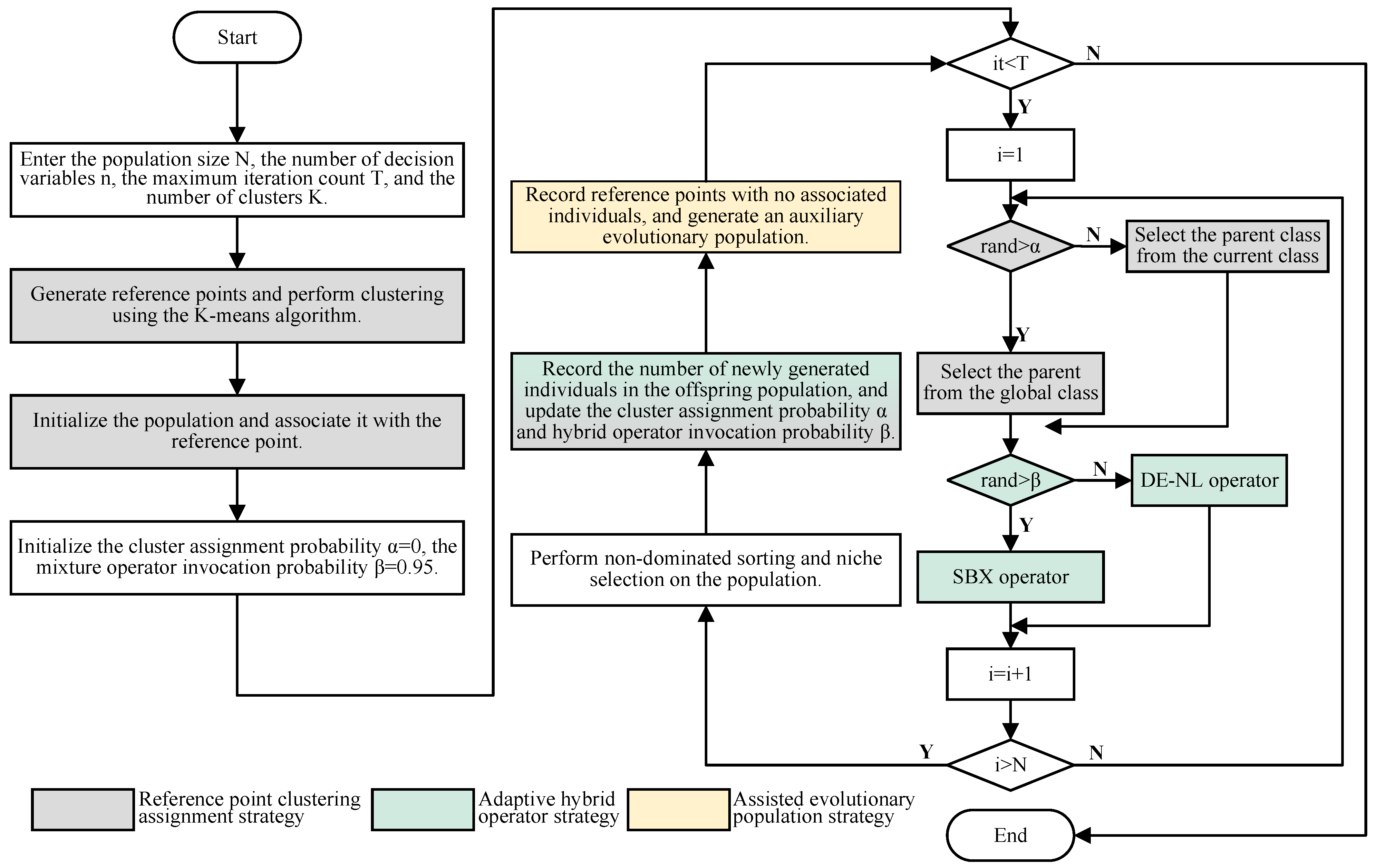
Its main feature is the integration of the clustering concept into the original algorithm, where the reference points are classified. Furthermore, through the calculation of clustering assignment probabilities α , different parent sources are selected for different categories of populations, thereby balancing the algorithm’s varying requirements for convergence and diversity in different phases of the optimization process. Meanwhile, different crossover and mutation operators exhibit adaptive differences in distinct phases of the optimization process, so relying on a single operator to handle complex scenarios throughout the entire process is somewhat inadequate. Therefore, the improved algorithm introduces hybrid operator selection probabilities β to adaptively select the operators used for offspring generation, thus balancing the algorithm’s global exploration capability and local exploitation capability. Finally, to enhance the diversity of the algorithm and avoid falling into local optima, an assistant evolutionary population is added. Figure 1 shows the flow chart of the MSNSGA-III algorithm.

2.1. Reference Point Clustering Assignment Strategy

In multi-objective optimization, this paper proposes a clustering assignment strategy to control the parent selection during the mating process in the NSGA-III algorithm so as to balance the algorithm’s requirements for exploration and exploitation at different stages. This strategy enables the algorithm to favor exploitation when parent individuals are relatively similar, and to lean more toward exploring unknown regions when parents are highly dissimilar. It mainly consists of two parts: the first part is to generate a set of predefined reference points and cluster them according to their potential internal relationships; the second part is to dynamically and adaptively adjust the probability of parent sources in the mating process of each category based on the status of offspring generation.
Clustering is a method for automatically classifying unlabeled data to discover its potential structures and similarities [25]. By leveraging the concept of clustering, this paper classifies a set of uniformly distributed reference points in the objective space, thereby achieving indirect control over the populations attached to these reference points. Owing to the inherent characteristics of the algorithm, the reference points remain fixed throughout the optimization process. A single clustering operation suffices to complete the classification for the entire optimization process, which significantly reduces the complexity of the algorithm.
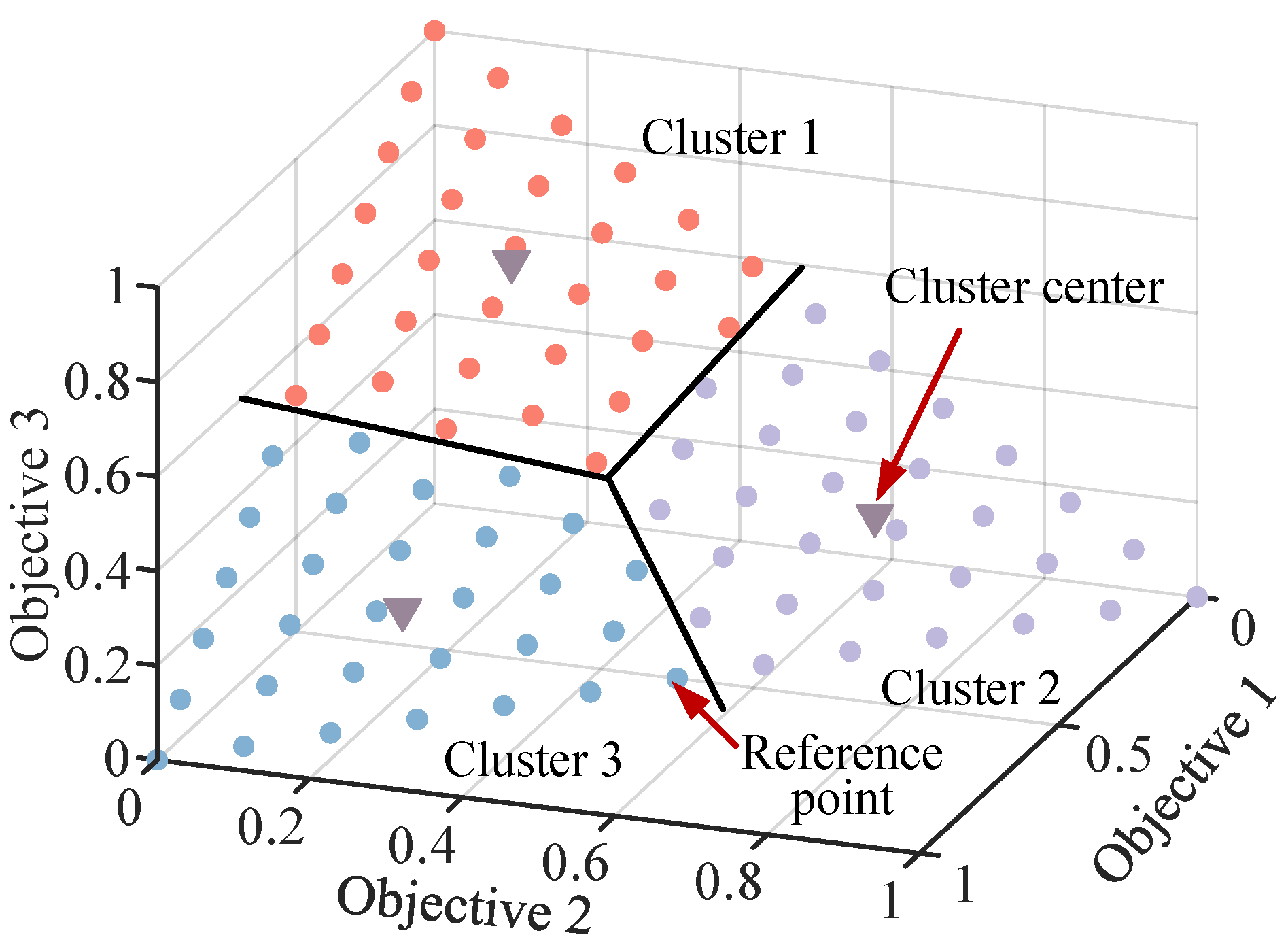
First, a set of predefined reference points is generated according to the NSGA-III algorithm. For an optimization problem with M objectives, these reference points should lie on an ( M 1 ) -dimensional hyperplane. The intercept of the reference hyperplane on each objective axis is 1, and uniform division is performed along each objective axis. Assuming the number of divisions is p, the number of reference points is given by Equation (1). For example, when the number of objectives M = 3 and the number of divisions p = 12 , the number of reference points H = 91 can be calculated according to Equation (1). The distribution of reference points is shown in Figure 2.
H = M + p 1 p
Next, this paper adopts the K-means algorithm [26] to cluster the obtained reference points. The core idea is to randomly select K cluster centers from the H reference points, then calculate the Euclidean distance between each of the remaining reference points and each cluster center. Reference points are assigned to the K clusters according to their proximity to the cluster centers. Subsequently, the cluster centers are updated, and the sum of distances from each reference point in each cluster to the corresponding cluster center is recalculated. This process is repeated until the convergence criterion is satisfied. Figure 2 illustrates the clustering effect when the K-means algorithm is used to divide the reference points into three clusters.
Since the reference points are generated on the ( M 1 ) -dimensional normalized hyperplane prior to optimization, they do not change with the progression of the optimization process. In contrast, the evolving population establishes connections with the reference points through an attachment relationship, thereby enabling population classification. This avoids the need to directly cluster the population in each iteration, which reduces the computational complexity of the algorithm.
After classification, the sub-populations exhibit distinct tendencies depending on their composition. For instance, if newly generated individuals account for the majority in a cluster, this indicates that the quality of this cluster is relatively low, and global exploration is therefore required. In this case, the parent individuals for mating should be selected from the entire population. Conversely, if the proportion of newly generated individuals in a cluster is small, it signifies that the cluster has high quality and further local exploitation is needed. For such clusters, parent individuals should be selected within the cluster itself during mating to fully leverage its inherent advantages. To achieve this goal, the clustering assignment strategy dynamically generates the clustering assignment probability α based on the number of newly generated individuals in different clusters, thus balancing the divergent requirements of global exploration and local exploitation. The pseudocode is presented as Algorithm 1.
Algorithm 1 Calculation of cluster assignment probabilities
Input :
After clustering, the total number of individuals in each cluster is N U M = [ n u m 1 , n u m 2 n u m K ] , and the number of newly generated individuals in each cluster is N U M n e w = [ n u m n e w 1 , n u m n e w 2 n u m n e w K ] .
Output :
Clustering assignment probability α = [ α 1 , α 2 α K ]
  1:
for  i = 1 : K   do
  2:
    Calculate the population renewal rate η i = n u m i n u m n e w i
  3:
end for
  4:
η max = Max ( η ) , η max = Min ( η )
  5:
for  i = 1 : K   do
  6:
    Calculate the clustering assignment probability α i = η max η i η max η min + ε
  7:
end for
Algorithm 1 is an expansion of the clustering assignment probability α calculation function presented in Figure 1. Its inputs are the total number of individuals in each clustered sub-population N U M and the number of newly generated individuals in each sub-population N U M n e w , with the clustering assignment probability α as the output. Line 2 of the algorithm calculates the population update rate η , which is the ratio of the number of newly generated individuals to the total number of individuals in the sub-population. A larger value of η indicates a higher proportion of new individuals and thus a poorer quality of the corresponding sub-population; conversely, a smaller value of η means a lower proportion of new individuals and higher sub-population quality. Line 6 of the algorithm calculates the clustering assignment probability α via normalization, where η max and η min are the maximum and minimum population update rates across all sub-populations, respectively, and  ε = 1 e 10 is used to ensure computational validity. A larger value of α implies a smaller population update rate for the corresponding sub-population, indicating a greater tendency toward local exploitation. In contrast, a smaller value of α corresponds to a larger population update rate, suggesting a stronger inclination toward global exploration. The normalization method can avoid the influence of an excessively high or low number of new individuals on the probability value. In this way, the parent source is determined based on the relative relationship between different sub-populations, thereby ensuring the healthy evolution of the overall population.

2.2. Adaptive Hybrid Operator Strategy

Over the past decades, researchers have proposed a wide variety of evolutionary operators tailored to different problems. However, these operators generally have their respective advantages and disadvantages, and none of them can perfectly solve all problems. Therefore, the approach to selecting more suitable operators has evolved from the initial fixed selection probability to the current adaptive selection.
Adaptive Operator Selection (AOS) [27] refers to a mechanism where the algorithm dynamically allocates the selection probability of each operator by evaluating its contribution during the evolutionary process, thereby achieving the goal of selecting appropriate evolutionary operators. This section introduces the algorithm improvement implemented by adopting AOS.
Prior to adaptive selection, an operator pool must first be constructed with two or more operators to provide options for selection. The MSNSGA-III algorithm employs an operator pool consisting of the Simulated Binary Crossover (SBX) operator and the Differential Evolution-Nonlinear (DE-NL) operator.
The NSGA-III algorithm employs the SBX operator to generate offspring individuals, which excels at local search and is suitable for the exploitation stage in the optimization process. However, in the early stage of optimization, the SBX operator also suffers from insufficient convergence, leading to convergence difficulties for the algorithm when dealing with large-scale variable optimization problems. Yuan et al. [28] compared the performance of the NSGA-III algorithm with different evolutionary operators; the results confirmed that the SBX operator employed in the original NSGA-III constitutes the bottleneck restricting its performance.
The other component of the operator pool is the DE-NL operator. Proposed by Sindhya et al. [29] to enhance the applicability of the DE operator, it is a polynomial-based operator with nonlinear curve-tracking capability. It generates offspring individuals through the nonlinear combination of multiple parent individuals, which is applicable to handling the different dependencies among decision variables, as shown in Equation (2).
v i = ω 2 c a + ω 2 c b + c c
where c a , c b , and  c c are linear combinations of randomly selected parent individuals, as shown in Equation (3):
c a = x 1 2 x 2 + x 3 2 c b = 4 x 2 3 x 1 x 3 2 c c = x 1
where x 1 , x 2 and x 3 are three distinct individuals randomly selected from the parent population; ω is a coefficient generated based on the interpolation probability P int e r , which is defined by Equation (4):
ω U [ 0 , 2 ] r a n d P int e r U [ 2 , 3 ] o t h e r w i s e
where U [ 0 , 2 ] indicates that ω takes a random number between 0 and 2, and  P int e r determines the balance of the operator between exploration and exploitation.
Sindhya et al. tested the performance of the operator, and the results showed that the new operator significantly improved the optimization outcomes across a variety of test problems, thus verifying the robustness of the operator [29]. In addition, to further expand the application scope of the operator, this paper combines the DE/best/1 operator with the polynomial-based operator to form the DE-NL operator, the definition of which is given in Equation (5):
v i = x b e s t + F ( x 1 x 2 ) r a n d 0.75 v i = ω 2 c a + ω 2 c b + c c o t h e r w i s e
After constructing the operator pool, adaptive selection needs to be performed according to the contribution of different operators to the optimization. This paper adopts the Probability Matching (PM) method for operator selection. This approach features low time complexity and ease of implementation, and it can select the operators that perform better during the optimization process. Meanwhile, it can also avoid the phenomenon where the selection probability of an operator is excessively low in the early stage and thus the operator is no longer selected in the later stage. The calculation of the operator selection probability β is given in Equation (6):
β i = β min + ( 1 S × β min ) q i s = 1 S q s
where S is the number of operators in the operator pool O = [ o 1 , o 2 o S ] , q i denotes the contribution degree of the i-th operator to the optimization, and  β min represents the minimum selection probability of the operators, which prevents the operators with poor current performance from being excluded from the selection in subsequent stages.
The adaptive hybrid operator strategy proposed in this section constructs an operator pool using the SBX operator and the DE-NL operator. It calculates the fitness of each operator by recording the survival rate of offspring individuals, and adaptively selects operators via the PM method, as shown in Algorithm 2.
Algorithm 2 Adaptive operator selection probability calculation
Input :
The number of newly generated individuals by the SBX operator and DE-NL operator in generation t, denoted as N U M S B X = [ n u m S B X 1 , n u m S B X 2 n u m S B X K ] and N U M D E N L = [ n u m D E N L 1 , n u m D E N L 2 n u m D E N L K ] , and the operator selection probability in the first t generations, denoted as β = [ β 1 , β 2 β t ] .
Output :
Adaptive hybrid operator selection probability β t + 1 = [ β t + 1 1 , β t + 1 2 β t + 1 K ] for generation t + 1
  1:
for  i t = 1 : K   do
  2:
     β t + 1 i = β min + ( 1 2 β min ) n u m D E N L i n u m S B X i + n u m S B X i + ε
  3:
    if  t < H L  then
  4:
         β t + 1 i = g = 1 t + 1 β g i t + 1
  5:
    else
  6:
         β t + 1 i = g = t + H L 2 t + 1 β g i H L
  7:
    end if
  8:
end for
In Algorithm 2, the inputs are the number of new individuals generated by two different operators in the current generation ( N U M S B X , N U M D E N L ) and the adaptive hybrid operator selection probability β across all previous generations. The output is the selection probability β t + 1 to be adopted in the next generation.
Line 2 of the algorithm initially calculates the selection probability β t + 1 i of operators within different clusters via the Probability Matching (PM) method based on the clusters obtained from clustering, where β min is the minimum selection probability of the operators (set to 0.1 in subsequent experiments), and the factor ε = 1 e 10 ensures computational validity. Lines 3 to 6 of the algorithm take the average of the probabilities from the previous H L generations (or the previous t generations when t < H L ) as the operator selection probability for the next generation, which avoids the randomness of the number of individuals generated by operators in a single generation.

2.3. Assistant Evolutionary Population Strategy

Environmental selection is another crucial component of optimization algorithms. Although the NSGA-III algorithm ensures diversity in multi-objective optimization by means of reference points and the niche strategy, it tends to over-rely on the attachment relationship with reference points when selecting individuals at layer l. This means that when the population is overly concentrated, there will be a large number of reference points with no individuals attached to them. In such cases, the niche strategy will randomly select individuals to form the next generation, and this randomness may lead to a reduction in the search area, thereby losing the diversity around those reference points without attached individuals. This characteristic makes the algorithm prone to falling into local optima and difficult to escape when dealing with certain problems that are sensitive to the distribution of solution sets.
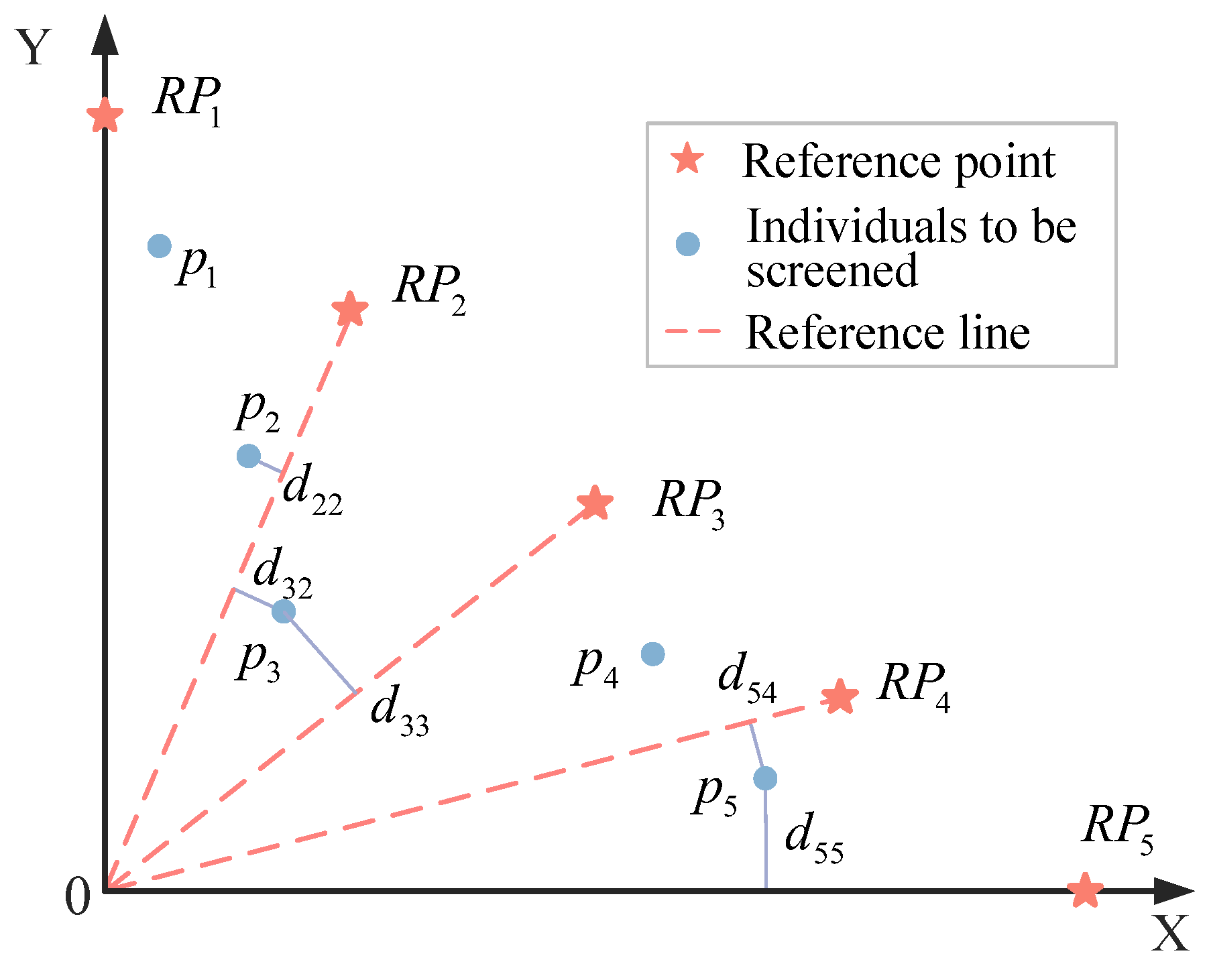
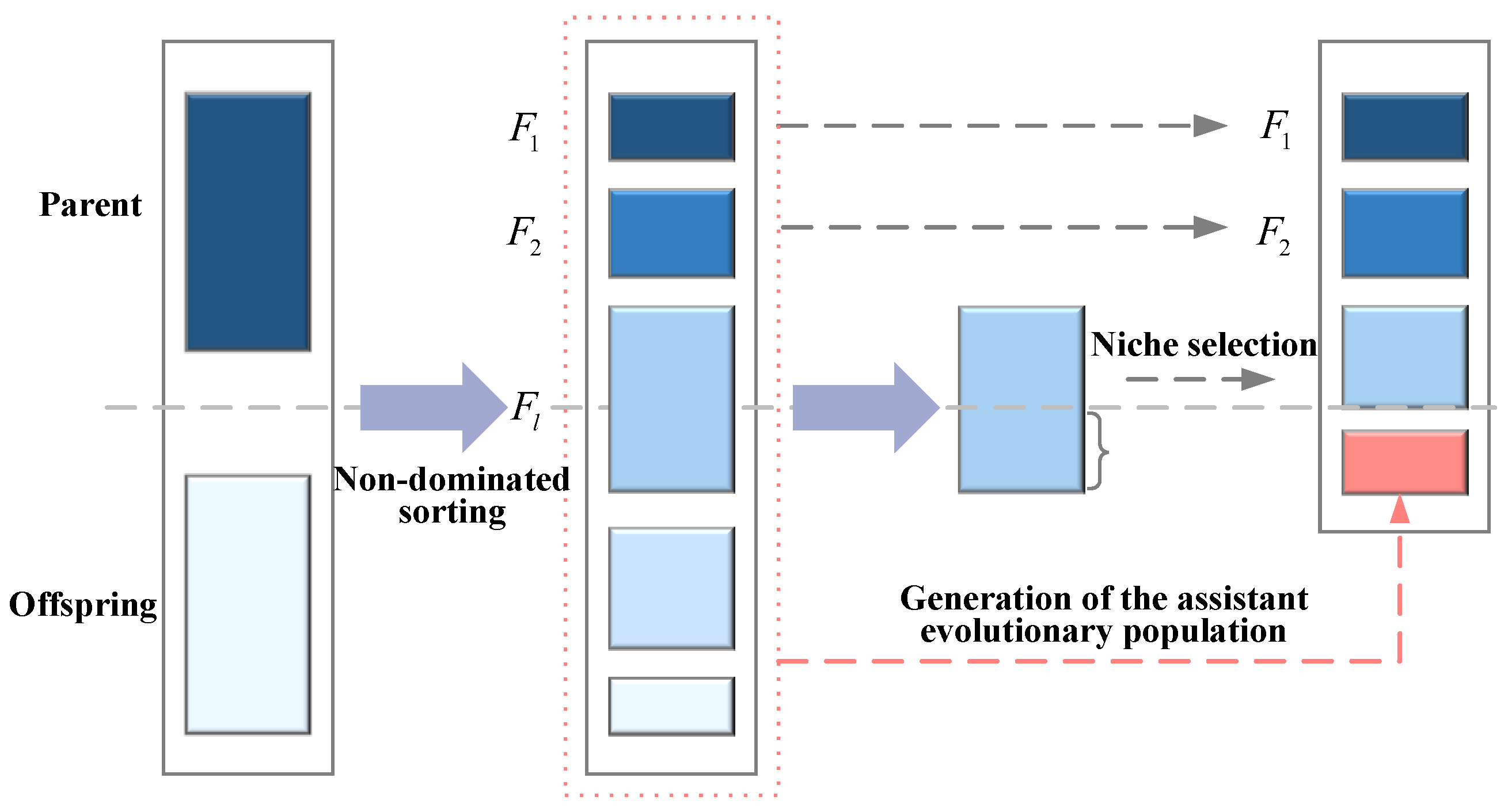
Therefore, to address this issue, this paper proposes an assistant evolutionary population strategy. This strategy mainly utilizes the individual information that is originally discarded in the NSGA-III algorithm to form an auxiliary evolutionary population, and the specific generation process is shown in Figure 3. Although these individuals are at a disadvantage in non-dominated sorting, they are located in sparse reference point regions and may carry potential evolutionary information. Direct discarding would result in the loss of relevant information and thus reduce population diversity. On the contrary, incorporating them into the parent population can provide richer options for the crossover and mutation of the next generation.
Among them, R P 3 and R P 5 are reference points with no individuals attached to them. The vertical distances between all individuals in the population and the reference lines of these reference points are calculated, and the individual with the closest distance to each of these reference points is put into the auxiliary evolutionary population. In Figure 3, both p 3 and p 2 are attached to the reference point R P 2 ; meanwhile, since d 22 < d 32 , individual p 3 may not be selected into the next generation during niche preservation. However, among all individuals to be screened, p 3 has the minimum distance d 33 to R P 3 , so it will be selected into the auxiliary evolutionary population. Similarly, p 5 , as the individual closest to R P 5 , will also be selected by the strategy. Nevertheless, since p 5 is originally the only individual attached to the reference point R P 4 and would be retained through niche preservation anyway, it should be removed from the auxiliary evolutionary population to avoid duplication.
The environmental selection process of the MSNSGA-III algorithm incorporated with the assistant evolutionary population is illustrated in Figure 4.
The pseudocode of the algorithm for generating the assistant evolutionary population is presented as Algorithm 3. Herein, r denotes the number of reference points with no individuals attached to them, and N represents the number of individuals in the population. First, the vertical distances between individuals and reference lines are calculated (Line 3); then, the individual with the closest vertical distance to each reference point is identified (Line 5) and added to the auxiliary evolutionary population (Line 6). Finally, individuals from P a s s i s t a n t that duplicate P t + 1 are removed (Line 8).
Algorithm 3 Assistant evolutionary population generation
Input :
The next-generation population P t + 1 = [ p t + 1 1 , p t + 1 2 p t + 1 N ] after non-dominated sorting and niche preservation, the unscreened original population P t + 1 = [ p t + 1 1 , p t + 1 2 p t + 1 N ] , and the reference point set R P n o n = [ R P n o n 1 , R P n o n 2 R P n o n r ] with no individuals attached.
Output :
Assistant evolutionary population P a s s i s t a n t
  1:
for  i t = 1 : r   do
  2:
    for  j = 1 : 2 N  do
  3:
         d i , j = distance ( R P n o n i , p j )
  4:
    end for
   5:
    [ , n u m ] = min ( [ d j , 1 , d j , 2 d j , 2 N ] )
  6:
     P a s s i s t a n t ( i ) = p n u m
  7:
end for
  8:
P a s s i s t a n t = setdiff ( P a s s i s t a n t , P t + 1 )

3. Numerical Experiments and Result Analysis

3.1. Test Functions and Performance Metrics

To evaluate the performance of the algorithm on different problems, the commonly used DTLZ1∼4 test functions in the field of multi-objective optimization are selected for experiments in this section. The DTLZ series of functions were proposed by Deb et al. [30], and are widely used in the testing of multi-objective optimization problems due to their characteristic that both the objective dimension and the number of variables can be arbitrarily extended.
To evaluate the convergence and diversity of the algorithm, as well as the quality of its optimization results in approximating the true Pareto front, it is necessary to establish evaluation metrics in a quantitative manner. This paper employs the Inverted Generational Distance (IGD) [31] and Hypervolume (HV) as the metric for measuring the algorithm’s performance.
A smaller IGD value indicates that the optimization results of the tested algorithm are closer to the true Pareto front, which means the comprehensive performance of the algorithm is better. In the early stage, the IGD value can characterize the convergence of the algorithm, while it characterizes the diversity in the later stage.

3.2. Comparison Algorithms and Experimental Setup

To verify the effectiveness of the proposed algorithm improvement strategies, six different multi-objective optimization algorithms are selected for comparison in this paper, including NSGA-II [32], NSGA-III [11], MOEA/D [33], AR-MOEA [34], MyO-DEMR [35] and EMyOC [36]. The initial parameters of each algorithm are set in accordance with their respective references, with the specific values shown in Table 1. The initial parameters of the MSNSGA-III algorithm proposed in this paper are set as follows: crossover probability p c = 1 , mutation probability p m = 1 / n , distribution index η c = η m = 20 , cluster number K = 3 , and hybrid operator p i n = 0.5 .
To reduce the randomness of the optimization results, all algorithms were run 20 times repeatedly for each optimization problem. The number of optimization objectives for all test problems was set to 3. Since the population sizes of the NSGA-III and MOEA/D algorithms are affected by reference points, the population size was set to 91; for the sake of consistency, the same population size was adopted for the other algorithms. The existing literature [30] provides the recommended variable dimensions for the DTLZ1∼4 problems with three optimization objectives. To test the processing capability of each algorithm with increased variable dimensions, additional experiments on multi-variable processing performance were conducted on the basis of the original recommended values. Meanwhile, an increase in variables leads to a higher computational complexity, which in turn affects the setting of termination criteria. Therefore, in the experiments, the number of variables for the DTLZ1 and DTLZ3 problems is set to 7, 20, and 30, while for the DTLZ2 and DTLZ4 problems, it is set to 12, 20, and 30. The maximum number of iterations is set to 200, 300, and 400, respectively.
To compare whether there are significant differences between the experimental results of different algorithms, this paper employs the Wilcoxon rank-sum test with a significance level of 0.05.

3.3. Validation of the Effectiveness of the Improved Strategy

The MSNSGA-III algorithm proposed in this paper applies K-means clustering and hybrid operator adaptive technology. Among them, the number of clusters K classifies the optimized reference points, thereby affecting the evolutionary probability of the population; however, an excessively large or small K value will adversely affect the performance of the algorithm.
To verify the effectiveness of the improved clustering strategy of the algorithm and determine an appropriate number of clusters K, comparative experiments on the number of clusters were conducted in this paper. The MSNSGA-III algorithm with the number of clusters set to K = 1 , 3 , 5 , 7 was applied to solve the DTLZ1∼4 problems, and each test was independently repeated 20 times. Except for the difference in the number of clusters, all other parameter settings were consistent with those in Section 3.2. The average IGD values and standard deviations of the obtained optimization results are shown in Table 2.
As can be seen from Table 2, when the number of clusters K = 3 , the optimal test results are obtained for all DTLZ1∼4 problems with 3 objectives. In particular, compared with the case of K = 1 (without using the clustering strategy), adopting the clustering strategy to select individuals from both local and global populations for evolution improves the quality of offspring to a certain extent, which demonstrates the effectiveness of the clustering strategy employed in this paper. The search performance deteriorates with an increase in the number of clusters. Therefore, the number of clusters should match the number of objectives of the problem under consideration. Taking all factors into account, K = 3 is chosen as the clustering parameter in this paper when the number of optimization objectives is 3.
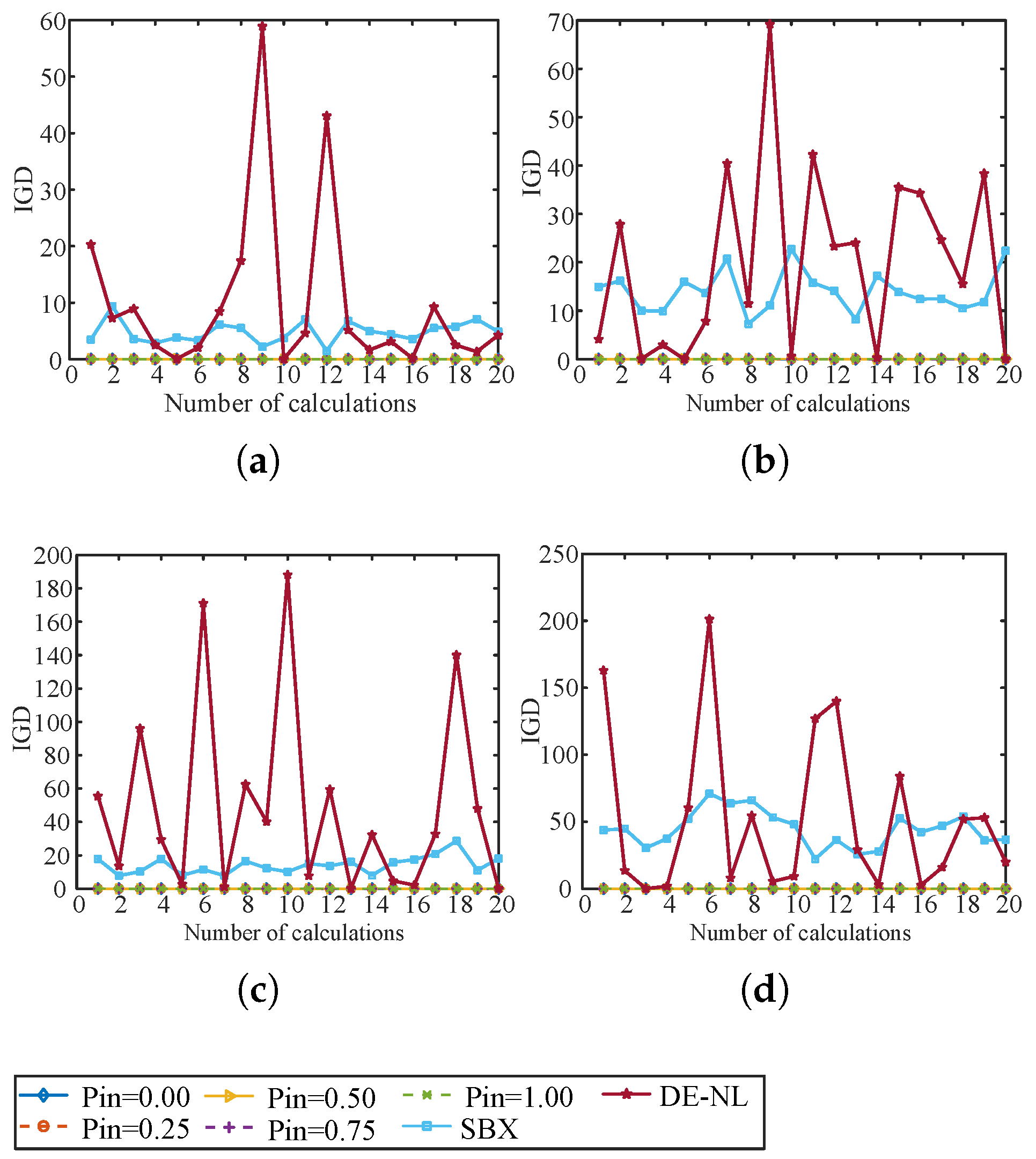
Besides the clustering strategy, another important modification of the algorithm is the introduction of hybrid operators. To verify the effectiveness of the hybrid adaptive operator strategy and determine the parameters of the hybrid operators, comparative experiments were carried out on the MSNSGA-III algorithm with different operators and parameter combinations. Seven comparative conditions were set: hybrid operator with Pin = 0, Pin = 0.25, Pin = 0.50, Pin = 0.75, Pin = 1, using only the SBX operator or using only the DE-NL operator. The DTLZ1∼4 problems were optimized and solved under these conditions, with each test problem repeated independently 20 times. All other settings were the same as those in Section 3.2.
The mean IGD values and standard deviations of the optimization results are shown in Table 3. The values in parentheses are the standard deviations of multiple runs, and the IGD values corresponding to the best algorithm are indicated in bold.
As can be seen from Table 3, except that the algorithm using only the SBX operator achieves better performance on the DTLZ2 problem, the optimization results of using either the SBX operator or the DE-NL operator alone are unsatisfactory in other cases compared with using the hybrid operator. Particularly for the DTLZ1 and DTLZ3 problems, as the dimension of decision variables increases, the single operator is insufficient to obtain the true Pareto front of the problems within a limited number of iterations. Meanwhile, the SBX operator and the DE-NL operator also exhibit different characteristics in solving high-dimensional problems.
Figure 5 shows the IGD distribution of 20 optimization runs with different operators on the DTLZ1 and DTLZ3 problems. As can be seen from the figure, the SBX operator produces relatively poor optimization results when dealing with problems with a large number of variables, but the results are relatively uniform without extreme cases.
In contrast, although the overall performance of the DE-NL operator is also poor, it exhibits high instability. In the 20 independent experiments for different problems, the number of runs with an IGD value less than 0.1 was 2, 3, 2, and 1, respectively. This indicates that the DE-NL operator has a strong global search ability but insufficient stability.
In comparison, the hybrid operator demonstrates excellent solution performance on the DTLZ1∼4 problems and maintains good consistency across the 20 independent runs, which reflects the high stability of the algorithm. The experimental results demonstrate that the hybrid adaptive strategy can significantly improve the algorithm’s performance in solving complex problems with high-dimensional decision variables.
It can also be seen from Table 3 that for different values of Pin corresponding to the DE-NL operator in the hybrid operator, the algorithm achieves the optimal mean IGD for all problems when Pin = 0.5, except for the 20-variable DTLZ2 problem and the 20-variable DTLZ3 problem. Therefore, considering the overall solution requirements, this paper selects Pin = 0.5 as the algorithm parameter for application in the subsequent solution process.

3.4. Experimental Results and Analysis

To verify the solution performance of the proposed algorithm with multiple variables, the optimization results of the NSGA-II, NSGA-III, MOEA/D, AR-MOEA, MyO-DEMR, EMyOC and MSNSGA-III algorithms for the DTLZ1∼4 problems were compared based on the aforementioned parameter settings. Table 4 and Table 5 show the mean IGD and HV values of the optimization results for different algorithms, respectively. The values in parentheses are the standard deviations of multiple runs, those in square brackets are the algorithm performance rankings, and the indicators corresponding to the best algorithm are presented in bold.
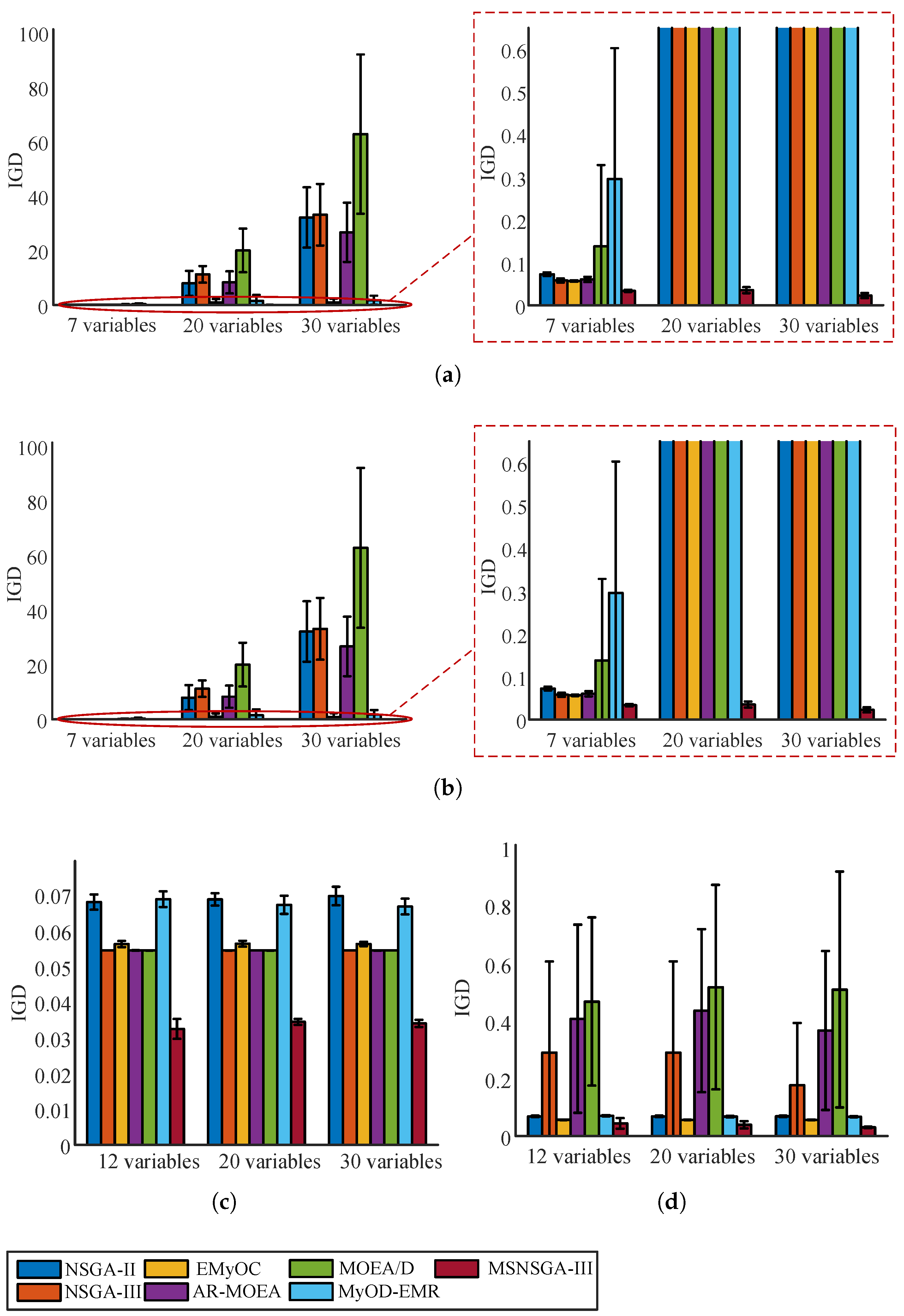
It can be seen from Table 4 that the MSNSGA-III algorithm proposed in this paper yields the optimal results in all cases, and its average IGD values are significantly lower than those of other algorithms as verified by the Wilcoxon rank-sum test. Among the test cases, distinct differences are observed in the optimization results of various algorithms with different numbers of variables for the DTLZ1 and DTLZ3 problems. Taking the DTLZ1 problem as an example, when the number of variables is 7, the average IGD values of all algorithms except MyO-DEMR are less than 0.1, indicating a small performance gap among these algorithms. However, with the increase in the number of variables, a considerable performance divergence emerges, particularly when the variable count reaches 30. Specifically, the MSNSGA-III algorithm can still maintain an IGD level on the order of 10 2 . While the average IGD values of the EMyOC and MyO-DEMR algorithms increase slightly, they remain at the level of 10 1 . In contrast, the IGD values of the remaining algorithms rise markedly, with the MOEA/D algorithm showing the maximum average IGD value of 18.43, which is 830 times that of the MSNSGA-III algorithm. This phenomenon exhibits the same trend for the DTLZ3 problem. On the contrary, the increase in the number of variables exerts no significant influence on the average IGD values of the results for the DTLZ2 and DTLZ4 problems. For a more intuitive comparison of the optimization results of different algorithms on various problems, Figure 6 presents the comparison of IGD values with different numbers of variables.
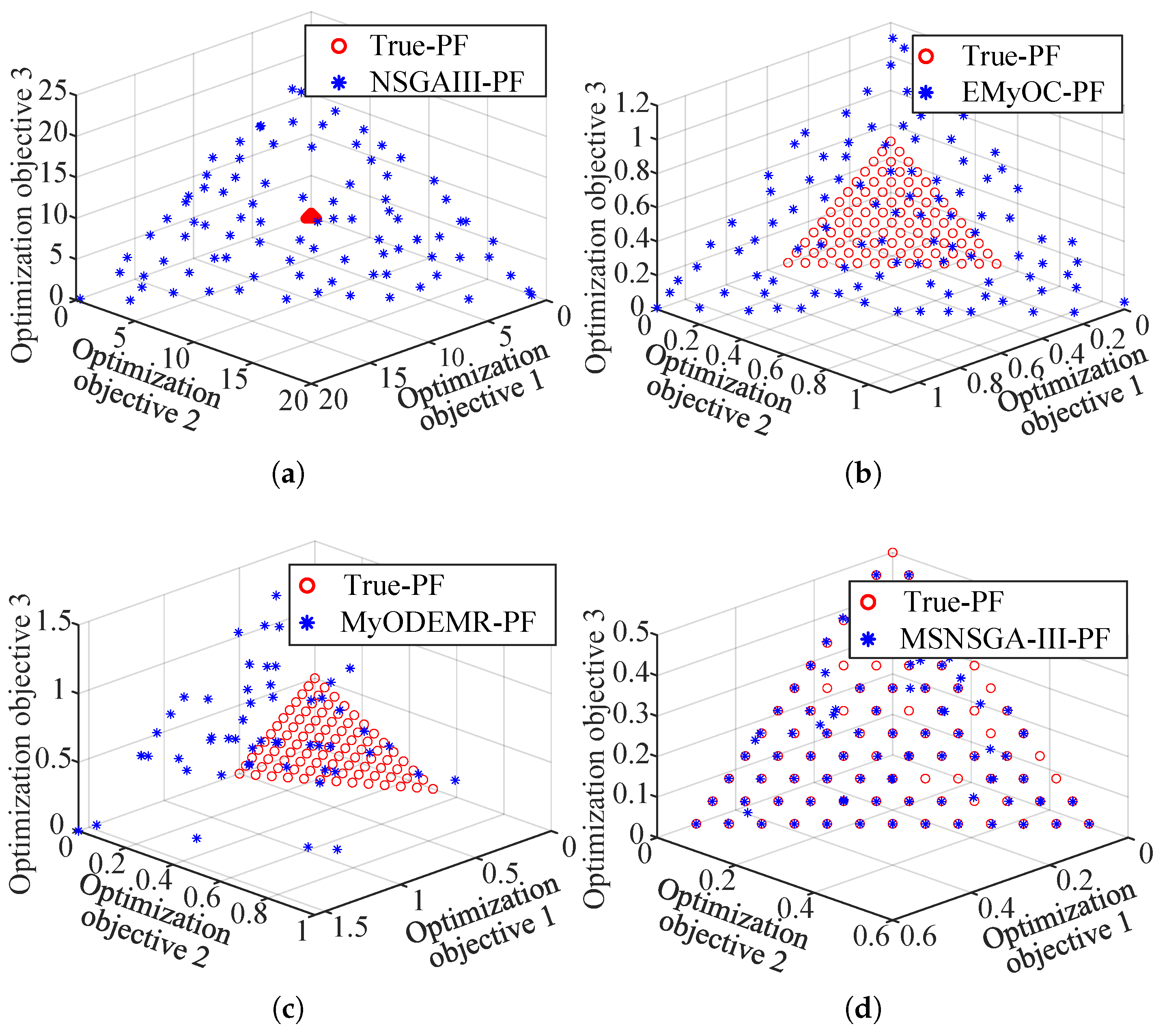
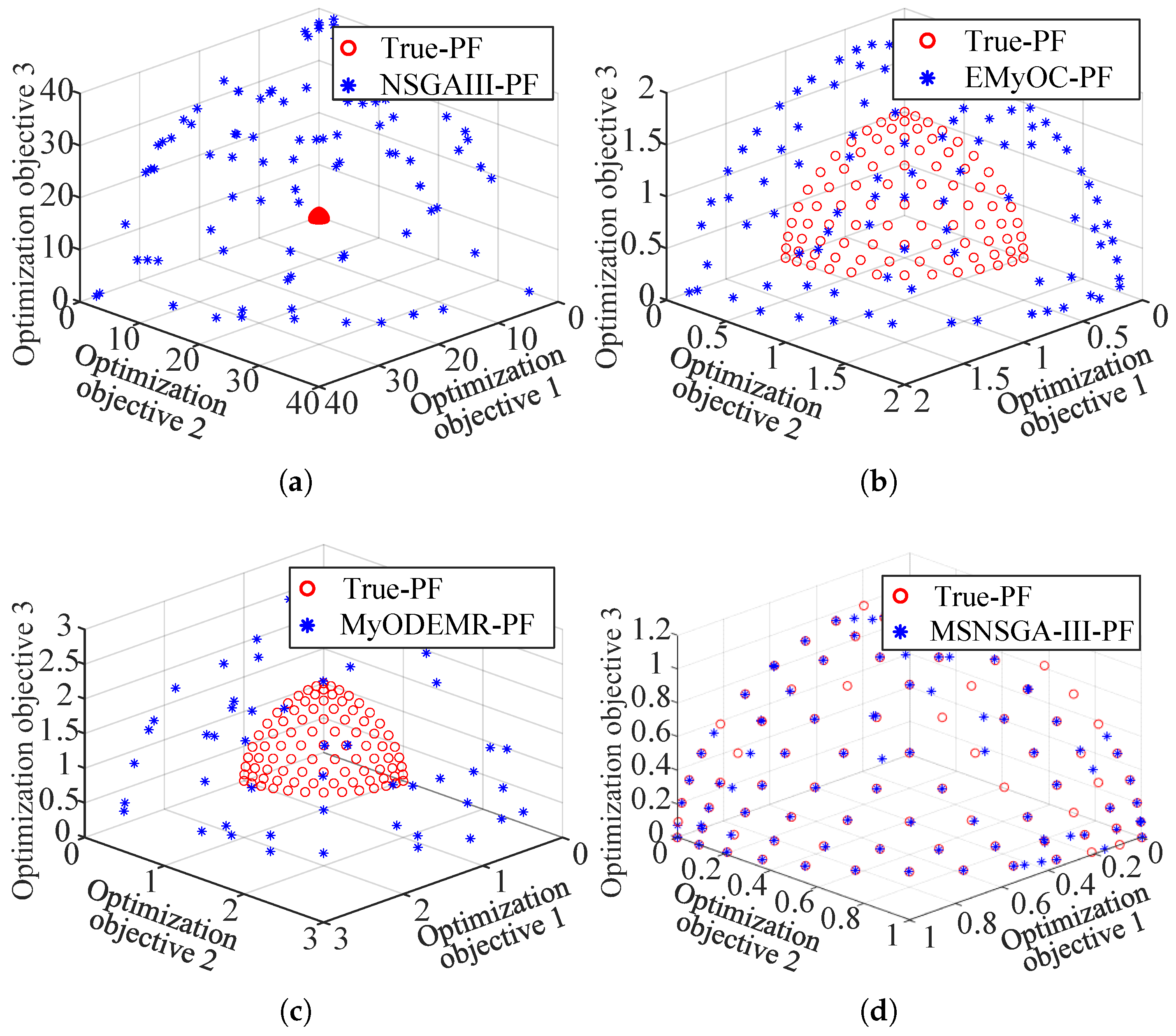
Figure 6a,b show the comparisons of the optimization results of different algorithms for the DTLZ1 and DTLZ3 problems with different numbers of variables, respectively. It can be seen that the IGD values of the optimization results are significantly affected by the number of variables; as the number of variables increases, the solution capabilities of the NSGA-II, NSGA-III, MOEA/D and AR-MOEA algorithms for the optimization problems decline rapidly. The Pareto fronts of the optimization results for the 30-variable DTLZ1 and DTLZ3 problems obtained by the NSGA-III, EMyOC, MyO-DEMR and MSNSGA-III algorithms are presented in Figure 7 and Figure 8, respectively.
It can be seen from Figure 7a and Figure 8a that when the NSGA-III algorithm handles the 30-variable DTLZ1 and DTLZ3 problems, there is a large gap between the optimized Pareto front and the true Pareto front, indicating a problem of slow convergence. The NSGA-II, MOEA/D and AR-MOEA algorithms exhibit the same issue. Although the optimization results of the EMyOC and MyO-DEMR algorithms are quite close to the true Pareto front, a slight gap still exists. The optimization results of the MSNSGA-III algorithm, as shown in Figure 7d and Figure 8d, are basically consistent with the true Pareto front. It is thus evident that the MSNSGA-III algorithm possesses distinct advantages in addressing multi-variable problems.
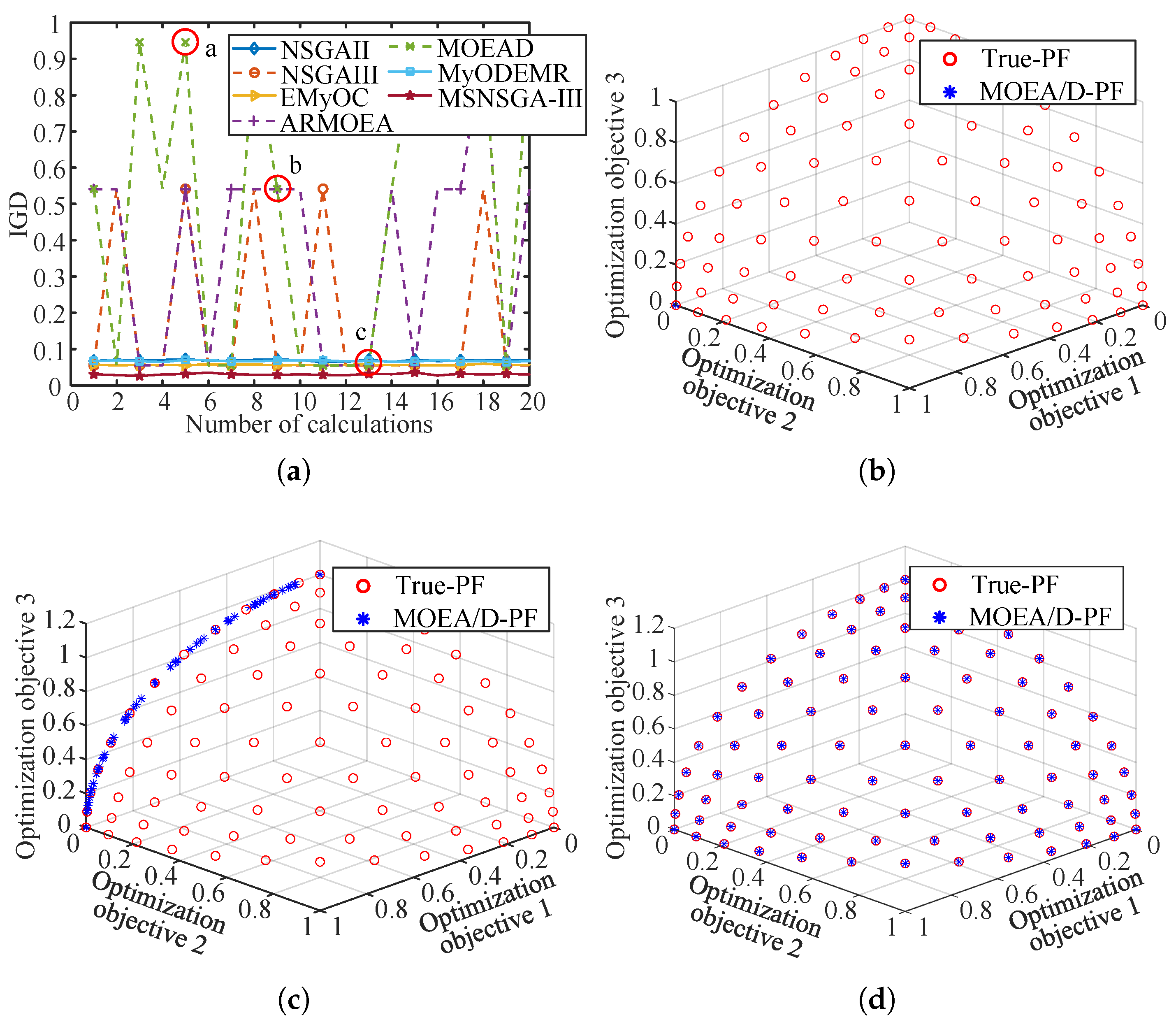
It can be seen from Figure 6d that, unlike DTLZ1 and DTLZ3, the optimization results for the DTLZ4 problem are insensitive to changes in the number of variables, with all algorithms maintaining relatively stable average IGD values across different variable counts. However, at the same number of variables, the performance differences among various algorithms are quite significant. Figure 9a presents the IGD distribution of 20 independent runs for each algorithm with 30 variables, while Figure 9b–d show three typical Pareto front distributions obtained by the MOEA/D algorithm for the DTLZ4 problem.
It can be seen from Figure 9a that the computational results of different algorithms for the DTLZ4 problem can be divided into two categories. The first category includes NSGA-II, EMyOC, MyO-DEMR and MSNSGA-III; in 20 independent runs, the IGD values of the optimization results of these algorithms show no obvious fluctuations with the standard deviation less than 0.01, indicating good algorithm consistency. The second category comprises NSGA-III, AR-MOEA and MOEA/D, whose optimization results exhibit significant fluctuations with the standard deviation all greater than 0.1. This phenomenon arises because the DTLZ4 problem has a strong initial value dependence, which tends to cause the algorithms to trap into local optima.
Taking the MOEA/D algorithm as an example, the optimization result of the algorithm in Figure 9b converges to a single point near (0,0), resulting in an IGD value of 9.459 × 10 1 —the maximum among the three cases—which corresponds to point a in Figure 9a. In Figure 9c, the Pareto front of the algorithm converges to a curve with an IGD value of 5.415 × 10 1 , corresponding to point b in Figure 9a. In Figure 9d, the Pareto front of the algorithm is basically consistent with the true Pareto front, and its IGD value is also the smallest of the three cases at 5.447 × 10 2 . This indicates that the MOEA/D algorithm has the ability to converge to the true Pareto front but suffers from poor stability and a lack of capability to escape from local optima.
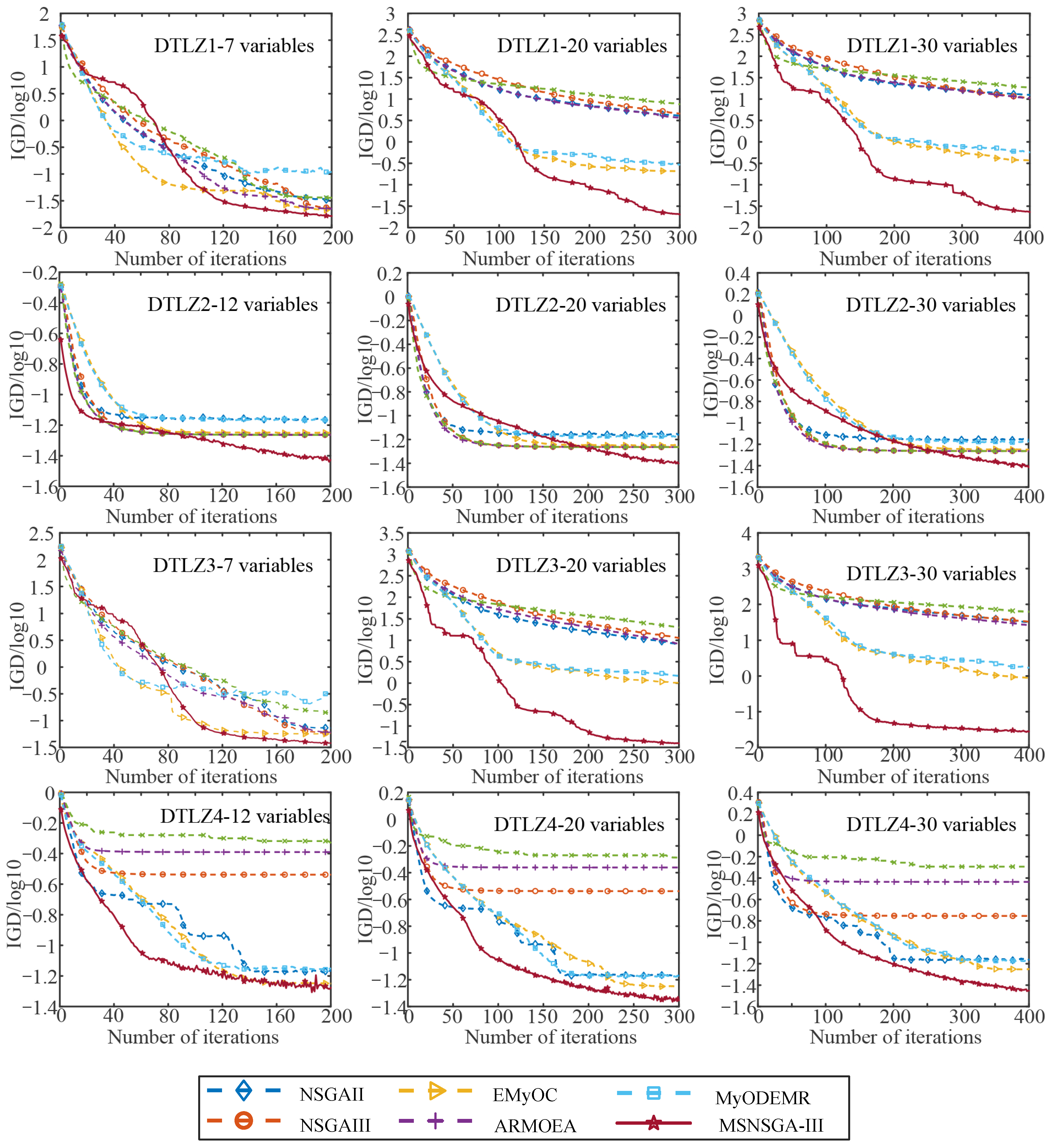
Based on the analysis of the results, the MSNSGA-III algorithm proposed in this paper demonstrates advantages across all the DTLZ1 4 problems. This superiority of the improved algorithm is particularly prominent compared with other algorithms when the number of variables increases. To investigate the variation trends of the search efficiency of different algorithms during the optimization process, Figure 10 plots the curves of average IGD values versus the number of iterations for the seven algorithms in solving the DTLZ1 4 problems with different numbers of variables.
It can be seen from Figure 10 that when addressing the DTLZ1 4 problems with different numbers of variables, the MSNSGA-III algorithm yields the optimal IGD values for its optimization results in comparison with other algorithms. For the DTLZ1 and DTLZ3 problems with 7 variables, although the algorithm failed to achieve the optimal search efficiency in the first half of the optimization process, it gradually demonstrated a stronger search capability in the second half. When the number of variables reached 20 and 30, the MSNSGA-III algorithm exhibited prominent advantages, which indicates that the algorithm can achieve rapid convergence and also possess good distributivity when dealing with multi-variable problems, thus being able to quickly approach the true Pareto front. For the DTLZ2 problem, although the MSNSGA-III algorithm had a slower convergence rate than other algorithms in the early stage of the optimization process, with the progress of the optimization, it finally converged to a smaller average IGD value, reflecting its superior ability to balance exploration and exploitation. For the DTLZ4 problem, the MSNSGA-III algorithm showed advantages under all variable number conditions. It can be concluded that compared with other algorithms, the improved algorithm proposed in this paper has high search efficiency in solving optimization problems, especially those with a large number of variables, and can better balance the convergence and diversity of the Pareto front.
Table 6 shows the comparison of running time among different algorithms for solving the DTLZ1∼4 problems. It can be observed that the MSNSGA-III algorithm proposed in this paper leads to an increase in computational cost due to the introduction of three improved strategies, and its running time is longer than that of the NSGA-III algorithm on all test problems.
This limits its application in computation-time-sensitive scenarios to a certain extent. However, in the morphing leading edge design scenario targeted in this paper, the computation time of the fitness function for the optimization problem is much longer than the running time of the optimization algorithm itself. In this case, the fast convergence of the improved algorithm proposed in this paper can be effectively applied.

4. Optimization Design of Morphing Leading Edge Based on the MSNSGA-III Algorithm

4.1. Design Concept and Structural Composition

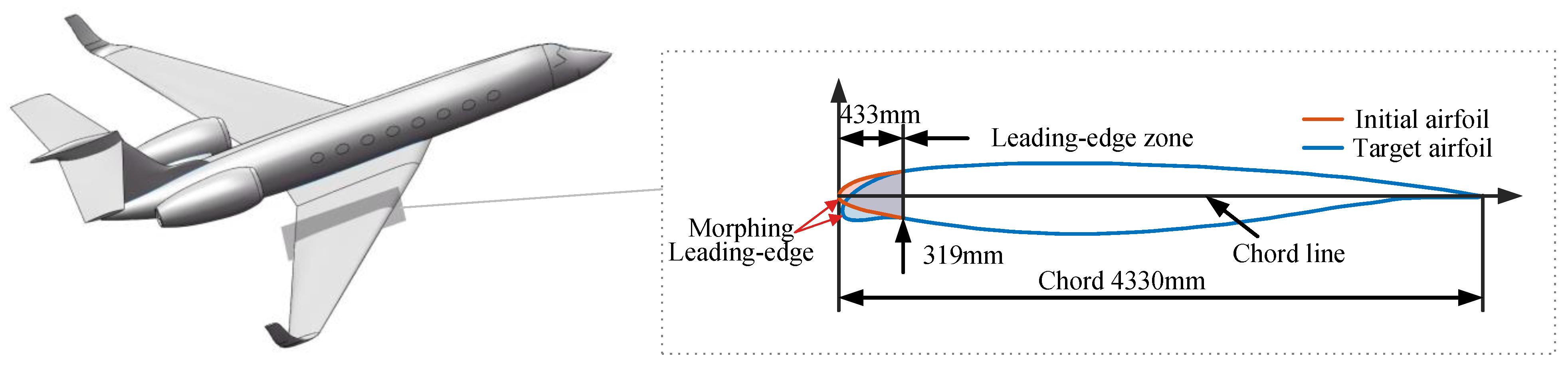
In this paper, the aerodynamic configuration of a certain transport aircraft is taken as the research example [37,38], with its designed cruise speed of 0.85 Mach, which has been verified by CAE-AVM wind tunnel tests. As a preliminary validation of the proposed design method, the three-dimensional airfoil with taper is simplified to a two-dimensional airfoil at the cross-section, whose geometric dimensions are shown in Figure 11. The chord length of the airfoil is 4330 mm, with the leading edge accounting for 10% of the total chord length. Taking the constant perimeter during the leading edge bending process as the constraint condition, the aerodynamic configuration with the drooped leading edge is obtained through CFD analysis and aerodynamic optimization [39]. Detailed aerodynamic optimization processes can be found in the relevant literature.
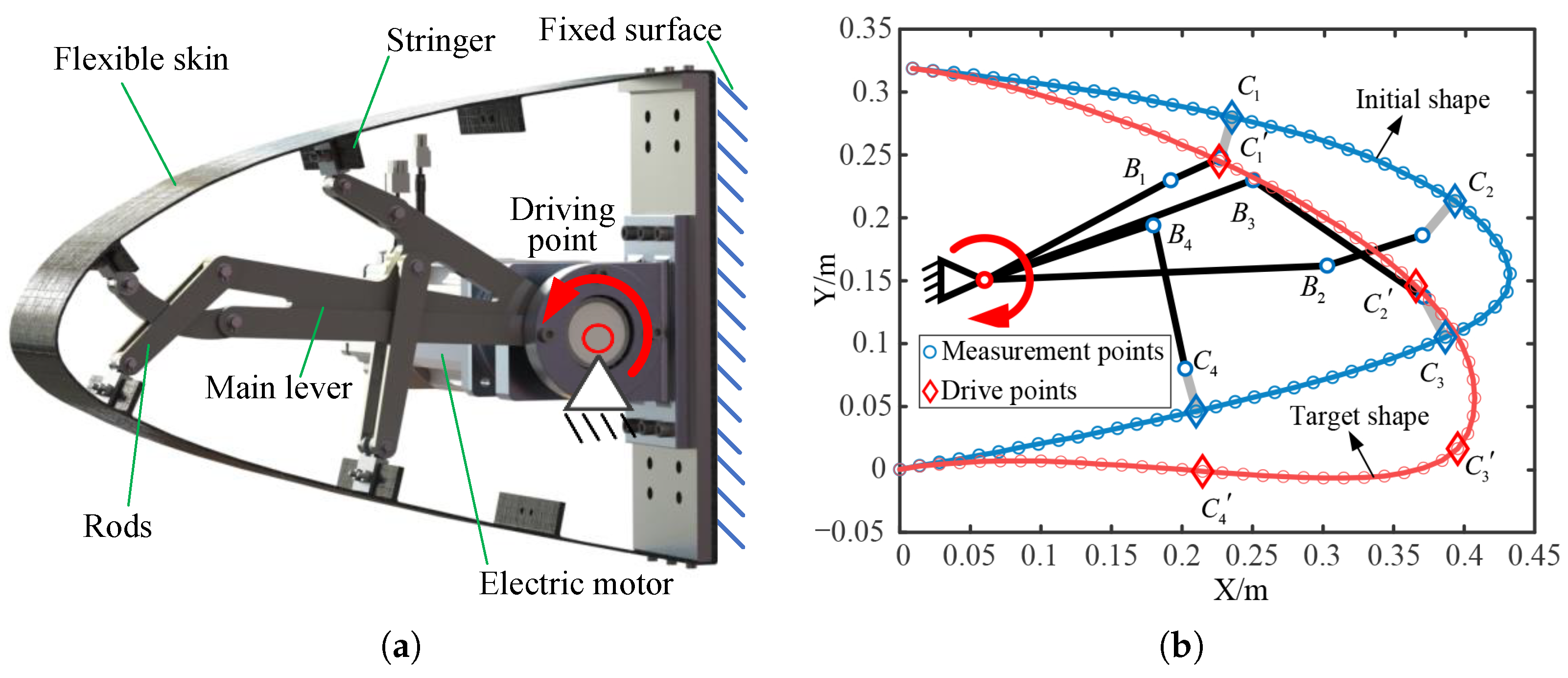
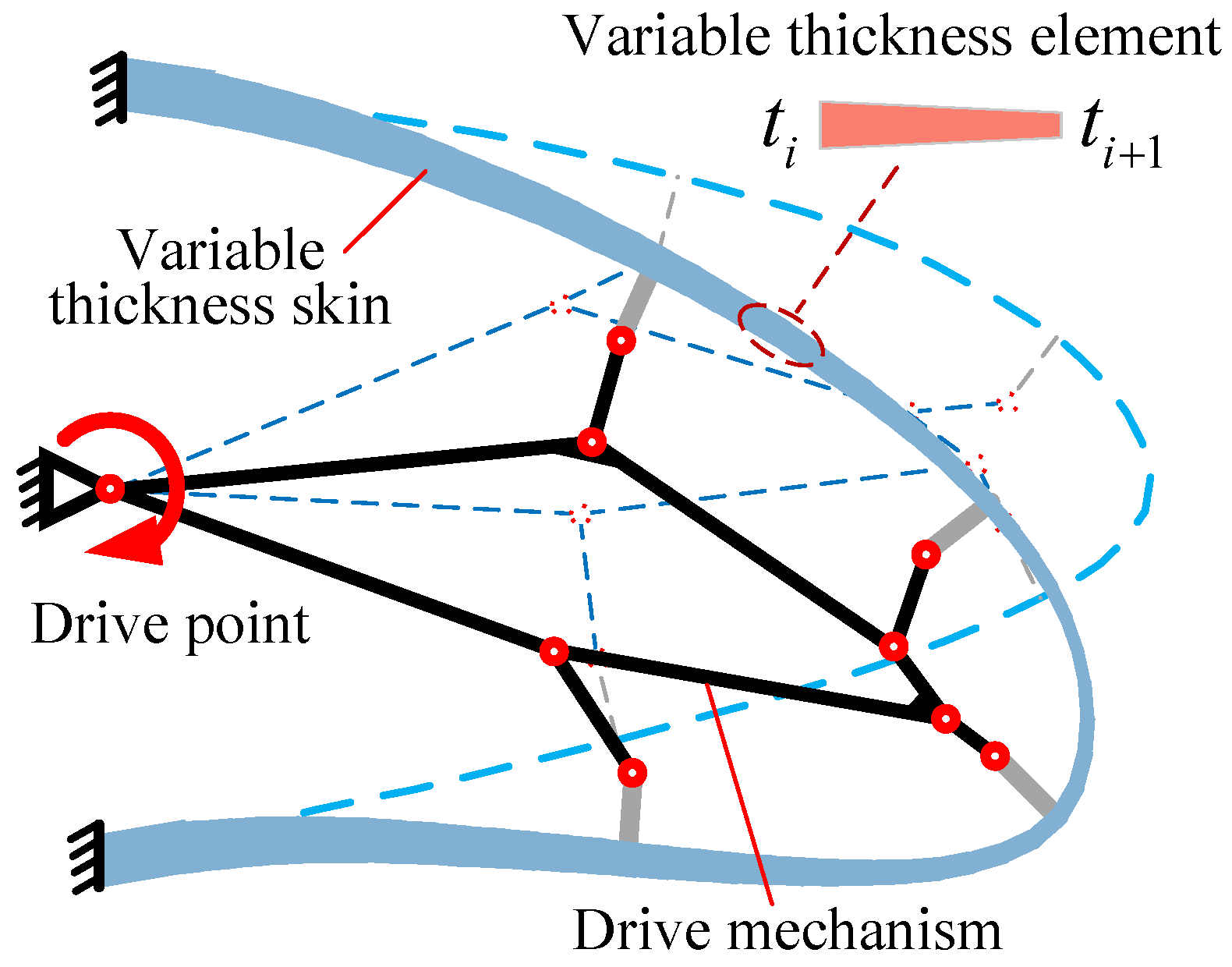
The structural configuration of the morphing leading edge is shown in Figure 12a, which consists of a flexible skin with variable thickness and a rigid driving mechanism. The upper and lower ends of the skin are subject to fixed constraints to simulate the actual wing front spar, and four stringers are distributed along the circumferential direction for articulated connection with the mechanism. The internal driving mechanism is composed of rigid connecting rods, including one main lever and four sub rods. The main lever rotates around the driving point and further drives the four sub rods to move; the sub rods actuate the skin to deform via the hinges connected to the stringers.
The 2D cross-sectional dimensions of the variable-camber leading edge investigated in this paper are shown in Figure 12b. The skin has a spanwise width of 100 mm, a thickness of 0.5∼3 mm, and an elastic modulus of 105 GPa. The parameters of the driving point position and rotation angle are presented in Table 7. The commercial finite element software ANSYS19.0 was used to calculate the deformation of the leading edge. In the finite element model, the skin was divided into 66 Shell elements along the circumferential direction, with Node 1 and Node 67 fully fixed, which correspond to the highest and lowest points of the leading edge, respectively. The main lever and sub rods were regarded as rigid bodies; the connections between the rods, as well as those between the rods and stringers, were all realized by frictionless rotational joints, all of which were simulated with MPC184 elements in ANSYS. A rotational angle of θ was applied at the driving point A. Since the deformation of the skin falls into the category of large deformation, the large deflection command (NLGEOM ON) was activated during the quasi-static structural analysis to account for the nonlinearity of all loads and curvatures in the deformation process. Details of the model can be found in Reference [40].

4.2. Optimization Model for Variable Thickness of Leading Edge Skin

The morphing leading edge with a variable-thickness flexible skin is shown in Figure 13. The variable-thickness skin is divided into n elements along the circumferential direction, with the thickness of each element varying linearly. For the i-th element, the cross-sectional thicknesses at its two ends are defined as t i and t i + 1 , respectively. The specific thickness distribution is to be determined through optimization.
In the actual flight environment, the shape of the wing leading edge has distinct requirements during the takeoff phase and the cruise phase. Specifically, in the cruise phase, the leading edge should maintain its initial shape to minimize drag. The flexible skin is required to withstand aerodynamic loads and retain a constant shape under the combined action of its inherent stiffness and the internal mechanism. Therefore, the optimization objective f 1 is de-fined as the shape-retaining accuracy of the leading edge in the cruise phase, which is quantified by the minimum squared difference between the actual nodal coordinates of the skin under aerodynamic loads and those in the initial configuration, as shown in Equation (7). A smaller value of the objective indicates a higher level of shape-retaining accuracy.
min f 1 = 1 n i = 1 n ( x i i n i t x i i n i t ) 2 + ( y i i n i t y i i n i t ) 2
where x i i n i t , y i i n i t and x i i n i t , y i i n i t represent the actual coordinates and desired coordinates of the skin nodes in the cruise phase, respectively, and n represents the number of nodes. By the same token, in the takeoff phase, the leading edge should be adjusted to the target configuration, thereby enabling the wing to generate substantial lift even at low speeds. During this phase, the flexible skin is required to deform to the target configuration under the combined action of the driving mechanism and aerodynamic loads. Therefore, the optimization objective is defined as the deformation accuracy of the leading edge in the takeoff phase, which is quantified by the minimum squared difference between the actual nodal coordinates of the deformed skin and those corresponding to the desired configuration, as shown in Equation (8). A smaller objective value indicates a higher level of shape-retaining accuracy.
min f 2 = 1 n i = 1 n ( x i t g t x i t g t ) 2 + ( y i t g t y i t g t ) 2
where x i t g t , y i t g t and x i t g t , y i t g t represent the actual and desired coordinates, respectively, of the skin nodes during the takeoff phase. Furthermore, the peak driving force which serves as a critical metric for assessing coordination throughout the deformation process is adopted as the third optimization objective, denoted by f 3 in Equation (9).
min f 3 = MAX ( M a )
In summary, for the variable-thickness optimization of the morphing leading edge skin, the shape maintaining accuracy in the cruise state, the deformation accuracy in the takeoff state and the peak driving force during the deformation process are taken as the optimization objectives, and the circumferential thickness distribution of the skin is used as the optimization variable to establish an optimization model, which is given in Equation (10).
min   F = f 1 f 2 f 3   o v e r     t = [ t 1 , t 2 t n ]     s . t .       t l < t i < t u ,           i = 1 , n
where f 1 , f 2 and f 3 denote the three optimization objectives, respectively. ti represents the cross-sectional thickness at the ith node, while t l and t u refer to the lower and upper limits of the skin thickness.

4.3. Optimization Variable Control Based on Spline Curves

To address the issue of an excessive number of design variables in the coupled optimization of the morphing leading edge mechanism and skin, and to improve the optimization efficiency during the leading edge design process, this paper adopts the concept of indirect control and employs B-splines and Non-Uniform Rational B-Splines (NURBS) curves for the indirect optimization of design variables.

4.3.1. B-Spline Curves and Optimization Variable Control

B-spline curve can be obtained by linearly combining the B-spline basis functions with the control points, as shown in Equation (11):
C u = i = 1 n N i , p u P i
According to the properties of B-spline curves, the shape of an entire curve can be modified using a limited number of control points. This is consistent with the concept of indirect optimization for the cross-sectional thickness of the leading-edge skin. Meanwhile, the strong convex hull property of B-spline curves can effectively ensure that the skin thickness values fall within the predefined range. The end-point interpolation property can guarantee that the optimization of skin thickness is constrained within the start and end nodes. Therefore, this paper adopts B-spline curves for the indirect optimization of the skin thickness.
First, it is assumed that a B-spline curve has a total of k control points with coordinates x i , y i where i = 1 , 2 , , k . x i 0 , 1 denotes the normalized circumferential coordinate of the skin, and y i 0 , 1 denotes the normalized thickness of the skin. To ensure the uniqueness of the skin thickness at the same point on the curve, the coordinates x i must be monotonically increasing, satisfying x i x i + 1 . For this purpose, a relaxation factor ε 0 , 1 is introduced, such that:
x i = 0 i = 1 m = 1 i 1 ε m m = 1 n 1 ε m i = 2 , 3 , k
The introduction of ε in Equation (12) enables x i to remain monotonically increasing without additional constraints.
Then, the affine invariance of B-spline curves is utilized to scale the curves, so as to achieve indirect control over the thickness of the leading edge skin. Assuming that the circumferential coordinate of the skin is n i [ 1 , n ] and the thickness is t t l , t u , the relationship between the B-spline curve C u and the thickness of the skin is given in Equation (13).
n i = 1 + n 1 u t = t l + t u t l C u u 0 , 1
Indirect control of the thickness of the leading edge skin via B-spline curves is achieved using Equation (11)–(13). Accordingly, the optimization model in Equation (14) can be rewritten as follows:
min     F = f 1 f 2 f 3   o v e r           ε = [ ε 1 , ε 2 ε k 1 ]           y = [ y 1 , y 2 y k ]   s . t .             ε i 0 , 1 i = 1 , 2 , , k 1             y i 0 , 1 i = 1 , 2 , , k
When the number of control points is k, the number of optimization variables using B-spline curves is 2 k 1 . By adjusting the curve shape with a small number of control points, the NURBS curve further derives the thickness of the skin through interpolation. This reduces the number of variables in the optimization process and improves the optimization efficiency.

4.3.2. NURBS Curves and Optimization Variable Control

B-spline curves have certain limitations, as they cannot accurately represent conic curves. For this reason, weight factors are introduced on the basis of B-spline basis functions to form the NURBS basis functions, the definition of which is given in Equation (15):
R i , p u = N i , p u ω i j = 1 n N j , p u ω j
In Equation (6), R i , p u denotes the NURBS basis function of degree P defined on the knot vector U. N i . p u is the corresponding B-spline basis function. ω i represents the introduced weight factor, and unless otherwise specified, all values of ω i are greater than zero. It can be seen that the NURBS basis functions degenerate into B-spline basis functions when all weight factors are equal. Therefore, B-spline basis functions are a special form of NURBS basis functions.
On the basis of the NURBS basis functions, the control points Pi are introduced and linearly combined with the basis functions to obtain the NURBS curve C(u), which can be expressed as Equation (16):
C u = i = 1 n R i , p u P i = i = 1 n N i , p u ω i P i j = 1 n N j , p u ω j
The introduction of the weight factor ω i allows for more precise control over the shape of NURBS curves. Therefore, on the basis of using B-spline curves to indirectly control the variable-thickness optimization variables of the morphing leading edge, the weight factor is introduced, and Equation (14) is further modified to adopt NURBS curves for the control of optimization variables. Assuming the number of control points is k, the optimization model can be rewritten as Equation (17):
min   F = f 1 f 2 f 3 o v e r ε = [ ε 1 , ε 2 ε k 1 ] y = [ y 1 , y 2 y k ] ω = [ ω 1 , ω 2 ω k ] s . t . ε i 0 , 1 y i 0 , 1 ω i 0 , ω max     i = 1 , 2 , , k 1     i = 1 , 2 , , k     i = 1 , 2 , , k
where ω max denotes the maximum value of the weight factor, and the definitions of the other parts are consistent with those in Equation (14). Compared with B-spline curves, when the number of control points is k, the number of optimization variables for NURBS curves is 3 k 1 .

4.4. Optimization Results and Analysis

In this section, the proposed MSNSGA-III algorithm is adopted to solve the variable-thickness optimization model for the morphing leading edge skin. The parameters of the algorithm used are consistent with those in Section 3, where the clustering number K = 3 , the crossover probability p c = 1 of SBX operator, the mutation probability p m = 1 / n , the distribution indices η c = η m = 20 , and the p i n = 0.5 of the DE-NL operator. The size of the optimization population is set to 91 with a maximum number of iterations of 200, and the initial population is generated in a random manner.
Since the true Pareto front for the variable-thickness optimization of the morphing leading edge is unknown, the IGD metric used in the preceding sections is no longer applicable. Therefore, this section adopts the HV metric, which is suitable for problems with an unknown Pareto front, to evaluate the performance of the leading edge skin optimization results.
To evaluate the B-spline and NURBS variable control methods proposed in Section 4.3, the optimization models expressed by Equations (14) and (17) were solved separately. Table 8 presents the HV values of the optimization results obtained via the B-spline and NURBS control methods with different orders and different numbers of variables. In the optimization, the variation range of the skin thickness was set to t 1 , 3 m m . It should be noted that due to the different compositions of optimization variables in the two control methods, the number of control points corresponding to the same variable dimension D is D + 1 / 2 for the B-spline model and D + 1 / 3 for the NURBS model, respectively. In addition, to ensure the comparability of the HV values of the optimization results obtained under different conditions, all data shown in Table 8 were subjected to a unified normalization process, with the reference point set as 1 , 1 , 1 .
For B-spline or NURBS curves, a greater number of control points enables more precise control of the curve shape, yet the consequent increase in the number of variables will reduce the solution efficiency of the optimization algorithm. Therefore, selecting an appropriate variable dimension is an important approach to improving the optimization results. As can be seen from the table, within the selected range of variable dimensions D = 17 , 23 , 29 , 35 , with the increase in the number of optimization variables, the HV values of the optimization results obtained by variable control methods of different types and orders show a trend of first increasing and then decreasing, and all yield the optimal HV value at the variable dimension of 29. This phenomenon is consistent with expectations: in the initial stage, the distribution of the leading edge skin thickness can be controlled more accurately with the increase in the number of control points, leading to an improvement in the quality of the optimization results; however, as the number of variables increases, the algorithm performance becomes the main factor restricting the optimization effect, which consequently causes the HV value of the Pareto front to decline instead of rising. Therefore, setting the variable dimension of the optimization model to 29 is relatively appropriate.
It can also be seen from Table 8 that whether B-spline or NURBS curves are used, the optimization results obtained with the third order are superior to those with the second order in most cases. This is mainly because as the order increases, the curve intervals affected by the control points expand, and the scope of the convex hull enclosed by the control polygon also increases, which leads to an expanded variation range of the curve and a smoother curve shape.
In addition, since NURBS curves incorporate the weight coefficient ω , which enables more precise control of the variable curves during the optimization process, the optimization results obtained with NURBS curves are all superior to those with B-spline curves under the same order and number of variables. It is particularly worth noting that for the same number of variables, the number of control points of NURBS curves is fewer than that of B-spline curves. For example, when the variable dimension D = 35 , the respective numbers of control points for the two are 12 and 18. With the same 12 control points adopted, the NURBS curve with 35 variables still yields better results than the B-spline curve with 23 variables, even when subject to the limitations of algorithm performance.
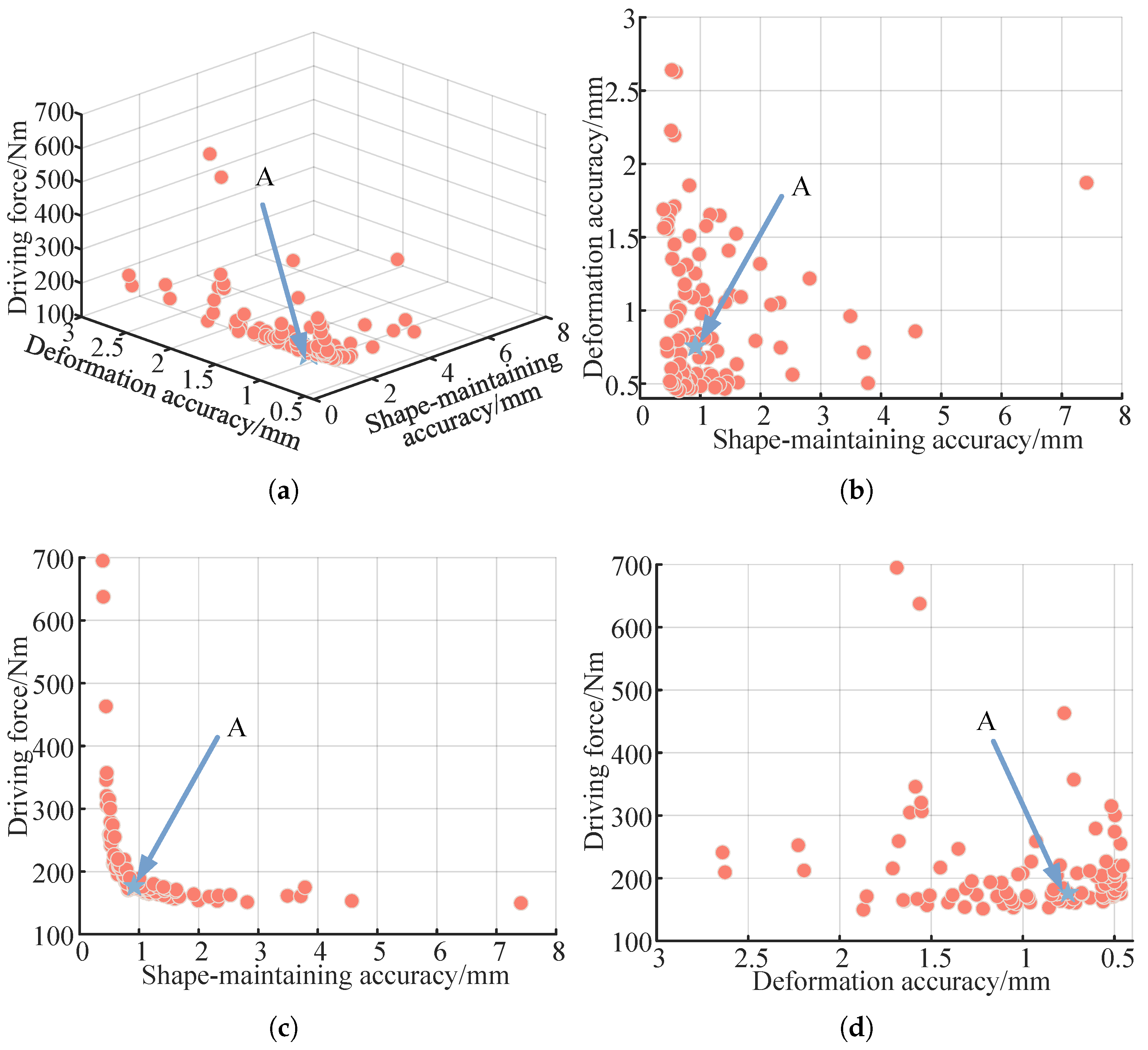
In summary, to further analyze the results of the variable-thickness optimization for the morphing leading edge, the Pareto front of the optimization results with 29 variables using third-order NURBS curves is plotted, as shown in Figure 14. Meanwhile, to analyze the relationships among the three optimization objectives, the correlation coefficients of the optimization objectives are calculated.
Figure 14a shows the Pareto front of the optimization results for the variable-thickness design of the morphing leading edge. Figure 14b presents the projection of the Pareto front onto the optimization objectives of f 1 (shape maintaining accuracy) and f 2 (deformation accuracy). It can be seen that these two optimization objectives are independent of each other with no obvious interdependency, which is also confirmed by the correlation coefficient of −0.0072 between f 1 and f 2 . This indicates that the shape maintaining accuracy or deformation accuracy of the leading edge can be independently influenced by adjusting the thickness distribution of the leading edge skin.
Figure 14c shows the projection of the optimization results onto the optimization objective f 1 (shape maintaining accuracy) and the optimization objective f 3 (peak deformation driving force). It can be observed that a negative correlation trend exists between them, i.e., the peak driving force increases as the shape maintaining accuracy is improved. The main reason for this phenomenon is that the leading edge mainly relies on the inherent stiffness of the skin to resist aerodynamic loads before deformation; the skin stiffness increases with the increase in skin thickness, yet higher stiffness also imposes a greater burden on the actuators. The correlation coefficient between the two objectives f 1 and f 3 is −0.5379, which to a certain extent also verifies the antagonistic relationship between driving force and shape maintaining accuracy.
It should be noted that a distinct phased difference can also be observed in the negative correlation trend between the two objectives f 1 and f 3 from Figure 14c: specifically, when the average deviation of the leading edge before deformation is greater than 0.8 mm, the improvement in shape maintaining accuracy will not lead to a significant increase in driving force. However, once the optimization objective f 1 is to be further improved from 0.8 mm, it will result in a rapid surge in the peak driving force. This also causes the correlation coefficient between the two to not be closer to −1. This indicates that within a certain range, the shape maintaining accuracy can be enhanced through the design of the leading edge skin thickness distribution without a noticeable increase in driving force, which provides guidance for our design.
Figure 14d depicts the relationship between optimization objective f 2 (deformation accuracy) and optimization objective f 3 (peak driving force). The correlation coefficient between them is 0.1857, and the values of optimization objective f3 are mainly distributed around 200 Nm. When the average deformation deviation is less than 1.4 mm in Figure 14d, there is no obvious interdependency between the two objectives. This demonstrates that the deformation accuracy of the leading edge can be improved by optimizing the skin thickness distribution. Meanwhile, the deformed skin can resist aerodynamic loads by virtue of its inherent stress stiffening effect instead of relying on an increase in skin thickness. This explains the random distribution of f 3 values when f 2 is less than 1.4 mm.
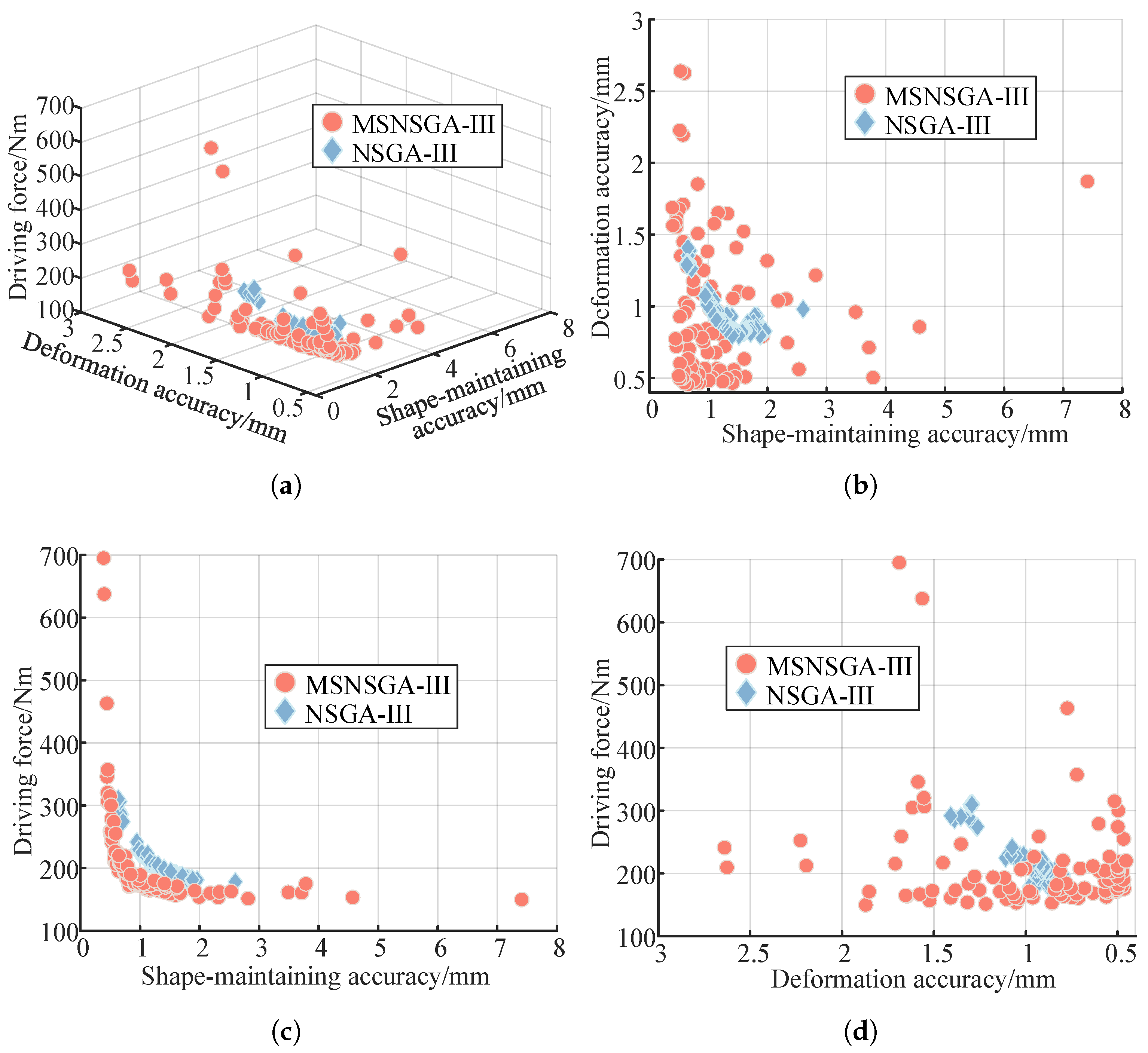
To further demonstrate the performance improvement of the proposed MSNSGA-III algorithm over the original NSGA-III algorithm in the variable-thickness optimization of the morphing leading edge, the leading edge skin thickness is optimized using both algorithms under the same parameters, including population size and maximum number of iterations. The cubic NURBS curve is used as the variable control method, and all other parameters remain unchanged. The optimization results are presented in Figure 15.
The experimental results show that the HV value of the solution set obtained by the NSGA-III algorithm is 0.7625, while the HV value of the solution set obtained by the MSNSGA-III algorithm is 0.9550. In comparison, the MSNSGA-III algorithm improves the HV value of the leading edge variable-thickness optimization solution set by 25.2%, indicating that the optimized results obtained by the improved algorithm have a wider coverage and more uniform distribution in the objective space. The diversity of the solution set is significantly better than that of the original algorithm, which can also be clearly observed in Figure 15a.
In addition, the quality of the solution set is another important indicator for evaluating the optimization performance of the algorithm. It can be seen from Figure 15 that the Pareto front obtained by the MSNSGA-III algorithm is closer to the origin than that of the original algorithm, which shows that the improved algorithm achieves better results on all three objectives.
The main reason for these differences is that the NSGA-III algorithm adopts a fixed reference point mechanism and cannot adjust the parent sources according to the evolutionary state of the population, which easily leads to the loss of population diversity. Especially in the leading-edge variable-section optimization with strongly coupled and large numbers of variables, a single evolutionary strategy struggles to escape from local optima, making it difficult to obtain the global optimal solution.
In contrast, the improved MSNSGA-III algorithm enhances its global optimization ability by integrating multiple strategies. The reference point clustering allocation strategy and the adaptive hybrid operator strategy can effectively jump out of the local optimal region and guide the population to converge toward the global optimal region. Meanwhile, the auxiliary evolution can effectively maintain population diversity and finally obtain a higher-quality solution set, providing more abundant scheme alternatives for the variable-section design of the flexible leading edge.
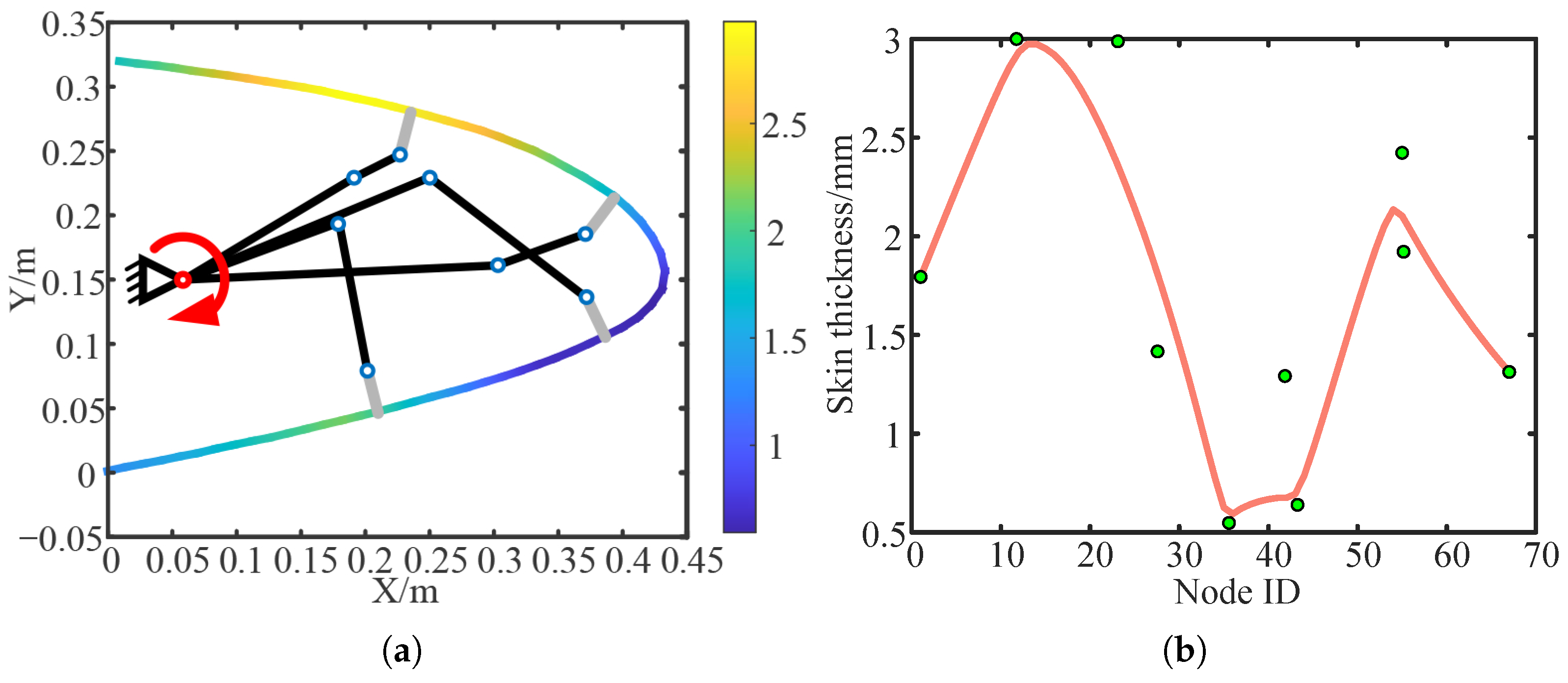
To further compare the effects of variable-thickness and fixed-thickness skins on the performance of the morphing leading edge, a compromised thickness distribution of the leading edge skin balancing the three optimization objectives was selected from the Pareto front shown in Figure 14a via the ideal point method, as indicated by Point A in Figure 14. The mechanism joint positions and skin thickness distribution represented by Point A are illustrated in Figure 16.
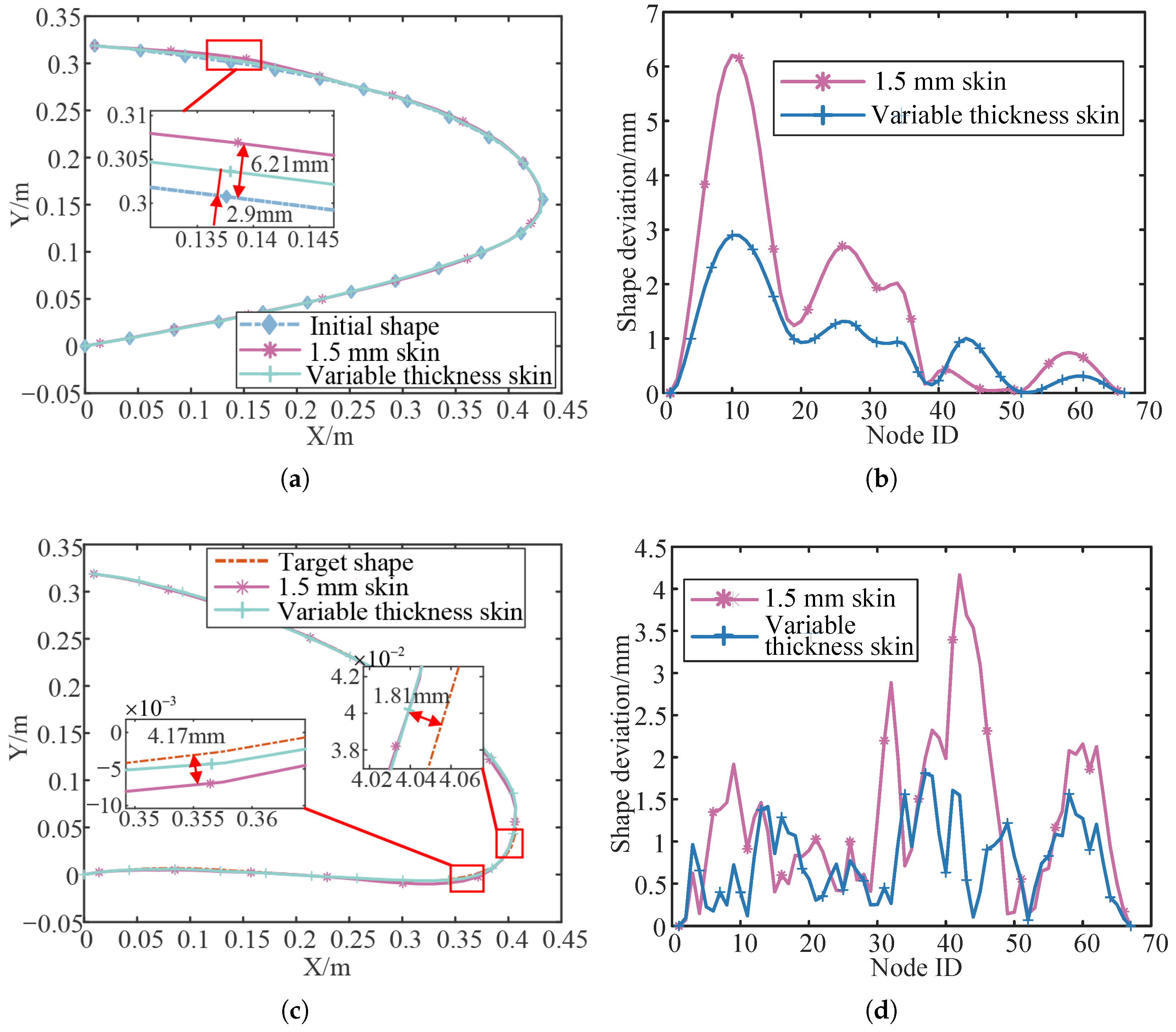
Figure 16 shows that the peak values of the skin thickness are distributed at nodes 10 to 25 on the upper surface, which coincides with the suction peak region of the aerodynamic load. This indicates that the skin thickness is increased here to provide the necessary supporting stiffness. In the region of nodes 35 to 45, the skin thickness decreases significantly. This part corresponds to the area with the maximum curvature variation during the leading edge deformation, where the skin thickness is reduced to achieve the goal of decreasing the driving force. Figure 17 further presents a comparison of the morphing leading edge with a variable-thickness skin against the leading edge with a fixed-thickness skin of 1.5 mm in terms of shape maintaining accuracy and deformation accuracy.
Figure 17a,b respectively show the comparison of the shape-maintaining profile of the leading edge with different skin thicknesses against the initial profile, as well as the corresponding deviation curves, under the cruise condition. It can be clearly seen from the two figures that the variation in skin thickness mainly affects the accuracy of the skin in the range of nodes 1 to 39. This node range corresponds to the upper surface of the skin, which verifies that the deviation of the leading edge under the cruise condition is primarily caused by the aerodynamic loads acting on the upper surface. At this stage, as the skin thickness increases, the load-bearing capacity of the leading edge is enhanced and the profile deviation is gradually reduced. By increasing the skin thickness within the corresponding node range, the variable-thickness skin can effectively resist aerodynamic loads, thereby improving its shape maintaining accuracy.
Figure 17c,d respectively show the comparison of the deformation profile of the leading edge with different skin thicknesses against the target profile, as well as the corresponding deviation curves, under the takeoff condition. It can be seen that, in contrast to the cruise condition, the deviation of the leading edge profile in the takeoff condition is not concentrated in a specific region but distributed over the entire skin range, and the distribution characteristics of skins with different thicknesses are also inconsistent. This indicates that the stress stiffening effect of the skin after deformation resists the aerodynamic loads, and the profile errors are mainly determined by the driving mechanism and the skin structure. The variable-thickness skin achieves the optimal deformation accuracy by virtue of the optimization of its thickness distribution.
To further quantify the differences in deformation performance between the variable-thickness skin and fixed-thickness skin, Table 9 lists various performance indices of the leading edge with skins of different thicknesses during the deformation process. The numbers in parentheses represent the percentage of performance improvement or reduction of the variable-thickness skin relative to the 1.5 mm fixed-thickness skin.
It can be seen from Table 9 that the leading edge with a variable-thickness skin outperforms that with a fixed 1.5 mm-thickness skin in all six performance indices, which proves its superior comprehensive performance. Specifically, compared with the fixed 1.5 mm-thickness skin, the variable-thickness skin improves the average shape maintaining accuracy by 43.6% and the average deformation accuracy by 40.9% while reducing the maximum driving force by 17.5% and the maximum strain by 52.1%. In summary, the flexible leading edge adopting a variable-thickness skin can resolve the contradictory requirements of improving shape maintaining accuracy and reducing the deformation driving force. Meanwhile, its deformation accuracy can be further enhanced through the design of thickness distribution.

5. Discussion

In summary, to address the strongly coupled and highly nonlinear optimization problems arising from the increase in system complexity, number of optimization objectives and variable dimensions in practical engineering applications, this paper proposes a multi-strategy enhanced NSGA-III algorithm (MSNSGA-III) by introducing the K-means clustering, adaptive hybrid operator and auxiliary evolutionary population strategy on the basis of the original NSGA-III algorithm. This algorithm achieves a balance between exploration and exploitation in solving nonlinear, non-convex and multi-local optimization problems, and promotes the diversity of the Pareto solution set distribution. The performance of the proposed algorithm is verified using the DTLZ1 4 test functions and compared with six commonly used algorithms. Experimental results show that the MSNSGA-III algorithm improves both the convergence and diversity of the original algorithm and exhibits excellent performance on multiple test cases.
On this basis, the proposed algorithm is applied to the variable-thickness optimal design of the morphing leading edge. With the optimization objectives of reducing the driving force during the deformation, improving the precision of continuous and smooth morphing, and enhancing its load-bearing capacity of the leading edge, an optimization model for the variable-thickness design of the leading edge is established. A method for indirectly controlling the skin thickness via spline curves to reduce the number of optimization variables is also proposed so as to further improve the optimization efficiency of the variable-thickness design for the leading edge skin. The optimization results show that the morphing leading edge with a variable-thickness skin outperforms the 1.5 mm fixed-thickness skin in five indicators, including shape retention accuracy, deformation accuracy and driving force. Among them, the variable-thickness morphing leading edge achieves a 43.6% improvement in shape maintaining accuracy, a 40.9% improvement in deformation accuracy, and a 17.5% reduction in the maximum driving force. These results verify the effectiveness of the proposed optimization design method.
Future work will focus on extending the existing two-dimensional design method to three-dimensional wings with taper and sweepback angles so as to improve the applicability of morphing leading edges on civil aircraft. Additionally, other aspects will be considered, such as the aeroelastic coupling of structural mechanisms, shape monitoring, and bird strike resistance. It should also be noted that the method proposed in this study can be further extended to various adaptive, reconfigurable, morphing and shape-variable mechanical systems and structures, including morphing turbine blades, adaptive optical structures and reconfigurable satellite reflectors.

Author Contributions

Conceptualization, F.Y.; methodology, F.Y.; validation, F.Y.; formal analysis, F.Y.; investigation, F.Y.; resources, F.Y.; data curation, F.Y.; writing—original draft preparation, F.Y.; writing—review and editing, R.Z. and G.Y.; visualization, F.Y.; supervision, G.Y.; project administration, H.X. and R.L.; funding acquisition, H.G. All authors have read and agreed to the published version of the manuscript.

Funding

This research was funded by National Natural Science Foundation of China (NNSFC) grant numbers 52192631 and 52405013, and Pre-research Task (No. SKLRS202412B) of State Key Laboratory of Robotics and System (HIT).

Institutional Review Board Statement

Not applicable.

Informed Consent Statement

Not applicable.

Data Availability Statement

The data that support the findings of this study are available on request from the corresponding author.

Acknowledgments

The authors gratefully acknowledge the support of National Natural Science Foundation of China (NNSFC) through grant No. 52192631 and 52405013, and the support from Pre-research Task (No. SKLRS202412B) of State Key Laboratory of Robotics and System (HIT).

Conflicts of Interest

The authors declare no conflicts of interest.

References

  1. Yuan, Y.; Lv, L.; Wang, X.; Song, X. Optimization of a frame structure using the Coulomb force search strategy-based dragonfly algorithm. Eng. Optim. 2020, 52, 915–931. [Google Scholar] [CrossRef]
  2. Yuan, Y.; Lv, L.; Wang, S.; Song, X. Multidisciplinary co-design optimization of structural and control parameters for bucket wheel reclaimer. Front. Mech. Eng. 2020, 15, 406–416. [Google Scholar] [CrossRef]
  3. Fang, N.; Ma, S.; Liao, X.; Ding, H.; Yu, J. Optimized scheduling of integrated community energy stations based on improved NSGA-III algorithm. J. Energy Storage 2024, 99, 113362. [Google Scholar] [CrossRef]
  4. Khishe, M.; Mosavi, M.R. Chimp optimization algorithm. Expert Syst. Appl. 2020, 149, 113338. [Google Scholar] [CrossRef]
  5. Talatahari, S.; Bayzidi, H.; Saraee, M. Social network search for global optimization. IEEE Access 2021, 9, 92815–92863. [Google Scholar] [CrossRef]
  6. Lin, C.C.; Liu, W.Y.; Peng, Y.C.; Lee, T.K. Altruistic production and distribution planning in the multilayer dual-channel supply chain: Using an improved NSGA-II with lion pride algorithm. Comput. Ind. Eng. 2023, 176, 108884. [Google Scholar] [CrossRef]
  7. Mirjalili, S.; Mirjalili, S.M.; Lewis, A. Grey wolf optimizer. Adv. Eng. Softw. 2014, 69, 46–61. [Google Scholar] [CrossRef]
  8. Mirjalili, S. Dragonfly algorithm: A new meta-heuristic optimization technique for solving single-objective, discrete, and multi-objective problems. Neural Comput. Appl. 2016, 27, 1053–1073. [Google Scholar] [CrossRef]
  9. Bashir, M.; Longtin-Martel, S.; Botez, R.M.; Wong, T. Optimization and design of a flexible droop-nose leading-edge morphing wing based on a novel black widow optimization algorithm—Part I. Designs 2022, 6, 10. [Google Scholar] [CrossRef]
  10. Yuan, Y.; Mu, X.; Shao, X.; Ren, J.; Zhao, Y.; Wang, Z. Optimization of an auto drum fashioned brake using the elite opposition-based learning and chaotic k-best gravitational search strategy based grey wolf optimizer algorithm. Appl. Soft Comput. 2022, 123, 108947. [Google Scholar] [CrossRef]
  11. Deb, K.; Jain, H. An evolutionary many-objective optimization algorithm using reference-point-based nondominated sorting approach, Part I: Solving problems with box constraints. IEEE Trans. Evol. Comput. 2013, 18, 577–601. [Google Scholar] [CrossRef]
  12. Ma, L.; Zou, D. An Improved NSGA-III With Hybrid Crossover Operator for Multi-Objective Optimization of Complex Combined Cooling, Heating, and Power Systems. Energy Sci. Eng. 2025, 13, 1509–1543. [Google Scholar] [CrossRef]
  13. Tao, J.; Wang, X.; Sun, G. Stall characteristics analyses and stall lift robustness inverse design for high-lift devices of a wide-body commercial aircraft. Aerosp. Sci. Technol. 2021, 111, 106570. [Google Scholar] [CrossRef]
  14. Chen, G.; Chen, B.; Yang, X.; Tang, X.; Ding, J.; Weng, P. Noise reduction for high-lift devices on a swept wing model by droop nose. Aerosp. Sci. Technol. 2023, 143, 108702. [Google Scholar] [CrossRef]
  15. Zhao, A.; Zou, H.; Jin, H.; Wen, D. Structural design and verification of an innovative whole adaptive variable camber wing. Aerosp. Sci. Technol. 2019, 89, 11–18. [Google Scholar] [CrossRef]
  16. Auteri, F.; Savino, A.; Zanotti, A.; Gibertini, G.; Zagaglia, D.; Tekap, Y.B.; Braza, M. Experimental evaluation of the aerodynamic performance of a large-scale high-lift morphing wing. Aerosp. Sci. Technol. 2022, 124, 107515. [Google Scholar] [CrossRef]
  17. Zhang, J.; Shaw, A.D.; Wang, C.; Gu, H.; Amoozgar, M.; Friswell, M.I.; Woods, B.K. Aeroelastic model and analysis of an active camber morphing wing. Aerosp. Sci. Technol. 2021, 111, 106534. [Google Scholar] [CrossRef]
  18. Kintscher, M.; Wiedemann, M.; Monner, H.P.; Heintze, O.; Kühn, T. Design of a smart leading edge device for low speed wind tunnel tests in the European project SADE. Int. J. Struct. Integr. 2011, 2, 383–405. [Google Scholar] [CrossRef]
  19. Vasista, S.; Riemenschneider, J.; Monner, H.P.; Nolte, F.; Horst, P. Manufacture and testing of a large-displacement droop-nose morphing wing leading edge. In Proceedings of the AIAA Scitech 2019 Forum, San Diego, CA, USA, 7–11 January 2019; p. 1858. [Google Scholar] [CrossRef]
  20. Yang, Y.; Wang, Z.; Wang, B.; Lyu, S. Optimization, design and testing for morphing leading edge. Proc. Inst. Mech. Eng. Part J. Mech. Eng. Sci. 2023, 237, 4100–4111. [Google Scholar] [CrossRef]
  21. Zhigang, W.; Xiasheng, S.; Yu, Y.; Wenjie, G.; Daochun, L.; Panpan, B.; Qi, W.; Andrea, D. Design optimization and testing of a morphing leading-edge with a variable-thickness compliant skin and a closed-chain mechanism. Chin. J. Aeronaut. 2024, 37, 285–300. [Google Scholar] [CrossRef]
  22. Bai, Y.; Yang, G.; Xiao, H.; Wang, C.; Zhao, R.; Liu, R.; Guo, H. A driving force calculation method for shear variable-sweep wing with flexible composite skin. Thin-Walled Struct. 2025, 221, 114405. [Google Scholar] [CrossRef]
  23. Bai, Y.; Yang, G.; Guo, H.; Xiao, H.; Liu, R.; Deng, Z. An unsteady aerodynamic force calculation method for shear variable-sweep wing considering sweep angle and airfoil changes. Aerosp. Sci. Technol. 2025, 157, 109771. [Google Scholar] [CrossRef]
  24. Yue, B.; Guang, Y.; Hong, X.; Hongwei, G.; Rongqiang, L.; Bei, L. An efficient stiffness analysis model based on shear deformation theory for flexible skin shear variable-sweep wing. Chin. J. Aeronaut. 2024, 37, 445–458. [Google Scholar] [CrossRef]
  25. Hua, Y.; Jin, Y.; Hao, K. A clustering-based adaptive evolutionary algorithm for multiobjective optimization with irregular Pareto fronts. IEEE Trans. Cybern. 2018, 49, 2758–2770. [Google Scholar] [CrossRef] [PubMed]
  26. Liu, Q.; Liu, X.; Wu, J.; Li, Y. An improved NSGA-III algorithm using genetic K-means clustering algorithm. IEEE Access 2019, 7, 185239–185249. [Google Scholar] [CrossRef]
  27. Aleti, A.; Moser, I. A systematic literature review of adaptive parameter control methods for evolutionary algorithms. Acm Comput. Surv. (CSUR) 2016, 49, 1–35. [Google Scholar] [CrossRef]
  28. Yuan, Y.; Xu, H.; Wang, B. An experimental investigation of variation operators in reference-point based many-objective optimization. In Proceedings of the 2015 Annual Conference on Genetic and Evolutionary Computation, Madrid, Spain, 11–15 July 2015; pp. 775–782. [Google Scholar] [CrossRef]
  29. Sindhya, K.; Ruuska, S.; Haanpää, T.; Miettinen, K. A new hybrid mutation operator for multiobjective optimization with differential evolution. Soft Comput. 2011, 15, 2041–2055. [Google Scholar] [CrossRef]
  30. Deb, K.; Thiele, L.; Laumanns, M.; Zitzler, E. Scalable multi-objective optimization test problems. In Proceedings of the 2002 Congress on Evolutionary Computation, CEC’02 (Cat. No. 02TH8600); IEEE Computer Society: Washington, DC, USA, 2002; Volume 1, pp. 825–830. [Google Scholar] [CrossRef]
  31. Coello Coello, C.A.; Reyes Sierra, M. A study of the parallelization of a coevolutionary multi-objective evolutionary algorithm. In Proceedings of the Mexican International Conference on Artificial Intelligence; Springer: Berlin/Heidelberg, Germany, 2004; pp. 688–697. [Google Scholar] [CrossRef]
  32. Deb, K.; Pratap, A.; Agarwal, S.; Meyarivan, T. A fast and elitist multiobjective genetic algorithm: NSGA-II. IEEE Trans. Evol. Comput. 2002, 6, 182–197. [Google Scholar] [CrossRef]
  33. Zhou, A.; Zhang, Q.; Zhang, G. A multiobjective evolutionary algorithm based on decomposition and probability model. In Proceedings of the 2012 IEEE Congress on Evolutionary Computation, Brisbane, Australia, 10–15 June 2012; pp. 1–8. [Google Scholar] [CrossRef]
  34. Tian, Y.; Cheng, R.; Zhang, X.; Cheng, F.; Jin, Y. An indicator-based multiobjective evolutionary algorithm with reference point adaptation for better versatility. IEEE Trans. Evol. Comput. 2017, 22, 609–622. [Google Scholar] [CrossRef]
  35. Denysiuk, R.; Costa, L.; Espírito Santo, I. Many-objective optimization using differential evolution with variable-wise mutation restriction. In Proceedings of the 15th Annual Conference on Genetic and Evolutionary Computation, Amsterdam, The Netherlands, 6–10 July 2013; pp. 591–598. [Google Scholar] [CrossRef]
  36. Denysiuk, R.; Costa, L.; Espírito Santo, I. Clustering-based selection for evolutionary many-objective optimization. In Proceedings of the International Conference on Parallel Problem Solving from Nature; Springer: Berlin/Heidelberg, Germany, 2014; pp. 538–547. [Google Scholar] [CrossRef]
  37. Zhong, M.; Zheng, S.; Wang, G.; Hua, J.; Gebbink, R. Correlation analysis of combined and separated effects of wing deformation and support system in the CAE-AVM study. Chin. J. Aeronaut. 2018, 31, 429–438. [Google Scholar] [CrossRef]
  38. Jun, H.; Zheng, S.; Zhong, M.; Ganglin, W.; Eitelberg, G.; Hegen, S.; Gebbink, R. Recent development of a CFD-wind tunnel correlation study based on CAE-AVM investigation. Chin. J. Aeronaut. 2018, 31, 419–428. [Google Scholar] [CrossRef]
  39. Min, Z.; Jun, H.; Hao, W.; Junqiang, B. Design and verification of high-lift configuration of civil aircraft standard model CAE-AVM-HL. Acta Aerodyn. Sin. 2022, 40, 158–167. [Google Scholar] [CrossRef]
  40. Yang, F.; Yang, G.; Zhao, R.; Liu, R.; Xiao, H.; Guo, H. Kinematic modeling and optimization design of morphing leading edge with flexible skin and rigid linkage coupling. Aerosp. Sci. Technol. 2025, 165, 110441. [Google Scholar] [CrossRef]
Figure 1. Flow chart of improved NSGA-III algorithm with multi-strategy fusion.
Applsci 16 02598 g001
Figure 2. Reference point clustering assignment.
Applsci 16 02598 g002
Figure 3. Assistant evolutionary population screening.
Applsci 16 02598 g003
Figure 4. MSNSGA-II I algorithm environment selection.
Applsci 16 02598 g004
Figure 5. IGD results for solving DTLZ1 and DTLZ3 problems under different operator selection probabilities: (a) DTLZ1-20 variables. (b) DTLZ1-30 variables. (c) DTLZ3-20 variables. (d) DTLZ3-30 variables.
Applsci 16 02598 g005
Figure 6. Mean and standard deviation of IGD for different algorithms DTLZ1–4: (a) DTLZ1. (b) DTLZ3. (c) DTLZ2. (d) DTLZ4.
Applsci 16 02598 g006
Figure 7. Pareto fronts for the DTLZ1-30 problem using different algorithms: (a) NSGA-III. (b) EMyOC. (c) MyO-DEMR. (d) MSNSGA-III.
Applsci 16 02598 g007
Figure 8. Pareto fronts for the DTLZ3-30 problem using different algorithms: (a) NSGA-III. (b) EMyOC. (c) MyO-DEMR. (d) MSNSGA-III.
Applsci 16 02598 g008
Figure 9. Pareto fronts for the DTLZ4-30 problem using different algorithms: (a) Average IGD for DTLZ4 problem across different algorithms. (b) Result a: IGD = 9.459 × 10 1 . (c) Result b: IGD = 5.415 × 10 1 . (d) Result c: IGD = 5.447 × 10 2 .
Applsci 16 02598 g009
Figure 10. Evolutionary curves of IGD mean values across different algorithms.
Applsci 16 02598 g010
Figure 11. Aerodynamic profile of the morphing leading edge.
Applsci 16 02598 g011
Figure 12. Structure and dimensions of the morphing leading edge: (a) Structural composition. (b) Dimensional parameters.
Applsci 16 02598 g012
Figure 13. Morphing leading edge with variable-thickness skin.
Applsci 16 02598 g013
Figure 14. Morphing leading edge variable section optimization Pareto front ( D = 29 , third-order NURBS curve): (a) Optimization Pareto front. (b) f 1 and f 2 projection. (c) f 1 and f 3 projection. (d) f 2 and f 3 projection.
Applsci 16 02598 g014
Figure 15. Comparison of morphing leading edge variable section optimization results using different algorithms: (a) Optimization Pareto front. (b) f 1 and f 2 projection. (c) f 1 and f 3 projection. (d) f 2 and f 3 projection.
Applsci 16 02598 g015
Figure 16. Thickness distribution of morphing leading edge skin: (a) Skin thickness optimization results. (b) Skin thickness curve.
Applsci 16 02598 g016
Figure 17. Comparison of deformation results between variable-thickness skin and 1.5 mm fixed-thickness skin: (a) Pre-deformation shape comparison. (b) Pre-deformation shape deviation. (c) Deformed shape comparison. (d) Deformation shape deviation.
Applsci 16 02598 g017
Table 1. Parameter settings for comparison algorithms.
AlgorithmParameter Setting
NSGA-IICrossover rate p c = 1 , mutation rate p m = 1 / n , distribution index η c = η m = 20
NSGA-IIISame as NSGA-III
MOEA/DNeighborhood size T = 20 , neighborhood selection probability δ = 0.9 , PBI penalty factor θ = 5 , and the rest are the same as NSGA-III.
AR-MOEASame as NSGA-III
MyO-DEMRCrossover rate C R = 0.15 , mutation rate p m = 1 / n , distribution index η m = 20 , P = 500
EMyOCCrossover rate C R = 0.15 , mutation rate p m = 1 / n , distribution index η m = 20
Table 2. Optimized mean and standard deviation of IGD across different cluster numbers.
Test FunctionNumber of VariablesK = 1K = 3K = 5K = 7
DTLZ17 1.545 × 10 2
( 3.111 × 10 3 )
1 . 505 × 10 2
( 2.502 × 10 3 )
1.659 × 10 2
( 3.379 × 10 3 )
1.861 × 10 2
( 3.366 × 10 3 )
20 2.629 × 10 2
( 1.440 × 10 2 )
1 . 927 × 10 2
( 7.398 × 10 3 )
3.062 × 10 2
( 1.164 × 10 2 )
3.836 × 10 2
( 1.781 × 10 2 )
30 2.863 × 10 2
( 2.691 × 10 2 )
2 . 222 × 10 2
( 8.819 × 10 3 )
2.696 × 10 2
( 1.150 × 10 2 )
2.871 × 10 2
( 8.792 × 10 3 )
DTLZ212 3.315 × 10 2
( 2.045 × 10 3 )
3 . 252 × 10 2
( 2.785 × 10 2 )
3.305 × 10 2
( 2.357 × 10 3 )
3.401 × 10 2
( 1.970 × 10 3 )
20 3.487 × 10 2
( 1.953 × 10 3 )
3 . 449 × 10 2
( 8.453 × 10 4 )
3.604 × 10 2
( 1.382 × 10 3 )
3.612 × 10 2
( 2.219 × 10 3 )
30 3.447 × 10 2
( 1.444 × 10 3 )
3 . 406 × 10 2
( 9.977 × 10 4 )
3.492 × 10 2
( 1.869 × 10 3 )
3.582 × 10 2
( 2.192 × 10 3 )
DTLZ37 3.487 × 10 2
( 5.928 × 10 3 )
3 . 370 × 10 2
( 2.632 × 10 3 )
3.951 × 10 2
( 5.610 × 10 3 )
4.051 × 10 2
( 9.022 × 10 3 )
20 4.302 × 10 2
( 1.839 × 10 2 )
3 . 529 × 10 2
( 7.049 × 10 3 )
4.460 × 10 2
( 9.468 × 10 3 )
4.290 × 10 2
( 1.281 × 10 2 )
30 2.813 × 10 2
( 1.037 × 10 2 )
2 . 282 × 10 2
( 5.970 × 10 3 )
2.668 × 10 2
( 5.562 × 10 3 )
3.362 × 10 2
( 7.584 × 10 3 )
DTLZ412 4.868 × 10 2
( 1.757 × 10 2 )
4 . 380 × 10 2
( 1.844 × 10 2 )
4.415 × 10 2
( 1.118 × 10 2 )
4.695 × 10 2
( 1.960 × 10 2 )
20 4.333 × 10 2
( 2.370 × 10 2 )
3 . 883 × 10 2
( 1.252 × 10 2 )
4.631 × 10 2
( 1.609 × 10 2 )
5.302 × 10 2
( 3.619 × 10 2 )
30 3.988 × 10 2
( 2.045 × 10 2 )
2 . 997 × 10 2
( 2.351 × 10 3 )
3.404 × 10 2
( 4.926 × 10 3 )
4.500 × 10 2
( 2.922 × 10 2 )
Table 3. The IGD for different Pin values optimized by MSNSGA-III algorithm.
Test FunctionVariables Pin = 0.00 Pin = 0.25 Pin = 0.50 Pin = 0.75 Pin = 1.00SBXDE-NL
DTLZ17 1.679 × 10 2
( 3.892 × 10 3 )
1.622 × 10 2
( 2.587 × 10 3 )
1 . 505 × 10 2
( 2.502 × 10 3 )
1.951 × 10 2
( 5.232 × 10 3 )
2.016 × 10 2
( 5.342 × 10 3 )
2.136 × 10 2
( 6.354 × 10 3 )
2.150 × 10 0
( 1.397 × 10 0 )
20 1.992 × 10 2
( 8.241 × 10 3 )
2.078 × 10 2
( 7.272 × 10 3 )
1 . 927 × 10 2
( 7.398 × 10 3 )
2.077 × 10 2
( 9.112 × 10 3 )
2.071 × 10 2
( 9.570 × 10 3 )
4.775 × 10 0
( 1.905 × 10 0 )
1.005 × 10 1
( 1.523 × 10 1 )
30 2.351 × 10 2
( 9.475 × 10 3 )
2.356 × 10 2
( 5.551 × 10 3 )
2 . 222 × 10 2
( 8.819 × 10 3 )
2.258 × 10 2
( 8.939 × 10 3 )
2.331 × 10 2
( 1.194 × 10 2 )
1.407 × 10 1
( 4.327 × 10 0 )
2.014 × 10 1
( 1.915 × 10 1 )
DTLZ212 3.782 × 10 2
( 1.946 × 10 3 )
3.714 × 10 2
( 1.296 × 10 3 )
3.252 × 10 2
( 2.785 × 10 3 )
3.959 × 10 2
( 2.357 × 10 3 )
4.056 × 10 2
( 2.234 × 10 3 )
2 . 732 × 10 2
( 1.309 × 10 3 )
6.949 × 10 2
( 2.808 × 10 3 )
20 3.264 × 10 2
( 1.801 × 10 3 )
3.366 × 10 2
( 2.333 × 10 3 )
3.449 × 10 2
( 8.453 × 10 4 )
3.649 × 10 2
( 2.636 × 10 3 )
3.852 × 10 2
( 1.943 × 10 3 )
2 . 557 × 10 2
( 1.620 × 10 3 )
9.031 × 10 2
( 7.831 × 10 3 )
30 3.451 × 10 2
( 2.074 × 10 3 )
3.494 × 10 2
( 2.133 × 10 3 )
3.406 × 10 2
( 9.977 × 10 4 )
3.583 × 10 2
( 1.413 × 10 3 )
3.576 × 10 2
( 1.764 × 10 3 )
2 . 637 × 10 2
( 1.282 × 10 3 )
1.101 × 10 1
( 6.939 × 10 3 )
DTLZ37 3.652 × 10 2
( 3.959 × 10 3 )
3.663 × 10 2
( 6.946 × 10 3 )
3 . 370 × 10 2
( 2.632 × 10 3 )
3.646 × 10 2
( 4.178 × 10 3 )
3.552 × 10 2
( 3.904 × 10 3 )
4.827 × 10 2
( 1.252 × 10 2 )
6.070 × 10 0
( 4.100 × 10 0 )
20 3.625 × 10 2
( 1.081 × 10 2 )
3 . 362 × 10 2
( 1.095 × 10 2 )
3.529 × 10 2
( 7.049 × 10 3 )
3.728 × 10 2
( 1.135 × 10 2 )
3.482 × 10 2
( 1.242 × 10 2 )
1.423 × 10 1
( 5.272 × 10 0 )
4.938 × 10 1
( 5.734 × 10 1 )
30 2.765 × 10 2
( 6.877 × 10 3 )
3.033 × 10 2
( 8.354 × 10 3 )
2 . 282 × 10 2
( 5.970 × 10 3 )
2.699 × 10 2
( 8.026 × 10 3 )
2.920 × 10 2
( 9.380 × 10 3 )
4.454 × 10 1
( 1.342 × 10 1 )
5.215 × 10 1
( 6.042 × 10 1 )
DTLZ412 5.554 × 10 2
( 2.977 × 10 2 )
4.538 × 10 2
( 2.037 × 10 2 )
4 . 380 × 10 2
( 1.844 × 10 2 )
5.446 × 10 2
( 2.530 × 10 2 )
5.084 × 10 2
( 3.014 × 10 2 )
1.294 × 10 1
( 2.220 × 10 1 )
8.217 × 10 2
( 1.623 × 10 2 )
20 3.922 × 10 2
( 2.292 × 10 2 )
4.460 × 10 2
( 1.445 × 10 2 )
3 . 883 × 10 2
( 1.252 × 10 2 )
4.089 × 10 2
( 1.719 × 10 2 )
4.192 × 10 2
( 1.630 × 10 2 )
1.063 × 10 1
( 1.483 × 10 1 )
9.957 × 10 2
( 1.615 × 10 2 )
30 3.132 × 10 2
( 2.322 × 10 3 )
3.096 × 10 2
( 1.847 × 10 3 )
2 . 997 × 10 2
( 2.351 × 10 3 )
3.196 × 10 2
( 1.801 × 10 3 )
3.332 × 10 2
( 1.617 × 10 3 )
1.367 × 10 1
( 2.448 × 10 1 )
1.311 × 10 1
( 4.426 × 10 2 )
Table 4. Comparison of IGD values between MSNSGA-III and reference algorithms for DTLZ1∼4.
Test FunctionVariablesNSGA-IINSGA-IIIEMyOCAR-MOEAMOEA/DMyO-DEMRMSNSGA-III
DTLZ17 3.142 × 10 2 [ 5 ]
( 1.460 × 10 2 )
2.313 × 10 2 [ 4 ]
( 3.181 × 10 3 )
2.120 × 10 2 [ 2 ]
( 1.017 × 10 3 )
2.248 × 10 2 [ 3 ]
( 2.567 × 10 3 )
3.603 × 10 2 [ 6 ]
( 6.221 × 10 2 )
1.084 × 10 1 [ 7 ]
( 1.326 × 10 1 )
1.505 × 10 2 [ 1 ]
( 2.502 × 10 3 )
20 4.091 × 10 0 [ 5 ]
( 1.672 × 10 0 )
4.577 × 10 0 [ 6 ]
( 1.692 × 10 0 )
2.075 × 10 1 [ 2 ]
( 2.802 × 10 1 )
3.675 × 10 0 [ 4 ]
( 1.907 × 10 0 )
7.581 × 10 0 [ 7 ]
( 4.427 × 10 0 )
2.953 × 10 1 [ 3 ]
( 2.186 × 10 1 )
1.927 × 10 2 [ 1 ]
( 7.398 × 10 3 )
30 1.250 × 10 1 [ 6 ]
( 4.021 × 10 0 )
1.041 × 10 1 [ 4 ]
( 3.398 × 10 0 )
3.609 × 10 1 [ 2 ]
( 3.565 × 10 1 )
1.053 × 10 1 [ 5 ]
( 3.798 × 10 0 )
1.843 × 10 1 [ 7 ]
( 4.735 × 10 0 )
5.761 × 10 1 [ 3 ]
( 7.935 × 10 1 )
2.222 × 10 2 [ 1 ]
( 8.819 × 10 3 )
DTLZ212 6.796 × 10 2 [ 6 ]
( 2.149 × 10 3 )
5.451 × 10 2 [ 3 ]
( 1.946 × 10 5 )
5.629 × 10 2 [ 5 ]
( 8.722 × 10 4 )
5.452 × 10 2 [ 4 ]
( 6.476 × 10 5 )
5.448 × 10 2 [ 2 ]
( 4.903 × 10 6 )
6.877 × 10 2 [ 7 ]
( 2.184 × 10 3 )
3.252 × 10 2 [ 1 ]
( 2.785 × 10 3 )
20 6.872 × 10 2 [ 7 ]
( 1.739 × 10 3 )
5.450 × 10 2 [ 4 ]
( 2.592 × 10 5 )
5.639 × 10 2 [ 5 ]
( 8.221 × 10 4 )
5.450 × 10 2 [ 3 ]
( 1.703 × 10 5 )
5.448 × 10 2 [ 2 ]
( 4.033 × 10 6 )
6.719 × 10 2 [ 6 ]
( 2.542 × 10 3 )
3.449 × 10 2 [ 1 ]
( 8.453 × 10 4 )
30 6.966 × 10 2 [ 7 ]
( 2.607 × 10 3 )
5.450 × 10 2 [ 3 ]
( 1.049 × 10 5 )
5.631 × 10 2 [ 5 ]
( 6.036 × 10 4 )
5.450 × 10 2 [ 4 ]
( 5.628 × 10 5 )
5.449 × 10 2 [ 2 ]
( 6.700 × 10 6 )
6.671 × 10 2 [ 6 ]
( 2.219 × 10 3 )
3.406 × 10 2 [ 1 ]
( 9.977 × 10 4 )
DTLZ37 7.266 × 10 2 [ 5 ]
( 4.448 × 10 3 )
5.806 × 10 2 [ 3 ]
( 4.842 × 10 3 )
5.683 × 10 2 [ 2 ]
( 1.734 × 10 3 )
6.046 × 10 2 [ 4 ]
( 6.104 × 10 3 )
1.382 × 10 1 [ 6 ]
( 1.904 × 10 1 )
2.961 × 10 1 [ 7 ]
( 3.065 × 10 1 )
3.370 × 10 2 [ 1 ]
( 2.632 × 10 3 )
20 7.926 × 10 0 [ 4 ]
( 4.556 × 10 0 )
1.121 × 10 1 [ 6 ]
( 3.036 × 10 0 )
9.303 × 10 1 [ 2 ]
( 1.214 × 10 0 )
8.288 × 10 0 [ 5 ]
( 4.014 × 10 0 )
2.000 × 10 1 [ 7 ]
( 8.002 × 10 0 )
1.483 × 10 0 [ 3 ]
( 2.187 × 10 0 )
3.529 × 10 2 [ 1 ]
( 7.049 × 10 3 )
30 3.207 × 10 1 [ 5 ]
( 1.105 × 10 1 )
3.308 × 10 1 [ 6 ]
( 1.129 × 10 1 )
8.849 × 10 1 [ 2 ]
( 1.368 × 10 0 )
2.663 × 10 1 [ 4 ]
( 1.086 × 10 1 )
6.266 × 10 1 [ 7 ]
( 2.920 × 10 1 )
1.711 × 10 0 [ 3 ]
( 1.665 × 10 0 )
2.282 × 10 2 [ 1 ]
( 5.970 × 10 3 )
DTLZ412 6.819 × 10 2 [ 3 ]
( 2.436 × 10 3 )
2.898 × 10 1 [ 5 ]
( 3.167 × 10 1 )
5.628 × 10 2 [ 2 ]
( 8.301 × 10 4 )
4.071 × 10 1 [ 6 ]
( 3.266 × 10 1 )
4.667 × 10 1 [ 7 ]
( 2.917 × 10 1 )
7.053 × 10 2 [ 4 ]
( 2.234 × 10 2 )
4.380 × 10 2 [ 1 ]
( 1.844 × 10 2 )
20 6.814 × 10 2 [ 4 ]
( 2.458 × 10 3 )
2.898 × 10 1 [ 5 ]
( 3.167 × 10 1 )
5.601 × 10 2 [ 2 ]
( 6.113 × 10 4 )
4.355 × 10 1 [ 6 ]
( 2.833 × 10 1 )
5.168 × 10 1 [ 7 ]
( 3.548 × 10 1 )
6.746 × 10 2 [ 3 ]
( 2.521 × 10 3 )
3.883 × 10 2 [ 1 ]
( 1.252 × 10 2 )
30 6.839 × 10 2 [ 4 ]
( 2.250 × 10 3 )
1.763 × 10 1 [ 5 ]
( 2.164 × 10 1 )
5.617 × 10 2 [ 2 ]
( 1.057 × 10 3 )
3.666 × 10 1 [ 6 ]
( 2.761 × 10 1 )
5.085 × 10 1 [ 7 ]
( 4.094 × 10 1 )
6.699 × 10 2 [ 3 ]
( 1.754 × 10 3 )
2.997 × 10 2 [ 1 ]
( 2.351 × 10 3 )
Table 5. Comparison of HV values between MSNSGA-III and reference algorithms for DTLZ1∼4.
Test FunctionVariablesNSGA-IINSGA-IIIEMyOCAR-MOEAMOEA/DMyO-DEMRMSNSGA-III
DTLZ17 8.041 × 10 1
( 4.726 × 10 2 )
8.409 × 10 1
( 9.249 × 10 3 )
8.457 × 10 1
( 3.551 × 10 3 )
8.431 × 10 1
( 6.474 × 10 3 )
8.089 × 10 1
( 1.455 × 10 1 )
6.405 × 10 1
( 2.502 × 10 1 )
8.478 × 10 1
( 3.762 × 10 3 )
2000 5.250 × 10 1
( 3.569 × 10 1 )
00 3.090 × 10 1
( 2.936 × 10 1 )
8.301 × 10 1
( 1.109 × 10 2 )
3000 3.499 × 10 1
( 3.620 × 10 1 )
00 3.272 × 10 1
( 3.385 × 10 1 )
8.247 × 10 1
( 1.408 × 10 2 )
DTLZ212 5.328 × 10 1
( 4.155 × 10 3 )
5.720 × 10 1
( 1.434 × 10 4 )
5.698 × 10 1
( 1.113 × 10 3 )
5.720 × 10 1
( 1.962 × 10 4 )
5.720 × 10 1
( 1.021 × 10 4 )
5.539 × 10 1
( 3.204 × 10 3 )
5.729 × 10 1
( 2.283 × 10 3 )
20 5.448 × 10 1
( 2.800 × 10 3 )
5.720 × 10 1
( 1.293 × 10 4 )
5.692 × 10 1
( 1.470 × 10 3 )
5.719 × 10 1
( 1.260 × 10 4 )
5.719 × 10 1
( 1.106 × 10 4 )
5.542 × 10 1
( 3.345 × 10 3 )
5.724 × 10 1
( 1.657 × 10 3 )
30 5.432 × 10 1
( 2.194 × 10 3 )
5.718 × 10 1
( 1.611 × 10 4 )
5.682 × 10 1
( 1.145 × 10 3 )
5.718 × 10 1
( 1.382 × 10 4 )
5.717 × 10 1
( 1.779 × 10 4 )
5.503 × 10 1
( 3.024 × 10 3 )
5.722 × 10 1
( 1.295 × 10 3 )
DTLZ37 5.146 × 10 1
( 1.261 × 10 2 )
5.584 × 10 1
( 1.124 × 10 2 )
5.669 × 10 1
( 4.952 × 10 3 )
5.541 × 10 1
( 1.147 × 10 2 )
4.913 × 10 1
( 1.301 × 10 1 )
3.833 × 10 1
( 1.805 × 10 1 )
5.664 × 10 1
( 3.438 × 10 3 )
2000 2.348 × 10 1
( 2.618 × 10 1 )
00 1.842 × 10 1
( 2.298 × 10 1 )
5.618 × 10 1
( 8.038 × 10 3 )
3000 2.944 × 10 1
( 2.557 × 10 1 )
00 1.397 × 10 1
( 1.978 × 10 1 )
5.628 × 10 1
( 6.408 × 10 3 )
DTLZ412 5.339 × 10 1
( 4.051 × 10 3 )
4.592 × 10 1
( 1.586 × 10 1 )
5.694 × 10 1
( 1.448 × 10 3 )
3.926 × 10 1
( 1.790 × 10 1 )
3.731 × 10 1
( 1.497 × 10 1 )
5.493 × 10 1
( 3.990 × 10 3 )
5.706 × 10 1
( 1.027 × 10 3 )
20 5.465 × 10 1
( 3.312 × 10 3 )
4.590 × 10 1
( 1.586 × 10 1 )
5.684 × 10 1
( 1.194 × 10 3 )
3.974 × 10 1
( 1.408 × 10 1 )
3.429 × 10 1
( 1.879 × 10 1 )
5.493 × 10 1
( 3.846 × 10 3 )
5.670 × 10 1
( 3.022 × 10 3 )
30 5.448 × 10 1
( 4.303 × 10 3 )
5.168 × 10 1
( 9.761 × 10 3 )
5.659 × 10 1
( 1.347 × 10 3 )
4.292 × 10 1
( 1.528 × 10 1 )
3.397 × 10 1
( 2.168 × 10 1 )
5.454 × 10 1
( 4.272 × 10 3 )
5.678 × 10 1
( 2.520 × 10 3 )
Table 6. Comparison of running time between MSNSGA-III and reference algorithms for DTLZ1∼4.
Test FunctionNumber of VariablesNSGA-IINSGA-IIIEMyOCAR-MOEAMOEA/DMyO-DEMRMSNSGA-III
DTLZ170.3500.6384.1144.7503.5230.5262.358
200.5760.9934.84116.9835.0381.0923.953
300.7961.3756.1056.8586.9151.5155.267
DTLZ2120.3640.6411.97511.4983.5290.4742.019
200.5341.0222.15339.2844.9661.0103.524
300.7531.4262.57521.9756.8011.4585.982
DTLZ370.3560.6034.5454.5123.5340.5252.237
200.5350.9775.1248.1565.0581.0674.061
300.7631.3727.5754.5296.9421.5116.159
DTLZ4120.3470.7621.5877.7273.5640.4462.127
200.5411.2111.88653.4625.1070.9653.762
300.7691.5982.32416.3906.9051.4045.593
Table 7. Morphing leading edge mechanism and structural parameters.
A θ B 1 B 2 B 3 B 4 wbE
(0.05, 0.15) 21 . 5 (0.18, 0.22)(0.33, 0.18)(0.36, 0.16)(0.19, 0.14)100 mm0.5∼3 mm105 Gpa
Table 8. HV values from optimization results using different variable control methods.
Variable Control Method17 Variables23 Variables29 Variables35 Variables
B-spline (2nd order)0.94510.94880.95470.9464
NURBS (2nd order)0.95000.95600.96360.9596
B-spline (3nd order)0.95230.95200.95750.9432
NURBS (3nd order)0.95240.95890.96520.9609
Table 9. Comparison of deformation results between variable-thickness skin and 1.5 mm thickness skin.
Skin ThicknessShape-Maintaining Accuracy/mmDeformation Accuracy/mmDriving Force/NmMaximum Strain/%
Average Deviation/mmMax Deviation/mmAverage Deviation/mmMax Deviation/mm
1.5 mm1.636.211.274.17214.001.44
Variable thickness0.922.900.751.81176.620.69
Disclaimer/Publisher’s Note: The statements, opinions and data contained in all publications are solely those of the individual author(s) and contributor(s) and not of MDPI and/or the editor(s). MDPI and/or the editor(s) disclaim responsibility for any injury to people or property resulting from any ideas, methods, instructions or products referred to in the content.